EP3284761B1 - Polymère à base de chlorure de vinyle et son procédé de préparation - Google Patents
Polymère à base de chlorure de vinyle et son procédé de préparation Download PDFInfo
- Publication number
- EP3284761B1 EP3284761B1 EP16803789.3A EP16803789A EP3284761B1 EP 3284761 B1 EP3284761 B1 EP 3284761B1 EP 16803789 A EP16803789 A EP 16803789A EP 3284761 B1 EP3284761 B1 EP 3284761B1
- Authority
- EP
- European Patent Office
- Prior art keywords
- carboxylic acid
- unsaturated carboxylic
- acid ester
- vinyl chloride
- conversion rate
- Prior art date
- Legal status (The legal status is an assumption and is not a legal conclusion. Google has not performed a legal analysis and makes no representation as to the accuracy of the status listed.)
- Active
Links
Classifications
-
- C—CHEMISTRY; METALLURGY
- C08—ORGANIC MACROMOLECULAR COMPOUNDS; THEIR PREPARATION OR CHEMICAL WORKING-UP; COMPOSITIONS BASED THEREON
- C08F—MACROMOLECULAR COMPOUNDS OBTAINED BY REACTIONS ONLY INVOLVING CARBON-TO-CARBON UNSATURATED BONDS
- C08F214/00—Copolymers of compounds having one or more unsaturated aliphatic radicals, each having only one carbon-to-carbon double bond, and at least one being terminated by a halogen
- C08F214/02—Monomers containing chlorine
- C08F214/04—Monomers containing two carbon atoms
- C08F214/06—Vinyl chloride
-
- C—CHEMISTRY; METALLURGY
- C08—ORGANIC MACROMOLECULAR COMPOUNDS; THEIR PREPARATION OR CHEMICAL WORKING-UP; COMPOSITIONS BASED THEREON
- C08F—MACROMOLECULAR COMPOUNDS OBTAINED BY REACTIONS ONLY INVOLVING CARBON-TO-CARBON UNSATURATED BONDS
- C08F14/00—Homopolymers and copolymers of compounds having one or more unsaturated aliphatic radicals, each having only one carbon-to-carbon double bond, and at least one being terminated by a halogen
- C08F14/02—Monomers containing chlorine
- C08F14/04—Monomers containing two carbon atoms
- C08F14/06—Vinyl chloride
-
- C—CHEMISTRY; METALLURGY
- C08—ORGANIC MACROMOLECULAR COMPOUNDS; THEIR PREPARATION OR CHEMICAL WORKING-UP; COMPOSITIONS BASED THEREON
- C08F—MACROMOLECULAR COMPOUNDS OBTAINED BY REACTIONS ONLY INVOLVING CARBON-TO-CARBON UNSATURATED BONDS
- C08F2/00—Processes of polymerisation
- C08F2/12—Polymerisation in non-solvents
- C08F2/16—Aqueous medium
- C08F2/18—Suspension polymerisation
- C08F2/20—Suspension polymerisation with the aid of macromolecular dispersing agents
-
- C—CHEMISTRY; METALLURGY
- C08—ORGANIC MACROMOLECULAR COMPOUNDS; THEIR PREPARATION OR CHEMICAL WORKING-UP; COMPOSITIONS BASED THEREON
- C08F—MACROMOLECULAR COMPOUNDS OBTAINED BY REACTIONS ONLY INVOLVING CARBON-TO-CARBON UNSATURATED BONDS
- C08F220/00—Copolymers of compounds having one or more unsaturated aliphatic radicals, each having only one carbon-to-carbon double bond, and only one being terminated by only one carboxyl radical or a salt, anhydride ester, amide, imide or nitrile thereof
- C08F220/02—Monocarboxylic acids having less than ten carbon atoms; Derivatives thereof
- C08F220/10—Esters
-
- C—CHEMISTRY; METALLURGY
- C08—ORGANIC MACROMOLECULAR COMPOUNDS; THEIR PREPARATION OR CHEMICAL WORKING-UP; COMPOSITIONS BASED THEREON
- C08F—MACROMOLECULAR COMPOUNDS OBTAINED BY REACTIONS ONLY INVOLVING CARBON-TO-CARBON UNSATURATED BONDS
- C08F222/00—Copolymers of compounds having one or more unsaturated aliphatic radicals, each having only one carbon-to-carbon double bond, and at least one being terminated by a carboxyl radical and containing at least one other carboxyl radical in the molecule; Salts, anhydrides, esters, amides, imides, or nitriles thereof
- C08F222/10—Esters
- C08F222/12—Esters of phenols or saturated alcohols
- C08F222/14—Esters having no free carboxylic acid groups, e.g. dialkyl maleates or fumarates
-
- C—CHEMISTRY; METALLURGY
- C08—ORGANIC MACROMOLECULAR COMPOUNDS; THEIR PREPARATION OR CHEMICAL WORKING-UP; COMPOSITIONS BASED THEREON
- C08L—COMPOSITIONS OF MACROMOLECULAR COMPOUNDS
- C08L27/00—Compositions of homopolymers or copolymers of compounds having one or more unsaturated aliphatic radicals, each having only one carbon-to-carbon double bond, and at least one being terminated by a halogen; Compositions of derivatives of such polymers
- C08L27/02—Compositions of homopolymers or copolymers of compounds having one or more unsaturated aliphatic radicals, each having only one carbon-to-carbon double bond, and at least one being terminated by a halogen; Compositions of derivatives of such polymers not modified by chemical after-treatment
- C08L27/04—Compositions of homopolymers or copolymers of compounds having one or more unsaturated aliphatic radicals, each having only one carbon-to-carbon double bond, and at least one being terminated by a halogen; Compositions of derivatives of such polymers not modified by chemical after-treatment containing chlorine atoms
- C08L27/06—Homopolymers or copolymers of vinyl chloride
-
- C—CHEMISTRY; METALLURGY
- C08—ORGANIC MACROMOLECULAR COMPOUNDS; THEIR PREPARATION OR CHEMICAL WORKING-UP; COMPOSITIONS BASED THEREON
- C08F—MACROMOLECULAR COMPOUNDS OBTAINED BY REACTIONS ONLY INVOLVING CARBON-TO-CARBON UNSATURATED BONDS
- C08F220/00—Copolymers of compounds having one or more unsaturated aliphatic radicals, each having only one carbon-to-carbon double bond, and only one being terminated by only one carboxyl radical or a salt, anhydride ester, amide, imide or nitrile thereof
- C08F220/02—Monocarboxylic acids having less than ten carbon atoms; Derivatives thereof
- C08F220/10—Esters
- C08F220/12—Esters of monohydric alcohols or phenols
-
- C—CHEMISTRY; METALLURGY
- C08—ORGANIC MACROMOLECULAR COMPOUNDS; THEIR PREPARATION OR CHEMICAL WORKING-UP; COMPOSITIONS BASED THEREON
- C08F—MACROMOLECULAR COMPOUNDS OBTAINED BY REACTIONS ONLY INVOLVING CARBON-TO-CARBON UNSATURATED BONDS
- C08F220/00—Copolymers of compounds having one or more unsaturated aliphatic radicals, each having only one carbon-to-carbon double bond, and only one being terminated by only one carboxyl radical or a salt, anhydride ester, amide, imide or nitrile thereof
- C08F220/62—Monocarboxylic acids having ten or more carbon atoms; Derivatives thereof
- C08F220/68—Esters
-
- C—CHEMISTRY; METALLURGY
- C08—ORGANIC MACROMOLECULAR COMPOUNDS; THEIR PREPARATION OR CHEMICAL WORKING-UP; COMPOSITIONS BASED THEREON
- C08F—MACROMOLECULAR COMPOUNDS OBTAINED BY REACTIONS ONLY INVOLVING CARBON-TO-CARBON UNSATURATED BONDS
- C08F222/00—Copolymers of compounds having one or more unsaturated aliphatic radicals, each having only one carbon-to-carbon double bond, and at least one being terminated by a carboxyl radical and containing at least one other carboxyl radical in the molecule; Salts, anhydrides, esters, amides, imides, or nitriles thereof
- C08F222/10—Esters
-
- C—CHEMISTRY; METALLURGY
- C08—ORGANIC MACROMOLECULAR COMPOUNDS; THEIR PREPARATION OR CHEMICAL WORKING-UP; COMPOSITIONS BASED THEREON
- C08F—MACROMOLECULAR COMPOUNDS OBTAINED BY REACTIONS ONLY INVOLVING CARBON-TO-CARBON UNSATURATED BONDS
- C08F2800/00—Copolymer characterised by the proportions of the comonomers expressed
- C08F2800/20—Copolymer characterised by the proportions of the comonomers expressed as weight or mass percentages
-
- C—CHEMISTRY; METALLURGY
- C08—ORGANIC MACROMOLECULAR COMPOUNDS; THEIR PREPARATION OR CHEMICAL WORKING-UP; COMPOSITIONS BASED THEREON
- C08J—WORKING-UP; GENERAL PROCESSES OF COMPOUNDING; AFTER-TREATMENT NOT COVERED BY SUBCLASSES C08B, C08C, C08F, C08G or C08H
- C08J2300/00—Characterised by the use of unspecified polymers
- C08J2300/22—Thermoplastic resins
-
- C—CHEMISTRY; METALLURGY
- C08—ORGANIC MACROMOLECULAR COMPOUNDS; THEIR PREPARATION OR CHEMICAL WORKING-UP; COMPOSITIONS BASED THEREON
- C08L—COMPOSITIONS OF MACROMOLECULAR COMPOUNDS
- C08L33/00—Compositions of homopolymers or copolymers of compounds having one or more unsaturated aliphatic radicals, each having only one carbon-to-carbon double bond, and only one being terminated by only one carboxyl radical, or of salts, anhydrides, esters, amides, imides or nitriles thereof; Compositions of derivatives of such polymers
- C08L33/04—Homopolymers or copolymers of esters
- C08L33/06—Homopolymers or copolymers of esters of esters containing only carbon, hydrogen and oxygen, which oxygen atoms are present only as part of the carboxyl radical
- C08L33/062—Copolymers with monomers not covered by C08L33/06
Definitions
- the present invention relates to a vinyl chloride-based polymer containing an unsaturated carboxylic acid ester at a specific ratio, a method for preparing the same, a thermoplastic resin composition containing the same, and a thermoplastic resin molded article produced from the composition.
- vinyl chloride-based polymers contain at least 50% of vinyl chloride and are used in a variety of applications since they are inexpensive, easy to control hardness, and applicable to most processing apparatuses. Moreover, vinyl chloride-based polymers have excellent physical and chemical properties such as mechanical strength, weather resistance, and chemical resistance, and are thus being widely used in various fields such as building materials, household goods, automobile interior materials, and decorative materials. However, vinyl chloride-based polymers have various processing problems in that, for example, moldable temperature ranges are narrow due to processing temperatures close to the thermal decomposition temperatures thereof and it takes a long time to become a molten state.
- the method in which other resin components are blended with a vinyl chloride-based polymer generally lowers the melt viscosity during molding process and thus lowers the processing temperature. Furthermore, kneading energy consumed by flows during the process results in insufficient gelation of a vinyl chloride-based polymer, which degrades physical properties compared to a sufficiently-gelled vinyl chloride-based polymer.
- US patent No. 5,204,421 discloses a preparation method in which a dispersant having a degree of hydration of 20-55% is added in installments in the initial stage and the middle stage of polymerization, and indicates that a vinyl chloride polymer having excellent plasticizer absorption and a small number of fish-eyes can be prepared through the preparation method.
- US patent No. 7,001,960 discloses a preparation method in which a dispersant having a degree of hydration of 20-57% is continuously added from the initial stage of polymerization to the middle stage of polymerization, and indicates that a vinyl chloride polymer having a small number of fish-eyes can be prepared through the preparation method.
- JP H02269709 relates to a vinyl chloride copolymer which is excellent in heat resistance, impact resistance and moldability and is obtained by copolymerizing a vinyl chloride monomer with a cycloalkyl fumarate.
- DE2015917 relates to compounds based on vinyl chloride/vinyl acetate copolymers containing 2 to 30 wt.% vinyl chloride/fumaric acid diester copolymer and/or vinyl chloride/maleic acid diester copolymer or a corresponding copolymer.
- GB 1309320 relates to a non-inflammable molding composition comprising 10-70% of a vinyl chloride copolymer with a maleic or fumaric acid diester of an alcohol containing more than 8 carbons and 90-30% of an ABS copolymer or graft polymer.
- the vinyl chloride copolymer may contain 2-20% of the ester which may be a diester of a C9-C30 alcohol.
- the present invention has been devised in consideration of the above-mentioned problems, and the object of the present invention is to provide a vinyl chloride-based polymer containing an unsaturated carboxylic acid ester at a specific ratio.
- Another object of the present invention is to provide a method for preparing the vinyl chloride-based polymer.
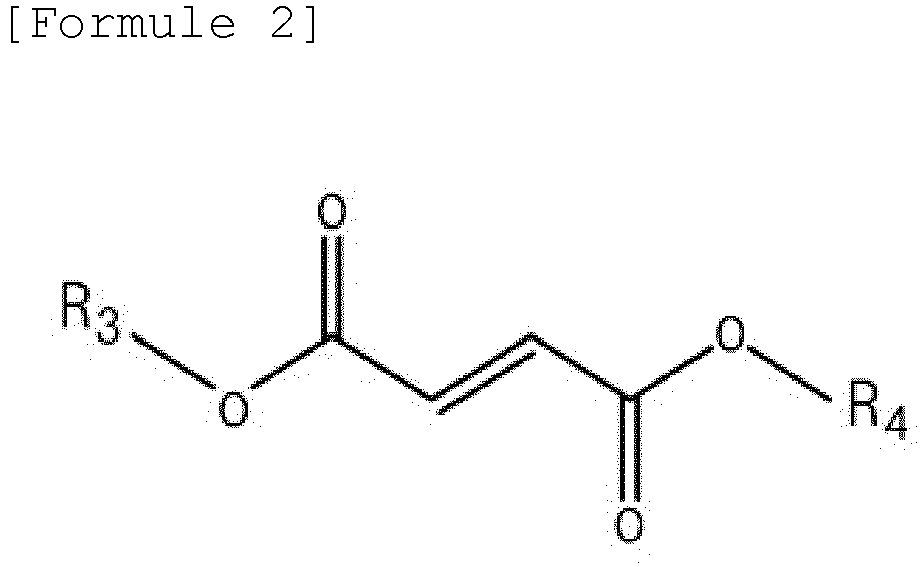
- the present invention provides a vinyl chloride-based polymer containing 0.001 parts by weight or more and less than 2 parts by weight of an unsaturated carboxylic acid ester on the basis of 100 parts by weight of the vinyl chloride-based polymer, wherein the unsaturated carboxylic acid ester includes cis- and trans-isomers of unsaturated carboxylic acid ester, wherein the weight ratio between the cis- and trans-isomers of unsaturated carboxylic acid ester is 60:40 to 90:10, and wherein the cis-isomer of unsaturated carboxylic acid ester is a compound represented by Formula 1, and the trans isomer of the unsaturated carboxylic acid ester is a compound represented by Formula 2: in Formulas 1 and 2, R 1 to R 4 are each independently selected from the group consisting of an alkyl group having 2 to 16 carbon atoms, a cycloalkyl group having 3 to 16 carbon atoms, and a combination thereof.
- R 1 to R 4 are each independently selected
- thermoplastic resin composition containing the vinyl chloride-based polymer.
- thermoplastic resin molded article produced from the thermoplastic resin composition.
- a vinyl chloride-based polymer according to the present invention contains an unsaturated carboxylic acid ester at a specific ratio of 0.001 parts by weight or more and less than 2 parts by weight, and the processability thereof can be improved due to the action of an internal plasticizer of the unsaturated carboxylic acid ester.
- the unsaturated carboxylic acid ester can be stably distributed in the vinyl chloride-based polymer, and the polymerization conversion rate to a vinyl chloride-based polymer can be increased.
- thermoplastic resin molded article produced from a thermoplastic resin composition containing the vinyl chloride-based polymer according to the present invention can have excellent impact strength, a small number of fish-eyes, and excellent appearance characteristics.
- the vinyl chloride-based polymer according to the present invention and the method for preparing the same can be easily applied to industries as needed, in particular, industries using vinyl chloride-based resins.
- the present invention provides a vinyl chloride-based polymer which has excellent processability and thus is capable of providing molded articles having a small number of fish-eyes and excellent appearance characteristics.
- the vinyl chloride-based polymer according to the present invention is characterized by containing 0.001 parts by weight or more and less than 2 parts by weight of an unsaturated carboxylic acid ester on the basis of 100 parts by weight of the vinyl chloride-based polymer, wherein the unsaturated carboxylic acid ester includes cis- and trans-isomers of unsaturated carboxylic acid ester, wherein the weight ratio between the cis- and trans-isomers of unsaturated carboxylic acid ester is 60:40 to 90:10, and wherein the cis-isomer of unsaturated carboxylic acid ester is a compound represented by Formula 1, and the trans isomer of the unsaturated carboxylic acid ester is a compound represented by Formula 2: in Formulas 1 and 2, R 1 to R 4 are each independently selected from the group consisting of an
- vinyl chloride-based polymer in the present disclosure comprehensively means a material produced by polymerizing a vinyl chloride-based monomer, and may be in a state in which vinyl chloride-based monomer-derived polymer chains and unsaturatedcarboxylic acid esters are mixed.
- mixed includes a mixture state, a bonded state, relationship between a continuous phase and a discontinuous phase, and the like.
- the vinyl chloride-based polymer according to an embodiment of the present invention may be a polymer prepared by a method described below using only vinyl chloride monomer as a monomer component.
- the vinyl chloride-based polymer may be a copolymer prepared using, as monomer components, a vinyl chloride monomer as a main component, together with a vinyl-based monomer which is copolymerizable with the vinyl chloride monomer.
- the vinyl chloride-based polymer is a copolymer of a vinyl chloride monomer and a vinyl-based monomer
- the content of vinyl chloride in the copolymer may be 50% or more.
- vinyl-based monomers copolymerizable with the vinyl chloride-based monomer may include, but not limited to, olefin compounds such as ethylene, propylene and butene; vinyl esters such as vinyl acetate, vinyl propionate and vinyl stearate; unsaturated nitriles such as acrylonitrile; vinyl alkyl ethers such as vinyl methyl ether, vinyl ethyl ether, vinyl octyl ether and vinyl lauryl ether; vinylidene halides such as vinylidene chloride; unsaturated carboxylic acids such as acrylic acid, methacrylic acid, itaconic acid, maleic acid, fumaric acid, maleic anhydride and itaconic anhydride, and anhydrides of these carboxylic acids; unsaturated carboxylic acid esters such as methyl acrylate, ethyl acrylate, monomethyl maleate, dimethyl maleate and butyl benzyl maleate; and crosslinkable monomers such as
- the unsaturated carboxylic acid ester included in the vinyl chloride-based polymer according the present invention may be a substance produced by esterification of an unsaturated carboxylic acid with an alcohol, and the unsaturated carboxylic acid is a compound having at least one carbon-carbon double bond.
- the unsaturated carboxylic acid ester may act as an internal plasticizer and thus serve to improve the processability of the vinyl chloride-based polymer containing the unsaturated carboxylic acid ester.
- the unsaturated carboxylic acid ester includes cis- and trans-isomers of carboxylic acid ester.
- the weight ratio between the cis- and trans-isomers of carboxylic acid ester is 60:40 to 90:10. More particularly, the weight ratio between the cis- and trans-isomers of unsaturated carboxylic acid ester may be 65:35 to 80:20.
- the cis-isomer of unsaturated carboxylic acid ester is a compound represented by Formula 1 below, and the trans-isomer of unsaturated carboxylic acid ester is a compound represented by Formula 2 below.
- R 1 to R 4 are each independently selected from the group consisting of an alkyl group having 2 to 16 carbon atoms, a cycloalkyl group having 3 to 16 carbon atoms, and the combination thereof.
- the combination thereof may mean that two or more functional groups are bonded by a single bond, a double bond (ethylene group), a triple bond (acetylene group) or through a linker such as an alkylene group having 2 to 16 carbon atoms (for example, a methylene group (-CH 2 -) or an ethylene group (-CH 2 CH 2 -), etc.), or two or more functional groups linked by condensation.
- a linker such as an alkylene group having 2 to 16 carbon atoms (for example, a methylene group (-CH 2 -) or an ethylene group (-CH 2 CH 2 -), etc.
- R 1 to R 4 may be each independently a linear or branched alkyl group having 4 to 14 carbon atoms.
- alkyl group may refer to a remaining atomic group excluding one hydrogen atom in a saturated hydrocarbon chain.
- the unsaturated carboxylic acid ester according to an embodiment of the present invention is included in the vinyl chloride-based polymer in an amount of 0.001 parts by weight or more and less than 2 parts by weight as described above.
- the amount of the unsaturated carboxylic acid ester included is less than 0.001 parts by weight, the action as an internal plasticizer may not be properly exhibited, and the processability of the vinyl chloride-based polymer containing thereof may not be improved.
- the amount of the unsaturated carboxylic acid ester is 2 parts by weight or more, antiplasticization phenomenon may occur, and the impact strength of a thermoplastic resin molded article which is produced using the vinyl chloride-based polymer may be deteriorated or the surface properties thereof may be suppressed even the processability of the vinyl chloride-based polymer containing thereof may be somewhat improved.
- the vinyl chloride polymer according to the present invention includes an unsaturated carboxylic acid ester which may act as an internal plasticizer at a specific ratio, processability may be improved due to the unsaturated carboxylic acid ester.
- a method for preparing the vinyl chloride-based polymer comprises:
- Step A is a step for producing a vinyl chloride-based polymer containing an unsaturated carboxylic acid ester at a specific ratio and can be performed by adding an unsaturated carboxylic acid ester to a vinyl chloride-based monomer and polymerizing.
- step A is performed by adding an unsaturated carboxylic acid ester mixture to a polymerization reactor provided with a vinyl chloride-based monomer and then performing suspension polymerization.
- the polymerization reactor may be a filled-reactor with a solvent, a polymerization initiator and a protective colloid auxiliary prior to providing the vinyl chloride-based monomer.
- the "filled-reactor” may mean a reactor in a state in which a solvent, a polymerization initiator and a protective colloid auxiliary are added prior to providing the vinyl chloride-based monomer.
- the vinyl chloride-based monomer may be pure vinyl chloride-based monomer alone.
- the vinyl chloride-based monomer may be a combination of a vinyl chloride monomer and a vinyl-based monomer copolymerizable therewith according to the objective.
- the amount of the vinyl chloride may be controlled so as to be 50 wt% or more in the vinyl chloride-based polymer finally prepared.
- the vinyl-based monomer copolymerizable with the vinyl chloride monomer may be the same as described above.
- the unsaturated carboxylic acid ester is added during polymerization of a vinyl chloride-based monomer and is included in a vinyl chloride-based polymer finally prepared at a specific ratio to serve the improvement of the processability of the vinyl chloride-based polymer, and includes cis- and trans-isomers of unsaturated carboxylic acid ester as described above.
- the weight ratio between the cis- and trans-isomers of unsaturated carboxylic acid ester is 60:40 to 90:10. More particularly, the weight ratio between the cis- and trans-isomers of unsaturated carboxylic acid ester may be 65:35 to 80:20. Specific examples of the unsaturated carboxylic acid ester may be the same as described above.
- the amount of the unsaturated carboxylic acid ester is 0.001 parts by weight or more and less than 2 parts by weight on the basis of 100 parts by weight of the vinyl chloride-based monomer.
- the improvement effect of processability of the vinyl chloride-based polymer finally prepared may not be attained or may be trivial, and in the case where the amount is 2 parts by weight or more, the processability of the vinyl chloride-based polymer finally prepared may be somewhat improved, but the impact strength of a molded article using thereof may be deteriorated and the surface properties thereof may be degraded.
- the unsaturated carboxylic acid ester is batch-added, continuously added, or added in at least two installments to a polymerization reactor provided with a vinyl chloride-based monomer in a range in which the polymerization conversion rate is 85% or less as described above.
- the "polymerization conversion rate” may mean conversion rate of a vinyl chloride-based monomer to a polymer and may be measured by using a butane tracer equipped with gas chromatography. Specifically, a polymerization conversion curve according to the ratio of the vinyl chloride-based monomer to butane with time under predetermined polymerization conditions is drawn for each polymerization condition, and the polymerization conversion rate according to each polymerization condition may be measured on the basis of the curve. Also, the polymerization conversion rate may include a tolerance of the measurement, and, for example, may include up to ⁇ 3% from 85%.
- the batch addition may be addition of an unsaturated carboxylic acid ester which is used at one point in the above-described range of the polymerization conversion rate to a polymerization reactor provided with a vinyl chloride-based monomer at a time.
- the batch addition may be addition of the entire amount of the unsaturated carboxylic acid ester in a range of the polymerization conversion rate of 60% or less at a time.
- the continuous addition may be addition of an unsaturated carboxylic acid ester continuously to a polymerization reactor provided with a vinyl chloride-based monomer in a range of the polymerization conversion rate of 85% or less, and in particular, may be performed in such a manner that the addition of the unsaturated carboxylic acid ester is started when the polymerization conversion rate is 1% or more, and the addition is ended when the polymerization conversion rate is 85% or less.
- the addition may be performed in such a manner that an entire amount of the unsaturated carboxylic acid ester is added at a constant rate from the start to the end of the addition.
- the polymerization conversion rate of 1% may denote the reaching time of a polymerization initiation temperature, and that is, the unsaturated carboxylic acid ester may be added immediately after the start of polymerization or simultaneously with the start of polymerization.
- the polymerization conversion rate of 85% may denote the end time of polymerization and may include up to the termination time of reaction,
- the continuous addition may be performed in such a manner that the addition is started when the polymerization conversion rate is 10% or more, and the addition is ended when the polymerization conversion rate is 35% or less, and the entire amount of the unsaturated carboxylic acid ester used may be added at a constant rate from the start to the end of the addition.
- the addition in installments may denote continuous addition in installments or batch addition in installments.
- the continuous addition in installments may be continuous addition of an unsaturated carboxylic acid ester after dividing thereof in two or more parts in a range of a specific polymerization conversion rate, and the batch addition in installments may be addition at a time at a specific polymerization conversion rate after dividing an unsaturated carboxylic acid ester in two or more parts.
- the continuous addition in installments may include a first continuous addition in which the addition of a first fraction of the entire amount of the unsaturated carboxylic acid ester is started at the time when the polymerization conversion rate is 1% or more and is ended at the time when the polymerization conversion rate is 25% or less, and a second continuous addition in which the addition of a second fraction which corresponds to the entire amount excluding the first fraction is started at the time when the polymerization conversion rate is 35% or more and is ended at the time when the polymerization conversion rate is 60% or less.
- each of the first continuous addition and the second continuous addition may be performed by continuously adding the unsaturated carboxylic acid ester at a constant rate from the start to the end of the addition.
- the batch addition in installments may be performed in such a manner that a first fraction of the entire amount of the unsaturated carboxylic acid ester is primarily added when the polymerization conversion rate is in a range of 1% to 30%, and a remaining second fraction excluding the first fraction, of the entire amount of the unsaturated carboxylic acid ester is secondarily added when the polymerization conversion rate is in a range of 35% to 85%.
- the first fraction and the second fraction may be adjusted to be divided into a weight ratio of 9:1 to 1:9, and the addition in installments may be performed by a number of at least two times, three times, and four times. Fractions may be formed in a number equal to the number of times of the additions, and each fraction may be adjusted to have an appropriate ratio depending on the purpose.
- the continuous addition in installments may include a first continuous addition in which the addition of a first fraction of the entire amount of the unsaturated carboxylic acid ester is started at the time when the polymerization conversion rate is 1% or more and is ended at the time when the polymerization conversion rate is 25% or less, a second continuous addition in which the addition of a second fraction of the entire amount is started at the time when the polymerization conversion rate is 30% or more and is ended at the time when the polymerization conversion rate is 50% or less, and a third continuous addition in which the addition of a third fraction of the entire amount excluding the first fraction and the second fraction is started at the time when the polymerization conversion rate is 55% or more and is ended at the time when the polymerization conversion rate is 70% or less.
- each of the first continuous addition, the second continuous addition, and the third continuous addition may be performed by adding the unsaturated carboxylic acid ester from the start to
- the batch addition in installments may be performed in such a manner that a first fraction of the entire amount of the unsaturated carboxylic acid ester is primarily added when the polymerization conversion rate is in a range of 10% to 30%, a second fraction of the entire amount is secondarily added when the polymerization conversion rate is in a range of 35% to 50%, and a remaining third fraction excluding the first fraction and the second fraction, of the entire amount is thirdly added when the polymerization conversion rate is in a range of 55% to 85%.
- the protective colloid auxiliary functions to stabilize reactants during polymerization and allows the production of uniform and stable particles, wherein the protective colloid auxiliary may be used in an amount of 0.03 parts by weight to 5 parts by weight on the basis of 100 parts by weight of the vinyl chloride-based monomer that is used in the polymerization. Specifically, the protective colloid auxiliary may be used in an amount of 0.05 parts by weight to 2.5 parts by weight on the basis of 100 parts by weight of the vinyl chloride-based monomer. If the protective colloid auxiliary is used in an amount of less than 0.03 parts by weight, the particle size of the vinyl chloride-based polymer finally prepared increases excessively, and fish-eyes may be generated in a molded article manufactured using the vinyl chloride-based polymer.
- the protective colloid auxiliary is used in an amount of greater than 5 parts by weight, initial colorability of a molded article manufactured using the vinyl chloride-based polymer may be deteriorated due to the increase of fine particles in the vinyl chloride-based polymer finally prepared.
- the protective colloid auxiliary may be one selected from the group consisting of a vinyl alcohol-based resin, cellulose, and an unsaturated organic acid polymer, or a mixture of two thereof, and, specifically, the protective colloid auxiliary may be a mixture in which the vinyl alcohol-based resin and the cellulose are mixed in a weight ratio of 5:1 to 9:7.
- the vinyl alcohol-based resin may be a mixture in which a first polyvinyl alcohol having a degree of hydration of greater than 50 wt% and 90 wt% and less, and a second polyvinyl alcohol having a degree of hydration of 30 wt% to 50 wt% are mixed in a weight ratio of 2:1 to 1:2.
- the cellulose may include methyl cellulose, hydroxyethyl cellulose, or hydroxypropylmethyl cellulose, and any one thereof or a mixture of two or more thereof may be used.
- the cellulose may be hydroxypropylmethyl cellulose and more particularly, an amount of a hydroxypropyl group in the molecule may be in a range of 3 wt% to 20 wt% and viscosity of 2% aqueous solution at 23 ⁇ 5°C may be in a range of 10 cps to 20,000 cps.
- the unsaturated organic acid polymer may include an acrylic acid polymer, a methacrylic acid polymer, an itaconic acid polymer, a fumaric acid polymer, a maleic acid polymer, or a succinic acid polymer, and any one thereof or a mixture of two or more thereof may be used.
- the polymerization initiator may be used in an amount of 0.02 parts by weight to 0.2 parts by weight on the basis of 100 parts by weight of the vinyl chloride-based monomer that is used in the polymerization. Specifically, the polymerization initiator may be used in an amount of 0.04 parts by weight to 0.12 parts by weight on the basis of 100 parts by weight of the vinyl chloride-based monomer. If the amount of the polymerization initiator is less than 0.02 parts by weight, polymerization reaction time may be increased and the conversion rate to the vinyl chloride-based polymer may be decreased, thereby decreasing the productivity.
- the amount of the polymerization initiator is greater than 0.2 parts by weight, the polymerization initiator may not be completely consumed during the polymerization but may remain in the vinyl chloride-based polymer finally prepared, thereby causing worry on the decrease of physical properties, particularly thermal stability of the polymer.
- the polymerization initiator is not particularly limited, but may include, for example, a peroxide-based compound such as dicumyl peroxide, dipentyl peroxide, di-3,5,5-trimethyl hexanoyl peroxide, and dilauryl peroxide; a peroxydicarbonate-based compound such as diisopropyl peroxydicarbonate, di-sec-butyl peroxydicarbonate, and di-2-ethylhexyl peroxydicarbonate; a peroxyester-based compound such as t-butyl peroxypivalate, 1,1,3,3-tetramethylbutyl peroxyneodecanoate, and t-butyl peroxyneodecanoate; an azo-based compound such as azobis-2,4-dimethylvaleronitrile; a hydroperoxide-based compound such as t-butyl hydroperoxide; or a sulfate-based compound such as potassium
- the suspension polymerization is not specifically limited, but, for example, may be performed in a temperature range of 30°C to 70°C, and the temperature during the suspension polymerization may be appropriately adjusted within the above temperature range according to the desired degree of polymerization.
- polymerization may be ended by adding a reaction terminator, and the end point may be a point at which a pressure in the reactor is in a range of 6 kg/cm 2 to 8 kg/cm 2 (or a point at which the polymerization conversion rate is greater than 85%).
- the reaction terminator is not particularly limited, but may include, for example, a phenolic compound, an amine compound, a nitrile compound, or a sulfur compound.
- the reaction terminator may be at least one selected from the group consisting of a phenolic compound such as triethylene glycol-bis-3-(3-t-butyl-4-hydroxy-5-methylphenyl)propionate, hydroquinone, p-methoxy phenol, t-butyl hydroxyanisole, n-octadecyl-3-(4-hydroxy-3,5-di-t-butylphenyl)propionate, 2,5-di-t-butylhydroquinone, 4,4'-butylidenebis(3-methyl-6-t-butylphenol), t-butyl catechol, 4,4'-thiobis(6-t-butyl-m-cresol), and tocopherol, an amine compound such as N,N'-diphenyl-p-
- a solvent may be used, and the solvent may be deionized water.
- the amount of the solvent may be appropriately controlled according to the amount of the vinyl chloride-based monomer used in polymerization and the size of a polymerization reactor.
- the solvent may be used in an amount of 70 parts by weight or more on the basis of 100 parts by weight of the vinyl chloride-based monomer.
- an additive such as a polymerization regulator, a chain transfer agent, a pH adjuster, an antioxidant, a cross-linking agent, an antistatic agent, a scale inhibitor, and a surfactant, may be further added as needed in addition to the above-described active ingredients, and type and amount of the additive are not particularly limited and the type and amount known in the art may be used.
- the additive may be added at any point, for example, at the starting of the suspension polymerization, in the middle of the polymerization, or after the polymerization, and may be added in batches or continuously.
- the preparation method according to the present invention may further include drying after the step A, and the drying is not particularly limited and may be performed by a method known in the art.
- thermoplastic resin composition including the vinyl chloride-based polymer.
- the thermoplastic resin composition may include the vinyl chloride-based polymer which contains a unsaturated carboxylic acid ester at a specific ratio as a main component. That is, the thermoplastic resin composition may include 90 wt% or more, particularly, 95 wt% or more of the vinyl chloride-based polymer on the basis of 100 wt% of the composition.
- thermoplastic resin composition may include various additives according to an object to produce, for example, the use of a thermoplastic resin molded article.
- the additive is not specifically limited, but may include a plasticizer, a stabilizer, a lubricant, an impact reinforcing agent, a processing assistant agent, a pigment, etc.
- thermoplastic resin molded article manufactured from the thermoplastic resin composition.
- thermoplastic resin molded article is produced from a thermoplastic resin composition containing a vinyl chloride-based polymer according to the present invention, and may have excellent impact strength, a small number of fish-eyes, and excellent transparency.
- polymerization conversion rate was measured using a butane tracer equipped with gas chromatography. Specifically, a polymerization conversion curve according to the ratio of the vinyl chloride-based monomer to butane with time under predetermined polymerization conditions was drawn for each polymerization condition, and the polymerization conversion rate according to each polymerization condition was measured on the basis of the curve.
- 390 kg of deionized water was added to a reactor having an internal volume of 1 m 3 and equipped with a reflux condenser, 150 g of polyvinyl alcohol having a degree of hydration of 80.5%, 120 g of polyvinyl alcohol having a degree of hydration of 42.3%, and 30 g of hydroxypropylmethyl cellulose were added to the reactor, and 300 kg of a vinyl chloride monomer was added thereto. Then, 60 g of di-2-ethylhexyl peroxydicarbonate and 120 g of t-butyl peroxyneodecanoate were added to initiate the reaction.
- di(2-ethylhexyl)ester started to be added to the reactor and the addition was ended when the polymerization conversion rate was 35%.
- the di (2-ethylhexyl) ester added was 3 g in total and was a mixture of di(2-ethylhexyl)maleate and di(2-ethylhexyl)fumarate in a weight ratio of 90:10.
- the reaction temperature was maintained at 57°C during the entire process of the polymerization reaction, and, when an internal pressure of the reactor for polymerization reached 6.3 kg/cm 2 , 12 g of 4-hydroxy-2,2,6,6-tetramethyl-piperidine-1-oxyl and 90 g of triethylene glycol-bis-3-(3-t-butyl-4-hydroxy-5-methylphenyl)propionate were added to terminate the reaction. Thereafter, an unreacted monomer and a vinyl chloride-based copolymer slurry generated were separated from each other and recovered, and the vinyl chloride-based copolymer slurry was dried in a fluidized bed dryer to obtain a vinyl chloride-based polymer.
- a vinyl chloride-based polymer was produced by the same method described in Example 1 except for increasing the amount added of di(2-ethylhexyl)ester to 1,500 g.
- a vinyl chloride-based polymer was produced by the same method described in Example 1 except for increasing the amount added of di(2-ethylhexyl)ester to 4,500 g.
- a vinyl chloride-based polymer was produced by the same method described in Example 1 except for using a mixture of di(2-ethylhexyl)maleate and di(2-ethylhexyl)fumarate in a weight ratio of 80:20 instead of di(2-ethylhexyl)ester.
- a vinyl chloride-based polymer was produced by the same method described in Example 1 except for using a mixture of di(2-ethylhexyl)maleate and di(2-ethylhexyl)fumarate in a weight ratio of 65:35 instead of di(2-ethylhexyl)ester.
- a vinyl chloride-based polymer was produced by the same method described in Example 2 except for using di(ethyldodecyl)ester instead of di(2-ethylhexyl)ester.
- the di(ethyldodecyl)ester was a mixture of di(ethyldodecyl)maleate and di(ethyldodecyl)fumarate in a weight ratio of 90:10.
- a vinyl chloride-based polymer was produced by the same method described in Example 1 except for using 150 g of dihexyl ester together with the vinyl chloride-based monomer in batch instead of di(2-ethylhexyl)ester.
- the dihexyl ester was a mixture of dihexyl maleate and dihexyl fumarate in a weight ratio of 90:10.
- a vinyl chloride-based polymer was produced by the same method described in Example 1 except for adding 100 g of di(2-ethylhexyl)ester in batch at a point when polymerization conversion rate was 10%.
- a vinyl chloride-based polymer was produced by the same method described in Example 1 except for using dibutyl ester instead of di(2-ethylhexyl)ester, primarily adding 500 g of the dibutyl ester in batch at a point when polymerization conversion rate was 15% and continuing polymerization, and secondly adding 500 g of the dibutyl ester in batch at a point when polymerization conversion rate was 40%.
- the dibutyl ester was a mixture of dibutyl maleate and dibutyl fumarate in a weight ratio of 90:10.
- a vinyl chloride-based polymer was produced by the same method described in Example 1 except for using didecyl ester instead of di(2-ethylhexyl)ester, primarily adding 1, 000 g of the didecyl ester continuously in a way that the addition started at a point when polymerization conversion rate was 15% and the addition was ended at a point when polymerization conversion rate was 20%, and secondly adding 1,000 g of the didecyl ester continuously in a way that the addition started at a point when polymerization conversion rate was 30% and the addition was ended at a point when polymerization conversion rate was 40%.
- the didecyl ester was a mixture of didecyl maleate and didecyl fumarate in a weight ratio of 90:10.
- a vinyl chloride-based polymer was produced by the same method described in Example 1 except for primarily adding 500 g of the di(2-ethylhexyl)ester in batch at a point when polymerization conversion rate was 20% and continuing polymerization, secondly adding 500 g of di(2-ethylhexyl)ester in batch at a point when polymerization conversion rate was 40% and continuing polymerization, and thirdly adding 500 g of di(2-ethylhexyl)ester in batch at a point when polymerization conversion rate was 60%.
- All the di(2-ethylhexyl)esters added in the first, second and third batch were a mixture of di(2-ethylhexyl)maleate and di(2-ethylhexyl)fumarate in a weight ratio of 90:10.
- 390 kg of deionized water was added to a reactor having an internal volume of 1 m 3 and equipped with a reflux condenser, 150 g of polyvinyl alcohol having a degree of hydration of 80.5%, 120 g of polyvinyl alcohol having a degree of hydration of 42.3%, and 30 g of hydroxypropylmethyl cellulose were added to the reactor, and 300 kg of a vinyl chloride monomer was added thereto. Then, 60 g of di-2-ethylhexyl peroxydicarbonate and 150 g of t-butyl peroxyneodecanoate were added to initiate the reaction.
- di(2-ethylhexyl)ester 50 g was added in batch.
- the di(2-ethylhexyl)ester was a mixture of di(2-ethylhexyl)maleate and di(2-ethylhexyl)fumarate in a weight ratio of 90:10.
- the reaction temperature was maintained at 64°C during an entire process of the polymerization reaction, and when an internal pressure of the reactor reached 8.0 kg/cm 2 , 12 g of 4-hydroxy-2,2,6,6-tetramethyl-piperidine-1-oxyl and 90 g of triethylene glycol-bis-3-(3-t-butyl-4-hydroxy-5-methylphenyl)propionate were added to terminate the reaction. Thereafter, an unreacted monomer and a vinyl chloride-based copolymer slurry generated were separated from each other and recovered, and the vinyl chloride-based copolymer slurry was dried in a fluidized bed dryer to obtain a vinyl chloride-based polymer.
- a vinyl chloride-based polymer was produced by the same method described in Example 12 except for adding 300 g of dibutylester instead of di(2-ethylhexyl)ester in a way that the addition started at a point when polymerization conversion rate was 50% and the addition was ended at a point when polymerization conversion rate was 60%.
- a vinyl chloride-based polymer was produced by the same method described in Example 12 except for adding 500 g of didecylester instead of di(2-ethylhexyl)ester in a way that the addition started at a point when polymerization conversion rate was 15% and the addition was ended at a point when polymerization conversion rate was 30%.
- the didecyl ester was a mixture of didecyl maleate and didecyl fumarate in a weight ratio of 90:10.
- a vinyl chloride-based polymer was produced by the same method described in Example 12 except for primarily adding 200 g of di(2-ethylhexyl)ester continuously in a way that the addition started at a point when polymerization conversion rate was 15% and the addition was ended at a point when polymerization conversion rate was 25% and continuing polymerization, secondly adding 200 g of di(2-ethylhexyl)ester continuously in a way that the addition started at a point when polymerization conversion rate was 35% and the addition was ended at a point when polymerization conversion rate was 45% and continuing polymerization, and additionally adding 200 g of di(2-ethylhexyl)ester continuously in a way that the addition started at a point when polymerization conversion rate was 55% and the addition was ended at a point when polymerization conversion rate was 70%.
- the di(2-ethylhexyl)ester was a mixture of di(2-ethylhexyl)maleate and di(2-e
- a vinyl chloride-based polymer was produced by the same method described in Example 1 except for not using di(2-ethylhexyl)ester.
- a vinyl chloride-based polymer was produced by the same method described in Example 1 except for adding 2.5 g of di(2-ethylhexyl)ester.
- a vinyl chloride-based polymer was produced by the same method described in Example 1 except for increasing the amount added of di(2-ethylhexyl)ester to 7,500 g.
- a vinyl chloride-based polymer was produced by the same method described in Example 1 except for using a mixture of di(2-ethylhexyl)maleate and di(2-ethylhexyl)fumarate in a weight ratio of 95:5 as di(2-ethylhexyl)ester.
- a vinyl chloride-based polymer was produced by the same method described in Example 1 except for using a mixture of di(2-ethylhexyl)maleate and di(2-ethylhexyl)fumarate in a weight ratio of 50:50 as di(2-ethylhexyl)ester.
- a vinyl chloride-based polymer was produced by the same method described in Example 6 except for using di(octadecyl)ester instead of the di(2-ethylhexyl)ester.
- the di(octadecyl)ester was a mixture of di(octadecyl)maleate and di(octadecyl)fumarate in a weight ratio of 90:10.
- a vinyl chloride-based polymer was produced by the same method described in Example 1 except for using diallyl ester instead of di(2-ethylhexyl)ester.
- the diallyl ester was a mixture of diallyl maleate and diallyl fumarate in a weight ratio of 90:10.
- a vinyl chloride-based polymer was produced by the same method described in Example 12 except for not using di(2-ethylhexyl)ester.
- the apparent specific gravity was measured based on ASTM D1 895-89 standard.
- the average particle diameter and the particle size distribution degree were measured based on ASTM D1 705 standard.
- the average particle diameter was weight average particle diameter obtained by the standard, and the particle size distribution degree was obtained from the remaining amount not passing through a 200 mesh with respect to the entire specimen used for the measurement in a wt% ratio.
- the vinyl chloride polymers of Examples 1 to 11 and the vinyl chloride polymers of Examples 12 to 15 according to exemplary embodiments of the present invention exhibited similar particle properties, in general, as the vinyl chloride polymers of Comparative Examples 1 and 8, which were prepared to the same polymerization degrees, respectively.
- the vinyl chloride polymers of Comparative Examples 3 to 7 exhibited changed particle properties when compared to the vinyl chloride polymer of Comparative Example 1, which was prepared to the same polymerization degree.
- the vinyl chloride polymers of Comparative Example 4, Comparative Example 6, and Comparative Example 7 exhibited considerably changed particle properties when compared to the vinyl chloride polymer of Comparative Example 1.
- the vinyl chloride polymers of Examples 1 to 15 according to exemplary embodiments of the present invention include a specific amount of an unsaturated carboxylic acid ester in which cis- and trans-isomers are present at a specific weight ratio, and particle properties inherent in a common vinyl chloride polymer are not changed.
- thermoplastic resin composition including each vinyl chloride polymer was prepared and a molded article was manufactured using thereof. Then, the generation degree of fish-eyes, transparency and impact strength were measured, and the results are listed in Table 2 below.
- Each sheet thus manufactured was cut to a predetermined size, then was put into a frame with a thickness of 3 cm, and using a press, pre-heated at 185°C for 2 minutes, heated at a low pressure for 3 minutes and cooled at a high pressure for 2 minutes to manufacture each compressed sheet. Transparency was measured for each compressed sheet using a haze-gard plus instrument (BYK-Gardener). The higher the transparency value is, the better the product is.
- Example 1 10 77.3 33 Example 2 3 78.3 37 Example 3 2 78.6 42 Example 4 7 77.3 36 Example 5 9 78.5 37 Example 6 3 78.4 38 Example 7 6 78.1 35 Example 8 78.0 34 Example 9 4 78.3 37 Example 10 3 78.9 40 Example 11 7 79.2 40 Example 12 12 76.8 32 Example 13 7 77.2 34 Example 14 8 77.4 35 Example 15 9 77.5 34 Comparative Example 1 12 76.1 32 Comparative Example 2 12 76.4 31 Comparative Example 3 4 77.5 26 Comparative Example 4 1 3 75.2 29 Comparative Example 5 8 73.1 36 Comparative Example 6 14 74.5 28 Comparative Example 7 19 74.1 27 Comparative Example 8 15 75.7 30
- each molded article manufactured by using the vinyl chloride polymers of Examples 1 to 15 according to exemplary embodiments of the present invention exhibited similar or better transparency and impact strength and decreased generation of fish-eyes, in general, when compared to each molded article manufactured by using the vinyl chloride polymer of Comparative Examples 1 to 8.
- the vinyl chloride polymer of Comparative Example 1 which did not include an unsaturated carboxylic acid ester, exhibited somewhat decreased transparency, markedly increased number of fish-eyes by 120%, and decreased impact strength by about 4% when compared to the vinyl chloride polymer of Example 1, which was produced under the same conditions except for the inclusion or exclusion of an unsaturated carboxylic acid ester.
- the vinyl chloride polymer of Comparative Example 8 when comparing the vinyl chloride polymers of Example 12 and Comparative Example 8, which were produced under the same conditions except for the inclusion or exclusion of an unsaturated carboxylic acid ester, the vinyl chloride polymer of Comparative Example 8 exhibited somewhat decreased transparency, markedly increased number of fish-eyes by 125%, and decreased impact strength by about 6% when compared to the vinyl chloride polymer of Example 12.
- the vinyl chloride polymer in which an unsaturated carboxylic acid ester was included in an amount range suggested in the present invention but the ratio of a cis- isomer was excessively large in the weight ratio of a cis- isomer and a trans-isomer according to Comparative Example 4 (cis-isomer:trans-isomer 95:5), exhibited decreased transparency, increased number of fish-eyes by 130%, and markedly decreased impact strength to 79% degree when compared to the vinyl chloride polymer of Example 1.
- the vinyl chloride polymer in which an unsaturated carboxylic acid ester was included in an amount range suggested in the present invention but the ratio of a cis-isomer and a trans-isomer was the same in the weight ratio of a cis-isomer and a trans-isomer according to Comparative Example 5 (cis-isomer:trans-isomer 50:50), exhibited similar or somewhat decreased number of fish-eyes and impact strength, and decreased transparency to 93% degree when compared to the vinyl chloride polymer of Example 5.
- the vinyl chloride polymer of Comparative Example 6 which included an unsaturated carboxylic acid ester having a deviated carbon number from that suggested in the present invention exhibited decreased transparency to 95% degree, increased number of fish-eyes by about 5 times, and markedly decreased impact strength to 74% degree when compared to the vinyl chloride polymer of Example 6.
- the vinyl chloride polymer of Comparative Example 7 which included a diallyl ester instead of an unsaturated carboxylic acid ester suggested in the present invention, exhibited decreased transparency to 96% degree, rapidly increased number of fish-eyes by about 2 times, and markedly decreased impact strength to 82% degree when compared to the vinyl chloride polymer of Example 1.
- the vinyl chloride polymer according to an embodiment of the present invention may have similar particle properties as a common vinyl chloride polymer by including a specific amount range of an unsaturated carboxylic acid ester in which a cis-isomer and a trans-isomer are mixed in a specific weight ratio, and thus, impact strength properties of a common vinyl chloride polymer may not be deteriorated, the effect of an inherent plasticizer may be attained to improve processability, and the appearance characteristics of a molded article (for example, decrease of the number of fish-eyes, increase of transparency) may be improved.
Landscapes
- Chemical & Material Sciences (AREA)
- Health & Medical Sciences (AREA)
- Chemical Kinetics & Catalysis (AREA)
- Medicinal Chemistry (AREA)
- Polymers & Plastics (AREA)
- Organic Chemistry (AREA)
- Polymerisation Methods In General (AREA)
- Compositions Of Macromolecular Compounds (AREA)
- Addition Polymer Or Copolymer, Post-Treatments, Or Chemical Modifications (AREA)
Claims (14)
- Polymère à base de chlorure de vinyle contenant 0,001 partie en poids ou plus et moins de 2 parties en poids d'un ester insaturé d'un acide carboxylique pour 100 parties en poids du polymère à base de chlorure de vinyle,
où l'ester insaturé d'un acide carboxylique inclut les isomères cis et trans de l'ester insaturé d'un acide carboxylique,
où le rapport en poids entre les isomères cis et trans de l'ester insaturé d'un acide carboxylique va de 60:40 à 90:10 et
où l'isomère cis de l'ester insaturé d'un acide carboxylique est un composé représenté par la Formule 1 et l'isomère trans de l'ester insaturé d'un acide carboxylique est un composé représenté par la Formule 2 :
- Polymère à base de chlorure de vinyle de la revendication 1, où le rapport en poids entre les isomères cis et trans de l'ester insaturé d'un acide carboxylique va de 65:35 à 80:20.
- Polymère à base de chlorure de vinyle de la revendication 1 où, dans les Formules 1 et 2, R1 à R4 représentent chacun indépendamment un groupement alkyle linéaire ou ramifié à 4 à 14 atomes de carbone.
- Procédé de préparation du polymère à base de chlorure de vinyle de la revendication 1, le procédé comprenant :l'addition d'un ester insaturé d'un acide carboxylique à un monomère à base de chlorure de vinyle en la présence d'un initiateur de polymérisation et d'un auxiliaire colloïdal protecteur et la réalisation d'une polymérisation en suspension,où l'ester insaturé d'un acide carboxylique est ajouté en discontinu, ajouté en continu ou ajouté sous la forme de deux fractions au moins à une cadence telle que le taux de conversion par polymérisation du monomère à base de chlorure de vinyle est inférieur ou égal à 85 %,où l'ester insaturé d'un acide carboxylique est ajouté à une quantité de 0,001 partie en poids ou plus et de moins de 2 parties en poids pour 100 parties en poids du monomère à base de chlorure de vinyle,où l'ester insaturé d'un acide carboxylique inclut les isomères cis et trans d'un ester insaturé d'un acide carboxylique etoù le rapport en poids entre les isomères cis et trans de l'ester insaturé d'un acide carboxylique va de 60:40 à 90:10,où l'isomère cis de l'ester insaturé d'un acide carboxylique est un composé représenté par la Formule 1 et l'isomère trans de l'ester insaturé d'un acide carboxylique est un composé représenté par la Formule 2 :


- Procédé de la revendication 4 où, quand l'addition est effectuée en discontinu, la quantité totale de l'ester insaturé d'un acide carboxylique est ajoutée à un stade et à une cadence tels que le taux de conversion par polymérisation du monomère à base de chlorure de vinyle est inférieur ou égal à 60 %.
- Procédé de la revendication 4 où, quand l'addition est effectuée en continu, l'addition de l'ester insaturé d'un acide carboxylique est débutée au stade auquel le taux de conversion par polymérisation du monomère à base de chlorure de vinyle est égal ou supérieur à 1 % et terminée au stade auquel le taux de conversion par polymérisation du monomère à base de chlorure de vinyle est inférieur ou égal à 85 % et
la quantité totale de l'ester insaturé d'un acide carboxylique est ajoutée à une cadence constante du début à la fin de l'addition. - Procédé de la revendication 4 où, quand l'addition est effectuée en continu, l'addition de l'ester insaturé d'un acide carboxylique est débutée au stade auquel le taux de conversion par polymérisation est égal ou supérieur à 10 % et terminée au stade auquel le taux de conversion par polymérisation est inférieur ou égal à 35 % et
la quantité totale de l'ester insaturé d'un acide carboxylique est ajoutée à une cadence constante du début à la fin de l'addition. - Procédé de la revendication 4, où l'addition en fractions est une addition en fractions effectuée en continu ou une addition en fractions effectuée en discontinu.
- Procédé de la revendication 8, où l'addition en fractions effectuée en discontinu comprend une première addition en discontinu d'une première fraction de la quantité totale de l'ester insaturé d'un acide carboxylique au stade auquel le taux de conversion par polymérisation va de 1 à 30 % et une deuxième addition en discontinu de la deuxième fraction restante, à l'exclusion de la première fraction de la quantité totale, au stade auquel le taux de conversion par polymérisation va de 35 à 85 %.
- Procédé de la revendication 8, où l'addition en fractions effectuée en discontinu comprend une première addition en discontinu d'une première fraction de la quantité totale de l'ester insaturé d'un acide carboxylique au stade auquel le taux de conversion par polymérisation va de 10 à 30 %, une deuxième addition en discontinu de la deuxième fraction restante, à l'exclusion de la première fraction de la quantité totale, au stade auquel le taux de conversion par polymérisation va de 35 à 50 % et une troisième addition en discontinu de la troisième fraction restante, à l'exclusion des première et deuxième fractions de la quantité totale, au stade auquel le taux de conversion par polymérisation va de 55 à 85 %.
- Procédé de la revendication 8, où l'addition en fractions effectuée en continu comprend une première addition en continu d'une première fraction de la quantité totale de l'ester insaturé d'un acide carboxylique débutée au stade auquel le taux de conversion par polymérisation est égal ou supérieur à 1 % et terminée au stade auquel le taux de conversion par polymérisation est inférieur ou égal à 25 % et une deuxième addition en continu de la deuxième fraction restante, à l'exclusion de la première fraction de la quantité totale, débutée au stade auquel le taux de conversion par polymérisation est égal ou supérieur à 35 % et terminée au stade auquel le taux de conversion par polymérisation est inférieur ou égal à 60 % et
la première addition en continu et la deuxième addition en continu de l'ester insaturé d'un acide carboxylique sont effectuées à une cadence constante du début à la fin de l'addition respective. - Procédé de la revendication 8, où l'addition en fractions effectuée en continu comprend une première addition en continu d'une première fraction de la quantité totale de l'ester insaturé d'un acide carboxylique débutée au stade auquel le taux de conversion par polymérisation est égal ou supérieur à 1 % et terminée au stade auquel le taux de conversion par polymérisation est inférieur ou égal à 25 %, une deuxième addition en continu d'une deuxième fraction de la quantité totale débutée au stade auquel le taux de conversion par polymérisation est égal ou supérieur à 30 % et terminée au stade auquel le taux de conversion par polymérisation est inférieur ou égal à 50 % et une troisième addition en continu de la troisième fraction restante, à l'exclusion des première et deuxième fractions de la quantité totale, débutée au stade auquel le taux de conversion par polymérisation est égal ou supérieur à 55 % et terminée au stade auquel le taux de conversion par polymérisation est inférieur ou égal à 70 % et
la première addition en continu, la deuxième addition en continu et la troisième addition en continu de l'ester insaturé d'un acide carboxylique sont effectuées à une cadence constante du début à la fin de l'addition respective. - Procédé de la revendication 4, où l'auxiliaire colloïdal protecteur est un au moins sélectionné dans le groupe consistant en une résine à base d'un alcool vinylique, une cellulose et un polymère d'un acide organique insaturé.
- Procédé de la revendication 4, où l'auxiliaire colloïdal protecteur est un mélange d'une résine à base d'un alcool vinylique et d'une cellulose et
le rapport en poids entre la résine à base d'un alcool vinylique et la cellulose dans le mélange va de 5:1 à 9:7.
Applications Claiming Priority (2)
| Application Number | Priority Date | Filing Date | Title |
|---|---|---|---|
| KR20150080160 | 2015-06-05 | ||
| PCT/KR2016/005946 WO2016195436A1 (fr) | 2015-06-05 | 2016-06-03 | Polymère à base de chlorure de vinyle, procédé de préparation correspondant et composition de résine thermoplastique le comprenant |
Publications (3)
| Publication Number | Publication Date |
|---|---|
| EP3284761A1 EP3284761A1 (fr) | 2018-02-21 |
| EP3284761A4 EP3284761A4 (fr) | 2018-05-30 |
| EP3284761B1 true EP3284761B1 (fr) | 2020-08-05 |
Family
ID=57440800
Family Applications (1)
| Application Number | Title | Priority Date | Filing Date |
|---|---|---|---|
| EP16803789.3A Active EP3284761B1 (fr) | 2015-06-05 | 2016-06-03 | Polymère à base de chlorure de vinyle et son procédé de préparation |
Country Status (5)
| Country | Link |
|---|---|
| US (1) | US10336847B2 (fr) |
| EP (1) | EP3284761B1 (fr) |
| KR (1) | KR101819821B1 (fr) |
| CN (1) | CN107075029B (fr) |
| WO (1) | WO2016195436A1 (fr) |
Families Citing this family (6)
| Publication number | Priority date | Publication date | Assignee | Title |
|---|---|---|---|---|
| KR101868212B1 (ko) * | 2015-12-07 | 2018-07-19 | 주식회사 엘지화학 | 염화비닐계 공중합체, 이의 제조방법 및 이를 포함하는 열가소성 수지 조성물 |
| KR101969074B1 (ko) | 2016-05-03 | 2019-04-16 | 주식회사 엘지화학 | 염화비닐계 중합체의 제조방법 및 이에 따라 제조된 염화비닐계 중합체 |
| KR102236922B1 (ko) * | 2017-09-27 | 2021-04-07 | 주식회사 엘지화학 | 염화비닐계 중합체, 이의 제조방법 및 이를 포함하는 내장재 |
| KR102328795B1 (ko) * | 2017-11-29 | 2021-11-22 | 주식회사 엘지화학 | 공중합체의 제조방법 |
| KR102566990B1 (ko) * | 2020-07-16 | 2023-08-16 | 주식회사 엘지화학 | 염화비닐계 중합체의 제조방법 |
| JP2024543241A (ja) * | 2021-11-16 | 2024-11-19 | エスシージー ケミカルズ パブリック カンパニー リミテッド | 塩化ビニルコポリマーおよびコポリマー組成物、ならびにそれを含む物品 |
Family Cites Families (22)
| Publication number | Priority date | Publication date | Assignee | Title |
|---|---|---|---|---|
| GB765488A (en) * | 1954-05-03 | 1957-01-09 | Firestone Tire & Rubber Co | Improvements in or relating to vinyl chloride resins for application as solvent solutions |
| US2897169A (en) * | 1956-07-09 | 1959-07-28 | Monsanto Chemicals | Plasticized polyvinyl halide polymers |
| US3219729A (en) * | 1961-09-27 | 1965-11-23 | Glidden Co | Mixed neutral vinyl resin/reactive vinyl resin coating compositions, and cans and/or container components coated therewith |
| FR1496772A (fr) * | 1966-08-16 | 1967-10-06 | Silec Liaisons Elec | Procédé de fabrication de copolymères réticulables à base de chlorure de vinyle |
| DE1949451A1 (de) * | 1969-10-01 | 1971-04-08 | Dynamit Nobel Ag | Schwer entflammbare Formmassen auf Basis von Acrylnitril/Butadien/Styrol-Polymerisaten und daraus hergestellte Formkoerper |
| DE2015917A1 (en) * | 1970-04-03 | 1971-10-21 | Dynamit Nobel Ag | Moulding compounds for gramophone recordsmfe |
| US4210739A (en) * | 1975-09-05 | 1980-07-01 | Stauffer Chemical Company | Internally plasticized vinyl chloride copolymer composition |
| CA1140785A (fr) * | 1979-07-02 | 1983-02-08 | Steven B. Bolte | Composition pour revelateur renfermant du noir actif et un copolymere de chlorure de vinyle, avec du maleate d'ethyle, de propyle ou de butyle |
| JPH02269709A (ja) * | 1989-04-12 | 1990-11-05 | Nippon Shokubai Kagaku Kogyo Co Ltd | 塩化ビニル系共重合体の製造方法 |
| JP2583453B2 (ja) | 1989-08-01 | 1997-02-19 | 信越化学工業株式会社 | 可塑剤吸収性の改良された塩化ビニル系重合体の製造方法 |
| JPH06287237A (ja) * | 1993-04-05 | 1994-10-11 | Shin Etsu Chem Co Ltd | 塩化ビニル系重合体の製造方法 |
| CN1045303C (zh) * | 1994-08-13 | 1999-09-29 | 广州市化学工业研究所 | 一种氯乙烯四元共聚树脂及其制备方法 |
| PT103239A (pt) | 2004-03-02 | 2005-09-30 | Shinetsu Chemical Co | Processo para a producao de polimeros a base de cloreto de vinilo |
| CN101263166B (zh) * | 2005-09-13 | 2013-01-16 | Lg化学株式会社 | 制备基于氯乙烯的共聚物的方法以及包含使用该方法制备的基于氯乙烯的共聚物的氯乙烯增塑溶胶组合物 |
| KR101133962B1 (ko) | 2008-04-30 | 2012-04-09 | 주식회사 엘지화학 | 현탁 중합에 의한 염화 비닐 중합체의 제조 방법 |
| CN101338003B (zh) * | 2008-08-12 | 2010-12-15 | 上海氯碱化工股份有限公司 | 羧酸改性氯乙烯-醋酸乙烯酯共聚树脂的制备方法 |
| CN101386661A (zh) * | 2008-09-16 | 2009-03-18 | 浙江巨化股份有限公司电化厂 | 一种高聚合度聚氯乙烯的制备方法 |
| KR101410547B1 (ko) | 2010-09-06 | 2014-06-20 | 주식회사 엘지화학 | 높은 생산성과 향상된 열 안정성을 갖는 염화비닐계 수지의 제조 방법 |
| KR101532813B1 (ko) | 2011-05-23 | 2015-07-01 | 주식회사 엘지화학 | 중합 생산성이 우수한 염화비닐계 중합체의 제조방법 |
| KR101529750B1 (ko) | 2011-06-27 | 2015-06-17 | 주식회사 엘지화학 | 염화비닐계 수지 제조용 금속 비활성화제 조성물 및 이를 이용한 염화비닐계 수지의 제조방법 |
| KR101529764B1 (ko) | 2012-10-08 | 2015-06-29 | 주식회사 엘지화학 | 염화비닐 수지의 제조방법 및 이로부터 수득된 무광택 내열 염화비닐 수지 |
| CN104250335B (zh) * | 2013-06-28 | 2016-08-17 | 中国石油化工股份有限公司 | 一种高聚合度聚氯乙烯树脂的生产方法 |
-
2016
- 2016-06-03 KR KR1020160069526A patent/KR101819821B1/ko active Active
- 2016-06-03 US US15/512,771 patent/US10336847B2/en active Active
- 2016-06-03 WO PCT/KR2016/005946 patent/WO2016195436A1/fr not_active Ceased
- 2016-06-03 CN CN201680003030.5A patent/CN107075029B/zh active Active
- 2016-06-03 EP EP16803789.3A patent/EP3284761B1/fr active Active
Non-Patent Citations (1)
| Title |
|---|
| None * |
Also Published As
| Publication number | Publication date |
|---|---|
| US20170291974A1 (en) | 2017-10-12 |
| CN107075029A (zh) | 2017-08-18 |
| US10336847B2 (en) | 2019-07-02 |
| EP3284761A4 (fr) | 2018-05-30 |
| CN107075029B (zh) | 2020-02-07 |
| WO2016195436A1 (fr) | 2016-12-08 |
| EP3284761A1 (fr) | 2018-02-21 |
| KR101819821B1 (ko) | 2018-01-17 |
| KR20160143565A (ko) | 2016-12-14 |
Similar Documents
| Publication | Publication Date | Title |
|---|---|---|
| EP3284761B1 (fr) | Polymère à base de chlorure de vinyle et son procédé de préparation | |
| US10287377B2 (en) | Method of preparing vinyl chloride-based copolymer and vinyl chloride-based copolymer prepared thereby | |
| KR101540497B1 (ko) | 가공성이 향상된 염화 비닐 중합체의 제조방법 | |
| KR101898320B1 (ko) | 염화비닐계 중합체, 이의 제조방법 및 이를 포함하는 플라스티졸 | |
| KR20080049974A (ko) | 장갑용 페이스트 염화비닐계 수지의 제조방법 | |
| EP3388455B1 (fr) | Copolymère à base de chlorure de vinyle, procédé pour le produire, et composition de résine thermoplastique le comprenant | |
| KR102002061B1 (ko) | 염화비닐계 수지 조성물, 이의 제조방법 및 이로부터 제조된 염화비닐계 수지 성형품 | |
| EP3333197B1 (fr) | Procédé de préparation d'un polymère à base de chlorure de vinyle, et polymère à base de chlorure de vinyle obtenu selon ce procédé | |
| KR101980543B1 (ko) | 염화비닐계 수지 조성물, 이의 제조방법 및 이로부터 제조된 염화비닐계 수지 성형품 | |
| KR101875153B1 (ko) | 염화비닐계 수지 조성물 및 그 제조 방법 | |
| KR101979742B1 (ko) | 염화비닐계 수지 플라스티졸, 이의 제조방법 및 이로부터 제조된 염화비닐계 수지 성형품 | |
| KR101784549B1 (ko) | 염화비닐계 중합체 및 이의 제조방법 | |
| KR20170071784A (ko) | 염화비닐계 중합체 및 이의 제조방법 | |
| KR102527752B1 (ko) | 염화비닐계 중합체의 제조방법 | |
| KR20190050082A (ko) | 염화비닐계 중합체 및 이의 제조방법 | |
| US20230383025A1 (en) | Method for preparing vinyl chloride-based polymer and vinyl chloride-based polymer prepared thereby | |
| KR101636114B1 (ko) | 염화비닐계 수지의 제조방법 | |
| KR101982573B1 (ko) | 열가소성 수지 조성물, 이의 제조방법 및 이로부터 제조된 열가소성 수지 성형품 | |
| CN112189023A (zh) | 基于氯乙烯的聚合物及其制备方法 | |
| KR20180047362A (ko) | 염화비닐계 중합체 및 이의 제조방법 |
Legal Events
| Date | Code | Title | Description |
|---|---|---|---|
| STAA | Information on the status of an ep patent application or granted ep patent |
Free format text: STATUS: THE INTERNATIONAL PUBLICATION HAS BEEN MADE |
|
| PUAI | Public reference made under article 153(3) epc to a published international application that has entered the european phase |
Free format text: ORIGINAL CODE: 0009012 |
|
| STAA | Information on the status of an ep patent application or granted ep patent |
Free format text: STATUS: REQUEST FOR EXAMINATION WAS MADE |
|
| 17P | Request for examination filed |
Effective date: 20170306 |
|
| AK | Designated contracting states |
Kind code of ref document: A1 Designated state(s): AL AT BE BG CH CY CZ DE DK EE ES FI FR GB GR HR HU IE IS IT LI LT LU LV MC MK MT NL NO PL PT RO RS SE SI SK SM TR |
|
| AX | Request for extension of the european patent |
Extension state: BA ME |
|
| A4 | Supplementary search report drawn up and despatched |
Effective date: 20180504 |
|
| RIC1 | Information provided on ipc code assigned before grant |
Ipc: C08F 222/10 20060101ALN20180426BHEP Ipc: C08F 2/20 20060101ALN20180426BHEP Ipc: C08F 2/44 20060101ALN20180426BHEP Ipc: C08F 214/06 20060101AFI20180426BHEP Ipc: C08F 220/12 20060101ALN20180426BHEP |
|
| DAV | Request for validation of the european patent (deleted) | ||
| DAX | Request for extension of the european patent (deleted) | ||
| GRAP | Despatch of communication of intention to grant a patent |
Free format text: ORIGINAL CODE: EPIDOSNIGR1 |
|
| STAA | Information on the status of an ep patent application or granted ep patent |
Free format text: STATUS: GRANT OF PATENT IS INTENDED |
|
| RIC1 | Information provided on ipc code assigned before grant |
Ipc: C08F 222/10 20060101ALN20200417BHEP Ipc: C08F 214/06 20060101AFI20200417BHEP Ipc: C08F 220/12 20060101ALN20200417BHEP Ipc: C08F 2/20 20060101ALN20200417BHEP Ipc: C08F 2/44 20060101ALN20200417BHEP |
|
| GRAS | Grant fee paid |
Free format text: ORIGINAL CODE: EPIDOSNIGR3 |
|
| INTG | Intention to grant announced |
Effective date: 20200518 |
|
| GRAA | (expected) grant |
Free format text: ORIGINAL CODE: 0009210 |
|
| STAA | Information on the status of an ep patent application or granted ep patent |
Free format text: STATUS: THE PATENT HAS BEEN GRANTED |
|
| AK | Designated contracting states |
Kind code of ref document: B1 Designated state(s): AL AT BE BG CH CY CZ DE DK EE ES FI FR GB GR HR HU IE IS IT LI LT LU LV MC MK MT NL NO PL PT RO RS SE SI SK SM TR |
|
| REG | Reference to a national code |
Ref country code: GB Ref legal event code: FG4D |
|
| REG | Reference to a national code |
Ref country code: CH Ref legal event code: EP |
|
| REG | Reference to a national code |
Ref country code: AT Ref legal event code: REF Ref document number: 1298626 Country of ref document: AT Kind code of ref document: T Effective date: 20200815 |
|
| REG | Reference to a national code |
Ref country code: IE Ref legal event code: FG4D |
|
| REG | Reference to a national code |
Ref country code: DE Ref legal event code: R096 Ref document number: 602016041492 Country of ref document: DE |
|
| REG | Reference to a national code |
Ref country code: LT Ref legal event code: MG4D |
|
| REG | Reference to a national code |
Ref country code: NL Ref legal event code: MP Effective date: 20200805 |
|
| REG | Reference to a national code |
Ref country code: AT Ref legal event code: MK05 Ref document number: 1298626 Country of ref document: AT Kind code of ref document: T Effective date: 20200805 |
|
| PG25 | Lapsed in a contracting state [announced via postgrant information from national office to epo] |
Ref country code: PT Free format text: LAPSE BECAUSE OF FAILURE TO SUBMIT A TRANSLATION OF THE DESCRIPTION OR TO PAY THE FEE WITHIN THE PRESCRIBED TIME-LIMIT Effective date: 20201207 Ref country code: ES Free format text: LAPSE BECAUSE OF FAILURE TO SUBMIT A TRANSLATION OF THE DESCRIPTION OR TO PAY THE FEE WITHIN THE PRESCRIBED TIME-LIMIT Effective date: 20200805 Ref country code: GR Free format text: LAPSE BECAUSE OF FAILURE TO SUBMIT A TRANSLATION OF THE DESCRIPTION OR TO PAY THE FEE WITHIN THE PRESCRIBED TIME-LIMIT Effective date: 20201106 Ref country code: NO Free format text: LAPSE BECAUSE OF FAILURE TO SUBMIT A TRANSLATION OF THE DESCRIPTION OR TO PAY THE FEE WITHIN THE PRESCRIBED TIME-LIMIT Effective date: 20201105 Ref country code: BG Free format text: LAPSE BECAUSE OF FAILURE TO SUBMIT A TRANSLATION OF THE DESCRIPTION OR TO PAY THE FEE WITHIN THE PRESCRIBED TIME-LIMIT Effective date: 20201105 Ref country code: AT Free format text: LAPSE BECAUSE OF FAILURE TO SUBMIT A TRANSLATION OF THE DESCRIPTION OR TO PAY THE FEE WITHIN THE PRESCRIBED TIME-LIMIT Effective date: 20200805 Ref country code: LT Free format text: LAPSE BECAUSE OF FAILURE TO SUBMIT A TRANSLATION OF THE DESCRIPTION OR TO PAY THE FEE WITHIN THE PRESCRIBED TIME-LIMIT Effective date: 20200805 Ref country code: HR Free format text: LAPSE BECAUSE OF FAILURE TO SUBMIT A TRANSLATION OF THE DESCRIPTION OR TO PAY THE FEE WITHIN THE PRESCRIBED TIME-LIMIT Effective date: 20200805 Ref country code: FI Free format text: LAPSE BECAUSE OF FAILURE TO SUBMIT A TRANSLATION OF THE DESCRIPTION OR TO PAY THE FEE WITHIN THE PRESCRIBED TIME-LIMIT Effective date: 20200805 Ref country code: SE Free format text: LAPSE BECAUSE OF FAILURE TO SUBMIT A TRANSLATION OF THE DESCRIPTION OR TO PAY THE FEE WITHIN THE PRESCRIBED TIME-LIMIT Effective date: 20200805 |
|
| PG25 | Lapsed in a contracting state [announced via postgrant information from national office to epo] |
Ref country code: LV Free format text: LAPSE BECAUSE OF FAILURE TO SUBMIT A TRANSLATION OF THE DESCRIPTION OR TO PAY THE FEE WITHIN THE PRESCRIBED TIME-LIMIT Effective date: 20200805 Ref country code: RS Free format text: LAPSE BECAUSE OF FAILURE TO SUBMIT A TRANSLATION OF THE DESCRIPTION OR TO PAY THE FEE WITHIN THE PRESCRIBED TIME-LIMIT Effective date: 20200805 Ref country code: PL Free format text: LAPSE BECAUSE OF FAILURE TO SUBMIT A TRANSLATION OF THE DESCRIPTION OR TO PAY THE FEE WITHIN THE PRESCRIBED TIME-LIMIT Effective date: 20200805 Ref country code: NL Free format text: LAPSE BECAUSE OF FAILURE TO SUBMIT A TRANSLATION OF THE DESCRIPTION OR TO PAY THE FEE WITHIN THE PRESCRIBED TIME-LIMIT Effective date: 20200805 Ref country code: IS Free format text: LAPSE BECAUSE OF FAILURE TO SUBMIT A TRANSLATION OF THE DESCRIPTION OR TO PAY THE FEE WITHIN THE PRESCRIBED TIME-LIMIT Effective date: 20201205 |
|
| PG25 | Lapsed in a contracting state [announced via postgrant information from national office to epo] |
Ref country code: DK Free format text: LAPSE BECAUSE OF FAILURE TO SUBMIT A TRANSLATION OF THE DESCRIPTION OR TO PAY THE FEE WITHIN THE PRESCRIBED TIME-LIMIT Effective date: 20200805 Ref country code: CZ Free format text: LAPSE BECAUSE OF FAILURE TO SUBMIT A TRANSLATION OF THE DESCRIPTION OR TO PAY THE FEE WITHIN THE PRESCRIBED TIME-LIMIT Effective date: 20200805 Ref country code: RO Free format text: LAPSE BECAUSE OF FAILURE TO SUBMIT A TRANSLATION OF THE DESCRIPTION OR TO PAY THE FEE WITHIN THE PRESCRIBED TIME-LIMIT Effective date: 20200805 Ref country code: EE Free format text: LAPSE BECAUSE OF FAILURE TO SUBMIT A TRANSLATION OF THE DESCRIPTION OR TO PAY THE FEE WITHIN THE PRESCRIBED TIME-LIMIT Effective date: 20200805 Ref country code: SM Free format text: LAPSE BECAUSE OF FAILURE TO SUBMIT A TRANSLATION OF THE DESCRIPTION OR TO PAY THE FEE WITHIN THE PRESCRIBED TIME-LIMIT Effective date: 20200805 |
|
| REG | Reference to a national code |
Ref country code: DE Ref legal event code: R097 Ref document number: 602016041492 Country of ref document: DE |
|
| PG25 | Lapsed in a contracting state [announced via postgrant information from national office to epo] |
Ref country code: AL Free format text: LAPSE BECAUSE OF FAILURE TO SUBMIT A TRANSLATION OF THE DESCRIPTION OR TO PAY THE FEE WITHIN THE PRESCRIBED TIME-LIMIT Effective date: 20200805 |
|
| PLBE | No opposition filed within time limit |
Free format text: ORIGINAL CODE: 0009261 |
|
| STAA | Information on the status of an ep patent application or granted ep patent |
Free format text: STATUS: NO OPPOSITION FILED WITHIN TIME LIMIT |
|
| PG25 | Lapsed in a contracting state [announced via postgrant information from national office to epo] |
Ref country code: SK Free format text: LAPSE BECAUSE OF FAILURE TO SUBMIT A TRANSLATION OF THE DESCRIPTION OR TO PAY THE FEE WITHIN THE PRESCRIBED TIME-LIMIT Effective date: 20200805 |
|
| 26N | No opposition filed |
Effective date: 20210507 |
|
| PG25 | Lapsed in a contracting state [announced via postgrant information from national office to epo] |
Ref country code: IT Free format text: LAPSE BECAUSE OF FAILURE TO SUBMIT A TRANSLATION OF THE DESCRIPTION OR TO PAY THE FEE WITHIN THE PRESCRIBED TIME-LIMIT Effective date: 20200805 |
|
| PG25 | Lapsed in a contracting state [announced via postgrant information from national office to epo] |
Ref country code: SI Free format text: LAPSE BECAUSE OF FAILURE TO SUBMIT A TRANSLATION OF THE DESCRIPTION OR TO PAY THE FEE WITHIN THE PRESCRIBED TIME-LIMIT Effective date: 20200805 |
|
| PG25 | Lapsed in a contracting state [announced via postgrant information from national office to epo] |
Ref country code: MC Free format text: LAPSE BECAUSE OF FAILURE TO SUBMIT A TRANSLATION OF THE DESCRIPTION OR TO PAY THE FEE WITHIN THE PRESCRIBED TIME-LIMIT Effective date: 20200805 |
|
| REG | Reference to a national code |
Ref country code: CH Ref legal event code: PL |
|
| REG | Reference to a national code |
Ref country code: BE Ref legal event code: MM Effective date: 20210630 |
|
| PG25 | Lapsed in a contracting state [announced via postgrant information from national office to epo] |
Ref country code: LU Free format text: LAPSE BECAUSE OF NON-PAYMENT OF DUE FEES Effective date: 20210603 |
|
| PG25 | Lapsed in a contracting state [announced via postgrant information from national office to epo] |
Ref country code: LI Free format text: LAPSE BECAUSE OF NON-PAYMENT OF DUE FEES Effective date: 20210630 Ref country code: IE Free format text: LAPSE BECAUSE OF NON-PAYMENT OF DUE FEES Effective date: 20210603 Ref country code: CH Free format text: LAPSE BECAUSE OF NON-PAYMENT OF DUE FEES Effective date: 20210630 |
|
| PG25 | Lapsed in a contracting state [announced via postgrant information from national office to epo] |
Ref country code: BE Free format text: LAPSE BECAUSE OF NON-PAYMENT OF DUE FEES Effective date: 20210630 |
|
| PG25 | Lapsed in a contracting state [announced via postgrant information from national office to epo] |
Ref country code: HU Free format text: LAPSE BECAUSE OF FAILURE TO SUBMIT A TRANSLATION OF THE DESCRIPTION OR TO PAY THE FEE WITHIN THE PRESCRIBED TIME-LIMIT; INVALID AB INITIO Effective date: 20160603 |
|
| PG25 | Lapsed in a contracting state [announced via postgrant information from national office to epo] |
Ref country code: CY Free format text: LAPSE BECAUSE OF FAILURE TO SUBMIT A TRANSLATION OF THE DESCRIPTION OR TO PAY THE FEE WITHIN THE PRESCRIBED TIME-LIMIT Effective date: 20200805 |
|
| PG25 | Lapsed in a contracting state [announced via postgrant information from national office to epo] |
Ref country code: MK Free format text: LAPSE BECAUSE OF FAILURE TO SUBMIT A TRANSLATION OF THE DESCRIPTION OR TO PAY THE FEE WITHIN THE PRESCRIBED TIME-LIMIT Effective date: 20200805 |
|
| PG25 | Lapsed in a contracting state [announced via postgrant information from national office to epo] |
Ref country code: MT Free format text: LAPSE BECAUSE OF FAILURE TO SUBMIT A TRANSLATION OF THE DESCRIPTION OR TO PAY THE FEE WITHIN THE PRESCRIBED TIME-LIMIT Effective date: 20200805 |
|
| PGFP | Annual fee paid to national office [announced via postgrant information from national office to epo] |
Ref country code: DE Payment date: 20250520 Year of fee payment: 10 |
|
| PGFP | Annual fee paid to national office [announced via postgrant information from national office to epo] |
Ref country code: GB Payment date: 20250520 Year of fee payment: 10 |
|
| PGFP | Annual fee paid to national office [announced via postgrant information from national office to epo] |
Ref country code: FR Payment date: 20250521 Year of fee payment: 10 |
|
| PG25 | Lapsed in a contracting state [announced via postgrant information from national office to epo] |
Ref country code: TR Free format text: LAPSE BECAUSE OF FAILURE TO SUBMIT A TRANSLATION OF THE DESCRIPTION OR TO PAY THE FEE WITHIN THE PRESCRIBED TIME-LIMIT Effective date: 20200805 |