EP3285704B1 - Systèmes pour photoactiver un photosensibilisant appliqué à un oeil - Google Patents
Systèmes pour photoactiver un photosensibilisant appliqué à un oeil Download PDFInfo
- Publication number
- EP3285704B1 EP3285704B1 EP16784078.4A EP16784078A EP3285704B1 EP 3285704 B1 EP3285704 B1 EP 3285704B1 EP 16784078 A EP16784078 A EP 16784078A EP 3285704 B1 EP3285704 B1 EP 3285704B1
- Authority
- EP
- European Patent Office
- Prior art keywords
- oxygen
- eyes
- riboflavin
- chamber
- photosensitizer
- Prior art date
- Legal status (The legal status is an assumption and is not a legal conclusion. Google has not performed a legal analysis and makes no representation as to the accuracy of the status listed.)
- Active
Links
Images


Classifications
-
- A—HUMAN NECESSITIES
- A61—MEDICAL OR VETERINARY SCIENCE; HYGIENE
- A61N—ELECTROTHERAPY; MAGNETOTHERAPY; RADIATION THERAPY; ULTRASOUND THERAPY
- A61N5/00—Radiation therapy
- A61N5/06—Radiation therapy using light
- A61N5/0613—Apparatus adapted for a specific treatment
- A61N5/0624—Apparatus adapted for a specific treatment for eliminating microbes, germs, bacteria on or in the body
-
- A—HUMAN NECESSITIES
- A61—MEDICAL OR VETERINARY SCIENCE; HYGIENE
- A61F—FILTERS IMPLANTABLE INTO BLOOD VESSELS; PROSTHESES; DEVICES PROVIDING PATENCY TO, OR PREVENTING COLLAPSING OF, TUBULAR STRUCTURES OF THE BODY, e.g. STENTS; ORTHOPAEDIC, NURSING OR CONTRACEPTIVE DEVICES; FOMENTATION; TREATMENT OR PROTECTION OF EYES OR EARS; BANDAGES, DRESSINGS OR ABSORBENT PADS; FIRST-AID KITS
- A61F9/00—Methods or devices for treatment of the eyes; Devices for putting in contact-lenses; Devices to correct squinting; Apparatus to guide the blind; Protective devices for the eyes, carried on the body or in the hand
- A61F9/007—Methods or devices for eye surgery
- A61F9/0079—Methods or devices for eye surgery using non-laser electromagnetic radiation, e.g. non-coherent light or microwaves
-
- A—HUMAN NECESSITIES
- A61—MEDICAL OR VETERINARY SCIENCE; HYGIENE
- A61F—FILTERS IMPLANTABLE INTO BLOOD VESSELS; PROSTHESES; DEVICES PROVIDING PATENCY TO, OR PREVENTING COLLAPSING OF, TUBULAR STRUCTURES OF THE BODY, e.g. STENTS; ORTHOPAEDIC, NURSING OR CONTRACEPTIVE DEVICES; FOMENTATION; TREATMENT OR PROTECTION OF EYES OR EARS; BANDAGES, DRESSINGS OR ABSORBENT PADS; FIRST-AID KITS
- A61F9/00—Methods or devices for treatment of the eyes; Devices for putting in contact-lenses; Devices to correct squinting; Apparatus to guide the blind; Protective devices for the eyes, carried on the body or in the hand
- A61F9/02—Goggles
- A61F9/029—Additional functions or features, e.g. protection for other parts of the face such as ears, nose or mouth; Screen wipers or cleaning devices
-
- A—HUMAN NECESSITIES
- A61—MEDICAL OR VETERINARY SCIENCE; HYGIENE
- A61N—ELECTROTHERAPY; MAGNETOTHERAPY; RADIATION THERAPY; ULTRASOUND THERAPY
- A61N5/00—Radiation therapy
- A61N5/06—Radiation therapy using light
- A61N5/0613—Apparatus adapted for a specific treatment
- A61N5/062—Photodynamic therapy, i.e. excitation of an agent
-
- A—HUMAN NECESSITIES
- A61—MEDICAL OR VETERINARY SCIENCE; HYGIENE
- A61M—DEVICES FOR INTRODUCING MEDIA INTO, OR ONTO, THE BODY; DEVICES FOR TRANSDUCING BODY MEDIA OR FOR TAKING MEDIA FROM THE BODY; DEVICES FOR PRODUCING OR ENDING SLEEP OR STUPOR
- A61M2202/00—Special media to be introduced, removed or treated
- A61M2202/02—Gases
- A61M2202/0208—Oxygen
-
- A—HUMAN NECESSITIES
- A61—MEDICAL OR VETERINARY SCIENCE; HYGIENE
- A61M—DEVICES FOR INTRODUCING MEDIA INTO, OR ONTO, THE BODY; DEVICES FOR TRANSDUCING BODY MEDIA OR FOR TAKING MEDIA FROM THE BODY; DEVICES FOR PRODUCING OR ENDING SLEEP OR STUPOR
- A61M2205/00—General characteristics of the apparatus
- A61M2205/33—Controlling, regulating or measuring
- A61M2205/3368—Temperature
-
- A—HUMAN NECESSITIES
- A61—MEDICAL OR VETERINARY SCIENCE; HYGIENE
- A61M—DEVICES FOR INTRODUCING MEDIA INTO, OR ONTO, THE BODY; DEVICES FOR TRANSDUCING BODY MEDIA OR FOR TAKING MEDIA FROM THE BODY; DEVICES FOR PRODUCING OR ENDING SLEEP OR STUPOR
- A61M2205/00—General characteristics of the apparatus
- A61M2205/36—General characteristics of the apparatus related to heating or cooling
-
- A—HUMAN NECESSITIES
- A61—MEDICAL OR VETERINARY SCIENCE; HYGIENE
- A61M—DEVICES FOR INTRODUCING MEDIA INTO, OR ONTO, THE BODY; DEVICES FOR TRANSDUCING BODY MEDIA OR FOR TAKING MEDIA FROM THE BODY; DEVICES FOR PRODUCING OR ENDING SLEEP OR STUPOR
- A61M2205/00—General characteristics of the apparatus
- A61M2205/50—General characteristics of the apparatus with microprocessors or computers
- A61M2205/52—General characteristics of the apparatus with microprocessors or computers with memories providing a history of measured variating parameters of apparatus or patient
-
- A—HUMAN NECESSITIES
- A61—MEDICAL OR VETERINARY SCIENCE; HYGIENE
- A61M—DEVICES FOR INTRODUCING MEDIA INTO, OR ONTO, THE BODY; DEVICES FOR TRANSDUCING BODY MEDIA OR FOR TAKING MEDIA FROM THE BODY; DEVICES FOR PRODUCING OR ENDING SLEEP OR STUPOR
- A61M2210/00—Anatomical parts of the body
- A61M2210/06—Head
- A61M2210/0612—Eyes
-
- A—HUMAN NECESSITIES
- A61—MEDICAL OR VETERINARY SCIENCE; HYGIENE
- A61N—ELECTROTHERAPY; MAGNETOTHERAPY; RADIATION THERAPY; ULTRASOUND THERAPY
- A61N5/00—Radiation therapy
- A61N5/06—Radiation therapy using light
- A61N2005/0626—Monitoring, verifying, controlling systems and methods
-
- A—HUMAN NECESSITIES
- A61—MEDICAL OR VETERINARY SCIENCE; HYGIENE
- A61N—ELECTROTHERAPY; MAGNETOTHERAPY; RADIATION THERAPY; ULTRASOUND THERAPY
- A61N5/00—Radiation therapy
- A61N5/06—Radiation therapy using light
- A61N2005/0635—Radiation therapy using light characterised by the body area to be irradiated
- A61N2005/0643—Applicators, probes irradiating specific body areas in close proximity
- A61N2005/0645—Applicators worn by the patient
- A61N2005/0647—Applicators worn by the patient the applicator adapted to be worn on the head
- A61N2005/0648—Applicators worn by the patient the applicator adapted to be worn on the head the light being directed to the eyes
-
- A—HUMAN NECESSITIES
- A61—MEDICAL OR VETERINARY SCIENCE; HYGIENE
- A61N—ELECTROTHERAPY; MAGNETOTHERAPY; RADIATION THERAPY; ULTRASOUND THERAPY
- A61N5/00—Radiation therapy
- A61N5/06—Radiation therapy using light
- A61N2005/0658—Radiation therapy using light characterised by the wavelength of light used
- A61N2005/0661—Radiation therapy using light characterised by the wavelength of light used ultraviolet
Definitions
- the present invention pertains to systems for activating a photosensitizer applied to an eye during a treatment.
- Bacterial keratitis is an infection of the cornea caused by bacteria, such as Staphylococcus Aureus and Pseudomonas Aeruginosa.
- Amoebic keratitis is an infection of the cornea caused by amoeba, such as Acanthamoeba.
- Fungal keratitis is an infection of the cornea caused by fungi.
- Such eye infections may cause pain, reduced vision, light sensitivity, and tearing or discharge. If left untreated, these eye infections can cause blindness.
- Superficial keratitis involves the uppermost layers of the cornea, and after healing, usually leaves no scar on the cornea.
- deep keratitis affects deeper corneal layers, and after healing, may leave a scar that can affect vision depending on where the scar is located.
- the treatment of these eye infections may involve the application of an antimicrobial agent to the infected eyes.
- Some antimicrobial treatments employ photosensitizers to sterilize tissues.
- photosensitizers When photosensitizers are applied to tissue and exposed to photoactivating illumination, resulting photochemical kinetic reactions can produce antimicrobial agents that place microbes in the tissue under stress and induce an apoptotic or necrotic response in the microbes.
- Example antimicrobial treatments may, for instance, employ formulations including various concentrations of riboflavin as a photosensitizer. After a riboflavin formulation is applied to tissue, illumination of the tissue with ultraviolet A (UVA) light in particular results in photochemical kinetic reactions that provide an antimicrobial effect.
- UVA ultraviolet A
- an antimicrobial treatment system comprises a wearable photoactivation device.
- the wearable photoactivation device includes a body that defines a chamber shaped to be positioned over and enclose one or more eyes of a subject.
- the body includes one or more windows that allow the one or more eyes to see through the body.
- the wearable photoactivation device includes one or more photoactivating light sources coupled to the body and configured to direct photoactivating light to the one or more eyes according to illumination parameters.
- the illumination parameters determine a dose of the photoactivating light that activates, according to photochemical kinetic reactions, a photosensitizer applied to the one or more eyes and generates reactive oxygen species that provide an antimicrobial effect in the one or more eyes.
- the wearable photoactivation device includes an inlet configured to couple the body to an oxygen source.
- the chamber receives oxygen from the oxygen source via the inlet to modify oxygen conditions in the chamber. The activation of the photosensitizer depends on the oxygen conditions.
- the wearable photoactivation device may further include one or more heating elements coupled to the body and configured to generate heat in the chamber according to temperature parameters.
- the temperature parameters modify, according to photochemical kinetic reactions, the activation of the photosensitizer applied to the one or more eyes and the generation of reactive oxygen species that provide the antimicrobial effect in the one or more eyes.
- a wearable antimicrobial treatment device includes a body shaped to be positioned on a head of a subject over one or more eyes.
- the body includes one or more openings that allow the one or more eyes to see through the body.
- the wearable antimicrobial treatment device includes one or more photoactivating light sources coupled to the body and configured to direct photoactivating light to the one or more eyes according to illumination parameters.
- the illumination parameters determine a dose of the photoactivating light that activates, according to photochemical kinetic reactions, a photosensitizer applied to the one or more eyes and generates reactive oxygen species that provide an antimicrobial effect in the one or more eyes.
- the wearable antimicrobial treatment device includes a plurality of guide light sources coupled at a plurality of positions about the body and configured to direct visible light to the one or more eyes from a plurality of directions.
- the wearable antimicrobial treatment device includes a controller configured to operate the guide light sources to alternately direct the visible light from each direction according to a sequence wherein the subject is directed to look, with the one or more eyes, in each direction according to the sequence and different respective areas of the one or more eyes are exposed to the photoactivating light from the one or more photoactivating light sources.
- an antimicrobial treatment system comprises a wearable photoactivation device.
- the wearable photoactivation device includes a body configured to be positioned on a head of a subject over one or more eyes of the subject.
- the body includes one or more windows or openings that allow the one or more eyes to see through the body.
- the body includes one or more photoactivating light sources coupled to the body and configured to direct photoactivating light to the one or more eyes according to illumination parameters.
- the illumination parameters determine a dose of the photoactivating light that activates, according to photochemical kinetic reactions, a photosensitizer applied to the one or more eyes and generates reactive oxygen species that provide an antimicrobial effect in the one or more eyes, without substantially inducing cross-linking activity that produces biomechanical changes in the one or more eyes.
- US 2011/0118654 A1 discloses embodiments which apply a cross-linking agent to a region of corneal tissue.
- US 2013/0245536 A1 discloses a method for controlling activation of a cross-linking agent applied to an eye, including applying the cross-linking agent to a selected region of a cornea of the eye and initiating cross-linking activity in the selected region by activating the cross-linking agent with pulsed light illumination.
- US 2012/0327367 A1 discloses a device for stimulation of the visual system, including a body having a pair of spaced lobes configured to conform to the periocular region.
- WO 2014/145666 A2 discloses a system and methods for a corrective eye procedure, including at least one application device configured to be positioned at a selected area of an eye.
- Pavel Kamaev et al 'Photochemical Kinetics of Corneal Cross-Linking with Riboflavin', INVESTIGATIVE OPTHALMOLOGY & VISUAL SCIENCE, vol. 53, no.
- US 2012/0289886 A1 discloses devices and approaches for activating cross-linking within at least one eye component of an eye to stabilize and strengthen corneal tissue or other tissues of the eye.
- US 2003/0056281 A1 discloses an eye mask that has magnetic bodies and self-heating warm members, which are inserted in eye pads on a mask member to be placed over eyeball parts.
- Some antimicrobial treatments employ photosensitizers to sterilize tissues.
- photosensitizers When photosensitizers are applied to tissue and exposed to photoactivating illumination, resulting photochemical kinetic reactions can produce antimicrobial agents that place microbes in the tissue under stress and induce an apoptotic or necrotic response in the microbes.
- Example antimicrobial treatments may, for instance, employ formulations including various concentrations of riboflavin as a photosensitizer. After a riboflavin formulation is applied to tissue, illumination of the tissue with ultraviolet A (UVA) light in particular results in photochemical kinetic reactions that provide an antimicrobial effect.
- UVA ultraviolet A
- the stroma may be treated with riboflavin, and UVA light is delivered to the cornea to activate the riboflavin in the stroma.
- UVA light is delivered to the cornea to activate the riboflavin in the stroma.
- riboflavin undergoes a reaction with oxygen in which reactive oxygen species (ROS) and other radicals are produced.
- ROS reactive oxygen species
- the ROS can provide an antimicrobial effect in the treated tissue.
- FIGS. 1a, b illustrate an example photoactivation device 100 that is configured to activate a photosensitizer, such as riboflavin, that has been applied to eye tissue according to an antimicrobial treatment.
- the photoactivation device 100 combines a plurality of features to enhance or otherwise control photochemical kinetic reactions that produce an antimicrobial effect in the targeted eye tissue.
- the photoactivation device 100 includes a body 102 that defines a substantially closed chamber 103. As shown in FIGS. 1a, b , the photoactivation device 100 fits over the eyes of a subject in a manner similar to eye goggles and may be coupled more securely to the subject's head with a strap, tape, adhesives, and/or the like.
- the body 102 includes a window 104 formed from glass, plastic, etc., that allows the subject see through the photoactivation device 100.
- the window 104 allows the procedure to be monitored and also allows the subject to read, watch television, or be otherwise occupied during the treatment.
- the conditions in the chamber 103 can be controlled and monitored to achieve desired photochemical kinetic reactions and to provide an antimicrobial effect in the targeted eye tissue.
- the photoactivation device 100 includes photoactivating light sources 106 that emit light (e.g., UVA light) to initiate photochemical kinetic reactions with the photosensitizer that has been applied to the targeted eye tissue.
- the photoactivating light sources 106 may be light emitting diodes (LED's) that can emit selected wavelengths of light, e.g., 365 nm, 450 nm, etc.
- the photoactivation device 100 includes heating elements 108 that generate heat and increase the temperature within the chamber 103.
- the heating elements 108 may include LEDs that can emit electromagnetic energy, such as near-infrared (NIR) light, infrared (IR) light, and/or microwaves, to generate heat.
- the heating elements 108 may include resistive heating elements or the like.
- the temperature of the targeted eye tissue may also be decreased by applying chilled gas, evaporative cooling systems, chilled liquids, etc.
- a controller 116 is coupled to the photoactivating light sources 106.
- the controller 116 can control the photoactivating light sources 106 to apply light with any combination/sequence of pulses or continuous wave having any suitable wavelength, power, irradiance, intensity, duration, duty cycle (for pulses), and/or other illumination parameters.
- the controller 116 may also be coupled to the heating elements 108 to control the generation of heat.
- one or more sensors 114 in the photoactivation device 100 may include temperature sensors (e.g., thermostat, optical sensors, etc.) that monitor the temperature in the chamber 103 and provide feedback for the operation of heating elements 108.
- the generation of ROS according to the photochemical kinetic reactions may be highly dependent on the oxygen conditions (e.g., concentration, pressure, etc.) in the targeted eye tissue or the environment around the targeted eye tissue.
- the photoactivation device 100 can enhance the antimicrobial effect associated with the ROS by controlling the amount of oxygen available during photoactivation of the photosensitizer.
- the photoactivation device 100 can increase the partial pressure of oxygen in the chamber 103 that encloses the targeted eye tissue.
- the partial pressure of the oxygen may be achieved through the use of hyperoxic addition of oxygen up to 100% and/or through hyperbaric pressurization of up to 2 atm.
- the photoactivation device 100 includes an inlet 117 that couples the chamber 103 to an oxygen source 118 via a tube 120.
- the oxygen source 118 delivers oxygen gas (e.g., humidified oxygen gas) to the chamber 103 to increase the partial pressure of oxygen.
- the controller 116 may also be coupled to the oxygen source 118 to control the delivery of oxygen gas to achieve the desired concentration of oxygen in the chamber 103.
- the one or more sensors 114 may also include oxygen sensors to monitor the concentration of oxygen and provide feedback for the operation of the oxygen source 118.
- the treated tissue may be exposed to a sequence of different oxygen conditions to generate different amounts of ROS at different depths in the treated tissue.
- example antimicrobial treatments may expose the target tissue to normoxic conditions, followed by hyperoxic conditions, and then followed by hyperbaric conditions.
- the oxygen gas in the oxygen source 118 has a temperature that may also be controlled by the controller 116.
- the oxygen gas may be kept at a lower temperature that allows the oxygen gas to be used as a cooling agent to control the temperature in the chamber 103.
- the oxygen source 118 includes one or more sensors 122 that measure the temperature of the oxygen gas and provide feedback to manage the temperature of the oxygen gas.
- the controller 116 can control various aspects of the antimicrobial treatment applied to the targeted eye tissue and achieve more optimal/efficient antimicrobial effects from the photochemical kinetic reactions.
- the controller 116 can modulate: (i) the light from the photoactivating light sources 106; (ii) the heat generated by the heating elements 108; (iii) the concentration of oxygen gas in the chamber 103; and/or (iv) the cooling provided by the oxygen gas.
- the controller 116 can modulate these aspects of the antimicrobial treatment in any combination and sequence of steps.
- the controller 116 may initially increase the temperature of the treated tissue by generating heat with the heating elements 108 and, after a certain period of time, may cool the treated tissue by applying cooled oxygen gas from the oxygen source 118.
- the window 104 may include a diffuser to allow other external illumination systems to deliver light additionally or alternatively to the treated tissue.
- aspects of the controller 116 and/or the oxygen source 118 may be coupled to or otherwise combined with the photoactivation device 100 in a single unit.
- the one or more sensors 114, 122 provide feedback for modulating these aspects of the antimicrobial treatment.
- additional monitoring can be provided by additional systems.
- a fluorescence dosimetry system may be employed to determine the distribution/uptake of the photosensitizer as well as the consumption of the photosensitizer during/after the antimicrobial treatment.
- An example of a fluorescence dosimetry system is described in U.S. Patent No. 9,020,580, filed June 4, 2012 and titled "Systems and Methods for Monitoring Time Based Photo Active Agent Delivery or Photo Active Marker Presence.” The photoactivation device 100 shown in FIGS.
- photoactivation devices for delivering photoactiving light to corneal tissue are described in U.S. Patent Application Serial No. 14/248,966, filed April 9, 2014 and titled "Systems and Methods for Delivering Light in Eye Treatments.”
- Such photoactivation devices can be modified to include one or more of the features according to aspects of the present disclosure.
- the devices can be modified to introduce oxygen gas into the environment of the corneal tissue in a manner similar to the photoactivation device 100.
- the epithelium functions to regulate nutrients, including oxygen, that are admitted into the stromal tissue from the tear film. This regulation is carried out via the epithelium's physiological "pumps" that are driven by osmotic pressure across the epithelium due to differential concentrations of barrier-permeable solutes on either side of the epithelium.
- the epithelium's physiological "pumps” that are driven by osmotic pressure across the epithelium due to differential concentrations of barrier-permeable solutes on either side of the epithelium.
- certain nutrients in the tear film that become depleted within the stroma can permeate the epithelium via osmotic pressure to resupply the stroma.
- oxygen and some other small molecule nutrients can reach the stroma according to this mechanism, certain photosensitizers cannot pass through the epithelium.
- Riboflavin for example, is a relatively large, hydrophilic molecule that cannot penetrate the tight junctions of the epithelium.
- the epithelium slows the amount of riboflavin that can penetrate the stroma.
- a variety of approaches have been employed to overcome low riboflavin diffusivity and deliver sufficient concentrations of riboflavin to the stroma for performing treatments.
- the epithelium may be removed (epithelium debridement) before a riboflavin solution is applied directly to the stroma.
- the epithelium allows riboflavin to reach the stroma, the approach is associated with patient discomfort, risks of infection, and other possible complications.
- removing the epithelium may be less appropriate for treatments such as antimicrobial treatments.
- riboflavin may be provided in a transepithelial formulation that allows riboflavin to pass through the epithelium.
- some transepithelial formulations include agents, such as benzalkonium chloride (BAC), with a specific osmolarity of sodium chloride (NaCl).
- BAC benzalkonium chloride
- NaCl sodium chloride
- Formulations including BAC are described, for example, in U.S Patent Application Publication No. 2010/0286156, filed on May 6, 2009 , and U.S. Patent Application Publication No. 2013/0267528, filed on January 4, 2013 .
- Other transepithelial formulations may employ other additives, such as ethylenediaminetetraacetic acid (EDTA) or tris(hydroxymethyl)aminomethane (Tris).
- EDTA ethylenediaminetetraacetic acid
- Tris tris(hydroxymethyl)aminomethane
- transepithelial formulations may employ non-ionic permeability enhancers. Aspects of using transepithelial formulations with such non-ionic agents are further described further in U.S. Provisional Patent Application No. 62/195,144, filed July 21, 2015 , U.S. Provisional Patent Application No. 62/255,452, filed November 14, 2015 , U.S. Provisional Patent Application No. 62/262,919, filed December 4, 2015 , and U.S. Provisional patent Application No. 62/263,598, filed December 4, 2015 .
- such transepithelial formulations employ a non-ionic agent that is chosen using the Hydrophile-Lipophile Balance (HLB) system.
- HLB Hydrophile-Lipophile Balance
- Permeability enhancers (or emulsifiers) for the epithelium include a molecule which has both hydrophilic and lipophilic groups. Molecules with HLB number below 9 are considered lipophilic and those above 11 as hydrophilic. Molecules with HLB number between 9 and 11 are intermediate.
- aspects of the present disclosure employ non-ionic agents that have a hydrophilic/lipophilic balance to achieve optimized diffusivity through the epithelium and the stroma.
- non-ionic agents are also less corrosive and damaging to the epithelium than ionic agents, such as BAC.
- the HLB range for more effective permeability enhancers has been experimentally determined by the inventors to be between approximately 12.6 and approximately 14.6.
- a class of permeability enhancers includes various forms of polyethylene glycol (PEG) with different aliphatic chain lengths.
- PEG polyethylene glycol
- some riboflavin formulations include specific concentrations of Polidocanol (Polyoxyethylene (9) lauryl ether), which has a HLB number of approximately 13.6.
- microbes such as fungi
- microbes such as fungi
- other microbes such as Acanthamoeba
- cystic cell membrane barriers can be used.
- additives that enhance permeability can increase penetration and uptake of photosensitizer by microbes and enhance the antimicrobial effect of the photosensitizer.
- another solution and/or mechanical forces may be applied to enhance the permeability of the epithelium and allow the riboflavin to pass more easily through the epithelium.
- approaches for enhancing or otherwise controlling the delivery of a photosensitizer to the underlying regions of the cornea are described, for example, in U.S. Patent Application Publication No. 2011/0288466, filed April 13, 2011 , and U.S. Patent Application Publication No. 2012/0289886, filed May 18, 2012 .
- photosensitizers e.g., riboflavin
- photoactivating light e.g., UVA light
- cross-linking activity may be desired for treatments that modify biomechanical properties of the cornea, for instance.
- antimicrobial treatments it may be more preferable to generate minimal cross-linking activity while providing the deepest and more predictable generation of ROS for their antimicrobial effect.
- Example embodiments may employ the transepithelial formulations described above to deliver a photosensitizer through the epithelium and to desired depths in the corneal tissue.
- the example embodiments can induce an antimicrobial effect at these depths without inducing cross-linking activity by delivering low doses of photoactivating light that can nevertheless reach these depths and sufficiently generate ROS.
- the low doses of photoactivating light minimize cross-linking activity but induce the desired antimicrobial effect.
- some implementations may apply UVA light at an irradiance of approximately 0.3 mW/cm 2 over an extended amount of time to corneal tissue that has been treated with a transepithelial riboflavin formulation with a non-ionic permeability enhancer, such as Polidocanol.
- a transepithelial riboflavin formulation with a non-ionic permeability enhancer such as Polidocanol.
- the presence of microbes can be modeled with a molar concentrator, and the killing efficiency can be represented by the concentration of microbes multiplied by a susceptibility constant for each type of microbe. Additionally, for riboflavin, a model based on the photochemical kinetic reactions described herein may be modified to include an additional molar concentration of microbes. In this manner, the killing efficiency can be calculated and validated by experiment.
- the total number of photoreactive sites in molar concentration is the sum of two concentrations, microbe molar concentration plus cross-linking site concentration.
- ROS are generated at desired depths and at rates that allow the whole thickness of the cornea to reach the killing threshold at once while minimizing cross-linking of the anterior cornea.
- FIGS. 2 and 3 illustrate respective graphs of concentrations for ROS and cross-links generated when various doses of UVA light are applied to corneas treated with a transepithelial riboflavin formulation with a non-ionic permeability enhancer as described above.
- the doses of UVA light are applied at irradiances of 0.1 mW/cm 2 , 0.2 mW/cm 2 , 0.3 mW/cm 2 , 0.4 mW/cm 2 , 0.5 mW/cm 2 , 0.6 mW/cm 2 , 0.7 mW/cm 2 , and 0.8 mW/cm 2 for 10 minutes.
- FIGS. 1 illustrates of concentrations for ROS and cross-links generated when various doses of UVA light are applied to corneas treated with a transepithelial riboflavin formulation with a non-ionic permeability enhancer as described above.
- the doses of UVA light are applied at i
- the results from an irradiance of 0.3 mW/cm 2 are predominately dictated by Beer's law and full oxygen depletion is never achieved for the full stromal thickness as seen with the greater doses.
- the ROS concentration profile as a function of depth is maintained with the irradiance of 0.3 mW/cm 2 but increases with the greater irradiances. Therefore, an antimicrobial threshold can be achieved to a given depth for a given concentration of microbes.
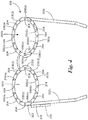
- FIG. 4 illustrates another photoactivation device 200 that is configured to activate a photosensitizer, such as riboflavin, that has been applied to eye tissue according to an antimicrobial treatment.
- a photosensitizer such as riboflavin
- the photosensitizer when photoactivated, the photosensitizer generates ROS that provides an antimicrobial effect.
- the eye tissue may be treated with a transepithelial formulation with a non-ionic permeability enhancer as described above.
- a medical practitioner e.g., a nurse, or the patient (once instructed) places drops of the transepithelial photosensitizer formulation every 30 to 60 seconds for a period of approximately 15 to 20 minutes.
- the transepithelial photosensitizer formulation can be applied to the eyes without the use of specula.
- the photoactivation device 200 includes a body 202.
- the body 202 may be shaped and worn like an eyeglasses frame.
- the body 202 includes rims 202a defining openings 202b allowing the subject can see through the body 202.
- the body 202 also includes temples 202c and nosepads 202d that can support the body 202 on the head of the subject.
- the photoactivation device 200 in FIG. 4 resembles a pair of eyeglasses, it is understood that other shapes and configurations may be employed to situate the photoactivation device 200 stably about the eyes.
- the body 202 includes a plurality of photoactivating light sources 204 that can direct photoactivating light to each eye of the subject from the top, bottom, left, and right.
- the photoactivating light sources 204 may include light-emitting diodes (LED's) that direct UVA light simultaneously to eyes that have been treated with a riboflavin formulation.
- the number of photoactivating light sources 204 may be limited to the number required to provide the desired low dose of photoactivating light, e.g., delivered at an irradiance of approximately 0.3mW/cm 2 for approximately at least 10 minutes.
- the body 202 also includes a plurality of guide light sources 206 that emit visible light from above, below, left, and right of each eye.
- the guide light sources 206 may include LEDs. At least one top guide light source 206(a) emits light from above each eye; at least one bottom guide light source 206(b) emits light from below each eye; at least one left guide light source 206(c) emits light from the left of each eye; and at least one right guide light source 206(d) emits light from the right of each eye.
- a controller 208 e.g., in the form of an electronic/electric chip/circuit, is coupled to the guide light sources 206.
- the controller 208 can alternately illuminate the guide light sources 206.
- the controller 208 may repeatedly, in series: (1) illuminate the top guide light source(s) 206(a) for a predetermined period of time (e.g., 10 seconds or other optimal period) while the other guide light sources 206(b), (c), (d) remain off; (2) illuminate the bottom guide light source(s) 206(b) for the predetermined period of time while the other guide light sources 206(a), (c), (d) remain off; (3) illuminate the left guide light source(s) 206(c) for the predetermined period of time while the other guide light sources 206(a), (b), (d) remain off; and (4) illuminate the right guide light source(s) 206(d) for the predetermined period of time while the other guide light sources 206(a), (b), (c) remain off.
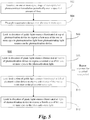
- FIG. 5 illustrates a method 500 that corresponds to the example above.
- the one or more eyes receive drops of transepithelial photosensitizer formulation periodically over a specified amount of time.
- the photoactivation device 200 is placed over the one or more eyes.
- the one or more eyes look at the guide light sources 206(a) illuminated at the top of the photoactivation device 200 to expose a first area of the one or more eyes to photoactivation light from photoactivating light sources 204 on the photoactivation device 200.
- the one or more eyes look at the guide light sources 206(b) illuminated at the bottom of the photoactivation device 200 to expose the one or more eyes to the photoactivation light.
- the one or more eyes look at the guide light sources 206(c) illuminated at the left of the photoactivation device 200 to expose a third area of the one or more eyes to the photoactivation light.
- the one or more eyes look at the guide light sources 206(d) illuminated at the right of the photoactivation device 200 to expose a fourth area of the one or more eyes to the photoactivation light.
- the guide light sources 206 may be alternately illuminated in a different sequence.
- the guide light sources 206 may direct light to the eyes from additional directions, e.g., top-left, top-right, bottom-left, bottom-right, etc.
- the patient is directed to move his or her eyes to follow the alternately illuminated guide light sources 206 (i.e., up, down, to the left, to the right, and so on), thereby moving different areas of the eye, e.g., corneal surface, to the open area between the top and bottom eyelids.
- substantially the entire surface of each eye is exposed between the top and bottom eyelids to the photoactivating light from the photoactivating light sources 204, and the photosensitizer in the treated tissue can be photoactivated for the antimicrobial effect.
- substantially the entire eye surface gets full coverage of irradiance without the need for specula to force the eyes wide open for the delivery of photoactivating light.
- the patient may sit up or lay down for the procedure for as long as necessary. Because the irradiance is low and the procedure lasts for an extended amount of time, irradiance variation is averaged and greatly minimized over time.
- the body 202 also includes a battery 210 to power the photoactivating light sources 204, the guide light sources 206, and the controller 208.
- a plastic pull-tab can electrically separate the battery 210 from the other components.
- the pull-tab can be removed to connect the battery 210 with a conductive contact which delivers electrical power to the other components.
- the frame 202 may include an electrical switch that can be selectively operated to connect the battery 210 with the other components.
- the power from the battery 210 may be limited to what is necessary to operate the photoactivating light sources 204 and the guide light sources 206 to deliver the photoactivating light to the entire ocular surface with the desired low irradiance and desired extended irradiation time.
- the end of the treatment may coincide with the depletion of power from the battery 210.
- the controller 208 may control the irradiation time.
- the components of the photoactivation device 200 may turn off (e.g., burn out) and self-destruct after a given amount of irradiation time.
- the photoactivation device 200 may be employed as a single-use, disposable device.
- the photoactivation device 200 does not include any lenses and can be inexpensively manufactured.
- the body 202 may be molded from plastic. Because photoactivation device 200 is not positioned too close to the eyes (e.g., the surgical field), the photoactivation device 200 should be clean but does not necessarily have to be sterile. Furthermore, the photoactivation device 200 might not be considered medical waste and as such may not require special disposal procedures.
- the photoactivation device 200 may be configured to become inoperable once the treatment is complete. For instance, the battery 210 cannot be replaced once the power is depleted and the treatment is complete. Additionally or alternatively, as described above, the components of the photoactivation device 200 may self-destruct after a given amount of irradiation time.
- the photoactivation device 200 is more convenient and cost-effective than other irradiation systems. As such, the photoactivation device 200 may be more feasible for treatments in the third world and/or other remote locations.
- the use of the photoactivation device 200 is not limited to humans. Indeed, the photoactivation device 200 can be especially modified/configured for treatment of animals, such as dogs, cats, horses, etc.
- photochemical kinetic reactions can produce antimicrobial agents that place microbes in the tissue under stress and induce an apoptotic or necrotic response in the microbes.
- a description of photochemical kinetic reactions for riboflavin is provided, for example, in International Patent Application No. PCT/US15/57628, filed October 27, 2015 .
- riboflavin absorbs radiant energy, especially UVA light, it undergoes photoactivation.
- photoactivation There are two photochemical kinetic pathways for riboflavin photoactivation, Type I and Type II. Some of the reactions involved in both the Type I and Type II mechanisms are as follows:
- Rf represents riboflavin in the ground state.
- Rf* 1 represents riboflavin in the excited singlet state.
- Rf* 3 represents riboflavin in a triplet excited state.
- Rf •- is the reduced radical anion form of riboflavin.
- RfH • is the radical form of riboflavin.
- RfH2 is the reduced form of riboflavin.
- DH is the substrate.
- DH •+ is the intermediate radical cation.
- D • is the radical.
- D ox is the oxidized form of the substrate.
- Riboflavin is excited into its triplet excited state Rf* 3 as shown in reactions (r1) to (r3). From the triplet excited state Rf* 3 , the riboflavin reacts further, generally according to Type I or Type II mechanisms.
- the substrate reacts with the excited state riboflavin to generate radicals or radical ions, respectively, by hydrogen atoms or electron transfer.
- Type II mechanism the excited state riboflavin reacts with oxygen to form singlet molecular oxygen. The singlet molecular oxygen then acts on tissue to produce additional cross-linked bonds.
- Oxygen concentration in the cornea is modulated by UVA irradiance and temperature and quickly decreases at the beginning of UVA exposure.
- Utilizing pulsed light of a specific duty cycle, frequency, and irradiance, input from both Type I and Type II photochemical kinetic mechanisms can be employed to achieve a greater amount of photochemical efficiency.
- utilizing pulsed light allows regulating the rate of reactions involving riboflavin. The rate of reactions may either be increased or decreased, as needed, by regulating, one of the parameters such as the irradiance, the dose, the on/off duty cycle, riboflavin concentration, soak time, and others.
- additional ingredients that affect the reaction and cross-linking rates may be added to the cornea.
- oxygen concentrations start to increase (replenish). Excess oxygen may be detrimental in the corneal cross-linking process because oxygen is able to inhibit free radical photopolymerization reactions by interacting with radical species to form chain-terminating peroxide molecules.
- the pulse rate, irradiance, dose, and other parameters can be adjusted to achieve a more optimal oxygen regeneration rate. Calculating and adjusting the oxygen regeneration rate is another example of adjusting the reaction parameters to achieve a desired amount of corneal stiffening.
- Oxygen content may be depleted throughout the cornea, by various chemical reactions, except for the very thin corneal layer where oxygen diffusion is able to keep up with the kinetics of the reactions. This diffusion-controlled zone will gradually move deeper into the cornea as the reaction ability of the substrate to uptake oxygen decreases.
- Riboflavin is reduced (deactivated) reversibly or irreversibly and/or photo-degraded to a greater extent as irradiance increases.
- Photon optimization can be achieved by allowing reduced riboflavin to return to ground state riboflavin in Type I reactions.
- the rate of return of reduced riboflavin to ground state in Type I reactions is determined by a number of factors. These factors include, but are not limited to, on/off duty cycle of pulsed light treatment, pulse rate frequency, irradiance, and dose.
- the riboflavin concentration, soak time, and addition of other agents, including oxidizers affect the rate of oxygen uptake.
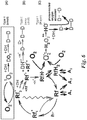
- FIG. 6 illustrates a diagram for the photochemical kinetic reactions provided in reactions (r1) through (r26) above.
- the diagram summarizes photochemical transformations of riboflavin (Rf) under UVA photoactivating light and its interactions with various donors (DH) via electron transfer.
- cross-linking activity occurs: (A) through the presence of singlet oxygen in reactions (r6) through (r8) (Type II mechanism); (B) without using oxygen in reactions (r4) and (r17) (Type I mechanism); and (C) through the presence of peroxide (H 2 O 2 ), superoxide (O 2 - ), and hydroxyl radicals ( ⁇ OH) in reactions (r13) through (r17).
- the present inventors have also determined that the cross-linking activity is generated to a greater degree from reactions involving peroxide, superoxide, and hydroxyl radicals.
- Cross-linking activity is generated to a lesser degree from reactions involving singlet oxygen and from non-oxygen reactions.
- Some models based on the reactions (r1)-(r26) may account for the level of cross-linking activity generated by the respective reactions. For instance, where singlet oxygen plays a smaller role in generating cross-linking activity, models may be simplified by treating the cross-linking activity resulting from singlet oxygen as a constant.
- the parameters may include, but is not limited to: the concentration(s) and/or soak times of the applied photosensitizer; the dose(s), wavelength(s), irradiance(s), duration(s), and/or on/off duty cycle(s) of the photoactivating light; the oxygenation conditions in the tissue; and/or presence of additional agents and solutions.
- example embodiments can generate ROS at desired depths and at rates to achieve an antimicrobial effect throughout the thickness of the cornea while minimizing cross-linking of the anterior cornea.
- the photochemical kinetic reactions above can be employed to determine the threshold at which cross-linking activity is generated at depths within the cornea.
- the example embodiments can be configured accordingly to generate ROS for the antimicrobial effect without reaching the determined threshold for cross-linking activity.
- alternative embodiments may call for cross-linking activity (to modify biomechanical properties) in addition to antimicrobial treatment.
- the model based on the photochemical kinetic reactions allows these alternative embodiments to generate ROS and/or other radicals for the desired antimicrobial effect and desired cross-linking activity.
- example embodiments may enhance the photochemical kinetic reactions by adding a metal, such as iron or copper, to the riboflavin formulation.
- a metal such as iron or copper
- a description of how additives can affect photochemical kinetic reactions is provided, for example, in U.S. Patent Application Serial No. 14/281,638, filed May 19, 2014 and titled “Systems, Methods, and Compositions for Cross-Linking" and U.S. Provisional Patent Application No. 62/086,572, filed December 2, 2014 and also titled “Systems, Methods, and Compositions for Cross-Linking.”
- trace amounts of copper can provide an enhanced antimicrobial effect for a riboflavin formulation.
- Copper can enhance the photodynamic effect of riboflavin through a Fenton-type reaction.
- copper on its own specifically, copper ions
- copper ions can have an antimicrobial effect even when it is not combined with a photosensitizer. Therefore, the enhanced mode of action for a riboflavin formulation with a copper additive involves enhancement though the Fenton-type reaction and/or the antimicrobial effect of the copper by itself.
- the photochemical kinetic reactions for a riboflavin formulation can be enhanced by adding a deuterated water (D 2 O), also known as "heavy water.”
- D 2 O by itself does not kill bacteria. Skladnev D. A., et al. Methylotrophic Bacteria as Sources of 2H-and 13C-amino Acids. Biotechnology (1996), pp. 14-22 .
- D 2 O can increase the presence of singlet oxygen when used in combination with a photosensitizer formulation (and optionally other additives).
- Singlet oxygen is one of the ROS responsible for producing an antimicrobial effect through Type II photochemical kinetic energy transfer.
- Type II photochemical kinetic reactions are described, for example, in U.S. Patent Application Serial No. 13/841,617 cited above.
- example embodiments may employ D 2 O to enhance the antimicrobial effect associated with singlet oxygen.
- Example embodiments may also employ timed application of agents, such as dimethyl sulfoxide (DMSO), which can cause penetration of a photosensitizer to desired depths in the targeted tissue and produce an antimicrobial effect at the desired depths.
- agents such as dimethyl sulfoxide (DMSO)
- DMSO dimethyl sulfoxide
- the antimicrobial effect at the desired depths may be further enhanced by increasing the oxygen concentration available for the photochemical reactions with the photosensitizer.
- Example embodiments may also employ timed application of quenching agents to generate greater antimicrobial effect at the desired depths.
- the quenching agents can limit the photochemical reaction in regions closer to the surface of the tissue and allow the antimicrobial effect of the photosensitizer to take place deeper in the tissue. Quenching agents are described, for example, in U.S. Patent Application Serial No. 13/475,175, filed May 18, 2012 and titled "Controlled Application of Cross-Linking Agent.”
- Example embodiments may also increase or decrease the pH of the tissue to enhance the antimicrobial effect of antimicrobial treatments.
- the pH of the tissue may be modified by selectively applying acidic or basic solutions.
- the acidic or basic solutions may include additives as described herein.
- the solutions may include quenching agents to control the photochemical reactions at a given depth within the tissue.
- Example embodiments may employ a dispensing device configured to apply different formulations and/or different concentrations according to a predetermined sequence.
- the dispensing device may be a charged nanocloud device that applies the photosensitizer formulations via aerosolized electro-spraying.
- the dispensing device may generate and deliver a dual payload of ionized ROS encapsulated in photosensitizer nanoparticles for simultaneous intra-stromal deposition.
- Example embodiments may additionally employ water nanoparticles for antimicrobial applications.
- Electro-spraying ionized water (“engineered water”) results in nano-caging ROS via an excess of electrons loaded during droplet fission thereby conferring the nanoparticles with antimicrobial properties.
- Example embodiments may employ nanostructures to promote delivery of photosensitizer formulations to the target tissue and enhance the antimicrobial effect of the photochemical kinetic reactions.
- the nanostructures may include, but are not limited to, liposomes, polymeric micelles, ceramic (graphene oxide) and metallic nanorods. These nanostructures may be included in drops that are applied to the target tissue. Alternatively, specially configured structures may be employed to allow the nanostructures and photosensitizer formulations to penetrate the target tissue.
- a contact lens device may be configured to allow different photosensitizer formulations and nanostructures to penetrate a cornea in a corneal procedure.
- the contact lens device may be applied to the cornea for several minutes or even a few hours before illumination is applied to initiate photochemical kinetic reactions.
- Such a device facilitates delivery through the epithelium for procedures that keep the epithelium in place, i.e., "epi-on" procedures.
- very low concentrations of drug formulation may be applied to eye tissue, followed by application of illumination at very low irradiance levels, e.g., a formulation with approximately 0.02% riboflavin concentration followed by approximately 1 mW/cm 2 illumination of UV light.
- the contact lens devices described above can be applied to the subject's eyes for 30-90 minutes to deliver the formulation. Once the contact lens devices are removed and the photoactivation device 100 is positioned over the subject's eyes to deliver the illumination to generate the photochemical kinetic reactions.
- example embodiments can enhance antimicrobial treatments by any combination of:
- VAP Ventilator Associated Pneumonia
- aerosolized drugs/photosensitizers and ionized ROS in water nanoparticles can be delivered to the oral and tracheal regions with targeted multi-drug resistant anti-bacterial payloads (MDR A. baumannii, P. aeruginosa).
- MDR A. baumannii, P. aeruginosa multi-drug resistant anti-bacterial payloads
- a pre-tracheal mouthpiece tube having actinic illumination targets ROS-photosensitizer nanoparticles flowing into the oral cavity.
- the embodiments described herein may employ controllers and other devices for processing information and controlling aspects of the example systems.
- the example photoactivation device 100 shown in FIGS. 1a, b includes the controller 116 or the photoactivation device 200 shown in FIG. 4 includes the controller 208.
- the controllers include one or more processors.
- the processor(s) of a controller or other devices may be implemented as a combination of hardware and software elements.
- the hardware elements may include combinations of operatively coupled hardware components, including microprocessors, memory, signal filters, electronic/electric chip/circuit, etc.
- the processors may be configured to perform operations specified by the software elements, e.g., computer-executable code stored on computer readable medium.
- the processors may be implemented in any device, system, or subsystem to provide functionality and operation according to the present disclosure.
- the processors may be implemented in any number of physical devices/machines. Indeed, parts of the processing of the example embodiments can be distributed over any combination of processors for better performance, reliability, cost, etc.
- the physical devices/machines can be implemented by the preparation of integrated circuits or by interconnecting an appropriate network of conventional component circuits, as is appreciated by those skilled in the electrical art(s).
- the physical devices/machines may include field programmable gate arrays (FPGA's), application-specific integrated circuits (ASIC's), digital signal processors (DSP's), etc.
- the example embodiments are not limited to any specific combination of hardware circuitry and/or software.
- the computing systems may include software for controlling the devices and subsystems of the example embodiments, for driving the devices and subsystems of the example embodiments, for enabling the devices and subsystems of the example embodiments to interact with a human user (user interfaces, displays, controls), etc.
- Such software can include, but is not limited to, device drivers, operating systems, development tools, applications software, etc.
- a computer readable medium further can include the computer program product(s) for performing all or a portion of the processing performed by the example embodiments.
- Computer program products employed by the example embodiments can include any suitable interpretable or executable code mechanism, including but not limited to complete executable programs, interpretable programs, scripts, dynamic link libraries (DLLs), applets, etc.
- the processors may include, or be otherwise combined with, computer-readable media.
- Some forms of computer-readable media may include, for example, a hard disk, any other suitable magnetic medium, any suitable optical medium, RAM, PROM, EPROM, flash memory, any other suitable memory chip or cartridge, any other suitable non-volatile memory, a carrier wave, or any other suitable medium from which a computer can read.
- the controllers and other devices may also include databases for storing data.
- databases may be stored on the computer readable media described above and may organize the data according to any appropriate approach.
- the data may be stored in relational databases, navigational databases, flat files, lookup tables, etc.
Landscapes
- Health & Medical Sciences (AREA)
- Biomedical Technology (AREA)
- Engineering & Computer Science (AREA)
- Life Sciences & Earth Sciences (AREA)
- General Health & Medical Sciences (AREA)
- Animal Behavior & Ethology (AREA)
- Public Health (AREA)
- Veterinary Medicine (AREA)
- Nuclear Medicine, Radiotherapy & Molecular Imaging (AREA)
- Ophthalmology & Optometry (AREA)
- Pathology (AREA)
- Radiology & Medical Imaging (AREA)
- Heart & Thoracic Surgery (AREA)
- Vascular Medicine (AREA)
- Biophysics (AREA)
- Otolaryngology (AREA)
- Physics & Mathematics (AREA)
- Electromagnetism (AREA)
- Optics & Photonics (AREA)
- Surgery (AREA)
- Pharmaceuticals Containing Other Organic And Inorganic Compounds (AREA)
- Radiation-Therapy Devices (AREA)
- Anesthesiology (AREA)
- Hematology (AREA)
Claims (7)
- Dispositif de photoactivation portable (100) comprenant :un corps (102) définissant une chambre (103) ; une ou plusieurs sources de lumière de photoactivation (106) opérationnelle(s) pour diriger de la lumière ultraviolette vers les un ou plusieurs yeux selon des paramètres d'éclairage sélectionnés, les paramètres d'éclairage déterminant une dose de la lumière ultraviolette qui active un photosensibilisateur, y compris la riboflavine, appliquée aux un ou plusieurs yeux ; et une entrée (117) configurée pour coupler le corps (102) à une source d'oxygène (118), la chambre (103) recevant de l'oxygène à partir de la source d'oxygène (118) via l'entrée (117) pour modifier des conditions d'oxygène dans la chambre (103)caractérisé en ce que :la chambre (103) définie par le corps (102) est mise en forme pour être positionnée sur et renfermer deux yeux d'un sujet, le corps (102) comprenant une ou plusieurs fenêtres (104) qui permettent aux deux yeux de voir à travers le corps (102), etles une ou plusieurs sources lumineuses de photoactivation (106) sont couplées au corps (102).
- Dispositif (100) selon la revendication 1, dans lequel les une ou plusieurs sources de lumière de photoactivation (106) délivrent la lumière ultraviolette sous la forme d'au moins une d'impulsions ou d'une onde continue, et les paramètres d'éclairage comprennent au moins un parmi une longueur d'onde, une puissance, une irradiance, une intensité, une durée ou cycle de service.
- Dispositif (100) selon la revendication 2, dans lequel la dose de lumière ultraviolette active le photosensibilisateur sans induire substantiellement une activité de réticulation qui produit des changements biomécaniques dans les un ou plusieurs yeux.
- Dispositif (100) selon la revendication 1, comprenant en outre un ou plusieurs éléments chauffants (108) couplés au corps (102) et configurés pour générer de la chaleur dans la chambre (103) selon des paramètres de température.
- Dispositif (100) selon la revendication 4, comprenant en outre un dispositif de commande (116) comprenant un ou plusieurs processeurs et un ou plusieurs supports lisibles par ordinateur, les un ou plusieurs processeurs étant configurés pour exécuter des instructions à partir du support lisible par ordinateur pour :déterminer les paramètres de température à partir d'un modèle des réactions cinétiques photochimiques ; etfaire fonctionner les un ou plusieurs éléments chauffants (108) en fonction des paramètres de température.
- Dispositif (100) selon la revendication 1, comprenant en outre la source d'oxygène (118) couplée au corps (102), la source d'oxygène (118) étant opérationnelle pour fournir de l'oxygène à la chambre (103) via l'entrée (117).
- Dispositif (100) selon la revendication 6, dans lequel la source d'oxygène (118) est en outre opérationnelle pour modifier la température dans la chambre (102) en fonction d'une température de l'oxygène.
Priority Applications (1)
| Application Number | Priority Date | Filing Date | Title |
|---|---|---|---|
| EP20207592.5A EP3827792A1 (fr) | 2015-04-24 | 2016-04-25 | Systèmes et procédés pour photoactiver un photosensibilisant appliqué à un il |
Applications Claiming Priority (4)
| Application Number | Priority Date | Filing Date | Title |
|---|---|---|---|
| US201562152533P | 2015-04-24 | 2015-04-24 | |
| US201562152568P | 2015-04-24 | 2015-04-24 | |
| US201662279951P | 2016-01-18 | 2016-01-18 | |
| PCT/US2016/029187 WO2016172695A1 (fr) | 2015-04-24 | 2016-04-25 | Systèmes et procédés pour photoactiver un photosensibilisant appliqué à un oeil |
Related Child Applications (1)
| Application Number | Title | Priority Date | Filing Date |
|---|---|---|---|
| EP20207592.5A Division EP3827792A1 (fr) | 2015-04-24 | 2016-04-25 | Systèmes et procédés pour photoactiver un photosensibilisant appliqué à un il |
Publications (3)
| Publication Number | Publication Date |
|---|---|
| EP3285704A1 EP3285704A1 (fr) | 2018-02-28 |
| EP3285704A4 EP3285704A4 (fr) | 2019-04-17 |
| EP3285704B1 true EP3285704B1 (fr) | 2020-11-18 |
Family
ID=57143648
Family Applications (2)
| Application Number | Title | Priority Date | Filing Date |
|---|---|---|---|
| EP16784078.4A Active EP3285704B1 (fr) | 2015-04-24 | 2016-04-25 | Systèmes pour photoactiver un photosensibilisant appliqué à un oeil |
| EP20207592.5A Pending EP3827792A1 (fr) | 2015-04-24 | 2016-04-25 | Systèmes et procédés pour photoactiver un photosensibilisant appliqué à un il |
Family Applications After (1)
| Application Number | Title | Priority Date | Filing Date |
|---|---|---|---|
| EP20207592.5A Pending EP3827792A1 (fr) | 2015-04-24 | 2016-04-25 | Systèmes et procédés pour photoactiver un photosensibilisant appliqué à un il |
Country Status (3)
| Country | Link |
|---|---|
| US (4) | US10258809B2 (fr) |
| EP (2) | EP3285704B1 (fr) |
| WO (1) | WO2016172695A1 (fr) |
Families Citing this family (21)
| Publication number | Priority date | Publication date | Assignee | Title |
|---|---|---|---|---|
| US9622911B2 (en) | 2010-09-30 | 2017-04-18 | Cxl Ophthalmics, Llc | Ophthalmic treatment device, system, and method of use |
| US9566301B2 (en) | 2012-03-29 | 2017-02-14 | Cxl Ophthalmics, Llc | Compositions and methods for treating or preventing diseases associated with oxidative stress |
| EP2830627B1 (fr) | 2012-03-29 | 2024-05-01 | Epion Therapeutics, Inc. | Solutions de traitement oculaire, dispositifs d'administration et procédés améliorant l'administration |
| US10258809B2 (en) | 2015-04-24 | 2019-04-16 | Avedro, Inc. | Systems and methods for photoactivating a photosensitizer applied to an eye |
| KR102706856B1 (ko) | 2015-07-21 | 2024-09-19 | 아베드로 인코퍼레이티드 | 광증감제로 눈을 치료하기 위한 시스템 및 방법 |
| CN108601668B (zh) * | 2015-12-03 | 2021-05-25 | 艾维德洛公司 | 利用面罩装置处理眼睛的系统和方法 |
| EP3442481B1 (fr) | 2016-04-13 | 2023-06-28 | Avedro, Inc. | Systèmes d'administration de médicaments à un oeil |
| US10695217B2 (en) * | 2017-12-12 | 2020-06-30 | Huseyin Yetik | System to provide humidified controlled high pressure air during ocular surgery |
| WO2019181967A1 (fr) * | 2018-03-21 | 2019-09-26 | 株式会社坪田ラボ | Dispositif non invasif et procédé de renforcement de la cornée ou de la sclérotique |
| US10932864B2 (en) | 2018-11-28 | 2021-03-02 | Rxsight, Inc. | Tracking-based illumination control system |
| US11013593B2 (en) | 2018-12-02 | 2021-05-25 | Rxsight, Inc. | Light adjustable lens tracking system and method |
| US20210285633A1 (en) * | 2020-03-12 | 2021-09-16 | Arash Esmailzadeh | Wearable uv light devices |
| WO2021202398A1 (fr) * | 2020-03-30 | 2021-10-07 | University Of Miami | Dispositif de thérapie photodynamique antimicrobienne |
| US11684691B2 (en) * | 2020-04-17 | 2023-06-27 | Otter Products, Llc | Personal sanitizing device |
| US11779676B2 (en) | 2020-04-17 | 2023-10-10 | Otter Products, Llc | Sanitizing device |
| US11806558B2 (en) | 2020-06-26 | 2023-11-07 | Clear Blew | Body-worn air-treatment devices and methods of deactivating pathogens |
| US11744914B2 (en) * | 2020-07-15 | 2023-09-05 | John R. Wyss | Projection of germicidal ultra-violet light by edgelit substrate |
| US11458220B2 (en) | 2020-11-12 | 2022-10-04 | Singletto Inc. | Microbial disinfection for personal protection equipment |
| CA3205242A1 (fr) | 2020-12-17 | 2022-06-23 | Avedro, Inc. | Traitements pour infection oculaire |
| US12472376B2 (en) * | 2022-02-06 | 2025-11-18 | Demaod Ltd | Devices and methods for stimulating tear secretion |
| US12359369B2 (en) | 2022-08-11 | 2025-07-15 | Singletto Inc. | Skin protection against microbial particles |
Family Cites Families (272)
| Publication number | Priority date | Publication date | Assignee | Title |
|---|---|---|---|---|
| US3169459A (en) | 1963-03-11 | 1965-02-16 | Michael A Friedberg | Method of determining surface contours of an eye |
| US4034750A (en) | 1975-04-22 | 1977-07-12 | Maurice Seiderman | Electrochemically linking collagen fibrils to animal tissue |
| US4161013A (en) | 1977-05-23 | 1979-07-10 | Massachusetts Institute Of Technology | Electromechanochemical device |
| US4326529A (en) | 1978-05-26 | 1982-04-27 | The United States Of America As Represented By The United States Department Of Energy | Corneal-shaping electrode |
| US4805616A (en) | 1980-12-08 | 1989-02-21 | Pao David S C | Bipolar probes for ophthalmic surgery and methods of performing anterior capsulotomy |
| US4381007A (en) | 1981-04-30 | 1983-04-26 | The United States Of America As Represented By The United States Department Of Energy | Multipolar corneal-shaping electrode with flexible removable skirt |
| US4712543A (en) | 1982-01-20 | 1987-12-15 | Baron Neville A | Process for recurving the cornea of an eye |
| US4665913A (en) | 1983-11-17 | 1987-05-19 | Lri L.P. | Method for ophthalmological surgery |
| US5484432A (en) | 1985-09-27 | 1996-01-16 | Laser Biotech, Inc. | Collagen treatment apparatus |
| US4764007A (en) | 1986-02-24 | 1988-08-16 | The United States Of America As Represented By The Secretary Of The Air Force | Glare susceptibility tester |
| GB8606821D0 (en) | 1986-03-19 | 1986-04-23 | Pa Consulting Services | Corneal reprofiling |
| US5019074A (en) | 1987-03-09 | 1991-05-28 | Summit Technology, Inc. | Laser reprofiling system employing an erodable mask |
| US4891043A (en) | 1987-05-28 | 1990-01-02 | Board Of Trustees Of The University Of Illinois | System for selective release of liposome encapsulated material via laser radiation |
| US5171318A (en) | 1987-11-09 | 1992-12-15 | Chiron Ophthalmics, Inc. | Treated corneal prosthetic device |
| US4969912A (en) | 1988-02-18 | 1990-11-13 | Kelman Charles D | Human collagen processing and autoimplant use |
| US4881543A (en) | 1988-06-28 | 1989-11-21 | Massachusetts Institute Of Technology | Combined microwave heating and surface cooling of the cornea |
| US5098426A (en) | 1989-02-06 | 1992-03-24 | Phoenix Laser Systems, Inc. | Method and apparatus for precision laser surgery |
| US5152759A (en) | 1989-06-07 | 1992-10-06 | University Of Miami, School Of Medicine, Dept. Of Ophthalmology | Noncontact laser microsurgical apparatus |
| US5103005A (en) | 1989-07-21 | 1992-04-07 | Coors Biotech, Inc. | Method for recovery of riboflavin |
| US5016615A (en) | 1990-02-20 | 1991-05-21 | Riverside Research Institute | Local application of medication with ultrasound |
| US5490849A (en) | 1990-07-13 | 1996-02-13 | Smith; Robert F. | Uniform-radiation caustic surface for photoablation |
| US6342053B1 (en) | 1990-07-23 | 2002-01-29 | Laser Biotech, Inc. | Apparatus for cornea reshaping |
| US5779696A (en) | 1990-07-23 | 1998-07-14 | Sunrise Technologies International, Inc. | Method and apparatus for performing corneal reshaping to correct ocular refractive errors |
| US6325792B1 (en) | 1991-11-06 | 2001-12-04 | Casimir A. Swinger | Ophthalmic surgical laser and method |
| US5171254A (en) | 1991-11-19 | 1992-12-15 | Sher Neal A | Eye fixation device |
| AU3781193A (en) | 1992-02-27 | 1993-09-13 | Phoenix Laser Systems, Inc. | Automated laser workstation for high precision surgical and industrial interventions |
| RU2086215C1 (ru) | 1992-03-17 | 1997-08-10 | Александр Иосифович Симановский | Способ определения истинного внутриглазного давления, коэффициента легкости оттока и минутного объема продуцирования камерной влаги |
| US6450641B2 (en) | 1992-06-02 | 2002-09-17 | Lasersight Technologies, Inc. | Method of corneal analysis using a checkered placido apparatus |
| JP2965101B2 (ja) | 1992-07-31 | 1999-10-18 | 株式会社ニデック | 眼科装置 |
| CA2141577A1 (fr) | 1992-08-03 | 1994-02-17 | David R. Hennings | Methode et appareil pour exposer l'oeil humain a un schema de taches de rayonnement |
| IL103290A (en) | 1992-09-25 | 1996-06-18 | Ben Nun Joshua | Ophthalmologic examination and/or treatment apparatus |
| US5608472A (en) | 1992-11-06 | 1997-03-04 | Research Development Foundation | Eye imaging system |
| US5891131A (en) | 1993-02-01 | 1999-04-06 | Arizona Board Of Regents | Method and apparatus for automated simulation and design of corneal refractive procedures |
| WO1994024545A1 (fr) | 1993-04-15 | 1994-10-27 | Board Of Regents, The University Of Texas System | Spectrometre raman |
| US5461212A (en) | 1993-06-04 | 1995-10-24 | Summit Technology, Inc. | Astigmatic laser ablation of surfaces |
| AU716040B2 (en) | 1993-06-24 | 2000-02-17 | Bausch & Lomb Incorporated | Ophthalmic pachymeter and method of making ophthalmic determinations |
| US20020002369A1 (en) | 1993-08-23 | 2002-01-03 | Hood Larry L. | Method and apparatus for modifying visual acuity by moving a focal point of energy within a cornea |
| US20020042612A1 (en) | 1997-10-27 | 2002-04-11 | Hood Larry L. | Method and apparatus for modifications of visual acuity by thermal means |
| US5634921A (en) | 1993-08-23 | 1997-06-03 | Hood; Larry | Method and apparatus for modifications of visual acuity by thermal means |
| JPH09511161A (ja) | 1994-02-09 | 1997-11-11 | ケラビジヨン, インコーポレイテッド | 角膜を反曲させる電気外科的方法 |
| JP3263275B2 (ja) | 1994-04-05 | 2002-03-04 | ザ リージェンツ オブ ザ ユニバーシティ オブ カリフォルニア | 生体組織のレーザー処理のための装置並びに火焔状斑点母斑のレーザー処理装置 |
| US6293938B1 (en) | 1994-04-08 | 2001-09-25 | Summit Technology, Inc. | Photo-refractive keratectomy |
| US20050187599A1 (en) | 1994-05-06 | 2005-08-25 | Hugh Sharkey | Method and apparatus for controlled contraction of soft tissue |
| JPH09511671A (ja) | 1994-08-22 | 1997-11-25 | イオメド インコーポレイテッド | 水和水段を組み込んだイオントフォレティック(iontophoretic)デリバリー装置 |
| RU2098057C1 (ru) | 1994-10-20 | 1997-12-10 | Ольга Александровна Киселева | Способ лечения отслойки сетчатки, осложненной субретинальным швартообразованием |
| US5624437A (en) | 1995-03-28 | 1997-04-29 | Freeman; Jerre M. | High resolution, high speed, programmable laser beam modulating apparatus for microsurgery |
| HU213450B (en) | 1995-04-26 | 1997-06-30 | Ladanyi Jozsef | Gel contains gelatin and process for producing it |
| US5910110A (en) | 1995-06-07 | 1999-06-08 | Mentor Ophthalmics, Inc. | Controlling pressure in the eye during surgery |
| US6520956B1 (en) | 1995-11-06 | 2003-02-18 | David Huang | Apparatus and method for performing laser thermal keratoplasty with minimized regression |
| US6033396A (en) | 1995-11-06 | 2000-03-07 | Huang; David | Apparatus and method for performing laser thermal keratoplasty with minimized regression |
| US6441047B2 (en) | 1995-11-17 | 2002-08-27 | Alcon Manufacturing Ltd.. | Combination therapy for treating glaucoma |
| US7452358B2 (en) | 1996-01-05 | 2008-11-18 | Thermage, Inc. | RF electrode assembly for handpiece |
| US7141049B2 (en) | 1999-03-09 | 2006-11-28 | Thermage, Inc. | Handpiece for treatment of tissue |
| US20070244496A1 (en) | 1996-02-07 | 2007-10-18 | Hellenkamp Johann F | Automatic surgical device and control assembly for cutting a cornea |
| DE19614823A1 (de) | 1996-04-15 | 1997-10-16 | Mann Gerhard Chem Pharm Fab | Ophthalmische Zusammensetzung mit verlängerter Verweilzeit am Auge |
| US6726684B1 (en) | 1996-07-16 | 2004-04-27 | Arthrocare Corporation | Methods for electrosurgical spine surgery |
| US20060149343A1 (en) | 1996-12-02 | 2006-07-06 | Palomar Medical Technologies, Inc. | Cooling system for a photocosmetic device |
| RU2127099C1 (ru) | 1997-04-07 | 1999-03-10 | Борзенок Сергей Анатольевич | Глазные капли "неокератоник" |
| RU2127100C1 (ru) | 1997-04-17 | 1999-03-10 | Борзенок Сергей Анатольевич | Глазные капли "пиротоник" |
| US6302876B1 (en) | 1997-05-27 | 2001-10-16 | Visx Corporation | Systems and methods for imaging corneal profiles |
| RU2121825C1 (ru) | 1997-06-24 | 1998-11-20 | Межотраслевой научно-технический комплекс "Микрохирургия глаза" | Глазные капли "интертоник" |
| US6104959A (en) | 1997-07-31 | 2000-08-15 | Microwave Medical Corp. | Method and apparatus for treating subcutaneous histological features |
| US6007499A (en) | 1997-10-31 | 1999-12-28 | University Of Washington | Method and apparatus for medical procedures using high-intensity focused ultrasound |
| RU2130762C1 (ru) | 1997-12-10 | 1999-05-27 | Федоров Святослав Николаевич | Устройство для офтальмохирургических операций |
| US20030135122A1 (en) | 1997-12-12 | 2003-07-17 | Spectrx, Inc. | Multi-modal optical tissue diagnostic system |
| US20080027328A1 (en) | 1997-12-29 | 2008-01-31 | Julia Therapeutics, Llc | Multi-focal treatment of skin with acoustic energy |
| US5885275A (en) | 1998-01-15 | 1999-03-23 | Diomed, Inc. | Medical spacing guide |
| US6161544A (en) | 1998-01-28 | 2000-12-19 | Keratoform, Inc. | Methods for accelerated orthokeratology |
| US20020013577A1 (en) | 1998-03-06 | 2002-01-31 | Frey Rudolph W. | Laser beam delivery and eye tracking system |
| JP2002506013A (ja) | 1998-03-09 | 2002-02-26 | イスタ ファーマシューティカルズ インコーポレイテッド | 酵素角膜矯正術における角膜硬化剤の使用 |
| US6188500B1 (en) | 1998-04-03 | 2001-02-13 | Psc Scanning, Inc. | Method for generating multiple scan lines in a thin scanner |
| US6398753B2 (en) | 1998-04-03 | 2002-06-04 | Mcdaniel David H. | Ultrasound enhancement of percutaneous drug absorption |
| RU2145247C1 (ru) * | 1998-04-10 | 2000-02-10 | Жаров Владимир Павлович | Фотоматричное терапевтическое устройство для лечения протяженных патологий |
| WO1999057529A1 (fr) | 1998-05-04 | 1999-11-11 | The Board Of Regents | Spectroscopie par fluorescence et reflectance combinees |
| US6099521A (en) | 1998-05-26 | 2000-08-08 | Shadduck; John H. | Semiconductor contact lens cooling system and technique for light-mediated eye therapies |
| US6162210A (en) | 1998-08-06 | 2000-12-19 | Shadduck; John H. | Laser mediated treatments for presbyopia and hyperopia |
| PT1105037E (pt) | 1998-08-19 | 2002-11-29 | Autonomous Technologies Corp | Aparelho e metodo para medir defeitos de visao de um olho humano |
| US6101411A (en) | 1998-09-24 | 2000-08-08 | Newsome; David A. | Dilation enhancer |
| US6218360B1 (en) | 1998-11-19 | 2001-04-17 | The Schepens Eye Research Institute | Collagen based biomaterials and methods of preparation and use |
| US6402739B1 (en) | 1998-12-08 | 2002-06-11 | Y-Beam Technologies, Inc. | Energy application with cooling |
| US6617963B1 (en) | 1999-02-26 | 2003-09-09 | Sri International | Event-recording devices with identification codes |
| WO2000053113A1 (fr) | 1999-03-09 | 2000-09-14 | Thermage, Inc. | Appareil et procede destines au traitement de tissus |
| JP4250721B2 (ja) | 1999-03-15 | 2009-04-08 | カール ツアイス メディテック アクチエンゲゼルシャフト | 眼検査用立体顕微鏡における照明装置及びその方法 |
| WO2000074648A2 (fr) | 1999-06-04 | 2000-12-14 | Sunrise Technologies International, Inc. | Prevention de la regression dans la keratoplastie de refraction |
| US6280436B1 (en) | 1999-08-10 | 2001-08-28 | Memphis Eye & Cataract Associates Ambulatory Surgery Center | Eye tracking and positioning system for a refractive laser system |
| JP2002058695A (ja) | 1999-09-03 | 2002-02-26 | Carl Zeiss Jena Gmbh | 眼の照射方法及び装置 |
| US6946440B1 (en) | 1999-09-15 | 2005-09-20 | Dewoolfson Bruce H | Composition for stabilizing corneal tissue during or after orthokeratology lens wear |
| EP2092876B1 (fr) | 1999-10-21 | 2012-08-01 | Technolas Perfect Vision GmbH | Profilage cornéen personnalisé |
| US6319273B1 (en) | 1999-12-16 | 2001-11-20 | Light Sciences Corporation | Illuminating device for treating eye disease |
| US6673067B1 (en) | 2000-01-31 | 2004-01-06 | Gholam A. Peyman | System and method for thermally and chemically treating cells at sites of interest in the body to impede cell proliferation |
| US7073510B2 (en) | 2000-02-11 | 2006-07-11 | The General Hospital Corporation | Photochemical tissue bonding |
| US8215314B2 (en) | 2000-02-11 | 2012-07-10 | The General Hospital Corporation | Photochemical tissue bonding |
| JP5101778B2 (ja) | 2000-02-11 | 2012-12-19 | ザ ジェネラル ホスピタル コーポレイション | 光化学作用による組織接着 |
| US6394999B1 (en) | 2000-03-13 | 2002-05-28 | Memphis Eye & Cataract Associates Ambulatory Surgery Center | Laser eye surgery system using wavefront sensor analysis to control digital micromirror device (DMD) mirror patterns |
| US6949093B1 (en) | 2000-03-21 | 2005-09-27 | Minu, L.L.C. | Adjustable universal implant blank for modifying corneal curvature and methods of modifying corneal curvature therewith |
| US7867186B2 (en) | 2002-04-08 | 2011-01-11 | Glaukos Corporation | Devices and methods for treatment of ocular disorders |
| JP2001299941A (ja) | 2000-04-27 | 2001-10-30 | Hamamatsu Photonics Kk | レーザ治療装置 |
| US6494878B1 (en) | 2000-05-12 | 2002-12-17 | Ceramoptec Industries, Inc. | System and method for accurate optical treatment of an eye's fundus |
| US6668190B2 (en) | 2000-06-16 | 2003-12-23 | Wayne State University | Method and apparatus for activating molecules to stimulate neurological tissue |
| EP1295602A1 (fr) | 2000-06-29 | 2003-03-26 | Rohto Pharmaceutical Co., Ltd. | Composition ophtalmique contenant de l'oxygene |
| CA2423354C (fr) | 2000-09-20 | 2009-12-15 | Lee Shahinian Jr. | Preparations et medications nasales, inhalables et ophtalmiques locales a conservation spontanee |
| EP1324767B1 (fr) | 2000-10-13 | 2009-06-24 | The Johns Hopkins University | Activateur du plasminogene permettant d'eviter un trouble corneen et sous-epithelial apres une intervention chirurgicale de correction de la vision au laser |
| US20020099363A1 (en) | 2001-01-23 | 2002-07-25 | Woodward Benjamin W. | Radiation treatment system and method of using same |
| US7753943B2 (en) | 2001-02-06 | 2010-07-13 | Qlt Inc. | Reduced fluence rate PDT |
| US7044945B2 (en) | 2001-03-30 | 2006-05-16 | Sand Bruce J | Prevention of regression in thermal ciliary muscle tendinoplasty |
| US6766042B2 (en) | 2001-04-26 | 2004-07-20 | Memphis Eye & Contact Associates | System to automatically detect eye corneal striae |
| US6918904B1 (en) | 2001-11-07 | 2005-07-19 | Minu, L.L.C. | Method of reshaping the cornea by controlled thermal delivery |
| US20030208190A1 (en) | 2001-07-20 | 2003-11-06 | Cynthia Roberts | Methods and instruments for refractive ophthalmic surgery |
| US20030030908A1 (en) | 2001-08-13 | 2003-02-13 | Yeou-Yen Cheng | Virtually imaged phased array (VIPA) with machined radiation window boundary |
| JP3667268B2 (ja) | 2001-09-26 | 2005-07-06 | 得一郎 長谷川 | アイマスク |
| US20070135805A1 (en) | 2001-11-07 | 2007-06-14 | Minu Telesystems Llc | Device and method for reshaping the cornea |
| US20050149006A1 (en) | 2001-11-07 | 2005-07-07 | Peyman Gholam A. | Device and method for reshaping the cornea |
| US9681942B2 (en) | 2001-11-07 | 2017-06-20 | Gholam A. Peyman | Method for prevention of rejection and sever encapsulation of a supportive or functioning implant |
| US20070142828A1 (en) | 2001-11-07 | 2007-06-21 | Minu, Llc | Method and system for altering the refractive properties of the eye |
| US9155652B2 (en) | 2001-11-07 | 2015-10-13 | Gholam A. Peyman | Method for laser correction of refractive errors of an eye with a thin cornea |
| CA2473924A1 (fr) | 2002-01-23 | 2003-07-31 | Light Sciences Corporation | Systemes et procedes pour une therapie photodynamique |
| US7130835B2 (en) | 2002-03-28 | 2006-10-31 | Bausch & Lomb Incorporated | System and method for predictive ophthalmic correction |
| WO2003085376A2 (fr) | 2002-04-03 | 2003-10-16 | The Regents Of The University Of California | Systeme et procede de mesure quantitative ou qualitative de substances exogenes dans un tissu et d'autres matieres par mise en oeuvre d'une spectroscopie par fluorescence induite par laser |
| EP1358839B1 (fr) | 2002-04-05 | 2005-02-23 | SIS AG Surgical Instrument Systems | Dispositif et procédé de determination des valeurs de mesure géométriques d'un oeil |
| US6758564B2 (en) | 2002-06-14 | 2004-07-06 | Physical Sciences, Inc. | Line-scan laser ophthalmoscope |
| DE10323422B4 (de) | 2002-08-23 | 2022-05-05 | Carl Zeiss Meditec Ag | Vorrichtung und Verfahren zur Messung eines optischen Durchbruchs in einem Gewebe |
| ITTO20021007A1 (it) | 2002-11-19 | 2004-05-20 | Franco Bartoli | Apparecchiatura laser ad eccimeri e metodo di pilotaggio |
| CA2511767A1 (fr) | 2002-12-09 | 2004-06-24 | The Trustees Of Dartmouth College | Systemes de thermokeratoplastie |
| US7377917B2 (en) | 2002-12-09 | 2008-05-27 | The Trustees Of Dartmouth College | Feedback control of thermokeratoplasty treatments |
| US20060177430A1 (en) | 2002-12-20 | 2006-08-10 | Chakshu Research Inc | Treatment of ocular disorders with ophthalmic formulations containing methylsulfonylmethane as a transport enhancer |
| US7004902B2 (en) | 2003-03-21 | 2006-02-28 | Reichert, Inc. | Method and apparatus for measuring biomechanical characteristics of corneal tissue |
| US20110098790A1 (en) | 2009-10-26 | 2011-04-28 | Albert Daxer | Methods for treating corneal disease |
| US7223275B2 (en) | 2003-05-27 | 2007-05-29 | Yichieh Shiuey | System for cutting the cornea of an eye |
| CN1838935B (zh) | 2003-08-22 | 2011-05-04 | 株式会社高丝 | 单线态氧消除剂及使用它的组合物 |
| JP4152836B2 (ja) | 2003-08-22 | 2008-09-17 | 富士通株式会社 | 分波機能を備えた光部品および波長分散補償器 |
| US20050096515A1 (en) | 2003-10-23 | 2005-05-05 | Geng Z. J. | Three-dimensional surface image guided adaptive therapy system |
| ATE427725T1 (de) | 2004-02-03 | 2009-04-15 | Iroc Ag | Ophtalmologische vorrichtung |
| DE102004021754A1 (de) | 2004-04-30 | 2005-11-24 | Reinhardt Thyzel | Vorrichtung zum Entfernen von Epithelzellen aus einem Linsenkapselsack eines menschlichen oder tierischen Auges |
| JP2007536272A (ja) | 2004-05-07 | 2007-12-13 | ザ・レジェンツ・オブ・ザ・ユニバーシティ・オブ・カリフォルニア | 近視の処置法 |
| US8571648B2 (en) | 2004-05-07 | 2013-10-29 | Aesthera | Apparatus and method to apply substances to tissue |
| ITMI20041625A1 (it) | 2004-08-06 | 2004-11-06 | Roberto Pinelli | Apparato per la correzione della presbiopia |
| EP1793730B1 (fr) | 2004-08-24 | 2011-12-28 | The General Hospital Corporation | Ensemble procede, systeme et logiciel pour la détermination de module d 'élasticité |
| US20060135957A1 (en) | 2004-12-21 | 2006-06-22 | Dorin Panescu | Method and apparatus to align a probe with a cornea |
| US7871378B1 (en) | 2004-12-22 | 2011-01-18 | Achevé Technology, Inc. | Device and method to measure corneal biomechanical properties and its application to intraocular pressure measurement |
| US8394084B2 (en) | 2005-01-10 | 2013-03-12 | Optimedica Corporation | Apparatus for patterned plasma-mediated laser trephination of the lens capsule and three dimensional phaco-segmentation |
| US20060276777A1 (en) | 2005-04-08 | 2006-12-07 | Coroneo Minas T | Corneal shaping |
| US20060287662A1 (en) | 2005-05-26 | 2006-12-21 | Ntk Enterprises, Inc. | Device, system, and method for epithelium protection during cornea reshaping |
| WO2007001926A2 (fr) | 2005-06-24 | 2007-01-04 | Hyperbranch Medical Technology, Inc. | Matériaux d'obturation par hydrogel à faible gonflement pour la réparation des blessures |
| US20070027509A1 (en) | 2005-07-29 | 2007-02-01 | Eisenberg Elliot S | Automated panretinal laser photocoagulation |
| US7292347B2 (en) | 2005-08-01 | 2007-11-06 | Mitutoyo Corporation | Dual laser high precision interferometer |
| US8388668B2 (en) | 2005-08-05 | 2013-03-05 | Gholam A. Peyman | Methods to regulate polarization of excitable cells |
| US20070048340A1 (en) | 2005-08-31 | 2007-03-01 | Searete Llc, A Limited Liability Corporation Of The State Of Delaware | Multi step patterning of a skin surface |
| US20070055227A1 (en) | 2005-09-08 | 2007-03-08 | Refractec, Inc. | Probe used for an ocular procedure |
| WO2007035913A2 (fr) | 2005-09-21 | 2007-03-29 | Kurve Technology, Inc. | Controle d'administration de medicaments, systeme de surveillance et systeme d'etablissement de rapports, et procede correspondant |
| WO2007044309A2 (fr) | 2005-10-05 | 2007-04-19 | Vasix Corporation | Appareil et méthode pour inhiber la formation du complexe ptag |
| EP1779891A1 (fr) | 2005-10-28 | 2007-05-02 | Abdula Kurkayev | Méthode d'activation d'un photosensibilisateur |
| JP5498699B2 (ja) | 2005-10-31 | 2014-05-21 | シーアールエス・アンド・アソシエイツ | 対象物の変形特性を測定する装置 |
| DE102005056958A1 (de) | 2005-11-29 | 2007-06-06 | Rowiak Gmbh | Verfahren und Vorrichtung zum Bearbeiten eines Werkstücks |
| US20070203547A1 (en) | 2005-12-15 | 2007-08-30 | Costello Benedict J | Medical device identification |
| WO2007082127A2 (fr) | 2006-01-05 | 2007-07-19 | El Hage Sami G | Thérapie de combinaison pour ckrtm durable |
| US20080177220A1 (en) | 2006-01-06 | 2008-07-24 | The Curators Of The University Of Missouri | Ultrasound-Mediated Transcleral Drug Delivery |
| US20070203478A1 (en) | 2006-02-21 | 2007-08-30 | Herekar Satish V | Method and system for elasto-modulation of ocular tissue |
| RU2309713C1 (ru) | 2006-03-17 | 2007-11-10 | ЗАО "Екатеринбургский центр МНТК "Микрохирургия глаза" | Способ лечения начальных стадий кератоконуса путем эксимерлазерной хирургии |
| US8182471B2 (en) | 2006-03-17 | 2012-05-22 | Amo Manufacturing Usa, Llc. | Intrastromal refractive correction systems and methods |
| US20090130176A1 (en) | 2006-03-30 | 2009-05-21 | Leila Bossy-Nobs | Intraocular lens with drug delivery system attached thereto |
| WO2007120457A2 (fr) | 2006-04-13 | 2007-10-25 | Euclid Systems Corporation | Composition et procédé de stabilisation de tissu de la cornée après une chirurgie réfractive |
| US8624721B2 (en) | 2006-04-17 | 2014-01-07 | Warsaw Orthopedic, Inc. | Method and apparatus for embedding a transmitter into a tool, and a system for monitoring the tool |
| WO2007122615A2 (fr) | 2006-04-20 | 2007-11-01 | Xceed Imaging Ltd. | Système entièrement optique et procédé destinés à produire des images présentant une profondeur de focalisation étendue |
| WO2007127172A2 (fr) | 2006-04-27 | 2007-11-08 | The Trustees Of Columbia University In The City Of New York | Compositions bioadhésives en couches et leurs utilisations |
| AU2007247846A1 (en) | 2006-05-03 | 2007-11-15 | Vision Crc Limited | Biological polysiloxanes |
| EP1854438B1 (fr) | 2006-05-09 | 2018-07-04 | IROC Services AG | Dispositif ophthalmologique pour prévenir de la myopie |
| CA2653309C (fr) | 2006-05-26 | 2013-11-19 | The Cleveland Clinic Foundation | Procede de mesure de proprietes biomecaniques dans un oeil |
| WO2007143111A2 (fr) | 2006-06-01 | 2007-12-13 | University Of Southern California | Procédé et appareil destinés à guider une chirurgie cornéenne au laser avec mesures optiques |
| US20070291277A1 (en) | 2006-06-20 | 2007-12-20 | Everett Matthew J | Spectral domain optical coherence tomography system |
| DE102006030219A1 (de) | 2006-06-30 | 2008-01-03 | Iroc Ag | Bestrahlungssystem für medizinische Anwendungen |
| JP3940161B1 (ja) | 2006-07-03 | 2007-07-04 | 朝日インテック株式会社 | 医療用ガイドワイヤ、医療用ガイドワイヤとマイクロカテーテルとの組立体、および医療用ガイドワイヤとバルーンカテーテルとガイディングカテーテルとの組立体 |
| US20080015660A1 (en) | 2006-07-13 | 2008-01-17 | Priavision, Inc. | Method And Apparatus For Photo-Chemical Oculoplasty/Keratoplasty |
| US10729585B2 (en) | 2006-07-19 | 2020-08-04 | Alcon Inc. | Computer program for ophthalmological surgery |
| US20080063627A1 (en) | 2006-09-12 | 2008-03-13 | Surmodics, Inc. | Tissue graft materials containing biocompatible agent and methods of making and using same |
| US7496174B2 (en) | 2006-10-16 | 2009-02-24 | Oraya Therapeutics, Inc. | Portable orthovoltage radiotherapy |
| WO2008052081A2 (fr) | 2006-10-24 | 2008-05-02 | California Institute Of Technology | Thérapie photochimique pour avoir une incidence des propriétés mécaniques et/ou chimiques du tissu cellulaire |
| WO2008070185A2 (fr) | 2006-12-06 | 2008-06-12 | The Trustees Of Columbia University In The City Of New York | Procédé de stabilisation de tissu oculaire humain par réaction avec du nitrite et des agents associés tels que des composés nitro |
| WO2008070848A2 (fr) | 2006-12-07 | 2008-06-12 | Priavision, Inc. | Procédé et matériau d'augmentation de la structure cornéenne in situ |
| EP2174118A4 (fr) | 2007-02-01 | 2015-06-24 | Ls Biopath Inc | Système optique pour l'identification et la caractérisation de tissu et de cellules anormaux |
| WO2008124009A2 (fr) | 2007-04-02 | 2008-10-16 | The Cleveland Clinic Foundation | Procédés de traitement du glaucome |
| US8115919B2 (en) | 2007-05-04 | 2012-02-14 | The General Hospital Corporation | Methods, arrangements and systems for obtaining information associated with a sample using optical microscopy |
| US8202272B2 (en) | 2007-07-19 | 2012-06-19 | Avedro, Inc. | Eye therapy system |
| US8992516B2 (en) | 2007-07-19 | 2015-03-31 | Avedro, Inc. | Eye therapy system |
| AU2008289552B2 (en) | 2007-08-16 | 2014-10-09 | The Schepens Eye Research Institute, Inc. | Therapeutic compositions for treatment of inflammation of ocular and adnexal tissues |
| US8603081B2 (en) | 2007-08-23 | 2013-12-10 | Ntk Enterprises, Inc. | System and method for defining and controlling LTK and other surgical eye procedures to produce little or no stromal collagen shrinkage |
| WO2009042159A1 (fr) | 2007-09-24 | 2009-04-02 | The Johns Hopkins University | Photoactivateur portable pour des applications en thérapie oculaire et utilisation de celui-ci |
| DE102007052103A1 (de) | 2007-10-31 | 2009-05-07 | Medizinisches Laserzentrum Lübeck GmbH | Vorrichtung zur schonenden Lasertherapie der Retina |
| JP2011503232A (ja) | 2007-11-20 | 2011-01-27 | ザ ブリガム アンド ウィメンズ ホスピタル インコーポレイテッド | 免疫応答の調節 |
| EP2220112B1 (fr) | 2007-11-26 | 2015-08-26 | Yissum Research Development Company of the Hebrew University of Jerusalem Ltd. | Compositions renfermant des polypeptides fibreux et des polysaccharides |
| US8545487B2 (en) | 2007-12-05 | 2013-10-01 | Avedro Inc. | Eye therapy system |
| US20090149923A1 (en) | 2007-12-07 | 2009-06-11 | 21X Corporation Dba Priavision, Inc. | Method for equi-dosed time fractionated pulsed uva irradiation of collagen/riboflavin mixtures for ocular structural augmentation |
| US20100057060A1 (en) | 2007-12-07 | 2010-03-04 | Seros Medical, Llc | In Situ UV/Riboflavin Ocular Treatment System |
| US8348935B2 (en) | 2008-01-23 | 2013-01-08 | Avedro, Inc. | System and method for reshaping an eye feature |
| JP2011514359A (ja) | 2008-03-14 | 2011-05-06 | ユークリッド システムズ コーポレイション | 角膜脆弱性疾患を治療するための紫外線の照射 |
| US7981097B2 (en) * | 2008-03-27 | 2011-07-19 | Paoli Jr Alexander Delli | Medical device for the treatment and prevention of eye and respiratory tract conditions |
| US9943401B2 (en) | 2008-04-04 | 2018-04-17 | Eugene de Juan, Jr. | Therapeutic device for pain management and vision |
| US9125735B2 (en) | 2008-04-04 | 2015-09-08 | Forsight Labs, Llc | Method of correcting vision using corneal onlays |
| EP2296580A2 (fr) | 2008-04-04 | 2011-03-23 | Forsight Labs, Llc | Dispositifs de greffe de la cornée et procédés |
| US8346518B2 (en) | 2008-04-23 | 2013-01-01 | The Cleveland Clinic Foundation | Method for modeling biomechanical properties of an eye |
| WO2009135084A1 (fr) | 2008-04-30 | 2009-11-05 | Amo Development, Llc | Système et procédé pour commander une mesure dans un œil pendant un processus ophtalmique |
| US7898656B2 (en) | 2008-04-30 | 2011-03-01 | The General Hospital Corporation | Apparatus and method for cross axis parallel spectroscopy |
| WO2010011119A1 (fr) | 2008-07-22 | 2010-01-28 | Choza Remero Andres Abelino | Solution ophtalmique pour épaissir les cornées |
| EP2349148A1 (fr) | 2008-08-08 | 2011-08-03 | Glostrup Hospital | Système et procédé pour traiter des troubles associés au cristallin |
| RU2391078C2 (ru) | 2008-08-14 | 2010-06-10 | Сергей Игоревич Анисимов | Способ лечения кератоконуса воздействием ультрафиолетового излучения и устройство для его осуществления (варианты) |
| IT1393402B1 (it) | 2008-08-28 | 2012-04-20 | Sooft Italia Spa | Uso di enhancer eventualmente con riboflavina, nonche' relative composizioni oftalmiche per cross-linking corneale del cheratocono o di altre patologie ectasiche corneali |
| DE102008046834A1 (de) | 2008-09-11 | 2010-03-18 | Iroc Ag | Steuerprogramm zum Steuern elektromagnetischer Strahlung für eine Quervernetzung von Augengewebe |
| US20100082018A1 (en) | 2008-09-26 | 2010-04-01 | Daryus Panthakey | Method and system for reshaping the cornea |
| US8366689B2 (en) | 2008-09-30 | 2013-02-05 | Avedro, Inc. | Method for making structural changes in corneal fibrils |
| US8226232B2 (en) | 2008-12-17 | 2012-07-24 | Technion Research And Development Foundation, Ltd. | System and method for fast retinal imaging |
| US8496651B2 (en) | 2009-01-27 | 2013-07-30 | Technolas Perfect Vision Gmbh | System and method for refractive surgery with augmentation by intrastromal corrective procedure |
| EP2395906A4 (fr) | 2009-02-12 | 2017-06-28 | Novartis Ag | Procédé et appareil d'imagerie de la surface oculaire |
| US20120059439A1 (en) | 2009-02-12 | 2012-03-08 | University Of Rochester | Aberration control by corneal collagen crosslinking combined with beam-shaping technique |
| US7883210B2 (en) | 2009-04-24 | 2011-02-08 | Filar Paul A | Apparatus for photographing the anterior segment and retina of the eye through the use of a camera attachment |
| US20100286156A1 (en) | 2009-05-06 | 2010-11-11 | Roberto Pinelli | Collyrium For The Treatment Of Conical Cornea With Cross-Linking Trans-Epithelial Technique |
| EP2253321A1 (fr) | 2009-05-06 | 2010-11-24 | Roberto Pinelli | Collyre pour le traitement de la cornée conique avec une technique trans-épithéliale de réticulation |
| US20100318017A1 (en) | 2009-06-11 | 2010-12-16 | Lewis Scott E | Method of improving vision using contact lenses and corneal collagen crosslinking |
| WO2011019940A2 (fr) | 2009-08-12 | 2011-02-17 | Seros Medical, Llc | Solution d’eau deutérée et de riboflavine pour des durées de vie prolongées d’oxygène singulet dans le traitement du tissu oculaire et procédé d’utilisation |
| US8710099B2 (en) | 2009-09-10 | 2014-04-29 | New York University | Treatment of cancer using the sodium salt of a benzoic acid derivative |
| US8518028B2 (en) | 2009-09-30 | 2013-08-27 | Abbott Medical Optics Inc. | Methods for enhancing accommodation of a natural lens of an eye |
| US8948863B2 (en) | 2009-10-09 | 2015-02-03 | Board Of Regents, The University Of Texas System | Photokinetic ocular drug delivery methods and apparatus |
| US9707126B2 (en) | 2009-10-21 | 2017-07-18 | Avedro, Inc. | Systems and methods for corneal cross-linking with pulsed light |
| US8574277B2 (en) * | 2009-10-21 | 2013-11-05 | Avedro Inc. | Eye therapy |
| US20130245536A1 (en) | 2009-10-21 | 2013-09-19 | Avedro, Inc. | Systems and methods for corneal cross-linking with pulsed light |
| JP2013508096A (ja) | 2009-10-23 | 2013-03-07 | イバンティス インコーポレイテッド | 眼内移植システムおよび眼内移植方法 |
| US20120215155A1 (en) | 2010-03-19 | 2012-08-23 | Avedro Inc. | Controlled cross-linking initiation and corneal topography feedback systems for directing cross-linking |
| US20120283621A1 (en) | 2010-03-19 | 2012-11-08 | Avedro, Inc. | Sterilizing application of cross-linking agent |
| WO2011116306A2 (fr) | 2010-03-19 | 2011-09-22 | Avedro, Inc. | Systèmes et méthodes d'application et de surveillance de thérapie oculaire |
| US20110288466A1 (en) | 2010-04-13 | 2011-11-24 | Avedro, Inc. | Systems and methods for activating cross-linking in an eye |
| RU2428152C1 (ru) | 2010-04-19 | 2011-09-10 | Сергей Васильевич Безик | Способ мобилизации интраокулярной линзы для удаления вторичной катаракты с использованием бимануальной автоматизированной системы аспирации-ирригации при наличии фимоза переднего капсулорексиса |
| EP2380535B1 (fr) | 2010-04-21 | 2015-04-08 | IROC Innocross AG | Dispositif de réticulation d'un tissu oculaire à l'aide d'un rayonnement électromagnétique |
| DE102010020194B4 (de) | 2010-05-07 | 2022-09-08 | Carl Zeiss Meditec Ag | Vorrichtung zur Stabilisierung der Augenhornhaut |
| KG1376C1 (en) | 2010-05-31 | 2011-08-30 | M A Medvedev | Method for keratoconus treatment |
| IT1400982B1 (it) | 2010-07-05 | 2013-07-05 | Pinelli | Collirio osmotico trans-epiteliale per la cura del cheratocono. |
| US9622911B2 (en) | 2010-09-30 | 2017-04-18 | Cxl Ophthalmics, Llc | Ophthalmic treatment device, system, and method of use |
| US20120083772A1 (en) | 2010-09-30 | 2012-04-05 | Curveright Llc | Corneal treatment system and method |
| MX2013008042A (es) | 2011-01-12 | 2013-09-16 | Sooft Italia Spa | Suministro a la cornea de agentes de reticulacion mediante iontoforesis, para el tratamiento del queratocono y composiciones oftalmicas relacionadas. |
| US9005099B2 (en) | 2011-02-15 | 2015-04-14 | Seros Medical, Llc | Method and apparatus for the delivery of photochemical (cross-linking) treatment to scleral tissue |
| US8111394B1 (en) | 2011-04-01 | 2012-02-07 | IsoSpec Technologies, LP | Raman spectrometer for monitoring traces of dissolved organic and inorganic substances |
| RU2456971C1 (ru) | 2011-04-19 | 2012-07-27 | Федеральное государственное учреждение "Межотраслевой научно-технический комплекс "Микрохирургия глаза" имени академика С.Н. Федорова Федерального агентства по высокотехнологичной медицинской помощи" | Способ лечения прогрессирующего кератоконуса |
| EP3838123A1 (fr) | 2011-04-29 | 2021-06-23 | The General Hospital Corporation | Procédés et agencements pour obtenir des informations et fournir une analyse de tissus biologiques |
| WO2012154627A2 (fr) * | 2011-05-06 | 2012-11-15 | California Institute Of Technology | Dispositif d'application de lumière et compositions, procédés et systèmes apparentés |
| WO2012158991A2 (fr) | 2011-05-18 | 2012-11-22 | Avedro, Inc. | Application contrôlée d'un agent réticulant |
| US9044308B2 (en) | 2011-05-24 | 2015-06-02 | Avedro, Inc. | Systems and methods for reshaping an eye feature |
| US20140066835A1 (en) | 2011-05-24 | 2014-03-06 | Avedro, Inc. | Systems and methods for corneal cross-linking with pulsed light |
| US10813791B2 (en) | 2011-06-02 | 2020-10-27 | University Of Rochester | Method for modifying the refractive index of ocular tissues and applications thereof |
| US9020580B2 (en) | 2011-06-02 | 2015-04-28 | Avedro, Inc. | Systems and methods for monitoring time based photo active agent delivery or photo active marker presence |
| WO2012174453A2 (fr) | 2011-06-15 | 2012-12-20 | Sybotics, Llc | Systèmes et procédés pour imagerie d'iris binoculaire |
| US9095414B2 (en) * | 2011-06-24 | 2015-08-04 | The Regents Of The University Of California | Nonlinear optical photodynamic therapy (NLO-PDT) of the cornea |
| US8777405B2 (en) * | 2011-06-27 | 2014-07-15 | David Joseph Anschel | Self-adhering visual stimulator |
| JP2015500670A (ja) | 2011-10-02 | 2015-01-08 | アヴェドロ・インコーポレーテッドAvedro,Inc. | 眼治療を適用及びモニタするシステム及び方法 |
| US20130110091A1 (en) | 2011-10-26 | 2013-05-02 | Ntk Enterprises, Inc. | Apparatus and method for performing surgical eye procedures including ltk and cxl procedures |
| WO2013148713A1 (fr) | 2012-03-28 | 2013-10-03 | Cxl Ophthalmics, Llc | Système et procédé de traitement oculaire à l'aide d'une photothérapie rouge et or |
| US9566301B2 (en) | 2012-03-29 | 2017-02-14 | Cxl Ophthalmics, Llc | Compositions and methods for treating or preventing diseases associated with oxidative stress |
| EP2830554A1 (fr) | 2012-03-29 | 2015-02-04 | CXL Ophthalmics, LLC | Système de réticulation oculaire et procédé de scellement étanche de plaies cornéennes |
| EP2830627B1 (fr) | 2012-03-29 | 2024-05-01 | Epion Therapeutics, Inc. | Solutions de traitement oculaire, dispositifs d'administration et procédés améliorant l'administration |
| JP5989523B2 (ja) | 2012-05-01 | 2016-09-07 | 株式会社トプコン | 眼科装置 |
| US20140276361A1 (en) | 2012-11-20 | 2014-09-18 | Avedro, Inc. | Systems and methods for treating glaucoma |
| WO2014081875A1 (fr) | 2012-11-20 | 2014-05-30 | David Muller | Systèmes et procédés pour le traitement du glaucome |
| WO2014145666A2 (fr) | 2013-03-15 | 2014-09-18 | Avedro, Inc. | Traitements de matrices extracellulaires de l'œil |
| US20140277431A1 (en) | 2013-03-15 | 2014-09-18 | Avedro, Inc. | Treatments of extracellular matrices of the eye |
| EP2999471B1 (fr) | 2013-05-19 | 2020-12-16 | Avedro, Inc. | Systèmes, procédés et compositions permettant une réticulation |
| US9498114B2 (en) | 2013-06-18 | 2016-11-22 | Avedro, Inc. | Systems and methods for determining biomechanical properties of the eye for applying treatment |
| DE102013211854B4 (de) | 2013-06-21 | 2017-01-05 | Universität Rostock | Verfahren und Vorrichtung zur Bestimmung einer spektralen Änderung von gestreutem Licht |
| US20150209597A1 (en) * | 2013-12-04 | 2015-07-30 | Michael E. Haarlander | Phototherapy eyeglass device |
| NZ767766A (en) * | 2014-09-09 | 2023-03-31 | Lumithera Inc | Multi-wavelength phototherapy devices, systems, and methods for the non-invasive treatment of damaged or diseased tissue |
| JP6644799B2 (ja) | 2014-10-27 | 2020-02-12 | アヴェドロ・インコーポレーテッドAvedro,Inc. | 眼の架橋処置のためのシステム及び方法 |
| US10114205B2 (en) | 2014-11-13 | 2018-10-30 | Avedro, Inc. | Multipass virtually imaged phased array etalon |
| CN107206003B (zh) | 2014-12-02 | 2021-10-26 | 艾维德洛公司 | 用于眼的交联治疗的系统、方法和组合物 |
| US10258809B2 (en) | 2015-04-24 | 2019-04-16 | Avedro, Inc. | Systems and methods for photoactivating a photosensitizer applied to an eye |
| KR102706856B1 (ko) * | 2015-07-21 | 2024-09-19 | 아베드로 인코퍼레이티드 | 광증감제로 눈을 치료하기 위한 시스템 및 방법 |
| CN108601668B (zh) * | 2015-12-03 | 2021-05-25 | 艾维德洛公司 | 利用面罩装置处理眼睛的系统和方法 |
| CN109789011B (zh) * | 2016-10-03 | 2021-09-17 | 加州理工学院 | 放射发光光疗眼部设备 |
-
2016
- 2016-04-25 US US15/137,748 patent/US10258809B2/en active Active
- 2016-04-25 EP EP16784078.4A patent/EP3285704B1/fr active Active
- 2016-04-25 WO PCT/US2016/029187 patent/WO2016172695A1/fr not_active Ceased
- 2016-04-25 EP EP20207592.5A patent/EP3827792A1/fr active Pending
-
2019
- 2019-04-15 US US16/384,099 patent/US11167149B2/en active Active
-
2021
- 2021-11-08 US US17/521,276 patent/US12070618B2/en active Active
-
2024
- 2024-07-17 US US18/775,674 patent/US20240366961A1/en active Pending
Also Published As
| Publication number | Publication date |
|---|---|
| US20220054858A1 (en) | 2022-02-24 |
| EP3827792A1 (fr) | 2021-06-02 |
| EP3285704A1 (fr) | 2018-02-28 |
| WO2016172695A1 (fr) | 2016-10-27 |
| US11167149B2 (en) | 2021-11-09 |
| US20190240503A1 (en) | 2019-08-08 |
| US10258809B2 (en) | 2019-04-16 |
| US20160310758A1 (en) | 2016-10-27 |
| US20240366961A1 (en) | 2024-11-07 |
| EP3285704A4 (fr) | 2019-04-17 |
| US12070618B2 (en) | 2024-08-27 |
Similar Documents
| Publication | Publication Date | Title |
|---|---|---|
| US20240366961A1 (en) | Systems and methods for photoactivating a photosensitizer applied to an eye | |
| US20260000539A1 (en) | Systems and methods for cross-linking treatments of an eye | |
| US6960201B2 (en) | Method for the prevention and treatment of skin and nail infections | |
| EP3297589B1 (fr) | Systèmes de surveillance de l'activité de réticulation pour des traitements de la cornée | |
| EP3324973B1 (fr) | Traitement de l' oeil avec un photosensibilisateur | |
| JP2024120016A (ja) | 眼をマスク装置で処置するためのシステムおよび方法 | |
| US20140066835A1 (en) | Systems and methods for corneal cross-linking with pulsed light | |
| US20130245536A1 (en) | Systems and methods for corneal cross-linking with pulsed light | |
| US11358002B2 (en) | Method and apparatus for non-thermal nail, foot, and hand fungus treatment | |
| WO2009042159A1 (fr) | Photoactivateur portable pour des applications en thérapie oculaire et utilisation de celui-ci | |
| RU112631U1 (ru) | Устройство фотодинамического воздействия на ткани живого организма | |
| EP3585393A1 (fr) | Formules pour traitements oculaires | |
| US20140113009A1 (en) | Controlled application of cross-linking agent | |
| WO2013106563A1 (fr) | Application d'énergie dans des traitements médicaux | |
| WO2014071408A1 (fr) | Systèmes et méthodes permettant de redonner une forme à une partie constitutive d'un œil | |
| EP2749317B1 (fr) | Dispositif portable pour traitements des ongles | |
| US20250276196A1 (en) | Treatment apparatus and methods for treatment of wounds | |
| WO2025106927A1 (fr) | Application latérale d'une thérapie de photobiomodulation à un œil pour traiter une affection d'un segment antérieur | |
| Model et al. | Photobiomodulation Therapy in Clinical Dentistry |
Legal Events
| Date | Code | Title | Description |
|---|---|---|---|
| STAA | Information on the status of an ep patent application or granted ep patent |
Free format text: STATUS: THE INTERNATIONAL PUBLICATION HAS BEEN MADE |
|
| PUAI | Public reference made under article 153(3) epc to a published international application that has entered the european phase |
Free format text: ORIGINAL CODE: 0009012 |
|
| STAA | Information on the status of an ep patent application or granted ep patent |
Free format text: STATUS: REQUEST FOR EXAMINATION WAS MADE |
|
| 17P | Request for examination filed |
Effective date: 20171122 |
|
| AK | Designated contracting states |
Kind code of ref document: A1 Designated state(s): AL AT BE BG CH CY CZ DE DK EE ES FI FR GB GR HR HU IE IS IT LI LT LU LV MC MK MT NL NO PL PT RO RS SE SI SK SM TR |
|
| AX | Request for extension of the european patent |
Extension state: BA ME |
|
| DAV | Request for validation of the european patent (deleted) | ||
| DAX | Request for extension of the european patent (deleted) | ||
| RIC1 | Information provided on ipc code assigned before grant |
Ipc: A61F 9/007 20060101ALI20181210BHEP Ipc: A61F 9/00 20060101AFI20181210BHEP Ipc: A61N 5/06 20060101ALI20181210BHEP |
|
| A4 | Supplementary search report drawn up and despatched |
Effective date: 20190320 |
|
| RIC1 | Information provided on ipc code assigned before grant |
Ipc: A61N 5/06 20060101ALI20190314BHEP Ipc: A61F 9/007 20060101ALI20190314BHEP Ipc: A61F 9/00 20060101AFI20190314BHEP |
|
| RIC1 | Information provided on ipc code assigned before grant |
Ipc: A61F 9/007 20060101ALI20200421BHEP Ipc: A61N 5/06 20060101ALI20200421BHEP Ipc: A61F 9/00 20060101AFI20200421BHEP |
|
| GRAP | Despatch of communication of intention to grant a patent |
Free format text: ORIGINAL CODE: EPIDOSNIGR1 |
|
| STAA | Information on the status of an ep patent application or granted ep patent |
Free format text: STATUS: GRANT OF PATENT IS INTENDED |
|
| INTG | Intention to grant announced |
Effective date: 20200529 |
|
| GRAS | Grant fee paid |
Free format text: ORIGINAL CODE: EPIDOSNIGR3 |
|
| GRAA | (expected) grant |
Free format text: ORIGINAL CODE: 0009210 |
|
| STAA | Information on the status of an ep patent application or granted ep patent |
Free format text: STATUS: THE PATENT HAS BEEN GRANTED |
|
| AK | Designated contracting states |
Kind code of ref document: B1 Designated state(s): AL AT BE BG CH CY CZ DE DK EE ES FI FR GB GR HR HU IE IS IT LI LT LU LV MC MK MT NL NO PL PT RO RS SE SI SK SM TR |
|
| REG | Reference to a national code |
Ref country code: GB Ref legal event code: FG4D |
|
| REG | Reference to a national code |
Ref country code: CH Ref legal event code: EP |
|
| REG | Reference to a national code |
Ref country code: DE Ref legal event code: R096 Ref document number: 602016048155 Country of ref document: DE |
|
| REG | Reference to a national code |
Ref country code: IE Ref legal event code: FG4D |
|
| REG | Reference to a national code |
Ref country code: AT Ref legal event code: REF Ref document number: 1334927 Country of ref document: AT Kind code of ref document: T Effective date: 20201215 |
|
| REG | Reference to a national code |
Ref country code: AT Ref legal event code: MK05 Ref document number: 1334927 Country of ref document: AT Kind code of ref document: T Effective date: 20201118 |
|
| REG | Reference to a national code |
Ref country code: NL Ref legal event code: MP Effective date: 20201118 |
|
| PG25 | Lapsed in a contracting state [announced via postgrant information from national office to epo] |
Ref country code: NO Free format text: LAPSE BECAUSE OF FAILURE TO SUBMIT A TRANSLATION OF THE DESCRIPTION OR TO PAY THE FEE WITHIN THE PRESCRIBED TIME-LIMIT Effective date: 20210218 Ref country code: PT Free format text: LAPSE BECAUSE OF FAILURE TO SUBMIT A TRANSLATION OF THE DESCRIPTION OR TO PAY THE FEE WITHIN THE PRESCRIBED TIME-LIMIT Effective date: 20210318 Ref country code: RS Free format text: LAPSE BECAUSE OF FAILURE TO SUBMIT A TRANSLATION OF THE DESCRIPTION OR TO PAY THE FEE WITHIN THE PRESCRIBED TIME-LIMIT Effective date: 20201118 Ref country code: FI Free format text: LAPSE BECAUSE OF FAILURE TO SUBMIT A TRANSLATION OF THE DESCRIPTION OR TO PAY THE FEE WITHIN THE PRESCRIBED TIME-LIMIT Effective date: 20201118 Ref country code: GR Free format text: LAPSE BECAUSE OF FAILURE TO SUBMIT A TRANSLATION OF THE DESCRIPTION OR TO PAY THE FEE WITHIN THE PRESCRIBED TIME-LIMIT Effective date: 20210219 |
|
| PG25 | Lapsed in a contracting state [announced via postgrant information from national office to epo] |
Ref country code: AT Free format text: LAPSE BECAUSE OF FAILURE TO SUBMIT A TRANSLATION OF THE DESCRIPTION OR TO PAY THE FEE WITHIN THE PRESCRIBED TIME-LIMIT Effective date: 20201118 Ref country code: LV Free format text: LAPSE BECAUSE OF FAILURE TO SUBMIT A TRANSLATION OF THE DESCRIPTION OR TO PAY THE FEE WITHIN THE PRESCRIBED TIME-LIMIT Effective date: 20201118 Ref country code: IS Free format text: LAPSE BECAUSE OF FAILURE TO SUBMIT A TRANSLATION OF THE DESCRIPTION OR TO PAY THE FEE WITHIN THE PRESCRIBED TIME-LIMIT Effective date: 20210318 Ref country code: PL Free format text: LAPSE BECAUSE OF FAILURE TO SUBMIT A TRANSLATION OF THE DESCRIPTION OR TO PAY THE FEE WITHIN THE PRESCRIBED TIME-LIMIT Effective date: 20201118 Ref country code: BG Free format text: LAPSE BECAUSE OF FAILURE TO SUBMIT A TRANSLATION OF THE DESCRIPTION OR TO PAY THE FEE WITHIN THE PRESCRIBED TIME-LIMIT Effective date: 20210218 Ref country code: SE Free format text: LAPSE BECAUSE OF FAILURE TO SUBMIT A TRANSLATION OF THE DESCRIPTION OR TO PAY THE FEE WITHIN THE PRESCRIBED TIME-LIMIT Effective date: 20201118 |
|
| REG | Reference to a national code |
Ref country code: LT Ref legal event code: MG9D |
|
| PG25 | Lapsed in a contracting state [announced via postgrant information from national office to epo] |
Ref country code: HR Free format text: LAPSE BECAUSE OF FAILURE TO SUBMIT A TRANSLATION OF THE DESCRIPTION OR TO PAY THE FEE WITHIN THE PRESCRIBED TIME-LIMIT Effective date: 20201118 |
|
| PG25 | Lapsed in a contracting state [announced via postgrant information from national office to epo] |
Ref country code: SK Free format text: LAPSE BECAUSE OF FAILURE TO SUBMIT A TRANSLATION OF THE DESCRIPTION OR TO PAY THE FEE WITHIN THE PRESCRIBED TIME-LIMIT Effective date: 20201118 Ref country code: RO Free format text: LAPSE BECAUSE OF FAILURE TO SUBMIT A TRANSLATION OF THE DESCRIPTION OR TO PAY THE FEE WITHIN THE PRESCRIBED TIME-LIMIT Effective date: 20201118 Ref country code: SM Free format text: LAPSE BECAUSE OF FAILURE TO SUBMIT A TRANSLATION OF THE DESCRIPTION OR TO PAY THE FEE WITHIN THE PRESCRIBED TIME-LIMIT Effective date: 20201118 Ref country code: LT Free format text: LAPSE BECAUSE OF FAILURE TO SUBMIT A TRANSLATION OF THE DESCRIPTION OR TO PAY THE FEE WITHIN THE PRESCRIBED TIME-LIMIT Effective date: 20201118 Ref country code: CZ Free format text: LAPSE BECAUSE OF FAILURE TO SUBMIT A TRANSLATION OF THE DESCRIPTION OR TO PAY THE FEE WITHIN THE PRESCRIBED TIME-LIMIT Effective date: 20201118 Ref country code: EE Free format text: LAPSE BECAUSE OF FAILURE TO SUBMIT A TRANSLATION OF THE DESCRIPTION OR TO PAY THE FEE WITHIN THE PRESCRIBED TIME-LIMIT Effective date: 20201118 |
|
| REG | Reference to a national code |
Ref country code: DE Ref legal event code: R097 Ref document number: 602016048155 Country of ref document: DE |
|
| PG25 | Lapsed in a contracting state [announced via postgrant information from national office to epo] |
Ref country code: DK Free format text: LAPSE BECAUSE OF FAILURE TO SUBMIT A TRANSLATION OF THE DESCRIPTION OR TO PAY THE FEE WITHIN THE PRESCRIBED TIME-LIMIT Effective date: 20201118 |
|
| PLBE | No opposition filed within time limit |
Free format text: ORIGINAL CODE: 0009261 |
|
| STAA | Information on the status of an ep patent application or granted ep patent |
Free format text: STATUS: NO OPPOSITION FILED WITHIN TIME LIMIT |
|
| 26N | No opposition filed |
Effective date: 20210819 |
|
| PG25 | Lapsed in a contracting state [announced via postgrant information from national office to epo] |
Ref country code: AL Free format text: LAPSE BECAUSE OF FAILURE TO SUBMIT A TRANSLATION OF THE DESCRIPTION OR TO PAY THE FEE WITHIN THE PRESCRIBED TIME-LIMIT Effective date: 20201118 Ref country code: IT Free format text: LAPSE BECAUSE OF FAILURE TO SUBMIT A TRANSLATION OF THE DESCRIPTION OR TO PAY THE FEE WITHIN THE PRESCRIBED TIME-LIMIT Effective date: 20201118 Ref country code: NL Free format text: LAPSE BECAUSE OF FAILURE TO SUBMIT A TRANSLATION OF THE DESCRIPTION OR TO PAY THE FEE WITHIN THE PRESCRIBED TIME-LIMIT Effective date: 20201118 |
|
| PG25 | Lapsed in a contracting state [announced via postgrant information from national office to epo] |
Ref country code: MC Free format text: LAPSE BECAUSE OF FAILURE TO SUBMIT A TRANSLATION OF THE DESCRIPTION OR TO PAY THE FEE WITHIN THE PRESCRIBED TIME-LIMIT Effective date: 20201118 Ref country code: SI Free format text: LAPSE BECAUSE OF FAILURE TO SUBMIT A TRANSLATION OF THE DESCRIPTION OR TO PAY THE FEE WITHIN THE PRESCRIBED TIME-LIMIT Effective date: 20201118 |
|
| PG25 | Lapsed in a contracting state [announced via postgrant information from national office to epo] |
Ref country code: LU Free format text: LAPSE BECAUSE OF NON-PAYMENT OF DUE FEES Effective date: 20210425 |
|
| REG | Reference to a national code |
Ref country code: BE Ref legal event code: MM Effective date: 20210430 |
|
| PG25 | Lapsed in a contracting state [announced via postgrant information from national office to epo] |
Ref country code: LI Free format text: LAPSE BECAUSE OF NON-PAYMENT OF DUE FEES Effective date: 20210430 Ref country code: CH Free format text: LAPSE BECAUSE OF NON-PAYMENT OF DUE FEES Effective date: 20210430 Ref country code: ES Free format text: LAPSE BECAUSE OF FAILURE TO SUBMIT A TRANSLATION OF THE DESCRIPTION OR TO PAY THE FEE WITHIN THE PRESCRIBED TIME-LIMIT Effective date: 20201118 |
|
| PG25 | Lapsed in a contracting state [announced via postgrant information from national office to epo] |
Ref country code: IE Free format text: LAPSE BECAUSE OF NON-PAYMENT OF DUE FEES Effective date: 20210425 |
|
| PG25 | Lapsed in a contracting state [announced via postgrant information from national office to epo] |
Ref country code: IS Free format text: LAPSE BECAUSE OF FAILURE TO SUBMIT A TRANSLATION OF THE DESCRIPTION OR TO PAY THE FEE WITHIN THE PRESCRIBED TIME-LIMIT Effective date: 20210318 |
|
| PG25 | Lapsed in a contracting state [announced via postgrant information from national office to epo] |
Ref country code: BE Free format text: LAPSE BECAUSE OF NON-PAYMENT OF DUE FEES Effective date: 20210430 |
|
| PG25 | Lapsed in a contracting state [announced via postgrant information from national office to epo] |
Ref country code: HU Free format text: LAPSE BECAUSE OF FAILURE TO SUBMIT A TRANSLATION OF THE DESCRIPTION OR TO PAY THE FEE WITHIN THE PRESCRIBED TIME-LIMIT; INVALID AB INITIO Effective date: 20160425 |
|
| P01 | Opt-out of the competence of the unified patent court (upc) registered |
Effective date: 20230524 |
|
| PG25 | Lapsed in a contracting state [announced via postgrant information from national office to epo] |
Ref country code: CY Free format text: LAPSE BECAUSE OF FAILURE TO SUBMIT A TRANSLATION OF THE DESCRIPTION OR TO PAY THE FEE WITHIN THE PRESCRIBED TIME-LIMIT Effective date: 20201118 |
|
| PG25 | Lapsed in a contracting state [announced via postgrant information from national office to epo] |
Ref country code: MK Free format text: LAPSE BECAUSE OF FAILURE TO SUBMIT A TRANSLATION OF THE DESCRIPTION OR TO PAY THE FEE WITHIN THE PRESCRIBED TIME-LIMIT Effective date: 20201118 |
|
| PG25 | Lapsed in a contracting state [announced via postgrant information from national office to epo] |
Ref country code: MT Free format text: LAPSE BECAUSE OF FAILURE TO SUBMIT A TRANSLATION OF THE DESCRIPTION OR TO PAY THE FEE WITHIN THE PRESCRIBED TIME-LIMIT Effective date: 20201118 |
|
| PGFP | Annual fee paid to national office [announced via postgrant information from national office to epo] |
Ref country code: DE Payment date: 20250430 Year of fee payment: 10 |
|
| PGFP | Annual fee paid to national office [announced via postgrant information from national office to epo] |
Ref country code: FR Payment date: 20250429 Year of fee payment: 10 |
|
| PG25 | Lapsed in a contracting state [announced via postgrant information from national office to epo] |
Ref country code: TR Free format text: LAPSE BECAUSE OF FAILURE TO SUBMIT A TRANSLATION OF THE DESCRIPTION OR TO PAY THE FEE WITHIN THE PRESCRIBED TIME-LIMIT Effective date: 20201118 |
|
| PGFP | Annual fee paid to national office [announced via postgrant information from national office to epo] |
Ref country code: GB Payment date: 20260331 Year of fee payment: 11 |