EP3290020B1 - Milde zubereitungen mit alkoxylierten fettsäureamiden - Google Patents
Milde zubereitungen mit alkoxylierten fettsäureamiden Download PDFInfo
- Publication number
- EP3290020B1 EP3290020B1 EP17020389.7A EP17020389A EP3290020B1 EP 3290020 B1 EP3290020 B1 EP 3290020B1 EP 17020389 A EP17020389 A EP 17020389A EP 3290020 B1 EP3290020 B1 EP 3290020B1
- Authority
- EP
- European Patent Office
- Prior art keywords
- oil
- surfactant
- carbon atoms
- fatty acid
- rco
- Prior art date
- Legal status (The legal status is an assumption and is not a legal conclusion. Google has not performed a legal analysis and makes no representation as to the accuracy of the status listed.)
- Active
Links
- 0 C*[C@](C1*)[C@](*)C(C*)CO[C@]1O[C@]1O[C@](C*)[C@@](C)C(*)C1C Chemical compound C*[C@](C1*)[C@](*)C(C*)CO[C@]1O[C@]1O[C@](C*)[C@@](C)C(*)C1C 0.000 description 1
Classifications
-
- A—HUMAN NECESSITIES
- A61—MEDICAL OR VETERINARY SCIENCE; HYGIENE
- A61Q—SPECIFIC USE OF COSMETICS OR SIMILAR TOILETRY PREPARATIONS
- A61Q19/00—Preparations for care of the skin
-
- A—HUMAN NECESSITIES
- A61—MEDICAL OR VETERINARY SCIENCE; HYGIENE
- A61K—PREPARATIONS FOR MEDICAL, DENTAL OR TOILETRY PURPOSES
- A61K8/00—Cosmetics or similar toiletry preparations
- A61K8/18—Cosmetics or similar toiletry preparations characterised by the composition
- A61K8/30—Cosmetics or similar toiletry preparations characterised by the composition containing organic compounds
- A61K8/40—Cosmetics or similar toiletry preparations characterised by the composition containing organic compounds containing nitrogen
- A61K8/45—Derivatives containing from 2 to 10 oxyalkylene groups
-
- A—HUMAN NECESSITIES
- A61—MEDICAL OR VETERINARY SCIENCE; HYGIENE
- A61K—PREPARATIONS FOR MEDICAL, DENTAL OR TOILETRY PURPOSES
- A61K8/00—Cosmetics or similar toiletry preparations
- A61K8/18—Cosmetics or similar toiletry preparations characterised by the composition
- A61K8/30—Cosmetics or similar toiletry preparations characterised by the composition containing organic compounds
- A61K8/60—Sugars; Derivatives thereof
- A61K8/602—Glycosides, e.g. rutin
-
- A—HUMAN NECESSITIES
- A61—MEDICAL OR VETERINARY SCIENCE; HYGIENE
- A61Q—SPECIFIC USE OF COSMETICS OR SIMILAR TOILETRY PREPARATIONS
- A61Q11/00—Preparations for care of the teeth, of the oral cavity or of dentures; Dentifrices, e.g. toothpastes; Mouth rinses
-
- A—HUMAN NECESSITIES
- A61—MEDICAL OR VETERINARY SCIENCE; HYGIENE
- A61Q—SPECIFIC USE OF COSMETICS OR SIMILAR TOILETRY PREPARATIONS
- A61Q5/00—Preparations for care of the hair
-
- A—HUMAN NECESSITIES
- A61—MEDICAL OR VETERINARY SCIENCE; HYGIENE
- A61Q—SPECIFIC USE OF COSMETICS OR SIMILAR TOILETRY PREPARATIONS
- A61Q9/00—Preparations for removing hair or for aiding hair removal
- A61Q9/02—Shaving preparations
-
- C—CHEMISTRY; METALLURGY
- C11—ANIMAL OR VEGETABLE OILS, FATS, FATTY SUBSTANCES OR WAXES; FATTY ACIDS THEREFROM; DETERGENTS; CANDLES
- C11D—DETERGENT COMPOSITIONS; USE OF SINGLE SUBSTANCES AS DETERGENTS; SOAP OR SOAP-MAKING; RESIN SOAPS; RECOVERY OF GLYCEROL
- C11D1/00—Detergent compositions based essentially on surface-active compounds; Use of these compounds as a detergent
- C11D1/38—Cationic compounds
- C11D1/52—Carboxylic amides, alkylolamides or imides or their condensation products with alkylene oxides
- C11D1/526—Carboxylic amides (R1-CO-NR2R3), where R1, R2 or R3 are polyalkoxylated
Definitions
- This invention relates to mild, cosmetic preparations with alkoxylated fatty acid amides for non-therapeutic use as cosmetic or medical cleaning or care products.
- This application relates to cosmetic preparations which contain at least one glycolipid biosurfactant and at least one alkoxylated fatty acid amide.
- the alkoxylated surfactant or surfactants are based on fatty acids from vegetable oils with an exceptionally high proportion of long-chain, unsaturated hydrocarbon chains.
- Another subject matter is their non-therapeutic use as or for the production of cosmetic or medical cleaning or care products.
- the present invention is directed to a cosmetic preparation with improved dermatological compatibility and the non-therapeutic use of the agents for body cleaning and care, hair washing, make-up removal, dental care and shaving, in particular for the removal of carbohydrates and stains of various kinds.
- Fungi or bacteria play a central role, particularly in the case of diseased skin, such as Propionibacterium acnes (acne), streptococci (plaque), Malassezia furfur (shed hair).
- surface-active agents modify the permeability of biological membranes and thus have an antibacterial, antiviral or fungicidal effect.
- EP 209 783 Wella
- Sophorolipids and their use as anti-dandruff and bacteriostatic agents. Apart from the antimicrobial effect, it is of the utmost importance to take preventive action against contamination by microorganisms from the outset.
- Carbohydrate removal is also important in facial care and shaving.
- the face in particular is exposed to environmental influences and pollution.
- pollen the main components of which are carbohydrates, as well as soot and dust particles can adsorb on skin and hair.
- Carbohydrate cleansing is also important in hair care in order to easily wash residues of styling products out of the hair.
- One goal of personal hygiene is therefore the effective removal of carbohydrates.
- Another aspect of hygienic body cleaning is the removal of the metabolic products that are often pathogenic.
- Malassezia furfur produces fluorescent pigments that are associated with the pathogenic effect. So it is important for a cleaning, be it in the oral hygiene, the skin or the hair, in addition to the good removal of carbohydrates, also the removal of color or. Achieve pigment dirt.
- surfactant mixtures are used to remove stubborn dirt.
- Cleaning products for mechanical cleaning often contain abrasives such as wood flour, cellulose, plastic particles, kaolin, sand and others.
- Particularly stubborn dirt is removed with the addition of aggressive organic solvents, such as aliphatic hydrocarbons.
- a large number of the surfactants commonly used are known to be skin-irritating.
- the solvents commonly used also lead to a Degreasing and drying of the skin by destroying the hydro-lipid layer. The skin becomes more permeable to toxic or allergenic substances and reacts by skin irritation and allergenic skin reactions.
- a mild cleaning of stubborn soiling is still desirable in the commercial sector, such as varnishers, painters, hairdressers, car mechanics, gardeners, etc.But also in the artistic, leisure and family sectors, the removal of colored stains from skin and hair is a frequent necessity. Last but not least, rough cleaning is often necessary in animal care, for example the grooming of pets.
- palm oils with a high lauric acid content such as coconut oil or babassu oil
- animal oils and fats have always been used. Due to the less favorable fatty acid composition, for hygienic (e.g. TSE problems) and ideological reasons (e.g. vegan trend), however, animal raw materials are often not desired from the consumer’s point of view.
- vegetable soap has been used for thousands of years for washing and cleaning purposes, its use is also limited due to the formation of lime soaps and binding to an alkaline pH value.
- the challenge of this invention is therefore to dispense with crude oil, animal fats and palm oils (palm oil, palm kernel oil, coconut oil, babassu oil) as a fatty acid source for the surfactants as the main component and to use as much surfactants as possible from less problematic sources, such as vegetable oils European cultivation or fermentation.
- crude oil, animal fats and palm oils palm kernel oil, coconut oil, babassu oil
- Glycolipid biosurfactants which can be produced from a wide variety of substrates via fermentation, meet the requirements for sustainability and are also characterized by low skin irritation potential and toxicity. Furthermore, they have excellent fat and oil dissolving power, which is advantageous for cosmetic use; however, the skin can be severely dehydrated. In order to meet all requirements for cosmetic products, such as foam, cleaning power, stability, etc., the glycolipid biosurfactants are usually combined with other surfactants.
- glycolipid biosurfactants according to the prior art are in turn combined with surfactants based on lauric acid from palm trees or petrochemical origin, for example DE19600743 (Henkel ) skin-friendly dishwashing detergents, WO 2011120776 (Unilever ) mild and foaming washing compositions for personal cleansing, JP 2009275145 (Seraya ) Skin cleansing with sophorolipids in combination with soaps, WO 2016050439 (Evonik ) formulations containing bioteriside with improved foaming and fat dissolving properties. Also known from EP 0499434 , US 5520839 is the combination of biosurfactants with anionic surfactants including rapeseed soap for improved oil and fat solubility.
- the use of long-chain, unsaturated alkoxylated fatty acid amides for cosmetic purposes is known in the literature.
- This surfactant class is used for mild body cleansing, thanks to its good thickenability, the possibility of transparent formulations, whose good foaming power ( DE 44 09 189 , Chemische Fabrik, Chem-Y) as well as for increased stability of the compositions (e.g. large hand cleaning EP 2 455 062 , Stockhausen).
- the amides according to the prior art are again preferably combined with sodium laureth sulfate.
- the complex technical task of the invention consisted in identifying surfactant combinations which, in addition to an advantageous toxicological profile, exhibit excellent cosmetic cleaning properties.
- no surfactants derived from the fatty acids in palm oils, coconut, palm, babassu or palm kernel oil, or petroleum should be used.
- This is technically demanding, since common surfactants based on palm kernel oil have a high proportion of lauric acid (C12) in their fatty acid composition, which gives the surfactant advantageous properties such as solubility, stability, Impart wettability, compatibility, etc.
- the challenge is to produce caring and cleaning preparations of surfactants based on vegetable oils with a high content of fatty acids with chain lengths over 18 carbon atoms and predominantly unsaturated, and biosurfactant glycolipids. Furthermore, the surfactant combination should be applicable over a broad pH range.
- the preparations according to the invention should preferably be based on natural raw materials to the greatest possible extent and be readily biodegradable.
- the preparations according to the invention exhibit a cleaning effect on specific soiling that the person skilled in the art could not in any way predict. This enables preparations that are mild on the skin to be produced, even for stubborn stains such as stains or carbohydrate contamination.
- synergistic means that the cleaning power of the mixture is higher than the cleaning power of the individual components.
- the invention therefore also relates to the optional additional addition of an alkoxylated surfactant (C) as described in the claims.
- C alkoxylated surfactant
- a significant reduction in paint soiling is observed with the inventive compositions without the mandatory addition of additional solvents.
- Another object of the invention is the optional additional addition of mild solvents, which further improve the removal of certain color and pigment impurities, such as eye shadow.
- the synergistic effect between (A) and (B) is surprisingly retained.
- the invention also relates to the optional additional addition of chelating agents.
- the synergistic effect between (A) and (B) is not impaired, on the contrary, the cleaning performance on makeup is improved and the foam formation and stability are increased. Clear formulations emerge.
- This application also relates to the non-therapeutic use of the preparations according to the invention as or for the production of cleaning and care products for the body, mouth and teeth, skin and hair and for animal care.
- cleaning and care products also include aids that are added to the actual product during cleaning and care.
- cleaning and care agents in the context of the invention include pre- and post-treatment agents, that is to say those agents that are used before the actual cleaning, for example to loosen stubborn dirt.
- Solid substrates such as wipes
- These are impregnated with a cosmetic preparation and have the advantage that the preparation is already given in the correct dosage. This particularly meets the consumer's desire for convenience. They are easy to handle, can be used directly without additional work steps and can also be used well on the go, e.g. when traveling, even if no water is available.
- Cloths are made from textiles that can be woven, knitted or knitted or are present as a composite material in fleece, paper, wadding or felt, whereby fleeces are mostly made of polypropylene, polyester or viscose.
- Substrates and tissues impregnated with cosmetic preparations can be produced in different ways - the dipping, the stripping and the spraying process. The latter is used in particular for non-foaming or low-foaming preparations.
- preparations according to the invention can be used over the entire pH range and have a high level of compatibility with other ingredients - be they anionic, cationic, amphoteric or nonionic ingredients.
- the preparation shows a moisturizing effect combined with a pleasant feeling on the skin.
- the preparation according to the invention is also disclosed in a preservative-free embodiment.
- Another advantage of the invention is that the preparations can also be produced without sulfate surfactants and thus meet the “sulfate-free” cosmetic trend.
- the preparations surprisingly show such a good cleaning performance that the common surfactants lauryl sulfate, lauryl ether sulfate and cocoamide propyl betaine based on palm kernel oil, which in higher doses can irritate the skin and mucous membranes, can be completely dispensed with.
- the vegetable oils from oil palms, babassu, palm kernels or coconuts differ significantly in terms of their fatty acid composition from the C-18 vegetable oils according to the invention:
- the following vegetable oils, fats, waxes or resins are referred to as C-18 vegetable oil:
- the C-18 vegetable oils are preferably natural triglycerides.
- C-18 vegetable oils have a mixture of saturated and unsaturated fatty acids, the fatty acid distribution of fatty acids with 18 or more carbon atoms being over 60% by weight, particularly preferably over 72% by weight and very particularly preferably over 77% by weight. % and wherein the proportion of unsaturated fatty acids is above 55% by weight, preferably above 65% by weight and particularly preferably above 72% by weight.
- the proportion of fatty acids with 16 or fewer carbon atoms is preferably below 30% by weight, preferably below 27% by weight and particularly preferably below 17% by weight.
- the C-18 vegetable oils preferably contain ⁇ 0.5%, particularly preferably> 0.05%, of fatty acids with 6 carbon atoms.
- the C-18 vegetable oils preferably contain ⁇ 75% by weight of hydroxy fatty acids, preferably ⁇ 25% by weight, particularly preferably ⁇ 5% by weight.
- C-18 vegetable oils preferably contain saturated or unsaturated fatty acids with 20 or more carbon atoms, their content being up to 96% by weight.
- the C-18 vegetable oils preferably contain less than 95% by weight of oleic acid, particularly preferably less than 85% by weight of oleic acid
- C-18 vegetable oils can be obtained from the following plants or parts of plants, such as seeds, kernels, pulp, leaves, roots and others, hereinafter referred to as C-18 plants: amaranth, anise, apple, apricot, argan, arnica, avocado, cotton, borage, nettle, broccoli, canola, chia, hemp, hazelnut, beech, boxwood, thistle, spelled, peanut, tiger nut, lilac, garden cress, barley, pomegranate, oats, hemp, hazelnut, blueberry, elder, jasmine, Currant, St.
- amaranth anise, apple, apricot, argan, arnica, avocado, cotton, borage, nettle, broccoli, canola, chia, hemp, hazelnut, beech, boxwood, thistle, spelled, peanut, tiger nut, lilac, garden cress, barley, pomegranate, oats, hemp
- the oil is preferably selected from the group: apricot, avocado, cotton, broccoli, beech, thistle, spelled, tiger almond, barley, hemp, hazelnut, jojoba, cherry, mullein, krambe, cruciferous milkweed, pumpkin, Iberian dragon head, camelina, linseed , Lupine, alfalfa, macademia, almond, corn, poppy seed, evening primrose, olive, oil radish, oil rocket, peach, rapeseed, rice, marigold, turnip rape, safflower, sage, sea buckthorn, black cumin, sesame, sesame leaf, mustard, sunflower, soy, tobacco , Walnut, grape and wheat, as well as their combinations.
- apricot avocado, cotton, broccoli, beech, thistle, spelled, tiger almond, barley, hemp, hazelnut, jojoba, cherry, mullein, krambe, crucifer
- the oil is very particularly preferably selected from the group of apricot, thistle, Tigernut, hemp, Krambe, Iberian scorpionfish, camelina, flaxseed, lupine, alfalfa, corn, almond, olive, oil radish, peach, rapeseed, rapeseed, sesame, sesame leaf, sunflower, soy, grape and wheat, as well as combinations thereof.
- oils is used in this invention to represent fats, waxes and resins.
- surfactant is understood to mean amphiphilic organic substances with surface-active properties, which adsorb on the interface between two liquids, such as oil and water, and have the ability to reduce the surface tension of water.
- surfactants tend to self-aggregate and form structures such as micelles, lamellar structures, etc.
- emulsifiers are included under the term surfactants, but not vice versa.
- fats or waxes representing derivatives of fatty acids - purified or as a mixture - and / or their reaction products, such as addition products to the double bond, reactions on the fatty acid function, such as, for example, fatty alcohols and their ethers and / or carboxyl ethers, amines or fatty acid amides, fatty acid esters and imines.
- fatty acid derivatives are preferably present as a mixture according to the fatty acid distribution in the native oil or as they occur in the conversion of naturally occurring vegetable oils or fats.
- fatty acids or fatty alcohol or their derivatives represent branched or unbranched, saturated, mono- or polyunsaturated carboxylic acids or alcohols or their derivatives, preferably having 6 to 24 carbon atoms.
- PEGylated vegetable oils are ethoxylated vegetable oils as defined in " Safety Assessment of PEGylated Oils as Used in Cosmetics ", International Journal of Toxicology November / December 2014, 33 .
- cosmetic ingredients which are the etherification and esterification products of glycerides and fatty acids with ethylene oxide describes.
- representatives of the C-18 plants are particularly preferred; Examples are listed under surfactants (C).
- PEGylated fatty acid glycerides are mono-, di- and / or triglycerides which have been modified with a specific number of alkylene glycol units, mostly ethylene glycol units, and which can contain by-products of the reaction.
- PEGylated fatty acid glycerides are defined as in " Safety Assessment of PEGylated Alkyl Glycerides as Used in Cosmetics ", Cosmetic Ingredient Review (CIR) 2014 . It should be noted that the CIR also includes unsaturated fatty acids under "alkyl”.
- alkoxylated fatty acid glycerides (PEGylated and others) of the C-18 plants are particularly preferred;
- alkoxylated fatty acid glyceride esters of the C-18 plants are listed under surfactants (C).
- sulfur surfactants are understood to mean anionic or amphoteric surfactants with a sulfur-containing hydrophilic radical, such as alkyl sulfates, alkyl ether sulfates, (alkoxylated) sulfosuccinates, (alkoxylated) sulfonates, (alkoxylated) isethionates, (alkoxylated) taurates, sulfobetaines and sultaines.
- sulfate-containing surfactants are sodium laureth sulfate, sodium lauryl sulfate, ammonium laureth sulfate, ammonium lauryl sulfate, sodium myreth sulfate, sodium coco sulfate, sodium trideceth sulfate or MIPA-laureth sulfate.
- biosurfactant stands for the biosurfactant glycolipids defined according to the invention.
- Free of sulfur surfactants, phosphates, phosphonates means that the preparation does not contain any significant amounts of sulfur surfactants, phosphates or phosphonates. In particular, this is to be understood as meaning that sulfur surfactants, phosphates, phosphonates are each contained in amounts of less than 0.1% by weight, preferably less than 0.01% by weight, based on the total amount of the preparation, in particular no detectable amounts.
- At least one refers to 1 or more, for example 1, 2, 3, 4, 5, 6, 7, 8, 9 or more.
- cleaning and care products means a cosmetic or non-therapeutic medical preparation for the care of Skin and hair, teeth, gums, nails as well as the removal of undesired impurities, e.g. make-up, external dirt, paint, earth, etc., metabolic products of biological processes, e.g. sweat, skin fat, etc. or odors.
- the preparations can be applied to the areas to be treated directly or via an auxiliary, diluted or concentrated, by rubbing in, metering, spraying, foaming and other methods (eg anointing, applying, etc.).
- the agent can cleanse, make a person more attractive, maintain skin and hair health, including shaving, beautify and care for it.
- the term includes animal care and cleaning.
- cleaning performance or “washing power” is understood to mean the removal of one or more soiling, metabolic products or odors.
- the distance can be measured, oleofactorically or visually assessed by lightening or reducing the soiling.
- the HLB (hydrophile-lipophile balance) value is a measure of the hydrophilicity or lipophilicity of a substance, usually a nonionic surfactant. The value can be measured theoretically as described in the relevant literature (e.g. using the Griffin method) or experimentally by comparing the solubility behavior of standard compositions with known HLB.
- a first object of the invention is directed to a preparation containing at least one alkoxylated surfactant (A) from the group of the alkoxylated Fatty acid amides (I) and at least one glycolipid biosurfactant (B) comprising rhamnolipids, sophorolipids, mannosylerythritol lipids, cellobiose lipids and trehalose lipids.
- A alkoxylated surfactant
- B glycolipid biosurfactant
- Fatty acid amides of the formula (I) derived from thistle, tiger nut, hemp, Krambe, Iberian scorpionfish, camelina, flaxseed, lupine, alfalfa, corn, olive, oil radish, rape, rape, sesame leaf, sunflower, soy, grape and wheat are particularly preferred, as well as their combinations.
- Fatty acid amides of the formula (I) with an HLB> 10.5 and ⁇ 12.0 are particularly preferred.
- the ethoxylated fatty acid amide based on rapeseed oil IUPAC name: Amides, rape oil, N - (hydroxyethyl), ethoxylated; INCI name: PEG-4 rapeseed amide, or rapeseed amide or PEG-4 rapeseed amide.
- Amidet® N from Kao.
- PEG-4 rapeseed amide Compared to the mostly used surfactant sodium laureth sulfate, PEG-4 rapeseed amide has a lower acute oral toxicity (rat> 2,000 mg / kg), a comparatively low acute dermal toxicity (rat> 2,000 mg / kg), a comparable skin irritation (Cat .2), and a significantly lower potential for eye irritation and is therefore outstandingly suitable for the uses according to the invention.
- the alkoxylated surfactant (A) is based on a mixture of fatty acid derivatives based on C18 vegetable oils with different chain lengths and degrees of saturation.
- the mixture preferably follows the fatty acid distribution in the native oil or as it occurs when naturally occurring vegetable oils or fats are converted.
- fatty acid amide mixtures for the synthesis of the surfactant class - such as those obtained when converting naturally occurring vegetable oils or fats - the surfactants can be produced in a cost-effective, resource-efficient and environmentally friendly manner. Additional purification processes, such as the separation of fatty acids or fatty acid esters or amides by fractional distillation or additional synthesis steps, such as for fatty alcohol, are not required here.
- the surfactant mixtures used show an increased cleaning performance.
- the preparations preferably contain 0.1 to 50% by weight of one or more alkoxylated surfactants (A), more preferably 0.1 to 25% by weight, particularly preferably 0.1 to 10% by weight and very particularly preferably 0.25% by weight to 5% by weight. -%. % By weight based on the total amount of the preparation.
- A alkoxylated surfactants
- biosurfactants of biological origin are generally referred to as biosurfactants. They do not undergo any chemical conversion like the synthetic glycolipids e.g. alkyl polyglycosides (APG). Biosurfactants can occur in living organisms or arise from the cultivation of various microorganisms such as fungi, yeasts, viruses, bacteria or enzymes.
- APG alkyl polyglycosides
- glycolipid biosurfactants can be obtained directly through the use of natural raw materials through microbiological processes, while the production of synthetic glycolipids usually requires further chemical steps, such as the reduction of fatty acids to fatty alcohol.
- glycolipid biosurfactants have special properties, such as those known to the person skilled in the art, good skin compatibility and very low toxicity, which makes them particularly suitable for the uses according to the invention.
- the structure of the glycolipid biosurfactants and the chain lengths of the hydrophobic part vary depending on the microorganism or substrate used.
- glycolipid biosurfactants (B) include rhamnolipids, in particular mono-, di- or polyrhamnolipids, sophorolipids in their acid or lactone form or as mixtures thereof, diacetylated, acetylated or non-acetylated, trehalose lipids, mannosylerythritol lipids and cellobelipids.
- Suitable substrates for glycolipid biosurfactants are a wide variety of carbon sources known from the literature, such as vegetable oils and the glycerides or fatty acid methyl esters obtained therefrom, fatty acids, fatty alcohols, fatty acid methyl esters or ethyl esters, carbohydrates, e.g. cellulose, glucose, starch, C4 sources such as succinates, butane , Butyric acid, C1 sources such as CO 2 , CO or methane, oil- and / or carbohydrate-containing wastewater from refineries or the food industry and also mixtures thereof.
- carbon sources known from the literature, such as vegetable oils and the glycerides or fatty acid methyl esters obtained therefrom, fatty acids, fatty alcohols, fatty acid methyl esters or ethyl esters, carbohydrates, e.g. cellulose, glucose, starch, C4 sources such as succinates, butane , Butyric acid, C1 sources such as CO 2 , CO or methane, oil-
- Preferred microorganisms for producing the biosurfactants are Bacillus, Candida, Pseudomonas, Trichosporan and / or Pseudozyma strains and others as described in the relevant literature, in particular Arthrobacter spec., Bacillus licheniformis, Bacillus subtilis, Burkholderia, Candida apistaicola, Candida antarctica, Candida batistae, Candida batistae bogoriensis, Candida bombicola, Candida sp., Cryptococcus humicola, Gordonia, Mycobacterium tuberculosis, Nocardia cornynebacterium, Pichia anomala, Pseudomonas aeruginosa, Pseudozyma aphidis (MEL), Pseudomonas sp, Pseudococcus Pseudocyma, Pseudococcus Pseudocyma), Pseudo o
- glycolipid biosurfactants can e.g. B. as in EP 0 499 434 , U.S. 7,985 722 , WO 03/006146 , JP 60-183032 , DE 19648439 , DE 19600743 , JP 01-304034 , CN 1337439 , JP 2006-274233 , KR 2004033376 , JP 2006-083238 , JP 2006-070231 , WO 03/002700 , FR 2740779 , DE 2939519 , U.S.
- Rhamnolipids are accessible through organisms such as Pseudomonas and Burkholderia, both wild types. They are also produced using recombinant cells. Rhamnolipids are commercially available from Evonik under the trade name Rewoferm®, The Gene Biotech or from Jeneil Biosurfactant Co.LLC.
- rhamnolipids from Evonik Rewoferm® and JBR 425 from Jeneil Biosurfactant, in particular JBR 425.
- sophorolipids can contain impurities such as fatty alcohols, fatty acids, fatty acid esters, triglycerides or oils, sugars, especially glucose, sophorose, or organic acids.
- substrates can be used, such as in C. Mulligan, Biosurfactants: Research Trends and Application, CRC Press 2014, p. 112.
- preferred substrates for sophorolipids from the literature are: corn oil ( EP 0282942 ), Oil of C22 fatty acids ( KR20100022289 ), Olive oil ( ES 2018637 , CN 1431312 ), Rapeseed oil or ester ( CN 102250790 , US2008032383 ), Sunflower or rapeseed fatty acid ester ( DE4319540 , FR 2692593 ) or waste oils or fats ( JP 2004254595 , JP 2007252279 , CN 101845468 , CN 101948786 ).
- Sophorolipids are accessible through a large number of different organisms known to the person skilled in the art, such as Candida bombicola, Starmerella or Wickerhamiella.
- sophorolipids with the trade names Sophogreen, Sophoclean, Soliance S.
- Mannosylerythritol lipids can be obtained from Pseudozyma Antarctica NBRC 10736 in a nutrient medium with soybean oil, alternatively they are obtained from the smut fungus Ustilago maydis or Candida spec. or Antarctica accessible.
- tetralose dimycolates tetralose monomycolates, succinyl trehalose lipids and trehalose tetraesters or mixtures thereof are preferably suitable.
- Trehalose lipids can be obtained by methods described in the literature by Rhodococcus erythropolis, Arthobacter spec., Gordonia, Mycobacterium tuberculosis, Nocardia Cornynebacterium spec. or Tsukamurella spec. can be obtained.
- the preparations preferably contain 0.1 to 50% by weight of one or more glycolipid biosurfactants, more preferably 0.1 to 25% by weight, particularly preferably 0.1 to 10% by weight and very particularly preferably 0.3 to 8% by weight, based on the total amount of the preparation.
- the alkoxylated surfactant (s) (A) and the glycolipid biosurfactant (s) (B) can be combined in any desired ratio.
- the surfactants (A) to the glycolipid biosurfactants (B) are preferably present in a ratio between (A): (B) 20: 1 and 1:20; for example 20: 1, 9: 1, 8: 1, etc.
- the surfactants (A) to the glycolipid biosurfactants (B) are present in a ratio between (A): (B) 10: 1 and 1:10 and the surfactants (A) are very particularly preferred to the glycolipid -Biotic surfactants (B) are present in a ratio between (A): (B) 2: 1 and 1: 6; (A): (B) 1: 1 and 1: 6; each based on weight percent active content in the total mean.
- the combinations (A), (B) and (C) show an unchanged high or even better cleaning power on carbohydrate stains or dye and pigment stains.
- Another advantage of combinations (A), (B) and (C) is greater foam formation than with the pure combination (A) and (B), and it was particularly surprising that the foam also remains stable for significantly longer.
- the foaming embodiment is desirable for some uses and is shown as an example in the working examples.
- the agents consisting of the surfactant (s) (A) and the glycolipid biosurfactant (s) (B) can additionally be combined with a surfactant (C) at any pH value.
- Exemplary representatives of the surfactants (C) suitable according to the invention are PEG-6 Almond Oil, PEG-8 Almond Oil, PEG-8 Apricot Kernel Oil, PEG-8 Buxus Chinensis Oil, PEG-6 Apricot Kernel Oil, PEG-40 Apricot Kernel Oil, PEG-8 Argan Oil, PEG-8 Avocado Oil, PEG-11 Avocado Oil, PEG-8 Borage Seed Oil, PEG-8 Macademia Tenuifolia Oil, PEG-6 Corn Oil, PEG-8 Corn Oil, PEG-8 Grape Seed Oil, PEG-8 Hazelnut Oil, PEG-8 Flax Seed Oil, PEG-6 Olive Oil, PEG-7 Olive Oil, PEG-7 Olive Oil, PEG -8 Olea Europaea Oil, PEG-7 Olive Oil, PEG-7 Olive Oil, PEG-8 Olive Oil, PEG-10 Olive Oil, PEG-8 Oryza Sativa Oil, PEG-8 Prunus Dulcis, PEG-8 Persea Gratissma Oil, PEG-8 Passiflora edulis
- Ethoxylated rapeseed methyl esters (EO 7-15), ethoxylated rapeseed ethyl esters (EO 7-15), ethoxylated soy methyl esters (EO 7-15), ethoxylated soy ethyl esters (EO 7-15).
- Alkoxylated surfactants with an HLB> 10.5 and ⁇ 12.0 are particularly preferred. Examples of these representatives are rapeseed methyl ester oxylate 7 EO, olive oil glycereth-PEG-8 ester, almond oil PEG-7 ester, PEG-10 olive glyceride.
- preparations are preferred which are characterized in that they contain 0.1 to 50% by weight, preferably 0.1 to 20% by weight and particularly preferably 0.2 to 10% by weight of one or more additional alkoxylated surfactants; % By weight based on the total amount of the preparation.
- the surfactant or surfactants (C) can be combined with (A) and (B) in any desired ratio.
- the surfactants (C) to the surfactant (A) / glycolipid-biosurfactant (B) mixture are preferably present in a ratio between (C): (A / B) 20: 1 and 1:20; e.g. 20: 1, 9: 1, 8: 1, etc.
- the surfactants (C) are particularly preferably in a ratio between (C): (A / B) 10: 1 and 1:10 and the surfactants (C) are very particularly preferably in a ratio between (C): ( A / B) ⁇ 2: 1 and ⁇ 1: 6, (C): (A / B) ⁇ 3: 1 and ⁇ 1: 10; each based on weight percent active content in the total mean. (Any ratio of A: B here).
- surfactant is understood to mean amphiphilic organic substances with surface-active properties that adhere to the interface adsorb between two liquids, such as oil and water, and have the ability to reduce the surface tension of water.
- surfactants tend to self-aggregate and form structures such as micelles, lamellar structures, etc.
- emulsifiers are included under the term surfactants, but not vice versa.
- Particularly suitable surfactants are those which have the ability to reduce the surface tension of water at 20 ° C. and at a concentration of 0.5% by weight, based on the total amount of the preparation, to below 45 mN / m.
- the agent additionally contains at least one soap or its corresponding acid as an anionic surfactant.
- Soaps are alkali or ammonium salts of saturated or unsaturated fatty acids with 6 to 24 carbon atoms.
- the agents consisting of the surfactant (s) (A) and the glycolipid biosurfactant (s) (B) can also be combined with a soap at neutral or alkaline pH, or with the corresponding fatty acid at acidic pH, so that the overall result continues is improved, that is, with a high cleaning power on carbohydrate stains or dye stains.
- fatty acids which, for example, are used in a later process step to produce the cleaning and care agent. For this reason, fatty acids are treated as surfactants in the context of this invention.
- the addition of fatty acids or soap can be desirable for other properties of the formulation such as consistency, stability, skin feel and, last but not least, costs.
- Exemplary representatives of the products suitable according to the invention are: Sodium olive oil soaps, potassium rapeseed oil soaps, ammonium diestel oil soaps, sodium flaxseed oil soaps, sodium sunflower oil soaps, sodium soybean oil soaps, flaxseed fatty acid, olive oil fatty acids and others.
- the salts of fatty acids are preferred according to the invention.
- preparations are preferred which are characterized in that they contain - based on their weight - 0.001 to 50% by weight, more preferably 0.01 to 20% by weight and particularly preferably 0.1 to 20% by weight soaps or fatty acids and very particularly preferably contain 0.5 to 10% by weight; Percentage by weight based on the total amount of the preparation.
- the preparation can additionally be combined with other surfactants well known to the person skilled in the art, whereby according to the invention there are no restrictions on the origin, chain length or degree of saturation of the selected surfactants.
- surfactants derived from C-18 vegetable oils are used.
- surfactant is understood to mean amphiphilic organic substances with surface-active properties that adhere to the interface adsorb between two liquids, such as oil and water, and have the ability to reduce the surface tension of water.
- surfactants tend to self-aggregate and form structures such as micelles, lamellar structures, etc.
- those surfactants (D) are suitable which have the ability to relate the surface tension of water at 20 ° C. and at a concentration of 0.5% by weight to reduce the total amount of the preparation to below 45 mN / m.
- Suitable optional anionic surfactants which can be freely combined with the preparation according to the invention by the person skilled in the art are further soaps, fatty alcohol carboxylate, alkyl polyglycol ether carboxylates, acyl lactylate, etc. as well as their mixtures.
- the less preferred sulfur surfactants, phosphates or phosphonates can also optionally be used.
- examples are alkylbenzenesulphonates, alkane / alkene sulphonates, alkyl sulphates or fatty alcohol sulphates, alkyl polyglycol ether sulphates with 2 to 6 ethylene oxide units (EO) in the ether part, and sulphosuccinates, carboxamide ether sulphates, sulphosuccinic acid mono- and di-alkyl acetates, sulphonate acetates, sulphonated fatty alcoholsulphionates, alkyl esters, ⁇ -olefin isethionates, alkyl esters, ⁇ -olefin sulfionates, sulphonated fatty alcoholsulphionates, alkyl ethersulphonates Fatty acid esters, such as sulfonated fatty acid glycerol esters and
- the preparations according to the invention show a cleaning performance that is comparable to that of conventional agents with sulfur surfactants, even without their use.
- a preferred variant is free of all sulfur surfactants.
- the water-polluting surfactants based on phosphates and phosphonates can also be used without compromising on cleaning and care performance be waived.
- Another preferred embodiment is free of phosphate and phosphonate.
- nonionic surfactants which can be freely combined with the preparation according to the invention by the person skilled in the art are, for example, alcohol polyglycol ethers, ie ethoxylated and / or propoxylated alcohols with 1-40 ethylene oxide (EO) and / or propylene oxide (PO) units, amine oxides, amidoamines , Amidopropyl dimethylamines, polyethylene glycol mercaptans, glycolipids, such as, for example, alkyl polyglycosides with 1-10 glycoside units, polyhydroxy fatty acid amides, polyhydroxy fatty acid esters, carboxylic acid esters, sorbitan esters, as well as alkoxylated sorbitan esters, alkanolamine-carboxylic acid condensates, 2-pyridrole alkyls, N-alkyl pyrroles.
- EO ethylene oxide
- PO propylene oxide
- amine oxides amidoamines
- amphoteric surfactants which can be freely combined with the preparation according to the invention by the person skilled in the art, can optionally also be included, such as, for example, N-alkylbetaines, alkylamido betaines, imidazolinium betaines, amine oxides, and less preferably sulfobetaines, phosphobetaines and sultaines.
- the preparation can optionally additionally contain cationic surfactants, for example primary, secondary, tertiary or quaternary alkylammonium salts of the formula (RI) (RII) (RIII) (RIV) N + X - , in which RI to RVI independently of one another are identical or different organic Radicals, branched and unbranched, saturated or unsaturated, unsubstituted, mono- or polysubstituted or H, where at least one of the radicals RI - RIV is not an H; and X - stand for an anion.
- cationic surfactants for example primary, secondary, tertiary or quaternary alkylammonium salts of the formula (RI) (RII) (RIII) (RIV) N + X - , in which RI to RVI independently of one another are identical or different organic Radicals, branched and unbranched, saturated or unsaturated, unsubstituted, mono- or polysubstitute
- the preparation according to the invention can additionally contain as optional surfactants (D) compounds some of which are listed as emulsifiers in the literature.
- D optional surfactants
- adducts of 2 to 30 moles of ethylene oxide and / or 0 to 5 moles of propylene oxide with linear fatty alcohols with 8 to 22 carbon atoms, with fatty acids with 12 to 22 carbon atoms, with alkylphenols with 8 to 15 carbon atoms in the are suitable Alkyl group and alkylamines with 8 to 22 carbon atoms in the alkyl radical; Ethoxylated analogs of alkyl and / or alkenyl oligoglycosides with 8 to 24 carbon atoms in the alk (en) yl radical; Addition products of 1 to 15 mol of ethylene oxide with castor oil and / or hydrogenated castor oil; Addition products of 15 to 60 mol of ethylene oxide with castor oil and / or hydrogenated castor oil; Adducts with 1 to 30 moles of ethylene oxide of partial esters of glycerol and / or sorbitan with unsaturated, linear or saturated, branched fatty acids having 12 to 24
- steroids that have a hydroxyl group on the 3 carbon atom of the steroid structure and are derived both from animal tissue (zoosterols, e.g. cholesterol, lanosterol) and from plants (phytosterols, e.g.
- B polyethylene glycol-30 dipolyhydroxystearate
- Polymer emulsifiers e.g. B. Pemulen types
- Polyalkylene glycols Wool wax alcohols; Mixtures thereof
- cellulose with saturated and / or unsaturated, linear or branched fatty acids with 12 to 24 carbon atoms and / or hydroxycarboxylic acids having 3 to 18 carbon atoms;
- Glycerides such as tartaric acid monoglyceride, tartaric acid diglyceride, citric acid monoglyceride, citric acid monoglyceride, malic acid monoglyceride, malic acid diglyceride and their technical mixtures, which may still contain small amounts of triglyceride as a result of the manufacturing process.
- Particularly suitable examples are glyceryl stearate citrate and glyceryl stearate tartrate.
- Dicarboxylic acids with 12 to 24 carbon atoms such as azelaic acid or sebacic acid
- emulsifiers suitable according to the invention are generally known to the person skilled in the art and can be found in the relevant literature, for example Kirk-Othmer, "Encylcopedia of Chemical Technology", 5th ed. 2007 can be removed.
- Preferred emulsifiers are linear saturated alkanols with 12-30 carbon atoms, in particular with 16-22 carbon atoms.
- Typical examples are caproic alcohol, caprylic alcohol, 2-ethylhexyl alcohol, capric alcohol, lauryl alcohol, isotridyl alcohol, myristyl alcohol, cetyl alcohol, palmoleyl alcohol, stearyl alcohol, isostearyl alcohol, oleyl alcohol, elaidyl alcohol, gulfoyl alcohol, aryl aryl alcohol, aryl aryl alcohol, aryl aryl alcohol, aryl aryl alcohol, aryl aryl alcohol, aryl aryl alcohol, aryl aryl alcohol, aryl aryl alcohol, aryl aryl alcohol, aryl aryl alcohol, aryl aryl alcohol, aryl aryl alcohol, aryl aryl alcohol, aryl aryl alcohol and brassidyl alcohol and their mixtures of
- fatty alcohols derived from C18 plants are particularly preferred according to the invention, in particular mixtures of fatty alcohols which correspond to the natural composition of the vegetable oil or the mixture which is obtained by converting the vegetable oil into a fatty acid or fatty acid ester mixture with subsequent reduction to the fatty alcohol mixture.
- the surfactants (D) are preferably selected from soap or fatty acids, polyhydroxy fatty acid amides, polyhydroxy fatty acid esters, and glyceryl and polyglyceryl esters with 1-20 glyceryl units, carboxylic acid esters, sorbitan esters, and alkoxylated sorbitan esters, acylated amino acids or peptides, N-alkyl betaines, alkyl amido-amidoamines, Imidazolinium betaines, amine oxides, fatty alcohols.
- the preferred preparations according to the invention can contain one or more additional surfactants (D) in a total amount of 0.05-50% by weight, preferably 0.2-20% by weight, in particular 0.5-10% by weight, based on the total amount of the preparation .
- the preparations particularly preferably contain surfactants (D) which are derived from C-18 vegetable oils with the lipophilic radicals R, derived from fatty acids RCOOH, as defined under (I).
- the radicals R are preferably present as a mixture according to the fatty acid distribution in the native oil or as they arise in the conversion of native oils.
- the preparation according to the invention can additionally contain further optional biosurfactants (E), in particular lipopeptides, which preferably consist of a cycloheptapeptide with saturated, unsaturated, substituted or unsubstituted fatty acid residues of chain lengths of 2-30 carbon atoms, which are bonded to the amino acid residues, for example Surfactin, Iturin, Fengycin.
- E biosurfactants
- Bioemulsifiers (E) are produced by microorganisms. Bioemulsifiers belong to the biosurfactants, but are understood in the literature as higher molecular compounds than the classic glycolipid biosurfactants ( Chibuzo Uzoigwe et al., Front. Microbiol. 2015; 6; 245 ), which consists of complex mixtures of heteropolysaccharides, lipopolysaccharides, lipoproteins and proteins exist. Further examples of bioemulsifiers (E) are Emulsan, produced by Acinetobacter calcoaceticus, Alasan, produced by A. redioresistens, or mannoprotein bioemulsifiers by Kluyveromyces marxianus, Saccharomyces cerevisiae, or Acinetobacter sp.
- bioemulsifiers (E) are understood to mean biosurfactants which are characterized in that the biosurfactant glycolipid (B) or the bioemulsifiers (E) have been chemically or enzymatically derivatized in such a way that the assignment under (B) is no longer possible, such as, for example Amidation, glycosylation, deglycosylation, esterification, oxidation of the hydroxyl groups or C, C double bonds, additions to the C, C double bonds (for example nucleophilic or cycloadditions), and others.
- the preferred preparations according to the invention can contain one or more additional bioemulsifiers (E) in a total amount of 0.05-50% by weight, preferably 0.2-20% by weight, in particular 0.5-10% by weight, based on the total amount of the preparation .
- the preparations particularly preferably contain surfactants and emulsifiers (E) which are derived from C-18 vegetable oils with the lipophilic radicals R, derived from fatty acids RCOOH, as defined under (I).
- the radicals R are preferably present as a mixture according to the fatty acid distribution in the native oil or as they arise in the conversion of native oils.
- the preparation preferably contains a proportion of surfactants consisting of surfactant (A), surfactant (C) and optionally surfactants (D) and (E), with the stipulation that the surfactant (s) (D) and (E) of derived from a C-18 vegetable oil, and Biosurfactant glycolipid (B), which in total is 30%, preferably 60%, particularly preferably 95% and extremely preferably 99%, based on the total content of surfactants in% by weight in the agent.
- surfactant A
- B Biosurfactant glycolipid
- Chelating agents increase the stability of the preparations, but can also be effective against tartar.
- the chelating agents in combination with the preparations according to the invention show an unchanged high to improved cleaning performance on carbohydrates, paint and pigment soiling and thus do not impair the synergistic effect between the biosurfactant glycolipids and surfactant (A).
- the chelating agents due to their nucleophilicity, compete structurally with the hydrophilic part of the biosurfactant glycolipid.
- the addition of chelating agents to the preparations according to the invention significantly increases the cleaning power for makeup on the skin and considerably increases the foam formation of the preparation and the foam stability.
- the addition of chelating agents clarified the formulations in an unpredictable way. This means that transparent formulations are also possible.
- Exemplary preparations with chelating agents are disclosed in the exemplary embodiments.
- all chelating agents customary in cleaning and care products are suitable, for example from the groups of phosphates and phosphonates, phyllosilicates, zeolites, carbonates and polycarboxylates, aminopolycarboxylic acids such as aminoacetic acids and polyaminoacetic acids and their salts, hydroxycarboxylic acids and their salts, polyglycosides and their glycosides Salts.
- Suitable chelating agents are, for example, the following compounds designated according to INCI: Aminotrimethylene phosphonic acid, beta-alanine acetoacetic acid, calcium disodium EDTA, chitosan, citric acid and its salts and hydrates, cyclodextrin, cyclohexanediamine, tetraacetic acid, diammonium citrate, diammonium EDTA, diethylenetriaminepentaacetic ethyl acetate, dinothylenetriaminepentaacetic acid, disodium dinatrium dinatrium, disodium, disodium, disodium, disodium, disodium, disodium, disodium, disodium, disodium, disodium, disodium, disodium, disodium, disodium, disodium, disodium Pyrophosphate, EDTA, Ethylenediamine- N, N'-disuccinic acid (EDDS), etidronic acid,
- the preparations according to the invention contain chelating agents which are biodegradable.
- the preparations according to the invention therefore preferably contain no phosphates, no phosphonates, no EDTA and no polycarboxylates.
- Beta-Alanine Beta-Glucan, Chitosan, Diacetic acid, Cyclodextrin, Ethylenediamine- N, N'-disuccinic acid (EDDS), Galactaric acid, gluconic acid, glucuronic acid, glucoheptonic acid, methylcyclodextrin, hydroxypropyl cyclodextrin, phytic acid, polyaspartic acid, sodium carbonate, carboxymethyl inulin and sodium carboxymethyl inulin (NaCMI), sodium dihydroxyethylglycinate (tetrasuccinate, sodium lysuccinate, sodium iodisuccinate, sodium Tetrasodium glutamate diacetate (GLDA, I-glutamic acid, N, N-di (acetic acid), tetrasodium salt), trisodium methylglycine dieacetic acid (MGDA)
- chelating agents tetrasodium glutamate diacetate (GLDA, I-glutamic acid, N, N-di (acetic acid), tetrasodium salt), tetrasodium iminodisuccinate (IDS), ethylenediamine- N, N'-disuccinic acid (EDDS), trisodium are extremely preferred Methylglycine dieacetic acid (MGDA- Na 3 ), gluconic acid, glucuronic acid, glucoheponic acid, polyaspartic acid and their salts.
- GLDA tetrasodium glutamate diacetate
- IDS tetrasodium iminodisuccinate
- EDDS ethylenediamine- N, N'-disuccinic acid
- trisodium are extremely preferred Methylglycine dieacetic acid (MGDA- Na 3 ), gluconic acid, glucuronic acid, glucoheponic acid, polyaspart
- Preferred preparations according to the invention contain at least one complexing agent in a total amount of 0.1-20% by weight, preferably 0.2-15% by weight, in particular 0.5-10% by weight, based on the total amount of the preparation.
- preparations with tetrasodium GLDA, MGDA-Na 3 , IDS, chitosan, sodium carbonate, beta-glucan, Citrus Paradisi (grapefruit) peel extract and sodium gluconate as complex formers are disclosed.
- the preparations according to the invention show a good cleaning effect, so that the addition of abrasives is unnecessary. Nevertheless, the preparations, in particular in the field of oral and dental care or in the field of coarse cleaners, may optionally contain abrasives as components for certain cleaning applications. These include plastic abrasives based on polyethylene or polyurethane, organic polymers, mineral abrasives such as silicas, e.g.
- gel silicas hydrogel silicas and precipitated silicas, aluminum hydroxide, aluminum oxide, magnesium sulfate, sodium aluminum silicates, calcium carbonate, kaolin, sand, chalk, calcium pyrophosphate, calcium phosphate dihydrate, and calcium phosphate dihydrate on a vegetable basis such as cellulose derivatives, wood flour or gruel and shell flour, as well as their mixtures.
- Rubbing agents based on natural kernel and / or shell flours in particular walnut shells, almond shells, hazelnut shells, olive kernel, apricot kernel and cherry kernel flour or pearls made from wax (e.g. jojoba wax) are particularly preferred for use as coarse cleaning.
- Polishing agent components that are preferred for use in dental care are low in calcium, such as silicas, aluminum hydroxide, aluminum oxide, sodium aluminum silicates, organic polymers or mixtures of such friction bodies.
- the concentration of the abrasives can be up to 50% by weight, preferably 0-30% by weight, based on the total amount of the preparation.
- the preparation according to the invention can contain all solvents customary in cosmetics. They serve to stabilize the formulation, to solubilize poorly soluble ingredients, to keep the skin moist and the resulting improved sensory properties and to increase the cleaning performance, in particular on fat and oil.
- the synergy of surfactant (A) with the biosurfactant glycolipids (B) is not impaired by adding a mild organic solvent.
- An improvement is even found in the case of individual impurities, disclosed by way of example in the exemplary embodiments on eyeshadows.
- Part of the water was replaced by a mild organic solvent without impairing the synergistic effect of surfactant (A) with the biosurfactant glycolipids (B).
- This cannot be taken for granted insofar as the surfactant-water interactions are strongly controlled by hydrogen bonds, which are significantly changed by the addition of a solvent. As is known, this leads to changed solubilizing or dispersing power, the direction and characteristics of which, however, cannot be predicted a priori.
- the invention therefore relates to the preparation according to one of the preceding claims additionally containing one or more mild organic solvents.
- the preparation contains water as the solvent, more than 5% by weight, preferably more than 15% by weight and particularly preferably more than 25% by weight of water, each based on the active content in the total amount of the preparation.
- Particularly preferred preparations contain, based on their weight, 5 to 99.5% by weight, preferably 15 to 90% by weight, particularly preferably 25 to 75% by weight, of water.
- the preparations can be low-water or water-free preparations, the water content in a preferred embodiment containing less than 10% by weight, particularly preferably less than 8% by weight, in each case. based on the total amount of the preparation.
- the preparation is anhydrous, the preparation containing a mild organic solvent as the main solvent. It is preferred that the agent contains 5 to 99.5% by weight, preferably 10 to 90% by weight, particularly preferably 25 to 75% by weight of solvent, based on the total amount of the preparation.
- suitable organic solvents are the following compounds named according to INCI: Alcohol (ethanol), alcohols, buteth-3, butoxydiglycol, butoxyethanol, butoxyisopropanol, butoxypropanol, n-butyl alcohol, t-butyl alcohol, butyl-3-hydroxybutyrate, butylene glycol, Butyloctanol, C1-C6-alkanes, C7-C15-alkanes, diethylene glycol, diethylene glycol monobutyl ether, dimethoxydiglycol, dimethyl ether, dimethyl 2-methylglutarate, dipropylene glycol, dipropylene glycol phenyl ether, ethyl lactate, 2-ethyl lactate, ethyl levulinate propylene propylene glycol ketal, ethyl levulinate ethylene glycol ketal, ethoxydiglycol, ethoxyethanol, ethyl hexanediol, e
- Limonene, Thymol among others in particular of natural origin such as lemon oil, lavender oil, thyme oil, among others, Tetrahydrofurfuryl Alcohol, Trimethylhexanol. According to the invention, these solvents can be freely combined with other ingredients in a manner well known to the person skilled in the art.
- solvents from the group consisting of solvents obtained from vegetable raw materials and which are biodegradable are used.
- Mild organic solvents preferred according to the invention are therefore selected from the group consisting of ethanol, C1-C6-alkanes, C7-C15-alkanes, dimethyl 2-methylglutarate, ethyl lactate, 2-ethyl lactate, ethyl levulinate glycerol ketal, ethyl levulinate propylene glycol ketal, ethyl levulinate ethylene glycol ketal, fatty acid methyl esters based on C18 plants, gammalaverolactone, glycerine, 2-methyl THF, polyols, pentylene glycol, 1,2-propanediol, 1,3-propanediol, pentylene glycol, fatty acid alkyl esters of C-18 plants, in particular rapeseed methyl ester, sunflower methyl ester ,
- the embodiment containing ethanol, glycerol, 1,2-propanediol, 1,3-propanediol, pentylene glycol or a fatty acid alkyl ester of C-18 plants, in particular rapeseed methyl ester and soy methyl ester, as mild organic solvent is very particularly preferred.
- the solvent can be contained in the aqueous, the low-water and the anhydrous embodiment, it is preferred that the preparation contains 0.2-99.5% by weight of solvent, particularly preferably 0.5-98% by weight, the concentration in each case being based on is based on the active content in the entire preparation.
- pH of the preparation according to the invention can be adjusted by means of customary pH regulators, with different pH ranges known to the person skilled in the art depending on the application, from acidic (pH 1-4) to neutral (pH 5-7) to basic (pH 8-11).
- pH adjusters and buffer substances are, for example, carboxylic acids, mineral acids, ammonia and amines, e.g. sodium bicarbonate, sodium citrate, sodium benzoate, citric acid, lactic acid, glycolic acid, phosphoric acid or acid salts, e.g.
- NaH 2 PO4 alkali or alkaline earth hydroxides or organic amines, such as monoethanolamine, monoisopropanolamine, 2- Amino-2-methyl-propanol, 2-amino-2-methyl-1,3-propanediol, 2-amino-2-ethyl-1,3-propanediol, 2-amino-2-methylbutanol and triethanolamine. It is also possible to use omega-amino acids such as omega-aminocaproic acid as alkalizing agents.
- the preparation is stable over a wide pH range, so different embodiments are possible, such as hair coloring range between 5 and 11, shaving / hair removal between 3 and 10, soaps and facial tonic pH 5-9, in particular a skin-neutral pH of 5.5.
- the preparation preferably has a pH value between 0-14, particularly preferably between 3 and 11.
- Antioxidants are preferably added to the cosmetic preparation, on the one hand to protect the unsaturated hydrocarbon chains of the inventive preparation and on the other hand to reduce harmful oxidative effects on the skin or hair during use.
- the antioxidants are selected from the group consisting of amino acids (e.g. glycine, histidine, tyrosine, tryptophan) and their derivatives, imidazoles (e.g. urocanic acid) and their derivatives, peptides such as D, L-carnosine, D-carnosine, L-carnosine and their derivatives (e.g.
- carotenoids carotenoids
- carotenes carotenoids
- chlorogenic acid and their derivatives lipoic acid and their derivatives
- aurothioglucose propylthiouracil and other thiols (e.g.
- thioredoxin glutathione, cysteine, cystine, cystamine and their glycosyl, N-acetyl , Methyl, ethyl, propyl, amyl, butyl and lauryl, palmitoyl, oleyl, [gamma] -linoleyl, cholesteryl and glyceryl esters) and their salts, Dilauryl thiodipropionate, distearyl thiodipropionate, thiodipropionic acid and their derivatives (esters, ethers, peptides, lipids, nucleotides, nucleosides and salts) as well as sulfoximine compounds (e.g.
- buthionine sulfoximine homocysteine sulfoximine, buthionine sulfone, penta-, hexa-, heptathionine sulfoximine in low tolerable dosages (metal, hexa-, heptathionine) ) -Chelators (e.g. [alpha] -hydroxy fatty acids, palmitic acid, phytic acid, lactoferrin), [alpha] -hydroxy acids (e.g.
- citric acid lactic acid, malic acid
- numic acid bile acid, bile extracts, bilirubin, biliverdin, EDTA, EGTA and their derivatives
- unsaturated Fatty acids and their derivatives e.g. [gamma] -linolenic acid, linoleic acid, oleic acid
- folic acid and their derivatives ubiquinone and ubiquinol and their derivatives
- vitamin C and derivatives e.g. ascorbyl palmitate, Mg-ascorbyl phosphate, ascorbyl acetate
- tocopherols and derivatives e.g.
- vitamin -E acetate vitamin A and derivatives (vitamin A palmitate) as well as coniferyl benzoate of benzoin, rutic acid and its derivatives vate, [alpha] -Glycosylrutin, Ferulic Acid, Furfurylidenglucitol, Carnosine, Butylhydroxytoluol, Butylhydroxyanisol, Nordihydroguajakarzäure, Nordihydroguajaretic acid, Trihydroxybutyrophenon, uric acid and its derivatives, Mannose and its derivatives (eg.
- stilbenes and their derivatives for example stilbene oxide, trans-stilbene oxide
- superoxide dismutase and the derivatives suitable according to the invention salts, esters, ethers, sugars, nucleotides, nucleosides, peptides and lipids
- Antioxidants based on raw materials from plants, preferably C-18 plants, such as, for example, antioxidants from the groups of amino acids, peptides, cartinoids, chelators, plant extracts and hydroxy acids, and mixtures thereof are preferred according to the invention.
- the amount of antioxidants (one or more compounds) in the preparations is preferably 0.001 to 30% by weight, particularly preferably 0.05-20% by weight, in particular 1-10% by weight, based on the total amount of the preparation. Those skilled in the art can combine these antioxidants with other ingredients mentioned here.
- the preparation according to the invention can contain conventional conditioning agents known to the person skilled in the art, such as, for example, monographed in the " International Cosmetic Ingredient Dictionary and Handbook, "14th Edition, K. Schrader , or the " Fundamentals and Formulations of Cosmetics “, 2nd edition (Hüthig Verlag, Heidelberg, 1989), pp. 782-815 .
- the agent can contain deodorant active ingredients. This is understood to mean odor absorbers, deodorant ion exchangers, germ-inhibiting agents, prebiotically active components and enzyme inhibitors or combinations of the active ingredients mentioned.
- the odor absorbers used are silicates, which at the same time can advantageously support the viscosity of the agents according to the invention.
- silicates include sheet silicates, in particular montmorillonite. Kaolinite, ilite, beidellite, nontronite, saponite, hectorite, bentonite, smectite and talc.
- Other advantageous odor absorbers are, for example, zeolites, zinc ricinoleate, cyclodextrins, certain metal oxides, such as. B. aluminum oxide, as well as chlorophyll.
- the preparation according to the invention can optionally contain active ingredients against microorganisms such as fungi or bacteria in order to prevent odor, flaking, tooth decay, acne, etc.
- active ingredients against microorganisms such as fungi or bacteria in order to prevent odor, flaking, tooth decay, acne, etc.
- Organohalogen compounds and halides, quaternary ammonium compounds, a number of plant extracts and zinc compounds can be used according to the invention as germ-inhibiting or antimicrobial active ingredients.
- These include triclosan, chlorhexidine and chlorhexidine gluconate, 3,4,4'-trichlorocarbanilide, bromochlorophene, dichlorophene, chlorothymol, chloroxylenol, hexachlorophene, Dichloro-m-xylenol, dequalinium chloride, domiphen bromide, ammonium phenol sulfonate, benzalkonium halides, benzalkonium cetyl phosphate, benzalkonium saccharinates, benzethonium chloride, cetylpyridinium chloride, laurylpyridinium chloride, laurylisoquinolinium bromide, methylbenzedonium chloride.
- phenol phenoxyethanol, disodium dihydroxyethylsulfosuccinylundecylenate, sodium bicarbonate, zinc lactate, sodium phenolsulfonate and zinc phenolsulfonate, ketoglutaric acid, terpene alcohols such as. B.
- ⁇ -monoalkyl glycerol ethers with a branched or linear saturated or unsaturated optionally hydroxylated C 6 -C 22 -alkyl radical, particularly preferably ⁇ - (2-ethylhexyl) glycerol ether
- active ingredients are selected from so-called prebiotically active components, which according to the invention are to be understood as those components which only or at least predominantly inhibit the undesired germs of the skin microflora, but not the desired ones, i.e. those that belong to a healthy skin microflora.
- prebiotically active components include conifer extracts, in particular from the group of the Pinaceae, and plant extracts from the group of the Sapindaceae, Araliaceae, Lamiaceae and Saxifragaceae, in particular extracts from Picea sp., Paullinia sp., Panax sp., Lamium album or Ribes nigrum and mixtures of these substances.
- active ingredients are selected from the germ-inhibiting perfume oils or essential oils.
- the agent can contain enzyme inhibitors which inhibit the enzymes responsible for the decomposition of sweat, in particular aryl sulfatase, ⁇ -glucuronidase, aminoacylase, the ester-cleaving lipases and lipoxygenase, e.g. B. trialkyl citric acid esters, especially triethyl citrate, or zinc glycinate.
- enzyme inhibitors which inhibit the enzymes responsible for the decomposition of sweat, in particular aryl sulfatase, ⁇ -glucuronidase, aminoacylase, the ester-cleaving lipases and lipoxygenase, e.g. B. trialkyl citric acid esters, especially triethyl citrate, or zinc glycinate.
- the amount of deodorant active ingredients in the compositions according to the invention is 0.1-10% by weight, preferably 0.2-7% by weight, in particular 0.3-5% by weight and extremely preferably 0.4-1.0% by weight, based on the total amount of the preparation.
- Antiperspirant active ingredients can optionally also be contained, such as water-soluble astringent inorganic and organic salts of aluminum, zirconium and zinc or any mixtures of these salts.
- These include aluminum chlorohydrates, for example aluminum sesquichlorohydrate, aluminum chlorhydrex propylene glycol (PG) or polyethylene glycol (PEG), aluminum sesquichlorohydrex-PG or -PEG, aluminum-PG-dichlorohydrex or aluminum-PEG-dichlorohydrex, aluminum hydroxide, also aluminum zirconium chlorohydrate such as aluminum zirconium chlorohydrate, Aluminiumzirconiumpentachlorhydrat, Aluminiumzirconiumoctachlorhydrat, the Atuminium zirconium Chiorohydrat- glycine complexes, such as Aluminiumzirconiumtrichlorhydrexglycin, Aluminiumzirconiumtetrachlorhydrexglycin, Aluminiumzirconiumpentachlorhydrexglycin, Aluminiumzirconiumoc
- the amount of antiperspirant active ingredients in the compositions according to the invention can be up to 10% by weight, preferably 0.2-7% by weight, in particular 0.3-5% by weight and extremely preferably 0.4-1.0% by weight, based on the total amount of the preparation.
- a preferred embodiment variant does not contain any antiperspirant active ingredients.
- the preparation according to the invention can contain all preservatives customary in cosmetics. Some of these also have antimicrobial properties.
- active ingredients from the groups of alcohols, aldehydes, antimicrobial acids or their salts, carboxylic acid esters, acid amides, phenols, phenol derivatives, diphenyls, diphenylalkanes, urea derivatives, oxygen and nitrogen acetals and formals, benzamidines, isothiazoles and their derivatives are suitable such as isothiazolinones, phthalimide derivatives, pyridine derivatives, surface-active compounds, guanidines, antimicrobial amphoteric compounds, quinolines, 1,2-dibromo-2,4-dicyanobutane, iodo-2-propynyl-butyl-carbamate, iodine, iodophores and peroxides.
- Such substances can, for. B. be selected from methyl, ethyl or propyl p-hydroxybenzoate, sodium sorbate, sodium benzoate, bromochlorophene, triclosan, phenyl salicylic acid ester, biguanides, e.g. B. chlorhexidine and thymol.
- Preferred preservatives for cosmetics are, for example, benzoic acid and its derivatives (e.g. propyl, phenyl and butyl benzoate, ammonium, sodium, potassium and magnesium benzoate), propionic acid and its derivatives (e.g. ammonium, sodium , Potassium and magnesium propionate), salicylic acid and its derivatives (e.g. sodium, potassium and magnesium salicylate), 4-hydroxybenzoic acid and its esters and alkali metal salts (e.g.
- benzoic acid and its derivatives e.g. propyl, phenyl and butyl benzoate, ammonium, sodium, potassium and magnesium benzoate
- propionic acid and its derivatives e.g. ammonium, sodium , Potassium and magnesium propionate
- salicylic acid and its derivatives e.g. sodium, potassium and magnesium salicylate
- 4-hydroxybenzoic acid and its esters and alkali metal salts e.g.
- ethanol, propanol Isopropanol, benzyl alcohol, phenethyl alcohol, phenol, potassium phenolate, phenoxyethanol, phenoxyisopropanol, o-phenylphenol), guaiacol and its derivatives, chlorhexidine and its derivatives (e.g. chlorhexidine diacetate, digluconate and dihydrochloride ), Hydantoin and its derivatives (e.g. E.g. DEDM and DMDM hydantoin, DEDM hydantoin dilaurate), urea and urea derivatives (e.g.
- iodopropynylbutylcarbamate formaldehyde and sodium format, glutaraldehyde, glyoxal, hexamidine, dehydroacetic acid, 2-bromo-2-nitropropane-1,3-diol, isopropyl cresol, methyldibromoglutaronitrile, thalaminopropylbiguanide, sodium hydroxymanicol, triaminopropylbiguanide, sodium hydroxymanicol, triaminopropylbiguanide, sodium , Zinc pyrithione and various peptide antibiotics (e.g. nisin).
- glutaraldehyde glyoxal
- hexamidine dehydroacetic acid
- 2-bromo-2-nitropropane-1,3-diol isopropyl cresol, methyldibromoglutaronitrile
- thalaminopropylbiguanide sodium hydroxymani
- a mild preservation of the preparation based on active ingredients selected from ethanol, benzyl alcohol, dehydroacetic acid and their salts, vegetable organic acids, glycerol, citric acid, lactic acid, benzoic acid, salicylic acid, potassium sorbate is preferred.
- the amount of preservatives in the compositions according to the invention is 0.001-10% by weight, preferably 0.01-5% by weight and in particular 0.1-3% by weight, based on the total amount of the preparation.
- the preparation is preservative-free.
- UV protective substances It is also possible and advantageous for the purposes of the present invention to use a content of UV protective substances.
- the preparation according to the invention is particularly suitable since, as disclosed, the pigments are extremely well dispersed in the combination of surfactants. In addition to the effect that pigments can be easily detached from a substrate, this also has the effect that preparations with paint or pigments are stabilized.
- pigmentary UV filters are zinc oxide, titanium dioxide, methylene bis-benzotriazolyl tetramethylbutylphenol, among others
- Preparations according to the invention can therefore advantageously contain substances which absorb UV radiation in the UVA and UVB range, the total amount of filter substances in the preparation as a whole being preferably between 0.1% by weight and 30% by weight.
- Commercially available water- or oil-soluble UV filters are preferred.
- Combinations of UV filters are usually used which can be combined with other ingredients mentioned here by the person skilled in the art.
- the cosmetic agent can contain components that are effective against dandruff. Examples of this are zinc pyrithione, selenium disulfide, piroctone olamine, climbazole or plant extracts such as Vitis Vinifera Seed Extract, Thymus Serpyllum Extract, Rosmarinus officialis Leaf Extract, Leuconostoc / Radish Root Ferment Filtrate, Leptospermone / Isoleptospermone, Brancharoum / Leptaroo Oil Fragaria ananassa (Strawberry) Seed oil, Adianthum Capillus Veneris Leaf Extract, Nettle Extract, Juniper Extract, Thyme Extract and others.
- zinc pyrithione selenium disulfide
- piroctone olamine climbazole or plant extracts
- plant extracts such as Vitis Vinifera Seed Extract, Thymus Serpyllum Extract, Rosmarinus officialis Leaf Extract, Leuconostoc / Radish Root Ferment Filtrate, Leptosper
- these are used in concentrations of up to 7% by weight, preferably 0.1-4% by weight, particularly preferably 0.1-2% by weight, based in each case on the total amount of the preparation.
- fragrances customary in cosmetics can be added.
- Preferred fragrances the selection of which poses no difficulty to the person skilled in the art, have a long shelf life and are insensitive to the other ingredients of the cosmetic preparation.
- fragrance compounds such as esters, ethers, aldehydes, ketones, alcohols and hydrocarbons can be used as perfume oils.
- Fragrance compounds based on esters are, for example, phenoxyethyl isobutyrate, benzyl acetate, p-tert-butylcyclohexyl acetate, dimethylbenzylcarbinylacetate, linalyl acetate, phenylethyl acetate, linalyl benzoate, ethylmethylphenylglycinate, benzyl formate, allyl cyclohexicyl propionate, stalyl cyclohexyl propionate, and benzyl propionate.
- the ethers include, for example, benzyl ethyl ether, the aldehydes, for example, the linear alkanals with 8 to 18 carbon atoms, citral, citronellal, citronellyloxyacetaldehyde, cyclamen aldehyde, hydroxycitronellal, Lilial and Bourgeonal, the ketones, for example, the ionones ⁇ -isomethylionone and methyl cedryl ketone, the Alcohols anethole, citronellol, eugenol, geraniol, linalool, phenylethyl alcohol and terpineol, the hydrocarbons mainly include terpenes and balms.
- perfume oils can also be natural fragrance mixtures from vegetable or animal sources, for example pine, citrus, jasmine, lily, rose or ylang-ylang oil.
- Essential oils are also suitable as perfume oils, for example sage oil, chamomile oil, clove oil, lemon balm oil, mint oil, cinnamon leaf oil, linden blossom oil, juniper berry oil, vetiver oil, oliban oil, galbanum oil and laudanum oil.
- Dyes and fragrances which are not described as allergens in the literature and are based on natural raw materials, such as extracts from plants, are particularly preferred.
- aroma oils can be used as aroma oils.
- Preferred in the embodiment of the dental care products are aromatic oils from the group consisting of peppermint oil, spearmint oil, anise oil, caraway oil, eucalyptus oil, fennel oil, cinnamon oil, geranium oil, sage oil, thyme oil, marjoram oil, basil oil, citrus oil, gaultheria oil or one or more of these oils synthetically produced therefrom be.
- oils mentioned are, for example, menthol, carvone, anethole, cineol, eugenol, cinnamaldehyde, geraniol, citronellol, linalool, salven, thymol, terpinene, terpinol, methylchavicol and methyl salicylate.
- suitable flavors are, for example, menthyl acetate, vanillin, ionone, linalyl acetate, rhodinol and piperitone.
- Either natural sugars such as sucrose, maltose, lactose and fructose are suitable as sweeteners synthetic sweeteners such as sodium saccharin, sodium cyclamate or aspartame.
- no fragrances whatsoever are added, for example for use by consumers with allergies and / or sensitive skin.
- the preparations according to the invention contain the fragrance component (s) in amounts of up to 5% by weight, preferably 0.1-3% by weight, particularly preferably 0.2-2% by weight; in each case based on the total amount of the preparation; in the unperfumed embodiment, no fragrances whatsoever are contained.
- ingredients that can be contained in the agents according to the invention are anti-caries active ingredients. These can be selected, for example, from organic or inorganic fluorides, e.g. B. from sodium fluoride, potassium fluoride, sodium monofluorophosphate, sodium fluorosilicate, zinc fluoride and tin (II) fluoride. It should preferably contain an amount of 0.01-0.5% by weight of fluorine in the form of the compounds mentioned.
- organic or inorganic fluorides e.g. B. from sodium fluoride, potassium fluoride, sodium monofluorophosphate, sodium fluorosilicate, zinc fluoride and tin (II) fluoride. It should preferably contain an amount of 0.01-0.5% by weight of fluorine in the form of the compounds mentioned.
- the cosmetic preparation can contain other active ingredients such. B. against gum inflammation, skin inflammation, especially for diseased or stressed skin such as during shaving.
- Such substances can, for. B. be selected from acetylsalicylic acid derivatives, allantoin, aloe vera, azulene, urea, chamomile extracts, tocopherol, panthenol, pantothenic acid bisabolol, propolis, rhodanide, retinol, sage extracts.
- Suitable non-cationic, bactericidal components are, for example, phenols, resorcinols, bisphenols, salicylanilides and their halogenated derivatives, halogenated carbanilides and p-hydroxybenzoic acid esters.
- Halogenated diphenyl ethers for example 2,4-dichloro-2-hydroxydiphenyl ether, 4,4-dichloro-2-hydroxydiphenyl ether, 2,4,4-tribromo-2-hydroxydiphenyl ether, can also be used and 2,4,4-trichloro-2-hydroxydiphenyl ether (triclosan) can be used.
- Numerous plant extracts can be used, as disclosed in the exemplary embodiments by a few examples representative of the class of plant extracts.
- active ingredients are preferably used in amounts of 0.01-5% by weight in the preparations according to the invention,% by weight based on the total amount of the preparation.
- the agent can also contain common active ingredients against acne, such as azelaic acid, antibiotics, retinoids, zinc oxide, ⁇ -hydroxy acids, linoleic acid, plant extracts such as chamomile extracts, tea tree oil, green tea and others. They are preferably used in amounts of 0.01-5% by weight in the preparations according to the invention,% by weight based on the total amount of the preparation.
- common active ingredients against acne such as azelaic acid, antibiotics, retinoids, zinc oxide, ⁇ -hydroxy acids, linoleic acid, plant extracts such as chamomile extracts, tea tree oil, green tea and others.
- the cosmetic agent can also contain other active ingredients, such as anti-aging ingredients, peptides, UV absorbers, vitamins & minerals (e.g. ascorbic acid, biotin, tocopherol or rutin, niacin), mineral salts such as manganese, zinc or Magnesium salts, other herbal extracts.
- active ingredients such as anti-aging ingredients, peptides, UV absorbers, vitamins & minerals (e.g. ascorbic acid, biotin, tocopherol or rutin, niacin), mineral salts such as manganese, zinc or Magnesium salts, other herbal extracts.
- the preparations according to the invention can also contain dyes for direct or oxidative coloring of hair.
- the coloring preparations should protect the hair and damage it as little as possible.
- Both hair colorants and tinting shampoos can be produced on the basis of the preparations according to the invention.
- the preparation contains at least one dye precursor and / or at least one dye for coloring keratinic fibers, in particular for coloring human hair.
- the preparation is particularly suitable for this since the pigments and colors are dissolved or dispersed extremely well in the combination of surfactants, as disclosed.
- the excess of dyes and pigments that remained on the hair and scalp after the dyeing process can be washed out in one step thanks to the preparation according to the invention, without the need for additional washing to rinse out the dye residues.
- coupler components are 1-naphthol, 1,5-, 2,7- and 1,7-dihydroxynaphthalene, 3-aminophenol, 5-amino-2-methylphenol, 2-amino-3-hydroxypyridine, resorcinol, 4-chlororesorcinol, 2-chloro-6-methyl-3-aminophenol, 2-methylresorcinol, 5-methylresorcinol, 2,5-dimethylresorcinol and 2,6-dihydroxy-3,4-dimethylpyridine.
- Substantive dyes are usually nitrophenylenediamines, nitroaminophenols, azo dyes, anthraquinones or indophenols.
- Particularly suitable substantive dyes are those under the international names or trade names HC Yellow 2, HC Yellow 4, HC Yellow 5, HC Yellow 6, Basic Yellow 57, Disperse Orange 3, HC Red 3, HC Red BN, Basic Red 76, HC Blue 2, HC Blue 12, Disperse Blue 3, Basic Blue 99, HC Violet 1, Disperse Violet 1, Disperse Violet 4, Disperse Black 9, Basic Brown 16 and Basic Brown 17 known compounds as well as 1,4-bis- ( ⁇ -hydroxyethyl) -amino-2-nitrobenzene, 4-amino-2-nitrodiphenylamine-2'- carboxylic acid, 6-nitro-1,2,3,4-tetrahydroquinoxaline, hydroxyethyl-2-nitro-toluidine, picric acid, 2-amino-6-chloro-4-nitrophenol, 4-ethylamino-3-nitrobenzoic acid and 2-chloro- 6-ethylamino-1-hydroxy-4-nitrobenzene.
- Naturally occurring direct dyes are, for example, henna red, henna neutral, henna black, chamomile blossom, sandalwood, black tea, buckthorn bark, sage, logwood, madder root, catechu, sedre and alkanna root. It is not necessary that the oxidation dye precursors or the substantive dyes each represent uniform compounds. Rather, due to the manufacturing process for the individual dyes, the hair dyes according to the invention may contain other components in minor amounts, provided they do not adversely affect the coloring result or have to be excluded for other reasons, e.g. toxicological. Indoles and indolines and their physiologically compatible salts, for example, are used as precursors of nature-analogous dyes.
- indoles and indolines which have at least one hydroxyl or amino group, preferably as a substituent on the six-membered ring.
- These groups can carry further substituents, for example in the form of an etherification or esterification of the hydroxyl group or an alkylation of the amino group.
- N-methyl-5,6-dihydroxyindoline N-ethyl-5,6-dihydroxyindoline, N-propyl-5,6-dihydroxyindoline, N-butyl-5,6-dihydroxyindoline and especially the 5, 6-dihydroxyindoline and N-methyl-5,6-dihydroxyindole, N-ethyl-5,6-dihydroxyindole, N-propyl-5,6-dihydroxyindole, N-butyl-5,6-dihydroxyindole and especially the 5,6- Dihydroxyindole.
- indoline and indole derivatives can be used both as free bases and in the form of their physiologically compatible salts with inorganic or organic acids, e.g. the hydrochlorides, sulfates and hydrobromides.
- amino acids are aminocarboxylic acids, in particular alpha-aminocarboxylic acids and omega-aminocarboxylic acids.
- alpha-aminocarboxylic acids arginine, lysine, ornithine and histidine are again particularly preferred.
- a very particularly preferred amino acid is arginine, especially in free form, but also used as a hydrochloride.
- Hair dyes especially if the coloring is done oxidatively, be it with atmospheric oxygen or other oxidizing agents such as hydrogen peroxide, are usually adjusted to be slightly acidic to alkaline, i.e. to pH values in the range from about 5 to 11, using pH adjusting agents.
- Oxidation with atmospheric oxygen as the only oxidizing agent can, however, be preferred. It is also possible to carry out the oxidation with the aid of enzymes. Oxidases such as tyrosinase, ascorbate oxidase and laccase, but also glucose oxidase, uricase or pyruvate oxidase, are preferred.
- the preparation of the oxidizing agent is expediently mixed with the preparation according to the invention with the dye precursors immediately before the hair is colored.
- the ready-to-use hair coloring preparation produced should preferably have a pH in the range from 6 to 10. After an exposure time of approx. 5 to 45, in particular 15 to 30, minutes, the hair dye is removed from the hair to be colored by rinsing.
- Another advantage of the preparation according to the invention is that washing with a shampoo can be dispensed with, since the dye preparation already contains surfactant.
- Particularly preferred embodiments according to the invention are characterized in that the preparation does not contain oxidizing agents and reducing agents (different therefrom) at the same time.
- the preparation according to the invention can serve as a binder or consistency regulator, e.g. B. natural and / or synthetic water-soluble polymers such as alginates, carrageenates, tragacanth, starch and starch ethers, cellulose ethers such.
- the preparation according to the invention can contain all viscosity regulators customary in cosmetics, known to the person skilled in the art, and can be combined with other cosmetic ingredients in the preparation according to the invention. Depending on the application, the viscosity is adjusted to the values known to the person skilled in the art and customary on the market.
- Suitable viscosity regulators are, for example, organic modified natural substances (carboxymethyl cellulose and other cellulose ethers, hydroxyethyl and propyl cellulose and the like, flour ethers), organic fully synthetic thickeners (polyacrylic and polymethacrylic compounds, vinyl polymers, polycarboxylic acids, polyethers, polyimines, polyamides) and inorganic thickeners (polykylic acids , Layered silicates, clay minerals such as montmorillonites, zeolites, silicas), as well as organic natural thickeners (agar-agar, carrageenan, xanthan, tragacanth, gum arabic, Alginates, pectins, polyoses, guar flour, locust bean gum, starch, dextrins, gelatin, casein) and mixtures thereof.
- organic modified natural substances carboxymethyl cellulose and other cellulose ethers, hydroxyethyl and propyl cellulose and the like, flour ethers
- Preferred viscosity regulators are natural organic thickeners made from vegetable raw materials - including algae - for example polysaccharides such as pectins or starch.
- Biotechnologically produced thickeners with the aid of non-genetically modified organisms (non GMO), such as xanthan gum, are also preferred.
- Mineral thickeners such as polysilicic acids, sheet silicates, clay minerals such as montmorillonites, zeolites and silicas are also preferred.
- the thickeners are preferably used in the cosmetic preparations, particularly preferably 0.01-3% by weight, based on the total amount of the preparation.
- the preparations according to the invention show less foam formation than conventional agents based on short-chain surfactants.
- the low sudsing is desirable for many uses, such as facial care.
- a particularly preferred embodiment in which foaming occurs is the addition of the alkoxylated surfactant (C) or the addition of a chelating agent, as explained above.
- foaming agents can be added to the preparations according to the invention.
- the foam formation in shower and washing preparations is influenced by the choice of surfactants, such as surfactant (C).
- surfactants such as surfactant (C).
- C surfactant
- high-foaming surfactants for example amino acid derivatives of fatty acids, such as glycinates, alanates, taurates or sarcosinates, are also suitable.
- Amphoteric surfactants such as betaines, imidazole carboxylates or alkenylaminopropionic acids are also suitable for good foam formation.
- saponins are natural glycosides that are widely used as plant ingredients.
- saponins from the Indian soap nut (Sapindus mukorossi), Korean ginseng (Panax ginseng), agave plants, Inca cucumber (Cyclanthera pedata), liquorice (Glycyrrhiza glabra) and soap bark ( Quillaja saponaria Molina) and mixtures thereof.
- Saponins which because of their occurrence do not require long transport routes, are particularly preferably used in the preparation according to the invention. These are saponins from the following preferred plants: ivy (Hedera), cowslip (Primula veris), chickweed (Stellaria media), forest sanickel (Sanicula europaea), thorny grouse (Ononis spinosa), legumes (Leguminosae), spinach ( Spinacia), asparagus (Asparagaceae), oats (Avena), (Ononis spinosa), shadow flowers (Maianthemum bifolium), soapwort (Saponaria officinalis), walnut (Aesculus hippocastanum), Acker-Gauchheil (Anagallis arvensis), yellow hollow tooth (Gale arvensis) , Carthusian carnation (Dianthus carthusianorum), field horsetail (Equisetum arvense) and mixtures thereof.
- the amount of saponins is usually up to 5% by weight, preferably 0.001 to 3% by weight, in particular 0.01 to 2% by weight, based on the total amount of the preparation.
- the preparation according to the invention can contain customary oil components known to the person skilled in the art.
- Oil components include water-insoluble, organic compounds, the water-insolubility being understood according to the invention as a solubility of less than 10% by weight at 20 ° C.
- the oil components which can be used according to the invention include, for example, glycerides, hydrocarbons, silicone oils, dialkyl ethers, dialkyl carbonates, wax esters, etc. Any mixtures of oil components can also be used according to the invention.
- Glycerides are fatty acid esters of glycerine, which can be of natural (animal, microbial, algae-based and vegetable) or synthetic origin. A distinction is made between mono-, di- and triglycerides. These are known substances that can be produced using relevant methods in preparative organic chemistry.
- Synthetically produced glycerides are usually mixtures of mono-, di- and triglycerides, which are obtained by transesterification of the corresponding triglycerides with glycerol or by specific esterification of fatty acids. Triglycerides or glyceride mixtures with a high triglyceride content (> 90% by weight) are preferred. According to the invention, C6-C30 fatty acids are suitable as fatty acids. The fatty acids can be branched or unbranched, hydroxylated or non-hydroxylated, saturated or unsaturated.
- glycerides of vegetable origin for example soybean oil, cottonseed oil, sunflower oil, linseed oil, almond oil, corn oil, olive oil, rapeseed oil, sesame oil, safflower oil, wheat germ oil, peach kernel oil and the like are particularly preferred.
- soybean oil, cottonseed oil, sunflower oil, linseed oil, almond oil, corn oil, olive oil, rapeseed oil, sesame oil, safflower oil, wheat germ oil, peach kernel oil and the like are particularly preferred.
- some preparations with oil bodies are disclosed in the exemplary embodiments.
- the oil components which can be used according to the invention also include natural and synthetic, aliphatic and / or naphthenic hydrocarbons, such as. B. squalane, squalene, paraffin oils, isohexadecane, isoeicosane or polydecene and dialkycyclohexane.
- natural and synthetic, aliphatic and / or naphthenic hydrocarbons such as. B. squalane, squalene, paraffin oils, isohexadecane, isoeicosane or polydecene and dialkycyclohexane.
- silicone oils are also suitable as oil components. These include B. dialkyl and alkyl arylsiloxanes, such as cyclomethicones, dimethylpolysiloxane and methylphenylpolysiloxane, and their alkoxylated and quaternized analogs. Suitable non-volatile silicone oils, such as. B. polyalkylsiloxanes, polyalkylarylsiloxanes and polyether siloxane copolymers are in Cosmetics: Science and Technology, Eds .: M. Balsam and E. Sagarin, Vol. 1, 1972, pp. 27-104 refer to. From sustainability considerations, silicone oils are not preferred in the preparations according to the invention.
- Suitable oils which are preferred according to the invention are also branched, saturated or unsaturated fatty alcohols having 6 to 30 carbon atoms. These alcohols are often referred to as Guerbet alcohols because they are after the Guerbet reaction are available.
- Examples of preferred oils are alcohol hexyldecanol, octyldodecanol, 2-ethylhexyl alcohol and the commercial products Guerbitol ® 18, Isofol ® 12, Isofol ® 16, Isofol ® 24, Isofol ® 36, Isocarb 12 ®, ® Isocarb 16 or Isocarb ® 24th
- Guerbet alcohols e.g. hexyl decanol and hexyl decyl laurate.
- Esters of linear, saturated or unsaturated C6-C30-fatty acids with linear or branched, saturated or unsaturated C6-C30-fatty alcohols or esters of branched C6-C30-carboxylic acids with linear or branched, saturated or unsaturated C6-C also come as oil components 30 solid alcohols, which can be hydroxylated (so-called wax esters) in question.
- wax esters expemplarisch following representatives include: myristyl myristate, myristyl palmitate, myristyl stearate, Myristylisostearat, myristyl, Myristylbehenat, Myristylerucat, cetyl palmitate, cetyl palmitate, cetyl stearate, Cetylisostearat, cetyl oleate, cetyl behenate, Cetylerucat, myristate stearyl, stearyl, stearyl, Stearylisostearat, stearyl, stearyl , Stearylerucat, isostearyl, isostearyl palmitate, Isostearylstearat, isostearyl isostearate, Isostearyloleat, isostearyl behenate, Isostearyloleat, tribehenate oleyl myristate, oleyl palmitate, oleyl
- Mono- or polyunsaturated wax esters such as oleyl oleate and oleyl eucate, are preferably used. These wax esters derived from C18 plants are particularly preferred.
- esters of linear C6-C22 fatty acids with branched alcohols in particular 2-ethylhexanol
- esters of C2-C38-alkylhydroxycarboxylic acids with linear or branched C6-C22 fatty alcohols esters of linear and / or branched fatty acids with polyhydric alcohols (such as propylene glycol, dimerdiol or trimer triol) and / or Guerbet alcohols
- esters of C6-C22 fatty alcohols and / or Guerbet alcohols with aromatic carboxylic acids in particular benzoic acid
- esters of C2-C12 dicarboxylic acids with linear or branched alcohols 1 to 22 carbon atoms e.g.
- dioctyl malate or polyols with 2 up to 10 carbon atoms and 2 to 6 hydroxyl groups.
- Other exemplary representatives are: hexyldecyl, hexyldecyl, isodecyl, isononyl isononanoate, 2-ethylhexyl and 2-ethylhexyl, isopropyl palmitate, isopropyl stearate, isopropyl, isopropyl oleate, isooctyl, Isononylstearat, isocetyl stearate, isononyl isononanoate, isotridecyl, cetearyl, 2-ethylhexyl, 2-ethylhexyl , 2-ethylhexyl cocoate, 2-octyldodecyl palmitate, butyloctanoic acid-2-butyloctanoate, diisotri
- Linear or branched, symmetrical or asymmetrical, saturated or unsaturated di-n-alkyl (en) ethers with 12 to 24 carbon atoms per alkyl (en) group such as, for. B. di-n-octyl ether, di (2-ethylhexyl) ether, lauryl methyl ether or octyl butyl ether, didodecyl ether or dibehenyl ether, ethers derived from C18 plants being preferred.
- Linear or branched, saturated or unsaturated C6-C40 fatty alcohol carbonates are particularly preferred as oil components. These compounds can be prepared by transesterification of dimethyl or diethyl carbonate with the corresponding hydroxy compounds according to processes of the prior art; an overview of this can be found in Chem. Rev. 96, 951 (1996 ).
- dialkyl (en) carbonates are complete or partial transesterification products of dimethyl and / or diethyl carbonate with caproic alcohol, caprylic alcohol, 2-ethylhexyl alcohol, capric alcohol, lauryl alcohol, isotropic alcohol, myristyl alcohol, cetyl alcohol, palm oleyl alcohol, isostearyl alcohol, , Elaidyl alcohol, petroselinyl alcohol, linolyl alcohol, linolenyl alcohol, elaeostearyl alcohol, arachidyl alcohol, gadoleyl alcohol, behenyl alcohol, erucyl alcohol and brassidyl alcohol and their technical mixtures, the z. B. in the high pressure hydrogenation of technical methyl esters based on fats and Oils accumulate.
- oils suitable according to the invention are selected from the dicarboxylic acid esters of linear or branched C 2 -C 10 alkanols, in particular diisopropyl adipate, di-n-butyl adipate, di- (2-ethylhexyl) adipate, dioctyl adipate, diethyl / din-butyl / dioctyl sebacate, Diisopropyl sebacate, dioctyl malate, dioctyl maleate, dicaprylyl maleate, diisooctyl succinate, di-2-ethylhexyl succinate and di- (2-hexyldecyl) succinate.
- Oil bodies made from esters of linear or branched, saturated or unsaturated fatty alcohols with 2-30 carbon atoms with linear or branched, saturated or unsaturated fatty acids with 2-30 carbon atoms, which can be hydroxylated, are also suitable.
- Other oils are selected from the addition products of ethylene oxide and / or propylene oxide with mono- or polyhydric C 3-20 alkanols such as butanol, butanediol, myristyl alcohol and stearyl alcohol, e.g. B. PPG-14 butyl ether, PPG-9 butyl ether, PPG-10 butanediol, PPG-3 myristyl ether and PPG-15 stearyl ether.
- oil bodies are used which are based on C-18 plants, such as vegetable oils and corresponding mono- / di- / triglyceride mixtures based on saturated and unsaturated C6-C24 fatty acids, esters of C6-C24 fatty alcohols and / or fatty alcohols Carboxylic acids or polyols, such as sugars with 2 to 10 carbon atoms and 2 to 6 hydroxyl groups. In a preferred embodiment, no silicones are used.
- Typical examples of fats and oils are glycerides, ie solid or liquid vegetable or animal products which essentially consist of mixed glycerol esters of higher fatty acids.
- the waxes include natural waxes, such as. B. beeswax, rump fat, candelilla wax, carnauba wax, ceresin, esparto wax, guaruma wax, Japan wax, cork wax, lanolin (wool wax), micro waxes, montan wax, ozokerite (earth wax), petrolatum, paraffin waxes, ouricoury wax, rice germ oil wax, shellac wax, Sunflower wax, fruit waxes such as orange waxes, lemon waxes, grapefruit waxes, sugar cane wax, chemically modified waxes (hard waxes), such as.
- fat-like substances such as lecithins and phospholipids can also be used as additives.
- lecithins are the cephalins.
- sphingosines or sphingolipids can also be used.
- Mixtures of the oils and waxes mentioned are also possible.
- Particularly preferred according to the invention are vegetable oils or triglycerides, as they can be isolated from the plants of the temperate zones. Oils of the plants and plant families as described in the application in the section “C18 plants” are very particularly preferred.
- the oil components can be used in the preparations according to the invention in an amount of 0.2 to 80% by weight, preferably amounts of 0.2 to 70% by weight, based on the total amount of the preparation.
- suitable pearlescent waxes are: alkylene glycol esters, especially ethylene glycol distearate; Fatty acid alkanolamides, partial glycerides, esters of polybasic, optionally hydroxy-substituted carboxylic acids with fatty alcohols having 6 to 24 carbon atoms, fatty substances, such as, for example, fatty alcohols, fatty ketones, fatty aldehydes, fatty ethers and fatty carbonates, which have a total of at least 24 carbon atoms; Fatty acids such as stearic acid, hydroxystearic acid or behenic acid, ring opening products of olefin epoxides with 12 to 24 carbon atoms with fatty alcohols with 12 to 24 carbon atoms and / or polyols with 2 to 15 carbon atoms and 2 to 10 hydroxyl groups and mixtures thereof.
- alkylene glycol esters especially ethylene glycol distearate
- Fatty acid alkanolamides partial glycer
- Pearlescent waxes based on C18 plants are preferred according to the invention.
- the amount of pearlescent waxes used can - based on the total amount of the preparation - be 0.1 to 5, preferably 0.5 to 3 and in particular 1 to 1.5% by weight.
- preparations according to the invention can contain other customary ingredients for cosmetics which are well known to the person skilled in the art.
- the cosmetic and dermatological preparations according to the invention can accordingly also contain cosmetic auxiliaries such as are customarily used in such preparations;
- desensitizing additives e.g. hydroxyapatite, arginine with calcium carbonate, tin, potassium, strontium chloride, potassium nitrate, etc.
- consistency factors e.g. hydroxyapatite, arginine with calcium carbonate, tin, potassium, strontium chloride, potassium nitrate, etc.
- consistency factors e.g. hydroxyapatite, arginine with calcium carbonate, tin, potassium, strontium chloride, potassium nitrate, etc.
- consistency factors e.g. hydroxyapatite, arginine with calcium carbonate, tin, potassium, strontium chloride, potassium nitrate, etc.
- cationic polymers e.g. hydroxyapatite, arginine with calcium carbonate, tin, potassium, strontium chlor
- Another object of the invention is directed to a method for cleaning and / or care.
- Methods for cleaning and care are generally characterized in that variously active substances are applied to the body or the body part or to a substrate, for example a textile, a cloth, a brush, etc. in several process steps and are washed off after the exposure time , or that the body, the mouth, the teeth, the hair, the fur or the skin is treated in some other way with the preparation according to the invention.
- the agent is applied to solid substrates such as cloths made of textile, composite material, non-woven, fleece, paper, wadding or felt, among others. These are impregnated with the preparation using a pressing, dipping, stripping or spraying process.
- the subject of this application is the non-therapeutic use of the preparations according to the invention as or for the production of cleaning and care products for the body, mouth and teeth, skin and hair and for animal care.
- the invention relates in particular to the use of the preparation for removing paint or carbohydrate soiling.
- the preparation is used at an acidic pH between 0 and 7, preferably between 1 and 6 and very particularly preferably at a pH between 2 and 5.5.
- the preparation according to the invention shows extremely good suitability in acidic conditions.
- the agent according to the invention is therefore suitable for use in hair removers, medical products such as for example against psoriasis or neurodermatitis, in particular for their prevention, furthermore for hair coloring products and for use in the intimate area.
- the preparation is used at a neutral pH between 5 and 8, for example when a skin-neutral pH is desirable, such as in hand soap, facial care, facial toner, eye makeup remover, makeup remover, shampoo, shower preparations, contact lens cleaning and others .
- the agent is used at an alkaline pH between 7 and 14, preferably between 8 and 12.
- Typical examples of the uses at alkaline pH are shaving soap, hair dye, soap-based skin cleansing.
- the preparations according to the invention are used as or for the production of cleaning and care products, preferably as cosmetic, non-therapeutic, dermatological or medical cleaning and / or care products which come into direct or indirect contact with the human body.
- cleaning and care products preferably as cosmetic, non-therapeutic, dermatological or medical cleaning and / or care products which come into direct or indirect contact with the human body.
- These are, for example: shower preparations, bath additives, hand soaps, also for rough cleaning, hand pastes, intimate cleaning, cleaning the eye area, contact lens cleaning, makeup remover, eye makeup remover, body cleaning, oral and dental care, hair shampoos, conditioning shampoos, anti-dandruff shampoo, baby shampoo, Cleaning and Care products for psoriasis, neurodermatitis, acne; especially for prevention, body or face tonic, face lotion, wet wipes, also with nourishing or other active ingredients, e.g.
- deodorant, anti-aging, etc. hair removal and shaving products, hair tonic, hair coloring shampoos, hair coloring and hair styling preparations, oral care product (oral hygiene product ), in particular in the form of toothpaste, toothpaste, tooth gel, tooth powder, tooth-cleaning liquid, tooth-cleaning foam, mouthwash, mouthwash concentrate, toothpaste and mouthwash as a 2-in-1 product, mouth spray.
- animal care and cleaning is included.
- the agent can be used as a liquid, solution or dispersion, emulsion, lotion, gel, spray or foam.
- a solution, an emulsion (O / W), or a multiple emulsion for example of the water-in-oil-in-water (W / O / W) type, a gel, a hydrodispersion, a lamellar phase, a liquid isotropic solution phase or a micellar phase; the liquid or gel-like embodiment with water or an organic solvent is preferred, and the aqueous embodiment is very particularly preferred.
- the preparations are suitable here both for diluted use and for direct application and also for use via an auxiliary.
- the preparations according to the invention are rinse-off formulations.
- Modern rinse-off products often have a high proportion of conditioning active ingredients, which can also consist of oil components. Consequently, these preparations can be in the form of emulsions.
- the surfactants are designated as follows. All concentration data relate to the active content of the ingredients in the entire preparation.
- test series are each standardized to the washing power of a surfactant.
- biosurfactant glycolipid 1 was selected as the standard in table 1 and surfactant A for table 2.
- the test value of the surfactant mixtures is given relative to the detergency of the standard, the result shown being the mean of the individual results per test series (Table 1).
- the carbohydrate dissolving power of the test solutions is based on the carbohydrate dissolving power of the glycolipid biosurfactant 1 as 100%.
- Cocamid DEA was chosen, a surfactant which comes closest to surfactant A in terms of use and behavior.
- biosurfactant glycolipid 4 gives an overall result of 3.3 as an 8% solution, while the 1: 1 mixture with surfactant (A) has a total detergency of 1.32.
- synergy for cleaning other colored or pigmented spots such as ballpoint pens, earth, etc. is also given on different surfaces.
- the test results for foam height and stability for the addition of alkoxylated surfactants (C) to a 1: 1 mixture of surfactant (A) and biosurfactant glycolipid B1 are shown in Table 6 as an example.
- Total surfactant concentration here 3.5%, ratio surfactant (A): biosurfactant glycolipid (B): surfactant (C) 1: 1: 1, using biosurfactant 1 as an example.
- the foam stability is determined by measuring the foam height after 15 minutes.
- the foam formation of the mixtures is improved. All tertiary mixtures are above 100%, i.e. they foam more than the binary mixture of surfactant (A) and biosurfactant-glycolipid (B). At the same time, all tertiary mixtures show a significantly higher level of foam formation than the individual surfactants. The binary mixture also shows a positive effect in terms of foam formation compared to the individual surfactants.
- test results for makeup removal for the synergistic mixture A / B in water and A / B in water with the additional addition of mild solvents are shown in Table 7.
- Total surfactant concentration here 8% in water, solvents are 4% each; based on the total amount of the preparation, shown here using the example of biosurfactant 1.
- Evaluation according to the evaluation scale as stated above. ⁇ u> Table 7: ⁇ /u> Cleaning effect on make-up after adding an additional mild solvent to A / B1 A / B 1 1: 1 Rapeseed methyl ester Glycerin Pentylene glycol Propanediol Eyeshadow 1 0 0 0 0 total 1.25 1.10 1.38 1.19 1.20
- test results for makeup removal for the synergistic mixture A / B1 in water and A / B1 in water with the additional addition of chelating agents are shown in Table 8.
- a / B 1 1: 1 Tetrasodium Glutamate Diacetate Tetrasodium Iminodisuccinate Eyeshadow 1 0 0 Make up 2 0 0 total 1.25 1.00 1.13
- the overall cleaning effect is slightly improved, as is the cleaning performance on make-up (silicone-based) and eye shadow. It can be seen that the synergy effect is retained and the overall cleaning power is also slightly improved. This effect could generally be confirmed with colors and pigments, also on other substrates.
- a chelating agent increases the foam formation.
- the test results for foam height and stability for the addition of chelating agents are shown in Table 9 as an example.
- the foam formation is determined by measuring the foam height immediately after shaking the test mixture.
- the foam stability is determined by measuring the foam height after 15 minutes.
- Table 9 ⁇ /u> Increased foam formation and stability by adding additional chelating agents to A / B1 Surfactant
- a Biosurfactant B1 A / B 1 1: 1 Tetrasodium Glutamate Diacetate Tetrasodium Iminodisuccinate Foaming 53% 100% 100% 233% 233% Foam stability 133% 0% 100% 417% 417%
- the foam formation of the mixtures is significantly improved by adding a chelating agent.
- the mixtures with chelating agents are over 200%, i.e. they form about twice as much foam as the binary mixture of surfactant (A) and biosurfactant B1.
- the chelating agents have a foam-stabilizing effect.
- the foam stability of the biosurfactant (B) is improved by surfactant A in the binary mixture (A) / (B).
- surfactant A in the binary mixture (A) / (B).
- Table 10 shows examples of shampoo preparations according to the invention, concentrations of active substance in each case. Examples of Shampoo 1-8, Examples of Conditioning Shampoos 9-11.
- Table 11 shows examples of body cleansing preparations according to the invention, concentrations of active substance in each case.
- Table 12 shows examples of facial preparations according to the invention, concentrations of active substance in each case.
- Examples of facial milks and lotions e.g. for facial cleansing or the removal of make-up or eye make-up, water-based and oil-based, as well as 2-phase mixtures, and for facial cleansing in the case of acne.
- facial cleansing according to the invention with biosurfactant glycolipids and surfactant A is in particular that the compositions are not foaming or only slightly foaming and, since the agents according to the invention are not or only slightly irritating to the eyes, can also be used for sensitive areas, as shown here by way of example for the removal of eye makeup.
- Table 13 shows examples of rinse-off hair care preparations according to the invention, concentrations of active substance in each case.
- Table 14 shows examples of preparations according to the invention, preferably for wet wipes, concentrations of active substance in each case.
- Table 15 shows examples of preparations according to the invention for oral care and cleaning. Concentrations in each case active substance. Examples of dentifrices 54-58 and mouthwashes 59-62.
- a further advantage is the avoidance of sodium laureth sulfate as a common surfactant in the oral care sector, which shows incompatibility with some common cationic active ingredients, such as chlorhexidine.
- Table 16 shows examples of preparations according to the invention for shaving and hair removal. Concentrations in each case active substance. Examples of shaving cream, shaving lotions, shaving soaps and 2-in-1 shave & cleanse ⁇ u> Table 10 ⁇ /u>: Examples for shampoo (concentrations in% by weight of active substance) 1 2 3 4th 5 6th 7th 8th 9 10 11th Biosurfactant 1 1 Biosurfactant 2 2.5 Biosurfactant 3 3.5 3.5 3.5 4th Biosurfactant 4 2.5 1.5 4th Biosurfactant 5 2.5 1 Biosurfactant 6 Biosurfactant 7 2.5 Surfactant A 1.5 2.5 2.5 1.5 1.5 1.5 2.5 2.5 1 2 0.3 0.3 Oliveamido propylbetaine 2 Brassicamidopropyl dimethylamine 1.5 2 2 Almond oil glycereth-8 ester 0.5 2 Saponin 2 Brassica alcohol 0.4 0.5 0.5 Glycerin 0.5 0.5 0.5 0.5 0.5 0.5 0.5 0.5 0.5 0.5 0.5 0.5 0.5 0.5 0.5 0.5 0.5 0.5 0.5 0.5
Landscapes
- Health & Medical Sciences (AREA)
- Life Sciences & Earth Sciences (AREA)
- Public Health (AREA)
- Animal Behavior & Ethology (AREA)
- Veterinary Medicine (AREA)
- General Health & Medical Sciences (AREA)
- Chemical & Material Sciences (AREA)
- Birds (AREA)
- Epidemiology (AREA)
- Dermatology (AREA)
- Engineering & Computer Science (AREA)
- Organic Chemistry (AREA)
- Wood Science & Technology (AREA)
- Chemical Kinetics & Catalysis (AREA)
- Oil, Petroleum & Natural Gas (AREA)
- Oral & Maxillofacial Surgery (AREA)
- Detergent Compositions (AREA)
- Cosmetics (AREA)
Description
- Gegenstand dieser Erfindung sind milde, kosmetische Zubereitungen mit alkoxylierten Fettsäureamiden zur nicht-therapeutischen Verwendung als kosmetisches oder medizinisches Reinigungs- oder Pflegemittel.
- Gegenstand dieser Anmeldung sind kosmetische Zubereitungen, die mindestens ein Glycolipid-Biotensid und mindestens ein alkoxyliertes Fettsäureamid enthalten. Das oder die alkoxylierten Tenside basieren auf Fettsäuren von Pflanzenölen mit einem aussergewöhnlich hohen Anteil an langkettigen, ungesättigten Kohlenwasserstoffketten. Weiterer Gegenstand ist deren nicht-therapeutische Verwendung als oder zur Herstellung von kosmetischen oder medizinischen Reinigungs- oder Pflegemitteln.
- Die vorliegende Erfindung richtet sich auf eine kosmetische Zubereitung mit verbesserter dermatologischer Verträglichkeit und die nicht-therapeutische Verwendung der Mittel zur Körperreinigung und -pflege, der Haarwäsche, dem Abschminken, der Zahnpflege, und der Rasur insbesondere für die Entfernung von Kohlenhydraten und Anfärbungen unterschiedlichster Art.
- Die Entfernung von kohlenhydrathaltigen Verunreinigungen ist in der Körperpflege ausserordentlich wichtig. Insbesondere bei erkrankter Haut spielen Pilze oder Bakterien eine zentrale Rolle wie z.B. Propionibacterium acnes (Akne), Streptococcen (Zahnbelag), Malassezia furfur (Haarschnuppen). Bekannt ist, dass oberflächenaktive Mittel die Permeabilität der biologischen Membranen modifizieren und damit antibakteriell, antiviral oder fungizid wirken. So offenbart z.B.
EP 209 783 (Wella - Die Kohlenhydratentfernung ist auch in der Gesichtspflege und Rasur wichtig. Insbesondere das Gesicht ist Umwelteinflüssen und -verschmutzung ausgesetzt. So können sich z.B. Pollen, deren Hauptbestandteil Kohlenhydrate sind sowie Russ- und Staubteilchen an Haut und Haaren adsorbieren.
Weiterhin ist die Kohlenhydratreinigung wichtig bei der Haarpflege um Reste von Styling-Produkten leicht aus dem Haar auszuwaschen. Ein Ziel der Körperhygiene stellt daher die effektive Entfernung von Kohlenhydraten dar. - Ein weiterer Aspekt hygienischer Körperreinigung ist die Entfernung der häufig pathogenen Stoffwechselprodukte. So produziert beispielsweise Malassezia furfur fluoreszierende Pigmente, welche mit der pathogenen Wirkung in Zusammenhang gebracht werden. So ist es für eine Reinigung, sei es in der Mundhygiene, der Haut oder den Haaren, wichtig, neben der guten Entfernung von Kohlenhydraten, auch die Entfernung von Farb-bzw. Pigmentschmutz zu erzielen.
- Anders als bei der Materialreinigung, ist eine gute Reinigungsleistung insbesondere bei der Reinigung von Körper oder Fell problematisch, da die Reinigungsleistung auf die Anwendung auf einen schmalen Temperaturbereich von ca. 15 - ca. 40°C begrenzt ist und auch die mechanische Entfernung von Schmutz nur in limitiertem Masse möglich ist. Weiterhin muss auf agressive Inhaltsstoffe sowie extreme pH-Werte < 2 oder > 12 verzichtet werden. Insbesondere bei der Gesichtsreinigung und Entfernung von Augenmakeup ist zudem erwünscht, eine sanfte Reinigung ohne mechanische Kräfte zu erzielen.
- Üblicherweise werden für die Entfernung von hartnäckigem Schmutz Tensidgemische eingesetzt. Häufig enthalten Reinigungsprodukte zur mechanischen Reinigung Reibekörper wie Holzmehl, Cellulose, Plastikpartikel, Kaolin, Sand und andere. Besonders hartnäckige Verschmutzungen werden unter Zusatz agressiver organischer Lösungsmittel entfernt, wie z.B. aliphatische Kohlenwasserstoffe.
- Je häufiger die Produkte angewendet werden, z.B. bei empfindlichen Partien wie Augenbereich, Intimbereich oder auch im gewerblichen Bereich, desto deutlicher werden die nachteiligen Wirkungen der enthaltenen Inhaltsstoffe. So ist zum Beispiel eine Vielzahl der üblicherweise verwendeten Tenside als hautirritierend bekannt. Insbesondere führen auch die üblicherweise verwendeten Lösungsmittel zu einer Entfettung und Austrocknung der Haut durch die Zerstörung des Hydro-Lipid-Mantels. Die Haut wird damit permeabler für toxische oder allergene Stoffe und reagiert durch Hautreizungen und allergene Hautreaktionen.
- Zur Vermeidung der vorgenannten Hautproblematik sind in der Patentliteratur eine Vielzahl von Formulierungen vorgeschlagen worden. Nichtsdestoweniger gehen die verbesserte Hautverträglichkeit sowie der verbesserte Schutz vor Hautaustrocknung mit einem Verlust an Reinigungswirkung einher.
- Die Entfernung von Farb- und Pigmentresten aus der dekorativen Kosmetik ist hier eine weitere Herausforderung - eine milde Reinigung insbesondere von empfindlichen Hautstellen, wie den Augenbereich, nimmt eine Schlüsselposition ein. Technisch herausfordernd ist, dass die dekorative Kosmetik auf unterschiedlichen Formulierungskonzepten beruht und der Konsument oftmals zu mehreren Produkten zur Entfernung von wasser- bzw. öllöslicher Kosmetik greifen muss. Alternativ gibt es 2-Phasenprodukte.
- Eine milde Reinigung von hartnäckigen Verunreinigungen ist weiterhin im gewerblichen Bereich wünschenswert, wie z.B. Lackierer, Maler, Friseure, Automechaniker, Gärtner u.a. Aber auch im künstlerischen, Freizeitbereich und Familienbereich ist die Entfernung von Farbflecken von Haut und Haaren eine häufige Notwendigkeit. Nicht zuletzt ist auch in der Tierpflege häufig eine Grobreinigung notwendig, zum Beispiel die Fellpflege von Haustieren.
- Neben dem ehrgeizigen Ziel eine bessere Hautverträglichkeit bei hoher Reinigungskraft zu erreichen, sollen gleichzeitig die Inhaltsstoffe aus nachwachsenden Rohstoffen bezogen werden. Hierbei haben sich in den vergangenen Jahren Palmöle, für Wasch- und Reinigungsmittel v.a. Palmkernöl, als pflanzliche Basis für Tenside etabliert.
- Jedoch wird die Nachhaltigkeit der Tenside auf Basis Palmöle zunehmend in Frage gestellt, da sie aus tropischen Monokulturen stammen, deren Anbaufläche oftmals durch unkontrollierte Rodung wertvoller tropischer Regenwälder gewonnen wird. Diese Pflanzenöle werden aufgrund ihrer technischen Eigenschaften wie vorteilhafte Schaum-, Wasch- und Reinigungsleistung eingesetzt, die sie dank ihrem hohen Laurinsäuregehalt (C12- Fettsäure, gesättigt) besitzen.
- Alternativ werden in einem geringeren Mass auch andere Palmöle mit hohem ' Laurinsäuregehalt wie bspw. Kokosöl oder Babassuöl eingesetzt. Zudem finden seit jeher auch tierische Öle und Fette-Anwendung. Aufgrund der ungünstigeren Fettsäurezusammensetzung, aus hygienischen (z.B. TSE-Problematik) und weltanschaulichen Gründen (z.B. vegan-Trend) sind allerdings tierische Rohstoffe aus Konsumentensicht oft nicht erwünscht. Weiterhin wird Pflanzenseife seit Jahrtausenden für Wasch- und Reinigungszwecke eingesetzt, deren Anwendung ist aufgrund der Bildung von Kalkseifen und Bindung an einen alkalischen pH-Wert ebenfalls begrenzt.
- Die Herausforderung dieser Erfindung besteht daher darin, auf Erdöl, tierische Fette und Palmöle (Palmöl, Palmkernöl, Kokosöl, Babassuöl) als Fettsäurequelle für die Tenside als Hauptkomponente zu verzichten und in einem grösstmöglichen Mass Tenside aus weniger problematischen Quellen, wie zum Beispiel pflanzlichen Ölen aus europäischem Anbau oder Fermentation einzusetzen.
- Technisch ist dies ein Problem, da aus verfügbaren Ölen, zum Beispiel aus Mitteleuropa, die gewünschte Laurinsäure nicht in ausreichendem Mass gewonnen werden kann und damit heutzutage übliche Reinigungsmittel weitestgehend auf Erdöl oder Palmölen basieren.
- Glycolipid-Biotenside, welche über Fermentation aus unterschiedlichsten Substraten hergestellt werden können, erfüllen die Anforderungen an Nachhaltigkeit und zeichnen sich zudem durch geringes Hautirritationspotential und Toxizität aus. Weiterhin verfügen sie über ein ausgezeichnetes Fett- und Öllösevermögen, was für die kosmetische Verwendung von Vorteil ist; jedoch die Haut stark austrocknen kann. Um alle Anforderungen an kosmetische Mittel zu erfüllen, wie z.B. Schaum, Reinigungskraft, Stabilität u.a. werden die Glycolipid-Biotenside in der Regel mit anderen Tensiden kombiniert.
- Hierbei werden die Glycolipid-Biotenside nach Stand der Technik wiederum mit Tensiden auf Laurinsäurebasis aus Palmen oder petrochemischer Herkunft kombiniert z.B.
DE19600743 (Henkel ) hautverträgliche Geschirrspülmittel,WO 2011120776 (Unilever ) milde und schäumende Waschzusammensetzungen für die Körperreinigung,JP 2009275145 (Seraya WO 2016050439 (Evonik ) bioterisidhaltige Formulierungen mit verbessertem Schaumbildungs- und Fettlösevermögen. Weiterhin bekannt ausEP 0499434 ,US 5520839 ist die Kombination von Biotensiden mit anionischen Tensiden u.a. Rapsseife für eine verbesserte Öl- und Fettlöslichkeit.
Alle bisher vorgestellten Kombinationen von Biotensid-Glycolipiden mit Tensiden enthalten hydrophobe Teile der Tenside, welche von Laurinsäure abgeleitet sind. Die Kombination von Glycolipiden mit Lösungsmittel für nicht-kosmetische Anwendungen ist ausDE 102009046169 bekannt.WO 2013/182759 offenbart die Verwendung von Sophorolipiden als Lösungsvermittler von schlecht wasserlöslichen Substanzen. - Desweiteren ist die Verwendung von langkettigen, ungesättigten alkoxylierten Fettsäureamiden für kosmetische Zwecke in der Literatur bekannt. Diese Tensidklasse wird eingesetzt für die milde Körperreinigung, dank Ihrer guten Verdickbarkeit, der Möglichkeit transparenter Formulierungen, deren gutes Schaumvermögen (
DE 44 09 189 , Chemische Fabrik, Chem-Y) sowie für eine erhöhte Stabilität der Zusammensetzungen (z.B. GrobhandreinigungEP 2 455 062 , Stockhausen). Kombiniert werden die Amide nach Stand der Technik in den offenbarten Ausführungsbeispielen wiederum bevorzugt mit Natrium Laurethsulfat. - Damit ist aber das Problem nicht gelöst. Nachhaltige Zubereitungen mit Biotensid-Glycolipiden und Tensiden auf Basis von Pflanzölen mit einem hohen Gehalt an langkettigen, vorwiegend ungesättigten Fettsäuren herzustellen, welche eine hohe Reinigungs- und Pflegeleistung, insbesondere auf Kohlenhydrate und Anfärbungen, und gleichzeitig eine hervorragende dermatologische Verträglichkeit aufweisen und zudem über den gesamten pH-Bereich angewendet werden können.
- Die komplexe technische Aufgabe der Erfindung hat darin bestanden, Tensidkombinationen zu identifizieren, die neben einem vorteilhaften toxikologischen Profil ausgezeichnete kosmetische Reinigungseigenschaften ausweisen. Gleichzeitig sollen aus Nachhaltigkeitsbetrachtungen entgegen dem Stand der Technik möglichst keine Tenside abgeleitet aus den Fettsäuren der Palmöle, Kokos-, Palm-, Babassu- oder Palmkernöl, oder Erdöl verwendet werden. Dies ist technisch insofern anspruchsvoll, da gebräuchliche Tenside auf Basis Palmkernöl in ihrer Fettsäurezusammensetzung einen hohen Anteil an Laurinsäure (C12) aufweisen, welche dem Tensid vorteilhafte Eigenschaften wie Löslichkeit, Stabilität, Benetzungsfähigkeit, Kompatibilität, u.a. verleihen. Die Herausforderung besteht somit darin, pflegende und reinigende Zubereitungen von Tensiden auf Basis von Pflanzenölen mit einem hohen Gehalt an Fettsäuren mit Kettenlängen über 18 Kohlenstoffatomen und überwiegend ungesättigt, und Biotensid-Glycolipiden herzustellen. Weiterhin soll die Tensidkombination über einen breiten pH-Bereich anwendbar sein.
- Die erfindungsgemässen Zubereitungen sollten vorzugsweise zu einem grösstmöglichen.Umfang auf natürlichen Rohstoffen basieren und biologisch gut abbaubar sein.
- Überraschenderweise wurde gefunden, dass binäre Kombinationen von Glycolipid-Biotensiden (B) mit alkoxylierten Fettsäureamide auf Basis von C18-Pflanzenölen (A) wie in den Ansprüchen beschrieben, eine oder mehrere der genannten Aufgaben lösen.
- Unerwarteterweise zeigte sich, dass die erfindungsgemässen Zubereitungen eine für den Fachmann in keiner Weise vorhersehbare Reinigungswirkung auf spezifische Verschmutzungen zeigt. Dies ermöglicht die Herstellung von hautmilden Zubereitungen selbst für hartnäckige Verschmutzungen, wie Anfärbungen oder Kohlenhydratverunreinigungen.
- Es wurde festgestellt, dass die erfindungsgemässen Zubereitungen für den Fachmann nicht vorhersehbar synergistisch auf das Lösen von Kohlenhydratverschmutzungen wirken. Hierbei wird unter synergistisch verstanden, dass die Reinigungskraft der Mischung höher ist, als die Reinigungskraft der einzelnen Komponenten.
- Überraschenderweise wurde auch eine synergistische Wirkung bei Farbverschmutzungen festgestellt. Farbreste unterschiedlicher Art können durch die erfindungsgemässe Zusammensetzung mit nur einem Mittel entfernt werden, was sich beispielsweise in der Verwendung als Makeup-Entferner für fett- und wasserlösliche Kosmetik vorteilhaft erweist.
- Weitere Erfindungsgegenstände basieren auf Inhaltstoffen, die mit der erfindungsgemässen Zubereitung kombiniert werden können und erstaunlicherweise die synergistische Wirkung zwischen (A) und (B) nicht beeinträchtigen. Die Synergie bleibt überraschenderweise in vollem Umfang erhalten - dies ist insofern erstaunlich, da die Zugabe einer dritten Komponente die Interaktion (A), (B) und die zu lösende Verunreinigung deutlich- und meist negativ- beeinflusst.
- Weiterer Gegenstand der Erfindung ist daher die optionale zusätzliche Zugabe eines alkoxylierten Tensids (C) wie in den Ansprüchen beschrieben. Bei gleichbleibend hoher Reingungskraft auf Kohlenhydrate, Farben und Pigmente verbessert sich zudem die Reinigungsleistung auf spezifische Anfärbungen wie z.B. Makeup sowie die Schaumeigenschaften der Zubereitung.
- Eine deutliche Reduktion von Farbverschmutzungen wird durch die erfinderischen Zusammensetzungen ohne zwingende Zugabe zusätzlicher Lösungsmittel beobachtet. Ein weiterer Gegenstand der Erfindung ist die optionale zusätzliche Zugabe von milden Lösungsmitteln, welche die Entfernung bestimmter Farb- und Pigmentverunreinigungen, wie z.B. Lidschatten weiter verbessert. Die synergistische Wirkung zwischen (A) und (B) bleibt erstaunlicherweise erhalten.
- Weiterhin ist Gegenstand der Erfindung die optionale zusätzliche Zugabe von Chelatbildnern. Auch hier wird die synergistische Wirkung zwischen (A) und (B) nicht beeinträchtigt, im Gegenteil, die Reinigungsleistung auf Makeup wird verbessert sowie die Schaumbildung und -stabilität verstärkt. Es entstehen klare Formulierungen.
- Weiterer Gegenstand dieser Anmeldung ist die nicht-therapeutische Verwendung der erfindungsgemässen Zubereitungen als oder zur Herstellung von Reinigungs- und Pflegemitteln für Körper, Mund und Zähne, Haut und Haare sowie zur Tierpflege.
- Zu den Reinigungs- und Pflegemittel zählen im Rahmen der Erfindung auch Hilfsmittel, die bei der Reinigung und Pflege zum eigentlichen Mittel zudosiert werden. Ferner zählen zu Reinigungs- und Pflegemittel im Rahmen der Erfindung Vor- und Nachbehandlungsmittel, also solche Mittel, die vor der eigentlichen Reinigung angewendet werden, beispielsweise zum Anlösen von hartnäckigen Verschmutzungen.
- In einem weiteren Erfindungsgegenstand richtet sich die Erfindung auf ein Reinigungs- und Pflegeverfahren umfassend
- a) die Bereitstellung eines Reinigungs- und Pflegemittel umfassend eine Zubereitung gemäss den vorhergehenden Erfindungsgegenständen
- b) in Kontakt bringen einer biologischen oder natürlichen Oberflächen, z.B. Zähne, Zahnfleisch, Haare, Haut, Fell u.a. mit dem Reinigungs - und Pflegemittel gemäss (a).
- Eine besondere Produktform stellen feste Substrate, wie Tücher dar. Diese werden mit einer kosmetischen Zubereitung getränkt und haben den Vorteil, dass in ihnen die Zubereitung bereits in der richtigen Dosierung vorgegeben ist. Dies kommt insbesondere dem Konsumentenwunsch der Convenience entgegen. Sie sind einfach handhabbar, direkt zu verwenden ohne zusätzliche Arbeitsschritte und können auch unterwegs, z.B. auf Reisen gut angewendet werden, selbst wenn kein Wasser zur Verfügung steht.
- Tücher werden aus Textilien hergestellt, welche gewebt, gestrickt, oder gewirkt sein können oder als Verbundstoff in Vlies, Papier, Watte oder Filz vorliegen, wobei Vliese meist aus Polypropylen, Polyester oder Viskose hergestellt werden.
- Mit kosmetischen Zubereitungen imprägnierte Substrate und Tücher können auf unterschiedliche Weisen hergestellt werden - dem Tauch-, dem Abstreif- und dem Sprühverfahren. Letzteres wird insbesondere für nicht oder schwach schäumende Zubereitungen angewendet.
- Vorteilhaft ist, dass die erfindungsgemässen Zubereitungen über den gesamten pH-Bereich eingesetzt werden kann, sowie eine hohe Kompatibilität mit anderen Inhaltsstoffen aufweist - seien es anionische, kationische, amphotere, oder nichtionische Inhaltsstoffe.
- Zudem zeigt die Zubereitung eine rückfettende Wirkung verbunden mit einem, angenehmen Hautgefühl.
- Die erfindungsgemässe Zubereitung wird auch in einer konservierungsmittelfreien Ausführungsform offenbart.
- Ein weiterer Vorteil der Erfindung ist, dass die Zubereitungen auch ohne Sulfattenside hergestellt werden können und somit dem Kosmetiktrend "sulfatfrei" Sorge tragen.
- Weiterhin zeigen die Zubereitungen überraschenderweise eine so gute Reinigungsleistung, dass auf die gängigen Tenside Laurylsulfat, Laurylethersulfat und Cocoamidpropylbetain auf Basis Palmkernöl vollständig verzichtet werden kann, welche in höheren Dosen haut- und schleimhautreizend wirken können.
- Definitionen:
Technisch unterscheiden sich die Pflanzenöle aus Ölpalmen, Babassu, Palmkernen, oder Kokosnüssen deutlich in der Fettsäurezusammensetzung von den erfindungsgemässen C-18-Pflanzenölen:
In dieser Erfindung werden folgende Pflanzenöle, - fette, -wachse oder -harze als C-18-Pflanzenöl bezeichnet:
Bevorzugt handelt es sich bei den C-18-Pflanzenölen um natürliche Triglyceride. C-18-Pflanzenöle weisen ein Gemisch an gesättigten und ungesättigten Fettsäuren auf, wobei die Fettsäureverteilung von Fettsäuren mit 18 und mehr Kohlenstoffatomen über 60 Gew.-%, besonders bevorzugt über 72 Gew.-% und ganz besonders bevorzugt von über 77 Gew.-% liegt und wobei der Anteil an ungesättigten Fettsäuren über 55 Gew.-%, vorzugsweise über 65 Gew.-% und besonders bevorzugt über 72 Gew.-% liegt. - Bevorzugt liegt der Anteil an Fettsäuren mit 16 und weniger Kohlenstoffatomen unter 30 Gew.-%, bevorzugt unter 27 Gew.-% und besonders bevorzugt unter 17 Gew.-%.
- Bevorzugt enthalten die C-18-Pflanzenöle einen Anteil von < 0.5%, besonders bevorzugt > 0.05% Fettsäuren mit 6 Kohlenstoffatomen.
- Bevorzugt enthalten die C-18-Pflanzenöle einen Anteil von < 75 Gew-% Hydroxyfettsäuren, bevorzugt < 25 Gew.-%, besonders bevorzugt < 5 Gew.-%.
- Bevorzugt enthalten C-18-Pflanzenöle gesättigte oder ungesättigte Fettsäuren mit 20 und mehr Kohlenstoffatomen, wobei deren Gehalt bis zu 96 Gew.-% betragen kann. Bevorzugt enthalten C-18-Pflanzenöle einen Anteil von gesättigten oder ungesättigten Fettsäuren mit 20 und mehr Kohlenstoffatomen von > 0.01 Gew.-% und besonders bevorzugt > 0.05 Gew.-% und ganz besonders bevorzugt > 0.1 Gew-% und äusserst bevorzugt >= 0.2 Gew.-%
- Bevorzugt enthalten die C-18-Pflanzenöle einen Anteil von weniger als 95 Gew.-% Ölsäure, besonders bevorzugt unter 85 Gew.-% Ölsäure
- Gew.-% hier jeweils bezogen auf den Gesamtgehalt an Fettsäuren im Pflanzenöl.
- Aus folgenden Pflanzen bzw. Pflanzenteilen wie bspw. Samen, Kerne, Fruchtfleisch, Blätter, Wurzeln und andere, im folgenden C-18-Pflanzen genannt, können C-18 Pflanzenöle gewonnen werden: Amarant, Anis, Apfel, Aprikose, Argan, Arnika, Avocado, Baumwolle, Borretsch, Brennessel, Brokkoli, Canola, Chia, Hanf, Haselnuss, Buche, Buchsbaum, Distel, Dinkel, Erdnuss, Erdmandel, Flieder, Gartenkresse, Gerste, Granatapfel, Hafer, Hanf, Haselnuss, Heidelbeere, Holunder, Jasmin, Johannisbeere, Johanniskraut, Jojoba, Kamelie, Kamille, Kümmel, Karotte, Kirsche, Koriander, Königskerze, Krambe, Kreuzblättrige Wolfsmilch, Kreuzblütengewächse, Kürbis, Iberischer Drachenkopf, Lavendel, Leindotter, Leinsamen, Liguster, Lupine, Luzerne, Macademia, Mais, Mandel, Marula, Mirabelle, Melone, Mohn, Mongongo, Nachtkerze, Olive, Ölrettich, Ölrauke, Passionsblume, Pekannuss, Pfirsich, Pflaume, Pistazie, Preiselbeere, Purgiernuss (Jatropha), Raps, Reis, Ringelblume, Rübsen, Saflor, Salbei, Sanddorn, Schwarzkümmel, Sesam, Sesamblatt, Senf, Sonnenblume, Soja, Tabak, Walnuss, Weintraube, Weizen, Wiesenschaumkraut und Wildrose; sowie deren Kombinationen.
- Vorzugsweise ist das Öl ausgewählt aus der Gruppe: Aprikose, Avocado, Baumwolle, Brokkoli, Buche, Distel, Dinkel, Erdmandel, Gerste, Hanf, Haselnuss, Jojoba, Kirsche, Königskerze, Krambe, Kreuzblättrige Wolfsmilch, Kürbis, Iberischer Drachenkopf, Leindotter, Leinsamen, Lupine, Luzerne, Macademia, Mandel, Mais, Mohn, Nachtkerze, Olive, Ölrettich, Ölrauke, Pfirsich, Raps, Reis, Ringelblume, Rübsen, Saflor, Salbei, Sanddorn, Schwarzkümmel, Sesam, Sesamblatt, Senf, Sonnenblume, Soja, Tabak, Walnuss, Weintraube und Weizen, sowie deren Kombinationen.
- Ganz besonders bevorzugt ist das Öl ausgewählt aus der Gruppe Aprikose, Distel, Erdmandel, Hanf, Krambe, Iberischer Drachenkopf, Leindotter, Leinsamen, Lupine, Luzerne, Mais, Mandel, Olive, Ölrettich, Pfirsich, Raps, Rübsen, Sesam, Sesamblatt, Sonnenblume, Soja, Weintraube und Weizen, sowie deren Kombinationen.
- Der Begriff Öle wird in dieser Erfindung stellvertretend für Fette, Wachse und Harze verwendet.
- Unter Tensid werden im Zusammenhang dieser Erfindung amphiphile organische Substanzen mit grenzflächenaktiven Eigenschaften verstanden, die sich an die Grenzfläche zwischen zwei Flüssigkeiten, wie beispielsweise Öl und Wasser adsorbieren und die Fähigkeit besitzen, die Oberflächenspannung von Wasser zu verringern. In Lösung tendieren Tenside zur Selbstaggregation und bilden Strukturen wie bspw. Micellen, lamellare Strukturen u.a. Im Zusammenhang dieser Erfindung werden Emulgatoren unter den Begriff der Tenside gefasst, jedoch nicht umgekehrt.
- Im Rahmen der vorliegenden Erfindung steht - soweit nicht anders angegeben- auf Basis von oder abgeleitet von Pflanzenölen, -fetten oder -wachsen stellvertretend für Derivate aus Fettsäuren - gereinigt oder als Gemisch - und/oder deren Reaktionsprodukte, wie beispielsweise Additionsprodukte an die Doppelbindung, Reaktionen an der Fettsäurefunktion, wie z.B. Fettalkohole und deren Ether und/ oder Carboxylether, Amine oder Fettsäureamide, Fettsäureester, sowie Imine. Bevorzugt liegen diese Fettsäurederivate als Mischung gemäss der Fettsäurenverteilung im nativen Öl vor oder wie sie bei der Umsetzung von natürlich vorkommenden Pflanzenölen oder -fetten anfallen.
- Im Rahmen der vorliegenden Erfindung stehen Fettsäuren bzw. Fettalkohol bzw. deren Derivate soweit nicht anders angegeben - stellvertretend für verzweigte oder unverzweigte, gesättigte, einfach oder mehrfach ungesättigte Carbonsäuren bzw. Alkohole bzw. deren Derivaten mit vorzugsweise 6 bis 24 Kohlenstoffatomen.
- PEGylierte Pflanzenöle sind ethoxylierte Pflanzenöle wie definiert in "Safety Assessment of PEGylated Oils as Used in Cosmetics", International Journal of Toxicology November/December 2014, 33. Im Rahmen dieser Erfindung wird die Terminologie verwendet, welche bei kosmetischen Inhaltsstoffen Anwendung findet, welche die Veretherungs- und Veresterungsprodukte von Glyceriden und Fettsäuren mit Ethylenoxid beschreibt. Im Rahmen dieser Erfindung sind insbesondere Vertreter der C-18-Pflanzen bevorzugt; Beispiele sind unter den Tensiden (C) gelistet.
- PEGylierten Fettsäureglyceride sind Mono-, Di- und/oder Triglyceride, welche mit einer spezifischen Anzahl an Alkylenglycol-Einheiten, meist Ethylenglycoleinheiten modifiziert wurden und Nebenprodukte der Reaktion enthalten können. Im Rahmen dieser Erfindung werden PEGylierten Fettsäureglyceride definiert wie in "Safety Assessment of PEGylated Alkyl Glycerides as Used in Cosmetics", Cosmetic Ingredient Review (CIR) 2014. Zu bemerken ist, dass CIR unter "Alkyl" auch ungesättigte Fettsäuren berücksichtigt.
- Im Rahmen dieser Erfindung sind insbesondere alkoxylierte Fettsäureglyceride (PEGyliert und andere) der C-18-Pflanzen bevorzugt; Beispiele alkoxylierten Fettsäureglyceridester der C-18-Pflanzen sind unter den Tensiden (C) gelistet.
- Im Rahmen dieser Anmeldung wird unter "Schwefeltenside" anionische oder amphotere Tenside mit einem schwefelhaltigen hydrophilen Rest verstanden wie z.B. Alkylsulfate, Alkylethersulfate, (alkoxylierte) Sulfosuccinate, (alkoxylierte) Sulfonate, (alkoxylierte) Isethionate, (alkoxylierte) Taurate, Sulfobetaine und Sultaine. Beispiele für sulfathaltige Tenside stellen Sodium Laureth Sulfate, Sodium Lauryl Sulfate, Ammonium Laureth Sulfate, Ammonium Lauryl Sulfate, Sodium Myreth Sulfate, Sodium Coco Sulfate, Sodium Trideceth Sulfate oder MIPA-Laureth Sulfate dar.
- Im Rahmen dieser Erfindung steht soweit nicht anders vermerkt Biotensid für die erfindungsgemäss definierten Biotensid-Glycolipide.
- Frei von Schwefeltensiden, Phosphaten, Phosphonaten bedeutet, dass die Zubereitung keine nennenswerten Mengen an Schwefeltensiden, Phosphaten, Phosphonaten aufweisen. Insbesondere ist hierunter zu verstehen, dass Schwefeltenside, Phosphate, Phosphonate jeweils in Mengen von kleiner 0.1 Gew.-%, bevorzugt von kleiner 0.01 Gew.-% bezogen auf die Gesamtmenge der Zubereitung, insbesondere keine nachweisbaren Mengen, enthalten sind.
- "Mindestens ein" wie hierin verwendet, bezieht sich auf 1 oder mehr, beispielsweise 1, 2, 3, 4, 5, 6, 7, 8, 9 oder mehr.
- Unter "Reinigungs- und Pflegemittel" wird im Rahmen der Erfindung eine kosmetische oder nicht-therapeutische medizinische Zubereitung zur Pflege von Haut und Haar, Zähne, Zahnfleisch, Nägel sowie zur Entfernung unerwünschter Verunreinigungen, z.B. Make-up, externe Verschmutzungen, Farbe, Erde, u.a., Stoffwechselprodukten von biologischen Vorgängen, z.B. Schweiss, Hautfett u.a. oder Gerüchen verstanden.
Die Zubereitungen können durch einreiben, zudosieren, sprayen, schäumen und andere Methoden (z.B. salben, auflegen, etc.) direkt oder über ein Hilfsmittel, verdünnt oder konzentriert, auf den zu behandelnden Stellen aufgebracht werden. Das Mittel kann reinigen, die Attraktivität einer Person erhöhen, die Gesundheit von Haut und Haar erhalten, inklusive der Rasur, verschönern und pflegen. In den Begriff eingeschlossen ist die Tierpflege und -reinigung. - Unter "Reinigungsleistung" oder "Waschkraft" wird im Rahmen dieser Erfindung die Entfernung von einer oder mehreren Verschmutzungen, Stoffwechselprodukten oder Gerüchen verstanden.
- Die Entfernung kann über eine Aufhellung oder Verringerung der Anschmutzung messtechnisch erfasst, oleofaktorisch oder visuell beurteilt werden.
- Der HLB (hydrophile-lipophile balance) Wert ist ein Mass für die Hydrophilie, bzw. Lipophilie eines Stoffes, in der Regel eines nichtionischen Tensids. Der Wert kann theoretisch wie in einschlägiger Literatur beschrieben (z.B. nach der Griffin-Methode) oder experimentell durch den Vergleich des Löslichkeitsverhaltens von Standardzusammensetzungen mit bekanntem HLB gemessen werden.
- Stoffe, die als Inhaltsstoffe von kosmetischen Mitteln dienen, werden nachfolgend gegebenenfalls gemäss der International Nomenclature Cosmetic Ingredient- (INCI-) Nomenklatur bezeichnet. Die INCI-Bezeichnungen sind dem "International Cosmetic Ingredient Dictionary and Handbook, 13th Edition (2010)" zu entnehmen. Herausgeber: The Personal Care Products Council.
- Soweit nicht explizit anders angegeben, beziehen sich die angegeben Menge in Gewichtsprozent (Gew.-%) auf die gesamte Zubereitung. Dabei beziehen sich die prozentualen Mengenangaben auf Aktivgehalte.
- Ein erster Gegenstand der Erfindung richtet sich auf eine Zubereitung enthaltend mindestens ein alkoxyliertes Tensid (A) aus der Gruppe der alkoxylierten Fettsäureamide (I) und mindestens ein Glycolipid-Biotensid (B) umfassend Rhamnolipide, Sophorolipide, Mannosylerythritollipide, Cellobiose Lipide und Trehaloselipde.
- Für die Erfindung geeignete alkoxylierte Fettsäureamide folgen der Formel (I),
(I) R- CO-NH-(CmH2mO)n -H
wobei - m die ganze Zahlen 2 oder 3 ist, bevorzugt 2,
- n Zahl im Bereich von 2-10, bevorzugt im Bereich 2-8, ganz besonders bevorzugt 2-4,
- mit R = gesättigte, ein- oder mehrfach ungesättigter Kohlenwasserstoffkette mit 5-23 Kohlenstoffatomen und RCO abgeleitet aus einem Fettsäuregemisch, wobei der Anteil von 18 und mehr Kohlenstoffatomen des Fettsäurerestes RCO über 60 Gew.-%, bevorzugt über 72 Gew.-% und ganz besonders bevorzugt von über 77 Gew.-% liegt;
- und wobei der Anteil an ungesättigten Fettsäureresten über 55 Gew.-%, vorzugsweise über 65 Gew.-% und besonders bevorzugt über 72 Gew.-% liegt, jeweils bezogen auf den Gesamtanteil an Fettsäureresten RCO des eingesetzten Tensids (I);
- und wobei das Tensid (I) aus einem Gemisch unterschiedlicher Kettenlängen und Sättigungsgrade des Fettsäurerests RCO wie oben definiert besteht und abgeleitet ist von einem C-18-Pflanzenöl aus der Gruppe umfassend: Amarant, Anis, Apfel, Aprikose, Argan, Arnika, Avocado, Baumwolle, Borretsch, Brennessel, Brokkoli, Canola, Chia, Hanf, Haselnuss, Buche, Buchsbaum, Distel, Dinkel, Erdnuss, Erdmandel, Flieder, Gartenkresse, Gerste, Granatapfel, Hafer, Hanf, Haselnuss, Heidelbeere, Holunder, Jasmin, Johannisbeere, Johanniskraut, Jojoba, Kamelie, Kamille, Kümmel, Karotte, Kirsche, Koriander, Königskerze, Krambe, Kreuzblättrige Wolfsmilch, Kürbis, Iberischer Drachenkopf, Lavendel, Leindotter, Leinsamen, Liguster, Lupine, Luzerne, Macademia, Mais, Mandel, Marula, Mirabelle, Melone, Mohn, Mongongo, Moringa, Nachtkerze, Olive, Ölrettich, Ölrauke, Passionsblume, Pekannuss, Pfirsich, Pflaume, Pistazie, Preiselbeere, Purgiernuss (Jatropha), Raps, Reis, Ringelblume, Rübsen, Saflor, Salbei, Sanddorn, Schwarzkümmel, Sesam, Sesamblatt, Senf, Sonnenblume, Soja, Tabak, Walnuss, Weintraube, Weizen, Wiesenschaumkraut und Wildrose; sowie deren Kombinationen;
- und wobei bevorzugt der Anteil an Fettsäureresten RCO von 20 oder mehr Kohlenstoffatomen > 0.01 Gew.-%, besonders bevorzugt > 0.05 Gew.-% und ganz besonders bevorzugt > 0.1 Gew.-% und äusserst bevorzugt ≥ 0.2 Gew.-% beträgt;
- und wobei bevorzugt der Anteil an Fettsäureresten RCO mit Fettsäuren von 16 und weniger Kohlenstoffatomen unter 30 Gew.-%, bevorzugt unter 27 Gew.% und besonders bevorzugt unter 17 Gew.% liegt;
- und wobei bevorzugt der Anteil an Fettsäureresten RCO mit Fettsäuren von 6 und weniger Kohlenstoffatomen < 0.5 Gew.-%, besonders bevorzugt < 0.05 Gew.-% liegt;
- und wobei bevorzugt der Anteil an Fettsäureresten RCO mit Hydroxyfettsäuren < 75 Gew-%, bevorzugt < 25 Gew.-%, besonders bevorzugt < 5 Gew.-% liegt;
- und wobei bevorzugt der Anteil an Fettsäureresten RCO des Ölsäureacylrestes RCO bei weniger als 95 Gew.-%, besonders bevorzugt unter 85 Gew.-% liegt;
- jeweils bezogen auf den Gesamtanteil an Fettsäureresten RCO des eingesetzten Tensids (I).
- Besonders bevorzugt sind Fettsäureamide der Formel (I) abgeleitet von Distel, Erdmandel, Hanf, Krambe, Iberischer Drachenkopf, Leindotter, Leinsamen, Lupine, Luzerne, Mais, Olive, Ölrettich, Raps, Rübsen, Sesamblatt, Sonnenblume, Soja, Weintraube und Weizen, sowie deren Kombinationen.
- Besonders bevorzugt sind Fettsäureamide der Formel (I) mit einem HLB > 10.5 und <12.0.
- Erfindungsgemäss äusserst bevorzugt ist das ethoxylierte Fettsäureamid auf Basis Rapsöl, IUPAC Name: Amides, rape oil, N-(hydroxyethyl), ethoxylated; INCI Name: PEG-4 Rapssamenamid, oder Rübsamenamid bzw. PEG-4 Rapeseedamide. Handelsname: Amidet® N der Firma Kao.
- Im Vergleich zu dem meist verwendeten Tensid Natrium Laureth Sulfat, weist PEG-4 Rapssamenamid eine niedrigere akute orale Toxizität (Ratte > 2,000 mg/kg),eine vergleichbar niedrige akute dermale Toxizität (Ratte > 2,000 mg/kg), eine vergleichbare Hautirritation (Cat.2), und ein deutlich niedrigeres Augenirritationspotential auf und eignet sich damit hervorragend für die erfindungsgemässen Verwendungen.
- Im Sinne dieser Anmeldung liegt dem alkoxylierten Tensid (A) eine Mischung von Fettsäurederivaten auf Basis von C18-Pflanzenölen mit unterschiedlicher Kettenlänge und Sättigungsgrad zugrunde. Die Mischung folgt bevorzugt der Fettsäureverteilung im nativen Öl oder wie sie bei der Umsetzung von natürlich vorkommenden Pflanzenöle oder Fette anfallen. Indem für die Synthese der-Tensidklasse Fettsäureamidgemische verwendet werden - wie sie bei der Umsetzung von natürlich vorkommenden Pflanzenöle oder Fette anfallen - können die Tenside kostengünstig, ressourceneffizient und umweltschonend produziert werden. Zusätzliche Reinigungsverfahren, wie z.B. die Trennung der Fettsäuren, bzw. Fettsäureester oder -amide durch fraktionierte Destillation oder zusätzliche Syntheseschritte, wie z.B. zum Fettalkohol, werden hier nicht benötigt. Neben den ökologischen und ökomischen Vorteilen der Verwendung von natürlichen Fettsäuregemischen, zeigen die verwendeten Tensidmischungen eine erhöhte Reinigungsleistung.
- Die Zubereitungen enthalten bevorzugt 0.1 bis 50 Gew.-% eines oder mehrerer alkoxylierter Tenside (A), bevorzugter 0.1 bis 25 Gew-%, besonders bevorzugt 0.1 bis 10 Gew.-% und ganz besonders bevorzugt 0.25 Gew.-% bis 5 Gew.-%. Gew.-% bezogen auf die Gesamtmenge der Zubereitung.
- Als Biotenside werden allgemein Tenside biologischen Ursprungs bezeichnet. Sie erfahren keine chemische Umsetzung wie die synthetischen Glycolipide z.B. Alkylpolyglycoside (APG). Biotenside können in lebenden Organismen vorkommen, oder entstehen bei der Kultivierung diverser Mikroorganismen wie z.B. Pilze, Hefen, Viren, Bakterien oder Enzyme.
- Glycolipid-Biotenside können unmittelbar durch die Verwendung von natürlichen Rohstoffen durch mikrobiologische Prozesse gewonnen werden, während die Herstellung von synthetischen Glycolipiden meist weitere chemische Schritte, wie bspw. die Reduktion der Fettsäure zum Fettalkohol bedingt. Durch die biologische Modifizierung des Zuckerteils weisen Glycolipid-Biotenside spezielle Eigenschaften auf, wie zum Beispiel dem Fachmann bekannt, eine gute Hautverträglichkeit und eine sehr geringe Toxizität, womit sie für die erfindungsgemässen Verwendungen bevorzugt geeignet sind. Die Struktur der Glycolipid-Biotenside sowie die Kettenlängen des hydrophoben Teils variiert je nach verwendetem Mikroorganismus bzw. Substrat.
- Im Rahmen dieser Erfindung umfassen Glycolipid-Biotenside (B) Rhamnolipide, insbesondere Mono-, Di- oder Polyrhamnolipide, Sophorolipide in ihrer Säure- oder Laktonform oder als deren Gemische, diacetyliert, acetyliert oder nicht-acetyliert, Trehaloselipiden, Mannosylerythritollipide und Cellobioselipide.
- Als Substrate für Glycolipid-Biotenside eignen sich die unterschiedlichsten, literaturbekannten Kohlenstoffquellen, wie z.B. Pflanzenöle und den daraus erhaltenen Glyceriden oder Fettsäuremethylestern, Fettsäuren, Fettalkohole, Fettsäuremethylester oder -ethylester, Kohlenhydrate, z.B. Cellulose, Glucose, Stärke, C4-Quellen wie Succinate, Butan, Buttersäure, C1-Quellen wie CO2, CO oder Methan, öl- und/oder kohlenhydrathaltige Abwässer aus Raffinerien oder der Lebensmittelindustrie und auch Mischungen derselben.
- Bevorzugte Mikroorganismen zur Herstellung der Biotenside sind Bacillus, Candida, Pseudomonas, Trichosporan und/oder Pseudozyma Stämme und weitere wie in einschlägiger Literatur beschrieben, insbesondere Arthrobacter spec., Bacillus licheniformis, Bacillus subtilis, Burkholderia, Candida apicola, Candida antarctica, Candida batistae, Candida bogoriensis, Candida bombicola, Candida sp., Cryptococcus humicola, Gordonia, Mycobacterium tuberculosis, Nocardia cornynebacterium, Pichia anomala, Pseudomonas aeruginosa, Pseudozyma aphidis (MEL), Pseudomonas sp, Pseudozyma antarctica (MEL), Pseudozyma parantarctica, Pseudozyma fusiformata, Rhodococcus, Rhodococcus erythropolis, Rhodotorula bogoriensis, Sphingomonas sp. NM05, Starmerella bombicola, Trichosporon cutaneum, Trichosporan loubieri; Torulopsis magnoliae, Torulopsis bombicola, Tsukamurella spec., Yarrowia alipolytica, Yarrowia lipolytica, Ustilago maydis (MEL), Wickerhamiella domercqiae Y2A.
- Die Glycolipid-Biotenside können z. B. wie in
EP 0 499 434 ,US 7,985 722 ,WO 03/006146 JP 60-183032 DE 19648439 ,DE 19600743 ,JP 01-304034 CN 1337439 ,JP 2006- 274233 KR 2004033376 JP 2006-083238 JP 2006-070231 WO 03/002700 FR 2740779 DE 2939519 ,US 7,556,654 ,FR 2855752 EP 1445302 ,JP 2008-062179 JP 2007-181789 WO 2004/020647 ,JP 20042544595 - Unter dem Begriff Rhamnolipid im Zusammenhang mit der vorliegenden Erfindung werden insbesondere Verbindungen der allgemeinen Formel (II) oder deren Salze verstanden,

- m = 2, 1 oder 0,
- n = 1 oder 0,
- R1 und R2 = unabhängig voneinander gleicher oder verschiedener organischer Rest mit 2 bis 24 Kohlenstoffatomen, insbesondere gesättigter, ein- oder mehrfach ungesättigter, linear oder verzweigter, gegebenenfalls substituierter, insbesondere hydroxy-substituierter Kohlenwasserstoffrest, bevorzugt mit 5 bis 13 Kohlenstoffatomen, bevorzugt ausgewählt aus der Gruppe bestehend aus Pentenyl, Heptenyl, Nonenyl, Undecenyl und Tridecenyl und -(CH2)o-CH3 mit o = 1 bis 23, besonders bevorzugt 4 bis 12, äusserst bevorzugt o= 6.
- R3 - H, -CH3, oder Kation, insbesondere Alkalikation, bevorzugt H
- R4 - H oder die Gruppe CH3(CH2)aCH=CH-CO-, mit a Zahlen zwischen 4 und 10, bevorzugt H.
- Unter dem Begriff "di-Rhamnolipid" im Zusammenhang mit der vorliegenden Erfindung werden Verbindungen der allgemeinen Formel (II) oder deren Salze verstanden, bei denen n =1 ist.
- Unter dem Begriff "mono-Rhamnolipid" im Zusammenhang mit der vorliegenden Erfindung werden Verbindungen der allgemeinen Formel (II) oder deren Salze verstanden, bei denen n =0 ist.
- Rhamnolipide sind über Organismen wie Pseudomonas und Burkholderia, beides Wildtypen zugänglich. Desweiteren werden sie über rekombinante Zellen hergestellt. Kommerziell erhältlich sind Rhamnolipide bei der Firma Evonik unter dem Handelsnamen Rewoferm®, The Gene Biotech oder bei Jeneil Biosurfactant Co.LLC.
- Besonders bevorzugt in dieser Erfindung sind die Rhamnolipide der Firma Evonik Rewoferm® und JBR 425 von Jeneil Biosurfactant, insbesondere JBR 425.
- Unter dem Begriff Sophorolipid im Zusammenhang mit der vorliegenden Erfindung werden insbesondere Verbindungen der offenen Form oder Säureform, der Ring- oder Laktonform, oder deren Gemische verstanden, vorzugsweise Formel (III) folgend

- R5 und R6 unabhängig voneinander H oder Acetylgruppen sind
- R7 ist H oder reine gesättigte oder ungesättigte, hydroxylierte oder nichthydroxylierte Kohlenwasserstoffkette mit 1-9 Kohlenstoffatomen, bevorzugt H oder -CH3
- R8 ist eine gesättigte oder ungesättigte, hydroxylierte oder nichthydroxylierte, lineare oder verzweigte Kohlenwasserstoffkette mit 1-22 Kohlenstoffatomen, bevorzugt besteht R8 aus einer gesättigten Kohlenwasserstoffkette aus 11 bis 22 Kohlenstoffatomen oder aus einer einfach oder zweifach ungesättigten Kohlenwasserstoffkette aus 13 bis 22 Kohlenstoffatomen, besonders bevorzugt aus einer einfachen oder zweifach ungesättigten Kohlenwasserstoffkette aus 15 oder 16 Kohlenstoffatomen stammend aus Rapsöl als Substrat.
- R9 ist -COOH oder ein kationisches Salz desselben, oder -COO(CH2)mCH3 mit m zwischen 0 und 3,
- In der Laktonkonfiguration kann die Laktonbildung der Carboxylgruppe mit Hydroxylgruppe an C4", wie hier exemplarisch in Formel (III) dargestellt, oder alternativ an C6" oder C6' erfolgen, an der C4" Position befindet sich dann eine Hydroxylgruppe.
- Zusätzlich können die Sophorolipide Verunreinigungen enthalten, wie Fettalkohole, Fettsäuren, Fettsäureester, Triglyceride oder Öle, Zucker, besonders Glucose, Sophorose, oder organische Säuren.
- Erfindungsgemäss können unterschiedlichste Substrate verwendet werden, wie in C. Mulligan, Biosurfactants: Research Trends and Application, CRC Press 2014, S. 112. Beispiele für bevorzugten Substrate für Sophorolipide aus der Literatur sind: Maisöl (
EP 0282942 ), Öl von C22 Fettsäuren (KR20100022289 ES 2018637 CN 1431312 ), Rapsöl oder -ester (CN 102250790 ,US2008032383 ), Sonnenblumen- oder Rapsfettsäureester (DE4319540 ,FR 2692593 JP 2004254595 JP 2007252279 CN 101845468 ,CN 101948786 ). - Sophorolipide sind durch eine Vielzahl unterschiedlicher dem Fachmann bekannten Organismen wie Candida bombicola, Starmerella oder Wickerhamiella zugänglich.
- Weiterhin sind sie kommerziell erhältlich, z.B. von der Firma Evonik z.B. unter dem Handelsnamen Rewoferm SL 446 oder von Soliance/Givaudan.
- Besonders bevorzugt in dieser Erfindung sind die Sophorolipide mit den Handelsnamen Sophogreen, Sophoclean, Soliance S.
- Unter dem Begriff Mannosylerythritollipide im Zusammenhang mit der vorliegenden Erfindung werden insbesondere Verbindungen der allgemeinen Formel (IV) oder deren Salze verstanden,

- R10 und R11 unabhängig voneinander H oder -COCH3,
- R12 und R13 unabhängig voneinander, lineare oder verzweigte C1 bis C23, vorzugsweise C1 bis C17, und besonders bevorzugt C7 bis C15Alkylgruppen; oder lineare oder verzweigte C2 bis C23, bevorzugt C2 bis C17, und besonders bevorzugt C7 bis C15Alkenylgruppen; oder lineare oder verzweigte C5 bis C23, vorzugsweise C5 bis C17, und besonders bevorzugt C7 bis C15 Alkadienylgruppen; oder lineare oder verzweigte C8 bis C19, bevorzugt C8 bis C17, und besonders bevorzugt C8 bis C15 Alkatrienylgruppen.
- Mannosylerythritollipide können durch Pseudozyma Antarctica NBRC 10736 in einem Nährmedium mit Sojaöl erhalten werden, alternativ sind sie durch den Brandpilz Ustilago maydis oder Candida spec. bzw. Antarctica zugänglich.
- Unter dem Begriff Cellobioselipid im Zusammenhang mit der vorliegenden Erfindung werden insbesondere Verbindungen der allgemeinen Formel (V) oder deren Salze verstanden

- R14, R15 und R17= unabhängig voneinander H oder -COCH3,
- R16 = gesättigter oder ungesättigter, hydroxylierter oder nicht-hydroxylierter Kohlenwasserstoff mit 5 bis 23 Kohlenstoffatomen, oder -CH3, bevorzugt - CH3 oder - CH2-CH(OH)-(CH2)n-CH3 mit n= 2-4,
- R18= H oder -OH,
- R19= gesättigter oder ungesättigter, hydroxylierter oder nicht-hydroxylierter Kohlenwasserstoff mit 9 bis 21 Kohlenstoffatomen, bevorzugt 13 Kohlenstoffatome, besonders bevorzugt - (CH2)n-CH(OH)- mit n= 12,
- R20= H, oder ein Kation,
- Cellobioselipide können durch literaturbeschriebe Verfahren durch Crypotcoccus humicola, Pseudozyma fusiformata oder durch den Brandpilz Ustilago maydis erhalten werden.
- Unter dem Begriff Trehaloselipide im Zusammenhang mit der vorliegenden Erfindung werden insbesondere Verbindungen der allgemeinen Formel (VI) oder deren Salze verstanden.

- R21, R22, R31 und R32= jeweils unabhängig voneinander Wasserstoff oder -COR 27 mit R27 gesättigtem oder ungesättigtem, hydroxyliertem oder nicht-hydroxyliertem Kohlenwasserstoff mit 5 bis 23 Kohlenstoffatomen;
- R25 und R26 jeweils unabhängig voneinander Wasserstoff oder -COR28 mit R28 gesättigtem oder ungesättigtem, verzweigt oder nicht-verzweigtem, hydroxyliertem oder nicht-hydroxyliertem Kohlenwasserstoff mit 5 bis 23 Kohlenstoffatomen oder R28 = -CH[(CH2)cCH3]CHOH(CH2)dCH3 mit c+d = 27;
- R29 und R23 jeweils unabhängig voneinander Wasserstoff, -COR30 mit R30 gesättigtem oder ungesättigtem, verzweigt oder nicht-verzweigtem, hydroxyliertem oder nicht-hydroxyliertem Kohlenwasserstoff mit 5 bis 23 Kohlenstoffatomen oder R30 = -(CH)2COOR24 mit R24= H oder Kation.
- Erfindungsgemäss eignen sich vorzugsweise Tetralose Dimycolate, Tetralose Monomycolate, Succinyl Trehalose Lipide und Trehalose Tetraester oder Gemische derselben.
- Trehaloselipide können durch literaturbeschriebene Verfahren durch Rhodococcus erythropolis, Arthobacter spec., Gordonia, Mycobacterium tuberculosis, Nocardia Cornynebacterium spec. oder Tsukamurella spec. erhalten werden.
- Die Zubereitungen enthalten bevorzugt 0.1 bis 50 Gew.-% eines oder mehrerer Glycolipid-Biotenside, bevorzugter 0.1 bis 25 Gew.-%, besonders bevorzugt 0.1 bis 10 Gew.-% und ganz besonders bevorzugt 0.3 bis 8 Gew.-%, bezogen auf die Gesamtmenge der Zubereitung.
- Das oder die alkoxylierten Tenside (A) und das oder die Glycolipid-Biotenside (B) können in jedem beliebigen Verhältnis kombiniert werden.
- Bevorzugt liegen die Tenside (A) zu den Glycolipid-Biotensiden (B) in einem Verhältnis zwischen (A) :(B) ≤ 20:1 und ≥1:20 vor; beispielsweise 20:1, 9:1, 8:1 u.s.w. Besonders bevorzugt liegen die Tenside (A) zu den Glycolipid-Biotensiden (B) in einem Verhältnis zwischen (A) :(B) ≤ 10:1 und ≥1:10 vor und ganz besonders bevorzugt liegen die Tenside (A) zu den Glycolipid-Biotensiden (B) in einem Verhältnis zwischen (A) :(B) ≤ 2:1 und ≥1:6 vor, äusserst bevorzugt liegt (A) :(B) ≤ 1:1 und ≥1:6; jeweils bezogen auf Gewichtsprozent Aktivgehalt im gesamten Mittel.
- Ein weiterer Gegenstand der Erfindung richtet sich auf eine Zubereitung zusätzlich enthaltend mindestens ein alkoxyliertes Tensid (C). In dieser weiteren Ausführungsform enthält die Zubereitung zusätzlich ein oder mehrere alkoxylierte Tenside (C), ausgewählt aus der Gruppe der alkoxylierten Fettsäureester, der alkoxylierten Fettsäureglyceridester, oder der alkoxylierten Pflanzenölester vorzugsweise der Formel (VIII) folgend,
(VIII) RCO-O(CmH2mO)o-{CH2-CH[O(CmH2mO)pR"]-CH2O}w-(CmH2mO)q-R‴
- mit R und RCO definiert wie in Formel (I), d.h. gesättigte, ein- oder mehrfach ungesättigter Kohlenwasserstoffkette mit 5-23 Kohlenstoffatomen und RCO abgeleitet aus einem Fettsäuregemisch, wobei der Anteil von 18 und mehr Kohlenstoffatomen des Fettsäurerestes RCO über 60 Gew.-%, bevorzugt über 72 Gew.-% und ganz besonders bevorzugt von über 77 Gew.-% liegt;
- und wobei der Anteil an ungesättigten Fettsäureresten RCO über 55 Gew.-%, vorzugsweise über 65 Gew.-% und besonders bevorzugt über 72 Gew.-% liegt, jeweils bezogen auf den Gesamtanteil an Fettsäureresten RCO des eingesetzten Tensids (C);
- und wobei das Tensid (C) aus einem Gemisch unterschiedlicher Kettenlängen und Sättigungsgrade des Fettsäurerests RCO wie oben definiert besteht und abgeleitet ist von einem C-18-Pflanzenöl.
- m ist 2, 3 oder 4, bevorzugt 2 oder 3, besonders bevorzugt 2,
- o, p, q sind unabhängig voneinander Zahlen von 0 bis 75, bevorzugt 0-10, bevorzugter 0-8, wobei o+p+q ≠ 0. Die Zahlen o, p, q repräsentieren den Alkoxylierungsgrad. Obwohl diese Zahlen auf molekularer Ebene nur ganze Zahlen einschliesslich der Null annehmen können, kann der Gesamtalkoxylierungsgrad x als Dezimalzahl angegeben werden, da dieser die stöchiometrischen Äquivalente von Alkylenoxid darstellt,
- R" ist H, oder COR,
- R'" ist H, COR, oder ein linearer oder verzweigter Alkylrest mit 1-8 C-Atomen.
- w ist eine ganze Zahl zwischen 0 und 10;
- Überraschenderweise zeigen die Kombinationen (A), (B) und (C) eine unverändert hohe oder sogar bessere Reinigungskraft auf Kohlenhydratflecken oder Farbstoff- und Pigmentflecken.
- Dies ist insofern erstaunlich, da die Kombination (A)/(B) auch mit einem dritten Tensid (C) synergistisch auf Kohlenhydratflecken oder Farbstoff- und Pigmentflecken wirkt. Zudem wurde eine noch bessere Reinigungskraft, welche für den Fachmann nicht vorhersehbar ist, bei der Entfernung von Farbstoffen und Pigmenten von Makeup auf Haut festgestellt.
- Ein weiterer Vorteil der Kombinationen (A), (B) und (C) ist eine stärkere Schaumbildung als bei der reinen Kombination (A) und (B), insbesondere überraschend war, dass der Schaum zudem deutlich länger stabil bleibt. Die schäumende Ausführungsform ist für einige Verwendungen wünschenswert und ist in den Ausführungsbeispielen exemplarisch dargestellt.
- Überraschenderweise können die Mittel bestehend aus dem oder den Tensiden (A) und dem oder den Glycolipid-Biotensiden (B) bei beliebigem pH-Wert zusätzlich mit einem Tensid (C) kombiniert werden.
- Beispielhafte Vertreter der erfindungsgemäss geeigneten Tenside (C) sind PEG-6 Mandelöl, PEG-8 Mandelöl, PEG-8 Aprikosenkernöl, PEG-8 Buxus Chinensis Oil, PEG-6 Aprikosenkernöl, PEG-40 Aprikosenkernöl, PEG-8 Arganöl, PEG-8 Avocadoöl, PEG-11 Avocadoöl, PEG-8 Borretschsamenöl, PEG-8 Macademia Tenuifolia Öl, PEG-6 Maisöl, PEG-8 Maisöl, PEG-8 Traubenkernöl, PEG-8 Haselnussöl, PEG-8 Leinsamenöl, PEG-6 Olivenöl, PEG-7 Olivenöl, PEG-7 Olivenöl, PEG-8 Olea Europaea Öl, PEG-7 Olivenöl, PEG-7 Olivenöl, PEG-8 Olivenöl, PEG-10 Olivenöl, PEG-8 Oryza Sativa Öl, PEG-8 Prunus Dulcis, PEG-8 Persea Gratissma Öl, PEG-8 Passiflora edulis seed oil, PEG-6 Erdnussöl, PEG-45 Crambe Absyssinica Seed oil, PEG-75 Wiesenschaumkrautöl, PEG-8 Kürbiskernöl, PEG-3 Rapssamenöl, PEG-20 Rapssamenöl, PEG-8 Diestelöl, PEG-8 Schinziophyton Rautaneii Kernöl, PEG-8 Sesamsamenöl, PEG-8 Senum Indicum Öl, PEG-8 Sojabohnenöl, PEG-20 Sojabohnenöl, PEG-36 Sojabohnenöl, PEG-8 Sonnenblumenöl, PEG-32 Sonnenblumenöl, PEG-8 Süssmandelöl, PEG-8 Wassermelonenkernöl, PEG-8 Weizenkeimöl, PEG-8 Zea Mais Öl
- PEG-6 Mandelglycerid, Mandelöl Glycereth-8 Ester, PEG-20 Mandelglycerid, PEG-35 Mandelglycerid, PEG-60 Mandelglycerid, Avocadoöl Glycereth-8 Ester, PEG-11 Avocadoglycerid, Arganöl Glycereth-8 Ester, Mandelöl Glycereth-8 Ester, PEG-14 Mandelglycerid, Maisöl Glycereth-8 Ester, PEG-20 Maisglycerid, PEG-60 Maisglycerid, PEG-20 Nachtkerzenglycerid, PEG-60 Nachtkerzenglycerid, Traubenkernöl Glycereth-8 Ester, Cannabis Sativa Kernöl Glycereth-8 Ester, Jojobaöl Glycereth-8 Ester, PEG-16 Macademiaglycerid, PEG-25 Moringaglycerid, PEG-2 Olivenglycerid, PEG-6 Olivenglycerid, PEG-7 Olivenglycerid, Olivenöl Glycereth-8 Ester, PEG-10 Olivenglycerid, PEG-40 Olivenglycerid, Pfirsichkernöl Glycereth-8 Ester, PEG-60 Passiflora edulis seed glycerid, PEG-60 Passiflora Incarnata seed glycerid, PEG-40 Diestelglycerid, Sojaöl Glycereth-8 Ester, PEG-35 Soja glycerid, PEG-75 Soja glycerid Ester, PEG-2 Sonnenblumenglycerid, PEG-7 Sonnenblumenglycerid, Sonnenblumenöl Glycereth-8 Ester, PEG-10 Sonnenblumenglycerid, PEG-13 Sonnenblumenglycerid, PEG-7 Rapsglycerid, PEG-4 Rapsglycerid, PEG-10 Canolaglycerid, PEG-5 Tsubakiateglycerid, PEG-10 Tsubakiateglycerid, PEG-20 Tsubakiateglycerid, PEG-60 Tsubakiateglycerid, Baumwollöl Glycereth-8 Ester, Reisöl Glycereth-8 Ester, Sesamöl Glycereth-8 Ester, Weizenkeimöl Glycereth-8 Ester.
- Ethoxylierte Rapsmethylester (EO 7-15), Ethoxylierte Rapsethylester (EO 7-15), Ethoxylierte Sojamethylester (EO 7-15), Ethoxylierte Sojaethylester (EO 7-15).
- Besonders bevorzugt sind alkoxylierte Tenside mit einem HLB > 10.5 und <12.0. Beispiele dieser Vertreter sind Rapsmethylester oxylat 7 EO, Olivenöl Glycereth-PEG-8 Ester, Mandelöl PEG-7 Ester, PEG-10 Oliven Glyceride. Ganz besonders bevorzugt sind die Vertreter Pflanzenöl Glycereth-y Ester, Pflanze-PEG-y-ester, Ethoxylierter Rapsmethylester (y EO), mit Pflanze = Aprikose(nkern), Avocado, Baumwolle, Distel, Hanf, Jojoba, Leinsamen, Macademia, Mandel, Mais, Olive, Pfirsichkern, Reis, Sesam, Soja, Sonnenblume, Traube(nkern), Weizen(keim), Raps, Rüböl mit y= 6-10, bevorzugt 7-8.
- In dieser Ausführungsform bevorzugt sind Zubereitungen, die dadurch gekennzeichnet sind, dass sie 0.1 bis 50 Gew.-%, bevorzugt 0.1 bis 20 Gew.-% und besonders bevorzugt 0.2 bis 10 Gew.-% eines oder mehrerer zusätzlicher alkoxylierter Tenside enthalten; Gew-% bezogen auf die Gesamtmenge der Zubereitung.
- Das oder die Tenside (C) können in jedem beliebigen Verhältnis mit (A) und (B) kombiniert werden.
- Bevorzugt liegen die Tenside (C) zu dem Tensid (A)/ Glycolipid-Biotensid (B)-Gemisch in einem Verhältnis zwischen (C) : (A/B) ≤ 20:1 und ≥1:20 vor; beispielsweise 20:1, 9:1, 8:1 u.s.w.
Besonders bevorzugt liegen die Tenside (C) in einem Verhältnis zwischen (C) : (A/B) ≤ 10:1 und ≥1:10 vor und ganz besonders bevorzugt liegen die Tenside (C) in einem Verhältnis zwischen (C) : (A/B) ≤ 2:1 und ≥1:6 vor, äusserst bevorzugt liegt (C) : (A/B) ≤ 3:1 und ≥1:10; jeweils bezogen auf Gewichtsprozent Aktivgehalt im gesamten Mittel. (Verhältnis von A:B hier beliebig). - Unter Tensid werden in diesem Zusammenhang amphiphile organische Substanzen mit grenzflächenaktiven Eigenschaften verstanden, die sich an die Grenzfläche zwischen zwei Flüssigkeiten, wie beispielsweise Öl und Wasser adsorbieren und die Fähigkeit besitzen, die Oberflächenspannung von Wasser zu verringern. In Lösung tendieren Tenside zur Selbstaggregation und bilden Strukturen wie bspw. Micellen, lamellare Strukturen u.a. Im Zusammenhang dieser Erfindung, werden Emulgatoren unter den Begriff der Tenside gefasst, jedoch nicht umgekehrt.
- Vorzugsweise sind die Tenside geeignet, die die Fähigkeit besitzen, die Oberflächenspannung von Wasser bei 20°C und bei einer Konzentration von 0.5 Gew.-% bezogen auf die Gesamtmenge der Zubereitung auf unter 45 mN/m zu verringern.
- In einer weiteren Ausführungsform, hat es sich als vorteilhaft erwiesen, wenn das Mittel als anionisches Tensid zusätzlich mindestens eine Seife bzw. deren korrespondierende Säure enthält. Seifen sind Alkali- oder Ammoniumsalze gesättigter oder ungesättigter Fettsäuren von 6 bis 24 Kohlenstoffatomen.
- Überraschenderweise können die Mittel bestehend aus dem oder den Tensiden (A) und dem oder den Glycolipid-Biotensiden (B) bei neutralem oder alkalischem pH zusätzlich mit einer Seife kombiniert werden, bzw. bei saurem pH mit der korrespondierenden Fettsäure, so dass das Gesamtergebnis weiter verbessert wird, d.h. mit einer hohen Reinigungskraft auf Kohlenhydratflecken oder Farbstoffflecken. Es können auch Fettsäuren zugegeben werden, die beispielsweise in einem späteren Verfahrensschritt zur Herstellung des Reinigungs- und Pflegemittels dienen. Aus diesem Grund werden Fettsäuren im Zusammenhang mit dieser Erfindung als Tenside behandelt. Weiterhin kann die Zugabe von Fettsäuren oder Seife für andere Eigenschaften der Formulierung wie Konsistenz, Stabilität, Hautgefühl und nicht zuletzt den Kosten wünschenswert sein.
- Besonders bevorzugt in dieser Erfindung sind Salze von Fettsäuren der Formel (X)
RCOOM (X)
- M ist ein Alkali- oder Ammoniumkation oder H
- R bzw. RCO wie in Formel (I) definiert und abgeleitet von C-18-Pflanzenölen. das bedeutet: R = gesättigte, ein- oder mehrfach ungesättigter Kohlenwasserstoffkette mit 5-23 Kohlenstoffatomen und RCO abgeleitet aus einem Fettsäuregemisch, wobei der Anteil von 18 und mehr Kohlenstoffatomen des Fettsäurerestes RCO über 60 Gew.-%, bevorzugt über 72 Gew.-% und ganz besonders bevorzugt von über 77 Gew.-% liegt;
- und wobei der Anteil an ungesättigten Fettsäureresten über 55 Gew.-%, vorzugsweise über 65 Gew.-% und besonders bevorzugt über 72 Gew.-% liegt, jeweils bezogen auf den Gesamtanteil an Fettsäureresten RCO des eingesetzten Tensids (X);
- und wobei das Tensid (X) aus einem Gemisch unterschiedlicher Kettenlängen und Sättigungsgrade des Fettsäurerests RCO wie oben definiert besteht und abgeleitet ist von einem C-18-Pflanzenöl.
- Beispielhafte Vertreter der erfindungsgemäss geeigneten Produkte sind:
Natrium Olivenölseifen, Kalium Rapsölseifen, Ammonium Diestelölseifen, Natrium Leinsamenölseifen, Natrium Sonnenblumenölseifen, Natrium Sojaölseifen, Leinsamenfettsäure, Olivenölfettsäuren und andere. - Erfindungmässig bevorzugt sind die Salze der Fettsäuren.
- In dieser Ausführungsform bevorzugt sind Zubereitungen, die dadurch gekennzeichnet sind, dass sie - bezogen auf ihr Gewicht - 0.001 bis 50 Gew.-%, bevorzugter 0.01 bis 20 Gew.-% und besonders bevorzugt 0.1 bis 20 Gew.-% Seifen bzw. Fettsäuren und ganz besonders bevorzugt 0.5 bis 10 Gew.-% enthalten; Gewichtsprozent bezogen auf die Gesamtmenge der Zubereitung.
- Weiterhin kann die Zubereitung zusätzlich mit weiteren dem Fachmann gut bekannten Tensiden kombiniert werden, wobei es erfindungsgemäss keine Einschränkungen auf den Ursprung, Kettenlänge oder Sättigungsgrad der gewählten Tenside gibt. Vorzugsweise jedoch werden Tenside verwendet, welche von C-18-Pflanzenölen abgeleitet sind.
- Unter Tensid werden in diesem Zusammenhang amphiphile organische Substanzen mit grenzflächenaktiven Eigenschaften verstanden, die sich an die Grenzfläche zwischen zwei Flüssigkeiten, wie beispielsweise Öl und Wasser adsorbieren und die Fähigkeit besitzen, die Oberflächenspannung von Wasser zu verringern. In Lösung tendieren Tenside zur Selbstaggregation und bilden Strukturen wie bspw. Mizellen, lamellare Strukturen u.a. Vorzugsweise sind diejenigen Tenside (D) geeignet, die die Fähigkeit besitzen, die Oberflächenspannung von Wasser bei 20°C und bei einer Konzentration von 0.5 Gew.-% bezogen auf die Gesamtmenge der Zubereitung auf unter 45 mN/m zu verringern.
- Geeignete optionale anionische Tenside, welche vom Fachmann frei mit der erfindungsgemässen Zubereitung kombiniert werden können, sind weitere Seifen, Fettalkoholcarboxylat, Alkylpolyglykolethercarboxylate, Acyllactylat, u.s.w. sowie deren Mischungen.
- Daneben können zusätzlich optional die weniger bevorzugten Schwefeltenside, Phosphate oder Phosphonate verwendet werden. Beispiele sind Alkylbenzolsulfonate, Alkan-/Alkensulfonate, Alkylsulfate bzw. Fettalkoholsulfate, Alkylpolyglykolethersulfate mit 2 bis 6 Ethylenoxideinheiten (EO) im Etherteil, sowie Sulfosuccinate, Carbonsäureamidethersulfate, Sulfobernsteinsäuremono- und diAlkylester, α-Olefinsulfonate, Alkylisethionat, Acylisethionat, Alkylsulfoacetate, sulfonierte Fettsäuren, sulfonierte Fettsäureester, wie sulfonierte Fettsäureglycerinester und sulfonierte Fettsäuremethylester, N-Acylaminosulfonsäuren, Alkylphosphate und Alkyletherphosphate, Phosphor- und Polyphosphorsäureester.
Überraschenderweise zeigen die erfindungsgemässen Zubereitungen eine vergleichbare Reinigungsleistung zu üblichen Mitteln mit Schwefeltensiden, auch ohne deren Verwendung. Aus Umweltschutzgründen und den zunehmenden Sulfatgehalten in Trinkwasser sowie der Konsumentenpräferenz von sulfatfreien Kosmetikprodukten ist eine bevorzugte Ausführungsvariante frei von allen Schwefeltensiden. - Ebenso kann auf die gewässerbelastenden Tenside auf Basis Phosphate und Phosphonate ohne Kompromisse an die Reinigungsleistung und Pflegeleistung verzichtet werden. Eine weitere bevorzugte Ausführungsform ist phosphat- und phosphonatfrei.
- Als weitere optionale nichtionische Tenside welche vom Fachmann frei mit der erfindungsgemässen Zubereitung kombiniert werden können, eignen sich' beispielsweise Alkoholpolyglykolether d.h. ethoxylierte und/oder propoxylierte Alkohole mit 1-40 Ethylenoxid (EO) und/oder Propylenoxid (PO)- Einheiten, Aminoxide, Amidoamine, Amidopropyl dimethylamine, Polyethylenglykolmercaptane, Glykolipide, wie zum Beispiel Alkylpolyglykoside mit 1-10 Glykosideinheiten, Polyhydroxyfettsäureamide, Polyhydroxyfettsäureester, Carbonsäureester, Sorbitanester, sowie alkoxylierte Sorbitanester, Alkanolamin-Carbonsäure-Kondensate, N-Alkylpyrrolidone, Amidoalkyl-2-pyrrolidone.
- Weiterhin können optional amphotere Tenside, welche vom Fachmann frei mit der erfindungsgemässen Zubereitung kombiniert werden können, zusätzlich enthalten sein, wie beispielsweise N-Alkylbetaine, Alkylamidobetaine, Imidazoliniumbetaine, Aminoxide, und weniger bevorzugt Sulfobetaine, Phosphobetaine und Sultaine.
- Weiterhin kann die Zubereitung optional zusätzlich kationische Tenside enthalten, beispielsweise primäre, sekundäre, tertiäre oder quartäre Alkylammoniumsalze der Formel (RI)(RII)(RIII)(RIV)N+X-, in der RI bis RVI unabhängig voneinander gleich- oder verschiedenartige organische Reste, verzweigte und unverzweigt, gesättigt oder ungesättigt, unsubstituiert, einfach oder mehrfach substituiert oder H, wobei mindestens einer der Reste RI - RIV kein H darstellt; und X- für ein Anion stehen.
- Für weitere zusätzliche optionale Tenside, welche vom Fachmann frei mit der erfindungsgemässen Zubereitung kombiniert werden können, wird auf die einschlägige Fachliteratur wie z.B. Richard J. Farn, Chemistry and Technology of Surfactants, Blackwell Publishing, verwiesen.
- Weiterhin können in der erfindungsgemässen Zubereitung als optionale Tenside (D) zusätzlich Verbindungen, die in der Literatur z.T. unter Emulgatoren geführt werden, enthalten sein.
- Geeignet sind beispielsweise Anlagerungsprodukte von 2 bis 30 Mol Ethylenoxid und/oder 0 bis 5 Mol Propylenoxid an lineare Fettalkohole mit 8 bis 22 C-Atomen, an Fettsäuren mit 12 bis 22 C-Atomen, an Alkylphenole mit 8 bis 15 C-Atomen in der Alkylgruppe sowie Alkylamine mit 8 bis 22 Kohlenstoffatomen im Alkylrest; Ethoxylierte Analoga von Alkyl- und/oder Alkenyloligoglykoside mit 8 bis 24 Kohlenstoffatomen im Alk(en)ylrest; Anlagerungsprodukte von 1 bis 15 Mol Ethylenoxid an Ricinusöl und/oder gehärtetes Ricinusöl; Anlagerungsprodukte von 15 bis 60 Mol Ethylenoxid an Ricinusöl und/oder gehärtetes Ricinusöl; Addukte mit 1 bis 30 Mol Ethylenoxid von Partialestern von Glycerin und/oder Sorbitan mit ungesättigten, linearen oder gesättigten, verzweigten Fettsäuren mit 12 bis 24 Kohlenstoffatomen und/oder Hydroxycarbonsäuren mit 3 bis 18 Kohlenstoffatomen; alkoxylierte Sterine, also Steroide, die am C-Atom 3 des Steroid-Gerüstes eine Hydroxylgruppe tragen und sowohl aus tierischem Gewebe (Zoosterine, z. B. Cholesterin, Lanosterin) wie auch aus Pflanzen (Phytosterine, z. B. Ergosterin, Stigmasterin, Sitosterin) und aus Pilzen und Hefen (Mykosterine) isoliert werden und die niedrig ethoxyliert (1 - 5 EO) sein können; niedrig ethoxylierte (1 - 4 EO) Alkanole und Carbonsäuren mit 8 - 24 C-Atomen, Polyethylenglycol (Molekulargewicht 400 bis 5000); Alkoxylierte Partialester von Polyglycerin (durchschnittlicher Eigenkondensationsgrad 2 bis 8), sowie Partialester von Trimethylolpropan, Pentaerythrit, mit gesättigten und/oder ungesättigten, linearen oder verzweigten Fettsäuren mit 12 bis 24 Kohlenstoffatomen und/oder Hydroxycarbonsäuren mit 3 bis 18 Kohlenstoffatomen; Mono-, Di- und Trialkylphosphate sowie Mono-, Di- und/oder Tri-PEG-alkylphosphate und deren Salze; Polysiloxan-Polyalkyl-Polyether-Copolymere bzw. entsprechende Derivate; Block-Copolymere z. B. Polyethylenglycol-30 Dipolyhydroxystearate; Polymeremulgatoren, z. B. Pemulen-Typen; Polyalkylenglycole; Wollwachsalkohole; Gemische derselben; Fettalkohole, Partialester von Polyglycerin (durchschnittlicher Eigenkondensationsgrad 2 bis 8), Pentaerythrit, Zuckeralkoholen (z. B. Sorbit), Alkylglucosiden sowie Polyglucosiden (z. B. Cellulose) mit gesättigten und/oder ungesättigten, linearen oder verzweigten Fettsäuren mit 12 bis 24 Kohlenstoffatomen und/oder Hydroxycarbonsäuren mit 3 bis 18 Kohlenstoffatomen; Polyglycerinester, Polyolester, umgesetzte Mono-, Di- und Triester von Trimethylolpropan oder Pentaerythrit mit C8-C24 Fettsäuren,
- Alkyl- und/oder Alkenyloligoglykoside mit 8 bis 24 Kohlenstoffatomen im Alk(en)ylrest, Acylglutamine, Partialestern von Glycerin und/oder Sorbitan mit ungesättigten, linearen oder gesättigten, verzweigten Fettsäuren mit 12 bis 22 Kohlenstoffatomen und/oder Hydroxycarbonsäuren mit 3 bis 18 Kohlenstoffatomen, Glyceride wie Weinsäuremonoglycerid, Weinsäurediglycerid, Citronensäuremonoglycerid, Citronendiglycerid, Äpfelsäuremonoglycerid, Äpfelsäurediglycerid sowie deren technische Gemische, die untergeordnet aus dem Herstellungsprozess noch geringe Mengen an Triglycerid enthalten können. Mischester aus Pentaerythrit, Fettsäuren, Citronensäure und Fettalkohol und/oder Mischester von Fettsäuren mit 6 bis 24 Kohlenstoffatomen, Methylglucose und Polyole, vorzugsweise Glycerin oder Polyglycerin, Glycerincarbonat, Gemische derselben. Besonders geeignete Beispiele sind Glyceryl Stearate citrat, Glyceryl stearate tartrate.
- Dicarbonsäuren mit 12 bis 24 Kohlenstoffatomen, wie beispielsweise Azelainsäure oder Sebacinsäure
- Weitere erfindungsgemäss geeignete Emulgatoren sind dem Fachmann allgemein bekannt und können aus der einschlägigen Literatur, beispielsweise Kirk-Othmer, "Encylcopedia of Chemical Technology", 5. Aufl. 2007 entnommen werden.
- Im Folgenden werden einige bevorzugte Beispiele genannt:
Bevorzugte Emulgatoren sind lineare gesättigte Alkanole mit 12 - 30 Kohlenstoffatomen, insbesondere mit 16 - 22 Kohlenstoffatomen. Typische Beispiele sind Capronalkohol, Gaprylalkohol, 2-Ethylhexylalkohol, Caprinalkohol, Laurylalkohol, Isotride- cylalkohol, Myristylalkohol, Cetylalkohol, Palmoleylalkohol, Stearylalkohol, Isostearylalkohol, Oleylalkohol, Elaidylalkohol, Petroselinylalkohol, Linolylalkohol, Linolenylalkohol, Elaeostearylalkohol, Arachidyl- alkohol, Gadoleylalkohol, Behenylalkohol, Erucylalkohol und Brassidylalkohol sowie deren Gemische dieser Alkohole, wie sie bei der technischen Hydrierung von pflanzlichen und tierischen Fettsäuren erhältlich sind. - Erfindungsgemäss besonders bevorzugt sind Fettalkohole abgeleitet aus C18-Pflanzen, insbesondere Mischungen aus Fettalkohlen welche der natürlichen Zusammensetzung des Pflanzenöls entsprechen oder der Mischung, welche durch Umsetzung des Pflanzenöls zum Fettsäure- bzw. Fettsäureestergemisches mit anschliessender Reduktion zum Fettalkoholgemisch erhalten wird.
- Vorzugsweise sind die Tenside (D) ausgewählt aus Seife bzw. Fettsäuren, Polyhydroxyfettsäureamide, Polyhydroxyfettsäureester, sowie Glyceryl- und Polyglycerylester mit 1-20 Glycerineinheiten, Carbonsäureester, Sorbitanester, sowie alkoxylierte Sorbitanester, acylierte Aminosäuren oder Peptide, N-Alkylbetaine, Amidoaminen, Alkylamidobetaine, Imidazoliniumbetaine, Aminoxide, Fettalkoholen. Die bevorzugte erfindungsgemäße Zubereitungen können ein oder mehrere zusätzliche Tenside (D) in einer Gesamtmenge von 0.05-50 Gew.-%, vorzugsweise 0.2-20 Gew.-%, insbesondere 0.5-10 Gew.-% enthalten, bezogen auf die Gesamtmenge der Zubereitung.
- Besonders bevorzugt enthalten die Zubereitungen Tenside (D), die abgeleitet sind von C-18-Pflanzenölen mit den lipophilen Resten R, stammend aus Fettsäuren RCOOH, wie unter (I) definiert. Die Reste R liegen bevorzugt als Gemisch gemäss der Fettsäureverteilung im nativen Öl vor oder wie sie bei der Umsetzung von nativen Ölen entstehen.
- In der erfindungsgemässen Zubereitung können zusätzlich weitere optionale Biotenside (E) enthalten sein, insbesondere Lipopeptide, welche vorzugsweise aus einem Cycloheptapeptid, mit gesättigten, ungesättigten, substituierten oder unsubstituierten Fettsäurereste von Kettenlängen von 2-30 Kohlenstoffatomen bestehen, welche an die Aminosäurereste gebunden sind, beispielsweise Surfactin, Iturin, Fengycin.
- Bioemulgatoren (E) werden von Mikroorganismen produziert. Bioemulgatoren gehören den Biotensiden an, werden aber in der Literatur als höhermolekulare Verbindungen als die klassischen Glycolipid- Biotenside verstanden (Chibuzo Uzoigwe et al., Front. Microbiol. 2015; 6; 245), welche aus komplexen Mischungen von Heteropolysacchariden, Lipopolysacchariden, Lipoproteinen und Proteinen bestehen. Weitere Beispiele für Bioemulgatoren (E) sind Emulsan, produziert durch Acinetobacter calcoaceticus, Alasan, produziert durch A. redioresistens, oder mannoprotein bioemulsifiers von Kluyveromyces marxianus, Saccharomyces cerevisiae, oder Acinetobacter sp.
- Desweiteren werden unter Bioemulgatoren (E) Biotenside verstanden, die dadurch gekennzeichnet sind, dass das Biotensid-Glycolipide (B) oder der Bioemulgatoren (E) chemisch oder enzymatisch so derivatisiert wurde, dass die Zuordnung unter (B) nicht mehr möglich ist, wie beispielsweise Amidierung, Glycosylierung, Deglycosilierung, Veresterung, Oxidation der Hydroxylgruppen oder C,C-Doppelbindungen, Additionen an die C,C-Doppelbindungen (z.B. nukleophil oder Cylcoadditionen), und andere.
- Ein Beispiel für eine Modifizierung ist das Sophorolipid der Formel (III) mit R9 = - COO(CH2)m Z mit m= 2-8, Z = OH, CH3, N(CH3)2, N(CH3)3 +, NH2, NH3 +, (1-pyrrolinyl), (2-imidazolyl), oder -CONH(CH2)mZ mit m= 2-8, Z = NH2, NH (CH2)4NH(CH2)3 NH2, (1-lmidazole), sowie, deren Ammoniumsalze
- Die bevorzugte erfindungsgemäße Zubereitungen können ein oder mehrere zusätzliche Bioemulgatoren (E) in einer Gesamtmenge von 0.05-50 Gew.-%, vorzugsweise 0.2-20 Gew.-%, insbesondere 0.5-10 Gew.-% enthalten, bezogen auf die Gesamtmenge der Zubereitung.
- Besonders bevorzugt enthalten die Zubereitungen Tenside und Emulgatoren (E), die abgeleitet sind von C-18-Pflanzenölen mit den lipophilen Resten R, stammend aus Fettsäuren RCOOH, wie unter (I) definiert. Die Reste R liegen bevorzugt als Gemisch gemäss der Fettsäureverteilung im nativen Öl vor oder wie sie bei der Umsetzung von nativen Ölen entstehen.
- Bevorzugt enthält die Zubereitung einen Anteil an Tensiden, bestehend aus Tensid (A), Tensid (C) und gegebenenfalls den Tensiden (D) und (E), mit der Vorgabe, dass. das oder die Tenside (D) und (E) von einem C-18-Pflanzenöl abgeleitet sind, und Biotensid-Glycolipid (B), welcher in Summe ≥ 30%, bevorzugt ≥ 60 %, besonders bevorzugt ≥ 95 % und äusserst bevorzugt ≥ 99 % beträgt, bezogen auf den Gesamtgehalt an Tensiden in Gew.-% in dem Mittel.
- Dieser Anteil in % stellt den Anteil an Tensiden in der Zubereitung dar, welcher von C-18-Pflanzen abgeleitet ist, und wird bestimmt nach der Formel:

- (A), (B), u.s.w. jeweils die Menge an dem oder den Tensiden (A), (B), u.s.w. angegeben, bezogen auf Gew.-% bezogen auf die Gesamtzusammensetzung,
- wobei (C), (D) und (E) jeweils unabhängig voneinander Null sein können,
- wobei (D) und (E) weitere optionale Tenside (RX mit X = hydrophiler Rest) wie oben definiert darstellen, mit der Vorgabe, dass sie die Fähigkeit besitzen, die Oberflächenspannung von Wasser bei 20°C und bei einer Konzentration von 0.5 Gew.-% bezogen auf die Gesamtmenge der Zubereitung auf unter 45 mN/m zu verringern.
- (D) und (E) können entweder abgeleitet sind aus C-18-Pflanzen (Hier genannt DC18, EC18) - mit R stammend aus den Fettsäuren RCOOH mit R, bzw. RCO definiert wie unter Formel (I) - oder abgeleitet sein von anderen Ölen oder Fetten wie beispielsweise Erdöl, Palmkernöl, Kokosöl, tierischen Fetten, Rizinusöl oder Silikontenside u.a. (hier genannt D Rest bzw. E Rast). D.h. (E) = (EC18 + ERest ).bzw. (D) = (Dc18 + DRest ).
- [(A) + (B) + (C) +(D) + (E)] stellt den Gesamtgehalt an Tensiden in Gew.-% in der Zubereitung dar.
- Chelatbildner erhöhen die Stabilität der Zubereitungen, können jedoch auch gegen Zahnstein wirksam sein.
- Überraschenderweise zeigen die Chelatbildner in Kombination mit den erfindungsgemässen Zubereitungen eine unverändert hohe bis verbesserte Reinigungsleistung auf Kohlenhydrate, Farb- und Pigmentanschmutzungen und beeinträchtigen somit die synergistische Wirkung zwischen den Biotensid-Glycolipiden und Tensid (A) nicht. Dies ist insofern erstaunlich, da die Chelatbildner aufgrund Ihrer Nukleophilie mit dem hydrophilen Teil des Biotensid-Glycolipid strukturell in Konkurrenz treten.
Erstaunlicherweise erhöht die Zugabe von Chelatbildner zu den erfindungsgemässen Zubereitungen deutlich die Reinigungskraft für Makeup auf der Haut und erhöht die Schaumbildung der Zubereitung und die Schaumstabilität erheblich. Weiterhin wurde festgestellt, dass die Zugabe von Chelatbildnern die Zubereitungen in einer nicht vorhersehbaren Weise klarstellten. Es sind dadurch auch transparente Formulierungen möglich.
In den Ausführungsbeispielen sind exemplarische Zubereitungen mit Chelatbildnern offenbart. - Erfindungsgemäss geeignet sind alle in Reinigungs- und Pflegemittel üblichen Chelatbildner, z.B. aus den Gruppen der Phosphate und Phosphonate, Schichtsilikate, Zeolithe, Carbonate und Polycarboxylate, Aminopolycarbonsäuren, wie Aminoessigsäuren und Polyaminoessigsäuren sowie deren Salze, Hydroxycarbonsäuren und deren Salze, Polyglycoside und-gluconsäuren und deren Salze.
- Vetreter geeigneter Chelatbildner sind beispielsweise die folgenden gemäss INCI bezeichneten Verbindungen:
Aminotrimethylene Phosphonsäure, Beta-Alanine Acetessigsäure, Calcium Disodium EDTA, Chitosan, Zitronensäure und dessen Salze und Hydrate, Cyclodextrin, Cyclohexanediamin Tetraessigsäure, Diammonium Citrat, Diammonium EDTA, Diethylenetriaminepentaacetic Acid, Diethylenetriamine Pentamethylene Phosphorsäure, Dikalium EDTA, Dinatrium Azacycloheptane Diphosphonat, Dinatrium EDTA, Dinatrium Pyrophosphate, EDTA, Ethylenediamine- N,N'-disuccinic acid (EDDS), Etidronsäure, Galactarsäure, β-Glucan, Gluconsäure, Glucuronsäure, Glucoheptonsäure, HEDTA, Hydroxypropyl Cyclodextrin, Methyl Cyclodextrin, Pentapotassium Triphosphat, Pentasodium Aminotrimethylene Phosphonat, Phosphonobutane tricarbonsäure (PBTC), Pentasodium Ethylenediamine Tetramethylene Phosphonat, Pentasodium Pentetate, Pentasodium Triphosphate, Pentetic Acid, (DTPA), Phytic Acid, Potassium Citrate, Potassium EDTMP, Kalium Gluconate, Kalium Polyphosphate, Kalium Trisphosphonomethylamine Oxide, Ribonsäure, Natrium Chitosan Methylene Phosphonate, Natriumcitrat, Natrium Diethylenetriamine Pentamethylene Phosphonate, Natrium Dihydroxyethylglycinate, Natrium EDTMP, Natrium Glucoheptate, Natrium Gluconate, Natrium Glycereth-1 Polyphosphate, Natrium Hexametaphosphate, Natrium Metaphosphate, Natrium Metasilicate, Natrium Phytate, Natrium Polydimethylglycinophenolsulfonate, Natrium Trimetaphosphate, TEA-EDTA, TEA Polyphosphate, Tetrahydroxyethyl Ethylenediamin, Tetrahydroxypropyl Ethylenediamin, Tetrakalium Etidronat, Tetranatrium Iminodisuccinat (IDS), Tetrakalium Pyrophosphat, Tetranatrium EDTA, Tetranatrium Etidronat, Tetranatrium Pyrophosphat, Trikalium EDTA, Trikalium Dicarboxymethyl Alaninat, Trinatrium EDTA, Trinatrium HEDTA, Trinatrium Methylglycin dieacetic acid (MGDA- Na3), Trinatrium NTA und Trinatrium Phosphate, Phytinsäure, Plfanzenextrakte wie z.B. Lupinus Albus Seed Extract, Carnosine, Bambusa Arundinacea Leaf Extract, Citrus Paradisi (Grapefruit) Peel Extract, Sambucus Nigra Extract; oder im Falle von Säuren, deren Salze. Diese Chelatbildner können vom Fachmann frei mit anderen hier genannten Inhaltstoffen kombiniert werden. - In einer bevorzugten Ausführungsform enthalten die erfindungsgemässen Zubereitungen Chelatbildner, die biologisch abbaubar sind. Bevorzugt enthalten die erfindungsgemässen Zubereitungen daher keine Phosphate, keine Phosphonate, kein EDTA und keine Polycarboxylate.
- Bevorzugt in dieser Erfindung sind daher folgende Komplexbildner auf Basis erneuerbarer Rohstoffe, bzw. mit einer sehr guten biologischen Abbaubarkeit: Beta-Alanine, Beta-Glucan, Chitosan, Diacetic acid, Cyclodextrin, Ethylenediamine- N,N'-disuccinic acid (EDDS), Galactarsäure, Gluconsäure, Glucuronsäure, Glucoheptonsäure, Methylcyclodextrin, Hydroxypropyl cyclodextrin, Phytinsäure, Polyasparaginsäure, Natrium Carbonat, Carboxy methyl inulin und Natrium Carboxymethyl inulin (NaCMI), Natrium Dihydroxyethylglycinat, Natrium Iminodisuccinat, Natrium Lignosulfate, Tetranatrium Iminodisuccinat (IDS, Tetranatrium Glutamate Diacetat (GLDA, I-glutamic acid, N,N-di (acetic acid), tetrasodium salt), Trinatrium Methylglycin dieacetic acid (MGDA- Na3), Zitronensäure, Milchsäure und jeweils deren Salze, Plfanzenextrakte wie z.B. Lupinus Albus Seed Extract, Carnosine, Bambusa Arundinacea Leaf Extract, Citrus Paradisi (Grapefruit) Peel Extract, Sambucus Nigra Extract, oder im Falle von Säuren, deren Salze.
- Äusserst bevorzugt sind die Chelatbildner Tetranatrium Glutamate Diacetat (GLDA, I-glutamic acid, N,N-di (acetic acid), tetrasodium salt), Tetranatrium Iminodisuccinat (IDS), Ethylenediamine- N,N'-disuccinic acid (EDDS), Trinatrium Methylglycin dieacetic acid (MGDA- Na3), Gluconsäure, Glucuronsäure, Glucoheponsäure, Polyasparaginsäure, sowie deren Salze.
- Bevorzugte erfindungsgemäße Zubereitungen enthalten mindestens einen Komplexbildner in einer Gesamtmenge von 0,1-20 Gew.-%, vorzugsweise 0,2-15 Gew.-%, insbesondere 0,5-10 Gew.-%, bezogen auf die Gesamtmenge der Zubereitung.
- In den Ausführungsbeispielen werden examplarisch Zubereitungen mit Tetranatrium GLDA, MGDA- Na3, IDS, Chitosan, Natrium carbonat, Beta-Glucan, Citrus Paradisi (Grapefruit) Peel Extract und Natrium Gluconat als Kompexbildner offenbart.
- Die erfindungsgemässen Zubereitungen zeigen eine gute Reinigungswirkung, so dass der Zusatz von Abrasiva entbehrlich ist. Nichtsdestoweniger können die Zubereitungen, insbesondere im Bereich der Mund- und Zahnpflege oder im Bereich der Grobreiniger gegebenenfalls für bestimmte Reinigungsanwendungen Abrasiva als Komponenten enthalten. Hierzu gehören Kunststoffreibemittel auf der Basis von Polyethylen oder Polyurethan, organische Polymere, mineralische Reibemittel wie Kieselsäuren z.B. Gelkieselsäuren, Hydrogelkieselsäuren und Fällungskieselsäuren, Aluminiumhydroxid, Aluminiumoxid, Magnesiumsulfat, Natriumaluminiumsilikate, Calciumcarbonat, Kaolin, Sand, Kreide, Calciumpyrophosphat, Dicalcium-phosphatdihydrat und andere sowie Reibemittel auf pflanzlicher Basis wie Cellulosederivate, Holzmehl oder Kern- und Schalenmehle, sowie deren Gemische.
- Insbesondere bevorzugt sind für die Verwendung als Grobreinigung sind Reibemittel auf der Basis von natürlichen Kern- und/oder Schalenmehlen, insbesondere Walnussschalen, Mandelschalen, Hasselnussschalen, Olivenkern-, Aprikosenkern- und Kirschkernmehl oder Perlen aus Wachsen (z.B. Jojobawachse).
- Für die Verwendung in der Zahnpflege bevorzugt geeignete Poliermittelkomponenten sind calciumarm wie Kieselsäuren, Aluminiumhydroxid, Aluminiumoxid, Natriumaluminiumsilikate, organische Polymere oder Gemische solcher Reibkörper.
- Die Konzentration der Reibemittel kann bis zu 50 Gew.-% betragen, bevorzugt 0 - 30 Gew.-%, bezogen auf die Gesamtmenge der Zubereitung.
- Die erfindungsgemässe Zubereitung kann alle in Kosmetik üblichen Lösungsmittel enthalten. Sie dienen der Stabilisierung der Formulierung, der Solubilisierung von schlecht löslichen Inhaltsstoffen, dem Feuchthalten der Haut und daraus resultierenden verbesserten sensorischen Eigenschaften und der Erhöhung der Reinigungsleistung insbesondere auf Fett und Öl.
- Überraschenderweise wird in den erfindungsgemässen Zubereitungen durch Zugabe eines milden organischen Lösungsmittels die Synergie von Tensid (A) mit den Biotensid-Glycolipiden (B) nicht beeinträchtigt. Es wird sogar eine Verbesserung bei einzelnen Verunreinigungen festgestellt, exemplarisch in den Ausführungsbeispielen an Lidschatten offenbart. Hierbei wurde ein Teil des Wassers durch ein mildes organisches Lösungsmittel ersetzt ohne Beeinträchtigung der synergistischen Wirkung von Tensid (A) mit den Biotensid-Glycolipiden (B). Dies ist insofern nicht selbstverständlich, als dass die Interaktionen Tensid- Wasser stark durch Wasserstoffbrückenbindung gesteuert sind, die durch die Zugabe eines Lösungsmittels wesentlich verändert wird. Bekanntermassen führt dies zu veränderten Solubilisierungs- bzw. Dispergiervermögen, deren Richtung und Ausprägung jedoch a priori nicht vorhergesagt werden kann.
- Im Falle der Biotensid-Glycolipide (B) mit Tensid (A) zeigt sich eine verbesserte Reinigung für pigmentäre Verunreinigungen, wie hier am Lidschatten offenbart. Weitere Tests haben diesen Effekt auch auf anderen Substraten bestätigt.
- Gegenstand der Erfindung ist daher die Zubereitung gemäss einem der vorgehenden Ansprüche zusätzlich enthaltend ein oder mehrere milde organische Lösungsmittel.
- In einer bevorzugten flüssigen oder gelförmigen Ausführungsform enthält die Zubereitung Wasser als Lösungsmittel, wobei mehr als 5 Gew.-%, bevorzugt mehr als 15 Gew.-% und besonders bevorzugt mehr als 25 Gew.-% Wasser enthält, jeweils bezogen auf den Aktivgehalt in der Gesamtmenge der Zubereitung. Besonders bevorzugte Zubereitungen enthalten - bezogen auf ihr Gewicht- 5 bis 99.5 Gew.-%, bevorzugt 15 bis 90 Gew.-%, besonders bevorzugt 25 bis 75 Gew.-% Wasser.
- Alternativ kann es sich um wasserarme oder wasserfreie Zubereitungen handeln, wobei der Gehalt an Wasser in einer bevorzugten Ausführungsform weniger als 10 Gew.-%, besonders bevorzugt weniger als 8 Gew.-% enthält, jeweils. bezogen auf die Gesamtmenge der Zubereitung.
- In einer weiteren flüssigen oder gelförmigen Ausführungsform ist die Zubereitung wasserfrei, wobei die Zubereitung ein mildes organisches Lösungsmittel als Hauptlösungsmittel enthält. Dabei ist es bevorzugt, dass das Mittel 5 bis 99.5 Gew.-%, bevorzugt 10 bis 90 Gew.-%, besonders bevorzugt 25 bis 75 Gew.-% Lösungsmittel enthält, bezogen auf die Gesamtmenge der Zubereitung.
- Beispielhafte geeignete organische Lösungsmittel sind die folgenden gemäss INCI benannten Verbindungen: Alcohol (Ethanol), Alkohole, Buteth-3, Butoxydiglycol, Butoxyethanol, Butoxyisopropanol, Butoxypropanol, n-Butyl Alcohol, t-Butyl Alcohol, Butyl-3-hydroxybutyrate, Butylene Glycol, Butyloctanol, C1-C6-Alkane, C7-C15-Alkane, Diethylene Glycol, Diethylenglycol monobutylether, Dimethoxydiglycol, Dimethyl Ether, Dimethyl 2-methylglutarat, Dipropylene Glycol, Dipropylenglycol Phenylether, Ethyllactat, 2-Ethyllactat, Ethyl levulinate glycerol ketal, Ethyl levulinate propylene glycol ketal, Ethyl levulinate ethylene glycol ketal, Ethoxydiglycol, Ethoxyethanol, Ethyl Hexanediol, Fettsäuremethylester z.B. auf Basis C18-Pflanzen, Gammalaverolacton, Glycol, Glycerin, Hexanediol, 1,2,6-Hexanetriol, Hexyl Alcohol, Hexylene Glycol, Isobutoxypropanol, Isopentyldiol, Isopropyl Alcohol (iso-Propanol), Lävulinsäure ester, 3-Methoxybutanol, Methoxydiglycol, Methoxyethanol, Methoxyisopropanol, Methoxymethylbutanol, Methoxy PEG-10, Methylal, Methyl Alcohol, Methyl-9-dodecenoate, Methyl Hexyl Ether, Methylpropanediol, 2-Methyl THF, Neopentyl Glycol, N,N-Dimethyl-9-decenamide, Polyole, PEG-4, PEG-6, PEG-7, PEG-8, PEG-9, PEG-6 Methyl Ether, Pentylene Glycol, PPG-7, PPG-2-Buteth-3, PPG-2 Butyl Ether, PPG-3 Butyl Ether, PPG-2 Methyl Ether, PPG-3 Methyl Ether, PPG-2 Propyl Ether, 1,2-Propanediol, 1,3-Propandiol, Propyl Alcohol (n-Propanol), Propylene Glycol, Propylene Glycol Butyl Ether, Propylene Glycol Propyl Ether, Terpene, z.B. Limonen, Thymol, u.a. insbesondere natürlichen Ursprungs wie Zitronenöl, Lavendelöl, Thymianöl, u.a., Tetrahydrofurfuryl Alcohol, Trimethylhexanol. Erfindungsgemäss können diese Lösungsmittel in einer dem Fachmann durchaus bekannten Art und Weise frei mit anderen Inhaltsstoffen kombiniert werden.
- In einer bevorzugten Ausführungsform, werden Lösungsmittel aus der Gruppe Lösungsmittel, die aus pflanzlichen Rohstoffen gewonnen werden und biologisch abbaubar sind, verwendet. Erfindungsgemäss bevorzugte milde organische Lösungsmittel sind daher ausgewählt aus der Gruppe Ethanol, C1-C6-Alkane, C7-C15-Alkane, Dimethyl 2-methylglutarat, Ethyllactat, 2-Ethyllactat, Ethyl levulinate glycerol ketal, Ethyl levulinate propylene glycol ketal, Ethyl levulinate ethylene glycol ketal, Fettsäuremethylester auf Basis C18-Pflanzen, Gammalaverolacton, Glycerin, 2-Methyl THF, Polyole, Pentylene Glycol, 1,2-Propanediol, 1,3-Propandiol, Pentylenglycol, Fettsäurealkylester von C-18-Pflanzen, insbesondere Rapsmethylester, Sonnenblumenmethylester, Sojamethylester, Terpene, z.B. D-Limonen, Tetrahydrofurfuryl Alcohol.
- Ganz besonders bevorzugt ist die Ausführungsform enthaltend Ethanol, Glycerin, 1,2-Propanediol, 1,3-Propandiol, Pentylenglycol, oder einen Fettsäurealkylester von C-18-Pflanzen, insbesondere Rapsmethylester und Sojamethylester als mildes organisches Lösungsmittel.
- Das Lösungsmittel kann dabei in der wässrigen, der wasserarmen sowie der wasserfreien Ausführungsform enhalten sein, dabei ist es bevorzugt, dass die Zubereitung 0.2- 99.5 Gew.-% Lösungsmittel, besonders bevorzugt 0.5 -98 Gew.-% enthält, wobei die Konzentration jeweils bezogen ist auf den Aktivgehalt in der gesamten Zubereitung.
- Der pH-Wert der erfindungsgemässen Zubereitung kann mittels üblicher pH-Regulatoren eingestellt werden, wobei je nach Anwendung dem Fachmann bekannte, unterschiedliche pH-Bereiche von sauer (pH 1-4) zu neutral (pH 5-7) bis hin zu basisch (pH 8-11) eingestellt werden.
pH-Stellmittel und Puffersubstanzen, deren Auswahl dem Fachmann keine Mühe . bereitet, sind beispielsweise Carbonsäuren, Mineralsäuren, Ammoniak und Amine, z.B. Natriumbicarbonat, Natriumeitrat, Natriumbenzoat, Zitronensäure, Milchsäure, Glycolsäure, Phosphorsäure oder saure Salze, z.B. NaH2PO4, Alkali- oder Erdalkalihydroxide oder organische Amine, wie Monoethanolamin, Monoisopropanolamin, 2-Amino-2-methyl-propanol, 2-Amino-2-methyl-1,3-propandiol, 2-Amino-2-ethyl-1,3-propandiol, 2-Amino-2-methylbutanol und Triethanolamin. Auch die Verwendung von Omega-Aminosäuren wie Omega-Aminocapronsäure als Alkalisierungsmittel ist möglich. - Die Zubereitung ist über einen weiten pH-Bereich stabil, so werden unterschiedliche Ausführungsformen ermöglicht, wie zum Beispiel Haarfärbebereich zwischen 5 und 11, Rasur/ Haarentfernung zwischen 3 und 10, Seifen und Gesichtswasser pH 5-9, insbesondere ein hautneutraler pH von 5.5.
Vorzugsweise hat die Zubereitung einen pH-Wert zwischen 0-14,besonders bevorzugt zwischen 3 und 11. - Bevorzugt werden der kosmetischen Zubereitung Antioxidantien zugesetzt, einerseits um die ungesättigten Kohlenwasserstoffketten der erfinderischen Zubereitung zu schützen und andererseits, um bei der Anwendung schädliche oxidative Einflüsse auf Haut bzw. Haare zu mindern. Beispielsweise werden die Antioxidantien ausgewählt aus der Gruppe bestehend aus Aminosäuren (z.B. Glycin, Histidin, Tyrosin, Tryptophan) und deren Derivaten, Imidazole (z.B. Urocaninsäure) und deren Derivaten, Peptide wie D,L-Carnosin, D-Carnosin, L-Carnosin und deren Derivaten (z.B. Anserin), Carotinoide, Carotine und deren Derivate, Chlorogensäure und deren Derivate, Liponsäure und deren Derivate, Aurothioglucose, Propylthiouracil und andere Thiole (z.B. Thioredoxin, Glutathion, Cystein, Cystin, Cystamin und deren Glycosyl-, N-Acetyl-, Methyl-, Ethyl-, Propyl-, Amyl-, Butyl- und Lauryl-, Palmitoyl-, Oleyl-, [gamma]-Linoleyl-, Cholesteryl- und Glycerylester) sowie deren Salze, Dilaurylthiodipropionat, Distearylthiodipropionat, Thiodipropionsäure und deren Derivate (Ester, Ether, Peptide, Lipide, Nukleotide, Nukleoside und Salze) sowie Sulfoximinverbindungen (z.B. Buthioninsulfoximine, Homocysteinsulfoximin, Buthioninsulfone, Penta-, Hexa-, Heptathioninsulfoximin) in sehr geringen verträglichen Dosierungen, ferner (Metall)-Chelatoren (z.B. [alpha]-Hydroxyfettsäuren, Palmitinsäure, Phytinsäure, Lactoferrin), [alpha]-Hydroxysäuren (z.B. Citronensäure, Milchsäure, Apfelsäure), Numinsäure, Gallensäure, Gallenextrakte, Bilirubin, Biliverdin, EDTA, EGTA und deren Derivate, ungesättigte Fettsäuren und deren Derivate (z.B. [gamma]-Linolensäure, Linolsäure, Ölsäure), Folsäure und deren Derivate, Ubichinon und Ubichinol und deren Derivate, Vitamin C und Derivate (z.B. Ascorbylpalmitat, Mg-Ascorbylphosphat, Ascorbylacetat), Tocopherole und Derivate (z.B. Vitamin-E-acetat), Vitamin A und Derivate (Vitamin-A-palmitat) sowie Koniferylbenzoat des Benzoeharzes, Rutinsäure und deren Derivate, [alpha]-Glycosylrutin, Ferulasäure, Furfurylidenglucitol, Carnosin, Butylhydroxytoluol, Butylhydroxyanisol, Nordihydroguajakharzsäure, Nordihydroguajaretsäure, Trihydroxybutyrophenon, Harnsäure und deren Derivate, Mannose und deren Derivate, Zink und dessen Derivate (z.B. ZnO, ZnSO4) Selen und dessen Derivate (z.B. Selenmethionin), Stilbene und deren Derivate (z.B. Stilbenoxid, Trans-Stilbenoxid), Superoxid-Dismutase und die erfindungsgemäss geeigneten Derivate (Salze, Ester, Ether, Zucker, Nukleotide, Nukleoside, Peptide und Lipide) dieser genannten Stoffe.
- Erfindungsgemäss bevorzugt sind Antioxidantien, die auf Rohstoffen aus Pflanzen, bevorzugt C-18-Pflanzen beruhen, wie beispielsweise Antioxidantien aus den Gruppen der Aminosäuren, Peptide, Cartinoide, Chelatoren, Pflanzenextrakten und Hydroxysäuren, sowie Mischungen derselben.
- Die Menge der Antioxidantien (eine oder mehrere Verbindungen) in den Zubereitungen beträgt vorzugsweise 0.001 bis 30 Gew.-%, besonders bevorzugt 0.05-20 Gew.-%, insbesondere 1-10 Gew.-%, bezogen auf die Gesamtmenge der Zubereitung. Diese Antioxidatien können vom Fachmann mit anderen hier genannten Inhaltstoffen kombiniert werden.
- Die erfindungsgemässe Zubereiung kann übliche, dem Fachmann bekannte Konditionierungsmittel enthalten, wie beispielsweise monographiert in dem "International Cosmetic Ingredient Dictionary and Handbook", 14. Auflage, K. Schrader, oder den "Fundamentals and Formulations of Cosmetics", 2. Auflage (Hüthig Verlag, Heidelberg, 1989), S. 782-815.
- Das Mittel kann Deodorant-Wirkstoffe enthalten. Hierunter werden Geruchsabsorber, desodorierend wirkende lonenaustauscher, keimhemmende Mittel, präbiotisch wirksame Komponenten sowie Enzyminhibitoren oder Kombinationen der genannten Wirkstoffe verstanden.
- Als Geruchsabsorber dienen Silicate, die auch gleichzeitig die Viskosität der erfindungsgemäßen Mittel vorteilhaft unterstützen können. Hierzu zählen Schichtsilicate, insbesondere Montmorillonit,. Kaolinit, Ilit, Beidellit, Nontronit, Saponit, Hectorit, Bentonit, Smectit und Talkum. Weitere vorteilhafte Geruchsabsorber sind beispielsweise Zeolithe, Zinkricinoleat, Cyclodextrine, bestimmte Metalloxide, wie z. B. Aluminiumoxid, sowie Chlorophyll.
- Sie werden in einer Menge von 0.1 - 10 Gew.-%, vorzugsweise 0.5 - 7 Gew.-% und insbesondere 1 ― 5 Gew.-%, jeweils bezogen auf die Gesamtmenge der Zubereitung eingesetzt.
- Optional kann die erfindungsgemässe Zubereitung Wirkstoffe gegen Mikroorganismen wie Pilze oder Bakterien enthalten um Geruch, Schuppenbildung, Karies, Akne u.a. zu unterbinden.
- Als keimhemmende oder antimikrobielle Wirkstoffe erfindungsgemäß einsetzbar sind Organohalogenverbindungen sowie -halogenide, quartäre Ammoniumverbindungen, eine Reihe von Pflanzenextrakten und Zinkverbindungen. Hierzu zählen u. a. Triclosan, Chlorhexidin und Chlorhexidingluconat, 3,4,4'-Trichlorcarbanilid, Bromchlorophen, Dichlorophen, Chlorothymol, Chloroxylenol, Hexachlorophen, Dichloro-m-xylenol, Dequaliniumchlorid, Domiphenbromid, Ammoniumphenolsulfonat, Benzalkoniumhalogenide, Benzalkoniumcetylphosphat, Benzalkoniumsaccharinate, Benzethoniumchlorid, Cetylpyridiniumchlorid, Laurylpyridiniumchlorid, Laurylisoquinoliniumbromid, Methylbenzedoniumchlorid. Desweiteren sind Phenol, Phenoxyethanol, Dinatriumdihydroxyethylsulfosuccinylundecylenat, Natriumbicarbonat, Zinklactat, Natriumphenolsulfonat und Zinkphenolsulfonat, Ketoglutarsäure, Terpenalkohole wie z. B. Farnesol, Chlorophyllin-Kupfer-Komplexe, α-Monoalkylglycerinether mit einem verzweigten oder linearen gesättigten oder ungesättigten, gegebenenfalls hydroxylierten C6 ― C22-Alkylrest, besonders bevorzugt α-(2-Ethylhexyl)glycerinether, Carbonsäureester des Mono-, Di- und Triglycerins (z. B. Glycerinmonolaurat, Diglycerinmonocaprinat), Lantibiotika sowie Pflanzenextrakte (z. B. grüner Tee und Bestandteile des Lindenblütenöls) einsetzbar.
- Weitere bevorzugte Wirkstoffe sind ausgewählt aus sogenannten präbiotisch wirksamen Komponenten, worunter erfindungsgemäß solche Komponenten zu verstehen sind, die nur oder zumindest überwiegend die unerwünschten Keime der Hautmikroflora hemmen, nicht aber die erwünschten, das heißt, diejenigen, die zu einer gesunden Hautmikroflora gehören. Dazu gehören Nadelbaumextrakte, insbesondere aus der Gruppe der Pinaceae, und Pflanzenextrakte aus der Gruppe der Sapindaceae, Araliaceae, Lamiaceae und Saxifragaceae, insbesondere Extrakte aus Picea sp., Paullinia sp., Panax sp., Lamium album oder Ribes nigrum sowie Mischungen dieser Substanzen.
- Weitere bevorzugte Wirkstoffe sind ausgewählt aus den keimhemmend wirkenden Parfümölen bzw. ätherischen Ölen.
- Weiterhin kann das Mittel Enzyminhibitoren enthalten, die die für die Schweißzersetzung verantwortlichen Enzyme, insbesondere die Arylsulfatase, β-Glucuronidase, Aminoacylase, die esterspaltenden Lipasen und die Lipoxigenase, hemmen, z. B. Trialkylcitronensäureester, insbesondere Triethylcitrat, oder Zinkglycinat.
- Die Menge der Deodorant-Wirkstoffe in den erfindungsgemäßen Zusammensetzungen beträgt 0,1 ― 10 Gew.-%, vorzugsweise 0,2 ― 7 Gew.-%, insbesondere 0,3 - 5 Gew.-% und außerordentlich bevorzugt 0,4 ― 1,0 Gew.-%, bezogen auf die Gesamtmenge der Zubereitung.
- Optional können auch Antitranspirant-Wirkstoffe enthalten sein wie wasserlösliche adstringierende anorganische und organische Salze des Aluminiums, Zirkoniums und Zinks bzw. beliebige Mischungen dieser Salze. Hierzu zählen Aluminiumchlorhydraten, zum Beispiel Aluminiumsesquichlorhydrat, Aluminiumchlorhydrex-Propylenglykol (PG) oder -Polyethylenglykol (PEG), Aluminiumsesquichlorhydrex-PG oder -PEG, Aluminium-PG-dichlorhydrex oder Aluminium-PEG-dichlorhydrex, Aluminiumhydroxid, weiterhin Aluminiumzirconiumchlorhydraten, wie Aluminiumzirconiumtrichlorhydrat, Aluminiumzirconiumtetrachlorhydrat, Aluminiumzirconiumpentachlorhydrat, Aluminiumzirconiumoctachlorhydrat, den Atuminium-Zirkonium-Chiorohydrat- Glycin-Komplexen wie Aluminiumzirconiumtrichlorhydrexglycin, Aluminiumzirconiumtetrachlorhydrexglycin, Aluminiumzirconiumpentachlorhydrexglycin, Aluminiumzirconiumoctachlorhydrexglycin, Kaliumaluminiumsulfat (KAl(SO4)2·12 H2O, Alaun), Aluminiumundecylenoylkollagenaminosäure, Natriumaluminiumlactat + Aluminiumsulfat, Natriumaluminiumchlorhydroxylactat, Aluminiumbromhydrat, Aluminiumchlorid, den Komplexen von Zink- und Natriumsalzen, den Komplexe von Lanthan und Cer, den Aluminiumsalzen von Lipoaminosäuren, Aluminiumsulfat, Aluminiumlactat, Aluminiumchlorhydroxyallantoinat, Natrium-Aluminium-Chlorhydroxylactat, Zinkchlorid, Zinksulfocarbolat, Zinksulfat und Zirkoniumchlorohydrat.
- Die Menge der Antitranspirant-Wirkstoffe in den erfindungsgemäßen Zusammensetzungen kann bis zu 10 Gew.-% betragen, vorzugsweise 0.2 ― 7 Gew.-%, insbesondere 0.3 ― 5 Gew.-% und außerordentlich bevorzugt 0.4 ― 1.0 Gew.-%, bezogen auf die Gesamtmenge der Zubereitung.
- Eine bevorzugte Ausführungsvariante enthält keine Antitranspirant-Wirkstoffe.
- Die erfindungsgemässe Zubereitung kann alle in Kosmetika üblichen Konservierungsmittel enthalten. Diese haben teilweise auch antimikrobielle Eigenschaften.
- Erfindungsgemäss geeignet sind beispielsweise Wirkstoffe aus den Gruppen der Alkohole, Aldehyde, antimikrobiellen Säuren bzw. deren Salze, Carbonsäureester, Säureamide, Phenole, Phenolderivate, Diphenyle, Diphenylalkane, Harnstoffderivate, Sauerstoff- und Stickstoff-Acetale sowie -Formale, Benzamidine, Isothiazole und deren Derivate wie Isothiazolinone, Phtalimidderivate, Pyridinderivate, oberflächenaktive Verbindungen, Guanidine, antimikrobielle amphoterer Verbindungen, Chinoline, 1,2-Dibrom-2,4-dicyanobutan, lodo-2-propynyl-butyl-carbamat, Iod, lodophore und Peroxide. Derartige Stoffe können z. B. ausgewählt sein aus p- Hydroxybenzoesäuremethyl-, -ethyl- oder propylester, Natriumsorbat, Natriumbenzoat, Bromchlorophen, Triclosan, Phenyl- Salicylsäureester, Biguanide, z. B. Chlorhexidin und Thymol.
- Für Kosmetika als Konservierungsstoffe bevorzugt geeignet sind beispielsweise Benzoesäure und deren Derivate (z. B. Propyl-, Phenyl- und Butylbenzoat, Ammonium-, Natrium, Kalium- und Magnesiumbenzoat), Propionsäure und deren Derivate (z. B. Ammonium-, Natrium-, Kalium-, und Magnesiumpropionat), Salicylsäure und deren Derivate (z. B. Natrium-, Kalium- und Magnesiumsalicylat), 4-Hydroxybenzoesäure und deren Ester und Alkalimetallsalze (z. B. Methyl-, Ethyl-, Propyl-, Isopropyl-, Butyl-, Isobutyl-, Isodecyl-, Phenyl-, Phenoxyethyl- und Benzylparaben, Hexamidinparaben und - diparaben, Natrium- und Kaliumparaben, Natrium- und Kaliummethylparaben, Kaliumbutylparaben, Natrium- und Kaliumpropylparaben), Alkohole und deren Salze (z.B. Ethanol, Propanol, Isopropanol, Benzylalkohol, Phenethylalkohol, Phenol, Kaliumphenolat, Phenoxyethanol, Phenoxyisopropanol, o-Phenylphenol), Guajacol und dessen Derivate, Chlorhexidin und dessen Derivate (z. B. Chlorhexidindiacetat, -digluconat, und -dihydrochlorid), Hydantoin und dessen Derivate (z. B. DEDM- und DMDM-Hydantoin, DEDM-Hydantoindilaurat), Harnstoff und Harnstoffderivate (z. B. Diazolidinylharnstoff, Imidazolidinylharnstoff), Ferulasäure und deren Derivate (z. B. Ethylferulat), Sorbinsäure und deren Derivate (z. B. Isopropylsorbat, TEA-Sorbat, Natrium-, Kalium-, und Magnesiumsorbat), Isothiazol- und Oxazolderivate (z. B. Methylisothiazolinon, Methylchloroisothiazolinon, Dimethyloxazolidin), quartäre Ammoniumverbindungen (z. B. Polyquaternium-42, Quaternium-8, Quaternium-14, Quaternium-15), Carbamate (z. B. lodopropynylbutylcarbamat), Formaldehyd und Natriumformat, Glutaraldehyd, Glyoxal, Hexamidin, Dehydracetsäure, 2-Bromo-2-nitropropan-1,3-diol, Isopropylkresol, Methyldibromoglutaronitril, Polyaminopropylbiguanid, Natriumhydroxymethylglycinat, Natriumphenolsulfonat, Triclocarban, Thymol, Triclosan, Zinkpyrithion sowie diverse Peptid-Antibiotika (z. B. Nisin).
- Erfindungsgemäss bevorzugt ist eine milde Konservierung der Zubereitung auf Basis von Wirkstoffen, ausgewählt aus Ethanol, Benzylalkohol, Dehydroessigsäure und deren Salzen, pflanzlichen organischen Säuren, Glycerin, Zitronensäure, Milchsäure, Benzoesäure, Salicylsäure, Kaliumsorbat.
- Die hier genannten Inhaltstoffe können vom Fachmann mit anderen kosmetischen Inhaltstoffen kombiniert werden.
- Die Menge der Konservierungsmittel in den erfindungsgemäßen Zusammensetzungen beträgt 0.001 ― 10 Gew.-%, vorzugsweise 0.01 - 5 Gew.-% und insbesondere 0.1 - 3 Gew.-%, bezogen auf die Gesamtmenge der Zubereitung. In einer bevorzugten Ausführungsvariante ist die Zubereitung konservierungsmittelfrei.
- Es ist auch möglich und vorteilhaft im Sinne der vorliegenden Erfindung, einen Gehalt an UV-Schutzsubstanzen zu verwenden. Die erfindungsgemässe Zubereitung eignet sich insbesondere, da die Pigmente in der Kombination der Tenside wie offenbart ausserordentlich gut dispergiert werden. Neben dem Effekt, dass dadurch Pigmente gut von einem Substrat gelöst werden können, hat dies gleichzeitig den Effekt, dass Zubereitungen mit Farbe oder Pigmenten stabilisiert werden. Beispiele für pigmentäre UV-Filter sind Zinkoxid, Titandioxid, Methylene Bis-Benzotriazolyl Tetramethylbutylphenol, u.a.
- Vorteilhaft können daher erfindungsgemässe Zubereitungen Substanzen enthalten, die UV-Strahlung im UVA und UVB-Bereich absorbieren, wobei die Gesamtmenge der Filtersubstanzen an der gesamten Zubereitung vorzugsweise zwischen 0.1 Gew.-% bis 30 Gew.-% betragen kann. Bevorzugt sind handelsübliche wasser- oder öllösliche UV-Filter. Üblicherweise werden Kombinationen von UV-Filtern eingesetzt, die vom Fachmann mit anderen hier genannten Inhaltstoffen kombiniert werden können.
- Das kosmetische Mittel kann Komponenten enthalten, die gegen Kopfschuppen wirksam sind. Beispiele hierfür sind Zinkpyrithion, Selendisulfid, Piroctone Olamin, Climbazol oder auch Pflanzenextrakte wie Vitis Vinifera Seed Extract, Thymus Serpyllum Extrakt, Rosmarinus officialis Leaf Extrakt, Leuconostoc / Radish Root Ferment Filtrate, Leptospermone/ Isoleptospermone/ Flavesone, Leptospermum Scoparoi, Branch/ Leaf Oil, Fragaria ananassa (Strawberry) Seed oil, Adianthum Capillus Veneris Leaf Extrakt, Brennessel Extrakt, Wacholder Extrakt, Thymian Extrakt und andere.
- In den erfindungsmässigen Zubereitungen mit Anti-Schuppen-Wirkstoff werden diese in Konzentrationen bis zu 7 Gew.-%, bevorzugt 0.1- 4 Gew.-%, besonders bevorzugt 0.1- 2 Gew.-% eingesetzt, jeweils bezogen auf die Gesamtmenge der Zubereitung.
- Um den ästhetischen bzw. organoleptischen Eindruck der erfindungsgemässen Zubereitungen zu verbessern, können alle in Kosmetika üblichen Duftstoffe zugesetzt werden.
Bevorzugte Duftstoffe, deren Auswahl dem Fachmann keinerlei Schwierigkeit bereitet, besitzen eine hohe Lagerstabilität und Unempfindlichkeit gegenüber den übrigen Inhaltsstoffen der kosmetischen Zubereitung. - Als Parfümöle können einzelne Duftstoffverbindungen, wie z.B. Ester, Ether, Aldehyde, Ketone, Alkohole und Kohlenwasserstoffe verwendet werden.
- Duftstoffverbindungen auf Basis von Estern sind z.B. Phenoxyethylisobutyrat, Benzylacetat, p-tert.-Butylcyclohexylacetat, Dimethylbenzylcarbinylacetat, Linalylacetat, Phenylethylacetat, Linalylbenzoat, Ethylmethylphenylglycinat, Benzylformiat, Allylcyclohexylpropionat, Styrallylpropionat und Benzylsalicylat. Zu den Ethern zählen beispielsweise Benzylethylether, zu den Aldehyden z.B. die linearen Alkanale mit 8 bis 18 C-Atomen, Citral, Citronellal, Citronellyloxyacetaldehyd, Cyclamenaldehyd, Hydroxycitronellal, Lilial und Bourgeonal, zu den Ketonen z.B. die lonone α-Isomethylionon und Methylcedrylketon, zu den Alkoholen Anethol, Citronellol, Eugenol, Geraniol, Linalool, Phenylethylalkohol und Terpineol, zu den Kohlenwasserstoffen gehören hauptsächlich die Terpene und Balsame. Bevorzugt werden jedoch Mischungen verschiedener Riechstoffe verwendet.
Geeignete Parfümöle können auch natürliche Duftstoffgemische aus pflanzlichen oder tierischen Quellen sein, z.B. Pinien-, Citrus-, Jasmin-, Lilien-, Rosen- oder Ylang-Ylang-Öl. Auch ätherische Öle eignen sich als Parfümöle, z.B. Salbeiöl, Kamillenöl, Nelkenöl, Melissenöl, Minzenöl, Zimtblätteröl, Lindenblütenöl, Wacholderbeerenöl, Vetiveröl, Olibanöl, Galbanumöl und Laudanumöl. - Besonders bevorzugt werden Farbstoffe und Duftstoffe, welche in der Literatur nicht als Allergene beschrieben werden und auf natürlichen Rohstoffen basieren, wie zum Beispiel Extrakte aus Pflanzen.
- Als Aromaöle kommen alle gebräuchlichen natürlichen und synthetischen Aromen in Frage. Bevorzugt in der Ausführungsform der Zahnpflegeprodukte sind Aromaöle aus der Gruppe Pfefferminzöl, Krauseminzöl, Anisöl, Kümmelöl, Eukalyptusöl, Fenchelöl, Zimtöl, Geraniumöl, Salbeiöl, Thymianöl, Majoranöl, Basilikumöl, Citrusöl, Gaultheriaöl oder eine oder mehrere daraus isolierte synthetisch erzeugten Komponenten dieser Öle enthalten sein. Die wichtigsten Komponenten der genannten Öle sind z.B. Menthol, Carvon, Anethol, Cineol, Eugenol, Zimtaldehyd, Geraniol, Citronellol, Linalool, Salven, Thymol, Terpinen, Terpinol, Methylchavicol und Methylsalicylat. Weitere geeignete Aromen sind z.B. Menthylacetat, Vanillin, Jonone, Linalylacetat, Rhodinol und Piperiton. Als Süßungsmittel eignen sich entweder natürliche Zucker wie Sucrose, Maltose, Lactose und Fructose oder synthetische Süßstoffe wie z.B. Saccharin-Natriumsalz, Na- triumcyclamat oder Aspartam.
- In einer weiteren bevorzugten Ausführungsform der Erfindung, werden keinerlei Duftstoffe zugesetzt, beispielsweise für Anwendungen bei Konsumenten mit Allergien und/oder sensibler Haut.
- Die erfindungsgemäßen Zubereitungen enthalten in der parfümierten Ausführungsvariante die Duftstoffkomponente/n in Mengen von bis zu 5 Gew.-%, bevorzugt 0.1 - 3 Gew.-%, besonders bevorzugt 0.2 - 2 Gew.-%; jeweils bezogen auf die Gesamtmenge der Zubereitung; in der unparfümierten Ausführungsform sind keinerlei Duftsstoffe enthalten.
- Eine weitere bevorzugte Gruppe von Inhaltsstoffen, die in den erfindungsgemäßen Mitteln enthalten sein kann, sind Antikaries-Wirkstoffe. Diese können beispielsweise aus organischen oder anorganischen Fluoriden ausgewählt sein, z. B. aus Natriumfluorid, Kaliumfluorid, Natriummonofluorphosphat, Natriumfluorosilikat, Zinkfluorid und Zinn-(II)-fluorid. Bevorzugt sollte eine Menge von 0.01 - 0.5 Gew.-% Fluor in Form der genannten Verbindungen enthalten sein.
- Die kosmetische Zubereitung kann weitere Wirkstoffe z. B. gegen Zahnfleischentzündungen, Hautentzündungen, insbesondere bei erkrankter oder beanspruchter Haut wie z.B. während der Rasur enthalten. Derartige Stoffe können z. B. ausgewählt sein aus Acetylsalicylsäurederivate, Allantoin, Aloe Vera, Azulen, Harnstoff, Kamillenextrakten, Tocopherol, Panthenol, Pantothensäure Bisabolol, Propolis , Rhodanid, Retinol, Salbeiextrakten. Als nicht-kationische, bakterizide Komponente eignen sich z.B. Phenole, Resorcine, Bisphenole, Salicylanilide und deren halogenierte Derivate, halogenierte Carbanilide und p-Hydroxybenzoesäureester. Weiterhin können halogenierte Diphenylether, z.B. 2,4-Dichlor-2-hydroxydiphenylether, 4,4-Dichlor-2-hydroxydiphenylether, 2,4,4-Tribrom-2-hydroxydiphenylether und 2,4,4-Trichlor-2-hydroxydiphenylether (Triclosan) verwendet werden. Eingesetzt werden können zahlreiche Pflanzenextrakte, wie einige Beispiele stellvertretend für die Klasse der Pflanzenextrakte in den Ausführungsbeispielen offenbart.
- Diese Wirkstoffe werden bevorzugt in Mengen von 0.01- 5 Gew.-% in die erfindungsgemäßen Zubereitungen eingesetzt, Gew.-% bezogen auf die Gesamtmenge der Zubereitung.
- Das Mittel kann weiterhin übliche Wirkstoffe gegen Akne enthalten, wie beispielsweise Azelainsäure, Antibiotika, Retinoide, Zinc Oxid, α-Hydroxysäuren, Linolsäure, pflanzliche Extrakte wie z.B. Kamillenextrakte, Teebaumöl, Grüner Tee und andere.
Sie werden bevorzugt in Mengen von 0.01- 5 Gew.-% in die erfindungsgemäßen Zubereitungen eingesetzt, Gew.-% bezogen auf die Gesamtmenge der Zubereitung. - Weiterhin können andere Wirkstoffe in dem kosmetischen Mittel enthalten sein, wie beispielsweise Anti-Ageing-Wirkstoffe, Peptide, UV-Absorber, Vitamine & Mineralstoffe (z.B. Ascorbinsäure, Biotin, Tocopherol oder Rutin, Niacin), Mineralsalze wie z.B. Mangan-, Zink- oder Magnesiumsalze, weitere pflanzliche Extrakte.
- Sie werden bevorzugt in Mengen von 0.01- 5 Gew.-% in die erfindungsgemäßen Zubereitungen eingesetzt, Gew.-% bezogen auf die Gesamtmenge der Zubereitung.
- Die erfindungsgemässen Zubereitungen können auch Farbstoffe zur direkten oder oxidativen Färbung von Haaren enthalten. Die Färbezubereitungen sollen das Haar schützen und möglichst wenig schädigen. Auf Basis der erfindungsgemässen Zubereitungen können sowohl Haarfärbemittel als auch Tönungsshampoos hergestellt werden.
- In einer weiteren bevorzugten erfindungsgemäßen Ausführungsform enthält die Zubereitung mindestens ein Farbstoffvorprodukt und/oder mindestens einen Farbstoff zur Färbung keratinischer Fasern, insbesondere zur Färbung menschlicher Haare.
- Die Zubereitung eignet sich hierfür insbesondere, da die Pigmente und Farben in der Kombination der Tenside wie offenbart ausserordentlich gut gelöst bzw. dispergiert werden. Der Überschuss an Farbstoffen und Pigmenten, welche nach dem Färbevorgang noch auf Haar und Kopfhaut verblieben sind, können dank der erfindungsgemässen Zubereitung in einem Schritt ausgewaschen werden ohne dass ein zusätzliches Nachwaschen zum Ausspülen der Farbreste notwendig ist.
- Als Farbstoff(vorprodukt)e können
- Oxidationsfarbstoffvorprodukte vom Entwickler- und Kuppler-Typ,
- natürliche und synthetische direktziehende Farbstoffe und
- Vorstufen naturanaloger Farbstoffe, wie Indol- und Indolin-Derivate,
- Als Oxidationsfarbstoffvorprodukte vom Kuppler-Typ werden in der Regel m-Phenylendiaminderivate, Naphthole, Resorcin und Resorcinderivate, Pyrazolone und m-Aminophenolderivate verwendet. Beispiele für solche Kupplerkomponenten sind
- m-Aminophenol und dessen Derivate wie beispielsweise 5-Amino-2-methylphenol, 5-(3-Hydroxypropylamino)-2-methylphenol, 3-Amino-2-chlor-6-methylphenol, 2-Hydroxy-4-aminophenoxyethanol, 2,6-Dimethyl-3-aminophenol, 3-Trifluoroacetylamino-2-chlor-6-methylphenol, 5-Amino-4-chlor-2-methylphenol, 5-Amino-4-methoxy-2-methylphenol, 5-(2'-Hydroxyethyl)-amino-2-methylphenol, 3-(Diethylamino)-phenol, N-Cyclopentyl-3-aminophenol, 1,3-Dihydroxy-5-(methylamino)-benzol, 3-(Ethylamino)-4-methylphenol und 2,4-Dichlor-3-aminophenol,
- o-Aminophenol und dessen Derivate,
- m-Diaminobenzol und dessen Derivate wie beispielsweise 2,4-Diaminophenoxyethanol, 1,3-Bis-(2,4-diaminophenoxy)-propan, 1-Methoxy-2-amino-4-(2'-hydroxyethylamino)benzol, 1,3-Bis-(2,4-diaminophenyl)-propan, 2,6-Bis-(2-hydroxyethylamino)-1-methylbenzol und 1-Amino-3-bis-(2'-hydroxyethyl)-aminobenzol,
- o-Diaminobenzol und dessen Derivate wie beispielsweise 3,4-Diaminobenzoesäure und 2,3-Diamino-1-methylbenzol,
- Di- beziehungsweise Trihydroxybenzolderivate wie beispielsweise Resorcin, Resorcinmonomethylether, 2-Methylresorcin, 5-Methylresorcin, 2,5-Dimethylresorcin, 2-Chlorresorcin, 4-Chlorresorcin, Pyrogallol und 1,2,4-Trihydroxybenzol,
- Pyridinderivate wie beispielsweise 2,6-Dihydroxypyridin, 2-Amino-3-hydroxypyridin, 2-Amino-5-chlor-3-hydroxypyridin, 3-Amino-2-methylamino-6-methoxypyridin, 2,6-Dihydroxy-3,4-dimethylpyridin, 2,6-Dihydroxy-4-methylpyridin, 2,6-Diaminopyridin, 2,3-Diamino-6-methoxypyridin und 3,5-Diamino-2,6-dimethoxypyridin,
- Naphthalinderivate wie beispielsweise 1-Naphthol, 2-Methyl-1-naphthol, 2-Hydroxymethyl-1-naphthol, 2-Hydroxyethyl-1-naphthol, 1,5-Dihydroxynaphthalin, 1,6-Dihydroxynaphthalin, 1,7-Dihydroxynaphthalin, 1,8-Dihydroxynaphthalin, 2,7-Dihydroxynaphthalin und 2,3-Dihydroxynaphthalin,
- Morpholinderivate wie beispielsweise 6-Hydroxybenzomorpholin und 6-Aminobenzomorpholin,
- Chinoxalinderivate wie beispielsweise 6-Methyl-1,2,3,4-tetrahydrochinoxalin,
- Pyrazolderivate wie beispielsweise 1-Phenyl-3-methylpyrazol-5-on,
- Indolderivate wie beispielsweise 4-Hydroxyindol, 6-Hydroxyindol und 7-Hydroxyindol,
- Methylendioxybenzolderivate wie beispielsweise 1-Hydroxy-3,4-methylendioxybenzol, 1-Amino-3,4-methylendioxybenzol und 1-(2'-Hydroxyethyl)-amino-3,4-methylendioxybenzol,
- Besonders geeignete Kupplerkomponenten sind 1-Naphthol, 1,5-, 2,7- und 1,7-Dihydroxynaphthalin, 3-Aminophenol, 5-Amino-2-methylphenol, 2-Amino-3-hydroxypyridin, Resorcin, 4-Chlorresorcin, 2-Chlor-6-methyl-3-aminophenol, 2-Methylresorcin, 5-Methylresorcin, 2,5-Dimethylresorcin und 2,6-Dihydroxy-3,4-dimethylpyridin.
Direktziehende Farbstoffe sind üblicherweise Nitrophenylendiamine, Nitroaminophenole, Azofarbstoffe, Anthrachinone oder Indophenole. Besonders geeignete direktziehende Farbstoffe sind die unter den internationalen Bezeichnungen bzw. Handelsnamen HC Yellow 2, HC Yellow 4, HC Yellow 5, HC Yellow 6, Basic Yellow 57, Disperse Orange 3, HC Red 3, HC Red BN, Basic Red 76, HC Blue 2, HC Blue 12, Disperse Blue 3, Basic Blue 99, HC Violet 1, Disperse Violet 1, Disperse Violet 4, Disperse Black 9, Basic Brown 16 und Basic Brown 17 bekannten Verbindungen sowie 1,4-Bis-(β-hydroxyethyl)-amino-2-nitrobenzol, 4-Amino-2-nitrodiphenylamin-2'-carbonsäure, 6-Nitro-1,2,3,4-tetrahydrochinoxalin, Hydroxyethyl-2-nitro-toluidin, Pikraminsäure, 2-Amino-6-chloro-4-nitrophenol, 4-Ethylamino-3-nitrobenzoesäure und 2-Chloro-6-ethylamino-1-hydroxy-4-nitrobenzol. - In der Natur vorkommende direktziehende Farbstoffe sind beispielsweise Henna rot, Henna neutral, Henna schwarz, Kamillenblüte, Sandelholz, schwarzen Tee, Faulbaumrinde, Salbei, Blauholz, Krappwurzel, Catechu, Sedre und Alkannawurzel enthalten.
Es ist nicht erforderlich, dass die Oxidationsfarbstoffvorprodukte oder die direktziehenden Farbstoffe jeweils einheitliche Verbindungen darstellen. Vielmehr können in den erfindungsgemäßen Haarfärbemitteln, bedingt durch die Herstellungsverfahren für die einzelnen Farbstoffe, in untergeordneten Mengen noch weitere Komponenten enthalten sein, soweit diese nicht das Färbeergebnis nachteilig beeinflussen oder aus anderen Gründen, z.B. toxikologischen, ausgeschlossen werden müssen.
Als Vorstufen naturanaloger Farbstoffe werden beispielsweise Indole und Indoline sowie deren physiologisch verträgliche Salze verwendet. Bevorzugt werden solche Indole und Indoline eingesetzt, die mindestens eine Hydroxy- oder Aminogruppe, bevorzugt als Substituent am Sechsring, aufweisen. Diese Gruppen können weitere Substituenten tragen, z.B. in Form einer Veretherung oder Veresterung der Hydroxygruppe oder eine Alkylierung der Aminogruppe. Besonders vorteilhafte Eigenschaften haben 5,6-Dihydroxyindolin, N-Methyl-5,6-dihydroxyindolin, N-Ethyl-5,6-dihydroxyindolin, N-Propyl-5,6-dihydroxyindolin, N-Butyl-5,6-dihydroxyindolin, 5,6-Dihydroxyindolin-2-carbonsäure, 6-Hydroxyindolin, 6-Aminoindolin und 4-Aminoindolin sowie 5,6-Dihydroxyindol, N-Methyl-5,6-dihydroxyindol, N-Ethyl-5,6-dihydroxyindol, N-Propyl-5,6-dihydroxyindol, N-Butyl-5,6-dihydroxyindol, 5,6-Dihydroxyindol-2-carbonsäure, 6-Hydroxyindol, 6-Aminoindol und 4-Aminoindol. Besonders hervorzuheben sind innerhalb dieser Gruppe N-Methyl-5,6-dihydroxyindolin, N-Ethyl-5,6-dihydroxyindolin, N-Propyl-5,6-dihydroxyindolin, N-Butyl-5,6-dihydroxyindolin und insbesondere das 5,6-Dihydroxyindolin sowie N-Methyl-5,6-dihydroxyindol, N-Ethyl-5,6-dihydroxyindol, N-Propyl-5,6-dihydroxyindol, N-Butyl-5,6-dihydroxyindol sowie insbesondere das 5,6-Dihydroxyindol. - Die Indolin- und Indol-Derivate können sowohl als freie Basen als auch in Form ihrer physiologisch verträglichen Salze mit anorganischen oder organischen Säuren, z.B. der Hydrochloride, der Sulfate und Hydrobromide, eingesetzt werden.
- Bei der Verwendung von Farbstoff-Vorstufen vom Indolin- oder Indol-Typ kann es bevorzugt sein, diese zusammen mit mindestens einer Aminosäure und/oder mindestens einem Oligopeptid einzusetzen. Bevorzugte Aminosäuren sind Aminocarbonsäuren, insbesondere alpha-Aminocarbonsäuren und Omega-Aminocarbonsäuren. Unter den alpha-Aminocarbonsäuren sind wiederum Arginin, Lysin, Ornithin und Histidin besonders bevorzugt. Eine ganz besonders bevorzugte Aminosäure ist Arginin, insbesondere in freier Form, aber auch als Hydrochlorid eingesetzt.
- Haarfärbemittel, insbesondere wenn die Ausfärbung oxidativ, sei es mit Luftsauerstoff oder anderen Oxidationsmitteln wie Wasserstoffperoxid, erfolgt, werden üblicherweise über pH-Stellmittel schwach sauer bis alkalisch, d.h. auf pH-Werte im Bereich von etwa 5 bis 11, eingestellt.
- Erfolgt die Ausbildung der eigentlichen Haarfarben im Rahmen eines oxidativen Prozesses, so können übliche Oxidationsmittel verwendet werden. Die Oxidation mit Luftsauerstoff als einzigem Oxidationsmittel kann allerdings bevorzugt sein. Weiterhin ist es möglich, die Oxidation mit Hilfe von Enzymen durchzuführen. Bevorzugt sind dabei Oxidasen wie Tyrosinase, Ascorbatoxidase und Laccase aber auch Glucoseoxidase, Uricase oder Pyruvatoxidase.
- Zweckmäßigerweise wird die Zubereitung des Oxidationsmittels unmittelbar vor dem Färben der Haare mit der erfindungsgemässen Zubereitung mit den Farbstoffvorprodukten vermischt. Das dabei entstehende gebrauchsfertige Haarfärbepräparat sollte bevorzugt einen pH-Wert im Bereich von 6 bis 10 aufweisen. Nach einer Einwirkungszeit von ca. 5 bis 45, insbesondere 15 bis 30, Minuten wird das Haarfärbemittel durch Ausspülen von dem zu färbenden Haar entfernt.
- Weiterer Vorteil der erfindungsgemässen Zubereitung ist, dass das Nachwaschen mit einem Shampoo entfallen kann, da die Farbstoffzubereitung bereits tensidhaltig ist.
- Besonders bevorzugte erfindungsgemäße Ausführungsformen sind dadurch gekennzeichnet, dass die Zubereitung nicht gleichzeitig Oxidationsmittel und (davon verschiedene) Reduktionsmittel enthält.
- Die erfindungsgemässe Zubereitung kann als Bindemittel bzw. Konsistenzregler dienen z. B. natürliche und/oder synthetische wasserlösliche Polymere wie Alginate, Carrageenate, Traganth, Stärke und Stärkeether, Celluloseether wie z. B. Carboxymethylcellulose (Na-Salz), Hydroxyethylcellulose, Methylhydroxypropylcellulose, Guar, Akaziengum, Agar-Agar, Xanthan- Gum, Succinoglycan-Gum, Johannisbrotmehl, Pectine, wasserlösliche Carboxyvinylpolymere Polyvinylalkohol, Polyvinylpyrrolidon, Polyethylenglycole.
- Sie werden bevorzugt in Mengen von 0,01- 10 Gew.-% in die erfindungsgemäßen Zubereitungen eingesetzt, Gew.-% bezogen auf die Gesamtmenge der Zubereitung.
- Die erfindungsgemässe Zubereitung kann alle in der Kosmetik üblichen, dem Fachmann bekannten, Viskositätsregulatoren enthalten und können mit anderen kosmetischen Inhaltsstoffen in der erfindungsgemässen Zubereitung kombiniert werden. Die Viskosität wird je nach Anwendung auf die dem Fachmann bekannten und im Markt üblichen Werte eingestellt.
Geeignete Viskositätsregulatoren sind beispielsweise organische abgewandelte Naturstoffe (Carboxymethylcellulose und andere Celluloseether, Hydroxyethyl- und - propylcellulose und dergleichen, Kernmehlether), organische vollsynthetische Verdickungsmittel (Polyacryl- und Polymethacryl-Verbindungen, Vinylpolymere, Polycarbonsäuren, Polyether, Polyimine, Polyamide) und anorganische Verdickungsmittel (Polykieselsäuren, Schichtsilikate, Tonmineralien wie Montmorillonite, Zeolithe, Kieselsäuren), sowie organische natürliche Verdickungsmittel (Agar-Agar, Carrageen, Xanthan, Traganth, Gummi arabicum, Alginate, Pektine, Polyosen, Guar-Mehl, Johannisbrotbaumkernmehl, Stärke, Dextrine, Gelatine, Casein) und Mischungen derselben. - Bevorzugte Viskositätsregulatoren sind natürliche organische Verdickungsmittel aus pflanzlichen Rohstoffen - einschliesslich Algen - beispielsweise Polysaccharide wie Pektine oder Stärke. Des Weiteren bevorzugt sind biotechnologisch hergestellte Verdickungsmittel mithilfe von nicht genmodifizierten Organismen (non GMO), wie beispielsweise Xanthan. Bevorzugt sind zudem mineralische Verdickungsmittel wie Polykieselsäuren, Schichtsilikate, Tonmineralien wie Montmorillonite, Zeolithe, Kieselsäuren.
- Bevorzugt werden in den kosmetischen Zubereitungen bis zu 5 Gew.-% der Verdickungsmittel eingesetzt, besonders bevorzugt 0.01- 3 Gew.-%, bezogen auf die Gesamtmenge der Zubereitung.
- Generell zeigen die erfindungsgemässen Zubereitungen eine geringere Schaumbildung als herkömmliche Mittel auf Basis kurzkettiger Tenside. Die geringe Schaumbildung ist für viele Verwendungen wünschenswert, wie zum Beispiel die Gesichtspflege.
- Eine besonders bevorzugte Ausführungsform, bei der Schaumbildung auftritt, ist die Zugabe des alkoxylierten Tensids (C) oder die Zugabe eines Chelatbildners, wie oben ausgeführt.
- Weiterhin können den erfindungsgemässen Zubereitungen zusätzliche Schaumbildner zugegeben werden. Die Schaumbildung bei Dusch- und Waschzubereitungen wird durch die Wahl der Tenside, wie z.B. Tensid (C) beeinflusst. Geeignet sind ausserdem bekannte Kombinationen mit stark schäumenden Tensiden, beispielsweise Aminosäurederivate von Fettsäuren, wie Glycinate, Alanate, Taurate, oder Sarcosinate. Geeignet für eine gute Schaumbildung sind zudem amphotere Tenside, wie zum Beispiel Betaine, Imidazolcarboxylate oder Alkenylaminopropionsäuren.
- Eine weitere bevorzugte Ausführungsform der erfindungsgemässen kosmetischen Zubereitung enthält Saponine als Schaumbildner. Saponine sind natürliche Glykoside, die als Pflanzeninhaltsstoffe weit verbreitet sind. Geeignet sind beispielsweise Saponine aus der indischen Waschnuss (Sapindus mukorossi), Koreanischen Ginsengs (Panax ginseng), Agavengewächsen, Inka-Gurke (Cyclanthera pedata), Süssholz (Glycyrrhiza glabra) und Seifenrinde (Quillaja saponaria Molina) und Mischungen derselben.
- Besonders bevorzugt werden Saponine, die aufgrund ihres Vorkommens keine langen Transportwege erfordern, in der erfindungsgemässen Zubereitung eingesetzt. Hierbei handelt es sich um Saponine aus folgenden bevorzugten Pflanzen: Efeu (Hedera), Schlüsselblume (Primula veris), Vogelmiere (Stellaria media), Wald-Sanickel (Sanicula europaea), Dornige Hauhechel (Ononis spinosa), Hülsenfrüchten (Leguminosae), Spinat (Spinacia), Spargel (Asparagaceae), Hafer (Avena), (Ononis spinosa), Schattenblümchen (Maianthemum bifolium), Seifenkraut (Saponaria officinalis), Walnuss (Aesculus hippocastanum), Acker-Gauchheil (Anagallis arvensis), Gelber Hohlzahn (Galeopsis segetum), Karthäuser-Nelke (Dianthus carthusianorum), Ackerschachtelhalm (Equisetum arvense) und Mischungen derselben.
- Die Menge an Saponinen beträgt üblicherweise bis zu 5 Gew.-%, vorzugsweise 0.001 bis 3 Gew.-%, insbesondere 0.01 bis 2 Gew.-%, bezogen auf die Gesamtmenge der Zubereitung.
- Die erfindungsgemässe Zubereitung kann übliche, dem Fachmann bekannte Ölkörper enthalten. Zu Ölkörpern zählen wasserunlösliche, organische Verbindungen, wobei die Wasserunlöslichkeit erfindungsgemäß als eine Löslichkeit von weniger als 10 Gew.-% bei 20° C verstanden wird.
- Zu den erfindungsgemäß einsetzbaren Ölkörpern zählen beispielsweise Glyceride, Kohlenwasserstoffe, Silikonöle, Dialkylether, Dialkylcarbonate, Wachsester, etc. Auch beliebige Gemische von Ölkörpern sind erfindungsgemäß einsetzbar. Glyceride sind Fettsäureester des Glycerins, die natürlicher (tierischer, mikrobieller, algenbasierter und pflanzlicher) oder synthetischer Herkunft sein können. Man unterscheidet zwischen Mono-, Di- und Triglyceriden. Es handelt sich um bekannte Stoffe, die nach einschlägigen Verfahren der präparativen organischen Chemie hergestellt werden können. Synthetisch hergestellte Glyceride sind üblicherweise Mischungen von Mono-, Di- und Triglyceriden, die durch Umesterung der entsprechenden Triglyceride mit Glycerin oder durch gezielte Veresterung von Fettsäuren erhalten werden. Triglyceride oder Glycerid-Gemische mit einem hohen Triglycerid-Anteil (> 90 Gew.-%) sind bevorzugt. Als Fettsäure sind erfindungsgemäß C6-C30-Fettsäuren geeignet. Die Fettsäuren können verzweigt oder unverzweigt, hydroxyliert oder nicht-hydroxyliert, gesättigt oder ungesättigt sein. Erfindungsgemäß bevorzugt ist die Verwendung Glyceride pflanzlicher Herkunft, besonders bevorzugt sind Glyceride der C-18-Pflanzen, z.B. Sojaöl, Baumwollsaatöl, Sonnenblumenöl, Leinöl, Mandelöl, Maisöl, Olivenöl, Rapsöl, Sesamöl, Distelöl, Weizenkeimöl, Pfirsichkernöl und dergleichen. Exemplarisch sind einige Zubereitungen mit Ölkörpern in den Ausführungsbeispielen offenbart.
- Zu den erfindungsgemäß einsetzbaren Ölkörpern zählen auch natürliche und synthetische, aliphatische und/oder naphthenische Kohlenwasserstoffe, wie z. B. Squalan, Squalen, Paraffinöle, Isohexadecan, Isoeicosan oder Polydecene sowie Dialkycyclohexane.
- Erfindungsgemäß sind als Ölkörper auch Siliconöle geeignet. Zu diesen zählen z. B. Dialkyl- und Alkyl- arylsiloxane, wie beispielsweise Cyclomethicone, Dimethylpolysiloxan und Methylphenylpolysiloxan, sowie deren alkoxylierte und quaternisierte Analoga. Geeignete nicht-flüchtige Siliconöle, wie z. B. Polyalkylsiloxane, Polyalkylarylsiloxane und Polyethersiloxan-Copolymere sind in Cosmetics: Science and Technology, Hrsg.: M. Balsam und E. Sagarin, Bd. 1, 1972, S. 27-104 zu entnehmen.
Siliconöle sind aus Nachhaltigkeitsbetrachtungen in den erfindungsgemässen Zubereitungen nicht bevorzugt. - Geeignete und erfindungsgemäß bevorzugte Öle sind weiterhin verzweigte gesättigte oder ungesättigte Fettalkohole mit 6 ― 30 Kohlenstoffatomen. Diese Alkohole werden häufig auch als Guerbet-Alkohole bezeichnet, da sie nach der Guerbet-Reaktion erhältlich sind. Beispiele bevorzugter Alkoholöle sind Hexyldecanol, Octyldodecanol, 2-Ethylhexylalkohol und die Handelsprodukte Guerbitol® 18, Isofol® 12, Isofol® 16, Isofol® 24, Isofol® 36, Isocarb® 12, Isocarb® 16 oder Isocarb® 24.
- Weitere geeignete Ölkomponenten sind Mischungen aus Guerbetalkoholen und Guerbetalkoholestern, z.B. Hexyldecanol und Hexyldecyllaurat.
- Als Ölkörper kommen auch Ester von linearen, gesättigten oder ungesättigten C6-C30-Fettsäuren mit linearen oder verzweigten, gesättigten oder ungesättigten C6-C30-Fettalkoholen bzw. Ester von verzweigten C6-C30-Carbonsäuren mit linearen oder verzweigten, gesättigten oder ungesättigten C6-C30-Feftalkoholen, welche hydroxyliert sein können (sogenannte Wachsester) in Frage.
- Unter den Wachsestern seien expemplarisch folgende Vertreter genannt: Myristylmyristat, Myristylpalmitat, Myristylstearat, Myristylisostearat, Myristyloleat, Myristylbehenat, Myristylerucat, Cetylmyristat, Cetylpalmitat, Cetylstearat, Cetylisostearat, Cetyloleat, Cetylbehenat, Cetylerucat, Stearyl- myristat, Stearylpalmitat, Stearylstearat, Stearylisostearat, Stearyloleat, Stearylbehenat, Stearylerucat, Isostearylmyristat, Isostearylpalmitat, Isostearylstearat, Isostearylisostearat, Isostearyloleat, Isostearyl- behenat, Isostearyloleat, Oleylmyristat, Oleylpalmitat, Oleylstearat, Oleylisostearat, Oleyloleat, Oleylbe- henat, Oleylerucat, Behenylmyristat, Behenylpalmitat, Behenylstearat, Behenylisostearat, Behenyloleat, Behenylbehenat, Behenylerucat, Erucylmyristat, Erucylpalmitat, Erucylstearat, Erucylisostearat, Erucyloleat, Erucylbehenat und Erucylerucat. Vorzugsweise werden ein- oder mehrfach ungesättigte Wachsester, wie beispielsweise Oleyloleat und Oleylerucat eingesetzt. Insbesondere bevorzugt sind diese Wachsester abgeleitet aus C18-Pflanzen. Daneben eignen sich auch Ester von linearen C6-C22-Fettsäuren mit verzweigten Alkoholen, insbesondere 2-Ethylhexanol, Ester von C2-C38-Alkylhydroxycarbonsäuren mit linearen oder verzweigten C6-C22-Fettalkoholen, Ester von linearen und/oder verzweigten Fettsäuren mit mehrwertigen Alkoholen (wie z. B. Propylenglycol, Dimerdiol oder Trimertriol) und/oder Guerbetalkoholen, sowie Ester von C6-C22-Fettalkoholen und/oder Guerbet- alkoholen mit aromatischen Carbonsäuren, insbesondere Benzoesäure, Ester von C2-C12- Dicarbonsäuren mit linearen oder verzweigten Alkoholen mit 1 bis 22 Kohlenstoffatomen (z. B. Dioctyl Malate) oder Polyolen mit 2 bis 10 Kohlenstoffatomen und 2 bis 6 Hydroxylgruppen.
Weitere beispielhafte Vertreter sind: Hexyldecylstearat , Hexyldecyllaurat, Isodecylneopentanoat, Isononylisononanoat, 2-Ethylhexylpalmitat und 2-Ethylhexylstearat, Isopropylmyristat, Isopropylpalmitat, Isopropylstearat, Isopropylisostearat, Isopropyloleat, Isooctylstearat, Isononylstearat, Isocetylstearat, Isononylisononanoat, Isotridecylisononanoat, Cetearylisononanoat, 2-Ethylhexyllaurat, 2-Ethylhexylisostearat, 2-Ethylhexylcocoat, 2-Octyldodecylpalmitat, Butyloctansäure-2-butyloctanoat, Diisotridecylacetat, n-Butylstearat, n-Hexyllaurat, n-Decyloleat, Ethylenglycoldioleat und -dipalmitat, Linolylmyristat, Linolylpalmitat, Linoleylmyristat, Linoleylpalmitat, Isostearyloleat, Isostearylbehenat, Isostearyloleat, , Linoylstearat, Linoleylstearat, Oleyloleat, Oleyllinolat, Oleyllinolenat, Oleylrizinat, Oleylerucat, Linolyloleat Linolyllinolat, Linolylrizinat, Linolylerucat, Linolenyloleat, Linolenyllinolat, Linolenyllinenolat, Linolenylrizinat, Linolenylerucat, Erucyllinolat, Erucyllinolenat, Erucylrizinat, wobei die Linolenderivate alpha-, sowie gamma-Linolenderivate einschliessen. - Als Ölkörper geeignet sind lineare oder verzweigte, symmetrische oder unsymmetrische, gesättigte oder ungesättigte Di-n-alkyl(en)ether mit 12 bis 24 C-Atomen pro Alkyl(en)gruppe, wie z. B. Di-n-octylether, Di-(2-ethylhexyl)-ether, Laurylmethylether oder Octylbutylether, Didodecylether oder Dibehenylether, wobei bevorzugt Ether abgeleitet aus C18-Pflanzen verwendet werden.
- Besonders bevorzugt sind als Ölkörper lineare oder verzweigte, gesättigte oder ungesättigte C6-C40-Fettalkoholcarbonate geeignet. Diese Verbindungen lassen sich durch Umesterung von Dimethyl- oder Diethylcarbonat mit den entsprechenden Hydroxyverbindungen nach Verfahren des Standes der Technik herstellen; eine Übersicht hierzu findet sich in Chem.Rev. 96, 951 (1996). Typische Beispiele für Dialkyl(en)carbonate sind vollständige oder partielle Umesterungsprodukte von Dimethyl- und/oder Diethylcarbonat mit Capronalkohol, Caprylalkohol, 2-Ethylhexylalkohol, Caprinalkohol, Laurylalkohol, Isotride- cylalkohol, Myristylalkohol, Cetylalkohol, Palmoleylalkohol, Stearylalkohol, Isostearylalkohol, Oleylalko- hol, Elaidylalkohol, Petroselinylalkohol, Linolylalkohol, Linolenylalkohol, Elaeostearylalkohol, Arachidyl- alkohol, Gadoleylalkohol, Behenylalkohol, Erucylalkohol und Brassidylalkohol sowie deren technische Mischungen, die z. B. bei der Hochdruckhydrierung von technischen Methylestern auf Basis von Fetten und Ölen anfallen. Bevorzugt geeignet Dialkylcarbonate abgeleitet von C-18-Pflanzenölen.
- Weitere erfindungsgemäß geeignete Öle sind ausgewählt aus den Dicarbonsäureestern von linearen oder verzweigten C2-C10-Alkanolen, insbesondere Diisopropyladipat, Di-n-butyladipat, Di-(2-ethylhexyl)adipat, Dioctyladipat, Diethyl-/Din-butyl/ Dioctylsebacat, Diisopropylsebacat, Dioctylmalat, Dioctylmaleat, Dicaprylylmaleat, Diisooctylsuccinat, Di-2-ethylhexylsuccinat und Di-(2-hexyldecyl)-succinat.
- Weiterhin geeignet sind Ölkörper aus Ester von linearen oder verzweigten, gesättigten oder ungesättigten Fettalkoholen mit 2-30 Kohlenstoffatomen mit linearen, oder verzweigten gesättigten oder ungesättigten Fettsäuren mit 2 ― 30 Kohlenstoffatomen, die hydroxyliert sein können.
Weitere Öle, sind ausgewählt aus den Anlagerungsprodukten von Ethylenoxid und/oder Propylenoxid an ein- oder mehrwertige C3-20-Alkanole wie Butanol, Butandiol, Myristylalkohol und Stearylalkohol, z. B. PPG-14-Butylether, PPG-9-Butylether, PPG-10-Butandiol, PPG-3-Myristylether und PPG-15-Stearylether. - Vorzugsweise werden Ölkörper eingesetzt, die auf C-18-Pflanzen basieren, wie beispielsweise Pflanzenöle und entsprechende Mono-/Di- /Triglyceridmischungen auf Basis von gesättigten und ungesättigten C6-C24-Fettsäuren, Ester von C6-C24-Fettalkoholen und/oder Fettalkohole mit Carbonsäuren oder Polyolen, wie zum Beispiel Zucker mit 2 bis 10 Kohlenstoffatomen und 2 bis 6 Hydroxylgruppen.
In einer bevorzugten Ausführungsform werden keine Silikone eingesetzt. - Typische Beispiele für Fette und Öle sind Glyceride, d. h. feste oder flüssige pflanzliche oder tierische Produkte, die im Wesentlichen aus gemischten Glycerinestern höherer Fettsäuren bestehen. Als Wachse kommen u. a. natürliche Wachse, wie z. B. Bienenwachs, Bürzelfett, Candelillawachs, Carnaubawachs, Ceresin, Espartograswachs, Guarumawachs, Japanwachs, Korkwachs, Lanolin (Wollwachs), Mikrowachse, Montanwachs, Ozokerit (Erdwachs), Petrolatum, Paraffinwachse, Ouricourywachs, Reiskeimölwachs, Schellackwachs, Sonnenblumenwachs, Fruchtwachse wie Orangenwachse, Zitronenwachse, Grapefruitwachse, Zuckerrohrwachs, chemisch modifizierte Wachse (Hartwachse), wie z. B. Montanesterwachse, Sasolwachse, hydrierte Jojobawachse, hydriertes Rinzinusöl sowie synthetische Wachse, wie z. B. Polyalkylenwachse und Polyethylenglycolwachse in Frage.
- Neben den Fetten kommen als Zusatzstoffe auch fettähnliche Substanzen, wie Lecithine und Phospholipide in Frage. Als Beispiele für natürliche Lecithine seien die Kephaline genannt. Daneben kommen auch Sphingosine bzw. Sphingolipide in Frage. Desweiteren sind auch Mischungen der genannten Öle und Wachse möglich. Erfinderisch besonders bevorzugt eingesetzt werden Pflanzenöle, bzw. Triglyceride, wie sie aus den Pflanzen der gemässigten Zonen isoliert werden können. Ganz besonders bevorzugt werden Öle der Pflanzen und Pflanzenfamilien wie sie in der Anmeldung im Abschnitt "C18-Pflanzen" beschrieben wurden.
- Die Ölkörper können in den erfindungsgemässen Zubereitungen in einer Menge von 0.2 bis 80 Gew.-%, bevorzugt Mengen von 0.2 bis 70 Gew.-%, bezogen auf die Gesamtmenge der Zubereitung.
- Als Perlglanzwachse kommen beispielsweise in Frage: Alkylenglycolester, speziell Ethylenglycoldistearat; Fettsäurealkanolamide, Partialglyceride, Ester von mehrwertigen, gegebenenfalls hydroxysubstituierte Carbonsäuren mit Fettalkoholen mit 6 bis 24 Kohlenstoffatomen, Fettstoffe, wie beispielsweise Fettalkohole, Fettketone, Fettaldehyde, Fettether und Fettcarbonate, die in Summe mindestens 24 Kohlenstoffatome aufweisen; Fettsäuren wie Stearinsäure, Hydroxystearinsäure oder Behensäure, Ringöffnungsprodukte von Olefinepoxiden mit 12 bis 24 Kohlenstoffatomen mit Fettalkoholen mit 12 bis 24 Kohlenstoffatomen und/oder Polyolen mit 2 bis 15 Kohlenstoffatomen und 2 bis 10 Hydroxylgruppen sowie deren Mischungen.
- Erfindungsgemäss bevorzugt sind Perlglanzwachse basierend auf C18-Pflanzen.
- Die Einsatzmenge der Perlglanzwachse kann - bezogen auf die Gesamtmenge der Zubereitung - bei 0.1 bis 5, vorzugsweise 0.5 bis 3 und insbesondere 1 bis 1.5 Gew.-% liegen.
- Neben den bisher genannten Komponenten können die erfindungsgemässen Zubereitungen weitere übliche Inhaltsstoffe für Kosmetika enthalten, die dem Fachmann durchaus bekannt sind.
- Die erfindungsgemässen kosmetischen und dermatologischen Zubereitungen können dementsprechend ferner kosmetische Hilfsstoffe enthalten, wie sie üblicherweise in solchen Zubereitungen verwendet werden; beispielsweise, Desensibilisierende Zusätze (z.B. Hydroxylapatit, Arginin mit Calciumcarbonat, Zinn-, Kalium-, Strontiumchlorid, Kaliumnitrat u.a.), Konsistenzgeber, kationische Polymere, Filmbildner, Überfettungsmittel, Stabilisatoren, biogene Wirkstoffe, Trübungsmittel, ferner Eiweissderivate wie Gelatine, Collagenhydrolysate, Aminosäuren, Oligo- oder Polypeptide auf natürlicher und synthetischer Basis, DNA- oder RNA-Oligonucleotide, Desoxyzucker oder Desoxyzucker-Bausteine enthaltende Polysaccharide, Kreatin, Xanthin-Derivate, z.B. Coffein, Theophyllin, Theobromin, Aminophyllin, Eigelb, Honig, Lanolin und Lanolinderivate, Stoffe mit keratolytischer und keratoplastischer Wirkung, Enzyme und Trägersubstanzen, Pflanzenextrakte, Vitamine, Provitamine und deren Ester, Antiageing- Mittel, Füllstoffe, Pigmente, , Suspendiermittel, Puffergemische, oberflächenaktive Substanzen, weichmachende, anfeuchtende und/oder feuchthaltende Substanzen, entzündungshemmende Substanzen, Meristem Wirkstoffe, Flavonoide und'flavonoid-reiche Pflanzenextrakte, Isoflavonoide und isoflavonoid-reiche Pflanzenextrakte, Ubichinon und ubichinonreiche Pflanzenextrakte, Silymarin, selbstbräunende Wirkstoffe, haarentfernende Wirkstoffe und haarwachstumanregende bzw. haarwuchsregulierende Wirkstoffe, sebumregulierende Wirkstoffe, hautaufhellende Wirkstoffe oder Weissmacher in Zahnpasten (z.B. Phosphate oder Papain), Lichtschutzmittel, Insektenrepellentien, Bakterizide, Salze, antimikrobiell, proteolytische oder wirksame Substanzen, Medikamente oder andere übliche Bestandteile einer kosmetischen oder dermatologischen Formulierung wie Alkohole, Polyole, Polymere, Schaumstabilisatoren, organische Lösungsmittel oder auch Elektrolyte, sowie Gemische derselben.
- Diese sind vorzugsweise in einer Menge von 0,001 - 20 Gew.-% in der Zubereitung enthalten.
- Ein weiterer Gegenstand der Erfindung richtet sich auf ein Verfahren zur Reinigung und/oder Pflege.
Verfahren zur Reinigung und Pflege zeichnen sich im allgemeinen dadurch aus, dass in mehreren Verfahrensschritten verschieden aktive Substanzen auf den Körper, bzw. das Körperteil oder auf ein Substrat, z.B. ein Textil, ein Tuch, eine Bürste etc. aufgebracht und nach der Einwirkzeit abgewaschen werden, oder dass der Körper, der Mund, die Zähne, die Haare, das Fell oder die Haut in sonstiger Weise mit der erfindungsgemässen Zubereitung behandelt wird. - Das Reinigungs- und/oder Pflegeverfahren umfassend die Verfahrensschritte:
- a) Bereitstellen einer Zubereitung umfassend ein Reinigungs- oder Pflegemittel gemäss den vorhergehenden Beschreibungen
- b) In Kontakt bringen von Körper, Zähne, Zahnfleisch, Haaren oder Fell mit dem Reinigungs- oder Pflegemittel gemäss a)
- In einem weiteren Verfahren wird das Mittel auf feste Substrate, wie Tücher aus Textil, Verbundstoff, non woven, Vlies, Papier, Watte oder Filz u.a. aufgebracht. Diese werden mit der Zubereitung durch ein Press-, Tauch-, Abstreif- oder Sprühverfahren imprägniert.
- Alle Sachverhalte, Gegenstände und Ausführungsformen, die für die Zubereitung beschrieben sind, sind auch auf das Reinigungs-und Pflegeverfahren sowie deren Verwendung anwendbar und umgekehrt.
- Gegenstand dieser Anmeldung ist die nicht-therapeutische Verwendung der erfindungsgemässen Zubereitungen als oder zur Herstellung von Reinigungs- und Pflegemitteln für Körper, Mund und Zähne, Haut und Haare sowie zur Tierpflege.
- Wie oben beschrieben, betrifft die Erfindung insbesondere die Verwendung der Zubereitung zur Entfernung von Farb- oder Kohlenhydratverschmutzungen.
- In einer bevorzugten Ausführungsform wird die Zubereitung in bei saurem pH zwischen 0 und 7, bevorzugt zwischen 1 und 6 eingesetzt und ganz besonders bevorzugt bei einem pH zwischen 2 und 5.5. Überraschenderweise zeigt die erfindungsgemässe Zubereitung eine ausgesprochen gute Eignung im Sauren. Das erfindungsgemässe Mittel eignet sich dadurch für die Verwendung in Haarentfernern, medizinischen Produkten wie zum Beispiel gegen Schuppenflechte oder Neurodermitis, insbesondere zu deren Prävention, weiterhin für Haarfärbeprodukte und für die Verwendung im Intimbereich.
- In einer weiteren bevorzugen Ausführungsform wird die Zubereitung bei neutralem pH zwischen 5 und 8 eingesetzt, z.B. wenn ein hautneutraler pH wünschenswert ist, wie beispielsweise in einer Handseife, der Gesichtpflege, Gesichtswasser, AugenMakeup-Entferner, Makeup Entferner, Shampoo, Duschzubereitungen, Kontaktlinsenreinigung und andere.
- In einer anderen bevorzugten Ausführungsform wird das Mittel bei alkalischem pH zwischen 7 und 14 eingesetzt, bevorzugt zwischen 8 und 12 eingesetzt. Typische Beispiele für die Verwendungen bei alkalischem pH sind Rasierseife, Haarfärbemittel, Hautreinigung auf Seifenbasis.
- Die erfindungsgemässen Zubereitungen werden als oder für die Herstellung von Reinigungs- und Pflegemitteln verwendet, bevorzugt als kosmetisches, nichttherapeutisches dermatologisches oder medizinisches Reinigungs- und/oder Pflegemittel, welches direkt oder indirekt mit dem menschlichen Körper in Berührung kommt. Dies sind beispielsweise: Duschzubereitungen, Badezusätze, Handseifen, auch zur Grobreinigung, Handpasten, Intimreinigung, Reinigung des Augenbereichs, Kontaktlinsenreinigung, Makeup-Entferner, Augenmakeup-Entferner, Körperreinigung, Mund- und Zahnpflege, Haarshampoos, konditionierende Shampoos, Antischuppen-Shampoo, Babyshampoo, Reinigungs- und Pflegeprodukte bei Schuppenflechte, Neurodermitis, Akne; insbesondere für die Prävention, Körper-, bzw. Gesichtstonic, Gesichtslotion, Feuchttücher, auch mit pflegenden oder anderen Wirkstoffen, z.B. desodorierend, anti-ageing u.a., Haarentfernung und Rasierprodukte, Haar-Tonicen, Haarfärbeshampoos, Haarfärbemittel und Haarstyling-Zubereitungen, Mundpflegeprodukt (Mundhygieneprodukt), insbesondere in Form von Zahnpasta, Zahncreme, Zahngel, Zahnpulver, Zahnputzflüssigkeit, Zahnputzschaum, Mundwasser, Mundwasserkonzentrat, Zahncreme und Mundwasser als 2-in-1 Produkt, Mundspray.
- Eingeschlossen ist erfindungsgemäss die Tierpflege und -reinigung.
- Im Sinne dieser Anmeldung kann das Mittel als Flüssigkeit, Lösung oder Dispersion, Emulsion, Lotion, Gel, Spray oder Schaum verwendet werden. So können sie z. B. eine Lösung, eine Emulsion (O/W), oder eine multiple Emulsion, beispielsweise vom Typ Wasser-in-Öl-in-Wasser (W/O/W), ein Gel, eine Hydrodispersion, eine lamellare Phase, eine flüssige isotrope Lösungsphase oder eine micellare Phase, darstellen; bevorzugt ist die flüssige oder gelförmige Ausführungsform mit Wasser oder einem organischen Lösungsmittel, ganz besonders bevorzugt ist die wässrige Ausführungsform.
- Die Zubereitungen eignen sich hierbei sowohl zur verdünnten Anwendung, als auch zur direkten Applikation als auch zur Anwendung über ein Hilfsmittel.
- Sie können als auf der Haut und dem Haar verbleibende ("leave-on") oder abzuspülende ("rinse-off") Produkte formuliert werden.
In einer besonders bevorzugten Ausführungsform handelt es sich bei den erfindungsgemässen Zubereitungen um Rinse-off-Formulierungen. Moderne Rinse-off Produkte haben häufig einen hohen Anteil an konditionierenden Wirkstoffen, die auch aus Ölanteilen bestehen können. Folglich können diese Zubereitungen als Emulsionen vorliegen. - Weitere Aspekte der vorliegenden Erfindung ergeben sich aus den nachfolgenden Beispielen sowie den beigefügten Patentansprüchen.
- In den Beispielen sind die Tenside wie folgt bezeichnet. Alle Konzentrationsangaben beziehen sich auf den Aktivgehalt der Inhaltsstoffe in der gesamten Zubereitung.
Tensid A1 Alkoxyliertes Fettsäureamid Rapeseed PEG-4amide Kao Biotensid 1 Sophorolipid Sophoclean, aktiv Soliance Biotensid 2 Sophorolipid Soliance S Soliance Biotensid 3 Sophorolipid Sophogreen Soliance Biotensid 4 Rhamnolipid JBR 425 Jeneil Biotensid 5 Mannosylerythritollipide via Ustilago maydis Biotensid 6 Cellobioselipid via Ustilago maydis Biotensid 7 Trehaloselipid via Rhodococcus - Versuchsdurchführung: Die Waschkraft auf Kohlenhydrate wurde über eine 1%-ige Tensidlösung in einem Natriumcitrat/ Zitronensäure-Puffer bei pH= 5.5 getestet. Hierzu wurde eine definierte Menge an Saccharose/Glucosegemisch verdichtet und eingefärbt, bei 20°C in die Testlösung eingebracht und die Zeit bestimmt, nach der die Tablette ohne Rühren oder andere mechanische Einwirkung vollständig aufgelöst ist (= Waschkraft)
- Auswertung: Zur vergleichenden Bestimmung der Waschkraft der Kohlenhydrate werden die Versuchsreihen jeweils auf die Waschkraft eines Tensids standardisiert. Für die Vergleichbarkeit wurde in Tabelle 1 Biotensid Glycolipid 1, für Tabelle 2 Tensid A als Standard gewählt. Der Testwert der Tensidmischungen wird relativ zur Waschkraft des Standards angegeben, wobei das aufgeführte Ergebnis jeweils der Mittelwert der Einzelergebnisse pro Versuchsreihe ist (Tabelle 1).
- In Tabelle 1 werden exemplarisch die Ergebnisse der Kombination mit Biotensid 1 bei pH = 3 für die Kohlenhydratlösekraft offenbart. Dabei wird die Kohlenhydratlösekraft der Versuchslösungen bezogen auf die Kohlenhydratlösekraft des Glycolipid- Biotensids 1 als 100%. Für die vergleichenden Versuche wurde Cocamid DEA gewählt, ein Tensid welches betreffend Verwendung und Verhalten Tensid A am nächsten kommt. Cocamid DEA ist abgeleitet von Kokos- oder Palmöl
Tabelle 1: Kohlenhydratlösekraft bei pH = 3,1%-ige Tensidlösung Kohlenhydrat-Lösekraft 1 %-ige Lösung Biotensid 1 1%-ige Lösung Tensid A bzw. R Tensid A bzw. R kombiniert mit Biotensid 1, je 0.5 Gew.-% Tensid A 100% 94% 108% Tensid R 100% 100% 93% - Ergebnis: Synergien sind deutlich bei in dem erfindungsgemässen Mitteln in Kombination mit Tensid A, während eine negative Synergie bei dem Kokosfettsäure-Tensid R auftritt (Verschlechterung der Reinigungsleistung um 7%).
- Die Waschkraft für Zubereitungen bei pH = 6 mit weiteren Biotensid Glykolipid ist exemplarisch in Tabelle 2 gezeigt.
Tabelle 2: Synergistische Waschkraft für Kohlenhydrate 1% Gesamttensidkonzentration in Zitratpuffer, pH = 6, Werte relativ zur Waschkraft von Tensid A Kohlenhydratlösekraft Tensid A Biotensid (B) A: B = 1:1 Biotensid 2 100% 106% 123% Biotensid 3 100% 106% 110% Biotensid 4 100% 110% 125% - Ergebnis: Alle erfindungsgemässen Testlösungen A : B zeigen eine erhöhte Waschkraft auf Kohlenhydrate, welche deutlich über der Waschkraft der Einzelkomponenten liegt.
- Durch weitere Versuche wurde bestätigt, dass die Synergie auch bei basischem pH von 9.7 erhalten bleibt. Bevorzugt sind Kombinationen mit A:B ≤ 2:1. Ebenso bleibt die Synergie bei Zugabe der erfindungsgemässen Tenside (C) oder Lösungsmittel bzw. Chelatbildner erhalten. Exemplarisch sind einige Ausführungsbeispiele bei den Verwendungen offenbart.
- Versuchsdurchführung: Das Make-up wird bei mehreren Versuchspersonen als Fleck von ca. 1 cm Durchmesser auf die Haut (Arm, oder Bein) aufgetragen und 5 min getrocknet. Als Testsubstanzen wurden typisches Augen- und Gesichtsmakeup verwendet (Lidschatten L'Oreal, luminous; Mascara L'Oreal Volume Million Lashes extra black, wasserlöslich; Make-up der Löscher, Silikonbasis; Maybelline, Kajal Expression Maybelline). Anschliessend wird ein Kosmetiktuch mit 1 ml Testlösung getränkt und der Fleck ohne Druck einmalig abgewischt und beurteilt. Anschliessend wird der Fleck vollständig versucht zu entfernen. Die Versuche werden nach folgender Bewertungsskala von 0 bis 4 bewertet (Tabelle 3) und statistisch ausgewertet. Die gemittelten und gerundeten Ergebnisse sind den Tabelle 4 zu entnehmen.
Tabelle 3: Bewertungsskala Makeup-Entferner Bewertungsskala Ergebnis bei einmaligem Wischen Notwendige Schritte zur vollständigen Entfernung 4 Farbe nicht angelöst Nicht möglich 3 Farbe leicht angelöst, Streifen Kräftiges Reiben mit Druck notwendig 2 Farbe deutlich angelöst Leichtes Reiben mit Druck notwendig 1 Farbe fast vollständig entfernt Sanftes 2-3 maliges Wischen ohne Druck 0 Farbe vollständig entfernt Sanftes 1-maliges Reiben ohne Druck Tabelle 4: Synergistische Reinigungswirkung auf Makeup, Gesamttensidkonzentration 8% in Wasser Tensid A Biotensid B1 A/B1 = 1:1 Lidschatten 3 2 1 Make-up 3 3 2 Mascara (wasserlösl.) 2 4 1 Lidstrich Kajal 3 4 1 2.75 3.25 1.25 - Ergebnis: Überraschenderweise wird eine synergistische Wirkung zwischen Tensid A und Biotensid B (hier beispielhaft Biotensid B1) festgestellt. Für alle repräsentativen Makeup-Kategorien wurde eine deutlich bessere Reinigungswirkung für die erfindungsgemässe Kombination beider Tenside festgestellt. Besonders markant sind diese Ergebnisse für Mascara und Lidstrich auf Basis von Farbstoffen und Pigmenten trotz unterschiedlicher Basis wasser- bzw. fettlöslich. Selbst bei Make-up auf Basis Silikon ist der Effekt deutlich sichtbar.
Betrachtet man das gemittelte Gesamtergebnis, so liegt die erfindungsgemässe Kombination bei 1.5-2 Bewertungspunkten über der Bewertung der Einzeltenside, was einer Verbesserung des Gesamtreinigungseffektes von 30-40% entspricht. - Die Durchführung mit anderen Biotensiden lieferte analoge Ergebnisse, bspw. liefert das Biotensid-Glycolipid 4 ein Gesamtergebnis von 3.3 als 8%-ige Lösung, während die 1:1-Mischung mit Tensid (A) eine Gesamtwaschkraft von 1.32 aufweist. Bei weiteren Versuchen wurde weiterhin bestätigt, dass die Synergie zur Reinigung anderer Farb- bzw. Pigmentflecken wie bspw. Kugelschreiber, Erde, etc. auch auf unterschiedlichen Oberflächen gegeben ist. Exemplarisch sind einige Ausführungsbeispiele offenbart.
- Exemplarisch sind die Testergebnisse zur Makeup-Entfernung nach der zusätzlichen Zugabe von alkoxylierten Tensiden (C) in Tabelle 5 abgebildet. Gesamttensidkonzentration hier 12% in Wasser, Verhältnis Tensid (A) : Biotensid Glycolipid (B1) : Tensid (C) = 1:1:1, am Beispiel Biotensid 1.
Tabelle 5: Reinigungswirkung auf Make-up nach zusätzlicher Zugabe eines 3. Tensids (C) zu A/B1 A/B 1 =1:1 Mandelöl PEG-8 Esters Pfirsichkernöl Glycereth-8 Esters Rapssamenmethylester Oxylat 7EO Make-up 2 1 0 0 Gesamt 1.25 1.38 1.25 0.81 - Ergebnis: Durch Zugabe des 3. Tensids wird die Reinigungswirkung auf Make-up auf Silikonbasis deutlich verbessert. Es ist eindeutig zu erkennen, dass der
- Synergieeffekt erhalten bleibt und die Veränderungen der Gesamtreinigungskraft nur in einem relativ kleinen Bereich variiert.
- Weiterhin wird durch die Zugabe eines 3. Tensids (C) die Schaumbildung verstärkt. Exemplarisch sind die Testergebnisse zur Schaumhöhe und -stabilität für die Zugabe von alkoxylierten Tensiden (C) zu einer 1:1-Mischung von Tensid (A) und Biotensid-Glycolipid B1 in Tabelle 6 abgebildet. Gesamttensidkonzentration hier 3.5%, Verhältnis Tensid (A) : Biotensid Glycolipid (B) : Tensid (C) = 1:1:1, am Beispiel Biotensid 1. Die Schaumbildung wird bestimmt durch unmittelbares Messen der Schaumhöhe nach Schütteln der Testmischung. Die angegebene Schaumhöhe wird bezogen auf die Mischung Tensid (A)/ Biotensid 1 = 1:1 als 100% Die Schaumstabilität wird bestimmt durch Messen der Schaumhöhe nach 15 min. Die angegebene Schaumstabilität wird wiederum bezogen auf die Schaumhöhe der Mischung Tensid (A)/ Biotensid 1 = 1:1 als 100% (Tabelle 6).
Tabelle 6: Erhöhte Schaumbildung und ―stabilität durch zusätzliches Tensid (C) zu A/B1 Tensid A Biotensid B1 A/B 1 = 1:1 Mandelöl PEG-8 Esters Pfirsichkernöl Glycereth-8 Esters Rapssamenmethylester Oxylat 7EO Schaumbildung 53% 100% 100% 133% 127% 120% Schaumstabilität 133% 0% 100% 217% 167% 217% - Ergebnis: Durch zusätzliche Zugabe des 3. Tensids wird die Schaumbildung der Mischungen verbessert. Alle tertiären Mischungen liegen über 100%, d.h. haben eine grössere Schaumbildung als das binäre Gemisch aus Tensid (A) und Biotensid-Glycolipid (B). Gleichzeitig zeigen alle tertiären Mischungen eine deutlich höhere Schaumbildung als die Einzeltenside. Die binäre Mischung zeigt zudem einen positiven Effekt betreffend Schaumbildung gegenüber den Einzeltensiden.
- Der schaumstabilisierende Effekt von Tensid (A) auf Tensidmischungen ist bekannt. Die Schaumstabilität des Biotensids wird erwartungsgemäss bei der binären Mischung (A)/(B) durch Tensid A verbessert. Überraschend zeigt sich dagegen, dass die tertiären Mischungen mit Tensid (C) die Schaumstabilität der binären Mischung um etwa das Doppelte übertreffen.
- Exemplarisch sind die Testergebnisse zur Makeup-Entfernung für die synergistische Mischung A/B in Wasser und A/B in Wasser unter zusätzlicher Zugabe von milden Lösungsmitteln in Tabelle 7 abgebildet. Gesamttensidkonzentration hier 8 % in Wasser, Lösungsmittel sind zu je 4%; bezogen auf die Gesamtmenge der Zubereitung, hier gezeigt am Beispiel Biotensid 1. Bewertung gemäss Bewertungsskala wie oben angegeben.
Tabelle 7: Reinigungswirkung auf Make-up nach Zugabe eines zusätzlichen milden Lösungsmittels zu A/B1 A/B 1 = 1:1 Rapsmethylester Glycerin Pentylenglycol Propandiol Lidschatten 1 0 0 0 0 Gesamt 1.25 1.10 1.38 1.19 1.20 - Ergebnis: Durch Zugabe des milden Lösungsmittels wird die synergistische Gesamtreinigungswirkung auf dekorative Kosmetik nur geringfügig beeinflusst. Jedoch wird eine Verbesserung bei einzelnen Farbkategorien festgestellt, exemplarisch ist hier Lidschatten offenbart; die Ergebnisse sind in der Tabelle 7 gezeigt. Ein Teil des Wassers wird durch ein Lösungsmittel ersetzt ohne Beeinflussung der synergistischen Wirkung. Dies ist insofern nicht selbstverständlich, als dass die Interaktionen Tensid- Wasser stark durch Wasserstoffbrückenbindung gesteuert sind, die durch die Zugabe eines Lösungsmittels wesentlich verändert wird. Bekanntermassen führt dies zu veränderten Solubilisierungs- bzw. Dispergiervermögen, deren Richtung und Ausprägung jedoch a priori nicht vorhergesagt werden kann.
- Exemplarisch sind die Testergebnisse zur Makeup-Entfernung für die synergistische Mischung A/B1 in Wasser und A/B1 in Wasser unter zusätzlicher Zugabe von Chelatbildnern in Tabelle 8 abgebildet. Gesamttensidkonzentration hier 8 % in Wasser, Chelatbildner zu je 4%; bezogen auf die Gesamtmenge der Zubereitung, am Beispiel Biotensid 1. Bewertung gemäss Bewertungsskala (Tabelle 3) wie oben angegeben.
Tabelle 8: Reinigungswirkung auf Make-up nach zusätzlicher Zugabe eines Chelatbildners zu A/B1 A/B 1 = 1:1 Tetrasodium Glutamate Diacetate Tetrasodium Iminodisuccinate Lidschatten 1 0 0 Make-up 2 0 0 Gesamt 1.25 1.00 1.13 - Ergebnis: Durch Zugabe des Chelatbildners wird die Gesamt-Reinigungswirkung leicht verbessert, als auch die Reinigungsleistung auf Make-up (Silikonbasis) und Lidschatten. Es ist zu erkennen, dass der Synergieeffekt erhalten bleibt und sich die Gesamtreinigungskraft zusätzlich leicht verbessert. Dieser Effekt konnte generell bei Farben und Pigmente, auch auf anderen Substraten, bestätigt werden.
- Weiterhin wird durch die Zugabe eines Chelatbildners die Schaumbildung verstärkt. Exemplarisch sind die Testergebnisse zur Schaumhöhe und -stabilität für die Zugabe von Chelatbildners in Tabelle 9 abgebildet. Gesamttensidkonzentration hier 3.5%, Der Chelatbildner wird zusätzlich der Mischung A/B beigegeben, Verhältnis Tensid (A) : Biotensid-Glycolipid (B) = 1:1, am Beispiel Biotensid B1. Die Schaumbildung wird bestimmt durch unmittelbares Messen der Schaumhöhe nach Schütteln der Testmischung. Die angegebene Schaumhöhe wird bezogen auf die Mischung Tensid (A)/ Biotensid 1 = 1:1 als 100% Die Schaumstabilität wird bestimmt durch Messen der Schaumhöhe nach 15 min. Die angegebene Schaumstabilität wird wiederum bezogen auf die Schaumhöhe der Mischung Tensid (A)/ Biotensid B1 = 1:1 als 100% (Tabelle 9).
Tabelle 9: Erhöhte Schaumbildung und -stabilität durch Zugabe zusätzlicher Chelatbildner zu A/B1 Tensid A Biotensid B1 A/B 1 = 1:1 Tetrasodium Glutamate Diacetate Tetrasodium Iminodisuccinate Schaumbildung 53% 100% 100% 233% 233% Schaumstabilität 133% 0% 100% 417% 417% - Ergebnis: Durch zusätzliche Zugabe eines Chelatbildners wird die Schaumbildung der Mischungen deutlich verbessert. Die Mischungen mit Chelatbildner liegen über 200%, d.h. bilden ungefähr doppelt so viel Schaum wie das binäre Gemisch aus Tensid (A) und Biotensid B1.
- Zusätzlich bewirken die Chelatbildner einen schaumstabilisierenden Effekt. Die Schaumstabilität des Biotensids (B) wird erwartungsgemäss bei der binären Mischung (A)/(B) durch Tensid A verbessert. Überraschend zeigt sich allerdings, dass die Mischungen mit einem zusätzlichen Chelatbildner die Schaumstabilität der binären Mischung um etwa das Vierfache übertreffen.
- Ausserdem wurde überraschenderweise festgestellt, dass die Zugabe von Chelatbildner eine Klarstellung der Zubereitung erwirkt. Während die binäre Mischungen (A) und (B), auch bei Zugabe eines weiteren Tensids (C) nicht transparent sind, wird die Mischung mit Chelatbildnern, z.B. mit Tetrasodium Glutamate Diacetat oder Tetrasodium Iminosuccinat, transparent. Dies ist aus optischen bzw. marketingtechnischen Gründen oftmals erwünscht ist.
- In Tabelle 10 sind Beispiele für erfindungsgemässe Shampoo-Zubereitungen gezeigt, Konzentrationen jeweils Aktivsubstanz. Beispiele für Shampoo 1-8, Beispiele für Konditionierende Shampoos 9-11.
- In Tabelle 11 sind Beispiele für erfindungsgemässe Körperreinigungs-Zubereitungen gezeigt, Konzentrationen jeweils Aktivsubstanz. Beispiele für milde Shampoo und Duschgele/ Babyshampoo, tränenfreie Shampoos und Intimreinigung 12-15, Beispiele für Handwaschpasten 16-18, Schaum- und Ölbad 19-20, Handseife 21-22.
- In Tabelle 12 sind Beispiele für erfindungsgemässe Gesichts-Zubereitungen gezeigt, Konzentrationen jeweils Aktivsubstanz. Beispiele für Gesichtsmilch und - lotionen, z.B. zur Gesichtsreinigung oder die Entfernung von Make-up, bzw. Augenmakeup, auf Wasser- sowie auf Ölbasis, als auch 2-Phasen-Gemische, und zur Gesichtsreinigung bei Akne.
- Weiterer Vorteil bei der erfindungsgemässen Gesichtsreinigung mit Biotensid-Glycolipide und Tensid A ist insbesondere, dass die Zusammensetzungen nicht oder nur schwach schäumend sind und, da die erfindungsgemässen Mittel nicht oder nur schwach augenreizend sind, auch für empfindliche Stellen verwendet werden können, wie hier beispielhaft gezeigt für die Entfernung des Augen-Makeups.
- In Tabelle 13 sind Beispiele für erfindungsgemässe Rinse-off Haarpflege-Zubereitungen gezeigt, Konzentrationen jeweils Aktivsubstanz. Beispiele für Haarkur 33, Konditionierer 34-35, Haarfärbemittel und -shampoos 36-40.
- In Tabelle 14 sind Beispiele für erfindungsgemässe Zubereitungen vorzugsweise für Feuchttücher gezeigt, Konzentrationen jeweils Aktivsubstanz. Beispiele für unterschiedliche Reinigungstücher mit Wirksubstanzen 41-44, Mittel mit Pflegewirkstoffen 45-46, Mittel für Grobreinigung mit Lösungsmittel 47-49, Mittel für Baby Pflege- und Reinigungstücher 50-53.
- In Tabelle 15 sind Beispiele für erfindungsgemässe Zubereitungen für die Mundpflege und -reinigung. Konzentrationen jeweils Aktivsubstanz. Beispiele für Zahnpflegemittel 54-58 und Mundwasser 59-62. Neben der geringen Toxikologie der erfindungsgemässen Zubereitung ist ein weiterer Vorteil die Vermeidung von Natrium laureth sulfat als gängigesTensid im Mundpflegebereich, welches Inkompatibilität mit einigen üblichen kationischen Wirkstoffen, wie bspw. Chlorhexidin zeigt.
- In Tabelle 16 sind Beispiele für erfindungsgemässe Zubereitungen für die Rasur und Haarentfernung. Konzentrationen jeweils Aktivsubstanz. Beispiele für Rasiercreme, Rasierlotionen, Rasierseifen und 2-in-1 Rasur & Reinigung
Tabelle 10: Beispiele für Shampoo (Konzentrationen in Gew.-% Aktivsubstanz) 1 2 3 4 5 6 7 8 9 10 11 Biotensid 1 1 Biotensid 2 2.5 Biotensid 3 3.5 3.5 3.5 4 Biotensid 4 2.5 1.5 4 Biotensid 5 2.5 1 Biotensid 6 Biotensid 7 2.5 Tensid A 1.5 2.5 2.5 1.5 1.5 2.5 2.5 1 2 0.3 0.3 Oliveamido propylbetain 2 Brassicamidopropyl dimethylamine 1.5 2 2 Mandelöl Glycereth-8 ester 0.5 2 Saponin 2 Brassica alcohol 0.4 0.5 0.5 Glycerin 0.5 0.5 0.5 1,2-Propandiol 0.5 0.5 EDTA 0.2 0.2 Zinc Omadine 2 2 Piroctone Olamine 2 Teebaumöl 0.5 0.5 Brennessel Extrakt 2 Rosmarinus Officinalis (Rosemary) Blätterextrakt 5 5 Panthenol 0.1 0.1 Optional: Verdicker, Parfum, Konservierung, silikone, pH-Stellmittel, Actives Wasser ad 100 ad 100 ad 100 ad 100 ad 100 ad 100 ad 100 ad 100 ad 100 ad 100 ad 100 Tabelle 11: Beispiele für Mittel zur Körperreinigung (Konzentrationen in Gew.-% Aktivsubstanz) 12 13 14 15 16 17 18 19 20 21 22 Biotensid 1 5 Biotensid 2 3 0.2 3 Biotensid 3 0.6 Biotensid 4 6 6 6 Biotensid 5 3 Biotensid 6 3 4.5 Biotensid 7 3 Tensid A 0.3 0.3 0.3 1.5 1.5 1.5 4 8 3 1.5 1.5 Natrium Olivenöffettsäuren 0.5 5 5 Sonnenblumenöl PEG-20 4 4 5 Oliveamido propylbetain 2 2 Sonnenblumenöl Glycereth-8 ester 0.5 3 1.5 1.5 10 Mandelöl PEG-7 ester 2.5 2 Ethoxylierter Rapsmethylester (7EO) 5 Aprikosenkernöl 10 Saponin 3 Ethanol 7 2 Glycerin 2.5 1 1,2-Propandiol 2 0.5 Rapsmethylester 0.3 Sojamethylester 0.3 Limonene 0.5 0.1 Walnussschalenmehl 15 Quarzsand 35 Aloe Vera extract 0.1 0.2 Hydrolisiertes Weizenprotein 4 Lecithin 0.5 Carboxymethylcellulose 0.6 0.6 Natriumcarbonat 0.5 Tetrasodium iminodisuccinate (IDS) 0.2 Ethylendiamine-N,N'-disuccinic acid (EDDS) 0.2 Panthenol 0.2 0.2 Optional: Verdicker, Parfüm, Konservierung, silikone, pH-Stellmittel, Actives Wasser ad 100 ad 100 ad 100 ad 100 ad 100 ad 100 ad 100 ad 100 ad 100 ad 100 ad 100 Tabelle 12: Beispiele für Mittel für die Gesichtsreinigung (Konzentrationen in Gew.-% Aktivsubstanz) 23 24 25 26 27 28 29 30 31 32 Biotensid 1 3 Biotensid 2 0.5 Biotensid 3 0.3 0.3 Biotensid 4 15 15 Biotensid 5 5 15 Biotensid 6 3 Biotensid 7 15 Tensid A 0.5 0.5 0.5 0.5 0.5 5 10 5 5 Aprikosenkernöl 5 5 Nachtkemzenöl 30 30 30 Cathamus Tinctorius Öl 40 Mandelöl 5 5 Sonnenblumenöl Glycereth-8 ester 30 20 30 30 Mandelöl Glycereth-8 ester 1.75 5 5 Alkohol denat. 20 20 20 Glycerin 2 10 10 10 10 10 Pentylenglycol 6 5 5 5 1,2-Propandiol 5 5 5 Limonene 0.001 0.001 Aloe Barbadensis Gel 0.05 0.05 0.05 Lecithin 0.5 0.5 0.5 Hydrolisiertes Weizenprotein 0.2 0.2 Bentonite 0,1 0.1 Panthenol 0.5 0.5 0.1 0.1 Optional: Verdicker, Parfüm, Konservierung, silikone, pH-Stellmittel, Actives Wasser ad 100 ad 100 ad 100 ad 100 ad 100 ad 100 ad 100 ad 100 ad 100 ad 100 Tabelle 13: Beispiele für Mittel zur Haarpflege (Konzentrationen in Gew.-% Aktivsubstanz) 33 34 35 36 37 38 39 40 Biotensid 1 2 4 Biotensid 2 10 Biotensid 3 0.5 Biotensid 4 15 Biotensid 5 2 15 Biotensid 6 3 Biotensid 7 Tensid A 2 0.5 0.5 5 5 5 0.5 2 Hydrolisiertes Mandelprotein 0.6 hydrolisiertes Weizenprotein 0.2 0.2 Weizenkeimöl PEG-8 ester 0.5 0.3 0.3 Brassicamidopropyl dimethylamine 0.9 0.9 1.5 1.5 1.5 Ethanol 10 7 Glycerin Tocopherol 0.2 Propylenglycol 2 2 5 5 5 2 Mandelöl PEG-7 Ester 2 2 2 Sojabohnenöl PEG-20 Ester 3 3 3 p-Aminophenol 0.35 0.35 0.35 p-Toluylendiamin 0.85 0.85 0.85 2-Methylresorcin 0.14 0.14 0.14 6-Methyl-m-aminophenol 0.42 0.42 0.42 Natriumsulfit 0.6 0.6 0.6 Tetranatrium GLDA 0.2 0.2 0.2 Ammoniak (28%) 5 Ethanolamin 3 3 Herbasec Henna 5 Beta Vulgaris Wurzelextract 0.2 Juglans Regia Schalenextrakt 0.2 Mignonette Tree extract 0,4 0.2 Optional: Verdicker, Parfüm, Konservierung, Silikone, pH-Stellmittel, Actives, weitere Actives Wasser ad 100 ad 100 ad 100 ad 100 ad 100 ad 100 ad 100 ad 100 Tabelle14 : Beispiele für Mittel für Feucht- und Reinigungstücher (Konzentrationen in Gew.-% Aktivsubstanz) 41 42 43 44 45 46 47 48 49 50 51 52 53 Biotensid 1 5 Biotensid 2 3 2 2 Biotensid 3 3 Biotensid 4 2 5 2 5 3 Biotensid 5 5 Biotensid 6 3 Biotensid 7 3 Tensid A 0.5 0.5 0.5 1 0.5 0.5 5 5 5 0.3 0.3 0.3 0.3 Olivenöl glycereth-8 esters 3 3 10 Rapsmethylester 10 Oenothera Biennis Öl 10 10 10 10 Alkohol 25 40 40 40 Glycerin 10 40 5 5 5 5 Pentyfenglycol ad 100 1,2-Propandlol 3 ad 100 ad 100 5 2 2 2 2 Chitosan 0.2 Glycolsäure 0.08 0.04 Triethylcitrat 2 Niacinamid 0.1 0.1 Salicylsäure 0.1 0.1 Aloe Barbadensis Gel 0.2 0.2 0.2 0.2 Hydroxy Propyl Methyl Cellulose 0.8 Matrixyl Synthe 6 2 Glycerin (and) Aqua (and) Malpighia Glabra (Acerola) Fruit Extract 3 Dimethyl glutarate 40 40 40 Potassium sorbate 0.1 0.2 0.2 0.2 0.2 0.2 Panthenol Optional: Verdicker, Parfüm, Konservierung, silikone, pH-Stellmittel, Actives Wasser ad 100 ad 100 - - ad 100 ad 100 ad 100 ad 100 ad 100 ad 100 Tabelle 15: Beispiele für Mittel zur Zahn- und Mundreinigung (Konzentrationen in Gew.-% Aktivsubstanz) 54 55 56 57 58 59 60 61 62 Biotensid 2 3 0.8 Biotensid 3 0.5 Biotensid 4 3 Biotensid 5 3 0.5 Biotensid 6 1.5 0.5 Biotensid 7 3 Tensid A 0.1 0.05 0.3 0.05 0.05 0.2 0.05 0.05 0.1 Glycerin 60 10 10 13 Hydrated Silica 20 25 25 25 25 Natrium fluorid 0.2 0.1 0.2 0.2 Sorbitol 35 35 20 20 5 Meersalz 7 Pflanzenextrakte (z.B. Kamille, Pfefferminze, Myrrhe, Thymian, Salbei, etc.) 1.2 0.8 3.5 Alkohol 0.3 15 1,2-Propandiol 5 Xanthan gum 1 0.8 Hydroxycellulose 1 1.3 1 Natrium gluconate 0.8 Titandioxid 0.8 Saccharin 0.7 0.1 0.5 0.2 Chitosan 0.1 0.1 ß- Glucan 0.3 Citrus Paradisi (Grapefruit) Peel Extract 0.1 0.2 Natrium benzoate 0.2 0.2 0.2 optional: Geschmacksstoffe, Farbstoffe, pH-Stellmittel Wasser ad 100 ad 100 ad 100 ad 100 ad 100 ad 100 ad 100 ad 100 ad 100 Tabelle 16: Beispiele für Mittel für die Rasur und Reinigungstücher (Konzentrationen in Gew.-% Aktivsubstanz) 63 64 65 66 67 68 69 Biotensid 1 10 Biotensid 2 0.3 Biotensid 3 3 Biotensid 4 3.5 Biotensid 5 6 Biotensid 6 2 Biotensid 7 2 Tensid A 11.5 3 1 5 1 0.3 Olivenöl Fettsäuren 5 Natrium/Kalium Olivenölseife 18 25 Monoethanolamin 1.3 Nachtkerzenöl 5 10 0.3 0.5 Amicaöl 10 Camellia Oleifera Seed Oil 10 Oliveamido propytbetain 3 2 2 Brassicamidopropyl dimethylamine 0.5 PEG-20 sonnenblumenöl 4 Traubenkernöl Glycereth-8 ester 1.5 Saponin Brassica alcohol 0.5 Glycerin 5 1 3 5 10 1,2-Propandiol 2 Natrium Glucoheptonate 0.2 Natrium Glucuronat 0.2 Panthenol 0.5 0.05 0.2 Allantoin 0.5 0.1 10 Aloe Vera 0.2 Hydroxypropyl Methylcellulose 0.7 Optional: Verdicker, Parfüm, Konservierung, silikone, pH-Stellmittel, Actives, Wasser ad 100 ad 100 ad 100 ad 100 ad 100 ad 100 ad 100 -
- Cocamid DEA Rewomid DC 212 S, Evonik Industries
- Xanthan Gum, Keltrol, CP Kelco
- Panthenol, BASF
- Tocopheryl Acetat, BASF
- Sodium Lactat, Evonik Industries
- Hydrolyzed Wheat Protein, Gluadin WLM, BASF
- Climbazol Crinipan AD, Symrise
- Octopirox Clariant
- Zinc Pyrithion, Lonza
- Glycerin, Cremer
- Hydroxypropylmethylcellulose, Evonik
- Oliveamidopropylbetain, Soliance
- Brassicoamidopropyldimethylamine, Kao
- Saponine, Baja YE, Desert King
- Mandelöl- PEG Glyceridester, Mulsifan, Zschimmer & Schwarz
- Peg-20 Sonnenblumenöl, Levenol, Kao
- 1,2-Propandiol, Dow
- EDTA, Dow
- Teebaumöl, Lucas Meyer
- Brennnessel Extract, Phytotex Nettle, Crodarom
- Rosemary Officinalis, Rosmary Eco, Provital
- Sonnenblumenöl Glycereth-8ester
- Sojamethylester, Stepan
- Limonen, Symrise
- Walnussschalenmehl, Walnut Shell Powder40/100, Elementis Specialties
- Carboxmethylcellulose, BASF
- Tetrasodium Iminodisuccinat, Lanxess
- Ethylendiamine-N,N-disuccinic acid, Natrlquest E30, Innospec
- Aprikosenkernöl, Refined Apricot Kernel Oil - BCE1021, Biocosmethic
- Nachtkerzenöl, Refined Evening Primrose Oil - BCE1014, Biocosmethic
- Cathamus Tinctorius Öl, Seatons SafflowerOil, Croda
- Mandelöl, Refined Sweet Almond Oil - BCE1082, Biocosmethic
- Aloe Barbadensis Gel, Aloe Vera Gel - Eco Provital Group
- Lecithin, Bergasom sun 75, Berg & Schmidt
- Bentonite, Gelwhite H, Eckart Effect Pigments
- PEG-20-Sojabohnenöl
- Haarfarben, BASF
- Natrium GLDA, Akzo Nobel
- Herbasec Henna, Lipoid Cosmetics
- Beta Vulgaris Wurzelextrakt, Day Moist CLR, CLR Chemisches Laboratorium Dr. Kurt Richter GmbH
- Oenothera Biennis Öl, Organic Evening Primrose Oil - BCE1516, Biocosmethic
- Chitosan, Marine Biopolymer, Lucas Meyer
- Triethylcitrat, Jungbunzlauer
- Salicylsäure, A& E Connock
- Niacinamid, Lonza
- Matrixyl Synthe 6, Sederma
- Glycerin (and) Aqua (and) Malpighia Glabra (Acerola) Fruit Extract, Fruitliquid, Crodarom
- Dimethyl glutarate, Solvay
- Kalium Sorbate, Tri-K Industries
- Hydrated Silica, Evonik
- Sorbitol 70% Food Grade, Global Starch
- Zinklactat, Jungbunzlauer
- Xylit, Foodchem
- Natrium Gluconate, Jungbunzlauer
- Titandioxid, AEROXIDE® TIO2 P 25, Evonik Corporation Silica
- Natrium saccharinate/ Saccharine, I.H.C. Chempharm
- Beta Glucan, Clariant
- Citrus Paradisi (Grapefruit) Peel Extract, Solid Extract Grapefruit FR-O, Frutarome Industries Ltd.
- Natrium Benzoate, I.H.C. Chempharm
- Camellia Oleifera Seed Oil, Organic Camellia Oil - BCE1542, Biocosmethic
- Natrium Glucoheptonate, Akzo Nobel
Als Oxidationsfarbstoffvorprodukte vom Entwickler-Typ werden üblicherweise primäre aromatische Amine mit einer weiteren, in para- oder ortho-Position befindlichen, freien oder substituierten Hydroxy- oder Aminogruppe, Diaminopyridinderivate, heterocyclische Hydrazone, 4-Aminopyrazolderivate sowie 2,4,5,6-Tetraaminopyrimidin und dessen Derivate eingesetzt. Geeignete Entwicklerkomponenten sind beispielsweise p-Phenylendiamin, p-Toluylendiamin, p-Aminophenol, o-Aminophenol, 1-(2'-Hydroxyethyl)-2,5-diaminobenzol, N,N-Bis-(2-hydroxy-ethyl)-p-phenylendiamin, 2-(2,5-Diaminophenoxy)-ethanol, 4-Amino-3-methylphenol, 2,4,5,6-Tetraaminopyrimidin, 2-Hydroxy-4,5,6-triaminopyrimidin, 4-Hydroxy-2,5,6-triaminopyrimidin, 2,4-Dihydroxy-5,6-diaminopyrimidin, 2-Dimethylamino-4,5,6-triaminopyrimidin, 2-Hydroxymethylamino-4-amino-phenol, Bis(4-aminophenyl)amin, 4-Amino-3-fluorphenol, 2-Aminomethyl-4-aminophenol, 2-Hydroxymethyl-4-aminophenol, 4-Amino-2-((diethylamino)-methyl)-phenol, Bis-(2-hydroxy-5-aminophenyl)-methan, 1,4-Bis-(4-aminophenyl)-diazacycloheptan, 1,3-Bis(N(2-hydroxyethyl)-N(4-aminophenylamino))-2-propanol, 4-Amino-2-(2-hydroxyethoxy)-phenol, 1,10-Bis-(2,5-diaminophenyl)-1,4,7,10-tetraoxa decan sowie 4,5-Diaminopyrazol-Derivate wie z.B. 4,5-Diamino-1-(2'-hydroxyethyl)-pyrazol. Besonders vorteilhafte Entwicklerkomponenten sind p-Phenylendiamin, p-Toluylendiamin, p-Aminophenol, 1-(2'-Hydroxyethyl)-2,5-diaminobenzol, 4-Amino-3-methylphenol, 2-Aminomethyl-4-aminophenol, 2,4,5,6-Tetraaminopyrimidin, 2-Hydroxy-4,5,6-triaminopyrimidin, 4-Hydroxy-2,5,6-triaminopyrimidin.
Claims (11)
- Kosmetische Zubereitung enthaltend mindestens ein alkoxyliertes Fettsäureamid (A) der Formel (I) und mindestens ein Glycolipid-Biotensid (B) umfassend Rhamnolipide der Formel (II), Sophorolipide der Formeln (III), Mannosylerythritollipide der Formel (IV), Cellobioselipid der Formel (V) und Trehaloselipide der Formel (VI):
Alkoxyliertes Fettsäureamid (I):
(I) R- CO-NH-(CmH2mO)n -H
mitm der ganzen Zahl 2 oder 3, bevorzugt 2n einer Zahl im Bereich von 2-10 ist, bevorzugt im Bereich 2-8R einem gesättigten, ein- oder mehrfach ungesättigten Kohlenwasserstoff mit 5-23 Kohlenstoffatomen;und wobei das Tensid (I) als ein Gemisch unterschiedlicher Kettenlängen und Sättigungsgrade der Fettsäurereste RCO vorliegt mit einem Anteil an RCO von 18 und mehr Kohlenstoffatomen über 60 Gew.-%, bevorzugt über 72 Gew.-% und ganz besonders bevorzugt von über 77 Gew.-%;und wobei der Anteil an ungesättigten Fettsäurereste RCO über 55 Gew.-%, vorzugsweise über 65 Gew.-% und besonders bevorzugt über 72 Gew.-% liegt, jeweils bezogen auf den Gesamtanteil an Fettsäurereste RCO in dem Tensid (I);und wobei RCO abgeleitet ist von einem Pflanzenöl (hier: C-18-Pflanzenöl) aus der Gruppe umfassend: Amarant, Anis, Apfel, Aprikose, Argan, Arnika, Avocado, Baumwolle, Borretsch, Brennessel, Brokkoli, Canola, Chia, Hanf, Haselnuss, Buche, Buchsbaum, Distel, Dinkel, Erdnuss, Erdmandel, Flieder, Gartenkresse, Gerste, Granatapfel, Hafer, Hanf, Haselnuss, Heidelbeere, Holunder, Jasmin, Johannisbeere, Johanniskraut, Jojoba, Kamelie, Kamille, Kümmel, Karotte, Kirsche, Koriander, Königskerze, Krambe, Kreuzblättrige Wolfsmilch, Kürbis, Iberischer Drachenkopf, Lavendel, Leindotter, Leinsamen, Liguster, Lupine, Luzerne, Macademia, Mais, Mandel, Marula, Mirabelle, Melone, Mohn, Mongongo, Moringa, Nachtkerze, Olive, Ölrettich, Ölrauke, Passionsblume, Pekannuss, Pfirsich, Pflaume, Pistazie, Preiselbeere, Purgiernuss (Jatropha), Raps, Reis, Ringelblume, Rübsen, Saflor, Salbei, Sanddorn, Schwarzkümmel, Sesam, Sesamblatt, Senf, Sonnenblume, Soja, Tabak, Walnuss, Weintraube, Weizen, Wiesenschaum-kraut, Wildrose; sowie deren Kombinationen;Rhamnolipid der Formel (II)wobei m = 2, 1 oder 0,n = 1 oder 0,R1 und R2 = unabhängig voneinander gleicher oder verschiedener organischer Rest mit 2 bis 24 Kohlenstoffatomen, insbesondere verzweigter oder linearer, gesättigter, einfach, zweifach oder dreifach ungesättigter, gegebenenfalls substituierter, insbesondere hydroxy-substituierter Kohlenwasserstoffrest, bevorzugt mit 5 bis 13 Kohlenstoffatomen.R3 ― CH3, Kation oder H, bevorzugt H,R4 ― H oder die Gruppe CH3(CH2)aCH=CH-CO-, mit a als Zahlen zwischen 4 und 10; bevorzugt H,Sophorolipide der Formeln (III)wobei
 R5 und R6 unabhängig voneinander H oder Acetylgruppen,R7 ist H oder gesättigte oder ungesättigte, hydroxylierte oder nicht-hydroxylierte Kohlenwasserstoffkette mit 1-9 Kohlenstoffatomen, bevorzugt CH3 ,R8 ist eine gesättigte oder ungesättigte, hydroxylierte oder nicht-hydroxylierte, lineare oder verzweigte Kohlenwasserstoffkette mit 1-22 Kohlenstoffatomen R9 ist -COO(CH2)mCH3 mit m zwischen 0 und 3 oder -COOH oder ein kationisches Salz desselben,Mannosylerythritollipide der Formel (IV)wobei
 R10 und R11 unabhängig voneinander H oder ―COCH3 ist,R12 und R13 sind unabhängig voneinander, lineare oder verzweigte C1 bis C23,vorzugsweise C1 bis C17, und besonders bevorzugt C7 bis C15 Alkylgruppen; oder lineare oder verzweigte C2 bis C23, bevorzugt C2 bis C17, und besonders bevorzugt C7 bis C15 Alkenylgruppen; oder lineare oder verzweigte C5 bis C23, vorzugsweise C5 bis C17, und besonders bevorzugt C7 bis C15 Alkadienylgruppen; oder lineare oder verzweigte C8 bis C23, bevorzugt C8 bis C17, und besonders bevorzugt C8 bis C15 Alkatrienylgruppen;Cellobioselipid der Formel (V)
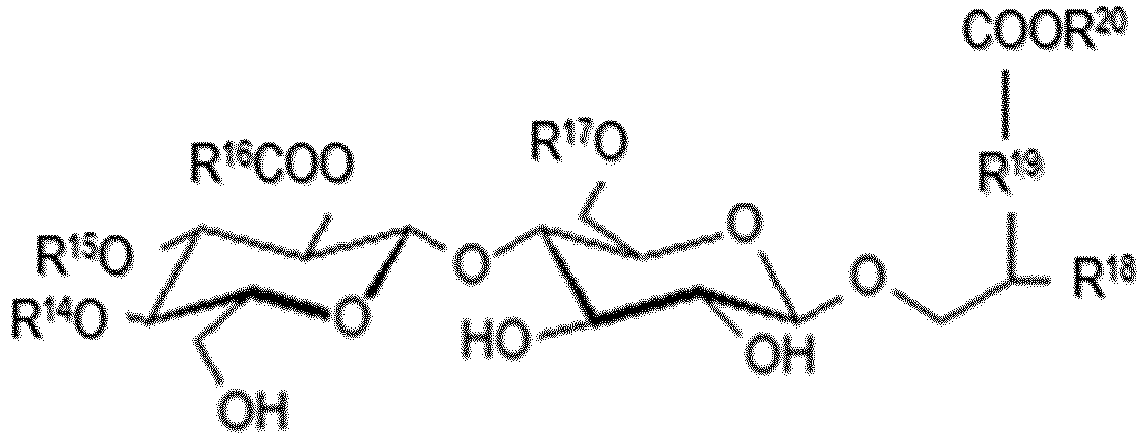 R14, R15 und R17 sind unabhängig voneinander H oder ―COCH3,R16 ist ein gesättigter oder ungesättigter, hydroxylierter oder nichthydroxylierter Kohlenwasserstoff mit 5 bis 23 Kohlenstoffatomen, oder ―CH3, bevorzugt ― CH3 oder - CH2-CH(OH)-(CH2)n-CH3 mit n= 2-4,R18 ist H oder -OH,R19 ist ein gesättigter oder ungesättigter, hydroxylierter oder nichthydroxylierter Kohlenwasserstoff mit 9 bis 21 Kohlenstoffatomen, bevorzugt 13 Kohlenstoffatome, besonders bevorzugt ― (CH2)n-CH(OH)- mit n= 12,R20= H oder ein Kation,Trehaloselipide der Formel (VI)
 R21, R22, R31 und R32= jeweils unabhängig voneinander Wasserstoff oder COR27 mit R27 gesättigtem oder ungesättigtem, hydroxyliertem oder nichthydroxyliertem Kohlenwasserstoff mit 5 bis 23 KohlenstoffatomenR25 und R26 jeweils unabhängig voneinander Wasserstoff oder COR28 mit R28 gesättigtem oder ungesättigtem, verzweigt oder nicht-verzweigtem, hydroxyliertem oder nicht- hydroxyliertem Kohlenwasserstoff mit 5 bis 23 Kohlenstoffatomen oder R28 = CH[(CH2)cCH3]CHOH(CH2)dCH3 mit c+d = 27 R29 und R23 jeweils unabhängig voneinander Wasserstoff oder COR30 mit R30 gesättigtem oder ungesättigtem, verzweigt oder nicht-verzweigtem, hydroxyliertem oder nicht- hydroxyliertem Kohlenwasserstoff mit 5 bis 23 Kohlenstoffatomen oder R30 = (CH)2COOR24 mit R24= H oder Kation.
 - Zubereitung gemäss Anspruch 1, dadurch gekennzeichnet, dass das mindestens eine alkoxylierte Tensid (A) als ein Gemisch unterschiedlicher Kettenlängen und Sättigungsgrade der Fettsäurereste RCO enthalten ist, wobei der Anteil an gesättigten und ungesättigten Fettsäurereste RCO mit 20 oder mehr Kohlenstoffatomen > 0.01 Gew.-% und besonders bevorzugt > 0.05 Gew.-% und ganz besonders bevorzugt > 0.1 Gew.-% und äusserst bevorzugt >= 0.2 Gew.-% beträgt, bezogen auf den Gesamtanteil an Fettsäurereste RCO in dem Tensid (A).
- Zubereitung gemäss einem der vorgehenden Ansprüche zusätzlich enthaltend mindestens ein weiteres Tensid (C) ausgewählt aus der Gruppe der alkoxylierten Fettsäureester, der alkoxylierten Fettsäureglyceridester und der alkoxylierten Pflanzenölester der Formel (VIII) oder jeweils Gemische derselben;
wobei
(VIII) RCO-O(CmH2mO)o-{CH2-CH[O(CmH2mO)pRʺ]-CH2O}w-(CmH2mO)q-R‴
m ist 2, 3 oder 4,o, p, q sind unabhängig voneinander Zahlen von 0 bis 75, wobei o+p+q ≠ 0, und der Alkoxylierungsgrad x = 2-75,Rʺ ist H, oder CORR‴ ist H, COR, oder ein linearer oder verzweigter Alkylrest mit 1-8 C-Atomen. w ist o oder 1,und wobei das oder die Tenside (C) als ein Gemisch unterschiedlicher Kettenlängen und Sättigungsgrade der Fettsäurereste RCO vorliegen und RCO abgeleitet ist von einem C-18-Pflanzenöl mit R und RCO wie definiert in Formel (I). - Zubereitung gemäss einem der vorgehenden Ansprüche zusätzlich enthaltend einen oder mehrere Chelatbildner.
- Zubereitung gemäss einem der vorgehenden Ansprüche zusätzlich enthaltend ein oder mehrere organische Lösungsmittel.
- Zubereitung gemäss einem der vorgehenden Ansprüche, dadurch gekennzeichnet, dass der Anteil an Tensiden bestehend aus Tensid (A), dem Tensid (C) und gegebenenfalls den Tensiden (D) und (E), mit der Vorgabe, dass das oder die Tenside (D) und (E) von einem C-18-Pflanzenöl abgeleitet sind, und Biotensid-Glycolipid (B), in Summe ≥ 30% beträgt, bevorzugt ≥ 60 %, besonders bevorzugt ≥ 95 % und äusserst bevorzugt ≥ 99 %, bezogen auf den Gesamtgehalt an Tensiden in Gew.-% in der Zubereitung.
- Zubereitung gemäss einem der vorgehenden Ansprüche, dadurch gekennzeichnet, dass Tensid (A) PEG-4 Rapssamenamid ist
- Zubereitung gemäss einem der vorgehenden Ansprüche, dadurch gekennzeichnet, dass das oder die Glycolipid-Biotensid (B) ein Sophorolipid oder/und Rhamnolipid ist.
- Zubereitung gemäss einem der vorgehenden Ansprüche, dadurch gekennzeichnet, dass sie auf ein Substrat aufgebracht wurde, nach einem Verfahren durch Aufstreifen, Aufsprühen und/ oder Tauchen.
- Reinigungs- und Pflegeverfahren umfassend die Verfahrensschritte:a) Bereitstellung eines Reinigungs- und Pflegemittel umfassend eine Zubereitung gemäss einem der vorstehenden Ansprüche 1-9b) direktes oder indirektes in Kontakt bringen einer Oberfläche insbesondere Zähne, Zahnfleisch, Haare, Haut und Fell mit dem Reinigungs- und Pflegemittel gemäss (a).
- Nicht-therapeutische Verwendung der Zubereitung gemäss einem der vorhergehenden Ansprüche 1-9 als kosmetisches Mittel für die Körperreinigung und -pflege, sowie der Mundhygiene.
Priority Applications (1)
| Application Number | Priority Date | Filing Date | Title |
|---|---|---|---|
| EP21020587.8A EP3998059A1 (de) | 2016-08-29 | 2017-08-25 | Milde zubereitungen als reinigungs- oder pflegemittel zum entfernen von kohlenhydraten oder anfärbungen |
Applications Claiming Priority (1)
| Application Number | Priority Date | Filing Date | Title |
|---|---|---|---|
| CH01112/16A CH712858A2 (de) | 2016-08-29 | 2016-08-29 | Milde Zubereitungen mit alkoxylierten Fettsäureamiden und Glycolipid-Biotensiden. |
Related Child Applications (1)
| Application Number | Title | Priority Date | Filing Date |
|---|---|---|---|
| EP21020587.8A Division EP3998059A1 (de) | 2016-08-29 | 2017-08-25 | Milde zubereitungen als reinigungs- oder pflegemittel zum entfernen von kohlenhydraten oder anfärbungen |
Publications (2)
| Publication Number | Publication Date |
|---|---|
| EP3290020A1 EP3290020A1 (de) | 2018-03-07 |
| EP3290020B1 true EP3290020B1 (de) | 2021-11-24 |
Family
ID=59738107
Family Applications (2)
| Application Number | Title | Priority Date | Filing Date |
|---|---|---|---|
| EP21020587.8A Pending EP3998059A1 (de) | 2016-08-29 | 2017-08-25 | Milde zubereitungen als reinigungs- oder pflegemittel zum entfernen von kohlenhydraten oder anfärbungen |
| EP17020389.7A Active EP3290020B1 (de) | 2016-08-29 | 2017-08-25 | Milde zubereitungen mit alkoxylierten fettsäureamiden |
Family Applications Before (1)
| Application Number | Title | Priority Date | Filing Date |
|---|---|---|---|
| EP21020587.8A Pending EP3998059A1 (de) | 2016-08-29 | 2017-08-25 | Milde zubereitungen als reinigungs- oder pflegemittel zum entfernen von kohlenhydraten oder anfärbungen |
Country Status (3)
| Country | Link |
|---|---|
| EP (2) | EP3998059A1 (de) |
| CH (1) | CH712858A2 (de) |
| DK (1) | DK3290020T3 (de) |
Families Citing this family (16)
| Publication number | Priority date | Publication date | Assignee | Title |
|---|---|---|---|---|
| DE102019202724A1 (de) * | 2019-02-28 | 2020-09-03 | Beiersdorf Ag | Glycolipid-haltige Reinigungszubereitung enthaltend Mizellen |
| DE102019202723A1 (de) * | 2019-02-28 | 2020-09-03 | Beiersdorf Ag | Reinigungstücher getränkt mit Tränkungsmitteln enthaltend Biotenside |
| US20230190615A1 (en) * | 2020-03-24 | 2023-06-22 | Evonik Operations Gmbh | Compositions comprising rhamnolipid, alkyl polyglycoside and acyl lactylate |
| EP3940049A1 (de) | 2020-07-13 | 2022-01-19 | Dalli-Werke GmbH & Co. KG | Mannosylerythritol-lipid mit flüssigen spülhilfsmitteln |
| JP7747742B2 (ja) * | 2020-08-28 | 2025-10-01 | フジフイルム エレクトロニック マテリアルズ ユー.エス.エー., インコーポレイテッド | 洗浄組成物及びその使用方法 |
| DE102021200031A1 (de) | 2021-01-05 | 2022-07-07 | Henkel Ag & Co. Kgaa | Mittel zur oxidativen Farbveränderung von keratinischen Fasern mit Komplexbildner, Aktivator und Oxidationsmittel |
| EP4046620B1 (de) | 2021-02-23 | 2026-04-08 | Beiersdorf AG | Emulsionen enthaltend mannosylerythritol lipid (mel) |
| CN114958820B (zh) * | 2022-05-11 | 2023-10-31 | 西南石油大学 | 一种水溶性天然溶蜡剂及其制备方法与应用 |
| FR3138038A1 (fr) * | 2022-07-25 | 2024-01-26 | L'oreal | Composition comprenant du glycolipide et un dérivé d'acide citrique |
| CN115417764B (zh) * | 2022-09-06 | 2023-11-17 | 深圳市恒纬祥科技有限公司 | 一种蓖麻酸醇醚羧酸及其合成方法 |
| WO2024073683A2 (en) * | 2022-09-30 | 2024-04-04 | K18, Inc. | Hair demineralizer composition, methods and uses thereof |
| WO2024141844A1 (en) * | 2022-12-27 | 2024-07-04 | L'oreal | Foaming cleansing compositions |
| FR3146408A1 (fr) * | 2023-03-06 | 2024-09-13 | L'oreal | Composition nettoyante d'origine naturelle |
| FR3146407A1 (fr) * | 2023-03-06 | 2024-09-13 | L'oreal | Composition nettoyante moussante |
| CN117417789B (zh) * | 2023-10-19 | 2024-08-23 | 太仓立日包装容器有限公司 | 一种再生ibc吨桶绿色清洗溶剂 |
| DE102024208294A1 (de) * | 2024-09-02 | 2026-03-05 | Beiersdorf Aktiengesellschaft | Produkt mit Sophorolipiden |
Citations (1)
| Publication number | Priority date | Publication date | Assignee | Title |
|---|---|---|---|---|
| DE102009046169A1 (de) * | 2009-10-29 | 2011-05-05 | Henkel Ag & Co. Kgaa | Rückstandsarmer Reiniger für harte Oberflächen |
Family Cites Families (43)
| Publication number | Priority date | Publication date | Assignee | Title |
|---|---|---|---|---|
| JPS6037087B2 (ja) | 1978-09-28 | 1985-08-24 | 花王株式会社 | 化粧料 |
| JPS60183032A (ja) | 1984-03-02 | 1985-09-18 | Shiseido Co Ltd | 乳化組成物 |
| DE3526417A1 (de) | 1985-07-24 | 1987-02-05 | Wella Ag | Kosmetische mittel mit einem gehalt an einem sophoroselipid-lacton sowie seine verwendung |
| US4933281A (en) | 1987-03-17 | 1990-06-12 | The University Of Iowa Research Foundation | Method for producing rhamnose |
| JPH064665B2 (ja) | 1988-05-30 | 1994-01-19 | 工業技術院長 | 金属セッケン |
| ES2018637A6 (es) | 1989-04-18 | 1991-04-16 | Presas Angeles Manresa | Mejoras introducidas en el metodo para la obtencion de biotensioactivos en su sustrato de aceites y grasa refinados. |
| CA2060698C (en) | 1991-02-12 | 1997-09-30 | Peter J. Hall | Detergent compositions |
| FR2692593B1 (fr) | 1992-06-18 | 1995-06-16 | Inst Francais Du Petrole | Procede de production de sophorolipides acetyles sous leur forme acide a partir d'un substrat consistant et une huile ou un ester. |
| US5520839A (en) | 1993-09-10 | 1996-05-28 | Lever Brothers Company, Division Of Conopco, Inc. | Laundry detergent composition containing synergistic combination of sophorose lipid and nonionic surfactant |
| DE4409189C2 (de) | 1994-03-17 | 1996-08-14 | Chem Y | Tensid-Zusammensetzung, insbesondere zur Verwendung in Körperreinigungsmitteln |
| FR2740779B1 (fr) | 1995-11-08 | 1997-12-05 | Rhone Poulenc Chimie | Composition a base d'enzyme et de sophorolipide sous forme lactone et son utilisation dans les formulations detergentes pour le lavage du linge |
| DE19600743A1 (de) | 1996-01-11 | 1997-07-24 | Henkel Kgaa | Verwendung von Mischungen aus Glycolipiden und Tensiden |
| DE19648439A1 (de) | 1996-11-22 | 1998-05-28 | Henkel Kgaa | Verwendung von Mischungen aus Glycolipiden und Tensiden |
| CN1141357C (zh) | 2000-08-09 | 2004-03-10 | 大庆油田有限责任公司勘探开发研究院 | 一种驱油剂及其应用 |
| JP2003013093A (ja) | 2001-06-27 | 2003-01-15 | Saraya Kk | 低泡性洗浄剤組成物 |
| FR2827192B1 (fr) | 2001-07-13 | 2004-06-04 | Cognis France Sa | Preparations contenant des agents tensio-actifs non ioniques comme agents d'extraction |
| GB0219825D0 (en) | 2002-08-24 | 2002-10-02 | Cerestar Holding Bv | Process for producing and recovering mannosylerythritol lipidsfrom culture medium containing the same |
| KR20040033376A (ko) | 2002-10-14 | 2004-04-28 | 주식회사 엘지생활건강 | 소포로리피드를 포함하는 화장료 조성물 |
| CN1219886C (zh) | 2003-01-23 | 2005-09-21 | 湖南大学 | 复合生物表面活性剂及其在堆肥中的应用 |
| DE60305861T2 (de) | 2003-01-28 | 2007-01-04 | Ecover N.V. | Reinigungsmittelzusammensetzungen |
| JP4286558B2 (ja) | 2003-02-26 | 2009-07-01 | 広島県 | マンノシルエリスリトールリピッドの製造方法 |
| US8034605B2 (en) | 2003-03-26 | 2011-10-11 | Kyu-Jin Yum | Microbial materials for degradation of oils and toxic chemicals |
| FR2855752B1 (fr) | 2003-06-03 | 2005-08-26 | Lvmh Rech | Utilisation cosmetique des sophorolipides comme agents regulateurs de la masse adipeuse sous-cutanee et application a l'amincissement |
| JP4548827B2 (ja) | 2004-09-06 | 2010-09-22 | サラヤ株式会社 | 生分解性の液体洗浄剤組成物 |
| JP2006083238A (ja) | 2004-09-14 | 2006-03-30 | Saraya Kk | 洗浄剤組成物 |
| US7556654B1 (en) | 2004-10-15 | 2009-07-07 | Naturell | Methods for cleaning materials |
| JP2006274233A (ja) | 2005-03-29 | 2006-10-12 | Saraya Kk | 漂白剤組成物 |
| JP4858946B2 (ja) | 2006-01-10 | 2012-01-18 | 独立行政法人産業技術総合研究所 | 乳化剤又は可溶化剤 |
| JP4803434B2 (ja) | 2006-03-23 | 2011-10-26 | 独立行政法人産業技術総合研究所 | マンノシルエリスリトールリピッドの高効率生産方法 |
| EP2046930A4 (de) | 2006-07-27 | 2012-06-27 | Aurora Advance Beauty Labs | Auf rhamnolipid basierende formulierungen |
| JP5294226B2 (ja) | 2006-09-07 | 2013-09-18 | 独立行政法人産業技術総合研究所 | W/o型マイクロエマルジョン |
| DE102007022693A1 (de) | 2007-05-11 | 2009-01-15 | Evonik Stockhausen Gmbh | Haut- und Händereinigungsmittel mit hydrophilen Emollients |
| JP5649268B2 (ja) | 2008-05-15 | 2015-01-07 | サラヤ株式会社 | ソホロリピッドを含む吸着抑制組成物 |
| KR20100022289A (ko) | 2008-08-19 | 2010-03-02 | 인하대학교 산학협력단 | C-22 소포로리피드 유도체 화합물 및 이의 제조방법 |
| CN101845468B (zh) | 2010-03-30 | 2012-11-14 | 湖州紫金生物科技有限公司 | 一种鼠李糖脂的制备方法及其应用 |
| WO2011120776A1 (en) | 2010-03-31 | 2011-10-06 | Unilever Plc | Mild to the skin, foaming detergent composition |
| CN101948786B (zh) | 2010-09-03 | 2012-04-04 | 中国石油天然气股份有限公司 | 高产鼠李糖脂的铜绿假单胞菌及其应用 |
| DK2648809T3 (da) * | 2010-12-09 | 2019-07-15 | Y&B Mothers Choice Ltd | Naturlige formuleringer |
| CN102250790B (zh) | 2011-06-14 | 2014-05-07 | 南京农业大学 | 一株生物表面活性剂高效产生菌s2及其发酵培养基 |
| DE102011090030B4 (de) * | 2011-12-28 | 2025-11-06 | Evonik Operations Gmbh | Wässrige Haar- und Hautreinigungszusammensetzungen, enthaltend Biotenside |
| FR2991688B1 (fr) * | 2012-06-06 | 2015-05-22 | Soliance | Biosolubilisant |
| BR112015012907A2 (pt) * | 2012-12-17 | 2017-07-11 | Unilever Nv | composição de cuidado pessoal |
| EP3002328A1 (de) | 2014-09-30 | 2016-04-06 | Evonik Degussa GmbH | Biotensidhaltige Formulierung |
-
2016
- 2016-08-29 CH CH01112/16A patent/CH712858A2/de not_active Application Discontinuation
-
2017
- 2017-08-25 EP EP21020587.8A patent/EP3998059A1/de active Pending
- 2017-08-25 EP EP17020389.7A patent/EP3290020B1/de active Active
- 2017-08-25 DK DK17020389.7T patent/DK3290020T3/da active
Patent Citations (1)
| Publication number | Priority date | Publication date | Assignee | Title |
|---|---|---|---|---|
| DE102009046169A1 (de) * | 2009-10-29 | 2011-05-05 | Henkel Ag & Co. Kgaa | Rückstandsarmer Reiniger für harte Oberflächen |
Also Published As
| Publication number | Publication date |
|---|---|
| EP3998059A8 (de) | 2022-07-06 |
| EP3998059A9 (de) | 2022-09-28 |
| EP3998059A1 (de) | 2022-05-18 |
| EP3290020A1 (de) | 2018-03-07 |
| DK3290020T3 (en) | 2022-02-28 |
| CH712858A2 (de) | 2018-03-15 |
Similar Documents
| Publication | Publication Date | Title |
|---|---|---|
| EP3290020A1 (de) | Milde zubereitungen mit alkoxylierten fettsäureamiden | |
| EP3290500B1 (de) | Wasch-, pflege- und reinigungsmittel mit polyoxyalkylen carboxylat | |
| EP2459155B1 (de) | Öl-in-wasser-emulsion mit verbesserten sensorischen eigenschaften | |
| CN109384650A (zh) | 1,2-链烷二醇及其制备方法 | |
| EP2097059B1 (de) | Reinigungs- oder pflegeprodukt | |
| DE202021004519U1 (de) | Zusammensetzungen, die ein oder mehrere (Bio)-Alkandiole mit Antioxidantien enthalten | |
| DE102005014687A1 (de) | Zusammensetzung enthaltend ß-Defensin 2 | |
| EP1725210A1 (de) | Präbiotisch wirksame substanzen für deodorantien | |
| EP1938789A1 (de) | Verbesserung der Hautverträglichkeit von hyperämisierenden Wirkstoffen | |
| EP2005941A2 (de) | Zellverjüngende Zusammensetzungen | |
| EP2253305A2 (de) | Hautbehandlung zur Porenverfeinerung | |
| DE102008061045A1 (de) | Verwendung von epsilon-Viniferin | |
| DE102009045981A1 (de) | Antifalten-Kosmetikum mit Strandkamillenextrakt | |
| EP2182027A1 (de) | neues Verdickungssystem | |
| DE102007022448A1 (de) | Mittel zur Hautaufhellung | |
| EP2322138A2 (de) | Antimikrobielle Formulierung | |
| DE102005063179A1 (de) | Verwendung von Vitamin B6 zur Behandlung der Hautalterung | |
| EP3536383B1 (de) | Reinigungs- und pflegezubereitungen enthaltend ein polyoxyalkylen carboxylat | |
| EP1539128B1 (de) | Verwendung von substanzen zum schutz der haut | |
| DE102008061340A1 (de) | Antioxidative Zusammensetzungen | |
| DE102007022449A1 (de) | Mittel zur Behandlung unreiner Haut | |
| EP1675564A1 (de) | Mittel enthaltend baldrian | |
| EP3166589B1 (de) | Schweisshemmende kosmetische mittel mit speziellen proteinen aus hülsenfrüchten der gattung pisum, welche keine halogenide und/oder hydroxyhalogenide von aluminium und/oder zirconium enthalten" | |
| DE202017007679U1 (de) | 1,2-Alkandiole | |
| EP2654703A2 (de) | Wirkstoffkombinationen aus glucosylglyceriden und einem oder mehreren partiell hochethoxylierten estern aus polyolen und fettsäuren |
Legal Events
| Date | Code | Title | Description |
|---|---|---|---|
| PUAI | Public reference made under article 153(3) epc to a published international application that has entered the european phase |
Free format text: ORIGINAL CODE: 0009012 |
|
| STAA | Information on the status of an ep patent application or granted ep patent |
Free format text: STATUS: THE APPLICATION HAS BEEN PUBLISHED |
|
| AK | Designated contracting states |
Kind code of ref document: A1 Designated state(s): AL AT BE BG CH CY CZ DE DK EE ES FI FR GB GR HR HU IE IS IT LI LT LU LV MC MK MT NL NO PL PT RO RS SE SI SK SM TR |
|
| AX | Request for extension of the european patent |
Extension state: BA ME |
|
| STAA | Information on the status of an ep patent application or granted ep patent |
Free format text: STATUS: REQUEST FOR EXAMINATION WAS MADE |
|
| 17P | Request for examination filed |
Effective date: 20180903 |
|
| RBV | Designated contracting states (corrected) |
Designated state(s): AL AT BE BG CH CY CZ DE DK EE ES FI FR GB GR HR HU IE IS IT LI LT LU LV MC MK MT NL NO PL PT RO RS SE SI SK SM TR |
|
| STAA | Information on the status of an ep patent application or granted ep patent |
Free format text: STATUS: EXAMINATION IS IN PROGRESS |
|
| 17Q | First examination report despatched |
Effective date: 20181025 |
|
| RAP1 | Party data changed (applicant data changed or rights of an application transferred) |
Owner name: PERFECT IDEAS GMBH |
|
| GRAP | Despatch of communication of intention to grant a patent |
Free format text: ORIGINAL CODE: EPIDOSNIGR1 |
|
| STAA | Information on the status of an ep patent application or granted ep patent |
Free format text: STATUS: GRANT OF PATENT IS INTENDED |
|
| INTG | Intention to grant announced |
Effective date: 20201202 |
|
| GRAS | Grant fee paid |
Free format text: ORIGINAL CODE: EPIDOSNIGR3 |
|
| GRAJ | Information related to disapproval of communication of intention to grant by the applicant or resumption of examination proceedings by the epo deleted |
Free format text: ORIGINAL CODE: EPIDOSDIGR1 |
|
| GRAL | Information related to payment of fee for publishing/printing deleted |
Free format text: ORIGINAL CODE: EPIDOSDIGR3 |
|
| STAA | Information on the status of an ep patent application or granted ep patent |
Free format text: STATUS: EXAMINATION IS IN PROGRESS |
|
| INTC | Intention to grant announced (deleted) | ||
| GRAP | Despatch of communication of intention to grant a patent |
Free format text: ORIGINAL CODE: EPIDOSNIGR1 |
|
| STAA | Information on the status of an ep patent application or granted ep patent |
Free format text: STATUS: GRANT OF PATENT IS INTENDED |
|
| INTG | Intention to grant announced |
Effective date: 20210614 |
|
| GRAA | (expected) grant |
Free format text: ORIGINAL CODE: 0009210 |
|
| STAA | Information on the status of an ep patent application or granted ep patent |
Free format text: STATUS: THE PATENT HAS BEEN GRANTED |
|
| AK | Designated contracting states |
Kind code of ref document: B1 Designated state(s): AL AT BE BG CH CY CZ DE DK EE ES FI FR GB GR HR HU IE IS IT LI LT LU LV MC MK MT NL NO PL PT RO RS SE SI SK SM TR |
|
| REG | Reference to a national code |
Ref country code: GB Ref legal event code: FG4D Free format text: NOT ENGLISH |
|
| REG | Reference to a national code |
Ref country code: DE Ref legal event code: R096 Ref document number: 502017012070 Country of ref document: DE |
|
| REG | Reference to a national code |
Ref country code: AT Ref legal event code: REF Ref document number: 1449304 Country of ref document: AT Kind code of ref document: T Effective date: 20211215 |
|
| REG | Reference to a national code |
Ref country code: IE Ref legal event code: FG4D Free format text: LANGUAGE OF EP DOCUMENT: GERMAN |
|
| REG | Reference to a national code |
Ref country code: DK Ref legal event code: T3 Effective date: 20220224 |
|
| REG | Reference to a national code |
Ref country code: NL Ref legal event code: FP |
|
| REG | Reference to a national code |
Ref country code: LT Ref legal event code: MG9D |
|
| PG25 | Lapsed in a contracting state [announced via postgrant information from national office to epo] |
Ref country code: RS Free format text: LAPSE BECAUSE OF FAILURE TO SUBMIT A TRANSLATION OF THE DESCRIPTION OR TO PAY THE FEE WITHIN THE PRESCRIBED TIME-LIMIT Effective date: 20211124 Ref country code: LT Free format text: LAPSE BECAUSE OF FAILURE TO SUBMIT A TRANSLATION OF THE DESCRIPTION OR TO PAY THE FEE WITHIN THE PRESCRIBED TIME-LIMIT Effective date: 20211124 Ref country code: FI Free format text: LAPSE BECAUSE OF FAILURE TO SUBMIT A TRANSLATION OF THE DESCRIPTION OR TO PAY THE FEE WITHIN THE PRESCRIBED TIME-LIMIT Effective date: 20211124 Ref country code: BG Free format text: LAPSE BECAUSE OF FAILURE TO SUBMIT A TRANSLATION OF THE DESCRIPTION OR TO PAY THE FEE WITHIN THE PRESCRIBED TIME-LIMIT Effective date: 20220224 |
|
| PG25 | Lapsed in a contracting state [announced via postgrant information from national office to epo] |
Ref country code: IS Free format text: LAPSE BECAUSE OF FAILURE TO SUBMIT A TRANSLATION OF THE DESCRIPTION OR TO PAY THE FEE WITHIN THE PRESCRIBED TIME-LIMIT Effective date: 20220324 Ref country code: SE Free format text: LAPSE BECAUSE OF FAILURE TO SUBMIT A TRANSLATION OF THE DESCRIPTION OR TO PAY THE FEE WITHIN THE PRESCRIBED TIME-LIMIT Effective date: 20211124 Ref country code: PT Free format text: LAPSE BECAUSE OF FAILURE TO SUBMIT A TRANSLATION OF THE DESCRIPTION OR TO PAY THE FEE WITHIN THE PRESCRIBED TIME-LIMIT Effective date: 20220324 Ref country code: PL Free format text: LAPSE BECAUSE OF FAILURE TO SUBMIT A TRANSLATION OF THE DESCRIPTION OR TO PAY THE FEE WITHIN THE PRESCRIBED TIME-LIMIT Effective date: 20211124 Ref country code: NO Free format text: LAPSE BECAUSE OF FAILURE TO SUBMIT A TRANSLATION OF THE DESCRIPTION OR TO PAY THE FEE WITHIN THE PRESCRIBED TIME-LIMIT Effective date: 20220224 Ref country code: LV Free format text: LAPSE BECAUSE OF FAILURE TO SUBMIT A TRANSLATION OF THE DESCRIPTION OR TO PAY THE FEE WITHIN THE PRESCRIBED TIME-LIMIT Effective date: 20211124 Ref country code: HR Free format text: LAPSE BECAUSE OF FAILURE TO SUBMIT A TRANSLATION OF THE DESCRIPTION OR TO PAY THE FEE WITHIN THE PRESCRIBED TIME-LIMIT Effective date: 20211124 Ref country code: ES Free format text: LAPSE BECAUSE OF FAILURE TO SUBMIT A TRANSLATION OF THE DESCRIPTION OR TO PAY THE FEE WITHIN THE PRESCRIBED TIME-LIMIT Effective date: 20211124 |
|
| PG25 | Lapsed in a contracting state [announced via postgrant information from national office to epo] |
Ref country code: SM Free format text: LAPSE BECAUSE OF FAILURE TO SUBMIT A TRANSLATION OF THE DESCRIPTION OR TO PAY THE FEE WITHIN THE PRESCRIBED TIME-LIMIT Effective date: 20211124 Ref country code: SK Free format text: LAPSE BECAUSE OF FAILURE TO SUBMIT A TRANSLATION OF THE DESCRIPTION OR TO PAY THE FEE WITHIN THE PRESCRIBED TIME-LIMIT Effective date: 20211124 Ref country code: RO Free format text: LAPSE BECAUSE OF FAILURE TO SUBMIT A TRANSLATION OF THE DESCRIPTION OR TO PAY THE FEE WITHIN THE PRESCRIBED TIME-LIMIT Effective date: 20211124 Ref country code: EE Free format text: LAPSE BECAUSE OF FAILURE TO SUBMIT A TRANSLATION OF THE DESCRIPTION OR TO PAY THE FEE WITHIN THE PRESCRIBED TIME-LIMIT Effective date: 20211124 Ref country code: CZ Free format text: LAPSE BECAUSE OF FAILURE TO SUBMIT A TRANSLATION OF THE DESCRIPTION OR TO PAY THE FEE WITHIN THE PRESCRIBED TIME-LIMIT Effective date: 20211124 |
|
| REG | Reference to a national code |
Ref country code: DE Ref legal event code: R097 Ref document number: 502017012070 Country of ref document: DE |
|
| PLBE | No opposition filed within time limit |
Free format text: ORIGINAL CODE: 0009261 |
|
| STAA | Information on the status of an ep patent application or granted ep patent |
Free format text: STATUS: NO OPPOSITION FILED WITHIN TIME LIMIT |
|
| PG25 | Lapsed in a contracting state [announced via postgrant information from national office to epo] |
Ref country code: AL Free format text: LAPSE BECAUSE OF FAILURE TO SUBMIT A TRANSLATION OF THE DESCRIPTION OR TO PAY THE FEE WITHIN THE PRESCRIBED TIME-LIMIT Effective date: 20211124 |
|
| PGFP | Annual fee paid to national office [announced via postgrant information from national office to epo] |
Ref country code: IT Payment date: 20220808 Year of fee payment: 6 |
|
| 26N | No opposition filed |
Effective date: 20220825 |
|
| PG25 | Lapsed in a contracting state [announced via postgrant information from national office to epo] |
Ref country code: SI Free format text: LAPSE BECAUSE OF FAILURE TO SUBMIT A TRANSLATION OF THE DESCRIPTION OR TO PAY THE FEE WITHIN THE PRESCRIBED TIME-LIMIT Effective date: 20211124 |
|
| PG25 | Lapsed in a contracting state [announced via postgrant information from national office to epo] |
Ref country code: MC Free format text: LAPSE BECAUSE OF FAILURE TO SUBMIT A TRANSLATION OF THE DESCRIPTION OR TO PAY THE FEE WITHIN THE PRESCRIBED TIME-LIMIT Effective date: 20211124 |
|
| PG25 | Lapsed in a contracting state [announced via postgrant information from national office to epo] |
Ref country code: LU Free format text: LAPSE BECAUSE OF NON-PAYMENT OF DUE FEES Effective date: 20220825 |
|
| PG25 | Lapsed in a contracting state [announced via postgrant information from national office to epo] |
Ref country code: IE Free format text: LAPSE BECAUSE OF NON-PAYMENT OF DUE FEES Effective date: 20220825 |
|
| PG25 | Lapsed in a contracting state [announced via postgrant information from national office to epo] |
Ref country code: HU Free format text: LAPSE BECAUSE OF FAILURE TO SUBMIT A TRANSLATION OF THE DESCRIPTION OR TO PAY THE FEE WITHIN THE PRESCRIBED TIME-LIMIT; INVALID AB INITIO Effective date: 20170825 |
|
| PG25 | Lapsed in a contracting state [announced via postgrant information from national office to epo] |
Ref country code: CY Free format text: LAPSE BECAUSE OF FAILURE TO SUBMIT A TRANSLATION OF THE DESCRIPTION OR TO PAY THE FEE WITHIN THE PRESCRIBED TIME-LIMIT Effective date: 20211124 |
|
| PG25 | Lapsed in a contracting state [announced via postgrant information from national office to epo] |
Ref country code: MK Free format text: LAPSE BECAUSE OF FAILURE TO SUBMIT A TRANSLATION OF THE DESCRIPTION OR TO PAY THE FEE WITHIN THE PRESCRIBED TIME-LIMIT Effective date: 20211124 |
|
| PG25 | Lapsed in a contracting state [announced via postgrant information from national office to epo] |
Ref country code: TR Free format text: LAPSE BECAUSE OF FAILURE TO SUBMIT A TRANSLATION OF THE DESCRIPTION OR TO PAY THE FEE WITHIN THE PRESCRIBED TIME-LIMIT Effective date: 20211124 |
|
| PG25 | Lapsed in a contracting state [announced via postgrant information from national office to epo] |
Ref country code: IT Free format text: LAPSE BECAUSE OF NON-PAYMENT OF DUE FEES Effective date: 20230825 |
|
| PG25 | Lapsed in a contracting state [announced via postgrant information from national office to epo] |
Ref country code: MT Free format text: LAPSE BECAUSE OF FAILURE TO SUBMIT A TRANSLATION OF THE DESCRIPTION OR TO PAY THE FEE WITHIN THE PRESCRIBED TIME-LIMIT Effective date: 20211124 |
|
| PG25 | Lapsed in a contracting state [announced via postgrant information from national office to epo] |
Ref country code: GR Free format text: LAPSE BECAUSE OF NON-PAYMENT OF DUE FEES Effective date: 20211124 |
|
| PG25 | Lapsed in a contracting state [announced via postgrant information from national office to epo] |
Ref country code: GR Free format text: LAPSE BECAUSE OF NON-PAYMENT OF DUE FEES Effective date: 20211124 |
|
| PGFP | Annual fee paid to national office [announced via postgrant information from national office to epo] |
Ref country code: NL Payment date: 20250815 Year of fee payment: 9 |
|
| PGFP | Annual fee paid to national office [announced via postgrant information from national office to epo] |
Ref country code: DK Payment date: 20250811 Year of fee payment: 9 Ref country code: DE Payment date: 20250819 Year of fee payment: 9 |
|
| PGFP | Annual fee paid to national office [announced via postgrant information from national office to epo] |
Ref country code: BE Payment date: 20250818 Year of fee payment: 9 Ref country code: GB Payment date: 20250811 Year of fee payment: 9 |
|
| PGFP | Annual fee paid to national office [announced via postgrant information from national office to epo] |
Ref country code: FR Payment date: 20250811 Year of fee payment: 9 Ref country code: AT Payment date: 20250818 Year of fee payment: 9 |
|
| PGFP | Annual fee paid to national office [announced via postgrant information from national office to epo] |
Ref country code: CH Payment date: 20250901 Year of fee payment: 9 |