EP3291282A1 - Procédés de fonctionnement des analyseurs de masse à piège électrostatique - Google Patents
Procédés de fonctionnement des analyseurs de masse à piège électrostatique Download PDFInfo
- Publication number
- EP3291282A1 EP3291282A1 EP17188423.2A EP17188423A EP3291282A1 EP 3291282 A1 EP3291282 A1 EP 3291282A1 EP 17188423 A EP17188423 A EP 17188423A EP 3291282 A1 EP3291282 A1 EP 3291282A1
- Authority
- EP
- European Patent Office
- Prior art keywords
- trapping
- ions
- field
- frequency
- superimposing
- Prior art date
- Legal status (The legal status is an assumption and is not a legal conclusion. Google has not performed a legal analysis and makes no representation as to the accuracy of the status listed.)
- Granted
Links
Images



Classifications
-
- H—ELECTRICITY
- H01—ELECTRIC ELEMENTS
- H01J—ELECTRIC DISCHARGE TUBES OR DISCHARGE LAMPS
- H01J49/00—Particle spectrometers or separator tubes
- H01J49/02—Details
- H01J49/025—Detectors specially adapted to particle spectrometers
- H01J49/027—Detectors specially adapted to particle spectrometers detecting image current induced by the movement of charged particles
-
- H—ELECTRICITY
- H01—ELECTRIC ELEMENTS
- H01J—ELECTRIC DISCHARGE TUBES OR DISCHARGE LAMPS
- H01J49/00—Particle spectrometers or separator tubes
- H01J49/0027—Methods for using particle spectrometers
- H01J49/0031—Step by step routines describing the use of the apparatus
-
- H—ELECTRICITY
- H01—ELECTRIC ELEMENTS
- H01J—ELECTRIC DISCHARGE TUBES OR DISCHARGE LAMPS
- H01J49/00—Particle spectrometers or separator tubes
- H01J49/26—Mass spectrometers or separator tubes
- H01J49/34—Dynamic spectrometers
- H01J49/42—Stability-of-path spectrometers, e.g. monopole, quadrupole, multipole, farvitrons
- H01J49/4205—Device types
- H01J49/4245—Electrostatic ion traps
-
- H—ELECTRICITY
- H01—ELECTRIC ELEMENTS
- H01J—ELECTRIC DISCHARGE TUBES OR DISCHARGE LAMPS
- H01J49/00—Particle spectrometers or separator tubes
- H01J49/26—Mass spectrometers or separator tubes
- H01J49/34—Dynamic spectrometers
- H01J49/42—Stability-of-path spectrometers, e.g. monopole, quadrupole, multipole, farvitrons
- H01J49/426—Methods for controlling ions
-
- H—ELECTRICITY
- H01—ELECTRIC ELEMENTS
- H01J—ELECTRIC DISCHARGE TUBES OR DISCHARGE LAMPS
- H01J49/00—Particle spectrometers or separator tubes
- H01J49/26—Mass spectrometers or separator tubes
- H01J49/34—Dynamic spectrometers
- H01J49/42—Stability-of-path spectrometers, e.g. monopole, quadrupole, multipole, farvitrons
- H01J49/426—Methods for controlling ions
- H01J49/427—Ejection and selection methods
- H01J49/4275—Applying a non-resonant auxiliary oscillating voltage, e.g. parametric excitation
Definitions
- the present invention relates generally to mass spectrometry and mass spectrometers and, more particularly, relates to operation of electrostatic trap mass analyzers and to operation of mass spectrometer systems employing electrostatic trap mass analyzers.
- Electrostatic traps are a class of ion optical devices where moving ions experience multiple reflections or deflections in substantially electrostatic fields. Unlike for trapping in RF field ion traps, trapping in electrostatic traps is possible only for moving ions. Thus, a high vacuum is required to ensure that this movement takes place with minimal loss of ion energy due to collisions over a data acquisition time T m . Since its commercial introduction in 2005, the ORBITRAPTM mass analyzer, which belongs to the class of electrostatic trap mass analyzers, has become widely recognized as a useful tool for mass spectrometric analysis.
- the ORBITRAPTM mass analyzer which is commercially available from Thermo Fisher Scientific of Waltham Massachusetts USA, is a type of electrostatic trap mass analyzer that is substantially modified from the earlier Kingdon ion trap.
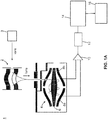
- FIGS. 1A and 1B discussed further below, provide schematic illustrations of an ORBITRAPTM mass analyzer. The main advantages of electrostatic trapping mass analyzers of the type illustrated in FIGS.
- ions are compelled to undergo collective oscillatory motion within the analyzer which induces a correspondingly oscillatory image charge in neighboring detection electrodes, thereby enabling detection of the ions.
- the oscillatory motion used for detection may be of various forms including, for example, circular oscillatory motion in the case of FT-ICR and axial oscillatory motion while orbiting about a central electrode in the case of a mass analyzer of the type schematically illustrated in FIGS. 1A-1B or a mass spectrometer employing such a mass analyzer.
- the oscillatory image charge in turn induces an oscillatory image current and corresponding voltage in circuitry connected to the detection electrodes, which is then typically amplified, digitized and stored in computer memory which is referred to as a transient (i.e. a transitory signal in the time domain).
- the oscillating ions induce oscillatory image charge and oscillatory current at frequencies which are related to the mass-to-charge ( m / z ) values of the ions.
- Each ion of a given mass to charge ( m / z ) value will oscillate at a corresponding given frequency such that it contributes a signal to the collective ion image current which is generally in the form of a periodic wave at the given frequency.
- the total detected image current of the transient is then the resultant sum of the image currents at all the frequencies present (i.e. a sum of periodic signals).
- Frequency spectrum analysis (such as Fourier transformation) of the transient yields the oscillation frequencies associated with the particular detected oscillating ions; from the frequencies, the m / z values of the ions can be determined (i.e. the mass spectrum) by known equations with parameters determined by prior calibration experiments.
- an ORBITRAPTM mass analyzer includes an outer barrel-like electrode and a central spindle-like electrode along the axis.
- FIG. 1A a portion of a mass spectrometer system including an ORBITRAPTM mass analyzer is schematically shown in longitudinal section view.
- the mass spectrometer system 1 includes an ion injection device 2 and an electrostatic orbital trapping mass analyzer 4.
- the ion injection device 2 in this case, is a curved multipolar curvi-linear trap (known as a "C-trap"). Ions are ejected radially from the "C-trap" in a pulse to the Orbitrap.
- the C-trap may receive and trap ions from an ion source 3 which may be any known type of source such as an electrospray (ESI) ion source, a Matrix-Assisted Laser Desorption Ionization (MALDI) ion source, a Chemical Ionization (CI) ion source, an Electron Ionization (EI) ion source, etc.
- ESI electrospray
- MALDI Matrix-Assisted Laser Desorption Ionization
- CI Chemical Ionization
- EI Electron Ionization
- Additional not-illustrated ion processing components such as ion guiding components, mass filtering components, linear ion trapping components, ion fragmentation components, etc. may optionally be included (and frequently are included) between the ion source 3 and the C-trap 2 or between the C-trap and other parts of the mass spectrometer.
- Other parts of the mass spectrometer which are not shown are conventional, such as additional ion optics, vacuum pumping system, power supplies etc.
- ion injection devices may be employed in place of the C-trap.
- the aforementioned U.S. Pat. No. 6,872,938 teaches the use of an injection assembly comprising a segmented quadrupole linear ion trap having an entrance segment, an exit segment, an entrance lens adjacent to the entrance segment and an exit lens adjacent to the exit segment.
- DC direct-current
- a temporary axial potential well may be created in the axial direction within the exit segment.
- the pressure inside the trap is chosen in such a way that ions lose sufficient kinetic energy during their first pass through the trap such that they accumulate near the bottom of the axial potential well.
- the electrostatic orbital trapping mass analyzer 4 comprises a central spindle shaped electrode 6 and a surrounding outer electrode which is separated into two halves 8a and 8b.
- FIG. 1B is an enlarged cross-sectional view of the inner and outer electrodes.
- the annular space 17 between the inner spindle electrode 6 and the outer electrode halves 8a and 8b is the volume in which the ions orbit and oscillate and comprises a measurement chamber in that the motion of ions within this volume induces the measured signal that is used to determine the ions m / z ratios and relative abundances.
- the motions of trapped ions are associated with three characteristic oscillation frequencies: a frequency of rotation around the central electrode 6, a frequency of radial oscillations a nominal rotational radius and a frequency of axial oscillations along the z -axis.
- a frequency of rotation around the central electrode 6 a frequency of radial oscillations a nominal rotational radius and a frequency of axial oscillations along the z -axis.
- the motion of ions of a given m / z need to be coherent.
- the radial and rotational oscillations are only partially coherent for ions of the same m / z as differences in average orbital radius and size of radial oscillations correspond to different orbital and radial frequencies.
- axial oscillation frequency is independent of oscillation amplitude and depends only on m / z and, therefore, the axial oscillation frequencies are the only ones used for mass-to-charge ratio determinations.
- the outer electrode is formed in two parts 8a, 8b as described above and is shown in FIG. 1B .
- One or both parts 8a, 8b of the outer electrode are used to detect image current as the ions oscillate back and forth axially.
- the Fourier transform of the induced ion image current signal from the time domain to the frequency domain can thus produce a mass spectrum in a conventional manner. This mode of detection makes possible high mass resolving powers.
- Ions having various m / z values which are trapped within the C-trap are injected from the C-trap into the electrostatic orbital trapping mass analyzer 4 in a temporally and spatially short packet at an offset ion inlet aperture 5 that is located at an axial position which is offset from the equatorial plane 7 of the analyzer in order to achieve "excitation by injection” whereby the ions of the ion packet immediately commence oscillation within the mass analyzer in the quadro-logarithmic potential.
- the ions oscillate axially between the two outer electrodes 8a and 8b while also orbiting around the inner electrode 6.
- the axial oscillation frequency of an ion is dependent on the m / z values of the ions contained within the ion packet so that ions in the packet with different m / z begin to oscillate at different frequencies.
- the two outer electrodes 8a and 8b serve as detection electrodes.
- the oscillation of the ions in the mass analyzer causes an image charge to be induced in the electrodes 8a and 8b and the resulting image current in the connected circuitry is picked-up as a signal and amplified by an amplifier 10 ( FIG. 1A ) connected to the two outer electrodes 8a and 8b which is then digitized by a digitizer 12.
- the resulting digitized signal (i.e. the transient) is then received by an information processor 14 and stored in memory.
- the memory may be part of the information processor 14 or separate, preferably part of the information processor 14.
- the information processor 14 may comprise a computer running a program having elements of program code designed for processing the transient.
- the computer 14 may be connected to an output means 16, which can comprise one or more of: an output visual display unit, a printer, a data writer or the like.
- the transient received by the information processor 14 represents the mixture of the image currents produced by the ions of different m / z values which oscillate at different frequencies in the mass analyzer.
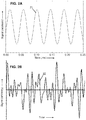
- a transient signal for ions of one m / z is periodic as shown in FIG. 2A , which shows a "symbolic" approximately sinusoidal transient 21 for just a few oscillations of a single frequency ( m / z ) component.
- a representative transient 22 obtained when several different frequencies are combined is shown in FIG. 2B .
- the m / z value of the ion determines the period (and frequency) of the periodic function.
- the information processor 14 performs a Fourier transformation on the received transient.
- the mathematical method of discrete Fourier transformation may be employed to convert the transient in the time domain (e.g., curve 22 in FIG. 2B ), which comprises the mixture of periodic transient signals which result from the mixture of m / z present among the measured ions, into a spectrum in the frequency domain. If desired, at this stage or later, the frequency domain spectrum can be converted into the m / z domain by straightforward calculation.
- the discrete Fourier transformation produces a spectrum which has a profile point for each frequency or m / z value, and these profile points form a peak at those frequency or m / z positions where an ion signal is detected (i.e. where an ion of corresponding m / z is present in the analyzer).
- the Fourier transform outputs a complex number for each profile point (frequency).
- the complex number comprises a magnitude and a phase angle (often simply termed phase).
- the complex number at each frequency point may be described as comprising a real component, Re, and an imaginary component, Im.
- the set of real components, Re, and imaginary components, Im compose a so-called complex spectrum. It is generally the case that the real component and imaginary component are asymmetrical because the initial phase of the signal at the start of the transient is not zero. Because asymmetrical peaks lead to undesirable low spectral resolution, conventional Fourier transform processing of mass spectral transients has made use of the so-called magnitude spectrum rather than a spectrum based on the real or imaginary components alone.
- the mass resolving power of an electrostatic orbital trapping mass analyzer of the type illustrated in FIGS. 1A-1B or any other electrostatic trapping mass analyzer may be inhibited by accumulation of space charge within the trap.
- any ion trap mass analyzer there is a finite amount of charge that may be injected into an electrostatic orbital trapping mass analyzer of the type illustrated in FIGS. 1A-1B while still attaining a given level of performance.
- the buildup of charge density within a trap produces perturbations of the electric field within the measurement cavity 17 that causes local deviations of the form of the field from the theoretical form given by Eq. 1.
- interactions between ions that are caused by increase in the density of space charge may lead to ion-to-ion transfers of both momentum and energy between ion species of differing m / z ratios.
- a transfer of momentum may cause disruption of the z-axis oscillatory phase coherence among ions of the same m / z value thereby leading to broadened and weakened transient signals, coalescence of mass spectral peaks and consequent loss of spectral resolution.
- a transfer of energy may cause some ions to prematurely collide with one or the other of the electrodes, thereby contributing to a loss of signal.
- the geometric configuration of electrodes within the electrostatic trap mass analyzer illustrated in FIGS. 1A , 1B is more favorable to dispersal of space charge than is three-dimensional radio frequency (RF) quadrupole ion trap. This is because, in the mass analyzer shown in FIGS. 1A , 1B , ions of each m / z value are partially angularly dispersed, in the form of an arc, around the spindle electrode 6 within the measurement cavity 17 instead of being confined to a localized central volume (as in a multipole ion trap).
- RF radio frequency
- ions are spread programmatically along the available trap z -axis amplitude according to their intact mass-to-charge ( m / z ) ratios to minimize temporal overlap of all ions and reduce accumulation of ion density at the z-axis oscillation extrema.
- the present invention thus provides a planned utilization of available trap volume to minimize space-charge and ion-ion interaction for the duration of the trapping and detection of ions within the ORBITRAPTM mass analyzer.
- Programming of z-axis amplitude has been found to provide a significant performance enhancement of an electrostatic orbital trapping mass analyzer of the type illustrated in FIGS. 1A-1B and may be applicable to other three-dimensional electrostatic trap apparatuses.
- One other major class of three-dimensional electrostatic trap apparatuses is represented by the various so-called Cassinian electrostatic ion trap apparatuses (also referred to as “Cassinian trap” apparatuses) as described in U.S. Patent No. 7,994,473 in the name of inventor Köster, said patent hereby incorporated herein by reference in its entirety.
- an ORBITRAPTM mass analyzer employs an electrostatic trap comprising an outer electrode and a single inner spindle electrode
- the Cassinian trap apparatus employs an outer electrode and two or more inner spindle electrodes. Therefore, the various Cassinian trap apparatuses and their derivatives may be collectively referred to as "Higher-Order Kingdon" trap apparatuses.
- ions are provided to the electrostatic trap and an initial transient signal is recorded and analyzed according to the method of enhanced Fourier Transformation (eFT) so as to recover phase information associated with various frequencies of oscillatory components of the transient, where each oscillatory component pertains to a respective m / z ratio.
- eFT enhanced Fourier Transformation
- Phase information could also be derived from other methods of so-called "phasing" wherein phase information is recovered during the transformation process.
- the derived phase information is then used during the programmed application of a supplemental AC multi-frequency waveform to the outer electrodes of the electrostatic trap during which, in accordance with the programming, oscillations corresponding to various m / z ratios are either enhanced (excited) to higher energy or damped (de-excited) to lower energy.
- the application of the supplemental or auxiliary multi-frequency waveform superimposes a multi-frequency oscillatory modulation field onto the main trapping electrostatic field within the trapping region, wherein the modulation field acts to either increase or reduce the harmonic motion energies of the ions by an amount varying according to the frequency of harmonic motion.
- the supplemental AC waveform varies in frequency and amplitude according to the z-axis oscillation frequency of each m / z ratio.
- the various supplemental AC frequencies may be applied in-phase with the ions z -axis oscillations according to the phase information derived from the prior eFT analysis or, in general, in accordance with phase analysis derived by other mathematical transform techniques.
- the excitation of oscillations produces a wider z -axis oscillation range for those ions that are excited; the de-excitation produces a narrower z -axis oscillation range for those ions that are de-excited.
- the average orbital radius of ions around the z -axis may also respectively increase or decrease concurrently. This programmatic control of oscillation amplitude and possibly orbital radius more efficiently spreads ion charge throughout more of the available trapping volume, thereby negating the deleterious effects of accumulation of space charge density within the trapping volume.
- a method of operating an electrostatic trapping mass analyzer comprising: introducing a sample of ions into a trapping region of the mass analyzer, wherein a trapping field within the trapping region is such that the ions exhibit radial motion with respect to a central longitudinal axis of the trapping region while undergoing harmonic motion in a dimension defined by the central longitudinal axis, the frequency of harmonic motion of a particular ion being a function of its mass-to-charge ratio; superimposing a modulation field, which may be a periodic modulation field, a multi-frequency modulation field or a simple impulse, onto the trapping field within the trapping region, the modulation field acting to either increase or reduce the harmonic motion amplitudes of the ions by an amount varying according to the frequency of harmonic motion; and acquiring a mass spectrum of the ions in the trapping region by measuring a signal representative of an image current induced by the harmonic motion of the ions.
- ion injection is presently performed using a fixed ion injection schema, whereby the entry point of ions into the trap is at an ion injection aperture 5 that is offset from the equatorial plane 7 of the trap.
- the z -displacement of the injection aperture determines the z -axis oscillation amplitude of all ions which enter and maintain stable orbits.
- the axial motion of all trapped m / z species thus possess similar z-axis oscillation amplitudes, whereby space charge and ion-ion interactions are non-ideal and contribute negatively to performance aspects such as dynamic range, isotope peak ratio, and peak coalescence.
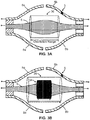
- the post-injection z -axis ion oscillation range for essentially all ions is illustrated by cylinder 36 (note that the cylindrical representation is schematic only - the zone of occupation of ions of any m / z ratio is more complex than that of a cylindrical surface).
- cylinder 36 note that the cylindrical representation is schematic only - the zone of occupation of ions of any m / z ratio is more complex than that of a cylindrical surface. The inventors have realized that this conventional mode of operation leads to inefficient use of available trap volume and consequent inhomogeneous space charge density within the electrostatic trap.
- the axial motion of the precursor ions is selectively de-excited by application of a supplemental sinusoidal voltage waveform at an appropriate frequency, such as double the frequency of the undamped axial oscillations of the precursor ions.
- the supplemental waveform comprises a radio-frequency (RF) waveform.
- the application of the supplemental sinusoidal voltage decreases the amplitude of axial oscillation of selected ions so that only selected precursor ions are brought onto and restricted to the equatorial plane 7 of the ion trap.
- the precursor ions are left in this state long enough to allow metastable decay to occur.
- the z -axis oscillations of the remaining precursor ions as well as of any fragment ions generated by MSD are then excited by application of a broadband supplemental waveform.
- the reduction of ion density is especially effective at the z -axis oscillation extrema, because these z -axis oscillation extrema are caused to be dispersed along the z -axis according to m / z . Accordingly, the available trap volume is utilized more efficiently through the re-distribution of ion density.
- FIG. 4A is a flow diagram of a method 40 for operating an electrostatic trap mass analyzer within a mass spectrometer system in accordance with the present teachings. If the form of a supplemental excitation (or de-excitation) voltage waveform may be simply calculated or is already known, as from a prior experiment, then execution of the method 40 may begin at Step 44b, at which the voltage waveform may be calculated or the predetermined or previously stored information relating to the voltage waveform may be retrieved. Otherwise, execution of the method 40 may begin at Step 41. If predetermined or previously stored information is retrieved at Step 44b, such information may have been derived by a prior execution of the method 40 in which the prior sample of ions is a set of calibrant ions.
- the waveform may, in some cases, be calculated as a multi-frequency voltage waveform of which the frequencies or amplitudes (or both) of the various periodic components are chosen as appropriate from a selected range of frequencies and a selected range of amplitudes, respectively.
- the selected range of frequencies may correspond to a range of m / z ratios to be detected in a particular experiment.
- a first packet of ions is supplied to the electrostatic trap mass analyzer through an aperture (e.g., aperture 5 ) that is displaced from the equatorial plane of the trap.
- the ions may be produced by any known ionization technique, such as by thermospray ionization, electrospray ionization, electron ionization, chemical ionization, matrix-assisted laser desorption ionization, photo-induced ionization, etc.
- the ionization may be performed by an ion source component of the mass spectrometer system. Prior to injection, a population of ions may be accumulated within an accumulation ion trap component of the mass spectrometer system.
- At least some of the accumulated ions are then provided to the electrostatic trap as a packet that is tightly bunched spatially and temporally through application of a voltage pulse that releases the accumulated ions as the packet.
- the ion injection into the electrostatic trap is performed through an ion injection aperture that is offset from an equatorial symmetry plane of the electrostatic trap such that ion oscillation within the electrostatic trap begins immediately upon injection (that is, according to the so-called "excitation by injection” technique).
- Step 42 of the method 40 the ions of the ion packet of various m / z ratios are allowed to oscillate within the electrostatic ion trap and an image current that tracks the combined ion oscillations of all ion species is measured by detection electrodes and recorded as a transient signal in known fashion.
- Step 43 a preliminary mass spectrum is calculated from the measured and recorded transient signal using the enhanced Fourier Transform (eFT) method as taught in U.S. Patent No. 8,853,620 or, alternatively, any equivalent mathematical method.
- eFT enhanced Fourier Transform
- a Fourier transform is first calculated in a conventional way (such as by a Fast-Fourier transform) so as to generate real and imaginary complex spectral components in the frequency domain.
- a frequency spectrum (or a mass spectrum, through a simple transformation of variables) is calculated as a combination of a so-called “positive spectrum” (which, in many cases, may be any of a Power spectrum, a Magnitude spectrum or estimates thereof) together with an "absorption spectrum", which is the real component of the complex spectrum after application of an appropriate phase correction that causes the corrected phase to be zero at a peak center.
- the derived frequency spectrum (or the mass spectrum) generally comprises a plurality of peaks, where the location of each such peak in the frequency domain provides information about a frequency of oscillation, within the electrostatic trap, of an ion species of a respective m / z ratio.
- the determined phase corrections provide information about the relative phase offsets between the oscillations of the various ion species (corresponding to respective peaks in the frequency spectrum) and by inference the functional dependence of phase with frequency (and thus m / z ).
- the phase and frequency information derived in the prior step 43 is used to calculate the frequencies of a supplemental or auxiliary periodic voltage waveform to be applied to the electrodes of the electrostatic trap (for instance, in a later Step 48 ).
- the supplemental or auxiliary voltage waveform may consist of a set of superimposed (multiplexed) component periodic waveforms, each component waveform comprising a respective periodic waveform of a frequency that corresponds to the frequency of oscillation (generally, a frequency of a z -axis oscillation as described above) of an ion species of a respective m / z ratio.
- Each waveform component frequency is related to the oscillation frequency of the ion species to which it corresponds.
- the waveform component frequency and the ion species oscillation frequency may be identical; however, in some instances the waveform component frequency may be an integral multiple or very close to an integral multiple of the ion species oscillation frequency such as, for example, twice the ion oscillation frequency.
- the phase of each waveform component may be such that when applied the periodic oscillations of the voltage waveform component add to the ion motion primarily "in phase" with the oscillations of the corresponding ion species; however, some other pre-determined phase relationship between the ion oscillation and the waveform component may be employed.
- the waveform component phases may be determined from the phase information generated in step 43.
- each waveform component corresponds to a degree of excitation or de-excitation to be applied to the oscillations of the corresponding ion species.
- an excitation waveform may not be periodic and may, instead comprise a simple impulse, since an impulse may be considered to comprise a continuous range of component frequencies that may excite oscillations of ions comprising a plurality of m / z values. In such instances, the step 44a may be skipped.
- each waveform component may be applied within its own respective time segment.
- the waveform components would then be applied sequentially instead of in a superimposed fashion.
- each waveform component is applied to the electrodes at a certain respective segment application time.
- Each such segment application time is determined such that the phase of the applied periodic waveform component is related to the phase of the oscillations of the corresponding ion species.
- each segment application time is such that the applied waveform component of the segment is "in phase" with the oscillations of the corresponding ion species; however, some other pre-determined phase relationship between the ion oscillation and the waveform component may be employed.
- the waveform segment application times may be determined from the phase information generated in step 43.
- Step 45 a particular execution of the method 40 pertains to a calibration experiment, possibly using a sample including calibrant compounds, then the supplemental voltage waveform information generated in Step 43 may be saved for use in later analyses (Step 52 ) and the method may terminate at Step 53. Otherwise, execution may proceed to Step 46 at which a new packet of ions from the same general ion population as the first ion packet is injected into the electrostatic trap.
- This second injection is performed in the same manner as the first injection (step 41 ).
- Step 47 of the method 40 ( FIG. 4A ) a supplemental or auxiliary broadband de-excitation voltage waveform is applied to the electrodes of the electrostatic trap mass analyzer in order to fullly de-excite the z -axis oscillations of all ions to a known starting state in which the ions are temporarily confined to the equatorial plane.
- This step is then followed by subsequent excitation of z -axis oscillations to a desired oscillation amplitude profile (in Step 48 ) using the calculated supplemental excitation voltage waveform (Step 44a ) or the pre-determined supplemental excitation voltage waveform (Step 44b ) or, alternatively, a simple impulse function.
- the desired oscillation amplitude profile is one which reduces overall charge density within the trap so as to improve trap performance and the quality of mass spectra obtained from the trap.
- Each component of the voltage waveform serves to either excite the z -axis oscillations of the ion species that are close in frequency to a higher amplitude or, alternatively, "de-excite" the z -axis oscillations of only the ion species that are close in frequency to a lower amplitude.
- Such de-excitation only applies if the prior optional broadband de-excitation step (Step 47 ) has not been executed.
- the closer in frequency a component of the voltage waveform is to that of any particular m / z the stronger the coupling effect to the motion of that m / z .
- all applied waveform frequency components couple to the motion of all ions to greater or lesser extent.
- excitation waveforms for excitation of an ion species expands the z -axis oscillation range of the ion species and may also increase or decrease the average radius of orbits around the spindle electrode.
- excitation waveforms to effect de-excitation reduces the z -axis oscillation range of the ion species and may also decrease or increase the average orbital radius for that ion species.
- application of such excitation and de-excitation waveforms may also increase or decrease the spread in orbital radii around the average orbital radius for that species.
- Excitation may be achieved by applying the voltage waveform component so as to be of the same frequency as and in phase quadrature with the oscillations of the corresponding ion species; de-excitation may be achieved by applying the voltage waveform component with some other phase or frequency relationship relative to the ion species oscillations, such as out of phase, in phase quadrature with or at twice the ion oscillation frequency.
- FIG. 3B there is shown a schematic depiction of the ranges of axial oscillation of ions of two respective different m / z ratios within an electrostatic trap mass analyzer of the type illustrated in FIG. 1A and FIG. 1B and operated in accordance with the present teachings.
- the extrema are represented in terms of the highest m / z (represented as cylinder 38 ) and lowest m / z (represented as cylinder 34 ) observed in the broad band spectrum.
- element 11 is a voltage waveform source that may include various electronic and electrical components such as a digital waveform generator, a power supply, an amplifier, etc. Other electrical components, such as the power supply and controller that maintains and controls the DC voltage difference between inner and outer electrodes, the components that measure image current, etc. are not illustrated in FIGS. 5A-5C .
- each of electrodes 8a and 8b is cylindrically symmetrical in three dimensions and, thus, each such electrode is formed of a single piece (i.e., not two pieces).
- the supplemental or auxiliary voltage is supplied across the two outer electrodes 8a, 8b, a configuration which is expected to primarily resonantly excite axial ( z -axis) oscillations as previously noted.
- the supplemental or auxiliary voltage is applied between the inner spindle electrode 6 and the pair of outer electrodes 8a, 8b, a configuration which is also expected to resonantly excite axial oscillations as well as to radially disperse ions according to m / z .
- the supplemental or auxiliary voltage is applied between the inner spindle electrode 6 and just one of the outer electrodes, either electrode 8a or electrode 8b.
- Step 49 is another transient signal measurement and recording step, similar to the preceding Step 42 except that, in the Step 49, the measurement is made of ion oscillations that correspond to a more favorable dispersal of the ions throughout the trapping volume, as provided by the application of the supplemental or auxiliary waveform in step 49.
- a final mass spectrum is calculated in Step 51, using any suitable transformation or calculation technique but, preferably, using the enhanced Fourier Transform technique noted above.
- the mass spectrum calculated in Step 51 may regarded as a refined mass spectrum, relative to the preliminary mass spectrum calculated in Step 43. Steps 46 through 51 may be repeated, using respective packets of ions, as may be required.
- Amplitudes of the reported m / z peaks in the calculated spectra m / z may be adjusted according (generally inversely) to their corresponding z -axis oscillation amplitude so that that different m / z peaks produced by the same amount of ion net charge have the same or nearly the same amplitudes.
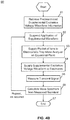
- FIG. 4B is a flow diagram of a second method, method 60, for operating an electrostatic trap in accordance with the present teachings.
- the method 60 applies to injection of ions on the equatorial plane 7 of an electrostatic trap 4 (see FIG. 1B ) as opposed to the previously described method 40 ( FIG. 4A ) which applies to ion injection through an aperture (e.g., aperture 5 ) that is displaced from the equatorial plane.
- a pre-determined supplemental excitation waveform is retrieved.
- the excitation waveform may be periodic and may comprise a set of periodic components of respective frequencies.
- an excitation waveform may not be periodic and may, instead comprise a simple impulse, since an impulse may be considered to comprise a continuous range of component frequencies that may excite oscillations of ions comprising a plurality of m / z values. In such latter instances, the step 61 may be skipped.
- Step 62 the application of any prior supplemental waveform is suspended.
- Step 63 a packet of ions is introduced into the electrostatic trap on the equatorial plane of the trap. Because the equatorial plane effectively defines the bottom of the harmonic potential well with regard to z-axis oscillations, all injected ions take up temporary residence in orbits about the spindle electrode 6 within the equatorial plane.
- Step 64 a supplemental excitation waveform is applied, as described previously, such that the various ions develop oscillatory motion along the z -axis with different z -axis oscillation extrema as a function of their respective frequencies and m / z ratios.
- Step 65 a transient signal is measured and in Step 66, a mass spectrum is calculated, using the transient information in known fashion. Steps 62-66 may then be repeated as many times as necessary in order to repeat mass spectral analysis of a given sample composition or to perform mass spectral analyses of differing sample compositions.
- the present invention has been described with reference to an ORBITRAPTM mass analyzer which is schematically illustrated in FIGS. 1A-1B .
- the present invention is also applicable to operation of other forms of electrostatic trap mass analyzer within which ions undergo mathematically orthogonal components of oscillatory motion and wherein the frequency of oscillation of at least one such component is independent of the other oscillation components.
- the present invention is also applicable to operation of Higher-Order Kingdon traps, as described above, which include Cassinian electrostatic ion trap mass analyzers.
- a Cassinian electrostatic ion trap comprises an outer electrode with an ion-repelling electric potential and at least two inner electrodes with ion-attracting potentials, where the outer electrode and the inner electrodes are shaped and arranged in such a way that a harmonic electric potential is formed in one spatial direction and, perpendicular to this spatial direction, an electric potential is formed in which ions move on stable, radial trajectories.
- a known Cassinian electrostatic ion trap as described in U.S. Patent No. 7,994,473 , comprises an outer electrode maintained at a first electrical potential and two spindle-shaped inner electrodes both maintained at a same second electrical potential.
- U x y z U 0 + U C ln x 2 + y 2 2 ⁇ 2 b 2 x 2 ⁇ y 2 + b 4 a 4 ⁇ k 2 x 2 + y 2 + kz 2
- U 0 is an offset of the potential that is proportional to the voltage between the outer electrode and the inner electrodes
- U C is a scaling factor
- a, b and k are parameters (constants).
- each spindle electrode is shaped with a diameter that is greatest at its central region and that tapers towards each end.
- the parameters a and b are related to the radial geometry of the electrode system.
- the parameter b which is non-zero, corresponds to the distance between the axis of each spindle and the central z -axis.
- one way to obtain mass-dependent data from such a Cassinian electrostatic ion trap is to measure the oscillation frequency of ions along the z -direction.
- Each ion package oscillating inside the Cassinian electrostatic ion trap induces a periodic signal in an ion detector, which is electronically amplified and measured as a function of time.
- the ion detector comprises detection elements, such as detection coils, in which ion packages induce voltages as they fly through, or detection electrodes, for example segments of the outer electrode or inner electrodes, in which ion packages induce image charges as they fly past.
- a Fourier transformation (or other mathematical transformation) can be used to transform a measured time signal of z -axis oscillations into a frequency spectrum, which can be converted into a mass spectrum via the known mass dependence of the z -axis oscillation frequency.
- ions may be preferably introduced into a Cassinian electrostatic ion trap of the type described above by introduction of the ions into the plane of symmetry (the medial y - z plane) between the two inner electrodes. Upon introduction, such ions begin oscillations parallel to at least the y -axis. Further, if the ions are introduced into the medial y - z plane at a z -axis coordinate that is not at the minimum of the z -axis harmonic potential, they will also immediately start to oscillate along the z -axis.
- the ions may be quasi-continuously introduced directly at the potential minimum of the harmonic potential, the ions move with only small amplitudes along the z -axis according to their initial energy in z -direction. After the ions are introduced and stored in the potential minimum in this fashion, they are excited to harmonic oscillations, for example by using a high frequency electric dipole field along the z -axis.
- ions undergo complex motions that may be represented as the superimposition of radial oscillations as well as z -axis axial oscillations upon an orbital motion around a central spindle electrode whose long dimension defines the z -axis.
- the z -axis oscillations are mathematically separable from other oscillations and may be mathematically treated as simple harmonic oscillation parallel to the z -axis, wherein an apparent minimum in the z -axis harmonic potential occurs at a central plane of symmetry of the apparatus.
- this apparent simple harmonic motion parallel to the z -axis is used to advantage in order to obtain m / z -dependent data which may be used for the purpose of mass analysis.
- ion injection may be effected either at or away from the apparent z -axis potential minimum (generally corresponding to a medial plane of symmetry of the apparatus). If ion injection occurs away from the minimum, z -axis oscillations begin immediately. If ion injection occurs near the minimum, z -axis motion is initially either mostly or completely suppressed but may be subsequently excited by application of a supplemental excitation voltage or voltage waveform.
- ion density is greater at the extrema of the z -axis oscillations (the so-called "turn-around points", which are separated by about 20 millimeters in the two-spindle trap as noted in U.S. Patent No. 7,994,473 ) than at the z -axis potential minimum.
- the multiple spindles of a Higher-Order Kingdon trap would preferably be electrically connected in common.
- U.S. Patent No. 7,994,473 only specifically illustrates the outer electrode of a Cassinian trap as a single integral piece, one of ordinary skill in the art may readily envisage that the outer electrode may be split into two halves, similar to the way that the outer electrodes are illustrated in FIGS. 5A-5C , such that a supplemental voltage waveform may be applied across the two halves at the same time that a common trapping voltage is being applied in common to the two halves.
Landscapes
- Chemical & Material Sciences (AREA)
- Analytical Chemistry (AREA)
- Other Investigation Or Analysis Of Materials By Electrical Means (AREA)
- Electron Tubes For Measurement (AREA)
Applications Claiming Priority (1)
| Application Number | Priority Date | Filing Date | Title |
|---|---|---|---|
| US15/252,025 US10192730B2 (en) | 2016-08-30 | 2016-08-30 | Methods for operating electrostatic trap mass analyzers |
Publications (2)
| Publication Number | Publication Date |
|---|---|
| EP3291282A1 true EP3291282A1 (fr) | 2018-03-07 |
| EP3291282B1 EP3291282B1 (fr) | 2021-05-12 |
Family
ID=59846320
Family Applications (1)
| Application Number | Title | Priority Date | Filing Date |
|---|---|---|---|
| EP17188423.2A Active EP3291282B1 (fr) | 2016-08-30 | 2017-08-29 | Procédés de fonctionnement des analyseurs de masse à piège électrostatique |
Country Status (3)
| Country | Link |
|---|---|
| US (2) | US10192730B2 (fr) |
| EP (1) | EP3291282B1 (fr) |
| CN (1) | CN107799383B (fr) |
Families Citing this family (7)
| Publication number | Priority date | Publication date | Assignee | Title |
|---|---|---|---|---|
| US10600632B2 (en) | 2018-08-23 | 2020-03-24 | Thermo Finnigan Llc | Methods for operating electrostatic trap mass analyzers |
| RU2693570C1 (ru) * | 2018-11-08 | 2019-07-03 | Автономная некоммерческая образовательная организация высшего образования "Сколковский институт науки и технологий" | Многоэлектродная гармонизированная ионная ловушка кингдона со слившимися внутренними электродами |
| WO2020157654A1 (fr) * | 2019-02-01 | 2020-08-06 | Dh Technologies Development Pte. Ltd. | Spectromètres de masse à transformée de fourier et procédés d'analyse les utilisant |
| US12051579B2 (en) | 2019-04-25 | 2024-07-30 | Thermo Finnigan Llc | Charge detection mass spectrometry utilizing harmonic oscillation and selective temporal overview of resonant ion (STORI) plots |
| GB201906546D0 (en) * | 2019-05-09 | 2019-06-26 | Thermo Fisher Scient Bremen Gmbh | Charge detection for ion current control |
| RU2713910C1 (ru) * | 2019-05-13 | 2020-02-11 | Автономная некоммерческая образовательная организация высшего образования «Сколковский институт науки и технологий» | Способ проектирования поверхности внешнего электрода орбитальной ионной ловушки |
| CN111653472B (zh) * | 2020-06-12 | 2021-10-29 | 中国科学院地质与地球物理研究所 | 一种物质分析方法、装置和静电离子阱质量分析器 |
Citations (8)
| Publication number | Priority date | Publication date | Assignee | Title |
|---|---|---|---|---|
| US5886346A (en) | 1995-03-31 | 1999-03-23 | Hd Technologies Limited | Mass spectrometer |
| US6872938B2 (en) | 2001-03-23 | 2005-03-29 | Thermo Finnigan Llc | Mass spectrometry method and apparatus |
| US7498571B2 (en) | 2004-06-21 | 2009-03-03 | Thermo Finnigan Llc | RF power supply for a mass spectrometer |
| US7714283B2 (en) | 2005-06-03 | 2010-05-11 | Thermo Finnigan Llc | Electrostatic trap |
| US7728288B2 (en) | 2005-03-29 | 2010-06-01 | Thermo Finnigan Llc | Mass spectrometry |
| US7994473B2 (en) | 2007-04-12 | 2011-08-09 | Bruker Daltonik Gmbh | Mass spectrometer with an electrostatic ion trap |
| US8017909B2 (en) | 2006-12-29 | 2011-09-13 | Thermo Fisher Scientific (Bremen) Gmbh | Ion trap |
| US8853620B2 (en) | 2010-03-31 | 2014-10-07 | Thermo Fisher Scientific (Bremen) Gmbh | Methods and apparatus for producing a mass spectrum |
Family Cites Families (23)
| Publication number | Priority date | Publication date | Assignee | Title |
|---|---|---|---|---|
| US3334225A (en) * | 1964-04-24 | 1967-08-01 | California Inst Res Found | Quadrupole mass filter with means to generate a noise spectrum exclusive of the resonant frequency of the desired ions to deflect stable ions |
| US5256875A (en) * | 1992-05-14 | 1993-10-26 | Teledyne Mec | Method for generating filtered noise signal and broadband signal having reduced dynamic range for use in mass spectrometry |
| US5179278A (en) * | 1991-08-23 | 1993-01-12 | Mds Health Group Limited | Multipole inlet system for ion traps |
| US5300772A (en) * | 1992-07-31 | 1994-04-05 | Varian Associates, Inc. | Quadruple ion trap method having improved sensitivity |
| DE19501823A1 (de) * | 1995-01-21 | 1996-07-25 | Bruker Franzen Analytik Gmbh | Verfahren zur Regelung der Erzeugungsraten für massenselektives Einspeichern von Ionen in Ionenfallen |
| US7265344B2 (en) | 2001-03-23 | 2007-09-04 | Thermo Finnigan Llc | Mass spectrometry method and apparatus |
| US6627875B2 (en) * | 2001-04-23 | 2003-09-30 | Beyond Genomics, Inc. | Tailored waveform/charge reduction mass spectrometry |
| JP3620479B2 (ja) * | 2001-07-31 | 2005-02-16 | 株式会社島津製作所 | イオン蓄積装置におけるイオン選別の方法 |
| JP3791455B2 (ja) * | 2002-05-20 | 2006-06-28 | 株式会社島津製作所 | イオントラップ型質量分析装置 |
| US6838665B2 (en) * | 2002-09-26 | 2005-01-04 | Hitachi High-Technologies Corporation | Ion trap type mass spectrometer |
| GB2402260B (en) | 2003-05-30 | 2006-05-24 | Thermo Finnigan Llc | All mass MS/MS method and apparatus |
| EP1743357B8 (fr) | 2004-05-05 | 2016-02-24 | DH Technologies Development Pte. Ltd. | Procede et appareil d'ejection axiale a selectivite de masse |
| GB0513047D0 (en) * | 2005-06-27 | 2005-08-03 | Thermo Finnigan Llc | Electronic ion trap |
| GB0524042D0 (en) | 2005-11-25 | 2006-01-04 | Micromass Ltd | Mass spectrometer |
| US7321847B1 (en) * | 2006-05-05 | 2008-01-22 | Analytica Of Branford, Inc. | Apparatus and methods for reduction of coherent noise in a digital signal averager |
| CN104779132B (zh) | 2009-05-06 | 2018-04-13 | Mks仪器公司 | 静电离子陷阱 |
| EP2447980B1 (fr) * | 2010-11-02 | 2019-05-22 | Thermo Fisher Scientific (Bremen) GmbH | Procédé de génération d'un spectre de masse disposant d'une alimentation à résolution améliorée |
| DE102011008713B4 (de) | 2011-01-17 | 2012-08-02 | Bruker Daltonik Gmbh | Kingdon-Ionenfallen mit Cassini-Potentialen höherer Ordnung |
| GB2495068B (en) * | 2011-05-12 | 2017-05-10 | Thermo Fisher Scient (Bremen) Gmbh | Mass analyser |
| WO2013176901A1 (fr) * | 2012-05-23 | 2013-11-28 | President And Fellows Of Harvard College | Spectromètre de masse pour quantification multiplexée au moyen de multiples encoches de fréquence |
| US9653279B2 (en) * | 2013-02-18 | 2017-05-16 | Micromass Uk Limited | Device allowing improved reaction monitoring of gas phase reactions in mass spectrometers using an auto ejection ion trap |
| US9455128B2 (en) | 2014-06-16 | 2016-09-27 | Thermo Finnigan Llc | Methods of operating a fourier transform mass analyzer |
| EP3086353A1 (fr) * | 2015-04-24 | 2016-10-26 | Thermo Fisher Scientific (Bremen) GmbH | Procédé de production d'un spectre de masse |
-
2016
- 2016-08-30 US US15/252,025 patent/US10192730B2/en active Active
-
2017
- 2017-08-29 CN CN201710755958.5A patent/CN107799383B/zh active Active
- 2017-08-29 EP EP17188423.2A patent/EP3291282B1/fr active Active
-
2018
- 2018-12-17 US US16/222,010 patent/US10424475B2/en active Active
Patent Citations (8)
| Publication number | Priority date | Publication date | Assignee | Title |
|---|---|---|---|---|
| US5886346A (en) | 1995-03-31 | 1999-03-23 | Hd Technologies Limited | Mass spectrometer |
| US6872938B2 (en) | 2001-03-23 | 2005-03-29 | Thermo Finnigan Llc | Mass spectrometry method and apparatus |
| US7498571B2 (en) | 2004-06-21 | 2009-03-03 | Thermo Finnigan Llc | RF power supply for a mass spectrometer |
| US7728288B2 (en) | 2005-03-29 | 2010-06-01 | Thermo Finnigan Llc | Mass spectrometry |
| US7714283B2 (en) | 2005-06-03 | 2010-05-11 | Thermo Finnigan Llc | Electrostatic trap |
| US8017909B2 (en) | 2006-12-29 | 2011-09-13 | Thermo Fisher Scientific (Bremen) Gmbh | Ion trap |
| US7994473B2 (en) | 2007-04-12 | 2011-08-09 | Bruker Daltonik Gmbh | Mass spectrometer with an electrostatic ion trap |
| US8853620B2 (en) | 2010-03-31 | 2014-10-07 | Thermo Fisher Scientific (Bremen) Gmbh | Methods and apparatus for producing a mass spectrum |
Non-Patent Citations (2)
| Title |
|---|
| MAKAROV: "Electrostatic Axially Harmonic Orbital Trapping: A High-Performance Technique of Mass Analysis", ANAL. CHEM., vol. 72, no. 6, 2000, pages 1156 - 1162, XP055034188, DOI: doi:10.1021/ac991131p |
| WU G ET AL: "Ion trajectory simulations of axial ac dipolar excitation in the Orbitrap", INTERNATIONAL JOURNAL OF MASS SPECTROMETRY, ELSEVIER SCIENCE PUBLISHERS, AMSTERDAM, NL, vol. 254, no. 1-2, 15 July 2006 (2006-07-15), pages 53 - 62, XP028039315, ISSN: 1387-3806, [retrieved on 20060715], DOI: 10.1016/J.IJMS.2006.05.007 * |
Also Published As
| Publication number | Publication date |
|---|---|
| US20180061625A1 (en) | 2018-03-01 |
| CN107799383B (zh) | 2020-04-10 |
| US10424475B2 (en) | 2019-09-24 |
| US10192730B2 (en) | 2019-01-29 |
| US20190122879A1 (en) | 2019-04-25 |
| EP3291282B1 (fr) | 2021-05-12 |
| CN107799383A (zh) | 2018-03-13 |
Similar Documents
| Publication | Publication Date | Title |
|---|---|---|
| US10424475B2 (en) | Methods for operating electrostatic trap mass analyzers | |
| US7728290B2 (en) | Orbital ion trap including an MS/MS method and apparatus | |
| US4818869A (en) | Method of isolating a single mass or narrow range of masses and/or enhancing the sensitivity of an ion trap mass spectrometer | |
| EP1839325B1 (fr) | Méthode de guidage ou piégeage d'ions, méthode de spectrométrie de masse | |
| JPS6237861A (ja) | イオントラツプを利用した質量分析方法 | |
| US8097844B2 (en) | Mass-analysis method and mass-analysis apparatus | |
| EP1298699A2 (fr) | Méthode de sélection des ions dans un dispositif de stockage des ions | |
| Belov et al. | Electrospray ionization-Fourier transform ion cyclotron mass spectrometry using ion preselection and external accumulation for ultrahigh sensitivity | |
| CN101188183A (zh) | 质量分析装置和质量分析方法 | |
| US12347665B2 (en) | Rapid identification and sequence analysis of intact proteins in complex mixtures | |
| US7696476B2 (en) | Apparatus and method for improving fourier transform ion cyclotron resonance mass spectrometer signal | |
| US5623144A (en) | Mass spectrometer ring-shaped electrode having high ion selection efficiency and mass spectrometry method thereby | |
| EP3614417B1 (fr) | Procédés de fonctionnement des analyseurs de masse à piège électrostatique | |
| US9455128B2 (en) | Methods of operating a fourier transform mass analyzer | |
| GB2291534A (en) | Collisionally induced decomposition of ions in nonlinear ion traps | |
| US12033844B2 (en) | Auto gain control for optimum ion trap filling | |
| US11881388B2 (en) | Fourier transform mass spectrometers and methods of analysis using the same | |
| CN114616647A (zh) | 傅立叶变换质谱法的方法和系统 | |
| CA2689091C (fr) | Procede et appareil pour realiser une spectrometrie de masse | |
| US8304715B2 (en) | Ion cyclotron resonance mass spectrometer system and a method of operating the same | |
| JP3269313B2 (ja) | 質量分析装置及び質量分析方法 | |
| Perry et al. | Rephasing ion packets in the orbitrap mass analyzer to improve resolution and peak shape |
Legal Events
| Date | Code | Title | Description |
|---|---|---|---|
| PUAI | Public reference made under article 153(3) epc to a published international application that has entered the european phase |
Free format text: ORIGINAL CODE: 0009012 |
|
| STAA | Information on the status of an ep patent application or granted ep patent |
Free format text: STATUS: THE APPLICATION HAS BEEN PUBLISHED |
|
| AK | Designated contracting states |
Kind code of ref document: A1 Designated state(s): AL AT BE BG CH CY CZ DE DK EE ES FI FR GB GR HR HU IE IS IT LI LT LU LV MC MK MT NL NO PL PT RO RS SE SI SK SM TR |
|
| AX | Request for extension of the european patent |
Extension state: BA ME |
|
| STAA | Information on the status of an ep patent application or granted ep patent |
Free format text: STATUS: REQUEST FOR EXAMINATION WAS MADE |
|
| 17P | Request for examination filed |
Effective date: 20180907 |
|
| RBV | Designated contracting states (corrected) |
Designated state(s): AL AT BE BG CH CY CZ DE DK EE ES FI FR GB GR HR HU IE IS IT LI LT LU LV MC MK MT NL NO PL PT RO RS SE SI SK SM TR |
|
| STAA | Information on the status of an ep patent application or granted ep patent |
Free format text: STATUS: EXAMINATION IS IN PROGRESS |
|
| 17Q | First examination report despatched |
Effective date: 20200924 |
|
| GRAP | Despatch of communication of intention to grant a patent |
Free format text: ORIGINAL CODE: EPIDOSNIGR1 |
|
| STAA | Information on the status of an ep patent application or granted ep patent |
Free format text: STATUS: GRANT OF PATENT IS INTENDED |
|
| INTG | Intention to grant announced |
Effective date: 20201202 |
|
| GRAS | Grant fee paid |
Free format text: ORIGINAL CODE: EPIDOSNIGR3 |
|
| GRAA | (expected) grant |
Free format text: ORIGINAL CODE: 0009210 |
|
| STAA | Information on the status of an ep patent application or granted ep patent |
Free format text: STATUS: THE PATENT HAS BEEN GRANTED |
|
| AK | Designated contracting states |
Kind code of ref document: B1 Designated state(s): AL AT BE BG CH CY CZ DE DK EE ES FI FR GB GR HR HU IE IS IT LI LT LU LV MC MK MT NL NO PL PT RO RS SE SI SK SM TR |
|
| REG | Reference to a national code |
Ref country code: GB Ref legal event code: FG4D |
|
| REG | Reference to a national code |
Ref country code: CH Ref legal event code: EP |
|
| REG | Reference to a national code |
Ref country code: DE Ref legal event code: R096 Ref document number: 602017038436 Country of ref document: DE |
|
| REG | Reference to a national code |
Ref country code: IE Ref legal event code: FG4D |
|
| REG | Reference to a national code |
Ref country code: AT Ref legal event code: REF Ref document number: 1392736 Country of ref document: AT Kind code of ref document: T Effective date: 20210615 |
|
| REG | Reference to a national code |
Ref country code: LT Ref legal event code: MG9D |
|
| REG | Reference to a national code |
Ref country code: AT Ref legal event code: MK05 Ref document number: 1392736 Country of ref document: AT Kind code of ref document: T Effective date: 20210512 |
|
| REG | Reference to a national code |
Ref country code: NL Ref legal event code: MP Effective date: 20210512 |
|
| PG25 | Lapsed in a contracting state [announced via postgrant information from national office to epo] |
Ref country code: HR Free format text: LAPSE BECAUSE OF FAILURE TO SUBMIT A TRANSLATION OF THE DESCRIPTION OR TO PAY THE FEE WITHIN THE PRESCRIBED TIME-LIMIT Effective date: 20210512 Ref country code: BG Free format text: LAPSE BECAUSE OF FAILURE TO SUBMIT A TRANSLATION OF THE DESCRIPTION OR TO PAY THE FEE WITHIN THE PRESCRIBED TIME-LIMIT Effective date: 20210812 Ref country code: AT Free format text: LAPSE BECAUSE OF FAILURE TO SUBMIT A TRANSLATION OF THE DESCRIPTION OR TO PAY THE FEE WITHIN THE PRESCRIBED TIME-LIMIT Effective date: 20210512 Ref country code: FI Free format text: LAPSE BECAUSE OF FAILURE TO SUBMIT A TRANSLATION OF THE DESCRIPTION OR TO PAY THE FEE WITHIN THE PRESCRIBED TIME-LIMIT Effective date: 20210512 Ref country code: LT Free format text: LAPSE BECAUSE OF FAILURE TO SUBMIT A TRANSLATION OF THE DESCRIPTION OR TO PAY THE FEE WITHIN THE PRESCRIBED TIME-LIMIT Effective date: 20210512 |
|
| PG25 | Lapsed in a contracting state [announced via postgrant information from national office to epo] |
Ref country code: GR Free format text: LAPSE BECAUSE OF FAILURE TO SUBMIT A TRANSLATION OF THE DESCRIPTION OR TO PAY THE FEE WITHIN THE PRESCRIBED TIME-LIMIT Effective date: 20210813 Ref country code: IS Free format text: LAPSE BECAUSE OF FAILURE TO SUBMIT A TRANSLATION OF THE DESCRIPTION OR TO PAY THE FEE WITHIN THE PRESCRIBED TIME-LIMIT Effective date: 20210912 Ref country code: LV Free format text: LAPSE BECAUSE OF FAILURE TO SUBMIT A TRANSLATION OF THE DESCRIPTION OR TO PAY THE FEE WITHIN THE PRESCRIBED TIME-LIMIT Effective date: 20210512 Ref country code: PT Free format text: LAPSE BECAUSE OF FAILURE TO SUBMIT A TRANSLATION OF THE DESCRIPTION OR TO PAY THE FEE WITHIN THE PRESCRIBED TIME-LIMIT Effective date: 20210913 Ref country code: PL Free format text: LAPSE BECAUSE OF FAILURE TO SUBMIT A TRANSLATION OF THE DESCRIPTION OR TO PAY THE FEE WITHIN THE PRESCRIBED TIME-LIMIT Effective date: 20210512 Ref country code: NO Free format text: LAPSE BECAUSE OF FAILURE TO SUBMIT A TRANSLATION OF THE DESCRIPTION OR TO PAY THE FEE WITHIN THE PRESCRIBED TIME-LIMIT Effective date: 20210812 Ref country code: RS Free format text: LAPSE BECAUSE OF FAILURE TO SUBMIT A TRANSLATION OF THE DESCRIPTION OR TO PAY THE FEE WITHIN THE PRESCRIBED TIME-LIMIT Effective date: 20210512 Ref country code: SE Free format text: LAPSE BECAUSE OF FAILURE TO SUBMIT A TRANSLATION OF THE DESCRIPTION OR TO PAY THE FEE WITHIN THE PRESCRIBED TIME-LIMIT Effective date: 20210512 |
|
| PG25 | Lapsed in a contracting state [announced via postgrant information from national office to epo] |
Ref country code: NL Free format text: LAPSE BECAUSE OF FAILURE TO SUBMIT A TRANSLATION OF THE DESCRIPTION OR TO PAY THE FEE WITHIN THE PRESCRIBED TIME-LIMIT Effective date: 20210512 |
|
| PG25 | Lapsed in a contracting state [announced via postgrant information from national office to epo] |
Ref country code: SM Free format text: LAPSE BECAUSE OF FAILURE TO SUBMIT A TRANSLATION OF THE DESCRIPTION OR TO PAY THE FEE WITHIN THE PRESCRIBED TIME-LIMIT Effective date: 20210512 Ref country code: SK Free format text: LAPSE BECAUSE OF FAILURE TO SUBMIT A TRANSLATION OF THE DESCRIPTION OR TO PAY THE FEE WITHIN THE PRESCRIBED TIME-LIMIT Effective date: 20210512 Ref country code: CZ Free format text: LAPSE BECAUSE OF FAILURE TO SUBMIT A TRANSLATION OF THE DESCRIPTION OR TO PAY THE FEE WITHIN THE PRESCRIBED TIME-LIMIT Effective date: 20210512 Ref country code: DK Free format text: LAPSE BECAUSE OF FAILURE TO SUBMIT A TRANSLATION OF THE DESCRIPTION OR TO PAY THE FEE WITHIN THE PRESCRIBED TIME-LIMIT Effective date: 20210512 Ref country code: EE Free format text: LAPSE BECAUSE OF FAILURE TO SUBMIT A TRANSLATION OF THE DESCRIPTION OR TO PAY THE FEE WITHIN THE PRESCRIBED TIME-LIMIT Effective date: 20210512 Ref country code: RO Free format text: LAPSE BECAUSE OF FAILURE TO SUBMIT A TRANSLATION OF THE DESCRIPTION OR TO PAY THE FEE WITHIN THE PRESCRIBED TIME-LIMIT Effective date: 20210512 Ref country code: ES Free format text: LAPSE BECAUSE OF FAILURE TO SUBMIT A TRANSLATION OF THE DESCRIPTION OR TO PAY THE FEE WITHIN THE PRESCRIBED TIME-LIMIT Effective date: 20210512 |
|
| REG | Reference to a national code |
Ref country code: DE Ref legal event code: R097 Ref document number: 602017038436 Country of ref document: DE |
|
| PLBE | No opposition filed within time limit |
Free format text: ORIGINAL CODE: 0009261 |
|
| STAA | Information on the status of an ep patent application or granted ep patent |
Free format text: STATUS: NO OPPOSITION FILED WITHIN TIME LIMIT |
|
| REG | Reference to a national code |
Ref country code: CH Ref legal event code: PL |
|
| PG25 | Lapsed in a contracting state [announced via postgrant information from national office to epo] |
Ref country code: MC Free format text: LAPSE BECAUSE OF FAILURE TO SUBMIT A TRANSLATION OF THE DESCRIPTION OR TO PAY THE FEE WITHIN THE PRESCRIBED TIME-LIMIT Effective date: 20210512 |
|
| 26N | No opposition filed |
Effective date: 20220215 |
|
| REG | Reference to a national code |
Ref country code: BE Ref legal event code: MM Effective date: 20210831 |
|
| PG25 | Lapsed in a contracting state [announced via postgrant information from national office to epo] |
Ref country code: LI Free format text: LAPSE BECAUSE OF NON-PAYMENT OF DUE FEES Effective date: 20210831 Ref country code: CH Free format text: LAPSE BECAUSE OF NON-PAYMENT OF DUE FEES Effective date: 20210831 |
|
| PG25 | Lapsed in a contracting state [announced via postgrant information from national office to epo] |
Ref country code: IS Free format text: LAPSE BECAUSE OF FAILURE TO SUBMIT A TRANSLATION OF THE DESCRIPTION OR TO PAY THE FEE WITHIN THE PRESCRIBED TIME-LIMIT Effective date: 20210912 Ref country code: LU Free format text: LAPSE BECAUSE OF NON-PAYMENT OF DUE FEES Effective date: 20210829 Ref country code: AL Free format text: LAPSE BECAUSE OF FAILURE TO SUBMIT A TRANSLATION OF THE DESCRIPTION OR TO PAY THE FEE WITHIN THE PRESCRIBED TIME-LIMIT Effective date: 20210512 |
|
| PG25 | Lapsed in a contracting state [announced via postgrant information from national office to epo] |
Ref country code: IT Free format text: LAPSE BECAUSE OF FAILURE TO SUBMIT A TRANSLATION OF THE DESCRIPTION OR TO PAY THE FEE WITHIN THE PRESCRIBED TIME-LIMIT Effective date: 20210512 Ref country code: IE Free format text: LAPSE BECAUSE OF NON-PAYMENT OF DUE FEES Effective date: 20210829 Ref country code: BE Free format text: LAPSE BECAUSE OF NON-PAYMENT OF DUE FEES Effective date: 20210831 |
|
| PG25 | Lapsed in a contracting state [announced via postgrant information from national office to epo] |
Ref country code: HU Free format text: LAPSE BECAUSE OF FAILURE TO SUBMIT A TRANSLATION OF THE DESCRIPTION OR TO PAY THE FEE WITHIN THE PRESCRIBED TIME-LIMIT; INVALID AB INITIO Effective date: 20170829 |
|
| P01 | Opt-out of the competence of the unified patent court (upc) registered |
Effective date: 20230520 |
|
| PG25 | Lapsed in a contracting state [announced via postgrant information from national office to epo] |
Ref country code: CY Free format text: LAPSE BECAUSE OF FAILURE TO SUBMIT A TRANSLATION OF THE DESCRIPTION OR TO PAY THE FEE WITHIN THE PRESCRIBED TIME-LIMIT Effective date: 20210512 |
|
| PG25 | Lapsed in a contracting state [announced via postgrant information from national office to epo] |
Ref country code: MK Free format text: LAPSE BECAUSE OF FAILURE TO SUBMIT A TRANSLATION OF THE DESCRIPTION OR TO PAY THE FEE WITHIN THE PRESCRIBED TIME-LIMIT Effective date: 20210512 |
|
| PG25 | Lapsed in a contracting state [announced via postgrant information from national office to epo] |
Ref country code: MT Free format text: LAPSE BECAUSE OF FAILURE TO SUBMIT A TRANSLATION OF THE DESCRIPTION OR TO PAY THE FEE WITHIN THE PRESCRIBED TIME-LIMIT Effective date: 20210512 |
|
| PGFP | Annual fee paid to national office [announced via postgrant information from national office to epo] |
Ref country code: DE Payment date: 20250714 Year of fee payment: 9 |
|
| PGFP | Annual fee paid to national office [announced via postgrant information from national office to epo] |
Ref country code: GB Payment date: 20250811 Year of fee payment: 9 |
|
| PGFP | Annual fee paid to national office [announced via postgrant information from national office to epo] |
Ref country code: FR Payment date: 20250808 Year of fee payment: 9 |
|
| PG25 | Lapsed in a contracting state [announced via postgrant information from national office to epo] |
Ref country code: TR Free format text: LAPSE BECAUSE OF FAILURE TO SUBMIT A TRANSLATION OF THE DESCRIPTION OR TO PAY THE FEE WITHIN THE PRESCRIBED TIME-LIMIT Effective date: 20210512 |