EP3292429B1 - Flugzeugwirbelschleppenbewusstsein - Google Patents
Flugzeugwirbelschleppenbewusstsein Download PDFInfo
- Publication number
- EP3292429B1 EP3292429B1 EP16789393.2A EP16789393A EP3292429B1 EP 3292429 B1 EP3292429 B1 EP 3292429B1 EP 16789393 A EP16789393 A EP 16789393A EP 3292429 B1 EP3292429 B1 EP 3292429B1
- Authority
- EP
- European Patent Office
- Prior art keywords
- aircraft
- wake turbulence
- wake
- ads
- risk
- Prior art date
- Legal status (The legal status is an assumption and is not a legal conclusion. Google has not performed a legal analysis and makes no representation as to the accuracy of the status listed.)
- Active
Links
Images


Classifications
-
- G—PHYSICS
- G08—SIGNALLING
- G08G—TRAFFIC CONTROL SYSTEMS
- G08G5/00—Traffic control systems for aircraft
- G08G5/70—Arrangements for monitoring traffic-related situations or conditions
- G08G5/72—Arrangements for monitoring traffic-related situations or conditions for monitoring traffic
- G08G5/723—Arrangements for monitoring traffic-related situations or conditions for monitoring traffic from the aircraft
-
- B—PERFORMING OPERATIONS; TRANSPORTING
- B64—AIRCRAFT; AVIATION; COSMONAUTICS
- B64D—EQUIPMENT FOR FITTING IN OR TO AIRCRAFT; FLIGHT SUITS; PARACHUTES; ARRANGEMENT OR MOUNTING OF POWER PLANTS OR PROPULSION TRANSMISSIONS IN AIRCRAFT
- B64D43/00—Arrangements or adaptations of instruments
-
- B—PERFORMING OPERATIONS; TRANSPORTING
- B64—AIRCRAFT; AVIATION; COSMONAUTICS
- B64D—EQUIPMENT FOR FITTING IN OR TO AIRCRAFT; FLIGHT SUITS; PARACHUTES; ARRANGEMENT OR MOUNTING OF POWER PLANTS OR PROPULSION TRANSMISSIONS IN AIRCRAFT
- B64D45/00—Aircraft indicators or protectors not otherwise provided for
-
- G—PHYSICS
- G08—SIGNALLING
- G08G—TRAFFIC CONTROL SYSTEMS
- G08G5/00—Traffic control systems for aircraft
- G08G5/20—Arrangements for acquiring, generating, sharing or displaying traffic information
- G08G5/21—Arrangements for acquiring, generating, sharing or displaying traffic information located onboard the aircraft
-
- G—PHYSICS
- G08—SIGNALLING
- G08G—TRAFFIC CONTROL SYSTEMS
- G08G5/00—Traffic control systems for aircraft
- G08G5/20—Arrangements for acquiring, generating, sharing or displaying traffic information
- G08G5/25—Transmission of traffic-related information between aircraft
-
- G—PHYSICS
- G08—SIGNALLING
- G08G—TRAFFIC CONTROL SYSTEMS
- G08G5/00—Traffic control systems for aircraft
- G08G5/70—Arrangements for monitoring traffic-related situations or conditions
- G08G5/76—Arrangements for monitoring traffic-related situations or conditions for monitoring atmospheric conditions
Definitions
- the present invention is directed to an aircraft avionic system and method, and in particular, to a system and method for an equipped aircraft to avoid a potential wake turbulence generated by another aircraft.
- wake turbulence can be a threat to safety of any aircraft, it is particularly dangerous for medium to small aircraft. Such wake turbulence is particularly dangerous immediately before landings and immediately after takeoffs. The task of avoiding potential wake turbulences of other aircraft is made more difficult when a pilot of an aircraft is forced to monitor the position and flight path history of multiple other aircraft.
- US2015088342 (A1 ) discloses a system and method to display, when within an envelope of an ownship's flight path, a symbol representing wake turbulence from another aircraft based on aircraft type and flight parameters received from the other aircraft, the symbol being formatted to indicate the severity of portions of the wake turbulence.
- the format is modified periodically in accordance with the aircraft's flight path and a decay rate of the wake turbulence.
- US8135500 (B1 ) discloses a method for estimating the effect of environmental conditions on an aircraft, including measuring the motions of an aircraft; estimating the expected motions of the aircraft, wherein the expected motions of the aircraft are estimated using information regarding the aircraft's control inputs and/or control surface positions; and estimating, based on the measured motions of the aircraft and the expected motions of the aircraft, the forces exerted on the aircraft by the environmental conditions, wherein the forces are estimated based on a difference between the measured motions of the aircraft and expected motions of the aircraft.
- US2014136110 discloses a computer method for determining potential wake turbulence by a first aircraft from wake generated by a second aircraft.
- the computer method includes receiving a signal generated by the second aircraft at the first aircraft and transforming the signal to a first wake turbulence boundary that represents the wake generated by the second aircraft.
- An intersection volume which is representative of a zone of dangerous turbulence interactions, is selected for the first aircraft. Based on a determination of intersection between the first wake turbulence boundary and the intersection volume, issuing a warning flag if an intersection exists or continue generating the first wake turbulence boundary and determining whether interactions exist.
- the present disclosure provides a avionic wake turbulence awareness system as detailed in claim 1 and a method of wake turbulence awareness in an aircraft according to claim 10.
- Advantageous features are provided in dependent claims.
- the present invention provides awareness to a pilot of a risk posed by wake turbulence of other aircraft.
- the present invention may be implemented as a system that is based upon information that is readily available from avionic systems of even small aircraft to provide awareness of a risk of encountering such wake turbulence.
- the invention is based upon a recognition that it is difficult for a pilot to visually estimate the distance of another aircraft and/or the time it may take to reach the flight path of that aircraft and any accompanying potential wake turbulence. As a result of such inaccuracy, it is possible for the pilot to encounter a wake turbulence even when the pilot estimates that the aircraft is sufficiently spaced from another aircraft.
- ADS-B systems are becoming popular in aircraft of all sizes and will soon be required on most aircraft systems.
- ADS-B systems receive transmissions from other aircraft in the form of an 8 character field that consists of either a flight identifier for a commercial airliner or a tail number for general aviation aircraft, as well as the relative position of the identified aircraft with respect to the equipped aircraft.
- the control system of the equipped aircraft creates a flight path history for each aircraft in its vicinity.
- Wake turbulence caution areas that follow each of those other aircraft are defined by their aircraft type and follow the respective bread crumbs of the their respective flight path histories. In other words, this wake turbulence caution area may be modified to account for lead aircraft type, typical wake vortex, descent rate, reported winds, and the like.
- the system of the equipped aircraft can provide a visual and/or aural advisory to the pilot of a potential wake turbulence associated with the intruding aircraft.
- the system also reports to the pilot the time and distance from the lead aircraft which will aid the pilot in keeping appropriate spacing from the lead aircraft.
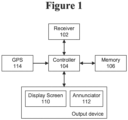
- FIG. 1 illustrates an exemplary avionics wake turbulence awareness system 100.
- a receiver 102 of the wake turbulence awareness system 100 may be an ADS-B receive that is capable of receiving ADS-B transmissions from other aircraft.
- the transmission be in the form of an 8-character field that consists of either a flight identifier for a commercial airliner or a tail number for a general aviation aircraft, as well as the relative position of the identified aircraft with respect to the equipped aircraft.
- the wake turbulence awareness system 100 includes a control system 104 (also known herein as a controller 104) that is responsive to the ADS-B receiver 102 in order to receive transmissions from other aircraft.
- the wake turbulence awareness system 100 may include any form of ADS-B receiver 102 and accompanying controller 104, and may be of the type disclosed in commonly assigned U.S. Patent No. 9,285,472 of Blake R. Getson et al. , entitled MULTI-LINK TRANSPONDER FOR AIRCRAFT AND METHOD OF PROVIDING MULTI-LINK TRANSPONDER CAPABILITY TO AN AIRCRAFT HAVING AN EXISTING TRANSPONDER,.
- U.S. Patent No. 9,285,472 of Blake R. Getson et al. entitled MULTI-LINK TRANSPONDER FOR AIRCRAFT AND METHOD OF PROVIDING MULTI-LINK TRANSPONDER CAPABILITY TO AN AIRCRAFT HAVING AN EXISTING TRANSPONDER,
- the wake turbulence awareness system 100 also includes an output device 108, which comprises a visual display screen 110.
- the output device 108 may also optionally include an annunciator 112.
- the annunciator 112 may be implemented as one or more speakers in the aircraft and via a pilot's aural headset.
- the output device 108 is responsive to the control system 104 to provide guidance to a pilot of the equipped aircraft to avoid encounters with potential wake turbulences of other aircraft.
- Figure 2 illustrates that the ADS-B receiver 102 of Figure 1 may comprise a 1090 ES receiver 102a and/or a 978 MHz UAT receiver 102b. As illustrated in Figure 2 , either of the 1090 ES receiver 102a and the 978 MHz UAT receiver 102b forwards the received ADS-B transmissions to the controller 104 for processing.
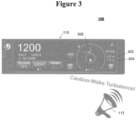
- Figure 3 illustrates an exemplary output device 108 that incorporates a display screen 110 and an annunciator 112.
- the guidance includes a visual distance indication 302 indicating a distance in nautical miles to another aircraft.
- the guidance includes a time indication 304 advising the pilot of an estimated time behind the other aircraft or to the potential wake encounter computed at least in part from the ADS-B system.
- the guidance may include a visual indication 306 that the equipped aircraft is at risk of encountering the wake turbulence caution area of the other aircraft.
- an icon 306 is used as a visual indication 306. As illustrated in Figure 3 , the icon 306 may be placed adjacent a depiction of the other aircraft on the display 110.
- the icon 306 may take other forms, but is shown as a chevron trailing the depiction of the other aircraft on the display 110. As discussed below, and illustrated in Figures 6A and 6B , the icon 306 may be paired with a visual depiction of the flight path history 602 of the other aircraft in order to give the pilot a better understanding of the form of potential wake turbulences that should be avoided. As illustrated in Figures 6A and 6B , and discussed herein, such visual indication of the flight path 602 of the other aircraft may be in the form of dotted "bread crumbs" or other intuitive indications of the flight path history 602 of the other aircraft.
- the output device 108 may include an aural annunciator 112 that verbally notifies the pilot via an aural announcement that the equipped aircraft is at risk of encountering the wake turbulence caution area of the other aircraft.
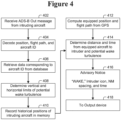
- Figure 4 illustrates the exemplary steps to a computer-implemented method for providing guidance to a pilot of an equipped aircraft that the equipped aircraft is at risk of encountering a wake turbulence caution area of another aircraft.
- an ADS-B Out message is received from an intruding aircraft.
- an "intruding aircraft” is merely another aircraft leading the equipped aircraft that occupies the same general airspace as the equipped aircraft. Such an intruding aircraft has a potential wake turbulence that the equipped aircraft may need to avoid.
- the received ADS-B Out message is decoded to determine position, flight path, and aircraft ID of the intruding aircraft.
- data corresponding to the aircraft ID is retrieved from the database in the memory 106 based upon the determined aircraft ID.
- a wake turbulence caution area may be defined with regards to its length, height, and width.
- the defined length may be three minutes in length, based upon the intruding aircraft's ground speed, a height or vertical dimension may be a thousand feet in height, while a width or horizontal dimension may also be a thousand feet in width.
- the vertical and horizontal dimensions are variable based upon the intruding aircraft's category type. For example, larger aircraft types define larger horizontal and vertical dimensions.
- historical positions of the intruding aircraft are recorded in the memory 106. Such recorded positions may be used, as discussed herein, to define the location of any potential wake vortex/turbulence.
- the equipped aircraft's position and flight path are computed based upon positioning data received from a global positioning system (GPS) receiver 114 in the equipped aircraft.
- GPS global positioning system
- the GPS receiver 114 determines the position of the equipped aircraft and transmits the positioning data to the controller 104.
- a distance and time from the equipped aircraft to the intruder and its associated wake turbulence caution area is determined. As discussed herein, once a location and flight history of the intruder aircraft is determined, the wake turbulence caution area may be defined.
- a wake advisory will be transmitted to the output device 108.
- a visual wake advisory is displayed in the display screen 110 and an audible wake advisory is announced in the annunciator 112.
- the text box "WAKE” the icon 306 (e.g., chevrons), a determined nautical mile range 302 to the potential wake vortex/turbulence, and a determined time 304 to enter the wake turbulence caution area will be displayed on the display screen 110.
- the controller will indicate the above wake vortex/turbulence caution thirty seconds prior.
- the visual display screen 110 and the annunciator 112 of the output device 108 will visually and/or audibly indicate the wake advisory, respectively.
- the avionic wake turbulence awareness system 100 may receive ADS-B transmissions from multiple aircraft within the vicinity of the equipped aircraft. It is possible that more than one of these multiple aircraft may have a flight path history that indicates that there is a potential wake turbulence risk to the equipped aircraft.
- the controller 104 may utilize a prioritization scheme that is capable of determining among the flight path histories of the multiple other aircraft, which of the multiple other aircraft creates a greatest risk of the equipped aircraft encountering the potential wake turbulence of that aircraft. The controller 104 may then provide guidance to the pilot of the equipped aircraft to avoid a potential encounter with the highest risk potential wake turbulence.
- the visual indication 306 may be displayed at only one aircraft depiction, and the distance 302 and time of separation 304 for only that intruding aircraft, even though multiple aircraft depictions may be displayed on the display screen 110.
- This prioritization scheme avoids the pilot needing to make a choice as to which intruding aircraft needs to be avoided in order to take the least risky route.
- the avionic wake turbulence awareness system 100 may utilize a hierarchy to prioritize advisories, select a highest threat intruder, and suppress advisories for much smaller aircraft that would not create a significant wake vortex/turbulence as compared to the equipped aircraft.
- Tables I & II are an exemplary aircraft assignment for a six category system, as proposed by the Federal Aviation Administration (FAA). The list is not all-inclusive. As illustrated in Table I, aircraft models are categorized according to size, from Category A (the largest) to Category F (the smallest). Table II illustrates how the necessary separation between aircraft can vary according to the varying sizes of the leader aircraft and the follower aircraft. The minimum separation increases with the size ratio between the leading aircraft and the trailing aircraft.
- the minimum radar separation is a variable minimum horizontal separation required between radar controlled aircraft, based upon their range from the controlling radar.
- the MRS may be 3-8 nautical miles.
- the minimum required separation may be greater than the MRS, such as when the following aircraft type is smaller than the leading aircraft type.
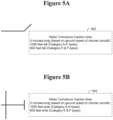
- Figures 5A and 5B illustrate exemplary wake turbulence caution areas 502 and how the dimensions of the wake turbulence caution area 502 are defined by the type of intruder/leading aircraft and related information.
- an exemplary wake turbulence caution area 502 may be three minutes in length, based upon the ground speed of the intruder/leading aircraft.
- the exemplary wake caution area's vertical dimension, extending below the altitude of the intruder/leading aircraft may be a notional 1000 feet for category A-D types, and a notional 600 feet for category E & F types.
- the wake caution area 502 extends below the intruder/leading aircraft because a wake turbulence may drift down over time.
- the wake turbulence caution area's exemplary width may also vary according to category type.
- the width may also be a notional 1000 feet for category A-D types, and a notional 600 feet for category E & F types.
- the exemplary length, width, and height values are notional, and other dimensions based on category types are anticipated.
- Figures 6A and 6B illustrate exemplary wake turbulence caution areas 502 that are shaped to follow the flight path histories 602 of the intruder/leading aircraft.
- a wake turbulence caution area's dimensions will conform to the path of a flight path history as it moves in three dimensions.
- embodiments of the present invention are capable of improving safety by providing quantitative separation information for a flight operation that is typically performed visually using the pilot's judgement.
- the system provides awareness to a developing or potential wake turbulence encounter that may not be readily apparent to the pilot, such as crossing flight paths that may occur during any phase of the flight. This may be accomplished because the flight paths of both aircraft may be known from the controller 104 that is responsive to the ADS-B receiver 102.
Landscapes
- Engineering & Computer Science (AREA)
- Aviation & Aerospace Engineering (AREA)
- Physics & Mathematics (AREA)
- General Physics & Mathematics (AREA)
- Traffic Control Systems (AREA)
- Radar, Positioning & Navigation (AREA)
- Remote Sensing (AREA)
- Life Sciences & Earth Sciences (AREA)
- Atmospheric Sciences (AREA)
- Alarm Systems (AREA)
- Radio Relay Systems (AREA)
Claims (10)
- Avionik-Wirbelschleppen-Erkennungssystem (100) zur Verwendung in einem Luftfahrzeug, wobei das System umfasst:einen ADS-B-Empfänger (102), der dazu eingerichtet ist, in einem ausgerüsteten Luftfahrzeug positioniert und betreibbar zu sein, um ADS-B-Übertragungen von einer Vielzahl von anderen Luftfahrzeugen zu empfangen;ein Steuersystem (104), das konfiguriert ist, um basierend auf Informationen von den empfangenen ADS-B-Übertragungen, die durch den ADS-B-Empfänger (102) empfangen werden, eine Identität für jedes der Vielzahl von anderen Luftfahrzeugen zu bestimmen, und das konfiguriert ist, um eine Bewegung jedes der Vielzahl von anderen Luftfahrzeugen relativ zu dem ausgerüsteten Luftfahrzeug zu bestimmen;wobei das Steuersystem (104) konfiguriert ist, um eine Flugbahnhistorie jedes der Vielzahl von anderen Luftfahrzeugen aus ihren jeweiligen Identitäten und Bewegungen relativ zu dem ausgerüsteten Luftfahrzeug zu bestimmen; undeine Ausgabevorrichtung (108), die auf das Steuersystem (104) reagiert und konfiguriert ist, um einem Piloten des ausgerüsteten Luftfahrzeugs eine Anleitung bereitzustellen, um ein Antreffen eines Wirbelschleppen-Warnbereichs zu vermeiden, der durch eine Flugbahnhistorie eines ausgewählten Luftfahrzeugs der Vielzahl von anderen Luftfahrzeugen definiert ist; undwobei das Steuersystem (104) konfiguriert ist, um das relative Risiko zu evaluieren, dass das ausgerüstete Luftfahrzeug auf jeweilige Wirbelschleppen-Warnbereiche jedes der Vielzahl von anderen Luftfahrzeugen trifft, und konfiguriert ist, um, nach der Auswahl eines Luftfahrzeugs der Vielzahl von anderen Luftfahrzeugen mit dem höchsten relativen Risiko basierend auf der Evaluierung der jeweiligen Wirbelschleppen-Warnbereiche, dem Piloten des ausgerüsteten Luftfahrzeugs eine Anleitung bereitzustellen, um ein Antreffen eines Wirbelschleppen-Warnbereichs des ausgewählten Luftfahrzeugs zu vermeiden, wobei die Anleitung Entfernung und Flugzeit zu dem ausgewählten Luftfahrzeug umfasst.
- Avionik-Wirbelschleppen-Erkennungssystem (100) nach Anspruch 1, wobei die Anleitung eine Angabe beinhaltet, dass das ausgerüstete Luftfahrzeug Gefahr läuft, auf den Wirbelschleppen-Warnbereich des ausgewählten Luftfahrzeugs zu treffen.
- Avionik-Wirbelschleppen-Erkennungssystem (100) nach Anspruch 2, das eine Pilotenbenachrichtigungsvorrichtung aufweist, die auf die Anleitung reagiert, um einen Piloten zu warnen, dass das ausgerüstete Luftfahrzeug Gefahr läuft, auf den Wirbelschleppen-Warnbereich des ausgewählten Luftfahrzeugs zu treffen.
- Avionik-Wirbelschleppen-Erkennungssystem (100) nach Anspruch 3, wobei die Benachrichtigungsvorrichtung eine Anzeige (110) umfasst, wobei die Anzeige (110) dazu eingerichtet ist, eine visuelle Angabe bereitzustellen, dass das ausgerüstete Luftfahrzeug Gefahr läuft, auf den Wirbelschleppen-Warnbereich des ausgewählten Luftfahrzeugs zu treffen.
- Avionik-Wirbelschleppen-Erkennungssystem (100) nach Anspruch 4, wobei die visuelle Angabe (306) ein Symbol benachbart zu einer Darstellung des ausgewählten Luftfahrzeugs auf der Anzeige ist.
- Avionik-Wirbelschleppen-Erkennungssystem (100) nach Anspruch 4, wobei die visuelle Angabe (306) einen Chevron hinter der Darstellung des ausgewählten Luftfahrzeugs auf der Anzeige umfasst.
- Avionik-Wirbelschleppen-Erkennungssystem (100) nach Anspruch 4, wobei die visuelle Angabe (306) eine visuelle Angabe der Flugbahnhistorie (602) des ausgewählten Luftfahrzeugs umfasst.
- Avionik-Wirbelschleppen-Erkennungssystem (100) nach Anspruch 4, wobei die Benachrichtigungsvorrichtung eine Angabe in Form einer akustischen Ansage umfasst, dass das ausgerüstete Luftfahrzeug Gefahr läuft, auf den Wirbelschleppen-Warnbereich des ausgewählten Luftfahrzeugs zu treffen.
- Avionik-Wirbelschleppen-Erkennungssystem (100) nach Anspruch 1, wobei das Steuersystem (104) konfiguriert ist, um das Risiko zu evaluieren und jedes der Vielzahl von anderen Luftfahrzeugen zu priorisieren, indem eine Hierarchie verwendet wird, um Warnhinweise, die mit dem anderen Luftfahrzeug assoziiert sind, zu priorisieren, ein eindringendes Luftfahrzeug mit dem höchsten Risiko aus den anderen Luftfahrzeugen auszuwählen und Warnhinweise für viel kleinere Luftfahrzeuge zu unterdrücken, die keine signifikanten Wirbelschleppen im Vergleich zu dem ausgerüsteten Luftfahrzeug erzeugen würden.
- Verfahren zur Erkennung von Wirbelschleppen in einem Luftfahrzeug, umfassend:Empfangen von ADS-B-Übertragungen von einer Vielzahl von anderen Luftfahrzeugen mit einem ADS-B-Empfänger (102), der in einem ausgerüsteten Luftfahrzeug positioniert ist;Bestimmen, basierend auf Informationen von den empfangenen ADS-B-Übertragungen, die durch den ADS-B-Empfänger (102) empfangen werden, einer Identität jedes der Vielzahl von anderen Luftfahrzeugen und einer Bewegung jedes der Vielzahl von anderen Luftfahrzeugen relativ zu dem ausgerüsteten Luftfahrzeug;Bestimmen einer Flugbahnhistorie jedes der Vielzahl von anderen Luftfahrzeugen aus ihren jeweiligen Identitäten und Bewegungen relativ zu dem ausgerüsteten Luftfahrzeug;Bereitstellen einer Anleitung für einen Piloten des ausgerüsteten Luftfahrzeugs, um ein Antreffen eines Wirbelschleppen-Warnbereichs zu vermeiden, der durch eine Flugbahnhistorie eines ausgewählten Luftfahrzeugs der Vielzahl von anderen Luftfahrzeugen definiert ist; undEvaluieren des relativen Risikos, dass das ausgerüstete Luftfahrzeug auf jeweilige Wirbelschleppen-Warnbereiche jedes der Vielzahl von anderen Luftfahrzeugen trifft, und, nach der Auswahl eines Luftfahrzeugs der Vielzahl von anderen Luftfahrzeugen mit dem höchsten relativen Risiko basierend auf der Evaluierung der jeweiligen Wirbelschleppen-Warnbereiche, Bereitstellen einer Anleitung für den Piloten des ausgerüsteten Luftfahrzeugs, um ein Antreffen eines Wirbelschleppen-Warnbereichs des ausgewählten Luftfahrzeugs zu vermeiden, wobei die Anleitung Entfernung und Flugzeit zu dem ausgewählten Luftfahrzeug umfasst.
Applications Claiming Priority (2)
| Application Number | Priority Date | Filing Date | Title |
|---|---|---|---|
| US201562158340P | 2015-05-07 | 2015-05-07 | |
| PCT/IB2016/052580 WO2016178182A1 (en) | 2015-05-07 | 2016-05-05 | Aircraft wake turbulence awareness |
Publications (3)
| Publication Number | Publication Date |
|---|---|
| EP3292429A1 EP3292429A1 (de) | 2018-03-14 |
| EP3292429A4 EP3292429A4 (de) | 2019-01-09 |
| EP3292429B1 true EP3292429B1 (de) | 2025-03-12 |
Family
ID=57218144
Family Applications (1)
| Application Number | Title | Priority Date | Filing Date |
|---|---|---|---|
| EP16789393.2A Active EP3292429B1 (de) | 2015-05-07 | 2016-05-05 | Flugzeugwirbelschleppenbewusstsein |
Country Status (4)
| Country | Link |
|---|---|
| US (1) | US9911342B2 (de) |
| EP (1) | EP3292429B1 (de) |
| AU (1) | AU2016257208B2 (de) |
| WO (1) | WO2016178182A1 (de) |
Families Citing this family (17)
| Publication number | Priority date | Publication date | Assignee | Title |
|---|---|---|---|---|
| FR3051586B1 (fr) * | 2016-05-19 | 2018-05-18 | Airbus Operations | Procede permettant d'identifier la proximite d'une turbulence de sillage et de generer un rapport relatif a cette proximite |
| FR3065567B1 (fr) * | 2017-04-24 | 2021-04-16 | Airbus Operations Sas | Procede de transmission de parametres de vol d'un aeronef meneur vers un aeronef intrus |
| US10055998B1 (en) * | 2017-08-25 | 2018-08-21 | Airbus Operations (S.A.S.) | Ground-based identification of wake turbulence encounters |
| CN108198462B (zh) * | 2018-01-25 | 2018-12-14 | 中国民航大学 | 一种全空域飞机尾流遭遇风险告警系统实现方法 |
| WO2020046998A1 (en) * | 2018-08-27 | 2020-03-05 | Gulfstream Aerospace Corporation | Avoidance of aircraft and aircraft wake during flight |
| EP3857533B1 (de) | 2018-09-25 | 2024-05-01 | Aviation Communication & Surveillance Systems, LLC | Verfahren und system zur verbesserung von wachsituationsbewusstseinsanzeigen |
| GB2578893B (en) * | 2018-11-12 | 2021-10-06 | Ge Aviat Systems Ltd | Flight management system and method of updating flight calculations |
| GB2579191B (en) * | 2018-11-22 | 2022-07-13 | Ge Aviat Systems Ltd | Method and system to identify and display suspcious aircraft |
| US11030907B1 (en) | 2020-06-19 | 2021-06-08 | Honeywell International Inc. | Methods, systems, and apparatuses for identifying and indicating the secondary runway aiming point (SRAP) approach procedures |
| US11501647B2 (en) | 2020-09-22 | 2022-11-15 | Rockwell Collins, Inc. | Estimated wake turbulence trail for aircraft system |
| US12230142B2 (en) * | 2022-03-01 | 2025-02-18 | Aviation Capital Partners, Llc | Status reporting system for aircraft |
| US12579898B2 (en) * | 2022-05-04 | 2026-03-17 | Innovative Solutions & Support, Inc. | Systems and methods for implementing automated flight following options and upgrading legacy flight management systems |
| US12499772B2 (en) | 2022-05-04 | 2025-12-16 | Innovative Solutions & Support, Inc. | Systems and methods for implementing automated flight following options and upgrading legacy flight management systems |
| US12518641B2 (en) | 2023-05-10 | 2026-01-06 | Honeywell International Inc. | Systems and methods for generating avionic displays indicating wake turbulence |
| US20250006065A1 (en) * | 2023-06-30 | 2025-01-02 | Mark Krietzman | Real time alert for landing airplanes |
| US20250259557A1 (en) * | 2024-02-08 | 2025-08-14 | The Boeing Company | Wake turbulence alert systems and methods |
| US20260043901A1 (en) * | 2024-06-07 | 2026-02-12 | Honeywell International Inc. | Wake vortex prediction using weather radar |
Family Cites Families (23)
| Publication number | Priority date | Publication date | Assignee | Title |
|---|---|---|---|---|
| US5179377A (en) | 1990-12-31 | 1993-01-12 | Honeywell Inc. | Tcas view display format with horizontal trend |
| US6459411B2 (en) | 1998-12-30 | 2002-10-01 | L-3 Communications Corporation | Close/intra-formation positioning collision avoidance system and method |
| US6683541B2 (en) | 1999-01-21 | 2004-01-27 | Honeywell International Inc. | Vertical speed indicator and traffic alert collision avoidance system |
| US7411519B1 (en) | 1999-05-14 | 2008-08-12 | Honeywell International Inc. | System and method for predicting and displaying wake vortex turbulence |
| US6177888B1 (en) | 1999-09-08 | 2001-01-23 | The Boeing Company | Wake turbulence warning and caution system and method |
| US8135500B1 (en) * | 2000-05-26 | 2012-03-13 | Aerotech Research (Usa), Inc. | Wake vortex detection and reporting system |
| US6992596B2 (en) | 2002-04-04 | 2006-01-31 | Megadata | Simplified flight track display system |
| US6963291B2 (en) | 2002-05-17 | 2005-11-08 | The Board Of Trustees Of The Leland Stanford Junior University | Dynamic wake prediction and visualization with uncertainty analysis |
| FR2899350B1 (fr) | 2006-03-30 | 2011-04-22 | Airbus France | Procede et dispositif pour determiner la turbulence de l'air susceptible d'etre rencontree par un aeronef |
| FR2908876B1 (fr) * | 2006-11-21 | 2009-02-13 | Thales Sa | Procede de detection automatique de turbulence |
| US8362925B2 (en) | 2009-05-05 | 2013-01-29 | Honeywell International Inc. | Avionics display system and method for generating flight information pertaining to neighboring aircraft |
| US8219264B1 (en) | 2009-06-08 | 2012-07-10 | The United States Of America As Represented By The Secretary Of The Air Force | Close formation flight positioning system using air data measurements |
| DE102009039016B4 (de) * | 2009-08-28 | 2012-05-03 | Deutsches Zentrum für Luft- und Raumfahrt e.V. | Strömungsermittlungsverfahren |
| US20110066362A1 (en) | 2009-09-17 | 2011-03-17 | Honeywell International Inc. | Method and system displaying aircraft in-trail traffic |
| US10429844B2 (en) | 2010-04-29 | 2019-10-01 | Aviation Communication & Surveillance Systems Llc | Systems and methods for providing a vertical profile for an in-trail procedure |
| FR2965087B1 (fr) | 2010-09-21 | 2013-05-17 | Dassault Aviat | Dispositif d'assistance a l'equipage d'un aeronef lors de changements de niveau de vol de celui-ci |
| US8736465B2 (en) | 2011-01-17 | 2014-05-27 | L-3 Communications Avionics Systems, Inc. | Aircraft traffic display |
| US9709698B2 (en) | 2011-06-10 | 2017-07-18 | Ohio University | Wake turbulence analyzer for real-time visualization, detection, and avoidance |
| US9285472B2 (en) | 2011-12-06 | 2016-03-15 | L-3 Communications Avionics Systems, Inc. | Multi-link transponder for aircraft and method of providing multi-link transponder capability to an aircraft having an existing transponder |
| US8949014B2 (en) | 2012-08-01 | 2015-02-03 | Honeywell International Inc. | Systems and methods for presentation of probable wake turbulence |
| US9310222B1 (en) * | 2014-06-16 | 2016-04-12 | Sean Patrick Suiter | Flight assistant with automatic configuration and landing site selection method and apparatus |
| US9355567B2 (en) | 2013-08-08 | 2016-05-31 | Honeywell International Inc. | System and method for highlighting an area encompassing an aircraft that is free of hazards |
| US9037319B2 (en) | 2013-09-24 | 2015-05-19 | Honeywell International Inc. | System and method for processing and displaying wake turbulence |
-
2016
- 2016-05-04 US US15/146,230 patent/US9911342B2/en active Active
- 2016-05-05 EP EP16789393.2A patent/EP3292429B1/de active Active
- 2016-05-05 WO PCT/IB2016/052580 patent/WO2016178182A1/en not_active Ceased
- 2016-05-05 AU AU2016257208A patent/AU2016257208B2/en active Active
Also Published As
| Publication number | Publication date |
|---|---|
| EP3292429A1 (de) | 2018-03-14 |
| WO2016178182A1 (en) | 2016-11-10 |
| AU2016257208A2 (en) | 2018-03-15 |
| US9911342B2 (en) | 2018-03-06 |
| EP3292429A4 (de) | 2019-01-09 |
| CA2984866A1 (en) | 2016-11-10 |
| BR112017023755A2 (pt) | 2018-07-31 |
| AU2016257208B2 (en) | 2021-03-11 |
| US20160328981A1 (en) | 2016-11-10 |
| AU2016257208A1 (en) | 2017-11-23 |
Similar Documents
| Publication | Publication Date | Title |
|---|---|---|
| EP3292429B1 (de) | Flugzeugwirbelschleppenbewusstsein | |
| US8660713B2 (en) | Methods and systems for an improved in-trail procedures display | |
| CN105280025B (zh) | 用于提供供机场离场和到达程序使用的飞行器显示的飞行器显示系统和方法 | |
| CA2679910C (en) | Aircraft-centered ground maneuvering monitoring and alerting system | |
| EP2485205B1 (de) | Systeme und Verfahren zur Bereitstellung von Abstandsinformationen | |
| US9646504B2 (en) | Flight deck displays to enable visual separation standard | |
| EP3048424B1 (de) | Verfahren und systeme für route-basierte anzeige meteorologischer informationsvorhersage | |
| US8855906B2 (en) | Database augmented surveillance | |
| EP2328134B1 (de) | System und Verfahren zum Hinweis auf Verkehr in der Nähe einer Flughafenumgebung | |
| Paielli et al. | Tactical conflict alerting aid for air traffic controllers | |
| US11348469B2 (en) | Systems and methods for providing wake situational awareness displays | |
| EP2966634A2 (de) | Systeme und verfahren zur anzeige von degradierten eindringlingsverkehrsdaten auf einem flugzeugbildschirm | |
| EP3734573B1 (de) | Grafischer geschwindigkeitsleistungsmonitor mit flugintervallverwaltung | |
| EP3696792A1 (de) | Systeme und verfahren zur warnung vor unzulässiger hemmung von warnsystemen | |
| Howell et al. | Measured impact of ADS-B in applications on general aviation and air taxi accident rates | |
| US8478513B1 (en) | System and method for displaying degraded traffic data on an in-trail procedure (ITP) display | |
| EP3573037A1 (de) | Systeme und verfahren zur vorhersage des verlustes von trennungsereignissen | |
| EP2151384A2 (de) | Systeme und Verfahren zur Verbesserung des Situationsbewusstseins eines Piloten während der Landung | |
| CA2984866C (en) | Aircraft wake turbulence awareness | |
| Smith et al. | Current safety nets within the us national airspace system | |
| EP4141842B1 (de) | Verfahren, systeme und vorrichtungen zur berechnung und anzeige von mach tuck | |
| US11830370B2 (en) | Methods, systems, and apparatuses for computation and annunciation of Mach tuck | |
| EP4648034A1 (de) | Integrierte sicherheitswarnung für landebahn | |
| CA3117491C (en) | Systems and methods for providing wake situational awareness displays | |
| Rodrigues Filho | Increasing Flexibility in the Design and Operation of Instrument Flight Procedures |
Legal Events
| Date | Code | Title | Description |
|---|---|---|---|
| STAA | Information on the status of an ep patent application or granted ep patent |
Free format text: STATUS: THE INTERNATIONAL PUBLICATION HAS BEEN MADE |
|
| PUAI | Public reference made under article 153(3) epc to a published international application that has entered the european phase |
Free format text: ORIGINAL CODE: 0009012 |
|
| STAA | Information on the status of an ep patent application or granted ep patent |
Free format text: STATUS: REQUEST FOR EXAMINATION WAS MADE |
|
| 17P | Request for examination filed |
Effective date: 20171103 |
|
| AK | Designated contracting states |
Kind code of ref document: A1 Designated state(s): AL AT BE BG CH CY CZ DE DK EE ES FI FR GB GR HR HU IE IS IT LI LT LU LV MC MK MT NL NO PL PT RO RS SE SI SK SM TR |
|
| AX | Request for extension of the european patent |
Extension state: BA ME |
|
| DAV | Request for validation of the european patent (deleted) | ||
| DAX | Request for extension of the european patent (deleted) | ||
| A4 | Supplementary search report drawn up and despatched |
Effective date: 20181210 |
|
| RIC1 | Information provided on ipc code assigned before grant |
Ipc: G08G 5/00 20060101ALI20181204BHEP Ipc: G01W 1/02 20060101AFI20181204BHEP |
|
| STAA | Information on the status of an ep patent application or granted ep patent |
Free format text: STATUS: EXAMINATION IS IN PROGRESS |
|
| 17Q | First examination report despatched |
Effective date: 20210628 |
|
| RAP3 | Party data changed (applicant data changed or rights of an application transferred) |
Owner name: L3HARRIS AVIATION PRODUCTS, INC. |
|
| GRAP | Despatch of communication of intention to grant a patent |
Free format text: ORIGINAL CODE: EPIDOSNIGR1 |
|
| STAA | Information on the status of an ep patent application or granted ep patent |
Free format text: STATUS: GRANT OF PATENT IS INTENDED |
|
| INTG | Intention to grant announced |
Effective date: 20241108 |
|
| GRAS | Grant fee paid |
Free format text: ORIGINAL CODE: EPIDOSNIGR3 |
|
| GRAA | (expected) grant |
Free format text: ORIGINAL CODE: 0009210 |
|
| STAA | Information on the status of an ep patent application or granted ep patent |
Free format text: STATUS: THE PATENT HAS BEEN GRANTED |
|
| AK | Designated contracting states |
Kind code of ref document: B1 Designated state(s): AL AT BE BG CH CY CZ DE DK EE ES FI FR GB GR HR HU IE IS IT LI LT LU LV MC MK MT NL NO PL PT RO RS SE SI SK SM TR |
|
| REG | Reference to a national code |
Ref country code: GB Ref legal event code: FG4D |
|
| REG | Reference to a national code |
Ref country code: CH Ref legal event code: EP |
|
| REG | Reference to a national code |
Ref country code: DE Ref legal event code: R096 Ref document number: 602016091530 Country of ref document: DE |
|
| REG | Reference to a national code |
Ref country code: IE Ref legal event code: FG4D |
|
| PG25 | Lapsed in a contracting state [announced via postgrant information from national office to epo] |
Ref country code: RS Free format text: LAPSE BECAUSE OF FAILURE TO SUBMIT A TRANSLATION OF THE DESCRIPTION OR TO PAY THE FEE WITHIN THE PRESCRIBED TIME-LIMIT Effective date: 20250612 |
|
| PG25 | Lapsed in a contracting state [announced via postgrant information from national office to epo] |
Ref country code: FI Free format text: LAPSE BECAUSE OF FAILURE TO SUBMIT A TRANSLATION OF THE DESCRIPTION OR TO PAY THE FEE WITHIN THE PRESCRIBED TIME-LIMIT Effective date: 20250312 |
|
| PGFP | Annual fee paid to national office [announced via postgrant information from national office to epo] |
Ref country code: DE Payment date: 20250618 Year of fee payment: 10 |
|
| PG25 | Lapsed in a contracting state [announced via postgrant information from national office to epo] |
Ref country code: ES Free format text: LAPSE BECAUSE OF FAILURE TO SUBMIT A TRANSLATION OF THE DESCRIPTION OR TO PAY THE FEE WITHIN THE PRESCRIBED TIME-LIMIT Effective date: 20250312 |
|
| REG | Reference to a national code |
Ref country code: LT Ref legal event code: MG9D |
|
| PG25 | Lapsed in a contracting state [announced via postgrant information from national office to epo] |
Ref country code: NO Free format text: LAPSE BECAUSE OF FAILURE TO SUBMIT A TRANSLATION OF THE DESCRIPTION OR TO PAY THE FEE WITHIN THE PRESCRIBED TIME-LIMIT Effective date: 20250612 |
|
| PG25 | Lapsed in a contracting state [announced via postgrant information from national office to epo] |
Ref country code: HR Free format text: LAPSE BECAUSE OF FAILURE TO SUBMIT A TRANSLATION OF THE DESCRIPTION OR TO PAY THE FEE WITHIN THE PRESCRIBED TIME-LIMIT Effective date: 20250312 |
|
| REG | Reference to a national code |
Ref country code: NL Ref legal event code: MP Effective date: 20250312 |
|
| PG25 | Lapsed in a contracting state [announced via postgrant information from national office to epo] |
Ref country code: LV Free format text: LAPSE BECAUSE OF FAILURE TO SUBMIT A TRANSLATION OF THE DESCRIPTION OR TO PAY THE FEE WITHIN THE PRESCRIBED TIME-LIMIT Effective date: 20250312 |
|
| PGFP | Annual fee paid to national office [announced via postgrant information from national office to epo] |
Ref country code: FR Payment date: 20250530 Year of fee payment: 10 |
|
| PG25 | Lapsed in a contracting state [announced via postgrant information from national office to epo] |
Ref country code: GR Free format text: LAPSE BECAUSE OF FAILURE TO SUBMIT A TRANSLATION OF THE DESCRIPTION OR TO PAY THE FEE WITHIN THE PRESCRIBED TIME-LIMIT Effective date: 20250613 Ref country code: BG Free format text: LAPSE BECAUSE OF FAILURE TO SUBMIT A TRANSLATION OF THE DESCRIPTION OR TO PAY THE FEE WITHIN THE PRESCRIBED TIME-LIMIT Effective date: 20250312 |
|
| REG | Reference to a national code |
Ref country code: AT Ref legal event code: MK05 Ref document number: 1775446 Country of ref document: AT Kind code of ref document: T Effective date: 20250312 |
|
| PG25 | Lapsed in a contracting state [announced via postgrant information from national office to epo] |
Ref country code: NL Free format text: LAPSE BECAUSE OF FAILURE TO SUBMIT A TRANSLATION OF THE DESCRIPTION OR TO PAY THE FEE WITHIN THE PRESCRIBED TIME-LIMIT Effective date: 20250312 |
|
| PG25 | Lapsed in a contracting state [announced via postgrant information from national office to epo] |
Ref country code: SE Free format text: LAPSE BECAUSE OF FAILURE TO SUBMIT A TRANSLATION OF THE DESCRIPTION OR TO PAY THE FEE WITHIN THE PRESCRIBED TIME-LIMIT Effective date: 20250312 |
|
| PG25 | Lapsed in a contracting state [announced via postgrant information from national office to epo] |
Ref country code: SM Free format text: LAPSE BECAUSE OF FAILURE TO SUBMIT A TRANSLATION OF THE DESCRIPTION OR TO PAY THE FEE WITHIN THE PRESCRIBED TIME-LIMIT Effective date: 20250312 |
|
| PG25 | Lapsed in a contracting state [announced via postgrant information from national office to epo] |
Ref country code: PT Free format text: LAPSE BECAUSE OF FAILURE TO SUBMIT A TRANSLATION OF THE DESCRIPTION OR TO PAY THE FEE WITHIN THE PRESCRIBED TIME-LIMIT Effective date: 20250714 |
|
| PG25 | Lapsed in a contracting state [announced via postgrant information from national office to epo] |
Ref country code: PL Free format text: LAPSE BECAUSE OF FAILURE TO SUBMIT A TRANSLATION OF THE DESCRIPTION OR TO PAY THE FEE WITHIN THE PRESCRIBED TIME-LIMIT Effective date: 20250312 Ref country code: IT Free format text: LAPSE BECAUSE OF FAILURE TO SUBMIT A TRANSLATION OF THE DESCRIPTION OR TO PAY THE FEE WITHIN THE PRESCRIBED TIME-LIMIT Effective date: 20250312 |
|
| PG25 | Lapsed in a contracting state [announced via postgrant information from national office to epo] |
Ref country code: AT Free format text: LAPSE BECAUSE OF FAILURE TO SUBMIT A TRANSLATION OF THE DESCRIPTION OR TO PAY THE FEE WITHIN THE PRESCRIBED TIME-LIMIT Effective date: 20250312 |
|
| PG25 | Lapsed in a contracting state [announced via postgrant information from national office to epo] |
Ref country code: EE Free format text: LAPSE BECAUSE OF FAILURE TO SUBMIT A TRANSLATION OF THE DESCRIPTION OR TO PAY THE FEE WITHIN THE PRESCRIBED TIME-LIMIT Effective date: 20250312 Ref country code: CZ Free format text: LAPSE BECAUSE OF FAILURE TO SUBMIT A TRANSLATION OF THE DESCRIPTION OR TO PAY THE FEE WITHIN THE PRESCRIBED TIME-LIMIT Effective date: 20250312 |
|
| PG25 | Lapsed in a contracting state [announced via postgrant information from national office to epo] |
Ref country code: RO Free format text: LAPSE BECAUSE OF FAILURE TO SUBMIT A TRANSLATION OF THE DESCRIPTION OR TO PAY THE FEE WITHIN THE PRESCRIBED TIME-LIMIT Effective date: 20250312 |
|
| PG25 | Lapsed in a contracting state [announced via postgrant information from national office to epo] |
Ref country code: SK Free format text: LAPSE BECAUSE OF FAILURE TO SUBMIT A TRANSLATION OF THE DESCRIPTION OR TO PAY THE FEE WITHIN THE PRESCRIBED TIME-LIMIT Effective date: 20250312 |
|
| PG25 | Lapsed in a contracting state [announced via postgrant information from national office to epo] |
Ref country code: IS Free format text: LAPSE BECAUSE OF FAILURE TO SUBMIT A TRANSLATION OF THE DESCRIPTION OR TO PAY THE FEE WITHIN THE PRESCRIBED TIME-LIMIT Effective date: 20250712 |
|
| REG | Reference to a national code |
Ref country code: DE Ref legal event code: R097 Ref document number: 602016091530 Country of ref document: DE |
|
| REG | Reference to a national code |
Ref country code: CH Ref legal event code: H13 Free format text: ST27 STATUS EVENT CODE: U-0-0-H10-H13 (AS PROVIDED BY THE NATIONAL OFFICE) Effective date: 20251223 |
|
| PG25 | Lapsed in a contracting state [announced via postgrant information from national office to epo] |
Ref country code: DK Free format text: LAPSE BECAUSE OF FAILURE TO SUBMIT A TRANSLATION OF THE DESCRIPTION OR TO PAY THE FEE WITHIN THE PRESCRIBED TIME-LIMIT Effective date: 20250312 |
|
| PG25 | Lapsed in a contracting state [announced via postgrant information from national office to epo] |
Ref country code: LU Free format text: LAPSE BECAUSE OF NON-PAYMENT OF DUE FEES Effective date: 20250505 |
|
| PLBE | No opposition filed within time limit |
Free format text: ORIGINAL CODE: 0009261 |
|
| STAA | Information on the status of an ep patent application or granted ep patent |
Free format text: STATUS: NO OPPOSITION FILED WITHIN TIME LIMIT |
|
| PG25 | Lapsed in a contracting state [announced via postgrant information from national office to epo] |
Ref country code: CH Free format text: LAPSE BECAUSE OF NON-PAYMENT OF DUE FEES Effective date: 20250531 |
|
| REG | Reference to a national code |
Ref country code: CH Ref legal event code: L10 Free format text: ST27 STATUS EVENT CODE: U-0-0-L10-L00 (AS PROVIDED BY THE NATIONAL OFFICE) Effective date: 20260121 |
|
| REG | Reference to a national code |
Ref country code: BE Ref legal event code: MM Effective date: 20250531 |
|
| PG25 | Lapsed in a contracting state [announced via postgrant information from national office to epo] |
Ref country code: MC Free format text: LAPSE BECAUSE OF FAILURE TO SUBMIT A TRANSLATION OF THE DESCRIPTION OR TO PAY THE FEE WITHIN THE PRESCRIBED TIME-LIMIT Effective date: 20250312 |
|
| 26N | No opposition filed |
Effective date: 20251215 |
|
| PGFP | Annual fee paid to national office [announced via postgrant information from national office to epo] |
Ref country code: GB Payment date: 20260327 Year of fee payment: 11 |
|
| PG25 | Lapsed in a contracting state [announced via postgrant information from national office to epo] |
Ref country code: IE Free format text: LAPSE BECAUSE OF NON-PAYMENT OF DUE FEES Effective date: 20250505 |
|
| PG25 | Lapsed in a contracting state [announced via postgrant information from national office to epo] |
Ref country code: BE Free format text: LAPSE BECAUSE OF NON-PAYMENT OF DUE FEES Effective date: 20250531 |