EP3293389A1 - Triebwerkvorrichtung eines raketentriebwerks - Google Patents
Triebwerkvorrichtung eines raketentriebwerks Download PDFInfo
- Publication number
- EP3293389A1 EP3293389A1 EP17187938.0A EP17187938A EP3293389A1 EP 3293389 A1 EP3293389 A1 EP 3293389A1 EP 17187938 A EP17187938 A EP 17187938A EP 3293389 A1 EP3293389 A1 EP 3293389A1
- Authority
- EP
- European Patent Office
- Prior art keywords
- chamber
- gas
- nozzle needle
- engine
- engine device
- Prior art date
- Legal status (The legal status is an assumption and is not a legal conclusion. Google has not performed a legal analysis and makes no representation as to the accuracy of the status listed.)
- Granted
Links
Images

Classifications
-
- F—MECHANICAL ENGINEERING; LIGHTING; HEATING; WEAPONS; BLASTING
- F02—COMBUSTION ENGINES; HOT-GAS OR COMBUSTION-PRODUCT ENGINE PLANTS
- F02K—JET-PROPULSION PLANTS
- F02K9/00—Rocket-engine plants, i.e. plants carrying both fuel and oxidant therefor; Control thereof
- F02K9/97—Rocket nozzles
- F02K9/978—Closures for nozzles; Nozzles comprising ejectable or discardable elements
-
- F—MECHANICAL ENGINEERING; LIGHTING; HEATING; WEAPONS; BLASTING
- F02—COMBUSTION ENGINES; HOT-GAS OR COMBUSTION-PRODUCT ENGINE PLANTS
- F02K—JET-PROPULSION PLANTS
- F02K9/00—Rocket-engine plants, i.e. plants carrying both fuel and oxidant therefor; Control thereof
- F02K9/80—Rocket-engine plants, i.e. plants carrying both fuel and oxidant therefor; Control thereof characterised by thrust or thrust vector control
- F02K9/86—Rocket-engine plants, i.e. plants carrying both fuel and oxidant therefor; Control thereof characterised by thrust or thrust vector control using nozzle throats of adjustable cross- section
-
- F—MECHANICAL ENGINEERING; LIGHTING; HEATING; WEAPONS; BLASTING
- F05—INDEXING SCHEMES RELATING TO ENGINES OR PUMPS IN VARIOUS SUBCLASSES OF CLASSES F01-F04
- F05D—INDEXING SCHEME FOR ASPECTS RELATING TO NON-POSITIVE-DISPLACEMENT MACHINES OR ENGINES, GAS-TURBINES OR JET-PROPULSION PLANTS
- F05D2220/00—Application
- F05D2220/80—Application in supersonic vehicles excluding hypersonic vehicles or ram, scram or rocket propulsion
-
- F—MECHANICAL ENGINEERING; LIGHTING; HEATING; WEAPONS; BLASTING
- F05—INDEXING SCHEMES RELATING TO ENGINES OR PUMPS IN VARIOUS SUBCLASSES OF CLASSES F01-F04
- F05D—INDEXING SCHEME FOR ASPECTS RELATING TO NON-POSITIVE-DISPLACEMENT MACHINES OR ENGINES, GAS-TURBINES OR JET-PROPULSION PLANTS
- F05D2270/00—Control
- F05D2270/30—Control parameters, e.g. input parameters
- F05D2270/306—Mass flow
- F05D2270/3061—Mass flow of the working fluid
Definitions
- the present invention relates to an engine device of a rocket engine.
- interceptor missiles are collided with the ballistic targets to be destroyed, with the kinetic energy that is converted in the crash destroying the target.
- targets themselves are moving at high speeds and with only limited predictable trajectories, so high-level control of the interceptor missiles is essential.
- reactive shear thrust and attitude control systems are usually used. These systems can be operated by discrete thrust pulses, with the engines on or off. In this case, the thrust is used only for course correction. In addition, continuous thrust controls are available which allow accurate adjustment of thrust.
- the invention accordingly relates to an engine device of a rocket engine, which comprises an afterburner chamber which has a gas inlet opening for the flow of a gas into the afterburner chamber, and a gas outlet opening or nozzle, which is designed for the outflow of the gas from the afterburner chamber.
- the engine assembly further includes a gas-fillable equalization chamber and a gas-fillable control chamber.
- a nozzle needle is arranged in an axially displaceable manner such that a first end region of the nozzle needle is at least partially insertable into the gas outlet opening.
- a second end region of the nozzle needle has a piston device, wherein a first section of the piston device is arranged in the compensation chamber and can be acted upon by a gas in the compensation chamber with pressure such that the nozzle needle experiences an axial force in the direction of the gas outlet opening.
- a second portion of the piston device is arranged in the control chamber and acted upon by filling a gas into the control chamber with pressure such that the nozzle needle experiences an axial force in the direction away from the gas outlet opening.
- the position of the nozzle needle can be set accurately.
- the pneumatic control achieves a very short positioning time, so that the effective cross section of the gas outlet opening of the afterburner chamber can be varied extremely quickly. This allows the thrust of the engine device to be precisely adjusted.
- the engine device comprises a control device which is adapted to adjust an axial position of the nozzle needle by varying a gas pressure of a gas located in the control chamber.
- a control device which is adapted to adjust an axial position of the nozzle needle by varying a gas pressure of a gas located in the control chamber.
- control device is furthermore designed to set a gas pressure of a gas in the compensation chamber. This allows both the axial force on the Nozzle needle can be adjusted in the direction of the gas outlet opening and away from the gas outlet opening.
- the engine device has a sensor device which is designed to measure an axial position of the nozzle needle. Based on the measured position, for example, the control device to adjust the gas pressure of the gas in the control chamber and / or compensation chamber such that the nozzle needle is moved to a predetermined axial position.
- the afterburner chamber is fluidically connected to the compensation chamber.
- the pressure in the post-combustion chamber substantially corresponds to the pressure in the compensation chamber, apart from dynamic fluctuations due to the displacement of the nozzle needle and the flow losses due to an overflow of gas quantities.
- the afterburner chamber is in this case designed such that in the case in which the control chamber is vented, that is not acted upon by a gas, an axial force on the nozzle needle in the direction of the gas outlet opening is greater than one due to the flow of the gas in the afterburner axial force exerted on the nozzle needle away from the gas outlet opening.
- the control chamber serves to build up a counter force which moves the nozzle needle away from the gas outlet opening.
- the nozzle needle Since this only the pressure difference is required, the nozzle needle is already displaced axially by applying low gas pressure, so that a small change in the gas pressure is sufficient to adjust the exact axial position of the nozzle needle. As a result, the positioning time is kept very short.
- control chamber is arranged in the axial direction between the compensation chamber and the afterburning chamber.
- the axial direction corresponds to the axial displacement direction of the nozzle needle.
- the afterburner chamber and the control chamber are separated by a bulkhead.
- the compensation chamber and / or the afterburner chamber are arranged symmetrically about an axial displacement axis of the nozzle needle.
- the gas outlet opening can be completely closed by inserting the nozzle needle.
- the thrust provided by the engine device can thus be varied continuously between zero and a maximum predetermined value, the maximum value corresponding to a position in which the nozzle needle is completely displaced out of the gas outlet opening.
- the piston device is displaceable in an intermediate chamber, wherein the intermediate chamber is fluidically connected to an ambient air.
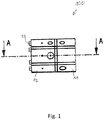
- FIG. 1 a schematic side view of an engine device 100 is shown, which has a housing with a front housing portion 11 and a rear housing portion 12.
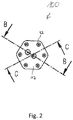
- FIG. 2 shows a rear view of the in FIG. 1 shown engine device.
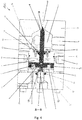
- FIG. 15 is a cross-sectional view of engine device 100 taken along in FIG FIG. 1 illustrated axis AA illustrated.
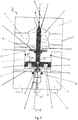
- FIG. 4 shows the engine device in a schematic cross-sectional view along the axis BB of FIG. 2 and FIG. 5 along the CC axis of the FIG. 2 ,
- the engine device 100 has an afterburner chamber 1, which is connected via gas inlet openings 27 with a gas reservoir or a gas generator.
- the gas reservoir or the gas generator introduces gas into the afterburning chamber 1, which is accelerated by a gas outlet opening or engine nozzle 20 and discharged from the afterburning chamber 1.
- the discharged gas generates a thrust, via which the direction of flight of the engine device having missile can be changed.
- a nozzle needle 4 is arranged axially displaceable in the engine device 100, wherein a first end portion 28 of the nozzle needle 4 is at least partially inserted into the gas outlet 20, so that the effective Cross section of the gas outlet opening 20 is variable.
- the nozzle needle has for this purpose a cylindrical portion which tapers in the first end region 28.
- the end portion 28 is tapered.
- the end region may also be rounded or likewise cylindrical.
- the gas outlet opening 20 is preferably completely closed by insertion of the nozzle needle 4.
- the afterburner chamber 1 is separated from a control chamber 2 via a bulkhead 10. Between the bulkhead 10 and the housing seals 25, 26 are arranged. A seal retainer plate 15 is bolted to the bulkhead 10 by seal retaining bolts 16 with a nozzle needle seal 13 secured to the seal retainer plate 15. The nozzle needle 4 is inserted through the nozzle needle seal 13 and the seal holding plate 15 into the afterburner chamber 1 and axially displaceable, wherein the afterburner chamber 1 is sealed by the nozzle needle seal 13.
- the engine device 100 further comprises a compensation chamber 3, wherein the control chamber 2 is arranged in the axial direction between the afterburner chamber 1 and the compensation chamber 3. Between the compensation chamber 3 and the control chamber 2, an intermediate chamber 30 is arranged.
- the compensation chamber 3 and / or the afterburner chamber 1 are arranged symmetrically about an axial axis of displacement of the nozzle needle 4 around.
- the nozzle needle 4 has a piston device 5 at a second end region, which is axially opposite the first end region 28.
- the piston device 5 comprises a first portion 29, which is arranged axially displaceably and positively in the compensation chamber 3. Furthermore, the piston device 5 comprises a second section 7, which is arranged axially displaceably and positively in the control chamber 2.
- the first portion 29 is connected via a piston screw 8 with the second portion 7 of the piston device 5.
- a third section 6 is remote from the afterburner chamber 1 and arranged axially displaceable and positively in the intermediate chamber 30. Between the second section 7 and the third section 6 of the piston device 5 are piston seals 9 included in a radially outer direction, which prevent fluidic contact of the control chamber 2 with the intermediate chamber 30.
- the intermediate chamber 30 is fluidly connected via air vents 21 with an ambient air, so that in the intermediate chamber 30, a neutral ambient pressure prevails and the nozzle needle 4 in the axial direction in the intermediate chamber 30 is displaceable without an air located in the intermediate chamber 30, an axial force the nozzle needle 4 exerts.
- the afterburner chamber 1 is fluidically connected to the compensation chamber 3.
- the compensation chamber 3 and the afterburner chamber 1 may be connected to the same gas reservoir or gas generator or the afterburner chamber 1 and the compensation chamber 3 may be connected to each other via a fluid line or gas line.
- the piston device 5 has a sensor connection 17, which can be connected or connected to a sensor device, which can also be part of the engine device 100.
- the sensor device can be screwed by means of screws to a screw hole 23 of the rear housing portion 12 and secured thereto.
- the sensor device is designed to measure an axial position of the nozzle needle 4.
- the afterburner chamber 1 has a port 18 which is connectable or connected to a pressure / temperature transducer, which may also be part of the engine device 100.
- the pressure / temperature transducer is adapted to measure a pressure or a temperature in the afterburner chamber 1.
- the control chamber 2 has a connection 19 which can be connected or connected to a pressure / temperature transducer, which can be identical to the pressure / temperature transducer connected to the connection 18 of the afterburning chamber 1 or different from it.
- the pressure / temperature transducer is adapted to a pressure or a temperature in the control chamber 2 and may also be part of the engine device 100.
- a located in the compensation chamber 3 gas acts on the first portion 29 of the piston device 5 with such pressure that the nozzle needle 4 is a in FIG. 5 drawn axial compensating force F A in the direction of the gas outlet opening 20 of the afterburner chamber 1 experiences. Due to the air flow through the gas outlet opening 20 of the afterburner chamber 1, the first end portion 28 of the nozzle needle 4 is also pressurized, so that an air force F L is exerted away from the gas outlet opening 20 on the nozzle needle 4.
- the compensation chamber is preferably dimensioned such that a size and / or geometric shape of the compensation chamber is selected such that the compensating force F A at fully retracted nozzle needle, that is, in a position in which the nozzle needle 4 far from the gas outlet 20 of the Afterburning chamber 1 is moved out, greater than the air force F L is. This creates an effective force in the direction of the gas outlet opening 20 in this case.
- the control chamber 2 has a gas opening 24, via which gas can be introduced or diverted into the control chamber 2.
- a control force F S can be generated on the nozzle needle 4, which is caused by the gas pressure of the gas in the control chamber 2 and points away from the gas outlet 20.
- the inflow and outflow of the gas into the control chamber 2 can be done by two 2/2-way valve or a 3/3-way valve.
- the engine device 100 preferably further includes a control device (not shown) configured to adjust the axial position of the nozzle needle 4 by changing a gas pressure of a gas in the control chamber 2.
- the control device is connected to the sensor device and receives from the sensor device a current axial position of the nozzle needle 4. Based on the current axial position of the nozzle needle 4, the control device increases or decreases the gas pressure of the gas in the control chamber 2 until that of the Sensor device corresponds measured current axial position of a predetermined position.
- the control force F S pointing away from the gas outlet port 20 is increased, so that by increasing the gas pressure of the gas, the nozzle needle 4 continues to move can be moved out of the gas outlet 20 out.
- control means can reduce the control force F S , so that the nozzle needle 4 is moved further into the gas outlet opening 20 due to the balancing force F A.
- the effective cross section of the gas outlet opening 20 is thereby reduced.
- the control device is thus designed to change the axial position of the nozzle needle 4 continuously.
- control device may also be designed to set a pressure of a gas in the compensation chamber 3.
- the controller may adjust both the gas pressure of the gas in the balance chamber and the gas pressure of the gas in the control chamber 2.
- the order of arrangement of the compensation chamber 3, control chamber 2 and afterburning chamber 1 is not limited to the embodiments shown.
- the compensation chamber 3 may be arranged between the control chamber 2 and the afterburning chamber 1.
Landscapes
- Engineering & Computer Science (AREA)
- Chemical & Material Sciences (AREA)
- Combustion & Propulsion (AREA)
- Mechanical Engineering (AREA)
- General Engineering & Computer Science (AREA)
- Testing Of Engines (AREA)
- Jet Pumps And Other Pumps (AREA)
- Output Control And Ontrol Of Special Type Engine (AREA)
Abstract
Description
- Die vorliegende Erfindung betrifft eine Triebwerkvorrichtung eines Raketentriebwerks.
- Zur Raketenabwehr werden Abfangflugkörper mit den zu zerstörenden ballistischen Zielen zur Kollision gebracht, wobei die kinetische Energie, welche bei dem Zusammenstoß umgewandelt wird, das Ziel zerstört. Die Ziele selbst bewegen sich jedoch mit hohen Geschwindigkeiten und auf nur bedingt vorhersehbaren Flugbahnen, sodass eine hochagile Steuerung der Abfangflugkörper essentiell ist.
- Hierzu werden üblicherweise reaktive Querschub- und Lageregelungssysteme eingesetzt. Diese Systeme können durch diskrete Schubimpulse betrieben werden, wobei die Triebwerke an- bzw. ausgeschaltet werden. In diesem Fall wird der Schub lediglich zur Kurskorrektur eingesetzt. Darüber hinaus stehen kontinuierliche Schubsteuerungen zur Verfügung, welche eine genaue Einstellung des Schubes erlauben.
- Eine Möglichkeit, den Schub zu regulieren, besteht darin, eine Düsennadel, das heißt einen länglichen Körper, in eine Düsenöffnung hineinzuschieben bzw. aus dieser herauszuschieben. Hierdurch wird der effektive Querschnitt der Düse, das heißt der für das ausströmende Gas verfügbare Anteil des Querschnitts, verringert und dadurch der Schub verändert. Aus der Druckschrift
US 6 986 246 B2 ist eine derartige Triebwerkvorrichtung bekannt, wobei die Düsennadel mechanisch in axialer Richtung verschoben wird. - Es ist eine Aufgabe der Erfindung, eine verbesserte Schubeinstellung zu ermöglichen.
- Diese Aufgabe wird durch eine Triebwerkvorrichtung mit den Merkmalen des Patentanspruchs 1 gelöst. Vorteilhafte Ausführungsformen der Erfindung sind Gegenstand der abhängigen Patentansprüche.
- Die Erfindung betrifft demnach eine Triebwerkvorrichtung eines Raketentriebwerks, welche eine Nachbrennkammer umfasst, die eine Gaseinlassöffnung zum Einströmen eines Gases in die Nachbrennkammer aufweist, sowie eine Gasauslassöffnung bzw. Düse aufweist, welche zum Ausströmen des Gases aus der Nachbrennkammer ausgebildet ist. Die Triebwerkvorrichtung umfasst weiter eine mit Gas befüllbare Ausgleichskammer und eine mit Gas befüllbare Steuerkammer. Eine Düsennadel ist in axial verschiebbarer Weise derart angeordnet, dass ein erster Endbereich der Düsennadel zumindest teilweise in die Gasauslassöffnung einführbar ist. Ein zweiter Endbereich der Düsennadel weist eine Kolbeneinrichtung auf, wobei ein erster Abschnitt der Kolbeneinrichtung in der Ausgleichskammer angeordnet ist und durch ein in der Ausgleichskammer befindliches Gas mit Druck derart beaufschlagbar ist, dass die Düsennadel eine axiale Kraft in Richtung der Gasauslassöffnung erfährt. Ein zweiter Abschnitt der Kolbeneinrichtung ist in der Steuerkammer angeordnet und durch Einfüllen eines Gases in die Steuerkammer mit Druck derart beaufschlagbar, dass die Düsennadel eine axiale Kraft in Richtung von der Gasauslassöffnung weg erfährt.
- In Abhängigkeit von den Gasdruckverhältnissen in den drei Kammern, das heißt der Ausgleichskammer, der Steuerkammer und der Nachbrennkammer, werden jeweilige axiale Kräfte auf die Düsennadel ausgeübt. Durch Einstellen der Drücke kann daher die Position der Düsennadel genau eingestellt werden. Durch die pneumatische Steuerung wird eine sehr kurze Stellzeit erreicht, so dass der effektive Querschnitt der Gasauslassöffnung der Nachbrennkammer extrem schnell variiert werden kann. Dadurch kann der Schub der Triebwerkvorrichtung präzise eingestellt werden.
- Gemäß einer bevorzugten Ausführungsform weist die Triebwerkvorrichtung eine Steuereinrichtung auf, die dazu ausgebildet ist, eine axiale Position der Düsennadel durch Verändern eines Gasdrucks eines in der Steuerkammer befindlichen Gases einzustellen. Durch Veränderung des Gasdrucks wird die axiale Kraft auf die Düsennadel verändert, so dass die Position der Düsennadel und damit auch der effektive Querschnitt der Gasauslassöffnung exakt eingestellt werden können.
- Gemäß einer bevorzugten Weiterbildung der Triebwerkvorrichtung ist die Steuereinrichtung darüber hinaus dazu ausgebildet, einen Gasdruck eines Gases in der Ausgleichskammer einzustellen. Dadurch kann sowohl die axiale Kraft auf die Düsennadel in Richtung der Gasauslassöffnung als auch von der Gasauslassöffnung weg eingestellt werden.
- Gemäß einer bevorzugten Ausführungsform weist die Triebwerkvorrichtung eine Sensoreinrichtung auf, die dazu ausgebildet ist, eine axiale Position der Düsennadel zu messen. Anhand der gemessenen Position kann beispielsweise die Steuereinrichtung den Gasdruck des Gases in der Steuerkammer und/oder Ausgleichskammer derart einstellen, dass die Düsennadel in eine vorgegebene axiale Position verschoben wird.
- Gemäß einer bevorzugten Weiterbildung der Triebwerkvorrichtung ist die Nachbrennkammer mit der Ausgleichskammer fluidisch verbunden. Somit entspricht der Druck in der Nachbrennkammer im Wesentlichen dem Druck in der Ausgleichskammer, abgesehen von dynamischen Fluktuationen aufgrund der Verschiebung der Düsennadel sowie der Strömungsverluste durch ein Überströmen von Gasmengen. Vorzugsweise ist die Nachbrennkammer hierbei derart ausgelegt, dass in dem Fall, in welchem die Steuerkammer gelüftet, das heißt nicht mit einem Gas beaufschlagt ist, eine axiale Kraft auf die Düsennadel in Richtung der Gasauslassöffnung größer ist als eine aufgrund der Strömung des Gases in der Nachbrennkammer auf die Düsennadel ausgeübte axiale Kraft von der Gasauslassöffnung weg. Die Steuerkammer dient dazu, eine Gegenkraft aufzubauen, welche die Düsennadel von der Gasauslassöffnung weg verschiebt. Da hierzu nur die Druckdifferenz erforderlich ist, wird die Düsennadel bereits durch Beaufschlagen mit geringem Gasdruck axial verschoben, so dass eine geringe Änderung des Gasdruckes zur Einstellung der exakten axialen Position der Düsennadel ausreicht. Dadurch wird die Stellzeit sehr kurz gehalten.
- Gemäß einer bevorzugten Ausführungsform der Triebwerkvorrichtung ist die Steuerkammer in axialer Richtung zwischen der Ausgleichskammer und der Nachbrennkammer angeordnet. Die axiale Richtung entspricht hierbei der axialen Verschiebungsrichtung der Düsennadel.
- Gemäß einer Weiterbildung der Triebwerkvorrichtung sind die Nachbrennkammer und die Steuerkammer durch einen Schott getrennt.
- Gemäß einer Weiterbildung der Triebwerkvorrichtung sind die Ausgleichskammer und/oder die Nachbrennkammer symmetrisch um eine axiale Verschiebungsachse der Düsennadel herum angeordnet.
- Gemäß einer Weiterbildung der Triebwerkvorrichtung ist die Gasauslassöffnung durch Einführen der Düsennadel vollständig verschließbar. Der von der Triebwerkvorrichtung bereitgestellte Schub kann somit kontinuierlich zwischen Null und einem maximalen vorgegebenen Wert variiert werden, wobei der maximale Wert einer Position entspricht, in welcher die Düsennadel vollständig aus der Gasauslassöffnung heraus verschoben ist.
- Gemäß einer bevorzugten Weiterbildung der Triebwerkvorrichtung ist die Kolbeneinrichtung in einer Zwischenkammer verschiebbar, wobei die Zwischenkammer fluidisch mit einer Umgebungsluft verbunden ist.
- Im Folgenden wird die Erfindung unter Bezugnahme auf die Figuren der Zeichnungen erläutert. Von den Figuren zeigen:
- Fig. 1
- eine schematische Seitenansicht einer Triebwerkvorrichtung gemäß einer Ausführungsform der Erfindung;
- Fig. 2
- eine schematische Rückansicht der in
Fig. 1 gezeigten Triebwerkvorrichtung; - Fig. 3
- eine schematische Querschnittsansicht der Triebwerkvorrichtung, welche sich bei einem Schnitt entlang der in
Fig. 1 gezeigten Achse A-A ergibt; - Fig. 4
- eine schematische Querschnittsansicht der Triebwerkvorrichtung, welche sich bei einem Schnitt entlang der in
Fig. 2 gezeigten Achse B-B ergibt; und - Fig. 5
- eine schematische Querschnittsansicht der Triebwerkvorrichtung, welche sich bei einem Schnitt entlang der in
Fig. 2 gezeigten Achse C-C ergibt. - Sofern sinnvoll lassen sich die beschriebenen Ausgestaltungen und Weiterbildungen beliebig miteinander kombinieren. Weitere mögliche Ausgestaltungen, Weiterbildungen und Implementierungen der Erfindung umfassen auch nicht explizit genannte Kombinationen von zuvor oder im Folgenden bezüglich der Ausführungsbeispiele beschriebenen Merkmale der Erfindung.
- Die beiliegenden Zeichnungen sollen ein weiteres Verständnis der Ausführungsformen der Erfindung vermitteln. Sie veranschaulichen Ausführungsformen und dienen im Zusammenhang mit der Beschreibung der Erklärung von Prinzipien und Konzepten der Erfindung. Andere Ausführungsformen und viele der genannten Vorteile ergeben sich im Hinblick auf die Zeichnungen. Die Elemente der Zeichnungen sind nicht notwendigerweise maßstabsgetreu zueinander gezeigt. Gleiche Bezugszeichen bezeichnen dabei gleiche oder ähnlich wirkende Komponenten.
- In
Figur 1 ist eine schematische Seitenansicht einer Triebwerkvorrichtung 100 gezeigt, welche ein Gehäuse mit einem vorderen Gehäuseabschnitt 11 und einem hinteren Gehäuseabschnitt 12 aufweist. -
Figur 2 zeigt eine Rückansicht der inFigur 1 gezeigten Triebwerkvorrichtung. - In
Figur 3 ist eine Querschnittsansicht der Triebwerkvorrichtung 100 entlang der inFigur 1 eingezeichneten Achse A-A illustriert. -
Figur 4 zeigt die Triebwerkvorrichtung in einer schematischen Querschnittsansicht entlang der Achse B-B derFigur 2 undFigur 5 entlang der Achse C-C derFigur 2 . - Die Triebwerkvorrichtung 100 weist eine Nachbrennkammer 1 auf, welche über Gaseinlassöffnungen 27 mit einem Gasreservoir oder einem Gasgenerator verbunden ist. Das Gasreservoir oder der Gasgenerator leitet Gas in die Nachbrennkammer 1 ein, welches durch eine Gasauslassöffnung bzw. Triebwerksdüse 20 beschleunigt und aus der Nachbrennkammer 1 ausgeleitet wird. Das ausgeleitete Gas erzeugt einen Schub, über welchen die Flugrichtung eines die Triebwerkvorrichtung aufweisenden Flugkörpers verändert werden kann.
- Die Variation des Schubs erfolgt hierbei über eine Änderung eines effektiven Querschnitts der Gasauslassöffnung 20. Hierzu ist eine Düsennadel 4 axial verschiebbar in der Triebwerkvorrichtung 100 angeordnet, wobei ein erster Endbereich 28 der Düsennadel 4 zumindest teilweise in die Gasauslassöffnung 20 einführbar ist, so dass der effektive Querschnitt der Gasauslassöffnung 20 variierbar ist. Die Düsennadel weist hierzu einen zylinderförmigen Abschnitt auf, welcher sich im ersten Endbereich 28 verjüngt. Vorzugsweise läuft der Endbereich 28 spitz zu. Der Endbereich kann jedoch gemäß weiteren Ausführungsformen auch abgerundet oder ebenfalls zylinderförmig sein. Die Gasauslassöffnung 20 ist vorzugsweise durch Einführen der Düsennadel 4 vollständig verschließbar.
- Die Nachbrennkammer 1 ist über einen Schott 10 von einer Steuerkammer 2 getrennt. Zwischen dem Schott 10 und dem Gehäuse sind Dichtungen 25, 26 angeordnet. Eine Dichtungshalteplatte 15 ist mittels Dichtungshalteschrauben 16 mit dem Schott 10 verschraubt, wobei eine Düsennadeldichtung 13 an der Dichtungshalteplatte 15 befestigt ist. Die Düsennadel 4 ist durch die Düsennadeldichtung 13 und die Dichtungshalteplatte 15 hindurch in die Nachbrennkammer 1 eingeführt und axial verschiebbar, wobei die Nachbrennkammer 1 durch die Düsennadeldichtung 13 abgedichtet ist.
- Die Triebwerkvorrichtung 100 weist weiter eine Ausgleichskammer 3 auf, wobei die Steuerkammer 2 in axialer Richtung zwischen der Nachbrennkammer 1 und der Ausgleichskammer 3 angeordnet ist. Zwischen der Ausgleichskammer 3 und der Steuerkammer 2 ist eine Zwischenkammer 30 angeordnet. Vorzugsweise sind die Ausgleichskammer 3 und/oder die Nachbrennkammer 1 symmetrisch um eine axiale Verschiebungsachse der Düsennadel 4 herum angeordnet.
- Die Düsennadel 4 weist an einem zweiten Endbereich, welcher dem ersten Endbereich 28 axial entgegengesetzt ist, eine Kolbeneinrichtung 5 auf. Die Kolbeneinrichtung 5 umfasst einen ersten Abschnitt 29, welcher in der Ausgleichskammer 3 axial verschiebbar und formschlüssig angeordnet ist. Weiter umfasst die Kolbeneinrichtung 5 einen zweiten Abschnitt 7, welcher axial verschiebbar und formschlüssig in der Steuerkammer 2 angeordnet ist. Der erste Abschnitt 29 ist über eine Kolbenschraube 8 mit dem zweiten Abschnitt 7 der Kolbeneinrichtung 5 verbunden. Ein dritter Abschnitt 6 ist von der Nachbrennkammer 1 abgewandt und axial verschiebbar sowie formschlüssig in der Zwischenkammer 30 angeordnet. Zwischen dem zweiten Abschnitt 7 und dem dritten Abschnitt 6 der Kolbeneinrichtung 5 sind in einer radial äußeren Richtung Kolbendichtungen 9 eingeschlossen, welche einen fluidischen Kontakt der Steuerkammer 2 mit der Zwischenkammer 30 verhindern. Weitere Dichtungen 14 sind zwischen dem hinteren Gehäuseabschnitt 12 und einer zylindrischen Ausstülpung des dritten Abschnitts 6 der Kolbeneinrichtung 5 angeordnet, so dass die zylindrische Ausstülpung in der Ausgleichskammer 3 in axialer Richtung verschiebbar ist und gleichzeitig die Ausgleichskammer 3 gegenüber der Zwischenkammer 30 abgedichtet ist.
- Die Zwischenkammer 30 ist über Entlüftungsöffnungen 21 fluidisch mit einer Umgebungsluft verbunden, so dass in der Zwischenkammer 30 ein neutraler Umgebungsdruck vorherrscht und die Düsennadel 4 in axialer Richtung in der Zwischenkammer 30 verschiebbar ist, ohne dass eine in der Zwischenkammer 30 befindliche Luft eine axiale Kraft auf die Düsennadel 4 ausübt.
- Vorzugsweise ist die Nachbrennkammer 1 mit der Ausgleichskammer 3 fluidisch verbunden. So können die Ausgleichskammer 3 und die Nachbrennkammer 1 mit demselben Gasreservoir oder Gasgenerator verbunden sein oder die Nachbrennkammer 1 und die Ausgleichskammer 3 können über eine Fluidleitung bzw. Gasleitung miteinander verbunden sein.
- Die Kolbeneinrichtung 5 weist einen Sensoranschluss 17 auf, welcher mit einer Sensoreinrichtung verbindbar bzw. verbunden ist, welche ebenfalls Teil der Triebwerkvorrichtung 100 sein kann. Die Sensoreinrichtung kann mittels Schrauben an einem Schraubenloch 23 des hinteren Gehäuseabschnittes 12 verschraubt und daran befestigt werden. Die Sensoreinrichtung ist dazu ausgebildet, eine axiale Position der Düsennadel 4 zu messen.
- Weiter weist die Nachbrennkammer 1 einen Anschluss 18 auf, welcher mit einem Druck-/Temperaturmesswandler verbindbar bzw. verbunden ist, welcher ebenfalls Teil der Triebwerkvorrichtung 100 sein kann. Der Druck-/Temperaturmesswandler ist dazu ausgebildet, einen Druck bzw. eine Temperatur in der Nachbrennkammer 1 zu messen. Weiter weist die Steuerkammer 2 einen Anschluss 19 auf, welcher mit einem Druck-/Temperaturmesswandler verbindbar oder verbunden ist, welcher mit dem an den Anschluss 18 der Nachbrennkammer 1 angeschlossenen Druck-/Temperaturmesswandler identisch sein kann oder von diesem verschieden sein kann. Der Druck-/Temperaturmesswandler ist dazu ausgebildet, einen Druck bzw. eine Temperatur in der Steuerkammer 2 zu messen und kann ebenfalls Teil der Triebwerkvorrichtung 100 sein.
- Ein in der Ausgleichskammer 3 befindliches Gas beaufschlagt den ersten Abschnitt 29 der Kolbeneinrichtung 5 derart mit Druck, dass die Düsennadel 4 eine in
Figur 5 eingezeichnete axiale Ausgleichskraft FA in Richtung der Gasauslassöffnung 20 der Nachbrennkammer 1 erfährt. Aufgrund des Luftstroms durch die Gasauslassöffnung 20 der Nachbrennkammer 1 wird der erste Endbereich 28 der Düsennadel 4 ebenfalls mit Druck beaufschlagt, so dass eine Luftkraft FL von der Gasauslassöffnung 20 weg auf die Düsennadel 4 ausgeübt wird. Die Ausgleichskammer ist vorzugsweise derart dimensioniert, das heißt eine Größe und/oder geometrische Form der Ausgleichskammer ist derart gewählt, dass die Ausgleichskraft FA bei vollständig zurückgefahrener Düsennadel, das heißt in einer Position, in welcher die Düsennadel 4 maximal weit aus der Gasauslassöffnung 20 der Nachbrennkammer 1 herausbewegt ist, größer als die Luftkraft FL ist. Dadurch entsteht in diesem Fall eine effektive Kraft in Richtung der Gasauslassöffnung 20. - Die Steuerkammer 2 weist eine Gasöffnung 24 auf, über welche Gas in die Steuerkammer 2 einleitbar bzw. ausleitbar ist. Durch Einleiten eines Gases über die Gasöffnung 24 in die Steuerkammer 2 kann eine Steuerkraft FS auf die Düsennadel 4 erzeugt werden, welche durch den Gasdruck des Gases in der Steuerkammer 2 entsteht und von der Gasauslassöffnung 20 weg zeigt. Der Zu- und Abstrom des Gases in die Steuerkammer 2 kann durch zwei 2/2-Wege-Ventil oder ein 3/3-Wege-Ventil erfolgen.
- Die Triebwerkvorrichtung 100 weist vorzugsweise weiter eine (nicht gezeigte) Steuereinrichtung auf, welche dazu ausgebildet ist, die axiale Position der Düsennadel 4 durch Verändern eines Gasdrucks eines in der Steuerkammer 2 befindlichen Gases einzustellen. Vorzugsweise ist die Steuereinrichtung mit der Sensoreinrichtung verbunden und empfängt von der Sensoreinrichtung eine aktuelle axiale Position der Düsennadel 4. Basierend auf der aktuellen axialen Position der Düsennadel 4 erhöht oder erniedrigt die Steuereinrichtung den Gasdruck des in der Steuerkammer 2 befindlichen Gases solange, bis die von der Sensoreinrichtung gemessene aktuelle axiale Position einer vorgegebenen Position entspricht. Durch Erhöhen des Gasdrucks des in der Steuerkammer 2 befindlichen Gases wird die Steuerkraft FS, welche von der Gasauslassöffnung 20 weg zeigt, erhöht, so dass durch Erhöhen des Gasdrucks des Gases die Düsennadel 4 weiter aus der Gasauslassöffnung 20 heraus verschoben werden kann. Umgekehrt kann die Steuereinrichtung durch Verringern des Gasdrucks des in der Steuerkammer 2 befindlichen Gases die Steuerkraft FS verringern, so dass die Düsennadel 4 aufgrund der Ausgleichskraft FA weiter in die Gasauslassöffnung 20 hinein bewegt bzw. eingeführt wird. Der effektive Querschnitt der Gasauslassöffnung 20 wird dadurch verringert. Die Steuereinrichtung ist somit dazu ausgelegt, die axiale Position der Düsennadel 4 kontinuierlich zu verändern.
- Die Erfindung ist nicht auf die gezeigten Ausführungsbeispiele beschränkt. So kann gemäß weiteren Ausführungsformen die Steuereinrichtung darüber hinaus dazu ausgebildet sein, einen Druck eines Gases in der Ausgleichskammer 3 einzustellen. Vorzugsweise kann die Steuereinrichtung sowohl den Gasdruck des Gases in der Ausgleichskammer als auch den Gasdruck des Gases in der Steuerkammer 2 einstellen. Auch die Reihenfolge der Anordnung von Ausgleichskammer 3, Steuerkammer 2 und Nachbrennkammer 1 ist nicht auf die gezeigten Ausführungsformen beschränkt. So kann gemäß weiterer Ausführungsformen die Ausgleichskammer 3 zwischen der Steuerkammer 2 und der Nachbrennkammer 1 angeordnet sein.
-
- 1
- Nachbrennkammer
- 2
- Steuerkammer
- 3
- Ausgleichkammer
- 4
- Düsennadel
- 5
- Kolbeneinrichtung
- 6
- dritter Abschnitt der Kolbeneinrichtung
- 7
- zweiter Abschnitt der Kolbeneinrichtung
- 8
- Kolbenschraube
- 9
- Kolbendichtung
- 10
- Schott
- 11
- vorderer Gehäuseabschnitt
- 12
- hinterer Gehäuseabschnitt
- 13
- Düsennadeldichtung
- 14
- Dichtung
- 15
- Dichtungshalteplatte
- 16
- Dichtungshalteschraube
- 17
- Sensoranschluss
- 18
- Nachbrennkammer-Anschluss an Druck-/Temperaturmesswandler
- 19
- Steuerkammer-Anschluss an Druck-/Temperaturmesswandler
- 20
- Gasauslassöffnung
- 21
- Lüftungsöffnungen
- 22
- Gehäuseschrauben
- 23
- Schraubloch
- 24
- Gasöffnung
- 25
- Dichtung
- 26
- Dichtung
- 27
- Gaseinlassöffnungen
- 28
- erster Endbereich der Düsennadel
- 29
- erster Abschnitt der Kolbeneinrichtung
- 30
- Zwischenkammer
- 100
- Triebwerkvorrichtung
Claims (10)
- Triebwerkvorrichtung (100) eines Raketentriebwerks, aufweisend:eine Nachbrennkammer (1) mit einer Gaseinlassöffnung (27) zum Einströmen eines Gases in die Nachbrennkammer (1) und einer Gasauslassöffnung (20) zum Ausströmen des Gases;eine mit Gas befüllbare Ausgleichskammer (3);eine mit Gas befüllbare Steuerkammer (2); undeine Düsennadel (4), welche axial verschiebbar derart angeordnet ist, dass ein erster Endbereich (28) der Düsennadel (4) zumindest teilweise in die Gasauslassöffnung (20) einführbar ist;wobei die Düsennadel (4) an einem zweiten Endbereich eine Kolbeneinrichtung (5) aufweist, wobei ein erster Abschnitt (29) der Kolbeneinrichtung (5) in der Ausgleichskammer (3) angeordnet ist und durch ein in der Ausgleichskammer (3) befindliches Gas mit Druck derart beaufschlagbar ist, dass die Düsennadel (4) eine axiale Kraft in Richtung der Gasauslassöffnung (20) erfährt, und wobei ein zweiter Abschnitt (7) der Kolbeneinrichtung (5) in der Steuerkammer (2) angeordnet ist und durch Einfüllen eines Gases in die Steuerkammer (2) mit Druck derart beaufschlagbar ist, dass die Düsennadel (4) eine axiale Kraft in Richtung von der Gasauslassöffnung (20) weg erfährt.
- Triebwerkvorrichtung (100) nach Anspruch 1, mit einer Steuereinrichtung, welche dazu ausgebildet ist, eine axiale Position der Düsennadel (4) durch Verändern eines Gasdrucks eines in der Steuerkammer (2) befindlichen Gases einzustellen.
- Triebwerkvorrichtung (100) nach Anspruch 2, wobei die Steuereinrichtung weiter dazu ausgebildet ist, einen Gasdruck eines Gases in der Ausgleichskammer (3) einzustellen.
- Triebwerkvorrichtung (100) nach einem der vorangehenden Ansprüche, mit einer Sensoreinrichtung, welche dazu ausgebildet ist, eine axiale Position der Düsennadel (4) zu messen.
- Triebwerkvorrichtung (100) nach einem der vorangehenden Ansprüche, wobei die Nachbrennkammer (1) mit der Ausgleichskammer (3) fluidisch verbunden ist.
- Triebwerkvorrichtung (100) nach einem der vorangehenden Ansprüche, wobei die Steuerkammer (2) in axialer Richtung zwischen der Ausgleichskammer (3) und der Nachbrennkammer (1) angeordnet ist.
- Triebwerkvorrichtung (100) nach einem der vorangehenden Ansprüche, wobei die Nachbrennkammer (1) von der Steuerkammer (2) durch einen Schott (10) getrennt ist.
- Triebwerkvorrichtung (100) nach einem der vorangehenden Ansprüche, wobei die Ausgleichskammer (3) und/oder die Nachbrennkammer (1) symmetrisch um eine axiale Verschiebungsachse der Düsennadel herum angeordnet sind.
- Triebwerkvorrichtung (100) nach einem der vorangehenden Ansprüche, wobei die Gasauslassöffnung (20) durch Einführen der Düsennadel (4) vollständig verschließbar ist.
- Triebwerkvorrichtung (100) nach einem der vorangehenden Ansprüche, wobei die Kolbeneinrichtung (5) in einer Zwischenkammer (30) verschiebbar ist, wobei die Zwischenkammer (30) fluidisch mit einer Umgebungsluft verbunden ist.
Applications Claiming Priority (1)
| Application Number | Priority Date | Filing Date | Title |
|---|---|---|---|
| DE102016217104.6A DE102016217104A1 (de) | 2016-09-08 | 2016-09-08 | Triebwerkvorrichtung eines Raketentriebwerks |
Publications (2)
| Publication Number | Publication Date |
|---|---|
| EP3293389A1 true EP3293389A1 (de) | 2018-03-14 |
| EP3293389B1 EP3293389B1 (de) | 2021-02-24 |
Family
ID=59702619
Family Applications (1)
| Application Number | Title | Priority Date | Filing Date |
|---|---|---|---|
| EP17187938.0A Active EP3293389B1 (de) | 2016-09-08 | 2017-08-25 | Triebwerkvorrichtung eines raketentriebwerks |
Country Status (3)
| Country | Link |
|---|---|
| EP (1) | EP3293389B1 (de) |
| DE (1) | DE102016217104A1 (de) |
| ES (1) | ES2857249T3 (de) |
Families Citing this family (1)
| Publication number | Priority date | Publication date | Assignee | Title |
|---|---|---|---|---|
| CN110849519A (zh) * | 2019-10-14 | 2020-02-28 | 中国北方发动机研究所(天津) | 一种轴向力气动平衡装置及测功机装置 |
Citations (1)
| Publication number | Priority date | Publication date | Assignee | Title |
|---|---|---|---|---|
| US6227247B1 (en) * | 2000-02-10 | 2001-05-08 | Honeywell International | Position driven hot gas proportional thruster valve |
Family Cites Families (1)
| Publication number | Priority date | Publication date | Assignee | Title |
|---|---|---|---|---|
| US6986246B2 (en) | 2002-05-21 | 2006-01-17 | Mitsubishi Heavy Industries, Ltd. | Side thruster valve and side thruster device |
-
2016
- 2016-09-08 DE DE102016217104.6A patent/DE102016217104A1/de active Granted
-
2017
- 2017-08-25 ES ES17187938T patent/ES2857249T3/es active Active
- 2017-08-25 EP EP17187938.0A patent/EP3293389B1/de active Active
Patent Citations (1)
| Publication number | Priority date | Publication date | Assignee | Title |
|---|---|---|---|---|
| US6227247B1 (en) * | 2000-02-10 | 2001-05-08 | Honeywell International | Position driven hot gas proportional thruster valve |
Also Published As
| Publication number | Publication date |
|---|---|
| EP3293389B1 (de) | 2021-02-24 |
| ES2857249T3 (es) | 2021-09-28 |
| DE102016217104A1 (de) | 2018-03-08 |
Similar Documents
| Publication | Publication Date | Title |
|---|---|---|
| EP2209998B1 (de) | Vorgesteuerter wegeschieber, insbesondere zur steuerung eines stellzylinders einer turbomaschine | |
| DE3110255C2 (de) | Selbsttätig nachfüllende Flüssigtreibstoffgeschützvorrichtung mit Direkteinspritzung | |
| DE2815087C2 (de) | Lenkvorrichtung für ein Geschoß | |
| DE3149735A1 (de) | Staustrahltriebwerk-geschoss und verfahren, das dieses einer ballistischen flugbahn folgen laesst | |
| DE2616209A1 (de) | Kurzbahngeschoss fuer uebungsmunition | |
| DE1428630A1 (de) | Einrichtung zur Beeinflussung des Druckes von Geschosstreibladungen | |
| DE1172901B (de) | UEberschall-Lufteinlass mit innerer Verdichtung | |
| EP3293389B1 (de) | Triebwerkvorrichtung eines raketentriebwerks | |
| EP0222057B1 (de) | Überdruckventil für einen pyrotechnischen Gasgenerator | |
| DE3441534A1 (de) | Lageranordnung fuer das ruderblatt eines flugkoerpers | |
| EP3318782A1 (de) | Stellvorrichtung | |
| EP0078893A2 (de) | Gesteuertes Geschoss | |
| EP0137095B1 (de) | Ausblaseinrichtung für Ausstoss- und Ablaufrohre von U-Booten | |
| DE4005607C1 (de) | ||
| DE2846372A1 (de) | Verfahren und vorrichtung zur steigerung der treffgenauigkeit von geschossen | |
| DE68906606T2 (de) | Lenk-Steuereinrichtung für einen eine bewegliche Düse enthaltenden Flugkörper. | |
| DE2856286C2 (de) | Mit Überschallgeschwindigkeit fliegendes Geschoß | |
| DE102004045855B4 (de) | Steuer- und/oder Antriebseinrichtung für einen Flugkörper | |
| DE19736297C2 (de) | Hydrodynamischer Drehmomentwandler mit einem Drosselelement | |
| EP2872850B1 (de) | Granate, insbesondere 40-mm-granate | |
| EP1204823A1 (de) | Elektrohydraulische überwachungseinrichtung für einen doppelt wirkenden hydrozylinder | |
| DE2737653A1 (de) | Steuergeraet fuer einen hydraulischen arbeitskreis | |
| DE102008042383A1 (de) | Ventilanordnung einer hydraulischen Steuerung | |
| EP3421758B1 (de) | Umschaltventil zum steuern eines hydraulikflüssigkeitsstroms eines pleuels für eine brennkraftmaschine mit variabler verdichtung sowie pleuel | |
| DE102016121070B4 (de) | Verstellbare Gasabnahmeanordnung für eine Gasdrucklader-Schusswaffe |
Legal Events
| Date | Code | Title | Description |
|---|---|---|---|
| PUAI | Public reference made under article 153(3) epc to a published international application that has entered the european phase |
Free format text: ORIGINAL CODE: 0009012 |
|
| STAA | Information on the status of an ep patent application or granted ep patent |
Free format text: STATUS: THE APPLICATION HAS BEEN PUBLISHED |
|
| AK | Designated contracting states |
Kind code of ref document: A1 Designated state(s): AL AT BE BG CH CY CZ DE DK EE ES FI FR GB GR HR HU IE IS IT LI LT LU LV MC MK MT NL NO PL PT RO RS SE SI SK SM TR |
|
| AX | Request for extension of the european patent |
Extension state: BA ME |
|
| STAA | Information on the status of an ep patent application or granted ep patent |
Free format text: STATUS: REQUEST FOR EXAMINATION WAS MADE |
|
| 17P | Request for examination filed |
Effective date: 20180824 |
|
| RBV | Designated contracting states (corrected) |
Designated state(s): AL AT BE BG CH CY CZ DE DK EE ES FI FR GB GR HR HU IE IS IT LI LT LU LV MC MK MT NL NO PL PT RO RS SE SI SK SM TR |
|
| STAA | Information on the status of an ep patent application or granted ep patent |
Free format text: STATUS: EXAMINATION IS IN PROGRESS |
|
| 17Q | First examination report despatched |
Effective date: 20190104 |
|
| GRAP | Despatch of communication of intention to grant a patent |
Free format text: ORIGINAL CODE: EPIDOSNIGR1 |
|
| STAA | Information on the status of an ep patent application or granted ep patent |
Free format text: STATUS: GRANT OF PATENT IS INTENDED |
|
| INTG | Intention to grant announced |
Effective date: 20201013 |
|
| GRAS | Grant fee paid |
Free format text: ORIGINAL CODE: EPIDOSNIGR3 |
|
| GRAA | (expected) grant |
Free format text: ORIGINAL CODE: 0009210 |
|
| STAA | Information on the status of an ep patent application or granted ep patent |
Free format text: STATUS: THE PATENT HAS BEEN GRANTED |
|
| AK | Designated contracting states |
Kind code of ref document: B1 Designated state(s): AL AT BE BG CH CY CZ DE DK EE ES FI FR GB GR HR HU IE IS IT LI LT LU LV MC MK MT NL NO PL PT RO RS SE SI SK SM TR |
|
| REG | Reference to a national code |
Ref country code: CH Ref legal event code: EP |
|
| REG | Reference to a national code |
Ref country code: DE Ref legal event code: R096 Ref document number: 502017009445 Country of ref document: DE |
|
| REG | Reference to a national code |
Ref country code: AT Ref legal event code: REF Ref document number: 1364734 Country of ref document: AT Kind code of ref document: T Effective date: 20210315 |
|
| REG | Reference to a national code |
Ref country code: IE Ref legal event code: FG4D Free format text: LANGUAGE OF EP DOCUMENT: GERMAN |
|
| REG | Reference to a national code |
Ref country code: LT Ref legal event code: MG9D |
|
| REG | Reference to a national code |
Ref country code: NL Ref legal event code: MP Effective date: 20210224 |
|
| PG25 | Lapsed in a contracting state [announced via postgrant information from national office to epo] |
Ref country code: GR Free format text: LAPSE BECAUSE OF FAILURE TO SUBMIT A TRANSLATION OF THE DESCRIPTION OR TO PAY THE FEE WITHIN THE PRESCRIBED TIME-LIMIT Effective date: 20210525 Ref country code: HR Free format text: LAPSE BECAUSE OF FAILURE TO SUBMIT A TRANSLATION OF THE DESCRIPTION OR TO PAY THE FEE WITHIN THE PRESCRIBED TIME-LIMIT Effective date: 20210224 Ref country code: FI Free format text: LAPSE BECAUSE OF FAILURE TO SUBMIT A TRANSLATION OF THE DESCRIPTION OR TO PAY THE FEE WITHIN THE PRESCRIBED TIME-LIMIT Effective date: 20210224 Ref country code: NO Free format text: LAPSE BECAUSE OF FAILURE TO SUBMIT A TRANSLATION OF THE DESCRIPTION OR TO PAY THE FEE WITHIN THE PRESCRIBED TIME-LIMIT Effective date: 20210524 Ref country code: PT Free format text: LAPSE BECAUSE OF FAILURE TO SUBMIT A TRANSLATION OF THE DESCRIPTION OR TO PAY THE FEE WITHIN THE PRESCRIBED TIME-LIMIT Effective date: 20210624 Ref country code: LT Free format text: LAPSE BECAUSE OF FAILURE TO SUBMIT A TRANSLATION OF THE DESCRIPTION OR TO PAY THE FEE WITHIN THE PRESCRIBED TIME-LIMIT Effective date: 20210224 Ref country code: BG Free format text: LAPSE BECAUSE OF FAILURE TO SUBMIT A TRANSLATION OF THE DESCRIPTION OR TO PAY THE FEE WITHIN THE PRESCRIBED TIME-LIMIT Effective date: 20210524 |
|
| PG25 | Lapsed in a contracting state [announced via postgrant information from national office to epo] |
Ref country code: LV Free format text: LAPSE BECAUSE OF FAILURE TO SUBMIT A TRANSLATION OF THE DESCRIPTION OR TO PAY THE FEE WITHIN THE PRESCRIBED TIME-LIMIT Effective date: 20210224 Ref country code: PL Free format text: LAPSE BECAUSE OF FAILURE TO SUBMIT A TRANSLATION OF THE DESCRIPTION OR TO PAY THE FEE WITHIN THE PRESCRIBED TIME-LIMIT Effective date: 20210224 Ref country code: RS Free format text: LAPSE BECAUSE OF FAILURE TO SUBMIT A TRANSLATION OF THE DESCRIPTION OR TO PAY THE FEE WITHIN THE PRESCRIBED TIME-LIMIT Effective date: 20210224 Ref country code: NL Free format text: LAPSE BECAUSE OF FAILURE TO SUBMIT A TRANSLATION OF THE DESCRIPTION OR TO PAY THE FEE WITHIN THE PRESCRIBED TIME-LIMIT Effective date: 20210224 Ref country code: SE Free format text: LAPSE BECAUSE OF FAILURE TO SUBMIT A TRANSLATION OF THE DESCRIPTION OR TO PAY THE FEE WITHIN THE PRESCRIBED TIME-LIMIT Effective date: 20210224 |
|
| REG | Reference to a national code |
Ref country code: ES Ref legal event code: FG2A Ref document number: 2857249 Country of ref document: ES Kind code of ref document: T3 Effective date: 20210928 |
|
| PG25 | Lapsed in a contracting state [announced via postgrant information from national office to epo] |
Ref country code: IS Free format text: LAPSE BECAUSE OF FAILURE TO SUBMIT A TRANSLATION OF THE DESCRIPTION OR TO PAY THE FEE WITHIN THE PRESCRIBED TIME-LIMIT Effective date: 20210624 |
|
| PG25 | Lapsed in a contracting state [announced via postgrant information from national office to epo] |
Ref country code: SM Free format text: LAPSE BECAUSE OF FAILURE TO SUBMIT A TRANSLATION OF THE DESCRIPTION OR TO PAY THE FEE WITHIN THE PRESCRIBED TIME-LIMIT Effective date: 20210224 Ref country code: CZ Free format text: LAPSE BECAUSE OF FAILURE TO SUBMIT A TRANSLATION OF THE DESCRIPTION OR TO PAY THE FEE WITHIN THE PRESCRIBED TIME-LIMIT Effective date: 20210224 Ref country code: EE Free format text: LAPSE BECAUSE OF FAILURE TO SUBMIT A TRANSLATION OF THE DESCRIPTION OR TO PAY THE FEE WITHIN THE PRESCRIBED TIME-LIMIT Effective date: 20210224 |
|
| REG | Reference to a national code |
Ref country code: DE Ref legal event code: R097 Ref document number: 502017009445 Country of ref document: DE |
|
| PG25 | Lapsed in a contracting state [announced via postgrant information from national office to epo] |
Ref country code: DK Free format text: LAPSE BECAUSE OF FAILURE TO SUBMIT A TRANSLATION OF THE DESCRIPTION OR TO PAY THE FEE WITHIN THE PRESCRIBED TIME-LIMIT Effective date: 20210224 Ref country code: RO Free format text: LAPSE BECAUSE OF FAILURE TO SUBMIT A TRANSLATION OF THE DESCRIPTION OR TO PAY THE FEE WITHIN THE PRESCRIBED TIME-LIMIT Effective date: 20210224 Ref country code: SK Free format text: LAPSE BECAUSE OF FAILURE TO SUBMIT A TRANSLATION OF THE DESCRIPTION OR TO PAY THE FEE WITHIN THE PRESCRIBED TIME-LIMIT Effective date: 20210224 |
|
| PLBE | No opposition filed within time limit |
Free format text: ORIGINAL CODE: 0009261 |
|
| STAA | Information on the status of an ep patent application or granted ep patent |
Free format text: STATUS: NO OPPOSITION FILED WITHIN TIME LIMIT |
|
| PG25 | Lapsed in a contracting state [announced via postgrant information from national office to epo] |
Ref country code: AL Free format text: LAPSE BECAUSE OF FAILURE TO SUBMIT A TRANSLATION OF THE DESCRIPTION OR TO PAY THE FEE WITHIN THE PRESCRIBED TIME-LIMIT Effective date: 20210224 |
|
| 26N | No opposition filed |
Effective date: 20211125 |
|
| PG25 | Lapsed in a contracting state [announced via postgrant information from national office to epo] |
Ref country code: SI Free format text: LAPSE BECAUSE OF FAILURE TO SUBMIT A TRANSLATION OF THE DESCRIPTION OR TO PAY THE FEE WITHIN THE PRESCRIBED TIME-LIMIT Effective date: 20210224 |
|
| REG | Reference to a national code |
Ref country code: CH Ref legal event code: PL |
|
| PG25 | Lapsed in a contracting state [announced via postgrant information from national office to epo] |
Ref country code: MC Free format text: LAPSE BECAUSE OF FAILURE TO SUBMIT A TRANSLATION OF THE DESCRIPTION OR TO PAY THE FEE WITHIN THE PRESCRIBED TIME-LIMIT Effective date: 20210224 |
|
| REG | Reference to a national code |
Ref country code: BE Ref legal event code: MM Effective date: 20210831 |
|
| PG25 | Lapsed in a contracting state [announced via postgrant information from national office to epo] |
Ref country code: LI Free format text: LAPSE BECAUSE OF NON-PAYMENT OF DUE FEES Effective date: 20210831 Ref country code: CH Free format text: LAPSE BECAUSE OF NON-PAYMENT OF DUE FEES Effective date: 20210831 |
|
| PG25 | Lapsed in a contracting state [announced via postgrant information from national office to epo] |
Ref country code: IS Free format text: LAPSE BECAUSE OF FAILURE TO SUBMIT A TRANSLATION OF THE DESCRIPTION OR TO PAY THE FEE WITHIN THE PRESCRIBED TIME-LIMIT Effective date: 20210624 Ref country code: LU Free format text: LAPSE BECAUSE OF NON-PAYMENT OF DUE FEES Effective date: 20210825 |
|
| PG25 | Lapsed in a contracting state [announced via postgrant information from national office to epo] |
Ref country code: IE Free format text: LAPSE BECAUSE OF NON-PAYMENT OF DUE FEES Effective date: 20210825 Ref country code: BE Free format text: LAPSE BECAUSE OF NON-PAYMENT OF DUE FEES Effective date: 20210831 |
|
| PG25 | Lapsed in a contracting state [announced via postgrant information from national office to epo] |
Ref country code: HU Free format text: LAPSE BECAUSE OF FAILURE TO SUBMIT A TRANSLATION OF THE DESCRIPTION OR TO PAY THE FEE WITHIN THE PRESCRIBED TIME-LIMIT; INVALID AB INITIO Effective date: 20170825 |
|
| P01 | Opt-out of the competence of the unified patent court (upc) registered |
Effective date: 20230509 |
|
| PG25 | Lapsed in a contracting state [announced via postgrant information from national office to epo] |
Ref country code: CY Free format text: LAPSE BECAUSE OF FAILURE TO SUBMIT A TRANSLATION OF THE DESCRIPTION OR TO PAY THE FEE WITHIN THE PRESCRIBED TIME-LIMIT Effective date: 20210224 |
|
| REG | Reference to a national code |
Ref country code: AT Ref legal event code: MM01 Ref document number: 1364734 Country of ref document: AT Kind code of ref document: T Effective date: 20220825 |
|
| PG25 | Lapsed in a contracting state [announced via postgrant information from national office to epo] |
Ref country code: AT Free format text: LAPSE BECAUSE OF NON-PAYMENT OF DUE FEES Effective date: 20220825 |
|
| PG25 | Lapsed in a contracting state [announced via postgrant information from national office to epo] |
Ref country code: MK Free format text: LAPSE BECAUSE OF FAILURE TO SUBMIT A TRANSLATION OF THE DESCRIPTION OR TO PAY THE FEE WITHIN THE PRESCRIBED TIME-LIMIT Effective date: 20210224 |
|
| PG25 | Lapsed in a contracting state [announced via postgrant information from national office to epo] |
Ref country code: TR Free format text: LAPSE BECAUSE OF FAILURE TO SUBMIT A TRANSLATION OF THE DESCRIPTION OR TO PAY THE FEE WITHIN THE PRESCRIBED TIME-LIMIT Effective date: 20210224 |
|
| PG25 | Lapsed in a contracting state [announced via postgrant information from national office to epo] |
Ref country code: MT Free format text: LAPSE BECAUSE OF FAILURE TO SUBMIT A TRANSLATION OF THE DESCRIPTION OR TO PAY THE FEE WITHIN THE PRESCRIBED TIME-LIMIT Effective date: 20210224 |
|
| PGFP | Annual fee paid to national office [announced via postgrant information from national office to epo] |
Ref country code: ES Payment date: 20250926 Year of fee payment: 9 |
|
| PGFP | Annual fee paid to national office [announced via postgrant information from national office to epo] |
Ref country code: DE Payment date: 20250829 Year of fee payment: 9 |
|
| PGFP | Annual fee paid to national office [announced via postgrant information from national office to epo] |
Ref country code: IT Payment date: 20250825 Year of fee payment: 9 |
|
| PGFP | Annual fee paid to national office [announced via postgrant information from national office to epo] |
Ref country code: GB Payment date: 20250821 Year of fee payment: 9 |
|
| PGFP | Annual fee paid to national office [announced via postgrant information from national office to epo] |
Ref country code: FR Payment date: 20250828 Year of fee payment: 9 |