EP3293584B1 - Oszillatormechanismus für uhr - Google Patents
Oszillatormechanismus für uhr Download PDFInfo
- Publication number
- EP3293584B1 EP3293584B1 EP17192071.3A EP17192071A EP3293584B1 EP 3293584 B1 EP3293584 B1 EP 3293584B1 EP 17192071 A EP17192071 A EP 17192071A EP 3293584 B1 EP3293584 B1 EP 3293584B1
- Authority
- EP
- European Patent Office
- Prior art keywords
- resonators
- oscillator
- elementary
- timepiece oscillator
- timepiece
- Prior art date
- Legal status (The legal status is an assumption and is not a legal conclusion. Google has not performed a legal analysis and makes no representation as to the accuracy of the status listed.)
- Active
Links
Images


Classifications
-
- G—PHYSICS
- G04—HOROLOGY
- G04B—MECHANICALLY-DRIVEN CLOCKS OR WATCHES; MECHANICAL PARTS OF CLOCKS OR WATCHES IN GENERAL; TIME PIECES USING THE POSITION OF THE SUN, MOON OR STARS
- G04B15/00—Escapements
-
- G—PHYSICS
- G04—HOROLOGY
- G04B—MECHANICALLY-DRIVEN CLOCKS OR WATCHES; MECHANICAL PARTS OF CLOCKS OR WATCHES IN GENERAL; TIME PIECES USING THE POSITION OF THE SUN, MOON OR STARS
- G04B17/00—Mechanisms for stabilising frequency
- G04B17/04—Oscillators acting by spring tension
- G04B17/08—Oscillators with coil springs stretched and unstretched axially
-
- G—PHYSICS
- G04—HOROLOGY
- G04B—MECHANICALLY-DRIVEN CLOCKS OR WATCHES; MECHANICAL PARTS OF CLOCKS OR WATCHES IN GENERAL; TIME PIECES USING THE POSITION OF THE SUN, MOON OR STARS
- G04B17/00—Mechanisms for stabilising frequency
- G04B17/04—Oscillators acting by spring tension
-
- G—PHYSICS
- G04—HOROLOGY
- G04B—MECHANICALLY-DRIVEN CLOCKS OR WATCHES; MECHANICAL PARTS OF CLOCKS OR WATCHES IN GENERAL; TIME PIECES USING THE POSITION OF THE SUN, MOON OR STARS
- G04B29/00—Frameworks
-
- G—PHYSICS
- G04—HOROLOGY
- G04B—MECHANICALLY-DRIVEN CLOCKS OR WATCHES; MECHANICAL PARTS OF CLOCKS OR WATCHES IN GENERAL; TIME PIECES USING THE POSITION OF THE SUN, MOON OR STARS
- G04B15/00—Escapements
- G04B15/14—Component parts or constructional details, e.g. construction of the lever or the escape wheel
-
- G—PHYSICS
- G04—HOROLOGY
- G04B—MECHANICALLY-DRIVEN CLOCKS OR WATCHES; MECHANICAL PARTS OF CLOCKS OR WATCHES IN GENERAL; TIME PIECES USING THE POSITION OF THE SUN, MOON OR STARS
- G04B17/00—Mechanisms for stabilising frequency
- G04B17/04—Oscillators acting by spring tension
- G04B17/045—Oscillators acting by spring tension with oscillating blade springs
-
- G—PHYSICS
- G04—HOROLOGY
- G04B—MECHANICALLY-DRIVEN CLOCKS OR WATCHES; MECHANICAL PARTS OF CLOCKS OR WATCHES IN GENERAL; TIME PIECES USING THE POSITION OF THE SUN, MOON OR STARS
- G04B17/00—Mechanisms for stabilising frequency
- G04B17/04—Oscillators acting by spring tension
- G04B17/06—Oscillators with hairsprings, e.g. balance
-
- G—PHYSICS
- G04—HOROLOGY
- G04B—MECHANICALLY-DRIVEN CLOCKS OR WATCHES; MECHANICAL PARTS OF CLOCKS OR WATCHES IN GENERAL; TIME PIECES USING THE POSITION OF THE SUN, MOON OR STARS
- G04B17/00—Mechanisms for stabilising frequency
- G04B17/20—Compensation of mechanisms for stabilising frequency
- G04B17/28—Compensation of mechanisms for stabilising frequency for the effect of imbalance of the weights, e.g. tourbillon
-
- G—PHYSICS
- G04—HOROLOGY
- G04B—MECHANICALLY-DRIVEN CLOCKS OR WATCHES; MECHANICAL PARTS OF CLOCKS OR WATCHES IN GENERAL; TIME PIECES USING THE POSITION OF THE SUN, MOON OR STARS
- G04B43/00—Protecting clockworks by shields or other means against external influences, e.g. magnetic fields
- G04B43/002—Component shock protection arrangements
Definitions
- the invention relates to a horological oscillator comprising a structure or/and a frame, and a plurality of distinct primary resonators, temporally and geometrically phase-shifted, and each comprising at least one inertial mass returned to said structure or to said frame by a return means elastic, and each consisting of one or more elementary resonators, said horological oscillator comprising coupling means arranged to allow the interaction of said resonators, said coupling means comprising a mobile arranged to be subjected to a torque or a motor force and which comprises drive and guide means arranged to drive and guide a single control means articulated around a first control axis with a plurality of transmission means each articulated around a second axis of articulation, at a distance from said control means, with a said inertial mass of a said primary resonator, said resonators and said mobi the being arranged such that said second axes of articulation of any two of said resonators and said
- the invention also relates to a timepiece movement comprising at least one such timepiece oscillator.
- the invention relates to a watch comprising at least one such movement.
- the invention relates to the field of horological oscillators for watches, in particular for mechanical movements.
- the escapement In addition to these two functions, the escapement must be robust and resistant to shocks, and made in such a way as to avoid jamming the movement (overturning).
- the Swiss lever escapement has a low energy efficiency, around 30%. This low efficiency comes from the fact that the movements of the escapement are jerky, and the fact that several parts transmit their movement via inclined planes which rub against each other.
- the documents WO2015104692 and WO2015104693 on behalf of EPFL each describe a mechanical isotropic harmonic oscillator that includes at least one two-degree-of-freedom linkage supporting a mass in orbit relative to a fixed base having springs exhibiting linear and isotropic restoring force properties, the mass having a tilting movement.
- the oscillator can be used in a device for measuring time, for example a watch.
- the document CH451021A in the name of EBAUCHES SA describes a symmetrical bending oscillator for a timepiece, in particular for an electric timepiece, comprising a U-shaped part, the two branches of which, flexible, constitute two vibrating blades, as in a tuning fork. It has two rigid arms, serving as counterweights, each connected to one of the flexible branches, near the end of the latter, the arrangement being such that, for each of the two symmetrical parts of this oscillator, the center instantaneous rotation coincides with the center of gravity, all in such a way that the frequency of the oscillator practically does not vary with its changes of position in the field of gravity.
- the object of the present invention is to provide a high-efficiency exhaust system.
- the invention consists in the development of an architecture allowing continuous interactions, without jerks, between resonator and escape wheel. To do this, the use of at least one second resonator out of phase with respect to a first resonator must be granted.
- the invention relates to a clock oscillator according to claim 1.
- the invention also relates to a timepiece movement comprising at least one such timepiece oscillator.
- the invention relates to a watch comprising at least one such movement.
- the invention relates to a mechanical watch 200 provided with resonators that are balanced, phase-shifted and continuously maintained.
- the invention relates to a horological oscillator 1 comprising a structure 2 and/or a frame 4, and a plurality of separate primary resonators 10.
- These primary resonators 10 are out of phase temporally and geometrically. They each comprise at least one inertial mass 5, which is returned to the structure 2, or the frame 4, by an elastic return means 6.
- the term “separate resonators” means the fact that each primary resonator 10 has its own inertial mass 5 and its own elastic return means 6, in particular a spring.
- this horological oscillator 1 comprises coupling means 11, which are arranged to allow the interaction of the primary resonators 10, and which comprise a mobile 13, which is arranged to be subjected to a force or/and to a engine couple.
- These coupling means 11 comprise motor means 12, arranged to drive such a mobile 13. More particularly, motor means 12 are arranged to drive this mobile 13 in motion.
- This mobile 13 comprises drive and guide means 14, which are arranged to drive and guide, preferably captively, a mechanical control means.
- This control means 15 is articulated around a first control axis with a plurality of transmission means 16, each articulated around a second axis of articulation, at a distance from the control means 15, with an inertial mass 5 d a primary resonator 10.
- the primary resonators 10 oscillate around mutually parallel axes.
- the invention seeks to perform a compensation of the forces at the recesses, both in translation and in rotation, unlike the known prior art, which only performs a compensation in translation.
- the rotation compensation is an important characteristic of the invention, it allows the oscillator to vibrate longer, and to have a better quality factor. In addition, the sensitivity to shocks is less.
- the primary resonators 10 and the mobile 13 are arranged in such a way that the second axes of articulation of any two of the primary resonators 10, and the first control axis of the control means 15, are never coplanar. In other words, the projections of these axes along a common perpendicular plane are never aligned. It is understood that the axes of articulation can, in certain embodiments, be axes of virtual pivots.
- the mobile 13 is subjected to a rotational movement; more particularly, the motor means 12 are arranged to drive the mobile 13 according to a rotational movement around an axis of rotation A.
- the drive and guide means 14 consist of a groove 140 in which slides a finger 150 that comprises the control means 15. Said groove 140 can be substantially radial with respect to the axis of rotation A of the mobile 13.
- the mobile 13 replaces a conventional escapement wheel, and is preferably downstream of a going train powered by a barrel or the like.
- the transmission means 16 can in particular be made in the form of connecting rods 160, each comprising a first articulation 161 with the control means 15, and a second articulation 162 with the inertial mass 5 considered.
- the first articulation 161 and the second articulation 162 together define a connecting rod direction.
- all the connecting rod directions form two by two, at any instant, an angle different from zero or ⁇ . Otherwise formulated, the vector product of the two directions of connecting rods is different from zero.
- the transmission means 16 are non-collinear connecting rods 160.
- the mobile 13, subjected to an engine torque, and the coupling means 11 have an interaction geometry, which essentially makes it possible to transmit tangential forces to these connecting rods 160.
- elementary resonators are called resonators which together constitute a primary resonator: they are mounted in tune, in such a way that the reactions and the errors cancel each other out.
- a number n of elementary resonators together constitute a primary resonator they are out of phase with each other by 2 ⁇ /n.
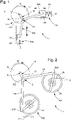
- the figure 1 illustrates a general case of two primary resonators, each consisting of a single elementary resonator, 10A and 10B, of the mass-spring type oscillating linearly and in different directions, and whose masses 5A and 5B are articulated to connecting rods 16A and 16B, which cooperate together in an articulated manner with a finger 150, which constitutes the control means 15, which runs through a groove 140 of a wheel constituting the mobile 13, the motor means being represented in figure 4 which shows a detail at the level of the articulation of the connecting rods on the control means 15.
- the primary resonators 10 are rotary resonators.
- at least one mobile of the primary resonator has a large oscillation amplitude, preferably greater than 180° and advantageously greater than 270°.
- These rotating primary resonators 10 are not very sensitive to shocks in translation, and to positioning problems, unlike linear and angular resonators.
- the figure 2 illustrates such an example, where the primary resonators 10A, 10B are balance-spring sets, where the hairsprings 6A, 6B are attached at their external turn to the structure 2, and at their internal turn to the balances 5A, 5B, which are articulated with the ends 162A, 162B, of connecting rods 16A, 16B, arranged similarly to those of the figure 1 .
- the oscillator 1 is arranged so that the forces and reaction torques of all the primary resonators 10 on the support 2 (or on the frame 4 if they are all fixed on such a frame) approximately cancel each other out.
- the forces approximately cancel each other out because the center of mass does not move, or moves very little, when the axis of rotation passes through the center of mass.
- the center of mass is substantially coincident with the center of rotation, that is to say with a position deviation of only a few micrometers or tens of micrometers.
- the torques approximately cancel each other out because each rotating component is balanced by another counter-rotating component.
- the coupling between the resonators can be done via a flexible embedding as in a tuning fork or via the connecting rods 160, or, more generally, the transmission means 16.
- the coupling of the primary resonators 10 relative to each other is then done by a flexible installation of each of the primary resonators 10 with respect to the common structure 2 or to the frame 4.
- the resultant of the forces and reaction torques of the primary resonators 10 with respect to the common structure 2 or to the frame 4, to which or to which they are fixed, is zero, thanks to the phase-shifted arrangement of the n primary resonators 10, in particular rotary.
- the rotating primary resonators 10 are arranged so that their centers of mass remain approximately in a fixed position, at least during normal oscillations of these primary resonators 10.
- the timepiece oscillator 1 preferably comprises means of stopper to limit their travel in the event of an impact or the like.
- these primary resonators 10 have at least one substantially identical resonance mode, they are arranged to vibrate according to a phase difference between them of the value 2 ⁇ /n, where n is their number, and they are arranged according to a symmetry in the space such that the resultant of the forces and torques applied by the primary resonators 10 on the structure 2, or on a frame 4 which supports them, is zero.
- substantially identical resonance mode it is meant that these primary resonators 10 have substantially the same amplitude, substantially the same inertia, and substantially the same natural frequency. The most important is this time phase shift of 2 ⁇ /n.
- the primary resonators 10 are an even number, and they constitute two by two of the pairs in which the inertial masses 5 are in motion out of phase by ⁇ with respect to each other. .
- At least one of the primary resonators 10 consists of a plurality of n elementary resonators 810.
- These elementary resonators 810 each comprise at least one elementary mass carried by an elementary elastic flexible blade, constituting an elastic return means, and which is arranged to work in bending, and which is embedded in an elementary crosspiece.
- These elementary resonators 810 have at least one substantially identical resonance mode, and are arranged to vibrate according to a phase shift between them of the value 2 ⁇ /n, where n is the number of elementary resonators 810. They are arranged according to a symmetry in the space, such as the resultant of efforts and torques applied by the elementary resonators 810 on the elementary crosspiece is zero.
- This elementary crosspiece is fixed to the fixed support 2 by an elementary main elastic connection, the rigidity of which is greater than the rigidity of each elementary elastic flexible blade, and the damping of which is greater than the damping of each elementary flexible blade.
- the elementary resonators 810 are arranged in space so that the resultant of their path errors due to gravitation is zero.
- At least one of the primary resonators 10 consists of a pair of such elementary resonators 810.
- the elementary inertial masses are in motion out of phase by ⁇ relative to each other.
- this pair consists of identical elementary resonators 810, which are in geometric and phase opposition with respect to each other.
- each primary resonator 10 consists of such a pair of elementary resonators 810.
- each primary resonator 10A, 10B thus forms, by the combination of two elementary resonators 8101, 8102, respectively 8103, 8104, an isochronous oscillator mechanism of the tuning fork type known as goat horns.
- a crosspiece 40A, 40B respectively is fixed to the fixed support 2 by a main elastic connection 3A, 3B respectively, the rigidity of which is greater than the rigidity of each elastic flexible strip 61A, 62A, 61B, 62B respectively. And the damping of this main elastic connection is greater than that of each flexible blade.
- each primary resonator 10 is balanced for itself, in translation and in rotation.
- the fixed support 2 forms a monolithic assembly with these two primary monolithic structures.
- flat structure it is meant that this monolithic structure is a right prism, produced by elevation of a two-dimensional contour, along a direction of elongation, and delimited by two end planes parallel to each other and perpendicular to this direction of elongation of the prism.
- the monolithic structure has a constant thickness defined by the spacing of these two end planes, and therefore has a single level, in certain variants certain zones, in particular flexible blades of the monolithic structure, may occupy only part of this thickness.
- the monolithic structure is produced by a growth process, of the “MEMS”, “LIGA” or similar type.
- the monolithic structure is produced by cutting out a plate, for example by wire spark erosion and/or sinking.
- the crosspiece 40A carries a pair of masses 5, marked 51A and 52 A, respectively 51B and 52 B, mounted symmetrically on either side of the fixed support 2 and of the main elastic connection 3A, respectively 3B .
- Each of these masses is mounted in an oscillating manner and returned by an elastic flexible blade 61A, 62A, respectively 61B, 62B, which is a hairspring, or else an assembly of hairsprings.
- These spirals are each linked directly or indirectly to a mass at the level of their internal spiral, and attached to the crosspiece 40A, respectively 40B, by its external spiral.
- Each mass pivots around a virtual pivot axis of determined position with respect to the crosspiece 40A, respectively 40B.
- Each virtual pivot axis is, in the rest position of the isochronous oscillator mechanism 1, coincident with the center of mass, of the respective mass.
- the masses extend substantially parallel to each other in the rest position, in a transverse direction.
- each hairspring has a variable section or curvature along its development.
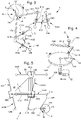
- the variant of the figure 5 is a structure similar to that of the picture 3 , where each primary resonator 10A, 10B, forms, by the combination of two elementary resonators 8101, 8102, respectively 8103, 8104, an isochronous oscillator mechanism of the so-called H tuning fork type.
- the elastic flexible blades 6: 61A, 62A, respectively 61B , 62B, are no longer made up of hairsprings, but of straight, short blades.
- the term “short blade” is used here to mean a blade with a length less than the smallest value between four times its height or thirty times its thickness, this characteristic of a short blade making it possible to limit the displacements of the center of mass concerned.
- These short blades are here arranged on either side of a crosspiece 40A, respectively 40B, with which they form the horizontal bar of an H whose masses form the vertical bars. Due to the symmetry, and the alignment, the longitudinal arrangement of the elastic flexible strips makes it possible to compensate for the direction of greatest displacement of the centers of mass, which move symmetrically with respect to the plane of symmetry.
- Each primary resonator 10A, 10B thus rendered isochronous by one of these particular combinations of elementary resonators, advantageously comprises rotation stops, and/or translation limiting stops in the longitudinal and transverse directions, and/or stops limitation in translation in a direction perpendicular to the two previous ones.
- These stroke limiting means can be integrated, be part of a one-piece construction, or/and be attached.
- the masses advantageously comprise abutment means arranged to cooperate with complementary abutment means that comprise the crosspieces 40A, 40B, to limit the movement of the elastic flexible strips with respect to these crosspieces, in the event of shocks or similar accelerations .
- the figure 5 also illustrates an advantageous variant where the transmission means 16A, 16B are elastic flexible blades. It is then possible to produce a monolithic assembly comprising the structure 2, the primary resonators 10 as described above, in particular complete, and these elastic flexible blades, and the finger 150.
- the figures 6 and 7 illustrate variants where the connecting rods are beams having necks at both ends instead of hubs.
- the figure 6 illustrates a case of coupling of two primary resonators, the figure 7 of three such resonators.
- the transmission means 16 thus comprise at least one monolithic connecting rod arranged to cooperate both with the control means 15 and with at least two inertial masses 5 of as many primary resonators 10, and comprise at least one flexible neck at the level of each joint zone.
- the figures 1, 2 , 3, and 5 illustrate a horological oscillator 1 comprising two primary resonators 10.
- the horological oscillator 1 comprises at least three primary resonators 10.
- the figure 8 illustrates a horological oscillator 1 comprising three primary resonators 10. This figure shows the application of the coupling of the figure 7 to the inertial masses 5A, 5B, 5C, of the three primary resonators 10A, 10B, 10C.
- the figure 9 illustrates a clock oscillator 1 comprising four resonators. These four resonators can be four primary resonators 10. They can also be four elementary resonators, constituting two by two primary resonators: one composed of elementary resonators 10A and 10C, out of phase by ⁇ , the other of elementary resonators 10B and 10D , also out of phase by ⁇ .
- each resonator taken in isolation has a reaction to the embedding, and it is the juxtaposition and the judicious combination of the "n" resonators compensates for all of the reactions.
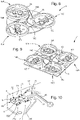
- the figure 10 , 12, and 13 illustrate a variant where at least one elastic return means 6 also constitutes a rotary guide, which makes it possible to avoid the friction inherent in the use of pivots.
- the figure 10 shows a transmission means 16 consisting of a flexible blade, in the configuration of the figure 9 .
- This figure also shows angular stops: 71, 72, 710, 720, 76 on the mass 5, the respective complementary abutment surfaces 73, 74, 730, 740, 77 at the level of the frame 4 on which is attached a short flexible blade 6, and a shockproof abutment surface 75 on the mass 5, arranged to cooperate with a complementary surface 750 at the level of the frame 4.
- These integrated shock absorbers are particularly advantageous, and do not require any adjustment.
- the mobile 13 is subjected to a rotational movement; more particularly, the motor means 12 are arranged to drive the mobile 13 according to a rotational movement, and the mobile 13 and the driving and guiding means 14 are arranged to apply to the control means 15 an essentially tangential force with respect to the rotation of the mobile 13.
- the figure 11 illustrates a variant according to the invention where the mobile 13 comprises a deformable elastic structure 130, forming a radially flexible and tangentially rigid guide, this deformable structure 130 comprises a housing 140 to cooperate with the finger 150 of the control means 15, at the main joint.
- the elastic return means 6 of the primary resonators 10 comprise flexible blades
- the primary resonators 10 and/or the common structure 2, or/and the frame 4 comprise radial stops and/ or angular and/or axial arranged to limit the deformations of the flexible blades and to avoid breakage in the event of shocks or too high engine torque.
- the horological oscillator 1 comprises a monolithic structure which groups together a common structure 4 towards which the inertial masses 5 are returned by their elastic return means 6, the control means 15 and its articulations with the transmission means 16, and the means transmission 16 with their joints to the inertial masses 5.
- the desired phase shifts are perfectly ensured, the cancellation of the reactions also.
- Such monolithic structures allow the elimination of traditional pivots, by implementing flexible strips which have a dual function: pivoting guidance constituting a virtual pivot, and elastic return.
- this monolithic structure still includes the stops.
- the orientation of the elastic return means 6 of the primary resonators 10 is optimized so that the rate errors due to gravity are canceled between the primary resonators 10.
- the elastic return means 6 of the primary resonators 10 are virtual pivots with crossed blades.
- the primary resonators 10 are isochronous.
- At least the elastic means that comprises the clock oscillator 1 according to the invention are thermally compensated.
- An embodiment in micro-machinable material makes it possible to ensure such compensation.
- the invention also relates to a timepiece movement 100 comprising at least one such timepiece oscillator 1.
- the invention also relates to a watch 200 comprising at least one such movement 100.
Landscapes
- Physics & Mathematics (AREA)
- General Physics & Mathematics (AREA)
- Micromachines (AREA)
- Apparatuses For Generation Of Mechanical Vibrations (AREA)
- Electric Clocks (AREA)
Claims (22)
- Uhrenoszillator (1), aufweisend eine Struktur (2) oder/und einen Rahmen (4) und eine Vielzahl unterschiedlicher primärer Resonatoren, die zeitlich und geometrisch phasenverschoben sind und wobei jeder mindestens eine Trägheitsmasse (5) aufweist, die von einem elastischen Rückstellmittel (6) zu der Struktur (2) oder zum Rahmen (4) zurückgestellt wird und jeder aus einem oder mehreren elementaren Resonatoren besteht, wobei der Uhrenoszillator (1) Verbindungsmittel (11) aufweist, die eingerichtet sind, um die Interaktion der Resonatoren zu erlauben, wobei die Verbindungsmittel (11) ein Drehteil (13) aufweisen, das eingerichtet ist, um einem Drehmoment oder einer Kraft eines Motors ausgesetzt zu sein, wobei das Drehteil (13) einer Rotationsbewegung ausgesetzt ist und Antriebs- und Führungsmittel (14) aufweist, die eingerichtet sind, um ein einziges Steuermittel (15) anzutreiben und zu führen, das um eine erste Steuerwelle mit einer Vielzahl von Übertragungsmitteln (16) angelenkt ist, wobei jedes um eine zweite Gelenkwelle beabstandet vom einzigen Steuermittel (15) mit einer Trägheitsmasse (5) eines primären Resonators (10) angelenkt ist und wobei die Resonatoren und das Drehteil (13) derart eingerichtet sind, dass die zweiten Gelenkwellen von zwei beliebigen Resonatoren und die erste Steuerwelle des Steuermittels (15) nie koplanar sind, wobei die Resonatoren Rotationsresonatoren sind, dadurch gekennzeichnet, dass die Massezentren der elementaren Resonatoren bei normalen Oszillationen der Resonatoren in einem Abstand verbleiben, der kleiner als einige Zehntel Mikrometer von den jeweiligen Rotationszentren der Resonatoren ist, und dass das Drehteil (13) eine elastische Struktur (130) aufweist, die eine radial elastische und tangential starre Führung bildet.
- Uhrenoszillator (1) nach Anspruch 1, dadurch gekennzeichnet, dass die Resultierende der Reaktionsdrehmomente der Gesamtheit der Resonatoren im Verhältnis zu der gemeinsamen Struktur (2) oder zum Rahmen (4) null ist.
- Uhrenoszillator (1) nach Anspruch 1, dadurch gekennzeichnet, dass der Oszillator (1) eine Anzahl n primärer Resonatoren aufweist und dass die primären Resonatoren mindestens einen Resonanzmodus haben, der etwa identisch ist, und eingerichtet sind, um gemäß einer Phasenverschiebung untereinander des Wertes 2π/n zu vibrieren.
- Uhrenoszillator (1) nach einem der Ansprüche 1 bis 3, dadurch gekennzeichnet, dass mindestens einer der primären Resonatoren (10) aus einer Vielzahl von n elementaren Resonatoren (810) besteht, die jeweils eine elementare Masse aufweisen, die von einer elementaren elastischen flexiblen Lamelle getragen wird, die ein elastisches Rückstellmittel darstellt, und die eingerichtet ist, um in Biegung zu arbeiten und die in einen elementaren Querträger eingelassen ist und dass die elementaren Resonatoren (810) mindestens einen Resonanzmodus haben, der etwa identisch ist, und eingerichtet sind, um gemäß einer Phasenverschiebung untereinander des Wertes 2π/n zu vibrieren, wobei n die Anzahl der elementaren Resonatoren (810) ist.
- Uhrenoszillator (1) nach Anspruch 4, dadurch gekennzeichnet, dass die elementaren Resonatoren (810) gemäß einer Symmetrie im Raum derart eingerichtet sind, dass die Resultierende der von den elementaren Resonatoren (810) auf den elementaren Querträger angewendeten Drehmomente null ist.
- Uhrenoszillator (1) nach einem der Ansprüche 1 bis 5, dadurch gekennzeichnet, dass die primären Resonatoren jeweils aus mehreren elementaren Resonatoren bestehen.
- Uhrenoszillator (1) nach einem der Ansprüche 1 bis 6, dadurch gekennzeichnet, dass die Übertragungsmittel (16) elastische flexible Lamellen sind.
- Uhrenoszillator (1) nach einem der Ansprüche 1 bis 7, dadurch gekennzeichnet, dass die Übertragungsmittel (16) mindestens einen monolithischen Pleuel aufweisen, der eingerichtet ist, um sowohl mit dem Steuermittel (15) und mit mindestens zwei Trägheitsmassen (5) von ebenso vielen Resonatoren zusammenzuwirken und mindestens einen flexiblen Hals im Bereich jedes Gelenkbereichs aufweisen.
- Uhrenoszillator (1) nach einem der Ansprüche 1 bis 7, dadurch gekennzeichnet, dass die Übertragungsmittel (16) Pleuel (160) aufweisen, die jeweils ein erstes Gelenk (161) mit dem Steuermittel (15) und ein zweites Gelenk (162) mit der Trägheitsmasse (5) aufweisen, wobei das erste Gelenk (161) und das zweite Gelenk (162) gemeinsam eine Pleuelrichtung definieren, und dadurch gekennzeichnet, dass alle Pleuelrichtungen paarweise jederzeit einen Winkel bilden, der von null oder π unterschiedlich ist.
- Uhrenoszillator (1) nach einem der Ansprüche 1 bis 9, dadurch gekennzeichnet, dass das Drehteil (13) einer Rotationsbewegung ausgesetzt ist und dass das Drehteil (13) und die Antriebs- und Führungsmittel (14) eingerichtet sind, um auf das Steuermittel (15) eine im Verhältnis zur Rotation des Drehteils (3) im Wesentlichen tangentiale Kraft auszuüben.
- Uhrenoszillator (1) nach einem der Ansprüche 1 bis 3 und 7 bis 10, dadurch gekennzeichnet, dass die elastischen Rückstellmittel (6) der Resonatoren flexible Lamellen aufweisen und dass die Resonatoren und/oder die gemeinsame Struktur (2) oder der Rahmen (4) radiale und/oder winklige und/oder axiale Anschläge aufweisen, die eingerichtet sind, um die Verformungen der flexiblen Lamellen zu begrenzen und um Brüche bei Stößen oder einem zu hohen Motordrehmoment zu vermeiden.
- Uhrenoszillator (1) nach einem der Ansprüche 1 bis 3 und 7 bis 11, dadurch gekennzeichnet, dass der Uhrenoszillator (1) eine monolithische Struktur aufweist, die eine gemeinsame Struktur (4) zusammenfasst, zu der die Trägheitsmassen (5) und deren elastische Rückstellmittel (6), das Steuermittel (15) und dessen Gelenke mit den Übertragungsmitteln (16) und die Übertragungsmittel (16) mit deren Gelenken mit den Trägheitsmassen (5) zurückgestellt werden.
- Uhrenoszillator (1) nach den Ansprüchen 11 und 12, dadurch gekennzeichnet, dass die monolithische Struktur weiterhin die Anschläge aufweist.
- Uhrenoszillator (1) nach Anspruch 12 oder 13, dadurch gekennzeichnet, dass die monolithische Struktur ein gerades Prisma ist, das von zwei zueinander parallelen und zur Streckungsrichtung des Prismas senkrechten Ebenen begrenzt wird.
- Uhrenoszillator (1) nach einem der Ansprüche 1 bis 14, dadurch gekennzeichnet, dass die elastischen Rückstellmittel (6) der Resonatoren gerade kurze Lamellen mit einer Länge aufweisen, die kleiner als der kleinste Wert zwischen dem Vierfachen ihrer Höhe oder dem Dreißigfachen ihrer Dicke ist.
- Uhrenoszillator (1) nach einem der Ansprüche 1 bis 15, dadurch gekennzeichnet, dass die Resonatoren isochron sind.
- Uhrenoszillator (1) nach einem der Ansprüche 1 bis 16, dadurch gekennzeichnet, dass die Resonatoren gemeinsam einen isochronen Oszillatormechanismus vom Typ Stimmgabel in H-Form bilden und jeweils elastische flexible Lamellen aufweisen, die aus geraden und kurzen Lamellen mit einer Länge bestehen, die kleiner als der kleinste Wert zwischen dem Vierfachen ihrer Höhe oder dem Dreißigfachen ihrer Dicke ist, die beiderseits eines Querträgers (40A; 40B) angeordnet sind, mit dem sie den horizontalen Strich eines H bilden, dessen Massen (5) die vertikalen Striche bilden.
- Uhrenoszillator (1) nach einem der Ansprüche 1 bis 16, dadurch gekennzeichnet, dass die Resonatoren gemeinsam einen isochronen Oszillatormechanismus vom Typ Stimmgabel in Bockshornform bilden und jeweils einen Querträger (40A; 40B) aufweisen, der die Massen (5) trägt, von denen jede oszillierend angebracht ist und von einer elastischen flexiblen Lamelle zurückgestellt wird, die eine Spiralfeder oder eine Spiralfederanordnung ist, wobei jede Spiralfeder direkt oder indirekt mit einer Masse (5) im Bereich ihrer inneren Windung verbunden und an dem Querträger (40A; 40B) anhand ihrer äußeren Windung befestigt ist, wobei jede Spiralfeder einen Querschnitt oder eine Krümmung hat, die entlang ihrer Entwicklung variabel ist.
- Uhrenoszillator (1) nach einem der Ansprüche 1 bis 17, dadurch gekennzeichnet, dass mindestens ein elastisches Rückstellmittel (6) ebenfalls eine Rotationsführung darstellt.
- Uhrenoszillator (1) nach einem der Ansprüche 1 bis 19, dadurch gekennzeichnet, dass mindestens die elastischen Mittel, die der Uhrenoszillator (1) aufweist, thermisch kompensiert sind.
- Uhrwerk (100), das mindestens einen Uhrenoszillator (1) nach einem der Ansprüche 1 bis 20 aufweist.
- Uhr (200), die mindestens ein Uhrwerk (100) nach Anspruch 21 aufweist.
Applications Claiming Priority (2)
| Application Number | Priority Date | Filing Date | Title |
|---|---|---|---|
| EP15153657.0A EP3054357A1 (de) | 2015-02-03 | 2015-02-03 | Oszillatormechanismus für Uhr |
| EP16152268.5A EP3054358B1 (de) | 2015-02-03 | 2016-01-21 | Oszillatormechanismus für uhr |
Related Parent Applications (2)
| Application Number | Title | Priority Date | Filing Date |
|---|---|---|---|
| EP16152268.5A Division EP3054358B1 (de) | 2015-02-03 | 2016-01-21 | Oszillatormechanismus für uhr |
| EP16152268.5A Division-Into EP3054358B1 (de) | 2015-02-03 | 2016-01-21 | Oszillatormechanismus für uhr |
Publications (2)
| Publication Number | Publication Date |
|---|---|
| EP3293584A1 EP3293584A1 (de) | 2018-03-14 |
| EP3293584B1 true EP3293584B1 (de) | 2022-03-30 |
Family
ID=52434684
Family Applications (3)
| Application Number | Title | Priority Date | Filing Date |
|---|---|---|---|
| EP15153657.0A Withdrawn EP3054357A1 (de) | 2015-02-03 | 2015-02-03 | Oszillatormechanismus für Uhr |
| EP16152268.5A Active EP3054358B1 (de) | 2015-02-03 | 2016-01-21 | Oszillatormechanismus für uhr |
| EP17192071.3A Active EP3293584B1 (de) | 2015-02-03 | 2016-01-21 | Oszillatormechanismus für uhr |
Family Applications Before (2)
| Application Number | Title | Priority Date | Filing Date |
|---|---|---|---|
| EP15153657.0A Withdrawn EP3054357A1 (de) | 2015-02-03 | 2015-02-03 | Oszillatormechanismus für Uhr |
| EP16152268.5A Active EP3054358B1 (de) | 2015-02-03 | 2016-01-21 | Oszillatormechanismus für uhr |
Country Status (6)
| Country | Link |
|---|---|
| US (1) | US9465363B2 (de) |
| EP (3) | EP3054357A1 (de) |
| JP (1) | JP6114845B2 (de) |
| CN (2) | CN105843026B (de) |
| CH (1) | CH710692B1 (de) |
| RU (1) | RU2692817C2 (de) |
Families Citing this family (36)
| Publication number | Priority date | Publication date | Assignee | Title |
|---|---|---|---|---|
| US10585398B2 (en) * | 2014-01-13 | 2020-03-10 | Ecole Polytechnique Federale De Lausanne (Epfl) | General two degree of freedom isotropic harmonic oscillator and associated time base |
| US10365609B2 (en) | 2014-01-13 | 2019-07-30 | Ecole Polytechnique Federale De Lausanne (Epfl) | Isotropic harmonic oscillator and associated time base without escapement or with simplified escapement |
| CN106537264B (zh) * | 2014-09-09 | 2019-03-15 | Eta瑞士钟表制造股份有限公司 | 钟表调节机构、钟表机芯以及钟表 |
| EP3035126B1 (de) * | 2014-12-18 | 2017-12-13 | The Swatch Group Research and Development Ltd. | Resonator einer Uhr mit sich kreuzenden Blättern |
| CH710692B1 (fr) * | 2015-02-03 | 2021-09-15 | Eta Sa Mft Horlogere Suisse | Mécanisme oscillateur d'horlogerie. |
| JP6326549B2 (ja) * | 2015-02-03 | 2018-05-16 | ウーテーアー・エス・アー・マニファクチュール・オロロジェール・スイス | 等時性を有する計時器用共振器 |
| US12265359B2 (en) * | 2016-07-06 | 2025-04-01 | Ecole Polytechnique Federale De Lausanne (Epfl) | General 2 degree of freedom isotropic harmonic oscillator and associated time base without escapement or with simplified escapement |
| EP3312683B1 (de) | 2016-10-18 | 2019-02-20 | ETA SA Manufacture Horlogère Suisse | Mechanisches uhrwerk mit resonator mit zwei freiheitsgraden und wartungsmechanismus über eine auf einer laufpiste rollenden laufrolle |
| CH713055A2 (fr) * | 2016-10-18 | 2018-04-30 | Eta Sa Mft Horlogere Suisse | Mouvement d'horlogerie comportant un mécanisme résonateur et un mécanisme d'échappement coopérant en transmission continue. |
| CH713069A2 (fr) * | 2016-10-25 | 2018-04-30 | Eta Sa Mft Horlogere Suisse | Montre mécanique avec résonateur rotatif isochrone, insensible aux positions. |
| CH713137A2 (fr) | 2016-11-16 | 2018-05-31 | Swatch Group Res & Dev Ltd | Protection d'un mécanisme résonateur à lames contre les chocs axiaux. |
| FR3059792B1 (fr) * | 2016-12-01 | 2019-05-24 | Lvmh Swiss Manufactures Sa | Dispositif pour piece d'horlogerie, mouvement horloger et piece d'horlogerie comprenant un tel dispositif |
| EP3336613B1 (de) * | 2016-12-16 | 2020-03-11 | Association Suisse pour la Recherche Horlogère | Resonator für uhr, der zwei pendellager umfasst, die so angeordnet sind, dass sie auf derselben ebene schwingen können |
| CH713288A1 (fr) * | 2016-12-23 | 2018-06-29 | Sa De La Manufacture Dhorlogerie Audemars Piguet & Cie | Composant monolithique flexible pour pièce d'horlogerie. |
| WO2018215284A1 (fr) | 2017-05-24 | 2018-11-29 | Sa De La Manufacture D'horlogerie Audemars Piguet & Cie | Dispositif de régulation pour pièce d'horlogerie avec oscillateur harmonique isotrope ayant des masses rotatives et une force de rappel commune |
| CH713829B1 (fr) * | 2017-05-24 | 2022-01-14 | Mft Dhorlogerie Audemars Piguet Sa | Dispositif de régulation pour pièce d'horlogerie avec oscillateur harmonique isotrope ayant des masses rotatives et une force de rappel commune. |
| EP3425458A1 (de) * | 2017-07-07 | 2019-01-09 | ETA SA Manufacture Horlogère Suisse | Abtrennbares stück eines uhrenoszillators |
| EP3435173B1 (de) * | 2017-07-26 | 2020-04-29 | ETA SA Manufacture Horlogère Suisse | Mechanisches uhrwerk mit sich drehendem isochronem resonator, der positionsunempfindlich ist |
| US20210208537A1 (en) | 2017-10-02 | 2021-07-08 | Manufacture D'horlogerie Audemars Piguet Sa | Timepiece setting device with harmonic oscillator having rotating weights and a common recoil strength |
| WO2019141789A1 (en) | 2018-01-18 | 2019-07-25 | Ecole polytechnique fédérale de Lausanne (EPFL) | Horological oscillator |
| EP3561609B1 (de) | 2018-04-23 | 2022-03-23 | ETA SA Manufacture Horlogère Suisse | Stossdämpfungsschutz eines resonatormechanismus mit flexibler drehführung |
| EP3561607B1 (de) | 2018-04-23 | 2022-03-16 | ETA SA Manufacture Horlogère Suisse | Stossdämpfungsschutz eines resonatormechanismus mit flexibler drehführung |
| EP3561603B1 (de) * | 2018-04-25 | 2021-01-06 | The Swatch Group Research and Development Ltd | Reguliermechanismus einer uhr mit verbundenen resonatoren |
| EP3561606B1 (de) | 2018-04-27 | 2022-01-26 | The Swatch Group Research and Development Ltd | Stossdämpfungsschutz eines resonators mit rcc-schwenkfedern |
| EP3572885B1 (de) * | 2018-05-25 | 2022-04-20 | ETA SA Manufacture Horlogère Suisse | Mechanischer oszillator eines isochronen uhrwerks in jeder position |
| EP3627242B1 (de) | 2018-09-19 | 2021-07-21 | The Swatch Group Research and Development Ltd | Optimierter magnetomechanischer uhrhemmungsmechanismus |
| EP3719584A1 (de) * | 2019-04-02 | 2020-10-07 | Ecole Polytechnique Fédérale de Lausanne (EPFL) | Oszillatorsystem mit zwei freiheitsgraden |
| EP3739394A1 (de) | 2019-05-16 | 2020-11-18 | Ecole Polytechnique Fédérale de Lausanne (EPFL) | Kurbelanordnung zum antreiben eines mechanischen oszillators |
| EP3839644B1 (de) | 2019-12-20 | 2026-01-28 | Nivarox-FAR S.A. | Flexible uhrwerkskomponente, insbesondere für oszillationsmechanismus, und eine solche komponente umfassendes uhrwerk |
| EP3842876B1 (de) * | 2019-12-24 | 2025-02-19 | The Swatch Group Research and Development Ltd | Uhr, die mit einem mechanischen uhrwerk und einer vorrichtung zur korrektur der angezeigten stunde ausgestattet ist |
| EP3919988A1 (de) * | 2020-06-04 | 2021-12-08 | Montres Breguet S.A. | Gelenkmechanismus eines uhrwerks mit flexibler führung |
| EP3926412A1 (de) * | 2020-06-16 | 2021-12-22 | Montres Breguet S.A. | Regulator eines uhrwerks |
| EP3982204A1 (de) * | 2020-10-08 | 2022-04-13 | The Swatch Group Research and Development Ltd | Uhrresonator, der mindestens eine flexible führung umfasst |
| EP4191346B1 (de) | 2021-12-06 | 2024-06-26 | The Swatch Group Research and Development Ltd | Stossdämpfungsschutz eines resonatormechanismus mit flexibler drehführung |
| EP4357858B1 (de) * | 2022-10-18 | 2026-06-03 | Omega SA | Spiralfeder für resonatormechanismus einer uhr mit mitteln zur einstellung der steifigkeit |
| CH720138A2 (fr) | 2022-10-18 | 2024-04-30 | Goujon Pierre | Dispositif d'affichage d'indications discrètes |
Family Cites Families (18)
| Publication number | Priority date | Publication date | Assignee | Title |
|---|---|---|---|---|
| DE451035C (de) * | 1922-11-10 | 1927-10-22 | Heinrich Schieferstein | Elastische Kopplung zwischen einem Triebwerk, insbesondere einem Uhrwerk und einem dessen Ablauf regelnden Glied |
| CH113025A (de) * | 1924-04-28 | 1925-12-16 | Heinrich Schieferstein Georg | Verfahren zur Steuerung eines Drehbewegungen ausführenden Mechanismus. |
| CH474466A (de) * | 1961-06-20 | 1969-06-30 | Inventa Ag | Verfahren zur Herstellung von Cyclodecen-(5)-on-(1) |
| DE1205464B (de) * | 1961-08-24 | 1965-11-18 | United States Time Corp | Gangregler |
| CH452443A (fr) * | 1964-07-10 | 1968-05-31 | Movado Montres | Oscillateur pour pièces d'horlogerie |
| CH451021A (fr) | 1965-05-28 | 1968-05-15 | Ebauches Sa | Oscillateur symétrique à flexion pour pièce d'horlogerie |
| CH485145A (fr) | 1966-03-29 | 1970-01-31 | Ebauches Sa | Dispositif transformant les mouvements oscillants d'un résonateur acoustique en mouvements rotatifs d'une roue de comptage |
| CH481411A (fr) * | 1967-06-27 | 1969-12-31 | Movado Montres | Résonateur de rotation mécanique pour appareil de mesure du temps |
| DE1805777A1 (de) * | 1968-10-29 | 1970-05-21 | Kienzle Uhrenfabriken Gmbh | Schwingsystem |
| GB1293159A (en) * | 1969-12-10 | 1972-10-18 | Suwa Seikosha Kk | A vibrator for an electric timepiece |
| JP3614009B2 (ja) * | 1998-12-21 | 2005-01-26 | セイコーエプソン株式会社 | 圧電アクチュエータ、圧電アクチュエータの駆動方法、携帯機器および時計 |
| DE602008006057D1 (de) * | 2008-07-04 | 2011-05-19 | Swatch Group Res & Dev Ltd | Gekoppelte Resonatoren für Uhr |
| CH702062B1 (fr) * | 2009-10-26 | 2022-01-31 | Mft Dhorlogerie Audemars Piguet Sa | Organe régulateur comportant au moins deux balanciers, un mouvement de montre ainsi qu'une pièce d'horlogerie comportant un tel organe. |
| WO2012010408A1 (fr) * | 2010-07-19 | 2012-01-26 | Nivarox-Far S.A. | Mecanisme oscillant a pivot elastique et mobile de transmission d'energie |
| CH707171A2 (fr) * | 2012-11-09 | 2014-05-15 | Nivarox Sa | Mécanisme horloger de limitation ou transmission. |
| US10365609B2 (en) * | 2014-01-13 | 2019-07-30 | Ecole Polytechnique Federale De Lausanne (Epfl) | Isotropic harmonic oscillator and associated time base without escapement or with simplified escapement |
| US10585398B2 (en) | 2014-01-13 | 2020-03-10 | Ecole Polytechnique Federale De Lausanne (Epfl) | General two degree of freedom isotropic harmonic oscillator and associated time base |
| CH710692B1 (fr) * | 2015-02-03 | 2021-09-15 | Eta Sa Mft Horlogere Suisse | Mécanisme oscillateur d'horlogerie. |
-
2015
- 2015-02-03 CH CH00140/15A patent/CH710692B1/fr unknown
- 2015-02-03 EP EP15153657.0A patent/EP3054357A1/de not_active Withdrawn
-
2016
- 2016-01-21 EP EP16152268.5A patent/EP3054358B1/de active Active
- 2016-01-21 EP EP17192071.3A patent/EP3293584B1/de active Active
- 2016-02-02 JP JP2016017696A patent/JP6114845B2/ja active Active
- 2016-02-02 CN CN201610150689.5A patent/CN105843026B/zh active Active
- 2016-02-02 RU RU2016103417A patent/RU2692817C2/ru active
- 2016-02-02 US US15/013,539 patent/US9465363B2/en active Active
- 2016-02-02 CN CN201620203744.8U patent/CN205539955U/zh not_active Withdrawn - After Issue
Also Published As
| Publication number | Publication date |
|---|---|
| EP3293584A1 (de) | 2018-03-14 |
| JP6114845B2 (ja) | 2017-04-12 |
| CN105843026A (zh) | 2016-08-10 |
| CN105843026B (zh) | 2018-04-20 |
| RU2692817C2 (ru) | 2019-06-28 |
| EP3054358A1 (de) | 2016-08-10 |
| US9465363B2 (en) | 2016-10-11 |
| CH710692A2 (fr) | 2016-08-15 |
| RU2016103417A (ru) | 2017-08-07 |
| RU2016103417A3 (de) | 2019-05-22 |
| CN205539955U (zh) | 2016-08-31 |
| JP2016142736A (ja) | 2016-08-08 |
| US20160223989A1 (en) | 2016-08-04 |
| EP3054358B1 (de) | 2019-08-28 |
| EP3054357A1 (de) | 2016-08-10 |
| CH710692B1 (fr) | 2021-09-15 |
Similar Documents
| Publication | Publication Date | Title |
|---|---|---|
| EP3054358B1 (de) | Oszillatormechanismus für uhr | |
| EP3254158B1 (de) | Isochroner resonator für uhr | |
| EP3206089B1 (de) | Resonatormechanismus eines uhrwerks | |
| EP3035127B1 (de) | Stimmgabeloszillator einer stimmgabelgesteuerten Uhr | |
| EP3561607B1 (de) | Stossdämpfungsschutz eines resonatormechanismus mit flexibler drehführung | |
| EP2911012B1 (de) | Oszillator einer Uhr | |
| EP3206091B1 (de) | Isochroner resonator für eine uhr | |
| EP3200029B1 (de) | Resonatormechanismus eines uhrwerks | |
| CH715526A2 (fr) | Protection antichoc d'un mécanisme résonateur à guidage flexible rotatif. | |
| CH714922A2 (fr) | Protection antichoc d'un mécanisme résonateur d'horlogerie à guidage flexible rotatif. | |
| EP3435172B1 (de) | Herstellungsverfahren eines flexiblen führungsmechanismus für mechanischen oszillator eines uhrwerks | |
| EP2908184A1 (de) | Wartungs- und Regulierungsverfahren eines Uhrenresonators | |
| EP3435173B1 (de) | Mechanisches uhrwerk mit sich drehendem isochronem resonator, der positionsunempfindlich ist | |
| EP3561606B1 (de) | Stossdämpfungsschutz eines resonators mit rcc-schwenkfedern | |
| EP3667432B1 (de) | Uhrresonator, der mindestens eine flexible führung umfasst | |
| EP4047424B1 (de) | Komponente mit flexiblem zapfen, insbesondere für uhrwerk | |
| EP3771947A1 (de) | Führungsvorrichtung zum schwenken und resonatormechanismus eines uhrwerks für eine schwenkbare masse | |
| EP3435170B1 (de) | Uhrwerkoszillator mit flexiblen führungen mit grosser winkelförmiger laufbahn | |
| EP3336613B1 (de) | Resonator für uhr, der zwei pendellager umfasst, die so angeordnet sind, dass sie auf derselben ebene schwingen können | |
| EP3812842B1 (de) | Schwenkbare führungsvorrichtung für eine schwenkbare masse, und resonatormechanismus einer uhr | |
| EP4191346A1 (de) | Stossdämpfungsschutz eines resonatormechanismus mit flexibler drehführung | |
| EP4432019B1 (de) | Verfahren zur verringerung von schwingungen ausserhalb der ebene in einem resonatormechanismus mit flexibler drehführung | |
| EP3637196B1 (de) | Mechanischer oszillator | |
| CH714030A2 (fr) | Oscillateur d'horlogerie à guidages flexibles à grande course angulaire. | |
| EP3572885B1 (de) | Mechanischer oszillator eines isochronen uhrwerks in jeder position |
Legal Events
| Date | Code | Title | Description |
|---|---|---|---|
| PUAI | Public reference made under article 153(3) epc to a published international application that has entered the european phase |
Free format text: ORIGINAL CODE: 0009012 |
|
| STAA | Information on the status of an ep patent application or granted ep patent |
Free format text: STATUS: THE APPLICATION HAS BEEN PUBLISHED |
|
| AC | Divisional application: reference to earlier application |
Ref document number: 3054358 Country of ref document: EP Kind code of ref document: P |
|
| AK | Designated contracting states |
Kind code of ref document: A1 Designated state(s): AL AT BE BG CH CY CZ DE DK EE ES FI FR GB GR HR HU IE IS IT LI LT LU LV MC MK MT NL NO PL PT RO RS SE SI SK SM TR |
|
| STAA | Information on the status of an ep patent application or granted ep patent |
Free format text: STATUS: REQUEST FOR EXAMINATION WAS MADE |
|
| 17P | Request for examination filed |
Effective date: 20180914 |
|
| RBV | Designated contracting states (corrected) |
Designated state(s): AL AT BE BG CH CY CZ DE DK EE ES FI FR GB GR HR HU IE IS IT LI LT LU LV MC MK MT NL NO PL PT RO RS SE SI SK SM TR |
|
| STAA | Information on the status of an ep patent application or granted ep patent |
Free format text: STATUS: EXAMINATION IS IN PROGRESS |
|
| 17Q | First examination report despatched |
Effective date: 20200710 |
|
| REG | Reference to a national code |
Ref country code: DE Ref legal event code: R079 Ref document number: 602016070657 Country of ref document: DE Free format text: PREVIOUS MAIN CLASS: G04B0017280000 Ipc: G04B0017040000 |
|
| GRAP | Despatch of communication of intention to grant a patent |
Free format text: ORIGINAL CODE: EPIDOSNIGR1 |
|
| STAA | Information on the status of an ep patent application or granted ep patent |
Free format text: STATUS: GRANT OF PATENT IS INTENDED |
|
| RIC1 | Information provided on ipc code assigned before grant |
Ipc: G04B 43/00 20060101ALI20211117BHEP Ipc: G04B 17/28 20060101ALI20211117BHEP Ipc: G04B 17/08 20060101ALI20211117BHEP Ipc: G04B 17/06 20060101ALI20211117BHEP Ipc: G04B 17/04 20060101AFI20211117BHEP |
|
| INTG | Intention to grant announced |
Effective date: 20211209 |
|
| GRAS | Grant fee paid |
Free format text: ORIGINAL CODE: EPIDOSNIGR3 |
|
| GRAA | (expected) grant |
Free format text: ORIGINAL CODE: 0009210 |
|
| STAA | Information on the status of an ep patent application or granted ep patent |
Free format text: STATUS: THE PATENT HAS BEEN GRANTED |
|
| AC | Divisional application: reference to earlier application |
Ref document number: 3054358 Country of ref document: EP Kind code of ref document: P |
|
| AK | Designated contracting states |
Kind code of ref document: B1 Designated state(s): AL AT BE BG CH CY CZ DE DK EE ES FI FR GB GR HR HU IE IS IT LI LT LU LV MC MK MT NL NO PL PT RO RS SE SI SK SM TR |
|
| REG | Reference to a national code |
Ref country code: GB Ref legal event code: FG4D Free format text: NOT ENGLISH |
|
| REG | Reference to a national code |
Ref country code: CH Ref legal event code: EP |
|
| REG | Reference to a national code |
Ref country code: DE Ref legal event code: R096 Ref document number: 602016070657 Country of ref document: DE |
|
| REG | Reference to a national code |
Ref country code: AT Ref legal event code: REF Ref document number: 1479762 Country of ref document: AT Kind code of ref document: T Effective date: 20220415 |
|
| REG | Reference to a national code |
Ref country code: IE Ref legal event code: FG4D Free format text: LANGUAGE OF EP DOCUMENT: FRENCH |
|
| REG | Reference to a national code |
Ref country code: LT Ref legal event code: MG9D |
|
| PG25 | Lapsed in a contracting state [announced via postgrant information from national office to epo] |
Ref country code: SE Free format text: LAPSE BECAUSE OF FAILURE TO SUBMIT A TRANSLATION OF THE DESCRIPTION OR TO PAY THE FEE WITHIN THE PRESCRIBED TIME-LIMIT Effective date: 20220330 Ref country code: RS Free format text: LAPSE BECAUSE OF FAILURE TO SUBMIT A TRANSLATION OF THE DESCRIPTION OR TO PAY THE FEE WITHIN THE PRESCRIBED TIME-LIMIT Effective date: 20220330 Ref country code: NO Free format text: LAPSE BECAUSE OF FAILURE TO SUBMIT A TRANSLATION OF THE DESCRIPTION OR TO PAY THE FEE WITHIN THE PRESCRIBED TIME-LIMIT Effective date: 20220630 Ref country code: LT Free format text: LAPSE BECAUSE OF FAILURE TO SUBMIT A TRANSLATION OF THE DESCRIPTION OR TO PAY THE FEE WITHIN THE PRESCRIBED TIME-LIMIT Effective date: 20220330 Ref country code: HR Free format text: LAPSE BECAUSE OF FAILURE TO SUBMIT A TRANSLATION OF THE DESCRIPTION OR TO PAY THE FEE WITHIN THE PRESCRIBED TIME-LIMIT Effective date: 20220330 Ref country code: BG Free format text: LAPSE BECAUSE OF FAILURE TO SUBMIT A TRANSLATION OF THE DESCRIPTION OR TO PAY THE FEE WITHIN THE PRESCRIBED TIME-LIMIT Effective date: 20220630 |
|
| REG | Reference to a national code |
Ref country code: NL Ref legal event code: MP Effective date: 20220330 |
|
| REG | Reference to a national code |
Ref country code: AT Ref legal event code: MK05 Ref document number: 1479762 Country of ref document: AT Kind code of ref document: T Effective date: 20220330 |
|
| PG25 | Lapsed in a contracting state [announced via postgrant information from national office to epo] |
Ref country code: LV Free format text: LAPSE BECAUSE OF FAILURE TO SUBMIT A TRANSLATION OF THE DESCRIPTION OR TO PAY THE FEE WITHIN THE PRESCRIBED TIME-LIMIT Effective date: 20220330 Ref country code: GR Free format text: LAPSE BECAUSE OF FAILURE TO SUBMIT A TRANSLATION OF THE DESCRIPTION OR TO PAY THE FEE WITHIN THE PRESCRIBED TIME-LIMIT Effective date: 20220701 Ref country code: FI Free format text: LAPSE BECAUSE OF FAILURE TO SUBMIT A TRANSLATION OF THE DESCRIPTION OR TO PAY THE FEE WITHIN THE PRESCRIBED TIME-LIMIT Effective date: 20220330 |
|
| PG25 | Lapsed in a contracting state [announced via postgrant information from national office to epo] |
Ref country code: NL Free format text: LAPSE BECAUSE OF FAILURE TO SUBMIT A TRANSLATION OF THE DESCRIPTION OR TO PAY THE FEE WITHIN THE PRESCRIBED TIME-LIMIT Effective date: 20220330 |
|
| PG25 | Lapsed in a contracting state [announced via postgrant information from national office to epo] |
Ref country code: SM Free format text: LAPSE BECAUSE OF FAILURE TO SUBMIT A TRANSLATION OF THE DESCRIPTION OR TO PAY THE FEE WITHIN THE PRESCRIBED TIME-LIMIT Effective date: 20220330 Ref country code: SK Free format text: LAPSE BECAUSE OF FAILURE TO SUBMIT A TRANSLATION OF THE DESCRIPTION OR TO PAY THE FEE WITHIN THE PRESCRIBED TIME-LIMIT Effective date: 20220330 Ref country code: RO Free format text: LAPSE BECAUSE OF FAILURE TO SUBMIT A TRANSLATION OF THE DESCRIPTION OR TO PAY THE FEE WITHIN THE PRESCRIBED TIME-LIMIT Effective date: 20220330 Ref country code: PT Free format text: LAPSE BECAUSE OF FAILURE TO SUBMIT A TRANSLATION OF THE DESCRIPTION OR TO PAY THE FEE WITHIN THE PRESCRIBED TIME-LIMIT Effective date: 20220801 Ref country code: ES Free format text: LAPSE BECAUSE OF FAILURE TO SUBMIT A TRANSLATION OF THE DESCRIPTION OR TO PAY THE FEE WITHIN THE PRESCRIBED TIME-LIMIT Effective date: 20220330 Ref country code: EE Free format text: LAPSE BECAUSE OF FAILURE TO SUBMIT A TRANSLATION OF THE DESCRIPTION OR TO PAY THE FEE WITHIN THE PRESCRIBED TIME-LIMIT Effective date: 20220330 Ref country code: CZ Free format text: LAPSE BECAUSE OF FAILURE TO SUBMIT A TRANSLATION OF THE DESCRIPTION OR TO PAY THE FEE WITHIN THE PRESCRIBED TIME-LIMIT Effective date: 20220330 Ref country code: AT Free format text: LAPSE BECAUSE OF FAILURE TO SUBMIT A TRANSLATION OF THE DESCRIPTION OR TO PAY THE FEE WITHIN THE PRESCRIBED TIME-LIMIT Effective date: 20220330 |
|
| PG25 | Lapsed in a contracting state [announced via postgrant information from national office to epo] |
Ref country code: PL Free format text: LAPSE BECAUSE OF FAILURE TO SUBMIT A TRANSLATION OF THE DESCRIPTION OR TO PAY THE FEE WITHIN THE PRESCRIBED TIME-LIMIT Effective date: 20220330 Ref country code: IS Free format text: LAPSE BECAUSE OF FAILURE TO SUBMIT A TRANSLATION OF THE DESCRIPTION OR TO PAY THE FEE WITHIN THE PRESCRIBED TIME-LIMIT Effective date: 20220730 Ref country code: AL Free format text: LAPSE BECAUSE OF FAILURE TO SUBMIT A TRANSLATION OF THE DESCRIPTION OR TO PAY THE FEE WITHIN THE PRESCRIBED TIME-LIMIT Effective date: 20220330 |
|
| REG | Reference to a national code |
Ref country code: DE Ref legal event code: R097 Ref document number: 602016070657 Country of ref document: DE |
|
| PG25 | Lapsed in a contracting state [announced via postgrant information from national office to epo] |
Ref country code: DK Free format text: LAPSE BECAUSE OF FAILURE TO SUBMIT A TRANSLATION OF THE DESCRIPTION OR TO PAY THE FEE WITHIN THE PRESCRIBED TIME-LIMIT Effective date: 20220330 |
|
| PLBE | No opposition filed within time limit |
Free format text: ORIGINAL CODE: 0009261 |
|
| STAA | Information on the status of an ep patent application or granted ep patent |
Free format text: STATUS: NO OPPOSITION FILED WITHIN TIME LIMIT |
|
| 26N | No opposition filed |
Effective date: 20230103 |
|
| PG25 | Lapsed in a contracting state [announced via postgrant information from national office to epo] |
Ref country code: SI Free format text: LAPSE BECAUSE OF FAILURE TO SUBMIT A TRANSLATION OF THE DESCRIPTION OR TO PAY THE FEE WITHIN THE PRESCRIBED TIME-LIMIT Effective date: 20220330 |
|
| PG25 | Lapsed in a contracting state [announced via postgrant information from national office to epo] |
Ref country code: IT Free format text: LAPSE BECAUSE OF FAILURE TO SUBMIT A TRANSLATION OF THE DESCRIPTION OR TO PAY THE FEE WITHIN THE PRESCRIBED TIME-LIMIT Effective date: 20220330 |
|
| P01 | Opt-out of the competence of the unified patent court (upc) registered |
Effective date: 20230701 |
|
| PG25 | Lapsed in a contracting state [announced via postgrant information from national office to epo] |
Ref country code: LU Free format text: LAPSE BECAUSE OF NON-PAYMENT OF DUE FEES Effective date: 20230121 |
|
| REG | Reference to a national code |
Ref country code: BE Ref legal event code: MM Effective date: 20230131 |
|
| PG25 | Lapsed in a contracting state [announced via postgrant information from national office to epo] |
Ref country code: BE Free format text: LAPSE BECAUSE OF NON-PAYMENT OF DUE FEES Effective date: 20230131 |
|
| PG25 | Lapsed in a contracting state [announced via postgrant information from national office to epo] |
Ref country code: IE Free format text: LAPSE BECAUSE OF NON-PAYMENT OF DUE FEES Effective date: 20230121 |
|
| PG25 | Lapsed in a contracting state [announced via postgrant information from national office to epo] |
Ref country code: MC Free format text: LAPSE BECAUSE OF FAILURE TO SUBMIT A TRANSLATION OF THE DESCRIPTION OR TO PAY THE FEE WITHIN THE PRESCRIBED TIME-LIMIT Effective date: 20220330 |
|
| PG25 | Lapsed in a contracting state [announced via postgrant information from national office to epo] |
Ref country code: MC Free format text: LAPSE BECAUSE OF FAILURE TO SUBMIT A TRANSLATION OF THE DESCRIPTION OR TO PAY THE FEE WITHIN THE PRESCRIBED TIME-LIMIT Effective date: 20220330 |
|
| PG25 | Lapsed in a contracting state [announced via postgrant information from national office to epo] |
Ref country code: CY Free format text: LAPSE BECAUSE OF FAILURE TO SUBMIT A TRANSLATION OF THE DESCRIPTION OR TO PAY THE FEE WITHIN THE PRESCRIBED TIME-LIMIT; INVALID AB INITIO Effective date: 20160121 |
|
| PG25 | Lapsed in a contracting state [announced via postgrant information from national office to epo] |
Ref country code: HU Free format text: LAPSE BECAUSE OF FAILURE TO SUBMIT A TRANSLATION OF THE DESCRIPTION OR TO PAY THE FEE WITHIN THE PRESCRIBED TIME-LIMIT; INVALID AB INITIO Effective date: 20160121 |
|
| PG25 | Lapsed in a contracting state [announced via postgrant information from national office to epo] |
Ref country code: TR Free format text: LAPSE BECAUSE OF FAILURE TO SUBMIT A TRANSLATION OF THE DESCRIPTION OR TO PAY THE FEE WITHIN THE PRESCRIBED TIME-LIMIT Effective date: 20220330 |
|
| PGFP | Annual fee paid to national office [announced via postgrant information from national office to epo] |
Ref country code: GB Payment date: 20251217 Year of fee payment: 11 |
|
| PGFP | Annual fee paid to national office [announced via postgrant information from national office to epo] |
Ref country code: FR Payment date: 20251217 Year of fee payment: 11 |
|
| REG | Reference to a national code |
Ref country code: CH Ref legal event code: U11 Free format text: ST27 STATUS EVENT CODE: U-0-0-U10-U11 (AS PROVIDED BY THE NATIONAL OFFICE) Effective date: 20260201 |
|
| PGFP | Annual fee paid to national office [announced via postgrant information from national office to epo] |
Ref country code: DE Payment date: 20251217 Year of fee payment: 11 |
|
| PGFP | Annual fee paid to national office [announced via postgrant information from national office to epo] |
Ref country code: CH Payment date: 20260201 Year of fee payment: 11 |