EP3294762B1 - Expressionskonstrukte und verfahren zur genmanipulation von methylotrophen hefen - Google Patents
Expressionskonstrukte und verfahren zur genmanipulation von methylotrophen hefen Download PDFInfo
- Publication number
- EP3294762B1 EP3294762B1 EP16793420.7A EP16793420A EP3294762B1 EP 3294762 B1 EP3294762 B1 EP 3294762B1 EP 16793420 A EP16793420 A EP 16793420A EP 3294762 B1 EP3294762 B1 EP 3294762B1
- Authority
- EP
- European Patent Office
- Prior art keywords
- nucleic acid
- yeast cell
- dna
- cell
- promoter
- Prior art date
- Legal status (The legal status is an assumption and is not a legal conclusion. Google has not performed a legal analysis and makes no representation as to the accuracy of the status listed.)
- Active
Links
Images


Classifications
-
- C—CHEMISTRY; METALLURGY
- C12—BIOCHEMISTRY; BEER; SPIRITS; WINE; VINEGAR; MICROBIOLOGY; ENZYMOLOGY; MUTATION OR GENETIC ENGINEERING
- C12N—MICROORGANISMS OR ENZYMES; COMPOSITIONS THEREOF; PROPAGATING, PRESERVING, OR MAINTAINING MICROORGANISMS; MUTATION OR GENETIC ENGINEERING; CULTURE MEDIA
- C12N15/00—Mutation or genetic engineering; DNA or RNA concerning genetic engineering, vectors, e.g. plasmids, or their isolation, preparation or purification; Use of hosts therefor
- C12N15/09—Recombinant DNA-technology
- C12N15/63—Introduction of foreign genetic material using vectors; Vectors; Use of hosts therefor; Regulation of expression
- C12N15/79—Vectors or expression systems specially adapted for eukaryotic hosts
- C12N15/80—Vectors or expression systems specially adapted for eukaryotic hosts for fungi
- C12N15/81—Vectors or expression systems specially adapted for eukaryotic hosts for fungi for yeasts
- C12N15/815—Vectors or expression systems specially adapted for eukaryotic hosts for fungi for yeasts for yeasts other than Saccharomyces
-
- C—CHEMISTRY; METALLURGY
- C07—ORGANIC CHEMISTRY
- C07K—PEPTIDES
- C07K14/00—Peptides having more than 20 amino acids; Gastrins; Somatostatins; Melanotropins; Derivatives thereof
- C07K14/37—Peptides having more than 20 amino acids; Gastrins; Somatostatins; Melanotropins; Derivatives thereof from fungi
- C07K14/39—Peptides having more than 20 amino acids; Gastrins; Somatostatins; Melanotropins; Derivatives thereof from fungi from yeasts
-
- C—CHEMISTRY; METALLURGY
- C07—ORGANIC CHEMISTRY
- C07K—PEPTIDES
- C07K14/00—Peptides having more than 20 amino acids; Gastrins; Somatostatins; Melanotropins; Derivatives thereof
- C07K14/415—Peptides having more than 20 amino acids; Gastrins; Somatostatins; Melanotropins; Derivatives thereof from plants
-
- C—CHEMISTRY; METALLURGY
- C07—ORGANIC CHEMISTRY
- C07K—PEPTIDES
- C07K14/00—Peptides having more than 20 amino acids; Gastrins; Somatostatins; Melanotropins; Derivatives thereof
- C07K14/795—Porphyrin- or corrin-ring-containing peptides
- C07K14/805—Haemoglobins; Myoglobins
-
- C—CHEMISTRY; METALLURGY
- C12—BIOCHEMISTRY; BEER; SPIRITS; WINE; VINEGAR; MICROBIOLOGY; ENZYMOLOGY; MUTATION OR GENETIC ENGINEERING
- C12N—MICROORGANISMS OR ENZYMES; COMPOSITIONS THEREOF; PROPAGATING, PRESERVING, OR MAINTAINING MICROORGANISMS; MUTATION OR GENETIC ENGINEERING; CULTURE MEDIA
- C12N1/00—Microorganisms; Compositions thereof; Processes of propagating, maintaining or preserving microorganisms or compositions thereof; Processes of preparing or isolating a composition containing a microorganism; Culture media therefor
- C12N1/14—Fungi; Culture media therefor
- C12N1/16—Yeasts; Culture media therefor
-
- C—CHEMISTRY; METALLURGY
- C12—BIOCHEMISTRY; BEER; SPIRITS; WINE; VINEGAR; MICROBIOLOGY; ENZYMOLOGY; MUTATION OR GENETIC ENGINEERING
- C12N—MICROORGANISMS OR ENZYMES; COMPOSITIONS THEREOF; PROPAGATING, PRESERVING, OR MAINTAINING MICROORGANISMS; MUTATION OR GENETIC ENGINEERING; CULTURE MEDIA
- C12N15/00—Mutation or genetic engineering; DNA or RNA concerning genetic engineering, vectors, e.g. plasmids, or their isolation, preparation or purification; Use of hosts therefor
- C12N15/09—Recombinant DNA-technology
- C12N15/63—Introduction of foreign genetic material using vectors; Vectors; Use of hosts therefor; Regulation of expression
- C12N15/635—Externally inducible repressor mediated regulation of gene expression, e.g. tetR inducible by tetracyline
-
- C—CHEMISTRY; METALLURGY
- C12—BIOCHEMISTRY; BEER; SPIRITS; WINE; VINEGAR; MICROBIOLOGY; ENZYMOLOGY; MUTATION OR GENETIC ENGINEERING
- C12N—MICROORGANISMS OR ENZYMES; COMPOSITIONS THEREOF; PROPAGATING, PRESERVING, OR MAINTAINING MICROORGANISMS; MUTATION OR GENETIC ENGINEERING; CULTURE MEDIA
- C12N15/00—Mutation or genetic engineering; DNA or RNA concerning genetic engineering, vectors, e.g. plasmids, or their isolation, preparation or purification; Use of hosts therefor
- C12N15/09—Recombinant DNA-technology
- C12N15/63—Introduction of foreign genetic material using vectors; Vectors; Use of hosts therefor; Regulation of expression
- C12N15/79—Vectors or expression systems specially adapted for eukaryotic hosts
- C12N15/80—Vectors or expression systems specially adapted for eukaryotic hosts for fungi
- C12N15/81—Vectors or expression systems specially adapted for eukaryotic hosts for fungi for yeasts
-
- C—CHEMISTRY; METALLURGY
- C12—BIOCHEMISTRY; BEER; SPIRITS; WINE; VINEGAR; MICROBIOLOGY; ENZYMOLOGY; MUTATION OR GENETIC ENGINEERING
- C12N—MICROORGANISMS OR ENZYMES; COMPOSITIONS THEREOF; PROPAGATING, PRESERVING, OR MAINTAINING MICROORGANISMS; MUTATION OR GENETIC ENGINEERING; CULTURE MEDIA
- C12N2830/00—Vector systems having a special element relevant for transcription
- C12N2830/001—Vector systems having a special element relevant for transcription controllable enhancer/promoter combination
- C12N2830/002—Vector systems having a special element relevant for transcription controllable enhancer/promoter combination inducible enhancer/promoter combination, e.g. hypoxia, iron, transcription factor
-
- C—CHEMISTRY; METALLURGY
- C12—BIOCHEMISTRY; BEER; SPIRITS; WINE; VINEGAR; MICROBIOLOGY; ENZYMOLOGY; MUTATION OR GENETIC ENGINEERING
- C12R—INDEXING SCHEME ASSOCIATED WITH SUBCLASSES C12C - C12Q, RELATING TO MICROORGANISMS
- C12R2001/00—Microorganisms ; Processes using microorganisms
- C12R2001/645—Fungi ; Processes using fungi
- C12R2001/84—Pichia
-
- Y—GENERAL TAGGING OF NEW TECHNOLOGICAL DEVELOPMENTS; GENERAL TAGGING OF CROSS-SECTIONAL TECHNOLOGIES SPANNING OVER SEVERAL SECTIONS OF THE IPC; TECHNICAL SUBJECTS COVERED BY FORMER USPC CROSS-REFERENCE ART COLLECTIONS [XRACs] AND DIGESTS
- Y02—TECHNOLOGIES OR APPLICATIONS FOR MITIGATION OR ADAPTATION AGAINST CLIMATE CHANGE
- Y02E—REDUCTION OF GREENHOUSE GAS [GHG] EMISSIONS, RELATED TO ENERGY GENERATION, TRANSMISSION OR DISTRIBUTION
- Y02E50/00—Technologies for the production of fuel of non-fossil origin
- Y02E50/10—Biofuels, e.g. bio-diesel
Definitions
- This disclosure generally relates to DNA constructs and methods of using such DNA constructs to genetically engineer methylotrophic yeast.
- Methylotrophic yeast such as Pichia pastoris are commonly used for expression of recombinant proteins. Constructs that can be used to efficiently express one or more polypeptides in a Pichia methylotrophic yeast are disclosed herein (but not claimed as such).
- Krainer et al. disclose the expression of the heme protein horseradish peroxidase together with an engineered heme biosynthesis pathway in P. pastoris using the methanol inducible AOX1 promoter system.
- Liu et al (Metabolic Engineering 21 (2014) p. 9-16 ) disclose human hemoglobin expression in Saccharomyces cerevisiae having an engineered biosynthetic pathway for heme synthesis.
- WO2015/153666 A1 discloses meat replicas that may contain a heme-containing protein.
- WO2014/008729 A1 discloses a method of eliminating the dependence of methanol induced promoter on a single methanol carbon source for expressing foreign polypeptide.
- the method comprises activating the expression of the promoter requiring methanol induction by increasing the expression quantity of Mitl polypeptide in cells of methylotrophic yeast, such that the promoter originally depending on methanol induction no longer depends on single methanol and can also express foreign polypeptide.
- Mxr1p as a key regulator of the methanol utilization pathway and peroxisomal genes in Pichia pastoris.
- EP 2 058 398 A1 discloses production of recombinant human hemoglobin using Pichia yeast and an expression vector utilizing the AOX1 promoter.
- This disclosure describes the use of P. pastoris strains that overexpress the transcriptional activator, Mxr1, from the AOX1 promoter to increase expression of transgenes that also are expressed from the AOX1 promoter, which significantly improves the recombinant production of one or more proteins.
- expression of Mxr1 from the AOX1 promoter creates a positive feedback loop that allows for expression of other transgenes from the AOX1 promoter in the absence of methanol, the normally obligate inducer, when repressing carbon sources are depleted. Expression of Mxr1 results in a significant increase in the amount of protein produced.
- a methylotrophic Pichia yeast cell comprising:
- a representative methylotrophic Pichia yeast is Pichia pastoris.
- the recombinant nucleic acid molecule is stably integrated into the genome of the methylotrophic yeast cell. In some embodiments, the recombinant nucleic acid molecule is extrachromosomally expressed from a replication-competent plasmid.
- the exogenous nucleic acid encoding a Mxr1 transcriptional activator comprises a Mxr1 sequence from Pichia pastoris.
- a representative nucleic acid encoding a transcriptional activator is shown in DQ395124.
- a representative transcriptional activator has an amino acid sequence shown in ABD57365.
- the alcohol oxidase 1 (AOX1) promoter element is from Pichia pastoris.
- the methylotrophic Pichia yeast cell further includes a nucleic acid molecule that includes at least one heterologous nucleic acid encoding a polypeptide operably linked to at least one methanol-inducible promoter element.
- the at least one heterologous nucleic acid encodes one or more polypeptides involved in the biosynthesis of hemebeing selected from ALA synthase, ALA dehydratase, porphogilinogen deaminase, UPG III synthase, UPG III decarboxylase, CPG oxidase, PPG oxidase, and ferrochelatase.
- the polypeptides involved in the biosynthesis of the heme are linked to at least one methanol-inducible promoter element.
- a method for expressing a heterologous polypeptide in a cell includes providing a methylotrophic yeast cell according to the first aspect;; and culturing the cell under conditions suitable for expression of the recombinant nucleic acid molecule, thereby expressing the member of the globin family PF00042.
- the conditions under which the cells are cultured includes the addition of iron or a pharmaceutically or metabolically acceptable salt thereof.
- the introducing step includes a technique such as transduction, electroporation, biolistic particle delivery, or chemical transformation.
- the culturing step includes culturing the cell in the presence of methanol.
- nucleic acid constructs are described (but not claimed as such) herein that allow for genetically engineering a cell to increase the recombinant expression of a polypeptide.
- nucleic acid constructs are described (but not claimed as such) herein that allow for genetically engineering a cell to increase the recombinant expression of a polypeptide from an inducible promoter in the absence of the inducing molecule.
- the methods described herein create a positive feedback loop where the low level native expression of a transcriptional activator induces a promoter that is operably linked to a transcriptional activator. This leads to an increased expression of the transcriptional activator as well as one or more target polypeptides that are operably linked to the same inducible promoter.
- Nucleic acid constructs are described (but not claimed as such) herein that allow for genetically engineering a methylotrophic yeast cell. While the methods are exemplified herein using a Pichia species (i.e., P. pastoris), other species of the Pichia genus can be used.
- a Pichia species i.e., P. pastoris
- other species of the Pichia genus can be used.
- Genetically engineering a methylotrophic yeast cell typically includes introducing a recombinant nucleic acid molecule into the cell.
- a recombinant nucleic acid molecule typically includes an exogenous nucleic acid that encodes a transcriptional activator operably linked to at least one inducible promoter element.
- nucleic acid molecules used in the methods described herein are typically DNA, but RNA molecules can be used under the appropriate circumstances.
- exogenous refers to any nucleic acid sequence that is introduced into the genome of a cell from an external source, where the external source can be the same or a different organism or a nucleic acid generated synthetically.
- an exogenous nucleic acid can be a nucleic acid from one microorganism (e.g., one genus or species of methylotrophic yeast) that is introduced into a different genus or species of methylotrophic yeast, however, an exogenous nucleic acid also can be a nucleic acid from a methylotrophic yeast that is introduced recombinantly into a methylotrophic yeast as an additional copy despite the presence of a corresponding native nucleic acid sequence.
- P. pastoris contains an endogenous nucleic acid encoding a Mxr1 transcriptional activator; an additional P. pastoris Mxr1 nucleic acid (e.g., introduced recombinantly into P. pastoris) or modifying the endogenous P. pastoris Mxr1 nucleic acid is considered exogenous.
- Transcriptional activators and nucleic acids encoding transcriptional activators (e.g., exogenous nucleic acids encoding transcriptional activators), are known in the art.
- a transcriptional activator from Pichia pastoris is the Mxr1 sequence.
- a representative P. pastoris Mxr1 nucleic acid sequence can be found, for example, in GenBank Accession No. DQ395124, while a representative P. pastoris Mxr1 polypeptide sequence can be found, for example, in GenBank Accession No. ABD57365.
- Transcriptional activators such as Mxr1 may be normally expressed at low levels. Therefore, it is desirable to place the exogenous nucleic acid (i.e., the transcriptional activator) under control of a promoter that is inducible.
- operably linked means that a promoter or other expression element(s) are positioned relative to a nucleic acid coding sequence in such a way as to direct or regulate expression of the nucleic acid (e.g., in-frame).
- inducible promoters that can be used when genetically engineering methylotrophic yeast.
- a methanol-inducible promoter, or a promoter element therefrom can be used.
- at least one alcohol oxidase 1 (AOX1) promoter element which is strongly transcribed in response to methanol, is used.
- the recombinant nucleic acid molecule described (but not claimed as such) herein can be stably integrated into the genome of the methylotrophic yeast cell, or can be extrachromosomally expressed from a replication-competent plasmid. Methods of achieving both are well known and routinely used in the art.
- the methanol-regulated transcriptional activators in Pichia can bind to the AOX1 promoter and act cooperatively with Mxr1 to activate transcription from the AOX1 promoter.
- two methanol-regulated transcriptional activators e.g., Mxr1 and Mit1 can be operably linked to a methanol inducible promoter element.
- a strain that includes a recombinant nucleic acid molecule as described herein can be used to regulate (e.g., overexpress) a second recombinant nucleic acid molecule comprising a nucleic acid encoding a member of the globin family (PF00042) operably linked to at least one AOX1 element in the methylotrophic yeast cell.
- a second recombinant nucleic acid molecule can include, for example, one or more heterologous nucleic acids encoding one or more polypeptides of interest.
- a heterologous nucleic acid refers to any nucleic acid sequence that is not native to the genome or in the genome of an organism (e.g., a heterologous nucleic acid can be a nucleic acid from one microorganism (e.g., one genus or species of methylotrophic yeast) that is introduced into a different genus or species of methylotrophic yeast).
- a microorganism e.g., one genus or species of methylotrophic yeast
- the heterologous nucleic acids encoding the one or more polypeptides of interest comprise a nucleic acid encoding at least one polypeptide involved in the biosynthesis of a heme-co-factor, selected from nucleic acids encoding the 8 different enzymes involved in heme biosynthesis as determined and annotated from the sequence of the Pichia pastoris genome, being heterologous nucleic acids encoding ALA synthase, ALA dehydratase, porphobilinogen deaminase, UPG III synthase, UPG III decarboxylase, CPG oxidase, PPG oxidase, and ferrochelatase.
- methylotrophic yeast For genetically engineering methylotrophic yeast to contain more than one heterologous nucleic acids (e.g., transgenes), a combination of methanol-inducible and constitutive promoters, or elements therefrom, can be combined to further increase the expression of such nucleic acids.
- heterologous nucleic acids e.g., transgenes
- a nucleic acid encoding a member of the globin family of proteins including plant hemoglobins is present.
- a nucleic acid encoding soybean leghemoglobin is present.
- LegH is a protein that binds to the iron co-factor, heme, which results in a characteristic absorption at 415 nm and a distinct red color.
- the LegH protein also known as LGB2 is naturally found in root nodules of soybean (see, for example, UniprotKB Accession No. P02236), and the nucleic acid sequence used herein was codon optimized for expression in P. pastoris. See, for example, WO 2014/110539 and WO 2014/110532 .
- An additional heterologous nucleic acid encoding a polypeptide of interest can be, for example and without limitation, a dehydrin, a phytase, a protease, a catalase, a lipase, a peroxidase, an amylase, a transglutaminase, an oxidoreductase, a transferase, a hydrolase, a lyase, an isomerase, a ligase, or an antibody against any such polypeptides.
- a heterologous nucleic acid can encode one or more enzymes involved in the pathway for production of small molecules, such as ethanol, lactic acid, butanol, adipic acid, or succinic acid.
- the heterologous nucleic acid encoding a polypeptide of interest can be operably linked to an inducible promoter element (e.g., a methanol-inducible promoter element), or the heterologous nucleic acid encoding a polypeptide of interest can be operably linked to a constitutive promoter or constitutive promoter element.
- inducible promoters and elements therefrom are discussed above.
- Constitutive promoters and constitutive promoter elements are known in the art. For example, a commonly used constitutive promoter from P.
- yeast is the promoter, or a portion thereof, from the transcriptional elongation factor EF-1 ⁇ gene (TEF1), which is strongly transcribed in a constitutive manner.
- Other constitutive promoters, or promoter elements therefrom, however, can be used, including, without limitation, the glyceraldehyde-3-phosphate dehydrogenase (GAPDH) promoter from P . pastoris (see, for example, GenBank Accession No. U62648.1), the promoter from the potential glycosyl phosphatidyl inositol (GPI)-anchored protein, GCW14p (PAS_chr1-4_0586), from P . pastoris (see, for example, GenBank Accession No. XM_002490678), or the promoter from the 3-phosphoglycerate kinase gene (PGK1) from P . pastoris (see, for example, GenBank Accession No. AY288296).
- GPI glycosyl phosphatidyl
- the second recombinant nucleic acid molecule can be stably integrated into the genome of the methylotrophic yeast cell, or can be extrachromosomally expressed from a replication-competent plasmid.
- inducible e.g., methanol-inducible
- constitutive promoters or promoter elements therefrom
- a heterologous nucleic acid encoding a polypeptide of interest operably linked to a promoter element can be separate from the recombinant nucleic acid molecule described herein, or can be contiguous with the exogenous nucleic acid encoding a transcriptional activator operably linked to a promoter element contained within the recombinant nucleic acid molecule described herein.
- the second nucleic acid molecule is contiguous with the recombinant nucleic acid molecule described herein, that a single promoter, or promoter element therefrom, can be used to drive transcription of both or all of the genes (e.g., the exogenous nucleic acid encoding the transcriptional activator as well as the one or more heterologous nucleic acids encoding the polypeptide(s) of interest).
- Methods of introducing nucleic acids into methylotrophic yeast cells include, without limitation, transduction, electroporation, biolistic particle delivery, and chemical transformation.
- Pichia strains are able to grow on methanol as the sole carbon source. Methanol utilization is initiated by the conversion of methanol to formaldehyde by the action of alcohol oxidase.
- the methylotrophic yeast, Pichia pastoris contains two genes for alcohol oxidases, AOX1 and AOX2. Strains with reduced alcohol oxidase activity ("methanol utilization slow" or MutS strains) often produce more of a recombinant protein expressed from the AOX1 promoter than strains that do not have reduced alcohol oxidase activity.
- the protein of interest or a complex that includes one or more proteins of interest (e.g., heme-bound LegH, a dehydrin, a phytase, a protease a catalase, a lipase, a peroxidase, an amylase, a transglutaminase, an oxidoreductase, a transferase, a hydrolase, a lyase, an isomerase, a ligase, or an antibody
- proteins of interest e.g., heme-bound LegH, a dehydrin, a phytase, a protease a catalase, a lipase, a peroxidase, an amylase, a transglutaminase, an oxidoreductase, a transferase, a hydrolase, a lyase, an isomerase, a ligase, or an antibody
- a “purified” polypeptide is a polypeptide that has been separated or purified from cellular components that naturally accompany it. Typically, the polypeptide is considered “purified” when it is at least 70% (e.g., at least 75%, 80%, 85%, 90%, 95%, or 99%) by dry weight, free from the polypeptides and naturally occurring molecules with which it is naturally associated. Since a polypeptide that is chemically synthesized is, by nature, separated from the components that naturally accompany it, a synthetic polypeptide is "purified.”
- nucleic acids can include DNA and RNA, and includes nucleic acids that contain one or more nucleotide analogs or backbone modifications.
- a nucleic acid can be single stranded or double stranded, which usually depends upon its intended use. Also provided are nucleic acids and polypeptides that differ from a given sequence.
- Nucleic acids and polypeptides can have at least 50% sequence identity (e.g., at least 55%, 60%, 65%, 70%, 75%, 80%, 81%, 82%, 83%, 84%, 85%, 86%, 87%, 88%, 89%, 90%, 91%, 92%, 93%, 94%, 95%, 96%, 97%, 98%, or 99% sequence identity) to a given nucleic acid or polypeptide sequence.
- sequence identity e.g., at least 55%, 60%, 65%, 70%, 75%, 80%, 81%, 82%, 83%, 84%, 85%, 86%, 87%, 88%, 89%, 90%, 91%, 92%, 93%, 94%, 95%, 96%, 97%, 98%, or 99% sequence identity
- two sequences are aligned and the number of identical matches of nucleotides or amino acid residues between the two sequences is determined.
- the number of identical matches is divided by the length of the aligned region (i.e., the number of aligned nucleotides or amino acid residues) and multiplied by 100 to arrive at a percent sequence identity value.
- the length of the aligned region can be a portion of one or both sequences up to the full-length size of the shortest sequence.
- a single sequence can align with more than one other sequence and hence, can have different percent sequence identity values over each aligned region.
- the alignment of two or more sequences to determine percent sequence identity can be performed using the computer program ClustalW and default parameters, which allows alignments of nucleic acid or polypeptide sequences to be carried out across their entire length (global alignment). Chenna et al., 2003, Nucleic Acids Res., 31(13):3497-500 .
- ClustalW calculates the best match between a query and one or more subject sequences, and aligns them so that identities, similarities and differences can be determined. Gaps of one or more residues can be inserted into a query sequence, a subject sequence, or both, to maximize sequence alignments.
- the default parameters can be used (i.e., word size: 2; window size: 4; scoring method: percentage; number of top diagonals: 4; and gap penalty: 5); for an alignment of multiple nucleic acid sequences, the following parameters can be used: gap opening penalty: 10.0; gap extension penalty: 5.0; and weight transitions: yes.
- word size 1; window size: 5; scoring method: percentage; number of top diagonals: 5; and gap penalty: 3.
- ClustalW can be run, for example, at the Baylor College of Medicine Search Launcher website or at the European Bioinformatics Institute website on the World Wide Web.
- Changes can be introduced into a nucleic acid molecule, thereby leading to changes in the amino acid sequence of the encoded polypeptide.
- changes can be introduced into nucleic acid coding sequences using mutagenesis (e.g., site-directed mutagenesis, PCR-mediated mutagenesis) or by chemically synthesizing a nucleic acid molecule having such changes.
- mutagenesis e.g., site-directed mutagenesis, PCR-mediated mutagenesis
- Such nucleic acid changes can lead to conservative and/or non-conservative amino acid substitutions at one or more amino acid residues.
- a "conservative amino acid substitution” is one in which one amino acid residue is replaced with a different amino acid residue having a similar side chain (see, for example, Dayhoff et al. (1978, in Atlas of Protein Sequence and Structure, 5(Suppl.
- Nucleic acid and/or polypeptide sequences may be modified as described herein to improve one or more properties including, without limitation, increased expression (e.g., transcription and/or translation), tighter regulation, deregulation, loss of catabolite repression, modified specificity, secretion, thermostability, solvent stability, oxidative stability, protease resistance, catalytic activity, and/or color.
- an "isolated" nucleic acid molecule is a nucleic acid molecule that is free of sequences that naturally flank one or both ends of the nucleic acid in the genome of the organism from which the isolated nucleic acid molecule is derived (e.g., a cDNA or genomic DNA fragment produced by PCR or restriction endonuclease digestion). Such an isolated nucleic acid molecule is generally introduced into a vector (e.g., a cloning vector, or an expression vector) for convenience of manipulation or to generate a fusion nucleic acid molecule, discussed in more detail below.
- an isolated nucleic acid molecule can include an engineered nucleic acid molecule such as a recombinant or a synthetic nucleic acid molecule.
- Nucleic acids can be isolated using techniques routine in the art. For example, nucleic acids can be isolated using any method including, without limitation, recombinant nucleic acid technology, and/or the polymerase chain reaction (PCR). General PCR techniques are described, for example in PCR Primer: A Laboratory Manual, Dieffenbach & Dveksler, Eds., Cold Spring Harbor Laboratory Press, 1995 . Recombinant nucleic acid techniques include, for example, restriction enzyme digestion and ligation, which can be used to isolate a nucleic acid. Isolated nucleic acids also can be chemically synthesized, either as a single nucleic acid molecule or as a series of oligonucleotides.
- PCR polymerase chain reaction
- Polypeptides can be purified from natural sources (e.g., a biological sample) by known methods such as DEAE ion exchange, gel filtration, and hydroxyapatite chromatography.
- a polypeptide also can be purified, for example, by expressing a nucleic acid in an expression vector.
- a purified polypeptide can be obtained by chemical synthesis. The extent of purity of a polypeptide can be measured using any appropriate method, e.g., column chromatography, polyacrylamide gel electrophoresis, or HPLC analysis.
- a construct or vector containing a nucleic acid (e.g., a nucleic acid that encodes a polypeptide) also is described but not claimed as such.
- Constructs or vectors, including expression constructs or vectors, are commercially available or can be produced by recombinant DNA techniques routine in the art.
- a construct or vector containing a nucleic acid can have expression elements operably linked to such a nucleic acid, and further can include sequences such as those encoding a selectable marker (e.g., an antibiotic resistance gene).
- a construct or vector containing a nucleic acid can encode a chimeric or fusion polypeptide (i.e., a polypeptide operatively linked to a heterologous polypeptide, which can be at either the N-terminus or C-terminus of the polypeptide).
- a heterologous polypeptide i.e., a polypeptide operatively linked to a heterologous polypeptide, which can be at either the N-terminus or C-terminus of the polypeptide.
- heterologous polypeptides are those that can be used in purification of the encoded polypeptide (e.g., 6xHis tag, glutathione S-transferase (GST))
- Expression elements include nucleic acid sequences that direct and regulate expression of nucleic acid coding sequences.
- An expression element is a promoter sequence.
- Expression elements also can include introns, enhancer sequences, response elements, or inducible elements that modulate expression of a nucleic acid.
- Expression elements can be of bacterial, yeast, insect, mammalian, or viral origin, and vectors can contain a combination of elements from different origins.
- Vectors as described herein can be introduced into a host cell.
- host cell refers to the particular cell into which the nucleic acid is introduced and also includes the progeny of such a cell that carry the vector.
- a host cell can be any prokaryotic or eukaryotic cell.
- nucleic acids can be expressed in bacterial cells such as E. coli, or in insect cells, yeast or mammalian cells (such as Chinese hamster ovary cells (CHO) or COS cells). Other suitable host cells are known to those skilled in the art.
- nucleic acids are well known to those skilled in the art and include, without limitation, electroporation, calcium phosphate precipitation, polyethylene glycol (PEG) transformation, heat shock, lipofection, microinjection, and viral-mediated nucleic acid transfer.
- electroporation calcium phosphate precipitation
- PEG polyethylene glycol
- Nucleic acids can be detected using any number of amplification techniques (see, e.g., PCR Primer: A Laboratory Manual, 1995, Dieffenbach & Dveksler, Eds., Cold Spring Harbor Laboratory Press, Cold Spring Harbor, NY ; and U.S. Patent Nos. 4,683,195 ; 4,683,202 ; 4,800,159 ; and 4,965,188 ) with an appropriate pair of oligonucleotides (e.g., primers).
- a number of modifications to the original PCR have been developed and can be used to detect a nucleic acid.
- Nucleic acids also can be detected using hybridization. Hybridization between nucleic acids is discussed in detail in Sambrook et al. (1989, Molecular Cloning: A Laboratory Manual, 2nd Ed., Cold Spring Harbor Laboratory Press, Cold Spring Harbor, NY ; Sections 7.37-7.57, 9.47-9.57, 11.7-11.8, and 11.45-11.57).
- Sambrook et al. discloses suitable Southern blot conditions for oligonucleotide probes less than about 100 nucleotides (Sections 11.45-11.46). The Tm between a sequence that is less than 100 nucleotides in length and a second sequence can be calculated using the formula provided in Section 11.46. Sambrook et al.
- the conditions under which membranes containing nucleic acids are prehybridized and hybridized, as well as the conditions under which membranes containing nucleic acids are washed to remove excess and non-specifically bound probe, can play a significant role in the stringency of the hybridization.
- Such hybridizations and washes can be performed, where appropriate, under moderate or high stringency conditions.
- washing conditions can be made more stringent by decreasing the salt concentration in the wash solutions and/or by increasing the temperature at which the washes are performed.
- high stringency conditions typically include a wash of the membranes in 0.2X SSC at 65°C.
- interpreting the amount of hybridization can be affected, for example, by the specific activity of the labeled oligonucleotide probe, by the number of probe-binding sites on the template nucleic acid to which the probe has hybridized, and by the amount of exposure of an autoradiograph or other detection medium.
- any number of hybridization and washing conditions can be used to examine hybridization of a probe nucleic acid molecule to immobilized target nucleic acids, it is more important to examine hybridization of a probe to target nucleic acids under identical hybridization, washing, and exposure conditions.
- the target nucleic acids are on the same membrane.
- a nucleic acid molecule is deemed to hybridize to a nucleic acid but not to another nucleic acid if hybridization to a nucleic acid is at least 5-fold (e.g., at least 6-fold, 7-fold, 8-fold, 9-fold, 10-fold, 20-fold, 50-fold, or 100-fold) greater than hybridization to another nucleic acid.
- the amount of hybridization can be quantitated directly on a membrane or from an autoradiograph using, for example, a PhosphorImager or a Densitometer (Molecular Dynamics, Sunnyvale, CA).
- Polypeptides can be detected using antibodies. Techniques for detecting polypeptides using antibodies include enzyme linked immunosorbent assays (ELISAs), Western blots, immunoprecipitations and immunofluorescence.
- An antibody can be polyclonal or monoclonal.
- An antibody having specific binding affinity for a polypeptide can be generated using methods well known in the art.
- the antibody can be attached to a solid support such as a microtiter plate using methods known in the art. In the presence of a polypeptide, an antibody-polypeptide complex is formed.
- Detection e.g., of an amplification product, a hybridization complex, or a polypeptide is usually accomplished using detectable labels.
- label is intended to encompass the use of direct labels as well as indirect labels.
- Detectable labels include enzymes, prosthetic groups, fluorescent materials, luminescent materials, bioluminescent materials, and radioactive materials.
- Methods are described herein (but not claimed as such) that can be used to generate a strain that lacks sequences for selection (i.e., that lacks a selectable marker). These methods include using a circular plasmid DNA vector and a linear DNA sequence; the circular plasmid DNA vector contains a selection marker and an origin of DNA replication (also known as an autonomously replicating sequence (ARS)), and the linear DNA sequence contains sequences for integration into the Pichia genome by homologous recombination.
- ARS autonomously replicating sequence
- the linear DNA molecule additionally can include nucleic acid sequences encoding one or more proteins of interest such as, without limitation, heme-bound LegH, a dehydrin, a phytase, a protease a catalase, a lipase, a peroxidase, an amylase, a transglutaminase, an oxidoreductase, a transferase, a hydrolase, a lyase, an isomerase, a ligase, one or more enzymes involved in the pathway for production of small molecules, such as ethanol, lactic acid, butanol, adipic acid or succinic acid, or an antibody against any such proteins.
- proteins of interest such as, without limitation, heme-bound LegH, a dehydrin, a phytase, a protease a catalase, a lipase, a peroxidase, an amylase, a transg
- Pichia cells can be transformed with both DNA molecules and the transformants selected by the presence of the selectable marker on the circular plasmid. Transformants then can be screened for integration of the linear DNA molecule into the genome using, for example, PCR. Once transformants with the correct integration of the marker-free linear DNA molecule are identified, the cells can be grown in the absence of selection for the circular plasmid. Because the marker-bearing plasmid is not stably maintained in the absence of selection, the plasmid is lost, often very quickly, after selection is relaxed. The resulting strain carries the integrated linear DNA in the absence of heterologous sequences for selection. Therefore, this approach can be used to construct Pichia strains that lack a selectable marker (e.g., a heterologous selection marker) with little to no impact on recombinant protein yield.
- a selectable marker e.g., a heterologous selection marker
- 1.5-2 ⁇ l of ligation mixture was transformed into 20 ⁇ l of ElectroMax DH10B T1 Phage-Resistant Competent Cells (Invitrogen, Cat # 12033-015) by electroporation using MicroPulser (BioRad) set at 1.7 kV using a 1 mm gap cuvette (BioRad, Cat # 165-2089); after a pulse 1 ml SOC was added to cells and cells were incubated at 37°C for 1 h with shaking at 200 rpm. 10 ⁇ l of recovery mixture was plated on LB agar plates containing ampicillin at a concentration of 100 ⁇ g/ml. Plates were incubated overnight at 37°C.
- Plasmid DNA was digested with either PmeI restriction endonuclease (New England BioLabs, Cat # R0560L) in 1 ⁇ CutSmart Buffer for 1-4 hours at 37°C or SfiI restriction endonuclease in 1 ⁇ CutSmart Buffer for 1-4 hours at 50°C (New England BioLabs, Cat # R0123L).
- Linearized plasmid was gel purified from a 0.8% agarose gel using Zymoclean Gel DNA Recovery Kit (Zymo Research, Cat # D4002). DNA was eluted in 20 ⁇ l H 2 O.
- Selected strains of P. pastoris were grown to mid-exponential growth phase ( ⁇ 2 OD) in 25 ml YPD medium. Cells were collected by centrifugation at 930 ⁇ g for 15 minutes. The cell pellet was resuspended in 2 ml of a solution of 80% YPD and 200 mM HEPES, pH 6.8. 75 ⁇ l of 1 M DTT was added. The resuspended cell pellet was mixed at 100 rpm at 30°C for 25 minutes. A 40 ml volume of ice cold, sterile water was added to the suspension, and the cells were collected by centrifugation at 1125 ⁇ g for 15 minutes and placed on ice.
- the cell pellet was resuspended in 40 ml ice cold water and collected as before for two additional wash steps. The cell pellet was then resuspended in 20 ml of ice cold 1 M sorbitol and collected by centrifugation as before. The final cell pellet was suspended in 0.3 ml ice cold, sterile sorbitol, aliquoted and frozen at -80°C.
- 30-100 ng of linearized plasmid DNA was transformed into 30 ⁇ l of electrocompetent P . pastoris cells using a 1 mm gap GenePulser cuvette (BioRad) with a GenePulser (BioRad) set at 1.15 kV.
- 1 ml of YPD/1M sorbitol was added and mixed at a 1:1 ratio to the cells.
- the cells were allowed to recover for 3 h at 30°C with shaking at 100 rpm.
- 100 ⁇ l of the recovery mixture was plated on a YPD plate containing the appropriate antibiotic, and the rest of the cells were plated on a YPD plate with the appropriate antibiotic. Plates were incubated at 30°C for 48 hours.
- a strain from a fresh patch was inoculated into growth media BMGY (BMY supplemented with 0.75% glycerol) and grown overnight at 30°C with shaking at 200 rpm. The next day, expression of LegH was induced with methanol by diluting the ON culture with BMMY media (BMY+ 1% methanol) supplemented with 0.1 mM Ammonium Fe(III) citrate. The culture was grown to an OD600 of 0.5-0.7. Antifoam was added to a final concentration of 0.01%. The cultures were grown for 72 hours total; cultures were supplemented with methanol every 24 hours by adding 1/10 of shake flask volume of 10 ⁇ BMMY media (BMY+10% methanol). Cells were harvested after 72 h of induced growth by centrifugation.
- BMGY BMY supplemented with 0.75% glycerol
- BMY media was prepared by dissolving 10 g of yeast extract and 20 g soytone in 790 ml water. The mixture was sterilized by autoclaving, and cooled to room temperature. 100 ml 1 M Potassium Phosphate buffer (pH 6.0) and 100 ml 10X Yeast Nitrogen Base without amino acids (13.4 g of YNB powder per 100 mL; Sigma-Aldrich) was filter sterilized (0.2 ⁇ m pore size PES) and added to the media. No pH adjustment is required.
- BMY Media Components Component Amount, per 1L Yeast Extract 10g Soy peptone (BD) 20 g Yeast Nitrogen Base without amino acids, 10X solution 100 mL (results in 13.4 g/L in BMY) 1M Potassium Phosphate Buffer, pH 6.0 100 mL
- PTM1 solution is available as a powdered mix from Sunrise Science (Cat No. 4052-A-B-1L). Pouch A and pouch B were mixed in 950 mL water, and 5 mL sulfuric acid was added. Some precipitation is expected upon mixing; the mixture was filter sterilized (0.2 ⁇ m pore size PES) and stored at 4°C in the dark.
- Vitamin solution recipe Component Amount, g/L biotin 0.2 calcium pantothenate 1 folic acid 0.2 inositol 1 niacin 0.2 p-aminobenzoic acid 0.2 Pyridoxine hydrochloride 1 riboflavin 0.5 thiamine hydrochloride 1 B12 0.1
- trace metals PTM1 can be made as follows: Component Amount Cupric sulfate - 5H2O 6.0 g Sodium iodide 0.08 g Manganese sulfate - H2O 3.0 g Sodium molybdate - 2H2O 0.2 g Boric acid 0.02 g Cobalt chloride 0.5 g Zinc chloride 0.5 g Ferrous sulfate - 7H2O 65.0 g Biotin 0.2 g Sulfuric acid 5.0 ml Water To a final volume of 1 L
- the components are mixed together, filter sterilized and stored at room temperature.
- the glycerol feed mix was prepared by mixing 17.5 g of AmberFerm 4000 into 320 mL water and stirring to dissolve. The water-Amberferm mixture was added to 850 g of glycerol and mixed well by vigorous stirring. The feed mix was sterilized by autoclaving.
- the methanol feed was made using 99-100% methanol supplemented with 12 mL/L of PTM1 solution.
- low-osmolarity medium and BMY were mixed in a 9:1 low-osmo:BMY ratio.
- Glycerol at a concentration of 12.5 g/L, was added to the medium.
- USP food grade glycerol/glycerin 99.7% purity in a 50% v/v (63% w/w) glycerol/water solution) was used and autoclaved to sterilize.
- Sigma 204 or an equivalent antifoam was added to the medium at a concentration of 0.25 mL/L.
- Glycerol seed vials were retrieved, sprayed outside with 70% IPA or ethanol and thawed inside a biosafety hood at room temperature for about 5 min.
- Baffled shake flasks were inoculated with glycerol seed vials; 1 mL of inoculum vial were used for every 1 L of shake flask medium. Cultures were grown at 30°C for 24 hours with shaking (200 RPM with a 1" throw). A ratio of between 1:10 and 1:5 of actual medium volume : nominal shake flask volume was used. 2.8 L nominal volume flask with 250 to 500 mL of medium were routinely use with success.
- the OD at 600 nm was measured after 24 hours of growth; if the OD was 15 or higher, the culture was used to inoculate a fermenter. If the OD was less than 15, the culture was grown for 1-2 more hours before the OD was determined again. If an OD of 15 was not reached after 15 to 30 hours, the seed flask was considered to have failed.
- the fermentation medium and feeds were prepared as described herein.
- the initial volume should be about 40% of the maximum fermenter volume, e.g., 4 L, if the maximum working volume of the fermenter is 10 L. This is because the process will approach the maximum working volume by the end of the fermentation.
- the fermenter is inoculated with shake flask seed at 10% inoculum-fermenter ratio, e.g. if 4 L of initial media are present in the fermenter, the fermenter is inoculated with about 0.4 L of shake flask seed.
- the total volume in the fermenter at this point is referred to T0 volume, e.g. 4.4 L in this representative example.
- Process controls include the following: 30°C temperature; dissolved oxygen controlled by agitation-aeration cascade to maintain a 20% saturation set point; and pH controlled via addition of 28% NH 4 OH, the set point will depend on the phase of the process.
- Batch phase (from inoculation to depletion of glycerol, signaled by DO spike): Depending on the responsiveness of the PID control for dissolved oxygen, a strong DO spike or a fast drop in agitation-aeration rates or a combination of both may be observed when the cells deplete the glycerol present in the medium.
- Fed-batch phase is initiated when this occurs.
- the duration of the batch phase is approximately 20 hours, but up to 24 hours is considered acceptable.
- the pH set point is 5.0.
- the wet cell weight at the end of the batch phase will be approximately 220 g/L.
- glycerol feed is initiated to achieve 12-14 g/L/hr of neat glycerol based on T0 volume.
- the federate was maintained until approximately 350 g/L wet cell weight was reached, which should take about 7-10 hours.
- the pH set point is 5.0.
- Transition phase A sample is taken before beginning the transition phase.
- Methanol feed was initiated to achieve 1 g/L/hr of neat methanol, based on the T0 volume, until 1-2 g/L methanol concentration was reached in the fermentation broth.
- the methanol feed rate was adjusted during the remainder of fermentation so as to maintain a methanol concentration of 0.25-1 g/L in broth.
- Glycerol federate was reduced from 12-14 g/L/hr to 8-9 g/L/hr of neat glycerol, based on T0 volume, linearly over the course of 2 hours. Stepwise reduction in feed rate every 20 min would be acceptable as well.
- the pH set point was changed to 3.5, and the fermentation was allowed to naturally adjust to the new set point (i.e., with no addition of acid).
- Production phase (from end of glycerol feed ramp-down to end of fermentation): The pH set point was 3.5. A methanol concentration of 0.25-1 g/L was maintained in the fermentation broth. The feed rate of the glycerol was maintained at 8-9 g/L/hr of neat glycerol, based on the T0 volume. Samples were taken approximately every 12 hours. Samples were spun at 4000 to 7000 RCF at 4°C, and the supernatant decanted. The supernatant was saved in a separate tube. Pellets and 3 samples of 5 mL of supernatants at each time point were frozen at -80°C.
- the glycerol feed rate can be lowered up to 5 g/L/hr of neat glycerol, based on the T0 volume. Fermentation ended 60 hours after inoculation. At 1000 L scale, the harvest process consisted of shutting down feeds and aeration, chilling the broth to 8°C, and concentrating the paste using a sharples or disk stack centrifuge. Harvesting usually takes about 5-10 hours and does not incur a detectable loss of quality of the product. For lab scale, it is sufficient to collect, in addition to the 3x5 mL samples, an additional 50 mL sample at the end. Wet cell weight was >450 g/L, and spun pellets looked pink, as opposed to spun pellets from pre-induction samples, which looked more white. The color change of the broth from white to a more pronounced pink started following about 6-12 hours of induction.
- pGAN with the nat selection marker
- pGAZ with the zeocin selection marker
- Biogrammatics, Inc Carlsbad, CA.
- Each gene was placed under control of the AOX1 promoter, and the FDH terminator was placed immediately after the stop codon of each gene.
- the genes in the heme biosynthesis pathway were PCR amplified from wild type P . pastoris strain or subcloned from previous constructs.
- the heme biosynthetic pathway including the enzymes involved in the biosynthesis of heme, are shown in Figure 1 .
- the intermediates produced during the biosynthesis of heme are shown in the boxes, and the enzyme catalyzing each step is shown to the right.
- the rate limiting enzymatic steps, as shown in S. cerevisiae, are shown with underlining.
- ALA synthase, ALA dehydratase, UPGIII synthase, UPGIII decarboxylase, CPG oxidase and PPG oxidase genes were PCR amplified with primers containing sites for recognition by the restriction endonuclease, BsaI. Oligonucleotides were synthesized by ElimBiopharm.
- Phusion High-Fidelity DNA Polymerase (New England BioLabs, Cat # M0530L) was used to amplify genes from genomic DNA. PCR products were obtained and purified using DNA Clean&Concentrator-5 (Cat # D4004) and DNA was eluted in 25 ⁇ l of H 2 O. Vector DNA, pGAZ and pGAN, and PCR products were digested with BsaI (New England BioLabs, Cat # R0535S) in 50 ⁇ l reaction volume at 37°C.
- Linearized vectors and digested PCR products were purified from 0.8% agarose gel using Zymoclean Gel DNA Recovery Kit (Zymo Research Cat # D4002). DNA was eluted in 20 ⁇ l H 2 O.Ligation reactions were set up in 10 ⁇ l at 16°C overnight using T4 DNA Ligase (New England BioLabs, Cat # M0202S).
- pJAZ_PBD was digested with BstBI(Bsp119I) (ThermoScientific, FD0124)and NotI (ThermoScientific, FD0596) in 1 ⁇ Fast Digest buffer for 5 min at 37°C.
- pJAZ_Ferroch was digested with MfeI (MunI, ThermoScientific, FD0753) and NotI (ThermoScientific, FD0596) in 1 ⁇ Fast Digest buffer for 5 min at 37°C.
- Digested products were purified from 0.8% agarose gel using Zymoclean Gel DNA Recovery Kit (Zymo Research Cat # D4002). DNA was eluted in 20 ⁇ l H 2 O.
- 1.5 ⁇ l of ligation mixture was transformed into 20 ⁇ l of ElectroMax DH10B T1 Phage-Resistant Competent Cells (Invitrogen, Cat # 12033-015) by electroporation using MicroPulser (BioRad) set at 1.7 kV; cells were incubated at 37°C in 1 ml SOC for 1 h with shaking at 200 rpm. 10 ⁇ l of recovery mixture was plated on LB agar plates containing ampicillin at concentration 100 ⁇ g/ml. Plates were incubated overnight at 37°C. Colonies were screened by colony PCR for the presence of the insert. The sequences of the genes were confirmed.
- the whole cassette "promoter-gene-terminator” was PCR amplified with primers containing sites for restriction endonucleases to assemble plasmids for integration into the Pichia genome.
- pGAN-CPGoxidase (pMx312) was used as a vector to clone the UPS and UPD cassettes.
- UPG III synthase cassette was PCR amplified from pMx310 with primers to AOX1 promoter / FDH1 terminator containing NheI and SphI recognition sites for restriction endonucleases correspondingly: Primer Designation Recognition Sites Sequence SEQ ID NO : MxO0399 NheI-pAOX1-F CAA TCG CTA GCA TCC AAC ATC CAA AGA CGA AAG G 31 MxO0401 SphI-FDH1-R 32
- UPG III decarboxylase cassette was PCR amplified from pMx311 with primers to AOX1 promoter / FDH1 terminator containing SphI and AgeI recognition sites for restriction endonucleases correspondingly: Primer Designation Recognition Sites Sequence SEQ ID NO : MxO0402 SphI-pAOX1I-F 33 MxO0404 AgeI-FDH1-R 34
- Phusion High-Fidelity DNA Polymerase (New England BioLabs, Cat # M0530L) was used to amplify DNA from plasmids.
- pGAN-CPGoxidase designated as a vector was digested in 1 ⁇ CutSmart Buffer with NheI-HF (New England BioLabs, Cat # R3131S) and AgeI-HF (New England BioLabs, Cat # R3552S) over night at 37°C.
- UPG III synthase cassette PCR product was digested in 1 ⁇ CutSmart Buffer with NheI-HF (New England BioLabs, Cat # R3131S) and SphI-HF (New England BioLabs, Cat # R3182S) over night at 37°C.
- UPG III decarboxylase cassette PCR product was digested in 1 ⁇ CutSmart Buffer with SphI-HF (New England BioLabs, Cat # R3182S) and AgeI-HF (New England BioLabs, Cat # R3552S) over night at 37°C.
- Digested vector and PCR products were gel purified from 0.8% agarose using Zymoclean Gel DNA Recovery Kit (Zymo Research, Cat # D4002). DNA was eluted in 20 ⁇ l H 2 O.
- 1.5 ⁇ l of ligation mixture was transformed into 20 ⁇ l of ElectroMax DH10B T1 Phage-Resistant Competent Cells (Invitrogen, Cat # 12033-015) by electroporation using MicroPulser (BioRad) set at 1.7 kV; cells were incubated at 37°C in 1 ml SOC for 1 h with shaking at 200 rpm. 10 ⁇ l of recovery mixture was plated on LB agar plates containing ampicillin at a concentration of 100 ⁇ g/ml. Plates were incubated overnight at 37°C. Colonies were screened by colony PCR for the presence of the insert. The sequences of the junctions between vector and inserts were confirmed.
- Paox1_ALAsynthase_FDH1term Assembling Paox1_ALAsynthase_FDH1term. - Paox1_PPGoxidase_FDH1term- Paox1_Fc FDH1term.- Paox1_PBD_FDH1term cassette (pMx330)
- ALAsynthase cassette was PCR amplified from pMx310 with primers to AOX1 promoter / FDH1 terminator containing NheI and XhoI recognition sites for restriction endonucleases correspondingly: Primer Designation Recognition Sites Sequence SEQ ID NO: MxO0399 NheI-pAOX1-F CAA TCG CTA GCA TCC AAC ATC CAA AGA CGA AAG G 35 MxO0400 XhoI-FDH1-R 36
- PPGoxidase cassette was PCR amplified from pMx313 with primers to AOX1 promoter / FDH1 terminator containing XhoI and AflII recognition sites for restriction endonucleases correspondingly: Primer Designation Recognition Sites Sequence SEQ ID NO: MxO0403 XhoI-pAOX1-F CAA TCT CGA GAA CAT CCA AAG ACG AAA GGT TG 37 MxO0437 AflII-FDH1-R 38
- Ferrochelatase cassette was PCR amplified from pMx323 with primers to AOX1 promoter / FDH1 terminator containing AflII and AgeI recognition sites for restriction endonucleases correspondingly: Primer Designatio n Recognition Sites Sequence SEQ ID NO: MxO0404 AgeI-FDH1-R 39 MxO0436 AflII-pAOX1-F TTA CTT AAG TCC AAC ATC CAA AGA CGA AAG GTT G 40
- G418 marker was PCR amplified from pJAG plasmid purchased from Biogrammatics using the following primers: Primer Designation Recognition Sites Sequence SEQ ID NO: MxO0438 Mlu-G418-F TCA CAG ACG CGT TGA ATT GTC C 41 MxO0439 BbvCI-G418-R 42
- Phusion High-Fidelity DNA Polymerase (New England BioLabs, Cat # M0530L) was used to amplify DNA from plasmids.
- the PCR products were obtained and purified using DNA Clean&Concentrator-5 (Zymo Research, Cat # D4004) and DNA was eluted in 25 ⁇ l of H 2 O.
- pGAZ-PBD (pMx321) designated as a vector was digested in 1 ⁇ CutSmart Buffer with NheI-HF (New England BioLabs, Cat # R3131S) and XhoI (New England BioLabs, Cat # R0146S) overnight at 37°C.
- pGAZ-ALAsyn.-PBD (pMx328) was digested in 1 ⁇ NEBuffer3.1 with MluI (New England BioLabs, Cat # R0198S) and BbvCI (New England BioLabs, Cat # R0601S) overnight at 37°C.
- pGAG-ALAsyn-PBD (pMx332) was digested in 1 ⁇ CutSmart Buffer with XhoI (New England BioLabs, Cat # R0146S) and AgeI-HF (New England BioLabs, Cat # R3552S) overnight at 37°C.
- Digested vector and PCR products were gel purified from 0.8% agarose using Zymoclean Gel DNA Recovery Kit (Zymo Research, Cat # D4002). DNA was eluted in 20 ⁇ l of H 2 O.
- pGAZ-PBD (pMx321) vector digested with NheI-XhoI restriction endonucleases, was ligated with ALAsynthase cassette PCR product digested with the same enzymes in 10 ⁇ l reaction at 16°C overnight using T4 DNA Ligase (New England BioLabs, Cat # M0202S) to yield a pGAZ-ALAsyn.-PBD plasmid (pMx328).
- pGAG-ALAsyn-PBD (pMx332) digested with XhoI and AgeI-HF restriction endonucleases was ligated with PPGoxidase cassette and Ferrochelatase cassette PCR products digested with XhoI, AflII and AflII, AgeI-HF restriction endonucleases correspondingly in a three way ligation reaction using T4 DNA Ligase (New England BioLabs, Cat # M0202S) to yield a pGAG-ALAsynthase_PPGoxidase_Fc_PBD (pMx330).
- 1.5 ⁇ l of ligation mixture was transformed into 20 ⁇ l of ElectroMax DH10B T1 Phage-Resistant Competent Cells (Invitrogen, Cat # 12033-015) by electroporation using MicroPulser (BioRad) set at 1.7 kV; cells were incubated at 37°C in 1 ml SOC for 1 h with shaking at 200 rpm. 10 ⁇ l of recovery mixture was plated on LB agar plates containing ampicillin at a concentration of 100 ⁇ g/ml. Plates were incubated overnight at 37°C. Colonies were screened by colony PCR for the presence of the insert. The sequences of junctions between the vector and the inserts were confirmed.
- the first enzyme to be introduced into the P. pastoris Bg11 genome was ALAD.
- a plasmid containing pAOX1-driven ALAD (pMX229, Figure 2i and Figure 3 ) was linearized using PmeI restriction enzyme (New England BioLab). Linearized plasmid was purified from 0.8% agarose gel as described and transformed into P. pastoris using homologous recombination at the native AOX1 locus, generating strain MXY099 ( Figure 3 ).
- a plasmid containing two copies of the soybean LegH gene (sequence optimized for P. pastoris; SEQ ID NO:3) under the control of the pAOX1 promoter designated pMX282 ( Figure 2ii and Figure 3 ) was linearized using SfiI restriction enzyme.
- Linearized plasmid was purified from a 0.8% agarose gel as described and transformed into the P. pastoris strain containing ALAD, generating the strain MXY0118 ( Figure 3 ).
- qPCR was used and determined that strain MXY0118 contained several copies of the LegH gene, likely due to concatamerization of the plasmid, pMX282, at the time of recombination.
- Plasmid pMX327 ( Figure 2iii and Figure 3 ) containing genes encoding Uroporphyrinogen III synthase (UPS), Uroporphyrinogen III decarboxylase (UPD) and Coproporphyrinogen III oxidase (CPO) (the enzymes catalyzing steps 4, 5 and 6, respectively) under control of the AOX1 promoter was linearized with the SfiI restriction endonuclease and introduced into MXY0118, yielding strain MXY0170 ( Figure 3 ).
- UPS Uroporphyrinogen III synthase
- UPD Uroporphyrinogen III decarboxylase
- CPO Coproporphyrinogen III oxidase
- ALA synthase (ALAS), Protoporphyrin III oxidase (PPO), Ferrochelatase (FC) and Porphobilinogen deaminase (PBD) (the enzymes catalyzing steps 1, 7, 8 and 3, respectively) from the P . pastoris genome were assembled on plasmid pMX330 ( Figure 2iv and Figure 3 ).
- pMX330 was linearized with the SfiI restriction endonuclease and transformed into MXY0170, leading to the generation of strain MXY0183 ( Figure 3 ).
- the genotype of MXY0183 was confirmed using PCR and qPCR.
- the pGAB expression vector ( Figure 4A) was constructed by replacing the open reading frame of the Zeocin resistance gene in the pGAZ vector (BioGrammatics, Inc., Carlsbad, CA) with the open reading frame from the Blasticidin S deaminase (BSD) gene from Aspergillus terreus, which allows for selection of transformants carrying the plasmid with the antibiotic Blasticidin S.
- BSD Blasticidin S deaminase
- the BSD open reading frame was amplified from a commercially synthesized DNA molecule using oligonucleotide primers MxO0476 and MxO0477 using a high fidelity polymerase chain reaction as described herein.
- Primer Designation Description Sequence SEQ ID NO: MxO0477 BSD_Reverse TTA GTC TTG CTC CTC AGC TTA GCC 43 MxO0476 BSD Forward TCA CAG ACG CGT TGA ATT GTC C 44
- the BSD PCR product was purified by gel electrophoresis on a 1% agarose gel in 1 ⁇ TBE buffer (89 mM Tris, 89 mM boric acid, 2 mM EDTA, pH 8.3) and visualized using SYBR Safe DNA gel stain (Life Technologies, Carlsbad, CA).
- the desired DNA fragment was excised from the agarose gel and the DNA was recovered using the Zymoclean Gel DNA Recovery Kit (Zymo Research, Irvine, CA).
- the purified BSD PCR product and pGAZ vector were digested with 10 units each of the MluI and BbvCI restriction endonucleases (New England Biolabs, Ipswich, MA) for 1 hour at 37°C in 1 ⁇ NEBuffer 3.1 (100 mM NaCl, 50 mM Tris-HCl, 10 mM MgCl 2 , 100 ⁇ g/ml BSA, pH 7.9 @ 25°C). Digested DNA products were recovered by gel electrophoresis as described above.
- the purified, Mlul and BbvCI digested BSD product and pGAZ vector were incubated with 400 units of T4 DNA ligase (New England Biolabs) in 1 ⁇ T4 DNA ligase reaction buffer (50 mM Tris-HCl, 10 mM MgCl 2 , 1 mM ATP, 10 mM DTT, pH 7.5 @ 25°C) in a 20 ⁇ l reaction, at 16°C for 2 hours in a 20 ⁇ l reaction.
- Electrocompetent E. coli DH10B cells were transformed with 2 ⁇ l of the ligation reaction and antibiotic resistant transformants were selected on LSB agar plates supplemented with 100 ⁇ g/ ⁇ l ampicillin.
- the Mxr1 expression vector, pMx354, was constructed by introducing the Mxr1 open reading frame into the pGAB vector ( Figure 4B).
- the Mxr1 open reading frame was inserted into pGAB with the translation start immediately downstream of the methanol-inducible alcohol oxidase 1 (AOX1) promoter from Pichia pastoris and the translation stop signal immediately followed by the transcription terminator sequence from the P . pastoris FDH1 gene.
- AOX1 methanol-inducible alcohol oxidase 1
- the open reading frame encoding the Mxr1 protein was amplified from genomic DNA isolated from Pichia pastoris strain Bg11 MutS obtained from BioGrammatics, Inc. (Carlsbad, CA).
- the Mxr1 open reading frame was amplified from P. pastoris genomic DNA with primers MxO0495 (TTT TGC GGC CGC ATG AGC AAT CTA CCC CCA ACT TTT G (SEQ ID NO:45)) and MxO0496 (AAA AGC GGC CGC CTA GAC ACC ACC ATC TAG TCG GTT (SEQ ID NO:46)), which appended flanking NotI restriction endonuclease recognition sites.
- Amplification was accomplished using the polymerase chain reaction as described herein.
- the amplified Mxr1 PCR product and the pGAB vector were digested with 10 units of NotI restriction endonuclease (New England Biolabs) for 1 hour at 37°C in 1 ⁇ NEBuffer 3.1 (100 mM NaCl, 50 mM Tns-HCl, 10 mM MgCl 2 , 100 ⁇ g/ml BSA, pH 7.9 @ 25°C).
- NotI restriction endonuclease New England Biolabs
- NotI-digested pMx352 vector was treated with 5 units Antarctic phosphatase (New England Biolabs) for 15 minutes at 37°C in 1 ⁇ Antarctic phosphatase buffer (50 mM Bis-Tris-Propane-HCl, 1 mM MgCl 2 , 0.1 mM ZnCl 2 , pH 6 @ 25°C).
- 5 units Antarctic phosphatase New England Biolabs
- 1 ⁇ Antarctic phosphatase buffer 50 mM Bis-Tris-Propane-HCl, 1 mM MgCl 2 , 0.1 mM ZnCl 2 , pH 6 @ 25°C.
- the NotI-digested amplified Mxr1 fragment and pMx352 vector were separated by electrophoresis on a 1% agarose gel in 1 ⁇ TBE buffer (89 mM Tris, 89 mM boric acid, 2 mM EDTA, pH 8.3) and visualized using SYBR Safe DNA gel stain (Life Technologies, Carlsbad, CA).
- the desired DNA fragments were excised from the agarose gel and the DNA was recovered using the Zymoclean Gel DNA Recovery Kit (Zymo Research, Irvine, CA).
- the NotI-digested fragment containing Mxr1 open reading frame was introduced into pGAB at a NotI site immediately downstream of the AOX1 promoter by ligation.
- a mixture containing 137 ng of NotI-digested DNA encoding the Mxr1 open reading frame and 60 ng of NotI-digested, phosphatase-treated pMx352 was incubate with 400 units of T4 DNA ligase (New England Biolabs) in 1 ⁇ T4 DNA ligase reaction buffer (50 mM Tris-HCl, 10 mM MgCl 2 , 1 mM ATP, 10 mM DTT, pH 7.5 @ 25°C) in a 20 ⁇ l reaction, at 16°C, for 2 hours in a 20 ⁇ l reaction.
- Electrocompetent E. coli DH10B cells were transformed with 2 ⁇ l of the ligation reaction and antibiotic resistant transformants were selected on LSB agar plates supplemented with 100 ⁇ g/ ⁇ l ampicillin. Plates were incubated overnight at 37°C. Colonies were screened for the presence of the insert by PCR using primers MxO0495 and MxO0496. The sequence of the final vector was confirmed by DNA sequencing.
- the 3' end of the AOX1 promoter, the LegH open reading frame, and the AOX1 terminator were amplified from pMX354 using primers MxO0617 and MxO0647 shown below.
- the AOX1 terminator, linker and the 5' end of the AOX1 promoter were amplified from pMX382 using primers MxO0618 and MxO0646.
- PCR products were obtained and purified using DNA Clean&Concentrator-5 and DNA was eluted in 12 ⁇ l of H 2 O. The purified PCR products were then combined and used as a template for a subsequent round of PCR amplification using primers MxO0617 and MxO0618. The resulting PCR product was composed of the 3' end of the AOX1 promoter, followed by the Mxr1 open reading frame, the AOX1 terminator, a short linker sequence, and the 5' end of the AOX1 promoter. The PCR product was obtained and purified as described herein.
- the purified PCR product was cloned into the pCR TM -Blunt II-TOPO ® vector using the Zero Blunt ® TOPO ® PCR Cloning Kit (Invitrogen, Cat # K2800-20) to create the pMX402 vector.
- the pMx354 vector (1.5 ⁇ g) was linearized at a unique PmeI site in the AOX1 promoter sequences by digestion with 20 units of the PmeI restriction endonuclease (New England Biolabs) for 1 hour at 37°C in 1 ⁇ NEBuffer 4 (50mM Potassium Acetate, 20mM Tris-acetate, 10mM Magnesium Acetate, 1mMDTT, pH 7.9@25°C).
- the PmeI-digested pMX354 vector was purified by gel electrophoresis recovered using the Zymoclean Gel DNA Recovery Kit as described above.
- the linearized pMX354 vector was introduced into strain MXY0183 by transformation and selection on blasticidin-containing medium. Two independent clones were obtained from the transformation, and they were designated MXY0206 and MXY0207. The presence of an additional copy of Mxr1 under the control of the AOX1 promoter in these strains was confirmed by PCR.
- Figure 5 shows the steps taken to construct antibiotic marker free strain MXY0213 that contains 7 enzymes of the heme biosynthetic pathway.
- This linear Mxr1 expression cassette was simultaneously introduced into Pichia strain MXY213 with the pIL75 plasmid by transformation.
- the pIL75 vector carries a panARS autonomous replication sequence ( Liachko & Dunham, 2014, FEMS Yeast Res., 14:364-7 ), which allows for maintenance of the plasmid vector without integration into the genome of the transformed cells, and a kanMX marker for selection of transformants with the antibiotic G418.
- Transformed cells were selected on media supplemented with G418 for the presence of kanMX marker on the pIL75 plasmid.
- Pichia transformants were screened by colony PCR for transformants that took up both the pIL75 plasmid and had correctly integrated the Mxr1 expression cassette.
- a plasmid containing a different Pichia pastoris-codon optimized variant of soybean LegH gene (variant 3; SEQ ID NO:5) under the control of the pAOX1 promoter designated pMX399 was used as a source of template for PCR amplification of the gene.
- the backbone from TOPO cloning plasmid pMX401 was PCR amplified.
- the insert and vector were assembled using Gibson assembly (NEB Gibson assembly kit) to generate plasmid pMX422.
- This plasmid was used as a template for a subsequent round of PCR amplification using primers MxO0617 and MxO0618 shown below.
- Primer Designation Sequence SEQ ID NO: MxO0617 AAACGCTGTCTTGGAACCTAATATGAC 49 MxO0618 AAACTGTCAGTTTTGGGCCATTTG 50
- the resulting PCR product was composed of, in the 5' to 3' direction, the 3' end of the AOX1 promoter, followed by the LegH var 3 open reading frame, the AOX1 terminator, a short linker sequence, and the 5' end of the AOX1 promoter ( Figure 6ii ).
- the PCR product was obtained and purified by agarose gel electrophoresis as described herein.
- Genotype PCR of strain MXY0291 revealed that a portion of the CPGoxidase coding sequence had been deleted during construction of this strain. The full-length CPGoxidase coding region was restored by replacement of the truncated copy. Briefly, a linear DNA fragment containing the pAOX1 promoter and full-length CPGoxidase coding region was generated by PCR amplification from plasmid pMX312 using primers MxO0866 and MxO0867 shown below.
- Primer Designation Sequence SEQ ID NO: MxO0866 ACGCTGTCTTGGAACCTAATATGAC 51 MxO0867 TACCCATTCAATAGGATTTTGTAGTACCTGC 52
- the linear pAOX1-CPGoxidase DNA fragment was introduced into strain MXY0291 by co-transformation with the pIL75 plasmid. Transformants were selected on media containing G418 and then screened for the presence of the full-length CPGoxidase coding region by PCR. An isolate containing the full-length CPGoxidase was identified and subsequently cured of the plasmid vector required for selection on G418 as described above. This strain was designated MXY0306 (see Figure 5 ).
- LegH variant 3 was expressed under the direction of each of the three native Pichia pastoris constitutive promoters indicated herein.
- the linear constructs are shown in Figure 7 , and contained the 3' half of the promoter, followed by LegH var3, followed by the FDH1 transcription terminator. This was immediately followed by the antibiotic resistance cassette containing the pTEF promoter from Ashbya gossypii, the acetamidase gene (amdS) from Aspergillus nidulans and the TEF terminator from Ashbya gossypii. Finally, the construct contained the 5' half of the promoter.
- This linear cassette was amplified using the oligonucleotide primers listed in the Table below to generate constructs that contain several hundred base pairs on the 5' and 3' ends that are homologous to the respective promoter in the native Pichia genome.
- Primers used to amplify the linear constructs Primer designation Sequence SEQ ID NO: NIXO0718 GAGCTTCTTCTACGGCCCCC 53 MXO0723 TCCAGCAGAGTAAAATTTCCTAGGGAC 54 MXO0724 CTCTTTTAGGTTTTAAGTTGTGGGAACAGTAACA 55 MXO0729 GTGGGTGCTTCTTTGCGTGG 56 MXO0730 AGAATTGCCATCAAGAGACTCAGGACT 57 MXO0735 GATAGAGAGAAATCGCAAACTTTGAGAGGAAG 58
- Competent MXY0306 cells were transformed with each of the linear cassettes and transformants containing the amdS selection cassette were selected based on their ability to grow on agar plates containing acetamide as the sole nitrogen source. These strains were purified, isolated and the presence of LegH under control of the constitutive promoter was verified by PCR ( Figure 5 ).
- Optimum growth conditions for Strain MXY0183 include a target pH of 3.0 to 6.0 and temperatures of 28-35°C. In order to produce the LegH protein, strain MXY0183 must be alive and growing aerobically for a period of 6 days.
- FIG. 8 shows photographs of shake flasks at the start of induction (0 hr) and 72 hr post-induction.
- the flasks designated #1 contain the host strain, MXY0051.
- the flasks designated #2 and #3 contain one of the intermediate strains (i.e., MXY0118, containing >10 copies of the LegH gene and the ALA dehydratase from the heme biosynthetic pathway) and the production strain (i.e., MXY0183, containing > 10 copies of the LegH gene and the 8 enzymes from the heme biosynthetic pathway), respectively.
- the characteristic red color in flask #3 after 72 hours demonstrates the production of heme-bound LegH.
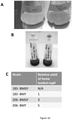
- Photographs of the shake flask cultures after 48 hr are shown in Figure 10A
- photographs of the pellets from cells grown on BMY media for 48 hours with no additional source of carbon are shown in Figure 10B ; these experiments demonstrated that significant expression of transgenes (e.g. heme enzymes) under the control of the AOX1 promoter occurs in the absence of an inducing carbon source when a repressing carbon source is consumed in the growth medium of a strain in which Mxr1 is also expressed from the AOX1 promoter.
- the relative yield of heme-loaded LegH, when shake flask cultures were grown in the absence of induction agent is shown in Figure 10C .
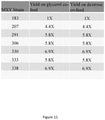
- strain MXY0291 was constructed to recapitulate the LegH production ability of MXY0207, while being free of antibiotic resistance genes. It was determined that strain MXY0291 contained ⁇ 16 copies of LegH var3, Mxr1 and 7 of the 8 heme biosynthetic enzymes. When grown in 2 L fermenter tanks, this strain showed improved LegH yield compared to MXY0207. This improvement was seen both in induction media containing methanol / glycerol and methanol / dextrose (D-glucose) ( Figure 11 ).
Landscapes
- Life Sciences & Earth Sciences (AREA)
- Health & Medical Sciences (AREA)
- Genetics & Genomics (AREA)
- Chemical & Material Sciences (AREA)
- Organic Chemistry (AREA)
- Engineering & Computer Science (AREA)
- Mycology (AREA)
- Biotechnology (AREA)
- Bioinformatics & Cheminformatics (AREA)
- Wood Science & Technology (AREA)
- Zoology (AREA)
- Biomedical Technology (AREA)
- General Engineering & Computer Science (AREA)
- General Health & Medical Sciences (AREA)
- Biochemistry (AREA)
- Molecular Biology (AREA)
- Biophysics (AREA)
- Microbiology (AREA)
- Medicinal Chemistry (AREA)
- Plant Pathology (AREA)
- Physics & Mathematics (AREA)
- Gastroenterology & Hepatology (AREA)
- Proteomics, Peptides & Aminoacids (AREA)
- Botany (AREA)
- Tropical Medicine & Parasitology (AREA)
- Virology (AREA)
- Micro-Organisms Or Cultivation Processes Thereof (AREA)
- Preparation Of Compounds By Using Micro-Organisms (AREA)
Claims (11)
- Methylotrophe Pichia-Hefezelle, umfassend:a) ein erstes rekombinantes Nukleinsäuremolekül, umfassend eine exogene Nukleinsäure, die einen Mxr1-Transkriptionsaktivator kodiert, funktionell verbunden mit mindestens einem Alkoholoxidase1-Promotorelement (AOX1-Promotorelement); undb) ein zweites rekombinantes Nukleinsäuremolekül, umfassend eine Nukleinsäure, die ein Mitglied der Globinfamilie PF00042 kodiert, funktionell verbunden mit mindestens einem AOX1-Element; undc) ein rekombinantes Molekül, umfassend eine Nukleinsäure, die mindestens ein Polypeptid kodiert, das an der Biosynthese von Häm beteiligt ist, ausgewählt aus der Gruppe bestehend aus ALA-Synthase, ALA-Dehydratase, Porphobilinogen-Deaminase, UPG III-Synthase, UPG III-Decarboxylase, CPGOxidase, PPG-Oxidase und Ferrochelatase, funktionell verbunden mit mindestens einem Methanol-induzierbaren Promotorelement.
- Hefezelle nach Anspruch 1, wobei die methylotrophe Hefezelle eine Pichia pastoris-Zelle ist.
- Hefezelle nach einem der Ansprüche 1 bis 2, wobei die rekombinanten Nukleinsäuremoleküle stabil in das Genom der methylotrophen Hefezelle integriert sind.
- Hefezelle nach einem der Ansprüche 1 bis 2, wobei die rekombinanten Nukleinsäuremoleküle extrachromosomal aus einem replikationskompetenten Plasmid exprimiert sind.
- Hefezelle nach einem der Ansprüche 1 bis 4, wobei die Mxr1-Sequenz von Pichia pastoris stammt.
- Hefezelle nach einem der Ansprüche 1 bis 5, wobei der Transkriptionsaktivator eine in GenBank-Zugangsnr. ABD57365 gezeigte Sequenz umfasst oder der Transkriptionsaktivator durch die in GenBank-Zugangsnr. DQ395124 gezeigte Nukleinsäuresequenz kodiert wird.
- Hefezelle nach einem der Ansprüche 1 bis 6, wobei das AOX1 - Promotorelement von Pichia pastoris stammt.
- Verfahren zum Exprimieren eines Mitglieds der Globinfamilie PF00042 in einer Zelle, wobei das Verfahren umfasst:Bereitstellen der Hefezelle nach einem der Ansprüche 1 bis 7; undKultivieren der Zelle unter Bedingungen, die zur Expression der rekombinanten Nukleinsäuremoleküle geeignet sind,wodurch das Mitglied der Globinfamilie PF00042 exprimiert wird.
- Verfahren nach Anspruch 8, wobei das Mitglied der Globinfamilie PF00042 ein Pflanzenhämoglobin ist, vorzugsweise Leghämoglobin, am meisten bevorzugt ein Leghämoglobin mit einer Sequenz, ausgewählt aus der Gruppe bestehend aus SEQ ID Nr. 4 und SEQ ID Nr. 6.
- Verfahren nach einem der Ansprüche 8 bis 9, wobei die Bedingungen, unter denen die Zellen kultiviert werden, die Zugabe von Eisen oder eines pharmazeutisch oder metabolisch verträglichen Salzes davon umfassen.
- Verfahren nach einem der Ansprüche 8 bis 10, wobei der Kultivierungsschritt das Kultivieren der Zelle in Gegenwart von Methanol umfasst.
Priority Applications (7)
| Application Number | Priority Date | Filing Date | Title |
|---|---|---|---|
| RS20220256A RS63099B1 (sr) | 2015-05-11 | 2016-05-11 | Konstrukti i metode ekspresije genetski modifikovanog metilotrofnog kvasca |
| SM20220124T SMT202200124T1 (it) | 2015-05-11 | 2016-05-11 | Costrutti di espressione e metodi per ingegnerizzare geneticamente lievito metilotrofico |
| EP25181056.0A EP4624565A3 (de) | 2015-05-11 | 2016-05-11 | Expressionskonstrukte und verfahren zur genmanipulation von methylotrophen hefen |
| PL16793420T PL3294762T3 (pl) | 2015-05-11 | 2016-05-11 | Konstrukty ekspresyjne i sposoby inżynierii genetycznej drożdży metylotroficznych |
| SI201631500T SI3294762T1 (sl) | 2015-05-11 | 2016-05-11 | Ekspresijski konstrukti in metode genskega inženiringa metilotrofnih kvasovk |
| HRP20220299TT HRP20220299T1 (hr) | 2015-05-11 | 2016-05-11 | Ekspresijski konstrukti i postupci za genetsku modifikaciju metilotrofnog kvasca |
| EP22151183.5A EP4039695B1 (de) | 2015-05-11 | 2016-05-11 | Expressionskonstrukte und verfahren zur genmanipulation von methylotrophen hefen |
Applications Claiming Priority (9)
| Application Number | Priority Date | Filing Date | Title |
|---|---|---|---|
| US201562159899P | 2015-05-11 | 2015-05-11 | |
| US201562183074P | 2015-06-22 | 2015-06-22 | |
| US201562185921P | 2015-06-29 | 2015-06-29 | |
| US201562203052P | 2015-08-10 | 2015-08-10 | |
| US201562220366P | 2015-09-18 | 2015-09-18 | |
| US201562222388P | 2015-09-23 | 2015-09-23 | |
| US201562236506P | 2015-10-02 | 2015-10-02 | |
| US201662313491P | 2016-03-25 | 2016-03-25 | |
| PCT/US2016/031797 WO2016183163A1 (en) | 2015-05-11 | 2016-05-11 | Expression constructs and methods of genetically engineering methylotrophic yeast |
Related Child Applications (2)
| Application Number | Title | Priority Date | Filing Date |
|---|---|---|---|
| EP25181056.0A Division EP4624565A3 (de) | 2015-05-11 | 2016-05-11 | Expressionskonstrukte und verfahren zur genmanipulation von methylotrophen hefen |
| EP22151183.5A Division EP4039695B1 (de) | 2015-05-11 | 2016-05-11 | Expressionskonstrukte und verfahren zur genmanipulation von methylotrophen hefen |
Publications (3)
| Publication Number | Publication Date |
|---|---|
| EP3294762A1 EP3294762A1 (de) | 2018-03-21 |
| EP3294762A4 EP3294762A4 (de) | 2018-10-17 |
| EP3294762B1 true EP3294762B1 (de) | 2022-01-19 |
Family
ID=57249545
Family Applications (3)
| Application Number | Title | Priority Date | Filing Date |
|---|---|---|---|
| EP25181056.0A Pending EP4624565A3 (de) | 2015-05-11 | 2016-05-11 | Expressionskonstrukte und verfahren zur genmanipulation von methylotrophen hefen |
| EP22151183.5A Active EP4039695B1 (de) | 2015-05-11 | 2016-05-11 | Expressionskonstrukte und verfahren zur genmanipulation von methylotrophen hefen |
| EP16793420.7A Active EP3294762B1 (de) | 2015-05-11 | 2016-05-11 | Expressionskonstrukte und verfahren zur genmanipulation von methylotrophen hefen |
Family Applications Before (2)
| Application Number | Title | Priority Date | Filing Date |
|---|---|---|---|
| EP25181056.0A Pending EP4624565A3 (de) | 2015-05-11 | 2016-05-11 | Expressionskonstrukte und verfahren zur genmanipulation von methylotrophen hefen |
| EP22151183.5A Active EP4039695B1 (de) | 2015-05-11 | 2016-05-11 | Expressionskonstrukte und verfahren zur genmanipulation von methylotrophen hefen |
Country Status (21)
| Country | Link |
|---|---|
| US (6) | US10689656B2 (de) |
| EP (3) | EP4624565A3 (de) |
| JP (5) | JP6831797B2 (de) |
| KR (4) | KR20250048145A (de) |
| CN (1) | CN107614516A (de) |
| AU (4) | AU2016262494B2 (de) |
| CA (1) | CA2985641A1 (de) |
| CY (1) | CY1125979T1 (de) |
| DK (1) | DK3294762T3 (de) |
| ES (2) | ES3051659T3 (de) |
| HR (1) | HRP20220299T1 (de) |
| HU (1) | HUE058104T2 (de) |
| LT (1) | LT3294762T (de) |
| MX (3) | MX2017014469A (de) |
| NZ (1) | NZ737094A (de) |
| PL (1) | PL3294762T3 (de) |
| PT (1) | PT3294762T (de) |
| RS (1) | RS63099B1 (de) |
| SI (1) | SI3294762T1 (de) |
| SM (1) | SMT202200124T1 (de) |
| WO (1) | WO2016183163A1 (de) |
Families Citing this family (39)
| Publication number | Priority date | Publication date | Assignee | Title |
|---|---|---|---|---|
| PT3294762T (pt) | 2015-05-11 | 2022-03-21 | Impossible Foods Inc | Constructos de expressão e métodos de modificar geneticamente levedura metilotrófica |
| US10988515B2 (en) | 2017-01-13 | 2021-04-27 | Bolt Threads, Inc. | Elastomeric proteins |
| WO2018140654A1 (en) * | 2017-01-25 | 2018-08-02 | Altius Institute For Biomedical Sciences | Methods and platform of designing genetic editing tools |
| CA3076249A1 (en) | 2017-09-21 | 2019-03-28 | The Brigham And Women's Hospital, Inc. | Isolation, preservation, compositions and uses of extracts from justicia plants |
| US11051532B2 (en) | 2017-09-22 | 2021-07-06 | Impossible Foods Inc. | Methods for purifying protein |
| US10221403B1 (en) * | 2018-04-25 | 2019-03-05 | Life Rainbow Biotech Co., Ltd. | Method of preparing zearalenone hydrolase |
| CN108913732B (zh) * | 2018-07-31 | 2022-02-08 | 华东理工大学 | 一种莫纳可林j异源生产的方法及应用 |
| CN111286520B (zh) * | 2018-12-10 | 2021-05-07 | 上海凯赛生物技术股份有限公司 | 用于发酵生产l-赖氨酸的重组dna、菌株及其应用 |
| CN109929769B (zh) * | 2019-03-05 | 2021-07-23 | 天津科技大学 | 一种利用fld1启动子调控黏玉米谷氨酰胺转氨酶表达的重组毕赤酵母菌株及构建方法 |
| CN109749948A (zh) * | 2019-03-05 | 2019-05-14 | 天津科技大学 | 一种利用tef1启动子调控黏玉米谷氨酰胺转氨酶表达的重组毕赤酵母菌株及构建方法 |
| AU2020257270B2 (en) | 2019-04-17 | 2026-01-15 | Impossible Foods Inc. | Materials and methods for protein production |
| EP3959311A1 (de) | 2019-04-25 | 2022-03-02 | Impossible Foods Inc. | Stämme und verfahren zur herstellung von häm-haltigen proteinen |
| WO2021108502A1 (en) | 2019-11-27 | 2021-06-03 | Evelo Biosciences, Inc. | Methods and compositions for culturing hemoglobin-dependent bacteria |
| KR20220123019A (ko) | 2019-12-31 | 2022-09-05 | 에어 프로틴 인코포레이티드 | 고단백질 식품 조성물 |
| EP4090746A4 (de) * | 2020-01-10 | 2024-01-24 | Intron Biotechnology, Inc. | Verfahren zur herstellung von soja-leghämoglobin unter verwendung von escherichia coli |
| AU2021229443A1 (en) | 2020-03-02 | 2022-09-15 | Air Protein, Inc. | Structured high-protein meat analogue compositions |
| US12011016B2 (en) | 2020-09-14 | 2024-06-18 | Impossible Foods Inc. | Protein methods and compositions |
| US10947552B1 (en) | 2020-09-30 | 2021-03-16 | Alpine Roads, Inc. | Recombinant fusion proteins for producing milk proteins in plants |
| AU2021353004A1 (en) | 2020-09-30 | 2023-04-13 | Nobell Foods, Inc. | Recombinant milk proteins and food compositions comprising the same |
| US10894812B1 (en) | 2020-09-30 | 2021-01-19 | Alpine Roads, Inc. | Recombinant milk proteins |
| WO2022072833A2 (en) | 2020-10-02 | 2022-04-07 | Impossible Foods Inc. | Expression constructs and methods of genetically engineering cells |
| WO2022072846A2 (en) | 2020-10-02 | 2022-04-07 | Impossible Foods Inc. | Transgenic plants with altered fatty acid profiles and upregulated heme biosynthesis |
| WO2022117743A1 (en) * | 2020-12-02 | 2022-06-09 | Genzyme Corporation | Polypeptide having beta-hexosaminidase activity, and polynucleotides coding for the same |
| JP2023553042A (ja) * | 2020-12-02 | 2023-12-20 | プランイート フーズ プライベート リミテッド | 組換えによりグロビンポリペプチドを生成する方法および肉代替食品製品 |
| WO2022251166A2 (en) | 2021-05-25 | 2022-12-01 | Evelo Biosciences, Inc. | Bacterial compositions comprising soy hemoglobin |
| AU2022369299A1 (en) | 2021-10-19 | 2024-03-14 | Eat Scifi Inc. | Plant base/animal cell hybrid meat substitute |
| KR20240118861A (ko) * | 2021-12-16 | 2024-08-05 | 임파서블 푸즈 인크. | 재조합 단백질의 발현을 증가시키는 유전 인자 |
| US11931687B2 (en) | 2022-02-15 | 2024-03-19 | Streamline Innovations, Inc. | Gas purification apparatus and method |
| KR102804540B1 (ko) | 2022-05-25 | 2025-05-07 | 한화솔루션 주식회사 | 야생형 효모 균주를 이용한 헴 고생산 방법 |
| WO2024022474A1 (zh) | 2022-07-29 | 2024-02-01 | 南京百斯杰生物工程有限公司 | 一种嵌合型转录激活因子及其应用 |
| KR20240098834A (ko) | 2022-12-21 | 2024-06-28 | 한화솔루션 주식회사 | 고농도의 헴을 생산하는 효모 돌연변이 균주 및 이를 이용한 헴 고생산 방법 |
| CN116042621A (zh) * | 2023-01-06 | 2023-05-02 | 江南大学 | 一种酵母杂交启动子及其应用 |
| WO2024167695A1 (en) | 2023-02-08 | 2024-08-15 | Danisco Us Inc. | Compositions and methods for producing heterologous globins in filamentous fungal cells |
| CN116410996A (zh) * | 2023-02-15 | 2023-07-11 | 浙江大学 | 一种血红蛋白的编码基因表达盒及其应用 |
| KR20240162935A (ko) | 2023-05-09 | 2024-11-18 | 한화솔루션 주식회사 | 고농도의 헴을 생산하는 효모 돌연변이 균주 hs-y010 및 이를 이용한 헴 고생산 방법 |
| KR20240162936A (ko) | 2023-05-09 | 2024-11-18 | 한화솔루션 주식회사 | 고농도의 헴을 생산하는 효모 돌연변이 균주 hs-y007 및 이를 이용한 헴 고생산 방법 |
| EP4726051A1 (de) * | 2023-06-06 | 2026-04-15 | FUJIFILM Corporation | Rekombinante hefe, verfahren zur herstellung eines zielproteins sowie kit und verfahren zur herstellung von rekombinanter hefe |
| WO2025247966A1 (en) * | 2024-05-29 | 2025-12-04 | Mybios Gmbh | Process for protein production in methylotrophic yeast host cell. |
| WO2025259480A2 (en) | 2024-06-12 | 2025-12-18 | Streamline Innovations Inc | Gas purification apparatus with eductor reduction unit and method |
Family Cites Families (72)
| Publication number | Priority date | Publication date | Assignee | Title |
|---|---|---|---|---|
| US4158065A (en) | 1977-12-16 | 1979-06-12 | Sugiyo Co., Ltd. | Crab meat substitute and method of preparing same |
| US4965188A (en) | 1986-08-22 | 1990-10-23 | Cetus Corporation | Process for amplifying, detecting, and/or cloning nucleic acid sequences using a thermostable enzyme |
| US4683195A (en) | 1986-01-30 | 1987-07-28 | Cetus Corporation | Process for amplifying, detecting, and/or-cloning nucleic acid sequences |
| US4683202A (en) | 1985-03-28 | 1987-07-28 | Cetus Corporation | Process for amplifying nucleic acid sequences |
| DK162399C (da) | 1986-01-28 | 1992-03-23 | Danisco | Fremgangsmaade til ekspression af gener i baelgplanteceller, dna-fragment, rekombineret dna-fragment samt plasmid til brug ved udoevelsen af fremgangsmaaden |
| US4800159A (en) | 1986-02-07 | 1989-01-24 | Cetus Corporation | Process for amplifying, detecting, and/or cloning nucleic acid sequences |
| US5663143A (en) | 1988-09-02 | 1997-09-02 | Dyax Corp. | Engineered human-derived kunitz domains that inhibit human neutrophil elastase |
| US6946587B1 (en) | 1990-01-22 | 2005-09-20 | Dekalb Genetics Corporation | Method for preparing fertile transgenic corn plants |
| US5204253A (en) | 1990-05-29 | 1993-04-20 | E. I. Du Pont De Nemours And Company | Method and apparatus for introducing biological substances into living cells |
| US5753465A (en) | 1994-08-30 | 1998-05-19 | Carnegie Mellon University | Unmodified recombinant human adult hemoglobin production |
| US5538800A (en) | 1994-09-29 | 1996-07-23 | At&T Corp. | Magnetoresistive oxide material and articles comprising the material |
| FR2736930B1 (fr) | 1995-07-17 | 1997-09-19 | Biocem | Procede de production, par des cellules vegetales, de proteines heminiques, proteines ainsi obtenues et produits contenant ces proteines |
| US5824511A (en) | 1995-08-01 | 1998-10-20 | University Technology Corporation | Method for enhancing the production of hemoproteins |
| PL328096A1 (en) | 1996-02-01 | 1999-01-04 | North American Vaccine | Expression of external membrane (mb3) protein of neisseria meningitidis of b group in yeasts and vaccines |
| JP3462218B2 (ja) | 1996-06-10 | 2003-11-05 | ノボザイムス バイオテック,インコーポレイティド | 糸状菌におけるヘムタンパク質生産を増加せしめるための方法 |
| JP3794760B2 (ja) | 1996-07-30 | 2006-07-12 | 三井化学株式会社 | フィターゼ生産酵母 |
| US5959187A (en) | 1996-09-26 | 1999-09-28 | Bailey; James E. | Expression of oxygen-binding proteins in plants |
| JPH10117776A (ja) | 1996-10-22 | 1998-05-12 | Japan Tobacco Inc | インディカイネの形質転換方法 |
| CA2331772C (en) | 1998-06-26 | 2009-08-04 | The University Of Manitoba | Hemoglobins to maintain cell energy status |
| US7803765B2 (en) | 1999-05-05 | 2010-09-28 | Phylogica Limited | Methods of constructing biodiverse gene fragment libraries and biological modulators isolated therefrom |
| US7498304B2 (en) | 2000-06-16 | 2009-03-03 | Curis, Inc. | Angiogenesis-modulating compositions and uses |
| WO2001098480A2 (en) | 2000-06-23 | 2001-12-27 | Syngenta Participations Ag | Promoters for regulation of plant gene expression |
| EP1356060B1 (de) | 2000-09-18 | 2005-12-14 | Genencor International, Inc. | Zwillingsarginin translokation in bacillus |
| US8021695B2 (en) | 2002-02-15 | 2011-09-20 | Arch Personal Care Products, L.P. | Personal care composition containing leghemoglobin |
| AU2003296714A1 (en) | 2002-12-23 | 2004-07-22 | Max-Planck-Gesellschaft Zur Forderung Der Wissenschaften Ev | Method for altering the content of reserve substances in plants |
| WO2004099405A1 (en) | 2003-04-11 | 2004-11-18 | Ventria Bioscience | Human blood proteins expressed in monocot seeds |
| KR100660539B1 (ko) | 2004-07-29 | 2006-12-22 | 삼성전자주식회사 | 자기 기억 소자 및 그 형성 방법 |
| CN1308452C (zh) | 2004-09-14 | 2007-04-04 | 上海永业农科生物工程有限公司 | 一种含有改组乙醇氧化酶启动子的毕赤酵母植酸酶表达系统 |
| US20080193969A1 (en) | 2005-01-12 | 2008-08-14 | Rob Te Biesebeke | Hemoglobin Overexpression in Fungal Fermentations |
| AT501955B1 (de) | 2005-02-23 | 2007-08-15 | Univ Graz Tech | Mutierte aox1-promotoren |
| EP2479254A1 (de) | 2005-08-24 | 2012-07-25 | The Scripps Research Institute | Von einem Translationsverstärkerelement abhängige Vektorsysteme |
| JP2007228956A (ja) | 2006-02-28 | 2007-09-13 | Suntory Ltd | 醸造用酵母由来の有用タンパク質同定方法 |
| JP2008017733A (ja) | 2006-07-11 | 2008-01-31 | Tokyo Univ Of Agriculture | 異種タンパク質の発現方法及び異種タンパク質の発現方法により得られたタンパク質 |
| JP2008017774A (ja) * | 2006-07-13 | 2008-01-31 | Nipro Corp | ピキア酵母を用いた組換えヒトヘモグロビンの製造 |
| CN101541187A (zh) | 2006-11-01 | 2009-09-23 | 西格马食品可变资本有限公司 | 肉类替代食品及其制备方法 |
| US8143023B2 (en) | 2007-01-26 | 2012-03-27 | Novozymes A/S | Method for methanol independent induction from methanol inducible promoters in Pichia |
| WO2009009142A2 (en) | 2007-07-10 | 2009-01-15 | Monsanto Technology, Llc | Transgenic plants with enhanced agronomic traits |
| EP2058398A1 (de) * | 2007-11-09 | 2009-05-13 | Nipro Corporation | Herstellung von rekombinantem humanem Hämoglobin mittels Pichia-Hefe |
| CN102105589A (zh) | 2008-07-11 | 2011-06-22 | 诺维信公司 | 巴斯德毕赤酵母(Pichia pastoris) DAS启动子变体 |
| US20120156761A1 (en) | 2009-07-02 | 2012-06-21 | Verdezyne, Inc. | Biological methods for preparing adipic acid |
| US20120184007A1 (en) | 2009-07-09 | 2012-07-19 | Stephen Picataggio | Engineered microorganisms with enhanced fermentation activity |
| WO2011079388A1 (en) | 2009-12-30 | 2011-07-07 | Iogen Energy Corporation | Modified yeast strains exhibiting enhanced fermentation of lignocellulosic hydrolysates |
| CN102190731B (zh) | 2010-03-09 | 2016-01-27 | 中国科学院上海生命科学研究院 | 用人工转录因子诱导产生多能干细胞 |
| US9085766B2 (en) | 2010-05-21 | 2015-07-21 | Cornell University | Methods of producing recombinant heme-binding proteins and uses thereof |
| WO2012017329A2 (en) | 2010-08-02 | 2012-02-09 | Cellectis S.A. | Method for targeted genomic events in algae |
| WO2012083424A1 (en) | 2010-12-21 | 2012-06-28 | The University Of Western Ontario | Novel amino acid linker sequences for ligand immobilization |
| EP2669375B1 (de) | 2011-01-27 | 2018-10-17 | Kaneka Corporation | Zur expression von erhöhten mengen an mpp1 homolog modifizierte hefe der gattung pichia und verfahren zur herstellung von protein |
| US9212359B2 (en) | 2011-06-23 | 2015-12-15 | Sanford Jay Silverman | Systems for induction of gene expression and protein depletion in yeast |
| CN105724726A (zh) | 2011-07-12 | 2016-07-06 | 非凡食品有限公司 | 用于消费品的方法和组合物 |
| US20140220217A1 (en) | 2011-07-12 | 2014-08-07 | Maraxi, Inc. | Method and compositions for consumables |
| US10039306B2 (en) | 2012-03-16 | 2018-08-07 | Impossible Foods Inc. | Methods and compositions for consumables |
| EP2565262A1 (de) | 2011-08-31 | 2013-03-06 | VTU Holding GmbH | Protein-Expression |
| JP6295512B2 (ja) | 2012-03-15 | 2018-03-20 | 株式会社豊田中央研究所 | 酵母における外来遺伝子の発現産物の生産方法、酵母における発現調節剤及びその利用 |
| WO2013158749A2 (en) | 2012-04-17 | 2013-10-24 | Gevo, Inc. | Engineered microorganisms with improved growth properties |
| CN102757976B (zh) * | 2012-07-12 | 2014-10-08 | 华东理工大学 | 消除甲醇诱导型启动子单一甲醇碳源依赖性的方法 |
| CN104812405A (zh) | 2012-09-19 | 2015-07-29 | 国立大学法人大阪大学 | 含有肺炎球菌表面蛋白a的肺炎球菌疫苗 |
| PT2943078T (pt) | 2013-01-11 | 2021-06-16 | Impossible Foods Inc | Métodos e composições para consumíveis |
| AU2014305233B2 (en) | 2013-08-05 | 2017-06-29 | New Zealand Institute For Bioeconomy Science Limited | A method and control system for optimising the quality of meat |
| SI3044320T1 (sl) | 2013-09-11 | 2020-07-31 | Impossible Foods Inc. | Sekrecija polipeptidov, ki vsebujejo hem |
| JP6759103B2 (ja) * | 2014-03-31 | 2020-09-23 | インポッシブル フーズ インコーポレイテッド | ひき肉レプリカ |
| WO2016089516A2 (en) | 2014-10-31 | 2016-06-09 | Board Of Regents, The University Of Texas System | Short exogenous promoter for high level expression in fungi |
| PT3294762T (pt) | 2015-05-11 | 2022-03-21 | Impossible Foods Inc | Constructos de expressão e métodos de modificar geneticamente levedura metilotrófica |
| EP3128006A1 (de) | 2015-08-06 | 2017-02-08 | Consejo Superior de Investigaciones Cientificas (CSIC) | Werkzeuge zur komplexen multiproteinexpression in pichia pastoris |
| US20190292555A1 (en) | 2016-12-02 | 2019-09-26 | Impossible Foods Inc. | Producing recombinant products in contained systems |
| US20190292217A1 (en) | 2016-12-02 | 2019-09-26 | Impossible Foods Inc. | Transgenic plants with upregulated heme biosynthesis |
| EP3688166A4 (de) | 2017-09-28 | 2021-06-23 | Precision Fermentation, Inc. | Verfahren, vorrichtungen und computerprogrammprodukte zur hefeleistungsüberwachung in fermentationssystemen |
| RU2658758C1 (ru) | 2017-10-02 | 2018-06-22 | ООО "Лаборатория Ангиофарм" | Рекомбинантная плазмида для экспрессии в дрожжах Pichia pastoris гена химерного белка ангиогенина человека и штамм дрожжей Pichia pastoris - продуцент рекомбинантного химерного белка ангиогенина человека |
| US20200325484A1 (en) | 2019-04-12 | 2020-10-15 | Delin Liang | Enhancing gene expression by linking self-amplifying transcription factor with viral 2A-like peptide |
| AU2020257270B2 (en) | 2019-04-17 | 2026-01-15 | Impossible Foods Inc. | Materials and methods for protein production |
| EP3959311A1 (de) | 2019-04-25 | 2022-03-02 | Impossible Foods Inc. | Stämme und verfahren zur herstellung von häm-haltigen proteinen |
| US20210062206A1 (en) | 2019-07-08 | 2021-03-04 | The Regents Of The University Of California | Synthetic transcription factors |
| KR20240118861A (ko) | 2021-12-16 | 2024-08-05 | 임파서블 푸즈 인크. | 재조합 단백질의 발현을 증가시키는 유전 인자 |
-
2016
- 2016-05-11 PT PT167934207T patent/PT3294762T/pt unknown
- 2016-05-11 EP EP25181056.0A patent/EP4624565A3/de active Pending
- 2016-05-11 RS RS20220256A patent/RS63099B1/sr unknown
- 2016-05-11 KR KR1020257009989A patent/KR20250048145A/ko active Pending
- 2016-05-11 KR KR1020207026647A patent/KR102504198B1/ko active Active
- 2016-05-11 JP JP2017558948A patent/JP6831797B2/ja active Active
- 2016-05-11 ES ES22151183T patent/ES3051659T3/es active Active
- 2016-05-11 HR HRP20220299TT patent/HRP20220299T1/hr unknown
- 2016-05-11 US US15/573,300 patent/US10689656B2/en active Active
- 2016-05-11 DK DK16793420.7T patent/DK3294762T3/da active
- 2016-05-11 KR KR1020237006299A patent/KR102789173B1/ko active Active
- 2016-05-11 SI SI201631500T patent/SI3294762T1/sl unknown
- 2016-05-11 NZ NZ737094A patent/NZ737094A/en unknown
- 2016-05-11 LT LTEPPCT/US2016/031797T patent/LT3294762T/lt unknown
- 2016-05-11 PL PL16793420T patent/PL3294762T3/pl unknown
- 2016-05-11 ES ES16793420T patent/ES2908463T3/es active Active
- 2016-05-11 KR KR1020177033598A patent/KR102229968B1/ko active Active
- 2016-05-11 CN CN201680029580.4A patent/CN107614516A/zh active Pending
- 2016-05-11 WO PCT/US2016/031797 patent/WO2016183163A1/en not_active Ceased
- 2016-05-11 SM SM20220124T patent/SMT202200124T1/it unknown
- 2016-05-11 CA CA2985641A patent/CA2985641A1/en active Pending
- 2016-05-11 MX MX2017014469A patent/MX2017014469A/es unknown
- 2016-05-11 HU HUE16793420A patent/HUE058104T2/hu unknown
- 2016-05-11 EP EP22151183.5A patent/EP4039695B1/de active Active
- 2016-05-11 AU AU2016262494A patent/AU2016262494B2/en active Active
- 2016-05-11 EP EP16793420.7A patent/EP3294762B1/de active Active
-
2017
- 2017-08-16 US US15/678,891 patent/US9938327B2/en active Active
- 2017-08-16 US US15/678,342 patent/US10273492B2/en active Active
- 2017-11-10 MX MX2022013540A patent/MX2022013540A/es unknown
- 2017-11-10 MX MX2022006513A patent/MX2022006513A/es unknown
-
2018
- 2018-09-06 US US16/123,121 patent/US11319544B2/en active Active
-
2019
- 2019-10-17 AU AU2019250216A patent/AU2019250216B2/en active Active
-
2020
- 2020-02-03 JP JP2020016038A patent/JP7308160B2/ja active Active
-
2021
- 2021-09-30 JP JP2021161491A patent/JP2022025068A/ja active Pending
-
2022
- 2022-01-25 US US17/584,028 patent/US12084667B2/en active Active
- 2022-03-03 AU AU2022201465A patent/AU2022201465C1/en active Active
- 2022-03-04 CY CY20221100189T patent/CY1125979T1/el unknown
- 2022-11-04 JP JP2022177137A patent/JP7596344B2/ja active Active
-
2024
- 2024-07-29 US US18/786,876 patent/US20250051786A1/en active Pending
- 2024-09-13 JP JP2024158832A patent/JP2025003991A/ja active Pending
-
2025
- 2025-03-12 AU AU2025201786A patent/AU2025201786A1/en active Pending
Non-Patent Citations (2)
| Title |
|---|
| LIN-CEREGHINO G P ET AL: "Mxr1p, a key regulator of the methanol utilization pathway and peroxisomal genes in Pichia pastoris", MOLECULAR AND CELLULAR BIOLOGY, AMERICAN SOCIETY FOR PHARMACOLOGY AND EXPERIMENTAL THERAPEUTICS, US, vol. 26, no. 3, 1 February 2006 (2006-02-01), pages 883 - 897, XP002438945, ISSN: 0270-7306, DOI: 10.1128/MCB.26.3.883-897.2006 * |
| ROLAND NILSSON ET AL: "Discovery of Genes Essential for Heme Biosynthesis through Large-Scale Gene Expression Analysis", CELL METABOLISM, vol. 10, no. 2, 1 August 2009 (2009-08-01), United States, pages 119 - 130, XP055238295, ISSN: 1550-4131, DOI: 10.1016/j.cmet.2009.06.012 * |
Also Published As
Similar Documents
| Publication | Publication Date | Title |
|---|---|---|
| US12084667B2 (en) | Expression constructs and methods of genetically engineering methylotrophic yeast | |
| HK40078346A (en) | Expression constructs and methods of genetically engineering methylotrophic yeast | |
| HK40078346B (en) | Expression constructs and methods of genetically engineering methylotrophic yeast | |
| HK1252605B (en) | Expression constructs and methods of genetically engineering methylotrophic yeast | |
| BR112017024123B1 (pt) | Células de levedura de pichia metilotrófica compreendendo uma molécula de ácido nucleico recombinante, e método para expressão de um polipeptídeo heterólogo em uma célula | |
| BR122025009343A2 (pt) | Células de levedura metilotrófica compreendendo uma molécula de ácido nucleico recombinante, e método para expressão de um polipeptídeo heterólogo em uma célula |
Legal Events
| Date | Code | Title | Description |
|---|---|---|---|
| REG | Reference to a national code |
Ref country code: HR Ref legal event code: TUEP Ref document number: P20220299T Country of ref document: HR |
|
| STAA | Information on the status of an ep patent application or granted ep patent |
Free format text: STATUS: THE INTERNATIONAL PUBLICATION HAS BEEN MADE |
|
| PUAI | Public reference made under article 153(3) epc to a published international application that has entered the european phase |
Free format text: ORIGINAL CODE: 0009012 |
|
| STAA | Information on the status of an ep patent application or granted ep patent |
Free format text: STATUS: REQUEST FOR EXAMINATION WAS MADE |
|
| 17P | Request for examination filed |
Effective date: 20171107 |
|
| AK | Designated contracting states |
Kind code of ref document: A1 Designated state(s): AL AT BE BG CH CY CZ DE DK EE ES FI FR GB GR HR HU IE IS IT LI LT LU LV MC MK MT NL NO PL PT RO RS SE SI SK SM TR |
|
| AX | Request for extension of the european patent |
Extension state: BA ME |
|
| DAV | Request for validation of the european patent (deleted) | ||
| DAX | Request for extension of the european patent (deleted) | ||
| A4 | Supplementary search report drawn up and despatched |
Effective date: 20180919 |
|
| RIC1 | Information provided on ipc code assigned before grant |
Ipc: C12N 15/81 20060101ALI20180913BHEP Ipc: C07K 14/805 20060101ALI20180913BHEP Ipc: C12N 15/00 20060101ALI20180913BHEP Ipc: C12R 1/84 20060101ALI20180913BHEP Ipc: C07K 14/39 20060101AFI20180913BHEP Ipc: C12N 1/16 20060101ALI20180913BHEP Ipc: C07K 14/415 20060101ALI20180913BHEP Ipc: C12N 15/63 20060101ALI20180913BHEP |
|
| REG | Reference to a national code |
Ref country code: HK Ref legal event code: DE Ref document number: 1252605 Country of ref document: HK |
|
| STAA | Information on the status of an ep patent application or granted ep patent |
Free format text: STATUS: EXAMINATION IS IN PROGRESS |
|
| 17Q | First examination report despatched |
Effective date: 20190708 |
|
| GRAJ | Information related to disapproval of communication of intention to grant by the applicant or resumption of examination proceedings by the epo deleted |
Free format text: ORIGINAL CODE: EPIDOSDIGR1 |
|
| GRAP | Despatch of communication of intention to grant a patent |
Free format text: ORIGINAL CODE: EPIDOSNIGR1 |
|
| GRAP | Despatch of communication of intention to grant a patent |
Free format text: ORIGINAL CODE: EPIDOSNIGR1 |
|
| STAA | Information on the status of an ep patent application or granted ep patent |
Free format text: STATUS: GRANT OF PATENT IS INTENDED |
|
| GRAJ | Information related to disapproval of communication of intention to grant by the applicant or resumption of examination proceedings by the epo deleted |
Free format text: ORIGINAL CODE: EPIDOSDIGR1 |
|
| STAA | Information on the status of an ep patent application or granted ep patent |
Free format text: STATUS: EXAMINATION IS IN PROGRESS |
|
| INTG | Intention to grant announced |
Effective date: 20211027 |
|
| GRAP | Despatch of communication of intention to grant a patent |
Free format text: ORIGINAL CODE: EPIDOSNIGR1 |
|
| STAA | Information on the status of an ep patent application or granted ep patent |
Free format text: STATUS: GRANT OF PATENT IS INTENDED |
|
| GRAS | Grant fee paid |
Free format text: ORIGINAL CODE: EPIDOSNIGR3 |
|
| GRAA | (expected) grant |
Free format text: ORIGINAL CODE: 0009210 |
|
| STAA | Information on the status of an ep patent application or granted ep patent |
Free format text: STATUS: THE PATENT HAS BEEN GRANTED |
|
| INTC | Intention to grant announced (deleted) | ||
| INTG | Intention to grant announced |
Effective date: 20211208 |
|
| RAP3 | Party data changed (applicant data changed or rights of an application transferred) |
Owner name: IMPOSSIBLE FOODS INC. |
|
| AK | Designated contracting states |
Kind code of ref document: B1 Designated state(s): AL AT BE BG CH CY CZ DE DK EE ES FI FR GB GR HR HU IE IS IT LI LT LU LV MC MK MT NL NO PL PT RO RS SE SI SK SM TR |
|
| REG | Reference to a national code |
Ref country code: GB Ref legal event code: FG4D |
|
| REG | Reference to a national code |
Ref country code: CH Ref legal event code: EP |
|
| REG | Reference to a national code |
Ref country code: DE Ref legal event code: R096 Ref document number: 602016068504 Country of ref document: DE |
|
| REG | Reference to a national code |
Ref country code: AT Ref legal event code: REF Ref document number: 1463750 Country of ref document: AT Kind code of ref document: T Effective date: 20220215 |
|
| REG | Reference to a national code |
Ref country code: IE Ref legal event code: FG4D |
|
| REG | Reference to a national code |
Ref country code: DK Ref legal event code: T3 Effective date: 20220307 |
|
| REG | Reference to a national code |
Ref country code: NL Ref legal event code: FP |
|
| REG | Reference to a national code |
Ref country code: FI Ref legal event code: FGE |
|
| REG | Reference to a national code |
Ref country code: PT Ref legal event code: SC4A Ref document number: 3294762 Country of ref document: PT Date of ref document: 20220321 Kind code of ref document: T Free format text: AVAILABILITY OF NATIONAL TRANSLATION Effective date: 20220314 |
|
| REG | Reference to a national code |
Ref country code: RO Ref legal event code: EPE |
|
| REG | Reference to a national code |
Ref country code: ES Ref legal event code: FG2A Ref document number: 2908463 Country of ref document: ES Kind code of ref document: T3 Effective date: 20220429 |
|
| REG | Reference to a national code |
Ref country code: SE Ref legal event code: TRGR |
|
| REG | Reference to a national code |
Ref country code: HR Ref legal event code: T1PR Ref document number: P20220299 Country of ref document: HR |
|
| REG | Reference to a national code |
Ref country code: EE Ref legal event code: FG4A Ref document number: E022144 Country of ref document: EE Effective date: 20220308 |
|
| REG | Reference to a national code |
Ref country code: GR Ref legal event code: EP Ref document number: 20220400783 Country of ref document: GR Effective date: 20220509 |
|
| REG | Reference to a national code |
Ref country code: NO Ref legal event code: T2 Effective date: 20220119 |
|
| REG | Reference to a national code |
Ref country code: HR Ref legal event code: ODRP Ref document number: P20220299 Country of ref document: HR Payment date: 20220525 Year of fee payment: 7 |
|
| REG | Reference to a national code |
Ref country code: HU Ref legal event code: AG4A Ref document number: E058104 Country of ref document: HU |
|
| REG | Reference to a national code |
Ref country code: DE Ref legal event code: R097 Ref document number: 602016068504 Country of ref document: DE |
|
| PLBE | No opposition filed within time limit |
Free format text: ORIGINAL CODE: 0009261 |
|
| STAA | Information on the status of an ep patent application or granted ep patent |
Free format text: STATUS: NO OPPOSITION FILED WITHIN TIME LIMIT |
|
| 26N | No opposition filed |
Effective date: 20221020 |
|
| REG | Reference to a national code |
Ref country code: HR Ref legal event code: ODRP Ref document number: P20220299 Country of ref document: HR Payment date: 20230419 Year of fee payment: 8 |
|
| P01 | Opt-out of the competence of the unified patent court (upc) registered |
Effective date: 20230412 |
|
| PGFP | Annual fee paid to national office [announced via postgrant information from national office to epo] |
Ref country code: LU Payment date: 20230530 Year of fee payment: 8 |
|
| PGFP | Annual fee paid to national office [announced via postgrant information from national office to epo] |
Ref country code: SM Payment date: 20230421 Year of fee payment: 8 Ref country code: RS Payment date: 20230420 Year of fee payment: 8 Ref country code: RO Payment date: 20230426 Year of fee payment: 8 Ref country code: PT Payment date: 20230419 Year of fee payment: 8 Ref country code: NO Payment date: 20230530 Year of fee payment: 8 Ref country code: MC Payment date: 20230420 Year of fee payment: 8 Ref country code: LT Payment date: 20230418 Year of fee payment: 8 Ref country code: EE Payment date: 20230418 Year of fee payment: 8 Ref country code: DK Payment date: 20230530 Year of fee payment: 8 Ref country code: CZ Payment date: 20230426 Year of fee payment: 8 Ref country code: CY Payment date: 20230421 Year of fee payment: 8 Ref country code: BG Payment date: 20230511 Year of fee payment: 8 |
|
| PGFP | Annual fee paid to national office [announced via postgrant information from national office to epo] |
Ref country code: TR Payment date: 20230426 Year of fee payment: 8 Ref country code: SK Payment date: 20230418 Year of fee payment: 8 Ref country code: SI Payment date: 20230419 Year of fee payment: 8 Ref country code: PL Payment date: 20230419 Year of fee payment: 8 Ref country code: LV Payment date: 20230420 Year of fee payment: 8 Ref country code: IS Payment date: 20230422 Year of fee payment: 8 Ref country code: HU Payment date: 20230502 Year of fee payment: 8 Ref country code: HR Payment date: 20230419 Year of fee payment: 8 Ref country code: GR Payment date: 20230530 Year of fee payment: 8 Ref country code: FI Payment date: 20230525 Year of fee payment: 8 Ref country code: AT Payment date: 20230419 Year of fee payment: 8 |
|
| PGFP | Annual fee paid to national office [announced via postgrant information from national office to epo] |
Ref country code: MT Payment date: 20230418 Year of fee payment: 8 |
|
| PGFP | Annual fee paid to national office [announced via postgrant information from national office to epo] |
Ref country code: AL Payment date: 20230515 Year of fee payment: 8 |
|
| PGFP | Annual fee paid to national office [announced via postgrant information from national office to epo] |
Ref country code: MK Payment date: 20230425 Year of fee payment: 8 |
|
| REG | Reference to a national code |
Ref country code: HR Ref legal event code: PBON Ref document number: P20220299 Country of ref document: HR Effective date: 20240511 |
|
| REG | Reference to a national code |
Ref country code: LT Ref legal event code: MM4D Effective date: 20240511 |
|
| PG25 | Lapsed in a contracting state [announced via postgrant information from national office to epo] |
Ref country code: PT Free format text: LAPSE BECAUSE OF NON-PAYMENT OF DUE FEES Effective date: 20241111 |
|
| REG | Reference to a national code |
Ref country code: EE Ref legal event code: MM4A Ref document number: E022144 Country of ref document: EE Effective date: 20240531 |
|
| PG25 | Lapsed in a contracting state [announced via postgrant information from national office to epo] |
Ref country code: PT Free format text: LAPSE BECAUSE OF NON-PAYMENT OF DUE FEES Effective date: 20241111 |
|
| REG | Reference to a national code |
Ref country code: DK Ref legal event code: EBP Effective date: 20240531 |
|
| PG25 | Lapsed in a contracting state [announced via postgrant information from national office to epo] |
Ref country code: MC Free format text: LAPSE BECAUSE OF NON-PAYMENT OF DUE FEES Effective date: 20240531 |
|
| PG25 | Lapsed in a contracting state [announced via postgrant information from national office to epo] |
Ref country code: LT Free format text: LAPSE BECAUSE OF NON-PAYMENT OF DUE FEES Effective date: 20240511 |
|
| PG25 | Lapsed in a contracting state [announced via postgrant information from national office to epo] |
Ref country code: NO Free format text: LAPSE BECAUSE OF NON-PAYMENT OF DUE FEES Effective date: 20240531 |
|
| REG | Reference to a national code |
Ref country code: SK Ref legal event code: MM4A Ref document number: E 39471 Country of ref document: SK Effective date: 20240511 Ref country code: AT Ref legal event code: MM01 Ref document number: 1463750 Country of ref document: AT Kind code of ref document: T Effective date: 20240511 |
|
| PG25 | Lapsed in a contracting state [announced via postgrant information from national office to epo] |
Ref country code: LU Free format text: LAPSE BECAUSE OF NON-PAYMENT OF DUE FEES Effective date: 20240511 Ref country code: FI Free format text: LAPSE BECAUSE OF NON-PAYMENT OF DUE FEES Effective date: 20240511 Ref country code: GR Free format text: LAPSE BECAUSE OF NON-PAYMENT OF DUE FEES Effective date: 20241204 |
|
| PG25 | Lapsed in a contracting state [announced via postgrant information from national office to epo] |
Ref country code: BG Free format text: LAPSE BECAUSE OF NON-PAYMENT OF DUE FEES Effective date: 20240511 |
|
| PG25 | Lapsed in a contracting state [announced via postgrant information from national office to epo] |
Ref country code: LV Free format text: LAPSE BECAUSE OF NON-PAYMENT OF DUE FEES Effective date: 20240511 Ref country code: EE Free format text: LAPSE BECAUSE OF NON-PAYMENT OF DUE FEES Effective date: 20240531 |
|
| PG25 | Lapsed in a contracting state [announced via postgrant information from national office to epo] |
Ref country code: AT Free format text: LAPSE BECAUSE OF NON-PAYMENT OF DUE FEES Effective date: 20240511 |
|
| PG25 | Lapsed in a contracting state [announced via postgrant information from national office to epo] |
Ref country code: CZ Free format text: LAPSE BECAUSE OF NON-PAYMENT OF DUE FEES Effective date: 20240511 Ref country code: HR Free format text: LAPSE BECAUSE OF NON-PAYMENT OF DUE FEES Effective date: 20240511 |
|
| PG25 | Lapsed in a contracting state [announced via postgrant information from national office to epo] |
Ref country code: RO Free format text: LAPSE BECAUSE OF NON-PAYMENT OF DUE FEES Effective date: 20240511 Ref country code: SK Free format text: LAPSE BECAUSE OF NON-PAYMENT OF DUE FEES Effective date: 20240511 |
|
| PG25 | Lapsed in a contracting state [announced via postgrant information from national office to epo] |
Ref country code: SM Free format text: LAPSE BECAUSE OF NON-PAYMENT OF DUE FEES Effective date: 20241210 Ref country code: RS Free format text: LAPSE BECAUSE OF NON-PAYMENT OF DUE FEES Effective date: 20240511 |
|
| PG25 | Lapsed in a contracting state [announced via postgrant information from national office to epo] |
Ref country code: CY Free format text: LAPSE BECAUSE OF NON-PAYMENT OF DUE FEES Effective date: 20240511 |
|
| PG25 | Lapsed in a contracting state [announced via postgrant information from national office to epo] |
Ref country code: SM Free format text: LAPSE BECAUSE OF NON-PAYMENT OF DUE FEES Effective date: 20241210 Ref country code: SK Free format text: LAPSE BECAUSE OF NON-PAYMENT OF DUE FEES Effective date: 20240511 Ref country code: RS Free format text: LAPSE BECAUSE OF NON-PAYMENT OF DUE FEES Effective date: 20240511 Ref country code: RO Free format text: LAPSE BECAUSE OF NON-PAYMENT OF DUE FEES Effective date: 20240511 Ref country code: NO Free format text: LAPSE BECAUSE OF NON-PAYMENT OF DUE FEES Effective date: 20240531 Ref country code: MC Free format text: LAPSE BECAUSE OF NON-PAYMENT OF DUE FEES Effective date: 20240531 Ref country code: LV Free format text: LAPSE BECAUSE OF NON-PAYMENT OF DUE FEES Effective date: 20240511 Ref country code: LU Free format text: LAPSE BECAUSE OF NON-PAYMENT OF DUE FEES Effective date: 20240511 Ref country code: LT Free format text: LAPSE BECAUSE OF NON-PAYMENT OF DUE FEES Effective date: 20240511 Ref country code: HR Free format text: LAPSE BECAUSE OF NON-PAYMENT OF DUE FEES Effective date: 20240511 Ref country code: GR Free format text: LAPSE BECAUSE OF NON-PAYMENT OF DUE FEES Effective date: 20241204 Ref country code: FI Free format text: LAPSE BECAUSE OF NON-PAYMENT OF DUE FEES Effective date: 20240511 Ref country code: EE Free format text: LAPSE BECAUSE OF NON-PAYMENT OF DUE FEES Effective date: 20240531 Ref country code: CZ Free format text: LAPSE BECAUSE OF NON-PAYMENT OF DUE FEES Effective date: 20240511 Ref country code: CY Free format text: LAPSE BECAUSE OF NON-PAYMENT OF DUE FEES Effective date: 20240511 Ref country code: BG Free format text: LAPSE BECAUSE OF NON-PAYMENT OF DUE FEES Effective date: 20240511 Ref country code: AT Free format text: LAPSE BECAUSE OF NON-PAYMENT OF DUE FEES Effective date: 20240511 |
|
| PG25 | Lapsed in a contracting state [announced via postgrant information from national office to epo] |
Ref country code: HU Free format text: LAPSE BECAUSE OF NON-PAYMENT OF DUE FEES Effective date: 20240512 |
|
| PG25 | Lapsed in a contracting state [announced via postgrant information from national office to epo] |
Ref country code: DK Free format text: LAPSE BECAUSE OF NON-PAYMENT OF DUE FEES Effective date: 20240531 |
|
| PGFP | Annual fee paid to national office [announced via postgrant information from national office to epo] |
Ref country code: NL Payment date: 20250516 Year of fee payment: 10 |
|
| PGFP | Annual fee paid to national office [announced via postgrant information from national office to epo] |
Ref country code: DE Payment date: 20250507 Year of fee payment: 10 |
|
| PGFP | Annual fee paid to national office [announced via postgrant information from national office to epo] |
Ref country code: GB Payment date: 20250501 Year of fee payment: 10 Ref country code: ES Payment date: 20250606 Year of fee payment: 10 |
|
| PGFP | Annual fee paid to national office [announced via postgrant information from national office to epo] |
Ref country code: BE Payment date: 20250516 Year of fee payment: 10 Ref country code: IT Payment date: 20250522 Year of fee payment: 10 |
|
| PGFP | Annual fee paid to national office [announced via postgrant information from national office to epo] |
Ref country code: FR Payment date: 20250508 Year of fee payment: 10 |
|
| PGFP | Annual fee paid to national office [announced via postgrant information from national office to epo] |
Ref country code: CH Payment date: 20250601 Year of fee payment: 10 |
|
| PGFP | Annual fee paid to national office [announced via postgrant information from national office to epo] |
Ref country code: IE Payment date: 20250509 Year of fee payment: 10 |
|
| PGFP | Annual fee paid to national office [announced via postgrant information from national office to epo] |
Ref country code: SE Payment date: 20250514 Year of fee payment: 10 |
|
| PG25 | Lapsed in a contracting state [announced via postgrant information from national office to epo] |
Ref country code: PL Free format text: LAPSE BECAUSE OF FAILURE TO SUBMIT A TRANSLATION OF THE DESCRIPTION OR TO PAY THE FEE WITHIN THE PRESCRIBED TIME-LIMIT Effective date: 20240511 |
|
| REG | Reference to a national code |
Ref country code: SI Ref legal event code: KO00 Effective date: 20240512 |
|
| PG25 | Lapsed in a contracting state [announced via postgrant information from national office to epo] |
Ref country code: PL Free format text: LAPSE BECAUSE OF NON-PAYMENT OF DUE FEES Effective date: 20240511 |
|
| REG | Reference to a national code |
Ref country code: AT Ref legal event code: UEP Ref document number: 1463750 Country of ref document: AT Kind code of ref document: T Effective date: 20220119 |