EP3296888A1 - Procédé et système d'ingénierie pour la synchronisation entre structures de stockage basées sur fichiers - Google Patents
Procédé et système d'ingénierie pour la synchronisation entre structures de stockage basées sur fichiers Download PDFInfo
- Publication number
- EP3296888A1 EP3296888A1 EP16188696.5A EP16188696A EP3296888A1 EP 3296888 A1 EP3296888 A1 EP 3296888A1 EP 16188696 A EP16188696 A EP 16188696A EP 3296888 A1 EP3296888 A1 EP 3296888A1
- Authority
- EP
- European Patent Office
- Prior art keywords
- file
- synchronization
- fingerprint
- database
- stored
- Prior art date
- Legal status (The legal status is an assumption and is not a legal conclusion. Google has not performed a legal analysis and makes no representation as to the accuracy of the status listed.)
- Withdrawn
Links
Images

Classifications
-
- G—PHYSICS
- G06—COMPUTING OR CALCULATING; COUNTING
- G06F—ELECTRIC DIGITAL DATA PROCESSING
- G06F16/00—Information retrieval; Database structures therefor; File system structures therefor
- G06F16/20—Information retrieval; Database structures therefor; File system structures therefor of structured data, e.g. relational data
- G06F16/27—Replication, distribution or synchronisation of data between databases or within a distributed database system; Distributed database system architectures therefor
Definitions
- the invention relates to a method for synchronizing a file-based memory structure with a database-based memory structure for storing the source code of an industrial automation program according to the preamble of patent claim 1, and an engineering system for carrying out the method according to the preamble of patent claim 9.
- PLC's Programs and in particular programs for industrial automation systems, so-called PLC's (Programmable Logic Controller), are created with the help of editors and edited and also stored.
- editors are part of so-called engineering systems which, in addition to the creation and processing of source code or source code of the automation programs, also concern other aspects or "facets" of an industrial automation system or an industrial automation system.
- the data processed and stored in the individual projects is often referred to as "engineering data", whereby this engineering data must be stored in a persistent form, ie permanently, but also editable.
- the engineering data can be divided into individual information units, which are often referred to as elements or fragments.
- An element or fragment can be a single instruction, for example a command line, but usually groups of information or instructions are considered as element or fragment, for example function blocks, function blocks, data blocks, controller blocks, device descriptions or the like.
- the granularity of the fragments or elements thus depends essentially on the one hand on the endeavor but to be able to access individual elements as finely granular as possible, but on the other hand to obtain a clear overview of the project.
- database-based storage structure or “database-based repository”
- file-based storage structure or “file-based repository”.
- database is understood in the form that this is a form of storage, which includes a number of elements or artifacts of the engineering data, the structure or the structure of this filing usually only the associated engineering Tool or engineering system is known.
- database-based memory structure is often preferred because in such a database the relationships and dependencies between the various elements can be well defined and stored, so that changes to individual elements can easily determine and track the changes to other elements that depend on them.
- an engineering system operates with a repository in which all elements or artifacts and their relationships are stored.
- the engineering system can ensure the consistency of the overall model at all times as it has complete control over the data storage with the elements.
- additional data such as cache information can also be stored, for example, and always kept up to date with the actual elements or artifacts.
- the complete control over the data storage enables an optimal physical storage of the data in storage media. For example, changes can always be stored at the end of a data storage or memory structure, wherein a Revocation of commands ("undo") can be realized simply by resetting the file end.
- the items or artifacts are stored in one or more files.
- each item or artifact may be stored in its own file, but it is equally possible to store a number or even all of the items or artifacts in a common file.
- the relationships between the elements or artifacts are also stored in the files, for example, at the source of such a relationship.
- the consistency of the overall model can not be ensured per se with this repository because the files can be changed independently of each other.
- a reference to an item or artifact may be stored in another file in a file, but it is possible that that item or the other file already exists.
- the format of the filing system must also be disclosed so that, for example, the files can also be processed with tools other than the generating engineering system.
- a file-based storage structure is often the basis for integrating the engineering system into a so-called source code management system (SCM) or basis for collaboration with other tools.
- SCM source code management system
- the time stamp of an element, object or artifact can only be limited Provide information as to whether a functional change of the item or object has occurred because a timestamp is also modified for such changes to an item or object that do not manifest in the external representation or functionality of the item in a file or file-based representation.
- Central elements of the inventive solution of the task are on the one hand the creation of digital fingerprints - often referred to as "fingerprints" - the elements or artifacts of the database-based storage system, to the storage of these digital fingerprints both in a synchronization protocol, as well as in the respective files of the file-based storage system during export or synchronization, and secondly, the use of an integrity protection or check value (eg CRC - Cyclic Redundancy Check or a digital signature or the like) in the respective files of the file-based storage system.
- an integrity protection or check value eg CRC - Cyclic Redundancy Check or a digital signature or the like
- the "source portion" of an element or artifact corresponds to the representation of the element or artifact in a file-based memory structure. In addition to a representation of the element itself, this "source portion" can also include the relationships and dependencies of the element to other elements.
- the "source portion" of a function block of a programmable logic controller corresponds to the source code of the block.
- a particular advantage is given by the fact that the "fingerprint" exclusively for a internal representation of the item or artifact in the "database-based repository” must be calculated. A calculation due to a possibly different external representation (eg after a conversion to another format) of the element or artifact is not necessary. In addition, no disclosure of the fingerprint calculation is necessary, that is, the algorithm must be known only to the engineering system. By contrast, the checksum of the file (CRC) controls the entire file content, including the elements / artifacts stored in the file and the associated fingerprints.
- CRC checksum of the file
- the object is achieved in particular by the method according to claim 1 and by the device (engineering system) according to claim 9.
- a method for synchronizing a file-based storage structure for storing an industrial automation program wherein a number of elements of the automation program are stored and managed, and wherein at least part of the elements are exported from the database-based storage structure to one or more files during synchronization , or vice versa, into the database-based storage structure.
- a synchronization log is created or updated during a first synchronization, where a digital fingerprint is created for each synchronized element of the database-based storage structure and stored in both the synchronization log and a file of the file-based storage structure containing the synchronized element, with the respective file is provided with an integrity protection, such as a check value or a digital signature or the like.
- an integrity protection such as a check value or a digital signature or the like.
- an engineering system can largely decide for itself whether and, if so, in which direction a synchronization of the individual elements between the database-based system and the file-based system must take place. Unnecessary synchronization of individual elements is avoided, non-automatically resolvable conflicts can be reported to a user.
- the object solution also provides an engineering system for creating, editing and storing source code or source code of an industrial automation program, the engineering system for storing elements of the industrial automation program being embodied in a database-based memory structure, and the engineering system Means for exporting and importing elements of the database-based storage structure into or out of a file of a file-based storage structure.
- the engineering system is set up to create and / or update a synchronization protocol when the database-based storage structure is synchronized with the file-based storage structure, wherein the engineering system is set up to create or update a synchronization protocol during a first synchronization, wherein for each Synchronized element of the database-based storage structure creates a digital fingerprint and in both the synchronization log and in a file of the file-based memory structure is stored with the synchronized element, wherein in addition the respective file with a integrity protection (check value, signature or the like.) Is provided, wherein in a second synchronization, a current digital fingerprint of the element to be re-synchronized with the in the course of the first synchronization in Synchronization protocol stored previously digital fingerprint of the item and to be compared with the fingerprint of the item stored in the file, and the validity of the integrity protection of the file with the item is checked, and based on matches or discrepancies of the current digital fingerprint with the first Synchronization stored digital fingerprints of the element
- the digital fingerprint is created on the basis of a representation of the element in the database-oriented memory structure. This has the advantage, among other things, that, when working with several different file-based storage structures, their respective characteristics do not enter into the digital fingerprint. In addition, the responsibility and thus also the knowledge of the algorithm to be used for the generation of the fingerprint can remain in the area of the engineering system, which contributes to data security and system security. It is advantageous if the creation of the digital fingerprint views only functional properties of the respective elements or artifacts, but formal properties, such as display color, formatting information for the representation of the source code, etc. but ignore.
- the element used is a simple instruction, a number of instructions, a complete function or a complete function module of a source text / source code of an industrial automation program.
- the method or the arrangement can also be used to manage any other text-based representations of all aspects of engineering data, for example programs, hardware configurations, parameters, peripheral data, or the like, in particular data in projects in the field of industrial automation technology ; All of this data can be managed as elements in the context shown here.
- a user of an engineering system can set in which granularity the elements are to be managed in the database-based system and also in the file-based system.
- the synchronization protocol also stores a respective time stamp of the file of the file-based storage system generated or changed during the synchronization. If the file still has the same time stamp at the time of the next synchronization, it can be assumed that the content of the file has not changed and thus the element / artifact stored in the file and the associated fingerprint information are unchanged. Thus, further checks of the content or of the fingerprint can be omitted, so that only a comparison of the fingerprint stored in the file with the current fingerprint of the same element must be made in the version of the database-based system. This can speed up the synchronization process. According to a preferred embodiment, the decision about a synchronization of individual elements and the synchronization direction to be used thereby takes place on the basis of a decision matrix, which in a further advantageous variant can be viewed or even changed by a user of the engineering system.
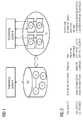
- FIG. 1 In the FIG. 1 are two common approaches for storage (storage) of elements (fragments) 1, ..., 4 of an industrial automation program contrasted.
- a first engineering system A (shown on the left) uses a database-based memory structure that includes both the elements 1,..., 4 and the dependencies, links and cross-relationships (symbolized as lines in the figure) between them.
- the database-based memory structure can be, for example, a relational database, with each element 1,..., 4 having its own data record or the like. is. That in the FIG.
- engineering system B shown on the right side uses a file-based memory structure, wherein each of the elements 1,..., 4 is stored in a single file, wherein the respective file is read from or stored in a mass memory individually for processing, use or display can be.
- each of the elements 1,..., 4 is stored in a single file, wherein the respective file is read from or stored in a mass memory individually for processing, use or display can be.
- several elements or fragments can also be stored in a common file.
- the engineering systems A, B serve to create and manage automation programs in industrial automation arrangements
- these systems may also have a different functionality
- the engineering system B may also be a version management system for a plurality of users of a manufacturer of Be automation arrangements, in which case the engineering system B with the associated file storage of the overall management of the projects with the elements 1, ..., 4 is used
- the engineering system A is mainly a programming system for a single user, in the processing of a Project or program would like to take advantage of a database-based filing system.
- both elements 1,..., 4 of the database-based system can be changed between two synchronization processes, as well as those of the file-based storage system. Possible changes may also relate to the dependencies or cross relationships between the elements, which are mapped differently in both storage systems, but still need to be synchronized.
- the goal of any synchronization is to exchange or import or export only those elements that have been changed, deleted or newly added since the last synchronization process.
- the synchronization direction that is, whether an item to be synchronized must be imported or exported from the point of view of the database-based system.
- those elements must also be identified that require a decision, ie, for which a user must decide which of the versions of the corresponding element, ie a version from the database-based storage system or from the file-based storage system, will ultimately be used for both "worlds" should.
- a synchronization protocol is shown which is either created or changed ("update") with each synchronization.
- the in the FIG. 2 structure shown here is an example of a table. Other forms of storage and display modes are of course possible.
- a row (table entry) is created or updated for each synchronized element 1,..., 4, the elements each having its own identification number ID ("engineering system ID"). This identification number ID is immutable for each element, irrespective of whether the corresponding element is edited, functionally changed, converted or the like.
- the "working copy storage path" is stored, which is the storage information for the corresponding element in the file-based storage system (file-based storage structure, file system).
- a so-called digital fingerprint is generated via the representation (stored representation) of the element and stored in the synchronization protocol.
- the digital fingerprint is based on the representation of the element in the database-based memory system and preferably by a functionality of the engineering System A, ie the "owner" of the database-based memory structure is calculated. Since all in the If digital fingerprints used in this method are generated by this functionality, the algorithm for generating the digital fingerprint need not be disclosed system-wide.
- the digital fingerprint may be a check value, for example a hash value or the like, the corresponding algorithm being designed such that different elements or elements with different functionality are also likely to produce a different digital fingerprint.
- Non-functional properties, such as formatting parameters for the representation should, however, if possible have no influence on the digital fingerprint.
- the digital fingerprint of the synchronized element is written both to the synchronization log, as well as to the file-based storage structure file in which the particular element is stored.
- the fingerprint can also be stored in the database-oriented memory structure for the element in question, which can speed up subsequent synchronizations, but requires that the fingerprint always be updated or at least invalidated whenever there is a change to the version of the element stored there.
- an integrity protection in this example a "CRC” called check value
- the check value may also be a so-called “hash value” or another suitable checksum that secures both the content, ie the synchronized element, and the digital fingerprint stored therewith in the file.
- Digital signatures, hash values or the like are also suitable as integrity protection.
- this check value does not have to be stored in the synchronization log, but can, as mentioned, be saved with the file. It must be ensured that changes are made to the file contents, ie the element or the fingerprint, the check value or, in general, the integrity protection.
- the synchronization protocol thus comprises at least one reference (eg "ID”) per element or “artifact” to the element in the "database-based repository", a second reference to the element in the “file-based repository”, and a fingerprint of the element in the "database-based repository” "at the time of the last sync.
- a timestamp (storage time) of the file in which the respective element was stored in the file-based storage structure and database information about the storage location of the element in the database-oriented storage structure can also be specified in the synchronization protocol.
- Another option is shown in the last column of the table (synchronization protocol); this is version information of a source code management system, which is considered exemplary as a second, file-based engineering system B.
- the "database-oriented repository” may also be synchronized with multiple "file-based repositories", in which case the synchronization protocol is extended accordingly or multiple synchronization protocols are managed.
- the integrity protection, ie the checksum of the corresponding file is valid, ie the content of the file has not changed since the last save time.
- each element or artifact is considered separately.
- the respective element is identified both in the database-based repository and in the corresponding file. If both elements no longer exist, ie neither stored in the database nor in the file system, no further action is necessary. If there is a version of the element in both storage systems, then some cases must be distinguished.
- the method outlined here makes it possible to limit synchronization to a subset of the database-based repository or file-based repository elements.
- a user or a system (software) can thus define a subset, so that the synchronization can be limited to functionally required elements or groups of instructions, artifacts, etc., and the realization or introduction of the described one Method in existing systems as a step solution can be done gradually.
Landscapes
- Engineering & Computer Science (AREA)
- Databases & Information Systems (AREA)
- Theoretical Computer Science (AREA)
- Computing Systems (AREA)
- Data Mining & Analysis (AREA)
- Physics & Mathematics (AREA)
- General Engineering & Computer Science (AREA)
- General Physics & Mathematics (AREA)
- Information Retrieval, Db Structures And Fs Structures Therefor (AREA)
Priority Applications (1)
| Application Number | Priority Date | Filing Date | Title |
|---|---|---|---|
| EP16188696.5A EP3296888A1 (fr) | 2016-09-14 | 2016-09-14 | Procédé et système d'ingénierie pour la synchronisation entre structures de stockage basées sur fichiers |
Applications Claiming Priority (1)
| Application Number | Priority Date | Filing Date | Title |
|---|---|---|---|
| EP16188696.5A EP3296888A1 (fr) | 2016-09-14 | 2016-09-14 | Procédé et système d'ingénierie pour la synchronisation entre structures de stockage basées sur fichiers |
Publications (1)
| Publication Number | Publication Date |
|---|---|
| EP3296888A1 true EP3296888A1 (fr) | 2018-03-21 |
Family
ID=57103785
Family Applications (1)
| Application Number | Title | Priority Date | Filing Date |
|---|---|---|---|
| EP16188696.5A Withdrawn EP3296888A1 (fr) | 2016-09-14 | 2016-09-14 | Procédé et système d'ingénierie pour la synchronisation entre structures de stockage basées sur fichiers |
Country Status (1)
| Country | Link |
|---|---|
| EP (1) | EP3296888A1 (fr) |
Cited By (1)
| Publication number | Priority date | Publication date | Assignee | Title |
|---|---|---|---|---|
| CN116484034A (zh) * | 2023-02-02 | 2023-07-25 | 北京彩漩科技有限公司 | 幻灯片级别的演示文稿更新方法和装置 |
Citations (4)
| Publication number | Priority date | Publication date | Assignee | Title |
|---|---|---|---|---|
| CA2609083A1 (fr) * | 2007-10-31 | 2009-04-30 | Caseware International Inc. | Dispositif, logiciel et methode de synchronisation de fichier hierarchisee |
| US20140181034A1 (en) * | 2012-12-21 | 2014-06-26 | Zetta, Inc. | Systems and methods for minimizing network bandwidth for replication/back up |
| EP2811352A1 (fr) * | 2013-06-05 | 2014-12-10 | Siemens Aktiengesellschaft | Procédé de traitement d'un projet d'automatisation par une pluralité de stations de traitement |
| US20150248466A1 (en) * | 2014-03-03 | 2015-09-03 | Netapp, Inc. | Data transfer between storage systems using data fingerprints |
-
2016
- 2016-09-14 EP EP16188696.5A patent/EP3296888A1/fr not_active Withdrawn
Patent Citations (4)
| Publication number | Priority date | Publication date | Assignee | Title |
|---|---|---|---|---|
| CA2609083A1 (fr) * | 2007-10-31 | 2009-04-30 | Caseware International Inc. | Dispositif, logiciel et methode de synchronisation de fichier hierarchisee |
| US20140181034A1 (en) * | 2012-12-21 | 2014-06-26 | Zetta, Inc. | Systems and methods for minimizing network bandwidth for replication/back up |
| EP2811352A1 (fr) * | 2013-06-05 | 2014-12-10 | Siemens Aktiengesellschaft | Procédé de traitement d'un projet d'automatisation par une pluralité de stations de traitement |
| US20150248466A1 (en) * | 2014-03-03 | 2015-09-03 | Netapp, Inc. | Data transfer between storage systems using data fingerprints |
Cited By (1)
| Publication number | Priority date | Publication date | Assignee | Title |
|---|---|---|---|---|
| CN116484034A (zh) * | 2023-02-02 | 2023-07-25 | 北京彩漩科技有限公司 | 幻灯片级别的演示文稿更新方法和装置 |
Similar Documents
| Publication | Publication Date | Title |
|---|---|---|
| EP1215589A2 (fr) | Provision de données de projets dans un format d'une meta-langue standardisée | |
| DE102016110939B3 (de) | Datenorganisationsverfahren und Entwicklungsumgebungssystem | |
| EP1430369B1 (fr) | Acces dynamique a des ressources d'automatisation | |
| AT522276B1 (de) | Vorrichtung und Verfahren zur Integritätsprüfung von Sensordatenströmen | |
| WO2009013132A2 (fr) | Procédé et dispositif permettant de vérifier l'intégrité de données mémorisées dans une zone prédéfinie d'une mémoire | |
| EP2439691A1 (fr) | Dispositif et procédé d'établissement mécanique d'un schéma de processus | |
| EP4181000A1 (fr) | Procédé et environnement de calcul permettant de créer et d'appliquer un algorithme de vérification pour les processus de calcul | |
| EP3667597A1 (fr) | Procédé de détermination d'une identité d'un produit au moyen de la détection d'une caractéristique visible optiquement et d'une caractéristique invisible ainsi que système d'identification | |
| EP3719632B1 (fr) | Procédé et dispositif de gestion des modules logiciels et des objets | |
| EP3320431A1 (fr) | Procédé mis en oeuvre par ordinateur pour le traitement de variantes d'objet de données | |
| DE102015103740A1 (de) | Verfahren und Vorrichtung zum Verarbeiten und Übertragen von Daten innerhalb eines funktional sicheren elektrischen, elektronischen oder programmierbar elektronischen Systems | |
| EP3692424B1 (fr) | Procédé de traitement d'un projet de logiciel | |
| DE3842286C2 (de) | Verfahren zur Verarbeitung von Daten in einem verteilten Verarbeitungssystem | |
| EP4078393B1 (fr) | Methode et systeme calculateur pour generer des donnees d'une structure de donnees | |
| DE3689502T2 (de) | System und Verfahren zur Programmstrukturierung durch Datentabellenübersetzung. | |
| EP2405317B1 (fr) | Procédé de paramétrage assuré sûr d'un appareil | |
| EP3028182A1 (fr) | Procédé et système de synchronisation de données | |
| EP1701266A1 (fr) | Appareil de test pour vérifier un traitment par lots | |
| EP2811352A1 (fr) | Procédé de traitement d'un projet d'automatisation par une pluralité de stations de traitement | |
| EP3809260A1 (fr) | Système et procédé d'administration des appareils d'imagerie | |
| EP1331534A2 (fr) | Système d'automatisation et procédé de génération de documentation | |
| DE10138533A1 (de) | Bereitstellung von Projekt- und/oder Projektierungsdaten eines Automatisierungsprojekts in einem durch eine standardisierte Meta-Sprache, insbesondere XML, definiertem Format | |
| EP2329374A1 (fr) | Module de test et procédé destiné à tester un intergiciel de mapping o/r | |
| EP1643336A1 (fr) | Identification de produits non équivoque | |
| EP2037375B1 (fr) | Procédé de fonctionnement de bases de données |
Legal Events
| Date | Code | Title | Description |
|---|---|---|---|
| PUAI | Public reference made under article 153(3) epc to a published international application that has entered the european phase |
Free format text: ORIGINAL CODE: 0009012 |
|
| AK | Designated contracting states |
Kind code of ref document: A1 Designated state(s): AL AT BE BG CH CY CZ DE DK EE ES FI FR GB GR HR HU IE IS IT LI LT LU LV MC MK MT NL NO PL PT RO RS SE SI SK SM TR |
|
| AX | Request for extension of the european patent |
Extension state: BA ME |
|
| STAA | Information on the status of an ep patent application or granted ep patent |
Free format text: STATUS: THE APPLICATION IS DEEMED TO BE WITHDRAWN |
|
| 18D | Application deemed to be withdrawn |
Effective date: 20180922 |