EP3297003B1 - Matériau d'aimant sm-fe-n et aimant sm-fe-n lié - Google Patents
Matériau d'aimant sm-fe-n et aimant sm-fe-n lié Download PDFInfo
- Publication number
- EP3297003B1 EP3297003B1 EP17191126.6A EP17191126A EP3297003B1 EP 3297003 B1 EP3297003 B1 EP 3297003B1 EP 17191126 A EP17191126 A EP 17191126A EP 3297003 B1 EP3297003 B1 EP 3297003B1
- Authority
- EP
- European Patent Office
- Prior art keywords
- magnet
- magnet material
- temperature
- magnets
- bonded
- Prior art date
- Legal status (The legal status is an assumption and is not a legal conclusion. Google has not performed a legal analysis and makes no representation as to the accuracy of the status listed.)
- Active
Links
Images

Classifications
-
- H—ELECTRICITY
- H01—ELECTRIC ELEMENTS
- H01F—MAGNETS; INDUCTANCES; TRANSFORMERS; SELECTION OF MATERIALS FOR THEIR MAGNETIC PROPERTIES
- H01F1/00—Magnets or magnetic bodies characterised by the magnetic materials therefor; Selection of materials for their magnetic properties
- H01F1/01—Magnets or magnetic bodies characterised by the magnetic materials therefor; Selection of materials for their magnetic properties of inorganic materials
- H01F1/03—Magnets or magnetic bodies characterised by the magnetic materials therefor; Selection of materials for their magnetic properties of inorganic materials characterised by their coercivity
- H01F1/032—Magnets or magnetic bodies characterised by the magnetic materials therefor; Selection of materials for their magnetic properties of inorganic materials characterised by their coercivity of hard-magnetic materials
- H01F1/04—Magnets or magnetic bodies characterised by the magnetic materials therefor; Selection of materials for their magnetic properties of inorganic materials characterised by their coercivity of hard-magnetic materials metals or alloys
- H01F1/047—Alloys characterised by their composition
- H01F1/053—Alloys characterised by their composition containing rare earth metals
- H01F1/055—Alloys characterised by their composition containing rare earth metals and magnetic transition metals, e.g. SmCo5
- H01F1/059—Alloys characterised by their composition containing rare earth metals and magnetic transition metals, e.g. SmCo5 and Va elements, e.g. Sm2Fe17N2
-
- H—ELECTRICITY
- H01—ELECTRIC ELEMENTS
- H01F—MAGNETS; INDUCTANCES; TRANSFORMERS; SELECTION OF MATERIALS FOR THEIR MAGNETIC PROPERTIES
- H01F1/00—Magnets or magnetic bodies characterised by the magnetic materials therefor; Selection of materials for their magnetic properties
- H01F1/01—Magnets or magnetic bodies characterised by the magnetic materials therefor; Selection of materials for their magnetic properties of inorganic materials
- H01F1/03—Magnets or magnetic bodies characterised by the magnetic materials therefor; Selection of materials for their magnetic properties of inorganic materials characterised by their coercivity
- H01F1/032—Magnets or magnetic bodies characterised by the magnetic materials therefor; Selection of materials for their magnetic properties of inorganic materials characterised by their coercivity of hard-magnetic materials
- H01F1/04—Magnets or magnetic bodies characterised by the magnetic materials therefor; Selection of materials for their magnetic properties of inorganic materials characterised by their coercivity of hard-magnetic materials metals or alloys
- H01F1/047—Alloys characterised by their composition
- H01F1/053—Alloys characterised by their composition containing rare earth metals
- H01F1/055—Alloys characterised by their composition containing rare earth metals and magnetic transition metals, e.g. SmCo5
- H01F1/0555—Alloys characterised by their composition containing rare earth metals and magnetic transition metals, e.g. SmCo5 pressed, sintered or bonded together
- H01F1/0558—Alloys characterised by their composition containing rare earth metals and magnetic transition metals, e.g. SmCo5 pressed, sintered or bonded together bonded together
-
- H—ELECTRICITY
- H01—ELECTRIC ELEMENTS
- H01F—MAGNETS; INDUCTANCES; TRANSFORMERS; SELECTION OF MATERIALS FOR THEIR MAGNETIC PROPERTIES
- H01F1/00—Magnets or magnetic bodies characterised by the magnetic materials therefor; Selection of materials for their magnetic properties
- H01F1/01—Magnets or magnetic bodies characterised by the magnetic materials therefor; Selection of materials for their magnetic properties of inorganic materials
- H01F1/03—Magnets or magnetic bodies characterised by the magnetic materials therefor; Selection of materials for their magnetic properties of inorganic materials characterised by their coercivity
- H01F1/032—Magnets or magnetic bodies characterised by the magnetic materials therefor; Selection of materials for their magnetic properties of inorganic materials characterised by their coercivity of hard-magnetic materials
- H01F1/04—Magnets or magnetic bodies characterised by the magnetic materials therefor; Selection of materials for their magnetic properties of inorganic materials characterised by their coercivity of hard-magnetic materials metals or alloys
- H01F1/047—Alloys characterised by their composition
- H01F1/053—Alloys characterised by their composition containing rare earth metals
-
- C—CHEMISTRY; METALLURGY
- C22—METALLURGY; FERROUS OR NON-FERROUS ALLOYS; TREATMENT OF ALLOYS OR NON-FERROUS METALS
- C22C—ALLOYS
- C22C33/00—Making ferrous alloys
- C22C33/02—Making ferrous alloys by powder metallurgy
- C22C33/0257—Making ferrous alloys by powder metallurgy characterised by the range of the alloying elements
- C22C33/0278—Making ferrous alloys by powder metallurgy characterised by the range of the alloying elements with at least one alloying element having a minimum content above 5%
-
- C—CHEMISTRY; METALLURGY
- C22—METALLURGY; FERROUS OR NON-FERROUS ALLOYS; TREATMENT OF ALLOYS OR NON-FERROUS METALS
- C22C—ALLOYS
- C22C38/00—Ferrous alloys, e.g. steel alloys
- C22C38/005—Ferrous alloys, e.g. steel alloys containing rare earths, i.e. Sc, Y, Lanthanides
-
- H—ELECTRICITY
- H01—ELECTRIC ELEMENTS
- H01F—MAGNETS; INDUCTANCES; TRANSFORMERS; SELECTION OF MATERIALS FOR THEIR MAGNETIC PROPERTIES
- H01F1/00—Magnets or magnetic bodies characterised by the magnetic materials therefor; Selection of materials for their magnetic properties
- H01F1/01—Magnets or magnetic bodies characterised by the magnetic materials therefor; Selection of materials for their magnetic properties of inorganic materials
- H01F1/03—Magnets or magnetic bodies characterised by the magnetic materials therefor; Selection of materials for their magnetic properties of inorganic materials characterised by their coercivity
- H01F1/032—Magnets or magnetic bodies characterised by the magnetic materials therefor; Selection of materials for their magnetic properties of inorganic materials characterised by their coercivity of hard-magnetic materials
- H01F1/04—Magnets or magnetic bodies characterised by the magnetic materials therefor; Selection of materials for their magnetic properties of inorganic materials characterised by their coercivity of hard-magnetic materials metals or alloys
- H01F1/047—Alloys characterised by their composition
- H01F1/053—Alloys characterised by their composition containing rare earth metals
- H01F1/055—Alloys characterised by their composition containing rare earth metals and magnetic transition metals, e.g. SmCo5
- H01F1/0551—Alloys characterised by their composition containing rare earth metals and magnetic transition metals, e.g. SmCo5 in the form of particles, e.g. rapid quenched powders or ribbon flakes
-
- H—ELECTRICITY
- H01—ELECTRIC ELEMENTS
- H01F—MAGNETS; INDUCTANCES; TRANSFORMERS; SELECTION OF MATERIALS FOR THEIR MAGNETIC PROPERTIES
- H01F1/00—Magnets or magnetic bodies characterised by the magnetic materials therefor; Selection of materials for their magnetic properties
- H01F1/01—Magnets or magnetic bodies characterised by the magnetic materials therefor; Selection of materials for their magnetic properties of inorganic materials
- H01F1/03—Magnets or magnetic bodies characterised by the magnetic materials therefor; Selection of materials for their magnetic properties of inorganic materials characterised by their coercivity
- H01F1/032—Magnets or magnetic bodies characterised by the magnetic materials therefor; Selection of materials for their magnetic properties of inorganic materials characterised by their coercivity of hard-magnetic materials
- H01F1/04—Magnets or magnetic bodies characterised by the magnetic materials therefor; Selection of materials for their magnetic properties of inorganic materials characterised by their coercivity of hard-magnetic materials metals or alloys
- H01F1/047—Alloys characterised by their composition
- H01F1/053—Alloys characterised by their composition containing rare earth metals
- H01F1/055—Alloys characterised by their composition containing rare earth metals and magnetic transition metals, e.g. SmCo5
- H01F1/059—Alloys characterised by their composition containing rare earth metals and magnetic transition metals, e.g. SmCo5 and Va elements, e.g. Sm2Fe17N2
- H01F1/0596—Alloys characterised by their composition containing rare earth metals and magnetic transition metals, e.g. SmCo5 and Va elements, e.g. Sm2Fe17N2 of rhombic or rhombohedral Th2Zn17 structure or hexagonal Th2Ni17 structure
-
- H—ELECTRICITY
- H01—ELECTRIC ELEMENTS
- H01F—MAGNETS; INDUCTANCES; TRANSFORMERS; SELECTION OF MATERIALS FOR THEIR MAGNETIC PROPERTIES
- H01F1/00—Magnets or magnetic bodies characterised by the magnetic materials therefor; Selection of materials for their magnetic properties
- H01F1/01—Magnets or magnetic bodies characterised by the magnetic materials therefor; Selection of materials for their magnetic properties of inorganic materials
- H01F1/03—Magnets or magnetic bodies characterised by the magnetic materials therefor; Selection of materials for their magnetic properties of inorganic materials characterised by their coercivity
- H01F1/032—Magnets or magnetic bodies characterised by the magnetic materials therefor; Selection of materials for their magnetic properties of inorganic materials characterised by their coercivity of hard-magnetic materials
- H01F1/04—Magnets or magnetic bodies characterised by the magnetic materials therefor; Selection of materials for their magnetic properties of inorganic materials characterised by their coercivity of hard-magnetic materials metals or alloys
- H01F1/06—Magnets or magnetic bodies characterised by the magnetic materials therefor; Selection of materials for their magnetic properties of inorganic materials characterised by their coercivity of hard-magnetic materials metals or alloys in the form of particles, e.g. powder
-
- H—ELECTRICITY
- H01—ELECTRIC ELEMENTS
- H01F—MAGNETS; INDUCTANCES; TRANSFORMERS; SELECTION OF MATERIALS FOR THEIR MAGNETIC PROPERTIES
- H01F1/00—Magnets or magnetic bodies characterised by the magnetic materials therefor; Selection of materials for their magnetic properties
- H01F1/01—Magnets or magnetic bodies characterised by the magnetic materials therefor; Selection of materials for their magnetic properties of inorganic materials
- H01F1/03—Magnets or magnetic bodies characterised by the magnetic materials therefor; Selection of materials for their magnetic properties of inorganic materials characterised by their coercivity
- H01F1/12—Magnets or magnetic bodies characterised by the magnetic materials therefor; Selection of materials for their magnetic properties of inorganic materials characterised by their coercivity of soft-magnetic materials
- H01F1/14—Magnets or magnetic bodies characterised by the magnetic materials therefor; Selection of materials for their magnetic properties of inorganic materials characterised by their coercivity of soft-magnetic materials metals or alloys
- H01F1/147—Alloys characterised by their composition
- H01F1/14766—Fe-Si based alloys
- H01F1/14791—Fe-Si-Al based alloys, e.g. Sendust
-
- H—ELECTRICITY
- H01—ELECTRIC ELEMENTS
- H01F—MAGNETS; INDUCTANCES; TRANSFORMERS; SELECTION OF MATERIALS FOR THEIR MAGNETIC PROPERTIES
- H01F41/00—Apparatus or processes specially adapted for manufacturing or assembling magnets, inductances or transformers; Apparatus or processes specially adapted for manufacturing materials characterised by their magnetic properties
- H01F41/02—Apparatus or processes specially adapted for manufacturing or assembling magnets, inductances or transformers; Apparatus or processes specially adapted for manufacturing materials characterised by their magnetic properties for manufacturing cores, coils, or magnets
- H01F41/0253—Apparatus or processes specially adapted for manufacturing or assembling magnets, inductances or transformers; Apparatus or processes specially adapted for manufacturing materials characterised by their magnetic properties for manufacturing cores, coils, or magnets for manufacturing permanent magnets
-
- B—PERFORMING OPERATIONS; TRANSPORTING
- B22—CASTING; POWDER METALLURGY
- B22F—WORKING METALLIC POWDER; MANUFACTURE OF ARTICLES FROM METALLIC POWDER; MAKING METALLIC POWDER; APPARATUS OR DEVICES SPECIALLY ADAPTED FOR METALLIC POWDER
- B22F1/00—Metallic powder; Treatment of metallic powder, e.g. to facilitate working or to improve properties
- B22F1/10—Metallic powder containing lubricating or binding agents; Metallic powder containing organic material
- B22F1/102—Metallic powder coated with organic material
-
- B—PERFORMING OPERATIONS; TRANSPORTING
- B22—CASTING; POWDER METALLURGY
- B22F—WORKING METALLIC POWDER; MANUFACTURE OF ARTICLES FROM METALLIC POWDER; MAKING METALLIC POWDER; APPARATUS OR DEVICES SPECIALLY ADAPTED FOR METALLIC POWDER
- B22F9/00—Making metallic powder or suspensions thereof
- B22F9/02—Making metallic powder or suspensions thereof using physical processes
- B22F9/04—Making metallic powder or suspensions thereof using physical processes starting from solid material, e.g. by crushing, grinding or milling
- B22F2009/048—Making metallic powder or suspensions thereof using physical processes starting from solid material, e.g. by crushing, grinding or milling by pulverising a quenched ribbon
-
- B—PERFORMING OPERATIONS; TRANSPORTING
- B22—CASTING; POWDER METALLURGY
- B22F—WORKING METALLIC POWDER; MANUFACTURE OF ARTICLES FROM METALLIC POWDER; MAKING METALLIC POWDER; APPARATUS OR DEVICES SPECIALLY ADAPTED FOR METALLIC POWDER
- B22F2998/00—Supplementary information concerning processes or compositions relating to powder metallurgy
- B22F2998/10—Processes characterised by the sequence of their steps
-
- B—PERFORMING OPERATIONS; TRANSPORTING
- B22—CASTING; POWDER METALLURGY
- B22F—WORKING METALLIC POWDER; MANUFACTURE OF ARTICLES FROM METALLIC POWDER; MAKING METALLIC POWDER; APPARATUS OR DEVICES SPECIALLY ADAPTED FOR METALLIC POWDER
- B22F2999/00—Aspects linked to processes or compositions used in powder metallurgy
-
- B—PERFORMING OPERATIONS; TRANSPORTING
- B22—CASTING; POWDER METALLURGY
- B22F—WORKING METALLIC POWDER; MANUFACTURE OF ARTICLES FROM METALLIC POWDER; MAKING METALLIC POWDER; APPARATUS OR DEVICES SPECIALLY ADAPTED FOR METALLIC POWDER
- B22F9/00—Making metallic powder or suspensions thereof
- B22F9/02—Making metallic powder or suspensions thereof using physical processes
- B22F9/04—Making metallic powder or suspensions thereof using physical processes starting from solid material, e.g. by crushing, grinding or milling
-
- H—ELECTRICITY
- H01—ELECTRIC ELEMENTS
- H01F—MAGNETS; INDUCTANCES; TRANSFORMERS; SELECTION OF MATERIALS FOR THEIR MAGNETIC PROPERTIES
- H01F41/00—Apparatus or processes specially adapted for manufacturing or assembling magnets, inductances or transformers; Apparatus or processes specially adapted for manufacturing materials characterised by their magnetic properties
- H01F41/02—Apparatus or processes specially adapted for manufacturing or assembling magnets, inductances or transformers; Apparatus or processes specially adapted for manufacturing materials characterised by their magnetic properties for manufacturing cores, coils, or magnets
- H01F41/0253—Apparatus or processes specially adapted for manufacturing or assembling magnets, inductances or transformers; Apparatus or processes specially adapted for manufacturing materials characterised by their magnetic properties for manufacturing cores, coils, or magnets for manufacturing permanent magnets
- H01F41/0266—Moulding; Pressing
Definitions
- the present invention relates to an Sm-Fe-N (samarium-iron-nitrogen) magnet and an isotropic Sm-Fe-N bonded magnet suitable for use in applications where small size, small thickness, or complicated shape is required.
- Sm-Fe-N sinarium-iron-nitrogen
- Nd-Fe-B neodymium-iron-boron magnets are mainly used as permanent magnets for applications where high magnetic force (maximum energy product) is required.
- Sm-Fe-N magnets are known as magnets which are superior in property to the Nd-Fe-B magnets (Patent Document 1 and Non-Patent Document 1).
- Sm-Fe-N magnets have the merits of being comparable in saturation magnetic polarization to the Nd-Fe-B magnets and higher in anisotropic magnetic field and Curie temperature than the Nd-Fe-B magnets and being less apt to oxidize and rust.
- powders for use as raw materials for magnets are classified by magnetism into isotropic magnet powders and anisotropic magnet powders.
- isotropic magnet powder means a powder in which each of the alloy powder particles is configured of a large number of fine crystal grains and the directions of easy magnetization of the individual crystal grains are random.
- anisotropic magnetic powder means a powder in which each of the alloy powder particles is a single crystal or in which each of the alloy powder particles is configured of a large number of crystal grains and the directions of easy magnetization of the individual crystal grains in each particle have been oriented in a specific direction.
- the Sm-Fe-N alloy powders mainly include: isotropic magnet powders in which the main phase thereof has a hexagonal crystal structure that is metastable and is called the TbCu 7 type and which is obtained, for example, by a melt-quench method; and anisotropic magnet powders in which the main phase thereof has a rhombohedral crystal structure called the Th 2 Zn 17 type and is a stable phase.
- the crystals which constitute Sm-Fe-N magnets decompose upon heating to a temperature exceeding about 500°C. Because of this, Sm-Fe-N magnets cannot be produced as sintered magnets, for which heating to a temperature around 1,000°C is necessary during the production, and are used as bonded magnets.
- a bonded magnet is produced by mixing a magnet powder and a binder and molding the resultant compound with a compression molding machine, injection molding machine, or the like.
- the bonded magnets hence are inferior in magnetic flux density to the sintered magnets by an amount corresponding to the presence of the binder and voids, but have a merit in that bonded magnets which are small or thin or have a complicated shape can be easily obtained.
- isotropic Sm-Fe-N bonded magnets produced from powders of TbCu 7 -type isotropic magnets are low in maximum energy product as compared with anisotropic Sm-Fe-N bonded magnets produced from powders of Th 2 Zn 17 -type anisotropic magnets, but have an advantage in that since there is no need of applying a magnetic field during the molding, the production efficiency is high and the freedom of designing magnetization patters is high.
- isotropic Sm-Fe-N bonded magnets are used in, for example, automotive motors that are used in severe environments.
- Patent Document 1 JP-A-2002-057017
- Non-Patent Document 1 Ryo Omatsuzawa, Kimitoshi Murashige, and Takahiko Iriyama, "Structure and Magnetic Properties of SmFeN Prepared by Rapid-Quenching Method", DENKI-SEIKO (Electric Furnace Steel), Daido Steel Co., Ltd., Vol.73, No.4, pp.235-242, published in October, 2002
- a magnet which has been magnetized decreases in magnetic flux density as the temperature rises. In cases when the temperature which has temporarily been heightened declines to room temperature, the magnet does not completely recover the original magnetic flux density although partly recovering the magnetic flux density.
- thermal demagnetization Such a decrease in magnetic flux density which occurs upon heating from room temperature
- reversible demagnetization that part of the thermal demagnetization by which the magnetic flux density recovers upon cooling to room temperature
- irreversible demagnetization the part which remains unrecovered
- a value obtained by dividing the difference between the "magnetic flux measured after temperature rise and subsequent return to room temperature (after demagnetization)" and the “magnetic flux measured at room temperature after magnetization and before temperature rise (before demagnetization)" by the latter magnetic flux is called “irreversible demagnetizing factor”.
- the demagnetizing factor and the irreversible demagnetizing factor have negative values.
- the magnetic flux density decreases (the magnet is demagnetized) at a relatively high rate over the period when the temperature rises and reaches a predetermined temperature, but the magnetic flux density gradually decreases (the magnet is gradually demagnetized) also during the period when the magnet is held at that temperature over a long period. Since it is difficult to measure the magnetic flux of the magnet in a heated state as stated above, the demagnetization which occurs during the period when the magnet is heated to a predetermined temperature is evaluated using an initial demagnetizing factor determined from the magnetic flux measured when the magnet which was held at that predetermined temperature for 1 hour has been returned to room temperature.
- the demagnetization which occurs during the period when the magnet is held at a predetermined temperature over a long period is evaluated using the decrease amount of an irreversible demagnetizing factor from the initial demagnetizing factor, the irreversible demagnetizing factor being determined from the magnetic flux measured when the magnet which was held at that predetermined temperature over the long period has been returned to room temperature.
- the conventional Sm-Fe-N bonded magnets kept being heated show a lower degree of demagnetization with the lapse of time than Nd-Fe-B bonded magnets.
- the irreversible demagnetizing factor thereof for example, due to 2,000-hour holding at 120-150°C in the air is lower than the initial demagnetizing factor by as large as 2% or more.
- the bonded magnet In order for an Sm-Fe-N bonded magnet to be used in a high-temperature environment over a long period, the bonded magnet needs to be inhibited, as much as possible, from suffering such demagnetization.
- An object of the present invention according to claim 1 is to provide an Sm-Fe-N magnet material and an Sm-Fe-N bonded magnet which are isotropic (TbCu 7 type) and are suitable for long-term use in high-temperature environments.
- the present invention relates to the following items (1) to (5).
- the present inventors made an experiment in which Sm-Fe-N magnet materials were held in a high-temperature environment (120°C in this experiment) in the air for a long period. As a result, the following were ascertained.
- the absolute value of the decrease amount of the irreversible demagnetizing factor as measured after holding over a sufficiently long time period (2,000 hours in this experiment) from the initial demagnetizing factor was larger than 2.2%.
- the at least one element (hereinafter referred to as element T) selected from the group consisting of Hf, Zr, and Sc is an element added in order to obtain a TbCu 7 -type structure.
- element T the saturation magnetization can be heightened and the Curie temperature can be elevated to improve the heat resistance.
- the saturation magnetic flux density and the residual magnetization undesirably decrease, rather than increase. Consequently, the content of Co is 35% or less.
- the Sm-Fe-N magnet material according to the present invention can contain, as unavoidable impurities, O (oxygen) and H (hydrogen) each in an amount of up to 0.3 at% and Cr (chromium), Ni (nickel), and Cu (copper) each in an amount of up to 0.1 at%. Furthermore, the Sm-Fe-N magnet material according to the present invention may contain C (carbon) in an amount of up to 0.5 at%. Any Sm-Fe-N magnet material which contains these elements in amounts within the respective ranges is included in the present invention so long as the magnet material includes Sm, element T, Mn, N, Fe, and Co in amounts within the respective ranges described above (Co may not be contained).
- the measured value is rounded off to the effective digits by correcting the digit succeeding the effective digits.
- this content satisfies the requirement according to the present invention.
- the measured value is rounded off by correcting the digit in the second decimal place to give "0.1 at%", which is within the range. Consequently, the measured value satisfies the requirement concerning Mn content.
- the Sm-Fe-N magnet material according to the present invention includes Si (silicon) in an amount of 0.1-0.5 at%.
- Si silicon
- the thermal demagnetization of the Sm-Fe-N magnet material according to the present invention can be further diminished also by incorporating Al (aluminum) thereinto in an amount of 0.1-0.5 at%.
- the Sm-Fe-N magnet material according to the present invention may contain either Si or Al in an amount of 0.1-0.5 at%, or may contain both Si and Al in an amount of 0.1-0.5 at% each.
- the Sm-Fe-N bonded magnet according to the present invention includes a powder of the Sm-Fe-N magnet material according to the present invention and a binder.
- the Sm-Fe-N magnet material of the present invention includes: 7.0-12 at% of Sm; 0.1-1.5 at% of at least one element (element T) selected from the group consisting of Hf, Zr, and Sc; 0.1-0.5 at% of Mn, 10-20 at% of N, and 0-35 at% of Co, with the remainder being Fe and unavoidable impurities.
- This Sm-Fe-N magnet material can be produced, for example, by the following method.
- the components shown above, excluding N, are mixed together and melted to thereby produce a melt serving as a raw material.
- this melt is jetted to the surface of a roll which is rotating at a high speed, thereby rapidly cooling the melt to produce a ribbon of an alloy.
- This ribbon is heat-treated in an inert atmosphere at a temperature in the range of 700-800°C to thereby change some of the amorphous and metastable phases into a stable phase. This operation is conducted in order to enable the alloy to have a higher coercive force after the subsequent nitriding.
- the ribbon is heated in a gas which contains molecules having nitrogen atoms to thereby obtain nitrided powder.
- a mixed gas containing ammonia and hydrogen is suitable for use as the gas containing molecules including nitrogen atoms.
- ammonia gas is the gas including molecules including nitrogen atoms.
- the heating temperature and pressure in the nitriding depend on the gas used. In an example, in cases when a gas containing ammonia and hydrogen in a volume ratio of 1:3 is used, a heating temperature of about 450°C is used and the pressure is regulated to substantially atmospheric pressure (slightly higher than atmospheric pressure) by performing the treatment while passing the gas through the tube furnace.
- Sm-Fe-N magnet powder a powder-form Sm-Fe-N magnet material (hereinafter referred to as "Sm-Fe-N magnet powder") is obtained.
- the Sm-Fe-N magnets generally include ones in which the main phase thereof has a Th 2 Zn 17 -type crystal structure and ones in which the main phase thereof has a TbCu 7 -type crystal structure.
- an Sm-Fe-N magnet powder in which the main phase thereof has a TbCu 7 -type crystal structure is obtained by incorporating element T in an amount of 0.1-1.5 at%.
- the Sm-Fe-N magnet powder according to this embodiment it is possible to further incorporate Si in an amount of 0.1-0.5 at% or to further incorporate Al in an amount of 0.1-0.5 at%.
- an Sm-Fe-N magnet powder may be produced in the same manner as described above.
- the Sm-Fe-N bonded magnet according to this embodiment can be produced by mixing the Sm-Fe-N magnet powder produced by the method described above with a binder and molding the mixture.
- a binder use can be made of a thermosetting resin such as an epoxy resin or a thermoplastic resin such as a nylon.
- the Sm-Fe-N magnet powder according to the embodiment described above is mixed with 2% by mass of an epoxy resin, and this mixture is compression-molded.
- an Sm-Fe-N bonded magnet according to this embodiment is obtained.
- the contents of Si and Al are each 0.04 at% or less (less than 0.1 at% when the content values are rounded off by correcting the digits in the second decimal place).
- the content of Si is 0.05-0.54 at% (0.1-0.5 at% when the content values are rounded off likewise), and the content of Al is 0.04 at% or less.
- the content of Si is 0.04 at% or less, and the content of Al is 0.05-0.54 at%.
- the contents of Si and Al are each 0.05-0.54 at%.
- the samples of Comparative Examples are ones in each of which the content of Mn is 0.04 at% or less or is 0.55 at% or higher (the content is less than 0.1 at% or exceeds 0.5 at%, when rounded off by correcting the digit in the second decimal place).
- Example 1 7.37 3.83 13.6 0.14 1.02 - - 0.04 0.04 0.08
- Example 2 7.16 3.80 13.4 0.32 0.96 - - 0.04 0.03 0.10
- Example 3 7.54 3.82 13.2 0.48 0.97 - - 0.03 0.03 0.12
- Example 4 7.29 3.76 13.3 0.05 1.01 - - 0.12 0.03 0.06
- Example 5 7.30 3.81 13.2 0.15 1.05 - - 0.28 0.02 0.06
- Example 6 7.44 3.79 13.5 0.31 0.99 - - 0.52 0.04 0.04
- Example 7 7.42 3.82 13.6 0.32 0.32 0.98 - - 0.10 0.03 0.06
- Example 8 7.30 3.82 13.3 0.35 1.41 - - 0.21 0.03 0.04
- Example 9 7.42 3.81 13.1 0.09 - 1.52 - 0.18 0.04 0.03
- Example 10 7.35 3.83 13.7 0.12 - - 1.28 0.22 0.04 0.04
- Example 11 7.41 3.77 13.4 0.51 0.95
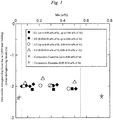
- the samples of the Examples and Comparative Examples were each subjected to an experiment in which the sample was examined for magnetic flux after magnetization and after the magnetized sample was held in a 120°C oven for 1 hour or for 2,000 hours and then cooled to room temperature.
- the "initial demagnetizing factor” and “irreversible demagnetizing factor due to 2,000-hour holding” were determined from the data obtained.
- the decrease amount of the irreversible demagnetizing factor due to 2,000-hour holding from the initial demagnetizing factor (hereinafter, the decrease amount is referred to as "decrease amount through 2,000-hour holding") was determined as shown in Fig. 1 and Table 2.
- Example 1 -6.68 -8.78 -2.10
- Example 2 -6.63 -8.73 -2.10
- Example 3 -6.63 -8.71 -2.08 G2
- Example 4 -6.70 -8.70 -2.00
- Example 5 -6.68 -8.61 -1.93
- Example 6 -6.63 -8.61 -1.98
- Example 7 -6.65 -8.63 -1.98
- Example 9 -6.65 -8.63 -1.98
- Example 10 -6.66 -8.66 -2.00
- Example 11 -6.63 -8.71 -2.08 G3
- Example 12 -6.63 -8.61 -1.98
- Example 13 -6.64 -8.64 -2.00
- Example 14 -6.64 -8.62 -1
- Fig. 2 shows changes in irreversible demagnetizing factor with the lapse of time in holding at 120°C, with respect to the samples of Example 1, Example 17, Comparative Example 2, and Comparative Example 3.
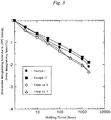
- Fig. 3 shows changes with the lapse of time in the decrease amounts of irreversible demagnetizing factors due to 120°C holding from the initial demagnetizing factors with respect to the same samples as in Fig. 2 .
- demagnetization occurs at a relatively high rate during heating from room temperature to the holding temperature, it can be seen from the graphs of Fig. 2 and Fig. 3 that after the holding temperature has been reached, demagnetization occurs linearly with the logarithmic lapse of time.
- the decrease amount of an irreversible demagnetizing factor from the initial demagnetizing factor can be reduced by heightening the room-temperature coercive force iH c by suitably setting the conditions (temperature, time period) for the heat treatment of the powder. In this case, however, the residual magnetic flux density B r decreases undesirably.
- Example 1 7.78 9.54 12.9
- Example 2 7.85 9.36 12.9
- Example 3 8.02 9.44 13.2 G2
- Example 4 8.02 9.53 13.5
- Example 5 8.01 9.43 13.4
- Example 6 8.03 9.54 13.7
- Example 7 8.02 9.36 13.3
- Example 8 8.02 9.46 13.2
- Example 9 7.98 9.45 13.1
- Example 10 7.99 9.51 12.9
- Example 11 8.04 9.55 13.5
- Example 12 8.03 9.43 13.1
- Example 13 7.88 9.47 13.5
- Example 14 7.96 9.51 12.9
- Example 15 8.01 9.53 13.2 G4
- Example 16 8.04 9.37 13.4
- Example 17 8.12 9.41 13.6
- Example 18 8.13 9.54 13.8
- Example 19 8.10 9.49 13.7 Comparative Example 1 7.88 9.52 13.1 Comparative Example 2 7.98 9.41 13.4 Comparative Example 3 7.78 9.53 12.9 Comparative Example 4 8.09 9.46 13.8
Landscapes
- Engineering & Computer Science (AREA)
- Chemical & Material Sciences (AREA)
- Power Engineering (AREA)
- Crystallography & Structural Chemistry (AREA)
- Inorganic Chemistry (AREA)
- Mechanical Engineering (AREA)
- Materials Engineering (AREA)
- Metallurgy (AREA)
- Organic Chemistry (AREA)
- Manufacturing & Machinery (AREA)
- Physics & Mathematics (AREA)
- Electromagnetism (AREA)
- Dispersion Chemistry (AREA)
- Hard Magnetic Materials (AREA)
- Powder Metallurgy (AREA)
Claims (10)
- Matériau d'aimant Sm-Fe-N comprenant :7,0 à 12 % atomique de Sm ;0,1 à 1,5 % atomique d'au moins un élément choisi dans le groupe constitué par Hf, Zr et Sc ;0,1 à 0,5 % atomique de Mn ;10 à 20 % atomique de N ;0 à 35 % atomique de Co,jusqu'à 0,5 % atomique de Si,jusqu'à 0,5 % atomique de C, etjusqu'à 0,5 % atomique d'Al,le reste étant Fe et des impuretés inévitables.
- Matériau d'aimant Sm-Fe-N selon la revendication 1, comprenant en outre 0,1 à 0,5 % atomique de Si.
- Matériau d'aimant Sm-Fe-N selon la revendication 1 ou 2, comprenant en outre 0,1 à 0,5 % atomique d'Al.
- Matériau d'aimant Sm-Fe-N selon l'une quelconque des revendications 1 à 3, dont une phase principale a une structure cristalline du type TbCu7.
- Aimant Sm-Fe-N lié comprenant une poudre du matériau d'aimant Sm-Fe-N selon l'une quelconque des revendications 1 à 4 et un liant.
- Utilisation de l'aimant Sm-Fe-N lié selon la revendication 5 dans un moteur automobile.
- Procédé de fabrication du matériau d'aimant Sm-Fe-N selon l'une quelconque des revendications 1 à 3, comprenant le mélange de ses composants, à l'exclusion de N, ensemble et la fusion pour produire ainsi une masse fondue ; l'éjection de la masse fondue à la surface d'un rouleau en rotation pour refroidir rapidement la masse fondue pour produire un ruban d'un alliage ; et le traitement à la chaleur du ruban dans une atmosphère inerte à une température dans la plage de 700 à 800 °C, suivi par une nitruration.
- Procédé selon la revendication 7, dans lequel la nitruration est réalisée par chauffage de l'alliage dans un gaz contenant des molécules ayant des atomes d'azote.
- Procédé selon la revendication 8, dans lequel les molécules sont des molécules d'ammoniac.
- Procédé selon la revendication 9, dans lequel le gaz contient de l'ammoniac et de l'hydrogène.
Applications Claiming Priority (1)
| Application Number | Priority Date | Filing Date | Title |
|---|---|---|---|
| JP2016181262A JP6862730B2 (ja) | 2016-09-16 | 2016-09-16 | Sm−Fe−N系磁石材料及びSm−Fe−N系ボンド磁石 |
Publications (2)
| Publication Number | Publication Date |
|---|---|
| EP3297003A1 EP3297003A1 (fr) | 2018-03-21 |
| EP3297003B1 true EP3297003B1 (fr) | 2019-03-20 |
Family
ID=59887070
Family Applications (1)
| Application Number | Title | Priority Date | Filing Date |
|---|---|---|---|
| EP17191126.6A Active EP3297003B1 (fr) | 2016-09-16 | 2017-09-14 | Matériau d'aimant sm-fe-n et aimant sm-fe-n lié |
Country Status (6)
| Country | Link |
|---|---|
| US (1) | US10658095B2 (fr) |
| EP (1) | EP3297003B1 (fr) |
| JP (1) | JP6862730B2 (fr) |
| KR (1) | KR101945362B1 (fr) |
| CN (1) | CN107833726B (fr) |
| DK (1) | DK3297003T3 (fr) |
Families Citing this family (1)
| Publication number | Priority date | Publication date | Assignee | Title |
|---|---|---|---|---|
| JP7095310B2 (ja) * | 2018-02-28 | 2022-07-05 | 大同特殊鋼株式会社 | Sm-Fe-N系磁石材料及びSm-Fe-N系ボンド磁石 |
Family Cites Families (21)
| Publication number | Priority date | Publication date | Assignee | Title |
|---|---|---|---|---|
| JP3135665B2 (ja) * | 1991-03-27 | 2001-02-19 | 株式会社東芝 | 磁性材料およびボンド磁石 |
| JPH0620813A (ja) * | 1992-05-08 | 1994-01-28 | Inter Metallics Kk | 希土類異方性永久磁石粉末及びその製造法 |
| JP3455557B2 (ja) | 1993-02-10 | 2003-10-14 | 株式会社東芝 | 磁性材料 |
| JPH06244013A (ja) | 1993-02-12 | 1994-09-02 | Tdk Corp | 磁石の製造方法 |
| JP3560387B2 (ja) * | 1994-05-25 | 2004-09-02 | 旭化成株式会社 | 磁性材料とその製造法 |
| JPH097006A (ja) | 1995-06-19 | 1997-01-10 | Yazaki Corp | タクシーメータ、タクシー用応答器、並びに、タクシー用運賃算出システム |
| JP3171558B2 (ja) * | 1995-06-30 | 2001-05-28 | 株式会社東芝 | 磁性材料およびボンド磁石 |
| JPH113812A (ja) * | 1997-04-03 | 1999-01-06 | Toshiba Corp | 永久磁石材料およびボンド磁石 |
| US5968290A (en) * | 1997-04-03 | 1999-10-19 | Kabushiki Kaisha Toshiba | Permanent magnet material and bonded magnet |
| JPH1187118A (ja) | 1997-09-01 | 1999-03-30 | Toshiba Corp | 磁石材料とその製造方法、およびそれを用いたボンド磁石 |
| JPH11293418A (ja) * | 1998-04-14 | 1999-10-26 | Hitachi Metals Ltd | 希土類磁石材料用母合金、希土類磁石材料およびその製造方法ならびにそれを用いた希土類ボンド磁石 |
| JP2000357606A (ja) | 1999-04-14 | 2000-12-26 | Hitachi Metals Ltd | 複合型等方性ボンド磁石およびそれを用いた回転機 |
| JP2001135509A (ja) * | 1999-08-20 | 2001-05-18 | Hitachi Metals Ltd | 等方性希土類磁石材料、等方性ボンド磁石、回転機およびマグネットロール |
| JP2001068315A (ja) * | 1999-08-26 | 2001-03-16 | Daido Steel Co Ltd | アトマイズ法磁石粉末、その製造方法およびそれを使用したボンド磁石 |
| TW503409B (en) | 2000-05-29 | 2002-09-21 | Daido Steel Co Ltd | Isotropic powdery magnet material, process for preparing and resin-bonded magnet |
| JP4899254B2 (ja) | 2000-05-29 | 2012-03-21 | 大同特殊鋼株式会社 | 等方性の粉末磁石材料、その製造方法およびボンド磁石 |
| JP4135447B2 (ja) * | 2002-09-17 | 2008-08-20 | 住友金属鉱山株式会社 | 高耐候性磁石粉、ボンド磁石用樹脂組成物及びそれを用いて得られるボンド磁石 |
| CN1434466A (zh) * | 2003-01-14 | 2003-08-06 | 浙江大学 | 高工作温度和高热稳定性的稀土磁性材料的组成 |
| JP4314244B2 (ja) * | 2006-01-12 | 2009-08-12 | 株式会社東芝 | 磁性材料粉末の製造方法およびボンド磁石の製造方法 |
| JP5668426B2 (ja) | 2010-11-18 | 2015-02-12 | 大同特殊鋼株式会社 | Sm−Fe−N系磁石用薄帯の製造方法 |
| WO2014190558A1 (fr) | 2013-05-31 | 2014-12-04 | 北京有色金属研究总院 | Poudres à aimantation permanente de terres rares, aimant collé comprenant lesdites poudres, et dispositif utilisant l'aimant collé |
-
2016
- 2016-09-16 JP JP2016181262A patent/JP6862730B2/ja active Active
-
2017
- 2017-09-11 US US15/701,085 patent/US10658095B2/en active Active
- 2017-09-13 CN CN201710822051.6A patent/CN107833726B/zh active Active
- 2017-09-14 EP EP17191126.6A patent/EP3297003B1/fr active Active
- 2017-09-14 DK DK17191126.6T patent/DK3297003T3/da active
- 2017-09-15 KR KR1020170118580A patent/KR101945362B1/ko active Active
Non-Patent Citations (1)
| Title |
|---|
| None * |
Also Published As
| Publication number | Publication date |
|---|---|
| KR20180030766A (ko) | 2018-03-26 |
| KR101945362B1 (ko) | 2019-02-07 |
| CN107833726A (zh) | 2018-03-23 |
| CN107833726B (zh) | 2020-05-22 |
| US10658095B2 (en) | 2020-05-19 |
| US20180082771A1 (en) | 2018-03-22 |
| JP6862730B2 (ja) | 2021-04-21 |
| JP2018046222A (ja) | 2018-03-22 |
| EP3297003A1 (fr) | 2018-03-21 |
| DK3297003T3 (da) | 2019-05-27 |
Similar Documents
| Publication | Publication Date | Title |
|---|---|---|
| JP7588618B2 (ja) | R-t-b系永久磁石 | |
| AU593183B1 (en) | Magnetic materials containing rare earth element iron nitrogen and hydrogen | |
| JP3741597B2 (ja) | 多元系希土類−鉄格子浸入型永久磁石材料、およびそれからなる永久磁石、ならびにそれらの製造方法 | |
| EP2077567B1 (fr) | Aimant fritté r-t-b | |
| JP6503483B2 (ja) | 高熱安定性の希土類永久磁石材料、その製造方法及びそれを含む磁石 | |
| CN108154988B (zh) | R-t-b系永久磁铁 | |
| JP4371188B2 (ja) | 高比電気抵抗性希土類磁石及びその製造方法 | |
| CN103180917A (zh) | 稀土-铁-氮系合金材料及其制备方法、稀土-铁系合金材料及其制备方法 | |
| US11742121B2 (en) | Sm—Fe—N magnet material and Sm—Fe—N bonded magnet | |
| EP3297003B1 (fr) | Matériau d'aimant sm-fe-n et aimant sm-fe-n lié | |
| CN111724955B (zh) | R-t-b系永久磁铁 | |
| WO2017191790A1 (fr) | Aimant permanent aux terres rares et son procédé de fabrication | |
| JPS62198103A (ja) | 希土類−鉄系永久磁石 | |
| CN115083715B (zh) | 一种非均质单晶磁粉及其制备方法和应用 | |
| JP2008223052A (ja) | 希土類磁石合金、希土類磁石合金薄帯の製造方法、およびボンド磁石 | |
| CN111145972B (zh) | RFeB系烧结磁体及其制造方法 | |
| CN111724961B (zh) | R-t-b系永久磁铁 | |
| JP2018046221A (ja) | Sm−Fe−N系磁石材料及びSm−Fe−N系ボンド磁石 | |
| CN115240946B (zh) | 一种钐铁氮基各向异性永磁材料及其制备方法与应用 | |
| JPH04143221A (ja) | 永久磁石の製造方法 | |
| JPH05112852A (ja) | 永久磁石合金 | |
| JP2004363531A (ja) | 希土類磁石粉末の製造方法および希土類ボンド磁石 | |
| CN103366939A (zh) | 永磁体的制造方法 | |
| JPH05112851A (ja) | 永久磁石合金 | |
| JPH023209A (ja) | 永久磁石およびその製造方法 |
Legal Events
| Date | Code | Title | Description |
|---|---|---|---|
| PUAI | Public reference made under article 153(3) epc to a published international application that has entered the european phase |
Free format text: ORIGINAL CODE: 0009012 |
|
| STAA | Information on the status of an ep patent application or granted ep patent |
Free format text: STATUS: REQUEST FOR EXAMINATION WAS MADE |
|
| 17P | Request for examination filed |
Effective date: 20170914 |
|
| AK | Designated contracting states |
Kind code of ref document: A1 Designated state(s): AL AT BE BG CH CY CZ DE DK EE ES FI FR GB GR HR HU IE IS IT LI LT LU LV MC MK MT NL NO PL PT RO RS SE SI SK SM TR |
|
| AX | Request for extension of the european patent |
Extension state: BA ME |
|
| RIC1 | Information provided on ipc code assigned before grant |
Ipc: B22F 9/04 20060101ALI20181010BHEP Ipc: B22F 1/00 20060101ALI20181010BHEP Ipc: C22C 33/02 20060101ALI20181010BHEP Ipc: C22C 38/00 20060101ALI20181010BHEP Ipc: H01F 1/059 20060101AFI20181010BHEP Ipc: H01F 1/055 20060101ALI20181010BHEP Ipc: H01F 41/02 20060101ALI20181010BHEP Ipc: B22F 9/16 20060101ALI20181010BHEP Ipc: C22C 1/10 20060101ALI20181010BHEP |
|
| GRAP | Despatch of communication of intention to grant a patent |
Free format text: ORIGINAL CODE: EPIDOSNIGR1 |
|
| STAA | Information on the status of an ep patent application or granted ep patent |
Free format text: STATUS: GRANT OF PATENT IS INTENDED |
|
| INTG | Intention to grant announced |
Effective date: 20181128 |
|
| GRAS | Grant fee paid |
Free format text: ORIGINAL CODE: EPIDOSNIGR3 |
|
| GRAA | (expected) grant |
Free format text: ORIGINAL CODE: 0009210 |
|
| STAA | Information on the status of an ep patent application or granted ep patent |
Free format text: STATUS: THE PATENT HAS BEEN GRANTED |
|
| AK | Designated contracting states |
Kind code of ref document: B1 Designated state(s): AL AT BE BG CH CY CZ DE DK EE ES FI FR GB GR HR HU IE IS IT LI LT LU LV MC MK MT NL NO PL PT RO RS SE SI SK SM TR |
|
| REG | Reference to a national code |
Ref country code: GB Ref legal event code: FG4D |
|
| REG | Reference to a national code |
Ref country code: CH Ref legal event code: EP |
|
| REG | Reference to a national code |
Ref country code: DE Ref legal event code: R096 Ref document number: 602017002821 Country of ref document: DE |
|
| REG | Reference to a national code |
Ref country code: AT Ref legal event code: REF Ref document number: 1111336 Country of ref document: AT Kind code of ref document: T Effective date: 20190415 |
|
| REG | Reference to a national code |
Ref country code: IE Ref legal event code: FG4D |
|
| REG | Reference to a national code |
Ref country code: DK Ref legal event code: T3 Effective date: 20190521 |
|
| REG | Reference to a national code |
Ref country code: NL Ref legal event code: MP Effective date: 20190320 |
|
| PG25 | Lapsed in a contracting state [announced via postgrant information from national office to epo] |
Ref country code: FI Free format text: LAPSE BECAUSE OF FAILURE TO SUBMIT A TRANSLATION OF THE DESCRIPTION OR TO PAY THE FEE WITHIN THE PRESCRIBED TIME-LIMIT Effective date: 20190320 Ref country code: LT Free format text: LAPSE BECAUSE OF FAILURE TO SUBMIT A TRANSLATION OF THE DESCRIPTION OR TO PAY THE FEE WITHIN THE PRESCRIBED TIME-LIMIT Effective date: 20190320 Ref country code: SE Free format text: LAPSE BECAUSE OF FAILURE TO SUBMIT A TRANSLATION OF THE DESCRIPTION OR TO PAY THE FEE WITHIN THE PRESCRIBED TIME-LIMIT Effective date: 20190320 Ref country code: NO Free format text: LAPSE BECAUSE OF FAILURE TO SUBMIT A TRANSLATION OF THE DESCRIPTION OR TO PAY THE FEE WITHIN THE PRESCRIBED TIME-LIMIT Effective date: 20190620 |
|
| REG | Reference to a national code |
Ref country code: LT Ref legal event code: MG4D |
|
| PG25 | Lapsed in a contracting state [announced via postgrant information from national office to epo] |
Ref country code: BG Free format text: LAPSE BECAUSE OF FAILURE TO SUBMIT A TRANSLATION OF THE DESCRIPTION OR TO PAY THE FEE WITHIN THE PRESCRIBED TIME-LIMIT Effective date: 20190620 Ref country code: GR Free format text: LAPSE BECAUSE OF FAILURE TO SUBMIT A TRANSLATION OF THE DESCRIPTION OR TO PAY THE FEE WITHIN THE PRESCRIBED TIME-LIMIT Effective date: 20190621 Ref country code: HR Free format text: LAPSE BECAUSE OF FAILURE TO SUBMIT A TRANSLATION OF THE DESCRIPTION OR TO PAY THE FEE WITHIN THE PRESCRIBED TIME-LIMIT Effective date: 20190320 Ref country code: RS Free format text: LAPSE BECAUSE OF FAILURE TO SUBMIT A TRANSLATION OF THE DESCRIPTION OR TO PAY THE FEE WITHIN THE PRESCRIBED TIME-LIMIT Effective date: 20190320 Ref country code: LV Free format text: LAPSE BECAUSE OF FAILURE TO SUBMIT A TRANSLATION OF THE DESCRIPTION OR TO PAY THE FEE WITHIN THE PRESCRIBED TIME-LIMIT Effective date: 20190320 Ref country code: NL Free format text: LAPSE BECAUSE OF FAILURE TO SUBMIT A TRANSLATION OF THE DESCRIPTION OR TO PAY THE FEE WITHIN THE PRESCRIBED TIME-LIMIT Effective date: 20190320 |
|
| REG | Reference to a national code |
Ref country code: AT Ref legal event code: MK05 Ref document number: 1111336 Country of ref document: AT Kind code of ref document: T Effective date: 20190320 |
|
| PG25 | Lapsed in a contracting state [announced via postgrant information from national office to epo] |
Ref country code: RO Free format text: LAPSE BECAUSE OF FAILURE TO SUBMIT A TRANSLATION OF THE DESCRIPTION OR TO PAY THE FEE WITHIN THE PRESCRIBED TIME-LIMIT Effective date: 20190320 Ref country code: IT Free format text: LAPSE BECAUSE OF FAILURE TO SUBMIT A TRANSLATION OF THE DESCRIPTION OR TO PAY THE FEE WITHIN THE PRESCRIBED TIME-LIMIT Effective date: 20190320 Ref country code: CZ Free format text: LAPSE BECAUSE OF FAILURE TO SUBMIT A TRANSLATION OF THE DESCRIPTION OR TO PAY THE FEE WITHIN THE PRESCRIBED TIME-LIMIT Effective date: 20190320 Ref country code: SK Free format text: LAPSE BECAUSE OF FAILURE TO SUBMIT A TRANSLATION OF THE DESCRIPTION OR TO PAY THE FEE WITHIN THE PRESCRIBED TIME-LIMIT Effective date: 20190320 Ref country code: ES Free format text: LAPSE BECAUSE OF FAILURE TO SUBMIT A TRANSLATION OF THE DESCRIPTION OR TO PAY THE FEE WITHIN THE PRESCRIBED TIME-LIMIT Effective date: 20190320 Ref country code: AL Free format text: LAPSE BECAUSE OF FAILURE TO SUBMIT A TRANSLATION OF THE DESCRIPTION OR TO PAY THE FEE WITHIN THE PRESCRIBED TIME-LIMIT Effective date: 20190320 Ref country code: PT Free format text: LAPSE BECAUSE OF FAILURE TO SUBMIT A TRANSLATION OF THE DESCRIPTION OR TO PAY THE FEE WITHIN THE PRESCRIBED TIME-LIMIT Effective date: 20190720 Ref country code: EE Free format text: LAPSE BECAUSE OF FAILURE TO SUBMIT A TRANSLATION OF THE DESCRIPTION OR TO PAY THE FEE WITHIN THE PRESCRIBED TIME-LIMIT Effective date: 20190320 |
|
| PG25 | Lapsed in a contracting state [announced via postgrant information from national office to epo] |
Ref country code: PL Free format text: LAPSE BECAUSE OF FAILURE TO SUBMIT A TRANSLATION OF THE DESCRIPTION OR TO PAY THE FEE WITHIN THE PRESCRIBED TIME-LIMIT Effective date: 20190320 Ref country code: SM Free format text: LAPSE BECAUSE OF FAILURE TO SUBMIT A TRANSLATION OF THE DESCRIPTION OR TO PAY THE FEE WITHIN THE PRESCRIBED TIME-LIMIT Effective date: 20190320 |
|
| PG25 | Lapsed in a contracting state [announced via postgrant information from national office to epo] |
Ref country code: IS Free format text: LAPSE BECAUSE OF FAILURE TO SUBMIT A TRANSLATION OF THE DESCRIPTION OR TO PAY THE FEE WITHIN THE PRESCRIBED TIME-LIMIT Effective date: 20190720 Ref country code: AT Free format text: LAPSE BECAUSE OF FAILURE TO SUBMIT A TRANSLATION OF THE DESCRIPTION OR TO PAY THE FEE WITHIN THE PRESCRIBED TIME-LIMIT Effective date: 20190320 |
|
| REG | Reference to a national code |
Ref country code: DE Ref legal event code: R097 Ref document number: 602017002821 Country of ref document: DE |
|
| PLBE | No opposition filed within time limit |
Free format text: ORIGINAL CODE: 0009261 |
|
| STAA | Information on the status of an ep patent application or granted ep patent |
Free format text: STATUS: NO OPPOSITION FILED WITHIN TIME LIMIT |
|
| 26N | No opposition filed |
Effective date: 20200102 |
|
| PG25 | Lapsed in a contracting state [announced via postgrant information from national office to epo] |
Ref country code: SI Free format text: LAPSE BECAUSE OF FAILURE TO SUBMIT A TRANSLATION OF THE DESCRIPTION OR TO PAY THE FEE WITHIN THE PRESCRIBED TIME-LIMIT Effective date: 20190320 |
|
| PG25 | Lapsed in a contracting state [announced via postgrant information from national office to epo] |
Ref country code: TR Free format text: LAPSE BECAUSE OF FAILURE TO SUBMIT A TRANSLATION OF THE DESCRIPTION OR TO PAY THE FEE WITHIN THE PRESCRIBED TIME-LIMIT Effective date: 20190320 |
|
| PG25 | Lapsed in a contracting state [announced via postgrant information from national office to epo] |
Ref country code: MC Free format text: LAPSE BECAUSE OF FAILURE TO SUBMIT A TRANSLATION OF THE DESCRIPTION OR TO PAY THE FEE WITHIN THE PRESCRIBED TIME-LIMIT Effective date: 20190320 |
|
| PG25 | Lapsed in a contracting state [announced via postgrant information from national office to epo] |
Ref country code: LU Free format text: LAPSE BECAUSE OF NON-PAYMENT OF DUE FEES Effective date: 20190914 Ref country code: IE Free format text: LAPSE BECAUSE OF NON-PAYMENT OF DUE FEES Effective date: 20190914 |
|
| REG | Reference to a national code |
Ref country code: BE Ref legal event code: MM Effective date: 20190930 |
|
| PG25 | Lapsed in a contracting state [announced via postgrant information from national office to epo] |
Ref country code: BE Free format text: LAPSE BECAUSE OF NON-PAYMENT OF DUE FEES Effective date: 20190930 |
|
| REG | Reference to a national code |
Ref country code: CH Ref legal event code: PL |
|
| PG25 | Lapsed in a contracting state [announced via postgrant information from national office to epo] |
Ref country code: CY Free format text: LAPSE BECAUSE OF FAILURE TO SUBMIT A TRANSLATION OF THE DESCRIPTION OR TO PAY THE FEE WITHIN THE PRESCRIBED TIME-LIMIT Effective date: 20190320 |
|
| PG25 | Lapsed in a contracting state [announced via postgrant information from national office to epo] |
Ref country code: MT Free format text: LAPSE BECAUSE OF FAILURE TO SUBMIT A TRANSLATION OF THE DESCRIPTION OR TO PAY THE FEE WITHIN THE PRESCRIBED TIME-LIMIT Effective date: 20190320 Ref country code: HU Free format text: LAPSE BECAUSE OF FAILURE TO SUBMIT A TRANSLATION OF THE DESCRIPTION OR TO PAY THE FEE WITHIN THE PRESCRIBED TIME-LIMIT; INVALID AB INITIO Effective date: 20170914 |
|
| PG25 | Lapsed in a contracting state [announced via postgrant information from national office to epo] |
Ref country code: CH Free format text: LAPSE BECAUSE OF NON-PAYMENT OF DUE FEES Effective date: 20200930 Ref country code: LI Free format text: LAPSE BECAUSE OF NON-PAYMENT OF DUE FEES Effective date: 20200930 |
|
| PG25 | Lapsed in a contracting state [announced via postgrant information from national office to epo] |
Ref country code: MK Free format text: LAPSE BECAUSE OF FAILURE TO SUBMIT A TRANSLATION OF THE DESCRIPTION OR TO PAY THE FEE WITHIN THE PRESCRIBED TIME-LIMIT Effective date: 20190320 |
|
| PGFP | Annual fee paid to national office [announced via postgrant information from national office to epo] |
Ref country code: DE Payment date: 20250730 Year of fee payment: 9 Ref country code: DK Payment date: 20250911 Year of fee payment: 9 |
|
| PGFP | Annual fee paid to national office [announced via postgrant information from national office to epo] |
Ref country code: GB Payment date: 20250731 Year of fee payment: 9 |
|
| PGFP | Annual fee paid to national office [announced via postgrant information from national office to epo] |
Ref country code: FR Payment date: 20250808 Year of fee payment: 9 |