EP3297433B1 - Utilisation de l'hydroxyapatite comme support d'éléments nutritionnels et d'extraits végétaux pour traiter les plantes - Google Patents
Utilisation de l'hydroxyapatite comme support d'éléments nutritionnels et d'extraits végétaux pour traiter les plantes Download PDFInfo
- Publication number
- EP3297433B1 EP3297433B1 EP16733692.4A EP16733692A EP3297433B1 EP 3297433 B1 EP3297433 B1 EP 3297433B1 EP 16733692 A EP16733692 A EP 16733692A EP 3297433 B1 EP3297433 B1 EP 3297433B1
- Authority
- EP
- European Patent Office
- Prior art keywords
- caused
- carbonate
- hydroxyapatite
- mildew
- plants
- Prior art date
- Legal status (The legal status is an assumption and is not a legal conclusion. Google has not performed a legal analysis and makes no representation as to the accuracy of the status listed.)
- Active
Links
Images







Classifications
-
- A—HUMAN NECESSITIES
- A01—AGRICULTURE; FORESTRY; ANIMAL HUSBANDRY; HUNTING; TRAPPING; FISHING
- A01N—PRESERVATION OF BODIES OF HUMANS OR ANIMALS OR PLANTS OR PARTS THEREOF; BIOCIDES, e.g. AS DISINFECTANTS, AS PESTICIDES OR AS HERBICIDES; PEST REPELLANTS OR ATTRACTANTS; PLANT GROWTH REGULATORS
- A01N59/00—Biocides, pest repellants or attractants, or plant growth regulators containing elements or inorganic compounds
- A01N59/26—Phosphorus; Compounds thereof
-
- A—HUMAN NECESSITIES
- A01—AGRICULTURE; FORESTRY; ANIMAL HUSBANDRY; HUNTING; TRAPPING; FISHING
- A01N—PRESERVATION OF BODIES OF HUMANS OR ANIMALS OR PLANTS OR PARTS THEREOF; BIOCIDES, e.g. AS DISINFECTANTS, AS PESTICIDES OR AS HERBICIDES; PEST REPELLANTS OR ATTRACTANTS; PLANT GROWTH REGULATORS
- A01N25/00—Biocides, pest repellants or attractants, or plant growth regulators, characterised by their forms, or by their non-active ingredients or by their methods of application, e.g. seed treatment or sequential application; Substances for reducing the noxious effect of the active ingredients to organisms other than pests
- A01N25/08—Biocides, pest repellants or attractants, or plant growth regulators, characterised by their forms, or by their non-active ingredients or by their methods of application, e.g. seed treatment or sequential application; Substances for reducing the noxious effect of the active ingredients to organisms other than pests containing solids as carriers or diluents
-
- A—HUMAN NECESSITIES
- A01—AGRICULTURE; FORESTRY; ANIMAL HUSBANDRY; HUNTING; TRAPPING; FISHING
- A01N—PRESERVATION OF BODIES OF HUMANS OR ANIMALS OR PLANTS OR PARTS THEREOF; BIOCIDES, e.g. AS DISINFECTANTS, AS PESTICIDES OR AS HERBICIDES; PEST REPELLANTS OR ATTRACTANTS; PLANT GROWTH REGULATORS
- A01N59/00—Biocides, pest repellants or attractants, or plant growth regulators containing elements or inorganic compounds
- A01N59/16—Heavy metals; Compounds thereof
- A01N59/20—Copper
-
- A—HUMAN NECESSITIES
- A01—AGRICULTURE; FORESTRY; ANIMAL HUSBANDRY; HUNTING; TRAPPING; FISHING
- A01N—PRESERVATION OF BODIES OF HUMANS OR ANIMALS OR PLANTS OR PARTS THEREOF; BIOCIDES, e.g. AS DISINFECTANTS, AS PESTICIDES OR AS HERBICIDES; PEST REPELLANTS OR ATTRACTANTS; PLANT GROWTH REGULATORS
- A01N65/00—Biocides, pest repellants or attractants, or plant growth regulators containing material from algae, lichens, bryophyta, multi-cellular fungi or plants, or extracts thereof
- A01N65/08—Magnoliopsida [dicotyledons]
- A01N65/22—Lamiaceae or Labiatae [Mint family], e.g. thyme, rosemary, skullcap, selfheal, lavender, perilla, pennyroyal, peppermint or spearmint
-
- A—HUMAN NECESSITIES
- A01—AGRICULTURE; FORESTRY; ANIMAL HUSBANDRY; HUNTING; TRAPPING; FISHING
- A01N—PRESERVATION OF BODIES OF HUMANS OR ANIMALS OR PLANTS OR PARTS THEREOF; BIOCIDES, e.g. AS DISINFECTANTS, AS PESTICIDES OR AS HERBICIDES; PEST REPELLANTS OR ATTRACTANTS; PLANT GROWTH REGULATORS
- A01N65/00—Biocides, pest repellants or attractants, or plant growth regulators containing material from algae, lichens, bryophyta, multi-cellular fungi or plants, or extracts thereof
- A01N65/08—Magnoliopsida [dicotyledons]
- A01N65/28—Myrtaceae [Myrtle family], e.g. teatree or clove
-
- A—HUMAN NECESSITIES
- A01—AGRICULTURE; FORESTRY; ANIMAL HUSBANDRY; HUNTING; TRAPPING; FISHING
- A01N—PRESERVATION OF BODIES OF HUMANS OR ANIMALS OR PLANTS OR PARTS THEREOF; BIOCIDES, e.g. AS DISINFECTANTS, AS PESTICIDES OR AS HERBICIDES; PEST REPELLANTS OR ATTRACTANTS; PLANT GROWTH REGULATORS
- A01N65/00—Biocides, pest repellants or attractants, or plant growth regulators containing material from algae, lichens, bryophyta, multi-cellular fungi or plants, or extracts thereof
- A01N65/40—Liliopsida [monocotyledons]
- A01N65/48—Zingiberaceae [Ginger family], e.g. ginger or galangal
-
- C—CHEMISTRY; METALLURGY
- C01—INORGANIC CHEMISTRY
- C01B—NON-METALLIC ELEMENTS; COMPOUNDS THEREOF; METALLOIDS OR COMPOUNDS THEREOF NOT COVERED BY SUBCLASS C01C
- C01B25/00—Phosphorus; Compounds thereof
- C01B25/16—Oxyacids of phosphorus; Salts thereof
- C01B25/26—Phosphates
- C01B25/32—Phosphates of magnesium, calcium, strontium, or barium
Definitions
- the present invention relates to the use of a carbonate-substituted hydroxyapatite in combination with at least one bioactive substance, in particular vegetal extracts and/or nutritional elements, for the phytosanitary and/or nutritional treatment of plants, preferably grapevines.
- plants generally have a resistance called pre-infection resistance in the sense that they have physical barriers, like their membrane walls, or chemical barriers obtained by the production and diffusion of antimicrobial substances. Plant resistance can be sufficient by itself and thus not require any treatment.
- Potassium is a key element, through the potassium/nitrogen ratio, in the reduction of fungal diseases, such as botrytis, in grapevine.
- leaf nitrogen levels are high, plant growth increases and the concentration of plant exudates (e.g. sugar and amino acids) in the fruit rises.
- the combination with low potassium-levels (N/K ratio over 2.5) stimulates spreading of the disease on leaves and fruit.
- Magnesium sustains the healthy growth and development of crop. Magnesium is a constituent of the structural tissues and is involved in physiological functions and biochemical processes.
- magnesium fertilizers resulted in decrease of bunch stem necrosis. Iron takes part to important metabolic activities during respiration, DNA synthesis and photosynthesis. All these processes play major roles in the disease defence systems of crop. Manganese can provide opportunity for direct and indirect effects on defence mechanism of crop, being involved in the metabolism of carbohydrate and nitrate. Molybdenum is involved in synthesis or regulation of hormones and its deficiency limits the growth of crop. Boron contribution in lignification and phenol metabolism reveals its benefit in the crop defence mechanism against diseases.
- Vegetal extracts are a mixture of natural substances derived from various parts of plants, mainly seeds, but also fruits (olive) and other parts of plants (e.g. leaves). They are a very heterogeneous group of products of natural origin, in the form of hygroscopic powder, alcoholic and hydro-alcoholic solution. Some vegetal substances were included in Annex I of Directive 91/414/EEC with specific provisions (Directive 2008/127/EC): rapeseed extract as insecticide and acaricide, citronella extract as herbicide, and melaleuca alternifolia (tea tree extract) as fungicide.
- Hydroxyapatite is well known in the prior art in different forms and for different applications.
- synthetic hydroxyapatite constitutes an excellent biomaterial for biomedical applications, notably for bone reconstruction.
- Hydroxyapatite and synthetic substituted hydroxyapatite can be produced by different processes, by wet, hydrothermal, electrochemical, sol-gel or solid state synthesis. It can be found in different stoichiometric, morphological and crystalline forms.
- Carriers of stoichiometric hydroxyapatite are known from JPH0556105 which describes the use of hydroxyapatite as a carrier for an antimicrobial metal ion selected from silver, copper and zinc to sterilize a soil from the presence of the plant pathogenic fungus Pythium.
- the action of the antimicrobial metal ion is limited to the soil since the publication specify that the agent is hardly absorbed into the plant.
- EP0640284 describes an antimicrobial sand coated with a stoichiometric hydroxyapatite carrier containing antimicrobial agents, such as silver, copper or zinc ions.
- the antimicrobial sand is mixed with the soil used to grow flowering plants, such as orchids, cyclamen etc., to sterilize the soil against the fungi: Rhizoctonia, Fusarium, Sclerotinia and Pyshium.
- RO 122830 describes a fungicide composition, based on salts of N,N-ethylene-bis-thiocarbamic acid, characterized by the fact that it consists of 40-50% zinc N,N-ethylene-bis-thiocarbamate or a mixture thereof with the manganese salt or manganese and iron salt, 30-50% hydroxyapatite, 1,5-3% SiO 2 and 20-50% potassium acetate.
- Prior art JPH0556105 and EP 0 640 284 does not describe the use of substituted hydroxyapatite as a carrier of active principles. Prior art does not describe the use of hydroxyapatite as carrier of active substances for the treatment of plant pathologies by application of the carrier on the plant. Prior art teaches only a way to sterilize the soil used to grow the plants, in particular flowering plants (not crops).
- Prior art RO 122830 does not describe hydroxyapatite as carrier of nutritional elements, such as K, Mg, Fe, Mn, Mo, B and Se and/or as carrier of vegetal extracts, nor that hydroxyapatite can be substituted with metal ions in the Ca, PO 4 and/or OH ion positions.
- stoichiometric hydroxyapatite i.e. hydroxyapatite base on calcium-phosphate ions not substituted by other ions
- Ca 10 (PO 4 ) 6 (OH) 2 as a carrier of metal ions for sterilizing soil used to grow plants
- the present invention provides the use of carbonate-substituted hydroxyapatite having the following formula: Ca (10) (PO 4 ) (6-y) (CO 3 ) y (OH) 2 wherein y is comprised between 0.002 and 2, loaded with bioactive substances chosen among metal ions such as Mn, Mg, K, Fe, B (acting as fertilizers and nutritional elements), and extracts of vegetal origin, such as extracts of: lignin, mint, thyme, rosemary, sesame, soya, cloves, garlic, lemon, cinnamon, Abies sibirica, Malpighia glabra, Achillea millefolium.
- the vegetal extracts can have both nutritional activity and mild anti-parasite activity.
- the invention provides also for the use of the carbonate-substituted hydroxyapatite loaded with a mixture of the vegetal extracts listed above or a mixture of metal ions listed above or a mixture of metal ions and vegetal extracts.
- the invention also provides for the use of a composition of the carbonate-substituted hydroxyapatite of the invention and one or more bioactive substances according to the invention for treating plants.
- the use of the carbonate-substituted hydroxyapatite loaded with at least one bioactive substance according to the invention is intended for treating plants, preferably for the phytosanitary and/or nutritional treatment of plants, in particular of the grapevines.
- Other plants that can be treated according to the invention are: tomato plant (Solanum lycopersicum), wheat (Triticum spp), pear tree (Pyrus spp), apple tree (Malus domestica), olive tree (Olea europaea), kiwifruit (Actinia spp) and vegetable plants, such as lettuce, spinach, cucurbits (for example cantaloupe, cucumber, pumpkin, squash and watermelon), onion, leek, peas.
- the carbonate substitution is in the phosphate site of hydroxyapatite (site B).
- the hydroxyapatite used as carrier of bioactive substances for the treatment of plants is hydroxyapatite substituted with at least one carbonate ion and no further metal ions.
- the carbonate-substituted hydroxyapatite loaded with at least one bioactive substance is applied on the plants and penetrates into the plants through natural openings, as explained in details below, thus realizing an intimate contact with the pathogen cells that can be present both on the plant surface or inside the plant.
- the carbonate-substituted hydroxyapatite loaded with at least one bioactive substance is used for treating plants according to the invention.
- the carbonate substitution has the advantage to lower the crystallinity degree of hydroxyapatite, which thus becomes more amorphous.
- the amorphous state leads to an increase of solubility of the carbonate-substituted hydroxyapatite in a biological environment, with the advantage that the bioactive substances release is improved and becomes more effective.
- lower doses of bioactive substances can be used with respect to the administration of a bioactive substance without the hydroxyapatite carrier.
- the carbonate-substituted hydroxyapatite having the above characteristics comprises a bioactive substance adsorbed thereto, thus yielding a carbonate-substituted hydroxyapatite loaded with at least one active substance.
- substituted hydroxyapatite in the present invention, it is intended to refer to hydroxyapatite of the formula Ca 10 (PO 4 ) 6 (OH) 2 in which the Ca, PO 4 and/or OH ions are replaced, in the crystal lattice of hydroxyapatite, with one or more ions of the same or different species.
- hydroxyapatite functionalized with a bioactive substance is a definition equivalent to say that the bioactive-substance is “adsorbed” or “loaded” on the hydroxyapatite and also equivalent to say that hydroxyapatite is a carrier of bioactive substances.
- vegetal extract in the present invention it is intended to refer to a mixture of natural substances derived from the mechanical or chemical treatment of various parts of plants, mainly seeds, but also fruits (in particular peel or skin of the fruits) and other parts of plants (e.g. leaves).
- the vegetal extracts according to the invention are preferably prepared using a chemical method of treating seeds, flower, leaves, fruits (in particular the peel or skin of the fruits) (or other parts of the plants) with an alcoholic and/or hydro-alcoholic solution and then removing the solvent to obtain a hygroscopic powder.
- the vegetal extracts of the invention can be used either in the form of a powder or in the form of an alcoholic or hydro-alcoholic solution.
- bioactive substance in the present invention it is intended to refer to substances that have a nutritional activity and/or a phytosanitary activity.
- phytosanitary treatment or “phytosanitary activity” it is intended the treatment or prevention of plant diseases caused by parasites such as cryptogams, bacteria, fungi, phytoplasma and insects.
- nutritional treatment or “nutritional activity” it is intended to refer to bioactive substances that help the development of the plant natural defences (and thus help plants to fight against diseases), keeping the plant in the best nutrition balance, fundamental prerogative to prevent any disease development.
- the bioactive substance used in the invention can have both a phytosanitary activity and a nutritional activity and thus can be used for both phytosanitary and nutritional treatment of the plants, depending on the dosage of use.
- the present invention relates to the use of carbonate-substituted hydroxyapatite loaded with a bioactive substance for the phytosanitary treatment and/or nutritional treatment of plants, in particular of grapevines.
- the invention is suitable for treating all types of plants, particularly for treating grapevines.
- Other plants that can be treated according to the invention are: tomato plant (Solanum lycopersicum), wheat (Triticum spp), pear tree (Pyrus spp), apple tree (Malus domestica), olive tree (Olea europaea), kiwifruit (Actinia spp) and vegetable plants, such as lettuce, spinach, cucurbits (for example cantaloupe, cucumber, pumpkin, squash and watermelon), onion, leek, peas.
- Preferred diseases treated with the product of the invention are: downy mildew (caused by Plasmopara viticola), powdery mildew (caused by Erysiphe nectar), grey mould (caused by Botrytis cinerea), black rot (caused by Guignardia bidwellii), grapevine crown gall (caused by Agrobacterium vitis), grapevine trunk diseases or esca (caused by Botryosphaeriaceae, Phaeomoniella chlamydospora, Phaeoacremonium aleophilum, Fomitiporia mediterranea) late blight of tomatoes (caused by Phytophthora infestans), fusarium head blight of wheat (caused by Fusarium graminearum and Fusarium culmorum), apple scab (caused by Venturia inaequalis), pear scab (caused by Venturia pirina), brown spot of pear (caused by Stemphy
- the hydroxyapatite of the invention is substituted by at least one carbonate ion (and no other metal ion), and has the following formula: Ca (10) (PO 4 ) (6-y) (CO 3 ) y (OH) 2 wherein y is comprised between 0.002 and 2.
- the carbonate substitution can occupy site B (PO 4 3- phosphate ions) as per general formulae above.
- the substitution is on site B, with a percentage of carbonate occupying the B site that is greater than or equal to 55% in weight, even more preferably comprised between 90 and 100% in weight of the total weight of carbonate contained in the hydroxyapatite.
- the overall content of carbonate in the hydroxyapatite according to the invention can be from 1 to 20%, preferably from 5 to 15% in weight of the total hydroxyapatite structure.
- the carbonate ion, at site B is very significant since it allows the whole hydroxyapatite structure to increase its solubility in a biological environment.
- the above carbonate-substituted hydroxyapatite has a crystallinity degree comprised between 25 and 75%, preferably between 25 and 40%.
- the carbonate-substituted hydroxyapatite is in the form of particles smaller than 2 ⁇ m, preferably sized between 0.2 and 0.9 ⁇ m.
- the carbonate-substituted hydroxyapatite particles are preferably joined together to create aggregates of carbonate-substituted hydroxyapatite particles (also referred to in this application as “clusters” or “crystals” or “microcrystals” or “microcrystalline aggregates”, all these terms having the same meaning as “aggregates” according to the invention).
- These aggregates have micrometric dimensions, with a size comprised between 0.5 and 25 ⁇ m, more particularly between 0.5 and 5 ⁇ m and having a significant surface area.
- carbonate-substituted hydroxyapatite aggregates useful according to the present invention have a surface area comprised between 60 and 120 m 2 /g, more particularly between 70 and 90 m 2 /g.
- the aggregates of carbonate-substituted hydroxyapatite have the advantage of a larger surface area with respect to single carbonate-substituted hydroxyapatite particles and therefore allows adsorbing more bioactive substances and controlling the release of them in the environment.
- a small quantity of carbonate-substituted hydroxyapatite it is possible to transport a significant number of bioactive substances which allows the activity and biological effectiveness of the substances to be increased further.
- the bioactive substances adsorbed on the carbonate-substituted hydroxyapatite of the invention are chosen among metal ions such as Mn, Mg, K, Fe, B (acting as fertilizers and nutritional elements), and extracts of vegetal origin, such as extracts of: lignin, mint, thyme, rosemary, sesame, soya, cloves, garlic, lemon, cinnamon, Abies sibirica, Malpighia glabra, Achillea millefolium.
- the vegetal extracts can have both nutritional activity and mild anti-parasite activity.
- the bioactive molecules are adsorbed on to the carbonate-substituted hydroxyapatite, thus obtaining a carbonate-substituted hydroxyapatite loaded with at least one active substance.
- the absorption of such substances on carbonate-substituted hydroxyapatite can be performed by all processes known to a person skilled in the art.
- the crystallised carbonate-substituted hydroxyapatite aggregate has an inner zone that is purely crystalline and an outer peripheral zone with electrical charges that are not completely neutral, which allows the bioactive substances to be retained.
- the carbonate-substituted hydroxyapatite loaded with at least one bioactive substance is preferably integrated into a composition, preferably in the form of microcrystalline aggregates.
- This composition may be in all forms, notably powder, granules, liquid or gel.
- aggregates of carbonate-substituted hydroxyapatite are dispersed in a uniform way in water.
- the pH of the composition in liquid form is preferably greater than 5 so as to prevent that the microcrystals of carbonate-substituted hydroxyapatite undergo partial or total hydrolysis.
- Such a liquid composition allows foliar application, in particular by spraying.
- the structure and micrometric size of the hydroxyapatite crystals allows uniform dispersion of carbonate-substituted hydroxyapatite crystals within the volume of the micronised droplets during spraying, thus allowing good distribution throughout the total volume used for application and consequently more uniform distribution on the application surface.
- the type of atomiser used for the application of carbonate-substituted hydroxyapatite it is possible to have droplets whose diameter varies between 50 and 800 ⁇ m.
- spraying means that allow droplets sized between 150 and 250 ⁇ m to be obtained.
- the aggregated particles adhere to the leaf without needing to use anti-stripping agents in the composition.
- the carbonate-substituted hydroxyapatite crystals cling onto the surface of the leaves, thus ensuring optimal adhesion resistance to run off water, unlike currently existing products that are carried away by rain or dew.
- compositions applied per hectare, is to be adapted according to the climatic conditions encountered, the season and the protection and nutrition strategies of the soil.
- a suitable example of use corresponds to a quantity of water used in the order of 250 l/ha for fully developed plants, with a density in the order of 4000 stumps/ha, in variable concentration, formulated from 2.5 to 5% in particles of carbonate-substituted hydroxyapatite in weight in relation to the total weight of the liquid composition.
- bioactive molecules may be directly released or the carbonate-substituted hydroxyapatite microcrystals may transport these substances into the intercellular spaces. Bioactive molecules are thus released by hydrolysis, in proximity to targets, in particular in proximity to target parasites such as fungi and bacteria.
- the microcrystalline aggregates of carbonate-substituted hydroxyapatite penetrate into the plant according to passive diffusion following the discharge of fluids, such as carbon dioxide and water, through the natural openings of the plant tissues.
- the carbonate-substituted hydroxyapatite behaves like a "sol-gel": it is not stagnant in a liquid medium, it moves in the xylem and the phloem by following the circulating lymph. Hence there is no risk of accumulation in the plant.
- the aggregate decomposes as the more acidic wall of the microorganism promotes dissolution and the release of bioactive substances, which can therefore act against the pathogen.
- bioactive molecules for example, phosphorus, calcium and carbonate
- the bioactive molecules follow the lymphatic flow and exercise their activity in particular as fertilisers for improving the development of the plant and/or reinforcing its natural defences.
- bioactive substances can therefore act when they are sprayed onto the surface but also in depth into the core of the plant tissues treated.
- the carbonate-substituted hydroxyapatite loaded with at least one bioactive substance can also be used for application on the trunk, on the wood of plants or on their roots according to the aim of the application.
- the carbonate-substituted hydroxyapatite particles are loaded with at least one bioactive substance.
- the carbonate-substituted hydroxyapatite particles (or aggregates) comprise bioactive substances adsorbed thereto.
- the bioactive substances are those listed above.
- Aggregates of carbonate-substituted hydroxyapatite particles have a size comprised between 0,5 and 25 ⁇ m, preferably comprised between 0,5 and 5 ⁇ m.
- a composition comprising at least one carbonate-substituted hydroxyapatite particle or at least one aggregate of carbonate-substituted hydroxyapatite particles according to the invention is loaded with bioactive substances.
- a composition comprises between 5 and 70% in weight of carbonate-substituted hydroxyapatite particles and/or aggregates in relation to the total weight of the dry material of the composition, even more preferably between 6 and 60%.
- the carbonate-substituted hydroxyapatite is synthesised by mixing phosphoric acid with a composition comprising calcium hydroxide and calcium carbonate previously dispersed in a suitable quantity of water.
- the reaction requires about 12 to 48 hours, more particularly about 15 to 30 hours.
- a suspension of vegetal extracts such as extracts of mint, thyme, rosemary, cloves, cinnamon, lemon and garlic is added, previously dissolved in a suitable quantity of water.
- the of the copper solution takes about 12 to 72 hours, more particularly from 24 to 60 hours.
- the carbonate-substituted hydroxyapatite is synthesised by mixing phosphoric acid with a composition comprising calcium hydroxide and calcium carbonate, previously dispersed in a suitable quantity of water.
- the reaction requires about 12 to 48 hours, more particularly about 15 to 30 hours.
- a formulation of micro-elements such as boric acid and magnesium oxide is dispersed in a suitable volume of water is added.
- the reaction requires about 2 to 10 hours, more particularly about 4 to 6 hours.
- the carbonate-substituted hydroxyapatite is synthesised by mixing phosphoric acid with a composition comprising calcium hydroxide and calcium carbonate, previously dispersed in a suitable quantity of water.
- the reaction requires about 12 to 48 hours, more particularly about 15 to 30 hours.
- a suspension of vegetal extracts such as the alcoholic or hydro alcoholic extract (in form of hygroscopic powder) of Citrus paradisi, Loranthus europaeus, Medicago sativa and Solidago virgaurea, is dispersed in a suitable volume of water is added.
- the reaction requires about 2 to 10 hours, more particularly about 4 to 6 hours.
- a selenium based composition may comprise the following formulation:
- a Boron based composition may comprise the following formulation:
- a composition according to the invention may also be a composition comprising a mixture of the two compositions previously described.
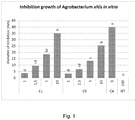
- the biological efficacy of the test agents was determined in terms of inhibition of the growth.
- the strains of A. vitis were inoculated on Petri dishes containing PDA (Potato Dextrose Agar), in the ratio of approximately 10 to 8 cells.
- PDA Pantotato Dextrose Agar
- 5 holes (6 mm) were drilled in the substrate (one at the center of the plate and 4 equally spaced around the central hole).
- Each plate was filled with 20 microliters of test substance at the concentrations indicated; for each substance and concentration, 3 replies were set up.
- the central hole was filled with 20 microliters of sterile water, which represented the untreated control.
- the plates were incubated at 28°C, for 2-5 days.
- the diameters of the inhibitory zones were considered (average of two orthogonal diameters of each inhibitory area).
- the collected data were subjected to analysis of variance ANOVA and comparison of averages with SNK test.
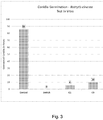
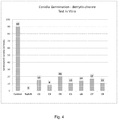
- test agents against Botrytis cinerea were performed only in laboratory by a test in vitro. To this aim, several microscope slides were immersed in a beaker containing water agar medium and then placed into petri dishes.
- the inoculum of conidia was prepared selecting three cultures (petri dishes) of Botrytis cinerea: 10 ml of distilled water were poured in each petri dish and smeared by a spatula over the entire surface of the mycelium.
- the conidia suspension obtained was filtered through a sterile plastic tube filled with fiberglass in order to separate parts of mycelium from conidia.
- the conidia concentration was adjusted to 1*10 6 conidia/ml (minimum) by counting in a Thoma® chamber at the microscope (magnification 40x) eventually achieved diluting with distilled water.
- the petri dishes were incubated in a humid box at 25 °C (day/night intervals 12/12). After 48 hours they were observed on the microscope (magnification 40x).
- the biological efficacy of the test agents was determined in terms of conidia germination, evaluating the ratio between non-germinated conidia (inactive or degenerated) and germinated conidia (active having issued the germination tube) of one hundred conidia. In the first test, the biological efficacies of the following treatments were compared after 20 hours:
- the protocol consisted on the pathogens growth in a proper media (PDA, Difco) as untreated sample, and the same media with 3 different concentrations of the testing agents, 1.2%, 2.4% and 4.8%; and the same media with the Bordeaux mixture based on copper (p.a. 0.02%) as comparison agent.
- each pathogen was inoculated by placing a colony (0.5 cm diam.) in the centre of petri dishes (6 cm diam.) containing the media already prepared with the testing agents. Petri dishes were closed by Parafilm and placed into an incubation chamber at 22 ⁇ 1°C alternating light/dark during the incubation period.
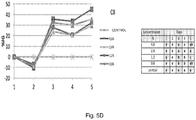
- the measures of the colony growth are summarised, referred to the diameter of growth of each pathogen after the incubation period on the PDA media without any agent and add of each testing agent in 3 different concentrations and the comparison agent. Next to these, their efficacy values are reported.
- All the formulations contain water, hydroxyapatite substituted with carbonate ions and/or copper and/or zinc, and functionalized with ions (K, Mg, B, Mn) and/or vegetal extracts.
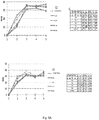
- Samples constituted of water and based on Carbonate Hydroxyapatite (HCA) loaded with vegetal extracts were tested in vitro against the pathogens related to esca and grey mould: Phaeomoniella chlamydospora, Phaeoacremonium aleophilum, Botrytis cinerea.
- the protocol consisted on the pathogens growth in a proper media (MEA - Malt Extract Agar) as untreated sample, and the same media with 4 different concentrations of the testing agents, 0,6%, 1.2%, 2.4% and 4.8.
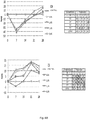
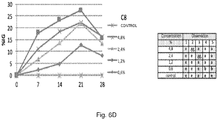
- the fungal growth was measured, in the diametrical direction, from the inoculation point. The measurement was expressed in mm. Given the excessive growth difference of the three tested fungi, the measurements were set differently: Botrytis cinerea, with rapid growth, it was monitored every 24 hours for the first five days, at the end of which the control had completely filled the plate, while Phaeoacremonium aleophilum and Phaeomoniella chlamydospora were observed every 7 days for four weeks (then at 7, 14, 21 and 28 days).
- % IG Growth value inoculated sample ⁇ Growth value control / Growth value control
- the treatment with C8 shows a statistically significant inhibitory effect from the 2 nd day at all concentrations.
- the sample C4 showed a similar control to the previous extract, showing also in this case, to inhibit the growth of the fungus over 40%.
- the treatment C6 also shows an inhibitory effect, from the 2 nd day.
- the treatment with C3 proves to have a inhibitory effect of growth already at the 2 nd day for all concentrations, which was not the case in previous treatments. It is observed that treatments C5 and C7 have an inhibitory effect on the fungus that is, as in the case C7, statistically significant at the 2 nd day.
- the treatment C2 inhibits significantly the fungus from the 3 rd day.
- Treatment C8 has an inhibitory effect, for the very high concentrations, already at day 7. This effect increases with time coming, for the 1.2% concentration, by day 2, at 27%.
- C4 and C6 show a probiotic effect, immediately observed at day 7, which tends to decrease during the test reporting day 21.
- Treatment C3 on the 28 th day, it has an inhibitory effect, which also exceeds 40%, for the concentrations 4.8%, 1.2% and 0.6%.
- Treatment C7 shows a similar trend to the previous treatment.
- Treatment C5 showed a development equal in the first 14 day, the inhibition effect was seen only for the highest concentrations of 4.8% and 2.4%.
- Treatment C2 showed an inhibitory effect of about 5% toward the end of the growth that could be indicate a long-term effect.
- Treatment C8 revealed a probiotic effect from day 14 for the very high concentrations, at day 21, while for the 1.2% a constant inhibitory effect was reported. The same trend was also reported by the treatment C4 and C6, at the concentration of 0.6%. For the treatment C3, the concentration 0.6% departs from the others assuming an initial inhibition then turned into a probiotic effect.
- the concentration 1,2%, of the treatment C7 inhibits the fungus up to 56% IG at day 14, while the treatment C5, at concentration 0.6%, has an inhibitory effect immediately but that tends to decrease over time.
- the treatment C2 it is noted that all concentrations induce a probiotic effect, which increases up to 21 days after which the highest concentrations decrease this effect.
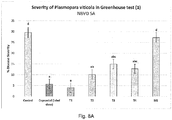
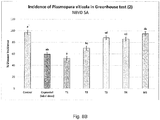
- the greenhouse test was performed to evaluate the protective efficacy of the test agents applied at the concentration of 1% v/v.
- 6 potted vines were employed per each treatment: control (water), comparison agent and test agents. Potted vines were selected for adequate height, good health status and number of unfolded leaves (minimum five). They were prepared for the treatment, tying the shoot just above the first five leaves eligible for the final disease assessment.
- the disease severity was determined by observing the five leaves below the tying point of the shoot in each potted vine.
- the pure HCA did not interfere significantly the fungal growth, even if in absolute value, the treatment MS showed a disease severity lower than the control.
Landscapes
- Life Sciences & Earth Sciences (AREA)
- Health & Medical Sciences (AREA)
- General Health & Medical Sciences (AREA)
- Engineering & Computer Science (AREA)
- Agronomy & Crop Science (AREA)
- Plant Pathology (AREA)
- Dentistry (AREA)
- Wood Science & Technology (AREA)
- Zoology (AREA)
- Environmental Sciences (AREA)
- Natural Medicines & Medicinal Plants (AREA)
- Chemical & Material Sciences (AREA)
- Pest Control & Pesticides (AREA)
- Inorganic Chemistry (AREA)
- Organic Chemistry (AREA)
- Biotechnology (AREA)
- Microbiology (AREA)
- Mycology (AREA)
- Toxicology (AREA)
- Botany (AREA)
- Agricultural Chemicals And Associated Chemicals (AREA)
- Cosmetics (AREA)
- Fertilizers (AREA)
Claims (7)
- Utilisation d'une hydroxyapatite substituée par des carbonates ayant la formule suivante :
Ca(10)(PO4)(6-y)(CO3)y(OH)2
dans laquelle y est compris entre 0,002 et 2, en combinaison avec au moins une substance bioactive sélectionnée parmi le groupe constitué d'un ion de Mn, Mg, K, Fe et B et/ou un extrait végétal sélectionné parmi le groupe constitué d'un extrait de : lignine, menthe, thym, romarin, sésame, soja, clous de girofle, ail, citron, cannelle, Abies sibirica, Malpighia glabra, Achillea millefolium, Allium sativum, Medicago sativa, Aloe vera Citrus sinensis, Artemisia annua, Amica Montana, Ocimum basilicum, Betula pendula, Betula pubescens, Calendula officinalis, Matricaria chamomilla, Chamaemelum nobile, Cinnamomum verum, Centella asiatica, Chelidonium majus, Syzygium aromaticum, Allium cepa, Equisetum arvense, Curcuma longa, Echinacea purpurea, Echinacea angustifolia, Eucalyptus globulus, Hypericum perforatum, Fucus vesiculosus, Gentiana lutea, Lavandula angustifolia, Citrus limon, Melilotus officinalis, Melissa officinalis, Punica granatum, Mentha piperita, Vaccinium myrtillus, Orthosiphon stamineus, Urtica dioica, Olea europeae, Tabebuia impetiginosa, Plantago lanceolata, Hieracium pilosella, Pinus sibirica, Polypodium leucotoms, Citrus paradise, Quassia amara, Rheum Thais, Rosa canina, Rosmarinus officinalis, Ruscus aculeatus, Salix alba, Salvia officinalis, Camelia sinensis, Tilia tomentosa, Thymus vulgaris, Arctostaphylos uva-ursi, Valeriana officinalis, Solidago virgaurea, Loranthus europaeus et Zingiber officinale,
dans laquelle la substance bioactive est absorbée sur l'hydroxyapatite substituée, pour le traitement phytosanitaire et/ou nutritionnel des plantes. - Utilisation selon la revendication 1, dans laquelle l'hydroxyapatite substituée par des carbonates est sous forme d'un agrégat de particules d'hydroxyapatite substituée par des carbonates, dans laquelle l'agrégat a une dimension comprise entre 0,5 et 5 µm.
- Utilisation selon la revendication 1 ou 2, dans laquelle l'extrait végétal est sous forme d'une poudre ou d'une solution alcoolique ou hydroalcoolique.
- Utilisation selon l'une quelconque des revendications 1 à 3, dans laquelle l'hydroxyapatite substituée par des carbonates en combinaison avec au moins une substance bioactive est comprise dans une composition dans une quantité de 5-70 % par rapport au poids total de matière sèche de la composition.
- Utilisation selon l'une quelconque des revendications 1 à 4, dans laquelle les plantes sont la vigne, la tomate (Solanum lycopersicum), le blé (Triticum spp), le poirier (Pyrus spp), le pommier (Malus domestica), l'olivier (Olea europaea), le kiwi (Actinia spp) et les plantes potagères, de préférence la laitue, les épinards, les cucurbitacées, l'oignon, le poireau, les pois.
- Utilisation selon l'une quelconque des revendications 1 à 5, dans laquelle la substance bioactive a une activité antiparasitaire, de préférence contre des cryptogames, bactéries, champignons, phytoplasmes et insectes et/ou une activité nutritionnelle comme engrais ou stimulateur de croissance.
- Utilisation selon l'une quelconque des revendications 1 à 6, dans laquelle l'activité antiparasitaire de la substance bioactive est pour la prévention et le traitement de mildiou (causé par Plasmopara viticola), oïdium (causé par le nectar d'Erysiphe), moisissure grise (causée par Botrytis cinerea), pourriture noire (causée par Guignardia bidwellii), galle du collet de la vigne (causée par Agrobacterium vitis), maladies du tronc de la vigne ou esca (causées par Botryosphaeriaceae, Phaeomoniella chlamydospora, Phaeoacremonium aleophilum, Fomitiporia mediterranea), brûlure tardive des tomates (causée par Phytophthora infestans), fusariose de l'épi du blé (causée par Fusarium graminearum et Fusarium culmorum), tavelure du pommier (causée par Venturia inaequalis), tavelure du poirier (causée par Venturia pirina), tache brune du poirier (causée par Stemphylium vesicarium), mildiou de la laitue (causé par Bremia lactucae), mildiou des épinards (causé par Peronospora spinaceae), mildiou des cucurbitacées (causé par Pseudoperonospora cubensis sur le cantaloup, le concombre, le potiron, la courge et la pastèque), mildiou de l'oignon (causé par Peronospora schleideni), mildiou du poireau (causé par Phytophtora porri), mildiou des pois (causé par Peronospora pisi), maladies causées par les insectes : pyrales de la vigne (Eupoecilia ambiguella) et la cochenille de la vigne (Planococcus ficus).
Applications Claiming Priority (2)
| Application Number | Priority Date | Filing Date | Title |
|---|---|---|---|
| ITUB2015A000805A ITUB20150805A1 (it) | 2015-05-18 | 2015-05-18 | Uso di idrossiapatite come veicolo di elementi nutritivi ed estratti vegetali per trattare le piante |
| PCT/IB2016/052861 WO2016185379A1 (fr) | 2015-05-18 | 2016-05-17 | Utilisation de l'hydroxyapatite comme support d'éléments nutritionnels et d'extraits végétaux pour traiter les plantes |
Publications (2)
| Publication Number | Publication Date |
|---|---|
| EP3297433A1 EP3297433A1 (fr) | 2018-03-28 |
| EP3297433B1 true EP3297433B1 (fr) | 2021-06-23 |
Family
ID=53765455
Family Applications (1)
| Application Number | Title | Priority Date | Filing Date |
|---|---|---|---|
| EP16733692.4A Active EP3297433B1 (fr) | 2015-05-18 | 2016-05-17 | Utilisation de l'hydroxyapatite comme support d'éléments nutritionnels et d'extraits végétaux pour traiter les plantes |
Country Status (7)
| Country | Link |
|---|---|
| US (1) | US20180132485A1 (fr) |
| EP (1) | EP3297433B1 (fr) |
| AU (1) | AU2016263054B2 (fr) |
| ES (1) | ES2886426T3 (fr) |
| IT (1) | ITUB20150805A1 (fr) |
| PT (1) | PT3297433T (fr) |
| WO (1) | WO2016185379A1 (fr) |
Families Citing this family (11)
| Publication number | Priority date | Publication date | Assignee | Title |
|---|---|---|---|---|
| CN106755069B (zh) * | 2016-12-09 | 2020-04-21 | 广东省农业科学院蔬菜研究所 | 一种外源基因在南瓜果实中的瞬时表达方法 |
| CN108002904A (zh) * | 2017-12-04 | 2018-05-08 | 大新县科学技术情报研究所 | 一种蚬木专用肥及其制备方法 |
| MX2022001072A (es) * | 2019-07-25 | 2022-02-14 | Produits Bio Sun Inc | Metodos y composiciones de un extracto botanico para promover y reforzar el crecimiento de las plantas y prevenir y suprimir las enfermedades de las plantas. |
| GB2597268B (en) * | 2020-07-17 | 2023-07-19 | Maxstim Ltd | Composition and method of treating plant material |
| IT202000026575A1 (it) * | 2020-11-06 | 2022-05-06 | Ndg Natural Dev Group S R L | Composizione fotostabile |
| CN112772675A (zh) * | 2020-12-31 | 2021-05-11 | 苏州硒谷科技有限公司 | 一种防治小麦赤霉病的硒抑制剂及其制备和应用 |
| IT202100002042A1 (it) * | 2021-02-01 | 2022-08-01 | Ndg Natural Dev Group S R L | Composizione erbicida |
| CN113545368B (zh) * | 2021-07-21 | 2022-09-09 | 江西劲农作物保护有限公司 | 一种马铃薯的生长调节剂及其制备方法 |
| IT202100019568A1 (it) * | 2021-07-22 | 2023-01-22 | Ndg Natural Dev Group S R L | Composizioni fitoterapeutiche per endoterapia |
| GB202207964D0 (en) | 2022-05-30 | 2022-07-13 | Quassia Labs Ltd | Quassia amara solution for controlling varroa destructor mites |
| IT202300012561A1 (it) * | 2023-06-19 | 2024-12-19 | Ndg Natural Dev Group S R L | Formulazioni antifungine per la concia delle sementi, semi trattati e metodi |
Family Cites Families (4)
| Publication number | Priority date | Publication date | Assignee | Title |
|---|---|---|---|---|
| TW294574B (fr) * | 1993-08-30 | 1997-01-01 | Sangi Kk | |
| ITMI20020205A1 (it) * | 2002-02-05 | 2003-08-05 | Isagro Spa | Composizioni di sali rameici e loro uso per il controllo di funghi fitopatogeni |
| CN101489925B (zh) * | 2006-05-30 | 2013-07-10 | 科斯威尔股份有限公司 | 用碳酸根置换的羟磷灰石的生物活性纳米粒子及其制备方法和包含其的组合物 |
| RO122830B1 (ro) * | 2007-11-27 | 2010-03-30 | Universitatea "Babeş-Bolyai" Cluj-Napoca | Compoziţie fungicidă pe bază de săruri ale acidului n,n-etilen-bis-tiocarbamic şi procedeu de obţinere |
-
2015
- 2015-05-18 IT ITUB2015A000805A patent/ITUB20150805A1/it unknown
-
2016
- 2016-05-17 PT PT167336924T patent/PT3297433T/pt unknown
- 2016-05-17 AU AU2016263054A patent/AU2016263054B2/en active Active
- 2016-05-17 ES ES16733692T patent/ES2886426T3/es active Active
- 2016-05-17 EP EP16733692.4A patent/EP3297433B1/fr active Active
- 2016-05-17 US US15/574,279 patent/US20180132485A1/en not_active Abandoned
- 2016-05-17 WO PCT/IB2016/052861 patent/WO2016185379A1/fr not_active Ceased
Non-Patent Citations (1)
| Title |
|---|
| None * |
Also Published As
| Publication number | Publication date |
|---|---|
| US20180132485A1 (en) | 2018-05-17 |
| PT3297433T (pt) | 2021-09-06 |
| AU2016263054B2 (en) | 2019-01-17 |
| ITUB20150805A1 (it) | 2016-11-18 |
| ES2886426T3 (es) | 2021-12-20 |
| WO2016185379A1 (fr) | 2016-11-24 |
| AU2016263054A1 (en) | 2017-12-07 |
| EP3297433A1 (fr) | 2018-03-28 |
Similar Documents
| Publication | Publication Date | Title |
|---|---|---|
| EP3297433B1 (fr) | Utilisation de l'hydroxyapatite comme support d'éléments nutritionnels et d'extraits végétaux pour traiter les plantes | |
| EP3297432B1 (fr) | Utilisation d'hydroxyapatite comme support de substances bioactives pour le traitement des maladies vasculaires des plantes | |
| EP3071039B1 (fr) | Utilisation d'hydroxyapatite en tant que support de substances bioactives pour le traitement de plantes | |
| KR20110117329A (ko) | 무공해 농약 및 이의 제조방법 | |
| CN103518750B (zh) | 一种高效复配生物杀菌剂及其应用 | |
| CN106508970A (zh) | 一种复配杀菌组合物及其应用 | |
| KR101764260B1 (ko) | 수분산 나노 유황이 함유된 액체비료 조성물과 그 제조방법 | |
| EP2359693A2 (fr) | Composition pour prendre soin des plantes | |
| CN104872155A (zh) | 一种防治水稻稻瘟病的复合杀菌剂 | |
| US11805784B2 (en) | Use of hydroxyapatite as a carrier of bioactive substances for treating vascular diseases in plants | |
| KR20090049966A (ko) | 농작물의 영양공급 및 생육촉진과 병해충예방을 위한조성물 | |
| CN103478129B (zh) | 一种复配农用杀菌剂及其应用 | |
| CN103548849B (zh) | 一种协同增效复配生物杀菌剂及其应用 | |
| KR101662818B1 (ko) | 비료의 특성을 갖는 제초제 | |
| CN101647466B (zh) | 杀菌组合物 | |
| ES2794127B2 (es) | Formulados liquidos a base de nanoparticulas de oxidos de metales como mejoradores de la productividad y para la obtencion de cultivos mas sanos, y uso de los mismos | |
| US20260076372A1 (en) | Sprayable antifungal composition for use in the field of agriculture, and associated method and use | |
| WO2024261562A1 (fr) | Formulations antifongiques pour l'enrobage de semences, semences traitées et procédés | |
| WO2013105909A1 (fr) | Utilisation de curvularine et d'analcyme dans la production d'un milieu ayant une action fongicide, composition, et procédé de préparation (variantes) | |
| CN105766956A (zh) | 加有阿维菌素高渗乙蒜素农药杀菌剂及制备方法 | |
| CN106259434B (zh) | 一种增强甲基硫菌灵防效的杀菌混剂配方及制备方法 | |
| CN103651398A (zh) | 一种复配杀菌剂 |
Legal Events
| Date | Code | Title | Description |
|---|---|---|---|
| STAA | Information on the status of an ep patent application or granted ep patent |
Free format text: STATUS: THE INTERNATIONAL PUBLICATION HAS BEEN MADE |
|
| PUAI | Public reference made under article 153(3) epc to a published international application that has entered the european phase |
Free format text: ORIGINAL CODE: 0009012 |
|
| STAA | Information on the status of an ep patent application or granted ep patent |
Free format text: STATUS: REQUEST FOR EXAMINATION WAS MADE |
|
| 17P | Request for examination filed |
Effective date: 20171117 |
|
| AK | Designated contracting states |
Kind code of ref document: A1 Designated state(s): AL AT BE BG CH CY CZ DE DK EE ES FI FR GB GR HR HU IE IS IT LI LT LU LV MC MK MT NL NO PL PT RO RS SE SI SK SM TR |
|
| AX | Request for extension of the european patent |
Extension state: BA ME |
|
| DAV | Request for validation of the european patent (deleted) | ||
| DAX | Request for extension of the european patent (deleted) | ||
| STAA | Information on the status of an ep patent application or granted ep patent |
Free format text: STATUS: EXAMINATION IS IN PROGRESS |
|
| 17Q | First examination report despatched |
Effective date: 20190215 |
|
| GRAP | Despatch of communication of intention to grant a patent |
Free format text: ORIGINAL CODE: EPIDOSNIGR1 |
|
| STAA | Information on the status of an ep patent application or granted ep patent |
Free format text: STATUS: GRANT OF PATENT IS INTENDED |
|
| INTG | Intention to grant announced |
Effective date: 20201105 |
|
| GRAS | Grant fee paid |
Free format text: ORIGINAL CODE: EPIDOSNIGR3 |
|
| GRAJ | Information related to disapproval of communication of intention to grant by the applicant or resumption of examination proceedings by the epo deleted |
Free format text: ORIGINAL CODE: EPIDOSDIGR1 |
|
| GRAL | Information related to payment of fee for publishing/printing deleted |
Free format text: ORIGINAL CODE: EPIDOSDIGR3 |
|
| STAA | Information on the status of an ep patent application or granted ep patent |
Free format text: STATUS: EXAMINATION IS IN PROGRESS |
|
| INTC | Intention to grant announced (deleted) | ||
| RAP1 | Party data changed (applicant data changed or rights of an application transferred) |
Owner name: NDG NATURAL DEVELOPMENT GROUP S.R.L. |
|
| GRAP | Despatch of communication of intention to grant a patent |
Free format text: ORIGINAL CODE: EPIDOSNIGR1 |
|
| STAA | Information on the status of an ep patent application or granted ep patent |
Free format text: STATUS: GRANT OF PATENT IS INTENDED |
|
| INTG | Intention to grant announced |
Effective date: 20210316 |
|
| GRAA | (expected) grant |
Free format text: ORIGINAL CODE: 0009210 |
|
| STAA | Information on the status of an ep patent application or granted ep patent |
Free format text: STATUS: THE PATENT HAS BEEN GRANTED |
|
| AK | Designated contracting states |
Kind code of ref document: B1 Designated state(s): AL AT BE BG CH CY CZ DE DK EE ES FI FR GB GR HR HU IE IS IT LI LT LU LV MC MK MT NL NO PL PT RO RS SE SI SK SM TR |
|
| REG | Reference to a national code |
Ref country code: GB Ref legal event code: FG4D |
|
| REG | Reference to a national code |
Ref country code: CH Ref legal event code: EP |
|
| REG | Reference to a national code |
Ref country code: DE Ref legal event code: R096 Ref document number: 602016059649 Country of ref document: DE Ref country code: AT Ref legal event code: REF Ref document number: 1403462 Country of ref document: AT Kind code of ref document: T Effective date: 20210715 |
|
| REG | Reference to a national code |
Ref country code: IE Ref legal event code: FG4D |
|
| REG | Reference to a national code |
Ref country code: PT Ref legal event code: SC4A Ref document number: 3297433 Country of ref document: PT Date of ref document: 20210906 Kind code of ref document: T Free format text: AVAILABILITY OF NATIONAL TRANSLATION Effective date: 20210830 |
|
| REG | Reference to a national code |
Ref country code: LT Ref legal event code: MG9D |
|
| PG25 | Lapsed in a contracting state [announced via postgrant information from national office to epo] |
Ref country code: HR Free format text: LAPSE BECAUSE OF FAILURE TO SUBMIT A TRANSLATION OF THE DESCRIPTION OR TO PAY THE FEE WITHIN THE PRESCRIBED TIME-LIMIT Effective date: 20210623 Ref country code: BG Free format text: LAPSE BECAUSE OF FAILURE TO SUBMIT A TRANSLATION OF THE DESCRIPTION OR TO PAY THE FEE WITHIN THE PRESCRIBED TIME-LIMIT Effective date: 20210923 Ref country code: FI Free format text: LAPSE BECAUSE OF FAILURE TO SUBMIT A TRANSLATION OF THE DESCRIPTION OR TO PAY THE FEE WITHIN THE PRESCRIBED TIME-LIMIT Effective date: 20210623 Ref country code: LT Free format text: LAPSE BECAUSE OF FAILURE TO SUBMIT A TRANSLATION OF THE DESCRIPTION OR TO PAY THE FEE WITHIN THE PRESCRIBED TIME-LIMIT Effective date: 20210623 |
|
| REG | Reference to a national code |
Ref country code: GR Ref legal event code: EP Ref document number: 20210402343 Country of ref document: GR Effective date: 20211013 |
|
| REG | Reference to a national code |
Ref country code: AT Ref legal event code: MK05 Ref document number: 1403462 Country of ref document: AT Kind code of ref document: T Effective date: 20210623 |
|
| PG25 | Lapsed in a contracting state [announced via postgrant information from national office to epo] |
Ref country code: LV Free format text: LAPSE BECAUSE OF FAILURE TO SUBMIT A TRANSLATION OF THE DESCRIPTION OR TO PAY THE FEE WITHIN THE PRESCRIBED TIME-LIMIT Effective date: 20210623 Ref country code: NO Free format text: LAPSE BECAUSE OF FAILURE TO SUBMIT A TRANSLATION OF THE DESCRIPTION OR TO PAY THE FEE WITHIN THE PRESCRIBED TIME-LIMIT Effective date: 20210923 Ref country code: SE Free format text: LAPSE BECAUSE OF FAILURE TO SUBMIT A TRANSLATION OF THE DESCRIPTION OR TO PAY THE FEE WITHIN THE PRESCRIBED TIME-LIMIT Effective date: 20210623 Ref country code: RS Free format text: LAPSE BECAUSE OF FAILURE TO SUBMIT A TRANSLATION OF THE DESCRIPTION OR TO PAY THE FEE WITHIN THE PRESCRIBED TIME-LIMIT Effective date: 20210623 |
|
| REG | Reference to a national code |
Ref country code: NL Ref legal event code: MP Effective date: 20210623 |
|
| REG | Reference to a national code |
Ref country code: ES Ref legal event code: FG2A Ref document number: 2886426 Country of ref document: ES Kind code of ref document: T3 Effective date: 20211220 |
|
| PG25 | Lapsed in a contracting state [announced via postgrant information from national office to epo] |
Ref country code: SM Free format text: LAPSE BECAUSE OF FAILURE TO SUBMIT A TRANSLATION OF THE DESCRIPTION OR TO PAY THE FEE WITHIN THE PRESCRIBED TIME-LIMIT Effective date: 20210623 Ref country code: SK Free format text: LAPSE BECAUSE OF FAILURE TO SUBMIT A TRANSLATION OF THE DESCRIPTION OR TO PAY THE FEE WITHIN THE PRESCRIBED TIME-LIMIT Effective date: 20210623 Ref country code: EE Free format text: LAPSE BECAUSE OF FAILURE TO SUBMIT A TRANSLATION OF THE DESCRIPTION OR TO PAY THE FEE WITHIN THE PRESCRIBED TIME-LIMIT Effective date: 20210623 Ref country code: CZ Free format text: LAPSE BECAUSE OF FAILURE TO SUBMIT A TRANSLATION OF THE DESCRIPTION OR TO PAY THE FEE WITHIN THE PRESCRIBED TIME-LIMIT Effective date: 20210623 Ref country code: RO Free format text: LAPSE BECAUSE OF FAILURE TO SUBMIT A TRANSLATION OF THE DESCRIPTION OR TO PAY THE FEE WITHIN THE PRESCRIBED TIME-LIMIT Effective date: 20210623 Ref country code: NL Free format text: LAPSE BECAUSE OF FAILURE TO SUBMIT A TRANSLATION OF THE DESCRIPTION OR TO PAY THE FEE WITHIN THE PRESCRIBED TIME-LIMIT Effective date: 20210623 Ref country code: AT Free format text: LAPSE BECAUSE OF FAILURE TO SUBMIT A TRANSLATION OF THE DESCRIPTION OR TO PAY THE FEE WITHIN THE PRESCRIBED TIME-LIMIT Effective date: 20210623 |
|
| PG25 | Lapsed in a contracting state [announced via postgrant information from national office to epo] |
Ref country code: PL Free format text: LAPSE BECAUSE OF FAILURE TO SUBMIT A TRANSLATION OF THE DESCRIPTION OR TO PAY THE FEE WITHIN THE PRESCRIBED TIME-LIMIT Effective date: 20210623 |
|
| REG | Reference to a national code |
Ref country code: DE Ref legal event code: R097 Ref document number: 602016059649 Country of ref document: DE |
|
| PG25 | Lapsed in a contracting state [announced via postgrant information from national office to epo] |
Ref country code: DK Free format text: LAPSE BECAUSE OF FAILURE TO SUBMIT A TRANSLATION OF THE DESCRIPTION OR TO PAY THE FEE WITHIN THE PRESCRIBED TIME-LIMIT Effective date: 20210623 |
|
| PLBE | No opposition filed within time limit |
Free format text: ORIGINAL CODE: 0009261 |
|
| STAA | Information on the status of an ep patent application or granted ep patent |
Free format text: STATUS: NO OPPOSITION FILED WITHIN TIME LIMIT |
|
| 26N | No opposition filed |
Effective date: 20220324 |
|
| PG25 | Lapsed in a contracting state [announced via postgrant information from national office to epo] |
Ref country code: AL Free format text: LAPSE BECAUSE OF FAILURE TO SUBMIT A TRANSLATION OF THE DESCRIPTION OR TO PAY THE FEE WITHIN THE PRESCRIBED TIME-LIMIT Effective date: 20210623 |
|
| PGFP | Annual fee paid to national office [announced via postgrant information from national office to epo] |
Ref country code: CH Payment date: 20220421 Year of fee payment: 7 |
|
| REG | Reference to a national code |
Ref country code: BE Ref legal event code: MM Effective date: 20220531 |
|
| GBPC | Gb: european patent ceased through non-payment of renewal fee |
Effective date: 20220517 |
|
| PG25 | Lapsed in a contracting state [announced via postgrant information from national office to epo] |
Ref country code: MC Free format text: LAPSE BECAUSE OF FAILURE TO SUBMIT A TRANSLATION OF THE DESCRIPTION OR TO PAY THE FEE WITHIN THE PRESCRIBED TIME-LIMIT Effective date: 20210623 Ref country code: LU Free format text: LAPSE BECAUSE OF NON-PAYMENT OF DUE FEES Effective date: 20220517 |
|
| PG25 | Lapsed in a contracting state [announced via postgrant information from national office to epo] |
Ref country code: IE Free format text: LAPSE BECAUSE OF NON-PAYMENT OF DUE FEES Effective date: 20220517 |
|
| PG25 | Lapsed in a contracting state [announced via postgrant information from national office to epo] |
Ref country code: GB Free format text: LAPSE BECAUSE OF NON-PAYMENT OF DUE FEES Effective date: 20220517 Ref country code: BE Free format text: LAPSE BECAUSE OF NON-PAYMENT OF DUE FEES Effective date: 20220531 |
|
| P01 | Opt-out of the competence of the unified patent court (upc) registered |
Effective date: 20230525 |
|
| REG | Reference to a national code |
Ref country code: CH Ref legal event code: PL |
|
| PG25 | Lapsed in a contracting state [announced via postgrant information from national office to epo] |
Ref country code: LI Free format text: LAPSE BECAUSE OF NON-PAYMENT OF DUE FEES Effective date: 20230531 Ref country code: CH Free format text: LAPSE BECAUSE OF NON-PAYMENT OF DUE FEES Effective date: 20230531 |
|
| PG25 | Lapsed in a contracting state [announced via postgrant information from national office to epo] |
Ref country code: HU Free format text: LAPSE BECAUSE OF FAILURE TO SUBMIT A TRANSLATION OF THE DESCRIPTION OR TO PAY THE FEE WITHIN THE PRESCRIBED TIME-LIMIT; INVALID AB INITIO Effective date: 20160517 |
|
| PG25 | Lapsed in a contracting state [announced via postgrant information from national office to epo] |
Ref country code: MK Free format text: LAPSE BECAUSE OF FAILURE TO SUBMIT A TRANSLATION OF THE DESCRIPTION OR TO PAY THE FEE WITHIN THE PRESCRIBED TIME-LIMIT Effective date: 20210623 Ref country code: CY Free format text: LAPSE BECAUSE OF FAILURE TO SUBMIT A TRANSLATION OF THE DESCRIPTION OR TO PAY THE FEE WITHIN THE PRESCRIBED TIME-LIMIT Effective date: 20210623 |
|
| PG25 | Lapsed in a contracting state [announced via postgrant information from national office to epo] |
Ref country code: TR Free format text: LAPSE BECAUSE OF FAILURE TO SUBMIT A TRANSLATION OF THE DESCRIPTION OR TO PAY THE FEE WITHIN THE PRESCRIBED TIME-LIMIT Effective date: 20210623 |
|
| PG25 | Lapsed in a contracting state [announced via postgrant information from national office to epo] |
Ref country code: MT Free format text: LAPSE BECAUSE OF FAILURE TO SUBMIT A TRANSLATION OF THE DESCRIPTION OR TO PAY THE FEE WITHIN THE PRESCRIBED TIME-LIMIT Effective date: 20210623 |
|
| PGFP | Annual fee paid to national office [announced via postgrant information from national office to epo] |
Ref country code: FR Payment date: 20250321 Year of fee payment: 10 |
|
| PGFP | Annual fee paid to national office [announced via postgrant information from national office to epo] |
Ref country code: DE Payment date: 20250325 Year of fee payment: 10 |
|
| PGFP | Annual fee paid to national office [announced via postgrant information from national office to epo] |
Ref country code: ES Payment date: 20250605 Year of fee payment: 10 |
|
| PGFP | Annual fee paid to national office [announced via postgrant information from national office to epo] |
Ref country code: IT Payment date: 20250424 Year of fee payment: 10 |
|
| PGFP | Annual fee paid to national office [announced via postgrant information from national office to epo] |
Ref country code: PT Payment date: 20250519 Year of fee payment: 10 |
|
| PGFP | Annual fee paid to national office [announced via postgrant information from national office to epo] |
Ref country code: GR Payment date: 20250416 Year of fee payment: 10 |