EP3299329B1 - Aufzugskabine - Google Patents
Aufzugskabine Download PDFInfo
- Publication number
- EP3299329B1 EP3299329B1 EP16190397.6A EP16190397A EP3299329B1 EP 3299329 B1 EP3299329 B1 EP 3299329B1 EP 16190397 A EP16190397 A EP 16190397A EP 3299329 B1 EP3299329 B1 EP 3299329B1
- Authority
- EP
- European Patent Office
- Prior art keywords
- ceiling panel
- elevator car
- bars
- ceiling
- opening
- Prior art date
- Legal status (The legal status is an assumption and is not a legal conclusion. Google has not performed a legal analysis and makes no representation as to the accuracy of the status listed.)
- Active
Links
Images




Classifications
-
- B—PERFORMING OPERATIONS; TRANSPORTING
- B66—HOISTING; LIFTING; HAULING
- B66B—ELEVATORS; ESCALATORS OR MOVING WALKWAYS
- B66B11/00—Main component parts of lifts in, or associated with, buildings or other structures
- B66B11/02—Cages, i.e. cars
- B66B11/0226—Constructional features, e.g. walls assembly, decorative panels, comfort equipment, thermal or sound insulation
- B66B11/0253—Fixation of wall panels
-
- B—PERFORMING OPERATIONS; TRANSPORTING
- B66—HOISTING; LIFTING; HAULING
- B66B—ELEVATORS; ESCALATORS OR MOVING WALKWAYS
- B66B11/00—Main component parts of lifts in, or associated with, buildings or other structures
- B66B11/02—Cages, i.e. cars
- B66B11/0226—Constructional features, e.g. walls assembly, decorative panels, comfort equipment, thermal or sound insulation
-
- B—PERFORMING OPERATIONS; TRANSPORTING
- B66—HOISTING; LIFTING; HAULING
- B66B—ELEVATORS; ESCALATORS OR MOVING WALKWAYS
- B66B11/00—Main component parts of lifts in, or associated with, buildings or other structures
- B66B11/02—Cages, i.e. cars
- B66B11/0226—Constructional features, e.g. walls assembly, decorative panels, comfort equipment, thermal or sound insulation
- B66B11/0233—Lighting systems
-
- B—PERFORMING OPERATIONS; TRANSPORTING
- B66—HOISTING; LIFTING; HAULING
- B66B—ELEVATORS; ESCALATORS OR MOVING WALKWAYS
- B66B5/00—Applications of checking, fault-correcting, or safety devices in elevators
- B66B5/0087—Devices facilitating maintenance, repair or inspection tasks
-
- E—FIXED CONSTRUCTIONS
- E04—BUILDING
- E04B—GENERAL BUILDING CONSTRUCTIONS; WALLS, e.g. PARTITIONS; ROOFS; FLOORS; CEILINGS; INSULATION OR OTHER PROTECTION OF BUILDINGS
- E04B9/00—Ceilings; Construction of ceilings, e.g. false ceilings; Ceiling construction with regard to insulation
- E04B9/003—Ceilings; Construction of ceilings, e.g. false ceilings; Ceiling construction with regard to insulation with movable parts, e.g. pivoting panels, access doors
Definitions
- the invention relates to an elevator car, in particular an elevator car comprising a removable inner ceiling panel.
- Elevator cars are usually equipped with lighting elements which are configured for illuminating the interior of the elevator car.
- Document JP2010-6572A discloses a lighting device on a ceiling of an elevator car, including lighting fixtures, a case with a movable part and a fixed part with spaced apart supporting members, hinge parts, and a lock device.
- an elevator car comprises a ceiling defining a top end of the interior space of the elevator car and two bars, a first bar and a second bar, extending parallel to and spaced apart from each other along the ceiling.
- Each of the bars comprises at least one first opening and at least one second opening.
- the elevator car further comprises a ceiling panel with two protrusions, a first protrusion and a second protrusion, extending from opposite sides of the panel.
- Each protrusion is configured such as to be received within a first opening of one of the bars and for allowing for a pivoting motion of the ceiling panel around an axis extending between the two protrusions.
- the ceiling panel is also equipped with at least one locking mechanism, which is switchable between a locked state and an unlocked state.
- the at least one locking mechanism engages with one of the second openings for locking the ceiling panel to at least one of the bars when the ceiling panel is pivoted into an operating position in which the ceiling panel extends parallel to the bars.
- the least one locking mechanism allows the ceiling panel to pivot from the operating position to a maintenance position in which the ceiling panel is inclined at an angle of more than 0° with respect to the bars.
- Exemplary embodiments of the invention further include an elevator system comprising at least one elevator car according to an exemplary embodiment of the invention.
- Exemplary embodiments of the invention also include a method of mounting a ceiling panel in an elevator car, wherein the method comprises the steps of: introducing the first protrusion into a first opening of the first bar, introducing the second protrusion into a first opening of the second bar, pivoting the ceiling panel upwards around the axis extending between the protrusions, and locking the ceiling panel to at least one of the bars by means of the at least one locking mechanism when the ceiling panel is oriented parallel to the bars.
- Exemplary embodiments of the invention further include a method of removing a ceiling panel from an elevator car, wherein the method comprises the steps of: unlocking the at least one locking mechanism, pivoting the ceiling panel downwards around the axis extending between the protrusions, and extracting the protrusions from the respective first openings.
- Exemplary embodiments of the invention allow for an easy installation and removal of a ceiling panel of an elevator car.
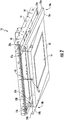
- the elevator system 2 includes an elevator car 6 comprising a floor 9 and a ceiling 12.
- the elevator car 6 is movably suspended within a hoistway 4 by means of a tension member 3.
- the tension member 3 for example a rope or belt, is connected to an elevator drive 5, which is configured for driving the tension member 3 in order to move the elevator car 6 along the height of the hoistway 4 between a plurality of landings 8 located on different floors.
- the exemplary embodiment shown in Figure 1 uses a 1:1 roping for suspending the elevator car 6.
- the skilled person easily understands that the type of the roping is not essential for the invention and that different kinds of roping, e.g. a 2:1 roping or none roping at all, may be used as well.
- the elevator system 2 may use a counterweight (not shown) or not.
- the elevator drive 5 may be any form of drive used in the art, e.g. a traction drive, a hydraulic drive or a linear drive.
- the elevator system 2 may have a machine room or may be a machine room-less elevator system.
- the elevator system 2 may use a tension member 3, as it is shown in Figure 1 , or it may be an elevator system without a tension member 3.
- the elevator drive 5 is controlled by an elevator control unit 13 for moving the elevator car 6 along the hoistway 4 between the different landings 8.
- Input to the control unit 13 may be provided via an elevator car control panel 7b provided inside the elevator car 6 and/or landing control panels 7a, which are provided on each landing 8 close to the landing doors 10.
- the elevator car control panel 7b and the landing control panels 7a may be connected to the elevator control unit 13 by means of electrical lines, which are not shown in Fig. 1 , in particular by an electric bus, or by means of wireless data connections.
- the portion of the ceiling 12 comprises three structural panels 14 arranged adjacent to each other.
- the structural panels 14 are fixed to each other. This configuration, however, is only exemplary and the skilled person will understand that other configurations of the ceiling 12, in particular configurations comprising less or more structural panels 14, are possible as well.
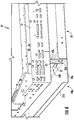
- Two elongated bars 18a, 18b extending parallel to and spaced apart from each other are attached to the bottom of the ceiling 12 facing the interior space of the elevator car 6.
- Each of the bars 18a, 18b respectively comprises a first horizontal leg 15a, 15b attached to the structural panels 14, a first vertical leg 17a, 17b extending orthogonally from the first horizontal leg 15a, 15b and a second horizontal leg 19a, 19b extending basically orthogonally from the first vertical leg 17a, 17b, i.e. parallel to the first horizontal leg 15a, 15b and the ceiling 12.
- Each of the bars 18a, 18b further comprises a second vertical leg 21a, 21b extending orthogonally from a portion of the second horizontal leg 19a, 19b opposite to the first vertical leg 17a, 17b and parallel to said first vertical leg 17a, 17b.
- a ceiling panel 20 comprising a transparent central portion 16 is arranged in between the two bars 18a, 18b.
- the ceiling panel 20 may comprise and/or support lighting elements, e.g. lighting elements comprising LEDs, which are not visible in Figure 2 .
- the ceiling panel 20 is supported by the bars 18a, 18b such that it is pivotable around an axis (not shown in Figure 2 ) which extends parallel to the ceiling 12 along a rear portion of the ceiling panel 20 between rear ends of the bars 18a, 18b.
- a safety wire 40 extends between a safety hook 42 provided at a front portion of the ceiling panel 20 and one of the structural panels 14 in order to prevent the front end of the ceiling panel 20 from falling down.
- the safety wire 40 may be detached from the safety hook 42 in case the front end of the ceiling panel 20 is supposed to be lowered by pivoting the ceiling panel 20. This operation will be described in more detail further below.
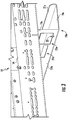
- Figure 3 shows an enlarged partial view of a front area of a first bar 18a which is shown on the right side of Figure 2 .
- Two openings 22a, 24a are formed in a front portion of the first vertical leg 17a of the first bar 18a: A first opening 22a having a basically quadratic shape with a small recess 23 formed in the lower edge of the first opening 22a, and a second opening 24a having a rectangular shape. Similar openings are formed in a rear portion (not shown) of the first bar 18a.
- the first bar 18a has mirror symmetry with respect to a virtual plane which extends orthogonally to the ceiling 12 through a center of the first bar 18a when the first bar 18a is viewed along its longitudinal direction.
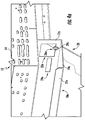
- Figure 4a depicts a rear portion of the first bar 18a shown in Figure 3 from an opposite side of view (from "outside") in combination with the ceiling panel 20.
- the ceiling panel 20 is provided with a first protrusion 26a having the form of a pin 26a extending from a lateral side portion of the ceiling panel 20, which is a rear lateral side portion of the ceiling panel 20 in the orientation shown in Figure 2 .
- the first protrusion / pin 26a is received within the first opening 22a.
- the first protrusion / pin 26a in particular is received within the recess 23 formed within the lower edge of the first opening 22a for pivotably supporting the ceiling panel 20.
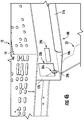
- Figure 4b depicts a second bar 18b, which is attached to the ceiling 12 of the elevator car 6 extending parallel to and spaced apart from the first bar 18a for supporting the ceiling panel 20.
- the second bar 18b is formed similar to the first bar 18a, in particular comprising first and second openings 22b, 24b.
- a recess 23 which is not visible in Figure 4b , is formed within the lower edge of the first opening 22b.
- a second protrusion / pin 26b is provided on an opposite lateral side of the ceiling panel 20. Said second protrusion / pin 26b is accommodated in a (not visible) recess 23 of the first opening 22b of the second bar 18b supporting the opposing side of the ceiling panel 20.
- the ceiling panel 20 in particular is supported such that it is pivotable around an axis extending between the two protrusions / pins 26a, 26b.
- a ring 29a, 29b having a larger outer diameter then the recess 23 is provided at the end of each protrusion / pin 26a, 26b for preventing the protrusion / pin 26a, 26b from slipping out of the respective recess 23.
- a locking mechanism 28 is provided in a left front portion of the ceiling panel 20, which is opposite to the rear portion of the ceiling panel 20 supporting the protrusions / pins 26a, 26b as described before.
- the locking mechanism 28 is configured for engagement with the second (rectangular) opening 24b formed within the first vertical leg 17b of the second bar 18b.
- a corresponding locking mechanism 28 (not shown), which is configured for engagement with the second (rectangular) opening 24a formed within the first vertical leg 17a of the first bar 18a, may be provided in the opposite right front portion of the ceiling panel 20.
- FIG 7 shows a perspective explosive view of an exemplary embodiment of the locking mechanism 28.
- the locking mechanism 28 comprises the protrusion element 27, which is pivotable around an axis A to be moved between the unlocked position shown in Figure 5 and the locked position shown in Figure 6 .
- the locking mechanism 28 further comprises an elastic element 32, such as a spiral spring, which is configured for urging the protrusion element 27 into its locked position.
- the locking mechanism 28 also comprises a key receiving portion 34, which is configured for receiving a matching key 36 (not shown in Figure 7 ) and for moving the protrusion element 27 from its locked position into an unlocked position by turning the key 36 around the axis A.
- Figure 8 shows a configuration similar to Figure 2 in which the ceiling panel 20 is locked in the operating position extending basically parallel to the ceiling 12.
- a key 36 is introduced via one of two holes 38 provided within the ceiling panel 20 into the key receiving portion 34 of one of the locking mechanisms 28, which are not visible in Figure 8 .
- the protrusion element 27 of the locking mechanism 28 may be moved from its locked position into its unlocked position.
- the ceiling panel 20 may be moved from its operating position into a maintenance position by pivoting the ceiling panel 20 around the axis extending between the two protrusions / pins 26a, 26b, which are accommodated within the first openings 22a, 22b (not visible in Figure 8 ), as it is illustrated in Figure 9 .
- This provides access to lighting elements 44 arranged on the top side of the ceiling panel 20 facing the ceiling 12 when the ceiling panel 20 is arranged in its operating position. Additionally or alternatively, lighting elements 44 may be provided at the bottom side of the structural panel 14 facing the ceiling panel 20.
- Figure 10 illustrates that the protrusions / pins 26a, 26b may be extracted from the first openings 22a, 22b by slightly tilting the ceiling panel 20 so that an axis B extending between the two protrusions / pins 26a, 26b of the ceiling panel 20 is inclined with respect to a straight line L connecting the two first openings 22a, 22b of the bars 18a, 18b. This allows to separate the ceiling panel 20 from the bars 18a, 18b and to remove the ceiling panel 20 from the ceiling 12 / elevator car 6.
- a first opening may be formed in a first portion of the respective bar next to a first end of the bar, and a second opening may be formed in a second portion of the respective bar next to an opposing second end of the bar.
- each of the bars may be formed symmetrically, in particular comprising a first and a second opening at a first end and a first and a second opening at an opposing second end, respectively.
- a symmetrically formed bar may be selectively used as a first bar and as second bar. In consequence, only a single type of bar needs to be produced and delivered. This allows reducing the costs for production and installation.
- the first openings may be large enough for allowing to insert the protrusions into and for removing the protrusions from the first openings by tilting the ceiling panel, in particular by tilting the ceiling panel in such a manner that the axis extending between the two protrusions of the ceiling panel is inclined with respect to a line connecting the two first openings of the bars.
- tilting the ceiling panel in particular by tilting the ceiling panel in such a manner that the axis extending between the two protrusions of the ceiling panel is inclined with respect to a line connecting the two first openings of the bars.
- the protrusions may be provided by pins, in particular by metallic pins. Pins, in particular metallic pins, allow for a secure support of the ceiling panel by the bars.
- each of the first openings may comprise a recess which is configured for receiving a protrusion / pin of the ceiling panel.
- a recess allows to fix the protrusions / pins at a well-defined position within the first openings. This results in a secure installation of the ceiling panel.
- the ceiling panel may comprise at least one lighting element, which is configured for illuminating the interior space of the elevator car.
- the at least one lighting element in particular may include at least one LED or an LED panel.
- the ceiling panel may comprise at least one transparent portion allowing light to pass through the ceiling panel.
- lighting elements may be installed on the side of the ceiling panel facing away from the interior space of the elevator car. Such a configuration prevents passengers from touching, polluting and/or damaging the lighting elements.
- the locking mechanism may be configured for being unlocked by means of a key, in particular by a mechanical key, more particular by a triangular key.
- a locking mechanism which may be unlocked only by means of a key prevents an unauthorized removal of the ceiling panel.
- a mechanical key is reliable and may be provided at low costs.
- each of the bars may comprise at least a first leg and a second leg.
- the first leg in particular may be a vertical leg extending basically orthogonally from the ceiling of the elevator car.
- the second leg may be a horizontal leg, which extends basically orthogonally to the first leg and parallel to the ceiling.
- the first and second openings may be formed in the first leg. This allows for an easy installation and removal of the ceiling panel.
- the ceiling panel may be provided with a safety hook and a removable safety wire extending between the safety hook and a structural panel of the ceiling in order to avoid the front end of ceiling panel from falling down as soon as the locking mechanism(s) is/are unlocked.
- a safety wire provides additional safety to a mechanic removing the ceiling panel.
Landscapes
- Engineering & Computer Science (AREA)
- Civil Engineering (AREA)
- Mechanical Engineering (AREA)
- Structural Engineering (AREA)
- Cage And Drive Apparatuses For Elevators (AREA)
Claims (15)
- Aufzugskabine (6), die Folgendes umfasst:eine Decke (12);eine erste Schiene (18a) und eine zweite Schiene (18b), wobei sich beide Schienen (18a, 18b) parallel zueinander und voneinander beabstandet entlang der Decke (12) erstrecken, wobei jede der Schienen (18a, 18b) mindestens eine erste Öffnung (22a, 22b) und eine zweite Öffnung (24a, 24b) umfasst;ein Deckenpaneel (20), das Folgendes umfasst:einen ersten Vorsprung (26a) und einen zweiten Vorsprung (26b), wobei sich beide Vorsprünge (26a, 26b) von gegenüberliegenden Seiten des Deckenpaneels (20) erstrecken, wobei jeder der Vorsprünge (26a, 26b) derart konfiguriert ist, um innerhalb einer ersten Öffnung (22a, 22b) von einer der Schienen (18a, 18b) aufgenommen zu werden, und um eine Schwenkbewegung des Deckenpaneels (20) um eine Achse zu ermöglichen, die sich zwischen den beiden Vorsprüngen (26a, 26b) erstreckt;mindestens einen Verriegelungsmechanismus (28), der zwischen einem verriegelten Zustand und einem entriegelten Zustand umschaltbar ist;wobei der mindestens eine Verriegelungsmechanismus (28) in seinem verriegelten Zustand mit einer der zweiten Öffnungen (24a, 24b) in Eingriff steht, um das Deckenpaneel (20) an mindestens einem der Schiene (18a, 18b) zu verriegeln, wenn das Deckenpaneel (20) in eine Betriebsposition geschwenkt wird, in der das Deckenpaneel (20) sich parallel zu den Schienen (18a, 18b) erstreckt; undwobei der mindestens eine Verriegelungsmechanismus (28) es in seinem entriegelten Zustand dem Deckenpaneel (20) ermöglicht, von der Betriebsposition in eine Wartungsposition zu schwenken, in der das Deckenpaneel (20) in Bezug auf die Schienen (18a, 18b) geneigt ist.
- Aufzugskabine (6) nach Anspruch 1, wobei eine erste Öffnung (22a, 22b) in einem ersten Abschnitt der jeweiligen Schiene (18a, 18b) neben einem ersten Ende der Schiene (18a, 18b) ausgebildet ist, und wobei eine zweite Öffnung (24a, 24b) in einem zweiten Abschnitt der jeweiligen Schiene (18a, 18b) neben einem gegenüberliegenden zweiten Ende der Schiene (18a, 18b) ausgebildet ist.
- Aufzugskabine (6) nach einem der vorhergehenden Ansprüche, wobei die Schienen (18a, 18b) jeweils symmetrisch, insbesondere jeweils umfassend eine erste Öffnung (22a, 22b) und eine zweite Öffnung (24a, 24b) an ihrem ersten Ende und eine erste Öffnung (22a, 22b) und eine zweite Öffnung (24a, 24b) an ihrem zweiten Ende ausgebildet sind.
- Aufzugskabine (6) nach einem der vorhergehenden Ansprüche, wobei die ersten Öffnungen (22a, 22b) ausreichend groß sind, um ein Einführen der Vorsprünge (26a, 26b) in die ersten Öffnungen (22a, 22b) und ein Entfernen der Vorsprünge (26a, 26b) aus diesen heraus, insbesondere durch ein Kippen des Deckenpaneels (20), in einer derartigen Weise zu ermöglichen, dass die Achse, die sich zwischen den zwei Vorsprüngen (26a, 26b) des Deckenpaneels (20) erstreckt, in Bezug auf eine Linie, welche die sich gegenüberliegenden ersten Öffnungen (22a, 22b) der zwei Schienen (18a, 18b) verbindet, geneigt ist.
- Aufzugskabine (6) nach einem der vorhergehenden Ansprüche, wobei jede der ersten Öffnungen (22a, 22b) eine Vertiefung (23) umfasst, die zur Aufnahme eines Vorsprungs (26a, 26b) konfiguriert ist.
- Aufzugskabine (6) nach einem der vorhergehenden Ansprüche, wobei das Deckenpaneel (20) mindestens ein Beleuchtungselement (44) umfasst, insbesondere ein Beleuchtungselement (44), das eine LED oder ein LED-Paneel umfasst.
- Aufzugskabine (6) nach einem der vorhergehenden Ansprüche, wobei das Deckenpaneel (20) mindestens einen transparenten Abschnitt (16) umfasst.
- Aufzugskabine (6) nach einem der vorhergehenden Ansprüche, wobei die Vorsprünge (26a, 26b) durch Stifte, insbesondere Metallstifte bereitgestellt sind.
- Aufzugskabine (6) nach einem der vorhergehenden Ansprüche, wobei der Verriegelungsmechanismus (28) ein elastisches Element (32) umfasst, das zum Drücken des Verriegelungsmechanismus (28) in seine verriegelte Position konfiguriert ist.
- Aufzugskabine (6) nach einem der vorhergehenden Ansprüche, wobei der Verriegelungsmechanismus (28) dazu konfiguriert ist, mittels eines Schlüssels (36), insbesondere durch einen mechanischen Schlüssel (36), vor allem durch einen dreieckigen Schlüssel (36) entriegelt zu werden.
- Aufzugskabine (6) nach einem der vorhergehenden Ansprüche, wobei das Deckenpaneel (20) zwei Verriegelungsmechanismen (28) umfasst, wobei jeder der zwei Verriegelungsmechanismen (28) jeweils zum Eingriff mit einer der Schienen (18a, 18b) konfiguriert ist.
- Aufzugskabine (6) nach einem der vorhergehenden Ansprüche, wobei jede der Schienen (18a, 18b) einen ersten Schenkel (17a, 17b) und einen zweiten Schenkel (19a, 19b) umfasst, und wobei die ersten Öffnungen (22a, 22b) und die zweiten Öffnungen (24a, 24b) in dem ersten Schenkel (17a, 17b) ausgebildet sind, wobei der erste Schenkel (17a, 17b) sich insbesondere im Wesentlichen orthogonal von der Decke (12) der Aufzugskabine (6) erstreckt, und/oder wobei der erste Schenkel (17a, 17b) und der zweite Schenkel (19a, 19b) sich insbesondere im Wesentlichen orthogonal zueinander erstrecken.
- Aufzugskabine (6) nach einem der vorhergehenden Ansprüche, ferner umfassend mindestens einen beweglichen Sicherheitsdraht (40), der sich zwischen dem Deckenpaneel (20) und der Decke (12) erstreckt.
- Verfahren zum Befestigen eines Deckenpaneels (20) in einer Aufzugskabine (6) nach einem der Ansprüche 1 bis 13, wobei das Verfahren die folgenden Schritte umfasst:Einführen des ersten Vorsprungs (26a) in eine erste Öffnung (22a) der ersten Schiene (18a);Einführen des zweiten Vorsprungs (26b) in eine erste Öffnung (22b) der zweiten Schiene (18b);Schwenken des Deckenpaneels (20) nach oben um eine Achse, die sich zwischen den Vorsprüngen (26a, 26b) erstreckt; undVerriegeln des Deckenpaneels (20) an mindestens einer der Schienen (18a, 18b) mittels des mindestens einen Verriegelungsmechanismus (28), wenn das Deckenpaneel (20) parallel zu den Schienen (18a, 18b) ausgerichtet ist.
- Verfahren zum Entfernen eines Deckenpaneels (20) aus einer Aufzugskabine (6) nach einem der Ansprüche 1 bis 13, wobei das Verfahren die folgenden Schritte umfasst:Entriegeln des mindestens einen Verriegelungsmechanismus (28);Schwenken des Deckenpaneels (20) nach unten um die Achse, die sich zwischen den Vorsprüngen (26a, 26b) erstreckt; undHerausziehen der Vorsprünge (26a, 26b) aus den jeweiligen ersten Öffnungen (22a, 22b).
Priority Applications (3)
| Application Number | Priority Date | Filing Date | Title |
|---|---|---|---|
| EP16190397.6A EP3299329B1 (de) | 2016-09-23 | 2016-09-23 | Aufzugskabine |
| US15/712,412 US20180086603A1 (en) | 2016-09-23 | 2017-09-22 | Elevator car |
| CN201710866129.4A CN107867619B (zh) | 2016-09-23 | 2017-09-22 | 电梯轿厢 |
Applications Claiming Priority (1)
| Application Number | Priority Date | Filing Date | Title |
|---|---|---|---|
| EP16190397.6A EP3299329B1 (de) | 2016-09-23 | 2016-09-23 | Aufzugskabine |
Publications (2)
| Publication Number | Publication Date |
|---|---|
| EP3299329A1 EP3299329A1 (de) | 2018-03-28 |
| EP3299329B1 true EP3299329B1 (de) | 2019-05-15 |
Family
ID=56990355
Family Applications (1)
| Application Number | Title | Priority Date | Filing Date |
|---|---|---|---|
| EP16190397.6A Active EP3299329B1 (de) | 2016-09-23 | 2016-09-23 | Aufzugskabine |
Country Status (3)
| Country | Link |
|---|---|
| US (1) | US20180086603A1 (de) |
| EP (1) | EP3299329B1 (de) |
| CN (1) | CN107867619B (de) |
Families Citing this family (2)
| Publication number | Priority date | Publication date | Assignee | Title |
|---|---|---|---|---|
| ES2928876T3 (es) * | 2018-02-27 | 2022-11-23 | Otis Elevator Co | Cabina de ascensor que comprende una plataforma de trabajo y procedimiento para mover una plataforma de trabajo |
| DE102024117475A1 (de) * | 2024-06-20 | 2025-12-24 | Tk Elevator Innovation And Operations Gmbh | Fahrkorb für eine Aufzugsanlage mit öffenbarer Decke |
Family Cites Families (9)
| Publication number | Priority date | Publication date | Assignee | Title |
|---|---|---|---|---|
| US2929648A (en) * | 1957-11-18 | 1960-03-22 | Marvin Electric Mfg Company | Push latch |
| GB2116601B (en) * | 1982-03-16 | 1985-10-09 | Universal Panels Limited | Suspended ceiling access panel |
| CN2633847Y (zh) * | 2003-01-09 | 2004-08-18 | 永大机电工业股份有限公司 | 电梯车厢顶壁 |
| JP5044990B2 (ja) * | 2006-05-25 | 2012-10-10 | フジテック株式会社 | エレベータかごの天井照明装置 |
| GB2456646B (en) * | 2008-01-26 | 2013-03-06 | Mark John Tetsell | Improvements in or relating to panel assemblies |
| JP2010006572A (ja) * | 2008-06-30 | 2010-01-14 | Toshiba Elevator Co Ltd | エレベータかごの天井照明装置 |
| FI121667B (fi) * | 2009-07-03 | 2011-02-28 | Kone Corp | Menetelmä ja järjestely hissikorin alakaton tai vastaavan avaamiseksi ja sulkemiseksi sekä lukituslaite |
| JP2014069923A (ja) * | 2012-09-28 | 2014-04-21 | Hitachi Ltd | エレベータ用照明装置 |
| US9193566B1 (en) * | 2014-09-10 | 2015-11-24 | Eleclip Interior Systems, Llc | Elevator ceiling |
-
2016
- 2016-09-23 EP EP16190397.6A patent/EP3299329B1/de active Active
-
2017
- 2017-09-22 US US15/712,412 patent/US20180086603A1/en not_active Abandoned
- 2017-09-22 CN CN201710866129.4A patent/CN107867619B/zh active Active
Non-Patent Citations (1)
| Title |
|---|
| None * |
Also Published As
| Publication number | Publication date |
|---|---|
| CN107867619A (zh) | 2018-04-03 |
| US20180086603A1 (en) | 2018-03-29 |
| EP3299329A1 (de) | 2018-03-28 |
| CN107867619B (zh) | 2019-12-13 |
Similar Documents
| Publication | Publication Date | Title |
|---|---|---|
| US10589964B2 (en) | Elevator car, elevator system and method of checking, maintaining and/or repairing an elevator system | |
| US11104550B2 (en) | Elevator car and elevator system comprising an elevator car | |
| US20180111797A1 (en) | Elevator car wall panels | |
| EP3484807B1 (de) | Aufzugsanordnung für sichere wartungsarbeiten | |
| ES2441443T3 (es) | Soporte de máquina de ascensor | |
| US20190119073A1 (en) | Elevator arrangement | |
| EP3702309B1 (de) | Aufzugskabine mit einer arbeitsbühne | |
| US6742628B2 (en) | Rope elevator | |
| US20170362064A1 (en) | Elevator Car and Elevator System | |
| US20180037440A1 (en) | Elevator car | |
| EP3299329B1 (de) | Aufzugskabine | |
| ES2441444T3 (es) | Sistema de ascensor que incluye sistemas electrónicos de control soportados sobre un soporte de máquina de ascensor | |
| CN108883904A (zh) | 电梯轿厢、电梯系统和维护电梯系统的方法 | |
| ES2556593T3 (es) | Sistema de ascensor y método de instalación | |
| ES2923328T3 (es) | Cabina de ascensor | |
| US8544611B2 (en) | Elevator safety system with bar to prevent shaft entry | |
| CN110407066B (zh) | 电梯轿厢及电梯系统 | |
| KR100904919B1 (ko) | 엘리베이터도어의 상부이탈방지장치 | |
| JP4929774B2 (ja) | エレベータのかご室 | |
| CN102574660B (zh) | 用于升降装置的接线箱 | |
| HK1172600B (en) | Service box for lifts |
Legal Events
| Date | Code | Title | Description |
|---|---|---|---|
| PUAI | Public reference made under article 153(3) epc to a published international application that has entered the european phase |
Free format text: ORIGINAL CODE: 0009012 |
|
| STAA | Information on the status of an ep patent application or granted ep patent |
Free format text: STATUS: THE APPLICATION HAS BEEN PUBLISHED |
|
| AK | Designated contracting states |
Kind code of ref document: A1 Designated state(s): AL AT BE BG CH CY CZ DE DK EE ES FI FR GB GR HR HU IE IS IT LI LT LU LV MC MK MT NL NO PL PT RO RS SE SI SK SM TR |
|
| AX | Request for extension of the european patent |
Extension state: BA ME |
|
| STAA | Information on the status of an ep patent application or granted ep patent |
Free format text: STATUS: REQUEST FOR EXAMINATION WAS MADE |
|
| 17P | Request for examination filed |
Effective date: 20180920 |
|
| RBV | Designated contracting states (corrected) |
Designated state(s): AL AT BE BG CH CY CZ DE DK EE ES FI FR GB GR HR HU IE IS IT LI LT LU LV MC MK MT NL NO PL PT RO RS SE SI SK SM TR |
|
| GRAP | Despatch of communication of intention to grant a patent |
Free format text: ORIGINAL CODE: EPIDOSNIGR1 |
|
| STAA | Information on the status of an ep patent application or granted ep patent |
Free format text: STATUS: GRANT OF PATENT IS INTENDED |
|
| RIC1 | Information provided on ipc code assigned before grant |
Ipc: B66B 11/02 20060101AFI20181025BHEP |
|
| INTG | Intention to grant announced |
Effective date: 20181127 |
|
| GRAS | Grant fee paid |
Free format text: ORIGINAL CODE: EPIDOSNIGR3 |
|
| GRAA | (expected) grant |
Free format text: ORIGINAL CODE: 0009210 |
|
| STAA | Information on the status of an ep patent application or granted ep patent |
Free format text: STATUS: THE PATENT HAS BEEN GRANTED |
|
| AK | Designated contracting states |
Kind code of ref document: B1 Designated state(s): AL AT BE BG CH CY CZ DE DK EE ES FI FR GB GR HR HU IE IS IT LI LT LU LV MC MK MT NL NO PL PT RO RS SE SI SK SM TR |
|
| REG | Reference to a national code |
Ref country code: CH Ref legal event code: EP |
|
| REG | Reference to a national code |
Ref country code: DE Ref legal event code: R096 Ref document number: 602016013937 Country of ref document: DE |
|
| REG | Reference to a national code |
Ref country code: IE Ref legal event code: FG4D |
|
| REG | Reference to a national code |
Ref country code: NL Ref legal event code: MP Effective date: 20190515 |
|
| REG | Reference to a national code |
Ref country code: LT Ref legal event code: MG4D |
|
| PG25 | Lapsed in a contracting state [announced via postgrant information from national office to epo] |
Ref country code: FI Free format text: LAPSE BECAUSE OF FAILURE TO SUBMIT A TRANSLATION OF THE DESCRIPTION OR TO PAY THE FEE WITHIN THE PRESCRIBED TIME-LIMIT Effective date: 20190515 Ref country code: NO Free format text: LAPSE BECAUSE OF FAILURE TO SUBMIT A TRANSLATION OF THE DESCRIPTION OR TO PAY THE FEE WITHIN THE PRESCRIBED TIME-LIMIT Effective date: 20190815 Ref country code: HR Free format text: LAPSE BECAUSE OF FAILURE TO SUBMIT A TRANSLATION OF THE DESCRIPTION OR TO PAY THE FEE WITHIN THE PRESCRIBED TIME-LIMIT Effective date: 20190515 Ref country code: SE Free format text: LAPSE BECAUSE OF FAILURE TO SUBMIT A TRANSLATION OF THE DESCRIPTION OR TO PAY THE FEE WITHIN THE PRESCRIBED TIME-LIMIT Effective date: 20190515 Ref country code: PT Free format text: LAPSE BECAUSE OF FAILURE TO SUBMIT A TRANSLATION OF THE DESCRIPTION OR TO PAY THE FEE WITHIN THE PRESCRIBED TIME-LIMIT Effective date: 20190915 Ref country code: ES Free format text: LAPSE BECAUSE OF FAILURE TO SUBMIT A TRANSLATION OF THE DESCRIPTION OR TO PAY THE FEE WITHIN THE PRESCRIBED TIME-LIMIT Effective date: 20190515 Ref country code: AL Free format text: LAPSE BECAUSE OF FAILURE TO SUBMIT A TRANSLATION OF THE DESCRIPTION OR TO PAY THE FEE WITHIN THE PRESCRIBED TIME-LIMIT Effective date: 20190515 Ref country code: LT Free format text: LAPSE BECAUSE OF FAILURE TO SUBMIT A TRANSLATION OF THE DESCRIPTION OR TO PAY THE FEE WITHIN THE PRESCRIBED TIME-LIMIT Effective date: 20190515 Ref country code: NL Free format text: LAPSE BECAUSE OF FAILURE TO SUBMIT A TRANSLATION OF THE DESCRIPTION OR TO PAY THE FEE WITHIN THE PRESCRIBED TIME-LIMIT Effective date: 20190515 |
|
| PG25 | Lapsed in a contracting state [announced via postgrant information from national office to epo] |
Ref country code: BG Free format text: LAPSE BECAUSE OF FAILURE TO SUBMIT A TRANSLATION OF THE DESCRIPTION OR TO PAY THE FEE WITHIN THE PRESCRIBED TIME-LIMIT Effective date: 20190815 Ref country code: RS Free format text: LAPSE BECAUSE OF FAILURE TO SUBMIT A TRANSLATION OF THE DESCRIPTION OR TO PAY THE FEE WITHIN THE PRESCRIBED TIME-LIMIT Effective date: 20190515 Ref country code: LV Free format text: LAPSE BECAUSE OF FAILURE TO SUBMIT A TRANSLATION OF THE DESCRIPTION OR TO PAY THE FEE WITHIN THE PRESCRIBED TIME-LIMIT Effective date: 20190515 Ref country code: GR Free format text: LAPSE BECAUSE OF FAILURE TO SUBMIT A TRANSLATION OF THE DESCRIPTION OR TO PAY THE FEE WITHIN THE PRESCRIBED TIME-LIMIT Effective date: 20190816 |
|
| REG | Reference to a national code |
Ref country code: AT Ref legal event code: MK05 Ref document number: 1133195 Country of ref document: AT Kind code of ref document: T Effective date: 20190515 |
|
| PG25 | Lapsed in a contracting state [announced via postgrant information from national office to epo] |
Ref country code: SK Free format text: LAPSE BECAUSE OF FAILURE TO SUBMIT A TRANSLATION OF THE DESCRIPTION OR TO PAY THE FEE WITHIN THE PRESCRIBED TIME-LIMIT Effective date: 20190515 Ref country code: CZ Free format text: LAPSE BECAUSE OF FAILURE TO SUBMIT A TRANSLATION OF THE DESCRIPTION OR TO PAY THE FEE WITHIN THE PRESCRIBED TIME-LIMIT Effective date: 20190515 Ref country code: EE Free format text: LAPSE BECAUSE OF FAILURE TO SUBMIT A TRANSLATION OF THE DESCRIPTION OR TO PAY THE FEE WITHIN THE PRESCRIBED TIME-LIMIT Effective date: 20190515 Ref country code: AT Free format text: LAPSE BECAUSE OF FAILURE TO SUBMIT A TRANSLATION OF THE DESCRIPTION OR TO PAY THE FEE WITHIN THE PRESCRIBED TIME-LIMIT Effective date: 20190515 Ref country code: DK Free format text: LAPSE BECAUSE OF FAILURE TO SUBMIT A TRANSLATION OF THE DESCRIPTION OR TO PAY THE FEE WITHIN THE PRESCRIBED TIME-LIMIT Effective date: 20190515 |
|
| REG | Reference to a national code |
Ref country code: DE Ref legal event code: R097 Ref document number: 602016013937 Country of ref document: DE |
|
| PG25 | Lapsed in a contracting state [announced via postgrant information from national office to epo] |
Ref country code: IT Free format text: LAPSE BECAUSE OF FAILURE TO SUBMIT A TRANSLATION OF THE DESCRIPTION OR TO PAY THE FEE WITHIN THE PRESCRIBED TIME-LIMIT Effective date: 20190515 Ref country code: SM Free format text: LAPSE BECAUSE OF FAILURE TO SUBMIT A TRANSLATION OF THE DESCRIPTION OR TO PAY THE FEE WITHIN THE PRESCRIBED TIME-LIMIT Effective date: 20190515 |
|
| PLBE | No opposition filed within time limit |
Free format text: ORIGINAL CODE: 0009261 |
|
| STAA | Information on the status of an ep patent application or granted ep patent |
Free format text: STATUS: NO OPPOSITION FILED WITHIN TIME LIMIT |
|
| PG25 | Lapsed in a contracting state [announced via postgrant information from national office to epo] |
Ref country code: TR Free format text: LAPSE BECAUSE OF FAILURE TO SUBMIT A TRANSLATION OF THE DESCRIPTION OR TO PAY THE FEE WITHIN THE PRESCRIBED TIME-LIMIT Effective date: 20190515 |
|
| 26N | No opposition filed |
Effective date: 20200218 |
|
| PG25 | Lapsed in a contracting state [announced via postgrant information from national office to epo] |
Ref country code: PL Free format text: LAPSE BECAUSE OF FAILURE TO SUBMIT A TRANSLATION OF THE DESCRIPTION OR TO PAY THE FEE WITHIN THE PRESCRIBED TIME-LIMIT Effective date: 20190515 |
|
| PG25 | Lapsed in a contracting state [announced via postgrant information from national office to epo] |
Ref country code: SI Free format text: LAPSE BECAUSE OF FAILURE TO SUBMIT A TRANSLATION OF THE DESCRIPTION OR TO PAY THE FEE WITHIN THE PRESCRIBED TIME-LIMIT Effective date: 20190515 Ref country code: MC Free format text: LAPSE BECAUSE OF FAILURE TO SUBMIT A TRANSLATION OF THE DESCRIPTION OR TO PAY THE FEE WITHIN THE PRESCRIBED TIME-LIMIT Effective date: 20190515 |
|
| REG | Reference to a national code |
Ref country code: CH Ref legal event code: PL |
|
| PG25 | Lapsed in a contracting state [announced via postgrant information from national office to epo] |
Ref country code: CH Free format text: LAPSE BECAUSE OF NON-PAYMENT OF DUE FEES Effective date: 20190930 Ref country code: LU Free format text: LAPSE BECAUSE OF NON-PAYMENT OF DUE FEES Effective date: 20190923 Ref country code: LI Free format text: LAPSE BECAUSE OF NON-PAYMENT OF DUE FEES Effective date: 20190930 Ref country code: IE Free format text: LAPSE BECAUSE OF NON-PAYMENT OF DUE FEES Effective date: 20190923 |
|
| REG | Reference to a national code |
Ref country code: BE Ref legal event code: MM Effective date: 20190930 |
|
| PG25 | Lapsed in a contracting state [announced via postgrant information from national office to epo] |
Ref country code: BE Free format text: LAPSE BECAUSE OF NON-PAYMENT OF DUE FEES Effective date: 20190930 |
|
| PG25 | Lapsed in a contracting state [announced via postgrant information from national office to epo] |
Ref country code: RO Free format text: LAPSE BECAUSE OF FAILURE TO SUBMIT A TRANSLATION OF THE DESCRIPTION OR TO PAY THE FEE WITHIN THE PRESCRIBED TIME-LIMIT Effective date: 20190515 |
|
| GBPC | Gb: european patent ceased through non-payment of renewal fee |
Effective date: 20200923 |
|
| PG25 | Lapsed in a contracting state [announced via postgrant information from national office to epo] |
Ref country code: CY Free format text: LAPSE BECAUSE OF FAILURE TO SUBMIT A TRANSLATION OF THE DESCRIPTION OR TO PAY THE FEE WITHIN THE PRESCRIBED TIME-LIMIT Effective date: 20190515 |
|
| PG25 | Lapsed in a contracting state [announced via postgrant information from national office to epo] |
Ref country code: IS Free format text: LAPSE BECAUSE OF FAILURE TO SUBMIT A TRANSLATION OF THE DESCRIPTION OR TO PAY THE FEE WITHIN THE PRESCRIBED TIME-LIMIT Effective date: 20190915 |
|
| PG25 | Lapsed in a contracting state [announced via postgrant information from national office to epo] |
Ref country code: HU Free format text: LAPSE BECAUSE OF FAILURE TO SUBMIT A TRANSLATION OF THE DESCRIPTION OR TO PAY THE FEE WITHIN THE PRESCRIBED TIME-LIMIT; INVALID AB INITIO Effective date: 20160923 Ref country code: MT Free format text: LAPSE BECAUSE OF FAILURE TO SUBMIT A TRANSLATION OF THE DESCRIPTION OR TO PAY THE FEE WITHIN THE PRESCRIBED TIME-LIMIT Effective date: 20190515 |
|
| PG25 | Lapsed in a contracting state [announced via postgrant information from national office to epo] |
Ref country code: GB Free format text: LAPSE BECAUSE OF NON-PAYMENT OF DUE FEES Effective date: 20200923 |
|
| PG25 | Lapsed in a contracting state [announced via postgrant information from national office to epo] |
Ref country code: MK Free format text: LAPSE BECAUSE OF FAILURE TO SUBMIT A TRANSLATION OF THE DESCRIPTION OR TO PAY THE FEE WITHIN THE PRESCRIBED TIME-LIMIT Effective date: 20190515 |
|
| PGFP | Annual fee paid to national office [announced via postgrant information from national office to epo] |
Ref country code: DE Payment date: 20250820 Year of fee payment: 10 |
|
| PGFP | Annual fee paid to national office [announced via postgrant information from national office to epo] |
Ref country code: FR Payment date: 20250820 Year of fee payment: 10 |