EP3300675B1 - Komponente für ein medizinisches instrument und medizinisches instrument - Google Patents
Komponente für ein medizinisches instrument und medizinisches instrument Download PDFInfo
- Publication number
- EP3300675B1 EP3300675B1 EP17192042.4A EP17192042A EP3300675B1 EP 3300675 B1 EP3300675 B1 EP 3300675B1 EP 17192042 A EP17192042 A EP 17192042A EP 3300675 B1 EP3300675 B1 EP 3300675B1
- Authority
- EP
- European Patent Office
- Prior art keywords
- transmission device
- component
- shaft
- abutment surface
- proximal end
- Prior art date
- Legal status (The legal status is an assumption and is not a legal conclusion. Google has not performed a legal analysis and makes no representation as to the accuracy of the status listed.)
- Active
Links
Images



Classifications
-
- A—HUMAN NECESSITIES
- A61—MEDICAL OR VETERINARY SCIENCE; HYGIENE
- A61B—DIAGNOSIS; SURGERY; IDENTIFICATION
- A61B90/00—Instruments, implements or accessories specially adapted for surgery or diagnosis and not covered by any of the groups A61B1/00 - A61B50/00, e.g. for luxation treatment or for protecting wound edges
- A61B90/03—Automatic limiting or abutting means, e.g. for safety
-
- A—HUMAN NECESSITIES
- A61—MEDICAL OR VETERINARY SCIENCE; HYGIENE
- A61B—DIAGNOSIS; SURGERY; IDENTIFICATION
- A61B17/00—Surgical instruments, devices or methods
- A61B17/28—Surgical forceps
- A61B17/29—Forceps for use in minimally invasive surgery
-
- A—HUMAN NECESSITIES
- A61—MEDICAL OR VETERINARY SCIENCE; HYGIENE
- A61B—DIAGNOSIS; SURGERY; IDENTIFICATION
- A61B17/00—Surgical instruments, devices or methods
- A61B17/00234—Surgical instruments, devices or methods for minimally invasive surgery
- A61B2017/00292—Surgical instruments, devices or methods for minimally invasive surgery mounted on or guided by flexible, e.g. catheter-like, means
- A61B2017/0034—Surgical instruments, devices or methods for minimally invasive surgery mounted on or guided by flexible, e.g. catheter-like, means adapted to be inserted through a working channel of an endoscope
-
- A—HUMAN NECESSITIES
- A61—MEDICAL OR VETERINARY SCIENCE; HYGIENE
- A61B—DIAGNOSIS; SURGERY; IDENTIFICATION
- A61B17/00—Surgical instruments, devices or methods
- A61B2017/0046—Surgical instruments, devices or methods with a releasable handle; with handle and operating part separable
-
- A—HUMAN NECESSITIES
- A61—MEDICAL OR VETERINARY SCIENCE; HYGIENE
- A61B—DIAGNOSIS; SURGERY; IDENTIFICATION
- A61B17/00—Surgical instruments, devices or methods
- A61B2017/00526—Methods of manufacturing
-
- A—HUMAN NECESSITIES
- A61—MEDICAL OR VETERINARY SCIENCE; HYGIENE
- A61B—DIAGNOSIS; SURGERY; IDENTIFICATION
- A61B17/00—Surgical instruments, devices or methods
- A61B17/28—Surgical forceps
- A61B17/29—Forceps for use in minimally invasive surgery
- A61B2017/2901—Details of shaft
- A61B2017/2902—Details of shaft characterized by features of the actuating rod
-
- A—HUMAN NECESSITIES
- A61—MEDICAL OR VETERINARY SCIENCE; HYGIENE
- A61B—DIAGNOSIS; SURGERY; IDENTIFICATION
- A61B17/00—Surgical instruments, devices or methods
- A61B17/28—Surgical forceps
- A61B17/29—Forceps for use in minimally invasive surgery
- A61B2017/2901—Details of shaft
- A61B2017/2905—Details of shaft flexible
-
- A—HUMAN NECESSITIES
- A61—MEDICAL OR VETERINARY SCIENCE; HYGIENE
- A61B—DIAGNOSIS; SURGERY; IDENTIFICATION
- A61B90/00—Instruments, implements or accessories specially adapted for surgery or diagnosis and not covered by any of the groups A61B1/00 - A61B50/00, e.g. for luxation treatment or for protecting wound edges
- A61B90/03—Automatic limiting or abutting means, e.g. for safety
- A61B2090/033—Abutting means, stops, e.g. abutting on tissue or skin
- A61B2090/034—Abutting means, stops, e.g. abutting on tissue or skin abutting on parts of the device itself
-
- A—HUMAN NECESSITIES
- A61—MEDICAL OR VETERINARY SCIENCE; HYGIENE
- A61B—DIAGNOSIS; SURGERY; IDENTIFICATION
- A61B2217/00—General characteristics of surgical instruments
- A61B2217/002—Auxiliary appliance
- A61B2217/007—Auxiliary appliance with irrigation system
-
- A—HUMAN NECESSITIES
- A61—MEDICAL OR VETERINARY SCIENCE; HYGIENE
- A61B—DIAGNOSIS; SURGERY; IDENTIFICATION
- A61B34/00—Computer-aided surgery; Manipulators or robots specially adapted for use in surgery
- A61B34/70—Manipulators specially adapted for use in surgery
Definitions
- the present invention relates to a component for a medical instrument and to a medical instrument.
- the present invention relates in particular to measures which, under certain circumstances, can prevent a medical instrument from being destroyed by improper use or handling.
- a surgical instrument 10 is described with a device 30 for limiting the force transmission (column 7, lines 39 to 41).
- This device 30 connects a first section 32 and a second section 54 of an otherwise rod-shaped actuating element 26 ( Figures 1, 2 ).
- the device 30 comprises an approximately hollow-cylindrical housing 38 which is connected to the first section 32 of the rod-shaped actuating element 26 is rigidly connected and has axially extending grooves (column 7, lines 45 to 55) and an inner cone (column 8, lines 14 to 16; Figure 4 ).
- the device 30 further comprises a cone 56 which is connected to the second section 54 of the rod-shaped actuating element 26, has a conical wedge surface 57 and is arranged in the hollow-cylindrical housing 38 such that the cone 56 rests against the inner cone 64 (column 8, lines 7 to 23). If a predetermined force is exceeded, the hollow-cylindrical housing 38 is deformed and the cone 56 is partially pulled out of it (column 8, lines 33 to 53).
- EP 2 510 889 A1 a handling device for a microinvasive surgical instrument is described.
- a pre-tensioned compression spring 564 in a cup-shaped component 562 limits a tensile force to be transmitted from a rod 561 to a transmission rod 40 (paragraph [0083] of EP 2 510 888 A1 ; Figure 3 ).
- a surgical instrument 10 with a device 30 for limiting the force transmission is described (column 7, lines 39 to 41, figures).
- This device 30 connects a first, distal section 32 and a second, proximal section 54 of an otherwise rod-shaped actuating element 26 (column 7, lines 45 to 47; column 8, lines 7 to 8; Figures 1, 2 ).
- the device 30 comprises a housing 38, which is approximately hollow-cylindrical in shape and which is rigidly connected to the first section 32 of the rod-shaped actuating element 26 and has axially extending Grooves (column 7, lines 45 to 55) and an inner cone 64 (column 8, lines 14 to 16; Figure 4 ).
- the device 30 further comprises a cone 56 which is connected to the second section 54 of the rod-shaped actuating element 26, has a conical wedge surface 57 and is arranged in the housing 38 such that the cone 56 rests against the inner cone 64 (column 8, lines 7 to 23). If a predetermined force is exceeded, the housing 38 is deformed and the cone 56 is partially pulled out of it (column 8, lines 33 to 53).
- EP 2 561 816 A1 A tool for a microinvasive surgical instrument is described.
- EP 2 269 522 A1 a medical instrument 1 is described in which a force limiting device 8 is provided in the handle 3, which reversibly separates two coupled components when a limit load is exceeded (paragraph [0024]).
- a gripping forceps 1 with an insertion area 2 that can be inserted into a body cavity of a patient is described (column 4, lines 14 to 22, Figure 1 ).
- an actuating shaft 10 is arranged, which connects gripping parts 27a, 27b in a tweezer area 3 with an operating area 4 (column 4, lines 31 to 50 and lines 66 to 68, Figures 3, 4 ).
- the proximal end of the transmission shaft 10 is formed by a coupling rod 41 (column 5, lines 46 to 56, Figure 4 ).
- a step between a large diameter portion 41a of the coupling rod 41 and a small diameter portion 41b of the coupling rod 41 and a step between a rod holding hole 37 and a through hole 38 in the operating portion 4 form a stopper device 12 which restricts the proximal movement of the actuating shaft 10 (column 6, lines 19 to 28, Figure 4 ).
- An object of the present invention is to provide an improved component for a medical instrument, an improved medical instrument and an improved method for producing a component for a medical instrument.
- a component for a medical instrument comprises a shaft, a transmission device which is movable in the shaft for transmitting a force from a handling device coupled to the proximal end of the component to a tool at the distal end of the component, a stop surface on the shaft and a stop surface on the transmission device, wherein the stop surface of the shaft and the stop surface of the transmission device are arranged such that mechanical contact between the stop surface and the transmission device and the stop surface of the shaft limits a movement of the transmission device relative to the shaft in a proximally direction.
- the component is provided and designed to be mechanically connected and/or coupled to one or more other components in such a way that a medical instrument is formed.
- the component is in particular a component for a microinvasive medical instrument, wherein the shaft has a diameter of a few millimeters or less and a length of a few centimeters or a few or a few decimetres.
- the shaft can, for example, be provided and designed to be introduced into a working channel of an endoscope.
- the proximal end of the shaft is provided and designed in particular for a non-destructively detachable or permanent or non-destructively detachable mechanical connection to a handling device.
- the proximal end of the transmission device is provided and designed in particular for a non-destructively detachable or permanent or non-destructively detachable mechanical coupling to a manually movable part of a handling device.
- the component can have a tool at its distal end, which is in particular rigidly connected to the distal end of the shaft, and which has a movable part (for example a pivotable branch or a pivotable jaw part).
- the movable part of the tool is mechanically coupled directly or indirectly to the distal end of the transmission device in such a way that a movement of the transmission device relative to the shaft is associated with a movement of the movable part of the tool relative to another part of the tool.
- the tool can be mechanically connected and coupled to the distal end of the shaft and to the distal end of the transmission device in a non-destructively detachable or permanent or non-non-destructively detachable manner.
- the component may not have a tool, but may be provided and designed for the non-destructively detachable or permanent or non-destructively detachable mechanical connection and coupling of a tool to the distal end of the shaft and to the distal end of the transmission device.
- the transmission device is movable relative to the shaft in particular in a direction parallel to the longitudinal axis of the shaft.
- the transmission device is provided and designed in particular to transmit a tensile force from a movable part of a handling device coupled to the proximal end of the transmission device to a movable part of a tool coupled to the distal end of the transmission device.
- the transmission device can be provided and designed to transmit a thrust force from a movable part of a handling device coupled to the proximal end of the transmission device to a movable part of a tool coupled to the distal end of the transmission device.
- the distal end of the transmission device can be coupled or is coupled in particular to a movable part of a tool in such a way that a proximal movement of the transmission device is accompanied by the intended active movement of the movable part of the tool.
- the force required for the active movement of the movable part of the tool is transmitted by a tensile force or tensile stress in the transmission device.
- the active movement of the movable part of a tool is the movement in which the tool develops the intended effect. In the case of pliers or another tool for gripping, holding, squeezing, punching or cutting, this is usually the closing movement in which two (in some cases more) jaw parts or branches are moved towards each other. In other cases, the active movement can be a movement in which jaw parts or branches be moved away from each other, for example in a tool for spreading or expanding a vessel or other hollow space.
- the stop surface of the shaft and the stop surface of the transmission device can be arranged such that a mechanical contact between the stop surface of the transmission device and the stop surface of the shaft limits a movement of the transmission device relative to the shaft in the distal direction.
- the stop surface of the shaft is oriented distally and the stop surface of the transmission device is oriented proximally.
- the movement of the distal end of the transmission device relative to the distal end of the shaft is limited proximally and the stop surface of the shaft and the stop surface of the transmission device are arranged such that mechanical contact between the stop surface of the transmission device and the stop surface of the shaft limits an elastic deformation of the transmission device by a force transmitted by the transmission device to a predetermined maximum value, wherein the predetermined maximum value of the elastic deformation and elastic properties of the transmission device are selected such that, at the force which is present at the predetermined maximum value of the elastic deformation of the transmission device, destruction or damage to the shaft, the transmission device and a tool connected to the distal end of the shaft and coupled to the distal end of the transmission device is excluded.
- the movement of the distal end of the transmission device relative to the distal end of the shaft is in particular by a tool which is connected to the distal end of the shaft mechanically connected and mechanically coupled to the distal end of the transmission device.
- the component does not comprise a tool at the distal end, but is intended and designed for mechanical connection and coupling to a tool
- the movement of the distal end of the transmission device relative to the distal end of the shaft is in particular only limited proximally or only limited in the manner required for the limitation of the transmitted force to the predetermined maximum value described here if the distal end of the shaft is connected to the tool provided for the component or to one of several tools provided for the component in the intended manner and one or more movable parts of the tool are mechanically coupled to the distal end of the transmission device in the intended manner.
- the stop surface of the shaft and the stop surface of the transmission device are in particular arranged such that a mechanical contact between the stop surface of the transmission device and the stop surface of the shaft during the intended use limits an elastic deformation of the transmission device by a force transmitted by the transmission device to a predetermined maximum value, wherein the predetermined maximum value of the elastic deformation and elastic properties of the transmission device are selected such that, with the force present at the predetermined maximum value of the elastic deformation of the transmission device, destruction or damage to the shaft, the transmission device and a tool connected to the distal end of the shaft and coupled to the distal end of the transmission device is excluded.
- Plastic deformation of the transmission device, the shaft or a tool coupled to the distal end of the shaft and the distal end of the transmission device is also a damage to the transmission device, the shaft or the tool. Excluding destruction or damage to the shaft, the transmission device and a tool coupled to the distal end of the shaft and the distal end of the transmission device therefore also means that the transmission device, the shaft and the tool are only elastically and not plastically deformed.
- a tool for cutting, gripping, holding, squeezing or punching that is connected to the distal end of the shaft and coupled to the distal end of the transmission device can be blocked in its fully open configuration, for example by a hard object or an object that does not yield under the force that can be generated. If the transmission device is coupled to the movable part of the tool in such a way that a tensile force to be transmitted by the transmission device is required to close the tool, the transmission device is maximally deformed, namely stretched, when the tool is blocked in the fully open state and the stop surface of the transmission device rests against the stop surface of the shaft.
- the stop surface of the transmission device and the stop surface of the shaft are positioned and the elastic properties of the transmission device are selected so that even in this case the shaft, the transmission device and a tool coupled to the distal end of the shaft are not damaged or destroyed.
- the stop surface of the shaft is arranged near the proximal end of the shaft and the stop surface of the transmission device is arranged near the proximal end of the transmission device.
- the distance between the stop surface of the shaft and the proximal end of the shaft is in particular no more than one fifth or no more than one tenth of the length of the shaft.
- the distance between the stop surface of the transmission device and the proximal end of the transmission device is in particular no more than one fifth or no more than one tenth of the length of the transmission device.
- the stop surface of the shaft and the stop surface of the transmission device are arranged in particular in a proximal region of the shaft in which the shaft has an enlarged diameter or an enlarged cross-section.
- the stop surface of the shaft and the stop surface of the transmission device are arranged in particular in a region of the shaft which is intended for reception in a handling device.
- the shaft has a long and thin tubular section and a proximal section that is significantly thicker than the tubular section.
- the long and thin tubular section of the shaft generally extends over at least two thirds or at least four fifths or at least nine tenths of the length of the shaft and has a diameter of a few millimeters or less.
- the diameter and cross section of the proximal section of the shaft are generally significantly larger than the diameter and cross section of the long and thin tubular section. In the proximal section, more installation space is available for the stop surface of the shaft and for the stop surface of the transmission device.
- the transmission device has its minimum cross-sectional area in particular in a section distal to the stop surface of the transmission device, wherein all cross-sectional areas of the transmission device proximal to the stop surface of the transmission device are larger than the minimum cross-sectional area of the transmission device.
- the cross-sectional area of the transmission device is, in particular, substantially larger proximal to the stop surface of the transmission device than distal to the stop surface of the transmission device.
- the cross-sectional area of the transmission device is, for example, substantially larger proximal to the stop surface of the transmission device than distal to the stop surface of the transmission device by at least a factor of 5 or at least a factor of 10 or at least a factor of 20.
- the transmission device has, in particular, distal to the stop surface of the Transmission device has a largely constant circular cross-section with a diameter of less than 1 mm.
- the transmission device in particular has a continuous circular or other cross-section with a cross-sectional area of several square millimeters.
- a design of the transmission device such that its cross-sectional area proximal to the stop surface of the transmission device is significantly larger than distally enables a high robustness of the transmission device proximal to the stop surface of the transmission device and therefore a low risk of destruction or damage due to excessive force.
- the transmission device has its minimum tensile strength in particular in a section distal to the stop surface of the transmission device, wherein the tensile strength of the transmission device proximal to the stop surface of the transmission device is consistently greater than the minimum tensile strength of the transmission device.
- the tensile strength of the transmission device is, in particular, significantly greater than the minimum tensile strength of the transmission device proximal to the stop surface of the transmission device.
- the tensile strength of the transmission device is, for example, at least a factor of 5 or a factor of 10 or a factor of 20 greater than the minimum tensile strength of the transmission device proximal to the stop surface of the transmission device.
- the transmission device is elastically deformable up to a first maximum force, in particular distal to the stop surface of the transmission device, wherein the transmission device is elastically deformable up to a second maximum force proximal to the stop surface of the transmission device, and wherein the second maximum force is greater than the first maximum force.
- the maximum force up to which the transmission device is elastically deformable at a certain point is the greatest force at which the transmission device is not yet plastically deformed at the certain point.
- the second maximum force is in particular significantly greater than the first maximum force.
- the second maximum force is in particular at least a factor of 2 or at least a factor of 5 or at least a factor of 10 or at least a factor of 20 or at least a factor of 50 greater than the first maximum force.
- a significantly greater mechanical robustness of the transmission device proximal to the stop surface of the transmission device can also significantly reduce the risk of destruction or damage to the transmission device proximal to the stop surface of the transmission device.
- the transmission device cannot be removed from the shaft either proximally or distally without disassembling the shaft.
- a component as described here further comprises, in particular, a further stop surface on the shaft and a further stop surface on the transmission device, wherein the further stop surface of the shaft and the further stop surface of the transmission device are arranged such that a mechanical contact between the further stop surface of the transmission device and the further stop surface of the shaft limits a movement of the transmission device relative to the shaft in the distal direction.
- the further stop surface of the shaft is arranged in particular near the proximal end of the shaft and in particular near the stop surface of the shaft.
- the further stop surface of the transmission device is in particular near the proximal end the transmission device and in particular close to the stop surface of the transmission device.
- the further stop surface of the shaft is oriented proximally and the further stop surface of the transmission device is oriented distally.
- Limiting the movement of the transmission device relative to the shaft in the distal direction can prevent overloading, damage or destruction of the transmission device, the shaft or a tool at the distal end of the component due to excessive thrust transmitted by the transmission device.
- compression of the transmission device distal to the further stop surface of the transmission device can be prevented.
- the transmission device in particular has an outwardly projecting collar, wherein the shaft has a groove which widens a channel in which the transmission device is arranged, wherein the collar of the transmission device is arranged in the groove of the shaft, wherein the stop surface of the shaft is part of the inner surface of the groove, and wherein the stop surface of the transmission device is part of the surface of the collar.
- a proximally oriented surface of the collar can form the stop surface of the transmission device, a distally oriented surface of the groove can form the stop surface of the shaft.
- a distally oriented surface on the collar can form the further stop surface of the transmission device, a proximally oriented surface in the groove can form the further stop surface of the shaft in order to limit a movement of the transmission device relative to the shaft in the distal direction.
- the collar is in particular ring-shaped or circular.
- an annular or circular region of the surface of the collar forms the stop surface of the transmission device.
- the groove is in particular annular or circular and extends the channel in which the transmission device is arranged in an annular manner.
- an annular or circular region of the inner surface of the groove forms the stop surface of the shaft.
- the transmission device in particular has a projection, a nose, a web, a pin or another convex region
- the shaft has a groove or another niche-shaped recess extending from a channel in which the transmission device is arranged, wherein the projection or the nose or the web or the pin or the other convex region of the transmission device is arranged in the groove or the other niche-shaped recess of the shaft, wherein the stop surface of the shaft is part of the inner surface of the groove or the other niche-shaped recess of the shaft, and wherein the stop surface of the transmission device is part of the surface of the projection or the nose or the web or the pin or the other convex region.
- a further proximally oriented part of the inner surface of the groove or the other niche-shaped recess of the shaft can form a further stop surface of the shaft and a further distally oriented part of the surface of the projection or the nose or the web or the pin or the other convex region can form a further stop surface of the transmission device in order to limit a movement of the transmission device relative to the shaft in the distal direction.
- a component as described herein further comprises a tool at the distal end of the shaft, the tool having a movable member coupled to the distal end of the transmission device.
- the tool can be connected to the distal end of the shaft in a non-destructively detachable manner or permanently or non-destructively detachable manner.
- the tool is designed in particular for gripping, grasping, holding, squeezing, cutting or punching.
- the movable component is in particular a branch or a jaw part of the tool.
- the movable component is in particular coupled to the transmission device in such a way that a linear Translational movement of the transmission device in a direction parallel to its longitudinal axis is accompanied by a pivoting movement of the movable component.
- a medical instrument comprises a component as described herein and a handling device coupled or coupleable to the proximal end of the shaft.
- a method for producing a component for a medical instrument comprises a step of passing a proximal end of a first component of a transmission device distally through a first component of a shaft to an assembly position which is proximal to the position intended for the finished component relative to the first component of the shaft, a step of mechanically connecting the proximal end of the first component of the transmission device to a second component of the transmission device and a step of moving the proximal end of the first component of the transmission device distally to a position intended for the finished component relative to the first component of the shaft.
- the method is particularly suitable for producing a component as described here or for another component with features, properties and functions described here.
- the steps of passing through, connecting and moving are particularly carried out in this order.
- the proximal end of the first component of the transmission device is connected to the second component of the transmission device in a particularly permanent or non-destructively detachable manner.
- the second component of the transmission device, to which the proximal end of the first component of the transmission device is connected, and the first component of the shaft are particularly designed such that a movement of the second component of the transmission device relative to the first component of the shaft is limited distally by mechanical contact of corresponding stop surfaces.
- a method as described here further comprises in particular a step of inserting a proximal end of a shaft tube into the first component of the shaft until to an assembly position which is proximal to the position intended for the finished component relative to the first component of the shaft, before connecting the proximal end of the first component of the transmission device to the second component of the transmission device, a step of moving the proximal end of the shaft tube relative to the first component of the shaft distally to the position of the shaft tube intended for use of the component relative to the first component of the shaft after connecting the proximal end of the first component of the transmission device to the second component of the transmission device, and a step of mechanically connecting the proximal end of the shaft tube to the first component of the shaft at the position intended for the finished component relative to the first component of the shaft.
- the proximal end of the shaft tube is connected to the first component of the shaft in a particularly permanent or non-destructively detachable manner.
- a method as described here comprises in particular a step of coupling a distal end of the transmission device to a movable part of a tool and a step of mechanically connecting the tool to a distal end of the shaft.
- At least either the step of coupling the distal end of the transmission device to a movable part of the tool or the step of mechanically connecting the tool to the distal end of the shaft are carried out at least either before the step of inserting the proximal end of the shaft tube into the first component of the shaft or before the step of guiding the proximal end of the first component of the transmission device from distally through the first component of the shaft.
- Figure 1 shows a schematic representation of a medical instrument 10 with a tool 13 at the distal end of a component 14.
- the tool 13 is in Figure 1 exemplified as a tool for gripping, holding, squeezing, cutting or punching fabric between a fixed branch and a pivoting branch.
- the component 14 comprises a shaft 15, which can be straight or curved, rigid or elastic.
- the shaft 15 is in particular flexible and has a circular cross-section with a diameter of 2 mm or less.
- the component 14 further comprises a transmission device 16 for transmitting a force.
- the transmission device 16 is arranged inside the shaft 15 and is therefore actually not visible and in Figure 1 only indicated by a dashed line.
- the proximal end of the shaft 15 has a significantly enlarged cross-section and is mechanically connected to a handling device 18.
- the handling device 18 has a manually movable part 19.
- the movable part 19 is coupled to the proximal end of the transmission device 16 in such a way that a pivoting movement of the movable part 19 (in particular about a pivot axis orthogonal to the plane of the drawing of the Figure 1 ) relative to the remaining handling device 18 is accompanied by a movement, in particular a translation of the transmission device 16 relative to the shaft 15.
- the distal end of the transmission device 16 is coupled to the movable part of the tool 13 in such a way that a movement of the transmission device 16 relative to the shaft 15 is accompanied by a pivoting movement of the movable part of the tool 13 relative to the rest of the tool 13.
- the component 14 can be separated from the handling device 18 without causing any damage, while at the same time the mechanical coupling of the proximal end of the transmission device 16 with the movable part 19 of the handling device 18 is terminated.
- the component 14 is thus designed to form the medical instrument 10 together with the handling device 18.
- Figure 2 shows a schematic representation of another component 14 for a medical instrument.
- the component 14 is similar in some features, properties and functions to the component 14 shown in the Figure 1 shown component.
- the proximal end of the shaft 15 can be mechanically connected to a handling device in a non-destructively detachable or permanent or non-destructively detachable manner and the proximal end of the transmission device 16 can be coupled to a movable part of the handling device in a non-destructively detachable or permanent or non-destructively detachable manner.
- Component 14 shown differs from that shown in the Figure 1
- the component shown is particularly distinguished by the fact that it has no tool at the distal end, but can only be connected and coupled to a tool 13.
- the tool 13 is therefore indicated in dashed lines.
- the distal end of the shaft 15 of the component 14 can be provided and designed for a permanent or non-destructively detachable or non-destructively detachable mechanical connection to a fixed part of the tool 13.
- the distal end of the transmission device 16 can be provided and designed for a permanent or non-destructively detachable or non-destructively detachable mechanical coupling to a movable part of the tool 13.
- Figure 3 shows a schematic representation of a section through a proximal end of a component 14 for forming a medical instrument.
- the Figure 3 Component 14 shown in Figure 1 is similar in some respects, particularly in those not Figures 3 to 5 presented - features, properties and functions to the basis of the Figure 1 and 2 components shown.
- the component 14 shown comprises a transmission device (see reference numeral 16 from the Figures 1 and 2 ) from distal (in Figure 3 : left) to proximal (in Figure 3 : right) a wire 20 as a long thin section of the transmission device, a first rod component 30 and a second rod component 40.
- the component 14 shown comprises the shaft (see reference numeral 15 from the Figures 1 and 2 ) from distal to proximal a long thin shaft tube 50, a first sleeve component 60, a second sleeve component 70 and a third sleeve component 80.
- the proximal end of the shaft tube 50, the first sleeve component 60 and the distal end of the second sleeve component 70 are further surrounded by a connection component 90.
- the wire 20 has the shape of a long, thin cylinder, in particular a circular cylinder.
- the wire 20 is intended and designed to transmit a force to a tool at the distal end of the component 14.
- the wire 20 is in particular made of surgical steel, spring steel or another metal.
- the wire can be made of plastic or contain a plastic.
- the proximal end 23 of the wire 20 is arranged in a first longitudinal bore 32 at the distal end of the first rod component 30 and is mechanically rigidly connected to it, for example by welding, soldering, gluing or in another material, force and/or form-fitting manner.
- the first rod component 30 has a second longitudinal bore 34 at its proximal end, in which a pin 43 is arranged at the distal end of the second rod component.
- the pin 43 at the distal end of the second rod component is mechanically rigidly connected to the second longitudinal bore 34 at the proximal end of the first rod component 30, for example by a screw connection between corresponding internal and external threads and/or in another way.
- the second rod component 40 has a coupling ball 49 at its proximal end for detachable mechanical coupling to a movable part 19 of a handling device 18 (cf. Figure 1 ) on.
- the first rod component 30 further comprises a collar 35.
- the collar is in the Figure 3 In the example shown, the collar 35 is arranged at or near the proximal end of the first rod component 30.
- the collar 35 projects radially outward and surrounds the rest of the first rod component 30 in a ring shape.
- a proximally oriented, flat and annular stop surface 36 and a distally oriented, flat and annular stop surface 37 are provided on the collar 35.
- the shaft tube 50 has a channel 52.
- the cross-section of the channel 52 in the shaft tube 50 and the cross-section of the wire 20 are selected such that the wire 20 is guided in the channel 52 in the shaft tube 50 with little play and, above all, with little friction.
- the shaft tube 50 has, for example, a circular cross-section and an outer diameter of 2 mm or less.
- the wire 20 has, for example, a circular cross-section and an outer diameter of a few tenths of a millimeter.
- the first sleeve component 60 has a substantially circular cylindrical channel in which the proximal end 56 of the shaft tube 50 is arranged and which is narrowed by a radially inwardly projecting collar 66 at the proximal end of the first sleeve component 60.
- the proximal end 56 of the shaft tube 50 rests against a distally oriented, annular surface on the collar 66.
- the collar 66 narrows the channel enclosed by the first sleeve component 60 to a cross section that approximately corresponds to or is larger than the cross section of the channel 52 in the shaft tube 50.
- the wire 20 can therefore also be moved with little friction relative to the first sleeve component 60.
- the second sleeve component 70 encloses a channel 73 which extends from the distal end to the proximal end of the second sleeve component 70.
- the cross section of the channel 73 in the second sleeve component 70 and the cross section of the first rod component 30 are selected such that the first rod component 30 is guided in the channel 73 in the second sleeve component 70 with little play and little friction.
- the channel 73 in the second sleeve component 70 is widened at one location by a radially outwardly extending groove in which an O-ring 74 is arranged.
- the groove, the O-ring 74 and the outer contour of the cross section of the first rod component 30 are selected so that that the O-ring 74 rests against the outer surface of the first rod component 30 at all times.
- the O-ring 74 can thus prevent or at least hinder a transfer of a fluid from distal to proximal.
- the O-ring 74 can slow down a movement of the transmission device 20, 30, 40 relative to the shaft 50, 60, 70, 80.
- the cross section of the channel 73 in the second sleeve component 70 is larger distal to the groove than proximal to the groove.
- the cross section of the channel 73 in the second sleeve component 70 is widened in a step-like manner near the distal end of the second sleeve component 70 in order to accommodate the first sleeve component 60 and to define the position of the first sleeve component 60 relative to the second sleeve component 70 in a form-fitting manner.
- the first sleeve component 60 is joined in the distal end of the channel 73 in the second sleeve component 70 in particular by means of a screw connection and/or in another form-fitting, force-fitting and/or material-fitting manner.
- the third sleeve component 80 has a channel 83 in which the second rod component 40 is arranged.
- the cross section of the channel 83 in the third sleeve component 80 and the outer contour of the cross section of the second rod component 40 are selected such that the second rod component 40 is guided in the channel 83 in the third sleeve component 80 with little play and, above all, with little friction.
- the proximal end of the second sleeve component 70 and the distal end of the third sleeve component 80 are rigidly connected to one another.
- both the proximal end of the second sleeve component 70 and the distal end of the third sleeve component 80 are each tubular, but with different diameters.
- the tubular proximal end of the second sleeve component 70 is inserted into the tubular distal end of the third sleeve component 80 and is joined thereto in a form-fitting, force-fitting and/or material-fitting manner.
- a distally stepped widening of the channel 83 in the third sleeve component 80 forms an annular recess 85 in the form of a flat groove projecting radially outward from the channel 83 in the third sleeve component 80.
- the collar 35 is arranged on the first rod component 30 in the recess 85.
- the cross section of the recess 85 and the outer contour of the collar 35 on the first rod component are selected such that the collar 35 can be moved in the recess 85 with little friction.
- the distally oriented, annular and planar portion of the surface of the recess 85 forms a distally oriented stop surface 86.
- Mechanical contact between the proximally oriented stop surface 36 on the collar 35 on the first rod component 30 and the distally oriented stop surface 86 in the recess 85 limits proximal movement of the transmission device 20, 30, 40 relative to the shaft 50, 60, 70, 80.
- the proximally oriented annular and planar edge surface of the second sleeve component 70 forms the distal edge of the recess 85 and a proximally oriented stop surface of the shaft 50, 60, 70, 80.
- Mechanical contact between the distally oriented stop surface 37 on the collar 35 on the first rod component 30 and the proximally oriented stop surface 78 on the shaft 50, 60, 70, 80 limits distal movement of the transmission device 20, 30, 40 relative to the shaft 50, 60, 70, 80.
- the connection component 90 has a flushing connection 95, which in particular corresponds to the Luer-Lock system.
- the flushing connection 95 is aligned with a flushing opening 59 in the shaft tube 50 and enables a flushing fluid to be supplied into the space between the wire 20 and the shaft tube 50 for cleaning the component.
- Figure 4 shows another schematic representation of a section through the proximal end of the Figure 3 component shown.
- the cutting plane of the Figure 4 corresponds to the cutting plane of the Figure 3 .
- Figure 4 a situation or configuration is shown in which the proximally oriented stop surface 36 on the collar 35 on the transmission device 20, 30, 40 rests against the distally oriented stop surface 86 on the shaft 50, 60, 70, 80.
- the Figure 4 The position of the transmission device 20, 30, 40 relative to the shaft 50, 60, 70, 80 shown is therefore the most proximal position that can be reached. If a the Figures 3 and 4 If a tool (not shown) has one or two movable branches or jaws at the distal end of component 14 and is intended for gripping, holding, squeezing, cutting or punching, the jaws of the tool are located in the Figure 4 shown situation and are pressed against each other.
- the component 14, in particular the positions of the proximally oriented stop surface 36 on the collar 35 on the transmission device 20, 30, 40 and the distally oriented stop surface 86 on the shaft 50, 60, 70, 80 as well as the elastic properties of the wire 20 are selected such that in the Figure 4 In the situation shown, the wire 20 is only elastically deformed, but not plastically, and the shaft tube 50 and the tool are not destroyed or damaged by the forces acting in this process. This applies in particular even if the tool is blocked in the fully open state, for example by a hard or non-yielding object between the jaw parts.
- Figure 5 shows a representation of another section through the Figures 3 and 4 component shown.
- the cutting plane of the Figure 5 is orthogonal to the cutting plane of the Figures 3 and 4 and to the longitudinal and symmetry axis of the transmission device 20, 30, 40.
- the cutting plane of the Figure 5 cuts the recess 85 and is located proximal to the collar 35 on the transmission device 20, 30, 40.
- Figure 5 therefore shows a situation similar to that in Figure 3 shown.
- Figure 6 shows a schematic representation of a section through another component that corresponds to the Figures 3 to 5 component 14 shown in some features, properties and functions.
- the cutting plane of the Figure 6 corresponds to the cutting plane of the Figure 5 .
- features, characteristics and functions are described in particular in which the Figure 6 shown component differs from the component shown in Figures 3 to 5.
- a longitudinal section through the Figure 6 shown component as shown in the Figures 3 and 4 shown would differ from those shown in the Figures 3 and 4 shown sections. Therefore, the following also refers to the Figures 3 and 4 reference is made.
- the component 14 shown does not have an annular recess that widens the channel 30, 40 in the shaft 50, 60, 70, 80, but rather one or more niche-shaped recesses 85.
- two recesses 85 are symmetrically opposite one another.
- the recesses 85 widen the channel 73, 83 in the shaft 50, 60, 70, 80 in which the transmission device 20, 30, 40 is arranged in a niche-shaped manner.
- the third sleeve component 80 has in the Figure 6
- the component shown has the same shape as the one shown in the Figures 3 to 5 shown component.
- the second sleeve component 70 does not have a circular ring-shaped proximal edge surface 78, but rather a stepped edge surface.
- the proximal edge of the second sleeve component 70 rests in particular on the distally oriented circular ring-shaped stop surface 86 on the third sleeve component 80, but is interrupted by two opposing slots which form the recesses 85. The distal ends of these slots form proximally oriented stop surfaces 78 (cf. Figure 3 ).
- the transmission device 20, 30, 40 does not have an annular collar, but rather two mutually opposing projections or noses or pins 35.
- the noses 35 are arranged in the recesses 85.
- Figure 7 shows a schematic representation of a section through another component 14, which in some features, properties and functions corresponds to the Figures 3 to 6 components shown.
- the components shown in Figure 7 shown cutting plane corresponds the cutting plane of the Figures 3 and 4 .
- the features, properties and functions of component 14 are described below, in which they differ from those described in the Figures 3 to 6 components shown.
- Component 14 shown may have an annular collar 35 on the transmission device 20, 30, 40 in an annular recess 85 in the shaft 50, 60, 70, 80, similar to the Figures 3 to 5 component shown.
- the component shown in Figure 7 shown component 14 may have one or more lugs on the transmission device 20, 30, 40, which are each arranged in an associated recess 85 in the shaft 50, 60, 70, 80, similar to the component shown in Figure 6.
- Component 14 shown differs from the components shown in the Figures 3 to 6 shown components in particular in that the first sleeve component 60 does not have an inwardly projecting collar at the proximal end.
- the channel 65 in the first sleeve component 60 is instead continuously cylindrical, in particular circular cylindrical. This enables the manufacture of the component 14 as shown in the Figures 8 to 13 is shown.
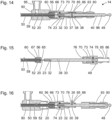
- Figure 8 shows a schematic representation of a section through parts of the component 14 shown in Figure 7 during its manufacture.
- the cutting plane of the Figure 8 corresponds to the cutting planes of the Figures 3, 4 and 7 .
- Figure 8 a situation is shown during the manufacture of the component, in which the wire 20 is already arranged in the channel 52 in the shaft tube 50.
- the proximal end 56 of the shaft tube 50 is inserted into the channel 65 in the first sleeve component 60.
- the shaft tube 50 is not yet rigidly connected to the first sleeve component 60, but can, as shown below with reference to the Figures 10 to 12 described, relative to the first sleeve component 60.
- the first sleeve component 60 has an external thread 67 which is provided and designed for positive and non-positive joining with a corresponding internal thread 76 at the distal end of the second sleeve component 70.
- Figure 9 shows another schematic representation of a section through the Figure 8 shown parts.
- the cutting plane of the Figure 9 corresponds to the cutting planes of the Figures 3, 4 , 7 and 8 .
- the first sleeve component 60 is connected by a screw connection between its external thread 67 (cf. Figure 8 ) with the internal thread 76 on the second sleeve component 70 is connected to the distal end of the second sleeve component 70.
- the first sleeve component 60 and the second sleeve component 70 can be connected to one another in a form-fitting, force-fitting and/or material-fitting manner.
- Figure 10 shows another schematic representation of a section through the Figures 8 and 9 shown parts.
- the cutting plane of the Figure 10 corresponds to the cutting planes of the Figures 3, 4 and 7 to 9 .
- the unit of the first sleeve component 60 and the second sleeve component 70 is displaced distally relative to the wire 20 and the shaft tube 50, so that the proximal end 23 of the wire 20 and optionally also as in Figure 10 As indicated, the proximal end 56 of the shaft tube 50 protrudes proximally from the channel 73 in the second sleeve component 70.
- Figure 11 shows a further schematic representation of a section through parts of the Figure 7 shown component 14 during its manufacture.
- the cutting plane of the Figure 11 corresponds to the cutting planes of the Figures 3, 4 and 7 to 10 .
- the proximal end 23 of the wire 20 protruding from the second sleeve component 70 is inserted into the first longitudinal bore 32 at the distal end of the first rod component 30.
- a transverse bore 33 is provided in the first rod component 30 in the region of the first longitudinal bore 32 in order to enable or simplify a material-locking joining of the proximal end 23 of the wire 20 to the distal end of the first rod component 30.
- the proximal end 23 of the wire 20 is laser-welded in the region of the transverse bore 33 is joined to the first rod component 30 in a material-locking manner.
- the proximal end 23 of the wire 20 and the first rod component 30 can be connected to one another in a form-fitting, force-fitting and/or material-locking manner in another way.
- a transverse bore 33 in the first rod component 30, as shown in the Figures 7 and 11 shown can also be used in the Figures 3 to 6 shown components may be provided.
- Figure 12 shows another schematic representation of a section through the Figure 11 shown parts.
- the cutting plane of the Figure 12 corresponds to the cutting planes of the Figures 3, 4 and 7 to 11 .
- the unit consisting of the first sleeve component 60 and the second sleeve component 70 is displaced proximally again relative to the shaft tube 50 and also relative to the transmission device 20, 30, 40.
- the Figure 12 The position shown of the unit comprising the first sleeve component 60 and the second sleeve component 70 relative to the proximal end 56 of the shaft tube 50 corresponds to the final position or the position intended for the finished component.
- the proximal end 56 of the shaft tube 50 is mechanically rigidly connected to the first sleeve component 60, for example by means of a circumferential laser weld seam or in another form-fitting, force-fitting and/or material-fitting manner.
- Figure 13 shows a further schematic representation of a section through parts of the Figure 7 shown component 14 during its manufacture.
- the cutting plane of the Figure 13 corresponds to the cutting planes of the Figures 3, 4 and 7 to 12 .
- the third sleeve component 80 is attached to the second sleeve component 70 in the manner provided and can be connected to it in a form-fitting, force-fitting and/or material-fitting manner.
- the connecting component 90 has to be slipped over the shaft tube 50, the first sleeve component 60 and the distal end of the second sleeve component 70 and joined thereto in a form-fitting, force-fitting and/or material-fitting manner.
- Figure 14 shows a schematic representation of a section through the proximal end of another component 14, which in some features, properties and functions corresponds to the Figures 3 to 13 components shown.
- the cutting plane of the Figure 14 corresponds to the cutting planes of the Figures 3, 4 and 7 to 13 .
- features and properties of component 14 are described in particular, in which they differ from the Figures 3 to 13 components shown.
- the components shown in Figure 14 Component 14 shown differs from the components shown in the Figures 3 to 13 shown components in particular in that only one rod component 30 is provided, which performs the functions of both rod components 30, 40 of the Figures 3 to 13
- the rod component 30 comprises, in particular, at its distal end, a longitudinal bore 32 in which the proximal end 23 of the wire 20 is arranged and fastened, and at its proximal end a coupling ball 49 for releasable mechanical coupling to a movable part 19 of a handling device 18 (cf. Figure 1 ).
- Component 14 shown differs from the components shown in the Figures 3 to 13 The components shown furthermore differ in that neither an annular collar nor one or more lugs are provided on the rod component 30. Rather, a pin 38 is provided in a corresponding transverse bore in the rod component 30. Both ends of the pin 38 protrude from the outer contour of the rod component 30 and each protrude into an elongated recess 85 in the shaft 50, 60, 70, 80. Proximally oriented stop surfaces 36 and distally oriented stop surfaces 37 of the transmission device 20, 30, 40 are formed by corresponding parts of the surfaces of the ends of the pin 38.
- the recesses 85 are formed by slots in the second sleeve component 70, which are closed off to the outside by a tubular section of the third sleeve component 80. Edge regions of the slots forming the recesses 85 in the second sleeve component 70 form the proximally oriented stop surface 78 and the distally oriented stop surface 86.
- Figure 15 shows a schematic representation of a section through parts of the component shown in Figure 14.
- the cutting plane of the Figure 15 corresponds to the cutting planes of the Figures 3, 4 and 7 to 14 .
- FIG 15 a situation is shown in which the first sleeve component 60 can already be mechanically rigidly connected to the proximal end 56 of the shaft tube 50. Furthermore, the proximal end 23 of the wire 20 is already mechanically rigidly connected to the distal end of the rod component 30, namely inserted into the longitudinal bore 32 at the distal end of the rod component 30. The proximal end of the rod component 30 is already partially inserted into the channel 73 in the second sleeve component 70. In the second sleeve component 70, opposing slots can be seen which form the recesses 85 and whose proximal and distal ends form the distally oriented stop surfaces 86 and the proximally oriented stop surfaces 78, respectively.
- the second sleeve component 70 can be displaced distally relative to the other components shown and connected to the first sleeve component 60, for example by screwing between an external thread 67 on the first sleeve component 60 and an internal thread 76 on the second sleeve component 70.
- Figure 16 shows another schematic representation of a section through parts of the Figure 14 shown component 14 during its manufacture.
- the cutting plane of the Figure 16 corresponds to the cutting planes of the Figures 3, 4 and 7 to 15 .
- the situation shown differs from that in Figure 15 shown situation in that the first sleeve component 60 is rigidly and in particular permanently mechanically connected to the second sleeve component 70.
- the pin 38 is already partially inserted through one of the two slots on the second sleeve component 70, which form the two recesses 85, into a corresponding transverse bore 39 in the rod component 30.
- the Figure 16 The third sleeve component 80, which is already shown slipped over the proximal end of the rod component 30, is attached to the proximal end of the second sleeve component 70 and is mechanically rigidly and in particular permanently connected thereto.
- the connecting component 90 can be slipped over the first sleeve component 60 and the distal end of the second sleeve component 70 from the distal end before or after this.
- a mechanically rigid connection between the connecting component 90 and the second sleeve component 70 is achieved in the Figures 3 to 16 illustrated examples are formed by engagement of an inwardly projecting collar at the proximal end of the connecting component 90 in a corresponding circumferential groove on the second sleeve component 70.
- the connecting component 90 can be formed in all of the Figures 3 to 16 shown components 14 are joined in a form-fitting, force-fitting and/or material-fitting manner to the shaft tube 50 and/or to the second sleeve component 70.
- Figure 17 shows a schematic flow diagram of a method for producing a component for a medical instrument, in particular one of the components described in the Figures 3 to 16
- the method is also suitable for producing a component with features, properties and functions that differ from those shown in the Figures 1 to 16 Nevertheless, reference symbols from the Figures 1 to 16 used as an example to simplify understanding.
- a distal end of a transmission device 16, 20, 30, 40 is coupled to a movable part of a tool 13.
- the tool 13 is intended in particular for gripping, holding, squeezing, cutting or punching and has, for example, a fixed branch or a fixed jaw part and a branch that can be pivoted relative to the fixed branch.
- the pivotable branch can be coupled directly to the distal end of the transmission device 16, 20, 30, 40 by a joint or indirectly via a connecting rod.
- the pivotable branch can be coupled in another way to the distal end of the transmission device 16, 20, 30, 40 in such a way that a translation of the transmission device 16, 20, 30, 40 is accompanied by a pivoting movement of the pivotable branch.
- a second step 102 the tool 13 is connected to the distal end of the shaft 15, 50, 60, 70, 80.
- the tool is connected in particular permanently or non-destructively releasably to the distal end of the shaft 15, 50, 60, 70, 80.
- a proximal end 56 of a shaft tube 50 is guided to a mounting position (cf. Figures 10 , 11 ) relative to a first component 60, 70 of a shaft 15, 50, 60, 70, 80 to be manufactured as part of the component to be manufactured into the first component 60, 70 of the shaft 15, 50, 60, 70, 80.
- the assembly position of the proximal end 56 of the shaft tube 50 (cf. Figures 10 , 11 ) is located proximal to the position intended for the finished component (cf. Figure 7 ) of the proximal end 56 of the shaft tube 50 relative to the first component 60, 70 of the shaft 15, 50, 60, 70, 80.
- the mounting position of the proximal end 56 of the shaft tube 50 can be proximal (cf. Figures 10, 11) or distal of the proximal end of the first component 60, 70 of the shaft 15, 50, 60, 70, 80.
- a proximal end 23 of a first component 20 of a transmission device 16, 20, 30, 40 is guided from distal to an assembly position (cf. Figures 10 , 11 ) is passed through the first component 60, 70 of the shaft 15, 50, 60, 70, 80.
- the assembly position of the proximal end 23 of the first component 20 relative to the first component 60, 70 of the shaft 15, 50, 60, 70, 80 is proximal to its position for the finished Component 14 provided position (cf. Figure 7 ).
- the mounting position of the proximal end 23 of the first component 20 of the transmission device 160, 20, 30, 40 is in particular proximal to the proximal end of the first component 60, 70 of the shaft 15, 50, 60, 70, 80.
- the first step 101, the second step 102, the third step 103 and the fourth step 104 are in particular carried out in the order given. Alternatively, these steps can be carried out in a different order, with the first step 101 and the second step 102 in particular being carried out before the third step 103 and/or before the fourth step 104. If the first step 101 and the second step 102 are carried out before the third step 103 and the fourth step 104, the third step 103 and the fourth step 104 can be carried out simultaneously.
- the first step 101, the second step 102 and the third step 103 are each optional and can be omitted.
- a fifth step 105 the proximal end 23 of the first component 20 of the transmission device 16, 20, 30, 40 is mechanically connected to a second component 30, 40 of the transmission device 16, 20, 30, 40.
- the mechanical connection produced in the fifth step 105 is in particular a permanent connection or a connection that cannot be released without causing damage.
- the second component 30, 40 of the transmission device 16, 20, 30, 40 and the first component 50, 60, 70 of the shaft 15, 50, 60, 70, 80 are in particular designed such that a movement of the second component 30, 40 of the transmission device 16, 20, 30, 40 relative to the first component 50, 60, 70 of the shaft 15, 50, 60, 70, 80 is limited distally by mechanical contact of corresponding stop surfaces 37, 78.
- proximal end 23 of the first component 20 of the transmission device 16, 20, 30, 40 is moved from the assembly position of the proximal end 23 of the first component 20 distally to a position intended for the finished component relative to the first component 60, 70 of the shaft 15, 50, 60, 70, 80.
- a seventh step 107 the proximal end 56 of the shaft tube 50 is moved distally relative to the first component of the shaft 15, 50, 60, 70, 80 to the position intended for use of the component 14.
- the sixth step 106 and the seventh step 107 are carried out simultaneously or in any order, but both after the fourth step 104 and the fifth step 105.
- the proximal end 56 of the shaft tube 50 is connected to the first component 60, 70 of the shaft 15, 50, 60, 70, 80.
- the eighth step 108 is carried out in particular after the seventh step 107, i.e. at the position of the proximal end 56 of the shaft tube 50 relative to the first component 60, 70 of the shaft 15, 50, 60, 70, 80 intended for the finished component 14.
Landscapes
- Health & Medical Sciences (AREA)
- Surgery (AREA)
- Life Sciences & Earth Sciences (AREA)
- Medical Informatics (AREA)
- Animal Behavior & Ethology (AREA)
- Engineering & Computer Science (AREA)
- Biomedical Technology (AREA)
- Heart & Thoracic Surgery (AREA)
- Veterinary Medicine (AREA)
- Molecular Biology (AREA)
- Nuclear Medicine, Radiotherapy & Molecular Imaging (AREA)
- General Health & Medical Sciences (AREA)
- Public Health (AREA)
- Oral & Maxillofacial Surgery (AREA)
- Pathology (AREA)
- Ophthalmology & Optometry (AREA)
- Surgical Instruments (AREA)
Description
- Die vorliegende Erfindung ist auf eine Komponente für ein medizinisches Instrument und auf ein medizinisches Instrument bezogen. Die vorliegende Erfindung ist insbesondere auf Maßnahmen bezogen, die unter bestimmten Umständen eine Zerstörung eines medizinischen Instruments durch unsachgemäße Verwendung oder Handhabung verhindern können.
- In
DE 197 31 453 A1 (ähnlich oder gleich:WO 99/04703 A1 EP 0 925 037 B1 ) ist ein chirurgisches Instrument 10 mit einer Vorrichtung 30 zur Begrenzung der Kraftübertragung beschrieben (Spalte 7, Zeilen 39 bis 41). Diese Vorrichtung 30 verbindet einen ersten Abschnitt 32 und einen zweiten Abschnitt 54 eines im Übrigen stabförmigen Betätigungselements 26 (Figuren 1, 2 ). Die Vorrichtung 30 umfasst ein näherungsweise hohlzylinderförmiges Gehäuse 38, das mit dem ersten Abschnitt 32 des stabförmigen Betätigungselements 26 starr verbunden ist und sich axial erstreckende Nuten (Spalte 7, Zeilen 45 bis 55) und einen Innenkonus (Spalte 8, Zeilen 14 bis 16;Figur 4 ) aufweist. Die Vorrichtung 30 umfasst ferner einen Konus 56, der mit dem zweiten Abschnitt 54 des stabförmigen Betätigungselements 26 verbunden ist, eine konische Keilfläche 57 aufweist und in dem hohlzylinderförmigen Gehäuse 38 so angeordnet ist, dass der Konus 56 an dem Innenkonus 64 anliegt (Spalte 8, Zeilen 7 bis 23). Bei Überschreiten einer vorbestimmten Kraft wird das hohlzylinderförmige Gehäuse 38 verformt und der Konus 56 aus diesem teilweise heraus gezogen (Spalte 8, Zeilen 33 bis 53). - In
DE 10 2009 031 262 A1 undEP 2 269 522 A1 ist ein medizinisches Instrument 1 beschrieben, bei dem in der Handhabe 3 eine Kraftbegrenzungsvorrichtung 8 vorgesehen ist, die zwei miteinander gekoppelte Komponenten bei Überschreiten einer Grenzlast reversibel trennt (Absatz [0024] vonEP 2 269 522 A1 ). -
-
EP 2 510 889 A1 ist eine Handhabungseinrichtung für ein mikroinvasiv-chirurgisches Instrument beschrieben. Eine vorgespannte Druckfeder 564 in einem becherförmigen Bauteil 562 begrenzt eine von einem Stab 561 auf eine Übertragungsstange 40 zu übertragende Zugkraft (Absatz [0083] vonEP 2 510 888 A1 ;Figur 3 ). - In
DE 10 2012 002 770 A1 undEP 2 626 018 A2 ist ein medizinisches Instrument beschrieben, bei dem in der Handhabe 3 eine Kraftbegrenzungsvorrichtung 8 vorgesehen ist, die bei Überschreiten einer Grenzlast die übertragene Kraft reversibel begrenzt (Absatz [0026] vonEP 2 626 018 A2 .) - In
DE 197 31 453 A1 ist ein chirurgisches Instrument 10 mit einer Vorrichtung 30 zur Begrenzung der Kraftübertragung beschrieben (Spalte 7, Zeilen 39 bis 41, Figuren). Diese Vorrichtung 30 verbindet einen ersten, distalen Abschnitt 32 und einen zweiten, proximalen Abschnitt 54 eines im Übrigen stabförmigen Betätigungselements 26 (Spalte 7, Zeilen 45 bis 47; Spalte 8, Zeilen 7 bis 8;Figuren 1, 2 ). Die Vorrichtung 30 umfasst ein als näherungsweise hohlzylinderförmig bezeichnetes Gehäuse 38, das mit dem ersten Abschnitt 32 des stabförmigen Betätigungselements 26 starr verbunden ist und axial sich erstreckende Nuten (Spalte 7, Zeilen 45 bis 55) sowie einen Innenkonus 64 (Spalte 8, Zeilen 14 bis 16;Figur 4 ) aufweist. Die Vorrichtung 30 umfasst ferner einen Konus 56, der mit dem zweiten Abschnitt 54 des stabförmigen Betätigungselements 26 verbunden ist, eine konische Keilfläche 57 aufweist und in dem Gehäuse 38 so angeordnet ist, dass der Konus 56 an dem Innenkonus 64 anliegt (Spalte 8, Zeilen 7 bis 23). Bei Überschreiten einer vorbestimmten Kraft wird das Gehäuse 38 verformt und der Konus 56 aus diesem teilweise heraus gezogen (Spalte 8, Zeilen 33 bis 53). - In
EP 2 561 816 A1 ist ein Werkzeug für ein mikroinvasiv-chirurgisches Instrument beschrieben. - In
EP 2 269 522 A1 ist ein medizinisches Instrument 1 beschrieben, bei dem in der Handhabe 3 eine Kraftbegrenzungsvorrichtung 8 vorgesehen ist, die zwei miteinander gekoppelte Komponenten bei Überschreiten einer Grenzlast reversibel trennt (Absatz [0024]). - In
DE 43 11 770 A1 ist eine Greifpinzette 1 mit einem in einen Körperhohlraum eines Patienten einführbaren Einführbereich 2 beschrieben (Spalte 4, Zeilen 14 bis 22,Figur 1 ). In einer Umhüllung 24 ist ein Betätigungsschaft 10 angeordnet, der Greifteile 27a, 27b in einem Pinzettenbereich 3 mit einem Bedienbereich 4 verbindet (Spalte 4, Zeilen 31 bis 50 und Zeilen 66 bis 68,Figuren 3, 4 ). Das proximale Ende des Übertragungsschafts 10 wird durch einen Kopplungsstab 41 gebildet (Spalte 5, Zeilen 46 bis 56,Figur 4 ). Eine Stufe zwischen einem Bereich 41a des Kopplungsstabs 41 mit großem Durchmesser und einem Bereich 41b des Kopplungsstabs 41mit kleinem Durchmesser und eine Stufe zwischen einer Stabhaltebohrung 37 und einer Durchgangsbohrung 38 in dem Bedienbereich 4 bilden eine Stopper-Vorrichtung 12, die die Bewegung des Betätigungsschafts 10 nach proximal beschränkt (Spalte 6, Zeilen 19 bis 28,Figur 4 ). - In
US 4,569,131 A1 ist ein Werkzeug mit einer Handhabungseinrichtung, einem austauschbaren Schaft und einem Paar schwenkbar verbundener Bauteile beschrieben. Um ein Überschließen, also ein Überstehen der Schneidkante eines schwenkbaren Bauteils gegen über dem anderen schwenkbaren Bauteil zu vermeiden, ist ein ringförmiger Begrenzungsanschlag vorgesehen, der zwischen zwei Anschlägen bewegbar ist. - Eine Aufgabe der vorliegenden Erfindung besteht darin, eine verbesserte Komponente für ein medizinisches Instrument, ein verbessertes medizinisches Instrument und ein verbessertes Verfahren zum Herstellen einer Komponente für ein medizinisches Instrument zu schaffen.
- Diese Aufgabe wird durch die Gegenstände der unabhängigen Ansprüche gelöst.
- Weiterbildungen sind in den abhängigen Ansprüchen angegeben.
- Eine Komponente für ein medizinisches Instrument umfasst einen Schaft, eine Übertragungseinrichtung, die in dem Schaft bewegbar ist, zum Übertragen einer Kraft von einer mit dem proximalen Ende der Komponente gekoppelten Handhabungseinrichtung zu einem Werkzeug an dem distalen Ende der Komponente, eine Anschlagfläche an dem Schaft und eine Anschlagfläche an der Übertragungseinrichtung, wobei die Anschlagfläche des Schafts und die Anschlagfläche der Übertragungseinrichtung so angeordnet sind, dass ein mechanischer Kontakt zwischen der Anschlagfläche und der Übertragungseinrichtung und der Anschlagfläche des Schafts eine Bewegung der Übertragungseinrichtung relativ zu dem Schaft nach proximal begrenzt.
- Die Komponente ist vorgesehen und ausgebildet, um mit einer oder mehreren weiteren Komponenten so mechanisch verbunden und / oder gekoppelt zu werden, dass ein medizinisches Instrument gebildet wird. Die Komponente ist insbesondere eine Komponente für ein mikroinvasives medizinisches Instrument, wobei der Schaft einen Durchmesser von wenigen Millimetern oder weniger und eine Länge von einigen Zentimetern oder wenigen oder einigen Dezimetern aufweist. Der Schaft kann beispielsweise dafür vorgesehen und ausgebildet sein, um in einen Arbeitskanal eines Endoskops eingeführt zu werden.
- Das proximale Ende des Schafts ist insbesondere zur zerstörungsfrei lösbaren oder zur dauerhaften bzw. nicht zerstörungsfrei lösbaren mechanischen Verbindung mit einer Handhabungseinrichtung vorgesehen und ausgebildet. Das proximale Ende der Übertragungseinrichtung ist insbesondere zur zerstörungsfrei lösbaren oder dauerhaften bzw. nicht zerstörungsfrei lösbaren mechanischen Kopplung mit einem manuell bewegbaren Teil einer Handhabungseinrichtung vorgesehen und ausgebildet.
- Die Komponente kann an ihrem distalen Ende ein Werkzeug aufweisen, das mit dem distalen Ende des Schafts insbesondere starr verbunden ist, und das einen bewegbaren Teil (beispielsweise eine schwenkbare Branche oder ein schwenkbares Maulteil) aufweist. Dabei ist der bewegbare Teil des Werkzeugs derart unmittelbar oder mittelbar mit dem distalen Ende der Übertragungseinrichtung mechanisch gekoppelt, dass eine Bewegung der Übertragungseinrichtung relativ zu dem Schaft mit einer Bewegung des bewegbaren Teils des Werkzeugs relativ zu einem anderen Teil des Werkzeugs einhergeht. Das Werkzeug kann mit dem distalen Ende des Schafts und mit dem distalen Ende der Übertragungseinrichtung zerstörungsfrei lösbar oder dauerhaft bzw. nicht zerstörungsfrei lösbar mechanisch verbunden und gekoppelt sein.
- Alternativ kann die Komponente kein Werkzeug aufweisen, jedoch zur zerstörungsfrei lösbaren oder zur dauerhaften bzw. nicht zerstörungsfrei lösbaren mechanischen Verbindung und Kopplung eines Werkzeugs mit dem distalen Ende des Schafts und mit dem distalen Ende der Übertragungseinrichtung vorgesehen und ausgebildet sein.
- Die Übertragungseinrichtung ist insbesondere in Richtung parallel zur Längsachse des Schafts relativ zu dem Schaft bewegbar. Die Übertragungseinrichtung ist insbesondere zum Übertragen einer Zugkraft von einem mit dem proximalen Ende der Übertragungseinrichtung gekoppelten bewegbaren Teil einer Handhabungseinrichtung zu einem mit dem distalen Ende der Übertragungseinrichtung gekoppelten bewegbaren Teil eines Werkzeugs vorgesehen und ausgebildet. Alternativ oder zusätzlich kann die Übertragungseinrichtung zum Übertragen einer Schubkraft von einem mit dem proximalen Ende der Übertragungseinrichtung gekoppelten bewegbaren Teil einer Handhabungseinrichtung zu einem mit dem distalen Ende der Übertragungseinrichtung gekoppelten bewegbaren Teil eines Werkzeugs vorgesehen und ausgebildet sein.
- Das distale Ende der Übertragungseinrichtung ist insbesondere mit einem bewegbaren Teil eines Werkzeugs derart koppelbar oder derart gekoppelt, dass eine Bewegung der Übertragungseinrichtung nach proximal mit der vorgesehenen Wirkbewegung des bewegbaren Teils des Werkzeugs einhergeht. In diesem Fall wird die für die Wirkbewegung des bewegbaren Teils des Werkzeugs erforderliche Kraft durch eine Zugkraft bzw. Zugspannung in der Übertragungseinrichtung übertragen. Die Wirkbewegung des bewegbaren Teils eines Werkzeugs ist die Bewegung, bei der das Werkzeug die vorgesehene Wirkung entfaltet. Bei einer Zange oder einem anderen Werkzeug zum Greifen, Halten, Quetschen, Stanzen oder Schneiden ist dies in der Regel die schließende Bewegung, bei der zwei (in manchen Fällen mehr) Maulteile bzw. Branchen aufeinander zu bewegt werden. In anderen Fällen kann die Wirkbewegung eine Bewegung sein, bei der Maulteile bzw. Branchen voneinander wegbewegt werden, beispielsweise bei einem Werkzeug zum Spreizen oder Weiten eines Gefäßes oder eines anderen Hohlraums.
- Alternativ zu einer Anordnung der Anschlagfläche des Schafts und der Anschlagfläche der Übertragungseinrichtung derart, dass ein mechanischer Kontakt zwischen der Anschlagfläche der Übertragungseinrichtung und der Anschlagfläche des Schafts eine Bewegung der Übertragungseinrichtung relativ zu dem Schaft nach proximal begrenzt, können die Anschlagfläche des Schafts und die Anschlagfläche der Übertragungseinrichtung derart angeordnet sein, dass ein mechanischer Kontakt zwischen der Anschlagfläche der Übertragungseinrichtung und der Anschlagfläche des Schafts eine Bewegung der Übertragungseinrichtung relativ zu dem Schaft nach distal begrenzt.
- Bei einer Komponente, wie sie hier beschrieben ist, sind insbesondere die Anschlagfläche des Schafts nach distal und die Anschlagfläche der Übertragungseinrichtung nach proximal orientiert.
- Bei einer Komponente, wie sie hier beschrieben ist, sind insbesondere die Bewegung des distalen Endes der Übertragungseinrichtung relativ zu dem distalen Ende des Schafts nach proximal so begrenzt und die Anschlagfläche des Schafts und die Anschlagfläche der Übertragungseinrichtung so angeordnet, dass ein mechanischer Kontakt zwischen der Anschlagfläche der Übertragungseinrichtung und der Anschlagfläche des Schafts eine elastische Verformung der Übertragungseinrichtung durch eine von der Übertragungseinrichtung übertragene Kraft auf einen vorbestimmten Maximalwert begrenzt, wobei der vorbestimmte Maximalwert der elastischen Verformung und elastische Eigenschaften der Übertragungseinrichtung so gewählt sind, dass bei der Kraft, die bei dem vorbestimmten Maximalwert der elastischen Verformung der Übertragungseinrichtung vorliegt, eine Zerstörung oder Schädigung des Schafts, der Übertragungseinrichtung und eines mit dem distalen Ende des Schafts verbundenen und mit dem distalen Ende der Übertragungseinrichtung gekoppelten Werkzeugs ausgeschlossen ist.
- Die Bewegung des distalen Endes der Übertragungseinrichtung relativ zu dem distalen Ende des Schafts ist insbesondere durch ein Werkzeug, das mit dem distalen Ende des Schafts mechanisch verbunden und mit dem distalen Ende der Übertragungsrichtung mechanisch gekoppelt ist, begrenzt. Wenn die Komponente kein Werkzeug am distalen Ende umfasst, sondern zur mechanischen Verbindung und Kopplung mit einem Werkzeug vorgesehen und ausgebildet ist, ist die Bewegung des distalen Endes der Übertragungseinrichtung relativ zu dem distalen Ende des Schafts insbesondere nur dann nach proximal begrenzt oder nur dann in der Weise, die für die hier beschriebene Begrenzung der übertragenen Kraft auf den vorbestimmten Maximalwert erforderlich ist, begrenzt, wenn das distale Ende des Schafts mit dem für die Komponente vorgesehenen Werkzeug oder mit einem von mehreren für die Komponente vorgesehenen Werkzeugen in der vorgesehenen Weise verbunden und ein oder mehrere bewegbare Teile des Werkzeugs in der vorgesehenen Weise mit dem distalen Ende der Übertragungseinrichtung mechanisch gekoppelt sind.
- Bei einer Komponente, wie sie hier beschrieben ist, sind die Anschlagfläche des Schafts und die Anschlagfläche der Übertragungseinrichtung insbesondere so angeordnet, dass ein mechanischer Kontakt zwischen der Anschlagfläche der Übertragungseinrichtung und der Anschlagfläche des Schafts bei der vorgesehenen Verwendung eine elastische Verformung der Übertragungseinrichtung durch eine von der Übertragungseinrichtung übertragene Kraft auf einen vorbestimmten Maximalwert begrenzt, wobei der vorbestimmte Maximalwert der elastischen Verformung und elastische Eigenschaften der Übertragungseinrichtung so gewählt sind, dass bei der Kraft, die bei dem vorbestimmten Maximalwert der elastischen Verformung der Übertragungseinrichtung vorliegt, eine Zerstörung oder Schädigung des Schafts, der Übertragungseinrichtung und eines mit dem distalen Ende des Schafts verbundenen und mit dem distalen Ende der Übertragungseinrichtung gekoppelten Werkzeugs ausgeschlossen ist.
- Auch eine plastische Verformung der Übertragungseinrichtung, des Schafts oder eines mit dem distalen Ende des Schafts und dem distalen Ende der Übertragungseinrichtung gekoppelten Werkzeugs ist eine Schädigung der Übertragungseinrichtung, des Schafts bzw. des Werkzeugs. Ein Ausschluss einer Zerstörung oder Schädigung des Schafts, der Übertragungseinrichtung und eines mit dem distalen Ende des Schafts und dem distalen Ende der Übertragungseinrichtung gekoppelten Werkzeugs bedeutet somit auch, dass die Übertragungseinrichtung, der Schaft und das Werkzeug jeweils lediglich elastisch und nicht plastisch verformt werden.
- Bei einer Komponente, wie sie hier beschrieben ist, ist eine Zerstörung oder Schädigung des Schafts, der Übertragungseinrichtung und eines mit dem distalen Ende des Schafts gekoppelten Werkzeugs insbesondere auch dann ausgeschlossen, wenn das Werkzeug in einem ganz geöffneten oder in einem ganz geschlossenen oder in einem beliebigen Zustand blockiert ist.
- Ein mit dem distalen Ende des Schafts verbundenes und mit dem distalen Ende der Übertragungseinrichtung gekoppeltes Werkzeug zum Schneiden, Greifen, Halten, Quetschen oder Stanzen kann beispielsweise durch einen harten oder bei der erzeugbaren Kraft nicht nachgebenden Gegenstand in seiner ganz geöffneten Konfiguration blockiert werden. Wenn die Übertragungseinrichtung mit dem bewegbaren Teil des Werkzeugs derart gekoppelt ist, dass zum Schließen des Werkzeugs eine durch die Übertragungseinrichtung zu übertragende Zugkraft erforderlich ist, ist die Übertragungseinrichtung dann maximal verformt, nämlich gedehnt, wenn das Werkzeug im ganz geöffneten Zustand blockiert ist und die Anschlagfläche der Übertragungseinrichtung an der Anschlagfläche des Schafts anliegt. Die Anschlagfläche der Übertragungseinrichtung und die Anschlagfläche des Schafts sind so positioniert und die elastischen Eigenschaften der Übertragungseinrichtung sind so gewählt, dass auch in diesem Fall der Schaft, die Übertragungseinrichtung und ein mit dem distalen Ende des Schafts gekoppeltes Werkzeug nicht geschädigt oder zerstört werden.
- Bei einer Komponente, wie sie hier beschrieben ist, sind insbesondere die Anschlagfläche des Schafts nahe dem proximalen Ende des Schafts und die Anschlagfläche der Übertragungseinrichtung nahe dem proximalen Ende der Übertragungseinrichtung angeordnet.
- Der Abstand der Anschlagfläche des Schafts von dem proximalen Ende des Schafts beträgt insbesondere nicht mehr als ein Fünftel oder nicht mehr als ein Zehntel der Länge des Schafts. Der Abstand der Anschlagfläche der Übertragungseinrichtung von dem proximalen Ende der Übertragungseinrichtung beträgt insbesondere nicht mehr als ein Fünftel oder nicht mehr als ein Zehntel der Länge der Übertragungseinrichtung.
- Bei einer Komponente, wie sie hier beschrieben ist, sind die Anschlagfläche des Schafts und die Anschlagfläche der Übertragungseinrichtung insbesondere in einem proximalen Bereich des Schafts, in dem der Schaft einen vergrößerten Durchmesser oder einen vergrößerten Querschnitt aufweist, angeordnet.
- Bei einer Komponente, wie sie hier beschrieben ist, sind die Anschlagfläche des Schafts und die Anschlagfläche der Übertragungseinrichtung insbesondere in einem Bereich des Schafts, der zur Aufnahme in einer Handhabungseinrichtung vorgesehen ist, angeordnet.
- Der Schaft weist insbesondere einen langen und dünnen rohrförmigen Abschnitt und einen im Vergleich zu dem rohrförmigen Abschnitt wesentlich dickeren proximalen Abschnitt auf. Der lange und dünne rohrförmige Abschnitt des Schafts erstreckt sich in der Regel über mindestens zwei Drittel oder mindestens vier Fünftel oder mindestens neun Zehntel der Länge des Schafts und hat einen Durchmesser von wenigen Millimetern oder weniger. Durchmesser und Querschnitt des proximalen Abschnitts des Schafts sind in der Regel deutlich größer als Durchmesser und Querschnitt des langen und dünnen rohrförmigen Abschnitts. In dem proximalen Abschnitt steht mehr Bauraum für die Anschlagfläche des Schafts und für die Anschlagfläche der Übertragungseinrichtung zur Verfügung.
- Bei einer Komponente, wie sie hier beschrieben ist, weist die Übertragungseinrichtung insbesondere in einem Abschnitt distal der Anschlagfläche der Übertragungseinrichtung ihre minimale Querschnittsfläche auf, wobei alle Querschnittsflächen der Übertragungseinrichtung proximal der Anschlagfläche der Übertragungseinrichtung größer sind als die minimale Querschnittsfläche der Übertragungseinrichtung.
- Die Querschnittsfläche der Übertragungseinrichtung ist insbesondere proximal der Anschlagfläche der Übertragungseinrichtung durchgehend wesentlich größer als distal der Anschlagfläche der Übertragungseinrichtung. Die Querschnittsfläche der Übertragungseinrichtung ist beispielsweise proximal der Anschlagfläche der Übertragungseinrichtung durchgehend mindestens um einen Faktor 5 oder mindestens um einen Faktor 10 oder mindestens um einen Faktor 20 größer als distal der Anschlagfläche der Übertragungseinrichtung. Die Übertragungseinrichtung weist insbesondere distal der Anschlagfläche der Übertragungseinrichtung weitgehend einen konstanten kreisförmigen Querschnitt mit einem Durchmesser von weniger als 1 mm auf. Proximal der Anschlagfläche der Übertragungseinrichtung weist die Übertragungseinrichtung insbesondere durchgehend einen kreisförmigen oder anderen Querschnitt mit einer Querschnittsfläche von mehreren Quadratmillimetern auf.
- Eine Ausgestaltung der Übertragungseinrichtung derart, dass ihre Querschnittsfläche proximal der Anschlagfläche der Übertragungseinrichtung deutlich größer ist als distal, ermöglicht eine große Robustheit der Übertragungseinrichtung proximal der Anschlagfläche der Übertragungseinrichtung und deshalb ein geringes Risiko einer Zerstörung oder Schädigung durch eine zu große Kraft.
- Bei einer Komponente, wie sie hier beschrieben ist, weist die Übertragungseinrichtung insbesondere in einem Abschnitt distal der Anschlagfläche der Übertragungseinrichtung ihre minimale Zugfestigkeit auf, wobei die Zugfestigkeit der Übertragungseinrichtung proximal der Anschlagfläche der Übertragungseinrichtung durchgehend größer ist als die minimale Zugfestigkeit der Übertragungseinrichtung.
- Die Zugfestigkeit der Übertragungseinrichtung ist proximal der Anschlagfläche der Übertragungseinrichtung insbesondere wesentlich größer als die minimale Zugfestigkeit der Übertragungseinrichtung. Die Zugfestigkeit der Übertragungseinrichtung ist proximal der Anschlagfläche der Übertragungseinrichtung beispielsweise mindestens um einen Faktor 5 oder um einen Faktor 10 oder um einen Faktor 20 größer als die minimale Zugfestigkeit der Übertragungseinrichtung.
- Bei einer Komponente, wie sie hier beschrieben ist, ist die Übertragungseinrichtung insbesondere distal der Anschlagfläche der Übertragungseinrichtung bis zu einer ersten Maximalkraft elastisch verformbar, wobei die Übertragungseinrichtung proximal der Anschlagfläche der Übertragungseinrichtung bis zu einer zweiten Maximalkraft elastisch verformbar ist, und wobei die zweite Maximalkraft größer ist als die erste Maximalkraft.
- Die Maximalkraft, bis zu der die Übertragungseinrichtung an einem bestimmten Punkt elastisch verformbar ist, ist die größte Kraft, bei der die Übertragungseinrichtung an dem bestimmten Punkt noch nicht plastisch verformt wird. Die zweite Maximalkraft ist insbesondere deutlich größer als die erste Maximalkraft. Die zweite Maximalkraft ist insbesondere mindestens um einen Faktor 2 oder mindestens um einen Faktor 5 oder mindestens um einen Faktor 10 oder mindestens um einen Faktor 20 oder mindestens um einen Faktor 50 größer als die erste Maximalkraft.
- Durch Ausgestaltung und Anordnung der Anschlagfläche der Übertragungseinrichtung und der Anschlagfläche des Schafts und Wahl elastischer Eigenschaften der Übertragungseinrichtung kann eine Zerstörung oder Schädigung der Übertragungseinrichtung sowie des Schafts und eines Werkzeugs am distalen Ende der Komponente verhindert werden. Eine proximal der Anschlagfläche der Übertragungseinrichtung wesentlich größere mechanische Robustheit der Übertragungseinrichtung kann auch das Risiko einer Zerstörung oder Schädigung der Übertragungseinrichtung proximal der Anschlagfläche der Übertragungseinrichtung deutlich reduzieren.
- Bei einer Komponente, wie sie hier beschrieben ist, kann die Übertragungseinrichtung insbesondere weder nach proximal noch nach distal aus dem Schaft entnommen werden ohne den Schaft zu zerlegen.
- Eine Komponente, wie sie hier beschrieben ist, umfasst insbesondere ferner eine weitere Anschlagfläche an dem Schaft und eine weitere Anschlagfläche an der Übertragungseinrichtung, wobei die weitere Anschlagfläche des Schafts und die weitere Anschlagfläche der Übertragungseinrichtung so angeordnet sind, dass ein mechanischer Kontakt zwischen der weiteren Anschlagfläche der Übertragungseinrichtung und der weiteren Anschlagfläche des Schafts eine Bewegung der Übertragungseinrichtung relativ zu dem Schaft nach distal begrenzt.
- Die weitere Anschlagfläche des Schafts ist insbesondere nahe dem proximalen Ende des Schafts und insbesondere nahe der Anschlagfläche des Schafts angeordnet. Die weitere Anschlagfläche der Übertragungseinrichtung ist insbesondere nahe dem proximalen Ende der Übertragungseinrichtung und insbesondere nahe der Anschlagfläche der Übertragungseinrichtung angeordnet. Insbesondere sind die weitere Anschlagfläche des Schafts nach proximal und die weitere Anschlagfläche der Übertragungseinrichtung nach distal orientiert.
- Die Begrenzung der Bewegung der Übertragungseinrichtung relativ zu dem Schaft nach distal kann eine Überlastung, Schädigung oder Zerstörung der Übertragungseinrichtung, des Schafts oder eines Werkzeugs am distalen Ende der Komponente durch eine zu hohe durch die Übertragungseinrichtung übertragene Schubkraft verhindern. Insbesondere kann eine Stauchung der Übertragungseinrichtung distal der weiteren Anschlagfläche der Übertragungseinrichtung verhindert werden.
- Bei einer Komponente, wie sie hier beschrieben ist, weist die Übertragungseinrichtung insbesondere einen nach außen ragenden Kragen auf, wobei der Schaft eine Nut, die einen Kanal, in dem die Übertragungseinrichtung angeordnet ist, erweitert, aufweist, wobei der Kragen der Übertragungseinrichtung in der Nut des Schafts angeordnet ist, wobei die Anschlagfläche des Schafts Teil der inneren Oberfläche der Nut ist, und wobei die Anschlagfläche der Übertragungseinrichtung Teil der Oberfläche des Kragens ist.
- Eine nach proximal orientierte Oberfläche des Kragens kann die Anschlagfläche der Übertragungseinrichtung, eine nach distal orientierte Oberfläche der Nut kann die Anschlagfläche des Schafts bilden. Eine nach distal orientierte Oberfläche an dem Kragen kann die weitere Anschlagfläche der Übertragungseinrichtung, eine nach proximal orientierte Fläche in der Nut kann die weitere Anschlagfläche des Schafts bilden, um eine Bewegung der Übertragungseinrichtung relativ zu dem Schaft nach distal zu begrenzen.
- Der Kragen ist insbesondere ringförmig oder kreisringförmig. In diesem Fall bildet insbesondere ein ringförmiger oder kreisringförmiger Bereich der Oberfläche des Kragens die Anschlagfläche der Übertragungseinrichtung.
- Die Nut ist insbesondere ringförmig oder kreisringförmig und erweitert den Kanal, in dem die Übertragungseinrichtung angeordnet ist, ringförmig. In diesem Fall bildet insbesondere ein ringförmiger oder kreisringförmiger Bereich der inneren Oberfläche der Nut die Anschlagfläche des Schafts.
- Bei einer Komponente, wie sie hier beschrieben ist, weist die Übertragungseinrichtung insbesondere einen Vorsprung, eine Nase, einen Steg, einen Zapfen oder einen anderen konvexen Bereich auf, wobei der Schaft eine Nut oder eine andere nischenförmige Ausnehmung, die von einem Kanal, in dem die Übertragungseinrichtung angeordnet ist, ausgeht, aufweist, wobei der Vorsprung oder die Nase oder der Steg oder der Zapfen oder der andere konvexe Bereich der Übertragungseinrichtung in der Nut oder der anderen nischenförmigen Ausnehmung des Schafts angeordnet ist, wobei die Anschlagfläche des Schafts Teil der inneren Oberfläche der Nut oder der anderen nischenförmigen Ausnehmung des Schafts ist, und wobei die Anschlagfläche der Übertragungseinrichtung Teil der Oberfläche des Vorsprungs oder der Nase oder des Stegs oder des Zapfens oder des anderen konvexen Bereichs ist.
- Ferner können ein weiterer, nach proximal orientierter Teil der inneren Oberfläche der Nut oder der anderen nischenförmigen Ausnehmung des Schafts eine weitere Anschlagfläche des Schafts und ein weiterer, nach distal orientierter Teil der Oberfläche des Vorsprungs oder der Nase oder des Stegs oder des Zapfens oder des anderen konvexen Bereichs eine weitere Anschlagfläche der Übertragungseinrichtung bilden, um eine Bewegung der Übertragungseinrichtung relativ zu dem Schaft nach distal zu begrenzen.
- Eine Komponente, wie sie hier beschrieben ist, umfasst insbesondere ferner ein Werkzeug an dem distalen Ende des Schafts, wobei das Werkzeug ein bewegbares Bauteil, das mit dem distalen Ende der Übertragungseinrichtung gekoppelt ist, aufweist.
- Das Werkzeug kann mit dem distalen Ende des Schafts zerstörungsfrei lösbar oder dauerhaft bzw. nicht zerstörungsfrei lösbar verbunden sein. Das Werkzeug ist insbesondere zum Greifen, Fassen, Halten, Quetschen, Schneiden oder Stanzen ausgebildet. Das bewegbare Bauteil ist insbesondere eine Branche oder ein Maulteil des Werkzeugs. Das bewegbare Bauteil ist insbesondere derart mit der Übertragungseinrichtung gekoppelt, dass eine lineare Translationsbewegung der Übertragungseinrichtung in Richtung parallel zu ihrer Längsachse mit einer Schwenkbewegung des bewegbaren Bauteils einhergeht.
- Ein medizinisches Instrument umfasst eine Komponente, wie sie hier beschrieben ist, und eine Handhabungseinrichtung, die mit dem proximalen Ende des Schafts gekoppelt oder koppelbar ist.
- Ein Verfahren zum Herstellen einer Komponente für ein medizinisches Instrument umfasst einen Schritt des Hindurchführens eines proximalen Endes eines ersten Bauteils einer Übertragungseinrichtung von distal durch ein erstes Bauteil eines Schafts bis zu einer Montageposition, die proximal der für die fertiggestellte Komponente vorgesehenen Position relativ zu dem ersten Bauteil des Schafts liegt, einen Schritt des mechanischen Verbindens des proximalen Endes des ersten Bauteils der Übertragungseinrichtung mit einem zweiten Bauteil der Übertragungseinrichtung und einen Schritt des Bewegens des proximalen Endes des ersten Bauteils der Übertragungseinrichtung nach distal bis zu einer für die fertiggestellte Komponente vorgesehenen Position relativ zu dem ersten Bauteil des Schafts.
- Das Verfahren ist insbesondere zum Herstellen einer Komponente, wie sie hier beschrieben ist oder für eine andere Komponente mit hier beschriebenen Merkmalen, Eigenschaften und Funktionen geeignet. Die Schritte des Hindurchführens, des Verbindens und des Bewegens werden insbesondere in dieser Reihenfolge ausgeführt. Das proximale Ende des ersten Bauteils der Übertragungseinrichtung wird mit dem zweiten Bauteil der Übertragungseinrichtung insbesondere dauerhaft bzw. nicht zerstörungsfrei lösbar verbunden. Das zweite Bauteil der Übertragungseinrichtung, mit dem das proximale Ende des ersten Bauteils der Übertragungseinrichtung verbunden ist, und das erste Bauteil des Schafts sind insbesondere so ausgeführt, dass eine Bewegung des zweiten Bauteils der Übertragungseinrichtung relativ zu dem ersten Bauteil des Schafts durch mechanischen Kontakt korrespondierender Anschlagflächen nach distal begrenzt ist.
- Ein Verfahren, wie es hier beschrieben ist, umfasst insbesondere ferner einen Schritt des Einführens eines proximalen Endes eines Schaftrohrs in das erste Bauteil des Schafts bis zu einer Montageposition, die proximal der für die fertiggestellte Komponente vorgesehenen Position relativ zu dem ersten Bauteil des Schafts liegt, vor dem Verbinden des proximalen Endes des ersten Bauteils der Übertragungseinrichtung mit dem zweiten Bauteil der Übertragungseinrichtung, einen Schritt des Bewegens des proximalen Endes des Schaftrohrs relativ zu dem ersten Bauteil des Schafts nach distal bis zu der für die Verwendung der Komponente vorgesehenen Position des Schaftrohrs relativ zu dem ersten Bauteil des Schafts nach dem Verbinden des proximalen Endes des ersten Bauteils der Übertragungseinrichtung mit dem zweiten Bauteil der Übertragungseinrichtung, und einen Schritt des mechanischen Verbindens des proximalen Endes des Schaftrohrs mit dem ersten Bauteil des Schafts an der für die fertiggestellte Komponente vorgesehenen Position relativ zu dem ersten Bauteil des Schafts.
- Das proximale Ende des Schaftrohrs wird mit dem ersten Bauteil des Schafts insbesondere dauerhaft bzw. nicht zerstörungsfrei lösbar verbunden.
- Ein Verfahren, wie es hier beschrieben ist, umfasst insbesondere einen Schritt des Koppelns eines distalen Endes der Übertragungseinrichtung mit einem bewegbaren Teil eines Werkzeugs und einen Schritt des mechanischen Verbindens des Werkzeugs mit einem distalen Ende des Schafts.
- Bei einem Verfahren, wie es hier beschrieben ist, werden insbesondere zumindest entweder der Schritt des Koppelns des distalen Endes der Übertragungseinrichtung mit einem bewegbaren Teil des Werkzeugs oder der Schritt des mechanischen Verbindens des Werkzeugs mit dem distalen Ende des Schafts zumindest entweder vor dem Schritt des Einführens des proximalen Endes des Schaftrohrs in das erste Bauteil des Schafts oder vor dem Schritt des Hindurchführens des proximalen Endes des ersten Bauteils der Übertragungseinrichtung von distal durch das erste Bauteil des Schafts ausgeführt.
- Nachfolgend werden Ausführungsformen anhand der beigefügten Figuren näher erläutert. Es zeigen:
- Figur 1
- eine schematische Darstellung eines medizinischen Instruments;
- Figur 2
- eine schematische Darstellung einer Komponente eines medizinischen Instruments;
- Figur 3
- eine schematische Darstellung eines Schnitts durch das proximale Ende einer Komponente eines medizinischen Instruments;
- Figur 4
- eine weitere schematische Darstellung eines Schnitts durch das proximale Ende der Komponente aus
Figur 3 ; - Figur 5
- eine schematische Darstellung eines weiteren Schnitts durch das proximale Ende der Komponente aus den
Figuren 3 und 4 ; - Figur 6
- eine schematische Darstellung eines Schnitts durch eine weitere Komponente eines medizinischen Instruments;
- Figur 7
- eine schematische Darstellung eines Schnitts durch das proximale Ende einer weiteren Komponente eines medizinischen Instruments;
- Figur 8
- eine schematische Darstellung eines Schnitts durch Teile der Komponente aus Figur 7;
- Figur 9
- eine weitere schematische Darstellung eines Schnitts durch die Teile aus
Figur 8 ; - Figur 10
- eine weitere schematische Darstellung eines Schnitts durch die Teile aus den Figuren 8 und 9;
- Figur 11
- eine schematische Darstellung eines Schnitts durch Teile der Komponente aus den
Figuren 7 bis 10 ; - Figur 12
- eine weitere schematische Darstellung eines Schnitts durch die Teile aus
Figur 11 ; - Figur 13
- eine weitere schematische Darstellung eines Schnitts durch Teile der Komponente aus
Figur 7 ; - Figur 14
- eine schematische Darstellung eines Schnitts durch das proximale Ende einer weiteren Komponente eines medizinischen Instruments;
- Figur 15
- eine weitere schematische Darstellung eines Schnitts durch Teile der Komponente aus
Figur 14 ; - Figur 16
- eine weitere schematische Darstellung eines Schnitts durch Teile der Komponente aus
Figur 14 ; - Figur 17
- ein schematisches Flussdiagramm eines Verfahrens zum Herstellen einer Komponente für ein medizinisches Instrument.
-
Figur 1 zeigt eine schematische Darstellung eines medizinischen Instruments 10 mit einem Werkzeug 13 am distalen Ende einer Komponente 14. Das Werkzeug 13 ist inFigur 1 beispielhaft als Werkzeug zum Greifen, Halten, Quetschen, Schneider oder Stanzen von Gewebe zwischen einer feststehenden Branche und einer schwenkbaren Branche angedeutet. - Die Komponente 14 umfasst einen Schaft 15, der gerade oder gekrümmt, starr oder elastisch sein kann. Der Schaft 15 ist insbesondere flexibel und weist einen kreisförmigen Querschnitt mit einem Durchmesser von 2 mm oder weniger auf. Die Komponente 14 umfasst ferner eine Übertragungseinrichtung 16 zum Übertragen einer Kraft. Die Übertragungseinrichtung 16 ist im Inneren des Schafts 15 angeordnet und deshalb tatsächlich nicht sichtbar und in
Figur 1 nur durch eine gestrichelte Linie angedeutet. - Das proximale Ende des Schafts 15 weist einen deutlich vergrößerten Querschnitt auf und ist mit einer Handhabungseinrichtung 18 mechanisch verbunden. Die Handhabungseinrichtung 18 weist ein manuell bewegbares Teil 19 auf. Das bewegbare Teil 19 ist mit dem proximalen Ende der Übertragungseinrichtung 16 derart gekoppelt, dass eine Schwenkbewegung des bewegbaren Teils 19 (insbesondere um eine Schwenkachse orthogonal zur Zeichenebene der
Figur 1 ) relativ zu der übrigen Handhabungseinrichtung 18 mit einer Bewegung, insbesondere einer Translation der Übertragungseinrichtung 16 relativ zu dem Schaft 15 einhergeht. Das distale Ende der Übertragungseinrichtung 16 ist mit dem bewegbaren Teil des Werkzeugs 13 derart gekoppelt, dass eine Bewegung der Übertragungseinrichtung 16 relativ zu dem Schaft 15 mit einer Schwenkbewegung des bewegbaren Teils des Werkzeugs 13 relativ zu dem übrigen Werkzeug 13 einhergeht. - Die Komponente 14 ist von der Handhabungseinrichtung 18 zerstörungsfrei trennbar, wobei gleichzeitig die mechanische Kopplung des proximalen Endes der Übertragungseinrichtung 16 mit dem bewegbaren Teil 19 der Handhabungseinrichtung 18 beendet wird. Die Komponente 14 ist also dazu ausgebildet, um zusammen mit der Handhabungseinrichtung 18 das medizinische Instrument 10 zu bilden.
-
Figur 2 zeigt eine schematische Darstellung einer weiteren Komponente 14 für ein medizinisches Instrument. Die Komponente 14 ähnelt in einigen Merkmalen, Eigenschaften und Funktionen der anhand derFigur 1 dargestellten Komponente. Insbesondere können das proximale Ende des Schafts 15 mit einer Handhabungseinrichtung zerstörungsfrei lösbar oder dauerhaft bzw. nicht zerstörungsfrei lösbar mechanisch verbunden und das proximale Ende der Übertragungseinrichtung 16 mit einem bewegbaren Teil der Handhabungseinrichtung zerstörungsfrei lösbar oder dauerhaft bzw. nicht zerstörungsfrei lösbar gekoppelt werden. - Die in
Figur 2 dargestellte Komponente 14 unterscheidet sich von der anhand derFigur 1 dargestellten Komponente insbesondere dadurch, dass sie am distalen Ende kein Werkzeug aufweist, sondern lediglich mit einem Werkzeug 13 verbunden und gekoppelt werden kann. Das Werkzeug 13 ist deshalb in gestrichelten Linien angedeutet. Das distale Ende des Schafts 15 der Komponente 14 kann zur dauerhaften bzw. nicht zerstörungsfrei lösbaren oder zur zerstörungsfrei lösbaren mechanischen Verbindung mit einem feststehenden Teil des Werkzeugs 13 vorgesehen und ausgebildet sein. Das distale Ende der Übertragungseinrichtung 16 kann zur dauerhaften bzw. nicht zerstörungsfrei lösbaren oder zur zerstörungsfrei lösbaren mechanischen Kopplung mit einem bewegbaren Teil des Werkzeugs 13 vorgesehen und ausgebildet sein. -
Figur 3 zeigt eine schematische Darstellung eines Schnitts durch ein proximales Ende einer Komponente 14 zur Bildung eines medizinischen Instruments. Die inFigur 3 dargestellte Komponente 14 ähnelt in einigen - insbesondere in den nicht anhand derFiguren 3 bis 5 dargestellten - Merkmalen, Eigenschaften und Funktionen den anhand derFigur 1 und 2 dargestellten Komponenten. - Bei der in
Figur 3 gezeigten Komponente 14 umfasst eine Übertragungseinrichtung (vgl. Bezugszeichen 16 aus denFiguren 1 und 2 ) von distal (inFigur 3 : links) nach proximal (inFigur 3 : rechts) einen Draht 20 als langen dünnen Abschnitt der Übertragungseinrichtung, ein erstes Stabbauteil 30 und ein zweites Stabbauteil 40. Bei der inFigur 3 gezeigten Komponente 14 umfasst der Schaft (vgl. Bezugszeichen 15 aus denFiguren 1 und 2 ) von distal nach proximal ein langes dünnes Schaftrohr 50, ein erstes Hülsenbauteil 60, ein zweites Hülsenbauteil 70 und ein drittes Hülsenbauteil 80. Das proximale Ende des Schaftrohrs 50, das erste Hülsenbauteil 60 und das distale Ende des zweiten Hülsenbauteils 70 sind ferner von einem Anschlussbauteil 90 umgeben. - Der Draht 20 weist die Gestalt eines langen dünnen Zylinders, insbesondere eines Kreiszylinders auf. Der Draht 20 ist zur Übertragung einer Kraft zu einem Werkzeug am distalen Ende der Komponente 14 vorgesehen und ausgebildet. Der Draht 20 ist insbesondere aus chirurgischem Stahl, Federstahl oder einem anderen Metall gebildet. Alternativ kann der Draht aus Kunststoff gefertigt sein oder einen Kunststoff enthalten.
- Das proximale Ende 23 des Drahts 20 ist in einer ersten Längsbohrung 32 am distalen Ende des ersten Stabbauteils 30 angeordnet und mit diesem beispielsweise durch Schweißen, Löten, eine Klebung oder auf andere stoff-, kraft- und / oder formschlüssige Weise mechanisch starr verbunden. Das erste Stabbauteil 30 weist an seinem proximalen Ende eine zweite Längsbohrung 34 auf, in der ein Zapfen 43 am distalen Ende des zweiten Stabbauteils angeordnet ist. Der Zapfen 43 am distalen Ende des zweiten Stabbauteils ist mit der zweiten Längsbohrung 34 am proximalen Ende des ersten Stabbauteils 30 beispielsweise durch eine Schraubverbindung zwischen korrespondierenden Innen- und Außengewinden und / oder auf andere Weise mechanisch starr verbunden. Das zweite Stabbauteil 40 weist an seinem proximalen Ende eine Kopplungskugel 49 zur lösbaren mechanischen Kopplung mit einem bewegbaren Teil 19 einer Handhabungseinrichtung 18 (vgl.
Figur 1 ) auf. - Das erste Stabbauteil 30 weist ferner einen Kragen 35 auf. Der Kragen ist bei dem in
Figur 3 gezeigten Beispiel an oder nahe dem proximalen Ende des ersten Stabbauteils 30 angeordnet. Der Kragen 35 ragt radial nach außen und umgibt das übrige erste Stabbauteil 30 ringförmig. An dem Kragen 35 sind eine nach proximal orientierte, ebene und ringförmige Anschlagfläche 36 und eine nach distal orientierte, ebene und ringförmige Anschlagfläche 37 vorgesehen. - Das Schaftrohr 50 weist einen Kanal 52 auf. Der Querschnitt des Kanals 52 in dem Schaftrohr 50 und der Querschnitt des Drahts 20 sind so gewählt, dass der Draht 20 spiel- und vor allem reibungsarm in dem Kanal 52 in dem Schaftrohr 50 geführt ist. Das Schaftrohr 50 weist beispielsweise einen kreisringförmigen Querschnitt und einen Außendurchmesser von 2 mm oder weniger auf. Der Draht 20 weist beispielsweise einen kreisförmigen Querschnitt und einen Außendurchmesser von wenigen Zehntelmillimetern auf.
- Das erste Hülsenbauteil 60 weist einen im Wesentlichen kreiszylindrischen Kanal auf, in dem das proximale Ende 56 des Schaftrohrs 50 angeordnet ist, und der durch einen nach radial innen ragenden Kragen 66 am proximalen Ende des ersten Hülsenbauteils 60 verengt wird. Das proximale Ende 56 des Schaftrohrs 50 liegt an einer nach distal orientierten, kreisringförmigen Fläche an dem Kragen 66 an. Der Kragen 66 verengt den durch das erste Hülsenbauteil 60 umschlossenen Kanal auf einem Querschnitt, der näherungsweise dem Querschnitt des Kanals 52 in dem Schaftrohr 50 entspricht oder größer ist. Somit kann der Draht 20 auch relativ zu dem ersten Hülsenbauteil 60 reibungsarm bewegt werden.
- Das zweite Hülsenbauteil 70 umschließt einen Kanal 73, der sich vom distalen Ende bis zum proximalen Ende des zweiten Hülsenbauteils 70 erstreckt. Der Querschnitt des Kanals 73 in dem zweiten Hülsenbauteil 70 und der Querschnitt des ersten Stabbauteils 30 sind so gewählt, dass das erste Stabbauteil 30 in dem Kanal 73 in dem zweiten Hülsenbauteil 70 spiel- und reibungsarm geführt ist.
- Der Kanal 73 in dem zweiten Hülsenbauteil 70 ist an einem Ort durch eine nach radial au-ßen sich erstreckende Nut, in der ein O-Ring 74 angeordnet ist, erweitert. Die Nut, der O-Ring 74 und die äußere Kontur des Querschnitts des ersten Stabbauteils 30 sind so gewählt, dass der O-Ring 74 an der äußeren Mantelfläche des ersten Stabbauteils 30 jederzeit anliegt. Der O-Ring 74 kann auf diese Weise einen Übertritt eines Fluids von distal nach proximal unterbinden oder zumindest behindern. Ferner kann der O-Ring 74 eine Bewegung der Übertragungseinrichtung 20, 30, 40 relativ zu dem Schaft 50, 60, 70, 80 bremsen. Um die Erzeugung der Nut für den O-Ring 74 zu vereinfachen, ist der Querschnitt des Kanals 73 in dem zweiten Hülsenbauteil 70 distal der Nut größer als proximal der Nut.
- Der Querschnitt des Kanals 73 in dem zweiten Hülsenbauteil 70 ist nahe dem distalen Ende des zweiten Hülsenbauteils 70 stufenförmig erweitert, um das erste Hülsenbauteil 60 aufzunehmen, und die Position des ersten Hülsenbauteils 60 relativ zu dem zweiten Hülsenbauteil 70 formschlüssig zu definieren. Das erste Hülsenbauteil 60 ist im distalen Ende des Kanals 73 in dem zweiten Hülsenbauteil 70 insbesondere mittels einer Schraubverbindung und / oder auf andere form-, kraft- und / oder stoffschlüssige Weise gefügt.
- Das dritte Hülsenbauteil 80 weist einen Kanal 83 auf, in dem vor allem das zweite Stabbauteil 40 angeordnet ist. Der Querschnitt des Kanals 83 in dem dritten Hülsenbauteil 80 und die äußere Kontur des Querschnitts des zweiten Stabbauteils 40 sind so gewählt, dass das zweite Stabbauteil 40 spiel- und vor allem reibungsarm in dem Kanal 83 in dem dritten Hülsenbauteil 80 geführt ist.
- Das proximale Ende des zweiten Hülsenbauteils 70 und das distale Ende des dritten Hülsenbauteils 80 sind starr miteinander verbunden. Bei dem dargestellten Beispiel sind sowohl das proximale Ende des zweiten Hülsenbauteils 70 als auch das distale Ende des dritten Hülsenbauteils 80 jeweils rohrförmig, jedoch mit unterschiedlichen Durchmessern ausgebildet. Das rohrförmige proximale Ende des zweiten Hülsenbauteils 70 steckt in dem rohrförmigen distalen Ende des dritten Hülsenbauteils 80 und ist mit diesem form-, kraft- und / oder stoffschlüssig gefügt.
- Eine nach distal stufenförmige Erweiterung des Kanals 83 in dem dritten Hülsenbauteil 80 bildet eine ringförmige Ausnehmung 85 in Gestalt einer von dem Kanal 83 in dem dritten Hülsenbauteil 80 aus nach radial außen ragenden, flachen Nut. In der Ausnehmung 85 ist der Kragen 35 an dem ersten Stabbauteil 30 angeordnet. Der Querschnitt der Ausnehmung 85 und die äußere Kontur des Kragens 35 an dem ersten Stabbauteil sind so gewählt, dass der Kragen 35 in der Ausnehmung 85 reibungsarm bewegt werden kann.
- Der nach distal orientierte, ringförmige und ebene Bereich der Oberfläche der Ausnehmung 85 bildet eine nach distal orientierte Anschlagfläche 86. Mechanischer Kontakt zwischen der nach proximal orientierten Anschlagfläche 36 an dem Kragen 35 an dem ersten Stabbauteil 30 und der nach distal orientierten Anschlagfläche 86 in der Ausnehmung 85 begrenzt eine Bewegung der Übertragungseinrichtung 20, 30, 40 relativ zu dem Schaft 50, 60, 70, 80 nach proximal.
- Die nach proximal orientierte ringförmige und ebene Randfläche des zweiten Hülsenbauteils 70 bildet den distalen Rand der Ausnehmung 85 und eine nach proximal orientierte Anschlagfläche des Schafts 50, 60, 70, 80. Mechanischer Kontakt zwischen der nach distal orientierten Anschlagfläche 37 an dem Kragen 35 an dem ersten Stabbauteil 30 und der nach proximal orientierten Anschlagfläche 78 an dem Schaft 50, 60, 70, 80 begrenzt eine Bewegung der Übertragungseinrichtung 20, 30, 40 relativ zu dem Schaft 50, 60, 70, 80 nach distal.
- Das Anschlussbauteil 90 weist einen Spülanschluss 95 auf, der insbesondere dem Luer-Lock-System entspricht. Der Spülanschluss 95 fluchtet mit einer Spülöffnung 59 in dem Schaftrohr 50 und ermöglicht eine Zufuhr eines Spülfluids in den Zwischenraum zwischen dem Draht 20 und dem Schaftrohr 50 zur Reinigung der Komponente.
-
Figur 4 zeigt eine weitere schematische Darstellung eines Schnitts durch das proximale Ende der anhand derFigur 3 dargestellten Komponente. Die Schnittebene derFigur 4 entspricht der Schnittebene derFigur 3 . - In
Figur 4 ist eine Situation bzw. Konfiguration dargestellt, bei der die nach proximal orientierte Anschlagfläche 36 an dem Kragen 35 an der Übertragungseinrichtung 20, 30, 40 an der nach distal orientierten Anschlagfläche 86 an dem Schaft 50, 60, 70, 80 anliegt. Die inFigur 4 dargestellte Position der Übertragungseinrichtung 20, 30, 40 relativ zu dem Schaft 50, 60, 70, 80 ist deshalb die äußerst proximale erreichbare Position. Wenn ein in denFiguren 3 und 4 nicht dargestelltes Werkzeug am distalen Ende der Komponente 14 eine oder zwei bewegbare Branchen bzw. Maulteile aufweist und zum Greifen, Halten, Quetschen, Schneiden oder Stanzen vorgesehen ist, liegen die Maulteile des Werkzeugs bei der inFigur 4 gezeigten Situation ganz aneinander an und werden gegeneinander gepresst. - Die Komponente 14, insbesondere die Positionen der nach proximal orientierten Anschlagfläche 36 an dem Kragen 35 an der Übertragungseinrichtung 20, 30, 40 und der nach distal orientierten Anschlagfläche 86 an dem Schaft 50, 60, 70, 80 sowie die elastischen Eigenschaften des Drahts 20 sind so gewählt, dass bei der in
Figur 4 gezeigten Situation der Draht 20 lediglich elastisch, jedoch nicht plastisch verformt wird und auch das Schaftrohr 50 und das Werkzeug durch die dabei wirkenden Kräfte nicht zerstört oder geschädigt werden. Dies gilt insbesondere selbst dann, wenn das Werkzeug im ganz geöffneten Zustand blockiert ist, beispielsweise durch einen harten bzw. nicht nachgebenden Gegenstand zwischen den Maulteilen. -
Figur 5 zeigt eine Darstellung eines weiteren Schnitts durch die anhand derFiguren 3 und 4 dargestellte Komponente. Die Schnittebene derFigur 5 ist orthogonal zur Schnittebene derFiguren 3 und 4 und zu der Längs- und Symmetrieachse der Übertragungseinrichtung 20, 30, 40. Die Schnittebene derFigur 5 schneidet die Ausnehmung 85 und liegt proximal des Kragens 35 an der Übertragungseinrichtung 20, 30, 40.Figur 5 zeigt deshalb eine Situation ähnlich der inFigur 3 gezeigten. - In
Figur 5 ist erkennbar, dass der Kragen 35 die Stabbauteile 30, 40 kreisringförmig umschließt, und dass die Ausnehmung 85 ebenfalls kreisringförmig ausgebildet ist. -
Figur 6 zeigt eine schematische Darstellung eines Schnitts durch eine weitere Komponente, die der anhand derFiguren 3 bis 5 dargestellten Komponente 14 in einigen Merkmalen, Eigenschaften und Funktionen ähnelt. Die Schnittebene derFigur 6 entspricht der Schnittebene derFigur 5 . Nachfolgend sind insbesondere Merkmale, Eigenschaften und Funktionen beschrieben, in denen die inFigur 6 gezeigte Komponente sich von der anhand der Figuren 3 bis 5 dargestellten Komponente unterscheidet. Ein Längsschnitt durch die inFigur 6 gezeigte Komponente, wie er in denFiguren 3 und 4 gezeigt ist, würde sich von den in denFiguren 3 und 4 gezeigten Schnitten nicht unterscheiden. Deshalb wird nachfolgend auch auf dieFiguren 3 und 4 Bezug genommen. - Die in
Figur 6 gezeigte Komponente 14 weist keine ringförmige, den Kanal 30, 40 in dem Schaft 50, 60, 70, 80 erweiternde Ausnehmung, sondern eine oder mehrere nischenförmige Ausnehmungen 85 auf. Bei dem dargestellten Beispiel liegen zwei Ausnehmungen 85 einander symmetrisch gegenüber. Die Ausnehmungen 85 erweitern nischenförmig den Kanal 73, 83 in dem Schaft 50, 60, 70, 80, in dem die Übertragungseinrichtung 20, 30, 40 angeordnet ist. Das dritte Hülsenbauteil 80 weist bei der inFigur 6 gezeigten Komponente insbesondere die gleiche Gestalt auf wie bei der anhand derFiguren 3 bis 5 dargestellten Komponente. Das zweite Hülsenbauteil 70 weist jedoch keine kreisringförmige proximale Randfläche 78, sondern eine gestufte Randfläche auf. Der proximale Rand des zweiten Hülsenbauteils 70 liegt insbesondere an der nach distal orientierten kreisringförmigen Anschlagfläche 86 an dem dritten Hülsenbauteil 80 an, ist jedoch durch zwei einander gegenüberliegende Schlitze unterbrochen, die die Ausnehmungen 85 bilden. Die distalen Enden dieser Schlitze bilden nach proximal orientierte Anschlagflächen 78 (vgl.Figur 3 ). - Bei der in
Figur 6 gezeigten Komponente weist die Übertragungseinrichtung 20, 30, 40 keinen ringförmigen Kragen, sondern zwei einander gegenüberliegende Vorsprünge oder Nasen oder Zapfen 35 auf. Die Nasen 35 sind in den Ausnehmungen 85 angeordnet. - Ähnlich wie bei der anhand der
Figuren 3 bis 5 dargestellten Komponente begrenzt auch bei der inFigur 6 gezeigten Komponente ein mechanischer Kontakt der Nasen 35 bzw. von Anschlagflächen an den Nasen 35 an der Übertragungseinrichtung 20, 30, 40 mit Anschlagflächen an dem Schaft 50, 60, 70, 80 eine Bewegung der Übertragungseinrichtung 20, 30, 40 relativ zu dem Schaft 50, 60, 70, 80 sowohl nach proximal als auch nach distal. -
Figur 7 zeigt eine schematische Darstellung eines Schnitts durch eine weitere Komponente 14, die in einigen Merkmalen, Eigenschaften und Funktionen den anhand derFiguren 3 bis 6 dargestellten Komponenten entspricht. Die inFigur 7 gezeigte Schnittebene entspricht der Schnittebene derFiguren 3 und 4 . Nachfolgend sind insbesondere Merkmale, Eigenschaften und Funktionen der Komponente 14 beschrieben, in denen diese sich von den anhand derFiguren 3 bis 6 dargestellten Komponenten unterscheidet. - Die in
Figur 7 gezeigte Komponente 14 kann einen ringförmigen Kragen 35 an der Übertragungseinrichtung 20, 30, 40 in einer ringförmigen Ausnehmung 85 in dem Schaft 50, 60, 70, 80 aufweisen, ähnlich wie die anhand derFiguren 3 bis 5 dargestellte Komponente. Alternativ kann die inFigur 7 gezeigte Komponente 14 eine oder mehrere Nasen an der Übertragungseinrichtung 20, 30, 40 aufweisen, die in jeweils einer zugeordneten Ausnehmung 85 in dem Schaft 50, 60, 70, 80 angeordnet sind, ähnlich wie bei der anhand der Figur 6 dargestellten Komponente. - Die in
Figur 7 gezeigte Komponente 14 unterscheidet sich von den anhand derFiguren 3 bis 6 dargestellten Komponenten insbesondere dadurch, dass das erste Hülsenbauteil 60 keinen nach innen ragenden Kragen am proximalen Ende aufweist. Der Kanal 65 in dem ersten Hülsenbauteil 60 ist vielmehr durchgehend zylindrisch, insbesondere kreiszylindrisch. Dies ermöglicht eine Fertigung der Komponente 14, wie sie anhand derFiguren 8 bis 13 dargestellt ist. -
Figur 8 zeigt eine schematische Darstellung eines Schnitts durch Teile der anhand der Figur 7 dargestellten Komponente 14 während deren Fertigung. Die Schnittebene derFigur 8 entspricht den Schnittebenen derFiguren 3, 4 und7 . - In
Figur 8 ist eine Situation während der Fertigung der Komponente gezeigt, bei der bereits der Draht 20 in dem Kanal 52 in dem Schaftrohr 50 angeordnet ist. Das proximale Ende 56 des Schaftrohrs 50 ist in den Kanal 65 in dem ersten Hülsenbauteil 60 eingeführt. Das Schaftrohr 50 ist jedoch noch nicht starr mit dem ersten Hülsenbauteil 60 verbunden, sondern kann, wie nachfolgend anhand derFiguren 10 bis 12 beschrieben, relativ zu dem ersten Hülsenbauteil 60 verschoben werden. Das erste Hülsenbauteil 60 weist ein Außengewinde 67 auf, das zur form- und kraftschlüssigen Fügung mit einem korrespondierenden Innengewinde 76 am distalen Ende des zweiten Hülsenbauteils 70 vorgesehen und ausgebildet ist. -
Figur 9 zeigt eine weitere schematische Darstellung eines Schnitts durch die inFigur 8 gezeigten Teile. Die Schnittebene derFigur 9 entspricht den Schnittebenen derFiguren 3, 4 ,7 und 8 . - Bei der in
Figur 9 gezeigten Situation ist das erste Hülsenbauteil 60 durch eine Schraubverbindung zwischen seinem Außengewinde 67 (vgl.Figur 8 ) mit dem Innengewinde 76 an dem zweiten Hülsenbauteil 70 mit dem distalen Ende des zweiten Hülsenbauteils 70 verbunden. Alternativ oder zusätzlich können das erste Hülsenbauteil 60 und das zweite Hülsenbauteil 70 auf andere Weise form-, kraft- und / oder stoffschlüssig miteinander verbunden sein. -
Figur 10 zeigt eine weitere schematische Darstellung eines Schnitts durch die in denFiguren 8 und 9 gezeigten Teile. Die Schnittebene derFigur 10 entspricht den Schnittebenen derFiguren 3, 4 und7 bis 9 . - Bei der in
Figur 10 gezeigten Situation ist die Einheit aus dem ersten Hülsenbauteil 60 und dem zweiten Hülsenbauteil 70 relativ zu dem Draht 20 und dem Schaftrohr 50 nach distal verschoben, so dass das proximale Ende 23 des Drahts 20 und optional auch wie inFigur 10 angedeutet das proximale Ende 56 des Schaftrohrs 50 nach proximal aus dem Kanal 73 in dem zweiten Hülsenbauteil 70 herausragen. -
Figur 11 zeigt eine weitere schematische Darstellung eines Schnitts durch Teile der anhand derFigur 7 dargestellten Komponente 14 während deren Fertigung. Die Schnittebene derFigur 11 entspricht den Schnittebenen derFiguren 3, 4 und7 bis 10 . - Bei der in
Figur 11 gezeigten Situation ist das aus dem zweiten Hülsenbauteil 70 herausragende proximale Ende 23 des Drahts 20 in die erste Längsbohrung 32 an dem distalen Ende des ersten Stabbauteils 30 eingeführt. Bei dem dargestellten Beispiel ist im Bereich der ersten Längsbohrung 32 eine Querbohrung 33 in dem ersten Stabbauteil 30 vorgesehen, um ein stoffschlüssiges Fügen des proximalen Endes 23 des Drahts 20 mit dem distalen Ende des ersten Stabbauteils 30 zu ermöglichen oder zu vereinfachen. Insbesondere wird das proximale Ende 23 des Drahts 20 durch Laserschweißen im Bereich der Querbohrung 33 mit dem ersten Stabbauteil 30 stoffschlüssig gefügt. Alternativ oder zusätzlich können das proximale Ende 23 des Drahts 20 und das erste Stabbauteil 30 auf andere Weise miteinander form-, kraft- und / oder stoffschlüssig verbunden werden. - Eine Querbohrung 33 in dem ersten Stabbauteil 30, wie sie in den
Figuren 7 und11 gezeigt ist, kann auch bei den anhand derFiguren 3 bis 6 dargestellten Komponenten vorgesehen sein. -
Figur 12 zeigt eine weitere schematische Darstellung eines Schnitts durch die inFigur 11 gezeigten Teile. Die Schnittebene derFigur 12 entspricht den Schnittebenen derFiguren 3, 4 und7 bis 11 . - Bei der in
Figur 12 gezeigten Situation ist die Einheit aus dem ersten Hülsenbauteil 60 und dem zweiten Hülsenbauteil 70 relativ zu dem Schaftrohr 50 und auch relativ zu der Übertragungseinrichtung 20, 30, 40 wieder nach proximal verschoben. Die inFigur 12 gezeigte Position der Einheit aus dem ersten Hülsenbauteil 60 und dem zweiten Hülsenbauteil 70 relativ zu dem proximalen Ende 56 des Schaftrohrs 50 entspricht der endgültigen bzw. für die fertige Komponente vorgesehenen Position. In dieser Position wird das proximale Ende 56 des Schaftrohrs 50 mit dem ersten Hülsenbauteil 60 mechanisch starr verbunden, beispielsweise durch eine umlaufende Laserschweißnaht oder auf andere form-, kraft- und / oder stoffschlüssige Weise. -
Figur 13 zeigt eine weitere schematische Darstellung eines Schnitts durch Teile der anhand derFigur 7 dargestellten Komponente 14 während deren Fertigung. Die Schnittebene derFigur 13 entspricht den Schnittebenen derFiguren 3, 4 und7 bis 12 . - Bei der in
Figur 13 gezeigten Situation ist das dritte Hülsenbauteil 80 in der vorgesehenen Weise an das zweite Hülsenbauteil 70 angesetzt und kann mit diesem form-, kraft- und / oder stoffschlüssig verbunden sein oder werden. Zur Fertigstellung der anhand derFigur 7 dargestellten Komponente muss nun nur noch das Anschlussbauteil 90 über das Schaftrohr 50, das erste Hülsenbauteil 60 und das distale Ende des zweiten Hülsenbauteils 70 gestülpt und mit diesem form-, kraft- und / oder stoffschlüssig gefügt werden. -
Figur 14 zeigt eine schematische Darstellung eines Schnitts durch das proximale Ende einer weiteren Komponente 14, die in einigen Merkmalen, Eigenschaften und Funktionen den anhand derFiguren 3 bis 13 dargestellten Komponenten ähnelt. Die Schnittebene derFigur 14 entspricht den Schnittebenen derFiguren 3, 4 und7 bis 13 . Nachfolgend sind insbesondere Merkmale und Eigenschaften der Komponente 14 beschrieben, in denen diese sich von den anhand derFiguren 3 bis 13 dargestellten Komponenten unterscheidet. Die inFigur 14 gezeigte Komponente 14 unterscheidet sich von den anhand derFiguren 3 bis 13 dargestellten Komponenten insbesondere dadurch, dass lediglich ein Stabbauteil 30 vorgesehen ist, das die Funktionen beider Stabbauteile 30, 40 der anhand derFiguren 3 bis 13 dargestellten Komponenten vereint. Das Stabbauteil 30 umfasst insbesondere an seinem distalen Ende eine Längsbohrung 32, in der das proximale Ende 23 des Drahts 20 angeordnet und befestigt ist, und an seinem proximalen Ende eine Kopplungskugel 49 zur lösbaren mechanischen Kopplung mit einem bewegbaren Teil 19 einer Handhabungseinrichtung 18 (vgl.Figur 1 ). - Auch bei den anhand der
Figuren 3 bis 13 dargestellten Komponenten kann anstelle zweier miteinander verbundener Stabbauteile jeweils ein einziges Stabbauteil 30 vorgesehen sein, das wie bei der inFigur 14 gezeigten Komponente 14 alle Funktionen der Stabbauteile in sich vereint. - Die in
Figur 14 gezeigte Komponente 14 unterscheidet sich von den anhand derFiguren 3 bis 13 dargestellten Komponenten ferner dadurch, dass weder ein ringförmiger Kragen noch eine oder mehrere Nasen an dem Stabbauteil 30 vorgesehen sind. Vielmehr ist ein Stift 38 in einer entsprechenden Querbohrung in dem Stabbauteil 30 vorgesehen. Beide Enden des Stifts 38 stehen gegenüber der äußeren Kontur des Stabbauteils 30 über und ragen in je eine längliche Ausnehmung 85 in dem Schaft 50, 60, 70, 80 hinein. Nach proximal orientierte Anschlagflächen 36 und nach distal orientierte Anschlagflächen 37 der Übertragungseinrichtung 20, 30, 40 werden durch entsprechende Teile der Oberflächen der Enden des Stifts 38 gebildet. - Die Ausnehmungen 85 werden durch Schlitze in dem zweiten Hülsenbauteil 70 gebildet, die nach außen durch einen rohrförmigen Abschnitt des dritten Hülsenbauteils 80 abgeschlossen werden. Randbereiche der die Ausnehmungen 85 bildenden Schlitze in dem zweiten Hülsenbauteil 70 bilden die nach proximal orientierte Anschlagfläche 78 und die nach distal orientierte Anschlagfläche 86.
- Mechanischer Kontakt zwischen den nach proximal orientierten Anschlagflächen 36 an dem Stift 38 und den nach distal orientierten Anschlagflächen 86 an den proximalen Enden der Ausnehmungen 85 begrenzt die Bewegung der Übertragungseinrichtung 20, 30 relativ zu dem Schaft 50, 60, 70, 80 nach proximal. Mechanischer Kontakt zwischen den nach distal orientierten Anschlagflächen 37 an den Enden des Stifts 38 und den nach proximal orientierten Anschlagflächen 78 an den distalen Enden der Ausnehmungen 85 begrenzen die Bewegung der Übertragungseinrichtung 20, 30 relativ zu dem Schaft 50, 60, 70, 80 nach distal.
-
Figur 15 zeigt eine schematische Darstellung eines Schnitts durch Teile der anhand der Figur 14 dargestellten Komponente. Die Schnittebene derFigur 15 entspricht den Schnittebenen derFiguren 3, 4 und7 bis 14 . - In
Figur 15 ist eine Situation gezeigt, bei der das erste Hülsenbauteil 60 bereits mit dem proximalen Ende 56 des Schaftrohrs 50 mechanisch starr verbunden sein kann. Ferner ist das proximale Ende 23 des Drahts 20 bereits mit dem distalen Ende des Stabbauteils 30 mechanisch starr verbunden, nämlich in die Längsbohrung 32 am distalen Ende des Stabbauteils 30 gefügt. Das proximale Ende des Stabbauteils 30 ist bereits teilweise in den Kanal 73 in dem zweiten Hülsenbauteil 70 eingeführt. In dem zweiten Hülsenbauteil 70 sind einander gegenüberliegende Schlitze, die die Ausnehmungen 85 bilden, und deren proximale bzw. distale Enden die nach distal orientierten Anschlagflächen 86 bzw. die nach proximal orientierten Anschlagflächen 78 bilden, erkennbar. - Ausgehend von der in
Figur 15 gezeigten Situation kann das zweite Hülsenbauteil 70 relativ zu den anderen dargestellten Bauteilen nach distal verschoben und mit dem ersten Hülsenbauteil 60 verbunden werden, beispielsweise durch Schraubverbindung zwischen einem Außengewinde 67 an dem ersten Hülsenbauteil 60 und einem Innengewinde 76 an dem zweiten Hülsenbauteil 70. -
Figur 16 zeigt eine weitere schematische Darstellung eines Schnitts durch Teile der anhand derFigur 14 dargestellten Komponente 14 während deren Fertigung. Die Schnittebene derFigur 16 entspricht den Schnittebenen derFiguren 3, 4 und7 bis 15 . - Die in
Figur 16 gezeigte Situation unterscheidet sich von der inFigur 15 gezeigten Situation dadurch, dass das erste Hülsenbauteil 60 starr und insbesondere dauerhaft mit dem zweiten Hülsenbauteil 70 mechanisch starr verbunden ist. Der Stift 38 ist bereits teilweise durch einen der beiden Schlitze an dem zweiten Hülsenbauteil 70, die die beiden Ausnehmungen 85 bilden, in eine korrespondierende Querbohrung 39 in dem Stabbauteil 30 eingeführt. Wenn der Stift 38 relativ zu dem Stabbauteil 30 seine vorgesehene und inFigur 14 gezeigte Position erreicht hat, kann das inFigur 16 bereits über das proximale Ende des Stabbauteils 30 gestülpt gezeigte dritte Hülsenbauteil 80 an das proximale Ende des zweiten Hülsenbauteils 70 angesetzt und mit diesem mechanisch starr und insbesondere dauerhaft verbunden werden. - Ferner kann bereits davor oder danach das Anschlussbauteil 90 von distal her über das erste Hülsenbauteil 60 und das distale Ende des zweiten Hülsenbauteils 70 gestülpt werden. Eine mechanisch starre Verbindung zwischen dem Anschlussbauteil 90 und dem zweiten Hülsenbauteil 70 wird bei den anhand der
Figuren 3 bis 16 dargestellten Beispielen jeweils durch Eingriff eines nach innen ragenden Kragens am proximalen Ende des Anschlussbauteils 90 in eine korrespondierende umlaufende Nut an dem zweiten Hülsenbauteil 70 gebildet. Alternativ oder zusätzlich kann das Anschlussbauteil 90 bei allen anhand derFiguren 3 bis 16 gezeigten Komponenten 14 form-, kraft- und / oder stoffschlüssig mit dem Schaftrohr 50 und / oder mit dem zweiten Hülsenbauteil 70 gefügt werden. -
Figur 17 zeigt ein schematisches Flussdiagramm eines Verfahrens zum Herstellen einer Komponente für ein medizinisches Instrument, insbesondere einer der anhand derFiguren 3 bis 16 dargestellten Komponenten. Das Verfahren ist auch geeignet zum Herstellen einer Komponente mit Merkmalen, Eigenschaften und Funktionen, die von den anhand derFiguren 1 bis 16 dargestellten abweichen. Trotzdem werden nachfolgend Bezugszeichen aus denFiguren 1 bis 16 beispielhaft verwendet, um das Verständnis zu vereinfachen. - Bei einem ersten Schritt 101 wird ein distales Ende einer Übertragungseinrichtung 16, 20, 30, 40 mit einem bewegbaren Teil eines Werkzeugs 13 gekoppelt. Das Werkzeug 13 ist insbesondere zum Greifen, Halten, Quetschen, Schneider oder Stanzen vorgesehen und weist beispielsweise eine feststehende Branche bzw. ein feststehendes Maulteil und eine relativ zu der feststehenden Branche schwenkbare Branche auf. Die schwenkbare Branche kann unmittelbar durch ein Gelenk oder mittelbar über einen Pleuel mit dem distalen Ende der Übertragungseinrichtung 16, 20, 30, 40 gekoppelt werden. Alternativ kann die schwenkbare Branche auf andere Weise derart mit dem distalen Ende der Übertragungsrichtung 16, 20, 30, 40 gekoppelt werden, dass eine Translation der Übertragungseinrichtung 16, 20, 30, 40 mit einer Schwenkbewegung der schwenkbaren Branche einhergeht.
- Bei einem zweiten Schritt 102 wird das Werkzeug 13 mit dem distalen Ende des Schafts 15, 50, 60, 70, 80 verbunden. Bei dem zweiten Schritt 102 wird das Werkzeug insbesondere dauerhaft bzw. nicht zerstörungsfrei lösbar mit dem distalen Ende des Schafts 15, 50, 60, 70, 80 verbunden.
- Bei einem dritten Schritt 103 wird ein proximales Ende 56 eines Schaftrohrs 50 bis zu einer Montageposition (vgl.
Figuren 10 ,11 ) relativ zu einem ersten Bauteil 60, 70 eines als Teil der zu fertigenden Komponente zu fertigenden Schafts 15, 50, 60, 70, 80 in das erste Bauteil 60, 70 des Schafts 15, 50, 60, 70, 80 eingeführt. Die Montageposition des proximalen Endes 56 des Schaftrohrs 50 (vgl.Figuren 10 ,11 ) befindet sich proximal der für die fertiggestellte Komponente vorgesehenen Position (vgl.Figur 7 ) des proximalen Endes 56 des Schaftrohrs 50 relativ zu dem ersten Bauteil 60, 70 des Schafts 15, 50, 60, 70, 80. Die Montageposition des proximalen Endes 56 des Schaftrohrs 50 kann sich proximal (vgl. Figuren 10, 11) oder distal des proximalen Endes des ersten Bauteils 60, 70 des Schafts 15, 50, 60, 70, 80 befinden. - Bei einem vierten Schritt 104 wird ein proximales Ende 23 eines ersten Bauteils 20 einer Übertragungseinrichtung 16, 20, 30, 40 von distal her bis zu einer Montageposition (vgl.
Figuren 10 ,11 ) durch das erste Bauteil 60, 70 des Schafts 15, 50, 60, 70, 80 hindurchgeführt. Die Montageposition des proximalen Endes 23 des ersten Bauteils 20 relativ zu dem ersten Bauteil 60, 70 des Schafts 15, 50, 60, 70, 80 liegt proximal seiner für die fertiggestellte Komponente 14 vorgesehenen Position (vgl.Figur 7 ). Die Montageposition des proximalen Endes 23 des ersten Bauteils 20 der Übertragungseinrichtung 160, 20, 30, 40 liegt insbesondere proximal des proximalen Endes des ersten Bauteils 60, 70 des Schafts 15, 50, 60, 70, 80. - Der erste Schritt 101, der zweite Schritt 102, der dritte Schritt 103 und der vierte Schritt 104 werden insbesondere in der angegebenen Reihenfolge ausgeführt. Alternativ können diese Schritte in einer anderen Reihenfolge ausgeführt werden, wobei der erste Schritt 101 und der zweite Schritt 102 insbesondere vor dem dritten Schritt 103 und / oder vor dem vierten Schritt 104 ausgeführt werden. Wenn der erste Schritt 101 und der zweite Schritt 102 vor dem dritten Schritt 103 und dem vierten Schritt 104 ausgeführt werden, können der dritte Schritt 103 und der vierte Schritt 104 gleichzeitig ausgeführt werden. Der erste Schritt 101, der zweite Schritt 102 und der dritte Schritt 103 sind jeweils optional und können entfallen.
- Bei einem fünften Schritt 105 wird das proximale Ende 23 des ersten Bauteils 20 der Übertragungseinrichtung 16, 20, 30, 40 mit einem zweiten Bauteil 30, 40 der Übertragungseinrichtung 16, 20, 30, 40 mechanisch verbunden. Die bei dem fünften Schritt 105 hergestellte mechanische Verbindung ist insbesondere eine dauerhafte bzw. nicht zerstörungsfrei lösbare Verbindung. Das zweite Bauteil 30, 40 der Übertragungseinrichtung 16, 20, 30, 40 und das erste Bauteil 50, 60, 70 des Schafts 15, 50, 60, 70, 80 sind insbesondere so ausgebildet, dass eine Bewegung des zweiten Bauteils 30, 40 der Übertragungseinrichtung 16, 20, 30, 40 relativ zu dem ersten Bauteil 50, 60, 70 des Schafts 15, 50, 60, 70, 80 durch mechanischen Kontakt korrespondierender Anschlagflächen 37, 78 nach distal begrenzt ist.
- Bei einem sechsten Schritt 106 wird das proximale Ende 23 des ersten Bauteils 20 der Übertragungseinrichtung 16, 20, 30, 40 ausgehend von der Montageposition des proximalen Endes 23 des ersten Bauteils 20 nach distal bis zu einer für die fertiggestellte Komponente vorgesehenen Position relativ zu dem ersten Bauteil 60, 70 des Schafts 15, 50, 60, 70, 80 bewegt.
- Bei einem siebten Schritt 107 wird das proximale Ende 56 des Schaftrohrs 50 relativ zu dem ersten Bauteil des Schafts 15, 50, 60, 70, 80 nach distal bis zu der für die Verwendung der Komponente 14 vorgesehenen Position bewegt.
- Der sechste Schritt 106 und der siebte Schritt 107 werden insbesondere gleichzeitig oder in beliebiger Reihenfolge, jedoch beide nach dem vierten Schritt 104 und dem fünften Schritt 105 ausgeführt.
- Bei einem achten Schritt 108 wird das proximale Ende 56 des Schaftrohrs 50 mit dem ersten Bauteil 60, 70 des Schafts 15, 50, 60, 70, 80 verbunden. Der achte Schritt 108 wird insbesondere nach dem siebten Schritt 107, also bei der für die fertiggestellte Komponente 14 vorgesehenen Position des proximalen Endes 56 des Schaftrohrs 50 relativ zu dem ersten Bauteil 60, 70 des Schafts 15, 50, 60, 70, 80 ausgeführt.
-
- 10
- medizinisches Instrument
- 13
- Werkzeug an dem distalen Ende des medizinischen Instruments 10
- 14
- Komponente des medizinischen Werkzeugs 10
- 15
- Schaft des medizinischen Instruments 10 als Teil der Komponente 14
- 16
- Übertragungseinrichtung des medizinischen Instruments 10 als Teil der Komponente 14
- 18
- Handhabungseinrichtung an dem proximalen Ende des medizinischen Instruments 10
- 19
- manuell bewegbarer Teil der Handhabungseinrichtung 18
- 20
- Draht, einen langen dünnen Abschnitt der Übertragungseinrichtung 16 bildend, zur Anordnung in dem Schaftrohr 50 vorgesehen
- 23
- proximales Ende des Drahts 20
- 30
- erstes Stabbauteil der Übertragungseinrichtung 16
- 32
- erste Längsbohrung an dem distalen Ende des ersten Stabbauteils 30 zur Aufnahme des proximalen Endes 23 des Drahts 20
- 33
- Querbohrung zur Herstellung einer Schweißverbindung des proximalen Endes 23 des Drahts 20 mit dem ersten Stabbauteil 30
- 34
- zweite Längsbohrung an dem proximalen Ende des ersten Stabbauteils 30 zur Aufnahme des Zapfens 43 an dem distalen Endes des zweiten Stabbauteils 40
- 35
- Kragen oder Nase an dem ersten Stabbauteil 30
- 36
- nach proximal orientierte Anschlagfläche der Übertragungseinrichtung 16, insb. Fläche an Kragen oder Nase 35 oder Stift 38
- 37
- nach distal orientierte Anschlagfläche der Übertragungseinrichtung 16, insb. Fläche an Kragen oder Nase 3 5 oder Stift 38
- 38
- Stift
- 39
- Querbohrung in dem ersten Stabbauteil 30, zur Aufnahme des Stifts 38
- 40
- zweites Stabbauteil der Übertragungseinrichtung 16
- 43
- Zapfen an dem distalen Ende des zweiten Stabbauteils 40 zur mechanischen Verbindung mit dem ersten Stabbauteil 30
- 49
- Kopplungskugel an dem proximalen Ende des zweiten Stabbauteils 40 zur Kopplung mit dem manuell bewegbaren Teil 19 der Handhabungseinrichtung 18
- 50
- Schaftrohr des Schafts 15
- 52
- Kanal in dem Schaftrohr 50 zur Aufnahme des Drahts 20
- 56
- proximales Ende des Schaftrohrs 50
- 59
- Spülöffnung in dem Schaftrohr 50
- 60
- erstes Hülsenbauteil des Schafts 15, das proximale Ende 56 des Schaftrohrs 50 mit dem zweiten Hülsenbauteil 70 verbindend
- 65
- Kanal in dem ersten Hülsenbauteil 60, zur Aufnahme des proximalen Endes 56 des Schaftrohrs 50
- 66
- nach radial innen ragender Kragen an dem proximalen Ende des ersten Hülsenbauteils 60
- 67
- Außengewinde an dem ersten Hülsenbauteil 60 zur mechanischen Verbindung mit dem zweiten Hülsenbauteil 70
- 70
- zweites Hülsenbauteil des Schafts 15
- 73
- Kanal in dem zweiten Hülsenbauteil 70, zur Aufnahme der Übertragungseinrichtung 16
- 74
- O-Ring in dem zweiten Hülsenbauteil 70
- 76
- Innengewinde an dem distalen Ende des zweiten Hülsenbauteil 70 zur mechanischen Verbindung mit dem Außengewinde 67 an dem ersten Hülsenbauteil 60
- 78
- nach proximal orientierte Anschlagfläche des Schafts 15, insb. proximale Randfläche des zweiten Hülsenbauteils 70
- 80
- drittes Hülsenbauteil des Schafts 15
- 83
- Kanal in dem dritten Hülsenbauteil 80, zur Aufnahme der Übertragungseinrichtung 16
- 85
- Ausnehmung in dem Schaft 15, zur Aufnahme des Kragens oder der Nase 35 oder eines Endes des Stifts 38 an dem ersten Stabbauteil 30
- 86
- nach distal orientierte Anschlagfläche an dem Schaft 15, insb. nach distal orientierter Bereich der inneren Oberfläche der Ausnehmung 85
- 90
- Anschlussbauteil des Schafts 15
- 95
- Spülanschluss des Anschlussbauteils 90
- 101
- erster Schritt (Koppeln eines distalen Endes einer Übertragungseinrichtung mit einem Werkzeug)
- 102
- zweiter Schritt (Verbinden des Werkzeugs mit einem distalen Ende eines Schaftrohrs)
- 103
- dritter Schritt (Einführen eines proximalen Endes eines Schaftrohrs in ein erstes Bauteil eines Schafts)
- 104
- vierter Schritt (Hindurchführen eines proximalen Endes eines ersten Bauteils einer Übertragungseinrichtung)
- 105
- fünfter Schritt (Verbinden des proximalen Endes des ersten Bauteils mit einem zweiten Bauteil der Übertragungseinrichtung)
- 106
- sechster Schritt (Bewegen des proximalen Endes des ersten Bauteils der Übertragungseinrichtung nach distal bis zu der vorgesehenen Position)
- 107
- siebter Schritt (Bewegen des proximalen Endes des Schaftrohrs nach distal bis zu der vorgesehenen Position)
- 108
- achter Schritt (Verbinden des proximalen Endes des Schaftrohrs mit dem ersten Bauteil des Schafts)
Claims (14)
- Komponente (14) zur mechanischen Verbindung mit einer Handhabungseinrichtung (18) zur Bildung eines medizinischen Instruments (10), mit:einem Schaft (15);einer Übertragungseinrichtung (16), die in dem Schaft (15) bewegbar ist, zum Übertragen einer Kraft von einer mit dem proximalen Ende der Komponente (14) gekoppelten Handhabungseinrichtung (18) zu einem Werkzeug (13) an dem distalen Ende der Komponente (14);einer Anschlagfläche (86) an dem Schaft (15),einer Anschlagfläche (36) an der Übertragungseinrichtung (16),wobei die Anschlagfläche (86) des Schafts (15) und die Anschlagfläche (36) der Übertragungseinrichtung (16) so angeordnet sind, dass ein mechanischer Kontakt zwischen der Anschlagfläche (36) der Übertragungseinrichtung (16) und der Anschlagfläche (86) des Schafts (15) eine Bewegung der Übertragungseinrichtung (16) relativ zu dem Schaft (15) nach proximal begrenzt,dadurch gekennzeichnet dass,die Übertragungseinrichtung (16) in einem Abschnitt (20) distal der Anschlagfläche (36) der Übertragungseinrichtung (16) ihre minimale Querschnittsfläche aufweist,alle Querschnittsflächen der Übertragungseinrichtung (16) proximal der Anschlagfläche (36) der Übertragungseinrichtung (16) größer ist als die minimale Querschnittsfläche der Übertragungseinrichtung (16).
- Komponente (14) nach dem vorangehenden Anspruch, bei derdie Anschlagfläche (86) des Schafts (15) und die Anschlagfläche (36) der Übertragungseinrichtung (16) so angeordnet sind, dass ein mechanischer Kontakt zwischen der Anschlagfläche (36) der Übertragungseinrichtung (16) und der Anschlagfläche (86) des Schafts (15) bei der vorgesehenen Verwendung eine elastische Verformung der Übertragungseinrichtung (16) durch eine von der Übertragungseinrichtung (16) übertragene Kraft auf einen vorbestimmten Maximalwert begrenzt,der vorbestimmte Maximalwert der elastischen Verformung und elastische Eigenschaften der Übertragungseinrichtung (16) so gewählt sind, dass bei der Kraft, die bei dem vorbestimmten Maximalwert der elastischen Verformung der Übertragungseinrichtung (16) vorliegt, eine Zerstörung oder Schädigung des Schafts (15), der Übertragungseinrichtung (16) und eines mit dem distalen Ende des Schafts (15) verbundenen und mit dem distalen Ende der Übertragungseinrichtung (16) gekoppelten Werkzeugs (13) ausgeschlossen ist.
- Komponente (14) nach dem vorangehenden Anspruch, bei der eine Zerstörung oder Schädigung des Schafts (15), der Übertragungseinrichtung (16) und eines mit dem distalen Ende des Schafts (15) gekoppelten Werkzeugs (13) auch dann ausgeschlossen ist, wenn das Werkzeug (13) in einem ganz geöffneten Zustand oder in einem ganz geschlossenen Zustand oder in einem beliebigen Zustand blockiert ist.
- Komponente (14) nach einem der vorangehenden Ansprüche, bei der die Anschlagfläche (86) des Schafts (15) nahe dem proximalen Ende des Schafts (15) und die Anschlagfläche (36) der Übertragungseinrichtung (16) nahe dem proximalen Ende der Übertragungseinrichtung (16) angeordnet sind.
- Komponente (14) nach einem der vorangehenden Ansprüche, bei derdie Übertragungseinrichtung (16) distal der Anschlagfläche (36) der Übertragungseinrichtung (16) bis zu einer ersten Maximalkraft elastisch verformbar ist,die Übertragungseinrichtung (16) proximal der Anschlagfläche (36) der Übertragungseinrichtung (16) bis zu einer zweiten Maximalkraft elastisch verformbar ist,die zweite Maximalkraft größer ist als die erste Maximalkraft.
- Komponente (14) nach einem der vorangehenden Ansprüche, ferner mit:einer weiteren Anschlagfläche (78) an dem Schaft (15),einer weiteren Anschlagfläche (37) an der Übertragungseinrichtung (16),wobei die weitere Anschlagfläche (78) des Schafts (15) und die weitere Anschlagfläche (37) der Übertragungseinrichtung (16) so angeordnet sind, dass ein mechanischer Kontakt zwischen der weiteren Anschlagfläche (37) der Übertragungseinrichtung (16) und der weiteren Anschlagfläche (78) des Schafts (15) eine Bewegung der Übertragungseinrichtung (16) relativ zu dem Schaft (15) nach distal begrenzt.
- Komponente (14) nach einem der vorangehenden Ansprüche, bei derdie Übertragungseinrichtung (16) einen nach außen ragenden Kragen (35) aufweist,der Schaft (15) eine Nut (85), die einen Kanal (83), in dem die Übertragungseinrichtung (16) angeordnet ist, erweitert, aufweist,der Kragen (35) der Übertragungseinrichtung (16) in der Nut (85) des Schafts (15) angeordnet ist,die Anschlagfläche (86) des Schafts (15) Teil der inneren Oberfläche der Nut (85) ist,die Anschlagfläche (36) der Übertragungseinrichtung (16) Teil der Oberfläche des Kragens (35) ist.
- Komponente (14) nach einem der vorangehenden Ansprüche, bei derdie Übertragungseinrichtung (16) einen Vorsprung, eine Nase, einen Steg, einen Zapfen oder einen anderen konvexen Bereich (38) aufweist,der Schaft (15) eine Nut oder eine andere nischenförmige Ausnehmung (85), die von einem Kanal (83), in dem die Übertragungseinrichtung (16) angeordnet ist, ausgeht, aufweistder Vorsprung oder die Nase oder der Steg oder der Zapfen oder der andere konvexe Bereich (38) der Übertragungseinrichtung (16) in der Nut oder der anderen nischenförmigen Ausnehmung (85) des Schafts (15) angeordnet ist,die Anschlagfläche (86) des Schafts (15) Teil der inneren Oberfläche der Nut oder der anderen nischenförmigen Ausnehmung (85) des Schafts (15) ist,die Anschlagfläche (36) der Übertragungseinrichtung (16) Teil der Oberfläche des Vorsprungs oder der Nase oder des Stegs oder des Zapfens oder des anderen konvexen Bereichs (38) ist.
- Komponente (14) nach einem der vorangehenden Ansprüche, ferner mit:einem Werkzeug (13) an dem distalen Ende des Schafts (15),wobei das Werkzeug (13) ein bewegbares Bauteil, das mit dem distalen Ende der Übertragungseinrichtung (16) gekoppelt ist, aufweist.
- Medizinisches Instrument (10) mit:einer Komponente (14) nach einem der vorangehenden Ansprüche;einer Handhabungseinrichtung (18), die mit dem proximalen Ende des Schafts (15) gekoppelt oder koppelbar ist.
- Verfahren zum Herstellen einer mit einer Handhabungseinrichtung (18) mechanisch verbindbaren Komponente (14) gemäß einem der Ansprüche 1 bis 9 für ein medizinisches Instrument (10) mit folgenden Schritten:Hindurchführen (104) eines proximalen Endes (23) eines ersten Bauteils (20) einer Übertragungseinrichtung (16, 20, 30, 40) von distal durch ein erstes Bauteil (60, 70) eines Schafts (15, 50, 60, 70, 80) bis zu einer Montageposition, die proximal der für die fertiggestellte Komponente (14) vorgesehenen Position relativ zu dem ersten Bauteil (60, 70) des Schafts (15, 50, 60, 70, 80) liegt;mechanisches Verbinden (105) des proximalen Endes (23) des ersten Bauteils (20) der Übertragungseinrichtung (16, 20, 30, 40) mit einem zweiten Bauteil (30, 40) der Übertragungseinrichtung (16, 20, 30, 40);Bewegen (106) des proximalen Endes (23) des ersten Bauteils (20) der Übertragungseinrichtung (16, 20, 30, 40) nach distal bis zu einer für die fertiggestellte Komponente (14) vorgesehenen Position relativ zu dem ersten Bauteil (60, 70) des Schafts (15, 50, 60, 70, 80).
- Verfahren nach dem vorangehenden Anspruch, ferner mit folgenden Schritten:Einführen (103) eines proximalen Endes (56) eines Schaftrohrs (50) in das erste Bauteil (60, 70) des Schafts (15, 50, 60, 70, 80) bis zu einer Montageposition, die proximal der für die fertiggestellte Komponente (14) vorgesehenen Position relativ zu dem ersten Bauteil (60, 70) des Schafts (15, 50, 60, 70, 80) liegt, vor dem Verbinden (10) des proximalen Endes (23) des ersten Bauteils (20) der Übertragungseinrichtung (16, 20, 30, 40) mit dem zweiten Bauteil (30, 40) der Übertragungseinrichtung (16, 20, 30, 40);Bewegen (107) des proximalen Endes (56) des Schaftrohrs (50) relativ zu dem ersten Bauteil (60, 70) des Schafts (15, 50, 60, 70, 80) nach distal bis zu der für die Verwendung der Komponente (14) vorgesehenen Position (60, 70) des Schaftrohrs (50) relativ zu dem ersten Bauteil (60, 70) des Schafts (15, 50, 60, 70, 80) nach dem Verbinden (10) des proximalen Endes (23) des ersten Bauteils (20) der Übertragungseinrichtung (16, 20, 30, 40) mit einem zweiten Bauteil (30, 40) der Übertragungseinrichtung (16, 20, 30, 40);mechanisches Verbinden (108) des proximalen Endes (56) des Schaftrohrs (50) mit dem ersten Bauteil (60, 70) des Schafts (15, 50, 60, 70, 80) an der für die fertiggestellte Komponente (14) vorgesehenen Position relativ zu dem ersten Bauteil (60, 70) des Schafts (15, 50, 60, 70, 80).
- Verfahren nach einem der Ansprüche 11 und 12, ferner mit folgenden Schritten:Koppeln (101) eines distalen Endes der Übertragungseinrichtung (16, 20, 30, 40) mit einem bewegbaren Teil eines Werkzeugs (13);mechanisch Verbinden (102) des Werkzeugs (13) mit einem distalen Ende des Schafts (15, 50, 60, 70, 80).
- Verfahren nach dem vorangehenden Anspruch, bei dem zumindest entweder der Schritt des Koppelns (101) des distalen Endes der Übertragungseinrichtung (16, 20, 30, 40) mit einem bewegbaren Teil des Werkzeugs (13) oder der Schritt des mechanischen Verbindens (102) des Werkzeugs (13) mit dem distalen Ende des Schafts (15, 50, 60, 70, 80) zumindest entweder vor dem Schritt des Einführens (103) des proximalen Endes (56) des Schaftrohrs (50) in das erste Bauteil (60, 70) des Schafts (15, 50, 60, 70, 80) oder vor dem Schritt des Hindurchführens (104) des proximalen Endes (23) des ersten Bauteils (20) der Übertragungseinrichtung (16, 20, 30, 40) von distal durch das erste Bauteil (60, 70) des Schafts (15, 50, 60, 70, 80) ausgeführt werden.
Applications Claiming Priority (1)
| Application Number | Priority Date | Filing Date | Title |
|---|---|---|---|
| DE102016118304.0A DE102016118304A1 (de) | 2016-09-28 | 2016-09-28 | Komponente für ein medizinisches Instrument und medizinisches Instrument |
Publications (2)
| Publication Number | Publication Date |
|---|---|
| EP3300675A1 EP3300675A1 (de) | 2018-04-04 |
| EP3300675B1 true EP3300675B1 (de) | 2024-08-07 |
Family
ID=59923295
Family Applications (1)
| Application Number | Title | Priority Date | Filing Date |
|---|---|---|---|
| EP17192042.4A Active EP3300675B1 (de) | 2016-09-28 | 2017-09-20 | Komponente für ein medizinisches instrument und medizinisches instrument |
Country Status (3)
| Country | Link |
|---|---|
| US (1) | US10842584B2 (de) |
| EP (1) | EP3300675B1 (de) |
| DE (1) | DE102016118304A1 (de) |
Families Citing this family (2)
| Publication number | Priority date | Publication date | Assignee | Title |
|---|---|---|---|---|
| EP3827731B1 (de) * | 2019-11-26 | 2025-03-26 | Karl Storz SE & Co. KG | Endoskopvorrichtung für ein flexibles endoskop und verfahren zu deren herstellung |
| DE102024139321B3 (de) | 2024-12-20 | 2026-04-23 | Karl Storz Se & Co. Kg | Adaptervorrichtung, zerlegbares medizinisches Schaftinstrument und Verfahren zum Reinigen des zerlegbaren medizinischen Schaftinstruments und Montageverfahren |
Citations (2)
| Publication number | Priority date | Publication date | Assignee | Title |
|---|---|---|---|---|
| US4569131A (en) * | 1983-06-01 | 1986-02-11 | Richard Wolf Gmbh | Tool having a handle with an interchangeable insert portion |
| DE4311770A1 (de) * | 1992-04-09 | 1993-10-28 | Olympus Optical Co | Greifpinzette für medizinische Behandlungen |
Family Cites Families (12)
| Publication number | Priority date | Publication date | Assignee | Title |
|---|---|---|---|---|
| ATE239425T1 (de) * | 1994-07-29 | 2003-05-15 | Olympus Optical Co | Medizinisches instrument zur benützung in kombination mit endoskopen |
| DE19731453C2 (de) | 1997-07-22 | 1999-07-22 | Storz Karl Gmbh & Co | Vorrichtung zum Begrenzen der Kraftübertragung an chirurgischen Instrumenten |
| JP4480978B2 (ja) * | 2003-10-08 | 2010-06-16 | オリンパス株式会社 | 医療用処置具 |
| US8025621B2 (en) | 2005-07-26 | 2011-09-27 | Microline Surgical, Inc. | Medical device with adjustable inner shaft movement |
| US8043301B2 (en) * | 2007-10-12 | 2011-10-25 | Spiration, Inc. | Valve loader method, system, and apparatus |
| DE102009031262A1 (de) | 2009-06-30 | 2011-01-05 | Karl Storz Gmbh & Co. Kg | Medizinisches Instrument |
| DE102011007121A1 (de) | 2011-04-11 | 2012-10-11 | Karl Storz Gmbh & Co. Kg | Handhabungseinrichtung für ein mikroinvasiv-chirurgisches Instrument |
| DE102011007119A1 (de) | 2011-04-11 | 2012-10-11 | Karl Storz Gmbh & Co. Kg | Handhabungseinrichtung für ein mikroinvasiv-chirurgisches Instrument |
| DE102011081464A1 (de) * | 2011-08-24 | 2013-02-28 | Karl Storz Gmbh & Co. Kg | Werkzeug für ein mikroinvasiv-chirurgisches Instrument |
| EP2591737B1 (de) * | 2011-11-11 | 2016-11-02 | Karl Storz GmbH & Co. KG | Chirurgisches Instrument |
| DE102012002770A1 (de) | 2012-02-11 | 2013-08-14 | Karl Storz Gmbh & Co. Kg | Medizinisches Instrument |
| US10702278B2 (en) * | 2014-12-02 | 2020-07-07 | Covidien Lp | Laparoscopic surgical ligation clip applier |
-
2016
- 2016-09-28 DE DE102016118304.0A patent/DE102016118304A1/de active Pending
-
2017
- 2017-09-20 EP EP17192042.4A patent/EP3300675B1/de active Active
- 2017-09-27 US US15/717,068 patent/US10842584B2/en active Active
Patent Citations (2)
| Publication number | Priority date | Publication date | Assignee | Title |
|---|---|---|---|---|
| US4569131A (en) * | 1983-06-01 | 1986-02-11 | Richard Wolf Gmbh | Tool having a handle with an interchangeable insert portion |
| DE4311770A1 (de) * | 1992-04-09 | 1993-10-28 | Olympus Optical Co | Greifpinzette für medizinische Behandlungen |
Also Published As
| Publication number | Publication date |
|---|---|
| US10842584B2 (en) | 2020-11-24 |
| US20180085181A1 (en) | 2018-03-29 |
| EP3300675A1 (de) | 2018-04-04 |
| DE102016118304A1 (de) | 2018-03-29 |
Similar Documents
| Publication | Publication Date | Title |
|---|---|---|
| EP2612609B1 (de) | Medizinisches Instrument | |
| DE112016005391T5 (de) | Verbindungsstruktur und verbindungsverfahren | |
| EP2674117B1 (de) | Übertragungseinrichtung zum Übertragen einer Kraft und eines Drehmoments in einem medizinischen Instrument | |
| EP3380026B1 (de) | Handhabungsinstrument für eine knochenschraube | |
| EP1055397A1 (de) | Medizinisches Instrument zum Präparieren von Gewebe | |
| DE102006032430A1 (de) | Medizinisches Gerät | |
| EP2497433A1 (de) | Mehrfachtrokarsystem | |
| DE102006034590A1 (de) | Medizinisches Instrument | |
| EP4091558A1 (de) | Endoskopisches instrument sowie schaft und instrumenteneinsatz für ein endoskopisches instrument | |
| EP2732778B1 (de) | Medizinisches Instrument | |
| EP3097873B1 (de) | Werkzeug für ein zerlegbares medizinisches instrument | |
| EP3300675A1 (de) | Komponente für ein medizinisches instrument und medizinisches instrument | |
| DE102009001278A1 (de) | Medizinisches Instrument | |
| EP1587434B1 (de) | Medizinisches instrument zum präparieren von gewebe | |
| EP1303219B1 (de) | Medizinisches instrument, insbesondere resektoskop | |
| DE102015204486A1 (de) | Chirurgisches Instrument | |
| WO2016124318A1 (de) | Chirurgische zange mit zweiteilig augebildetem maulteil | |
| DE202007000427U1 (de) | Chirurgischer Haltegriff und chirurgisches Instrument | |
| DE102022116372B4 (de) | Chirurgisches instrument und verfahren zu dessen zerlegung | |
| DE19908593C2 (de) | Chirurgisches Instrument | |
| DE60205934T2 (de) | Schneideinsatz-Antriebswelle Verbindung | |
| DE102013003316B4 (de) | Chirurgisches Maulinstrument | |
| DE102007007904B3 (de) | Kupplung für ein Rohrschaftinstrument | |
| DE102024111699A1 (de) | Chirurgisches Schaftinstrument sowie Verfahren zum Herstellen eines chirurgischen Schaftsinstruments | |
| DE102013217614B3 (de) | Stent-Falt- und Ladevorrichtung sowie Bronchoskopsystem |
Legal Events
| Date | Code | Title | Description |
|---|---|---|---|
| PUAI | Public reference made under article 153(3) epc to a published international application that has entered the european phase |
Free format text: ORIGINAL CODE: 0009012 |
|
| STAA | Information on the status of an ep patent application or granted ep patent |
Free format text: STATUS: THE APPLICATION HAS BEEN PUBLISHED |
|
| AK | Designated contracting states |
Kind code of ref document: A1 Designated state(s): AL AT BE BG CH CY CZ DE DK EE ES FI FR GB GR HR HU IE IS IT LI LT LU LV MC MK MT NL NO PL PT RO RS SE SI SK SM TR |
|
| AX | Request for extension of the european patent |
Extension state: BA ME |
|
| STAA | Information on the status of an ep patent application or granted ep patent |
Free format text: STATUS: REQUEST FOR EXAMINATION WAS MADE |
|
| 17P | Request for examination filed |
Effective date: 20181002 |
|
| RBV | Designated contracting states (corrected) |
Designated state(s): AL AT BE BG CH CY CZ DE DK EE ES FI FR GB GR HR HU IE IS IT LI LT LU LV MC MK MT NL NO PL PT RO RS SE SI SK SM TR |
|
| STAA | Information on the status of an ep patent application or granted ep patent |
Free format text: STATUS: EXAMINATION IS IN PROGRESS |
|
| 17Q | First examination report despatched |
Effective date: 20210315 |
|
| P01 | Opt-out of the competence of the unified patent court (upc) registered |
Effective date: 20230527 |
|
| GRAP | Despatch of communication of intention to grant a patent |
Free format text: ORIGINAL CODE: EPIDOSNIGR1 |
|
| STAA | Information on the status of an ep patent application or granted ep patent |
Free format text: STATUS: GRANT OF PATENT IS INTENDED |
|
| INTG | Intention to grant announced |
Effective date: 20240405 |
|
| RIN1 | Information on inventor provided before grant (corrected) |
Inventor name: KAERCHER, DANIEL Inventor name: STEFAN, JOCHEN |
|
| GRAS | Grant fee paid |
Free format text: ORIGINAL CODE: EPIDOSNIGR3 |
|
| GRAA | (expected) grant |
Free format text: ORIGINAL CODE: 0009210 |
|
| STAA | Information on the status of an ep patent application or granted ep patent |
Free format text: STATUS: THE PATENT HAS BEEN GRANTED |
|
| AK | Designated contracting states |
Kind code of ref document: B1 Designated state(s): AL AT BE BG CH CY CZ DE DK EE ES FI FR GB GR HR HU IE IS IT LI LT LU LV MC MK MT NL NO PL PT RO RS SE SI SK SM TR |
|
| REG | Reference to a national code |
Ref country code: GB Ref legal event code: FG4D Free format text: NOT ENGLISH |
|
| REG | Reference to a national code |
Ref country code: CH Ref legal event code: EP |
|
| REG | Reference to a national code |
Ref country code: IE Ref legal event code: FG4D Free format text: LANGUAGE OF EP DOCUMENT: GERMAN |
|
| REG | Reference to a national code |
Ref country code: DE Ref legal event code: R096 Ref document number: 502017016323 Country of ref document: DE |
|
| REG | Reference to a national code |
Ref country code: LT Ref legal event code: MG9D |
|
| REG | Reference to a national code |
Ref country code: NL Ref legal event code: MP Effective date: 20240807 |
|
| PG25 | Lapsed in a contracting state [announced via postgrant information from national office to epo] |
Ref country code: NO Free format text: LAPSE BECAUSE OF FAILURE TO SUBMIT A TRANSLATION OF THE DESCRIPTION OR TO PAY THE FEE WITHIN THE PRESCRIBED TIME-LIMIT Effective date: 20241107 |
|
| PG25 | Lapsed in a contracting state [announced via postgrant information from national office to epo] |
Ref country code: FI Free format text: LAPSE BECAUSE OF FAILURE TO SUBMIT A TRANSLATION OF THE DESCRIPTION OR TO PAY THE FEE WITHIN THE PRESCRIBED TIME-LIMIT Effective date: 20240807 Ref country code: PT Free format text: LAPSE BECAUSE OF FAILURE TO SUBMIT A TRANSLATION OF THE DESCRIPTION OR TO PAY THE FEE WITHIN THE PRESCRIBED TIME-LIMIT Effective date: 20241209 Ref country code: GR Free format text: LAPSE BECAUSE OF FAILURE TO SUBMIT A TRANSLATION OF THE DESCRIPTION OR TO PAY THE FEE WITHIN THE PRESCRIBED TIME-LIMIT Effective date: 20241108 Ref country code: PL Free format text: LAPSE BECAUSE OF FAILURE TO SUBMIT A TRANSLATION OF THE DESCRIPTION OR TO PAY THE FEE WITHIN THE PRESCRIBED TIME-LIMIT Effective date: 20240807 Ref country code: NL Free format text: LAPSE BECAUSE OF FAILURE TO SUBMIT A TRANSLATION OF THE DESCRIPTION OR TO PAY THE FEE WITHIN THE PRESCRIBED TIME-LIMIT Effective date: 20240807 |
|
| PG25 | Lapsed in a contracting state [announced via postgrant information from national office to epo] |
Ref country code: BG Free format text: LAPSE BECAUSE OF FAILURE TO SUBMIT A TRANSLATION OF THE DESCRIPTION OR TO PAY THE FEE WITHIN THE PRESCRIBED TIME-LIMIT Effective date: 20240807 |
|
| PG25 | Lapsed in a contracting state [announced via postgrant information from national office to epo] |
Ref country code: LV Free format text: LAPSE BECAUSE OF FAILURE TO SUBMIT A TRANSLATION OF THE DESCRIPTION OR TO PAY THE FEE WITHIN THE PRESCRIBED TIME-LIMIT Effective date: 20240807 |
|
| PG25 | Lapsed in a contracting state [announced via postgrant information from national office to epo] |
Ref country code: IS Free format text: LAPSE BECAUSE OF FAILURE TO SUBMIT A TRANSLATION OF THE DESCRIPTION OR TO PAY THE FEE WITHIN THE PRESCRIBED TIME-LIMIT Effective date: 20241207 |
|
| PG25 | Lapsed in a contracting state [announced via postgrant information from national office to epo] |
Ref country code: HR Free format text: LAPSE BECAUSE OF FAILURE TO SUBMIT A TRANSLATION OF THE DESCRIPTION OR TO PAY THE FEE WITHIN THE PRESCRIBED TIME-LIMIT Effective date: 20240807 |
|
| PG25 | Lapsed in a contracting state [announced via postgrant information from national office to epo] |
Ref country code: ES Free format text: LAPSE BECAUSE OF FAILURE TO SUBMIT A TRANSLATION OF THE DESCRIPTION OR TO PAY THE FEE WITHIN THE PRESCRIBED TIME-LIMIT Effective date: 20240807 Ref country code: RS Free format text: LAPSE BECAUSE OF FAILURE TO SUBMIT A TRANSLATION OF THE DESCRIPTION OR TO PAY THE FEE WITHIN THE PRESCRIBED TIME-LIMIT Effective date: 20241107 |
|
| PG25 | Lapsed in a contracting state [announced via postgrant information from national office to epo] |
Ref country code: RS Free format text: LAPSE BECAUSE OF FAILURE TO SUBMIT A TRANSLATION OF THE DESCRIPTION OR TO PAY THE FEE WITHIN THE PRESCRIBED TIME-LIMIT Effective date: 20241107 Ref country code: PT Free format text: LAPSE BECAUSE OF FAILURE TO SUBMIT A TRANSLATION OF THE DESCRIPTION OR TO PAY THE FEE WITHIN THE PRESCRIBED TIME-LIMIT Effective date: 20241209 Ref country code: PL Free format text: LAPSE BECAUSE OF FAILURE TO SUBMIT A TRANSLATION OF THE DESCRIPTION OR TO PAY THE FEE WITHIN THE PRESCRIBED TIME-LIMIT Effective date: 20240807 Ref country code: NO Free format text: LAPSE BECAUSE OF FAILURE TO SUBMIT A TRANSLATION OF THE DESCRIPTION OR TO PAY THE FEE WITHIN THE PRESCRIBED TIME-LIMIT Effective date: 20241107 Ref country code: NL Free format text: LAPSE BECAUSE OF FAILURE TO SUBMIT A TRANSLATION OF THE DESCRIPTION OR TO PAY THE FEE WITHIN THE PRESCRIBED TIME-LIMIT Effective date: 20240807 Ref country code: LV Free format text: LAPSE BECAUSE OF FAILURE TO SUBMIT A TRANSLATION OF THE DESCRIPTION OR TO PAY THE FEE WITHIN THE PRESCRIBED TIME-LIMIT Effective date: 20240807 Ref country code: IS Free format text: LAPSE BECAUSE OF FAILURE TO SUBMIT A TRANSLATION OF THE DESCRIPTION OR TO PAY THE FEE WITHIN THE PRESCRIBED TIME-LIMIT Effective date: 20241207 Ref country code: HR Free format text: LAPSE BECAUSE OF FAILURE TO SUBMIT A TRANSLATION OF THE DESCRIPTION OR TO PAY THE FEE WITHIN THE PRESCRIBED TIME-LIMIT Effective date: 20240807 Ref country code: GR Free format text: LAPSE BECAUSE OF FAILURE TO SUBMIT A TRANSLATION OF THE DESCRIPTION OR TO PAY THE FEE WITHIN THE PRESCRIBED TIME-LIMIT Effective date: 20241108 Ref country code: FI Free format text: LAPSE BECAUSE OF FAILURE TO SUBMIT A TRANSLATION OF THE DESCRIPTION OR TO PAY THE FEE WITHIN THE PRESCRIBED TIME-LIMIT Effective date: 20240807 Ref country code: ES Free format text: LAPSE BECAUSE OF FAILURE TO SUBMIT A TRANSLATION OF THE DESCRIPTION OR TO PAY THE FEE WITHIN THE PRESCRIBED TIME-LIMIT Effective date: 20240807 Ref country code: BG Free format text: LAPSE BECAUSE OF FAILURE TO SUBMIT A TRANSLATION OF THE DESCRIPTION OR TO PAY THE FEE WITHIN THE PRESCRIBED TIME-LIMIT Effective date: 20240807 |
|
| PG25 | Lapsed in a contracting state [announced via postgrant information from national office to epo] |
Ref country code: RO Free format text: LAPSE BECAUSE OF FAILURE TO SUBMIT A TRANSLATION OF THE DESCRIPTION OR TO PAY THE FEE WITHIN THE PRESCRIBED TIME-LIMIT Effective date: 20240807 Ref country code: DK Free format text: LAPSE BECAUSE OF FAILURE TO SUBMIT A TRANSLATION OF THE DESCRIPTION OR TO PAY THE FEE WITHIN THE PRESCRIBED TIME-LIMIT Effective date: 20240807 Ref country code: SM Free format text: LAPSE BECAUSE OF FAILURE TO SUBMIT A TRANSLATION OF THE DESCRIPTION OR TO PAY THE FEE WITHIN THE PRESCRIBED TIME-LIMIT Effective date: 20240807 |
|
| PG25 | Lapsed in a contracting state [announced via postgrant information from national office to epo] |
Ref country code: EE Free format text: LAPSE BECAUSE OF FAILURE TO SUBMIT A TRANSLATION OF THE DESCRIPTION OR TO PAY THE FEE WITHIN THE PRESCRIBED TIME-LIMIT Effective date: 20240807 |
|
| PG25 | Lapsed in a contracting state [announced via postgrant information from national office to epo] |
Ref country code: CZ Free format text: LAPSE BECAUSE OF FAILURE TO SUBMIT A TRANSLATION OF THE DESCRIPTION OR TO PAY THE FEE WITHIN THE PRESCRIBED TIME-LIMIT Effective date: 20240807 |
|
| PG25 | Lapsed in a contracting state [announced via postgrant information from national office to epo] |
Ref country code: SK Free format text: LAPSE BECAUSE OF FAILURE TO SUBMIT A TRANSLATION OF THE DESCRIPTION OR TO PAY THE FEE WITHIN THE PRESCRIBED TIME-LIMIT Effective date: 20240807 |
|
| REG | Reference to a national code |
Ref country code: CH Ref legal event code: PL |
|
| REG | Reference to a national code |
Ref country code: DE Ref legal event code: R097 Ref document number: 502017016323 Country of ref document: DE |
|
| PG25 | Lapsed in a contracting state [announced via postgrant information from national office to epo] |
Ref country code: LU Free format text: LAPSE BECAUSE OF NON-PAYMENT OF DUE FEES Effective date: 20240920 |
|
| PLBE | No opposition filed within time limit |
Free format text: ORIGINAL CODE: 0009261 |
|
| STAA | Information on the status of an ep patent application or granted ep patent |
Free format text: STATUS: NO OPPOSITION FILED WITHIN TIME LIMIT |
|
| PG25 | Lapsed in a contracting state [announced via postgrant information from national office to epo] |
Ref country code: MC Free format text: LAPSE BECAUSE OF FAILURE TO SUBMIT A TRANSLATION OF THE DESCRIPTION OR TO PAY THE FEE WITHIN THE PRESCRIBED TIME-LIMIT Effective date: 20240807 |
|
| REG | Reference to a national code |
Ref country code: BE Ref legal event code: MM Effective date: 20240930 |
|
| PG25 | Lapsed in a contracting state [announced via postgrant information from national office to epo] |
Ref country code: BE Free format text: LAPSE BECAUSE OF NON-PAYMENT OF DUE FEES Effective date: 20240930 |
|
| 26N | No opposition filed |
Effective date: 20250508 |
|
| PG25 | Lapsed in a contracting state [announced via postgrant information from national office to epo] |
Ref country code: CH Free format text: LAPSE BECAUSE OF NON-PAYMENT OF DUE FEES Effective date: 20240930 |
|
| PG25 | Lapsed in a contracting state [announced via postgrant information from national office to epo] |
Ref country code: IE Free format text: LAPSE BECAUSE OF NON-PAYMENT OF DUE FEES Effective date: 20240920 |
|
| PG25 | Lapsed in a contracting state [announced via postgrant information from national office to epo] |
Ref country code: SE Free format text: LAPSE BECAUSE OF FAILURE TO SUBMIT A TRANSLATION OF THE DESCRIPTION OR TO PAY THE FEE WITHIN THE PRESCRIBED TIME-LIMIT Effective date: 20240807 |
|
| PGFP | Annual fee paid to national office [announced via postgrant information from national office to epo] |
Ref country code: DE Payment date: 20250926 Year of fee payment: 9 |
|
| PGFP | Annual fee paid to national office [announced via postgrant information from national office to epo] |
Ref country code: GB Payment date: 20250923 Year of fee payment: 9 |
|
| PGFP | Annual fee paid to national office [announced via postgrant information from national office to epo] |
Ref country code: FR Payment date: 20250925 Year of fee payment: 9 |
|
| REG | Reference to a national code |
Ref country code: AT Ref legal event code: MM01 Ref document number: 1710043 Country of ref document: AT Kind code of ref document: T Effective date: 20240920 |
|
| PG25 | Lapsed in a contracting state [announced via postgrant information from national office to epo] |
Ref country code: AT Free format text: LAPSE BECAUSE OF NON-PAYMENT OF DUE FEES Effective date: 20240920 |
|
| PG25 | Lapsed in a contracting state [announced via postgrant information from national office to epo] |
Ref country code: IT Free format text: LAPSE BECAUSE OF NON-PAYMENT OF DUE FEES Effective date: 20240920 |
|
| PG25 | Lapsed in a contracting state [announced via postgrant information from national office to epo] |
Ref country code: CY Free format text: LAPSE BECAUSE OF FAILURE TO SUBMIT A TRANSLATION OF THE DESCRIPTION OR TO PAY THE FEE WITHIN THE PRESCRIBED TIME-LIMIT; INVALID AB INITIO Effective date: 20170920 |
|
| PG25 | Lapsed in a contracting state [announced via postgrant information from national office to epo] |
Ref country code: HU Free format text: LAPSE BECAUSE OF FAILURE TO SUBMIT A TRANSLATION OF THE DESCRIPTION OR TO PAY THE FEE WITHIN THE PRESCRIBED TIME-LIMIT; INVALID AB INITIO Effective date: 20170920 |
|
| PG25 | Lapsed in a contracting state [announced via postgrant information from national office to epo] |
Ref country code: IT Free format text: LAPSE BECAUSE OF NON-PAYMENT OF DUE FEES Effective date: 20240920 |
|
| PGFP | Annual fee paid to national office [announced via postgrant information from national office to epo] |
Ref country code: IT Payment date: 20250922 Year of fee payment: 9 |
|
| PGRI | Patent reinstated in contracting state [announced from national office to epo] |
Ref country code: IT Effective date: 20250131 |
|
| PG25 | Lapsed in a contracting state [announced via postgrant information from national office to epo] |
Ref country code: TR Free format text: LAPSE BECAUSE OF FAILURE TO SUBMIT A TRANSLATION OF THE DESCRIPTION OR TO PAY THE FEE WITHIN THE PRESCRIBED TIME-LIMIT Effective date: 20240807 |
|
| PG25 | Lapsed in a contracting state [announced via postgrant information from national office to epo] |
Ref country code: SI Free format text: LAPSE BECAUSE OF FAILURE TO SUBMIT A TRANSLATION OF THE DESCRIPTION OR TO PAY THE FEE WITHIN THE PRESCRIBED TIME-LIMIT Effective date: 20240807 |
|
| PG25 | Lapsed in a contracting state [announced via postgrant information from national office to epo] |
Ref country code: LT Free format text: LAPSE BECAUSE OF FAILURE TO SUBMIT A TRANSLATION OF THE DESCRIPTION OR TO PAY THE FEE WITHIN THE PRESCRIBED TIME-LIMIT Effective date: 20240807 |