EP3301444B1 - Procédé permettant de capturer des cellules cancéreuses - Google Patents
Procédé permettant de capturer des cellules cancéreuses Download PDFInfo
- Publication number
- EP3301444B1 EP3301444B1 EP17189346.4A EP17189346A EP3301444B1 EP 3301444 B1 EP3301444 B1 EP 3301444B1 EP 17189346 A EP17189346 A EP 17189346A EP 3301444 B1 EP3301444 B1 EP 3301444B1
- Authority
- EP
- European Patent Office
- Prior art keywords
- cancer cells
- biological fluid
- hydrophilic polymer
- blood
- cells
- Prior art date
- Legal status (The legal status is an assumption and is not a legal conclusion. Google has not performed a legal analysis and makes no representation as to the accuracy of the status listed.)
- Active
Links
Images
Classifications
-
- G—PHYSICS
- G01—MEASURING; TESTING
- G01N—INVESTIGATING OR ANALYSING MATERIALS BY DETERMINING THEIR CHEMICAL OR PHYSICAL PROPERTIES
- G01N33/00—Investigating or analysing materials by specific methods not covered by groups G01N1/00 - G01N31/00
- G01N33/48—Biological material, e.g. blood, urine; Haemocytometers
- G01N33/483—Physical analysis of biological material
- G01N33/487—Physical analysis of biological material of liquid biological material
- G01N33/49—Blood
- G01N33/491—Blood by separating the blood components
-
- C—CHEMISTRY; METALLURGY
- C12—BIOCHEMISTRY; BEER; SPIRITS; WINE; VINEGAR; MICROBIOLOGY; ENZYMOLOGY; MUTATION OR GENETIC ENGINEERING
- C12N—MICROORGANISMS OR ENZYMES; COMPOSITIONS THEREOF; PROPAGATING, PRESERVING, OR MAINTAINING MICROORGANISMS; MUTATION OR GENETIC ENGINEERING; CULTURE MEDIA
- C12N5/00—Undifferentiated human, animal or plant cells, e.g. cell lines; Tissues; Cultivation or maintenance thereof; Culture media therefor
- C12N5/06—Animal cells or tissues; Human cells or tissues
- C12N5/0602—Vertebrate cells
- C12N5/0693—Tumour cells; Cancer cells
-
- C—CHEMISTRY; METALLURGY
- C08—ORGANIC MACROMOLECULAR COMPOUNDS; THEIR PREPARATION OR CHEMICAL WORKING-UP; COMPOSITIONS BASED THEREON
- C08F—MACROMOLECULAR COMPOUNDS OBTAINED BY REACTIONS ONLY INVOLVING CARBON-TO-CARBON UNSATURATED BONDS
- C08F20/00—Homopolymers and copolymers of compounds having one or more unsaturated aliphatic radicals, each having only one carbon-to-carbon double bond, and only one being terminated by only one carboxyl radical or a salt, anhydride, ester, amide, imide or nitrile thereof
- C08F20/02—Monocarboxylic acids having less than ten carbon atoms, Derivatives thereof
- C08F20/52—Amides or imides
- C08F20/54—Amides, e.g. N,N-dimethylacrylamide or N-isopropylacrylamide
- C08F20/58—Amides, e.g. N,N-dimethylacrylamide or N-isopropylacrylamide containing oxygen in addition to the carbonamido oxygen, e.g. N-methylolacrylamide, N-acryloylmorpholine
-
- G—PHYSICS
- G01—MEASURING; TESTING
- G01N—INVESTIGATING OR ANALYSING MATERIALS BY DETERMINING THEIR CHEMICAL OR PHYSICAL PROPERTIES
- G01N33/00—Investigating or analysing materials by specific methods not covered by groups G01N1/00 - G01N31/00
- G01N33/48—Biological material, e.g. blood, urine; Haemocytometers
- G01N33/50—Chemical analysis of biological material, e.g. blood, urine; Testing involving biospecific ligand binding methods; Immunological testing
- G01N33/5005—Chemical analysis of biological material, e.g. blood, urine; Testing involving biospecific ligand binding methods; Immunological testing involving human or animal cells
-
- C—CHEMISTRY; METALLURGY
- C12—BIOCHEMISTRY; BEER; SPIRITS; WINE; VINEGAR; MICROBIOLOGY; ENZYMOLOGY; MUTATION OR GENETIC ENGINEERING
- C12N—MICROORGANISMS OR ENZYMES; COMPOSITIONS THEREOF; PROPAGATING, PRESERVING, OR MAINTAINING MICROORGANISMS; MUTATION OR GENETIC ENGINEERING; CULTURE MEDIA
- C12N2509/00—Methods for the dissociation of cells, e.g. specific use of enzymes
-
- C—CHEMISTRY; METALLURGY
- C12—BIOCHEMISTRY; BEER; SPIRITS; WINE; VINEGAR; MICROBIOLOGY; ENZYMOLOGY; MUTATION OR GENETIC ENGINEERING
- C12N—MICROORGANISMS OR ENZYMES; COMPOSITIONS THEREOF; PROPAGATING, PRESERVING, OR MAINTAINING MICROORGANISMS; MUTATION OR GENETIC ENGINEERING; CULTURE MEDIA
- C12N2533/00—Supports or coatings for cell culture, characterised by material
- C12N2533/30—Synthetic polymers
-
- G—PHYSICS
- G01—MEASURING; TESTING
- G01N—INVESTIGATING OR ANALYSING MATERIALS BY DETERMINING THEIR CHEMICAL OR PHYSICAL PROPERTIES
- G01N30/00—Investigating or analysing materials by separation into components using adsorption, absorption or similar phenomena or using ion-exchange, e.g. chromatography or field flow fractionation
- G01N30/02—Column chromatography
- G01N30/88—Integrated analysis systems specially adapted therefor, not covered by a single one of the groups G01N30/04 - G01N30/86
- G01N2030/8809—Integrated analysis systems specially adapted therefor, not covered by a single one of the groups G01N30/04 - G01N30/86 analysis specially adapted for the sample
- G01N2030/8813—Integrated analysis systems specially adapted therefor, not covered by a single one of the groups G01N30/04 - G01N30/86 analysis specially adapted for the sample biological materials
- G01N2030/8822—Integrated analysis systems specially adapted therefor, not covered by a single one of the groups G01N30/04 - G01N30/86 analysis specially adapted for the sample biological materials involving blood
-
- G—PHYSICS
- G01—MEASURING; TESTING
- G01N—INVESTIGATING OR ANALYSING MATERIALS BY DETERMINING THEIR CHEMICAL OR PHYSICAL PROPERTIES
- G01N30/00—Investigating or analysing materials by separation into components using adsorption, absorption or similar phenomena or using ion-exchange, e.g. chromatography or field flow fractionation
- G01N30/02—Column chromatography
- G01N30/88—Integrated analysis systems specially adapted therefor, not covered by a single one of the groups G01N30/04 - G01N30/86
- G01N2030/8809—Integrated analysis systems specially adapted therefor, not covered by a single one of the groups G01N30/04 - G01N30/86 analysis specially adapted for the sample
- G01N2030/884—Integrated analysis systems specially adapted therefor, not covered by a single one of the groups G01N30/04 - G01N30/86 analysis specially adapted for the sample organic compounds
- G01N2030/885—Integrated analysis systems specially adapted therefor, not covered by a single one of the groups G01N30/04 - G01N30/86 analysis specially adapted for the sample organic compounds involving polymers
Definitions
- the present invention relates to a method for capturing cancer cells present in biological fluid (e.g. blood).
- biological fluid e.g. blood
- cancer cells When cancer cells are formed, they are known to appear in due course in blood or biological fluid. Such cancer cells in blood are called “circulating tumor cells (CTCs)". Thus, it can be expected that the circulating tumor cells are examined, e.g., to confirm the cancertreating effect, predict prognosis life expectancy, predict the effect of anticancer drugs before administration, or examine treatment methods through genetic analysis of cancer cells.
- CTCs circulating tumor cells
- the CellSearch System is known as a technique for capturing circulating tumor cells.
- This technique which utilizes an antigen-antibody reaction (capture by EpCAM antibody), can only capture cancer cells expressing EpCAM, and the types of capturable cancer cells are limited.
- WO2016/115537 A2 a method for in vitro single-cell identification and recovery is disclosed, wherein in a first step a fluorescence labeling of a cell suspension is performed. Subsequently, the cells are loaded into macrowells and sedimentation is performed e.g. by settling by gravity, centrifugation or immunomagnetic enrichment.
- WO2016/103002 A1 discloses an array having microwells having high sidewalls.
- the material of these sidewalls can be produced from PDMS and other polymeric materials such as plastics or hydrogels such as those based on synthetic hydrophilic polymers, preferably poly(ethylene glycol) (PEG), or naturally derived components such as Matrigel, agarose, gelatin or collagens.
- PEG poly(ethylene glycol)
- EP 2 720 039 A1 an agent for improving cancer cell adhesiveness is disclosed, consisting of a polymer comprising a constitutional unit represented by the below formula (1): wherein R 1 is a hydrogen atom or a methyl group, R 2 is a methyl group or an ethyl group, and m is 1 to 3.
- US2012/156698 A1 discloses a multiwell which is rinsed with 95% ethanol prior to the addition of cancer cells.
- WO2011/017094 A2 describes an assay including one or more dilution steps in which a volume of a sample is first transferred from a sample rack subassembly to a first dilution well of the auxiliary plate, to which a volume of diluent is also added and mixed with the sample.
- Patent Literature 1 JP 2005-523981 T
- the present invention aims to solve the above problem and provide a method for capturing cancer cells which can capture many types of cancer cells, including cancer cells not expressing EpCAM.
- the present invention relates to a method for capturing cancer cells present in biological fluid, the method including reducing a protein level of sampled biological fluid, followed by capturing cancer cells using a hydrophilic polymer layer, wherein the hydrophilic polymer layer has a thickness of 20 to 200 nm.
- the hydrophilic polymer layer is preferably formed of at least one hydrophilic polymer selected from the group consisting of poly(meth)acryloylmorpholine and a polymer represented by the formula (I): wherein R 1 represents a hydrogen atom or a methyl group, R 2 represents an alkyl group, m represents 1 to 5, and n represents the number of repetitions.
- the hydrophilic polymer layer is preferably formed of a copolymer of at least one hydrophilic monomer selected from the group consisting of (meth)acryloylmorpholine and a compound represented by the formula (I-1): wherein R 1 , R 2 , and m are as defined above, with a second monomer.
- the protein level is preferably reduced by diluting the sampled biological fluid.
- the dilution is preferably carried out with a buffer solution or a liquid medium.
- the protein level is preferably reduced by centrifuging the sampled biological fluid and removing a supernatant.
- the biological fluid is preferably blood.
- the method for capturing cancer cells present in biological fluid according to the present invention includes reducing the protein level of sampled biological fluid, followed by capturing cancer cells using a hydrophilic polymer layer.
- Such a method can capture many types of cancer cells, including cancer cells not expressing EpCAM.
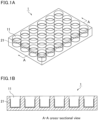
- Figs. 1 are exemplary schematic views of a multi-well plate (medical analysis device) having wells with a hydrophilic polymer layer formed thereon.
- the present invention relates to a method for capturing cancer cells present in biological fluid.
- the method includes reducing the protein level of sampled biological fluid, followed by capturing cancer cells using a hydrophilic polymer layer.
- sampled biological fluid is first subjected to a treatment such as dilution or centrifugation to prepare a sample having a lower protein level than the sampled biological fluid, and the sample is brought into contact with a hydrophilic polymer layer to capture cancer cells in the sample.
- a treatment such as dilution or centrifugation to prepare a sample having a lower protein level than the sampled biological fluid
- the sample is brought into contact with a hydrophilic polymer layer to capture cancer cells in the sample.
- tumor cells e.g. cancer cells
- biological fluid such as circulating tumor cells (several to hundreds of cells/1 mL of blood)
- a sample having a lower protein level than the sampled biological fluid is previously prepared, and then brought into contact with a hydrophilic polymer layer. Accordingly, more tumor cells in the biological fluid adsorb or adhere to the hydrophilic polymer layer.
- the number of adsorbed tumor cells is counted to determine the number of tumor cells in the biological fluid, e.g., in order to confirm the cancertreating effect.
- the captured tumor cells may be cultured and then used to determine the effect of drugs such as anticancer drugs. This allows us to determine the effect of drugs such as anticancer drugs ex vivo before administration, and also helps to screen drugs such as anticancer drugs.
- the method for capturing cancer cells of the present invention can be carried out using, for example, a medical analysis device 1 (multi-well plate 1) illustrated in Figs. 1 .
- a medical analysis device 1 (multi-well plate 1) illustrated in Figs. 1 is a device intended to capture cancer cells in which wells 11 are arranged in so-called matrix form.
- the multi-well plate 1 has multiple wells 11 having a circular opening.
- the wells 11 are recesses into which a sample prepared by reducing the protein level of biological fluid such as blood is injected. Cancer cells can be efficiently captured when the injected sample is subjected to analysis as compared to when the sampled biological fluid is directly subjected to analysis. Consequently, it is possible to confirm the presence or absence of cancer cells in the biological fluid, count the number of cancer cells, culture the cancer cells, determine the effect of drugs, and screen the drugs.
- the protein level of biological fluid can be reduced by known methods, such as by diluting the sampled biological fluid.
- the dilution may be carried out with a buffer solution such as a phosphate buffered saline (PBS) having the same pH as human blood (about 7.4) or a liquid medium such as Dulbecco's modified eagle's medium (DMEM).
- PBS phosphate buffered saline
- DMEM Dulbecco's modified eagle's medium
- a sample having a lower protein level than the sampled biological fluid can be prepared by diluting the biological fluid by adding a buffer solution to the sampled biological fluid or adding the sampled biological fluid to a liquid medium.
- the protein level of biological fluid may also be reduced by centrifuging the sampled biological fluid and removing the supernatant. Specifically, the sampled biological fluid is centrifuged, followed by removing the resulting supernatant containing proteins to prepare a sample having a lower protein level than the sampled biological fluid.
- Figs. 1 show a 24-well plate having 24 wells 11 arranged in 4 rows by 6 columns as an example, it is sufficient for the multi-well plate 1 to have at least two wells 11, and any number of wells 11 may be provided. Examples other than the 24-well plate include general multi-well plates in which the number of wells 11 is 6, 96, 384, etc.
- Examples of the material of the multi-well plate 1 include acrylic resins (polyacrylic resins) such as polymethyl acrylate, polymethyl methacrylate, polyacrylic acid, and polymethacrylic acid, cycloolefin resins (polycycloolefins), carbonate resins (polycarbonates), styrene resins (polystyrenes), polyester resins such as polyethylene terephthalate (PET), and polydimethylsiloxanes.
- acrylic resins polyacrylic resins
- polymethyl methacrylate polyacrylic acid
- polymethacrylic acid cycloolefin resins
- carbonate resins polycarbonates
- styrene resins polystyrenes
- polyester resins such as polyethylene terephthalate (PET), and polydimethylsiloxanes.
- Each well 11 is a non-through hole which is opened at the surface of the multi-well plate 1.
- a sample prepared by reducing the protein level of biological fluid is injected into the wells 11 through the respective openings. If the presence of cancer cells is confirmed, a culture fluid for culturing the cancer cells may also be injected.
- the diameter R and depth D of the opening of each well 11 are not particularly limited, and may be those of a conventional multi-well plate 1. Although in Figs. 1 , the inner side surface of each well 11 is substantially vertical to the opposite sides of the multi-well plate 1, the inner side surface of each well 11 may be inclined to taper from the opening to the bottom. Alternatively, the inner side surface may be inclined to flare out from the opening to the bottom.
- the opening of the wells 11 may be of any shape such as a quadrangle.
- the multi-well plate 1 may suitably be one in which the multiple wells 11 are separable. Since multiple wells are provided, they can be separated into wells for counting the number of cancer cells and for culturing cancer cells. For example, the presence or absence of cancer cells is first confirmed in the wells for counting, and if the presence is confirmed, the cancer cells are cultured in the wells for culturing and then used to determine the effect of drugs.
- each well 11 preferably has a hydrophilic polymer layer formed at least partly on the inner surface thereof.
- Figs. 1 illustrate a case where a hydrophilic polymer layer 21 is formed on the bottom surface and a part of the side surface of the wells.
- cancer cells present in the sample adsorb onto the hydrophilic polymer layer 21, while the adsorption of other cells such as platelets and erythrocytes is reduced.
- cancer cells can be adsorbed onto the hydrophilic polymer layer 21 by introducing and retaining the sample in the wells for a predetermined time, followed by washing. Then, it can be expected that the number of adsorbed cancer cells is counted to determine the number of cancer cells in the biological fluid, e.g., in order to confirm the cancertreating effect.
- the thickness (film thickness) of the hydrophilic polymer layer 21 is 20 to 200 nm, more preferably 20 to 180 nm. When the thickness is adjusted within the range indicated above, selective adsorption or adhesion of cancer cells, and low adsorption of other proteins and cells can be well achieved.
- the hydrophilic polymer may be appropriately selected from polymers having hydrophilicity.
- it may be a homopolymer or copolymer of one or two or more hydrophilic monomers, or a copolymer of one or two or more hydrophilic monomers with a second monomer.
- the homopolymer and copolymers include polyacrylic acid, polyacrylic acid esters, polymethacrylic acid, polymethacrylic acid esters, polyacryloylmorpholine, polymethacryloylmorpholine, polyacrylamide, and polymethacrylamide.
- the hydrophilic monomer may be any monomer containing a hydrophilic group.
- the hydrophilic group include known hydrophilic groups such as an amide group, a sulfuric acid group, a sulfonic acid group, a carboxylic acid group, a hydroxy group, an amino group, and an oxyethylene group.
- hydrophilic monomer examples include (meth)acrylic acid, (meth)acrylic acid esters (e.g. alkoxyalkyl (meth)acrylates such as methoxyethyl (meth)acrylate, and hydroxyalkyl (meth)acrylates such as hydroxyethyl (meth)acrylate), (meth)acrylamide, and (meth)acrylamide derivatives containing cyclic groups (e.g. (meth)acryloylmorpholine).
- alkoxyalkyl (meth)acrylates such as methoxyethyl (meth)acrylate
- hydroxyalkyl (meth)acrylates such as hydroxyethyl (meth)acrylate
- (meth)acrylamide, and (meth)acrylamide derivatives containing cyclic groups e.g. (meth)acryloylmorpholine).
- the second monomer may be appropriately selected as long as it does not inhibit the effect of the hydrophilic polymer.
- aromatic monomers such as styrene, vinyl acetate, and N-isopropylacrylamide which can impart temperature responsiveness.
- the hydrophilic polymer is preferably at least one selected from the group consisting of poly(meth)acryloylmorpholine and a polymer represented by the following formula (I): wherein R 1 represents a hydrogen atom or a methyl group, R 2 represents an alkyl group, m represents 1 to 5, and n represents the number of repetitions.
- the alkyl group represented by R 2 preferably has a carbon number of 1 to 10, more preferably 1 to 5.
- R 2 is particularly preferably a methyl group or an ethyl group.
- the symbol m is preferably 1 to 3, while n (number of repeating units) is preferably 15 to 1,000, more preferably 30 to 500.
- the hydrophilic polymer may also suitably be a copolymer of at least one hydrophilic monomer selected from the group consisting of (meth)acryloylmorpholine and a compound represented by the following formula (I-1): wherein R 1 , R 2 , and m are as defined above, with a second monomer.
- the hydrophilic polymer preferably has a weight average molecular weight (Mw) of 4,000 to 150,000, more preferably 5,000 to 100,000, still more preferably 8,000 to 50,000.
- Mw weight average molecular weight
- the Mw as used herein can be determined by gel permeation chromatography (GPC) (GPC-8000 series produced by TOSOH Corporation, detector: differential refractometer, column: TSKGEL SUPERMULTIPORE HZ-M produced by TOSOH Corporation) calibrated with polystyrene standards.
- the medical analysis device can be produced, for example, by preparing a multi-well plate 1 including wells 11 as illustrated in Figs. 1 , optionally followed by addition of other members (parts).
- the multi-well plate 1 provided with a polymer layer formed of a hydrophilic polymer can be produced by dissolving or dispersing a hydrophilic polymer in any solvent to prepare a hydrophilic polymer solution or dispersion, and entirely or partially coating the inner surface of each well 11 with the hydrophilic polymer solution or dispersion by a known method, such as (1) by injecting the hydrophilic polymer solution or dispersion into the wells 11 and retaining it for a predetermined time, or (2) by applying (spraying) the hydrophilic polymer solution or dispersion to the inner surface of the wells 11. Then, other parts, if necessary, are added to the prepared multi-well plate 1, whereby a medical analysis device can be produced.
- the solvent, injection method, application (spraying) method, and other conditions may be conventionally known materials or methods.
- the retention time in the method (1) or (2) may be selected appropriately according to the size of the wells 11, the type of liquid introduced, and other factors, and is preferably five minutes to ten hours, more preferably ten minutes to five hours, still more preferably 15 minutes to two hours. After the retention, the excess hydrophilic polymer solution or dispersion may be discharged followed by drying, as required.
- AIBN azobisisobutyronitrile
- the poly(2-methoxyethyl acrylate) solution (2.5 w/v%) was injected into a commercially available PMMA plate, and left for 30 minutes at room temperature. Thereafter, the solution was drawn using a pipette, followed by drying to prepare an analysis device including a multi-well plate with a hydrophilic polymer layer formed thereon as illustrated in Figs. 1 .
- Fibrosarcoma (HT-1080) was suspended in a PBS solution (phosphate buffered saline), and the number of cells was counted using a blood cell counter. Then, a PBS solution was further added to adjust the cell concentration in the PBS solution to a predetermined value (A1). Next, the mixture was resuspended in blood so that the calculated plating density (concentration) was 2,850 cells/cm 2 . In this example, blood and an equal amount of a PBS solution were added.
- PBS solution phosphate buffered saline
- Fibrosarcoma (HT-1080) was suspended in a PBS solution (phosphate buffered saline), and the number of cells was counted using a blood cell counter. Then, a PBS solution was further added to adjust the cell concentration in the PBS solution to a predetermined value (A2). Next, the mixture was resuspended in blood so that the calculated plating density (concentration) was 2,850 cells/cm 2 . In this example, blood and a double amount of a PBS solution were added.
- PBS solution phosphate buffered saline
- Fibrosarcoma (HT-1080) was suspended in DMEM (liquid medium), and the number of cells was counted using a blood cell counter. Then, DMEM was further added to adjust the cell concentration in the DMEM to a predetermined value (A1). Next, the mixture was resuspended in blood so that the calculated plating density (concentration) was 2,850 cells/cm 2 . In this example, blood and an equal amount of DMEM were added.
- Fibrosarcoma (HT-1080) was suspended in DMEM (liquid medium), and the number of cells was counted using a blood cell counter. Then, DMEM was further added to adjust the cell concentration in the DMEM to a predetermined value (A2). Next, the mixture was resuspended in blood so that the calculated plating density (concentration) was 2,850 cells/cm 2 . In this example, blood and a double amount of DMEM were added.
- Fibrosarcoma (HT-1080) was suspended in a dissociation solution and a portion of the suspension was resuspended in a PBS solution to count the number of cells using a blood cell counter. Using the obtained number, the dissociation solution containing fibrosarcoma (HT-1080) was resuspended in blood so that the calculated plating density (concentration) was 2,850 cells/cm 2 . Next, the resuspended blood was centrifuged (3,000 rpm, 10 minutes), the supernatant was discharged, and the remaining blood was taken out.
- Fibrosarcoma (HT-1080) was suspended in a dissociation solution and a portion of the suspension was resuspended in a PBS solution to count the number of cells using a blood cell counter. Using the obtained number, the dissociation solution containing fibrosarcoma (HT-1080) was resuspended in blood so that the calculated plating density (concentration) was 2,850 cells/cm 2 . Next, the resuspended blood was centrifuged (3,000 rpm, 5 minutes), the supernatant was discharged, and the remaining blood was taken out.
- Fibrosarcoma (HT-1080) was suspended in a dissociation solution and a portion of the suspension was resuspended in a PBS solution to count the number of cells using a blood cell counter. Using the obtained number, the dissociation solution containing fibrosarcoma (HT-1080) was resuspended in blood so that the calculated plating density (concentration) was 2,850 cells/cm 2 . Next, the resuspended blood was centrifuged (1,500 rpm, 10 minutes), the supernatant was discharged, and the remaining blood was taken out.
- Fibrosarcoma (HT-1080) was suspended in a dissociation solution and a portion of the suspension was resuspended in a PBS solution to count the number of cells using a blood cell counter. Using the obtained number, the dissociation solution containing fibrosarcoma (HT-1080) was resuspended in blood so that the calculated plating density (concentration) was 2,850 cells/cm 2 .
- test samples samples having a lower protein level than the sampled blood prepared in the examples and comparative example were evaluated using the medical analysis device illustrated in Figs. 1 , as follows.
- the thickness of the hydrophilic polymer layer on the inner surface of the wells was measured (photographed) using a TEM at an accelerating voltage of 15 kV and a magnification of 1,000 times.
- Example Comparative Example 1 2 3 4 5 6 7 1 Thickness of hydrophilic polymer layer (nm) 88 88 88 88 88 88 88 88 88 88 Amount of adhering cancer cells 3.5 3.2 3.7 3.5 4.1 3.9 3.8 1.0
Landscapes
- Health & Medical Sciences (AREA)
- Life Sciences & Earth Sciences (AREA)
- Engineering & Computer Science (AREA)
- Biomedical Technology (AREA)
- Chemical & Material Sciences (AREA)
- Hematology (AREA)
- Immunology (AREA)
- Biotechnology (AREA)
- Organic Chemistry (AREA)
- General Health & Medical Sciences (AREA)
- Biochemistry (AREA)
- Physics & Mathematics (AREA)
- Zoology (AREA)
- Genetics & Genomics (AREA)
- Urology & Nephrology (AREA)
- Molecular Biology (AREA)
- Wood Science & Technology (AREA)
- Bioinformatics & Cheminformatics (AREA)
- Medicinal Chemistry (AREA)
- Microbiology (AREA)
- Cell Biology (AREA)
- Analytical Chemistry (AREA)
- General Physics & Mathematics (AREA)
- Pathology (AREA)
- Food Science & Technology (AREA)
- Oncology (AREA)
- General Engineering & Computer Science (AREA)
- Biophysics (AREA)
- Ecology (AREA)
- Tropical Medicine & Parasitology (AREA)
- Chemical Kinetics & Catalysis (AREA)
- Polymers & Plastics (AREA)
- Apparatus Associated With Microorganisms And Enzymes (AREA)
- Investigating Or Analysing Biological Materials (AREA)
- Immobilizing And Processing Of Enzymes And Microorganisms (AREA)
- Micro-Organisms Or Cultivation Processes Thereof (AREA)
Claims (7)
- Procédé de capture de cellules cancéreuses présentes dans un fluide biologique, le procédé comprenantla réduction d'un niveau de protéines de fluide biologique échantillonné, suivie par la capture de cellules cancéreuses en utilisant une couche de polymère hydrophile,dans lequel la couche de polymère hydrophile ayant une épaisseur de 20 à 200 nm.
- Procédé de capture de cellules cancéreuses selon la revendication 1, dans lequel la couche de polymère hydrophile est formée d'au moins un polymère hydrophile choisi dans le groupe constitué par la poly(méth)acryloylmorpholine et un polymère représenté par la formule (I) :

- Procédé de capture de cellules cancéreuses selon la revendication 1, dans lequel la couche de polymère hydrophile est formée d'un copolymère d'au moins un monomère hydrophile choisi dans le groupe constitué par la (méth)acryloylmorpholine et un composé représenté par la formule (1-1) :

- Procédé de capture de cellules cancéreuse selon l'une quelconque des revendications 1 à 3,
dans lequel le niveau de protéines est réduit par dilution du fluide biologique échantillonné. - Procédé de capture de cellules cancéreuses selon la revendication 4, dans lequel la dilution est réalisée avec une solution tampon ou un milieu liquide.
- Procédé de capture de cellules cancéreuses selon l'une quelconque des revendications 1 à 3,
dans lequel le niveau de protéines est réduit par centrifugation du fluide biologique échantillonné et enlèvement d'un surnageant. - Procédé de capture de cellules cancéreuses selon l'une quelconque des revendications 1 à 6,
dans lequel le fluide biologique est le sang.
Applications Claiming Priority (1)
| Application Number | Priority Date | Filing Date | Title |
|---|---|---|---|
| JP2016191618A JP6518985B2 (ja) | 2016-09-29 | 2016-09-29 | がん細胞捕捉方法 |
Publications (2)
| Publication Number | Publication Date |
|---|---|
| EP3301444A1 EP3301444A1 (fr) | 2018-04-04 |
| EP3301444B1 true EP3301444B1 (fr) | 2024-01-10 |
Family
ID=59799258
Family Applications (1)
| Application Number | Title | Priority Date | Filing Date |
|---|---|---|---|
| EP17189346.4A Active EP3301444B1 (fr) | 2016-09-29 | 2017-09-05 | Procédé permettant de capturer des cellules cancéreuses |
Country Status (4)
| Country | Link |
|---|---|
| US (1) | US10620186B2 (fr) |
| EP (1) | EP3301444B1 (fr) |
| JP (1) | JP6518985B2 (fr) |
| CN (1) | CN107881150A (fr) |
Families Citing this family (11)
| Publication number | Priority date | Publication date | Assignee | Title |
|---|---|---|---|---|
| JP6779483B2 (ja) | 2016-09-29 | 2020-11-04 | 住友ゴム工業株式会社 | 医療用検査装置及び細胞検査方法 |
| JP7109719B2 (ja) * | 2018-02-14 | 2022-08-01 | 住友ゴム工業株式会社 | 特定細胞捕捉方法 |
| JP7170254B2 (ja) * | 2018-02-14 | 2022-11-14 | 住友ゴム工業株式会社 | 特定細胞捕捉方法 |
| JP7158671B2 (ja) * | 2018-02-14 | 2022-10-24 | 住友ゴム工業株式会社 | 特定細胞捕捉方法 |
| CN109694809B (zh) * | 2018-11-19 | 2022-05-10 | 江苏汇先医药技术有限公司 | 用于捕获生物分子、细胞或细菌的捕获筛及其制备方法 |
| CN109609336B (zh) * | 2018-11-19 | 2021-05-18 | 江苏汇先医药技术有限公司 | 一种用于捕获生物分子、细胞或细菌的捕获筛 |
| JP7580076B2 (ja) * | 2019-01-24 | 2024-11-11 | 住友ゴム工業株式会社 | 細胞培養装置及び細胞培養方法 |
| JP6895662B2 (ja) * | 2019-01-24 | 2021-06-30 | 住友ゴム工業株式会社 | 特定細胞の分画方法及び捕捉方法 |
| US11614440B2 (en) * | 2019-01-24 | 2023-03-28 | Sumitomo Rubber Industries, Ltd. | Specific cell fractionating and capturing methods |
| JP7670266B2 (ja) * | 2019-03-07 | 2025-04-30 | 住友ゴム工業株式会社 | がん細胞の染色方法 |
| US20240409768A1 (en) * | 2023-06-09 | 2024-12-12 | Sumitomo Rubber Industries, Ltd. | Method of producing polymer-coated substrate for capturing cancer cells |
Family Cites Families (18)
| Publication number | Priority date | Publication date | Assignee | Title |
|---|---|---|---|---|
| US7008979B2 (en) | 2002-04-30 | 2006-03-07 | Hydromer, Inc. | Coating composition for multiple hydrophilic applications |
| JP4518767B2 (ja) * | 2003-09-09 | 2010-08-04 | チッソ株式会社 | 刺激応答性ポリマー固定化磁性微粒子及びこれを用いた吸着材 |
| CN1922304A (zh) * | 2003-10-31 | 2007-02-28 | 维特克公司 | 用于检测循环肿瘤和内皮细胞的血液测试样机和方法 |
| EP1874920A4 (fr) * | 2005-04-05 | 2009-11-04 | Cellpoint Diagnostics | Dispositifs et procédés permettant d'enrichir et de modifier des cellules tumorales circulantes et d'autres particules |
| JP4053579B2 (ja) * | 2006-02-22 | 2008-02-27 | 富士フイルム株式会社 | バイオセンサー |
| AU2009219437B2 (en) * | 2008-02-25 | 2014-10-16 | Nestec S.A. | Drug selection for breast cancer therapy using antibody-based arrays |
| EP2470914B1 (fr) * | 2009-07-27 | 2020-05-13 | Meso Scale Technologies, LLC | Appareils et procédés d'essai |
| JP6474540B2 (ja) * | 2010-11-17 | 2019-02-27 | 国立大学法人山形大学 | 溶液から細胞を分離する細胞分離方法、細胞吸着用水和性組成物、および細胞分離システム |
| US9551700B2 (en) | 2010-12-20 | 2017-01-24 | Milagen, Inc. | Device and methods for the detection of cervical disease |
| JPWO2012108087A1 (ja) * | 2011-02-10 | 2014-07-03 | エドワーズ株式会社 | 真空ポンプ |
| JP5975532B2 (ja) * | 2011-06-13 | 2016-08-23 | 日立化成株式会社 | 癌細胞接着性向上剤 |
| JP2014105159A (ja) * | 2012-11-22 | 2014-06-09 | Nippon Koden Corp | ヒト由来上皮細胞接着分子に対するモノクローナル抗体、およびこれを用いた循環腫瘍細胞の検出方法 |
| CN104520420B (zh) | 2013-07-24 | 2016-09-07 | 株式会社奥普特尼克斯精密 | 末梢循环肿瘤细胞或稀少细胞分离用装置及末梢循环肿瘤细胞或稀少细胞分离方法 |
| JP2015224332A (ja) * | 2014-05-30 | 2015-12-14 | 株式会社日立製作所 | 刺激応答型材料とそれを用いた細胞培養容器 |
| JP7089240B2 (ja) | 2014-12-22 | 2022-06-22 | エコール・ポリテクニーク・フェデラル・ドゥ・ローザンヌ (ウ・ペ・エフ・エル) | 高い収集能力で哺乳動物細胞を操作(マニピュレーション)する装置 |
| WO2016115537A2 (fr) | 2015-01-15 | 2016-07-21 | Massachusetts Institute Of Technology | Systèmes, procédés, et appareil pour l'identification et la récupération in vitro de cellules individuelles |
| JP2016131561A (ja) * | 2015-01-22 | 2016-07-25 | 国立大学法人山形大学 | 細胞を回収する方法、及びそれに用いられるポリマー |
| JP6762082B2 (ja) * | 2015-03-13 | 2020-09-30 | 静岡県公立大学法人 | 刺激応答性磁性ナノ粒子を用いた検出対象を検出する方法 |
-
2016
- 2016-09-29 JP JP2016191618A patent/JP6518985B2/ja active Active
-
2017
- 2017-08-31 US US15/692,735 patent/US10620186B2/en active Active
- 2017-09-05 EP EP17189346.4A patent/EP3301444B1/fr active Active
- 2017-09-14 CN CN201710826297.0A patent/CN107881150A/zh active Pending
Also Published As
| Publication number | Publication date |
|---|---|
| JP2018050548A (ja) | 2018-04-05 |
| US20180088105A1 (en) | 2018-03-29 |
| CN107881150A (zh) | 2018-04-06 |
| EP3301444A1 (fr) | 2018-04-04 |
| JP6518985B2 (ja) | 2019-05-29 |
| US10620186B2 (en) | 2020-04-14 |
Similar Documents
| Publication | Publication Date | Title |
|---|---|---|
| EP3301444B1 (fr) | Procédé permettant de capturer des cellules cancéreuses | |
| EP3301443B1 (fr) | Dispositif d'analyse médicale et procédé d'analyse cellulaire | |
| EP3527986B1 (fr) | Procédé de capture de cellules spécifiques | |
| US11360078B2 (en) | Medical analysis device and cell analysis method | |
| EP3527985B1 (fr) | Procédé de capture de cellules spécifiques | |
| EP3553516B1 (fr) | Procédé de capture de cellules spécifiques | |
| JP6485783B2 (ja) | 医療用検査装置及び細胞検査方法 | |
| EP3244208A1 (fr) | Dispositif d'analyse médicale et procédé d'analyse cellulaire | |
| EP3686598B1 (fr) | Procédés de capture et de fractionnement de cellules spécifiques | |
| JP6886667B2 (ja) | がん細胞捕捉方法 |
Legal Events
| Date | Code | Title | Description |
|---|---|---|---|
| PUAI | Public reference made under article 153(3) epc to a published international application that has entered the european phase |
Free format text: ORIGINAL CODE: 0009012 |
|
| STAA | Information on the status of an ep patent application or granted ep patent |
Free format text: STATUS: THE APPLICATION HAS BEEN PUBLISHED |
|
| AK | Designated contracting states |
Kind code of ref document: A1 Designated state(s): AL AT BE BG CH CY CZ DE DK EE ES FI FR GB GR HR HU IE IS IT LI LT LU LV MC MK MT NL NO PL PT RO RS SE SI SK SM TR |
|
| AX | Request for extension of the european patent |
Extension state: BA ME |
|
| STAA | Information on the status of an ep patent application or granted ep patent |
Free format text: STATUS: REQUEST FOR EXAMINATION WAS MADE |
|
| 17P | Request for examination filed |
Effective date: 20180921 |
|
| RBV | Designated contracting states (corrected) |
Designated state(s): AL AT BE BG CH CY CZ DE DK EE ES FI FR GB GR HR HU IE IS IT LI LT LU LV MC MK MT NL NO PL PT RO RS SE SI SK SM TR |
|
| STAA | Information on the status of an ep patent application or granted ep patent |
Free format text: STATUS: EXAMINATION IS IN PROGRESS |
|
| 17Q | First examination report despatched |
Effective date: 20210805 |
|
| P01 | Opt-out of the competence of the unified patent court (upc) registered |
Effective date: 20230510 |
|
| GRAP | Despatch of communication of intention to grant a patent |
Free format text: ORIGINAL CODE: EPIDOSNIGR1 |
|
| STAA | Information on the status of an ep patent application or granted ep patent |
Free format text: STATUS: GRANT OF PATENT IS INTENDED |
|
| INTG | Intention to grant announced |
Effective date: 20230922 |
|
| GRAS | Grant fee paid |
Free format text: ORIGINAL CODE: EPIDOSNIGR3 |
|
| GRAA | (expected) grant |
Free format text: ORIGINAL CODE: 0009210 |
|
| STAA | Information on the status of an ep patent application or granted ep patent |
Free format text: STATUS: THE PATENT HAS BEEN GRANTED |
|
| AK | Designated contracting states |
Kind code of ref document: B1 Designated state(s): AL AT BE BG CH CY CZ DE DK EE ES FI FR GB GR HR HU IE IS IT LI LT LU LV MC MK MT NL NO PL PT RO RS SE SI SK SM TR |
|
| REG | Reference to a national code |
Ref country code: GB Ref legal event code: FG4D |
|
| REG | Reference to a national code |
Ref country code: CH Ref legal event code: EP |
|
| REG | Reference to a national code |
Ref country code: DE Ref legal event code: R096 Ref document number: 602017078289 Country of ref document: DE |
|
| REG | Reference to a national code |
Ref country code: IE Ref legal event code: FG4D |
|
| REG | Reference to a national code |
Ref country code: LT Ref legal event code: MG9D |
|
| REG | Reference to a national code |
Ref country code: NL Ref legal event code: MP Effective date: 20240110 |
|
| REG | Reference to a national code |
Ref country code: AT Ref legal event code: MK05 Ref document number: 1649290 Country of ref document: AT Kind code of ref document: T Effective date: 20240110 |
|
| PG25 | Lapsed in a contracting state [announced via postgrant information from national office to epo] |
Ref country code: NL Free format text: LAPSE BECAUSE OF FAILURE TO SUBMIT A TRANSLATION OF THE DESCRIPTION OR TO PAY THE FEE WITHIN THE PRESCRIBED TIME-LIMIT Effective date: 20240110 |
|
| PG25 | Lapsed in a contracting state [announced via postgrant information from national office to epo] |
Ref country code: NL Free format text: LAPSE BECAUSE OF FAILURE TO SUBMIT A TRANSLATION OF THE DESCRIPTION OR TO PAY THE FEE WITHIN THE PRESCRIBED TIME-LIMIT Effective date: 20240110 |
|
| PG25 | Lapsed in a contracting state [announced via postgrant information from national office to epo] |
Ref country code: IS Free format text: LAPSE BECAUSE OF FAILURE TO SUBMIT A TRANSLATION OF THE DESCRIPTION OR TO PAY THE FEE WITHIN THE PRESCRIBED TIME-LIMIT Effective date: 20240510 |
|
| PG25 | Lapsed in a contracting state [announced via postgrant information from national office to epo] |
Ref country code: LT Free format text: LAPSE BECAUSE OF FAILURE TO SUBMIT A TRANSLATION OF THE DESCRIPTION OR TO PAY THE FEE WITHIN THE PRESCRIBED TIME-LIMIT Effective date: 20240110 |
|
| PG25 | Lapsed in a contracting state [announced via postgrant information from national office to epo] |
Ref country code: GR Free format text: LAPSE BECAUSE OF FAILURE TO SUBMIT A TRANSLATION OF THE DESCRIPTION OR TO PAY THE FEE WITHIN THE PRESCRIBED TIME-LIMIT Effective date: 20240411 |
|
| PG25 | Lapsed in a contracting state [announced via postgrant information from national office to epo] |
Ref country code: HR Free format text: LAPSE BECAUSE OF FAILURE TO SUBMIT A TRANSLATION OF THE DESCRIPTION OR TO PAY THE FEE WITHIN THE PRESCRIBED TIME-LIMIT Effective date: 20240110 Ref country code: RS Free format text: LAPSE BECAUSE OF FAILURE TO SUBMIT A TRANSLATION OF THE DESCRIPTION OR TO PAY THE FEE WITHIN THE PRESCRIBED TIME-LIMIT Effective date: 20240410 |
|
| PG25 | Lapsed in a contracting state [announced via postgrant information from national office to epo] |
Ref country code: ES Free format text: LAPSE BECAUSE OF FAILURE TO SUBMIT A TRANSLATION OF THE DESCRIPTION OR TO PAY THE FEE WITHIN THE PRESCRIBED TIME-LIMIT Effective date: 20240110 |
|
| PG25 | Lapsed in a contracting state [announced via postgrant information from national office to epo] |
Ref country code: AT Free format text: LAPSE BECAUSE OF FAILURE TO SUBMIT A TRANSLATION OF THE DESCRIPTION OR TO PAY THE FEE WITHIN THE PRESCRIBED TIME-LIMIT Effective date: 20240110 |
|
| PG25 | Lapsed in a contracting state [announced via postgrant information from national office to epo] |
Ref country code: RS Free format text: LAPSE BECAUSE OF FAILURE TO SUBMIT A TRANSLATION OF THE DESCRIPTION OR TO PAY THE FEE WITHIN THE PRESCRIBED TIME-LIMIT Effective date: 20240410 Ref country code: NO Free format text: LAPSE BECAUSE OF FAILURE TO SUBMIT A TRANSLATION OF THE DESCRIPTION OR TO PAY THE FEE WITHIN THE PRESCRIBED TIME-LIMIT Effective date: 20240410 Ref country code: LT Free format text: LAPSE BECAUSE OF FAILURE TO SUBMIT A TRANSLATION OF THE DESCRIPTION OR TO PAY THE FEE WITHIN THE PRESCRIBED TIME-LIMIT Effective date: 20240110 Ref country code: IS Free format text: LAPSE BECAUSE OF FAILURE TO SUBMIT A TRANSLATION OF THE DESCRIPTION OR TO PAY THE FEE WITHIN THE PRESCRIBED TIME-LIMIT Effective date: 20240510 Ref country code: HR Free format text: LAPSE BECAUSE OF FAILURE TO SUBMIT A TRANSLATION OF THE DESCRIPTION OR TO PAY THE FEE WITHIN THE PRESCRIBED TIME-LIMIT Effective date: 20240110 Ref country code: GR Free format text: LAPSE BECAUSE OF FAILURE TO SUBMIT A TRANSLATION OF THE DESCRIPTION OR TO PAY THE FEE WITHIN THE PRESCRIBED TIME-LIMIT Effective date: 20240411 Ref country code: ES Free format text: LAPSE BECAUSE OF FAILURE TO SUBMIT A TRANSLATION OF THE DESCRIPTION OR TO PAY THE FEE WITHIN THE PRESCRIBED TIME-LIMIT Effective date: 20240110 Ref country code: BG Free format text: LAPSE BECAUSE OF FAILURE TO SUBMIT A TRANSLATION OF THE DESCRIPTION OR TO PAY THE FEE WITHIN THE PRESCRIBED TIME-LIMIT Effective date: 20240110 Ref country code: AT Free format text: LAPSE BECAUSE OF FAILURE TO SUBMIT A TRANSLATION OF THE DESCRIPTION OR TO PAY THE FEE WITHIN THE PRESCRIBED TIME-LIMIT Effective date: 20240110 |
|
| PG25 | Lapsed in a contracting state [announced via postgrant information from national office to epo] |
Ref country code: PT Free format text: LAPSE BECAUSE OF FAILURE TO SUBMIT A TRANSLATION OF THE DESCRIPTION OR TO PAY THE FEE WITHIN THE PRESCRIBED TIME-LIMIT Effective date: 20240510 Ref country code: PL Free format text: LAPSE BECAUSE OF FAILURE TO SUBMIT A TRANSLATION OF THE DESCRIPTION OR TO PAY THE FEE WITHIN THE PRESCRIBED TIME-LIMIT Effective date: 20240110 |
|
| PG25 | Lapsed in a contracting state [announced via postgrant information from national office to epo] |
Ref country code: SE Free format text: LAPSE BECAUSE OF FAILURE TO SUBMIT A TRANSLATION OF THE DESCRIPTION OR TO PAY THE FEE WITHIN THE PRESCRIBED TIME-LIMIT Effective date: 20240110 Ref country code: PT Free format text: LAPSE BECAUSE OF FAILURE TO SUBMIT A TRANSLATION OF THE DESCRIPTION OR TO PAY THE FEE WITHIN THE PRESCRIBED TIME-LIMIT Effective date: 20240510 Ref country code: PL Free format text: LAPSE BECAUSE OF FAILURE TO SUBMIT A TRANSLATION OF THE DESCRIPTION OR TO PAY THE FEE WITHIN THE PRESCRIBED TIME-LIMIT Effective date: 20240110 Ref country code: LV Free format text: LAPSE BECAUSE OF FAILURE TO SUBMIT A TRANSLATION OF THE DESCRIPTION OR TO PAY THE FEE WITHIN THE PRESCRIBED TIME-LIMIT Effective date: 20240110 |
|
| PG25 | Lapsed in a contracting state [announced via postgrant information from national office to epo] |
Ref country code: DK Free format text: LAPSE BECAUSE OF FAILURE TO SUBMIT A TRANSLATION OF THE DESCRIPTION OR TO PAY THE FEE WITHIN THE PRESCRIBED TIME-LIMIT Effective date: 20240110 |
|
| REG | Reference to a national code |
Ref country code: DE Ref legal event code: R097 Ref document number: 602017078289 Country of ref document: DE |
|
| PG25 | Lapsed in a contracting state [announced via postgrant information from national office to epo] |
Ref country code: SM Free format text: LAPSE BECAUSE OF FAILURE TO SUBMIT A TRANSLATION OF THE DESCRIPTION OR TO PAY THE FEE WITHIN THE PRESCRIBED TIME-LIMIT Effective date: 20240110 |
|
| PG25 | Lapsed in a contracting state [announced via postgrant information from national office to epo] |
Ref country code: CZ Free format text: LAPSE BECAUSE OF FAILURE TO SUBMIT A TRANSLATION OF THE DESCRIPTION OR TO PAY THE FEE WITHIN THE PRESCRIBED TIME-LIMIT Effective date: 20240110 Ref country code: EE Free format text: LAPSE BECAUSE OF FAILURE TO SUBMIT A TRANSLATION OF THE DESCRIPTION OR TO PAY THE FEE WITHIN THE PRESCRIBED TIME-LIMIT Effective date: 20240110 |
|
| PG25 | Lapsed in a contracting state [announced via postgrant information from national office to epo] |
Ref country code: SK Free format text: LAPSE BECAUSE OF FAILURE TO SUBMIT A TRANSLATION OF THE DESCRIPTION OR TO PAY THE FEE WITHIN THE PRESCRIBED TIME-LIMIT Effective date: 20240110 |
|
| PG25 | Lapsed in a contracting state [announced via postgrant information from national office to epo] |
Ref country code: SM Free format text: LAPSE BECAUSE OF FAILURE TO SUBMIT A TRANSLATION OF THE DESCRIPTION OR TO PAY THE FEE WITHIN THE PRESCRIBED TIME-LIMIT Effective date: 20240110 Ref country code: SK Free format text: LAPSE BECAUSE OF FAILURE TO SUBMIT A TRANSLATION OF THE DESCRIPTION OR TO PAY THE FEE WITHIN THE PRESCRIBED TIME-LIMIT Effective date: 20240110 Ref country code: RO Free format text: LAPSE BECAUSE OF FAILURE TO SUBMIT A TRANSLATION OF THE DESCRIPTION OR TO PAY THE FEE WITHIN THE PRESCRIBED TIME-LIMIT Effective date: 20240110 Ref country code: EE Free format text: LAPSE BECAUSE OF FAILURE TO SUBMIT A TRANSLATION OF THE DESCRIPTION OR TO PAY THE FEE WITHIN THE PRESCRIBED TIME-LIMIT Effective date: 20240110 Ref country code: DK Free format text: LAPSE BECAUSE OF FAILURE TO SUBMIT A TRANSLATION OF THE DESCRIPTION OR TO PAY THE FEE WITHIN THE PRESCRIBED TIME-LIMIT Effective date: 20240110 Ref country code: CZ Free format text: LAPSE BECAUSE OF FAILURE TO SUBMIT A TRANSLATION OF THE DESCRIPTION OR TO PAY THE FEE WITHIN THE PRESCRIBED TIME-LIMIT Effective date: 20240110 |
|
| PLBE | No opposition filed within time limit |
Free format text: ORIGINAL CODE: 0009261 |
|
| STAA | Information on the status of an ep patent application or granted ep patent |
Free format text: STATUS: NO OPPOSITION FILED WITHIN TIME LIMIT |
|
| PG25 | Lapsed in a contracting state [announced via postgrant information from national office to epo] |
Ref country code: IT Free format text: LAPSE BECAUSE OF FAILURE TO SUBMIT A TRANSLATION OF THE DESCRIPTION OR TO PAY THE FEE WITHIN THE PRESCRIBED TIME-LIMIT Effective date: 20240110 |
|
| 26N | No opposition filed |
Effective date: 20241011 |
|
| PG25 | Lapsed in a contracting state [announced via postgrant information from national office to epo] |
Ref country code: IT Free format text: LAPSE BECAUSE OF FAILURE TO SUBMIT A TRANSLATION OF THE DESCRIPTION OR TO PAY THE FEE WITHIN THE PRESCRIBED TIME-LIMIT Effective date: 20240110 |
|
| PG25 | Lapsed in a contracting state [announced via postgrant information from national office to epo] |
Ref country code: SI Free format text: LAPSE BECAUSE OF FAILURE TO SUBMIT A TRANSLATION OF THE DESCRIPTION OR TO PAY THE FEE WITHIN THE PRESCRIBED TIME-LIMIT Effective date: 20240110 Ref country code: MC Free format text: LAPSE BECAUSE OF FAILURE TO SUBMIT A TRANSLATION OF THE DESCRIPTION OR TO PAY THE FEE WITHIN THE PRESCRIBED TIME-LIMIT Effective date: 20240110 |
|
| REG | Reference to a national code |
Ref country code: CH Ref legal event code: PL |
|
| PG25 | Lapsed in a contracting state [announced via postgrant information from national office to epo] |
Ref country code: LU Free format text: LAPSE BECAUSE OF NON-PAYMENT OF DUE FEES Effective date: 20240905 |
|
| GBPC | Gb: european patent ceased through non-payment of renewal fee |
Effective date: 20240905 |
|
| PG25 | Lapsed in a contracting state [announced via postgrant information from national office to epo] |
Ref country code: GB Free format text: LAPSE BECAUSE OF NON-PAYMENT OF DUE FEES Effective date: 20240905 |
|
| REG | Reference to a national code |
Ref country code: BE Ref legal event code: MM Effective date: 20240930 |
|
| PG25 | Lapsed in a contracting state [announced via postgrant information from national office to epo] |
Ref country code: BE Free format text: LAPSE BECAUSE OF NON-PAYMENT OF DUE FEES Effective date: 20240930 |
|
| PG25 | Lapsed in a contracting state [announced via postgrant information from national office to epo] |
Ref country code: CH Free format text: LAPSE BECAUSE OF NON-PAYMENT OF DUE FEES Effective date: 20240930 |
|
| PG25 | Lapsed in a contracting state [announced via postgrant information from national office to epo] |
Ref country code: IE Free format text: LAPSE BECAUSE OF NON-PAYMENT OF DUE FEES Effective date: 20240905 |
|
| PG25 | Lapsed in a contracting state [announced via postgrant information from national office to epo] |
Ref country code: FI Free format text: LAPSE BECAUSE OF FAILURE TO SUBMIT A TRANSLATION OF THE DESCRIPTION OR TO PAY THE FEE WITHIN THE PRESCRIBED TIME-LIMIT Effective date: 20240110 |
|
| PGFP | Annual fee paid to national office [announced via postgrant information from national office to epo] |
Ref country code: FR Payment date: 20250922 Year of fee payment: 9 |
|
| PGFP | Annual fee paid to national office [announced via postgrant information from national office to epo] |
Ref country code: DE Payment date: 20251126 Year of fee payment: 9 |
|
| PG25 | Lapsed in a contracting state [announced via postgrant information from national office to epo] |
Ref country code: CY Free format text: LAPSE BECAUSE OF FAILURE TO SUBMIT A TRANSLATION OF THE DESCRIPTION OR TO PAY THE FEE WITHIN THE PRESCRIBED TIME-LIMIT; INVALID AB INITIO Effective date: 20170905 |
|
| PG25 | Lapsed in a contracting state [announced via postgrant information from national office to epo] |
Ref country code: HU Free format text: LAPSE BECAUSE OF FAILURE TO SUBMIT A TRANSLATION OF THE DESCRIPTION OR TO PAY THE FEE WITHIN THE PRESCRIBED TIME-LIMIT; INVALID AB INITIO Effective date: 20170905 |