EP3306285A1 - Dispositif de mesure de vibration et/ou d'émission acoustique de petits objets - Google Patents
Dispositif de mesure de vibration et/ou d'émission acoustique de petits objets Download PDFInfo
- Publication number
- EP3306285A1 EP3306285A1 EP16192604.3A EP16192604A EP3306285A1 EP 3306285 A1 EP3306285 A1 EP 3306285A1 EP 16192604 A EP16192604 A EP 16192604A EP 3306285 A1 EP3306285 A1 EP 3306285A1
- Authority
- EP
- European Patent Office
- Prior art keywords
- movement
- measuring device
- sound
- sensing element
- sensing
- Prior art date
- Legal status (The legal status is an assumption and is not a legal conclusion. Google has not performed a legal analysis and makes no representation as to the accuracy of the status listed.)
- Withdrawn
Links
Images


Classifications
-
- G—PHYSICS
- G01—MEASURING; TESTING
- G01H—MEASUREMENT OF MECHANICAL VIBRATIONS OR ULTRASONIC, SONIC OR INFRASONIC WAVES
- G01H11/00—Measuring mechanical vibrations or ultrasonic, sonic or infrasonic waves by detecting changes in electric or magnetic properties
- G01H11/06—Measuring mechanical vibrations or ultrasonic, sonic or infrasonic waves by detecting changes in electric or magnetic properties by electric means
-
- G—PHYSICS
- G04—HOROLOGY
- G04D—APPARATUS OR TOOLS SPECIALLY DESIGNED FOR MAKING OR MAINTAINING CLOCKS OR WATCHES
- G04D7/00—Measuring, counting, calibrating, testing or regulating apparatus
- G04D7/001—Purely mechanical measuring and testing apparatus
-
- G—PHYSICS
- G04—HOROLOGY
- G04D—APPARATUS OR TOOLS SPECIALLY DESIGNED FOR MAKING OR MAINTAINING CLOCKS OR WATCHES
- G04D7/00—Measuring, counting, calibrating, testing or regulating apparatus
- G04D7/002—Electrical measuring and testing apparatus
-
- G—PHYSICS
- G04—HOROLOGY
- G04D—APPARATUS OR TOOLS SPECIALLY DESIGNED FOR MAKING OR MAINTAINING CLOCKS OR WATCHES
- G04D7/00—Measuring, counting, calibrating, testing or regulating apparatus
- G04D7/12—Timing devices for clocks or watches for comparing the rate of the oscillating member with a standard
- G04D7/1207—Timing devices for clocks or watches for comparing the rate of the oscillating member with a standard only for measuring
- G04D7/1214—Timing devices for clocks or watches for comparing the rate of the oscillating member with a standard only for measuring for complete clockworks
-
- G—PHYSICS
- G10—MUSICAL INSTRUMENTS; ACOUSTICS
- G10K—SOUND-PRODUCING DEVICES; METHODS OR DEVICES FOR PROTECTING AGAINST, OR FOR DAMPING, NOISE OR OTHER ACOUSTIC WAVES IN GENERAL; ACOUSTICS NOT OTHERWISE PROVIDED FOR
- G10K11/00—Methods or devices for transmitting, conducting or directing sound in general; Methods or devices for protecting against, or for damping, noise or other acoustic waves in general
- G10K11/004—Mounting transducers, e.g. provided with mechanical moving or orienting device
Definitions
- the present invention relates to a device for measuring movement and/or deformation, such as vibrations, and/or acoustic emission of an object. Even more specifically, the invention relates to a measuring device which allows movement and/or sound to be measured at the same time along different directions, thereby allowing an improved analysis of the object under measurement.
- Measuring vibrations from an object can be, in some cases, the only possible way of measuring the internal characteristics of an enclosed mechanism. This is, for instance, often the case for watches, electric motors, medical devices such as implantable pumps, etc.
- the presence of the vibrations, or their characteristics in terms of frequency, amplitude and phase, can for instance indicate the presence of defects in the assembled product.
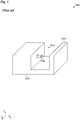
- Measuring devices have been developed for this task, one example of which is provided in figure 1 .
- Measuring device 1000 comprises a frame 1010 which is shaped so as to define a volume 1012.
- An object to be measured for instance a watch, can be placed in the volume 1012, between a blocking element 1011 and a sensing element 1100.
- the sensing element 1100 for instance an accelerometer or a piezoelectric sensor, is biased by a spring toward the direction of the blocking element 1011, as indicated by the arrow in the drawing. In this manner the sensing element 1100 is put in contact with the object to be measured so as to measure the vibrations of the object.
- the measuring device 1000 presents several problems.
- the measuring device 1000 can therefore only provide a very limited analysis of the vibrations of the object to be measured. In those cases where the vibrations have small intensity and/or are directed in a direction perpendicular to the X axis, no meaningful analysis can be performed at all.
- sensing element 1100 if a two-dimensional or three-dimensional sensor is used as sensing element 1100, the analysis is still very limited. This is due to the fact that the sensing element 1100 only touches the object at a single point. Vibrations can, in some cases, induce a deformation of the object and not a translational movement of the object. In these cases, it is possible that the movement at the point of contact of sensing element 1100 is zero, due to the deformation having a local zero at that point. For instance, if the vibration is on the Y axis, the point at which the sensing element 1100 touches the object may not move, while the extremities of the object in the Y direction move due to a deformation of the object.
- it is an object to allow the measurement and/or estimation of the total vibrational power of the object under measurement.
- An additional object of the invention is to provide a measuring device which can measure the vibration and the sound at the same time, so as to allow an improved analysis of the vibro-acoustic behavior of the object under measurement.
- the inventors have realized that, by measuring vibrations at the same time along more than one direction, it is possible to provide a better profile of the vibration of the object under measurement. Moreover, this allows to mechanically support the object, so as to avoid the absorption of vibrations by some fixed components.
- the inventors have realized that by measuring the vibrations and the sound emitted from the object at the same time, those two analysis can be integrated so as to obtain a better analysis of the behavior of the object.
- One embodiment of the invention can in particular relate to a measuring device for measuring vibration and/or sound of an object
- the measuring device can comprise a plurality of sensing elements
- the plurality of sensing elements can comprise: a first movement sensing element for sensing movement in a first direction, and a second movement sensing element for sensing movement in a second direction, wherein the first direction and the second direction can be configured such that, when projected together on three orthogonal axes, they result in a projection value different from zero on each of the three orthogonal axes.
- the plurality of sensing elements can further comprise: a third movement sensing element for sensing movement in a third direction, and/or a fourth movement sensing element for sensing movement in a fourth direction, and/or a fifth movement sensing element for sensing movement in a fifth direction, and/or a sixth movement sensing element for sensing movement in a sixth direction, wherein the third direction, the fourth direction, the fifth direction and the sixth direction can be configured such that, when projected on three orthogonal axes together with the first direction and the second direction, they result in a projection value different from zero on all three orthogonal axes.
- the first direction can correspond to the fourth direction
- the second direction can correspond to the fifth direction
- the third direction can correspond to the sixth direction.
- first direction, the second direction and the third direction can be perpendicular to each other.
- the first movement sensing element and the fourth movement sensing element can be positioned on opposite sides of a measurement position for the object
- the second movement sensing element and the fifth movement sensing element can be positioned on opposite sides of the measurement position
- the third movement sensing element and the sixth movement sensing element can be positioned on opposite sides of the measurement position.
- At least one movement sensing element of the plurality of sensing elements can comprise: an elastic element, and a movement sensor connected to the elastic element.
- the movement sensor can be an accelerometer or a piezoelectric sensor.
- an elastic constant of the elastic element can be configured so that the elastic element can accelerate the movement sensor at least to a value corresponding to a maximum acceleration value of the object due to the vibration to be measured.
- the plurality of sensing elements can further comprise a plurality of sound sensing elements for sensing sound emitted from the object.
- each of the plurality of sound sensing elements can comprise a sound sensor, the sound sensors of the plurality of sound sensing elements can be substantially positioned on the surface of a spherical region.
- the first movement sensing element can further comprise a first sound sensor, and/or the second movement sensing element can further comprise a second sound sensor.
- the measuring device can further comprise a frame for supporting the plurality of sensing elements, the frame can comprise: a plurality of vertical beams, a plurality of horizontal beams, at least one stability beam.
- the frame can be rotated in space and positioned on a working plane in a stable manner.
- the plurality of vertical beams can be disposed in a vertical plane
- the plurality of horizontal beams can be disposed in a horizontal plane
- the at least one stability beam can be disposed in a stability plane which substantially perpendicular to both the horizontal plane and the vertical plane.
- the frame can be rotated in space and positioned on a working plane in a stable manner.
- At least one beam among the plurality of vertical beams, the plurality of horizontal beams and the stability beam can have a cross-section which minimizes sound reflection toward a measurement position for the object.
- the at least one beam can have a cross-section which is substantially elongated along the direction from the at least one beam to the measurement position.
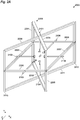
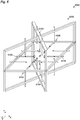
- Figure 2A schematically illustrates a perspective view of a measuring device 2000.
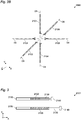
- Figure 2B schematically illustrates a perspective view of movement sensing elements 2101-2106 of figure 2A .
- figure 2A schematically illustrates a measuring device 2000 comprising six movement sensing element 2101-2106. As will be described below, it is not necessary that all six illustrated sensing elements 2101-2106 are implemented, in order to carry out the invention.
- Each of the movement sensing element 2101-2106 is capable of measuring movement along a certain direction D1-D6, illustrated in figure 2B .
- an object to be measured is positioned between the movement sensing elements 2101-2106, substantially in correspondence with the point C, it is therefore possible to measure movements along different directions at the same time.
- This provides the beneficial advantage that vibrations, or more generally movement, of the object is not measured along a single direction, such as in the case of the prior art, but can be measured at the same time in more than one direction.
- the positioning of the movement sensing element 2101-2106 advantageously allows the object to be measured to be kept in place only by the movement sensing elements 2101-2106. This avoids contact of the object to a fix element, such as blocking element 1011 of the prior art. In this manner, it is advantageously possible to avoid vibrations to be absorbed by some fixed component of the measuring device. This, in turn, results in a better measurement of the vibrations, or more generally movement, of the object to be measured, as those are not damped by the measuring device 2000.
- the directions D1 and D4 are substantially parallel to each other
- the directions D2 and D5 are substantially parallel to each other
- the directions D3 and D6 are substantially parallel to each other.
- the directions D1, D2 and D3 are each substantially perpendicular to each other.
- the term substantially means that the various directions are parallel or perpendicular to each other with an error of less than 30 degrees, preferably less than 15 degrees, even more preferably less than 5 degrees.
- the data collected by the movement sensing elements 2101-2106 can be directly assigned to three different axes in space, which are orthogonal to each other. For instance, with reference to the illustrated embodiment, movement along directions D1 and D4 corresponds to movement in the Y axis, movement along directions D2 and D5 corresponds to movement in the X axis while movement along directions D3 and D6 correspond to movement in the Z axis. This simplifies the subsequent data processing of the movement measured by the measuring device 2000.
- the object to be measured can be placed at a position C, where the object can be maintained in place independently on the orientation in space of the measuring device 2000.
- This is particularly advantageous in all of those cases in which the object has to be measured while being placed in different orientations in space. For instance, this is a common requirement in the watchmaking industry in which mechanical movements have to be tested while being kept in different positions in space.
- two movement sensing elements are placed on opposite sides of point C, where the object to be measured is placed. This allows to combine their output, so as to evaluate the movement of the object along a single direction.
- the signal measured by movement sensing element 2101 and 2104 can be combined so as to evaluate the movement along the direction D1, substantially corresponding to the direction D4.
- the combination of the two signals allows a more precise measurement to be obtained.
- this implementation increases reliability as a measurement can be performed only in presence of a malfunctioning movement sensing element.
- the invention can be implemented with any number of movement sensing elements equal to or higher than two.
- any number of movement sensing elements equal to or higher than two.
- directions D1 and D2 as defined above have a projection on the X, Y and Z axis, when the object under measurement moves in any direction in space, it will be possible to evaluate independently the X, Y and Z movement by a simple geometrical transformation.
- Figure 3 schematically illustrates a cross-sectional view of one movement sensing element 2101, as an example of any of movement sensing elements 2101-2106.
- the movement sensing element 2101 comprises a frame 2150, which provides structural stability to the movement sensing element 2101. Moreover, the frame 2150 allows the movement sensing element to be fixed to a frame 2200 of the measuring device 2000, which will be described below. Still further, the movement sensing element 2101 comprises an elastic element 2120 connected to a stem 2130. At the other end of the stem 2130, a movement sensor 2140 is positioned.
- the stem 2130 can travel through the frame 2150 under the bias of the elastic element 2120 and under the bias of the force exerted by the object to be measured.
- This allows the movement sensor 2140 to be movable along the traveling direction of the stem 2130.
- the movement sensor 2140 can measure movement along at least the direction of movement.
- the movement sensor 2140 can measure movement along the X axis.
- the elastic element 2120 can be any element capable of providing an elastic force.
- a coil spring or a pneumatic spring can be used.
- the stem 2130 can be implemented by any fixed component which allows a connection between the elastic element 2120 and the movement sensor 2140 and does not necessarily have to be realized with the proportions illustrated in figure 3 .
- the movement sensor 2140 can be any device capable of recording movement in at least one direction.
- an accelerometer or or a piezoelectric sensor can be used, however the invention is not limited thereto and any device capable of detecting or signaling its position in space, or its acceleration and/or speed, can be used.
- the travelling length of the stem 2130 can be approximately 40mm +/- 20mm. This allows the positioning of several different objects within the space defined by the plurality of movement sensors 2140, without having to rearrange the movement sensing elements 2101-2106 within frame 2200 to accommodate for smaller or larger objects.
- an elastic constant of the elastic element 2120 is configured so that the elastic element can accelerate the movement sensor 2140 at least to a value corresponding to a maximum acceleration value of the object to be measured. For instance with respect to the situation illustrated in figure 3 , when the object to be measured moves from left to right, if the elastic element 2120 can ensure that the movement sensor 2140 accelerates fast enough so as to follow the object to be measured, movement of the object to be measured can be precisely measured. In other words, by ensuring that the movement sensor 2140 can move faster than the object to be measured, it can be ensured that the movement sensor 2140 will remain permanently in contact with the object to be measured and thus precisely record the movements of the object.
- the present invention is not limited thereto.
- the position of the object to be measured, and/or its speed can still be precisely tracked by using two movement sensing elements. This could be the case, for instance, when the requirement for the elastic constant would result in a too high pressure applied on the object, thus resulting in dampening of the vibrations.
- the present invention can reliably perform by using two movement sensors 2140, one on each side of the object to be measured.
- the present invention is not limited thereto since, by using more than one movement sensing element 2101-2106 per direction, this drawback can be advantageously overcome.
- This flexibility in the choice of the value of the elastic constant of the elastic element 2120 allows the measuring device 2120 to be used for the measurement of a wide range of objects, having different vibration characteristics, contrary to the case of the prior art.
- movement sensing elements 2101-2106 comprising a movement sensor 2140
- the present invention is not limited thereto. In some embodiments, some of the movement sensing elements 2101-2106 may be implemented without a movement sensor 2140.
- the movement sensor 2140 of movement sensing element 2102 can precisely track of the movement of the object to be measured in the direction from right to left and in the direction from left to right, it may not be necessary to provide the movement sensing element 2105 with a movement sensor 2114.
- the movement sensing element 2105 may only be provided with the elastic element 2120 and with the stem 2130 so as to guarantee support for the object to be measured, while reducing the cost and the complexity of the measuring device 2000.
- Measuring device 2000 further comprises a frame 2200 so as to allow the positioning in space of the movement sensing elements 2101-2106, which will be described below. It will be noted that this is only one potential implementation and the frame 2200 can be realized with different shapes as long as they allow the positioning of the movement sensing elements as described above.
- the frame 2200 comprises four horizontal beams 2201-2204, four vertical beams 2205-2208 and four stability beams 2209-2212.
- This implementation is particularly advantageous as it allows the positioning of the frame 2200 in six different orientations in space. This advantageously allows measuring the object in different orientations in space without having to move the object itself with respect to the movement sensing elements 2101-2106, but simply by moving the measuring device 2000.
- the beams 2201-2212 are provided with a hole for the passage of a respective movement sensing element 2101-2106.
- Each of the movement sensing elements 2101-2106 can be inserted into the respective hole and fixed by means of a fixing screw, not illustrated in the drawings.
- the connection of the movement sensing element 2101-2106 to the respective beam is not limited to such implementation.
- any manner of fixing the movement sensing elements 2101-2106 two any of the beams 2201-2212 can be implemented as long as it allows the movement sensing element to be connected in a substantially stable manner to the frame 2200.
- each of the frames 2150 could be flush with the side face of the respective beam so as to advantageously avoid oscillations of the frame 2200 when the frame 2200 is placed such that its bottom side comprises one of the movement sensing elements 2101-2106.
- the movement sensing element 2104 could be flush with the side faces of beams 2211 and 2202 so as to avoid oscillations of the frame 2000.
- the frame 2200 can have a dimension of approximately 200mm along each axe X, Y and Z. This allows a large number of objects to be tested within measuring device 2000, as well as allowing the user to easily position those objects at point C, by having dimensions sufficient for hand-placement of the object.
- Figure 4A schematically illustrates a perspective view of a measuring device 4000. Measuring device 4000 differs from measuring device 2000 due to the additional presence of sound sensing elements 4101-4112.
- Figure 4B schematically illustrates a perspective view of sound sensing elements 4101-4112 of figure 4A .
- the sound sensing elements 4101-4112 advantageously make use of the frame 2000 to which they are connected in a manner similar to that already described for the movement sensing elements 2101-2106.
- the number of sound sensing elements 4101-4112 is 12.
- the present invention is not limited thereto and any number of sound sensing elements can be implemented. It will be understood that by increasing the number of sound sensing elements the precision of the sound measurement of the object to be measured will increase.
- the measuring device 4000 therefore differs from measuring device 2000 in that it allows the sound emitted by the object to be measured to be recorded, alternatively, or in addition to, the recorded movement of the object to be measured.
- the combined analysis of the movements, or of the vibration, together with the sound emitted by the object allows a more detailed analysis of the internal operation of the object.
- the sound sensing element 4101 - 4102 in the space around the object, it is possible to record sound from different position thereby allowing a more detailed analysis of the origin of the sound and thus permitting a deeper analysis of the object to be measured.
- the positioning, as well as the number, of the sound sensing elements 4101-4112 is flexible. As for the number, any number of sound sensing elements 4101-4112 can be implemented and the illustrated embodiment with 12 sound sensing elements 4101-4112 is only one possible implementation. As for the placement, any placement of the sound sensing elements 4101-4112 can be implemented. In general, however, it will be preferred to place the sound sensing element 4101-4112 substantially equally spaced from each other around the object to be measured, or around point C illustrated in figures 4A and 4B , which represents the ideal measurement position. Such equal spacing allows sound to be recorded from different directions thereby improving the sensibility of the measuring device 4000. Moreover, by placing the sound sensing element 4101-4112 in this manner it is possible to determine, or estimate, the total acoustic power of the object to be measured.
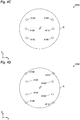
- Figure 4C schematically illustrates a side view of the positioning of the sound sensors of the sound sensing elements 4101-4112 of figure 4A .
- Figure 4D schematically illustrates a top view of the positioning of the sound sensors of the sound sensing elements 4101-4112 of figure 4A .
- each of the points 4101-4112 schematically represents the position in space of the sound sensor 4160 of the respective sound sensing element 4101-4112.
- those sound sensing elements which are not referenced in figures 4C and 4D are not visible as they are placed behind another sound sensing element. For instance, sound sensing elements 4101 and 4102 are placed behind sound sensing element 4104 and 4103, respectively, and therefore not visible in the side view of figure 4C .
- the sound sensors 4160 of the plurality of sound sensing elements 4101-4112 are substantially placed on the surface of a spherical region S.
- some of the indicated positions in figures 4C and 4D are not overlapping the projection of the spherical region S.
- the position of sound sensor 4160 of sound sensing elements 4106 in figure 4C is not positioned on the projection of the spherical region S.
- the spherical region S is positioned on the projection of the spherical region S here, as the position in the Y plane of the sound sensing element 4106 correspond to the maximum extension of the spherical region S, when device 4000 is seen from above.
- the spherical region S is centered in point C.
- the spherical region S has a radius of 100mm +/- 50mm. This allows a close placement of the sound sensing elements to the object to be measured while still allowing an easy reach of point C, so that positioning and removing of the object to be measured can be easily carried out.
- the substantially spherical positioning of the sound sensors 4160 of the various sound sensing elements allows a measurement of the total acoustic power of the object under measurement, without the data treatment that would be necessary if the sounds sensors 4160 were positioned at difference distances from point C, or from the object to be measured. This simplify the data analysis from measuring device 4000.
- Figure 5 schematically illustrates a cross-sectional view of one sound sensing element 4101 of figure 4A , as an example for any of sound sensing elements 4101-4112.
- the sound sensing element 4101 can be implemented by any device capable of measuring sound, such as a microphone.
- the sound sensing element 4101 comprises a frame 4150 for providing a structural support to the sound sensing element 4101 and for connecting it to the frame 2200 of the measuring device 4000.
- the sound sensing device 4101 comprises a sound sensor 4160 for measuring sound. It will be understood that the sound sensor 4160 can be anything from a complete microphone, eventually comprising the amplification circuitry, to something as simple as a microphone membrane, while leaving the related measuring and/or amplification electronic outside of measuring device 4000.
- the specifically illustrated shape of sound sensing element 4101 is particularly advantageous as it reduces the surface facing the object to be measured and therefore also the echo which would be cause by such surface.
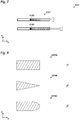
- Figure 8 schematically illustrates various cross-sectional views of a beam 2205A, 2205B, 2205C as an example possible implementations for any of the beams 2201-2212.
- beam 2205A has a substantially rectangular cross section in which the shorter side of the rectangle is facing point C.
- Beam 2205B has a substantially triangular cross section in which the triangle has one of its tips tapering toward point C.
- Beam 2205C has a substantially rounded and convex side facing point C.
- the implementations here illustrated as an example have a cross-section which is substantially elongated along the direction from the beam 2205 toward the measurement position C. In this manner, structural stability of the beam can be ensured, while at the same time reducing the surface creating echo toward point C.
- FIG. 6 schematically illustrates a perspective view of a measuring device 6000.
- Measuring device 6000 differs from measuring device 4000 in that movement sensing elements 2101-2106 are replaced by movement and sound sensing elements 6101-6106.
- Figure 7 schematically illustrates a cross-sectional view of one movement and sound sensing element 6101 of figure 6 , as an example of any of movement and sound sensing elements 6101-6106.
- the movement and sound sensing element 6101 basically corresponds to movement sensing element 2101 with the addition of a sound sensors 6160, substantially similar to sound sensor 4160.
- sound sensors 6160 can be also advantageously placed on the spherical surface S previously described with reference to the sound sensors 4160, providing similar advantages as those previously described.
Landscapes
- Physics & Mathematics (AREA)
- General Physics & Mathematics (AREA)
- Engineering & Computer Science (AREA)
- Acoustics & Sound (AREA)
- Multimedia (AREA)
- Measurement Of Mechanical Vibrations Or Ultrasonic Waves (AREA)
Priority Applications (1)
| Application Number | Priority Date | Filing Date | Title |
|---|---|---|---|
| EP16192604.3A EP3306285A1 (fr) | 2016-10-06 | 2016-10-06 | Dispositif de mesure de vibration et/ou d'émission acoustique de petits objets |
Applications Claiming Priority (1)
| Application Number | Priority Date | Filing Date | Title |
|---|---|---|---|
| EP16192604.3A EP3306285A1 (fr) | 2016-10-06 | 2016-10-06 | Dispositif de mesure de vibration et/ou d'émission acoustique de petits objets |
Publications (1)
| Publication Number | Publication Date |
|---|---|
| EP3306285A1 true EP3306285A1 (fr) | 2018-04-11 |
Family
ID=57209185
Family Applications (1)
| Application Number | Title | Priority Date | Filing Date |
|---|---|---|---|
| EP16192604.3A Withdrawn EP3306285A1 (fr) | 2016-10-06 | 2016-10-06 | Dispositif de mesure de vibration et/ou d'émission acoustique de petits objets |
Country Status (1)
| Country | Link |
|---|---|
| EP (1) | EP3306285A1 (fr) |
Citations (4)
| Publication number | Priority date | Publication date | Assignee | Title |
|---|---|---|---|---|
| US4775960A (en) * | 1985-12-20 | 1988-10-04 | Societe Nationale Elf Aquitaine (Production) | Method and device for measuring vibrational stresses and velocities of waves propagated within formations surrounding a wellbore |
| US20100116059A1 (en) * | 2004-07-26 | 2010-05-13 | Spider Technologies Security Ltd. | Vibration sensor having a single virtual center of mass |
| US20110033062A1 (en) * | 2009-08-06 | 2011-02-10 | Deng Ken K | Acoustic velocity microphone using a buoyant object |
| FR3033654A1 (fr) * | 2015-03-11 | 2016-09-16 | Lepsi Sarl | Porte mouvement d'une piece d'horlogerie |
-
2016
- 2016-10-06 EP EP16192604.3A patent/EP3306285A1/fr not_active Withdrawn
Patent Citations (4)
| Publication number | Priority date | Publication date | Assignee | Title |
|---|---|---|---|---|
| US4775960A (en) * | 1985-12-20 | 1988-10-04 | Societe Nationale Elf Aquitaine (Production) | Method and device for measuring vibrational stresses and velocities of waves propagated within formations surrounding a wellbore |
| US20100116059A1 (en) * | 2004-07-26 | 2010-05-13 | Spider Technologies Security Ltd. | Vibration sensor having a single virtual center of mass |
| US20110033062A1 (en) * | 2009-08-06 | 2011-02-10 | Deng Ken K | Acoustic velocity microphone using a buoyant object |
| FR3033654A1 (fr) * | 2015-03-11 | 2016-09-16 | Lepsi Sarl | Porte mouvement d'une piece d'horlogerie |
Similar Documents
| Publication | Publication Date | Title |
|---|---|---|
| JP5470724B2 (ja) | 振動試験装置 | |
| US8638956B2 (en) | Acoustic velocity microphone using a buoyant object | |
| KR20150131955A (ko) | 진동 센서 | |
| RU2253138C1 (ru) | Гравиметр | |
| JP2010022585A (ja) | 振動感覚測定装置の加振ユニット | |
| CN107121708A (zh) | 绝对重力测量系统及测量方法 | |
| US20100300206A1 (en) | Self-Supporting And Self-Aligning Vibration Excitator | |
| US10012671B2 (en) | Micro-electro-mechanical system device | |
| US10935679B2 (en) | Coupling evaluation geophone and method for eliminating ground-geophone coupling effect | |
| CN109073451B (zh) | 振动传感器 | |
| EP3654041B1 (fr) | Étalonnage d'un détecteur d'accélération de volume | |
| EP1531326A1 (fr) | Méthode d'essai de matériaux | |
| US6655215B2 (en) | Inverse corner cube for non-intrusive three axis vibration measurement | |
| US20250076820A1 (en) | Measuring support for a watch movement | |
| CN101281032B (zh) | 倾斜角传感器以及具备倾斜角传感器的被检测装置 | |
| RU168085U1 (ru) | Устройство для измерения углового ускорения | |
| RU2799973C1 (ru) | Векторный автономный регистратор | |
| KR20100092434A (ko) | 매스의 단일 가상 중심을 갖는 진동 센서 | |
| JPH067167B2 (ja) | 地下人工弾性波の測定用ゾンデ | |
| US20220244149A1 (en) | Compact stress waveguide | |
| JPH10176902A (ja) | タッチ信号プローブ | |
| US20260133163A1 (en) | System for determining the direction of a surface acoustic wave | |
| JP2008256648A (ja) | 傾斜角センサ及びこれを備えた被検出装置 | |
| RU2174687C1 (ru) | Устройство для измерения турбулентных пульсаций скорости | |
| RU178309U1 (ru) | Устройство для измерения трехмерных угловых ускорений |
Legal Events
| Date | Code | Title | Description |
|---|---|---|---|
| PUAI | Public reference made under article 153(3) epc to a published international application that has entered the european phase |
Free format text: ORIGINAL CODE: 0009012 |
|
| STAA | Information on the status of an ep patent application or granted ep patent |
Free format text: STATUS: THE APPLICATION HAS BEEN PUBLISHED |
|
| AK | Designated contracting states |
Kind code of ref document: A1 Designated state(s): AL AT BE BG CH CY CZ DE DK EE ES FI FR GB GR HR HU IE IS IT LI LT LU LV MC MK MT NL NO PL PT RO RS SE SI SK SM TR |
|
| AX | Request for extension of the european patent |
Extension state: BA ME |
|
| STAA | Information on the status of an ep patent application or granted ep patent |
Free format text: STATUS: REQUEST FOR EXAMINATION WAS MADE |
|
| 17P | Request for examination filed |
Effective date: 20181011 |
|
| RBV | Designated contracting states (corrected) |
Designated state(s): AL AT BE BG CH CY CZ DE DK EE ES FI FR GB GR HR HU IE IS IT LI LT LU LV MC MK MT NL NO PL PT RO RS SE SI SK SM TR |
|
| STAA | Information on the status of an ep patent application or granted ep patent |
Free format text: STATUS: EXAMINATION IS IN PROGRESS |
|
| 17Q | First examination report despatched |
Effective date: 20201103 |
|
| STAA | Information on the status of an ep patent application or granted ep patent |
Free format text: STATUS: THE APPLICATION IS DEEMED TO BE WITHDRAWN |
|
| 18D | Application deemed to be withdrawn |
Effective date: 20210316 |