EP3307538B1 - Rayonnement sur demande induit par des réactions chimiques constructives et déconstructives - Google Patents
Rayonnement sur demande induit par des réactions chimiques constructives et déconstructives Download PDFInfo
- Publication number
- EP3307538B1 EP3307538B1 EP16812214.1A EP16812214A EP3307538B1 EP 3307538 B1 EP3307538 B1 EP 3307538B1 EP 16812214 A EP16812214 A EP 16812214A EP 3307538 B1 EP3307538 B1 EP 3307538B1
- Authority
- EP
- European Patent Office
- Prior art keywords
- energy
- adhesive
- radiation
- objects
- adhesives
- Prior art date
- Legal status (The legal status is an assumption and is not a legal conclusion. Google has not performed a legal analysis and makes no representation as to the accuracy of the status listed.)
- Active
Links
Images





Classifications
-
- B—PERFORMING OPERATIONS; TRANSPORTING
- B32—LAYERED PRODUCTS
- B32B—LAYERED PRODUCTS, i.e. PRODUCTS BUILT-UP OF STRATA OF FLAT OR NON-FLAT, e.g. CELLULAR OR HONEYCOMB, FORM
- B32B43/00—Operations specially adapted for layered products and not otherwise provided for, e.g. repairing; Apparatus therefor
- B32B43/006—Delaminating
-
- C—CHEMISTRY; METALLURGY
- C08—ORGANIC MACROMOLECULAR COMPOUNDS; THEIR PREPARATION OR CHEMICAL WORKING-UP; COMPOSITIONS BASED THEREON
- C08J—WORKING-UP; GENERAL PROCESSES OF COMPOUNDING; AFTER-TREATMENT NOT COVERED BY SUBCLASSES C08B, C08C, C08F, C08G or C08H
- C08J11/00—Recovery or working-up of waste materials
- C08J11/04—Recovery or working-up of waste materials of polymers
- C08J11/10—Recovery or working-up of waste materials of polymers by chemically breaking down the molecular chains of polymers or breaking of crosslinks, e.g. devulcanisation
-
- B—PERFORMING OPERATIONS; TRANSPORTING
- B29—WORKING OF PLASTICS; WORKING OF SUBSTANCES IN A PLASTIC STATE IN GENERAL
- B29B—PREPARATION OR PRETREATMENT OF THE MATERIAL TO BE SHAPED; MAKING GRANULES OR PREFORMS; RECOVERY OF PLASTICS OR OTHER CONSTITUENTS OF WASTE MATERIAL CONTAINING PLASTICS
- B29B17/00—Recovery of plastics or other constituents of waste material containing plastics
- B29B17/02—Separating plastics from other materials
-
- B—PERFORMING OPERATIONS; TRANSPORTING
- B32—LAYERED PRODUCTS
- B32B—LAYERED PRODUCTS, i.e. PRODUCTS BUILT-UP OF STRATA OF FLAT OR NON-FLAT, e.g. CELLULAR OR HONEYCOMB, FORM
- B32B27/00—Layered products comprising a layer of synthetic resin
- B32B27/18—Layered products comprising a layer of synthetic resin characterised by the use of special additives
-
- B—PERFORMING OPERATIONS; TRANSPORTING
- B32—LAYERED PRODUCTS
- B32B—LAYERED PRODUCTS, i.e. PRODUCTS BUILT-UP OF STRATA OF FLAT OR NON-FLAT, e.g. CELLULAR OR HONEYCOMB, FORM
- B32B27/00—Layered products comprising a layer of synthetic resin
- B32B27/32—Layered products comprising a layer of synthetic resin comprising polyolefins
-
- B—PERFORMING OPERATIONS; TRANSPORTING
- B32—LAYERED PRODUCTS
- B32B—LAYERED PRODUCTS, i.e. PRODUCTS BUILT-UP OF STRATA OF FLAT OR NON-FLAT, e.g. CELLULAR OR HONEYCOMB, FORM
- B32B38/00—Ancillary operations in connection with laminating processes
- B32B38/10—Removing layers, or parts of layers, mechanically or chemically
-
- B—PERFORMING OPERATIONS; TRANSPORTING
- B32—LAYERED PRODUCTS
- B32B—LAYERED PRODUCTS, i.e. PRODUCTS BUILT-UP OF STRATA OF FLAT OR NON-FLAT, e.g. CELLULAR OR HONEYCOMB, FORM
- B32B7/00—Layered products characterised by the relation between layers; Layered products characterised by the relative orientation of features between layers, or by the relative values of a measurable parameter between layers, i.e. products comprising layers having different physical, chemical or physicochemical properties; Layered products characterised by the interconnection of layers
- B32B7/04—Interconnection of layers
-
- B—PERFORMING OPERATIONS; TRANSPORTING
- B32—LAYERED PRODUCTS
- B32B—LAYERED PRODUCTS, i.e. PRODUCTS BUILT-UP OF STRATA OF FLAT OR NON-FLAT, e.g. CELLULAR OR HONEYCOMB, FORM
- B32B7/00—Layered products characterised by the relation between layers; Layered products characterised by the relative orientation of features between layers, or by the relative values of a measurable parameter between layers, i.e. products comprising layers having different physical, chemical or physicochemical properties; Layered products characterised by the interconnection of layers
- B32B7/04—Interconnection of layers
- B32B7/06—Interconnection of layers permitting easy separation
-
- B—PERFORMING OPERATIONS; TRANSPORTING
- B32—LAYERED PRODUCTS
- B32B—LAYERED PRODUCTS, i.e. PRODUCTS BUILT-UP OF STRATA OF FLAT OR NON-FLAT, e.g. CELLULAR OR HONEYCOMB, FORM
- B32B7/00—Layered products characterised by the relation between layers; Layered products characterised by the relative orientation of features between layers, or by the relative values of a measurable parameter between layers, i.e. products comprising layers having different physical, chemical or physicochemical properties; Layered products characterised by the interconnection of layers
- B32B7/04—Interconnection of layers
- B32B7/10—Interconnection of layers at least one layer having inter-reactive properties
-
- B—PERFORMING OPERATIONS; TRANSPORTING
- B29—WORKING OF PLASTICS; WORKING OF SUBSTANCES IN A PLASTIC STATE IN GENERAL
- B29B—PREPARATION OR PRETREATMENT OF THE MATERIAL TO BE SHAPED; MAKING GRANULES OR PREFORMS; RECOVERY OF PLASTICS OR OTHER CONSTITUENTS OF WASTE MATERIAL CONTAINING PLASTICS
- B29B17/00—Recovery of plastics or other constituents of waste material containing plastics
- B29B17/02—Separating plastics from other materials
- B29B2017/0203—Separating plastics from plastics
-
- B—PERFORMING OPERATIONS; TRANSPORTING
- B32—LAYERED PRODUCTS
- B32B—LAYERED PRODUCTS, i.e. PRODUCTS BUILT-UP OF STRATA OF FLAT OR NON-FLAT, e.g. CELLULAR OR HONEYCOMB, FORM
- B32B37/00—Methods or apparatus for laminating, e.g. by curing or by ultrasonic bonding
- B32B37/12—Methods or apparatus for laminating, e.g. by curing or by ultrasonic bonding characterised by using adhesives
- B32B2037/1253—Methods or apparatus for laminating, e.g. by curing or by ultrasonic bonding characterised by using adhesives curable adhesive
-
- B—PERFORMING OPERATIONS; TRANSPORTING
- B32—LAYERED PRODUCTS
- B32B—LAYERED PRODUCTS, i.e. PRODUCTS BUILT-UP OF STRATA OF FLAT OR NON-FLAT, e.g. CELLULAR OR HONEYCOMB, FORM
- B32B2310/00—Treatment by energy or chemical effects
- B32B2310/08—Treatment by energy or chemical effects by wave energy or particle radiation
- B32B2310/0806—Treatment by energy or chemical effects by wave energy or particle radiation using electromagnetic radiation
- B32B2310/0831—Treatment by energy or chemical effects by wave energy or particle radiation using electromagnetic radiation using UV radiation
-
- B—PERFORMING OPERATIONS; TRANSPORTING
- B32—LAYERED PRODUCTS
- B32B—LAYERED PRODUCTS, i.e. PRODUCTS BUILT-UP OF STRATA OF FLAT OR NON-FLAT, e.g. CELLULAR OR HONEYCOMB, FORM
- B32B2310/00—Treatment by energy or chemical effects
- B32B2310/08—Treatment by energy or chemical effects by wave energy or particle radiation
- B32B2310/0806—Treatment by energy or chemical effects by wave energy or particle radiation using electromagnetic radiation
- B32B2310/085—Treatment by energy or chemical effects by wave energy or particle radiation using electromagnetic radiation using X-ray
-
- B—PERFORMING OPERATIONS; TRANSPORTING
- B32—LAYERED PRODUCTS
- B32B—LAYERED PRODUCTS, i.e. PRODUCTS BUILT-UP OF STRATA OF FLAT OR NON-FLAT, e.g. CELLULAR OR HONEYCOMB, FORM
- B32B2310/00—Treatment by energy or chemical effects
- B32B2310/08—Treatment by energy or chemical effects by wave energy or particle radiation
- B32B2310/0875—Treatment by energy or chemical effects by wave energy or particle radiation using particle radiation
- B32B2310/0887—Treatment by energy or chemical effects by wave energy or particle radiation using particle radiation using electron radiation, e.g. beta-rays
-
- B—PERFORMING OPERATIONS; TRANSPORTING
- B32—LAYERED PRODUCTS
- B32B—LAYERED PRODUCTS, i.e. PRODUCTS BUILT-UP OF STRATA OF FLAT OR NON-FLAT, e.g. CELLULAR OR HONEYCOMB, FORM
- B32B38/00—Ancillary operations in connection with laminating processes
-
- C—CHEMISTRY; METALLURGY
- C08—ORGANIC MACROMOLECULAR COMPOUNDS; THEIR PREPARATION OR CHEMICAL WORKING-UP; COMPOSITIONS BASED THEREON
- C08J—WORKING-UP; GENERAL PROCESSES OF COMPOUNDING; AFTER-TREATMENT NOT COVERED BY SUBCLASSES C08B, C08C, C08F, C08G or C08H
- C08J2321/00—Characterised by the use of unspecified rubbers
-
- Y—GENERAL TAGGING OF NEW TECHNOLOGICAL DEVELOPMENTS; GENERAL TAGGING OF CROSS-SECTIONAL TECHNOLOGIES SPANNING OVER SEVERAL SECTIONS OF THE IPC; TECHNICAL SUBJECTS COVERED BY FORMER USPC CROSS-REFERENCE ART COLLECTIONS [XRACs] AND DIGESTS
- Y02—TECHNOLOGIES OR APPLICATIONS FOR MITIGATION OR ADAPTATION AGAINST CLIMATE CHANGE
- Y02W—CLIMATE CHANGE MITIGATION TECHNOLOGIES RELATED TO WASTEWATER TREATMENT OR WASTE MANAGEMENT
- Y02W30/00—Technologies for solid waste management
- Y02W30/50—Reuse, recycling or recovery technologies
- Y02W30/62—Plastics recycling; Rubber recycling
-
- Y—GENERAL TAGGING OF NEW TECHNOLOGICAL DEVELOPMENTS; GENERAL TAGGING OF CROSS-SECTIONAL TECHNOLOGIES SPANNING OVER SEVERAL SECTIONS OF THE IPC; TECHNICAL SUBJECTS COVERED BY FORMER USPC CROSS-REFERENCE ART COLLECTIONS [XRACs] AND DIGESTS
- Y10—TECHNICAL SUBJECTS COVERED BY FORMER USPC
- Y10T—TECHNICAL SUBJECTS COVERED BY FORMER US CLASSIFICATION
- Y10T156/00—Adhesive bonding and miscellaneous chemical manufacture
- Y10T156/11—Methods of delaminating, per se; i.e., separating at bonding face
- Y10T156/1153—Temperature change for delamination [e.g., heating during delaminating, etc.]
-
- Y—GENERAL TAGGING OF NEW TECHNOLOGICAL DEVELOPMENTS; GENERAL TAGGING OF CROSS-SECTIONAL TECHNOLOGIES SPANNING OVER SEVERAL SECTIONS OF THE IPC; TECHNICAL SUBJECTS COVERED BY FORMER USPC CROSS-REFERENCE ART COLLECTIONS [XRACs] AND DIGESTS
- Y10—TECHNICAL SUBJECTS COVERED BY FORMER USPC
- Y10T—TECHNICAL SUBJECTS COVERED BY FORMER US CLASSIFICATION
- Y10T156/00—Adhesive bonding and miscellaneous chemical manufacture
- Y10T156/11—Methods of delaminating, per se; i.e., separating at bonding face
- Y10T156/1153—Temperature change for delamination [e.g., heating during delaminating, etc.]
- Y10T156/1158—Electromagnetic radiation applied to work for delamination [e.g., microwave, uv, ir, etc.]
-
- Y—GENERAL TAGGING OF NEW TECHNOLOGICAL DEVELOPMENTS; GENERAL TAGGING OF CROSS-SECTIONAL TECHNOLOGIES SPANNING OVER SEVERAL SECTIONS OF THE IPC; TECHNICAL SUBJECTS COVERED BY FORMER USPC CROSS-REFERENCE ART COLLECTIONS [XRACs] AND DIGESTS
- Y10—TECHNICAL SUBJECTS COVERED BY FORMER USPC
- Y10T—TECHNICAL SUBJECTS COVERED BY FORMER US CLASSIFICATION
- Y10T156/00—Adhesive bonding and miscellaneous chemical manufacture
- Y10T156/19—Delaminating means
- Y10T156/1911—Heating or cooling delaminating means [e.g., melting means, freezing means, etc.]
- Y10T156/1917—Electromagnetic radiation delaminating means [e.g., microwave, uv, ir, etc.]
Definitions
- the invention pertains to the activation of suitably reactive chemistries inside polymeric materials to induce constructive chemical reactions such as curing; and, subsequently, having the ability to induce on demand the degradation of such polymeric materials.
- Such polymeric degradation facilitates the recycling of bonded parts and highly cross-linked polymer networks such as rubber tires.
- Such constructive and deconstructive chemical reactions are induced by the combination of an initiating radiation having suitable photonic energy and depth of penetration along with chemical additives that modulate the initiation energy.
- Polymers are used in a wide range of applications from composite structures, automobile tires and adhesives to athletic shoes and fibers and are well known.
- One particularly important application subsequent to all domains of manufacturing is the field of reclaiming and recycling from already manufactured parts that have reached their end of life.
- Adhesives have proliferated many assembling processes to bond dissimilar parts.
- the properties of the bonding adhesive can be tailored to the part.
- Commercially available materials are formulated to meet various requirements, and in addition to the monomer(s) may contain particulate fillers such as metal, oxides, or dielectric powders, as well as various additives to control thermal conductivity, viscosity and other properties.
- a set of related technologies encompassing process, apparatus and methods are provided herein to take an existing polymer network that is highly reacted with good properties through an efficient degradation process to depolymerize it for ease of removal and de-bonding of joint parts while maximizing yield.
- US 9 676 918 discloses a method for de-bonding objects contained in an article at an interface between the objects, wherein the objects are joined at the interface through an intermediate layer, which involves applying energy from a radiation source, wherein the energy is sufficient to cause destruction of bonds within the intermediate layer; and separating the two objects from one another.
- US 2012/148791 discloses a pressure-sensitive adhesive tape or sheet having an adhesive face which includes two or more different pressure-sensitive adhesives each capable of acting on an adherend and exhibits adhesiveness and debonding capability both at high levels.
- US 2004/234717 discloses a releasable adhesion layer having good adhesion during high temperature fabrication process in the absence of light, and delaminating at a lower temperature in the presence of light.
- US 2009/133820 discloses a separating method of a bonded body, the bonded body including two base members and a bonding film through which the base members are bonded together, enabling to easily and efficiently separating the bonded body into the two original base members is provided.
- US 4 104 205 discloses devulcanization of elastomer waste without depolymerization to a material capable of recompounding and revulcanization into a product having physical properties essentially equivalent to the original vulcanizate.
- WO 2015/026479 discloses a method of enabling the easy separation of labels, including wrap around labels and sleeve labels, particularly shrink sleeve labels, from containers during recycling through the use of a specially formulated coating to be applied in the seam area.
- EP 1 950 019 discloses an interlayer film separation solution and an interlayer film separation method capable of separating an interlayer film and a glass for a short period of time and collecting the separated interlayer film in a recyclable condition.
- an object of the present invention is to provide a method for debonding objects contained in an article at an interface between the objects, wherein the objects are joined at the interface through an intermediate layer by causing destruction of bonds within the intermediate layer through an applied energy.
- An aspect of the present invention pertains to process, chemistries, applications and methods related to the incorporation of special chemistries (special additives) to be embedded in polymeric materials (including organic, inorganic and biological polymers), whereby the resultant formulation can be processed by first imparting energy (including but not limited to UV light, heat, X-Ray, E-beam) to promote chemical reactions (including but not limited to the formation of adduct, cross-linkages, addition); and, subsequently, after an elapsed time ranging from months to years depending on the intended functional life, the polymeric material can be made to undergo deconstructive reaction(s) to degrade (though loss of structural integrity, downsizing of molecular weight, breakage of crosslinks, breakage of specific bonds to name a few examples).
- energy including but not limited to UV light, heat, X-Ray, E-beam
- chemical reactions including but not limited to the formation of adduct, cross-linkages, addition
- the polymeric material can be made to undergo deconstructive
- the deconstructive chemical reactions are caused by exposing the polymeric material to a deeply penetrating radiation capable of being modulated by the special additives that in turn emit a least one radiation (distinct for the initiation radiation) which is capable of effectively causing the degradation of the said polymer(s) that have undergone an initial constructive reaction.
- the attributes of the novel material chemistry include, but are not limited to, the ability to form free radicals and to cause bond scission under X-Ray energy.
- the addition of UV radiation to X-Ray radiation leads to enhanced free radical formation and bond scission.
- the addition of heat to the UV and X-Ray energies leads to further enhancement of the free radical formation and bond scission leading to deconstructive reactions in the polymer network.
- depolymerizing a network there are various possibilities for depolymerizing a network including the use of a highly energetic light such as UV light. Typically, depolymerization needs a direct exposure to UV light to occur where one surface is permeable to direct UV exposure enabling depth of penetration of such highly catalytic light. Most adhesives do not allow UV to penetrate more than a few atomic layers up to possibly microns, which make the application of external light ineffective at depolymerizing an established polymer network.
- UV radiation preferably in powder form like phosphors
- a technology pathway to have dispersed UV centers across a polymer network can be utilized for depolymerizing purposes.
- This phosphor mediated technology can enable mechanisms within the thickness of adhesives that are enclosed with no line of sight and the materials need not to be UV transparent.
- degradation mechanisms include: 1-Photo-degradation of polymer backbones via exposure to UV radiation (in UVA, UVB and UVC) and 2-Cleavage of molecular backbones via exposure to UV radiation. Extended exposure to ultraviolet (UV) radiation may cause the significant degradation of many materials.
- PS Polystyrene
- the mechanism of PS photolysis in the solid state (film) depends on the mobility of free radicals in the polymer matrix and their bimolecular recombination. Free hydrogen radicals diffuse very easily through the polymer matrix and combine in pairs or abstract hydrogen atoms from polymer molecules. Phenyl radicals have limited mobility. They may abstract hydrogen from the near surrounding or combine with a polymer radical or with hydrogen radicals.
- plastics in building applications are popular in the developing world because of the low cost and the ease of use of plastic components compared to the conventional metal, glass, mortar, wood and other materials. Plastics are used in other products such as outdoor furniture, fishing gear, and marine craft, which are also routinely used outdoors.
- Solar radiation reaching the surface of the earth is characterized by wave lengths from approximately 295 up to 2500 nm.
- the solar radiation classified as UV-B (280 ⁇ 315 nm) has an energy of 426 ⁇ 380 KJ mol-1.
- UV-A 315 ⁇ 400 nm
- Visible 400 ⁇ 760 nm
- Photodegradation is degradation of a photodegradable molecule caused by the absorption of photons, particularly those wavelengths found in sunlight, such as infrared radiation, visible light, and ultraviolet light. However, other forms of electromagnetic radiation can cause photodegradation. Photo degradation includes photo dissociation, the breakup of molecules into smaller pieces by photons. It also includes the change of a molecule's shape to make it irreversibly altered, such as the denaturing of proteins, and the addition of other atoms or molecules. A common photo degradation reaction is oxidation. Photo degradation in the environment is part of the process by which amber grisevolves from its fatty precursor.
- Light - induced polymer degradation includes the physical and chemical changes caused by irradiation of polymers with ultraviolet or visible light. In order to be effective, light must be absorbed by the substrate (polymeric system). Thus, the existence of chromophoric groups in the macromolecules is a pre- requisite for the initiation of any photochemical reaction.
- Ketones, quinines, and peroxides are initiators for different reaction degradation or chemical modification occurring in organic compounds. They absorb light up to about 380 nm, which causes their excitation or cleavage to radicals. One may initiate polymer degradation and other transformation by abstraction of hydrogen atom from a macromolecule (PH) and formation of polymer alkyl radical (P.)
- PH macromolecule
- P polymer alkyl radical
- BPh benzophenone
- AQ anthraquinone
- BPo benzoyl peroxide
- Photo degradation may occur in the absence of oxygen (chain breaking or cross-linking) and the presence of oxygen (photo oxidative) degradation.
- the photo oxidative degradation process is induced by UV radiation and other catalysts (or both) and can be accelerated at elevated temperatures.
- Photo degradation of polystyrene e.g. embrittlement and color change
- Nickel chelates are very effective quenchers of the triplet state of carbonyl groups in polyolefins. These chelates have been tested for photostabilization of polyisobutylene, poly butadiene Lala and Rabek (1980), polystyrene George (1974), PVC, poly (2,6-dimethyl-1,4-phenyloxide) and poly urethanes. (Chandra 1983; Osawa et al. 1979).
- Nickel chelates can photostabilize a polymer by one or more of the following mechanisms.
- degradation of macromolecules denotes all processes which lead to a decline of polymer properties. It may eventually involve physical processes, such as polymer recrystallization, or denaturation of protein structures. Chemical processes related to degradation may lead to a reduction of average molar mass due to macromolecular chain bond scission or to an increase of molar mass due to crosslinking rendering the polymer insoluble.
- a wide variety of synthetic and naturally occurring high polymers absorb solar ultraviolet radiation and undergo photolytic, photo-oxidative, and thermos-oxidative reactions that result in the degradation of the material.
- UV Damage by UV radiation is commonly the main reason for the discoloration of dyes and pigments, weathering, yellowing of plastics, loss of gloss and mechanical properties (cracking), sun burnt skin, skin cancer, and other problems associated with UV light.
- Most of the common polymers used in such applications contain photo stabilizers to reduce photo damage and to ensure acceptable life times under outdoor exposure conditions; without these additives, the UV induced degradation may proceed unchecked.
- a light-activated reagent that can bind to protein molecules and then sever them when irradiated by a 344-nm light could offer microbiologists a versatile tool for exploring the structure and behavior of proteins.
- scientists could use this tool to sequence and manipulate proteins, controlling the reagent's scissor-like effect precisely, in part because the reagent can be selectively activated and in part because the molecule will bind only in specific sites on the protein.
- the reagent was designed and studied by researchers at the University of Connecticut in collaboration with Glaxo Wellcome in Research Triangle, N.C., and Columbia University in New York. "So far we looked at several wavelengths from 310 to 380 nm, and the cleavage efficiency varies. The molecule absorbs light very strongly at [the 344 nm] wavelength," said Challa V. Kumar, an associate professor of chemistry at the University of Connecticut.
- the designer molecule N-(phenylalanine)-4-(1-pyrene)butyramide, or Py-Phe, binds in specific sites.
- the pyrene part is hydrophobic, and the phenylalanine carboxyl part is hydrophilic, so Py-Phe will bind on a protein only where a hydrophobic site is adjacent to a hydrophilic one.
- Kumar expects to begin tests on streptavidin, cholesterol oxidase and other key proteins involved in human disease states. "If we can selectively photodestruct key proteins, then we may target cancer cells or specific pathogens," he said.
- researchers used a lamp and a monochromator. Light raises the Py-Phe radical to an excited state, initiating a sequence of molecular reactions that split the peptide bond.
- Adhesives (Groups 1, 2, 3 & 4):
- An aspect of the present disclosure pertains to special additives to be embedded in standard or specialty adhesives, whereby the resultant formulation can be cured using standard curing methods (including UV light, heat, X-Ray, E-beam and part A: part B reactive chemistries of the appropriate stoichiometry); and, subsequently, the cured adhesive can be broken from within the adhesive thickness by applying a special energy with deeply penetrating property (such as X-Ray and E-beam), that can interact with the special adhesive and causes the structural disintegration of the special adhesive via different pathways including but not limited (the deterioration of the polymeric chains, the inducement of shorter molecular weights, the scission of certain molecular bonds, the reduction of crosslink density or the breakage of the cross-linkages).
- a special energy with deeply penetrating property such as X-Ray and E-beam
- the special adhesive according to the embodiments of the present invention comes apart and the assemblies (or subassemblies) that were bonded can be separated.
- the recovery of the assemblies and subassemblies can be done with higher yield compared to other methods hence facilitating any subsequent recycling steps.
- At least one part needs to have the special adhesive for bonding 2 different assemblies or subassemblies.
- Certain embodiments of the present invention can preferably be practiced by using standard (commercially available) adhesives or by using specialty adhesives as outlined in the four following groups:
- polymeric adhesives including, but not limited to, 2 part adhesives, UV curable adhesives and thermally curable adhesives
- a special additive preferably in powder form
- the additive can be added by weight percent in the range of 1% to 30%.
- the Commercially available adhesive is then cured using the recommended curing methods.
- the 2 parts assembly (or subassemblies) that have been joined using the commercially available adhesive goes through its functional life (that can be 5 years for an inkjet housing).
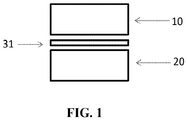
- FIG. 1 shows a graphical depiction of this type of assembly wherein Parts A (10) and B (20) are joined using commercially available adhesive containing the special additive able to modulate deeply penetrating radiation (31).
- polymeric adhesives of various kinds including 2 part adhesives, UV curable adhesives and thermally curable adhesives can be used in accordance with the present invention by modifying certain bonds within the polymeric adhesive and chain and by adding a special additive (preferably an energy modulation agent, and preferably in powder form).
- a special additive preferably an energy modulation agent, and preferably in powder form.
- the additive can be added by weight or mole percent in the range of 1% to 30%.
- the Commercially available adhesive is then cured using the recommended curing method.
- the 2 parts assembly (or subassemblies) that have been joined using the commercially available adhesive goes through its functional life.
- FIG. 2 shows a graphical depiction of this type of assembly wherein Parts A (10) and B (20) are joined using commercially available adhesive that include the modification of certain bonds and that contain special additives able to modulate deeply penetrating radiation for structural disintegration of the adhesive (32).
- UV curable polymeric adhesives (of various kinds) that can be cured using a first initiating energy that interact with a first additive that modulates the first initiating energy light into UV light suitable for activating the photo-initiator catalyzing the cure of the polymeric adhesive and by adding a special additive (preferably an energy modulation agent, and preferably in powder form).
- a special additive preferably an energy modulation agent, and preferably in powder form.
- the additive can be added by weight or mole percent in the range of 1% to 30%.
- the adhesive is then cured using the recommended curing using the first initiating energy.
- the 2 parts assembly (or subassembly) that has been joined using the adhesive goes through its functional life.
- FIG. 3 shows a graphical depiction of this type of assembly wherein Parts A (10) and B (20) are joined using an adhesive containing additives that modulate a deeply penetrating energy to cure the adhesive and that further comprises special additives able to modulate deeply penetrating radiation for the structural disintegration of the adhesive (33).
- Group 4 (interlayering a special adhesive between two standard adhesives)
- Two Commercially available polymeric adhesives including 2 part adhesives, UV curable adhesives and thermally curable adhesives can be used in accordance to the current invention.
- a third adhesive an adhesive containing the special additive (preferably an energy modulation agent and preferably in powder form)) is added in the joint between the assemblies and subassemblies to be bonded.
- the additive can be added by weight or mole percent in the range of 1% to 30%.
- the Commercially available adhesives are then co-cured with the specialty adhesive using the recommended curing method.
- the 2 parts assembly (or subassemblies) that have been joined using the commercially available adhesive goes through its functional life.
- FIG. 4 shows a graphical depiction of this type of assembly wherein Parts A (10) and B (20) are joined using an adhesive containing additives that modulate a deeply penetrating energy for the structural disintegration of the adhesive (34), having a layer of commercially available adhesive (41 and 42) between the adhesive (34) and each of Parts A (10) and B (20).
- Parts A (10) and B (20) may be the same or different, and commercially available adhesives (41 and 42) of Group 4 may be the same or different.
- the four groups of adhesives described can be used for wide range of applications such as the bonding parts and de-bonding of parts including:
- An aspect of the present invention extends to special primers whereby the special primers that adhere to both the adhesive and the parts to be bonded is special in that it can be processed using standard process steps with the ability to become undone (to undergo deconstructive reactions) after being exposed to X-Ray. At least one part needs to be primed in this case (preferably both). In these cases both parts are free any contamination and the recycling yield out of the bonded parts is maximized.
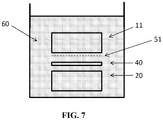
- Figure 5 shows one embodiment of this aspect of the invention wherein Part A' (11) has a primed surface primed with a special primer (50), which is joined with Part B (20) using a commercially available adhesive (40).
- Figure 6 shows another embodiment of this aspect of the invention wherein Part A' (11) and Part B' (21) are both primed with special primers (51) and (52) (which may be the same or different), and joined together on the primed surfaces using a commercially available adhesive (40).
- Another aspect of the present invention includes the use of assisted chemical digestion while the article is being exposed to the applied energy, such as X-Ray or E-Beam.
- the chemical digestion occurs in a chemical digestion bath containing a medium and a reactive compound, wherein the reactive compound interacts with the intermediate layer between the objects to be de-bonded, in order to accelerate the de-bonding process.
- Suitable reactive compounds include, but are not limited to, various acidic and basic compounds reactive with the intermediate layer.
- Preferred reactive compounds include, but are not limited to, mineral acids such as hydrochloric acid, sulfuric acid, and phosphoric acid; organic acids such as formic acid and acetic acid; alkali and alkaline metal bases, such as alkali metal or alkaline metal hydroxides, carbonates, etc.
- Figure 7 is a graphical representation of an embodiment of the present invention in which an embodiment according to Figure 5 is placed in an acid wash bath (60) during X-ray irradiation in order to speed up the depolymerization.
- Heat can be added to speed up the kinetics of the various chemical reactions involved in the present invention.
- the de-bonding process can be accelerated by the application of heat to the article being treated.
- the heating can be done at any desired temperature, and is preferably at a temperature of from room temperature to 200°C, depending on the medium. Further, the heating can be performed on the article being de-bonded during application of the applied energy, or the article can be both immersed in a chemical digestion bath (such as the above noted acid wash for example), while simultaneously heating and applying the applied energy to cause de-bonding. The effects of the chemical digestion bath and the heating can thus be maximized to cause accelerated de-bonding of the objects forming the article.
- Fiber reinforced Composites of different kinds can be formed by a lamination process under heat and pressure.
- the constituents within a given ply (or layer or lamina) of the composites include fibers, matrix, coupling agents or coatings, fillers.
- the matrix can be thermosetting or thermoplastic matrix.
- the thermosetting matrix can include (by way of illustration) diglycidyl ether of bisphenol A (DGEBA) epoxy resin and diethylene triamine (DETA) curing agent with fiber including carbon fibers or glass fibers.
- DGEBA diglycidyl ether of bisphenol A
- DETA diethylene triamine
- thermoplastic resins can be used in the present invention including PEEK (Cictrex (ICI), PPS (Ryton (Philips Petroleum)), PSUL (Udel (Amoco)), PEI (Ultem (GE)), PAI (Torlon(Amoco)), PAI (Amoco), K-III (Avimid (Dupont)), LARC-TPI (Durimid (Rogers)).
- Various thermosetting resins can be used in the present invention including Bismaleimide (compimide 353 (Shell Chemical Co)), PMR-15 , ACTP (Thermid 600 (National Starch and Chemical Corp)).
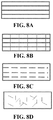
- Fig. 8A unidirectional continuous
- Fig. 8B bidirectional continuous
- Fig. 8C unidirectional discontinuous
- Fig. 8D random discontinuous
- Fig. 8E the lamination of the various plies, optionally with the application of pressure and heat.
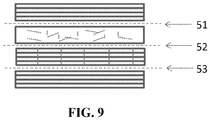
- Fig. 9 shows a multi-ply construction using special primer layers (51, 52, and 53) between each two adjacent plies, which permits recovery of the separate ply layers by use of the present invention, which is not obtainable by conventional recycling methods.
- the Phosphors can be use to break bonds in the rubber chains by virtue of their highly energetic energy. Phosphors can emit UVA, UVB and UVC to promote degradation of weak bond in the network. This embodiment is depicted in Fig. 10 .
- Phosphors can be excited under X-Ray using KV beams and MV beams.
- the MV beams will be powerful and cause more secondary electron cascade in the phosphors leading to more charged surfaces and to more creation of radical oxygen species.
- UV curable pressure sensitive adhesives ⁇ UV curable pressure sensitive liquid and/or hot melt adhesives have been used for label, tape and self-adhesive insulation materials for several years. Although there is only a limited range of cross linkable raw materials available, formulation of these materials has opened a wide range of new adhesives.
- hot melt pressure sensitive adhesives are formulated with a polyurethane resin with low molecular weight, acrylate functional tackifying resins. Typical tackifying resins remain low molecular weight and thus have the desired properties to make the adhesive PSA.
- the acrylate moiety can participate in UV induced crosslinking of the short chain oligomer which results in the loss of its PSA characteristics and allows the material to be removed.
- UV-curing pressure-sensitive adhesives Many formulation factors can influence the performance of UV-curing pressure-sensitive adhesives (PSAs).
- PSAs pressure-sensitive adhesives
- Most commercially available UV-curing PSA systems are based on free-radical curing liquid systems, therefore emphasis will be on this technology.
- Rheology is the study of the change in form and flow of a matter. It is generally applied to viscoelastic materials.
- the rheological properties of the uncured adhesive are important with regard to application and coating. However, they are also important in the cured state, as they must be capable of a degree of flow to provide wetting and tack, yet have sufficient resistance to stress to provide for high adhesive strength.
- the correct rheological properties for a PSA require a careful balancing of these properties.
- PSAs are based on very high-molecular-weight rubber polymers. These polymers rely on the entanglement of molecules to restrict flow. When high strength, heat resistance and chemical resistance are required, the entanglements themselves are not sufficient to restrict flow due to service stress.
- the molecules are chemically crosslinked to provide for a three-dimensional network structure. This is the function of UV-curing mechanisms.
- the crosslink density or the molecular weight between crosslinks provides a measure of the balance that can be achieved between holding power and viscous flow.
- This crosslink density can also be measured by the glass-transition temperature of the adhesive. The higher the glass-transition temperature (Tg) for a specific adhesive, the higher the crosslink density or the lower the molecular weight between crosslinks.
- Tg glass-transition temperature
- Functionality plays an important role in determining crosslink density.
- the functionality of a polymer is the number of reactive sites contained in the polymer molecule. The reactive sites are the connecting points for crosslinking to take place.
- the conventional liquid UV-curable PSA is comprised of four essential components: oligomers, monomers, photoinitiator and additives.
- oligomers monomers
- photoinitiator additives
- the wide choice of raw materials available allows maximum latitude to achieve the desired properties.
- adhesives the final performance properties are achieved during the resin polymerization process in a reactor.
- UV technology the polymerization takes place during the curing process.
- radiation-curable adhesives are a self-contained polymer factory of sorts.
- the oligomer used in PSA applications is generally a multi-functional elastomeric polymer, such as an aliphatic urethane acrylates. Oligomers provide much of the shear strength in the UV PSA formulation. However, selection of the oligomer will also affect more viscous properties, such as tack and peel strength.
- the high-molecular-weights and glass-transition temperatures are generally well below room temperature to allow the oligomer to offer elastic properties at room temperature. This provides the viscoelasticity required for good tack and adhesion.
- Other factors that are affected by choice of oligomer include: reactivity, creep resistance, heat and chemical resistance, and color retention. Of course, cost is also an important factor as oligomers often have the greatest weight concentration in an adhesive formulation.
- Epoxy acrylates are one of the dominant oligomers in the radiation-curable coatings market. In most cases, epoxy acrylates do not have any free epoxy groups left from their synthesis but react through their unsaturation.
- Urethane acrylates are produced by reacting polyisocyanates with hydroxyl alky acrylates, usually along with hydroxyl compounds, to produce the desired set of properties. Urethane acrylates are the most expensive of the acrylates. There are many different types of urethane acrylate oligomers that feature variations in the following parameters.
- polyester acrylates A variety of polyester acrylates is available, which enables a range of properties. They are generally low-viscosity resins that require no reactive diluents. Polyester acrylates provide performance properties between those of urethane acrylates and epoxy acrylates. A disadvantage of some types of polyester acrylate is their irritancy. This is particularly true for low-molecular-weight, highly reactive resins.
- Polyester acrylates vary in functionality, chemical backbone and molecular weight.
- the influence of the functionality is similar to that for the urethane acrylates.
- the chemical backbone has a large influence on properties such as reactivity, color stability, hardness, reactivity, etc.
- properties such as reactivity, color stability, hardness, reactivity, etc.
- the higher the molecular weight the higher the flexibility and viscosity and the lower the reactivity.
- Polyether acrylates have the lowest viscosity of the acrylate resins and are typically used with very little monomer or reactive diluents. They generally have high flexibility but relatively poor water and chemical resistance. To overcome these drawbacks, polyether acrylates are mostly used in combinations with other oligomers or monomers. An interesting property of some polyether acrylates is that they are compatible with water and can be used in water dilutable systems.
- Acrylic acrylates like urethane acrylates, have a very versatile chemistry, and there are many variations available to the formulator. These resins are often used because of their good adhesion to difficult substrates, such as low-surface-energy plastics.
- Miscellaneous oligomers are generally specialty products that typically comprise melamine acrylates, silicone acrylates, etc.
- Other types of radiation-curable resins include unsaturated polyesters dissolved in styrene or acrylics. More recently, polyester resins have appeared on the market in the form of non-acrylic vinyl ether blends.
- Monomers are primarily used to lower the viscosity of the uncured material and to facilitate application. However, they are also used to make adjustments of the formulation, such as improved surface wetting, leveling, and physical properties. Since most oligomers are too viscous to be applied with conventional coating equipment, most radiation-cured formulations are diluted down to a viscosity of 100-10,000 cps by adding a lower-molecular-weight monomer.
- monomers There are primarily two types of monomers: monofunctional, which are used primarily as a diluent; and multifunctional, which can be used as a diluent and crosslinker.
- Multifunctional monomers can be di-, tri-, and polyfunctional. The greater the functionality, the greater the crosslinking potential of the monomer. In this way, the functional monomers can be used to adjust properties of the final adhesive as well as to reduce viscosity.
- Monomer chemistry also has an influence on the polymerization process and physical properties of the final adhesive. Increasing the monomer functionality leads to higher cure speed, higher Tg, higher crosslink density, higher shear strength, and greater chemical and thermal resistance, but lower flexibility and low conversion. A balance is generally required between adhesive strength and rigidity. Rigid adhesives have high shear strength and chemical/thermal resistance but exhibit low peel strength. More flexible adhesives have high peel and impact strength and better adhesion to plastic substrates, but they do not have the heat and chemical resistance of their more densely crosslinked (more rigid) counterparts.
- the monomer used as a reactive diluent in a UV-curable resin plays a key role: it affects both the cure speed and the polymerization extent, as well as the properties of the final product.
- An increase in monomer functionality generally accelerates the curing process, but at the expense of the overall monomer conversion. Poor conversion leads to a crosslinked polymer, which contains a substantial amount of residual unsaturation.
- UV adhesives become more rigid and more resistant to chemicals, temperatures, and abrasion. However, they become less flexible and less resistant to impact and thermal cycling.
- the adhesive usually can be characterized as exhibiting some of the following qualities:
- the type and molecular weight of the backbone chain in a monomer can be varied to provide lower skin irritation, better flexibility, and faster cure speeds.
- Monomers can also be tailored for water-dispersible, adhesion-promoting and pigment-dispensing applications. In addition to providing the functions noted above, monomers could be used as a chemical intermediate to produce copolymers that enhance performance properties.
- Photoinitiators absorb light and are responsible for the production of free radicals. High-energy free radicals induce crosslinking between the unsaturation sites of monomer, oligomers and polymers. Arguably, the most important additive is a photoinitiator for UV-cured adhesives. Photoinitiators are not needed for electronic beam-cured systems because the electrons themselves are able to initiate crosslinking by virtue of their higher energy. A typical photoinitiator for a UV-curable acrylic system is based on an aromatic keto compound. Often more than one photoinitiator is employed to provide for cure with a specific radiation source. The photoinitiator package will also need to be optimized for a given adhesive thickness and UV dosage.
- the photoinitiator determines not only how but where the cure will occur.
- a high-surface-cure photoinitiator for example, tends to increase shear properties while destroying the tack of the system.
- a good through-cure product may leave the surface very tacky but exhibit poor cohesive strength due to the fact that the surfaces are not well crosslinked.
- UV curing requires that the adhesive has to be transparent to UV light in order to be cured. Filled or pigmented adhesives may pose a curing challenge. Another disadvantage is that one transparent substrate is normally required, and a limited depth of cure can be achieved. These disadvantages have generally been overcome by the development of dual-cure adhesive systems. In these systems, two independent curing mechanisms are incorporated into a single formulation. The adhesives can be cured first to a chemically stable state by UV radiation and then advanced to a full cure by a second means such as thermal cure.
- Tackifiers are required in pressure-sensitive radiant-cured adhesives to improve the tack and pressure-sensitive nature or "stickiness" of the adhesive. Traditionally, these formulations have included tackifiers consisting of solid rosin esters of C-5 and C-9 hydrocarbon resins.
- the adhesive materials are typically dispensed as a thixotropic fluid in precise locations, and after all the parts are placed, the entire assembly is heated to a temperature necessary to polymerize the monomers or crosslink resins.
- the adhesion of two objects is done by adding the adhesive material at the interface of two objects to be bonded.
- the potential elimination of the addition of a third layer (the adhesive in this case) would be of great benefits.
- the tool used to dispense an adhesive is eliminated and the step required to cure the adhesive under heat is also obsoleted which saves overall cycle time.
- the assemblies used for various commercial products are relatively small. While electron beam can deliver a desirable source of radiation, the electron beam is not compact and is more applicable to large form factors (such is the case of a wide web process for example). X-Ray energy is delivered through a more compact set of equipment and can integrated in various tools for more efficient tool utilization. In the present invention a bonding method that is vertically integrated is discussed.
- Light Modulating particles which may contain Coatings:
- the light modulating particles refers to any material that can absorb X-Ray and emit another wavelength preferably in the UV (which is a photo-catalytic light).
- the light mediating particles can include (Phosphors, Quantum Dots and Scintillators, diamonds with adequate defect centers and densities). All these particles will be referred to as phosphors interchangeably and therefore examples given by way of preparations are applicable to QDs, diamonds and scintillators.
- Fig. 11A is a graphical representation of an uncoated phosphor and a coated phosphor. The process was performed by first dissolving PMMA into Acetone and then rolling the phosphors with the solution in a ball mill using 5mm zirconia as the grinding and mixing balls. The solution is then recovered and then dried. Upon acetone evaporation the particles were left with a surface coating of PMMA, as shown in Fig. 11B . If phosphors of different types are subjected to coating in a ball mill simultaneously, the result is a number of powders of mixed kind that are individually coated when ball milling is used, as shown in Fig. 11C . The thickness of the coating can be estimated from the surface area of the particles and the concentration of PMMA or of Ethyl cellulose that is dissolved in a diluent.
- the PMMA or Ethyl Cellulose coating can include some of the desirable organic peroxide chemistries. These chemistries can be added in liquid forms and can be rolled in a jar in the ball mill in acetone. Upon drying the solvent, the PMMA or Ethyl cellulose coating is doped with the organic peroxide chemistry, which is depicted in Fig. 11D . As an example Dicumyl peroxide can be added at 1% by weight in the previous table. If the particles are not completely dispersed then an aggregate of the phosphors is coated with the PMMA resin, as depicted in Fig. 11E .
- an aggregate of different phosphor can be coated using PMMA, as depicted in Fig. 12A , or coated and imparted with peroxide chemistry, as depicted in Fig. 12B .
- the Molecular Weight of the PMMA used can vary, and its selection is within the skill of one of ordinary skill in the art.
- the coating is no longer forms a discontinuous phase where individual particles are coated; but, rather, the particles start to neck and to connect laterally which culminates in the formation of a film.
- the necking of particles enables the formation of a film.
- the film is obtained by taking the slurry and using a drawing knife.
- the conformable film can be drawn using a 1 mill to 8 mill knife, as shown in Fig. 13A , providing a phosphor coated conformable film depicted in an overhead view in Fig. 13B .
- a die cutter can be used to obtain various geometries cut from the phosphor loaded conformable film as shown in Fig. 13C .
- the resulting conformable film, or its die-cut shapes, can accommodate stretching and maintaining its shape across complex interfaces, as shown in Fig. 13D .
- plasticizers in the mix prior to casting. About 2% to 5% by weight is a desirable range. Plasticizers with boiling points temperatures above room temperature remain embedded in the film and make the film's surface sticky. This is desirable in case the film is to be used between two objects to be adhered.
- suitable plasticizers include Tripropylene glycol. The addition of a small amount of Tripropylene glycol in the film (around 2% by weight of solids) and the placement of the film at the interface of two objects allows a good material transport between the objects and promotes bonding. Excessive Tripropylene glycol would prohibit adhesion. H[OC 2 H 3 (CH 3 )] 3 OH
- the present invention provides a method for de-bonding objects contained in an article at an interface between the objects, wherein the objects are joined at the interface through an intermediate layer, comprising applying energy from a radiation source, wherein the energy is sufficient to cause destruction of bonds within the intermediate layer; and separating the two objects from one another.
- the intermediate layer is an adhesive layer used to join the objects together, wherein the adhesive layer is formed from a curable adhesive composition comprising one or more curable monomers and one or more energy modulation agents.
- the adhesive layer is formed by applying an applied energy to the curable adhesive composition, wherein the one or more energy modulation agents convert the applied energy into an initiation energy which initiates polymerization of the one or more monomers and thus causes curing of the curable adhesive composition.
- the applied energy is a first ionizing radiation, more preferably selected from the group consisting of x-rays, gamma rays, and electron beams, most preferably x-rays.
- the x-rays used as the applied energy for curing the curable adhesive layer have an energy of from 1 kV to 250 kV.
- the one or more energy modulation agents are used to convert an externally applied energy into an energy sufficient to cause destruction of bonds within the previously formed adhesive layer.
- the externally applied energy is a second ionizing radiation, more preferably selected from the group consisting of x-rays, gamma rays, and electron beams, most preferably x-rays.
- the second ionizing radiation used in the debonding portion of the embodiment has an energy of 1 MV or higher, more preferably x-rays having an energy of 1 MV or higher.
- Wavelength (m) Frequency (Hz) Energy (J) Radio > 1 ⁇ 10 -1 ⁇ 3 ⁇ 10 9 ⁇ 2 ⁇ 10 -24 Microwave 1 ⁇ 10 -3 - 1 ⁇ 10 -1 3 ⁇ 10 9 - 3 ⁇ 10 11 2 ⁇ 10 -24 - 2 ⁇ 10 -22
- initiation energy in the form of radiation from the initiation energy source permeated throughout the medium.
- the initiation energy source can be an external energy source or an energy source located at least partially in the medium.
- Activatable agents and/or the energy modulation agents can include plasmonics agents which enhance either the applied energy or the energy emitted from the energy modulation agents so as to directly or indirectly produce a change in the medium.
- the initiation energy source may be a linear accelerator equipped with at least kV image guided computer-control capability to deliver a precisely calibrated beam of radiation to a pre-selected coordinate.
- linear accelerators include the SMARTBEAMTM IMRT (intensity modulated radiation therapy) system (from Varian Medical Systems, Inc., Palo Alto, California) or Varian OBI technology (OBI stands for "On-board Imaging", and is found on many commercial models of Varian machines).
- the initiation energy source may be commercially available components of X-ray machines or non-medical X-ray machines. X-ray machines that produce from 10 to 150 keV X-rays are readily available in the marketplace.
- the General Electric DEFINIUM series or the Siemens MULTIX series are two nonlimiting examples of typical X-ray machines designed for the medical industry, while the EAGLE PACK series from Smith Detection is an example of a non-medical X-ray machine.
- Another suitable commercially available device is the SIEMENS DEFINITION FLASH, (a CT system), by Siemens Medical Solutions. As such, the invention is capable of performing its desired function when used in conjunction with commercial X-ray equipment.
- energy modulation agents can be placed in the vicinity of a fluid medium (e.g., a liquid or other fluid-like medium) and held inside a container.
- the container can be made of a material that is "transparent" to the radiation.
- plastic, quartz, glass, or aluminum containers would be sufficiently transparent to X-rays, while plastic or quartz or glass containers would be transparent to microwave or radio frequency light.
- the energy modulation agents can be dispersed uniformly throughout the medium or may be segregated in distinct parts of the medium or further separated physically from the medium by encapsulation structures. A supply would provide the medium to the container.
- Fig. 15 is a schematic depicting x-ray scattering events and interactions with energy modulation agents in the medium.
- the effect produced by the interactions of the x-rays and energy modulation agents with the medium occurs by pathways not yet certain where internally produced light (IR, visible, and/or UV) alone or in combination with the x-ray exposure drive a chemical reaction in the medium or to the energy modulation agents themselves.
- These pathways may be influenced by the generation of free radicals inside the medium.
- These pathways may alternatively, or in addition, be influenced by the generation of ionized species inside the medium.
- These pathways include the disassociation of salts that in turn create a desirable chemical reaction.
- These pathways may be influenced by the scattering of x-rays inside the medium.
- These pathways may be influenced by the generation of emitted and re-emitted light inside the medium. These pathways may be a combination of these factors.
- these pathways may include the in situ generation of singlet oxygen and/or ozone to produce a change in the medium.
- the photoactivatable agents may be stimulated through mechanisms such as irradiation, resonance energy transfer, exciton migration, ion-exchange, free radicals, electron injection, or chemical reaction to where "activated" agent is capable of producing the predetermined change desired.
- clusters of energy modulations agents may be provided to a local site where x-ray exposure or internally generated light breaks apart the clusters into a form more useful to treatment at the local site or more useful to generating a local change in the medium nearby where the clusters existed.
- Some phosphor coating can participate in the initial curing and break the crosslinks by virtue of breaking the coating.
- the use of a coating susceptible to cleavage by an applied radiation can lead to compositions that can be cured by one wavelength of applied radiation (which does not affect the coating), and de-bonded or deconstructed by application of a different radiation causing the phosphor coating to break, and thus creating weaknesses in the previously cured material.
Landscapes
- Engineering & Computer Science (AREA)
- Mechanical Engineering (AREA)
- Chemical & Material Sciences (AREA)
- Environmental & Geological Engineering (AREA)
- Life Sciences & Earth Sciences (AREA)
- Health & Medical Sciences (AREA)
- Sustainable Development (AREA)
- Chemical Kinetics & Catalysis (AREA)
- Medicinal Chemistry (AREA)
- Polymers & Plastics (AREA)
- Organic Chemistry (AREA)
- Adhesives Or Adhesive Processes (AREA)
- Laminated Bodies (AREA)
- Lining Or Joining Of Plastics Or The Like (AREA)
Claims (4)
- Procédé pour détacher des objets contenus dans un article au niveau d'une interface entre les objets, dans lequel les objets sont assemblés au niveau de l'interface au moyen d'une couche intermédiaire, comprenant :l'application d'une énergie à partir d'une source de rayonnement, dans lequel l'énergie est suffisante pour provoquer la destruction de liaisons au sein de la couche intermédiaire ; etla séparation des deux objets l'un de l'autre,dans lequel la couche intermédiaire est au moins une couche de primaire (50, 51, 52) au niveau d'une interface entre au moins un parmi les objets et une autre couche de liaison (40) entre les objets, etdans lequel la source de rayonnement est un ou plusieurs agents de modulation d'énergie contenus au sein de l'au moins une couche de primaire (50, 51, 52), dans lequel les un ou plusieurs agents de modulation d'énergie convertissent une énergie appliquée en externe en une énergie suffisante pour provoquer la destruction de liaisons au sein de l'au moins une couche de primaire (50, 51, 52) ou entre l'au moins une couche de primaire (50, 51, 52) et l'autre couche de liaison (40).
- Procédé selon la revendication 1, dans lequel l'énergie appliquée en externe est un rayonnement ionisant ; éventuellement :dans lequel (i) le rayonnement ionisant est un élément choisi parmi le groupeconstitué de rayons X, rayons gamma et faisceaux d'électrons ; ou :
dans lequel (ii) le rayonnement ionisant comprend des rayons X, et les un ou plusieurs agents de modulation d'énergie convertissent le rayonnement ionisant en une énergie de rayonnement UV suffisante pour provoquer la destruction de liaisons au sein de l'au moins une couche de primaire (50, 51, 52) ou entre l'au moins une couche de primaire (50, 51, 52) et l'autre couche de liaison (40); en outre éventuellement dans lequel les rayons X ont une énergie de 1 MV ou plus. - Procédé selon la revendication 1, dans lequel l'application d'énergie est effectuée pendant que l'article est immergé dans un bain de digestion chimique comprenant un milieu et un composé acide.
- Procédé selon la revendication 1, dans lequel l'application d'énergie est effectuée pendant que l'article est chauffé à une température comprise entre la température ambiante et 200 °C ; éventuellement dans lequel l'article immergé est également chauffé à une température comprise entre la température ambiante et 200 °C.
Applications Claiming Priority (2)
| Application Number | Priority Date | Filing Date | Title |
|---|---|---|---|
| US201562175683P | 2015-06-15 | 2015-06-15 | |
| PCT/US2016/037319 WO2016205167A1 (fr) | 2015-06-15 | 2016-06-14 | Rayonnement sur demande induit par des réactions chimiques constructives et déconstructives |
Publications (3)
| Publication Number | Publication Date |
|---|---|
| EP3307538A1 EP3307538A1 (fr) | 2018-04-18 |
| EP3307538A4 EP3307538A4 (fr) | 2019-06-26 |
| EP3307538B1 true EP3307538B1 (fr) | 2021-10-27 |
Family
ID=57546712
Family Applications (1)
| Application Number | Title | Priority Date | Filing Date |
|---|---|---|---|
| EP16812214.1A Active EP3307538B1 (fr) | 2015-06-15 | 2016-06-14 | Rayonnement sur demande induit par des réactions chimiques constructives et déconstructives |
Country Status (5)
| Country | Link |
|---|---|
| US (3) | US10093784B2 (fr) |
| EP (1) | EP3307538B1 (fr) |
| JP (1) | JP6797140B2 (fr) |
| ES (1) | ES2908622T3 (fr) |
| WO (1) | WO2016205167A1 (fr) |
Families Citing this family (3)
| Publication number | Priority date | Publication date | Assignee | Title |
|---|---|---|---|---|
| CA3131865A1 (fr) | 2019-03-04 | 2020-09-10 | Immunolight, Llc. | Structures d'augmentation d'energie destinees a etre utilisees avec des emetteurs et des collecteurs d'energie |
| JP7487473B2 (ja) | 2019-12-26 | 2024-05-21 | セイコーエプソン株式会社 | 圧電デバイス、及びmemsデバイス |
| US20240108226A1 (en) * | 2022-09-29 | 2024-04-04 | Canon U.S.A., Inc. | Medical device distal optics potting |
Family Cites Families (23)
| Publication number | Priority date | Publication date | Assignee | Title |
|---|---|---|---|---|
| US4104205A (en) | 1976-01-06 | 1978-08-01 | The Goodyear Tire & Rubber Company | Microwave devulcanization of rubber |
| US4228839A (en) * | 1978-08-03 | 1980-10-21 | The Firestone Tire & Rubber Company | Self-sealing pneumatic tire |
| US5492135A (en) * | 1992-09-09 | 1996-02-20 | Devore; Dale P. | Collagen modulators for use in photoablation excimer laser keratectomy |
| US6565927B1 (en) * | 1999-04-07 | 2003-05-20 | Board Of Trustees Of Michigan State University | Method for treatment of surfaces with ultraviolet light |
| EP1400577B1 (fr) * | 2001-05-22 | 2013-02-27 | Bridgestone Corporation | Compositions adhesives et procede de fixation sur du caoutchouc |
| US6595927B2 (en) | 2001-07-23 | 2003-07-22 | Medtronic, Inc. | Method and system for diagnosing and administering therapy of pulmonary congestion |
| US6946178B2 (en) | 2003-05-23 | 2005-09-20 | James Sheats | Lamination and delamination technique for thin film processing |
| US20050113502A1 (en) * | 2003-11-21 | 2005-05-26 | Fitzharris Wall Jennifer E. | Pneumatic tire with built-in colored sealant layer |
| WO2007032501A1 (fr) | 2005-09-12 | 2007-03-22 | Nippon Sheet Glass Company, Limited | Solution pour la separation d'un film intercouche et procede de separation d'un film intercouche |
| WO2016003888A1 (fr) * | 2014-06-30 | 2016-01-07 | Immunolight, Llc | Composition de liaison adhésive améliorée et procédé d'utilisation |
| US9676918B2 (en) | 2007-08-06 | 2017-06-13 | Immunolight, Llc. | On demand radiation induced constructive and deconstructive chemical reactions |
| JP4710897B2 (ja) | 2007-11-28 | 2011-06-29 | セイコーエプソン株式会社 | 接合体の剥離方法 |
| JP4697243B2 (ja) * | 2008-02-22 | 2011-06-08 | セイコーエプソン株式会社 | 接合体および接合方法 |
| US20090258154A1 (en) * | 2008-04-15 | 2009-10-15 | Basf Corporation | Coatings and methods for improved adhesion to plastic |
| WO2011140469A1 (fr) * | 2010-05-06 | 2011-11-10 | Zakaryae Fathi | Composition de liaison adhésive et procédé d'utilisation |
| CA2799645C (fr) * | 2010-07-01 | 2017-04-18 | Advanced Fusion Systems Llc | Methode et systeme servant a induire des reactions chimiques par rayonnement x |
| US8726955B2 (en) * | 2010-11-09 | 2014-05-20 | The Goodyear Tire & Rubber Company | Self-balancing pneumatic tire and method of making the same |
| JP2012122027A (ja) * | 2010-12-10 | 2012-06-28 | Nitto Denko Corp | 粘着テープ又はシート |
| JP2014047254A (ja) | 2012-08-30 | 2014-03-17 | Nitto Denko Corp | 両面粘着シート、積層体、及び板の剥離方法 |
| JP6139862B2 (ja) * | 2012-11-02 | 2017-05-31 | デンカ株式会社 | (メタ)アクリル系樹脂組成物及び接着・解体方法 |
| US20140367030A1 (en) | 2013-06-17 | 2014-12-18 | Corning Incorporated | Apparatuses and methods to process flexible glass laminates |
| JP6318025B2 (ja) * | 2013-06-27 | 2018-04-25 | 積水化学工業株式会社 | 導電性粒子、導電材料及び接続構造体 |
| WO2015026479A1 (fr) | 2013-08-21 | 2015-02-26 | Sun Chemical Corporation | Revêtement pour étiquette d'emballage rétractable afin d'en faciliter le recyclage |
-
2016
- 2016-06-14 EP EP16812214.1A patent/EP3307538B1/fr active Active
- 2016-06-14 ES ES16812214T patent/ES2908622T3/es active Active
- 2016-06-14 WO PCT/US2016/037319 patent/WO2016205167A1/fr not_active Ceased
- 2016-06-14 JP JP2017564911A patent/JP6797140B2/ja active Active
-
2017
- 2017-05-09 US US15/590,181 patent/US10093784B2/en active Active
-
2018
- 2018-09-18 US US16/134,427 patent/US10494500B2/en active Active
-
2019
- 2019-11-05 US US16/674,435 patent/US10899907B2/en active Active
Non-Patent Citations (1)
| Title |
|---|
| None * |
Also Published As
| Publication number | Publication date |
|---|---|
| ES2908622T3 (es) | 2022-05-03 |
| EP3307538A1 (fr) | 2018-04-18 |
| CA2989312A1 (fr) | 2016-12-22 |
| JP6797140B2 (ja) | 2020-12-09 |
| US10093784B2 (en) | 2018-10-09 |
| US20200079926A1 (en) | 2020-03-12 |
| WO2016205167A1 (fr) | 2016-12-22 |
| EP3307538A4 (fr) | 2019-06-26 |
| US10494500B2 (en) | 2019-12-03 |
| US10899907B2 (en) | 2021-01-26 |
| US20190016869A1 (en) | 2019-01-17 |
| JP2018520233A (ja) | 2018-07-26 |
| US20170240717A1 (en) | 2017-08-24 |
Similar Documents
| Publication | Publication Date | Title |
|---|---|---|
| US10899907B2 (en) | On demand radiation induced constructive and deconstructive chemical reactions | |
| US20230191747A1 (en) | Adhesive bonding composition and method of use | |
| EP3119601B1 (fr) | Composition de liaison adhésive améliorée et son procédé d'utilisation | |
| US10410991B2 (en) | Adhesive bonding composition and method of use | |
| US9676918B2 (en) | On demand radiation induced constructive and deconstructive chemical reactions | |
| US11661487B2 (en) | Activating surfaces for subsequent bonding | |
| CN103214773B (zh) | 用于聚丙烯酸酯的交联剂‑促进剂系统 | |
| US11926768B2 (en) | Activating surfaces for subsequent bonding | |
| US10087343B2 (en) | Adhesive bonding composition and method of use | |
| JPS61291668A (ja) | 接着剤組成物 | |
| CA2989312C (fr) | Rayonnement sur demande induit par des reactions chimiques constructives et deconstructives | |
| EP2917297B1 (fr) | Liaison de substrats induite par un rayonnement ionisant | |
| JP2009256465A (ja) | 活性エネルギー線架橋型接着剤 | |
| JPH0782544A (ja) | 可視光硬化型接着剤 | |
| JP3413400B2 (ja) | 再剥離可能な積層体およびその再剥離方法 | |
| JP3183726B2 (ja) | 光反応性組成物及び透明積層体の製造方法 | |
| US11787911B2 (en) | Activating surfaces for subsequent bonding | |
| EP4538330A1 (fr) | Composition d'apprêt pouvant être décollable thermiquement | |
| JP2007023144A (ja) | 活性エネルギー線架橋型接着剤及びゴムとの接着方法 |
Legal Events
| Date | Code | Title | Description |
|---|---|---|---|
| STAA | Information on the status of an ep patent application or granted ep patent |
Free format text: STATUS: THE INTERNATIONAL PUBLICATION HAS BEEN MADE |
|
| PUAI | Public reference made under article 153(3) epc to a published international application that has entered the european phase |
Free format text: ORIGINAL CODE: 0009012 |
|
| STAA | Information on the status of an ep patent application or granted ep patent |
Free format text: STATUS: REQUEST FOR EXAMINATION WAS MADE |
|
| 17P | Request for examination filed |
Effective date: 20171219 |
|
| AK | Designated contracting states |
Kind code of ref document: A1 Designated state(s): AL AT BE BG CH CY CZ DE DK EE ES FI FR GB GR HR HU IE IS IT LI LT LU LV MC MK MT NL NO PL PT RO RS SE SI SK SM TR |
|
| AX | Request for extension of the european patent |
Extension state: BA ME |
|
| DAV | Request for validation of the european patent (deleted) | ||
| DAX | Request for extension of the european patent (deleted) | ||
| RIC1 | Information provided on ipc code assigned before grant |
Ipc: B32B 38/10 20060101AFI20190215BHEP Ipc: B32B 7/10 20060101ALI20190215BHEP Ipc: B32B 27/32 20060101ALI20190215BHEP Ipc: B05D 5/10 20060101ALI20190215BHEP Ipc: B32B 27/18 20060101ALI20190215BHEP Ipc: B32B 7/12 20060101ALI20190215BHEP Ipc: B32B 7/06 20190101ALI20190215BHEP |
|
| REG | Reference to a national code |
Ref country code: DE Ref legal event code: R079 Ref document number: 602016065487 Country of ref document: DE Free format text: PREVIOUS MAIN CLASS: B32B0007060000 Ipc: B32B0038100000 |
|
| A4 | Supplementary search report drawn up and despatched |
Effective date: 20190527 |
|
| RIC1 | Information provided on ipc code assigned before grant |
Ipc: B32B 27/32 20060101ALI20190521BHEP Ipc: B05D 5/10 20060101ALI20190521BHEP Ipc: B32B 27/18 20060101ALI20190521BHEP Ipc: B32B 7/06 20190101ALI20190521BHEP Ipc: B32B 7/10 20060101ALI20190521BHEP Ipc: B32B 38/10 20060101AFI20190521BHEP Ipc: B32B 7/12 20060101ALI20190521BHEP |
|
| STAA | Information on the status of an ep patent application or granted ep patent |
Free format text: STATUS: EXAMINATION IS IN PROGRESS |
|
| 17Q | First examination report despatched |
Effective date: 20201022 |
|
| GRAP | Despatch of communication of intention to grant a patent |
Free format text: ORIGINAL CODE: EPIDOSNIGR1 |
|
| STAA | Information on the status of an ep patent application or granted ep patent |
Free format text: STATUS: GRANT OF PATENT IS INTENDED |
|
| INTG | Intention to grant announced |
Effective date: 20210517 |
|
| GRAS | Grant fee paid |
Free format text: ORIGINAL CODE: EPIDOSNIGR3 |
|
| GRAA | (expected) grant |
Free format text: ORIGINAL CODE: 0009210 |
|
| STAA | Information on the status of an ep patent application or granted ep patent |
Free format text: STATUS: THE PATENT HAS BEEN GRANTED |
|
| AK | Designated contracting states |
Kind code of ref document: B1 Designated state(s): AL AT BE BG CH CY CZ DE DK EE ES FI FR GB GR HR HU IE IS IT LI LT LU LV MC MK MT NL NO PL PT RO RS SE SI SK SM TR |
|
| REG | Reference to a national code |
Ref country code: GB Ref legal event code: FG4D |
|
| REG | Reference to a national code |
Ref country code: CH Ref legal event code: EP |
|
| REG | Reference to a national code |
Ref country code: DE Ref legal event code: R096 Ref document number: 602016065487 Country of ref document: DE |
|
| REG | Reference to a national code |
Ref country code: AT Ref legal event code: REF Ref document number: 1441448 Country of ref document: AT Kind code of ref document: T Effective date: 20211115 |
|
| REG | Reference to a national code |
Ref country code: IE Ref legal event code: FG4D |
|
| REG | Reference to a national code |
Ref country code: NL Ref legal event code: FP |
|
| REG | Reference to a national code |
Ref country code: LT Ref legal event code: MG9D |
|
| REG | Reference to a national code |
Ref country code: AT Ref legal event code: MK05 Ref document number: 1441448 Country of ref document: AT Kind code of ref document: T Effective date: 20211027 |
|
| PG25 | Lapsed in a contracting state [announced via postgrant information from national office to epo] |
Ref country code: RS Free format text: LAPSE BECAUSE OF FAILURE TO SUBMIT A TRANSLATION OF THE DESCRIPTION OR TO PAY THE FEE WITHIN THE PRESCRIBED TIME-LIMIT Effective date: 20211027 Ref country code: LT Free format text: LAPSE BECAUSE OF FAILURE TO SUBMIT A TRANSLATION OF THE DESCRIPTION OR TO PAY THE FEE WITHIN THE PRESCRIBED TIME-LIMIT Effective date: 20211027 Ref country code: FI Free format text: LAPSE BECAUSE OF FAILURE TO SUBMIT A TRANSLATION OF THE DESCRIPTION OR TO PAY THE FEE WITHIN THE PRESCRIBED TIME-LIMIT Effective date: 20211027 Ref country code: BG Free format text: LAPSE BECAUSE OF FAILURE TO SUBMIT A TRANSLATION OF THE DESCRIPTION OR TO PAY THE FEE WITHIN THE PRESCRIBED TIME-LIMIT Effective date: 20220127 Ref country code: AT Free format text: LAPSE BECAUSE OF FAILURE TO SUBMIT A TRANSLATION OF THE DESCRIPTION OR TO PAY THE FEE WITHIN THE PRESCRIBED TIME-LIMIT Effective date: 20211027 |
|
| REG | Reference to a national code |
Ref country code: ES Ref legal event code: FG2A Ref document number: 2908622 Country of ref document: ES Kind code of ref document: T3 Effective date: 20220503 |
|
| PG25 | Lapsed in a contracting state [announced via postgrant information from national office to epo] |
Ref country code: IS Free format text: LAPSE BECAUSE OF FAILURE TO SUBMIT A TRANSLATION OF THE DESCRIPTION OR TO PAY THE FEE WITHIN THE PRESCRIBED TIME-LIMIT Effective date: 20220227 Ref country code: SE Free format text: LAPSE BECAUSE OF FAILURE TO SUBMIT A TRANSLATION OF THE DESCRIPTION OR TO PAY THE FEE WITHIN THE PRESCRIBED TIME-LIMIT Effective date: 20211027 Ref country code: PT Free format text: LAPSE BECAUSE OF FAILURE TO SUBMIT A TRANSLATION OF THE DESCRIPTION OR TO PAY THE FEE WITHIN THE PRESCRIBED TIME-LIMIT Effective date: 20220228 Ref country code: PL Free format text: LAPSE BECAUSE OF FAILURE TO SUBMIT A TRANSLATION OF THE DESCRIPTION OR TO PAY THE FEE WITHIN THE PRESCRIBED TIME-LIMIT Effective date: 20211027 Ref country code: NO Free format text: LAPSE BECAUSE OF FAILURE TO SUBMIT A TRANSLATION OF THE DESCRIPTION OR TO PAY THE FEE WITHIN THE PRESCRIBED TIME-LIMIT Effective date: 20220127 Ref country code: LV Free format text: LAPSE BECAUSE OF FAILURE TO SUBMIT A TRANSLATION OF THE DESCRIPTION OR TO PAY THE FEE WITHIN THE PRESCRIBED TIME-LIMIT Effective date: 20211027 Ref country code: HR Free format text: LAPSE BECAUSE OF FAILURE TO SUBMIT A TRANSLATION OF THE DESCRIPTION OR TO PAY THE FEE WITHIN THE PRESCRIBED TIME-LIMIT Effective date: 20211027 Ref country code: GR Free format text: LAPSE BECAUSE OF FAILURE TO SUBMIT A TRANSLATION OF THE DESCRIPTION OR TO PAY THE FEE WITHIN THE PRESCRIBED TIME-LIMIT Effective date: 20220128 |
|
| REG | Reference to a national code |
Ref country code: DE Ref legal event code: R097 Ref document number: 602016065487 Country of ref document: DE |
|
| PG25 | Lapsed in a contracting state [announced via postgrant information from national office to epo] |
Ref country code: SM Free format text: LAPSE BECAUSE OF FAILURE TO SUBMIT A TRANSLATION OF THE DESCRIPTION OR TO PAY THE FEE WITHIN THE PRESCRIBED TIME-LIMIT Effective date: 20211027 Ref country code: SK Free format text: LAPSE BECAUSE OF FAILURE TO SUBMIT A TRANSLATION OF THE DESCRIPTION OR TO PAY THE FEE WITHIN THE PRESCRIBED TIME-LIMIT Effective date: 20211027 Ref country code: RO Free format text: LAPSE BECAUSE OF FAILURE TO SUBMIT A TRANSLATION OF THE DESCRIPTION OR TO PAY THE FEE WITHIN THE PRESCRIBED TIME-LIMIT Effective date: 20211027 Ref country code: EE Free format text: LAPSE BECAUSE OF FAILURE TO SUBMIT A TRANSLATION OF THE DESCRIPTION OR TO PAY THE FEE WITHIN THE PRESCRIBED TIME-LIMIT Effective date: 20211027 Ref country code: DK Free format text: LAPSE BECAUSE OF FAILURE TO SUBMIT A TRANSLATION OF THE DESCRIPTION OR TO PAY THE FEE WITHIN THE PRESCRIBED TIME-LIMIT Effective date: 20211027 Ref country code: CZ Free format text: LAPSE BECAUSE OF FAILURE TO SUBMIT A TRANSLATION OF THE DESCRIPTION OR TO PAY THE FEE WITHIN THE PRESCRIBED TIME-LIMIT Effective date: 20211027 |
|
| PLBE | No opposition filed within time limit |
Free format text: ORIGINAL CODE: 0009261 |
|
| STAA | Information on the status of an ep patent application or granted ep patent |
Free format text: STATUS: NO OPPOSITION FILED WITHIN TIME LIMIT |
|
| 26N | No opposition filed |
Effective date: 20220728 |
|
| PG25 | Lapsed in a contracting state [announced via postgrant information from national office to epo] |
Ref country code: AL Free format text: LAPSE BECAUSE OF FAILURE TO SUBMIT A TRANSLATION OF THE DESCRIPTION OR TO PAY THE FEE WITHIN THE PRESCRIBED TIME-LIMIT Effective date: 20211027 |
|
| PG25 | Lapsed in a contracting state [announced via postgrant information from national office to epo] |
Ref country code: SI Free format text: LAPSE BECAUSE OF FAILURE TO SUBMIT A TRANSLATION OF THE DESCRIPTION OR TO PAY THE FEE WITHIN THE PRESCRIBED TIME-LIMIT Effective date: 20211027 |
|
| PG25 | Lapsed in a contracting state [announced via postgrant information from national office to epo] |
Ref country code: MC Free format text: LAPSE BECAUSE OF FAILURE TO SUBMIT A TRANSLATION OF THE DESCRIPTION OR TO PAY THE FEE WITHIN THE PRESCRIBED TIME-LIMIT Effective date: 20211027 |
|
| REG | Reference to a national code |
Ref country code: CH Ref legal event code: PL |
|
| PG25 | Lapsed in a contracting state [announced via postgrant information from national office to epo] |
Ref country code: LU Free format text: LAPSE BECAUSE OF NON-PAYMENT OF DUE FEES Effective date: 20220614 Ref country code: LI Free format text: LAPSE BECAUSE OF NON-PAYMENT OF DUE FEES Effective date: 20220630 Ref country code: IE Free format text: LAPSE BECAUSE OF NON-PAYMENT OF DUE FEES Effective date: 20220614 Ref country code: CH Free format text: LAPSE BECAUSE OF NON-PAYMENT OF DUE FEES Effective date: 20220630 |
|
| P01 | Opt-out of the competence of the unified patent court (upc) registered |
Effective date: 20230417 |
|
| PGFP | Annual fee paid to national office [announced via postgrant information from national office to epo] |
Ref country code: NL Payment date: 20230626 Year of fee payment: 8 Ref country code: FR Payment date: 20230626 Year of fee payment: 8 |
|
| PGFP | Annual fee paid to national office [announced via postgrant information from national office to epo] |
Ref country code: BE Payment date: 20230627 Year of fee payment: 8 |
|
| PGFP | Annual fee paid to national office [announced via postgrant information from national office to epo] |
Ref country code: IT Payment date: 20230620 Year of fee payment: 8 Ref country code: GB Payment date: 20230627 Year of fee payment: 8 Ref country code: ES Payment date: 20230703 Year of fee payment: 8 |
|
| PG25 | Lapsed in a contracting state [announced via postgrant information from national office to epo] |
Ref country code: HU Free format text: LAPSE BECAUSE OF FAILURE TO SUBMIT A TRANSLATION OF THE DESCRIPTION OR TO PAY THE FEE WITHIN THE PRESCRIBED TIME-LIMIT; INVALID AB INITIO Effective date: 20160614 |
|
| PG25 | Lapsed in a contracting state [announced via postgrant information from national office to epo] |
Ref country code: MK Free format text: LAPSE BECAUSE OF FAILURE TO SUBMIT A TRANSLATION OF THE DESCRIPTION OR TO PAY THE FEE WITHIN THE PRESCRIBED TIME-LIMIT Effective date: 20211027 Ref country code: CY Free format text: LAPSE BECAUSE OF FAILURE TO SUBMIT A TRANSLATION OF THE DESCRIPTION OR TO PAY THE FEE WITHIN THE PRESCRIBED TIME-LIMIT Effective date: 20211027 |
|
| PG25 | Lapsed in a contracting state [announced via postgrant information from national office to epo] |
Ref country code: TR Free format text: LAPSE BECAUSE OF FAILURE TO SUBMIT A TRANSLATION OF THE DESCRIPTION OR TO PAY THE FEE WITHIN THE PRESCRIBED TIME-LIMIT Effective date: 20211027 |
|
| PG25 | Lapsed in a contracting state [announced via postgrant information from national office to epo] |
Ref country code: MT Free format text: LAPSE BECAUSE OF FAILURE TO SUBMIT A TRANSLATION OF THE DESCRIPTION OR TO PAY THE FEE WITHIN THE PRESCRIBED TIME-LIMIT Effective date: 20211027 |
|
| REG | Reference to a national code |
Ref country code: NL Ref legal event code: MM Effective date: 20240701 |
|
| GBPC | Gb: european patent ceased through non-payment of renewal fee |
Effective date: 20240614 |
|
| PG25 | Lapsed in a contracting state [announced via postgrant information from national office to epo] |
Ref country code: NL Free format text: LAPSE BECAUSE OF NON-PAYMENT OF DUE FEES Effective date: 20240701 |
|
| PG25 | Lapsed in a contracting state [announced via postgrant information from national office to epo] |
Ref country code: NL Free format text: LAPSE BECAUSE OF NON-PAYMENT OF DUE FEES Effective date: 20240701 |
|
| PG25 | Lapsed in a contracting state [announced via postgrant information from national office to epo] |
Ref country code: BE Free format text: LAPSE BECAUSE OF NON-PAYMENT OF DUE FEES Effective date: 20240630 |
|
| PG25 | Lapsed in a contracting state [announced via postgrant information from national office to epo] |
Ref country code: FR Free format text: LAPSE BECAUSE OF NON-PAYMENT OF DUE FEES Effective date: 20240630 |
|
| PG25 | Lapsed in a contracting state [announced via postgrant information from national office to epo] |
Ref country code: GB Free format text: LAPSE BECAUSE OF NON-PAYMENT OF DUE FEES Effective date: 20240614 Ref country code: IT Free format text: LAPSE BECAUSE OF NON-PAYMENT OF DUE FEES Effective date: 20240614 |
|
| REG | Reference to a national code |
Ref country code: BE Ref legal event code: MM Effective date: 20240630 |
|
| PGFP | Annual fee paid to national office [announced via postgrant information from national office to epo] |
Ref country code: DE Payment date: 20250627 Year of fee payment: 10 |
|
| REG | Reference to a national code |
Ref country code: ES Ref legal event code: FD2A Effective date: 20250801 |
|
| PG25 | Lapsed in a contracting state [announced via postgrant information from national office to epo] |
Ref country code: ES Free format text: LAPSE BECAUSE OF NON-PAYMENT OF DUE FEES Effective date: 20240615 |