EP3309282B1 - Tricoteuse rectiligne destinée à poser des fils de trame - Google Patents
Tricoteuse rectiligne destinée à poser des fils de trame Download PDFInfo
- Publication number
- EP3309282B1 EP3309282B1 EP16193983.0A EP16193983A EP3309282B1 EP 3309282 B1 EP3309282 B1 EP 3309282B1 EP 16193983 A EP16193983 A EP 16193983A EP 3309282 B1 EP3309282 B1 EP 3309282B1
- Authority
- EP
- European Patent Office
- Prior art keywords
- thread
- knitting
- knitting system
- weft
- hold
- Prior art date
- Legal status (The legal status is an assumption and is not a legal conclusion. Google has not performed a legal analysis and makes no representation as to the accuracy of the status listed.)
- Active
Links
Images





Classifications
-
- D—TEXTILES; PAPER
- D04—BRAIDING; LACE-MAKING; KNITTING; TRIMMINGS; NON-WOVEN FABRICS
- D04B—KNITTING
- D04B7/00—Flat-bed knitting machines with independently-movable needles
- D04B7/24—Flat-bed knitting machines with independently-movable needles for producing patterned fabrics
- D04B7/28—Flat-bed knitting machines with independently-movable needles for producing patterned fabrics with stitch patterns
-
- D—TEXTILES; PAPER
- D04—BRAIDING; LACE-MAKING; KNITTING; TRIMMINGS; NON-WOVEN FABRICS
- D04B—KNITTING
- D04B15/00—Details of, or auxiliary devices incorporated in, weft knitting machines, restricted to machines of this kind
- D04B15/88—Take-up or draw-off devices for knitting products
- D04B15/90—Take-up or draw-off devices for knitting products for flat-bed knitting machines
-
- D—TEXTILES; PAPER
- D04—BRAIDING; LACE-MAKING; KNITTING; TRIMMINGS; NON-WOVEN FABRICS
- D04B—KNITTING
- D04B1/00—Weft knitting processes for the production of fabrics or articles not dependent on the use of particular machines; Fabrics or articles defined by such processes
- D04B1/10—Patterned fabrics or articles
- D04B1/102—Patterned fabrics or articles with stitch pattern
-
- D—TEXTILES; PAPER
- D04—BRAIDING; LACE-MAKING; KNITTING; TRIMMINGS; NON-WOVEN FABRICS
- D04B—KNITTING
- D04B1/00—Weft knitting processes for the production of fabrics or articles not dependent on the use of particular machines; Fabrics or articles defined by such processes
- D04B1/10—Patterned fabrics or articles
- D04B1/102—Patterned fabrics or articles with stitch pattern
- D04B1/104—Openwork fabric, e.g. pelerine fabrics
-
- D—TEXTILES; PAPER
- D04—BRAIDING; LACE-MAKING; KNITTING; TRIMMINGS; NON-WOVEN FABRICS
- D04B—KNITTING
- D04B1/00—Weft knitting processes for the production of fabrics or articles not dependent on the use of particular machines; Fabrics or articles defined by such processes
- D04B1/22—Weft knitting processes for the production of fabrics or articles not dependent on the use of particular machines; Fabrics or articles defined by such processes specially adapted for knitting goods of particular configuration
-
- D—TEXTILES; PAPER
- D04—BRAIDING; LACE-MAKING; KNITTING; TRIMMINGS; NON-WOVEN FABRICS
- D04B—KNITTING
- D04B15/00—Details of, or auxiliary devices incorporated in, weft knitting machines, restricted to machines of this kind
- D04B15/02—Loop-transfer points
-
- D—TEXTILES; PAPER
- D04—BRAIDING; LACE-MAKING; KNITTING; TRIMMINGS; NON-WOVEN FABRICS
- D04B—KNITTING
- D04B15/00—Details of, or auxiliary devices incorporated in, weft knitting machines, restricted to machines of this kind
- D04B15/06—Sinkers
-
- D—TEXTILES; PAPER
- D04—BRAIDING; LACE-MAKING; KNITTING; TRIMMINGS; NON-WOVEN FABRICS
- D04B—KNITTING
- D04B15/00—Details of, or auxiliary devices incorporated in, weft knitting machines, restricted to machines of this kind
- D04B15/66—Devices for determining or controlling patterns ; Program-control arrangements
- D04B15/68—Devices for determining or controlling patterns ; Program-control arrangements characterised by the knitting instruments used
- D04B15/70—Devices for determining or controlling patterns ; Program-control arrangements characterised by the knitting instruments used in flat-bed knitting machines
Definitions
- the invention relates to a flat knitting machine that is set up to insert a first thread in the same knitting row as a weft thread and to knit with it. Furthermore, the invention relates to a method for knitting a knitted fabric on a flat knitting machine, in which a thread is laid in the same knitting row as a weft thread and is knitted.
- weft threads into a knitted fabric during the production of knitted fabrics on flat knitting machines. This can be necessary for design purposes in fashion, but also in the production of technical textiles. For example, by inserting a weft thread, a knitted fabric can be given a specific property, such as less stretch or higher tensile strength.
- the object of the present invention is to provide a flat knitting machine with which it is possible to insert a thread in a knitting row both as a weft thread and to knit it. Accordingly, it is the object of the present invention to provide a method for inserting a weft thread.
- a flat knitting machine which is set up to insert a first thread in the same knitting row as weft thread and to knit with it, with at least one first and one second knitting system, and a first thread guide assigned to the first knitting system, the guides a first thread, and at least one hold-down device, which is arranged between the knitting systems, for holding down the first thread below the level of the needles, and a needle selection, which is set up, in the area of the first advancing knitting system, needles with appropriate control to form stitches to be selected, with the first thread being inserted as weft thread if the needle selection is not activated.
- a thread that is intended for stitch formation can also be introduced into the knitted fabric as a weft thread at the same time.
- the thread should z. B. after a certain number of with him produced stitches are inserted as a weft thread, after which a stitch formation takes place with it again.
- the advantage here is that the inserted weft thread is simultaneously secured by the stitch formation, for example against displacement in the knitted fabric.
- weft insertion and stitch formation it is possible for weft insertion and stitch formation to be repeated several times in a row of knitting. It is also possible to use standard thread guides for weft insertion. A separate weft thread guide is not required.
- a standard thread guide is understood to be a thread guide that is carried along in the system, in particular that is arranged after the center of the system in the direction of movement of the system. In contrast to this, a conventional weft thread guide runs in front of the center of the system.
- the first knitting system is preferably a leading knitting system in relation to a knitting direction and the second is a knitting system following the first knitting system.
- the assignment of the first yarn guide to the first (preceding) knitting system applies to one knitting direction, i. H. a sled stroke. If the knitting direction changes, the (second) knitting system following in the previous knitting direction becomes the leading (first) knitting system and the first thread guide is then assigned to this knitting system.
- the hold-down device holds down threads and, if present, the knitted fabric underneath, so that needles that are subsequently driven out can come over the threads / knitted fabric.
- the hold-down device is designed as a stripper or plate. With such a configuration of the hold-down device, it is particularly easy to insert the weft thread shortly before the needle is driven out to bring the trailing knitting system, ie in particular the second knitting system, for knitting/transferring below the level of the needles.
- the hold-down device can be activated and deactivated.
- the hold-down device can be activated when a thread is inserted as weft thread through the first knitting system by means of the first thread guide.
- the hold-down device is activated when a thread previously inserted as a weft thread is to be knitted over by a subsequent, in particular second, knitting system in order to secure it in the knitted fabric.
- the first thread guide can be permanently assigned to the first knitting system during knitting in one knitting direction, in the sense that it can only be moved in a central region of the first knitting system relative to the first knitting system without leaving the first knitting system.
- the thread guide can only be arranged to the left or right of the center of the system, depending on the direction in which the knitting system is used for knitting.
- the thread guide can always be arranged behind the center of the system, viewed in the knitting direction. Accordingly, the thread guide can only be moved in a very limited area relative to the knitting system.
- the first thread guide is an independently driven thread guide that can be moved from the first knitting system to the hold-down device when knitting a row of knitting without entering the area of influence of the second knitting system.
- the range of motion of a self-sufficiently driven thread guide is also limited.
- the thread guide can be moved when no needle is selected in the first knitting system, or it can be left until just before the hold-down device. In this case, the first knitting system would be free for further needle operations, such as transferring stitches.
- the flat knitting machine can have at least one entraining device for entraining a thread guide.
- the thread guide can be taken along with a knitting system.
- a second thread guide can be assigned to the second knitting system.
- a second thread can be knitted with the second knitting system and thereby, for example, a first thread inserted as a weft thread can be knitted over in the knitted fabric and secured in the knitted fabric.
- a hold-down device is provided on both sides of the first knitting system.
- the first thread can thus be inserted as a weft thread in both knitting directions, since a hold-down device is always present behind the first knitting system, viewed in the knitting direction.
- the first and the second knitting system are preferably arranged on a common carriage, so that they carry out a carriage stroke together.
- the scope of the invention also includes a method according to claim 10 for knitting a knitted fabric on a flat knitting machine with a first and a second knitting system, in which a first thread is guided through a first thread guide and when a needle selection associated with the first knitting system is deactivated and no needle is selected, the first thread is inserted as weft thread and is held down in order to be able to carry out a transfer operation or knitting operation with a second thread, and at least one stitch is formed with the first thread if the needle selection associated with the first knitting system is activated and at least one needle is selected.
- the first thread is inserted as a weft thread in at least one area of a knitted fabric and the first thread is knitted in at least a second area.
- the first thread is secured by a second thread by using the second thread at least one stitch is formed or stitches formed with the second thread or a third thread are transferred from needles of one needle bed to needles of another needle bed, in particular by means of a further knitting system. It is not necessary for the first thread to be secured by a second thread in all areas of the knitted fabric in which the first thread was inserted as weft thread.
- the second thread which is knitted with a second, in particular trailing, knitting system and is fed with a second thread guide
- the first thread guide is only moved relative to the first, in particular leading, knitting system when no needle is selected for the first knitting system. Accordingly, the first thread guide is only moved relative to the first knitting system when it is not required for stitch formation.
- the scope of the invention also includes a program system for programming a flat knitting machine according to claim 15, for carrying out the method according to the invention, with a grouping device for grouping the instructions to insert the first thread with a first knitting system as weft thread, to activate the hold-down device and in another knitting system to secure the weft thread, and a device for converting the instructions into machine-related data, which ensures that the order of the grouped instructions in the machine-related data is retained.
- the 1 shows part of a flat knitting machine 100 with a first knitting system S1 leading in the knitting direction 102 and a trailing, second knitting system S2, both of which are arranged on a common carriage 101.
- a first thread guide FF1 is assigned to the leading knitting system S1
- a second thread guide FF2 is assigned to the trailing knitting system S2.
- a hold-down device NH is provided between the knitting systems S1, S2, which serves to hold down a first thread that was inserted as a weft thread with the first thread guide FF1, in order to ensure that it is not caught by the needles of the second, in particular trailing knitting system S2 will.
- the leading first knitting system S1 is used to produce a row of stitches, consisting of knitting areas and areas in which the thread is inserted as a weft by the thread guide FF1.
- the second knitting system S2 following here is used for stitch formation or for knitting over the weft thread.
- the first yarn guide FF1 is located behind the system center 103 of the first knitting system S1, seen in the knitting direction 102. However, it is still within the S1 knitting system. Provision is also made for the first thread guide FF1 not to be able to leave the first knitting system S1 while a row of knitting is being knitted. However, it is possible to move the thread guide FF1 to a limited extent, namely to the other side of the system center 103 when knitting is carried out counter to the knitting direction 102. In order to be able to insert the thread guided through the thread guide FF1 as a weft thread even with a knitting direction opposite to the knitting direction 102, a hold-down device can also be provided to the right of the first knitting system S1.
- the yarn guide 1 could be assigned to the system S2 for a knitting direction opposite to the knitting direction 102 and, with respect to this system S2, could be arranged behind the center of the system.
- the thread guides FF1 and FF2 are the knitting systems S1, S2 during the knitting of a row of knitting, i. H. in a carriage stroke, permanently assigned.
- first thread guide FF1 is an independently driven thread guide, it can be provided that in this case the first thread guide FF1 can be moved out of the first knitting system S1 in the direction of the hold-down device when knitting a row of knitting, but not via the hold-down device NH out. A possibility of movement to the right up to a hold-down device that may be provided there can also be provided.
- the determination as to whether a stitch is formed with the thread of the first thread guide FF1 or whether the thread is inserted as a weft thread takes place exclusively via needle selection, which is assigned to the first knitting system S1. If the needle selection is activated, a needle can be driven out and a stitch can be formed with the thread of the first thread guide FF1. If, on the other hand, the needle selection is deactivated, ie no needle is expelled, the associated thread is inserted as weft thread by the first thread guide FF1.
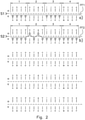
- the 2 shows a flow chart for the production of two rows of knitting with the in the 1 device shown.
- the Figure 2a is knitted with the leading first knitting system S1 in a knitting direction to the right (indicated by the arrow).
- the Figure 2b is knitted with the trailing second knitting system S2 in the same direction.
- first row of knitting according to Figure 2a is knitted with the first knitting system S1 in area 1 by forming stitches on the needles A to D of the front needle bed V with the thread guide FF1.
- the needle selection was activated.
- Weft insertion then takes place in area 2 with the same thread guide FF1 via the needles E to H of the front needle bed V or e to h of the rear needle bed H, ie with deactivated needle selection.
- stitches V are formed on the needles I to L of the front needle bed.
- This is followed in area 4 by a weft insertion via the needles M to P of the front needle bed V or the needles m to p of the rear needle bed H.
- the needle selection of the first knitting system S1 is switched to inactive, in the areas 1 and 5 it is activated.
- a weft thread was inserted in the same carriage stroke without a system change or other changes in areas 2 and 4. The same thread was knitted in sections 1 and 3.
- stitches are formed on the needles A to D of the front needle bed V in area 1 with the second knitting system S2 and the second thread guide FF2.
- the in the 1 shown hold-down device NH activated to keep the thread of the first thread guide FF1 safe in a low position. It is also conceivable to activate the hold-down device NH before the associated thread is inserted as weft thread with the thread guide FF1.
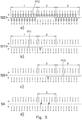
- the Figure 3a shows the process for producing a knitted fabric based on in the 2 described technique.
- the knitted fabric is divided into areas 1 to 5.
- the knitting direction is according to the Figure 3a from left to right, which is indicated by the arrowhead on the left side of the figure.
- a double-knitted fabric is formed on the needles A to E of the front needle bed V and the needles A to D of the rear needle bed H with the leading first knitting system S1 in area 1 with the associated first thread guide FF1.
- the thread of the thread guide FF1 is introduced as a weft thread, ie the needle selection is deactivated.
- This is followed in area 5 with the thread of thread guide FF1 to produce a double-sided knitted fabric on needles V to Z of the front needle bed V and needles v to y of the rear needle bed H.
- the thread of thread guide FF1 is thus integrated into the knitted fabric, by forming stitches with the thread of the thread guide FF1 in areas 1 and 5.
- the 4 shows an image of a knitted fabric 200, which corresponds to that in FIG Figures 3a to 3d described method was prepared.
- the areas 1 to 5 are also marked here.
- the Figures 5a to 5h show another process for the production of a knitted fabric based on the in 2 described technique.
- two weft threads are introduced into the knitted fabric from opposite sides via areas 1 and 3 and are connected to it in area 2 using stitch technology.
- a double-knitted fabric is formed on the needles A to J of the front needle bed V and the needles a to j of the rear needle bed H with a second (in this case leading) knitting system S22 with the thread guide FF2 in area 1.
- stitches H are formed on the needles k to q of the rear needle bed.
- stitches are formed on the needles R to Z of the front needle bed V and the needles r to y of the rear needle bed H in the area 3 to produce a double-knitted fabric.
- the knitting direction in Figure 5a is according to the arrow shown from left to right.
- the knitting direction is also from left to right.
- the associated thread is introduced as a weft thread from the left via the needles A to K of the front needle bed V and the needles a to k of the rear needle bed H into the knitted fabric.
- a stitch is formed in area 2 with the needle L of the front needle bed selected in a first (in this case trailing) knitting system S11.
- the knitting direction is from right to left.
- a weft thread is inserted from the right via the needles Z to P of the front needle bed V and the needles z to o of the rear needle bed H with a first thread guide FF3, which in this case is assigned to the first knitting system S22.
- a first thread guide FF3 which in this case is assigned to the first knitting system S22.
- the S22 knitting system can be the first or second knitting system.
- Fig. 5g In line according to Fig. 5g is the thread guide FF3, which according to the weft thread Figure 5c introduced into the knitted fabric from right to left, moved to the right, just like the S22 knitting system.
- a tuck stitch On the needle O of the front needle bed V, a tuck stitch is formed.
- the thread of the thread guide FF3 is inserted as a weft thread.
- the Figure 5h shows that the two in the rows according to Figures 5f, 5g stitches formed on the front needle bed V are transferred to needles of the rear needle bed H.
- the in the Figures 5a to 5h The processes described can be repeated as often as you like.
- the 6 shows a representation of a knitted fabric 300, which corresponds to the sequence according to FIG Figures 5a to 5h was produced. Areas 1 to 3 are in the 6 shown.
Landscapes
- Engineering & Computer Science (AREA)
- Textile Engineering (AREA)
- Knitting Of Fabric (AREA)
- Knitting Machines (AREA)
Claims (15)
- Métier à tricoter rectiligne conçu pour insérer un premier fil dans la même rangée de tricot qu'un fil de trame et pour former des mailles avec celui-ci, comportant au moins un premier et un second systèmes de tricotage (S1, S11, S2, S22) ainsi qu'un premier guide-fil (FF1, FF3) associé au premier système de tricotage (S1, S11, S22), lequel premier guide-fil guide un premier fil, et au moins un dispositif de maintien (NH) disposé entre les systèmes de tricotage (S1, S11, S2, S22) et permettant de maintenir le premier fil en dessous du niveau des aiguilles, et une sélection d'aiguilles qui est conçue, lors d'une activation appropriée, pour sélectionner des aiguilles dans la zone du premier système de tricotage (S1, S11, S22) afin de former des mailles, le premier fil étant inséré comme fil de trame lorsque la sélection d'aiguilles n'est pas activée.
- Métier à tricoter rectiligne selon la revendication 1, caractérisé en ce que le dispositif de maintien (NH) est réalisé sous forme d'organe de transfert ou de plaque.
- Métier à tricoter rectiligne selon l'une des revendications précédentes, caractérisé en ce que le dispositif de maintien (NH) peut être activé et désactivé.
- Métier à tricoter rectiligne selon l'une des revendications précédentes, caractérisé en ce que le premier guide-fil (FF1, FF3) est associé de façon définitive au premier système de tricotage (S1, S11, S22) lors du tricotage dans un sens de tricotage, dans le sens qu'il est exclusivement mobile dans une zone centrale du premier système de tricotage (S1, S11, S22) par rapport au premier système de tricotage (S1, S11, S22), sans quitter le premier système de tricotage (S1, S11, S22).
- Métier à tricoter rectiligne selon l'une des revendications 1 à 3, caractérisé en ce que le premier guide-fil (FF1, FF3) est un guide-fil autonome qui est mobile du premier système de tricotage (S1, S11, S22) vers le dispositif de maintien (NH) lors du tricotage d'une rangée de tricot, sans entrer dans la zone d'influence du second système de tricotage (S2, S22).
- Métier à tricoter rectiligne selon l'une des revendications précédentes 1 à 4, caractérisé en ce qu'au moins un appareil d'entraînement est prévu pour l'entraînement d'un guide-fil (FF1, FF2, FF3).
- Métier à tricoter rectiligne selon l'une des revendications précédentes, caractérisé en ce qu'un second guide-fil (FF2) est associé au second système de tricotage (S2, S22).
- Métier à tricoter rectiligne selon l'une des revendications précédentes, caractérisé en ce qu'un dispositif de maintien (NH) est prévu des deux côtés du premier système de tricotage (S1, S11, S22).
- Métier à tricoter rectiligne selon l'une des revendications précédentes, caractérisé en ce que le premier et le second systèmes de tricotage (S1, S11, S2, S22) sont disposés sur un coulisseau commun (101).
- Procédé de tricotage d'un tricot sur un métier à tricoter rectiligne comportant un premier et un second systèmes de tricotage (S1, S11, S2, S22), dans lequel un premier fil est guidé par un premier guide-fil (FF1, FF3) associé au premier système de tricotage (S1, S11, S22) et, si une sélection d'aiguilles associée au premier système de tricotage (S1, S11, S22) est désactivée et aucune aiguille n'est sélectionnée, le premier fil est inséré comme fil de trame, et comportant un dispositif de maintien (NH) qui est disposé entre les systèmes de tricotage (S1, S11, S2, S22), est maintenu en dessous du niveau des aiguilles afin de pouvoir effectuer une opération de transfert ou de tricotage au moyen d'un deuxième fil, et au moins une maille étant formée au moyen du premier fil dans la même rangée de tricotage dans laquelle le premier fil a été inséré comme fil de trame lorsque la sélection d'aiguilles associée au premier système de tricotage (S1, S11, S22) est activée et au moins une aiguille est sélectionnée.
- Procédé selon la revendication 10, caractérisé en ce que le premier fil est inséré comme fil de trame dans au moins une zone d'un tricot (200, 300) dans la même course de coulisseau et qu'au moins une maille est formée au moyen du premier fil dans au moins une seconde zone.
- Procédé selon la revendication 11, caractérisé en ce que le premier fil est fixé par un deuxième fil dans les zones du tricot (200, 300) dans lesquelles le premier fil a été inséré comme fil de trame en formant au moins une maille au moyen du deuxième fil ou que des mailles formées au moyen du deuxième ou d'un troisième fil sont transférées des aiguilles d'une fonture (H, V) aux aiguilles d'une autre fonture (H, V).
- Procédé selon l'une des revendications précédentes 10 à 12, caractérisé en ce que le premier guide-fil (FF1, FF3) est déplacé en direction d'un dispositif de maintien (NH) disposé entre les premier et second systèmes de tricotage (S1, S11, S2, S22) avant que des mailles soient formées ou transférées au moyen du second système de tricotage.
- Procédé selon l'une des revendications précédentes, caractérisé en ce que le premier guide-fil (FF1, FF3) n'est déplacé par rapport au premier système de tricotage (S1, S11, S22) que si aucune aiguille n'est sélectionnée pour le premier système de tricotage (S1, S11, S22).
- Système de programme de programmation d'un métier à tricoter rectiligne permettant la mise en œuvre du procédé selon l'une des revendications 10 à 14, comportant un appareil de regroupement permettant de regrouper les instructions d'insertion du premier fil avec le premier système de tricotage (S1, S11, S22) comme fil de trame, d'activation du dispositif de maintien (NH) et de fixation du fil de trame au moyen du deuxième fil et du second système de tricotage (S2, S22), et un appareil de conversion des instructions en données relatives à la machine, lequel garantit que la séquence des instructions regroupées est conservée dans les données relatives à la machine.
Priority Applications (2)
| Application Number | Priority Date | Filing Date | Title |
|---|---|---|---|
| EP16193983.0A EP3309282B1 (fr) | 2016-10-14 | 2016-10-14 | Tricoteuse rectiligne destinée à poser des fils de trame |
| CN201710951207.0A CN107956031B (zh) | 2016-10-14 | 2017-10-13 | 用于放入纬纱线的平针针织机 |
Applications Claiming Priority (1)
| Application Number | Priority Date | Filing Date | Title |
|---|---|---|---|
| EP16193983.0A EP3309282B1 (fr) | 2016-10-14 | 2016-10-14 | Tricoteuse rectiligne destinée à poser des fils de trame |
Publications (2)
| Publication Number | Publication Date |
|---|---|
| EP3309282A1 EP3309282A1 (fr) | 2018-04-18 |
| EP3309282B1 true EP3309282B1 (fr) | 2022-02-09 |
Family
ID=57136788
Family Applications (1)
| Application Number | Title | Priority Date | Filing Date |
|---|---|---|---|
| EP16193983.0A Active EP3309282B1 (fr) | 2016-10-14 | 2016-10-14 | Tricoteuse rectiligne destinée à poser des fils de trame |
Country Status (2)
| Country | Link |
|---|---|
| EP (1) | EP3309282B1 (fr) |
| CN (1) | CN107956031B (fr) |
Families Citing this family (1)
| Publication number | Priority date | Publication date | Assignee | Title |
|---|---|---|---|---|
| EP4019680B1 (fr) * | 2020-12-23 | 2023-06-07 | KARL MAYER STOLL R&D GmbH | Système de tricotage pour un métier à tricoter rectiligne, métier à tricoter rectiligne avec dutit système et procédé de fonctionnement du métier à tricoter rectiligne |
Family Cites Families (4)
| Publication number | Priority date | Publication date | Assignee | Title |
|---|---|---|---|---|
| JP2005060857A (ja) * | 2003-08-08 | 2005-03-10 | Shima Seiki Mfg Ltd | 横編機、編成プログラム、及び編成プログラムの生成方法 |
| US9060570B2 (en) * | 2011-03-15 | 2015-06-23 | Nike, Inc. | Method of manufacturing a knitted component |
| DE102014116558A1 (de) | 2014-11-12 | 2016-05-12 | Ofa Bamberg Gmbh | Kompressionsgestrick mit zusätzlichem Kompressionsfaden |
| EP3034665B1 (fr) * | 2014-12-18 | 2024-01-24 | KARL MAYER STOLL R&D GmbH | Métier à tricoter rectiligne avec un dispositif presse-maille |
-
2016
- 2016-10-14 EP EP16193983.0A patent/EP3309282B1/fr active Active
-
2017
- 2017-10-13 CN CN201710951207.0A patent/CN107956031B/zh active Active
Also Published As
| Publication number | Publication date |
|---|---|
| CN107956031A (zh) | 2018-04-24 |
| CN107956031B (zh) | 2020-05-22 |
| EP3309282A1 (fr) | 2018-04-18 |
Similar Documents
| Publication | Publication Date | Title |
|---|---|---|
| EP2664701B1 (fr) | Procédé de fabrication d'un tricot avec au moins un fil flottant et textile obtenu | |
| EP3034665B1 (fr) | Métier à tricoter rectiligne avec un dispositif presse-maille | |
| DE19816440C1 (de) | Verfahren und Kettenwirkmaschine zum Herstellen von Wirkware mit frei wählbarem Schußfaden-Musterrapport | |
| EP2431508B1 (fr) | Procédé de fabrication d'un tube tricoté et tricot tubulaire obtenu | |
| EP2671989B1 (fr) | Serrure de métier à tricoter et procédé de fabrication d'un tricotage en filigrane sur une machine à tricoter rectiligne | |
| DE102008006502A1 (de) | Rechts/Rechts-Rippware sowie Verfahren und Strickmaschine zu ihrer Herstellung | |
| EP3309282B1 (fr) | Tricoteuse rectiligne destinée à poser des fils de trame | |
| DE102010010892B4 (de) | Verfahren zur Herstellung eines Gestricks und Flachstrickmaschine | |
| EP1724385B1 (fr) | Procédé pour la production d'un tricot sur un métier à tricoter rectiligne | |
| DE102011108702B4 (de) | Verfahren zur Herstellung eines Gestricks mit Zierstichen sowie Gestrick | |
| EP2574692B1 (fr) | Method for producing a knitted fabric with inlay pattern and decorative stitches | |
| EP1522616B1 (fr) | Procédé pour la production d'un vêtement tricoté | |
| DE4301231A1 (de) | Verfahren und Einrichtung zur Herstellung textiler netzartiger Flächengebilde | |
| DE4301242A1 (de) | Verfahren und Einrichtung zur Herstellung textiler Abstandsflächengebilde | |
| DE102005013214A1 (de) | Vorrichtung sowie Verfahren zur Herstellung einer Kettenwirkware | |
| DE102015001512A1 (de) | Verfahren zum Stricken eines Schlauchgestricks | |
| EP2003231A1 (fr) | Procédé pour relier un bout de commencement et/ou bout de fin d'un fil | |
| EP2835458A1 (fr) | Procédé de fabrication d'un textile tricoté avec des ajours | |
| AT517089B1 (de) | Webmaschine zur Herstellung eines Halbdrehergewebes | |
| EP2835461B1 (fr) | Procédé de fabrication d'une pièce de textile tricoté sur une machine à tricoter rectiligne avec guide-fils à entraînement autonome qui effectuent une course en sens inverse | |
| EP2835457B1 (fr) | Procédé de fabrication d'une pièce de tricot sur une machine à tricoter plate, les guide-fils étant déplacés entre les systèmes de tricot | |
| DE102004052414B3 (de) | Verfahren zum Herstellen einer eine biaxiale Gitterstruktur aufweisenden Kettenwirkware mit großen Gitteröffnungen | |
| EP2835459B1 (fr) | Procédé de fabrication d'une pièce de textile tricoté sur une machine à tricoter rectiligne, dans laquelle des guide-fils à entraînement autonome sont déplacés par des aiguilles expulsées dans le sens inverse du tricotage | |
| WO2014180846A1 (fr) | Métier à tisser servant à fabriquer un tissu et tissu | |
| EP4474552A1 (fr) | Procédé de fabrication d'un tricot avec un fil de chaîne incorporé |
Legal Events
| Date | Code | Title | Description |
|---|---|---|---|
| PUAI | Public reference made under article 153(3) epc to a published international application that has entered the european phase |
Free format text: ORIGINAL CODE: 0009012 |
|
| STAA | Information on the status of an ep patent application or granted ep patent |
Free format text: STATUS: THE APPLICATION HAS BEEN PUBLISHED |
|
| AK | Designated contracting states |
Kind code of ref document: A1 Designated state(s): AL AT BE BG CH CY CZ DE DK EE ES FI FR GB GR HR HU IE IS IT LI LT LU LV MC MK MT NL NO PL PT RO RS SE SI SK SM TR |
|
| AX | Request for extension of the european patent |
Extension state: BA ME |
|
| STAA | Information on the status of an ep patent application or granted ep patent |
Free format text: STATUS: REQUEST FOR EXAMINATION WAS MADE |
|
| 17P | Request for examination filed |
Effective date: 20181010 |
|
| RBV | Designated contracting states (corrected) |
Designated state(s): AL AT BE BG CH CY CZ DE DK EE ES FI FR GB GR HR HU IE IS IT LI LT LU LV MC MK MT NL NO PL PT RO RS SE SI SK SM TR |
|
| RAP1 | Party data changed (applicant data changed or rights of an application transferred) |
Owner name: KARL MAYER STOLL R&D GMBH |
|
| GRAP | Despatch of communication of intention to grant a patent |
Free format text: ORIGINAL CODE: EPIDOSNIGR1 |
|
| STAA | Information on the status of an ep patent application or granted ep patent |
Free format text: STATUS: GRANT OF PATENT IS INTENDED |
|
| INTG | Intention to grant announced |
Effective date: 20210810 |
|
| GRAJ | Information related to disapproval of communication of intention to grant by the applicant or resumption of examination proceedings by the epo deleted |
Free format text: ORIGINAL CODE: EPIDOSDIGR1 |
|
| STAA | Information on the status of an ep patent application or granted ep patent |
Free format text: STATUS: REQUEST FOR EXAMINATION WAS MADE |
|
| GRAP | Despatch of communication of intention to grant a patent |
Free format text: ORIGINAL CODE: EPIDOSNIGR1 |
|
| STAA | Information on the status of an ep patent application or granted ep patent |
Free format text: STATUS: GRANT OF PATENT IS INTENDED |
|
| INTC | Intention to grant announced (deleted) | ||
| INTG | Intention to grant announced |
Effective date: 20211029 |
|
| GRAS | Grant fee paid |
Free format text: ORIGINAL CODE: EPIDOSNIGR3 |
|
| GRAA | (expected) grant |
Free format text: ORIGINAL CODE: 0009210 |
|
| STAA | Information on the status of an ep patent application or granted ep patent |
Free format text: STATUS: THE PATENT HAS BEEN GRANTED |
|
| AK | Designated contracting states |
Kind code of ref document: B1 Designated state(s): AL AT BE BG CH CY CZ DE DK EE ES FI FR GB GR HR HU IE IS IT LI LT LU LV MC MK MT NL NO PL PT RO RS SE SI SK SM TR |
|
| REG | Reference to a national code |
Ref country code: GB Ref legal event code: FG4D Free format text: NOT ENGLISH |
|
| REG | Reference to a national code |
Ref country code: CH Ref legal event code: EP Ref country code: AT Ref legal event code: REF Ref document number: 1467564 Country of ref document: AT Kind code of ref document: T Effective date: 20220215 |
|
| REG | Reference to a national code |
Ref country code: DE Ref legal event code: R096 Ref document number: 502016014491 Country of ref document: DE |
|
| REG | Reference to a national code |
Ref country code: IE Ref legal event code: FG4D Free format text: LANGUAGE OF EP DOCUMENT: GERMAN |
|
| REG | Reference to a national code |
Ref country code: LT Ref legal event code: MG9D |
|
| REG | Reference to a national code |
Ref country code: NL Ref legal event code: MP Effective date: 20220209 |
|
| PG25 | Lapsed in a contracting state [announced via postgrant information from national office to epo] |
Ref country code: SE Free format text: LAPSE BECAUSE OF FAILURE TO SUBMIT A TRANSLATION OF THE DESCRIPTION OR TO PAY THE FEE WITHIN THE PRESCRIBED TIME-LIMIT Effective date: 20220209 Ref country code: RS Free format text: LAPSE BECAUSE OF FAILURE TO SUBMIT A TRANSLATION OF THE DESCRIPTION OR TO PAY THE FEE WITHIN THE PRESCRIBED TIME-LIMIT Effective date: 20220209 Ref country code: PT Free format text: LAPSE BECAUSE OF FAILURE TO SUBMIT A TRANSLATION OF THE DESCRIPTION OR TO PAY THE FEE WITHIN THE PRESCRIBED TIME-LIMIT Effective date: 20220609 Ref country code: NO Free format text: LAPSE BECAUSE OF FAILURE TO SUBMIT A TRANSLATION OF THE DESCRIPTION OR TO PAY THE FEE WITHIN THE PRESCRIBED TIME-LIMIT Effective date: 20220509 Ref country code: NL Free format text: LAPSE BECAUSE OF FAILURE TO SUBMIT A TRANSLATION OF THE DESCRIPTION OR TO PAY THE FEE WITHIN THE PRESCRIBED TIME-LIMIT Effective date: 20220209 Ref country code: LT Free format text: LAPSE BECAUSE OF FAILURE TO SUBMIT A TRANSLATION OF THE DESCRIPTION OR TO PAY THE FEE WITHIN THE PRESCRIBED TIME-LIMIT Effective date: 20220209 Ref country code: HR Free format text: LAPSE BECAUSE OF FAILURE TO SUBMIT A TRANSLATION OF THE DESCRIPTION OR TO PAY THE FEE WITHIN THE PRESCRIBED TIME-LIMIT Effective date: 20220209 Ref country code: ES Free format text: LAPSE BECAUSE OF FAILURE TO SUBMIT A TRANSLATION OF THE DESCRIPTION OR TO PAY THE FEE WITHIN THE PRESCRIBED TIME-LIMIT Effective date: 20220209 Ref country code: BG Free format text: LAPSE BECAUSE OF FAILURE TO SUBMIT A TRANSLATION OF THE DESCRIPTION OR TO PAY THE FEE WITHIN THE PRESCRIBED TIME-LIMIT Effective date: 20220509 |
|
| PG25 | Lapsed in a contracting state [announced via postgrant information from national office to epo] |
Ref country code: PL Free format text: LAPSE BECAUSE OF FAILURE TO SUBMIT A TRANSLATION OF THE DESCRIPTION OR TO PAY THE FEE WITHIN THE PRESCRIBED TIME-LIMIT Effective date: 20220209 Ref country code: LV Free format text: LAPSE BECAUSE OF FAILURE TO SUBMIT A TRANSLATION OF THE DESCRIPTION OR TO PAY THE FEE WITHIN THE PRESCRIBED TIME-LIMIT Effective date: 20220209 Ref country code: GR Free format text: LAPSE BECAUSE OF FAILURE TO SUBMIT A TRANSLATION OF THE DESCRIPTION OR TO PAY THE FEE WITHIN THE PRESCRIBED TIME-LIMIT Effective date: 20220510 Ref country code: FI Free format text: LAPSE BECAUSE OF FAILURE TO SUBMIT A TRANSLATION OF THE DESCRIPTION OR TO PAY THE FEE WITHIN THE PRESCRIBED TIME-LIMIT Effective date: 20220209 |
|
| PG25 | Lapsed in a contracting state [announced via postgrant information from national office to epo] |
Ref country code: IS Free format text: LAPSE BECAUSE OF FAILURE TO SUBMIT A TRANSLATION OF THE DESCRIPTION OR TO PAY THE FEE WITHIN THE PRESCRIBED TIME-LIMIT Effective date: 20220609 |
|
| PG25 | Lapsed in a contracting state [announced via postgrant information from national office to epo] |
Ref country code: SM Free format text: LAPSE BECAUSE OF FAILURE TO SUBMIT A TRANSLATION OF THE DESCRIPTION OR TO PAY THE FEE WITHIN THE PRESCRIBED TIME-LIMIT Effective date: 20220209 Ref country code: SK Free format text: LAPSE BECAUSE OF FAILURE TO SUBMIT A TRANSLATION OF THE DESCRIPTION OR TO PAY THE FEE WITHIN THE PRESCRIBED TIME-LIMIT Effective date: 20220209 Ref country code: RO Free format text: LAPSE BECAUSE OF FAILURE TO SUBMIT A TRANSLATION OF THE DESCRIPTION OR TO PAY THE FEE WITHIN THE PRESCRIBED TIME-LIMIT Effective date: 20220209 Ref country code: EE Free format text: LAPSE BECAUSE OF FAILURE TO SUBMIT A TRANSLATION OF THE DESCRIPTION OR TO PAY THE FEE WITHIN THE PRESCRIBED TIME-LIMIT Effective date: 20220209 Ref country code: DK Free format text: LAPSE BECAUSE OF FAILURE TO SUBMIT A TRANSLATION OF THE DESCRIPTION OR TO PAY THE FEE WITHIN THE PRESCRIBED TIME-LIMIT Effective date: 20220209 Ref country code: CZ Free format text: LAPSE BECAUSE OF FAILURE TO SUBMIT A TRANSLATION OF THE DESCRIPTION OR TO PAY THE FEE WITHIN THE PRESCRIBED TIME-LIMIT Effective date: 20220209 |
|
| REG | Reference to a national code |
Ref country code: DE Ref legal event code: R097 Ref document number: 502016014491 Country of ref document: DE |
|
| PG25 | Lapsed in a contracting state [announced via postgrant information from national office to epo] |
Ref country code: AL Free format text: LAPSE BECAUSE OF FAILURE TO SUBMIT A TRANSLATION OF THE DESCRIPTION OR TO PAY THE FEE WITHIN THE PRESCRIBED TIME-LIMIT Effective date: 20220209 |
|
| PLBE | No opposition filed within time limit |
Free format text: ORIGINAL CODE: 0009261 |
|
| STAA | Information on the status of an ep patent application or granted ep patent |
Free format text: STATUS: NO OPPOSITION FILED WITHIN TIME LIMIT |
|
| 26N | No opposition filed |
Effective date: 20221110 |
|
| PG25 | Lapsed in a contracting state [announced via postgrant information from national office to epo] |
Ref country code: SI Free format text: LAPSE BECAUSE OF FAILURE TO SUBMIT A TRANSLATION OF THE DESCRIPTION OR TO PAY THE FEE WITHIN THE PRESCRIBED TIME-LIMIT Effective date: 20220209 |
|
| PG25 | Lapsed in a contracting state [announced via postgrant information from national office to epo] |
Ref country code: MC Free format text: LAPSE BECAUSE OF FAILURE TO SUBMIT A TRANSLATION OF THE DESCRIPTION OR TO PAY THE FEE WITHIN THE PRESCRIBED TIME-LIMIT Effective date: 20220209 |
|
| REG | Reference to a national code |
Ref country code: CH Ref legal event code: PL |
|
| REG | Reference to a national code |
Ref country code: BE Ref legal event code: MM Effective date: 20221031 |
|
| GBPC | Gb: european patent ceased through non-payment of renewal fee |
Effective date: 20221014 |
|
| PG25 | Lapsed in a contracting state [announced via postgrant information from national office to epo] |
Ref country code: LU Free format text: LAPSE BECAUSE OF NON-PAYMENT OF DUE FEES Effective date: 20221014 |
|
| PG25 | Lapsed in a contracting state [announced via postgrant information from national office to epo] |
Ref country code: LI Free format text: LAPSE BECAUSE OF NON-PAYMENT OF DUE FEES Effective date: 20221031 Ref country code: FR Free format text: LAPSE BECAUSE OF NON-PAYMENT OF DUE FEES Effective date: 20221031 Ref country code: CH Free format text: LAPSE BECAUSE OF NON-PAYMENT OF DUE FEES Effective date: 20221031 |
|
| P01 | Opt-out of the competence of the unified patent court (upc) registered |
Effective date: 20230630 |
|
| PG25 | Lapsed in a contracting state [announced via postgrant information from national office to epo] |
Ref country code: BE Free format text: LAPSE BECAUSE OF NON-PAYMENT OF DUE FEES Effective date: 20221031 |
|
| PG25 | Lapsed in a contracting state [announced via postgrant information from national office to epo] |
Ref country code: IE Free format text: LAPSE BECAUSE OF NON-PAYMENT OF DUE FEES Effective date: 20221014 Ref country code: GB Free format text: LAPSE BECAUSE OF NON-PAYMENT OF DUE FEES Effective date: 20221014 |
|
| REG | Reference to a national code |
Ref country code: AT Ref legal event code: MM01 Ref document number: 1467564 Country of ref document: AT Kind code of ref document: T Effective date: 20221014 |
|
| PG25 | Lapsed in a contracting state [announced via postgrant information from national office to epo] |
Ref country code: AT Free format text: LAPSE BECAUSE OF NON-PAYMENT OF DUE FEES Effective date: 20221014 |
|
| PG25 | Lapsed in a contracting state [announced via postgrant information from national office to epo] |
Ref country code: HU Free format text: LAPSE BECAUSE OF FAILURE TO SUBMIT A TRANSLATION OF THE DESCRIPTION OR TO PAY THE FEE WITHIN THE PRESCRIBED TIME-LIMIT; INVALID AB INITIO Effective date: 20161014 |
|
| PG25 | Lapsed in a contracting state [announced via postgrant information from national office to epo] |
Ref country code: CY Free format text: LAPSE BECAUSE OF FAILURE TO SUBMIT A TRANSLATION OF THE DESCRIPTION OR TO PAY THE FEE WITHIN THE PRESCRIBED TIME-LIMIT Effective date: 20220209 |
|
| PG25 | Lapsed in a contracting state [announced via postgrant information from national office to epo] |
Ref country code: MK Free format text: LAPSE BECAUSE OF FAILURE TO SUBMIT A TRANSLATION OF THE DESCRIPTION OR TO PAY THE FEE WITHIN THE PRESCRIBED TIME-LIMIT Effective date: 20220209 |
|
| PG25 | Lapsed in a contracting state [announced via postgrant information from national office to epo] |
Ref country code: MT Free format text: LAPSE BECAUSE OF FAILURE TO SUBMIT A TRANSLATION OF THE DESCRIPTION OR TO PAY THE FEE WITHIN THE PRESCRIBED TIME-LIMIT Effective date: 20220209 |
|
| PGFP | Annual fee paid to national office [announced via postgrant information from national office to epo] |
Ref country code: DE Payment date: 20241029 Year of fee payment: 9 |
|
| PGFP | Annual fee paid to national office [announced via postgrant information from national office to epo] |
Ref country code: TR Payment date: 20241001 Year of fee payment: 9 |
|
| PGFP | Annual fee paid to national office [announced via postgrant information from national office to epo] |
Ref country code: IT Payment date: 20251022 Year of fee payment: 10 |