EP3311373B1 - Dispositifs et procédés d'administration et de mélange de médicaments, et d'apprentissage de techniques appropriées à cet effet - Google Patents
Dispositifs et procédés d'administration et de mélange de médicaments, et d'apprentissage de techniques appropriées à cet effet Download PDFInfo
- Publication number
- EP3311373B1 EP3311373B1 EP15739071.7A EP15739071A EP3311373B1 EP 3311373 B1 EP3311373 B1 EP 3311373B1 EP 15739071 A EP15739071 A EP 15739071A EP 3311373 B1 EP3311373 B1 EP 3311373B1
- Authority
- EP
- European Patent Office
- Prior art keywords
- syringe
- housing
- paliperidone
- shaking
- patients
- Prior art date
- Legal status (The legal status is an assumption and is not a legal conclusion. Google has not performed a legal analysis and makes no representation as to the accuracy of the status listed.)
- Active
Links
Images








Classifications
-
- G—PHYSICS
- G09—EDUCATION; CRYPTOGRAPHY; DISPLAY; ADVERTISING; SEALS
- G09B—EDUCATIONAL OR DEMONSTRATION APPLIANCES; APPLIANCES FOR TEACHING, OR COMMUNICATING WITH, THE BLIND, DEAF OR MUTE; MODELS; PLANETARIA; GLOBES; MAPS; DIAGRAMS
- G09B23/00—Models for scientific, medical, or mathematical purposes, e.g. full-sized devices for demonstration purposes
- G09B23/28—Models for scientific, medical, or mathematical purposes, e.g. full-sized devices for demonstration purposes for medicine
-
- G—PHYSICS
- G09—EDUCATION; CRYPTOGRAPHY; DISPLAY; ADVERTISING; SEALS
- G09B—EDUCATIONAL OR DEMONSTRATION APPLIANCES; APPLIANCES FOR TEACHING, OR COMMUNICATING WITH, THE BLIND, DEAF OR MUTE; MODELS; PLANETARIA; GLOBES; MAPS; DIAGRAMS
- G09B9/00—Simulators for teaching or training purposes
-
- A—HUMAN NECESSITIES
- A61—MEDICAL OR VETERINARY SCIENCE; HYGIENE
- A61J—CONTAINERS SPECIALLY ADAPTED FOR MEDICAL OR PHARMACEUTICAL PURPOSES; DEVICES OR METHODS SPECIALLY ADAPTED FOR BRINGING PHARMACEUTICAL PRODUCTS INTO PARTICULAR PHYSICAL OR ADMINISTERING FORMS; DEVICES FOR ADMINISTERING FOOD OR MEDICINES ORALLY; BABY COMFORTERS; DEVICES FOR RECEIVING SPITTLE
- A61J1/00—Containers specially adapted for medical or pharmaceutical purposes
- A61J1/14—Details; Accessories therefor
- A61J1/16—Holders for containers
-
- A—HUMAN NECESSITIES
- A61—MEDICAL OR VETERINARY SCIENCE; HYGIENE
- A61J—CONTAINERS SPECIALLY ADAPTED FOR MEDICAL OR PHARMACEUTICAL PURPOSES; DEVICES OR METHODS SPECIALLY ADAPTED FOR BRINGING PHARMACEUTICAL PRODUCTS INTO PARTICULAR PHYSICAL OR ADMINISTERING FORMS; DEVICES FOR ADMINISTERING FOOD OR MEDICINES ORALLY; BABY COMFORTERS; DEVICES FOR RECEIVING SPITTLE
- A61J1/00—Containers specially adapted for medical or pharmaceutical purposes
- A61J1/14—Details; Accessories therefor
- A61J1/20—Arrangements for transferring or mixing fluids, e.g. from vial to syringe
- A61J1/2003—Accessories used in combination with means for transfer or mixing of fluids, e.g. for activating fluid flow, separating fluids, filtering fluid or venting
- A61J1/2048—Connecting means
- A61J1/2055—Connecting means having gripping means
-
- A—HUMAN NECESSITIES
- A61—MEDICAL OR VETERINARY SCIENCE; HYGIENE
- A61J—CONTAINERS SPECIALLY ADAPTED FOR MEDICAL OR PHARMACEUTICAL PURPOSES; DEVICES OR METHODS SPECIALLY ADAPTED FOR BRINGING PHARMACEUTICAL PRODUCTS INTO PARTICULAR PHYSICAL OR ADMINISTERING FORMS; DEVICES FOR ADMINISTERING FOOD OR MEDICINES ORALLY; BABY COMFORTERS; DEVICES FOR RECEIVING SPITTLE
- A61J1/00—Containers specially adapted for medical or pharmaceutical purposes
- A61J1/14—Details; Accessories therefor
- A61J1/20—Arrangements for transferring or mixing fluids, e.g. from vial to syringe
- A61J1/2096—Combination of a vial and a syringe for transferring or mixing their contents
-
- A—HUMAN NECESSITIES
- A61—MEDICAL OR VETERINARY SCIENCE; HYGIENE
- A61J—CONTAINERS SPECIALLY ADAPTED FOR MEDICAL OR PHARMACEUTICAL PURPOSES; DEVICES OR METHODS SPECIALLY ADAPTED FOR BRINGING PHARMACEUTICAL PRODUCTS INTO PARTICULAR PHYSICAL OR ADMINISTERING FORMS; DEVICES FOR ADMINISTERING FOOD OR MEDICINES ORALLY; BABY COMFORTERS; DEVICES FOR RECEIVING SPITTLE
- A61J3/00—Devices or methods specially adapted for bringing pharmaceutical products into particular physical or administering forms
- A61J3/002—Compounding apparatus specially for enteral or parenteral nutritive solutions
-
- A—HUMAN NECESSITIES
- A61—MEDICAL OR VETERINARY SCIENCE; HYGIENE
- A61J—CONTAINERS SPECIALLY ADAPTED FOR MEDICAL OR PHARMACEUTICAL PURPOSES; DEVICES OR METHODS SPECIALLY ADAPTED FOR BRINGING PHARMACEUTICAL PRODUCTS INTO PARTICULAR PHYSICAL OR ADMINISTERING FORMS; DEVICES FOR ADMINISTERING FOOD OR MEDICINES ORALLY; BABY COMFORTERS; DEVICES FOR RECEIVING SPITTLE
- A61J7/00—Devices for administering medicines orally, e.g. spoons; Pill counting devices; Arrangements for time indication or reminder for taking medicine
- A61J7/0015—Devices specially adapted for taking medicines
- A61J7/0053—Syringes, pipettes or oral dispensers
-
- A—HUMAN NECESSITIES
- A61—MEDICAL OR VETERINARY SCIENCE; HYGIENE
- A61M—DEVICES FOR INTRODUCING MEDIA INTO, OR ONTO, THE BODY; DEVICES FOR TRANSDUCING BODY MEDIA OR FOR TAKING MEDIA FROM THE BODY; DEVICES FOR PRODUCING OR ENDING SLEEP OR STUPOR
- A61M5/00—Devices for bringing media into the body in a subcutaneous, intra-vascular or intramuscular way; Accessories therefor, e.g. filling or cleaning devices, arm-rests
- A61M5/178—Syringes
- A61M5/1782—Devices aiding filling of syringes in situ
-
- G—PHYSICS
- G09—EDUCATION; CRYPTOGRAPHY; DISPLAY; ADVERTISING; SEALS
- G09B—EDUCATIONAL OR DEMONSTRATION APPLIANCES; APPLIANCES FOR TEACHING, OR COMMUNICATING WITH, THE BLIND, DEAF OR MUTE; MODELS; PLANETARIA; GLOBES; MAPS; DIAGRAMS
- G09B23/00—Models for scientific, medical, or mathematical purposes, e.g. full-sized devices for demonstration purposes
- G09B23/28—Models for scientific, medical, or mathematical purposes, e.g. full-sized devices for demonstration purposes for medicine
- G09B23/285—Models for scientific, medical, or mathematical purposes, e.g. full-sized devices for demonstration purposes for medicine for injections, endoscopy, bronchoscopy, sigmoidscopy, insertion of contraceptive devices or enemas
-
- G—PHYSICS
- G09—EDUCATION; CRYPTOGRAPHY; DISPLAY; ADVERTISING; SEALS
- G09B—EDUCATIONAL OR DEMONSTRATION APPLIANCES; APPLIANCES FOR TEACHING, OR COMMUNICATING WITH, THE BLIND, DEAF OR MUTE; MODELS; PLANETARIA; GLOBES; MAPS; DIAGRAMS
- G09B5/00—Electrically-operated educational appliances
- G09B5/02—Electrically-operated educational appliances with visual presentation of the material to be studied, e.g. using film strip
-
- A—HUMAN NECESSITIES
- A61—MEDICAL OR VETERINARY SCIENCE; HYGIENE
- A61J—CONTAINERS SPECIALLY ADAPTED FOR MEDICAL OR PHARMACEUTICAL PURPOSES; DEVICES OR METHODS SPECIALLY ADAPTED FOR BRINGING PHARMACEUTICAL PRODUCTS INTO PARTICULAR PHYSICAL OR ADMINISTERING FORMS; DEVICES FOR ADMINISTERING FOOD OR MEDICINES ORALLY; BABY COMFORTERS; DEVICES FOR RECEIVING SPITTLE
- A61J2200/00—General characteristics or adaptations
- A61J2200/70—Device provided with specific sensor or indicating means
-
- A—HUMAN NECESSITIES
- A61—MEDICAL OR VETERINARY SCIENCE; HYGIENE
- A61M—DEVICES FOR INTRODUCING MEDIA INTO, OR ONTO, THE BODY; DEVICES FOR TRANSDUCING BODY MEDIA OR FOR TAKING MEDIA FROM THE BODY; DEVICES FOR PRODUCING OR ENDING SLEEP OR STUPOR
- A61M2205/00—General characteristics of the apparatus
- A61M2205/50—General characteristics of the apparatus with microprocessors or computers
-
- A—HUMAN NECESSITIES
- A61—MEDICAL OR VETERINARY SCIENCE; HYGIENE
- A61M—DEVICES FOR INTRODUCING MEDIA INTO, OR ONTO, THE BODY; DEVICES FOR TRANSDUCING BODY MEDIA OR FOR TAKING MEDIA FROM THE BODY; DEVICES FOR PRODUCING OR ENDING SLEEP OR STUPOR
- A61M2205/00—General characteristics of the apparatus
- A61M2205/58—Means for facilitating use, e.g. by people with impaired vision
- A61M2205/581—Means for facilitating use, e.g. by people with impaired vision by audible feedback
Definitions
- Pharmaceutical products intended for delivery by injection may be stored in vials or prefilled syringes. 1n either case, when such products consist of two or more liquid and/or solid phases, they must be agitated prior to administration for optimum result, usually by manual shaking.
- Health Care Professionals HCPs and in some cases patients or caregivers, may not provide consistent agitation for a number of reasons. They may not be familiar with the pharmaceutical product; they may have habituated experience of similar pharmaceutical products which they presume to have the same or similar preparation steps; or they may mis-time the shake duration or required shaking vigor, mistakenly underestimating the time or vigor required to properly agitate the device and adequately mix the product.
- US9022988B1 describes a cartridge-based computer controlled self-injection device which automatically regulates time and dosage administered to a patient.
- Cartridges can be electronically tagged so the injection device can determine the content, volume, expiration date, and physician prescribed dosage timetable.
- Authentication verifies the device and ensures the proper patient is using the device with the appropriate therapeutic injectant. Authentication further provides information controlling device operation including expiration dates and clock synchronization.
- Therapeutic injectant administration statistics such as date and time of administration of a therapeutic injectant are stored and provide to a health care provider for monitoring. Patients can be notified of nearing or missed administrations.
- a device for training users how to properly mix pharmaceutical components.
- a device for mixing and assisting with the administration of properly mixed pharmaceutical components we have devised a device for mixing and administrating properly mixed pharmaceutical components.
- a device for attachment to a pharmaceutical delivery device and for assisting with the administration of properly mixed pharmaceutical components we have devised a device for attachment to a pharmaceutical delivery device and for assisting with the administration of properly mixed pharmaceutical components. All of these devices are referenced herein (in both the description and claims) as the "device”.
- the device includes a housing that extends along a longitudinal axis with a power source disposed in the housing and a microcontroller disposed in the housing and electrically powered by the power source as well as a user notification device and an accelerometer disposed in the housing and electrically connected to the microcontroller.
- the microcontroller is configured to detect a motion and orientation of the housing and indicate via the user notification device as to whether the motion or orientation of the housing being shaken during one of a drug administration or a training event is sufficient with respect to predetermined thresholds including magnitude of the force applied during the shaking, the orientation of the housing and duration of such shaking.
- Another aspect of the invention includes a method of operating such a device.
- the method can be achieved by determining from the accelerometer if the magnitude of the motion and orientation of the housing are sufficient with respect to predetermined thresholds including magnitude of the force applied during the shaking, the orientation of the housing and duration of such shaking; and announcing via the user notification device as to whether the motion or orientation of the housing being shaken during one of a drug administration or a training event meets the predetermined thresholds.
- the device may include a start switch electrically connected to the microcontroller;
- the accelerometer may include a 3-axis accelerometer;
- the accelerometer is configured to activate the microcontroller upon detection of movements of the housing during one of a drug administration or a training event;
- the microcontroller is configured to detect when shaking of the housing has ended prematurely, or if the level of shaking vigor has reduced to a level below the pre-set threshold, to enter a pause mode to allow the user to restart the shaking during one of a drug administration or a training event;
- the microcontroller is configured to set a timer and determine when a maximum allowable time after shaking of the housing has elapsed to warn the user to shake the device again during one of a drug administration or a training event;
- the housing may include a syringe barrel element with finger flange and one end and a barrel tip spaced apart along the longitudinal axis;
- the terms “about” or “approximately” for any numerical values or ranges indicate a suitable dimensional tolerance that allows the part or collection of components to function for its intended purpose as described herein. More specifically, “about” or “approximately” may refer to the range of values ⁇ 10% of the recited value, e.g. “about 90%” may refer to the range of values from 81% to 99%.
- the terms “patient,” “host,” “user,” and “subject” refer to any human or animal subject and are not intended to limit the systems or methods to human use, although use of the subject invention in a human patient represents a preferred embodiment.
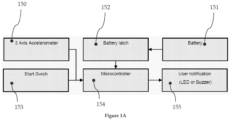
- the exemplary embodiments shown and described here may utilize an electronic system such as an electronic circuit mounted on a printed circuit board (PCB), which may include means to supply and control electrical power, means to measure spatial acceleration, means to time the duration of shaking and means to communicate the device state to the user as shown in Figure 1A .
- PCB printed circuit board
- Figure 1A illustrates a schematic overview of the electronic system that can be utilized with various embodiments described and illustrated herein. It is noted that for these embodiments, the forces are measured preferably using a 3-axis accelerometer 150 because the user's shaking movement will likely be in more than one direction and furthermore sufficient acceleration may be a factor of accelerations in multiple directions. Hence, a threshold may be determined to be a function of one or more acceleration directions. Additionally the system may include a start switch 153, which may be a manually activated switch, or preferably may be an acceleration activated switch to wake up the circuit, thus conserving battery power when the device is not in use. The advantage of the acceleration activated switch is that the user need only start shaking the device to switch it on.
- the battery latch 152 ensures power is supplied from the battery 151 for sufficient time to complete the shake cycle and provide feedback to the user.
- Time is measured using a microcontroller 154, microprocessor or timer; from the moment that shaking is first detected.
- the electronic system is programmed with an algorithm which compares the measured shake acceleration and duration with a preset threshold.
- the electronic system compares the recorded elapsed time and force measurements and retums a communication signal corresponding to the device state 155.
- the device state is communicated using one or preferably a combination of the following: visual feedback such as light emitting diode (LED), graphical display such as Liquid Crystal Display (LCD); audible feedback such as an audible buzzer or polyphonic speaker; tactile feedback such as vibration motor.
- a power source such as a battery, that may be rechargeable or not. If not rechargeable, the battery may be replaceable or it may not be replaceable, in which case the device must be disposed of in its entirety at end of life, defined by the end of the battery life.
- the electronic circuit is contained inside the device, with visual feedback means visible to the user by way of a window or light transmitting element.
- the electronic circuit affords additional design features:
- Pause function The program allows the system to detect when shaking has ended prematurely, or if the level of shaking vigor has reduced to a level below the pre-set threshold, using the accelerometer or acceleration activated switch. If such events are detected the device may enter a pause mode, which pauses the timing process and may indicate to the user that the device has entered pause mode.
- the indication to the user may be a pause in the feedback being provided, such as a pause in the audible tone, or a pause in the tactile vibration; or it may be by other means such as a state change on a light or screen.
- the user upon receiving the pause indication may then correct their actions, by recommencing the shake action or increasing the vigor of the shake action, at which moment the device switches out of pause mode and recommences with the timing and force monitoring process, starting from the time count at which it paused. If the device is in pause mode for a significant amount of time such that the particles may have started to re-form a sediment, the timer will be reset.
- Syringe administration timer may be used to warn the user that too much time has elapsed since the device was shaken. After shaking, the particles will slowly return to a sediment state; therefore there is a maximum time limit between shaking the device and administering the injection. In some scenarios, the user may shake the device correctly, but then may be distracted long enough for the particles in the syringe to re- sediment.
- a timer may be set such that when the max allowable time after shaking of the housing has elapsed, the user is warned to shake the device again before administration. This warning could be communicated using several methods. As examples, an audible buzzer could sound when the maximum time has elapsed, or a green light which was illuminated to indicate shaking has completed could switch off.
- Low battery warning Such an electronic system requires a power source, preferably a battery cell.
- a power source preferably a battery cell.
- the device may indicate to the user that a battery failure is imminent, and that the battery must be replaced. The device could shut down in such an event so that it may not be used until the battery has been replaced. This would prevent a potential device malfunction.
- Error warning Such an electronic system can perform self-checks on the system and main components so that when errors are detected the user may be given warning. It can perform such self-checks whenever the device is awoken for a shake cycle and immediately communicate that it has entered an error mode. This prevents the user from using a faulty device and prompts them to take remedial action, for example to return the device to the manufacturer, and use a replacement device.
- this invention is described as providing the user with information on the success of the shake action as a single piece of information, when both sufficient time AND sufficient vigor have been achieved.
- An alternative arrangement of such an electronics system can provide feedback to the user on the constituent elements; in that two pieces of information are provided, the elapsed time and the level of vigor over that time. That way if a user fails to achieve the combination of sufficient time and vigor they may consult the information provided and determine the reason they were unable to be successful, they may determine if they failed to shake for sufficient time, or if they failed to shake with sufficient vigor.
- Drug expiration alert A development of such an electronic system incorporates means to read the expiration data on the syringe and warn the user if it has expired. If the user were informed that the expiration date had expired they could dispose of the expired syringe and use another that had not expired.
- Such a system uses scanning components that read a barcode or text on the syringe to gather the expiration date, or may communicate with a chip on the syringe that contains the lot and expiration information, and compares the date to an internal clock and calendar programmed into the processor and gives an alert if the gathered date is before that on the internal clock and calendar.
- Embodiment 1 MIMIC .
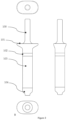
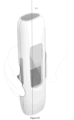
- the trainer embodiment uses a form factor for a housing that mimics that of a syringe. It may include a syringe barrel element 103, with finger flange 100 at one end and a barrel tip 104 at the other. The distance between finger flange 100 and barrel tip 104 are similar to that of a syringe such that it may be held in a similar fashion.
- a cylindrical portion 100 that represents a syringe plunger rod.
- the barrel 103 includes a light emitting feedback window 102, through which light is emitted to communicate the state of the device.
- amber light is used to indicate the device is running through a shake cycle and is monitoring the level of agitation imparted on it; green light is used to indicate the shake cycle is complete and sufficient shaking has occurred. When not in use, the light is off to conserve battery power and also to indicate that the shake cycle has not yet commenced.
- Embodiment 2 - ATTACH attaches to the syringe and provides feedback to the user while they are shaking the syringe.
- the device housing may include a body 109 with a slot 111 sized to accept a syringe barrel 107.
- a clip 112 ( Figure 4 ) in the slot 111 retains the syringe.
- the second simultaneous feedback method is audible.
- An intermittent audible buzzing tone indicates that the shake cycle is in progress, which changes to a continuous tone when the shake cycle is completed.
- the intermittent tone emitted during the shake cycle is set at a frequency of approximately 3Hz to reinforce the frequency and speed of shake required for optimum mixing, exploiting the tendency for humans to match repetitive behavior to percussive audible tones.
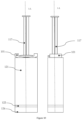
- Embodiment 3 - CASE The embodiment shown in Figure 6 - Figure 9 contains the syringe and provides feedback to the user while they are shaking the syringe.
- the device housing is opened by pressing on the lid catch 120; a syringe 117 is placed in the case liner 115 where it is retained by a spring clip 118 as shown in Figure 7 .
- the syringe could be retained by case lid 113 when the device housing is closed.
- Case lid 113 pivots around the case syringe 116 enclosing the syringe as shown in Figure 8 .
- the case includes flat surfaces on the case base 148 and case top 149 ( Figure 9 ), such that when placed on a desktop or work top it will not roll off.
- the case is closed and retained in a closed position by the lid catch 120.
- the outer shape of the case is designed to allow for users to hold it comfortably and securely when shaking. Shaking motion is measured using the internal electronic system, and the device state is communicated in two simultaneous ways.
- the first communication method is with light emitted from the light emitting panel 119, and amber light indicates that a shake cycle is in progress; and a green light indicates that it is completed.
- the second simultaneous feedback method is tactile. An intermittent vibration transmitted to the holding hand indicates that the shake cycle is in progress which changes to a continuous vibration when the shake cycle is completed.
- the intermittent vibration emitted during the shake cycle is set at a frequency of approximately 3Hz to reinforce the frequency and speed of shake required for optimum mixing, exploiting the tendency for humans to match repetitive behavior to percussive stimuli.
- the light emitting panel turning green indicates to the user to remove the syringe and continue with the drug administration process.
- This embodiment may be further developed with a syringe lock out feature. This feature would detect the presence of the syringe inside, lock the case in the closed state and only unlock the case when sufficient time and shake vigor have been achieved.
- the case could re-lock itself, and/or the light could turn amber again, indicating that the device housing must be shaken again to re-suspend the particles before the syringe can be used.
- Embodiment 4 - POT The embodiment shown in Figure 10 and Figure 11 includes an elongated body housing approximately the same length as the syringe barrel.
- the syringe is inserted into a syringe receiving hole 123 in the body housing and is retained by the compressive force applied by the fingers between the syringe finger flange 101 and the device body housing base 124.
- the first communication method is with light emitted from the light emitting band 122, and amber light indicates that a shake cycle is in progress; and a green light indicates that it is completed.
- the second simultaneous feedback method is tactile.
- An intermittent vibration transmitted to the holding hand indicates that the shake cycle is in progress which changes to a continuous tone when the shake cycle is completed. Furthermore, the intermittent vibration emitted during the shake cycle is set at a frequency of approximately 3Hz to reinforce the frequency and speed of shake required for optimum mixing, exploiting the tendency for humans to match repetitive behavior to percussive stimuli.
- the light emitting panel turning green indicates to the user to remove the syringe and continue with the drug administration process.
- further means of supplemental communication may be included, such as audible or tactile vibrating feedback, and a timing function can be used to signal the user if the syringe has not been removed from the device before a specified time period, indicating that the device must be shaken again to re-suspend the particles prior to performing the injection.
- a switch internal to receiving hold 123 would be used to detect when the syringe is attached to the device.
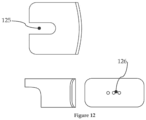
- Embodiment 5 - FINGER REST ATTACHMENT The embodiment shown in Figure 12 , Figure 13 and Figure 14 is similar to embodiment 2, in that it attaches to the syringe. It is shown on the syringe in Figure 13 and Figure 14 .
- the syringe fits and is retained in the syringe accepting slot 125.
- the electronic system is housed within, and communicates to the user via the light panel 126 on the front face. An orange color indicates when the device is sensing and this turns green when it has been shaken sufficiently.
- further means of supplemental communication may be included, such as audible or tactile vibrating feedback.
- Embodiment 6 - PUCK The embodiment shown in Figure 15 and Figure 16 is similar to embodiment 4, in that it fits to the bottom of the syringe but is a much more compact design. It may include a body housing 127 with syringe accepting hole 128. The interface is provided by a circumferential light emitting band 129 around the diameter of the base of the form. In use, the syringe is inserted into the syringe accepting hole 128 and is held in place with the user's thumb on the underside thumb grip 130. As with other embodiments, further means of supplemental communication may be included, such as audible or tactile vibrating feedback.
- Embodiment 7 - EVOKE The embodiment shown in Figure 17 is similar to embodiment 1 of Figure 1B and 2 . It is a stand-alone device, which does not interact with the syringe, intended to be used in advance of the administration process.
- the user may practice shaking in advance of shaking the real syringe. It may include the device body housing 134, at either end of is the finger grip 131 and the thumb grip 132.
- the distance between finger grip and thumb grip is similar to the distance between the syringe finger grip and rubber stopper, to ensure it feels similar in the hand.
- the device detects the forces applied and emits an amber light from the light emitting window 133. The light turns green when sufficiently vigorous shaking has occurred for sufficient time.
- further means of supplemental communication may be included, such as audible or tactile vibrating feedback.
- Embodiment 8 - PACKAGING B is similar to embodiment 8, in that the device 141 attaches to the syringe blister packaging 142 while the syringe 144 is contained within. In this embodiment, the protective film 143 is still in place on top of the blister tray 142. With reference to Figure 21 the device is attached to the blister tray by sliding it along the length of the blister tray and is retained against the blister tray by means of return clips 145 on the underside of the device.
- the body housing of the device 147 includes means of communication, a light emitting strip 146.
- the electronic system in the device detects the onset of shaking and starts to monitor the vigor and duration of shaking.
- the light emitting strip 146 emits amber light. Once sufficient vigor and duration have been achieved the light changes to green.
- the device is removed from the blister tray 142; the blister tray film 143 is peeled off and the device is used normally as per the syringe administration instructions.
- further means of supplemental communication may be included, such as audible or tactile vibrating feedback.
- Vigorous shaking was initially defined using a training video in which an expert experienced in the correct preparation of the pharmaceutical product shakes a syringe for the required 15 seconds at the required level of vigor.
- Video analysis was used to estimate the amplitude and frequency of the demonstrated shake, finding that shake amplitude of approximately 40cm was used at a frequency of 3.4 hertz. Assuming simple harmonic motion it was calculated that the syringe was experiencing a maximum acceleration of 9.3g. This provides an indication of the required accelerations imparted on the fluid to achieve sufficient mixing as recommended by an expert in the preparation of such a formulation.
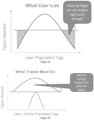
- the failure mode associated with not mixing the syringe sufficiently is a failure to administer the full dose from the syringe. This occurs because insufficiently shaken syringes contain residual sediment which can block, or partially block, the syringe or needle during administration. Therefore syringes containing fluids with different sediment properties such as mass, density, and concentration can be quantified in terms of the required mixing vigor by applying controlled and known levels of acceleration (by experimental means) measuring the force required to eject the fluid from a syringe. Using such methods, different shake vigor thresholds may be determined for different fluid with different properties. Figure 22 illustrates the device requirement for a threshold exceeding the intrinsic variability in the device population.
- the behavior of users should also be understood. Different users will have different capabilities, strengths, habits and expectations; therefore, there is in inherent variability in the way each interprets the instruction "shake vigorously" and some will naturally fail to meet the required threshold as illustrated in the chart in Figure 23 . Moreover, different users employ different shaking techniques, which some of which will be more vigorous than others. Acknowledging this variability, and that a minimum shake time and vigor are required leads to the conclusion that a need exists for the device described in this disclosure. The device can communicate the required time and vigor to the user, and modify behavior, increasing the likelihood of the user achieving the minimum required level of mixing. The subsequent effect of the device on the behavior across a population of users is illustrated in Figure 24 .
- a stand-alone device is used in isolation of the administration process, providing the user an opportunity to shake a device and learn what level of vigor is required when they come to shake the real device.
- Such a stand-alone device may have a form factor close to that of the syringe so it may represent the experience of shaking the real syringe a closely as possible.
- Other form factors may also be used. For example, if the drug comes in a vial, a vial shaped device would be more appropriate.
- An assistive device is required to couple with, attach to, or encase the real syringe. As such means of coupling, attaching or encasing are required. This leads to varied opportunities for several form factors illustrated in figures 1-21 .
- Several means of communicating the device state to the user are possible. As previously described, they may include lights of different color or state (flashing or steady state); they may include audible means such as buzzers and speakers; and they may include tactile means such as vibrations. Further means are possible as shown in Figure 25 , such as a LCD (liquid Crystal Display) or similar, which may use graphical means to communicate the device state.
- An LCD may be used as a segment display to communicate device state through words and icons, or it may be used as a metaphorical indication of the mix state of the solution such as described in Figure 26 .
- LCD segments or pixels are switched on or off to create a visual indication of particles mixing with solution.
- darkly colored pixels in the lower portion of the display represent the presence of sediment in the bottom of the syringe.
- different pixels are switched on and off across the whole screen to indicate mixing is in progress, and when sufficient mixing is achieved the LCD can show a uniform homogenous color across the whole screen, indicating that the solution is also in a uniform homogeneous state.
- INVEGA TRINZA TM a 3-month injection, is an atypical antipsychotic indicated for the treatment of schizophrenia in patients after they have been adequately treated with INVEGA SUSTENNA ® (1-month paliperidone palmitate extended-release injectable suspension) for at least four months.
- Extended-release injectable suspension 273 mg, 4 10 mg, 546 mg, or 819 mg (3)
- Strong CYP3A4 / P-glycoprotein (P-gp) inducers Avoid using a strong inducer of CYP3A4 and/or P-gp (e.g., carbamazepine, rifampin, St John's Wort) during a dosing interval for INVEGA TRINZA TM . If administering a strong inducer is necessary, consider managing the patient using paliperidone extended release tablets. (7.2, 12.3)
- INVEGA TRINZA TM paliperidone palmitate
- INVEGA SUSTENNA ® 1-month paliperidone palmitate extended-release injectable suspension
- INVEGA TRINZA TM should be administered once every 3 months.
- Each injection must be administered only by a health care professional.
- Parenteral drug products should be inspected visually for foreign matter and discoloration prior to administration. It is important to shake the syringe vigorously for at least 15 seconds to ensure a homogeneous suspension. Inject INVEGA TRINZA TM within 5 minutes of shaking vigorously [see Dosage and Administration (2.8)].
- INVEGA TRINZA TM is intended for intramuscular use only. Do not administer by any other route. Avoid inadvertent injection into a blood vessel. Administer the dose in a single injection; do not administer the dose in divided injections. Inject slowly, deep into the deltoid or gluteal muscle.
- INVEGA TRINZA TM must be administered using only the thin wall needles that are provided in the INVEGA TRINZA TM pack. Do not use needles from the 1-month paliperidone palmitate extended-release injectable suspension pack or other commercially-available needles to reduce the risk of blockage.
- the recommended needle size for administration of INVEGA TRINZA TM into the deltoid muscle is determined by the patient's weight:
- the recommended needle size for administration of INVEGA TRINZA TM into the gluteal muscle is the 11 ⁇ 2-inch, 22 gauge thin wall needle. Administer into the upper-outer quadrant of the gluteal muscle. Gluteal injections should be alternated between the two gluteal muscles.
- INVEGA TRINZA TM is to be used only after INVEGA SUSTENNA ® (1-month paliperidone palmitate extended-release injectable suspension) has been established as adequate treatment for at least four months. In order to establish a consistent maintenance dose, it is recommended that the last two doses of INVEGA SUSTENNA ® be the same dosage strength before starting INVEGA TRINZA TM .
- INVEGA TRINZA TM when the next 1-month paliperidone palmitate dose is scheduled with an INVEGA TRINZA TM dose based on the previous 1-month injection dose, using the equivalent 3.5-fold higher dose as shown in Table 1.
- INVEGA TRINZA TM may be administered up to 7 days before or after the monthly time point of the next scheduled paliperidone palmitate 1-month dose.
- INVEGA TRINZA TM should be administered every 3 months. If needed, dose adjustment can be made every 3 months in increments within the range of 273 mg to 819 mg based on individual patient tolerability and/or efficacy. Due to the long-acting nature of INVEGA TRINZA TM , the patient's response to an adjusted dose may not be apparent for several months [see Clinical Pharmacology (12.3)].
- Missing doses of INVEGA TRINZA TM should be avoided. If necessary, patients may be given the injection up to 2 weeks before or after the 3-month time point.
- INVEGA TRINZA TM If more than 31 ⁇ 2 months (up to but less than 4 months) have elapsed since the last injection of INVEGA TRINZA TM , the previously administered INVEGA TRINZA TM dose should be administered as soon as possible, then continue with the 3-month injections following this dose.
- INVEGA TRINZA TM re-initiate treatment with the 1-month paliperidone palmitate extended-release injectable suspension as described in the prescribing information for that product.
- INVEGA TRINZA TM can then be resumed after the patient has been adequately treated with the 1-month paliperidone palmitate extended-release injectable suspension for at least 4 months.
- INVEGA TRINZA TM has not been systematically studied in patients with renal impairment [see Clinical Pharmacology (12.3)].
- patients with mild renal impairment creatinine clearance ⁇ 50 mL/min to ⁇ 80 mL/min [Cockcroft-Gault Formula]
- Table 1 Dosage and Administration
- INVEGA TRINZA TM is not recommended in patients with moderate or severe renal impairment (creatinine clearance ⁇ 50 mL/min) [see Use in Specific Populations (8.6) and Clinical Pharmacology (12.3)].
- the 1-month paliperidone palmitate extended-release injectable suspension should be started 3 months after the last INVEGA TRINZA TM dose, using the equivalent 3.5-fold lower dose as shown in Table 3.
- the 1-month paliperidone palmitate extended-release injectable suspension should then continue, dosed at monthly intervals.
- the daily dosing of the paliperidone extended-release tablets should be started 3 months after the last INVEGA TRINZA TM dose and transitioned over the next several months following the last INVEGA TRINZA TM dose as described in Table 4.
- Table 4 provides dose conversion regimens to allow patients previously stabilized on different doses of INVEGA TRINZA TM to attain similar paliperidone exposure with once daily paliperidone extended-release tablets.
- INVEGA TRINZA TM should be administered by a healthcare professional as a single injection. DO NOT divide dose into multiple injections.
- INVEGA TRINZA TM is intended for intramuscular use only. Inject slowly, deep into the muscle taking care to avoid injection into a blood vessel.
- This medication should be administered once every 3 months.
- Thin wall safety needles are designed to be used with INVEGA TRINZA TM . Therefore, it is important to only use the needles provided in the INVEGA TRINZA TM kit.
- the suspension should appear uniform and milky white in color.
- INVEGA TRINZA TM is available as a white to off-white aqueous extended-release injectable suspension for intramuscular injection in dose strengths of 273 mg, 410 mg, 546 mg, and 819 mg paliperidone palmitate.
- INVEGA TRINZA TM is contraindicated in patients with a known hypersensitivity to either paliperidone or risperidone, or to any of the excipients in the INVEGA TRINZA TM formulation.
- Hypersensitivity reactions including anaphylactic reactions and angioedema, have been observed in patients treated with risperidone and paliperidone.
- Paliperidone palmitate is converted to paliperidone, which is a metabolite of risperidone.
- NMS Neuroleptic Malignant Syndrome
- Paliperidone causes a modest increase in the corrected QT (QTc) interval.
- the use of paliperidone should be avoided in combination with other drugs that are known to prolong QTc including Class 1A (e.g., quinidine, procainamide) or Class III (e.g., amiodarone, sotalol) antiarrhythmic medications, antipsychotic medications (e.g., chlorpromazine, thioridazine), antibiotics (e.g., gatifloxacin, moxifloxacin), or any other class of medications known to prolong the QTc interval.
- Paliperidone should also be avoided in patients with congenital long QT syndrome and in patients with a history of cardiac arrhythmias.
- Torsades de pointes and/or sudden death in association with the use of drugs that prolong the QTc interval, including (1) bradycardia; (2) hypokalemia or hypomagnesemia; (3) concomitant use of other drugs that prolong the QTc interval; and (4) presence of congenital prolongation of the QT interval.
- INVEGA TRINZA TM should be prescribed in a manner that is most likely to minimize the occurrence of tardive dyskinesia.
- Chronic antipsychotic treatment should generally be reserved for patients who suffer from a chronic illness that is known to respond to antipsychotic drugs. In patients who do require chronic treatment, the smallest dose and the shortest duration of treatment producing a satisfactory clinical response should be sought. The need for continued treatment should be reassessed periodically.
- Atypical antipsychotic drugs have been associated with metabolic changes that may increase cardiovascular/cerebrovascular risk. These metabolic changes include hyperglycemia, dyslipidemia, and body weight gain. While all of the drugs in the class have been shown to produce some metabolic changes, each drug has its own specific risk profile.
- Hyperglycemia and diabetes mellitus in some cases extreme and associated with ketoacidosis or hyperosmolar coma or death, have been reported in patients treated with all atypical antipsychotics. These cases were, for the most part, seen in post-marketing clinical use and epidemiologic studies, not in clinical trials. Hyperglycemia and diabetes have been reported in trial subjects treated with INVEGA TRINZA TM . Assessment of the relationship between atypical antipsychotic use and glucose abnormalities is complicated by the possibility of an increased background risk of diabetes mellitus in patients with schizophrenia and the increasing incidence of diabetes mellitus in the general population. Given these confounders, the relationship between atypical antipsychotic use and hyperglycemia-related adverse events is not completely understood. However, epidemiological studies suggest an increased risk of hyperglycemia-related adverse reactions in patients treated with the atypical antipsychotics.
- Patients with an established diagnosis of diabetes mellitus who are started on atypical antipsychotics should be monitored regularly for worsening of glucose control.
- Patients with risk factors for diabetes mellitus e.g., obesity, family history of diabetes
- patients with atypical antipsychotics should undergo fasting blood glucose testing at the beginning of treatment and periodically during treatment.
- Any patient treated with atypical antipsychotics should be monitored for symptoms of hyperglycemia including polydipsia, polyuria, polyphagia, and weakness.
- Patients who develop symptoms of hyperglycemia during treatment with atypical antipsychotics should undergo fasting blood glucose testing. In some cases, hyperglycemia has resolved when the atypical antipsychotic was discontinued; however, some patients required continuation of anti-diabetic treatment despite discontinuation of the suspect drug.
- Weight gain has been observed with atypical antipsychotic use. Clinical monitoring of weight is recommended.
- syncope was reported in ⁇ 1% (1/506) of subjects treated with the 1-month paliperidone palmitate extended-release injectable suspension during the open-label phase; there were no cases reported during the double-blind phase in either treatment group.
- orthostatic hypotension was reported as an adverse event by ⁇ 1% (1/506) of subjects treated with the 1-month paliperidone palmitate extended-release injectable suspension and ⁇ 1% (1/379) of subjects after receiving a single-dose of INVEGA TRINZA TM during the open-label phase; there were no cases reported during the double-blind phase in either treatment group.
- INVEGA TRINZA TM should be used with caution in patients with known cardiovascular disease (e.g., heart failure, history of myocardial infarction or ischemia, conduction abnormalities), cerebrovascular disease, or conditions that predispose the patient to hypotension (e.g., dehydration, hypovolemia, and treatment with antihypertensive medications). Monitoring of orthostatic vital signs should be considered in patients who are vulnerable to hypotension.
- Possible risk factors for leukopenia/neutropenia include pre-existing low white blood cell count (WBC)/absolute neutrophil count (ANC) and history of drug-induced leukopenia/neutropenia.
- WBC white blood cell count
- ANC absolute neutrophil count
- CBC complete blood count
- paliperidone elevates prolactin levels and the elevation persists during chronic administration.
- Paliperidone has a prolactin-elevating effect similar to that seen with risperidone, a drug that is associated with higher levels of prolactin than other antipsychotic drugs.
- Hyperprolactinemia may suppress hypothalamic GnRH, resulting in reduced pituitary gonadotrophin secretion. This, in turn, may inhibit reproductive function by impairing gonadal steroidogenesis in both female and male patients.
- Galactorrhea, amenorrhea, gynecomastia, and impotence have been reported in patients receiving prolactin-elevating compounds. Long-standing hyperprolactinemia when associated with hypogonadism may lead to decreased bone density in both female and male subjects.
- Tissue culture experiments indicate that approximately one-third of human breast cancers are prolactin dependent in vitro , a factor of potential importance if the prescription of these drugs is considered in a patient with previously detected breast cancer.
- An increase in the incidence of pituitary gland, mammary gland, and pancreatic islet cell neoplasia was observed in the risperidone carcinogenicity studies conducted in mice and rats [see Nonclinical Toxicology (13.1)].
- Neither clinical studies nor epidemiologic studies conducted to date have shown an association between chronic administration of this class of drugs and tumorigenesis in humans, but the available evidence is too limited to be conclusive.
- INVEGA TRINZA TM should be used cautiously in patients with a history of seizures or other conditions that potentially lower the seizure threshold. Conditions that lower the seizure threshold may be more prevalent in patients 65 years or older.
- priapism Drugs with alpha-adrenergic blocking effects have been reported to induce priapism. Although no cases of priapism have been reported in clinical trials with INVEGA TRINZA TM , priapism has been reported with oral paliperidone during postmarketing surveillance. Severe priapism may require surgical intervention.
- Disruption of the body's ability to reduce core body temperature has been attributed to antipsychotic agents.
- Appropriate care is advised when prescribing INVEGA TRINZA TM to patients who will be experiencing conditions which may contribute to an elevation in core body temperature, e.g., exercising strenuously, exposure to extreme heat, receiving concomitant medication with anticholinergic activity, or being subject to dehydration.
- the data described in this section include data from two clinical trials.
- One is a long-term maintenance trial, in which 506 subjects with schizophrenia received several doses of the 1-month paliperidone palmitate extended-release injectable suspension during the open-label phase, of which 379 subjects continued to receive a single injection of INVEGA TRINZA TM during the open-label phase. and 160 subjects were subsequently randomized to receive at least one dose of INVEGA TRINZA TM and 145 subjects received placebo during the double-blind placebo-controlled phase.
- the mean (SD) duration of exposure during the double-blind phase was 150 (79) days in the placebo group and 175 (90) days in the INVEGA TRINZA TM group.
- Dystonic symptoms include: spasm of the neck muscles, sometimes progressing to tightness of the throat, swallowing difficulty, difficulty breathing, and/or protrusion of the tongue. While these symptoms can occur at low doses, they occur more frequently and with greater severity with high potency and at higher doses of first generation antipsychotic drugs. An elevated risk of acute dystonia is observed in males and younger age groups.
- Subject ratings of injection site pain Subject evaluations of injection pain during the double-blind phase also were similar for placebo and INVEGA TRINZA TM .
- Paliperidone is the major active metabolite of risperidone. Adverse reactions reported with oral risperidone and risperidone long-acting injection can be found in the Adverse Reactions (6) sections of the package inserts for those products.
- Paliperidone is not expected to cause clinically important pharmacokinetic interactions with drugs that are metabolized by cytochrome P450 isozymes.
- CYP2D6 and CYP3A4 may be involved in paliperidone metabolism; however, there is no evidence in vivo that inhibitors of these enzymes significantly affect the metabolism of paliperidone.
- Paliperidone is not a substrate of CYP1A2, CYP2A6, CYP2C9, and CYP2C19; an interaction with inhibitors or inducers of these isozymes is unlikely. [See Clinical Pharmacology (12.3)]
- Advise pregnant women of the potential risk to a fetus Advise pregnant women of the potential risk to a fetus.
- the background risk of major birth defects and miscarriage for the indicated population are unknown.
- the estimated background risk of major birth defects and miscarriage in clinically recognized pregnancies is 2-4% and 15-20%, respectively.
- Extrapyramidal and/or withdrawal symptoms including agitation, hypertonia, hypotonia, tremor, somnolence, respiratory distress, and feeding disorder have been reported in neonates who were exposed to antipsychotic drugs during the third trimester of pregnancy. These symptoms have varied in severity. Monitor neonates for extrapyramidal and/or withdrawal symptoms and manage symptoms appropriately. Some neonates recover within hours or days without specific treatment; others may require prolonged hospitalization.
- Paliperidone is present in human breast milk; however, there are insufficient data to assess the amount in human milk, the effects on the breastfed infant, or the effects on milk production. Paliperidone has been detected in plasma at very low levels up to 18 months after a single-dose administration of INVEGA TRINZA TM , and the clinical significance on the breastfed infant is not known [see Clinical Pharmacology (12.3)].
- INVEGA TRINZA TM Safety and effectiveness of INVEGA TRINZA TM in patients less than 18 years of age have not been established. Use of INVEGA TRINZA TM is not recommended in pediatric patients because of the potential longer duration of an adverse event compared to shorter-acting products. In clinical trials of oral paliperidone, there were notably higher incidences of dystonia, hyperkinesia, tremor, and parkinsonism in the adolescent population as compared to the adult studies.
- Juvenile dogs administered for 40 weeks daily oral doses of risperidone which is extensively metabolized to paliperidone in animals and humans, at 0.31, 1.25, and 5 mg/kg/day, had decreased bone length and density with no-effect dose of 0.31 mg/kg/day, which produced plasma levels (AUC) of risperidone plus paliperidone similar to those in children and adolescents receiving the MRHD of 6 mg/day of risperidone.
- AUC plasma levels
- delayed sexual maturation was seen at all doses in both males and females. All adverse effects showed little or no reversibility in females after a 12-week drug-free recovery period.
- This drug is known to be substantially excreted by the kidney and clearance is decreased in patients with renal impairment [see Clinical Pharmacology (12.3)], who should be given reduced doses. Because elderly patients are more likely to have decreased renal function, monitor renal function and adjust dosage [see Dosage and Administration (2.5)].
- INVEGA TRINZA TM Use of INVEGA TRINZA TM is not recommended in patients with moderate or severe renal impairment (creatinine clearance ⁇ 50 mL/min). Use of INVEGA TRINZA TM in patients with mild renal impairment (creatinine clearance ⁇ 50 mL/min to ⁇ 80 mL/min) is based on the previous dose of the 1-month paliperidone palmitate extended-release injectable suspension that the patient was stabilized on prior to initiation of INVEGA TRINZA TM [see Dosage and Administration (2.5) and Clinical Pharmacology (12.3)].
- INVEGA TRINZA TM has not been studied in patients with hepatic impairment. Based on a study with oral paliperidone, no dose adjustment is required in patients with mild or moderate hepatic impairment. Paliperidone has not been studied in patients with severe hepatic impairment [see Clinical Pharmacology (12.3)].
- INVEGA TRINZA TM (paliperidone) is not a controlled substance.
- Paliperidone has not been systematically studied in animals or humans for its potential for abuse.
- Paliperidone has not been systematically studied in animals or humans for its potential for tolerance or physical dependence.
- Paliperidone is the major active metabolite of risperidone. Overdose experience reported with risperidone can be found in the OVERDOSAGE section of the risperidone package insert.
- INVEGA TRINZA TM is an atypical antipsychotic.
- INVEGA TRINZA TM contains paliperidone palmitate.
- the active ingredient, paliperidone palmitate, is a psychotropic agent belonging to the chemical class of benzisoxazole derivatives.
- INVEGA TRINZA TM contains a racemic mixture of (+)- and (-)- paliperidone palmitate.
- Paliperidone palmitate is very slightly soluble in ethanol and methanol, practically insoluble in polyethylene glycol 400 and propylene glycol, and slightly soluble in ethyl acetate.
- INVEGA TRINZA TM is available as a white to off-white sterile aqueous extended-release suspension for intramuscular injection in dose strengths of 273 mg, 410 mg, 546 mg, and 819 mg paliperidone palmitate.
- the drug product hydrolyzes to the active moiety, paliperidone, resulting in dose strengths of 175 mg, 263 mg, 350 mg, and 525 mg of paliperidone, respectively.
- the inactive ingredients are polysorbate 20 (10 mg/mL), polyethylene glycol 4000 (75 mg/mL), citric acid monohydrate (7.5 mg/mL), sodium dihydrogen phosphate monohydrate, sodium hydroxide, and water for injection.
- INVEGA TRINZA TM is provided in a prefilled syringe (cyclic-olefin-copolymer) prefilled with either 175 mg (0.875 mL), 263 mg (1.315 mL), 350 mg (1.75 mL), or 525 mg (2.625 mL) paliperidone (as 273 mg, 410 mg, 546 mg, or 819 mg paliperidone palmitate) suspension with a plunger stopper and tip cap (bromobutyl rubber), a backstop, and 2 types of commercially available needles: a thin walled 22G, 1 1 ⁇ 2-inch safety needle and a thin walled 22G, 1-inch safety needle.
- Paliperidone palmitate is hydrolyzed to paliperidone [see Clinical Pharmacology (12.3)].
- the mechanism of action of paliperidone is unknown. It has been proposed that the therapeutic activity of paliperidone in schizophrenia is mediated through a combination of central dopamine Type 2 (D 2 ) and serotonin Type 2 (5HT 2A ) receptor antagonism.
- Paliperidone is a centrally active dopamine Type 2 (D 2 ) receptor antagonist and a serotonin Type 2 (5HT 2A ) receptor antagonist. Paliperidone is also active as an antagonist at ⁇ 1 and ⁇ 2 adrenergic receptors and H 1 histaminergic receptors, which may explain some of the other effects of the drug. Paliperidone has no affinity for cholinergic muscarinic or ⁇ 1 - and ⁇ 2 -adrenergic receptors. The pharmacological activity of the (+) and (-)- paliperidone enantiomers is qualitatively and quantitatively similar in vitro.
- the 3-month formulation of paliperidone palmitate dissolves slowly after intramuscular injection before being hydrolyzed to paliperidone and absorbed into the systemic circulation.
- the release of the drug starts as early as day 1 and lasts for as long as 18 months.
- the mean steady-state peak:trough ratio for a INVEGA TRINZA TM dose was 1.6 following gluteal administration and 1.7 following deltoid administration. Following administration of INVEGA TRINZA TM , the apparent volume of distribution of paliperidone is 1960 L.
- the plasma protein binding of racemic paliperidone is 74%.
- the median apparent half-life of paliperidone following INVEGA TRINZA TM administration over the dose range of 273-819 mg ranged from 84-95 days following deltoid injections and 118-139 days following gluteal injections.
- the concentration of paliperidone remaining in the circulation 18 months after dosing of 819 mg INVEGA TRINZA TM is stopped is estimated to be 3% (following deltoid injection) or 7% (following gluteal injection) of the average steady-state levels.
- INVEGA TRINZA TM is designed to deliver paliperidone over a 3-month period, while 1-month paliperidone palmitate injection is administered on a monthly basis.
- INVEGA TRINZA TM when administered at doses that are 3.5-fold higher than the corresponding dose of 1-month paliperidone palmitate injection, results in paliperidone exposures similar to those obtained with corresponding monthly doses of 1-month paliperidone palmitate injection and corresponding once daily doses of paliperidone extended-release tablets.
- the exposure range for INVEGA TRINZA TM is encompassed within the exposure range for the approved dose strengths of paliperidone extended-release tablets.
- paliperidone does not substantially inhibit the metabolism of drugs metabolized by cytochrome P450 isozymes, including CYP1A2, CYP2A6, CYP2C8/9/10, CYP2D6, CYP2E1, CYP3A4, and CYP3A5. Therefore, paliperidone is not expected to inhibit clearance of drugs that are metabolized by these metabolic pathways in a clinically relevant manner. Paliperidone is also not expected to have enzyme inducing properties.
- Paliperidone is a weak inhibitor of P-gp at high concentrations. No in vivo data are available, and the clinical relevance is unknown.
- paliperidone is not a substrate for CYP1A2; smoking should, therefore, not have an effect on the pharmacokinetics of paliperidone.
- Slower absorption was observed in females in a population pharmacokinetic analysis.
- the trough concentrations were similar between males and females.
- the carcinogenic potential of intramuscular injection of 1-month paliperidone palmitate extended-release injectable suspension was assessed in rats. There was an increase in mammary gland adenocarcinomas in female rats at 16, 47, and 94 mg/kg/month, which are 0.2, 0.6 and 1 times the maximum recommended human dose (MRHD) of 819 mg of 3-month paliperidone palmitate extended-release injectable suspension on mg/m 2 basis. A no-effect dose was not established. Male rats showed an increase in mammary gland adenomas, fibroadenomas, and carcinomas at doses, which are 0.6 and 1 times the MRHD of 819 mg of 3-month paliperidone palmitate extended-release injectable suspension on mg/m 2 basis. A carcinogenicity study in mice has not been conducted with the 1-month paliperidone palmitate extended-release injectable suspension.
- Risperidone was administered in the diet for 18 months to mice and for 25 months to rats at daily doses of 0.63, 2.5, and 10 mg/kg/day, which are 0.2 to 3 times in mice and 0.4 to 6 times in rats the MRHD of 16 mg/day of risperidone on mg/m 2 basis.
- a maximum tolerated dose was not achieved in male mice. There were statistically significant increases in pituitary gland adenomas, endocrine pancreas adenomas, and mammary gland adenocarcinomas.
- the no-effect dose for these tumors was less than or equal to the MRHD of risperidone on mg/m 2 basis (see RISPERDAL ® package insert).
- An increase in mammary, pituitary, and endocrine pancreas neoplasms has been found in rodents after chronic administration of other antipsychotic drugs and is considered to be mediated by prolonged dopamine D2-receptor antagonism and hyperprolactinemia.
- the relevance of these tumor findings in rodents in terms of human risk is unknown [see Warnings and Precautions (5.9)].
- Paliperidone palmitate showed no genotoxicity in the in vitro Ames bacterial reverse mutation test and mouse lymphoma assay. Paliperidone was not genotoxic in the in vitro Ames bacterial reverse mutation test, mouse lymphoma assay and the in vivo rat bone marrow micronucleus test.
- the fertility of male rats was not affected at oral doses of paliperidone of up to 2.5 mg/kg/day, which are up to 2 times the MRHD of 12 mg on mg/m 2 basis, although sperm count and sperm viability studies were not conducted with paliperidone.
- Injection site toxicity was assessed in minipigs injected intramuscularly with the 3-month paliperidone palmitate extended-release injectable suspension at doses up to 819 mg, which is equal to the MRHD. Injection site inflammatory reactions were greater and more advanced than reactions to the 1-month paliperidone palmitate extended-release injectable suspension. Reversibility of these findings was not examined.
- Patients could enter the study with acute symptoms (if previously treated with oral antipsychotics) or be clinically stable (if treated with long-acting injectable antipsychotics [LAI]). All patients who previously received oral antipsychotics received the paliperidone palmitate -month initiation regimen (deltoid injections of 234 mg and 156 mg one week apart), while those patients switching from LAI medication were treated with the 1-month paliperidone palmitate extended-release injectable suspension in place of the next scheduled injection. Specifically:
- the primary efficacy variable was time to first relapse. Relapse was pre-defined as emergence of one or more of the following: psychiatric hospitalization, ⁇ 25% increase (if the baseline score was ⁇ 40) or a to-point increase (if the baseline score was ⁇ 40) in total PANSS score on two consecutive assessments, deliberate self-injury, violent behavior, suicidal/homicidal ideation, or a score of ⁇ 5 (if the maximum baseline score was ⁇ 3) or ⁇ 6 (if the maximum baseline score was 4) on two consecutive assessments of the specific PANSS items.
- INVEGA TRINZA TM is available as a white to off-white sterile aqueous extended-release suspension for intramuscular injection in dose strengths of 273 mg, 410 mg, 546 mg, and 819 mg paliperidone palmitate.
- the kit contains a prefilled syringe and 2 safety needles (a thin walled 22G, 1-inch safety needle and a thin walled 22G, 11 ⁇ 2-inch safety needle).
- NMS Neuroleptic Malignant Syndrome
- NMS Neuroleptic Malignant Syndrome
- INVEGA TRINZA TM has the potential to impair judgment. thinking, or motor skills, caution patients about operating hazardous machinery, including automobiles, until they are reasonably certain that INVEGA TRINZA TM therapy does not affect them adversely [see Warnings and Precautions (5.10)].
- Advise patients that INVEGA TRINZA TM may cause extrapyramidal and/or withdrawal symptoms in a neonate and to notify their healthcare provider if they become pregnant or intend to become pregnant during treatment with INVEGA TRINZA TM .
Landscapes
- Health & Medical Sciences (AREA)
- Engineering & Computer Science (AREA)
- General Health & Medical Sciences (AREA)
- Physics & Mathematics (AREA)
- General Physics & Mathematics (AREA)
- Life Sciences & Earth Sciences (AREA)
- Public Health (AREA)
- Veterinary Medicine (AREA)
- Animal Behavior & Ethology (AREA)
- Theoretical Computer Science (AREA)
- Business, Economics & Management (AREA)
- Educational Technology (AREA)
- Educational Administration (AREA)
- Medicinal Chemistry (AREA)
- Chemical & Material Sciences (AREA)
- Pharmacology & Pharmacy (AREA)
- Pure & Applied Mathematics (AREA)
- Mathematical Physics (AREA)
- Mathematical Optimization (AREA)
- Mathematical Analysis (AREA)
- Computational Mathematics (AREA)
- Algebra (AREA)
- Medical Informatics (AREA)
- Pulmonology (AREA)
- Radiology & Medical Imaging (AREA)
- Vascular Medicine (AREA)
- Anesthesiology (AREA)
- Biomedical Technology (AREA)
- Heart & Thoracic Surgery (AREA)
- Hematology (AREA)
- Fluid Mechanics (AREA)
- Nutrition Science (AREA)
- Infusion, Injection, And Reservoir Apparatuses (AREA)
- Medical Preparation Storing Or Oral Administration Devices (AREA)
- Catching Or Destruction (AREA)
- External Artificial Organs (AREA)
- Instructional Devices (AREA)
Claims (13)
- Dispositif permettant d'entraîner des utilisateurs à mélanger correctement des composants pharmaceutiques, le dispositif comprenant :un logement qui s'étend le long d'un axe longitudinal ;une source de puissance (151) disposée dans le logement ;un micro-dispositif de commande (154) disposé dans le logement et alimenté en puissance électrique par la source de puissance (151) ;un dispositif de notification d'utilisateur (155) ; etun accéléromètre (150) disposé dans le logement et connecté électriquement au micro-dispositif de commande (154) de sorte que le micro-dispositif de commande (154) est configuré pour détecter un mouvement et une orientation du logement et indiquer par l'intermédiaire du dispositif de notification d'utilisateur (155) si le mouvement ou l'orientation du logement qui est secoué pendant l'un parmi une administration de médicament ou un événement d'entraînement est suffisant par rapport à des seuils prédéterminés comportant la grandeur de la force appliquée pendant le secouage, l'orientation du logement et la durée d'un tel secouage, et dans lequelle micro-dispositif de commande (154) est configuré pour détecter si le niveau de vigueur de secouage a diminué à un niveau en dessous du seuil préréglé et pour entrer dans un mode de pause pour permettre à l'utilisateur de redémarrer le secouage pendant l'un parmi une administration de médicament ou un événement d'entraînement.
- Procédé pour diriger un utilisateur concernant une technique adéquate de mélange de médicament avec un dispositif d'entraînement ou un dispositif permettant de mélanger et aider à l'administration du médicament, qui comporte :un logement qui s'étend le long d'un axe longitudinal ;une source de puissance (151) disposée dans le logement ;un micro-dispositif de commande (154) disposé dans le logement et alimenté en puissance électrique par la source de puissance (151) ;un dispositif de notification d'utilisateur (155) ; etun accéléromètre (150) disposé dans le logement et connecté électriquement au micro-dispositif de commande (154) pour détecter un mouvement et une orientation d'un tel mouvement,le procédé comprenant les étapes consistant à :déterminer à partir de l'accéléromètre (150) si la grandeur du mouvement et l'orientation du logement sont suffisantes par rapport à des seuils prédéterminés comportant la grandeur de la force appliquée pendant le secouage, l'orientation du logement et la durée d'un tel secouage ; etannoncer par l'intermédiaire du dispositif de notification d'utilisateur (155) si le mouvement ou l'orientation du logement qui est secoué pendant l'un parmi une administration de médicament ou un événement d'entraînement respecte les seuils prédéterminés, et dans lequelle micro-dispositif de commande (154) est configuré pour détecter si le niveau de vigueur de secouage a diminué à un niveau en dessous du seuil préréglé et pour entrer dans un mode de pause pour permettre à l'utilisateur de redémarrer le secouage pendant l'un parmi une administration de médicament ou un événement d'entraînement.
- Dispositif selon la revendication 1 ou procédé selon la revendication 2, dans lequel le micro-dispositif de commande (154) est configuré pour détecter lorsque le secouage du logement a pris fin prématurément et pour entrer dans un mode de pause pour permettre à l'utilisateur de redémarrer le secouage pendant l'un parmi une administration de médicament ou un événement d'entraînement.
- Dispositif selon la revendication 1 ou procédé selon la revendication 2, dans lequel le dispositif comporte en outre un interrupteur de démarrage (153) connecté électriquement au micro-dispositif de commande (154).
- Dispositif selon la revendication 1 ou procédé selon la revendication 2, dans lequel l'accéléromètre (150) comprend un accéléromètre à 3 axes.
- Dispositif selon la revendication 1 ou procédé selon la revendication 2, dans lequel l'accéléromètre (150) est configuré pour activer le micro-dispositif de commande (154) lors d'une détection de mouvements du logement pendant l'un parmi une administration de médicament ou un événement d'entraînement.
- Dispositif selon la revendication 1 ou procédé selon la revendication 2, dans lequel le micro-dispositif de commande (154) est configuré pour régler un temporisateur et déterminer lorsqu'un temps maximum admissible après secouage du logement s'est écoulé pour avertir l'utilisateur de secouer le dispositif de nouveau pendant l'un parmi une administration de médicament ou un événement d'entraînement.
- Dispositif selon la revendication 1 ou procédé selon la revendication 2, dans lequel le logement comprend un élément de cylindre de seringue (103) avec un support de doigts (100) et une extrémité et un bout de cylindre (104) espacés le long de l'axe longitudinal.
- Dispositif selon la revendication 1 ou procédé selon la revendication 2, dans lequel le logement comprend un corps (109) avec une fente (111) dimensionnée pour accepter un cylindre de seringue (107) ou un flacon.
- Dispositif selon la revendication 1 ou procédé selon la revendication 2, dans lequel le logement comprend un logement pourvu d'un compartiment et d'un couvercle pour recevoir une seringue entière.
- Dispositif selon la revendication 1 ou procédé selon la revendication 2, dans lequel le logement comprend un corps allongé approximativement de la même longueur que le cylindre de seringue de telle sorte qu'une seringue est insérée dans un trou de réception de seringue dans le corps et retenue par la force de compression appliquée par les éléments de type doigt entre un support de doigts de seringue et une base de corps.
- Dispositif selon la revendication 1 ou procédé selon la revendication 2, dans lequel le logement comprend un corps (127) avec une encoche de réception de seringue (128) dimensionnée pour recevoir un cylindre de seringue.
- Dispositif selon la revendication 1 ou procédé selon la revendication 2, dans lequel le logement comprend un corps de type galet presseur avec un trou de réception de seringue de sorte qu'en cours d'utilisation une seringue est insérée dans le trou de réception de seringue et est maintenue en place avec le pouce d'un utilisateur sur un repose-pouce inférieur.
Applications Claiming Priority (2)
| Application Number | Priority Date | Filing Date | Title |
|---|---|---|---|
| US201562182426P | 2015-06-19 | 2015-06-19 | |
| PCT/US2015/036969 WO2016204795A1 (fr) | 2015-06-19 | 2015-06-22 | Dispositifs et procédés d'administration et de mélange de médicaments, et d'apprentissage de techniques appropriées à cet effet |
Publications (3)
| Publication Number | Publication Date |
|---|---|
| EP3311373A1 EP3311373A1 (fr) | 2018-04-25 |
| EP3311373C0 EP3311373C0 (fr) | 2025-01-22 |
| EP3311373B1 true EP3311373B1 (fr) | 2025-01-22 |
Family
ID=53674277
Family Applications (5)
| Application Number | Title | Priority Date | Filing Date |
|---|---|---|---|
| EP15739071.7A Active EP3311373B1 (fr) | 2015-06-19 | 2015-06-22 | Dispositifs et procédés d'administration et de mélange de médicaments, et d'apprentissage de techniques appropriées à cet effet |
| EP25151698.5A Pending EP4564335A3 (fr) | 2015-06-19 | 2016-06-20 | Dispositifs et procédés d'administration et de mélange de médicaments, et formation de techniques appropriées associés |
| EP16730851.9A Active EP3311375B1 (fr) | 2015-06-19 | 2016-06-20 | Dispositifs et procédés d'administration et de mélange de médicaments, et formation aux techniques appropriées |
| EP16730850.1A Revoked EP3311374B1 (fr) | 2015-06-19 | 2016-06-20 | Dispositifs et procédés d'administration et de mélange de médicaments, et formation aux techniques appropriées associée |
| EP16733902.7A Active EP3311376B1 (fr) | 2015-06-19 | 2016-06-20 | Dispositifs et procédés d'administration et de mélange de médicaments, et formation aux techniques appropriées |
Family Applications After (4)
| Application Number | Title | Priority Date | Filing Date |
|---|---|---|---|
| EP25151698.5A Pending EP4564335A3 (fr) | 2015-06-19 | 2016-06-20 | Dispositifs et procédés d'administration et de mélange de médicaments, et formation de techniques appropriées associés |
| EP16730851.9A Active EP3311375B1 (fr) | 2015-06-19 | 2016-06-20 | Dispositifs et procédés d'administration et de mélange de médicaments, et formation aux techniques appropriées |
| EP16730850.1A Revoked EP3311374B1 (fr) | 2015-06-19 | 2016-06-20 | Dispositifs et procédés d'administration et de mélange de médicaments, et formation aux techniques appropriées associée |
| EP16733902.7A Active EP3311376B1 (fr) | 2015-06-19 | 2016-06-20 | Dispositifs et procédés d'administration et de mélange de médicaments, et formation aux techniques appropriées |
Country Status (14)
| Country | Link |
|---|---|
| US (6) | US11037465B2 (fr) |
| EP (5) | EP3311373B1 (fr) |
| JP (7) | JP6668387B2 (fr) |
| CN (7) | CN114783258A (fr) |
| AU (4) | AU2015399329B2 (fr) |
| BR (4) | BR112017027121B1 (fr) |
| CA (4) | CA2990066C (fr) |
| ES (4) | ES3014558T3 (fr) |
| HK (2) | HK1254640A1 (fr) |
| HU (4) | HUE070314T2 (fr) |
| MX (5) | MX391566B (fr) |
| PL (4) | PL3311373T3 (fr) |
| RU (4) | RU2699333C2 (fr) |
| WO (3) | WO2016204795A1 (fr) |
Families Citing this family (16)
| Publication number | Priority date | Publication date | Assignee | Title |
|---|---|---|---|---|
| HK1254640A1 (zh) | 2015-06-19 | 2019-07-26 | Janssen Pharmaceutica, N.V. | 用於药物施用和混合的设备和方法及用於所述设备和方法的适当技术的训练 |
| ES2643119B1 (es) | 2016-05-18 | 2018-03-27 | Kiro Grifols S.L | Dispositivo para la carga de contenedores médicos en máquinas de dosificación, adaptador para los contenedores, soporte para los adaptadores y usos de los mismos |
| WO2019129619A1 (fr) * | 2017-12-28 | 2019-07-04 | Sanofi | Dispositif à capteur pour fixation à un dispositif d'injection |
| US12011572B2 (en) | 2018-06-28 | 2024-06-18 | Noble International, Llc | Resettable lateral actuation member-activated autoinjector training device |
| EP3815075B1 (fr) * | 2018-06-28 | 2024-07-31 | Noble International, Inc. | Dispositif d'entraînement d'auto-injecteur activé par un élément d'actionnement latéral réinitialisable |
| CN109200390A (zh) * | 2018-10-24 | 2019-01-15 | 四川蓝色港湾科技有限公司 | 基于自动开机的输液监控终端 |
| CA3161462A1 (fr) | 2019-11-13 | 2021-05-20 | Janssen Biotech, Inc. | Modules de detection de dispositif d'administration de medicament |
| JP7123343B2 (ja) * | 2020-01-17 | 2022-08-23 | 株式会社大協精工 | 製剤均一化練習用模型及び製剤均一化練習方法 |
| EP4136633B1 (fr) | 2020-04-16 | 2025-09-03 | Janssen Biotech, Inc. | Dispositif d'entraînement à l'injection et son procédé d'utilisation |
| WO2021260007A1 (fr) * | 2020-06-25 | 2021-12-30 | Sanofi | Dispositif, système et procédé d'entraînement |
| MX2023006370A (es) * | 2020-11-30 | 2023-08-07 | Janssen Pharmaceutica Nv | Regimenes de dosificacion asociados con formulaciones inyectables de paliperidona de liberacion prolongada. |
| KR102794804B1 (ko) * | 2020-11-30 | 2025-04-10 | 얀센 파마슈티카 엔브이 | 서방형 팔리페리돈 주사용 제형과 관련된 투약 요법 |
| JP7839162B2 (ja) * | 2020-11-30 | 2026-04-01 | ヤンセン ファーマシューティカ エヌ.ベー. | パルミチン酸パリペリドン製剤の再懸濁を確実にする方法 |
| USD1007675S1 (en) | 2021-08-27 | 2023-12-12 | Janssen Pharmaceutica Nv | Pharmaceutical ingredient mixing training device |
| WO2023025845A1 (fr) * | 2021-08-27 | 2023-03-02 | Janssen Pharmaceutica N.V. | Système de formation et procédés de mélange de composants pharmaceutiques |
| CN120356609A (zh) * | 2025-06-24 | 2025-07-22 | 杭州馨兰汇智科技有限公司 | 帕利哌酮的剂量优化方法、装置、电子设备和存储介质 |
Citations (1)
| Publication number | Priority date | Publication date | Assignee | Title |
|---|---|---|---|---|
| US20080015503A1 (en) * | 2006-07-14 | 2008-01-17 | Roche Diagnostics Operations, Inc. | Injection device |
Family Cites Families (62)
| Publication number | Priority date | Publication date | Assignee | Title |
|---|---|---|---|---|
| SU1286264A1 (ru) | 1985-06-03 | 1987-01-30 | Брестская Областная Станция По Химизации Сельского Хозяйства | Лабораторный встр хиватель сосудов |
| SU1651316A1 (ru) * | 1988-05-17 | 1991-05-23 | Физико-механический институт им.Г.В.Карпенко | Устройство дл отработки техники инъекции |
| JPH02126858A (ja) | 1988-11-07 | 1990-05-15 | Terumo Corp | ケースに収納された注射装置 |
| EP0423864A1 (fr) * | 1989-10-16 | 1991-04-24 | Duphar International Research B.V | Dispositif d'entraînement pour un injecteur automatique |
| US5656211A (en) | 1989-12-22 | 1997-08-12 | Imarx Pharmaceutical Corp. | Apparatus and method for making gas-filled vesicles of optimal size |
| US5527294A (en) | 1993-05-18 | 1996-06-18 | Safety 1St | Shielded syringe |
| US8092224B2 (en) * | 1995-11-22 | 2012-01-10 | James A. Jorasch | Systems and methods for improved health care compliance |
| CA2266546A1 (fr) | 1996-09-27 | 1998-04-02 | American Home Products Corporation | Dispositif medical permettant de mettre en place des matieres solides |
| SE9702872D0 (sv) | 1997-08-06 | 1997-08-06 | Pharmacia & Upjohn Ab | Automated delivery device and method for its operation |
| DE19806020A1 (de) | 1998-02-13 | 1999-08-26 | Maxs Ag | Schüttelbecher |
| DE10057616B4 (de) | 2000-11-21 | 2006-09-14 | Stryker Trauma Gmbh | Verfahren zum Mischen und Applizieren von fließfähigem Knochenzement sowie Mischvorrichtung für Knochenzement |
| US20030120217A1 (en) | 2001-12-21 | 2003-06-26 | Abergel R. Patrick | Methods and devices for sclerotherapy |
| US7591801B2 (en) | 2004-02-26 | 2009-09-22 | Dexcom, Inc. | Integrated delivery device for continuous glucose sensor |
| US20050174430A1 (en) * | 2004-02-09 | 2005-08-11 | Anderson Michael E. | Method for organizing photographic images in a computer for locating, viewing and purchase |
| US9022980B2 (en) | 2005-02-01 | 2015-05-05 | Kaleo, Inc. | Medical injector simulation device |
| WO2007003062A1 (fr) | 2005-07-01 | 2007-01-11 | Saeco Ipr Limited | Dispositif de commande de distributeurs de boissons chaudes |
| US7682155B2 (en) * | 2005-11-03 | 2010-03-23 | Meridian Medical Technologies, Inc. | Training device for an automatic injector |
| RU2405574C2 (ru) | 2006-05-10 | 2010-12-10 | Медрад, Инк. | Медицинский инъектор с фронтальной загрузкой и шприцы для использования с ним |
| US8264335B2 (en) | 2006-12-22 | 2012-09-11 | Stora Enso Ab | Device attached to a blister |
| JP2011502630A (ja) | 2007-11-08 | 2011-01-27 | ネクスメツド・ホールデイングス・インコーポレイテツド | 別々に保存された成分を混合および分注するための器具およびシステム |
| WO2009141005A1 (fr) | 2008-05-20 | 2009-11-26 | Tecpharma Licensing Ag | Dispositif d'administration d'un produit injectable comportant une indication de quantité résiduelle |
| CN102123751A (zh) | 2008-08-19 | 2011-07-13 | 马林克罗特公司 | 具有倾斜传感器和针筒通讯逻辑的动力注射器 |
| US8398602B2 (en) | 2008-11-14 | 2013-03-19 | Panasonic Corporation | Carrying case and syringe system with same |
| DK2358423T3 (da) | 2008-12-15 | 2025-05-12 | Merit Medical Systems Inc | System og fremgangsmåde til oppustningssprøjtedisplay og modulopbygget komponentenhed |
| JP2010178814A (ja) | 2009-02-04 | 2010-08-19 | Nobuyuki Wakui | 薬剤懸濁液化方法 |
| CN104888316B (zh) | 2009-02-27 | 2017-08-08 | 生命扫描有限公司 | 给药系统 |
| WO2010100883A1 (fr) * | 2009-03-04 | 2010-09-10 | パナソニック株式会社 | Dispositif de perfusion médicamenteuse |
| CN201340357Y (zh) * | 2009-06-03 | 2009-11-04 | 武汉宏强医疗器械有限公司 | 细胞制片染色机上的注射器卡座 |
| CN201516164U (zh) * | 2009-06-13 | 2010-06-30 | 徐州医学院 | 注射给药即时混匀药物的微振荡装置 |
| DE202010000846U1 (de) * | 2010-01-13 | 2010-04-15 | Dieter Hölzle Technik-Projekte GmbH | Einstechtiefeneinstellung |
| DE102010018260A1 (de) * | 2010-01-29 | 2011-08-04 | OSRAM Opto Semiconductors GmbH, 93055 | Beleuchtungsvorrichtung |
| US20110253139A1 (en) | 2010-04-15 | 2011-10-20 | Spectrum Health Innovations, LLC | Inhaler module and related system |
| SE535417C2 (sv) | 2010-05-06 | 2012-07-31 | Jan Svensson | Spruta med expanderbart element |
| US9022988B1 (en) * | 2010-05-07 | 2015-05-05 | Kavan J. Shaban | System and method for controlling a self-injector device |
| CN102135850A (zh) | 2010-12-06 | 2011-07-27 | 华为终端有限公司 | 手持终端设备及其自动解锁的方法 |
| EP2541532A1 (fr) * | 2011-06-28 | 2013-01-02 | Alk AG | Dispositif d'entraînement pour injecteur automatique |
| JP6335779B2 (ja) | 2011-05-25 | 2018-05-30 | サノフィ−アベンティス・ドイチュラント・ゲゼルシャフト・ミット・ベシュレンクテル・ハフツング | カートリッジ・センサとカートリッジ・ホルダ・ドア・センサとを有する薬剤送達デバイスおよびこのデバイスを制御する方法 |
| BR112013033500A2 (pt) * | 2011-06-28 | 2017-01-24 | Alk Ag | método, dispositivo e produto de programa de computador para treinar o uso de um autoinjetor |
| JP5974016B2 (ja) * | 2011-11-10 | 2016-08-23 | パナソニックヘルスケアホールディングス株式会社 | 薬剤注入装置 |
| AU2013204609B2 (en) * | 2012-03-02 | 2015-10-01 | Abbvie Inc. | Automatic injection training device |
| CN102614565B (zh) | 2012-04-01 | 2013-12-25 | 上海大学 | 自动微量注射装置 |
| AR092077A1 (es) | 2012-08-10 | 2015-03-18 | Sanofi Aventis Deutschland | Sistema medico |
| CN202724447U (zh) * | 2012-09-07 | 2013-02-13 | 依贝伽射线防护设备科技(上海)有限公司 | 放射性药物注射用透明针管套 |
| JP6209530B2 (ja) * | 2012-11-22 | 2017-10-04 | パナソニックヘルスケアホールディングス株式会社 | 薬剤注入装置、薬剤注入装置の制御方法、プログラム及び記録媒体 |
| CN103902176A (zh) * | 2012-12-27 | 2014-07-02 | 上海鼎为电子科技(集团)有限公司 | 移动终端的解锁方法及装置 |
| CN103135792B (zh) | 2013-03-12 | 2015-12-02 | 广东欧珀移动通信有限公司 | 一种利用重力感应原理进行终端解锁的方法及装置 |
| US9199037B2 (en) * | 2013-03-15 | 2015-12-01 | Windgap Medical, Inc. | Portable drug mixing and delivery system and method |
| US10229607B2 (en) * | 2013-04-30 | 2019-03-12 | Elwha Llc | Systems and methods for competency training and use authorization for dispensing an agent |
| US20140350525A1 (en) | 2013-05-22 | 2014-11-27 | Warren Robinson | E-Z Dose-Pensing |
| US9380453B2 (en) * | 2013-06-10 | 2016-06-28 | Lg Electronics Inc. | Mobile terminal and method of controlling the same |
| US8807131B1 (en) | 2013-06-18 | 2014-08-19 | Isonea Limited | Compliance monitoring for asthma inhalers |
| CN103373573B (zh) * | 2013-07-11 | 2016-06-15 | 深圳市安瑞科科技有限公司 | 智能针剂储药装置 |
| RU138718U1 (ru) | 2013-08-27 | 2014-03-20 | Юрий Анатольевич Васильев | Приспособление для введение таблетированных лекарственных средств детям раннего возраста |
| US9586005B2 (en) | 2013-09-30 | 2017-03-07 | Dennis L Steffen | Dual syringe delivery device and method of use |
| CN103607501A (zh) * | 2013-10-22 | 2014-02-26 | 东莞市东信网络技术有限公司 | 摇动解锁移动终端的方法及可摇动解锁的移动终端 |
| JP2015100096A (ja) | 2013-11-20 | 2015-05-28 | 株式会社ジーデバイス | イヤホン |
| TWM496961U (zh) * | 2014-09-02 | 2015-03-11 | Jen Hui Entpr Corp | 容器用置瓶架結構 |
| WO2016154427A2 (fr) * | 2015-03-24 | 2016-09-29 | Kaleo, Inc. | Dispositifs et procédés pour administrer un médicament lyophilisé |
| WO2016203059A1 (fr) | 2015-06-19 | 2016-12-22 | Janssen Pharmaceutica Nv | Dispositifs et procédés d'administration et de mélange de médicaments, et formation aux techniques appropriées |
| HK1254640A1 (zh) | 2015-06-19 | 2019-07-26 | Janssen Pharmaceutica, N.V. | 用於药物施用和混合的设备和方法及用於所述设备和方法的适当技术的训练 |
| USD925730S1 (en) | 2019-06-20 | 2021-07-20 | Becton, Dickinson And Company | Enteral syringe |
| CA196998S (en) | 2020-01-22 | 2022-08-19 | GU Yu | Liquid atomizer for generating aerosol for inhalation |
-
2015
- 2015-06-22 HK HK18113607.8A patent/HK1254640A1/zh unknown
- 2015-06-22 EP EP15739071.7A patent/EP3311373B1/fr active Active
- 2015-06-22 WO PCT/US2015/036969 patent/WO2016204795A1/fr not_active Ceased
- 2015-06-22 BR BR112017027121-4A patent/BR112017027121B1/pt active IP Right Grant
- 2015-06-22 PL PL15739071.7T patent/PL3311373T3/pl unknown
- 2015-06-22 CN CN202210178006.2A patent/CN114783258A/zh active Pending
- 2015-06-22 ES ES15739071T patent/ES3014558T3/es active Active
- 2015-06-22 US US15/736,328 patent/US11037465B2/en active Active
- 2015-06-22 CA CA2990066A patent/CA2990066C/fr active Active
- 2015-06-22 JP JP2017565803A patent/JP6668387B2/ja active Active
- 2015-06-22 HU HUE15739071A patent/HUE070314T2/hu unknown
- 2015-06-22 CN CN201580082048.4A patent/CN108140332A/zh active Pending
- 2015-06-22 AU AU2015399329A patent/AU2015399329B2/en active Active
- 2015-06-22 RU RU2018101698A patent/RU2699333C2/ru active
- 2015-06-22 MX MX2017016657A patent/MX391566B/es unknown
-
2016
- 2016-06-20 JP JP2017565800A patent/JP6943771B2/ja active Active
- 2016-06-20 MX MX2017016205A patent/MX2017016205A/es unknown
- 2016-06-20 CN CN201680047313.XA patent/CN108352129A/zh active Pending
- 2016-06-20 BR BR112017027099-4A patent/BR112017027099B1/pt active IP Right Grant
- 2016-06-20 PL PL16730850T patent/PL3311374T3/pl unknown
- 2016-06-20 RU RU2018101877A patent/RU2712199C2/ru active
- 2016-06-20 WO PCT/EP2016/064229 patent/WO2016207119A1/fr not_active Ceased
- 2016-06-20 HU HUE16733902A patent/HUE070215T2/hu unknown
- 2016-06-20 BR BR112017027091-9A patent/BR112017027091B1/pt active IP Right Grant
- 2016-06-20 EP EP25151698.5A patent/EP4564335A3/fr active Pending
- 2016-06-20 HU HUE16730851A patent/HUE054754T2/hu unknown
- 2016-06-20 CA CA2989954A patent/CA2989954A1/fr active Pending
- 2016-06-20 AU AU2016279827A patent/AU2016279827B2/en active Active
- 2016-06-20 PL PL16733902.7T patent/PL3311376T3/pl unknown
- 2016-06-20 RU RU2018101887A patent/RU2715258C2/ru active
- 2016-06-20 MX MX2017016203A patent/MX393659B/es unknown
- 2016-06-20 ES ES16730851T patent/ES2873516T3/es active Active
- 2016-06-20 HK HK18113610.3A patent/HK1254643A1/zh unknown
- 2016-06-20 ES ES16730850T patent/ES2818178T3/es active Active
- 2016-06-20 WO PCT/EP2016/064227 patent/WO2016203058A1/fr not_active Ceased
- 2016-06-20 AU AU2016284754A patent/AU2016284754B2/en active Active
- 2016-06-20 BR BR112017027095-1A patent/BR112017027095B1/pt active IP Right Grant
- 2016-06-20 CN CN201680047336.0A patent/CN108140333B/zh active Active
- 2016-06-20 US US15/736,362 patent/US10861351B2/en active Active
- 2016-06-20 CA CA2989953A patent/CA2989953A1/fr active Pending
- 2016-06-20 US US15/736,338 patent/US11657731B2/en active Active
- 2016-06-20 RU RU2018101891A patent/RU2728110C2/ru active
- 2016-06-20 CN CN201680047348.3A patent/CN108352130B/zh active Active
- 2016-06-20 JP JP2017565795A patent/JP7051439B2/ja active Active
- 2016-06-20 AU AU2016279828A patent/AU2016279828B2/en active Active
- 2016-06-20 CA CA2989964A patent/CA2989964A1/fr active Pending
- 2016-06-20 MX MX2017016206A patent/MX393774B/es unknown
- 2016-06-20 US US15/736,347 patent/US11450235B2/en active Active
- 2016-06-20 CN CN202110710161.XA patent/CN113558975A/zh active Pending
- 2016-06-20 HU HUE16730850A patent/HUE051284T2/hu unknown
- 2016-06-20 EP EP16730851.9A patent/EP3311375B1/fr active Active
- 2016-06-20 EP EP16730850.1A patent/EP3311374B1/fr not_active Revoked
- 2016-06-20 JP JP2017565802A patent/JP6900326B2/ja active Active
- 2016-06-20 CN CN202210628738.7A patent/CN114927022A/zh active Pending
- 2016-06-20 EP EP16733902.7A patent/EP3311376B1/fr active Active
- 2016-06-20 ES ES16733902T patent/ES3015033T3/es active Active
- 2016-06-20 PL PL16730851T patent/PL3311375T3/pl unknown
-
2017
- 2017-12-13 MX MX2022012914A patent/MX2022012914A/es unknown
-
2020
- 2020-10-27 US US17/081,549 patent/US11574562B2/en active Active
-
2021
- 2021-04-26 US US17/240,192 patent/US12008916B2/en active Active
- 2021-10-22 JP JP2021173000A patent/JP2022017372A/ja active Pending
-
2023
- 2023-11-17 JP JP2023195870A patent/JP7588201B2/ja active Active
-
2024
- 2024-11-11 JP JP2024196529A patent/JP2025020358A/ja not_active Abandoned
Patent Citations (1)
| Publication number | Priority date | Publication date | Assignee | Title |
|---|---|---|---|---|
| US20080015503A1 (en) * | 2006-07-14 | 2008-01-17 | Roche Diagnostics Operations, Inc. | Injection device |
Also Published As
Similar Documents
| Publication | Publication Date | Title |
|---|---|---|
| EP3311373B1 (fr) | Dispositifs et procédés d'administration et de mélange de médicaments, et d'apprentissage de techniques appropriées à cet effet | |
| ES2879631T3 (es) | Pridopidina para el tratamiento de la enfermedad de Huntington | |
| Appleton et al. | The use of MElatonin in children with neurodevelopmental disorders and impaired sleep: a randomised, double-blind, placebo-controlled, parallel study (MENDS) | |
| Miller et al. | Comparison of dexmedetomidine and chloral hydrate sedation for transthoracic echocardiography in infants and toddlers: a randomized clinical trial | |
| US10980802B2 (en) | Medicament for treating mental and behavioural disorders | |
| TWI428130B (zh) | 治療急性躁狂症之藥學組成物及方法 | |
| CN115192575A (zh) | 使用芬氟拉明治疗Lennox-Gastaut综合征的方法 | |
| US20250360121A1 (en) | Pridopidine for treating huntington's disease | |
| US20230085549A1 (en) | Dosing Regimens Associated With Extended Release Paliperidone Injectable Formulations | |
| CA3083341C (fr) | Traitement de cyclobenzaprine pour l'agitation, la psychose et le declin cognitif dans la demence et les etats neurodegeneratifs | |
| KR20240005110A (ko) | 비-조현병성 환자에서 음성 증상을 치료하기 위한 조성물 및 방법 | |
| TW202102219A (zh) | 使用氘化右旋美沙芬(dextromethorphan)及奎尼丁(quinidine)治療精神分裂症之負面徵候之方法 | |
| KR20230016636A (ko) | 알츠하이머병과 관련된 불안을 치료하는 방법 | |
| HK40078002A (en) | Systems for drug administration and mixing, and training of proper techniques therefor | |
| KR20230154217A (ko) | 인지 장애 치료를 위한 루바다시스타트의 용도 | |
| WO2024108035A1 (fr) | Compositions et méthodes de traitement du syndrome de prader-willi | |
| Class et al. | Patent application title: PRIDOPIDINE FOR TREATING HUNTINGTON'S DISEASE | |
| Guidance | Mental Health Clinician Guidance for Managing People’s Smoking Cessation | |
| Standard et al. | PrMAR-TRAMADOL | |
| JP6419780B2 (ja) | 睡眠障害患者の治療のためのナルメフェン | |
| HK40068314A (en) | Methods for treating anxiety disorders, headache disorders, and eating disorders with psilocybin | |
| Vaidya et al. | Probable respiratory dyskinesia in an elderly patient after sudden stoppage of antipsychotics | |
| Stanos | Rational Approach to the use of Opioids for Chronic Noncancer Pain: Balancing Analgesia with Limiting Adverse Effects | |
| HK1255881A1 (zh) | 使用芬氟拉明治疗lennox-gastaut综合征的方法 |
Legal Events
| Date | Code | Title | Description |
|---|---|---|---|
| STAA | Information on the status of an ep patent application or granted ep patent |
Free format text: STATUS: THE INTERNATIONAL PUBLICATION HAS BEEN MADE |
|
| PUAI | Public reference made under article 153(3) epc to a published international application that has entered the european phase |
Free format text: ORIGINAL CODE: 0009012 |
|
| STAA | Information on the status of an ep patent application or granted ep patent |
Free format text: STATUS: REQUEST FOR EXAMINATION WAS MADE |
|
| 17P | Request for examination filed |
Effective date: 20180119 |
|
| AK | Designated contracting states |
Kind code of ref document: A1 Designated state(s): AL AT BE BG CH CY CZ DE DK EE ES FI FR GB GR HR HU IE IS IT LI LT LU LV MC MK MT NL NO PL PT RO RS SE SI SK SM TR |
|
| AX | Request for extension of the european patent |
Extension state: BA ME |
|
| DAV | Request for validation of the european patent (deleted) | ||
| DAX | Request for extension of the european patent (deleted) | ||
| STAA | Information on the status of an ep patent application or granted ep patent |
Free format text: STATUS: EXAMINATION IS IN PROGRESS |
|
| 17Q | First examination report despatched |
Effective date: 20190401 |
|
| REG | Reference to a national code |
Ref country code: HK Ref legal event code: DE Ref document number: 1254640 Country of ref document: HK |
|
| APBK | Appeal reference recorded |
Free format text: ORIGINAL CODE: EPIDOSNREFNE |
|
| APBN | Date of receipt of notice of appeal recorded |
Free format text: ORIGINAL CODE: EPIDOSNNOA2E |
|
| APBR | Date of receipt of statement of grounds of appeal recorded |
Free format text: ORIGINAL CODE: EPIDOSNNOA3E |
|
| APAF | Appeal reference modified |
Free format text: ORIGINAL CODE: EPIDOSCREFNE |
|
| APAF | Appeal reference modified |
Free format text: ORIGINAL CODE: EPIDOSCREFNE |
|
| APBX | Invitation to file observations in appeal sent |
Free format text: ORIGINAL CODE: EPIDOSNOBA2E |
|
| APBZ | Receipt of observations in appeal recorded |
Free format text: ORIGINAL CODE: EPIDOSNOBA4E |
|
| APAM | Information on closure of appeal procedure modified |
Free format text: ORIGINAL CODE: EPIDOSCNOA9E |
|
| APBT | Appeal procedure closed |
Free format text: ORIGINAL CODE: EPIDOSNNOA9E |
|
| GRAP | Despatch of communication of intention to grant a patent |
Free format text: ORIGINAL CODE: EPIDOSNIGR1 |
|
| STAA | Information on the status of an ep patent application or granted ep patent |
Free format text: STATUS: GRANT OF PATENT IS INTENDED |
|
| INTG | Intention to grant announced |
Effective date: 20240816 |
|
| RIN1 | Information on inventor provided before grant (corrected) |
Inventor name: KRULEVITCH, PETER, A. Inventor name: BURON VIDAL, JOSE ANTONIO Inventor name: FOLEY, NICK Inventor name: HUTTON, BLAIR Inventor name: GLENCROSS, JAMES Inventor name: MCLUSKY, JAMES Inventor name: MARTIN, SCOTT Inventor name: SCRIMGEOUR, IAN |
|
| GRAS | Grant fee paid |
Free format text: ORIGINAL CODE: EPIDOSNIGR3 |
|
| GRAA | (expected) grant |
Free format text: ORIGINAL CODE: 0009210 |
|
| STAA | Information on the status of an ep patent application or granted ep patent |
Free format text: STATUS: THE PATENT HAS BEEN GRANTED |
|
| AK | Designated contracting states |
Kind code of ref document: B1 Designated state(s): AL AT BE BG CH CY CZ DE DK EE ES FI FR GB GR HR HU IE IS IT LI LT LU LV MC MK MT NL NO PL PT RO RS SE SI SK SM TR |
|
| REG | Reference to a national code |
Ref country code: GB Ref legal event code: FG4D |
|
| REG | Reference to a national code |
Ref country code: CH Ref legal event code: EP |
|
| REG | Reference to a national code |
Ref country code: IE Ref legal event code: FG4D |
|
| REG | Reference to a national code |
Ref country code: DE Ref legal event code: R096 Ref document number: 602015090894 Country of ref document: DE |
|
| U01 | Request for unitary effect filed |
Effective date: 20250221 |
|
| U07 | Unitary effect registered |
Designated state(s): AT BE BG DE DK EE FI FR IT LT LU LV MT NL PT RO SE SI Effective date: 20250227 |
|
| REG | Reference to a national code |
Ref country code: ES Ref legal event code: FG2A Ref document number: 3014558 Country of ref document: ES Kind code of ref document: T3 Effective date: 20250423 |
|
| REG | Reference to a national code |
Ref country code: HU Ref legal event code: AG4A Ref document number: E070314 Country of ref document: HU |
|
| U20 | Renewal fee for the european patent with unitary effect paid |
Year of fee payment: 11 Effective date: 20250509 |
|
| PG25 | Lapsed in a contracting state [announced via postgrant information from national office to epo] |
Ref country code: RS Free format text: LAPSE BECAUSE OF FAILURE TO SUBMIT A TRANSLATION OF THE DESCRIPTION OR TO PAY THE FEE WITHIN THE PRESCRIBED TIME-LIMIT Effective date: 20250422 |
|
| PGFP | Annual fee paid to national office [announced via postgrant information from national office to epo] |
Ref country code: PL Payment date: 20250504 Year of fee payment: 11 |
|
| PGFP | Annual fee paid to national office [announced via postgrant information from national office to epo] |
Ref country code: GB Payment date: 20250501 Year of fee payment: 11 |
|
| PG25 | Lapsed in a contracting state [announced via postgrant information from national office to epo] |
Ref country code: IS Free format text: LAPSE BECAUSE OF FAILURE TO SUBMIT A TRANSLATION OF THE DESCRIPTION OR TO PAY THE FEE WITHIN THE PRESCRIBED TIME-LIMIT Effective date: 20250522 Ref country code: NO Free format text: LAPSE BECAUSE OF FAILURE TO SUBMIT A TRANSLATION OF THE DESCRIPTION OR TO PAY THE FEE WITHIN THE PRESCRIBED TIME-LIMIT Effective date: 20250422 |
|
| PG25 | Lapsed in a contracting state [announced via postgrant information from national office to epo] |
Ref country code: HR Free format text: LAPSE BECAUSE OF FAILURE TO SUBMIT A TRANSLATION OF THE DESCRIPTION OR TO PAY THE FEE WITHIN THE PRESCRIBED TIME-LIMIT Effective date: 20250122 |
|
| PGFP | Annual fee paid to national office [announced via postgrant information from national office to epo] |
Ref country code: HU Payment date: 20250529 Year of fee payment: 11 |
|
| PG25 | Lapsed in a contracting state [announced via postgrant information from national office to epo] |
Ref country code: GR Free format text: LAPSE BECAUSE OF FAILURE TO SUBMIT A TRANSLATION OF THE DESCRIPTION OR TO PAY THE FEE WITHIN THE PRESCRIBED TIME-LIMIT Effective date: 20250423 |
|
| PGFP | Annual fee paid to national office [announced via postgrant information from national office to epo] |
Ref country code: TR Payment date: 20250618 Year of fee payment: 11 |
|
| PGFP | Annual fee paid to national office [announced via postgrant information from national office to epo] |
Ref country code: IE Payment date: 20250509 Year of fee payment: 11 |
|
| PG25 | Lapsed in a contracting state [announced via postgrant information from national office to epo] |
Ref country code: SM Free format text: LAPSE BECAUSE OF FAILURE TO SUBMIT A TRANSLATION OF THE DESCRIPTION OR TO PAY THE FEE WITHIN THE PRESCRIBED TIME-LIMIT Effective date: 20250122 |
|
| PGFP | Annual fee paid to national office [announced via postgrant information from national office to epo] |
Ref country code: ES Payment date: 20250707 Year of fee payment: 11 |
|
| PGFP | Annual fee paid to national office [announced via postgrant information from national office to epo] |
Ref country code: CH Payment date: 20250701 Year of fee payment: 11 |
|
| PG25 | Lapsed in a contracting state [announced via postgrant information from national office to epo] |
Ref country code: CZ Free format text: LAPSE BECAUSE OF FAILURE TO SUBMIT A TRANSLATION OF THE DESCRIPTION OR TO PAY THE FEE WITHIN THE PRESCRIBED TIME-LIMIT Effective date: 20250122 |
|
| PG25 | Lapsed in a contracting state [announced via postgrant information from national office to epo] |
Ref country code: SK Free format text: LAPSE BECAUSE OF FAILURE TO SUBMIT A TRANSLATION OF THE DESCRIPTION OR TO PAY THE FEE WITHIN THE PRESCRIBED TIME-LIMIT Effective date: 20250122 |
|
| PLBE | No opposition filed within time limit |
Free format text: ORIGINAL CODE: 0009261 |
|
| STAA | Information on the status of an ep patent application or granted ep patent |
Free format text: STATUS: NO OPPOSITION FILED WITHIN TIME LIMIT |
|
| 26N | No opposition filed |
Effective date: 20251023 |
|
| REG | Reference to a national code |
Ref country code: HK Ref legal event code: WD Ref document number: 1254640 Country of ref document: HK |
|
| PG25 | Lapsed in a contracting state [announced via postgrant information from national office to epo] |
Ref country code: MC Free format text: LAPSE BECAUSE OF FAILURE TO SUBMIT A TRANSLATION OF THE DESCRIPTION OR TO PAY THE FEE WITHIN THE PRESCRIBED TIME-LIMIT Effective date: 20250122 |