EP3311545B1 - Procédé et dispositif de gestion de paquets dans une connexion multi-flux et multi-protocole - Google Patents
Procédé et dispositif de gestion de paquets dans une connexion multi-flux et multi-protocole Download PDFInfo
- Publication number
- EP3311545B1 EP3311545B1 EP16739224.0A EP16739224A EP3311545B1 EP 3311545 B1 EP3311545 B1 EP 3311545B1 EP 16739224 A EP16739224 A EP 16739224A EP 3311545 B1 EP3311545 B1 EP 3311545B1
- Authority
- EP
- European Patent Office
- Prior art keywords
- stream
- tcp
- return message
- udp
- management method
- Prior art date
- Legal status (The legal status is an assumption and is not a legal conclusion. Google has not performed a legal analysis and makes no representation as to the accuracy of the status listed.)
- Active
Links
Images

Classifications
-
- H—ELECTRICITY
- H04—ELECTRIC COMMUNICATION TECHNIQUE
- H04L—TRANSMISSION OF DIGITAL INFORMATION, e.g. TELEGRAPHIC COMMUNICATION
- H04L12/00—Data switching networks
- H04L12/02—Details
- H04L12/16—Arrangements for providing special services to substations
- H04L12/18—Arrangements for providing special services to substations for broadcast or conference, e.g. multicast
-
- H—ELECTRICITY
- H04—ELECTRIC COMMUNICATION TECHNIQUE
- H04L—TRANSMISSION OF DIGITAL INFORMATION, e.g. TELEGRAPHIC COMMUNICATION
- H04L47/00—Traffic control in data switching networks
- H04L47/10—Flow control; Congestion control
- H04L47/11—Identifying congestion
-
- H—ELECTRICITY
- H04—ELECTRIC COMMUNICATION TECHNIQUE
- H04L—TRANSMISSION OF DIGITAL INFORMATION, e.g. TELEGRAPHIC COMMUNICATION
- H04L69/00—Network arrangements, protocols or services independent of the application payload and not provided for in the other groups of this subclass
- H04L69/14—Multichannel or multilink protocols
-
- H—ELECTRICITY
- H04—ELECTRIC COMMUNICATION TECHNIQUE
- H04L—TRANSMISSION OF DIGITAL INFORMATION, e.g. TELEGRAPHIC COMMUNICATION
- H04L69/00—Network arrangements, protocols or services independent of the application payload and not provided for in the other groups of this subclass
- H04L69/16—Implementation or adaptation of Internet protocol [IP], of transmission control protocol [TCP] or of user datagram protocol [UDP]
-
- H—ELECTRICITY
- H04—ELECTRIC COMMUNICATION TECHNIQUE
- H04L—TRANSMISSION OF DIGITAL INFORMATION, e.g. TELEGRAPHIC COMMUNICATION
- H04L69/00—Network arrangements, protocols or services independent of the application payload and not provided for in the other groups of this subclass
- H04L69/16—Implementation or adaptation of Internet protocol [IP], of transmission control protocol [TCP] or of user datagram protocol [UDP]
- H04L69/165—Combined use of TCP and UDP protocols; selection criteria therefor
-
- H—ELECTRICITY
- H04—ELECTRIC COMMUNICATION TECHNIQUE
- H04L—TRANSMISSION OF DIGITAL INFORMATION, e.g. TELEGRAPHIC COMMUNICATION
- H04L69/00—Network arrangements, protocols or services independent of the application payload and not provided for in the other groups of this subclass
- H04L69/22—Parsing or analysis of headers
-
- H—ELECTRICITY
- H04—ELECTRIC COMMUNICATION TECHNIQUE
- H04L—TRANSMISSION OF DIGITAL INFORMATION, e.g. TELEGRAPHIC COMMUNICATION
- H04L69/00—Network arrangements, protocols or services independent of the application payload and not provided for in the other groups of this subclass
- H04L69/30—Definitions, standards or architectural aspects of layered protocol stacks
- H04L69/32—Architecture of open systems interconnection [OSI] 7-layer type protocol stacks, e.g. the interfaces between the data link level and the physical level
- H04L69/322—Intralayer communication protocols among peer entities or protocol data unit [PDU] definitions
- H04L69/326—Intralayer communication protocols among peer entities or protocol data unit [PDU] definitions in the transport layer [OSI layer 4]
Definitions
- the invention application lies in the field of connections in connected or unconnected mode, between entities of a packet switching network, and more particularly connections each comprising several streams using paths with different characteristics.
- MPTCP is an extension of Transmission Control Protocol (TCP) where each end has multiple Internet Protocol (IP) addresses and can thus combine multiple TCP substreams into the same main stream, with each substream borrowing paths established independently of each other.
- TCP Transmission Control Protocol
- IP Internet Protocol
- US patent application US2007/0002863A1 describes a solution where data packets and acknowledgment packets are reordered in stream queues in connected mode before transmission with a view to optimizing the use of the bit rates available in each of the two directions of transmission, but the management of congestion problems remains limited to the possibilities of flow protocols in connected mode.
- One of the aims of the invention is to remedy these drawbacks of the state of the art.
- the invention improves the situation by means of a management method according to claim 1.
- a connection in connected mode requires for its establishment a preliminary phase of negotiation between the ends, but the transmission of data is reliable.
- a connection in offline mode does not require this prior negotiation, but data transmission is less reliable.
- the invention if, in a multi-flow connection, a flow of one of the two types, connected or unconnected, suffers from a delay on arrival in the receiving entity, the latter can cause, using of the return message a corrective action in the entity transmitter without depending on this type of flow, which has an advantage in itself because a priori the reliability of the type of flow in question is affected. Indeed, contrary to the prior art, an indication of congestion or a resumption order is carried by the return message, which is sent on a flow in non-connected mode if the receiving flow is in connected mode, or vice versa. Thus it is possible for the transmitting and receiving entities to benefit from the advantages of both the connected mode and the non-connected mode.
- the stream in connected mode is a TCP stream.
- the stream in non-connected mode can be a UDP stream, a UDP-lite stream according to rfc3828, or a stream similar to UDP but capable of transmitting an identifier corresponding to a read pointer.
- UDP stream is used instead of "unconnected mode stream", in cases where UDP or UDP-lite can be used without modification.
- the management method according to the invention has several other advantages, examined in the various scenarios below.
- the receiving entity signals the congestion on a UDP flow, even if the TCP flow has activated the so-called ECN function (Explicit Congestion Notification, rfc3168, or notification congestion explicit) and is therefore intended to use the ECN-Echo flag (section 6.1.2 of rfc3168) in reverse to signal congestion, because congestion may be such that returning the congestion indication according to the prior art, that is, by the reverse direction of the TCP flow, has no effect.
- ECN function Exlicit Congestion Notification, rfc3168, or notification congestion explicit
- this indication (ECN-Echo flag) is sent in the ECN bits of the IP header of the packets via the UDP stream in the return message, with the effect that the sending entity, among other things, will reduce by example the throughput of the congested TCP flow.
- the entity receiver can cause the retransmission of pending packets by sending a return message on the TCP stream indicating this congestion.
- the receiving entity sends the return message on the stream in offline mode, and where the return message relates to the TCP stream.
- the return message comprises a read pointer to a data packet of the TCP stream.
- the receiving entity can order the transmitting entity to abandon the transmission of data not received in the TCP stream and to resume the transmission beyond data not received, which is not possible according to the prior art which uses the reverse direction of the same TCP stream and a pointer that necessarily guarantees the retransmission of all the data of the TCP stream.
- the return message comprises an indication of congestion of the TCP stream.
- the return message comprises an ECN-Echo flag.
- congestion on a TCP stream can be signaled by the receiving entity to the sending entity via the UDP stream, for example in the header of the RTP layer above UDP (rfc6679). This is particularly useful if the TCP flow is congested to the point that the transmission of the return message by this same flow is compromised.
- an ECN field of an IP header of the return message carries the value of the ECN-Echo flag.
- a congestion on a TCP flow can be signaled by the receiving entity to the sending entity via the UDP flow.
- the ECN function is not activated on the UDP stream received (ECN bits at 00), i.e. even if there is no ECT flag in the IP header
- the ECN-Echo congestion indication is reported to the sender in the IP header (rfc3168, section 5) by setting the 2 bits of the ECN field to a non-zero value, for example to 11.
- the flags of the ECN field are used in the opposite direction, that is to say to signal a congestion received at the transmitting entity and not at the receiving entity, and on the other hand the indication is transported at the level from the network layer and not from a higher layer. The indication is therefore visible to the network layer.
- the receiving entity sends the return message on the TCP stream, and where the return message relates to the stream in non-connected mode.
- the return message comprises a read pointer to a data packet of the stream in offline mode.
- packets that a UDP flow has definitively lost can be retransmitted, for example by another TCP flow of the same connection.
- the receiving entity must simply be able to identify the block of data from which the transmission resumes, in order to reconstruct the initial sequence. This allows, for example, multicast IP TV services to avoid image distortion following data loss.
- the receiver recovers in unicast lost data which cannot be retransmitted on the multicast part.
- the return message comprises an ECN-Echo flag.
- congestion on a UDP stream can be signaled by the receiving entity to the sending entity via the TCP stream.
- the flow in unconnected mode is of the unidirectional multicast IP type, with an ECT bit activated in the IP headers of the packets of the flow.
- a congestion on one of the branches of a multicast UDP stream can be signaled by ECN-Echo by a receiving entity on the TCP connection. This is contrary to the prior art, where congestion on a multicast UDP stream cannot be signalled. If the TCP connection is used by a receiver representative of the multicast group, this makes it possible to manage at low cost the adaptation of the bit rates sent to the entire group of terminals.
- the transmitted UDP stream is of the unidirectional multicast IP type and the connection is established on an IP PIM SM network (Source Specific Multicast for IP - Sparse Mode, rfc4607, rfc4601) to which the receiving entity sends a message equivalent to the IGMP (Internet Group Management Protocol, rfc3376, or Internet Group Management Protocol) message registering in the multicast group.
- the method replaces the IGMP message with a TCP SYN message containing the MxCP CAPABLE option with the "read-only" and "multicast” flags raised. This message is sent when the TCP stream is established and therefore easy to intercept by a multicast network function in charge of registering the receivers. Thanks to this aspect, the method simply adapts to an existing multicast network, without needing to implement IGMP.
- the invention also relates to a management device according to claim 12.
- This device capable of implementing in all its embodiments the management method which has just been described, is intended to be implemented in an entity receiving a data stream, whether in connected mode or in offline mode, this receiving entity generally comprising an application module that consumes the data received.
- the invention also relates to a computer program comprising instructions for implementing the steps of the management method which has just been described, when this program is executed by a processor.
- the invention finally relates to a recording medium readable by management equipment on which the program which has just been described is recorded, which can use any programming language, and be in the form of source code, object code , or intermediate code between source code and object code, such as in partially compiled form, or in any other desirable form.
- MPTCP encodes its parameters in the TCP field with a maximum length of 40 bytes. It is composed of a one-byte "Kind” parameter, a one-byte “Length” parameter and a 4-bit "Subtype” parameter. The maximum remaining length for the value of an MPTCP field is therefore 37 bytes and 4 bits.
- IP stack the stack of software layers, each separately managing a protocol in a transmitting or receiving entity. All data exchanged between two entities passes through the two software stacks of the client and the server.
- stack MxCP only the software layer which interfaces between the application consuming the data, and the TCP and UDP software layer.
- TCP transmits its data in what is called a segment
- TCP is designed to carry two sequences of bytes, one in each direction between the two entities at each end of the connection.
- a pointer to the data transmitted by the transmitter (“Sequence number" field of 4 bytes) of this TCP packet and a pointer to the data actually received by this same transmitter on the other direction (field TCP "Acknowledgment number” of 4 bytes).
- This field is used to handle retransmissions. It identifies the segment transmitted by the transmitter: the transmitter considers that a segment is received by the other end if and only if this segment has been acknowledged by the receiver in the "Acknowledgment number” field. The transmitter retransmits this segment in a spaced out manner until it has received its acknowledgment (between 3 and 15 times depending on the implementations; for example, 5 in Windows OS).
- TCP regulates the throughput of a connection by controlling the gap between the write pointer and the read pointer.
- the pointer to the transmitted data is called the write pointer
- the pointer to the received data is called the read pointer
- the invention makes possible a new protocol improving MPTCP, referred to below as MxCP.
- MxCP Application Programming Interface
- the MxCP API Application Programming Interface
- the MxCP API relies on so-called "socket" functions, setsockopt() and getsockopt().
- the MxCP protocol is based on the MxCP_CAPABLE message activating an MxCP connection sharing a TCP stream and a UDP stream. Its parameter indicates, at least, to the recipient the associated UDP port number.
- MxCP parameters are encoded according to section 3 of rfc6824: length, parameter identifier; value.
- Appendix A provides as an example a list of other primitives on which the MxCP API can be based.
- MxCP as an extension of MPTCP, ie a modification of MPTCP, or as a new option of TCP.
- the MPTCP protocol is identified by the value 30 in the "Option-Kind" field of the TCP packet.
- parameters are identified as new subtypes of MPTCP, per section 8 of rfc6824, and encoded as described in section 3 of rfc6824.
- This mode is identified by the "version” field or by one of the flags in the value of the MP_CAPABLE field described in section 3.1 of rfc6824.
- MxCP is identified for example by the value 31 in the TCP “Option-Kind” field of the TCP packet.
- MxCP parameters are identified separately and encoded according to the format described in section 3 of rfc6824. Operation is identical to the previous mode but incompatible with MPTCP.
- MxCP implemented using a version of UDP derived from UDP-lite, MxUDP
- Appendix B describes the 'MxUDP_Type' field which indicates the MxUDP message type.
- MxCP as an extension of MPTCP or MxCP as an option of TCP. Only the MxCP_CAPABLE message is necessary, it is conveyed in the first message of the TCP SYN stream or in the first message of the MxUDP stream.
- a simple implementation example, illustrated in appendix C, allows the activation of a unidirectional multicast IP flow to the subnet connecting the client.
- the MxCP parameter additionally describes the multicast IP address of the requested UDP stream.
- the access network captures the TCP SYN message and extracts the address of the multicast stream from it. This replaces the IGMP JOIN message usually sent by an IP multicast receiver.
- the figure 1 presents a first example of implementation of the data packet management method according to the invention. This example illustrates the application of the invention to the reception of MPEG frames, used for video streams and particularly for IPTV streams.
- the client CL creates, in addition to the stream Sf1 and Sf2, a new UDP stream Sf3 in the MxCP connection, for example by sending a message similar to the message MP_JOIN of the MPTCP protocol.
- the MPEG data to be transmitted are frames of three types distinguished by different characteristics such as resolution, renewal frequency, etc. : the I frames, the B frames and the P frames.
- the server SRV chooses to transmit the I frames on the TCP stream, the B frames on the Sf2 and the P frames on Sf3. It therefore makes a call to the primitive setsockopt() with the MxCP_PREF parameter to recall its preferences when sending frame 1 data (setsockopt(MxCP_PREF, 'Sf1')), when sending frame B data on Sf2 (setsockopt(MxCP_PREF, 'Sf2')) and P frames on Sf3 (setsockopt(MxCP_PREF, 'Sf3')).
- the maximum size of a TCP segment is negotiated by the MSS (Maximum Segment Size) parameter when the TCP connection is opened.
- MSS Maximum Segment Size
- UDP packets we speak of UDP datagrams.
- the maximum size of a UDP packet is not negotiated.
- the MxCP stack of the SRV server transmits on the Sf1 stream the I frames in TCP segments, i.e. sets of consecutive TCP packets, while keeping a read pointer to the last data correctly received by the client CL ( last byte of the last segment for which the acknowledgment was received by the server) and a write pointer to the last data transmitted by the server SRV (last byte of the last segment transmitted), which is the normal operation of TCP.
- the client CL receives the first packets of the (i)th frame I by the stream Sf1.
- the client CL receives the first packets of the (j)th frame B by the stream Sf2.
- the client CL receives the first packets of the (k)th frame P by the stream Sf3.
- the SRV server retransmits packets from the (i)th I frame, which generates a delay and creates a data starvation in the CL client decoder.
- step E20 after a delay of 10 milliseconds corresponding to MxCP_CANCEL_DELAY, the client CL considers that the data of this I-frame will arrive too late to be decoded and displayed, and that in addition the corresponding packets (increased by packets of associated B and I frame) and their retransmissions prevent and delay the arrival of the packets of the next I-frame. It therefore forces the acknowledgment on Sf2 of the useless packets and advances the read pointer by the same amount. By a calculation, an example of which is given below, it determines the last byte of the packet to be acknowledged, i.e.
- the client CL can perform this acknowledgment on the stream Sf3 (step E21), or on the two streams Sf2 and Sf3 at the times, in order to increase the chances of stopping the re-transmission of unnecessary packets.
- the MxCP stack of the SRV server receives the acknowledgment message on the UDP stream Sf2, which includes the pointer acknowledging the reading, i.e. the so-called reception of all the packets of the (i)th I frame by the customer CL.
- the MxCP stack of the server SRV therefore positions the pointer for reading the TCP stream Sf1 at this location (the packet containing the first byte of the following I frame) and stops the retransmission of the preceding packets. It therefore focuses on the transmission of the data packets of this I frame and of the following frames.
- the client CL therefore receives the first packets of the (i+1)th frame I by the stream Sf1.
- server SRV considers as sent the other data associated with the other types of B or P frames which are found sequentially before the end of the last I frame received and forces the positioning of the write pointers of Sf2 and Sb3 on the last packet of the next I frame in order to start transmitting the B and P frames on streams Sf2 and Sf3.
- the client CL therefore receives the first packets of the (j+1)th frame B via the stream Sf2.
- the client CL therefore receives the first packets of the (k+1)th frame P by the stream Sf3.
- the client CL can use the ECN-Echo flag in the TCP packets acknowledging the reception of the data of the following I frames, in order to indicate to the server SRV that it must slow down its flow.
- the SRV server receives this indication and chooses a lower encoding rate. For example, it uses smaller I frames in order to have a lower encoding bitrate for the same quality.
- the server will have advantageously already made this choice to reduce the bit rate when forcing the positioning of the write pointers of Sf2 and Sb3 of the previous step, which avoids recourse to the ECN-Echo flag.
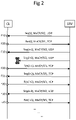
- the figure 2 presents a second example of implementation of the data packet management method according to the invention.
- the TCP stream data is transmitted over UDP but retransmitted and acknowledged over TCP.
- This example applies when a service wants to differentiate the QoS of the retransmitted packets to speed up the retransmission of the segments to be retransmitted from an IPTV service in order to avoid distortion of the decoded image following data loss, and/or to slowing down the retransmission packets relative to the set of initial packets in order to force the reduction in the bit rates of the streams concerned.
- An MxCP connection is established between a client and a server to transmit data from an MPEG stream from the server to the client.
- Each data consists of a number of packets.
- a TCP stream Sf1 and a stream Sf2 therefore exist between two client and server entities.
- connection is created by sending an MxCP_CAPABLE message with the ⁇ port:0 ⁇ option indicating that the UDP port is the same as that of TCP.
- the server transmits the TCP segments on the UDP stream Sf2, received by the client during successive steps F10 (Seg(i), Seg(i+1)).
- the client acknowledges on the TCP stream Sf1 the reception of the data by transmitting a read pointer aligned with the last TCP segment received.
- the server maintains the read pointer received from the client and a write pointer to the last data transmitted, which mirrors normal TCP operation except that it is coupled with UDP.
- a step F20 is performed with one or more segments late, thanks to the read pointer aligned with the last datum received, the server deduces the non-receipt on sf2 of this or these segments not received (Seg(i+2)) .
- the server knows that it has already sent this or these segments and retransmits them on the TCP stream Sf1, received by the client during a step F11 (Seg(i+2)), which is the normal operation of TCP whose MxCP benefits here, thanks to the invention.
- the server continues the transmission on the UDP stream Sf2 of the data situated after its write pointer (step F10 with Seg(i+3), and following).
- the client acknowledges during a step F20 on the TCP stream Sf1 the reception of the retransmitted segments by increasing the value of its read pointer accordingly.
- the server aligns its read pointer to this value.
- the MxCP protocol benefits both from the real-time efficiency inherent in UDP and from the possibilities of error repair inherent in TCP.
- the client must transmit to the server a read pointer to pending data, that is to say data not yet received.
- This pointer must then be deduced or calculated by the application in the client, or by the client's MxCP stack. This is the case for example when the client application wishes to avoid starvation of its decoding buffer.
- the client application When creating the MxCP connection, the client application indicates to the MxCP stack in the MxCP_CANCEL_DELAY parameter that it wishes to ignore data that would arrive 3ms too late.
- the client application detects that its decoding buffer is almost empty and uses the setsockopt(MxCP_CANCEL_DELAY,3) primitive to signal it to the MxCP stack.
- the client's MxCP stack converts this delay into a number of segments. By example it estimates the number N of segments being retransmitted from the differences between the times of arrival of the segments surrounding the missing segments (example: segment 14 is received at time 495 milliseconds. Its predecessor, segment 9 is received 3 milliseconds rather, at time 492 milliseconds. Segments 10, 11, 12 and 13 are therefore not yet received. N is therefore 4).
- the MxCP stack asks the server to stop the retransmission of this sequence by forcing the advancement of its read pointer: it forces the acknowledgment via the UDP stream of these N segments by transmitting a read pointer aligned on the last byte of segment 14.
- the server then advances its read pointer to the last byte of segment 14.
- the packets not received by the client cease to be retransmitted, thus freeing up space on the links and in the buffers of the equipment crossed to make up for the accumulated delay.
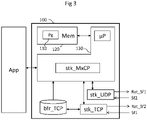
- the management device 100 implements the management method, various embodiments of which have just been described.
- Such a device 100 can be implemented in any receiving entity of a data stream, whether in connected mode or in offline mode, this receiving entity also comprising an App application module consuming data streams .
- the device 100 comprises a processing unit 130, equipped for example with a microprocessor ⁇ P, and controlled by a computer program 110, stored in a memory 120 and implementing the management method according to the invention.
- a computer program 110 stored in a memory 120 and implementing the management method according to the invention.
- the code instructions of the computer program 110 are for example loaded into a RAM memory, before being executed by the processor of the processing unit 130.
- the stk_MxCP processing module communicates with the App application module, for example using primitive functions as described in the table in appendix A.
- the modules described in relation to the picture 3 can be hardware or software modules.
- the stk_TCP module can be a TCP stack.
- the stk_UDP module can be a UDP stack, a UDP-lite stack or an MxUDP stack.
- Appendix A MxCP API Primitives Symbol Comment MxCP_CAPABLE Enables the MxCP option in MPTCP. Indicates to the receiver that the UDP stream is active on the sender side. Tells the 'network' functions to open the associated UDP port (UDP port in NATs in order to do without a protocol like STUN (Simple Traversal of User Datagram Protocol Through Network Address Translators, rfc3489).
- MxCP_SUB_FLOW_READ_ONLY Indicates to the receiver that the UDP stream is active on the sender side in read-only.
- 'flowType' 2 bit ⁇ UDP, UDP-lite, MxUDP ⁇ 'addressType': boolean ⁇ IPv4 or IPv6 ⁇ 'unicast': boolean Indicates to the 'network' functions that this is a unidirectional flow and that therefore the receiver is not authorized to send on this UDP flow.
- PIM SSM Packeger
- the stack algorithm can choose another stream given the state of the connection. By default the MxCP stack uses the initial TCP stream. Value: id of the substream to use Not transmitted in MxCP header ADD_ADDR The other parameters of MPTCP are carried over to MxCP. Their semantics are preserved. REMOVE_ADDR MP_PRIO MP_FAIL MP_FASTCLOSE
- Appendix B MxUDP_Type Field Structure MxUDPType MxUDP message Bit 0 to 0 Reserve Bit 0 to 1 carries a TCP segment in the data part of the UDP message; carries the TCP "sequence number" and "Acknowledgment number” fields in the "MxUDP_Data” field.
- MxUDP_Len indicates the length of the "MxUDP_Data” field and is equal to 12.
- PS The maximum length of the "MxUDP_Data” field is 12 bytes in order to guarantee space for the transport of a TCP segment: Indeed the size of the TCP header is at least 12 bytes longer than the UDP header. A length of the "MxUDP_Data” field of 12 bytes therefore always leaves enough space to transport the data of a TCP segment. Bit 1 to 3 Reserved
- Appendix C Simple example of an MxCP_CAPABLE message Symbol Comment MxCP_CAPABLE Enables the MxCP option in MPTCP.
- example value ⁇ Indicates to the receiver that the UDP stream is active on the sender side.
- port:0 Tells 'network' functions to open the associated UDP port.
Landscapes
- Engineering & Computer Science (AREA)
- Computer Networks & Wireless Communication (AREA)
- Signal Processing (AREA)
- Computer Security & Cryptography (AREA)
- Data Exchanges In Wide-Area Networks (AREA)
Description
- La demande d'invention se situe dans le domaine des connexions en mode connecté ou non-connecté, entre entités d'un réseau de commutation par paquets, et plus particulièrement les connexions comprenant chacune plusieurs flux empruntant des chemins de caractéristiques différentes.
- Les applications souhaitant bénéficier de ressources de transport optimisées peuvent utiliser une connexion utilisant conjointement plusieurs chemins différents entre deux mêmes extrémités, par exemple entre un client et un serveur. Ainsi, si un des chemins empruntés se trouve congestionné, le trafic généré par l'application peut emprunter les autres chemins. La qualité de service s'en trouve ainsi améliorée. Ce principe a été normalisé par l'IETF (Internet Engineering Task Force, ou Détachement d'ingénierie d'Internet) avec MPTCP (MultiPath Transmission Control Protocol, ou protocole de contrôle de transmission multi-chemin) dans le rfc6824 (request for comments, ou demande de commentaires).
- MPTCP est une extension de TCP (Transmission Control Protocol, ou protocole de contrôle de transmissions) où chaque extrémité dispose de plusieurs adresses IP (Internet Protocol) et peut ainsi combiner plusieurs sous-flux TCP dans le même flux principal, chaque sous-flux empruntant des chemins établis indépendamment les uns des autres.
- Pour des applications dites "temps réel", telles que de la voix sur IP ou de la télévision sur IP, le fait que dans le protocole TCP des paquets soient émis uniquement après acquittement de la réception des paquets précédents pose problème. En effet, certains des sous-flux TCP de MPTCP s'en trouvent ralentis ou interrompus, ce qui rend la qualité de transmission inacceptable pour ce type d'applications. De plus le nombre de paquets de retransmission, représentant environ 3% du débit, augmente le débit total demandé et accroit la congestion dans les buffers (tampons) des équipements traversés. L'avantage, en terme de débit, de combiner plusieurs flux à l'intérieur d'une même connexion grâce à MPTCP ne se fait donc pas toujours sentir dans le cas d'applications temps réel.
- De plus, s'il est vrai que les applications "temps réel" peuvent aussi utiliser le protocole UDP (User Datagram Protocol, ou protocole de datagramme utilisateur) qui est en mode non-connecté, la gestion des problèmes de congestion ne peut pas être faite au niveau de ce protocole.
- La demande de brevet américaine
US2007/0002863A1 décrit une solution où des paquets de données et des paquets d'acquittement sont réordonnés dans des files d'attente de flux en mode connecté avant transmission en vue d'optimiser l'utilisation des débits disponibles dans chacun des deux sens de transmission, mais la gestion des problèmes de congestion reste limitée au possibilités des protocoles des flux en mode connecté. - Un des buts de l'invention est de remédier à ces inconvénients de l'état de la technique.
- L'invention vient améliorer la situation à l'aide d'un procédé de gestion conforme à la revendication 1.
- Une connexion en mode connecté nécessite pour son établissement une phase préalable de négociation entre les extrémités, mais la transmission des données est fiable. Une connexion en mode non-connecté ne nécessite pas cette négociation préalable, mais la transmission des données est moins fiable.
- Grâce à l'invention, si, dans une connexion multi-flux, un flux d'un des deux types connecté ou non-connecté souffre de retard à l'arrivée dans l'entité réceptrice, celle-ci peut provoquer à l'aide du message de retour une action corrective dans l'entité émettrice sans dépendre de ce type de flux, ce qui comporte un avantage en soi car a priori la fiabilité du type de flux en question est affectée. En effet, contrairement à la technique antérieure, une indication de congestion ou un ordre de reprise est porté(e) par le message de retour, qui est émis sur un flux en mode non-connecté si le flux en réception est en mode connecté, ou vice-versa. Ainsi il est possible pour les entités émettrices et réceptrices de profiter des avantages à la fois du mode connecté et du mode non-connecté.
- Il est utile de noter que dans ce document le sens voulu de l'expression "message de retour" est similaire à celui de "feedback message" en anglais.
- Selon un aspect de l'invention, le flux en mode connecté est un flux TCP.
- Le flux en mode non-connecté peut être un flux UDP, un flux UDP-lite selon le rfc3828, ou un flux similaire à UDP mais capable de transmettre un identifiant correspondant à un pointeur de lecture. Par commodité l'expression "flux UDP" est utilisé à la place de "flux en mode non-connecté", dans les cas où UDP ou UDP-lite peuvent être utilisés sans modification.
- Le procédé de gestion selon l'invention comporte plusieurs autres avantages, examinés dans les différents cas de figures suivants.
- Par exemple, si un flux TCP de la connexion multi-flux est congestionné, l'entité réceptrice signale la congestion sur un flux UDP, et ce même si le flux TCP a activé la fonction dite ECN (Explicit Congestion Notification, rfc3168, ou notification explicite de congestion) et est donc prévu pour utiliser le drapeau ECN-Echo (section 6.1.2 du rfc3168) en sens inverse pour signaler une congestion, car la congestion peut-être telle que retourner l'indication de congestion selon la technique antérieure, c'est-à-dire par le sens inverse du flux TCP, reste sans effet.
- Selon l'invention, cette indication (drapeau ECN-Echo) est émise dans les bits ECN de l'entête IP des paquets via le flux UDP dans le message de retour, avec comme effet que l'entité émettrice, entre autre, réduira par exemple le débit du flux TCP congestionné.
- Dans un autre exemple, inversement, si un flux UDP est congestionné, l'entité réceptrice peut provoquer la retransmission de paquets en attente par l'envoi sur le flux TCP d'un message de retour indiquant cette congestion.
- Selon un aspect de l'invention, l'entité réceptrice émet sur le flux en mode non-connecté le message de retour, et où le message de retour est relatif au flux TCP.
- Selon un aspect de l'invention, le message de retour comprend un pointeur de lecture sur un paquet de données du flux TCP.
- Grâce à cet aspect, l'entité réceptrice peut commander à l'entité émettrice l'abandon de la transmission de données non reçues dans le flux TCP et la reprise de la transmission au-delà de données non reçues, ce qui n'est pas possible selon la technique antérieure qui utilise le sens inverse du même flux TCP et un pointeur garantissant obligatoirement la retransmission de toutes les données du flux TCP.
- Selon un aspect de l'invention, le message de retour comprend une indication de congestion du flux TCP.
- Selon un aspect de l'invention, le message de retour comprend un drapeau ECN-Echo.
- Grâce à cet aspect, une congestion sur un flux TCP peut être signalée par l'entité réceptrice à l'entité émettrice via le flux UDP, par exemple dans l'entête de la couche RTP au-dessus de UDP (rfc6679). Ceci est particulièrement utile si le flux TCP est congestionné au point que la transmission du message de retour par ce même flux est compromise.
- Selon un aspect de l'invention, un champ ECN d'un entête IP du message de retour porte la valeur du drapeau ECN-Echo.
- Grâce à cet aspect, comme précédemment et avec la même utilité, une congestion sur un flux TCP peut être signalée par l'entité réceptrice à l'entité émettrice via le flux UDP. Dans cette implémentation particulière, lorsque la fonction ECN n'est pas activée sur le flux UDP reçue (bits ECN a 00), c'est-à-dire même s'il n'y a pas de drapeau ECT dans l'entête IP, l'indication de congestion ECN-Echo est signalée à l'émetteur dans l'entête IP (rfc3168, section 5) en positionnant les 2 bits du champ ECN à une valeur non nulle, par exemple à 11. Ceci va doublement à l'encontre des préjugés de l'homme de métier car d'une part les drapeaux du champ ECN sont utilisés à contresens, c'est-à-dire pour signaler une congestion reçue à l'entité émettrice et non à l'entité réceptrice, et d'autre part l'indication est transportée au niveau de la couche réseau et non d'une couche supérieure. L'indication est donc visible par la couche réseau.
- Selon un aspect de l'invention, l'entité réceptrice émet sur le flux TCP le message de retour, et où le message de retour est relatif au flux en mode non-connecté.
- Selon un aspect de l'invention, le message de retour comprend un pointeur de lecture sur un paquet de données du flux en mode non-connecté.
- Grâce à cet aspect, des paquets qu'un flux UDP a définitivement perdus peuvent être réémis, par exemple par un autre flux TCP de la même connexion. L'entité réceptrice doit simplement être capable d'identifier le bloc de données à partir duquel la transmission reprend, afin de reconstruire la séquence initiale. Ceci permet par exemple à des services IP TV multicast d'éviter des déformations d'image suite à des pertes de données. Le récepteur récupère en unicast des données perdues et qui ne peuvent pas être retransmises sur la partie multicast.
- Selon un aspect de l'invention, le message de retour comprend un drapeau ECN-Echo.
- Grâce à cet aspect, une congestion sur un flux UDP peut être signalée par l'entité réceptrice à l'entité émettrice via le flux TCP.
- De plus cela permet l'activation d'ECN dans un flux UDP (bit ECT de l'entête IP à 1) et le signalement de la congestion ECN-Echo sans implémenter RTP, RTCP et le rfc6679. Ceci est contraire à la technique antérieure, où une congestion sur un flux UDP ne peut pas être signalée sans implémenter le mécanisme de signalement sur une couche de protocole supplémentaire.
- Selon un aspect de l'invention, le flux en mode non-connecté est de type IP multicast unidirectionnel, avec un bit ECT activé dans des entêtes IP des paquets du flux.
- Grâce à cet aspect, une congestion sur une des branches d'un flux UDP multicast peut être signalée par ECN-Echo par une entité réceptrice sur la connexion TCP. Ceci est contraire à la technique antérieure, où une congestion sur un flux UDP multicast ne peut pas être signalée. Si la connexion TCP est utilisée par un récepteur représentatif du groupe multicast, ceci permet de gérer à bas coût l'adaptation des débits émis vers tout le groupe de terminaux.
- Selon un autre aspect, le flux UDP émis est de type IP multicast unidirectionnel et la connexion est établie sur un réseau IP PIM SM (Source Specific Multicast for IP - Sparse Mode, rfc4607, rfc4601) à destination duquel l'entité réceptrice émet un message équivalent au message IGMP (Internet Group Management Protocol, rfc3376, ou protocole de gestion de groupe Internet) d'enregistrement dans le groupe multicast. Le procédé remplace le message IGMP par un message TCP SYN contenant l'option MxCP CAPABLE ayant les drapeaux "read-only" et "multicast" levés. Ce message est émis lors de l'établissement du flux TCP et donc facile à intercepter par une fonction réseau multicast en charge de l'enregistrement des récepteurs. Grâce à cet aspect, le procédé s'adapte simplement à un réseau multicast existant, sans avoir besoin d'implémenter IGMP.
- Les différents aspects du procédé de gestion qui viennent d'être décrits peuvent être mis en œuvre indépendamment les uns des autres ou en combinaison les uns avec les autres.
- L'invention concerne encore un dispositif de gestion conforme à la revendication 12.
- Ce dispositif, apte à mettre en œuvre dans tous ses modes de réalisation le procédé de gestion qui vient d'être décrit, est destiné à être mis en œuvre dans une entité réceptrice d'un flux de données, que ce soit en mode connecté ou en mode non-connecté, cette entité réceptrice comprenant en général un module applicatif consommateur des données reçues.
- L'invention concerne aussi un programme d'ordinateur comprenant des instructions pour la mise en œuvre des étapes du procédé de gestion qui vient d'être décrit, lorsque ce programme est exécuté par un processeur.
- L'invention concerne enfin un support d'enregistrement lisible par un équipement de gestion sur lequel est enregistré le programme qui vient d'être décrit, pouvant utiliser n'importe quel langage de programmation, et être sous la forme de code source, code objet, ou de code intermédiaire entre code source et code objet, tel que dans une forme partiellement compilée, ou dans n'importe quelle autre forme souhaitable.
- D'autres avantages et caractéristiques de l'invention apparaitront plus clairement à la lecture de la description suivante d'un mode de réalisation particulier de l'invention, donné à titre de simple exemple illustratif et non limitatif, et des dessins annexés, parmi lesquels :
- la
figure 1 présente un premier exemple de mise en œuvre du procédé de gestion de paquets de données selon l'invention, - la
figure 2 présente un deuxième exemple de mise en œuvre du procédé de gestion de paquets de données selon l'invention, - la
figure 3 présente un exemple de structure d'un dispositif de gestion mettant en œuvre le procédé de gestion, selon un aspect de l'invention. - Dans la suite de la description, on présente des exemples de plusieurs modes de réalisation de l'invention basés sur TCP et UDP, mais l'invention ne se limite pas à ces exemples. L'invention s'applique par exemple à des flux en mode non-connectés tels que des flux UDP-lite, ou tout flux similaire à UDP mais capable de transmettre un pointeur de lecture.
- Il est rappelé que MPTCP encode ses paramètres dans le champ TCP d'une longueur maximum de 40 octets. Il est composé d'un paramètre "Kind" d'un octet, d'un paramètre "Length" d'un octet et d'un paramètre "Subtype" de 4 bits. La longueur maximale restante pour la valeur d'un champ MPTCP est donc de 37 octets et 4 bits.
- On appelle un "stack IP" l'empilement de couches logicielles gérant séparément chacunes un protocole dans une entité émettrice ou réceptrice. Toutes les données échangées entre deux entités passent par les deux empilages logiciels du client et du server. Dans la suite on appelle "stack MxCP" uniquement la couche logicielle qui s'interface entre l'application consommatrice des données, et la couche logicielle de TCP et de UDP.
- Il est rappelé que bien qu'un paquet TCP transmette ses données dans ce qui est appelé un segment, TCP est conçu pour transporter deux séquences d'octets, une dans chaque sens entre les deux entités à chaque extrémité de la connexion. Il y a donc dans l'entête d'un paquet TCP un pointeur sur les données transmises par l'émetteur (champ "Sequence number" de 4 octets) de ce paquet TCP et un pointeur sur les données effectivement reçues par ce même émetteur sur l'autre sens (champ TCP "Acknowledgment number" de 4 octets). Ce champ est utilisé pour gérer les retransmissions. Il identifie le segment émis par l'émetteur : l'émetteur considère qu'un segment est reçu par l'autre extrémité si et seulement si ce segment a été acquitté par le récepteur dans le champ "Acknowledgment number". L'émetteur retransmet ce segment de manière espacée tant qu'il n'a pas reçu son acquittement (entre 3 et 15 fois suivant les implémentations ; par exemple, 5 dans Windows OS).
- TCP régule le débit d'une connexion en contrôlant l'écart entre le pointeur d'écriture et le pointeur de lecture.
- Dans la suite de ce document, le pointeur sur les données émises est appelé pointeur d'écriture, le pointeur sur les données reçues est appelé pointeur de lecture.
- L'invention rend possible un nouveau protocole améliorant MPTCP, appelé ci-dessous MxCP. Comme pour le protocole MPTCP, l'API (Application Programming Interface) de MxCP s'appuie sur des fonctions dites "de socket", setsockopt() et getsockopt().
- Le protocole MxCP repose sur le message MxCP_CAPABLE activant une connexion MxCP partageant un flux TCP et un flux UDP. Son paramètre indique, au minimum, au destinataire le numéro de port UDP associé.
- Les paramètres MxCP sont encodés suivant la section 3 du rfc6824 : longueur, identifiant du paramètre ; valeur.
- La valeur de ces paramètres est encodée en binaire de façon connue (addresse IPv4 sur 4 octets, entier...).
- L'annexe A fournit à titre d'exemple une liste d'autres primitives sur lesquelles peut s'appuyer l'API de MxCP.
- Il est possible d'implémenter MxCP en tant qu'extension de MPTCP, c'est-à-dire une modification de MPTCP, ou en tant qu'option nouvelle de TCP.
- Le protocole MPTCP est identifié par la valeur 30 dans le champ "Option-Kind" du paquet TCP. Dans ce mode les paramètres sont identifiés comme des nouveaux sous-types de MPTCP, suivant la section 8 du rfc6824, et encodés comme décrit dans la section 3 du rfc6824. Ce mode est identifié par le champ "version" ou par un des drapeaux de la valeur du champ MP_CAPABLE décrit dans la section 3.1 du rfc6824.
- Il s'agit d'une implémentation similaire à MPTCP mais indépendante. Dans ce mode, à l'instar de MPTCP, MxCP est identifié par exemple par la valeur 31 dans le champ TCP "Option-Kind" du paquet TCP. Les paramètres de MxCP sont identifiés séparément et encodés suivant le format décrit dans la section 3 du rfc6824. Le fonctionnement est identique au mode précédent mais incompatible avec MPTCP.
- Dans un mode particulier, le premier flux est de type TCP et au moins le premier flux UDP est d'un nouveau type dérivé de UDP-lite, appelé MxUDP, permettant au moins l'acquittement des segments TCP sur le flux MxUDP :
- UDP-lite (rfc3828) est un protocole existant qui dérive directement de UDP. Il respecte le format UDP mais scinde le champ "Checksum" de UDP de 32 bits en deux afin de créer un champ "Checksum Coverage" de 16 bits et un champ "Checksum" de 16 bits.
- MxUDP respecte également le format de UDP et scinde également le champ "Checksum" de UDP de 32 bits en deux champs :
- un champ "MxUDP_control" de 16 bits.
- un champ "MxUDP_Checksum" de 16 bits.
- MxUDP_Type (4 bits)
- et MxUDP_Len (12 bits).
- L'annexe B décrit le champ 'MxUDP_Type' qui indique le type de message MxUDP.
- Une implémentation rudimentaire est possible avec MxCP en tant qu'extension de MPTCP ou MxCP en tant qu'option de TCP. Seul le message MxCP_CAPABLE est nécessaire, il est véhiculé dans le premier message du flux TCP SYN ou dans le premier message du flux MxUDP.
- Un exemple d'implémentation simple, illustré dans l'annexe C, permet l'activation d'un flux IP multicast unidirectionnel jusqu'au sous réseau raccordant le client. Dans ce cas le paramètre de MxCP décrit en plus l'adresse IP multicast du flux UDP demandé. Le réseau d'accès capture le message TCP SYN et en extrait l'adresse du flux multicast. Cela remplace le message IGMP JOIN habituellement émis par un récepteur IP multicast.
- La
figure 1 présente un premier exemple de mise en œuvre du procédé de gestion de paquets de données selon l'invention. Cet exemple illustre l'application de l'invention à la réception de trames MPEG, utilisées pour les flux vidéo et particulièrement pour les flux IPTV. - Une connexion MxCP est établie entre un client CL et un serveur SRV pour transmettre des données de type MPEG (IPTV) du serveur vers le client. Un flux TCP Sf1 existe éventuellement par défaut, auquel cas les deux entités CL et SRV modifient la connexion TCP en connexion MxCP par l'envoi d'un message MxCP_CAPABLE par exemple avec les options suivantes :
    {
    "MxCP_CANCEL_DELAY": 10ms,
    "MxCP_CONGESTION_ASYNC_NOTIFICATION_ENABLE": 3
    }
    A ce stade les flux Sf1 et Sf2 sont donc créés.
- un premier module d'émission-réception stk_TCP, apte à émettre (Ret_Sf2) et recevoir (Sf1) un flux en mode connecté,
- un deuxième module d'émission-réception stk_UDP, apte à émettre (Ret_Sf1) et recevoir (Sf2) un flux en mode non-connecté,
- une mémoire tampon bfr_TCP, apte à stocker des données reçues d'un flux en mode connecté,
- un module de traitement stk_MxCP, apte à analyser un flux reçu sur l'un des premier ou deuxième modules d'émission-réception stk_TCP ou stk_UDP, à déterminer si un message de retour doit être émis, à générer son contenu, et à demander à l'autre module d'émission-réception stk_UDP ou stk_TCP l'émission du message de retour.
| Symbole | Commentaire |
| MxCP_CAPABLE | Active l'option MxCP dans MPTCP. Indique au récepteur que le flux UDP est actif coté émetteur. Indique aux fonctions 'réseau' d'ouvrir le port UDP associé (port UDP dans les NAT afin de se passer de protocole comme STUN (Simple Traversai of User Datagram Protocol Through Network Address Translators, rfc3489). |
| 'flowType' : 2 bits { UDP, UDP-lite, MxUDP } | |
| 'port' : 2 bytes Integer | |
| Valeur 0 : le port UDP est le même que le port TCP | |
| Valeur N : le port UDP est 'N' | |
| 'addressType' : optionnel booleen { Ipv4 ou IPv6 } | |
| Transmis dans entête MxCP Identifiant 0x8 | |
| MxCP_CONGESTION_SYNC_NOTIFICATION_ENABLE | Active ECN-Echo sur les flux UDP et TCP. |
| Integer [1..255] | Demande à l'autre extrémité l'activation de ECN sur les flux |
| Valeur : nombre de bits ECT reçus qui déclenchera le recus signalement d'une congestion ECN-Echo sur l'autre flux. | |
| Transmis : La transmission du paramètre a l'autre extrémité est optionnelle | |
| MxCP_CONGESTION_ASYNC_NOTIFICATION_ENABLE | Active ECN-Echo sur le flux TCP seulement. |
| Integer [1..255] | Demande à l'autre extrémité l'activation de ECN sur les flux reçus. |
| Valeur : nombre de bits ECT consécutifs reçus (ou reçus | |
| sur le même laps de temps) qui déclenche le signalement | Active l'envoi de l'indication ECN-Echo à la place des bits ECN dans le flux UDP. |
| MxCP_CANCEL_DELAY | Délai entre l'instant d'émission du segment du pointeur d'écriture et l'instant d'émission du pointeur de lecture à partir duquel certains segments sont à poubelliser (à partir duquel le pointeur de lecture de l'émetteur doit effectuer un saut). |
| Integer [1..255] | |
| Transmis dans entête MxCP | |
| Identifiant 0x9 | |
| MxCP_SUB_FLOW_READ_ONLY | Indique au récepteur que le flux UDP est actif coté émetteur en lecture seule. |
| 'flowType' : 2 bits { UDP, UDP-lite, MxUDP } | |
| "addressType' : booleen { IPv4 ou IPv6 } 'unicast': booleen | Indique aux fonctions 'réseau' qu'il s'agit d'un flux unidirectionnel et que donc le récepteur n'est pas autoriser à émettre sur ce flux UDP. |
| port' : Integer[0..63536] | |
| Valeur 0 : le port UDP est le même que le port TCP | Multicast==1: Indique aux fonctions d'un réseau multicast tel que PIM SSM de préparer le réseau multicast afin que l'arbre multicast puisse délivrer le flux UDP: |
| Valeur N : le port UDP est 'N' | |
| Address : bytes [4] ou bytes[16] | |
| - Activation de la réception de la source correspondant à l'émetteur TCP ; | |
| Transmis dans entête MxCP | |
| Identifiant 0xA | - activation du trafic multicast dans le réseau d'attachement du récepteur (capture du message MXCP SUB_FLOW_READ_ONLY par les routeurs d'accès) ; |
| - mise en place du réseau multicast entre la source et le réseau d'attachement des récepteurs UDP (travail de protocole PIM dans les routeurs déclenchés par les routeurs d'accès) ; | |
| MxCP_PREF: | Sélectionne le flux à utiliser de préférence pour émettre les données. L'algorithme du stack peut choisir un autre flux compte tenu de l'état de la connexion. Par défaut le stack MxCP utilise le flux TCP initiale. |
| Valeur: id du sous flux à utiliser | |
| Non transmis dans entête MxCP | |
| ADD_ADDR | Les autres paramètres de MPTCP sont repris dans MxCP. Leur sémantique est conservée. |
| REMOVE_ADDR | |
| MP_PRIO | |
| MP_FAIL | |
| MP_FASTCLOSE |
| MxUDP Type | message MxUDP |
| Bit 0 à 0 | réservé |
| Bit 0 à 1 | transporte un segment TCP dans la partie donnée du message UDP; transporte les champs TCP "sequence number" et "Acknowledgment number" dans le champ "MxUDP_Data". |
| "MxUDP_Len" indique la longueur du champ "MxUDP_Data" et vaut 12. | |
| PS : La longueur maximale du champ "MxUDP_Data" est de 12 octets afin de garantir la place pour le transport d'un segment TCP : En effet la taille de l'entête TCP est au minimum 12 octets plus long que l'entête UDP. Une longueur du champ "MxUDP_Data" de 12 octets laisse donc dans tous les cas assez de place pour transporter les données d'un segment TCP. | |
| Bit 1 a 3 | Réservées |
| Symbole | Commentaire | |
| MxCP_CAPABLE | Active l'option MxCP dans MPTCP. | |
| exemple de valeur { | Indique au récepteur que le flux UDP est actif coté émetteur. | |
| port :0 | Indique aux fonctions 'réseau' d'ouvrir le port UDP associé. | |
| readonly : 0 | Valeur 0 : le port UDP est le même que le port TCP | |
| multicast :1 | Valeur N : le port UDP est 'N' | |
| addrType: 'ipv4' | Readonly==1 : Indique au destinataire du message que le flux UDP est actif mais en lecture seule (cas normal ou un client se connecte à un serveur et où le serveur émet le contenu). Indique aux fonctions 'réseau' qu'il s'agit de unidirectionnel et que donc le récepteur n'est pas autoriser à émettre sur ce flux UDP. | |
| addr: '224.1.1.1' | ||
| } | ||
| Multicast==1 : Les fonctions 'réseau' peuvent préparer le réseau multicast afin que l'arbre multicast puisse délivrer le flux UDP : activation de la réception de la source et préparation du réseau multicast en amont du réseau d'attachement du récepteur | ||
Claims (14)
- Procédé de gestion, dans une entité réceptrice (CL), de paquets de données (I(i); Seg(i)) reçus depuis une connexion de couche transport établie avec une entité émettrice (SRV),la connexion comprenant au moins un flux en mode connecté (Sf1), dit premier flux, et au moins un flux en mode non-connecté (Sf2, Sf3), dit second flux,le procédé de gestion étant caractérisé en ce qu'il comprend une étape d'émission (E20; F20) , par l'entité réceptrice, d'un message (Ret I(i); Ret(i)), dit de retour, relatif à au moins un paquet de données de l'un des premier ou second flux, le message de retour étant émis vers l'entité émettrice sur le second flux si le message de retour est relatif à au moins un paquet de données (I(i)) du premier flux, et sur le premier flux si le message de retour est relatif à au moins un paquet de données (Seg(i)) du second flux.
- Procédé de gestion selon la revendication 1, où le premier flux est un flux TCP.
- Procédé de gestion selon la revendication 2, où l'entité réceptrice émet sur le second flux le message de retour, et où le message de retour est relatif au flux TCP.
- Procédé de gestion selon la revendication 3, où le message de retour comprend un pointeur de lecture sur un paquet de données du flux TCP.
- Procédé de gestion selon la revendication 3, où le message de retour comprend une indication de congestion du flux TCP.
- Procédé de gestion selon la revendication 5, où le message de retour comprend un drapeau ECN-Echo.
- Procédé de gestion selon la revendication 5, où un champ ECN d'un entête IP du message de retour porte la valeur du drapeau ECN-Echo.
- Procédé de gestion selon la revendication 2, où l'entité réceptrice émet sur le flux TCP le message de retour, et où le message de retour est relatif au second flux.
- Procédé de gestion selon la revendication 8, où le message de retour comprend un pointeur de lecture sur un paquet de données du second flux.
- Procédé de gestion selon la revendication 8, où le message de retour comprend un drapeau ECN-Echo.
- Procédé de gestion selon la revendication 10, où le second flux est de type IP multicast unidirectionnel, avec un bit ECT activé dans des entêtes IP des paquets du flux.
- Dispositif (100) de gestion, dans une entité réceptrice (CL), de paquets de données reçus depuis une connexion établie avec une entité émettrice (SRV), comprenant un premier module d'émission-réception (Stk_TCP) apte à émettre et recevoir un flux en mode connecté (Sf1) et un deuxième module d'émission-réception (Stk_UDP) apte à émettre et recevoir un flux en mode non-connecté (Sf2, Sf3), la connexion comprenant au moins un flux en mode connecté et au moins un flux en mode non-connecté, le dispositif étant caractérisé en ce qu'un message (Ret I(i); Ret(i)), dit de retour, relatif à au moins un paquet de données (I(i); Seg(i)), est émis par le premier module d'émission-réception si l'au moins un paquet de données (Seg(i)) est reçu par le deuxième module d'émission-réception, ou est émis par le deuxième module d'émission-réception si l'au moins un paquet de données (I(i)) est reçu par le premier module d'émission-réception.
- Programme d'ordinateur comprenant des instructions pour la mise en œuvre des étapes du procédé de gestion selon la revendication 1, lorsque ce procédé est exécuté par un processeur.
- Support d'enregistrement lisible par une entité réceptrice sur lequel est enregistré le programme selon la revendication 13.
Applications Claiming Priority (2)
| Application Number | Priority Date | Filing Date | Title |
|---|---|---|---|
| FR1555606A FR3037750A1 (fr) | 2015-06-18 | 2015-06-18 | Procede et dispositif de gestion de paquets dans une connexion multi-flux et multi-protocole |
| PCT/FR2016/051464 WO2016203161A1 (fr) | 2015-06-18 | 2016-06-16 | Procédé et dispositif de gestion de paquets dans une connexion multi-flux et multi-protocole |
Publications (2)
| Publication Number | Publication Date |
|---|---|
| EP3311545A1 EP3311545A1 (fr) | 2018-04-25 |
| EP3311545B1 true EP3311545B1 (fr) | 2022-08-31 |
Family
ID=54356452
Family Applications (1)
| Application Number | Title | Priority Date | Filing Date |
|---|---|---|---|
| EP16739224.0A Active EP3311545B1 (fr) | 2015-06-18 | 2016-06-16 | Procédé et dispositif de gestion de paquets dans une connexion multi-flux et multi-protocole |
Country Status (4)
| Country | Link |
|---|---|
| US (1) | US10594500B2 (fr) |
| EP (1) | EP3311545B1 (fr) |
| FR (1) | FR3037750A1 (fr) |
| WO (1) | WO2016203161A1 (fr) |
Families Citing this family (4)
| Publication number | Priority date | Publication date | Assignee | Title |
|---|---|---|---|---|
| US9167275B1 (en) | 2010-03-11 | 2015-10-20 | BoxCast, LLC | Systems and methods for autonomous broadcasting |
| US10154317B2 (en) | 2016-07-05 | 2018-12-11 | BoxCast, LLC | System, method, and protocol for transmission of video and audio data |
| US10778568B2 (en) * | 2017-12-05 | 2020-09-15 | Mellanox Technologies, Ltd. | Switch-enhanced short loop congestion notification for TCP |
| US12237938B2 (en) * | 2022-11-10 | 2025-02-25 | Ciena Corporation | Prioritizing multicast streams in internet group management protocol (IGMP) networks |
Family Cites Families (7)
| Publication number | Priority date | Publication date | Assignee | Title |
|---|---|---|---|---|
| US6359882B1 (en) * | 1997-04-01 | 2002-03-19 | Yipes Communications, Inc. | Method and apparatus for transmitting data |
| JP2000295279A (ja) * | 1999-04-02 | 2000-10-20 | Nec Corp | パケットスイッチ |
| US7606234B2 (en) * | 2005-06-14 | 2009-10-20 | Microsoft Corporation | Multi-stream acknowledgement scheduling |
| EP2381621A1 (fr) * | 2010-04-21 | 2011-10-26 | Thomson Licensing | Procédé d'évaluation d'un débit binaire de chemin disponible d'après une sélection de chemin d'acquittement |
| US8738795B2 (en) * | 2010-08-23 | 2014-05-27 | Cisco Technology, Inc. | Media-aware and TCP-compatible bandwidth sharing for video streaming |
| US9998388B2 (en) * | 2014-02-06 | 2018-06-12 | Sony Interactive Entertainment LLC | Congestion control bitrate algorithm |
| US9832125B2 (en) * | 2015-05-18 | 2017-11-28 | Dell Products L.P. | Congestion notification system |
-
2015
- 2015-06-18 FR FR1555606A patent/FR3037750A1/fr active Pending
-
2016
- 2016-06-16 WO PCT/FR2016/051464 patent/WO2016203161A1/fr not_active Ceased
- 2016-06-16 EP EP16739224.0A patent/EP3311545B1/fr active Active
- 2016-06-16 US US15/737,589 patent/US10594500B2/en active Active
Also Published As
| Publication number | Publication date |
|---|---|
| FR3037750A1 (fr) | 2016-12-23 |
| EP3311545A1 (fr) | 2018-04-25 |
| US10594500B2 (en) | 2020-03-17 |
| WO2016203161A1 (fr) | 2016-12-22 |
| US20180183615A1 (en) | 2018-06-28 |
Similar Documents
| Publication | Publication Date | Title |
|---|---|---|
| US7840651B2 (en) | Client-server emulation supporting multicast transmissions of media objects | |
| US8943206B2 (en) | Network bandwidth detection and distribution | |
| EP2144403B1 (fr) | Procédé de gestion d'une transmission de flux de données sur un canal de transport d'un tunnel, tête de tunnel, produit programme d'ordinateur et moyen de stockage correspondants | |
| US8169911B2 (en) | Method for transmitting a data stream with anticipation of acknowledgments, correspondence input device and computer-readable storage medium | |
| US7894364B2 (en) | Method for the transmission of data packets in a tunnel, corresponding computer program product, storage means and tunnel end-point | |
| EP3053303B1 (fr) | Procede d'abonnement a des flux en provenance de clients multicast | |
| EP3311545B1 (fr) | Procédé et dispositif de gestion de paquets dans une connexion multi-flux et multi-protocole | |
| FR2954029A1 (fr) | Procede de transmission de paquets d'un flux de donnees bidirectionnel passager, dispositif gestionnaire, produit programme d'ordinateur et moyen de stockage correspondants | |
| FR2977101A1 (fr) | Retransmission de donnees perdues entre un emetteur et un recepteur | |
| WO2014117775A1 (fr) | Procédé de distribution de contenu de réseau à l'aide d'un nœud assistant de distribution | |
| McQuistin et al. | TCP Hollywood: An unordered, time-lined, TCP for networked multimedia applications | |
| CN105227276B (zh) | 一种基于udt的对等网络数据传输方法 | |
| CN116896533A (zh) | 内容分发网络系统及其数据传输方法 | |
| US20140369189A1 (en) | Method of controlling packet transmission in network system and network system transmitting packet using pseudo-tcp agent | |
| EP2645647B1 (fr) | Procédé d'optimisation du débit descendant d'une ligne d'accès asymétrique, dispositif, produit programme d'ordinateur et support de stockage correspondants. | |
| FR2951045A1 (fr) | Procede de gestion de la taille de paquets de donnees d'un flux de donnees, produit programme d'ordinateur, moyen de stockage, et tete de tunnel correspondants. | |
| EP2802117B1 (fr) | Système et procédé permettant de relayer des données basées sur un protocole de transport fiable modifié | |
| Kumar | Modified TCP for time critical applications | |
| FR2951044A1 (fr) | Procede et dispositif de gestion de transmission de donnees sur un lien de communication, produit programme d'ordinateur et moyen de stockage correspondants. | |
| FR2979505A1 (fr) | Procede d'insertion d'un equipement intermediaire permettant le controle a distance de la qualite d'une communication | |
| FR2935576A1 (fr) | Procede de gestion d'une transmission de flux de donnees sur un tunnel multi-canal, tete de tunnel, produit programme d'ordinateur et moyen de stockage correspondants. | |
| FR2908577A1 (fr) | Procede de transmission conformement a un protocole de transmission par rafales d'un contenu de donnees,produit programme d'ordinateur,moyen de stockage et dispositif correspondants. | |
| FR2868642A1 (fr) | Procede et dispositif de communication de donnees par paquets a haut debit | |
| WO2007101962A1 (fr) | Mécanisme de régulation multicouches du débit d'un flux de données tcp dans un réseau haut débit ethernet full duplex |
Legal Events
| Date | Code | Title | Description |
|---|---|---|---|
| STAA | Information on the status of an ep patent application or granted ep patent |
Free format text: STATUS: THE INTERNATIONAL PUBLICATION HAS BEEN MADE |
|
| PUAI | Public reference made under article 153(3) epc to a published international application that has entered the european phase |
Free format text: ORIGINAL CODE: 0009012 |
|
| STAA | Information on the status of an ep patent application or granted ep patent |
Free format text: STATUS: REQUEST FOR EXAMINATION WAS MADE |
|
| 17P | Request for examination filed |
Effective date: 20180110 |
|
| AK | Designated contracting states |
Kind code of ref document: A1 Designated state(s): AL AT BE BG CH CY CZ DE DK EE ES FI FR GB GR HR HU IE IS IT LI LT LU LV MC MK MT NL NO PL PT RO RS SE SI SK SM TR |
|
| AX | Request for extension of the european patent |
Extension state: BA ME |
|
| DAV | Request for validation of the european patent (deleted) | ||
| DAX | Request for extension of the european patent (deleted) | ||
| RAP1 | Party data changed (applicant data changed or rights of an application transferred) |
Owner name: ORANGE |
|
| STAA | Information on the status of an ep patent application or granted ep patent |
Free format text: STATUS: EXAMINATION IS IN PROGRESS |
|
| 17Q | First examination report despatched |
Effective date: 20201116 |
|
| RAP3 | Party data changed (applicant data changed or rights of an application transferred) |
Owner name: ORANGE |
|
| REG | Reference to a national code |
Ref country code: DE Ref legal event code: R079 Ref document number: 602016074650 Country of ref document: DE Free format text: PREVIOUS MAIN CLASS: H04L0029060000 Ipc: H04L0069140000 |
|
| GRAP | Despatch of communication of intention to grant a patent |
Free format text: ORIGINAL CODE: EPIDOSNIGR1 |
|
| STAA | Information on the status of an ep patent application or granted ep patent |
Free format text: STATUS: GRANT OF PATENT IS INTENDED |
|
| RIC1 | Information provided on ipc code assigned before grant |
Ipc: H04L 69/326 20220101ALI20220309BHEP Ipc: H04L 69/165 20220101ALI20220309BHEP Ipc: H04L 69/14 20220101AFI20220309BHEP |
|
| INTG | Intention to grant announced |
Effective date: 20220329 |
|
| GRAS | Grant fee paid |
Free format text: ORIGINAL CODE: EPIDOSNIGR3 |
|
| GRAA | (expected) grant |
Free format text: ORIGINAL CODE: 0009210 |
|
| STAA | Information on the status of an ep patent application or granted ep patent |
Free format text: STATUS: THE PATENT HAS BEEN GRANTED |
|
| AK | Designated contracting states |
Kind code of ref document: B1 Designated state(s): AL AT BE BG CH CY CZ DE DK EE ES FI FR GB GR HR HU IE IS IT LI LT LU LV MC MK MT NL NO PL PT RO RS SE SI SK SM TR |
|
| REG | Reference to a national code |
Ref country code: CH Ref legal event code: EP Ref country code: GB Ref legal event code: FG4D Free format text: NOT ENGLISH |
|
| REG | Reference to a national code |
Ref country code: AT Ref legal event code: REF Ref document number: 1516160 Country of ref document: AT Kind code of ref document: T Effective date: 20220915 Ref country code: DE Ref legal event code: R096 Ref document number: 602016074650 Country of ref document: DE |
|
| REG | Reference to a national code |
Ref country code: IE Ref legal event code: FG4D Free format text: LANGUAGE OF EP DOCUMENT: FRENCH |
|
| REG | Reference to a national code |
Ref country code: LT Ref legal event code: MG9D |
|
| REG | Reference to a national code |
Ref country code: NL Ref legal event code: MP Effective date: 20220831 |
|
| PG25 | Lapsed in a contracting state [announced via postgrant information from national office to epo] |
Ref country code: SE Free format text: LAPSE BECAUSE OF FAILURE TO SUBMIT A TRANSLATION OF THE DESCRIPTION OR TO PAY THE FEE WITHIN THE PRESCRIBED TIME-LIMIT Effective date: 20220831 Ref country code: RS Free format text: LAPSE BECAUSE OF FAILURE TO SUBMIT A TRANSLATION OF THE DESCRIPTION OR TO PAY THE FEE WITHIN THE PRESCRIBED TIME-LIMIT Effective date: 20220831 Ref country code: NO Free format text: LAPSE BECAUSE OF FAILURE TO SUBMIT A TRANSLATION OF THE DESCRIPTION OR TO PAY THE FEE WITHIN THE PRESCRIBED TIME-LIMIT Effective date: 20221130 Ref country code: LV Free format text: LAPSE BECAUSE OF FAILURE TO SUBMIT A TRANSLATION OF THE DESCRIPTION OR TO PAY THE FEE WITHIN THE PRESCRIBED TIME-LIMIT Effective date: 20220831 Ref country code: LT Free format text: LAPSE BECAUSE OF FAILURE TO SUBMIT A TRANSLATION OF THE DESCRIPTION OR TO PAY THE FEE WITHIN THE PRESCRIBED TIME-LIMIT Effective date: 20220831 Ref country code: FI Free format text: LAPSE BECAUSE OF FAILURE TO SUBMIT A TRANSLATION OF THE DESCRIPTION OR TO PAY THE FEE WITHIN THE PRESCRIBED TIME-LIMIT Effective date: 20220831 |
|
| REG | Reference to a national code |
Ref country code: AT Ref legal event code: MK05 Ref document number: 1516160 Country of ref document: AT Kind code of ref document: T Effective date: 20220831 |
|
| PG25 | Lapsed in a contracting state [announced via postgrant information from national office to epo] |
Ref country code: PL Free format text: LAPSE BECAUSE OF FAILURE TO SUBMIT A TRANSLATION OF THE DESCRIPTION OR TO PAY THE FEE WITHIN THE PRESCRIBED TIME-LIMIT Effective date: 20220831 Ref country code: IS Free format text: LAPSE BECAUSE OF FAILURE TO SUBMIT A TRANSLATION OF THE DESCRIPTION OR TO PAY THE FEE WITHIN THE PRESCRIBED TIME-LIMIT Effective date: 20221231 Ref country code: HR Free format text: LAPSE BECAUSE OF FAILURE TO SUBMIT A TRANSLATION OF THE DESCRIPTION OR TO PAY THE FEE WITHIN THE PRESCRIBED TIME-LIMIT Effective date: 20220831 Ref country code: GR Free format text: LAPSE BECAUSE OF FAILURE TO SUBMIT A TRANSLATION OF THE DESCRIPTION OR TO PAY THE FEE WITHIN THE PRESCRIBED TIME-LIMIT Effective date: 20221201 |
|
| PG25 | Lapsed in a contracting state [announced via postgrant information from national office to epo] |
Ref country code: SM Free format text: LAPSE BECAUSE OF FAILURE TO SUBMIT A TRANSLATION OF THE DESCRIPTION OR TO PAY THE FEE WITHIN THE PRESCRIBED TIME-LIMIT Effective date: 20220831 Ref country code: RO Free format text: LAPSE BECAUSE OF FAILURE TO SUBMIT A TRANSLATION OF THE DESCRIPTION OR TO PAY THE FEE WITHIN THE PRESCRIBED TIME-LIMIT Effective date: 20220831 Ref country code: PT Free format text: LAPSE BECAUSE OF FAILURE TO SUBMIT A TRANSLATION OF THE DESCRIPTION OR TO PAY THE FEE WITHIN THE PRESCRIBED TIME-LIMIT Effective date: 20230102 Ref country code: ES Free format text: LAPSE BECAUSE OF FAILURE TO SUBMIT A TRANSLATION OF THE DESCRIPTION OR TO PAY THE FEE WITHIN THE PRESCRIBED TIME-LIMIT Effective date: 20220831 Ref country code: DK Free format text: LAPSE BECAUSE OF FAILURE TO SUBMIT A TRANSLATION OF THE DESCRIPTION OR TO PAY THE FEE WITHIN THE PRESCRIBED TIME-LIMIT Effective date: 20220831 Ref country code: CZ Free format text: LAPSE BECAUSE OF FAILURE TO SUBMIT A TRANSLATION OF THE DESCRIPTION OR TO PAY THE FEE WITHIN THE PRESCRIBED TIME-LIMIT Effective date: 20220831 Ref country code: AT Free format text: LAPSE BECAUSE OF FAILURE TO SUBMIT A TRANSLATION OF THE DESCRIPTION OR TO PAY THE FEE WITHIN THE PRESCRIBED TIME-LIMIT Effective date: 20220831 |
|
| PG25 | Lapsed in a contracting state [announced via postgrant information from national office to epo] |
Ref country code: SK Free format text: LAPSE BECAUSE OF FAILURE TO SUBMIT A TRANSLATION OF THE DESCRIPTION OR TO PAY THE FEE WITHIN THE PRESCRIBED TIME-LIMIT Effective date: 20220831 Ref country code: EE Free format text: LAPSE BECAUSE OF FAILURE TO SUBMIT A TRANSLATION OF THE DESCRIPTION OR TO PAY THE FEE WITHIN THE PRESCRIBED TIME-LIMIT Effective date: 20220831 |
|
| REG | Reference to a national code |
Ref country code: DE Ref legal event code: R097 Ref document number: 602016074650 Country of ref document: DE |
|
| PG25 | Lapsed in a contracting state [announced via postgrant information from national office to epo] |
Ref country code: NL Free format text: LAPSE BECAUSE OF FAILURE TO SUBMIT A TRANSLATION OF THE DESCRIPTION OR TO PAY THE FEE WITHIN THE PRESCRIBED TIME-LIMIT Effective date: 20220831 Ref country code: AL Free format text: LAPSE BECAUSE OF FAILURE TO SUBMIT A TRANSLATION OF THE DESCRIPTION OR TO PAY THE FEE WITHIN THE PRESCRIBED TIME-LIMIT Effective date: 20220831 |
|
| PLBE | No opposition filed within time limit |
Free format text: ORIGINAL CODE: 0009261 |
|
| STAA | Information on the status of an ep patent application or granted ep patent |
Free format text: STATUS: NO OPPOSITION FILED WITHIN TIME LIMIT |
|
| 26N | No opposition filed |
Effective date: 20230601 |
|
| PG25 | Lapsed in a contracting state [announced via postgrant information from national office to epo] |
Ref country code: SI Free format text: LAPSE BECAUSE OF FAILURE TO SUBMIT A TRANSLATION OF THE DESCRIPTION OR TO PAY THE FEE WITHIN THE PRESCRIBED TIME-LIMIT Effective date: 20220831 |
|
| PG25 | Lapsed in a contracting state [announced via postgrant information from national office to epo] |
Ref country code: MC Free format text: LAPSE BECAUSE OF FAILURE TO SUBMIT A TRANSLATION OF THE DESCRIPTION OR TO PAY THE FEE WITHIN THE PRESCRIBED TIME-LIMIT Effective date: 20220831 |
|
| PG25 | Lapsed in a contracting state [announced via postgrant information from national office to epo] |
Ref country code: MC Free format text: LAPSE BECAUSE OF FAILURE TO SUBMIT A TRANSLATION OF THE DESCRIPTION OR TO PAY THE FEE WITHIN THE PRESCRIBED TIME-LIMIT Effective date: 20220831 |
|
| REG | Reference to a national code |
Ref country code: CH Ref legal event code: PL |
|
| REG | Reference to a national code |
Ref country code: BE Ref legal event code: MM Effective date: 20230630 |
|
| PG25 | Lapsed in a contracting state [announced via postgrant information from national office to epo] |
Ref country code: LU Free format text: LAPSE BECAUSE OF NON-PAYMENT OF DUE FEES Effective date: 20230616 |
|
| REG | Reference to a national code |
Ref country code: IE Ref legal event code: MM4A |
|
| PG25 | Lapsed in a contracting state [announced via postgrant information from national office to epo] |
Ref country code: LU Free format text: LAPSE BECAUSE OF NON-PAYMENT OF DUE FEES Effective date: 20230616 |
|
| PG25 | Lapsed in a contracting state [announced via postgrant information from national office to epo] |
Ref country code: IE Free format text: LAPSE BECAUSE OF NON-PAYMENT OF DUE FEES Effective date: 20230616 |
|
| PG25 | Lapsed in a contracting state [announced via postgrant information from national office to epo] |
Ref country code: IE Free format text: LAPSE BECAUSE OF NON-PAYMENT OF DUE FEES Effective date: 20230616 Ref country code: CH Free format text: LAPSE BECAUSE OF NON-PAYMENT OF DUE FEES Effective date: 20230630 |
|
| PG25 | Lapsed in a contracting state [announced via postgrant information from national office to epo] |
Ref country code: IT Free format text: LAPSE BECAUSE OF FAILURE TO SUBMIT A TRANSLATION OF THE DESCRIPTION OR TO PAY THE FEE WITHIN THE PRESCRIBED TIME-LIMIT Effective date: 20220831 Ref country code: BE Free format text: LAPSE BECAUSE OF NON-PAYMENT OF DUE FEES Effective date: 20230630 |
|
| PG25 | Lapsed in a contracting state [announced via postgrant information from national office to epo] |
Ref country code: BG Free format text: LAPSE BECAUSE OF FAILURE TO SUBMIT A TRANSLATION OF THE DESCRIPTION OR TO PAY THE FEE WITHIN THE PRESCRIBED TIME-LIMIT Effective date: 20220831 |
|
| PG25 | Lapsed in a contracting state [announced via postgrant information from national office to epo] |
Ref country code: BG Free format text: LAPSE BECAUSE OF FAILURE TO SUBMIT A TRANSLATION OF THE DESCRIPTION OR TO PAY THE FEE WITHIN THE PRESCRIBED TIME-LIMIT Effective date: 20220831 |
|
| PGFP | Annual fee paid to national office [announced via postgrant information from national office to epo] |
Ref country code: DE Payment date: 20250520 Year of fee payment: 10 |
|
| PGFP | Annual fee paid to national office [announced via postgrant information from national office to epo] |
Ref country code: GB Payment date: 20250520 Year of fee payment: 10 |
|
| PGFP | Annual fee paid to national office [announced via postgrant information from national office to epo] |
Ref country code: FR Payment date: 20250521 Year of fee payment: 10 |
|
| PG25 | Lapsed in a contracting state [announced via postgrant information from national office to epo] |
Ref country code: CY Free format text: LAPSE BECAUSE OF FAILURE TO SUBMIT A TRANSLATION OF THE DESCRIPTION OR TO PAY THE FEE WITHIN THE PRESCRIBED TIME-LIMIT; INVALID AB INITIO Effective date: 20160616 |
|
| PG25 | Lapsed in a contracting state [announced via postgrant information from national office to epo] |
Ref country code: HU Free format text: LAPSE BECAUSE OF FAILURE TO SUBMIT A TRANSLATION OF THE DESCRIPTION OR TO PAY THE FEE WITHIN THE PRESCRIBED TIME-LIMIT; INVALID AB INITIO Effective date: 20160616 |
|
| PG25 | Lapsed in a contracting state [announced via postgrant information from national office to epo] |
Ref country code: TR Free format text: LAPSE BECAUSE OF FAILURE TO SUBMIT A TRANSLATION OF THE DESCRIPTION OR TO PAY THE FEE WITHIN THE PRESCRIBED TIME-LIMIT Effective date: 20220831 |