EP3312811A1 - Procédé de prévention d'une menace - Google Patents
Procédé de prévention d'une menace Download PDFInfo
- Publication number
- EP3312811A1 EP3312811A1 EP17197087.4A EP17197087A EP3312811A1 EP 3312811 A1 EP3312811 A1 EP 3312811A1 EP 17197087 A EP17197087 A EP 17197087A EP 3312811 A1 EP3312811 A1 EP 3312811A1
- Authority
- EP
- European Patent Office
- Prior art keywords
- support
- hazard
- offer
- request message
- control device
- Prior art date
- Legal status (The legal status is an assumption and is not a legal conclusion. Google has not performed a legal analysis and makes no representation as to the accuracy of the status listed.)
- Granted
Links
Images


Classifications
-
- G—PHYSICS
- G08—SIGNALLING
- G08B—SIGNALLING SYSTEMS, e.g. PERSONAL CALLING SYSTEMS; ORDER TELEGRAPHS; ALARM SYSTEMS
- G08B13/00—Burglar, theft or intruder alarms
- G08B13/18—Actuation by interference with heat, light, or radiation of shorter wavelength; Actuation by intruding sources of heat, light, or radiation of shorter wavelength
- G08B13/189—Actuation by interference with heat, light, or radiation of shorter wavelength; Actuation by intruding sources of heat, light, or radiation of shorter wavelength using passive radiation detection systems
- G08B13/194—Actuation by interference with heat, light, or radiation of shorter wavelength; Actuation by intruding sources of heat, light, or radiation of shorter wavelength using passive radiation detection systems using image scanning and comparing systems
- G08B13/196—Actuation by interference with heat, light, or radiation of shorter wavelength; Actuation by intruding sources of heat, light, or radiation of shorter wavelength using passive radiation detection systems using image scanning and comparing systems using television cameras
- G08B13/19639—Details of the system layout
- G08B13/19647—Systems specially adapted for intrusion detection in or around a vehicle
-
- H—ELECTRICITY
- H04—ELECTRIC COMMUNICATION TECHNIQUE
- H04N—PICTORIAL COMMUNICATION, e.g. TELEVISION
- H04N7/00—Television systems
- H04N7/18—Closed-circuit television [CCTV] systems, i.e. systems in which the video signal is not broadcast
-
- G—PHYSICS
- G01—MEASURING; TESTING
- G01D—MEASURING NOT SPECIALLY ADAPTED FOR A SPECIFIC VARIABLE; ARRANGEMENTS FOR MEASURING TWO OR MORE VARIABLES NOT COVERED IN A SINGLE OTHER SUBCLASS; TARIFF METERING APPARATUS; MEASURING OR TESTING NOT OTHERWISE PROVIDED FOR
- G01D21/00—Measuring or testing not otherwise provided for
- G01D21/02—Measuring two or more variables by means not covered by a single other subclass
-
- G—PHYSICS
- G06—COMPUTING OR CALCULATING; COUNTING
- G06Q—INFORMATION AND COMMUNICATION TECHNOLOGY [ICT] SPECIALLY ADAPTED FOR ADMINISTRATIVE, COMMERCIAL, FINANCIAL, MANAGERIAL OR SUPERVISORY PURPOSES; SYSTEMS OR METHODS SPECIALLY ADAPTED FOR ADMINISTRATIVE, COMMERCIAL, FINANCIAL, MANAGERIAL OR SUPERVISORY PURPOSES, NOT OTHERWISE PROVIDED FOR
- G06Q10/00—Administration; Management
- G06Q10/08—Logistics, e.g. warehousing, loading or distribution; Inventory or stock management
-
- G—PHYSICS
- G08—SIGNALLING
- G08B—SIGNALLING SYSTEMS, e.g. PERSONAL CALLING SYSTEMS; ORDER TELEGRAPHS; ALARM SYSTEMS
- G08B13/00—Burglar, theft or intruder alarms
-
- G—PHYSICS
- G08—SIGNALLING
- G08B—SIGNALLING SYSTEMS, e.g. PERSONAL CALLING SYSTEMS; ORDER TELEGRAPHS; ALARM SYSTEMS
- G08B13/00—Burglar, theft or intruder alarms
- G08B13/18—Actuation by interference with heat, light, or radiation of shorter wavelength; Actuation by intruding sources of heat, light, or radiation of shorter wavelength
- G08B13/189—Actuation by interference with heat, light, or radiation of shorter wavelength; Actuation by intruding sources of heat, light, or radiation of shorter wavelength using passive radiation detection systems
- G08B13/194—Actuation by interference with heat, light, or radiation of shorter wavelength; Actuation by intruding sources of heat, light, or radiation of shorter wavelength using passive radiation detection systems using image scanning and comparing systems
- G08B13/196—Actuation by interference with heat, light, or radiation of shorter wavelength; Actuation by intruding sources of heat, light, or radiation of shorter wavelength using passive radiation detection systems using image scanning and comparing systems using television cameras
-
- G—PHYSICS
- G08—SIGNALLING
- G08B—SIGNALLING SYSTEMS, e.g. PERSONAL CALLING SYSTEMS; ORDER TELEGRAPHS; ALARM SYSTEMS
- G08B15/00—Identifying, scaring or incapacitating burglars, thieves or intruders, e.g. by explosives
-
- G—PHYSICS
- G08—SIGNALLING
- G08C—TRANSMISSION SYSTEMS FOR MEASURED VALUES, CONTROL OR SIMILAR SIGNALS
- G08C17/00—Arrangements for transmitting signals characterised by the use of a wireless electrical link
- G08C17/02—Arrangements for transmitting signals characterised by the use of a wireless electrical link using a radio link
-
- H—ELECTRICITY
- H04—ELECTRIC COMMUNICATION TECHNIQUE
- H04W—WIRELESS COMMUNICATION NETWORKS
- H04W4/00—Services specially adapted for wireless communication networks; Facilities therefor
- H04W4/90—Services for handling of emergency or hazardous situations, e.g. earthquake and tsunami warning systems [ETWS]
-
- G—PHYSICS
- G08—SIGNALLING
- G08B—SIGNALLING SYSTEMS, e.g. PERSONAL CALLING SYSTEMS; ORDER TELEGRAPHS; ALARM SYSTEMS
- G08B13/00—Burglar, theft or intruder alarms
- G08B13/18—Actuation by interference with heat, light, or radiation of shorter wavelength; Actuation by intruding sources of heat, light, or radiation of shorter wavelength
- G08B13/189—Actuation by interference with heat, light, or radiation of shorter wavelength; Actuation by intruding sources of heat, light, or radiation of shorter wavelength using passive radiation detection systems
- G08B13/194—Actuation by interference with heat, light, or radiation of shorter wavelength; Actuation by intruding sources of heat, light, or radiation of shorter wavelength using passive radiation detection systems using image scanning and comparing systems
- G08B13/196—Actuation by interference with heat, light, or radiation of shorter wavelength; Actuation by intruding sources of heat, light, or radiation of shorter wavelength using passive radiation detection systems using image scanning and comparing systems using television cameras
- G08B13/19697—Arrangements wherein non-video detectors generate an alarm themselves
-
- G—PHYSICS
- G08—SIGNALLING
- G08B—SIGNALLING SYSTEMS, e.g. PERSONAL CALLING SYSTEMS; ORDER TELEGRAPHS; ALARM SYSTEMS
- G08B21/00—Alarms responsive to a single specified undesired or abnormal condition and not otherwise provided for
- G08B21/02—Alarms for ensuring the safety of persons
Definitions
- Exemplary embodiments of the invention relate to a method for averting a hazard and / or for causing the threat to be averted. Furthermore, a control device, a computer program and a system are disclosed.
- unmanned vehicle with a receptacle for transport of one or more items are known.
- These unmanned vehicles may be exposed to various hazards during shipment, such as a possible theft of the shipment.
- the present invention has, inter alia, the task of overcoming these problems.
- control device comprises means arranged for carrying out the method according to the invention or respective means for carrying out the steps of the method according to the invention.
- the means of the control device according to the invention may comprise hardware and / or software components.
- the funds can, for example at least one memory with program instructions of a computer program (eg of the computer program according to the invention) and at least one processor designed to execute program instructions from the at least one memory.
- a control device is to be understood as disclosed, comprising at least one processor and at least one memory with program instructions, wherein the at least one memory and the program instructions are arranged, together with the at least one processor to cause the control device, the inventive Perform procedure.
- the means may further comprise one or more communication interfaces (e.g., one or more wireless and / or wired network adapters) and / or one or more sensors. It is understood that the control device may also comprise other unlisted means.
- one or more communication interfaces e.g., one or more wireless and / or wired network adapters
- the control device may also comprise other unlisted means.
- the control device according to the invention is, for example, a control device for averting a hazard and / or for causing the threat to be averted.
- system comprising at least one control device according to the invention and one or more support devices.
- a computer program comprises program instructions which are designed to cause a device (eg the control device according to the invention), when executed by at least one processor, to carry out the method according to the invention.
- a device eg the control device according to the invention
- the computer program according to the invention is contained and / or stored, for example, on a computer-readable storage medium.
- a computer-readable storage medium is meant, for example, a physical and / or accessible storage medium.
- sensor information represents environmental characteristics detected by a sensor at the position of the sensor (e.g., a measurement of a physical or chemical quantity detectable at the position of the sensor).
- the sensor information represents environmental characteristics sensed by various sensors (e.g., by at least two different sensors).
- the sensor information may be obtained, at least in part, by detecting one or more environmental characteristics through one or more sensors of the controller.
- the obtaining of the sensor information can be carried out, at least in part, by receiving the sensor information by a wireless and / or a wired communication interface of the control device.
- a hazard is to be understood, for example, as meaning that a certain probability (eg more than 50%, preferably more than 75%, particularly preferably more than 90%) of a damage (eg a functional destruction and / or functional impairment) and / or an unauthorized use ( eg a theft) of a protected good. Accordingly, determining, at least in part, depending on the sensor information obtained, whether there is a hazard, results, for example, in a risk if the resulting sensor information indicates that a certain probability exists Damage and / or unauthorized use of the protected good. For example, for certain sensor information, it may be predetermined that, when obtained, there is a certain likelihood of damage and / or unauthorized use of the item being protected.
- a certain probability eg more than 50%, preferably more than 75%, particularly preferably more than 90%
- hazard information is obtained.
- the hazard information is indicative of the location of the hazard, the time of the hazard, and / or the nature of the hazard.
- the support offer request message is, for example, set up to cause support devices that receive the support offer request message to offer possible support measures for warding off the threat in the form of a support offer message.
- the support offer request message is sent out according to a wireless communication technique when it is determined that the threat exists.
- the transmission of the support offer request message is effected, for example, by a wireless communication interface of the control device.
- a wireless communication interface is driven to send out the support offer request message.
- the support offer request message is broadcast in the form of a broadcast message (eg, a broadcast message) according to a wireless communication technique (eg, a local radio network technique).
- a wireless communication technique eg, a local radio network technique
- RFID Radio Frequency Identification
- NFC Near Field Communication
- Bluetooth eg Bluetooth Version 2.1 and / or 4.0
- WLAN Wireless Local Area Network
- RFID and NFC are specified in accordance with ISO standards 18000, 11784/11785 and ISO / IEC standards 14443-A and 15693.
- the Bluetooth specifications are currently available on the Internet at www.bluetooth.org.
- WLAN is specified in the standards of the IEEE 802.11 family.
- a wireless communication technology is a supra-regional radio network technology such as a mobile radio technology, for example Global System for Mobile Communications (GSM) and / or Universal Mobile Telecommunications System (UMTS) and / or Long Term Evolution (LTE).
- GSM Global System for Mobile Communications
- UMTS Universal Mobile Telecommunications System
- LTE Long Term Evolution
- 3GPP 3rd Generation Partnership Project
- a wireless communication technology is also to be understood to mean a broadcasting technology such as DAB (Digital Audio Broadcasting) and / or DMB (Digital Multimedia Broadcasting).
- DAB Digital Audio Broadcasting
- DMB Digital Multimedia Broadcasting
- An optical communication technique is based, for example, on the transmission of information by optical signals such as infrared signals, laser signals and / or flash patterns.
- optical signals such as infrared signals, laser signals and / or flash patterns.
- Acoustic communication technologies are therefore based, for example, on the transmission of information by acoustic signals such as ultrasonic signals and / or audible noise or Signal pattern (eg by modulation of a carrier wave with an audible or inaudible fundamental frequency, eg in the auditory or ultrasonic frequency range).
- Acoustic signals can be transmitted both as analog signals and as digital signals.
- the support offer request message may alternatively or additionally be sent out according to a wired communication technique if it is determined that the hazard exists.
- the transmission of the support offer request message is effected for example by a wired communication interface of the control device.
- An example of a wired communication technique is a local area network technology such as Ethernet and / or Universal Serial Bus (USB, e.g., USB version 2.0 and / or 3.0). Ethernet is specified, for example, in the standards of the IEEE 802.3 family. The USB specifications are currently available on the Internet at www.usb.org.
- Another example of a wired communication technique is supra-regional transmission standards such as Integrated Services Digital Network (ISDN) and / or Digital Subscriber Line (DSL).
- ISDN Integrated Services Digital Network
- DSL Digital Subscriber Line
- the DSL specifications have been developed, at least in part, by the ITU-T (e.g., ADSL, ADSL +, VDSL1 and VDSL2) and are currently available on the Internet at www.itu.int, among others. ISDN was also developed by the ITU-T.
- the first support offer message is received, for example, according to a wireless or wired communication technique (eg, in accordance with the communication technique with which the support offer request message has been sent out) from the first support device in response to the support offer request message.
- the first support offer message is received, for example, by a wireless or wired communication interface of the control device. For example, by causing the support offer message to be received be understood that a wireless communication interface is driven to receive the support offer message.
- the first support offer message is indicative of the first support measure of the first support device.
- the first support measure of the first support device is to be understood, for example, as a support measure that can be carried out by the first support device.
- the first assisting device is configured to perform the first assisting action.
- a support measure is, for example, an action and / or a sequence of several actions.
- the prevention of a hazard can be done, for example, by a support measure, which reduces the likelihood of damage and / or unauthorized use of the protected good. Accordingly, determining whether the first support action is appropriate for averting the hazard may indicate that the first support action is suitable for averting the hazard if the first support action reduces the likelihood of damage and / or unauthorized use of the asset. For example, certain support measures may be presumed to reduce the likelihood of damage and / or unauthorized use of the asset (e.g., one or more types of hazard).
- the protective good may be, for example, the unmanned vehicle and / or a consignment transported by the unmanned vehicle.
- a hazard may exist in this example if a certain probability (eg more than 50%, preferably more than 75%, particularly preferably more than 90%) for a theft of a consignment transported by the unmanned vehicle.
- the likelihood of such theft may be reduced, for example, by a supportive measure in the form of video and / or image surveillance of the unmanned vehicle. For example, the potential thief might notice the video and / or image surveillance and therefore abandon his plan.
- the protective good can be, for example, a building and / or a consignment located in the building if the control device is part of a building automation system and / or an alarm system.
- there may be a hazard if there is a certain probability (e.g., more than 50%, preferably more than 75%, most preferably more than 90%) of burglary in the building.
- the probability of such a collapse can also be reduced, for example, by a support measure in the form of video and / or image monitoring of the building.
- the control device causes the first support device to carry out the first assistance measure.
- the control device can access not only means of the control device (or, for example, an unmanned vehicle of which the control device is part), but also assistance measures of the first support device other than the control device, which happens to be nearby, for example , cause.
- the present invention thus enables a flexible and situation-dependent response to a hazard, without the complexity of the control device (or, for example, an unmanned vehicle, the part of which is the control device) is increased.
- the method is performed by the controller.
- control device causes one or more devices other than the control device (for example, the first support device and / or a plurality of support devices and / or a remote server device) to perform at least some steps of the method.
- the control device causes one or more devices other than the control device (for example, the first support device and / or a plurality of support devices and / or a remote server device) to perform at least some steps of the method.
- multiple support devices could coordinate their supportive actions with each other.
- the first support device may perform these steps.
- a plurality of support devices may perform these steps together in the form of a negotiation and jointly determine, for example, whether and which support action is suitable for averting the threat.
- the steps may also be performed by a remote server device (e.g., a server device in a control center).
- the sensor information originates from one or more sensors (e.g., from several different sensors).
- the sensor information is to be understood as coming from one or more sensors when the sensor information is provided by these sensors and / or when environmental characteristics detected by these sensors are represented.
- the sensor information is from one or more of the following sensors: a temperature sensor (eg, a thermometer, a thermocouple, and / or a thermal resistor), a pressure sensor, a brightness sensor, a motion sensor (eg, a motion detector), an acoustic sensor (eg, a microphone and / or a sound sensor), an ultrasonic sensor, an optical sensor, an infrared sensor, a light sensor (eg a photodiode and / or a photoresistor), an image sensor (eg an image camera, a CMOS sensor and / or a CCD sensor), a video sensor (eg a video camera, a CMOS sensor and / or a CCD sensor), a chemical sensor (eg a gas sensor), a glass breakage sensor, a motion sensor, a radio sensor (eg a wireless communication interface and / or a WLAN, NFC - and / or Bluetooth sensor), a position sensor (eg a GPS sensor), a
- the determination of whether a hazard exists is made in accordance with one or more predetermined rules and / or according to a pattern recognition algorithm and / or according to a machine learning algorithm.
- the predetermined rules for example, in the event that certain sensor information is received, pretend that there is a risk. Furthermore, the rules may dictate what type of hazard is when it is determined that there is a hazard.
- the pattern recognition may be, for example, a statistical pattern recognition. For example, a probability is determined for the obtained sensor information that a hazard exists. Furthermore, for example, a probability is determined for the obtained sensor information that there is no danger. For example, determining if there is a hazard will only result in a hazard if the likelihood of a hazard is greater than the likelihood of no hazard. In addition, for example, the probabilities for various types of hazards can be determined to determine the nature of the hazard. For example, pattern recognition algorithms are based, at least in part, on an artificial neural network, a support vector machine, a cluster analysis, or a combination of several (e.g., all) of these techniques.
- Machine learning can be done, for example, in the form of supervised machine learning.
- supervised machine learning the result of determining whether a hazard exists is monitored in a learning phase, for example, by comparing the obtained sensor information with reference sensor information, and the algorithm is adapted to deviate the result from a reference result associated with the reference sensor information corresponding to the sensor information obtained , to minimize.
- the reference results provide the result of determining whether there is a hazard and / or what type of hazard is for particular reference sensor information.
- the reference sensor information and reference results may come from one or more other controllers or may be obtained by trial attempts.
- Machine learning algorithms may also be based, at least in part, on an artificial neural network, a support vector machine, a Cluster analysis or a combination of several (eg all) of these techniques.
- the support request request message contains hazard information about the hazard, in particular the location of the hazard, the time of the hazard and / or the nature of the hazard.
- the hazard information is indicative of the location of the hazard, the timing of the hazard and / or the nature of the hazard, for example.
- the hazard information is at least partially obtained and / or determined as the result of determining whether a hazard exists, if it is determined that there is a hazard.
- the vulnerability information thus, for example, tells the support devices that receive the support offer request message what is needed, where it is needed, and when it is needed. This is advantageous, for example, so that support devices that receive the support offer request message can determine whether they can offer a support measure to avert the threat.
- the support offer message includes support information about a possible support action of the first support device, in particular the position of the first support device, the time of the support action, and / or the type of support action.
- the support information is indicative, for example, of the position of the first support device, the time (eg, the earliest earliest time point) of the first support action, and / or the nature of the first support action.
- the support information can also indicative of efficacy (eg, projected effectiveness) of the first support measure.
- determining whether the first assistance action is suitable for averting the threat is at least partially dependent on the assistance information.
- the support information informs the control device of which support measures are available, how quickly the support measure is available, where the support measure can take place and how effective the support measure is. This is advantageous, for example, for determining the suitability of a support measure for averting the threat.
- the determination of whether the first support action is suitable for averting the threat is made according to one or more predetermined rules and / or according to a pattern recognition algorithm and / or according to a machine learning algorithm.
- the predetermined rules can specify whether and under what conditions a given support measure is suitable for warding off a certain type of hazard.
- the position of the support device and / or the time of the first support measure can also be taken into account, for example.
- the pattern recognition is also a statistical pattern recognition as disclosed above.
- a probability can be determined that the first support measure determines the probability of the Damage and / or unauthorized use of the object is reduced.
- the likelihood is determined that the first support action does not reduce the likelihood of damage and / or unauthorized use of the asset. For example, determining whether the first assistance action is suitable for averting the hazard is only appropriate if the likelihood that the first support action reduces the likelihood of damage and / or unauthorized use of the asset is higher as the probability that the first support measure does not reduce the likelihood of damage and / or unauthorized use of the good.
- machine learning can also be used to determine whether the first support action is appropriate for averting the threat, in the form of supervised machine learning, as disclosed above.
- the first support device is different from the control device and / or at least partially autonomous.
- An at least partially autonomous device should be understood, for example, to mean a device which controls itself at least partially.
- a support device is an unmanned vehicle that can move at least partially autonomously.
- An unmanned vehicle is to be understood, for example, as an air, water and / or land vehicle.
- a support device in the form of an unmanned vehicle is, for example, a mobile robot (eg a storage robot) and / or a drone (eg a flying dinghy).
- a flying drone may fly as a supportive measure to the location of the hazard and use a video drone video camera to film and / or identify a potential attacker (e.g., thief or burglar) from a safe height.
- a storage robot may block a possible escape route of an attacker as support action and / or allow communication of a user (e.g., an operator) with the attacker.
- a support device can also be stationary.
- An example of a fixed support device is a pivotable surveillance camera that is configured to automatically monitor a particular pivot range and to trigger an alarm upon detection of predetermined events.
- Another example of a stationary support device is an at least partially autonomous actuator of a building automation system and / or an alarm system such as an automatic lighting system (eg a lighting system that automatically turns on and off at given times) or an automatic door (eg a fire door) closes automatically when a fire is detected).
- an automatic lighting system eg a lighting system that automatically turns on and off at given times
- an automatic door eg a fire door
- a lighting system can provide the light in a building to the brightest level as a supportive measure.
- Automatic doors can drive as a backup measure and turn on the frame with red LEDs to signal "fire protection mode, permanently locked with safety pin”.
- support devices are SmartLights, SmartCameras, Smartphones, SmartRingbells, SmartDoors, SmartElevators, and Home Automation Systems.
- initiating the first assistance action includes sending and / or causing the sending of a support request message to the first support device.
- the assistance request message is configured, for example, to cause the first support device to perform the first assistance action.
- the assistance request message is sent to the first support device in accordance with a wireless or wired communication technique (e.g., in accordance with the communication technique with which the support offer message was received).
- the transmission of the support request message is effected, for example, by a wireless or wired communication interface of the control device.
- a wireless communication interface is driven to send the support request message.
- the support offer request message and / or the support request message include assistance authorization information.
- the assistance authorization information is, for example, arranged to prove authorization of the control device to request assistance (e.g., to support devices owned and / or operated by the same organization and / or the same enterprise as the control device).
- a support device executes a support measure, for example, only if the control device can prove a corresponding authorization.
- the support authorization information includes a support authorization password, a support authorization code, and / or a backup authorization key.
- the support offer request message and / or the support offer message and / or the support request message are formed according to a predefined protocol.
- the second support offer message is different from the first support offer message, and the second support apparatus is different from the first support apparatus.
- At least one support measure of the various support devices causes.
- each of the support measures determines whether the respective support measure is suitable for averting the threat.
- the various support measures may be weighted according to their suitability for averting the hazard so that, based on the weighting, at least the most appropriate supportive measure to ward off the hazard may be determined and initiated.
- the weighting is obtained as a result of determining whether the respective supportive measure is suitable for averting the threat.
- the weighting is the likelihood that the particular support action will reduce the likelihood of damage and / or unauthorized use of the asset.
- possible collateral damage in the weighting can also be taken into account.
- two support measures, both of which reduce the likelihood of damage and / or unauthorized use of the good may be the same Support measure, which is likely to cause less collateral damage.
- This is advantageous, for example, to enable a situation-dependent and flexible reaction to a hazard.
- the documentation information includes, for example, sensor information and / or information received from one or more support devices.
- the documentation information is stored in a memory of the control device.
- the further sensor information is obtained after the first assistance action is initiated. Based on this further Sensor information, the success of the first support action can be determined.
- control device is part of an unmanned vehicle and / or a building automation system and / or an alarm system.
- the control device is part of an unmanned vehicle, for example.
- the control device is configured to at least partially control such an unmanned vehicle.
- An unmanned vehicle is to be understood as meaning, for example, an aircraft, water and / or land vehicle, for example an aircraft, water and / or land vehicle, which comprises means for receiving and / or transporting one or more consignments and is at least partially autonomous can move.
- the unmanned vehicle includes at least one receptacle closable by a door and / or flap for receiving and transporting one or more consignments. It goes without saying that the unmanned vehicle can also have a plurality of storage compartments which can be closed by a door and / or flap for receiving and transporting one or more consignments.
- a consignment is, for example, a package, a parcel, a package (eg a parcel) and / or a correspondence (eg a letter).
- the door and / or flap closes, for example, a housing and / or body opening of the unmanned vehicle through which a receiving compartment of the vehicle is accessible.
- One unmanned vehicle for example, is not intended for the transport of persons (eg neither for the transport of a driver nor of passengers).
- control device may for example also be part of a building automation system and / or an alarm system.
- control device is configured to at least partially control such a building automation system and / or alarm system.
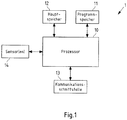
- Fig. 1 is a schematic representation of an exemplary embodiment of a control device 1 according to the invention.
- the control device 1 comprises by way of example a processor 10 and, connected to the processor 10, a first memory as program and data memory 11, a second memory as main memory 12, a wireless communication interface 13 and one or more sensors 14.
- a processor is meant, for example, a microprocessor, a microcontroller, a microcontroller, a digital signal processor (DSP), an application specific integrated circuit (ASIC) or a Field Programmable Gate Array (FPGA). It is understood that the control device 1 can also comprise a plurality of processors 10.
- DSP digital signal processor
- ASIC application specific integrated circuit
- FPGA Field Programmable Gate Array
- Processor 10 executes program instructions stored in program memory 11 and stores, for example, intermediate results or the like in main memory 12.
- Program memory 11 contains, for example, program instructions of a computer program according to the invention which comprises program instructions which cause processor 10 to carry out the method according to the invention (eg the method according to the in Fig. 3 flowchart 300) can be executed and / or controlled when the processor 10 executes these program instructions stored in program memory 11.
- Program memory 11 further includes, for example, the operating system of the control device 1, which is at least partially loaded into main memory 12 when the control device 1 is started and executed by the processor 10.
- the operating system of the control device 1 which is at least partially loaded into main memory 12 when the control device 1 is started and executed by the processor 10.
- Kernels of the operating system loaded into the main memory 12 and executed by the processor 10.
- An example of an operating system is a Windows, UNIX, Linux, Android, Apple iOS, and / or MAC OS operating system.
- the operating system in particular allows the use of the control device 1 for data processing. It manages, for example, resources such as a main memory and a program memory, provides, inter alia, through programming interfaces other computer programs basic functions and controls the execution of computer programs.
- a program memory is, for example, a non-volatile memory such as a flash memory, a magnetic memory, an EEPROM memory (electrically erasable programmable read only memory) and / or an optical memory.
- a main memory is for example a volatile or non-volatile memory, in particular a random access memory (RAM) such as a static RAM memory (SRAM), a dynamic RAM memory (DRAM), a ferroelectric RAM memory (FeRAM) and / or a magnetic RAM memory (MRAM).
- RAM random access memory
- SRAM static RAM memory
- DRAM dynamic RAM memory
- FeRAM ferroelectric RAM memory
- MRAM magnetic RAM memory
- Main memory 12 and program memory 11 may also be formed as a memory. Alternatively, main memory 12 and / or program memory 11 may each be formed by a plurality of memories. Furthermore, main memory 12 and / or program memory 11 may also be part of the processor 10.
- Processor 10 controls the wireless communication interface 13, which is designed, for example, as a WLAN interface.
- a wireless communication interface may receive and transmit information (via a wireless communication path) to the processor and / or receive and transmit information (via a wireless communication path) from the processor.
- An example of a wireless Communication Interface is a wireless network adapter.
- a wireless communication interface includes, in addition to an antenna, at least one transmitter circuit and a receiver circuit or transmitter-receiver circuit.
- the wireless communication interface 13 is configured to communicate with one or more support devices (eg, those in FIG Fig. 2 shown aircraft drone 4 and / or surveillance camera 5).
- support devices eg, those in FIG Fig. 2 shown aircraft drone 4 and / or surveillance camera 5.
- control device 1 has one or more sensors 14.
- the sensors 14 are configured to detect environmental characteristics (e.g., a measurement of a physical or chemical quantity detectable at the position of the sensor). Further, the sensors 14 are configured, for example, to provide sensor information representing the environmental characteristics sensed by the sensors 14. This sensor information comes from the sensors 14 and can be further processed by the processor 10, for example.
- the sensors 14 include, for example, one or more of the following sensors: a temperature sensor (eg, a thermometer, a thermocouple and / or a thermoresistor), a pressure sensor, a brightness sensor, a motion sensor (eg, a motion detector), an acoustic sensor (eg, a microphone and / or a sound sensor), an ultrasonic sensor, an optical sensor, an infrared sensor, a light sensor (eg a photodiode and / or a photoresistor), an image sensor (eg an image camera, a CMOS sensor and / or a CCD sensor) Video sensor (eg a video camera, a CMOS sensor and / or a CCD sensor), a chemical sensor (eg a gas sensor), a glass breakage sensor, a motion sensor, a position sensor (eg a GPS sensor), a door and / or Window opening sensor (eg a contact sensor), a fingerprint sensor and / or an acceleration sensor.
- the sensors 14 are at least partially external to the control device 1.
- the sensor information of the external sensors 14 may be received, for example, by the wireless communication interface 13 (or another wired or wireless communication interface).
- the components 10 to 14 of the control device 1 are communicatively and / or operationally interconnected, for example, via one or more bus systems (e.g., one or more serial and / or parallel bus links).
- bus systems e.g., one or more serial and / or parallel bus links.
- control device 1 may include other components (e.g., a user interface and / or another wired or wireless communication interface) in addition to the components 10 through 14.
- other components e.g., a user interface and / or another wired or wireless communication interface
- Fig. 2 shows a schematic representation of an embodiment of a system 2 according to the invention.
- the system 2 comprises an unmanned vehicle 3 and one or more support devices, for example in the form of the aerial drone 4 and / or the surveillance camera 5.
- Fig. 2 is related to Fig. 1 disclosed control device 1 by way of example as part of an unmanned vehicle 3 shown.
- the unmanned vehicle 3 is a land vehicle and has a receptacle 30 closed with a door.
- the unmanned vehicle 3 can transport a shipment.
- the unmanned vehicle 3 is a transport drone.
- the unmanned vehicle is set up for at least partially autonomous delivery of a shipment.
- the control device 1 is configured, for example, to control such at least partially autonomous delivery of a shipment by the unmanned vehicle.
- the flight drone 4 is an unmanned aircraft and, for example, set up for the at least partially autonomous delivery of a consignment.
- the aerial drone 4 is a parcel copter.
- the surveillance camera 5 is, for example, set up to automatically monitor a certain swivel area and to trigger an alarm upon detection of given events (for example an optical and / or acoustic alarm at the position of the surveillance camera 5 and / or in a surveillance center).
- given events for example an optical and / or acoustic alarm at the position of the surveillance camera 5 and / or in a surveillance center.
- the control device 1 can communicate with the aircraft drone 4 and / or the surveillance camera 5.
- the corresponding wireless communication paths are in Fig. 2 provided with the reference numerals 20 and 21.
- Fig. 3 shows a flowchart with steps of an exemplary embodiment of a method according to the invention.
- the steps 301 to 308 of the flowchart 300 are controlled by the control device 1, which is part of the unmanned vehicle 3 in system 2 (cf. Fig. 2 ) is to be executed.
- a plurality of sensor information is obtained at the control device 1.
- the sensor information from the sensors 14 represents environmental characteristics at the position of the unmanned vehicle 3.
- a step 302 it is determined at least partially as a function of the sensor information obtained in step 301, whether there is a risk.
- a hazard should be understood, for example, to mean that a certain probability (eg more than 50%, preferably more than 75%, particularly preferably more than 90%) of damage (eg a functional destruction and / or functional impairment) and / or or unauthorized use (eg theft) of a protected good.
- a certain probability eg more than 50%, preferably more than 75%, particularly preferably more than 90%
- damage eg a functional destruction and / or functional impairment
- unauthorized use eg theft
- the protective good is the unmanned vehicle 3 and / or a consignment transported by the unmanned vehicle 3. Accordingly, the determination in step 302 results in a risk, for example, if the resulting sensor information indicates that there is a certain probability of damage and / or unauthorized use of the unmanned vehicle 3 and / or of a consignment transported by the unmanned vehicle 3.
- the determination in step 302 may be in accordance with one or more predetermined rules.
- corresponding rule information representing the predetermined rules is stored in memory 11 of the control device.
- the predetermined rules for example, in the event that certain sensor information is received, pretend that there is a risk.
- the rules may dictate what type of hazard is when it is determined that there is a hazard.
- the rules may dictate that when a door opening sensor indicates that the door of the receiving compartment 30 has been opened without the control device being at the recipient's address (eg, detected by a position sensor) and / or a door opening authorization code on the control device 1 ( eg by an input on a user interface of the control device), there is a risk and that the nature of the hazard is a possible theft.
- the determination in step 302, as disclosed above can also be carried out according to a pattern recognition algorithm and / or according to a machine learning algorithm.
- step 304 If it is determined that there is a hazard, the flowchart proceeds to a step 304. Otherwise, the flowchart is ended in a step 303, for example, or restarted in step 301.
- a support offer request message is sent out and / or the sending of a support offer request message is effected.
- the support offer request message is sent out by the wireless communication interface 13 in the form of a broadcast message.
- the support offer request message is arranged to cause the flight drone 4 and the security camera 5 to offer possible assistance measures for preventing the threat in the form of a support offer message when they receive the sent out service offer request message.
- the support request request message contains, for example, hazard information which is indicative of the location of the hazard, the time of the hazard and / or the nature of the hazard.
- the flight drone 4 and the surveillance camera 5 can determine, for example, whether they can offer a possible support measure to avert the threat. For example, it may be predetermined that the surveillance camera 5 should only offer a possible support measure if the location of the danger by the surveillance camera 5 can be detected.
- a step 305 at least a first support offer message is received from a first support device in response to the support offer request message and / or the first support offer message is received.
- the first assistance offer message is received by the wireless communication interface 13 in step 305.
- the first support offer message includes support information that is indicative of the first support action of the first support device.
- the first support measure of the first support device should be understood, for example, as a first support measure that can be carried out by the first support device.
- step 305 a first support offer message is received from the flight drone 4 and a second support offer message is received by the surveillance camera 5.
- the first support offer message from the flight drone 4 includes, for example, support information indicative of a possible support action of the flight drone 4.
- this support information may indicate the current position of the aircraft drone 4 and / or the type of possible assistance action.
- the possible support measure of the aircraft drone 4 could be, for example, a hover over the unmanned vehicle 3 and a video surveillance of the unmanned vehicle 3 from the hover position. Accordingly, for example, mobile video surveillance could be indicated as the type of this possible support measure.
- the second support offer message from the security camera 5 may include, for example, support information indicative of a possible backup action of the security camera.
- this support information may indicate the type of possible support action.
- the possible supportive measure of the surveillance camera 5 could be, for example, video surveillance of the unmanned vehicle 3 and the triggering of an alarm (e.g., a visual and / or audible alarm at the location of the surveillance camera 5 and / or in a surveillance center). Accordingly, as a type of this possible support measure, for example, fixed video surveillance and alarm could be indicated.
- a step 306 it is determined, at least in part, depending on the first assistance bid message received in step 305, whether a first assistance action of the first assistance device is suitable for averting the threat. For example, determining at step 306 that the first assistance action is adapted to avert the hazard if the likelihood of damage and / or unauthorized use reduces the unmanned vehicle 3 and / or a consignment transported by the unmanned vehicle 3 by the first assistance action becomes.
- the determination in step 306 is made at least in part depending on support information included in the first support offer message and according to one or more predetermined rules.
- corresponding rule information representing the predetermined rules is stored in memory 11 of the control device 1.
- the predetermined rules can specify whether and under what conditions a support measure is suitable for warding off a certain type of hazard.
- a support measure for example, the position of the support device and / or the Date of the support measure.
- these rules may dictate that both video surveillance and the triggering of an alert are appropriate supportive measures for countering the threat.
- the determination in step 306, as disclosed above, may also be carried out according to a pattern recognition algorithm and / or according to a machine learning algorithm.
- step 306 may be performed for each of the support offer messages received in step 305 if multiple support offer messages have been received in step 305.
- the various support measures in step 306 can also be weighted according to their suitability for averting the threat, so that based on the weighting at least the support measure most suitable for warding off the threat can be determined. For example, the weighting is obtained as a result of determining whether the respective supportive measure is suitable for averting the threat. For example, the weighting is the likelihood that the particular support action will reduce the likelihood of damage and / or unauthorized use of the asset.
- step 305 receiving a first assistance offer message from the flight drone 4 and a second assistance offer message from the surveillance camera 5, it is determined at step 306 that both the potential support action of the aircraft drone 4 (ie, a hover over the unmanned Vehicle 3 and a video surveillance of the unmanned vehicle 3) and the possible supportive measure of the surveillance camera 5 (ie, a video surveillance of the unmanned vehicle 3 and the triggering of a Alarms) are suitable for averting the threat (eg of a possible theft).
- the potential support action of the aircraft drone 4 ie, a hover over the unmanned Vehicle 3 and a video surveillance of the unmanned vehicle 3
- the possible supportive measure of the surveillance camera 5 ie, a video surveillance of the unmanned vehicle 3 and the triggering of a Alarms
- step 305 If it is determined that the first support action (e.g., one of the various support actions, if multiple support offer messages were received in step 305) is suitable for warding off the hazard, the flowchart proceeds to a step 308. Otherwise, the flowchart is ended in step 307, for example, or restarted in step 301.
- the first support action e.g., one of the various support actions, if multiple support offer messages were received in step 305
- the flowchart proceeds to a step 308. Otherwise, the flowchart is ended in step 307, for example, or restarted in step 301.
- step 308 the first support action is initiated. It will be understood that in step 308, multiple or all of the various support actions may be initiated if multiple support offer messages have been received in step 305. For example, it may be predetermined that all support actions or all support actions be initiated with a certain minimum weight if the support measures are weighted in step 306.
- control device 1 causes a support device to carry out this support measure.
- control device 1 may send to the support device a support request message that is configured to cause the assistance device to perform this assistance action.
- a support request message may include assistance authorization information configured to prove authorization of the control device 1 to request assistance (eg, to support devices that belong to the same organization and / or the same enterprise as the control device belong and / or are operated by it).
- assistance authorization information configured to prove authorization of the control device 1 to request assistance (eg, to support devices that belong to the same organization and / or the same enterprise as the control device belong and / or are operated by it).
- a support device executes a support measure, for example, only if the control device 1 can prove a corresponding authorization.
- a first support offer message from the flight drone 4 and a second support offer message from the surveillance camera 5 are received, at step 308, for example, a support request message is sent to the flight drone 4 to provide support for the drone 4 (ie Hover over the unmanned vehicle 3 and video surveillance of the unmanned vehicle 3), and a support request message is sent to the surveillance camera 5 to initiate the assistance of the surveillance camera 5 (ie video surveillance of the unmanned vehicle 3 and the triggering of an alarm).
- step 304 further sensor information can be obtained and at least partially determined as a function of these further sensor information as to whether the hazard still exists. If it turns out that the hazard no longer exists, for example, a stop of the support measure (s) initiated in step 308 is initiated. Otherwise, step 304 is repeated, for example, in order to be able to initiate further support measures if necessary.
- documentation information for documenting the hazard and / or the defense against the threat is stored in memory 11 of the control device 1.
- the documentation information includes, for example, sensor information received from the sensors 14 and / or information received from one or more support devices (eg, video surveillance information of the flight drone 4 and the surveillance camera 5).
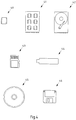
- Fig. 4 shows exemplary embodiments of storage media on which an embodiment of a computer program according to the invention can be stored.
- the storage medium may be, for example, a magnetic, electrical, optical and / or different storage medium.
- the storage medium may be part of a processor (eg, the processor 10 of the Fig. 1 ), for example a (non-volatile or volatile) program memory of the processor or a part thereof (eg memory 11 in FIG Fig. 1 ).
- Exemplary embodiments of a storage medium include a flash memory 40, an SSD hard disk 41, a magnetic hard disk 42, a memory card 43, a memory stick 44 (eg a USB stick), a CD-ROM or DVD 45 or a floppy disk 46.
Landscapes
- Physics & Mathematics (AREA)
- General Physics & Mathematics (AREA)
- Engineering & Computer Science (AREA)
- Business, Economics & Management (AREA)
- Signal Processing (AREA)
- Computer Networks & Wireless Communication (AREA)
- Economics (AREA)
- Public Health (AREA)
- Emergency Management (AREA)
- Environmental & Geological Engineering (AREA)
- Health & Medical Sciences (AREA)
- Human Resources & Organizations (AREA)
- Multimedia (AREA)
- Entrepreneurship & Innovation (AREA)
- Development Economics (AREA)
- Marketing (AREA)
- Operations Research (AREA)
- Quality & Reliability (AREA)
- Strategic Management (AREA)
- Tourism & Hospitality (AREA)
- General Business, Economics & Management (AREA)
- Theoretical Computer Science (AREA)
- Alarm Systems (AREA)
Applications Claiming Priority (1)
| Application Number | Priority Date | Filing Date | Title |
|---|---|---|---|
| DE102016120060.3A DE102016120060A1 (de) | 2016-10-20 | 2016-10-20 | Abwehren einer Gefährdung |
Publications (2)
| Publication Number | Publication Date |
|---|---|
| EP3312811A1 true EP3312811A1 (fr) | 2018-04-25 |
| EP3312811B1 EP3312811B1 (fr) | 2020-06-17 |
Family
ID=60269614
Family Applications (1)
| Application Number | Title | Priority Date | Filing Date |
|---|---|---|---|
| EP17197087.4A Active EP3312811B1 (fr) | 2016-10-20 | 2017-10-18 | Procédé de prévention d'une menace |
Country Status (4)
| Country | Link |
|---|---|
| US (1) | US11250678B2 (fr) |
| EP (1) | EP3312811B1 (fr) |
| CN (1) | CN107979742A (fr) |
| DE (1) | DE102016120060A1 (fr) |
Families Citing this family (4)
| Publication number | Priority date | Publication date | Assignee | Title |
|---|---|---|---|---|
| US11176383B2 (en) * | 2018-06-15 | 2021-11-16 | American International Group, Inc. | Hazard detection through computer vision |
| CN108564748B (zh) * | 2018-07-06 | 2023-10-31 | 长春工程学院 | 变压器防盗报警系统 |
| CN109448410A (zh) | 2018-09-26 | 2019-03-08 | 华为技术有限公司 | 一种信息处理方法、服务器和智能移动机器人 |
| US20220179090A1 (en) * | 2020-12-09 | 2022-06-09 | Pony Al Inc. | Systems and methods for detecting and addressing a potential danger |
Citations (5)
| Publication number | Priority date | Publication date | Assignee | Title |
|---|---|---|---|---|
| US20040030451A1 (en) * | 2002-04-22 | 2004-02-12 | Neal Solomon | Methods and apparatus for decision making of system of mobile robotic vehicles |
| EP1496484A1 (fr) * | 2003-07-11 | 2005-01-12 | Manfred Küsters | Système de détection et de géstion de risques. |
| US20060038678A1 (en) * | 2002-06-10 | 2006-02-23 | Shahar Avneri | Security system and method |
| WO2009147663A2 (fr) * | 2008-06-05 | 2009-12-10 | Lior Hessel | Systèmes mobiles à réponse rapide et appareil associé |
| JP2017124809A (ja) * | 2016-01-07 | 2017-07-20 | シャープ株式会社 | 自律走行車両 |
Family Cites Families (10)
| Publication number | Priority date | Publication date | Assignee | Title |
|---|---|---|---|---|
| US59688A (en) * | 1866-11-13 | Improved apparatus to be attached to stills to prevent fraud on the revenue | ||
| WO2005008914A1 (fr) * | 2003-07-10 | 2005-01-27 | University Of Florida Research Foundation, Inc. | Dispositif de soins et d'assistance intelligent mobile |
| US8245928B2 (en) * | 2008-10-23 | 2012-08-21 | Lockheed Martin Corporation | Dual band threat warning system |
| US8768609B2 (en) | 2010-02-01 | 2014-07-01 | Trimble Navigation Limited | Sensor unit system |
| US9235212B2 (en) * | 2012-05-01 | 2016-01-12 | 5D Robotics, Inc. | Conflict resolution based on object behavioral determination and collaborative relative positioning |
| US10171980B2 (en) * | 2014-04-08 | 2019-01-01 | Jason Friesen | Systems and methods for emergency response dispatch |
| US9997077B2 (en) * | 2014-09-04 | 2018-06-12 | Honda Motor Co., Ltd. | Vehicle operation assistance |
| US10234870B2 (en) * | 2016-03-14 | 2019-03-19 | Yosef Benraz | Autonomous public transportation system |
| EP3446468B1 (fr) * | 2016-04-19 | 2023-04-12 | Industrial Scientific Corporation | Synchronisation dans un réseau maillé sans fil |
| CN106005451B (zh) | 2016-08-03 | 2018-10-26 | 安徽钰龙信息科技有限公司 | 一种基于物联网的船载无人机水上行驶保护系统 |
-
2016
- 2016-10-20 DE DE102016120060.3A patent/DE102016120060A1/de not_active Withdrawn
-
2017
- 2017-10-18 EP EP17197087.4A patent/EP3312811B1/fr active Active
- 2017-10-18 US US15/787,449 patent/US11250678B2/en active Active
- 2017-10-20 CN CN201710981839.1A patent/CN107979742A/zh active Pending
Patent Citations (5)
| Publication number | Priority date | Publication date | Assignee | Title |
|---|---|---|---|---|
| US20040030451A1 (en) * | 2002-04-22 | 2004-02-12 | Neal Solomon | Methods and apparatus for decision making of system of mobile robotic vehicles |
| US20060038678A1 (en) * | 2002-06-10 | 2006-02-23 | Shahar Avneri | Security system and method |
| EP1496484A1 (fr) * | 2003-07-11 | 2005-01-12 | Manfred Küsters | Système de détection et de géstion de risques. |
| WO2009147663A2 (fr) * | 2008-06-05 | 2009-12-10 | Lior Hessel | Systèmes mobiles à réponse rapide et appareil associé |
| JP2017124809A (ja) * | 2016-01-07 | 2017-07-20 | シャープ株式会社 | 自律走行車両 |
Also Published As
| Publication number | Publication date |
|---|---|
| CN107979742A (zh) | 2018-05-01 |
| EP3312811B1 (fr) | 2020-06-17 |
| DE102016120060A1 (de) | 2018-04-26 |
| US20180114422A1 (en) | 2018-04-26 |
| US11250678B2 (en) | 2022-02-15 |
Similar Documents
| Publication | Publication Date | Title |
|---|---|---|
| EP3104340B1 (fr) | Procede et dispositif de deverrouillage et de verrouillage d'au moins une porte de vehicule pour une mise a disposition | |
| EP3312811B1 (fr) | Procédé de prévention d'une menace | |
| EP3312810B1 (fr) | Dispositif de prévention d'un danger | |
| DE102014217156B4 (de) | Fahrzeugeigene Vorrichtung und Berichterstattungsteuerungsverfahren | |
| DE102019203345A1 (de) | Verfahren zur Überwachung des Umfelds eines Fahrzeugs | |
| DE102017129076A1 (de) | Autonomer schulbus | |
| CN113971782B (zh) | 一种综合监控信息管理方法和系统 | |
| DE102016123486A1 (de) | Kind-/eindringling-erfassungswarnung durch verwenden innerer bewegungs-/schallsensoren | |
| EP3493166A1 (fr) | Procédé et dispositif pour un dispositif de rangement des envois | |
| DE102022127628A1 (de) | Überwachungssystem für unbewachte fahrzeuge | |
| CN108944799A (zh) | 车辆驾驶行为异常处理方法和装置 | |
| DE102016213682B3 (de) | Verfahren zum Sichern eines Grundstücks oder Wohngebiets mittels Fahrzeugen | |
| EP3296965A1 (fr) | Procédé de sécurisation d'un point de transfert | |
| CN115083089A (zh) | 一种基于无人机的夜间可视化监控系统及方法 | |
| EP3306578B1 (fr) | Autorisation d'ouverture d'un compartiment de réception d'un véhicule sans conducteur | |
| DE102014200567A1 (de) | Verfahren zur automatischen Übertragung von Bild- und/oder Audiodaten im Zusammenhang mit einem Unfall eines Fahrzeugs | |
| DE60211975T2 (de) | Regel- und Steuervorrichtung zur Überwachung, zur Neutralisation und/oder zur Vernichtung von Wertsachen, Dokumenten und/oder Gegenständen | |
| DE102022102223A1 (de) | Detektion, überwachung und meldung einer nahegelegenen vorrichtung | |
| DE102023128211A1 (de) | System und Verfahren zur automatischen Fahrzeugsicherung über drahtlose Verbindung und lokale Ereignisse | |
| EP3616858A2 (fr) | Procédé et dispositif de documentation d'un état d'un robot autonome | |
| DE102018210959B4 (de) | Verfahren zur Überwachung einer Verkehrskomponente, insbesondere eines Kraftfahrzeugs, auf eine unautorisierte Aktivität, sowie System | |
| EP2602161B1 (fr) | Système et procédé de détection et/ou prévention des rongements d'animaux sur les véhicules, programme informatique et produit de programme informatique | |
| DE102017109370A1 (de) | Verfahren zur Überwachung mittels eines fernsteuerbaren Fahrzeugs, insbesondere einer Drohne | |
| DE112016006803T5 (de) | Verfahren und Vorrichtung zur Ereignissituationvorhersage | |
| DE102014002665B4 (de) | Verfahren zum Verknüpfen einer mobilen Lokalisierungseinheit mit einer mobilen Überwachungseinheit |
Legal Events
| Date | Code | Title | Description |
|---|---|---|---|
| PUAI | Public reference made under article 153(3) epc to a published international application that has entered the european phase |
Free format text: ORIGINAL CODE: 0009012 |
|
| STAA | Information on the status of an ep patent application or granted ep patent |
Free format text: STATUS: THE APPLICATION HAS BEEN PUBLISHED |
|
| AK | Designated contracting states |
Kind code of ref document: A1 Designated state(s): AL AT BE BG CH CY CZ DE DK EE ES FI FR GB GR HR HU IE IS IT LI LT LU LV MC MK MT NL NO PL PT RO RS SE SI SK SM TR |
|
| AX | Request for extension of the european patent |
Extension state: BA ME |
|
| STAA | Information on the status of an ep patent application or granted ep patent |
Free format text: STATUS: REQUEST FOR EXAMINATION WAS MADE |
|
| 17P | Request for examination filed |
Effective date: 20180927 |
|
| RBV | Designated contracting states (corrected) |
Designated state(s): AL AT BE BG CH CY CZ DE DK EE ES FI FR GB GR HR HU IE IS IT LI LT LU LV MC MK MT NL NO PL PT RO RS SE SI SK SM TR |
|
| GRAP | Despatch of communication of intention to grant a patent |
Free format text: ORIGINAL CODE: EPIDOSNIGR1 |
|
| STAA | Information on the status of an ep patent application or granted ep patent |
Free format text: STATUS: GRANT OF PATENT IS INTENDED |
|
| INTG | Intention to grant announced |
Effective date: 20200306 |
|
| RIN1 | Information on inventor provided before grant (corrected) |
Inventor name: WIECHERS, RALPH Inventor name: IBACH, CHRISTIAN |
|
| GRAS | Grant fee paid |
Free format text: ORIGINAL CODE: EPIDOSNIGR3 |
|
| GRAA | (expected) grant |
Free format text: ORIGINAL CODE: 0009210 |
|
| STAA | Information on the status of an ep patent application or granted ep patent |
Free format text: STATUS: THE PATENT HAS BEEN GRANTED |
|
| AK | Designated contracting states |
Kind code of ref document: B1 Designated state(s): AL AT BE BG CH CY CZ DE DK EE ES FI FR GB GR HR HU IE IS IT LI LT LU LV MC MK MT NL NO PL PT RO RS SE SI SK SM TR |
|
| REG | Reference to a national code |
Ref country code: GB Ref legal event code: FG4D Free format text: NOT ENGLISH |
|
| REG | Reference to a national code |
Ref country code: CH Ref legal event code: EP |
|
| REG | Reference to a national code |
Ref country code: IE Ref legal event code: FG4D Free format text: LANGUAGE OF EP DOCUMENT: GERMAN |
|
| REG | Reference to a national code |
Ref country code: DE Ref legal event code: R096 Ref document number: 502017005718 Country of ref document: DE |
|
| REG | Reference to a national code |
Ref country code: AT Ref legal event code: REF Ref document number: 1282282 Country of ref document: AT Kind code of ref document: T Effective date: 20200715 |
|
| PG25 | Lapsed in a contracting state [announced via postgrant information from national office to epo] |
Ref country code: NO Free format text: LAPSE BECAUSE OF FAILURE TO SUBMIT A TRANSLATION OF THE DESCRIPTION OR TO PAY THE FEE WITHIN THE PRESCRIBED TIME-LIMIT Effective date: 20200917 Ref country code: GR Free format text: LAPSE BECAUSE OF FAILURE TO SUBMIT A TRANSLATION OF THE DESCRIPTION OR TO PAY THE FEE WITHIN THE PRESCRIBED TIME-LIMIT Effective date: 20200918 Ref country code: SE Free format text: LAPSE BECAUSE OF FAILURE TO SUBMIT A TRANSLATION OF THE DESCRIPTION OR TO PAY THE FEE WITHIN THE PRESCRIBED TIME-LIMIT Effective date: 20200617 Ref country code: FI Free format text: LAPSE BECAUSE OF FAILURE TO SUBMIT A TRANSLATION OF THE DESCRIPTION OR TO PAY THE FEE WITHIN THE PRESCRIBED TIME-LIMIT Effective date: 20200617 Ref country code: LT Free format text: LAPSE BECAUSE OF FAILURE TO SUBMIT A TRANSLATION OF THE DESCRIPTION OR TO PAY THE FEE WITHIN THE PRESCRIBED TIME-LIMIT Effective date: 20200617 |
|
| REG | Reference to a national code |
Ref country code: LT Ref legal event code: MG4D |
|
| REG | Reference to a national code |
Ref country code: NL Ref legal event code: MP Effective date: 20200617 |
|
| PG25 | Lapsed in a contracting state [announced via postgrant information from national office to epo] |
Ref country code: HR Free format text: LAPSE BECAUSE OF FAILURE TO SUBMIT A TRANSLATION OF THE DESCRIPTION OR TO PAY THE FEE WITHIN THE PRESCRIBED TIME-LIMIT Effective date: 20200617 Ref country code: BG Free format text: LAPSE BECAUSE OF FAILURE TO SUBMIT A TRANSLATION OF THE DESCRIPTION OR TO PAY THE FEE WITHIN THE PRESCRIBED TIME-LIMIT Effective date: 20200917 Ref country code: LV Free format text: LAPSE BECAUSE OF FAILURE TO SUBMIT A TRANSLATION OF THE DESCRIPTION OR TO PAY THE FEE WITHIN THE PRESCRIBED TIME-LIMIT Effective date: 20200617 Ref country code: RS Free format text: LAPSE BECAUSE OF FAILURE TO SUBMIT A TRANSLATION OF THE DESCRIPTION OR TO PAY THE FEE WITHIN THE PRESCRIBED TIME-LIMIT Effective date: 20200617 |
|
| PG25 | Lapsed in a contracting state [announced via postgrant information from national office to epo] |
Ref country code: NL Free format text: LAPSE BECAUSE OF FAILURE TO SUBMIT A TRANSLATION OF THE DESCRIPTION OR TO PAY THE FEE WITHIN THE PRESCRIBED TIME-LIMIT Effective date: 20200617 Ref country code: AL Free format text: LAPSE BECAUSE OF FAILURE TO SUBMIT A TRANSLATION OF THE DESCRIPTION OR TO PAY THE FEE WITHIN THE PRESCRIBED TIME-LIMIT Effective date: 20200617 |
|
| PG25 | Lapsed in a contracting state [announced via postgrant information from national office to epo] |
Ref country code: PT Free format text: LAPSE BECAUSE OF FAILURE TO SUBMIT A TRANSLATION OF THE DESCRIPTION OR TO PAY THE FEE WITHIN THE PRESCRIBED TIME-LIMIT Effective date: 20201019 Ref country code: IT Free format text: LAPSE BECAUSE OF FAILURE TO SUBMIT A TRANSLATION OF THE DESCRIPTION OR TO PAY THE FEE WITHIN THE PRESCRIBED TIME-LIMIT Effective date: 20200617 Ref country code: EE Free format text: LAPSE BECAUSE OF FAILURE TO SUBMIT A TRANSLATION OF THE DESCRIPTION OR TO PAY THE FEE WITHIN THE PRESCRIBED TIME-LIMIT Effective date: 20200617 Ref country code: SM Free format text: LAPSE BECAUSE OF FAILURE TO SUBMIT A TRANSLATION OF THE DESCRIPTION OR TO PAY THE FEE WITHIN THE PRESCRIBED TIME-LIMIT Effective date: 20200617 Ref country code: RO Free format text: LAPSE BECAUSE OF FAILURE TO SUBMIT A TRANSLATION OF THE DESCRIPTION OR TO PAY THE FEE WITHIN THE PRESCRIBED TIME-LIMIT Effective date: 20200617 Ref country code: CZ Free format text: LAPSE BECAUSE OF FAILURE TO SUBMIT A TRANSLATION OF THE DESCRIPTION OR TO PAY THE FEE WITHIN THE PRESCRIBED TIME-LIMIT Effective date: 20200617 Ref country code: ES Free format text: LAPSE BECAUSE OF FAILURE TO SUBMIT A TRANSLATION OF THE DESCRIPTION OR TO PAY THE FEE WITHIN THE PRESCRIBED TIME-LIMIT Effective date: 20200617 |
|
| PG25 | Lapsed in a contracting state [announced via postgrant information from national office to epo] |
Ref country code: SK Free format text: LAPSE BECAUSE OF FAILURE TO SUBMIT A TRANSLATION OF THE DESCRIPTION OR TO PAY THE FEE WITHIN THE PRESCRIBED TIME-LIMIT Effective date: 20200617 Ref country code: PL Free format text: LAPSE BECAUSE OF FAILURE TO SUBMIT A TRANSLATION OF THE DESCRIPTION OR TO PAY THE FEE WITHIN THE PRESCRIBED TIME-LIMIT Effective date: 20200617 Ref country code: IS Free format text: LAPSE BECAUSE OF FAILURE TO SUBMIT A TRANSLATION OF THE DESCRIPTION OR TO PAY THE FEE WITHIN THE PRESCRIBED TIME-LIMIT Effective date: 20201017 |
|
| REG | Reference to a national code |
Ref country code: DE Ref legal event code: R097 Ref document number: 502017005718 Country of ref document: DE |
|
| PLBE | No opposition filed within time limit |
Free format text: ORIGINAL CODE: 0009261 |
|
| STAA | Information on the status of an ep patent application or granted ep patent |
Free format text: STATUS: NO OPPOSITION FILED WITHIN TIME LIMIT |
|
| PG25 | Lapsed in a contracting state [announced via postgrant information from national office to epo] |
Ref country code: DK Free format text: LAPSE BECAUSE OF FAILURE TO SUBMIT A TRANSLATION OF THE DESCRIPTION OR TO PAY THE FEE WITHIN THE PRESCRIBED TIME-LIMIT Effective date: 20200617 |
|
| 26N | No opposition filed |
Effective date: 20210318 |
|
| PG25 | Lapsed in a contracting state [announced via postgrant information from national office to epo] |
Ref country code: SI Free format text: LAPSE BECAUSE OF FAILURE TO SUBMIT A TRANSLATION OF THE DESCRIPTION OR TO PAY THE FEE WITHIN THE PRESCRIBED TIME-LIMIT Effective date: 20200617 |
|
| REG | Reference to a national code |
Ref country code: CH Ref legal event code: PL |
|
| PG25 | Lapsed in a contracting state [announced via postgrant information from national office to epo] |
Ref country code: LU Free format text: LAPSE BECAUSE OF NON-PAYMENT OF DUE FEES Effective date: 20201018 Ref country code: MC Free format text: LAPSE BECAUSE OF FAILURE TO SUBMIT A TRANSLATION OF THE DESCRIPTION OR TO PAY THE FEE WITHIN THE PRESCRIBED TIME-LIMIT Effective date: 20200617 |
|
| REG | Reference to a national code |
Ref country code: BE Ref legal event code: MM Effective date: 20201031 |
|
| PG25 | Lapsed in a contracting state [announced via postgrant information from national office to epo] |
Ref country code: LI Free format text: LAPSE BECAUSE OF NON-PAYMENT OF DUE FEES Effective date: 20201031 Ref country code: CH Free format text: LAPSE BECAUSE OF NON-PAYMENT OF DUE FEES Effective date: 20201031 Ref country code: BE Free format text: LAPSE BECAUSE OF NON-PAYMENT OF DUE FEES Effective date: 20201031 |
|
| PG25 | Lapsed in a contracting state [announced via postgrant information from national office to epo] |
Ref country code: IE Free format text: LAPSE BECAUSE OF NON-PAYMENT OF DUE FEES Effective date: 20201018 |
|
| PG25 | Lapsed in a contracting state [announced via postgrant information from national office to epo] |
Ref country code: TR Free format text: LAPSE BECAUSE OF FAILURE TO SUBMIT A TRANSLATION OF THE DESCRIPTION OR TO PAY THE FEE WITHIN THE PRESCRIBED TIME-LIMIT Effective date: 20200617 Ref country code: MT Free format text: LAPSE BECAUSE OF FAILURE TO SUBMIT A TRANSLATION OF THE DESCRIPTION OR TO PAY THE FEE WITHIN THE PRESCRIBED TIME-LIMIT Effective date: 20200617 Ref country code: CY Free format text: LAPSE BECAUSE OF FAILURE TO SUBMIT A TRANSLATION OF THE DESCRIPTION OR TO PAY THE FEE WITHIN THE PRESCRIBED TIME-LIMIT Effective date: 20200617 |
|
| PG25 | Lapsed in a contracting state [announced via postgrant information from national office to epo] |
Ref country code: MK Free format text: LAPSE BECAUSE OF FAILURE TO SUBMIT A TRANSLATION OF THE DESCRIPTION OR TO PAY THE FEE WITHIN THE PRESCRIBED TIME-LIMIT Effective date: 20200617 |
|
| P01 | Opt-out of the competence of the unified patent court (upc) registered |
Effective date: 20230517 |
|
| REG | Reference to a national code |
Ref country code: AT Ref legal event code: MM01 Ref document number: 1282282 Country of ref document: AT Kind code of ref document: T Effective date: 20221018 |
|
| PG25 | Lapsed in a contracting state [announced via postgrant information from national office to epo] |
Ref country code: AT Free format text: LAPSE BECAUSE OF NON-PAYMENT OF DUE FEES Effective date: 20221018 |
|
| PGFP | Annual fee paid to national office [announced via postgrant information from national office to epo] |
Ref country code: DE Payment date: 20251021 Year of fee payment: 9 |
|
| PGFP | Annual fee paid to national office [announced via postgrant information from national office to epo] |
Ref country code: GB Payment date: 20251023 Year of fee payment: 9 |
|
| PGFP | Annual fee paid to national office [announced via postgrant information from national office to epo] |
Ref country code: FR Payment date: 20251021 Year of fee payment: 9 |