EP3316213A1 - Systèmes et procédés pour améliorer la qualité de médias visuels - Google Patents
Systèmes et procédés pour améliorer la qualité de médias visuels Download PDFInfo
- Publication number
- EP3316213A1 EP3316213A1 EP17195408.4A EP17195408A EP3316213A1 EP 3316213 A1 EP3316213 A1 EP 3316213A1 EP 17195408 A EP17195408 A EP 17195408A EP 3316213 A1 EP3316213 A1 EP 3316213A1
- Authority
- EP
- European Patent Office
- Prior art keywords
- image
- neighboring
- frames
- image media
- frame
- Prior art date
- Legal status (The legal status is an assumption and is not a legal conclusion. Google has not performed a legal analysis and makes no representation as to the accuracy of the status listed.)
- Withdrawn
Links
Images

Classifications
-
- G—PHYSICS
- G06—COMPUTING OR CALCULATING; COUNTING
- G06T—IMAGE DATA PROCESSING OR GENERATION, IN GENERAL
- G06T5/00—Image enhancement or restoration
- G06T5/90—Dynamic range modification of images or parts thereof
-
- G—PHYSICS
- G06—COMPUTING OR CALCULATING; COUNTING
- G06T—IMAGE DATA PROCESSING OR GENERATION, IN GENERAL
- G06T5/00—Image enhancement or restoration
- G06T5/50—Image enhancement or restoration using two or more images, e.g. averaging or subtraction
-
- G—PHYSICS
- G06—COMPUTING OR CALCULATING; COUNTING
- G06T—IMAGE DATA PROCESSING OR GENERATION, IN GENERAL
- G06T2207/00—Indexing scheme for image analysis or image enhancement
- G06T2207/10—Image acquisition modality
- G06T2207/10016—Video; Image sequence
-
- G—PHYSICS
- G06—COMPUTING OR CALCULATING; COUNTING
- G06T—IMAGE DATA PROCESSING OR GENERATION, IN GENERAL
- G06T2207/00—Indexing scheme for image analysis or image enhancement
- G06T2207/20—Special algorithmic details
- G06T2207/20172—Image enhancement details
- G06T2207/20208—High dynamic range [HDR] image processing
-
- G—PHYSICS
- G06—COMPUTING OR CALCULATING; COUNTING
- G06T—IMAGE DATA PROCESSING OR GENERATION, IN GENERAL
- G06T2207/00—Indexing scheme for image analysis or image enhancement
- G06T2207/20—Special algorithmic details
- G06T2207/20212—Image combination
- G06T2207/20221—Image fusion; Image merging
Definitions
- the present disclosure relates to image processing, more particularly the disclosure relates to enhancing the quality of images or videos while restoration from digitization.
- Digitization of images and especially old movies is a relatively new concept.
- Digitization of images and especially old movies is a relatively new concept.
- After digitization, these movies are then further processed to restoration in order to improve the overall quality of the video.
- Restoration step helps to crop out black borders, reduces noise, removes dust spots, reduces luminosity fluctuation and more.
- This is generally followed by a color grading step that helps to alter and enhance color of the video. This can be done either electronically, photo-chemically or digitally.
- the photo-chemical process is also referred to as color timing and is typically performed at a photographic laboratory.
- a method for enhancing quality of image media includes acquiring by a processor, the image media, wherein the image media includes a plurality of image frames. Further, the processor identifies an image frame, from the plurality of image frames whose quality is to be enhanced. The method further, includes isolating a plurality of neighboring frames by the processor, wherein the plurality of neighboring frames has similar properties. Further, the processor forms processed neighboring frames, by moving each pixel of each of the neighboring frame from the plurality of neighboring images to correspond to the image media. Further, this step is repeated for all of the plurality of neighboring frames. These processed frames are stacked and a composite image of enhanced quality is generated.
- a system for enhancing the quality of image media comprises a processor, and a computer readable medium which when executed by the processor causes the processor to perform a method.
- the method includes acquiring by a processor, the image media, wherein the image media includes a plurality of image frames.
- the method further, includes isolating a plurality of neighboring frames by the processor, wherein the plurality of neighboring frames has similar properties.
- the processor forms processed neighboring frames, by moving each pixel of each of the neighboring frame from the plurality of neighboring frames to correspond to the image media. Further, this step is repeated for all of the plurality of neighboring frames.
- a non-transitory computer readable storage medium for enhancing quality of image media, when executed by a computing device, causes the computing device to perform a method.
- the method includes acquiring by a processor, the image media, wherein the image media includes a plurality of image frames.
- the method includes isolating a plurality of neighboring frames by the processor, wherein the plurality of neighboring frames has similar properties.
- the processor forms processed neighboring frames, by moving each pixel of each of the neighboring frame from the plurality of neighboring frame to correspond to the image media. Further, this step is repeated for all of the plurality of neighboring frames. These processed frames are stacked and a composite image of enhanced quality is generated.
- Image media can be a video or burst images.
- the image media is storable in a digital file in a conventional picture or video encoding format such as e.g. RAW, JPEG or PNG, AVI, MOV, etc. Further, this image media is also displayable on conventional and new age displays such as a display screen.
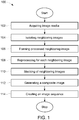
- image media is acquired by a processor to initiate enhancement of the image media.
- the image media acquired can be previously stored as digital files, or from an imaging sensor.
- the image media includes images that can be stored in digital files in a conventional picture encoding format such as e.g. RAW, JPEG or PNG, AVI, MOV, etc.
- image media can also be displayed on a conventional display device such as a screen.
- the image media may also be encoded in 8 bits, or 16 bits per color.
- the enhanced version of the image media will also be encoded in same format as the image media.
- the image media and the enhanced version are coded pictures on a comparable number of color intensity levels.
- the image media includes a plurality of image frames.
- Exposure level of a frame is a function of the amount of light or light energy received at the imaging sensor, for an incident light intensity on the given optical imaging system. This exposure level depends in particular the opening of the imaging device and the exposure time of the sensor.
- the exposure level is expressed in indices EV IL, i.e. "Exposure Value" Ev.
- Ev Exposure Value
- a +/- 1 Ev (or +/- 1 EV) of the exposure level corresponds respectively to a making half or double of the amount of light incident on the imaging sensor (for a light intensity incident on the optical system data imaging).
- the neighboring images it is preferable that the neighboring images to be as similar as possible. Neighboring images can be acquired for e.g. in burst mode or continuous acquisition mode with a digital camera, in a very short time interval.
- devices available in the market can acquire up to 60 frames per second or even more, and / or create videos at 24 or 60 frames /s. This allows to acquire images with short exposure time (1/1000 for instance), and so it helps in minimizing blur due to movements.
- a processed neighboring image is formed.
- each pixel of the neighboring image out of the plurality of neighboring images is moved.
- the movement of pixels is so as to correspond completely to the image media identified to be enhanced.
- the previous process of step 106 is re-executed for all the plurality of identified neighboring frames. Hence forming a set of processed neighboring frames.
- step 110 all the processed neighboring frames, are stacked up together to generate a composite image at a further step 112.
- This composite image is the enhanced version of the image media.
- the composite image is on the same format as the acquired image media. Summation of each pixel of the neighboring frames is performed. This summation generates a noise only due to the addition of each pixel noise and no additional noise are created as a result of the summation.
- SNR (X, Y) is the signal to noise ratio of the pixel in the neighboring frames in the image media.
- N 1/ ⁇
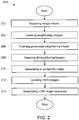
- step 202 image media is acquired by a processor. Details of this step have been described earlier in conjunction to FIG. 1 .
- the processor performs isolation of neighboring frames. Details of the step have been described above in conjunction with FIG. 1
- the processor performs isolation of neighboring frames. Details of the step have been described above in conjunction with FIG. 1
- the processed neighboring frames are formed by moving entire pixel map or all the neighboring frames in order to correspond to the image media to be enhanced. Each pixel of the neighboring frame is moved to correspond to the image media.
- the image media acquired, thereafter at step 204, undergoes an identification, wherein the processor further identifies an image sequence within the image media that needs to be enhanced. This is done by determining and comparing moisture, dust spots and pixels within the image sequence.
- step 208 stacking of these processed neighboring frames takes place.
- the changed pixel map of each processed neighboring frames is placed one over the other in order to produce an enhanced or composite image.
- Summation of each pixel of the meighboring frames is performed. The summation generates a noise only due to the addition of each pixel noise and no additional noise are created as a result of the summation.
- SNRc(X, Y) N / ⁇ (N) x SNR (X, Y)
- SNR (X, Y) is the signal to noise ratio of the pixel in the neighboring frames in the image media pixel.
- an enhanced composite image is formed.
- This composite image has very less noise level. Therefore, an object can be detectable in the composite image whereas, in the image media the object is not clearly detected because it is buried in noise.
- This process of digital summation of N processed neighboring frames generates for low lights, a result comparable with that, which would produce an increase by a factor of N exposure level on the imaging sensor in the acquisition of image media, albeit with significant advantages: - the motion sensitivity is less, since acquisitions can be done with short exposure time and the neighboring frames are readjusted before to be combined, there is no saturation effects in the highlights because there is no coding dynamic problems.
- Method 200 further involves a step 212, wherein high dynamic range (HDR) images of the composite image are processed.
- the composite image as obtained at step 210 includes all the useful information in areas of low, medium and high exposure.
- the composite image is coded high dynamics that is for e.g. 32 bits so as to be directly displayed on a display device with both the shadowed areas and highlight areas distinctly reproduced. Therefore, an HDR image, that can be stored in a digital file with a classic encoding format that is 8 or 16 bits per color. Whereas correct representation of areas of high and low lights is allowed.
- multiple composite images correspond to images of different exposure levels. It recreates images as they would have been obtained by varying the exposure. For example: - to reproduce the equivalent of shooting with levels of one show +1, 0, -1 Ev, it must generate three composite images with at least 1, 2, and 4 neighboring frames to obtain the equivalent of shooting with exposure levels of +2, 0, -2 Ev, it must generate three composite images with at least 1, 4 and 16 images.
- the composite images are then normalized on a dynamic of M levels corresponding to the dynamics of the HDR image.
- This standardization is carried out to reproduce the sensor saturation process: - the pixels of the composite image whose intensity level is lower than the peak intensity levels M, retain their value, the pixels of the composite images, whose intensity level is higher than the maximum level of intensity M, take the maximum level of intensity M. If the composite image of lower dynamic is generated from 5 to more than a picture of acquisition, intensity levels are also normalized accordingly.
- the HDR image is then generated by using an exposure fusion technique ("exposure blending"): - the light areas corresponding to areas of low lights of the scene are taken from the composite image with the highest level of exposure, and the light areas corresponding to areas of medium stage lights are extracted from the composite image with the average level of exposure, the light areas corresponding to highlight areas of the scene are taken from the composite image with the level of the lowest exposure, that is to say one that is generated with one image acquisition. The extractions of the light areas are based on the levels of intensity of the pixels that compose them. The light areas corresponding to zones of low, medium and high lights are then combined to generate the HDR image.
- exposure blending an exposure fusion technique
- all HDR images processed are patched together to form a sequence of images may be in burst mode or in a video.
- Image media 300 includes multiple neighboring frames 302a-302n which will be collectively named as neighboring frames 302. These neighboring frames have similar properties. These properties include exposure levels. So all the neighboring frames are of similar exposure. These neighboring frames 302 are then processed, wherein each and every pixel of the neighboring frames 302 are moved so that they correspond to the image media 300. The processed neighboring frames 304a-304n are then stacked together as displayed in FIG. 3 to obtain a final enhanced composite image 306. In further steps, these composite images 306 can be further processed to obtain HDR images or videos.
- each block in the flowchart or block diagrams may represent a module, segment, or portion of instructions, which comprises one or more executable instructions for implementing the specified logical function(s).
- the functions noted in the block may occur out of the order noted in the figures.
- two blocks shown in succession may, in fact, be executed substantially concurrently, or the blocks may sometimes be executed in the reverse order, depending upon the functionality involved.
Landscapes
- Physics & Mathematics (AREA)
- General Physics & Mathematics (AREA)
- Engineering & Computer Science (AREA)
- Theoretical Computer Science (AREA)
- Studio Devices (AREA)
- Image Processing (AREA)
Applications Claiming Priority (1)
| Application Number | Priority Date | Filing Date | Title |
|---|---|---|---|
| US15/338,503 US9607365B1 (en) | 2016-10-31 | 2016-10-31 | Systems and methods for enhancing quality of image media |
Publications (1)
| Publication Number | Publication Date |
|---|---|
| EP3316213A1 true EP3316213A1 (fr) | 2018-05-02 |
Family
ID=58359641
Family Applications (1)
| Application Number | Title | Priority Date | Filing Date |
|---|---|---|---|
| EP17195408.4A Withdrawn EP3316213A1 (fr) | 2016-10-31 | 2017-10-09 | Systèmes et procédés pour améliorer la qualité de médias visuels |
Country Status (2)
| Country | Link |
|---|---|
| US (1) | US9607365B1 (fr) |
| EP (1) | EP3316213A1 (fr) |
Families Citing this family (3)
| Publication number | Priority date | Publication date | Assignee | Title |
|---|---|---|---|---|
| US11054431B2 (en) * | 2018-10-19 | 2021-07-06 | Diagnostic Instruments, Inc. | Barcode scanning of bulk sample containers |
| US11941478B2 (en) | 2018-10-19 | 2024-03-26 | Diagnostics Instruments, Inc. | Barcode scanning of bulk sample containers |
| CN109934776B (zh) * | 2018-12-25 | 2021-05-25 | 北京奇艺世纪科技有限公司 | 模型生成方法、视频增强方法、装置及计算机可读存储介质 |
Citations (1)
| Publication number | Priority date | Publication date | Assignee | Title |
|---|---|---|---|---|
| FR2996034A1 (fr) * | 2012-09-24 | 2014-03-28 | Jacques Joffre | Procede pour creer des images a gamme dynamique etendue en imagerie fixe et video, et dispositif d'imagerie implementant le procede. |
Family Cites Families (8)
| Publication number | Priority date | Publication date | Assignee | Title |
|---|---|---|---|---|
| CA2158988C (fr) * | 1993-03-25 | 2000-06-13 | Bruno Delean | Methode et systeme de traitement des images |
| JP3851384B2 (ja) * | 1996-09-18 | 2006-11-29 | シャープ株式会社 | 画像合成装置および方法 |
| JPH11205648A (ja) * | 1998-01-09 | 1999-07-30 | Olympus Optical Co Ltd | 画像合成装置 |
| US7729563B2 (en) * | 2002-08-28 | 2010-06-01 | Fujifilm Corporation | Method and device for video image processing, calculating the similarity between video frames, and acquiring a synthesized frame by synthesizing a plurality of contiguous sampled frames |
| JP4151422B2 (ja) * | 2003-01-23 | 2008-09-17 | セイコーエプソン株式会社 | 画像生成装置、画像生成方法および画像生成プログラム |
| US8878950B2 (en) * | 2010-12-14 | 2014-11-04 | Pelican Imaging Corporation | Systems and methods for synthesizing high resolution images using super-resolution processes |
| US8861893B2 (en) * | 2011-09-27 | 2014-10-14 | The Boeing Company | Enhancing video using super-resolution |
| KR20140135968A (ko) * | 2012-03-05 | 2014-11-27 | 톰슨 라이센싱 | 초해상도화를 수행하는 방법 및 장치 |
-
2016
- 2016-10-31 US US15/338,503 patent/US9607365B1/en active Active
-
2017
- 2017-10-09 EP EP17195408.4A patent/EP3316213A1/fr not_active Withdrawn
Patent Citations (1)
| Publication number | Priority date | Publication date | Assignee | Title |
|---|---|---|---|---|
| FR2996034A1 (fr) * | 2012-09-24 | 2014-03-28 | Jacques Joffre | Procede pour creer des images a gamme dynamique etendue en imagerie fixe et video, et dispositif d'imagerie implementant le procede. |
Non-Patent Citations (1)
| Title |
|---|
| SCHALLAUER P ET AL: "Automatic Restoration Algorithms for 35mm Film", VIDERE: JOURNAL OF COMPUTER VISION RESEARCH, MASSACHUSETTS INSTITUTE OF TECHNOLOGY, US, vol. 1, no. 3, 1 January 1999 (1999-01-01), pages 60 - 85, XP002382262, ISSN: 1089-2788 * |
Also Published As
| Publication number | Publication date |
|---|---|
| US9607365B1 (en) | 2017-03-28 |
Similar Documents
| Publication | Publication Date | Title |
|---|---|---|
| David Stump | Digital cinematography: fundamentals, tools, techniques, and workflows | |
| CN105323497B (zh) | 恒定包围的高动态范围(cHDR)操作 | |
| Phillips et al. | Camera image quality benchmarking | |
| US9679366B2 (en) | Guided color grading for extended dynamic range | |
| CN111491148B (zh) | 显示方法 | |
| Andriani et al. | Beyond the Kodak image set: A new reference set of color image sequences | |
| Artusi et al. | High dynamic range imaging technology [lecture notes] | |
| US20180109711A1 (en) | Method and device for overexposed photography | |
| US11876987B2 (en) | Video encoder and encoding method | |
| TR201901751T4 (tr) | Bir hdr videonun bir ldr video ile birlikte kodlanmasına yönelik yöntem ve cihaz, birlikte kodlanan bir hdr video ve bir ldr videodan birinin yeniden yapılandırılmasına yönelik yöntem ve cihaz ve geçici olmayan depolama ortamı. | |
| EP2958076A1 (fr) | Procédé et appareil d'expansion de plage dynamique de séquence vidéo LDR | |
| CN101953152A (zh) | 摄像系统、摄像方法、和用于存储程序的计算机可读取介质 | |
| US20160323596A1 (en) | Method and apparatus for producing a video stream | |
| EP3316213A1 (fr) | Systèmes et procédés pour améliorer la qualité de médias visuels | |
| Parker et al. | Digital video processing for engineers: A foundation for embedded systems design | |
| US9860456B1 (en) | Bayer-clear image fusion for dual camera | |
| Vien et al. | Single-shot high dynamic range imaging via multiscale convolutional neural network | |
| CN101706962A (zh) | 图像边缘提取方法 | |
| WO2023083466A1 (fr) | Dispositif d'imagerie à plage dynamique élevée et procédé de génération d'une image à plage dynamique élevée | |
| US12096163B2 (en) | Device and a method of encoding images including a privacy filter | |
| CN112581365B (zh) | 一种跨尺度自适应信息映射成像方法及装置、介质 | |
| CN114266696B (zh) | 图像处理方法、装置、电子设备和计算机可读存储介质 | |
| EP2180692A1 (fr) | Procédé et dispositif de production d'images numériques | |
| Lim et al. | Learning-based Framework for Color Conversion between Digital Cinema Package and Streaming Movie | |
| Wheeler et al. | The effect of single-sensor CFA captures on images intended for motion picture and TV applications |
Legal Events
| Date | Code | Title | Description |
|---|---|---|---|
| PUAI | Public reference made under article 153(3) epc to a published international application that has entered the european phase |
Free format text: ORIGINAL CODE: 0009012 |
|
| 17P | Request for examination filed |
Effective date: 20171009 |
|
| AK | Designated contracting states |
Kind code of ref document: A1 Designated state(s): AL AT BE BG CH CY CZ DE DK EE ES FI FR GB GR HR HU IE IS IT LI LT LU LV MC MK MT NL NO PL PT RO RS SE SI SK SM TR |
|
| AX | Request for extension of the european patent |
Extension state: BA ME |
|
| 17Q | First examination report despatched |
Effective date: 20190227 |
|
| STAA | Information on the status of an ep patent application or granted ep patent |
Free format text: STATUS: THE APPLICATION IS DEEMED TO BE WITHDRAWN |
|
| 18D | Application deemed to be withdrawn |
Effective date: 20190710 |