EP3316912B1 - Verfahren zur herstellung von proben mit hochpolarisierten kernspins - Google Patents
Verfahren zur herstellung von proben mit hochpolarisierten kernspins Download PDFInfo
- Publication number
- EP3316912B1 EP3316912B1 EP16817376.3A EP16817376A EP3316912B1 EP 3316912 B1 EP3316912 B1 EP 3316912B1 EP 16817376 A EP16817376 A EP 16817376A EP 3316912 B1 EP3316912 B1 EP 3316912B1
- Authority
- EP
- European Patent Office
- Prior art keywords
- sample
- vessel
- gas
- nmr
- radicals
- Prior art date
- Legal status (The legal status is an assumption and is not a legal conclusion. Google has not performed a legal analysis and makes no representation as to the accuracy of the status listed.)
- Active
Links
Images




Classifications
-
- G—PHYSICS
- G01—MEASURING; TESTING
- G01R—MEASURING ELECTRIC VARIABLES; MEASURING MAGNETIC VARIABLES
- G01R33/00—Arrangements or instruments for measuring magnetic variables
- G01R33/20—Arrangements or instruments for measuring magnetic variables involving magnetic resonance
- G01R33/44—Arrangements or instruments for measuring magnetic variables involving magnetic resonance using nuclear magnetic resonance [NMR]
- G01R33/48—NMR imaging systems
- G01R33/54—Signal processing systems, e.g. using pulse sequences ; Generation or control of pulse sequences; Operator console
- G01R33/56—Image enhancement or correction, e.g. subtraction or averaging techniques, e.g. improvement of signal-to-noise ratio and resolution
- G01R33/5601—Image enhancement or correction, e.g. subtraction or averaging techniques, e.g. improvement of signal-to-noise ratio and resolution involving use of a contrast agent for contrast manipulation, e.g. a paramagnetic, super-paramagnetic, ferromagnetic or hyperpolarised contrast agent
-
- A—HUMAN NECESSITIES
- A61—MEDICAL OR VETERINARY SCIENCE; HYGIENE
- A61B—DIAGNOSIS; SURGERY; IDENTIFICATION
- A61B5/00—Measuring for diagnostic purposes; Identification of persons
- A61B5/05—Detecting, measuring or recording for diagnosis by means of electric currents or magnetic fields; Measuring using microwaves or radio waves
- A61B5/055—Detecting, measuring or recording for diagnosis by means of electric currents or magnetic fields; Measuring using microwaves or radio waves involving electronic [EMR] or nuclear [NMR] magnetic resonance, e.g. magnetic resonance imaging
-
- A—HUMAN NECESSITIES
- A61—MEDICAL OR VETERINARY SCIENCE; HYGIENE
- A61K—PREPARATIONS FOR MEDICAL, DENTAL OR TOILETRY PURPOSES
- A61K49/00—Preparations for testing in vivo
- A61K49/06—Nuclear magnetic resonance [NMR] contrast preparations; Magnetic resonance imaging [MRI] contrast preparations
- A61K49/20—Nuclear magnetic resonance [NMR] contrast preparations; Magnetic resonance imaging [MRI] contrast preparations containing free radicals, e.g. trityl radical for overhauser
-
- A—HUMAN NECESSITIES
- A61—MEDICAL OR VETERINARY SCIENCE; HYGIENE
- A61M—DEVICES FOR INTRODUCING MEDIA INTO, OR ONTO, THE BODY; DEVICES FOR TRANSDUCING BODY MEDIA OR FOR TAKING MEDIA FROM THE BODY; DEVICES FOR PRODUCING OR ENDING SLEEP OR STUPOR
- A61M5/00—Devices for bringing media into the body in a subcutaneous, intra-vascular or intramuscular way; Accessories therefor, e.g. filling or cleaning devices, arm-rests
- A61M5/007—Devices for bringing media into the body in a subcutaneous, intra-vascular or intramuscular way; Accessories therefor, e.g. filling or cleaning devices, arm-rests for contrast media
-
- G—PHYSICS
- G01—MEASURING; TESTING
- G01R—MEASURING ELECTRIC VARIABLES; MEASURING MAGNETIC VARIABLES
- G01R33/00—Arrangements or instruments for measuring magnetic variables
- G01R33/20—Arrangements or instruments for measuring magnetic variables involving magnetic resonance
- G01R33/28—Details of apparatus provided for in groups G01R33/44 - G01R33/64
- G01R33/282—Means specially adapted for hyperpolarisation or for hyperpolarised contrast agents, e.g. for the generation of hyperpolarised gases using optical pumping cells, for storing hyperpolarised contrast agents or for the determination of the polarisation of a hyperpolarised contrast agent
-
- G—PHYSICS
- G01—MEASURING; TESTING
- G01R—MEASURING ELECTRIC VARIABLES; MEASURING MAGNETIC VARIABLES
- G01R33/00—Arrangements or instruments for measuring magnetic variables
- G01R33/20—Arrangements or instruments for measuring magnetic variables involving magnetic resonance
- G01R33/62—Arrangements or instruments for measuring magnetic variables involving magnetic resonance using double resonance
-
- A—HUMAN NECESSITIES
- A61—MEDICAL OR VETERINARY SCIENCE; HYGIENE
- A61M—DEVICES FOR INTRODUCING MEDIA INTO, OR ONTO, THE BODY; DEVICES FOR TRANSDUCING BODY MEDIA OR FOR TAKING MEDIA FROM THE BODY; DEVICES FOR PRODUCING OR ENDING SLEEP OR STUPOR
- A61M5/00—Devices for bringing media into the body in a subcutaneous, intra-vascular or intramuscular way; Accessories therefor, e.g. filling or cleaning devices, arm-rests
- A61M2005/006—Devices for bringing media into the body in a subcutaneous, intra-vascular or intramuscular way; Accessories therefor, e.g. filling or cleaning devices, arm-rests for gases, e.g. CO2
-
- G—PHYSICS
- G01—MEASURING; TESTING
- G01R—MEASURING ELECTRIC VARIABLES; MEASURING MAGNETIC VARIABLES
- G01R33/00—Arrangements or instruments for measuring magnetic variables
- G01R33/20—Arrangements or instruments for measuring magnetic variables involving magnetic resonance
- G01R33/44—Arrangements or instruments for measuring magnetic variables involving magnetic resonance using nuclear magnetic resonance [NMR]
- G01R33/48—NMR imaging systems
- G01R33/4806—Functional imaging of brain activation
Definitions
- the present invention relates to a method for the preparation of highly polarized nuclear spins containing samples, and uses thereof.
- DFT density functional theory
- DNP dynamic nuclear polarization
- EDIR electrical discharge induced radical
- ESR electron spin resonance
- MRI magnetic resonance imaging
- NMR nuclear magnetic resonance
- RF radio frequency
- SNR signal to noise ratio
- NMR is a field of science with applications ranging from basic physics and chemical analysis to medical imaging and diagnostics (MRI). NMR relies on picking up RF signals from nuclear spins transiting between energy levels created as an external magnetic field is applied. The spectral properties of the NMR signal are highly influenced by the microscopic environment of the observed nuclei hence providing detailed information on that environment. This gives NMR its informative power, unparalleled by any other spectroscopic technique.
- NMR nuclear magnetic resonance
- the SNR problem is also encountered in the MRI field, where the low sensitivity limits the scope of the measurement only to the bulk constituents of the human body, i.e., water and fat. All the interesting parts, such as proteins, hormones, genetic material, etc., are usually completely transparent, unless extremely specialized and unique protocols are employed. The sensitivity problem is also the bottle neck factor limiting image resolution.
- DNP is a technique that enables the transfer of magnetization from a highly polarized population of unpaired electron spins, known as polarizing agents, onto the much more weakly polarized population of nuclear spins (Maly et al ., 2008; Abragam and Goldman, 1978). Since its first demonstration as a manifestation of the Overhouser effect in low fields (Carver and Slichter, 1956), DNP has attracted much interest both as means to dramatically increase the faint NMR signal (Ardenkj ⁇ r-Larsen et al ., 2003) and as a scientifically interesting phenomenon in its own right (Hu et al ., 2011).
- DNP has found recent applications ranging from structural biology (Barnes et al ., 2008) and NMR of surfaces to experimental metabolic MRI used for clinical diagnosis (Nelson et al ., 2013; Mishkovsky et al ., 2012; Golman et al ., 2006).
- the magnetization enhancement factor for protons obtainable by DNP which is calculated as the ratio between the hyperpolarized and the normal thermal (Boltzmann) magnetizations, has a theoretical maximal value of ⁇ 658. In practice, however, enhancement factors are usually several times smaller than the maximal theoretical ones (typically 10-100). An increase in magnetization by a given factor speeds up the NMR experiment quadratically, and in this respect the hyper polarization obtained by DNP is of great value.
- the common method of obtaining efficient DNP enhancements in molecules of interest is to dissolve them in the presence of unique stable free radicals (polarizing agents) (Maly et al ., 2008; Song et al ., 2006) and then cool the solution to low cryogenic temperatures, where an appropriate microwave irradiation resonant with free radicals can transfer the spin polarization from the electrons to the nuclei of interest (Maly et al ., 2008; Abragam and Goldman, 1978).
- polarizing agents unique stable free radicals
- the sample can be measured as is, using solid state NMR (Barnes et al ., 2008), or undergo rapid dissolution to be measured in the liquid state (Ardenkj ⁇ r-Larsen et al ., 2003), while preserving most of its spin polarization.
- This fairly established procedure is very effective, but yet possesses some challenges: The most trivial hindrance stems from the polarizing agents' chemical uniqueness and cost, which can amount to hundreds of dollars per milligram for some species.
- a more profound problem that plagues the use of DNP is the necessity to achieve molecular-level mixing between sample molecules and polarizing agents, obtainable only in a solvent environment.
- WO 2014139573 discloses a method for the preparation of highly polarized nuclear spins containing sample, aimed at enhancing the SNR in NMR and MRI measurements thus shortening these measurements.
- the concept underlying the method disclosed is the generation of radicals in the solid state, which are then used in a DNP process prior to the NMR measurement or MRI scan.
- the present invention thus relates to a method for the preparation of a sample comprising highly polarized nuclear spins, said method comprising:
- the method of the present invention further comprises the step of setting a controlled pressure and composition gas environment in said vessel, prior to, during, or immediately after, step (ii).
- the step of setting a controlled pressure and composition gas environment in said vessel is carried out prior to, and optionally during, step (ii), e.g., by evacuating gas from said vessel leaving a reduced pressure in said vessel.
- the highly polarized nuclear spins containing sample obtained by the method of the present invention may be subjected to an NMR measurement; or thawed and then be subjected to an NMR measurement, or administered to a subject undergoing an MRI scan.
- the method of the invention thus further comprises the step of subjecting the sample obtained in step (v) to an NMR measurement, e.g., a solid state NMR, magic-angle spinning (MAS)-NMR, or an NMR measurement for the investigation of a surface.
- an NMR measurement e.g., a solid state NMR, magic-angle spinning (MAS)-NMR, or an NMR measurement for the investigation of a surface.
- the sample provided in step (i) of the method of the invention is an MRI contrast agent or a compound participating in a metabolic pathway occurring in the body of a subject undergoing an MRI scan, and said method further comprises the step of thawing the sample obtained in (v) and immediately administering said sample, in liquid or gaseous form, to said subject.
- the method of the present invention is aimed at significantly enhancing the SNR in NMR and MRI measurements thus shortening these measurements by generating stable radicals in the solid state, wherein those radicals are then used in a DNP process, transferring spin polarization from electrons to nuclei, prior to the NMR measurement or MRI scan.
- the method of the present invention is substantially different from the one disclosed in WO 2014139573 in that the material treated by the former may be any organic or inorganic material containing H or OH groups or adsorbed water molecules, no matter whether carbonyl groups are present or not; and generation of radicals is carried out at a significantly shorter process, more particularly dozens of seconds vs.
- the method of the present invention also works well with optically opaque solid materials with high surface area - generating radicals mainly on the surface of the sample.
- the present invention relates to a method for the preparation of a sample comprising highly polarized nuclear spins, more particularly, a sample polarized in excess of Boltzmann polarization, said method comprising:
- the method of the present invention preferably further comprises the step of setting a controlled pressure and composition gas environment in said vessel, prior to step (ii), during step (ii), or immediately after step (ii) and prior to step (iii).
- the step of setting a controlled pressure and composition gas environment in said vessel is carried out prior to, and optionally during, step (ii).
- sealed vessel refers to a vessel such as a tube, e.g., NMR tube, having an inner environment that is isolated from its outer environment, i.e., the ambient atmosphere.
- the gas environment inside the vessel provided in step (i) of the method is isolated from the outer environment rather than permanently sealed, and the pressure and composition of said gas environment can thus be controlled, e.g., by evacuating gas from said vessel or by introducing a suitable gas into said vessel, prior to, during, or immediately after step (ii).
- the sealed vessel used is an ordinary (i.e., regular) tube such as a regular NMR tube, whereas in other embodiments said vessel may have an irregular shape, e.g., may be a bulged tube such as a bulged NMR tube, having a bulge in which the sample is placed in step (i).
- the bulge and consequently the increased volume of gas environment in said vessel may substantially increase the concentration of radicals generated (in step (ii)) in said sample as a result of, e.g., electrical ionization of the gas environment.
- the method of the present invention further comprises the step of setting a controlled pressure and composition gas environment in said vessel, preferably prior to step (ii), wherein said step is carried out by evacuating gas from the sealed vessel, e.g., by a vacuum system, leaving a reduced pressure in the vessel.
- the gas is evacuated from said vessel by a vacuum system maintaining a moderate vacuum level, e.g., of about 0,1 Pa (1 ⁇ 10 -6 bar) to about 100 Pa (1 ⁇ 10 -3 bar), or about 5 Pa (0.5 ⁇ 10 -4 bar) to about 20 Pa (2 ⁇ 10 -4 bar). It should be understood that the low pressure is necessary in order to preserve the radicals formed in step (ii).
- radicals can theoretically be generated in step (ii), under certain conditions (e.g., strong voltage source), without first reducing the pressure in the vessel, such radicals would not be stable and could be preserved only if the pressure inside the vessel is immediately reduced, i.e., the atmosphere inside the vessel is diluted.
- the method of the present invention further comprises the step of setting a controlled pressure and composition gas environment in said vessel, preferably prior to step (ii), wherein said step is carried out by introducing a suitable gas into the sealed vessel, and creating a pressure that is lower than the initial pressure in said vessel.
- the gas introduced into the vessel so as to set a controlled composition in said vessel may be any suitable gas, e.g., a noble gas such as helium, argon, neon, krypton and xenon; oxygen; nitrogen; a halogen such as fluorine, chlorine and bromine; CO 2 ; CO; a chlorofluorocarbon (CFC), i.e., a volatile derivative of methane, ethane or propane containing carbon, chlorine and fluorine only, e.g., dichlorodifluoromethane; or a combination thereof.
- a noble gas such as helium, argon, neon, krypton and xenon
- oxygen nitrogen
- a halogen such as fluorine, chlorine and bromine
- CO 2 CO
- CO a chlorofluorocarbon
- CFC chlorofluorocarbon
- generation, i.e., formation, of unstable radicals in the sample in step (ii) of the method of the invention is carried out by electrical ionization of the gas environment in the sealed vessel.
- electrical ionization is carried out by sustaining an electrical current, e.g., electrical discharge, through said gas environment as the conducting material, for a sufficient period of time.
- Such embodiments are those wherein the electrical current is of up to a few milliampere (mA), more particularly from 10 microampere ( ⁇ A) to 5 mA, e.g., 0.01-1 mA or 0.05-0.5 mA, depending inter alia on the sample size; and/or sustained for up to 5 minutes, e.g., for about 15-240 seconds, about 30-210 seconds, about 90-150 seconds, or about 2 minutes.
- mA milliampere
- ⁇ A microampere
- 5 minutes e.g., for about 15-240 seconds, about 30-210 seconds, about 90-150 seconds, or about 2 minutes.
- generation of unstable radicals in the sample in step (ii) is carried out by subjecting the sample in the sealed vessel to ionizing radiation with an energy not less than ( ⁇ ) 25 eV or a frequency not less than ( ⁇ ) 6 penta Hz, i.e., 6 ⁇ 10 6 GHz.
- ionizing radiation refers to a radiation that carries enough energy (i.e., at least 5 eV) to liberate electrons from atoms or molecules, thereby ionizing them, and composed of energetic subatomic particles, ions or atoms moving at relativistic speeds, and electromagnetic waves on the high-energy end of the electromagnetic spectrum.
- the ionizing radiation according to the present invention is gamma radiation, also known as gamma rays, X-radiation (composed of X-rays), or the higher ultraviolet (UV) part of the electromagnetic spectrum.
- the radicals generated in the sample in step (ii) of the method of the invention are fixed to the solid and are thus prevented from any possible interaction, i.e., contacting with other possible reaction partners, and consequently do not decay.
- An additional factor contributing to the stability of those radicals is the diluted environment inside the sealed vessel, optionally set prior to, during, or immediately after, step (ii), either by evacuating gas from the said vessel or by introducing a suitable gas into said vessel while creating a pressure that is lower than the initial pressure in the vessel.
- those radicals are stable for tens of minutes and up to several (e.g., 1, 2, 3, or more) days under moderate conditions, e.g., provided that the sample is maintained at room temperature (about 20°C-25°C).
- the cryogenic temperature can be any temperature in the range of 0 K to 120 K, preferably 15 K to 60 K or 15 K to 80 K, more preferably about 20 K.
- the DNP process applied to the sample, after cooling to cryogenic temperature can be any DNP process known in the art, aimed at transferring polarization from unpaired electrons to nuclei.
- the DNP process performed in step (iv) of the method involves microwave irradiation at a frequency of either the sum or difference of the electron and nuclear Larmor frequencies, under applied magnetic field.
- the generation of radicals in the sample treated according to the method of the present invention has nothing to do with the presence of a particular group, and the material treated may thus be any organic or inorganic material containing H or OH groups or adsorbed water molecules, in the form of a powdery solid.
- the sample provided in step (i) of the method of the invention comprises a material having no carbonyl groups.
- the DNP experiment was conducted at varying microwave irradiation frequency (irradiation time of 40 sec; microwave magnetic field strength equivalent to ⁇ 800 KHz; and a repetition delay of 1 min).
- the EDIRs were found to have a lifetime of days under inert conditions, when kept in the sealed glass tube following preparation, but may readily annihilate and self-terminate when exposed to air, and even more so when exposed to a solvent.
- Example 2 shows the preparation of a highly polarized nuclear spins containing glucose sample, carried out by a process similar to that described in Example 1, wherein activation of the sample with electricity was carried out right before inserting the sample to the magnet, which was about 48 hours after preparation (including evacuation and sealing).
- Examples 1-2 suggest that the method utilized can be used for many other materials such as those including cleavable Si-H, Si-OH, C-H, or C-OH bonds.
- These results show that the EDIRs generated are very effective polarizing agents, and on the other hand, possess an instability that promotes them to self-terminate upon dissolution, thereby neutralizing their toxicity and their action as relaxation agents and possibly allowing their use in an injectable MRI contrast formulation.
- Another possible field of applications for these EDIRs is solid-state NMR structural measurements of pharmaceutical products, which has the ability to differentiate pharmaceutical polymorphs, but is straggling with sensitivity when examining natural abundance products (i.e., products with natural isotopic composition - not enriched with NMR responsive isotopes).
- the method of the present invention is a method as defined in any one of the embodiments above, wherein the step of setting a controlled pressure and composition gas environment in said vessel is carried out prior to step (ii) by evacuating gas from the sealed vessel, e.g., by a vacuum system, maintaining a moderate vacuum level of, e.g., 5 - 20 Pa (0.5-2 ⁇ 10 -4 bar); said unstable radicals are generated by sustaining an electrical current, e.g., discharge, through said gas environment for 1-3 minutes, preferably for about 2 minutes; and said cryogenic temperature is about 20°K.
- the highly polarized nuclear spins containing sample obtained by the method of the present invention is subjected to an NMR measurement.
- the method of the invention further comprises the step of subjecting the sample obtained in step (iv) to an NMR measurement, e.g., a solid state NMR, magic-angle spinning (MAS)-NMR, a liquid state NMR measurement, or an NMR measurement for the investigation of a surface.
- an NMR measurement e.g., a solid state NMR, magic-angle spinning (MAS)-NMR, a liquid state NMR measurement, or an NMR measurement for the investigation of a surface.
- the highly polarized nuclear spins containing sample obtained by the method of the present invention is administered to a subject, more particularly a mammal such as an individual, undergoing a MRI scan, e.g., a metabolic MRI or functional MRI scan.
- the sample provided in step (i) is a MRI contrast agent or a compound participating in a metabolic pathway occurring in the body of said subject, and the method of the invention further comprises the step of thawing the sample obtained in step (iv) and immediately administering said sample, in liquid or gaseous form, to said subject.
- Administration in liquid form can be carried out using any suitable parenteral mode of administration, preferably intravenously or by injection; and administration in gaseous form can be carried out, e.g., by inhalation of the gaseous material.
- metabolic pathway refers to both anabolic pathway, i.e., a metabolic pathway that requires energy and synthesizes molecules (e.g., the synthesis of sugar from CO 2 , the synthesis of large proteins from amino acid building blocks, and the synthesis of new DNA strands from nucleic acid building blocks), as well as to catabolic pathway, i.e., a metabolic pathway that produces energy and breaks down molecules (e.g., breaking down complex molecules into simpler ones such as where glucose is broken down, i.e., oxidized, to CO 2 and water).
- anabolic pathway i.e., a metabolic pathway that requires energy and synthesizes molecules
- molecules e.g., the synthesis of sugar from CO 2 , the synthesis of large proteins from amino acid building blocks, and the synthesis of new DNA strands from nucleic acid building blocks
- catabolic pathway i.e., a metabolic pathway that produces energy and breaks down molecules (e.g., breaking down complex molecules into simpler ones such as where glucose is broken
- a dissolution DNP system for carrying out the method of the present invention can be divided into two subsystems, wherein the first subsystem is a radical generator utilized for the generation of unstable radicals in the sample treated according to step (ii) of the method, and the second subsystem is a dissolution DNP polarizer, which may consist of any commercially available components modified if and as necessary.
- such a radical generator 100 comprises: (i) a sample tube 200 having (a) at least one opening 204 comprising a valve, for optionally introducing a powdery sample 203 and/or a solvent therein, and for evacuating gas from said sample tube and/or introducing a desired gas or gas composition therein; (b) optionally an additional opening capable of being hermetically sealed for inserting a powdery sample; and (c) optionally two internal electric contacts 104 for connecting to an external electric power source 102 and carrying electric power to cause electrical breaching of the atmosphere within said sample tube; (ii) optionally an inductor 105 surrounding said smaple tube 200, for connecting to a high frequency alternating current (AC) electric power source and carrying electric power to induce a strong circular electric field within said sample tube 200 to thereby
- AC alternating current
- the radical generator 100 of the invention comprises an inductor 105 surrounding said smaple tube 200, and said optional two internal electric contacts 104 are absent.
- the sample tube 200 comprises two internal electric contacts 104 for connecting to an external electric power source 102, and said inductor 105 is absent.
- the sample tube 200 comprises an additional opening for inserting a powdery sample, which is hermetically sealed using a cork 202.
- the sample tube 200 comprises a single opening 204 ( Fig . 8 ) comprising a two-way valve and serving as an inlet and outlet for both evacuating gas from said tube and for introducing, i.e., refilling, a desired gas or gas composition into said tube, or vise-versa.
- the sample tube 200 comprises two openings 204 ( Fig. 9 ), each comprising either one-way or two-way valve.
- the number of openings 204 in said sample tube 200 is independent of the overall structure of the sample tube and said radical generator 100, i.e., the sample tube 200 may comprise either a sole or two or more openings 204, no matter whether said tube comprises two internal electric contacts 104 or said radical generator comprises an inductor 105.
- one or two of said openings 204 further serve as an inlet and/or outlet of a solvent.
- the sample tube 200 further comprises at least one additional opening comprising a valve, which serves as an inlet and/or outlet of a solvent, e.g., an organic solvent or an inorganic solvent, more particularly water.
- a solvent e.g., an organic solvent or an inorganic solvent, more particularly water.
- one of said at least one additional opening is located at the bottom of said sample tube 200 for evacuation of the solvent.
- said solvent may be introduced into said sample tube 200 via its additonal opening, when present, by simply removing the cork 202 therefrom. In such a case, said solvent may also be extracted from said sample tube 200 via said additional opening.
- said two internal electric contacts 104 are associated with said electric power source 102 by direct contact, e.g., via a filament traversing said sample tube's wall.
- said atmosphere control unit 103 is designed to control the inner pressure and gas composition within said sample tube 200.
- said unit 103 comprises at least one sensor, such as a pressure sensor, a gas sensor (e.g., oxygen sensor) and/or a gas-flow sensor, for measuring the inner pressure and/or gas composition within said sample tube 200.
- Said atmosphere control unit 103 may further comprise or be associated-with a vacuum or pressure generating unit, such as a pump, for generating a reduced pressure within said sample tube 200 and/or for pumping gas or gas-composition into said sample tube 200.
- said atmosphere control unit 103 further comprises or is associated with a gas container for holding the gas or gas-composition designated for insertion into said sample tube 200.
- a sample 203 is inserted into the sample tube 200, which is then sealed, e.g., with a cork 202.
- the tube 200 is then connected to the atmosphere control unit 103, e.g., via a designated connector to at least one of the opening(s) 204 of the sample tube 200.
- the atmosphere control unit 103 sets the conditions inside the sample tube 200 by evacuating gas therefrom or introducing a suitable gas into said tube and creating a pressure lower than the initial pressure in said tube.
- the electric source 102 transmits power to the sample tube 200, either through said internal electric contacts 104 via said filaments or through said external inductor coil 105, to cause electrical breaching of the atmosphere within the sample tube 200 and consequently induce and sustain an electric arc within the sample tube for a desired duration.
- the activated sample obtained following this process may then be transported to a dissolution DNP polarizer for further use.
- a dissolution DNP polarizer is based on a standard design which consists of the following main components: a magnet, a resonant cavity suitable for the desired frequencies, a MW source suitable for the desired frequencies and power requirements, a refrigeration system for the Kelvin range, a high throughput flushing system to quickly flush out polarized sample and inject into a subject or patient.
- the sample tube 200 with the activated sample can be placed in the DNP polarizer, as any other radical contacting sample, and be subjected to the DNP polarizing process and dissolution of cooling, MW irradiation, and the subsequent flushing with hot water through the two vales in the sample tube or through the cork.
- the present radical generator 100 of the invention may stand alone or be incorporated within a dissolution DNP polarizer to form a single machine.
- Example 1 Preparing highly polarized nuclear spins containing samples of silica, sucrose and mannose
- the LiChrosorb ® Si 60 product was used as is, while the latter two materials were manually pulverized to a fine powder using a pestle and a mortar.
- the materials were placed in Pyrex NMR tubes (Wilmad), evacuated for up to one hour by a vacuum system maintaining a moderate vacuum level of 0.5-2 ⁇ 10 -4 bar, and then sealed using a hot flame.
- Ionization of the dilute gas inside the tubes was obtained by sustaining an electrical discharge through it for about 2 minutes using a commercial spark discharge tool (Electro-Technic Products model BD-10A). This action created free radicals on the solid sample that persisted over a few days (based on their ESR signal) as long as the sample tubes remained sealed.
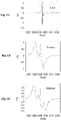
- Fig. 1 shows the ESR spectra of the three samples immediately after preparation.
- the spin concentration was estimated using a 10- ⁇ M trityl free radical reference sample and was found to be around 1.7 ⁇ 10 14 , 2.4 ⁇ 10 15 and 4.6 ⁇ 10 14 spins per mg for the silica, sucrose and mannose samples, respectively.
- These EDIRs can be assigned based on their spectra and the chemical properties of the samples' surfaces.
- the radicals in the silica sample are most likely the result of Si ⁇ and SiO ⁇ broken bonds on the surface of the silica, which is known to be capped by O and OH groups or by a combination of H 2 O and OH groups (Zhuravlev, 2000; Radzig, 2000; Giordano et al ., 2007).
- the EDIRs in the irradiated sucrose powder have the same characteristics as those measured by ⁇ -irradiation of sucrose single crystals, which have been identified as carbon-centered radicals based on hydrogen-extracted species (Ueda et al ., 1961).
- DNP experiments were conducted on a homemade instrument (Feintuch et al ., 2011) employing a 3.4-tesla superconducting magnet equipped with a dual NMR-ESR probe head for simultaneous excitation of both electron and nuclear spins, operating at a cryogenic temperature of 20K.
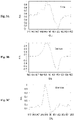
- the DNP experiment was conducted at varying microwave (MW) irradiation frequencies for each sample. At every MW frequency, these experiments used MW irradiation time of 40 sec with MW magnetic field (Bi) strength equivalent to ⁇ 800 KHz, and a repetition delay of 1 min before the next MW frequency was tested. The results of these measurements are shown in Fig. 3 .
- Fig. 3 demonstrates the DNP enhancement of the magnetization, with the EDIRs serving as polarizing agents. Enhancement factors of ⁇ 1-2 for silica and mannose, and ⁇ 17 for sucrose, are apparent. These radicals may herald a new class of polarizing agents with various desirable characteristics.
- EDIRs When not exposed to air (i.e., kept at room temperature in the sealed glass tube following preparation), the EDIRs were found to have a lifetime of days (data not shown). On the other hand, as noted above, they readily annihilate and self-terminate when exposed to air, and especially to a solvent. A typical experiment of this sort is presented in Fig. 4 .
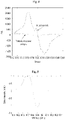
- the signal from the EDIRs imparted on a sucrose sample was first measured by CW ESR system immediately after preparation. Subsequently, we introduced a solvent (50/50 water ethanol) to the sample and repeated the measurement. The results show that only a small residual signal remains, indicating a high yield destruction of EDIRs.
- DNP experiments were conducted as described in Example 1.
- we scanned the echo intensity as a function of microwave (MW) frequency, while varying it from 94.4 GHz to 95.4 GHz in 100 steps of 10 MHz.
- the DNP of glucose as a function of the MW frequency is shown in Fig. 5 , indicating that the maximal polarization transfer was achieved at 94.67GHz, where an increase of a factor of 20 in the NMR signal is shown.
- the ESR measurement was done with one 163 sec long scan, over a 3280-3380 gauss range (modulation frequency of 100 KHz; amplitude of 1 gauss; regular attenuation of 25db; and 512 ample points).
- the samples were measured quickly one after the other in more or less the same conditions, and the results are shown in Fig. 7 , indicating that the bulge and the increased gas (plain air) volume in the bulged tube increases the radical concentration by -3.6 fold.
Landscapes
- Health & Medical Sciences (AREA)
- Physics & Mathematics (AREA)
- Life Sciences & Earth Sciences (AREA)
- Nuclear Medicine, Radiotherapy & Molecular Imaging (AREA)
- General Health & Medical Sciences (AREA)
- Radiology & Medical Imaging (AREA)
- General Physics & Mathematics (AREA)
- Condensed Matter Physics & Semiconductors (AREA)
- Public Health (AREA)
- Engineering & Computer Science (AREA)
- Veterinary Medicine (AREA)
- Animal Behavior & Ethology (AREA)
- High Energy & Nuclear Physics (AREA)
- Biomedical Technology (AREA)
- Heart & Thoracic Surgery (AREA)
- Biophysics (AREA)
- Epidemiology (AREA)
- Signal Processing (AREA)
- Pathology (AREA)
- Medical Informatics (AREA)
- Molecular Biology (AREA)
- Surgery (AREA)
- Anesthesiology (AREA)
- Vascular Medicine (AREA)
- Hematology (AREA)
- Medicines Containing Antibodies Or Antigens For Use As Internal Diagnostic Agents (AREA)
- Magnetic Resonance Imaging Apparatus (AREA)
- Medicines That Contain Protein Lipid Enzymes And Other Medicines (AREA)
Claims (14)
- Verfahren zur Herstellung einer Probe, die hochpolarisierte Kernspins umfasst, wobei das Verfahren:(i) das Bereitstellen einer Probe, die ein organisches oder anorganisches Material umfasst, das H- oder OH-Gruppen oder adsorbierte Wassermoleküle enthält, in Form eines pulverförmigen Feststoffes in einem verschlossenen Gefäß mit einem Anfangsdruck;(ii) das Erzeugen instabiler Radikale in der Probe durch (a) elektrische Ionisierung der Gasumgebung in dem Gefäß oder (b) Aussetzen der Probe ionisierender Strahlung mit einer Energie von nicht weniger als 25 eV, wobei die instabilen Radikale an dem Feststoff fixiert sind, so dass ihr Zerfall verlangsamt wird;(iii) das Abkühlen der Probe auf eine kryogene Temperatur und(iv) das Durchführen eines dynamischen Kernpolarisations- (DNP)-Verfahrens an der abgekühlten Probe, um so Spinpolarisation von den Elektronenspins auf die Kernspins zu übertragen, umfasst, wodurch die Probe, die hochpolarisierte Kernspins umfasst, erhalten wird.
- Verfahren nach Anspruch 1, ferner umfassend den Schritt des Einstellens einer Gasumgebung mit kontrolliertem Druck und kontrollierter Zusammensetzung in dem Gefäß vor, während oder unmittelbar nach, vorzugsweise vor Schritt (ii).
- Verfahren nach Anspruch 2, wobei der Schritt des Einstellens einer Gasumgebung mit kontrolliertem Druck und kontrollierter Zusammensetzung in dem Gefäß durch das Abpumpen von Gas aus dem Gefäß durchgeführt wird, was einen verminderten Druck in dem Gefäß hinterlässt.
- Verfahren nach Anspruch 3, wobei das Gas mit einem Vakuumsystem abgepumpt wird, wobei das Vakuumsystem vorzugsweise ein moderates Vakuumniveau von 0,1 Pa bis 100 Pa (1 × 10⁻⁶ bis 1 × 10⁻³ bar) aufrechterhält.
- Verfahren nach Anspruch 2, wobei der Schritt des Einstellens einer Gasumgebung mit kontrolliertem Druck und kontrollierter Zusammensetzung in dem Gefäß durch Einbringen eines geeigneten Gases, ausgewählt aus einem Edelgas, wie Helium, Argon, Neon, Krypton und Xenon; Sauerstoff; Stickstoff; Methan; einem Halogen, wie Fluor, Chlor und Brom; CO2; CO; einem Fluorchlorkohlenwasserstoff (CFC), wie Dichlordifluormethan; oder einer Kombination davon, in das Gefäß und Erzeugen eines Druckes, der niedriger ist als der Anfangsdruck in dem Gefäß, durchgeführt wird.
- Verfahren nach Anspruch 1, wobei die instabilen Radikale in Schritt (ii) durch elektrische Ionisierung der Gasumgebung in dem Gefäß erzeugt werden.
- Verfahren nach Anspruch 6, wobei die elektrische Ionisierung durch Aufrechterhalten eines elektrischen Stroms durch die Gasumgebung für einen ausreichenden Zeitraum, vorzugsweise für 1 - 3 Minuten, stärker bevorzugt für etwa 2 Minuten, durchgeführt wird.
- Verfahren nach Anspruch 1, wobei die instabilen Radikale in Schritt (ii) durch Aussetzen der Probe ionisierender Strahlung, wie Röntgenstrahlung oder Gammastrahlung, erzeugt werden.
- Verfahren nach Anspruch 1, wobei die kryogene Temperatur im Bereich von 0 K bis 120 K, vorzugsweise 15 K bis 60 K, liegt, stärker bevorzugt etwa 20 K beträgt.
- Verfahren nach Anspruch 1, wobei das in Schritt (iv) durchgeführte DNP-Verfahren Mikrowellenbestrahlung bei einer Frequenz der Summe oder Differenz der Elektronen- und Kern-Larmor-Frequenzen unter einem angelegten Magnetfeld umfasst.
- Verfahren nach Anspruch 1, wobei die in Schritt (i) bereitgestellte Probe ein Material ohne Carbonylgruppen umfasst.
- Verfahren nach Anspruch 2, wobei der Schritt des Einstellens einer Gasumgebung mit kontrolliertem Druck und kontrollierter Zusammensetzung in dem Gefäß vor Schritt (ii) durch Abpumpen von Gas aus dem Gefäß unter Aufrechterhaltung eines moderaten Vakuumniveaus von 0,1 Pa bis 100 Pa (1 × 10⁻⁶ bis 1 × 10⁻³ bar) durchgeführt wird; die instabilen Radikale durch Aufrechterhalten eines elektrischen Stroms durch die Gasumgebung für 1 - 3 Minuten erzeugt werden und die kryogene Temperatur etwa 20 K beträgt.
- Verfahren nach einem der Ansprüche 1 bis 12, wobei (a) das Verfahren ferner den Schritt des Unterziehens der in (iv) erhaltenen Probe einer Kernmagnetresonanz- (NMR)-Messung umfasst oder (b) die in Schritt (i) bereitgestellte Probe ein Magnetresonanzbildgebungs- (MRI)-Kontrastmittel oder eine Verbindung ist, die am Stoffwechselweg im Körper eines Individuums, das sich einem MRI-Scan unterzieht, beteiligt ist, und das Verfahren ferner den Schritt des Auftauens der in (iv) erhaltenen Probe und unmittelbaren Verabreichens der Probe in flüssiger oder gasförmiger Form an das Individuum umfasst.
- Verfahren nach Anspruch 13, wobei die NMR-Messung Festkörper-NMR, NMR mit Rotation um den magischen Winkel (MAS-NMR), eine Flüssigkeits-NMR-Messung oder eine NMR-Messung für die Untersuchung einer Oberfläche ist oder der MRI-Scan Stoffwechsel-MRI oder funktionelle MRI ist.
Applications Claiming Priority (2)
| Application Number | Priority Date | Filing Date | Title |
|---|---|---|---|
| US201562186405P | 2015-06-30 | 2015-06-30 | |
| PCT/IL2016/050691 WO2017002113A1 (en) | 2015-06-30 | 2016-06-26 | Method for preparation of highly polarized nuclear spins containing samples and uses thereof for nmr and mri |
Publications (3)
| Publication Number | Publication Date |
|---|---|
| EP3316912A1 EP3316912A1 (de) | 2018-05-09 |
| EP3316912A4 EP3316912A4 (de) | 2019-03-20 |
| EP3316912B1 true EP3316912B1 (de) | 2022-11-30 |
Family
ID=57609333
Family Applications (1)
| Application Number | Title | Priority Date | Filing Date |
|---|---|---|---|
| EP16817376.3A Active EP3316912B1 (de) | 2015-06-30 | 2016-06-26 | Verfahren zur herstellung von proben mit hochpolarisierten kernspins |
Country Status (3)
| Country | Link |
|---|---|
| US (3) | US10718840B2 (de) |
| EP (1) | EP3316912B1 (de) |
| WO (1) | WO2017002113A1 (de) |
Families Citing this family (4)
| Publication number | Priority date | Publication date | Assignee | Title |
|---|---|---|---|---|
| US10718840B2 (en) * | 2015-06-30 | 2020-07-21 | Technion Research & Development Foundation Limited | Method for preparation of highly polarized nuclear spins containing samples and uses thereof for NMR and MRI |
| US11834416B2 (en) | 2018-11-29 | 2023-12-05 | Board Of Trustees Of Southern Illinois University | Cleavable agents |
| CN111580029B (zh) * | 2020-05-18 | 2022-05-03 | 中国科学院精密测量科学与技术创新研究院 | 一种利用仲氢诱导极化的高场原位极化方法 |
| CN120334275A (zh) * | 2025-04-08 | 2025-07-18 | 中国科学院精密测量科学与技术创新研究院 | 一种产生长寿命无溶剂添加的dnp极化自由基的方法和装置 |
Family Cites Families (6)
| Publication number | Priority date | Publication date | Assignee | Title |
|---|---|---|---|---|
| US134418A (en) * | 1872-12-31 | James calkins | ||
| JPS61140846A (ja) * | 1984-12-14 | 1986-06-27 | Hitachi Ltd | レ−ザ磁気共鳴装置 |
| JP2958103B2 (ja) * | 1989-12-12 | 1999-10-06 | エーザイ株式会社 | プラズマ照射固形製剤 |
| GB0014463D0 (en) * | 2000-06-14 | 2000-08-09 | Nycomed Amersham Plc | NMR Method |
| EP2972441B1 (de) * | 2013-03-14 | 2016-11-30 | Ecole Polytechnique Fédérale de Lausanne (EPFL) | Verfahren zur erzeugung von radikalen für eine dynamische kernspinpolarisierung und anwendungen in der nmr, mrs und mrt |
| US10718840B2 (en) * | 2015-06-30 | 2020-07-21 | Technion Research & Development Foundation Limited | Method for preparation of highly polarized nuclear spins containing samples and uses thereof for NMR and MRI |
-
2016
- 2016-06-26 US US15/738,688 patent/US10718840B2/en active Active
- 2016-06-26 EP EP16817376.3A patent/EP3316912B1/de active Active
- 2016-06-26 WO PCT/IL2016/050691 patent/WO2017002113A1/en not_active Ceased
-
2020
- 2020-06-03 US US16/891,437 patent/US11041928B2/en active Active
-
2021
- 2021-06-21 US US17/352,647 patent/US20210356543A1/en not_active Abandoned
Also Published As
| Publication number | Publication date |
|---|---|
| US20180180696A1 (en) | 2018-06-28 |
| US11041928B2 (en) | 2021-06-22 |
| US20200341093A1 (en) | 2020-10-29 |
| EP3316912A4 (de) | 2019-03-20 |
| US10718840B2 (en) | 2020-07-21 |
| US20210356543A1 (en) | 2021-11-18 |
| EP3316912A1 (de) | 2018-05-09 |
| WO2017002113A1 (en) | 2017-01-05 |
Similar Documents
| Publication | Publication Date | Title |
|---|---|---|
| US20210356543A1 (en) | Method for preparation of highly polarized nuclear spins containing samples and uses thereof for nmr and mri | |
| US8703201B2 (en) | Hyperpolarization methods, systems and compositions | |
| Capozzi et al. | Liquid-state 13C polarization of 30% through photoinduced nonpersistent radicals | |
| Pietraiß et al. | Optically polarized 129Xe in NMR spectroscopy | |
| JPH10501708A (ja) | 過分極した貴ガスを利用した磁気共鳴映像化 | |
| Aabel et al. | Nuclear magnetic resonance (NMR) studies of homeopathic solutions | |
| Hughes-Riley et al. | Cryogenics free production of hyperpolarized 129Xe and 83Kr for biomedical MRI applications | |
| JP2001516876A (ja) | 超分極された高圧ヘリウムガスを調製するための方法および装置、該法の使用 | |
| Six et al. | Pulmonary MRI contrast using Surface Quadrupolar Relaxation (SQUARE) of hyperpolarized 83Kr | |
| Song | Spin polarization–induced nuclear Overhauser effect: An application of spin‐polarized xenon and helium | |
| Katz et al. | Dynamic nuclear polarization in solid samples by electrical-discharge-induced radicals | |
| CN1224502A (zh) | 利用超极化惰性气体对于核磁共振和磁共振成象质量的提高 | |
| Katz et al. | Proton polarization enhancement of up to 150 with dynamic nuclear polarization of plasma-treated glucose powder | |
| EP2917749B1 (de) | Verfahren zur brute-force-hyperpolarisation mit partikelbeschleunigungsmitteln | |
| JP4420224B2 (ja) | 過分極129Xeの製造法 | |
| Cleveland et al. | Hyperpolarized 83Kr and 129Xe NMR relaxation measurements of hydrated surfaces: implications for materials science and pulmonary diagnostics | |
| Otten | Take a breath of polarized noble gas | |
| Tastevin | Optically polarized helium-3 for NMR imaging in medicine | |
| Katz et al. | Dynamic nuclear polarization enhancement of 13C in glucose using electrical discharge induced radicals as polarizing agents | |
| US20090311189A1 (en) | Temperature-jump dynamic nuclear polarization | |
| Wiström et al. | Hyperpolarized ¹²⁹Xe MRI Using Dissolution DNP on a Commercial Polarizer: From Solid-State Optimization to In Vivo Lung Imaging | |
| Wakai et al. | Magnetic resonance spectra of hyperpolarized 129Xe in human blood and living rat chest | |
| KRYPTON et al. | and processed the image data. Zackary I. Cleveland produced the hp" Kr, designed the | |
| Johnson et al. | A new window into the lung | |
| Ceillier | Instrumental developments for dissolution dynamic nuclear polarization: generating, transferring and transporting hyperpolarization |
Legal Events
| Date | Code | Title | Description |
|---|---|---|---|
| STAA | Information on the status of an ep patent application or granted ep patent |
Free format text: STATUS: THE INTERNATIONAL PUBLICATION HAS BEEN MADE |
|
| PUAI | Public reference made under article 153(3) epc to a published international application that has entered the european phase |
Free format text: ORIGINAL CODE: 0009012 |
|
| STAA | Information on the status of an ep patent application or granted ep patent |
Free format text: STATUS: REQUEST FOR EXAMINATION WAS MADE |
|
| 17P | Request for examination filed |
Effective date: 20171221 |
|
| AK | Designated contracting states |
Kind code of ref document: A1 Designated state(s): AL AT BE BG CH CY CZ DE DK EE ES FI FR GB GR HR HU IE IS IT LI LT LU LV MC MK MT NL NO PL PT RO RS SE SI SK SM TR |
|
| AX | Request for extension of the european patent |
Extension state: BA ME |
|
| DAV | Request for validation of the european patent (deleted) | ||
| DAX | Request for extension of the european patent (deleted) | ||
| RIN1 | Information on inventor provided before grant (corrected) |
Inventor name: FEINTUCH, AKIVA Inventor name: KATZ, ITAI Inventor name: BLANK, AHARON |
|
| A4 | Supplementary search report drawn up and despatched |
Effective date: 20190214 |
|
| RIC1 | Information provided on ipc code assigned before grant |
Ipc: A61K 49/20 20060101ALI20190208BHEP Ipc: H01J 37/00 20060101ALI20190208BHEP Ipc: G01R 33/62 20060101ALI20190208BHEP Ipc: G01R 33/48 20060101ALN20190208BHEP Ipc: G01R 33/56 20060101ALI20190208BHEP Ipc: G01R 33/28 20060101AFI20190208BHEP |
|
| STAA | Information on the status of an ep patent application or granted ep patent |
Free format text: STATUS: EXAMINATION IS IN PROGRESS |
|
| 17Q | First examination report despatched |
Effective date: 20210216 |
|
| REG | Reference to a national code |
Ref country code: DE Ref legal event code: R079 Ref document number: 602016076655 Country of ref document: DE Free format text: PREVIOUS MAIN CLASS: A61K0049200000 Ipc: G01R0033280000 |
|
| GRAP | Despatch of communication of intention to grant a patent |
Free format text: ORIGINAL CODE: EPIDOSNIGR1 |
|
| STAA | Information on the status of an ep patent application or granted ep patent |
Free format text: STATUS: GRANT OF PATENT IS INTENDED |
|
| RIC1 | Information provided on ipc code assigned before grant |
Ipc: G01R 33/48 20060101ALN20220609BHEP Ipc: H01J 37/00 20060101ALI20220609BHEP Ipc: A61K 49/20 20060101ALI20220609BHEP Ipc: G01R 33/56 20060101ALI20220609BHEP Ipc: G01R 33/62 20060101ALI20220609BHEP Ipc: G01R 33/28 20060101AFI20220609BHEP |
|
| RIC1 | Information provided on ipc code assigned before grant |
Ipc: G01R 33/48 20060101ALN20220613BHEP Ipc: H01J 37/00 20060101ALI20220613BHEP Ipc: A61K 49/20 20060101ALI20220613BHEP Ipc: G01R 33/56 20060101ALI20220613BHEP Ipc: G01R 33/62 20060101ALI20220613BHEP Ipc: G01R 33/28 20060101AFI20220613BHEP |
|
| INTG | Intention to grant announced |
Effective date: 20220629 |
|
| GRAS | Grant fee paid |
Free format text: ORIGINAL CODE: EPIDOSNIGR3 |
|
| GRAA | (expected) grant |
Free format text: ORIGINAL CODE: 0009210 |
|
| STAA | Information on the status of an ep patent application or granted ep patent |
Free format text: STATUS: THE PATENT HAS BEEN GRANTED |
|
| AK | Designated contracting states |
Kind code of ref document: B1 Designated state(s): AL AT BE BG CH CY CZ DE DK EE ES FI FR GB GR HR HU IE IS IT LI LT LU LV MC MK MT NL NO PL PT RO RS SE SI SK SM TR |
|
| REG | Reference to a national code |
Ref country code: CH Ref legal event code: EP Ref country code: GB Ref legal event code: FG4D |
|
| REG | Reference to a national code |
Ref country code: AT Ref legal event code: REF Ref document number: 1535063 Country of ref document: AT Kind code of ref document: T Effective date: 20221215 |
|
| REG | Reference to a national code |
Ref country code: IE Ref legal event code: FG4D |
|
| REG | Reference to a national code |
Ref country code: DE Ref legal event code: R096 Ref document number: 602016076655 Country of ref document: DE |
|
| REG | Reference to a national code |
Ref country code: LT Ref legal event code: MG9D |
|
| REG | Reference to a national code |
Ref country code: NL Ref legal event code: MP Effective date: 20221130 |
|
| PG25 | Lapsed in a contracting state [announced via postgrant information from national office to epo] |
Ref country code: SE Free format text: LAPSE BECAUSE OF FAILURE TO SUBMIT A TRANSLATION OF THE DESCRIPTION OR TO PAY THE FEE WITHIN THE PRESCRIBED TIME-LIMIT Effective date: 20221130 Ref country code: PT Free format text: LAPSE BECAUSE OF FAILURE TO SUBMIT A TRANSLATION OF THE DESCRIPTION OR TO PAY THE FEE WITHIN THE PRESCRIBED TIME-LIMIT Effective date: 20230331 Ref country code: NO Free format text: LAPSE BECAUSE OF FAILURE TO SUBMIT A TRANSLATION OF THE DESCRIPTION OR TO PAY THE FEE WITHIN THE PRESCRIBED TIME-LIMIT Effective date: 20230228 Ref country code: LT Free format text: LAPSE BECAUSE OF FAILURE TO SUBMIT A TRANSLATION OF THE DESCRIPTION OR TO PAY THE FEE WITHIN THE PRESCRIBED TIME-LIMIT Effective date: 20221130 Ref country code: FI Free format text: LAPSE BECAUSE OF FAILURE TO SUBMIT A TRANSLATION OF THE DESCRIPTION OR TO PAY THE FEE WITHIN THE PRESCRIBED TIME-LIMIT Effective date: 20221130 Ref country code: ES Free format text: LAPSE BECAUSE OF FAILURE TO SUBMIT A TRANSLATION OF THE DESCRIPTION OR TO PAY THE FEE WITHIN THE PRESCRIBED TIME-LIMIT Effective date: 20221130 |
|
| REG | Reference to a national code |
Ref country code: AT Ref legal event code: MK05 Ref document number: 1535063 Country of ref document: AT Kind code of ref document: T Effective date: 20221130 |
|
| PG25 | Lapsed in a contracting state [announced via postgrant information from national office to epo] |
Ref country code: RS Free format text: LAPSE BECAUSE OF FAILURE TO SUBMIT A TRANSLATION OF THE DESCRIPTION OR TO PAY THE FEE WITHIN THE PRESCRIBED TIME-LIMIT Effective date: 20221130 Ref country code: PL Free format text: LAPSE BECAUSE OF FAILURE TO SUBMIT A TRANSLATION OF THE DESCRIPTION OR TO PAY THE FEE WITHIN THE PRESCRIBED TIME-LIMIT Effective date: 20221130 Ref country code: LV Free format text: LAPSE BECAUSE OF FAILURE TO SUBMIT A TRANSLATION OF THE DESCRIPTION OR TO PAY THE FEE WITHIN THE PRESCRIBED TIME-LIMIT Effective date: 20221130 Ref country code: IS Free format text: LAPSE BECAUSE OF FAILURE TO SUBMIT A TRANSLATION OF THE DESCRIPTION OR TO PAY THE FEE WITHIN THE PRESCRIBED TIME-LIMIT Effective date: 20230330 Ref country code: HR Free format text: LAPSE BECAUSE OF FAILURE TO SUBMIT A TRANSLATION OF THE DESCRIPTION OR TO PAY THE FEE WITHIN THE PRESCRIBED TIME-LIMIT Effective date: 20221130 Ref country code: GR Free format text: LAPSE BECAUSE OF FAILURE TO SUBMIT A TRANSLATION OF THE DESCRIPTION OR TO PAY THE FEE WITHIN THE PRESCRIBED TIME-LIMIT Effective date: 20230301 |
|
| P01 | Opt-out of the competence of the unified patent court (upc) registered |
Effective date: 20230413 |
|
| PG25 | Lapsed in a contracting state [announced via postgrant information from national office to epo] |
Ref country code: NL Free format text: LAPSE BECAUSE OF FAILURE TO SUBMIT A TRANSLATION OF THE DESCRIPTION OR TO PAY THE FEE WITHIN THE PRESCRIBED TIME-LIMIT Effective date: 20221130 |
|
| PG25 | Lapsed in a contracting state [announced via postgrant information from national office to epo] |
Ref country code: SM Free format text: LAPSE BECAUSE OF FAILURE TO SUBMIT A TRANSLATION OF THE DESCRIPTION OR TO PAY THE FEE WITHIN THE PRESCRIBED TIME-LIMIT Effective date: 20221130 Ref country code: RO Free format text: LAPSE BECAUSE OF FAILURE TO SUBMIT A TRANSLATION OF THE DESCRIPTION OR TO PAY THE FEE WITHIN THE PRESCRIBED TIME-LIMIT Effective date: 20221130 Ref country code: EE Free format text: LAPSE BECAUSE OF FAILURE TO SUBMIT A TRANSLATION OF THE DESCRIPTION OR TO PAY THE FEE WITHIN THE PRESCRIBED TIME-LIMIT Effective date: 20221130 Ref country code: DK Free format text: LAPSE BECAUSE OF FAILURE TO SUBMIT A TRANSLATION OF THE DESCRIPTION OR TO PAY THE FEE WITHIN THE PRESCRIBED TIME-LIMIT Effective date: 20221130 Ref country code: CZ Free format text: LAPSE BECAUSE OF FAILURE TO SUBMIT A TRANSLATION OF THE DESCRIPTION OR TO PAY THE FEE WITHIN THE PRESCRIBED TIME-LIMIT Effective date: 20221130 Ref country code: AT Free format text: LAPSE BECAUSE OF FAILURE TO SUBMIT A TRANSLATION OF THE DESCRIPTION OR TO PAY THE FEE WITHIN THE PRESCRIBED TIME-LIMIT Effective date: 20221130 |
|
| PG25 | Lapsed in a contracting state [announced via postgrant information from national office to epo] |
Ref country code: SK Free format text: LAPSE BECAUSE OF FAILURE TO SUBMIT A TRANSLATION OF THE DESCRIPTION OR TO PAY THE FEE WITHIN THE PRESCRIBED TIME-LIMIT Effective date: 20221130 Ref country code: AL Free format text: LAPSE BECAUSE OF FAILURE TO SUBMIT A TRANSLATION OF THE DESCRIPTION OR TO PAY THE FEE WITHIN THE PRESCRIBED TIME-LIMIT Effective date: 20221130 |
|
| REG | Reference to a national code |
Ref country code: DE Ref legal event code: R097 Ref document number: 602016076655 Country of ref document: DE |
|
| PLBE | No opposition filed within time limit |
Free format text: ORIGINAL CODE: 0009261 |
|
| STAA | Information on the status of an ep patent application or granted ep patent |
Free format text: STATUS: NO OPPOSITION FILED WITHIN TIME LIMIT |
|
| 26N | No opposition filed |
Effective date: 20230831 |
|
| PG25 | Lapsed in a contracting state [announced via postgrant information from national office to epo] |
Ref country code: SI Free format text: LAPSE BECAUSE OF FAILURE TO SUBMIT A TRANSLATION OF THE DESCRIPTION OR TO PAY THE FEE WITHIN THE PRESCRIBED TIME-LIMIT Effective date: 20221130 |
|
| PG25 | Lapsed in a contracting state [announced via postgrant information from national office to epo] |
Ref country code: MC Free format text: LAPSE BECAUSE OF FAILURE TO SUBMIT A TRANSLATION OF THE DESCRIPTION OR TO PAY THE FEE WITHIN THE PRESCRIBED TIME-LIMIT Effective date: 20221130 |
|
| PG25 | Lapsed in a contracting state [announced via postgrant information from national office to epo] |
Ref country code: MC Free format text: LAPSE BECAUSE OF FAILURE TO SUBMIT A TRANSLATION OF THE DESCRIPTION OR TO PAY THE FEE WITHIN THE PRESCRIBED TIME-LIMIT Effective date: 20221130 |
|
| REG | Reference to a national code |
Ref country code: CH Ref legal event code: PL |
|
| REG | Reference to a national code |
Ref country code: BE Ref legal event code: MM Effective date: 20230630 |
|
| PG25 | Lapsed in a contracting state [announced via postgrant information from national office to epo] |
Ref country code: LU Free format text: LAPSE BECAUSE OF NON-PAYMENT OF DUE FEES Effective date: 20230626 |
|
| REG | Reference to a national code |
Ref country code: IE Ref legal event code: MM4A |
|
| PG25 | Lapsed in a contracting state [announced via postgrant information from national office to epo] |
Ref country code: LU Free format text: LAPSE BECAUSE OF NON-PAYMENT OF DUE FEES Effective date: 20230626 |
|
| PG25 | Lapsed in a contracting state [announced via postgrant information from national office to epo] |
Ref country code: IE Free format text: LAPSE BECAUSE OF NON-PAYMENT OF DUE FEES Effective date: 20230626 |
|
| PG25 | Lapsed in a contracting state [announced via postgrant information from national office to epo] |
Ref country code: IE Free format text: LAPSE BECAUSE OF NON-PAYMENT OF DUE FEES Effective date: 20230626 Ref country code: CH Free format text: LAPSE BECAUSE OF NON-PAYMENT OF DUE FEES Effective date: 20230630 |
|
| PG25 | Lapsed in a contracting state [announced via postgrant information from national office to epo] |
Ref country code: IT Free format text: LAPSE BECAUSE OF FAILURE TO SUBMIT A TRANSLATION OF THE DESCRIPTION OR TO PAY THE FEE WITHIN THE PRESCRIBED TIME-LIMIT Effective date: 20221130 Ref country code: BE Free format text: LAPSE BECAUSE OF NON-PAYMENT OF DUE FEES Effective date: 20230630 |
|
| PG25 | Lapsed in a contracting state [announced via postgrant information from national office to epo] |
Ref country code: BG Free format text: LAPSE BECAUSE OF FAILURE TO SUBMIT A TRANSLATION OF THE DESCRIPTION OR TO PAY THE FEE WITHIN THE PRESCRIBED TIME-LIMIT Effective date: 20221130 |
|
| PG25 | Lapsed in a contracting state [announced via postgrant information from national office to epo] |
Ref country code: BG Free format text: LAPSE BECAUSE OF FAILURE TO SUBMIT A TRANSLATION OF THE DESCRIPTION OR TO PAY THE FEE WITHIN THE PRESCRIBED TIME-LIMIT Effective date: 20221130 |
|
| PGFP | Annual fee paid to national office [announced via postgrant information from national office to epo] |
Ref country code: DE Payment date: 20250618 Year of fee payment: 10 |
|
| PGFP | Annual fee paid to national office [announced via postgrant information from national office to epo] |
Ref country code: GB Payment date: 20250618 Year of fee payment: 10 |
|
| PGFP | Annual fee paid to national office [announced via postgrant information from national office to epo] |
Ref country code: FR Payment date: 20250625 Year of fee payment: 10 |
|
| PG25 | Lapsed in a contracting state [announced via postgrant information from national office to epo] |
Ref country code: CY Free format text: LAPSE BECAUSE OF FAILURE TO SUBMIT A TRANSLATION OF THE DESCRIPTION OR TO PAY THE FEE WITHIN THE PRESCRIBED TIME-LIMIT; INVALID AB INITIO Effective date: 20160626 |
|
| PG25 | Lapsed in a contracting state [announced via postgrant information from national office to epo] |
Ref country code: HU Free format text: LAPSE BECAUSE OF FAILURE TO SUBMIT A TRANSLATION OF THE DESCRIPTION OR TO PAY THE FEE WITHIN THE PRESCRIBED TIME-LIMIT; INVALID AB INITIO Effective date: 20160626 |
|
| PG25 | Lapsed in a contracting state [announced via postgrant information from national office to epo] |
Ref country code: TR Free format text: LAPSE BECAUSE OF FAILURE TO SUBMIT A TRANSLATION OF THE DESCRIPTION OR TO PAY THE FEE WITHIN THE PRESCRIBED TIME-LIMIT Effective date: 20221130 |