EP3317251B1 - Polymeradditiv und verfahren zu seiner herstellung - Google Patents
Polymeradditiv und verfahren zu seiner herstellung Download PDFInfo
- Publication number
- EP3317251B1 EP3317251B1 EP16727163.4A EP16727163A EP3317251B1 EP 3317251 B1 EP3317251 B1 EP 3317251B1 EP 16727163 A EP16727163 A EP 16727163A EP 3317251 B1 EP3317251 B1 EP 3317251B1
- Authority
- EP
- European Patent Office
- Prior art keywords
- process according
- sodium
- potassium
- reaction
- formula
- Prior art date
- Legal status (The legal status is an assumption and is not a legal conclusion. Google has not performed a legal analysis and makes no representation as to the accuracy of the status listed.)
- Active
Links
- 0 *OC(c1cc(C(O*)=O)ccc1)=O Chemical compound *OC(c1cc(C(O*)=O)ccc1)=O 0.000 description 1
Classifications
-
- C—CHEMISTRY; METALLURGY
- C07—ORGANIC CHEMISTRY
- C07D—HETEROCYCLIC COMPOUNDS
- C07D211/00—Heterocyclic compounds containing hydrogenated pyridine rings, not condensed with other rings
- C07D211/04—Heterocyclic compounds containing hydrogenated pyridine rings, not condensed with other rings with only hydrogen or carbon atoms directly attached to the ring nitrogen atom
- C07D211/06—Heterocyclic compounds containing hydrogenated pyridine rings, not condensed with other rings with only hydrogen or carbon atoms directly attached to the ring nitrogen atom having no double bonds between ring members or between ring members and non-ring members
- C07D211/36—Heterocyclic compounds containing hydrogenated pyridine rings, not condensed with other rings with only hydrogen or carbon atoms directly attached to the ring nitrogen atom having no double bonds between ring members or between ring members and non-ring members with hetero atoms or with carbon atoms having three bonds to hetero atoms with at the most one bond to halogen, e.g. ester or nitrile radicals, directly attached to ring carbon atoms
- C07D211/56—Nitrogen atoms
- C07D211/58—Nitrogen atoms attached in position 4
-
- C—CHEMISTRY; METALLURGY
- C07—ORGANIC CHEMISTRY
- C07C—ACYCLIC OR CARBOCYCLIC COMPOUNDS
- C07C233/00—Carboxylic acid amides
- C07C233/64—Carboxylic acid amides having carbon atoms of carboxamide groups bound to carbon atoms of six-membered aromatic rings
- C07C233/77—Carboxylic acid amides having carbon atoms of carboxamide groups bound to carbon atoms of six-membered aromatic rings having the nitrogen atom of at least one of the carboxamide groups bound to a carbon atom of a hydrocarbon radical substituted by amino groups
- C07C233/79—Carboxylic acid amides having carbon atoms of carboxamide groups bound to carbon atoms of six-membered aromatic rings having the nitrogen atom of at least one of the carboxamide groups bound to a carbon atom of a hydrocarbon radical substituted by amino groups with the substituted hydrocarbon radical bound to the nitrogen atom of the carboxamide group by a carbon atom of a ring other than a six-membered aromatic ring
-
- C—CHEMISTRY; METALLURGY
- C08—ORGANIC MACROMOLECULAR COMPOUNDS; THEIR PREPARATION OR CHEMICAL WORKING-UP; COMPOSITIONS BASED THEREON
- C08K—Use of inorganic or non-macromolecular organic substances as compounding ingredients
- C08K5/00—Use of organic ingredients
- C08K5/0008—Organic ingredients according to more than one of the "one dot" groups of C08K5/01 - C08K5/59
- C08K5/005—Stabilisers against oxidation, heat, light, ozone
-
- C—CHEMISTRY; METALLURGY
- C08—ORGANIC MACROMOLECULAR COMPOUNDS; THEIR PREPARATION OR CHEMICAL WORKING-UP; COMPOSITIONS BASED THEREON
- C08K—Use of inorganic or non-macromolecular organic substances as compounding ingredients
- C08K5/00—Use of organic ingredients
- C08K5/16—Nitrogen-containing compounds
- C08K5/34—Heterocyclic compounds having nitrogen in the ring
- C08K5/3412—Heterocyclic compounds having nitrogen in the ring having one nitrogen atom in the ring
- C08K5/3432—Six-membered rings
- C08K5/3435—Piperidines
-
- C—CHEMISTRY; METALLURGY
- C08—ORGANIC MACROMOLECULAR COMPOUNDS; THEIR PREPARATION OR CHEMICAL WORKING-UP; COMPOSITIONS BASED THEREON
- C08L—COMPOSITIONS OF MACROMOLECULAR COMPOUNDS
- C08L2201/00—Properties
- C08L2201/08—Stabilised against heat, light or radiation or oxydation
-
- C—CHEMISTRY; METALLURGY
- C08—ORGANIC MACROMOLECULAR COMPOUNDS; THEIR PREPARATION OR CHEMICAL WORKING-UP; COMPOSITIONS BASED THEREON
- C08L—COMPOSITIONS OF MACROMOLECULAR COMPOUNDS
- C08L2201/00—Properties
- C08L2201/14—Gas barrier composition
-
- C—CHEMISTRY; METALLURGY
- C08—ORGANIC MACROMOLECULAR COMPOUNDS; THEIR PREPARATION OR CHEMICAL WORKING-UP; COMPOSITIONS BASED THEREON
- C08L—COMPOSITIONS OF MACROMOLECULAR COMPOUNDS
- C08L23/00—Compositions of homopolymers or copolymers of unsaturated aliphatic hydrocarbons having only one carbon-to-carbon double bond; Compositions of derivatives of such polymers
- C08L23/02—Compositions of homopolymers or copolymers of unsaturated aliphatic hydrocarbons having only one carbon-to-carbon double bond; Compositions of derivatives of such polymers not modified by chemical after-treatment
- C08L23/04—Homopolymers or copolymers of ethene
- C08L23/08—Copolymers of ethene
- C08L23/0846—Copolymers of ethene with unsaturated hydrocarbons containing atoms other than carbon or hydrogen
-
- C—CHEMISTRY; METALLURGY
- C08—ORGANIC MACROMOLECULAR COMPOUNDS; THEIR PREPARATION OR CHEMICAL WORKING-UP; COMPOSITIONS BASED THEREON
- C08L—COMPOSITIONS OF MACROMOLECULAR COMPOUNDS
- C08L29/00—Compositions of homopolymers or copolymers of compounds having one or more unsaturated aliphatic radicals, each having only one carbon-to-carbon double bond, and at least one being terminated by an alcohol, ether, aldehydo, ketonic, acetal or ketal radical; Compositions of hydrolysed polymers of esters of unsaturated alcohols with saturated carboxylic acids; Compositions of derivatives of such polymers
- C08L29/02—Homopolymers or copolymers of unsaturated alcohols
- C08L29/04—Polyvinyl alcohol; Partially hydrolysed homopolymers or copolymers of esters of unsaturated alcohols with saturated carboxylic acids
-
- C—CHEMISTRY; METALLURGY
- C08—ORGANIC MACROMOLECULAR COMPOUNDS; THEIR PREPARATION OR CHEMICAL WORKING-UP; COMPOSITIONS BASED THEREON
- C08L—COMPOSITIONS OF MACROMOLECULAR COMPOUNDS
- C08L67/00—Compositions of polyesters obtained by reactions forming a carboxylic ester link in the main chain; Compositions of derivatives of such polymers
-
- C—CHEMISTRY; METALLURGY
- C08—ORGANIC MACROMOLECULAR COMPOUNDS; THEIR PREPARATION OR CHEMICAL WORKING-UP; COMPOSITIONS BASED THEREON
- C08L—COMPOSITIONS OF MACROMOLECULAR COMPOUNDS
- C08L77/00—Compositions of polyamides obtained by reactions forming a carboxylic amide link in the main chain; Compositions of derivatives of such polymers
-
- G—PHYSICS
- G01—MEASURING; TESTING
- G01N—INVESTIGATING OR ANALYSING MATERIALS BY DETERMINING THEIR CHEMICAL OR PHYSICAL PROPERTIES
- G01N23/00—Investigating or analysing materials by the use of wave or particle radiation, e.g. X-rays or neutrons, not covered by groups G01N3/00 – G01N17/00, G01N21/00 or G01N22/00
- G01N23/20—Investigating or analysing materials by the use of wave or particle radiation, e.g. X-rays or neutrons, not covered by groups G01N3/00 – G01N17/00, G01N21/00 or G01N22/00 by using diffraction of the radiation by the materials, e.g. for investigating crystal structure; by using scattering of the radiation by the materials, e.g. for investigating non-crystalline materials; by using reflection of the radiation by the materials
- G01N23/20075—Investigating or analysing materials by the use of wave or particle radiation, e.g. X-rays or neutrons, not covered by groups G01N3/00 – G01N17/00, G01N21/00 or G01N22/00 by using diffraction of the radiation by the materials, e.g. for investigating crystal structure; by using scattering of the radiation by the materials, e.g. for investigating non-crystalline materials; by using reflection of the radiation by the materials by measuring interferences of X-rays, e.g. Borrmann effect
Definitions
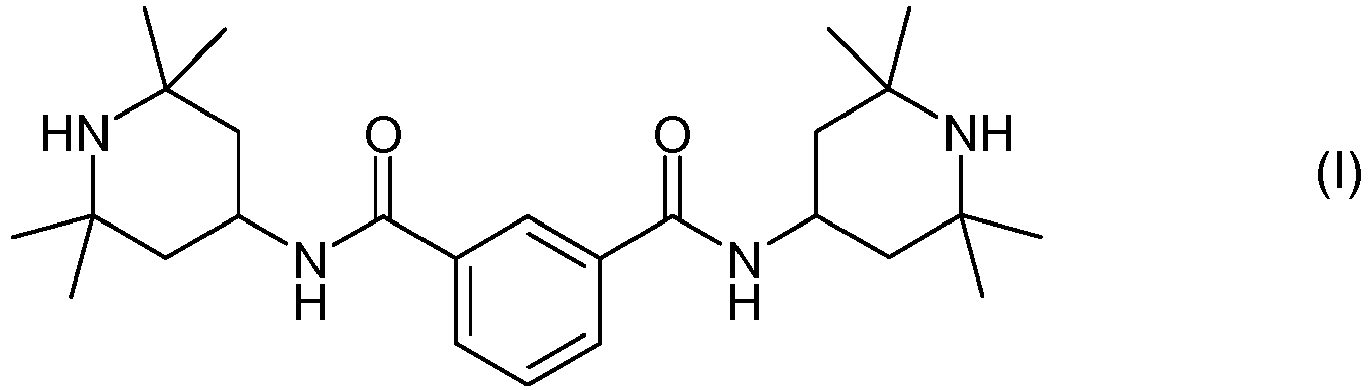
- the present invention relates to the preparation of the polymer additive of the formula (I) in a crystal morphology hitherto unknown for the polymer additive of the formula (I) and its preparation process.
- the preparation of this compound is usually carried out under Schotten-Baumann conditions according to the reaction equation (1) according to WO 2004/016591 :
- mixtures of water and isopropanol are used as the solvent.
- the crystal structure of the polymer additive of the formula (I) prepared by reaction equation (1) is highly intense in the X-ray diffractogram by six Peaks at a 2-theta angle of 5.7, 14.9, 15.2, 17.8, 22.7, 23.7; four intermediate intense peaks at a 2-theta angle of 16.9, 20.2, 21.8, 26.8; and other weakly intense peaks at a 2-theta angle of 9.3, 10.5, 11.3, 12.9, 14.1, 16.5, 19.7, 24.9, 28.5, 30.7, 31.5, 32.0, 33.0, 34.0, 35.9, 37.6, 39.5, 40.6, 41.1, 43.1, 45.3, 47.2, 48.1, 59.0.
- This known crystal phase is hereinafter referred to as alpha phase.
- the alpha phase is difficult to handle on an industrial scale because the powder isolated from the synthesis is dusty, poorly flowable and has a low bulk density, which requires complex compaction.
- An object of the present invention was to provide a practical method by which it is possible to prepare the polymer additive of formula (I) with improved physical properties over the prior art.
- Another object of the invention was to provide a process for the preparation of the polymer additive of the formula (I), which is characterized by the use of toxic and corrosive acid chlorides, the formation of halide salts, which require a costly separation and disposal, and a avoid costly cooling.
- the process should ensure a safe and reproducible reaction.
- the invention relates to a process for the preparation of the compound of the formula (I) by reacting at least one isophthalic diester of the formula (II) wherein R 1 and R 2 are the same or different and represent an aliphatic radical, with 2 equivalents of 4-amino-2,2,6,6-tetramethylpiperidine, in the presence of at least one catalyst from the group of metal alcoholates, at a reaction temperature between 50 and 150 ° C.
- R 1 and R 2 each represent an aliphatic radical which has 1 to 20, preferably 1 to 6, particularly preferably 1 to 4, C atoms.
- the aliphatic radical may be linear, branched or cyclic. It can be saturated or unsaturated, preferably it is saturated.
- Suitable aliphatic radicals are For example: methyl, ethyl, n-propyl, iso-propyl, n-butyl, iso-butyl, sec-butyl, tert-butyl, n-pentyl, iso-pentyl, sec-pentyl, neo-pentyl, 1 , 2-dimethylpropyl, iso-amyl, n-hexyl, sec-hexyl, n-heptyl, n-octyl, 2-ethylhexyl, n-nonyl, n-decyl, cyclopropyl, cyclobutyl, cyclopentyl, cyclohexyl, cycloheptyl, cyclooctyl, Cyclononyl, cyclodecyl.
- the radicals methyl, ethyl, n-propyl,
- isophthalic diesters in which the radicals R 1 and R 2 are each methyl, ethyl, n-propyl, isopropyl or n-butyl.
- Preferred catalysts are, for example, n-methoxide, K-methoxide, Li-methoxide, Na-ethoxide, K-ethoxide, Li-ethoxide, Na-n-propoxide, Kn-propoxide, Na-isopropanolate, K-isopropanolate, Na-butoxide, K Butylate, Na-isobutylate, K-isobutylate, Na-sec-butoxide, K-sec-butoxide, Na-tert-amylate, Na-amylate, K-amylate, K-tert-butoxide.
- the catalyst is expediently added in amounts of from 1 to 20 mol%, preferably from 2 to 15 mol%, in particular from 3 to 12 mol%, based on the isophthalic acid diester, of the reaction mixture.
- the catalyst when added to the reaction mixture is completely dissolved in an alcohol, for example in the alcohol from which it is prepared, preferably in a 1 to 4-fold Amount of alcohol, based on the mass of the catalyst.
- the reaction is carried out without solvent and in a reaction apparatus from the group of mixers, kneaders and extruders.
- a reaction apparatus from the group of mixers, kneaders and extruders.
- liquid and solid mixtures of liquid and solid materials can be mixed using shear forces.
- a solvent-free process is understood to mean a process which contains no or only so little of an organic solvent, eg. As alcohols, aliphatic or aromatic hydrocarbons, contains that the reaction product under the given reaction temperatures does not go into solution and precipitates directly from the reaction mixture as a solid.
- the isophthalic diester is mixed with about two equivalents of 4-amino-2,2,6,6-tetramethylpiperidine in the reaction apparatus, ie neither the isophthalic acid diester nor the amine are used in excess.
- the amount of alcohol introduced into the reaction mixture by the catalyst is so small relative to the mass of the reactants that the reaction according to the invention can be termed solvent-free.
- the alcohol introduced through the catalyst is removed from the reaction mixture along with the alcohol resulting from the reaction, e.g. B. distillative.
- the desired reaction product of formula (I) is solid at the reaction temperature of the invention (melting point about 272 ° C) and is obtained as a solid, without having previously undergone a melt.
- reaction apparatus is conveniently a device with which liquid and solid mixtures of liquid and solid materials can be mixed using shear forces used.
- reaction mass motions are effected by internal mechanical stirring or mixing devices.
- a rotation of the housing and static mechanical installations are also possible, but not preferred.
- An addition of grinding media such as balls made of steel or of different ceramics is possible, but not necessary.
- the reaction apparatus can be operated in batch mode or in continuous operation.
- the reaction apparatus in process variant a) is expediently a kneader or mixer, which is preferably equipped with sigma blades, mastikator blades, plowshares, Becker blades or throw paddles.
- the reaction apparatus may also be an extruder, for. B. a single-spindle or two-spindle worm kneader.
- the reaction mixture is controlled to the intended temperature, which is between 50 and 150 ° C, preferably 80 to 120 ° C, especially 90 to 110 ° C.
- the catalyst in amounts of 1 to 20 mol%, preferably 2 to 15 mol%, in particular 3 to 12 mol%, with respect to the isophthalic in the given homogeneous reaction mixture.
- the reaction mixture is suitably mixed for a period of 10 to 400 minutes, preferably 30 to 300 minutes, in particular 45 to 120 minutes, by the stirring and mixing devices of the reaction apparatus after the addition of the catalyst and the resulting alcohol at a pressure of 0.1 to 1013 mbar, preferably 0.2 to 500 mbar, in particular 0.3 to 250 mbar, removed from the reaction mixture, preferably by distillation. After venting the reaction apparatus, preferably with inert gas, the reaction mixture is cooled to room temperature.
- the polymer additive of the formula (I) is obtained as a solid in high purity and high yields.
- the isophthalic acid diester is dissolved in an excess of 4-amino-2,2,6,6-tetramethylpiperidine.
- the molar ratio between isophthalic acid diester and 4-amino-2,2,6,6-tetramethylpiperidine in this case is 1 to 3.9 mol to 1 to 27.5 mol, preferably 1 to 6.25 mol to 1 to 18 mol, more preferably 1 to 8.6 mol to 1 to 13.35 mol.
- the catalyst is preferably added at a temperature between 50 and 80 ° C, in particular between 60 and 70 ° C, and the reaction mixture is preferably heated to a temperature between 80 and 150 ° C, in particular between 85 and 130 ° C.
- the resulting alcohol can be removed by distillation during the reaction from the reaction mixture.
- the polymer additive of the formula (I) precipitates out of the reaction mixture and can be filtered off.
- the process variant b) is advantageously carried out as the variant a) solvent-free.
- the isophthalic acid diester is reacted with about two equivalents of 4-amino-2,2,6,6-tetramethylpiperidine and a lipophilic liquid hydrocarbon or a mixture of such hydrocarbons, e.g. B. hexane, heptane, octane, dodecane, petroleum ether, Shellsol, White Spirit or Exxsol, preferably at a temperature between 20 and 40 ° C, then the catalyst is preferably at a temperature between 50 and 80 ° C, especially between 60 and 70 ° C, added.
- a lipophilic liquid hydrocarbon or a mixture of such hydrocarbons e.g. B. hexane, heptane, octane, dodecane, petroleum ether, Shellsol, White Spirit or Exxsol
- the mass ratio between solvents and starting materials is between 90 and 10% by weight to 50 and 50% by weight, preferably 85 to 15% by weight to 60 to 40% by weight, particularly preferably 80 to 20% by weight. to 70 to 30 wt .-%
- the reaction mixture is preferably heated to a temperature between 80 and 150 ° C, in particular between 85 and 110 ° C.
- the resulting alcohol can be removed from the reaction mixture by distillation.
- the polymer additive of the formula (I) precipitates out of the reaction mixture and can be filtered off.
- the process according to the invention avoids the formation of wastewater contaminated with halide salts or optionally educt, whose proper disposal has a significant influence on the total costs of producing the polymer additive of the formula (I).
- the avoidance of halide salts in the form of byproducts further excludes the contamination of the polymer additive of the formula (I) with these, which in turn may be of crucial importance for its commercial distribution.
- the particularly preferred variant is process variant a).
- the process according to the invention in particular in process variants a), b) and c), gives the compound of formula (I) in a novel crystal modification, which is called beta phase.
- the beta phase is in the X-ray diffraction pattern by two strong peaks at a 2-theta angle of 15.0, 22.7; six intermediate intense peaks at a 2-theta angle of 5.0, 11.3, 18.9, 20.8, 21.6, 23.6; and other numerous weakly intense peaks, for example at a 2-theta angle from 7.1, 10.1, 12.2, 16.0, 16.8, 17.8, 18.2, 19.7, 24.8, 25.6, 26.7, 27.2, 28.5, 29.3, 30.5, 32.5, 33.5, 34.1, 36.2, 37.3, 38.4, 40.6, 41.3, 44.3, 46.5 characterized. High intensity peaks are those that have a relative intensity of over 50%. Medium intensity peaks are those having a relative intensity of 35 to 50%. Peaks below 35% are said to be weakly
- the invention furthermore relates to a compound of the formula (I) obtainable by the process according to the invention described above.
- the invention furthermore relates to a compound of the formula (I) in the beta phase characterized by the characteristic signals in the X-ray powder diagram, measured with Cu K alpha radiation (0.154 nm), at a 2-theta angle, of 15.0 and 22.7, which have a high intensity, and of 5.0, 11.3, 18.9, 20.8, 21.6 and 23.6, which have a medium intensity.
- the compound of formula (I) in the beta phase is surprisingly characterized by advantageous physical properties, such as. B. low dust formation, better flowability and higher bulk density compared to the previously known alpha phase. This significantly simplifies or eliminates compaction.
- the bulk density of the beta phase obtained from the process according to the invention is in the range from 0.40 to 0.65 g / cm 3 , preferably from 0.45 to 0.60 g / cm 3 .
- the determination of the bulk density can be carried out according to DIN 53468, EN ISO 60 at room temperature (23 - 25 ° C), z. B. using a Karg Fluometer ADP.
- the compound of the formula (I) in the beta phase can be used as a polymer additive, in particular for the stabilization in particular of polymers, preferably polyamides, EVOH and polyesters, for. As PET, against light and heat and to improve the oxygen barrier properties, in particular of EVOH.
- the products were analyzed by means of 1 H-NMR spectroscopy at 400 MHz in DMSO-d 6 and HPLC under isocratic conditions.
- As the continuous phase an acetonitrile / water mixture (70% by weight / 30% by weight) was used in HPLC.
- As the stationary phase an RP-18 column was used.
- the X-ray diffractograms were measured by means of Cu K alpha radiation (0.154 nm) at a temperature of 20 ° C. on a PANalytical X'Pert Pro MPD PW 3040/00 with an X'Celerator detector.
- the bulk density of the product was about 0.53 g / cm 3 .
- the alcohol from the catalyst preparation and the alcohol formed during the reaction are removed by distillation from the compulsory mixer. After discharging the solid and drying to constant weight, 1075.6 g (mass yield: 97.3%) of a white powder were isolated. The bulk density of the product was about 0.53 g / cm 3 .
- Example 2 In the X-ray diffractogram, the same characteristic signals as shown in Example 1 were observed for the product.
- the bulk density of the product was 0.54 g / cm 3 .
- Example 2 In the X-ray diffractogram, the same characteristic signals as shown in Example 1 were observed for the product.
- the bulk density of the product was 0.57 g / cm 3 .
- reaction mixture is heated to a temperature of 100 ° C, wherein the solid is completely dissolved.
- Two liquid phases are formed, of which the organic phase is separated, mixed with water and the alcohol is distilled off.
- the product is filtered off, washed with water and dried to constant weight.
- the yield of the reaction product is 200.0 g (95% of the theoretical value)
- the bulk density of the product is about 0.20 g / cm 3 .
Landscapes
- Chemical & Material Sciences (AREA)
- Organic Chemistry (AREA)
- Health & Medical Sciences (AREA)
- Chemical Kinetics & Catalysis (AREA)
- Medicinal Chemistry (AREA)
- Polymers & Plastics (AREA)
- Organic Low-Molecular-Weight Compounds And Preparation Thereof (AREA)
- Hydrogenated Pyridines (AREA)
- Low-Molecular Organic Synthesis Reactions Using Catalysts (AREA)
- Compositions Of Macromolecular Compounds (AREA)
Description
- Die vorliegende Erfindung betrifft die Herstellung des Polymeradditives der Formel (I) in einer für das Polymeradditiv der Formel (I) bislang unbekannten Kristall-Morphologie sowie dessen Herstellungsprozess.
- Das Polymeradditiv der Formel (I):

WO 97/43335 WO 2004/016591 :
- Dabei werden als Lösungsmittel Mischungen aus Wasser und Isopropanol verwendet.
- Die Kristallstruktur des Polymeradditives der Formel (I) hergestellt nach Reaktionsgleichung (1) ist im Röntgendiffraktogramm durch sechs stark intensive Peaks bei einem 2-theta-Winkel von 5.7, 14.9, 15.2, 17.8, 22.7, 23.7; vier mittel intensiven Peaks bei einem 2-theta-Winkel von 16.9, 20.2, 21.8, 26.8; und weiteren schwach intensiven Peaks bei einem 2-theta Winkel von 9.3, 10.5, 11.3, 12.9, 14.1, 16.5, 19.7, 24.9, 28.5, 30.7, 31.5, 32.0, 33.0, 34.0, 35.9, 37.6, 39.5, 40.6, 41.1, 43.1, 45.3, 47.2, 48.1, 59.0 charakterisiert. Diese bekannte Kristallphase wird nachstehend als alpha-Phase bezeichnet.
- Die alpha-Phase ist in technischem Maßstab schwierig handhabbar, da das aus der Synthese isolierte Pulver staubt, schlecht rieselfähig ist und eine geringe Schüttdichte aufweist, was eine aufwändige Kompaktierung erforderlich macht.
- Eine Aufgabe der vorliegenden Erfindung war es, ein praktikables Verfahren bereitzustellen, mit welchem es möglich ist, das Polymeradditiv der Formel (I) mit verbesserten physikalischen Eigenschaften gegenüber dem Stand der Technik herzustellen.
- Eine weitere Aufgabe der Erfindung war es, ein Verfahren zur Herstellung des Polymeradditives der Formel (I) bereitzustellen, das sich dadurch auszeichnet, den Einsatz von toxischen und korrosiven Säurechloriden, die Entstehung von Halogenidsalzen, die eine kostenintensive Abtrennung und Entsorgung erforderlich machen, sowie eine kostenintensive Kühlung zu vermeiden. Zudem soll das Verfahren eine sichere und reproduzierbare Reaktionsführung gewährleisten.
- Überraschenderweise wurde gefunden, dass diese Aufgabe durch ein Verfahren gelöst werden kann, das auf einer Amidierung von Isophthalsäurediestern mit 4-Amino-2,2,6,6-tetramethylpiperidin beruht und unter Verwendung eines Katalysators aus der Gruppe der Metallalkoholate (Reaktionsgleichung (2) durchgeführt wird.

- Gegenstand der Erfindung ist ein Verfahren zur Herstellung der Verbindung der Formel (I),

mit 2 Equivalenten 4-Amino-2,2,6,6-tetramethylpiperidin,
in Gegenwart mindestens eines Katalysators aus der Gruppe der Metallalkoholate, bei einer Reaktionstemperatur zwischen 50 und 150 °C. - In einer bevorzugten Form stehen R1 und R2 jeweils für einen aliphatischen Rest, der 1 bis 20, bevorzugt 1 bis 6, besonders bevorzugt 1 bis 4 C-Atome, hat. Der aliphatische Rest kann linear, verzweigt oder zyklisch sein. Er kann gesättigt oder ungesättigt sein, bevorzugt ist er gesättigt. Geeignete aliphatische Reste sind beispielsweise: Methyl, Ethyl, n-Propyl, iso-Propyl, n-Butyl, iso-Butyl, sec.-Butyl, tert.-Butyl, n-Pentyl, iso-Pentyl, sec.-Pentyl, neo-Pentyl, 1,2-Dimethylpropyl, iso-Amyl, n-Hexyl, sec.-Hexyl, n-Heptyl, n-Octyl, 2-Ethylhexyl, n-Nonyl, n-Decyl, Cyclopropyl, Cyclobutyl, Cyclopentyl, Cyclohexyl, Cycloheptyl, Cyclooctyl, Cyclononyl, Cyclodecyl. Besonders bevorzugt sind die Reste Methyl, Ethyl, n-Propyl, Isopropyl und n-Butyl.
- Besonders bevorzugt sind Isophthalsäurediester, worin die Reste R1 und R2 jeweils Methyl, Ethyl, n-Propyl, Isopropyl oder n-Butyl bedeuten.
- Katalysatoren im Sinne der vorliegenden Erfindung sind Alkoholate der allgemeinen Formeln (VI) und/oder (VII)
X-OR13 (VI)
R14O-Y-OR15 (VII)
wobei die Reste - R14 und R15
- jeweils gleich oder verschieden sind;
- R13, R14 und R15
- für aliphatische Reste mit jeweils 1 bis 20 C-Atomen stehen, wie z. B. Methyl, Ethyl, n-Propyl, iso-Propyl, n-Butyl, iso-Butyl, sec.-Butyl, tert.-Butyl, n-Pentyl, iso-Pentyl, sec.-Pentyl, neo-Pentyl, 1,2-Dimethylpropyl, iso-Amyl, n-Hexyl, sec.-Hexyl, n-Heptyl, n-Octyl, 2-Ethylhexyl, n-Nonyl, n-Decyl, oder C3-C12-Cycloalkylreste, beispielsweise Cyclopropyl, Cyclobutyl, Cyclopentyl, Cyclohexyl, Cycloheptyl, Cyclooctyl, Cyclononyl, Cyclodecyl, Cycloundecyl und Cyclododecyl.
- Bevorzugt sind Methyl, Ethyl und tert.-Butyl.
- X
- steht für Alkalimetalle wie z. B. Lithium, Natrium, Kalium, Rubidium und Cäsium. Bevorzugt sind Lithium, Natrium und Kalium;
- Y
- steht für Erdalkalimetalle wie z. B. Beryllium, Magnesium, Calcium, Strontium und Barium. Bevorzugt sind Magnesium und Calcium.
- Bevorzugte Katalysatoren sind beispielsweiseNa-methanolat, K-methanolat, Li-methanolat, Na-ethanolat, K-ethanolat, Li-ethanolat, Na-n-propanolat, K-n-propanolat,Na-isopropanolat, K-isopropanolat, Na-butylat, K-butylat, Na-isobutylat, K-isobutylat, Na-sec.-butylat, K-sec.-butylat, Na-tert.-amylat, Na-amylat, K-amylat, K-tert.-butylat.
- Der Katalysator wird zweckmäßigerweise in Mengen von 1 bis 20 mol-%, bevorzugt 2 bis 15 mol-%, insbesondere 3 bis 12 mol-%, bezogen auf den Isophthalsäurediester, dem Reaktionsgemisch hinzugefügt.
- Um Einbußen an Ausbeute und Reinheit zu verhindern, ist es weiterhin zweckmäßig, dass der Katalysator bei der Zugabe in das Reaktionsgemisch vollständig in einem Alkohol, beispielsweise in dem Alkohol, aus dem er hergestellt wurde, gelöst ist, vorzugsweise in einer 1 bis 4-fachen Menge Alkohol, bezogen auf die Masse des Katalysators.
- In einer bevorzugten Ausführungsform des erfindungsgemäßen Verfahrens (Verfahrensvariante a) wird die Umsetzung lösungsmittelfrei und in einer Reaktionsapparatur aus der Gruppe der Mischer, Kneter und Extruder durchgeführt. In diesen Reaktionsapparaturen können flüssige und feste Mischungen aus flüssigen und festen Stoffen unter Verwendung von Scherkräften durchmischt werden.
- Im Sinne der vorliegenden Erfindung wird unter lösungsmittelfreiem Verfahren ein Verfahren verstanden, das kein oder nur so wenig eines organischen Lösungsmittels, z. B. Alkohole, aliphatische oder aromatische Kohlenwasserstoffe, enthält, dass das Reaktionsprodukt unter den gegebenen Reaktionstemperaturen nicht in Lösung geht und aus dem Reaktionsgemisch direkt als Feststoff ausfällt. Bei Verfahrensvariante a) ist es zweckmäßig, dass der Isophthalsäurediester mit etwa zwei Equivalenten 4-Amino-2,2,6,6-tetramethylpiperidin in der Reaktionsapparatur vermischt wird, d. h. weder der Isophthalsäurediester noch das Amin werden im Überschuss eingesetzt. Die durch den Katalysator in das Reaktionsgemisch eingeführte Menge an Alkohol ist bezüglich der Masse der Reaktionspartner so klein, dass die erfindungsgemäße Umsetzung als lösungsmittelfrei bezeichnet werden kann. Im Allgemeinen wird der durch den Katalysator eingeführte Alkohol zusammen mit dem bei der Reaktion entstehenden Alkohol aus dem Reaktionsgemisch entfernt, z. B. destillativ.
- Das gewünschte Reaktionsprodukt der Formel (I) ist bei der erfindungsgemäßen Reaktionstemperatur fest (Schmelzpunkt ca. 272 °C) und fällt als Feststoff an, ohne vorher eine Schmelze durchlaufen zu haben.
- Als Reaktionsapparatur wird zweckmäßigerweise eine Vorrichtung, mit der flüssige und feste Mischungen aus flüssigen und festen Stoffen unter Verwendung von Scherkräften durchmischt werden können, verwendet. In einem statischen Gehäuse werden die Reaktionsmassebewegungen durch interne mechanische Rühr- oder Mischvorrichtungen bewirkt. Eine Drehung des Gehäuses und statische mechanische Einbauten sind auch möglich, aber nicht bevorzugt. Eine Zugabe von Mahlkörpern wie Kugeln aus Stahl oder aus verschiedenen Keramiken ist möglich, aber nicht notwendig. Die Reaktionsapparatur kann im Chargenbetrieb oder im Dauerbetrieb betrieben werden.
- Die Reaktionsapparatur bei Verfahrensvariante a) ist zweckmäßigerweise ein Kneter oder Mischer, der vorzugsweise mit Sigmaschaufeln, Mastikatorschaufeln, Pflugscharen, Beckerschaufeln oder Wurfpaddeln ausgerüstet ist. Alternativ kann die Reaktionsapparatur auch ein Extruder sein, z. B. ein einspindeliger oder zweispindeliger Schneckenkneter.
- In Frage kommende Apparaturen sind unter anderem:
- Planetenmischer, welche mit Mischwerkzeugen wie z. B. Kreuzbalken, einem Flügelmischwerk, einem Wendelmischwerk oder einem Kammschaufelrührwerk ausgestattet sind,
- horizontal oder vertikal arbeitende Schaufelkneter, welche mit Mischwerkzeugen, wie z. B. Sigmaschaufeln, Mastikatorschaufeln, Pflugschare, Beckerschaufeln oder Wurfpaddeln ausgestattet sind,
- einspindelige Schneckenkneter,
- zweispindelige Schneckenkneter, ausgerüstet mit gegenläufigen oder gleichläufigen Schneckenbändern,
- Bandschneckenmischer, welche mit einer Doppelbandschnecke ausgestattet sind,
- Konusmischer mit Ein- oder Zweiwendelausführung,
- Taumelmischer,
- Freifallmischer, dessen Trommelwände optional mit Mischwerkzeugen, wie z. B. Spiralen, Paddeln oder Schaufeln ausgestattet sind,
- horizontal oder vertikal arbeitende Zwangsmischer, welche mit Mischwerkzeugen, wie z. B. Sigmaschaufeln, Mastikatorschaufeln, Pflugschare, Beckerschaufeln oder Wurfpaddeln in Kombination mit einem Schneidrotor ausgestattet sind,
bevorzugt horizontal arbeitende Schaufelkneter, welche mit Mischwerkzeugen oder Kombinationen aus Mischwerkzeugen, wie z. B. Sigmaschaufeln, Mastikatorschaufeln, Pflugscharen, Beckerschaufeln oder Wurfpaddeln ausgestattet sind,
weiterhin bevorzugt zweispindelige Schneckenkneter mit gegenläufigen Schneckenbändern,
weiterhin bevorzugt horizontal arbeitende Zwangsmischer, welche mit Mischwerkzeugen oder Kombinationen aus Mischwerkzeugen, wie z. B. Sigmaschaufeln, Mastikatorschaufeln, Pflugschare, Beckerschaufeln oder Wurfpaddeln ausgestattet sind in Kombination mit einem in der Trommel installierten Schneidrotor; - besonders bevorzugt horizontal arbeitende Zwangsmischer, welche bei einer Froudezahl zwischen 0,1 und 6, bevorzugt zwischen 0,25 und 5, besonders bevorzugt zwischen 0,4 und 4, arbeiten und mit Mischwerkzeugen oder Kombinationen aus Mischwerkzeugen wie z. B. Sigmaschaufeln, Mastikatorschaufeln, Pflugschare, Beckerschaufeln oder Wurfpaddeln ausgestattet sind in Kombination mit einem in der Trommel installierten Schneidrotor.
- Der Bewegungszustand insbesondere von Feststoffmischungen bei horizontalen Zwangsmischern lässt sich durch die dimensionslose Froude-Zahl Fr charakterisieren. Dabei gilt:

- v = Umfangsgeschwindigkeit der Mischelemente
- r = Radius der Mischtrommel
- g = Erdbeschleunigung.
- In einer speziellen Ausführungsform von Verfahrensvariante a) werden 1 Äquivalent Isophthalsäurediester und 2 Äquivalente 4-Amino-2,2,6,6-tetramethylpiperidin bei einer Temperatur zwischen 40 und 150 °C, bevorzugt 45 bis 120 °C, insbesondere 50 bis 110 °C, zweckmäßigerweise unter Schutzgas, zu einer homogenen (einphasigen) Mischung ohne Lösungsmittel und vorzugsweise in einem horizontal arbeitenden Zwangsmischer, welcher bei einer Froudezahl zwischen 0,1 und 6, bevorzugt zwischen 0,25 und 5 besonders bevorzugt zwischen 0,4 und 4 arbeitet und mit Mischwerkzeugen oder Kombinationen aus Mischwerkzeugen wie z. B. Sigmaschaufeln, Mastikatorschaufeln, Pflugschare, Beckerschaufeln oder Wurfpaddeln ausgestattet ist, optional in Kombination mit einem in der Trommel installierten Schneidrotor, miteinander vermischt. Als Schutzgas besonders bevorzugt sind Stickstoff und Argon. Nach Entstehung der homogenen Mischung wird die Reaktionsmischung auf die vorgesehene Temperatur geregelt, die zwischen 50 und 150 °C, bevorzugt 80 bis 120 °C, speziell 90 bis 110 °C liegt. Anschließend wird der Katalysator in Mengen von 1 bis 20 mol-%, bevorzugt 2 bis 15 mol-%, insbesondere 3 bis 12 mol-%, bezüglich des Isophthalsäurediesters in das homogene Reaktionsgemisch hineingegeben. Das Reaktionsgemisch wird nach der Zugabe des Katalysators zweckmäßigerweise für einen Zeitraum von 10 bis 400 Minuten, bevorzugt 30 bis 300 Minuten, insbesondere 45 bis 120 Minuten, durch die Rühr- und Mischvorrichtungen der Reaktionsapparatur durchmischt und der entstehende Alkohol bei einem Druck von 0,1 bis 1013 mbar, bevorzugt 0,2 bis 500 mbar, insbesondere 0,3 bis 250 mbar, aus dem Reaktionsgemisch entfernt, vorzugsweise destillativ. Nach Belüften der Reaktionsapparatur, bevorzugt mit Schutzgas, wird das Reaktionsgemisch auf Raumtemperatur abgekühlt. Das Polymeradditiv der Formel (I) fällt dabei als Feststoff in hoher Reinheit und hohen Ausbeuten an.
- In einer weiteren Ausführungsform des erfindungsgemäßen Verfahrens (Verfahrensvariante b) wird der Isophthalsäurediester in einem Überschuss 4-Amino-2,2,6,6-tetramethylpiperidin gelöst. Das molare Verhältnis zwischen Isophthalsäurediester und 4-Amino-2,2,6,6-tetramethylpiperidin beträgt in diesem Fall 1 zu 3,9 mol bis 1 zu 27,5 mol, bevorzugt 1 zu 6,25 mol bis 1 zu 18 mol, besonders bevorzugt 1 zu 8,6 mol bis 1 zu 13,35 mol. Anschließend wird der Katalysator vorzugsweise bei einer Temperatur zwischen 50 und 80°C, insbesondere zwischen 60 und 70 °C, hinzugegeben und die Reaktionsmischung vorzugsweise auf eine Temperatur zwischen 80 und 150 °C, insbesondere zwischen 85 und 130 °C, erhitzt. Optional kann der entstehende Alkohol während der Reaktion aus dem Reaktionsgemisch destillativ entfernt werden. Das Polymeradditiv der Formel (I) fällt aus dem Reaktionsgemisch aus und kann abfiltriert werden. Die Verfahrensvariante b) wird zweckmäßigerweise wie die Variante a) lösungsmittelfrei durchgeführt.
- In einer weiteren Ausführungsform des erfindungsgemäßen Verfahrens (Verfahrensvariante c) wird der Isophthalsäurediester mit etwa zwei Equivalenten 4-Amino-2,2,6,6-tetramethylpiperidin und einem lipophilen flüssigen Kohlenwasserstoff oder einer Mischung solcher Kohlenwasserstoffe, z. B. Hexan, Heptan, Octan, Dodecan, Petrolether, Shellsol, White Spirit oder Exxsol gelöst, vorzugsweise bei einer Temperatur zwischen 20 und 40 °C, anschließend der Katalysator vorzugsweise bei einer Temperatur zwischen 50 und 80 °C, insbesondere zwischen 60 und 70 °C, hinzugegeben. Das Massenverhältnis zischen Lösungsmittel und Edukte liegt zwischen 90 zu 10 Gew.-% bis 50 zu 50 Gew.-%, bevorzugt 85 zu 15 Gew.-% bis 60 zu 40 Gew.-%, besonders bevorzugt 80 zu 20 Gew.-% bis 70 zu 30 Gew.-% Anschließend wird die Reaktionsmischung vorzugsweise auf eine Temperatur zwischen 80 und 150 °C, insbesondere zwischen 85 und 110 °C, erhitzt. Optional kann der entstehende Alkohol aus dem Reaktionsgemisch destillativ entfernt werden. Das Polymeradditiv der Formel (I) fällt aus dem Reaktionsgemisch aus und kann abfiltriert werden.
- Die Vorteile des erfindungsgemäßen Verfahrens gegenüber dem Stand der Technik bestehen unter anderem darin, dass das Polymeradditiv der Formel (I) lösungsmittelfrei (Varianten a und b), ohne Verwendung von Eduktüberschüssen (Varianten a und c), in hoher Reinheit und nahezu quantitativen Ausbeuten, und ohne zusätzliche Aufreinigungsschritte synthetisiert werden kann.
Des Weiteren vermeidet das erfindungsgemäße Verfahren die Entstehung von mit Halogenidsalzen oder gegebenenfalls Edukt belastetem Abwasser, dessen vorschriftsmäßige Entsorgung einen signifikanten Einfluss auf die Gesamtkosten der Herstellung des Polymeradditives der Formel (I) hat. Die Vermeidung von Halogenidsalzen in Form von Nebenkondensationsprodukten schließt weiterhin die Kontamination des Polymeradditives der Formel (I) mit diesen aus, was wiederum für dessen kommerzielle Verbreitung von entscheidender Bedeutung sein kann.
Die besonders bevorzugte Variante ist Verfahrensvariante a). - Des Weiteren wurde überraschenderweise gefunden, dass das erfindungsgemäße Verfahren, insbesondere in den Verfahrensvarianten a), b) und c), die Verbindung der Formel (I) in einer neuen Kristallmodifikation liefert, welche beta-Phase genannt wird. Die beta-Phase ist im Röntgendiffraktogramm durch zwei stark intensive Peaks bei einem 2-theta-Winkel von 15.0, 22.7; sechs mittel intensiven Peaks bei einem 2-theta-Winkel von 5.0, 11.3, 18.9, 20.8, 21.6, 23.6; und weiteren zahlreichen schwach intensiven Peaks beispielsweise bei einem 2-theta Winkel von 7.1, 10.1, 12.2, 16.0, 16.8, 17.8, 18.2, 19.7, 24.8, 25.6, 26.7, 27.2, 28.5, 29.3, 30.5, 32.5, 33.5, 34.1, 36.2, 37.3, 38.4, 40.6, 41.3, 44.3, 46.5 charakterisiert. Peaks mit starker Intensität sind solche, die eine relative Intensität von über 50 % haben. Peaks mit mittlerer Intensität sind solche, die eine relative Intensität von 35 bis 50 % haben. Peaks unter 35 % werden als schwach intensiv bezeichnet.
- Gegenstand der Erfindung ist weiterhin eine Verbindung der Formel (I) erhältlich nach dem vorstehend beschriebenen erfindungsgemäßen Verfahren.
- Gegenstand der Erfindung ist weiterhin eine Verbindung der Formel (I) in der beta-Phase

- Die Verbindung der Formel (I) in der beta-Phase ist überraschenderweise durch vorteilhafte physikalische Eigenschaften gekennzeichnet, wie z. B. eine geringe Staubbildung, bessere Rieselfähigkeit und höhere Schüttdichte im Vergleich zur bislang bekannten alpha-Phase. Dadurch wird eine Kompaktierung wesentlich vereinfacht oder überflüssig. Die Schüttdichte der beta-Phase, erhalten aus dem erfindungsgemäßen Verfahren, liegt im Bereich von 0,40 bis 0,65 g/cm3, vorzugsweise von 0,45 und 0,60 g/cm3.
- Die Bestimmung der Schüttdichte kann nach DIN 53468, EN ISO 60 bei Raumtemperatur (23 - 25 °C) erfolgen, z. B. mit Hilfe eines Karg Fluometer ADP. Die Verbindung der Formel (I) in der beta-Phase ist als Polymeradditiv verwendbar, insbesondere zur Stabilisierung insbesondere von Polymeren, vorzugsweise Polyamiden, EVOH und Polyestern, z. B. PET, gegen Licht und Wärme sowie zur Verbesserung der Sauerstoff-Barriereeigenschaften, insbesondere von EVOH.
- Die Analytik der Produkte erfolgte mittels 1H-NMR-Spektroskopie bei 400 MHz in DMSO-d6 und HPLC unter isokratischen Bedingungen. Als kontinuierliche Phase wurde bei der HPLC ein Acetonitril/Wasser-Gemisch (70 Gew.-% / 30 Gew.-%) verwendet. Als stationäre Phase wurde eine RP-18-Säule verwendet.
- Die Röntgendiffraktogramme sind mittels Cu K alpha-Strahlung (0,154 nm) bei einer Temperatur von 20 °C auf einem PANalytical X'Pert Pro MPD PW 3040/00 mit einem X'Celerator Detektor gemessen worden.
- Herstellung von N,N'-Bis-(2,2,6,6-tetramethyl-piperidin-4-yl)-isophthalamid in der β Phase (Smp.: 272 °C):
- In einem horizontal arbeitenden Zwangsmischer, welcher bei einer Froudezahl von 2,16 arbeitet, und mit Pflugscharen, einer Destillationskolonne und einem Schutzgasanschluss ausgestattet ist, werden 2,5 mol Dimethylisophthalat (Smp. 64 - 66 °C) und 5 mol 4-Amino-2,2,6,6-tetramethylpiperidin (flüssig bei Raumtemperatur) bei einer Temperatur von 60 °C unter Stickstoff miteinander homogenisiert, bis eine einphasige flüssige Mischung entsteht. Nach der Zugabe von 59,4 g einer Natriummethanolatlösung (25 gew.-%ig in Methanol) wird die Reaktionsmasse für eine Dauer von 90 Minuten bei 110 °C durchmischt. Der Alkohol aus der Katalysatorzubereitung und der während der Reaktion entstehende Alkohol werden aus dem Zwangsmischer destillativ entfernt. Nach dem Austragen des Feststoffs und Trocknung bis zur Gewichtskonstanz wurden 1088,4 g (Massenausbeute: 98,5 %) eines weißen Pulvers isoliert.
- Die Schüttdichte des Produkts betrug ca. 0,53 g/cm3.
- Eine HPLC-Analyse des weißen Feststoffes ergab folgende Zusammensetzung:
Stoff mol-% Produkt 99,7 Monoamid 0,1 4-Amino-2,2,6,6-tetramethypiperidin 0,1 Dimethylisophthalat 0,1 - Im Röntgendiffraktogramm wurden für das Produkt folgende Signale identifiziert:
2 theta d/Angström Absolute Intensität Relative Intensität/% 4,99 17,69 10429,00 42,28 7,12 12,42 8059,00 32,67 10,11 8,75 3057,00 12,39 11,27 7,85 11217,00 45,47 12,19 7,26 4110,00 16,66 14,97 5,92 24667,00 100,00 16,00 5,54 5368,00 21,76 16,83 5,27 3289,00 13,33 17,76 4,99 6477,00 26,26 18,22 4,87 7616,00 30,88 18,88 4,70 9158,00 37,13 19,68 4,51 7802,00 31,63 20,82 4,27 11672,00 47,32 21,57 4,12 11646,00 47,21 22,67 3,92 17291,00 70,10 23,56 3,78 9127,00 37,00 24,78 3,59 5763,00 23,36 25,60 3,48 4740,00 19,22 26,70 3,34 5518,00 22,37 27,21 3,28 5428,00 22,01 28,52 3,13 4108,00 16,65 29,29 3,05 4554,00 18,46 30,48 2,93 5588,00 22,65 32,45 2,76 3628,00 14,71 33,45 2,68 4144,00 16,80 34,08 2,63 4649,00 18,85 36,22 2,48 4644,00 18,83 37,33 2,41 4463,00 18,09 38,37 2,35 4433,00 17,97 40,61 2,22 5763,00 23,36 41,32 2,18 6110,00 24,77 44,33 2,04 6077,00 24,64 46,49 1,95 5742,00 23,28 - In einem horizontal arbeitenden Zwangsmischer, welcher bei einer Froudezahl von 2,16 arbeitet, und mit Pflugscharen, einer Destillationskolonne und einem Schutzgasanschluss ausgestattet ist, werden 2,5 mol Dibutylisophthalat (flüssig bei Raumtemperatur) und 5 mol 4-Amino-2,2,6,6-tetramethylpiperidin (flüssig bei Raumtemperatur) bei einer Temperatur von 60 °C unter Stickstoff miteinander homogenisiert. Nach der Zugabe von 59,4 g einer Natriummethanolatlösung (25 gew.-%ig in Methanol) wird die Reaktionsmasse für eine Dauer von 180 Minuten bei 130 °C durchmischt. Zusätzlich wird ein Vakuum von 50 mbar angelegt. Der Alkohol aus der Katalysatorzubereitung und der während der Reaktion entstehende Alkohol werden aus dem Zwangsmischer destillativ entfernt. Nach dem Austragen des Feststoffs und Trocknung bis zur Gewichtskonstanz wurden 1075,6 g (Massenausbeute: 97,3 %) eines weißen Pulvers isoliert.
Die Schüttdichte des Produkts betrug ca. 0,53 g/cm3. - Eine HPLC-Analyse des weißen Feststoffes ergab folgende Zusammensetzung:
Stoff mol-% Produkt 99,7 Monoamid 0,1 4-Amino-2,2,6,6-tetramethypiperidin 0,1 Dimethylisophthalat 0,1 - Im Röntgendiffraktogramm wurden für das Produkt dieselben charakteristischen Signale wie in Beispiel 1 angegeben beobachtet.
- In einem Mehrhalskolben mit Rückflusskühler, KPG-Rührer, N2-Einlass und Innenthermometer löst man bei einer Temperatur von 30 °C 1 mol Isophthalsäuredimethylester in 8,6 mol 4-Amino-2,2,6,6-tetramethylpiperidin. Anschließend wird das Reaktionsgemisch auf eine Temperatur von 50 °C erhitzt und 23,76 g Natriummethanolat, gelöst in Methanol (25 gew.-%ig), hinzugegeben. Nach der Zugabe des Katalysators wird das Reaktionsgemisch für 4 Stunden auf eine Temperatur von 90°C erhitzt. Das Polymeradditiv der Formel (I) fällt während dieser Zeit aus dem Reaktionsgemisch aus und wird nach Ablauf von 4 Stunden bei Raumtemperatur abgesaugt. Nach Trocknung bis zur Gewichtskonstanz konnten 415 g eines weißen Feststoffs (94 % Ausbeute) isoliert werden.
- Eine HPLC-Analyse des weißen Feststoffes ergab folgende Zusammensetzung:
Stoff mol-% Produkt >99,7 Monoamid <0,1 4-Amino-2,2,6,6-tetramethypiperidin <0,1 Dimethylisophthalat <0,1 - Im Röntgendiffraktogramm wurden für das Produkt dieselben charakteristischen Signale wie in Beispiel 1 angegeben beobachtet. Die Schüttdichte des Produkts betrug 0,54g/cm3.
- In einem 4I Mehrhalskolben mit Rückflusskühler, KPG-Rührer, N2-Einlass und Innenthermometer löst man bei einer Temperatur von 40 °C 1 mol Isophthalsäuredimethylester und 2 mol 4-Amino-2,2,6,6-tetramethylpiperidin in 1700 g n-Heptan. Anschließend wird das Reaktionsgemisch auf eine Temperatur von 50 °C erhitzt und 23,76 g Natriummethanolat, gelöst in Methanol (25 gew.-%ig) hinzugegeben. Nach der Zugabe des Katalysators wird das Reaktionsgemisch für 6 Stunden auf eine Temperatur von 90 °C erhitzt. Das Polymeradditiv der Formel (I) fällt während dieser Zeit aus dem Reaktionsgemisch aus und wird nach Ablauf von 6 Stunden bei Raumtemperatur abgesaugt. Nach Trocknung bis zur Gewichtskonstanz konnten 424 g eines weißen Feststoffs (96 % Ausbeute) isoliert werden.
- Eine HPLC-Analyse des weißen Feststoffes ergab folgende Zusammensetzung:
Stoff mol-% Produkt >99,5 Monoamid 0,2 4-Amino-2,2,6,6-tetramethypiperidin 0,2 Dimethylisophthalat <0,1 - Im Röntgendiffraktogramm wurden für das Produkt dieselben charakteristischen Signale wie in Beispiel 1 angegeben beobachtet. Die Schüttdichte des Produkts betrug 0,57 g/cm3.
- Herstellung von N,N'-Bis-(2,2,6,6-tetramethyl-piperidin-4-yl)-isophthalamid in der α-Phase gemäß
DE 60315329 T2 (Smp.: 272 °C):
In einen Reaktionskolben werden 0,95 mol (150,5 g) 4-Amino-2,2,6,6-tetramethylpiperidin und 1,07 mol (85,2 g) 50 gew.-%ige wässrige NaOH-Lösung zu 470 g Isopropanol und 260 g entmineralisiertem Wasser gegeben. Unter Rühren werden 0,5 mol (102,1 g) Isophthalsäuredichlorid zugegeben. Anschließend wird die Reaktionsmischung auf eine Temperatur von 100 °C erhitzt, wobei der Feststoff vollständig in Lösung geht. Es bilden sich 2 flüssige Phasen, von denen die organische Phase abgetrennt, mit Wasser versetzt und der Alkohol abdestilliert wird. Nach Abkühlung wird das Produkt abfiltriert, mit Wasser gewaschen und bis zur Gewichtskonstanz getrocknet. Die Ausbeute des Reaktionsproduktes beträgt 200,0 g (95 % des theoretischen Werts) - Die Schüttdichte des Produkts beträgt ca. 0,20 g/cm3.
- Im Röntgendiffraktogramm wurden folgende Signale identifiziert:
2 theta d/Angström Absolut Intensität Relative Intensität/% 5,66 15,62 31473,00 100,00 9,33 9,48 7325,00 23,27 10,54 8,40 3475,00 11,04 11,28 7,84 7997,00 25,41 12,87 6,88 5399,00 17,15 14,14 6,26 5640,00 17,92 14,89 5,95 25649,00 81,50 15,16 5,84 28327,00 90,00 16,50 5,37 7164,00 22,76 16,91 5,24 13596,00 43,20 17,78 4,99 16524,00 52,50 19,67 4,51 10433,00 33,15 20,19 4,40 12160,00 38,64 21,79 4,08 11911,00 37,85 22,66 3,92 21629,00 68,72 23,68 3,76 17097,00 54,32 24,87 3,58 7694,00 24,45 26,77 3,33 10583,00 33,63 28,45 3,14 6061,00 19,26 30,72 2,91 6330,00 20,11 31,45 2,84 4019,00 12,77 32,02 2,79 3494,00 11,10 32,98 2,72 6001,00 19,07 34,03 2,63 5111,00 16,24 35,90 2,50 4840,00 15,38 37,62 2,39 4396,00 13,97 39,48 2,28 6330,00 20,11 40,61 2,22 6176,00 19,62 41,05 2,20 6250,00 19,86 43,13 2,10 9371,00 29,77 45,28 2,00 5454,00 17,33 47,17 1,93 5973,00 18,98 48,14 1,89 5824,00 18,50 58,99 1,57 4621,00 14,68
Claims (15)
- Verbindung der Formel (I)

- Verfahren zur Herstellung der Verbindung der Formel (I) nach Anspruch 1, durch Umsetzung mindestens eines Isophthalsäurediesters der Formel (II)

mit 2 Equivalenten 4-Amino-2,2,6,6-tetramethylpiperidin in Gegenwart mindestens eines Katalysators aus der Gruppe der Metallalkoholate und bei einer Reaktionstemperatur zwischen 50 und 150 °C. - Verfahren nach Anspruch 2, dadurch gekennzeichnet, dass das Metallalkoholat eine Verbindung der allgemeinen Formel (VI) und/oder (VII) ist
X-OR13 (VI)
R14O-Y-OR15 (VII)
wobeiR14 und R15 jeweils gleich oder verschieden sind undR13, R14 und R15 für aliphatische Reste mit jeweils 1 bis 20 C-Atomen stehen,X für ein Alkalimetall, undY für ein Erdalkalimetall stehen. - Verfahren nach Anspruch 2 oder 3, dadurch gekennzeichnet, dass das Metallalkoholat Na-methanolat, K-methanolat, Li-methanolat, Na-ethanolat, K-ethanolat, Li-ethanolat, Na-n-propanolat, K-n-propanolat, Na-isopropanolat, K-isopropanolat, Na-butylat, K-butylat, Na-isobutylat, K-isobutylat, Na-sec.-butylat, K-sec.-butylat, Na-tert.-amylat, Na-amylat, K-amylat und/oder K-tert.-butylat ist.
- Verfahren nach einem oder mehreren der Ansprüche 2 bis 4, dadurch gekennzeichnet, dass das Metallalkoholat in Mengen von 1 bis 20 mol-%, bezogen auf Isophthalsäurediester, dem Reaktionsgemisch hinzugefügt wird.
- Verfahren nach einem oder mehreren der Ansprüche 2 bis 5, dadurch gekennzeichnet, dass die Umsetzung lösungsmittelfrei und in einer Reaktionsapparatur aus der Gruppe der Mischer, Kneter und Extruder durchgeführt wird.
- Verfahren nach Anspruch 6, dadurch gekennzeichnet, dass das Reaktionsgemisch nach der Zugabe des Katalysators für einen Zeitraum von 10 bis 400 Minuten bei der Reaktionstemperatur durch den Kneter, Mischer oder Extruder durchmischt wird.
- Verfahren nach Anspruch 6 oder 7, dadurch gekennzeichnet, dass der Kneter oder Mischer mit Sigmaschaufeln, Mastikatorschaufeln, Pflugscharen, Beckerschaufeln und/oder Wurfpaddeln ausgerüstet ist.
- Verfahren nach mindestens einem der Ansprüche 2 bis 5, dadurch gekennzeichnet, dass der Isophthalsäurediester in einem Überschuss an 4-Amino-2,2,6,6-tetramethylpiperidin gelöst wird.
- Verfahren nach mindestens einem der Ansprüche 2 bis 5, dadurch gekennzeichnet, dass der Isophthalsäurediester mit etwa zwei Equivalenten 4-Amino-2,2,6,6-tetramethylpiperidin und einem lipophilen flüssigen Kohlenwasserstoff oder einer Mischung solcher Kohlenwasserstoffe gelöst wird.
- Verfahren nach einem oder mehreren der Ansprüche 2 bis 10, dadurch gekennzeichnet, dass der bei der Reaktion entstehende Alkohol aus dem Reaktionsgemisch entfernt wird.
- Verfahren nach einem oder mehreren der Ansprüche 2 bis 11, dadurch gekennzeichnet, dass das Reaktionsprodukt der Formel (I) aus dem Reaktionsgemisch als Feststoff ausfällt.
- Verwendung einer Verbindung der Formel (I) gemäß Anspruch 1 als Polymeradditiv.
- Verwendung nach Anspruch 13 zur Stabilisierung von Polymeren gegen Licht und Wärme und zur Verbesserung der Sauerstoff-Barriereeigenschaften von Polymeren.
- Verwendung nach Anspruch 13 oder 14, dadurch gekennzeichnet, dass die Polymere Polyamide, Polyester oder EVOH sind.
Applications Claiming Priority (2)
| Application Number | Priority Date | Filing Date | Title |
|---|---|---|---|
| DE102015212508.4A DE102015212508A1 (de) | 2015-07-03 | 2015-07-03 | Polymeradditiv und Verfahren zu seiner Herstellung |
| PCT/EP2016/062301 WO2017005413A1 (de) | 2015-07-03 | 2016-05-31 | Polymeradditiv und verfahren zu seiner herstellung |
Publications (2)
| Publication Number | Publication Date |
|---|---|
| EP3317251A1 EP3317251A1 (de) | 2018-05-09 |
| EP3317251B1 true EP3317251B1 (de) | 2019-07-10 |
Family
ID=57582493
Family Applications (1)
| Application Number | Title | Priority Date | Filing Date |
|---|---|---|---|
| EP16727163.4A Active EP3317251B1 (de) | 2015-07-03 | 2016-05-31 | Polymeradditiv und verfahren zu seiner herstellung |
Country Status (7)
| Country | Link |
|---|---|
| US (1) | US10745353B2 (de) |
| EP (1) | EP3317251B1 (de) |
| JP (1) | JP6975051B2 (de) |
| CN (1) | CN107820488B (de) |
| DE (1) | DE102015212508A1 (de) |
| ES (1) | ES2738000T3 (de) |
| WO (1) | WO2017005413A1 (de) |
Families Citing this family (7)
| Publication number | Priority date | Publication date | Assignee | Title |
|---|---|---|---|---|
| CN106905225A (zh) * | 2017-02-28 | 2017-06-30 | 湘潭大学 | 一种多功能聚酰胺稳定剂的制备方法 |
| CN106831539B (zh) * | 2017-03-01 | 2019-02-01 | 湘潭大学 | 聚酰胺用稳定剂的合成 |
| CN107382828B (zh) * | 2017-08-02 | 2020-05-12 | 烟台新秀化学科技股份有限公司 | 一种n,n′-二(2,2,6,6-四甲基-4-哌啶基)-1,3-苯二甲酰胺的合成方法 |
| CN118812417A (zh) * | 2024-06-21 | 2024-10-22 | 福建帝盛科技股份有限公司 | N,n-双(2,2,6,6-四甲基哌啶基)-1,4-乙二酰胺的制备方法 |
| EP4722284A1 (de) | 2024-10-01 | 2026-04-08 | Clariant International Ltd | Niedrigschmelzende carboxamid-hals zur verbesserten stabilisierung von polymeren oder harzen |
| EP4722276A1 (de) | 2024-10-01 | 2026-04-08 | Clariant International Ltd | Niedrigschmelzende carboxamid-hals zur verbesserten stabilisierung von polyamiden |
| CN120757488B (zh) * | 2025-09-05 | 2025-12-02 | 安徽新秀化学股份有限公司 | 一种基于无溶剂法制备多功能尼龙助剂的方法 |
Family Cites Families (16)
| Publication number | Priority date | Publication date | Assignee | Title |
|---|---|---|---|---|
| US5241067A (en) | 1987-06-12 | 1993-08-31 | Elf Atochem North America, Inc. | Piperidinyl phthalimide hindered amine light stabilizers |
| CA1316920C (en) * | 1987-06-12 | 1993-04-27 | Terry N. Myers | Hindered amine light stabilizers containing aromatic carboxy groups and derivatives |
| GB9609742D0 (en) * | 1996-05-10 | 1996-07-17 | Clariant Int Ltd | Improvements in or relating to organic compounds |
| GB0219260D0 (en) | 2002-08-19 | 2002-09-25 | Clariant Gmbh | Improvements in or relating to organic compounds |
| US20050027120A1 (en) * | 2003-06-02 | 2005-02-03 | Reactimex, S.A. De C.V. | Method for the synthesis of amides and related products from esters or ester-like compounds |
| DE102009031058A1 (de) * | 2009-06-30 | 2011-01-27 | Clariant International Ltd. | Kontinuierliches Verfahren zur Herstellung von Amiden aromatischer Carbonsäuren |
| DE102009027983A1 (de) * | 2009-07-24 | 2011-01-27 | Robert Bosch Gmbh | Copolymer aus einem Polyphenylen und einer flexiblen Kettenkomponente |
| JP6095264B2 (ja) * | 2010-12-01 | 2017-03-15 | 富士フイルム株式会社 | 高分子フィルム、位相差フィルム、偏光板、液晶表示装置、及び化合物 |
| CN103030588A (zh) * | 2011-10-10 | 2013-04-10 | 南通市振兴精细化工有限公司 | 一种光稳定剂的制造工艺 |
| CN103508938B (zh) * | 2013-03-30 | 2015-07-08 | 烟台瑞龙化学技术有限公司 | N,n’-二(2,2,6,6-四甲基-4-哌啶基)-1,3-苯二甲酰胺的制备方法 |
| DE102013012622A1 (de) * | 2013-07-30 | 2015-02-05 | Clariant lnternational Ltd | Neue sterisch gehinderte cyclische Amine |
| CN104557676B (zh) * | 2013-10-20 | 2017-01-25 | 山西省化工研究所(有限公司) | 一种尼龙多功能稳定剂的精制方法 |
| CN103554009B (zh) * | 2013-10-22 | 2016-05-04 | 山西省化工研究所(有限公司) | 一种尼龙多功能稳定剂的制备方法 |
| CN104974075A (zh) * | 2015-08-07 | 2015-10-14 | 新秀化学(烟台)有限公司 | 一种n, n-二(2,2,6,6-四甲基-4-哌啶基) -1,3-苯二甲酰胺的制备方法 |
| CN106905225A (zh) * | 2017-02-28 | 2017-06-30 | 湘潭大学 | 一种多功能聚酰胺稳定剂的制备方法 |
| CN107382828B (zh) * | 2017-08-02 | 2020-05-12 | 烟台新秀化学科技股份有限公司 | 一种n,n′-二(2,2,6,6-四甲基-4-哌啶基)-1,3-苯二甲酰胺的合成方法 |
-
2015
- 2015-07-03 DE DE102015212508.4A patent/DE102015212508A1/de not_active Withdrawn
-
2016
- 2016-05-31 ES ES16727163T patent/ES2738000T3/es active Active
- 2016-05-31 WO PCT/EP2016/062301 patent/WO2017005413A1/de not_active Ceased
- 2016-05-31 EP EP16727163.4A patent/EP3317251B1/de active Active
- 2016-05-31 US US15/739,458 patent/US10745353B2/en active Active
- 2016-05-31 JP JP2017567220A patent/JP6975051B2/ja active Active
- 2016-05-31 CN CN201680038516.2A patent/CN107820488B/zh active Active
Non-Patent Citations (1)
| Title |
|---|
| None * |
Also Published As
| Publication number | Publication date |
|---|---|
| ES2738000T3 (es) | 2020-01-17 |
| US20180194727A1 (en) | 2018-07-12 |
| JP2018527303A (ja) | 2018-09-20 |
| DE102015212508A1 (de) | 2017-01-05 |
| CN107820488B (zh) | 2021-07-02 |
| WO2017005413A1 (de) | 2017-01-12 |
| JP6975051B2 (ja) | 2021-12-01 |
| US10745353B2 (en) | 2020-08-18 |
| CN107820488A (zh) | 2018-03-20 |
| EP3317251A1 (de) | 2018-05-09 |
Similar Documents
| Publication | Publication Date | Title |
|---|---|---|
| EP3317251B1 (de) | Polymeradditiv und verfahren zu seiner herstellung | |
| DE19841032A1 (de) | Verfahren zur Herstellung von Anhydrozuckeralkoholen | |
| EP2949646A1 (de) | Verfahren zur herstellung von 2,2'-selenobiarylethern oder 4,4'-selenobiarylethern unter verwendung von selendioxid | |
| DE69333339T2 (de) | 7,8-Zyclopropataxane mit Antitumorwirkung | |
| DE2366349C2 (de) | Verfahren zur Herstellung von 5-Methyl-1-phenyl-2-(1H)-pyridon | |
| EP1213292A1 (de) | Oligomere Silasesquioxane, deren Herstellung und deren Verwendung zur Synthese von nicht vollständig kondensierten Silasesquioxanen, von Katalysatoren und deren Ausgangsverbindungen sowie von Polymeren | |
| EP3573929A1 (de) | Verfahren zur reduktion von metallhalogeniden | |
| CN1043892C (zh) | 聚酯化合物及含有该化合物有机胶凝剂 | |
| DE1155114B (de) | Verfahren zur Herstellung von Bis-(hydroxyalkyl)-benzoldicarbonsaeureestern | |
| DE2807230C3 (de) | Verfahren zur Herstellung von Alkoxymethylsilazanen | |
| EP3371248B1 (de) | Kontinuierliches verfahren für reaktionen mit feinteiligen alkalimetall-dispersionen | |
| WO2000043381A1 (de) | Verfahren zur herstellung von hochreinem dilactid | |
| DE3518294C2 (de) | Verfahren zur Herstellung von N-Benzyloxycarbonylaminosäuren, die eine zusätzliche Funktionalität enthalten | |
| DE69220226T2 (de) | Verfahren zur herstellung von 2-alkyl-4-acyl-6-tert-butylphenol-verbindungen | |
| EP3505586B1 (de) | Verdickender stabilisator | |
| EP2398811B1 (de) | Verfahren zur herstellung und stabilisierung von oligoaminosilanen | |
| DE102006018500B4 (de) | Verfahren zur Herstellung einer carbamatfreien ureidopropylalkoxysilanhaltigen Zubereitung | |
| WO2017005412A1 (de) | Verfahren zur synthese von aliphatischen und aromatischen amiden | |
| DE934352C (de) | Verfahren zur Herstellung von Alkyltitanaten | |
| DE10154350A1 (de) | Vernetzer auf Basis von Imiden | |
| DE102022129896A1 (de) | Salze und Komplexe mit 3-Acetyl-4-hydroxybicyclo[3.3.1]non-3-en-2,9-dion-Derivaten und Verwendungen dieser Salze und Komplexe | |
| DE2027577C3 (de) | Glyzirrhetinsäureester, ihre Herstellung und diese enthaltende, pharmazeutische Zubereitungen | |
| AT222660B (de) | Verfahren zur Herstellung von neuen Azepin-Derivaten | |
| EP1368331A1 (de) | Kontinuierliches verfahren zur herstellung von dihydropyronen | |
| DE2364744B2 (de) | Verfahren zur herstellung von thiophanderivaten |
Legal Events
| Date | Code | Title | Description |
|---|---|---|---|
| STAA | Information on the status of an ep patent application or granted ep patent |
Free format text: STATUS: THE INTERNATIONAL PUBLICATION HAS BEEN MADE |
|
| PUAI | Public reference made under article 153(3) epc to a published international application that has entered the european phase |
Free format text: ORIGINAL CODE: 0009012 |
|
| STAA | Information on the status of an ep patent application or granted ep patent |
Free format text: STATUS: REQUEST FOR EXAMINATION WAS MADE |
|
| 17P | Request for examination filed |
Effective date: 20180205 |
|
| AK | Designated contracting states |
Kind code of ref document: A1 Designated state(s): AL AT BE BG CH CY CZ DE DK EE ES FI FR GB GR HR HU IE IS IT LI LT LU LV MC MK MT NL NO PL PT RO RS SE SI SK SM TR |
|
| AX | Request for extension of the european patent |
Extension state: BA ME |
|
| DAV | Request for validation of the european patent (deleted) | ||
| DAX | Request for extension of the european patent (deleted) | ||
| GRAP | Despatch of communication of intention to grant a patent |
Free format text: ORIGINAL CODE: EPIDOSNIGR1 |
|
| STAA | Information on the status of an ep patent application or granted ep patent |
Free format text: STATUS: GRANT OF PATENT IS INTENDED |
|
| INTG | Intention to grant announced |
Effective date: 20190104 |
|
| GRAS | Grant fee paid |
Free format text: ORIGINAL CODE: EPIDOSNIGR3 |
|
| GRAA | (expected) grant |
Free format text: ORIGINAL CODE: 0009210 |
|
| STAA | Information on the status of an ep patent application or granted ep patent |
Free format text: STATUS: THE PATENT HAS BEEN GRANTED |
|
| AK | Designated contracting states |
Kind code of ref document: B1 Designated state(s): AL AT BE BG CH CY CZ DE DK EE ES FI FR GB GR HR HU IE IS IT LI LT LU LV MC MK MT NL NO PL PT RO RS SE SI SK SM TR |
|
| REG | Reference to a national code |
Ref country code: GB Ref legal event code: FG4D Free format text: NOT ENGLISH |
|
| REG | Reference to a national code |
Ref country code: CH Ref legal event code: EP Ref country code: AT Ref legal event code: REF Ref document number: 1153432 Country of ref document: AT Kind code of ref document: T Effective date: 20190715 |
|
| REG | Reference to a national code |
Ref country code: DE Ref legal event code: R096 Ref document number: 502016005499 Country of ref document: DE |
|
| REG | Reference to a national code |
Ref country code: IE Ref legal event code: FG4D Free format text: LANGUAGE OF EP DOCUMENT: GERMAN |
|
| REG | Reference to a national code |
Ref country code: NL Ref legal event code: MP Effective date: 20190710 |
|
| REG | Reference to a national code |
Ref country code: LT Ref legal event code: MG4D |
|
| REG | Reference to a national code |
Ref country code: ES Ref legal event code: FG2A Ref document number: 2738000 Country of ref document: ES Kind code of ref document: T3 Effective date: 20200117 |
|
| PG25 | Lapsed in a contracting state [announced via postgrant information from national office to epo] |
Ref country code: LT Free format text: LAPSE BECAUSE OF FAILURE TO SUBMIT A TRANSLATION OF THE DESCRIPTION OR TO PAY THE FEE WITHIN THE PRESCRIBED TIME-LIMIT Effective date: 20190710 Ref country code: HR Free format text: LAPSE BECAUSE OF FAILURE TO SUBMIT A TRANSLATION OF THE DESCRIPTION OR TO PAY THE FEE WITHIN THE PRESCRIBED TIME-LIMIT Effective date: 20190710 Ref country code: NL Free format text: LAPSE BECAUSE OF FAILURE TO SUBMIT A TRANSLATION OF THE DESCRIPTION OR TO PAY THE FEE WITHIN THE PRESCRIBED TIME-LIMIT Effective date: 20190710 Ref country code: PT Free format text: LAPSE BECAUSE OF FAILURE TO SUBMIT A TRANSLATION OF THE DESCRIPTION OR TO PAY THE FEE WITHIN THE PRESCRIBED TIME-LIMIT Effective date: 20191111 Ref country code: SE Free format text: LAPSE BECAUSE OF FAILURE TO SUBMIT A TRANSLATION OF THE DESCRIPTION OR TO PAY THE FEE WITHIN THE PRESCRIBED TIME-LIMIT Effective date: 20190710 Ref country code: BG Free format text: LAPSE BECAUSE OF FAILURE TO SUBMIT A TRANSLATION OF THE DESCRIPTION OR TO PAY THE FEE WITHIN THE PRESCRIBED TIME-LIMIT Effective date: 20191010 Ref country code: FI Free format text: LAPSE BECAUSE OF FAILURE TO SUBMIT A TRANSLATION OF THE DESCRIPTION OR TO PAY THE FEE WITHIN THE PRESCRIBED TIME-LIMIT Effective date: 20190710 Ref country code: NO Free format text: LAPSE BECAUSE OF FAILURE TO SUBMIT A TRANSLATION OF THE DESCRIPTION OR TO PAY THE FEE WITHIN THE PRESCRIBED TIME-LIMIT Effective date: 20191010 |
|
| PG25 | Lapsed in a contracting state [announced via postgrant information from national office to epo] |
Ref country code: RS Free format text: LAPSE BECAUSE OF FAILURE TO SUBMIT A TRANSLATION OF THE DESCRIPTION OR TO PAY THE FEE WITHIN THE PRESCRIBED TIME-LIMIT Effective date: 20190710 Ref country code: IS Free format text: LAPSE BECAUSE OF FAILURE TO SUBMIT A TRANSLATION OF THE DESCRIPTION OR TO PAY THE FEE WITHIN THE PRESCRIBED TIME-LIMIT Effective date: 20191110 Ref country code: GR Free format text: LAPSE BECAUSE OF FAILURE TO SUBMIT A TRANSLATION OF THE DESCRIPTION OR TO PAY THE FEE WITHIN THE PRESCRIBED TIME-LIMIT Effective date: 20191011 Ref country code: LV Free format text: LAPSE BECAUSE OF FAILURE TO SUBMIT A TRANSLATION OF THE DESCRIPTION OR TO PAY THE FEE WITHIN THE PRESCRIBED TIME-LIMIT Effective date: 20190710 Ref country code: AL Free format text: LAPSE BECAUSE OF FAILURE TO SUBMIT A TRANSLATION OF THE DESCRIPTION OR TO PAY THE FEE WITHIN THE PRESCRIBED TIME-LIMIT Effective date: 20190710 |
|
| PG25 | Lapsed in a contracting state [announced via postgrant information from national office to epo] |
Ref country code: TR Free format text: LAPSE BECAUSE OF FAILURE TO SUBMIT A TRANSLATION OF THE DESCRIPTION OR TO PAY THE FEE WITHIN THE PRESCRIBED TIME-LIMIT Effective date: 20190710 |
|
| PG25 | Lapsed in a contracting state [announced via postgrant information from national office to epo] |
Ref country code: RO Free format text: LAPSE BECAUSE OF FAILURE TO SUBMIT A TRANSLATION OF THE DESCRIPTION OR TO PAY THE FEE WITHIN THE PRESCRIBED TIME-LIMIT Effective date: 20190710 Ref country code: EE Free format text: LAPSE BECAUSE OF FAILURE TO SUBMIT A TRANSLATION OF THE DESCRIPTION OR TO PAY THE FEE WITHIN THE PRESCRIBED TIME-LIMIT Effective date: 20190710 Ref country code: DK Free format text: LAPSE BECAUSE OF FAILURE TO SUBMIT A TRANSLATION OF THE DESCRIPTION OR TO PAY THE FEE WITHIN THE PRESCRIBED TIME-LIMIT Effective date: 20190710 Ref country code: PL Free format text: LAPSE BECAUSE OF FAILURE TO SUBMIT A TRANSLATION OF THE DESCRIPTION OR TO PAY THE FEE WITHIN THE PRESCRIBED TIME-LIMIT Effective date: 20190710 |
|
| PG25 | Lapsed in a contracting state [announced via postgrant information from national office to epo] |
Ref country code: CZ Free format text: LAPSE BECAUSE OF FAILURE TO SUBMIT A TRANSLATION OF THE DESCRIPTION OR TO PAY THE FEE WITHIN THE PRESCRIBED TIME-LIMIT Effective date: 20190710 Ref country code: SK Free format text: LAPSE BECAUSE OF FAILURE TO SUBMIT A TRANSLATION OF THE DESCRIPTION OR TO PAY THE FEE WITHIN THE PRESCRIBED TIME-LIMIT Effective date: 20190710 Ref country code: IS Free format text: LAPSE BECAUSE OF FAILURE TO SUBMIT A TRANSLATION OF THE DESCRIPTION OR TO PAY THE FEE WITHIN THE PRESCRIBED TIME-LIMIT Effective date: 20200224 Ref country code: SM Free format text: LAPSE BECAUSE OF FAILURE TO SUBMIT A TRANSLATION OF THE DESCRIPTION OR TO PAY THE FEE WITHIN THE PRESCRIBED TIME-LIMIT Effective date: 20190710 |
|
| REG | Reference to a national code |
Ref country code: DE Ref legal event code: R097 Ref document number: 502016005499 Country of ref document: DE |
|
| PLBE | No opposition filed within time limit |
Free format text: ORIGINAL CODE: 0009261 |
|
| STAA | Information on the status of an ep patent application or granted ep patent |
Free format text: STATUS: NO OPPOSITION FILED WITHIN TIME LIMIT |
|
| PG2D | Information on lapse in contracting state deleted |
Ref country code: IS |
|
| 26N | No opposition filed |
Effective date: 20200603 |
|
| PG25 | Lapsed in a contracting state [announced via postgrant information from national office to epo] |
Ref country code: SI Free format text: LAPSE BECAUSE OF FAILURE TO SUBMIT A TRANSLATION OF THE DESCRIPTION OR TO PAY THE FEE WITHIN THE PRESCRIBED TIME-LIMIT Effective date: 20190710 |
|
| REG | Reference to a national code |
Ref country code: DE Ref legal event code: R082 Ref document number: 502016005499 Country of ref document: DE Representative=s name: MIKULECKY, KLAUS, DIPL.-CHEM. DR.PHIL.NAT., DE Ref country code: DE Ref legal event code: R081 Ref document number: 502016005499 Country of ref document: DE Owner name: CLARIANT INTERNATIONAL LTD, CH Free format text: FORMER OWNER: CLARIANT PLASTICS & COATINGS LTD, MUTTENZ, CH |
|
| PG25 | Lapsed in a contracting state [announced via postgrant information from national office to epo] |
Ref country code: MC Free format text: LAPSE BECAUSE OF FAILURE TO SUBMIT A TRANSLATION OF THE DESCRIPTION OR TO PAY THE FEE WITHIN THE PRESCRIBED TIME-LIMIT Effective date: 20190710 |
|
| REG | Reference to a national code |
Ref country code: BE Ref legal event code: MM Effective date: 20200531 |
|
| PG25 | Lapsed in a contracting state [announced via postgrant information from national office to epo] |
Ref country code: LU Free format text: LAPSE BECAUSE OF NON-PAYMENT OF DUE FEES Effective date: 20200531 |
|
| PG25 | Lapsed in a contracting state [announced via postgrant information from national office to epo] |
Ref country code: IE Free format text: LAPSE BECAUSE OF NON-PAYMENT OF DUE FEES Effective date: 20200531 |
|
| REG | Reference to a national code |
Ref country code: ES Ref legal event code: PC2A Owner name: CLARIANT INTERNATIONAL LTD Effective date: 20210518 |
|
| PG25 | Lapsed in a contracting state [announced via postgrant information from national office to epo] |
Ref country code: BE Free format text: LAPSE BECAUSE OF NON-PAYMENT OF DUE FEES Effective date: 20200531 |
|
| REG | Reference to a national code |
Ref country code: GB Ref legal event code: 732E Free format text: REGISTERED BETWEEN 20210805 AND 20210811 |
|
| PG25 | Lapsed in a contracting state [announced via postgrant information from national office to epo] |
Ref country code: MT Free format text: LAPSE BECAUSE OF FAILURE TO SUBMIT A TRANSLATION OF THE DESCRIPTION OR TO PAY THE FEE WITHIN THE PRESCRIBED TIME-LIMIT Effective date: 20190710 Ref country code: CY Free format text: LAPSE BECAUSE OF FAILURE TO SUBMIT A TRANSLATION OF THE DESCRIPTION OR TO PAY THE FEE WITHIN THE PRESCRIBED TIME-LIMIT Effective date: 20190710 |
|
| PG25 | Lapsed in a contracting state [announced via postgrant information from national office to epo] |
Ref country code: MK Free format text: LAPSE BECAUSE OF FAILURE TO SUBMIT A TRANSLATION OF THE DESCRIPTION OR TO PAY THE FEE WITHIN THE PRESCRIBED TIME-LIMIT Effective date: 20190710 |
|
| REG | Reference to a national code |
Ref country code: AT Ref legal event code: MM01 Ref document number: 1153432 Country of ref document: AT Kind code of ref document: T Effective date: 20210531 |
|
| PG25 | Lapsed in a contracting state [announced via postgrant information from national office to epo] |
Ref country code: AT Free format text: LAPSE BECAUSE OF NON-PAYMENT OF DUE FEES Effective date: 20210531 |
|
| P01 | Opt-out of the competence of the unified patent court (upc) registered |
Effective date: 20230505 |
|
| PGFP | Annual fee paid to national office [announced via postgrant information from national office to epo] |
Ref country code: FR Payment date: 20230523 Year of fee payment: 8 Ref country code: ES Payment date: 20230613 Year of fee payment: 8 Ref country code: CH Payment date: 20230602 Year of fee payment: 8 |
|
| PGFP | Annual fee paid to national office [announced via postgrant information from national office to epo] |
Ref country code: GB Payment date: 20230523 Year of fee payment: 8 |
|
| REG | Reference to a national code |
Ref country code: CH Ref legal event code: PL |
|
| GBPC | Gb: european patent ceased through non-payment of renewal fee |
Effective date: 20240531 |
|
| PG25 | Lapsed in a contracting state [announced via postgrant information from national office to epo] |
Ref country code: CH Free format text: LAPSE BECAUSE OF NON-PAYMENT OF DUE FEES Effective date: 20240531 |
|
| PG25 | Lapsed in a contracting state [announced via postgrant information from national office to epo] |
Ref country code: FR Free format text: LAPSE BECAUSE OF NON-PAYMENT OF DUE FEES Effective date: 20240531 |
|
| PG25 | Lapsed in a contracting state [announced via postgrant information from national office to epo] |
Ref country code: GB Free format text: LAPSE BECAUSE OF NON-PAYMENT OF DUE FEES Effective date: 20240531 |
|
| REG | Reference to a national code |
Ref country code: ES Ref legal event code: FD2A Effective date: 20250704 |
|
| PGFP | Annual fee paid to national office [announced via postgrant information from national office to epo] |
Ref country code: DE Payment date: 20250528 Year of fee payment: 10 |
|
| PG25 | Lapsed in a contracting state [announced via postgrant information from national office to epo] |
Ref country code: ES Free format text: LAPSE BECAUSE OF NON-PAYMENT OF DUE FEES Effective date: 20240601 |
|
| PGFP | Annual fee paid to national office [announced via postgrant information from national office to epo] |
Ref country code: IT Payment date: 20250522 Year of fee payment: 10 |