EP3317268B1 - Herbizid wirksame n-(tetrazol-5-yl)- und n-(triazol-5-yl)arylcarboxamid-derivate - Google Patents
Herbizid wirksame n-(tetrazol-5-yl)- und n-(triazol-5-yl)arylcarboxamid-derivate Download PDFInfo
- Publication number
- EP3317268B1 EP3317268B1 EP16732671.9A EP16732671A EP3317268B1 EP 3317268 B1 EP3317268 B1 EP 3317268B1 EP 16732671 A EP16732671 A EP 16732671A EP 3317268 B1 EP3317268 B1 EP 3317268B1
- Authority
- EP
- European Patent Office
- Prior art keywords
- alkyl
- cycloalkyl
- alkoxy
- radicals
- heterocyclyl
- Prior art date
- Legal status (The legal status is an assumption and is not a legal conclusion. Google has not performed a legal analysis and makes no representation as to the accuracy of the status listed.)
- Active
Links
- 0 CC(N1N=NN(C)[C@@]1C=NC(c1ccc(*)c(*)c1*)=O)OC(OC)=O Chemical compound CC(N1N=NN(C)[C@@]1C=NC(c1ccc(*)c(*)c1*)=O)OC(OC)=O 0.000 description 10
Classifications
-
- A—HUMAN NECESSITIES
- A01—AGRICULTURE; FORESTRY; ANIMAL HUSBANDRY; HUNTING; TRAPPING; FISHING
- A01N—PRESERVATION OF BODIES OF HUMANS OR ANIMALS OR PLANTS OR PARTS THEREOF; BIOCIDES, e.g. AS DISINFECTANTS, AS PESTICIDES OR AS HERBICIDES; PEST REPELLANTS OR ATTRACTANTS; PLANT GROWTH REGULATORS
- A01N43/00—Biocides, pest repellants or attractants, or plant growth regulators containing heterocyclic compounds
- A01N43/64—Biocides, pest repellants or attractants, or plant growth regulators containing heterocyclic compounds having rings with three nitrogen atoms as the only ring hetero atoms
- A01N43/647—Triazoles; Hydrogenated triazoles
- A01N43/653—1,2,4-Triazoles; Hydrogenated 1,2,4-triazoles
-
- A—HUMAN NECESSITIES
- A01—AGRICULTURE; FORESTRY; ANIMAL HUSBANDRY; HUNTING; TRAPPING; FISHING
- A01N—PRESERVATION OF BODIES OF HUMANS OR ANIMALS OR PLANTS OR PARTS THEREOF; BIOCIDES, e.g. AS DISINFECTANTS, AS PESTICIDES OR AS HERBICIDES; PEST REPELLANTS OR ATTRACTANTS; PLANT GROWTH REGULATORS
- A01N43/00—Biocides, pest repellants or attractants, or plant growth regulators containing heterocyclic compounds
- A01N43/713—Biocides, pest repellants or attractants, or plant growth regulators containing heterocyclic compounds having rings with four or more nitrogen atoms as the only ring hetero atoms
-
- A—HUMAN NECESSITIES
- A01—AGRICULTURE; FORESTRY; ANIMAL HUSBANDRY; HUNTING; TRAPPING; FISHING
- A01N—PRESERVATION OF BODIES OF HUMANS OR ANIMALS OR PLANTS OR PARTS THEREOF; BIOCIDES, e.g. AS DISINFECTANTS, AS PESTICIDES OR AS HERBICIDES; PEST REPELLANTS OR ATTRACTANTS; PLANT GROWTH REGULATORS
- A01N43/00—Biocides, pest repellants or attractants, or plant growth regulators containing heterocyclic compounds
- A01N43/72—Biocides, pest repellants or attractants, or plant growth regulators containing heterocyclic compounds having rings with nitrogen atoms and oxygen or sulfur atoms as ring hetero atoms
- A01N43/80—Biocides, pest repellants or attractants, or plant growth regulators containing heterocyclic compounds having rings with nitrogen atoms and oxygen or sulfur atoms as ring hetero atoms five-membered rings with one nitrogen atom and either one oxygen atom or one sulfur atom in positions 1,2
-
- A—HUMAN NECESSITIES
- A01—AGRICULTURE; FORESTRY; ANIMAL HUSBANDRY; HUNTING; TRAPPING; FISHING
- A01N—PRESERVATION OF BODIES OF HUMANS OR ANIMALS OR PLANTS OR PARTS THEREOF; BIOCIDES, e.g. AS DISINFECTANTS, AS PESTICIDES OR AS HERBICIDES; PEST REPELLANTS OR ATTRACTANTS; PLANT GROWTH REGULATORS
- A01N43/00—Biocides, pest repellants or attractants, or plant growth regulators containing heterocyclic compounds
- A01N43/72—Biocides, pest repellants or attractants, or plant growth regulators containing heterocyclic compounds having rings with nitrogen atoms and oxygen or sulfur atoms as ring hetero atoms
- A01N43/84—Biocides, pest repellants or attractants, or plant growth regulators containing heterocyclic compounds having rings with nitrogen atoms and oxygen or sulfur atoms as ring hetero atoms six-membered rings with one nitrogen atom and either one oxygen atom or one sulfur atom in positions 1,4
-
- A—HUMAN NECESSITIES
- A01—AGRICULTURE; FORESTRY; ANIMAL HUSBANDRY; HUNTING; TRAPPING; FISHING
- A01N—PRESERVATION OF BODIES OF HUMANS OR ANIMALS OR PLANTS OR PARTS THEREOF; BIOCIDES, e.g. AS DISINFECTANTS, AS PESTICIDES OR AS HERBICIDES; PEST REPELLANTS OR ATTRACTANTS; PLANT GROWTH REGULATORS
- A01N47/00—Biocides, pest repellants or attractants, or plant growth regulators containing organic compounds containing a carbon atom not being member of a ring and having no bond to a carbon or hydrogen atom, e.g. derivatives of carbonic acid
- A01N47/02—Biocides, pest repellants or attractants, or plant growth regulators containing organic compounds containing a carbon atom not being member of a ring and having no bond to a carbon or hydrogen atom, e.g. derivatives of carbonic acid the carbon atom having no bond to a nitrogen atom
- A01N47/06—Biocides, pest repellants or attractants, or plant growth regulators containing organic compounds containing a carbon atom not being member of a ring and having no bond to a carbon or hydrogen atom, e.g. derivatives of carbonic acid the carbon atom having no bond to a nitrogen atom containing —O—CO—O— groups; Thio analogues thereof
-
- C—CHEMISTRY; METALLURGY
- C07—ORGANIC CHEMISTRY
- C07D—HETEROCYCLIC COMPOUNDS
- C07D253/00—Heterocyclic compounds containing six-membered rings having three nitrogen atoms as the only ring hetero atoms, not provided for by group C07D251/00
- C07D253/02—Heterocyclic compounds containing six-membered rings having three nitrogen atoms as the only ring hetero atoms, not provided for by group C07D251/00 not condensed with other rings
- C07D253/06—1,2,4-Triazines
-
- C—CHEMISTRY; METALLURGY
- C07—ORGANIC CHEMISTRY
- C07D—HETEROCYCLIC COMPOUNDS
- C07D257/00—Heterocyclic compounds containing rings having four nitrogen atoms as the only ring hetero atoms
- C07D257/02—Heterocyclic compounds containing rings having four nitrogen atoms as the only ring hetero atoms not condensed with other rings
- C07D257/04—Five-membered rings
- C07D257/06—Five-membered rings with nitrogen atoms directly attached to the ring carbon atom
-
- C—CHEMISTRY; METALLURGY
- C07—ORGANIC CHEMISTRY
- C07D—HETEROCYCLIC COMPOUNDS
- C07D401/00—Heterocyclic compounds containing two or more hetero rings, having nitrogen atoms as the only ring hetero atoms, at least one ring being a six-membered ring with only one nitrogen atom
- C07D401/02—Heterocyclic compounds containing two or more hetero rings, having nitrogen atoms as the only ring hetero atoms, at least one ring being a six-membered ring with only one nitrogen atom containing two hetero rings
- C07D401/12—Heterocyclic compounds containing two or more hetero rings, having nitrogen atoms as the only ring hetero atoms, at least one ring being a six-membered ring with only one nitrogen atom containing two hetero rings linked by a chain containing hetero atoms as chain links
-
- C—CHEMISTRY; METALLURGY
- C07—ORGANIC CHEMISTRY
- C07D—HETEROCYCLIC COMPOUNDS
- C07D403/00—Heterocyclic compounds containing two or more hetero rings, having nitrogen atoms as the only ring hetero atoms, not provided for by group C07D401/00
- C07D403/02—Heterocyclic compounds containing two or more hetero rings, having nitrogen atoms as the only ring hetero atoms, not provided for by group C07D401/00 containing two hetero rings
- C07D403/12—Heterocyclic compounds containing two or more hetero rings, having nitrogen atoms as the only ring hetero atoms, not provided for by group C07D401/00 containing two hetero rings linked by a chain containing hetero atoms as chain links
-
- C—CHEMISTRY; METALLURGY
- C07—ORGANIC CHEMISTRY
- C07D—HETEROCYCLIC COMPOUNDS
- C07D407/00—Heterocyclic compounds containing two or more hetero rings, at least one ring having oxygen atoms as the only ring hetero atoms, not provided for by group C07D405/00
- C07D407/02—Heterocyclic compounds containing two or more hetero rings, at least one ring having oxygen atoms as the only ring hetero atoms, not provided for by group C07D405/00 containing two hetero rings
- C07D407/12—Heterocyclic compounds containing two or more hetero rings, at least one ring having oxygen atoms as the only ring hetero atoms, not provided for by group C07D405/00 containing two hetero rings linked by a chain containing hetero atoms as chain links
-
- C—CHEMISTRY; METALLURGY
- C07—ORGANIC CHEMISTRY
- C07D—HETEROCYCLIC COMPOUNDS
- C07D413/00—Heterocyclic compounds containing two or more hetero rings, at least one ring having nitrogen and oxygen atoms as the only ring hetero atoms
- C07D413/02—Heterocyclic compounds containing two or more hetero rings, at least one ring having nitrogen and oxygen atoms as the only ring hetero atoms containing two hetero rings
- C07D413/12—Heterocyclic compounds containing two or more hetero rings, at least one ring having nitrogen and oxygen atoms as the only ring hetero atoms containing two hetero rings linked by a chain containing hetero atoms as chain links
-
- C—CHEMISTRY; METALLURGY
- C07—ORGANIC CHEMISTRY
- C07D—HETEROCYCLIC COMPOUNDS
- C07D417/00—Heterocyclic compounds containing two or more hetero rings, at least one ring having nitrogen and sulfur atoms as the only ring hetero atoms, not provided for by group C07D415/00
- C07D417/02—Heterocyclic compounds containing two or more hetero rings, at least one ring having nitrogen and sulfur atoms as the only ring hetero atoms, not provided for by group C07D415/00 containing two hetero rings
- C07D417/12—Heterocyclic compounds containing two or more hetero rings, at least one ring having nitrogen and sulfur atoms as the only ring hetero atoms, not provided for by group C07D415/00 containing two hetero rings linked by a chain containing hetero atoms as chain links
Definitions
- the invention relates to the technical field of herbicides, in particular that of herbicides for the selective control of weeds and grass weeds in crops.
- N- (tetrazol-5-yl) and N- (triazol-5-yl) arylcarboxamides are known as herbicides.
- WO2013 / 087577 A1 discloses N- (tetrazol-5-yl) and N- (triazol-5-yl) arylcarboxamides substituted on the amide nitrogen, also as herbicides.
- Out WO 2014/126070 A1 herbicidally active triazinone-carboxamides are known which are substituted on Amidstickstoff.
- the object of the present invention was to provide herbicidally active compounds having improved properties over the compounds known from the prior art.
- R 6 represents (C 1 -C 6 ) -alkyl, halogeno (C 1 -C 6 ) -alkyl, (C 2 -C 6 ) -alkenyl, (C 2 -C 6 ) -alkynyl, these 4 being mentioned above Radicals in each case by s radicals from the group consisting of S (O) n - (C 1 -C 6 ) -alkyl, (C 1 -C 6 ) -alkoxy, halogeno (C 1 -C 6 ) -alkoxy, N ( R 7 ) 2 , COR 7 , CO 2 R 7 , OCOR 7 , OCO 2 R 7 , NR 7 COR 7 , NR 7 SO 2 R 8 , (C 3 -C 6 ) -cycloalkyl, Heteroaryl, heterocyclyl, phenyl, D-heteroaryl,
- W means CY, X and Z are each independently hydrogen, halogen, (C 1 -C 6 ) -alkyl, (C 1 -C 6 ) -haloalkyl, (C 2 -C 6 ) -alkenyl, (C 3 -C 6 ) -cycloalkyl , (C 3 -C 6 ) -halocycloalkyl, OR 1 , S (O) NR 2 , SO 2 N (R 1 ) 2 , NR 1 SO 2 R 2 , NR 1 COR 1 , (C 1 -C 6 ) - Alkyl S (O) NR 2 , (C 1 -C 6 ) alkyl OR 1 , or in each case by s radicals from the group methyl, ethyl, methoxy, nitro, trifluoromethyl and halogen-substituted heteroaryl, heterocyclyl or phenyl,
- X is F, Cl, Br, methyl, ethyl, cyclopropyl, trifluoromethyl, methoxy, methoxymethyl, methoxyethoxymethyl, SMe or SO 2 Me
- Z is hydrogen, F, Cl, Br, I, methyl, ethyl, trifluoromethyl, difluoromethyl, pentafluoroethyl, methylsulfonyl or ethylsulfonyl
- alkyl radicals having more than two carbon atoms may be straight-chain or branched.
- Alkyl radicals mean e.g. Methyl, ethyl, n- or i-propyl, n-, i-, t- or 2-butyl, pentyls, hexyls, such as n-hexyl, i-hexyl and 1,3-dimethylbutyl.
- alkenyl means e.g.
- Alkynyl means e.g. Propargyl, but-2-yn-1-yl, but-3-yn-1-yl, 1-methyl-but-3-yn-1-yl.
- the multiple bond can each be in any position of the unsaturated radical.
- Cycloalkyl means a carbocyclic saturated ring system having three to six C atoms, e.g.
- cycloalkenyl is a monocyclic alkenyl group having three to six carbon ring members, e.g. Cyclopropenyl, cyclobutenyl, cyclopentenyl and cyclohexenyl, wherein the double bond may be in any position.
- Halogen is fluorine, chlorine, bromine or iodine.
- Heterocyclyl means a saturated, partially saturated or fully unsaturated cyclic radical containing from 3 to 6 ring atoms, of which from 1 to 4 are from the group consisting of oxygen, nitrogen and sulfur, and may additionally be fused by a benzo ring.
- heterocyclyl is piperidinyl, pyrrolidinyl, tetrahydrofuranyl, dihydrofuranyl and oxetanyl
- Heteroaryl means an aromatic cyclic radical containing from 3 to 6 ring atoms, of which from 1 to 4 are from the group consisting of oxygen, nitrogen and sulfur, and may additionally be fused by a benzo ring.
- heteroaryl is benzimidazol-2-yl, furanyl, imidazolyl, isoxazolyl, isothiazolyl, oxazolyl, pyrazinyl, pyrimidinyl, pyridazinyl, pyridinyl, benzisoxazolyl, thiazolyl, pyrrolyl, pyrazolyl, thiophenyl, 1,2,3-oxadiazolyl, 1,2, 4-oxadiazolyl, 1,2,5-oxadiazolyl, 1,3,4-oxadiazolyl, 1,2,4-triazolyl, 1,2,3-triazolyl, 1,2,5-triazolyl, 1,3,4- Triazolyl, 1,2,4-triazolyl, 1,2,4-thiadiazolyl, 1,3,4-thiadiazolyl, 1,2,3-thiadiazolyl, 1,2,5-thiadiazolyl, 2H-1,2,3, 4-tetrazolyl,
- the compounds of the general formula (I) can exist as stereoisomers. For example, if one or more asymmetric carbon atoms are present, enantiomers and diastereomers may occur. Similarly, stereoisomers occur when n is 1 (sulfoxides). Stereoisomers can be obtained from the mixtures obtained in the preparation by customary separation methods, for example by chromatographic separation methods. Similarly, stereoisomers can be selectively prepared by using stereoselective reactions using optically active sources and / or adjuvants. The invention also relates to all stereoisomers and mixtures thereof which are of the general formula (I), but not specifically defined.
- the compounds of the invention may also occur as geometric isomers (E / Z isomers) due to the oxime ether structure.
- the invention also relates to all E / Z isomers and mixtures thereof, which are of the general formula (I) but are not specifically defined.
- the compounds according to the invention can be prepared, for example, by the method given in Scheme 1 by reacting an N- (tetrazol-5-yl) or N- (triazol-5-yl) -arylcarboxamide or nicotinamide (II) with a compound of the general formula ( III), where L is a leaving group such.
- B. is a chlorine, bromine, iodine, mesyloxy, tosyloxy, trifluorosulfonyloxy, etc., are prepared:
- the compounds of the formula (I) according to the invention are generally obtained as a mixture of the compounds of the formulas (I-A1), (IA-2), (I-A3) and (I-A4) and can be prepared by simple methods known to the person skilled in the art, such as chromatographic separation, recrystallization, isolated.
- N- (tetrazol-5-yl) - or N- (triazol-5-yl) - arylcarbonklaamide (II) of the formula (II) are basically known and can, for example, according to the in. In WO 2012/028579 A1 be prepared methods described.
- the compounds of formula (III) wherein L represents a leaving group such as chlorine, bromine, iodine, methylsulfonyloxy, tosyloxy or trifluorosulfonyloxy are either commercially available or can be prepared by known methods described in the literature.
- Collections of compounds of formula (I) which may be synthesized after the above reactions may also be prepared in a parallelized manner, which may be done in a manual, partially automated or fully automated manner. It is possible, for example, to automate the reaction procedure, the work-up or the purification of the products or intermediates. Overall, this is understood as a procedure, as described for example by D. Tiebes in Combinatorial Chemistry - Synthesis, Analysis, Screening (Editor Günther Jung), Verlag Wiley 1999, on pages 1 to 34 is described.
- a number of commercially available devices may be used, for example, Calypso reaction blocks (Caylpso reaction blocks) from Barnstead International, Dubuque, Iowa 52004-0797, USA or reaction stations from Radleys, Shirehill. Saffron Walden, Essex, CB 11 3AZ, England or MultiPROBE Automated Workstations of Perkin Elmar, Waltham, Massachusetts 02451, USA.
- Calypso reaction blocks Calypso reaction blocks
- chromatographic apparatuses are available, inter alia, for example the company ISCO, Inc., 4700 Superior Street, Lincoln, NE 68504, USA.
- the listed equipment leads to a modular procedure, in which the individual work steps are automated, but between the work steps, manual operations must be performed.
- This can be circumvented by the use of partially or fully integrated automation systems in which the respective automation modules are operated, for example, by robots.
- Such automation systems can be obtained, for example, from Caliper, Hopkinton, MA 01748, USA.
- the preparation of compounds of the general formula (I) can be carried out completely or partially by methods supported by solid phases.
- solid phase assisted Synthetic methods are adequately described in the specialist literature, eg Barry A. Bunin in The Combinatorial Index, Academic Press, 1998 and Combinatorial Chemistry - Synthesis, Analysis, Screening (published by Günther Jung), published by Wiley, 1999 .
- the use of solid-phase assisted synthetic methods allows a number of protocols known from the literature, which in turn can be carried out manually or automatically.
- the reactions can be carried out, for example, by means of IRORI technology in microreactors (microreactors) from Nexus Biosystems, 12140 Community Road, Poway, CA92064, USA.
- the preparation according to the methods described herein yields compounds of formula (I) in the form of substance collections called libraries.
- the present invention also provides libraries containing at least two compounds of the formula (I).
- the compounds of the formula (I) according to the invention have excellent herbicidal activity against a broad spectrum of economically important monocotyledonous and dicotyledonous harmful plants. Also difficult to control perennial harmful plants that expel from rhizomes, rhizomes or other permanent organs are well detected by the active ingredients.
- the present invention therefore also provides a method for controlling undesirable plants or for regulating the growth of plants, preferably in plant crops, wherein one or more compounds of the invention are applied to the plants (eg harmful plants such as monocotyledonous or dicotyledonous weeds or undesired crop plants), the seeds (eg grains, seeds or vegetative propagules such as tubers or sprout parts with buds) or the area on which the plants grow (eg the acreage) are applied.
- harmful plants such as monocotyledonous or dicotyledonous weeds or undesired crop plants
- the seeds eg grains, seeds or vegetative propagules such as tubers or sprout parts with buds
- the area on which the plants grow eg the acreage
- the compounds of the invention may be e.g. in pre-sowing (possibly also by incorporation into the soil), pre-emergence or Nachauflaufmaschine be applied.
- pre-sowing possibly also by incorporation into the soil
- Nachauflaufmaschine be applied.
- some representatives of the monocotyledonous and dicotyledonous weed flora can be mentioned, which can be controlled by the compounds according to the invention, without the intention of limiting them to certain species.
- the compounds according to the invention are applied to the surface of the earth before germination, then either the emergence of the weed seedlings is completely prevented or the weeds grow up to the cotyledon stage, but then cease their growth and finally die off completely after a lapse of three to four weeks.
- the compounds of the invention have excellent herbicidal activity against mono- and dicotyledonous weeds, crops of economically important crops, e.g. dicotyledonous cultures of the genera Arachis, Beta, Brassica, Cucumis, Cucurbita, Helianthus, Daucus, Glycine, Gossypium, Ipomoea, Lactuca, Linum, Lycopersicon, Nicotiana, Phaseolus, Pisum, Solanum, Vicia, or monocotyledonous cultures of the genera Allium, Pineapple, Asparagus , Avena, Hordeum, Oryza, Panicum, Saccharum, Secale, Sorghum, Triticale, Triticum, Zea, in particular Zea and Triticum, depending on the structure of the respective compound of the invention and their application rate only insignificantly or not at all damaged.
- the present compounds are very well suited for the selective control of undesired plant growth in crops such as agricultural crops or ornamental plants.
- the compounds according to the invention (depending on their respective structure and the applied application rate) have excellent growth-regulatory properties in crop plants. They regulate the plant's metabolism and can thus be used to specifically influence plant constituents and facilitate harvesting, such as be used by triggering desiccation and stunted growth. Furthermore, they are also suitable for the general control and inhibition of undesirable vegetative growth, without killing the plants. Inhibition of vegetative growth plays an important role in many monocotyledonous and dicotyledonous crops, since, for example, storage formation can thereby be reduced or completely prevented.
- the active compounds can also be used to control harmful plants in crops of genetically engineered or conventional mutagenized plants.
- the transgenic plants are usually characterized by particular advantageous properties, for example by resistance to certain pesticides, especially certain herbicides, resistance to plant diseases or pathogens of plant diseases such as certain insects or microorganisms such as fungi, bacteria or viruses.
- Other special Properties concern z.
- transgenic plants with increased starch content or altered quality of the starch or those with other fatty acid composition of the crop are known.
- transgenic crops Preferred with respect to transgenic crops is the use of the compounds of the invention in economically important transgenic crops of useful and ornamental plants, eg. As cereals such as wheat, barley, rye, oats, millet, rice and corn or cultures of sugar beet, cotton, soybeans, rape, potato, tomato, pea and other vegetables.
- the compounds of the invention can be used as herbicides in crops , which are resistant to the phytotoxic effects of herbicides or have been made genetically resistant.
- the application of the compounds of the invention in economically important transgenic crops of useful and ornamental plants, eg.
- cereals such as wheat, barley, rye, oats, millet, rice, cassava and corn or cultures of sugar beet, cotton, soy, rape, potato, tomato, pea and other vegetables.
- the compounds according to the invention can preferably be employed as herbicides in crops which are resistant to the phytotoxic effects of the herbicides or have been made genetically resistant.
- nucleic acid molecules can be introduced into plasmids that allow mutagenesis or sequence alteration by recombination of DNA sequences. With the help of standard methods z. For example, base substitutions are made, partial sequences are removed, or natural or synthetic sequences are added.
- adapters or linkers can be attached to the fragments, see, for example, US Pat. B. Sambrook et al., 1989, Molecular Cloning, A Laboratory Manual, 2. Ed., Cold Spring Harbor Laboratory Press, Cold Spring Harbor, NY , or Winnacker "Genes and Clones", VCH Weinheim 2nd edition 1996
- the production of plant cells having a reduced activity of a gene product can be achieved, for example, by the expression of at least one corresponding antisense RNA, a sense RNA to obtain a cosuppression effect, or the expression of at least one appropriately engineered ribozyme which specifically cleaves transcripts of the above gene product.
- DNA molecules may be used which comprise the entire coding sequence of a gene product, including any flanking sequences that may be present, as well as DNA molecules which comprise only parts of the coding sequence, which parts must be long enough to be present in the cells to cause an antisense effect. It is also possible to use DNA sequences which have a high degree of homology to the coding sequences of a gene product, but are not completely identical.
- the synthesized protein may be located in any compartment of the plant cell. But to achieve the localization in a particular compartment, z.
- the coding region can be linked to DNA sequences that ensure localization in a particular compartment. Such sequences are known to the person skilled in the art (see, for example Braun et al., EMBO J. 11 (1992), 3219-3227 . Wolter et al., Proc. Natl. Acad. Sci. USA 85 (1988), 846-850 . Sonnewald et al., Plant J. 1 (1991), 95-106 ).
- the expression of the nucleic acid molecules can also take place in the organelles of the plant cells.
- the transgenic plant cells can be regenerated to whole plants by known techniques.
- the transgenic plants may, in principle, be plants of any plant species, that is, both monocotyledonous and dicotyledonous plants.
- the compounds of the invention can be used in transgenic cultures which are resistant to growth factors, such as. B. Dicamba or against herbicides, the essential plant enzymes, eg. As acetolactate synthases (ALS), EPSP synthases, glutamine synthase (GS) or hydroxyphenylpyruvate dioxygenases (HPPD) inhibit or herbicides from the group of sulfonylureas, the glyphosate, glufosinate or benzoylisoxazole and analogues, resistant.
- the essential plant enzymes eg. As acetolactate synthases (ALS), EPSP synthases, glutamine synthase (GS) or hydroxyphenylpyruvate dioxygenases (HPPD) inhibit or herbicides from the group of sulfonylureas, the glyphosate, glufosinate or benzoylisoxazole and analogues, resistant.
- the invention therefore also relates to the use of the compounds according to the invention as herbicides for controlling harmful plants in transgenic crop plants.
- Another advantage of the compounds of the invention is also lower toxicity to organisms such as insects, amphibians, fish and mammals.
- the compounds according to the invention can be used in the form of wettable powders, emulsifiable concentrates, sprayable solutions, dusts or granules in the customary formulations.
- the invention therefore also relates to herbicidal and plant growth-regulating agents which contain the compounds according to the invention.
- the compounds according to the invention can be formulated in various ways, depending on which biological and / or chemical-physical parameters are predetermined. Possible formulation options are, for example: wettable powder (WP), water-soluble powders (SP), water-soluble concentrates, emulsifiable concentrates (EC), emulsions (EW), such as oil-in-water and water-in-oil emulsions, sprayable solutions , Suspension concentrates (SC), oil or water based dispersions, oil miscible solutions, capsule suspensions (CS), dusts (DP), mordants, granules for litter and soil application, granules (GR) in the form of micro, spray, elevator and adsorption granules, water-dispersible granules (WG), water-soluble granules (SG), ULV formulations, microcapsules and waxes.
- WP wettable powder
- SP water-soluble powders
- EC emulsifiable concentrates
- Suitable safeners are for example, mefenpyr-diethyl, cyprosulfamide, isoxadifen-ethyl, cloquintocet-mexyl and dichloromide.
- Injectable powders are preparations which are uniformly dispersible in water and contain surfactants of the ionic and / or nonionic type (wetting agents, dispersants) in addition to the active ingredient except a diluent or inert substance.
- the herbicidal active compounds are finely ground, for example, in customary apparatus such as hammer mills, blower mills and air-jet mills and mixed simultaneously or subsequently with the formulation auxiliaries.
- Emulsifiable concentrates are prepared by dissolving the active ingredient in an organic solvent, e.g. Butanol, cyclohexanone, dimethylformamide, xylene or higher-boiling aromatics or hydrocarbons or mixtures of organic solvents with the addition of one or more surfactants of ionic and / or nonionic type (emulsifiers).
- organic solvent e.g. Butanol, cyclohexanone, dimethylformamide, xylene or higher-boiling aromatics or hydrocarbons or mixtures of organic solvents.
- alkylarylsulfonic acid calcium salts such as calcium dodecylbenzenesulfonate or nonionic emulsifiers
- fatty acid polyglycol esters alkylaryl polyglycol ethers, fatty alcohol polyglycol ethers, propylene oxide-ethylene oxide condensation products, alkyl polyethers, sorbitan esters such as e.g. Sorbitan fatty acid esters or polyoxethylenesorbitan esters such as e.g. Polyoxyethylene.
- Dusts are obtained by milling the active ingredient with finely divided solids, e.g. Talc, natural clays such as kaolin, bentonite and pyrophyllite, or diatomaceous earth.
- finely divided solids e.g. Talc, natural clays such as kaolin, bentonite and pyrophyllite, or diatomaceous earth.
- Suspension concentrates may be water or oil based. You can, for example, by wet grinding using commercially available bead mills and if appropriate, addition of surfactants, as are already listed above, for example, for the other types of formulation.
- Emulsions e.g. Oil-in-water (EW) emulsions may be prepared, for example, by means of stirrers, colloid mills and / or static mixers using aqueous organic solvents and optionally surfactants such as those described e.g. listed above for the other formulation types.
- EW Oil-in-water
- Granules can either be prepared by atomizing the active ingredient on adsorptive, granulated inert material or by applying active substance concentrates by means of adhesives, e.g. Polyvinyl alcohol, polyacrylic acid sodium or mineral oils, on the surface of carriers such as sand, kaolinites or granulated inert material. It is also possible to granulate suitable active ingredients in the manner customary for the production of fertilizer granules, if desired in admixture with fertilizers.
- adhesives e.g. Polyvinyl alcohol, polyacrylic acid sodium or mineral oils
- Water-dispersible granules are generally prepared by the usual methods such as spray drying, fluidized bed granulation, plate granulation, mixing with high-speed mixers and extrusion without solid inert material.
- the agrochemical preparations generally contain from 0.1 to 99% by weight, in particular from 0.1 to 95% by weight, of compounds according to the invention.
- the active ingredient concentration is for example about 10 to 90 wt .-%, the remainder to 100 wt .-% consists of conventional formulation components.
- the active ingredient concentration may be about 1 to 90, preferably 5 to 80 wt .-%.
- Dust-like formulations contain 1 to 30 wt .-% of active ingredient, preferably usually 5 to 20 wt .-% of active ingredient, sprayable solutions contain about 0.05 to 80, preferably 2 to 50 wt .-% of active ingredient.
- the active ingredient content depends, in part, on whether the active compound is liquid or solid and which granulating aids, fillers, etc. are used.
- the content of active ingredient is, for example, between 1 and 95% by weight, preferably between 10 and 80% by weight.
- the active substance formulations mentioned optionally contain the customary adhesion, wetting, dispersing, emulsifying, penetrating, preserving, antifreeze and solvent, fillers, carriers and dyes, antifoams, evaporation inhibitors and the pH and the Viscosity-influencing agent.
- the formulations present in commercial form are optionally diluted in a customary manner, e.g. for wettable powders, emulsifiable concentrates, dispersions and water-dispersible granules by means of water. Dust-like preparations, ground or scattered granules and sprayable solutions are usually no longer diluted with other inert substances before use.
- the type of herbicide used u.a. varies the required application rate of the compounds of formula (I). It can vary within wide limits, e.g. between 0.001 and 1.0 kg / ha or more of active substance, but is preferably between 0.005 and 750 g / ha.
- the aqueous phase is extracted twice more with 20 ml of ethyl acetate each time.
- the combined organic phases are washed with saturated NaCl solution, dried and concentrated.
- the residue is purified by RP-HPLC (acetonitrile / water).
- Table 1 Compounds of the general formula (I) according to the invention, in which A is A1, B is N, R ⁇ sup> 6 ⁇ / sup> is methyl, R is CH (Me) OCO ⁇ sub> 2 ⁇ / sub> Et, W is CY and V is hydrogen No.
- Table 2 contains 451 compounds (2-1 to 2-451) in which X, Y and Z are defined in Table 1.
- Table 3 Compounds of the general formula (I) according to the invention, in which A is A1, B is N, R 6 for methyl, R for CH (Me) OCO 2 Me, W is CY and V is hydrogen.
- Table 3 contains 451 compounds (3-1 to 3-451) in which X, Y and Z are defined in Table 1.
- Table 4 Compounds of the general formula (I) according to the invention, in which A is A1, B is N, R6 is ethyl, R is CH (Me) OCO 2 Me, W is CY and V is hydrogen.
- Table 4 contains 451 compounds (4-1 to 4-451) in which X, Y and Z are defined in Table 1.
- Table 5 Compounds of the general formula (I) according to the invention, in which A is A1, B is N, R6 is methyl, R is CH (Me) OCO 2 c is hexyl, W is CY and V is hydrogen.
- Table 5 contains 451 compounds (5-1 to 5-451) in which X, Y and Z are defined in Table 1.
- Table 6 Compounds of the general formula (I) according to the invention, in which A is A1, B is N, R6 is ethyl, R is CH (Me) OCO 2 c is hexyl, W is CY and V is hydrogen.
- Table 6 contains 451 compounds (6-1 to 6-451) in which X, Y and Z are defined in Table 1.
- Table 7 Compounds of the general formula (I) according to the invention, in which A is A1, B is CH, R 6 for methyl, R for CH (Me) OCO 2 Et, W is CY and V is hydrogen.
- Table 7 contains 451 compounds (7-1 to 7-451) in which X, Y and Z are defined in Table 1.
- Table 8 Compounds of the general formula (I) according to the invention, in which A is A1, B is CH, R 6 for methyl, R for CH (Me) OCO 2 Me, W is CY and V is hydrogen.
- Table 8 contains 451 compounds (8-1 to 8-451) in which X, Y and Z are defined in Table 1.
- Table 9 Compounds of the general formula (I) according to the invention, in which A is A1, B is CH, R 6 for methyl, R for CH (Me) OCO 2 c is hexyl, W is CY and V is hydrogen.
- Table 9 contains 451 compounds (9-1 to 9-451) in which X, Y and Z are defined in Table 1.
- Table 10 Compounds of the general formula (I) according to the invention, in which A is A2, B is N, R 6 for methyl, R for CH (Me) OCO 2 Et, W is CY and V is hydrogen.
- Table 10 contains 451 compounds (10-1 to 10-451) in which X, Y and Z are defined in Table 1.
- Table 11 Compounds of the general formula (I) according to the invention, in which A is A2, B is N, R 6 for ethyl, R for CH (Me) OCO 2 Et, W is CY and V is hydrogen.
- Table 11 contains 451 compounds (11-1 to 11-451) in which X, Y and Z are defined in Table 1.
- Table 12 Compounds of the general formula (I) according to the invention, in which A is A2, B is N, R 6 for methyl, R for CH (Me) OCO 2 Me, W is CY and V is hydrogen.
- Table 12 contains 451 compounds (12-1 to 12-451) in which X, Y and Z are defined in Table 1.
- Table 13 Compounds of the general formula (I) according to the invention, in which A is A2, B is N, R 6 for ethyl, R for CH (Me) OCO 2 Me, W is CY and V is hydrogen.
- Table 13 contains 451 compounds (13-1 to 13-451) in which X, Y and Z are defined in Table 1.
- Table 14 Compounds of the general formula (I) according to the invention, in which A is A2, B is N, R 6 for methyl, R for CH (Me) OCO 2 c is hexyl, W is CY and V is hydrogen.
- Table 14 contains 451 compounds (14-1 to 14-451) in which X, Y and Z are defined in Table 1.
- Table 15 Compounds of the general formula (I) according to the invention, in which A is A2, B is N, R 6 for ethyl, R for CH (Me) OCO 2 c is hexyl, W is CY and V is hydrogen.
- Table 15 contains 451 compounds (15-1 to 15-451) in which X, Y and Z are defined in Table 1.
- Table 16 Compounds of the general formula (I) according to the invention, in which A is A2, B is CH, R 6 for methyl, R for CH (Me) OCO 2 Et, W is CY and V is hydrogen.
- Table 16 contains 451 compounds (16-1 to 16-451) in which X, Y and Z are defined in Table 1.
- Table 17 Compounds of the general formula (I) according to the invention, in which A is A2, B is CH, R 6 for methyl, R for CH (Me) OCO 2 Me, W is CY and V is hydrogen.
- Table 17 contains 451 compounds (17-1 to 17-451) in which X, Y and Z are defined in Table 1.
- Table 18 Compounds of the general formula (I) according to the invention, in which A is A2, B is CH, R 6 for methyl, R for CH (Me) OCO 2 c is hexyl, W is CY and V is hydrogen.
- Table 18 contains 451 compounds (18-1 to 18-451) in which X, Y and Z are defined in Table 1.
- Table 19 Compounds of the general formula (I) according to the invention, in which A is A3, B is N, R 6 for methyl, R for CH (Me) OCO 2 Et, W is CY and V is hydrogen.
- Table 19 contains 451 compounds (19-1 to 19-451) in which X, Y and Z are defined in Table 1.
- Table 20 Compounds of the general formula (I) according to the invention, in which A is A3, B is N, R 6 for ethyl, R for CH (Me) OCO 2 Et, W is CY and V is hydrogen.
- Table 20 contains 451 compounds (20-1 to 20-451) in which X, Y and Z are defined in Table 1.
- Table 21 Compounds of the general formula (I) according to the invention, in which A is A3, B is N, R 6 for methyl, R for CH (Me) OCO 2 Me, W is CY and V is hydrogen.
- Table 20 contains 451 compounds (20-1 to 20-451) in which X, Y and Z are defined in Table 1.
- Table 22 Compounds of the general formula (I) according to the invention, in which A is A3, B is N, R 6 for ethyl, R for CH (Me) OCO 2 Me, W is CY and V is hydrogen.
- Table 22 contains 451 compounds (22-1 to 22-451) in which X, Y and Z are defined in Table 1.
- Table 23 Compounds of the general formula (I) according to the invention, in which A is A3, B is N, R 6 for methyl, R for CH (Me) OCO 2 c is hexyl, W is CY and V is hydrogen.
- Table 23 contains 451 compounds (23-1 to 23-451) in which X, Y and Z are defined in Table 1.
- Table 24 Compounds of the general formula (I) according to the invention, in which A is A3, B is N, R 6 for ethyl, R for CH (Me) OCO 2 c is hexyl, W is CY and V is hydrogen.
- Table 24 contains 451 compounds (24-1 to 24-451) in which X, Y and Z are defined in Table 1.
- Table 25 Compounds of the general formula (I) according to the invention, in which A is A3, B is CH, R 6 for methyl, R for CH (Me) OCO 2 Et, W is CY and V is hydrogen.
- Table 25 contains 451 compounds (25-1 to 25-451) in which X, Y and Z are defined in Table 1.
- Table 26 Compounds of the general formula (I) according to the invention, in which A is A3, B is N, R 6 for methyl, R for CH (Me) OCO 2 Me, W is CY and V is hydrogen.
- Table 26 contains 451 compounds (26-1 to 26-451) in which X, Y and Z are defined in Table 1.
- Table 27 Compounds of the general formula (I) according to the invention, in which A is A3, B is CH, R 6 for methyl, R for CH (Me) OCO 2 c is hexyl, W is CY and V is hydrogen.
- Table 27 contains 451 compounds (27-1 to 27-451) in which X, Y and Z are defined in Table 1.
- Table 28 Compounds of the general formula (I) according to the invention, in which A is A4, B is N, R 6 for methyl, R for CH (Me) OCO 2 Et, W is CY and V is hydrogen.
- Table 28 contains 451 compounds (28-1 to 28-451) in which X, Y and Z are defined in Table 1.
- Table 29 Compounds of the general formula (I) according to the invention, in which A is A4, B is N, R 6 for ethyl, R for CH (Me) OCO 2 Et, W is CY and V is hydrogen.
- Table 29 contains 451 compounds (29-1 to 29-451) in which X, Y and Z are defined in Table 1.
- Table 30 Compounds of the general formula (I) according to the invention, in which A is A4, B is N, R 6 for methyl, R for CH (Me) OCO 2 Me, W is CY and V is hydrogen.
- Table 30 contains 451 compounds (30-1 to 30-451) in which X, Y and Z are defined in Table 1.
- Table 31 Compounds of the general formula (I) according to the invention, in which A is A4, B is N, R 6 for ethyl, R for CH (Me) OCO 2 Me, W is CY and V is hydrogen.
- Table 31 contains 451 compounds (31-1 to 31-451) in which X, Y and Z are defined in Table 1.
- Table 32 Compounds of the general formula (I) according to the invention, in which A is A4, B is N, R 6 for methyl, R for CH (Me) OCO 2 c is hexyl, W is CY and V is hydrogen.
- Table 32 contains 451 compounds (32-1 to 32-451) in which X, Y and Z are defined in Table 1.
- Table 33 Compounds of the general formula (I) according to the invention, in which A is A4, B is N, R 6 for ethyl, R for CH (Me) OCO 2 c is hexyl, W is CY and V is hydrogen.
- Table 33 contains 451 compounds (33-1 to 33-451) in which X, Y and Z are defined in Table 1.
- Table 34 Compounds of the general formula (I) according to the invention, in which A is A4, B is CH, R 6 for methyl, R for CH (Me) OCO 2 Et, W is CY and V is hydrogen.
- Table 34 contains 451 compounds (34-1 to 34-451) in which X, Y and Z are defined in Table 1.
- Table 35 Compounds of the general formula (I) according to the invention, in which A is A4, B is CH, R 6 for methyl, R for CH (Me) OCO 2 Me, W is CY and V is hydrogen.
- Table 35 contains 451 compounds (35-1 to 35-451) in which X, Y and Z are defined in Table 1.
- Table 36 Compounds of the general formula (I) according to the invention, in which A is A4, B is CH, R 6 for methyl, R for CH (Me) OCO 2 c is hexyl, W is CY and V is hydrogen.
- Table 36 contains 451 compounds (36-1 to 36-451) in which X, Y and Z are defined in Table 1.
- Table 37 Compounds of the general formula (I) according to the invention, in which A is A1, B is N, W is CY and V is hydrogen and R, R ⁇ sup> 6 ⁇ / sup>, X and Z are those indicated in Table 37 Have meaning No.
- Table 38 contains 30 compounds (38-1 to 38-30), wherein R, R 6 , X and Z are as defined in Table 37.
- Table 39 Compounds of the general formula (I) according to the invention, in which A is A3, B is N, W is CY and V is hydrogen. Table 39 contains 30 compounds (39-1 to 39-30), wherein R, R 6 , X and Z are as defined in Table 37.
- Table 40 Compounds of the general formula (I) according to the invention, in which A is A4, B is N, W is CY and V is hydrogen. Table 40 contains 30 compounds (40-1 to 40-30) wherein R, R 6 , X and Z are as defined in Table 37.
- Seeds of monocotyledonous or dicotyledonous weed or crop plants are laid out in sandy loam in wood fiber pots and covered with soil.
- the compounds according to the invention formulated in the form of wettable powders (WP) or as emulsion concentrates (EC) are then submerged as an aqueous suspension or emulsion with a water application rate of 600 to 800 l / ha Addition of 0.2% wetting agent applied to the surface of the cover soil. After the treatment, the pots are placed in the greenhouse and kept under good growth conditions for the test plants.
- WP wettable powders
- EC emulsion concentrates
- the compounds Nos. 1-384, 1-390, 3-384, 5-384, 19-384, 9-390, 21-384, 23-384, 28-390 and 32-384 at an application rate of 320 g / ha each have at least 80% action against Stellaria media and Amaranthus retroflexus.
- Seeds of monocotyledonous or dicotyledonous crops are laid out in sandy loam soil in wood fiber pots, covered with soil and grown in the greenhouse under good growth conditions. 2 to 3 weeks after sowing, the test plants are treated in the single leaf stage.
- the compounds Nos. 1-384, 1-390, 3-384, 5-384, 19-384, 9-390, 21-384, 23-384, 28-390 and 32-384 at an application rate of 80 g / ha each have at least 80% action against Stellaria media and Veronica persica.
Landscapes
- Organic Chemistry (AREA)
- Chemical & Material Sciences (AREA)
- Life Sciences & Earth Sciences (AREA)
- Dentistry (AREA)
- Health & Medical Sciences (AREA)
- Engineering & Computer Science (AREA)
- Plant Pathology (AREA)
- General Health & Medical Sciences (AREA)
- Wood Science & Technology (AREA)
- Zoology (AREA)
- Environmental Sciences (AREA)
- Pest Control & Pesticides (AREA)
- Agronomy & Crop Science (AREA)
- Agricultural Chemicals And Associated Chemicals (AREA)
- Plural Heterocyclic Compounds (AREA)
Description
- Die Erfindung betrifft das technische Gebiet der Herbizide, insbesondere das der Herbizide zur selektiven Bekämpfung von Unkräutern und Ungräsern in Nutzpflanzenkulturen.
- Aus
WO 2012/028579 A1 sind N-(Tetrazol-5-yl)- und N-(Triazol-5-yl)arylcarboxamide als Herbizide bekannt.WO2013/087577 A1 offenbart N-(Tetrazol-5-yl)- und N-(Triazol-5-yl)arylcarboxamide, die am Amidstickstoff substituiert sind, ebenfalls als Herbizide. AusWO 2014/126070 A1 sind herbizid wirksame Triazinon-Carboxamide bekannt, die am Amidstickstoff substituiert sind. - Aufgabe der vorliegenden Erfindung war die Bereitstellung von herbizid wirksamen Verbindungen mit gegenüber den aus dem Stand der Technik bekannten Verbindungen verbesserten Eigenschaften.
- Es wurde nun gefunden, dass bestimmte N-(Tetrazol-5-yl)- und N-(Triazol-5-yl)arylcarboxamid-Derivate, die durch spezielle Reste am Tetrazolyl- bzw. Triazolyl-Rest oder an der Carbamoyl-Gruppe subsituiert sind, als Herbizide besonders gut geeignet sind.
- Ein Gegenstand der vorliegenden Erfindung sind somit N-(Tetrazol-5-yl)- und N-(Triazol-5-yl)arylcarboxamid-Derivate der Formel (I)

- W bedeutet N oder CY,
- X und Z bedeuten unabhängig voneinander jeweils Wasserstoff, Nitro, Halogen, Cyano, Formyl, Rhodano, (C1-C6)-Alkyl, (C1-C6)-Halogenalkyl, (C2-C6)-Alkenyl, (C2-C6)-Halogenalkenyl, (C2-C6)-Alkinyl, (C3-C6)-Halogenalkinyl, (C3-C6)-Cycloalkyl, (C3-C6)-Halogencycloalkyl, (C3-C6)-Cycloalkyl-(C1-C6)-alkyl, (C3-C6)-Halogencycloalkyl-(C1-C6)-alkyl, COR1, OR1, OCOR1, OSO2R2, S(O)nR2, SO2OR1, SO2N(R1)2, NR1SO2R2, NR1COR1, (C1-C6)-Alkyl-S(O)nR2, (C1-C6)-Alkyl-OR1, (C1-C6)-Alkyl-OCOR1, (C1-C6)-Alkyl-OSO2R2, (C1-C6)-Alkyl-CO2R1, (C1-C6)-Alkyl-SO2OR1, (C1-C6)-Alkyl-CON(R1)2, (C1-C6)-Alkyl-SO2N(R1)2, (C1-C6)-Alkyl-NR1COR1, (C1-C6)-Alkyl-NR1SO2R2, NR1R2, P(O)(OR5)2, oder
jeweils durch s Reste aus der Gruppe Methyl, Ethyl, Methoxy, Nitro, Trifluormethyl und Halogen substituiertes Heteroaryl, Heterocyclyl oder Phenyl, - Y bedeutet Wasserstoff, Nitro, Halogen, Cyano, Rhodano, (C1-C6)-Alkyl, Halogen-(C1-C6)-alkyl, (C2-C6)-Alkenyl, Halogen-(C2-C6)-alkenyl, (C2-C6)-Alkinyl, Halogen-(C2-C6)-alkinyl, (C3-C6)-Cycloalkyl, (C3-C6)-Cycloalkenyl, Halogen-(C3-C6)-cycloalkyl, (C3-C6)-Cycloalkyl-(C1-C6)-alkyl, Halogen-(C3-C6)-cycloalkyl-(C1-C6)-alkyl, COR1, CO2R1,OCO2R1, NR1CO2R1, C(O)N(R1)2, NR1C(O)N(R1)2, OC(O)N(R1)2, C(O)N(R1)OR1, NR1SO2R2, NR1COR1, OR1, OSO2R2, S(O)nR2, SO2OR1, SO2N(R1)2, (C1-C6)-Alkyl-S(O)nR2, (C1-C6)-Alkyl-OR1, (C1-C6)-Alkyl-OCOR1, (C1-C6)-Alkyl-OSO2R2, (C1-C6)-Alkyl-CO2R1, (C1-C6)-Alkyl-CN, (C1-C6)-Alkyl-SO2OR1, (C1-C6)-Alkyl-CON(R1)2, (C1-C6)-Alkyl-SO2N(R1)2, (C1-C6)-Alkyl-NR1COR1, (C1-C6)-Alkyl-NR1SO2R2, N(R1)2, P(O)(OR5)2, CH2P(O)(OR5)2, CH=NOR1, (C1-C6)-Alkyl-CH=NOR1, (C1-C6)-Alkyl-O-N=C(R1)2, (C1-C6)-Alkyl-Phenyl, (C1-C6)-Alkyl-Heteroaryl, (C1-C6)-Alkyl-Heterocyclyl, Phenyl, Heteroaryl oder Heterocyclyl, wobei die 6 letztgenannten Reste jeweils durch s Reste aus der Gruppe bestehend aus Halogen, Nitro, Cyano, (C1-C6)-Alkyl, Halogen-(C1-C6)-alkyl, (C3-C6)-Cycloalkyl, S(O)n-(C1-C6)-Alkyl, (C1-C6)-Alkoxy, Halogen-(C1-C6)-alkoxy, (C1-C6)-Alkoxy-(C1-C4)-alkyl und Cyanomethyl substituiert sind, und wobei Heterocyclyl n Oxogruppen trägt,
oder
Y und Z bilden gemeinsam mit den beiden Atomen, an die sie gebunden sind, einen 5-, 6- oder 7-gliedrigen, ungesättigten, teilgesättigten oder gesättigten Ring, der neben Kohlenstoffatomen jeweils s Stickstoffatome, n Sauerstoffatome, n Schwefelatome und n Elemente S(O), S(O)2, C=N-R10, C(OR11)2, C[-O-(CH2)2-O-] oder C(O) als Ringglieder umfasst,
dessen Kohlenstoffatome durch s Reste aus der Gruppe bestehend aus Halogen, Cyano, (C1-C6)-Alkyl, (C2-C10)-Alkenyl, (C2-C10)-Alkinyl, (C1-C6)-Haloalkyl, (C1-C6)-Alkoxy, Phenoxy, Halogen-(C1-C6)-alkoxy, (C3-C8)-Cycloalkyl, (C2-C8)-Alkoxyalkyl und Phenyl substituiert sind,
dessen Stickstoffatome durch n Reste aus der Gruppe bestehend aus (C1-C6)-Alkyl und Phenyl substituiert sind,
und worin die vorstehend genannten Phenylreste durch s Reste aus der Gruppe bestehend aus Cyano, Nitro, Halogen, (C1-C6)-Alkyl, (C1-C6)-Haloalkyl und (C1-C6)-Alkoxy substituiert sind, - V bedeutet Wasserstoff, Nitro, Halogen, Cyano, (C1-C4)-Alkyl, (C1-C4)-Halogenalkyl, OR1 oder S(O)NR2,
- R1 bedeutet Wasserstoff, (C1-C6)-Alkyl, (C1-C6)-Halogenalkyl, (C2-C6)-Alkenyl, (C2-C6)-Halogenalkenyl, (C2-C6)-Alkinyl, (C2-C6)-Halogenalkinyl, (C3-C6)-Cycloalkyl, (C3-C6)-Cycloalkenyl, (C3-C6)-Halogencycloalkyl, (C1-C6)-Alkyl-O-(C1-C6)-alkyl, (C3-C6)-Cycloalkyl-(C1-C6)-alkyl, Phenyl, Phenyl-(C1-C6)-alkyl, Heteroaryl, (C1-C6)-Alkyl-Heteroaryl, Heterocycl, (C1-C6)-Alkyl-Heterocyclyl, (C1-C6)-Alkyl-O-Heteroaryl, (C1-C6)-Alkyl-O-Heterocyclyl, (C1-C6)-Alkyl-NR3-Heteroaryl, (C1-C6)-Alkyl-NR3-Heterocyclyl wobei die 21 letztgenannten Reste durch s Reste aus der Gruppe bestehend aus Cyano, Halogen, Nitro, Rhodano, OR3, S(O)nR4, N(R3)2, NR3OR3, COR3, OCOR3, SCOR4, NR3COR3, NR3SO2R4, CO2R3, COSR4, CON(R3)2 und (C1-C4)-Alkoxy-(C2-C6)-alkoxycarbonyl substituiert sind, und wobei Heterocyclyl n Oxogruppen trägt,
- R2 bedeutet (C1-C6)-Alkyl, (C1-C6)-Halogenalkyl, (C2-C6)-Alkenyl, (C2-C6)-Halogenalkenyl, (C2-C6)-Alkinyl, (C2-C6)-Halogenalkinyl, (C3-C6)-Cycloalkyl, (C3-C6)-Cycloalkenyl, (C3-C6)-Halogencycloalkyl, (C1-C6)-Alkyl-O-(C1-C6)-alkyl, (C3-C6)-Cycloalkyl-(C1-C6)-alkyl, Phenyl, Phenyl-(C1-C6)-alkyl, Heteroaryl, (C1-C6)-Alkyl-Heteroaryl, Heterocyclyl, (C1-C6)-Alkyl-Heterocyclyl, (C1-C6)-Alkyl-O-Heteroaryl, (C1-C6)-Alkyl-O-Heterocyclyl, (C1-C6)-Alkyl-NR3-Heteroaryl, (C1-C6)-Alkyl-NR3-Heterocyclyl wobei die 21 letztgenannten Reste durch s Reste aus der Gruppe bestehend aus Cyano, Halogen, Nitro, Rhodano, OR3, S(O)nR4, N(R3)2, NR3OR3, COR3, OCOR3, SCOR4, NR3COR3, NR3SO2R4, CO2R3, COSR4, CON(R3)2 und (C1-C4)-Alkoxy-(C2-C6)-alkoxycarbonyl substituiert sind, und wobei Heterocyclyl n Oxogruppen trägt,
- R3 bedeutet Wasserstoff, (C1-C6)-Alkyl, (C2-C6)-Alkenyl, (C2-C6)-Alkinyl, (C3-C6)-Cycloalkyl oder (C3-C6)-Cycloalkyl-(C1-C6)-alkyl,
- R4 bedeutet (C1-C6)-Alkyl, (C2-C6)-Alkenyl oder (C2-C6)-Alkinyl, (C3-C6)-Cycloalkyl oder (C3-C6)-Cycloalkyl-(C1-C6)-alkyl,
- R5 bedeutet (C1-C4)-Alkyl,
- n bedeutet 0, 1 oder 2,
- s bedeutet 0, 1, 2 oder 3,
- A bedeutet einen Rest A1, A2, A3 oder A4

- B bedeutet N oder CH,
- R bedeutet (C1-C6)-Alkyl-OC(O)N(R3)2 oder (C1-C6)-Alkyl-OC(O)OR12,
- R6 bedeutet (C1-C6)-Alkyl, Halogen-(C1-C6)-alkyl, (C2-C6)-Alkenyl, Halogen-(C2-C6)-alkenyl, (C2-C6)-Alkinyl, Halogen-(C2-C6)-alkinyl,
wobei diese 6 vorstehend genannten Reste jeweils durch s Reste aus der Gruppe bestehend aus Nitro, Cyano, SiR9 3, PO(OR9)3, S(O)n-(C1-C6)-Alkyl, (C1-C6)-Alkoxy, Halogen-(C1-C6)-alkoxy, N(R7)2, COR7, CO2R7, OCOR7, OCO2R7, NR7COR7, NR7SO2R8, (C3-C6)-Cycloalkyl, Heteroaryl, Heterocyclyl, Phenyl, D-Heteroaryl, D-Heterocyclyl, D-Phenyl oder D-Benzyl substituiert sind, und wobei die 7 letztgenannten Reste durch s Reste aus der Gruppe Methyl, Ethyl, Methoxy, Trifluormethyl und Halogen substituiert sind, und wobei Heterocyclyl n Oxogruppen trägt, oder
R6 bedeutet jeweils durch s Reste aus der Gruppe bestehend aus Halogen, Nitro, Cyano, (C1-C6)-Alkyl, Halogen-(C1-C6)-alkyl, (C3-C6)-Cycloalkyl, S(O)n-(C1-C6)-Alkyl, (C1-C6)-Alkoxy, Halogen-(C1-C6)-alkoxy und (C1-C6)-Alkoxy-(C1-C4)-alkyl substituiertes (C3-C7)-Cycloalkyl, Heteroaryl, Heterocyclyl oder Phenyl,
R7 bedeutet Wasserstoff, (C1-C6)-Alkyl, (C2-C6)-Alkenyl, (C2-C6)-Alkinyl, (C3-C6)-Cycloalkyl oder (C3-C6)-Cycloalkyl-(C1-C6)-alkyl oder Phenyl,
R8 bedeutet (C1-C6)-Alkyl, (C2-C6)-Alkenyl, (C2-C6)-Alkinyl oder Phenyl, - R9 bedeutet (C1)-Alkyl, R10 bedeutet (C1-C6)-Alkyl, Halogen-(C1-C6)-alkyl, (C1-C6)-Alkoxy oder Halogen-(Ci-C6)-alkoxy,
R11 bedeutet (C1-C6)-Alkyl oder Halogen-(C1-C6)-alkyl,
R12 bedeutet (C1-C6)-Alkyl, Halogen-(C1-C6)-alkyl oder (C1-C6)-Cycloalkyl,
s bedeutet 0, 1, 2 oder 3,
n bedeutet 0, 1 oder 2,
D bedeutet O, S, oder NR8. - Bevorzugt sind Verbindungen der allgemeinen Formel (I), worin
R6 bedeutet (C1-C6)-Alkyl, Halogen-(C1-C6)-alkyl, (C2-C6)-Alkenyl, (C2-C6)-Alkinyl, wobei diese 4 vorstehend genannten Reste jeweils durch s Reste aus der Gruppe bestehend aus S(O)n-(C1-C6)-Alkyl, (C1-C6)-Alkoxy, Halogen-(C1-C6)-alkoxy, N(R7)2, COR7, CO2R7, OCOR7, OCO2R7, NR7COR7, NR7SO2R8, (C3-C6)-Cycloalkyl, Heteroaryl, Heterocyclyl, Phenyl, D-Heteroaryl, D-Heterocyclyl, D-Phenyl oder D-Benzyl substituiert sind, und wobei die 7 letztgenannten Reste durch s Reste aus der Gruppe Methyl, Ethyl, Methoxy, Trifluormethyl und Halogen substituiert sind, und wobei Heterocyclyl n Oxogruppen trägt, oder
R6 bedeutet jeweils durch s Reste aus der Gruppe bestehend aus Halogen, Nitro, Cyano, (C1-C6)-Alkyl, Halogen-(C1-C6)-alkyl, (C3-C6)-Cycloalkyl, S(O)n-(C1-C6)-Alkyl, (C1-C6)-Alkoxy, Halogen-(C1-C6)-alkoxy und (C1-C6)-Alkoxy-(C1-C4)-alkyl substituiertes (C3-C7)-Cycloalkyl, Heteroaryl, Heterocyclyl oder Phenyl,
und die anderen Substituenten und Indices die oben genannten Bedeutungen haben. - Besonders bevorzugt sind Verbindungen der allgemeinen Formel (I), worin
W bedeutet CY,
X und Z bedeuten unabhängig voneinander jeweils Wasserstoff, Halogen, (C1-C6)-Alkyl, (C1-C6)-Halogenalkyl, (C2-C6)-Alkenyl, (C3-C6)-Cycloalkyl, (C3-C6)-Halogencycloalkyl, OR1, S(O)NR2, SO2N(R1)2, NR1SO2R2, NR1COR1, (C1-C6)-AlkylS(O)NR2, (C1-C6)-Alkyl-OR1, oder
jeweils durch s Reste aus der Gruppe Methyl, Ethyl, Methoxy, Nitro, Trifluormethyl und Halogen substituiertes Heteroaryl, Heterocyclyl oder Phenyl,
Y bedeutet Wasserstoff, (C2-C6)-Alkenyl, COR1, CO2R1,OCO2R1, NR1CO2R1, C(O)N(R1)2, NR1C(O)N(R1)2, OC(O)N(R1)2, C(O)N(R1)OR1, NR1SO2R2, NR1COR1, OR1, S(O)NR2, SO2N(R1)2, (C1-C6)-Alkyl-S(O)nR2, (C1-C6)-Alkyl-OR1, (C1-C6)-Alkyl-OCOR1, (C1-C6)-Alkyl-CO2R1, (C1-C6)-Alkyl-CON(R1)2, (C1-C6)-Alkyl-SO2N(R1)2, (C1-C6)-Alkyl-NR1COR1, (C1-C6)-Alkyl-NR1SO2R2, N(R1)2, CH=NOR1, (C1-C6)-Alkyl-CH=NOR1, (C1-C6)-Alkyl-Heteroaryl, (C1-C6)-Alkyl-Heterocyclyl, Heteroaryl oder Heterocyclyl, wobei die 4 letztgenannten Reste jeweils durch s Reste aus der Gruppe bestehend aus Halogen, Nitro, Cyano, (C1-C6)-Alkyl, Halogen-(C1-C6)-alkyl, (C3-C6)-Cycloalkyl, S(O)n-(C1-C6)-Alkyl, (C1-C6)-Alkoxy, Halogen-(C1-C6)-alkoxy, (C1-C6)-Alkoxy-(C1-C4)-alkyl und Cyanomethyl substituiert sind, und wobei Heterocyclyl n Oxogruppen trägt,
V bedeutet Wasserstoff, Cl, OMe, Methyl oder Ethyl,
R6 bedeutet Methyl, Ethyl oder n-Propyl,
und die anderen Substituenten und Indices die oben genannten Bedeutungen haben. - Ganz besonders bevorzugt sind Verbindungen der allgemeinen Formel (I), worin
X bedeutet F, Cl, Br, Methyl, Ethyl, Cyclopropyl, Trifluormethyl, Methoxy, Methoxymethyl, Methoxyethoxymethyl, SMe oder SO2Me,
Z bedeutet Wasserstoff, F, Cl, Br, I, Methyl, Ethyl, Trifluormethyl, Difluormethyl, Pentafluorethyl, Methylsulfonyl oder Ethylsulfonyl,
Y bedeutet Wasserstoff, SMe, S(O)Me, SO2Me, SEt, S(O)Et, SO2Et, CH2OMe, CH2OEt, CH2OCH2CF3,CH2SMe, CH2S(O)Me, CH2SO2Me, Vinyl, C(O)Me, C(O)Et, C(O)cPr, CO2Me, CHN=OMe, 4,5-dihydro-1,2-oxazol-3-yl, 5-methyl-4,5-dihydro-1,2-oxazol-3-yl, 5-methyl-4,5-dihydro-1,2-oxazol-3-yl, 5-cyanomethyl-4,5-dihydro-1,2-oxazol-3-yl, 4,5-dihydro-1,2-oxazol-5-yl, 3-methyl-4,5-dihydro-1,2-oxazol-5-yl, 1H-pyrazol-1-yl, 1H-1,2,3-triazol-1-yl, 2H-1,2,3-triazol-2-yl, 1H-1,2,4-triazol-1-yl, pyrolidin-2-on-1-yl, morpholin-3-on-4-yl, OMe, OEt, O-n-Pr, OCH2-c-Pr, OCH2CH2F; OCH2CH2OMe oder OCH2CH2CH2OMe,
V bedeutet Wasserstoff,
B bedeutet N,
R bedeutet CH2OCO2Et, CH(CH3)OCO2Me, CH(CH3)OCO2Et, CH(CH3)OCO2-c-Hexyl, CH(CH3)OCO2-i-Pr oder CH(CH3)OCO2-t-Bu,
R6 bedeutet Methyl oder Ethyl,
und die anderen Substituenten und Indices die oben genannten Bedeutungen haben. - In der Formel (I) und allen nachfolgenden Formeln können Alkylreste mit mehr als zwei Kohlenstoffatomen geradkettig oder verzweigt sein. Alkylreste bedeuten z.B. Methyl, Ethyl, n- oder i-Propyl, n-, i-, t- oder 2-Butyl, Pentyle, Hexyle, wie n-Hexyl, i-Hexyl und 1,3-Dimethylbutyl. Analog bedeutet Alkenyl z.B. Allyl, 1-Methylprop-2-en-1-yl, 2-Methyl-prop-2-en-1-yl, But-2-en-1-yl, But-3-en-1-yl, 1-Methyl-but-3-en-1-yl und 1-Methyl-but-2-en-1-yl. Alkinyl bedeutet z.B. Propargyl, But-2-in-1-yl, But-3-in-1-yl, 1-Methyl-but-3-in-1-yl. Die Mehrfachbindung kann sich jeweils in beliebiger Position des ungesättigten Rests befinden. Cycloalkyl bedeutet ein carbocyclisches, gesättigtes Ringsystem mit drei bis sechs C-Atomen, z.B. Cyclopropyl, Cyclobutyl, Cyclopentyl oder Cyclohexyl. Analog bedeutet Cycloalkenyl eine monocyclische Alkenylgruppe mit drei bis sechs Kohlenstoffringgliedern, z.B. Cyclopropenyl, Cyclobutenyl, Cyclopentenyl und Cyclohexenyl, wobei sich die Doppelbindung an beliebiger Position befinden kann.
- Halogen steht für Fluor, Chlor, Brom oder Iod.
- Heterocyclyl bedeutet einen gesättigten, teilgesättigten oder vollständig ungesättigten cyclischen Rest, der 3 bis 6 Ringatome enthält, von denen 1 bis 4 aus der Gruppe Sauerstoff, Stickstoff und Schwefel stammen, und der zusätzlich durch einen Benzoring annelliert sein kann. Beispielsweise steht Heterocyclyl für Piperidinyl, Pyrrolidinyl, Tetrahydrofuranyl, Dihydrofuranyl und Oxetanyl,
Heteroaryl bedeutet einen aromatischen cyclischen Rest, der 3 bis 6 Ringatome enthält, von denen 1 bis 4 aus der Gruppe Sauerstoff, Stickstoff und Schwefel stammen, und der zusätzlich durch einen Benzoring annelliert sein kann. Beispielsweise steht Heteroaryl für Benzimidazol-2-yl, Furanyl, Imidazolyl, Isoxazolyl, Isothiazolyl, Oxazolyl, Pyrazinyl, Pyrimidinyl, Pyridazinyl, Pyridinyl, Benzisoxazolyl, Thiazolyl, Pyrrolyl, Pyrazolyl, Thiophenyl, 1,2,3-Oxadiazolyl, 1,2,4-Oxadiazolyl, 1,2,5-Oxadiazolyl, 1,3,4-Oxadiazolyl, 1,2,4-Triazolyl, 1,2,3-Triazolyl, 1,2,5-Triazolyl, 1,3,4-Triazolyl, 1,2,4-Triazolyl, 1,2,4-Thiadiazolyl, 1,3,4-Thiadiazolyl, 1,2,3-Thiadiazolyl, 1,2,5-Thiadiazolyl, 2H-1,2,3,4-Tetrazolyl, 1H-1,2,3,4-Tetrazolyl, 1,2,3,4-Oxatriazolyl, 1,2,3,5-Oxatriazolyl, 1,2,3,4-Thiatriazolyl und 1,2,3,5-Thiatriazolyl. - Ist eine Gruppe mehrfach durch Reste substituiert, so ist darunter zu verstehen, daß diese Gruppe durch ein oder mehrere gleiche oder verschiedene der genannten Reste substituiert ist. Analoges gilt für den Aufbau von Ringsystemen durch verschiedene Atome und Elemente.
- Die Verbindungen der allgemeinen Formel (I) können je nach Art und Verknüpfung der Substituenten als Stereoisomere vorliegen. Sind beispielsweise ein oder mehrere asymmetrische Kohlenstoffatome vorhanden, so können Enantiomere und Diastereomere auftreten. Ebenso treten Stereoisomere auf, wenn n für 1 steht (Sulfoxide). Stereoisomere lassen sich aus den bei der Herstellung anfallenden Gemischen nach üblichen Trennmethoden, beispielsweise durch chromatographische Trennverfahren, erhalten. Ebenso können Stereoisomere durch Einsatz stereoselektiver Reaktionen unter Verwendung optisch aktiver Ausgangs- und/oder Hilfsstoffe selektiv hergestellt werden. Die Erfindung betrifft auch alle Stereoisomeren und deren Gemische, die von der allgemeinen Formel (I) umfasst, jedoch nicht spezifisch definiert sind. Die erfindungsgemäßen Verbindungen können auf Grund der Oximether-Struktur auch als geometrische Isomere (E-/Z-Isomere) auftreten. Die Erfindung betrifft auch alle E-/Z-Isomere und deren Gemische, die von der allgemeinen Formel (I) umfasst, jedoch nicht spezifisch definiert sind.
- Die erfindungsgemäßen Verbindungen können beispielsweise nach der in Schema 1 angegebenen Methode durch Umsetzung eines N-(Tetrazol-5-yl)- oder N-(Triazol-5-yl)- arylcarbonsäureamids oder-nicotinamids (II) mit einer Verbindung der allgemeinen Formel (III), wobei L für eine Abgangsgruppe wie z. B. ein Chlor, Brom, Jod, Mesyloxy, Tosyloxy, Trifluorsulfonyloxy etc. steht, hergestellt werden:

- Die erfindungsgemäßen Verbindungen der Formel (I) fallen grundsätzlich als Gemisch der Verbindungen der Formeln (I-A1), (IA-2), (I-A3) und (I-A4) an und können nach einfachen dem Fachmann bekannten Methoden, wie chromatographische Trennung, Umkristallistion, isoliert werden.
- Die N-(Tetrazol-5-yl)- oder N-(Triazol-5-yl)- arylcarbonsäureamide (II) der Formel (II) sind grundsätzlich bekannt und können beispielsweise gemäß den in
WO 2012/ 028579 A1 beschriebenen Methoden hergestellt werden. Die Verbindungen der Formel (III), bei denen L eine Abgangsgruppe wie Chlor, Brom, Jod, Methylsulfonyloxy, Tosyloxy oder Trifluorsulfonyloxy bedeutet sind, entweder käuflich oder können nach bekannten in der Literatur beschriebenen Methoden hergestellt werden. - Kollektionen aus Verbindungen der Formel (I), die nach den oben genannten Reaktionen synthetisiert werden können, können auch in parallelisierter Weise hergestellt werden, wobei dies in manueller, teilweise automatisierter oder vollständig automatisierter Weise geschehen kann. Dabei ist es beispielsweise möglich, die Reaktionsdurchführung, die Aufarbeitung oder die Reinigung der Produkte bzw. Zwischenstufen zu automatisieren. Insgesamt wird hierunter eine Vorgehensweise verstanden, wie sie beispielsweise durch D. Tiebes in Combinatorial Chemistry - Synthesis, Analysis, Screening (Herausgeber Günther Jung), Verlag Wiley 1999, auf den Seiten 1 bis 34 beschrieben ist.
- Zur parallelisierten Reaktionsdurchführung und Aufarbeitung können eine Reihe von im Handel erhältlichen Geräten verwendet werden, beispielsweise Calpyso-Reaktionsblöcke (Caylpso reaction blocks) der Firma Barnstead International, Dubuque, Iowa 52004-0797, USA oder Reaktionsstationen (reaction stations) der Firma Radleys, Shirehill, Saffron Walden, Essex, CB 11 3AZ, England oder MultiPROBE Automated Workstations der Firma Perkin Elmar, Waltham, Massachusetts 02451, USA. Für die parallelisierte Aufreinigung von Verbindungen der allgemeinen Formel (I) beziehungsweise von bei der Herstellung anfallenden Zwischenprodukten stehen unter anderem Chromatographieapparaturen zur Verfügung, beispielsweise der Firma ISCO, Inc., 4700 Superior Street, Lincoln, NE 68504, USA.
- Die aufgeführten Apparaturen führen zu einer modularen Vorgehensweise, bei der die einzelnen Arbeitsschritte automatisiert sind, zwischen den Arbeitsschritten jedoch manuelle Operationen durchgeführt werden müssen. Dies kann durch den Einsatz von teilweise oder vollständig integrierten Automationssystemen umgangen werden, bei denen die jeweiligen Automationsmodule beispielsweise durch Roboter bedient werden. Derartige Automationssysteme können zum Beispiel von der Firma Caliper, Hopkinton, MA 01748, USA bezogen werden.
- Die Durchführung einzelner oder mehrerer Syntheseschritte kann durch den Einsatz von Polymer-supported reagents/Scavanger-Harze unterstützt werden. In der Fachliteratur sind eine Reihe von Versuchsprotokollen beschrieben, beispielsweise in ChemFiles, Vol. 4, No. 1, Polymer-Supported Scavengers and Reagents for Solution-Phase Synthesis (Sigma-Aldrich).
- Neben den hier beschriebenen Methoden kann die Herstellung von Verbindungen der allgemeinen Formel (I) vollständig oder partiell durch Festphasen unterstützte Methoden erfolgen. Zu diesem Zweck werden einzelne Zwischenstufen oder alle Zwischenstufen der Synthese oder einer für die entsprechende Vorgehensweise angepassten Synthese an ein Syntheseharz gebunden. Festphasen- unterstützte Synthesemethoden sind in der Fachliteratur hinreichend beschrieben, z.B. Barry A. Bunin in "The Combinatorial Index", Verlag Academic Press, 1998 und Combinatorial Chemistry - Synthesis, Analysis, Screening (Herausgeber Günther Jung), Verlag Wiley, 1999. Die Verwendung von Festphasen- unterstützten Synthesemethoden erlaubt eine Reihe von literaturbekannten Protokollen, die wiederum manuell oder automatisiert ausgeführt werden können. Die Reaktionen können beispielsweise mittels IRORI-Technologie in Mikroreaktoren (microreactors) der Firma Nexus Biosystems, 12140 Community Road, Poway, CA92064, USA durchgeführt werden.
- Sowohl an fester als auch in flüssiger Phase kann die Durchführung einzelner oder mehrerer Syntheseschritte durch den Einsatz der Mikrowellen-Technologie unterstützt werden. In der Fachliteratur sind eine Reihe von Versuchsprotokollen beschrieben, beispielsweise in Microwaves in Organic and Medicinal Chemistry (Herausgeber C. O. Kappe und a. Stadler), Verlag Wiley, 2005.
- Die Herstellung gemäß der hier beschriebenen Verfahren liefert Verbindungen der Formel (I) in Form von Substanzkollektionen, die Bibliotheken genannt werden. Gegenstand der vorliegenden Erfindung sind auch Bibliotheken, die mindestens zwei Verbindungen der Formel (I) enthalten.
- Die erfindungsgemäßen Verbindungen der Formel (I), im Folgenden als "erfindungsgemäße Verbindungen" bezeichnet, weisen eine ausgezeichnete herbizide Wirksamkeit gegen ein breites Spektrum wirtschaftlich wichtiger mono- und dikotyler annueller Schadpflanzen auf. Auch schwer bekämpfbare perennierende Schadpflanzen, die aus Rhizomen, Wurzelstöcken oder anderen Dauerorganen austreiben, werden durch die Wirkstoffe gut erfaßt.
- Gegenstand der vorliegenden Erfindung ist daher auch ein Verfahren zur Bekämpfung von unerwünschten Pflanzen oder zur Wachstumsregulierung von Pflanzen, vorzugsweise in Pflanzenkulturen, worin eine oder mehrere erfindungsgemäße Verbindung(en) auf die Pflanzen (z.B. Schadpflanzen wie mono- oder dikotyle Unkräuter oder unerwünschte Kulturpflanzen), das Saatgut (z.B. Körner, Samen oder vegetative Vermehrungsorgane wie Knollen oder Sprossteile mit Knospen) oder die Fläche, auf der die Pflanzen wachsen (z.B. die Anbaufläche), ausgebracht werden.
- Dabei können die erfindungsgemäßen Verbindungen z.B. im Vorsaat- (ggf. auch durch Einarbeitung in den Boden), Vorauflauf- oder Nachauflaufverfahren ausgebracht werden. Im einzelnen seien beispielhaft einige Vertreter der mono- und dikotylen Unkrautflora genannt, die durch die erfindungsgemäßen Verbindungen kontrolliert werden können, ohne dass durch die Nennung eine Beschränkung auf bestimmte Arten erfolgen soll.
- Monokotyle Schadpflanzen der Gattungen: Aegilops, Agropyron, Agrostis, Alopecurus, Apera, Avena, Brachiaria, Bromus, Cenchrus, Commelina, Cynodon, Cyperus, Dactyloctenium, Digitaria, Echinochloa, Eleocharis, Eleusine, Eragrostis, Eriochloa, Festuca, Fimbristylis, Heteranthera, Imperata, Ischaemum, Leptochloa, Lolium, Monochoria, Panicum, Paspalum, Phalaris, Phleum, Poa, Rottboellia, Sagittaria, Scirpus, Setaria, Sorghum.
- Dikotyle Unkräuter der Gattungen: Abutilon, Amaranthus, Ambrosia, Anoda, Anthemis, Aphanes, Artemisia, Atriplex, Bellis, Bidens, Capsella, Carduus, Cassia, Centaurea, Chenopodium, Cirsium, Convolvulus, Datura, Desmodium, Emex, Erysimum, Euphorbia, Galeopsis, Galinsoga, Galium, Hibiscus, Ipomoea, Kochia, Lamium, Lepidium, Lindernia, Matricaria, Mentha, Mercurialis, Mullugo, Myosotis, Papaver, Pharbitis, Plantago, Polygonum, Portulaca, Ranunculus, Raphanus, Rorippa, Rotala, Rumex, Salsola, Senecio, Sesbania, Sida, Sinapis, Solanum, Sonchus, Sphenoclea, Stellaria, Taraxacum, Thlaspi, Trifolium, Urtica, Veronica, Viola, Xanthium.
- Werden die erfindungsgemäßen Verbindungen vor dem Keimen auf die Erdoberfläche appliziert, so wird entweder das Auflaufen der Unkrautkeimlinge vollständig verhindert oder die Unkräuter wachsen bis zum Keimblattstadium heran, stellen jedoch dann ihr Wachstum ein und sterben schließlich nach Ablauf von drei bis vier Wochen vollkommen ab.
- Bei Applikation der Wirkstoffe auf die grünen Pflanzenteile im Nachauflaufverfahren tritt nach der Behandlung Wachstumsstop ein und die Schadpflanzen bleiben in dem zum Applikationszeitpunkt vorhandenen Wachstumsstadium stehen oder sterben nach einer gewissen Zeit ganz ab, so dass auf diese Weise eine für die Kulturpflanzen schädliche Unkrautkonkurrenz sehr früh und nachhaltig beseitigt wird.
- Obgleich die erfindungsgemäßen Verbindungen eine ausgezeichnete herbizide Aktivität gegenüber mono- und dikotylen Unkräutern aufweisen, werden Kulturpflanzen wirtschaftlich bedeutender Kulturen z.B. dikotyler Kulturen der Gattungen Arachis, Beta, Brassica, Cucumis, Cucurbita, Helianthus, Daucus, Glycine, Gossypium, Ipomoea, Lactuca, Linum, Lycopersicon, Nicotiana, Phaseolus, Pisum, Solanum, Vicia, oder monokotyler Kulturen der Gattungen Allium, Ananas, Asparagus, Avena, Hordeum, Oryza, Panicum, Saccharum, Secale, Sorghum, Triticale, Triticum, Zea, insbesondere Zea und Triticum, abhängig von der Struktur der jeweiligen erfindungsgemäßen Verbindung und deren Aufwandmenge nur unwesentlich oder gar nicht geschädigt. Die vorliegenden Verbindungen eignen sich aus diesen Gründen sehr gut zur selektiven Bekämpfung von unerwünschtem Pflanzenwuchs in Pflanzenkulturen wie landwirtschaftlichen Nutzpflanzungen oder Zierpflanzungen.
- Darüberhinaus weisen die erfindungsgemäßen Verbindungen (abhängig von ihrer jeweiligen Struktur und der ausgebrachten Aufwandmenge) hervorragende wachstumsregulatorische Eigenschaften bei Kulturpflanzen auf. Sie greifen regulierend in den pflanzeneigenen Stoffwechsel ein und können damit zur gezielten Beeinflussung von Pflanzeninhaltsstoffen und zur Ernteerleichterung wie z.B. durch Auslösen von Desikkation und Wuchsstauchung eingesetzt werden. Desweiteren eignen sie sich auch zur generellen Steuerung und Hemmung von unerwünschtem vegetativen Wachstum, ohne dabei die Pflanzen abzutöten. Eine Hemmung des vegetativen Wachstums spielt bei vielen mono- und dikotylen Kulturen eine große Rolle, da beispielsweise die Lagerbildung hierdurch verringert oder völlig verhindert werden kann.
- Aufgrund ihrer herbiziden und pflanzenwachstumsregulatorischen Eigenschaften können die Wirkstoffe auch zur Bekämpfung von Schadpflanzen in Kulturen von gentechnisch oder durch konventionelle Mutagenese veränderten Pflanzen eingesetzt werden. Die transgenen Pflanzen zeichnen sich in der Regel durch besondere vorteilhafte Eigenschaften aus, beispielsweise durch Resistenzen gegenüber bestimmten Pestiziden, vor allem bestimmten Herbiziden, Resistenzen gegenüber Pflanzenkrankheiten oder Erregern von Pflanzenkrankheiten wie bestimmten Insekten oder Mikroorganismen wie Pilzen, Bakterien oder Viren. Andere besondere Eigenschaften betreffen z. B. das Erntegut hinsichtlich Menge, Qualität, Lagerfähigkeit, Zusammensetzung und spezieller Inhaltsstoffe. So sind transgene Pflanzen mit erhöhtem Stärkegehalt oder veränderter Qualität der Stärke oder solche mit anderer Fettsäurezusammensetzung des Ernteguts bekannt.
- Bevorzugt bezüglich transgener Kulturen ist die Anwendung der erfindungsgemäßen Verbindungen in wirtschaftlich bedeutenden transgenen Kulturen von Nutz- und Zierpflanzen, z. B. von Getreide wie Weizen, Gerste, Roggen, Hafer, Hirse, Reis und Mais oder auch Kulturen von Zuckerrübe, Baumwolle, Soja, Raps, Kartoffel, Tomate, Erbse und anderen Gemüsesorten.Vorzugsweise können die erfindungsgemäßen Verbindungen als Herbizide in Nutzpflanzenkulturen eingesetzt werden, welche gegenüber den phytotoxischen Wirkungen der Herbizide resistent sind bzw. gentechnisch resistent gemacht worden sind.
- Bevorzugt ist die Anwendung der erfindungsgemäßen Verbindungen in wirtschaftlich bedeutenden transgenen Kulturen von Nutz-und Zierpflanzen, z. B. von Getreide wie Weizen, Gerste, Roggen, Hafer, Hirse, Reis, Maniok und Mais oder auch Kulturen von Zuckerrübe, Baumwolle, Soja, Raps, Kartoffel, Tomate, Erbse und anderen Gemüsesorten. Vorzugsweise können die erfindungsgemäßen Verbindungen als Herbizide in Nutzpflanzenkulturen eingesetzt werden, welche gegenüber den phytotoxischen Wirkungen der Herbizide resistent sind bzw. gentechnisch resistent gemacht worden sind.
- Herkömmliche Wege zur Herstellung neuer Pflanzen, die im Vergleich zu bisher vorkommenden Pflanzen modifizierte Eigenschaften aufweisen, bestehen beispielsweise in klassischen Züchtungsverfahren und der Erzeugung von Mutanten. Alternativ können neue Pflanzen mit veränderten Eigenschaften mit Hilfe gentechnischer Verfahren erzeugt werden (siehe z. B.
EP-A-0221044 ,EP-A-0131624 ). Beschrieben wurden beispielsweise in mehreren Fällen - gentechnische Veränderungen von Kulturpflanzen zwecks Modifikation der in den Pflanzen synthetisierten Stärke (z. B.
WO 92/11376 WO 92/14827 WO 91/19806 - transgene Kulturpflanzen, welche gegen bestimmte Herbizide vom Typ Glufosinate (vgl. z. B.
EP-A-0242236 ,EP-A-242246 WO 92/00377 EP-A-0257993 ,US-A-5013659 ) resistent sind, - transgene Kulturpflanzen, beispielsweise Baumwolle, mit der Fähigkeit Bacillus thuringiensis-Toxine (Bt-Toxine) zu produzieren, welche die Pflanzen gegen bestimmte Schädlinge resistent machen (
EP-A-0142924 ,EP-A-0193259 ). - transgene Kulturpflanzen mit modifizierter Fettsäurezusammensetzung (
WO 91/13972 - gentechnisch veränderte Kulturpflanzen mit neuen Inhalts- oder Sekundärstoffen z. B. neuen Phytoalexinen, die eine erhöhte Krankheitsresistenz verursachen (
EPA 309862 EPA0464461 ) - gentechnisch veränderte Pflanzen mit reduzierter Photorespiration, die höhere Erträge und höhere Stresstoleranz aufweisen (
EPA 0305398 ). - Transgene Kulturpflanzen, die pharmazeutisch oder diagnostisch wichtige Proteine produzieren ("molecular pharming")
- transgene Kulturpflanzen, die sich durch höhere Erträge oder bessere Qualitat auszeichnen
- transgene Kulturpflanzen die sich durch eine Kombinationen z. B. der o. g. neuen Eigenschaften auszeichnen ("gene stacking")
- Zahlreiche molekularbiologische Techniken, mit denen neue transgene Pflanzen mit veränderten Eigenschaften hergestellt werden können, sind im Prinzip bekannt, siehe z. B. I. Potrykus und G. Spangenberg (eds.) Gene Transfer to Plants, Springer Lab Manual (1995), Springer Verlag Berlin, Heidelberg. oder Christou, "Trends in Plant Science" 1 (1996) 423-431).
- Für derartige gentechnische Manipulationen können Nucleinsäuremoleküle in Plasmide eingebracht werden, die eine Mutagenese oder eine Sequenzveränderung durch Rekombination von DNA-Sequenzen erlauben. Mit Hilfe von Standardverfahren können z. B. Basenaustausche vorgenommen, Teilsequenzen entfernt oder natürliche oder synthetische Sequenzen hinzugefügt werden. Für die Verbindung der DNA-Fragmente untereinander können an die Fragmente Adaptoren oder Linker angesetzt werden, siehe z. B. Sambrook et al., 1989, Molecular Cloning, A Laboratory Manual, 2. Aufl. Cold Spring Harbor Laboratory Press, Cold Spring Harbor, NY, oder Winnacker "Gene und Klone", VCH Weinheim 2. Auflage 1996
- Die Herstellung von Pflanzenzellen mit einer verringerten Aktivität eines Genprodukts kann beispielsweise erzielt werden durch die Expression mindestens einer entsprechenden antisense-RNA, einer sense-RNA zur Erzielung eines Cosuppressionseffektes oder die Expression mindestens eines entsprechend konstruierten Ribozyms, das spezifisch Transkripte des obengenannten Genprodukts spaltet. Hierzu können zum einen DNA-Moleküle verwendet werden, die die gesamte codierende Sequenz eines Genprodukts einschließlich eventuell vorhandener flankierender Sequenzen umfassen, als auch DNA-Moleküle, die nur Teile der codierenden Sequenz umfassen, wobei diese Teile lang genug sein müssen, um in den Zellen einen antisense-Effekt zu bewirken. Möglich ist auch die Verwendung von DNA-Sequenzen, die einen hohen Grad an Homologie zu den codiereden Sequenzen eines Genprodukts aufweisen, aber nicht vollkommen identisch sind.
- Bei der Expression von Nucleinsäuremolekülen in Pflanzen kann das synthetisierte Protein in jedem beliebigen Kompartiment der pflanzlichen Zelle lokalisiert sein. Um aber die Lokalisation in einem bestimmten Kompartiment zu erreichen, kann z. B. die codierende Region mit DNA-Sequenzen verknüpft werden, die die Lokalisierung in einem bestimmten Kompartiment gewährleisten. Derartige Sequenzen sind dem Fachmann bekannt (siehe beispielsweise Braun et al., EMBO J. 11 (1992), 3219-3227, Wolter et al., Proc. Natl. Acad. Sci. USA 85 (1988), 846-850, Sonnewald et al., Plant J. 1 (1991), 95-106). Die Expression der Nukleinsäuremoleküle kann auch in den Organellen der Pflanzenzellen stattfinden.
- Die transgenen Pflanzenzellen können nach bekannten Techniken zu ganzen Pflanzen regeneriert werden. Bei den transgenen Pflanzen kann es sich prinzipiell um Pflanzen jeder beliebigen Pflanzenspezies handeln, d.h., sowohl monokotyle als auch dikotyle Pflanzen.
- So sind transgene Pflanzen erhältlich, die veränderte Eigenschaften durch Überexpression, Suppression oder Inhibierung homologer (= natürlicher) Gene oder Gensequenzen oder Expression heterologer (= fremder) Gene oder Gensequenzen aufweisen.
- Vorzugsweise können die erfindungsgemäßen Verbindungen in transgenen Kulturen eingesetzt werden, welche gegen Wuchsstoffe, wie z. B. Dicamba oder gegen Herbizide, die essentielle Pflanzenenzyme, z. B. Acetolactatsynthasen (ALS), EPSP Synthasen, Glutaminsynthasen (GS) oder Hydroxyphenylpyruvat Dioxygenasen (HPPD) hemmen, respektive gegen Herbizide aus der Gruppe der Sulfonylharnstoffe, der Glyphosate, Glufosinate oder Benzoylisoxazole und analogen Wirkstoffe, resistent sind.
- Bei der Anwendung der erfindungsgemäßen Wirkstoffe in transgenen Kulturen treten neben den in anderen Kulturen zu beobachtenden Wirkungen gegenüber Schadpflanzen oftmals Wirkungen auf, die für die Applikation in der jeweiligen transgenen Kultur spezifisch sind, beispielsweise ein verändertes oder speziell erweitertes Unkrautspektrum, das bekämpft werden kann, veränderte Aufwandmengen, die für die Applikation eingesetzt werden können, vorzugsweise gute Kombinierbarkeit mit den Herbiziden, gegenüber denen die transgene Kultur resistent ist, sowie Beeinflussung von Wuchs und Ertrag der transgenen Kulturpflanzen.
- Gegenstand der Erfindung ist deshalb auch die Verwendung der erfindungsgemäßen Verbindungen als Herbizide zur Bekämpfung von Schadpflanzen in transgenen Kulturpflanzen.
- Ein weiterer Vorteil der erfindungsgemäßen Verbindungen besteht auch in einer geringeren Toxizität gegenüber Organismen wie Insekten, Amphibien, Fischen und Säugetieren.
- Die erfindungsgemäßen Verbindungen können in Form von Spritzpulvern, emulgierbaren Konzentraten, versprühbaren Lösungen, Stäubemitteln oder Granulaten in den üblichen Zubereitungen angewendet werden. Gegenstand der Erfindung sind deshalb auch herbizide und pflanzenwachstumsregulierende Mittel, welche die erfindungsgemäßen Verbindungen enthalten.
- Die erfindungsgemäßen Verbindungen können auf verschiedene Art formuliert werden, je nachdem welche biologischen und/oder chemisch-physikalischen Parameter vorgegeben sind. Als Formulierungsmöglichkeiten kommen beispielsweise in Frage: Spritzpulver (WP), wasserlösliche Pulver (SP), wasserlösliche Konzentrate, emulgierbare Konzentrate (EC), Emulsionen (EW), wie Öl-in-Wasser- und Wasser-in-ÖI-Emulsionen, versprühbare Lösungen, Suspensionskonzentrate (SC), Dispersionen auf Öl-oder Wasserbasis, ölmischbare Lösungen, Kapselsuspensionen (CS), Stäubemittel (DP), Beizmittel, Granulate für die Streu- und Bodenapplikation, Granulate (GR) in Form von Mikro-, Sprüh-, Aufzugs- und Adsorptionsgranulaten, wasserdispergierbare Granulate (WG), wasserlösliche Granulate (SG), ULV-Formulierungen, Mikrokapseln und Wachse.
Diese einzelnen Formulierungstypen sind im Prinzip bekannt und werden beispielsweise beschrieben in: Winnacker-Küchler, "Chemische Technologie", Band 7, C. Hanser Verlag München, 4. Aufl. 1986, Wade van Valkenburg, "Pesticide Formulations", Marcel Dekker, N.Y., 1973, K. Martens, "Spray Drying" Handbook, 3rd Ed. 1979, G. Goodwin Ltd. London. - Die notwendigen Formulierungshilfsmittel wie Inertmaterialien, Tenside, Lösungsmittel und weitere Zusatzstoffe sind ebenfalls bekannt und werden beispielsweise beschrieben in: Watkins, "Handbook of Insecticide Dust Diluents and Carriers", 2nd Ed., Darland Books, Caldwell N.J., H.v. Olphen, "Introduction to Clay Colloid Chemistry", 2nd Ed., J. Wiley & Sons, N.Y., C. Marsden, "Solvents Guide", 2nd Ed., Interscience, N.Y. 1963, McCutcheon's "Detergents and Emulsifiers Annual", MC Publ. Corp., Ridgewood N.J., Sisley and Wood, "Encyclopedia of Surface Active Agents", Chem. Publ. Co. Inc., N.Y. 1964, Schönfeldt, "Grenzflächenaktive Äthylenoxidaddukte", Wiss. Verlagsgesell., Stuttgart 1976, Winnacker-Küchler, "Chemische Technologie", Band 7, C. Hanser Verlag München, 4. Aufl. 1986.
- Auf der Basis dieser Formulierungen lassen sich auch Kombinationen mit anderen pestizid wirksamen Stoffen, wie z.B. Insektiziden, Akariziden, Herbiziden, Fungiziden, sowie mit Safenern, Düngemitteln und/oder Wachstumsregulatoren herstellen, z.B. in Form einer Fertigformulierung oder als Tankmix. Geeignete Safener sind beispielsweise Mefenpyr-diethyl, Cyprosulfamid, Isoxadifen-ethyl, Cloquintocet-mexyl und Dichlormid.
- Spritzpulver sind in Wasser gleichmäßig dispergierbare Präparate, die neben dem Wirkstoff außer einem Verdünnungs- oder Inertstoff noch Tenside ionischer und/oder nichtionischer Art (Netzmittel, Dispergiermittel), z.B. polyoxyethylierte Alkylphenole, polyoxethylierte Fettalkohole, polyoxethylierte Fettamine, Fettalkoholpolyglykolethersulfate, Alkansulfonate, Alkylbenzolsulfonate, ligninsulfonsaures Natrium, 2,2'-dinaphthylmethan-6,6'-disulfonsaures Natrium, dibutylnaphthalin-sulfonsaures Natrium oder auch oleoylmethyltaurinsaures Natrium enthalten. Zur Herstellung der Spritzpulver werden die herbiziden Wirkstoffe beispielsweise in üblichen Apparaturen wie Hammermühlen, Gebläsemühlen und Luftstrahlmühlen feingemahlen und gleichzeitig oder anschließend mit den Formulierungshilfsmitteln vermischt.
- Emulgierbare Konzentrate werden durch Auflösen des Wirkstoffes in einem organischen Lösungsmittel z.B. Butanol, Cyclohexanon, Dimethylformamid, Xylol oder auch höhersiedenden Aromaten oder Kohlenwasserstoffen oder Mischungen der organischen Lösungsmittel unter Zusatz von einem oder mehreren Tensiden ionischer und/oder nichtionischer Art (Emulgatoren) hergestellt. Als Emulgatoren können beispielsweise verwendet werden: Alkylarylsulfonsaure Calzium-Salze wie Ca-Dodecylbenzolsulfonat oder nichtionische Emulgatoren wie Fettsäurepolyglykolester, Alkylarylpolyglykolether, Fettalkoholpolyglykolether, Propylenoxid-Ethylenoxid-Kondensationsprodukte, Alkylpolyether, Sorbitanester wie z.B. Sorbitanfettsäureester oder Polyoxethylensorbitanester wie z.B. Polyoxyethylensorbitanfettsäureester.
- Stäubemittel erhält man durch Vermahlen des Wirkstoffes mit fein verteilten festen Stoffen, z.B. Talkum, natürlichen Tonen, wie Kaolin, Bentonit und Pyrophyllit, oder Diatomeenerde.
- Suspensionskonzentrate können auf Wasser- oder Ölbasis sein. Sie können beispielsweise durch Naß-Vermahlung mittels handelsüblicher Perlmühlen und gegebenenfalls Zusatz von Tensiden, wie sie z.B. oben bei den anderen Formulierungstypen bereits aufgeführt sind, hergestellt werden.
- Emulsionen, z.B. Öl-in-Wasser-Emulsionen (EW), lassen sich beispielsweise mittels Rührern, Kolloidmühlen und/oder statischen Mischern unter Verwendung von wäßrigen organischen Lösungsmitteln und gegebenenfalls Tensiden, wie sie z.B. oben bei den anderen Formulierungstypen bereits aufgeführt sind, herstellen.
- Granulate können entweder durch Verdüsen des Wirkstoffes auf adsorptionsfähiges, granuliertes Inertmaterial hergestellt werden oder durch Aufbringen von Wirkstoffkonzentraten mittels Klebemitteln, z.B. Polyvinylalkohol, polyacrylsaurem Natrium oder auch Mineralölen, auf die Oberfläche von Trägerstoffen wie Sand, Kaolinite oder von granuliertem Inertmaterial. Auch können geeignete Wirkstoffe in der für die Herstellung von Düngemittelgranulaten üblichen Weise - gewünschtenfalls in Mischung mit Düngemitteln - granuliert werden.
- Wasserdispergierbare Granulate werden in der Regel nach den üblichen Verfahren wie Sprühtrocknung, Wirbelbett-Granulierung, Teller-Granulierung, Mischung mit Hochgeschwindigkeitsmischern und Extrusion ohne festes Inertmaterial hergestellt.
- Zur Herstellung von Teller-, Fließbett-, Extruder- und Sprühgranulate siehe z.B. Verfahren in "Spray-Drying Handbook" 3rd ed. 1979, G. Goodwin Ltd., London, J.E. Browning, "Agglomeration", Chemical and Engineering 1967, Seiten 147 ff, "Perry's Chemical Engineer's Handbook", 5th Ed., McGraw-Hill, New York 1973, S. 8-57.
- Für weitere Einzelheiten zur Formulierung von Pflanzenschutzmitteln siehe z.B. G.C. Klingman, "Weed Control as a Science", John Wiley and Sons, Inc., New York, 1961, Seiten 81-96 und J.D. Freyer, S.A. Evans, "Weed Control Handbook", 5th Ed., Blackwell Scientific Publications, Oxford, 1968, Seiten 101-103.
- Die agrochemischen Zubereitungen enthalten in der Regel 0.1 bis 99 Gew.-%, insbesondere 0.1 bis 95 Gew.-%, erfindungsgemäße Verbindungen.
In Spritzpulvern beträgt die Wirkstoffkonzentration z.B. etwa 10 bis 90 Gew.-%, der Rest zu 100 Gew.-% besteht aus üblichen Formulierungsbestandteilen. Bei emulgierbaren Konzentraten kann die Wirkstoffkonzentration etwa 1 bis 90, vorzugsweise 5 bis 80 Gew.-% betragen. Staubförmige Formulierungen enthalten 1 bis 30 Gew.-% Wirkstoff, vorzugsweise meistens 5 bis 20 Gew.-% an Wirkstoff, versprühbare Lösungen enthalten etwa 0.05 bis 80, vorzugsweise 2 bis 50 Gew.-% Wirkstoff. Bei wasserdispergierbaren Granulaten hängt der Wirkstoffgehalt zum Teil davon ab, ob die wirksame Verbindung flüssig oder fest vorliegt und welche Granulierhilfsmittel, Füllstoffe usw. verwendet werden. Bei den in Wasser dispergierbaren Granulaten liegt der Gehalt an Wirkstoff beispielsweise zwischen 1 und 95 Gew.-%, vorzugsweise zwischen 10 und 80 Gew.-%. - Daneben enthalten die genannten Wirkstofformulierungen gegebenenfalls die jeweils üblichen Haft-, Netz-, Dispergier-, Emulgier-, Penetrations-, Konservierungs-, Frostschutz- und Lösungsmittel, Füll-, Träger- und Farbstoffe, Entschäumer, Verdunstungshemmer und den pH-Wert und die Viskosität beeinflussende Mittel.
- Zur Anwendung werden die in handelsüblicher Form vorliegenden Formulierungen gegebenenfalls in üblicher Weise verdünnt z.B. bei Spritzpulvern, emulgierbaren Konzentraten, Dispersionen und wasserdispergierbaren Granulaten mittels Wasser. Staubförmige Zubereitungen, Boden- bzw. Streugranulate sowie versprühbare Lösungen werden vor der Anwendung üblicherweise nicht mehr mit weiteren inerten Stoffen verdünnt.
- Mit den äußeren Bedingungen wie Temperatur, Feuchtigkeit, der Art des verwendeten Herbizids, u.a. variiert die erforderliche Aufwandmenge der Verbindungen der Formel (I). Sie kann innerhalb weiter Grenzen schwanken, z.B. zwischen 0,001 und 1,0 kg/ha oder mehr Aktivsubstanz, vorzugsweise liegt sie jedoch zwischen 0,005 und 750 g/ha.
- Die nachstehenden Beispiele erläutern die Erfindung.
- Zu einer Lösung von 1,00 g (2,843 mmol) 2-Chlor-3-(methylsulfanyl)-N-(1-methyl-1H-tetrazol-5-yl)-4-(trifluormethyl)benzamidwerden in 20 ml Acetonitril werden bei Raumtemperatur 911 mg (5,97 mmol) 1-Chlorethyl-ethylcarbonat und 825 mg (5,97 mmol) Kaliumcarbonat zugegeben und 9 h am Rückfluss gekocht. Das Reaktionsgemisch wird eingeengt und dann in 20 ml Essigester gelöst und mit 20 ml Wasser versetzt und extrahiert. Die wässrige Phase wird noch zweimal mit jeweils 20 ml Essigester extrahiert. Die vereinigten organischen Phasen werden mit gesättigter NaCl-Lösung gewaschen, getrocknet und eingeengt. Der Rückstand wird über RP-HPLC (Acetonitril/Wasser) gereinigt.
- Ausbeute: 230 mg (15,7 %)
1H-NMR (400 MHz; CDCl3): 7.78 ppm (d, 1H); 7.67 ppm (d, 1H), 7.03 (q, 1H), 4.25-4.16 (m, 2H); 3.97 (s, 3H); 2.43 (s, 3H); 2.00 (d, 3H), 1.29 (t; 3H). - Ausbeute: 200 mg (13,5 %)
1H-NMR (400 MHz; CDCl3): 8.04 ppm (d, 1H); 7.81 ppm (d, 1H), 6.74 (q, 1H), 4.25-4.18 (m, 2H); 3.25 (s, 3H); 2.92 (s, 3H); 2.49 (s, 3H); 1.77 (d, 3H), 1.30 (t; 3H). - Analog zu oben genannter Herstellmethode wurden durch Umsetzung von 1,00 g (2,843 mmol) 2-Chlor-3-(methylsulfanyl)-N-(1-methyl-1H-tetrazol-5-yl)-4-(trifluormethyl)benzamid mit 871 mg (5,71 mmol) 1-Chlorethyl-ethylcarbonat isoliert:
- 1H-NMR (400 MHz; CDCl3): 7.78 ppm (d, 1H), 7.68 ppm (d, 1H), 7.04 (q, 1H), 3.98 (s, 3H); 3.80 (s, 3H), 2.43 (s, 3H); 2.00 (d, 3H).
- 1H-NMR (400 MHz; CDCl3): 7.73 ppm (d, 1H); 7.53 ppm (d, 1H), 7.28 (q, 1H), 3.97 (s, 3H); 3.86 (s, 3H); 2.33 (s, 3H), 1.75 (d, 3H).
- Analog zu oben genannter Herstellmethode wurden durch Umsetzung von 1,00 g (2,719 mmol) 2-Chlor-3-(methylsulfanyl)-N-(1-methyl-1H-tetrazol-5-yl)-4-(trifluormethyl)benzamid mit 1234 mg (5,97 mmol) 1-Chlorethyl-cyclohexylcarbonat isoliert:
- 1H-NMR (400 MHz; CDCl3): 7.77 ppm (d, 1H); 7.68 ppm (d, 1H), 7.00 (q, 1H), 4.65-4.59 (m, 1H); 3.98 (s, 3H); 2.43 (s, 3H); 2.00 (d, 3H); 1.98-1.88 (m, 1H), 1.85-1.65 (m, 4H),1.59-1.18 (m, 5H).
- 1H-NMR (400 MHz; CDCl3): 7.96 ppm (d, 1H); 7.73 ppm (d, 1H); 7.54 ppm (d, 1H), 7.27 (q, 1H), 4.72-4.63 (m, 1H); 3.97 (s, 3H); 2.32 (s, 3H); 2.00- 1.86 (m, 2H), 1.77-1.65 (m, 5H), 1.59-1.21 (m, 6H).
- 1H-NMR (400 MHz; CDCl3): 7.81 ppm and 7.72 ppm (2d, 1H); 7.52 ppm and 7.38 (2d, 1H), 6.23 and 5.95 (2q, 1H), 4.72 and 4.56 (2m, 1H); 4.12-3.98 (3s, 3H); 2.2.46 and 2.34 (2s, 3H); 2.01- 1.766 (m, 4H), 1.59-1.1.22 (m, 8H).
- Zu einer Lösung von 100 mg (0,303 mmol) 2-Chlor-4-methyl-3-(methylsulfonyl)-N-(1-methyl-1H-tetrazol-5-yl) benzamid in 3 ml Acetonitril werden bei Raumtemperatur 49 mg (0,318 mmol) 1-Chlorethyl-ethylcarbonat und 104 mg (5,97 mmol) Cäsiumcarbonat zugegeben. Der Ansatz wird 5 d auf 75° C erhitzt und bis zur vollständigen Umsetzung (LC-MS-Kontrolle) bei RT gerührt. Das Reaktionsgemisch wird filtriert, und das Lösungsmittel wird im Vakuum entfernt. Der Rückstand wird über RP-HPLC (Acetonitril/Wasser) gereinigt.
- Ausbeute: 32 mg (24%)
1H-NMR (400 MHz; CDCl3): 7.80 ppm (d, 1H); 7.27 ppm (d, 1H), 7.01 (q, 1H), 4.23-4.19 (m, 2H); 3.95 (s, 3H); 3.34 (s, 3H); 2.78 (s, 3H), 2.00 (d, 3H), 1.29 (t; 3H). - Ausbeute: 26 mg (19%)
1H-NMR (400 MHz; CDCl3): 7.96 ppm (d, 1H); 7.50 ppm (d, 1H); 7.34 ppm (d, 1H), 7.26 (q, 1H), 4.27-4.24 (m, 2H); 3.96 (s, 3H); 3.20 (s, 3H), 2.79 (s, 3H); 1.74 (d, 3H), 1.34 (t; 3H). - Ausbeute: 36 mg (27%)
1H-NMR (400 MHz; CDCl3): 7.96 ppm (d, 1H); 7.72 ppm (br, 1H); 7.49 ppm (d, 1H), 6,48 (br, 1H), 4.17 (q, 2H); 4.01 (s, 3H); 3.31 (s, 3H), 2.69 (s, 3H); 1.39 (d, 3H), 1.23 (t; 3H). - Die in den nachfolgenden Tabellen aufgeführten Beispiele wurden analog oben genannten Methoden hergestellt beziehungsweise sind analog oben genannten Methoden erhältlich. Die in den nachfolgenden Tabellen aufgeführten Verbindungen sind ganz besonders bevorzugt.
Tabelle 1: Erfindungsgemäße Verbindungen der allgemeinen Formel (I), worin A für A1, B für N, R6 für Methyl, R für CH(Me)OCO2Et, W für CY und V für Wasserstoff steht 
Nr. X Y Z Physikalische Daten (1H-NMR, DMSO-d6,400 MHz) 1-1 F H Cl 1-2 F H SO2Me 1-3 F H SO2Et 1-4 F H CF3 1-5 F H NO2 1-6 Cl H Br 1-7 Cl H SMe 1-8 Cl H SOMe 1-9 Cl H SO2Me 1-10 Cl H SO2CH2Cl 1-11 Cl H SEt 1-12 Cl H SO2Et 1-13 Cl H CF3 1-14 Cl H NO2 1-15 Cl H pyrazol-1-yl 1-16 Cl H 1H-1,2,4-triazol-1-yl 1-17 Br H Cl 1-18 Br H Br 1-19 Br H SO2Me 1-20 Br H SO2Et 1-21 Br H CF3 1-22 SO2Me H Cl 1-23 SO2Me H Br 1-24 SO2Me H SMe 1-25 SO2Me H SOMe 1-26 SO2Me H SO2Me 1-27 SO2Me H SO2Et 1-28 SO2Me H CF3 1-29 SO2Et H Cl 1-30 SO2Et H Br 1-31 SO2Et H SMe 1-32 SO2Et H SOMe 1-33 SO2Et H SO2Me 1-34 SO2Et H CF3 1-35 NO2 H F 1-36 NO2 H Cl 1-37 NO2 H Br 1-38 NO2 H I 1-39 NO2 H CN 1-40 NO2 H SO2Me 1-41 NO2 H SO2Et 1-42 NO2 H CF3 1-43 Me H Cl 1-44 Me H Br 1-45 Me H SMe 1-46 Me H SO2Me 1-47 Me H SO2CH2Cl 1-48 Me H SEt 1-49 Me H SO2Et 1-50 Me H CF3 1-51 CH2SO2Me H CF3 1-52 Et H Cl 1-53 Et H Br 1-54 Et H SMe 1-55 Et H SO2Me 1-56 Et H SO2CH2Cl 1-57 Et H SEt 1-58 Et H SO2Et 1-59 Et H CF3 1-60 CF3 H Cl 1-61 CF3 H Br 1-62 CF3 H SO2Me 1-63 CF3 H SO2Et 1-64 CF3 H CF3 1-65 NO2 NH2 F 1-66 NO2 NHMe F 1-67 NO2 NMe2 F 1-68 NO2 Me Cl 1-69 NO2 NH2 Cl 1-70 NO2 NHMe Cl 1-71 NO2 NMe2 Cl 1-72 NO2 NH2 Br 1-73 NO2 NHMe Br 1-74 NO2 NMe2 Br 1-75 NO2 NH2 CF3 1-76 NO2 NMe2 CF3 1-77 NO2 NH2 SO2Me 1-78 NO2 NH2 SO2Et 1-79 NO2 NHMe SO2Me 1-80 NO2 NMe2 SO2Me 1-81 NO2 NMe2 SO2Et 1-82 NO2 NH2 1H-1,2,4-triazol-1-yl 1-83 NO2 NHMe 1H-1,2,4-triazol-1-yl 1-84 NO2 NMe2 1H-1,2,4-triazol-1-yl 1-85 Me SMe H 1-86 Me SOMe H 1-87 Me SO2Me H 1-88 Me SEt H 1-89 Me SOEt H 1-90 Me SO2Et H 1-91 Me S(CH2)2OMe H 1-92 Me SO(CH2)2OMe H 1-93 Me SO2(CH2)2OMe H 1-94 Me F F 1-95 Me F Cl 1-96 Me SEt F 1-97 Me SOEt F 1-98 Me SO2Et F 1-99 Me Me Cl 1-100 Me F Cl 1-101 Me Cl Cl 1-102 Me NH2 Cl 1-103 Me NHMe Cl 1-104 Me NMe2 Cl Nr. X Y Z Physikalische Daten (1H-NMR, DMSO-d6, 400 MHz) 1-105 Me O(CH2)2OMe Cl 1-106 Me O(CH2)3OMe Cl 1-107 Me O(CH2)4OMe Cl 1-108 Me OCH2CONMe2 Cl 1-109 Me O(CH2)2-CO-NMe2 Cl 1-110 Me O(CH2)2-NH(CO)NMe2 Cl 1-111 Me O(CH2)2-NH(CO)NHCO2Et Cl 1-112 Me O(CH2)2-NHCO2Me Cl 1-113 Me OCH2-NHSO2cPr Cl 1-114 Me O(CH2)-5-2,4-dimethyl-2,4-dihydro-3H-1,2,4-triazol-3-on Cl 1-115 Me O(CH2)-3,5-dimethyl-1,2-oxazol-4-yl Cl 1-116 Me SMe Cl 1-117 Me SOMe Cl 1-118 Me SO2Me Cl 1-119 Me SEt Cl 1-120 Me SOEt Cl 1-121 Me SO2Et Cl 1-122 Me S(CH2)2OMe Cl 1-123 Me SO(CH2)2OMe Cl 1-124 Me SO2(CH2)2OMe Cl 1-125 Me NH2 Br 1-126 Me NHMe Br 1-127 Me NMe2 Br 1-128 Me OCH2(CO)NMe2 Br 1-129 Me O(CH2)-5-pyrrolidin-2-on Br 1-130 Me SMe Br 1-131 Me SOMe Br 1-132 Me SO2Me Br 1-133 Me SEt Br 1-134 Me SOEt Br 1-135 Me SO2Et Br 1-136 Me SMe I 1-137 Me SOMe I 1-138 Me SO2Me I 1-139 Me SEt I Nr. X Y Z Physikalische Daten (1H-NMR, DMSO-d6,400 MHz) 1-140 Me SOEt I 1-141 Me SO2Et I 1-142 Me Cl CF3 1-143 Me SMe CF3 1-144 Me SOMe CF3 1-145 Me SO2Me CF3 1-146 Me SEt CF3 1-147 Me SOEt CF3 1-148 Me SO2Et CF3 1-149 Me S(CH2)2OMe CF3 1-150 Me SO(CH2)2OMe CF3 1-151 Me SO2(CH2)2OMe CF3 1-152 Me Me SO2Me 1-153 Me 4,5-dihydro-1,2-oxazol-3 yl SO2Me 1-154 Me 4,5-dihydro-1,2-oxazol-3 yl SO2Et 1-155 Me 5-cyanomethyl- 4,5-dihydro-1,2-oxazol-3-yl SO2Me 1-156 Me 5-cyanomethyl- 4,5-dihydro-1,2-oxazol-3-yl SO2Et 1-157 Me NH2 SO2Me 1-158 Me NHMe SO2Me 1-159 Me NMe2 SO2Me 1-160 Me NH(CH2)2OMe SO2Me 1-161 Me pyrazol-1-yl SO2Me 1-162 Me OH SO2Me 1-163 Me OMe SO2Me 1-164 Me OMe SO2Et 1-165 Me OEt SO2Me 1-166 Me OEt SO2Et 1-167 Me O-i-Pr SO2Me 1-168 Me O-i-Pr SO2Et 1-169 Me O(CH2)2OMe SO2Me 1-170 Me O(CH2)2OMe SO2Et 1-171 Me O(CH2)3OMe SO2Me 1-172 Me O(CH2)3OMe SO2Et 1-173 Me O(CH2)4OMe SO2Me 1-174 Me O(CH2)4OMe SO2Et 1-175 Me O(CH2)2NHSO2Me SO2Me 1-176 Me O(CH2)2NHSO2Me SO2Et 1-177 Me OCH2(CO)NMe2 SO2Me 1-178 Me OCH2(CO)NMe2 SO2Et 1-179 Me [1,4]dioxan-2-yl-methoxy SO2Me 1-180 Me [1,4]dioxan-2-yl-methoxy SO2Et 1-181 Me O(CH2)2-O(3,5-dimethoxypyrimidin-2-yl SO2Me 1-182 Me Cl SO2Me 1-183 Me SMe SO2Me 1-184 Me SOMe SO2Me 1-185 Me SO2Me SO2Me 1-186 Me SO2Me SO2Et 1-187 Me SEt SO2Me 1-188 Me SOEt SO2Me 1-189 Me SO2Et SO2Me 1-190 Me S(CH2)2OMe SO2Me 1-191 Me SO(CH2)2OMe SO2Me 1-192 Me SO2(CH2)2OMe SO2Me 1-193 CH2SMe OMe SO2Me 1-194 CH2OMe OMe SO2Me 1-195 CH2O(CH2)2OMe NH(CH2)2OEt SO2Me 1-196 CH2O(CH2)2OMe NH(CH2)3OEt SO2Me 1-197 CH2O(CH2)3OMe OMe SO2Me 1-198 CH2O(CH2)2OMe NH(CH2)2OMe SO2Me 1-199 CH2O(CH2)2OMe NH(CH2)3OMe SO2Me 1-200 Et SMe Cl 1-201 Et SO2Me Cl 1-202 Et SMe CF3 1-203 Et SO2Me CF3 1-204 Et F SO2Me 1-205 Et NH(CH2)2OMe SO2Me 1-206 -i-Pr SO2Me CF3 1-207 cPr SO2Me CF3 1-208 CF3 O(CH2)2OMe F 1-209 CF3 O(CH2)3OMe F 1-210 CF3 OCH2CONMe2 F 1-211 CF3 [1,4]dioxan-2-yl-methoxy F Nr. X Y Z Physikalische Daten (1H-NMR, DMSO-d6, 400 MHz) 1-212 CF3 O(CH2)2OMe Cl 1-213 CF3 O(CH2)3OMe Cl 1-214 CF3 OCH2CONMe2 Cl 1-215 CF3 [1,4]dioxan-2-yl-methoxy Cl 1-216 CF3 O(CH2)2OMe Br 1-217 CF3 O(CH2)3OMe Br 1-218 CF3 OCH2CONMe2 Br 1-219 CF3 [1,4]dioxan-2-yl-methoxy Br 1-220 CF3 O(CH2)2OMe I 1-221 CF3 O(CH2)3OMe I 1-222 CF3 OCH2CONMe2 I 1-223 CF3 [1,4]dioxan-2-yl-methoxy I 1-224 CF3 F SO2Me 1-225 CF3 F SO2Et 1-226 CF3 O(CH2)2OMe SO2Me 1-227 CF3 O(CH2)2OMe SO2Et 1-228 CF3 O(CH2)3OMe SO2Me 1-229 CF3 O(CH2)3OMe SO2Et 1-230 CF3 OCH2CONMe2 SO2Me 1-231 CF3 OCH2CONMe2 SO2Et 1-232 CF3 [1,4]dioxan-2-yl-methoxy SO2Me 1-233 CF3 [1,4]dioxan-2-yl-methoxy SO2Et 1-234 F SMe CF3 1-235 F SOMe CF3 1-236 Cl Me Cl 1-237 Cl OCH2CHCH2 Cl 1-238 Cl OCH2CHF2 Cl 1-239 Cl O(CH2)2OMe Cl 1-240 Cl OCH2CONMe2 Cl 1-241 Cl O(CH2)-5-pyrrolidin-2-on Cl 1-242 Cl SMe Cl 1-243 Cl SOMe Cl 1-244 Cl SO2Me Cl 1-245 Cl F SMe 1-246 Cl Cl SO2Me 1-247 Cl CO2Me SO2Me 1-248 Cl CONMe2 SO2Me 1-249 Cl CONMe(OMe) SO2Me 1-250 Cl CH2OMe SO2Me 1-251 Cl CH2OMe SO2Et 1-252 Cl CH2OEt SO2Me 1-253 Cl CH2OEt SO2Et 1-254 Cl CH2OCH2CHF2 SO2Me 1-255 Cl CH2OCH2CF3 SO2Me 1-256 Cl CH2OCH2CF3 SO2Et 1-257 Cl CH2OCH2CF2CHF2 SO2Me 1-258 Cl CH2OcPentyl SO2Me 1-259 Cl CH2PO(OMe)2 SO2Me 1-260 Cl 4,5-dihydro-1,2-oxazol-3 yl SMe 1-261 Cl 4,5-dihydro-1,2-oxazol-3 yl SO2Me 1-262 Cl 4,5-dihydro-1,2-oxazol-3 yl SO2Et 1-263 Cl 5-cyanomethyl- 4,5-dihydro-1,2-oxazol-3 yl SO2Me 1-264 Cl 5-cyanomethyl- 4,5-dihydro-1,2-oxazol-3 yl SO2Et 1-265 Cl 5-(Methoxyme-thyl)-4,5-dihydro-1,2-oxazol-3 yl SO2Et 1-266 Cl 5-(Methoxyme-thyl)-5-Methyl- 4,5-dihydro-1,2-oxazol-3 yl SO2Et 1-267 Cl CH2O-tetrahydrofuran-3-yl SO2Me 1-268 Cl CH2O-tetrahydrofuran-3-yl SO2Et 1-269 Cl CH2OCH2-tetrahydrofuran-2-yl SO2Me 1-270 Cl CH2OCH2-tetrahydrofuran-2-yl SO2Et 1-271 Cl CH2OCH2-tetrahydrofuran-3-yl SO2Me 1-272 Cl CH2OCH2-tetrahydrofuran-3-yl SO2Et 1-273 Cl OMe SO2Me 1-274 Cl OMe SO2Et 1-275 Cl OEt SO2Me 1-276 Cl OEt SO2Et 1-277 Cl O-i-Pr SO2Me 1-278 Cl O-i-Pr SO2Et 1-279 Cl O(CH2)2OMe SO2Me 1-280 Cl O(CH2)4OMe SO2Me 1-281 Cl O(CH2)4OMe SO2Et 1-282 Cl O(CH2)3OMe SO2Me 1-283 Cl O(CH2)3OMe SO2Et 1-284 Cl O(CH2)2OMe SO2Me 1-285 Cl O(CH2)2OMe SO2Et 1-286 Cl [1,4]dioxan-2-yl-methoxy SO2Me 1-287 Cl [1,4]dioxan-2-yl-methoxy SO2Et 1-288 Cl OCH2(CO)NMe2 SO2Me 1-289 Cl OCH2(CO)NMe2 SO2Et 1-290 Cl SMe SO2Me 1-291 Cl SOMe SO2Me 1-292 Br OMe Br 1-293 Br O(CH2)2OMe Br 1-294 Br O(CH2)2OMe SO2Me 1-295 Br O(CH2)2OMe SO2Et 1-296 Br O(CH2)3OMe SO2Me 1-297 Br O(CH2)3OMe SO2Et 1-298 Br O(CH2)4OMe SO2Me 1-299 Br O(CH2)4OMe SO2Et 1-300 Br [1,4]dioxan-2-yl-methoxy SO2Me 1-301 Br [1,4]dioxan-2-yl-methoxy SO2Et 1-302 I O(CH2)2OMe SO2Me 1-303 I O(CH2)2OMe SO2Et 1-304 I O(CH2)3OMe SO2Me 1-305 I O(CH2)3OMe SO2Et 1-306 I O(CH2)4OMe SO2Me 1-307 I O(CH2)4OMe SO2Et 1-308 I [1,4]dioxan-2-yl-methoxy SO2Me 1-309 I [1,4]dioxan-2-yl-methoxy SO2Et 1-310 OMe SMe CF3 1-311 OMe SOMe CF3 1-312 OMe SO2Me CF3 1-313 OMe SOEt CF3 1-314 OMe SO2Et CF3 1-315 OMe S(CH2)2OMe CF3 1-316 OMe SO(CH2)2OMe CF3 1-317 OMe SO2(CH2)2OMe CF3 1-318 OMe SMe Cl 1-319 OMe SOMe Cl 1-320 OMe SO2Me Cl 1-321 OMe SEt Cl 1-322 OMe SOEt Cl 1-323 OMe SO2Et Cl 1-324 OMe S(CH2)2OMe Cl 1-325 OMe SO(CH2)2OMe Cl 1-326 OMe SO2(CH2)2OMe Cl 1-327 OCH2c-Pr SMe CF3 1-328 OCH2c-Pr SOMe CF3 1-329 OCH2c-Pr SO2Me CF3 1-330 OCH2c-Pr SEt CF3 1-331 OCH2c-Pr SOEt CF3 1-332 OCH2c-Pr SO2Et CF3 1-333 OCH2c-Pr S(CH2)2OMe CF3 1-334 OCH2c-Pr SO(CH2)2OMe CF3 1-335 OCH2c-Pr SO2(CH2)2OMe CF3 1-336 OCH2c-Pr SMe Cl 1-337 OCH2c-Pr SOMe Cl 1-338 OCH2c-Pr SO2Me Cl 1-339 OCH2c-Pr SEt Cl 1-340 OCH2c-Pr SOEt Cl 1-341 OCH2c-Pr SO2Et Cl 1-342 OCH2c-Pr S(CH2)2OMe Cl 1-343 OCH2c-Pr SO(CH2)2OMe Cl 1-344 OCH2c-Pr SO2(CH2)2OMe Cl 1-345 OCH2c-Pr SMe SO2Me 1-346 OCH2c-Pr SOMe SO2Me 1-347 OCH2c-Pr SO2Me SO2Me 1-348 OCH2c-Pr SEt SO2Me 1-349 OCH2c-Pr SOEt SO2Me 1-350 OCH2c-Pr SO2Et SO2Me 1-351 OCH2c-Pr S(CH2)2OMe SO2Me 1-352 OCH2c-Pr SO(CH2)2OMe SO2Me 1-353 OCH2c-Pr SO2(CH2)2OMe SO2Me 1-354 SO2Me F CF3 1-355 SO2Me NH2 CF3 1-356 SO2Me NHEt Cl 1-357 SMe SEt F 1-358 SMe SMe F 1-359 SMe SMe CF3 1-360 SMe SOMe CF3 1-361 SMe SO2Me CF3 1-362 SMe SMe Cl 1-363 SMe SMe Br 1-364 Cl Ac CF3 1-365 Cl Ac SO2Me 1-366 Cl C(O)cPr CF3 1-367 Cl C(O)cPr SO2Me 1-368 Cl CH2SMe CF3 1-369 Cl CH2S(O)Me CF3 1-370 Cl CH2SO2Me CF3 1-371 Cl CH2SMe SO2Me 1-372 Cl CH2S(O)Me SO2Me 1-373 Cl CH2SO2Me SO2Me 1-374 Cl CH=NOMe CF3 1-375 Cl CH=NOMe SO2Me 1-376 Cl 4,5-dihydro-1,2-oxazol-5-yl, CF3 1-377 Cl 4,5-dihydro-1,2-oxazol-5-yl, SO2Me 1-378 Cl 3-methyl-4,5-dihydro-1,2-oxazol-5-yl CF3 1-379 Cl 3-methyl-4,5-dihydro-1,2-oxazol-5-yl SO2Me 1-380 Cl vinyl CF3 1-381 Cl vinyl SO2Me 1-382 Cl CO2Me CF3 1-383 Cl CO2Me SO2Me 1-384 Cl SMe CF3 1-385 Cl S(O)Me CF3 1-386 Cl SO2Me CF3 1-387 Cl SO2Me SO2Me 1-388 Cl SMe Me 1-389 Cl SOMe Me 1-390 Cl SO2Me Me 1-391 Cl 1H-1,2,4-triazol-1-yl CF3 1-392 Cl 1H-1,2,3-triazol-1-yl CF3 1-393 Cl 2H-1,2,3-triazol-2-yl CF3 1-394 Cl 1H-pyrazol-1-yl CF3 1-395 Cl 1H-4-Chlorpyrazol-1-yl CF3 1-396 Cl 1H-3-brom-pyrazol-1-yl CF3 1-397 Cl 1H-4-trifluormethyl-pyrazol-1-yl CF3 1-398 Cl pyrolidin-2-on-1-yl CF3 1-399 Cl morpholin-3-on-4-yl CF3 1-400 Cl 1,2-Thiazolidin-1,1-dioxid-2-yl CF3 1-401 Br 1H-1,2,4-triazol-1-yl CF3 1-402 Br 1H-1,2,3-triazol-1-yl CF3 1-403 Br 2H-1,2,3-triazol-2-yl CF3 1-404 Br 1H-pyrazol-1-yl CF3 1-405 Br 1H-4-Chlorpyrazol-1-yl CF3 1-406 Br 1H-3-brom-pyrazol-1-yl CF3 1-407 Br 1H-4-trifluormethyl-pyrazol-1-yl CF3 1-408 Br pyrolidin-2-on-1-yl CF3 1-409 Br morpholin-3-on-4-yl CF3 1-410 Br 1,2-Thiazolidin-1,1-dioxid-2-yl CF3 1-411 CH2OMe 1H-1,2,4-triazol-1-yl CF3 1-412 CH2OMe 1H-1,2,3-triazol-1-yl CF3 1-413 CH2OMe 2H-1,2,3-triazol-2-yl CF3 1-414 CF3 OCH2CH2F CF3 1-415 CF3 OMe CF3 1-416 CF3 SMe CF3 1-417 CF3 SOMe CF3 1-418 CF3 SO2Me CF3 1-419 CF3 1H-pyrazol-1-yl CF3 1-420 Me SMe Et 1-421 Me SOMe Et 1-422 Me SO2Me Et 1-423 Me 1H-pyrazol-1-yl Et 1-424 Me OCH2CH2F Et 1-425 Me OMe Et 1-426 Me Ac CF3 1-427 Me Ac SO2Me 1-428 Me C(O)cPr CF3 1-429 Me C(O)cPr SO2Me 1-430 Me CH2SMe CF3 1-431 Me CH2S(O)Me CF3 1-432 Me CH2SO2Me CF3 1-433 Me CH2SMe SO2Me 1-434 Me CH2S(O)Me SO2Me 1-435 Me CH2SO2Me SO2Me 1-436 Me CH=NOMe CF3 1-437 Me CH=NOMe SO2Me 1-438 Me 4,5-dihydro-1,2-oxazol-5-yl, CF3 1-439 Me 4,5-dihydro-1,2-oxazol-5-yl, SO2Me 1-440 Me 3-methyl-4,5-dihydro-1,2-oxazol-5-yl CF3 1-441 Me 3-methyl-4,5-dihydro-1,2-oxazol-5-yl SO2Me 1-442 Me vinyl CF3 1-443 Me vinyl SO2Me 1-444 Me CO2Me CF3 1-445 Me CO2Me SO2Me 1-446 Cl SMe CF3 1-447 Cl SOMe CF3 1-448 Cl SO2Me CF3 1-449 Et SEt CF3 1-450 Et SOEt CF3 1-451 Et SO2Et CF3
Tabelle 2: Erfindungsgemäße Verbindungen der allgemeinen Formel (I), worin A für A1, B für N, R6 für Ethyl, R für CH(Me)OCO2Et, W für CY und V für Wasserstoff steht. Tabelle 2 enthält 451 Verbindungen (2-1 bis 2-451), bei denen X, Y und Z in Tabelle 1 definiert sind.
Tabelle 3: Erfindungsgemäße Verbindungen der allgemeinen Formel (I), worin A für A1, B für N, R6 für Methyl, R für CH(Me)OCO2Me, W für CY und V für Wasserstoff steht. Tabelle 3 enthält 451 Verbindungen (3-1 bis 3-451), bei denen X, Y und Z in Tabelle 1 definiert sind.
Tabelle 4: Erfindungsgemäße Verbindungen der allgemeinen Formel (I), worin A für A1, B für N, R6 für Ethyl, R für CH(Me)OCO2Me, W für CY und V für Wasserstoff steht. Tabelle 4 enthält 451 Verbindungen (4-1 bis 4-451), bei denen X, Y und Z in Tabelle 1 definiert sind.
Tabelle 5: Erfindungsgemäße Verbindungen der allgemeinen Formel (I), worin A für A1, B für N, R6 für Methyl, R für CH(Me)OCO2-c-Hexyl, W für CY und V für Wasserstoff steht. Tabelle 5 enthält 451 Verbindungen (5-1 bis 5-451), bei denen X, Y und Z in Tabelle 1 definiert sind.
Tabelle 6: Erfindungsgemäße Verbindungen der allgemeinen Formel (I), worin A für A1, B für N, R6 für Ethyl, R für CH(Me)OCO2-c-Hexyl, W für CY und V für Wasserstoff steht. Tabelle 6 enthält 451 Verbindungen (6-1 bis 6-451), bei denen X, Y und Z in Tabelle 1 definiert sind.
Tabelle 7: Erfindungsgemäße Verbindungen der allgemeinen Formel (I), worin A für A1, B für CH, R6 für Methyl, R für CH(Me)OCO2Et, W für CY und V für Wasserstoff steht. Tabelle 7 enthält 451 Verbindungen (7-1 bis 7-451), bei denen X, Y und Z in Tabelle 1 definiert sind.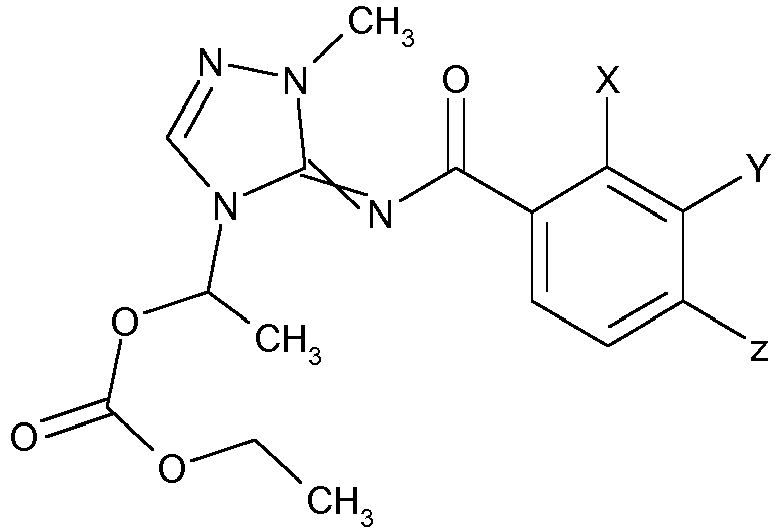
Tabelle 8: Erfindungsgemäße Verbindungen der allgemeinen Formel (I), worin A für A1, B für CH, R6 für Methyl, R für CH(Me)OCO2Me, W für CY und V für Wasserstoff steht. Tabelle 8 enthält 451 Verbindungen (8-1 bis 8-451), bei denen X, Y und Z in Tabelle 1 definiert sind.
Tabelle 9: Erfindungsgemäße Verbindungen der allgemeinen Formel (I), worin A für A1, B für CH, R6 für Methyl, R für CH(Me)OCO2-c-Hexyl, W für CY und V für Wasserstoff steht. Tabelle 9 enthält 451 Verbindungen (9-1 bis 9-451), bei denen X, Y und Z in Tabelle 1 definiert sind.
Tabelle 10: Erfindungsgemäße Verbindungen der allgemeinen Formel (I), worin A für A2, B für N, R6 für Methyl, R für CH(Me)OCO2Et, W für CY und V für Wasserstoff steht. Tabelle 10 enthält 451 Verbindungen (10-1 bis 10-451), bei denen X, Y und Z in Tabelle 1 definiert sind.
Tabelle 11: Erfindungsgemäße Verbindungen der allgemeinen Formel (I), worin A für A2, B für N, R6 für Ethyl, R für CH(Me)OCO2Et, W für CY und V für Wasserstoff steht. Tabelle 11 enthält 451 Verbindungen (11-1 bis 11-451), bei denen X, Y und Z in Tabelle 1 definiert sind.
Tabelle 12: Erfindungsgemäße Verbindungen der allgemeinen Formel (I), worin A für A2, B für N, R6 für Methyl, R für CH(Me)OCO2Me, W für CY und V für Wasserstoff steht. Tabelle 12 enthält 451 Verbindungen (12-1 bis 12-451), bei denen X, Y und Z in Tabelle 1 definiert sind.
Tabelle 13: Erfindungsgemäße Verbindungen der allgemeinen Formel (I), worin A für A2, B für N, R6 für Ethyl, R für CH(Me)OCO2Me, W für CY und V für Wasserstoff steht. Tabelle 13 enthält 451 Verbindungen (13-1 bis 13-451), bei denen X, Y und Z in Tabelle 1 definiert sind.
Tabelle 14: Erfindungsgemäße Verbindungen der allgemeinen Formel (I), worin A für A2, B für N, R6 für Methyl, R für CH(Me)OCO2-c-Hexyl, W für CY und V für Wasserstoff steht. Tabelle 14 enthält 451 Verbindungen (14-1 bis 14-451), bei denen X, Y und Z in Tabelle 1 definiert sind.
Tabelle 15: Erfindungsgemäße Verbindungen der allgemeinen Formel (I), worin A für A2, B für N, R6 für Ethyl, R für CH(Me)OCO2-c-Hexyl, W für CY und V für Wasserstoff steht. Tabelle 15 enthält 451 Verbindungen (15-1 bis 15-451), bei denen X, Y und Z in Tabelle 1 definiert sind.
Tabelle 16: Erfindungsgemäße Verbindungen der allgemeinen Formel (I), worin A für A2, B für CH, R6 für Methyl, R für CH(Me)OCO2Et, W für CY und V für Wasserstoff steht. Tabelle 16 enthält 451 Verbindungen (16-1 bis 16-451), bei denen X, Y und Z in Tabelle 1 definiert sind.
Tabelle 17: Erfindungsgemäße Verbindungen der allgemeinen Formel (I), worin A für A2, B für CH, R6 für Methyl, R für CH(Me)OCO2Me, W für CY und V für Wasserstoff steht. Tabelle 17 enthält 451 Verbindungen (17-1 bis 17-451), bei denen X, Y und Z in Tabelle 1 definiert sind.
Tabelle 18: Erfindungsgemäße Verbindungen der allgemeinen Formel (I), worin A für A2, B für CH, R6 für Methyl, R für CH(Me)OCO2-c-Hexyl, W für CY und V für Wasserstoff steht. Tabelle 18 enthält 451 Verbindungen (18-1 bis 18-451), bei denen X, Y und Z in Tabelle 1 definiert sind.
Tabelle 19: Erfindungsgemäße Verbindungen der allgemeinen Formel (I), worin A für A3, B für N, R6 für Methyl, R für CH(Me)OCO2Et, W für CY und V für Wasserstoff steht. Tabelle 19 enthält 451 Verbindungen (19-1 bis 19-451), bei denen X, Y und Z in Tabelle 1 definiert sind.
Tabelle 20: Erfindungsgemäße Verbindungen der allgemeinen Formel (I), worin A für A3, B für N, R6 für Ethyl, R für CH(Me)OCO2Et, W für CY und V für Wasserstoff steht. Tabelle 20 enthält 451 Verbindungen (20-1 bis 20-451), bei denen X, Y und Z in Tabelle 1 definiert sind.
Tabelle 21: Erfindungsgemäße Verbindungen der allgemeinen Formel (I), worin A für A3, B für N, R6 für Methyl, R für CH(Me)OCO2Me, W für CY und V für Wasserstoff steht. Tabelle 20 enthält 451 Verbindungen (20-1 bis 20 - 451), bei denen X, Y und Z in Tabelle 1 definiert sind.
Tabelle 22: Erfindungsgemäße Verbindungen der allgemeinen Formel (I), worin A für A3, B für N, R6 für Ethyl, R für CH(Me)OCO2Me, W für CY und V für Wasserstoff steht. Tabelle 22 enthält 451 Verbindungen (22-1 bis 22-451), bei denen X, Y und Z in Tabelle 1 definiert sind.
Tabelle 23: Erfindungsgemäße Verbindungen der allgemeinen Formel (I), worin A für A3, B für N, R6 für Methyl, R für CH(Me)OCO2-c-Hexyl, W für CY und V für Wasserstoff steht. Tabelle 23 enthält 451 Verbindungen (23-1 bis 23-451), bei denen X, Y und Z in Tabelle 1 definiert sind.
Tabelle 24: Erfindungsgemäße Verbindungen der allgemeinen Formel (I), worin A für A3, B für N, R6 für Ethyl, R für CH(Me)OCO2-c-Hexyl, W für CY und V für Wasserstoff steht. Tabelle 24 enthält 451 Verbindungen (24 -1 bis 24 - 451), bei denen X, Y und Z in Tabelle 1 definiert sind.
Tabelle 25: Erfindungsgemäße Verbindungen der allgemeinen Formel (I), worin A für A3, B für CH, R6 für Methyl, R für CH(Me)OCO2Et, W für CY und V für Wasserstoff steht. Tabelle 25 enthält 451 Verbindungen (25 - 1 bis 25 - 451), bei denen X, Y und Z in Tabelle 1 definiert sind.
Tabelle 26: Erfindungsgemäße Verbindungen der allgemeinen Formel (I), worin A für A3, B für N, R6 für Methyl, R für CH(Me)OCO2Me, W für CY und V für Wasserstoff steht. Tabelle 26 enthält 451 Verbindungen (26-1 bis 26-451), bei denen X, Y und Z in Tabelle 1 definiert sind.
Tabelle 27: Erfindungsgemäße Verbindungen der allgemeinen Formel (I), worin A für A3, B für CH, R6 für Methyl, R für CH(Me)OCO2-c-Hexyl, W für CY und V für Wasserstoff steht. Tabelle 27 enthält 451 Verbindungen (27-1 bis 27-451), bei denen X, Y und Z in Tabelle 1 definiert sind.
Tabelle 28: Erfindungsgemäße Verbindungen der allgemeinen Formel (I), worin A für A4, B für N, R6 für Methyl, R für CH(Me)OCO2Et, W für CY und V für Wasserstoff steht. Tabelle 28 enthält 451 Verbindungen (28 -1 bis 28 - 451), bei denen X, Y und Z in Tabelle 1 definiert sind.
Tabelle 29: Erfindungsgemäße Verbindungen der allgemeinen Formel (I), worin A für A4, B für N, R6 für Ethyl, R für CH(Me)OCO2Et, W für CY und V für Wasserstoff steht. Tabelle 29 enthält 451 Verbindungen (29 -1 bis 29 - 451), bei denen X, Y und Z in Tabelle 1 definiert sind.
Tabelle 30: Erfindungsgemäße Verbindungen der allgemeinen Formel (I), worin A für A4, B für N, R6 für Methyl, R für CH(Me)OCO2Me, W für CY und V für Wasserstoff steht. Tabelle 30 enthält 451 Verbindungen (30 -1 bis 30 - 451), bei denen X, Y und Z in Tabelle 1 definiert sind.
Tabelle 31: Erfindungsgemäße Verbindungen der allgemeinen Formel (I), worin A für A4, B für N, R6 für Ethyl, R für CH(Me)OCO2Me, W für CY und V für Wasserstoff steht. Tabelle 31 enthält 451 Verbindungen (31 -1 bis 31 - 451), bei denen X, Y und Z in Tabelle 1 definiert sind.
Tabelle 32: Erfindungsgemäße Verbindungen der allgemeinen Formel (I), worin A für A4, B für N, R6 für Methyl, R für CH(Me)OCO2-c-Hexyl, W für CY und V für Wasserstoff steht. Tabelle 32 enthält 451 Verbindungen (32 -1 bis 32 - 451), bei denen X, Y und Z in Tabelle 1 definiert sind.
Tabelle 33: Erfindungsgemäße Verbindungen der allgemeinen Formel (I), worin A für A4, B für N, R6 für Ethyl, R für CH(Me)OCO2-c-Hexyl, W für CY und V für Wasserstoff steht. Tabelle 33 enthält 451 Verbindungen (33 -1 bis 33 - 451), bei denen X, Y und Z in Tabelle 1 definiert sind.
Tabelle 34: Erfindungsgemäße Verbindungen der allgemeinen Formel (I), worin A für A4, B für CH, R6 für Methyl, R für CH(Me)OCO2Et, W für CY und V für Wasserstoff steht. Tabelle 34 enthält 451 Verbindungen (34 -1 bis 34 - 451), bei denen X, Y und Z in Tabelle 1 definiert sind.
Tabelle 35: Erfindungsgemäße Verbindungen der allgemeinen Formel (I), worin A für A4, B für CH, R6 für Methyl, R für CH(Me)OCO2Me, W für CY und V für Wasserstoff steht. Tabelle 35 enthält 451 Verbindungen (35 -1 bis 35 - 451), bei denen X, Y und Z in Tabelle 1 definiert sind.
Tabelle 36: Erfindungsgemäße Verbindungen der allgemeinen Formel (I), worin A für A4, B für CH, R6 für Methyl, R für CH(Me)OCO2-c-Hexyl, W für CY und V für Wasserstoff steht. Tabelle 36 enthält 451 Verbindungen (36 -1 bis 36 - 451), bei denen X, Y und Z in Tabelle 1 definiert sind.
Tabelle 37: Erfindungsgemäße Verbindungen der allgemeinen Formel (I), worin A für A1, B für N, W für CY und V für Wasserstoff steht und R, R6, X und Z die in Tabelle 37 angegebene Bedeutung haben 
Nr. X Z R6 R Physikalische Daten (1H-NMR, DMSO-d6, 400 MHz) 10-1 Cl CF3 Me CH(Me)OCO2Et 10-2 Cl CF3 Me CH(Me)OCO2Me 10-3 Cl CF3 Me CH(Me)OCO2-c-Hexyl 10-4 Cl CF3 Et CH(Me)OCO2Et 10-5 Cl CF3 Et CH(Me)OCO2Me 10-6 Cl CF3 Et CH(Me)OCO2-c-Hexyl 10-7 Br CF3 Me CH(Me)OCO2Et 10-8 Br CF3 Me CH(Me)OCO2Me 10-9 Br CF3 Me CH(Me)OCO2-c-Hexyl 10-10 Br CF3 Et CH(Me)OCO2Et 10-11 Br CF3 Et CH(Me)OCO2Me 10-12 Br CF3 Et CH(Me)OCO2-c-Hexyl 10-13 Me CF3 Me CH(Me)OCO2Et 10-14 Me CF3 Me CH(Me)OCO2Me 10-15 Me CF3 Me CH(Me)OCO2-c-Hexyl 10-16 Me CF3 Et CH(Me)OCO2Et 10-17 Me CF3 Et CH(Me)OCO2Me 10-18 Me CF3 Et CH(Me)OCO2-c-Hexyl 10-19 CH2OMe CF3 Me CH(Me)OCO2Et 10-20 CH2OMe CF3 Me CH(Me)OCO2Me 10-21 CH2OMe CF3 Me CH(Me)OCO2-c-Hexyl 10-22 CH2OMe CF3 Et CH(Me)OCO2Et 10-23 CH2OMe CF3 Et CH(Me)OCO2Me 10-24 CH2OMe CF3 Et CH(Me)OCO2-c-Hexyl 10-25 CH2OCH2CH2OMe CF3 Me CH(Me)OCO2Et 10-26 CH2OCH2CH2OMe CF3 Me CH(Me)OCO2Me 10-27 CH2OCH2CH2OMe CF3 Me CH(Me)OCO2-c-Hexyl 10-28 CH2OCH2CH2OMe CF3 Et CH(Me)OCO2Et 10-29 CH2OCH2CH2OMe CF3 Et CH(Me)OCO2Me 10-30 CH2OCH2CH2OMe CF3 Et CH(Me)OCO2-c-Hexyl
Tabelle 38: Erfindungsgemäße Verbindungen der allgemeinen Formel (I), worin A für A2, B für N, W für CY und V für Wasserstoff steht. Tabelle 38 enthält 30 Verbindungen (38 -1 bis 38 - 30), worin R, R6, X und Z wie in Tabelle 37 definiert sind.
Tabelle 39: Erfindungsgemäße Verbindungen der allgemeinen Formel (I), worin A für A3, B für N, W für CY und V für Wasserstoff steht. Tabelle 39 enthält 30 Verbindungen (39 -1 bis 39 - 30), worin R, R6, X und Z wie in Tabelle 37 definiert sind.
Tabelle 40: Erfindungsgemäße Verbindungen der allgemeinen Formel (I), worin A für A4, B für N, W für CY und V für Wasserstoff steht. Tabelle 40 enthält 30 Verbindungen (40 -1 bis 40 - 30), worin R, R6, X und Z wie in Tabelle 37 definiert sind.
- Die verwendeten Abkürzungen bedeuten:
Et = Ethyl Me = Methyl n-Pr = n-Propyl i-Pr = Isopropyl c-Pr = cyclo-Propyl Ph = Phenyl Bn = Benzyl Bu = Butyl c = cyclo -
- a) Ein Stäubemittel wird erhalten, indem man 10 Gew.-Teile einer Verbindung der Formel (I) und 90 Gew.-Teile Talkum als Inertstoff mischt und in einer Schlagmühle zerkleinert.
- b) Ein in Wasser leicht dispergierbares, benetzbares Pulver wird erhalten, indem man 25 Gewichtsteile einer Verbindung der Formel (I), 64 Gew.-Teile kaolinhaltigen Quarz als Inertstoff, 10 Gewichtsteile ligninsulfonsaures Kalium und 1 Gew.-Teil oleoylmethyltaurinsaures Natrium als Netz- und Dispergiermittel mischt und in einer Stiftmühle mahlt.
- c) Ein in Wasser leicht dispergierbares Dispersionskonzentrat wird erhalten, indem man 20 Gew.-Teile einer Verbindung der Formel (I) mit 6 Gew.-Teilen Alkylphenolpolyglykolether (®Triton X 207), 3 Gew.-Teilen Isotridecanolpolyglykolether (8 EO) und 71 Gew.-Teilen paraffinischem Mineralöl (Siedebereich z.B. ca. 255 bis über 277 C) mischt und in einer Reibkugelmühle auf eine Feinheit von unter 5 Mikron vermahlt.
- d) Ein emulgierbares Konzentrat wird erhalten aus 15 Gew.-Teilen einer Verbindung der Formel (I), 75 Gew.-Teilen Cyclohexanon als Lösungsmittel und 10 Gew.-Teilen oxethyliertes Nonylphenol als Emulgator.
- e) Ein in Wasser dispergierbares Granulat wird erhalten indem man
75 Gew.-Teile einer Verbindung der Formel (I) und/oder deren Salze,
10 Gew.-Teile ligninsulfonsaures Calcium,
5 Gew.-Teile Natriumlaurylsulfat,
3 Gew.-Teile Polyvinylalkohol und
7 Gew.-Teile Kaolin
mischt, auf einer Stiftmühle mahlt und das Pulver in einem Wirbelbett durch Aufsprühen von Wasser als Granulierflüssigkeit granuliert. - f) Ein in Wasser dispergierbares Granulat wird auch erhalten, indem man
25 Gew.-Teile einer Verbindung der Formel (I),
5 Gew.-Teile 2,2'-dinaphthylmethan-6,6'-disulfonsaures Natrium
2 Gew.-Teile oleoylmethyltaurinsaures Natrium,
1 Gew.-Teil Polyvinylalkohol,
17 Gew.-Teile Calciumcarbonat und
50 Gew.-Teile Wasser
auf einer Kolloidmühle homogenisiert und vorzerkleinert, anschließend auf einer Perlmühle mahlt und die so erhaltene Suspension in einem Sprühturm mittels einer Einstoffdüse zerstäubt und trocknet. - Samen von mono- bzw. dikotylen Unkraut- bzw. Kulturpflanzen werden in Holzfasertöpfen in sandiger Lehmerde ausgelegt und mit Erde abgedeckt. Die in Form von benetzbaren Pulvern (WP) oder als Emulsionskonzentrate (EC) formulierten erfindungsgemäßen Verbindungen werden dann als wäßrige Suspension bzw. Emulsion mit einer Wasseraufwandmenge von umgerechnet 600 bis 800 l/ha unter Zusatz von 0,2% Netzmittel auf die Oberfläche der Abdeckerde appliziert. Nach der Behandlung werden die Töpfe im Gewächshaus aufgestellt und unter guten Wachstumsbedingungen für die Testpflanzen gehalten. Die visuelle Bonitur der Schäden an den Versuchspflanzen erfolgt nach einer Versuchszeit von 3 Wochen im Vergleich zu unbehandelten Kontrollen (herbizide Wirkung in Prozent (%): 100% Wirkung = Pflanzen sind abgestorben, 0 % Wirkung = wie Kontrollpflanzen). Dabei zeigen beispielsweise die Verbindungen Nr. 1-384, 1-390, 3-384, 5-384, 19-384, 9-390, 21-384, 23-384, 28-390 und 32-384 bei einer Aufwandmenge von 320 g/ha jeweils eine mindestens 80 %-ige Wirkung gegen Stellaria media und Amaranthus retroflexus.
- Samen von mono- bzw. dikotylen Unkraut- bzw. Kulturpflanzen werden in Holzfasertöpfen in sandigem Lehmboden ausgelegt, mit Erde abgedeckt und im Gewächshaus unter guten Wachstumsbedingungen angezogen. 2 bis 3 Wochen nach der Aussaat werden die Versuchspflanzen im Einblattstadium behandelt. Die in Form von benetzbaren Pulvern (WP) oder als Emulsionskonzentrate (EC) formulierten erfindungsgemäßen Verbindungen werden dann als wäßrige Suspension bzw. Emulsion mit einer Wasseraufwandmenge von umgerechnet 600 bis 800 l/ha unter Zusatz von 0,2% Netzmittel auf die grünen Pflanzenteile gesprüht. Nach ca. 3 Wochen Standzeit der Versuchspflanzen im Gewächshaus unter optimalen Wachstumsbedingungen wird die Wirkung der Präparate visuell im Vergleich zu unbehandelten Kontrollen bonitiert (herbizide Wirkung in Prozent (%): 100% Wirkung = Pflanzen sind abgestorben, 0 % Wirkung = wie Kontrollpflanzen). Dabei zeigen beispielsweise die Verbindungen Nr. 1-384, 1-390, 3-384, 5-384, 19-384, 9-390, 21-384, 23-384, 28-390 und 32-384 bei einer Aufwandmenge von 80 g/ha jeweils eine mindestens 80 %-ige Wirkung gegen Stellaria media und Veronica persica.
- Zu Vergleichszwecken wurde die herbizide Wirkung einiger erfindungsgemäßer Verbindungen und die der strukturell ähnlichsten und aus dem Stand der Technik bekannten Verbindungen geprüft.
Verbindung Dosierung [g/ha] herbizide Wirkung gegen POLCO Nr. 1-390, erfindungsgemäß 320 100% Nr. 4-634, aus WO 2012/028579 320 70% Nr. 19-390, erfindungsgemäß 320 100% Nr. 4-634, aus WO 2012/028579 320 70% Nr. 28-390, erfindungsgemäß 320 90% Nr. 4-634, aus WO 2012/028579 320 70% Nr. 1-390, erfindungsgemäß 320 100% Nr. 3-040, aus WO 2014/126070 320 70% Nr. 28-390, erfindungsgemäß 320 90% Nr. 3-040, aus WO 2014/126070 320 70% Nr. 21-384, erfindungsgemäß 320 100% Nr. 4-638, aus WO 2012/028579 320 50% Nr. 23-384, erfindungsgemäß 320 90% Nr. 4-638, aus WO 2012/028579 320 50% Nr. 32-384, erfindungsgemäß 320 70% Nr. 4-638, aus WO 2012/028579 320 50% - Die Versuche zeigen beispielhaft an der Schadpflanze Polygonum convolvulus (POLCO) die überlegene herbizide Wirkung der erfindungsgemäßen Verbindungen.
Claims (14)
- N-(Tetrazol-5-yl)- und N-(Triazol-5-yl)arylcarboxamid-Derivate der Formel (I)
 W bedeutet N oder CY,X und Z bedeuten unabhängig voneinander jeweils Wasserstoff, Nitro, Halogen, Cyano, Formyl, Rhodano, (C1-C6)-Alkyl, (C1-C6)-Halogenalkyl, (C2-C6)-Alkenyl, (C2-C6)-Halogenalkenyl, (C2-C6)-Alkinyl, (C3-C6)-Halogenalkinyl, (C3-C6)-Cycloalkyl, (C3-C6)-Halogencycloalkyl, (C3-C6)-Cycloalkyl-(C1-C6)-alkyl, (C3-C6)-Halogencycloalkyl-(C1-C6)-alkyl, COR1, OR1, OCOR1, OSO2R2, S(O)nR2, SO2OR1, SO2N(R1)2, NR1SO2R2, NR1COR1, (C1-C6)-Alkyl-S(O)nR2, (C1-C6)-Alkyl-OR1, (C1-C6)-Alkyl-OCOR1, (C1-C6)-Alkyl-OSO2R2, (C1-C6)-Alkyl-CO2R1, (C1-C6)-Alkyl-SO2OR1, (C1-C6)-Alkyl-CON(R1)2, (C1-C6)-Alkyl-SO2N(R1)2, (C1-C6)-Alkyl-NR1COR1, (C1-C6)-Alkyl-NR1SO2R2, NR1R2, P(O)(OR5)2, oder
jeweils durch s Reste aus der Gruppe Methyl, Ethyl, Methoxy, Nitro, Trifluormethyl und Halogen substituiertes Heteroaryl, Heterocyclyl oder Phenyl,Y bedeutet Wasserstoff, Nitro, Halogen, Cyano, Rhodano, (C1-C6)-Alkyl, Halogen-(C1-C6)-alkyl, (C2-C6)-Alkenyl, Halogen-(C2-C6)-alkenyl, (C2-C6)-Alkinyl, Halogen-(C2-C6)-alkinyl, (C3-C6)-Cycloalkyl, (C3-C6)-Cycloalkenyl, Halogen-(C3-C6)-cycloalkyl, (C3-C6)-Cycloalkyl-(C1-C6)-alkyl, Halogen-(C3-C6)-cycloalkyl-(C1-C6)-alkyl, COR1, CO2R1,OCO2R1, NR1CO2R1, C(O)N(R1)2, NR1C(O)N(R1)2, OC(O)N(R1)2, C(O)N(R1)OR1, NR1SO2R2, NR1COR1, OR1, OSO2R2, S(O)nR2, SO2OR1, SO2N(R1)2, (C1-C6)-Alkyl-S(O)nR2, (C1-C6)-Alkyl-OR1, (C1-C6)-Alkyl-OCOR1, (C1-C6)-Alkyl-OSO2R2, (C1-C6)-Alkyl-CO2R1, (C1-C6)-Alkyl-CN, (C1-C6)-Alkyl-SO2OR1, (C1-C6)-Alkyl-CON(R1)2, (C1-C6)-Alkyl-SO2N(R1)2, (C1-C6)-Alkyl-NR1COR1, (C1-C6)-Alkyl-NR1SO2R2, N(R1)2, P(O)(OR5)2, CH2P(O)(OR5)2, CH=NOR1, (C1-C6)-Alkyl-CH=NOR1, (C1-C6)-Alkyl-O-N=C(R1)2, (C1-C6)-Alkyl-Phenyl, (C1-C6)-Alkyl-Heteroaryl, (C1-C6)-Alkyl-Heterocyclyl, Phenyl, Heteroaryl oder Heterocyclyl, wobei die 6 letztgenannten Reste jeweils durch s Reste aus der Gruppe bestehend aus Halogen, Nitro, Cyano, (C1-C6)-Alkyl, Halogen-(C1-C6)-alkyl, (C3-C6)-Cycloalkyl, S(O)n-(C1-C6)-Alkyl, (C1-C6)-Alkoxy, Halogen-(C1-C6)-alkoxy, (C1-C6)-Alkoxy-(C1-C4)-alkyl und Cyanomethyl substituiert sind, und wobei Heterocyclyl n Oxogruppen trägt,
oder
Y und Z bilden gemeinsam mit den beiden Atomen, an die sie gebunden sind, einen 5-, 6- oder 7-gliedrigen, ungesättigten, teilgesättigten oder gesättigten Ring, der neben Kohlenstoffatomen jeweils s Stickstoffatome, n Sauerstoffatome, n Schwefelatome und n Elemente S(O), S(O)2, C=N-R10, C(OR11)2, C[-O-(CH2)2-O-] oder C(O) als Ringglieder umfasst,
dessen Kohlenstoffatome durch s Reste aus der Gruppe bestehend aus Halogen, Cyano, (C1-C6)-Alkyl, (C2-C10)-Alkenyl, (C2-C10)-Alkinyl, (C1-C6)-Haloalkyl, (C1-C6)-Alkoxy, Phenoxy, Halogen-(C1-C6)-alkoxy, (C3-C3)-Cycloalkyl, (C2-C8)-Alkoxyalkyl und Phenyl substituiert sind,
dessen Stickstoffatome durch n Reste aus der Gruppe bestehend aus (C1-C6)-Alkyl und Phenyl substituiert sind,
und worin die vorstehend genannten Phenylreste durch s Reste aus der Gruppe bestehend aus Cyano, Nitro, Halogen, (C1-C6)-Alkyl, (C1-C6)-Haloalkyl und (C1-C6)-Alkoxy substituiert sind,V bedeutet Wasserstoff, Nitro, Halogen, Cyano, (C1-C4)-Alkyl, (C1-C4)-Halogenalkyl oder OR1, S(O)nR2,R1 bedeutet Wasserstoff, (C1-C6)-Alkyl, (C1-C6)-Halogenalkyl, (C2-C6)-Alkenyl, (C2-C6)-Halogenalkenyl, (C2-C6)-Alkinyl, (C2-C6)-Halogenalkinyl, (C3-C6)-Cycloalkyl, (C3-C6)-Cycloalkenyl, (C3-C6)-Halogencycloalkyl, (C1-C6)-Alkyl-O-(C1-C6)-alkyl, (C3-C6)-Cycloalkyl-(C1-C6)-alkyl, Phenyl, Phenyl-(C1-C6)-alkyl, Heteroaryl, (C1-C6)-Alkyl-Heteroaryl, Heterocycl, (C1-C6)-Alkyl-Heterocyclyl, (C1-C6)-Alkyl-O-Heteroaryl, (C1-C6)-Alkyl-O-Heterocyclyl, (C1-C6)-Alkyl-NR3-Heteroaryl, (C1-C6)-Alkyl-NR3-Heterocyclyl wobei die 21 letztgenannten Reste durch s Reste aus der Gruppe bestehend aus Cyano, Halogen, Nitro, Rhodano, OR3, S(O)nR4, N(R3)2, NR3OR3, COR3, OCOR3, SCOR4, NR3COR3, NR3SO2R4, CO2R3, COSR4, CON(R3)2 und (C1-C4)-Alkoxy-(C2-C6)-alkoxycarbonyl substituiert sind, und wobei Heterocyclyl n Oxogruppen trägt,R2 bedeutet (C1-C6)-Alkyl, (C1-C6)-Halogenalkyl, (C2-C6)-Alkenyl, (C2-C6)-Halogenalkenyl, (C2-C6)-Alkinyl, (C2-C6)-Halogenalkinyl, (C3-C6)-Cycloalkyl, (C3-C6)-Cycloalkenyl, (C3-C6)-Halogencycloalkyl, (C1-C6)-Alkyl-O-(C1-C6)-alkyl, (C3-C6)-Cycloalkyl-(C1-C6)-alkyl, Phenyl, Phenyl-(C1-C6)-alkyl, Heteroaryl, (C1-C6)-Alkyl-Heteroaryl, Heterocyclyl, (C1-C6)-Alkyl-Heterocyclyl, (C1-C6)-Alkyl-O-Heteroaryl, (C1-C6)-Alkyl-O-Heterocyclyl, (C1-C6)-Alkyl-NR3-Heteroaryl, (C1-C6)-Alkyl-NR3-Heterocyclyl wobei die 21 letztgenannten Reste durch s Reste aus der Gruppe bestehend aus Cyano, Halogen, Nitro, Rhodano, OR3, S(O)nR4, N(R3)2, NR3OR3, COR3, OCOR3, SCOR4, NR3COR3, NR3SO2R4, CO2R3, COSR4, CON(R3)2 und (C1-C4)-Alkoxy-(C2-C6)-alkoxycarbonyl substituiert sind, und wobei Heterocyclyl n Oxogruppen trägt,R3 bedeutet Wasserstoff, (C1-C6)-Alkyl, (C2-C6)-Alkenyl, (C2-C6)-Alkinyl, (C3-C6)-Cycloalkyl oder (C3-C6)-Cycloalkyl-(C1-C6)-alkyl,R4 bedeutet (C1-C6)-Alkyl, (C2-C6)-Alkenyl oder (C2-C6)-Alkinyl, (C3-C6)-Cycloalkyl oder (C3-C6)-Cycloalkyl-(C1-C6)-alkyl,R5 bedeutet (C1-C4)-Alkyl,n bedeutet 0, 1 oder 2,s bedeutet 0, 1, 2 oder 3,A bedeutet einen Rest A1, A2, A3 oder A4 B bedeutet N oder CH,R bedeutet (C1-C6)-Alkyl-OC(O)N(R3)2 oder (C1-C6)-Alkyl-OC(O)OR12,R6 bedeutet (C1-C6)-Alkyl, Halogen-(C1-C6)-alkyl, (C2-C6)-Alkenyl, Halogen-(C2-C6)-alkenyl, (C2-C6)-Alkinyl, Halogen-(C2-C6)-alkinyl,
wobei diese 6 vorstehend genannten Reste jeweils durch s Reste aus der Gruppe bestehend aus Nitro, Cyano, SiR9 3, PO(OR9)3, S(O)n-(C1-C6)-Alkyl, (C1-C6)-Alkoxy, Halogen-(C1-C6)-alkoxy, N(R7)2, COR7, CO2R7, OCOR7, OCO2R7, NR7COR7, NR7SO2R8, (C3-C6)-Cycloalkyl, Heteroaryl, Heterocyclyl, Phenyl, D-Heteroaryl, D-Heterocyclyl, D-Phenyl oder D-Benzyl substituiert sind, und wobei die 7 letztgenannten Reste durch s Reste aus der Gruppe Methyl, Ethyl, Methoxy, Trifluormethyl und
Halogen substituiert sind, und wobei Heterocyclyl n Oxogruppen trägt, oder
R6 bedeutet jeweils durch s Reste aus der Gruppe bestehend aus Halogen, Nitro, Cyano, (C1-C6)-Alkyl, Halogen-(C1-C6)-alkyl, (C3-C6)-Cycloalkyl, S(O)n-(C1-C6)-Alkyl, (C1-C6)-Alkoxy, Halogen-(C1-C6)-alkoxy und (C1-C6)-Alkoxy-(C1-C4)-alkyl substituiertes (C3-C7)-Cycloalkyl, Heteroaryl, Heterocyclyl oder Phenyl,R7 bedeutet Wasserstoff, (C1-C6)-Alkyl, (C2-C6)-Alkenyl, (C2-C6)-Alkinyl, (C3-C6)-Cycloalkyl oder (C3-C6)-Cycloalkyl-(C1-C6)-alkyl oder Phenyl,R8 bedeutet (C1-C6)-Alkyl, (C2-C6)-Alkenyl, (C2-C6)-Alkinyl oder Phenyl,R9 bedeutet (C1)-Alkyl,R10 bedeutet (C1-C6)-Alkyl, Halogen-(C1-C6)-alkyl, (C1-C6)-Alkoxy und Halogen-(Ci-C6)-alkoxy,R11 bedeutet (C1-C6)-Alkyl oder Halogen-(C1-C6)-alkyl,R12 bedeutet (C1-C6)-Alkyl, Halogen-(C1-C6)-alkyl oder (C1-C6)-Cycloalkyl,s bedeutet 0, 1, 2 oder 3,n bedeutet 0, 1 oder 2,D bedeutet O, S, oder NR8. - N-(Tetrazol-5-yl)- und N-(Triazol-5-yl)arylcarboxamid-Derivate der Formel (I) nach Anspruch 1, worin
R6 bedeutet (C1-C6)-Alkyl, Halogen-(C1-C6)-alkyl, (C2-C6)-Alkenyl, (C2-C6)-Alkinyl, wobei diese 4 vorstehend genannten Reste jeweils durch s Reste aus der Gruppe bestehend aus S(O)n-(C1-C6)-Alkyl, (C1-C6)-Alkoxy, Halogen-(C1-C6)-alkoxy, N(R7)2, COR7, CO2R7, OCOR7, OCO2R7, NR7COR7, NR7SO2R8, (C3-C6)-Cycloalkyl, Heteroaryl, Heterocyclyl, Phenyl, D-Heteroaryl, D-Heterocyclyl, D-Phenyl oder D-Benzyl substituiert sind, und wobei die 7 letztgenannten Reste durch s Reste aus der Gruppe Methyl, Ethyl, Methoxy, Trifluormethyl und Halogen substituiert sind, und wobei Heterocyclyl n Oxogruppen trägt, oder
R6 bedeutet jeweils durch s Reste aus der Gruppe bestehend aus Halogen, Nitro, Cyano, (C1-C6)-Alkyl, Halogen-(C1-C6)-alkyl, (C3-C6)-Cycloalkyl, S(O)n-(C1-C6)-Alkyl, (C1-C6)-Alkoxy, Halogen-(C1-C6)-alkoxy und (C1-C6)-Alkoxy-(C1-C4)-alkyl substituiertes (C3-C7)-Cycloalkyl, Heteroaryl, Heterocyclyl oder Phenyl. - N-(Tetrazol-5-yl)- und N-(Triazol-5-yl)arylcarboxamid-Derivate der Formel (I) nach Anspruch 1 oder 2, worin
W bedeutet CY,
X und Z bedeuten unabhängig voneinander jeweils Wasserstoff, Halogen, (C1-C6)-Alkyl, (C1-C6)-Halogenalkyl, (C2-C6)-Alkenyl, (C3-C6)-Cycloalkyl, (C3-C6)-Halogencycloalkyl, OR1, S(O)nR2, SO2N(R1)2, NR1SO2R2, NR1COR1, (C1-C6)-AlkylS(O)nR2, (C1-C6)-Alkyl-OR1, oder
jeweils durch s Reste aus der Gruppe Methyl, Ethyl, Methoxy, Nitro, Trifluormethyl und Halogen substituiertes Heteroaryl, Heterocyclyl oder Phenyl,
Y bedeutet Wasserstoff, (C2-C6)-Alkenyl, COR1, CO2R1,OCO2R1, NR1CO2R1, C(O)N(R1)2, NR1C(O)N(R1)2, OC(O)N(R1)2, C(O)N(R1)OR1, NR1SO2R2, NR1COR1, OR1, S(O)nR2, SO2N(R1)2, (C1-C6)-Alkyl-S(O)nR2, (C1-C6)-Alkyl-OR1, (C1-C6)-Alkyl-OCOR1, (C1-C6)-Alkyl-CO2R1, (C1-C6)-Alkyl-CON(R1)2, (C1-C6)-Alkyl-SO2N(R1)2, (C1-C6)-Alkyl-NR1COR1, (C1-C6)-Alkyl-NR1SO2R2, N(R1)2, CH=NOR1, (C1-C6)-Alkyl-CH=NOR1, (C1-C6)-Alkyl-Heteroaryl, (C1-C6)-Alkyl-Heterocyclyl, Heteroaryl oder Heterocyclyl, wobei die 4 letztgenannten Reste jeweils durch s Reste aus der Gruppe bestehend aus Halogen, Nitro, Cyano, (C1-C6)-Alkyl, Halogen-(C1-C6)-alkyl, (C3-C6)-Cycloalkyl, S(O)n-(C1-C6)-Alkyl, (C1-C6)-Alkoxy, Halogen-(C1-C6)-alkoxy, (C1-C6)-Alkoxy-(C1-C4)-alkyl und Cyanomethyl substituiert sind, und wobei Heterocyclyl n Oxogruppen trägt,
V bedeutet Wasserstoff, Cl, OMe, Methyl oder Ethyl,
R6 bedeutet Methyl, Ethyl, n-Propyl. - N-(Tetrazol-5-yl)- und N-(Triazol-5-yl)arylcarboxamid-Derivate der Formel (I) nach einem der Ansprüche 1 bis 3, worin
W bedeutet CY,
X bedeutet F, Cl, Br, Methyl, Ethyl, Cyclopropyl, Trifluormethyl, Methoxy, Methoxymethyl, Methoxyethoxymethyl, SMe oder SO2Me,
Z bedeutet Wasserstoff, F, Cl, Br, I, Methyl, Ethyl, Trifluormethyl, Difluormethyl, Pentafluorethyl, Methylsulfonyl oder Ethylsulfonyl,
Y bedeutet Wasserstoff, SMe, S(O)Me, SO2Me, SEt, S(O)Et, SO2Et, CH2OMe, CH2OEt, CH2OCH2CF3,CH2SMe, CH2S(O)Me, CH2SO2Me, Vinyl, C(O)Me, C(O)Et, C(O)cPr, CO2Me, CHN=OMe, 4,5-dihydro-1,2-oxazol-3-yl, 5-methyl-4,5-dihydro-1,2-oxazol-3-yl, 5-methyl-4,5-dihydro-1,2-oxazol-3-yl, 5-cyanomethyl-4,5-dihydro-1,2-oxazol-3-yl, 4,5-dihydro-1,2-oxazol-5-yl, 3-methyl-4,5-dihydro-1,2-oxazol-5-yl, 1H-pyrazol-1-yl, 1H-1,2,3-triazol-1-yl, 2H-1,2,3-triazol-2-yl, 1H-1,2,4-triazol-1-yl, pyrolidin-2-on-1-yl, morpholin-3-on-4-yl, OMe, OEt, O-n-Pr, OCH2-c-Pr, OCH2CH2F; OCH2CH2OMe oder OCH2CH2CH2OMe,
V bedeutet Wasserstoff,
B bedeutet N,
R bedeutet CH2OCO2Et, CH(CH3)OCO2Me, CH(CH3)OCO2Et, CH(CH3)OCO2-c-Hexyl, CH(CH3)OCO2-i-Pr oder CH(CH3)OCO2-t-Bu,
R6 bedeutet Methyl oder Ethyl. - Herbizide Mittel, gekennzeichnet durch einen herbizid wirksamen Gehalt an mindestens einem N-(Tetrazol-5-yl)- oder N-(Triazol-5-yl)arylcarboxamid-Derivate der Formel (I) gemäß einem der Ansprüche 1 bis 4.
- Herbizide Mittel nach Anspruch 5 in Mischung mit Formulierungshilfsmitteln.
- Herbizide Mittel nach Anspruch 5 oder 6 enthaltend mindestens einen weiteren pestizid wirksamen Stoff aus der Gruppe Insektizide, Akarizide, Herbizide, Fungizide, Safener und Wachstumsregulatoren.
- Herbizide Mittel nach Anspruch 7 enthaltend einen Safener.
- Herbizide Mittel nach Anspruch 5 enthaltend cyprosulfamid, cloquintocet-mexyl, mefenpyr-diethyl oder isoxadifen-ethyl.
- Herbizide Mittel nach einem der Ansprüche 7 bis 9 enthaltend ein weiteres Herbizid.
- Verfahren zur Bekämpfung unerwünschter Pflanzen, dadurch gekennzeichnet, daß man eine wirksame Menge mindestens einer Verbindung der Formel (I) gemäß einem der Ansprüche 1 bis 4 oder eines herbiziden Mittels nach einem der Ansprüche 5 bis 10 auf die Pflanzen oder auf den Ort des unerwünschten Pflanzenwachstums appliziert.
- Verwendung von Verbindungen der Formel (I) gemäß einem der Ansprüche 1 bis 4 oder von herbiziden Mitteln nach einem der Ansprüche 5 bis 10 zur Bekämpfung unerwünschter Pflanzen.
- Verwendung nach Anspruch 12, dadurch gekennzeichnet, daß die Verbindungen der Formel (I) zur Bekämpfung unerwünschter Pflanzen in Kulturen von Nutzpflanzen eingesetzt werden.
- Verwendung nach Anspruch 13, dadurch gekennzeichnet, daß die Nutzpflanzen transgene Nutzpflanzen sind.
Applications Claiming Priority (2)
| Application Number | Priority Date | Filing Date | Title |
|---|---|---|---|
| EP15175276 | 2015-07-03 | ||
| PCT/EP2016/065098 WO2017005567A1 (de) | 2015-07-03 | 2016-06-29 | Herbizid wirksame n-(tetrazol-5-yl)- und n-(triazol-5-yl)arylcarboxamid-derivate |
Publications (2)
| Publication Number | Publication Date |
|---|---|
| EP3317268A1 EP3317268A1 (de) | 2018-05-09 |
| EP3317268B1 true EP3317268B1 (de) | 2019-08-28 |
Family
ID=53510785
Family Applications (1)
| Application Number | Title | Priority Date | Filing Date |
|---|---|---|---|
| EP16732671.9A Active EP3317268B1 (de) | 2015-07-03 | 2016-06-29 | Herbizid wirksame n-(tetrazol-5-yl)- und n-(triazol-5-yl)arylcarboxamid-derivate |
Country Status (11)
| Country | Link |
|---|---|
| US (1) | US10548318B2 (de) |
| EP (1) | EP3317268B1 (de) |
| JP (1) | JP6677749B2 (de) |
| CN (1) | CN107922395B (de) |
| AU (1) | AU2016290425A1 (de) |
| BR (1) | BR112018000091B1 (de) |
| CA (1) | CA2990985A1 (de) |
| EA (1) | EA033155B1 (de) |
| MX (1) | MX2018000295A (de) |
| WO (1) | WO2017005567A1 (de) |
| ZA (1) | ZA201708378B (de) |
Families Citing this family (6)
| Publication number | Priority date | Publication date | Assignee | Title |
|---|---|---|---|---|
| BR112019023012B1 (pt) * | 2017-05-04 | 2023-03-21 | Bayer Cropscience Aktiengesellschaft | Composto de 4-difluorometil benzoilamida com ação herbicida, composições herbicidas que compreendem o composto, método e uso dos mesmos para controlar plantas indesejadas |
| TWI771440B (zh) * | 2017-08-04 | 2022-07-21 | 德商拜耳廠股份有限公司 | 3-醯基苯甲醯胺類及其作為除草劑之用途 |
| CA3154874C (en) | 2019-10-21 | 2024-06-04 | Young Kwan Ko | Nicotinamide compound and herbicidal composition comprising compound |
| WO2024074126A1 (zh) * | 2022-10-05 | 2024-04-11 | 江苏中旗科技股份有限公司 | 一种4-甲磺酰基苯甲酰胺类化合物、制备方法、除草组合物及用途 |
| JP2025534427A (ja) * | 2022-10-05 | 2025-10-15 | ジァンスー フラッグ ケミカル インダストリー カンパニー リミテッド | 4-メチルスルホニルベンズアミド化合物、製造方法、除草剤組成物および使用 |
| WO2025114250A1 (de) | 2023-11-29 | 2025-06-05 | Bayer Aktiengesellschaft | 3-acyl-benzamide und ihre verwendung als herbizide |
Family Cites Families (22)
| Publication number | Priority date | Publication date | Assignee | Title |
|---|---|---|---|---|
| JPS60500438A (ja) | 1983-01-17 | 1985-04-04 | モンサント カンパニ− | 植物細胞を形質転換するためのプラスミド |
| BR8404834A (pt) | 1983-09-26 | 1985-08-13 | Agrigenetics Res Ass | Metodo para modificar geneticamente uma celula vegetal |
| BR8600161A (pt) | 1985-01-18 | 1986-09-23 | Plant Genetic Systems Nv | Gene quimerico,vetores de plasmidio hibrido,intermediario,processo para controlar insetos em agricultura ou horticultura,composicao inseticida,processo para transformar celulas de plantas para expressar uma toxina de polipeptideo produzida por bacillus thuringiensis,planta,semente de planta,cultura de celulas e plasmidio |
| ATE80182T1 (de) | 1985-10-25 | 1992-09-15 | Monsanto Co | Pflanzenvektoren. |
| DE3765449D1 (de) | 1986-03-11 | 1990-11-15 | Plant Genetic Systems Nv | Durch gentechnologie erhaltene und gegen glutaminsynthetase-inhibitoren resistente pflanzenzellen. |
| JPH01503663A (ja) | 1986-05-01 | 1989-12-07 | ハネウエル・インコーポレーテツド | 多重集積回路相互接続装置 |
| IL83348A (en) | 1986-08-26 | 1995-12-08 | Du Pont | Nucleic acid fragment encoding herbicide resistant plant acetolactate synthase |
| US5013659A (en) | 1987-07-27 | 1991-05-07 | E. I. Du Pont De Nemours And Company | Nucleic acid fragment encoding herbicide resistant plant acetolactate synthase |
| DE3733017A1 (de) | 1987-09-30 | 1989-04-13 | Bayer Ag | Stilbensynthase-gen |
| ATE241007T1 (de) | 1990-03-16 | 2003-06-15 | Calgene Llc | Dnas, die für pflanzliche desaturasen kodieren und deren anwendungen |
| ATE212670T1 (de) | 1990-06-18 | 2002-02-15 | Monsanto Technology Llc | Erhöhter stärkegehalt in pflanzen |
| EP0536330B1 (de) | 1990-06-25 | 2002-02-27 | Monsanto Technology LLC | Glyphosattolerante pflanzen |
| DE4107396A1 (de) | 1990-06-29 | 1992-01-02 | Bayer Ag | Stilbensynthase-gene aus weinrebe |
| SE467358B (sv) | 1990-12-21 | 1992-07-06 | Amylogene Hb | Genteknisk foeraendring av potatis foer bildning av staerkelse av amylopektintyp |
| DE4104782B4 (de) | 1991-02-13 | 2006-05-11 | Bayer Cropscience Gmbh | Neue Plasmide, enthaltend DNA-Sequenzen, die Veränderungen der Karbohydratkonzentration und Karbohydratzusammensetzung in Pflanzen hervorrufen, sowie Pflanzen und Pflanzenzellen enthaltend dieses Plasmide |
| DE19548416A1 (de) * | 1995-12-22 | 1997-06-26 | Bayer Ag | 3,3-Dioxy-4,4,4-trifluorbuttersäure-Derivate |
| US7378530B2 (en) * | 2005-02-22 | 2008-05-27 | Nereus Pharmaceuticals, Inc. | Anti-cancer and anti-microbial 5-membered heterocyclic compounds |
| WO2012028579A1 (de) * | 2010-09-01 | 2012-03-08 | Bayer Cropscience Ag | N-(tetrazol-5-yl)- und n-(triazol-5-yl)arylcarbonsäureamide und ihre verwendung als herbizide |
| EP2739611B1 (de) * | 2011-08-03 | 2015-05-13 | Bayer Intellectual Property GmbH | N-(tetrazol-5-yl)- und n-(triazol-5-yl)arylcarbonsäureamide und ihre verwendung als herbizide |
| UA116532C2 (uk) | 2011-12-13 | 2018-04-10 | Байєр Інтеллектуал Проперті Гмбх | Аміди n-(1,2,5-оксадіазол-3-іл)-, n-(1,3,4-оксадіазол-2-іл)- або n-(тетразол-5-іл)арилкарбоксильної кислоти й застосування їх як гербіцидів |
| JP2016094344A (ja) * | 2013-02-15 | 2016-05-26 | 石原産業株式会社 | トリアジノンカルボキサミド系化合物又はその塩 |
| WO2014173374A1 (en) * | 2013-04-24 | 2014-10-30 | Smart Brain s.r.o. | Tamoxifen derivatives for treatment of neoplastic diseases, especially with high her2 protein level |
-
2016
- 2016-06-29 EP EP16732671.9A patent/EP3317268B1/de active Active
- 2016-06-29 CN CN201680050605.9A patent/CN107922395B/zh active Active
- 2016-06-29 EA EA201890210A patent/EA033155B1/ru not_active IP Right Cessation
- 2016-06-29 US US15/741,151 patent/US10548318B2/en active Active
- 2016-06-29 BR BR112018000091-4A patent/BR112018000091B1/pt active IP Right Grant
- 2016-06-29 JP JP2017567777A patent/JP6677749B2/ja active Active
- 2016-06-29 CA CA2990985A patent/CA2990985A1/en not_active Abandoned
- 2016-06-29 MX MX2018000295A patent/MX2018000295A/es unknown
- 2016-06-29 AU AU2016290425A patent/AU2016290425A1/en not_active Abandoned
- 2016-06-29 WO PCT/EP2016/065098 patent/WO2017005567A1/de not_active Ceased
-
2017
- 2017-12-11 ZA ZA2017/08378A patent/ZA201708378B/en unknown
Non-Patent Citations (1)
| Title |
|---|
| None * |
Also Published As
| Publication number | Publication date |
|---|---|
| BR112018000091B1 (pt) | 2022-07-26 |
| BR112018000091A2 (pt) | 2018-08-28 |
| WO2017005567A1 (de) | 2017-01-12 |
| ZA201708378B (en) | 2018-11-28 |
| JP2018525344A (ja) | 2018-09-06 |
| EA201890210A1 (ru) | 2018-07-31 |
| EA033155B1 (ru) | 2019-09-30 |
| CN107922395B (zh) | 2020-11-17 |
| CN107922395A (zh) | 2018-04-17 |
| AU2016290425A1 (en) | 2018-01-18 |
| CA2990985A1 (en) | 2017-01-12 |
| US10548318B2 (en) | 2020-02-04 |
| MX2018000295A (es) | 2018-03-08 |
| US20180192650A1 (en) | 2018-07-12 |
| JP6677749B2 (ja) | 2020-04-08 |
| EP3317268A1 (de) | 2018-05-09 |
Similar Documents
| Publication | Publication Date | Title |
|---|---|---|
| EP3356334B1 (de) | Acylierte n-(1,2,5-oxadiazol-3-yl)-, n-(1,3,4-oxadiazol-2-yl)-, n-(tetrazol-5-yl)- und n-(triazol-5-yl)-arylcarbonsäureamide und ihre verwendung als herbizide | |
| EP3271340B1 (de) | Salze von n-(1,3,4-oxadiazol-2-yl) arylcarbonsäureamiden und ihre verwendung als herbizide | |
| EP3317272B1 (de) | Herbizid wirksame n-(1,3,4-oxadiazol-2-yl)arylcarboxamid-derivate | |
| EP2928874B1 (de) | N-(isoxazol-3-yl)-arylcarbonsäureamide und ihre verwendung als herbizide | |
| EP2928887B1 (de) | N-(oxazol-2-yl)-arylcarbonsäureamide und ihre verwendung als herbizide | |
| EP2739611B1 (de) | N-(tetrazol-5-yl)- und n-(triazol-5-yl)arylcarbonsäureamide und ihre verwendung als herbizide | |
| EP2855437B1 (de) | N-(tetrazol-5-yl)- und n-(triazol-5-yl)arylcarbonsäurethioamide und ihre verwendung als herbizide | |
| EP3121172A1 (de) | Natriumsalz von 2-chlor-3-(methylsulfanyl)-n-(1-methyl-1h-tetrazol-5-yl)-4-(trifluoromethyl)benzamid und dessen verwendung als herbizid | |
| US10548318B2 (en) | N-(tetrazol-5-yl)- and N-(triazol-5-yl)arylcarboxamide derivatives with herbicidal action | |
| WO2017144402A1 (de) | N-(5-halogen-1,3,4-oxadiazol-2-yl)arylcarbonsäureamide und ihre verwendung als herbizide | |
| EP3068773B1 (de) | Pyridazinon-derivate und ihre verwendung als herbizide | |
| EP2844650B1 (de) | 6-pyridon-2-carbamoyl-azole und ihre verwendung als herbizide | |
| EP3174871B1 (de) | Bicyclische arylcarbonsäureamide und ihre verwendung als herbizide | |
| EP3118199A1 (de) | Herbizid wirksame n-(tetrazol-5-yl)-, n-(triazol-5-yl)- und n-(1,3,4-oxadiazol-2-yl)arylcarboxamid-derivate | |
| CA2990981C (en) | N-(1,3,4-oxadiazol-2-yl)aryl carboxamide derivatives with herbicidal action | |
| EP2882732B1 (de) | Herbizid wirksame 6'-phenyl-2,2'-bipyridin-3-carbonsäure-derivate |
Legal Events
| Date | Code | Title | Description |
|---|---|---|---|
| STAA | Information on the status of an ep patent application or granted ep patent |
Free format text: STATUS: THE INTERNATIONAL PUBLICATION HAS BEEN MADE |
|
| PUAI | Public reference made under article 153(3) epc to a published international application that has entered the european phase |
Free format text: ORIGINAL CODE: 0009012 |
|
| STAA | Information on the status of an ep patent application or granted ep patent |
Free format text: STATUS: REQUEST FOR EXAMINATION WAS MADE |
|
| 17P | Request for examination filed |
Effective date: 20180205 |
|
| AK | Designated contracting states |
Kind code of ref document: A1 Designated state(s): AL AT BE BG CH CY CZ DE DK EE ES FI FR GB GR HR HU IE IS IT LI LT LU LV MC MK MT NL NO PL PT RO RS SE SI SK SM TR |
|
| AX | Request for extension of the european patent |
Extension state: BA ME |
|
| DAV | Request for validation of the european patent (deleted) | ||
| DAX | Request for extension of the european patent (deleted) | ||
| GRAP | Despatch of communication of intention to grant a patent |
Free format text: ORIGINAL CODE: EPIDOSNIGR1 |
|
| STAA | Information on the status of an ep patent application or granted ep patent |
Free format text: STATUS: GRANT OF PATENT IS INTENDED |
|
| INTG | Intention to grant announced |
Effective date: 20190319 |
|
| GRAS | Grant fee paid |
Free format text: ORIGINAL CODE: EPIDOSNIGR3 |
|
| GRAA | (expected) grant |
Free format text: ORIGINAL CODE: 0009210 |
|
| STAA | Information on the status of an ep patent application or granted ep patent |
Free format text: STATUS: THE PATENT HAS BEEN GRANTED |
|
| AK | Designated contracting states |
Kind code of ref document: B1 Designated state(s): AL AT BE BG CH CY CZ DE DK EE ES FI FR GB GR HR HU IE IS IT LI LT LU LV MC MK MT NL NO PL PT RO RS SE SI SK SM TR |
|
| REG | Reference to a national code |
Ref country code: GB Ref legal event code: FG4D Free format text: NOT ENGLISH |
|
| REG | Reference to a national code |
Ref country code: CH Ref legal event code: EP |
|
| REG | Reference to a national code |
Ref country code: AT Ref legal event code: REF Ref document number: 1172244 Country of ref document: AT Kind code of ref document: T Effective date: 20190915 |
|
| REG | Reference to a national code |
Ref country code: IE Ref legal event code: FG4D Free format text: LANGUAGE OF EP DOCUMENT: GERMAN |
|
| REG | Reference to a national code |
Ref country code: DE Ref legal event code: R096 Ref document number: 502016006310 Country of ref document: DE |
|
| REG | Reference to a national code |
Ref country code: CH Ref legal event code: PK Free format text: BERICHTIGUNGEN |
|
| RIN2 | Information on inventor provided after grant (corrected) |
Inventor name: AHRENS, HARTMUT Inventor name: GATZWEILER, ELMAR Inventor name: WALDRAFF, CHRISTIAN Inventor name: DIETRICH, HANSJOERG Inventor name: KOEHN, ARNIM Inventor name: ROSINGER, CHRISTOPHER HUGH Inventor name: BRAUN, RALF Inventor name: HEINEMANN, INES |
|
| REG | Reference to a national code |
Ref country code: NL Ref legal event code: MP Effective date: 20190828 |
|
| REG | Reference to a national code |
Ref country code: LT Ref legal event code: MG4D |
|
| PG25 | Lapsed in a contracting state [announced via postgrant information from national office to epo] |
Ref country code: LT Free format text: LAPSE BECAUSE OF FAILURE TO SUBMIT A TRANSLATION OF THE DESCRIPTION OR TO PAY THE FEE WITHIN THE PRESCRIBED TIME-LIMIT Effective date: 20190828 Ref country code: HR Free format text: LAPSE BECAUSE OF FAILURE TO SUBMIT A TRANSLATION OF THE DESCRIPTION OR TO PAY THE FEE WITHIN THE PRESCRIBED TIME-LIMIT Effective date: 20190828 Ref country code: PT Free format text: LAPSE BECAUSE OF FAILURE TO SUBMIT A TRANSLATION OF THE DESCRIPTION OR TO PAY THE FEE WITHIN THE PRESCRIBED TIME-LIMIT Effective date: 20191230 Ref country code: SE Free format text: LAPSE BECAUSE OF FAILURE TO SUBMIT A TRANSLATION OF THE DESCRIPTION OR TO PAY THE FEE WITHIN THE PRESCRIBED TIME-LIMIT Effective date: 20190828 Ref country code: FI Free format text: LAPSE BECAUSE OF FAILURE TO SUBMIT A TRANSLATION OF THE DESCRIPTION OR TO PAY THE FEE WITHIN THE PRESCRIBED TIME-LIMIT Effective date: 20190828 Ref country code: NO Free format text: LAPSE BECAUSE OF FAILURE TO SUBMIT A TRANSLATION OF THE DESCRIPTION OR TO PAY THE FEE WITHIN THE PRESCRIBED TIME-LIMIT Effective date: 20191128 Ref country code: BG Free format text: LAPSE BECAUSE OF FAILURE TO SUBMIT A TRANSLATION OF THE DESCRIPTION OR TO PAY THE FEE WITHIN THE PRESCRIBED TIME-LIMIT Effective date: 20191128 Ref country code: NL Free format text: LAPSE BECAUSE OF FAILURE TO SUBMIT A TRANSLATION OF THE DESCRIPTION OR TO PAY THE FEE WITHIN THE PRESCRIBED TIME-LIMIT Effective date: 20190828 |
|
| PG25 | Lapsed in a contracting state [announced via postgrant information from national office to epo] |
Ref country code: RS Free format text: LAPSE BECAUSE OF FAILURE TO SUBMIT A TRANSLATION OF THE DESCRIPTION OR TO PAY THE FEE WITHIN THE PRESCRIBED TIME-LIMIT Effective date: 20190828 Ref country code: LV Free format text: LAPSE BECAUSE OF FAILURE TO SUBMIT A TRANSLATION OF THE DESCRIPTION OR TO PAY THE FEE WITHIN THE PRESCRIBED TIME-LIMIT Effective date: 20190828 Ref country code: ES Free format text: LAPSE BECAUSE OF FAILURE TO SUBMIT A TRANSLATION OF THE DESCRIPTION OR TO PAY THE FEE WITHIN THE PRESCRIBED TIME-LIMIT Effective date: 20190828 Ref country code: AL Free format text: LAPSE BECAUSE OF FAILURE TO SUBMIT A TRANSLATION OF THE DESCRIPTION OR TO PAY THE FEE WITHIN THE PRESCRIBED TIME-LIMIT Effective date: 20190828 Ref country code: GR Free format text: LAPSE BECAUSE OF FAILURE TO SUBMIT A TRANSLATION OF THE DESCRIPTION OR TO PAY THE FEE WITHIN THE PRESCRIBED TIME-LIMIT Effective date: 20191129 Ref country code: IS Free format text: LAPSE BECAUSE OF FAILURE TO SUBMIT A TRANSLATION OF THE DESCRIPTION OR TO PAY THE FEE WITHIN THE PRESCRIBED TIME-LIMIT Effective date: 20191228 |
|
| PG25 | Lapsed in a contracting state [announced via postgrant information from national office to epo] |
Ref country code: TR Free format text: LAPSE BECAUSE OF FAILURE TO SUBMIT A TRANSLATION OF THE DESCRIPTION OR TO PAY THE FEE WITHIN THE PRESCRIBED TIME-LIMIT Effective date: 20190828 |
|
| PG25 | Lapsed in a contracting state [announced via postgrant information from national office to epo] |
Ref country code: PL Free format text: LAPSE BECAUSE OF FAILURE TO SUBMIT A TRANSLATION OF THE DESCRIPTION OR TO PAY THE FEE WITHIN THE PRESCRIBED TIME-LIMIT Effective date: 20190828 Ref country code: EE Free format text: LAPSE BECAUSE OF FAILURE TO SUBMIT A TRANSLATION OF THE DESCRIPTION OR TO PAY THE FEE WITHIN THE PRESCRIBED TIME-LIMIT Effective date: 20190828 Ref country code: RO Free format text: LAPSE BECAUSE OF FAILURE TO SUBMIT A TRANSLATION OF THE DESCRIPTION OR TO PAY THE FEE WITHIN THE PRESCRIBED TIME-LIMIT Effective date: 20190828 Ref country code: IT Free format text: LAPSE BECAUSE OF FAILURE TO SUBMIT A TRANSLATION OF THE DESCRIPTION OR TO PAY THE FEE WITHIN THE PRESCRIBED TIME-LIMIT Effective date: 20190828 Ref country code: DK Free format text: LAPSE BECAUSE OF FAILURE TO SUBMIT A TRANSLATION OF THE DESCRIPTION OR TO PAY THE FEE WITHIN THE PRESCRIBED TIME-LIMIT Effective date: 20190828 |
|
| PG25 | Lapsed in a contracting state [announced via postgrant information from national office to epo] |
Ref country code: IS Free format text: LAPSE BECAUSE OF FAILURE TO SUBMIT A TRANSLATION OF THE DESCRIPTION OR TO PAY THE FEE WITHIN THE PRESCRIBED TIME-LIMIT Effective date: 20200224 Ref country code: SM Free format text: LAPSE BECAUSE OF FAILURE TO SUBMIT A TRANSLATION OF THE DESCRIPTION OR TO PAY THE FEE WITHIN THE PRESCRIBED TIME-LIMIT Effective date: 20190828 Ref country code: CZ Free format text: LAPSE BECAUSE OF FAILURE TO SUBMIT A TRANSLATION OF THE DESCRIPTION OR TO PAY THE FEE WITHIN THE PRESCRIBED TIME-LIMIT Effective date: 20190828 Ref country code: SK Free format text: LAPSE BECAUSE OF FAILURE TO SUBMIT A TRANSLATION OF THE DESCRIPTION OR TO PAY THE FEE WITHIN THE PRESCRIBED TIME-LIMIT Effective date: 20190828 |
|
| REG | Reference to a national code |
Ref country code: DE Ref legal event code: R097 Ref document number: 502016006310 Country of ref document: DE |
|
| PLBE | No opposition filed within time limit |
Free format text: ORIGINAL CODE: 0009261 |
|
| STAA | Information on the status of an ep patent application or granted ep patent |
Free format text: STATUS: NO OPPOSITION FILED WITHIN TIME LIMIT |
|
| PG2D | Information on lapse in contracting state deleted |
Ref country code: IS |
|
| 26N | No opposition filed |
Effective date: 20200603 |
|
| PG25 | Lapsed in a contracting state [announced via postgrant information from national office to epo] |
Ref country code: SI Free format text: LAPSE BECAUSE OF FAILURE TO SUBMIT A TRANSLATION OF THE DESCRIPTION OR TO PAY THE FEE WITHIN THE PRESCRIBED TIME-LIMIT Effective date: 20190828 |
|
| PG25 | Lapsed in a contracting state [announced via postgrant information from national office to epo] |
Ref country code: MC Free format text: LAPSE BECAUSE OF FAILURE TO SUBMIT A TRANSLATION OF THE DESCRIPTION OR TO PAY THE FEE WITHIN THE PRESCRIBED TIME-LIMIT Effective date: 20190828 |
|
| REG | Reference to a national code |
Ref country code: CH Ref legal event code: PL |
|
| GBPC | Gb: european patent ceased through non-payment of renewal fee |
Effective date: 20200629 |
|
| PG25 | Lapsed in a contracting state [announced via postgrant information from national office to epo] |
Ref country code: LU Free format text: LAPSE BECAUSE OF NON-PAYMENT OF DUE FEES Effective date: 20200629 |
|
| REG | Reference to a national code |
Ref country code: BE Ref legal event code: MM Effective date: 20200630 |
|
| PG25 | Lapsed in a contracting state [announced via postgrant information from national office to epo] |
Ref country code: CH Free format text: LAPSE BECAUSE OF NON-PAYMENT OF DUE FEES Effective date: 20200630 Ref country code: LI Free format text: LAPSE BECAUSE OF NON-PAYMENT OF DUE FEES Effective date: 20200630 Ref country code: GB Free format text: LAPSE BECAUSE OF NON-PAYMENT OF DUE FEES Effective date: 20200629 Ref country code: IE Free format text: LAPSE BECAUSE OF NON-PAYMENT OF DUE FEES Effective date: 20200629 |
|
| PG25 | Lapsed in a contracting state [announced via postgrant information from national office to epo] |
Ref country code: BE Free format text: LAPSE BECAUSE OF NON-PAYMENT OF DUE FEES Effective date: 20200630 |
|
| PG25 | Lapsed in a contracting state [announced via postgrant information from national office to epo] |
Ref country code: MT Free format text: LAPSE BECAUSE OF FAILURE TO SUBMIT A TRANSLATION OF THE DESCRIPTION OR TO PAY THE FEE WITHIN THE PRESCRIBED TIME-LIMIT Effective date: 20190828 Ref country code: CY Free format text: LAPSE BECAUSE OF FAILURE TO SUBMIT A TRANSLATION OF THE DESCRIPTION OR TO PAY THE FEE WITHIN THE PRESCRIBED TIME-LIMIT Effective date: 20190828 |
|
| PG25 | Lapsed in a contracting state [announced via postgrant information from national office to epo] |
Ref country code: MK Free format text: LAPSE BECAUSE OF FAILURE TO SUBMIT A TRANSLATION OF THE DESCRIPTION OR TO PAY THE FEE WITHIN THE PRESCRIBED TIME-LIMIT Effective date: 20190828 |
|
| REG | Reference to a national code |
Ref country code: AT Ref legal event code: MM01 Ref document number: 1172244 Country of ref document: AT Kind code of ref document: T Effective date: 20210629 |
|
| PG25 | Lapsed in a contracting state [announced via postgrant information from national office to epo] |
Ref country code: AT Free format text: LAPSE BECAUSE OF NON-PAYMENT OF DUE FEES Effective date: 20210629 |
|
| P01 | Opt-out of the competence of the unified patent court (upc) registered |
Effective date: 20230507 |
|
| PGFP | Annual fee paid to national office [announced via postgrant information from national office to epo] |
Ref country code: DE Payment date: 20250521 Year of fee payment: 10 |
|
| PGFP | Annual fee paid to national office [announced via postgrant information from national office to epo] |
Ref country code: FR Payment date: 20250523 Year of fee payment: 10 |