EP3318938A1 - Système de réseau informatique réparti et noeud informatique utilisé pour celui-ci - Google Patents
Système de réseau informatique réparti et noeud informatique utilisé pour celui-ci Download PDFInfo
- Publication number
- EP3318938A1 EP3318938A1 EP16817102.3A EP16817102A EP3318938A1 EP 3318938 A1 EP3318938 A1 EP 3318938A1 EP 16817102 A EP16817102 A EP 16817102A EP 3318938 A1 EP3318938 A1 EP 3318938A1
- Authority
- EP
- European Patent Office
- Prior art keywords
- cpn
- algorithm
- computation
- cpns
- computing
- Prior art date
- Legal status (The legal status is an assumption and is not a legal conclusion. Google has not performed a legal analysis and makes no representation as to the accuracy of the status listed.)
- Withdrawn
Links
Images



Classifications
-
- G—PHYSICS
- G06—COMPUTING OR CALCULATING; COUNTING
- G06F—ELECTRIC DIGITAL DATA PROCESSING
- G06F9/00—Arrangements for program control, e.g. control units
- G06F9/06—Arrangements for program control, e.g. control units using stored programs, i.e. using an internal store of processing equipment to receive or retain programs
- G06F9/46—Multiprogramming arrangements
- G06F9/50—Allocation of resources, e.g. of the central processing unit [CPU]
- G06F9/5061—Partitioning or combining of resources
-
- G—PHYSICS
- G05—CONTROLLING; REGULATING
- G05B—CONTROL OR REGULATING SYSTEMS IN GENERAL; FUNCTIONAL ELEMENTS OF SUCH SYSTEMS; MONITORING OR TESTING ARRANGEMENTS FOR SUCH SYSTEMS OR ELEMENTS
- G05B15/00—Systems controlled by a computer
- G05B15/02—Systems controlled by a computer electric
-
- G—PHYSICS
- G05—CONTROLLING; REGULATING
- G05B—CONTROL OR REGULATING SYSTEMS IN GENERAL; FUNCTIONAL ELEMENTS OF SUCH SYSTEMS; MONITORING OR TESTING ARRANGEMENTS FOR SUCH SYSTEMS OR ELEMENTS
- G05B19/00—Program-control systems
- G05B19/02—Program-control systems electric
- G05B19/04—Program control other than numerical control, i.e. in sequence controllers or logic controllers
- G05B19/05—Programmable logic controllers, e.g. simulating logic interconnections of signals according to ladder diagrams or function charts
-
- G—PHYSICS
- G06—COMPUTING OR CALCULATING; COUNTING
- G06F—ELECTRIC DIGITAL DATA PROCESSING
- G06F9/00—Arrangements for program control, e.g. control units
- G06F9/06—Arrangements for program control, e.g. control units using stored programs, i.e. using an internal store of processing equipment to receive or retain programs
- G06F9/46—Multiprogramming arrangements
- G06F9/54—Interprogram communication
- G06F9/545—Interprogram communication where tasks reside in different layers, e.g. user- and kernel-space
-
- H—ELECTRICITY
- H04—ELECTRIC COMMUNICATION TECHNIQUE
- H04W—WIRELESS COMMUNICATION NETWORKS
- H04W84/00—Network topologies
- H04W84/18—Self-organising networks, e.g. ad-hoc networks or sensor networks
-
- H—ELECTRICITY
- H04—ELECTRIC COMMUNICATION TECHNIQUE
- H04L—TRANSMISSION OF DIGITAL INFORMATION, e.g. TELEGRAPHIC COMMUNICATION
- H04L41/00—Arrangements for maintenance, administration or management of data switching networks, e.g. of packet switching networks
- H04L41/12—Discovery or management of network topologies
- H04L41/122—Discovery or management of network topologies of virtualised topologies, e.g. software-defined networks [SDN] or network function virtualisation [NFV]
Definitions
- the invention relates to the technical field of computing network, and particularly to a decentralized computing network system and computing processing node used for the same.
- the management control system in the prior art is often not so "intelligent", and more than half of building automation systems can only remotely monitor the building environment and the operating parameter of the system equipment in the central control room, and manually stop/start or regulate the operating state of the electromechanical equipment through human-machine interface.
- Such system is substantially dependent heavily on manual operation of the operator, without achieving automation and intelligence. Only a very few buildings can realize automatic control and management at the building level, including optimal control in sub-systems and integrated control between the sub-systems.
- the automatic control system in the prior art adopts a centralized organizational structure, in which all terminal measuring and controlling points (sensor, actuator, field controller) are connected by a bus communication network.
- the terminal information measuring and controlling points of the sub-systems (lighting system, air conditioning system, firefighting system, security system) are largely distributed in the same building sub-space, but they are integrated vertically according to different sub-systems.
- the centralized automatic control system has the following main disadvantages:
- the invention is intended to solve at least one of the technical problems in the prior art.
- an object of the invention is to provide a decentralized computing network system and computing processing node (CPN) used for the same, which can be applied to the building automation system and provide an open, flat and easy-to-program control platform.
- CPN computing network system and computing processing node
- the computing network system and computing processing node (CPN) provided by the invention are generated in and can be applied to the building automation field, but this does not constitute limitation to the protection scope of the invention, and the computing network system of the invention, as a basic computing network, can also be applied to other fields.
- an embodiment of the invention discloses a computing processing node (CPN) used for a decentralized computing network, which is a computer with information receiving, processing and sending functions.
- the computing processing node (CPN) has a central processor, a memory and a communication interface; a plurality of the computing processing nodes (CPN) constitute the decentralized computing network; each computing processing node (CPN) conducts data interaction with its topologically adjacent computing processing node (CPN); the computing processing node (CPN) has spatial attribute, which is embodied as an absolute spatial position where the computing processing node (CPN) is located and/or a relative spatial position of the computing processing node (CPN) in the topological network; the computing processing node has an embedded operating system, which provides APIs, and a user can convert various management/control demands and/or strategies into a standard computation sequence through the APIs; the computing processing nodes (CPN) in the decentralized computing network jointly accomplish the computation sequence in a decentralized and self-organized manner.
- an embodiment of the invention discloses a decentralized computing network system, which consists of a plurality of computing processing nodes (CPN), the computing processing nodes (CPN)being computers with information receiving, processing and sending functions.
- Each computing processing node (CPN) conducts data interaction with its topologically adjacent computing processing node (CPN);
- the computing processing node (CPN) has spatial attribute, which is embodied as the absolute spatial position where the computing processing node (CPN) is located and/or the relative spatial position of the computing processing node (CPN) in the topological network;
- the decentralized computing network system has an embedded operating system, and the operating system or at least one portion of the operating system is distributed in each computing processing node (CPN); the operating system provides API interfaces, and a user can convert various management/control demands and/or strategies into a standard computation sequence through the API interfaces; and the computing processing nodes (CPN) in the decentralized computing network system jointly accomplish the computation sequence in a decentralized and self-organized manner.
- the computing network may consist of computing processing nodes (CPN). All of the computing processing nodes together compose a flat and decentralized computing network, and each of the computing processing nodes is equal.
- CPN computing processing nodes
- the computing processing node is a computer (e.g., a small size computer) with information receiving, processing and sending functions.
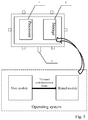
- the structure and composition of the computing processing node are as shown in Fig. 5 , wherein each computing processing node has a processor 1, a memory 2 and a communication interface 3.
- Each computing processing node conducts data interaction with a topologically adjacent computing processing node, and the data interaction is one-hop communication; then the computing processing node conducts data interaction with the topologically adjacent computing processing node after information processing, and the data interaction is also one-hop communication; all computing processing nodes jointly accomplish the computing task in a decentralized manner; that it to say, the decentralized computing network provided by the invention decomposes the task into typical and reproducible basic computations, while the basic computations is completed by each computing processing node through acquiring input information from adjacent nodes, completing local computation and then transmitting the computation result to the adjacent nodes.
- the decentralized computing network provided by the invention decomposes the task into typical and reproducible basic computations, while the basic computations is completed by each computing processing node through acquiring input information from adjacent nodes, completing local computation and then transmitting the computation result to the adjacent nodes.
- the computing processing node (CPN) has a spatial attribute embodied as an absolute spatial position where the computing processing node (CPN) is located and/or a relative spatial position of the computing processing node (CPN) in the topological network.
- an operating system is built in the distributed computing network system, and the operating system comprises a kernel module and a user module.
- the kernel module of the operating system is distributed at each computing processing node, and the kernel module in each computing processing node is completely the same.
- the network formed by interconnecting the computing processing nodes constitutes a large computer, and the computing process is distributed in each computing processing node (CPN); single computing processing node itself may also be a computer with comprehensive information processing and operating computation capability, but the capacity of processing information and computation is weak.
- the system formed by interconnecting multiple computing processing nodes has stronger information storage, computation and communication capabilities.
- cache modules in the memory of the CPN, which are used for storing the states of tasks and/or events.
- the number of the cache modules may be 1024 or be any.
- the system can process in parallel multiple tasks or events at the same time and can adapt to the complex and varied requirements of control tasks.
- a localized naming mode is adopted for each CPN when accessing the network, i.e., the naming of each CPN needs only to distinguish from adjacent nodes without global naming or configuring via route.
- the nodes named by 1, 4 or 5 occur for many times in the network, but the normal operation of the computing network is not affected.
- Each CPN can directly and only conduct data interaction with directly adjacent computing processing node on its topology, , and different names of the adjacent nodes are therefore required only, which may effectively avoid massive field naming and system configuration.
- Each CPN is provided with several communication interfaces (i.e., API) which are divided into type A and type B.
- the computing processing node is interconnected with its topologically adjacent computing processing nodes via the type A communication interface and interconnected with District Control System (DCS) via the type B communication interface.
- the District Control System is associated with a certain basic space unit (e.g., a subspace of a building: an office of a corridor, etc.) or a certain electromechanical equipment (e.g., a refrigerator, a pump, etc.).
- the District Control System is configured to collect all measurement and control information of the subspace or the electromechanical equipment or configured to control controllers or actuators associated with the subspace or the electromechanical equipment.
- Information interaction between the CPN and corresponding DCS is achieved according to the standard information set, and thus the related information required for calculation may be acquired from the DCS or the calculation results may be sent to the corresponding DCS for performing related control.
- the communication modes between CPN and DCS include but are not limited to the two modes below:
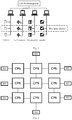
- the first mode as shown in Fig. 3:
- the computing processing node directly performs data interaction with a district control unit (DCU) in the DCS, and the DCU then performs data interaction with controllers, sensors or actuators, wherein the DCU forms a master-slave relationship with the controllers, the sensors or the actuators.
- DCU district control unit
- the DCU in the DCS and the controllers, the sensors, the actuators or intelligent devices such as lightings, shutters or FCU are located on a local network system (which can be a local area network).
- the computing processing node is interconnected with the local network system, and information interaction can be performed among the CPN, the DCU and the controllers, the sensors, the actuators or the intelligent devices such as the lightings, the shutters or the FCU. There is no master-slave relationship among the components mentioned above.
- the function of the DCU can be integrated into the CPN, that is, a module equivalent to the DCU can be added into the CPN.
- the module corresponds to the subspace of the building or the electromechanical equipment, and collects relevant information or performs relevant control.
- the network formed by the interconnected CPNs is a physically tangible network, on which multiple virtual functional subnets can be defined, such as indoor traffic network, air flow network, heat transfer network, power distribution system, air-conditioning water system, water system, domestic hot water system, air conditioning duct system, ventilation system, fresh air system, gas supply system, chiller plant, heating plant and the like. Calculation can be conducted within individual functional subnet and correlation calculation of multiple functional subnets can be conducted as well, therefore, the information sharing in the multiple subnets can be achieved naturally.
- multiple virtual functional subnets can be defined, such as indoor traffic network, air flow network, heat transfer network, power distribution system, air-conditioning water system, water system, domestic hot water system, air conditioning duct system, ventilation system, fresh air system, gas supply system, chiller plant, heating plant and the like.
- the functional subnet is determined by the specifically applied content, is a virtual net on the decentralized computing network provided by the invention, and has a topological structure being the same as that of the physical network.
- the same CPN may be subordinate to multiple functional subnets, and the functional subnets do not affect mutually, thus the computing processing nodes can handle the computing tasks of the functional subnets simultaneously and in parallel.
- each CPN functions differently in the functional subnets, for example, the CPNs of all space units are equal in the air flow subnet while the CPN of the air handling unit (AHU) in the AHU air system constitutes a master-slave relation with the CPN of the subordinate space.
- AHU air handling unit
- the system configuration is naturally finished by defining functional subnets on the distributed computing network provided by the invention, and control and management tasks required for the functional subnets are completed by further defining calculation procedures through functional subnets and running the procedures on the subnets.
- Standard computation sequence A user may transform demands and tasks of all control management into a standard computation sequence via the API interface in the operating system provided by the decentralized computing network.
- the computation sequence includes a plurality of computation units, and the computation unit is a task or event. Therefore, the definition of the standard computation sequence includes the followings:
- Each information point involved in the operation of management control strategies has information of three dimensions generally.
- the first dimension solves the problems of where/what it is, i.e., where the point of information is (including the space, location, being close to trunk or branch and other information with spatial attribute) and what it is (a room, pump or refrigerator);
- the second dimension focuses on the specific meaning represented by the transmitted data of the information point;
- the third dimension means the change of data over time.
- DCS is a basic space unit (a room or a corridor) or an electromechanical equipment, both of which naturally have position or spatial attribute) naturally maps in CPN
- the network formed after CPNs networking forms an internet of things with spatial attribute, thus, solving the characterization of the first dimension.
- a standard information set which consists of a plurality of standard data sheets, is formed through the standardized processing of all points of information involved in the basic space unit or electromechanical equipment.
- Each basic space unit or electromechanical equipment corresponds to one standard data sheet (as shown in Table 1) which defines the variable and the title and standard format of the variable needed to be acquired, then, all basic space units or electromechanical equipments are described according to the unified standard information set, thus CPN can acquire the information of corresponding district or equipment after interacting data with DCS.
- the No. 5 data in the standard information set is the "room air temperature", and if the equipment connected with DCS is provided with a temperature sensor placement, then the No.
- CPN can acquire information from DCS regardless of the equipment and communication protocol applied at the bottom; CPN can identify whether it is an architectural space or certain electromechanical equipment (such as refrigerator or pump) through information interaction after connecting with the site DCS, achieving the plug and play and automatic identification of CPN.
- Table 1 is an example of the standard data sheet.
- Table 1 Variable title Physical parameter Type of variable Basic district information 0X0006 District area Environmental and system measurement parameter 0X0010 Room temperature Operating parameter and state feedback of intelligent equipment 0X0020 On-off state feedback of lighting equipment Environmental operating parameter and set value of operating state of intelligent equipment 0X00B1 Set value of operating state of fan coil unit 1 within district 0X00D1 Set value of indoor ambient temperature Fault alarm 0X0134 Fault alarm of fire-fighting equipment Related to energy consumption 0X0140 Total average power in district in the past 10 minutes 0XFxxx User-defined function
- the characterization of the third dimension is realized through the record storage function of DCS or CPN, and the function can record the change and development of the information point over time. Details are not described herein again.
- the computing processing node in the decentralized computing network system provided by the invention can plug and play and intelligently identify with strong robustness and flexibility.
- the user module is a kind of API based on communication protocol.
- the API includes library module and user interaction module, i.e., the operating system provides algorithm libraries at all levels from simple mathematical calculation to professional application algorithm, the user can invoke an algorithm in the algorithm libraries while writing standard computation sequence, and the operating system automatically forms a bottom program code to realize agile programming.
- the library module has built-in three levels of operator/algorithm library, which are operator library, basic algorithm library and advanced algorithm library.
- the operator library includes but is not limited to: addition, subtraction, multiplication, division, weighted sum, quadrature, logical operation (and, or and non, etc.), maximizing, minimizing, set operation (intersection, union, etc.), spanning tree, Jacobi/gauss-seidel iteration, and other common basic mathematical operations.
- the basic algorithm library includes but is not limited to: matrix calculation algorithm, steepest descent method, Newton's method, genetic algorithm, neuron algorithm, and other common basic mathematical algorithms.
- the advanced algorithm library includes but is not limited to: sensor fault diagnosis algorithm, personnel distribution checking algorithm, fire inversion algorithm, region-based CFD algorithm, and other advanced algorithms applied to various professional fields.
- the user interaction module provides the user with following interfaces: task definition interface, event definition interface, algorithm definition interface and variable definition interface;
- users can define one or several of the following items: task name, task execution condition, total number of task steps, event and its execution steps included in the task, computation structure included in the return result of the task.
- users can define one or several of the following items: name of the event, the event affiliating to which task, executive conditions of the event, input variable of the event, output variable, name of intermediate variable, called operator/algorithm of the event.
- users can define one or several of following items: algorithm acting on which task/event, name of algorithm, concrete contents of algorithm;
- variable definition interface users can define one or several of following items: name of variable, variable affiliating to which task and/or event, byte length of variable, initial value of variable.
- the user module can take computing processing node as a carrier, district control system as a carrier and also other independent software and hardware as a carrier.
- the setting pattern is flexible.
- the kernel module further includes:
- the parallel computing collaboration service module further includes following submodules: task management module, event management module, operator/algorithm management module and variable management module.
- the communication module further includes following submodules: driver module of communication interface, parsing module of communication protocol and editing module of communication frame.
- the driver module of communication interface accepts information from communication interface and stores it in receive buffers, which is located in the memory of the computing processing node (CPN).
- CPN computing processing node
- the parsing module of communication protocol takes information out of receive buffer and after analytical process, the information is processed as such four subclasses as task-relevant information, event-relevant information, operator/algorithm-relevant information, variable-relevant information and the processed information in accordance with subclasses is stored in task management space, event management space, operator/algorithm management space and variable management space respectively.
- the task management space, event management space, operator/algorithm management space and variable management space are located in the memory of computing processing node (CPN).
- the task management module manages and maintains the relevant information of the task in the task management space.
- the event management module manages and maintains the relevant information of the event in the event management space.
- the operator/algorithm management module manages and maintains the relevant information of the operator/algorithm in the operator/algorithm management space.
- the variable management module manages and maintains the relevant information of the variable in the variable management space.
- the computing processing module takes relevant information out of task management space, event management space, operator/algorithm management space and variable management space for calculation. Then the computed outcomes are stored in task management space, event management space, operator/algorithm management space and variable management space by category respectively.
- the editing module of communication frame takes information out of task management space, event management space, operator/algorithm management space and variable management space and edits it into communication frame, which will be stored in transmit buffer located in the memory of computing processing node.
- the driver module of communication interface sends out frame in transmit buffer via communication interface.
- the kernel module interacts with the user module in terms of information under some communication protocol. It can be any communication protocol existing in the prior art or user-defined communication protocol.
- the communication frame that the user module sends to the kernel module can adopt three layers of structure.
- the bottom is physical link layer protocol, including synchronous code, length, checking and data.
- This physical link layer can use all kinds of mature communication technology such as Ethernet, Wifi, Zigbee, etc.;
- the second layer is the bottom of application, including the start of frame and data, which are used to cope with such communication problems as communication response, checking and patch transmission;
- the third layer is the upper of application, including message type and message content.
- Message content is used to cope with problems, such as task definition, event definition, algorithm downloading, variable assignment and system upgrade.
- the structure of application layer can apply other methods.
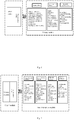
- the user module makes use of the form of communication frame as Fig. 10 shows and sends one or several forms of task, event, algorithm, and variable well defined by users to the kernel module.
- Operation management tasks and strategies on the decentralized computing network system provided by the invention are reflected and completed by the computation sequence. After the network completes the computation sequence, the task and the strategy of operation management are completed basically. Next, an example will be applied to introduce how computing processing node of the system collaborates with one another to complete distributed computation.
- Standard computation sequence is comprised of a number of computing units, which refer to tasks or events.
- task is comprised of a number of events in accordance with sequence; event is a basic algorithm completed by a computing processing node. It is defined through input variable, output variable, intermediate variable (there might be none in some cases) and operator/algorithm as Fig.12 shows.
- the chilled water pump of chilled water system in building HVAC system operates and adjusts in accordance with cooling conditions of the terminals on condition that the requirement of cooling demand for each terminal is met.
- the set value of chilled water pump pressure difference decreases as possible to minimize the energy consumption of the pump.
- the structure of network As Fig. 13 shows, the left part of the figure shows chilled water system control network.
- the terminal of the water system is the network for several branches, simply shown with a riser branch.
- Corresponding space node network is multidimensional network structure, which is simply shown with a chain-like structure.
- the chilled water system applies primary pump system, with 2 refrigerators corresponding to 3 chilled water pumps.
- the chilled water flows to coils of each room at the terminal via the water separator.
- the refrigerator and pump separately correspond to a computing processing node of equipment type.
- the terminal coil belongs to a computing processing node of space type.
- a computing processing node of space type is set up in the refrigerating machine room where refrigerator is located.
- the described computing processing nodes interconnect to form a functional subnet, whose structure of topology is shown in the right side of Fig.13 .
- Control logic If there is not enough water in the terminal equipment, the set value of pressure difference is increased according to the number of the terminals that do not meet the requirement, and increase the pump speed or turn on more pump. When all terminals meet the requirements, if the water amount is too large, the set value of pressure difference is reduced to reduce the pump speed or turn off the pump.
- the whole problem can be broken down into two relatively independent control loops.
- One is to adjust the set value of pressure difference at both ends of the chilled water pump according to the terminal demand.
- the other is that the pump set adjusts the number and frequencies of operating pumps, according to the set value of pressure difference, to minimize the pump energy consumption.
- the first control loop, - namely, how to determine the set value of pressure difference is related to introduce the calculation process of computing network system provided by the present invention.
- the specific procedure comprises the following steps:
- variable "whether too cold” or “whether too hot” can be a system variable provided by the computing network system or a self-defined variable when user compiles a program.
- the "local summation” is a basic operator provided by the library module in the user module, which can be built in each computing processing node, and user can directly invoke it without compiling a code.
- the algorithm of "spanning tree” is provided by computing network and can be directly invoked.
- the specific input variable, output variable and sequencing of the above events 1, 2 and 3 can be compiled by user.
- the personnel distribution in each district can be counted as well.
- an infrared detector installed at the gate of the district connected with space
- a signal of subtracting 1 from the number of people from the infrared detector will be sent to the computing processing node in district A
- the computing processing node of district A will subtract 1 from the number of people in the district and send a calculation to the computing processing node in the adjacent district B, adding 1 to the number of people in district B. Therefore, a physical process (corresponding to the actual process) that personnel enter district B from district A is finished on the system via simulation.
- All infrared detectors installed at the junction of interconnected districts will detect the personnel transfer in building in real time and send signal to the computing processing nodes of corresponding districts, triggering the real-time computation of the whole system, thus, the distribution of the number of people in all districts can be obtained.
- This information can serve as the basic information to realize the optimal control over other functional subsystems (such as air conditioning system and lighting system).
- the energy consumption of the electromechanical equipment of the system can be recorded via DCS or CPN.
- DCS or CPN calculates the energy consumption of the equipment according to the running time of the equipment, therefore, the energy consumption values of the equipment in each basic space unit can be counted through the system.
- Property managers have the demand to collect energy consumption values of all areas for comparison and analysis.
- a computing processing node accessed by the property managers initiates an energy consumption statistics task to globally acquire the union set.
- a variable operated by the CPN is a total energy consumption value of equipment involved of each basic space unit.
- the CPN of the initiated task is spread globally to form a spanning tree in an entire network system, and then the energy consumption value of an terminal node of each branch is returned to neighboring nodes thereof; after receiving the energy consumption values delivered by neighbors, each CPN adds the energy consumption value of a corresponding region thereof for repacking and then transmits to other neighbors (i.e.
- each CPN in the computing network system conforms to this principle, and finally energy consumption inflammation of all nodes is packed and transmitted to the CPN of the task initiator, i.e. the task of globally acquiring the union set and collecting the energy consumption values of all basic space units are completed.
- the computing processing node (CPN) for the decentralized computing network system provided by the present invention has the characteristics as follows:
Landscapes
- Engineering & Computer Science (AREA)
- Software Systems (AREA)
- Physics & Mathematics (AREA)
- General Physics & Mathematics (AREA)
- Theoretical Computer Science (AREA)
- General Engineering & Computer Science (AREA)
- Automation & Control Theory (AREA)
- Computer Networks & Wireless Communication (AREA)
- Signal Processing (AREA)
- Computer And Data Communications (AREA)
- Programmable Controllers (AREA)
Applications Claiming Priority (3)
| Application Number | Priority Date | Filing Date | Title |
|---|---|---|---|
| CN201510377980.1A CN106325229B (zh) | 2015-06-30 | 2015-06-30 | 分布式计算网络系统 |
| CN201510378076.2A CN106331037B (zh) | 2015-06-30 | 2015-06-30 | 用于分布式计算网络的计算节点 |
| PCT/CN2016/084332 WO2017000738A1 (fr) | 2015-06-30 | 2016-06-01 | Système de réseau informatique réparti et nœud informatique utilisé pour celui-ci |
Publications (2)
| Publication Number | Publication Date |
|---|---|
| EP3318938A1 true EP3318938A1 (fr) | 2018-05-09 |
| EP3318938A4 EP3318938A4 (fr) | 2019-02-20 |
Family
ID=57607775
Family Applications (1)
| Application Number | Title | Priority Date | Filing Date |
|---|---|---|---|
| EP16817102.3A Withdrawn EP3318938A4 (fr) | 2015-06-30 | 2016-06-01 | Système de réseau informatique réparti et noeud informatique utilisé pour celui-ci |
Country Status (4)
| Country | Link |
|---|---|
| US (1) | US10732588B2 (fr) |
| EP (1) | EP3318938A4 (fr) |
| JP (1) | JP6742353B2 (fr) |
| WO (1) | WO2017000738A1 (fr) |
Families Citing this family (10)
| Publication number | Priority date | Publication date | Assignee | Title |
|---|---|---|---|---|
| CN107483541A (zh) * | 2017-07-17 | 2017-12-15 | 广东工业大学 | 一种基于滚动时域的在线任务迁移方法 |
| CN107992478A (zh) * | 2017-11-30 | 2018-05-04 | 百度在线网络技术(北京)有限公司 | 确定热点事件的方法和装置 |
| WO2020121422A1 (fr) * | 2018-12-11 | 2020-06-18 | 三菱電機株式会社 | Système et procédé de calcul de valeur d'indice de gestion |
| EP3999953A4 (fr) * | 2019-07-19 | 2023-07-19 | Rambus Inc. | Mémoire empilée accélérée de calcul |
| CN112521094A (zh) * | 2020-12-11 | 2021-03-19 | 青岛理工大学 | 装配式建筑用c35免蒸汽养护混凝土及其制备方法 |
| CN114692083B (zh) * | 2020-12-31 | 2024-12-10 | 新奥新智科技有限公司 | 纵向联邦学习线性回归的方法及终端设备 |
| US12147221B2 (en) * | 2021-06-14 | 2024-11-19 | Transportation Ip Holdings, Llc | Facility control and communication system |
| US12523768B2 (en) * | 2022-07-03 | 2026-01-13 | Chengdu Qinchuan Iot Technology Co., Ltd. | Industrial internet of things for repeated positioning accuracy regulation and control method thereof |
| CN116755881A (zh) * | 2023-06-15 | 2023-09-15 | 重庆电子工程职业学院 | 一种楼宇一体化管理系统及管理方法 |
| CN120059767B (zh) * | 2025-04-29 | 2025-08-12 | 山西梗阳新能源有限公司 | 一种焦炉炭化室压力单调系统 |
Family Cites Families (22)
| Publication number | Priority date | Publication date | Assignee | Title |
|---|---|---|---|---|
| JPS62212763A (ja) | 1986-03-13 | 1987-09-18 | Fujitsu Ltd | 計算機ネツトワ−クにおけるジヨブ実行方式 |
| JP2533282B2 (ja) | 1992-05-22 | 1996-09-11 | インターナショナル・ビジネス・マシーンズ・コーポレイション | 並列アレイ・プロセッサ |
| JPH06301655A (ja) | 1993-04-14 | 1994-10-28 | Hitachi Ltd | 分散処理システム |
| US6671737B1 (en) * | 1999-09-24 | 2003-12-30 | Xerox Corporation | Decentralized network system |
| US7031945B1 (en) * | 2000-07-24 | 2006-04-18 | Donner Irah H | System and method for reallocating and/or upgrading and/or rewarding tickets, other event admittance means, goods and/or services |
| JP4500484B2 (ja) * | 2002-07-19 | 2010-07-14 | 株式会社日立製作所 | コントローラおよび情報通信サービス方法 |
| US7656822B1 (en) * | 2003-12-22 | 2010-02-02 | Sun Microsystems, Inc. | Method and apparatus for decentralized device and service description and discovery |
| DE102004021385A1 (de) | 2004-04-30 | 2005-11-17 | Daimlerchrysler Ag | Datenkommunikationsnetzwerk mit dezentralem Kommunikationsmanagement |
| DE602004001231T2 (de) * | 2004-07-02 | 2007-04-19 | Alcatel | Verfahren zur Wiederherstellung von Zusatzverkehr unterstützenden Transportnetzwerken |
| JP3987512B2 (ja) | 2004-07-15 | 2007-10-10 | 株式会社東芝 | メッセージ配送方法、計算機及びプログラム |
| US7765307B1 (en) * | 2006-02-28 | 2010-07-27 | Symantec Operating Corporation | Bulk network transmissions using multiple connections primed to optimize transfer parameters |
| US7945346B2 (en) * | 2006-12-14 | 2011-05-17 | Palo Alto Research Center Incorporated | Module identification method and system for path connectivity in modular systems |
| CN100568823C (zh) * | 2007-07-26 | 2009-12-09 | 北京航空航天大学 | 无线传感器网络节点管理方法 |
| US20140351010A1 (en) * | 2008-11-14 | 2014-11-27 | Thinkeco Power Inc. | System and method of democratizing power to create a meta-exchange |
| CN201477439U (zh) * | 2009-09-02 | 2010-05-19 | 沙毅 | 网络化控制器 |
| GB2486016A (en) | 2010-12-02 | 2012-06-06 | Sony Corp | Control of storage devices in an electric power network |
| CN102130950B (zh) * | 2011-03-14 | 2013-10-23 | 中国科学技术大学苏州研究院 | 基于Hadoop集群的分布式监控方法 |
| US20130325525A1 (en) * | 2012-05-21 | 2013-12-05 | Boost3, Llc | Systems and methods for an integrated online portal and marketplace for event-related items |
| US8768492B2 (en) * | 2012-05-21 | 2014-07-01 | Tait Towers Manufacturing Llc | Automation and motion control system |
| US8983669B2 (en) | 2012-07-31 | 2015-03-17 | Causam Energy, Inc. | System, method, and data packets for messaging for electric power grid elements over a secure internet protocol network |
| GB201306891D0 (en) * | 2013-04-16 | 2013-05-29 | Truphone Ltd | International converged mobile services |
| US20170270157A1 (en) * | 2016-03-21 | 2017-09-21 | Virtual Network Element, Inc. | TCP/IP Network Automation and Orchestration Tools |
-
2016
- 2016-06-01 EP EP16817102.3A patent/EP3318938A4/fr not_active Withdrawn
- 2016-06-01 US US15/740,146 patent/US10732588B2/en active Active
- 2016-06-01 JP JP2017568390A patent/JP6742353B2/ja active Active
- 2016-06-01 WO PCT/CN2016/084332 patent/WO2017000738A1/fr not_active Ceased
Also Published As
| Publication number | Publication date |
|---|---|
| EP3318938A4 (fr) | 2019-02-20 |
| JP6742353B2 (ja) | 2020-08-19 |
| US10732588B2 (en) | 2020-08-04 |
| US20180188702A1 (en) | 2018-07-05 |
| WO2017000738A1 (fr) | 2017-01-05 |
| JP2018523226A (ja) | 2018-08-16 |
Similar Documents
| Publication | Publication Date | Title |
|---|---|---|
| US10732588B2 (en) | Decentralized computing network system and computing processing node used for the same | |
| CN106325229B (zh) | 分布式计算网络系统 | |
| Bottaccioli et al. | Building energy modelling and monitoring by integration of IoT devices and building information models | |
| US9625885B2 (en) | Application-generated function block for data exchange between control programs and building automation objects | |
| US7953419B2 (en) | Method for integration of network nodes | |
| Taneja et al. | Enabling advanced environmental conditioning with a building application stack | |
| US11236917B2 (en) | Building control system with zone grouping based on predictive models | |
| US20200209820A1 (en) | System and method for improving the energy management of hvac equipment | |
| Fütterer et al. | A multifunctional demonstration bench for advanced control research in buildings—monitoring, control, and interface system | |
| CN117545240A (zh) | 机房空调的控制方法及装置、存储介质、电子设备 | |
| CN106331037B (zh) | 用于分布式计算网络的计算节点 | |
| CN103809541B (zh) | 用于建筑和建筑群的控制系统和方法 | |
| KR20200027079A (ko) | 인공신경망을 이용한 공조기 최적 제어 장치 및 방법 | |
| Feng et al. | A fully distributed voting strategy for AHU fault detection and diagnosis based on a decentralized structure | |
| Akhai et al. | Wireless networking solutions for climate control and comfort in modern air conditioning systems | |
| Sharma | Design of Wireless Sensors Network for Building Management Systems | |
| CN205864470U (zh) | 一种用于分布式计算网络的计算节点及分布式计算网络 | |
| JP7628458B2 (ja) | 空調制御システム | |
| Salsbury et al. | Smarter building start–A distributed solution | |
| CN119902450A (zh) | 结合全屋智能感知的家居设备调控方法及电子设备 | |
| Goyal et al. | An agent-based test bed for building controls | |
| US20250102177A1 (en) | Building as an Instrumentation for Data-Driven Building Operation | |
| Fütterer | Energy concept for the E. ON ERC main building | |
| CN116755881A (zh) | 一种楼宇一体化管理系统及管理方法 | |
| Simões et al. | Improving energy efficiency of cyber physical systems using multi-agent based control |
Legal Events
| Date | Code | Title | Description |
|---|---|---|---|
| STAA | Information on the status of an ep patent application or granted ep patent |
Free format text: STATUS: THE INTERNATIONAL PUBLICATION HAS BEEN MADE |
|
| PUAI | Public reference made under article 153(3) epc to a published international application that has entered the european phase |
Free format text: ORIGINAL CODE: 0009012 |
|
| STAA | Information on the status of an ep patent application or granted ep patent |
Free format text: STATUS: REQUEST FOR EXAMINATION WAS MADE |
|
| 17P | Request for examination filed |
Effective date: 20180111 |
|
| AK | Designated contracting states |
Kind code of ref document: A1 Designated state(s): AL AT BE BG CH CY CZ DE DK EE ES FI FR GB GR HR HU IE IS IT LI LT LU LV MC MK MT NL NO PL PT RO RS SE SI SK SM TR |
|
| AX | Request for extension of the european patent |
Extension state: BA ME |
|
| RAP1 | Party data changed (applicant data changed or rights of an application transferred) |
Owner name: LYNKROS TECHNOLOGY (BEIJING) CO. LTD. |
|
| DAV | Request for validation of the european patent (deleted) | ||
| DAX | Request for extension of the european patent (deleted) | ||
| A4 | Supplementary search report drawn up and despatched |
Effective date: 20190123 |
|
| RIC1 | Information provided on ipc code assigned before grant |
Ipc: G06F 9/50 20060101ALI20190117BHEP Ipc: G05B 19/05 20060101AFI20190117BHEP |
|
| STAA | Information on the status of an ep patent application or granted ep patent |
Free format text: STATUS: EXAMINATION IS IN PROGRESS |
|
| 17Q | First examination report despatched |
Effective date: 20210211 |
|
| STAA | Information on the status of an ep patent application or granted ep patent |
Free format text: STATUS: THE APPLICATION HAS BEEN WITHDRAWN |
|
| 18W | Application withdrawn |
Effective date: 20221115 |