EP3319789B1 - Verfahren zur herstellung eines faserlaminatbauteils eines flugzeugs - Google Patents
Verfahren zur herstellung eines faserlaminatbauteils eines flugzeugs Download PDFInfo
- Publication number
- EP3319789B1 EP3319789B1 EP16736114.6A EP16736114A EP3319789B1 EP 3319789 B1 EP3319789 B1 EP 3319789B1 EP 16736114 A EP16736114 A EP 16736114A EP 3319789 B1 EP3319789 B1 EP 3319789B1
- Authority
- EP
- European Patent Office
- Prior art keywords
- layer
- fiber
- end effector
- gripping
- deposition surface
- Prior art date
- Legal status (The legal status is an assumption and is not a legal conclusion. Google has not performed a legal analysis and makes no representation as to the accuracy of the status listed.)
- Active
Links
Images
Classifications
-
- B—PERFORMING OPERATIONS; TRANSPORTING
- B29—WORKING OF PLASTICS; WORKING OF SUBSTANCES IN A PLASTIC STATE IN GENERAL
- B29C—SHAPING OR JOINING OF PLASTICS; SHAPING OF MATERIAL IN A PLASTIC STATE, NOT OTHERWISE PROVIDED FOR; AFTER-TREATMENT OF THE SHAPED PRODUCTS, e.g. REPAIRING
- B29C70/00—Shaping composites, i.e. plastics material comprising reinforcements, fillers or preformed parts, e.g. inserts
- B29C70/02—Shaping composites, i.e. plastics material comprising reinforcements, fillers or preformed parts, e.g. inserts comprising combinations of reinforcements, e.g. non-specified reinforcements, fibrous reinforcing inserts and fillers, e.g. particulate fillers, incorporated in matrix material, forming one or more layers and with or without non-reinforced or non-filled layers
- B29C70/021—Combinations of fibrous reinforcement and non-fibrous material
- B29C70/023—Combinations of fibrous reinforcement and non-fibrous material with reinforcing inserts
-
- B—PERFORMING OPERATIONS; TRANSPORTING
- B25—HAND TOOLS; PORTABLE POWER-DRIVEN TOOLS; MANIPULATORS
- B25J—MANIPULATORS; CHAMBERS PROVIDED WITH MANIPULATION DEVICES
- B25J15/00—Gripping heads and other end effectors
- B25J15/06—Gripping heads and other end effectors with vacuum or magnetic holding means
- B25J15/0616—Gripping heads and other end effectors with vacuum or magnetic holding means with vacuum
-
- B—PERFORMING OPERATIONS; TRANSPORTING
- B29—WORKING OF PLASTICS; WORKING OF SUBSTANCES IN A PLASTIC STATE IN GENERAL
- B29C—SHAPING OR JOINING OF PLASTICS; SHAPING OF MATERIAL IN A PLASTIC STATE, NOT OTHERWISE PROVIDED FOR; AFTER-TREATMENT OF THE SHAPED PRODUCTS, e.g. REPAIRING
- B29C31/00—Handling, e.g. feeding of the material to be shaped, storage of plastics material before moulding; Automation, i.e. automated handling lines in plastics processing plants, e.g. using manipulators or robots
- B29C31/04—Feeding of the material to be moulded, e.g. into a mould cavity
- B29C31/08—Feeding of the material to be moulded, e.g. into a mould cavity of preforms to be moulded, e.g. tablets, fibre reinforced preforms, extruded ribbons, tubes or profiles; Manipulating means specially adapted for feeding preforms, e.g. supports conveyors
-
- B—PERFORMING OPERATIONS; TRANSPORTING
- B29—WORKING OF PLASTICS; WORKING OF SUBSTANCES IN A PLASTIC STATE IN GENERAL
- B29C—SHAPING OR JOINING OF PLASTICS; SHAPING OF MATERIAL IN A PLASTIC STATE, NOT OTHERWISE PROVIDED FOR; AFTER-TREATMENT OF THE SHAPED PRODUCTS, e.g. REPAIRING
- B29C31/00—Handling, e.g. feeding of the material to be shaped, storage of plastics material before moulding; Automation, i.e. automated handling lines in plastics processing plants, e.g. using manipulators or robots
- B29C31/04—Feeding of the material to be moulded, e.g. into a mould cavity
- B29C31/08—Feeding of the material to be moulded, e.g. into a mould cavity of preforms to be moulded, e.g. tablets, fibre reinforced preforms, extruded ribbons, tubes or profiles; Manipulating means specially adapted for feeding preforms, e.g. supports conveyors
- B29C31/085—Feeding of the material to be moulded, e.g. into a mould cavity of preforms to be moulded, e.g. tablets, fibre reinforced preforms, extruded ribbons, tubes or profiles; Manipulating means specially adapted for feeding preforms, e.g. supports conveyors combined with positioning the preforms according to predetermined patterns, e.g. positioning extruded preforms on conveyors
-
- B—PERFORMING OPERATIONS; TRANSPORTING
- B29—WORKING OF PLASTICS; WORKING OF SUBSTANCES IN A PLASTIC STATE IN GENERAL
- B29C—SHAPING OR JOINING OF PLASTICS; SHAPING OF MATERIAL IN A PLASTIC STATE, NOT OTHERWISE PROVIDED FOR; AFTER-TREATMENT OF THE SHAPED PRODUCTS, e.g. REPAIRING
- B29C43/00—Compression moulding, i.e. applying external pressure to flow the moulding material; Apparatus therefor
- B29C43/02—Compression moulding, i.e. applying external pressure to flow the moulding material; Apparatus therefor of articles of definite length, i.e. discrete articles
- B29C43/20—Making multilayered or multicoloured articles
-
- B—PERFORMING OPERATIONS; TRANSPORTING
- B29—WORKING OF PLASTICS; WORKING OF SUBSTANCES IN A PLASTIC STATE IN GENERAL
- B29C—SHAPING OR JOINING OF PLASTICS; SHAPING OF MATERIAL IN A PLASTIC STATE, NOT OTHERWISE PROVIDED FOR; AFTER-TREATMENT OF THE SHAPED PRODUCTS, e.g. REPAIRING
- B29C70/00—Shaping composites, i.e. plastics material comprising reinforcements, fillers or preformed parts, e.g. inserts
- B29C70/04—Shaping composites, i.e. plastics material comprising reinforcements, fillers or preformed parts, e.g. inserts comprising reinforcements only, e.g. self-reinforcing plastics
- B29C70/28—Shaping operations therefor
- B29C70/30—Shaping by lay-up, i.e. applying fibres, tape or broadsheet on a mould, former or core; Shaping by spray-up, i.e. spraying of fibres on a mould, former or core
- B29C70/38—Automated lay-up, e.g. using robots, laying filaments according to predetermined patterns
-
- B—PERFORMING OPERATIONS; TRANSPORTING
- B29—WORKING OF PLASTICS; WORKING OF SUBSTANCES IN A PLASTIC STATE IN GENERAL
- B29C—SHAPING OR JOINING OF PLASTICS; SHAPING OF MATERIAL IN A PLASTIC STATE, NOT OTHERWISE PROVIDED FOR; AFTER-TREATMENT OF THE SHAPED PRODUCTS, e.g. REPAIRING
- B29C70/00—Shaping composites, i.e. plastics material comprising reinforcements, fillers or preformed parts, e.g. inserts
- B29C70/04—Shaping composites, i.e. plastics material comprising reinforcements, fillers or preformed parts, e.g. inserts comprising reinforcements only, e.g. self-reinforcing plastics
- B29C70/28—Shaping operations therefor
- B29C70/54—Component parts, details or accessories; Auxiliary operations, e.g. feeding or storage of prepregs or SMC after impregnation or during ageing
- B29C70/541—Positioning reinforcements in a mould, e.g. using clamping means for the reinforcement
-
- B—PERFORMING OPERATIONS; TRANSPORTING
- B32—LAYERED PRODUCTS
- B32B—LAYERED PRODUCTS, i.e. PRODUCTS BUILT-UP OF STRATA OF FLAT OR NON-FLAT, e.g. CELLULAR OR HONEYCOMB, FORM
- B32B1/00—Layered products having a non-planar shape
-
- B—PERFORMING OPERATIONS; TRANSPORTING
- B32—LAYERED PRODUCTS
- B32B—LAYERED PRODUCTS, i.e. PRODUCTS BUILT-UP OF STRATA OF FLAT OR NON-FLAT, e.g. CELLULAR OR HONEYCOMB, FORM
- B32B15/00—Layered products comprising a layer of metal
- B32B15/04—Layered products comprising a layer of metal comprising metal as the main or only constituent of a layer, which is next to another layer of the same or of a different material
-
- B—PERFORMING OPERATIONS; TRANSPORTING
- B32—LAYERED PRODUCTS
- B32B—LAYERED PRODUCTS, i.e. PRODUCTS BUILT-UP OF STRATA OF FLAT OR NON-FLAT, e.g. CELLULAR OR HONEYCOMB, FORM
- B32B15/00—Layered products comprising a layer of metal
- B32B15/14—Layered products comprising a layer of metal next to a fibrous or filamentary layer
-
- B—PERFORMING OPERATIONS; TRANSPORTING
- B32—LAYERED PRODUCTS
- B32B—LAYERED PRODUCTS, i.e. PRODUCTS BUILT-UP OF STRATA OF FLAT OR NON-FLAT, e.g. CELLULAR OR HONEYCOMB, FORM
- B32B15/00—Layered products comprising a layer of metal
- B32B15/20—Layered products comprising a layer of metal comprising aluminium or copper
-
- B—PERFORMING OPERATIONS; TRANSPORTING
- B32—LAYERED PRODUCTS
- B32B—LAYERED PRODUCTS, i.e. PRODUCTS BUILT-UP OF STRATA OF FLAT OR NON-FLAT, e.g. CELLULAR OR HONEYCOMB, FORM
- B32B37/00—Methods or apparatus for laminating, e.g. by curing or by ultrasonic bonding
- B32B37/14—Methods or apparatus for laminating, e.g. by curing or by ultrasonic bonding characterised by the properties of the layers
- B32B37/16—Methods or apparatus for laminating, e.g. by curing or by ultrasonic bonding characterised by the properties of the layers with all layers existing as coherent layers before laminating
- B32B37/18—Methods or apparatus for laminating, e.g. by curing or by ultrasonic bonding characterised by the properties of the layers with all layers existing as coherent layers before laminating involving the assembly of discrete sheets or panels only
- B32B37/182—Methods or apparatus for laminating, e.g. by curing or by ultrasonic bonding characterised by the properties of the layers with all layers existing as coherent layers before laminating involving the assembly of discrete sheets or panels only one or more of the layers being plastic
-
- B—PERFORMING OPERATIONS; TRANSPORTING
- B32—LAYERED PRODUCTS
- B32B—LAYERED PRODUCTS, i.e. PRODUCTS BUILT-UP OF STRATA OF FLAT OR NON-FLAT, e.g. CELLULAR OR HONEYCOMB, FORM
- B32B38/00—Ancillary operations in connection with laminating processes
- B32B38/18—Handling of layers or the laminate
- B32B38/1858—Handling of layers or the laminate using vacuum
-
- B—PERFORMING OPERATIONS; TRANSPORTING
- B32—LAYERED PRODUCTS
- B32B—LAYERED PRODUCTS, i.e. PRODUCTS BUILT-UP OF STRATA OF FLAT OR NON-FLAT, e.g. CELLULAR OR HONEYCOMB, FORM
- B32B38/00—Ancillary operations in connection with laminating processes
- B32B38/18—Handling of layers or the laminate
- B32B38/1866—Handling of layers or the laminate conforming the layers or laminate to a convex or concave profile
-
- B—PERFORMING OPERATIONS; TRANSPORTING
- B32—LAYERED PRODUCTS
- B32B—LAYERED PRODUCTS, i.e. PRODUCTS BUILT-UP OF STRATA OF FLAT OR NON-FLAT, e.g. CELLULAR OR HONEYCOMB, FORM
- B32B5/00—Layered products characterised by the non- homogeneity or physical structure, i.e. comprising a fibrous, filamentary, particulate or foam layer; Layered products characterised by having a layer differing constitutionally or physically in different parts
- B32B5/02—Layered products characterised by the non- homogeneity or physical structure, i.e. comprising a fibrous, filamentary, particulate or foam layer; Layered products characterised by having a layer differing constitutionally or physically in different parts characterised by structural features of a fibrous or filamentary layer
-
- B—PERFORMING OPERATIONS; TRANSPORTING
- B32—LAYERED PRODUCTS
- B32B—LAYERED PRODUCTS, i.e. PRODUCTS BUILT-UP OF STRATA OF FLAT OR NON-FLAT, e.g. CELLULAR OR HONEYCOMB, FORM
- B32B7/00—Layered products characterised by the relation between layers; Layered products characterised by the relative orientation of features between layers, or by the relative values of a measurable parameter between layers, i.e. products comprising layers having different physical, chemical or physicochemical properties; Layered products characterised by the interconnection of layers
- B32B7/04—Interconnection of layers
- B32B7/12—Interconnection of layers using interposed adhesives or interposed materials with bonding properties
-
- B—PERFORMING OPERATIONS; TRANSPORTING
- B25—HAND TOOLS; PORTABLE POWER-DRIVEN TOOLS; MANIPULATORS
- B25J—MANIPULATORS; CHAMBERS PROVIDED WITH MANIPULATION DEVICES
- B25J15/00—Gripping heads and other end effectors
- B25J15/06—Gripping heads and other end effectors with vacuum or magnetic holding means
- B25J15/0616—Gripping heads and other end effectors with vacuum or magnetic holding means with vacuum
- B25J15/0625—Gripping heads and other end effectors with vacuum or magnetic holding means with vacuum provided with a valve
-
- B—PERFORMING OPERATIONS; TRANSPORTING
- B29—WORKING OF PLASTICS; WORKING OF SUBSTANCES IN A PLASTIC STATE IN GENERAL
- B29K—INDEXING SCHEME ASSOCIATED WITH SUBCLASSES B29B, B29C OR B29D, RELATING TO MOULDING MATERIALS OR TO MATERIALS FOR MOULDS, REINFORCEMENTS, FILLERS OR PREFORMED PARTS, e.g. INSERTS
- B29K2277/00—Use of PA, i.e. polyamides, e.g. polyesteramides or derivatives thereof, as reinforcement
- B29K2277/10—Aromatic polyamides [Polyaramides] or derivatives thereof
-
- B—PERFORMING OPERATIONS; TRANSPORTING
- B29—WORKING OF PLASTICS; WORKING OF SUBSTANCES IN A PLASTIC STATE IN GENERAL
- B29K—INDEXING SCHEME ASSOCIATED WITH SUBCLASSES B29B, B29C OR B29D, RELATING TO MOULDING MATERIALS OR TO MATERIALS FOR MOULDS, REINFORCEMENTS, FILLERS OR PREFORMED PARTS, e.g. INSERTS
- B29K2309/00—Use of inorganic materials not provided for in groups B29K2303/00 - B29K2307/00, as reinforcement
- B29K2309/08—Glass
-
- B—PERFORMING OPERATIONS; TRANSPORTING
- B29—WORKING OF PLASTICS; WORKING OF SUBSTANCES IN A PLASTIC STATE IN GENERAL
- B29K—INDEXING SCHEME ASSOCIATED WITH SUBCLASSES B29B, B29C OR B29D, RELATING TO MOULDING MATERIALS OR TO MATERIALS FOR MOULDS, REINFORCEMENTS, FILLERS OR PREFORMED PARTS, e.g. INSERTS
- B29K2705/00—Use of metals, their alloys or their compounds, for preformed parts, e.g. for inserts
-
- B—PERFORMING OPERATIONS; TRANSPORTING
- B29—WORKING OF PLASTICS; WORKING OF SUBSTANCES IN A PLASTIC STATE IN GENERAL
- B29L—INDEXING SCHEME ASSOCIATED WITH SUBCLASS B29C, RELATING TO PARTICULAR ARTICLES
- B29L2031/00—Other particular articles
- B29L2031/30—Vehicles, e.g. ships or aircraft, or body parts thereof
- B29L2031/3076—Aircrafts
-
- B—PERFORMING OPERATIONS; TRANSPORTING
- B32—LAYERED PRODUCTS
- B32B—LAYERED PRODUCTS, i.e. PRODUCTS BUILT-UP OF STRATA OF FLAT OR NON-FLAT, e.g. CELLULAR OR HONEYCOMB, FORM
- B32B38/00—Ancillary operations in connection with laminating processes
- B32B38/18—Handling of layers or the laminate
- B32B2038/1891—Using a robot for handling the layers
-
- B—PERFORMING OPERATIONS; TRANSPORTING
- B32—LAYERED PRODUCTS
- B32B—LAYERED PRODUCTS, i.e. PRODUCTS BUILT-UP OF STRATA OF FLAT OR NON-FLAT, e.g. CELLULAR OR HONEYCOMB, FORM
- B32B2255/00—Coating on the layer surface
- B32B2255/06—Coating on the layer surface on metal layer
-
- B—PERFORMING OPERATIONS; TRANSPORTING
- B32—LAYERED PRODUCTS
- B32B—LAYERED PRODUCTS, i.e. PRODUCTS BUILT-UP OF STRATA OF FLAT OR NON-FLAT, e.g. CELLULAR OR HONEYCOMB, FORM
- B32B2260/00—Layered product comprising an impregnated, embedded, or bonded layer wherein the layer comprises an impregnation, embedding, or binder material
- B32B2260/02—Composition of the impregnated, bonded or embedded layer
- B32B2260/021—Fibrous or filamentary layer
-
- B—PERFORMING OPERATIONS; TRANSPORTING
- B32—LAYERED PRODUCTS
- B32B—LAYERED PRODUCTS, i.e. PRODUCTS BUILT-UP OF STRATA OF FLAT OR NON-FLAT, e.g. CELLULAR OR HONEYCOMB, FORM
- B32B2260/00—Layered product comprising an impregnated, embedded, or bonded layer wherein the layer comprises an impregnation, embedding, or binder material
- B32B2260/02—Composition of the impregnated, bonded or embedded layer
- B32B2260/021—Fibrous or filamentary layer
- B32B2260/023—Two or more layers
-
- B—PERFORMING OPERATIONS; TRANSPORTING
- B32—LAYERED PRODUCTS
- B32B—LAYERED PRODUCTS, i.e. PRODUCTS BUILT-UP OF STRATA OF FLAT OR NON-FLAT, e.g. CELLULAR OR HONEYCOMB, FORM
- B32B2260/00—Layered product comprising an impregnated, embedded, or bonded layer wherein the layer comprises an impregnation, embedding, or binder material
- B32B2260/04—Impregnation, embedding, or binder material
- B32B2260/046—Synthetic resin
-
- B—PERFORMING OPERATIONS; TRANSPORTING
- B32—LAYERED PRODUCTS
- B32B—LAYERED PRODUCTS, i.e. PRODUCTS BUILT-UP OF STRATA OF FLAT OR NON-FLAT, e.g. CELLULAR OR HONEYCOMB, FORM
- B32B2262/00—Composition or structural features of fibres which form a fibrous or filamentary layer or are present as additives
- B32B2262/02—Synthetic macromolecular fibres
- B32B2262/0261—Polyamide fibres
- B32B2262/0269—Aromatic polyamide fibres
-
- B—PERFORMING OPERATIONS; TRANSPORTING
- B32—LAYERED PRODUCTS
- B32B—LAYERED PRODUCTS, i.e. PRODUCTS BUILT-UP OF STRATA OF FLAT OR NON-FLAT, e.g. CELLULAR OR HONEYCOMB, FORM
- B32B2262/00—Composition or structural features of fibres which form a fibrous or filamentary layer or are present as additives
- B32B2262/10—Inorganic fibres
- B32B2262/101—Glass fibres
-
- B—PERFORMING OPERATIONS; TRANSPORTING
- B32—LAYERED PRODUCTS
- B32B—LAYERED PRODUCTS, i.e. PRODUCTS BUILT-UP OF STRATA OF FLAT OR NON-FLAT, e.g. CELLULAR OR HONEYCOMB, FORM
- B32B2262/00—Composition or structural features of fibres which form a fibrous or filamentary layer or are present as additives
- B32B2262/10—Inorganic fibres
- B32B2262/106—Carbon fibres, e.g. graphite fibres
-
- B—PERFORMING OPERATIONS; TRANSPORTING
- B32—LAYERED PRODUCTS
- B32B—LAYERED PRODUCTS, i.e. PRODUCTS BUILT-UP OF STRATA OF FLAT OR NON-FLAT, e.g. CELLULAR OR HONEYCOMB, FORM
- B32B2305/00—Condition, form or state of the layers or laminate
- B32B2305/07—Parts immersed or impregnated in a matrix
- B32B2305/076—Prepregs
-
- B—PERFORMING OPERATIONS; TRANSPORTING
- B32—LAYERED PRODUCTS
- B32B—LAYERED PRODUCTS, i.e. PRODUCTS BUILT-UP OF STRATA OF FLAT OR NON-FLAT, e.g. CELLULAR OR HONEYCOMB, FORM
- B32B2305/00—Condition, form or state of the layers or laminate
- B32B2305/77—Uncured, e.g. green
-
- B—PERFORMING OPERATIONS; TRANSPORTING
- B32—LAYERED PRODUCTS
- B32B—LAYERED PRODUCTS, i.e. PRODUCTS BUILT-UP OF STRATA OF FLAT OR NON-FLAT, e.g. CELLULAR OR HONEYCOMB, FORM
- B32B2307/00—Properties of the layers or laminate
- B32B2307/70—Other properties
- B32B2307/714—Inert, i.e. inert to chemical degradation, corrosion
-
- B—PERFORMING OPERATIONS; TRANSPORTING
- B32—LAYERED PRODUCTS
- B32B—LAYERED PRODUCTS, i.e. PRODUCTS BUILT-UP OF STRATA OF FLAT OR NON-FLAT, e.g. CELLULAR OR HONEYCOMB, FORM
- B32B2307/00—Properties of the layers or laminate
- B32B2307/70—Other properties
- B32B2307/732—Dimensional properties
-
- B—PERFORMING OPERATIONS; TRANSPORTING
- B32—LAYERED PRODUCTS
- B32B—LAYERED PRODUCTS, i.e. PRODUCTS BUILT-UP OF STRATA OF FLAT OR NON-FLAT, e.g. CELLULAR OR HONEYCOMB, FORM
- B32B2311/00—Metals, their alloys or their compounds
-
- B—PERFORMING OPERATIONS; TRANSPORTING
- B32—LAYERED PRODUCTS
- B32B—LAYERED PRODUCTS, i.e. PRODUCTS BUILT-UP OF STRATA OF FLAT OR NON-FLAT, e.g. CELLULAR OR HONEYCOMB, FORM
- B32B2315/00—Other materials containing non-metallic inorganic compounds not provided for in groups B32B2311/00 - B32B2313/04
- B32B2315/08—Glass
-
- B—PERFORMING OPERATIONS; TRANSPORTING
- B32—LAYERED PRODUCTS
- B32B—LAYERED PRODUCTS, i.e. PRODUCTS BUILT-UP OF STRATA OF FLAT OR NON-FLAT, e.g. CELLULAR OR HONEYCOMB, FORM
- B32B2377/00—Polyamides
-
- B—PERFORMING OPERATIONS; TRANSPORTING
- B32—LAYERED PRODUCTS
- B32B—LAYERED PRODUCTS, i.e. PRODUCTS BUILT-UP OF STRATA OF FLAT OR NON-FLAT, e.g. CELLULAR OR HONEYCOMB, FORM
- B32B2605/00—Vehicles
- B32B2605/18—Aircraft
-
- B—PERFORMING OPERATIONS; TRANSPORTING
- B32—LAYERED PRODUCTS
- B32B—LAYERED PRODUCTS, i.e. PRODUCTS BUILT-UP OF STRATA OF FLAT OR NON-FLAT, e.g. CELLULAR OR HONEYCOMB, FORM
- B32B2607/00—Walls, panels
Definitions
- the invention is directed to a method for producing a Fiber Metal Laminate component of an airplane according to the general part of claim 1 as well as to a manipulator system according to claim 16.
- Fiber Metal Laminate The material class of Fiber Metal Laminate (FML) has increasingly been applied for the realization of airplane components, in particular of structural airplane components. The reason for this is that with Fiber Metal Laminates extraordinary mechanical properties may be achieved with extremely lightweight design.
- a Fiber Metal Laminate comprises metal layers and fiber layers stacked onto each other and bound by a normally thermoset resin.
- the manufacturing process of Fiber Metal Laminate components of an airplane is complex as the layers to be stacked onto each other are flexible at least as far as the fiber layers are concerned. Due to the flexibility of the layers it is challenging to achieve stable handling processes during stacking up the layers onto each other. Another challenge is to prevent the generation of cavities, when one layer is stacked onto another layer.
- US 2012 330453 A1 discloses an automated ply layup system using a robot and an end effector for selecting plies from a kit and placing the plies at predetermined locations on a tool.
- the known method ( DE 10 2012 000 508 A1 ), which is the starting point of the invention, relies on a manipulator system with one end effector for handling the metal layers and with a second end effector for handling the fiber layers. With this manipulator system the respective layers are being stacked onto each other in a mould in a stacking sequence.
- Each stacking cycle comprises picking up a layer from a supply stack, transporting the layer to the mould, placement of the layer at a deposition surface in the mould and depositing the so placed layer onto the deposition surface.
- the layers are being fixed to the mould by electrostatic charging.
- the idea underlying the invention is to adapt the form of the layer to be stacked to the form of the mould, before the respective layer is being deposited. With this it is possible that a flat contact is achieved between the surface of the layer and the surface of the deposition surface. With such contact the buildup of cavities may be prevented or at least effectively be reduced.
- the layer to be stacked is being deformed by the end effector as to adapt the form of the layer to the form of the deposition surface. It has been found that the above noted deforming of the layer may be achieved by the end effector itself. This is especially advantageous as no additional tool is necessary for deforming and also as no additional handling step is necessary for adapting the form of the layer to the deposition surface.
- the invention provides improved gripping of the layer to be stacked via a gripping arrangement. It is particularly preferred that the gripping arrangement at least partly provided a floating grip of the layer along its surface such that during the proposed deformation of the layer no undesired mechanical tension is building up within the layer.
- Especially preferred embodiments are directed to deforming the respective layer with low mechanical complexity.
- the idea behind the invention is to pick up and deform the respective layer via one and the same end effector.
- a further preferred embodiment allows an air pocked free deposition of the respective layer as a completely flat contact may be established between the surface of the layer and the deposition surface.
- the form of the layer before its deposition at least slightly deviates from the form of the deposition surface. This may prevent the build up of friction between the layer and the deposition surface during placement of the layer into the mould. Such friction may again lead to the build up of the undesired cavities between the layers.
- the manipulator system for performing the proposed method is claimed as such. Reference is made to all explanations even regarding the proposed method, as far as those explanations are suitable to describe the manipulator system.
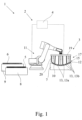
- the manufacturing system 1 shown in the drawings serves for producing a Fiber Metal Laminate component of an airplane.
- such component is part of a structural component of an airplane, in particular part of a fuselage or wing of an airplane.
- the component is part of the outer skin of the fuselage.
- the component is accordingly of half shell shape.
- the manufacturing system 1 comprises a manipulator system 2 with an end effector 3 and a control 4 assigned to the manipulator system 2.
- the control 4 is an electronic control which controls not only the movement of the manipulator system 2 but also the actions of the end effector 3.
- the manufacturing system 1 here and preferably is structured as a robot cell.
- the kind of layers 5, 6 and the stacking sequence depends on the kind of Fiber Metal Laminate material, the resulting component shall be made off.
- the metal layer 5 may be any kind of metal sheet
- the fiber layer 6 may be any kind of fiber sheet, which may be of dry fiber material or preimpregnated fiber material, also known as prepreg.
- the Fiber Metal Laminate component is a so called GLARE ® material (Glass Laminate Aluminium Reinforced Epoxy).
- the metal layer 5 is at least partly an aluminium layer. Other metal materials such as titanium may be applied as well.
- the outer layers of the Fiber Metal Laminate component are metal layers 5.
- the thickness of the metal layers is below 1,0 mm, preferably between 0,2 mm and 0,5 mm, further preferably between 0,3 mm and 0,4 mm. For prevention of corrosion it is anodized. In order to provide good bonding characteristics it is further coated with an appropriate primer.
- the fiber layer 6 may be of prepreg fiber material or dry fiber material, which during manufacturing is in any case unhardened. It may comprise different kind of fibers such as glass fibers, aramid fibers or the like.
- adhesive tape layers can be handled and deposited between two metal layers 5 or between two fiber layers 6 or a fiber layer 6 and a metal layer 5.
- an adhesive tape layer is positioned in the overlapping region in between the two metal layers 5. The adhesive tape layer can provide a sealing between the respective two layers.
- Each stacking cycle comprises picking up a metal layer 5 or a fiber layer 6 or an adhesive tape layer from a respective supply stack 8 according to the respective stacking sequence.
- two supply stacks 8, 9 are provided.
- Both types of layers 5, 6 can also be supplied on one supply stack.
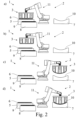
- Whether the metal layer 5 is being picked up from the supply stack 8 or a fiber layer 6 is being picked up from supply stack 9 depends on the stacking sequence which largely depends on the layer structure of the Fiber Metal Laminate component to be manufactured. The picking up of the respective layer is shown in Fig. 2a .
- the picked up a layer 5, 6 is being transported to the mould as shown in Fig. 2b .
- the transportation of the layer 5, 6 is followed the placement of the layer 5, 6 at a deposition surface 10 in the mould 7 according to the stacking sequence which again is followed by depositing the so placed layer 5, 6 onto the deposition surface 10, as shown in Fig. 2d .
- the deposition surface 10 may be the surface of the mould 7 or the surface of the respective layer 5, 6 that has been stacked in the previous stacking cycle. Accordingly the exact location of the deposition surface 10 depends on the stacking sequence. In any case the form of the deposition surface 10 is largely defined by the form of the mould 7.
- the mould 7, respectively the deposition surface 10 may have a convex and/or a concave form.
- the mould 7, respectively the deposition surface 10 may have both convex as well as concave sections, for example when fiber metal laminate components for the airplane sections between the fuselage and the wing are to be produced.
- the layer 5, 6 to be stacked is being deformed by the end effector 3 as to adapt the form of the layer 5, 6 to the form of the deposition surface 10.
- the deposition surface is of concave form, to which the layer 5, 6 is being adapted by the end effector 3.
- the step of deforming the respective layer 5, 6 may take place at any time between picking up the layer 5, 6 and depositing the layer 5, 6.
- the deforming step is being performed while the manipulator system 2 is being moved, in particular during the transporting step.
- it may be advantageous to stop the movement of the manipulator system 2 for the deforming step for example in order to achieve a higher accuracy in deforming.
- the advantages of providing a deforming step has been explained in the general part of the specification. The possibility of preventing cavities between layers 5, 6 becomes especially apparent when looking at Fig. 2c , d.
- the manipulator system 2 it is generally possible for the manipulator system 2 to comprise more than one end effector 3, for example if certain process steps are to be performed in parallel. All explanations given for the one shown end effector 3 are fully applicable to a manipulator system 2 with two or more than two end effectors 3.
- the manipulator system 2 shown in the drawings comprises a manipulator 11, which is being driven by the control 4.
- the manipulator 11 is a robot with sequential axes. It may also be a robot with any kind of other kinematic, for example the kinematic of a portal robot.
- the manipulator 11 may as well be a construction which is tailored to the manufacturing process explained above.
- the end effector 3 preferably comprises a gripping arrangement 12 for gripping the layer 5, 6 during pick up.
- the gripping arrangement 12 includes here and preferably a number of gripping elements 13 which each provide a localized gripping interaction with the respective layer 5, 6.
- the gripping arrangement 12 defines a gripping plane 14, along which the gripping interaction with the respective layer 5, 6 is possible.
- the gripping elements 13 are distributed across the gripping plane 14 of the gripping arrangement 12.
- the gripping arrangement 12 is being activated by the control 4.
- the activation of the gripping arrangement 12 does not only include turning on and off a gripping interaction but also adjusting operating parameters of the end effector 3 as will be noted below.
- the gripping elements 13 are distributed across the gripping plane 14, the gripping elements 13 are being activated separately or in groups by the control 4. With this it is possible to selectively activate the gripping elements 13, for example in order to prevent unused gripping elements 13 to undesirably interact with already deposited layers 5, 6. It is possible to handle layers 5, 6 smaller than the outline of the gripping arrangement 12.
- the gripping arrangement 12 comprises at least one gripping element 13a, here and preferably a number of gripping elements 13a, of a first type and at least one gripping element 13b, here and preferably a number of gripping elements 13b, of a second type.
- the gripping element 13a of the first type provided a floating grip of the layer 5, 6 along its surface such that the gripping forces only act perpendicular to the surface of the layer 5, 6 and are only minimal in the direction along the surface of the layer 5, 6.
- the gripping element 13b of the second type provides a stiff grip of the layer 5, 6.
- at least two gripping elements 13b of the second type are necessary, which are located at a certain distance to each other. With this distance it is possible for the gripping arrangement to provide a support of the layer 5, 6 also in view of possible rotation of the layer 5, 6.
- the gripping elements 13 of the gripping arrangement 12 There are various possibilities possible for realizing the gripping elements 13 of the gripping arrangement 12. Examples are pincer grippers, needle grippers, freezing grippers or the like.
- the gripping elements are suction gripping elements.
- the gripping elements 13a of the first type are Bemulli suction gripping elements, while the gripping elements 13b of the second type are Venturi suction gripping elements.
- the application of suction gripping elements is presently advantageous as damaging of the layers 5, 6 may effectively prevented, as is of particular importance for airplane components.
- the end effector 3 comprises a deformable carrier arrangement 15, which the gripping arrangement 12 is located on.
- the carrier arrangement comprises bendable carrier strips 16 which the gripping elements 13 are located on.
- the end effector 3 also comprises an actuator arrangement 17 for actuator based deforming of the carrier arrangement 15.
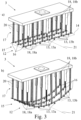
- the actuator arrangement 17 is being driven by the control 4. This becomes a parent from a comparison of Fig. 3a and Fig. 3b .
- Fig. 3 also shows that the actuator arrangement 17 comprises at least two actuators 18, here and preferably a number of actuators 18, that are driven by the control 4.
- the actuators 18 of the actuator arrangement 17 are linear actuators, that are driven by the control 4 respectively.
- the actuators 18 are partly of the type of a pneumatic muscle and partly of the type of a pneumatic piston drive.
- the actuator arrangement 17 comprises at least two actuators 18 of different type.
- the actuators 18 of the type of a pneumatic muscle are denominated with reference number 18a, while the actuators 18 of the type of a pneumatic piston drive are denominated with reference number 18b.
- the actuators 18a of the first type exact pulling forces may be introduced into the carrier arrangement 15, at the same time providing a certain elasticity.
- actuators 18b of the second type pulling forces and pushing forces may be introduced into the carrier arrangement 15, such that the actuators 18b of the second kind provide supporting points for the forces generated by the actuators 18a of the first kind.
- actuators 18a, 18b interacting with each other a high flexibility and at the same time accuracy in deformation of the carrier arrangement 1 and their risk of the gripped layer 5, 6 is possible.
- actuators 18 of different type are especially advantageous as the actuators 18 are each acting on the carrier arrangement 15, here on the carrier strips 16, mainly in a perpendicular direction with respect to the gripping plane 14, which the carrier strips 16 are aligned to.
- the actuators 18 are arranged in one or more rows and are attached to an interface arrangement 19 at their respective one ends and to the carrier arrangement 15, here the carrier strips 16, on their respective other ends.
- At least one of the actuators 18 is provided with a return spring 20 that may be a coil spring aligned to the longitudinal extension of the linear actuator 18.
- the application of the shown gripping arrangement 12 for the proposed manipulator system 2 allows an extraordinary amount of flexibility. This is particularly true because depending from driving the above noted actuators 18 by the control 4 the carrier arrangement 15 may be brought into different forms. This includes convex forms, concave forms and combinations of those. Also the degree of deformation of the carrier arrangement 15 and therewith of the respective layer 5, 6 may be changed on a continuous scale. As the deformation may be achieved actuator based as noted above, it is possible with no effort to change the deformation at any time during production, in particular between two stacking cycles.
- An advantage of the proposed method and the proposed manipulator system 2 is the fact that it is possible to provide the layers 5, 6 to be stacked as flat precut layers in the respective supply stack 8, 9.
- the outlines of the respective layers 5, 6 may vary to each other.
- the outlines of the precut metal layers 5 and the precut fiber layers 6 may vary to each other.
- the end effector 3 handles layers 5, 6 of different width and/or length during the production of the fiber metal laminate component.
- the width and/or the length of the metal layers 5 in comparison to the width, respectively the length of the fiber layers 6, may vary during the production of one fiber metal laminate component from one stacking cycle to the next stacking cycle.
- the surface area of the fiber layers 6 is smaller than the surface area of the metal layers 5. Additionally or alternatively the surface area of different metal layers 5 or different fiber layers 6 may vary from one stacking cycle to the next stacking cycle.
- Another adaption of an operating parameter is that during deforming the layer 5, 6 to be stacked, different gripping elements 13 are being activated by the control 4 depending on the layer 5, 6 being a metal layer 5 or a fiber layer 6. According to the invention it is well possible to activate the gripping elements 13 separately or in groups by the control 4. In particular it is preferred that during transporting and/or deforming of the fiber layers 6 a different number of gripping elements are activated then during transporting and/or forming of the metal layers 5, 6. It may also be pointed out that the surfaces of the layers 5, 6 to be stacked are normally smaller than the surface of the mould 7. Accordingly stacking of the layers 5, 6 means building up a tile structure across the mould surface.
- Fiber Metal Laminate structure The particular advantage of a Fiber Metal Laminate structure is that specific mechanical properties may be set, which mechanical properties may depend on the direction of force introduced into the structure. This may be achieved simply by placing the fiber layers 6 in specific orientations.
- the fibers are oriented homogeneously.
- all fibers are basically aligned to one direction.
- Depositing at least two fiber layers 5, 6 onto each other in different fiber orientations may, however, also be advantageous if the fiber layer 6 is of the type of knitted fabrics of interlaced fabrics or the like. It is preferred that at least one fiber layer 6 is stacked onto another fiber layer 6 such that the fiber orientations of the two layers 6 are offset to each other by 90°. In the manufacturing process this means that the first fiber layer 6 is deposited at a first angle and that the second fiber layer 6 is deposited at a second angle, while the first angle and the second angle are not identical. Preferably, the difference between the two angles is above 10°, preferably above 45°, further preferably 45° and especially preferably 90°.
- the complete ranges of angles for depositing the layers 5, 6 may be realized by the proposed manipulator system 2 simply by turning the end effector 3 via the manipulator 11 accordingly.
- the fiber layer 5 and the metal layer 6 are being deformed in at least two faxsian dimensions. It may even be possible that the fiber layer 5 and the metal layer 6 are being deformed in three faxsian dimensions.
- the fiber layer 5 and the metal layer 6 are being deformed by bending around at least one bending axis, which bending axis is roughly indicated in Fig. 3 .
- the bending axis 21 is arranged basically parallel to the surface of the respective layer 5, 6 and there is basically parallel to the gripping plane 14, as may be taken from Fig. 3 as well.
- the placement of the layer 5, 6 to be stacked, which precedes depositing the layer 5, 6 onto the deposition surface 10 may be performed in various advantageous ways.
- the placement of the layer 5, 6 to be stacked goes along with a layer 5, 6 contacting the deposition surface 10 along a contact line or a contact point.
- the contact line or the contact point is a single contact line or a single contact point. With this, depending on the form of the mould 7, the build up of cavities may be prevented.
- the placement of the layer 5, 6 to be stacked goes along with the layer 5, 6 evenly contacting the full deposition surface. This is shown in Fig. 2 .
- the flat contact between the surface of the layer 5, 6 and the deposition surface 10 prevents the build up of cavities.
- the placement of the layer 5, 6 to be stacked goes along with the layer 5, 6 floating directly above the position surface 10.
- the layer 5, 6 is vaguely dropped onto the deposition surface 10. Due to the very short dropping distance and the above noted adaption of the form of the layer 5, 6 to the form of the deposition surface 10, also with this alternative the build up of cavities is prevented.
- the proposed deforming of the respective layer may be performed in various ways, which may be advantageous depending on the form of the mould 7.
- the deformation of the layer 5, 6 to be stacked by the end effector 3 before its deposition is performed such that the form of the layer 5, 6 is identical to the form of the deposition surface. This is shown in Fig. 2 .
- the deformation of the layer 5, 6 to be stacked by the end effector 3 before its deposition is performed such that the form of the layer 5, 6 at least slightly deviates from the form of the deposition surface 10. This may be advantageous if any friction shall be prevented during the placement of the layer 5, 6 at the deposition surface 10.
- a convex deposition surface 10 this is realized that the deformation of the layer 5, 6 is performed such that the layer 5, 6 is less convex than the deposition surface 10.
- a concave deposition surface 10 ( Fig. 1 ) this may be done by deformation of the layer 5, 6 such that the surface of the layer 5, 6 is more concave than the deposition surface 10.
- this principle may be applied accordingly.
- the stacked up arrangement is preferably being compressed in order to i. a. further reduce possible cavities.
- the stacked up arrangement is then preferably transferred into an autoclave, in which it is being heated under pressure, activating the matrix of the fiber layers 6 as far as those fiber layers 6 are of prepreg material.
- This heat treatment is being performed for 3 to 10 hours under a high pressure of about 10 bar. Subsequent heat or pressure treatments may follow according to the layer material applied. It may be pointed out that if the fiber layers 6 are of dry fiber material they might be impregnated after each placement or the matrix material might be applied to the fiber layers 6 before the autoclave.
- the manipulator system 2 for performing the proposed method is claimed as such.
- the manipulator system 2 comprises an end effector 3 and is controllable by the control 4. All explanations given with respect to the proposed method are fully applicable to the proposed manipulator system 2.
Landscapes
- Engineering & Computer Science (AREA)
- Mechanical Engineering (AREA)
- Robotics (AREA)
- Chemical & Material Sciences (AREA)
- Composite Materials (AREA)
- Moulding By Coating Moulds (AREA)
- Laminated Bodies (AREA)
Claims (16)
- Verfahren zur Herstellung einer Fasermetalllaminatkomponente eines Flugzeugs unter Verwendung eines Manipulatorsystems (2) mit einem Endeffektor (3) und einer Steuerung (4), die dem Manipulatorsystem (2) zugeordnet ist, wobei mindestens eine Metallschicht (5) und mindestens eine ungehärtete Faserschicht (6) in einem Formwerkzeug (7) durch das Manipulatorsystem (2) in einer Stapelsequenz aufeinander gestapelt werden, wobei jeder Stapelzyklus Aufnehmen einer Metallschicht (5) oder einer Faserschicht (6) von einem jeweiligen Vorratsstapel (8, 9) gemäß der Stapelsequenz, Transportieren der Schicht (5, 6) zu dem Formwerkzeug (7), Platzieren der Schicht (5, 6) auf einer Ablegeoberfläche in dem Formwerkzeug (7) gemäß der Stapelsequenz und Ablegen der so platzierten Schicht (5, 6) auf der Ablegeoberfläche (10) umfasst,
dadurch gekennzeichnet,
dass die zu stapelnde Schicht (5, 6) nach dem Aufnehmen von dem Vorratsstapel (8, 9) und vor dem Ablegen auf der Ablegeoberfläche (10) durch den Endeffektor (3) verformt wird, um so die Form der Schicht (5, 6) an die Form der Ablegeoberfläche (10) anzupassen, und dass mindestens eine Metallschicht (5) und mindestens eine Faserschicht (6) jeweils mit ein und demselben Endeffektor (3) aufgenommen und verformt werden, und dass der Endeffektor (3) eine Anzahl von Greifelementen (13) zum Greifen der Schicht (5, 6) während des Aufnehmens umfasst, wobei die Greifelemente (13) separat oder in Gruppen durch die Steuerung (4) aktiviert werden. - Verfahren nach Anspruch 1, dadurch gekennzeichnet, dass das Manipulatorsystem (2) einen Manipulator (11), vorzugsweise einen Roboter mit sequentiellen Achsen oder einen Portalroboter umfasst, wobei der Manipulator (11) durch die Steuerung (4) angetrieben wird.
- Verfahren nach Anspruch 1 oder 2, dadurch gekennzeichnet, dass die Anzahl der Greifelemente (13) mindestens ein Greifelement (13a) von einem ersten Typ und mindestens ein Greifelement (13b) von einem zweiten Typ umfasst.
- Verfahren nach Anspruch 3, dadurch gekennzeichnet, dass das Greifelement (13a) des ersten Typs einen schwimmenden Griff der Schicht (5, 6) entlang ihrer Oberfläche bereitstellt, und dass das Greifelement (13b) des zweiten Typs einen starren Griff der Schicht (5, 6) bereitstellt.
- Verfahren nach Anspruch 3 oder 4, dadurch gekennzeichnet, dass die Greifelemente (13) Sauggreifelemente sind, wobei vorzugsweise mindestens eines der Greifelemente (13a) vom Typ Bernoulli-Sauggreifelement ist, und/oder dass mindestens eines der Greifelemente (13b) vom Typ Venturi-Sauggreifelement ist.
- Verfahren nach einem der Ansprüche 3 bis 5, dadurch gekennzeichnet, dass der Endeffektor (3) eine verformbare Trägeranordnung (15) umfasst, dass die Greifanordnung (12) sich auf der Trägeranordnung (15) befindet, dass der Endeffektor (3) auch eine Aktuatoranordnung (17) für aktuatorbasiertes Verformen der Trägeranordnung (15) umfasst, und dass zum Verformen der gegriffenen Schicht (8, 9) die Aktuatoranordnung (17) durch die Steuerung (4) angetrieben wird, wobei die Aktuatoranordnung (17) vorzugsweise mindestens zwei Aktuatoren (18), vorzugsweise mindestens zwei Linearaktuatoren (18) umfasst, die durch die Steuerung (4) angetrieben werden, insbesondere vom Typ eines pneumatischen Muskels (18a) und/oder vom Typ eines pneumatischen Kolbenantriebs (18b), wobei vorzugsweise die Aktuatoranordnung (17) mindestens zwei Aktuatoren (18) unterschiedlichen Typs umfasst.
- Verfahren nach einem der vorhergehenden Ansprüche, dadurch gekennzeichnet, dass die zu stapelnden Schichten (5, 6) als flache vorgeschnittene Schichten (5, 6) in dem Vorratsstapel (8, 9) bereitgestellt werden.
- Verfahren nach einem der Ansprüche 3 bis 7, dadurch gekennzeichnet, dass die Greifelemente (13) separat oder in Gruppen durch die Steuerung (4) in einer solchen Weise aktiviert werden, dass nicht-verwendete Greifelemente 13 daran gehindert werden, in unerwünschter Weise mit bereits abgelegten Schichten 5, 6 zu interagieren, und dass Schichten 5, 6, die kleiner als die Kontur der Greifanordnung 12 sind, gehandhabt werden können.
- Verfahren nach einem der vorhergehenden Ansprüche, dadurch gekennzeichnet, dass mindestens ein Betriebsparameter des Endeffektors (3) durch die Steuerung (4) in Abhängigkeit davon, ob die Schicht (5, 6) eine Metallschicht (5) oder eine Faserschicht (6) ist, angepasst wird.
- Verfahren nach einem der Ansprüche 3 bis 9, dadurch gekennzeichnet, dass während des Verformens der zu stapelnden Schichten (5, 6) durch die Steuerung (4) in Abhängigkeit davon, ob die Schicht (5, 6) eine Metallschicht (5) oder eine Faserschicht (6) ist, unterschiedliche Greifelemente (13) aktiviert werden.
- Verfahren nach einem der vorhergehenden Ansprüche, dadurch gekennzeichnet, dass die Fasern innerhalb der Faserschichten (6) homogen orientiert sind, dass vorzugsweise alle Fasern grundlegend in eine Richtung ausgerichtet sind, und/oder dass mindestens zwei Faserschichten in unterschiedlichen Faserorientierungen aufeinander abgelegt werden.
- Verfahren nach einem der vorhergehenden Ansprüche, dadurch gekennzeichnet, dass die Faserschicht (6) und die Metallschicht (5) in mindestens zwei kartesischen Dimensionen verformt werden, dass vorzugsweise die Faserschicht (6) und die Metallschicht (5) in drei kartesischen Dimensionen verformt werden, und/oder dass die Faserschicht (6) und die Metallschicht (5) durch Biegen um mindestens eine Biegeachse (21) verformt werden, wobei vorzugsweise die mindestens eine Biegeachse (21) grundlegend parallel zu der Oberfläche der jeweiligen Schicht (5, 6) angeordnet ist.
- Verfahren nach einem der vorhergehenden Ansprüche, dadurch gekennzeichnet, dass die Platzierung der zu stapelnden Schicht (5, 6) zusammen damit abläuft, dass die Schicht (5, 6) die Ablegeoberfläche (10) entlang einer Kontaktlinie oder eines Kontaktpunkts kontaktiert, oder dass die Platzierung der zu stapelnden Schicht (5, 6) zusammen damit abläuft, dass die Schicht (5, 6) die volle Ablegeoberfläche (10) gleichförmig kontaktiert, oder dass die Platzierung der zu stapelnden Schichten (5, 6) zusammen damit abläuft, dass die Schichten (5, 6) direkt über der Ablegeoberfläche (10) schwimmen.
- Verfahren nach einem der vorhergehenden Ansprüche, dadurch gekennzeichnet, dass die Verformung der durch den Endeffektor (3) zu stapelnden Schicht (5, 6) vor deren Ablegen durchgeführt wird, so dass die Form der Schicht (5, 6) mit der Form der Ablegeoberfläche (10) identisch ist.
- Verfahren nach einem der vorhergehenden Ansprüche, dadurch gekennzeichnet, dass die Verformung der durch den Endeffektor (5) zu stapelnden Schicht (5, 6) vor deren Ablegen durchgeführt wird, so dass die Form der Schicht (5, 6) mindestens geringfügig von der Form der Ablegeoberfläche (10) abweicht, wobei vorzugsweise die Verformung der durch den Endeffektor (3) zu stapelnden Schicht (5, 6) vor deren Ablegen so durchgeführt wird, dass im Fall einer konvexen Ablegeoberfläche (10) die Schicht (5, 6) weniger konvex als die Ablegeoberfläche (10) ist, und dass im Fall einer konkaven Ablegeoberfläche (10) die Oberfläche der Schicht (5, 6) stärker konkav als die Ablegeoberfläche (10) ist.
- Manipulatorsystem zur Durchführung des Verfahrens nach einem der vorhergehenden Ansprüche,wobei das Manipulatorsystem (2) einen Endeffektor (3) und eine Steuerung (4), die dem Manipulatorsystem (2) zugeordnet ist, umfasst,die Steuerung (4) eine elektronische Steuerung ist, die nicht nur die Bewegung des Manipulatorsystems (2), sondern auch die Aktionen des Endeffektors (3) steuert, wobei das Manipulatorsystem ausgestaltet ist, um das Verfahren gemäß einem der vorhergehenden Ansprüche durchzuführen,wobei der Endeffektor (3) eine Anzahl an Greifelementen (13) zum Greifen einer Schicht (5, 6) während des Aufnehmens umfasst, wobei die Greifelemente (13) separat oder in Gruppen durch die Steuerung (4) aktiviert werden.
Applications Claiming Priority (2)
| Application Number | Priority Date | Filing Date | Title |
|---|---|---|---|
| DE102015009177.8A DE102015009177A1 (de) | 2015-07-09 | 2015-07-09 | Verfahren zum Herstellen eines Faser-Metall-Laminatbauteils eines Flugzeugs |
| PCT/EP2016/065929 WO2017005770A1 (en) | 2015-07-09 | 2016-07-06 | Method for producing a fiber laminate component of an airplane |
Publications (2)
| Publication Number | Publication Date |
|---|---|
| EP3319789A1 EP3319789A1 (de) | 2018-05-16 |
| EP3319789B1 true EP3319789B1 (de) | 2024-12-25 |
Family
ID=56368964
Family Applications (1)
| Application Number | Title | Priority Date | Filing Date |
|---|---|---|---|
| EP16736114.6A Active EP3319789B1 (de) | 2015-07-09 | 2016-07-06 | Verfahren zur herstellung eines faserlaminatbauteils eines flugzeugs |
Country Status (8)
| Country | Link |
|---|---|
| US (1) | US11453179B2 (de) |
| EP (1) | EP3319789B1 (de) |
| CN (1) | CN107921716B (de) |
| DE (1) | DE102015009177A1 (de) |
| DK (1) | DK3319789T3 (de) |
| ES (1) | ES3014450T3 (de) |
| RU (1) | RU2752348C2 (de) |
| WO (1) | WO2017005770A1 (de) |
Families Citing this family (27)
| Publication number | Priority date | Publication date | Assignee | Title |
|---|---|---|---|---|
| DE102015009177A1 (de) | 2015-07-09 | 2017-01-12 | Broetje-Automation Gmbh | Verfahren zum Herstellen eines Faser-Metall-Laminatbauteils eines Flugzeugs |
| GB2543843B (en) * | 2015-10-31 | 2020-04-29 | Loop Tech Ltd | A system for handling flexible materials |
| CN108367466B (zh) * | 2015-12-18 | 2020-06-23 | 帝人株式会社 | 压制成型体的制造方法 |
| WO2017123816A1 (en) * | 2016-01-12 | 2017-07-20 | Grabit, Inc. | Methods and systems for electroadhesion-based manipulation in manufacturing |
| DE102016011618A1 (de) | 2016-09-28 | 2018-03-29 | Broetje-Automation Gmbh | Endeffektoranordnung |
| JP6821417B2 (ja) | 2016-12-16 | 2021-01-27 | 芝浦機械株式会社 | 搬送装置および搬送ヘッド |
| DE102016125674A1 (de) | 2016-12-23 | 2018-06-28 | Broetje-Automation Gmbh | Endeffektor |
| DE102017203368B4 (de) | 2017-03-02 | 2023-07-06 | Volkswagen Aktiengesellschaft | Verfahren und Vorrichtung zum Versteifen von Metallbauteilen mittels eines robotergeführten Applikationskopfes |
| PT3600882T (pt) * | 2017-03-22 | 2021-07-26 | Saint Gobain | Dispositivo e processo para o levantamento, deformação e deposição de uma placa de vidro fina |
| US10843449B2 (en) * | 2017-12-14 | 2020-11-24 | The Boeing Company | Method and apparatus for forming composite plies on contoured tool surfaces |
| US10926490B2 (en) * | 2018-04-09 | 2021-02-23 | The Boeing Company | Composite laminate forming apparatus and method therefor |
| AT521384B1 (de) * | 2018-09-20 | 2020-01-15 | Trumpf Maschinen Austria Gmbh & Co Kg | Automatisierter Vakuumgreifer und Verfahren zum sicheren Greifen von Bauteilen |
| US12070850B1 (en) * | 2019-05-14 | 2024-08-27 | Amazon Technologies, Inc. | Multi-piston, vacuum gripper assembly |
| CN114423693B (zh) * | 2019-06-03 | 2024-03-22 | 萨克米伊莫拉机械合作社合作公司 | 用于转移陶瓷加工业的物品的方法和系统 |
| WO2021048105A1 (en) | 2019-09-12 | 2021-03-18 | Syddansk Universitet | End effector comprising resilient members between adjacent holding tools |
| DE102019130375B4 (de) * | 2019-11-11 | 2023-02-16 | Fipa Holding Gmbh | Sauggreiferanordnung zum handhaben von gegenständen |
| EP4000842B1 (de) | 2020-11-18 | 2025-01-01 | The Boeing Company | Verbundvorformanordnungsverfahren und -vorrichtung |
| US12195201B2 (en) | 2020-11-18 | 2025-01-14 | The Boeing Company | Composite preform assembly method and apparatus |
| NL2027397B1 (en) * | 2021-01-26 | 2022-08-17 | Boeing Co | Composite preform assembly method and apparatus |
| JP2022187920A (ja) * | 2021-06-08 | 2022-12-20 | パナソニックIpマネジメント株式会社 | 組立システム、制御装置及び組立方法 |
| CN113459635A (zh) * | 2021-07-07 | 2021-10-01 | 北京机科国创轻量化科学研究院有限公司烟台分公司 | 纤维增强金属层板结构件自动化铺层装置及方法 |
| KR102685833B1 (ko) * | 2022-03-14 | 2024-07-16 | 주식회사 성일 | Grp 물탱크 판넬 성형장치 |
| CN115339129A (zh) * | 2022-07-18 | 2022-11-15 | 曜福精工技术(江苏)有限公司 | 一种铺贴复合材料料片的终端执行器及铺放方法 |
| GB202212181D0 (en) * | 2022-08-22 | 2022-10-05 | Lm Wind Power As | Layup of pre-manufactured elements in a wind turbine blade part mold |
| CN116409044B (zh) * | 2023-06-12 | 2023-08-29 | 成都市鸿侠科技有限责任公司 | 一种可柔性夹持的铝合金蜂窝胶接夹具 |
| CN117416069A (zh) * | 2023-11-02 | 2024-01-19 | 常州碳科智能装备有限公司 | 阵列式变曲面发动机叶片铺叠设备及其铺叠工艺方法 |
| US20250162170A1 (en) * | 2023-11-17 | 2025-05-22 | The Boeing Company | Electrorheological Shape Retaining Membrane |
Citations (1)
| Publication number | Priority date | Publication date | Assignee | Title |
|---|---|---|---|---|
| US20120330453A1 (en) * | 2011-06-22 | 2012-12-27 | The Boeing Company | Automated ply layup system |
Family Cites Families (50)
| Publication number | Priority date | Publication date | Assignee | Title |
|---|---|---|---|---|
| US1279500A (en) | 1917-11-19 | 1918-09-24 | Louis H Berry | Automobile jack and lock. |
| US2729040A (en) | 1954-02-10 | 1956-01-03 | Boeing Co | Vacuum chuck jigs |
| US3367764A (en) | 1964-12-15 | 1968-02-06 | Pittsburgh Plate Glass Co | Glass sheet press shaping apparatus with means to adjust the pressing surface curvature |
| US3281107A (en) | 1965-12-15 | 1966-10-25 | Ohio Brass Co | Hydraulic support prop |
| US3734464A (en) | 1971-11-17 | 1973-05-22 | S Bushnell | Control system for multi-stage lift |
| US3865359A (en) | 1972-05-01 | 1975-02-11 | Dbm Industries Ltd | Vacuum apparatus |
| BE791606A (fr) | 1972-07-10 | 1973-03-16 | Pilot Pen Co Ltd | Procede et appareil pour aspirer et soulever la feuille la plussuperieure d'une pile de feuilles de ce type |
| US4129328A (en) | 1977-06-20 | 1978-12-12 | Littell Edmund R | Plate handling apparatus with load deflection compensation |
| US4297118A (en) | 1980-03-18 | 1981-10-27 | Ppg Industries, Inc. | Controlling overheating of vacuum mold used to shape glass sheets |
| US4470835A (en) | 1982-11-15 | 1984-09-11 | Ppg Industries, Inc. | Shaping sheets of glass or other deformable material to a complicated curvature |
| US4527783A (en) | 1983-04-26 | 1985-07-09 | Grumman Aerospace Corporation | Universal contoured parts holding fixture |
| US4487623A (en) | 1983-07-18 | 1984-12-11 | Ppg Industries, Inc. | Method of and apparatus for removing sharply bent glass sheets from press bending molds |
| JPS6125778A (ja) | 1984-07-09 | 1986-02-04 | 川崎重工業株式会社 | 可変式曲面定盤 |
| US4579577A (en) | 1984-12-21 | 1986-04-01 | Ppg Industries, Inc. | Vacuum press mold construction |
| US4775290A (en) | 1986-03-03 | 1988-10-04 | Flow Systems, Inc. | Flexible vacuum gripper |
| DE3629968A1 (de) | 1986-09-03 | 1988-03-10 | Messerschmitt Boelkow Blohm | Vorrichtung zum aufnehmen und ablegen von zuschnitten |
| US4746348A (en) | 1986-12-29 | 1988-05-24 | Ppg Industries, Inc. | Horizontal press bending apparatus and method |
| US4741751A (en) | 1987-01-05 | 1988-05-03 | Ppg Industries, Inc. | Extended surface pressing mold and method of sheet shaping |
| US4806070A (en) | 1987-04-13 | 1989-02-21 | General Electric Company | Article transfer apparatus |
| US4822398A (en) | 1987-08-07 | 1989-04-18 | Mcmaster Harold | Glass bending and tempering apparatus |
| US4806140A (en) | 1987-12-21 | 1989-02-21 | Ppg Industries, Inc. | Adjustable press face |
| DE4210024A1 (de) | 1992-03-27 | 1993-09-30 | Krause Biagosch Gmbh | Vereinzelungsvorrichtung für Druckplatten |
| US5556505A (en) | 1994-07-05 | 1996-09-17 | Ford Motor Company | Windshield assembly system |
| US5865089A (en) | 1997-09-19 | 1999-02-02 | Langer; John W. | Linear thruster |
| FR2791919B1 (fr) * | 1999-04-12 | 2001-06-01 | Plastic Omnium Cie | Procede de realisation d'une piece en matiere plastique renforcee par surmoulage d'une feuille de renforcement, dispositif pour la mise en oeuvre de ce procede et chaine de fabrication comprenant ce dispositif |
| US6431623B1 (en) | 1999-06-11 | 2002-08-13 | Honeywell International Inc. | Vacuum device for peeling off thin sheets |
| CA2330612A1 (en) | 2000-12-29 | 2002-06-29 | Alain Bernier | Flexible actuator |
| US6467824B2 (en) | 2001-03-13 | 2002-10-22 | Data I/O Corporation | Floating seal pick and place system and unit therefor |
| DE20112633U1 (de) * | 2001-07-31 | 2002-02-21 | Festo AG & Co, 73734 Esslingen | Handhabungsvorrichtung, insbesondere zur Handhabung von Platten und Folien |
| DE10152232B4 (de) | 2001-10-20 | 2005-02-17 | Daimlerchrysler Ag | Verfahren und Vorrichtung zum automatisierten Handhaben von Harzmatten bei der Herstellung von SMC-Teilen |
| US6666127B2 (en) | 2002-05-03 | 2003-12-23 | Muscle Tech Ltd. | Artificial muscle |
| US6868773B2 (en) | 2002-08-13 | 2005-03-22 | Electro Cam Corporation | Fluidic actuator |
| US20070129653A1 (en) | 2003-04-24 | 2007-06-07 | Thomas Sugar | Spring-over-muscle actuator |
| WO2004113015A2 (en) | 2003-06-20 | 2004-12-29 | Par Systems, Inc. | Flexible fixture |
| KR20060123737A (ko) | 2003-11-10 | 2006-12-04 | 가부시키가이샤 히타치 메디코 | 유압 액츄에이터 |
| US7134649B2 (en) | 2004-05-27 | 2006-11-14 | The Boeing Company | Conformal vacuum cup apparatus and method |
| US7464548B2 (en) | 2005-11-30 | 2008-12-16 | The Boeing Company | Shape memory alloy linear actuator |
| WO2007102216A1 (ja) | 2006-03-08 | 2007-09-13 | Ibiden Co., Ltd. | 脱脂炉投入装置、及び、ハニカム構造体の製造方法 |
| NL2000100C2 (nl) * | 2006-06-13 | 2007-12-14 | Gtm Consulting B V | Laminaat uit metaalplaten en kunststof. |
| DE102006046624A1 (de) | 2006-09-29 | 2008-04-03 | Brötje-Automation GmbH | Verfahren und Transportvorrichtung zum Transportieren von Gegenständen |
| CN102744726B (zh) | 2007-01-22 | 2014-12-03 | 松下电器产业株式会社 | 压缩性流体压力促动器驱动机构及其驱动方法 |
| DE102007003275B4 (de) | 2007-01-23 | 2013-11-28 | Airbus Operations Gmbh | Schalenelement als Teil eines Flugzeugrumpfes |
| DE102008032574A1 (de) * | 2008-07-11 | 2010-01-14 | Brötje-Automation GmbH | Vorrichtung zur Verwendung bei der Herstellung faserverstärkter Bauteile |
| BR112012013754B1 (pt) * | 2009-12-18 | 2019-12-24 | Cytec Tech Corp | artigo compósito, processo de fabricação para fabricar um painel laminado, e, painel laminado |
| RU100448U1 (ru) * | 2010-08-11 | 2010-12-20 | Михаил Валерьевич Лифшиц | Консольный промышленный робот для обработки листовых материалов |
| DE102011106214A1 (de) * | 2011-06-07 | 2012-12-13 | Brötje-Automation GmbH | Endeffektor |
| DE102012000508A1 (de) | 2012-01-13 | 2013-07-18 | BOB Engineering GmbH Automation und Produktentwicklung | Verfahren zur Herstellung eines GLARE-Bauteils |
| US9375908B2 (en) * | 2013-05-03 | 2016-06-28 | The Boeing Company | Flexible material transfer devices, flexible vacuum compaction devices, flexible vacuum chucks, and systems and methods including the same |
| US9205558B1 (en) * | 2014-07-16 | 2015-12-08 | Google Inc. | Multiple suction cup control |
| DE102015009177A1 (de) | 2015-07-09 | 2017-01-12 | Broetje-Automation Gmbh | Verfahren zum Herstellen eines Faser-Metall-Laminatbauteils eines Flugzeugs |
-
2015
- 2015-07-09 DE DE102015009177.8A patent/DE102015009177A1/de active Pending
-
2016
- 2016-07-06 CN CN201680040641.7A patent/CN107921716B/zh active Active
- 2016-07-06 WO PCT/EP2016/065929 patent/WO2017005770A1/en not_active Ceased
- 2016-07-06 RU RU2018104802A patent/RU2752348C2/ru active
- 2016-07-06 DK DK16736114.6T patent/DK3319789T3/da active
- 2016-07-06 US US15/743,045 patent/US11453179B2/en active Active
- 2016-07-06 ES ES16736114T patent/ES3014450T3/es active Active
- 2016-07-06 EP EP16736114.6A patent/EP3319789B1/de active Active
Patent Citations (1)
| Publication number | Priority date | Publication date | Assignee | Title |
|---|---|---|---|---|
| US20120330453A1 (en) * | 2011-06-22 | 2012-12-27 | The Boeing Company | Automated ply layup system |
Also Published As
| Publication number | Publication date |
|---|---|
| US11453179B2 (en) | 2022-09-27 |
| CN107921716B (zh) | 2022-03-01 |
| WO2017005770A1 (en) | 2017-01-12 |
| DK3319789T3 (da) | 2025-03-17 |
| RU2752348C2 (ru) | 2021-07-26 |
| BR112018000154A2 (pt) | 2018-09-11 |
| RU2018104802A (ru) | 2019-08-09 |
| ES3014450T3 (en) | 2025-04-22 |
| CN107921716A (zh) | 2018-04-17 |
| DE102015009177A1 (de) | 2017-01-12 |
| RU2018104802A3 (de) | 2019-10-29 |
| EP3319789A1 (de) | 2018-05-16 |
| US20180304556A1 (en) | 2018-10-25 |
Similar Documents
| Publication | Publication Date | Title |
|---|---|---|
| EP3319789B1 (de) | Verfahren zur herstellung eines faserlaminatbauteils eines flugzeugs | |
| US9821474B2 (en) | End effector | |
| EP2660011B1 (de) | Greifervorrichtung zur handhabung flexibler elemente | |
| JP7391498B2 (ja) | 垂れ性のあるプライを搬送してマンドレルで成形するためエンドエフェクタ | |
| EP3867047B1 (de) | System und verfahren zur automatisierten folienentfernung | |
| DE102015107394B4 (de) | Effektor, Vorrichtung und Verfahren zum Aufnehmen, Handhaben und/oder Ablegen von textilen Strukturen | |
| US10464269B2 (en) | Laying die, laying device and method for manufacturing a laying die | |
| WO2016075424A1 (en) | Improvements to robotic arm end effectors and their use in the preparation and application of production materials | |
| US20160257428A1 (en) | Method of assembling components | |
| US9925670B2 (en) | Method for handling flexible mat-like workpieces | |
| AU2019200074B2 (en) | High resolution vacuum grippers that utilize bi-stable flow valves | |
| EP3970865A1 (de) | Formverfahren für blechelement und formvorrichtung für blechelement | |
| US12090715B2 (en) | Caul plates for preforms that undergo pick and placement | |
| Vistein et al. | Automated production of large fibre metal laminate aircraft structure parts | |
| BR112018000154B1 (pt) | Método para a produção de um componente de laminado de fibra e metal de um avião | |
| US20160001537A1 (en) | Assembly system | |
| US20190337281A1 (en) | Apparatus for handling and locally fixing flat thermoplastic materials | |
| US20250073928A1 (en) | Gripping device and robot having the same | |
| ZHI | DESIGN OF A SOFT GRIPPER FOR PICK AND PLACE APPLICATION |
Legal Events
| Date | Code | Title | Description |
|---|---|---|---|
| STAA | Information on the status of an ep patent application or granted ep patent |
Free format text: STATUS: THE INTERNATIONAL PUBLICATION HAS BEEN MADE |
|
| PUAI | Public reference made under article 153(3) epc to a published international application that has entered the european phase |
Free format text: ORIGINAL CODE: 0009012 |
|
| STAA | Information on the status of an ep patent application or granted ep patent |
Free format text: STATUS: REQUEST FOR EXAMINATION WAS MADE |
|
| 17P | Request for examination filed |
Effective date: 20171220 |
|
| AK | Designated contracting states |
Kind code of ref document: A1 Designated state(s): AL AT BE BG CH CY CZ DE DK EE ES FI FR GB GR HR HU IE IS IT LI LT LU LV MC MK MT NL NO PL PT RO RS SE SI SK SM TR |
|
| AX | Request for extension of the european patent |
Extension state: BA ME |
|
| DAV | Request for validation of the european patent (deleted) | ||
| DAX | Request for extension of the european patent (deleted) | ||
| STAA | Information on the status of an ep patent application or granted ep patent |
Free format text: STATUS: EXAMINATION IS IN PROGRESS |
|
| 17Q | First examination report despatched |
Effective date: 20210512 |
|
| GRAP | Despatch of communication of intention to grant a patent |
Free format text: ORIGINAL CODE: EPIDOSNIGR1 |
|
| STAA | Information on the status of an ep patent application or granted ep patent |
Free format text: STATUS: GRANT OF PATENT IS INTENDED |
|
| INTG | Intention to grant announced |
Effective date: 20240430 |
|
| GRAJ | Information related to disapproval of communication of intention to grant by the applicant or resumption of examination proceedings by the epo deleted |
Free format text: ORIGINAL CODE: EPIDOSDIGR1 |
|
| STAA | Information on the status of an ep patent application or granted ep patent |
Free format text: STATUS: EXAMINATION IS IN PROGRESS |
|
| GRAP | Despatch of communication of intention to grant a patent |
Free format text: ORIGINAL CODE: EPIDOSNIGR1 |
|
| STAA | Information on the status of an ep patent application or granted ep patent |
Free format text: STATUS: GRANT OF PATENT IS INTENDED |
|
| INTC | Intention to grant announced (deleted) | ||
| INTG | Intention to grant announced |
Effective date: 20240927 |
|
| GRAS | Grant fee paid |
Free format text: ORIGINAL CODE: EPIDOSNIGR3 |
|
| GRAA | (expected) grant |
Free format text: ORIGINAL CODE: 0009210 |
|
| STAA | Information on the status of an ep patent application or granted ep patent |
Free format text: STATUS: THE PATENT HAS BEEN GRANTED |
|
| AK | Designated contracting states |
Kind code of ref document: B1 Designated state(s): AL AT BE BG CH CY CZ DE DK EE ES FI FR GB GR HR HU IE IS IT LI LT LU LV MC MK MT NL NO PL PT RO RS SE SI SK SM TR |
|
| REG | Reference to a national code |
Ref country code: GB Ref legal event code: FG4D |
|
| REG | Reference to a national code |
Ref country code: CH Ref legal event code: EP |
|
| REG | Reference to a national code |
Ref country code: DE Ref legal event code: R096 Ref document number: 602016090728 Country of ref document: DE |
|
| REG | Reference to a national code |
Ref country code: IE Ref legal event code: FG4D |
|
| REG | Reference to a national code |
Ref country code: NL Ref legal event code: FP |
|
| REG | Reference to a national code |
Ref country code: DK Ref legal event code: T3 Effective date: 20250311 |
|
| REG | Reference to a national code |
Ref country code: LT Ref legal event code: MG9D |
|
| PG25 | Lapsed in a contracting state [announced via postgrant information from national office to epo] |
Ref country code: FI Free format text: LAPSE BECAUSE OF FAILURE TO SUBMIT A TRANSLATION OF THE DESCRIPTION OR TO PAY THE FEE WITHIN THE PRESCRIBED TIME-LIMIT Effective date: 20241225 |
|
| PG25 | Lapsed in a contracting state [announced via postgrant information from national office to epo] |
Ref country code: BG Free format text: LAPSE BECAUSE OF FAILURE TO SUBMIT A TRANSLATION OF THE DESCRIPTION OR TO PAY THE FEE WITHIN THE PRESCRIBED TIME-LIMIT Effective date: 20241225 |
|
| REG | Reference to a national code |
Ref country code: ES Ref legal event code: FG2A Ref document number: 3014450 Country of ref document: ES Kind code of ref document: T3 Effective date: 20250422 |
|
| PG25 | Lapsed in a contracting state [announced via postgrant information from national office to epo] |
Ref country code: NO Free format text: LAPSE BECAUSE OF FAILURE TO SUBMIT A TRANSLATION OF THE DESCRIPTION OR TO PAY THE FEE WITHIN THE PRESCRIBED TIME-LIMIT Effective date: 20250325 |
|
| PG25 | Lapsed in a contracting state [announced via postgrant information from national office to epo] |
Ref country code: LV Free format text: LAPSE BECAUSE OF FAILURE TO SUBMIT A TRANSLATION OF THE DESCRIPTION OR TO PAY THE FEE WITHIN THE PRESCRIBED TIME-LIMIT Effective date: 20241225 Ref country code: GR Free format text: LAPSE BECAUSE OF FAILURE TO SUBMIT A TRANSLATION OF THE DESCRIPTION OR TO PAY THE FEE WITHIN THE PRESCRIBED TIME-LIMIT Effective date: 20250326 |
|
| PG25 | Lapsed in a contracting state [announced via postgrant information from national office to epo] |
Ref country code: RS Free format text: LAPSE BECAUSE OF FAILURE TO SUBMIT A TRANSLATION OF THE DESCRIPTION OR TO PAY THE FEE WITHIN THE PRESCRIBED TIME-LIMIT Effective date: 20250325 |
|
| REG | Reference to a national code |
Ref country code: AT Ref legal event code: MK05 Ref document number: 1753823 Country of ref document: AT Kind code of ref document: T Effective date: 20241225 |
|
| PG25 | Lapsed in a contracting state [announced via postgrant information from national office to epo] |
Ref country code: SM Free format text: LAPSE BECAUSE OF FAILURE TO SUBMIT A TRANSLATION OF THE DESCRIPTION OR TO PAY THE FEE WITHIN THE PRESCRIBED TIME-LIMIT Effective date: 20241225 |
|
| PG25 | Lapsed in a contracting state [announced via postgrant information from national office to epo] |
Ref country code: PL Free format text: LAPSE BECAUSE OF FAILURE TO SUBMIT A TRANSLATION OF THE DESCRIPTION OR TO PAY THE FEE WITHIN THE PRESCRIBED TIME-LIMIT Effective date: 20241225 |
|
| PG25 | Lapsed in a contracting state [announced via postgrant information from national office to epo] |
Ref country code: IS Free format text: LAPSE BECAUSE OF FAILURE TO SUBMIT A TRANSLATION OF THE DESCRIPTION OR TO PAY THE FEE WITHIN THE PRESCRIBED TIME-LIMIT Effective date: 20250425 |
|
| PG25 | Lapsed in a contracting state [announced via postgrant information from national office to epo] |
Ref country code: PT Free format text: LAPSE BECAUSE OF FAILURE TO SUBMIT A TRANSLATION OF THE DESCRIPTION OR TO PAY THE FEE WITHIN THE PRESCRIBED TIME-LIMIT Effective date: 20250428 |
|
| PG25 | Lapsed in a contracting state [announced via postgrant information from national office to epo] |
Ref country code: EE Free format text: LAPSE BECAUSE OF FAILURE TO SUBMIT A TRANSLATION OF THE DESCRIPTION OR TO PAY THE FEE WITHIN THE PRESCRIBED TIME-LIMIT Effective date: 20241225 |
|
| PG25 | Lapsed in a contracting state [announced via postgrant information from national office to epo] |
Ref country code: AT Free format text: LAPSE BECAUSE OF FAILURE TO SUBMIT A TRANSLATION OF THE DESCRIPTION OR TO PAY THE FEE WITHIN THE PRESCRIBED TIME-LIMIT Effective date: 20241225 Ref country code: RO Free format text: LAPSE BECAUSE OF FAILURE TO SUBMIT A TRANSLATION OF THE DESCRIPTION OR TO PAY THE FEE WITHIN THE PRESCRIBED TIME-LIMIT Effective date: 20241225 |
|
| PG25 | Lapsed in a contracting state [announced via postgrant information from national office to epo] |
Ref country code: SK Free format text: LAPSE BECAUSE OF FAILURE TO SUBMIT A TRANSLATION OF THE DESCRIPTION OR TO PAY THE FEE WITHIN THE PRESCRIBED TIME-LIMIT Effective date: 20241225 |
|
| PG25 | Lapsed in a contracting state [announced via postgrant information from national office to epo] |
Ref country code: CZ Free format text: LAPSE BECAUSE OF FAILURE TO SUBMIT A TRANSLATION OF THE DESCRIPTION OR TO PAY THE FEE WITHIN THE PRESCRIBED TIME-LIMIT Effective date: 20241225 |
|
| PG25 | Lapsed in a contracting state [announced via postgrant information from national office to epo] |
Ref country code: IT Free format text: LAPSE BECAUSE OF FAILURE TO SUBMIT A TRANSLATION OF THE DESCRIPTION OR TO PAY THE FEE WITHIN THE PRESCRIBED TIME-LIMIT Effective date: 20241225 |
|
| PGFP | Annual fee paid to national office [announced via postgrant information from national office to epo] |
Ref country code: NL Payment date: 20250721 Year of fee payment: 10 |
|
| PG25 | Lapsed in a contracting state [announced via postgrant information from national office to epo] |
Ref country code: SE Free format text: LAPSE BECAUSE OF FAILURE TO SUBMIT A TRANSLATION OF THE DESCRIPTION OR TO PAY THE FEE WITHIN THE PRESCRIBED TIME-LIMIT Effective date: 20241225 |
|
| REG | Reference to a national code |
Ref country code: DE Ref legal event code: R097 Ref document number: 602016090728 Country of ref document: DE |
|
| PGFP | Annual fee paid to national office [announced via postgrant information from national office to epo] |
Ref country code: ES Payment date: 20250826 Year of fee payment: 10 |
|
| PGFP | Annual fee paid to national office [announced via postgrant information from national office to epo] |
Ref country code: DK Payment date: 20250725 Year of fee payment: 10 Ref country code: DE Payment date: 20250723 Year of fee payment: 10 |
|
| PGFP | Annual fee paid to national office [announced via postgrant information from national office to epo] |
Ref country code: GB Payment date: 20250722 Year of fee payment: 10 |
|
| PLBE | No opposition filed within time limit |
Free format text: ORIGINAL CODE: 0009261 |
|
| STAA | Information on the status of an ep patent application or granted ep patent |
Free format text: STATUS: NO OPPOSITION FILED WITHIN TIME LIMIT |
|
| REG | Reference to a national code |
Ref country code: CH Ref legal event code: L10 Free format text: ST27 STATUS EVENT CODE: U-0-0-L10-L00 (AS PROVIDED BY THE NATIONAL OFFICE) Effective date: 20251105 |
|
| 26N | No opposition filed |
Effective date: 20250926 |
|
| REG | Reference to a national code |
Ref country code: CH Ref legal event code: H13 Free format text: ST27 STATUS EVENT CODE: U-0-0-H10-H13 (AS PROVIDED BY THE NATIONAL OFFICE) Effective date: 20260224 |
|
| PG25 | Lapsed in a contracting state [announced via postgrant information from national office to epo] |
Ref country code: LU Free format text: LAPSE BECAUSE OF NON-PAYMENT OF DUE FEES Effective date: 20250706 |
|
| REG | Reference to a national code |
Ref country code: BE Ref legal event code: MM Effective date: 20250731 |
|
| PG25 | Lapsed in a contracting state [announced via postgrant information from national office to epo] |
Ref country code: HR Free format text: LAPSE BECAUSE OF FAILURE TO SUBMIT A TRANSLATION OF THE DESCRIPTION OR TO PAY THE FEE WITHIN THE PRESCRIBED TIME-LIMIT Effective date: 20241225 |
|
| PG25 | Lapsed in a contracting state [announced via postgrant information from national office to epo] |
Ref country code: BE Free format text: LAPSE BECAUSE OF NON-PAYMENT OF DUE FEES Effective date: 20250731 |
|
| PG25 | Lapsed in a contracting state [announced via postgrant information from national office to epo] |
Ref country code: FR Free format text: LAPSE BECAUSE OF NON-PAYMENT OF DUE FEES Effective date: 20250731 |
|
| PG25 | Lapsed in a contracting state [announced via postgrant information from national office to epo] |
Ref country code: CH Free format text: LAPSE BECAUSE OF NON-PAYMENT OF DUE FEES Effective date: 20250731 |