EP3321326B1 - Harzzusammensetzung, prepreg, harzfolie, mit einer metallfolie kaschiertes laminatschicht und leiterplatte - Google Patents
Harzzusammensetzung, prepreg, harzfolie, mit einer metallfolie kaschiertes laminatschicht und leiterplatte Download PDFInfo
- Publication number
- EP3321326B1 EP3321326B1 EP16821365.0A EP16821365A EP3321326B1 EP 3321326 B1 EP3321326 B1 EP 3321326B1 EP 16821365 A EP16821365 A EP 16821365A EP 3321326 B1 EP3321326 B1 EP 3321326B1
- Authority
- EP
- European Patent Office
- Prior art keywords
- resin composition
- group
- resin
- compound
- prepreg
- Prior art date
- Legal status (The legal status is an assumption and is not a legal conclusion. Google has not performed a legal analysis and makes no representation as to the accuracy of the status listed.)
- Active
Links
- 0 *C(*)(Cc1cc(N(C(C=C2)=O)C2=O)ccc1)Cc1cccc(N(C(C=C2)=O)C2=O)c1 Chemical compound *C(*)(Cc1cc(N(C(C=C2)=O)C2=O)ccc1)Cc1cccc(N(C(C=C2)=O)C2=O)c1 0.000 description 5
- DGTNSSLYPYDJGL-UHFFFAOYSA-N O=C=Nc1ccccc1 Chemical compound O=C=Nc1ccccc1 DGTNSSLYPYDJGL-UHFFFAOYSA-N 0.000 description 2
- QKCWPGZHRNWHGP-UHFFFAOYSA-N C1C2(C=CC=C3)C3=CC=CC12 Chemical compound C1C2(C=CC=C3)C3=CC=CC12 QKCWPGZHRNWHGP-UHFFFAOYSA-N 0.000 description 1
- ALFHSKSGHZAWIM-UHFFFAOYSA-N C=CCC(C(C1)C2C(N3Cc4cccc(CN(C(C5C6C7C(CC=C)=CC5C7)=O)C6=O)c4)=O)=CC1C2C3=O Chemical compound C=CCC(C(C1)C2C(N3Cc4cccc(CN(C(C5C6C7C(CC=C)=CC5C7)=O)C6=O)c4)=O)=CC1C2C3=O ALFHSKSGHZAWIM-UHFFFAOYSA-N 0.000 description 1
Classifications
-
- H—ELECTRICITY
- H01—ELECTRIC ELEMENTS
- H01B—CABLES; CONDUCTORS; INSULATORS; SELECTION OF MATERIALS FOR THEIR CONDUCTIVE, INSULATING OR DIELECTRIC PROPERTIES
- H01B3/00—Insulators or insulating bodies characterised by the insulating materials; Selection of materials for their insulating or dielectric properties
- H01B3/18—Insulators or insulating bodies characterised by the insulating materials; Selection of materials for their insulating or dielectric properties mainly consisting of organic substances
- H01B3/30—Insulators or insulating bodies characterised by the insulating materials; Selection of materials for their insulating or dielectric properties mainly consisting of organic substances plastics; resins; waxes
- H01B3/44—Insulators or insulating bodies characterised by the insulating materials; Selection of materials for their insulating or dielectric properties mainly consisting of organic substances plastics; resins; waxes vinyl resins; acrylic resins
- H01B3/442—Insulators or insulating bodies characterised by the insulating materials; Selection of materials for their insulating or dielectric properties mainly consisting of organic substances plastics; resins; waxes vinyl resins; acrylic resins from aromatic vinyl compounds
-
- C—CHEMISTRY; METALLURGY
- C08—ORGANIC MACROMOLECULAR COMPOUNDS; THEIR PREPARATION OR CHEMICAL WORKING-UP; COMPOSITIONS BASED THEREON
- C08G—MACROMOLECULAR COMPOUNDS OBTAINED OTHERWISE THAN BY REACTIONS ONLY INVOLVING UNSATURATED CARBON-TO-CARBON BONDS
- C08G73/00—Macromolecular compounds obtained by reactions forming a linkage containing nitrogen with or without oxygen or carbon in the main chain of the macromolecule, not provided for in groups C08G12/00 - C08G71/00
- C08G73/06—Polycondensates having nitrogen-containing heterocyclic rings in the main chain of the macromolecule
- C08G73/10—Polyimides; Polyester-imides; Polyamide-imides; Polyamide acids or similar polyimide precursors
- C08G73/12—Unsaturated polyimide precursors
-
- B—PERFORMING OPERATIONS; TRANSPORTING
- B32—LAYERED PRODUCTS
- B32B—LAYERED PRODUCTS, i.e. PRODUCTS BUILT-UP OF STRATA OF FLAT OR NON-FLAT, e.g. CELLULAR OR HONEYCOMB, FORM
- B32B15/00—Layered products comprising a layer of metal
- B32B15/04—Layered products comprising a layer of metal comprising metal as the main or only constituent of a layer, which is next to another layer of the same or of a different material
- B32B15/08—Layered products comprising a layer of metal comprising metal as the main or only constituent of a layer, which is next to another layer of the same or of a different material of synthetic resin
-
- B—PERFORMING OPERATIONS; TRANSPORTING
- B32—LAYERED PRODUCTS
- B32B—LAYERED PRODUCTS, i.e. PRODUCTS BUILT-UP OF STRATA OF FLAT OR NON-FLAT, e.g. CELLULAR OR HONEYCOMB, FORM
- B32B27/00—Layered products comprising a layer of synthetic resin
-
- B—PERFORMING OPERATIONS; TRANSPORTING
- B32—LAYERED PRODUCTS
- B32B—LAYERED PRODUCTS, i.e. PRODUCTS BUILT-UP OF STRATA OF FLAT OR NON-FLAT, e.g. CELLULAR OR HONEYCOMB, FORM
- B32B27/00—Layered products comprising a layer of synthetic resin
- B32B27/34—Layered products comprising a layer of synthetic resin comprising polyamides
-
- B—PERFORMING OPERATIONS; TRANSPORTING
- B32—LAYERED PRODUCTS
- B32B—LAYERED PRODUCTS, i.e. PRODUCTS BUILT-UP OF STRATA OF FLAT OR NON-FLAT, e.g. CELLULAR OR HONEYCOMB, FORM
- B32B5/00—Layered products characterised by the non- homogeneity or physical structure, i.e. comprising a fibrous, filamentary, particulate or foam layer; Layered products characterised by having a layer differing constitutionally or physically in different parts
-
- C—CHEMISTRY; METALLURGY
- C08—ORGANIC MACROMOLECULAR COMPOUNDS; THEIR PREPARATION OR CHEMICAL WORKING-UP; COMPOSITIONS BASED THEREON
- C08F—MACROMOLECULAR COMPOUNDS OBTAINED BY REACTIONS ONLY INVOLVING CARBON-TO-CARBON UNSATURATED BONDS
- C08F222/00—Copolymers of compounds having one or more unsaturated aliphatic radicals, each having only one carbon-to-carbon double bond, and at least one being terminated by a carboxyl radical and containing at least one other carboxyl radical in the molecule; Salts, anhydrides, esters, amides, imides, or nitriles thereof
-
- C—CHEMISTRY; METALLURGY
- C08—ORGANIC MACROMOLECULAR COMPOUNDS; THEIR PREPARATION OR CHEMICAL WORKING-UP; COMPOSITIONS BASED THEREON
- C08J—WORKING-UP; GENERAL PROCESSES OF COMPOUNDING; AFTER-TREATMENT NOT COVERED BY SUBCLASSES C08B, C08C, C08F, C08G or C08H
- C08J5/00—Manufacture of articles or shaped materials containing macromolecular substances
- C08J5/24—Impregnating materials with prepolymers which can be polymerised in situ, e.g. manufacture of prepregs
- C08J5/241—Impregnating materials with prepolymers which can be polymerised in situ, e.g. manufacture of prepregs using inorganic fibres
- C08J5/244—Impregnating materials with prepolymers which can be polymerised in situ, e.g. manufacture of prepregs using inorganic fibres using glass fibres
-
- C—CHEMISTRY; METALLURGY
- C08—ORGANIC MACROMOLECULAR COMPOUNDS; THEIR PREPARATION OR CHEMICAL WORKING-UP; COMPOSITIONS BASED THEREON
- C08J—WORKING-UP; GENERAL PROCESSES OF COMPOUNDING; AFTER-TREATMENT NOT COVERED BY SUBCLASSES C08B, C08C, C08F, C08G or C08H
- C08J5/00—Manufacture of articles or shaped materials containing macromolecular substances
- C08J5/24—Impregnating materials with prepolymers which can be polymerised in situ, e.g. manufacture of prepregs
- C08J5/249—Impregnating materials with prepolymers which can be polymerised in situ, e.g. manufacture of prepregs characterised by the additives used in the prepolymer mixture
-
- C—CHEMISTRY; METALLURGY
- C08—ORGANIC MACROMOLECULAR COMPOUNDS; THEIR PREPARATION OR CHEMICAL WORKING-UP; COMPOSITIONS BASED THEREON
- C08J—WORKING-UP; GENERAL PROCESSES OF COMPOUNDING; AFTER-TREATMENT NOT COVERED BY SUBCLASSES C08B, C08C, C08F, C08G or C08H
- C08J7/00—Chemical treatment or coating of shaped articles made of macromolecular substances
- C08J7/04—Coating
- C08J7/043—Improving the adhesiveness of the coatings per se, e.g. forming primers
-
- C—CHEMISTRY; METALLURGY
- C08—ORGANIC MACROMOLECULAR COMPOUNDS; THEIR PREPARATION OR CHEMICAL WORKING-UP; COMPOSITIONS BASED THEREON
- C08K—Use of inorganic or non-macromolecular organic substances as compounding ingredients
- C08K3/00—Use of inorganic substances as compounding ingredients
-
- C—CHEMISTRY; METALLURGY
- C08—ORGANIC MACROMOLECULAR COMPOUNDS; THEIR PREPARATION OR CHEMICAL WORKING-UP; COMPOSITIONS BASED THEREON
- C08K—Use of inorganic or non-macromolecular organic substances as compounding ingredients
- C08K5/00—Use of organic ingredients
- C08K5/04—Oxygen-containing compounds
- C08K5/05—Alcohols; Metal alcoholates
-
- C—CHEMISTRY; METALLURGY
- C08—ORGANIC MACROMOLECULAR COMPOUNDS; THEIR PREPARATION OR CHEMICAL WORKING-UP; COMPOSITIONS BASED THEREON
- C08K—Use of inorganic or non-macromolecular organic substances as compounding ingredients
- C08K5/00—Use of organic ingredients
- C08K5/16—Nitrogen-containing compounds
- C08K5/20—Carboxylic acid amides
-
- C—CHEMISTRY; METALLURGY
- C08—ORGANIC MACROMOLECULAR COMPOUNDS; THEIR PREPARATION OR CHEMICAL WORKING-UP; COMPOSITIONS BASED THEREON
- C08K—Use of inorganic or non-macromolecular organic substances as compounding ingredients
- C08K5/00—Use of organic ingredients
- C08K5/16—Nitrogen-containing compounds
- C08K5/34—Heterocyclic compounds having nitrogen in the ring
- C08K5/3412—Heterocyclic compounds having nitrogen in the ring having one nitrogen atom in the ring
- C08K5/3415—Five-membered rings
-
- C—CHEMISTRY; METALLURGY
- C08—ORGANIC MACROMOLECULAR COMPOUNDS; THEIR PREPARATION OR CHEMICAL WORKING-UP; COMPOSITIONS BASED THEREON
- C08K—Use of inorganic or non-macromolecular organic substances as compounding ingredients
- C08K5/00—Use of organic ingredients
- C08K5/54—Silicon-containing compounds
-
- C—CHEMISTRY; METALLURGY
- C08—ORGANIC MACROMOLECULAR COMPOUNDS; THEIR PREPARATION OR CHEMICAL WORKING-UP; COMPOSITIONS BASED THEREON
- C08K—Use of inorganic or non-macromolecular organic substances as compounding ingredients
- C08K5/00—Use of organic ingredients
- C08K5/54—Silicon-containing compounds
- C08K5/541—Silicon-containing compounds containing oxygen
- C08K5/5415—Silicon-containing compounds containing oxygen containing at least one Si—O bond
-
- C—CHEMISTRY; METALLURGY
- C08—ORGANIC MACROMOLECULAR COMPOUNDS; THEIR PREPARATION OR CHEMICAL WORKING-UP; COMPOSITIONS BASED THEREON
- C08K—Use of inorganic or non-macromolecular organic substances as compounding ingredients
- C08K5/00—Use of organic ingredients
- C08K5/54—Silicon-containing compounds
- C08K5/541—Silicon-containing compounds containing oxygen
- C08K5/5415—Silicon-containing compounds containing oxygen containing at least one Si—O bond
- C08K5/5419—Silicon-containing compounds containing oxygen containing at least one Si—O bond containing at least one Si—C bond
-
- C—CHEMISTRY; METALLURGY
- C08—ORGANIC MACROMOLECULAR COMPOUNDS; THEIR PREPARATION OR CHEMICAL WORKING-UP; COMPOSITIONS BASED THEREON
- C08K—Use of inorganic or non-macromolecular organic substances as compounding ingredients
- C08K9/00—Use of pretreated ingredients
- C08K9/04—Ingredients treated with organic substances
- C08K9/06—Ingredients treated with organic substances with silicon-containing compounds
-
- C—CHEMISTRY; METALLURGY
- C08—ORGANIC MACROMOLECULAR COMPOUNDS; THEIR PREPARATION OR CHEMICAL WORKING-UP; COMPOSITIONS BASED THEREON
- C08L—COMPOSITIONS OF MACROMOLECULAR COMPOUNDS
- C08L101/00—Compositions of unspecified macromolecular compounds
-
- C—CHEMISTRY; METALLURGY
- C08—ORGANIC MACROMOLECULAR COMPOUNDS; THEIR PREPARATION OR CHEMICAL WORKING-UP; COMPOSITIONS BASED THEREON
- C08L—COMPOSITIONS OF MACROMOLECULAR COMPOUNDS
- C08L25/00—Compositions of, homopolymers or copolymers of compounds having one or more unsaturated aliphatic radicals, each having only one carbon-to-carbon double bond, and at least one being terminated by an aromatic carbocyclic ring; Compositions of derivatives of such polymers
- C08L25/18—Homopolymers or copolymers of aromatic monomers containing elements other than carbon and hydrogen
-
- C—CHEMISTRY; METALLURGY
- C08—ORGANIC MACROMOLECULAR COMPOUNDS; THEIR PREPARATION OR CHEMICAL WORKING-UP; COMPOSITIONS BASED THEREON
- C08L—COMPOSITIONS OF MACROMOLECULAR COMPOUNDS
- C08L35/00—Compositions of homopolymers or copolymers of compounds having one or more unsaturated aliphatic radicals, each having only one carbon-to-carbon double bond, and at least one being terminated by a carboxyl radical, and containing at least one other carboxyl radical in the molecule, or of salts, anhydrides, esters, amides, imides or nitriles thereof; Compositions of derivatives of such polymers
-
- C—CHEMISTRY; METALLURGY
- C08—ORGANIC MACROMOLECULAR COMPOUNDS; THEIR PREPARATION OR CHEMICAL WORKING-UP; COMPOSITIONS BASED THEREON
- C08L—COMPOSITIONS OF MACROMOLECULAR COMPOUNDS
- C08L79/00—Compositions of macromolecular compounds obtained by reactions forming in the main chain of the macromolecule a linkage containing nitrogen with or without oxygen or carbon only, not provided for in groups C08L61/00 - C08L77/00
-
- C—CHEMISTRY; METALLURGY
- C08—ORGANIC MACROMOLECULAR COMPOUNDS; THEIR PREPARATION OR CHEMICAL WORKING-UP; COMPOSITIONS BASED THEREON
- C08L—COMPOSITIONS OF MACROMOLECULAR COMPOUNDS
- C08L79/00—Compositions of macromolecular compounds obtained by reactions forming in the main chain of the macromolecule a linkage containing nitrogen with or without oxygen or carbon only, not provided for in groups C08L61/00 - C08L77/00
- C08L79/04—Polycondensates having nitrogen-containing heterocyclic rings in the main chain; Polyhydrazides; Polyamide acids or similar polyimide precursors
- C08L79/08—Polyimides; Polyester-imides; Polyamide-imides; Polyamide acids or similar polyimide precursors
-
- H—ELECTRICITY
- H01—ELECTRIC ELEMENTS
- H01B—CABLES; CONDUCTORS; INSULATORS; SELECTION OF MATERIALS FOR THEIR CONDUCTIVE, INSULATING OR DIELECTRIC PROPERTIES
- H01B3/00—Insulators or insulating bodies characterised by the insulating materials; Selection of materials for their insulating or dielectric properties
- H01B3/18—Insulators or insulating bodies characterised by the insulating materials; Selection of materials for their insulating or dielectric properties mainly consisting of organic substances
- H01B3/48—Insulators or insulating bodies characterised by the insulating materials; Selection of materials for their insulating or dielectric properties mainly consisting of organic substances fibrous materials
- H01B3/50—Insulators or insulating bodies characterised by the insulating materials; Selection of materials for their insulating or dielectric properties mainly consisting of organic substances fibrous materials fabric
-
- H—ELECTRICITY
- H05—ELECTRIC TECHNIQUES NOT OTHERWISE PROVIDED FOR
- H05K—PRINTED CIRCUITS; CASINGS OR CONSTRUCTIONAL DETAILS OF ELECTRIC APPARATUS; MANUFACTURE OF ASSEMBLAGES OF ELECTRICAL COMPONENTS
- H05K1/00—Printed circuits
- H05K1/02—Details
- H05K1/03—Use of materials for the substrate
-
- H—ELECTRICITY
- H05—ELECTRIC TECHNIQUES NOT OTHERWISE PROVIDED FOR
- H05K—PRINTED CIRCUITS; CASINGS OR CONSTRUCTIONAL DETAILS OF ELECTRIC APPARATUS; MANUFACTURE OF ASSEMBLAGES OF ELECTRICAL COMPONENTS
- H05K1/00—Printed circuits
- H05K1/02—Details
- H05K1/03—Use of materials for the substrate
- H05K1/0313—Organic insulating material
- H05K1/0353—Organic insulating material consisting of two or more materials, e.g. two or more polymers, polymer + filler, + reinforcement
- H05K1/0373—Organic insulating material consisting of two or more materials, e.g. two or more polymers, polymer + filler, + reinforcement containing additives, e.g. fillers
-
- C—CHEMISTRY; METALLURGY
- C08—ORGANIC MACROMOLECULAR COMPOUNDS; THEIR PREPARATION OR CHEMICAL WORKING-UP; COMPOSITIONS BASED THEREON
- C08L—COMPOSITIONS OF MACROMOLECULAR COMPOUNDS
- C08L2203/00—Applications
- C08L2203/20—Applications use in electrical or conductive gadgets
-
- H—ELECTRICITY
- H05—ELECTRIC TECHNIQUES NOT OTHERWISE PROVIDED FOR
- H05K—PRINTED CIRCUITS; CASINGS OR CONSTRUCTIONAL DETAILS OF ELECTRIC APPARATUS; MANUFACTURE OF ASSEMBLAGES OF ELECTRICAL COMPONENTS
- H05K2201/00—Indexing scheme relating to printed circuits covered by H05K1/00
- H05K2201/02—Fillers; Particles; Fibers; Reinforcement materials
- H05K2201/0203—Fillers and particles
- H05K2201/0206—Materials
- H05K2201/0209—Inorganic, non-metallic particles
Definitions
- the present invention relates to a resin composition, a prepreg, a resin sheet, a metal foil-clad laminate, and a printed circuit board.
- One example of the approaches includes reduction in thermal expansion of insulating layers for use in printed circuit boards. This approach is to suppress the warpage by bringing the coefficient of thermal expansion of a printed circuit board closer to the coefficient of thermal expansion of a semiconductor device and is currently being actively addressed (see e.g., Patent Documents 1 to 3).
- JP 2013 139531 A relates to a resin composition comprising a copolymer of maleimide and an alkoxysilane having one or more binding vinyls.
- WO 2014/125884 A1 relates to a photosensitive resin composition which includes an acrylic resin, a radically polymerizable compound, a photopolymerization initiator, a metal chelate compound, and a solvent, said acrylic resin having a structure derived from a maleimide having a specific structure.
- JP 2008 133414 A relates to a thermosetting resin composition containing an un-cured semi-IPN type composite material, wherein the un-cured semi-IPN type composite material is an un-cured semi-IPN type composite material with which (A) polyphenylene ether and a prepolymer formed from (B) chemically non-modified butadiene polymer containing 1,2-butadiene units having 1,2-vinyl groups in side chains in an amount of ⁇ 40% in the molecule and (C) a cross-linking agent are compatibilized, and wherein the composition further contains an inorganic filler whose surface is treated with (D) vinyl group-containing silane coupling agent.
- the un-cured semi-IPN type composite material is an un-cured semi-IPN type composite material with which (A) polyphenylene ether and a prepolymer formed from (B) chemically non-modified butadiene polymer containing 1,2-butadiene units having 1,2-vinyl groups in side chains in an amount of ⁇ 40
- JP 2008 291227 A relates to a method for producing a thermosetting resin varnish containing a thermosetting resin composition comprised of an uncured semi-IPN-type composite, an inorganic filler, and a saturated thermoplastic elastomer comprising a process (i) of preparing a polyphenylene ether-modified butadiene prepolymer as an uncured semi-IPN-type composite by performing preliminary reaction of a chemically unmodified butadiene polymer (B) containing in its molecule at least 40% 1,2-butadiene units having an 1,2-vinyl group in the side chains in the presence of polyphenylene ether (A) with a crosslinking agent (C), a process (ii) of preparing a compound by combining an inorganic filler (D) with a saturated thermoplastic elastomer (E), and a process (iii) of compounding the compound prepared in the process (ii) with the polyphenylene ether-modified butadiene prepolymer
- the laminate has insufficient chemical resistance, the inner walls of through-holes or the surface of other resin layers is eluted in addition to smears.
- problems become pronounced, such as difficult processing into desired hole diameters or the like, the shortened life of the chemical solution due to the contamination of a step, and the collapse of an anchor formed on insulating layer surface, which leads to reduction in adhesion to a conductor layer (desmear resistance).
- the approach based on the high Tg mentioned above causes deterioration in heat resistance after moisture absorption caused by elevated crosslink density. This often becomes a practical problem in the field of electronic materials, which are required to have very high reliability.
- a method of increasing the ratio of a maleimide compound is suitably used as an approach for the high Tg.
- it is difficult to suppress deterioration in chemical resistance derived from the hydrolyzability of a maleimide group.
- the preparation of printed circuit boards requires excellent chemical resistance, desmear resistance, and insulation reliability.
- the present invention has been made in light of these circumstances, and an object of the present invention is to provide a metal foil-clad laminate and a printed circuit board excellent in chemical resistance, desmear resistance, and insulation reliability, and a resin composition, a prepreg, and a resin sheet that serve as raw materials therefor.
- the present inventors have conducted diligent studies to achieve the objects and consequently found that a resin composition that serves as a raw material for a printed circuit board contains a plurality of particular components, whereby all of excellent chemical resistance, desmear resistance, and insulation reliability are achieved. On the basis of the finding, the present invention has been completed.
- the present invention is as described below.
- the present invention can provide a metal foil-clad laminate and a printed circuit board excellent in chemical resistance, desmear resistance, and insulation reliability, and a resin composition, a prepreg, and a resin sheet that serve as raw materials therefor.
- the resin composition of the present embodiment contains a maleimide compound, a silane compound having a styrene skeleton and a hydrolyzable group or a hydroxy group (hereinafter, also referred to as a "styryl silane compound"), an inorganic filler, and an alkenyl-substituted nadimide.
- a maleimide compound a silane compound having a styrene skeleton and a hydrolyzable group or a hydroxy group
- an inorganic filler a hydrolyzable group or a hydroxy group
- the bonding of the styryl silane compound to the maleimide compound is probably caused by Diels-Alder addition reaction and is presumed to be a stronger bond because a ladder-shaped crosslinking point is thereby formed.
- the resistance of the resin composition of the present embodiment to chemical treatment and desmear treatment is enhanced.
- a metal foil-clad laminate and a printed circuit board excellent in chemical resistance and desmear resistance can be obtained.
- the styryl silane compound in addition to the high adhesion between the inorganic filler and the maleimide compound, the styryl silane compound usually has no polar group and thus has high hydrophobicity. For these reasons, a metal foil-clad laminate and a printed circuit board obtained with the resin composition of the present embodiment as a raw material are excellent in insulation reliability. However, possible factors are not limited to those described above.
- the maleimide compound used in the present embodiment is not particularly limited as long as the compound has one or more maleimide groups in the molecule.
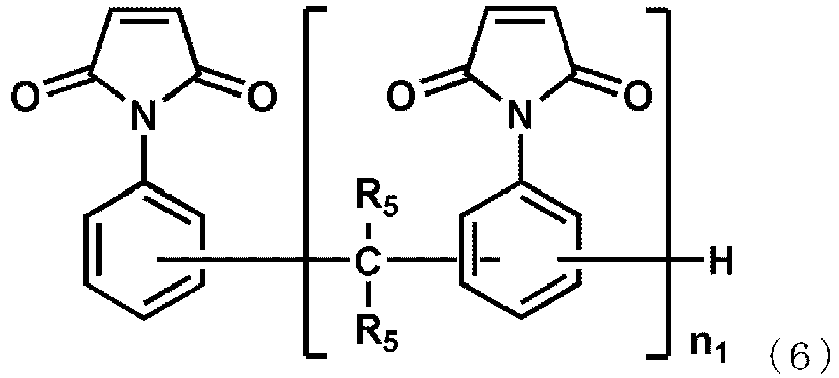
- Specific examples thereof include N-phenylmaleimide, N-hydroxyphenylmaleimide, bis(4-maleimidophenyl)methane, 2,2-bis ⁇ 4-(4-maleimidophenoxy)-phenyl ⁇ propane, bis(3,5-dimethyl-4-maleimidophenyl)methane, bis(3-ethyl-5-methyl-4-maleimidophenyl)methane, bis(3,5-diethyl-4-maleimidophenyl)methane, a maleimide compound represented by the formula (6) set forth below, prepolymers of these maleimide compounds, and prepolymers of the maleimide compounds and amine compounds. These compounds can be used singly or in a form of a suitable mixture of two or more thereof.
- bis(4-maleimidophenyl)methane, 2,2-bis ⁇ 4-(4-maleimidophenoxy)-phenyl ⁇ propane, bis(3-ethyl-5-methyl-4-maleimidophenyl)methane, or a maleimide compound represented by the following formula (6) is preferred, and a maleimide compound represented by the following formula (6) is particularly preferred.
- the resin composition contains such a maleimide compound, the resulting cured product tends to have better heat resistance and rate of elastic modulus maintenance.
- each R 5 independently represents a hydrogen atom or a methyl group and is particularly preferably a hydrogen atom.
- n 1 represents an integer of 1 or larger. The upper limit of n 1 is preferably 10, more preferably 7.
- the content of the maleimide compound is preferably determined according to the ratio of the number of functional group between the number of alkenyl groups ( ⁇ ) as a functional group in an optionally contained alkenyl-substituted nadimide and the number of maleimide groups ( ⁇ ) in the maleimide compound ([ ⁇ / ⁇ ]) as mentioned later.
- the content of the maleimide compound is preferably 15 to 70 parts by mass, more preferably 20 to 45 parts by mass, based on 100 parts by mass in total of component(s) constituting a resin (also including components that form resins by polymerization; the same holds true for the description below) in the resin composition.
- the content of the maleimide compound falls within such a range, whereby the resulting resin composition can be excellent in moldability even when filled with an inorganic filler, and be excellent in curability and elastic modulus under heat such as flexural modulus at, for example, 250°C during curing or flexural modulus at a solder reflow temperature, and a printed circuit board or the like excellent in desmear resistance and chemical resistance can be obtained.
- the resin composition of the present embodiment contains a styryl silane compound in order to enhance the adhesion between the maleimide compound and the inorganic filler.
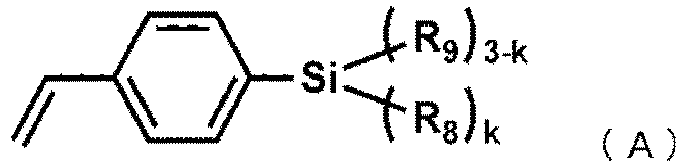
- the styryl silane compound is not particularly limited as long as the styryl silane compound is a silane compound having a styrene skeleton and a hydrolyzable group or a hydroxy group.
- the styryl silane compound may be any compound for use as a silane coupling agent having a styrene skeleton and a hydrolyzable group or a hydroxy group (so-called styryl silane coupling agent).
- the styryl silane compound preferably includes a compound represented by the following formula (A), in view of more effectively and reliably exhibiting the function effects of the present invention.
- R 8 represents the hydrolyzable group or the hydroxy group
- R 9 represents a hydrogen atom or an alkyl group having 1 to 3 carbon atoms
- k represents an integer of 1 to 3.
- the hydrolyzable group include: alkoxy groups such as a methoxy group, an ethoxy group, and a propoxy group; and halogen atoms such as a chlorine atom and an iodine atom (the same holds true for the description below).
- styryl silane compound examples include p-styryltrimethoxysilane, p-styryltriethoxysilane, p-styrylmethyldimethoxysilane, p-styrylmethyldiethoxysilane, and N-(vinylbenzyl)-2-aminoethyl-3-aminopropyltrimethoxysilane hydrochloride.
- p-styryltrimethoxysilane or p-styryltriethoxysilane is preferred, and p-styryltrimethoxysilane is more preferred.
- examples of commercially available products include KBM-575 and KBM-1403 (both are the names of products manufactured by Shin-Etsu Chemical Co., Ltd.). These styryl silane compounds are used singly or in combinations of two or more thereof.
- the content of the styryl silane compound is not particularly limited and is preferably 0.1 to 15 parts by mass, more preferably 0.1 to 10 parts by mass, particularly preferably 0.5 to 5 parts by mass, based on 100 parts by mass in total of component(s) constituting a resin in the resin composition.
- the content of the styryl silane compound within the range described above leads to further improvement in desmear resistance, chemical resistance, and insulation reliability, while it also can further suppress reduction in moldability.
- the resin composition of the present embodiment contains an inorganic filler.
- the inorganic filler contributes to reduction in the thermal expansion of a printed circuit board and improvement in elastic modulus and the coefficient of thermal conductivity.
- the inorganic filler is not particularly limited as long as the inorganic filler has insulating properties.
- Examples thereof include silicas (e.g., natural silica, fused silica, amorphous silica, and hollow silica), alumina, aluminum nitride, boron nitride, boehmite, molybdenum oxide, titanium oxide, silicone rubber, hybrid silicone powder, zinc borate, zinc stannate, clay, kaolin, talc, fired clay, fired kaolin, fired talc, mica, short glass fiber (fine glass powders such as E glass and D glass), hollow glass, and spherical glass.
- silicas e.g., natural silica, fused silica, amorphous silica, and hollow silica
- alumina aluminum nitride, boron nitride, boehmite, molybdenum oxide, titanium oxide, silicone rubber, hybrid silicone powder, zinc borate, zinc stannate, clay, kaolin, talc, fired clay, fired kaolin, fired talc,
- the inorganic filler may be surface-treated in advance with the styryl silane compound.
- a method for the surface treatment is not particularly limited. Examples thereof include direct treatment methods such as a dry treatment method and a treatment method using slurry (wet method). A wet method is preferred in view of uniform treatment.
- the inorganic filler may be a commercially available surface-treated inorganic filler.
- the content of the inorganic filler is not particularly limited and is preferably 100 to 1100 parts by mass, more preferably 100 to 700 parts by mass, based on 100 parts by mass in total of component(s) constituting a resin in the resin composition.
- the content of the inorganic filler falls within the range described above, characteristics unique to the inorganic filler, such as low thermal expansion, high elasticity, and the coefficient of thermal conductivity are more favorably exhibited, while reduction in moldability can be further suppressed.
- the average particle size (D50) of the inorganic filler is not particularly limited and is preferably 0.2 to 10 ⁇ m, more preferably 2 to 5 ⁇ m, because finer wiring can be formed thereby.
- the particle shape of the inorganic filler is not particularly limited and is preferably a spherical or substantially spherical shape in view of moldability.
- D50 is a median size and is a size that splits the measured particle size distribution of a powder such that the mass of half of the particles being larger is equal to the mass of half of the particles being smaller.
- D50 is generally measured by a wet laser diffraction/scattering method.
- the resin composition of the present embodiment contains an alkenyl-substituted nadimide in view of more effectively and reliably exhibiting the function effects of the present invention.
- the alkenyl-substituted nadimide is not particularly limited as long as the compound has one or more alkenyl-substituted nadimide groups in the molecule. Specific examples thereof include a compound represented by the following formula (1) :
- each R 1 independently represents a hydrogen atom or an alkyl group having 1 to 6 carbon atoms
- R 2 represents an alkylene group having 1 to 6 carbon atoms, a phenylene group, a biphenylene group, a naphthylene group, or a group represented by the following formula (2) or (3):
- R 3 represents a methylene group, an isopropylidene group, or a substituent represented by CO, O, S, or SO 2 .
- each R 4 is independently selected and represents an alkylene group having 1 to 4 carbon atoms, or a cycloalkylene group having 5 to 8 carbon atoms.
- a commercially available product can also be used as the alkenyl-substituted nadimide represented by the formula (1).
- Examples of the commercially available product include, but are not particularly limited to, a compound represented by the formula (4) set forth below (BANI-M (manufactured by Maruzen Petrochemical Co., Ltd.)), and a compound represented by the formula (5) set forth below (BANI-X (manufactured by Maruzen Petrochemical Co., Ltd.)). These compounds may be used singly or in combinations of two or more thereof.
- the content of the alkenyl-substituted nadimide is preferably determined according to the ratio of the number of functional group between an alkenyl group, one of its functional groups, and a maleimide group in the maleimide compound as mentioned later.
- the content of the alkenyl-substituted nadimide is preferably 20 to 50 parts by mass, more preferably 25 to 45 parts by mass, based on 100 parts by mass in total of component(s) constituting a resin in the resin composition.
- the resulting resin composition or the like can be excellent in moldability even when filled with an inorganic filler, and be excellent in curability and elastic modulus under heat during curing, and a printed circuit board or the like excellent in desmear resistance and chemical resistance can be obtained.
- the contents of the alkenyl-substituted nadimide and the maleimide compound are preferably determined by the ratio between the numbers of their respective designated functional groups.
- the designated functional group of the alkenyl-substituted nadimide is alkenyl groups bonded to molecular ends
- the designated functional group of the maleimide compound is maleimide groups.
- the resin composition of the present embodiment preferably contains the alkenyl-substituted nadimide and the maleimide compound so as to satisfy a relationship represented by the following formula (B), more preferably a relationship represented by the following formula (B1): 0.9 ⁇ ⁇ / ⁇ ⁇ 4.3 1.5 ⁇ ⁇ / ⁇ ⁇ 4.0
- ⁇ represents the total number of alkenyl groups contained in the alkenyl-substituted nadimide in the resin composition
- ⁇ represents the total number of maleimide groups contained in the maleimide compound in the resin composition.
- the resin composition of the present embodiment preferably further contains a cyanate ester compound in addition to each component mentioned above.
- a resin composition, a prepreg, a resin sheet, a metal foil-clad laminate, and a printed circuit board excellent in moldability can be obtained, and a metal foil-clad laminate and a printed circuit board having better metal foil peel strength can be obtained.
- the cyanate ester compound is used singly or in combinations of two or more thereof.
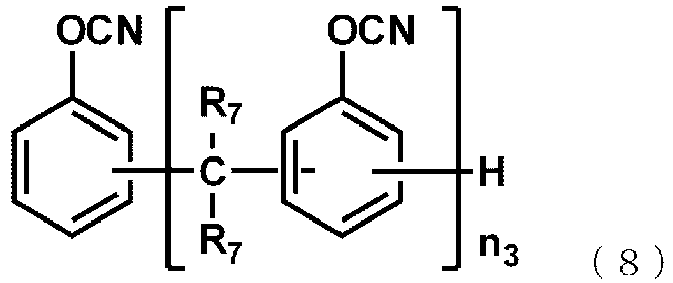
- Examples of the type of the cyanate ester compound used in the present embodiment include, but are not particularly limited to, a naphthol aralkyl-based cyanate ester represented by the formula (7) set forth below, a novolac-based cyanate ester represented by the formula (8) set forth below, biphenyl aralkyl-based cyanate esters, bis(3,3-dimethyl-4-cyanatophenyl)methane, bis(4-cyanatophenyl)methane, 1,3-dicyanatobenzene, 1,4-dicyanatobenzene, 1,3,5-tricyanatobenzene, 1,3-dicyanatonaphthalene, 1,4-dicyanatonaphthalene, 1,6-dicyanatonaphthalene, 1,8-dicyanatonaphthalene, 2,6-dicyanatonaphthalene, 2,7-dicyanatonaphthalene, 1,3,6-tricyanatonaphthalene, 4,4'-dicyanatobiphen
- each R 6 independently represents a hydrogen atom or a methyl group and is particularly preferably a hydrogen atom.
- n 2 represents an integer of 1 or larger. The upper limit of n 2 is preferably 10, more preferably 6.
- each R 7 independently represents a hydrogen atom or a methyl group and is particularly preferably a hydrogen atom.
- n 3 represents an integer of 1 or larger. The upper limit of n 3 is preferably 10, more preferably 7.
- the cyanate ester compound used in the present embodiment may be produced by any method existing as a cyanate ester synthesis method.
- the cyanate ester compound can be obtained by reacting a naphthol aralkyl-based phenol resin represented by the formula (9) set forth below with cyanogen halide in the presence of a basic compound in an inert organic solvent.
- An alternate method that may be adopted involves forming a salt of a similar naphthol aralkyl-based phenol resin and a basic compound in a solution containing water, followed by two-phase interfacial reaction with cyanogen halide for synthesis.
- each R 8 independently represents a hydrogen atom or a methyl group and is particularly preferably a hydrogen atom.
- n 4 represents an integer of 1 or larger. The upper limit of n 4 is preferably 10, more preferably 6.
- the naphthol aralkyl-based cyanate ester can be selected from those obtained by condensing cyanic acid with a naphthol aralkyl resin obtained through the reaction of a naphthol such as ⁇ -naphthol or ⁇ -naphthol with p-xylylene glycol, ⁇ , ⁇ '-dimethoxy-p-xylene, 1,4-di(2-hydroxy-2-propyl)benzene, or the like.
- a naphthol such as ⁇ -naphthol or ⁇ -naphthol with p-xylylene glycol, ⁇ , ⁇ '-dimethoxy-p-xylene, 1,4-di(2-hydroxy-2-propyl)benzene, or the like.
- the content of the cyanate ester compound is not particularly limited and is preferably 0.01 to 40 parts by mass, more preferably 0.01 to 25 parts by mass, based on 100 parts by mass in total of component(s) constituting a resin in the resin composition.
- a resin composition, a prepreg, and a resin sheet having better moldability even with an inorganic filler and having an excellent elastic modulus under heat during curing can be obtained, and a metal foil-clad laminate and a printed circuit board having better desmear resistance and chemical resistance can be obtained.
- the resin composition of the present embodiment may be supplemented with a resin other than those mentioned above (hereinafter, also referred to as an "additional resin") without impairing the expected characteristics.
- the type of the additional resin is not particularly limited as long as the resin has insulating properties. Examples thereof include resins such as epoxy resins, benzoxazine compounds, phenol resins, thermoplastic resins, and silicone resins. Appropriately combined use with these resins can impart metal adhesion to a prepreg and a resin sheet and can impart stress-relaxing properties to a printed circuit board or the like.
- the resin composition of the present embodiment may contain a silane compound having a group capable of being chemically bonded to an organic group, and a hydrolyzable group or a hydroxy group (hereinafter, referred to as an "additional silane compound"), except for the styryl silane compound, and/or a wetting dispersant in order to improve the dispersibility of the inorganic filler and the adhesion strength between the resin and the inorganic filler or glass cloth.
- the additional silane compound is not particularly limited and may be a silane coupling agent generally used in the surface treatment of inorganic substance.
- the additional silane compound include: aminosilane compounds having an amino group and a hydrolyzable group or a hydroxy group, such as ⁇ -aminopropyltriethoxysilane and N- ⁇ -(aminoethyl)- ⁇ -aminopropyltrimethoxysilane; epoxysilane compounds having an epoxy group and a hydrolyzable group or a hydroxy group, such as 3-glycidoxypropyltrimethoxysilane; vinylsilane compounds having a vinyl group and a hydrolyzable group or a hydroxy group, such as ⁇ -methacryloxypropyltrimethoxysilane; and cationic silane coupling agents. These additional silane compounds are used singly or in combinations of two or more thereof.
- the epoxysilane compound may be an epoxysilane coupling agent having an epoxy group and a hydrolyzable group or a hydroxy group. Examples thereof include 3-glycidoxypropyltrimethoxysilane, 3-glycidoxypropylmethyldimethoxysilane, 3-glycidoxypropyltriethoxysilane, and 3-glycidoxypropylmethyldiethoxysilane. 3-Glycidoxypropyltrimethoxysilane is preferred.
- the content of the additional silane compound is not particularly limited and is preferably 0.1 to 15 parts by mass, more preferably 0.5 to 5 parts by mass, based on 100 parts by mass in total of component(s) constituting a resin in the resin composition.
- the content of the additional silane compound falls within such a range, a resin composition, a prepreg, and a resin sheet having better moldability even with an inorganic filler and having a better elastic modulus under heat during curing can be obtained, and a metal foil-clad laminate and a printed circuit board having better desmear resistance and chemical resistance can be obtained.
- the wetting dispersant is not particularly limited as long as the wetting dispersant is used as a dispersion stabilizer for paint.
- Examples of commercially available products of the wetting dispersant include Disperbyk-110, 111, 118, 180, 161, 2009, BYK-W996, W9010, and W903 (all are product names) manufactured by BYK Japan K.K. These wetting dispersants are used singly or in combinations of two or more thereof.
- the resin composition of the present embodiment may be used in combination with a curing accelerator without impairing expected characteristics.
- the curing accelerator include: imidazole compounds; organic peroxides such as benzoyl peroxide, lauroyl peroxide, acetyl peroxide, p-chlorobenzoyl peroxide, and di-tert-butyl-di-perphthalate; azo compounds such as azobisnitrile; tertiary amines such as N,N-dimethylbenzylamine, N,N-dimethylaniline, N,N-dimethyltoluidine, 2-N-ethylanilinoethanol, tri-n-butylamine, pyridine, quinoline, N-methylmorpholine, triethanolamine, triethylenediamine, tetramethylbutanediamine, and N-methylpiperidine; phenols such as phenol, xylenol, cresol, resorcin, and catechol; organic metal
- the resin composition of the present embodiment preferably further contains an imidazole compound among the curing accelerators described above.
- the imidazole compound is not particularly limited and is preferably an imidazole compound represented by the following formula (11) in view of more effectively and reliably exhibiting the function effects of the present invention.
- Ar represents a phenyl group, a naphthalene group, a biphenyl group, or an anthracene group, or a monovalent group thereof modified with a hydroxy group and is particularly preferably a phenyl group.
- R 11 represents a hydrogen atom, an alkyl group or a monovalent group thereof modified with a hydroxy group, or an aryl group. Examples of the aryl group include a substituted or unsubstituted phenyl group, naphthalene group, biphenyl group, and anthracene group.
- a phenyl group is preferred. More preferably, both of the Ar group and the R 11 group are phenyl groups.
- imidazole compound examples include 2-methylimidazole, 2-ethyl-4-methylimidazole, 2-phenylimidazole, 1-cyanoethyl-2-phenylimidazole, 1-cyanoethyl-2-ethyl-4-methylimidazole, 2-phenyl-4,5-dihydroxymethylimidazole, 2-phenyl-4-methyl-5-hydroxymethylimidazole, 2,4,5-triphenylimidazole, and 2-phenyl-4-methylimidazole.
- 2,4,5-triphenylimidazole or 2-phenyl-4-methylimidazole is more preferred, and 2,4,5-triphenylimidazole is particularly preferred.
- the content of the imidazole compound is not particularly limited and is preferably 0.01 to 10 parts by mass, more preferably 0.1 to 5 parts by mass, based on 100 parts by mass in total of component(s) constituting a resin in the resin composition.
- the content of the imidazole compound falls within such a range, a resin composition, a prepreg, and a resin sheet excellent in curability and moldability, and a metal foil-clad laminate and a printed circuit board from these raw materials can be obtained.
- the resin composition of the present embodiment may further contain a surface conditioner for the purpose of, for example, improving the dispersibility of solid material such as the inorganic filler.
- the surface conditioner is not particularly limited as long as the surface conditioner is a surfactant conventionally contained in resin compositions. Examples thereof include polydimethylsiloxane derivatives and acrylic derivatives. Examples of commercially available products thereof include BYK-310, 330, and 346 manufactured by BYK Japan K.K. These surface conditioners are used singly or in combinations of two or more thereof.
- the resin composition of the present embodiment may also contain a solvent, if necessary.
- a solvent for example, use of an organic solvent reduces viscosity during the preparation of the resin composition and thus improves handleability while enhancing the impregnation of glass cloth with the resin composition.
- the type of the solvent is not particularly limited as long as the solvent is capable of dissolving a portion or the whole of the resins in the resin composition. Specific examples thereof include, but are not particularly limited to: ketones such as acetone, methyl ethyl ketone, and methylcellosolve; aromatic hydrocarbons such as toluene and xylene; amides such as dimethylformamide; and propylene glycol monomethyl ether and its acetate. These solvents are used singly or in combinations of two or more thereof.
- the resin composition of the present embodiment can be prepared in accordance with an ordinary method.
- a preferred method involves obtaining a resin composition homogeneously containing the components mentioned above.
- the components mentioned above can be sequentially added to the solvent and sufficiently stirred to readily prepare the resin composition of the present embodiment.
- the styryl silane compound may be contained in the resin composition, as with other components.
- the inorganic filler may be surface-treated with the styryl silane compound, and the inorganic filler bonded at its surface to the styryl silane compound can then be mixed with other components to prepare the resin composition.
- the method for surface-treating the inorganic filler with the styryl silane compound is not particularly limited. Examples thereof include direct treatment methods such as a dry treatment method and a treatment method using slurry (wet method). A wet method is preferred in view of uniform treatment. Alternatively, a commercially available surface-treated inorganic filler (filler) may be used.
- An organic solvent may be used, if necessary, in the preparation of the resin composition of the present embodiment.
- the type of the organic solvent is not particularly limited as long as the solvent is capable of dissolving the resins in the resin composition. Specific examples thereof are as listed above.
- Treatment (stirring, mixing, or kneading treatment, etc.) known in the art for uniformly dissolving or dispersing each component can be carried out in the preparation of the resin composition.
- the inorganic filler can be uniformly dispersed by stirring and dispersion treatment using a stirring vessel equipped with a stirrer having an appropriate stirring ability. This enhances the dispersibility of the inorganic filler (D) in the resin composition.
- the stirring, mixing, or kneading treatment can be appropriately performed by using an apparatus known in the art such as an apparatus aimed at mixing such as a ball mill or a bead mill, or a revolution- or rotation-type mixing apparatus.
- the prepreg of the present embodiment is a prepreg including a base material and the resin composition, the base material being impregnated or coated with the resin composition.
- the method for producing the prepreg can be carried out in accordance with an ordinary method without particular limitations.
- the base material can be impregnated or coated with the resin components according to the present embodiment, followed by semi-curing (B-staging) by heating or the like for 1 to 30 minutes in a drier of 100 to 200°C to prepare the prepreg of the present embodiment.
- the content of the resin composition is not particularly limited and is preferably 30 to 90% by mass, more preferably 35 to 85% by mass, further preferably 40 to 80% by mass, based on the total mass of the prepreg. When the content of the resin composition falls within the range described above, moldability tends to be further improved.
- the base material is not particularly limited and can be appropriately selected for use from various printed circuit board materials known in the art according to the intended use or performance. Specific examples thereof include, but are not particularly limited to: glass fibers such as E glass, D glass, S glass, Q glass, spherical glass, NE glass, L glass, and T glass; non-glass inorganic fibers such as quartz; wholly aromatic polyamides such as poly-p-phenyleneterephthalamide (Kevlar(R), manufactured by Du Pont K.K.) and co-poly-p-phenylene/3,4'-oxydiphenylene/terephthalamide (Technora(R), manufactured by Teijin Techno Products, Ltd.); polyesters such as 2,6-hydroxynaphthoic acid/p-hydroxybenzoic acid (Vectran(R), manufactured by Kuraray Co., Ltd.) and Zexion(R) (manufactured by KB Seiren, Ltd.); and organic fibers such as poly-p-phenylene be
- Examples of the form of the base material include, but are not particularly limited to, woven fabrics, nonwoven fabrics, lobings, chopped strand mats, and surfacing mats.
- the textures of the woven fabrics are not particularly limited, and, for example, plain weave, mat weave, and twill weave are known.
- the base material can be appropriately selected for use from these materials known in the art according to the intended use or performance. Such a base material subjected to opening treatment or a glass woven fabric surface-treated with a silane compound (e.g., a silane coupling agent) or the like is preferably used.
- the base material is not particularly limited by its thickness and mass. Usually, the thickness of the base material of approximately 0.01 to 0.3 mm is preferably used.
- the base material is preferably a glass woven fabric having a thickness of 200 ⁇ m or smaller and a mass of 250 g/m 2 or smaller, more preferably a woven fabric (cloth) made of one or more fibers selected from the group consisting of E glass, S glass, T glass, and Q glass fibers, and an organic fiber in view of strength and water absorbability.
- the resin sheet of the present embodiment includes a support (sheet base material) and the resin composition, the sheet base material being coated with the resin composition.
- the resin composition is laminated on one side or both sides of the sheet base material.
- the resin sheet is used as an approach for thinning and can be produced, for example, by directly coating a support such as a metal foil or a film with a thermosetting resin (containing an inorganic filler) for use in prepregs, etc., followed by drying.
- the sheet base material is not particularly limited, and any of various printed circuit board materials known in the art can be used. Examples thereof include polyimide films, polyamide films, polyester films, polyethylene terephthalate (PET) films, polybutylene terephthalate (PBT) films, polypropylene (PP) films, polyethylene (PE) films, aluminum foils, copper foils, and gold foils. Among them, an electrolytic copper foil or a PET film is preferred.
- Examples of the coating method include a method of applying a solution containing the resin composition of the present embodiment dissolved in a solvent onto the sheet base material using a bar coater, a die coater, a doctor blade, a Baker applicator, or the like.
- the resin sheet is preferably a product obtained by coating the support (sheet base material) with the resin composition, followed by semi-curing (B-staging) the resin composition.
- Specific examples thereof include a method which involves coating the sheet base material such as a copper foil with the resin composition, followed by semi-curing the resin composition by a method such as heating for 1 to 60 minutes in a drier of 100 to 200°C to produce the resin sheet.
- the amount of the resin composition applied to the support is preferably in the range of 1 to 300 ⁇ m in terms of the resin thickness of the resin sheet.
- the resin sheet of the present embodiment can be used as a buildup material for printed circuit boards.
- the laminate of the present embodiment has one or more layers of at least one material selected from the group consisting of the aforementioned prepreg and resin sheet and includes a cured product of the resin composition contained in at least one material selected from the group consisting of the aforementioned prepreg and resin sheet.
- This laminate can be obtained by curing one or more layers of at least one material selected from the group consisting of the aforementioned prepreg and resin sheet.
- the metal foil-clad laminate of the present embodiment is a metal foil-clad laminate having at least one material selected from the group consisting of the aforementioned prepreg and resin sheet, and a metal foil disposed on one side or both sides of at least one material selected from the group consisting of the aforementioned prepreg and resin sheet, the metal foil-clad laminate including a cured product of the resin composition contained in at least one material selected from the group consisting of the aforementioned prepreg and resin sheet.
- This metal foil-clad laminate can be obtained by providing one or more layers of at least one material selected from the group consisting of the aforementioned prepreg and resin sheet, and disposing the metal foil on one side or both sides thereof, followed by laminate molding.
- the metal foil-clad laminate can be produced by laminating one or more layers of the aforementioned prepreg and/or resin sheet, disposing the metal (e.g., copper or aluminum) foil on one side or both sides thereof if desired, and carrying out laminate molding of this structure according to the need.
- the metal foil used is not particularly limited as long as the metal foil can be used as a printed circuit board material.
- a copper foil known in the art such as a rolled copper foil or an electrolytic copper foil is preferred.
- the thickness of the metal foil is not particularly limited and is preferably 1 to 70 ⁇ m, more preferably 1.5 to 35 ⁇ m.
- the metal foil-clad laminate is not particularly limited by its molding method and molding conditions and can be molded by use of a general approach and conditions for laminates for printed circuit boards and multilayer boards.
- a multiplaten press, a multiplaten vacuum press, a continuous molding machine, or an autoclave molding machine can be used in the molding of the metal foil-clad laminate.
- the metal foil-clad laminate is generally molded at a temperature of 100 to 300°C and a pressure of 2 to 100 kgf/cm 2 in terms of surface pressure for a heating time in the range of 0.05 to 5 hours. If necessary, post curing may be further carried out at a temperature of 150 to 300°C.
- the laminate molding of the prepreg mentioned above may be carried out in combination with a separately prepared wiring board for an inner layer to obtain a multilayer board.
- the printed circuit board of the present embodiment is a printed circuit board including an insulating layer and a conductor layer formed on the surface of the insulating layer, wherein the insulating layer contains the resin composition mentioned above.
- the conductor layer that serves as a circuit can be formed from the metal foil in the metal foil-clad laminate mentioned above or can be formed by electroless plating on the insulating layer.
- This printed circuit board is excellent in chemical resistance, desmear resistance, and insulation reliability and can be particularly effectively used as a printed circuit board for semiconductor packages required to have such performance.
- the printed circuit board of the present embodiment can be produced by, for example, the following method: first, the metal foil-clad laminate (copper-clad laminate, etc.) mentioned above is prepared. The surface of the metal foil-clad laminate is subjected to etching treatment for the formation of an inner layer circuit to prepare an inner layer substrate. The inner layer circuit surface of this inner layer substrate is subjected, if necessary, to surface treatment for enhancing adhesion strength. Subsequently, a required number of the prepreg mentioned above is laminated on the resulting inner layer circuit surface. A metal foil for an outer layer circuit is laterally laminated thereon, followed by integral molding under heat and pressure.
- a multilayer laminate is produced in which the insulating layer composed of the base material and a cured product of thermosetting resin composition is formed between the inner layer circuit and the metal foil for an outer layer circuit.
- this multilayer laminate is subjected to hole-making processing for making through-holes or via holes and then subjected to desmear treatment for removing smear, which is a residue of resins derived from the resin components contained in the cured product layer.
- the inside walls of these holes are coated with a metal plating film for conducting the inner layer circuit and the metal foil for an outer layer circuit.
- the metal foil for an outer layer circuit is further subjected to etching treatment for the formation of the outer layer circuit to produce the printed circuit board.
- the prepreg mentioned above base material impregnated with the resin composition mentioned above
- the resin composition layer of the metal foil-clad laminate layer composed of the resin composition mentioned above
- the ratio of the flexural modulus at 250°C to the flexural modulus at 25°C (hereinafter, referred to as the "rate of elastic modulus maintenance") of the insulating layer is preferably 80 to 100% because warpage caused by the heating of the printed circuit board can be suppressed.
- Examples of an approach for adjusting the rate of elastic modulus maintenance to 80 to 100% include, but are not particularly limited to, appropriately adjusting the type and content of each component of the resin composition for use in the insulating layer within the ranges described above.
- the rate of elastic modulus maintenance may be adjusted to 80 to 100% by use of an existing method as long as it does not hinder the object of the present invention.
- examples thereof include restricting molecular motion by the introduction of nanofiller, hybridizing nanosilica by a sol-gel method to a crosslinking point in a resin for use in the insulating layer, achieving high Tg of a resin itself for use in the insulating layer, and rendering the resin Tg-less in a region of 400°C or lower.
- the printed circuit board may be prepared by forming the conductor layer that serves as a circuit on the prepreg or the resin sheet.
- an electroless plating approach may be used for forming the conductor layer.
- the printed circuit board of the present embodiment can be particularly effectively used as a printed circuit board for semiconductor packages, because the insulating layer mentioned above maintains the excellent elastic modulus even at a reflow temperature during semiconductor packaging and thereby effectively suppresses the warpage of semiconductor plastic packages.
- a reactor equipped with a thermometer, a stirrer, a dropping funnel, and a reflux condenser was cooled to 0 to 5°C in advance using brine and charged with 7.47 g (0.122 mol) of cyanogen chloride, 9.75 g (0.0935 mol) of 35% hydrochloric acid, 76 mL of water, and 44 mL of methylene chloride.
- the ratio [ ⁇ / ⁇ ] was 1.54.
- Varnish was obtained in the same way as in Example 1, and a prepreg was obtained in the same way as in Example 1, except that 5 parts by mass of the styryl silane compound p-styryltrimethoxysilane (KBM-1403, manufactured by Shin-Etsu Chemical Co., Ltd.) were used instead of 2.5 parts by mass of the epoxysilane compound 3-glycidoxypropyltrimethoxysilane (KBM-403, manufactured by Shin-Etsu Chemical Co., Ltd.) and 2.5 parts by mass of the styryl silane compound p-styryltrimethoxysilane (KBM-1403, manufactured by Shin-Etsu Chemical Co., Ltd.).
- KBM-1403 manufactured by Shin-Etsu Chemical Co., Ltd.
- Varnish was obtained in the same way as in Example 1, and a prepreg was obtained in the same way as in Example 1, except that 5 parts by mass of the epoxysilane compound 3-glycidoxypropyltrimethoxysilane (KBM-403, manufactured by Shin-Etsu Chemical Co., Ltd.) were used instead of 2.5 parts by mass of the epoxysilane compound 3-glycidoxypropyltrimethoxysilane (KBM-403, manufactured by Shin-Etsu Chemical Co., Ltd.) and 2.5 parts by mass of the styryl silane compound p-styryltrimethoxysilane (KBM-1403, manufactured by Shin-Etsu Chemical Co., Ltd.).
- KBM-403 manufactured by Shin-Etsu Chemical Co., Ltd.
- Varnish was obtained in the same way as in Example 1, and a prepreg was obtained in the same way as in Example 1, except that 5 parts by mass of an acrylic silane compound 3-acryloxypropyltrimethoxysilane (KBM-5103, manufactured by Shin-Etsu Chemical Co., Ltd.) were used instead of 2.5 parts by mass of the epoxysilane compound 3-glycidoxypropyltrimethoxysilane (KBM-403, manufactured by Shin-Etsu Chemical Co., Ltd.) and 2.5 parts by mass of the styryl silane compound p-styryltrimethoxysilane (KBM-1403, manufactured by Shin-Etsu Chemical Co., Ltd.).
- KBM-5103 acrylic silane compound 3-acryloxypropyltrimethoxysilane
- KBM-403 manufactured by Shin-Etsu Chemical Co., Ltd.
- Varnish was obtained in the same way as in Example 1, and a prepreg was obtained in the same way as in Example 1, except that 2.5 parts by mass of the epoxysilane compound 3-glycidoxypropyltrimethoxysilane (KBM-403, manufactured by Shin-Etsu Chemical Co., Ltd.) and 2.5 parts by mass of an acrylic silane compound 3-acryloxypropyltrimethoxysilane (KBM-5103, manufactured by Shin-Etsu Chemical Co., Ltd.) were used instead of 2.5 parts by mass of the epoxysilane compound 3-glycidoxypropyltrimethoxysilane (KBM-403, manufactured by Shin-Etsu Chemical Co., Ltd.) and 2.5 parts by mass of the styryl silane compound p-styryltrimethoxysilane (KBM-1403, manufactured by Shin-Etsu Chemical Co., Ltd.).
- KBM-403 manufactured by Shin-Etsu Chemical Co., Ltd.
- Varnish was obtained in the same way as in Example 1, and a prepreg was obtained in the same way as in Example 1, except that 5 parts by mass of an olefin silane compound octenyltrimethoxysilane (KBM-1083, manufactured by Shin-Etsu Chemical Co., Ltd.) were used instead of 2.5 parts by mass of the epoxysilane compound 3-glycidoxypropyltrimethoxysilane (KBM-403, manufactured by Shin-Etsu Chemical Co., Ltd.) and 2.5 parts by mass of the styryl silane compound p-styryltrimethoxysilane (KBM-1403, manufactured by Shin-Etsu Chemical Co., Ltd.).
- KBM-1083 olefin silane compound octenyltrimethoxysilane
- KBM-403 manufactured by Shin-Etsu Chemical Co., Ltd.
- Varnish was obtained in the same way as in Example 1, and a prepreg was obtained in the same way as in Example 1, except that 5 parts by mass of an acrylic silane compound methacryloxyoctyltrimethoxysilane (KBM-5803, manufactured by Shin-Etsu Chemical Co., Ltd.) were used instead of 2.5 parts by mass of the epoxysilane compound 3-glycidoxypropyltrimethoxysilane (KBM-403, manufactured by Shin-Etsu Chemical Co., Ltd.) and 2.5 parts by mass of the styryl silane compound p-styryltrimethoxysilane (KBM-1403, manufactured by Shin-Etsu Chemical Co., Ltd.).
- KBM-5803 an acrylic silane compound methacryloxyoctyltrimethoxysilane
- KBM-403 manufactured by Shin-Etsu Chemical Co., Ltd.
- Electrolytic copper foils having a thickness of 12 ⁇ m were disposed on the upper and lower sides of 1 layer, 4 layers, or 8 layers of the prepreg thus obtained, and laminate molding of the resultant was carried out at a pressure of 30 kgf/cm 2 and a temperature of 220°C for 120 minutes to obtain a copper-clad laminate having an insulating layer thickness of 0.1 mm, 0.4 mm, or 0.8 mm as a metal foil-clad laminate.
- the insulation reliability was evaluated by the interwinding insulation reliability test based on HAST (highly accelerated temperature and humidity stress test).
- a power was connected to the wiring, and continuous humidity insulation resistance was evaluated under conditions involving a temperature of 130°C, a humidity of 85%, and an applied voltage of 5 VDC.
- a resistance value equal to or lower than 1.0 ⁇ 10 8 ⁇ was regarded as a breakdown.
- the evaluation criteria are as described below.
- the copper-clad laminate (50 mm ⁇ 50 mm ⁇ 0.4 mm) was dipped for 2 hours in an aqueous sodium hydroxide solution of 70°C adjusted to 1 N.
- the amount of decrease in weight (% by mass) was calculated from the masses of the copper-clad laminate before and after the dipping.
- a lower absolute value means better chemical resistance (alkali resistance). The results are shown in Table 1.
- the copper foils were removed from both sides of the copper-clad laminate (50 mm ⁇ 50 mm ⁇ 0.4 mm) by etching.
- the resulting sample was dipped in Swelling Dip Securiganth P manufactured by Atotech Japan K.K. as a swelling solution at 80°C for 10 minutes, then dipped in Concentrate Compact CP manufactured by Atotech Japan K.K. as a roughening solution at 80°C for 5 minutes, and finally dipped in Reduction Conditioner Securiganth P500 manufactured by Atotech Japan K.K. as a neutralizing solution at 45°C for 10 minutes.
- This treatment was repetitively carried out three times. Then, the amount of decrease in mass (% by mass) was determined from the masses of the copper-clad laminate before and after the treatment. A lower absolute value means better desmear resistance.
- Table 1 The results are shown in Table 1.
- the copper foils were removed from both sides of the copper-clad laminate (50 mm ⁇ 25 mm ⁇ 0.8 mm).
- the copper-clad laminate (50 mm ⁇ 25 mm ⁇ 0.4 mm) was floated on solder of 280°C for 30 minutes, and the presence or absence of delamination was visually confirmed to evaluate heat resistance.
- the evaluation criteria are as described below.
- the present invention can provide an insulating layer for printed circuit boards not only excellent in chemical resistance, desmear resistance, and insulation reliability but excellent in heat resistance and the rate of elastic modulus loss, and is therefore industrially applicable to fields such as printed circuit boards for use in semiconductor plastic packages.
Landscapes
- Chemical & Material Sciences (AREA)
- Health & Medical Sciences (AREA)
- Chemical Kinetics & Catalysis (AREA)
- Medicinal Chemistry (AREA)
- Polymers & Plastics (AREA)
- Organic Chemistry (AREA)
- Engineering & Computer Science (AREA)
- Materials Engineering (AREA)
- Spectroscopy & Molecular Physics (AREA)
- Physics & Mathematics (AREA)
- Manufacturing & Machinery (AREA)
- Microelectronics & Electronic Packaging (AREA)
- Inorganic Chemistry (AREA)
- Reinforced Plastic Materials (AREA)
- Compositions Of Macromolecular Compounds (AREA)
- Laminated Bodies (AREA)
- Polymerisation Methods In General (AREA)
- Macromolecular Compounds Obtained By Forming Nitrogen-Containing Linkages In General (AREA)
Claims (17)
- Harzzusammensetzung, umfassend eine Maleimidverbindung, eine Silanverbindung mit einem Styrolgerüst und einer hydrolysierbaren Gruppe oder einer Hydroxygruppe, einen anorganischen Füllstoff und ein Alkenyl-substituiertes Nadimid.
- Harzzusammensetzung gemäß Anspruch 1, wobei die Harzzusammensetzung als Silanverbindung eine Verbindung der folgenden Formel (A) umfasst:
- Harzzusammensetzung gemäß Anspruch 1 oder 2, wobei die Harzzusammensetzung als Alkenyl-substituiertes Nadimid eine Verbindung der folgenden Formel (1) enthält:


- Harzzusammensetzung gemäß mindestens einem der Ansprüche 1 bis 3, wobei die Harzzusammensetzung als Alkenyl-substituiertes Nadimid eine Verbindung der folgenden Formel (4) und/oder (5) enthält:


- Harzzusammensetzung gemäß mindestens einem der Ansprüche 1 bis 4, wobei die Harzzusammensetzung als Maleimidverbindung mindestens eine Verbindung, ausgewählt aus der Gruppe bestehend aus Bis(4-maleimidophenyl)methan, 2,2-Bis{4-(4-maleimidophenoxy)phenyl}propan, Bis(3-ethyl-5-methyl-4-maleimidophenyl)methan und einer Maleimidverbindung der folgenden Formel (6), umfasst:
- Harzzusammensetzung gemäß mindestens einem der Ansprüche 1 bis 5, ferner umfassend eine Cyanatesterverbindung.
- Harzzusammensetzung gemäß Anspruch 6, wobei die Harzzusammensetzung als Cyanatesterverbindung eine Verbindung der folgenden Formel (7) und/oder (8) umfasst:

- Harzzusammensetzung gemäß mindestens einem der Ansprüche 1 bis 7, wobei der anorganische Füllstoff vorab mit der Silanverbindung oberflächenbehandelt wird.
- Harzzusammensetzung gemäß mindestens einem der Ansprüche 1 bis 8, wobei der Gehalt der Silanverbindung 0,1 bis 15 Massenteile, bezogen auf 100 Massenteile der gesamten Komponente(n), die ein Harz in der Harzzusammensetzung bilden, beträgt.
- Harzzusammensetzung gemäß mindestens einem der Ansprüche 1 bis 9, wobei der anorganische Füllstoff mindestens eines, ausgewählt aus der Gruppe bestehend aus Siliciumdioxid, Aluminiumoxid und Aluminiumnitrid, umfasst.
- Harzzusammensetzung gemäß mindestens einem der Ansprüche 1 bis 10, wobei der Gehalt des anorganischen Füllstoffs 100 bis 1100 Massenteile, bezogen auf 100 Massenteile der gesamten Komponente(n), die ein Harz in der Harzzusammensetzung bilden, beträgt.
- Vorimprägniertes Gewebe ("Prepreg"), umfassend ein Basismaterial und eine Harzzusammensetzung gemäß mindestens einem der Ansprüche 1 bis 11, wobei das Basismaterial mit der Harzzusammensetzung imprägniert oder beschichtet ist.
- Vorimprägniertes Gewebe ("Prepreg") gemäß Anspruch 12, wobei das Basismaterial mindestens ein Material, ausgewählt aus der Gruppe bestehend aus E-Glasgewebe, T-Glasgewebe, S-Glasgewebe, Q-Glasgewebe und einem organischen Fasergewebe, ist.
- Harzfolie, umfassend einen Träger und eine Harzzusammensetzung gemäß mindestens einem der Ansprüche 1 bis 11, wobei der Träger mit der Harzzusammensetzung beschichtet ist.
- Laminat mit einer oder mehreren Schichten aus mindestens einem Material, ausgewählt aus der Gruppe bestehend aus einem vorimprägnierten Gewebe ("Prepreg") gemäß Anspruch 12 oder 13 und einer Harzfolie gemäß Anspruch 14, wobei das Laminat ein gehärtetes Produkt einer Harzzusammensetzung, die in mindestens einem Material ausgewählt aus der Gruppe bestehend aus dem vorimprägnierten Gewebe ("Prepreg") und der Harzfolie enthalten ist, umfasst.
- Metallfolienplattiertes Laminat, das mindestens ein Material, ausgewählt aus der Gruppe bestehend aus einem vorimprägnierten Gewebe ("Prepreg") gemäß Anspruch 12 oder 13 und einer Harzfolie gemäß Anspruch 14, und eine Metallfolie, die auf einer Seite oder auf beiden Seiten von mindestens einem Material, ausgewählt aus der Gruppe bestehend aus dem vorimprägnierten Gewebe ("Prepreg") und der Harzfolie, angeordnet ist, aufweist, wobei das metallfolienplattierte Laminat ein gehärtetes Produkt einer Harzzusammensetzung, die in mindestens einem Material, ausgewählt aus der Gruppe bestehend aus dem vorimprägnierten Gewebe ("Prepreg") und der Harzfolie, enthalten ist, umfasst.
- Leiterplatte, umfassend eine Isolierschicht und eine Leiterschicht, die auf einer Oberfläche der Isolierschicht gebildet ist, wobei die Isolierschicht eine Harzzusammensetzung gemäß mindestens einem der Ansprüche 1 bis 11 umfasst.
Applications Claiming Priority (2)
| Application Number | Priority Date | Filing Date | Title |
|---|---|---|---|
| JP2015135212 | 2015-07-06 | ||
| PCT/JP2016/069753 WO2017006896A1 (ja) | 2015-07-06 | 2016-07-04 | 樹脂組成物、プリプレグ、レジンシート、金属箔張積層板及びプリント配線板 |
Publications (3)
| Publication Number | Publication Date |
|---|---|
| EP3321326A1 EP3321326A1 (de) | 2018-05-16 |
| EP3321326A4 EP3321326A4 (de) | 2019-02-27 |
| EP3321326B1 true EP3321326B1 (de) | 2020-02-19 |
Family
ID=57685488
Family Applications (1)
| Application Number | Title | Priority Date | Filing Date |
|---|---|---|---|
| EP16821365.0A Active EP3321326B1 (de) | 2015-07-06 | 2016-07-04 | Harzzusammensetzung, prepreg, harzfolie, mit einer metallfolie kaschiertes laminatschicht und leiterplatte |
Country Status (7)
| Country | Link |
|---|---|
| US (3) | US20180197655A1 (de) |
| EP (1) | EP3321326B1 (de) |
| JP (2) | JP6732215B2 (de) |
| KR (1) | KR102579981B1 (de) |
| CN (1) | CN107849361B (de) |
| TW (1) | TWI698466B (de) |
| WO (1) | WO2017006896A1 (de) |
Families Citing this family (7)
| Publication number | Priority date | Publication date | Assignee | Title |
|---|---|---|---|---|
| CN107849361B (zh) * | 2015-07-06 | 2020-10-16 | 三菱瓦斯化学株式会社 | 树脂组合物、预浸料、树脂片、覆金属箔层叠板和印刷电路板 |
| JP7145403B2 (ja) * | 2017-04-27 | 2022-10-03 | 三菱瓦斯化学株式会社 | 支持体及びそれを用いた半導体素子実装基板の製造方法 |
| JP7818201B2 (ja) * | 2020-09-11 | 2026-02-20 | パナソニックIpマネジメント株式会社 | 樹脂組成物、プリプレグ、樹脂付きフィルム、樹脂付き金属箔、金属張積層板、及び配線板 |
| JPWO2022249999A1 (de) * | 2021-05-28 | 2022-12-01 | ||
| TW202321353A (zh) * | 2021-07-20 | 2023-06-01 | 日商捷恩智股份有限公司 | 表面處理劑、玻璃布及預浸料 |
| CN118541448A (zh) * | 2022-01-28 | 2024-08-23 | 松下知识产权经营株式会社 | 树脂组合物、预浸料、具有树脂的膜、具有树脂的金属箔片材、覆金属层压体和印刷线路板 |
| KR20250097842A (ko) * | 2022-10-27 | 2025-06-30 | 미츠비시 가스 가가쿠 가부시키가이샤 | 수지 조성물, 경화물, 프리프레그, 금속박 피복 적층판, 수지 복합 시트, 및 프린트 배선판 |
Family Cites Families (36)
| Publication number | Priority date | Publication date | Assignee | Title |
|---|---|---|---|---|
| JPS5645948A (en) * | 1979-09-20 | 1981-04-25 | Mitsubishi Gas Chem Co Inc | Production of composite material |
| JPS5822067B2 (ja) | 1979-09-22 | 1983-05-06 | 工業技術院長 | ポリオレフイン系プラスチツクの熱分解方法 |
| JP3173332B2 (ja) | 1995-03-13 | 2001-06-04 | 新神戸電機株式会社 | 金属箔張り積層板の製造法 |
| JPH10292033A (ja) | 1997-01-30 | 1998-11-04 | Toyo Electric Mfg Co Ltd | 含浸用樹脂組成物 |
| KR100627404B1 (ko) | 2002-11-20 | 2006-09-21 | 가부시키가이샤 도모에가와 세이시쇼 | 가요성 금속적층체 및 내열성 접착제 조성물 |
| US20050182203A1 (en) | 2004-02-18 | 2005-08-18 | Yuuichi Sugano | Novel cyanate ester compound, flame-retardant resin composition, and cured product thereof |
| JP2006124425A (ja) | 2004-10-26 | 2006-05-18 | Chukyo Yushi Kk | 水系樹脂エマルション |
| US20060136620A1 (en) | 2004-12-16 | 2006-06-22 | Yu-Pin Chou | Data transfer interface apparatus and method thereof |
| JP4952585B2 (ja) | 2006-01-23 | 2012-06-13 | 日立化成工業株式会社 | 接着剤組成物、フィルム状接着剤、接着シート、並びにそれを用いた半導体装置 |
| JP5303854B2 (ja) * | 2006-10-24 | 2013-10-02 | 日立化成株式会社 | 新規なセミipn型複合体の熱硬化性樹脂組成物並びにこれを用いたワニス、プリプレグ及び金属張積層板 |
| JP5104507B2 (ja) * | 2007-04-26 | 2012-12-19 | 日立化成工業株式会社 | セミipn型複合体の熱硬化性樹脂を含有する樹脂ワニスの製造方法、並びにこれを用いたプリント配線板用樹脂ワニス、プリプレグ及び金属張積層板 |
| JP5024205B2 (ja) | 2007-07-12 | 2012-09-12 | 三菱瓦斯化学株式会社 | プリプレグ及び積層板 |
| KR101990258B1 (ko) | 2008-08-08 | 2019-06-17 | 헨켈 아이피 앤드 홀딩 게엠베하 | 저온 경화 조성물 |
| TW201204548A (en) | 2010-02-05 | 2012-02-01 | Sumitomo Bakelite Co | Prepreg, laminate, printed wiring board, and semiconductor device |
| JP5654912B2 (ja) * | 2011-03-18 | 2015-01-14 | パナソニックIpマネジメント株式会社 | イミド樹脂組成物およびその製造方法、プリプレグ、金属張積層板並びにプリント配線板 |
| JP2013001807A (ja) | 2011-06-16 | 2013-01-07 | Panasonic Corp | 電子回路基板材料用樹脂組成物、プリプレグ及び積層板 |
| JPWO2013047041A1 (ja) * | 2011-09-30 | 2015-03-26 | 三菱瓦斯化学株式会社 | 樹脂組成物、プリプレグ及び金属箔張り積層板 |
| JP3173332U (ja) | 2011-11-17 | 2012-02-02 | 奇▲こう▼科技股▲ふん▼有限公司 | 含油軸受ファン構造 |
| JP5895156B2 (ja) * | 2011-12-19 | 2016-03-30 | パナソニックIpマネジメント株式会社 | 熱硬化性樹脂組成物、封止材およびそれらを用いた電子部品 |
| JP2013139531A (ja) * | 2012-01-06 | 2013-07-18 | Hitachi Ltd | 樹脂組成物およびそれを用いたワニス、エナメル線、回転機 |
| JP5842664B2 (ja) * | 2012-02-23 | 2016-01-13 | 日立金属株式会社 | 熱硬化性接着剤組成物並びにそれを用いた耐熱接着フィルム、積層フィルム、配線フィルム及び多層配線フィルム |
| JP2013216884A (ja) | 2012-03-14 | 2013-10-24 | Hitachi Chemical Co Ltd | 熱硬化性樹脂組成物、プリプレグ及び積層板 |
| KR101996113B1 (ko) * | 2012-03-30 | 2019-07-03 | 미츠비시 가스 가가쿠 가부시키가이샤 | 수지 조성물, 프리프레그 및 적층판 |
| JP5516828B1 (ja) | 2012-07-25 | 2014-06-11 | 東レ株式会社 | プリプレグおよび炭素繊維強化複合材料 |
| JP6314830B2 (ja) | 2012-10-19 | 2018-04-25 | 三菱瓦斯化学株式会社 | 樹脂組成物、プリプレグ、積層板、及びプリント配線板 |
| US9282639B2 (en) * | 2012-12-12 | 2016-03-08 | Hitachi Metals, Ltd. | Adhesive composition, adhesive varnish, adhesive film and wiring film |
| US10138393B2 (en) | 2013-01-15 | 2018-11-27 | Mitsubishi Gas Chemical Company, Inc. | Resin composition, prepreg, laminate, metal foil-clad laminate, and printed-wiring board |
| CN104981737A (zh) * | 2013-02-12 | 2015-10-14 | 东丽株式会社 | 感光性树脂组合物、使其热固化而成的保护膜或绝缘膜、使用其的触摸面板及其制造方法 |
| JP6249345B2 (ja) * | 2013-03-22 | 2017-12-20 | 三菱瓦斯化学株式会社 | 樹脂組成物、プリプレグ、積層板及びプリント配線板 |
| JP6481610B2 (ja) | 2013-06-03 | 2019-03-13 | 三菱瓦斯化学株式会社 | プリント配線板材料用樹脂組成物、並びにそれを用いたプリプレグ、樹脂シート、金属箔張積層板、及びプリント配線板 |
| JP2015017158A (ja) * | 2013-07-09 | 2015-01-29 | 三菱瓦斯化学株式会社 | 硬化性樹脂組成物、およびその硬化物 |
| CN105705578B (zh) | 2013-10-25 | 2017-10-20 | 三菱瓦斯化学株式会社 | 树脂组合物、预浸料、层叠片以及覆有金属箔的层叠板 |
| KR20150047880A (ko) * | 2013-10-25 | 2015-05-06 | 삼성전기주식회사 | 인쇄회로기판용 절연 수지 조성물 및 이를 이용한 제품 |
| WO2016032795A1 (en) | 2014-08-29 | 2016-03-03 | 3M Innovative Properties Company | Inductively curable composition |
| KR102502314B1 (ko) * | 2015-07-06 | 2023-02-21 | 미츠비시 가스 가가쿠 가부시키가이샤 | 수지 조성물, 프리프레그, 레진 시트, 금속박 피복 적층판 및 프린트 배선판 |
| CN107849361B (zh) * | 2015-07-06 | 2020-10-16 | 三菱瓦斯化学株式会社 | 树脂组合物、预浸料、树脂片、覆金属箔层叠板和印刷电路板 |
-
2016
- 2016-07-04 CN CN201680039767.2A patent/CN107849361B/zh active Active
- 2016-07-04 WO PCT/JP2016/069753 patent/WO2017006896A1/ja not_active Ceased
- 2016-07-04 JP JP2017527444A patent/JP6732215B2/ja active Active
- 2016-07-04 KR KR1020177034273A patent/KR102579981B1/ko active Active
- 2016-07-04 US US15/737,496 patent/US20180197655A1/en not_active Abandoned
- 2016-07-04 EP EP16821365.0A patent/EP3321326B1/de active Active
- 2016-07-06 TW TW105121325A patent/TWI698466B/zh active
-
2020
- 2020-01-16 US US16/744,625 patent/US11195638B2/en active Active
- 2020-07-07 JP JP2020117116A patent/JP2020176267A/ja active Pending
-
2021
- 2021-11-16 US US17/527,417 patent/US11769607B2/en active Active
Non-Patent Citations (1)
| Title |
|---|
| None * |
Also Published As
| Publication number | Publication date |
|---|---|
| TW201706338A (zh) | 2017-02-16 |
| JP6732215B2 (ja) | 2020-07-29 |
| KR20180027418A (ko) | 2018-03-14 |
| TWI698466B (zh) | 2020-07-11 |
| US20220076859A1 (en) | 2022-03-10 |
| EP3321326A1 (de) | 2018-05-16 |
| US20180197655A1 (en) | 2018-07-12 |
| JPWO2017006896A1 (ja) | 2018-04-19 |
| JP2020176267A (ja) | 2020-10-29 |
| EP3321326A4 (de) | 2019-02-27 |
| KR102579981B1 (ko) | 2023-09-18 |
| CN107849361B (zh) | 2020-10-16 |
| US11195638B2 (en) | 2021-12-07 |
| CN107849361A (zh) | 2018-03-27 |
| US20200152349A1 (en) | 2020-05-14 |
| US11769607B2 (en) | 2023-09-26 |
| WO2017006896A1 (ja) | 2017-01-12 |
Similar Documents
| Publication | Publication Date | Title |
|---|---|---|
| EP3321326B1 (de) | Harzzusammensetzung, prepreg, harzfolie, mit einer metallfolie kaschiertes laminatschicht und leiterplatte | |
| EP3094162B1 (de) | Isolierschicht für leiterplatten und leiterplatte damit | |
| EP3321320B1 (de) | Harzzusammensetzung, prepreg, harzfolie, mit einer metallfolie plattiertes laminat und leiterplatte | |
| EP3321325B1 (de) | Harzzusammensetzung, prepreg, metallfolienkaschiertes laminat und leiterplatte | |
| EP3321322B1 (de) | Harzzusammensetzung, prepreg, harzfolie, mit einer metallfolie plattierte laminatfolie und leiterplatte | |
| JP7116370B2 (ja) | 樹脂組成物、プリプレグ、レジンシート、積層板、及びプリント配線板 | |
| US10721817B2 (en) | Resin composition, prepreg or resin sheet comprising the resin composition, and laminate and printed circuit board comprising them | |
| EP3321289B1 (de) | Harzzusammensetzung, vorimprägnat oder harzplatte enthaltend die harzzusammensetzung, und laminat und gedruckte schaltungsplatte diese enthalend | |
| EP3322268B1 (de) | Verfahren zur herstellung einer leiterplatte und harzzusammensetzung | |
| EP3321321B1 (de) | Resin composition and prepreg, resin sheet, laminate, and printed circuit board comprising the same |
Legal Events
| Date | Code | Title | Description |
|---|---|---|---|
| STAA | Information on the status of an ep patent application or granted ep patent |
Free format text: STATUS: THE INTERNATIONAL PUBLICATION HAS BEEN MADE |
|
| PUAI | Public reference made under article 153(3) epc to a published international application that has entered the european phase |
Free format text: ORIGINAL CODE: 0009012 |
|
| STAA | Information on the status of an ep patent application or granted ep patent |
Free format text: STATUS: REQUEST FOR EXAMINATION WAS MADE |
|
| 17P | Request for examination filed |
Effective date: 20180115 |
|
| AK | Designated contracting states |
Kind code of ref document: A1 Designated state(s): AL AT BE BG CH CY CZ DE DK EE ES FI FR GB GR HR HU IE IS IT LI LT LU LV MC MK MT NL NO PL PT RO RS SE SI SK SM TR |
|
| AX | Request for extension of the european patent |
Extension state: BA ME |
|
| DAV | Request for validation of the european patent (deleted) | ||
| DAX | Request for extension of the european patent (deleted) | ||
| A4 | Supplementary search report drawn up and despatched |
Effective date: 20190130 |
|
| RIC1 | Information provided on ipc code assigned before grant |
Ipc: C08K 3/00 20180101ALI20190121BHEP Ipc: H05K 1/03 20060101ALI20190121BHEP Ipc: C08L 79/00 20060101ALI20190121BHEP Ipc: B32B 5/00 20060101ALI20190121BHEP Ipc: B32B 27/00 20060101ALI20190121BHEP Ipc: C08K 9/06 20060101ALI20190121BHEP Ipc: C08K 5/54 20060101ALI20190121BHEP Ipc: C08J 7/04 20060101ALI20190121BHEP Ipc: C08L 101/00 20060101AFI20190121BHEP Ipc: B32B 27/34 20060101ALI20190121BHEP Ipc: C08J 5/24 20060101ALI20190121BHEP Ipc: C08K 5/5415 20060101ALI20190121BHEP |
|
| GRAP | Despatch of communication of intention to grant a patent |
Free format text: ORIGINAL CODE: EPIDOSNIGR1 |
|
| STAA | Information on the status of an ep patent application or granted ep patent |
Free format text: STATUS: GRANT OF PATENT IS INTENDED |
|
| INTG | Intention to grant announced |
Effective date: 20191007 |
|
| GRAS | Grant fee paid |
Free format text: ORIGINAL CODE: EPIDOSNIGR3 |
|
| GRAA | (expected) grant |
Free format text: ORIGINAL CODE: 0009210 |
|
| STAA | Information on the status of an ep patent application or granted ep patent |
Free format text: STATUS: THE PATENT HAS BEEN GRANTED |
|
| AK | Designated contracting states |
Kind code of ref document: B1 Designated state(s): AL AT BE BG CH CY CZ DE DK EE ES FI FR GB GR HR HU IE IS IT LI LT LU LV MC MK MT NL NO PL PT RO RS SE SI SK SM TR |
|
| REG | Reference to a national code |
Ref country code: CH Ref legal event code: EP |
|
| REG | Reference to a national code |
Ref country code: DE Ref legal event code: R096 Ref document number: 602016030259 Country of ref document: DE |
|
| REG | Reference to a national code |
Ref country code: AT Ref legal event code: REF Ref document number: 1234936 Country of ref document: AT Kind code of ref document: T Effective date: 20200315 |
|
| REG | Reference to a national code |
Ref country code: IE Ref legal event code: FG4D |
|
| REG | Reference to a national code |
Ref country code: NL Ref legal event code: FP |
|
| PG25 | Lapsed in a contracting state [announced via postgrant information from national office to epo] |
Ref country code: NO Free format text: LAPSE BECAUSE OF FAILURE TO SUBMIT A TRANSLATION OF THE DESCRIPTION OR TO PAY THE FEE WITHIN THE PRESCRIBED TIME-LIMIT Effective date: 20200519 Ref country code: FI Free format text: LAPSE BECAUSE OF FAILURE TO SUBMIT A TRANSLATION OF THE DESCRIPTION OR TO PAY THE FEE WITHIN THE PRESCRIBED TIME-LIMIT Effective date: 20200219 Ref country code: RS Free format text: LAPSE BECAUSE OF FAILURE TO SUBMIT A TRANSLATION OF THE DESCRIPTION OR TO PAY THE FEE WITHIN THE PRESCRIBED TIME-LIMIT Effective date: 20200219 |
|
| REG | Reference to a national code |
Ref country code: LT Ref legal event code: MG4D |
|
| PG25 | Lapsed in a contracting state [announced via postgrant information from national office to epo] |
Ref country code: HR Free format text: LAPSE BECAUSE OF FAILURE TO SUBMIT A TRANSLATION OF THE DESCRIPTION OR TO PAY THE FEE WITHIN THE PRESCRIBED TIME-LIMIT Effective date: 20200219 Ref country code: BG Free format text: LAPSE BECAUSE OF FAILURE TO SUBMIT A TRANSLATION OF THE DESCRIPTION OR TO PAY THE FEE WITHIN THE PRESCRIBED TIME-LIMIT Effective date: 20200519 Ref country code: SE Free format text: LAPSE BECAUSE OF FAILURE TO SUBMIT A TRANSLATION OF THE DESCRIPTION OR TO PAY THE FEE WITHIN THE PRESCRIBED TIME-LIMIT Effective date: 20200219 Ref country code: LV Free format text: LAPSE BECAUSE OF FAILURE TO SUBMIT A TRANSLATION OF THE DESCRIPTION OR TO PAY THE FEE WITHIN THE PRESCRIBED TIME-LIMIT Effective date: 20200219 Ref country code: IS Free format text: LAPSE BECAUSE OF FAILURE TO SUBMIT A TRANSLATION OF THE DESCRIPTION OR TO PAY THE FEE WITHIN THE PRESCRIBED TIME-LIMIT Effective date: 20200619 Ref country code: GR Free format text: LAPSE BECAUSE OF FAILURE TO SUBMIT A TRANSLATION OF THE DESCRIPTION OR TO PAY THE FEE WITHIN THE PRESCRIBED TIME-LIMIT Effective date: 20200520 |
|
| PG25 | Lapsed in a contracting state [announced via postgrant information from national office to epo] |
Ref country code: CZ Free format text: LAPSE BECAUSE OF FAILURE TO SUBMIT A TRANSLATION OF THE DESCRIPTION OR TO PAY THE FEE WITHIN THE PRESCRIBED TIME-LIMIT Effective date: 20200219 Ref country code: RO Free format text: LAPSE BECAUSE OF FAILURE TO SUBMIT A TRANSLATION OF THE DESCRIPTION OR TO PAY THE FEE WITHIN THE PRESCRIBED TIME-LIMIT Effective date: 20200219 Ref country code: SK Free format text: LAPSE BECAUSE OF FAILURE TO SUBMIT A TRANSLATION OF THE DESCRIPTION OR TO PAY THE FEE WITHIN THE PRESCRIBED TIME-LIMIT Effective date: 20200219 Ref country code: ES Free format text: LAPSE BECAUSE OF FAILURE TO SUBMIT A TRANSLATION OF THE DESCRIPTION OR TO PAY THE FEE WITHIN THE PRESCRIBED TIME-LIMIT Effective date: 20200219 Ref country code: EE Free format text: LAPSE BECAUSE OF FAILURE TO SUBMIT A TRANSLATION OF THE DESCRIPTION OR TO PAY THE FEE WITHIN THE PRESCRIBED TIME-LIMIT Effective date: 20200219 Ref country code: LT Free format text: LAPSE BECAUSE OF FAILURE TO SUBMIT A TRANSLATION OF THE DESCRIPTION OR TO PAY THE FEE WITHIN THE PRESCRIBED TIME-LIMIT Effective date: 20200219 Ref country code: PT Free format text: LAPSE BECAUSE OF FAILURE TO SUBMIT A TRANSLATION OF THE DESCRIPTION OR TO PAY THE FEE WITHIN THE PRESCRIBED TIME-LIMIT Effective date: 20200712 Ref country code: DK Free format text: LAPSE BECAUSE OF FAILURE TO SUBMIT A TRANSLATION OF THE DESCRIPTION OR TO PAY THE FEE WITHIN THE PRESCRIBED TIME-LIMIT Effective date: 20200219 Ref country code: SM Free format text: LAPSE BECAUSE OF FAILURE TO SUBMIT A TRANSLATION OF THE DESCRIPTION OR TO PAY THE FEE WITHIN THE PRESCRIBED TIME-LIMIT Effective date: 20200219 |
|
| REG | Reference to a national code |
Ref country code: AT Ref legal event code: MK05 Ref document number: 1234936 Country of ref document: AT Kind code of ref document: T Effective date: 20200219 |
|
| REG | Reference to a national code |
Ref country code: DE Ref legal event code: R097 Ref document number: 602016030259 Country of ref document: DE |
|
| PLBE | No opposition filed within time limit |
Free format text: ORIGINAL CODE: 0009261 |
|
| STAA | Information on the status of an ep patent application or granted ep patent |
Free format text: STATUS: NO OPPOSITION FILED WITHIN TIME LIMIT |
|
| 26N | No opposition filed |
Effective date: 20201120 |
|
| PG25 | Lapsed in a contracting state [announced via postgrant information from national office to epo] |
Ref country code: AT Free format text: LAPSE BECAUSE OF FAILURE TO SUBMIT A TRANSLATION OF THE DESCRIPTION OR TO PAY THE FEE WITHIN THE PRESCRIBED TIME-LIMIT Effective date: 20200219 |
|
| PG25 | Lapsed in a contracting state [announced via postgrant information from national office to epo] |
Ref country code: PL Free format text: LAPSE BECAUSE OF FAILURE TO SUBMIT A TRANSLATION OF THE DESCRIPTION OR TO PAY THE FEE WITHIN THE PRESCRIBED TIME-LIMIT Effective date: 20200219 Ref country code: SI Free format text: LAPSE BECAUSE OF FAILURE TO SUBMIT A TRANSLATION OF THE DESCRIPTION OR TO PAY THE FEE WITHIN THE PRESCRIBED TIME-LIMIT Effective date: 20200219 Ref country code: MC Free format text: LAPSE BECAUSE OF FAILURE TO SUBMIT A TRANSLATION OF THE DESCRIPTION OR TO PAY THE FEE WITHIN THE PRESCRIBED TIME-LIMIT Effective date: 20200219 |
|
| REG | Reference to a national code |
Ref country code: CH Ref legal event code: PL |
|
| REG | Reference to a national code |
Ref country code: BE Ref legal event code: MM Effective date: 20200731 |
|
| PG25 | Lapsed in a contracting state [announced via postgrant information from national office to epo] |
Ref country code: CH Free format text: LAPSE BECAUSE OF NON-PAYMENT OF DUE FEES Effective date: 20200731 Ref country code: LI Free format text: LAPSE BECAUSE OF NON-PAYMENT OF DUE FEES Effective date: 20200731 Ref country code: LU Free format text: LAPSE BECAUSE OF NON-PAYMENT OF DUE FEES Effective date: 20200704 Ref country code: IE Free format text: LAPSE BECAUSE OF NON-PAYMENT OF DUE FEES Effective date: 20200704 |
|
| PG25 | Lapsed in a contracting state [announced via postgrant information from national office to epo] |
Ref country code: BE Free format text: LAPSE BECAUSE OF NON-PAYMENT OF DUE FEES Effective date: 20200731 |
|
| PG25 | Lapsed in a contracting state [announced via postgrant information from national office to epo] |
Ref country code: TR Free format text: LAPSE BECAUSE OF FAILURE TO SUBMIT A TRANSLATION OF THE DESCRIPTION OR TO PAY THE FEE WITHIN THE PRESCRIBED TIME-LIMIT Effective date: 20200219 Ref country code: MT Free format text: LAPSE BECAUSE OF FAILURE TO SUBMIT A TRANSLATION OF THE DESCRIPTION OR TO PAY THE FEE WITHIN THE PRESCRIBED TIME-LIMIT Effective date: 20200219 Ref country code: CY Free format text: LAPSE BECAUSE OF FAILURE TO SUBMIT A TRANSLATION OF THE DESCRIPTION OR TO PAY THE FEE WITHIN THE PRESCRIBED TIME-LIMIT Effective date: 20200219 |
|
| PG25 | Lapsed in a contracting state [announced via postgrant information from national office to epo] |
Ref country code: MK Free format text: LAPSE BECAUSE OF FAILURE TO SUBMIT A TRANSLATION OF THE DESCRIPTION OR TO PAY THE FEE WITHIN THE PRESCRIBED TIME-LIMIT Effective date: 20200219 Ref country code: AL Free format text: LAPSE BECAUSE OF FAILURE TO SUBMIT A TRANSLATION OF THE DESCRIPTION OR TO PAY THE FEE WITHIN THE PRESCRIBED TIME-LIMIT Effective date: 20200219 |
|
| P01 | Opt-out of the competence of the unified patent court (upc) registered |
Effective date: 20230515 |
|
| PGFP | Annual fee paid to national office [announced via postgrant information from national office to epo] |
Ref country code: GB Payment date: 20250529 Year of fee payment: 10 |
|
| PGFP | Annual fee paid to national office [announced via postgrant information from national office to epo] |
Ref country code: NL Payment date: 20250613 Year of fee payment: 10 |
|
| PGFP | Annual fee paid to national office [announced via postgrant information from national office to epo] |
Ref country code: FR Payment date: 20250610 Year of fee payment: 10 |
|
| PGFP | Annual fee paid to national office [announced via postgrant information from national office to epo] |
Ref country code: DE Payment date: 20250528 Year of fee payment: 10 |
|
| PGFP | Annual fee paid to national office [announced via postgrant information from national office to epo] |
Ref country code: IT Payment date: 20250623 Year of fee payment: 10 |