EP3323890A1 - Verfahren zur induktion von ortsspezifischen rna-mutationen, im verfahren verwendete zieleditierungs-guide-rna und ziel-rna-zieleditierungs-guide-rna-komplex - Google Patents
Verfahren zur induktion von ortsspezifischen rna-mutationen, im verfahren verwendete zieleditierungs-guide-rna und ziel-rna-zieleditierungs-guide-rna-komplex Download PDFInfo
- Publication number
- EP3323890A1 EP3323890A1 EP16824536.3A EP16824536A EP3323890A1 EP 3323890 A1 EP3323890 A1 EP 3323890A1 EP 16824536 A EP16824536 A EP 16824536A EP 3323890 A1 EP3323890 A1 EP 3323890A1
- Authority
- EP
- European Patent Office
- Prior art keywords
- target
- rna
- editing
- formula
- guide rna
- Prior art date
- Legal status (The legal status is an assumption and is not a legal conclusion. Google has not performed a legal analysis and makes no representation as to the accuracy of the status listed.)
- Pending
Links
- 0 CCC1C2C(CC3)C3C1*2 Chemical compound CCC1C2C(CC3)C3C1*2 0.000 description 1
Images





Classifications
-
- C—CHEMISTRY; METALLURGY
- C12—BIOCHEMISTRY; BEER; SPIRITS; WINE; VINEGAR; MICROBIOLOGY; ENZYMOLOGY; MUTATION OR GENETIC ENGINEERING
- C12N—MICROORGANISMS OR ENZYMES; COMPOSITIONS THEREOF; PROPAGATING, PRESERVING, OR MAINTAINING MICROORGANISMS; MUTATION OR GENETIC ENGINEERING; CULTURE MEDIA
- C12N15/00—Mutation or genetic engineering; DNA or RNA concerning genetic engineering, vectors, e.g. plasmids, or their isolation, preparation or purification; Use of hosts therefor
- C12N15/09—Recombinant DNA-technology
- C12N15/10—Processes for the isolation, preparation or purification of DNA or RNA
- C12N15/102—Mutagenizing nucleic acids
- C12N15/1024—In vivo mutagenesis using high mutation rate "mutator" host strains by inserting genetic material, e.g. encoding an error prone polymerase, disrupting a gene for mismatch repair
-
- C—CHEMISTRY; METALLURGY
- C12—BIOCHEMISTRY; BEER; SPIRITS; WINE; VINEGAR; MICROBIOLOGY; ENZYMOLOGY; MUTATION OR GENETIC ENGINEERING
- C12N—MICROORGANISMS OR ENZYMES; COMPOSITIONS THEREOF; PROPAGATING, PRESERVING, OR MAINTAINING MICROORGANISMS; MUTATION OR GENETIC ENGINEERING; CULTURE MEDIA
- C12N15/00—Mutation or genetic engineering; DNA or RNA concerning genetic engineering, vectors, e.g. plasmids, or their isolation, preparation or purification; Use of hosts therefor
- C12N15/09—Recombinant DNA-technology
- C12N15/10—Processes for the isolation, preparation or purification of DNA or RNA
- C12N15/102—Mutagenizing nucleic acids
-
- C—CHEMISTRY; METALLURGY
- C12—BIOCHEMISTRY; BEER; SPIRITS; WINE; VINEGAR; MICROBIOLOGY; ENZYMOLOGY; MUTATION OR GENETIC ENGINEERING
- C12N—MICROORGANISMS OR ENZYMES; COMPOSITIONS THEREOF; PROPAGATING, PRESERVING, OR MAINTAINING MICROORGANISMS; MUTATION OR GENETIC ENGINEERING; CULTURE MEDIA
- C12N15/00—Mutation or genetic engineering; DNA or RNA concerning genetic engineering, vectors, e.g. plasmids, or their isolation, preparation or purification; Use of hosts therefor
- C12N15/09—Recombinant DNA-technology
- C12N15/11—DNA or RNA fragments; Modified forms thereof; Non-coding nucleic acids having a biological activity
- C12N15/111—General methods applicable to biologically active non-coding nucleic acids
-
- C—CHEMISTRY; METALLURGY
- C12—BIOCHEMISTRY; BEER; SPIRITS; WINE; VINEGAR; MICROBIOLOGY; ENZYMOLOGY; MUTATION OR GENETIC ENGINEERING
- C12N—MICROORGANISMS OR ENZYMES; COMPOSITIONS THEREOF; PROPAGATING, PRESERVING, OR MAINTAINING MICROORGANISMS; MUTATION OR GENETIC ENGINEERING; CULTURE MEDIA
- C12N9/00—Enzymes; Proenzymes; Compositions thereof; Processes for preparing, activating, inhibiting, separating or purifying enzymes
- C12N9/14—Hydrolases (3)
- C12N9/78—Hydrolases (3) acting on carbon to nitrogen bonds other than peptide bonds (3.5)
-
- C—CHEMISTRY; METALLURGY
- C12—BIOCHEMISTRY; BEER; SPIRITS; WINE; VINEGAR; MICROBIOLOGY; ENZYMOLOGY; MUTATION OR GENETIC ENGINEERING
- C12N—MICROORGANISMS OR ENZYMES; COMPOSITIONS THEREOF; PROPAGATING, PRESERVING, OR MAINTAINING MICROORGANISMS; MUTATION OR GENETIC ENGINEERING; CULTURE MEDIA
- C12N2310/00—Structure or type of the nucleic acid
- C12N2310/10—Type of nucleic acid
- C12N2310/11—Antisense
-
- C—CHEMISTRY; METALLURGY
- C12—BIOCHEMISTRY; BEER; SPIRITS; WINE; VINEGAR; MICROBIOLOGY; ENZYMOLOGY; MUTATION OR GENETIC ENGINEERING
- C12N—MICROORGANISMS OR ENZYMES; COMPOSITIONS THEREOF; PROPAGATING, PRESERVING, OR MAINTAINING MICROORGANISMS; MUTATION OR GENETIC ENGINEERING; CULTURE MEDIA
- C12N2310/00—Structure or type of the nucleic acid
- C12N2310/10—Type of nucleic acid
- C12N2310/14—Type of nucleic acid interfering nucleic acids [NA]
- C12N2310/141—MicroRNAs, miRNAs
-
- C—CHEMISTRY; METALLURGY
- C12—BIOCHEMISTRY; BEER; SPIRITS; WINE; VINEGAR; MICROBIOLOGY; ENZYMOLOGY; MUTATION OR GENETIC ENGINEERING
- C12Y—ENZYMES
- C12Y305/00—Hydrolases acting on carbon-nitrogen bonds, other than peptide bonds (3.5)
- C12Y305/04—Hydrolases acting on carbon-nitrogen bonds, other than peptide bonds (3.5) in cyclic amidines (3.5.4)
- C12Y305/04004—Adenosine deaminase (3.5.4.4)
Definitions
- the present invention relates to a method for introducing a site-directed RNA mutation and a target editing guide RNA to be used in the method, and a target RNA-target editing guide RNA complex. More specifically, the present invention relates to a method for introducing a site-directed RNA mutation including introducing a site-directed RNA mutation by inducing ADAR editing capability at a target editing site of a target RNA having a target base adenosine (A), a target editing guide RNA to be used in the method, and a target RNA-target editing guide RNA complex.
- A target base adenosine
- Non-Patent Literature 1 Genetic engineering technologies for regulating intracellular target-gene functions and/or expression have been widely used not only in basic research on life-related biological phenomena but also in medicinal and therapeutic applications.
- One purpose of using these methods is to regulate the functions of intracellular proteins involved in biological processes.
- Recently, a number of advanced genome-editing technologies have enabled target genomic information to be manipulated as desired (Non-Patent Literatures 1, 2, 3, 4, 5).
- the most significant feature of genome alterations is that they can provide a permanent change to the targeted intracellular gene. While this permanent effect can effectively suppress target-protein features, such methods can pose a health hazard if errors occur (Non-Patent Literature 6).
- Molecules responsible for biological phenomena are proteins in vivo. Usually, proteins in the living body are translated and synthesized based on information of messenger RNA (mRNA) transcribed from DNA. The thus synthesized proteins play a vital role in various vital activities such as in vivo chemical reactions, structure formation, information transfer, exercise, antibody, and nutrient storage and transport.
- mRNA messenger RNA
- Protein is synthesized by the following steps: genomic information of DNA is self-replicated, its base (nucleotide) sequence is transcribed into mRNA by the action of RNA polymerase, and then translated into amino acid by ribosome.
- RNA polymerase synthesizes mRNA by polymerizing four nucleosides (A: adenosine, U: uridine, G: guanosine, C: cytidine), which complementarily base pair with DNA base sequence, while moving on the DNA and copying the DNA base sequence using one strand of the DNA duplex (antisense strand: 5' ⁇ 3') as a template.
- A adenosine
- U uridine
- G guanosine
- C cytidine
- base pairing complementary to the DNA base sequence of the antisense strand is incorporated, and mRNA is elongated and synthesized as the sense strand (3' ⁇ 5').
- RNA editing which causes an RNA mutation
- RNA polymerase a phenomenon known as "RNA editing”
- a specific DNA base sequence to be transcribed of the DNA base sequence is found to be replaced with a different base, a different base is found to be inserted, or the original base is found to be deleted, causing an RNA mutation.
- protein synthesized based on the mutated RNA naturally has a different structure and functions from the proper protein to be generated. This can cause function failure and diseases.
- Adenosine in mammalian brain RNA is known to be often deaminated and converted to inosine.
- Inosine is similar to guanosine in chemical structure, and can form a base pair with cytosine.
- inosine modification changes the codon, editing the amino acid sequence.
- the inosine modification is known to be common in the cells of the brain and the nervous system, and the deficiency of modification is observed in, for example, various neuropsychiatric disorders and cancers.
- RNA-target genetic manipulation is capable of controlling target-protein functions, similar to genome editing, without the risk of damaging the original genomic information.
- small non-coding RNAs such as small-interfering RNAs (siRNAs) (Non-Patent Literature 7) and micro RNAs (miRNAs) (Non-Patent Literature 8), have been commonly used.
- Non-Patent Literature 9 Because these small non-coding RNAs utilize an intracellular RNA-silencing mechanism (Non-Patent Literature 9), efficient target-RNA degradation can be achieved by simply expressing or introducing the small non-coding RNA, without overexpressing any exogenous protein. Because of their simple structure and ease of use, siRNAs and miRNAs have been generalized as molecular tools for target-gene knockdown and applied also for nucleic acid drug discovery (Non-Patent Literature 10). In contrast to RNA interference technology, RNA mutagenesis technology that can modify RNA nucleotide sequences is not only a versatile gene mutation introduction tool in life science research, but has a large potential as a fundamental technology of drug discovery; however, no general method has yet been established.
- Non-Patent Literature 11 the mutation is permanently left in the cells genetically modified by genomic editing.
- One way to solve these problems and to control intracellular protein function is to introduce a mutation into RNA.
- A-I editing (A-to-I RNA editing) mechanism where adenosine in RNA transcribed from DNA is converted to inosine by double-strand specific adenosine deaminase (ADAR) is a post-transcriptional modification mechanism widely present in almost all higher organisms (Non-Patent Literatures 12, 13, 14).
- ADAR double-strand specific adenosine deaminase
- A-I editing is a post-transcriptional modification mechanism widely present in almost all higher organisms.
- One of the important roles of this A-I editing is the recoding of the genetic information at the transcription level, at which the converted inosine is read as guanosine by the translation mechanism.
- A-I editing is a powerful control of the function of various proteins by converting specific codons of a target protein.
- Non-Patent Literature 15 As a result of recent transcriptome analysis, more than 20,000 editing sites have been identified on human intracellular RNA (Non-Patent Literature 15), and A-I editing is believed to be involved in various biological phenomena. Because inosine in RNA is translated as guanosine during protein synthesis, a protein having information (function) different from genome information is synthesized by RNA editing. That is, ADAR intracellularly introduces a mutation into RNA.
- ribosomal RNA (rRNA) modifications such as psuedouridylation (Non-Patent Literature 16) and 2'-hydroxymethylation (Non-Patent Literature 17) are processed by riboproteins composed of specific enzymes and small nucleolar RNAs (snoRNA) which function as guide RNAs (gRNAs) (Non-Patent Literature 18).
- gRNAs small nucleolar RNAs
- gRNAs guide RNAs
- the modification activity can be altered simply by converting the artificial antisense sequence of the gRNAs (Non-Patent Literatures 19, 20,21). That is, gRNAs can effectively control target-RNA modification.
- hADAR2 Human ADAR2
- dsRBDs double-stranded RNA-binding domains
- dsRNA double-stranded RNA
- Fig. 21a single-stranded RNA
- ADAR proteins are not riboproteins, and directly bind target RNAs via their own dsRBDs. Thus, it has so far been considered to be impossible to direct natural ADAR enzyme to a specific reaction by the gRNA technique.
- a highly functional artificial editing enzyme (editase) has been developed, and artificial gRNA is tethered to modified deaminase domains from ADARs by SNAP tag (SNAP-tag) technology (Non-Patent Literatures 22, 23, 24) or the RNA-peptide binding motif (Non-Patent Literature 25).
- SNAP-tag SNAP tag
- Non-Patent Literatures 22, 23, 24 or the RNA-peptide binding motif
- These editases have been successful in regulating target protein functions by intracellular site-directed A-I editing.
- exogenous proteins are necessary for these RNA mutagenesis techniques, and technical difficulties still remain, considering versatility and generality.
- the residual editing activity of the modified deaminase domain has the possibility of adversely affecting the original editing state of maintaining homeostasis.
- Non-Patent Literature 26 methods have been developed for introducing a target site-directed RNA mutation using an artificial complex of ADAAR mutant protein and guide RNA. These methodologies are based on the principle that complementary RNA region called guide region is used for recognition of target RNA, and active domain of ADAR is used for mutation introduction. It is an epoch-making method applicable to any target RNA. However, these conventional methods require a modified ADAR protein, which is disadvantageous in that complicated operations are required for mutagenesis.
- RNA mutation in a target-site-directed manner only with guide RNA by using intracellular endogenous ADAR and by introducing intracellular ADAR freely using the principle of RNA editing, a new method can be developed that enables introduction of a site-directed RNA mutation to any intracellular target RNA.
- Non-Patent Literature 27 glutamate receptor mRNA precursor (GluR-B pre-mRNA) specifically edited by ADAR 2 in vivo and an artificial editing substrate (miniSL RNA) (Non-Patent Literature 28) constructed by leaving only the area necessary for editing, dividing at a specific position while leaving only the ADAR binding region of this editing substrate can separate editing guide RNA and target RNA.
- miniSL RNA artificial editing substrate
- target editing guide RNA can be designed as a functional RNA capable of introducing an RNA mutation in a target-site directed manner by utilizing ADAR which is endogenously expressed intracellularly.
- the target editing guide RNA constructed according to this design is composed of "complementary region", which forms a complementary strand with the target RNA, and "ADAR binding region”, which has the capability of binding with naturally occurring ADAR and defines the spatial arrangement and orientation to allow effective guide editing of the target base adenosine.
- the inventors have found that by designing the sequence of the complementary region by matching this target editing guide RNA to the target RNA sequence, it is possible to construct a target editing guide RNA for introducing target site-directed A-I mutations into arbitrary intracellular RNA, and has completed the present invention.
- AD-gRNA ADAR-guide RNA
- Fig. 21a specific hADAR2 editing activity at a specific site is induced by programmable antisense sequences.
- site-directed RNA mutagenesis can also be achieved by a method of transfecting AD-gRNA expressing plasmid DNA in addition to a method of directly introducing chemically synthesized AD-gRNA into cells expressing hADAR2.
- This AD-gRNA strategy is simple in design, easy to use, and is believed to be a fundamental technology for general approach of RNA mutagenesis.
- An aspect of an object of the present invention is to provide a method for introducing a site-directed RNA mutation including converting the target base adenosine (A) to inosine (I) in the target RNA generated upon transcription from genomic DNA to mRNA by inducing RNA editing capability by the action of double-strand specific adenosine deaminase (ADAR: adenosine deaminases acting on RNA).
- ADAR double-strand specific adenosine deaminases acting on RNA
- Another object of the present invention is to provide a method for introducing a site-directed RNA mutation including translating A-I edited inosine (I) into guanosine (G).
- Another object of the present invention is to provide a target editing guide RNA for use in a method for introducing a site-directed RNA mutation for RNA editing RNA mutations in a target RNA by the action of ADAR enzyme.
- RNA-target guide RNA complex where ADAR is fixed for RNA editing and functions as a base for inducing RNA editing capability.
- an aspect of the present invention provides a method for introducing a site-directed RNA mutation including causing ADAR to act on a target base adenosine (A) in a target RNA targeted for RNA editing to induce RNA editing capability to convert the target base adenosine (A) into inosine (I) by A-I editing.
- the present invention provides a method for introducing a site-directed RNA mutation including reacting a target RNA having an RNA mutation to be targeted for RNA editing with a target editing guide RNA to obtain a target RNA-target editing RNA complex having a double-stranded structure, allowing an ADAR enzyme to act to induce RNA editing capability, and converting target base adenosine (A) targeted for RNA editing to inosine (I) by A-I editing.
- the present invention also provides a method for introducing a site-directed RNA mutation including further converting inosine (I) converted by A-I editing to guanosine (G).
- Another aspect of the present invention provides a target editing guide RNA complementary to a target RNA having a target base adenosine targeted for RNA editing in order to construct the above-described target RNA-target editing guide RNA complex which induces RNA editing by ADAR enzyme and performs conversion to inosine.
- Another aspect of the present invention provides a target RNA-target editing guide RNA complex which is complementary to the target RNA having the target base adenosine and the target editing guide RNA to construct a double-stranded structure, and induces RNA editing by the ADAR enzyme to convert the adenosine into inosine.
- the method for introducing a site-directed RNA mutation according to the present invention is extremely versatile and useful because it can be applied independently and nonspecifically to any target RNA having the target base adenosine present at the target editing site.
- the method of the present invention is an extremely useful and highly valuable method which allows RNA editing to be induced by using the in vivo ADAR mechanism.
- an RNA mutation which is a pathogenesis of diseases, can be controlled by converting the target base adenosine into inosine by A-I editing and transcribing the inosine into mRNA, translating the inosine into guanosine, and further controlling the expression level of the causative protein of disease by the A-I editing.
- the method of the present invention plays an important role as a useful tool for research and development of drug discovery.
- the method for introducing a site-directed RNA mutation according to the present invention includes reacting a target RNA containing a target base adenosine (A) to be subjected to RNA editing or a specific region thereof with a target editing guide RNA to prepare a double-stranded complex, binding ADAR to the formed double-stranded complex to induce its RNA editing capability, thereby converting the target base adenosine present in the target RNA into inosine.
- the inosine thus converted is further translated into guanosine.
- RNA which includes the target base adenosine (A) to be subjected to RNA editing as a target RNA.
- RNAs are preferably selected from naturally occurring RNAs, such as serotonin receptors, glutamate receptors, and membrane voltage-dependent potassium channels.
- any RNA having a target base adenosine can be selected.
- a specific region containing the target base adenosine to be subjected to RNA editing is selected from among them.
- this specific region it is preferable to construct the specific region composed of a base sequence of a predetermined length on both sides of the target editing site.
- the fragment consisting of only this specific region it is obviously also possible to use a full-length RNA or partial length RNA containing such a specific region.
- target RNA is used to mean not only a fragment consisting of only a specific region but also a full-length RNA or a partial length RNA including a specific region or a partial length.
- the target editing guide RNA is designed and constructed so that the specific region substantially pairs with the target RNA to form a complementary strand. Once a specific region of such a target editing guide RNA is designed and constructed, it is preferable to design and construct such that the specific region is bound to the ADAR binding core region.
- the method for introducing a site-directed RNA mutation allows the target RNA that is designed and constructed as described above and the target editing guide to form complementary strands of corresponding specific regions to form a complex to construct a double-stranded structure, and induces the A-I editing capability by the action of ADAR to convert the target base adenosine of the target RNA to inosine.
- the present invention can be roughly classified into two aspects depending on the sequence format of the target RNA to be targeted for RNA editing.
- the first aspect is the sequence format denoted by 5'-target RNA
- the second aspect is the sequence format denoted by 3'-target RNA.
- 5'-target RNA means a target target RNA in which the 5' end exists on the left side (to the attached drawing) of the target base adenosine (A) of the target RNA to be targeted for RNA editing.
- 3'-target RNA means a target RNA in which the 3' end exists on the left side (to the attached drawing) of the target base adenosine (A) to be edited.
- “5'-target RNA” and “3'-target RNA” are sometimes simply referred to as target RNA without strictly distinguishing them from each other.
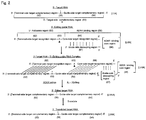
- a method for introducing a site-directed RNA mutation according to the first aspect of the present invention includes reacting 5'-target RNA represented by formula [LA]: with 3'-target editing guide RNA represented by formula [LIA]: to obtain 5'-target RNA-3'-target editing guide RNA complex represented by formula [LIIA]: causing ADAR to act to induce A-I editing to perform conversion to 5'-editing target RNA represented by formula [LIIIA]: and deaminating the target base adenosine (A) of the complex (solid triangle) to perform conversion to inosine (I). The thus converted inosine is translated into guanosine.
- this method is also referred to as a first target editing scheme.
- the method for introducing a site-directed RNA mutation according to the second aspect of the present invention is substantially the same as the method for introducing a site-directed RNA mutation according to the first embodiment, and includes reacting 3'-target RNA represented by formula [LVA]: with 5'-target editing guide RNA represented by formula [LVIA]: to obtain 3'-target RNA-5'-target editing guide RNA complex represented by formula [LVIIA]: causing ADAR to react to induce A-I editing to perform conversion to 3'-editing target RNA represented by formula [LVHIA]: and deaminating the target base adenosine (A) of the complex (solid triangle) to perform conversion to inosine (1) (marked with a solid triangle). The thus converted inosine is translated into guanosine.
- this method is also referred to as a second target editing scheme.
- the 5'-target RNA [LA] of the first aspect used in the present invention consists of a 5'-target side complementary region (10).
- the 5'-target side complementary region (10) consists of a terminal side target complementary region (12), a guide side target complementary region (14), and a target base adenosine (A) represented by A* (15).
- the 3'-target RNA [LVA] of the second aspect consists of a 3'-target complementary region (50).
- the 3'-target complementary region (50) consists of a terminal side target complementary region (52), a guide side target complementary region (5), and a target base adenosine (A) represented by A * (55).
- the terminal-side target complementary region (12, 52) of the target RNA is a base sequence composed of the same or different bases selected from adenine, cytosine, guanine, and uracil. Although it is not particularly limited, it is generally constructed to have a base sequence of about 40 bases, preferably about 30 bases, and more preferably about 20 bases.
- the guide-side target complementary region (14, 54) of the target RNA is a base sequence composed of the same or different bases selected from adenine, cytosine, guanine, and uracil. Although the number of bases is not particularly limited, it is constructed to have a sequence of about 1 to 15, preferably 1 to 12, more preferably 1 to 10, and particularly preferably 1 to 5 bases. When complexing the base sequence of the guide-side target complementary region of any target RNA with the editing guide RNA to be described later, it is preferable to construct it to base pair with the base sequence of the X-adjacent part of the core-side target recognition region of the editing guide RNA.
- A* (15, 55) means the target base adenosine targeted for editing existing at the target editing site (* mark) respectively.
- the target editing guide RNA consists of an antisense region (20, 60) and an ADAR binding region (26, 66).
- the antisense region (20, 60) is constructed to respectively form a complementary strand with the 5'-target RNA of the first aspect or the 3'-target RNA of the second aspect.
- the 3'-antisense region (20) of the 3'-target editing guide RNA includes a terminal side target recognition region (22), an X-adjacent part region of a core-side target recognition region (24) and a target editing-inducing base X (25) (marked with triangle) for target-editing-inducing the target base adenosine of 5'-target RNA.
- the 5'-antisense region (60) of the 5'-target editing guide RNA contains the terminal side target recognition region (62), the X-adjacent part region of the core-side target recognition region (64), and a target editing inducing base X (65) (marked with triangle) for target-editing-inducing the target base adenosine (A) of 3' target RNA [LVA].
- the terminal side target recognition region (22, 62) of the target editing guide RNA of the present invention is a base sequence consisting of the same kind and different kinds of bases selected from adenine, cytosine, guanine, and uracil. Although not particularly limited, it is generally preferable to construct base regions each consisting of about 40, preferably about 30, and more preferably about 20 base sequences. However, the number of constituent bases is the same as the number of bases of the terminal-side target complementary region (12, 52) of the corresponding target RNA, respectively, so that the corresponding bases are paired to form a base pair.
- the X-adjacent part region of the core side target recognition region of the antisense region is a base sequence consisting of the same and different bases selected from adenine, cytosine, guanine, and uracil, constitutes a base sequence consisting of a base sequence of generally 1 to 15, preferably 1 to 12, more preferably 10 or less, particularly preferably 1 to 5 bases, and forms a base pair with the base sequence of guide side target complementary region of the target RNA, respectively.
- the base sequence of the X-adjacent portion of the core side target recognition region is constructed so as to base pair with the base sequence of the guide side decoupling region to form a base pair.
- the ADAR binding region adjacent to the antisense region is composed of an ADAR adjacent region of the core side target recognition region, an ADAR binding core region, and a guide side decoupling region, each consisting of the same or different bases selected from adenine, cytosine, guanine, and uracil. It is a base region where the number of the bases in the ADAR adjacent region of the core side target recognition region and the guide side decoupling region is generally from 0 to 10, preferably about 5, and each constituent base is constructed so as to base pair with each other to form a base pair.
- the base sequence of the ADAR binding region in order that ADAR can exert A-I editing-inducing capability, can be fixed in a certain degree to a specific base sequence or a similar base sequence without greatly modifying the base sequence of the ADAR binding region.
- the base sequence of the antisense region of the editing guide RNA since the target RNA containing the target base A of interest is vastly different in base sequence and has a very diverse base sequence, it is necessary to construct so that the type and length of the base sequence can be freely changed.
- ADAR A-I editing capability of ADAR by increasing or decreasing the number of bases in the base sequence of the antisense region of the editing guide RNA, particularly the number of bases in the base sequence of the X-adjacent region of the core side target recognition region.
- the ADAR binding core region (28, 68) has an incomplete double-stranded RNA structure with a stem-loop structure composed of the same or different bases selected from adenine, cytosine, guanine, and uracil.
- This stem-loop structure has two incompletely complementary base sequence structures with a loop structure interposed therebetween, and the base sequence of each single strand is the same or different base sequence.
- the number of the bases is not particularly limited as long as it does not impair the editing inducing capability, it is typically about 10 to 40, and preferably about 20 to 30.
- the corresponding constituent bases do not form complementary strands to each other but are composed of 4 to 8, preferably 4 to 5 same or different bases.
- the base sequence of one single strand of this incompletely complementary double-strand has an ADAR adjacent part of the core side target recognition region at its end, and the base sequence of the other single strand has its end connected to the guide side decoupling regions, respectively.
- the ADAR binding core region is a region inducing the action of ADAR by binding with ADAR, and has the function of A-I editing the target base adenosine of the target RNA to convert it into inosine.
- RNA editing by ADAR can exert the function of inducing RNA editing capability of ADAR by ADAR being fixed to the ADAR fixing core region of the target editing guide RNA.
- the ADAR having A-I editing capability for example, hADAR1 and hADAR2 can be cited as ADAR, for example.
- the target RNA and the target editing guide RNA complementarily complex to form a target RNA-target editing guide RNA complex.
- the target side complementary region of the target RNA and the X-adjacent partial base sequence of the core side target recognition region, which is a part of the antisense region of the target editing guide RNA are base-paired to form a complementary strand target RNA-target editing guide RNA complex.
- the terminal-side target complementary region of the target RNA and the terminal-side target recognition region of the target editing guide RNA, and the guide-side target complementary region of the target RNA and the core-side target recognition region of the target editing guide RNA are paired to form a complementary strand, respectively, thereby forming a target RNA-target editing guide RNA complex.
- the corresponding bases of the constituent bases of the terminal side target complementary region (12) of the 5'-target RNA [LA] and the constituent bases of the 3'-terminal-side target recognition region (22) of the 3'-target editing guide RNA [LIA] are base-paired to form base pairs to construct the 5'-target RNA-3'-target editing guide RNA complex [LIIA].
- the corresponding bases of the constituent bases of the terminal side target complementary region (52) of the 3'-target RNA [LVA] and the constituent bases of the 5'-terminal side target recognition region (62) of the 5'-target editing guide RNA [LIA] are base-paired to form base pairs to construct the 3'-target RNA-5'-target editing guide RNA complex [LVIIA].
- the constituent bases of the guide-side target complementary region (14) of the 5'-target RNA [LA] are constructed to base pair with the constituent bases of the X-adjacent part region of the core-side target recognition region (24) of the editing guide RNA, and the constituent bases of the ADAR adjacent part region are constructed to base pair with the constituent bases of the guide side decoupling region (27) to form base pairs.
- the guide-side target complementary region (54) of the 3'-target RNA [LVA] is constructed to base pair with the constituent bases of the X-adjacent part region of the core-side target recognition region (64) of the editing guide RNA [LVIA], and the ADAR adjacent region is constructed to base pair with the constituent bases of the guide side decoupling region (67) to form base pairs.
- the number of bases in the core side target recognition region of the target editing guide RNA is constructed to be the same as the total number of bases in the guide side target complementary region of the target RNA and the guide side decoupling region of the target editing guide RNA.
- the target RNA and the target editing guide RNA are complexed to form a double-stranded structure, whereby ADAR acts on the ADAR fixing core region of the target editing guide RNA, induces RNA editing capability to allow the target base adenosine (A) present in the target RNA bound to the complex to be A-I edited and converted to inosine (I).
- the edited target RNA in which the target base adenosine is converted to inosine is translated into guanosine (G). That is, in the present invention, the inosine (I) of each of the RNA-edited 5'-editing target RNA [LIIIA] of 5'-target RNA and 3'-editing target RNA [LVIIIA] of 3'-target RNA is translated into guanosine (G) as represented by 5-translated target RNA [LIVA]: and 3'-translated target RNA [LIXA]:
- a target editing inducing base X (25, 26) which is positioned at target editing site (marked with triangle) corresponding to a target base A (*) in the target RNA includes any base which does not complement the target base A of cytosine (C), guanosine (G), adenosine (A) and uridine.
- cytosine can be preferably used as the target editing inducing base.
- the present invention provides a method for introducing a s ite-directed RNA mutagenesis in which a target editing inducing base (X) corres ponding to a target editing site (marked with triangle) is constructed as a base c ytosine (C) as a preferable embodiment.
- a preferred embodiment of the present invention is characterized by reacting a 3'-target editing guide RNA [LIB]: in which cytosine is used as the target editing inducing base X in the first target editing scheme or a 5'-target editing guide RNA [LVIB]: in which cytosine is used as the target editing inducing base X in the second target editing scheme with a corresponding target RNA respectively, to compose and obtain a 5'-target RNA-3'-target editing guide RNA complex [LIIB]: or a 3'-target RNA-5'-target editing guide RNA complex [LVIIB]: causing ADAR to react with the complex to induce A-I editing and convert the complex to a 5-edited target RNA [LIIIA]: or a 3'-edited target RNA [LVIIIA]: respectively, and converting the target base adenosine in the target RNA to inosine more efficiently and easily.
- Inosine (I) of each edited target RNA which has been A-I edited as described above is translated into guanosine (G) as shown in the 5'-translated target RNA [LIVA] or the 3'-translated target RNA [LIXA].
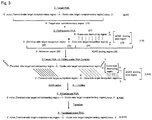
- the method for introducing a site-directed RNA mutation is constructed, as shown in Fig. 3 or Fig. 4 , from reacting a 5'-target RNA [LXA]: or a 3'-target RNA [LXVA]: with a 3'-target editing guide RNA [LIA]: or a 3'-target editing guide RNA [LVIA]: respectively, obtaining a 5'-target RNA-3'-target editing RNA complex [LXIA]: or a 3'-target RNA-5'-target editing RNA complex [LXVIA]: and obtaining a 5'-edited target RNA [LXIIA]: or a 3'-edited target RNA [LXVIIA]: in which the target base adenosine is A-I edited to inosine, which is an RNA mutation of the target RNA
- a 3'-target editing guide RNA represented by formula [LIB]: is used in place of the 3'-target editing guide RNA [LIA] in the first target editing scheme, or a 5'-target editing guide RNA represented by formula [LVIB]: is used in place of the 5'-target editing guide RNA [LVIA] in the second target editing scheme, and is reacted with a corresponding target RNA to obtain a 5'-target RNA-3'-target editing guide RNA complex represented by formula [LXIB]: or a 3'-target RNA-5'-target editing guide RNA complex represented by formula [LXVIB]: and the ADAR is reacted with each of the complex
- the edited target RNA converted to inosine as described above is converted into a 5'-translated target RNA [LIVA]: or a 3'-translated target RNA [LIXA]: and inosine is translated into guanosine.
- LIVA 5'-translated target RNA
- LIXA 3'-translated target RNA
- the method for introducing a site-directed RNA mutation according to the present invention can easily convert the target base adenosine contained in the full-length target RNA or the partial length target RNA by A-I editing to the inosine by the action of ADAR Is possible.
- the site-directed RNA mutation introduction method of the present invention by the first target editing scheme will be described with reference to Fig. 5 .
- the site-directed RNA mutation introduction method of the present invention shown in Fig. 5 more concretely represents the generic form shown in Fig. 1 .
- the method for introducing a site-directed RNA mutation of the present invention is constructed from RNA mutation editing in which, as indicated in Fig. 5 , 5'-target RNA [IA]: (in the formula, a symbol of a N1... a Nm indicates a base sequence corresponding to the terminal-side target complementary region (12) of the 5'-target RNA, is a continuous base sequence constructed from combination of the same or different bases consisting of any base a N selected from adenine, cytosine, guanine and uracil, and is constructed in such a manner that a number of bases which is not particularly limited, is generally 40, preferably 30 and more preferably about 20.
- a symbol of b N1 b N2... b Nn-1 b N indicates a base sequence corresponding to the guide-side target complementary region (14) of the 5'-target RNA [LA], and is constructed as a continuous base sequence which is constructed from combination of the same or different bases consisting of any base b N selected from adenine, cytosine, guanine and uracil, in such a manner that a number of bases is 1 to 15, preferably about 12, more preferably about 10, further preferably about 5.) is reacted with the 3'-target editing guide RNA [IIA]: (in the formula, a symbol of c N1 c N2...
- c Np-1 c Np corresponds to a guide-side decoupling region (27) of the 3'-target editing guide RNA
- a symbol of c N is a base sequence constructed from the same or different bases selected from adenine, cytosine, guanine and uracil
- a symbol of p indicates a number of bases of generally 0 to 15, preferably 12 or less, more preferably 10 or less and further preferably about 5, and a symbol of d N1...
- d Nm indicates a base sequence constructing a terminal-side target recognition region (22) of the 3'-target editing guide RNA, is constructed as a continuous base sequence which is constructed from combination of the same or different bases consisting of any base d N selected from adenine, cytosine, guanine and uracil, in such a manner that a number of bases which is not particularly limited, is generally 40, preferably 30 and more preferably about 20, as well as the number is equal to a number of constituent base of the base sequence in the terminal-side target complementary region (12) of the 5'-target RNA, and constructs base pairs with the base sequence of the terminal-side target complementary region.
- e Nn+p indicates a base sequence of X adjacent partial region of the core-side target recognition region represented by a symbol e N1 e N2... e Nn and a base sequence of ADAR adjacent partial region represented by e N1 e N2... e Np as well as the X adjacent partial regions consisted of any bases of a symbol e N selected from adenine, cytosine, guanine and uracil, and indicates a continuous base sequence consisted of the same or different bases in a number of base which is not particularly limited as long as the object and function of the present invention are not impaired of generally 1 to 15, preferably 1 to 12, more preferably 1 to 10, and particularly preferably 5 oe less.
- the ADAR adjacent partial region indicates a continuous base sequence which is consisted of any bases selected from adenine, cytosine, guanine and uracil and a number of bases is generally 0 to 15, preferably 12 or less, and more preferably 10 or less.), to compose and obtain a 5'-target RNA-3'-target editing guide RNA complex [IIIA]: and then the resulting 5'-target RNA-3'-target editing guide RNA complex [VIIIA] is A-I edited by the action of ADAR and converted to the 5'-edited target RNA [IVA]: and the target base adenosine (A*) is converted to inosine (I). The resulting 5'-edited target RNA [IVA] is converted the 5'-translated target RNA [VA]: by subsequent translating its inosine (I) into guanosine (G).
- the number marked with a solid triangle represents the number of bases of the base b N from the target base A.
- the number 0 means that there is no base of the guide side target complementary region adjacent to the target base A
- the number 1 means that one base of the guide side target complementary region adjacent to the target base A
- the number n means a base sequence consisting of n bases of the guide side target complementary region adjacent to the target base A. It also has the same meaning in the following description.
- the number marked with ⁇ represents the number of bases of the base cN from one end of the ADAR binding core region.
- the number 0 means that there is no base sequence of the guide side division region adjacent to the target base A
- the number 1 means that there is one base in the guide side division region
- the number p means a base sequence consisting of p bases in the guiding side disruption region. It also has the same meaning in the following description.
- the core side target recognition region is composed only of the base sequence of the X adjacent region represented by the symbol e N1... e Nn.
- the base sequence of the core side target recognition region is represented by the symbol e N1... e Nn + 1.
- the base sequence of the core side target recognition region is represented by the symbol e N1...
- e Nn+p It also has the same meaning in the following description.
- the corresponding base e N1 of the editing guide RNA composes a base pair with the base b N1 of the target side complementary region of the target RNA.
- the induction capability of A-I editing by ADAR may decrease and it is not preferable.
- the induction capability of A-I editing may decreases and it is not preferable.
- the symbol N ⁇ N ⁇ - N ⁇ N ⁇ consists of an incomplete double-stranded RNA structure consisting of a stem-loop structure which corresponds to the base sequence composing the ADAR binding core region (28, 68) of the 3'-target editing guide RNA [LIA] and the 5'- target editing guide RNA [LVIA] as described above. That is, the stem-loop structure is composed of two base sequences with a loop structure interposed therebetween and the two base sequences have a structure composed of incompletely complementary double strands including complementary base pairs and mismatch base pairs.
- the base (N) constituting each single strand is composed of the same or different bases selected from adenine, cytosine, guanine and uracil, and a number of bases of each single strand is generally 10 to 40, and preferably 20 to 30.
- the corresponding constituent bases do not form complementary strands to each other and are composed from the same or different bases of 4 to 8, preferably 4 to 5.
- one terminal of the incomplete complementary double strand which interposes the loop structure and binds each other may be joined with a base sequence of the ADAR adjacent region of the target recognition region, and the other terminal may be joined with a base sequence of the guide-side decoupling region.
- the symbol N ⁇ -N ⁇ is composed of one base sequence each consisting of the same or different bases selected from adenine, cytosine, guanine and uracil, and this base pair represents an incomplete double-stranded complementary region with single or plural, preferably about two mismatched base pairs.
- the symbol N ⁇ -N ⁇ represents a loop structure composed of similar the same or different bases having 4 to 8, preferably 4 to 5 bases.
- the symbol N ⁇ -N ⁇ has a structure in which one terminal thereof is joined with the guide-side target complementary region of the 5'-target RNA or the guide-side decoupling region of the target editing guide RNA and the other terminal is joined with the core side target recognition region of the target editing guide RNA.
- the symbols a N1... a Nm and the symbols d N1... d Nm are constituent base pairs (that is, for example, a N1 - d N1, a Nm - d Nm) are shown in a state of being connected with a solid line, and each constituent base pair forms a complementary strand.
- the ADAR binding core region has a structure in which one terminal is joined with the base sequence of the guide side decoupling region and the other terminal is joined with the ADAR adjacent part of the core side target recognition region.
- 3'-target RNA is complementary to the 3'-terminal portion at 3'-targeting guide RNA [IIA] as well, the target base adenosine of the 3'-target RNA undergoes A-I editing and is converted to inosine (I).
- the method of the present invention of the method according to the second target editing scheme is composed by RNA mutation editing in which, as shown in Fig. 6 , the 3'-target RNA [VIA]: is reacted with the 5'-target editing guide RNA [VIIA]: to compose and obtain the 5'-target RNA-3'-target editing guide RNA complex [VIIIA]: and subsequently the resulting complex is induced A-I editing capability by the action of ADAR to convert to 5'-edited target RNA [IXA]: In the resulting the 5'-edited target RNA, its inosine (I) is translated to guanosine to convert 5'-translated target RNA [XA]:
- cytosine (C), guanosine (G), adenosine (A) or uridine (U) is disposed at the site (marked with triangle) corresponding to the target editing site (*)
- cytosine (C) is higher than others, as a preferred embodiment of the invention, an embodiment in which the corresponding base (X) is cytosine (C) can be constructed. This also applies to the following.
- the present invention provides the method for introducing a site-directed RNA mutation in which, as shown in Fig. 7 , the 3'-target editing guide RNA [IIA] is used in place of the 3'-target editing guide RNA [IIB]: to compose with the 5'-target RNA and to obtain the 5'-target RNA-the 3'-target editing guide RNA complex [IIIB]: and the target base adenosine of the 5'-target RNA is A-I edited to convert inosine.
- the present invention according to the second target editing scheme provides the method for introducing a site-directed RNA mutation in which, as shown in Fig. 8 , the 5'-target editing guide RNA [VIIA] is used in place of the 5'-target editing guide RNA [VIIB]: to compose with the 3'-target RNA and to obtain the 3'-target RNA-5'-target editing guide RNA complex [VIIIB]: and the target base adenosine of the 5'-target RNA is A-I edited to convert inosine.
- the 5'-target editing guide RNA [VIIA] is used in place of the 5'-target editing guide RNA [VIIB]: to compose with the 3'-target RNA and to obtain the 3'-target RNA-5'-target editing guide RNA complex [VIIIB]: and the target base adenosine of the 5'-target RNA is A-I edited to convert inosine.
- the present invention can construct a preferred embodiment using a full-length RNA molecule or a partial length RNA molecule including a target RNA fragment as the target RNA.
- the present invention of the method for introducing a site-directed RNA mutation according to the first target editing scheme provides the method for introducing a site-directed RNA mutation in which, as shown in Fig. 9 , in place of the 5'-target RNA [IA], 5'-target RNA [XIA]: is used to compose with the 3'-target editing guide RNA and to obtain the 5'-target RNA-3'-target editing guide RNA complex [XIIIA]: and the target base adenosine of the 5'-target RNA is A-I edited to convert inosine.
- the present invention of the method for introducing a site-directed RNA mutation according to the second target editing scheme provides the method for introducing a site-directed RNA mutation in which, as shown in Fig. 10 , in place of the 3'-target RNA [VIA], 3'-target RNA [XVIA]: is used to compose with 5'-target editing guide RNA and to obtain the 3'-target RNA-5'-target editing guide RNA complex [XVIIIA]: and A-I editing capability is induced by the action of ADAR and the target base adenosine of the 5'-target RNA is A-I edited to convert inosine.
- the converted inosine present at the target site is translated into guanosine.
- the present invention according to the first and second target editing schemes provides the method for introducing a site-directed RNA mutation in which, as shown in Figs.
- 3'-target editing guide RNA [IIA], 3'-target editing guide RNA [IIB]: or in place of the 5'-target editing guide RNA [VIIA], 3'-target editing guide RNA [VIIB]: is used to compose with the 5'-target RNA [XIA] or the 3'-target RNA [XVIA] and to obtain the 5'-target RNA-3'-target editing guide RNA complex [XIIIB]: or the 3'-target RNA-5'-target editing guide RNA complex [XVIIIB]: and A-I editing capability is induced by the ADAR action on the resulting complex and the target base adenosine of the target RNA is converted to inosine, and then inosine is translated into guanosine.
- Non-Patent Document 7 describes that, based on the glutamate receptor mRNA precursor (GluR-B pre-mRNA) (Non-Patent Document 6) which is specifically edited in vivo by ADAR2, the editing substrate RNA (miniSL RNA) leaving only the region necessary for editing has been constructed.
- the present inventor has found that it can be constructed as the target editing guide RNA of the present invention by separating the target editing guide RNA and the target RNA by leaving only the ADAR binding region of this editing substrate and dividing at the position shown in the figure. Therefore, since the target editing guide RNA constructed in this way has a complementary region for recognizing the target RNA in addition to the ADAR binding region, it can be applied to any target RNA, so it can be used as a target editing guide of the present invention.
- the target editing guide RNA was designed for green fluorescent protein mRNA sequence as a model target RNA, and it was confirmed whether A-I mutation can be induced at the target editing site. Therefore, after designing each of RNAs using in vitro transcription reaction, in vitro editing reaction was carried out using purified recombinant ADAR2. As a result, it was found that the editing site was edited depending on the target editing guide RNA. As a result, it was found that target editing guide RNA having the intended function of the present invention can be constructed by such a design
- a preferred embodiment of the present invention according to the first target editing scheme using the target editing guide obtained here is, as shown in Fig. 13 , a method in which 5'-target RNA [XXIA]: is reacted with the 3'-target editing guide RNA [XXIIA]: to compose and obtain the 5-target RNA-3'-target editing guide RNA complex [XXIIIA]: and A-I editing capability is induced by ADAR action on the complex to convert to 5'-edited target RNA [XXIVA]: and target base adenosine is converted to inosine. The converted inosine is translated into guanosine.
- a more preferred embodiment of the present invention according to the first target editing scheme is, as shown in Fig. 15 , as the 3'-target editing guide RNA [XXIIA], the 3'-target editing guide RNA [XXHB]: is used and is reacted with the 5'-target RNA [XXIA] to compose and to obtain the 5'-target RNA-3'-target editing guide RNA complex [XXIIIB]: and A-I editing capability is induced by ADAR action, as shown in the 5'-edited target RNA [XXIVA]: and the target base adenosine is converted to inosine. Such converted inosine is, as shown in 5'-edited target RNA [XXVA]: translated into guanosine.
- a more preferred embodiment of the present invention according to the second target editing scheme is, as shown in Fig. 14 , the 3'-target RNA [XXVIA]: is reacted with the 5'-target editing guide RNA [XXVIIA]: , to compose and to obtain the 3'-target RNA-the 5'-target editing guide RNA complex [XXVIIIA]: and A-I editing capability is induced by ADAR action on the resulting complex to convert the 5'-edited target RNA [XXIXA]: and the target base adenosine can be converted to inosine.
- Such converted inosine is, as shown in the 3'-translated target RNA [XXXA]: translated into guanosine.
- a more preferred embodiment of the present invention can be constructed by introducing cytosine into the corresponding site (marked with triangle) of the target editing site (*). That is, more preferred embodiment of the present invention is, as shown in Fig. 15 or 16 , as the 3'-target editing guide RNA [XXIIA], the 3'-target RNA [XXIIB]: or, as the 5'-target editing guide RNA [XXVIIA], the 5'-target RNA [XXVIIB]: is used and reacted with the 5'-target RNA [XXIA] or the 3'-target RNA [XXVIA] respectively, to compose and to obtain the 5'-target RNA-3'-target editing guide RNA complex [XXIIIB]: or the 3'-target RNA-5'-target editing guide RNA complex [XXVIIIB]: and A-I editing capability is induced by ADAR action on the resulting complex to convert the 5'-edited target RNA [XXIVA]: or
- the full-length RNA or the partial length RNA having the 5'-target RNA [XXIA] or the 3'-target RNA [XXVIA] as specific regions in the RNA molecule can be used as a matter of course.
- the present invention in this form, as shown in Fig. 17 or Fig.
- the 5'-target RNA [XXXIA]: as the 5'-target RNA [XXIA], or the 3'-target RNA [XXXVIA]: as the 3'-target RNA [XXVIA] is used and is composed with the 5'-target editing guide RNA [XXXIIA] or the 3'-target editing guide RNA [XXXVIIA] to obtain the 3'-target RNA-5'-target editing guide RNA complex [XXXIIIA] or the 5'-target RNA-3'-target editing guide RNA complex, and A-I editing capability is induced by ADAR action on the resulting complex to convert the 5'-edited target RNA [XXXIVA] or the 3'-edited target RNA [XXXIXA], the target base adenosine is converted to inosine respectively, and then converted to the 5'-tranelated target RNA [XXXVA] or the 3'-translated target RNA [XXXX
- RNA base cytosine by changing the base (X) at the site corresponding to the target editing site to RNA base cytosine, a method according to a more preferred embodiment of the present invention is provided.
- the 5-target RNA [XXXIA] or the 3'-target RNA [XXXVIA] is reacted with the 3'-target editing guide RNA [XXXIIA] or 5'-target editing guide RNA [XXXVIIA], respectively to obtain the 5'-target RNA-3'-target editing guide RNA complex or the 3'-target RNA-5'-target editing guide RNA complex, and A-I editing capability is induced by ADAR action on the resulting complex to convert the 5'-edited target RNA [XXXIVA] or the 3'-edited target RNA [XXXIXA], the target base adenosine is converted to inosine respectively, and then converted to the 5'-tranelated target RNA [XXXVA] or the 3'-translated target RNA [XXXLA] and inosine is translated into guanosine
- a more preferred embodiment of the present invention according to the first target editing scheme is a method in which, for example, by using RNA molecules divided at each site of the target RNA (marked with solid triangle) and the target editing guide RNA divided at each site corresponding thereto (the arrows position), it is possible to convert the target base adenosine of the target RNA to inosine.
- Other embodiments can be similarly applied.
- the target editing guide RNA was designed for green fluorescent protein mRNA sequence as a model target RNA, and it was confirmed whether A-I mutation can be induced at the target editing site.
- in vitro editing reaction was carried out using purified recombinant ADAR2. As a result, it became clear that the editing site is edited depending on the target editing guide RNA.
- an ADAR binding core region composed of a double strand having the following sequence can be constructed.
- the target editing guide of the present invention can be constructed by binding the target recognition region and the base sequence of the guide-side decoupling region to both ends of the ADAR binding core region, respectively.
- an editing substrate for example, MiniSL RNA [XLA]
- a target editing site (*) is divided into a region including the target editing site and an ADAR binding region at the dividing site (for example, each of arrows 0 to 9 Site), and it can be separated into the target RNA and the target editing guide RNA, respectively.
- the target editing scheme of the present invention can be expressed as follows.
- the editing substrate [XLVA] is divided at the sites (0 to 5) indicated by arrows, as shown in the following formulae, the 5'-target editing guide RNAs [XLVA-0] to [XLVA-5] and the 3'-target RNAs [XLVIA-0] to [XLVIA-5] are formed, respectively.
- the illustrated editing substrate it is possible to divide at a site other than the segmented site shown in the drawing, that is, all of the complementary regions (nine bases present on the 5 'side of A) leaving the ADAR binding core region, RNA and target editing guide RNA can be separated.
- target RNAs complement each of the above-described target editing guide RNAs [XLVA-0] to [XLVA-5] to form a complex, and the A-I editing capability is induced by the action of ADAR, so that the target base adenosine is converted to inosine, respectively.
- target editing guide RNAs are naturally complexed complementarily to full-length RNA or partial length RNA containing the corresponding respective target RNA, and the target base adenosine is converted to inosine by the action of ADAR.
- the target editing guide RNA [XLA-2] divided by arrow 3 it is complementary to the full-length RNA or partial length RNA [XLA-6] containing the corresponding target RNA [XLA-1] to form the 5'-target RNA-3'-target editing guide RNA complex [XLA-7], then induced A-I editing capability by the action of ADAR to convert to the 5'-edited target RNA [XLA-8] and target bases adenosine is converted to inosine.
- the inosine of this edited target RNA is translated into guanosine and converted into the 5'-translated target RNA [XLA-9]. The same is true for other cases.
- the present invention can be similarly implemented by using other target editing guides.
- target editing guides For example, the case where GFP RNA is used will be described.
- RNA [XLIII-1] is used as full-length RNA or partial length RNA.
- RNA examples include serotonin receptor, glutamate receptor, and membrane voltage-dependent potassium channel.
- any type of RNA can be used without limitation in the present invention as long as the target base adenosine to be RNA edited exists in the RNA.
- RNA editing when a certain predetermined RNA is selected as the target RNA from the RNAs, a specific region including a target editing site to be subjected to RNA editing can be selected from the selected target RNA.
- the specific region of the target RNA which can be subjected to RNA editing can be used irrespective of its form, whether it is 5'-target RNA or 3'-target RNA. For example, even when the target editing site is present near the 5' end and it is difficult to construct a base pair in the complementary region, the target editing site can be replaced with the corresponding side chain on the opposite side to secure a complementary region.
- the target editing guide RNA When a specific region of the target RNA is selected, it is possible to design a corresponding target recognition region of the target editing guide RNA which forms a complementary chain with the specific region. In this way, if the corresponding target recognition region of the target editing guide RNA can be designed, the target editing guide RNA can be easily designed by binding to the ADAR binding core region.
- the target editing guide RNA of the present invention can be synthesized in accordance with a common method.
- the target editing guide RNA of the present invention can be synthesized by synthesizing a DNA molecule corresponding to the target editing guide RNA, and using the DNA molecule as a template by an in vitro transcription reaction or the like. That is, the target editing guide RNA of the present invention can be constructed by synthesizing synthetic oligo DNAs corresponding to each single strand of the double-strand constituting this target editing guide RNA, synthesizing each single strand by an annealing reaction or the like, and performing in vitro transcription reaction or the like using the synthesized DNA molecule as a template.
- the target editing guide RNA can be constructed to correspond to the target complementary region having the target editing site of every target RNA.
- the present invention can be easily and universally applied to any target RNA having a target base adenosine.
- gRNA editing guide RNA
- a 3'-editing guide RNA represented by the general formula [LIA] or a 5'-editing guide RNA represented by the general formula [LVIA] can be mentioned.
- the 3'-editing guide RNA [LIA] is composed of a 3'-target recognition region and an ADAR-binding region.
- the 5'-editing guide RNA [LVIA] is composed of a 5'-target recognition region and an ADAR binding region.
- the 3'-target recognition region of 3'-editing guide RNA [LIA] is composed of 3'-[terminal side target recognition region-X-core side target recognition region], and the core side target recognition region has a structure in which the 5' end thereof is bound to the 3'-end of the ADAR binding core region.
- the 5'-target recognition region of the 5'-editing guide RNA [LVIA] is composed of 5'-[terminal side target recognition region-X-core side target recognition region] and the 3' terminus of the core side target recognition region is bonded to the 5'-end of the ADAR binding core region.
- the target recognition region is also referred to as an antisense region.
- each core side target recognition region has its number of bases greater than the number of bases in the guide side decoupling region of the corresponding ADAR binding region.
- the base sequence is preferably designed to be long. That is, the number of the bases in the base sequence of the core side target recognition region is preferably 1 to 10, and preferably 1 to 5.
- Fig. 22B for example, for the 3'-gRNA (ADg-GFP_A200) (68 nt) having the editing target A200, the number of bases in the antisense region is 19 nt, the number of bases in the ADAR binding region (3 ng) is 49 nt, and the number of bases in the core side target recognition region was designed to be longer by about 3. This also applies to the case of Fig. 22A . This also applies to other examples.
- one main object of the present invention is to provide a simple gRNA design which induces the original A-I RNA editing activity of hADAR2 and to apply the gRNA to site-directed RNA mutagenesis.
- gRNA generally consists of a protein binding region that induces an enzyme protein such as Fibrillarin or Cbf5 on the target RNA and an antisense region that mediates target RNA via base pairing.
- the most important feature of gRNA is that the protein bound to gRNA is positioned to react effectively with the target site after the antisense gRNA region hybridizes to the target RNA.
- AD-gRNA RNA
- dsRBD mainly regulates substrate RNA binding, and the deaminase domain catalyzes the hydrolytic deamination reaction of adenosine ( Fig. 21a ).
- the natural structure of the substrate is considered to be adapted to the duplex structure required for dsRBD binding as well as enzyme activity.
- AD-gRNA capable of reconstituting the structure of the natural substrate can be constructed ( Fig. 21a).
- hADAR2 is composed of two dsRBDs and a deaminase domain. dsRBD primarily regulates the binding of the substrate RNA, and the deaminase domain promotes hydrolytic deamination.
- specific A-I RNA editing can be carried out simply by using the ADAR protein.
- the AD-gRNA composed of an antisense region and an ADAR binding region was designed based on a natural substrate RNA structure. In the figure, the target editing part is marked with a circled A.
- the structure of natural substrate RNA is induced by hybridization of AD-gRNA with the target RNA.
- the target site-directed RNA editing is accomplished by hADAR2 site-directed editing reaction on the reconstituted substrate RNA.
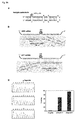
- Fig. 21b shows the sequence of AD-gRNA designed on the basis of the secondary structure of GluR 2 (GRIA 2) pre-mRNA, an editing substrate of natural hADAR2 (Non-Patent Literature 26).
- the known editing site of GluR2 RNA R/G site
- the stem-loop structure of GluR2 RNA can be split into two components.
- One component is believed to be a target guide RNA containing a targeted editing site, and the other component is believed to be a prototype AD-gRNA containing an antisense region ( Fig. 21b ).
- the site where this GluR2 RNA can be divided into two is indicated by an arrowhead and the AD-gRNA is shown in the gray background.
- the symbol X may be any nucleotide, and the dotted lines indicate base pairing. When X is completely base-paired, the cognate editing substrate structure is reconstructed.
- the antisense region acts as a determinant for targeting, and can be freely changed depending on the target site.
- AD-gRNA induced RNA editing on green fluorescent protein (AcGFP) mRNA (720 nt; Fig. 21c ) extracted from Anthurium coerulescens was shown.
- AcGFP green fluorescent protein
- mRNA 720 nt; Fig. 21c
- the AD-gRNA targeting A200 of GFP mRNA (ADg-GFP A200) is achieved by a 17-nt antisense region and a 49-nt ADAR binding region ( Fig. 21b ; its detailed design is shown in Fig. 22B ).
- gRNA and GFP mRNA Conjugate formation of gRNA and GFP mRNA was confirmed by gel mobility shift assays and an annealing reaction using small non-coding RNA fragments of ADg-RNA_A200 and AcGFP RNA (160 nt) synthesized in vitro including A200 site (see Fig. 23 ). After the complex formation reaction, the annealed gRNA-mRNA was allowed to react with hADAR2 for 1 hour. Subsequently, the editing induction efficiency of AD-gRNA was analyzed by reverse transcription (RT) and the fluorescent dye terminator sequencing method using AcGFP cDNA generated by PCR (Non-Patent Literature 29) ( Fig. 21c). Fig.
- 21c shows the editing-inducing activity of AD-gRNA by a sequence chromatogram of GFP cDNA obtained by RT-PCR and in vitro editing reaction.
- the top panel shows recombinant hADAR2 without gRNA.
- the central panel shows the results in the antisense region (17 nt), and the bottom panel shows the results with ADg-GFP-A200.
- the target site is indicated by an arrowhead.
- editing reaction in the absence of AD-gRNA, editing of A200 was not detected in the obtained sequencing chromatogram.
- A200 was slightly edited.
- AD-gRNA The diversity of the functional design of AD-gRNA was expanded.
- hADAR2 could not edit the site existing on the chain opposite to the original editing site ( Fig. 25 ).
- the trans-type substrate composed of gRNA and target RNA it is predicted that due to the loss of phosphodiester bond in the target RNA, the ADAR binding region acquires rotational degree of freedom.
- AD-gRNA having an antisense region on the 5' side of ADAR binding region could be constructed.
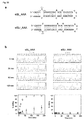
- the modified AD-gRNA targeting the same site was designed by introducing an antisense sequence at the 5' position of the ADAR binding region (ADg-rGFP A200) ( Fig. 22Aa ).
- ADg-rGFP-A200 showed specific editing-inducing activity for A200 ( Fig. 22Ab ).
- this editing activity was much higher than the original ADg-GFP-A200.
- Fig. 22Ab shows a temporal change in editing ratio at A200.
- Red circle indicates 5-antisense region
- solid red circle indicates 5-antisense AD-gRNA (ADg-rGFP -A200)
- blue triangle indicates 3-antisense region
- solid blue triangle indicates 3-antisense AD-gRNA (ADg-GFP-A200)
- solid triangle is the case without gRNA.
- Each editing percentage was calculated by quantifying the generated bases A and G from the direct sequencing chromatograph using the formula: (G peak height)/(A peak height + G peak height). The results are presented as averages with standard deviations from three independent experiments. This characteristic was also observed in the guide RNA generated from the hairpin matrix ( Fig. 24c ).
- ADg-rGFPex A200 extended AD-gRNA
- ADg-rGFPex_A200 showed different editing specificity and efficiency compared to ADg-rGFP_A200 ( Fig. 26 ). This result shows that the rotational freedom of the ADAR binding region is important for inducing target editing.
- AD-gRNA induced-RNA editing depends greatly on the inherent selectivity of the deaminase domain of hADAR2.
- the editing pattern of AD-gRNA induced-RNA editing is considered to be similar to that of naturally edited substrates.
- the neighboring specificity of AD-gRNA induced-RNA editing was almost identical to that observed for cis-type substrates ( Figs. 25 and 27 ). This indicates that AD-gRNA can induce structures similar to those occurring in natural substrates.
- the present inventors have successfully developed a highly active AD-gRNA framework by introducing an antisense region to the 5' side of the ADAR binding region.
- inosine is read as guanosine by the translational machinery
- the active mature luciferase is translated from Rluc-W104X only when A311 has been edited to 1311 by ADg-rRluc_A311 and then regenerated the Trp codon (UIG; Fig. 28a ). That is, regulation of protein expression by AD-gRNA-induced A-I RNA editing can be analyzed by monitoring luciferase activity after in vitro translation of edited reporter RNA.
- AD-gRNA with codon transformation was designed based on the 5'-antisense framework (ADg-rRluc_A311; Fig. 29 ).
- ADg-rRluc_A311 the 5'-antisense framework
- the editing efficiency at A311 was analyzed after the in vitro editing reaction. Similar to the results observed for ADg-rGFP, A311 could be efficiently and site-directedly edited in the resulting sequencing chromatogram ( Fig. 28b ). That is, by the above reaction, Rluc-W104X mRNA in which A311 was converted to 1311 was obtained.
- a simultaneous editing reaction was performed ( FIG. 30a ).
- ADg-rRluc_A311, Rluc-W104X, and hADAR2 were mixed together with the reaction components required for in vitro translation, and then reacted for 30 min.
- the editing efficiency and the luciferase activity were then analyzed.
- the editing efficiency of Rluc-W104X at A311 was 47% ( Fig. 30b ).
- Luciferase activity was also observed in the simultaneous reaction, and this luminescence intensity was almost half of the value detected by the single reaction ( Fig. 28c ).
- AD-gRNA strategy intracellular RNA mutagenesis was performed based on the AD-gRNA strategy.
- the most important advantage of AD-gRNA is its capability to induce the editing activity of native hADAR2.
- induction of the intracellular target RNA mutation does not require foreign protein, and can be achieved only by introduction of AD-gRNA into cells expressing hADAR2.
- the tet-ADAR2 cell line Non-Patent Literature 32
- Dox doxycycline
- ADg-GFP_A200 and ADg-rGFP_A200 already characterized in previous studies can guide the editing activity of hADAR2 in tet-ADAR 2 cells to AcGFP mRNA.
- a method for introducing AD-gRNA into cells a method of expressing by AD plasmid vector was used.
- pSuperne which expresses small non-coding RNA with commonly used pol III, was used as the expression vector ( Fig. 31a ).
- Expression plasmids of various AD-gRNAs were constructed using the above-described small non-coding RNA expression vectors.
- hADAR2 and AD-gRNA were confirmed by using Western blotting and real-time PCR ( FIGs. 32 and 33 ).
- GFP mRNA was extracted from tet-ADAR2 cells transduced with plasmid and co-cultured with Dox, and subjected to direct sequencing after RT-PCR.
- Fig. 31b shows the results of confirming the specific editing-inducing activity of ADg-GFP-A200 and ADg-rGFP_A200 in tet-ADAR2 cells.
- the panels each show a sequence chromatogram of GFP cDNA obtained from cells without plasmid transfection (guide [-], the upper panel), with the introduction and culturing of the expression plasmid of ADg-GFP-A200 (the middle panel), and of ADg-rGFP_A200 (the lower panel).
- the target base adenosine (A200) is indicated by an arrowhead. Editing efficiencies at nucleotide A200 from cells expressing ADg-GFP_A200 and ADg-rGFPA_200 were 34.9% and 30.5%, respectively ( Figs. 31 and 34 ).
- AD-gRNA-W58X RNA mutant A173GFP mRNA (GFP-W58X RNA) introduced with a stop codon by mutating G173 in codon Trp 58 was used as a reporter gene (Non-Patent Literatures 25 and 33).
- ADg-rGFP_A173 was designed to repair this stop codon to the Trp codon, and the corresponding expression plasmid was constructed using the pSUPER neo vector.
- hADAR2 and GFP-W58X For expression of hADAR2 and GFP-W58X, an expression plasmid was constructed based on the pcDNA 3.1 vector, which is commonly used for protein expression, and these plasmids were transduced into co-HEK293 cells, and after cultured for 48 hours, intracellular fluorescence was detected with a fluorescence microscope. Positive cells with clear fluorescence were not detected using control cells lacking AD-gRNA expression transduced with GFP-W58X and/or hADAR2 plasmid ( Fig. 31c ). In contrast, several cells with bright fluorescence were identified by transducing AD-gRNA expression plasmids ( Fig. 31c ).
- Non-Patent Literatures 19 to 21 RNA modification activity of natural riboprotein
- A-I RNA editing in vivo is performed only with ADAR protein, and gRNA inducing ADAR has not been found in nature.
- Site-specific RNA editing was previously accomplished using useful etitases consisting of artificial gRNA and modified ADAR protein (Non-Patent Literatures 22, 23, 24).
- AD-gRNA can be easily designed based on the secondary structure of a natural or artificial editing substrate having a hADAR2 expression site.
- GluR2 RNA the region bound by dsRBD of hADAR2 has been clarified by structural analysis by NMR (Non-Patent Literature 34). Judging from the structural information, the GluR2 RNA is divided into two parts, one divided part is considered to be a target RNA having an editing site, and the other is considered to be a prototype type AD-gRNA consisting of an ADAR binding region and an antisense region ( Fig. 21b ). In theory, the edited substrate structure is reconstructed by recombining the divided RNAs.
- AD-gRNA can induce A-I editing by hADAR2 against any of the target base adenosines by altering the antisense region to match the target sequence.
- AD-gRNA targeting various sites on GFP and Luc mRNA was constructed with this design.
- the flanking specificity of RNA edition induced by AD-gRNA was very similar to that observed in natural substrates ( Figs. 25 and 26 ). This indicates that the complex consisting of AD-gRNA and RNA forms a structure similar to the natural editing substrate structure.
- the AD-gRNA of the present invention was constructed using a basic skeleton in which a dividing line between both RNA components was immobilized at a position 3 nucleotides (nt) downstream of the target editing site ( Fig. 21b ).
- this dividing line is 0 nt or 1 nt, the editing efficiency decreased, but nearly constant editing efficiency was observed at distances of 2-5 nt away ( Fig. 35 ).
- 3 bp framework was used in this experiment.
- the editing efficiency can be changed to some extent by changing the dividing line, so the possibility of using different basic skeletons in AD-gRNA construction was shown.
- the antisense region is located on the 3' side of this design based on the GluR2 RNA, but in the design of AD-gRNA, the position can be located both 3' and 5' sides of the ADAR binding region. It is believed that the position of the antisense region is considered to be interchangeable as a result of increased rotational freedom of the ADAR binding region caused by loss of phosphodiester bond in the target RNA. This concept is supported by different editing behavior of ADg-rGFPex as observed when the sequence is additionally introduced to the 3' side that base pairing with the target RNA is caused, and that the degree of rotational freedom of the ADAR binding region is suppressed ( Fig. 27 ).
- 3'-antisense AD-gRNA may induce a more favorable structure for editing induction of hADAR.
- ADg-GFP_A200 shows the capability to induce A-I editing ( Fig. 21c ), but its efficiency was significantly lower than observed with complete AD-gRNA with ADAR binding region introduced. This result shows that ADg-RNA has high pluripotency for inducing efficient editing.
- nonspecific editing can occur in the antisense region depending on the surrounding sequence of the target.
- nt 11 bases apart from the target base adenosine are located on the sterically same surface.
- adenosine present at this position may be nonspecifically edited by induced ADAR.
- the editing pattern induced by AD-gRNA is highly dependent on hADAR2 specific properties. For example, if a target site is present in a contiguous adenosine sequence, adenosine adjacent to that target site is edited simultaneously ( Figs. 25 , 26 ).
- Non-Patent Literature 23 Given the similarity of reaction specificities observed with this artificial editase, it seems possible to apply these strategies for AD-gRNA induced RNA editing to regulate target selectivity. Conversely, by utilizing the flanking specificity of native hADAR2, it is possible to edit multiple adenosines at once.
- this result of successfully modifying the ADAR binding region strongly suggests the possibility of constructing AD-gRNA using an ADAR binding region different from the present invention from natural editing substrate RNAs such as the GluR2 Q/R site (Non-Patent Literature 35) and the NEIL1 K/R site (Non-Patent Literature 36). It is known that the GluR2R/G site is also compiled by hADAR1, another RNA-editing enzyme.
- hADAR1 has a domain structure similar to that of hADAR2 (Non-Patent Literatures 13 and 37)
- the design strategy of the present invention can be applied not only to hADAR2 guide RNA but also to hADAR1 guide RNA.
- the AD-gRNA developed in the present invention can directly induce the editing activity of hADAR1.
- an editing induction assay using hADAR1 was performed.
- This guide RNA design is showed to be effective to both hADAR1 and hADAR2.
- AD-gRNA according to the present invention was effective both in vitro and intracellularly, and showed site-selective activity, but by further optimizing it, it is expected that it is possible to improve the activity of AD-gRNA according to its intended use.
- the diversity of functional adjustment by the design of the present invention is very useful for improving editing efficiency and avoiding nonspecific editing.
- Intracellular site-directed RNA editing can be accomplished simply by expressing AD-gRNA in hADAR2 expressing cells. Moreover, it is evident that in the codon repair experiments (in vitro and intracellular) according to the present invention, the AD-gRNA strategy of the present invention can be applied to change codons and ultimately change the function of the target protein. Theoretically, 12 amino acids (Ser, Thr, His, Lys, Arg, Asp, Glu, Asn, Gln, Tyr, Ile and Met/start) out of all 20 amino acids can be changed by the A-I mutation generated in the coding region of mRNA.
- AD-gRNA strategy of the present invention has great potential as a new site-directed RNA mutation induction method applicable to control of various biological processes.
- the novel gRNA system of the present invention can induce A-I mutation by guiding hADAR2 to the target site.
- AD-gRNA can specifically introduce the A-I mutation at the target site programmed into the antisense region.
- the method for introducing a site-directed RNA mutation of the present invention can be accomplished merely by introducing gRNA into ADAR expressing cells.
- the gRNA strategy of the present invention provides a basic framework that is simple in design, easy to use, and necessary for establishing general RNA mutation induction.
- the reaction solution containing 100 mM of the synthetic oligo DNA (1) (guide RNA_D 3_tempT7F) and 100 mM of the synthetic oligo DNA (2) (guide RNA D 3_tempR) was treated at 95 °C for 3 min. and subsequently reduced to 25 °C for 15 min, and then annealing reaction was carried out to obtain DNA (guide RNA_D3_tempF/R).
- RNA (3'-target editing guide RNA 1) was synthesized by in vitro transcription (37 °C for 3 hours) using the obtained DNA as a template and T7-Scribe Standard RNA IVT KIT.
- the template DNA used to synthesize 3'-target editing guide RNA in vitro was synthesized using synthetic oligo DNA (1) guide RNA_D3_tempT7F and synthetic oligo DNA (2) guide RNA_D3_tempR.
- the base sequence of each synthesized oligo DNA used is as follows.
- RNA_D0_tempT7F 100 mM of synthetic oligo DNA (3)
- guide RNA_D0_tempR 100 mM of synthetic oligo DNA (4)
- the base sequences of synthetic oligo DNA (3) (guide RNA_D0_tempT7F) and synthetic oligo DNA (4) (guide RNA_D0_tempR) are as follows.
- a reaction solution containing 100 mM of synthetic oligo DNA (5) (guide RNA_D3r_tempT7F) and 100 mM of synthetic oligo DNA (6) (guide RNA_D3r_tempR) was treated in substantially the same manner as in Example 1 to obtain RNA (3'-editing guide RNA3).
- the base sequences of synthetic oligo DNA (5) (guide RNA_D3r_tempT7F) and synthetic oligo DNA (6) (guide RNA_D3r_tempR) are as follows.
- RNA_D0r_tempT7F 100 mM of synthetic oligo DNA (8)
- guide RNA_D0r_tempR 100 mM of synthetic oligo DNA (8)
- the base sequences of the synthetic oligo DNA (7) (guide RNA_D0r_tempT7F) and the synthetic oligo DNA (8) (guide RNA_D0r_tempR) are as follows.
- Amplification was performed using GFP-Gq-TK plasmid as a template, with PCR (1 cycle (98 °C for 10 sec, 55 °C for 30 sec. 68 °C for 30 sec) 30 cycles) in a reaction solution containing 100 mM AcGFP_sRNA 01_T7F01 primer, 100 mM AcGFP_sRNA 01_R01 primer, and 2.5 mM dNTP, 1.25 U/mL Prime Star GXL (final concentration: GFP-Gq-TK Plasmid 4.0 pg/mL, AcGFP_sRNA 01_T7 F/R 0.3 mM, dNTP 0.2 mM, PrimeStar GXL 2.5 U).
- the base sequence of the AcGFP_sRNA01_T7P01 primer is as follows. CTAATACGACTCACTATAGGGCCACCCTGGTGACCACCC
- the base sequence of the AcGFP_sRNA 01_R01 primer is as follows. GCGCGCGACTTGTAGTTGCC
- Target RNA Target Editing Guide RNA and Substrate RNA
- Annealing reaction 80 °C for 3 min ⁇ 25 °C for 15 min.
- purified target editing guide RNA final concentration: 0.45 mM
- target RNA target RNA
- annealing buffer 150 mM NaCl, 10 mM Tris-HCl (pH 7.6)
- formation of complex of target RNA (GFP RNA) and target editing guide RNA was confirmed with 8% Native PAGE.
- the base sequence of GFP sRNA 01 is as follows.
- Target RNA Target Editing Guide RNA and Substrate RNA
- Annealing reaction 80 °C for 3 min ⁇ 25 °C for 15 min.
- purified target editing guide RNA final concentration: 0.45 mM
- target RNA target RNA
- annealing buffer 150 mM NaCl, 10 mM Tris-HCl (pH 7.6)
- formation of complex of target RNA (GFP RNA) and target editing guide RNA was confirmed with 8% Native PAGE.
- the resulting RNA complex (0.45 mM) was diluted with TE Buffer to 50 mM.
- RNA complex 1 or RNA complex 2 was purified by phenol/chloroform extraction and ethanol precipitation, respectively.
- the resulting precipitate of each RNA complex was dissolved in 5 mL of TE Buffer and reverse transcription reaction was carried out using Prime Script Reverse Transcription Kit and AcGFP_sRNA_R01 primer (final concentration: 2.5 mM) (rapid quenching at 65 °C for 5 min, 42 °C for 45 min, 70 °C for 15 min.).
- PCR (1.25 U/mL Prime Star GXL, AcGFP_sRNA_T7F01 primer, cGFP_sRNA_R01 primer, 2.5 mM dNTP) (one cycle (98 °C for 10 sec, 55 °C for 15 sec, 68 sec for 20 sec), 25 cycles) was performed using the obtained cDNA as a template to amplify the double-stranded DNA.
- DNA base sequence analysis was performed using the amplified DNA and the Big Dye Terminator v3.1 Cycle Sequencing Kit.
- An editing ratio was calculated from the peak ratio (G/A + G) of A (T) and G (C) of the target editing site of the obtained chromatographic chart.
- the edit rate of each of RNA complex 1 and RNA complex 2 was 88.1% and 91.2%. In contrast, the control of the target RNA alone was 2.7%.
- the editing ratio was calculated for a complex obtained by subjecting 3'-target RNA [XLVIA-0 to XLVIA-5] and 5'-target editing guide RNA [XLVA-0 to XLVA-5] to annealing reaction in a manner substantially the same as in Example 8.
- the results are shown in Table 1 below showing the change of the editing rate over time.
- DNA oligonucleotide and synthetic RNA were purchased from Hokkaido System Science Co, Ltd. (Hokkaido, Japan) and Sigma genosys (Hokkaido, Japan). The sequences of all DNA oligonucleotides and synthetic RNAs are listed in Tables 2 to 6.
- AD-gRNA was synthesized by the in vitro transcription method.
- a template dsDNA for in vitro transcription was synthesized by a common method using synthetic oligonucleotides.
- 1 ⁇ M of the forward DNA oligonucleotide containing a T7 promoter sequence and 1 ⁇ M of a reverse DNA oligonucleotide were mixed in an annealing buffer (50 mM Tris-HCl [pH 7.6], 50 mM NaCl), after which an annealing reaction was performed by denaturing at 95 °C for 3 min, followed by cooling at room temperature for 15 min.
- an annealing buffer 50 mM Tris-HCl [pH 7.6], 50 mM NaCl
- the annealed product was elongated using Klenow polymerase (New England BioLabs).
- the obtained dsDNA was purified by phenol/chloroform extraction and ethanol precipitation.
- an in vitro transcription reaction was performed using the AmpliScribe T7 kit (Epicenter Biotechnologies) according to the manufacturer's protocol.
- the reaction solution was subjected to phenol/chloroform extraction and ethanol precipitation, and denatured on 5% polyacrylamide gel containing 8 M urea to purify AD-gRNAs.
- the target RNA was prepared by PCR using dsDNA template by a standard PCR reaction (PrimeSTAR GXL DNA polymerase (Takara Bio)). Subsequently, in vitro transcription and purification were performed as described above. The sequences of all DNA oligonucleotides and RNA samples are shown in Tables 2 to 6.
- Recombinant hADAR2 was prepared by amplifying the coding region for human ADAR2 from cDNA clone (clone ID 6014605, Open Biosystems) by PCR, cloning the N-terminal His-Express tagged fusion protein, and transforming it into INVSc1 yeast cells using the Frozen-EZ Yeast Transformation II Kit (Zymo Research). The obtained transformants were cultured in a liquid medium, and the recombinant hADAR2 was purified using a HisTrap HP column (GE Healthcare).
- hADAR2 Fractions containing hADAR2 were collected and dialyzed against a buffer for storage (10 mM Tris-HCl [pH 7.5], 150 mM NaCl, 5% glycerol, 1 mM DTT) using a 50-kDa molecular weight cutoff Float-A- Lyzer G 2 Spectra/Por). Purified hADAR2 was quantified using DC protein Assay Kit (BioRad) according to the manufacturer's protocol.
- gRNAs and target RNA were prepared by heating 900 nM AD-gRNA and 300 nM target RNA at 80 °C for 3 min. and then slowly cooling in an annealing buffer (10 mM Tris-HCl [pH 7.6], 150 mM NaCl) to 25 °C at a rate of 1 °C/10 sec.
- the editing reaction was carried out as follows: 5 nM of the obtained complex and purified hADAR2 with various concentrations were mixed in 20 ⁇ l of a reaction buffer (20 mM HEPES-KOH [pH 7.5], 100 mM NaCl, 2 mM MgCl 2, 0.5 mM DTT, 0.01% Triton X-100, 5% glycerol, 1 U/ ⁇ l Murine RNAse Inhibitor [New England BioLabs]), and then incubated at 37 °C for 2 hours. After completion of the reaction, the reacted RNA was subjected to phenol/chloroform extraction/ethanol precipitation. Thereafter, the RNA pellet was dissolved in 5 gl TE buffer.
- cDNA was reverse transcribed using PrimeScript II Reverse Transcription Kit (Takara Bio).
- cDNA was PCR-amplified using PrimeSTAR GXL DNA polymerase (Takara Bio) according to a standard protocol. Male and female efficiencies at each site were analyzed by direct sequencing as follows. 10 ng of gel purified PCR product was sequenced with a reverse primer and the BigDye Terminator Cycle Sequencing Kit (Applied Biosystems), and then sequencing chromatography was performed with 3130 Genetic Analyzer (Applied Biosystems). The editing ratio at each site was calculated as follows: A/(A + G) (where A and G are peak heights of adenosine and guanosine measured by Sequence Scanner software ver. 1.0 (Applied Biosystems)).
- the reporter for the in vitro codon repair experiment was designed based on Renilla luciferase mRNA (Rluc-WT).
- This reporter mRNA (Rluc-W104X) was prepared by mutating G 311 to A311 in Trp 104 (UGG) using QuikChange Site-Directed Mutagenesis Kit (Stratagene). With this Rluc-W104X reporter, the full length, wild type Rluc transcript was synthesized and A311 was edited to I 311. In vitro compilation reaction and translation reaction were carried out continuously.
- the edited RNA sample was extracted with phenol/chloroform and recovered by ethanol precipitation.
- an in vitro translation was performed in 20 ⁇ l of rabbit reticulocyte lysate, using 1 ⁇ g of reporter RNA obtained from the editing reaction. After 1 hour of translation at 37 °C, chemiluminescence was performed using the Dual-Luciferase Reporter Assay System (Promega) according to the manufacturing protocol, and luminescence was measured with a spectrophotometer.
- AD-gRNA expression plasmid was constructed using pSUPER.neo (Oligoengine), which is used for expressing intracellular RNAs such as short hairpin RNAs and miRNAs, based on the HI RNA polymerase III promoter. While preparing DNA insert-encoding AD-gRNAs, tetra uridine was inserted into the 3' end of the AD-gRNA sequence to terminate pol III transcription at a specified position. Cloning into vectors was facilitated by introducing Hind III and Bgl II restriction sites at the 5' and 3' ends, respectively. The DNA inserts were prepared using synthetic oligonucleotides shown in Tables 2 to 6.
- HEK 293 cells were collected in Dulbecco's Modified Eagle Medium (DMEM; Sigma) supplemented with 10% fetal bovine serum.
- DMEM Dulbecco's Modified Eagle Medium
- Tet-ADAR2 cells in which hADAR2 and AcGFP were simultaneously expressed from a bidirectional promoter under the control of the Tet-on system, were established in the inventors' laboratory.
- tet-ADAR2 cells were cultured as monolayers in DMEM supplemented with 10% Tet system-approved fetal bovine serum (Clontech), 1 ⁇ g/mL puromycin and 100 ⁇ g/mL G418 (Sigma) at 37 °C in the presence of 5% CO 2 .
- the expression of ADAR2 and AcGFP was induced by culturing tet-ADAR2 cells in the above medium supplemented with 5 ⁇ g/mL of Dox.
- Tet-ADAR2 cells (1.6 ⁇ 10 5 ) were added to 35-mm dishes containing a medium containing 5 ⁇ g/mL Dox. When the cells reached about 80% confluence, they were transfected with 2 ⁇ g of AD-gRNA using X-treme GENE HP DNA Transfection Reagent (Roche). After transfection for 72 hours, the editing efficiency at A100 in AcGFP RNA, which was simultaneously expressed with hADAR2 in tet-ADAR2 cells, was analyzed as follows. Total RNA was extracted from the transfected cells using Sepasol RNA I Super G (Nacalai Tesque) according to the manufacturer's protocol.
- RNA samples (30 ⁇ g) were treated with 10 U DNase I (Takara Bio) at 37 °C for 3 hours, followed by phenol/chloroform extraction and ethanol precipitation.
- Purified RNA (0.5 ⁇ g) was reverse transcribed using the adapter link oligo (dT) 17 primer and Transcriptor High Fidelity cDNA Synthesis Kit (Roche) according to the manufacturer's protocol.
- AcGFP cDNA was amplified by PCR using AcGFP-specific primers (AcGFP_F and AcGFP_R). The efficiency of AI RNA editing at the A100 site was analyzed by direct sequencing, followed by quantification of the relative heights of the A and G peaks, after which each editing ratio was calculated on the basis of the peak height of G divided by that of (A+G).
- the mutant GFP mRNA in which G173 was changed to A173 and codon W58 of the stop codon was mutated was designed to determine whether AD-gRNA could regulate functional gene expression in cells.
- the AcGFP-W58X expression plasmid was constructed based on the pcDNA 3.1 expression vector (Invitrogen).
- hADAR2 expression plasmid was constructed by cloning PCR-amplified hADAR2 cDNA into pcDNA 3.1. 100 ng each of hADAR2, AcGFP-W58X and AD-gRNA expression vectors were co-transfected into sub-confluent HEK 293 cells. The editing efficiency was analyzed 72 hours after transfection. The recovery of intracellular GFP fluorescence was analyzed with a fluorescence microscope.
- This example is an example of verifying whether the editing guide RNA according to the present invention functions in cultured cells into which intracellular RNA mutation has been introduced.
- intracellular expression plasmids of four editing guide RNAs (ADg-GFP-A200, ADg-rGFP_A200, sADg-GFP-A200, sADg-rGFP_A200; see Fig. 36 ) which showed editing-inducing activity in vitro were constructed.
- As an expression vector commercially available pSUPER.neo (Oligoengine) was used.
- tet-ADAR2 cells (a cell line constructed by incorporating an ADAR2 expression gene in HEK 293 cells, expressing ADAR 2 and GFP dependent on doxycycline concentration) were used as ADAR expressing cells.
- various editing guide RNA expression plasmids were introduced ( Fig. 37a ).
- the editing ratio of the target site A200 was analyzed based on the edit analysis result of GFP mRNA by direct sequencing. In other words, the GFP mRNA extracted from the cells was reverse transcribed, and the sequence analysis was carried out.
- GFP W58X mRNA in which the 58 th Trp codon (UGG) of GFP mRNA (720 nt) was modified to a stop codon (UAG) was used to mutagenize the stop codon into UIG so as to verify whether mature GFP is translated in cells ( Fig. 37a ).
- an editing guide RNA ADg-rGFP_A173 targeting A173 was designed and an intracellular expression plasmid was constructed using pSuper.neo.
- ADAR2 expression plasmid pcDNA3.1 (-) Hygro_His-ADAR2
- reporter RNA expression plasmid pcDNA3.1 (-) Hygro_AcGFPW 58X
- HEK 293 cells After cultivation, cells emitting fluorescence by editorial induction were confirmed by fluorescence microscopy. As a result, cells emitting intense fluorescence were detected only in the cell group into which the editing guide RNA expression plasmid was introduced ( Fig. 38 ). The above results demonstrate that expression of the target protein can be controlled by introducing an RNA mutation using the editing guide RNA.
- Tet-ADAR 2 cells were cultured in Tet serum medium containing 1 ⁇ g/mL puromycin, 100 ⁇ g/mL G418, and 5.0 ⁇ g/mL Dox in a collagen-coated 35-mm dish under the conditions of 37 °C and 5.0% CO 2 .
- Cells cultured to 80% confluence were subcultured to a 6-well plate at 1.6 ⁇ 10 5 cells/well. After incubation for 48 hours, each guide RNA expression plasmid (pSuper-guide 3-mini, pSuper-guide 3r-mini, pSuper-guide 3-Glu, pSuper-guide 3r-Glu) was transfected using FuGENE HP Transfection Reagent (Roche), and transfected for 72 hours.
- RNA was all extracted using 1000 ⁇ L of Cepazole RNA I Super G (Nacalai), and DNase treatment was performed for 1 hour at 37 °C using 10 U Recombinant DNase I (TaKaRa). RNA products were all purified by phenol/chloroform treatment, and ethanol precipitation in the presence of sodium acetate.
- a reverse transcription reaction was carried out for the following conditions: denaturing at 80 °C for 3 min, rapid cooling and annealing at 65 °C for 10 min, elongation reaction at 55 °C for 300 min, and heating at 85 °C for 5 min, using 0.5 ⁇ g of total RNA, 2.5 ⁇ M Oligo (dT) 17, and Transcriptor First Strand cDNA Synthesis Kit (Roche) to synthesize cDNA.
- 1st PCR (denaturation at 98 °C for 10 sec, annealing at 55 °C for 15 sec, elongation reaction at 68 °C for 60 sec, 35 cycles) was carried out using the sample diluted 10 times as a template with 0.25 ⁇ M AcGFP RNAf T7F01 primer, 0.25 ⁇ M 3'-ADP primer, 0.25 U PrimeStar GXL DNA polymerase (TaKaRa).
- Nested PCR (denaturation at 98 °C for 10 sec, annealing at 55 °C for 15 sec, elongation reaction at 68 °C, 60 sec; 24 cycles) was carried out with 0.25 ⁇ M RNAf T7F01 primer and 0.25 ⁇ M AcGFP-RNAf-R 01 primer.
- RNAf T7F01 primer
- the editing ratio was calculated from the obtained peak height ratio G/(G+A).
- the subsequent operation (after RNA extraction) was performed in the same manner as described above.
- HEK 293 cells were cultured in serum medium at 35 °C/GLASS BASE DISH (Glass 12 ⁇ ) (Iwaki) for 48 hours under conditions of 37 °C and 5.0% CO 2 . Thereafter, 700 ng each of ADAR2 expression plasmid pcDNA3.1 (-) Hygro_His-ADAR2, substrate RNA expression plasmid pcDNA3.1 (-) Hygro_AcGFPW58X and each guide RNA expression plasmid pSuper-neo-guide 3r-miniW 58X or pSuper-neo-guide 3r-GluW 58X were transduced using X-tremeGENE HP DNA Transfection Reagent (Roche) and cultured for 72 hours. After that, the cells were washed with D-PBS (-) (Nacalai) and then observed using a confocal fluorescence microscope.
- sADg-GFP_A200 and sADg-rGFP_A200 were obtained by calculating the editing ratio from the A and G peaks in the sequencing chromatogram of GFP cDNA.
- the sequencing chromatogram was obtained by in vitro compilation reaction without gRNA (upper panel), or sADg-GFP_A200 (middle panel) or sADg-rGFP A200 (lower panel) after RT-PCR. Results are presented as mean and standard deviation values from 3 independent experiments.
- editing specificity was analyzed using cis-substrate RNA ( Fig. 25 ).
- eSL_AAA RNA and eSLr_AAA RNA were designed based on the substrate hairpin structure using the following mutation.
- the eSL_AAA RNA was generated by mutating the nucleotide adjacent to the targeted editing site to adenosine and introducing uridine into the complementary position of this mutant adenosine to promote base pairing.
- eSLr_AAA RNA was generated by replacing three adenosines containing the target base adenosine of eSL_AAA RNA with complementary nt. The actual sequences of eSL_AAA RNA and eSLr_AAA RNA are shown in Fig. 25(a) .
- the target editing site is shown at the nt position (0), the adjacent 5'-adenosine is shown at the nt position (-1), and the 3'-adenosine is shown at the nt position (+1).
- an in vitro editing reaction with hADAR2 was performed according to the method of Fig. 23a .
- the editing efficiency of the target adenosine was analyzed by the direct sequencing method with varying reaction time.
- the obtained sequence chromatogram is shown in Fig. 25(b) .
- the position of each adenosine is represented by the corresponding nt position number.
- the editing ratio calculated from the peak height was plotted for each reaction time on a graph.
- circles indicate editing percentages observed at the nt position (0), square marks and triangle marks represent editing percentages observed at the nt positions (-1) and (+0), respectively.
- the data are the mean and standard deviation of the results of three independent experiments.
- GFP mut RNA was generated by mutating adjacent nt adjacent to A200 in GFP mRNA to adenosine.
- ntA200 was defined as nt position 0, and 5' side and 3' side adenosines were defined as nt-1 and nt + 1, respectively.
- ADg-rGFT_AAA was constructed according to the sequence design of ADg-rGFP_A200.
- Fig. 26a shows the sequence design around the targeted editing site on GFPmut RNA and the actual nucleotide sequence of ADg-rGFP_AAA.
- the adjacent specificity of AD-g RNA-induced RNA editing and the effect on editing efficiency when base pairing was additionally introduced were analyzed.
- the degree of rotational freedom of the ADAR binding site ( Fig. 25 ) in sADg-rGFP_AAA was investigated to see whether it could be suppressed by additionally introducing base pairing on the 3' side.
- 5 nt (5'-UCAGG-3') was further introduced on the 3' side of sADg-rGFP_AAA to design to extend base pairing region (boxed region).
- In vitro editing reaction with hADAR2 was performed under the same conditions as in Example 24, and the editing percentage at each site was analyzed.
- Fig. 30a is a schematic view of the reaction.
- Fig. 30b shows the results of analyzing the editing efficiency at A311 by direct sequencing after the reaction.
- the top panel shows the sequence chromatogram without guide RNA, and the bottom panel shows the sequence chromatogram of ADg-rRluc_A311.
- ADg-GFP A200 in tet-ADAR 2 cells was subjected to RT-PCR and quantitative PCR (qPCR).
- Sub-confluent proliferating tet-ADAR2 cells were transfected with the AD-gRNA expression plasmid vector. After incubation for each time, total RNA was extracted and reverse transcription was performed using a random hexamer primer (dN 6 primer) using Transcriptor High Fidelity cDNA Synthesis Kit (Roche).
- qPCR was performed using qADg_F and qADg_R primers for specific amplification of ADg-GFP-A200 using Power SYBR (R) Green PCR Master Mix (Applied Biosystems).
- Glyceraldehyde 3-phosphate dehydrogenase was also quantified using GAPDA-QF and GAPDH-QR primers as an internal standard for quantifying the total RNA amount.
- the conditions of qPCR are as follows: preheating for denaturation (95 °C for 10 min) and amplification by LightCycler Nano System (Roche) (95 °C, 15 sec; 60 °C, 1 min; 55 cycles).
- a tolerance threshold Ct: crossing threshold
- hADAR2 expression in tet-ADAR2 cells was analyzed by western blotting ( FIG. 33 ).
- Tet-ADAR2 cells were cultured in media containing doxycycline (Dox) at 0, 0.05, 0.1, 0.5, and 1.5 ug/mL, and subconfluent cells were collected. After counting with a hematocytometer, 6.4 x 10⁴ cells were lysed with 20 ⁇ L SDS-PAGE sample buffer (50 mM Tris-HCl [pH 7.6], 2% SDS, 6% ⁇ -mercaptoethanol, 10% glycerol).
- each cell lysate sample was subjected to SDS-PAGE electrolysis using an 8% polyacrylamide gel to separate proteins and electrophoresed on the PVDF membrane.
- the membrane was cut so that hADAR2 and ⁇ -actin could be analyzed simultaneously on the same membrane.
- Each membrane section was cultured with a primary antibody against hADAR2 (anti-ADARBl, Sigma) and a primary antibody rabbit-derived anti-actin antibody against ⁇ -actin, Sigma), followed by addition of horseradish peroxide-conjugated anti-rabbit IgG (Sigma) to react with the secondary antibody. Thereafter, chemiluminescence reaction with EzWestLumi plus (ATTO) was performed, and the band of the protein was detected with LuminoGraph I (ATTO).
- This example shows the editing efficiency induced by AD-gRNA in tet-ADAR2 cells.
- FIG. 35(a) shows the dividing line of the hairpin substrate for generating AD-gRNA.
- (b) shows the sequence of the target RNA (GFP mRNA) and the sequence of the 5'-antisense ADg-RNA constructed from the framework by dividing at the site shown in (a).
- ADg (L3) is the same as sADg-rGFP_A200 used in the experiment shown in Example 14.
- the editing assay was performed under the same conditions as shown in Example 16. Changes in editing efficiency at A200 according to reaction time were plotted on a graph. The data represents the average value of the two experiments and the standard deviation value.
- the method for introducing a site-directed RNA mutation according to the present invention can easily design and construct any target RNA in which its target base adenosine is present as well as target editing guide RNA for such target RNA. It is thus possible to easily design and construct a double-stranded complex of a target RNA which induces ADAR function and its target editing guide RNA.
- ADAR a target RNA which induces ADAR function and its target editing guide RNA.
- the present invention by allowing ADAR to act on such a double-stranded complex, it is possible to induce its RNA editing capability and convert the target base adenosine to inosine.
- the present invention can be used not only in vitro but also in living bodies, it can be used as a useful and important tool in research and development of drug discovery.
- the method for introducing a site-directed RNA mutation according to the present invention can be applied to mutations of amino acids involved in expression of functions of intracellular proteins such as sugar chain modification sites, phosphorylation sites, and metal coordination, and thus can provide a new methodology to temporarily control the function of intracellular proteins.
- the present invention provides molecular science technology that can greatly contribute to research and development in the life science field by generalizing an in vivo protein function control method by an RNA mutation introduction technique using target editing guide RNA.
- nucleic acid preparations have so far been developed, utilizing the suppression of the expression of a target protein by siRNA or the function control of a target protein by functional RNA called aptamer.
- drugs that convert mRNA information and modify the function of the target protein.
- the present invention provides novel nucleic acid pharmaceuticals exhibiting unprecedented functions and efficacy having possibility to generate drugs for, for example, neurological disorders, such as anti-muscular dystrophy drugs, anti-multiple sclerosis drugs, anti-Alzheimer's drugs, anti-nervous tissue degenerative drugs, and anti- Parkinson's disease , and anticancer drugs.
Landscapes
- Health & Medical Sciences (AREA)
- Life Sciences & Earth Sciences (AREA)
- Engineering & Computer Science (AREA)
- Genetics & Genomics (AREA)
- Chemical & Material Sciences (AREA)
- Biomedical Technology (AREA)
- Organic Chemistry (AREA)
- Bioinformatics & Cheminformatics (AREA)
- Wood Science & Technology (AREA)
- Zoology (AREA)
- Biotechnology (AREA)
- General Engineering & Computer Science (AREA)
- Molecular Biology (AREA)
- Microbiology (AREA)
- Biochemistry (AREA)
- General Health & Medical Sciences (AREA)
- Physics & Mathematics (AREA)
- Biophysics (AREA)
- Plant Pathology (AREA)
- Crystallography & Structural Chemistry (AREA)
- Medicinal Chemistry (AREA)
- Measuring Or Testing Involving Enzymes Or Micro-Organisms (AREA)
- Pharmaceuticals Containing Other Organic And Inorganic Compounds (AREA)
Applications Claiming Priority (2)
| Application Number | Priority Date | Filing Date | Title |
|---|---|---|---|
| JP2015140894 | 2015-07-14 | ||
| PCT/JP2016/070915 WO2017010556A1 (ja) | 2015-07-14 | 2016-07-14 | 部位特異的rna変異導入方法およびそれに使用する標的編集ガイドrnaならびに標的rna-標的編集ガイドrna複合体 |
Publications (2)
| Publication Number | Publication Date |
|---|---|
| EP3323890A1 true EP3323890A1 (de) | 2018-05-23 |
| EP3323890A4 EP3323890A4 (de) | 2019-01-30 |
Family
ID=57757181
Family Applications (1)
| Application Number | Title | Priority Date | Filing Date |
|---|---|---|---|
| EP16824536.3A Pending EP3323890A4 (de) | 2015-07-14 | 2016-07-14 | Verfahren zur induktion von ortsspezifischen rna-mutationen, im verfahren verwendete zieleditierungs-guide-rna und ziel-rna-zieleditierungs-guide-rna-komplex |
Country Status (4)
| Country | Link |
|---|---|
| US (1) | US11390865B2 (de) |
| EP (1) | EP3323890A4 (de) |
| JP (1) | JP6624743B2 (de) |
| WO (1) | WO2017010556A1 (de) |
Cited By (14)
| Publication number | Priority date | Publication date | Assignee | Title |
|---|---|---|---|---|
| EP3234134B1 (de) * | 2014-12-17 | 2020-05-27 | ProQR Therapeutics II B.V. | Gezieltes rna-editing |
| WO2022003684A1 (en) * | 2020-06-29 | 2022-01-06 | Bar-Ilan University | Composition and methods for identifying antisense guide rna for rna editing |
| US11274300B2 (en) | 2017-01-19 | 2022-03-15 | Proqr Therapeutics Ii B.V. | Oligonucleotide complexes for use in RNA editing |
| US11479775B2 (en) | 2017-03-03 | 2022-10-25 | The Regents Of The University Of California | RNA targeting of mutations via suppressor tRNAs and deaminases |
| WO2022248879A1 (en) * | 2021-05-27 | 2022-12-01 | Oxford University Innovation Limited | Composition and method for adar-mediated rna editing |
| US11649454B2 (en) | 2016-06-22 | 2023-05-16 | Proqr Therapeutics Ii B.V. | Single-stranded RNA-editing oligonucleotides |
| US11827880B2 (en) | 2019-12-02 | 2023-11-28 | Shape Therapeutics Inc. | Therapeutic editing |
| US11851656B2 (en) | 2016-09-01 | 2023-12-26 | Proqr Therapeutics Ii B.V. | Chemically modified single-stranded RNA-editing oligonucleotides |
| EP3981436A4 (de) * | 2019-06-05 | 2024-06-19 | Fukuoka University | Stabile zieleditierende guide-rna mit darin eingeführter chemisch modifizierter nukleinsäure |
| EP4177345A4 (de) * | 2020-07-06 | 2024-06-26 | EdiGene Therapeutics (Beijing) Inc. | Verbessertes rna-editierverfahren |
| EP3997229A4 (de) * | 2019-07-12 | 2024-07-03 | Peking University | Zielgerichtete rna-editierung durch leveraging endogenous adar unter verwendung von genetisch veränderten rnas |
| EP4256050A4 (de) * | 2020-12-01 | 2025-01-22 | Shape Therapeutics Inc. | Screening-verfahren für rna-editierung mit hohem durchsatz |
| EP4277990A4 (de) * | 2021-01-12 | 2025-02-12 | Peking University | Gezielte rna-editierung durch nutzung endogener adar unter verwendung manipulierter rnas |
| US12275937B2 (en) | 2018-05-18 | 2025-04-15 | Proqr Therapeutics Ii B.V. | Stereospecific linkages in RNA editing oligonucleotides |
Families Citing this family (93)
| Publication number | Priority date | Publication date | Assignee | Title |
|---|---|---|---|---|
| US10323236B2 (en) | 2011-07-22 | 2019-06-18 | President And Fellows Of Harvard College | Evaluation and improvement of nuclease cleavage specificity |
| US9163284B2 (en) | 2013-08-09 | 2015-10-20 | President And Fellows Of Harvard College | Methods for identifying a target site of a Cas9 nuclease |
| US9359599B2 (en) | 2013-08-22 | 2016-06-07 | President And Fellows Of Harvard College | Engineered transcription activator-like effector (TALE) domains and uses thereof |
| US9228207B2 (en) | 2013-09-06 | 2016-01-05 | President And Fellows Of Harvard College | Switchable gRNAs comprising aptamers |
| US9322037B2 (en) | 2013-09-06 | 2016-04-26 | President And Fellows Of Harvard College | Cas9-FokI fusion proteins and uses thereof |
| US9526784B2 (en) | 2013-09-06 | 2016-12-27 | President And Fellows Of Harvard College | Delivery system for functional nucleases |
| US20150165054A1 (en) | 2013-12-12 | 2015-06-18 | President And Fellows Of Harvard College | Methods for correcting caspase-9 point mutations |
| US10077453B2 (en) | 2014-07-30 | 2018-09-18 | President And Fellows Of Harvard College | CAS9 proteins including ligand-dependent inteins |
| DE102015012522B3 (de) * | 2015-09-26 | 2016-06-02 | Eberhard Karls Universität Tübingen | Verfahren und Substanzen zur gerichteten RNA-Editierung |
| IL310721B2 (en) | 2015-10-23 | 2025-11-01 | Harvard College | Nucleobase editors and uses thereof |
| CA3005968A1 (en) | 2015-11-23 | 2017-06-01 | The Regents Of The University Of California | Tracking and manipulating cellular rna via nuclear delivery of crispr/cas9 |
| CN110214183A (zh) | 2016-08-03 | 2019-09-06 | 哈佛大学的校长及成员们 | 腺苷核碱基编辑器及其用途 |
| WO2018031683A1 (en) | 2016-08-09 | 2018-02-15 | President And Fellows Of Harvard College | Programmable cas9-recombinase fusion proteins and uses thereof |
| US11542509B2 (en) | 2016-08-24 | 2023-01-03 | President And Fellows Of Harvard College | Incorporation of unnatural amino acids into proteins using base editing |
| KR102622411B1 (ko) | 2016-10-14 | 2024-01-10 | 프레지던트 앤드 펠로우즈 오브 하바드 칼리지 | 핵염기 에디터의 aav 전달 |
| WO2018119359A1 (en) | 2016-12-23 | 2018-06-28 | President And Fellows Of Harvard College | Editing of ccr5 receptor gene to protect against hiv infection |
| EP3592853A1 (de) | 2017-03-09 | 2020-01-15 | President and Fellows of Harvard College | Unterdrückung von schmerzen durch geneditierung |
| US12390514B2 (en) | 2017-03-09 | 2025-08-19 | President And Fellows Of Harvard College | Cancer vaccine |
| US11542496B2 (en) | 2017-03-10 | 2023-01-03 | President And Fellows Of Harvard College | Cytosine to guanine base editor |
| KR20240116572A (ko) | 2017-03-23 | 2024-07-29 | 프레지던트 앤드 펠로우즈 오브 하바드 칼리지 | 핵산 프로그램가능한 dna 결합 단백질을 포함하는 핵염기 편집제 |
| WO2018208998A1 (en) | 2017-05-10 | 2018-11-15 | The Regents Of The University Of California | Directed editing of cellular rna via nuclear delivery of crispr/cas9 |
| US11560566B2 (en) | 2017-05-12 | 2023-01-24 | President And Fellows Of Harvard College | Aptazyme-embedded guide RNAs for use with CRISPR-Cas9 in genome editing and transcriptional activation |
| CN111801345A (zh) | 2017-07-28 | 2020-10-20 | 哈佛大学的校长及成员们 | 使用噬菌体辅助连续进化(pace)的进化碱基编辑器的方法和组合物 |
| EP3676376B1 (de) | 2017-08-30 | 2025-01-15 | President and Fellows of Harvard College | Hocheffiziente baseneditoren mit gam |
| WO2019071274A1 (en) * | 2017-10-06 | 2019-04-11 | Oregon Health & Science University | Compositions and methods for editing rna |
| KR20250107288A (ko) | 2017-10-16 | 2025-07-11 | 더 브로드 인스티튜트, 인코퍼레이티드 | 아데노신 염기 편집제의 용도 |
| JP7333508B2 (ja) | 2017-12-06 | 2023-08-25 | 学校法人福岡大学 | オリゴヌクレオチド、その製造方法及び標的rnaの部位特異的編集方法 |
| WO2019111957A1 (ja) | 2017-12-06 | 2019-06-13 | 学校法人福岡大学 | オリゴヌクレオチド、その製造方法及び標的rnaの部位特異的編集方法 |
| US12406749B2 (en) | 2017-12-15 | 2025-09-02 | The Broad Institute, Inc. | Systems and methods for predicting repair outcomes in genetic engineering |
| US12157760B2 (en) | 2018-05-23 | 2024-12-03 | The Broad Institute, Inc. | Base editors and uses thereof |
| JP7347830B2 (ja) | 2018-06-29 | 2023-09-20 | エバーハルト カール ウニヴェルジテート テュービンゲン | Rna編集のための人工核酸 |
| US12522807B2 (en) | 2018-07-09 | 2026-01-13 | The Broad Institute, Inc. | RNA programmable epigenetic RNA modifiers and uses thereof |
| WO2020043750A1 (en) | 2018-08-28 | 2020-03-05 | Roche Innovation Center Copenhagen A/S | Neoantigen engineering using splice modulating compounds |
| EP3864152B1 (de) * | 2018-10-12 | 2023-08-16 | Peking University | Verfahren und zusammensetzungen zum editieren von rnas |
| WO2020092453A1 (en) | 2018-10-29 | 2020-05-07 | The Broad Institute, Inc. | Nucleobase editors comprising geocas9 and uses thereof |
| EP3914260A4 (de) | 2019-01-22 | 2023-05-17 | Korro Bio, Inc. | Rna-editierende oligonukleotide und deren verwendung |
| CA3127243A1 (en) | 2019-01-22 | 2020-07-30 | Korro Bio, Inc. | Rna-editing oligonucleotides and uses thereof |
| US20200385713A1 (en) | 2019-01-22 | 2020-12-10 | Korro Bio, Inc. | Rna-editing oligonucleotides and uses thereof |
| US12351837B2 (en) | 2019-01-23 | 2025-07-08 | The Broad Institute, Inc. | Supernegatively charged proteins and uses thereof |
| WO2020191233A1 (en) | 2019-03-19 | 2020-09-24 | The Broad Institute, Inc. | Methods and compositions for editing nucleotide sequences |
| CN111793627A (zh) * | 2019-04-08 | 2020-10-20 | 中国科学院上海生命科学研究院 | 利用人工构建rna编辑酶进行rna定点编辑及相关应用 |
| EP3956449B1 (de) | 2019-04-15 | 2026-02-25 | EdiGene Therapeutics (Beijing) Inc. | Verfahren und zusammensetzungen zum editieren von rnas |
| US12473543B2 (en) | 2019-04-17 | 2025-11-18 | The Broad Institute, Inc. | Adenine base editors with reduced off-target effects |
| EP4008784A1 (de) | 2019-08-01 | 2022-06-08 | Astellas Pharma Inc. | Giude-rna für target-editierung mit hinzugefügter funktioneller basensequenz |
| JP7738323B2 (ja) * | 2019-09-27 | 2025-09-12 | 学校法人福岡大学 | オリゴヌクレオチド及び標的rnaの部位特異的編集方法 |
| US12435330B2 (en) | 2019-10-10 | 2025-10-07 | The Broad Institute, Inc. | Methods and compositions for prime editing RNA |
| US20230059753A1 (en) | 2019-12-09 | 2023-02-23 | Astellas Pharma Inc. | Antisense guide rna with added functional region for editing target rna |
| US20240247258A1 (en) * | 2020-03-12 | 2024-07-25 | Frest Inc. | Oligonucleotide and target rna site-specific editing method |
| IL297761A (en) | 2020-05-08 | 2022-12-01 | Broad Inst Inc | Methods and compositions for simultaneously editing two helices of a designated double-helix nucleotide sequence |
| WO2021231680A1 (en) | 2020-05-15 | 2021-11-18 | Korro Bio, Inc. | Methods and compositions for the adar-mediated editing of methyl-cpg binding protein 2 (mecp2) |
| EP4150087A1 (de) | 2020-05-15 | 2023-03-22 | Korro Bio, Inc. | Verfahren und zusammensetzungen zur adar-vermittelten bearbeitung des gap-junction-proteins beta 2 (gjb2) |
| WO2021231691A1 (en) | 2020-05-15 | 2021-11-18 | Korro Bio, Inc. | Methods and compositions for the adar-mediated editing of retinoschisin 1 (rsi) |
| EP4150090A1 (de) | 2020-05-15 | 2023-03-22 | Korro Bio, Inc. | Verfahren und zusammensetzungen zur adar-vermittelten bearbeitung von otoflin (otof) |
| WO2021231675A1 (en) | 2020-05-15 | 2021-11-18 | Korro Bio, Inc. | Methods and compositions for the adar-mediated editing of argininosuccinate synthetase (ass1) |
| WO2021231673A1 (en) | 2020-05-15 | 2021-11-18 | Korro Bio, Inc. | Methods and compositions for the adar-mediated editing of leucine rich repeat kinase 2 (lrrk2) |
| WO2021231685A1 (en) | 2020-05-15 | 2021-11-18 | Korro Bio, Inc. | Methods and compositions for the adar-mediated editing of transmembrane channel-like protein 1 (tmc1) |
| WO2021231698A1 (en) | 2020-05-15 | 2021-11-18 | Korro Bio, Inc. | Methods and compositions for the adar-mediated editing of argininosuccinate lyase (asl) |
| WO2022078569A1 (en) | 2020-10-12 | 2022-04-21 | Eberhard Karls Universität Tübingen | Artificial nucleic acids for rna editing |
| CN114380918B (zh) * | 2020-10-19 | 2023-03-31 | 上海交通大学 | 一种目标rna单碱基编辑的系统和方法 |
| US20240110177A1 (en) * | 2020-10-21 | 2024-04-04 | The Board Of Trustees Of The Leland Stanford Junior University | A screening platform for adar-recruiting guide rnas |
| MX2023006714A (es) | 2020-12-08 | 2023-07-13 | Univ Fukuoka | Acido ribonucleico (arn) guia estable de edicion de objetivo al cual se introduce acido nucleico quimicamente modificado. |
| US20240101993A1 (en) * | 2021-01-21 | 2024-03-28 | Regents Of The University Of Minnesota | Enhancing efficiency of targeted gene knockin by base editors |
| WO2022256283A2 (en) | 2021-06-01 | 2022-12-08 | Korro Bio, Inc. | Methods for restoring protein function using adar |
| WO2023069603A1 (en) | 2021-10-22 | 2023-04-27 | Korro Bio, Inc. | Methods and compositions for disrupting nrf2-keap1 protein interaction by adar mediated rna editing |
| EP4479535A1 (de) | 2022-02-14 | 2024-12-25 | ProQR Therapeutics II B.V. | Guide-oligonukleotide zur nukleinsäureeditierung bei der behandlung von hypercholesterinämie |
| US20260027237A1 (en) | 2022-07-15 | 2026-01-29 | Proqr Therapeutics Ii B.V. | Chemically modified oligonucleotides for adar-mediated rna editing |
| JP2025524566A (ja) | 2022-07-15 | 2025-07-30 | プロキューアール セラピューティクス ツー ベスローテン フェンノートシャップ | Adar媒介rna編集のためのオリゴヌクレオチドおよびその使用 |
| GB202215614D0 (en) | 2022-10-21 | 2022-12-07 | Proqr Therapeutics Ii Bv | Heteroduplex rna editing oligonucleotide complexes |
| WO2024110565A1 (en) | 2022-11-24 | 2024-05-30 | Proqr Therapeutics Ii B.V. | Antisense oligonucleotides for the treatment of hereditary hfe-hemochromatosis |
| WO2024114908A1 (en) | 2022-11-30 | 2024-06-06 | Eberhard Karls Universität Tübingen | Chemically modified antisense oligonucleotides (asos) and compositions comprising the same for rna editing |
| GB202218090D0 (en) | 2022-12-01 | 2023-01-18 | Proqr Therapeutics Ii Bv | Antisense oligonucleotides for the treatment of aldehyde dehydrogenase 2 deficiency |
| AU2023390632A1 (en) | 2022-12-09 | 2025-07-10 | Proqr Therapeutics Ii B.V. | Antisense oligonucleotides for the treatment of cardiovascular disease |
| GB202300865D0 (en) | 2023-01-20 | 2023-03-08 | Proqr Therapeutics Ii Bv | Delivery of oligonucleotides |
| WO2024175550A1 (en) | 2023-02-20 | 2024-08-29 | Proqr Therapeutics Ii B.V. | Antisense oligonucleotides for the treatment of atherosclerotic cardiovascular disease |
| GB202304363D0 (en) | 2023-03-24 | 2023-05-10 | Proqr Therapeutics Ii Bv | Chemically modified antisense oligonucleotides for use in RNA editing |
| EP4689110A1 (de) | 2023-03-24 | 2026-02-11 | ProQR Therapeutics II B.V. | Antisense-oligonukleotide zur behandlung von neurologischen erkrankungen |
| EP4688143A1 (de) | 2023-03-27 | 2026-02-11 | ProQR Therapeutics II B.V. | Antisense-oligonukleotide zur behandlung von lebererkrankungen |
| TW202516003A (zh) | 2023-06-16 | 2025-04-16 | 荷蘭商Proqr治療上市公司Ii | 用於治療神經退化性疾病之反義寡核苷酸 |
| WO2025047679A1 (ja) | 2023-08-25 | 2025-03-06 | 学校法人福岡大学 | リン酸部修飾を導入した安定型標的編集ガイドrna |
| WO2025051946A1 (en) | 2023-09-07 | 2025-03-13 | Proqr Therapeutics Ii B.V. | Antisense oligonucleotides for the treatment of metabolic disorders |
| WO2025073902A1 (en) | 2023-10-06 | 2025-04-10 | Eberhard Karls Universität Tübingen | Chemical and sequence optimisation of antisense oligonucleotides for adar-mediated rna editing |
| WO2025083268A1 (en) | 2023-10-20 | 2025-04-24 | Airna Corporation | Chemically modified antisense oligonucleotides (asos) and compositions comprising the same for rna editing |
| WO2025104239A1 (en) | 2023-11-16 | 2025-05-22 | Proqr Therapeutics Ii B.V. | Antisense oligonucleotides for the treatment of classic galactosemia |
| WO2025132708A1 (en) | 2023-12-20 | 2025-06-26 | Proqr Therapeutics Ii B.V. | Antisense oligonucleotides for the treatment of huntington's disease |
| WO2025207671A1 (en) * | 2024-03-26 | 2025-10-02 | Edwards Lifesciences Corporation | Heart valve repair devices and methods |
| GB202404661D0 (en) | 2024-04-02 | 2024-05-15 | Proqr Therapeutics Ii Bv | Antisense oligoncleotides for the treatment of liver disease |
| WO2025224230A1 (en) | 2024-04-25 | 2025-10-30 | Proqr Therapeutics Ii B.V. | Antisense oligonucleotides for the treatment of fatty liver disease |
| WO2025231085A1 (en) | 2024-04-30 | 2025-11-06 | Airna Corporation | Site-directed editing of rna |
| WO2026006436A1 (en) | 2024-06-25 | 2026-01-02 | Korro Bio, Inc. | Methods and compositions for the adar-mediated editing of tar dna binding protein 43 kda (tdp43) |
| GB202410081D0 (en) | 2024-07-11 | 2024-08-28 | Proqr Therapeutics Ii Bv | Antisense oligonucleotides for the treatment of cardiovascular disease |
| WO2026022136A1 (en) | 2024-07-23 | 2026-01-29 | Proqr Therapeutics Ii B.V. | Antisense oligonucleotides for the treatment of metabolic disorders |
| WO2026060374A2 (en) | 2024-09-16 | 2026-03-19 | Proqr Therapeutics Ii B.V. | Antisense oligonucleotides for the treatment of neurological disorders |
| WO2026068781A1 (en) | 2024-09-30 | 2026-04-02 | Proqr Therapeutics Ii B.V. | Antisense oligonucleotides for the treatment of liver disease |
Family Cites Families (3)
| Publication number | Priority date | Publication date | Assignee | Title |
|---|---|---|---|---|
| US9650627B1 (en) * | 2012-07-19 | 2017-05-16 | University Of Puerto Rico | Site-directed RNA editing |
| EP3234134B1 (de) * | 2014-12-17 | 2020-05-27 | ProQR Therapeutics II B.V. | Gezieltes rna-editing |
| DE102015012522B3 (de) * | 2015-09-26 | 2016-06-02 | Eberhard Karls Universität Tübingen | Verfahren und Substanzen zur gerichteten RNA-Editierung |
-
2016
- 2016-07-14 EP EP16824536.3A patent/EP3323890A4/de active Pending
- 2016-07-14 WO PCT/JP2016/070915 patent/WO2017010556A1/ja not_active Ceased
- 2016-07-14 JP JP2017528728A patent/JP6624743B2/ja active Active
- 2016-07-14 US US15/744,771 patent/US11390865B2/en active Active
Cited By (21)
| Publication number | Priority date | Publication date | Assignee | Title |
|---|---|---|---|---|
| US11781134B2 (en) | 2014-12-17 | 2023-10-10 | Proqr Therapeutics Ii B.V. | Targeted RNA editing |
| US10676737B2 (en) | 2014-12-17 | 2020-06-09 | Proqr Therapeutics Ii B.V. | Targeted RNA editing |
| EP3234134B1 (de) * | 2014-12-17 | 2020-05-27 | ProQR Therapeutics II B.V. | Gezieltes rna-editing |
| US12545911B2 (en) | 2016-06-22 | 2026-02-10 | Proqr Therapeutics Ii B.V. | Single-stranded RNA-editing oligonucleotides |
| US12018257B2 (en) | 2016-06-22 | 2024-06-25 | Proqr Therapeutics Ii B.V. | Single-stranded RNA-editing oligonucleotides |
| US11649454B2 (en) | 2016-06-22 | 2023-05-16 | Proqr Therapeutics Ii B.V. | Single-stranded RNA-editing oligonucleotides |
| US11851656B2 (en) | 2016-09-01 | 2023-12-26 | Proqr Therapeutics Ii B.V. | Chemically modified single-stranded RNA-editing oligonucleotides |
| US12203072B2 (en) | 2016-09-01 | 2025-01-21 | Proqr Therapeutics Ii B.V. | Chemically modified single-stranded rna-editing oligonucleotides |
| US11274300B2 (en) | 2017-01-19 | 2022-03-15 | Proqr Therapeutics Ii B.V. | Oligonucleotide complexes for use in RNA editing |
| US11608503B2 (en) | 2017-03-03 | 2023-03-21 | The Regents Of The University Of California | RNA targeting of mutations via suppressor tRNAs and deaminases |
| US11932856B2 (en) | 2017-03-03 | 2024-03-19 | The Regents Of The University Of California | RNA targeting of mutations via suppressor tRNAs and deaminases |
| US11479775B2 (en) | 2017-03-03 | 2022-10-25 | The Regents Of The University Of California | RNA targeting of mutations via suppressor tRNAs and deaminases |
| US12275937B2 (en) | 2018-05-18 | 2025-04-15 | Proqr Therapeutics Ii B.V. | Stereospecific linkages in RNA editing oligonucleotides |
| EP3981436A4 (de) * | 2019-06-05 | 2024-06-19 | Fukuoka University | Stabile zieleditierende guide-rna mit darin eingeführter chemisch modifizierter nukleinsäure |
| EP3997229A4 (de) * | 2019-07-12 | 2024-07-03 | Peking University | Zielgerichtete rna-editierung durch leveraging endogenous adar unter verwendung von genetisch veränderten rnas |
| US11827880B2 (en) | 2019-12-02 | 2023-11-28 | Shape Therapeutics Inc. | Therapeutic editing |
| WO2022003684A1 (en) * | 2020-06-29 | 2022-01-06 | Bar-Ilan University | Composition and methods for identifying antisense guide rna for rna editing |
| EP4177345A4 (de) * | 2020-07-06 | 2024-06-26 | EdiGene Therapeutics (Beijing) Inc. | Verbessertes rna-editierverfahren |
| EP4256050A4 (de) * | 2020-12-01 | 2025-01-22 | Shape Therapeutics Inc. | Screening-verfahren für rna-editierung mit hohem durchsatz |
| EP4277990A4 (de) * | 2021-01-12 | 2025-02-12 | Peking University | Gezielte rna-editierung durch nutzung endogener adar unter verwendung manipulierter rnas |
| WO2022248879A1 (en) * | 2021-05-27 | 2022-12-01 | Oxford University Innovation Limited | Composition and method for adar-mediated rna editing |
Also Published As
| Publication number | Publication date |
|---|---|
| US11390865B2 (en) | 2022-07-19 |
| JPWO2017010556A1 (ja) | 2018-06-21 |
| JP6624743B2 (ja) | 2019-12-25 |
| WO2017010556A1 (ja) | 2017-01-19 |
| EP3323890A4 (de) | 2019-01-30 |
| US20180208924A1 (en) | 2018-07-26 |
Similar Documents
| Publication | Publication Date | Title |
|---|---|---|
| US11390865B2 (en) | Method for introducing site-directed RNA mutation, target editing guide RNA used in the method and target RNA-target editing guide RNA complex | |
| Khosravi et al. | Site-directed RNA editing: recent advances and open challenges | |
| Müller et al. | In vitro circularization of RNA | |
| EP3481838B1 (de) | Neuartiges verfahren zur herstellung von oligonukleotiden | |
| JP7065970B2 (ja) | オリゴヌクレオチドの産生のための新規プロセス | |
| JP7058839B2 (ja) | ローリングサークル増幅産物を使用した無細胞タンパク質発現 | |
| AU2019355177A1 (en) | Methods and compositions for increasing capping efficiency of transcribed RNA | |
| JP6145957B2 (ja) | Rna配列上の修飾を識別するリボザイムおよびそれを用いたrna開裂方法 | |
| US11643658B2 (en) | Oligonucleotides, manufacturing method for same, and target RNA site-specific editing method | |
| Xun et al. | Harnessing noncanonical crRNA for highly efficient genome editing | |
| CN115210372B (zh) | 一种制备定点修饰的长链rna的方法 | |
| KR20240004662A (ko) | 폴리 a 테일 길이를 측정하는 방법 | |
| Sabat et al. | Template-dependent DNA ligation for the synthesis of modified oligonucleotides | |
| Blidner et al. | Fully 2′‐deoxy‐2′‐fluoro substituted nucleic acids induce RNA interference in mammalian cell culture | |
| EP4585690A1 (de) | Selbstzirkularisierende rna-struktur | |
| Gamper et al. | Synthesis of long RNA with a site-specific modification by enzymatic splint ligation | |
| Salvador et al. | En masse evaluation of RNA guides (EMERGe) for ADARs | |
| EP4567110A1 (de) | Verfahren zur herstellung von oligonukleinsäuren | |
| Mamot et al. | Chemical circularization of in vitro transcribed RNA opens new avenues for circular mRNA design | |
| Jacobsen | Development and Application of Oligonucleotide Assays for Site-Directed RNA Editing | |
| KR20250143136A (ko) | 자가 환형화 rna 합성용 플라스미드 벡터 | |
| KR20260049436A (ko) | 덤벨 구조의 핵산 템플릿 및 이의 용도 | |
| WO2025240909A1 (en) | Hybridization-based capture and enrichment of target nucleic acid sequences | |
| CN120310879A (zh) | 制备mRNA转录模板的试剂盒和方法 | |
| WO2024138131A1 (en) | Expanding applications of zgtc alphabet in protein expression and gene editing |
Legal Events
| Date | Code | Title | Description |
|---|---|---|---|
| STAA | Information on the status of an ep patent application or granted ep patent |
Free format text: STATUS: THE INTERNATIONAL PUBLICATION HAS BEEN MADE |
|
| PUAI | Public reference made under article 153(3) epc to a published international application that has entered the european phase |
Free format text: ORIGINAL CODE: 0009012 |
|
| STAA | Information on the status of an ep patent application or granted ep patent |
Free format text: STATUS: REQUEST FOR EXAMINATION WAS MADE |
|
| 17P | Request for examination filed |
Effective date: 20180112 |
|
| AK | Designated contracting states |
Kind code of ref document: A1 Designated state(s): AL AT BE BG CH CY CZ DE DK EE ES FI FR GB GR HR HU IE IS IT LI LT LU LV MC MK MT NL NO PL PT RO RS SE SI SK SM TR |
|
| AX | Request for extension of the european patent |
Extension state: BA ME |
|
| DAV | Request for validation of the european patent (deleted) | ||
| DAX | Request for extension of the european patent (deleted) | ||
| A4 | Supplementary search report drawn up and despatched |
Effective date: 20190107 |
|
| RIC1 | Information provided on ipc code assigned before grant |
Ipc: C12N 15/09 20060101AFI20181221BHEP Ipc: C12N 15/11 20060101ALI20181221BHEP Ipc: C12N 15/10 20060101ALI20181221BHEP |
|
| STAA | Information on the status of an ep patent application or granted ep patent |
Free format text: STATUS: EXAMINATION IS IN PROGRESS |
|
| 17Q | First examination report despatched |
Effective date: 20200406 |