EP3324729B1 - Kühl- und kondensationseinrichtung für ein gewächshaus - Google Patents
Kühl- und kondensationseinrichtung für ein gewächshaus Download PDFInfo
- Publication number
- EP3324729B1 EP3324729B1 EP16751188.0A EP16751188A EP3324729B1 EP 3324729 B1 EP3324729 B1 EP 3324729B1 EP 16751188 A EP16751188 A EP 16751188A EP 3324729 B1 EP3324729 B1 EP 3324729B1
- Authority
- EP
- European Patent Office
- Prior art keywords
- cooling
- condenser
- condensation device
- tubular
- hollow bodies
- Prior art date
- Legal status (The legal status is an assumption and is not a legal conclusion. Google has not performed a legal analysis and makes no representation as to the accuracy of the status listed.)
- Active
Links
Images



Classifications
-
- A—HUMAN NECESSITIES
- A01—AGRICULTURE; FORESTRY; ANIMAL HUSBANDRY; HUNTING; TRAPPING; FISHING
- A01G—HORTICULTURE; CULTIVATION OF VEGETABLES, FLOWERS, RICE, FRUIT, VINES, HOPS OR SEAWEED; FORESTRY; WATERING
- A01G9/00—Cultivation in receptacles, forcing-frames or greenhouses; Edging for beds, lawn or the like
- A01G9/24—Devices or systems for heating, ventilating, regulating temperature, illuminating, or watering, in greenhouses, forcing-frames, or the like
-
- A—HUMAN NECESSITIES
- A01—AGRICULTURE; FORESTRY; ANIMAL HUSBANDRY; HUNTING; TRAPPING; FISHING
- A01G—HORTICULTURE; CULTIVATION OF VEGETABLES, FLOWERS, RICE, FRUIT, VINES, HOPS OR SEAWEED; FORESTRY; WATERING
- A01G9/00—Cultivation in receptacles, forcing-frames or greenhouses; Edging for beds, lawn or the like
- A01G9/24—Devices or systems for heating, ventilating, regulating temperature, illuminating, or watering, in greenhouses, forcing-frames, or the like
- A01G9/246—Air-conditioning systems
-
- B—PERFORMING OPERATIONS; TRANSPORTING
- B01—PHYSICAL OR CHEMICAL PROCESSES OR APPARATUS IN GENERAL
- B01D—SEPARATION
- B01D5/00—Condensation of vapours; Recovering volatile solvents by condensation
- B01D5/0003—Condensation of vapours; Recovering volatile solvents by condensation by using heat-exchange surfaces for indirect contact between gases or vapours and the cooling medium
- B01D5/0009—Horizontal tubes
-
- B—PERFORMING OPERATIONS; TRANSPORTING
- B01—PHYSICAL OR CHEMICAL PROCESSES OR APPARATUS IN GENERAL
- B01D—SEPARATION
- B01D5/00—Condensation of vapours; Recovering volatile solvents by condensation
- B01D5/0003—Condensation of vapours; Recovering volatile solvents by condensation by using heat-exchange surfaces for indirect contact between gases or vapours and the cooling medium
- B01D5/0012—Vertical tubes
-
- F—MECHANICAL ENGINEERING; LIGHTING; HEATING; WEAPONS; BLASTING
- F28—HEAT EXCHANGE IN GENERAL
- F28B—STEAM OR VAPOUR CONDENSERS
- F28B1/00—Condensers in which the steam or vapour is separate from the cooling medium by walls, e.g. surface condenser
-
- Y—GENERAL TAGGING OF NEW TECHNOLOGICAL DEVELOPMENTS; GENERAL TAGGING OF CROSS-SECTIONAL TECHNOLOGIES SPANNING OVER SEVERAL SECTIONS OF THE IPC; TECHNICAL SUBJECTS COVERED BY FORMER USPC CROSS-REFERENCE ART COLLECTIONS [XRACs] AND DIGESTS
- Y02—TECHNOLOGIES OR APPLICATIONS FOR MITIGATION OR ADAPTATION AGAINST CLIMATE CHANGE
- Y02A—TECHNOLOGIES FOR ADAPTATION TO CLIMATE CHANGE
- Y02A40/00—Adaptation technologies in agriculture, forestry, livestock or agroalimentary production
- Y02A40/10—Adaptation technologies in agriculture, forestry, livestock or agroalimentary production in agriculture
- Y02A40/25—Greenhouse technology, e.g. cooling systems therefor
Definitions
- the invention relates to a cooling and condensation device for a greenhouse, preferably a foil greenhouse, with at least one condenser arranged in the greenhouse, the wall of which is in contact on the outside with the air to be cooled in the greenhouse and a cooling medium is applied to the inside.
- the greenhouse described here has a heat exchanger device with a total of three pairs of pipelines, which are suspended via a carrier device on a support structure above the plant space of the greenhouse.
- the pipelines are spiral rib tubes with radially protruding spiral ribs, the pipelines being able to be adjusted by means of the carrier device between an upper position, in the head area of the plants, and a lower position, in the area of plant troughs.
- cooling water which preferably has a temperature below the dew point of the air in the greenhouse, flows through the pipelines; in cooling mode, the pipelines are in the upper position, in the head area of the plants, so that the warm, moist air rising in the greenhouse the pipelines can flow around. This means that the humidity contained in the air condenses on the pipes.
- the condensate can be fed to the plants.
- the heat exchange device is relatively bulky and heavy, especially when the weight of the cooling water is taken into account, so that installation in lightweight greenhouses or foil greenhouses would not be possible without additional support elements.
- the object of the invention is to propose a cooling and condensation device for a greenhouse, which is simple and inexpensive Manufacture distinguishes itself, whereby the possibility of retrofitting existing greenhouses and the problem-free use in foil greenhouses should be given.
- the at least one capacitor is designed as a foldable film tube and in particular consists of lined up hollow bodies made of a foldable film material, the tubular capacitor being unfolded from a folded storage shape into an elongated operating shape.
- the advantage of the invention is in particular that instead of the rigid, heavy structure of the WO 2015/028470 known device, which with its spiral tubes and suspension devices must be adapted to the special shape and dimensions of a greenhouse, lightweight, completely flexible capacitors made of a foldable plastic film material are used, which are kept in the folded state and only when assembled in the greenhouse - similar to a bellows - to be unfolded.
- the dismantling of the cooling and condensation device offers a further advantage, since essential parts, namely the tubular condensers made of foil material, can be recycled and therefore no cleaning and storage of these parts is necessary at the end of the season.
- the individual hollow bodies of the capacitor preferably consist of the lateral surfaces of straight truncated pyramids or truncated cones which have a base edge and a collar-shaped transition opening to the adjacent hollow body, the truncated pyramids or truncated cones being connected to one another at their base edges and collars.
- the basic structure can be triangular, square or also hexagonal, with hollow bodies in the form of a double truncated cone also being possible.
- the hollow bodies of the condenser have a square cross-sectional area and form a flat, octahedral body, with two opposite, blunt corners being cut off to form the transfer openings for the cooling medium.
- the cooling and condensation device There are two main design variants for the cooling and condensation device according to the invention, in a first variant the at least one tubular condenser or several capacitors arranged parallel to one another are fastened in a horizontal position in the greenhouse, as well as a second design variant in which the tubular condensers are in in a vertical orientation hanging freely from the ceiling in a greenhouse.
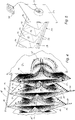
- the illustrated embodiment variant of a cooling and condensation device 10 for a greenhouse 1 with a foil-covered metal frame 2 has at least one, essentially horizontally arranged, tubular condenser 11 (whereby several condensers 11 arranged parallel next to one another are of course advantageous), the wall of which on the Outside 21 is in contact with the air to be cooled in the greenhouse 1 and a cooling medium is applied to the inside 22.
- the tubular Capacitors 11 consist, for example, of lined up hollow bodies 12 made of a foldable film material, which starting from a compact, folded-up storage form (see Fig. 3 ) in the e.g. in the FIGS. 1 and 2 shown elongated operating form can be unfolded.
- the length of the film tube can - compared to the operating form - be shortened by 70% to 95%.
- the hollow bodies 12 of the condenser 11 consist, for example, of the lateral surfaces 13 of straight truncated pyramids or truncated cones, each of which has a base edge 14 and a collar 15 forming a transition opening 16 to the adjacent hollow body 12, the pyramids - Or truncated cones are connected to one another at their base edges 14 and collars 15.
- the hollow bodies 12 of the capacitor 11 have a square cross-sectional area and form a flat, octahedral body, with two opposite, blunt corners being cut off to form the transfer openings 16 for the cooling medium (see FIG Fig. 4 ).
- Fastening means 17, 18 are provided for the horizontal mounting of the tubular condensers 11 in the greenhouse 1, a connecting flange 23 being formed at the inlet end and at the outlet end of each tubular condenser 11, which is connected to a passage opening in a wall, for example the front wall 3 and the rear wall 4 of greenhouse 1, can be connected (see FIGS. 1 and 2 ).
- hooks 17 which are fastened to the hollow bodies 12 and which engage in a support cable 18, preferably made of plastic, can be provided.
- the support cable 18 can be attached to the two connection flanges 23, for example.
- a separating surface 19 which is normal to the longitudinal axis 11 'of the condenser 11 and which has through openings 20 on the edge for the air used as the cooling medium, preferably ambient or outside air (see Fig. 4 , Arrows 35).
- the air used as the cooling medium preferably ambient or outside air (see Fig. 4 , Arrows 35).
- the air flow is deflected several times, the flow path is lengthened and the cooling effect is increased.
- the condensate 36 dripping off the outside 21 of the condenser 11.
- the separating surfaces 19 arranged in the interior of the hollow bodies 12 have a greater wall thickness or are designed to be more rigid than the flexible jacket surface 13 and therefore exercise a support function for the hollow bodies 12 in their elongated operating form.
- a ventilation device 24 is arranged on or in at least one connection flange 23 of the condenser 11, with which a cooling air flow can be produced through the condenser 11 in the pressure direction or suction direction.
- the ventilation device 24 can preferably be driven with the electrical energy from a solar panel 25.
- an inflatable collecting channel 26 for receiving the condensate 36 accumulating on the outside 21 of the condenser 11 can be attached.
- the collecting channel 26 consists of a film material and has inflatable, tubular chambers 27 arranged at the edge, on which holding elements 28 engage, which are fastened to the hollow bodies 12 of the tubular capacitor 11.
- the collecting channels 26 can also be recycled at the end of the season.
- Fig. 6 shows a flat film element for producing a hollow body 12 of the tubular capacitor 11, which is punched or cut out of a plastic film and after welding or gluing along the edges 40 results in the outer surface 13 of a square, square truncated pyramid.
- the four trapezoidal surfaces each have an acute angle of approx. 50 °.
- the individual hollow bodies 12 according to Fig. 7 consist of a first truncated pyramid A and a second truncated pyramid B, the base edges 14 of which are welded or glued to one another with the interposition of a separating surface 19 together with edge-side passage openings 20 for the cooling air. Finally, the individual hollow bodies 12 are welded or glued together on the collar 15, which forms the transition opening 16.
- FIG Fig. 6 It is also possible to use two flat film elements according to FIG Fig. 6 to be placed on top of each other and first welded or glued to the collar line 15. The two film elements are then pulled up in opposite directions and welded at the edges 40. The elements produced in this way are then connected to one another to form a tubular capacitor 11 with a separating surface 19 in between.
- the illustrated embodiment variant of a cooling and condensation device 10 for a greenhouse 1 with a foil-covered metal frame 2 has at least one, essentially vertically arranged, tubular condenser 11 (although several condensers 11 arranged in parallel are also advantageous here), the wall of which is in contact on the outside 21 with the air to be cooled in the greenhouse 1 and on the inside 22 with a cooling medium (cooling water 37 in Drop shape) is applied.
- the tubular capacitors 11 consist, for example - as described above - of concatenated hollow bodies 12 made of a foldable film material which, starting from a compact, folded-up storage form (see FIG Fig. 3 ) into the in Fig. 8 shown elongated operating form can be unfolded.
- a cooling water tank 29 is formed, which has openings 30 on the bottom for discharging cooling water 37 in the form of drops into the Has interior of the tubular capacitor 11.
- the cooling water released in the form of drops drips onto the inside 22 of the hollow bodies 12 made of film material and flows off along the inner surface.
- condensate 36 forms on the outside of the condenser and, in simple design variants, drips directly onto the plants in greenhouse 1.
- a collecting container 31 for the cooling water can be formed at the outlet end of the tubular condenser 11, preferably at an end connection flange 23, with a return device 32 for the cooling water being provided, starting from the collecting container 31, which opens into the cooling water container 29 arranged on the inlet side.
- the return device 32 can be equipped with a cooling water pump 33, which is preferably operated by means of solar energy.
- support cables 18, preferably made of plastic, are stretched between the inlet-side and outlet-side connection flange 23.
- no separating surfaces 19 are provided.
- a collecting pan 34 for receiving the condensate 36 accumulating on the outside 21 of the condenser 11 can be attached to the outlet end of the tubular condenser 11.
- the collecting trough 34 is formed by a circumferential wall 38 of the lower connection flange 23 and has a drainage hose 39.
- Fig. 10 shows a transition element 41 of the vertical capacitor 11 made of foil material which can be welded or glued between (only schematically indicated) adjacent hollow bodies 12 in order to round off the transition on the collar 15 forming the transition opening 16. This measure improves the wetting of the inside of the condenser 11 and prevents the cooling water from dripping off the collar 15.
- the collapsible, tubular condenser 11 can according to FIG Fig. 11 can be formed from several (four in the variant shown) film strips 42 which are welded or glued together at the side edges 43, which are jagged, for example, at an angle of approximately 100 °. Connection flanges 23 are then attached to the ends 44.
Landscapes
- Life Sciences & Earth Sciences (AREA)
- Environmental Sciences (AREA)
- Greenhouses (AREA)
- Heat-Exchange Devices With Radiators And Conduit Assemblies (AREA)
- Fixed Capacitors And Capacitor Manufacturing Machines (AREA)
- Vaporization, Distillation, Condensation, Sublimation, And Cold Traps (AREA)
Description
- Die Erfindung betrifft eine Kühl- und Kondensationseinrichtung für ein Gewächshaus, vorzugsweise ein Folientreibhaus, mit zumindest einem im Gewächshaus angeordneten Kondensator, dessen Wand an der Außenseite mit der zu kühlenden Luft im Gewächshaus in Kontakt steht und an der Innenseite mit einem Kühlmedium beaufschlagt ist.
- Gewächshäuser bzw. Folientreibhäuser werden bei starker Sonneneinstrahlung im Verlauf eines Tages oft in einem Ausmaß aufgeheizt, der für die Kulturen im Inneren des Gewächshauses schädlich ist. Im einfachsten Fall ist es daher notwendig Lüftungsklappen zu öffnen, welche allerdings für die Kulturen schädliche Zugluft erzeugen können und zudem mit der entweichenden Warmluft Wasserdampf abführen und daher den Boden im Inneren des Treibhauses sowie die Kulturen austrocknen.
- Es wurden daher bereits Problemlösungen mit einer Wärmetauschereinrichtung angedacht, welche beispielsweise in der
WO 2015/028470 beschrieben sind. Das hier beschriebene Gewächshaus weist eine Wärmetauschereinrichtung mit insgesamt drei Paaren von Rohrleitungen auf, die über eine Trägereinrichtung an einer Tragstruktur oberhalb des Pflanzenraums des Gewächshauses aufgehängt sind. Bei den Rohrleitungen handelt es sich um Spiralrippenrohre mit radial abstehenden Spiralrippen, wobei die Rohrleitungen mittels der Trägereinrichtung zwischen einer oberen Stellung, im Kopfbereich der Pflanzen, und einer unteren Stellung, im Bereich von Pflanzrinnen verstellt werden können. Im Kühlbetrieb durchströmt Kühlwasser, das vorzugsweise eine Temperatur unter dem Taupunkt der im Gewächshaus befindlichen Luft aufweist, die Rohrleitungen, wobei sich im Kühlbetrieb die Rohrleitungen in der oberen Stellung, im Kopfbereich der Pflanzen befinden, sodass die im Gewächshaus aufsteigende warme, feuchte Luft die Rohrleitungen umströmen kann. Das führt dazu, dass die in der Luft enthaltene Luftfeuchtigkeit an den Rohrleitungen auskondensiert. Das Kondensat kann den Pflanzen zugeführt werden. Die Wärmetauscheinrichtung ist relativ sperrig und schwer, insbesondere wenn man das Gewicht des Kühlwassers berücksichtigt, sodass ein Einbau in Leichtbau-Gewächshäusern oder Folientreibhäusern nicht ohne zusätzliche Stützelemente möglich wäre. - Aufgabe der Erfindung ist es, eine Kühl- und Kondensationseinrichtung für ein Gewächshaus vorzuschlagen, welches sich durch eine einfache und kostengünstige Herstellung auszeichnet, wobei die Möglichkeit einer Nachrüstung bestehender Gewächshäuser und der problemlose Einsatz in Folientreibhäusern gegeben sein soll.
- Diese Aufgabe wird erfindungsgemäß dadurch gelöst, dass der zumindest eine Kondensator als faltbarer Folienschlauch ausgeführt ist und insbesondere aus aneinandergereihten Hohlkörpern aus einem faltbaren Folienmaterial besteht, wobei der schlauchförmige Kondensator ausgehend von einer zusammengefaltenen Lagerform in eine längsgestreckte Betriebsform entfaltbar ist.
- Der Vorteil der Erfindung besteht insbesondere darin, dass anstelle der starren, schweren Struktur der aus der
WO 2015/028470 bekannten Einrichtung, die mit deren Spiralrohren und Aufhängevorrichtungen an die spezielle Form und Abmessung eines Gewächshauses angepasst werden muss, leichte, völlig flexible Kondensatoren aus einem faltbaren Folienmaterial aus Kunststoff verwendet werden, die im zusammengefaltenen Zustand vorrätig gehalten werden und erst bei der Montage im Gewächshaus - ähnlich wie ein Faltenbalg - entfaltet werden. - Einen weiteren Vorteil bietet die Demontage der Kühl- und Kondensationseinrichtung, da wesentliche Teile, nämlich die schlauchförmigen Kondensatoren aus Folienmaterial rezyklierbar sind und daher auch keine Reinigung und Aufbewahrung dieser Teile am Saisonende erforderlich ist.
- Die einzelnen Hohlkörper des Kondensators bestehen bevorzugt aus den Mantelflächen gerader Pyramidenstümpfe oder Kegelstümpfe, die einen Basisrand und eine kragenförmige Übertrittsöffnung zum benachbarten Hohlkörper aufweisen, wobei die Pyramidenstümpfe oder Kegelstümpfe jeweils an deren Basisrändern und Krägen miteinander verbunden sind. Die Grundstruktur kann dreieckig, viereckig oder auch sechseckig sein, wobei auch Hohlkörper in Form eines doppelten Kegelstumpfes möglich sind.
- Vorteile bei der Herstellung ergeben sich dann, wenn die Hohlkörper des Kondensators eine quadratische Querschnittsfläche aufweisen und einen flachen, oktaederartigen Körper bilden, wobei zwei gegenüberliegende, stumpfe Ecken zur Ausbildung der Übertrittsöffnungen für das Kühlmedium abgeschnitten sind.
- Es ergeben sich zwei Hauptausführungsvarianten für die erfindungsgemäße Kühl- und Kondensationseinrichtung, wobei in einer ersten Variante der zumindest eine schlauchförmige Kondensator bzw. mehrere parallel zueinander angeordnete Kondensatoren, in horizontaler Lage im Gewächshaus befestigt werden, sowie eine zweite Ausführungsvariante, bei welcher die schlauchförmigen Kondensatoren in einer vertikalen Ausrichtung frei von der Decke hängend in einem Gewächshaus montiert werden.
- Die bevorzugten Ausführungsvarianten der erfindungsgemäßen Kühl- und Kondensationseinrichtung werden in den nachfolgenden Zeichnungen näher erläutert. Es zeigen:
- Fig. 1
- eine erste Ausführungsvariante einer erfindungsgemäßen Kühlund Kondensationseinrichtung mit einem horizontalen, schlauchförmigen Kondensator in einer dreidimensionalen Ansicht;
- Fig. 2
- ein Detail II des Kondensators aus
Fig. 1 in vergrößerter Darstellung; - Fig. 3
- den Kondensator aus
Fig. 1 in zusammengefaltetem Zustand; - Fig. 4
- eine Detaildarstellung des Kondensators gemäß
Fig. 2 in einem Längsschnitt; - Fig. 5
- den Kondensator gemäß
Fig. 2 mit zusätzlichen Komponenten; - Fig. 6
- ein ebenes Folienelement zur Herstellung eines Hohlkörpers des schlauchförmigen Kondensators;
- Fig. 7
- einzelne Elemente eines Hohlkörpers zur Herstellung des schlauchförmigen Kondensators in dreidimensionaler Darstellung;
- Fig. 8
- eine zweite Ausführungsvariante einer erfindungsgemäßen Kühlund Kondensationseinrichtung mit einem vertikalen, schlauchförmigen Kondensator in einer dreidimensionalen Ansicht;
- Fig. 9
- eine vergrößerte Schnittdarstellung des vertikalen Kondensators gemäß
Fig. 8 ; - Fig. 10
- ein Übergangselement des vertikalen Kondensators zwischen den einzelnen Hohlkörpern; sowie
- Fig. 11
- eine Ausführungsvariante zur Herstellung eines Schlauchförmigen Kondensators gemäß
Fig. 8 . - Die in den
Figuren 1 bis 7 dargestellte Ausführungsvariante einer Kühl- und Kondensationseinrichtung 10 für ein Gewächshaus 1 mit einem folienbedeckten Metallrahmen 2, weist zumindest einen, im Wesentlichen horizontal angeordneten, schlauchförmigen Kondensator 11 auf (wobei natürlich mehrere, parallel nebeneinander angeordnete Kondensatoren 11 von Vorteil sind), deren Wand an der Außenseite 21 mit der zu kühlenden Luft im Gewächshaus 1 in Kontakt steht und an der Innenseite 22 mit einem Kühlmedium beaufschlagt ist. Die schlauchförmigen Kondensatoren 11 bestehen beispielsweise aus aneinandergereihten Hohlkörpern 12 aus einem faltbaren Folienmaterial, welche ausgehend von einer kompakten, zusammengefalteten Lagerform (sieheFig. 3 ) in die z.B. in denFig. 1 und Fig. 2 dargestellte längsgestreckte Betriebsform entfaltbar sind. - In der zusammengefalteten Lagerform kann die Länge des Folienschlauchs - im Vergleich zur Betriebsform - um 70% bis 95% verkürzt sein.
- Zur Vergrößerung der wirksamen Oberfläche der Kühleinrichtung und zur leichteren Faltbarkeit bestehen die Hohlkörper 12 des Kondensators 11 beispielsweise aus den Mantelflächen 13 gerader Pyramidenstümpfe oder Kegelstümpfe, die jeweils einen Basisrand 14 und einen eine Übertrittsöffnung 16 zum benachbarten Hohlkörper 12 bildenden Kragen 15 aufweisen, wobei die Pyramiden- oder Kegelstümpfe jeweils an deren Basisrändern 14 und Krägen 15 miteinander verbunden sind.
- Bei einer einfach herzustellenden Ausführungsvariante (siehe
Fig. 1 bis Fig. 7 ) weisen die Hohlkörper 12 des Kondensators 11 eine quadratische Querschnittsfläche auf und bilden einen flachen, oktaederartigen Körper, wobei zwei gegenüberliegende, stumpfe Ecken zur Ausbildung der Übertrittsöffnungen 16 für das Kühlmedium abgeschnitten sind (sieheFig. 4 ). - Zur horizontalen Montage der schlauchförmigen Kondensatoren 11 im Gewächshaus 1 sind Befestigungsmittel 17, 18 vorgesehen, wobei am Einlassende und am Auslassende jedes schlauchförmigen Kondensators 11 jeweils ein Anschlussflansch 23 ausgebildet ist, der an eine Durchlassöffnung in einer Wand, beispielsweise der Vorderwand 3 und der Hinterwand 4 des Gewächshauses 1, anschließbar ist (siehe
Fig. 1 und Fig. 2 ). - Als Befestigungsmittel für den schlauchförmigen Kondensator 11 können an den Hohlkörpern 12 befestigte Haken 17 vorgesehen sein, die in ein Tragseil 18, vorzugsweise aus Kunststoff, eingreifen. Das Tragseil 18 kann beispielsweise an den beiden Anschlussflanschen 23 befestigt sein.
- Erfindungsgemäß ist im Inneren der Hohlkörper 12 im Bereich des Basisrandes 14 jeweils eine auf die Längsachse 11' des Kondensators 11 normal stehende Trennfläche 19 angeordnet, welche randseitige Durchlassöffnungen 20 für die als Kühlmedium verwendete Luft, vorzugsweise Umgebungs- bzw. Außenluft, aufweist (siehe
Fig. 4 , Pfeile 35). Durch diese Maßnahme wird der Luftstrom mehrfach umgelenkt, der Strömungsweg verlängert und die Kühlwirkung erhöht. Dargestellt ist auch das an der Außenseite 21 des Kondensators 11 abtropfende Kondensat 36. - Die im Inneren der Hohlkörper 12 angeordneten Trennflächen 19 weisen eine größere Wandstärke auf oder sind starrer ausgebildet als die flexible Mantelfläche 13 und üben daher eine Stützfunktion für die Hohlkörper 12 in deren längsgestreckten Betriebsform aus.
- An oder in zumindest einem Anschlussflansch 23 des Kondensators 11 ist eine Ventilationseinrichtung 24 angeordnet, mit welcher ein Kühlluftstrom durch den Kondensator 11 in Druckrichtung oder Saugrichtung herstellbar ist. Bevorzugt kann die Ventilationseinrichtung 24 mit der elektrischen Energie aus einem Solarpaneel 25 angetrieben werden.
- In Betriebsstellung unterhalb des schlauchförmigen Kondensators 11 kann erfindungsgemäß eine aufblasbare Sammelrinne 26 zur Aufnahme des an der Außenseite 21 des Kondensators 11 anfallenden Kondensats 36 befestigt sein. Gemäß der dargestellten Ausführungsvariante (siehe
Fig. 5 ) besteht die Sammelrinne 26 aus einem Folienmaterial und weist randseitig angeordnete, aufblasbare, schlauchförmige Kammern 27 auf, an welchen Halteelemente 28 angreifen, die an den Hohlkörpern 12 des schlauchförmigen Kondensators 11 befestigt sind. Auch die Sammelrinnen 26 können am Saisonende rezykliert werden. -
Fig. 6 zeigt ein ebenes Folienelement zur Herstellung eines Hohlkörpers 12 des schlauchförmigen Kondensators 11, welches aus einer Kunststofffolie ausgestanzt oder ausgeschnitten wird und nach der Verschweißung oder Klebung entlang der Ränder 40 die Mantelfläche 13 eines viereckigen, quadratischen Pyramidenstumpfes ergibt. Die vier Trapezflächen weisen jeweils einen spitzen Winkel von ca. 50° auf. Die einzelnen Hohlkörper 12 gemäßFig. 7 bestehen aus einem ersten Pyramidenstumpf A und einem zweiten Pyramidenstumpf B, deren Basisränder 14 unter Zwischenlage einer Trennfläche 19 samt randseitigen Durchlassöffnungen 20 für die Kühlluft miteinander verschweißt oder verklebt werden. Schließlich werden die einzelnen Hohlkörper 12 am Kragen 15, der die Übertrittsöffnung 16 bildet, verschweißt oder zusammengeklebt. - Es ist auch möglich zwei ebene Folienelemente gemäß
Fig. 6 übereinander zu legen und zunächst an der Kragenlinie 15 zu verschweißen oder zu verkleben. Danach werden die beiden Folienelemente in entgegen gesetzten Richtungen hochgezogen und an den Rändern 40 verschweißt. Die so entstandenen Elemente werden dann unter Zwischenlage jeweils einer Trennfläche 19 miteinander zu einem schlauchförmigen Kondensator 11 verbunden. - Die in den
Figuren 8 bis 10 dargestellte Ausführungsvariante einer Kühl- und Kondensationseinrichtung 10 für ein Gewächshaus 1 mit einem folienbedeckten Metallrahmen 2, weist zumindest einen, im Wesentlichen vertikal angeordneten, schlauchförmigen Kondensator 11 auf (wobei natürlich auch hier mehrere, parallel nebeneinander angeordnete Kondensatoren 11 von Vorteil sind), deren Wand an der Außenseite 21 mit der zu kühlenden Luft im Gewächshaus 1 in Kontakt steht und an der Innenseite 22 mit einem Kühlmedium (Kühlwasser 37 in Tropfenform) beaufschlagt ist. Die schlauchförmigen Kondensatoren 11 bestehen beispielsweise - wie oben beschrieben - aus aneinandergereihten Hohlkörpern 12 aus einem faltbaren Folienmaterial, welche ausgehend von einer kompakten, zusammengefalteten Lagerform (sieheFig. 3 ) in die inFig. 8 dargestellte längsgestreckte Betriebsform entfaltbar sind. - Am Einlassende des schlauchförmigen Kondensators 11, vorzugsweise an einem Anschlussflansch 23, mit welchem der Kondensator an der Dachfolie 5 oder am Metallrahmen 2 des Gewächshauses 1 befestigt ist, ist ein Kühlwasserbehälter 29 ausgebildet, welcher bodenseitige Öffnungen 30 zur Abgabe von Kühlwasser 37 in Tropfenform in das Innere des schlauchförmigen Kondensators 11 aufweist. Das tropfenförmig abgegebene Kühlwasser tropft auf die Innenseite 22 der Hohlkörper 12 aus Folienmaterial und fließt entlang der Innenfläche ab. An der Außenseite des Kondensators bildet sich bei geeigneten Bedingungen Kondensat 36, welches in einfachen Ausführungsvarianten direkt auf die Pflanzen im Gewächshaus 1 tropft.
- Gemäß einer vorteilhaften Weiterbildung kann am Auslassende des schlauchförmigen Kondensators 11, vorzugsweise an einem endseitigen Anschlussflansch 23, ein Auffangbehälter 31 für das Kühlwasser ausgebildet sein, wobei ausgehend vom Auffangbehälter 31 eine in den eingangsseitig angeordneten Kühlwasserbehälter 29 mündende Rückführeinrichtung 32 für das Kühlwasser vorgesehen ist. Weiters kann die Rückführeinrichtung 32 mit einer vorzugsweise mittels Solarenergie betriebenen Kühlwasserpumpe 33 ausgestattet sein.
- Zur Begrenzung der Längserstreckung, des von der Decke des Gewächshauses 1 hängenden Kondensators 11 sind zwischen dem einlassseitigen und dem auslassseitigen Anschlussflansch 23 Tragseile 18, vorzugsweise aus Kunststoff, gespannt. Bei der vertikalen Variante mit Tropfkühlung sind keine Trennflächen 19 vorgesehen.
- Falls das Kondensat 36 nicht frei auf die Kulturen abtropfen soll, kann am Auslassende des schlauchförmigen Kondensators 11 eine Auffangwanne 34 zur Aufnahme des an der Außenseite 21 des Kondensators 11 anfallenden Kondensats 36 befestigt sein. In der dargestellten Ausführungsvariante wird die Auffangwanne 34 durch eine umlaufende Wand 38 des unteren Anschlussflansches 23 gebildet und weist einen Abflussschlauch 39 auf.
-
Fig. 10 zeigt ein Übergangselement 41 des vertikalen Kondensators 11 aus Folienmaterial das zwischen (nur schematisch angedeuteten) benachbarten Hohlkörpern 12 eingeschweißt oder eingeklebt werden kann, um den Übergang an dem die Übertrittsöffnung 16 bildenden Kragen 15 abzurunden. Durch diese Maßnahme wird die Benetzung der Innenseite des Kondensators 11 verbessert und ein Abtropfen des Kühlwassers am Kragen 15 vermieden. - Für die vertikal angeordnete Variante der Kühl- und Kondensationseinrichtung 10 kann der zusammenfaltbare, schlauchförmige Kondensator 11 gemäß
Fig. 11 aus mehreren (in der dargestellten Variante vier) Folienstreifen 42 gebildet sein, die an den beispielsweise im Winkel von ca. 100° gezackten, seitlichen Rändern 43 zusammengeschweißt oder geklebt werden. Anschließend werden an den Enden 44 Anschlussflansche 23 befestigt.
Claims (17)
- Kühl- und Kondensationseinrichtung (10) für ein Gewächshaus (1), vorzugsweise ein Folientreibhaus, mit zumindest einem angeordneten Kondensator (11), dessen Wand an der Außenseite (21) mit der zu kühlenden Luft in Kontakt steht und an der Innenseite (22) mit einem Kühlmedium beaufschlagbar ist, dadurch gekennzeichnet, dass der zumindest eine Kondensator (11) als faltbarer Folienschlauch ausgeführt ist und insbesondere aus aneinandergereihten Hohlkörpern (12) aus einem faltbaren Folienmaterial besteht, wobei der schlauchförmige Kondensator (11) ausgehend von einer zusammengefalteten Lagerform in eine längsgestreckte Betriebsform entfaltbar ist.
- Kühl- und Kondensationseinrichtung (10) nach Anspruch 1, dadurch gekennzeichnet, dass die Hohlkörper (12) des Kondensators (11) aus den Mantelflächen (13) gerader Pyramidenstümpfe oder Kegelstümpfe bestehen, die jeweils einen Basisrand (14) und einen eine Übertrittsöffnung (16) zum benachbarten Hohlkörper (12) bildenden Kragen (15) aufweisen, wobei die Pyramidenstümpfe oder Kegelstümpfe jeweils an deren Basisrändern (14) und Krägen (15) miteinander verbunden sind.
- Kühl- und Kondensationseinrichtung (10) nach Anspruch 2, dadurch gekennzeichnet, dass die Hohlkörper (12) des Kondensators (11) eine quadratische Querschnittsfläche aufweisen und einen flachen, oktaederartigen Körper bilden, wobei zwei gegenüberliegende, stumpfe Ecken zur Ausbildung der Übertrittsöffnungen (16) abgeschnitten sind .
- Kühl- und Kondensationseinrichtung (10) nach einem der Ansprüche 1 bis 3, dadurch gekennzeichnet, dass der zumindest eine schlauchförmige Kondensator (11) Befestigungsmittel (17, 18) zur horizontalen Montage aufweist.
- Kühl- und Kondensationseinrichtung (10) nach Anspruch 4, dadurch gekennzeichnet, dass im Inneren der Hohlkörper (12) im Bereich des Basisrandes (14) jeweils eine auf die Längsachse (11') des Kondensators (11) normal stehende Trennfläche (19) angeordnet ist, welche randseitige Durchlassöffnungen (20) für als Kühlmedium verwendete Luft, vorzugsweise Außenluft, aufweist.
- Kühl- und Kondensationseinrichtung (10) nach Anspruch 5, dadurch gekennzeichnet, dass die im Inneren der Hohlkörper (12) angeordneten Trennflächen (19) eine größere Wandstärke aufweisen oder starrer ausgebildet sind als die Mantelfläche (13) und eine Stützfunktion für die Hohlkörper (12) in deren längsgestreckten Betriebsform ausüben.
- Kühl- und Kondensationseinrichtung (10) nach einem der Ansprüche 4 bis 6, dadurch gekennzeichnet, dass am Einlassende und am Auslassende jedes schlauchförmigen Kondensators (11) jeweils ein Anschlussflansch (23) ausgebildet ist, der an eine Durchlassöffnung in einer Wand (3, 4) eines Gewächshauses (1) anschließbar ist.
- Kühl- und Kondensationseinrichtung (10) nach einem der Ansprüche 4 bis 7, dadurch gekennzeichnet, dass als Befestigungsmittel für den schlauchförmigen Kondensator (11) an den Hohlkörpern (12) befestigte Haken (17) vorgesehen sind, die in ein Tragseil (18), vorzugsweise aus Kunststoff, eingreifen.
- Kühl- und Kondensationseinrichtung (10) nach Anspruch 7 oder 8, dadurch gekennzeichnet, dass an oder in zumindest einem Anschlussflansch (23) des Kondensators (11) eine Ventilationseinrichtung (24) angeordnet ist, mit welcher ein Kühlluftstrom durch den Kondensator (11) herstellbar ist.
- Kühl- und Kondensationseinrichtung (10) nach einem der Ansprüche 4 bis 9, dadurch gekennzeichnet, dass in Betriebsstellung unterhalb des schlauchförmigen Kondensators (11) eine aufblasbare Sammelrinne (26) zur Aufnahme des an der Außenseite (21) des Kondensators (11) anfallenden Kondensats befestigt ist.
- Kühl- und Kondensationseinrichtung (10) nach Anspruch 10, dadurch gekennzeichnet, dass die Sammelrinne (26) aus einem Folienmaterial besteht und randseitig angeordnete, aufblasbare, schlauchförmige Kammern (27) aufweist, an welchen Halteelemente (28) angreifen, die an den Hohlkörpern (12) des schlauchförmigen Kondensators befestigt sind.
- Kühl- und Kondensationseinrichtung (10) nach einem der Ansprüche 1 bis 3, dadurch gekennzeichnet, dass der zumindest eine schlauchförmige Kondensator (11) Befestigungsmittel (18, 23) zur vertikalen Montage aufweist.
- Kühl- und Kondensationseinrichtung (10) nach Anspruch 12, dadurch gekennzeichnet, dass am Einlassende des schlauchförmigen Kondensators (11), vorzugsweise an einem Anschlussflansch (23), ein Kühlwasserbehälter (29) ausgebildet ist, welcher bodenseitige Öffnungen (30) zur Abgabe von Kühlwasser in Tropfenform in das Innere des schlauchförmigen Kondensators (11) aufweist, derart, dass das tropfenförmig abgegebene Kühlwasser auf die Innenseite (22) der Hohlkörper (12) aus Folienmaterial tropft und entlang der Innenfläche abfließt.
- Kühl- und Kondensationseinrichtung (10) nach Anspruch 12 oder 13, dadurch gekennzeichnet, dass am Auslassende des schlauchförmigen Kondensators (11), vorzugsweise an einem Anschlussflansch (23), ein Auffangbehälter (31) für das Kühlwasser ausgebildet ist, sowie dass ausgehend vom Auffangbehälter (31) eine in den eingangsseitig angeordneten Kühlwasserbehälter (29) mündende Rückführeinrichtung (32) für das Kühlwasser vorgesehen ist.
- Kühl- und Kondensationseinrichtung (10) nach Anspruch 14, dadurch gekennzeichnet, dass die Rückführeinrichtung (32) für das Kühlwasser eine vorzugsweise mittels Solarenergie betriebene Kühlwasserpumpe (33) aufweist.
- Kühl- und Kondensationseinrichtung (10) nach Anspruch 14 oder 15, dadurch gekennzeichnet, dass zwischen dem einlassseitigen und dem auslassseitigen Anschlussflansch (23) Tragseile (18), vorzugsweise aus Kunststoff, gespannt sind, die die Längserstreckung des schlauchförmigen Kondensators (11) begrenzen.
- Kühl- und Kondensationseinrichtung (10) nach einem der Ansprüche 12 bis 16, dadurch gekennzeichnet, dass am Auslassende des schlauchförmigen Kondensators (11) eine Auffangwanne (34) zur Aufnahme des an der Außenseite (21) des Kondensators (11) anfallenden Kondensats befestigt ist.
Applications Claiming Priority (2)
| Application Number | Priority Date | Filing Date | Title |
|---|---|---|---|
| ATA50641/2015A AT517237B1 (de) | 2015-07-21 | 2015-07-21 | Kühl- und kondensationseinrichtung für ein gewächshaus |
| PCT/EP2016/067173 WO2017013112A1 (de) | 2015-07-21 | 2016-07-19 | Kühl- und kondensationseinrichtung für ein gewächshaus |
Publications (2)
| Publication Number | Publication Date |
|---|---|
| EP3324729A1 EP3324729A1 (de) | 2018-05-30 |
| EP3324729B1 true EP3324729B1 (de) | 2021-03-17 |
Family
ID=56684587
Family Applications (1)
| Application Number | Title | Priority Date | Filing Date |
|---|---|---|---|
| EP16751188.0A Active EP3324729B1 (de) | 2015-07-21 | 2016-07-19 | Kühl- und kondensationseinrichtung für ein gewächshaus |
Country Status (8)
| Country | Link |
|---|---|
| US (1) | US10881053B2 (de) |
| EP (1) | EP3324729B1 (de) |
| CN (1) | CN107920476B (de) |
| AT (1) | AT517237B1 (de) |
| AU (1) | AU2016295011B2 (de) |
| BR (1) | BR112018001334B1 (de) |
| ES (1) | ES2874797T3 (de) |
| WO (1) | WO2017013112A1 (de) |
Families Citing this family (2)
| Publication number | Priority date | Publication date | Assignee | Title |
|---|---|---|---|---|
| WO2020060402A1 (en) * | 2018-09-20 | 2020-03-26 | B. Van Den Berg Holding B.V. | A greenhouse having a climate control system, climate control system and method of operating the greenhouse |
| AT521950B1 (de) * | 2018-11-26 | 2020-06-15 | Kerschgens Daniel | Kühl- und/oder Kondensationseinrichtung für einen Innenraum |
Family Cites Families (30)
| Publication number | Priority date | Publication date | Assignee | Title |
|---|---|---|---|---|
| US2625872A (en) * | 1947-12-03 | 1953-01-20 | Follansbee Rogers | Air circulating unit |
| US2804284A (en) * | 1953-04-03 | 1957-08-27 | Griscom Russell Co | Heat exchanger |
| US3359687A (en) * | 1964-08-17 | 1967-12-26 | Haveg Industries Inc | Expansible seal |
| US4163342A (en) * | 1978-03-24 | 1979-08-07 | General Electric Company | Controlled environment agriculture facility and method for its operation |
| US4290242A (en) * | 1979-03-23 | 1981-09-22 | Gregory Jr William T | Greenhouse tubular insulation barrier |
| US4291499A (en) * | 1979-08-14 | 1981-09-29 | Prewer John R | Propagation of plants |
| US4352259A (en) * | 1980-03-24 | 1982-10-05 | X. S. Smith, Inc. | Movable inflatable ceiling or partition for greenhouse use |
| EP0097051A1 (de) * | 1982-06-11 | 1983-12-28 | Mortimer Technology Limited | Blende |
| US4672888A (en) * | 1985-01-03 | 1987-06-16 | Insul-Rib, Inc. | Inflatable greenhouse vent cover |
| NL194529C (nl) * | 1990-08-24 | 2002-07-02 | Wiebe Jan Boter | Inrichting voor het kweken van een gewas in een in hoofdzaak gesloten ruimte. |
| JP2001201286A (ja) * | 2000-01-21 | 2001-07-27 | Mitsubishi Heavy Ind Ltd | 熱交換チューブ |
| CN2428969Y (zh) * | 2000-06-08 | 2001-05-09 | 北京市富通环境工程公司 | 温室高效地中热交换装置 |
| US6442903B1 (en) * | 2000-11-13 | 2002-09-03 | Thomas H. Hebert | Inflatable insulative covering |
| CN1312450A (zh) * | 2001-02-28 | 2001-09-12 | 任春严 | 节水、节能的装置和方法 |
| DE10223578A1 (de) | 2002-05-27 | 2003-12-24 | Hubert Hamm | Vorrichtung zur Brauchwassergewinnung |
| US20040099408A1 (en) * | 2002-11-26 | 2004-05-27 | Shabtay Yoram Leon | Interconnected microchannel tube |
| US20040194371A1 (en) * | 2003-04-02 | 2004-10-07 | Kinnis Ralph Arthur | Greenhouse climate control system |
| CA2432097C (en) * | 2003-06-12 | 2008-04-15 | Jean-Guy Dube | Ventilation barrier |
| KR100672778B1 (ko) * | 2005-05-30 | 2007-01-22 | 김명한 | 농업용 열교환 합성수지 |
| GB0519791D0 (en) * | 2005-09-29 | 2005-11-09 | Cote Eric | Inflatable insulating panel |
| US8397434B2 (en) * | 2006-03-28 | 2013-03-19 | David Bayne | Greenhouse insulation system |
| GB2472041A (en) * | 2009-07-22 | 2011-01-26 | Questor Group Ltd C | Greenhouse having a system of watering by collecting condensate |
| JP2011252619A (ja) * | 2010-05-31 | 2011-12-15 | Pura Giken:Kk | 熱交換用パイプ |
| CN202101592U (zh) * | 2011-03-30 | 2012-01-04 | 鹿泽海 | 实用新型换热器 |
| CN202420220U (zh) * | 2011-12-26 | 2012-09-05 | 北京广厦环能科技有限公司 | 螺旋折流板波纹管冷凝器 |
| DE102013217286B4 (de) * | 2013-08-29 | 2015-04-30 | Humboldt-Universität Zu Berlin | Wärmetauschereinrichtung für ein Gewächshaus |
| NL2011966C2 (nl) * | 2013-12-16 | 2015-06-17 | Maurice Kassenbouw B V | Warenhuis en werkwijze voor klimaatbeheersing in een warenhuis. |
| CN204006817U (zh) | 2014-07-29 | 2014-12-10 | 河南科隆集团有限公司 | 一种褶皱式吹胀冷凝器 |
| CN104142075B (zh) * | 2014-08-20 | 2015-12-16 | 济南巴顿化肥有限公司 | 一种化肥冷却机 |
| CN204377496U (zh) * | 2014-12-25 | 2015-06-10 | 王琛 | 一种冷藏库改造的菇房 |
-
2015
- 2015-07-21 AT ATA50641/2015A patent/AT517237B1/de not_active IP Right Cessation
-
2016
- 2016-07-19 US US15/746,015 patent/US10881053B2/en not_active Expired - Fee Related
- 2016-07-19 WO PCT/EP2016/067173 patent/WO2017013112A1/de not_active Ceased
- 2016-07-19 CN CN201680049501.6A patent/CN107920476B/zh not_active Expired - Fee Related
- 2016-07-19 BR BR112018001334-0A patent/BR112018001334B1/pt not_active IP Right Cessation
- 2016-07-19 ES ES16751188T patent/ES2874797T3/es active Active
- 2016-07-19 AU AU2016295011A patent/AU2016295011B2/en not_active Ceased
- 2016-07-19 EP EP16751188.0A patent/EP3324729B1/de active Active
Non-Patent Citations (1)
| Title |
|---|
| None * |
Also Published As
| Publication number | Publication date |
|---|---|
| AU2016295011A1 (en) | 2018-02-22 |
| AT517237B1 (de) | 2016-12-15 |
| AU2016295011B2 (en) | 2020-08-06 |
| WO2017013112A1 (de) | 2017-01-26 |
| CN107920476B (zh) | 2020-11-27 |
| US10881053B2 (en) | 2021-01-05 |
| BR112018001334A2 (pt) | 2018-09-11 |
| EP3324729A1 (de) | 2018-05-30 |
| ES2874797T3 (es) | 2021-11-05 |
| BR112018001334B1 (pt) | 2021-11-03 |
| US20180199522A1 (en) | 2018-07-19 |
| CN107920476A (zh) | 2018-04-17 |
| AT517237A4 (de) | 2016-12-15 |
Similar Documents
| Publication | Publication Date | Title |
|---|---|---|
| EP3077670B1 (de) | Übergangskörper zwischen turmabschnitten einer windkraftanlage und turm einer windkraftanlage umfassend einen übergangskörper | |
| DE102010011365B4 (de) | Wetterschutz für Arbeitsbühnen an Propellerblättern von Windkraftanlagen | |
| WO2016050228A1 (de) | Anlage zur kondensation von dampf | |
| DE202014104666U1 (de) | Anlage zur Kondensation von Dampf | |
| DE102008013013A1 (de) | Wärmeübertragendes Rohr | |
| EP3324729B1 (de) | Kühl- und kondensationseinrichtung für ein gewächshaus | |
| EP3728975B1 (de) | Luftgekühlte kondensatoranlage | |
| AT517220B1 (de) | Solarthermische vorrichtung zur aufbereitung von trinkwasser aus abwasser | |
| AT509426B1 (de) | Vorrichtung zur gewinnung von frischwasser aus rohwasser | |
| DE102010006370B4 (de) | Wärmetauscher | |
| DE102007017876B4 (de) | Ölfangvorrichtung, Getriebe und Verfahren | |
| WO2012136609A1 (de) | Vorrichtung und verfahren zur kondensation von dampf in einem behälter | |
| EP2520872B1 (de) | Solarturmkraftwerk-Solarempfänger | |
| AT521950B1 (de) | Kühl- und/oder Kondensationseinrichtung für einen Innenraum | |
| DE3045662A1 (de) | Waermeabsorber zum entziehen von waermeenergie aus der umgebung und/oder aus der sonnenstrahlung fuer den betrieb von heizungsanlagen | |
| EP2940418A1 (de) | Flüssigkeitsverteileinrichtung | |
| EP0125673B1 (de) | Wärmetauscher | |
| DE102009043308B4 (de) | Wärmetauscher | |
| EP1382916A2 (de) | Wärmeübertrager mit spiralförmig angeordneten Kunststoff-Kapillarrohrmatten und Verfahren zu seiner Anwendung | |
| DE202006013779U1 (de) | Windkraftanlage | |
| DE102006051903A1 (de) | Kompaktlüfter, bestehend aus Wärmetauscher mit integrierten oder angedockten Ventilatoren | |
| EP2188581B1 (de) | Luftbeaufschlagter trockenkühler | |
| DE1939245A1 (de) | Kondensator fuer das Kopfprodukt einer Destillier- oder Rektifizier-Kolonne | |
| DE102014012131A1 (de) | Wärmeübertragungselement; Anordnung eines Wärmeübertragungselements zur Herstellung eines Energiespeichers | |
| DE2431851A1 (de) | Trockener querstrom-kuehlturm |
Legal Events
| Date | Code | Title | Description |
|---|---|---|---|
| STAA | Information on the status of an ep patent application or granted ep patent |
Free format text: STATUS: THE INTERNATIONAL PUBLICATION HAS BEEN MADE |
|
| PUAI | Public reference made under article 153(3) epc to a published international application that has entered the european phase |
Free format text: ORIGINAL CODE: 0009012 |
|
| STAA | Information on the status of an ep patent application or granted ep patent |
Free format text: STATUS: REQUEST FOR EXAMINATION WAS MADE |
|
| 17P | Request for examination filed |
Effective date: 20180122 |
|
| AK | Designated contracting states |
Kind code of ref document: A1 Designated state(s): AL AT BE BG CH CY CZ DE DK EE ES FI FR GB GR HR HU IE IS IT LI LT LU LV MC MK MT NL NO PL PT RO RS SE SI SK SM TR |
|
| AX | Request for extension of the european patent |
Extension state: BA ME |
|
| DAV | Request for validation of the european patent (deleted) | ||
| DAX | Request for extension of the european patent (deleted) | ||
| GRAP | Despatch of communication of intention to grant a patent |
Free format text: ORIGINAL CODE: EPIDOSNIGR1 |
|
| STAA | Information on the status of an ep patent application or granted ep patent |
Free format text: STATUS: GRANT OF PATENT IS INTENDED |
|
| INTG | Intention to grant announced |
Effective date: 20201113 |
|
| GRAS | Grant fee paid |
Free format text: ORIGINAL CODE: EPIDOSNIGR3 |
|
| GRAA | (expected) grant |
Free format text: ORIGINAL CODE: 0009210 |
|
| STAA | Information on the status of an ep patent application or granted ep patent |
Free format text: STATUS: THE PATENT HAS BEEN GRANTED |
|
| AK | Designated contracting states |
Kind code of ref document: B1 Designated state(s): AL AT BE BG CH CY CZ DE DK EE ES FI FR GB GR HR HU IE IS IT LI LT LU LV MC MK MT NL NO PL PT RO RS SE SI SK SM TR |
|
| REG | Reference to a national code |
Ref country code: GB Ref legal event code: FG4D Free format text: NOT ENGLISH |
|
| REG | Reference to a national code |
Ref country code: CH Ref legal event code: EP |
|
| REG | Reference to a national code |
Ref country code: DE Ref legal event code: R096 Ref document number: 502016012617 Country of ref document: DE |
|
| REG | Reference to a national code |
Ref country code: IE Ref legal event code: FG4D Free format text: LANGUAGE OF EP DOCUMENT: GERMAN |
|
| REG | Reference to a national code |
Ref country code: AT Ref legal event code: REF Ref document number: 1371334 Country of ref document: AT Kind code of ref document: T Effective date: 20210415 |
|
| REG | Reference to a national code |
Ref country code: LT Ref legal event code: MG9D |
|
| PG25 | Lapsed in a contracting state [announced via postgrant information from national office to epo] |
Ref country code: BG Free format text: LAPSE BECAUSE OF FAILURE TO SUBMIT A TRANSLATION OF THE DESCRIPTION OR TO PAY THE FEE WITHIN THE PRESCRIBED TIME-LIMIT Effective date: 20210617 Ref country code: NO Free format text: LAPSE BECAUSE OF FAILURE TO SUBMIT A TRANSLATION OF THE DESCRIPTION OR TO PAY THE FEE WITHIN THE PRESCRIBED TIME-LIMIT Effective date: 20210617 Ref country code: FI Free format text: LAPSE BECAUSE OF FAILURE TO SUBMIT A TRANSLATION OF THE DESCRIPTION OR TO PAY THE FEE WITHIN THE PRESCRIBED TIME-LIMIT Effective date: 20210317 Ref country code: GR Free format text: LAPSE BECAUSE OF FAILURE TO SUBMIT A TRANSLATION OF THE DESCRIPTION OR TO PAY THE FEE WITHIN THE PRESCRIBED TIME-LIMIT Effective date: 20210618 Ref country code: HR Free format text: LAPSE BECAUSE OF FAILURE TO SUBMIT A TRANSLATION OF THE DESCRIPTION OR TO PAY THE FEE WITHIN THE PRESCRIBED TIME-LIMIT Effective date: 20210317 |
|
| REG | Reference to a national code |
Ref country code: NL Ref legal event code: MP Effective date: 20210317 |
|
| PG25 | Lapsed in a contracting state [announced via postgrant information from national office to epo] |
Ref country code: LV Free format text: LAPSE BECAUSE OF FAILURE TO SUBMIT A TRANSLATION OF THE DESCRIPTION OR TO PAY THE FEE WITHIN THE PRESCRIBED TIME-LIMIT Effective date: 20210317 Ref country code: RS Free format text: LAPSE BECAUSE OF FAILURE TO SUBMIT A TRANSLATION OF THE DESCRIPTION OR TO PAY THE FEE WITHIN THE PRESCRIBED TIME-LIMIT Effective date: 20210317 Ref country code: SE Free format text: LAPSE BECAUSE OF FAILURE TO SUBMIT A TRANSLATION OF THE DESCRIPTION OR TO PAY THE FEE WITHIN THE PRESCRIBED TIME-LIMIT Effective date: 20210317 |
|
| PG25 | Lapsed in a contracting state [announced via postgrant information from national office to epo] |
Ref country code: NL Free format text: LAPSE BECAUSE OF FAILURE TO SUBMIT A TRANSLATION OF THE DESCRIPTION OR TO PAY THE FEE WITHIN THE PRESCRIBED TIME-LIMIT Effective date: 20210317 |
|
| PG25 | Lapsed in a contracting state [announced via postgrant information from national office to epo] |
Ref country code: LT Free format text: LAPSE BECAUSE OF FAILURE TO SUBMIT A TRANSLATION OF THE DESCRIPTION OR TO PAY THE FEE WITHIN THE PRESCRIBED TIME-LIMIT Effective date: 20210317 Ref country code: CZ Free format text: LAPSE BECAUSE OF FAILURE TO SUBMIT A TRANSLATION OF THE DESCRIPTION OR TO PAY THE FEE WITHIN THE PRESCRIBED TIME-LIMIT Effective date: 20210317 Ref country code: EE Free format text: LAPSE BECAUSE OF FAILURE TO SUBMIT A TRANSLATION OF THE DESCRIPTION OR TO PAY THE FEE WITHIN THE PRESCRIBED TIME-LIMIT Effective date: 20210317 Ref country code: SM Free format text: LAPSE BECAUSE OF FAILURE TO SUBMIT A TRANSLATION OF THE DESCRIPTION OR TO PAY THE FEE WITHIN THE PRESCRIBED TIME-LIMIT Effective date: 20210317 |
|
| REG | Reference to a national code |
Ref country code: ES Ref legal event code: FG2A Ref document number: 2874797 Country of ref document: ES Kind code of ref document: T3 Effective date: 20211105 |
|
| PG25 | Lapsed in a contracting state [announced via postgrant information from national office to epo] |
Ref country code: IS Free format text: LAPSE BECAUSE OF FAILURE TO SUBMIT A TRANSLATION OF THE DESCRIPTION OR TO PAY THE FEE WITHIN THE PRESCRIBED TIME-LIMIT Effective date: 20210717 Ref country code: PT Free format text: LAPSE BECAUSE OF FAILURE TO SUBMIT A TRANSLATION OF THE DESCRIPTION OR TO PAY THE FEE WITHIN THE PRESCRIBED TIME-LIMIT Effective date: 20210719 Ref country code: PL Free format text: LAPSE BECAUSE OF FAILURE TO SUBMIT A TRANSLATION OF THE DESCRIPTION OR TO PAY THE FEE WITHIN THE PRESCRIBED TIME-LIMIT Effective date: 20210317 Ref country code: SK Free format text: LAPSE BECAUSE OF FAILURE TO SUBMIT A TRANSLATION OF THE DESCRIPTION OR TO PAY THE FEE WITHIN THE PRESCRIBED TIME-LIMIT Effective date: 20210317 Ref country code: RO Free format text: LAPSE BECAUSE OF FAILURE TO SUBMIT A TRANSLATION OF THE DESCRIPTION OR TO PAY THE FEE WITHIN THE PRESCRIBED TIME-LIMIT Effective date: 20210317 |
|
| REG | Reference to a national code |
Ref country code: DE Ref legal event code: R097 Ref document number: 502016012617 Country of ref document: DE |
|
| PLBE | No opposition filed within time limit |
Free format text: ORIGINAL CODE: 0009261 |
|
| STAA | Information on the status of an ep patent application or granted ep patent |
Free format text: STATUS: NO OPPOSITION FILED WITHIN TIME LIMIT |
|
| PG25 | Lapsed in a contracting state [announced via postgrant information from national office to epo] |
Ref country code: AL Free format text: LAPSE BECAUSE OF FAILURE TO SUBMIT A TRANSLATION OF THE DESCRIPTION OR TO PAY THE FEE WITHIN THE PRESCRIBED TIME-LIMIT Effective date: 20210317 Ref country code: DK Free format text: LAPSE BECAUSE OF FAILURE TO SUBMIT A TRANSLATION OF THE DESCRIPTION OR TO PAY THE FEE WITHIN THE PRESCRIBED TIME-LIMIT Effective date: 20210317 |
|
| REG | Reference to a national code |
Ref country code: DE Ref legal event code: R119 Ref document number: 502016012617 Country of ref document: DE |
|
| 26N | No opposition filed |
Effective date: 20211220 |
|
| PG25 | Lapsed in a contracting state [announced via postgrant information from national office to epo] |
Ref country code: SI Free format text: LAPSE BECAUSE OF FAILURE TO SUBMIT A TRANSLATION OF THE DESCRIPTION OR TO PAY THE FEE WITHIN THE PRESCRIBED TIME-LIMIT Effective date: 20210317 |
|
| REG | Reference to a national code |
Ref country code: CH Ref legal event code: PL |
|
| GBPC | Gb: european patent ceased through non-payment of renewal fee |
Effective date: 20210719 |
|
| PG25 | Lapsed in a contracting state [announced via postgrant information from national office to epo] |
Ref country code: MC Free format text: LAPSE BECAUSE OF FAILURE TO SUBMIT A TRANSLATION OF THE DESCRIPTION OR TO PAY THE FEE WITHIN THE PRESCRIBED TIME-LIMIT Effective date: 20210317 |
|
| REG | Reference to a national code |
Ref country code: BE Ref legal event code: MM Effective date: 20210731 |
|
| PG25 | Lapsed in a contracting state [announced via postgrant information from national office to epo] |
Ref country code: LI Free format text: LAPSE BECAUSE OF NON-PAYMENT OF DUE FEES Effective date: 20210731 Ref country code: GB Free format text: LAPSE BECAUSE OF NON-PAYMENT OF DUE FEES Effective date: 20210719 Ref country code: DE Free format text: LAPSE BECAUSE OF NON-PAYMENT OF DUE FEES Effective date: 20220201 Ref country code: CH Free format text: LAPSE BECAUSE OF NON-PAYMENT OF DUE FEES Effective date: 20210731 |
|
| PG25 | Lapsed in a contracting state [announced via postgrant information from national office to epo] |
Ref country code: IS Free format text: LAPSE BECAUSE OF FAILURE TO SUBMIT A TRANSLATION OF THE DESCRIPTION OR TO PAY THE FEE WITHIN THE PRESCRIBED TIME-LIMIT Effective date: 20210717 Ref country code: LU Free format text: LAPSE BECAUSE OF NON-PAYMENT OF DUE FEES Effective date: 20210719 Ref country code: FR Free format text: LAPSE BECAUSE OF NON-PAYMENT OF DUE FEES Effective date: 20210731 |
|
| PG25 | Lapsed in a contracting state [announced via postgrant information from national office to epo] |
Ref country code: IE Free format text: LAPSE BECAUSE OF NON-PAYMENT OF DUE FEES Effective date: 20210719 Ref country code: BE Free format text: LAPSE BECAUSE OF NON-PAYMENT OF DUE FEES Effective date: 20210731 |
|
| REG | Reference to a national code |
Ref country code: AT Ref legal event code: MM01 Ref document number: 1371334 Country of ref document: AT Kind code of ref document: T Effective date: 20210719 |
|
| PG25 | Lapsed in a contracting state [announced via postgrant information from national office to epo] |
Ref country code: AT Free format text: LAPSE BECAUSE OF NON-PAYMENT OF DUE FEES Effective date: 20210719 |
|
| PG25 | Lapsed in a contracting state [announced via postgrant information from national office to epo] |
Ref country code: HU Free format text: LAPSE BECAUSE OF FAILURE TO SUBMIT A TRANSLATION OF THE DESCRIPTION OR TO PAY THE FEE WITHIN THE PRESCRIBED TIME-LIMIT; INVALID AB INITIO Effective date: 20160719 |
|
| PG25 | Lapsed in a contracting state [announced via postgrant information from national office to epo] |
Ref country code: CY Free format text: LAPSE BECAUSE OF FAILURE TO SUBMIT A TRANSLATION OF THE DESCRIPTION OR TO PAY THE FEE WITHIN THE PRESCRIBED TIME-LIMIT Effective date: 20210317 |
|
| PGFP | Annual fee paid to national office [announced via postgrant information from national office to epo] |
Ref country code: TR Payment date: 20230719 Year of fee payment: 8 Ref country code: IT Payment date: 20230731 Year of fee payment: 8 Ref country code: ES Payment date: 20230821 Year of fee payment: 8 |
|
| PG25 | Lapsed in a contracting state [announced via postgrant information from national office to epo] |
Ref country code: MK Free format text: LAPSE BECAUSE OF FAILURE TO SUBMIT A TRANSLATION OF THE DESCRIPTION OR TO PAY THE FEE WITHIN THE PRESCRIBED TIME-LIMIT Effective date: 20210317 |
|
| PG25 | Lapsed in a contracting state [announced via postgrant information from national office to epo] |
Ref country code: MT Free format text: LAPSE BECAUSE OF FAILURE TO SUBMIT A TRANSLATION OF THE DESCRIPTION OR TO PAY THE FEE WITHIN THE PRESCRIBED TIME-LIMIT Effective date: 20210317 |
|
| PG25 | Lapsed in a contracting state [announced via postgrant information from national office to epo] |
Ref country code: IT Free format text: LAPSE BECAUSE OF NON-PAYMENT OF DUE FEES Effective date: 20240719 |
|
| REG | Reference to a national code |
Ref country code: ES Ref legal event code: FD2A Effective date: 20250829 |
|
| PG25 | Lapsed in a contracting state [announced via postgrant information from national office to epo] |
Ref country code: ES Free format text: LAPSE BECAUSE OF NON-PAYMENT OF DUE FEES Effective date: 20240720 |