EP3325536B1 - Verfahren zur stabilisierung einer polyaryletherketon (paek) zusammensetzung - Google Patents
Verfahren zur stabilisierung einer polyaryletherketon (paek) zusammensetzung Download PDFInfo
- Publication number
- EP3325536B1 EP3325536B1 EP16757297.3A EP16757297A EP3325536B1 EP 3325536 B1 EP3325536 B1 EP 3325536B1 EP 16757297 A EP16757297 A EP 16757297A EP 3325536 B1 EP3325536 B1 EP 3325536B1
- Authority
- EP
- European Patent Office
- Prior art keywords
- phosphate
- composition
- paek
- pekk
- phosphate salt
- Prior art date
- Legal status (The legal status is an assumption and is not a legal conclusion. Google has not performed a legal analysis and makes no representation as to the accuracy of the status listed.)
- Active
Links
Images

Classifications
-
- C—CHEMISTRY; METALLURGY
- C08—ORGANIC MACROMOLECULAR COMPOUNDS; THEIR PREPARATION OR CHEMICAL WORKING-UP; COMPOSITIONS BASED THEREON
- C08G—MACROMOLECULAR COMPOUNDS OBTAINED OTHERWISE THAN BY REACTIONS ONLY INVOLVING UNSATURATED CARBON-TO-CARBON BONDS
- C08G65/00—Macromolecular compounds obtained by reactions forming an ether link in the main chain of the macromolecule
- C08G65/34—Macromolecular compounds obtained by reactions forming an ether link in the main chain of the macromolecule from hydroxy compounds or their metallic derivatives
- C08G65/38—Macromolecular compounds obtained by reactions forming an ether link in the main chain of the macromolecule from hydroxy compounds or their metallic derivatives derived from phenols
- C08G65/40—Macromolecular compounds obtained by reactions forming an ether link in the main chain of the macromolecule from hydroxy compounds or their metallic derivatives derived from phenols from phenols (I) and other compounds (II), e.g. OH-Ar-OH + X-Ar-X, where X is halogen atom, i.e. leaving group
-
- C—CHEMISTRY; METALLURGY
- C08—ORGANIC MACROMOLECULAR COMPOUNDS; THEIR PREPARATION OR CHEMICAL WORKING-UP; COMPOSITIONS BASED THEREON
- C08G—MACROMOLECULAR COMPOUNDS OBTAINED OTHERWISE THAN BY REACTIONS ONLY INVOLVING UNSATURATED CARBON-TO-CARBON BONDS
- C08G65/00—Macromolecular compounds obtained by reactions forming an ether link in the main chain of the macromolecule
- C08G65/34—Macromolecular compounds obtained by reactions forming an ether link in the main chain of the macromolecule from hydroxy compounds or their metallic derivatives
- C08G65/38—Macromolecular compounds obtained by reactions forming an ether link in the main chain of the macromolecule from hydroxy compounds or their metallic derivatives derived from phenols
- C08G65/40—Macromolecular compounds obtained by reactions forming an ether link in the main chain of the macromolecule from hydroxy compounds or their metallic derivatives derived from phenols from phenols (I) and other compounds (II), e.g. OH-Ar-OH + X-Ar-X, where X is halogen atom, i.e. leaving group
- C08G65/4012—Other compound (II) containing a ketone group, e.g. X-Ar-C(=O)-Ar-X for polyetherketones
-
- C—CHEMISTRY; METALLURGY
- C08—ORGANIC MACROMOLECULAR COMPOUNDS; THEIR PREPARATION OR CHEMICAL WORKING-UP; COMPOSITIONS BASED THEREON
- C08K—Use of inorganic or non-macromolecular organic substances as compounding ingredients
- C08K3/00—Use of inorganic substances as compounding ingredients
- C08K3/32—Phosphorus-containing compounds
-
- C—CHEMISTRY; METALLURGY
- C08—ORGANIC MACROMOLECULAR COMPOUNDS; THEIR PREPARATION OR CHEMICAL WORKING-UP; COMPOSITIONS BASED THEREON
- C08K—Use of inorganic or non-macromolecular organic substances as compounding ingredients
- C08K5/00—Use of organic ingredients
- C08K5/49—Phosphorus-containing compounds
- C08K5/51—Phosphorus bound to oxygen
- C08K5/52—Phosphorus bound to oxygen only
- C08K5/521—Esters of phosphoric acids, e.g. of H3PO4
-
- C—CHEMISTRY; METALLURGY
- C08—ORGANIC MACROMOLECULAR COMPOUNDS; THEIR PREPARATION OR CHEMICAL WORKING-UP; COMPOSITIONS BASED THEREON
- C08K—Use of inorganic or non-macromolecular organic substances as compounding ingredients
- C08K5/00—Use of organic ingredients
- C08K5/49—Phosphorus-containing compounds
- C08K5/51—Phosphorus bound to oxygen
- C08K5/52—Phosphorus bound to oxygen only
- C08K5/521—Esters of phosphoric acids, e.g. of H3PO4
- C08K5/523—Esters of phosphoric acids, e.g. of H3PO4 with hydroxyaryl compounds
-
- C—CHEMISTRY; METALLURGY
- C08—ORGANIC MACROMOLECULAR COMPOUNDS; THEIR PREPARATION OR CHEMICAL WORKING-UP; COMPOSITIONS BASED THEREON
- C08K—Use of inorganic or non-macromolecular organic substances as compounding ingredients
- C08K5/00—Use of organic ingredients
- C08K5/49—Phosphorus-containing compounds
- C08K5/51—Phosphorus bound to oxygen
- C08K5/52—Phosphorus bound to oxygen only
- C08K5/527—Cyclic esters
-
- C—CHEMISTRY; METALLURGY
- C08—ORGANIC MACROMOLECULAR COMPOUNDS; THEIR PREPARATION OR CHEMICAL WORKING-UP; COMPOSITIONS BASED THEREON
- C08L—COMPOSITIONS OF MACROMOLECULAR COMPOUNDS
- C08L71/00—Compositions of polyethers obtained by reactions forming an ether link in the main chain; Compositions of derivatives of such polymers
-
- C—CHEMISTRY; METALLURGY
- C08—ORGANIC MACROMOLECULAR COMPOUNDS; THEIR PREPARATION OR CHEMICAL WORKING-UP; COMPOSITIONS BASED THEREON
- C08G—MACROMOLECULAR COMPOUNDS OBTAINED OTHERWISE THAN BY REACTIONS ONLY INVOLVING UNSATURATED CARBON-TO-CARBON BONDS
- C08G2650/00—Macromolecular compounds obtained by reactions forming an ether link in the main chain of the macromolecule
- C08G2650/28—Macromolecular compounds obtained by reactions forming an ether link in the main chain of the macromolecule characterised by the polymer type
- C08G2650/38—Macromolecular compounds obtained by reactions forming an ether link in the main chain of the macromolecule characterised by the polymer type containing oxygen in addition to the ether group
- C08G2650/40—Macromolecular compounds obtained by reactions forming an ether link in the main chain of the macromolecule characterised by the polymer type containing oxygen in addition to the ether group containing ketone groups, e.g. polyarylethylketones, PEEK or PEK
-
- C—CHEMISTRY; METALLURGY
- C08—ORGANIC MACROMOLECULAR COMPOUNDS; THEIR PREPARATION OR CHEMICAL WORKING-UP; COMPOSITIONS BASED THEREON
- C08K—Use of inorganic or non-macromolecular organic substances as compounding ingredients
- C08K3/00—Use of inorganic substances as compounding ingredients
- C08K3/32—Phosphorus-containing compounds
- C08K2003/321—Phosphates
-
- C—CHEMISTRY; METALLURGY
- C08—ORGANIC MACROMOLECULAR COMPOUNDS; THEIR PREPARATION OR CHEMICAL WORKING-UP; COMPOSITIONS BASED THEREON
- C08K—Use of inorganic or non-macromolecular organic substances as compounding ingredients
- C08K3/00—Use of inorganic substances as compounding ingredients
- C08K3/32—Phosphorus-containing compounds
- C08K2003/321—Phosphates
- C08K2003/322—Ammonium phosphate
-
- C—CHEMISTRY; METALLURGY
- C08—ORGANIC MACROMOLECULAR COMPOUNDS; THEIR PREPARATION OR CHEMICAL WORKING-UP; COMPOSITIONS BASED THEREON
- C08K—Use of inorganic or non-macromolecular organic substances as compounding ingredients
- C08K3/00—Use of inorganic substances as compounding ingredients
- C08K3/32—Phosphorus-containing compounds
- C08K2003/321—Phosphates
- C08K2003/324—Alkali metal phosphate
-
- C—CHEMISTRY; METALLURGY
- C08—ORGANIC MACROMOLECULAR COMPOUNDS; THEIR PREPARATION OR CHEMICAL WORKING-UP; COMPOSITIONS BASED THEREON
- C08L—COMPOSITIONS OF MACROMOLECULAR COMPOUNDS
- C08L2201/00—Properties
- C08L2201/08—Stabilised against heat, light or radiation or oxydation
-
- C—CHEMISTRY; METALLURGY
- C08—ORGANIC MACROMOLECULAR COMPOUNDS; THEIR PREPARATION OR CHEMICAL WORKING-UP; COMPOSITIONS BASED THEREON
- C08L—COMPOSITIONS OF MACROMOLECULAR COMPOUNDS
- C08L2205/00—Polymer mixtures characterised by other features
- C08L2205/02—Polymer mixtures characterised by other features containing two or more polymers of the same C08L -group
- C08L2205/025—Polymer mixtures characterised by other features containing two or more polymers of the same C08L -group containing two or more polymers of the same hierarchy C08L, and differing only in parameters such as density, comonomer content, molecular weight, structure
Definitions
- the invention relates to the field of polyarylene ether ketones.
- the invention relates to a process for stabilizing, in the melted state, a composition based on PAEK.
- PAEK polyarylene ether ketone
- the PAEK family includes more particularly poly-ether-ketone (PEK), poly-ether-ether-ketone (PEEK), poly-ether-ether-ketone-ketone (PEEKK), poly-ether-ketone-ketone (PEKK), poly-ether-ketone-ketone (PEKEKK), poly-ether-ether-ketone-ether-ketone (PEEKEK), poly-ether-ether-ether-ketone (PEEEK) and poly-ether-diphenyl-ether-ketone (PEDEK).
- PEK poly-ether-ketone
- PEEK poly-ether-ether-ketone
- PEEKK poly-ether-ether-ketone-ketone
- PEKK poly-ether-ketone-ketone-ketone
- PEKEKK poly-ether-ketone-ketone-ketone-ketone
- PEEKEK poly-ether-ether-ketone-ketone
- PEEEK poly-ether-diphenyl-ether-ketone
- polymers are used for applications requiring temperature and/or mechanical or even chemical constraints. These polymers are found in fields as varied as aeronautics, off-shore drilling, and medical implants. Depending on their nature and their applications, they can be implemented by different known techniques, such as molding, extrusion, compression molding, compounding, injection, calendering, thermoforming, rotational molding, impregnation, laser sintering or even molten material deposition modeling (FDM), for example, at temperatures generally between 320 and 430°C.
- FDM molten material deposition modeling
- PAEKs exhibit high melting temperatures, typically above 300°C. Therefore, to be able to be implemented, they must be melted at high temperature, typically above 320°C, preferably above 350°C, and more generally at a temperature of the order of 350 to 390°C. These temperatures obviously depend on the PAEK structures considered and the viscosities. In the state of the art, it is considered that PAEK must be melted at a temperature at least 20°C higher than the melting temperature of the PAEK considered.
- the molten PAEKs are not stable with respect to thermo-oxidation if their composition is not optimized and/or in the absence of additives making it possible to stabilize the structure.
- These structural changes can go as far as the crosslinking of the polymer and also lead to the release of compounds, among which we can cite carbon dioxide (CO 2 ), carbon monoxide (CO), phenols and aromatic ethers. .
- Stabilizers of the metal oxide type, as described in the document US3925307 or aluminosilicates, as described in the document US4593061 they also allow the acidity to be captured but do not sufficiently improve the stability of the molten polymer with respect to thermo-oxidation and can themselves generate structural changes. On the other hand, to achieve sufficient stability, it is necessary to add very large quantities of these additives which can then also have a loading action impacting the properties of the polymer and its use.
- the documents US5 063 265 , US 5,145,894 And WO2013/164855 describe the use of aromatic organophosphorus compounds to stabilize molten PAEK compositions either used alone or in synergy with another additive.
- the document US5 063 265 describes for example the use of a phosphonite, and more particularly [1,1-biphenyl]-4,4'-diylbisphosphonite of tetrakis (2,4-di-ter-butylphenyl), subsequently noted PEP-Q , and an organic acid to stabilize PAEK.
- Such organophosphorus compounds have a low degree of oxidation. They are typically in an oxidation state 2 or 3, and therefore act as reducers of peroxide groups in the polymer melt.
- a major disadvantage of these aromatic organophosphorus compounds lies in the fact that they are sensitive to hydrolysis and as a result, it is very difficult to incorporate them aqueously or during of a synthesis process. On the other hand, they are not sufficiently stable at processing temperatures so that they degrade, generating the emission of volatile organic compounds.
- the fact that the stabilizer is sensitive to hydrolysis and thermally degrades poses a problem when it is incorporated into the molten polymer and/or when the polymer is used at high temperature.
- the volatile organic compounds which are released during the degradation of the stabilizer are malodorous, harmful to the environment and/or health and create porosities in the composite material during manufacturing, leading to mechanical defects in the finished composite part.
- the volatile organic compounds emitted can also hinder the coating of the fibers and generate significant mechanical defects in the resulting objects.
- the document WO9001510 describes a treatment of a polymer powder from the PAEK family in an aqueous solution of a phosphate salt, at high temperature and under pressure for 3 hours to reduce the level of impurities.
- the polymer thus treated is then filtered and washed with water three times, then dried for 16 hours.
- the phosphate salt which is soluble in water, actually remains in the polymer powder.
- the treatment described is heavy and time-consuming to implement and is very different from an additivation.
- Phosphate salts are in fact known to be used in other polymer matrices, such as polysulfones, or polyvinyl chlorides for example, to capture the acidity and chlorides contained in the polymer.
- polysulfones such as polysulfones, or polyvinyl chlorides for example, to capture the acidity and chlorides contained in the polymer.
- polyvinyl chlorides such as polyvinyl chlorides
- the invention therefore aims to propose a process for stabilizing a composition based on PAEK in the molten state with regard to thermo-oxidation phenomena and not only under the sole effect of temperature.
- a process for stabilizing a composition based on Poly-arylene-ether-ketone comprising a step of incorporating a stabilizing agent with respect to of thermo-oxidation phenomena, said process being characterized in that the incorporated stabilizing agent is a phosphate salt, or a mixture of phosphate salts, makes it possible to obtain a composition based on PAEK which has a very high stability in the molten state with respect to thermo-oxidation, even in the presence of air, without release of volatile organic compounds, the stabilizer used being very stable at high temperatures, typically above 350°C, and insensitive to hydrolysis. Since the phosphate salts are mainly soluble in water, their incorporation into the PAEK-based composition is facilitated.
- the incorporation of the phosphate salt into the PAEK-based composition is carried out by one of the following techniques: dry blending, compounding, wet impregnation or during the PAEK polymer synthesis process.
- 100% of the X groups represent a carbonyl group and 100% of the Y groups represent an oxygen atom.
- sequence can be completely para but we can also introduce partially or totally meta sequences:
- composition which is the subject of the invention is based on PAEK. More particularly, the composition is a composition based on poly-ether-ketone-ketone (PEKK).
- PEKK poly-ether-ketone-ketone
- the composition based on PAEK can also be a composition based on one of the following polymers: PEEK, PEEKK, PEKEKK, PEEEK or PEDEK.
- the composition based on PAEK can also be a composition based on a mixture of polymers from the PAEK family.
- the composition can be based on PEKK and comprise, in addition to PEKK, at least one of the following polymers: PEK, PEEKEK, PEEK, PEEKK, PEKEKK, PEEEK, PEDEK, with a content of less than 50% by weight of the composition, preferably less than or equal to 30% by weight of the composition.
- the PAEK composition according to the invention is stable in the molten state thanks to the incorporation of a phosphate salt in the composition.
- polymer stable in the melted state means a polymer whose structure changes little when it is melted, so that its physicochemical properties, in particular viscosity, only vary within a range. limit. More specifically, we will consider a polymer as stable in the melt state under nitrogen when the evolution of its viscosity in the melt state in 30 minutes, measured by an oscillatory rheometer under nitrogen and with an oscillation frequency of 1 Hz , at 380°C or 20°C above its melting temperature when this is greater than 370°C, is less than 100%, in particular less than 50%, in particular less than 20%, and very particularly between -20% and +20%.
- a polymer will be considered stable in the melt state in air when the evolution of its viscosity in the melt state in 30 minutes measured as indicated above but in air and with an oscillation frequency of 0 .1 Hz is less than 150%, in particular less than 100%, in particular preferably less than 50% and very particularly between -20% and +50%.
- the stabilizer incorporated in the composition may be a mixture of phosphate salts.
- a phosphate salt makes it possible to stabilize a PAEK composition in the molten state both under nitrogen and under air.
- This effect of stabilizing PAEK in the molten state under air is very surprising and it was not at all intuitive for a person skilled in the art to choose to incorporate a phosphate salt to stabilize a PAEK in the molten state vis-à-vis with regard to a phenomenon of thermo-oxidation.
- a phosphate salt actually has a maximum degree of oxidation so that it is not known to be an antioxidant. However, in the presence of oxygen in the air, it manages to stabilize the polymer in the molten state with respect to the phenomenon of thermo-oxidation.
- the phosphate salt therefore presents itself as an active agent stabilizing PAEK compositions in the molten state, even in the presence of air, with as much effectiveness as an aromatic organophosphorus compound.
- it also has a considerable advantage compared to an aromatic organophosphorus compound because it does not hydrolyze and does not generate any emissions of organic volatile compounds. Only water can be generated in some cases where the phosphate salt is in a hydrated form or when the phosphate salt dimerizes.
- one or more phosphate salt(s) may be incorporated into the composition based on PAEK.
- the phosphate salt is advantageously chosen from ammonium phosphate salt(s), sodium, calcium, zinc, aluminum, potassium, magnesium, zirconium, barium, lithium, or rare earths.
- the phosphate salt(s) is(are) an inorganic or organometallic phosphate salt(s).
- the phosphate salt(s) is (are) more particularly chosen from at least one of the following compounds: anhydrous monosodium phosphate, monohydrate or dihydrate, anhydrous disodium phosphate, dihydrate, heptahydrate, octahydrate, or dodecahydrate , hexagonal anhydrous trisodium phosphate, cubic anhydrous, hemihydrate, hexahydrate, octahydrate, dodecahydrate, and/or ammonium dihydrogen phosphate.
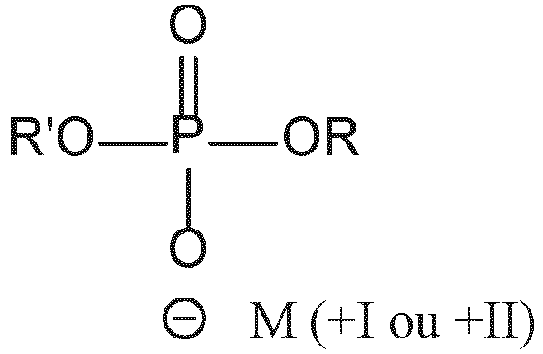
- the phosphate salt, or mixture of phosphate salts, used is an organometallic phosphate salt(s), it(these) present(s) the following formula: in which R is different or not from R', R and R' being formed by one or more aromatic groups substituted or not by one or more groups having 1 to 9 carbons, R and R' being able to be directly linked together or separated by at least one group chosen from the following groups: -CH2-; - C(CH3)2-; -C(CF3)2-; -SO2-; -S-, -CO-; -O- and M represents an element of group IA or IIA of the periodic table.
- the organometallic phosphate salt is sodium 2,2'-methylene-bis-(4,6-di-tert-butylphenyl) phosphate.
- the phosphate salt, or the mixture of phosphate salts is incorporated into the PAEK-based composition in proportions of between 10ppm and 50,000ppm and, even more preferably, between 100 and 5000ppm.
- Another surprising effect linked to the incorporation of the phosphate salt into the PAEK-based composition lies in the fact that it makes it possible to act as a nucleating agent.
- Increasing the crystallization kinetics to make it a crystallizable product under standard processing conditions, or for example in laser sintering, and thus having a semi-crystalline PEKK is advantageous for certain properties such as chemical resistance.
- such a nucleating agent makes it possible to control the crystalline morphology of the polymer, and in particular the size of the crystalline zones (or spherulites), in order to ensure consistency in the mechanical properties of the polymer, whatever the processing conditions. use of the polymer.
- the invention further relates to a process for stabilizing in the molten state a composition based on PAEK, said process comprising a step of incorporating a stabilizing agent with respect to thermal phenomena. oxidation, said process being characterized in that the incorporated stabilizing agent is a phosphate salt, or a mixture of phosphate salts.
- the incorporation of the phosphate salt into the composition based on PAEK can be carried out by one of the following techniques: dry mixing (also known by the Anglo-Saxon terminology “dry blend”), compounding, wet impregnation or during of the PAEK polymer synthesis process.
- the process for synthesizing a PAEK generally consists of polycondensation.
- the synthesis can be carried out according to two routes: a nucleophilic route, according to which ether bonds are formed during the polymerization step, or an electrophilic route, according to which carbonyl bridges are formed during the polymerization step.
- PEKK results from a Friedel-Crafts polycondensation reaction between DPE (diphenyl ether) and a terephthaloyl chloride and/or an isophthaloyl chloride for example.
- the stabilized composition based on PAEK is obtained by impregnation of PAEK during its production process, this impregnation of the PAEK with a solution of phosphate salt(s) is carried out after the polymerization of the PAEK and before its drying.
- the solvent is chosen so that it can solubilize the metal phosphate salt(s) while also being soluble with the solvent phase constituting at least 50% of the PAEK grain.
- This impregnation is advantageously carried out with stirring to promote homogenization.
- the stabilized composition based on PAEK can be obtained in the form of granules by compounding, on a tool known to those skilled in the art, such as a twin screw extruder, a comalaxer, or an internal mixer.
- composition thus prepared can then be transformed for use or subsequent transformation known to those skilled in the art using tools such as an injection press, an extruder, laser sintering equipment, etc. ..
- the process for preparing the composition according to the invention can also use a twin-screw extruder feeding, without intermediate granulation, a press. inject or an extruder according to an implementation device known to those skilled in the art.
- the stabilized composition based on PAEK can also be obtained in powder form, by dry mixing for example (better known by the Anglo-Saxon terminology “Dry Blend”).
- the PAEK is mixed with the phosphate salt(s) then this mixture is heated above the melting temperature of the PAEK with stirring in suitable equipment such as an extruder.
- the stabilized composition based on PAEK can also be obtained by wet mixing.
- the dried PAEK is impregnated with a solution of the metal phosphate salt(s).
- This solution is preferably aqueous if the phosphate salt(s) is(are) soluble in water.
- Mixing is preferably done with stirring to promote homogenization. Then the whole is dried and the solvent is thus eliminated.
- composition obtained which can be either in the form of granules or in the form of powder, it is possible to manufacture different objects by a technique of laser sintering, injection or extrusion, thermoforming, rotomolding, molding by compression, or even impregnation for example.
- pre-impregnated composite tapes also called “tape"
- the dispersion may for example comprise a powder of PEKK and phosphate salt(s) and a surfactant in aqueous solution.
- the fibers thus covered with the aqueous dispersion are then passed through an oven to evaporate the water. Then, they are passed through a high temperature die, typically above 370°C, in order to be able to melt the stabilized PEKK polymer and so that it can coat the fibers correctly.
- a high temperature die typically above 370°C
- phosphate salts lie in the fact that even heated to very high temperatures, greater than or equal to 350°C for example, they do not do not generate the emission of volatile organic compounds but they simply lose water, in the form of vapor. Consequently, phosphate salts do not present any risk to the environment and/or health and they do not create porosities likely to hinder the coating of the fibers and/or generate the appearance of defects in the final object. manufactured, likely to result in a deterioration of the mechanical properties.
- composition based on PAEK and phosphate salt(s) as defined above can be prepared by any known method, making it possible to obtain a homogeneous mixture containing the composition according to the invention and possibly other additives, fillers, other polymers.
- a method can be chosen from the techniques of dry blending (or dry mixing using for example a roller mixer), extrusion in the melt state, compounding, or even wet impregnation or during the process of synthesis of the polymer.
- composition according to the invention can be prepared by mixing all of its components in the molten state, in particular in a so-called direct process.
- Compounding for example, is a process that allows plastic materials and/or additives and/or fillers to be mixed by fusion.
- the raw materials in the form of granules, are placed in a co-rotating twin-screw extruder.
- compositions based on PEKK have been prepared.
- a control composition C T of PEKK containing no stabilizer was prepared by a conventional synthesis process by polycondensation reaction.
- a second composition based on PEKK, referenced C1 was prepared by wet impregnation, in which PEP-Q ([1,1-biphenyl]-4,4'-diylbisphosphonite of tetrakis (2,4-di-ter- butylphenyl)), of formula (1) below, was incorporated at a level of 1000ppm. This phosphonite is used as a comparative example to stabilize the PEKK composition.
- a third composition based on PEKK, referenced C2 was prepared by aqueous impregnation, in which anhydrous monosodium phosphate (NaH 2 PO 4 ), also called sodium dihydrogen phosphate, of formula (2) below was incorporated at a level of 1000ppm.
- anhydrous monosodium phosphate NaH 2 PO 4
- sodium dihydrogen phosphate of formula (2) below was incorporated at a level of 1000ppm.
- a fourth composition based on PEKK, referenced C3 was prepared in the same way as the second and third compositions, by aqueous impregnation, in which sodium trimetaphosphate (Na 3 P 3 O 9 ), also called anhydrous trisodium phosphate, of formula (3) below, was incorporated at a level of 1000ppm.
- sodium trimetaphosphate Na 3 P 3 O 9
- anhydrous trisodium phosphate also called anhydrous trisodium phosphate
- a fifth composition based on PEKK, referenced C4 was prepared in the same way as the previous compositions, by impregnation with acetone, in which an organic phosphate, and more particularly triphenylphosphate of formula (4) below, has been incorporated at a level of 1000ppm.
- melt viscosity of these compositions C T to C4 was then measured, with an oscillatory rheometer as a function of time, at 380° C., under nitrogen, with an oscillation frequency, also called stress, of 1 Hz, and with a deformation amplitude of 0.5%.
- Table I below groups together the stability data (EV%) under nitrogen for the different C T to C4 compositions obtained by wet impregnation with or without a stabilizer.
- Example 2 viscosity measurements under nitrogen and under air
- PEKK-based compounds have been prepared by the compounding technique.
- the different compounds are made with an extruder of several PEKK-based compositions.
- the behavior of the different compositions at 380°C under nitrogen and under air was compared.
- a first control composition C T 'of PEKK in the form of granules and containing no stabilizer was prepared.
- a second composition based on PEKK, referenced C5 was prepared by the coumpounding technique in which monosodium phosphate (NaH 2 PO 4 ), of formula (1) above, was incorporated at a level of 1000ppm.
- a third composition based on PEKK, referenced C6, was prepared by the coumpounding technique in which trisodium phosphate (Na 3 P 3 O 9 ), of formula (3) above, was incorporated at a level of 1000ppm.
- a fourth composition based on PEKK, referenced C7 was prepared by the compounding technique, in which ADK STAB NA-11UH (Sodium 2,2'-methylene-bis-(4,6-di-tert-butylphenyl) phosphate), of formula (5) below, was incorporated at a level of 1000ppm.
- ADK STAB NA-11UH Sodium 2,2'-methylene-bis-(4,6-di-tert-butylphenyl) phosphate
- melt viscosity of these compositions C T ', C5, C6 and C7 was then measured, with an oscillatory rheometer as a function of time at 380°C, under nitrogen then under air with an oscillation frequency, again called stress, respectively 1Hz and 0.1Hz and with a deformation amplitude of 0.5%.
- Table II below groups together the stability data (EV%) under nitrogen and in air for these different compositions obtained by coumpounding with or without a stabilizer.
- Example 3 influence of the ratio of incorporated phosphate salt.
- compositions based on PEKK have been prepared.
- a control composition C T of PEKK containing no stabilizer was prepared by a conventional synthesis process by polycondensation reaction.
- the other compositions are based on PEKK and each include anhydrous trisodium phosphate in different contents.
- compositions compared are prepared by aqueous impregnation.
- composition referenced C8 in Table III below comprises 500ppm of anhydrous trisodium phosphate, while the composition referenced C9 comprises 1000ppm and the composition referenced C10 comprises 3000ppm.
- melt viscosity of these compositions C T , C8, C9 and C10 was then measured, with an oscillatory rheometer as a function of time at 380°C, under nitrogen, with a stress of 1 Hz and with a deformation amplitude of 0.5%.
- Table III below groups together the stability data (EV%) under nitrogen for these different compositions. ⁇ b> ⁇ u>Table III ⁇ /u> ⁇ /b> Reference composition EV (%) (under N2, 1Hz) CT Reference PEKK 160% C8 500ppm anhydrous trisodium phosphate 50% C9 1000ppm anhydrous trisodium phosphate 45% C10 3000ppm anhydrous trisodium phosphate 10%
- compositions based on PEKK have been prepared.
- a control composition C T of PEKK containing no stabilizer was prepared by a conventional synthesis process by polycondensation reaction.
- the other compositions are based on PEKK and each include a different counter anion dihydrogen phosphate.
- composition referenced C11 in Table IV below comprises 1000ppm of anhydrous sodium dihydrogen phosphate (of formula (1) above), while the composition referenced C12 comprises 1000ppm of ammonium dihydrogen phosphate.
- melt viscosity of these compositions C T , C11 and C12 was then measured, with an oscillatory rheometer as a function of time, at 380°C, under nitrogen, with a load of 1 Hz and with a deformation amplitude of 0.5%.
- Table IV below groups together the stability data (EV%) under nitrogen for these different compositions. ⁇ b> ⁇ u>Table IV ⁇ /u> ⁇ /b> Reference composition EV (%) (under N2, 1Hz) CT Reference PEKK 160% C11 1000ppm anhydrous sodium dihydrogen phosphate 50% C12 1000ppm ammonium dihydrogen phosphate 55%
- the phosphate salts incorporated in the PAEK-based composition are also very thermally stable. Indeed, for phosphate salts, the weight losses measured correspond to water losses. The phenomenon that then occurs, for example with monosodium phosphate, is dehydration and dimerization in accordance with the following equation (A):
- PEP-Q begins to degrade and emit organic compounds at a temperature of around 200°C.
- thermogravimetry (TG) curves as a function of the temperature T(°C) presented on the graph of the Figure 2 make it possible to demonstrate a loss in weight of the phosphate salts due to a loss of water, while the PEP-Q phosphonite degrades rapidly from 200 °C by emitting volatile organic compounds.
- Phosphate salts therefore have great thermal stability combined with great stability with respect to thermo-oxidation phenomena.
- DSC differential scanning calorimetry
- samples studied are in the form of granules.
- a control sample based on PEKK, referenced E1 is compared to samples E2 and E3 based on PEKK and a phosphate salt in the same proportions.
- the different samples are more particularly described in Table V below.
- the anisothermal DSC protocol on the different samples E1 to E3, consists initially of stabilizing the temperature at 20°C. The temperature is then gradually increased, on a ramp of 20°C per minute to 380°C, then it is again gradually decreased to 20°C, on a reverse ramp of 20°C per minute.
- Crystallization is studied during the cooling stage.
- the heat flow is measured as a function of temperature, and a curve representing the evolution of the heat flow as a function of temperature is obtained for each sample studied.
- the crystallization temperature denoted Tc and expressed in degrees Celsius, is then determined for each sample, by projecting the maximum of the corresponding curve onto the abscissa axis. This determination is made directly by the DSC equipment used.
- the crystallization temperature Tc measured for each sample E1 to E3 is reported in Table V below.
- the isothermal DSC protocol includes the following three steps: a first step consists of initially stabilizing the temperature at 20°C, a second step then consists of increasing the temperature gradually, according to a ramp of 20°C per minute, up to 380°C. Finally, the temperature is reduced from 380°C to 315°C, at a ramp of 20°C per minute, then it is stabilized at 315°C for one hour.
- the half-crystallization time of a polymer is the time necessary for the crystallization of 50% of this polymer.
- hydrated phosphate salts can be used in the composition.
- Anhydrous phosphate salts are, however, preferred because water may be released during subsequent processing of the composition which may result in a possible negative effect on the physical properties of the composition.
- Phosphate salts are therefore good stabilizers of PAEK, and more particularly, but not exclusively, of PEKK. These phosphate salts also combine several very advantageous effects. They indeed provide temperature stability in the absence or presence of air and they are stable with respect to hydrolysis, unlike other phosphorus stabilizers such as phosphites or phosphonites like PEP-Q, and do not generate volatile organic compounds but simply water vapor. They also combine all the positive effects of a stabilizer for transformation: they limit color changes during transformation, they improve the stability of the structure in the molten state, significantly reducing the evolution of polymer chains and thus allowing the crystalline and mechanical properties of the material to be preserved. Finally, they act as a nucleant and regulator of residual acids (buffer effect), so that they can also help protect equipment against corrosion.
- the phosphate salts can also be easily incorporated into the PAEK polymer, either by impregnation in aqueous solution, or by dry mixing, or even by compounding.
Landscapes
- Chemical & Material Sciences (AREA)
- Health & Medical Sciences (AREA)
- Chemical Kinetics & Catalysis (AREA)
- Medicinal Chemistry (AREA)
- Polymers & Plastics (AREA)
- Organic Chemistry (AREA)
- Compositions Of Macromolecular Compounds (AREA)
- Polyethers (AREA)
- Organic Low-Molecular-Weight Compounds And Preparation Thereof (AREA)
- Dental Preparations (AREA)
- Anti-Oxidant Or Stabilizer Compositions (AREA)
Claims (10)
- Verfahren zur Stabilisierung einer Zusammensetzung auf Basis von PAEK, wobei das Verfahren einen Schritt des Einarbeitens eines Stabilisators gegen Thermooxidationsphänomene umfasst, wobei das Verfahren dadurch gekennzeichnet ist, dass es sich bei dem eingearbeiteten Stabilisator um ein Phosphatsalz oder eine Mischung von Phosphatsalzen handelt, dadurch gekennzeichnet, dass das Phosphatsalz oder die Mischung von Phosphatsalzen in Anteilen zwischen 10 ppm und 50.000 ppm in die Zusammensetzung eingearbeitet wird.
- Verfahren nach Anspruch 1, dadurch gekennzeichnet, dass die Einarbeitung des Phosphatsalzes in die Zusammensetzung auf Basis von PAEK durch eine der folgenden Techniken durchgeführt wird: Trockenmischen, Compoundieren, Nassimprägnierung oder während des Verfahrens zur Synthese des PAEK-Polymers.
- Verfahren nach Anspruch 1 oder 2, dadurch gekennzeichnet, dass das Phosphatsalz bzw. die Phosphatsalze aus mindestens einem der folgenden Salze ausgewählt wird bzw. werden: Ammonium-, Natrium-, Calcium-, Zink-, Kalium-, Aluminium-, Magnesium-, Zirconium-, Barium-, Lithium- oder Seltenerdmetall-phosphatsalz(en) .
- Verfahren nach einem der Ansprüche 1 bis 3, dadurch gekennzeichnet, dass das Phosphatsalz bzw. die Phosphatsalze spezieller aus mindestens einer der folgenden Verbindungen ausgewählt wird bzw. werden: wasserfreiem Mononatriumphosphat, Mononatriumphosphatmonohydrat oder -dihydrat, wasserfreiem Dinatriumphosphat, Dinatriumphosphatdihydrat, -heptahydrat, -octahydrat oder -dodecahydrat, hexagonalem wasserfreiem Trinatriumphosphat, kubischem wasserfreiem Trinatriumphosphat, Trinatriumphosphathemihydrat, - hexahydrat, -octahydrat, -dodecahydrat und Ammoniumdihydrogenphosphat.
- Verfahren nach einem der Ansprüche 1 bis 3, dadurch gekennzeichnet, dass das Phosphatsalz bzw. die Phosphatsalze ein metallorganisches Phosphatsalz bzw. metallorganische Phosphatsalze ist bzw. sind und die folgende Struktur aufweisen:
- Verfahren nach Anspruch 4, dadurch gekennzeichnet, dass es sich bei dem metallorganischen Phosphatsalz um Natrium-2,2'-methylenbis(4,6-di-tert-butylphenyl)phosphat handelt.
- Verfahren nach einem der vorhergehenden Ansprüche, dadurch gekennzeichnet, dass das Phosphatsalz in Anteilen zwischen 100 und 5000 ppm in die Zusammensetzung eingearbeitet wird.
- Verfahren nach einem der vorhergehenden Ansprüche, dadurch gekennzeichnet, dass die Zusammensetzung auf Basis von PAEK spezieller eine Zusammensetzung auf Basis eines der folgenden Polymere ist: PEKK, PEEK, PEEKK, PEKEKK, PEEEK oder PEDEK.
- Verfahren nach einem der vorhergehenden Ansprüche, dadurch gekennzeichnet, dass die Zusammensetzung auf Basis von PAEK spezieller eine Polyetherketonketon(PEKK)-Zusammensetzung ist.
- Verfahren nach Anspruch 7, dadurch gekennzeichnet, dass die Zusammensetzung auf Basis von PAEK spezieller eine Zusammensetzung auf Basis von PEKK ist und zusätzlich zu PEKK mindestens eines der folgenden Polymere umfasst: PEK, PEEKEK, PEEK, PEEKK, PEKEKK, PEEEK, PEDEK, mit einem Gehalt von weniger als 50 Massen-% der Zusammensetzung, vorzugsweise kleiner oder gleich 30 Massen-% der Zusammensetzung.
Priority Applications (1)
| Application Number | Priority Date | Filing Date | Title |
|---|---|---|---|
| EP24184131.1A EP4431567A3 (de) | 2015-07-22 | 2016-07-21 | Verfahren zur stabilisierung einer polyaryletherketon (paek) zusammensetzung |
Applications Claiming Priority (2)
| Application Number | Priority Date | Filing Date | Title |
|---|---|---|---|
| FR1556931A FR3039157B1 (fr) | 2015-07-22 | 2015-07-22 | Composition a base de polyarylene-ether-cetone (paek) stable a l'etat fondu et procede de stabilisation d'une telle composition |
| PCT/FR2016/051895 WO2017013369A1 (fr) | 2015-07-22 | 2016-07-21 | Procédé de stabilisation d'une composition a base de polyarylene-ether-cetone (paek) |
Related Child Applications (1)
| Application Number | Title | Priority Date | Filing Date |
|---|---|---|---|
| EP24184131.1A Division EP4431567A3 (de) | 2015-07-22 | 2016-07-21 | Verfahren zur stabilisierung einer polyaryletherketon (paek) zusammensetzung |
Publications (2)
| Publication Number | Publication Date |
|---|---|
| EP3325536A1 EP3325536A1 (de) | 2018-05-30 |
| EP3325536B1 true EP3325536B1 (de) | 2024-06-26 |
Family
ID=54066133
Family Applications (4)
| Application Number | Title | Priority Date | Filing Date |
|---|---|---|---|
| EP16757296.5A Active EP3325535B1 (de) | 2015-07-22 | 2016-07-21 | Schmelzstabile polyaryletherketon (paek) zusammensetzung |
| EP24184131.1A Pending EP4431567A3 (de) | 2015-07-22 | 2016-07-21 | Verfahren zur stabilisierung einer polyaryletherketon (paek) zusammensetzung |
| EP16757297.3A Active EP3325536B1 (de) | 2015-07-22 | 2016-07-21 | Verfahren zur stabilisierung einer polyaryletherketon (paek) zusammensetzung |
| EP20200205.1A Pending EP3778708A1 (de) | 2015-07-22 | 2016-07-21 | Schmelzstabile polyaryletherketon (paek) zusammensetzung |
Family Applications Before (2)
| Application Number | Title | Priority Date | Filing Date |
|---|---|---|---|
| EP16757296.5A Active EP3325535B1 (de) | 2015-07-22 | 2016-07-21 | Schmelzstabile polyaryletherketon (paek) zusammensetzung |
| EP24184131.1A Pending EP4431567A3 (de) | 2015-07-22 | 2016-07-21 | Verfahren zur stabilisierung einer polyaryletherketon (paek) zusammensetzung |
Family Applications After (1)
| Application Number | Title | Priority Date | Filing Date |
|---|---|---|---|
| EP20200205.1A Pending EP3778708A1 (de) | 2015-07-22 | 2016-07-21 | Schmelzstabile polyaryletherketon (paek) zusammensetzung |
Country Status (9)
| Country | Link |
|---|---|
| US (2) | US10988596B2 (de) |
| EP (4) | EP3325535B1 (de) |
| JP (4) | JP6640983B2 (de) |
| KR (2) | KR102160346B1 (de) |
| CN (3) | CN107849237B (de) |
| BR (3) | BR122022005752B1 (de) |
| ES (1) | ES2833103T3 (de) |
| FR (1) | FR3039157B1 (de) |
| WO (2) | WO2017013368A1 (de) |
Families Citing this family (26)
| Publication number | Priority date | Publication date | Assignee | Title |
|---|---|---|---|---|
| FR3039157B1 (fr) | 2015-07-22 | 2019-06-28 | Arkema France | Composition a base de polyarylene-ether-cetone (paek) stable a l'etat fondu et procede de stabilisation d'une telle composition |
| US12258462B2 (en) | 2015-07-22 | 2025-03-25 | Arkema France | Composition made from poly(arylene-ether-ketone) (PAEK) which is stable in the molten state and method for stabilizing such a composition |
| FR3065002B1 (fr) * | 2017-04-05 | 2020-05-15 | Arkema France | Procede d'impregnation de fibres de renfort avec des polyarylethercetones et semi-produits ainsi obtenus |
| CN110753728B (zh) | 2017-06-15 | 2023-05-09 | 阿科玛股份有限公司 | 由伪无定形聚合物生产半结晶部件 |
| CN112638989B (zh) | 2018-06-21 | 2024-05-17 | 索尔维特殊聚合物美国有限责任公司 | 聚(醚酮酮)(pekk)复合材料 |
| US11879036B2 (en) | 2018-06-21 | 2024-01-23 | Solvay Specialty Polymers Usa, Llc | Poly(ether ketone ketone) (PEKK) polymer and composites |
| JP7230363B2 (ja) * | 2018-07-26 | 2023-03-01 | 株式会社リコー | カット加工用印刷物、貼付け用印刷物、及び印刷物の製造方法 |
| CN113015611A (zh) * | 2018-11-13 | 2021-06-22 | 索尔维特殊聚合物美国有限责任公司 | 使用选择性激光烧结制造三维物体的增材制造方法 |
| KR102250300B1 (ko) * | 2018-12-11 | 2021-05-07 | 한화솔루션 주식회사 | 폴리에테르케톤케톤의 중합방법 및 이에 의해 중합된 폴리에테르케톤케톤 |
| KR20200074791A (ko) * | 2018-12-17 | 2020-06-25 | 한화솔루션 주식회사 | 폴리에테르케톤케톤 혼합수지 조성물 및 이의 제조방법 |
| KR102250299B1 (ko) * | 2018-12-18 | 2021-05-07 | 한화솔루션 주식회사 | 폴리에테르케톤케톤 혼합수지 조성물의 제조방법 및 이에 의해 제조된 폴리에테르톤케톤 |
| FR3093666B1 (fr) * | 2019-03-15 | 2022-01-14 | Arkema France | Procédé de fabrication par frittage d'une poudre à base de poly-aryl-éther-cétone(s) en partie recyclée |
| CN114026149A (zh) | 2019-07-01 | 2022-02-08 | 索尔维特殊聚合物美国有限责任公司 | PEEK-PEoEK共聚物粉末和制备该粉末的方法 |
| CN114364744B (zh) * | 2019-09-20 | 2024-01-30 | 东丽株式会社 | 聚芳基醚酮树脂组合物、纤维增强树脂基材及成型品 |
| FR3105794B1 (fr) * | 2019-12-31 | 2023-07-14 | Arkema France | Procédé de fabrication d’un produit à base de poly-aryl-éther-cétone et produit correspondants |
| JP6731128B1 (ja) * | 2020-03-16 | 2020-07-29 | 株式会社Adeka | 粒状核剤、樹脂組成物およびその製造方法ならびに成形品 |
| FR3124513B1 (fr) | 2021-06-29 | 2024-05-10 | Arkema France | Poudre de polymère thermoplastique pour impression 3D à la stabilité et à la recyclabilité améliorées |
| CN117769584A (zh) * | 2021-07-30 | 2024-03-26 | 宝理塑料株式会社 | 聚芳醚酮树脂组合物及其制造方法、成型品以及该树脂组合物的熔融粘度的滞留稳定性的提高方法 |
| CN114133556B (zh) * | 2021-12-23 | 2023-05-02 | 吉林省中研高分子材料股份有限公司 | 一种具有改善的亲水性和/或热稳定性的聚醚醚酮及其制备方法 |
| FR3131321B1 (fr) | 2021-12-23 | 2025-10-31 | Arkema France | Poudre de polymère thermoplastique pour impression 3D |
| KR102873046B1 (ko) * | 2021-12-29 | 2025-10-16 | 롯데케미칼 주식회사 | 열가소성 수지 조성물 및 이를 이용한 성형품 |
| US20250092221A1 (en) * | 2022-01-11 | 2025-03-20 | Polyplastics Co., Ltd. | Fully aromatic ether ketone resin composition, molded article thereof, and phosphorus stabilizer |
| WO2025178132A1 (ja) * | 2024-02-22 | 2025-08-28 | 出光興産株式会社 | 樹脂組成物、複合材料、及び成形体、並びに樹脂組成物の製造方法 |
| CN118580485A (zh) * | 2024-06-18 | 2024-09-03 | 江苏君华特种高分子材料股份有限公司 | 连续挤出反应性熔融增粘聚醚醚酮的制备方法 |
| FR3165272A1 (fr) * | 2024-07-31 | 2026-02-06 | Arkema France | Procédé de fabrication d’une composition de polyaryléthercétone intégrant un agent nucléant |
| WO2026048637A1 (ja) * | 2024-08-30 | 2026-03-05 | 出光興産株式会社 | 樹脂組成物、樹脂組成物の製造方法、複合材料、複合材料の製造方法及び成形体 |
Citations (13)
| Publication number | Priority date | Publication date | Assignee | Title |
|---|---|---|---|---|
| US3794615A (en) | 1971-03-10 | 1974-02-26 | Ici Ltd | Melt stabilized aromatic polysulphones with phosphorus compounds |
| US4593061A (en) | 1985-03-29 | 1986-06-03 | Raychem Corporation | Stabilized poly(aryl ether ketone) compositions |
| US4874839A (en) | 1988-08-05 | 1989-10-17 | Raychem Corporation | Stabilization of poly(arylene ether ketones) |
| US4977230A (en) | 1984-03-07 | 1990-12-11 | Mitsubishi Chemical Industries Limited | Heat-resistant film or sheet |
| JPH03227320A (ja) | 1990-01-30 | 1991-10-08 | Toyobo Co Ltd | 芳香族ポリエーテルケトン、その製造法、成形品 |
| US5063265A (en) | 1988-05-02 | 1991-11-05 | Amoco Corporation | Stabilized poly(aryl ether ketone) compositions |
| JPH04110339A (ja) | 1990-08-30 | 1992-04-10 | Sekisui Chem Co Ltd | イオン溶出の少ない熱可塑性樹脂組成物 |
| WO1992010542A1 (de) | 1990-12-14 | 1992-06-25 | Hoechst Aktiengesellschaft | Legierungen aus teilkristallinen und amorphen polyaryletherketonen |
| DE4207555A1 (de) | 1992-03-10 | 1993-09-16 | Hoechst Ag | Verfahren zur herstellung schmelzestabiler polyarylenetherketone und ihre verwendung |
| WO1995031502A1 (en) | 1994-05-18 | 1995-11-23 | Victrex Manufacturing Limited | Process for making an aromatic polymer |
| JP2000169738A (ja) | 1998-09-29 | 2000-06-20 | Oiles Ind Co Ltd | 摺動部材用樹脂組成物およびすべり軸受 |
| JP2001059040A (ja) | 1999-06-15 | 2001-03-06 | Asahi Denka Kogyo Kk | 造核剤 |
| US20070265415A1 (en) | 2006-05-13 | 2007-11-15 | Degussa Gmbh | Process for preparing polyarylene ether ketone |
Family Cites Families (32)
| Publication number | Priority date | Publication date | Assignee | Title |
|---|---|---|---|---|
| US3925307A (en) | 1973-04-23 | 1975-12-09 | Raychem Corp | Antioxidants for polyarylether ketones |
| GB1446962A (en) * | 1974-03-14 | 1976-08-18 | Ici Ltd | Stabilised aromatic polyetherketone compsoitions |
| US4567029A (en) | 1983-07-15 | 1986-01-28 | Union Carbide Corporation | Crystalline metal aluminophosphates |
| US4609714A (en) | 1983-09-29 | 1986-09-02 | Union Carbide Corporation | Blends of poly(aryl ketones) |
| US4826906A (en) * | 1987-06-22 | 1989-05-02 | Kureha Kagaku Kogyo K.K. | Poly(arylene thioether-ketone) compositions improved in both melt stability and crystallinity |
| DE3731607A1 (de) * | 1987-09-19 | 1989-03-30 | Hoechst Ag | Stabilisierte, aromatische polyetherketone enthaltende mischung und deren verwendung zur herstellung von formteilen |
| DE4010188A1 (de) * | 1990-03-30 | 1991-10-02 | Basf Ag | Stabilisierte polyaryletherketon-formmassen |
| ES2077724T3 (es) | 1990-07-12 | 1995-12-01 | Basf Ag | Masas de moldeo de poliariletercetona estabilizadas. |
| GB2261667A (en) * | 1991-11-20 | 1993-05-26 | Sandoz Ltd | Stabilized polymeric compositions |
| JP3501890B2 (ja) | 1994-12-26 | 2004-03-02 | Ntn株式会社 | 耐熱・潤滑性樹脂組成物 |
| US5726232A (en) | 1995-12-21 | 1998-03-10 | Ntn Corporation | Heat resistant lubricative resin composition |
| EP0933395B1 (de) | 1998-01-28 | 2004-12-22 | General Electric Company | Polyesterformmasse |
| DE60026995T2 (de) | 1999-06-15 | 2006-12-07 | Asahi Denka Kogyo K.K. | Nukleierungsmittel |
| FR2848856B1 (fr) | 2002-12-24 | 2007-05-25 | Cadorel Catherine | Materiau a usage medical ou veterinaire, son procede d'obtention et ses applications |
| JP2004224990A (ja) | 2003-01-27 | 2004-08-12 | Suzuki Motor Corp | ポリ乳酸系ポリマー樹脂組成物とその成形品 |
| EP1675883B1 (de) * | 2003-10-07 | 2007-08-08 | Dow Global Technologies Inc. | Polypropylenzusammensetzung für luftgekühlte blasfolien |
| CN1687201A (zh) * | 2005-04-08 | 2005-10-26 | 华东理工大学 | 一种超细有机磷酸盐类成核剂的制备方法 |
| US7488766B2 (en) * | 2005-10-06 | 2009-02-10 | Sabic Innovative Plastics Ip B.V. | Polymer composition, method, and article |
| WO2008013316A1 (en) | 2006-07-28 | 2008-01-31 | Teijin Limited | Resin composition, method for producing the same and molded article |
| JP2008050583A (ja) | 2006-07-28 | 2008-03-06 | Teijin Ltd | 樹脂組成物 |
| WO2009051264A1 (ja) * | 2007-10-16 | 2009-04-23 | Teijin Chemicals Ltd. | 芳香族ポリカーボネート樹脂組成物 |
| AU2009210750A1 (en) | 2008-02-01 | 2009-08-13 | Synthes Gmbh | Porous biocompatible polymer material and methods |
| GB0813093D0 (en) * | 2008-07-17 | 2008-08-27 | Invibio Ltd | Polymeric materials |
| EP2169012A1 (de) | 2008-09-24 | 2010-03-31 | Looser Holding AG | Verwendung von Phosphorsäure und/oder eines Phosphorsäureesters bei der Herstellung von Schichten aus mindestens einer wässrigen Dispersion |
| CN102597112A (zh) * | 2009-10-29 | 2012-07-18 | 伯利米克思有限公司 | 聚(芳醚酮二氮杂萘酮)的高温聚合物掺合物 |
| CN101864162B (zh) * | 2010-06-02 | 2012-05-02 | 吉林大学 | 具有较高热稳定性的聚芳醚酮类树脂及其制备方法 |
| KR101333579B1 (ko) | 2010-12-15 | 2013-11-28 | 제일모직주식회사 | 반사성, 내열성 및 내습성이 우수한 폴리아마이드 수지 조성물. |
| BR112014018614B1 (pt) * | 2012-02-01 | 2021-01-19 | Adeka Corporation | masterbatch para aditivo de resina |
| WO2013164855A2 (en) | 2012-03-29 | 2013-11-07 | Keki Hormusji Gharda | Stable polyetherketones thermoplastic polymer |
| JP5686930B1 (ja) * | 2013-03-21 | 2015-03-18 | ユニチカ株式会社 | 半芳香族ポリアミド樹脂組成物およびそれを成形してなる成形体 |
| CN103665368B (zh) | 2013-11-28 | 2017-01-11 | 张家港祥成医用材料科技有限公司 | 一种在纳米/微米尺度无机种床上的聚芳醚酮树脂低温合成方法 |
| FR3039157B1 (fr) | 2015-07-22 | 2019-06-28 | Arkema France | Composition a base de polyarylene-ether-cetone (paek) stable a l'etat fondu et procede de stabilisation d'une telle composition |
-
2015
- 2015-07-22 FR FR1556931A patent/FR3039157B1/fr active Active
-
2016
- 2016-07-21 CN CN201680042844.XA patent/CN107849237B/zh not_active Expired - Fee Related
- 2016-07-21 US US15/746,142 patent/US10988596B2/en active Active
- 2016-07-21 JP JP2018503135A patent/JP6640983B2/ja not_active Expired - Fee Related
- 2016-07-21 US US15/746,131 patent/US20180201759A1/en not_active Abandoned
- 2016-07-21 KR KR1020187005000A patent/KR102160346B1/ko active Active
- 2016-07-21 EP EP16757296.5A patent/EP3325535B1/de active Active
- 2016-07-21 JP JP2018503131A patent/JP6824956B2/ja active Active
- 2016-07-21 BR BR122022005752-7A patent/BR122022005752B1/pt active IP Right Grant
- 2016-07-21 KR KR1020187005001A patent/KR102160347B1/ko active Active
- 2016-07-21 CN CN202110270228.2A patent/CN113088062B/zh active Active
- 2016-07-21 EP EP24184131.1A patent/EP4431567A3/de active Pending
- 2016-07-21 ES ES16757296T patent/ES2833103T3/es active Active
- 2016-07-21 WO PCT/FR2016/051894 patent/WO2017013368A1/fr not_active Ceased
- 2016-07-21 CN CN201680042852.4A patent/CN107849238B/zh active Active
- 2016-07-21 BR BR112018000895-8A patent/BR112018000895B1/pt active IP Right Grant
- 2016-07-21 EP EP16757297.3A patent/EP3325536B1/de active Active
- 2016-07-21 EP EP20200205.1A patent/EP3778708A1/de active Pending
- 2016-07-21 WO PCT/FR2016/051895 patent/WO2017013369A1/fr not_active Ceased
- 2016-07-21 BR BR112018000869-9A patent/BR112018000869A2/pt not_active Application Discontinuation
-
2020
- 2020-12-02 JP JP2020200166A patent/JP7237910B2/ja active Active
-
2023
- 2023-03-01 JP JP2023030972A patent/JP2023060050A/ja active Pending
Patent Citations (13)
| Publication number | Priority date | Publication date | Assignee | Title |
|---|---|---|---|---|
| US3794615A (en) | 1971-03-10 | 1974-02-26 | Ici Ltd | Melt stabilized aromatic polysulphones with phosphorus compounds |
| US4977230A (en) | 1984-03-07 | 1990-12-11 | Mitsubishi Chemical Industries Limited | Heat-resistant film or sheet |
| US4593061A (en) | 1985-03-29 | 1986-06-03 | Raychem Corporation | Stabilized poly(aryl ether ketone) compositions |
| US5063265A (en) | 1988-05-02 | 1991-11-05 | Amoco Corporation | Stabilized poly(aryl ether ketone) compositions |
| US4874839A (en) | 1988-08-05 | 1989-10-17 | Raychem Corporation | Stabilization of poly(arylene ether ketones) |
| JPH03227320A (ja) | 1990-01-30 | 1991-10-08 | Toyobo Co Ltd | 芳香族ポリエーテルケトン、その製造法、成形品 |
| JPH04110339A (ja) | 1990-08-30 | 1992-04-10 | Sekisui Chem Co Ltd | イオン溶出の少ない熱可塑性樹脂組成物 |
| WO1992010542A1 (de) | 1990-12-14 | 1992-06-25 | Hoechst Aktiengesellschaft | Legierungen aus teilkristallinen und amorphen polyaryletherketonen |
| DE4207555A1 (de) | 1992-03-10 | 1993-09-16 | Hoechst Ag | Verfahren zur herstellung schmelzestabiler polyarylenetherketone und ihre verwendung |
| WO1995031502A1 (en) | 1994-05-18 | 1995-11-23 | Victrex Manufacturing Limited | Process for making an aromatic polymer |
| JP2000169738A (ja) | 1998-09-29 | 2000-06-20 | Oiles Ind Co Ltd | 摺動部材用樹脂組成物およびすべり軸受 |
| JP2001059040A (ja) | 1999-06-15 | 2001-03-06 | Asahi Denka Kogyo Kk | 造核剤 |
| US20070265415A1 (en) | 2006-05-13 | 2007-11-15 | Degussa Gmbh | Process for preparing polyarylene ether ketone |
Non-Patent Citations (11)
| Title |
|---|
| ANONYMOUS: " Natriumtrimetaphosphat", WIKIPEDIA, 3 June 2021 (2021-06-03), XP093268679, Retrieved from the Internet <URL:https://de.wikipedia.org/w/index.php?title=Natriumtrimetaphosphat&oldid=212627481> |
| ANONYMOUS: "Aluminium phosphate", WIKIPEDIA, 24 March 2021 (2021-03-24), XP093268667, Retrieved from the Internet <URL:https://en.wikipedia.org/w/index.php?title=Aluminium_phosphate&oldid=1013967793> |
| CORA FURIO, CATLOW RICHARD: "lonicity and Framework Stability of Crystalline Aluminophosphates", J. PHYS. CHEM., vol. 105, 1 January 2001 (2001-01-01), pages 10278 - 10281, XP055828249 |
| D12 - Technical report submitted on 23/6/2022 by Arkema France in the opposition proceedings against EP3325535B1, identified as document D43 |
| D13 - Technical report submitted on 7/7/2023 by Arkema France in the opposition proceedings against EP3325535B1, identified as document D47 |
| D15 - Experimental Report |
| D17 - Versuche unter Stickstoff (Evonik) |
| D18 - Versuche unter Luft (Evonik) |
| DATABASE PUBCHEM COMPOUND 25 October 2006 (2006-10-25), ANONYMOUS: "Phosphoric acid, aluminum salt (3:2)", XP093268674, Database accession no. 10088718 |
| HANS-HENNING KAUSCH, ROGER LEGRAS: "Advanced Thermoplastic Composites - Characterization and Processing", 1 January 1993, HANSER PUBLISHERS, ISBN: 3-446-17028-6, article A. JONAS AND R. LEGRAS: "D2 - "Advanced Thermoplastic Composites - Characterization and Processing" Ed. HH Kausch 1993", pages: 70 - 81, XP009560569 |
| VAN HEYDEN HENDRIK: "(Silico-) Aluminophosphates: Synthesis and Application for Heat Storage and Transformation", DISSERTATION DER LUDWIG-MAXIMILIANS-UNIVERSITäT MüNCHEN, 1 January 2008 (2008-01-01), pages 1 - 245, XP055828253 |
Also Published As
Similar Documents
| Publication | Publication Date | Title |
|---|---|---|
| EP3325535B1 (de) | Schmelzstabile polyaryletherketon (paek) zusammensetzung | |
| EP0169085B1 (de) | Polyamidzusammensetzung mit verspäteter Brennbarkeit | |
| EP3938181B1 (de) | Verfahren zur additiven fertigung durch sintern von pulvern, die teilweise auf recyceltem polyaryletherketon basieren | |
| WO2011144625A1 (fr) | Procédé pour nucléer et accélérer la cristallisation du polylactide | |
| US12258462B2 (en) | Composition made from poly(arylene-ether-ketone) (PAEK) which is stable in the molten state and method for stabilizing such a composition | |
| EP2448998B1 (de) | Modifiziertes polyamid, herstellungsverfahren dafür und aus diesem polyamid hergestellter artikel | |
| CN101600753B (zh) | 稳定的丙交酯颗粒 | |
| EP4452587A1 (de) | Thermoplastisches polymerpulver für 3d-druck | |
| EP3990535B1 (de) | Material für lebensmittelsverpackung und verfahren zu seiner herstellung | |
| KR20250082448A (ko) | 증기 방출형 식품용 포장재 및 이의 제조방법 | |
| EP2688958B1 (de) | Vulkanisationszusammensetzung in granulatform, verfahren zu ihrer herstellung und verwendung | |
| BE583427A (de) | ||
| BE547736A (de) |
Legal Events
| Date | Code | Title | Description |
|---|---|---|---|
| STAA | Information on the status of an ep patent application or granted ep patent |
Free format text: STATUS: THE INTERNATIONAL PUBLICATION HAS BEEN MADE |
|
| PUAI | Public reference made under article 153(3) epc to a published international application that has entered the european phase |
Free format text: ORIGINAL CODE: 0009012 |
|
| STAA | Information on the status of an ep patent application or granted ep patent |
Free format text: STATUS: REQUEST FOR EXAMINATION WAS MADE |
|
| 17P | Request for examination filed |
Effective date: 20180115 |
|
| AK | Designated contracting states |
Kind code of ref document: A1 Designated state(s): AL AT BE BG CH CY CZ DE DK EE ES FI FR GB GR HR HU IE IS IT LI LT LU LV MC MK MT NL NO PL PT RO RS SE SI SK SM TR |
|
| AX | Request for extension of the european patent |
Extension state: BA ME |
|
| DAV | Request for validation of the european patent (deleted) | ||
| DAX | Request for extension of the european patent (deleted) | ||
| STAA | Information on the status of an ep patent application or granted ep patent |
Free format text: STATUS: EXAMINATION IS IN PROGRESS |
|
| 17Q | First examination report despatched |
Effective date: 20220223 |
|
| GRAP | Despatch of communication of intention to grant a patent |
Free format text: ORIGINAL CODE: EPIDOSNIGR1 |
|
| STAA | Information on the status of an ep patent application or granted ep patent |
Free format text: STATUS: GRANT OF PATENT IS INTENDED |
|
| INTG | Intention to grant announced |
Effective date: 20240122 |
|
| GRAS | Grant fee paid |
Free format text: ORIGINAL CODE: EPIDOSNIGR3 |
|
| GRAA | (expected) grant |
Free format text: ORIGINAL CODE: 0009210 |
|
| STAA | Information on the status of an ep patent application or granted ep patent |
Free format text: STATUS: THE PATENT HAS BEEN GRANTED |
|
| AK | Designated contracting states |
Kind code of ref document: B1 Designated state(s): AL AT BE BG CH CY CZ DE DK EE ES FI FR GB GR HR HU IE IS IT LI LT LU LV MC MK MT NL NO PL PT RO RS SE SI SK SM TR |
|
| REG | Reference to a national code |
Ref country code: GB Ref legal event code: FG4D Free format text: NOT ENGLISH |
|
| REG | Reference to a national code |
Ref country code: CH Ref legal event code: EP |
|
| REG | Reference to a national code |
Ref country code: DE Ref legal event code: R096 Ref document number: 602016088127 Country of ref document: DE |
|
| P01 | Opt-out of the competence of the unified patent court (upc) registered |
Free format text: CASE NUMBER: APP_42013/2024 Effective date: 20240716 |
|
| PG25 | Lapsed in a contracting state [announced via postgrant information from national office to epo] |
Ref country code: BG Free format text: LAPSE BECAUSE OF FAILURE TO SUBMIT A TRANSLATION OF THE DESCRIPTION OR TO PAY THE FEE WITHIN THE PRESCRIBED TIME-LIMIT Effective date: 20240626 |
|
| PG25 | Lapsed in a contracting state [announced via postgrant information from national office to epo] |
Ref country code: HR Free format text: LAPSE BECAUSE OF FAILURE TO SUBMIT A TRANSLATION OF THE DESCRIPTION OR TO PAY THE FEE WITHIN THE PRESCRIBED TIME-LIMIT Effective date: 20240626 Ref country code: FI Free format text: LAPSE BECAUSE OF FAILURE TO SUBMIT A TRANSLATION OF THE DESCRIPTION OR TO PAY THE FEE WITHIN THE PRESCRIBED TIME-LIMIT Effective date: 20240626 |
|
| REG | Reference to a national code |
Ref country code: LT Ref legal event code: MG9D |
|
| PG25 | Lapsed in a contracting state [announced via postgrant information from national office to epo] |
Ref country code: GR Free format text: LAPSE BECAUSE OF FAILURE TO SUBMIT A TRANSLATION OF THE DESCRIPTION OR TO PAY THE FEE WITHIN THE PRESCRIBED TIME-LIMIT Effective date: 20240927 |
|
| PG25 | Lapsed in a contracting state [announced via postgrant information from national office to epo] |
Ref country code: LV Free format text: LAPSE BECAUSE OF FAILURE TO SUBMIT A TRANSLATION OF THE DESCRIPTION OR TO PAY THE FEE WITHIN THE PRESCRIBED TIME-LIMIT Effective date: 20240626 |
|
| REG | Reference to a national code |
Ref country code: NL Ref legal event code: MP Effective date: 20240626 |
|
| PG25 | Lapsed in a contracting state [announced via postgrant information from national office to epo] |
Ref country code: NO Free format text: LAPSE BECAUSE OF FAILURE TO SUBMIT A TRANSLATION OF THE DESCRIPTION OR TO PAY THE FEE WITHIN THE PRESCRIBED TIME-LIMIT Effective date: 20240926 Ref country code: LV Free format text: LAPSE BECAUSE OF FAILURE TO SUBMIT A TRANSLATION OF THE DESCRIPTION OR TO PAY THE FEE WITHIN THE PRESCRIBED TIME-LIMIT Effective date: 20240626 Ref country code: HR Free format text: LAPSE BECAUSE OF FAILURE TO SUBMIT A TRANSLATION OF THE DESCRIPTION OR TO PAY THE FEE WITHIN THE PRESCRIBED TIME-LIMIT Effective date: 20240626 Ref country code: GR Free format text: LAPSE BECAUSE OF FAILURE TO SUBMIT A TRANSLATION OF THE DESCRIPTION OR TO PAY THE FEE WITHIN THE PRESCRIBED TIME-LIMIT Effective date: 20240927 Ref country code: FI Free format text: LAPSE BECAUSE OF FAILURE TO SUBMIT A TRANSLATION OF THE DESCRIPTION OR TO PAY THE FEE WITHIN THE PRESCRIBED TIME-LIMIT Effective date: 20240626 Ref country code: BG Free format text: LAPSE BECAUSE OF FAILURE TO SUBMIT A TRANSLATION OF THE DESCRIPTION OR TO PAY THE FEE WITHIN THE PRESCRIBED TIME-LIMIT Effective date: 20240626 Ref country code: RS Free format text: LAPSE BECAUSE OF FAILURE TO SUBMIT A TRANSLATION OF THE DESCRIPTION OR TO PAY THE FEE WITHIN THE PRESCRIBED TIME-LIMIT Effective date: 20240926 |
|
| PG25 | Lapsed in a contracting state [announced via postgrant information from national office to epo] |
Ref country code: NL Free format text: LAPSE BECAUSE OF FAILURE TO SUBMIT A TRANSLATION OF THE DESCRIPTION OR TO PAY THE FEE WITHIN THE PRESCRIBED TIME-LIMIT Effective date: 20240626 |
|
| REG | Reference to a national code |
Ref country code: AT Ref legal event code: MK05 Ref document number: 1697656 Country of ref document: AT Kind code of ref document: T Effective date: 20240626 |
|
| PG25 | Lapsed in a contracting state [announced via postgrant information from national office to epo] |
Ref country code: NL Free format text: LAPSE BECAUSE OF FAILURE TO SUBMIT A TRANSLATION OF THE DESCRIPTION OR TO PAY THE FEE WITHIN THE PRESCRIBED TIME-LIMIT Effective date: 20240626 |
|
| PG25 | Lapsed in a contracting state [announced via postgrant information from national office to epo] |
Ref country code: PT Free format text: LAPSE BECAUSE OF FAILURE TO SUBMIT A TRANSLATION OF THE DESCRIPTION OR TO PAY THE FEE WITHIN THE PRESCRIBED TIME-LIMIT Effective date: 20241028 |
|
| PG25 | Lapsed in a contracting state [announced via postgrant information from national office to epo] |
Ref country code: PT Free format text: LAPSE BECAUSE OF FAILURE TO SUBMIT A TRANSLATION OF THE DESCRIPTION OR TO PAY THE FEE WITHIN THE PRESCRIBED TIME-LIMIT Effective date: 20241028 |
|
| PG25 | Lapsed in a contracting state [announced via postgrant information from national office to epo] |
Ref country code: PL Free format text: LAPSE BECAUSE OF FAILURE TO SUBMIT A TRANSLATION OF THE DESCRIPTION OR TO PAY THE FEE WITHIN THE PRESCRIBED TIME-LIMIT Effective date: 20240626 |
|
| PG25 | Lapsed in a contracting state [announced via postgrant information from national office to epo] |
Ref country code: EE Free format text: LAPSE BECAUSE OF FAILURE TO SUBMIT A TRANSLATION OF THE DESCRIPTION OR TO PAY THE FEE WITHIN THE PRESCRIBED TIME-LIMIT Effective date: 20240626 |
|
| PG25 | Lapsed in a contracting state [announced via postgrant information from national office to epo] |
Ref country code: IS Free format text: LAPSE BECAUSE OF FAILURE TO SUBMIT A TRANSLATION OF THE DESCRIPTION OR TO PAY THE FEE WITHIN THE PRESCRIBED TIME-LIMIT Effective date: 20241026 Ref country code: AT Free format text: LAPSE BECAUSE OF FAILURE TO SUBMIT A TRANSLATION OF THE DESCRIPTION OR TO PAY THE FEE WITHIN THE PRESCRIBED TIME-LIMIT Effective date: 20240626 |
|
| PG25 | Lapsed in a contracting state [announced via postgrant information from national office to epo] |
Ref country code: CZ Free format text: LAPSE BECAUSE OF FAILURE TO SUBMIT A TRANSLATION OF THE DESCRIPTION OR TO PAY THE FEE WITHIN THE PRESCRIBED TIME-LIMIT Effective date: 20240626 |
|
| PG25 | Lapsed in a contracting state [announced via postgrant information from national office to epo] |
Ref country code: SK Free format text: LAPSE BECAUSE OF FAILURE TO SUBMIT A TRANSLATION OF THE DESCRIPTION OR TO PAY THE FEE WITHIN THE PRESCRIBED TIME-LIMIT Effective date: 20240626 Ref country code: RO Free format text: LAPSE BECAUSE OF FAILURE TO SUBMIT A TRANSLATION OF THE DESCRIPTION OR TO PAY THE FEE WITHIN THE PRESCRIBED TIME-LIMIT Effective date: 20240626 |
|
| PG25 | Lapsed in a contracting state [announced via postgrant information from national office to epo] |
Ref country code: SM Free format text: LAPSE BECAUSE OF FAILURE TO SUBMIT A TRANSLATION OF THE DESCRIPTION OR TO PAY THE FEE WITHIN THE PRESCRIBED TIME-LIMIT Effective date: 20240626 Ref country code: ES Free format text: LAPSE BECAUSE OF FAILURE TO SUBMIT A TRANSLATION OF THE DESCRIPTION OR TO PAY THE FEE WITHIN THE PRESCRIBED TIME-LIMIT Effective date: 20240626 |
|
| PG25 | Lapsed in a contracting state [announced via postgrant information from national office to epo] |
Ref country code: SM Free format text: LAPSE BECAUSE OF FAILURE TO SUBMIT A TRANSLATION OF THE DESCRIPTION OR TO PAY THE FEE WITHIN THE PRESCRIBED TIME-LIMIT Effective date: 20240626 Ref country code: SK Free format text: LAPSE BECAUSE OF FAILURE TO SUBMIT A TRANSLATION OF THE DESCRIPTION OR TO PAY THE FEE WITHIN THE PRESCRIBED TIME-LIMIT Effective date: 20240626 Ref country code: RO Free format text: LAPSE BECAUSE OF FAILURE TO SUBMIT A TRANSLATION OF THE DESCRIPTION OR TO PAY THE FEE WITHIN THE PRESCRIBED TIME-LIMIT Effective date: 20240626 Ref country code: PL Free format text: LAPSE BECAUSE OF FAILURE TO SUBMIT A TRANSLATION OF THE DESCRIPTION OR TO PAY THE FEE WITHIN THE PRESCRIBED TIME-LIMIT Effective date: 20240626 Ref country code: IS Free format text: LAPSE BECAUSE OF FAILURE TO SUBMIT A TRANSLATION OF THE DESCRIPTION OR TO PAY THE FEE WITHIN THE PRESCRIBED TIME-LIMIT Effective date: 20241026 Ref country code: ES Free format text: LAPSE BECAUSE OF FAILURE TO SUBMIT A TRANSLATION OF THE DESCRIPTION OR TO PAY THE FEE WITHIN THE PRESCRIBED TIME-LIMIT Effective date: 20240626 Ref country code: EE Free format text: LAPSE BECAUSE OF FAILURE TO SUBMIT A TRANSLATION OF THE DESCRIPTION OR TO PAY THE FEE WITHIN THE PRESCRIBED TIME-LIMIT Effective date: 20240626 Ref country code: CZ Free format text: LAPSE BECAUSE OF FAILURE TO SUBMIT A TRANSLATION OF THE DESCRIPTION OR TO PAY THE FEE WITHIN THE PRESCRIBED TIME-LIMIT Effective date: 20240626 Ref country code: AT Free format text: LAPSE BECAUSE OF FAILURE TO SUBMIT A TRANSLATION OF THE DESCRIPTION OR TO PAY THE FEE WITHIN THE PRESCRIBED TIME-LIMIT Effective date: 20240626 |
|
| PG25 | Lapsed in a contracting state [announced via postgrant information from national office to epo] |
Ref country code: IT Free format text: LAPSE BECAUSE OF FAILURE TO SUBMIT A TRANSLATION OF THE DESCRIPTION OR TO PAY THE FEE WITHIN THE PRESCRIBED TIME-LIMIT Effective date: 20240626 |
|
| REG | Reference to a national code |
Ref country code: CH Ref legal event code: PL |
|
| PG25 | Lapsed in a contracting state [announced via postgrant information from national office to epo] |
Ref country code: LU Free format text: LAPSE BECAUSE OF NON-PAYMENT OF DUE FEES Effective date: 20240721 |
|
| PG25 | Lapsed in a contracting state [announced via postgrant information from national office to epo] |
Ref country code: MC Free format text: LAPSE BECAUSE OF FAILURE TO SUBMIT A TRANSLATION OF THE DESCRIPTION OR TO PAY THE FEE WITHIN THE PRESCRIBED TIME-LIMIT Effective date: 20240626 |
|
| REG | Reference to a national code |
Ref country code: DE Ref legal event code: R026 Ref document number: 602016088127 Country of ref document: DE |
|
| PLAZ | Examination of admissibility of opposition: despatch of communication + time limit |
Free format text: ORIGINAL CODE: EPIDOSNOPE2 |
|
| PLBI | Opposition filed |
Free format text: ORIGINAL CODE: 0009260 |
|
| PG25 | Lapsed in a contracting state [announced via postgrant information from national office to epo] |
Ref country code: MC Free format text: LAPSE BECAUSE OF FAILURE TO SUBMIT A TRANSLATION OF THE DESCRIPTION OR TO PAY THE FEE WITHIN THE PRESCRIBED TIME-LIMIT Effective date: 20240626 Ref country code: LU Free format text: LAPSE BECAUSE OF NON-PAYMENT OF DUE FEES Effective date: 20240721 |
|
| PLBA | Examination of admissibility of opposition: reply received |
Free format text: ORIGINAL CODE: EPIDOSNOPE4 |
|
| PLAB | Opposition data, opponent's data or that of the opponent's representative modified |
Free format text: ORIGINAL CODE: 0009299OPPO |
|
| PLAX | Notice of opposition and request to file observation + time limit sent |
Free format text: ORIGINAL CODE: EPIDOSNOBS2 |
|
| PG25 | Lapsed in a contracting state [announced via postgrant information from national office to epo] |
Ref country code: DK Free format text: LAPSE BECAUSE OF FAILURE TO SUBMIT A TRANSLATION OF THE DESCRIPTION OR TO PAY THE FEE WITHIN THE PRESCRIBED TIME-LIMIT Effective date: 20240626 |
|
| PG25 | Lapsed in a contracting state [announced via postgrant information from national office to epo] |
Ref country code: CH Free format text: LAPSE BECAUSE OF NON-PAYMENT OF DUE FEES Effective date: 20240731 |
|
| 26 | Opposition filed |
Opponent name: EVONIK OPERATIONS GMBH Effective date: 20250326 Opponent name: VICTREX MANUFACTURING LIMITED Effective date: 20250325 Opponent name: SOLVAY SPECIALTY POLYMERS USA, LLC Effective date: 20250325 |
|
| RAP4 | Party data changed (patent owner data changed or rights of a patent transferred) |
Owner name: ARKEMA FRANCE |
|
| R26 | Opposition filed (corrected) |
Opponent name: SOLVAY SPECIALTY POLYMERS USA, LLC Effective date: 20250325 |
|
| PG25 | Lapsed in a contracting state [announced via postgrant information from national office to epo] |
Ref country code: IE Free format text: LAPSE BECAUSE OF NON-PAYMENT OF DUE FEES Effective date: 20240721 |
|
| PLBB | Reply of patent proprietor to notice(s) of opposition received |
Free format text: ORIGINAL CODE: EPIDOSNOBS3 |
|
| PG25 | Lapsed in a contracting state [announced via postgrant information from national office to epo] |
Ref country code: SE Free format text: LAPSE BECAUSE OF FAILURE TO SUBMIT A TRANSLATION OF THE DESCRIPTION OR TO PAY THE FEE WITHIN THE PRESCRIBED TIME-LIMIT Effective date: 20240626 |
|
| PLAB | Opposition data, opponent's data or that of the opponent's representative modified |
Free format text: ORIGINAL CODE: 0009299OPPO |
|
| PGFP | Annual fee paid to national office [announced via postgrant information from national office to epo] |
Ref country code: DE Payment date: 20250702 Year of fee payment: 10 |
|
| PGFP | Annual fee paid to national office [announced via postgrant information from national office to epo] |
Ref country code: BE Payment date: 20250703 Year of fee payment: 10 Ref country code: GB Payment date: 20250703 Year of fee payment: 10 |
|
| PGFP | Annual fee paid to national office [announced via postgrant information from national office to epo] |
Ref country code: FR Payment date: 20250703 Year of fee payment: 10 |
|
| R26 | Opposition filed (corrected) |
Opponent name: SYENSQO SPECIALTY POLYMERS USA, LLC Effective date: 20250325 |
|
| REG | Reference to a national code |
Ref country code: DE Ref legal event code: R081 Ref document number: 602016088127 Country of ref document: DE Owner name: ARKEMA FRANCE, FR Free format text: FORMER OWNER: ARKEMA FRANCE, COLOMBES, FR |
|
| PG25 | Lapsed in a contracting state [announced via postgrant information from national office to epo] |
Ref country code: CY Free format text: LAPSE BECAUSE OF FAILURE TO SUBMIT A TRANSLATION OF THE DESCRIPTION OR TO PAY THE FEE WITHIN THE PRESCRIBED TIME-LIMIT; INVALID AB INITIO Effective date: 20160721 |
|
| REG | Reference to a national code |
Ref country code: BE Ref legal event code: PD Owner name: ARKEMA FRANCE; FR Free format text: DETAILS ASSIGNMENT: CHANGE OF OWNER(S), OTHER; FORMER OWNER NAME: ARKEMA FRANCE Effective date: 20250919 |
|
| PG25 | Lapsed in a contracting state [announced via postgrant information from national office to epo] |
Ref country code: HU Free format text: LAPSE BECAUSE OF FAILURE TO SUBMIT A TRANSLATION OF THE DESCRIPTION OR TO PAY THE FEE WITHIN THE PRESCRIBED TIME-LIMIT; INVALID AB INITIO Effective date: 20160721 |
|
| PLAB | Opposition data, opponent's data or that of the opponent's representative modified |
Free format text: ORIGINAL CODE: 0009299OPPO |
|
| REG | Reference to a national code |
Ref country code: CH Ref legal event code: L10 Free format text: ST27 STATUS EVENT CODE: U-0-0-L10-L00 (AS PROVIDED BY THE NATIONAL OFFICE) Effective date: 20260402 |
|
| R26 | Opposition filed (corrected) |
Opponent name: VICTREX MANUFACTURING LIMITED Effective date: 20250325 |