EP3326810A1 - Procédé et appareil de fabrication de feuille composite comprenant une feuille d'aérogel - Google Patents
Procédé et appareil de fabrication de feuille composite comprenant une feuille d'aérogel Download PDFInfo
- Publication number
- EP3326810A1 EP3326810A1 EP17753405.4A EP17753405A EP3326810A1 EP 3326810 A1 EP3326810 A1 EP 3326810A1 EP 17753405 A EP17753405 A EP 17753405A EP 3326810 A1 EP3326810 A1 EP 3326810A1
- Authority
- EP
- European Patent Office
- Prior art keywords
- sheet
- aerogel
- gel
- fiber
- silica sol
- Prior art date
- Legal status (The legal status is an assumption and is not a legal conclusion. Google has not performed a legal analysis and makes no representation as to the accuracy of the status listed.)
- Granted
Links
Images




Classifications
-
- B—PERFORMING OPERATIONS; TRANSPORTING
- B29—WORKING OF PLASTICS; WORKING OF SUBSTANCES IN A PLASTIC STATE IN GENERAL
- B29C—SHAPING OR JOINING OF PLASTICS; SHAPING OF MATERIAL IN A PLASTIC STATE, NOT OTHERWISE PROVIDED FOR; AFTER-TREATMENT OF THE SHAPED PRODUCTS, e.g. REPAIRING
- B29C70/00—Shaping composites, i.e. plastics material comprising reinforcements, fillers or preformed parts, e.g. inserts
- B29C70/04—Shaping composites, i.e. plastics material comprising reinforcements, fillers or preformed parts, e.g. inserts comprising reinforcements only, e.g. self-reinforcing plastics
- B29C70/28—Shaping operations therefor
- B29C70/40—Shaping or impregnating by compression not applied
- B29C70/50—Shaping or impregnating by compression not applied for producing articles of indefinite length, e.g. prepregs, sheet moulding compounds [SMC] or cross moulding compounds [XMC]
- B29C70/504—Shaping or impregnating by compression not applied for producing articles of indefinite length, e.g. prepregs, sheet moulding compounds [SMC] or cross moulding compounds [XMC] using rollers or pressure bands
-
- B—PERFORMING OPERATIONS; TRANSPORTING
- B01—PHYSICAL OR CHEMICAL PROCESSES OR APPARATUS IN GENERAL
- B01J—CHEMICAL OR PHYSICAL PROCESSES, e.g. CATALYSIS OR COLLOID CHEMISTRY; THEIR RELEVANT APPARATUS
- B01J13/00—Colloid chemistry, e.g. the production of colloidal materials or their solutions, not otherwise provided for; Making microcapsules or microballoons
- B01J13/0004—Preparation of sols
- B01J13/0026—Preparation of sols containing a liquid organic phase
-
- B—PERFORMING OPERATIONS; TRANSPORTING
- B01—PHYSICAL OR CHEMICAL PROCESSES OR APPARATUS IN GENERAL
- B01J—CHEMICAL OR PHYSICAL PROCESSES, e.g. CATALYSIS OR COLLOID CHEMISTRY; THEIR RELEVANT APPARATUS
- B01J13/00—Colloid chemistry, e.g. the production of colloidal materials or their solutions, not otherwise provided for; Making microcapsules or microballoons
- B01J13/0091—Preparation of aerogels, e.g. xerogels
-
- B—PERFORMING OPERATIONS; TRANSPORTING
- B29—WORKING OF PLASTICS; WORKING OF SUBSTANCES IN A PLASTIC STATE IN GENERAL
- B29C—SHAPING OR JOINING OF PLASTICS; SHAPING OF MATERIAL IN A PLASTIC STATE, NOT OTHERWISE PROVIDED FOR; AFTER-TREATMENT OF THE SHAPED PRODUCTS, e.g. REPAIRING
- B29C70/00—Shaping composites, i.e. plastics material comprising reinforcements, fillers or preformed parts, e.g. inserts
- B29C70/003—Shaping composites, i.e. plastics material comprising reinforcements, fillers or preformed parts, e.g. inserts characterised by the matrix material, e.g. material composition or physical properties
-
- B—PERFORMING OPERATIONS; TRANSPORTING
- B32—LAYERED PRODUCTS
- B32B—LAYERED PRODUCTS, i.e. PRODUCTS BUILT-UP OF STRATA OF FLAT OR NON-FLAT, e.g. CELLULAR OR HONEYCOMB, FORM
- B32B18/00—Layered products essentially comprising ceramics, e.g. refractory products
-
- B—PERFORMING OPERATIONS; TRANSPORTING
- B32—LAYERED PRODUCTS
- B32B—LAYERED PRODUCTS, i.e. PRODUCTS BUILT-UP OF STRATA OF FLAT OR NON-FLAT, e.g. CELLULAR OR HONEYCOMB, FORM
- B32B27/00—Layered products comprising a layer of synthetic resin
- B32B27/12—Layered products comprising a layer of synthetic resin next to a fibrous or filamentary layer
-
- B—PERFORMING OPERATIONS; TRANSPORTING
- B32—LAYERED PRODUCTS
- B32B—LAYERED PRODUCTS, i.e. PRODUCTS BUILT-UP OF STRATA OF FLAT OR NON-FLAT, e.g. CELLULAR OR HONEYCOMB, FORM
- B32B37/00—Methods or apparatus for laminating, e.g. by curing or by ultrasonic bonding
- B32B37/14—Methods or apparatus for laminating, e.g. by curing or by ultrasonic bonding characterised by the properties of the layers
- B32B37/144—Methods or apparatus for laminating, e.g. by curing or by ultrasonic bonding characterised by the properties of the layers using layers with different mechanical or chemical conditions or properties, e.g. layers with different thermal shrinkage, layers under tension during bonding
-
- B—PERFORMING OPERATIONS; TRANSPORTING
- B32—LAYERED PRODUCTS
- B32B—LAYERED PRODUCTS, i.e. PRODUCTS BUILT-UP OF STRATA OF FLAT OR NON-FLAT, e.g. CELLULAR OR HONEYCOMB, FORM
- B32B37/00—Methods or apparatus for laminating, e.g. by curing or by ultrasonic bonding
- B32B37/14—Methods or apparatus for laminating, e.g. by curing or by ultrasonic bonding characterised by the properties of the layers
- B32B37/15—Methods or apparatus for laminating, e.g. by curing or by ultrasonic bonding characterised by the properties of the layers with at least one layer being manufactured and immediately laminated before reaching its stable state, e.g. in which a layer is extruded and laminated while in semi-molten state
-
- B—PERFORMING OPERATIONS; TRANSPORTING
- B32—LAYERED PRODUCTS
- B32B—LAYERED PRODUCTS, i.e. PRODUCTS BUILT-UP OF STRATA OF FLAT OR NON-FLAT, e.g. CELLULAR OR HONEYCOMB, FORM
- B32B37/00—Methods or apparatus for laminating, e.g. by curing or by ultrasonic bonding
- B32B37/14—Methods or apparatus for laminating, e.g. by curing or by ultrasonic bonding characterised by the properties of the layers
- B32B37/16—Methods or apparatus for laminating, e.g. by curing or by ultrasonic bonding characterised by the properties of the layers with all layers existing as coherent layers before laminating
- B32B37/20—Methods or apparatus for laminating, e.g. by curing or by ultrasonic bonding characterised by the properties of the layers with all layers existing as coherent layers before laminating involving the assembly of continuous webs only
- B32B37/203—One or more of the layers being plastic
- B32B37/206—Laminating a continuous layer between two continuous plastic layers
-
- B—PERFORMING OPERATIONS; TRANSPORTING
- B32—LAYERED PRODUCTS
- B32B—LAYERED PRODUCTS, i.e. PRODUCTS BUILT-UP OF STRATA OF FLAT OR NON-FLAT, e.g. CELLULAR OR HONEYCOMB, FORM
- B32B38/00—Ancillary operations in connection with laminating processes
- B32B38/0012—Mechanical treatment, e.g. roughening, deforming, stretching
-
- B—PERFORMING OPERATIONS; TRANSPORTING
- B32—LAYERED PRODUCTS
- B32B—LAYERED PRODUCTS, i.e. PRODUCTS BUILT-UP OF STRATA OF FLAT OR NON-FLAT, e.g. CELLULAR OR HONEYCOMB, FORM
- B32B5/00—Layered products characterised by the non- homogeneity or physical structure, i.e. comprising a fibrous, filamentary, particulate or foam layer; Layered products characterised by having a layer differing constitutionally or physically in different parts
- B32B5/02—Layered products characterised by the non- homogeneity or physical structure, i.e. comprising a fibrous, filamentary, particulate or foam layer; Layered products characterised by having a layer differing constitutionally or physically in different parts characterised by structural features of a fibrous or filamentary layer
- B32B5/022—Non-woven fabric
-
- B—PERFORMING OPERATIONS; TRANSPORTING
- B32—LAYERED PRODUCTS
- B32B—LAYERED PRODUCTS, i.e. PRODUCTS BUILT-UP OF STRATA OF FLAT OR NON-FLAT, e.g. CELLULAR OR HONEYCOMB, FORM
- B32B5/00—Layered products characterised by the non- homogeneity or physical structure, i.e. comprising a fibrous, filamentary, particulate or foam layer; Layered products characterised by having a layer differing constitutionally or physically in different parts
- B32B5/02—Layered products characterised by the non- homogeneity or physical structure, i.e. comprising a fibrous, filamentary, particulate or foam layer; Layered products characterised by having a layer differing constitutionally or physically in different parts characterised by structural features of a fibrous or filamentary layer
- B32B5/06—Layered products characterised by the non- homogeneity or physical structure, i.e. comprising a fibrous, filamentary, particulate or foam layer; Layered products characterised by having a layer differing constitutionally or physically in different parts characterised by structural features of a fibrous or filamentary layer characterised by a fibrous or filamentary layer mechanically connected, e.g. by needling to another layer, e.g. of fibres, of paper
-
- C—CHEMISTRY; METALLURGY
- C01—INORGANIC CHEMISTRY
- C01B—NON-METALLIC ELEMENTS; COMPOUNDS THEREOF; METALLOIDS OR COMPOUNDS THEREOF NOT COVERED BY SUBCLASS C01C
- C01B33/00—Silicon; Compounds thereof
- C01B33/113—Silicon oxides; Hydrates thereof
- C01B33/12—Silica; Hydrates thereof, e.g. lepidoic silicic acid
- C01B33/14—Colloidal silica, e.g. dispersions, gels, sols
- C01B33/157—After-treatment of gels
- C01B33/158—Purification; Drying; Dehydrating
-
- C—CHEMISTRY; METALLURGY
- C01—INORGANIC CHEMISTRY
- C01B—NON-METALLIC ELEMENTS; COMPOUNDS THEREOF; METALLOIDS OR COMPOUNDS THEREOF NOT COVERED BY SUBCLASS C01C
- C01B33/00—Silicon; Compounds thereof
- C01B33/113—Silicon oxides; Hydrates thereof
- C01B33/12—Silica; Hydrates thereof, e.g. lepidoic silicic acid
- C01B33/14—Colloidal silica, e.g. dispersions, gels, sols
- C01B33/157—After-treatment of gels
- C01B33/158—Purification; Drying; Dehydrating
- C01B33/1585—Dehydration into aerogels
-
- B—PERFORMING OPERATIONS; TRANSPORTING
- B29—WORKING OF PLASTICS; WORKING OF SUBSTANCES IN A PLASTIC STATE IN GENERAL
- B29C—SHAPING OR JOINING OF PLASTICS; SHAPING OF MATERIAL IN A PLASTIC STATE, NOT OTHERWISE PROVIDED FOR; AFTER-TREATMENT OF THE SHAPED PRODUCTS, e.g. REPAIRING
- B29C65/00—Joining or sealing of preformed parts, e.g. welding of plastics materials; Apparatus therefor
- B29C65/02—Joining or sealing of preformed parts, e.g. welding of plastics materials; Apparatus therefor by heating, with or without pressure
- B29C65/18—Joining or sealing of preformed parts, e.g. welding of plastics materials; Apparatus therefor by heating, with or without pressure using heated tools
- B29C65/20—Joining or sealing of preformed parts, e.g. welding of plastics materials; Apparatus therefor by heating, with or without pressure using heated tools with direct contact, e.g. using "mirror"
-
- B—PERFORMING OPERATIONS; TRANSPORTING
- B29—WORKING OF PLASTICS; WORKING OF SUBSTANCES IN A PLASTIC STATE IN GENERAL
- B29C—SHAPING OR JOINING OF PLASTICS; SHAPING OF MATERIAL IN A PLASTIC STATE, NOT OTHERWISE PROVIDED FOR; AFTER-TREATMENT OF THE SHAPED PRODUCTS, e.g. REPAIRING
- B29C65/00—Joining or sealing of preformed parts, e.g. welding of plastics materials; Apparatus therefor
- B29C65/78—Means for handling the parts to be joined, e.g. for making containers or hollow articles, e.g. means for handling sheets, plates, web-like materials, tubular articles, hollow articles or elements to be joined therewith; Means for discharging the joined articles from the joining apparatus
- B29C65/7802—Positioning the parts to be joined, e.g. aligning, indexing or centring
- B29C65/7832—Positioning the parts to be joined, e.g. aligning, indexing or centring by setting the overlap between the parts to be joined, e.g. the overlap between sheets, plates or web-like materials
-
- B—PERFORMING OPERATIONS; TRANSPORTING
- B29—WORKING OF PLASTICS; WORKING OF SUBSTANCES IN A PLASTIC STATE IN GENERAL
- B29C—SHAPING OR JOINING OF PLASTICS; SHAPING OF MATERIAL IN A PLASTIC STATE, NOT OTHERWISE PROVIDED FOR; AFTER-TREATMENT OF THE SHAPED PRODUCTS, e.g. REPAIRING
- B29C65/00—Joining or sealing of preformed parts, e.g. welding of plastics materials; Apparatus therefor
- B29C65/78—Means for handling the parts to be joined, e.g. for making containers or hollow articles, e.g. means for handling sheets, plates, web-like materials, tubular articles, hollow articles or elements to be joined therewith; Means for discharging the joined articles from the joining apparatus
- B29C65/7841—Holding or clamping means for handling purposes
-
- B—PERFORMING OPERATIONS; TRANSPORTING
- B29—WORKING OF PLASTICS; WORKING OF SUBSTANCES IN A PLASTIC STATE IN GENERAL
- B29C—SHAPING OR JOINING OF PLASTICS; SHAPING OF MATERIAL IN A PLASTIC STATE, NOT OTHERWISE PROVIDED FOR; AFTER-TREATMENT OF THE SHAPED PRODUCTS, e.g. REPAIRING
- B29C65/00—Joining or sealing of preformed parts, e.g. welding of plastics materials; Apparatus therefor
- B29C65/78—Means for handling the parts to be joined, e.g. for making containers or hollow articles, e.g. means for handling sheets, plates, web-like materials, tubular articles, hollow articles or elements to be joined therewith; Means for discharging the joined articles from the joining apparatus
- B29C65/7858—Means for handling the parts to be joined, e.g. for making containers or hollow articles, e.g. means for handling sheets, plates, web-like materials, tubular articles, hollow articles or elements to be joined therewith; Means for discharging the joined articles from the joining apparatus characterised by the feeding movement of the parts to be joined
- B29C65/7861—In-line machines, i.e. feeding, joining and discharging are in one production line
-
- B—PERFORMING OPERATIONS; TRANSPORTING
- B29—WORKING OF PLASTICS; WORKING OF SUBSTANCES IN A PLASTIC STATE IN GENERAL
- B29C—SHAPING OR JOINING OF PLASTICS; SHAPING OF MATERIAL IN A PLASTIC STATE, NOT OTHERWISE PROVIDED FOR; AFTER-TREATMENT OF THE SHAPED PRODUCTS, e.g. REPAIRING
- B29C65/00—Joining or sealing of preformed parts, e.g. welding of plastics materials; Apparatus therefor
- B29C65/78—Means for handling the parts to be joined, e.g. for making containers or hollow articles, e.g. means for handling sheets, plates, web-like materials, tubular articles, hollow articles or elements to be joined therewith; Means for discharging the joined articles from the joining apparatus
- B29C65/7858—Means for handling the parts to be joined, e.g. for making containers or hollow articles, e.g. means for handling sheets, plates, web-like materials, tubular articles, hollow articles or elements to be joined therewith; Means for discharging the joined articles from the joining apparatus characterised by the feeding movement of the parts to be joined
- B29C65/7888—Means for handling of moving sheets or webs
- B29C65/7894—Means for handling of moving sheets or webs of continuously moving sheets or webs
-
- B—PERFORMING OPERATIONS; TRANSPORTING
- B29—WORKING OF PLASTICS; WORKING OF SUBSTANCES IN A PLASTIC STATE IN GENERAL
- B29C—SHAPING OR JOINING OF PLASTICS; SHAPING OF MATERIAL IN A PLASTIC STATE, NOT OTHERWISE PROVIDED FOR; AFTER-TREATMENT OF THE SHAPED PRODUCTS, e.g. REPAIRING
- B29C66/00—General aspects of processes or apparatus for joining preformed parts
- B29C66/40—General aspects of joining substantially flat articles, e.g. plates, sheets or web-like materials; Making flat seams in tubular or hollow articles; Joining single elements to substantially flat surfaces
- B29C66/41—Joining substantially flat articles ; Making flat seams in tubular or hollow articles
- B29C66/45—Joining of substantially the whole surface of the articles
-
- B—PERFORMING OPERATIONS; TRANSPORTING
- B29—WORKING OF PLASTICS; WORKING OF SUBSTANCES IN A PLASTIC STATE IN GENERAL
- B29C—SHAPING OR JOINING OF PLASTICS; SHAPING OF MATERIAL IN A PLASTIC STATE, NOT OTHERWISE PROVIDED FOR; AFTER-TREATMENT OF THE SHAPED PRODUCTS, e.g. REPAIRING
- B29C66/00—General aspects of processes or apparatus for joining preformed parts
- B29C66/70—General aspects of processes or apparatus for joining preformed parts characterised by the composition, physical properties or the structure of the material of the parts to be joined; Joining with non-plastics material
- B29C66/72—General aspects of processes or apparatus for joining preformed parts characterised by the composition, physical properties or the structure of the material of the parts to be joined; Joining with non-plastics material characterised by the structure of the material of the parts to be joined
- B29C66/721—Fibre-reinforced materials
-
- B—PERFORMING OPERATIONS; TRANSPORTING
- B29—WORKING OF PLASTICS; WORKING OF SUBSTANCES IN A PLASTIC STATE IN GENERAL
- B29C—SHAPING OR JOINING OF PLASTICS; SHAPING OF MATERIAL IN A PLASTIC STATE, NOT OTHERWISE PROVIDED FOR; AFTER-TREATMENT OF THE SHAPED PRODUCTS, e.g. REPAIRING
- B29C66/00—General aspects of processes or apparatus for joining preformed parts
- B29C66/70—General aspects of processes or apparatus for joining preformed parts characterised by the composition, physical properties or the structure of the material of the parts to be joined; Joining with non-plastics material
- B29C66/72—General aspects of processes or apparatus for joining preformed parts characterised by the composition, physical properties or the structure of the material of the parts to be joined; Joining with non-plastics material characterised by the structure of the material of the parts to be joined
- B29C66/729—Textile or other fibrous material made from plastics
-
- B—PERFORMING OPERATIONS; TRANSPORTING
- B29—WORKING OF PLASTICS; WORKING OF SUBSTANCES IN A PLASTIC STATE IN GENERAL
- B29C—SHAPING OR JOINING OF PLASTICS; SHAPING OF MATERIAL IN A PLASTIC STATE, NOT OTHERWISE PROVIDED FOR; AFTER-TREATMENT OF THE SHAPED PRODUCTS, e.g. REPAIRING
- B29C66/00—General aspects of processes or apparatus for joining preformed parts
- B29C66/70—General aspects of processes or apparatus for joining preformed parts characterised by the composition, physical properties or the structure of the material of the parts to be joined; Joining with non-plastics material
- B29C66/72—General aspects of processes or apparatus for joining preformed parts characterised by the composition, physical properties or the structure of the material of the parts to be joined; Joining with non-plastics material characterised by the structure of the material of the parts to be joined
- B29C66/729—Textile or other fibrous material made from plastics
- B29C66/7294—Non woven mats, e.g. felt
- B29C66/72941—Non woven mats, e.g. felt coated
-
- B—PERFORMING OPERATIONS; TRANSPORTING
- B29—WORKING OF PLASTICS; WORKING OF SUBSTANCES IN A PLASTIC STATE IN GENERAL
- B29C—SHAPING OR JOINING OF PLASTICS; SHAPING OF MATERIAL IN A PLASTIC STATE, NOT OTHERWISE PROVIDED FOR; AFTER-TREATMENT OF THE SHAPED PRODUCTS, e.g. REPAIRING
- B29C66/00—General aspects of processes or apparatus for joining preformed parts
- B29C66/80—General aspects of machine operations or constructions and parts thereof
- B29C66/81—General aspects of the pressing elements, i.e. the elements applying pressure on the parts to be joined in the area to be joined, e.g. the welding jaws or clamps
-
- B—PERFORMING OPERATIONS; TRANSPORTING
- B32—LAYERED PRODUCTS
- B32B—LAYERED PRODUCTS, i.e. PRODUCTS BUILT-UP OF STRATA OF FLAT OR NON-FLAT, e.g. CELLULAR OR HONEYCOMB, FORM
- B32B38/00—Ancillary operations in connection with laminating processes
- B32B2038/0052—Other operations not otherwise provided for
-
- B—PERFORMING OPERATIONS; TRANSPORTING
- B32—LAYERED PRODUCTS
- B32B—LAYERED PRODUCTS, i.e. PRODUCTS BUILT-UP OF STRATA OF FLAT OR NON-FLAT, e.g. CELLULAR OR HONEYCOMB, FORM
- B32B2262/00—Composition or structural features of fibres which form a fibrous or filamentary layer or are present as additives
- B32B2262/10—Inorganic fibres
- B32B2262/101—Glass fibres
-
- B—PERFORMING OPERATIONS; TRANSPORTING
- B32—LAYERED PRODUCTS
- B32B—LAYERED PRODUCTS, i.e. PRODUCTS BUILT-UP OF STRATA OF FLAT OR NON-FLAT, e.g. CELLULAR OR HONEYCOMB, FORM
- B32B2307/00—Properties of the layers or laminate
- B32B2307/30—Properties of the layers or laminate having particular thermal properties
- B32B2307/304—Insulating
-
- B—PERFORMING OPERATIONS; TRANSPORTING
- B32—LAYERED PRODUCTS
- B32B—LAYERED PRODUCTS, i.e. PRODUCTS BUILT-UP OF STRATA OF FLAT OR NON-FLAT, e.g. CELLULAR OR HONEYCOMB, FORM
- B32B2309/00—Parameters for the laminating or treatment process; Apparatus details
- B32B2309/08—Dimensions, e.g. volume
- B32B2309/10—Dimensions, e.g. volume linear, e.g. length, distance, width
- B32B2309/105—Thickness
-
- B—PERFORMING OPERATIONS; TRANSPORTING
- B32—LAYERED PRODUCTS
- B32B—LAYERED PRODUCTS, i.e. PRODUCTS BUILT-UP OF STRATA OF FLAT OR NON-FLAT, e.g. CELLULAR OR HONEYCOMB, FORM
- B32B38/00—Ancillary operations in connection with laminating processes
- B32B38/0004—Cutting, tearing or severing, e.g. bursting; Cutter details
-
- B—PERFORMING OPERATIONS; TRANSPORTING
- B32—LAYERED PRODUCTS
- B32B—LAYERED PRODUCTS, i.e. PRODUCTS BUILT-UP OF STRATA OF FLAT OR NON-FLAT, e.g. CELLULAR OR HONEYCOMB, FORM
- B32B38/00—Ancillary operations in connection with laminating processes
- B32B38/16—Drying; Softening; Cleaning
- B32B38/164—Drying
Definitions
- the present invention relates to an apparatus and method for manufacturing a composite sheet comprising an aerogel sheet, and more particularly, to an apparatus and method for manufacturing a composite sheet comprising an aerogel sheet, which has excellent thermal insulation and durability and a uniform thickness.
- an aerogel sheet is a high porous material having high porosity of about 90% to about 99% in solids that are known up to date.
- a silica precursor solution is subjected to sol-gel polymerization reaction to manufacture gel, and then, a drying process is performed on the manufactured gel under supercritical or atmospheric conditions to obtain the aerogel. That is, the aerogel sheet has a porous structure filled with air.
- Such the aerogel sheet is lightweight and has physical properties such as heat insulation and sound absorption due to the unique porous structure in which 90% to 99% of an internal space is empty.
- the greatest advantage of the above-described advantages is the high heat insulation having thermal conductivity of 30 mW/m.k or less, which is significantly lower than thermal conductivity of 36 mW/m.k that is thermal conductivity of an organic insulation material such as conventional Styrofoam and the like.
- the aerogel sheet according to the related art has a limitation that has high raw material costs and manufacturing costs in spite of the excellent thermal conductivity and particularly increases in thickness due to the limitations in manufacturing method. That is, when the aerogel sheets are laminated in multiple layers, an air layer is formed due to incomplete bonding between the aerogel sheets, and thus, the thermal conductivity and durability are deteriorated.
- the present invention has been made to solve the abovementioned problems, and an object of the prevent invention is to provide an apparatus and method for manufacturing a composite sheet comprising an aerogel sheet, in which an aerogel sheet and a fiber sheet are laminated to improve bondability and durability and significantly reduce manufacturing costs.
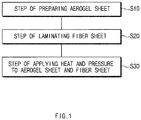
- a method for manufacturing a composite sheet comprising an aerogel sheet comprises: a step (S10) of preparing the aerogel sheet (30); a step (S20) of laminating a fiber sheet (10) on each of both surfaces of the aerogel sheet (30); and a step (S30) of applying heat and a pressure to the aerogel sheet (30) and the fiber sheet (10), which are laminated, to bond the sheets to each other and to manufacture the composite sheet (40) in which the fiber sheet (10), the aerogel sheet (30), and the fiber sheet (10) are laminated.
- the method may further comprise a step (S15) of drying the aerogel sheet 30 between the step (S10) and the step (S20).
- the method may further comprise a step (S25) of performing needling on the aerogel sheet (30) and the fiber sheet (10), which are laminated, to temporarily fix the aerogel sheet (30) and the fiber sheet (10) between the step (S20) and the step (S30).
- the method may further comprise a step (S40) of cutting the composite sheet (40) to a predetermined size to manufacture a composite pad (50) after the step (S30).
- the step (S10) comprises: a step (a) of manufacturing silica sol (2); a step (b) of manufacturing a gelling catalyst; a step (c) of injecting the silica sol (2), which is manufactured in the step (a), to a surface of a fiber sheet (1) to impregnate the silica sol (2); a step (d) of injecting the gelling catalyst (3), which is manufactured in step (b), to the surface of the fiber sheet (1), into which the silica sol (2) is impregnated, to manufacture a gel sheet (20) in which the silica sol is impregnated; a step (e) of aging the gel sheet (20) in which the silica sol is gelated; a step (f) of applying a coating solution to the aged gel sheet (20) to modify a surface of the gel sheet (20); and a step (g) of drying the gel sheet (20) of which the surface is modified to manufacture the aerogel sheet (30).
- TEOS tetraethyl orthosilicate
- ethanol tetraethyl orthosilicate
- the tetraethyl orthosilicate (TEOS) may comprise hydrolyzed TEOS.
- ethanol and ammonia water may be mixed to manufacture the gelling catalyst (3).
- the step (c) and the step (d) may be performed within a conveyor belt that transfers the fiber sheet (1) from one side to the other side thereof.
- the gelling catalyst (3) may be injected to the surface of the fiber sheet (1) at a rate of 0.035 L/min to 0.012 L/min to leave the gelling catalyst (3) for 8 minutes to 12 minutes and thereby to gelate the silica sol.
- the gel sheet (20), in which the silica sol is gelated may be aged at a temperature of 70°C and aged for 50 minutes.
- the coating solution may be manufactured by mixing ethanol with ammonia water (NH 4 OH).
- the coating solution may be injected with 1.6 times of the silica sol (2) impregnated into the surface of the fiber sheet (1), and the aging may be performed at a high temperature of 70°C for one hour to modify the surface of the fiber sheet (10) by using hexamethyldisilazane (HMDS).
- HMDS hexamethyldisilazane
- the step (g) may comprise a first drying step of injecting carbon dioxide at a rate of 70 L/min for ten minutes under environments of a temperature of 28 °C and a pressure of 70 bar to dry the gel sheet (20) of which the surface is modified, a second drying step of raising to a temperature of 50°C for 1 hour and 20 minutes to dry the gel sheet (20), a third drying step of injecting carbon dioxide at a rate of 0.7 L/min for 20 minutes under a temperature of 50°C and a pressure of 150 bar to dry the gel sheet (20), and a fourth drying step of injecting carbon dioxide at a rate of 0.7 L/min for 20 minutes after breaking for 20 minutes to dry the gel sheet (20).
- the ethanol generated from the gel sheet (20) of which the surface is modified may be collected while injecting the carbon dioxide.
- the step (g) may further comprise a step of discharging the carbon dioxide for 2 hours after the fourth drying step.
- the steps (e), (f), and (g) may be performed in a reaction vessel accommodating the gel sheet.
- An apparatus for performing the method for manufacturing the composite sheet comprising the aerogel sheet comprises: a gel sheet manufacturing machine (100) that manufactures a gel sheet (20); a reaction vessel (200) in which the gel sheet (20) manufactured by the gel sheet manufacturing machine (100) is aged, surface-modified, and dried to manufacture the aerogel sheet; and a composite sheet manufacturing machine (300) that bonds the aerogel sheet (30) manufactured in the reaction vessel (200) to a fiber sheet (10) to manufacture a composite sheet (40), wherein the composite sheet manufacturing machine (300) comprises an aerogel sheet supply roller (310) supplying the aerogel sheet (30), a plurality of fiber sheet supply rollers (320) supplying the fiber sheet (10) to each of both surfaces of the aerogel sheet (30) so that the fiber sheet (10) is laminated, a hot press (330) pressing the aerogel sheet (30) and the fiber sheet (10) while applying heat and a pressure in a state in which the fiber sheet (10) is disposed between the aerogel sheets (30) to manufacture the composite sheet (40) .
- the composite sheet manufacturing machine (300) may further comprise a drying member (340) for drying the aerogel sheet (30) supplied from the aerogel sheet supply rollers (310) and a needling member (350) for performing needling on the aerogel sheets (30) with the fiber sheet (10) therebetween to temporarily bond the aerogel sheets (30) to the fiber sheet (10).
- a drying member (340) for drying the aerogel sheet (30) supplied from the aerogel sheet supply rollers (310)
- a needling member (350) for performing needling on the aerogel sheets (30) with the fiber sheet (10) therebetween to temporarily bond the aerogel sheets (30) to the fiber sheet (10).
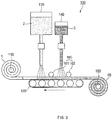
- the gel sheet manufacturing machine (100) may comprise a winding roller (110) around which a fiber sheet (1) is wound, a conveyor belt (120) for transferring the fiber sheet (1) wound around the winding roller (110) from one side to the other side thereof, a silica sol supply member (130) for injecting the silica sol (2) to a surface of the fiber sheet (1) disposed on the conveyor belt (120) to impregnate the silica sol (2), a catalyst supply member (140) for injecting the gelling catalyst (3) to the surface of the fiber sheet (1) disposed on the conveyor belt (120) to manufacture the gel sheet (20) in which the silica sol is gelated, and a collection roller (150) for winding the gel sheet (20), which is transferred up to the other side by the conveyor belt (120), in the form of the roll to collect the gel sheet (20).
- a method for manufacturing a composite sheet comprising an aerogel sheet according to a second embodiment of the present invention comprises: a step (S10) of preparing the aerogel sheet (30); a step (S20) of laminating a fiber sheet (10) on each of both surfaces of the aerogel sheet (30); and a step (S30) of applying heat and a pressure to the aerogel sheet (30) and the fiber sheet (10), which are laminated, to bond the sheets to each other and to manufacture the composite sheet (40) in which the fiber sheet (10), the aerogel sheet (30), and the fiber sheet (10) are laminated, wherein, in the step (S10) of preparing the aerogel sheet (30), the aerogel sheet (30) comprises a compound comprising an aerogel matrix and a reinforcing structure, and the aerogel matrix is continuous through the reinforcing structure, and the reinforcing structure is a lofty fibrous batting, wherein the fibers are oriented along all three axes, the lofty fibrous batting has the form of a sheet, the compound is a lightweight insulation
- the lofty fibrous batting may be maintained to a thickness of at least 50% after the gel forming liquid is added so at to form the aerogel matrix.
- the lofty fibrous batting may have resilience so that the lofty fibrous batting is compressible by at least 50% of its natural thickness and returns to at least 70% of its original thickness after being compressed for 5 seconds.
- the fibers of the lofty fibrous batting which is discriminable in the cross-sectional area of the compound, may have a cross-sectional area less than 8% of the total cross-sectional area.
- the present invention has effects as follows.
- the aerogel sheet and the fiber sheet may be laminated to manufacture the composite sheet, thereby improving the bondability and the durability and significantly reducing the manufacturing costs and particularly stably increasing in thickness.
- the aerogel sheet and the fiber sheet may be laminated to increase in thickness while maintaining the elegant exterior.
- the present invention may use the method for manufacturing the aerogel sheet to manufacture the aerogel sheet having the superior insulation and durability, and particularly, having the uniform thickness.
- the tetraethyl orthosilicate (TEOS) and the ethanol may be mixed to obtain the silica sol having the high quality.
- the ethanol and the ammonia water (NH 4 OH) may be mixed to obtain the gelling catalyst having the high quality.
- the conveyor belt for transferring the fiber sheet from one side to the other side thereof may be used to achieve the continuity of the operation and the simplification of the process.
- a method for manufacturing a composite sheet comprising an aerogel sheet according to a first embodiment of the present invention is for manufacturing a composite sheet 40 in which a fiber sheet 10, an aerogel sheet 30, and a fiber sheet 10 are laminated and comprises an aerogel preparing step (S10), a fiber sheet laminating step (S20), and a composite sheet manufacturing step (S30).
- the aerogel sheet 30 is prepared. First, a method for manufacturing the aerogel sheet will be described.
- the method for manufacturing the aerogel sheet is for manufacturing an aerogel sheet having superior thermal insulation and durability and having a uniform thickness and comprises a step (a) of manufacturing silica sol 2, a step (b) of manufacturing a gelling catalyst 3, a step (c) of injecting the silica sol 2 manufactured in the step (a) to a surface of the fiber sheet 1 to impregnate the silica sol 2, a step (d) of injecting the gelling catalyst 3 manufactured in the step (c) to the surface of the fiber sheet 1, into which the silica sol is impregnated, to manufacture a gel sheet 20 in which the silica sol is gelated, a step (e) of aging the gel sheet 20 in which the silica sol is gelated, a step (f) of applying a coating solution to the aged gel sheet 20 to modify a surface of the gel sheet 20, and a step (g) of drying the gel sheet 20 of which the surface is modified to manufacture the aerogel sheet 30.
- the silica sol manufacturing step (a) is a step of obtaining the silica sol.
- tetraethyl orthosilicate (TEOS) and ethanol are mixed to manufacture the silica sol 2. That is, 1.2 kg of TEOS and 2.7 kg of ethanol are provided in a reaction bath (not shown) to manufacture the silica sol 2.
- the TEOS may use a solvent having high reactivity with water and be hydrolyzed to more improve reactivity. That is, the hydrolyzed TEOS and the ethanol may be mixed to obtain the silica sol 2 having excellent reactivity.
- the gelling catalyst manufacturing step (b) is a step of obtaining the gelling catalyst.
- ethanol and ammonia water (NH 4 OH) are mixed to manufacture the gelling catalyst 3. That is, 0.5 kg of ethanol and 30 ml of ammonia water (NH 4 OH) are mixed in the reaction bath (not shown) to manufacture the gelling catalyst 3.
- An apparatus for manufacturing the composite sheet according to the first embodiment of the present invention comprises a gel sheet manufacturing machine 100 that manufactures the gel sheet 20, a reaction vessel 200 in which the aerogel sheet is manufactured by using the gel sheet 20, and a composite sheet manufacturing machine 300 that manufactures a composite sheet 40 by using the aerogel sheet 30.
- silica sol injection step (c) and the gelling catalyst injection step (d) are performed in the gel sheet manufacturing machine 100.
- the gel sheet manufacturing machine 100 will be described below in detail.
- the gel sheet manufacturing machine 100 comprises a winding roller 110 around which the fiber sheet 1 is wound in the form of a roll, a conveyor belt 120 for transferring the fiber sheet 1 wound around the winding roller 110 from one side to the other side thereof, a silica sol supply member 130 for injecting the silica sol 2 manufactured in the step (a) to a surface of the fiber sheet 1 disposed on the conveyor belt 120 to impregnate the silica sol 2, a catalyst supply member 140 for injecting the gelling catalyst 3 manufactured in the step (b) to the surface of the fiber sheet 1 disposed on the conveyor belt to manufacture the gel sheet 20 in which the silica sol is gelated, and a collection roller 150 for winding the gel sheet 20, which is transferred up to the other side by the conveyor belt 120, in the form of the roll to collect the gel sheet 20.
- the gel sheet manufacturing machine 100 transfers the fiber sheet 1 wound around the winding roller 110 from the one side to the other side through the conveyor belt 120 when the fiber sheet 1 is prepared on the winding roller 110.
- the silica sol supply member 130 injects the silica sol 2 manufactured in the step (a) to the surface of the fiber sheet 1 transferred by the conveyor belt 120 to impregnate the silica sol.
- the catalyst supply member 140 injects the gelling catalyst 3 to the surface of the fiber sheet 1 in which the silica sol is impregnated to manufacture the gel sheet 20 in which the silica sol is gelated.
- the gel sheet 20 transferred up to the other side of the conveyor belt 120 is rewound and collected by the collection roller 150.
- a scraper 160 for uniformly adjusting a thickness of each of the silica sol 2 and the gelling catalyst 3, which are injected to the fiber sheet 1, may be provided on the conveyor belt 120. That is, the scraper 160 comprises a first scraper 161 for adjusting a thickness of the silica sol 2 injected to the surface of the fiber sheet 1 and a second scraper 162 for adjusting a thickness of the gelling catalyst 3 injected to the surface of the fiber sheet 1.
- first scraper 161 and the second scraper 162 may have the same shape and be installed to be adjustable in height on a top surface of the conveyor belt 120 to uniformly adjust the thickness of each of the silica sol 20 and the gelling catalyst 3, thereby obtaining the gel sheet 20 having uniform quality.
- silica sol injection step (c) and the gelling catalyst injection step (d) using the gel sheet manufacturing machine 100 will be described in detail.
- the silica sol 2 manufactured in the step (a) is injected and impregnated to the surface of the fiber sheet 1. That is, the silica sol 2 manufactured in the step (a) is injected into and stored in the silica sol supply member 130. Then, when the fiber sheet 1 is transferred up to a lower side of the silica sol supply member 130 by the conveyor belt 120, the silica sol 2 is injected through the silica sol supply member 130 and impregnated into the surface of the fiber sheet 1.
- the silica sol 2 injected to the fiber sheet 1 has a uniform thickness while passing through the first scraper 161 installed on the conveyor belt 120. That is, the first scraper 161 may uniformly adjust the thickness of the silica sol 2 by blocking the silica sol 2 having a predetermined thickness or more so that the silica sol 20 does not pass therethrough.
- the gelling catalyst 3 is injected to the surface of the fiber sheet 1 in which the silica sol 2 is impregnated in the step (c) to gelate the silica sol 2. That is, the gelling catalyst 3 manufactured in the step (b) is injected and stored in the catalyst supply member 140. Then, when the fiber sheet 1 is transferred up to the lower side of the catalyst supply member 140 by the conveyor belt 120, the gelling catalyst 3 is injected to the surface of the fiber sheet 1 through the catalyst supply member 140 to gelate the silica sol, thereby obtaining the gel sheet 20 in which the silica sol is gelated.
- the catalyst supply member 140 may inject the stored gelling catalyst 3 at a preset rate and then leave the gelling catalyst 3 for a preset time to stably gelate the silica sol. That is, the catalyst supply member 140 may inject the gelling catalyst 3 to the surface of the fiber sheet 1 at a rate of 0.035 L/min to 0.012 L/min and then leave the gelling catalyst 30 for 8 minutes to 12 minutes to gradually gelate the silica sol.
- the catalyst supply member 140 may uniformly adjust the gelation of the silica sol by varying in injection rate of the gelling catalyst 3 according to density of the silica sol 2 impregnated in the fiber sheet 1.
- the injection rate of the gelling catalyst 3 is controlled to 0.035L/min.
- the silica sol 2 impregnated in the fiber sheet 1 has a content of 30 wt% and thermal conductivity of 14.9 mW/mK.
- the injection rate of the gelling catalyst 3 is controlled to 0.017 L/min.
- the silica sol 2 impregnated in the fiber sheet 1 has a content of 38 wt% and thermal conductivity of 14.1 mW/mK.
- the injection rate of the gelling catalyst 3 is controlled to 0.014 L/min.
- the silica sol 2 impregnated in the fiber sheet 1 has a content of 38 wt% and thermal conductivity of 13.6 mW/mK.
- the injection rate of the gelling catalyst 3 is controlled to 0.012 L/min.
- the silica sol 2 impregnated in the fiber sheet 1 has a content of 55 wt% and thermal conductivity of 13.0 mW/mK.
- the more the intensity of the silica sol increases the more the injection rate of the gelling catalyst decreases to induce stable gelation of the silica sol.
- the gel sheet 20 manufactured as described above is wound in the form of a roll by the collection roller 150 and then is collected.
- the collected gel sheet 20 undergoes the gel sheet aging step (e), the gel sheet surface modifying step (f), and the gel sheet drying step (g) to manufacture the aerogel sheet 30.
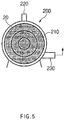
- the reaction vessel 200 has an accommodation space 210 in which the gel sheet 20 collected in the form of the roll is accommodated. Also, the reaction vessel 200 has one end in which an injection hole 220 connected to the accommodation space 210 is formed and the other end in which a discharge hole 230 connected to the accommodation space 210 is formed.
- the gel sheet 20 is aged. That is, the gel sheet 20 collected in the step (d) is accommodated into the accommodation space 210 of the reaction vessel 200. Then, the gel sheet 20 is aged for 50 minutes in a state in which the accommodation space 210 of the reaction vessel 200 is heated at 70°C to uniformize tissues of the gel sheet 20.
- the gel sheet 20 is left at room temperature (or a temperature of 25°C) for 10 minutes before being aged in the reaction vessel 200 to perform the aging. That is, the aging may be performed after inducing the stable gelation of the silica sol 2 to more uniformize the tissues of the gel sheet 20.
- a coating solution is injected to the aged gel sheet 20 to modify a surface of the gel sheet 20. That is, in the gel sheet surface modifying step (f), ethanol and ammonia water (NH 4 OH) are mixed to manufacture the coating solution. Then, the coating solution is injected into the accommodation space 210 through the injection hole 220 of the reaction vessel 200 in which the gel sheet 20 is inserted to modify the surface of the gel sheet 20.
- the coating solution is injected with 1.6 times of the silica sol impregnated into the surface of the fiber sheet in the step (c), and the aging is performed at a high temperature of 70°C for one hour in the reaction vessel 200 to modify the surface of the gel sheet 20 by using hexamethyldisilazane (HMDS) .
- HMDS hexamethyldisilazane
- HMDS hexamethyldisilazane
- the gel sheet 20 of which the surface is modified is dried to complete an aerogel sheet 30.
- supercritical drying is performed in a state in which the gel sheet 20 is accommodated in the reaction vessel 200.
- the gel sheet drying step (g) comprises a first drying step of injecting carbon dioxide at a rate of 70 L/min for ten minutes under environments of a temperature of 28 °C and a pressure of 70 bar to dry the gel sheet 20, a second drying step of raising to a temperature of 50 °C for 1 hour and 20 minutes to dry the gel sheet 20, a third drying step of injecting carbon dioxide at a rate of 0.7 L/min for 20 minutes again under a temperature of 50°C and a pressure of 150 bar to dry the gel sheet 20, and a fourth drying step of injecting carbon dioxide at a rate of 0.7 L/min for 20 minutes after breaking for 20 minutes to dry the gel sheet 20.
- the above-described drying steps may be performed to increase a drying rate of the gel sheet 20.
- ethanol is generated in the reaction vessel 200 by chemical reaction between the carbon dioxide and the gel sheet 20, and the ethanol generated in the reaction vessel 200 is discharged through the discharge hole 230 and then is collected.
- the gel sheet drying step (g) comprises a discharging step of discharging the carbon dioxide for 2 hours after the fourth drying step.
- a gradual environmental change in the gel sheet 20 is induced to uniformize the tissues of the gel sheet 20.
- the fiber sheet laminating step (S20) may be a step for increasing a thickness of a composite sheet and improving bondability with the aerogel sheet when the composite sheet is manufactured.
- a fiber sheet 10 such as a blanket is prepared.
- the prepared fiber sheet 10 is mounted on each of a plurality of fiber sheet supply rollers 320 to supply the fiber sheet so that the fiber sheet 10 is laminated on each of both surfaces of the aerogel sheet 30.
- the composite sheet manufacturing method (S30) heat and a pressure are applied to the fiber sheet 10, the aerogel sheet 30, and the fiber sheet 10, which are laminated, to bond the sheets to each other, thereby manufacturing the composite sheet 40.
- a composite sheet manufacturing machine is used.
- a composite sheet manufacturing machine comprises an aerogel sheet supply roller 310 supplying the aerogel sheet 30, a plurality of fiber sheet supply rollers 320 supplying the fiber sheet 10 to each of both surfaces of the aerogel sheet 30, and a hot press 330 pressing the aerogel sheet 30 and the fiber sheet 10 while applying heat and a pressure to manufacture a composite sheet 40.
- the aerogel sheet 30 and the fiber sheet 10 may pass through the hot press 330 to manufacture the composite sheet 40.
- the composite sheet manufacturing machine 300 further comprises a drying member 340 for drying the aerogel sheet 30 supplied from the aerogel sheet supply roller 310.
- the drying member 340 more increases a drying rate of the aerogel sheet 30 to improve the bondability with the fiber sheet 10.
- the composite sheet manufacturing machine 300 further comprises a needling member 350 for performing needling on the aerogel sheets 30 with the fiber sheet 10 therebetween to temporarily bond the aerogel sheets to the fiber sheet 10.
- the needling member 350 temporarily bonds the aerogel sheets to the fiber sheet 10 to previously prevent irregular bonding from occurring.
- the composite sheet manufacturing machine 300 further comprises a cutting member 360 for cutting the composite sheet 40 to a predetermined size to process the composite sheet 40 into a composite pad 50.
- the cutting member 360 cuts the composite sheet 40 to form the composite pad 50 so as to improve efficiency in use and stage.
- a composite sheet manufacturing step (S30) using the composite sheet manufacturing machine 300 comprising the above-described constituents according to the first embodiment of the present invention will be described.
- the fiber sheet 10 When the fiber sheet 10, the aerogel sheet 30, and the fiber sheet 10 are completely laminated through the aerogel sheet preparing step (S10) and the fiber sheet laminating step (S20), heat and a pressure are applied to the fiber sheet 10, the aerogel sheet 30, and the fiber sheet 10, which are laminated, to bond the sheets to each other, thereby manufacturing the composite sheet 40.
- a step (S15) of drying the prepared aerogel sheet 30 is further performed between the step (S10) and the step (S20).
- the aerogel sheet 30 is dried by the high-temperature heat through the drying member 340 to vaporize moisture.
- the drying rate of the aerogel sheet 30 may increase.
- a step (S25) of performing the needling on the aerogel sheet 30 and the fiber sheet 10, which are laminated, to temporarily fix the aerogel sheet 30 and the fiber sheet 10 is performed between the step (S20) and the step (S30).
- the needling is performed on the aerogel sheet 30 and the fiber sheet 10, which are laminated, to temporarily fix the aerogel sheet 30 and the fiber sheet 10, thereby preventing the aerogel sheet 30 and the fiber sheet 10 from moving when the compressing is performed.
- drying step and the temporary fixing step may be further performed to obtain the composite sheet 40 having uniform quality.
- the composite sheet 40 in which the aerogel sheet 30, the fiber sheet 10, and the aerogel sheet 30 are laminated, is described as one embodiment in the first embodiment of the present invention, a composite sheet 40 in which one or more aerogel sheets 30 and one or more fiber sheets 10 are laminated may be manufactured according to the application.
- the composite sheet 40 manufactured as described above may be cut to a predetermined size to obtain a composite pad 50. That is, the composite sheet 40 may be cut to a predetermined size through the cutting member 360 to obtain the composite pad 50.
- the apparatus and method for manufacturing the composite sheet comprising the aerogel gel which is manufactured through the above-described constituents and method, may be utilized to obtain the composite sheet and the composite pad, which have the high bondability and durability and the low manufacturing costs, and particularly, having the stable thickness.
- a method for manufacturing a composite sheet according to a second embodiment of the present invention is the same the method for manufacturing the composite sheet according to the first embodiment except for an aerogel sheet preparing step (S10).
- a method for manufacturing a composite sheet according to a second embodiment of the present invention comprises a step (S10) of preparing an aerogel sheet 30, a step (20) of laminating a fiber sheet 10 on each of both surfaces of the aerogel sheet 30, a step (S30) of applying heat and a pressure to the aerogel sheet 30 and the fiber sheet 10, which are laminated, to bond the sheets to each other and thereby to manufacture a composite sheet 40 in which the fiber sheet 10, the aerogel sheet 30, and the fiber sheet 10 are laminated.
- the aerogel sheet 30 is manufactured by using a compound 20 comprising an aerogel matrix and a reinforcing structure 21.
- the aerogel composite 20 comprises two reinforcing phases.
- the first phase is the aerogel matrix
- the second phase is the reinforcing phase.
- the reinforcing phase primarily comprises a lofty fibrous material, preferably, a mixture of lofty batting and one or more fibrous materials having significantly different thicknesses, lengths, or aspect ratios.
- the adequate mixture of a two fibrous material system is manufactured when a microfiber (one fibrous material) having a short and high aspect ratio is dispersed throughout a continuous aerogel matrix that penetrates into a lofty fiber battering (the other fibrous material).
- the aerogel matrix is continuous through the reinforcing structure 21, and the reinforcing structure 21 is the lofty fibrous batting.
- the fibers are oriented along all three axes.
- the lofty fibrous batting has the form of a sheet, and the compound 20 is a lightweight insulation product having resilience and durability.
- the lofty fibrous batting is compressible by at least 50% of its natural thickness and returns to at least 70% of its original thickness after being compressed for 5 seconds.
- the lofty fibrous batting may have a density of 0.001 g/cm 3 to 0.26 g/cm 3 , and the fibers discriminable in the cross-sectional area of the compound 20 may have a cross-sectional area less than 10% of the total cross-sectional area.
- the aerogel matrix may be an organic aerogel, inorganic aerogel, or a mixture thereof.
- the organic aerogel may be selected form the group consisting of polyacrylates, polystyrenes, polyacrylonitriles, polyurethanes, polyimides, polyfurfural alcohol, phenol furfuryl alcohol, melamine formaldehydes, resorcinol formaldehydes, cresol formaldehyde, phenol formaldehyde, polyvinyl alcohol dialdehyde, polycyanurates, polyacrylamides, various epoxies, agar, agarose, and the like (see for instance C. S. Ashley, C. J. Brinker and D. M. Smith, Journal of Non-Crystalline Solids, volume 285, 2001 ).
- a principal synthetic route for the production of the inorganic aerogel is hydrolysis and condensation of an appropriate metal alkoxide.
- the most suitable metal alkoxides are materials having about 1 carbon atoms to 6 carbon atoms, preferably, from 1 carbon atoms to 4 carbon atoms in each alkyl group.
- TEOS tetraethoxysilane
- TMOS tetramethoxysilane
- tetra-n-propoxysilane aluminum isopropoxide, aluminum sec-butoxide, cerium isopropoxide, hafnium tert-butoxide, magnesium aluminum isopropoxide, yttrium isopropoxide, titanium isopropoxide, zirconium isopropoxide, and the like.
- silica precursors the materials may be partially hydrolyzed and stabilized at a low pH as polymers of polysilicic acid esters, for example, polydiethoxysiloxane (PDEOS).
- PDEOS polydiethoxysiloxane
- the materials are commercially available in alcohol solution (for example Silbond® 40, 40% silica content, Silbond Corporation).
- Pre-polymerized silica precursors are especially preferred for the aerogel compound of this invention.
- Suitable materials for use in producing the aerogel to be used at a low temperature are non-refractory metal alkoxides based on oxide-forming metals. Suitable such metals are silicon and magnesium, and a mixture thereof. Suitable alkoxides that are adequate for high temperature are refractory metal alkoxides that are capable of forming oxides, e.g., such as zirconia, yttria, hafnia, alumina, titania, ceria, and the like, and a mixture thereof such as zirconia and yttria. Mixtures of non-refractory metals with refractory metals, such as silicon and/or magnesium with aluminum, may also be used.
- An advantage of using more than one metal oxide matrix material for the aerogel structure is an enhancement of IR opacification, which is achieved by providing chemical functional groups that absorb radiation at a wider range of wavelengths.
- Finely dispersed dopants for example, carbon black, titania, iron oxides, silicon carbide, molybdenum silicide, manganese oxides, polydialkylsiloxanes (where the alkyl groups contain 1 to 4 carbon atoms), and the like, may be added to improve thermal performance at a higher temperature by increasing the opacity of the article to IR transmission.
- a suitable amount of dopants generally ranges from about 1% to 20% by weight of the final compound, preferably, about 2% to 10%.
- the lofty fibrous batting is defined as a fibrous material that shows the properties of bulk and some resilience (with or without full bulk recovery).
- the adequate form is a soft web of this material.
- the use of the lofty batting reinforcement material minimizes a volume of unsupported aerogel while avoiding substantial degradation of the thermal performance of the aerogel.
- the batting preferably refers to layers or sheets of a fibrous material, which is commonly used for lining quilts or for stuffing or packaging or as a blanket of thermal insulation.
- the reinforcing fibrous material used in the second embodiment of the present invention is one or more layers of the lofty fibrous batting.
- the use of the lofty batting reinforcement material minimizes a volume of unsupported aerogel while avoiding substantial degradation of the thermal performance of the aerogel.
- the "batting” is a product resulting from carding or Garnetting fibers to form the soft web of a fiber in the form of a sheet
- the “batting” also comprises webs in non-sheet form which is provided that they are sufficiently open to be "lofty", e.g. the Primaloft® products from Albany International.
- the batting refers to layers or sheets of a fibrous material, which is commonly used for lining quilts or for stuffing or packaging or as a blanket of thermal insulation.
- Suitable fibers for producing the batting are relatively fine and have deniers of 15 and below, preferably 10 and below.
- the softness of the web is a byproduct of the relatively fine, multi-directionally oriented fibers that are used to make the fiber web.
- the batting is the "lofty" if it contains sufficiently few individual filaments (or fibers) that it does not significantly alter the thermal properties of the reinforced compound 20 as compared to a non-reinforced aerogel body of the same material. This means that upon looking at a cross-section of the final aerogel compound 20, the cross-sectional area of the fibers is less than 10% of the total surface area of that cross-section, preferably less than 8%, and most preferably less than 5%.
- the lofty batting preferably has thermal conductivity of 50 mW/m-K, or less at room temperature and pressure to facilitate the formation of low thermal conductivity aerogel compound 20.
- the lofty batting is one that (i) is compressible by at least 50% of its natural thickness, preferably at least 65%, and most preferably at least 80%, and (ii) is sufficiently resilient that after compression for several seconds it will return to at least 70% of its original thickness, preferably at least 75%, and most preferably at least 80%.
- the lofty batting may be recovered to substantially its original size and shape when the air (bulk) is removed.
- a HolofilTM batting may be compressed from its original 1.5" thickness to a minimum of about 0.2" and recovered to its original thickness when a load is removed.
- This batting may be considered to contain 1.3" of air (bulk) and 0.2" of fiber. It is compressible by 87% and recovered to essentially 100% of its original thickness.
- Fiber glass batting used for home insulation may be compressed to a similar extent and recovered to about 80% of its original thickness, but does that quite slowly.
- the batting used in the second embodiment of the present invention is substantially different from a fibrous mat.
- the fibrous mat is "a densely woven or thickly tangled mass," i.e. dense and relatively stiff fibrous structures with a minimal open space between adjacent fibers. While the mat has a density of 25 lbs/ft3 (0.41 g/cc), the lofty batting used in this invention has a much lower density, i.e., ranges from 0.1 lbs/ft3 to 16 lbs/ft3 (0.001 g/cc to 0.26 g/cc), preferably, 2.4 lbs/ft3 to 6.1 lbs/ft3 (0.04 to 0.1 g/cc).
- the mat is compressible by less than about 20% and shows little to no resilience.
- the cross-sectional surface area of the mat fibers is about 30 to 50% of the total surface area in the cross-section.
- the batting is maintained to a thickness of at least 50% after the gel forming liquid is poured.
- a method of understanding the need for openness in the fiber reinforcing material used herein is to recognize that fiber reinforcements that tend to run along the z axis, (in the direction of the heat flow) will significantly increase the thermal conductivity of the resulting compound by acting as thermal conduits.
- the batting that has highly aligned (straight) fibers in the x-y horizontal plane is stiffer than the typical lofty batting of the same density with bent or crimped fibers running in all three axes.
- the batting In order to minimize a heat flow in the z direction (as is the desire with most insulating materials) the batting should have low heat flow along the z axis (in the direction of the heat flow).
- the suitable batting has high enough quantity of fibers oriented along the z axis to maintain loft, but not so great a quantity that the insulating properties of the resulting compound are compromised by these fibers.
- the fibers along the z axis may be of a different material (preferably, a material with lower thermal conductivity) than those in the x and y axes.
- the z axis fibers may also be made more circuitous, so that the z axis fibers present a more tortuous path for heat conduction than do the fibers in the x-y direction.
- the same fiber materials and methods may be used throughout the batting in an attempt to minimize thermal conduction in all axes, but in many insulating applications, however, it is heat flow in a specific direction that is being addressed, and using such materials and methods may compromise the flexibility of the resulting compound.
- the ideal lofty batting is one with fine, crimped fibers, which are uniformly dispersed throughout the compound 20.
Landscapes
- Chemical & Material Sciences (AREA)
- Organic Chemistry (AREA)
- Engineering & Computer Science (AREA)
- Dispersion Chemistry (AREA)
- Mechanical Engineering (AREA)
- Composite Materials (AREA)
- Inorganic Chemistry (AREA)
- Physics & Mathematics (AREA)
- Mathematical Physics (AREA)
- Chemical Kinetics & Catalysis (AREA)
- Ceramic Engineering (AREA)
- Textile Engineering (AREA)
- Silicon Compounds (AREA)
- Laminated Bodies (AREA)
- Manufacture Of Porous Articles, And Recovery And Treatment Of Waste Products (AREA)
Applications Claiming Priority (3)
| Application Number | Priority Date | Filing Date | Title |
|---|---|---|---|
| KR20160019833 | 2016-02-19 | ||
| KR1020160095254A KR101962206B1 (ko) | 2016-02-19 | 2016-07-27 | 에어로겔 시트를 포함하는 복합시트 제조방법 및 제조장치 |
| PCT/KR2017/001327 WO2017142244A1 (fr) | 2016-02-19 | 2017-02-07 | Procédé et appareil de fabrication de feuille composite comprenant une feuille d'aérogel |
Publications (3)
| Publication Number | Publication Date |
|---|---|
| EP3326810A1 true EP3326810A1 (fr) | 2018-05-30 |
| EP3326810A4 EP3326810A4 (fr) | 2018-07-04 |
| EP3326810B1 EP3326810B1 (fr) | 2019-06-26 |
Family
ID=59760170
Family Applications (1)
| Application Number | Title | Priority Date | Filing Date |
|---|---|---|---|
| EP17753405.4A Active EP3326810B1 (fr) | 2016-02-19 | 2017-02-07 | Procédé et appareil de fabrication de feuille composite comprenant une feuille d'aérogel |
Country Status (5)
| Country | Link |
|---|---|
| US (1) | US10682839B2 (fr) |
| EP (1) | EP3326810B1 (fr) |
| JP (1) | JP6612443B2 (fr) |
| KR (1) | KR101962206B1 (fr) |
| CN (1) | CN108136749B (fr) |
Families Citing this family (33)
| Publication number | Priority date | Publication date | Assignee | Title |
|---|---|---|---|---|
| US11072145B2 (en) * | 2016-01-27 | 2021-07-27 | Aspen Aerogels, Inc. | Laminates comprising reinforced aerogel composites |
| KR102516024B1 (ko) * | 2018-03-09 | 2023-03-29 | 에스케이씨 주식회사 | 에어로겔 복합체의 제조장치 및 이를 이용한 에어로겔 복합체의 제조방법 |
| US11866324B2 (en) | 2018-11-27 | 2024-01-09 | Lg Chem, Ltd. | Method for manufacturing aerogel blanket |
| KR102427987B1 (ko) * | 2018-11-27 | 2022-08-02 | 주식회사 엘지화학 | 전가수분해된 폴리실리케이트의 합성방법 |
| CN113767083B (zh) * | 2019-08-09 | 2023-03-21 | 株式会社Lg化学 | 干燥湿凝胶毡的方法和使用该方法制造气凝胶毡的方法 |
| CN114007999A (zh) | 2019-09-03 | 2022-02-01 | 株式会社Lg化学 | 气凝胶毡 |
| KR102581268B1 (ko) | 2019-09-03 | 2023-09-22 | 주식회사 엘지화학 | 에어로겔 블랭킷 제조방법 |
| CN113226677A (zh) * | 2019-09-03 | 2021-08-06 | 株式会社Lg化学 | 用于制备气凝胶毡的装置和方法 |
| CN110592803B (zh) * | 2019-10-10 | 2020-09-04 | 上海盈兹无纺布有限公司 | 一种热风无纺布热压成型设备及其制备无纺布的方法 |
| CN111097344B (zh) * | 2020-01-07 | 2024-05-28 | 北京瑷格干细胞科技有限公司 | 一种制备水凝胶微球的设备和方法 |
| US12552673B2 (en) | 2021-05-31 | 2026-02-17 | Lg Chem, Ltd. | Device and method for producing aerogel blanket |
| KR102737602B1 (ko) * | 2021-05-31 | 2024-12-04 | 주식회사 엘지화학 | 에어로겔 블랭킷 제조장치 및 제조 방법 |
| CN113291038B (zh) * | 2021-06-24 | 2022-06-17 | 湖北三江航天红阳机电有限公司 | 一种大型气凝胶隔热板材的成型方法 |
| CN113478930A (zh) * | 2021-07-22 | 2021-10-08 | 浙江圣润纳米科技有限公司 | 一种高抗拉拔气凝胶复合材料及其制备方法 |
| CN113463302B (zh) * | 2021-07-31 | 2023-08-29 | 巩义市泛锐熠辉复合材料有限公司 | 一种离心浸渍制备凝胶毡的设备及方法 |
| CN115893974B (zh) * | 2021-08-20 | 2024-07-02 | 巩义市泛锐熠辉复合材料有限公司 | 制备气凝胶毡的设备及其方法 |
| US11769639B2 (en) | 2022-02-22 | 2023-09-26 | Imam Abdulrahman Bin Faisal University | Molybdenum doped carbon nanotube and graphene nanocomposite electrodes |
| KR20240038235A (ko) | 2022-09-16 | 2024-03-25 | 주식회사 플러스 | 마찰대전방지성과 단열성을 가지는 에어로겔 섬유 제조용 조성물 |
| CN115845751B (zh) * | 2022-12-20 | 2026-03-03 | 翌江新材(江苏)有限公司 | 一种用于气凝胶材料的二次改性系统及方法 |
| US12162766B1 (en) | 2023-06-29 | 2024-12-10 | Lg Chem, Ltd. | Aerogel composite |
| US12162767B1 (en) | 2023-07-26 | 2024-12-10 | Lg Chem, Ltd. | Aerogel composite |
| US12326214B2 (en) | 2023-08-30 | 2025-06-10 | Lg Chem, Ltd. | Aerogel composite |
| KR20250032471A (ko) | 2023-08-31 | 2025-03-07 | 주식회사 플러스 | 시스코어형 에어로겔 복합섬유 및 그의 제조방법 |
| CN119704793A (zh) * | 2023-09-26 | 2025-03-28 | 巩义市泛锐熠辉复合材料有限公司 | 气凝胶复合材料封装结构及其制备方法 |
| US12162260B1 (en) | 2023-10-05 | 2024-12-10 | Lg Chem, Ltd. | Aerogel composite |
| CN117245905B (zh) * | 2023-10-25 | 2025-07-22 | 中国联合工程有限公司 | 一种气凝胶隔热垫成型生产线及其工作方法 |
| CN120250396A (zh) * | 2024-01-04 | 2025-07-04 | 厦门点石新材料有限公司 | 一种气凝胶纤维纸及其制备方法 |
| KR20250144820A (ko) | 2024-03-27 | 2025-10-13 | 주식회사 엘지화학 | 에어로겔 복합체 |
| KR20250144821A (ko) | 2024-03-27 | 2025-10-13 | 주식회사 엘지화학 | 에어로겔 복합체 |
| US12479734B2 (en) | 2024-05-02 | 2025-11-25 | Lg Chem, Ltd. | Aerogel composite |
| US12606446B2 (en) | 2024-05-16 | 2026-04-21 | Lg Chem, Ltd. | Aerogel composite |
| WO2026039774A2 (fr) * | 2024-08-16 | 2026-02-19 | Cardinal Cg Company | Systèmes de film et procédés de coulée et de manipulation de gel dans la production d'aérogel |
| US12551859B1 (en) | 2025-01-13 | 2026-02-17 | Lg Chem, Ltd. | Aerogel composite |
Family Cites Families (21)
| Publication number | Priority date | Publication date | Assignee | Title |
|---|---|---|---|---|
| EP0099562A3 (fr) * | 1982-07-21 | 1985-12-11 | Akzo GmbH | Bande textile à plusieurs couches reliées |
| US4783234A (en) * | 1986-12-15 | 1988-11-08 | Fremont Special Machine Company, Inc. | Tubelet panel and method of and apparatus for manufacture thereof |
| JP3137792B2 (ja) | 1993-03-02 | 2001-02-26 | ビーエーエスエフディスパージョン株式会社 | 成形可能な繊維基材の製造方法 |
| US6319852B1 (en) * | 1995-11-16 | 2001-11-20 | Texas Instruments Incorporated | Nanoporous dielectric thin film formation using a post-deposition catalyst |
| KR100214248B1 (ko) * | 1997-07-08 | 1999-08-02 | 현상훈 | 실리카 에어로겔의 제조 방법 |
| BR0115523A (pt) | 2000-12-22 | 2003-09-16 | Aspen Aerogels Inc | Compósito |
| FR2851244B1 (fr) * | 2003-02-17 | 2005-06-17 | Snecma Propulsion Solide | Procede de siliciuration de materiaux composites thermostructuraux et pieces telles qu'obtenues par le procede |
| PL3120983T5 (pl) * | 2003-06-24 | 2024-04-22 | Aspen Aerogels, Inc. | Ciągły arkusz materiału żelowego oraz ciągły arkusz materiału aerożelowego |
| WO2007011750A2 (fr) | 2005-07-15 | 2007-01-25 | Aspen Aerogels, Inc. | Composites aerogel renforces et procedes de fabrication |
| US20070243393A1 (en) * | 2005-10-25 | 2007-10-18 | Advanced Ceramics Research, Inc. | Sandwich composite materials |
| WO2008051029A1 (fr) | 2006-10-25 | 2008-05-02 | Korea Institute Of Industrial Technology | Feuille d'aerogel et procede de preparation associe |
| EP2137247B1 (fr) | 2007-03-16 | 2017-10-18 | Cabot Corporation | Particules d'aérogel et procédés de fabrication associés |
| KR101204684B1 (ko) | 2010-09-20 | 2012-11-26 | 주식회사 영일이엔지 | 실리카 에어로겔 제조방법 |
| EP2634144A4 (fr) | 2010-10-25 | 2014-08-20 | Tokuyama Corp | Aérogel et procédé pour sa production |
| KR101082982B1 (ko) | 2011-03-23 | 2011-11-11 | 주식회사 지오스 | 실리카 에어로겔 분말 제조시스템 |
| US11053369B2 (en) * | 2012-08-10 | 2021-07-06 | Aspen Aerogels, Inc. | Segmented flexible gel composites and rigid panels manufactured therefrom |
| KR101400721B1 (ko) | 2012-10-22 | 2014-05-29 | 지오스 에어로겔 리미티드 | 실리카 에어로겔 분말 제조시스템 |
| US20140287641A1 (en) * | 2013-03-15 | 2014-09-25 | Aerogel Technologies, Llc | Layered aerogel composites, related aerogel materials, and methods of manufacture |
| EP2832690A1 (fr) * | 2013-08-02 | 2015-02-04 | EMPA Eidgenössische Materialprüfungs- und Forschungsanstalt | Procédé de fabrication d'un matériau aérogel |
| KR101506096B1 (ko) * | 2013-11-08 | 2015-03-25 | 지오스 에어로겔 리미티드 | 적층방식을 이용한 에어로겔이 함침된 단열원단의 제조장치 및 제조방법 |
| US9834446B2 (en) | 2014-02-06 | 2017-12-05 | Lg Chem, Ltd. | Method for preparing hydrophobic silica aerogel |
-
2016
- 2016-07-27 KR KR1020160095254A patent/KR101962206B1/ko active Active
-
2017
- 2017-02-07 EP EP17753405.4A patent/EP3326810B1/fr active Active
- 2017-02-07 JP JP2018520558A patent/JP6612443B2/ja active Active
- 2017-02-07 CN CN201780003197.6A patent/CN108136749B/zh active Active
- 2017-02-07 US US15/755,500 patent/US10682839B2/en active Active
Also Published As
| Publication number | Publication date |
|---|---|
| US20180244029A1 (en) | 2018-08-30 |
| CN108136749B (zh) | 2020-10-02 |
| US10682839B2 (en) | 2020-06-16 |
| KR20170098141A (ko) | 2017-08-29 |
| KR101962206B1 (ko) | 2019-03-27 |
| EP3326810B1 (fr) | 2019-06-26 |
| EP3326810A4 (fr) | 2018-07-04 |
| JP2018536558A (ja) | 2018-12-13 |
| JP6612443B2 (ja) | 2019-11-27 |
| CN108136749A (zh) | 2018-06-08 |
Similar Documents
| Publication | Publication Date | Title |
|---|---|---|
| EP3326810B1 (fr) | Procédé et appareil de fabrication de feuille composite comprenant une feuille d'aérogel | |
| US10493741B2 (en) | Apparatus and method for manufacturing composite sheet comprising aerogel sheet | |
| EP2864535B1 (fr) | Structures isolantes souples et leurs procédés de fabrication et d'utilisation | |
| CA2429771C (fr) | Composite d'aerogel a structure fibreuse gonflante | |
| EP3408084B1 (fr) | Structures isolantes | |
| US6989123B2 (en) | Methods to produce gel sheets | |
| EP2350517B1 (fr) | Produit isolant composite flexible | |
| JPH10510888A (ja) | 二成分繊維を含む繊維ウエブ/エーロゲル複合材料、その製造法およびその使用 | |
| JP2025535762A (ja) | 圧縮エアロゲル複合材料とその製造方法 | |
| AU2002232688A1 (en) | Aerogel composite with fibrous batting |
Legal Events
| Date | Code | Title | Description |
|---|---|---|---|
| STAA | Information on the status of an ep patent application or granted ep patent |
Free format text: STATUS: THE INTERNATIONAL PUBLICATION HAS BEEN MADE |
|
| PUAI | Public reference made under article 153(3) epc to a published international application that has entered the european phase |
Free format text: ORIGINAL CODE: 0009012 |
|
| STAA | Information on the status of an ep patent application or granted ep patent |
Free format text: STATUS: REQUEST FOR EXAMINATION WAS MADE |
|
| 17P | Request for examination filed |
Effective date: 20180220 |
|
| AK | Designated contracting states |
Kind code of ref document: A1 Designated state(s): AL AT BE BG CH CY CZ DE DK EE ES FI FR GB GR HR HU IE IS IT LI LT LU LV MC MK MT NL NO PL PT RO RS SE SI SK SM TR |
|
| AX | Request for extension of the european patent |
Extension state: BA ME |
|
| A4 | Supplementary search report drawn up and despatched |
Effective date: 20180605 |
|
| RIC1 | Information provided on ipc code assigned before grant |
Ipc: B32B 27/12 20060101ALI20180529BHEP Ipc: B29C 70/00 20060101ALN20180529BHEP Ipc: B32B 7/08 20060101ALI20180529BHEP Ipc: C01B 33/14 20060101ALI20180529BHEP Ipc: B32B 37/20 20060101AFI20180529BHEP |
|
| REG | Reference to a national code |
Ref country code: DE Ref legal event code: R079 Ref document number: 602017004873 Country of ref document: DE Free format text: PREVIOUS MAIN CLASS: B32B0027120000 Ipc: B32B0037200000 |
|
| GRAP | Despatch of communication of intention to grant a patent |
Free format text: ORIGINAL CODE: EPIDOSNIGR1 |
|
| STAA | Information on the status of an ep patent application or granted ep patent |
Free format text: STATUS: GRANT OF PATENT IS INTENDED |
|
| RIC1 | Information provided on ipc code assigned before grant |
Ipc: B32B 27/12 20060101ALI20190304BHEP Ipc: B29C 70/00 20060101ALN20190304BHEP Ipc: B32B 37/20 20060101AFI20190304BHEP Ipc: B32B 7/08 20190101ALI20190304BHEP Ipc: C01B 33/14 20060101ALI20190304BHEP |
|
| DAV | Request for validation of the european patent (deleted) | ||
| DAX | Request for extension of the european patent (deleted) | ||
| INTG | Intention to grant announced |
Effective date: 20190321 |
|
| GRAS | Grant fee paid |
Free format text: ORIGINAL CODE: EPIDOSNIGR3 |
|
| GRAA | (expected) grant |
Free format text: ORIGINAL CODE: 0009210 |
|
| STAA | Information on the status of an ep patent application or granted ep patent |
Free format text: STATUS: THE PATENT HAS BEEN GRANTED |
|
| AK | Designated contracting states |
Kind code of ref document: B1 Designated state(s): AL AT BE BG CH CY CZ DE DK EE ES FI FR GB GR HR HU IE IS IT LI LT LU LV MC MK MT NL NO PL PT RO RS SE SI SK SM TR |
|
| REG | Reference to a national code |
Ref country code: GB Ref legal event code: FG4D |
|
| REG | Reference to a national code |
Ref country code: CH Ref legal event code: EP |
|
| REG | Reference to a national code |
Ref country code: AT Ref legal event code: REF Ref document number: 1147820 Country of ref document: AT Kind code of ref document: T Effective date: 20190715 |
|
| REG | Reference to a national code |
Ref country code: DE Ref legal event code: R096 Ref document number: 602017004873 Country of ref document: DE |
|
| REG | Reference to a national code |
Ref country code: IE Ref legal event code: FG4D |
|
| REG | Reference to a national code |
Ref country code: NL Ref legal event code: MP Effective date: 20190626 |
|
| PG25 | Lapsed in a contracting state [announced via postgrant information from national office to epo] |
Ref country code: NO Free format text: LAPSE BECAUSE OF FAILURE TO SUBMIT A TRANSLATION OF THE DESCRIPTION OR TO PAY THE FEE WITHIN THE PRESCRIBED TIME-LIMIT Effective date: 20190926 Ref country code: HR Free format text: LAPSE BECAUSE OF FAILURE TO SUBMIT A TRANSLATION OF THE DESCRIPTION OR TO PAY THE FEE WITHIN THE PRESCRIBED TIME-LIMIT Effective date: 20190626 Ref country code: LT Free format text: LAPSE BECAUSE OF FAILURE TO SUBMIT A TRANSLATION OF THE DESCRIPTION OR TO PAY THE FEE WITHIN THE PRESCRIBED TIME-LIMIT Effective date: 20190626 Ref country code: AL Free format text: LAPSE BECAUSE OF FAILURE TO SUBMIT A TRANSLATION OF THE DESCRIPTION OR TO PAY THE FEE WITHIN THE PRESCRIBED TIME-LIMIT Effective date: 20190626 Ref country code: SE Free format text: LAPSE BECAUSE OF FAILURE TO SUBMIT A TRANSLATION OF THE DESCRIPTION OR TO PAY THE FEE WITHIN THE PRESCRIBED TIME-LIMIT Effective date: 20190626 Ref country code: FI Free format text: LAPSE BECAUSE OF FAILURE TO SUBMIT A TRANSLATION OF THE DESCRIPTION OR TO PAY THE FEE WITHIN THE PRESCRIBED TIME-LIMIT Effective date: 20190626 |
|
| REG | Reference to a national code |
Ref country code: LT Ref legal event code: MG4D |
|
| PG25 | Lapsed in a contracting state [announced via postgrant information from national office to epo] |
Ref country code: BG Free format text: LAPSE BECAUSE OF FAILURE TO SUBMIT A TRANSLATION OF THE DESCRIPTION OR TO PAY THE FEE WITHIN THE PRESCRIBED TIME-LIMIT Effective date: 20190926 Ref country code: GR Free format text: LAPSE BECAUSE OF FAILURE TO SUBMIT A TRANSLATION OF THE DESCRIPTION OR TO PAY THE FEE WITHIN THE PRESCRIBED TIME-LIMIT Effective date: 20190927 Ref country code: LV Free format text: LAPSE BECAUSE OF FAILURE TO SUBMIT A TRANSLATION OF THE DESCRIPTION OR TO PAY THE FEE WITHIN THE PRESCRIBED TIME-LIMIT Effective date: 20190626 Ref country code: RS Free format text: LAPSE BECAUSE OF FAILURE TO SUBMIT A TRANSLATION OF THE DESCRIPTION OR TO PAY THE FEE WITHIN THE PRESCRIBED TIME-LIMIT Effective date: 20190626 |
|
| REG | Reference to a national code |
Ref country code: AT Ref legal event code: MK05 Ref document number: 1147820 Country of ref document: AT Kind code of ref document: T Effective date: 20190626 |
|
| PG25 | Lapsed in a contracting state [announced via postgrant information from national office to epo] |
Ref country code: SK Free format text: LAPSE BECAUSE OF FAILURE TO SUBMIT A TRANSLATION OF THE DESCRIPTION OR TO PAY THE FEE WITHIN THE PRESCRIBED TIME-LIMIT Effective date: 20190626 Ref country code: PT Free format text: LAPSE BECAUSE OF FAILURE TO SUBMIT A TRANSLATION OF THE DESCRIPTION OR TO PAY THE FEE WITHIN THE PRESCRIBED TIME-LIMIT Effective date: 20191028 Ref country code: CZ Free format text: LAPSE BECAUSE OF FAILURE TO SUBMIT A TRANSLATION OF THE DESCRIPTION OR TO PAY THE FEE WITHIN THE PRESCRIBED TIME-LIMIT Effective date: 20190626 Ref country code: AT Free format text: LAPSE BECAUSE OF FAILURE TO SUBMIT A TRANSLATION OF THE DESCRIPTION OR TO PAY THE FEE WITHIN THE PRESCRIBED TIME-LIMIT Effective date: 20190626 Ref country code: NL Free format text: LAPSE BECAUSE OF FAILURE TO SUBMIT A TRANSLATION OF THE DESCRIPTION OR TO PAY THE FEE WITHIN THE PRESCRIBED TIME-LIMIT Effective date: 20190626 Ref country code: RO Free format text: LAPSE BECAUSE OF FAILURE TO SUBMIT A TRANSLATION OF THE DESCRIPTION OR TO PAY THE FEE WITHIN THE PRESCRIBED TIME-LIMIT Effective date: 20190626 Ref country code: EE Free format text: LAPSE BECAUSE OF FAILURE TO SUBMIT A TRANSLATION OF THE DESCRIPTION OR TO PAY THE FEE WITHIN THE PRESCRIBED TIME-LIMIT Effective date: 20190626 |
|
| PG25 | Lapsed in a contracting state [announced via postgrant information from national office to epo] |
Ref country code: SM Free format text: LAPSE BECAUSE OF FAILURE TO SUBMIT A TRANSLATION OF THE DESCRIPTION OR TO PAY THE FEE WITHIN THE PRESCRIBED TIME-LIMIT Effective date: 20190626 Ref country code: IS Free format text: LAPSE BECAUSE OF FAILURE TO SUBMIT A TRANSLATION OF THE DESCRIPTION OR TO PAY THE FEE WITHIN THE PRESCRIBED TIME-LIMIT Effective date: 20191026 Ref country code: ES Free format text: LAPSE BECAUSE OF FAILURE TO SUBMIT A TRANSLATION OF THE DESCRIPTION OR TO PAY THE FEE WITHIN THE PRESCRIBED TIME-LIMIT Effective date: 20190626 Ref country code: IT Free format text: LAPSE BECAUSE OF FAILURE TO SUBMIT A TRANSLATION OF THE DESCRIPTION OR TO PAY THE FEE WITHIN THE PRESCRIBED TIME-LIMIT Effective date: 20190626 |
|
| PG25 | Lapsed in a contracting state [announced via postgrant information from national office to epo] |
Ref country code: TR Free format text: LAPSE BECAUSE OF FAILURE TO SUBMIT A TRANSLATION OF THE DESCRIPTION OR TO PAY THE FEE WITHIN THE PRESCRIBED TIME-LIMIT Effective date: 20190626 |
|
| PG25 | Lapsed in a contracting state [announced via postgrant information from national office to epo] |
Ref country code: DK Free format text: LAPSE BECAUSE OF FAILURE TO SUBMIT A TRANSLATION OF THE DESCRIPTION OR TO PAY THE FEE WITHIN THE PRESCRIBED TIME-LIMIT Effective date: 20190626 Ref country code: PL Free format text: LAPSE BECAUSE OF FAILURE TO SUBMIT A TRANSLATION OF THE DESCRIPTION OR TO PAY THE FEE WITHIN THE PRESCRIBED TIME-LIMIT Effective date: 20190626 |
|
| PG25 | Lapsed in a contracting state [announced via postgrant information from national office to epo] |
Ref country code: IS Free format text: LAPSE BECAUSE OF FAILURE TO SUBMIT A TRANSLATION OF THE DESCRIPTION OR TO PAY THE FEE WITHIN THE PRESCRIBED TIME-LIMIT Effective date: 20200320 |
|
| REG | Reference to a national code |
Ref country code: DE Ref legal event code: R097 Ref document number: 602017004873 Country of ref document: DE |
|
| PLBE | No opposition filed within time limit |
Free format text: ORIGINAL CODE: 0009261 |
|
| STAA | Information on the status of an ep patent application or granted ep patent |
Free format text: STATUS: NO OPPOSITION FILED WITHIN TIME LIMIT |
|
| PG2D | Information on lapse in contracting state deleted |
Ref country code: IS |
|
| 26N | No opposition filed |
Effective date: 20200603 |
|
| PG25 | Lapsed in a contracting state [announced via postgrant information from national office to epo] |
Ref country code: SI Free format text: LAPSE BECAUSE OF FAILURE TO SUBMIT A TRANSLATION OF THE DESCRIPTION OR TO PAY THE FEE WITHIN THE PRESCRIBED TIME-LIMIT Effective date: 20190626 |
|
| REG | Reference to a national code |
Ref country code: CH Ref legal event code: PL |
|
| REG | Reference to a national code |
Ref country code: BE Ref legal event code: MM Effective date: 20200229 |
|
| PG25 | Lapsed in a contracting state [announced via postgrant information from national office to epo] |
Ref country code: MC Free format text: LAPSE BECAUSE OF FAILURE TO SUBMIT A TRANSLATION OF THE DESCRIPTION OR TO PAY THE FEE WITHIN THE PRESCRIBED TIME-LIMIT Effective date: 20190626 Ref country code: LU Free format text: LAPSE BECAUSE OF NON-PAYMENT OF DUE FEES Effective date: 20200207 |
|
| PG25 | Lapsed in a contracting state [announced via postgrant information from national office to epo] |
Ref country code: CH Free format text: LAPSE BECAUSE OF NON-PAYMENT OF DUE FEES Effective date: 20200229 Ref country code: LI Free format text: LAPSE BECAUSE OF NON-PAYMENT OF DUE FEES Effective date: 20200229 |
|
| PG25 | Lapsed in a contracting state [announced via postgrant information from national office to epo] |
Ref country code: IE Free format text: LAPSE BECAUSE OF NON-PAYMENT OF DUE FEES Effective date: 20200207 |
|
| PG25 | Lapsed in a contracting state [announced via postgrant information from national office to epo] |
Ref country code: BE Free format text: LAPSE BECAUSE OF NON-PAYMENT OF DUE FEES Effective date: 20200229 |
|
| PG25 | Lapsed in a contracting state [announced via postgrant information from national office to epo] |
Ref country code: MT Free format text: LAPSE BECAUSE OF FAILURE TO SUBMIT A TRANSLATION OF THE DESCRIPTION OR TO PAY THE FEE WITHIN THE PRESCRIBED TIME-LIMIT Effective date: 20190626 Ref country code: CY Free format text: LAPSE BECAUSE OF FAILURE TO SUBMIT A TRANSLATION OF THE DESCRIPTION OR TO PAY THE FEE WITHIN THE PRESCRIBED TIME-LIMIT Effective date: 20190626 |
|
| PG25 | Lapsed in a contracting state [announced via postgrant information from national office to epo] |
Ref country code: MK Free format text: LAPSE BECAUSE OF FAILURE TO SUBMIT A TRANSLATION OF THE DESCRIPTION OR TO PAY THE FEE WITHIN THE PRESCRIBED TIME-LIMIT Effective date: 20190626 |
|
| PGFP | Annual fee paid to national office [announced via postgrant information from national office to epo] |
Ref country code: GB Payment date: 20260122 Year of fee payment: 10 |
|
| PGFP | Annual fee paid to national office [announced via postgrant information from national office to epo] |
Ref country code: DE Payment date: 20260120 Year of fee payment: 10 |
|
| PGFP | Annual fee paid to national office [announced via postgrant information from national office to epo] |
Ref country code: FR Payment date: 20260121 Year of fee payment: 10 |