EP3327103B1 - Fluide à base de cristaux liquides, son procédé de stabilisation et affichage à base de cristaux liquides - Google Patents
Fluide à base de cristaux liquides, son procédé de stabilisation et affichage à base de cristaux liquides Download PDFInfo
- Publication number
- EP3327103B1 EP3327103B1 EP17208222.4A EP17208222A EP3327103B1 EP 3327103 B1 EP3327103 B1 EP 3327103B1 EP 17208222 A EP17208222 A EP 17208222A EP 3327103 B1 EP3327103 B1 EP 3327103B1
- Authority
- EP
- European Patent Office
- Prior art keywords
- compounds
- atoms
- denotes
- replaced
- oder
- Prior art date
- Legal status (The legal status is an assumption and is not a legal conclusion. Google has not performed a legal analysis and makes no representation as to the accuracy of the status listed.)
- Active
Links
- 0 *c(cc1)ccc1-c(ccc(*)c1F)c1F Chemical compound *c(cc1)ccc1-c(ccc(*)c1F)c1F 0.000 description 7
- RPMUDXVQHUECRE-UHFFFAOYSA-N CC1COC(C)OC1 Chemical compound CC1COC(C)OC1 RPMUDXVQHUECRE-UHFFFAOYSA-N 0.000 description 2
- KSIIBDFSMAKNMH-UHFFFAOYSA-N CC(C)(C)c1cc(C2OCC(CN=C)CO2)cc(C(C)(C)C)c1[O](C)=C Chemical compound CC(C)(C)c1cc(C2OCC(CN=C)CO2)cc(C(C)(C)C)c1[O](C)=C KSIIBDFSMAKNMH-UHFFFAOYSA-N 0.000 description 1
- SXPLGYBFGPYAHS-UHFFFAOYSA-N CC(C)(CC(CC1(C)C)OC(CCCCCCCCC(OC(CC2(C)C)CC(C)(C)N2O)=O)=O)N1O Chemical compound CC(C)(CC(CC1(C)C)OC(CCCCCCCCC(OC(CC2(C)C)CC(C)(C)N2O)=O)=O)N1O SXPLGYBFGPYAHS-UHFFFAOYSA-N 0.000 description 1
- TUBORAISJYHZPG-UHFFFAOYSA-N CC(CC1)CCC1C(CC1)CC=C1c(ccc(C)c1F)c1F Chemical compound CC(CC1)CCC1C(CC1)CC=C1c(ccc(C)c1F)c1F TUBORAISJYHZPG-UHFFFAOYSA-N 0.000 description 1
- SAXRQGFHVRXLIC-UHFFFAOYSA-N CCCC1COC(c(cc2C(C)(C)C)cc(C(C)(C)C)c2O)OC1 Chemical compound CCCC1COC(c(cc2C(C)(C)C)cc(C(C)(C)C)c2O)OC1 SAXRQGFHVRXLIC-UHFFFAOYSA-N 0.000 description 1
- PTXWFTZVAWHHQX-MWIPOEPSSA-N C[C@H](CC(C1)C(C)CCC1C(Cc(cc1)c2c(F)c1F)C2(F)F)[ClH]NF Chemical compound C[C@H](CC(C1)C(C)CCC1C(Cc(cc1)c2c(F)c1F)C2(F)F)[ClH]NF PTXWFTZVAWHHQX-MWIPOEPSSA-N 0.000 description 1
- QMZTZZBYSDIMRT-UHFFFAOYSA-N Cc(cc1)ccc1-c(cc1)ccc1-c1ccc(-c(cc2F)cc(F)c2F)c(F)c1 Chemical compound Cc(cc1)ccc1-c(cc1)ccc1-c1ccc(-c(cc2F)cc(F)c2F)c(F)c1 QMZTZZBYSDIMRT-UHFFFAOYSA-N 0.000 description 1
- DYSJQUQJVBYIOT-UHFFFAOYSA-N Cc(ccc(C)c1F)c1F Chemical compound Cc(ccc(C)c1F)c1F DYSJQUQJVBYIOT-UHFFFAOYSA-N 0.000 description 1
Classifications
-
- C—CHEMISTRY; METALLURGY
- C07—ORGANIC CHEMISTRY
- C07D—HETEROCYCLIC COMPOUNDS
- C07D401/00—Heterocyclic compounds containing two or more hetero rings, having nitrogen atoms as the only ring hetero atoms, at least one ring being a six-membered ring with only one nitrogen atom
- C07D401/02—Heterocyclic compounds containing two or more hetero rings, having nitrogen atoms as the only ring hetero atoms, at least one ring being a six-membered ring with only one nitrogen atom containing two hetero rings
- C07D401/12—Heterocyclic compounds containing two or more hetero rings, having nitrogen atoms as the only ring hetero atoms, at least one ring being a six-membered ring with only one nitrogen atom containing two hetero rings linked by a chain containing hetero atoms as chain links
-
- C—CHEMISTRY; METALLURGY
- C09—DYES; PAINTS; POLISHES; NATURAL RESINS; ADHESIVES; COMPOSITIONS NOT OTHERWISE PROVIDED FOR; APPLICATIONS OF MATERIALS NOT OTHERWISE PROVIDED FOR
- C09K—MATERIALS FOR MISCELLANEOUS APPLICATIONS, NOT PROVIDED FOR ELSEWHERE
- C09K19/00—Liquid crystal materials
- C09K19/52—Liquid crystal materials characterised by components which are not liquid crystals, e.g. additives with special physical aspect: solvents, solid particles
- C09K19/54—Additives having no specific mesophase characterised by their chemical composition
-
- C—CHEMISTRY; METALLURGY
- C07—ORGANIC CHEMISTRY
- C07D—HETEROCYCLIC COMPOUNDS
- C07D401/00—Heterocyclic compounds containing two or more hetero rings, having nitrogen atoms as the only ring hetero atoms, at least one ring being a six-membered ring with only one nitrogen atom
- C07D401/14—Heterocyclic compounds containing two or more hetero rings, having nitrogen atoms as the only ring hetero atoms, at least one ring being a six-membered ring with only one nitrogen atom containing three or more hetero rings
-
- C—CHEMISTRY; METALLURGY
- C09—DYES; PAINTS; POLISHES; NATURAL RESINS; ADHESIVES; COMPOSITIONS NOT OTHERWISE PROVIDED FOR; APPLICATIONS OF MATERIALS NOT OTHERWISE PROVIDED FOR
- C09K—MATERIALS FOR MISCELLANEOUS APPLICATIONS, NOT PROVIDED FOR ELSEWHERE
- C09K19/00—Liquid crystal materials
- C09K19/04—Liquid crystal materials characterised by the chemical structure of the liquid crystal components, e.g. by a specific unit
- C09K19/06—Non-steroidal liquid crystal compounds
- C09K19/08—Non-steroidal liquid crystal compounds containing at least two non-condensed rings
- C09K19/30—Non-steroidal liquid crystal compounds containing at least two non-condensed rings containing saturated or unsaturated non-aromatic rings, e.g. cyclohexane rings
- C09K19/3001—Cyclohexane rings
- C09K19/3066—Cyclohexane rings in which the rings are linked by a chain containing carbon and oxygen atoms, e.g. esters or ethers
-
- C—CHEMISTRY; METALLURGY
- C09—DYES; PAINTS; POLISHES; NATURAL RESINS; ADHESIVES; COMPOSITIONS NOT OTHERWISE PROVIDED FOR; APPLICATIONS OF MATERIALS NOT OTHERWISE PROVIDED FOR
- C09K—MATERIALS FOR MISCELLANEOUS APPLICATIONS, NOT PROVIDED FOR ELSEWHERE
- C09K19/00—Liquid crystal materials
- C09K19/04—Liquid crystal materials characterised by the chemical structure of the liquid crystal components, e.g. by a specific unit
- C09K19/06—Non-steroidal liquid crystal compounds
- C09K19/08—Non-steroidal liquid crystal compounds containing at least two non-condensed rings
- C09K19/30—Non-steroidal liquid crystal compounds containing at least two non-condensed rings containing saturated or unsaturated non-aromatic rings, e.g. cyclohexane rings
- C09K19/3098—Unsaturated non-aromatic rings, e.g. cyclohexene rings
-
- G—PHYSICS
- G02—OPTICS
- G02F—OPTICAL DEVICES OR ARRANGEMENTS FOR THE CONTROL OF LIGHT BY MODIFICATION OF THE OPTICAL PROPERTIES OF THE MEDIA OF THE ELEMENTS INVOLVED THEREIN; NON-LINEAR OPTICS; FREQUENCY-CHANGING OF LIGHT; OPTICAL LOGIC ELEMENTS; OPTICAL ANALOGUE/DIGITAL CONVERTERS
- G02F1/00—Devices or arrangements for the control of the intensity, colour, phase, polarisation or direction of light arriving from an independent light source, e.g. switching, gating or modulating; Non-linear optics
- G02F1/01—Devices or arrangements for the control of the intensity, colour, phase, polarisation or direction of light arriving from an independent light source, e.g. switching, gating or modulating; Non-linear optics for the control of the intensity, phase, polarisation or colour
- G02F1/13—Devices or arrangements for the control of the intensity, colour, phase, polarisation or direction of light arriving from an independent light source, e.g. switching, gating or modulating; Non-linear optics for the control of the intensity, phase, polarisation or colour based on liquid crystals, e.g. single liquid crystal display cells
-
- H—ELECTRICITY
- H04—ELECTRIC COMMUNICATION TECHNIQUE
- H04L—TRANSMISSION OF DIGITAL INFORMATION, e.g. TELEGRAPHIC COMMUNICATION
- H04L7/00—Arrangements for synchronising receiver with transmitter
- H04L7/04—Speed or phase control by synchronisation signals
- H04L7/08—Speed or phase control by synchronisation signals the synchronisation signals recurring cyclically
-
- C—CHEMISTRY; METALLURGY
- C09—DYES; PAINTS; POLISHES; NATURAL RESINS; ADHESIVES; COMPOSITIONS NOT OTHERWISE PROVIDED FOR; APPLICATIONS OF MATERIALS NOT OTHERWISE PROVIDED FOR
- C09K—MATERIALS FOR MISCELLANEOUS APPLICATIONS, NOT PROVIDED FOR ELSEWHERE
- C09K19/00—Liquid crystal materials
- C09K19/04—Liquid crystal materials characterised by the chemical structure of the liquid crystal components, e.g. by a specific unit
- C09K19/06—Non-steroidal liquid crystal compounds
- C09K19/08—Non-steroidal liquid crystal compounds containing at least two non-condensed rings
- C09K19/10—Non-steroidal liquid crystal compounds containing at least two non-condensed rings containing at least two benzene rings
- C09K19/20—Non-steroidal liquid crystal compounds containing at least two non-condensed rings containing at least two benzene rings linked by a chain containing carbon and oxygen atoms as chain links, e.g. esters or ethers
-
- C—CHEMISTRY; METALLURGY
- C09—DYES; PAINTS; POLISHES; NATURAL RESINS; ADHESIVES; COMPOSITIONS NOT OTHERWISE PROVIDED FOR; APPLICATIONS OF MATERIALS NOT OTHERWISE PROVIDED FOR
- C09K—MATERIALS FOR MISCELLANEOUS APPLICATIONS, NOT PROVIDED FOR ELSEWHERE
- C09K19/00—Liquid crystal materials
- C09K19/04—Liquid crystal materials characterised by the chemical structure of the liquid crystal components, e.g. by a specific unit
- C09K19/06—Non-steroidal liquid crystal compounds
- C09K19/08—Non-steroidal liquid crystal compounds containing at least two non-condensed rings
- C09K19/10—Non-steroidal liquid crystal compounds containing at least two non-condensed rings containing at least two benzene rings
- C09K19/12—Non-steroidal liquid crystal compounds containing at least two non-condensed rings containing at least two benzene rings at least two benzene rings directly linked, e.g. biphenyls
- C09K2019/121—Compounds containing phenylene-1,4-diyl (-Ph-)
- C09K2019/122—Ph-Ph
-
- C—CHEMISTRY; METALLURGY
- C09—DYES; PAINTS; POLISHES; NATURAL RESINS; ADHESIVES; COMPOSITIONS NOT OTHERWISE PROVIDED FOR; APPLICATIONS OF MATERIALS NOT OTHERWISE PROVIDED FOR
- C09K—MATERIALS FOR MISCELLANEOUS APPLICATIONS, NOT PROVIDED FOR ELSEWHERE
- C09K19/00—Liquid crystal materials
- C09K19/04—Liquid crystal materials characterised by the chemical structure of the liquid crystal components, e.g. by a specific unit
- C09K19/06—Non-steroidal liquid crystal compounds
- C09K19/08—Non-steroidal liquid crystal compounds containing at least two non-condensed rings
- C09K19/10—Non-steroidal liquid crystal compounds containing at least two non-condensed rings containing at least two benzene rings
- C09K19/12—Non-steroidal liquid crystal compounds containing at least two non-condensed rings containing at least two benzene rings at least two benzene rings directly linked, e.g. biphenyls
- C09K2019/121—Compounds containing phenylene-1,4-diyl (-Ph-)
- C09K2019/123—Ph-Ph-Ph
-
- C—CHEMISTRY; METALLURGY
- C09—DYES; PAINTS; POLISHES; NATURAL RESINS; ADHESIVES; COMPOSITIONS NOT OTHERWISE PROVIDED FOR; APPLICATIONS OF MATERIALS NOT OTHERWISE PROVIDED FOR
- C09K—MATERIALS FOR MISCELLANEOUS APPLICATIONS, NOT PROVIDED FOR ELSEWHERE
- C09K19/00—Liquid crystal materials
- C09K19/04—Liquid crystal materials characterised by the chemical structure of the liquid crystal components, e.g. by a specific unit
- C09K19/06—Non-steroidal liquid crystal compounds
- C09K19/08—Non-steroidal liquid crystal compounds containing at least two non-condensed rings
- C09K19/30—Non-steroidal liquid crystal compounds containing at least two non-condensed rings containing saturated or unsaturated non-aromatic rings, e.g. cyclohexane rings
- C09K19/3001—Cyclohexane rings
- C09K19/3003—Compounds containing at least two rings in which the different rings are directly linked (covalent bond)
- C09K2019/3004—Cy-Cy
-
- C—CHEMISTRY; METALLURGY
- C09—DYES; PAINTS; POLISHES; NATURAL RESINS; ADHESIVES; COMPOSITIONS NOT OTHERWISE PROVIDED FOR; APPLICATIONS OF MATERIALS NOT OTHERWISE PROVIDED FOR
- C09K—MATERIALS FOR MISCELLANEOUS APPLICATIONS, NOT PROVIDED FOR ELSEWHERE
- C09K19/00—Liquid crystal materials
- C09K19/04—Liquid crystal materials characterised by the chemical structure of the liquid crystal components, e.g. by a specific unit
- C09K19/06—Non-steroidal liquid crystal compounds
- C09K19/08—Non-steroidal liquid crystal compounds containing at least two non-condensed rings
- C09K19/30—Non-steroidal liquid crystal compounds containing at least two non-condensed rings containing saturated or unsaturated non-aromatic rings, e.g. cyclohexane rings
- C09K19/3001—Cyclohexane rings
- C09K19/3003—Compounds containing at least two rings in which the different rings are directly linked (covalent bond)
- C09K2019/301—Cy-Cy-Ph
-
- C—CHEMISTRY; METALLURGY
- C09—DYES; PAINTS; POLISHES; NATURAL RESINS; ADHESIVES; COMPOSITIONS NOT OTHERWISE PROVIDED FOR; APPLICATIONS OF MATERIALS NOT OTHERWISE PROVIDED FOR
- C09K—MATERIALS FOR MISCELLANEOUS APPLICATIONS, NOT PROVIDED FOR ELSEWHERE
- C09K19/00—Liquid crystal materials
- C09K19/04—Liquid crystal materials characterised by the chemical structure of the liquid crystal components, e.g. by a specific unit
- C09K19/06—Non-steroidal liquid crystal compounds
- C09K19/08—Non-steroidal liquid crystal compounds containing at least two non-condensed rings
- C09K19/30—Non-steroidal liquid crystal compounds containing at least two non-condensed rings containing saturated or unsaturated non-aromatic rings, e.g. cyclohexane rings
- C09K19/3001—Cyclohexane rings
- C09K19/3003—Compounds containing at least two rings in which the different rings are directly linked (covalent bond)
- C09K2019/3016—Cy-Ph-Ph
-
- C—CHEMISTRY; METALLURGY
- C09—DYES; PAINTS; POLISHES; NATURAL RESINS; ADHESIVES; COMPOSITIONS NOT OTHERWISE PROVIDED FOR; APPLICATIONS OF MATERIALS NOT OTHERWISE PROVIDED FOR
- C09K—MATERIALS FOR MISCELLANEOUS APPLICATIONS, NOT PROVIDED FOR ELSEWHERE
- C09K19/00—Liquid crystal materials
- C09K19/04—Liquid crystal materials characterised by the chemical structure of the liquid crystal components, e.g. by a specific unit
- C09K19/06—Non-steroidal liquid crystal compounds
- C09K19/08—Non-steroidal liquid crystal compounds containing at least two non-condensed rings
- C09K19/30—Non-steroidal liquid crystal compounds containing at least two non-condensed rings containing saturated or unsaturated non-aromatic rings, e.g. cyclohexane rings
- C09K19/3001—Cyclohexane rings
- C09K19/3003—Compounds containing at least two rings in which the different rings are directly linked (covalent bond)
- C09K2019/3027—Compounds comprising 1,4-cyclohexylene and 2,3-difluoro-1,4-phenylene
-
- H—ELECTRICITY
- H04—ELECTRIC COMMUNICATION TECHNIQUE
- H04L—TRANSMISSION OF DIGITAL INFORMATION, e.g. TELEGRAPHIC COMMUNICATION
- H04L7/00—Arrangements for synchronising receiver with transmitter
- H04L7/04—Speed or phase control by synchronisation signals
- H04L7/048—Speed or phase control by synchronisation signals using the properties of error detecting or error correcting codes, e.g. parity as synchronisation signal
Definitions
- the present invention relates to novel compounds, in particular for use in liquid media, as well as the use of these liquid crystal media in liquid crystal displays, and these liquid crystal displays, especially liquid crystal displays that use the ECB (e lectrically c ontrolled b irefringence) effect with dielectrically negative liquid crystals in a homeotropic initial orientation.
- the liquid crystal media according to the invention are characterized by a particularly low switching time in the inventive display coupled with a high voltage endurance (English "v oltage h olding r tio" short VHR or even HR) from.
- LC phases are required which must meet a large number of requirements.
- the chemical resistance to moisture, air and physical influences such as heat, radiation in the infrared, visible and ultraviolet range and electrical direct and alternating fields are particularly important here.
- LC phases are required to have a liquid-crystalline mesophase in a suitable temperature range and a low viscosity.
- Matrix liquid crystal displays are known. Active elements (i.e. transistors), for example, can be used as non-linear elements for the individual switching of the individual pixels.
- TFT thin-film transistors
- TFTs made from compound semiconductors such as CdSe or TFT's based on polycrystalline and u. a. amorphous silicon.
- CdSe compound semiconductors
- TFT's based on polycrystalline
- u. a. amorphous silicon The latter technology is currently of the greatest commercial importance worldwide.
- the TFT matrix is applied to the inside of one glass plate of the display, while the other glass plate carries the transparent counter electrode on the inside. Compared to the size of the pixel electrode, the TFT is very small and practically does not disturb the image.
- This technology can also be expanded for fully color-compatible images, with a mosaic of red, green and blue filters arranged in this way is that one filter element is located opposite a switchable picture element.
- IPS cells or ECB (or VAN) cells used, whereas monitors usually IPS cells or TN (T Wisted N Ematic) cells and mobile for "Note Books", “Lap Tops” and Applications mostly TN cells are used.
- MLC displays of this type are particularly suitable for TV applications, monitors and “note books” or for displays with a high information density, for example in automobile or aircraft construction.
- difficulties arise in MLC displays due to the insufficiently high specific resistance of the liquid crystal mixtures [ TOGASHI, S., SEKIGUCHI, K., TANABE, H., YAMAMOTO, E., SORIMACHI, K., TAJIMA, E., WATANABE, H., SHIMIZU, H., Proc. Eurodisplay 84, Sept. 1984: A 210-288 Matrix LCD Controlled by Double Stage Diode Rings, p.
- VAN V ertically A capitad N ematic advertisements in addition to IPS advertisements (e.g. Yeo, SD, Lecture 15.3: "A LC Display for the TV Application", SID 2004 International Symposium, Digest of Technical Papers, XXXV, Book II, pp. 758 and 759 ) and the long-known TN displays, established as one of the three most important newer types of liquid crystal displays, especially for television applications.
- MVA M ulti-Domain V ertical A lignment, e.g .: Yoshide, H. et al., Lecture 3.1: "MVA LCD for Notebook or Mobile PCs ", SID 2004 International Symposium, Digest of Technical Papers, XXXV, Book I, pp. 6 to 9 and Liu, CT et al., Lecture 15.1: "A 46-inch TFT-LCD HDTV Technology ", SID 2004 International Symposium, Digest of Technical Papers, XXXV, Book II, pp. 750 to 753 ), PVA (P atterned V ertical A lignment, z.
- ECB displays use liquid-crystalline media with negative dielectric anisotropy ( ⁇ ), whereas TN and all of them so far common IPS displays use liquid-crystalline media with positive dielectric anisotropy.
- liquid crystals are used as dielectrics, the optical properties of which change reversibly when an electrical voltage is applied.
- liquid-crystal media are used which are usually composed predominantly of liquid-crystal compounds which all have the same sign of the dielectric anisotropy and the largest possible amount of dielectric anisotropy.
- liquid-crystal media with negative dielectric anisotropy for ECB displays, compounds with negative dielectric anisotropy are therefore predominantly used.
- the liquid crystal media used generally consist predominantly and mostly even largely of liquid crystal compounds with negative dielectric anisotropy.
- liquid-crystal mixtures which contain the three compounds of the formula wherein RC 2 H 5 , C 3 H 7 or C 4 H 9 is, and in addition one or more compounds of the formula wherein (R, R ') is (C 3 H 7 , C 2 H 5 ), (C 5 H 11 , CH 3 ) or or (C 5 H 11 , C 2 H 5 ).
- liquid-crystal media are not stable enough for many practical applications in liquid-crystal displays.
- their stability against irradiation with UV, but also with the usual background lighting leads to a deterioration in particular of the electrical properties.
- HALS hindered amine light stabilizers
- the corresponding liquid-crystal mixtures do not have sufficient properties for some practical applications. Among other things, they are not sufficiently stable against exposure to radiation with typical CCFL (( C old C athod F lourescent L amp) backlights.
- these liquid-crystal mixtures can optionally also contain stabilizers of various types, such as.
- stabilizers of various types, such as.
- these liquid-crystal mixtures are characterized by relatively high threshold voltages and, at best, moderate stabilities. In particular, their "voltage holding ratio" falls after exposure. In addition, a yellowish discoloration often occurs.
- TINUVIN®123 a compound of the formula has been suggested for stabilization purposes.
- HALS with different substituents on the nitrogen atom are used in Ohkatsu, Y., J. of Japan Petroleum Institute, 51, 2008, pp. 191-204 compared with regard to their pKB values.
- the following types of structural formulas are disclosed.
- TEMPOL of the following formula is known, e.g. in Mieville, P. et al, Angew. Chem. 2010, 122, pages 6318-6321 mentioned. It is commercially available from various manufacturers and is z. B. used in formulations for precursors for polyolefins, polystyrenes, polyamides, coatings and PVC as a polymerization inhibitor and, especially in combination with UV absorbers, as light or UV protection.
- Liquid crystal media are among other things JP 2006 037054 A known.
- DE 10 2012 004871 A1 US 2011/278502 A1 , WO 2009/021671 A1 , WO 2009/129911 A1 , WO 2009/115186 A1 and EP 2 514 800 A2
- various compounds are mentioned as stabilizers for liquid crystal media and in DE 10 2011 117937 A1 and WO 02/18515 A1 various compounds are used as stabilizers for liquid crystal media.
- liquid-crystal media of the prior art with correspondingly low control voltages have relatively low electrical resistances or a low VHR and often lead to undesired "flicker” and / or inadequate transmission in the displays.
- they are not sufficiently stable against temperature and / or UV exposure, at least when they have a correspondingly high polarity, as is necessary for low control voltages.
- the drive voltage of the displays of the prior art which have a high VHR, is often too high, especially for displays that are not directly or not continuously connected to the power supply network such as, for. B. Ads for mobile applications.
- phase range of the liquid crystal mixture must be sufficiently wide for the intended application of the display.
- the switching times of the liquid crystal media in the displays must be improved, i.e. reduced. This is particularly important for displays for television or multi-media applications.
- the results obtained are not sufficient for many applications and therefore make it appear desirable to find further optimization approaches.
- the invention is based on the object of providing MLC displays not only for monitor and TV applications, but also for cell phones and navigation systems that are based on the ECB or the IPS effect, which do not or only have the above-mentioned disadvantages to a lesser extent and at the same time have very high specific resistances. In particular, it must be guaranteed for cell phones and navigation systems that they also work at extremely high and extremely low temperatures.
- liquid crystal displays can be realized which, especially in ECB displays, have a low threshold voltage with short switching times and at the same time a sufficiently broad nematic phase, a favorable, relatively low birefringence ( ⁇ n), good stability against decomposition by thermal and UV -Load and have a stable high VHR if nematic liquid-crystal mixtures are used in these display elements, the at least one compound of the formula I, and at least one compound of the formula III-O, preferably of the sub-formulas III-O-1 and / or III- O-2, and preferably at least one compound of the formula II and / or at least one compound selected from the group of compounds of the formulas III-1 to III-4, preferably of the formula III-3.
- Such media are to be used in particular for electro-optical displays with active matrix addressing based on the ECB effect and for IPS displays (in plane switching).
- the invention thus provides a liquid-crystalline medium based on a mixture of polar compounds, which contains at least one compound of the formula I and one or more compounds of the formula III-O and preferably additionally one or more compounds of the formula II and / or additionally one or more compounds contains several compounds selected from the group of compounds of the formulas III-1 to III-4.
- the mixtures according to the invention show very broad nematic phase ranges with clearing points ⁇ 70 ° C, very favorable values for the capacitive threshold, relatively high values for the holding ratio and at the same time good low temperature stabilities at -20 ° C and -30 ° C, and very low rotational viscosities.
- the mixtures according to the invention are also distinguished by a good ratio of clearing point and rotational viscosity and by a high negative dielectric anisotropy.
- liquid-crystalline media with a suitably high ⁇ , a suitable phase range and ⁇ n can be realized which do not have the disadvantages of the materials of the prior art or at least only have to a considerably lesser extent.
- the following embodiments are preferred means (Benzene-1,2,4,5-tetrayl) or -CH 2 - (CH -) - [CH 2 ] q - (CH -) - CH 2 - or> CH- [CH 2 ] p -CH ⁇ , (with p ⁇ ⁇ 0, 1, 2, 3, 4, 5 to 18 ⁇ and q ⁇ ⁇ 0, 1, 2, 3, to 16 ⁇ ) or means> CH- [CH 2 ] p -CH 2 - (with p ⁇ ⁇ 0, 1, 2, 3, 4, 5 to 18 ⁇ ) or means -CH 2 - [CH 2 ] p -CH 2 - (with p ⁇ ⁇ 0, 1, 2, 3, 4, 5 to 18 ⁇ ), propane-1,2-diyl, butane-1,2-diyl , Ethane-1,2-diyl, (1,4-phenylene), (1,2-phenylene) or (1,4-cyclohexylene).
- the elements all include their respective isotopes.
- one or more H in the compounds can be replaced by D, and this is also particularly preferred in some embodiments.
- a correspondingly high degree of deuteration of the corresponding compounds enables e.g. detection and recognition of the connections. This is very helpful in some cases, particularly with the compounds of the formula I.
- the liquid-crystalline media according to the present application preferably contain a total of 1 ppm to 1,000 ppm, preferably 1 ppm to 500 ppm, even more preferably 1 to 250 ppm, preferably up to 200 ppm, and, very particularly preferably, 1 ppm to 100 ppm of compounds of the Formula I.
- the concentration of the compounds of the formula I in the media according to the invention is preferably 90 ppm or less, particularly preferably 50 ppm or less.
- the concentration of the compounds of the formula I in the media according to the invention is very particularly preferably from 10 ppm or more to 80 ppm or less.
- the compounds of the formula I have all groupings present same meaning.
- These compounds are extremely suitable as stabilizers in liquid-crystal mixtures. In particular, they stabilize the VHR of the mixtures against UV exposure.
- the media according to the present invention preferably contain one or more dielectrically neutral compounds of the formula II in a total concentration in the range of 5% or more to 90% or less, preferably from 10% or more to 80% or less, particularly preferably from 20% or more to 70% or less.
- the medium according to the invention preferably contains one or more compounds selected from the group of formulas III-1 to III-4 in a total concentration in the range from 10% or more to 80% or less, preferably from 15% or more to 70% or less, particularly preferably from 20% or more to 60% or less.
- the media according to the invention contain one or more compounds of the formula II selected from the group of the compounds of the formulas II-1 and II-2.
- the media according to the invention do not contain any compounds of the formula II.
- the media according to the invention contain one or more compounds selected from the group of compounds of the formulas OH-1 to OH-6
- these media in which the media according to the invention contain in particular one or more compounds of formula I in which R 11 or at least one of R 11 is O • , these media can also have sufficient stability if they do not contain any phenolic compounds, in particular selected from the group of compounds of the formulas OH-1 to OH-6.
- the present invention also relates to electro-optical displays or electro-optical components which contain liquid-crystalline media according to the invention.
- Electro-optical displays based on the VA or the ECB effect are preferred, and in particular those that are controlled by means of an active matrix addressing device.
- liquid-crystalline medium according to the invention in an electro-optical display or in an electro-optical component is also the subject of the present invention, as is a method for producing the liquid-crystalline media according to the invention, characterized in that one or more compounds of the formula I with one or more compounds which contain one or more compounds of the formula II, preferably with one or more compounds of the sub-formula II-1, with one or more further compounds, preferably selected from the group of compounds of the formulas III-1 to III-4 and IV and / or V, is mixed.
- the present invention also relates to a method for stabilizing a liquid-crystalline medium which contains one or more compounds of the formula III-O, optionally one or more compounds of the formula II and / or one or more compounds selected from the group of compounds of the formulas III-1 to III-4, characterized in that one or more compounds of the formula I are added to the medium.
- the liquid crystal media according to the present invention can contain one or more chiral compounds.
- Another object of the invention is an electro-optical display with an active matrix addressing based on the VA or ECB effect, characterized in that it contains a liquid-crystalline medium according to the present invention as the dielectric.
- the liquid-crystal mixture preferably has a nematic phase range with a width of at least 80 degrees and a flow viscosity ⁇ 20 of at most 30 mm 2 ⁇ s -1 at 20 ° C.
- the liquid-crystal mixture according to the invention has a ⁇ from -0.5 to -8.0, in particular from -1.5 to -6.0, and very particularly preferably from -2.0 to -5.0, ⁇ being the dielectric Means anisotropy.
- the rotational viscosity ⁇ 1 is preferably 120 mPa ⁇ s or less, particularly 100 mPa ⁇ s or less.
- the mixtures according to the invention are suitable for all VA-TFT applications, such as VAN, MVA, (S) -PVA and ASV. Furthermore, they are for IPS (I n p lane s witching) -, FFS (F rings f ield s witching) - and PALC applications with a negative ⁇ suitable.
- the nematic liquid crystal mixtures in the displays according to the invention generally contain two components A and B, which in turn consist of one or more individual compounds.
- the liquid-crystalline media according to the invention preferably contain 4 to 15, in particular 5 to 12, and particularly preferably 10 or less, compounds. These are preferably selected from the group of compounds of the formulas I, II and III-1 to III-4, and / or IV and / or V.
- the liquid-crystalline media according to the invention can optionally also contain more than 18 compounds. In this case, they preferably contain 18 to 25 compounds.
- constituents can also be present, e.g. B. in an amount of up to 45%, but preferably up to 35%, in particular up to 10%, of the total mixture.
- the media according to the invention can optionally also contain a dielectrically positive component, the total concentration of which is preferably 10% or less, based on the entire medium.
- the liquid-crystal media according to the invention contain compounds selected from the group of the compounds of the formulas I, II, III-1 to III-4, IV and V, preferably selected from the group of the compounds of the formulas I, II and III-1 to III-4, they preferably consist predominantly, particularly preferably essentially and very particularly preferably almost completely, of the compounds of the formulas mentioned.
- the liquid crystal media according to the invention preferably have a nematic phase of at least from -20 ° C. or less to 70 ° C. or more, particularly preferably from -30 ° C. or less to 80 ° C. or more, very particularly preferably from -40 ° C. or more less to 85 ° C or more, and most preferably from -40 ° C or less to 90 ° C or more.
- the term “have a nematic phase” means on the one hand that at low temperatures at the corresponding temperature no smectic phase and no crystallization are observed and on the other hand that no clearing occurs when the nematic phase is heated up.
- the investigation at low temperatures is carried out in a flow viscometer at the corresponding temperature and checked by storage in test cells of a layer thickness corresponding to the electro-optical application for at least 100 hours. If the storage stability at a temperature of -20 ° C. in a corresponding test cell is 1,000 hours or more, the medium is said to be stable at this temperature. At temperatures of -30 ° C and -40 ° C, the corresponding times are 500 h and 250 h, respectively. At high temperatures, the clearing point is measured in capillaries using customary methods.
- the liquid-crystal media according to the invention are characterized by values of the optical anisotropies in the medium to low range.
- the birefringence values are preferably in the range from 0.065 or more to 0.130 or less, particularly preferably in the range from 0.080 or more to 0.120 or less and very particularly preferably in the range from 0.085 or more to 0.110 or less.
- the liquid-crystal media according to the invention have a negative dielectric anisotropy and have relatively high values of the amount of dielectric anisotropy (
- the liquid-crystal media according to the invention have relatively small values for the threshold voltage (V 0 ) in the range from 1.7 V or more to 2.5 V or less, preferably from 1.8 V or more to 2.4 V or less, particularly preferably from 1.9 V or more to 2.3 V or less and very particularly preferably from 1.95 V or more to 2.1 V or less.
- V 0 threshold voltage
- the liquid-crystal media according to the invention preferably have relatively low values of the mean dielectric anisotropy ( ⁇ av. ⁇ ( ⁇
- the mean dielectric anisotropy ⁇ av. ⁇ ( ⁇
- liquid-crystal media according to the invention have high values for the VHR in liquid-crystal cells.
- liquid crystal media with a low control voltage or threshold voltage have a lower VHR than those with a higher control voltage or threshold voltage, and vice versa.
- the individual compounds are in the mixtures in concentrations generally from 1% or more to 30% or less, preferably from 2% or more to 30% or less and particularly preferably from 3% or more to 16% or less used.
- the liquid-crystalline media according to the invention contain the compound of formula I, one or more compounds of the formula II, preferably selected from the group of the compounds of the formulas CC-nV and CC-n-Vm, preferably CC-3-V, CC-3-V1, CC-4-V and CC-5- V, particularly preferably selected from the group of the compounds CC-3-V, CC-3-V1 and CC-4-V, very particularly preferably the compound CC-3-V and optionally also the compound CC-4-V and / or CC-3-V1, one or more compounds of formula III-1-1, preferably of formula CY-n-Om, selected from the group of compounds of formulas CY-3-O2, CY-3-O4, CY-5-O2 and CY-5 -O4, one or more compounds of the formula III-1-2, preferably selected from the group of the compounds of the formula CCY-nm and CCY-n-Om, preferably of the formula CCY-n-Om, preferably selected
- the concentration of the compound in question is preferably 1% or more, particularly preferably 2% or more, very particularly preferably 4% or more.
- “” means less than or equal to, preferably less than, and “” means greater than or equal to, preferably greater than that.
- trans-1,4-cyclohexylene and 1,4-phenylene mean trans-1,4-cyclohexylene and 1,4-phenylene.
- dielectrically positive connections mean those connections with a ⁇ > 1.5
- dielectrically neutral connections mean those with -1.5 ⁇ 1,5 1.5
- dielectrically negative connections mean those with ⁇ ⁇ - 1.5.
- the dielectric anisotropy of the compounds is determined by dissolving 10% of the compounds in a liquid crystalline host and determining the capacitance of the resulting mixture in at least one test cell each with a 20 ⁇ m layer thickness with homeotropic and homogeneous surface orientation at 1 kHz.
- the measurement voltage is typically 0.5 V to 1.0 V, but it is always lower than the capacitive threshold of the liquid crystal mixture being examined.
- the host mixture used for dielectrically positive and dielectrically neutral compounds is ZLI-4792 and for dielectrically negative compounds ZLI-2857, both from Merck KGaA, Germany. From the change in the dielectric constant of the host mixture after addition of the compound to be investigated and extrapolation to 100% of the compound used, the values for the respective compounds to be investigated are obtained. 10% of the compound to be examined is dissolved in the host mixture. If the solubility of the substance does this is too low, the concentration is halved step by step until the test can be carried out at the desired temperature.
- the liquid crystal media according to the invention can also contain other additives such as. B. contain stabilizers and / or pleochroic dyes and / or chiral dopants in the usual amounts.
- the amount of these additives used is preferably a total of 0% or more to 10% or less based on the amount of the mixture as a whole, particularly preferably 0.1% or more to 6% or less.
- the concentration of the individual compounds used is preferably 0.1% or more to 3% or less. The concentration of these and similar additives is generally not taken into account when specifying the concentrations and the concentration ranges of the liquid-crystal compounds in the liquid-crystal media.
- the liquid-crystal media according to the invention contain a polymer precursor which contains one or more reactive compounds, preferably reactive mesogens and, if necessary, other additives such as. B. contain polymerization initiators and / or polymerization moderators in the usual amounts.
- the amount of these additives used is a total of 0% or more to 10% or less, based on the amount of the entire mixture, preferably 0.1% or more to 2% or less.
- concentration of these and similar additives is not taken into account when specifying the concentrations and the concentration ranges of the liquid-crystal compounds in the liquid-crystal media.
- compositions consist of several compounds, preferably 3 or more to 30 or less, particularly preferably 6 or more to 20 or less and very particularly preferably 10 or more to 16 or fewer compounds, which are mixed in a conventional manner.
- the desired amount of the components used in a smaller amount is dissolved in the components which make up the main constituent of the mixture. This is expediently done at an elevated temperature. Is the selected temperature above the clearing point of the main component, the completion of the solution process is particularly easy to observe.
- the mixtures according to the invention show very broad nematic phase ranges with clearing points 65 ° C or more, very favorable values for the capacitive threshold, relatively high values for the holding ratio and at the same time very good low temperature stabilities at -30 ° C and -40 ° C.
- the mixtures according to the invention are also distinguished by low rotational viscosities ⁇ 1 .
- the media according to the invention for use in VA, IPS, FFS or PALC displays can also contain compounds in which, for example, H, N, O, Cl, F are replaced by the corresponding isotopes are.
- the structure of the liquid crystal displays according to the invention corresponds to the usual geometry, as z. B. in EP-OS 0 240 379 is described.
- liquid crystal phases according to the invention can be modified in such a way that they can be used in any previously known type of e.g. B. ECB, VAN, IPS, GH or ASM VA LCD display can be used.
- Table E below indicates possible dopants which can be added to the mixtures according to the invention. If the mixtures contain one or more dopants, it is used in amounts of 0.01% to 4%, preferably 0.1% to 1.0%.
- Stabilizers which can be added to the mixtures according to the invention, for example, preferably in amounts of 0.01% to 6%, in particular 0.1% to 3%, are listed in Table F below.
- temperatures in the present application such as. B. the melting point T (C, N), the transition from the smectic (S) to the nematic (N) phase T (S, N) and the clearing point T (N, I), are in degrees Celsius (° C) and all temperature differences are given according to the degree of difference (° or degree), unless explicitly stated otherwise.
- threshold voltage relates to the capacitive threshold (V 0 ), also called the Freedericksz threshold, unless explicitly stated otherwise.
- the electro-optic properties e.g. B. the threshold voltage (V 0 ) (capacitive measurement), as well as the switching behavior, are determined in test cells manufactured by Merck Japan.
- the measuring cells have substrates made of sodium glass (Sodalime glass) and are in an ECB or VA configuration with polyimide orientation layers (SE-1211 with thinner ** 26 (mixing ratio 1: 1) both from Nissan Chemicals, Japan), which are perpendicular to each other are rubbed and which cause a homeotropic orientation of the liquid crystals.
- the area of the transparent, almost square electrodes made of ITO is 1 cm 2 .
- liquid-crystal mixtures used are not mixed with a chiral dopant; they are suitable but also especially for applications in which such doping is necessary.
- the VHR is determined in test cells manufactured by Merck Japan.
- the measuring cells have substrates made of sodium glass (sodalime glass) and are designed with polyimide orientation layers (AL-3046 from Japan Synthetic Rubber, Japan) with a layer thickness of 50 nm, which are rubbed perpendicular to one another.
- the layer thickness is uniformly 6.0 ⁇ m.
- the area of the transparent electrodes made of ITO is 1 cm 2 .
- the VHR is determined at 20 ° C. (VHR 20 ) and after 5 minutes in an oven at 100 ° C. (VHR 100 ) in a commercially available device from Autronic Melchers, Germany.
- the voltage used has a frequency of 60 Hz.
- VHR area Deviation (relative) VHR values ⁇ G VHR / VHR /% from to approx. 99.6% 100% +/- 0.1 99.0% 99.6% +/- 0.2 98% 99% +/- 0.3 95% 98% +/- 0.5 90% 95% +/- 1 80% 90% +/- 2 60% 80% +/- 4 40% 60% +/- 8 20% 40% +/- 10 10% 20% +/- 20
- the stability against irradiation with UV is investigated in a “Suntest CPS”, a commercial device from Heraeus, Germany.
- the sealed test cells are irradiated for 2.0 hours without additional thermal stress.
- the irradiation power in the wavelength range from 300 nm to 800 nm is 765 W / m 2 V.
- a UV "cut-off" filter with an edge wavelength of 310 nm is used to simulate the so-called window glass mode .
- at least four test cells are examined for each condition and the respective results are given as the mean values of the corresponding individual measurements.
- the ion density is preferably determined in test cells manufactured by Merck Japan Ltd.
- the test cells have substrates made of sodium glass (sodalime glass) and are designed with polyimide alignment layers (AL-3046 from Japan Synthetic Rubber, Japan) with a polyimide layer thickness of 40 nm.
- the layer thickness of the liquid-crystal mixture is uniformly 5.8 ⁇ m.
- the area of the circular, transparent electrodes made of ITO, which are also equipped with a "guard ring", is 1 cm 2 .
- the accuracy of the measurement method is approx. ⁇ 15%.
- the cells are dried overnight in an oven at 120.degree.
- the ion density is measured using a commercially available device from TOYO, Japan.
- the measurement method is essentially a measurement method analogous to cyclic voltammetry, as in M. Inoue, "Recent measurement of Liquid Crystal Material Characteristics", Proceedings IDW 2006 , LCT-7-1,647.
- an applied DC voltage is varied between a positive and negative maximum value according to a predetermined triangular profile. A complete run-through of the profile thus forms a measuring cycle. If the applied voltage is high enough that the ions in the field can move to the respective electrode, an ion current is created by discharging the ions.
- the amount of charge transferred is typically in the range from a few pC to a few nC.
- the results are shown in a current / voltage curve.
- the ion current can be recognized by the appearance of a peak at voltages that are lower than the threshold voltage of the liquid-crystal mixture. Integration of the peak area gives the value for the ion density of the mixture under investigation.
- Four test cells are measured per mixture. The repetition frequency of the triangular voltage is 0.033 Hz, the measuring temperature 60 ° C., the maximum voltage ⁇ 3 V to ⁇ 10 V depending on the size of the dielectric anisotropy of the mixture in question.
- the rotational viscosity is determined using the rotating permanent magnet method and the flow viscosity is determined in a modified Ubbelohde viscometer.
- the rotational viscosity values determined at 20 ° C are 161 mPas, 133 mPas and 186 mPas, respectively.
- the mixtures according to the invention preferably contain one or more compounds of the compounds mentioned below.
- n, m and I are each independently an integer, preferably 1 to 6)
- Table E lists chiral dopants which are preferably used in the mixtures according to the invention.
- the media according to the invention contain one or more compounds selected from the group of the compounds in Table E.
- Table F lists stabilizers which can preferably be used in addition to the compounds of the formula I in the mixtures according to the invention.
- the parameter n here means an integer in the range from 1 to 12.
- the phenol derivatives shown can be used as additional stabilizers, since they act as antioxidants.
- the following substances are preferred substances of the formula I (1 and 2) according to the present application, or comparative substances (V1 -V11) for the substances of the formula I to be preferably used according to the present application.
- Comparative synthesis example 1 Synthesis of bis (2,2,6,6-tetramethyl-4-piperidyl) -N, N'-dioxylsuccinate (comparative substance example 1)
- reaction solution is saturated with sufficient. NaHCO 3 solution and dichloromethane are added and the organic phase is separated off. It is with water and sat. NaCl solution, dried over Na 2 SO 4 , filtered and concentrated.
- the crude product is purified over silica gel with dichloromethane / methyl tert-butyl ether (95: 5) and the product is obtained as a white solid with a purity of> 99.5%.
- Comparative synthesis example 2 Synthesis of bis (2,2,6,6-tetramethylpiperidin-1-oxyl-4-ly) decandiate (comparative substance example 4)
- Comparative synthesis example 3 Synthesis of bis (2,2,6,6-tetramethyl-4-piperidyl) -N, N'-dioxylbutanediol (comparative substance example 7)
- Synthesis example 1 Synthesis of butanedioic acid 1,4-bis (1-hydroxy-2,2,6,6-tetramethyl-4-piperidinyl) ester (substance example 1 )
- Synthesis example 2 Synthesis of decanedioic acid 1,10-bis (1-hydroxy-2,2,6,6-tetramethyl-4-piperidinyl) ester (substance example 2)
- Liquid-crystal mixtures having the compositions and properties as indicated in the tables below are prepared and investigated.
- Example 1 Comparative Examples 1 to 1.2
- the mixture M-1 is divided into five parts and examined as described below.
- the stability of the voltage holding ratio of the mixture (M-1) itself is determined.
- the mixture M-1 itself is examined in a test cell with an orientation material for homeotropic alignment and flat ITO electrodes for its stability against illumination with a cold cathode (CCFL) LCD backlight (English “backlight”).
- CCFL cold cathode
- corresponding test cells are exposed to lighting for 1,056 hours.
- the voltage holding ratio is then determined in each case after 5 minutes at a temperature of 100 ° C.
- Table 1 below.
- six test cells are filled and examined for each individual mixture.
- the stated values are the mean of the six individual values and their standard deviation ( ⁇ ), also in the event that the standard deviation is smaller than the accuracy of the measured values given above.
- the relative deviations of the "voltage holding ratio" values in different series of measurements is typically in the range of up to about 2% and in exceptional cases can be up to a maximum of about 3 to 4%.
- VHR values before exposure to the backlight are significantly improved by all stabilizers used.
- the unstabilized reference shows a clear drop in VHR after exposure to the backlight. This can be almost completely avoided with the stabilizers used.
- the best results were obtained with I (1).
- the compound of Synthesis Example 1 has a stabilizing activity that is superior to all other stabilizers investigated here. This leads to a reduction in the occurrence of image sticking when exposed to the background lighting.
- All the compounds of the formula I used here significantly improve the stability of the mixtures used. This applies in particular to the values after the stress test. (The values before the stress test are almost indistinguishable within the scope of the measurement accuracy.)
- the stabilizer I (2) shows a particularly high activity in a concentration of only 100 ppm and leads to a high VHR after the stress through the backlight ". Without the use of stabilizers, the mixture M-2 could only be used to a limited extent in an LCD. By using the compounds of the formula I described, it is possible to increase the VHR to a value which enables use in most of the corresponding LCDs.
- Mixture M-3 as such has a slightly higher VHR both before and after exposure than Mixture M-2 of Example 2.
- All compounds of the formula I used here also have an improved VHR after exercise.
- the stabilizer I (3) shows a particularly high activity after exposure to the "backlight". Without the use of stabilizers, the mixture M-3 could only be used to a limited extent in an LCD.
- the stabilizers described, in particular the compounds of the formula I it is possible to increase the VHR to a value which enables use in most of the corresponding LCDs.
Landscapes
- Chemical & Material Sciences (AREA)
- Organic Chemistry (AREA)
- Engineering & Computer Science (AREA)
- Crystallography & Structural Chemistry (AREA)
- Materials Engineering (AREA)
- Physics & Mathematics (AREA)
- Nonlinear Science (AREA)
- Computer Networks & Wireless Communication (AREA)
- Signal Processing (AREA)
- General Physics & Mathematics (AREA)
- Optics & Photonics (AREA)
- Liquid Crystal Substances (AREA)
Claims (15)
- Milieu cristallin liquide comprenanta) un ou plusieurs composé(s) de la formule I
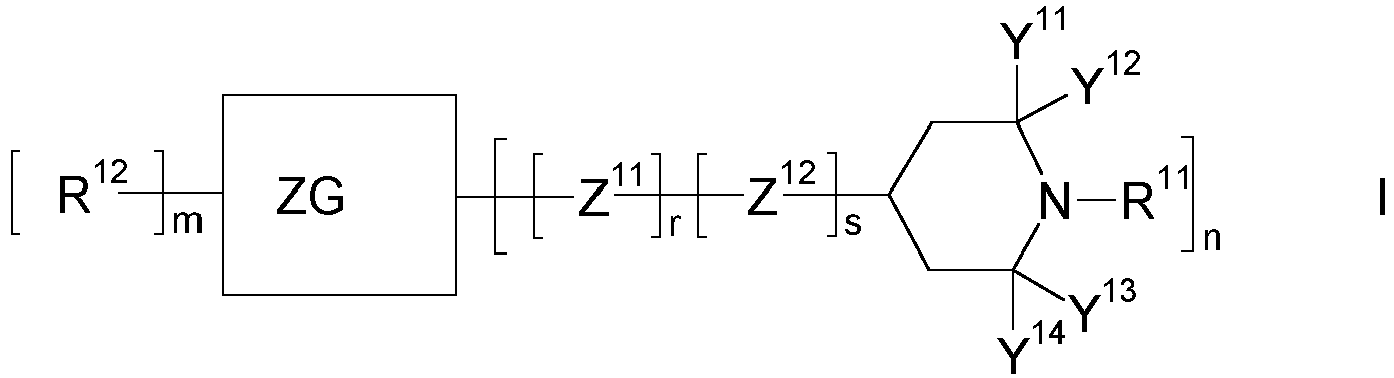 n représente 2, 3 ou 4,m représente (4-n),
 Z11 et Z12 représentent, de manière indépendante l'un de l'autre, -O-, -(C=O)-, -(N-R14)- ou une liaison simple, mais ne représentent pas tous les deux simultanément -O-,r et s représentent, de manière indépendante l'un de l'autre, 0 ou 1,Y11 à Y14 représentent, dans chaque cas, de manière indépendante les uns des autres, alkyle qui comporte de 1 à 4 atome(s) de C et à titre d'alternative, également de manière indépendante les uns des autres, une paire ou les deux paires (Y11 et Y12) et (Y13 et Y14) en association représente(nt) un groupe divalent qui comporte de 3 à 6 atomes de C,R11 représente OH,R12 représente pour chaque occurrence, de manière indépendante les unes des autres, H, F, OR14, NR14R15, une chaîne alkyle en chaîne droite ou ramifiée qui comporte de 1 à 20 atome(s) de C, où un groupe -CH2- ou une pluralité de groupes -CH2- peut/peuvent être remplacé(s) par -O- ou par -C(=O)-, mais deux groupes -CH2-adjacents ne peuvent pas être remplacés par -O-, ou représente un radical hydrocarbone qui contient une unité cycloalkyle ou alkylcycloalkyle et où un groupe -CH2- ou une pluralité de groupes -CH2- peut/peuvent être remplacé(s) par -O- ou par -C(=O)-, mais deux groupes -CH2- adjacents ne peuvent pas être remplacés par -O-, et où un atome de H ou une pluralité d'atomes de H peut/peuvent être remplacé(s) par OR14, N(R14)(R15) ou R16, ou représente un radical hydrocarbone aromatique ou hétéroaromatique, où un atome de H ou une pluralité d'atomes de H peut/peuvent être remplacé(s) par OR14, N(R14)(R15) ou R16,R13 représente pour chaque occurrence, de manière indépendante les unes des autres, une chaîne alkyle en chaîne droite ou ramifiée qui comporte de 1 à 20 atome(s) de C, où un groupe -CH2- ou une pluralités de groupes -CH2- peut/peuvent être remplacé(s) par -O- ou par -C(=O)-, mais deux groupes -CH2- adjacents ne peuvent pas être remplacés par -O-, ou représente un radical hydrocarbone qui contient une unité cycloalkyle ou alkylcycloalkyle et où un groupe -CH2- ou une pluralité de groupes -CH2- peut/peuvent être remplacé(s) par -O- ou par -C(=O)-, mais deux groupes -CH2- adjacents ne peuvent pas être remplacés par -O-, et où un atome de H ou une pluralité d'atomes de H peut/peuvent être remplacé(s) par OR14, N(R14)(R15) ou R16, ou représente un radical hydrocarbone aromatique ou hétéroaromatique, où un atome de H ou une pluralité d'atomes de H peut/peuvent être remplacé(s) par OR14, N(R14)(R15) ou R16,
ou
peut être R14 représente pour chaque occurrence, de manière indépendante les unes des autres, un groupe alkyle ou acyle en chaîne droite ou ramifié qui comporte de 1 à 10 atome(s) de C ou un radical hydrocarbone ou acide carboxylique aromatique qui comporte de 6 à 12 atomes de C,R15 représente pour chaque occurrence, de manière indépendante les unes des autres, un groupe alkyle ou acyle en chaîne droite ou ramifié qui comporte de 1 à 10 atome(s) de C ou un radical hydrocarbone ou acide carboxylique aromatique qui comporte de 6 à 12 atomes de C,R16 représente pour chaque occurrence, de manière indépendante les unes des autres, un groupe alkyle en chaîne droite ou ramifié qui comporte de 1 à 10 atome(s) de C, où un groupe -CH2- ou une pluralité de groupes -CH2- peut/peuvent être remplacé(s) par -O- ou par -C(=O)-, mais deux groupes -CH2- adjacents ne peuvent pas être remplacés par -O-, etb) un ou plusieurs composés de la formule III-Oc)
 d)
d)
dans laquelleR31 représente un radical alkyle non substitué qui comporte de 1 à 7 atome(s) de C,R32 représente un radical alkyle non substitué qui comporte de 1 à 7 atome(s) de C, un radical alcoxy non substitué qui comporte de 1 à 6 atome(s) de C ou un radical alkényloxy non substitué qui comporte de 2 à 6 atomes de C, eti représente 0 ou 1. - Milieu selon la revendication 1, caractérisé en ce qu'il comprend un ou plusieurs composé(s) de la formule I qui est/sont sélectionné(s) parmi le groupe des composés des formules I-1, I-2 et I-5 à I-8


 t représente un entier de 1 à 12,R17 représente une chaîne alkyle en chaîne droite ou ramifiée qui comporte de 1 à 12 atome(s) de C, où un groupe -CH2- ou une pluralité de groupes -CH2- peut/ peuvent être remplacé(s) par -O- ou par -C(=O)-, mais deux groupes -CH2- adjacents ne peuvent pas être remplacés par -O-, ou représente un radical hydrocarbone aromatique ou hétéroaromatique, où un atome de H ou une pluralité d'atomes de H peut/peuvent être remplacé(s) par OR14, N(R14)(R15) ou R16.
 - Milieu cristallin liquide selon la revendication 1 ou 2, caractérisé en ce qu'il comprend de façon additionnellec) un ou plusieurs composé(s) de la formule II
 R21 représente un radical alkyle non substitué qui comporte de 1 à 7 atome(s) de C ou un radical alkényle non substitué qui comporte de 2 à 7 atomes de C etR22 représente un radical alkényle non substitué qui comporte de 2 à 7 atomes de C,et/oud) un ou plusieurs composé(s) qui est/sont sélectionné(s) parmi le groupe des composés des formules III-1 à III-4


 R31 représente un radical alkyle non substitué qui comporte de 1 à 7 atome(s) de C,R32 représente un radical alkyle non substitué qui comporte de 1 à 7 atome(s) de C ou un radical alcoxy non substitué qui comporte de 1 à 6 atome(s) de C, etm, n et o représentent, dans chaque cas de manière indépendante les uns des autres, 0 ou 1.
 - Milieu selon au moins l'une des revendications 1 à 3, caractérisé en ce que la concentration totale des composés de la formule I dans le milieu pris dans sa globalité medium est de 1 ppm ou plus à 1000 ppm ou moins.
- Milieu selon au moins l'une des revendications 1 à 4, caractérisé en ce qu'il comprend un composé de la formule II, comme il a été indiqué selon la revendication 3, dans laquelle R21 représente n-propyle et R22 représente vinyle.
- Milieu selon au moins l'une des revendications 1 à 5, caractérisé en ce que la concentration totale des composés de la formule III-O dans le milieu pris dans sa globalité est de 5 % ou plus à 40 % ou moins.
- Milieu selon au moins l'une des revendications 1 à 6, caractérisé en ce qu'il comprend un ou plusieurs composé(s) de la formule III-O-1

- Milieu selon au moins l'une des revendications 1 à 7, caractérisé en ce qu'il comprend un ou plusieurs composé(s) de la formule III-O-2

- Milieu selon au moins l'une des revendications 1 à 8, caractérisé en ce qu'il comprend de façon additionnelle un ou plusieurs composé(s) chiral/chiraux.
- Affichage électro-optique ou composant électro-optique, caractérisé en ce qu'il contient un milieu cristallin liquide selon au moins l'une des revendications 1 à 9.
- Affichage selon la revendication 10, caractérisé en ce qu'il est basé sur l'effet VA ou ECB.
- Affichage selon la revendication 10 ou 11, caractérisé en ce qu'il contient un dispositif d'adressage par matrice active.
- Utilisation d'un milieu cristallin liquide selon au moins l'une des revendications 1 à 9 dans un affichage électro-optique ou dans un composant électro-optique.
- Procédé pour la préparation d'un milieu cristallin liquide selon au moins l'une des revendications 1 à 9, caractérisé en ce qu'un ou plusieurs composé(s) de la formule I est/sont mélangé(s) avec un ou plusieurs composé(s) de la formule III-O et/ou un ou plusieurs composé(s) de la formule II et/ou un ou plusieurs composé(s) qui est/sont sélectionné(s) parmi le groupe des composés des formules III-1 à III-4.
- Procédé pour la stabilisation d'un milieu cristallin liquide selon la revendication 14, caractérisé en ce que le milieu comprend un ou plusieurs composé(s) de la formule III-O, et un ou plusieurs composé(s) de la formule I et un ou plusieurs composé(s) qui est/sont sélectionné(s) parmi le groupe des composés des formules OH-1 à OH-6


Applications Claiming Priority (2)
| Application Number | Priority Date | Filing Date | Title |
|---|---|---|---|
| DE102012020374 | 2012-10-18 | ||
| EP13004948.9A EP2722381B1 (fr) | 2012-10-18 | 2013-10-16 | Fluide à base de cristaux liquides, son procédé de stabilisation et affichage à base de cristaux liquides |
Related Parent Applications (1)
| Application Number | Title | Priority Date | Filing Date |
|---|---|---|---|
| EP13004948.9A Division EP2722381B1 (fr) | 2012-10-18 | 2013-10-16 | Fluide à base de cristaux liquides, son procédé de stabilisation et affichage à base de cristaux liquides |
Publications (2)
| Publication Number | Publication Date |
|---|---|
| EP3327103A1 EP3327103A1 (fr) | 2018-05-30 |
| EP3327103B1 true EP3327103B1 (fr) | 2020-10-14 |
Family
ID=49382184
Family Applications (2)
| Application Number | Title | Priority Date | Filing Date |
|---|---|---|---|
| EP17208222.4A Active EP3327103B1 (fr) | 2012-10-18 | 2013-10-16 | Fluide à base de cristaux liquides, son procédé de stabilisation et affichage à base de cristaux liquides |
| EP13004948.9A Active EP2722381B1 (fr) | 2012-10-18 | 2013-10-16 | Fluide à base de cristaux liquides, son procédé de stabilisation et affichage à base de cristaux liquides |
Family Applications After (1)
| Application Number | Title | Priority Date | Filing Date |
|---|---|---|---|
| EP13004948.9A Active EP2722381B1 (fr) | 2012-10-18 | 2013-10-16 | Fluide à base de cristaux liquides, son procédé de stabilisation et affichage à base de cristaux liquides |
Country Status (7)
| Country | Link |
|---|---|
| US (1) | US9388339B2 (fr) |
| EP (2) | EP3327103B1 (fr) |
| JP (1) | JP6396651B2 (fr) |
| KR (1) | KR102245564B1 (fr) |
| CN (2) | CN103773388A (fr) |
| DE (1) | DE102013017174A1 (fr) |
| TW (1) | TWI607078B (fr) |
Families Citing this family (34)
| Publication number | Priority date | Publication date | Assignee | Title |
|---|---|---|---|---|
| EP3260518B1 (fr) * | 2011-03-29 | 2019-12-25 | Merck Patent GmbH | Milieu cristallin liquide |
| EP2514800B2 (fr) * | 2011-04-21 | 2018-03-07 | Merck Patent GmbH | Composés et milieu liquide cristallin |
| JP6375887B2 (ja) * | 2014-05-26 | 2018-08-22 | Jnc株式会社 | 液晶組成物および液晶表示素子 |
| CN106232774B (zh) * | 2014-07-08 | 2022-03-22 | Dic株式会社 | 向列型液晶组合物及使用其的液晶显示元件 |
| JP6435874B2 (ja) * | 2014-07-29 | 2018-12-12 | Jnc株式会社 | 液晶組成物および液晶表示素子 |
| CN104232105A (zh) * | 2014-08-18 | 2014-12-24 | 京东方科技集团股份有限公司 | 一种液晶混合物、液晶显示面板、液晶显示装置 |
| CN105441085A (zh) * | 2014-08-26 | 2016-03-30 | 江苏和成显示科技股份有限公司 | 液晶组合物及其液晶显示元件 |
| US10203558B2 (en) * | 2014-08-29 | 2019-02-12 | Sharp Kabushiki Kaisha | Liquid crystal display device |
| EP2993216B1 (fr) * | 2014-09-02 | 2017-07-26 | Merck Patent GmbH | Composés et milieu liquide cristallin |
| KR20160098586A (ko) * | 2015-02-09 | 2016-08-19 | 삼성디스플레이 주식회사 | 액정 조성물, 이를 포함하는 액정 표시 장치 및 그 제조 방법 |
| KR102660653B1 (ko) * | 2015-03-13 | 2024-04-26 | 메르크 파텐트 게엠베하 | 액정 매질 |
| DE102015003602A1 (de) * | 2015-03-18 | 2016-09-22 | Merck Patent Gmbh | Flüssigkristalines Medium |
| US20180057744A1 (en) * | 2015-03-24 | 2018-03-01 | Jnc Corporation | Liquid crystal composition and liquid crystal display device |
| DE102016005083A1 (de) * | 2015-05-13 | 2016-11-17 | Merck Patent Gmbh | Flüssigkristallines Medium |
| JP6891129B2 (ja) * | 2015-05-22 | 2021-06-18 | メルク パテント ゲゼルシャフト ミット ベシュレンクテル ハフツングMerck Patent Gesellschaft mit beschraenkter Haftung | 液晶媒体 |
| EP3303518B1 (fr) * | 2015-05-29 | 2020-06-10 | Merck Patent GmbH | Milieu cristal liquide |
| CN107849458B (zh) * | 2015-09-04 | 2021-07-27 | Dic株式会社 | 液晶组合物及使用其的液晶显示元件 |
| JP6696411B2 (ja) * | 2015-12-03 | 2020-05-20 | Jnc株式会社 | ピペリジン誘導体、液晶組成物および液晶表示素子 |
| EP3246374B1 (fr) * | 2016-05-19 | 2019-08-14 | Merck Patent GmbH | Milieu à base de cristaux liquides |
| US11015123B2 (en) | 2016-05-20 | 2021-05-25 | Merck Patent Gmbh | Liquid-crystal material |
| JP6690647B2 (ja) | 2016-08-29 | 2020-04-28 | Jnc株式会社 | ピペリジン誘導体、液晶組成物、および液晶表示素子 |
| KR102462887B1 (ko) | 2016-12-26 | 2022-11-02 | 제이엔씨 주식회사 | 액정 조성물 및 액정 표시 소자 |
| DE102018000109A1 (de) * | 2017-01-30 | 2018-08-02 | Merck Patent Gmbh | Verbindungen und Flüssigkristallines Medium |
| WO2019115485A1 (fr) * | 2017-12-14 | 2019-06-20 | Merck Patent Gmbh | Milieu cristallin liquide |
| JP2019200315A (ja) * | 2018-05-16 | 2019-11-21 | 株式会社ジャパンディスプレイ | 液晶表示装置 |
| CN111499561B (zh) * | 2019-01-30 | 2022-02-18 | 北京八亿时空液晶科技股份有限公司 | 一种新型光稳定剂化合物及其制备方法与应用 |
| CN111499563B (zh) * | 2019-01-30 | 2021-11-05 | 北京八亿时空液晶科技股份有限公司 | 一种光稳定剂化合物及其制备方法与应用 |
| CN111499564B (zh) * | 2019-01-30 | 2021-09-28 | 北京八亿时空液晶科技股份有限公司 | 一种新型光稳定剂化合物及其制备方法与应用 |
| CN111848499B (zh) * | 2019-04-28 | 2022-02-22 | 北京八亿时空液晶科技股份有限公司 | 一种化合物光稳定剂及其制备方法与应用 |
| CN111892530B (zh) * | 2019-05-05 | 2022-02-22 | 北京八亿时空液晶科技股份有限公司 | 一种光稳定剂及其制备方法与应用 |
| JP2021032982A (ja) * | 2019-08-21 | 2021-03-01 | 株式会社ジャパンディスプレイ | 液晶パネル |
| CN112824490B (zh) * | 2019-11-21 | 2022-08-23 | 江苏和成显示科技有限公司 | 一种液晶组合物及其应用 |
| CN115197716A (zh) * | 2021-04-13 | 2022-10-18 | 默克专利股份有限公司 | 液晶介质 |
| CN114369057A (zh) * | 2021-12-14 | 2022-04-19 | 利安隆凯亚(河北)新材料有限公司 | 一种受阻胺化合物其应用以及制备方法 |
Family Cites Families (20)
| Publication number | Priority date | Publication date | Assignee | Title |
|---|---|---|---|---|
| JPS5523169A (en) | 1978-08-09 | 1980-02-19 | Seiko Epson Corp | Liquid crystal composition and display elements comprising it |
| JPS6067587A (ja) * | 1983-09-22 | 1985-04-17 | Adeka Argus Chem Co Ltd | 液晶組成物 |
| FR2595157B1 (fr) | 1986-02-28 | 1988-04-29 | Commissariat Energie Atomique | Cellule a double couche de cristal liquide, utilisant l'effet de birefringence controlee electriquement et procede de fabrication d'un milieu uniaxe d'anisotropie optique negative utilisable dans cette cellule |
| JPH05117324A (ja) | 1991-10-31 | 1993-05-14 | Mitsubishi Rayon Co Ltd | 液晶複合体並びに液晶光学装置及びその製造方法 |
| JPH09291282A (ja) | 1996-04-26 | 1997-11-11 | Sumitomo Chem Co Ltd | 安定化した液晶材料およびこれを用いた液晶素子 |
| TW358110B (en) * | 1996-05-28 | 1999-05-11 | Ciba Sc Holding Ag | Mixture of polyalkylpiperidin-4-yl dicarboxylic acid esters as stabilizers for organic materials |
| EP1184442A1 (fr) | 2000-08-30 | 2002-03-06 | Clariant International Ltd. | Composition liquide cristalline |
| EP2199363B1 (fr) * | 2004-07-02 | 2012-02-22 | Merck Patent GmbH | Milieu cristallin liquide |
| JP4883336B2 (ja) | 2004-07-30 | 2012-02-22 | Dic株式会社 | ネマチック液晶組成物及びこれを用いた液晶表示素子 |
| DE102004041379A1 (de) | 2004-08-26 | 2006-03-02 | Wacker-Chemie Gmbh | Vernetzbare Siloxan-Harnstoff-Copolymere |
| ATE523576T1 (de) | 2006-07-19 | 2011-09-15 | Merck Patent Gmbh | Flüssigkristallines medium |
| CN101622577A (zh) * | 2007-02-27 | 2010-01-06 | Jsr株式会社 | 放射线敏感性树脂组合物、液晶显示元件用隔离物和保护膜以及它们的形成方法 |
| EP2176376B1 (fr) | 2007-08-15 | 2012-09-19 | Merck Patent GmbH | Milieu liquide cristallin |
| JP5566995B2 (ja) * | 2008-03-17 | 2014-08-06 | メルク パテント ゲゼルシャフト ミット ベシュレンクテル ハフツング | 液晶媒体 |
| US20110101270A1 (en) | 2008-04-22 | 2011-05-05 | Atsutaka Manabe | Liquid-crystalline medium |
| EP2182046B1 (fr) | 2008-10-30 | 2012-03-07 | Merck Patent GmbH | Milieu à base de cristaux liquides et affichage à base de cristaux liquides |
| EP2649154B1 (fr) * | 2010-12-07 | 2016-09-28 | Merck Patent GmbH | Milieu à base de cristaux liquides et dispositif d'affichage électro-optique |
| US9873834B2 (en) * | 2010-12-10 | 2018-01-23 | Merck Patent Gmbh | Liquid-crystalline medium and electro-optical display |
| EP3260518B1 (fr) * | 2011-03-29 | 2019-12-25 | Merck Patent GmbH | Milieu cristallin liquide |
| EP2514800B2 (fr) * | 2011-04-21 | 2018-03-07 | Merck Patent GmbH | Composés et milieu liquide cristallin |
-
2013
- 2013-10-16 EP EP17208222.4A patent/EP3327103B1/fr active Active
- 2013-10-16 EP EP13004948.9A patent/EP2722381B1/fr active Active
- 2013-10-16 DE DE102013017174.1A patent/DE102013017174A1/de not_active Withdrawn
- 2013-10-17 TW TW102137544A patent/TWI607078B/zh active
- 2013-10-17 KR KR1020130123995A patent/KR102245564B1/ko active Active
- 2013-10-18 JP JP2013217173A patent/JP6396651B2/ja active Active
- 2013-10-18 CN CN201310756713.6A patent/CN103773388A/zh active Pending
- 2013-10-18 CN CN202010778021.1A patent/CN111892935A/zh active Pending
- 2013-10-18 US US14/057,253 patent/US9388339B2/en active Active
Non-Patent Citations (1)
| Title |
|---|
| None * |
Also Published As
| Publication number | Publication date |
|---|---|
| JP2014084460A (ja) | 2014-05-12 |
| EP2722381A3 (fr) | 2014-10-15 |
| DE102013017174A1 (de) | 2014-04-24 |
| US20140111730A1 (en) | 2014-04-24 |
| EP2722381A2 (fr) | 2014-04-23 |
| CN103773388A (zh) | 2014-05-07 |
| JP6396651B2 (ja) | 2018-09-26 |
| EP2722381B1 (fr) | 2018-01-03 |
| TWI607078B (zh) | 2017-12-01 |
| US9388339B2 (en) | 2016-07-12 |
| KR20140049944A (ko) | 2014-04-28 |
| KR102245564B1 (ko) | 2021-04-29 |
| TW201420729A (zh) | 2014-06-01 |
| EP3327103A1 (fr) | 2018-05-30 |
| CN111892935A (zh) | 2020-11-06 |
Similar Documents
| Publication | Publication Date | Title |
|---|---|---|
| EP3354710B1 (fr) | Composés et milieu cristallin liquide | |
| EP3354709B1 (fr) | Composés et milieu cristallin liquide | |
| EP2722381B1 (fr) | Fluide à base de cristaux liquides, son procédé de stabilisation et affichage à base de cristaux liquides | |
| EP2514800B1 (fr) | Composés et milieu liquide cristallin | |
| EP2722380B1 (fr) | Fluide à base de cristaux liquides, son procédé de stabilisation et affichage à base de cristaux liquides | |
| EP3133137B1 (fr) | Milieu à base de cristaux liquides et dispositif d'affichage électro-optique | |
| EP2649153B1 (fr) | Milieu cristallin liquide et système d'affichage électro-optique | |
| EP2265691B1 (fr) | Milieu cristal liquide | |
| EP1913114B1 (fr) | Milieu cristallin liquide | |
| DE102009011666B4 (de) | Flüssigkristallines Medium und seine Verwendung | |
| DE102011013007A1 (de) | Flüssigkristallines Medium und Elektrooptische Anzeige | |
| EP2199362A2 (fr) | Milieu cristallin liquide | |
| DE102008006875A1 (de) | Flüssigkristallines Medium | |
| EP3303518B1 (fr) | Milieu cristal liquide | |
| EP3093328B1 (fr) | Milieu cristallin liquide | |
| EP3279289B1 (fr) | Dérivés de piperidine et milieu cristallin liquide | |
| EP3630922B1 (fr) | Milieu cristal liquide | |
| WO2010057575A1 (fr) | Milieu cristal liquide | |
| DE102012008570A1 (de) | Verbindungen und Flüssigkristallines Medium | |
| DE102015013980A1 (de) | Heterocyclische Verbindung, Flüssigkristallines Medium, Methode zu seiner Stabilisierung und Fküssigkristallanzeige | |
| DE102006036894A1 (de) | Flüssigkristallines Medium |
Legal Events
| Date | Code | Title | Description |
|---|---|---|---|
| PUAI | Public reference made under article 153(3) epc to a published international application that has entered the european phase |
Free format text: ORIGINAL CODE: 0009012 |
|
| STAA | Information on the status of an ep patent application or granted ep patent |
Free format text: STATUS: REQUEST FOR EXAMINATION WAS MADE |
|
| 17P | Request for examination filed |
Effective date: 20171218 |
|
| AC | Divisional application: reference to earlier application |
Ref document number: 2722381 Country of ref document: EP Kind code of ref document: P |
|
| AK | Designated contracting states |
Kind code of ref document: A1 Designated state(s): AL AT BE BG CH CY CZ DE DK EE ES FI FR GB GR HR HU IE IS IT LI LT LU LV MC MK MT NL NO PL PT RO RS SE SI SK SM TR |
|
| STAA | Information on the status of an ep patent application or granted ep patent |
Free format text: STATUS: EXAMINATION IS IN PROGRESS |
|
| 17Q | First examination report despatched |
Effective date: 20190201 |
|
| GRAP | Despatch of communication of intention to grant a patent |
Free format text: ORIGINAL CODE: EPIDOSNIGR1 |
|
| STAA | Information on the status of an ep patent application or granted ep patent |
Free format text: STATUS: GRANT OF PATENT IS INTENDED |
|
| INTG | Intention to grant announced |
Effective date: 20191122 |
|
| GRAS | Grant fee paid |
Free format text: ORIGINAL CODE: EPIDOSNIGR3 |
|
| GRAJ | Information related to disapproval of communication of intention to grant by the applicant or resumption of examination proceedings by the epo deleted |
Free format text: ORIGINAL CODE: EPIDOSDIGR1 |
|
| GRAL | Information related to payment of fee for publishing/printing deleted |
Free format text: ORIGINAL CODE: EPIDOSDIGR3 |
|
| STAA | Information on the status of an ep patent application or granted ep patent |
Free format text: STATUS: EXAMINATION IS IN PROGRESS |
|
| GRAS | Grant fee paid |
Free format text: ORIGINAL CODE: EPIDOSNIGR3 |
|
| STAA | Information on the status of an ep patent application or granted ep patent |
Free format text: STATUS: GRANT OF PATENT IS INTENDED |
|
| GRAP | Despatch of communication of intention to grant a patent |
Free format text: ORIGINAL CODE: EPIDOSNIGR1 |
|
| INTC | Intention to grant announced (deleted) | ||
| INTG | Intention to grant announced |
Effective date: 20200420 |
|
| GRAJ | Information related to disapproval of communication of intention to grant by the applicant or resumption of examination proceedings by the epo deleted |
Free format text: ORIGINAL CODE: EPIDOSDIGR1 |
|
| GRAL | Information related to payment of fee for publishing/printing deleted |
Free format text: ORIGINAL CODE: EPIDOSDIGR3 |
|
| STAA | Information on the status of an ep patent application or granted ep patent |
Free format text: STATUS: EXAMINATION IS IN PROGRESS |
|
| GRAR | Information related to intention to grant a patent recorded |
Free format text: ORIGINAL CODE: EPIDOSNIGR71 |
|
| STAA | Information on the status of an ep patent application or granted ep patent |
Free format text: STATUS: GRANT OF PATENT IS INTENDED |
|
| GRAA | (expected) grant |
Free format text: ORIGINAL CODE: 0009210 |
|
| STAA | Information on the status of an ep patent application or granted ep patent |
Free format text: STATUS: THE PATENT HAS BEEN GRANTED |
|
| INTC | Intention to grant announced (deleted) | ||
| INTG | Intention to grant announced |
Effective date: 20200903 |
|
| AC | Divisional application: reference to earlier application |
Ref document number: 2722381 Country of ref document: EP Kind code of ref document: P |
|
| AK | Designated contracting states |
Kind code of ref document: B1 Designated state(s): AL AT BE BG CH CY CZ DE DK EE ES FI FR GB GR HR HU IE IS IT LI LT LU LV MC MK MT NL NO PL PT RO RS SE SI SK SM TR |
|
| REG | Reference to a national code |
Ref country code: GB Ref legal event code: FG4D Free format text: NOT ENGLISH |
|
| REG | Reference to a national code |
Ref country code: AT Ref legal event code: REF Ref document number: 1323547 Country of ref document: AT Kind code of ref document: T Effective date: 20201015 Ref country code: CH Ref legal event code: EP |
|
| REG | Reference to a national code |
Ref country code: DE Ref legal event code: R096 Ref document number: 502013015220 Country of ref document: DE |
|
| REG | Reference to a national code |
Ref country code: IE Ref legal event code: FG4D Free format text: LANGUAGE OF EP DOCUMENT: GERMAN |
|
| REG | Reference to a national code |
Ref country code: NL Ref legal event code: MP Effective date: 20201014 |
|
| PG25 | Lapsed in a contracting state [announced via postgrant information from national office to epo] |
Ref country code: GR Free format text: LAPSE BECAUSE OF FAILURE TO SUBMIT A TRANSLATION OF THE DESCRIPTION OR TO PAY THE FEE WITHIN THE PRESCRIBED TIME-LIMIT Effective date: 20210115 Ref country code: FI Free format text: LAPSE BECAUSE OF FAILURE TO SUBMIT A TRANSLATION OF THE DESCRIPTION OR TO PAY THE FEE WITHIN THE PRESCRIBED TIME-LIMIT Effective date: 20201014 Ref country code: NO Free format text: LAPSE BECAUSE OF FAILURE TO SUBMIT A TRANSLATION OF THE DESCRIPTION OR TO PAY THE FEE WITHIN THE PRESCRIBED TIME-LIMIT Effective date: 20210114 Ref country code: PT Free format text: LAPSE BECAUSE OF FAILURE TO SUBMIT A TRANSLATION OF THE DESCRIPTION OR TO PAY THE FEE WITHIN THE PRESCRIBED TIME-LIMIT Effective date: 20210215 Ref country code: RS Free format text: LAPSE BECAUSE OF FAILURE TO SUBMIT A TRANSLATION OF THE DESCRIPTION OR TO PAY THE FEE WITHIN THE PRESCRIBED TIME-LIMIT Effective date: 20201014 |
|
| REG | Reference to a national code |
Ref country code: LT Ref legal event code: MG4D |
|
| PG25 | Lapsed in a contracting state [announced via postgrant information from national office to epo] |
Ref country code: SE Free format text: LAPSE BECAUSE OF FAILURE TO SUBMIT A TRANSLATION OF THE DESCRIPTION OR TO PAY THE FEE WITHIN THE PRESCRIBED TIME-LIMIT Effective date: 20201014 Ref country code: BG Free format text: LAPSE BECAUSE OF FAILURE TO SUBMIT A TRANSLATION OF THE DESCRIPTION OR TO PAY THE FEE WITHIN THE PRESCRIBED TIME-LIMIT Effective date: 20210114 Ref country code: PL Free format text: LAPSE BECAUSE OF FAILURE TO SUBMIT A TRANSLATION OF THE DESCRIPTION OR TO PAY THE FEE WITHIN THE PRESCRIBED TIME-LIMIT Effective date: 20201014 Ref country code: IS Free format text: LAPSE BECAUSE OF FAILURE TO SUBMIT A TRANSLATION OF THE DESCRIPTION OR TO PAY THE FEE WITHIN THE PRESCRIBED TIME-LIMIT Effective date: 20210214 Ref country code: LV Free format text: LAPSE BECAUSE OF FAILURE TO SUBMIT A TRANSLATION OF THE DESCRIPTION OR TO PAY THE FEE WITHIN THE PRESCRIBED TIME-LIMIT Effective date: 20201014 Ref country code: ES Free format text: LAPSE BECAUSE OF FAILURE TO SUBMIT A TRANSLATION OF THE DESCRIPTION OR TO PAY THE FEE WITHIN THE PRESCRIBED TIME-LIMIT Effective date: 20201014 |
|
| REG | Reference to a national code |
Ref country code: CH Ref legal event code: PL |
|
| PG25 | Lapsed in a contracting state [announced via postgrant information from national office to epo] |
Ref country code: HR Free format text: LAPSE BECAUSE OF FAILURE TO SUBMIT A TRANSLATION OF THE DESCRIPTION OR TO PAY THE FEE WITHIN THE PRESCRIBED TIME-LIMIT Effective date: 20201014 Ref country code: LU Free format text: LAPSE BECAUSE OF NON-PAYMENT OF DUE FEES Effective date: 20201016 Ref country code: NL Free format text: LAPSE BECAUSE OF FAILURE TO SUBMIT A TRANSLATION OF THE DESCRIPTION OR TO PAY THE FEE WITHIN THE PRESCRIBED TIME-LIMIT Effective date: 20201014 |
|
| REG | Reference to a national code |
Ref country code: DE Ref legal event code: R097 Ref document number: 502013015220 Country of ref document: DE Ref country code: BE Ref legal event code: MM Effective date: 20201031 |
|
| PG25 | Lapsed in a contracting state [announced via postgrant information from national office to epo] |
Ref country code: SK Free format text: LAPSE BECAUSE OF FAILURE TO SUBMIT A TRANSLATION OF THE DESCRIPTION OR TO PAY THE FEE WITHIN THE PRESCRIBED TIME-LIMIT Effective date: 20201014 Ref country code: RO Free format text: LAPSE BECAUSE OF FAILURE TO SUBMIT A TRANSLATION OF THE DESCRIPTION OR TO PAY THE FEE WITHIN THE PRESCRIBED TIME-LIMIT Effective date: 20201014 Ref country code: SM Free format text: LAPSE BECAUSE OF FAILURE TO SUBMIT A TRANSLATION OF THE DESCRIPTION OR TO PAY THE FEE WITHIN THE PRESCRIBED TIME-LIMIT Effective date: 20201014 Ref country code: CZ Free format text: LAPSE BECAUSE OF FAILURE TO SUBMIT A TRANSLATION OF THE DESCRIPTION OR TO PAY THE FEE WITHIN THE PRESCRIBED TIME-LIMIT Effective date: 20201014 Ref country code: EE Free format text: LAPSE BECAUSE OF FAILURE TO SUBMIT A TRANSLATION OF THE DESCRIPTION OR TO PAY THE FEE WITHIN THE PRESCRIBED TIME-LIMIT Effective date: 20201014 Ref country code: MC Free format text: LAPSE BECAUSE OF FAILURE TO SUBMIT A TRANSLATION OF THE DESCRIPTION OR TO PAY THE FEE WITHIN THE PRESCRIBED TIME-LIMIT Effective date: 20201014 Ref country code: LT Free format text: LAPSE BECAUSE OF FAILURE TO SUBMIT A TRANSLATION OF THE DESCRIPTION OR TO PAY THE FEE WITHIN THE PRESCRIBED TIME-LIMIT Effective date: 20201014 |
|
| PLBE | No opposition filed within time limit |
Free format text: ORIGINAL CODE: 0009261 |
|
| STAA | Information on the status of an ep patent application or granted ep patent |
Free format text: STATUS: NO OPPOSITION FILED WITHIN TIME LIMIT |
|
| PG25 | Lapsed in a contracting state [announced via postgrant information from national office to epo] |
Ref country code: BE Free format text: LAPSE BECAUSE OF NON-PAYMENT OF DUE FEES Effective date: 20201031 Ref country code: CH Free format text: LAPSE BECAUSE OF NON-PAYMENT OF DUE FEES Effective date: 20201031 Ref country code: LI Free format text: LAPSE BECAUSE OF NON-PAYMENT OF DUE FEES Effective date: 20201031 Ref country code: DK Free format text: LAPSE BECAUSE OF FAILURE TO SUBMIT A TRANSLATION OF THE DESCRIPTION OR TO PAY THE FEE WITHIN THE PRESCRIBED TIME-LIMIT Effective date: 20201014 |
|
| 26N | No opposition filed |
Effective date: 20210715 |
|
| GBPC | Gb: european patent ceased through non-payment of renewal fee |
Effective date: 20210114 |
|
| PG25 | Lapsed in a contracting state [announced via postgrant information from national office to epo] |
Ref country code: IT Free format text: LAPSE BECAUSE OF FAILURE TO SUBMIT A TRANSLATION OF THE DESCRIPTION OR TO PAY THE FEE WITHIN THE PRESCRIBED TIME-LIMIT Effective date: 20201014 Ref country code: AL Free format text: LAPSE BECAUSE OF FAILURE TO SUBMIT A TRANSLATION OF THE DESCRIPTION OR TO PAY THE FEE WITHIN THE PRESCRIBED TIME-LIMIT Effective date: 20201014 Ref country code: IE Free format text: LAPSE BECAUSE OF NON-PAYMENT OF DUE FEES Effective date: 20201016 Ref country code: FR Free format text: LAPSE BECAUSE OF NON-PAYMENT OF DUE FEES Effective date: 20201214 |
|
| PG25 | Lapsed in a contracting state [announced via postgrant information from national office to epo] |
Ref country code: SI Free format text: LAPSE BECAUSE OF FAILURE TO SUBMIT A TRANSLATION OF THE DESCRIPTION OR TO PAY THE FEE WITHIN THE PRESCRIBED TIME-LIMIT Effective date: 20201014 Ref country code: GB Free format text: LAPSE BECAUSE OF NON-PAYMENT OF DUE FEES Effective date: 20210114 |
|
| REG | Reference to a national code |
Ref country code: AT Ref legal event code: MM01 Ref document number: 1323547 Country of ref document: AT Kind code of ref document: T Effective date: 20201016 |
|
| PG25 | Lapsed in a contracting state [announced via postgrant information from national office to epo] |
Ref country code: AT Free format text: LAPSE BECAUSE OF NON-PAYMENT OF DUE FEES Effective date: 20201016 |
|
| PG25 | Lapsed in a contracting state [announced via postgrant information from national office to epo] |
Ref country code: IS Free format text: LAPSE BECAUSE OF FAILURE TO SUBMIT A TRANSLATION OF THE DESCRIPTION OR TO PAY THE FEE WITHIN THE PRESCRIBED TIME-LIMIT Effective date: 20210214 Ref country code: TR Free format text: LAPSE BECAUSE OF FAILURE TO SUBMIT A TRANSLATION OF THE DESCRIPTION OR TO PAY THE FEE WITHIN THE PRESCRIBED TIME-LIMIT Effective date: 20201014 Ref country code: MT Free format text: LAPSE BECAUSE OF FAILURE TO SUBMIT A TRANSLATION OF THE DESCRIPTION OR TO PAY THE FEE WITHIN THE PRESCRIBED TIME-LIMIT Effective date: 20201014 Ref country code: CY Free format text: LAPSE BECAUSE OF FAILURE TO SUBMIT A TRANSLATION OF THE DESCRIPTION OR TO PAY THE FEE WITHIN THE PRESCRIBED TIME-LIMIT Effective date: 20201014 |
|
| PG25 | Lapsed in a contracting state [announced via postgrant information from national office to epo] |
Ref country code: MK Free format text: LAPSE BECAUSE OF FAILURE TO SUBMIT A TRANSLATION OF THE DESCRIPTION OR TO PAY THE FEE WITHIN THE PRESCRIBED TIME-LIMIT Effective date: 20201014 |
|
| P01 | Opt-out of the competence of the unified patent court (upc) registered |
Effective date: 20230519 |
|
| PGFP | Annual fee paid to national office [announced via postgrant information from national office to epo] |
Ref country code: DE Payment date: 20250923 Year of fee payment: 13 |