EP3332073B1 - Panneau stratifié multicouche - Google Patents
Panneau stratifié multicouche Download PDFInfo
- Publication number
- EP3332073B1 EP3332073B1 EP16757570.3A EP16757570A EP3332073B1 EP 3332073 B1 EP3332073 B1 EP 3332073B1 EP 16757570 A EP16757570 A EP 16757570A EP 3332073 B1 EP3332073 B1 EP 3332073B1
- Authority
- EP
- European Patent Office
- Prior art keywords
- stone
- layer
- cork
- resin
- panel
- Prior art date
- Legal status (The legal status is an assumption and is not a legal conclusion. Google has not performed a legal analysis and makes no representation as to the accuracy of the status listed.)
- Active
Links
Images

Classifications
-
- B—PERFORMING OPERATIONS; TRANSPORTING
- B32—LAYERED PRODUCTS
- B32B—LAYERED PRODUCTS, i.e. PRODUCTS BUILT-UP OF STRATA OF FLAT OR NON-FLAT, e.g. CELLULAR OR HONEYCOMB, FORM
- B32B5/00—Layered products characterised by the non- homogeneity or physical structure, i.e. comprising a fibrous, filamentary, particulate or foam layer; Layered products characterised by having a layer differing constitutionally or physically in different parts
- B32B5/02—Layered products characterised by the non- homogeneity or physical structure, i.e. comprising a fibrous, filamentary, particulate or foam layer; Layered products characterised by having a layer differing constitutionally or physically in different parts characterised by structural features of a fibrous or filamentary layer
-
- B—PERFORMING OPERATIONS; TRANSPORTING
- B32—LAYERED PRODUCTS
- B32B—LAYERED PRODUCTS, i.e. PRODUCTS BUILT-UP OF STRATA OF FLAT OR NON-FLAT, e.g. CELLULAR OR HONEYCOMB, FORM
- B32B5/00—Layered products characterised by the non- homogeneity or physical structure, i.e. comprising a fibrous, filamentary, particulate or foam layer; Layered products characterised by having a layer differing constitutionally or physically in different parts
- B32B5/02—Layered products characterised by the non- homogeneity or physical structure, i.e. comprising a fibrous, filamentary, particulate or foam layer; Layered products characterised by having a layer differing constitutionally or physically in different parts characterised by structural features of a fibrous or filamentary layer
- B32B5/024—Woven fabric
-
- B—PERFORMING OPERATIONS; TRANSPORTING
- B32—LAYERED PRODUCTS
- B32B—LAYERED PRODUCTS, i.e. PRODUCTS BUILT-UP OF STRATA OF FLAT OR NON-FLAT, e.g. CELLULAR OR HONEYCOMB, FORM
- B32B5/00—Layered products characterised by the non- homogeneity or physical structure, i.e. comprising a fibrous, filamentary, particulate or foam layer; Layered products characterised by having a layer differing constitutionally or physically in different parts
- B32B5/22—Layered products characterised by the non- homogeneity or physical structure, i.e. comprising a fibrous, filamentary, particulate or foam layer; Layered products characterised by having a layer differing constitutionally or physically in different parts characterised by the presence of two or more layers which are next to each other and are fibrous, filamentary, formed of particles or foamed
- B32B5/24—Layered products characterised by the non- homogeneity or physical structure, i.e. comprising a fibrous, filamentary, particulate or foam layer; Layered products characterised by having a layer differing constitutionally or physically in different parts characterised by the presence of two or more layers which are next to each other and are fibrous, filamentary, formed of particles or foamed one layer being a fibrous or filamentary layer
- B32B5/28—Layered products characterised by the non- homogeneity or physical structure, i.e. comprising a fibrous, filamentary, particulate or foam layer; Layered products characterised by having a layer differing constitutionally or physically in different parts characterised by the presence of two or more layers which are next to each other and are fibrous, filamentary, formed of particles or foamed one layer being a fibrous or filamentary layer impregnated with or embedded in a plastic substance
-
- B—PERFORMING OPERATIONS; TRANSPORTING
- B32—LAYERED PRODUCTS
- B32B—LAYERED PRODUCTS, i.e. PRODUCTS BUILT-UP OF STRATA OF FLAT OR NON-FLAT, e.g. CELLULAR OR HONEYCOMB, FORM
- B32B9/00—Layered products comprising a layer of a particular substance not covered by groups B32B11/00 - B32B29/00
- B32B9/002—Layered products comprising a layer of a particular substance not covered by groups B32B11/00 - B32B29/00 comprising natural stone or artificial stone
-
- B—PERFORMING OPERATIONS; TRANSPORTING
- B32—LAYERED PRODUCTS
- B32B—LAYERED PRODUCTS, i.e. PRODUCTS BUILT-UP OF STRATA OF FLAT OR NON-FLAT, e.g. CELLULAR OR HONEYCOMB, FORM
- B32B9/00—Layered products comprising a layer of a particular substance not covered by groups B32B11/00 - B32B29/00
- B32B9/02—Layered products comprising a layer of a particular substance not covered by groups B32B11/00 - B32B29/00 comprising animal or vegetable substances, e.g. cork, bamboo, starch
-
- B—PERFORMING OPERATIONS; TRANSPORTING
- B32—LAYERED PRODUCTS
- B32B—LAYERED PRODUCTS, i.e. PRODUCTS BUILT-UP OF STRATA OF FLAT OR NON-FLAT, e.g. CELLULAR OR HONEYCOMB, FORM
- B32B9/00—Layered products comprising a layer of a particular substance not covered by groups B32B11/00 - B32B29/00
- B32B9/04—Layered products comprising a layer of a particular substance not covered by groups B32B11/00 - B32B29/00 comprising such particular substance as the main or only constituent of a layer, which is next to another layer of the same or of a different material
- B32B9/047—Layered products comprising a layer of a particular substance not covered by groups B32B11/00 - B32B29/00 comprising such particular substance as the main or only constituent of a layer, which is next to another layer of the same or of a different material made of fibres or filaments
-
- E—FIXED CONSTRUCTIONS
- E04—BUILDING
- E04C—STRUCTURAL ELEMENTS; BUILDING MATERIALS
- E04C2/00—Building elements of relatively thin form for the construction of parts of buildings, e.g. sheet materials, slabs, or panels
- E04C2/02—Building elements of relatively thin form for the construction of parts of buildings, e.g. sheet materials, slabs, or panels characterised by specified materials
- E04C2/26—Building elements of relatively thin form for the construction of parts of buildings, e.g. sheet materials, slabs, or panels characterised by specified materials composed of materials covered by two or more of groups E04C2/04, E04C2/08, E04C2/10 or of materials covered by one of these groups with a material not specified in one of the groups
- E04C2/284—Building elements of relatively thin form for the construction of parts of buildings, e.g. sheet materials, slabs, or panels characterised by specified materials composed of materials covered by two or more of groups E04C2/04, E04C2/08, E04C2/10 or of materials covered by one of these groups with a material not specified in one of the groups at least one of the materials being insulating
- E04C2/288—Building elements of relatively thin form for the construction of parts of buildings, e.g. sheet materials, slabs, or panels characterised by specified materials composed of materials covered by two or more of groups E04C2/04, E04C2/08, E04C2/10 or of materials covered by one of these groups with a material not specified in one of the groups at least one of the materials being insulating composed of insulating material and concrete, stone or stone-like material
-
- B—PERFORMING OPERATIONS; TRANSPORTING
- B32—LAYERED PRODUCTS
- B32B—LAYERED PRODUCTS, i.e. PRODUCTS BUILT-UP OF STRATA OF FLAT OR NON-FLAT, e.g. CELLULAR OR HONEYCOMB, FORM
- B32B2260/00—Layered product comprising an impregnated, embedded, or bonded layer wherein the layer comprises an impregnation, embedding, or binder material
- B32B2260/02—Composition of the impregnated, bonded or embedded layer
- B32B2260/021—Fibrous or filamentary layer
-
- B—PERFORMING OPERATIONS; TRANSPORTING
- B32—LAYERED PRODUCTS
- B32B—LAYERED PRODUCTS, i.e. PRODUCTS BUILT-UP OF STRATA OF FLAT OR NON-FLAT, e.g. CELLULAR OR HONEYCOMB, FORM
- B32B2260/00—Layered product comprising an impregnated, embedded, or bonded layer wherein the layer comprises an impregnation, embedding, or binder material
- B32B2260/04—Impregnation, embedding, or binder material
- B32B2260/046—Synthetic resin
-
- B—PERFORMING OPERATIONS; TRANSPORTING
- B32—LAYERED PRODUCTS
- B32B—LAYERED PRODUCTS, i.e. PRODUCTS BUILT-UP OF STRATA OF FLAT OR NON-FLAT, e.g. CELLULAR OR HONEYCOMB, FORM
- B32B2262/00—Composition or structural features of fibres which form a fibrous or filamentary layer or are present as additives
- B32B2262/02—Synthetic macromolecular fibres
-
- B—PERFORMING OPERATIONS; TRANSPORTING
- B32—LAYERED PRODUCTS
- B32B—LAYERED PRODUCTS, i.e. PRODUCTS BUILT-UP OF STRATA OF FLAT OR NON-FLAT, e.g. CELLULAR OR HONEYCOMB, FORM
- B32B2262/00—Composition or structural features of fibres which form a fibrous or filamentary layer or are present as additives
- B32B2262/10—Inorganic fibres
- B32B2262/101—Glass fibres
-
- B—PERFORMING OPERATIONS; TRANSPORTING
- B32—LAYERED PRODUCTS
- B32B—LAYERED PRODUCTS, i.e. PRODUCTS BUILT-UP OF STRATA OF FLAT OR NON-FLAT, e.g. CELLULAR OR HONEYCOMB, FORM
- B32B2305/00—Condition, form or state of the layers or laminate
- B32B2305/72—Cured, e.g. vulcanised, cross-linked
-
- B—PERFORMING OPERATIONS; TRANSPORTING
- B32—LAYERED PRODUCTS
- B32B—LAYERED PRODUCTS, i.e. PRODUCTS BUILT-UP OF STRATA OF FLAT OR NON-FLAT, e.g. CELLULAR OR HONEYCOMB, FORM
- B32B2307/00—Properties of the layers or laminate
- B32B2307/10—Properties of the layers or laminate having particular acoustical properties
- B32B2307/102—Insulating
-
- B—PERFORMING OPERATIONS; TRANSPORTING
- B32—LAYERED PRODUCTS
- B32B—LAYERED PRODUCTS, i.e. PRODUCTS BUILT-UP OF STRATA OF FLAT OR NON-FLAT, e.g. CELLULAR OR HONEYCOMB, FORM
- B32B2307/00—Properties of the layers or laminate
- B32B2307/30—Properties of the layers or laminate having particular thermal properties
- B32B2307/304—Insulating
-
- B—PERFORMING OPERATIONS; TRANSPORTING
- B32—LAYERED PRODUCTS
- B32B—LAYERED PRODUCTS, i.e. PRODUCTS BUILT-UP OF STRATA OF FLAT OR NON-FLAT, e.g. CELLULAR OR HONEYCOMB, FORM
- B32B2307/00—Properties of the layers or laminate
- B32B2307/30—Properties of the layers or laminate having particular thermal properties
- B32B2307/306—Resistant to heat
- B32B2307/3065—Flame resistant or retardant, fire resistant or retardant
-
- B—PERFORMING OPERATIONS; TRANSPORTING
- B32—LAYERED PRODUCTS
- B32B—LAYERED PRODUCTS, i.e. PRODUCTS BUILT-UP OF STRATA OF FLAT OR NON-FLAT, e.g. CELLULAR OR HONEYCOMB, FORM
- B32B2307/00—Properties of the layers or laminate
- B32B2307/50—Properties of the layers or laminate having particular mechanical properties
-
- B—PERFORMING OPERATIONS; TRANSPORTING
- B32—LAYERED PRODUCTS
- B32B—LAYERED PRODUCTS, i.e. PRODUCTS BUILT-UP OF STRATA OF FLAT OR NON-FLAT, e.g. CELLULAR OR HONEYCOMB, FORM
- B32B2307/00—Properties of the layers or laminate
- B32B2307/50—Properties of the layers or laminate having particular mechanical properties
- B32B2307/514—Oriented
- B32B2307/516—Oriented mono-axially
-
- B—PERFORMING OPERATIONS; TRANSPORTING
- B32—LAYERED PRODUCTS
- B32B—LAYERED PRODUCTS, i.e. PRODUCTS BUILT-UP OF STRATA OF FLAT OR NON-FLAT, e.g. CELLULAR OR HONEYCOMB, FORM
- B32B2307/00—Properties of the layers or laminate
- B32B2307/50—Properties of the layers or laminate having particular mechanical properties
- B32B2307/514—Oriented
- B32B2307/518—Oriented bi-axially
-
- B—PERFORMING OPERATIONS; TRANSPORTING
- B32—LAYERED PRODUCTS
- B32B—LAYERED PRODUCTS, i.e. PRODUCTS BUILT-UP OF STRATA OF FLAT OR NON-FLAT, e.g. CELLULAR OR HONEYCOMB, FORM
- B32B2307/00—Properties of the layers or laminate
- B32B2307/50—Properties of the layers or laminate having particular mechanical properties
- B32B2307/54—Yield strength; Tensile strength
-
- B—PERFORMING OPERATIONS; TRANSPORTING
- B32—LAYERED PRODUCTS
- B32B—LAYERED PRODUCTS, i.e. PRODUCTS BUILT-UP OF STRATA OF FLAT OR NON-FLAT, e.g. CELLULAR OR HONEYCOMB, FORM
- B32B2307/00—Properties of the layers or laminate
- B32B2307/50—Properties of the layers or laminate having particular mechanical properties
- B32B2307/546—Flexural strength; Flexion stiffness
-
- B—PERFORMING OPERATIONS; TRANSPORTING
- B32—LAYERED PRODUCTS
- B32B—LAYERED PRODUCTS, i.e. PRODUCTS BUILT-UP OF STRATA OF FLAT OR NON-FLAT, e.g. CELLULAR OR HONEYCOMB, FORM
- B32B2307/00—Properties of the layers or laminate
- B32B2307/50—Properties of the layers or laminate having particular mechanical properties
- B32B2307/558—Impact strength, toughness
-
- B—PERFORMING OPERATIONS; TRANSPORTING
- B32—LAYERED PRODUCTS
- B32B—LAYERED PRODUCTS, i.e. PRODUCTS BUILT-UP OF STRATA OF FLAT OR NON-FLAT, e.g. CELLULAR OR HONEYCOMB, FORM
- B32B2307/00—Properties of the layers or laminate
- B32B2307/70—Other properties
- B32B2307/72—Density
-
- B—PERFORMING OPERATIONS; TRANSPORTING
- B32—LAYERED PRODUCTS
- B32B—LAYERED PRODUCTS, i.e. PRODUCTS BUILT-UP OF STRATA OF FLAT OR NON-FLAT, e.g. CELLULAR OR HONEYCOMB, FORM
- B32B2307/00—Properties of the layers or laminate
- B32B2307/70—Other properties
- B32B2307/732—Dimensional properties
-
- B—PERFORMING OPERATIONS; TRANSPORTING
- B32—LAYERED PRODUCTS
- B32B—LAYERED PRODUCTS, i.e. PRODUCTS BUILT-UP OF STRATA OF FLAT OR NON-FLAT, e.g. CELLULAR OR HONEYCOMB, FORM
- B32B2309/00—Parameters for the laminating or treatment process; Apparatus details
- B32B2309/12—Pressure
-
- B—PERFORMING OPERATIONS; TRANSPORTING
- B32—LAYERED PRODUCTS
- B32B—LAYERED PRODUCTS, i.e. PRODUCTS BUILT-UP OF STRATA OF FLAT OR NON-FLAT, e.g. CELLULAR OR HONEYCOMB, FORM
- B32B2309/00—Parameters for the laminating or treatment process; Apparatus details
- B32B2309/12—Pressure
- B32B2309/125—Pressure vs time profiles
-
- B—PERFORMING OPERATIONS; TRANSPORTING
- B32—LAYERED PRODUCTS
- B32B—LAYERED PRODUCTS, i.e. PRODUCTS BUILT-UP OF STRATA OF FLAT OR NON-FLAT, e.g. CELLULAR OR HONEYCOMB, FORM
- B32B2315/00—Other materials containing non-metallic inorganic compounds not provided for in groups B32B2311/00 - B32B2313/04
-
- B—PERFORMING OPERATIONS; TRANSPORTING
- B32—LAYERED PRODUCTS
- B32B—LAYERED PRODUCTS, i.e. PRODUCTS BUILT-UP OF STRATA OF FLAT OR NON-FLAT, e.g. CELLULAR OR HONEYCOMB, FORM
- B32B2315/00—Other materials containing non-metallic inorganic compounds not provided for in groups B32B2311/00 - B32B2313/04
- B32B2315/08—Glass
- B32B2315/085—Glass fiber cloth or fabric
-
- B—PERFORMING OPERATIONS; TRANSPORTING
- B32—LAYERED PRODUCTS
- B32B—LAYERED PRODUCTS, i.e. PRODUCTS BUILT-UP OF STRATA OF FLAT OR NON-FLAT, e.g. CELLULAR OR HONEYCOMB, FORM
- B32B2317/00—Animal or vegetable based
- B32B2317/02—Cork
-
- B—PERFORMING OPERATIONS; TRANSPORTING
- B32—LAYERED PRODUCTS
- B32B—LAYERED PRODUCTS, i.e. PRODUCTS BUILT-UP OF STRATA OF FLAT OR NON-FLAT, e.g. CELLULAR OR HONEYCOMB, FORM
- B32B2419/00—Buildings or parts thereof
- B32B2419/04—Tiles for floors or walls
-
- B—PERFORMING OPERATIONS; TRANSPORTING
- B32—LAYERED PRODUCTS
- B32B—LAYERED PRODUCTS, i.e. PRODUCTS BUILT-UP OF STRATA OF FLAT OR NON-FLAT, e.g. CELLULAR OR HONEYCOMB, FORM
- B32B2451/00—Decorative or ornamental articles
-
- B—PERFORMING OPERATIONS; TRANSPORTING
- B32—LAYERED PRODUCTS
- B32B—LAYERED PRODUCTS, i.e. PRODUCTS BUILT-UP OF STRATA OF FLAT OR NON-FLAT, e.g. CELLULAR OR HONEYCOMB, FORM
- B32B2607/00—Walls, panels
- B32B2607/02—Wall papers, wall coverings
-
- E—FIXED CONSTRUCTIONS
- E04—BUILDING
- E04C—STRUCTURAL ELEMENTS; BUILDING MATERIALS
- E04C2/00—Building elements of relatively thin form for the construction of parts of buildings, e.g. sheet materials, slabs, or panels
- E04C2002/005—Appearance of panels
- E04C2002/008—Panels with the appearance of a natural stone wall
Definitions
- the present disclosure relates to multilayer laminate panels, methods for their production and their use in a number of applications, including as stone material coatings for interior and exterior use, for example in buildings for walls, floors and ceilings, and in furniture and decorative elements.
- presently available multilayer composite solutions typically employ honeycomb sandwich structures (metal or plastic) or other cores of plastic materials, and a metallic interface or impregnated fibers to promote adhesion between the different layers.
- the uneven topographies of stone or reinforcement layer surfaces require higher compressive loading to bring the surfaces together and/or thicker adhesive layers to accommodate the topographic mismatches.
- the cork-based layer yields under much lower compressive loads, thus advantageously accommodating any such surface protuberances on either of its sides.
- the honeycomb structures have disadvantages. Specifically, its structure greatly increases the stiffness, but has no ability to absorb impact energy. Similarly, the traction vibrations from an impact at low speed can create cracks in the stone material surface.
- WO 2011/115514 A2 discloses ceramic and cork material based laminated panels, compatibilized with fibres.
- WO 2014/118410 A1 discloses a construction element for raised floors and the like and a manufacturing method, which relates to a construction element for raised floors and the like, both interior and exterior.
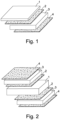
- the present disclosure allows for the use of a thin layer of stone material or stone derivative material, configured on a laminated composite panel, whose design and manufacturing process gives a panel whose mechanical, thermal and acoustic characteristics are superior to a layer of equivalent thickness of the same stone material (see Figure 1 ).
- the thickness of stone panelling currently used varies between 10-50 mm according to the application or use, for instance 30-50 mm for ventilated facade panels (exterior use) and 10-30 mm for flooring and wall covering (interior use).
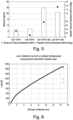
- the reinforcement technology for stone based materials disclosed herein offers a reduction in the waste of stone material associated with typical thickness reduction operations, and provides for freestanding panels with reduced weight/dimension ratios for construction applications (see Figure 2 ).
- the panels of the present disclosure are dimensioned, and manufactured, such that:
- the concave region of the material is under compressive stress whereas the opposing convex region of the material is under tensile stress. These two regions are divided by a zero stress line referred as the neutral axis.
- the multilayer laminate panels disclosed herein are constructed and dimensioned such that the neutral axis under flexural load applied from the exposed stone side is located outside the stone-based layer (and is preferably in a cork-based layer to which the stone layer is attached), leaving the stone layer under compression and, therefore, much stronger.
- the invention concerns a multilayer laminate panel, as defined in claim 1, and a process for the production of the multilayer laminate panel, as defined in claim 8. Further embodiments are defined by claims 2-7 and 9-11.
- the lightweight laminated panel with stone based surface finishing disclosed herein allows for the transformation of the brittle behaviour of materials used as surface finishes into a non-linear elastic behaviour. This behaviour results from the configuration and arrangement between the panel layers in order to ensure uniform transmission of stresses between the different layers, and a compression regime in the brittle material.
- the disclosed multilayer panel comprises a layer of stone material or derivative material for surface finishing, a further layer of a material with dissimilar properties and originated from cork or its derivatives, and one or more layers of fibers impregnated with resin, which resin is typically provided in liquid form and which then solidifies providing for the coupling (ie. attachment) between the various layers into one single panel.
- the improvement in the mechanical strength characteristics of the panels disclosed herein is also evident from, for instance, a comparison of stone slabs of approximately 30 mm thickness with a multilayer panel configuration comprising approximately 10 mm stone thickness and an approximately 10 mm cork agglomerate core layer, for which a reduction in mass of approximately three times is observed, but for which an increase of more than about two-fold in flexural strength is also observed.
- panels disclosed herein typically possess an ultimate deflection of about two times, or more than two times, the thickness of the panel.
- the ultimate deflection is the distance of the deflection, or bending, at which rupture, ie. breakage, of the panel occurs.
- the deflection was measured by video image correlation (VIC) using an area defined by the specimen thickness and +/- 5 mm for each side of the mid span point (in total 10 mm of the specimen width) with a total number of points within this area between 1000 and 1200.
- the ultimate deflection observed is a function of the span length used in the flexural test, i.e. the distance between the supporting elements, also known as "support span". In the testing reported herein, a support span of approximately 250 mm was used, in accordance with the support spans typically reported in ASTM standards for flexural tests. Spacing of the supports further away from one another will allow for larger ultimate deflections.
- panels disclosed herein possess an ultimate deflection of from about 0.2 times to about 2.0 times their thickness for a span length of approximately 250 mm, more preferably about 0.3 times to about 2.0 times, even more preferably about 0.35 times to about 2.0 times, for instance about 0.5 times to about 2.0 times, or about 0.8 times to about 2.0 times, or about 1.2 times to about 2.0 times, or about 1.5 times to about 2.0 times, or about 1.8 times to about 2.0 times; with an ultimate deflection of about 2.0 times, or greater, the panel thickness being most preferred.
- panels with approximately 5 or 10 mm stone layer thickness and comprising an approximately 10 mm cork agglomerate core have been found to exhibit an ultimate deflection of about 0.35 to about 2 times the total thickness of the panel on a span length of approximately 250 mm.
- the deflection to rupture of the panel described herein has been found to increase by a factor greater that about 10 to 20 times, or more, depending upon the stone type.
- substantial shape recovery ie. recovery of at least about 88 % of the panel's original shape, more preferably at least about 90%, and even more preferably at least about 95%, and up to about 100%
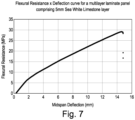
- FIGS 6 and 7 which plot, respectively the mid span deflection (in mm) versus the load (in N), and the mid span deflection versus the flexural resistance (in MPa; as measured in accordance with ASTM C293).
- the mid span deflection is the variable measured on the flexural test that varies according to the load applied between zero and the ultimate deflection which is observed at rupture load.
- Figures 6 and 7 report the properties of a panel comprising an approximately 5 mm Sea White limestone layer and an approximately 10 mm cork agglomerate layer (NL20 from Amorim Cork Composites, Mozelos VFR, Portugal) with two layers of epoxy-impregnated glass fiber layers (the epoxy resin being Resotech 1050 from Resoltech S.A.R.L., Eguilles, France).
- the first fiber layer comprised a biaxial glass fabric consisting of two fabric layers of unidirectionally oriented glass fibers positioned at 0 degrees and 90 degrees, and having a specific mass of approximately 600 g/m 2 ; and the second comprised a serge fabric with specific mass of approximately 300 g/m 2 .
- VIC video image correlation
- the system consists of one or two cameras (for 2D or 3D analysis respectively) that capture images during a mechanical test, ie. the deformation of the panel by deflection, or bending, and software that makes the correlation, based upon the mapping and monitoring of the image pixels.
- a mechanical test ie. the deformation of the panel by deflection, or bending
- software that makes the correlation, based upon the mapping and monitoring of the image pixels.
- Panels according to the present disclosure are readily manufactured as their production is advantageously compatible with the technology currently available in the stone processing industry. Namely:
- the one or more stone or stone derivative layers have a thickness of from about 2mm to about 50 mm, preferably from about 2 mm to about 40 mm, more preferably from about 2mm to about 30 mm, yet more preferably from about 2 mm to about 20 mm, and even more preferably from about 2 mm to about 15 mm.
- Further preferred thickness ranges for the stone-based layer include from about 2 mm to about 10 mm, about 5 mm to about 15 mm, and about 10 mm to about 20 mm.
- the at least one stone-based layer is about 2 mm, about 5 mm, about 10 mm or about 15 mm in thickness.
- the overall thickness of the panel products described herein typically ranges from about 5 mm to about 60 mm, preferably from about 5 mm to about 50 mm, and more preferably from about 5 mm to about 45 mm. Other overall thicknesses are possible depending upon the individual layers included in the overall structures, as well as the intended application of the panels.
- the panels comprise layers of fibers impregnated with resin, each of which is typically of a thickness of from about 0.5 to about 5 mm, for instance, about 0.5 to about 2.0 mm.
- the one or more layers of material with characteristics based on cork or derived from cork which are included in the multilayer panels are typically of a thickness of from about 1 mm to about 50 mm, more preferably from about 3 mm to about 40 mm, yet more preferably from about 5 mm to about 30 mm, or from about 5 mm to about 25 mm, or from about 5 mm to about 20 mm, with cork-based layers of about 5 mm to about 15 mm thickness, for instance approximately 10 mm, being particularly preferred.
- the technology may be adapted to other dimensions as necessary, for instance as required by the particular end application for which the panel is intended.
- the characteristics described above for the inventive panels are largely achieved by the specific choice of the various constituents, and their arrangement and dimensioning in the multilayer laminate, as well as the coupling of the different layers effected by the manufacturing process.
- the described technology provides new multilayer laminate materials, which meet or surpass the technical requirements of applications that presently use natural stone or its derivatives.
- the multilayer materials can be fitted to different structural products (e.g. ventilated facade panels), or ornamentals, including all types of interior and exterior coatings/coverings, floors, flooring, tables and counter-tops, as well as framing structures for windows, doors and masonry, for example.
- panels according to the present disclosure have the following unique benefits: i) significantly higher mechanical flexibility and the ability to accommodate bending and recover to their original shape; ii) enhanced impact resistance and energy absorption; and iii) superior thermal and acoustic insulation properties arising from the use of cork or cork derivative material.
- the neutral axis is coincident with the midline.
- the neutral axis can be shifted by adjusting the thickness of each material and taking into account their Young's Moduli.
- the neutral line is always located outside the material layer that provides the stone-based surface finish, and is preferably located in the cork-based layer.
- the stone-based material used as the surface finish material when tested alone, displays a poor response to tensile stress as compared with its response to compressive stress.
- the threshold stresses are typically about 7 up to 10 times lower.
- the thicknesses of the layers included in the presently described panels are optimized in order for the surface finish material to be mostly subjected to compressive stresses.
- the multilayer laminate panels of the present disclosure provide optimised stone-based materials with advantageous mechanical properties.
- the surface finish material with the greatest potential to be used in the disclosed panels is natural stone.
- rock-like source materials behave differently depending upon their physical, chemical and microstructural characteristics.
- Natural stone types particularly suitable for use in the multilayer panels include those typically used in stone panelling applications, for example limestones, marbles, granites including gneisses and pegmatites, schist rocks including slate and quartzite, and agglomerated stone.
- cork or cork derivative material natural or industrially processed materials can be used, which typically have densities (as measured in accordance with ASTM C271) of from about 30 to about 1500 kg/m 3 and preferably from about 100 to about 400 kg/m 3 .
- Particularly preferred materials have densities of from about 110 to about 350 kg/m 3 , even more preferably from about 115 to about 300 kg/m 3 , or from about 120 to about 250 kg/m 3 , for instance approximately 120 kg/m 3 , 200 kg/m 3 , or 250 kg/m 3 .
- Preferred cork-based materials have a compressive strength (as measured in accordance with ASTM C365) of about 0.1 to about 1.0 MPa, preferably about 0.2 to about 0.8 MPa, and yet more preferably about 0.3 to about 0.6 MPa, for instance approximately 0.3 MPa, 0.5 MPa or 0.6 MPa.
- Preferred cork-based materials have a compressive modulus (as measure in accordance with ASTM C365) of about 3.0 to about 10.0 MPa, more preferably about 4.0 to about 8.0 MPa, and even more preferably about 5.0 to about 7.0 MPa, for instance approximately 5.1 MPa, 6.0 MPa or 6.9 MPa.
- Preferred cork-based materials have a tensile strength (as measured in accordance with ASTM C297) of about 0.4 to about 0.9 MPa, more preferably about 0.5 to about 0.8 MPa, and yet more preferably about 0.6 to about 0.7 MPa, for instance approximately 0.6 MPa or 0.7 MPa.
- Preferred cork-based materials have a shear strength (as measured in accordance with ASTM C273) of about 0.7 to about 1.2 MPa, more preferably, 0.8 to about 1.1 MPa, and even more preferably about 0.9 to about 1.0 MPa, for instance approximately 0.9 MPa or 1.0 MPa.
- Preferred cork-based materials have a shear modulus (as measured in accordance with ASTM C273) of about 5.7 to about 6.2 MPa, more preferably about 5.8 to about 6.1 MPa, and even more preferably about 5.9 to about 6.0 MPa, for instance approximately 5.9 MPa or 6.0 MPa.
- Preferred cork-based materials have a thermal conductivity (as measured in accordance with ASTM C377) of about 0.030 to about 0.040 W/mK, more preferably about 0.031 to about 0.038 W/mK, and even more preferably about 0.032 to about 0.036 W/mK, for instance approximately 0.032 W/mK, 0.034 W/mK or 0.036 W/mK.
- Preferred cork-based materials have a loss factor (at 1 KHz and as measured in accordance with ASTM E756) of about 0.020 to 0.070, and more preferably 0.022 to 0.062, for instance approximately 0.022, 0.043 or 0.062.
- cork-based materials for use in the disclosed multilayer panels have one of the following combinations of properties:
- a particularly preferred material has all of these properties.
- a particularly preferred material has all of these properties.
- a particularly preferred material has all of these properties.
- Suitable, commercially available materials include, for example, Corecork NL10, NL20 and NL25 available from Amorim Cork Composites, Portugal. These materials are preferably selected to provide for a minimum resin uptake, to ensure impregnation (ie. entry of the resin into at least some of the open spaces, or pores, in the cork-based material) during processing, as well as facilitating low water absorption, rot and fire resistance and a high level of attenuation of impact noise and vibrations.
- the resin is typically impregnated, or imbibed, into the open porosity and surface "openings" of both the stone-based and cork-based layers, the resin being provided by the fiber-containing reinforcement layer(s) which serve to couple, or attach, the other layers together to form a unitary panel structure.
- the failure of multilayer laminates by delamination between layers, which was previously observed, is substantially reduced in the multilayer panels described herein, and the transfer of load/stress is more effective. This is a marked, and advantageous, difference from ordinary laminates, which typically comprise a sharp and well-defined, discrete interface between layers.
- Suitable resins for use in the multilayer panels are typically provided in liquid form and include, for example, epoxy resins, for instance Resoltech 1050, which is available from Resoltech S.A.R.L., Eguilles, France, and Sicomin SR1500, which is available from Sicomin,leneuf-les-Martigues, France; polyester resins including, for example, Recapoli 955 DCPD, which is available from Resinas Castro S.L., Pontevedra, Spain; vinylester esters, such as Resicastro X590AC, also available from Resinas Castro S.L., Pontevedra, Spain; and acrylic resins, such as Crestapol 1250LV, available from Scott Bader, Wellingborough, UK.
- epoxy resins for instance Resoltech 1050, which is available from Resoltech S.A.R.L., Eguilles, France
- Sicomin SR1500 which is available from Sicomin,leneuf-les-Martigues, France
- the chemical structure and viscosity of the resins used are typically optimized taking into account the microstructure (ie. mineralogy and porosity structure) of the stone materials.
- the viscosity of suitable resins ranges from about 100 to about 2000 mPa.s, depending mostly on the stone or derivative material open porosity. More preferred resins have a viscosity of from about 100 to about 1000 mPa.s, more preferably from about 100 to about 500 mPa.s, and even more preferably the resin viscosity is from about 300 to about 450 mPa.s, for instance approximately 400 mPa.s.
- open porosity of the stone-based materials may vary between about 0.1% and about 19%, or higher (according to EN1936). The higher this figure, the higher the resin viscosity which can be used. So, for instance, for a stone-based material with an open porosity of at least about 0.1 %, a resin with a viscosity of at least about 100 mPa.s may be used; whereas, for a stone-based material with an open porosity of about 19 %, or even higher, a resin with a viscosity of up to an including about 2000 mPa.s may be used. Furthermore, as viscosity has a dependence upon temperature, this may also be tuned to ensure adequate process viscosities for optimized penetration of the resin into the stone or derivative material layer(s) and into the cork-based core layer(s).
- the panel comprises at least two layers of fibers, with one positioned at the interface between the stone or derivative material and the cork or cork derivative core layer, and the second positioned on the exterior face of the cork or cork derivative core (see Figure 1 ).
- the first fiber layer is a multiaxial reinforcement fabric, made from glass fibers, and which has a specific mass between 150-300 g/m 2 per orientation axis, for instance a biaxial glass fabric with fibers oriented at 0/90 degrees and which has a specific mass of about 600g/m 2 .
- the second fiber layer comprises a woven fabric with a specific mass between 150- 300 g/m 2 , for instance serge or tafetan fabric.
- All of the laminate panels in Table 1 comprise the same reinforcement, specifically a 10 mm core of cork agglomerate (NL20, Amorim Cork Composites), with two layers (or “skins") of glass fiber impregnated in epoxy resin. The first is located at the interface between the stone layer and the cork core and the second is located on the exterior face of the core.
- cork agglomerate NL20, Amorim Cork Composites
- the first being a biaxial glass fabric consisting of two fabric layers of unidirectionally oriented glass fibers positioned at 0 degrees and 90 degrees, and having a specific mass of approximately 600 g/m 2 ; and the second being a serge fabric with specific mass of approximately 300 g/m 2 .
- the resin used in the multilayer panels reported in Table 1 was a commercially available two component epoxy resin, specifically Resoltech 1050, as mentioned above.
- the multilayer panels disclosed herein possess superior mechanical properties in comparison with those of comparable, standard stone slabs made from a range of different stone types.
- Figures 3, 4 and 5 further illustrate the major gains in mechanical properties of the multilayer laminate panels compared to natural stone slabs of equivalent thickness.
- the stone selected for the comparison illustrated in Figures 3 to 5 is a Sea White Limestone of medium porosity, ie. approximately 8-11% as per EN1936, which can be considered the most demanding material with regard to its basic properties, since it is not only one of the most fragile stone materials, but it is also very difficult to obtain and handle at reduced thickness (e.g. 5 or 10 mm) by means of the technologies currently available to the stone processing industry.
- the used production method allows for the multilayer panel to be self-supporting such that very large panels (eg. 3500 x 2500 mm) can be handled without concern of damage by action of their own weight, thus facilitating amongst other things ease of transportation.
- very large panels eg. 3500 x 2500 mm
- the smallest thickness which is currently able to be produced from blocks by the industry is about 8 mm in granite and 12 mm in limestone, and even these are only possible to obtain using state of the art, cutting edge technologies, which are still new and not usual in the stone processing industry.
- the first is related to comfort (thermal and acoustic) where usually the products made from these materials do not compete with others, in particular for flooring applications.
- the second relates to the methods of direct and indirect fixing (ie. anchorage), which currently have scaling problems associated with the stone characteristics and their ability to withstand stresses encountered during the lifetime of the products.
- Fixing or clamping means suitable for use with the panels disclosed herein, in order to attach the panels to structures (eg. a wall) as required include, for example, fixing or clamping means typically used with composite materials, in particular in the construction industry. Such means include those made from metal, for example stainless steel. With standard stone slabs, fixing or clamping means are required to be attached directly to the stone, thus subjecting the stone to a large amount of stress, which can result in weakening, cracking and even eventual breakage of the slab.
- the specific attachment of the fixing (or clamping) means such that it is located at least in part within the cork-based layer (3) and the fibrous layer (2) located between the cork-based layer (3) and the stone-based layer (1), achieves a very effective system for attachment of the panels to other structures, such as walls, which does not place the stone-based layer under detrimental stress.
- a multilayer laminate panel as described herein comprises fixing means, not being part of the invention, which is located in an orifice extending through the at least one layer of dissimilar material (3) and the at least one layer of resin-impregnated fibers (2) to the surface of the stone-based material layer (1), to which the at least one layer of resin-impregnated fibers (2) is attached.
- the fixing means is held in position in the orifice with resin.
- the fixing means may be attached with resin to the surface of the stone-based material layer (1) located at the end of the orifice so-formed.
- the space in the orifice, which is not occupied by the fixing means may be filled with resin.
- Particularly suitable fixing means for use with the panels are those which comprise a substantially flat plate with a shaft extending from the middle of the plate, which shaft may be hollow and is typically cylindrical.
- the shaft attaches to fastening means typically located on the structure to which the panel is to be attached, thus, holding the panel in the desired position.
- the plate portion of the fixing means may be of a variety of shapes, for instance square, rectangular, circular or hexagonal, and it may have holes cut through it.
- Suitable fixing means include those commercially available under the name "Master-Plate” from Specialinsert s.r.l, of Turin, Italy (see, for example, http://www.directindustry.com/prod/specialinsert-srl/product-58531-1428839.html).
- Such fixing means are attached to multilayer laminate panels described herein by forming an orifice in the panel, which extends through the at least one layer of dissimilar material (3) and the at least one layer of resin-impregnated fibers (2) to the surface of the stone-based material layer (1), to which the layer of resin-impregnated fibers (2) is attached; placing fixing means in the orifice; and either before or after, or both before and after the fixing means are placed in the orifice, introducing resin into the orifice.
- resin is introduced into the orifice both before and after placement of the fixing means in the orifice, such that the remaining space in the orifice, which is not occupied by the fixing means, is filled with resin.
- the process of attaching fixing means to the panel typically comprises:
- Panels according to the present disclosure comprise the following materials (with reference to Figure 1 ):
- Panels according to the present invention may also be manufactured having a symmetrical configuration (as shown in Figure 2 ), which is particularly useful for subsequent sectioning along layer (1) yielding two panels, for instance as shown in Figure 1 .
- Multilayer composite panels according to the present disclosure are generally manufactured in the following way:
- Additional release liners may be employed on resin coated surfaces to prevent adhesion to contact surfaces during processing, handling and transportation.
- Alternative curing or post-curing processes may include one or more of the following methods: heating by conduction; heating by microwave; heating by infrared; and ultraviolet photo-curing.
- Afurther, significant advantage of the present disclosure is the possibility to leverage on already existing stone processing industrial plants.
- stone slabs reinforced according to the present disclosure can be manufactured with large dimensions (ie. width and length up to approximately 3500 mm).
- the reinforcement provided by the present disclosure allows for currently available grinding and polishing processes to be carried out in a cost-effective way and without damaging the stone or derivative material layer.
- using current stone industry technology eg. sawing and wire cutting, it is possible to obtain from a surface element with an initial thickness of about 20 mm or less-(see Figure 2 ), two thinner elements, whose final thickness depends upon the amount of material lost by abrasion due to the cutting tool used.
Landscapes
- Engineering & Computer Science (AREA)
- Textile Engineering (AREA)
- Architecture (AREA)
- Ceramic Engineering (AREA)
- Civil Engineering (AREA)
- Structural Engineering (AREA)
- Laminated Bodies (AREA)
- Finishing Walls (AREA)
Claims (11)
- Panneau stratifié multicouche comprenant une première couche de matériau à base de pierre (1), d'une épaisseur d'environ 2 mm à environ 50 mm, étant de la pierre ou un dérivé de la pierre, et configurée pour être sous compression lorsque le panneau est mécaniquement chargé à partir de la surface exposée de la première couche et soutenu par deux points d'ancrage ou plus, de sorte que le panneau ait une charge maximale à la rupture d'au moins 7 fois par rapport à la même épaisseur de pierre, mesurée conformément à la norme ASTM C293;
une deuxième couche de matériau dissemblable (3) de densité inférieure, qui comprend du liège ou un dérivé du liège, d'une épaisseur d'environ 1 mm à environ 50 mm ; au moins deux couches de fibres imprégnées de résine (2,4), dans lesquelles :une première couche de fibres (2) est positionnée à l'interface entre la pierre ou le matériau dérivé de la pierre (1) et la couche de liège ou de dérivé de liège (3); etune deuxième couche de fibres (4) est placée sur la face extérieure de la couche de liège ou de dérivé de liège (3);la résine fournie par les couches de renforcement contenant des fibres sert à attacher les couches ensemble pour former une structure de panneau unitaire;caractérisé par:
la première couche de fibres (2) est un tissu de renforcement multiaxial composé de fibres de verre d'une masse spécifique comprise entre 150 et 300 g/m2 par axe d'orientation ; et la deuxième couche de fibres (4) est un tissu dont la masse spécifique est comprise entre 150-400 g/m2. - Le panneau selon toute revendication précédente dans lequel le matériau dissemblable (3) a une densité d'environ 30 à 1500 kg/m3, et de préférence d'environ 100 à 400 kg/m3 mesurée conformément à la norme ASTM C271.
- Panneau selon l'une des revendications précédentes, dans lequel le matériau dissemblable (3) a une résistance à la compression d'environ 0,1 à 1,0 MPa, et de préférence d'environ 0,3 à environ 0,8 MPa, mesurée conformément à la norme ASTM C365.
- Panneau selon l'une des revendications précédentes, dans lequel le matériau dissemblable (3) a une résistance à la traction d'environ 0,4 à 0,9 MPa, et de préférence d'environ 0,6 à environ 0,7 MPa, mesurée conformément à la norme ASTM C297. 0,7 MPa, mesurée conformément à la norme ASTM C297.
- Panneau selon l'une des revendications précédentes, dans lequel le matériau dissemblable (3) a une conductivité thermique d'environ 0,030 à environ 0,040 W/mK, et de préférence d'environ 0,032 à environ 0,036 W/mK, mesurée conformément à la norme ASTM C377.
- Le panneau selon toute revendication précédente dans lequel l'épaisseur de la couche à base de pierre (1) est d'environ 2 mm à environ 20 mm, et de préférence d'environ 2 mm à environ 15 mm.
- Le panneau selon l'une quelconque des revendications précédentes, dans lequel l'épaisseur de l'au moins une couche de matériau dissemblable (3) est comprise entre 1 et 20 mm environ, et de préférence entre 5 et 15 mm environ.
- Procédé de fabrication d'un panneau stratifié multicouche tel que défini dans l'une des revendications 1 à 7, le procédé comprenant les pas de:fournir une première couche de matériau à base de pierre (1) ayant une épaisseur d'environ 2 mm à environ 50 mm et étant de la pierre ou un dérivé de la pierre;fournir une deuxième couche d'un matériau dissemblable (3) de plus faible densité, qui comprenddu liège ou un dérivé du liège ; etfixer la couche de matériau à base de pierre (1) à la couche de matériau dissemblable (3) au moyen d'une couche (2) de fibres imprégnées de résine interposée entre la couche de matériau à base de pierre (1) et la couche de matériau dissemblable (3).
- Procédé selon la revendication 8, dans lequel la fourniture de la couche de fibres imprégnées de résine (2) comprend l'application d'une résine sur la couche de matériau à base de pierre (1), puis l'application d'un arrangement de fibres sur la résine, et enfin l'application d'une quantité supplémentaire de résine sur l'arrangement de fibres.
- Procédé selon la revendication 9, dans lequel la résine est sous forme liquide et a une viscosité comprise entre 100 mPa.s et 2000 mPa.s.
- Procédé selon l'une des revendications 9 ou 10, dans lequel la porosité ouverte du matériau à base de pierre (1) est d'au moins 0,1 % et de préférence d'au moins 19 %, mesurée conformément à la norme EN 1936.
Applications Claiming Priority (2)
| Application Number | Priority Date | Filing Date | Title |
|---|---|---|---|
| PT10875615 | 2015-08-06 | ||
| PCT/EP2016/068680 WO2017021505A1 (fr) | 2015-08-06 | 2016-08-04 | Panneau stratifié multicouche |
Publications (2)
| Publication Number | Publication Date |
|---|---|
| EP3332073A1 EP3332073A1 (fr) | 2018-06-13 |
| EP3332073B1 true EP3332073B1 (fr) | 2023-06-21 |
Family
ID=57942477
Family Applications (1)
| Application Number | Title | Priority Date | Filing Date |
|---|---|---|---|
| EP16757570.3A Active EP3332073B1 (fr) | 2015-08-06 | 2016-08-04 | Panneau stratifié multicouche |
Country Status (8)
| Country | Link |
|---|---|
| US (1) | US11806982B1 (fr) |
| EP (1) | EP3332073B1 (fr) |
| CN (1) | CN108138488A (fr) |
| BR (1) | BR112018002426B1 (fr) |
| CA (1) | CA2994498C (fr) |
| RU (1) | RU2770825C2 (fr) |
| SA (1) | SA518390882B1 (fr) |
| WO (1) | WO2017021505A1 (fr) |
Families Citing this family (6)
| Publication number | Priority date | Publication date | Assignee | Title |
|---|---|---|---|---|
| CH710927B1 (it) * | 2015-10-14 | 2016-10-14 | Generelli S A | Metodo di produzione di oggetti in pietra e materiale composito. |
| CN109411520B (zh) * | 2018-10-24 | 2020-11-20 | 上海天马微电子有限公司 | 柔性显示面板和显示装置 |
| CA3177044A1 (fr) * | 2020-03-27 | 2021-09-30 | Nexii Building Solutions Inc. | Systemes et procedes de construction d'un batiment a un seul niveau |
| DE102020114449A1 (de) * | 2020-05-29 | 2021-12-02 | Peri Gmbh | Asymmetrische Funktionsplatte |
| CN113686702A (zh) * | 2021-09-13 | 2021-11-23 | 东华大学 | 一种表征柔性材料防护低速冲击效果的直观方法 |
| EP4670939A1 (fr) * | 2024-06-27 | 2025-12-31 | Blomberger Holzindustrie GmbH | Produit de liège |
Family Cites Families (18)
| Publication number | Priority date | Publication date | Assignee | Title |
|---|---|---|---|---|
| FR1440792A (fr) * | 1965-04-21 | 1966-06-03 | Exxon Standard Sa | éléments de construction étanches préfabriqués |
| US3950202A (en) * | 1973-06-11 | 1976-04-13 | Hodges William E | Method of making a composite natural stone veneer product |
| DE8811912U1 (de) * | 1988-02-08 | 1989-01-12 | Buchtal Gmbh, 8472 Schwarzenfeld | Natursteinelement für die Verkleidung von Bauwerkfassaden |
| IE894211A1 (en) | 1989-12-29 | 1991-07-03 | Stone Panels Internat Ltd | Methods for manufacturing composite surface elements |
| DE10300779A1 (de) * | 2003-01-11 | 2004-07-22 | Schraps, Günter | Verfahren zum Herstellen einer Verbundplatte |
| US7442423B2 (en) * | 2003-04-28 | 2008-10-28 | Shaw Industries Group | Hard surface-veneer engineered surfacing tiles |
| WO2005102696A1 (fr) | 2004-04-20 | 2005-11-03 | Sindat, S.R.O. | Panneau sandwich en pierre et son procede de fabrication |
| KR100814861B1 (ko) * | 2004-04-30 | 2008-03-20 | (주)삼박 | 열가소성 복합 판재를 이용하여 제조된 물품 |
| KR100519224B1 (ko) | 2005-03-04 | 2005-10-06 | 주식회사 이엔에프월드 | 복합적층 판넬 |
| CN201406811Y (zh) * | 2009-04-30 | 2010-02-17 | 福建昌铭建筑工程技术有限公司 | 外墙板材的后加固装置 |
| PT105013A (pt) * | 2010-03-16 | 2011-09-16 | Amorim Cork Composites S A | Laminado cerâmico com cortiça e fibras |
| IT1400686B1 (it) | 2010-07-02 | 2013-06-28 | Fulvi | Costruzione del pannello honeycomb eseguita simultaneamente al processo di stratificiizone e rinforzo con relativa lastra lapidea |
| DE102011012015B4 (de) * | 2011-02-22 | 2014-10-02 | Fritz Egger Gmbh & Co. Og | Fußbodenpaneel mit bedruckter Korkschicht |
| US20130196789A1 (en) * | 2012-02-01 | 2013-08-01 | Taylor Made Golf Company, Inc. | Golf ball construction |
| WO2013190414A1 (fr) | 2012-06-22 | 2013-12-27 | Devesas Vieira Gomes Pedro Miguel | Matériau composite et son utilisation |
| ES2490396B1 (es) * | 2013-02-01 | 2015-06-12 | Torrecid, S.A | Elemento de construcción para suelos sobreelevados y similares y método de fabricación |
| CA2840850A1 (fr) | 2013-08-21 | 2015-02-21 | ForzaStone LLC | Panneaux composites en pierre |
| GB2557299B (en) * | 2016-12-05 | 2019-06-12 | Gurit Uk Ltd | Composite Panels |
-
2016
- 2016-08-04 CN CN201680059084.3A patent/CN108138488A/zh active Pending
- 2016-08-04 US US15/750,578 patent/US11806982B1/en active Active
- 2016-08-04 WO PCT/EP2016/068680 patent/WO2017021505A1/fr not_active Ceased
- 2016-08-04 BR BR112018002426-0A patent/BR112018002426B1/pt active IP Right Grant
- 2016-08-04 EP EP16757570.3A patent/EP3332073B1/fr active Active
- 2016-08-04 CA CA2994498A patent/CA2994498C/fr active Active
- 2016-08-04 RU RU2018107212A patent/RU2770825C2/ru active
-
2018
- 2018-02-06 SA SA518390882A patent/SA518390882B1/ar unknown
Also Published As
| Publication number | Publication date |
|---|---|
| CA2994498C (fr) | 2024-01-16 |
| RU2770825C2 (ru) | 2022-04-22 |
| BR112018002426B1 (pt) | 2022-07-05 |
| EP3332073A1 (fr) | 2018-06-13 |
| SA518390882B1 (ar) | 2023-03-23 |
| BR112018002426A2 (pt) | 2018-09-18 |
| CA2994498A1 (fr) | 2017-02-09 |
| RU2018107212A (ru) | 2019-09-09 |
| CN108138488A (zh) | 2018-06-08 |
| RU2018107212A3 (fr) | 2019-12-30 |
| US11806982B1 (en) | 2023-11-07 |
| WO2017021505A1 (fr) | 2017-02-09 |
Similar Documents
| Publication | Publication Date | Title |
|---|---|---|
| EP3332073B1 (fr) | Panneau stratifié multicouche | |
| JP5681621B2 (ja) | 天然石複合パネル及びその製造方法 | |
| JP3693426B2 (ja) | 複合板及びその製造方法 | |
| CN110198834B (zh) | 灰泥板及其制备方法 | |
| WO2017210068A1 (fr) | Enduit comprenant un nid d'abeilles et un matériau à base de ciment, d'argile ou de géopolymère | |
| AU647769B2 (en) | Methods for manufacturing composite surface elements | |
| WO2011115514A2 (fr) | Panneau stratifié en céramique comportant du liège et des fibres | |
| US20130209723A1 (en) | Method for producing sandwich construction elements | |
| EP3558666A1 (fr) | Composites de bande à base de polyester destinés à renforcer un panneau de construction | |
| CN101680221B (zh) | 建筑外墙隔热用的外墙隔热板、包含该外墙隔热板的复合隔热系统以及外墙隔热板的制作方法 | |
| EP0597982A1 (fr) | Structure composite a noyau en mousse et procede de production | |
| WO2012000893A1 (fr) | Procédé pour le renforcement de dalles de pierre au moyen d'un panneau en nid d'abeille comprenant la construction simultanée dudit panneau en nid d'abeille | |
| KR101227987B1 (ko) | 이종 석재 복합 석판의 제조 방법 및 동 제조 방법에 의한 석판 | |
| ES2960932T3 (es) | Panel laminado multicapa | |
| CA2564401A1 (fr) | Procede de fabrication d'un article leger en materiau agglomere, et panneau mixte associe | |
| KR20210023123A (ko) | 건축용 패널 제조방법 | |
| JPH082608B2 (ja) | 複合パネル | |
| Rahul et al. | Structural characterization of natural fiber-reinforced polymeric structural insulated panels for panelized construction | |
| CZ279390B6 (cs) | Deskový spojovaný element | |
| CA3112979C (fr) | Cloison comprenant des plaques montees sur des elements allonges verticaux et procede de construction correspondant | |
| JP2019157562A (ja) | 床材 | |
| WO2003035994A1 (fr) | Panneau compose d'une feuille structurelle de resine renforcee de fibres et dalle decorative de pierre ou de ceramique | |
| KR20080094017A (ko) | 석재 또는 석재 유사 재료로 제조된 시트의 형태인 물품을제조하기 위한 방법 및 이와 연관된 물품 | |
| Mortas et al. | Impact response of balsa core sandwiches | |
| JP2007046258A (ja) | 無機質系床材 |
Legal Events
| Date | Code | Title | Description |
|---|---|---|---|
| STAA | Information on the status of an ep patent application or granted ep patent |
Free format text: STATUS: THE INTERNATIONAL PUBLICATION HAS BEEN MADE |
|
| PUAI | Public reference made under article 153(3) epc to a published international application that has entered the european phase |
Free format text: ORIGINAL CODE: 0009012 |
|
| STAA | Information on the status of an ep patent application or granted ep patent |
Free format text: STATUS: REQUEST FOR EXAMINATION WAS MADE |
|
| 17P | Request for examination filed |
Effective date: 20180306 |
|
| AK | Designated contracting states |
Kind code of ref document: A1 Designated state(s): AL AT BE BG CH CY CZ DE DK EE ES FI FR GB GR HR HU IE IS IT LI LT LU LV MC MK MT NL NO PL PT RO RS SE SI SK SM TR |
|
| AX | Request for extension of the european patent |
Extension state: BA ME |
|
| DAX | Request for extension of the european patent (deleted) | ||
| RAV | Requested validation state of the european patent: fee paid |
Extension state: MA Effective date: 20180306 |
|
| STAA | Information on the status of an ep patent application or granted ep patent |
Free format text: STATUS: EXAMINATION IS IN PROGRESS |
|
| 17Q | First examination report despatched |
Effective date: 20190220 |
|
| GRAP | Despatch of communication of intention to grant a patent |
Free format text: ORIGINAL CODE: EPIDOSNIGR1 |
|
| STAA | Information on the status of an ep patent application or granted ep patent |
Free format text: STATUS: GRANT OF PATENT IS INTENDED |
|
| INTG | Intention to grant announced |
Effective date: 20230210 |
|
| GRAS | Grant fee paid |
Free format text: ORIGINAL CODE: EPIDOSNIGR3 |
|
| GRAA | (expected) grant |
Free format text: ORIGINAL CODE: 0009210 |
|
| STAA | Information on the status of an ep patent application or granted ep patent |
Free format text: STATUS: THE PATENT HAS BEEN GRANTED |
|
| AK | Designated contracting states |
Kind code of ref document: B1 Designated state(s): AL AT BE BG CH CY CZ DE DK EE ES FI FR GB GR HR HU IE IS IT LI LT LU LV MC MK MT NL NO PL PT RO RS SE SI SK SM TR |
|
| REG | Reference to a national code |
Ref country code: CH Ref legal event code: EP |
|
| REG | Reference to a national code |
Ref country code: DE Ref legal event code: R096 Ref document number: 602016080465 Country of ref document: DE |
|
| P01 | Opt-out of the competence of the unified patent court (upc) registered |
Effective date: 20230529 |
|
| REG | Reference to a national code |
Ref country code: AT Ref legal event code: REF Ref document number: 1580998 Country of ref document: AT Kind code of ref document: T Effective date: 20230715 |
|
| REG | Reference to a national code |
Ref country code: IE Ref legal event code: FG4D |
|
| REG | Reference to a national code |
Ref country code: LT Ref legal event code: MG9D |
|
| REG | Reference to a national code |
Ref country code: NL Ref legal event code: MP Effective date: 20230621 |
|
| PG25 | Lapsed in a contracting state [announced via postgrant information from national office to epo] |
Ref country code: SE Free format text: LAPSE BECAUSE OF FAILURE TO SUBMIT A TRANSLATION OF THE DESCRIPTION OR TO PAY THE FEE WITHIN THE PRESCRIBED TIME-LIMIT Effective date: 20230621 Ref country code: NO Free format text: LAPSE BECAUSE OF FAILURE TO SUBMIT A TRANSLATION OF THE DESCRIPTION OR TO PAY THE FEE WITHIN THE PRESCRIBED TIME-LIMIT Effective date: 20230921 |
|
| REG | Reference to a national code |
Ref country code: AT Ref legal event code: MK05 Ref document number: 1580998 Country of ref document: AT Kind code of ref document: T Effective date: 20230621 |
|
| PG25 | Lapsed in a contracting state [announced via postgrant information from national office to epo] |
Ref country code: RS Free format text: LAPSE BECAUSE OF FAILURE TO SUBMIT A TRANSLATION OF THE DESCRIPTION OR TO PAY THE FEE WITHIN THE PRESCRIBED TIME-LIMIT Effective date: 20230621 Ref country code: NL Free format text: LAPSE BECAUSE OF FAILURE TO SUBMIT A TRANSLATION OF THE DESCRIPTION OR TO PAY THE FEE WITHIN THE PRESCRIBED TIME-LIMIT Effective date: 20230621 Ref country code: LV Free format text: LAPSE BECAUSE OF FAILURE TO SUBMIT A TRANSLATION OF THE DESCRIPTION OR TO PAY THE FEE WITHIN THE PRESCRIBED TIME-LIMIT Effective date: 20230621 Ref country code: LT Free format text: LAPSE BECAUSE OF FAILURE TO SUBMIT A TRANSLATION OF THE DESCRIPTION OR TO PAY THE FEE WITHIN THE PRESCRIBED TIME-LIMIT Effective date: 20230621 Ref country code: HR Free format text: LAPSE BECAUSE OF FAILURE TO SUBMIT A TRANSLATION OF THE DESCRIPTION OR TO PAY THE FEE WITHIN THE PRESCRIBED TIME-LIMIT Effective date: 20230621 Ref country code: GR Free format text: LAPSE BECAUSE OF FAILURE TO SUBMIT A TRANSLATION OF THE DESCRIPTION OR TO PAY THE FEE WITHIN THE PRESCRIBED TIME-LIMIT Effective date: 20230922 |
|
| PG25 | Lapsed in a contracting state [announced via postgrant information from national office to epo] |
Ref country code: FI Free format text: LAPSE BECAUSE OF FAILURE TO SUBMIT A TRANSLATION OF THE DESCRIPTION OR TO PAY THE FEE WITHIN THE PRESCRIBED TIME-LIMIT Effective date: 20230621 |
|
| PG25 | Lapsed in a contracting state [announced via postgrant information from national office to epo] |
Ref country code: SK Free format text: LAPSE BECAUSE OF FAILURE TO SUBMIT A TRANSLATION OF THE DESCRIPTION OR TO PAY THE FEE WITHIN THE PRESCRIBED TIME-LIMIT Effective date: 20230621 |
|
| PG25 | Lapsed in a contracting state [announced via postgrant information from national office to epo] |
Ref country code: IS Free format text: LAPSE BECAUSE OF FAILURE TO SUBMIT A TRANSLATION OF THE DESCRIPTION OR TO PAY THE FEE WITHIN THE PRESCRIBED TIME-LIMIT Effective date: 20231021 |
|
| PG25 | Lapsed in a contracting state [announced via postgrant information from national office to epo] |
Ref country code: SM Free format text: LAPSE BECAUSE OF FAILURE TO SUBMIT A TRANSLATION OF THE DESCRIPTION OR TO PAY THE FEE WITHIN THE PRESCRIBED TIME-LIMIT Effective date: 20230621 Ref country code: SK Free format text: LAPSE BECAUSE OF FAILURE TO SUBMIT A TRANSLATION OF THE DESCRIPTION OR TO PAY THE FEE WITHIN THE PRESCRIBED TIME-LIMIT Effective date: 20230621 Ref country code: RO Free format text: LAPSE BECAUSE OF FAILURE TO SUBMIT A TRANSLATION OF THE DESCRIPTION OR TO PAY THE FEE WITHIN THE PRESCRIBED TIME-LIMIT Effective date: 20230621 Ref country code: PT Free format text: LAPSE BECAUSE OF FAILURE TO SUBMIT A TRANSLATION OF THE DESCRIPTION OR TO PAY THE FEE WITHIN THE PRESCRIBED TIME-LIMIT Effective date: 20231023 Ref country code: IS Free format text: LAPSE BECAUSE OF FAILURE TO SUBMIT A TRANSLATION OF THE DESCRIPTION OR TO PAY THE FEE WITHIN THE PRESCRIBED TIME-LIMIT Effective date: 20231021 Ref country code: EE Free format text: LAPSE BECAUSE OF FAILURE TO SUBMIT A TRANSLATION OF THE DESCRIPTION OR TO PAY THE FEE WITHIN THE PRESCRIBED TIME-LIMIT Effective date: 20230621 Ref country code: CZ Free format text: LAPSE BECAUSE OF FAILURE TO SUBMIT A TRANSLATION OF THE DESCRIPTION OR TO PAY THE FEE WITHIN THE PRESCRIBED TIME-LIMIT Effective date: 20230621 Ref country code: AT Free format text: LAPSE BECAUSE OF FAILURE TO SUBMIT A TRANSLATION OF THE DESCRIPTION OR TO PAY THE FEE WITHIN THE PRESCRIBED TIME-LIMIT Effective date: 20230621 |
|
| PG25 | Lapsed in a contracting state [announced via postgrant information from national office to epo] |
Ref country code: PL Free format text: LAPSE BECAUSE OF FAILURE TO SUBMIT A TRANSLATION OF THE DESCRIPTION OR TO PAY THE FEE WITHIN THE PRESCRIBED TIME-LIMIT Effective date: 20230621 |
|
| REG | Reference to a national code |
Ref country code: ES Ref legal event code: FG2A Ref document number: 2960932 Country of ref document: ES Kind code of ref document: T3 Effective date: 20240307 |
|
| PG25 | Lapsed in a contracting state [announced via postgrant information from national office to epo] |
Ref country code: MC Free format text: LAPSE BECAUSE OF FAILURE TO SUBMIT A TRANSLATION OF THE DESCRIPTION OR TO PAY THE FEE WITHIN THE PRESCRIBED TIME-LIMIT Effective date: 20230621 |
|
| REG | Reference to a national code |
Ref country code: DE Ref legal event code: R097 Ref document number: 602016080465 Country of ref document: DE |
|
| REG | Reference to a national code |
Ref country code: CH Ref legal event code: PL |
|
| PG25 | Lapsed in a contracting state [announced via postgrant information from national office to epo] |
Ref country code: MC Free format text: LAPSE BECAUSE OF FAILURE TO SUBMIT A TRANSLATION OF THE DESCRIPTION OR TO PAY THE FEE WITHIN THE PRESCRIBED TIME-LIMIT Effective date: 20230621 |
|
| PG25 | Lapsed in a contracting state [announced via postgrant information from national office to epo] |
Ref country code: LU Free format text: LAPSE BECAUSE OF NON-PAYMENT OF DUE FEES Effective date: 20230804 |
|
| PLBE | No opposition filed within time limit |
Free format text: ORIGINAL CODE: 0009261 |
|
| STAA | Information on the status of an ep patent application or granted ep patent |
Free format text: STATUS: NO OPPOSITION FILED WITHIN TIME LIMIT |
|
| PG25 | Lapsed in a contracting state [announced via postgrant information from national office to epo] |
Ref country code: LU Free format text: LAPSE BECAUSE OF NON-PAYMENT OF DUE FEES Effective date: 20230804 Ref country code: DK Free format text: LAPSE BECAUSE OF FAILURE TO SUBMIT A TRANSLATION OF THE DESCRIPTION OR TO PAY THE FEE WITHIN THE PRESCRIBED TIME-LIMIT Effective date: 20230621 Ref country code: CH Free format text: LAPSE BECAUSE OF NON-PAYMENT OF DUE FEES Effective date: 20230831 |
|
| PG25 | Lapsed in a contracting state [announced via postgrant information from national office to epo] |
Ref country code: SI Free format text: LAPSE BECAUSE OF FAILURE TO SUBMIT A TRANSLATION OF THE DESCRIPTION OR TO PAY THE FEE WITHIN THE PRESCRIBED TIME-LIMIT Effective date: 20230621 |
|
| REG | Reference to a national code |
Ref country code: BE Ref legal event code: MM Effective date: 20230831 |
|
| REG | Reference to a national code |
Ref country code: IE Ref legal event code: MM4A |
|
| 26N | No opposition filed |
Effective date: 20240322 |
|
| GBPC | Gb: european patent ceased through non-payment of renewal fee |
Effective date: 20230921 |
|
| PG25 | Lapsed in a contracting state [announced via postgrant information from national office to epo] |
Ref country code: SI Free format text: LAPSE BECAUSE OF FAILURE TO SUBMIT A TRANSLATION OF THE DESCRIPTION OR TO PAY THE FEE WITHIN THE PRESCRIBED TIME-LIMIT Effective date: 20230621 |
|
| PG25 | Lapsed in a contracting state [announced via postgrant information from national office to epo] |
Ref country code: IE Free format text: LAPSE BECAUSE OF NON-PAYMENT OF DUE FEES Effective date: 20230804 |
|
| PG25 | Lapsed in a contracting state [announced via postgrant information from national office to epo] |
Ref country code: GB Free format text: LAPSE BECAUSE OF NON-PAYMENT OF DUE FEES Effective date: 20230921 |
|
| PG25 | Lapsed in a contracting state [announced via postgrant information from national office to epo] |
Ref country code: IE Free format text: LAPSE BECAUSE OF NON-PAYMENT OF DUE FEES Effective date: 20230804 Ref country code: GB Free format text: LAPSE BECAUSE OF NON-PAYMENT OF DUE FEES Effective date: 20230921 |
|
| PG25 | Lapsed in a contracting state [announced via postgrant information from national office to epo] |
Ref country code: BE Free format text: LAPSE BECAUSE OF NON-PAYMENT OF DUE FEES Effective date: 20230831 |
|
| PG25 | Lapsed in a contracting state [announced via postgrant information from national office to epo] |
Ref country code: BG Free format text: LAPSE BECAUSE OF FAILURE TO SUBMIT A TRANSLATION OF THE DESCRIPTION OR TO PAY THE FEE WITHIN THE PRESCRIBED TIME-LIMIT Effective date: 20230621 |
|
| PG25 | Lapsed in a contracting state [announced via postgrant information from national office to epo] |
Ref country code: BG Free format text: LAPSE BECAUSE OF FAILURE TO SUBMIT A TRANSLATION OF THE DESCRIPTION OR TO PAY THE FEE WITHIN THE PRESCRIBED TIME-LIMIT Effective date: 20230621 |
|
| PG25 | Lapsed in a contracting state [announced via postgrant information from national office to epo] |
Ref country code: CY Free format text: LAPSE BECAUSE OF FAILURE TO SUBMIT A TRANSLATION OF THE DESCRIPTION OR TO PAY THE FEE WITHIN THE PRESCRIBED TIME-LIMIT; INVALID AB INITIO Effective date: 20160804 |
|
| PG25 | Lapsed in a contracting state [announced via postgrant information from national office to epo] |
Ref country code: HU Free format text: LAPSE BECAUSE OF FAILURE TO SUBMIT A TRANSLATION OF THE DESCRIPTION OR TO PAY THE FEE WITHIN THE PRESCRIBED TIME-LIMIT; INVALID AB INITIO Effective date: 20160804 |
|
| PGFP | Annual fee paid to national office [announced via postgrant information from national office to epo] |
Ref country code: ES Payment date: 20250903 Year of fee payment: 10 |
|
| PGFP | Annual fee paid to national office [announced via postgrant information from national office to epo] |
Ref country code: DE Payment date: 20250721 Year of fee payment: 10 |
|
| PGFP | Annual fee paid to national office [announced via postgrant information from national office to epo] |
Ref country code: IT Payment date: 20250722 Year of fee payment: 10 |
|
| PGFP | Annual fee paid to national office [announced via postgrant information from national office to epo] |
Ref country code: FR Payment date: 20250829 Year of fee payment: 10 |
|
| VS25 | Lapsed in a validation state [announced via postgrant information from nat. office to epo] |
Ref country code: MA Free format text: FAILURE TO ELECT DOMICILE IN THE NATIONAL COUNTRY Effective date: 20230922 |
|
| PG25 | Lapsed in a contracting state [announced via postgrant information from national office to epo] |
Ref country code: TR Free format text: LAPSE BECAUSE OF FAILURE TO SUBMIT A TRANSLATION OF THE DESCRIPTION OR TO PAY THE FEE WITHIN THE PRESCRIBED TIME-LIMIT Effective date: 20230621 |
|
| VS25 | Lapsed in a validation state [announced via postgrant information from nat. office to epo] |
Ref country code: MA Free format text: LAPSE BECAUSE OF FAILURE TO SUBMIT A TRANSLATION OF THE DESCRIPTION OR TO PAY THE FEE WITHIN THE PRESCRIBED TIME-LIMIT Effective date: 20230621 |