EP3335687A1 - Matière à modeler dentaire calcinable - Google Patents
Matière à modeler dentaire calcinable Download PDFInfo
- Publication number
- EP3335687A1 EP3335687A1 EP16204527.2A EP16204527A EP3335687A1 EP 3335687 A1 EP3335687 A1 EP 3335687A1 EP 16204527 A EP16204527 A EP 16204527A EP 3335687 A1 EP3335687 A1 EP 3335687A1
- Authority
- EP
- European Patent Office
- Prior art keywords
- weight
- mol
- bis
- udma
- tegdma
- Prior art date
- Legal status (The legal status is an assumption and is not a legal conclusion. Google has not performed a legal analysis and makes no representation as to the accuracy of the status listed.)
- Granted
Links
Images




Classifications
-
- C—CHEMISTRY; METALLURGY
- C08—ORGANIC MACROMOLECULAR COMPOUNDS; THEIR PREPARATION OR CHEMICAL WORKING-UP; COMPOSITIONS BASED THEREON
- C08L—COMPOSITIONS OF MACROMOLECULAR COMPOUNDS
- C08L33/00—Compositions of homopolymers or copolymers of compounds having one or more unsaturated aliphatic radicals, each having only one carbon-to-carbon double bond, and only one being terminated by only one carboxyl radical, or of salts, anhydrides, esters, amides, imides or nitriles thereof; Compositions of derivatives of such polymers
- C08L33/04—Homopolymers or copolymers of esters
-
- A—HUMAN NECESSITIES
- A61—MEDICAL OR VETERINARY SCIENCE; HYGIENE
- A61K—PREPARATIONS FOR MEDICAL, DENTAL OR TOILETRY PURPOSES
- A61K6/00—Preparations for dentistry
- A61K6/60—Preparations for dentistry comprising organic or organo-metallic additives
-
- A—HUMAN NECESSITIES
- A61—MEDICAL OR VETERINARY SCIENCE; HYGIENE
- A61K—PREPARATIONS FOR MEDICAL, DENTAL OR TOILETRY PURPOSES
- A61K6/00—Preparations for dentistry
- A61K6/80—Preparations for artificial teeth, for filling teeth or for capping teeth
- A61K6/884—Preparations for artificial teeth, for filling teeth or for capping teeth comprising natural or synthetic resins
- A61K6/887—Compounds obtained by reactions only involving carbon-to-carbon unsaturated bonds
-
- C—CHEMISTRY; METALLURGY
- C08—ORGANIC MACROMOLECULAR COMPOUNDS; THEIR PREPARATION OR CHEMICAL WORKING-UP; COMPOSITIONS BASED THEREON
- C08K—Use of inorganic or non-macromolecular organic substances as compounding ingredients
- C08K5/00—Use of organic ingredients
- C08K5/04—Oxygen-containing compounds
- C08K5/06—Ethers; Acetals; Ketals; Ortho-esters
-
- C—CHEMISTRY; METALLURGY
- C08—ORGANIC MACROMOLECULAR COMPOUNDS; THEIR PREPARATION OR CHEMICAL WORKING-UP; COMPOSITIONS BASED THEREON
- C08K—Use of inorganic or non-macromolecular organic substances as compounding ingredients
- C08K5/00—Use of organic ingredients
- C08K5/04—Oxygen-containing compounds
- C08K5/07—Aldehydes; Ketones
- C08K5/08—Quinones
-
- C—CHEMISTRY; METALLURGY
- C08—ORGANIC MACROMOLECULAR COMPOUNDS; THEIR PREPARATION OR CHEMICAL WORKING-UP; COMPOSITIONS BASED THEREON
- C08K—Use of inorganic or non-macromolecular organic substances as compounding ingredients
- C08K5/00—Use of organic ingredients
- C08K5/04—Oxygen-containing compounds
- C08K5/10—Esters; Ether-esters
- C08K5/101—Esters; Ether-esters of monocarboxylic acids
-
- C—CHEMISTRY; METALLURGY
- C08—ORGANIC MACROMOLECULAR COMPOUNDS; THEIR PREPARATION OR CHEMICAL WORKING-UP; COMPOSITIONS BASED THEREON
- C08K—Use of inorganic or non-macromolecular organic substances as compounding ingredients
- C08K5/00—Use of organic ingredients
- C08K5/56—Organo-metallic compounds, i.e. organic compounds containing a metal-to-carbon bond
Definitions
- the present invention relates to materials which are particularly suitable for the production of dental models for Ausmelzvon. Melting processes are used for the production of molded parts requiring high accuracy, and in particular for the production of dental restorations, such as inlays, onlays, veneers, crowns, bridges and frameworks.
- a wax model (wax-up) is formed, embedded in an embedding compound and heated in an oven after its setting.
- the wax melts and flows out of the mold.
- the mold is heated further, whereby residues burn on wax.
- a negative of the wax model is obtained, in which subsequently an alloy or a ceramic material is cast.
- the cast object is then again the positive, which exactly resembles the wax model.
- the production of the wax model can be done in different ways.
- manual modeling the dental technician builds up a model of the dental restoration with a special dental wax layer by layer on a plaster model.
- the waxes soften when heated and, after melting, usually flow out of the investment without cracking. This process is still the gold standard in terms of cast and press quality.
- the wax model is milled out of wax discs or blocks using CAD-CAM techniques.
- the waxes used here require a compromise between machinability and burnout.
- the commercially available products today usually meet both requirements sufficiently Good. These waxes soften when heated and flow out of the investment after melting without causing any cracks.
- Wax models are relatively sensitive, so that increasingly alternative materials are used for the production of models.
- plastic discs and blocks as well as plastic wax hybrid discs are used.
- curable resins are used as an alternative to waxes, which can be cured cold by mixing two components, thermally or preferably by light. These materials contain relatively large amounts of non-meltable thermosets.
- CAD data computer-aided design data
- SLS stereolithography
- FDM fused deposition modeling
- IJP ink-jet printing
- MJM fused deposition modeling
- SFF Solid Freeform Fabrication
- LOM Laminated Object Manufacturing
- LPF Laser Powder Forming
- a disadvantage of the materials used as an alternative to waxes is their melting behavior. Pure waxes soften when heated, then melt and then flow out of the mold. Therefore, they do not exert any great forces on the embedding material during the thermally induced expansion.
- the alternative materials do not show this melting behavior. They expand thermally during setting / curing of the investment and the associated increase in temperature and the subsequent heating, but do not flow out of the mold but are mainly removed by thermal decomposition of it. During expansion, they therefore exert pressure on the embedding material, which leads to tensions and, in particular in the case of large-volume dental restorations, to cracks in the negative mold, which result in pressing and casting flags and, in the case of larger cracks, also incorrect pressing or defective casting.
- the invention has for its object to provide materials for modeling dental prostheses available that do not have the disadvantages mentioned above. They are intended to allow the production of models, in particular by stereolithographic processes that take place after setting the investment without cracking, so that faultless molds and restorations are obtained.
- compositions which comprise (a) at least one free-radically polymerizable monomer, (b) at least one initiator for the free-radical polymerization and (c) at least one inert component.
- Component (c) is an organic compound.
- compositions of the invention are characterized by having as inert component (c) one or more phthalates, polyethylene glycols (PEG), polypropylene glycols (PPG), PEG-PPG co-polymers, glycerine derivatives, i. in particular ethoxylated or propoxylated glycerol, ethylenediamine tetrakispropoxylates and / or ethylenediaminetetrakisethoxylates.
- the propoxylated compounds are preferred over the ethoxylated compounds because, at higher molecular weights, ethoxylates tend to solidify and then require higher processing temperatures.
- Component (c) may be solid at room temperature, as long as it does not precipitate from the monomer used or from the monomer mixture at the processing temperature. However, preference is given to substances which are pasty at room temperature and, in particular, liquid.
- the consistency of component (c) can be adjusted, for example, by the proportion of PPG groups, for example by mixing propoxylated and ethoxylated compounds or by increasing the proportion of PPG groups within the molecule, for example in the case of PEG-PPG copolymers.
- the proportion of PPG groups is preferably so high that the component is liquid or pasty, more preferably so high that the pour point is less than the processing temperature.
- the pour point refers to DIN 51597 for a liquid product, the temperature at which it just flows when cooled.
- the pour point according to DIN 51583 designates the temperature at which the previously liquid product solidifies.
- the pour point is determined according to DIN 51597 / ISO 3016.
- the component (c) preferably has a molecular weight of 1000 to 10000 g / mol, more preferably 1000 to 5000 g / mol.
- Polyethylene glycols (PEG) preferably have a molecular weight of 1000 to 5000 g / mol, more preferably 1000 to 3000 g / mol, polypropylene glycols (PPG) of 1000 to 4000 g / mol, more preferably 1500 to 3000 g / mol and especially 2000 g / mol, PEG-PPG co-polymers of 1000 to 10000 g / mol, preferably 1500 to 5000 g / mol and in particular 2000 to 4000 g / mol.
- PEG polyethylene glycols
- PPG polypropylene glycols
- the ethylenediaminetetrakis propoxylates and ethoxylates preferably have a molecular weight of 1000 to 10,000 g / mol, more preferably 1000 to 5000 g / mol, with ethylenediaminetetrakispropoxylates and mixtures of ethylenediamine tetrakisethoxylates and propoxylates being preferred over the ethylenediamine tetrakisethoxylates.
- the molecular weight of polymers in all cases is the molecular weight M ⁇ (viscosity average) determined by viscometry.
- Particularly preferred components (c) are polypropylene glycols (PPG), in particular PPG having a molecular weight of 1000 to 4000 g / mol, preferably 1500 to 3000 g / mol, Co-PEG-PPG having a molecular weight of 1000 to 10000 g / mol, preferably 1500 to 5000 g / mol and most especially polypropylene glycol having a molecular weight of about 2000 g / mol.
- PPG polypropylene glycols
- mixtures of the substances mentioned may also contain, in a minor amount, compounds having a molecular weight of less than 1000 g / mol.
- Terminal -OH groups of said compounds may be esterified or etherified, for example with methyl, ethyl, propyl or iso-propyl groups or formate, acetate, propionate or iso-propionate groups.
- Component (c) is liquid or solid under normal conditions (20 ° C, 1013 mbar) and preferably has a pour point of greater than -150 ° C, more preferably greater than -100 ° C, and most preferably greater than -50 ° C.
- Component (c) preferably has a boiling point above 80 ° C, preferably above 120 ° C, more preferably above 150 ° C.
- Components which do not boil under atmospheric pressure without decomposition preferably have a thermal decomposition temperature of above 120 ° C, preferably above 135 ° C, more preferably above 150 ° C. Due to the relatively high boiling or decomposition temperature, it is ensured that component (c) is solid or liquid even under conditions of use and does not evaporate, for example, during printing or during setting of the embedding compound.
- Compounds having a boiling point of not more than 350 ° C. and / or a decomposition temperature of not more than 500 ° C. are preferred.
- Component (c) is chemically inert, ie it does not or not appreciably react with the other components of the material under storage and application conditions.
- the component (c) contains no radically polymerizable groups and therefore does not copolymerize with the monomer (a). It is homogeneously miscible with component (a), and mixtures of (a) and (c) are stable at the processing temperature, ie, no phase separation takes place, in particular component (c) does not precipitate or crystallize during processing.
- the processing of the materials according to the invention ie the production of models, for example by stereolithographic printing, preferably takes place at a temperature of 15 to 35 ° C, preferably 15 to 30 ° C. Preference is given to materials which can be processed and stored at room temperature (20 ° C.), so that the materials do not have to be additionally heated for processing or need not be cooled for storage.
- As component (c) are particularly residue-free combustible compounds into consideration. These are understood to mean substances which, upon combustion, preferably form less than 0.1% by weight of ash. Preference is given to compounds which burn when heated in an oxidizing atmosphere to a temperature of about 850 ° C.
- compositions of the invention comprise as component (a) at least one free-radically polymerizable monomer and as component (b) at least one initiator for the radical polymerization. They are preferably in the form of a homogeneous mixture of the components (a), (b), (c) and optionally present optional constituents. They can be cured thermally, via a two-component initiator system or photochemically, depending on the initiator used. Compositions containing a photoinitiator are preferred.
- a model is understood to mean in particular the desired positive shape for Ausmelz compiler.
- the meltdown process is referred to herein as the meltdown process.
- the material according to the invention is particularly suitable for the production of models for the manufacture of dental restorations.
- the modeling materials of the invention are characterized by a relatively low maximum linear thermal expansion. This is preferably below 1.5%, preferably below 1%, particularly preferably below 0.7%.
- the linear thermal expansion is measured in the temperature range from 30 ° C to 800 ° C, with most materials beginning to decompose before reaching 800 ° C. The decomposition manifests itself in a shrinkage of the measuring bodies.
- the maximum expansion is achieved at a temperature of less than 150 ° C., preferably less than 120 ° C., more preferably less than 100 ° C., and most preferably less than 90 ° C.
- commercially available burn-out SL resins typically have a maximum thermal expansion of 2% or more, which, moreover, is achieved only at relatively high temperatures.
- FIG. 5 shows the thermal expansion behavior of a conventional material.
- Conventional materials thermally expand upon heating and the volume increases continuously. Above a certain temperature, the materials begin to decompose. The decomposition manifests itself in a decrease in volume. The decomposition temperature depends on the material and is above 300 ° C for most organic materials.
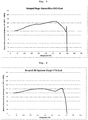
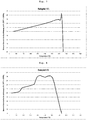
- Materials according to the invention initially generally also show a slight expansion upon heating, but they are significantly lower than conventional materials fails ( Fig. 1-4 ).
- the expansion curves drop significantly before reaching the decomposition temperature. Sometimes even at higher temperatures, a slight increase in the curves is observed, but this is relatively small. Overall, the materials according to the invention expand significantly less over the entire temperature range until decomposition than known materials.
- the determination of the thermal expansion is preferably carried out on cylinders with 6 mm diameter and 6 mm height in the temperature range from 30 ° C to 800 ° C at a heating rate of 5 K / min in an air atmosphere.
- the probe is placed on the sample with a contact force of 0.1 N.
- the linear expansion of the cylinders during heating and thermal decomposition is measured.
- the measurement may e.g. with a thermomechanical analyzer (TMA) of the type Q400 from TA Instruments with Macro-Expansion Tool.
- TMA thermomechanical analyzer
- the length of the cylinder at 30 ° C is referred to as the original length, i. 0% extension, assumed.
- the materials according to the invention Due to the thermal expansion behavior of the materials according to the invention, the risk of defects such as cracks or even the destruction of the mold during burnout is at least greatly reduced and usually completely eliminated.
- the materials according to the invention provide in this way crack-free molds with high accuracy and precision.
- the novel materials preferably contain at least one (meth) acrylate and / or (meth) acrylamide as radically polymerizable monomer (a), preferably one or a plurality of mono- or multi-functional (meth) acrylates or a mixture thereof.
- Particularly preferred materials are those which comprise as free-radically polymerizable monomer at least one multifunctional (meth) acrylate or a mixture of monofunctional and polyfunctional (meth) acrylates.
- monofunctional (meth) acrylates are meant compounds having a polyfunctional (meth) acrylate compound having two or more, preferably 2 to 6 radically polymerizable groups. Methacrylates are preferred in all cases over the acrylates.
- 2-Phenoxyethyl (meth) acrylate aliphatic urethane diacrylates
- the properties of the materials before and after curing can be influenced by a specific combination of the monomers.
- Mixtures of monofunctional and difunctional monomers are characterized by a relatively low viscosity and reactivity of the resin mixture, wherein viscosity and reactivity decrease with the content of monofunctional monomers.
- a content of monofunctional monomers ensures a lower rigidity of the models obtained by curing the materials.
- Mixtures of difunctional and trifunctional monomers have a higher reactivity, wherein the reactivity increases with the content of trifunctional monomers.
- the content of trifunctional monomers causes a higher brittleness.
- Reactivity and viscosity of the Resin mixture and the polymerization shrinkage are also determined by the molecular weight of the monomers, with increasing molecular weight of the polymerization shrinkage decreases as the viscosity increases.
- Preferred photoinitiators (b) for the initiation of radical photopolymerization are benzophenone, benzoin and derivatives thereof or ⁇ -diketones or derivatives thereof, such as 9,10-phenanthrenequinone, 1-phenyl-1,2-propanediol, diacetyl or 4,4 ' -Dichlorbenzil.
- camphorquinone (CQ) and 2,2-dimethoxy-2-phenyl-acetophenone and most preferably ⁇ -diketones are used in combination with amines as reducing agents, such as 4- (dimethylamino) -benzoic acid ester (EDMAB), N, N Dimethylaminoethyl methacrylate, N, N-dimethyl-symxylidine or triethanolamine.
- amines such as 4- (dimethylamino) -benzoic acid ester (EDMAB), N, N Dimethylaminoethyl methacrylate, N, N-dimethyl-symxylidine or triethanolamine.
- diethylthioxanthene (DETX, CAS 82799-44-8 ) and isopropylthioxanthone (ITX, CAS 75081-21-9 ), both in each case preferably in combination with ethyl 4- (dimethylamino) benzoate (EMBO, CAS No. 10287-53-3 ).
- Particularly preferred photoinitiators are furthermore Norrish type I photoinitiators, in particular monoacyl or bisacylphosphine oxides, and in particular monoacyltrialkyl or diacyldialkylgermanium compounds, for example benzoyltrimethylgermanium, dibenzoyldiethylgermanium or bis (4-methoxybenzoyl) diethylgermanium (MBDEGe). It is also advantageous to use mixtures of the various photoinitiators, for example bis (4-methoxybenzoyl) diethylgermanium in combination with camphorquinone and 4-dimethylaminobenzoic acid ethyl ester.
- monoacyl or bisacylphosphine oxides in particular monoacyltrialkyl or diacyldialkylgermanium compounds, for example benzoyltrimethylgermanium, dibenzoyldiethylgermanium or bis (4-methoxybenzoyl) diethylgermanium (
- camphorquinone (CAS No. 10373-78-1 ) in combination with ethyl 4- (dimethylamino) benzoate (EMBO, CAS No. 10287-53-3 ) and phenyl naphthalene (2,4,6-trimethylbenzoyl) phosphine oxide (Irgacure 819, CAS 162881-26-7) , Diphenyl (2,4,6-tri ⁇ methyl b enzoyl) ⁇ phenyl-phos ⁇ phinoxid (TPO, CAS No.
- the thermal expansion behavior of the materials can be specifically adjusted so that their maximum thermal expansion is less than 1.5%, preferably less than 1%, more preferably less than 0.7%, and according to Particularly preferred embodiment, the maximum extent at a temperature of below 150 ° C, preferably below 120 ° C, more preferably below 100 ° C and most preferably below 90 ° C is achieved.
- the inert component (c) used according to the invention and in particular the preferred components mentioned are homogeneously miscible with free-radically polymerizable monomers and in particular with acrylates and methacrylates and do not impair the polymerization of these monomers.
- the stereolithographic processing of the compositions according to the invention in the liquid state a high reactivity and short exposure and processing times can be ensured thereby.
- component (a) contains UDMA, TEGDMA or a mixture thereof.
- Particularly preferred are materials in which the component (A) in addition to UDMA and / or TEGDMA at most 20 wt .-%, preferably at most 10 wt .-%, more preferably at most 5 wt .-% and most preferably less than 3 wt .-% or contains no further monomers, wherein the percentages refer to the total mass of component (a).
- UDMA or TEGDMA particularly preferably a mixture of UDMA, TEGDMA and SR339C or of UDMA, TEGDMA and Bis-GMA and in particular a mixture of UDMA and TEGDMA.
- component (c) in each case PPG having a molecular weight of 1000 to 4000 g / mol, preferably from 1500 to 3000 g / mol, most preferably 2000 g / mol is preferred.
- PPG with a molecular weight of 2000 g / mol represents a good compromise.
- a molecular weight of about 3500 g / mol is advantageous.
- the materials according to the invention may advantageously contain further additives.
- materials are preferred which contain at least one colorant and preferably also at least one polymerization inhibitor.
- organic dyes and pigments are preferred, especially azo dyes, carbonyl dyes, cyanine dyes, azomethines and methines, phthalocyanines and dioxazines. Especially preferred are dyes that are soluble in the materials, especially azo dyes. Suitable colorants are also inorganic and especially organic pigments, which can be well dispersed in the materials. Azopigments and nonazopiments are preferred. As dyes, preferably such substances are used burn out without residue. For this reason, organic versus inorganic pigments are preferred. If inorganic pigments are used, their amount is preferably such that their ash content after burnout is less than 0.1% by weight, based on the total weight of the burnable material.
- the materials contain at least one colorant which absorbs in the same wavelength range as the polymerization initiator.
- colorants which have an absorption maximum which corresponds to the wavelength of the light used for curing.
- Colorants prevent the light used for curing from penetrating too deeply into the materials and thus have an advantageous effect on the precision of the components in the printing process, in particular in stereolithographic processes.
- colorants can also be added for aesthetic purposes.
- the polymerization inhibitor (s) serve as a stabilizer for preventing a spontaneous polyreaction.
- the inhibitors or stabilizers improve the storage stability of the materials and also prevent an uncontrolled polyreaction in the stereolithographic tub.
- the inhibitors are preferably added in such an amount that the materials are storage stable over a period of about 2-3 years.
- the inhibitors are particularly preferably used in an amount of 0.001 to 1.0% by weight, very particularly preferably 0.001 to 0.20% by weight, in each case based on the total mass of the material.
- Suitable aerobic inhibitors phenols such as hydroquinone monomethyl ether (MEHQ) or 2,6-di-tert-butyl-4-methylphenol (BHT), which are effectively effective only in the presence of oxygen and preferably in a concentration range of 100-2000 ppmw can be used.
- Suitable anaerobic inhibitors are phenothiazine, 2,2,6,6-tetramethylpiperidine-1-oxyl radical (TEMPO), iodine and copper (I) iodide. These act even in low concentrations of preferably 10-200 ppmw even in the absence of oxygen. Polymerization does not take place until these additives have been consumed. It is advantageous to use a mixture of aerobic and anaerobic inhibitors.
- Aerobic inhibitors are preferably used in an amount of 0.001 to 0.50 wt .-% and anaerobic inhibitors in an amount of 0.001 to 0.02 wt .-%, each based on the total mass of the material.
- Preferred mixtures contain from 0.005 to 0.10% by weight of aerobic inhibitors and from 0.001 to 0.02% by weight of anaerobic inhibitors, also based on the total mass of the material.
- the modeling materials of the invention may also contain particulate filler.
- particulate filler preference is given to organic particles as fillers, in particular fillers which burn ashlessly.
- the filler or fillers preferably have a particle size of less than 25 ⁇ m, preferably less than 10 ⁇ m and particularly preferably less than 5 ⁇ m. Unless otherwise stated, all particle sizes herein are D50 values, ie, 50% by volume of the particles have a diameter smaller than the specified value. Fillers serve primarily to adjust the viscosity, the mechanical and / or the optical properties of the materials.
- the surface of the fillers may be modified, for example to improve the dispersibility of the fillers in the organic matrix.
- surface modification it is preferred to use those compounds which are chemically, i. bound by ionic or covalent bonds to the surface of the fillers.
- the particle surface may be partially or preferably completely covered with the modifier.
- the modifiers used in the invention are monomeric compounds. As surface modifiers, especially linear carboxylic acids such as e.g.
- Formic acid acetic acid, propionic acid, octanoic acid, isobutyric acid, isovaleric acid, pivalic acid, or phosphonic acids, e.g. such as methyl, ethyl, propyl, butyl-hexyl, octyl or phenylphosphonic.
- silanes such as propyltrimethoxysilane, phenyltrimethoxysilane, hexyltrimethoxysilane, octyltrimethoxysilane, trimethylchlorosilane, trimethylbromosilane, trimethylmethoxysilane and hexamethyldisilazane.
- Very particularly preferred surface modifiers are acidic phosphoric acid esters, e.g. Dimethyl, diethyl, dipropyl, dibutyl, dipentyl, dihexyl, dioctyl or di (2-ethylhexyl) phosphate.
- the surface modifiers may also have free-radically polymerizable groups, for example (meth) acrylate groups, which react with component (a) and thus become incorporated into the polymer network.
- Preferred fillers are particulate waxes, in particular carnauba wax, preferably having a particle size of 1 to 10 .mu.m, crosslinked polymethyl methacrylate (PMMA) particles, preferably having a particle size of 500 nm to 10 .mu.m, and polyamide-12 particles, preferably having a particle size of 5 to 10 ⁇ m.
- PMMA polymethyl methacrylate
- fillers are preferably used whose maximum particle size is smaller than the thickness of the stereolithographically produced layers. Preference is given to particles having a maximum size of 25 ⁇ m, preferably not more than 15 ⁇ m.
- filler-free materials are preferred.
- the rheological properties of the materials according to the invention are adapted to the desired application.
- Materials for stereolithographic processing are preferably adjusted so that their viscosity is in the range of 50 mPa.s to 100 Pa.s, preferably 100 mPa.s to 10 Pa.s, more preferably 100 mPa.s to 5 Pa.s.
- the viscosity is determined at the desired processing temperature of the materials with a cone-plate viscometer (shear rate 100 / s).
- the processing temperature is preferably in the range of 10 to 70 ° C, particularly preferably 20 to 30 ° C.
- Materials for manual processing are preferably adjusted to have a pasty consistency.
- liquid monomers and low-viscosity components e.g. also solid monomers and / or viscous or solid components (c) can be used.
- the materials according to the invention may preferably additionally comprise one or more UV absorbers.
- Preferred UV absorbers are 2,2'-methylenebis [6- (2H-benzotriazol-2-yl) -4- (1,1,3,3-tetramethylbutyl) phenol] (CAS No. 103597- 45-1), 2,2 ', 4,4'-tetrahydroxybenzophenone (CAS No. 131-55-5), 2-tert-butyl-6- (5-chloro-2H-benzotriazol-2-yl) - 4-methylphenol (CAS No. 3896-11-5), 2,2'-benzene-1,4-diylbis (4h-3,1-benzoxazin-4-one) (CAS No.
- hindered amine light stabilizers such as bis (1,2,2,6,6-pentamethyl-4-piperidyl) sebacate (CAS No. 41556-26-7) and methyl-1,2,2,6, 6-pentamethyl-4-piperidyl sebacate (CAS No. 82919-37-7), bis (1-octyloxy-2,2,6,6-tetramethyl-4-piperidyl) sebacate (CAS No. 129757-67-1 ), Bis (1,2,6,6,6-pentamethyl-4-piperidyl) - [[3,5-bis (1,1-dimethylethyl) -4-hydroxyphenyl] methyl] butyl malonate (CAS No. 63843-). 89-0).
- the materials according to the invention may contain one or more further additives which are preferably made from thickeners, optical brighteners (for example Lumilux LZ Blue, CAS No. 658084-50-5, or 2,5-bis (5-tert-butyl). butyl benzoxazol-2-yl) thiophene, CAS No. 7128-64-5) and in the case of filler-containing materials are selected from dispersants.
- optical brighteners for example Lumilux LZ Blue, CAS No. 658084-50-5, or 2,5-bis (5-tert-butyl). butyl benzoxazol-2-yl) thiophene, CAS No. 7128-64-5
- filler-containing materials are selected from dispersants.
- the materials according to the invention are particularly suitable for the production of models for casting work of metal or glass-ceramic, in particular for the production of models for dental restoration, such as e.g. Inlays, onlays, veneers, crowns, bridges or frameworks and removable (partial) prostheses.
- the preparation of the model in step (A) is preferably carried out by a stereolithographic process.
- a virtual image of the dental situation is created by the direct or indirect digitization of the tooth to be restored or the teeth to be restored on the computer, then constructed on the basis of this image on the computer a model of dental restoration and this then produced by generative stereolithographic manufacturing.
- the model can be embedded in an investment in step (B) in a conventional manner.
- the materials according to the invention are suitable for use with customary dental investment materials.
- Gypsum-containing investments contain as main constituents gypsum and quartz in the ratio 1: 2 to 1: 4.
- Gypsum serves as a binder.
- a preferred quartz modification is cristobalite.
- Gypsum-free investment materials which contain phosphates as binders are preferred.
- Phosphate-bonded investments contain high-temperature-resistant SiO 2 modifications and a binder.
- the binder used is preferably a mixture of magnesium oxide and ammonium phosphate (NH 4 H 2 PO 4 ). The masses bind with water after mixing.
- the removal of the model from the mold in step (C) is carried out by heating e.g. in an oven to a temperature of preferably 600 ° C to 1000 ° C.
- the heating can be carried out in one or more stages. It is possible, but not essential, to raise the temperature to the desired final temperature in a controlled manner. Subsequently, the mold is heated further, wherein the remaining model material is thermally decomposed.
- the embedded model can be placed directly in an oven, which is on the Melting and / or burnout of the model required temperature is preheated.
- the melting and / or burnout occurs at a temperature of about 850 ° C.
- the temperature cycle proposed by the investment material manufacturer is used.
- the model is completely burned or emptied after just one hour.
- the maximum residence time in the oven can vary depending on the investment and the manufacturer. In most cases, it is sufficient to leave the mold in the oven for 1 to 8 hours at the maximum temperature. The heating process can take several hours (1-12 h).
- a metal alloy is poured or a suitable glass-ceramic material is pressed in step (D).
- Preference is given to using metal alloys suitable for dental purposes or glass ceramic materials suitable for dental purposes.
- FIGS. 5 and 6 show the expansion curves of commercially available materials according to the prior art.
- FIGS. 7 and 8 show the thermal expansion curves of comparative materials containing no inert component (c).
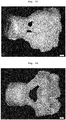
- FIGS. 9 to 11 show dental bridge frameworks made of glass ceramic, which were prepared using the materials according to the invention from Examples 4 (FIG. Fig. 9 ), 5 ( Fig. 10 ) and 8th ( Fig. 11 ) were prepared immediately after devesting.
- the bridge frameworks have no pressing flags.
- FIGS. 12 to 14 show dental glass-ceramic bridge frameworks which were produced using comparison materials without component (c) ( Fig. 12 , Material V1; Fig. 13 , Material V2; Fig. 14 , Material V3).
- the bridge frameworks have clearly visible press flags.
- FIGS. 15 and 16 show dental bridge frameworks made of glass ceramic, which were produced using commercially available materials.
- the bridge frameworks have clearly visible press flags.
- the components listed in Table 1 were mixed homogeneously with each other in the stated amounts. The components were weighed, stirred for 1 hour at about 50 ° C and then at room temperature for about 16h (overnight). In pigment and filler-containing compositions, the pigment or filler was stirred into UDMA, the masses were then homogenized and dispersed three times through a three-roll block with a gap width of 10 microns and then stirred into the remaining, already dissolved organic matrix (at least 1 hour at room temperature). Finally, further additives such as thickeners were optionally added to the paste and stirred again for at least 1 hour.
- stereolithographic cylinders of 6 mm diameter and 6 mm height were produced from the materials described in Tables 1 and 2 with a printer.
- the cylinders were cured in layers and then post-exposed in a post-exposure device at a wavelength of 400 nm with an intensity of 10 mW / cm 2 for 5 minutes.
- the cylinders were then placed in the sample chamber of a thermomechanical analyzer (Q400 type from TA Instruments with Macro-Expansion Tool) and heated to 800 ° C. at a heating rate of 5 K / min.
- the linear thermal expansion of the cylinders during the heating and the thermal decomposition in the temperature range of 30 ° C to 800 ° C in an air atmosphere was measured.
- the contact force of the probe was 0.1 N.
- FIGS. 1 to 4 the expansion curves for the materials of Examples 2, 4, 5 and 6 are shown.
- the thermal expansion remained clearly below 0.7% in all cases over the entire measuring range.
- the maximum linear thermal expansion was achieved in all cases at a temperature below 90 ° C. Thereafter, the length of the cylinders remained below the maximum value. From 300 ° C, the material decomposed thermally and burned out without residue (incineration residue in all cases ⁇ 0.1 wt .-%).
- the decomposition manifests itself in a strong decrease in linear thermal expansion.
- Example 6 shows that the wax particles used as filler have virtually no influence on the expansion.
- Example 8 The expansion curves of the other examples are similar. In Example 8, the maximum thermal expansion of ⁇ 1.5% at 125 ° C is achieved.
- FIG. 5 shows the expansion curve of the material Bego VarseoWax CAD-Cast. The material expands by more than 4%, and the maximum expansion temperature is reached shortly before thermal decomposition, that is, at more than 300 ° C.
- FIG. 6 is the expansion curve of another commercially available stereolithography resin for the Lost-Wax technique (3D Systems Visijet FTX-Cast) shown.
- the material expands by more than 2% and the maximum thermal expansion temperature is above 200 ° C.
- FIGS. 7 and 8 show the expansion curves of the comparative materials V1 and V3.
- Material V1 expanded by more than 6% ( Fig. 7 ), the material V3 by more than 8% ( Fig. 8 ).
- the maximum expansion temperature was only reached shortly before thermal decomposition, that is to say above 300 ° C. or above 200 ° C.
- the maximum thermal expansion of the comparison materials in all cases is greater than that of the materials according to the invention.
- the thermal expansion can be effectively reduced.
- the maximum of the linear thermal expansion lies at significantly higher temperatures, which are determined by the decomposition temperature of the materials.
- Models of a three-unit bridge were fabricated from the materials described in Examples 1 to 9 and with commercially available materials using a 3D printer. For the production of the models the same data set was used in all cases.
- the models were waxed on a muffle base with the matching muffle gauge and provided with press channels.
- the models were then each embedded in a commercially available phosphate-based investment (200 g PressVest Speed, Ivoclar Vivadent AG).
- the fine embedding of the cavities was done with a small brush.
- the Everbettete muffle was allowed to set vibration-free for 35 minutes. Thereafter, the muffles were placed directly in the pre-heating oven preheated to 850 ° C and left there for 1.5 h at 850 ° C to completely remove the models from it.
- the muffles were then removed from the preheating oven, the hot muffles were equipped with a ceramic blank (Ivs. Ivoclar Vivadent AG), placed in the hot pressing oven (Programat EP 5010, Ivoclar Vivadent) and the selected pressing program started.
- the muffles were removed from the oven and placed on a cooling grid in a place protected from drafts for cooling. After cooling to room temperature, the muffles were separated with a separating disk and the pressed objects were emptied. The coarse bedding was carried out with gloss blasting agent at 4 bar pressure, the fine Ausbettung with bright abrasive at 2 bar pressure. The press results were evaluated immediately after the fine-bedding.
- FIGS. 9 to 11 show by way of example bridge frameworks, which were prepared using the materials according to the invention from Examples 4, 5 and 8. The pictures were taken directly after the devesting. There are no press flags visible. The bridges made with the other materials of the present invention were similar, in no case were the press flags.
- FIGS. 12 to 14 show the bridge frameworks obtained using the comparative materials V1 to V3.
- FIG. 15 shows a using the commercial material Bego Varseo Wax CAD-Cast and FIG. 16 a bridge made using the 3D Systems Visijet FTX-Cast product. In all cases, press flags are present, which require a more or less complex reworking of the restorations. Some of the restorations were unusable.
- Comparative material V3 contained wax particles but no component (c). The model expanded during burnout strong, the press results were accordingly poor.
Landscapes
- Health & Medical Sciences (AREA)
- Chemical & Material Sciences (AREA)
- Organic Chemistry (AREA)
- Polymers & Plastics (AREA)
- Medicinal Chemistry (AREA)
- Chemical Kinetics & Catalysis (AREA)
- Oral & Maxillofacial Surgery (AREA)
- Epidemiology (AREA)
- Veterinary Medicine (AREA)
- Public Health (AREA)
- General Health & Medical Sciences (AREA)
- Animal Behavior & Ethology (AREA)
- Life Sciences & Earth Sciences (AREA)
- Plastic & Reconstructive Surgery (AREA)
- Dental Preparations (AREA)
Priority Applications (5)
| Application Number | Priority Date | Filing Date | Title |
|---|---|---|---|
| EP16204527.2A EP3335687B1 (fr) | 2016-12-15 | 2016-12-15 | Matière à modeler dentaire calcinable |
| US16/467,220 US11021600B2 (en) | 2016-12-15 | 2017-12-07 | Burn-out dental modelling material |
| PCT/EP2017/081802 WO2018108688A1 (fr) | 2016-12-15 | 2017-12-07 | Matériau de modélisation dentaire calcinable |
| CN201780076922.2A CN110072506B (zh) | 2016-12-15 | 2017-12-07 | 燃尽的牙科成型材料 |
| US17/234,937 US11649345B2 (en) | 2016-12-15 | 2021-04-20 | Burn-out dental modelling material |
Applications Claiming Priority (1)
| Application Number | Priority Date | Filing Date | Title |
|---|---|---|---|
| EP16204527.2A EP3335687B1 (fr) | 2016-12-15 | 2016-12-15 | Matière à modeler dentaire calcinable |
Publications (2)
| Publication Number | Publication Date |
|---|---|
| EP3335687A1 true EP3335687A1 (fr) | 2018-06-20 |
| EP3335687B1 EP3335687B1 (fr) | 2020-02-12 |
Family
ID=57570335
Family Applications (1)
| Application Number | Title | Priority Date | Filing Date |
|---|---|---|---|
| EP16204527.2A Active EP3335687B1 (fr) | 2016-12-15 | 2016-12-15 | Matière à modeler dentaire calcinable |
Country Status (4)
| Country | Link |
|---|---|
| US (2) | US11021600B2 (fr) |
| EP (1) | EP3335687B1 (fr) |
| CN (1) | CN110072506B (fr) |
| WO (1) | WO2018108688A1 (fr) |
Cited By (2)
| Publication number | Priority date | Publication date | Assignee | Title |
|---|---|---|---|---|
| EP3660087A1 (fr) * | 2018-11-29 | 2020-06-03 | Ivoclar Vivadent AG | Procédé et matériau destinés à la fabrication d'objets tridimensionnels par impression par transfert induit par impulsion énergétique |
| RU2818598C1 (ru) * | 2023-09-15 | 2024-05-03 | Общество с ограниченной ответственностью "Научно-производственное предприятие" "3Д Аддитивные технологии" | Стоматологическая выжигаемая фотополимерная композиция для 3D-печати |
Families Citing this family (2)
| Publication number | Priority date | Publication date | Assignee | Title |
|---|---|---|---|---|
| US11873359B2 (en) * | 2020-01-22 | 2024-01-16 | Mitsui Chemicals, Inc. | Photocurable composition, three-dimensional molded product, and dental product |
| DE102020109280A1 (de) * | 2020-04-02 | 2021-10-07 | Kulzer Gmbh | Lichthärtende Zusammensetzung für die Herstellung dentaler Bauteile mit matten Oberflächen |
Citations (4)
| Publication number | Priority date | Publication date | Assignee | Title |
|---|---|---|---|---|
| US4613560A (en) * | 1984-12-28 | 1986-09-23 | E. I. Du Pont De Nemours And Company | Photosensitive ceramic coating composition |
| DE19900459A1 (de) * | 1999-01-08 | 2000-07-13 | Basf Ag | Polymerdispersion |
| US20100029801A1 (en) * | 2008-07-30 | 2010-02-04 | Ivoclar Vivadent Ag | Light-curing slips for the stereolithographic preparation of dental ceramics |
| US20140183799A1 (en) * | 2010-07-08 | 2014-07-03 | Ivoclar Vivadent Ag | Light-Curing Ceramic Slips For The Stereolithographic Preparation Of High-Strength Ceramics |
Family Cites Families (2)
| Publication number | Priority date | Publication date | Assignee | Title |
|---|---|---|---|---|
| US20040151691A1 (en) * | 2003-01-30 | 2004-08-05 | Oxman Joel D. | Hardenable thermally responsive compositions |
| EP1840152B1 (fr) * | 2006-03-31 | 2009-07-08 | Sony Deutschland Gmbh | Procédé de production d'un gel polymèrique réticulé |
-
2016
- 2016-12-15 EP EP16204527.2A patent/EP3335687B1/fr active Active
-
2017
- 2017-12-07 US US16/467,220 patent/US11021600B2/en active Active
- 2017-12-07 WO PCT/EP2017/081802 patent/WO2018108688A1/fr not_active Ceased
- 2017-12-07 CN CN201780076922.2A patent/CN110072506B/zh active Active
-
2021
- 2021-04-20 US US17/234,937 patent/US11649345B2/en active Active
Patent Citations (4)
| Publication number | Priority date | Publication date | Assignee | Title |
|---|---|---|---|---|
| US4613560A (en) * | 1984-12-28 | 1986-09-23 | E. I. Du Pont De Nemours And Company | Photosensitive ceramic coating composition |
| DE19900459A1 (de) * | 1999-01-08 | 2000-07-13 | Basf Ag | Polymerdispersion |
| US20100029801A1 (en) * | 2008-07-30 | 2010-02-04 | Ivoclar Vivadent Ag | Light-curing slips for the stereolithographic preparation of dental ceramics |
| US20140183799A1 (en) * | 2010-07-08 | 2014-07-03 | Ivoclar Vivadent Ag | Light-Curing Ceramic Slips For The Stereolithographic Preparation Of High-Strength Ceramics |
Non-Patent Citations (3)
| Title |
|---|
| A. BEIL: "Fertigung von Mikro-Bauteilen mittels Stereolithographie", 2002, VDI-VERLAG, pages: 3 |
| A. GEBHARDT, VISION OF RAPID PROTOTYPING, vol. 83, 2006, pages 7 - 12 |
| A. GEBHARDT: "Generative Fertigungsverfahren", 2007, CARL HANSER VERLAG, pages: 77FF |
Cited By (4)
| Publication number | Priority date | Publication date | Assignee | Title |
|---|---|---|---|---|
| EP3660087A1 (fr) * | 2018-11-29 | 2020-06-03 | Ivoclar Vivadent AG | Procédé et matériau destinés à la fabrication d'objets tridimensionnels par impression par transfert induit par impulsion énergétique |
| US11623996B2 (en) | 2018-11-29 | 2023-04-11 | Ivoclar Vivadent Ag | Process and material for producing 3D objects by energy-pulse-induced transfer printing |
| US12319820B2 (en) | 2018-11-29 | 2025-06-03 | Ivoclar Vivadent Ag | Process and material for producing 3D objects by energy-pulse-induced transfer printing |
| RU2818598C1 (ru) * | 2023-09-15 | 2024-05-03 | Общество с ограниченной ответственностью "Научно-производственное предприятие" "3Д Аддитивные технологии" | Стоматологическая выжигаемая фотополимерная композиция для 3D-печати |
Also Published As
| Publication number | Publication date |
|---|---|
| WO2018108688A1 (fr) | 2018-06-21 |
| CN110072506A (zh) | 2019-07-30 |
| CN110072506B (zh) | 2020-07-14 |
| US11021600B2 (en) | 2021-06-01 |
| US20200079948A1 (en) | 2020-03-12 |
| US20210238403A1 (en) | 2021-08-05 |
| EP3335687B1 (fr) | 2020-02-12 |
| US11649345B2 (en) | 2023-05-16 |
Similar Documents
| Publication | Publication Date | Title |
|---|---|---|
| DE102016225208B4 (de) | Ausbrennbares Material auf Polymerbasis für die Lost-Wax Technik | |
| EP2404590B1 (fr) | Barbotine en céramique durcissant à la lumière pour la fabrication stéréo-lithographique de céramiques à haute résistance | |
| EP3147707B1 (fr) | Barbotine en ceramique ou en vitroceramique pour la stereolithographie | |
| EP3504017B1 (fr) | Composition durcissable colorée pour processus de fabrication additive, article composite 3 dim et son utilisation | |
| DE69922413T2 (de) | Dentale fräsrohlinge | |
| EP2751618A2 (fr) | Composition de résine composite et procédé de fabrication de composants dentaires par stéréolithographie | |
| DE19823530A1 (de) | Dentalharzmaterial und Verfahren zu dessen Herstellung | |
| WO2016026915A1 (fr) | Composites dentaires durcissant à la lumière avec une opacité croissante | |
| US11649345B2 (en) | Burn-out dental modelling material | |
| EP3654925A2 (fr) | Matériau composite dentaire et ébauches à fraiser de ce matériau composite | |
| DE102021124156A1 (de) | Kunstharzmaterial zum 3D-Drucken von Formen für die Herstellung medizintechnischer Formteile | |
| DE102017123006B4 (de) | Dentales Kompositmaterial sowie Fräsrohlinge dieses Kompositmaterials | |
| DE102017123012A1 (de) | Dentales Kompositmaterial mit abgestimmten Verhältnis von Biegefestigkeit und Elastizitätsmodul sowie Fräsrohlinge dieses Kompositmaterials | |
| EP3363423A1 (fr) | Bloc composite dentaire destiné à la fabrication de restaurations indirectes permanentes dans le procédé cad/cam | |
| EP3654923A1 (fr) | Matériau composite dentaire et ébauches à fraiser de ce matériau composite | |
| EP4484436A1 (fr) | Matériaux polymérisables par radicaux pour la fabrication de corps moulés dentaires à faible décoloration | |
| EP4126545A1 (fr) | Composition photodurcissable pour la production de composants dentaires à surfaces mates | |
| EP4652981A1 (fr) | Composition durcissable par rayonnement pour la fabrication de composants dentaires | |
| EP4702947A1 (fr) | Procédé de fabrication de restaurations dentaires céramiques et vitrocéramiques | |
| JP7801745B2 (ja) | 歯科用硬化性組成物 | |
| EP4483860A1 (fr) | Matériaux polymérisables par voie radicalaire pour la fabrication de corps moulés dentaires présentant une ténacité élevée à la rupture | |
| JP2024159454A (ja) | 歯科用硬化性組成物 | |
| DE102023131266A1 (de) | Strahlungshärtende Zusammensetzung für die Herstellung dentaler Bauteile in einem 3D-Druck-Verfahren |
Legal Events
| Date | Code | Title | Description |
|---|---|---|---|
| PUAI | Public reference made under article 153(3) epc to a published international application that has entered the european phase |
Free format text: ORIGINAL CODE: 0009012 |
|
| STAA | Information on the status of an ep patent application or granted ep patent |
Free format text: STATUS: THE APPLICATION HAS BEEN PUBLISHED |
|
| AK | Designated contracting states |
Kind code of ref document: A1 Designated state(s): AL AT BE BG CH CY CZ DE DK EE ES FI FR GB GR HR HU IE IS IT LI LT LU LV MC MK MT NL NO PL PT RO RS SE SI SK SM TR |
|
| AX | Request for extension of the european patent |
Extension state: BA ME |
|
| STAA | Information on the status of an ep patent application or granted ep patent |
Free format text: STATUS: REQUEST FOR EXAMINATION WAS MADE |
|
| 17P | Request for examination filed |
Effective date: 20181218 |
|
| RBV | Designated contracting states (corrected) |
Designated state(s): AL AT BE BG CH CY CZ DE DK EE ES FI FR GB GR HR HU IE IS IT LI LT LU LV MC MK MT NL NO PL PT RO RS SE SI SK SM TR |
|
| STAA | Information on the status of an ep patent application or granted ep patent |
Free format text: STATUS: EXAMINATION IS IN PROGRESS |
|
| 17Q | First examination report despatched |
Effective date: 20190404 |
|
| GRAP | Despatch of communication of intention to grant a patent |
Free format text: ORIGINAL CODE: EPIDOSNIGR1 |
|
| STAA | Information on the status of an ep patent application or granted ep patent |
Free format text: STATUS: GRANT OF PATENT IS INTENDED |
|
| INTG | Intention to grant announced |
Effective date: 20190923 |
|
| GRAS | Grant fee paid |
Free format text: ORIGINAL CODE: EPIDOSNIGR3 |
|
| GRAA | (expected) grant |
Free format text: ORIGINAL CODE: 0009210 |
|
| STAA | Information on the status of an ep patent application or granted ep patent |
Free format text: STATUS: THE PATENT HAS BEEN GRANTED |
|
| AK | Designated contracting states |
Kind code of ref document: B1 Designated state(s): AL AT BE BG CH CY CZ DE DK EE ES FI FR GB GR HR HU IE IS IT LI LT LU LV MC MK MT NL NO PL PT RO RS SE SI SK SM TR |
|
| REG | Reference to a national code |
Ref country code: GB Ref legal event code: FG4D Free format text: NOT ENGLISH |
|
| REG | Reference to a national code |
Ref country code: CH Ref legal event code: EP |
|
| REG | Reference to a national code |
Ref country code: AT Ref legal event code: REF Ref document number: 1231153 Country of ref document: AT Kind code of ref document: T Effective date: 20200215 |
|
| REG | Reference to a national code |
Ref country code: DE Ref legal event code: R096 Ref document number: 502016008692 Country of ref document: DE |
|
| REG | Reference to a national code |
Ref country code: CH Ref legal event code: NV Representative=s name: KELLER AND PARTNER PATENTANWAELTE AG, CH |
|
| REG | Reference to a national code |
Ref country code: IE Ref legal event code: FG4D Free format text: LANGUAGE OF EP DOCUMENT: GERMAN |
|
| PG25 | Lapsed in a contracting state [announced via postgrant information from national office to epo] |
Ref country code: RS Free format text: LAPSE BECAUSE OF FAILURE TO SUBMIT A TRANSLATION OF THE DESCRIPTION OR TO PAY THE FEE WITHIN THE PRESCRIBED TIME-LIMIT Effective date: 20200212 Ref country code: FI Free format text: LAPSE BECAUSE OF FAILURE TO SUBMIT A TRANSLATION OF THE DESCRIPTION OR TO PAY THE FEE WITHIN THE PRESCRIBED TIME-LIMIT Effective date: 20200212 Ref country code: NO Free format text: LAPSE BECAUSE OF FAILURE TO SUBMIT A TRANSLATION OF THE DESCRIPTION OR TO PAY THE FEE WITHIN THE PRESCRIBED TIME-LIMIT Effective date: 20200512 |
|
| REG | Reference to a national code |
Ref country code: LT Ref legal event code: MG4D |
|
| REG | Reference to a national code |
Ref country code: NL Ref legal event code: MP Effective date: 20200212 |
|
| PG25 | Lapsed in a contracting state [announced via postgrant information from national office to epo] |
Ref country code: BG Free format text: LAPSE BECAUSE OF FAILURE TO SUBMIT A TRANSLATION OF THE DESCRIPTION OR TO PAY THE FEE WITHIN THE PRESCRIBED TIME-LIMIT Effective date: 20200512 Ref country code: IS Free format text: LAPSE BECAUSE OF FAILURE TO SUBMIT A TRANSLATION OF THE DESCRIPTION OR TO PAY THE FEE WITHIN THE PRESCRIBED TIME-LIMIT Effective date: 20200612 Ref country code: GR Free format text: LAPSE BECAUSE OF FAILURE TO SUBMIT A TRANSLATION OF THE DESCRIPTION OR TO PAY THE FEE WITHIN THE PRESCRIBED TIME-LIMIT Effective date: 20200513 Ref country code: LV Free format text: LAPSE BECAUSE OF FAILURE TO SUBMIT A TRANSLATION OF THE DESCRIPTION OR TO PAY THE FEE WITHIN THE PRESCRIBED TIME-LIMIT Effective date: 20200212 Ref country code: SE Free format text: LAPSE BECAUSE OF FAILURE TO SUBMIT A TRANSLATION OF THE DESCRIPTION OR TO PAY THE FEE WITHIN THE PRESCRIBED TIME-LIMIT Effective date: 20200212 Ref country code: HR Free format text: LAPSE BECAUSE OF FAILURE TO SUBMIT A TRANSLATION OF THE DESCRIPTION OR TO PAY THE FEE WITHIN THE PRESCRIBED TIME-LIMIT Effective date: 20200212 |
|
| PG25 | Lapsed in a contracting state [announced via postgrant information from national office to epo] |
Ref country code: NL Free format text: LAPSE BECAUSE OF FAILURE TO SUBMIT A TRANSLATION OF THE DESCRIPTION OR TO PAY THE FEE WITHIN THE PRESCRIBED TIME-LIMIT Effective date: 20200212 |
|
| REG | Reference to a national code |
Ref country code: CH Ref legal event code: PFA Owner name: IVOCLAR VIVADENT AG, LI Free format text: FORMER OWNER: IVOCLAR VIVADENT AG, LI |
|
| PG25 | Lapsed in a contracting state [announced via postgrant information from national office to epo] |
Ref country code: SK Free format text: LAPSE BECAUSE OF FAILURE TO SUBMIT A TRANSLATION OF THE DESCRIPTION OR TO PAY THE FEE WITHIN THE PRESCRIBED TIME-LIMIT Effective date: 20200212 Ref country code: DK Free format text: LAPSE BECAUSE OF FAILURE TO SUBMIT A TRANSLATION OF THE DESCRIPTION OR TO PAY THE FEE WITHIN THE PRESCRIBED TIME-LIMIT Effective date: 20200212 Ref country code: PT Free format text: LAPSE BECAUSE OF FAILURE TO SUBMIT A TRANSLATION OF THE DESCRIPTION OR TO PAY THE FEE WITHIN THE PRESCRIBED TIME-LIMIT Effective date: 20200705 Ref country code: RO Free format text: LAPSE BECAUSE OF FAILURE TO SUBMIT A TRANSLATION OF THE DESCRIPTION OR TO PAY THE FEE WITHIN THE PRESCRIBED TIME-LIMIT Effective date: 20200212 Ref country code: CZ Free format text: LAPSE BECAUSE OF FAILURE TO SUBMIT A TRANSLATION OF THE DESCRIPTION OR TO PAY THE FEE WITHIN THE PRESCRIBED TIME-LIMIT Effective date: 20200212 Ref country code: ES Free format text: LAPSE BECAUSE OF FAILURE TO SUBMIT A TRANSLATION OF THE DESCRIPTION OR TO PAY THE FEE WITHIN THE PRESCRIBED TIME-LIMIT Effective date: 20200212 Ref country code: LT Free format text: LAPSE BECAUSE OF FAILURE TO SUBMIT A TRANSLATION OF THE DESCRIPTION OR TO PAY THE FEE WITHIN THE PRESCRIBED TIME-LIMIT Effective date: 20200212 Ref country code: EE Free format text: LAPSE BECAUSE OF FAILURE TO SUBMIT A TRANSLATION OF THE DESCRIPTION OR TO PAY THE FEE WITHIN THE PRESCRIBED TIME-LIMIT Effective date: 20200212 Ref country code: SM Free format text: LAPSE BECAUSE OF FAILURE TO SUBMIT A TRANSLATION OF THE DESCRIPTION OR TO PAY THE FEE WITHIN THE PRESCRIBED TIME-LIMIT Effective date: 20200212 |
|
| REG | Reference to a national code |
Ref country code: DE Ref legal event code: R097 Ref document number: 502016008692 Country of ref document: DE |
|
| PLBE | No opposition filed within time limit |
Free format text: ORIGINAL CODE: 0009261 |
|
| STAA | Information on the status of an ep patent application or granted ep patent |
Free format text: STATUS: NO OPPOSITION FILED WITHIN TIME LIMIT |
|
| 26N | No opposition filed |
Effective date: 20201113 |
|
| PG25 | Lapsed in a contracting state [announced via postgrant information from national office to epo] |
Ref country code: IT Free format text: LAPSE BECAUSE OF FAILURE TO SUBMIT A TRANSLATION OF THE DESCRIPTION OR TO PAY THE FEE WITHIN THE PRESCRIBED TIME-LIMIT Effective date: 20200212 |
|
| PG25 | Lapsed in a contracting state [announced via postgrant information from national office to epo] |
Ref country code: SI Free format text: LAPSE BECAUSE OF FAILURE TO SUBMIT A TRANSLATION OF THE DESCRIPTION OR TO PAY THE FEE WITHIN THE PRESCRIBED TIME-LIMIT Effective date: 20200212 Ref country code: PL Free format text: LAPSE BECAUSE OF FAILURE TO SUBMIT A TRANSLATION OF THE DESCRIPTION OR TO PAY THE FEE WITHIN THE PRESCRIBED TIME-LIMIT Effective date: 20200212 |
|
| PG25 | Lapsed in a contracting state [announced via postgrant information from national office to epo] |
Ref country code: MC Free format text: LAPSE BECAUSE OF FAILURE TO SUBMIT A TRANSLATION OF THE DESCRIPTION OR TO PAY THE FEE WITHIN THE PRESCRIBED TIME-LIMIT Effective date: 20200212 |
|
| REG | Reference to a national code |
Ref country code: BE Ref legal event code: MM Effective date: 20201231 |
|
| PG25 | Lapsed in a contracting state [announced via postgrant information from national office to epo] |
Ref country code: IE Free format text: LAPSE BECAUSE OF NON-PAYMENT OF DUE FEES Effective date: 20201215 Ref country code: LU Free format text: LAPSE BECAUSE OF NON-PAYMENT OF DUE FEES Effective date: 20201215 |
|
| PG25 | Lapsed in a contracting state [announced via postgrant information from national office to epo] |
Ref country code: TR Free format text: LAPSE BECAUSE OF FAILURE TO SUBMIT A TRANSLATION OF THE DESCRIPTION OR TO PAY THE FEE WITHIN THE PRESCRIBED TIME-LIMIT Effective date: 20200212 Ref country code: MT Free format text: LAPSE BECAUSE OF FAILURE TO SUBMIT A TRANSLATION OF THE DESCRIPTION OR TO PAY THE FEE WITHIN THE PRESCRIBED TIME-LIMIT Effective date: 20200212 Ref country code: CY Free format text: LAPSE BECAUSE OF FAILURE TO SUBMIT A TRANSLATION OF THE DESCRIPTION OR TO PAY THE FEE WITHIN THE PRESCRIBED TIME-LIMIT Effective date: 20200212 |
|
| PG25 | Lapsed in a contracting state [announced via postgrant information from national office to epo] |
Ref country code: MK Free format text: LAPSE BECAUSE OF FAILURE TO SUBMIT A TRANSLATION OF THE DESCRIPTION OR TO PAY THE FEE WITHIN THE PRESCRIBED TIME-LIMIT Effective date: 20200212 Ref country code: AL Free format text: LAPSE BECAUSE OF FAILURE TO SUBMIT A TRANSLATION OF THE DESCRIPTION OR TO PAY THE FEE WITHIN THE PRESCRIBED TIME-LIMIT Effective date: 20200212 |
|
| PG25 | Lapsed in a contracting state [announced via postgrant information from national office to epo] |
Ref country code: BE Free format text: LAPSE BECAUSE OF NON-PAYMENT OF DUE FEES Effective date: 20201231 |
|
| REG | Reference to a national code |
Ref country code: AT Ref legal event code: MM01 Ref document number: 1231153 Country of ref document: AT Kind code of ref document: T Effective date: 20211215 |
|
| PG25 | Lapsed in a contracting state [announced via postgrant information from national office to epo] |
Ref country code: AT Free format text: LAPSE BECAUSE OF NON-PAYMENT OF DUE FEES Effective date: 20211215 |
|
| P01 | Opt-out of the competence of the unified patent court (upc) registered |
Effective date: 20230607 |
|
| PGFP | Annual fee paid to national office [announced via postgrant information from national office to epo] |
Ref country code: DE Payment date: 20251216 Year of fee payment: 10 |
|
| PGFP | Annual fee paid to national office [announced via postgrant information from national office to epo] |
Ref country code: GB Payment date: 20251229 Year of fee payment: 10 |
|
| PGFP | Annual fee paid to national office [announced via postgrant information from national office to epo] |
Ref country code: FR Payment date: 20251229 Year of fee payment: 10 |
|
| REG | Reference to a national code |
Ref country code: CH Ref legal event code: U11 Free format text: ST27 STATUS EVENT CODE: U-0-0-U10-U11 (AS PROVIDED BY THE NATIONAL OFFICE) Effective date: 20260219 |
|
| PGFP | Annual fee paid to national office [announced via postgrant information from national office to epo] |
Ref country code: CH Payment date: 20260219 Year of fee payment: 10 |