EP3337458B1 - Verwendung von wasserlöslichen polymeren auf basis von n-vinylpyrrolidon und acrylsäure als pharmazeutische hilfstoffe - Google Patents
Verwendung von wasserlöslichen polymeren auf basis von n-vinylpyrrolidon und acrylsäure als pharmazeutische hilfstoffe Download PDFInfo
- Publication number
- EP3337458B1 EP3337458B1 EP16751610.3A EP16751610A EP3337458B1 EP 3337458 B1 EP3337458 B1 EP 3337458B1 EP 16751610 A EP16751610 A EP 16751610A EP 3337458 B1 EP3337458 B1 EP 3337458B1
- Authority
- EP
- European Patent Office
- Prior art keywords
- water
- weight
- soluble
- solubility
- use according
- Prior art date
- Legal status (The legal status is an assumption and is not a legal conclusion. Google has not performed a legal analysis and makes no representation as to the accuracy of the status listed.)
- Active
Links
- WHNWPMSKXPGLAX-UHFFFAOYSA-N N-Vinyl-2-pyrrolidone Chemical compound C=CN1CCCC1=O WHNWPMSKXPGLAX-UHFFFAOYSA-N 0.000 title claims description 45
- 229920003169 water-soluble polymer Polymers 0.000 title claims description 30
- SMZOUWXMTYCWNB-UHFFFAOYSA-N 2-(2-methoxy-5-methylphenyl)ethanamine Chemical compound COC1=CC=C(C)C=C1CCN SMZOUWXMTYCWNB-UHFFFAOYSA-N 0.000 title claims description 23
- NIXOWILDQLNWCW-UHFFFAOYSA-N 2-Propenoic acid Natural products OC(=O)C=C NIXOWILDQLNWCW-UHFFFAOYSA-N 0.000 title claims description 21
- 239000000546 pharmaceutical excipient Substances 0.000 title description 3
- XLYOFNOQVPJJNP-UHFFFAOYSA-N water Substances O XLYOFNOQVPJJNP-UHFFFAOYSA-N 0.000 claims description 61
- 229920000642 polymer Polymers 0.000 claims description 45
- 239000000203 mixture Substances 0.000 claims description 43
- 239000004480 active ingredient Substances 0.000 claims description 38
- 150000003839 salts Chemical class 0.000 claims description 32
- 239000006104 solid solution Substances 0.000 claims description 30
- 238000009472 formulation Methods 0.000 claims description 26
- VEXZGXHMUGYJMC-UHFFFAOYSA-N Hydrochloric acid Chemical compound Cl VEXZGXHMUGYJMC-UHFFFAOYSA-N 0.000 claims description 17
- 238000006116 polymerization reaction Methods 0.000 claims description 16
- 239000000178 monomer Substances 0.000 claims description 14
- 239000007864 aqueous solution Substances 0.000 claims description 10
- 230000000968 intestinal effect Effects 0.000 claims description 9
- 235000011389 fruit/vegetable juice Nutrition 0.000 claims description 8
- 210000004051 gastric juice Anatomy 0.000 claims description 8
- 239000002552 dosage form Substances 0.000 claims description 7
- 239000011230 binding agent Substances 0.000 claims description 5
- 230000015572 biosynthetic process Effects 0.000 claims description 4
- 230000003381 solubilizing effect Effects 0.000 claims description 2
- 238000007906 compression Methods 0.000 claims 1
- 230000006835 compression Effects 0.000 claims 1
- 239000003814 drug Substances 0.000 description 36
- 229940079593 drug Drugs 0.000 description 33
- 239000000243 solution Substances 0.000 description 31
- KFZMGEQAYNKOFK-UHFFFAOYSA-N Isopropanol Chemical compound CC(C)O KFZMGEQAYNKOFK-UHFFFAOYSA-N 0.000 description 28
- RDOIQAHITMMDAJ-UHFFFAOYSA-N loperamide Chemical compound C=1C=CC=CC=1C(C=1C=CC=CC=1)(C(=O)N(C)C)CCN(CC1)CCC1(O)C1=CC=C(Cl)C=C1 RDOIQAHITMMDAJ-UHFFFAOYSA-N 0.000 description 24
- 229960001571 loperamide Drugs 0.000 description 24
- 229920001577 copolymer Polymers 0.000 description 21
- 239000002904 solvent Substances 0.000 description 16
- 238000002360 preparation method Methods 0.000 description 15
- LNEPOXFFQSENCJ-UHFFFAOYSA-N haloperidol Chemical compound C1CC(O)(C=2C=CC(Cl)=CC=2)CCN1CCCC(=O)C1=CC=C(F)C=C1 LNEPOXFFQSENCJ-UHFFFAOYSA-N 0.000 description 14
- 229960004592 isopropanol Drugs 0.000 description 14
- 238000006243 chemical reaction Methods 0.000 description 13
- IJGRMHOSHXDMSA-UHFFFAOYSA-N Atomic nitrogen Chemical compound N#N IJGRMHOSHXDMSA-UHFFFAOYSA-N 0.000 description 12
- LFQSCWFLJHTTHZ-UHFFFAOYSA-N Ethanol Chemical compound CCO LFQSCWFLJHTTHZ-UHFFFAOYSA-N 0.000 description 12
- 239000002253 acid Substances 0.000 description 12
- 238000000034 method Methods 0.000 description 11
- 239000003826 tablet Substances 0.000 description 10
- OKKJLVBELUTLKV-UHFFFAOYSA-N Methanol Chemical compound OC OKKJLVBELUTLKV-UHFFFAOYSA-N 0.000 description 9
- 230000009477 glass transition Effects 0.000 description 9
- -1 spasmolytics Substances 0.000 description 9
- 239000013543 active substance Substances 0.000 description 8
- 239000003795 chemical substances by application Substances 0.000 description 8
- 238000001035 drying Methods 0.000 description 8
- 239000000126 substance Substances 0.000 description 8
- 150000007513 acids Chemical class 0.000 description 7
- 239000008367 deionised water Substances 0.000 description 7
- 229960003878 haloperidol Drugs 0.000 description 7
- 238000005259 measurement Methods 0.000 description 7
- 229910052757 nitrogen Inorganic materials 0.000 description 7
- 239000004014 plasticizer Substances 0.000 description 7
- WYURNTSHIVDZCO-UHFFFAOYSA-N Tetrahydrofuran Chemical compound C1CCOC1 WYURNTSHIVDZCO-UHFFFAOYSA-N 0.000 description 6
- 239000000975 dye Substances 0.000 description 6
- 229920001983 poloxamer Chemical class 0.000 description 6
- 229920000036 polyvinylpyrrolidone Polymers 0.000 description 6
- 235000013855 polyvinylpyrrolidone Nutrition 0.000 description 6
- ZMXDDKWLCZADIW-UHFFFAOYSA-N N,N-Dimethylformamide Chemical compound CN(C)C=O ZMXDDKWLCZADIW-UHFFFAOYSA-N 0.000 description 5
- 229920002535 Polyethylene Glycol 1500 Polymers 0.000 description 5
- 125000003178 carboxy group Chemical group [H]OC(*)=O 0.000 description 5
- 150000001875 compounds Chemical class 0.000 description 5
- 238000001125 extrusion Methods 0.000 description 5
- 229920001519 homopolymer Polymers 0.000 description 5
- 239000007787 solid Substances 0.000 description 5
- VUYXVWGKCKTUMF-UHFFFAOYSA-N tetratriacontaethylene glycol monomethyl ether Chemical compound COCCOCCOCCOCCOCCOCCOCCOCCOCCOCCOCCOCCOCCOCCOCCOCCOCCOCCOCCOCCOCCOCCOCCOCCOCCOCCOCCOCCOCCOCCOCCOCCOCCOCCO VUYXVWGKCKTUMF-UHFFFAOYSA-N 0.000 description 5
- VBICKXHEKHSIBG-UHFFFAOYSA-N 1-monostearoylglycerol Chemical compound CCCCCCCCCCCCCCCCCC(=O)OCC(O)CO VBICKXHEKHSIBG-UHFFFAOYSA-N 0.000 description 4
- QTBSBXVTEAMEQO-UHFFFAOYSA-N Acetic acid Chemical compound CC(O)=O QTBSBXVTEAMEQO-UHFFFAOYSA-N 0.000 description 4
- KRKNYBCHXYNGOX-UHFFFAOYSA-N citric acid Chemical compound OC(=O)CC(O)(C(O)=O)CC(O)=O KRKNYBCHXYNGOX-UHFFFAOYSA-N 0.000 description 4
- 229910021641 deionized water Inorganic materials 0.000 description 4
- 238000004090 dissolution Methods 0.000 description 4
- 238000010438 heat treatment Methods 0.000 description 4
- 230000003993 interaction Effects 0.000 description 4
- 239000007788 liquid Substances 0.000 description 4
- 239000003960 organic solvent Substances 0.000 description 4
- VMXUWOKSQNHOCA-LCYFTJDESA-N ranitidine Chemical class [O-][N+](=O)/C=C(/NC)NCCSCC1=CC=C(CN(C)C)O1 VMXUWOKSQNHOCA-LCYFTJDESA-N 0.000 description 4
- 229960000620 ranitidine Drugs 0.000 description 4
- 238000001694 spray drying Methods 0.000 description 4
- URAYPUMNDPQOKB-UHFFFAOYSA-N triacetin Chemical compound CC(=O)OCC(OC(C)=O)COC(C)=O URAYPUMNDPQOKB-UHFFFAOYSA-N 0.000 description 4
- CSCPPACGZOOCGX-UHFFFAOYSA-N Acetone Chemical compound CC(C)=O CSCPPACGZOOCGX-UHFFFAOYSA-N 0.000 description 3
- XEKOWRVHYACXOJ-UHFFFAOYSA-N Ethyl acetate Chemical compound CCOC(C)=O XEKOWRVHYACXOJ-UHFFFAOYSA-N 0.000 description 3
- OFOBLEOULBTSOW-UHFFFAOYSA-N Propanedioic acid Natural products OC(=O)CC(O)=O OFOBLEOULBTSOW-UHFFFAOYSA-N 0.000 description 3
- DNIAPMSPPWPWGF-UHFFFAOYSA-N Propylene glycol Chemical class CC(O)CO DNIAPMSPPWPWGF-UHFFFAOYSA-N 0.000 description 3
- 238000002441 X-ray diffraction Methods 0.000 description 3
- 239000003708 ampul Substances 0.000 description 3
- 239000004359 castor oil Chemical class 0.000 description 3
- 235000019438 castor oil Nutrition 0.000 description 3
- GVJHHUAWPYXKBD-UHFFFAOYSA-N d-alpha-tocopherol Natural products OC1=C(C)C(C)=C2OC(CCCC(C)CCCC(C)CCCC(C)C)(C)CCC2=C1C GVJHHUAWPYXKBD-UHFFFAOYSA-N 0.000 description 3
- 238000000113 differential scanning calorimetry Methods 0.000 description 3
- 238000001704 evaporation Methods 0.000 description 3
- 238000002474 experimental method Methods 0.000 description 3
- 239000000945 filler Substances 0.000 description 3
- 239000012530 fluid Substances 0.000 description 3
- 239000007789 gas Substances 0.000 description 3
- ZEMPKEQAKRGZGQ-XOQCFJPHSA-N glycerol triricinoleate Chemical class CCCCCC[C@@H](O)CC=CCCCCCCCC(=O)OC[C@@H](COC(=O)CCCCCCCC=CC[C@@H](O)CCCCCC)OC(=O)CCCCCCCC=CC[C@H](O)CCCCCC ZEMPKEQAKRGZGQ-XOQCFJPHSA-N 0.000 description 3
- 238000004519 manufacturing process Methods 0.000 description 3
- 238000002844 melting Methods 0.000 description 3
- 230000008018 melting Effects 0.000 description 3
- 239000000843 powder Substances 0.000 description 3
- 239000002244 precipitate Substances 0.000 description 3
- 239000007909 solid dosage form Substances 0.000 description 3
- 239000012730 sustained-release form Substances 0.000 description 3
- 229930003799 tocopherol Natural products 0.000 description 3
- 235000010384 tocopherol Nutrition 0.000 description 3
- 229960001295 tocopherol Drugs 0.000 description 3
- 239000011732 tocopherol Substances 0.000 description 3
- 229920003176 water-insoluble polymer Polymers 0.000 description 3
- GVJHHUAWPYXKBD-IEOSBIPESA-N α-tocopherol Chemical compound OC1=C(C)C(C)=C2O[C@@](CCC[C@H](C)CCC[C@H](C)CCCC(C)C)(C)CCC2=C1C GVJHHUAWPYXKBD-IEOSBIPESA-N 0.000 description 3
- LQIAZOCLNBBZQK-UHFFFAOYSA-N 1-(1,2-Diphosphanylethyl)pyrrolidin-2-one Chemical compound PCC(P)N1CCCC1=O LQIAZOCLNBBZQK-UHFFFAOYSA-N 0.000 description 2
- DQHHKFVACXSZHQ-UHFFFAOYSA-N 4-(2,3-dihydroxypropoxy)-4-oxobutanoic acid Chemical compound OCC(O)COC(=O)CCC(O)=O DQHHKFVACXSZHQ-UHFFFAOYSA-N 0.000 description 2
- CIWBSHSKHKDKBQ-JLAZNSOCSA-N Ascorbic acid Chemical compound OC[C@H](O)[C@H]1OC(=O)C(O)=C1O CIWBSHSKHKDKBQ-JLAZNSOCSA-N 0.000 description 2
- OYPRJOBELJOOCE-UHFFFAOYSA-N Calcium Chemical compound [Ca] OYPRJOBELJOOCE-UHFFFAOYSA-N 0.000 description 2
- VTYYLEPIZMXCLO-UHFFFAOYSA-L Calcium carbonate Chemical compound [Ca+2].[O-]C([O-])=O VTYYLEPIZMXCLO-UHFFFAOYSA-L 0.000 description 2
- VZCYOOQTPOCHFL-OWOJBTEDSA-N Fumaric acid Chemical compound OC(=O)\C=C\C(O)=O VZCYOOQTPOCHFL-OWOJBTEDSA-N 0.000 description 2
- 229920003085 Kollidon® CL Polymers 0.000 description 2
- FYYHWMGAXLPEAU-UHFFFAOYSA-N Magnesium Chemical compound [Mg] FYYHWMGAXLPEAU-UHFFFAOYSA-N 0.000 description 2
- 229920000168 Microcrystalline cellulose Polymers 0.000 description 2
- ZFMITUMMTDLWHR-UHFFFAOYSA-N Minoxidil Chemical compound NC1=[N+]([O-])C(N)=CC(N2CCCCC2)=N1 ZFMITUMMTDLWHR-UHFFFAOYSA-N 0.000 description 2
- NBIIXXVUZAFLBC-UHFFFAOYSA-N Phosphoric acid Chemical compound OP(O)(O)=O NBIIXXVUZAFLBC-UHFFFAOYSA-N 0.000 description 2
- SMWDFEZZVXVKRB-UHFFFAOYSA-N Quinoline Chemical compound N1=CC=CC2=CC=CC=C21 SMWDFEZZVXVKRB-UHFFFAOYSA-N 0.000 description 2
- VYPSYNLAJGMNEJ-UHFFFAOYSA-N Silicium dioxide Chemical compound O=[Si]=O VYPSYNLAJGMNEJ-UHFFFAOYSA-N 0.000 description 2
- QAOWNCQODCNURD-UHFFFAOYSA-N Sulfuric acid Chemical compound OS(O)(=O)=O QAOWNCQODCNURD-UHFFFAOYSA-N 0.000 description 2
- GWEVSGVZZGPLCZ-UHFFFAOYSA-N Titan oxide Chemical compound O=[Ti]=O GWEVSGVZZGPLCZ-UHFFFAOYSA-N 0.000 description 2
- DOOTYTYQINUNNV-UHFFFAOYSA-N Triethyl citrate Chemical compound CCOC(=O)CC(O)(C(=O)OCC)CC(=O)OCC DOOTYTYQINUNNV-UHFFFAOYSA-N 0.000 description 2
- 230000002378 acidificating effect Effects 0.000 description 2
- 239000008186 active pharmaceutical agent Substances 0.000 description 2
- XAGFODPZIPBFFR-UHFFFAOYSA-N aluminium Chemical compound [Al] XAGFODPZIPBFFR-UHFFFAOYSA-N 0.000 description 2
- 229910052782 aluminium Inorganic materials 0.000 description 2
- 229940035674 anesthetics Drugs 0.000 description 2
- 230000005540 biological transmission Effects 0.000 description 2
- 229910052791 calcium Inorganic materials 0.000 description 2
- 238000007707 calorimetry Methods 0.000 description 2
- 238000000354 decomposition reaction Methods 0.000 description 2
- 230000003111 delayed effect Effects 0.000 description 2
- 238000001938 differential scanning calorimetry curve Methods 0.000 description 2
- 238000009792 diffusion process Methods 0.000 description 2
- 238000010790 dilution Methods 0.000 description 2
- 239000012895 dilution Substances 0.000 description 2
- 230000000694 effects Effects 0.000 description 2
- 229920001971 elastomer Polymers 0.000 description 2
- 230000008020 evaporation Effects 0.000 description 2
- 238000004108 freeze drying Methods 0.000 description 2
- 210000001035 gastrointestinal tract Anatomy 0.000 description 2
- 239000000499 gel Substances 0.000 description 2
- 239000003193 general anesthetic agent Substances 0.000 description 2
- YQEMORVAKMFKLG-UHFFFAOYSA-N glycerine monostearate Natural products CCCCCCCCCCCCCCCCCC(=O)OC(CO)CO YQEMORVAKMFKLG-UHFFFAOYSA-N 0.000 description 2
- SVUQHVRAGMNPLW-UHFFFAOYSA-N glycerol monostearate Natural products CCCCCCCCCCCCCCCCC(=O)OCC(O)CO SVUQHVRAGMNPLW-UHFFFAOYSA-N 0.000 description 2
- 239000001087 glyceryl triacetate Substances 0.000 description 2
- 235000013773 glyceryl triacetate Nutrition 0.000 description 2
- 150000003840 hydrochlorides Chemical class 0.000 description 2
- 239000003999 initiator Substances 0.000 description 2
- 230000009878 intermolecular interaction Effects 0.000 description 2
- 238000011835 investigation Methods 0.000 description 2
- 239000000314 lubricant Substances 0.000 description 2
- 239000011777 magnesium Substances 0.000 description 2
- 229910052749 magnesium Inorganic materials 0.000 description 2
- HQKMJHAJHXVSDF-UHFFFAOYSA-L magnesium stearate Chemical compound [Mg+2].CCCCCCCCCCCCCCCCCC([O-])=O.CCCCCCCCCCCCCCCCCC([O-])=O HQKMJHAJHXVSDF-UHFFFAOYSA-L 0.000 description 2
- 239000011159 matrix material Substances 0.000 description 2
- 239000000155 melt Substances 0.000 description 2
- 229940016286 microcrystalline cellulose Drugs 0.000 description 2
- 235000019813 microcrystalline cellulose Nutrition 0.000 description 2
- 239000008108 microcrystalline cellulose Substances 0.000 description 2
- 229960003632 minoxidil Drugs 0.000 description 2
- GLDOVTGHNKAZLK-UHFFFAOYSA-N octadecan-1-ol Chemical compound CCCCCCCCCCCCCCCCCCO GLDOVTGHNKAZLK-UHFFFAOYSA-N 0.000 description 2
- 239000003921 oil Substances 0.000 description 2
- 229920001223 polyethylene glycol Polymers 0.000 description 2
- 229920002689 polyvinyl acetate Polymers 0.000 description 2
- 239000011118 polyvinyl acetate Substances 0.000 description 2
- 238000012545 processing Methods 0.000 description 2
- 239000013049 sediment Substances 0.000 description 2
- 239000007962 solid dispersion Substances 0.000 description 2
- 230000007928 solubilization Effects 0.000 description 2
- 238000005063 solubilization Methods 0.000 description 2
- 239000007921 spray Substances 0.000 description 2
- 239000003381 stabilizer Substances 0.000 description 2
- 238000013268 sustained release Methods 0.000 description 2
- 239000000454 talc Substances 0.000 description 2
- 229910052623 talc Inorganic materials 0.000 description 2
- VZCYOOQTPOCHFL-UHFFFAOYSA-N trans-butenedioic acid Natural products OC(=O)C=CC(O)=O VZCYOOQTPOCHFL-UHFFFAOYSA-N 0.000 description 2
- 229960002622 triacetin Drugs 0.000 description 2
- 239000001069 triethyl citrate Substances 0.000 description 2
- VMYFZRTXGLUXMZ-UHFFFAOYSA-N triethyl citrate Natural products CCOC(=O)C(O)(C(=O)OCC)C(=O)OCC VMYFZRTXGLUXMZ-UHFFFAOYSA-N 0.000 description 2
- 235000013769 triethyl citrate Nutrition 0.000 description 2
- PQUXFUBNSYCQAL-UHFFFAOYSA-N 1-(2,3-difluorophenyl)ethanone Chemical compound CC(=O)C1=CC=CC(F)=C1F PQUXFUBNSYCQAL-UHFFFAOYSA-N 0.000 description 1
- JWYVGKFDLWWQJX-UHFFFAOYSA-N 1-ethenylazepan-2-one Chemical compound C=CN1CCCCCC1=O JWYVGKFDLWWQJX-UHFFFAOYSA-N 0.000 description 1
- XLMXUUQMSMKFMH-UZRURVBFSA-N 2-hydroxyethyl (z,12r)-12-hydroxyoctadec-9-enoate Chemical compound CCCCCC[C@@H](O)C\C=C/CCCCCCCC(=O)OCCO XLMXUUQMSMKFMH-UZRURVBFSA-N 0.000 description 1
- QCQCHGYLTSGIGX-GHXANHINSA-N 4-[[(3ar,5ar,5br,7ar,9s,11ar,11br,13as)-5a,5b,8,8,11a-pentamethyl-3a-[(5-methylpyridine-3-carbonyl)amino]-2-oxo-1-propan-2-yl-4,5,6,7,7a,9,10,11,11b,12,13,13a-dodecahydro-3h-cyclopenta[a]chrysen-9-yl]oxy]-2,2-dimethyl-4-oxobutanoic acid Chemical compound N([C@@]12CC[C@@]3(C)[C@]4(C)CC[C@H]5C(C)(C)[C@@H](OC(=O)CC(C)(C)C(O)=O)CC[C@]5(C)[C@H]4CC[C@@H]3C1=C(C(C2)=O)C(C)C)C(=O)C1=CN=CC(C)=C1 QCQCHGYLTSGIGX-GHXANHINSA-N 0.000 description 1
- KWSLGOVYXMQPPX-UHFFFAOYSA-N 5-[3-(trifluoromethyl)phenyl]-2h-tetrazole Chemical compound FC(F)(F)C1=CC=CC(C2=NNN=N2)=C1 KWSLGOVYXMQPPX-UHFFFAOYSA-N 0.000 description 1
- 239000005541 ACE inhibitor Substances 0.000 description 1
- QZCLKYGREBVARF-UHFFFAOYSA-N Acetyl tributyl citrate Chemical compound CCCCOC(=O)CC(C(=O)OCCCC)(OC(C)=O)CC(=O)OCCCC QZCLKYGREBVARF-UHFFFAOYSA-N 0.000 description 1
- 229910002016 Aerosil® 200 Inorganic materials 0.000 description 1
- GUBGYTABKSRVRQ-XLOQQCSPSA-N Alpha-Lactose Chemical compound O[C@@H]1[C@@H](O)[C@@H](O)[C@@H](CO)O[C@H]1O[C@@H]1[C@@H](CO)O[C@H](O)[C@H](O)[C@H]1O GUBGYTABKSRVRQ-XLOQQCSPSA-N 0.000 description 1
- 201000001320 Atherosclerosis Diseases 0.000 description 1
- NLZUEZXRPGMBCV-UHFFFAOYSA-N Butylhydroxytoluene Chemical compound CC1=CC(C(C)(C)C)=C(O)C(C(C)(C)C)=C1 NLZUEZXRPGMBCV-UHFFFAOYSA-N 0.000 description 1
- 229940127291 Calcium channel antagonist Drugs 0.000 description 1
- 102000014914 Carrier Proteins Human genes 0.000 description 1
- 108010078791 Carrier Proteins Proteins 0.000 description 1
- VEXZGXHMUGYJMC-UHFFFAOYSA-M Chloride anion Chemical compound [Cl-] VEXZGXHMUGYJMC-UHFFFAOYSA-M 0.000 description 1
- 229920002785 Croscarmellose sodium Polymers 0.000 description 1
- FBPFZTCFMRRESA-FSIIMWSLSA-N D-Glucitol Natural products OC[C@H](O)[C@H](O)[C@@H](O)[C@H](O)CO FBPFZTCFMRRESA-FSIIMWSLSA-N 0.000 description 1
- FBPFZTCFMRRESA-KVTDHHQDSA-N D-Mannitol Chemical compound OC[C@@H](O)[C@@H](O)[C@H](O)[C@H](O)CO FBPFZTCFMRRESA-KVTDHHQDSA-N 0.000 description 1
- FBPFZTCFMRRESA-JGWLITMVSA-N D-glucitol Chemical compound OC[C@H](O)[C@@H](O)[C@H](O)[C@H](O)CO FBPFZTCFMRRESA-JGWLITMVSA-N 0.000 description 1
- FEWJPZIEWOKRBE-JCYAYHJZSA-N Dextrotartaric acid Chemical compound OC(=O)[C@H](O)[C@@H](O)C(O)=O FEWJPZIEWOKRBE-JCYAYHJZSA-N 0.000 description 1
- PYGXAGIECVVIOZ-UHFFFAOYSA-N Dibutyl decanedioate Chemical compound CCCCOC(=O)CCCCCCCCC(=O)OCCCC PYGXAGIECVVIOZ-UHFFFAOYSA-N 0.000 description 1
- IAYPIBMASNFSPL-UHFFFAOYSA-N Ethylene oxide Chemical group C1CO1 IAYPIBMASNFSPL-UHFFFAOYSA-N 0.000 description 1
- 108010010803 Gelatin Proteins 0.000 description 1
- 201000005569 Gout Diseases 0.000 description 1
- 208000031886 HIV Infections Diseases 0.000 description 1
- 208000037357 HIV infectious disease Diseases 0.000 description 1
- 108060003951 Immunoglobulin Proteins 0.000 description 1
- 239000012565 Kollidon 17 Substances 0.000 description 1
- GUBGYTABKSRVRQ-QKKXKWKRSA-N Lactose Natural products OC[C@H]1O[C@@H](O[C@H]2[C@H](O)[C@@H](O)C(O)O[C@@H]2CO)[C@H](O)[C@@H](O)[C@H]1O GUBGYTABKSRVRQ-QKKXKWKRSA-N 0.000 description 1
- 229930195725 Mannitol Natural products 0.000 description 1
- CERQOIWHTDAKMF-UHFFFAOYSA-N Methacrylic acid Chemical compound CC(=C)C(O)=O CERQOIWHTDAKMF-UHFFFAOYSA-N 0.000 description 1
- 229930012538 Paclitaxel Natural products 0.000 description 1
- 239000002202 Polyethylene glycol Substances 0.000 description 1
- 229920002690 Polyoxyl 40 HydrogenatedCastorOil Polymers 0.000 description 1
- XUIMIQQOPSSXEZ-UHFFFAOYSA-N Silicon Chemical compound [Si] XUIMIQQOPSSXEZ-UHFFFAOYSA-N 0.000 description 1
- DBMJMQXJHONAFJ-UHFFFAOYSA-M Sodium laurylsulphate Chemical compound [Na+].CCCCCCCCCCCCOS([O-])(=O)=O DBMJMQXJHONAFJ-UHFFFAOYSA-M 0.000 description 1
- 229920002472 Starch Polymers 0.000 description 1
- KDYFGRWQOYBRFD-UHFFFAOYSA-N Succinic acid Natural products OC(=O)CCC(O)=O KDYFGRWQOYBRFD-UHFFFAOYSA-N 0.000 description 1
- CZMRCDWAGMRECN-UGDNZRGBSA-N Sucrose Chemical compound O[C@H]1[C@H](O)[C@@H](CO)O[C@@]1(CO)O[C@@H]1[C@H](O)[C@@H](O)[C@H](O)[C@@H](CO)O1 CZMRCDWAGMRECN-UGDNZRGBSA-N 0.000 description 1
- 229930006000 Sucrose Natural products 0.000 description 1
- QAOWNCQODCNURD-UHFFFAOYSA-L Sulfate Chemical compound [O-]S([O-])(=O)=O QAOWNCQODCNURD-UHFFFAOYSA-L 0.000 description 1
- FEWJPZIEWOKRBE-UHFFFAOYSA-N Tartaric acid Natural products [H+].[H+].[O-]C(=O)C(O)C(O)C([O-])=O FEWJPZIEWOKRBE-UHFFFAOYSA-N 0.000 description 1
- ATJFFYVFTNAWJD-UHFFFAOYSA-N Tin Chemical compound [Sn] ATJFFYVFTNAWJD-UHFFFAOYSA-N 0.000 description 1
- RTAQQCXQSZGOHL-UHFFFAOYSA-N Titanium Chemical compound [Ti] RTAQQCXQSZGOHL-UHFFFAOYSA-N 0.000 description 1
- AOBORMOPSGHCAX-UHFFFAOYSA-N Tocophersolan Chemical compound OCCOC(=O)CCC(=O)OC1=C(C)C(C)=C2OC(CCCC(C)CCCC(C)CCCC(C)C)(C)CCC2=C1C AOBORMOPSGHCAX-UHFFFAOYSA-N 0.000 description 1
- 238000010521 absorption reaction Methods 0.000 description 1
- 239000002671 adjuvant Substances 0.000 description 1
- 239000003463 adsorbent Substances 0.000 description 1
- 150000001298 alcohols Chemical class 0.000 description 1
- 239000002170 aldosterone antagonist Substances 0.000 description 1
- 229940083712 aldosterone antagonist Drugs 0.000 description 1
- 125000001931 aliphatic group Chemical group 0.000 description 1
- 229910000147 aluminium phosphate Inorganic materials 0.000 description 1
- 150000001408 amides Chemical class 0.000 description 1
- 239000002269 analeptic agent Substances 0.000 description 1
- 230000003555 analeptic effect Effects 0.000 description 1
- 230000000202 analgesic effect Effects 0.000 description 1
- 229940044094 angiotensin-converting-enzyme inhibitor Drugs 0.000 description 1
- 239000003674 animal food additive Substances 0.000 description 1
- 150000001450 anions Chemical class 0.000 description 1
- 230000000507 anthelmentic effect Effects 0.000 description 1
- 230000003288 anthiarrhythmic effect Effects 0.000 description 1
- 239000003242 anti bacterial agent Substances 0.000 description 1
- 230000003266 anti-allergic effect Effects 0.000 description 1
- 230000000567 anti-anemic effect Effects 0.000 description 1
- 230000001088 anti-asthma Effects 0.000 description 1
- 230000003178 anti-diabetic effect Effects 0.000 description 1
- 230000003474 anti-emetic effect Effects 0.000 description 1
- 230000003556 anti-epileptic effect Effects 0.000 description 1
- 230000001567 anti-fibrinolytic effect Effects 0.000 description 1
- 230000002991 anti-hyperkinetic effect Effects 0.000 description 1
- 230000003276 anti-hypertensive effect Effects 0.000 description 1
- 230000001857 anti-mycotic effect Effects 0.000 description 1
- 230000001741 anti-phlogistic effect Effects 0.000 description 1
- 239000003416 antiarrhythmic agent Substances 0.000 description 1
- 239000000924 antiasthmatic agent Substances 0.000 description 1
- 229940088710 antibiotic agent Drugs 0.000 description 1
- 239000003146 anticoagulant agent Substances 0.000 description 1
- 229940127219 anticoagulant drug Drugs 0.000 description 1
- 239000001961 anticonvulsive agent Substances 0.000 description 1
- 239000000935 antidepressant agent Substances 0.000 description 1
- 229940005513 antidepressants Drugs 0.000 description 1
- 239000000729 antidote Substances 0.000 description 1
- 239000002111 antiemetic agent Substances 0.000 description 1
- 229940030600 antihypertensive agent Drugs 0.000 description 1
- 239000002220 antihypertensive agent Substances 0.000 description 1
- 239000003524 antilipemic agent Substances 0.000 description 1
- 239000002543 antimycotic Substances 0.000 description 1
- 239000003963 antioxidant agent Substances 0.000 description 1
- 230000003078 antioxidant effect Effects 0.000 description 1
- 235000006708 antioxidants Nutrition 0.000 description 1
- 229940127218 antiplatelet drug Drugs 0.000 description 1
- 239000003443 antiviral agent Substances 0.000 description 1
- 238000013459 approach Methods 0.000 description 1
- 239000003125 aqueous solvent Substances 0.000 description 1
- 235000010323 ascorbic acid Nutrition 0.000 description 1
- 229960005070 ascorbic acid Drugs 0.000 description 1
- 239000011668 ascorbic acid Substances 0.000 description 1
- 238000000889 atomisation Methods 0.000 description 1
- 239000000987 azo dye Substances 0.000 description 1
- 238000010923 batch production Methods 0.000 description 1
- 239000002876 beta blocker Substances 0.000 description 1
- 210000003445 biliary tract Anatomy 0.000 description 1
- 229960000074 biopharmaceutical Drugs 0.000 description 1
- 235000019658 bitter taste Nutrition 0.000 description 1
- 238000009529 body temperature measurement Methods 0.000 description 1
- 238000009835 boiling Methods 0.000 description 1
- 230000001813 broncholytic effect Effects 0.000 description 1
- KDYFGRWQOYBRFD-NUQCWPJISA-N butanedioic acid Chemical compound O[14C](=O)CC[14C](O)=O KDYFGRWQOYBRFD-NUQCWPJISA-N 0.000 description 1
- 125000000484 butyl group Chemical group [H]C([*])([H])C([H])([H])C([H])([H])C([H])([H])[H] 0.000 description 1
- 239000011575 calcium Substances 0.000 description 1
- 229910000019 calcium carbonate Inorganic materials 0.000 description 1
- 235000010216 calcium carbonate Nutrition 0.000 description 1
- 239000002302 calcium metabolism regulator Substances 0.000 description 1
- 239000001506 calcium phosphate Substances 0.000 description 1
- 235000011010 calcium phosphates Nutrition 0.000 description 1
- 239000002775 capsule Substances 0.000 description 1
- 150000001735 carboxylic acids Chemical class 0.000 description 1
- 230000000747 cardiac effect Effects 0.000 description 1
- 235000021466 carotenoid Nutrition 0.000 description 1
- 150000001747 carotenoids Chemical class 0.000 description 1
- 150000001768 cations Chemical class 0.000 description 1
- 230000001713 cholinergic effect Effects 0.000 description 1
- 239000008119 colloidal silica Substances 0.000 description 1
- 238000001816 cooling Methods 0.000 description 1
- 238000007334 copolymerization reaction Methods 0.000 description 1
- 239000002537 cosmetic Substances 0.000 description 1
- 239000006071 cream Substances 0.000 description 1
- 239000001767 crosslinked sodium carboxy methyl cellulose Substances 0.000 description 1
- 235000010947 crosslinked sodium carboxy methyl cellulose Nutrition 0.000 description 1
- 239000013078 crystal Substances 0.000 description 1
- 239000000824 cytostatic agent Substances 0.000 description 1
- 230000001085 cytostatic effect Effects 0.000 description 1
- 238000006114 decarboxylation reaction Methods 0.000 description 1
- 230000001934 delay Effects 0.000 description 1
- 230000001419 dependent effect Effects 0.000 description 1
- 230000036576 dermal application Effects 0.000 description 1
- 238000010586 diagram Methods 0.000 description 1
- 235000014113 dietary fatty acids Nutrition 0.000 description 1
- 235000015872 dietary supplement Nutrition 0.000 description 1
- 229940079919 digestives enzyme preparation Drugs 0.000 description 1
- 238000002845 discoloration Methods 0.000 description 1
- 239000007884 disintegrant Substances 0.000 description 1
- JFVXEJADITYJHK-UHFFFAOYSA-L disodium 2-(3-hydroxy-5-sulfonato-1H-indol-2-yl)-3-oxoindole-5-sulfonate Chemical compound [Na+].[Na+].Oc1c([nH]c2ccc(cc12)S([O-])(=O)=O)C1=Nc2ccc(cc2C1=O)S([O-])(=O)=O JFVXEJADITYJHK-UHFFFAOYSA-L 0.000 description 1
- 238000010494 dissociation reaction Methods 0.000 description 1
- 230000005593 dissociations Effects 0.000 description 1
- 239000002934 diuretic Substances 0.000 description 1
- 229940030606 diuretics Drugs 0.000 description 1
- 238000012377 drug delivery Methods 0.000 description 1
- 238000007876 drug discovery Methods 0.000 description 1
- 238000002036 drum drying Methods 0.000 description 1
- 239000002895 emetic Substances 0.000 description 1
- 239000003974 emollient agent Substances 0.000 description 1
- 239000002532 enzyme inhibitor Substances 0.000 description 1
- 239000002360 explosive Substances 0.000 description 1
- 239000007948 fast release tablet Substances 0.000 description 1
- 239000000194 fatty acid Substances 0.000 description 1
- 229930195729 fatty acid Natural products 0.000 description 1
- 230000002349 favourable effect Effects 0.000 description 1
- 230000003480 fibrinolytic effect Effects 0.000 description 1
- 239000000796 flavoring agent Substances 0.000 description 1
- 235000019634 flavors Nutrition 0.000 description 1
- 238000001595 flow curve Methods 0.000 description 1
- 235000013305 food Nutrition 0.000 description 1
- 239000002778 food additive Substances 0.000 description 1
- 235000003599 food sweetener Nutrition 0.000 description 1
- 238000010528 free radical solution polymerization reaction Methods 0.000 description 1
- 239000001530 fumaric acid Substances 0.000 description 1
- 239000000417 fungicide Substances 0.000 description 1
- 230000002496 gastric effect Effects 0.000 description 1
- 239000008273 gelatin Substances 0.000 description 1
- 229920000159 gelatin Polymers 0.000 description 1
- 239000007903 gelatin capsule Substances 0.000 description 1
- 235000019322 gelatine Nutrition 0.000 description 1
- 235000011852 gelatine desserts Nutrition 0.000 description 1
- 239000011521 glass Substances 0.000 description 1
- 150000002334 glycols Chemical class 0.000 description 1
- 239000008187 granular material Substances 0.000 description 1
- 238000000227 grinding Methods 0.000 description 1
- 239000005556 hormone Substances 0.000 description 1
- 229940088597 hormone Drugs 0.000 description 1
- 208000033519 human immunodeficiency virus infectious disease Diseases 0.000 description 1
- 230000036571 hydration Effects 0.000 description 1
- 238000006703 hydration reaction Methods 0.000 description 1
- 239000001257 hydrogen Substances 0.000 description 1
- 229910052739 hydrogen Inorganic materials 0.000 description 1
- 230000007062 hydrolysis Effects 0.000 description 1
- 238000006460 hydrolysis reaction Methods 0.000 description 1
- 239000003326 hypnotic agent Substances 0.000 description 1
- 230000000147 hypnotic effect Effects 0.000 description 1
- 102000018358 immunoglobulin Human genes 0.000 description 1
- 229940072221 immunoglobulins Drugs 0.000 description 1
- 230000001024 immunotherapeutic effect Effects 0.000 description 1
- 239000004179 indigotine Substances 0.000 description 1
- 235000012738 indigotine Nutrition 0.000 description 1
- 239000003112 inhibitor Substances 0.000 description 1
- 239000011256 inorganic filler Substances 0.000 description 1
- 229910003475 inorganic filler Inorganic materials 0.000 description 1
- 230000010354 integration Effects 0.000 description 1
- 238000005342 ion exchange Methods 0.000 description 1
- UQSXHKLRYXJYBZ-UHFFFAOYSA-N iron oxide Inorganic materials [Fe]=O UQSXHKLRYXJYBZ-UHFFFAOYSA-N 0.000 description 1
- 235000013980 iron oxide Nutrition 0.000 description 1
- VBMVTYDPPZVILR-UHFFFAOYSA-N iron(2+);oxygen(2-) Chemical class [O-2].[Fe+2] VBMVTYDPPZVILR-UHFFFAOYSA-N 0.000 description 1
- 239000008101 lactose Substances 0.000 description 1
- 210000004185 liver Anatomy 0.000 description 1
- 239000006210 lotion Substances 0.000 description 1
- HCWCAKKEBCNQJP-UHFFFAOYSA-N magnesium orthosilicate Chemical compound [Mg+2].[Mg+2].[O-][Si]([O-])([O-])[O-] HCWCAKKEBCNQJP-UHFFFAOYSA-N 0.000 description 1
- GVALZJMUIHGIMD-UHFFFAOYSA-H magnesium phosphate Chemical class [Mg+2].[Mg+2].[Mg+2].[O-]P([O-])([O-])=O.[O-]P([O-])([O-])=O GVALZJMUIHGIMD-UHFFFAOYSA-H 0.000 description 1
- 239000004137 magnesium phosphate Substances 0.000 description 1
- 235000010994 magnesium phosphates Nutrition 0.000 description 1
- 239000000391 magnesium silicate Substances 0.000 description 1
- 229910052919 magnesium silicate Inorganic materials 0.000 description 1
- 235000019792 magnesium silicate Nutrition 0.000 description 1
- 235000019359 magnesium stearate Nutrition 0.000 description 1
- VZCYOOQTPOCHFL-UPHRSURJSA-N maleic acid Chemical compound OC(=O)\C=C/C(O)=O VZCYOOQTPOCHFL-UPHRSURJSA-N 0.000 description 1
- 239000011976 maleic acid Substances 0.000 description 1
- FPYJFEHAWHCUMM-UHFFFAOYSA-N maleic anhydride Chemical compound O=C1OC(=O)C=C1 FPYJFEHAWHCUMM-UHFFFAOYSA-N 0.000 description 1
- 239000000594 mannitol Substances 0.000 description 1
- 235000010355 mannitol Nutrition 0.000 description 1
- 238000010309 melting process Methods 0.000 description 1
- 239000003094 microcapsule Substances 0.000 description 1
- 239000002480 mineral oil Chemical class 0.000 description 1
- 235000010446 mineral oil Nutrition 0.000 description 1
- 239000006082 mold release agent Substances 0.000 description 1
- 229940035363 muscle relaxants Drugs 0.000 description 1
- 239000003158 myorelaxant agent Substances 0.000 description 1
- GOQYKNQRPGWPLP-UHFFFAOYSA-N n-heptadecyl alcohol Natural products CCCCCCCCCCCCCCCCCO GOQYKNQRPGWPLP-UHFFFAOYSA-N 0.000 description 1
- 201000001119 neuropathy Diseases 0.000 description 1
- 230000007823 neuropathy Effects 0.000 description 1
- 230000007935 neutral effect Effects 0.000 description 1
- 239000002417 nutraceutical Substances 0.000 description 1
- 235000021436 nutraceutical agent Nutrition 0.000 description 1
- 239000003605 opacifier Substances 0.000 description 1
- 239000012766 organic filler Substances 0.000 description 1
- 150000001451 organic peroxides Chemical class 0.000 description 1
- 239000003791 organic solvent mixture Substances 0.000 description 1
- 229960001592 paclitaxel Drugs 0.000 description 1
- 230000035515 penetration Effects 0.000 description 1
- 208000033808 peripheral neuropathy Diseases 0.000 description 1
- 239000008177 pharmaceutical agent Substances 0.000 description 1
- 229940124531 pharmaceutical excipient Drugs 0.000 description 1
- 230000000704 physical effect Effects 0.000 description 1
- 239000006069 physical mixture Substances 0.000 description 1
- 239000000106 platelet aggregation inhibitor Substances 0.000 description 1
- 229920002239 polyacrylonitrile Polymers 0.000 description 1
- 229920000447 polyanionic polymer Polymers 0.000 description 1
- 229940093430 polyethylene glycol 1500 Drugs 0.000 description 1
- 239000000244 polyoxyethylene sorbitan monooleate Substances 0.000 description 1
- 235000010482 polyoxyethylene sorbitan monooleate Nutrition 0.000 description 1
- 229920001296 polysiloxane Polymers 0.000 description 1
- 229940068968 polysorbate 80 Drugs 0.000 description 1
- 229920000053 polysorbate 80 Polymers 0.000 description 1
- 239000001267 polyvinylpyrrolidone Substances 0.000 description 1
- 239000011148 porous material Substances 0.000 description 1
- 239000003755 preservative agent Substances 0.000 description 1
- 238000003825 pressing Methods 0.000 description 1
- 102000004196 processed proteins & peptides Human genes 0.000 description 1
- 108090000765 processed proteins & peptides Proteins 0.000 description 1
- 239000000047 product Substances 0.000 description 1
- 229940001470 psychoactive drug Drugs 0.000 description 1
- 239000004089 psychotropic agent Substances 0.000 description 1
- 238000010526 radical polymerization reaction Methods 0.000 description 1
- 239000011541 reaction mixture Substances 0.000 description 1
- 102000005962 receptors Human genes 0.000 description 1
- 108020003175 receptors Proteins 0.000 description 1
- 238000010992 reflux Methods 0.000 description 1
- 230000001105 regulatory effect Effects 0.000 description 1
- 238000012552 review Methods 0.000 description 1
- CXMXRPHRNRROMY-UHFFFAOYSA-N sebacic acid Chemical class OC(=O)CCCCCCCCC(O)=O CXMXRPHRNRROMY-UHFFFAOYSA-N 0.000 description 1
- 239000000932 sedative agent Substances 0.000 description 1
- 229940125723 sedative agent Drugs 0.000 description 1
- 238000000926 separation method Methods 0.000 description 1
- 150000004760 silicates Chemical class 0.000 description 1
- 239000010703 silicon Substances 0.000 description 1
- 229910052710 silicon Inorganic materials 0.000 description 1
- 210000000813 small intestine Anatomy 0.000 description 1
- 239000011734 sodium Substances 0.000 description 1
- 229910052708 sodium Inorganic materials 0.000 description 1
- 229940047670 sodium acrylate Drugs 0.000 description 1
- 229910001379 sodium hypophosphite Inorganic materials 0.000 description 1
- 235000019333 sodium laurylsulphate Nutrition 0.000 description 1
- RYYKJJJTJZKILX-UHFFFAOYSA-M sodium octadecanoate Chemical class [Na+].CCCCCCCCCCCCCCCCCC([O-])=O RYYKJJJTJZKILX-UHFFFAOYSA-M 0.000 description 1
- 159000000000 sodium salts Chemical class 0.000 description 1
- 239000011877 solvent mixture Substances 0.000 description 1
- 239000000600 sorbitol Substances 0.000 description 1
- 230000002048 spasmolytic effect Effects 0.000 description 1
- 238000004611 spectroscopical analysis Methods 0.000 description 1
- 239000008107 starch Substances 0.000 description 1
- 235000019698 starch Nutrition 0.000 description 1
- 238000001256 steam distillation Methods 0.000 description 1
- 238000003756 stirring Methods 0.000 description 1
- 210000002784 stomach Anatomy 0.000 description 1
- 238000003860 storage Methods 0.000 description 1
- 239000005720 sucrose Substances 0.000 description 1
- 229940124530 sulfonamide Drugs 0.000 description 1
- 150000003456 sulfonamides Chemical class 0.000 description 1
- 239000000829 suppository Substances 0.000 description 1
- 239000004094 surface-active agent Substances 0.000 description 1
- 239000003765 sweetening agent Substances 0.000 description 1
- 208000011580 syndromic disease Diseases 0.000 description 1
- 235000020357 syrup Nutrition 0.000 description 1
- 239000006188 syrup Substances 0.000 description 1
- 239000007916 tablet composition Substances 0.000 description 1
- 239000011975 tartaric acid Substances 0.000 description 1
- 235000002906 tartaric acid Nutrition 0.000 description 1
- RCINICONZNJXQF-MZXODVADSA-N taxol Chemical compound O([C@@H]1[C@@]2(C[C@@H](C(C)=C(C2(C)C)[C@H](C([C@]2(C)[C@@H](O)C[C@H]3OC[C@]3([C@H]21)OC(C)=O)=O)OC(=O)C)OC(=O)[C@H](O)[C@@H](NC(=O)C=1C=CC=CC=1)C=1C=CC=CC=1)O)C(=O)C1=CC=CC=C1 RCINICONZNJXQF-MZXODVADSA-N 0.000 description 1
- 238000005496 tempering Methods 0.000 description 1
- OPQYOFWUFGEMRZ-UHFFFAOYSA-N tert-butyl 2,2-dimethylpropaneperoxoate Chemical compound CC(C)(C)OOC(=O)C(C)(C)C OPQYOFWUFGEMRZ-UHFFFAOYSA-N 0.000 description 1
- YLQBMQCUIZJEEH-UHFFFAOYSA-N tetrahydrofuran Natural products C=1C=COC=1 YLQBMQCUIZJEEH-UHFFFAOYSA-N 0.000 description 1
- 229920001169 thermoplastic Polymers 0.000 description 1
- 239000004416 thermosoftening plastic Substances 0.000 description 1
- 210000001685 thyroid gland Anatomy 0.000 description 1
- 239000011135 tin Substances 0.000 description 1
- 229910052718 tin Inorganic materials 0.000 description 1
- 239000010936 titanium Substances 0.000 description 1
- 229910052719 titanium Inorganic materials 0.000 description 1
- 239000004408 titanium dioxide Substances 0.000 description 1
- NLLZTRMHNHVXJJ-UHFFFAOYSA-J titanium tetraiodide Chemical compound I[Ti](I)(I)I NLLZTRMHNHVXJJ-UHFFFAOYSA-J 0.000 description 1
- 238000004448 titration Methods 0.000 description 1
- 230000000699 topical effect Effects 0.000 description 1
- AAAQKTZKLRYKHR-UHFFFAOYSA-N triphenylmethane Chemical compound C1=CC=CC=C1C(C=1C=CC=CC=1)C1=CC=CC=C1 AAAQKTZKLRYKHR-UHFFFAOYSA-N 0.000 description 1
- 238000001291 vacuum drying Methods 0.000 description 1
- 229920001567 vinyl ester resin Polymers 0.000 description 1
- 238000011179 visual inspection Methods 0.000 description 1
- 239000011782 vitamin Substances 0.000 description 1
- 229930003231 vitamin Natural products 0.000 description 1
- 229940088594 vitamin Drugs 0.000 description 1
- 235000013343 vitamin Nutrition 0.000 description 1
- 239000000080 wetting agent Substances 0.000 description 1
Classifications
-
- A—HUMAN NECESSITIES
- A61—MEDICAL OR VETERINARY SCIENCE; HYGIENE
- A61K—PREPARATIONS FOR MEDICAL, DENTAL OR TOILETRY PURPOSES
- A61K9/00—Medicinal preparations characterised by special physical form
- A61K9/14—Particulate form, e.g. powders, Processes for size reducing of pure drugs or the resulting products, Pure drug nanoparticles
- A61K9/16—Agglomerates; Granulates; Microbeadlets ; Microspheres; Pellets; Solid products obtained by spray drying, spray freeze drying, spray congealing,(multiple) emulsion solvent evaporation or extraction
- A61K9/1605—Excipients; Inactive ingredients
- A61K9/1629—Organic macromolecular compounds
- A61K9/1635—Organic macromolecular compounds obtained by reactions only involving carbon-to-carbon unsaturated bonds, e.g. polyvinyl pyrrolidone, poly(meth)acrylates
-
- A—HUMAN NECESSITIES
- A61—MEDICAL OR VETERINARY SCIENCE; HYGIENE
- A61K—PREPARATIONS FOR MEDICAL, DENTAL OR TOILETRY PURPOSES
- A61K31/00—Medicinal preparations containing organic active ingredients
- A61K31/33—Heterocyclic compounds
- A61K31/395—Heterocyclic compounds having nitrogen as a ring hetero atom, e.g. guanethidine or rifamycins
- A61K31/435—Heterocyclic compounds having nitrogen as a ring hetero atom, e.g. guanethidine or rifamycins having six-membered rings with one nitrogen as the only ring hetero atom
- A61K31/44—Non condensed pyridines; Hydrogenated derivatives thereof
- A61K31/445—Non condensed piperidines, e.g. piperocaine
- A61K31/451—Non condensed piperidines, e.g. piperocaine having a carbocyclic group directly attached to the heterocyclic ring, e.g. glutethimide, meperidine, loperamide, phencyclidine, piminodine
-
- A—HUMAN NECESSITIES
- A61—MEDICAL OR VETERINARY SCIENCE; HYGIENE
- A61K—PREPARATIONS FOR MEDICAL, DENTAL OR TOILETRY PURPOSES
- A61K31/00—Medicinal preparations containing organic active ingredients
- A61K31/33—Heterocyclic compounds
- A61K31/395—Heterocyclic compounds having nitrogen as a ring hetero atom, e.g. guanethidine or rifamycins
- A61K31/435—Heterocyclic compounds having nitrogen as a ring hetero atom, e.g. guanethidine or rifamycins having six-membered rings with one nitrogen as the only ring hetero atom
- A61K31/44—Non condensed pyridines; Hydrogenated derivatives thereof
- A61K31/445—Non condensed piperidines, e.g. piperocaine
- A61K31/4515—Non condensed piperidines, e.g. piperocaine having a butyrophenone group in position 1, e.g. haloperidol
-
- A—HUMAN NECESSITIES
- A61—MEDICAL OR VETERINARY SCIENCE; HYGIENE
- A61K—PREPARATIONS FOR MEDICAL, DENTAL OR TOILETRY PURPOSES
- A61K9/00—Medicinal preparations characterised by special physical form
- A61K9/0012—Galenical forms characterised by the site of application
- A61K9/0053—Mouth and digestive tract, i.e. intraoral and peroral administration
-
- A—HUMAN NECESSITIES
- A61—MEDICAL OR VETERINARY SCIENCE; HYGIENE
- A61K—PREPARATIONS FOR MEDICAL, DENTAL OR TOILETRY PURPOSES
- A61K9/00—Medicinal preparations characterised by special physical form
- A61K9/14—Particulate form, e.g. powders, Processes for size reducing of pure drugs or the resulting products, Pure drug nanoparticles
- A61K9/141—Intimate drug-carrier mixtures characterised by the carrier, e.g. ordered mixtures, adsorbates, solid solutions, eutectica, co-dried, co-solubilised, co-kneaded, co-milled, co-ground products, co-precipitates, co-evaporates, co-extrudates, co-melts; Drug nanoparticles with adsorbed surface modifiers
- A61K9/146—Intimate drug-carrier mixtures characterised by the carrier, e.g. ordered mixtures, adsorbates, solid solutions, eutectica, co-dried, co-solubilised, co-kneaded, co-milled, co-ground products, co-precipitates, co-evaporates, co-extrudates, co-melts; Drug nanoparticles with adsorbed surface modifiers with organic macromolecular compounds
-
- A—HUMAN NECESSITIES
- A61—MEDICAL OR VETERINARY SCIENCE; HYGIENE
- A61K—PREPARATIONS FOR MEDICAL, DENTAL OR TOILETRY PURPOSES
- A61K9/00—Medicinal preparations characterised by special physical form
- A61K9/48—Preparations in capsules, e.g. of gelatin, of chocolate
- A61K9/4841—Filling excipients; Inactive ingredients
- A61K9/4866—Organic macromolecular compounds
Definitions
- the present invention relates to the use of water-soluble polymers based on N-vinylpyrrolidone and acrylic acid as pharmaceutical auxiliaries, in particular for improving the solubility of sparingly water-soluble basic active compounds.
- the invention further relates to solid solutions of basic and water-soluble polymers, to processes for preparing such solid solutions, to polymeric salts which can be obtained from such solid solutions, and to dosage forms containing such solid solutions.
- salts can be formed by reaction with acids, some of which have better solubilities.
- acids some of which have better solubilities.
- low molecular weight acids or alkalis are usually used.
- the most common acids are: hydrochloric acid, sulfuric acid, acetic acid, citric acid, tartaric acid, fumaric acid, maleic acid, malonic acid, succinic acid, phosphoric acid.
- the cause of this poor solubility is usually that the salt forms a very stable crystal lattice, which is energetically in a favorable state, whereby the tendency to go in solution is low.
- the solubility is further lowered.
- Minoxidilsalze be described with polymeric polyanions, which have a release delay and are used for dermal application.
- Minoxidil is a drug containing 4 salified groups and the corresponding polymeric salts were less soluble than the hydrochloride. Due to the numerous groups capable of salt formation, the dissociation of the salt is greatly reduced and the solubility to the hydrochloride is not improved. Oral applications are not described.
- compositions which contain salts of basic drugs and water-insoluble polymers, and which have a sustained release effect.
- water-insoluble polymers By using water-insoluble polymers, the formulations show no rapid release and high solubility over a wide pH range.
- salts can be formed from basic drugs and polymers obtained by partial hydrolysis of gel-forming polyacrylonitriles. Due to the high molecular weights, the polymers are gel-forming, which delays the release of the active ingredients. A suitability for fast-release tablets is not given.
- sustained-release microcapsules containing in the core a salt of a basic drug with a carboxyl group-containing polymer and coated with a water-insoluble polymer.
- the carboxyl-containing polymer reduces the release of the soluble drugs used.
- Salts of ranitidine with polycarboxylic acids are in EP 0721785 described.
- the polycarboxylic acids bind the ranitidine and are said to reduce its bitterness.
- low molecular weight salts of ranitidine are readily soluble, so that the polycarboxylic acids restrict only the mobility and diffusion of ranitidine, so that it does not reach the bitter receptors so quickly.
- the active substance In order to be able to form such polymeric salts, however, the active substance must have a certain residual solubility in an aqueous or aqueous-organic system, which is often not the case.
- Such solid solutions can be obtained from organic solutions of both components by evaporation of the solvent or by melt extrusion.
- some drugs are so sparingly soluble that they often can not be sufficiently dissolved even in those solvents which are acceptable for industrial use. Then remains as an alternative method of preparation, only the melt extrusion, in which, however, certain demands on the temperature and shear stability of the components used must be made.
- WO 2007/017452 discloses the use of copolymers containing a) 60 to 99% by weight of N-vinylcaprolactam; b) 1 to 40% by weight of at least one monomer b) selected from the group consisting of: b1) C8-C30-alkyl esters of monoethylenically unsaturated C3-C8-carboxylic acids; b2) N-alkyl- or N, N-dialkyl-substituted amides of acrylic or methacrylic acid with C 8 to C 30 -alkyl radicals; b3) the vinyl ester of C8-C30 aliphatic unbranched carboxylic acids; b4) the C8-C30-alkyl vinyl ethers, as solubilizers for water-insoluble substances.
- polymeric active substance salts which have a high proportion of acid group-containing monomers.
- polymeric counterions containing at least 80 wt .-% of carboxyl-containing monomers such as acrylic acid.
- carboxyl-containing monomers such as acrylic acid.
- these polymers have disadvantages despite their good solubility in the application. So they tend to decarboxylate at temperature load.
- decarboxylation Even otherwise, they have disadvantages in terms of storage stability. Due to the high carboxyl group content there is a greater risk of the interaction of the excess acidic groups and thus the damage of the active substances to sensitive binding sites.
- Another problem is that conversion to hydrochloride is not recommended for water-sensitive drugs.
- the formulation adjuvants or the active ingredient formulation against decomposition or discoloration of the formulations are not acceptable from a pharmaceutical entrepreneur's point of view, nor in the dietary supplement or animal feed sector or cosmetics.
- the object of the present invention was to find active ingredient formulations which help to avoid the disadvantages of the prior art and, with good stability, permit a faster release of the active ingredient compared to the corresponding hydrochloride salt.
- the desired formulations should also be pH-independent soluble.
- the formulations should have no concentration-dependent miscibility gaps in dilute solutions.
- a water-soluble polymer which has a water solubility greater than 5% (m / m) in the pH range of 1 to 13 and by free-radically initiated polymerization of a monomer mixture of i) 70 to 90 wt .-% N-vinylpyrrolidone and ii) from 10 to 30% by weight of acrylic acid, the sum of i) and ii) corresponding to 100% by weight, being found for the formulation of sparingly water-soluble basic active substances, the active compounds being present in an uncharged form or as hydrochloride have a solubility of less than 0.1% (m / m) in water, artificial intestinal juice or gastric juice.
- the invention relates to the use of a water-soluble polymer which has a water solubility of greater than 5% (m / m) in the pH range from 1 to 13 and by free-radically initiated polymerization of a monomer mixture of i) 70 to 90% by weight.
- % N-vinylpyrrolidone from 10 to 30% by weight of acrylic acid, the sum of i) and ii) being equal to 100% by weight, for the formulation of sparingly water-soluble basic active compounds, which are in an uncharged form or as hydrochloride have a solubility of less than 0.1% (m / m) in water, artificial intestinal juice or gastric juice, for the purpose of solubilizing the basic active ingredients in an aqueous environment.
- Solubilization means according to the invention that the water solubility of the active ingredients in the formulation is greater than the solubility of the corresponding hydrochloride salts.
- the water-soluble polymers according to the invention are used as binders in the preparation of solid dosage forms of poorly water-soluble basic active substances which have a solubility of less than 0.1% (m / m) in water, artificial intestinal fluid or gastric juice in non-charged form or as hydrochloride , used.
- the invention relates to solid solutions of poorly water-soluble basic active substances which in a non-charged form or as hydrochloride, a solubility of less than 0.1% (m / m) in water, artificial intestinal juice or Gastric juice, and a water-soluble polymer which has a water solubility of greater than 10% (m / m) in the pH range of 1 to 13 and by free-radically initiated polymerization of a monomer mixture of i) 70 to 90 wt .-% N-vinylpyrrolidone and ii) from 10 to 30% by weight of acrylic acid, the sum of i) and ii) being equal to 100% by weight.
- the formulations according to the invention are water-soluble and can dissolve completely in water under standard conditions to form optically clear solutions.
- the solid solutions have a solubility in water at standard conditions which is greater than that of the corresponding hydrochlorides.
- Standard conditions means at 20 +/- 5 ° C and standard air pressure of 1013.25 hPa.
- the formulations of the invention not only lead to increased solubility, but also to a faster release of active ingredient in conventional release media such as water, artificial gastric or intestinal juice. As a result, a higher bioavailability is usually achieved.
- Formulation means a physical mixture that enables administration as a drug and improves bioavailability. Essentially, there are no strong intermolecular interactions between the water-soluble polymers and the basic drugs. "No strong intermolecular interactions” means that only weak interactions such as van der Waals interactions, hydrogen bonds or complex bonds occur between the molecules as interactions.
- Suitable active ingredients in the context of the invention are basic, sparingly water-soluble active ingredients.
- Base means that the active ingredient is able to form cations and "sparingly soluble in water” means that the active substances according to the invention are those which in uncharged form or as hydrochloride solubilities of less than 0.1% (m / m) in water, artificial intestinal juice or gastric juice (at 20 +/- 5 ° C and standard air pressure of 1013.25 hPa).
- the basic active substances are active pharmaceutical ingredients.
- the active pharmaceutical ingredients can come from any indication.
- Examples include antihypertensives, vitamins, cytostatics - especially taxol, anesthetics, neuroleptics, antidepressants, antibiotics, antimycotics, fungicides, chemotherapeutics, urologics, antiplatelet agents, sulfonamides, spasmolytics, hormones, immunoglobulins, sera, thyroid drugs, psychotropic drugs, Parkinson's and other antihyperkinetics, Ophthalmics, neuropathy preparations, calcium metabolism regulators, muscle relaxants, anesthetics, lipid-lowering agents, liver therapeutics, coronary agents, cardiacs, immunotherapeutics, regulatory peptides and their inhibitors, hypnotics, sedatives, gynecologics, gout, fibrinolytics, enzyme preparations and transport proteins, enzyme inhibitors, emetics, emollients, circulation-enhancing agents, diuretics, Diagnostics, corticoids, cholinergics, biliary tract therapeutics, antia
- the water-soluble polymers used according to the invention are all water-independent in the entire pH range from pH 1 to pH 13, independently of pH. Water-soluble means that at least 5% (m / m) polymer is clearly soluble in water. In the clear solutions optically no haze is visible.
- the water-soluble polymers have a water solubility greater than 10% (m / m) in the pH range from 3 to 11.
- All water solubility data for all water-soluble polymers used in the invention refer to standard conditions of 20 +/- 5 ° C and standard air pressure of 1013.25 hPa.
- the figure (m / m) means mass fractions.
- the water-soluble polymers according to the invention have no miscibility gap in water and in 0.08 m hydrochloric acid as solvent in the concentration range from 5% by weight to 50% by weight, based on polymer in solvent. "No miscibility gap” means that the polymers are clearly soluble in the solvent, so that optically no haze can be recognized.
- the water-soluble polymers used according to the invention form optically clear solutions in water which are also storage-stable. Even when stored in the above-mentioned concentration range at 40 ° C and standard pressure after six months, they have no sediment. "No sediment” means that less than 1% by weight of the polymer used in preparing the solution precipitates out of the solution. Preference is given to water-soluble polymers which, when stored under the conditions mentioned, precipitate in an aqueous solvent medium to less than 0.1% by weight, based on the amount of water-soluble polymer used.
- All said water-soluble polymers are not gelling in solvents, especially in water.
- Non-gelling means that they do not form three-dimensional networks and therefore do not contain pores in which solvent molecules could be incorporated.
- the water-soluble polymers have Fikentscher K values, measured in a 5% strength by weight aqueous solution of less than 30, more preferably less than 20. This K value is a measure of the viscosity of the solution, which in turn represents a measure of the molecular weight in these polymers.
- the glass transition temperatures can also be measured by differential scanning calorimetry at a heating rate of 20 K / min and are in the range of 130 to 170 ° C.
- water-soluble polymers for the water-soluble formulations of sparingly soluble in water active ingredients consisting of a basic active ingredient, which has a solubility of less than 0.1% (m / m) in water, artificial intestinal fluid or gastric juice in non-charged form or as hydrochloride
- a water-soluble polymer which has a water solubility greater than 10% (m / m) over the entire pH range from 1 to 13 and by free-radically initiated polymerization of a monomer mixture of i) 80% by weight of N-vinylpyrrolidone and ii ) 20% by weight of acrylic acid, the sum of i) and ii) being equal to 100% by weight.
- the preparation of the polymers according to the invention can be carried out in a conventional manner by free-radical polymerization.
- the polymerization is preferably carried out as a solution polymerization in organic solvents, preferably in alcohols, in particular in isopropanol.
- organic solvents preferably in alcohols, in particular in isopropanol.
- Suitable initiators are, for example, organic peroxides such as tertiary butyl perpivalate or alcohol-soluble azo initiators.
- the polymerization can be carried out at temperatures of 50 to 130 ° C and pressures of 0.1 to 1.5 MPa.
- regulators for example sodium hypophosphite.
- the polymerization can be carried out continuously or as a batch process, preferably the polymers are obtained by feed processes.
- the sodium salt of the copolymer is first prepared by free-radical copolymerization of N-vinylpyrrolidone and sodium acrylate, which can then be converted by ion exchange into the free acidic copolymer.
- the conversion of the polymer solutions into the solid form can likewise be carried out by customary drying methods, for example by spray drying, freeze drying or roller drying.
- the polymeric K values according to Fikentscher measured in a 5% strength by weight aqueous solution, are in the range from 10 to less than 20.
- the preparation of the polymers of the invention is preferably to ensure that these are no low molecular weight anions such.
- anions such as chloride, sulfate, etc., which can lead to poorly soluble salts with drugs.
- the water-soluble polymers thus obtained are preferably used for the preparation of solid solutions with basic substances which are sparingly soluble in water.
- the preparation of the solid solutions according to the invention can be carried out by means of the solvent process.
- the active ingredient and the polymer are dissolved in organic solvents or solvent mixtures and the solution is then dried.
- the dissolution can also be carried out at elevated temperatures (30-200 ° C) and under pressure.
- Suitable organic solvents are dimethylformamide, methanol or mixtures thereof and mixtures with isopropanol, tetrahydrofuran, acetone or ethyl acetate.
- drying In principle, all types of drying are possible, such as Spray drying, fluidized bed drying, paddle drying, freeze drying, vacuum drying, belt drying, drum drying, drying of tow gas, evaporation, etc.
- the preparation of the solid solutions by melt process is achieved.
- the active ingredient is mixed with the polymer.
- the preparation of the solid solution takes place.
- temperatures above the glass transition temperature of the polymer or the melting point of the active ingredient are advantageous.
- a plasticizing excipient such as water, organic solvent, common organic plasticizers can lower the processing temperature accordingly.
- auxiliaries which can then be evaporated off again quite easily, i. have a boiling point below 180 ° C, preferably below 150 ° C.
- this type of production is carried out in a screw extruder. Which process parameters have to be adjusted in detail, the expert can determine by simple experiments within the scope of his usual expertise.
- plasticizers are added during the reflow.
- Preferred plasticizers are citric acid esters such as triethyl citrate or acetyltributyl citrate), glycol derivatives such as. Polyethylene glycol, propylene glycol or poloxamers; Castor oil and mineral oil derivatives; Sebacate esters such as dibutyl sebacate), triacetin, fatty acid esters such as glycerol monostearate or stearyl alcohol or vitamin E TPGS (tocopherol glyceryl succinate) in particular tocopherol glyceryl succinate or polyethylene glycol 1500.
- the plasticizers may be used in amounts of 0.1 to 40% by weight, preferably 1 to 20% by weight. %, based on the polymer used.
- the generated solid solutions are X-ray amorphous.
- the amorphous state can be detected by X-ray diffraction.
- the so-called "X-ray amorphous" state of the solid solutions means that the crystalline content is less than 5% by weight.
- the amorphous state can also be examined with the aid of a DSC thermogram (Differential Scanning Calorimetry).
- the solid solutions of the invention have no melting peaks, but only a glass transition temperature, which also depends on the type of active ingredient used in the solid solutions according to the invention.
- the glass transition temperatures, measured at a heating rate of 20 K / min, are predominantly in the range of 50 to 170 ° C.
- conventional pharmaceutical excipients may optionally be co-processed.
- these are substances from the class of fillers, plasticizers, solubilizers, binders, silicates and explosives and adsorbents, lubricants, flow agents, dyes, stabilizers such as antioxidants, wetting agents, preservatives, mold release agents, flavors or sweeteners, preferably fillers, plasticizers and solubilizers.
- fillers e.g. inorganic fillers such as oxides of magnesium, aluminum, silicon, titanium or calcium carbonate, calcium or magnesium phosphates or organic fillers such as lactose, sucrose, sorbitol, mannitol may be added.
- inorganic fillers such as oxides of magnesium, aluminum, silicon, titanium or calcium carbonate, calcium or magnesium phosphates or organic fillers such as lactose, sucrose, sorbitol, mannitol may be added.
- Suitable plasticizers are, for example, triacetin, triethyl citrate, glycerol monostearate, low molecular weight polyethylene glycols or poloxamers.
- HLB value hydrophilic lipophilic balance
- surfactants having an HLB value (hydrophilic lipophilic balance) greater than 11, for example ethoxylated hydrogenated castor oil (Cremophor® RH 40), castor oil ethoxylated with 35 ethylene oxide units (Cremophor eL), polysorbate 80, poloxamers, are suitable as additional solubility promoters or sodium lauryl sulfate.
- stearates of aluminum, calcium, magnesium and tin, as well as magnesium silicate, silicones and the like can be used.
- talc or colloidal silica can be used as flow agents.
- Suitable binders are, for example, microcrystalline cellulose.
- Crosslinked polyvinylpyrrolidone cross-linked sodium carboxymethylcellulose or cross-linked sodium carboxymethyl starch can be used as disintegrating agents.
- all substances with antioxidant properties can act, such as ascorbic acid, Butylhydroxytoluene or tocopherol.
- Dyes are e.g. Iron oxides, titanium dioxide, triphenylmethane dyes, azo dyes, quinoline dyes, indigotine dyes, carotenoids to color the dosage forms, opacifiers such as titanium iodide or talc to increase light transmission and to save dyes.
- opacifiers such as titanium iodide or talc to increase light transmission and to save dyes.
- formulations of the invention can be formulated into many different forms of administration, such as. Tablets, capsules, granules, powders, drug delivery systems, solutions, suppositories, transdermal systems, creams, gels, lotions, injectable solutions, drops, juices, syrups,
- thermoplastic slow-release agents such as polyvinyl acetate homopolymers or formulations of such polyvinyl acetate homopolymers, furthermore known as Eartragit® RS, RL or NE or NM retentive polymers, slows the release. In this way, reliably releasing sustained release forms of sparingly soluble drugs can be produced.
- the formulations of the invention have excellent processability to dosage forms, in particular with regard to the tablettability. Therefore, tablets with a diameter of 10 mm and 300 mg weight can be produced, which have a breaking strength of over 200N.
- the water-soluble polymer also acts as a binder and gives the tablet formulation an enormous plasticity.
- the solid solutions can be processed by melt extrusion even at higher temperatures, without causing a change in the acid number.
- the turbidity measurement was carried out according to ISO 7027 by ratio measurement of scattered light and transmission.
- the glass transition temperatures were determined at a heating rate of 20K / min, weighed. 8.5 mg.
- the original was heated to 75 ° C internal temperature under a slight stream of nitrogen. Upon reaching the internal temperature of 75 ° C, the subset of feed 2 was added. Thereafter, the feed 1 and the remaining amount of the feed 2 were started. Feed 1 was metered in in 6 hours and the remainder of feed 2 in 9 hours.
- sample name formulation extrusion temperature Zone 1 Zone 2 Zone 3 Zone 4-9 Zone 10 Sample 1 VP / AS (80/20) 100% 50 ° C 80 ° C 195 ° C 270 ° C 250 ° C Sample 2 VP / AS (80/20) 100% 50 ° C 80 ° C 170 ° C 300 ° C 230 ° C Sample 12 VP / AS (80/20) 90% 50 ° C 80 ° C 170 ° C 225 ° C 190 ° C Kolliphor TPGS 10% Sample 13 VP / AS (80/20) 90% 50 ° C 80 ° C 170 ° C 225 ° C 190 ° C PEG 1500 10% Sample 14 VP / AS (80/20) 85% 50 ° C 80 ° C 170 ° C 225 ° C 190 ° C Kolliphor TPGS 10% Loperamide (Base) 5% Sample 15 VP / AS (80/20) 80% 50 ° C 80 ° C 170 ° C 170 ° C 170 °
- the drug release from samples 14, 15, 16 and 17 were tested in the automatic spectroscopic release device (00501 FEXXX-D).
- the 5% active content extrudates were added directly to the release medium at the beginning of the experiment.
- the 10% active ingredient extrudates were mixed with 15% (w / w) Avicel PH 101 (microcrystalline cellulose) and 15% (w / w) Kollidon CL (disintegrant).
- the blends were filled into hard gelatin capsule and released from it.
- the results of the releases are shown in the following tables and diagrams.
- the release is complete in all cases.
- the crystalline loperamide (base) did not show any Dissolution in the release medium or no dissolved amount of loperamide could be detected with the spectroscopic method used.
- the polymer salt prepared by spray-drying in Example 6 with a haloperidol content of 24.5% (m / m) was used to prepare tablets.
- the tabletting was carried out on a Korsch XP1 eccentric press, stamped 11 mm, with a pressing force of 10kN.
- the release of the active ingredient from the tablets produced was carried out in deionised water.
- the initial weight was calculated to be 100 mg of haloperidol per 250 ml of release medium, equivalent to 4 tablets per 250 ml of release medium.
- the following table shows the results of the release compared to the crystalline drug. Release of polymer salt Haloperidol-VP / AS (spray-dried from organic solution, formulated and compressed in tablets) in deionised water 0 min 0% 2 min 5.4% 4 min 12.9% 6 min 20.7% 8 min 27.8% 10 min 34.5% 30 min 82.2% 60 min 97.4% 120 min 97.9%
- the solid solution of loperamide and copolymer was obtained by evaporating a solution of the substances in THF / methanol.
- the solid solution of loperamide and PVP was obtained as follows: 1 part loperamide (base) and 9 parts PVP K17 were dissolved in DMF. The solids concentration was 25% (m / m).
- the solution was poured into a rubber plate and dried for 48 hours in a vacuum oven at 50 ° C and 10 mbar. The resulting solid solution was then removed from the rubber plate and ground to a powder in a Tube Mill (Model Tube Mill Control, IKA) at 25,000 rpm.
- Nano ITC isothermal titration calorimeter
- a Nano ITC isothermal titration calorimeter
- loperamide was added successively.
- the electrical energy needed to compensate was recorded. This amount of energy is identical to the amount of heat produced or consumed in the reaction.
- the two cells, measuring cell and reference cell are embedded in a highly stable tempering bath (+ -0.0002 K at 25 ° C). During the experiment was stirred.
- the polymers were each added in a concentration of 3 g / L and 1 ml each submitted.
- the loperamide base was prepared in a concentration of 25 mg / l and added in 5 ⁇ l steps. After each addition, 600 sec. was allowed to elapse until the reaction was complete. Measured at 25 ° C.
- the solvent used was a water / ethanol mixture (9: 1).
- the formulations were weighed into a burst vial (20-140 mg) and placed in 100 mL of a 9: 1 by volume mixture of water / ethanol.
- the ampoule was broken on a spike in the measuring cell.
- the substance to be measured was thereby released in the solvent.
- a heat flow curve was obtained, heat quantity vs. temperature. Time.
- the solution enthalpy of the substance to be investigated was obtained.
- the table below shows the results of the solution enthalpy measurements of the individual loperamide polymer formulations.
- Column A shows the total heat quantity Q Ges for the respective formulation.
- Column B indicates the proportionate amount of heat of the polymer Q poly . The difference gives the amount of heat Q active ingredient of the active ingredient based on the total weight (column C) or based on the active ingredient content (column D).
- the value in column E quantifies the solution enthalpy or binding enthalpy (delta H) of the loperamide.
Landscapes
- Health & Medical Sciences (AREA)
- Chemical & Material Sciences (AREA)
- Medicinal Chemistry (AREA)
- Pharmacology & Pharmacy (AREA)
- Epidemiology (AREA)
- Life Sciences & Earth Sciences (AREA)
- Animal Behavior & Ethology (AREA)
- General Health & Medical Sciences (AREA)
- Public Health (AREA)
- Veterinary Medicine (AREA)
- Engineering & Computer Science (AREA)
- Bioinformatics & Cheminformatics (AREA)
- Nutrition Science (AREA)
- Physiology (AREA)
- Medicinal Preparation (AREA)
Description
- Die vorliegende Erfindung betrifft die Verwendung wasserlöslicher Polymeren auf Basis von N-Vinylpyrrolidon und Acrylsäure als pharmazeutische Hilfsstoffe, insbesondere zur Verbesserung der Löslichkeit von in Wasser schwerlöslichen basischen Wirkstoffen. Die Erfindung betrifft weiterhin feste Lösungen aus basischen Wirkstoffen und wasserlöslich Polymeren, Verfahren zur Herstellung solcher festen Lösungen, polymere Salze, die aus solchen festen Lösungen gewonnen werden können sowie Dosierungsformen, die solche festen Lösungen enthalten.
- Zahlreiche Arzneistoffe weisen eine sehr niedrige Wasserlöslichkeit auf und können dadurch nicht aus dem Magen- und Darmtrakt resorbiert werden. Die Folge ist eine sehr niedrige Bioverfügbarkeit.
- Zur Verbesserung der Bioverfügbarkeit lassen sich unterschiedliche Ansätze zur Lösung dieses Problems verfolgen.
- Bei Arzneistoffen, die eine basische Gruppe besitzen, lassen sich durch Umsetzung mit Säuren entsprechende Salze bilden, die teilweise bessere Löslichkeiten aufweisen. Hierzu werden in der Regel niedermolekulare Säuren oder Laugen verwendet. Die gebräuchlichsten Säuren sind: Salzsäure, Schwefelsäure, Essigsäure, Citronensäure, Weinsäure, Fumarsäure, Maleinsäure, Malonsäure, Bernsteinsäure, Phosphorsäure. Häufig besteht kaum ein Unterschied zwischen der Löslichkeit der Arzneistoffsäure oder -base und der eines Salzes mit den genannten Verbindungen. Die Ursache dieser schlechten Löslichkeit liegt in der Regel darin, dass das Salz ein sehr stabiles Kristallgitter ausbildet, das sich energetisch in einem günstigen Zustand befindet, wodurch die Tendenz in Lösung zu gehen niedrig ist. Falls zusätzlich der Energiegewinn durch die Hydratation niedrig ist, wird die Löslichkeit weiter herabgesetzt.
- Eine weitere Möglichkeit, das Problem der schlechten Löslichkeit zu überwinden, ist die Bildung von Salzen der schwerlöslichen Arzneistoffe mit polymeren Säuren oder Basen. Solche Salze wurden bisher im Prinzip schon hergestellt, jedoch wurden häufig Polymere eingesetzt, die nicht über einen großen pH-Bereich löslich waren - insbesondere nicht im physiologisch bedeutsamen Bereich von pH 1-8 - oder die in Lösung als Säure, Base oder Salz eine hohe Viskosität aufwiesen. Dadurch wird die Freisetzung verhindert oder zumindest stark verlangsamt.
- Weisen die Polymere jedoch eine hohe Viskosität in wässriger Lösung auf, wird die Wirkstofffreisetzung aus einer festen Darreichungsform wie z.B. einer Tablette ebenfalls verzögert. Bei der Auflösung des Salzes entsteht an der Oberfläche der Tablette und in den Hohlräumen ein Gel bzw. eine hochviskose Lösung, die das weitere Vordringen des Wassers in den Tablettenkern behindert und den Zerfall verlangsamt. Durch diesen Effekt wie auch durch den verringerten Diffusionskoeffizienten der Arzneistoffmoleküle durch Areale mit hoher Viskosität wird die Freisetzung des Arzneistoffes verzögert. Insofern sind gelbildende Polymere zur Herstellung von schnellfreisetzenden Formen ungeeignet, bei denen ein schwerlöslicher Arzneistoff schnell aufgelöst werden soll und der gesamten Magen- und Dünndarmoberfläche zur Resorption dargeboten werden soll.
- In
EP 0211268 werden Minoxidilsalze mit polymeren Polyanionen beschrieben, die eine Freisetzungsverzögerung aufweisen und zur dermalen Applikation verwendet werden. Minoxidil ist ein Arzneistoff der 4 zur Salzbildung befähigte Gruppen enthält und die entsprechenden polymeren Salze waren schlechter löslich als das Hydrochlorid. Durch die zahlreichen zur Salzbildung befähigten Gruppen ist die Dissoziation des Salzes stark vermindert und die Löslichkeit gegenüber dem Hydrochlorid nicht verbessert. Orale Applikationen sind nicht beschrieben. - In
US 4997643 wird ein biokompatibles, filmbildendes Delivery System für die topische Applikation beschrieben, das ein polymeres Salz mit einer carboxylgruppentragenden Komponente beinhaltet. Als Arzneistoff wird ebenfalls Minoxidil eingesetzt, der die o.g. Besonderheiten aufweist. Orale Anwendungen sind nicht beschrieben. - In
US 4248855 werden flüssige Zubereitungen beansprucht, die Salze aus basischen Arzneistoffen und wasserunlöslichen Polymeren enthalten, und die einen Retardeffekt besitzen. Durch die Verwendung von wasserunlöslichen Polymeren zeigen die Zubereitungen keine schnelle Freisetzung und keine hohe Löslichkeit über einen großen pH-Bereich. - Aus der
US 5736127 ist bekannt, dass aus basischen Arzneistoffen und Polymeren, die durch partielle Hydrolyse von gelbildendenden Polyacrylnitrilen erhalten werden, Salze gebildet werden können. Aufgrund der hohen Molekulargewichte sind die Polymeren gelbildend, wodurch die Freisetzung der Wirkstoffe verzögert wird. Eine Eignung für schnell freisetzende Tabletten ist nicht gegeben. - In der
US 4205060 werden Mikrokapseln mit verzögerter Freisetzung beschrieben, die im Kern ein Salz eines basischen Arzneistoffes mit einem carboxylgruppenhaltigem Polymer enthalten und der mit einem wasserunlöslichen Polymer umhüllt ist. Durch das carboxylgruppenhaltige Polymer wird die Freisetzung der verwendeten löslichen Arzneistoffe vermindert. - Salze des Ranitidins mit Polycarbonsäuren sind in
EP 0721785 beschrieben. Die Polycarbonsäuren binden das Ranitidin und sollen dessen Bitterkeit herabsetzen. Allerdings sind niedermolekulare Salze des Ranitidin gut löslich, so dass die Polycarbonsäuren lediglich die Beweglichkeit und Diffusion des Ranitidins einschränken, so dass es nicht so schnell an die Bitterrezeptoren gelangt. - Um solche polymeren Salze bilden zu können, muss der Wirkstoff jedoch eine gewisse Restlöslichkeit in einem wässrigen oder wässrig-organischen System aufweisen, was oft nicht gegeben ist.
- In der
US 4,853,439 werden wasserlösliche Komplexe von Homo- oder Copolymeren des N-Vinylpyrrolidons mit wasserunlöslichen Wirkstoffen beschrieben. Unter den Copolymeren sind ganz allgemein solche beschrieben, die säuregruppenhaltige Monomere wie Acrylsäure enthalten können. Konkret beschrieben ist jedoch nur ein Copolymer mit Maleinsäureanhydrid, dass aufgrund physikalischer Eigenschaften wie Farbe, Reinheit und Viskosität für den pharmazeutischen Anwender nicht akzeptabel ist. - H. Uelzmann, Journal of Polymer Science, Vol. XXXIII, S. 377-379 (1958) beschreibt ohne Angaben zu einer möglichen Verwendung relativ höhermolekulare Copolymere aus Acrylsäure und N-Vinylpyrrolidon mit unterschiedlichen molaren Anteilen, wobei solche Copolymere mit molaren Verhältnissen von 1:1 oder 1:2 AA:VP zwar in konzentrierter Form (50 gew.-ig) in Wasser löslich sind. Bei Verdünnung mit Wasser auf beispielsweise 5 gew.-ige Mischungen, fällt das Copolymer jedoch aus. Die Copolymeren sind auch in verdünnter Salzsäure nicht löslich. Ein solches Löslichkeitsverhalten ist für die Anwendung zur Löslichkeitsverbesserung von pharmazeutischen Wirkstoffen nicht akzeptabel.
- Eine andere Möglichkeit, die Löslichkeit schwerlöslicher Arzneistoffe zu verbessern, besteht in der Herstellung sogenannter "fester Lösungen" der Arzneistoffe in einer Polymermatrix. In solchen festen Lösungen liegt der Arzneistoff molekulardispers in der Polymermatrix verteilt vor. Siehe zum Beispiel: Janssens S. and Van den Mooter G.,: Review: Physical chemistry of solid dispersions, Journal of Pharmacy and Pharmacology 61, 1571-1586 (2009); Vasconcelos et al., Solid dispersions as strategy to improve oral bioavailability of poor water soluble drugs, Drug Discovery Today, Volume 12, Numbers 23/24, 1068-1075, (2006).
- Solche festen Lösungen können aus organischen Lösungen beider Komponenten durch Verdampfen des Lösungsmittels oder durch Schmelzextrusion erhalten werden. Jedoch sind manche Wirkstoffe so schwer löslich, dass sie oft auch in solchen Lösungsmittels, die für die technische Anwendung akzeptabel sind, nicht in ausreichendem Maße gelöst werden können. Dann bleibt als alternative Herstellungsweise nur die Schmelzextrusion, bei der allerdings gewisse Anforderungen an die Temperatur- und Scherstabilität der eingesetzten Komponenten gestellt werden müssen.
WO 2007/017452 offenbart die Verwendung von Copolymeren, enthaltend a) 60 bis 99 Gew.-% N-Vinylcaprolactam; b) 1 bis 40 Gew. -% mindestens eines Monomeren b) ausgewählt aus der Gruppe der: b1) C8-C30-Alkylester von monoethylensich ungesättigten C3-C8-Carbonsäuren; b2) N-Alkyl- oder N,N-Dialkylsubstituierten Amide der Acrylsäure oder der Methacrylsäure mit C8 bis C30-Alkylresten; b3) der Vinylester von aliphatischen unverzweigten C8-C30-Carbonsäuren; b4) der C8-C30-Alkyl-Vinylether, als Solubilisatoren für in Wasser schwerlösliche Substanzen. - Aus der
WO 2009/074609 sind polymere Wirkstoffsalze bekannt, die einen hohen Anteil an säuregruppenhaltigen Monomeren aufweisen. Konkret beschrieben sind polymere Gegenionen, die mindestens 80 Gew.-% an carboxylgruppenhaltigen Monomeren wie der Acrylsäure enthalten. Es hat sich jedoch gezeigt, dass diese Polymere trotz ihrer guten Löslichkeit in der Anwendung Nachteile aufweisen. So neigen sie bei Temperaturbelastung zur Decarboxylierung. Insbesondere bei der Verarbeitung in der Schmelze im Extruder kommt es zu einer Zersetzung der Polymere durch Decarboxylierung. Auch sonst weisen sie hinsichtlich der Lagerstabilität Nachteile auf. Durch den hohen Carboxylgruppengehalt besteht ein größeres Risiko der Wechselwirkung der überschüssigen sauren Gruppen und damit der Schädigung der Wirkstoffe an sensiblen Bindungsstellen. - Ein weiteres Problem besteht darin, dass für wasserempfindliche Wirkstoffe eine Überführung in Hydrochloride sich nicht empfiehlt.
- Mangelnde Stabilität des Wirkstoffs, der Formulierungshilfsstoffe oder der Wirkstoffformulierung gegen Zersetzung oder Verfärbung der Formulierungen sind aus Sicht eines pharmazeutischen Unternehmers nicht akzeptabel, ebenso wenig wie im Nahrungsergänzungsmittel- oder Tierfutterbereich oder bei Kosmetika.
- Aufgabe der vorliegenden Erfindung war es, Wirkstoffformulierungen zu finden, die die Nachteile des Standes der Technik zu vermeiden helfen und bei guter Stabilität eine im Vergleich zum entsprechenden Hydrochloridsalz schnellere Freisetzung des Wirkstoffs ermöglichen. Weiterhin sollten die gesuchten Formulierungen auch pH-unabhängig löslich sein. Ausserdem sollten die Formulierungen keine konzentrationsabhängigen Mischungslücken in verdünnten Lösungen aufweisen.
- Demgemäß wurde die Verwendung eines wasserlöslichen Polymers, welches im pH-Bereich von 1 bis 13 eine Wasserlöslichkeit größer von 5 % (m/m) aufweist und durch radikalisch initiierte Polymerisation einer Monomerenmischung aus i) 70 bis 90 Gew.-% N-Vinylpyrrolidon und ii) 10 bis 30 Gew.-% Acrylsäure, wobei die Summe von i) und ii) 100 Gew.-% entspricht, erhalten wird, zur Formulierung von in Wasser schwerlöslichen basischen Wirkstoffen gefunden, wobei die Wirkstoffe in nicht geladener Form oder als Hydrochlorid eine Löslichkeit von kleiner 0.1 % (m/m) in Wasser, künstlichem Darmsaft oder Magensaft aufweisen.
- Gemäß einer bevorzugten Ausführungsform betrifft die Erfindung die Verwendung eines wasserlöslichen Polymers, welches im pH-Bereich von 1 bis 13 eine Wasserlöslichkeit größer von 5 % (m/m) aufweist und durch radikalisch initiierte Polymerisation einer Monomerenmischung aus i) 70 bis 90 Gew.-% N-Vinylpyrrolidon und ii) 10 bis 30 Gew.-% Acrylsäure, wobei die Summe von i) und ii) 100 Gew.-% entspricht, erhalten wird, zur Formulierung von in Wasser schwerlöslichen basischen Wirkstoffen, welche in nicht geladener Form oder als Hydrochlorid eine Löslichkeit von kleiner 0.1 % (m/m) in Wasser, künstlichem Darmsaft oder Magensaft aufweisen, zum Zwecke der Solubilisierung der basischen Wirkstoffe in wässrigem Milieu. Solubilisierung bedeutet erfindungsgemäß, dass die Wasserlöslichkeit der Wirkstoffe in der Formulierung größer ist als die Löslichkeit der entsprechenden Hydrochlorid-Salze.
- Gemäß einer weiteren Ausführungsform werden die erfindungsgemäßen wasserlöslichen Polymere als Bindemittel bei der Herstellung fester Dosierungsformen von in Wasser schwerlöslichen basischen Wirkstoffen, welche in nicht geladener Form oder als Hydrochlorid eine Löslichkeit von kleiner 0.1 % (m/m) in Wasser, künstlichem Darmsaft oder Magensaft aufweisen, verwendet.
- Gemäß einer besonders bevorzugten Ausführungsform betrifft die Erfindung feste Lösungen von in Wasser schwerlöslichen basischen Wirkstoffen, welche in nicht geladener Form oder als Hydrochlorid eine Löslichkeit von kleiner 0.1 % (m/m) in Wasser, künstlichem Darmsaft oder Magensaft aufweist, und einem wasserlöslichen Polymer, welches im pH-Bereich von 1 bis 13 eine Wasserlöslichkeit von größer 10 % (m/m) aufweist und durch radikalisch initiierte Polymerisation einer Monomerenmischung aus i) 70 bis 90 Gew.-% N-Vinylpyrrolidon und ii) 10 bis 30 Gew.-% Acrylsäure, wobei die Summe von i) und ii) 100 Gew.-% entspricht, erhalten wird. Die erfindungsgemäßen Formulierungen sind wasserlöslich und können sich in Wasser bei Standardbedingungen vollständig unter Bildung von optisch klaren Lösungen auflösen. Die festen Lösungen weisen in Wasser bei Standardbedingungen eine Löslichkeit auf, die größer ist als die der entsprechenden Hydrochloride. Standardbedingungen bedeutet bei 20 +/- 5 °C und Standardluftdruck von 1013,25 hPa.
- Die erfindungsgemäßen Formulierungen führen nicht nur zu einer erhöhten Löslichkeit, sondern auch zu einer schnelleren Wirkstofffreisetzung in üblichen Freisetzungsmedien wie Wasser, künstlichem Magen- oder Darmsaft. Dadurch wird in der Regel auch eine höhere Bioverfügbarkeit erzielt.
- Weiterhin wurden Verfahren zur Herstellung der festen Lösungen sowie deren Verwendung in pharmazeutischen Dosierungsformen gefunden.
- "Formulierung" bedeutet eine physikalische Mischung, die die Verabreichung als Arzneimittel ermöglicht und die Bioverfügbarkeit verbessert. Im Wesentlichen liegen keine starken intermolekularen Wechselwirkungen zwischen den wasserlöslichen Polymeren und den basischen Wirkstoffen vor. "Keine starken intermolekularen Wechselwirkungen" bedeutet, dass zwischen den Molekülen als Wechselwirkungen nur schwache Wechselwirkungen wie van-der Waals-Wechselwirkungen, Wasserstoffbrückenbindungen oder Komplexbindungen auftreten.
- Geeignete Wirkstoffe im Sinne der Erfindung sind basische, in Wasser schwerlösliche Wirkstoffe.
- "Basisch" bedeutet, dass der Wirkstoff in der Lage ist Kationen zu bilden und" in Wasser schwerlöslich" bedeutet, dass die Wirkstoffe im Sinne der Erfindung solche sind, die in nicht geladener Form oder als Hydrochlorid Löslichkeiten von kleiner 0,1% (m/m) in Wasser, künstlichem Darmsaft oder Magensaft aufweisen (bei 20 +/- 5 °C und Standardluftdruck von 1013,25 hPa) .
- Prinzipiell sind alle in Wasser schwerlöslichen pharmazeutischen Wirkstoffe, Nutraceuticals, Lebensmittel- oder Futtermittelzusatzstoffe geeignet, die eine ausreichende Basizität aufweisen. Bevorzugte basische Wirkstoffe weisen mindestens eine und höchstens zwei zur Salzbildung befähigten Gruppen auf.
- Insbesondere handelt es sich bei den basischen Wirkstoffen um pharmazeutische Wirkstoffe.
- Erfindungsgemäß lassen sich auch Arzneistoffe in Lösung bringen, bei denen weder die neutrale Form noch die entsprechenden niedermolekularen Salze wasserlöslich sind. Bei diesen Arzneistoffen ist dann die Auflösung im Magen- und Darmtrakt sehr langsam und somit limitierend für die Resorption, wodurch häufig eine niedrige Bioverfügbarkeit resultiert (gemäß dem Biopharmaceutical Classification System: Wirkstoffe der Klasse II (Amidon et al.,Pharm. Res. 12, 413-420)).
- Die pharmazeutischen Wirkstoffe können dabei aus jedem Indikationsbereich kommen.
- Als Beispiele seien hier Antihypertensiva, Vitamine, Cytostatika - insbesondere Taxol, Anästhetika, Neuroleptika, Antidepressiva, Antibiotika, Antimykotika, Fungizide, Chemotherapeutika, Urologika, Thrombozytenaggregationshemmer, Sulfonamide, Spasmolytika, Hormone, Immunglobuline, Sera, Schilddrüsentherapeutika, Psychopharmaka, Parkinsonmittel und andere Antihyperkinetika, Ophthalmika, Neuropathiepräparate, Calciumstoffwechselregulatoren, Muskelrelaxantien, Narkosemittel, Lipidsenker, Lebertherapeutika, Koronarmittel, Kardiaka, Immuntherapeutika, regulatorische Peptide und ihre Hemmstoffe, Hypnotika, Sedativa, Gynäkologika, Gichtmittel, Fibrinolytika, Enzympräparate und Transportproteine, Enzyminhibitoren, Emetika, Abmagerungsmittel durchblutungsfördernde Mittel, Diuretika, Diagnostika, Corticoide, Cholinergika, Gallenwegstherapeutika, Antiasthmatika, Broncholytika, Betarezeptorenblocker, Calciumantagonisten, ACE-Hemmer, Arteriosklerosemittel, Antiphlogistika, Antikoagulantia, Antihypotonika, Antihypoglykämika, Antihypertonika, Antifibrinolytika, Antiepileptika, Antiemetika, Antidota, Antidiabetika, Antiarrhythmika, Antianämika, Antiallergika, Anthelmintika, Analgetika, Analeptika, Aldosteronantagonisten oder antivirale Wirkstoffe oder Wirkstoffe zur Behandlung von HIV-Infektionen und des AID-Syndroms genannt.
- Die erfindungsgemäß verwendeten wasserlöslichen Polymere sind alle pH-unabhängig im gesamten pH-Bereich von pH 1 bis pH 13 wasserlöslich. Wasserlöslich bedeutet, dass mindestens 5 % (m/m) Polymer in Wasser klar löslich sind. In den klaren Lösungen ist optisch keine Trübung zu erkennen.
- Insbesondere weisen die wasserlöslichen Polymere im pH-Bereich von 3 bis 11 eine Wasserlöslichkeit größer 10 % (m/m) auf.
- Alle Angaben zur Wasserlöslichkeit beziehen sich bei allen erfindungsgemäß verwendeten wasserlöslich Polymeren auf Standardbedingungen von 20 +/- 5 °C und Standardluftdruck von 1013,25 hPa. Die Angabe (m/m) bedeutet Massenanteile.
- Die erfindungsgemäßen wasserlöslichen Polymere weisen in Wasser und in 0.08 m Salzsäure als Lösemittel im Konzentrationsbereich von 5 Gew.-% bis 50 Gew.-%, bezogen auf Polymer in Lösemittel, keine Mischungslücke auf. "Keine Mischungslücke" bedeutet, dass die Polymere im Lösemittel klar löslich sind, dass also optisch keine Trübung zu erkennen ist.
- Die erfindungsgemäß verwendeten wasserlöslichen Polymere bilden in Wasser optisch klare Lösungen aus, die auch lagerstabil sind. Auch bei Lagerung in dem oben erwähnten Konzentrationsbereich bei 40 °C und Standarddruck nach sechs Monaten weisen sie keinen Bodensatz auf. "Kein Bodensatz" bedeutet, dass weniger als 1 Gew.-% des bei der Herstellung der Lösung eingesetzten Polymers aus der Lösung ausfallen. Bevorzugt sind wasserlösliche Polymere, die bei Lagerung unter den genannten Bedingungen in einem wässrigen Lösungsmedium zu weniger als 0.1 Gew.- %, bezogen auf die Menge des eingesetzten wasserlöslich Polymers, ausfallen.
- Alle genannten wasserlöslichen Polymere sind in Lösungsmitteln, insbesondere in Wasser, nicht gelbildend. Nicht gelbildend bedeutet, dass sie keine dreidimensionalen Netzwerke ausbilden und daher keine Poren enthalten, in denen sich Lösungsmittelmoleküle einlagern könnten. Die wasserlöslichen Polymere weisen K-Werte nach Fikentscher, gemessen in einer 5 gew-%igen wässrigen Lösung von kleiner 30, besonders bevorzugt kleiner 20 auf. Dieser K-Wert ist eine Kennzahl für die Viskosität der Lösung, die wiederum bei diesen Polymeren ein Maß für das Molekulargewicht darstellt.
- Die Glasübergangstemperaturen berechnet nach der FOX-Gleichung liegen im Bereich von 140 bis 160 °C:
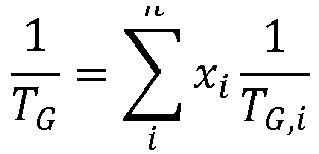
- xi = Massenanteil des Comonomers im Polymer
- TG,i = Glasübergangstemperatur des Homopolymers des entsprechenden Comonomers
- TG = Glasübergangstemperatur des Copolymers
- Die Glasübergangstemperaturen können auch mittels Differential Scanning Calorimetrie bei einer Heizrate von 20 K/min gemessen werden und liegen im Bereich von 130 bis 170 °C.
- Wie bereits erwähnt kommen als wasserlösliche Polymere für die wasserlöslichen Formulierungen von in Wasser schwerlöslichen Wirkstoffen, bestehend aus einem basischen Wirkstoff, welcher in nicht geladener Form oder als Hydrochlorid eine Löslichkeit von kleiner 0.1 % (m/m) in Wasser, künstlichem Darmsaft oder Magensaft aufweist, solche Polymere in Betracht, welche im gesamten pH-Bereich von 1bis 13 eine Wasserlöslichkeit größer von 10 % (m/m) aufweisen und durch radikalisch initiierte Polymerisation einer Monomerenmischung aus i) 70 bis 90 Gew.-% N-Vinylpyrrolidon und ii) 10 bis 30 Gew.-% Acrylsäure, wobei die Summe von i) und ii) 100 Gew.-% entspricht, erhalten werden.
- Bevorzugt werden wasserlösliche Polymere, welche im gesamten pH-Bereich von 1 bis 13 eine Wasserlöslichkeit größer von 10 % (m/m) aufweisen und durch radikalisch initiierte Polymerisation einer Monomerenmischung aus i) 75 bis 85 Gew.-% N-Vinylpyrrolidon und ii) 15 bis 25 Gew.-% Acrylsäure, wobei die Summe von i) und ii) 100 Gew.-% entspricht, erhalten werden.
- Besonders bevorzugt wird ein wasserlösliches Polymer verwendet, welche im gesamten pH-Bereich von 1 bis 13 eine Wasserlöslichkeit größer von 10 % (m/m) aufweist und durch radikalisch initiierte Polymerisation einer Monomerenmischung aus i) 80 Gew.-% N-Vinylpyrrolidon und ii) 20Gew.-% Acrylsäure, wobei die Summe von i) und ii) 100 Gew.-% entspricht erhalten wird.
- Die Herstellung der erfindungsgemäßen Polymere kann auf an sich übliche Weise durch radikalische Polymerisation erfolgen. Vorzugsweise erfolgt die Polymerisation als Lösungspolymerisation in organischen Lösungsmitteln, vorzugsweise in Alkoholen, insbesondere in Isopropanol. Solche Verfahren sind dem Fachmann an sich bekannt. Geeignete Initiatoren sind beispielsweise organische Peroxide wie tertiär-Butylperpivalat oder alkohollösliche Azostarter.
- Die Polymerisation kann bei Temperaturen von 50 bis 130 °C und Drücken von 0,1 bis 1,5 MPa erfolgen.
- Es kann sich auch empfehlen, die Polymerisation in Gegenwart von Reglern, beispielsweise von Natriumhypophosphit, durchzuführen.
- Die Polymerisation kann kontinuierlich oder als Batch-Verfahren erfolgen, bevorzugt werden die Polymere über Zulaufverfahren erhalten.
- Gemäß einer Ausführungsform der Erfindung wird zunächst das Natriumsalz des Copolymers durch radikalische Copolymerisation von N-Vinylpyrrolidon und Natriumacrylat hergestellt, welches dann durch lonenaustausch in das freie saure Copolymer überführt werden kann.
- Die Überführung der Polymerlösungen in die feste Form kann ebenfalls nach üblichen Trocknungsverfahren wie zum Beispiel durch Sprühtrocknung, Gefriertrocknung oder Walzentrocknung erfolgen.
- Gemäß einer besonders bevorzugten Ausführungsform weisen die polymere K-Werte nach Fikentscher, gemessen in einer 5 gew-%igen wässrigen Lösung, im Bereich von 10 bis kleiner 20 auf.
- Bei der Herstellung der erfindungsgemäßen Polymeren ist vorzugsweise darauf zu achten, dass diese keine niedermolekulare Anionen wie z. B. Chlorid, Sulfat, etc. aufweisen, die zu schwerlöslichen Salzen mit Wirkstoffen führen können.
- Bevorzugt werden die so erhaltenen wasserlöslich Polymere zur Herstellung von festen Lösungen mit basischen in Wasser schwerlöslichen Wirkstoffen verwendet.
- Gemäß einer Ausführungsform der Erfindung kann die Herstellung der erfindungsgemäßen festen Lösungen mit Hilfe des Lösungsmittelverfahrens erfolgen.
- Der Wirkstoff und das Polymer werden in organischen Lösungsmitteln oder Lösungsmittelgemischen gelöst und die Lösung wird anschließend getrocknet. Das Lösen kann auch bei erhöhten Temperaturen (30 - 200°C) und unter Druck erfolgen.
- Geeignete organische Lösungsmittel sind Dimethylformamid, Methanol oder Mischungen davon sowie Mischungen mit Isopropanol, Tetrahydrofuran, Aceton oder Ethylacetat.
- Prinzipiell sind alle Trocknungsarten möglich, wie z.B. Sprühtrocknung, Wirbelschichttrocknung, Schaufeltrocknung, Gefriertrocknung, Vakuumtrocknung, Bandtrocknung, Walzentrocknung, Schleppgastrocknung, Eindampfen etc.
- Gemäß einer bevorzugten Ausführungsform der Erfindung erfolgt die Herstellung der festen Lösungen durch Schmelzeverfahren. Der Wirkstoff wird mit dem Polymer gemischt. Durch Erhitzen auf Temperaturen von 50 - 250°C erfolgt die Herstellung der festen Lösung. Hierbei sind Temperaturen oberhalb der Glasübergangstemperatur des Polymers oder des Schmelzpunktes des Wirkstoffes vorteilhaft. Durch Zugabe eines weichmachenden Hilfsstoffes wie z. B. Wasser, organisches Lösungsmittel, übliche organische Weichmacher lässt sich die Verarbeitungstemperatur entsprechend absenken. Besonders vorteilhaft sind hier Hilfsstoffe, die nachher recht einfach wieder abgedampft werden können, d.h. einen Siedepunkt unter 180°C bevorzugt unter 150°C aufweisen.
- Gemäß einer bevorzugten Ausführungsform wird diese Art der Herstellung in einem Schneckenextruder vorgenommen. Welche Verfahrensparameter dabei im Einzelnen angepasst werden müssen, kann der Fachmann durch einfache Versuche im Rahmen seines üblichen Fachwissens ermitteln.
- Gemäß einer bevorzugten Ausführungsform werden während des Aufschmelzens Weichmacher zugesetzt. Bevorzugte Weichmacher sind Zitronensäureester wie beispielsweise Triethylzitrat oder Acetyltributylzitrat), Glykolderivate wie beispielsweise. Polyethylenglykol, Propylenglykol oder Poloxamere; Rizinusöl- und Mineralölderivate; Sebazatester wie beispielsweise Dibutylsebazat), Triacetin, Fettsäureester wie beispielsweise Glycerolmonostearat oder Stearylalkohol oder Vitamin E TPGS (Tocopherolglycerylsuccinat) insbesondere Tocopherolglycerylsuccinat oder Polyethylenglykol 1500. Die Weichmacher können in Mengen von 0,1 bis 40 Gew.-%, bevorzugt 1 bis 20 Gew.-%, bezogen auf das Polymer, eingesetzt werden.
- Die erzeugten festen Lösungen sind röntgenamorph. Der amorphe Zustand kann durch Röntgendiffraktion festgestellt werden. Der sogenannte "röntgenamorphe" Zustand der festen Lösungen bedeutet, dass der kristalline Anteil weniger als 5 Gew.-% beträgt.
- Auch mit Hilfe eines DSC Thermogramms (Differential Scanning Calorimetry) kann der amorphe Zustand untersucht werden. Die erfindungsgemäßen festen Lösungen weisen keine Schmelzpeaks auf, sondern lediglich eine Glasübergangstemperatur, die bei den erfindungsgemäßen festen Lösungen auch von der Art des eingesetzten Wirkstoffs abhängt. Die Glasübergangstemperaturen, gemessen bei einer Heizrate von 20K/min, liegen überwiegend im Bereich von 50 bis 170 °C.
- Bei der Herstellung der erfindungsgemäßen festen Dosierungsformen können gegebenenfalls übliche pharmazeutische Hilfsstoffe mitverarbeitet werden. Dabei handelt es sich um Stoffe aus der Klasse der Füllstoffe, Weichmacher, Löslichkeitsvermittler, Bindemittel, Silikate sowie Spreng- und Adsorptionsmittel, Schmiermittel, Fließmittel, Farbstoffe, Stabilisatoren wie Antioxidantien, Netzmittel, Konservierungsmittel, Formentrennmittel, Aromen oder Süßstoffe, bevorzugt um Füllstoffe, Weichmacher und Löslichkeitsvermittler.
- Als Füllstoffe können z.B. anorganische Füllstoffe wie Oxide von Magnesium, Aluminium, Silicium, Titan- oder Calciumcarbonat, Calcium- oder Magnesiumphosphate oder organische Füllstoffe wie Lactose, Saccharose, Sorbit, Mannit zugesetzt werden.
- Als Weichmacher eignen sich beispielsweise Triacetin, Triethylcitrat, Glycerolmonostearat, niedermolekulare Polyethylenglykole oder Poloxamere.
- Als zusätzliche Löslichkeitvermittler eignen sich grenzflächenaktive Substanzen mit einem HLB-Wert (HydrophilicLipophilicBalance) größer 11, beispielsweise mit 40 Ethylenoxid-Einheitten ethoxiliertes hydriertes Ricinusöl (Cremophor® RH 40), mit 35 Ethylenoxid-Einheiten ethoxiliertes Ricinusöl (Cremophor eL), Polysorbat 80, Poloxamere oder Natriumlaurylsulfat.
- Als Schmiermittel können Stearate von Aluminium, Calcium, Magnesium und Zinn, sowie Magnesiumsilikat, Silikone und ähnliche verwendet werden.
- Als Fließmittel können beispielsweise Talk oder kolloidales Siliciumdioxid eingesetzt werden.
- Als Bindemittel eignet sich zum Beispiel mikrokristalline Cellulose.
- Als Sprengmittel können quervernetztes Polyvinylpyrrolidon, quervernetzte Natriumcarboxymethylcellulose oder quervernetzte Natriumcarboxymethylstärke eingesetzt werden. Als Stabilisatoren können alle Stoffe mit antioxidativen Eigenschaften fungieren wie z.B. Ascorbinsäure, Butylhydroxytoluol oder Tocopherol.
- Farbstoffe sind z.B. Eisenoxide, Titandioxid, Triphenylmethanfarbstoffe, Azofarbstoffe, Chinolinfarbstoffe, Indigotinfarbstoffe, Carotinoide, um die Darreichungsformen einzufärben, Opakisierungsmittel wie Titandiodid oder Talkum, um die Lichtdurchlässigkeit zu erhöhen und um Farbstoffe einzusparen.
- Die erfindungsgemäßen Formulierungen lassen sich zu vielen verschiedenen Darreichungsformen formulieren, wie z. B. Tabletten, Kapseln, Granulate, Pulver, Drug Delivery Systeme, Lösungen, Suppositorien, transdermale Systeme, Cremes, Gele, Lotionen, Injektionslösungen, Tropfen, Säfte, Sirupe,
- Durch den Zusatz von thermoplastischen Retardierungsmitteln wie Polyvinylacetat-Homopolymeren oder Formulierungen solcher Polyvinylacetat-Homopolymeren, weiterhin als Retardpolymeren auf Acrylatbasis bekannten Eudragit®-Typen RS, RL oder NE oder NM, lässt sich die Freisetzung verlangsamen. Auf diese Weise können verlässlich freisetzende Retardformen schwerlöslicher Arzneistoffe hergestellt werden.
- Die erfindungsgemäßen Formulierungen besitzen eine ausgezeichnete Verarbeitbarkeit zu Darreichungsformen, insbesondere hinsichtlich der Tablettierbarkeit. Daher lassen sich Tabletten mit einem Durchmesser von 10mm und 300mg Gewicht herstellen, die eine Bruchfestigkeit von über 200N besitzen. Das wasserlösliche Polymere wirkt gleichzeitig als Bindemittel und verleiht der Tablettenrezeptur eine enorme Plastizität.
- Aufgrund der höheren Löslichkeit ist die Bioverfügbarkeit ebenfalls höher und auch viel reproduzierbarer, d.h. es gibt geringere interindividuelle Schwankungen.
- Die festen Lösungen lassen sich auch bei höheren Temperaturen durch Schmelzextrusion verarbeiten, ohne dass es zu einer Veränderung der Säurezahl kommt.
-
- Messgerät: Diffraktometer D 8 Advance mit 9-fach Probenwechsler (Fa.Bruker/AXS)
- Messart: θ- θ Geometrie in Reflexion
- Winkelbereich 2 Theta: 2-80°
- Schrittweite: 0,02°
- Messzeit pro Winkelschritt: 4,8s
- Divergence Slit: Göbelspiegel mit 0,4 mm Steckblende
- Antiscattering Slit: Sollerspalt
- Detektor: Sol-X Detektor
- Temperatur: Raumtemperatur
- Generatoreinstellung: 40kV/50mA
- Die Trübungsmessung erfolgte gemäß ISO 7027 durch Verhältnismessung von Streulicht und Transmission.
- Die Glasübergangstemperaturen wurden bei einer Heizrate von 20K/min bestimmt, Einwaage. 8,5 mg.
- Prozentangaben beziehen sich, soweit nicht anders angegeben, auf Gewichtsprozent.
- 2 I HWS Topf mit Ankerrührer, Rückflußkühler, Stickstoffeinleitung (über Flüssigkeits-spiegel) und temperierbarem Ölbad. 2 Zulaufgefäße je 1000 ml. Temperaturmessung im Polymerisationsgefäß und im Ölbad jeweils via Pt100 Fühler.
Zuläufe Menge Einsatzstoff Vorlage 210,0 g iso-Propanol 30,0 g N-Vinylpyrrolidon 10,6 g Teilmenge von Zulauf 2 Zulauf 1 399,0 g iso-Propanol 210,0 g N-Vinylpyrrolidon 60,0 g Acrylsäure Zulauf 2 100,0 g iso-Propanol 6,0 g tert.-Butylperpivalat, 75%ig - Die Vorlage wurde unter leichtem Stickstoffstrom auf 75°C Innentemperatur aufgeheizt. Bei Erreichen der 75°C Innentemperatur wurde die Teilmenge des Zulaufes 2 zugegeben. Danach wurden der Zulauf 1 und die Restmenge des Zulaufs 2 gestartet. Der Zulauf 1 wurde in 6 Stunden und die Restmenge des Zulaufs 2 in 9 Stunden zudosiert.
- Abschließend wurde das Reaktionsgemisch noch einer Wasserdampfdestilliation unterzogen, um das Lösungsmittel Isopropanol zu verdrängen.
Feststoffgehalt FG (Gew.%) 30,5 K-Wert (5 %ig in Wasser) 16,5 FNU-Wert (5 %ig in Wasser) 0,7 Tg (°C) 165 (gemessen mittels Differential Scanning Calorimetry DSC; berechnet 150 °C, s.o.) Isopropanol (ppm) 2800 - Aussehen: Wasserklare niedrigviskose wässrige Lösung.
- Es wurde wie in Beispiel 1 gearbeitet, allerdings wurde der Zulauf 1 in 4 Stunden und die Restmenge des Zulaufs 2 in 6 Stunden zudosiert.
- Nach dem Ende des Zulaufes 2 wurde noch 1 Stunde bei einer Innentemperatur von 75°C nachpolymerisiert.
FG (Gew.%) 30,8 K-Wert (5 %ig in Wasser) 17,8 FNU-Wert (5 %ig in Wasser) 0,6 Tg (°C) 164 (DSC) Isopropanol (ppm) 2600 - Aussehen: Wasserklare niedrigviskose wässrige Lösung.
- Die Herstellung erfolgte analog Beispiel 1, wobei der Zulauf 1 180 g N-Vinylpyrrolidon und 90 g Acrylsäure enthielt.
FG (Gew.%) 30,4 K-Wert (5 %ig in Wasser) 15,8 FNU-Wert (5 %ig in Wasser) 1,5 Tg (°C) 144 (berechnet) Isopropanol (ppm) 2200 - Aussehen: Wasserklare niedrigviskose wässrige Lösung.
- Die Herstellung erfolgte analog Beispiel 1, wobei der Zulauf 1 240 g N-Vinylpyrrolidon und 30 g Acrylsäure enthielt.
FG (Gew.%) 30,3 K-Wert (5 %ig in Wasser) 16,7 FNU-Wert (5 %ig in Wasser) 0,6 Tg (°C) 156 (berechnet) Isopropanol (ppm) 2500 - Aussehen: Wasserklare niedrigviskose wässrige Lösung.
- Die Herstellung erfolgte analog Beispiel 1, wobei der Zulauf 1 225 g N-Vinylpyrrolidon und 45 g Acrylsäure enthielt.
FG (Gew.%) 30,5 K-Wert (5 %ig in Wasser) 16,4 FNU-Wert (5 %ig in Wasser) 0,7 Tg (°C) 153 (berechnet) Isopropanol (ppm) 2100 - Aussehen: Wasserklare niedrigviskose wässrige Lösung.
- Die Herstellung erfolgte analog Beispiel 1, wobei der Zulauf 1 120 g Vinylpyrrolidon und 150 g Acrylsäure enthielt.
FG (Gew.%) 31,5 K-Wert (5 %ig in Wasser) 12,8 FNU-Wert (5 %ig in Wasser) 3,1 Tg (°C) 132 (berechnet) Isopropanol (ppm) 3000 - Das so erhaltene Polymer mit einem FNU-Wert von 3,1 war bei visueller Begutachtung nicht mehr "wasserklar" sondern leicht trübe.
- 1250 g des Copolymers VP/AS (80/20) wurden zusammen mit 416,7 g Haloperidol (Base) in 5999,3 g eines Lösemittelgemischs bestehend aus 50 % (2999,7 g) Ethanol und 50 % (2999,7 g) Isopropanol unter Rühren bei Raumtemperatur gelöst. Die organische Lösung hatte einen Gesamtfeststoffgehalt von 21,7 %. Die Lösung wurde anschließend unter den folgenden Bedingungen in einem Laborsprühtrockner sprühgetrocknet:
- Trocknungsgas: Stickstoff; 30 Nm3/h
- Einlasstemperatur (inlet temperature): 155°C
- Auslasstemperatur (outlet temperature): 75°C
- Zerstäubungsdüse: 1,4 mm Zweistoffdüse
- Zerstäubungsgas / Zerstäubungsdruck: Stickstoff / 2 bar abs.
- Fördergeschwindigkeit (liquid flow rate): 977,9 g/h
- Produktabscheidung: Zyklon
- Die folgende Tabelle gibt eine Übersicht über die Eigenschaften des sprühgetrockneten Polymeren Salzes Haloperidol-VP/AS nach der Sprühtrocknung aus organischer Lösung (Ethanol : Isopropanol 1:1).
Restfeuchte (gemessen bei 105°C) 1,75 % Arzneistoffgehalt (gemessen, UV/VIS bei 248 nm) 24,5 % Zustand Arzneistoff (XRD) röntgenamorph Glasübergangstemperatur 129°C (kein Schmelzpeak) - Weder im DSC Thermogramm noch in der Röntgendiffraktometrie waren kristalline Wirkstoffanteile zu erkennen. Es kann somit davon ausgegangen werden, dass es sich um ein amorphes Pulver handelt. Die Freisetzung des Wirkstoffes aus dem sprühgetrockneten polymeren Salz wurde in VE-Wasser durchgeführt. Die Einwaage wurde auf 100 mg Haloperidol pro 250 ml Freisetzungsmedium berechnet. Das entsprechend abgewogene polymere Salz bzw. die kristalline Substanz wurden in Hartgelatinekaspeln abgefüllt. Die folgende Tabelle zeigt die Ergebnisse der Freisetzung im Vergleich zum kristallinen Arzneistoff.
Freisetzung Polymeres Salz Haloperidol-VP/AS (hergestellt aus organischer Lösung) in VE-Wasser 0 min 0 % 2 min 1,4 % 4 min 62,5 % 6 min 84,8 % 8 min 89,0 % 10 min 95,4 % 30 min 98,3 % 60 min 98,6 % 120 min 98,6 % Kristallines Haloperidol in VE-Wasser 0 min 0,0 % 2 min 0,1 % 4 min 0,2 % 6 min 0,3 % 8 min 0,4 % 10 min 0,6 % 30 min 1,5 % 60 min 1,8 % 120 min 2,3 % - Herstellung der festen Lösung durch Schmelzeverfahren: Die Verarbeitung eines Polymers gemäß Beispiel 1 mit verschiedenen Wirkstoffen erfolgte mit einem Doppelschneckenextruder: Pharma Extruder, Haake PolyLab OS, RheoDrive 7 (Messantrieb); Haake Rheomex OS, PTW 16 mm (Messvorsatz); Gravimetrische Dosiereinheit Brabender Doppeldosierschnecke Typ DDSR 20, Software AIO-Control
-
- Düsentyp: 3 mm, Lochdüse
- Drehzahl: 200/min
- Drehmoment: 50 Nm
- Dosierung: 1 kg/h
- Kühlband für Extruder Typ 557-2680 (Thermo Fischer)
- Granulator Thermo Electron Typ 554-1345
- TubeMill (Modell Tube Mill control, IKA); Vermahlung der Extrudatstücke bei 25000 U/min
- Die jeweilige Extrusionstemperatur ist in der nachstehenden Tabelle aufgeführt.
Probenbezeichnung Formulierung Extrusionstemperatur Zone 1 Zone 2 Zone 3 Zone 4-9 Zone 10 Probe 1 VP/AS (80/20) 100 % 50°C 80°C 195°C 270°C 250°C Probe 2 VP/AS (80/20) 100 % 50°C 80°C 170°C 300°C 230°C Probe 12 VP/AS (80/20) 90 % 50°C 80°C 170°C 225°C 190°C Kolliphor TPGS 10 % Probe 13 VP/AS (80/20) 90 % 50 °C 80 °C 170°C 225°C 190°C PEG 1500 10 % Probe 14 VP/AS (80/20) 85 % 50 °C 80 °C 170°C 225°C 190°C Kolliphor TPGS 10 % Loperamid (Base) 5 % Probe 15 VP/AS (80/20) 80 % 50 °C 80 °C 170°C 225°C 190°C Kolliphor TPGS 10 % Loperamid (Base) 10 % Probe 16 VP/AS (80/20) 85 % 50 °C 80 °C 170°C 225°C 190°C PEG 1500 10 % Loperamid Base 5 % Probe 17 VP/AS (80/20) 80 % 50 °C 80 °C 170°C 225°C 190°C PEG 1500 10 % Loperamid Base 10 % - Die Wirkstofffreisetzung aus den Proben 14, 15, 16 und 17 wurden im Freisetzungsgerät mit automatischer spektroskopischer der Messung (00501 FEXXX-D) geprüft. Die Extrudate mit 5% Wirkstoffgehalt wurden zu Beginn des Versuches direkt in das Freisetzungsmedium gegeben. Die Extrudate mit 10% Wirkstoffgehalt wurden mit 15 % (m/m) Avicel PH 101 (mikrokristalline Cellulose) und von 15 % (m/m) Kollidon CL (Sprengmittel) gemischt. Die Abmischungen wurden in Hartgelatine-Kapsel gefüllt und aus diesen freigesetzt.
-
- 250 ml VE-Wasser;
- Paddle Apparatur 50 U/min;
- Temperatur 37°C
- Gehaltsbestimmung UV/VIS mit Küvette 1 cm Dicke
- Wirkstoffmenge 250 mg
- Die Ergebnisse der Freisetzungen sind in den folgenden Tabellen und Diagrammen dargestellt. Die Freisetzung ist in allen Fällen vollständig. Das kristalline Loperamid (Base) zeigte keinerlei Auflösung im Freisetzungsmedium bzw. es konnte keine aufgelöste Menge Loperamid mit der verwendeten spektroskopischen Methode detektiert werden.
Zeit [min] Freigesetztes Loperamid [%] Probe 14 5% Loperamid TPGS Probe 15 1 0% Loperamid TPGS Probe 16 5% Loperamid PEG 1500 Probe 16 10% Loperamid PEG 1500 0 0,0 % 0,0 % 0,0 % 0,0 % 2 57,2 % 5,7 % 58,2 % 0,3 % 4 86,4 % 20,0 % 75,7 % 27,6 % 6 92,8 % 48,7 % 81,5 % 33,1 % 8 95,4 % 69,6 % 84,5 % 47,2 % 10 97,0 % 76,6 % 87,0 % 58,5 % 30 101,6 % 90,8 % 96,7 % 89,0 % 60 100,3 % 95,0 % 99,3 % 93,4 % 120 97,6 % 98,0 % 101,9 % 96,1 % - Das in Beispiel 6 durch Sprühtrocknung hergestellte polymere Salz mit einem Haloperidolgehalt von 24,5% (m/m) wurde zur Herstellung von Tabletten verwendet.
- Rezeptur:
Ludipress 72,1 % 360,5 mg Polymeres Salz (gemäß Beispiel 6, Haloperidolgehalt 24,5%) 20,4 % 102,0 mg Aerosil 200 2,0 % 10,0 mg Magnesiumstearat 0,5 % 2,5 mg Kollidon CL 5,0 % 25,0 mg 100,0 % 500,0 mg - Die Tablettierung erfolgte auf einer Korsch XP1 Exzenterpresse, Stempelform 11 mm gewölbt bei einer Presskraft: 10kN. Die Freisetzung des Wirkstoffes aus den hergestellten Tabletten wurde in VE-Wasser durchgeführt. Die Einwaage wurde auf 100 mg Haloperidol pro 250 ml Freisetzungsmedium berechnet, entsprechend 4 Tabletten pro 250 ml Freisetzungsmedium. Die folgende Tabelle zeigt die Ergebnisse der Freisetzung im Vergleich zum kristallinen Arzneistoff.
Freisetzung Polymeres Salz Haloperidol-VP/AS (sprühgetrocknet aus organischer Lösung, formuliert und verpresst in Tabletten) in VE-Wasser 0 min 0 % 2 min 5,4 % 4 min 12,9 % 6 min 20,7 % 8 min 27,8 % 10 min 34,5 % 30 min 82,2 % 60 min 97,4 % 120 min 97,9 % - Hierbei wurde eine erfindungsgemäße feste Lösung aus Loperamid und dem Copolymer gemäß Beispiel 1, hergestellt wie in Beispiel 6 beschrieben, mit einem festen Salz aus Loperamid und dem gleichen Copolymer sowie mit einer festen Lösung aus Loperamid und PVP K17 verglichen. Die feste Lösung aus Loperamid und Copolymer wurde durch Eindampfen einer Lösung der Substanzen in THF/Methanol erhalten. Die feste Lösung von Loperamid und PVP wurde wie folgt erhalten:1 Teil Loperamid (Base) und 9 Teile PVP K17 wurden in DMF gelöst. Die Feststoffkonzentration betrug 25 % (m/m). Die Lösung wurde in eine Kautschukplatte ausgegossen und für 48 Stunden im Vakuumtrockenschrank bei 50°C und 10 mbar getrocknet. Die erhaltene feste Lösung wurde anschließend aus der Kautschukplatte entfernt und in einer TubeMill (Modell Tube Mill control, IKA) bei 25000 U/min zu einem Pulver vermahlen.
- Für die Untersuchungen wurde ein Nano ITC (Isothermal Titration Calorimeter) der Firma TA Instruments verwendet. In der Messzelle wurde jeweilige Polymer vorgelegt. Dazu wurde Loperamid sukzessive zugegeben. Sobald eine Reaktion stattfindet, verändert sich die Temperatur der Probe. Dieser Temperaturunterschied wurde registriert und über ein Peltierelement ausgeglichen. Die zum Ausgleich benötigte elektrische Energie wurde erfasst. Diese Energiemenge ist vom Betrag identisch mit der entstandenen oder verbrauchten Wärmemenge der Reaktion. Eingebettet sind die beiden Zellen, Messzelle und Referenzzelle in ein hochstabiles Temperierbad (+-0,0002 K bei 25°C). Während des Versuchs wurde gerührt.
- In Folge der geringen Wärmemengen, die hier gemessen werden, ist es notwendig Referenzmessungen durchzuführen. In diesen Falle die Verdünnungsreaktion der Polymere. Die bei der Verdünnungsreaktion gemessene Wärmemenge wurde von der Originalmessung subtrahiert. Der erhaltende Wert ist die Reaktionsenthalpie der Reaktion Wirkstoff- Polymer.
- Zur Bestimmung der Reaktionsenthalpie wurden die Polymere jeweils in einer Konzentration von 3g/L angesetzt und jeweils 1ml vorgelegt. Die Loperamid-Base wurde in einer Konzentration von 25mg/l angesetzt und in 5µl Schritten zugegeben. Nach jeder Zugabe wurde 600s gewartet bis die Reaktion beendet war. Gemessen wurde bei 25°C. Als Lösungsmittel diente eine Wasser/Ethanol - Mischung (9:1).
- Die Polymere wurden in großem Überschuss vorgelegt, sodass sichergestellt war, dass jedes zugegebene Molekül einen entsprechenden Reaktionspartner finden konnte.
- Durchgeführt wurde diese Untersuchung mit einem TAM III mit SolCal-Einsatz der Fa. TA-Instruments. Dazu wurde das Lösungsmittel vorgelegt. Die zu lösende Probe wurde in einer Glasampulle hermetisch eingeschlossen. Die Ampulle wurde in das Lösungsmittel eingebracht und Temperaturgleichheit hergestellt. Die Lösungskalorimetrie wurde bei 25°C (Nenntemperatur) durchgeführt.
- In einem nächsten Schritt wurde die Arbeitstemperatur auf eine Temperatur im Bereich von 0,3 K unter die Nenntemperatur gebracht. Anschließend wurde das Angleichen der Arbeitstemperatur an die Nenntemperatur gemessen der Kurvenverlauf bestimmt und durch gezielte Energiezufuhr (elektrische Energie = thermische Energie) kalibriert. Die Formulierungen wurden in eine Bruchampulle eingewogen (20-140mg) und in 100 mL eines Gemischs aus Wasser/ Ethanol im Volumenverhältnis 9:1 eingebracht.
- Dann wurde die Ampulle auf einem Dorn in der Messzelle gebrochen. Die zu messende Substanz wurde dadurch im Lösungsmittel freigesetzt. Nach Abzug der Basislinie des Temperaturverlaufes und der Umrechnung der Temperatur in die entsprechende Wärmemenge erhielt man eine Heat- Flow- Kurve, Wärmemenge vs. Zeit. Nach Integration der Kurve und Bezugnahme auf die Molekulargewichte, wurde die Lösungsenthalpie der zu untersuchenden Substanz erhalten.
- Die Lösungswärme aller Proben wurde doppelbestimmt. Von der Lösungswärme der Formulierung wurde anteilig die Enthalpie des Polymers, die in einer separaten Messung bestimmt wurde, subtrahiert.
- Die nachstehende Tabelle zeigt die Ergebnisse der Messungen zur Lösungsenthalpie der einzelnen Loperamid- Polymer- Formulierungen. Spalte A zeigt ist die Gesamtwärmemenge QGes für die jeweilige Formulierung. Spalte B weist die anteilige Wärmemenge des Polymeren QPoly aus. Die Differenz ergibt die Wärmemenge QWirkstoff des Wirkstoffes auf die Gesamteinwaage bezogen (Spalte C) bzw. auf den Wirkstoffanteil bezogen (Spalte D). Der Wert in der Spalte E beziffert die Lösungsenthalpie bzw. Bindungsenthalpie (Delta H) des Loperamids.
A B C D E Qges J/g* QPoly J/g* QWirk- stoff J/g * Qwirk- stoff J/g ** Delta H kJ/mol 10,4% Loperamid Base VP/AS erhalten aus VE-Wasser 263 202 61 586 -279 32,92% Loperamid Base VP/AS erhalten aus THF/Methanol 154 151 3 8 -4 feste Lösung 10% Loperamid/PVP K17 241 235 6 57 -27 Polymer VP/AS 80/20 226 Kollidon® 17 (PVP K17) 261 * Auf Gesamteinwaage bezogen
**Auf Wirkstoffanteil bezogen - Bestimmung der Beladbarkeit der festen Lösungen
Claims (14)
- Verwendung eines wasserlöslichen Polymers, welches im pH-Bereich von 1 bis 13 eine Wasserlöslichkeit größer von 5 % (m/m) aufweist und durch radikalisch initiierte Polymerisation einer Monomerenmischung aus i) 70 bis 90 Gew.-% N-Vinylpyrrolidon und ii) 10 bis 30 Gew.-% Acrylsäure, wobei die Summe von i) und ii) 100 Gew.-% entspricht, erhalten wird, zur Formulierung von in Wasser schwerlöslichen basischen Wirkstoffen, wobei die Wirkstoffe in nicht geladener Form oder als Hydrochlorid eine Löslichkeit von kleiner 0.1 % (m/m) in Wasser, künstlichem Darmsaft oder Magensaft aufweisen.
- Verwendung nach Anspruch 1, zur Solubilisierung des basischen Wirkstoffs.
- Verwendung nach einem der Ansprüche 1oder 2, wobei der Wirkstoff mindestens eine und höchstens zwei zur Salzbildung befähigten Gruppen aufweist.
- Verwendung nach einem der Ansprüche 1 bis 3, wobei das wasserlösliche Salz eine höhere Wasserlöslichkeit als der Wirkstoff und das entsprechende Hydrochlorid des Wirkstoffes aufweist.
- Verwendung nach einem der Ansprüche 1 bis 4, wobei das wasserlösliche Polymer welches im pH-Bereich von 1 bis 13 eine Wasserlöslichkeit größer 10 % (m/m) aufweist.
- Verwendung nach einem der Ansprüche 1 bis 5, wobei das wasserlösliche Polymer in 5 gew.-%iger wässriger Lösung einen K-Wert nach Fikentscher von kleiner 30 aufweist.
- Verwendung nach einem der Ansprüche 1 bis 6, wobei das wasserlösliche Polymer in 5 gew.-%iger wässriger Lösung einen K-Wert nach Fikentscher von kleiner 20 aufweist.
- Verwendung nach einem der Ansprüche 1 bis 7, enthaltend ein wasserlösliches Polymer, welches durch radikalisch initiierte Polymerisation einer Monomerenmischung aus i) 79 bis 81 Gew.-% N-Vinylpyrrolidon und ii) 18 bis 22 Gew.-% Acrylsäure, wobei die Summe von i) und ii) 100 Gew.-% entspricht, erhalten wird.
- Verwendung nach einem der Ansprüche 1 bis 8, enthaltend eine wasserlösliches Polymer, welches durch radikalisch initiierte Polymerisation einer Monomerenmischung aus i) 80 Gew.-% N-Vinylpyrrolidon und ii) 20Gew.-% Acrylsäure, wobei die Summe von i) und ii) 100 Gew.-% entspricht erhalten wird.
- Verwendung nach einem der Ansprüche 1 bis 9, wobei die Formulierungen in Form fester Lösungen vorliegen.
- Verwendung nach einem der Ansprüche 1 bis 10, wobei das wasserlösliche Polymer als Bindemittel wirkt.
- Dosierungsformen, enthaltend wasserlösliche Formulierungen von in Wasser schwerlöslichen Wirkstoffen und einem Polymer gemäß einem der Ansprüche 1 bis 11, wobei die Formulierungen aus einem basischen Wirkstoff, welcher in nicht geladener Form oder als Hydrochlorid eine Löslichkeit von kleiner 0.1 % (m/m) in Wasser, künstlichem Darmsaft oder Magensaft aufweist, und einem wasserlöslichen Polymer, welches im pH-Bereich von 1 bis 13 eine Wasserlöslichkeit größer von 10 % (m/m) aufweist, und durch radikalisch initiierte Polymerisation einer Monomerenmischung aus i) 78 bis 82 Gew.-% N-Vinylpyrrolidon und ii) 18 bis 22 Gew.-% Acrylsäure, wobei die Summe von i) und ii) 100 Gew.-% entspricht, erhalten wird, bestehen.
- Dosierungsformen nach Anspruch 12, enthaltend zusätzlich pharmazeutische Hilfsstoffe.
- Dosierungsformen nach Anspruch 13 oder 14, hergestellt durch Verpressung.
Applications Claiming Priority (2)
| Application Number | Priority Date | Filing Date | Title |
|---|---|---|---|
| EP15181992 | 2015-08-21 | ||
| PCT/EP2016/069456 WO2017032650A1 (de) | 2015-08-21 | 2016-08-17 | Verwendung von wasserlöslichen polymeren auf basis von n-vinylpyrrolidon und acrylsäure als pharmazeutische hilfstoffe |
Publications (2)
| Publication Number | Publication Date |
|---|---|
| EP3337458A1 EP3337458A1 (de) | 2018-06-27 |
| EP3337458B1 true EP3337458B1 (de) | 2019-10-16 |
Family
ID=54007548
Family Applications (1)
| Application Number | Title | Priority Date | Filing Date |
|---|---|---|---|
| EP16751610.3A Active EP3337458B1 (de) | 2015-08-21 | 2016-08-17 | Verwendung von wasserlöslichen polymeren auf basis von n-vinylpyrrolidon und acrylsäure als pharmazeutische hilfstoffe |
Country Status (5)
| Country | Link |
|---|---|
| US (1) | US20180228730A1 (de) |
| EP (1) | EP3337458B1 (de) |
| JP (1) | JP6914916B2 (de) |
| CN (1) | CN107920998B (de) |
| WO (1) | WO2017032650A1 (de) |
Families Citing this family (5)
| Publication number | Priority date | Publication date | Assignee | Title |
|---|---|---|---|---|
| EP3337459A1 (de) * | 2015-08-21 | 2018-06-27 | Basf Se | Salze von wirkstoffen mit polymeren gegenionen |
| US10835456B2 (en) | 2016-07-19 | 2020-11-17 | Basf Se | Propyl gallate-containing vitamin preparations |
| CN111479834B (zh) | 2017-12-20 | 2023-05-16 | 巴斯夫欧洲公司 | 三元共聚物及其在药物剂型中的用途 |
| US12343430B2 (en) | 2019-04-08 | 2025-07-01 | Mudanjiang Linrun Pharama Excipients Llc. | Methods of improving pharmaceutical substance solubilization and products thereof |
| EP4178996A1 (de) * | 2020-07-09 | 2023-05-17 | Basf Se | Neue copolymere und ihre verwendung in pharmazeutischen darreichungsformen |
Family Cites Families (16)
| Publication number | Priority date | Publication date | Assignee | Title |
|---|---|---|---|---|
| US3770683A (en) * | 1972-02-14 | 1973-11-06 | Gaf Corp | Graft copolymers of poly(vinylpyrrolidone) with acrylic acid and acrylic ester |
| US4248855A (en) | 1976-08-27 | 1981-02-03 | Hydrophilics International, Inc. | Pharmaceutical base salts |
| US4205060A (en) | 1978-12-20 | 1980-05-27 | Pennwalt Corporation | Microcapsules containing medicament-polymer salt having a water-insoluble polymer sheath, their production and their use |
| IT1201436B (it) | 1985-07-19 | 1989-02-02 | Vincenzo Zappia | Formulazioni topiche a lento rilascio |
| DE3612212A1 (de) * | 1986-04-11 | 1987-10-15 | Basf Ag | Verfahren zur herstellung von festen pharmazeutischen formen |
| US4853439A (en) | 1987-10-09 | 1989-08-01 | Gaf Corporation | Water-soluble complexes of water-insoluble organic compounds |
| US4997643A (en) | 1989-07-12 | 1991-03-05 | Union Carbide Chemicals And Plastics Company Inc. | Polymeric salt delivery systems |
| DE4207900A1 (de) * | 1992-03-12 | 1993-09-16 | Basf Ag | Verfahren zur herstellung von copolymerisaten aus saeuregruppen enthaltenden monoethylenisch ungesaettigten monomeren und n-vinyllactamen |
| US5736127A (en) | 1992-04-06 | 1998-04-07 | Hymedix International, Inc. | Polymeric nitrogen-containing drug salt forms for controlled release |
| DE9420259U1 (de) | 1994-12-17 | 1995-03-23 | Röhm GmbH, 64293 Darmstadt | Entbittertes Ranitidin-Präparat |
| DE19911097A1 (de) * | 1999-03-12 | 2000-09-14 | Basf Ag | Verfahren zur Herstellung von festen cyclodextrinhaltigen Dosierungsformen |
| EP1915407A2 (de) * | 2005-08-11 | 2008-04-30 | Basf Se | Copolymere auf basis von n-vinylcaprolactam und deren verwendung als solubilisatoren |
| MX2010006005A (es) | 2007-12-12 | 2010-06-15 | Basf Se | Sales de ingredientes activos con contraiones polimericos. |
| EP2140861A1 (de) * | 2008-06-30 | 2010-01-06 | Abbott GmbH & Co. KG | Pharmazeutische Dosierungsform mit polymerischer Trägerzusammensetzung |
| US20110236582A1 (en) * | 2010-03-29 | 2011-09-29 | Scheuing David R | Polyelectrolyte Complexes |
| EP3337459A1 (de) * | 2015-08-21 | 2018-06-27 | Basf Se | Salze von wirkstoffen mit polymeren gegenionen |
-
2016
- 2016-08-17 CN CN201680047500.8A patent/CN107920998B/zh not_active Expired - Fee Related
- 2016-08-17 EP EP16751610.3A patent/EP3337458B1/de active Active
- 2016-08-17 WO PCT/EP2016/069456 patent/WO2017032650A1/de not_active Ceased
- 2016-08-17 JP JP2018509496A patent/JP6914916B2/ja not_active Expired - Fee Related
- 2016-08-17 US US15/751,889 patent/US20180228730A1/en not_active Abandoned
Non-Patent Citations (1)
| Title |
|---|
| None * |
Also Published As
| Publication number | Publication date |
|---|---|
| WO2017032650A1 (de) | 2017-03-02 |
| US20180228730A1 (en) | 2018-08-16 |
| JP6914916B2 (ja) | 2021-08-04 |
| CN107920998B (zh) | 2021-07-27 |
| JP2018523691A (ja) | 2018-08-23 |
| EP3337458A1 (de) | 2018-06-27 |
| CN107920998A (zh) | 2018-04-17 |
Similar Documents
| Publication | Publication Date | Title |
|---|---|---|
| EP2229151B1 (de) | Salze von wirkstoffen mit polymeren gegenionen | |
| DE60201988T2 (de) | Pharmazeutische dosierungsform von amorphem nilfenavir mesylat | |
| DE3686275T2 (de) | Praeparate mit verzoegerter freisetzung. | |
| US6531153B2 (en) | Composition with sustained release of levodopa and carbidopa | |
| EP0240904B1 (de) | Verfahren zur Herstellung von festen pharmazeutischen Formen | |
| EP3337458A1 (de) | Verwendung von wasserlöslichen polymeren auf basis von n-vinylpyrrolidon und acrylsäure als pharmazeutische hilfstoffe | |
| WO2010130728A2 (de) | Feste pharmazeutischen zubereitungen enthaltend copolymere auf basis von polyethern in kombination mit wasserschwerlöslichen polymeren | |
| NO149490B (no) | Fremgangsmaate ved fremstilling av tabletter med regulert frigjoerelse av den aktive bestanddel | |
| EP1478344B1 (de) | Schmelzextrusion von wirkstoffsalzen | |
| EP2349218B1 (de) | Verfahren zur herstellung oraler darreichungsformen mit kontrollierter freisetzung | |
| EP2477606A1 (de) | Schnell lösliche feste pharmazeutische zubereitungen enthaltend amphiphile copolymere auf basis von polyethern in kombination mit hydrophilen polymeren | |
| JP6189429B2 (ja) | ジエチルアミノエチルメタクリレートコポリマーをベースにした活性成分含有固体分散体 | |
| EP3337459A1 (de) | Salze von wirkstoffen mit polymeren gegenionen | |
| DE19515972A1 (de) | Arzneizubereitungen mit kontrollierter Freisetzung und Verfahren zu ihrer Herstellung | |
| EP2934590A1 (de) | Magnesiumhydroxidcarbonat als träger in pharmazeutischen zubereitungen mit verbesserter wirkstofffreisetzung | |
| RU2673228C2 (ru) | Фармацевтическая композиция, включающая твердую дисперсию тадалафила | |
| WO2022090295A1 (en) | Method for producing an amorphous solid dispersion and pharmaceutical composition for stabilizing active pharmaceutical ingredients | |
| WO2009129913A1 (de) | Feste pharmazeutische zubereitung enthaltend 1-[(4-chloro-phenyl)-amid]- 2-{[4-(3-oxo-morpholin-4-yl)-phenyl]-amid}-4-hydroxy-pyrrolidin-1,2- dicarbonsäure |
Legal Events
| Date | Code | Title | Description |
|---|---|---|---|
| STAA | Information on the status of an ep patent application or granted ep patent |
Free format text: STATUS: THE INTERNATIONAL PUBLICATION HAS BEEN MADE |
|
| PUAI | Public reference made under article 153(3) epc to a published international application that has entered the european phase |
Free format text: ORIGINAL CODE: 0009012 |
|
| STAA | Information on the status of an ep patent application or granted ep patent |
Free format text: STATUS: REQUEST FOR EXAMINATION WAS MADE |
|
| 17P | Request for examination filed |
Effective date: 20180321 |
|
| AK | Designated contracting states |
Kind code of ref document: A1 Designated state(s): AL AT BE BG CH CY CZ DE DK EE ES FI FR GB GR HR HU IE IS IT LI LT LU LV MC MK MT NL NO PL PT RO RS SE SI SK SM TR |
|
| AX | Request for extension of the european patent |
Extension state: BA ME |
|
| DAV | Request for validation of the european patent (deleted) | ||
| DAX | Request for extension of the european patent (deleted) | ||
| GRAP | Despatch of communication of intention to grant a patent |
Free format text: ORIGINAL CODE: EPIDOSNIGR1 |
|
| STAA | Information on the status of an ep patent application or granted ep patent |
Free format text: STATUS: GRANT OF PATENT IS INTENDED |
|
| RIC1 | Information provided on ipc code assigned before grant |
Ipc: A61K 9/48 20060101ALI20190510BHEP Ipc: A61K 9/00 20060101ALI20190510BHEP Ipc: A61K 9/16 20060101ALI20190510BHEP Ipc: A61K 9/14 20060101AFI20190510BHEP Ipc: A61K 31/4515 20060101ALI20190510BHEP Ipc: A61K 31/451 20060101ALI20190510BHEP |
|
| INTG | Intention to grant announced |
Effective date: 20190605 |
|
| GRAS | Grant fee paid |
Free format text: ORIGINAL CODE: EPIDOSNIGR3 |
|
| GRAA | (expected) grant |
Free format text: ORIGINAL CODE: 0009210 |
|
| STAA | Information on the status of an ep patent application or granted ep patent |
Free format text: STATUS: THE PATENT HAS BEEN GRANTED |
|
| AK | Designated contracting states |
Kind code of ref document: B1 Designated state(s): AL AT BE BG CH CY CZ DE DK EE ES FI FR GB GR HR HU IE IS IT LI LT LU LV MC MK MT NL NO PL PT RO RS SE SI SK SM TR |
|
| REG | Reference to a national code |
Ref country code: GB Ref legal event code: FG4D Free format text: NOT ENGLISH |
|
| REG | Reference to a national code |
Ref country code: CH Ref legal event code: EP |
|
| REG | Reference to a national code |
Ref country code: DE Ref legal event code: R096 Ref document number: 502016007148 Country of ref document: DE |
|
| REG | Reference to a national code |
Ref country code: IE Ref legal event code: FG4D Free format text: LANGUAGE OF EP DOCUMENT: GERMAN |
|
| REG | Reference to a national code |
Ref country code: AT Ref legal event code: REF Ref document number: 1190608 Country of ref document: AT Kind code of ref document: T Effective date: 20191115 |
|
| REG | Reference to a national code |
Ref country code: NL Ref legal event code: MP Effective date: 20191016 |
|
| REG | Reference to a national code |
Ref country code: LT Ref legal event code: MG4D |
|
| PG25 | Lapsed in a contracting state [announced via postgrant information from national office to epo] |
Ref country code: NL Free format text: LAPSE BECAUSE OF FAILURE TO SUBMIT A TRANSLATION OF THE DESCRIPTION OR TO PAY THE FEE WITHIN THE PRESCRIBED TIME-LIMIT Effective date: 20191016 Ref country code: BG Free format text: LAPSE BECAUSE OF FAILURE TO SUBMIT A TRANSLATION OF THE DESCRIPTION OR TO PAY THE FEE WITHIN THE PRESCRIBED TIME-LIMIT Effective date: 20200116 Ref country code: GR Free format text: LAPSE BECAUSE OF FAILURE TO SUBMIT A TRANSLATION OF THE DESCRIPTION OR TO PAY THE FEE WITHIN THE PRESCRIBED TIME-LIMIT Effective date: 20200117 Ref country code: FI Free format text: LAPSE BECAUSE OF FAILURE TO SUBMIT A TRANSLATION OF THE DESCRIPTION OR TO PAY THE FEE WITHIN THE PRESCRIBED TIME-LIMIT Effective date: 20191016 Ref country code: NO Free format text: LAPSE BECAUSE OF FAILURE TO SUBMIT A TRANSLATION OF THE DESCRIPTION OR TO PAY THE FEE WITHIN THE PRESCRIBED TIME-LIMIT Effective date: 20200116 Ref country code: LT Free format text: LAPSE BECAUSE OF FAILURE TO SUBMIT A TRANSLATION OF THE DESCRIPTION OR TO PAY THE FEE WITHIN THE PRESCRIBED TIME-LIMIT Effective date: 20191016 Ref country code: PL Free format text: LAPSE BECAUSE OF FAILURE TO SUBMIT A TRANSLATION OF THE DESCRIPTION OR TO PAY THE FEE WITHIN THE PRESCRIBED TIME-LIMIT Effective date: 20191016 Ref country code: PT Free format text: LAPSE BECAUSE OF FAILURE TO SUBMIT A TRANSLATION OF THE DESCRIPTION OR TO PAY THE FEE WITHIN THE PRESCRIBED TIME-LIMIT Effective date: 20200217 Ref country code: LV Free format text: LAPSE BECAUSE OF FAILURE TO SUBMIT A TRANSLATION OF THE DESCRIPTION OR TO PAY THE FEE WITHIN THE PRESCRIBED TIME-LIMIT Effective date: 20191016 Ref country code: SE Free format text: LAPSE BECAUSE OF FAILURE TO SUBMIT A TRANSLATION OF THE DESCRIPTION OR TO PAY THE FEE WITHIN THE PRESCRIBED TIME-LIMIT Effective date: 20191016 |
|
| PG25 | Lapsed in a contracting state [announced via postgrant information from national office to epo] |
Ref country code: HR Free format text: LAPSE BECAUSE OF FAILURE TO SUBMIT A TRANSLATION OF THE DESCRIPTION OR TO PAY THE FEE WITHIN THE PRESCRIBED TIME-LIMIT Effective date: 20191016 Ref country code: RS Free format text: LAPSE BECAUSE OF FAILURE TO SUBMIT A TRANSLATION OF THE DESCRIPTION OR TO PAY THE FEE WITHIN THE PRESCRIBED TIME-LIMIT Effective date: 20191016 Ref country code: IS Free format text: LAPSE BECAUSE OF FAILURE TO SUBMIT A TRANSLATION OF THE DESCRIPTION OR TO PAY THE FEE WITHIN THE PRESCRIBED TIME-LIMIT Effective date: 20200224 |
|
| PG25 | Lapsed in a contracting state [announced via postgrant information from national office to epo] |
Ref country code: AL Free format text: LAPSE BECAUSE OF FAILURE TO SUBMIT A TRANSLATION OF THE DESCRIPTION OR TO PAY THE FEE WITHIN THE PRESCRIBED TIME-LIMIT Effective date: 20191016 |
|
| REG | Reference to a national code |
Ref country code: DE Ref legal event code: R097 Ref document number: 502016007148 Country of ref document: DE |
|
| PG2D | Information on lapse in contracting state deleted |
Ref country code: IS |
|
| PG25 | Lapsed in a contracting state [announced via postgrant information from national office to epo] |
Ref country code: RO Free format text: LAPSE BECAUSE OF FAILURE TO SUBMIT A TRANSLATION OF THE DESCRIPTION OR TO PAY THE FEE WITHIN THE PRESCRIBED TIME-LIMIT Effective date: 20191016 Ref country code: CZ Free format text: LAPSE BECAUSE OF FAILURE TO SUBMIT A TRANSLATION OF THE DESCRIPTION OR TO PAY THE FEE WITHIN THE PRESCRIBED TIME-LIMIT Effective date: 20191016 Ref country code: ES Free format text: LAPSE BECAUSE OF FAILURE TO SUBMIT A TRANSLATION OF THE DESCRIPTION OR TO PAY THE FEE WITHIN THE PRESCRIBED TIME-LIMIT Effective date: 20191016 Ref country code: DK Free format text: LAPSE BECAUSE OF FAILURE TO SUBMIT A TRANSLATION OF THE DESCRIPTION OR TO PAY THE FEE WITHIN THE PRESCRIBED TIME-LIMIT Effective date: 20191016 Ref country code: EE Free format text: LAPSE BECAUSE OF FAILURE TO SUBMIT A TRANSLATION OF THE DESCRIPTION OR TO PAY THE FEE WITHIN THE PRESCRIBED TIME-LIMIT Effective date: 20191016 Ref country code: IS Free format text: LAPSE BECAUSE OF FAILURE TO SUBMIT A TRANSLATION OF THE DESCRIPTION OR TO PAY THE FEE WITHIN THE PRESCRIBED TIME-LIMIT Effective date: 20200216 |
|
| PLBE | No opposition filed within time limit |
Free format text: ORIGINAL CODE: 0009261 |
|
| STAA | Information on the status of an ep patent application or granted ep patent |
Free format text: STATUS: NO OPPOSITION FILED WITHIN TIME LIMIT |
|
| PG25 | Lapsed in a contracting state [announced via postgrant information from national office to epo] |
Ref country code: SM Free format text: LAPSE BECAUSE OF FAILURE TO SUBMIT A TRANSLATION OF THE DESCRIPTION OR TO PAY THE FEE WITHIN THE PRESCRIBED TIME-LIMIT Effective date: 20191016 Ref country code: SK Free format text: LAPSE BECAUSE OF FAILURE TO SUBMIT A TRANSLATION OF THE DESCRIPTION OR TO PAY THE FEE WITHIN THE PRESCRIBED TIME-LIMIT Effective date: 20191016 |
|
| 26N | No opposition filed |
Effective date: 20200717 |
|
| PG25 | Lapsed in a contracting state [announced via postgrant information from national office to epo] |
Ref country code: SI Free format text: LAPSE BECAUSE OF FAILURE TO SUBMIT A TRANSLATION OF THE DESCRIPTION OR TO PAY THE FEE WITHIN THE PRESCRIBED TIME-LIMIT Effective date: 20191016 |
|
| PG25 | Lapsed in a contracting state [announced via postgrant information from national office to epo] |
Ref country code: MC Free format text: LAPSE BECAUSE OF FAILURE TO SUBMIT A TRANSLATION OF THE DESCRIPTION OR TO PAY THE FEE WITHIN THE PRESCRIBED TIME-LIMIT Effective date: 20191016 |
|
| REG | Reference to a national code |
Ref country code: CH Ref legal event code: PL |
|
| PG25 | Lapsed in a contracting state [announced via postgrant information from national office to epo] |
Ref country code: CH Free format text: LAPSE BECAUSE OF NON-PAYMENT OF DUE FEES Effective date: 20200831 Ref country code: LU Free format text: LAPSE BECAUSE OF NON-PAYMENT OF DUE FEES Effective date: 20200817 Ref country code: LI Free format text: LAPSE BECAUSE OF NON-PAYMENT OF DUE FEES Effective date: 20200831 |
|
| REG | Reference to a national code |
Ref country code: BE Ref legal event code: MM Effective date: 20200831 |
|
| PG25 | Lapsed in a contracting state [announced via postgrant information from national office to epo] |
Ref country code: BE Free format text: LAPSE BECAUSE OF NON-PAYMENT OF DUE FEES Effective date: 20200831 Ref country code: IE Free format text: LAPSE BECAUSE OF NON-PAYMENT OF DUE FEES Effective date: 20200817 |
|
| PGFP | Annual fee paid to national office [announced via postgrant information from national office to epo] |
Ref country code: FR Payment date: 20210826 Year of fee payment: 6 Ref country code: IT Payment date: 20210820 Year of fee payment: 6 |
|
| PGFP | Annual fee paid to national office [announced via postgrant information from national office to epo] |
Ref country code: GB Payment date: 20210826 Year of fee payment: 6 Ref country code: DE Payment date: 20210827 Year of fee payment: 6 |
|
| PG25 | Lapsed in a contracting state [announced via postgrant information from national office to epo] |
Ref country code: TR Free format text: LAPSE BECAUSE OF FAILURE TO SUBMIT A TRANSLATION OF THE DESCRIPTION OR TO PAY THE FEE WITHIN THE PRESCRIBED TIME-LIMIT Effective date: 20191016 Ref country code: MT Free format text: LAPSE BECAUSE OF FAILURE TO SUBMIT A TRANSLATION OF THE DESCRIPTION OR TO PAY THE FEE WITHIN THE PRESCRIBED TIME-LIMIT Effective date: 20191016 Ref country code: CY Free format text: LAPSE BECAUSE OF FAILURE TO SUBMIT A TRANSLATION OF THE DESCRIPTION OR TO PAY THE FEE WITHIN THE PRESCRIBED TIME-LIMIT Effective date: 20191016 |
|
| PG25 | Lapsed in a contracting state [announced via postgrant information from national office to epo] |
Ref country code: MK Free format text: LAPSE BECAUSE OF FAILURE TO SUBMIT A TRANSLATION OF THE DESCRIPTION OR TO PAY THE FEE WITHIN THE PRESCRIBED TIME-LIMIT Effective date: 20191016 |
|
| REG | Reference to a national code |
Ref country code: AT Ref legal event code: MM01 Ref document number: 1190608 Country of ref document: AT Kind code of ref document: T Effective date: 20210817 |
|
| PG25 | Lapsed in a contracting state [announced via postgrant information from national office to epo] |
Ref country code: AT Free format text: LAPSE BECAUSE OF NON-PAYMENT OF DUE FEES Effective date: 20210817 |
|
| REG | Reference to a national code |
Ref country code: DE Ref legal event code: R119 Ref document number: 502016007148 Country of ref document: DE |
|
| GBPC | Gb: european patent ceased through non-payment of renewal fee |
Effective date: 20220817 |
|
| PG25 | Lapsed in a contracting state [announced via postgrant information from national office to epo] |
Ref country code: IT Free format text: LAPSE BECAUSE OF NON-PAYMENT OF DUE FEES Effective date: 20220817 Ref country code: FR Free format text: LAPSE BECAUSE OF NON-PAYMENT OF DUE FEES Effective date: 20220831 Ref country code: DE Free format text: LAPSE BECAUSE OF NON-PAYMENT OF DUE FEES Effective date: 20230301 |
|
| PG25 | Lapsed in a contracting state [announced via postgrant information from national office to epo] |
Ref country code: GB Free format text: LAPSE BECAUSE OF NON-PAYMENT OF DUE FEES Effective date: 20220817 |