EP3338469B1 - Système et procédés pour une communication fiable avec une mobilité le long d'un itinéraire prévisible - Google Patents
Système et procédés pour une communication fiable avec une mobilité le long d'un itinéraire prévisible Download PDFInfo
- Publication number
- EP3338469B1 EP3338469B1 EP16845757.0A EP16845757A EP3338469B1 EP 3338469 B1 EP3338469 B1 EP 3338469B1 EP 16845757 A EP16845757 A EP 16845757A EP 3338469 B1 EP3338469 B1 EP 3338469B1
- Authority
- EP
- European Patent Office
- Prior art keywords
- network
- function
- mobile device
- access points
- functions
- Prior art date
- Legal status (The legal status is an assumption and is not a legal conclusion. Google has not performed a legal analysis and makes no representation as to the accuracy of the status listed.)
- Active
Links
Images







Classifications
-
- H—ELECTRICITY
- H04—ELECTRIC COMMUNICATION TECHNIQUE
- H04W—WIRELESS COMMUNICATION NETWORKS
- H04W4/00—Services specially adapted for wireless communication networks; Facilities therefor
- H04W4/02—Services making use of location information
- H04W4/023—Services making use of location information using mutual or relative location information between multiple location based services [LBS] targets or of distance thresholds
-
- H—ELECTRICITY
- H04—ELECTRIC COMMUNICATION TECHNIQUE
- H04L—TRANSMISSION OF DIGITAL INFORMATION, e.g. TELEGRAPHIC COMMUNICATION
- H04L45/00—Routing or path finding of packets in data switching networks
- H04L45/302—Route determination based on requested QoS
- H04L45/306—Route determination based on the nature of the carried application
-
- H—ELECTRICITY
- H04—ELECTRIC COMMUNICATION TECHNIQUE
- H04W—WIRELESS COMMUNICATION NETWORKS
- H04W12/00—Security arrangements; Authentication; Protecting privacy or anonymity
- H04W12/03—Protecting confidentiality, e.g. by encryption
-
- H—ELECTRICITY
- H04—ELECTRIC COMMUNICATION TECHNIQUE
- H04W—WIRELESS COMMUNICATION NETWORKS
- H04W4/00—Services specially adapted for wireless communication networks; Facilities therefor
- H04W4/02—Services making use of location information
- H04W4/029—Location-based management or tracking services
-
- H—ELECTRICITY
- H04—ELECTRIC COMMUNICATION TECHNIQUE
- H04W—WIRELESS COMMUNICATION NETWORKS
- H04W4/00—Services specially adapted for wireless communication networks; Facilities therefor
- H04W4/90—Services for handling of emergency or hazardous situations, e.g. earthquake and tsunami warning systems [ETWS]
-
- H—ELECTRICITY
- H04—ELECTRIC COMMUNICATION TECHNIQUE
- H04W—WIRELESS COMMUNICATION NETWORKS
- H04W40/00—Communication routing or communication path finding
-
- H—ELECTRICITY
- H04—ELECTRIC COMMUNICATION TECHNIQUE
- H04W—WIRELESS COMMUNICATION NETWORKS
- H04W36/00—Hand-off or reselection arrangements
- H04W36/0005—Control or signalling for completing the hand-off
- H04W36/0011—Control or signalling for completing the hand-off for data sessions of end-to-end connection
- H04W36/0016—Hand-off preparation specially adapted for end-to-end data sessions
-
- H—ELECTRICITY
- H04—ELECTRIC COMMUNICATION TECHNIQUE
- H04W—WIRELESS COMMUNICATION NETWORKS
- H04W4/00—Services specially adapted for wireless communication networks; Facilities therefor
- H04W4/30—Services specially adapted for particular environments, situations or purposes
- H04W4/40—Services specially adapted for particular environments, situations or purposes for vehicles, e.g. vehicle-to-pedestrians [V2P]
-
- H—ELECTRICITY
- H04—ELECTRIC COMMUNICATION TECHNIQUE
- H04W—WIRELESS COMMUNICATION NETWORKS
- H04W48/00—Access restriction; Network selection; Access point selection
- H04W48/20—Selecting an access point
-
- H—ELECTRICITY
- H04—ELECTRIC COMMUNICATION TECHNIQUE
- H04W—WIRELESS COMMUNICATION NETWORKS
- H04W88/00—Devices specially adapted for wireless communication networks, e.g. terminals, base stations or access point devices
- H04W88/16—Gateway arrangements
Definitions
- the present invention pertains to the field of communication networks, and in particular to a system and method for providing reliable communication with mobility.
- Communication networks enabled by technologies such as Network Function Virtualization and Software Defined Networking, may be flexibly organized so as to serve various customer demands.
- network slicing provides the ability to create isolated virtual networks over which different traffic flows can travel isolated from each other.
- 5G Fifth Generation
- network operators may have limited resources to service all customer demands over existing infrastructure.
- Networks are typically built with the recognition that not all users will require service at any given point, and therefore cannot provide full service to all users at the same time.
- mission critical communication services are required, for example in the case of a medical or other emergency.
- Mobile telemedicine makes use of wireless network technologies in order to provide mobile medical care in emergency situations. In some situations, this could be provision of medical care in a pre-hospital setting, such as in a moving ambulance. In other situations, medical care in remote settings, even while not mobile, may require, or at least be augmented by, the provision of services that rely upon a mobile network connection.
- EP 2 874 448 A1 describes that control information for registering of the user equipment at cells of the cellular radio network is determined dependent on a predicted location information relating to a user equipment which comprises a predicted future location of the user equipment.
- US 2011/0310865 A1 concerns a method and apparatus to access network connectivity information using predicted locations.
- WO 2015/122177 A1 proposes a solution for continuous management of virtual machines. Another technology for flexible virtual machine control is addressed in WO 2015/133124 A1 .
- Embodiments provide high reliability and responsiveness by dedicating resources both at the Radio Access Network (RAN) and the core to provide high throughput, low latency communication for a critical communication service to one or more mobile devices. Examples will be discussed for one such critical communication service involving an ambulance traveling to a hospital, referred to as a mobile telemedicine or mobile health (m-Health) service. However it should be appreciated that this is just one example of a critical communication service which requires high reliability and low latency for a mobile device, and that the methods and systems described herein can be utilized for other services with similar requirements. Radio resources can be allocated to the machines in the ambulance as and where needed to guarantee the required quality of service (QoS).
- QoS quality of service
- VNFs Virtual Network Functions
- end-to-end paths can be configured in advance between each access point and an application server at the hospital.
- core network functions can be isolated from other traffic in the network so that the performance of the critical communication service is not impacted by other services.
- low latency can be further enhanced by customized processing of the traffic.
- a "network” or “communication network” may service various devices, including but not necessarily limited to wireless devices. Such a network may include a radio access portion and backhaul portion. The network may further include various virtualized components. Those skilled in the art will appreciate that when round-trip latency limitations are too stringent for current third and fourth generation (3G/4G) mobile network deployments, next generation (so called fifth generation, 5G) networks may be used for some telemedicine implementations.
- technologies such as Network Function Virtualization (NFV), Software Defined Protocols (SDP), Software Defined Topology (SDT) and Software Defined Networking (SDN)
- NFV Network Function Virtualization
- SDP Software Defined Protocols
- SDT Software Defined Topology
- SDN Software Defined Networking
- Some networks may provide the flexible architecture through the use of Network Slicing, by creating a slice that provides an Ultra-Reliable Low Latency (URLL) slice, while other implementations can do so without creating isolated network slices.
- URLL Ultra-Re
- m-Health mobile telemedicine application
- mobile device is used to refer to devices that connect to mobile networks.
- a mobile device may not, itself, be mobile.
- an ambulance is mobile while on route to a hospital, it may not be mobile at various points along the path, even though it may need to take advantage of the systems and methods disclosed below.
- a remote medical clinic may make use of the wireless infrastructure to connect to another hospital in remote and sparsely populated regions.
- an ambulance may include multiple mobile devices.
- an ambulance may include a gateway mobile device which communicates with a mobile network on behalf of a plurality of devices each of which require communication sessions.
- a gateway mobile device which communicates with a mobile network on behalf of a plurality of devices each of which require communication sessions.
- network slicing relates to the ability of a network, such as a 5G communication network accessible by wireless devices, to provide multiple logical network slices on demand, with each network slice operating as a substantially separate network viewed as a service.
- the capabilities and operating parameters of each network slice may be customized to the service requirements.
- Configuration of the network slices may be based on software defined networking, network function virtualization and network orchestration.
- a carrier typically operates a network as a collection of computing and connectivity resources.
- the underlying network resources can be used as a base upon which network slices are instantiated.
- Each network slice can operate as a virtualized private network dedicated to a service or a type of traffic. Traffic can be contained within the slice so that there is a degree of traffic isolation between two slices.
- the parameters of each slice can be matched to a service, so that, for example, a slice used for machine-type communication (MTC) devices that is used for reporting usage and status information from a set of connected utility meters will be differently selected than the parameters of a slice that is used for mobile broadband (MBB) communications.
- MTC machine-type communication
- an MTC slice may be designed to support a large number of connected devices that each transmit small delay-insensitive messages, while the MBB slice, or a dedicated slice for applications which require ultra reliable low latency such as the m-Health example discussed herein, may be designed for a smaller number of connected devices, but provisioned to provide each of the devices with higher data rate and low latency connections.
- NFV Network Function Virtualization
- a network slice (as defined in 3GPP TR 22.891 entitled “Study on New Services and Markets Technology Enablers " not yet released) is a collection of logical network functions that supports the communication service requirements of a particular network service.
- One use of network slicing is in the core network. Through the use of network slicing, different core networks can be run on the same or overlapping physical set of network and computing resources. Network slicing can also be used to create independent virtual networks dedicated to particular types of network traffic. It should be understood that this discussion is not intended to exclude the application of network slicing as it applies to the radio access edge of the Radio Access Network (RAN), which may need specific functionality to support multiple network slices or partitioning of resources for different network slices.
- RAN Radio Access Network
- the network slices can be isolated from each other so that one slice does not negatively affect the other slices. The isolation is not restricted to different types of services, but also allows the operator to deploy multiple instances of the same network partition.
- a UE In a 3G/4G mobile network, a UE is associated with a Mobility Management Entity (MME) during the attach process.
- MME Mobility Management Entity
- the MME associated with the mobile device is selected from a pool of MMEs by a selection function in a network infrastructure component such as the eNodeB.
- network slicing allows the instantiation of separate network slices on the network resources. Each slice can be created so that it has characteristics tailored to the particular requirements of a single service.
- the use of network slices allows for the isolation of different types of traffic, each of which may have different packet processing requirements and Quality of Service (QoS) requirements.
- QoS Quality of Service
- an individual network slice can be used to support services with similar traffic profiles and requirements.
- any service that requires an URLL network could be run in the same URLL slice.
- some services may be considered too important to share resource with other services, and in such a case, the service may be supported in a dedicated slice.
- the underlying resources, upon which a slice is created may be commercial-off-the-shelf hardware components through the use of function virtualization approaches, such as NFV. By virtualizing functions at the locations at which they are required, as they are required, the network can flexibly support a plurality of different services without unnecessary deployment of resources.
- the Network Function Virtualization (NFV) framework can be used to define a plurality of virtual network functions (VNFs), each of which can correspond to a function enabling operation of a communication network.
- VNF virtual network functions
- a virtual function can be instantiated using available computing and connectivity resources. As demand for the function increases, the resources allocated to the function can be increased. If demand for the function decreases or ceases, the function can be scaled down or terminated.
- the function is virtualized in the sense that it may utilize a set of virtual resources, such as computing, storage and networking resources, rather than utilizing dedicated hardware resources.
- VNFs may be instantiated on an as-needed basis using available virtual resources.
- NFV and VNF architecture is described in ETSI GS NFV 001 entitled “Network Function Virtualization (NFV); Use Cases", October 2013, and ETSI GS NFV 002 entitled “Network Function Virtualization (NFV); Architectural Framework”, October 2013 , for example.
- Network slicing is a network management technique in which both compute and connectivity resources in a communications network are divided to create a set of isolated virtual networks.
- NFV Network Function Virtualization
- VNFs Virtual Network Functions
- NFV Network Function Virtualization
- VNFs Virtual Network Functions
- NFV Network Function Virtualization
- VNFs Virtual Network Functions
- This allows different slices of the compute and connectivity resources to be put together into a set of network slices, each of which is isolated from the other slices.
- the connectivity between these computing resources can be allocated so that traffic associated with each network operator is isolated from another. Isolation of the resource usage and traffic within a slice allows for different services to be isolated on different slices.
- NFV the capability and location of the network functions can be adjusted to suit the specific needs of each operator within their allocated slice.
- a first network slice may be configured to suit the needs of a Machine Type Communication (MTC) service that generates large number of short transmissions, where MTC devices do not need ultra-reliable connections because reliability can be designed at the application layer.
- MTC Machine Type Communication
- This network slice would differ in its configuration and resource demands from a network slice that is designed to serve the needs of User Equipment connecting for the purposes of an enhanced-Mobile-Broadband (eMBB) connection.
- eMBB enhanced-Mobile-Broadband
- the slices created to serve the needs of different services may be built upon the resources allocated to the network operator within a slice that isolated the network operator from other network operators on a set of resources associated with a service provider. It is anticipated that network slicing techniques, as well as Network Function Virtualization techniques will be employed in future generations of mobile networks, including so-called fifth generation (5G) communications networks that are used to provide network services to mobile devices such as UEs.
- 5G fifth generation
- the communication network architecture can be based on an NFV framework.
- the NFV Management and Orchestration (MANO) entity is used to instantiate the necessary network functional components in order to suitably provide the service identified by a Network Service (NS) request.
- NS Network Service
- the instantiation of an NS request is described by a Virtual Network Function Forwarding Graph (VNFFG), which defines the set of network functions that are required to provide the requested service.
- VNFFG Virtual Network Function Forwarding Graph
- the VNFFG contains a Network Forwarding Path (NFP) that defines a sequence of actions that are to be performed, for example by a collection of VNFs, to provide the requested service.
- NTP Network Forwarding Path
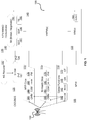
- FIG. 1 illustrates an overview of a communication network architecture in accordance with embodiments of the present invention.
- the NFV-MANO entity 135 includes an Orchestrator function 140, a Virtual Network Function Manager (VNFM) function 145 and a Virtual Infrastructure Manager (VIM) function 150.
- VNFM Virtual Network Function Manager
- VIM Virtual Infrastructure Manager
- the functionality of the Orchestrator function 140, VNFM function 145 and VIM function 150 can be as defined in ETSI GS NFV 001 and ETSI GS NFV 002, for example.
- the VIM function 150 is configured to manage the Network Function Virtual Infrastructure (NFVI) 105 which can include physical infrastructure, virtual resources and software resources in an NFV based network.
- NFVI Network Function Virtual Infrastructure
- physical infrastructure can include servers, storage devices and the like and virtual resources can include virtual machines.
- the VNFM function 145 can be configured to manage the VNFs and can manage the lifecycle of the VNFs.
- the VNFM function 145 can create, maintain and terminate VNF instances, which can be installed on virtual machines that are created and managed by the VIM function 150.
- the VNFM function 145 can also be configured to provide fault, configuration, accounting, performance and security management (FCAPs) of the VNFs.
- the VNFM function 145 can be configured to scale-up and scale-down one or more of the VNFs which can result in the scaling-up and scaling-down of the usage of the central processor(s) that is providing the computational power for the realization of the VNFs.
- each VNFM function manages a separate VNF or a single VNFM function manages multiple VNFs.
- the Orchestrator function 140 can be configured to coordinate, authorize, release and engage the NFVI resources by interaction with the VIM function 150.
- the Orchestrator function 140 is further configured to create end to end service between different VNFs by interaction with the VNFM function 145.
- the Global Control Plane 110 controls functions across multiple and potentially all the network slices.
- the Global Control Plane 110 may be regarded as a separate network slice in some embodiments.
- the illustrated network slices include a Mobile Broadband (MBB) network slice 120 and an m-Health slice 115. It should be appreciated that other types of network slices may be used, for example a slice can be created for each virtual network. Furthermore, a plurality of slices can be established for each type.
- MBB Mobile Broadband
- both the Global Control Plane functions and each network slice specific control plane function may be instantiated at an arbitrary location in the network by the NFV-MANO entity in order to provide connection management across a plurality or all of the network slices.
- the location of these functions may depend on performance factors such as delay requirements of different network services being provided.
- the functions configured within the Global Control Plane 110 can include the Global Connection and Mobility Management (G-CMM) function 182, Infrastructure Management (IM) function, which can contain a broker function and a negotiator function for obtaining computing, storage and network resources for core network functions.
- the IM function contains a Spectrum Broker (SB) function (IM-SB) 160 which is configured to obtain spectrum resources.
- the Global Control Plane 110 can also include a Data Analytics (DA) function 165 and Cache and Forwarding (CF) function 170.
- the DA function 165 is responsible for collecting statistics across multiple and potentially all network slices.
- the CF function 170 is responsible for management of the cached content across multiple and potentially all network slices.
- the G-CMM function 182 is responsible for maintaining a list of the instantiated network slices and the parameters associated with each network slice (e.g. Operator ID, service type, etc.).
- the G-CMM function 182 is further responsible for maintaining a pool of Connection and Mobility Management (CMM) functions, wherein each CMM function is instantiated as a local or network slice specific function.
- CMM Connection and Mobility Management
- the G-CMM function 182 is further responsible for initial association to a network slice.
- the network architecture further includes a Global Customer Service Management (G-CSM) function 187 which is configured to receive the NS Requests 130 and act upon same through communication with the Orchestrator function 140 of the NFV-MANO entity 135.
- G-CSM Global Customer Service Management
- the G-CSM function 187 is responsible for maintaining a pool of Customer Service Management (CSM) functions, wherein each CSM function is instantiated as a local or network slice specific function.
- CSM Customer Service Management
- the G-CSM function 187 is further responsible for keeping track of charging, for example billing, across multiple or potentially all network slices.
- the G-CSM function 187 can be configured to monitor network slices and provide feedback to the Orchestrator function 140 about the performance of a network slice, thereby enabling optional fine tuning of the network and computing resources, as managed by the VNFM function 145 and the VIM function 150.
- the G-CSM function 187 can be functionally integrated within the Operational Support System / Business Support System (OSS-BSS) 125.
- the OSS can include functions that support back-office activities which aid in operating a communication network, as well as provisioning and maintaining customer services and the like.
- the BSS can include functions that support customer-facing activities, for example billing order management, customer relationship management, call centre automation and the like.
- the G-CSM function 187 can communicate with the Orchestrator function 140 using the Os-Ma-nfvo interface 126, which provides communication between the OSS/BSS 125 and the Orchestrator function 140.
- the G-CSM function 187 can be instantiated within the network but external to the OSS/BSS 125.
- another interface which may not be defined with the NFV framework, is configured in order to provide communication between the G-CSM function 187 and the Orchestrator function 140.
- the various network slices may each include their own network slice specific CMM function 181, 180 and CSM function 186, 185, and additionally may be managed by the Global Control Plane 110.
- the network slice specific CMM functions 181, 180 are referred to and controlled by the G-CMM function 182 operating within the Global Control Plane 110.
- Each network slice further includes a Flow Management (FM) function 176, 175 which can be configured to tune the performance of the network slice by dynamically analyzing, predicting and regulating behaviour of data transmitted over that network slice.
- the FM functions can include a Traffic Engineering (TE) component.
- each of the network slices can further include an Authentication and Authorization (AA) function (not shown), which may provide authorization of access of a user equipment (UE) to use of the communication resources of the particular network slice.
- AA Authentication and Authorization
- each network slice further includes a network slice specific IM function containing a Spectrum Negotiator (SN) function (IM-SN) 191 190.
- IM-SN Spectrum Negotiator
- the IM-SN function is not contained within the network slice but instead resides within the Cloud Radio Access Network (C-RAN) functions or a global function.
- C-RAN Cloud Radio Access Network
- AP Access Point
- TRPs transmit/receive points
- BBUs Baseband Units
- AP can include multiple transmission points (TPs), multiple receive points (RPs), or a combination of the two.
- the G-CMM function 182 which can control or interact with the CMM function in a plurality of network slices can be instantiated close to the AP 100.
- the IM-SB function 160 can also be instantiated close to the AP 100 along with the G-CMM function 182.
- the processing functions of an AP may be physically separated from the radio head, and instantiated within a data center. In such embodiments, it is possible that a single G-CMM function 182 can be instantiated within a data center that also provides the processing functions for a plurality of APs.
- a Slice Management control plane function 155 which includes the G-CMM function 182 and the IM-SB function 160, is instantiated within the network architecture.
- the Slice Management control plane function 155 can be located within the RAN or close to the Core network / RAN boundary.
- the Slice Management control plane function 155 can include other functions, such as one or both of the G-CSM function 187 and the DA function 165.
- the NFV-MANO entity 135 further instantiates NFV management plane functions that define the network topology for an NS request, determine the transport protocols to be used across links and determine the physical links between different network functions used by the network service.
- these NFV management plane functions are integrated within the Orchestrator function 140 and include a Software Defined Topology (SDT) function 197, a Software Defined Protocol (SDP) function 196, a Software Defined Resource Allocation (SDRA) function 192, and an IM function 194.
- SDT Software Defined Topology
- SDP Software Defined Protocol
- SDRA Software Defined Resource Allocation
- SDN Software Defined Networking
- a network management entity e.g. an SDN Controller or SDN-C
- SDN-C SDN Controller
- the Orchestrator function form a logical network topology, for example as created via the SDT function.
- the SDT function can be combined with the SDN and SDP function to create a customized virtual network, wherein a virtual network is a collection of resources virtualized for a particular service.
- SDN allows for the management of network services through abstraction of lower-level functionality.
- Control functions may be separated from forwarding functions, for example by controlling the forwarding nodes from a control element.
- NFV can facilitate the virtualization of entire classes of network node functions.
- VNF can comprise or operate on one or more virtual machines running on relatively generic servers or computing equipment, such as commercial off-the-shelf hardware capable of being configured to provide a variety of functionalities, as opposed to dedicated hardware for a given functionality.
- the SDT function 197 is instantiated as part of the Orchestrator function 140.
- the SDT function 197 is configured to determine the Point of Presence (PoP) for each VNF in the VNFFG provided by the G-CSM function 187.
- the SDT function 197 is also configured to determine the logical links between the VNFs in the VNFFG.
- the SDRA function is configured to allocate the physical link resources for each logical link defined in the VNFFG.
- the SDRA function may utilize other functional components, such as the SDN-C function 193 and the TE function 195.
- the SDN-C function 193 is instantiated within each VIM function 193 and is configured to provide the forwarding rules to the forwarding switches, for example routers and the like, within the physical network architecture.
- the TE function 195 is instantiated within the Orchestrator function 140 and is configured to perform path computation between the source node and destination node while attempting to tune the path by dynamically analyzing, predicting and regulating behaviour of data transmission. In one embodiment, the TE function 195 performs only the path computation between the source node and destination node.
- the forwarding rules are then sent to the SDN-C function via the VIM function using the Or-Vi interface 198.
- the TE function 195 performs the path computation and also determines the capacity bounds for each physical link for each network slice.
- the capacity bounds are sent to the Flow Management (FM) function in each network slice, which performs the flow splitting function to ensure that the capacity bounds are not violated.
- the capacity bounds are sent on the Or-Vi interface to the VIM function 150, which then sends the rules to the SDN-C function 193 and the FM function.
- the TE and FM calculations can be distributed in different ways between the TE function 195 and the FM function (for example FM function 175 ).
- the information exchanged between the TE function 195 and the FM function 175 is sent from the Orchestrator function 140 to the VIM function 150 on the Or-Vi interface 198.
- the VIM function 150 sends the rules to the SDN-C function 193 and the SDN-C function 193 can send information to the FM function 175 for FM related calculations.
- Those skilled in the art will appreciate that at either extreme of the distribution of the functionality between TE function and FM function, one of the entities can be assigned all responsibilities, while the other is assigned none. It should be noted that both of these extreme cases along with any blend between the two can be supported.
- SMNF session management network function
- SME session management entity
- Such an SMNF/SME may reside within the NFV-MANO 135 or alternatively as a global function 110.
- an SMNF/SME may be instantiated for each slice, for example the m-Health slice 115.
- the SDP function 196 is instantiated as part of the Orchestrator function 140.
- the SDP function 196 is configured to determine the transport protocol stack for each of the logical links defined in the VNFFG.
- gateway In a 3G/4G network, there are gateway (GW) functions that are used to ensure data connectivity to a UE.
- the GW functions in a 3G/4G network are often statically configured so that other nodes in the network will be aware of an address at which the GW can be reached. As a result, even if the GW is a virtual entity, it is typically an entity that is instantiated at a fixed location using fixed parameters.
- a mobile-health also referred to as a telemedicine, application, it may be preferable to push a gateway function as close to the UE as possible.
- the GW functions are maintained at a topological distance away from the radio edge so that they can serve the UE regardless of which eNodeB the UE is connected to.
- This topological distance can introduce a delay which may be observed as a latency in communication.
- a virtualized gateway can be pushed towards the radio edge so that latency can be reduced.
- the GW can be distributed along the radio edge, so that effectively the GW functions specific to the UE move through the network with the UE.
- GW Distributed virtual Gateway
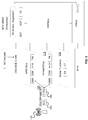
- the D-GW 50 (as shown in Figure 4B ) is composed of multiple Virtual Network Function Components (VNFCs), and includes multiple Local GW (L-GW) VNFCs 51 53 and 54 and can include an anchor GW (A-GW) 40.
- Figure 4A shows each Local GW VNFC (which is also known as a user plane (UP) GW (UPGW)) associated with an AP that is located at the same PoP as the VNFC.
- PoP1 10 includes AP1 11 associated with a L-GW illustrated as VNFC1 12
- PoP2 20 includes AP2 21 associated with a L-GW illustrated as VNFC2
- PoP3 30 includes AP3 31 associated with a L-GW illustrated as VNFC3 32.
- a single PoP can support more than one AP, in which case a single VNFC can be instantiated at the PoP to support all the APs supported by the PoP.
- Figure 4B illustrates a logical mapping between the VNFCs which make up the D-GW 50 and a more generalized view of the NFVI 60 which is used for the D-GW 50.
- VNFC 51 is instantiated to provide a L-GW within a host NFVI element 61
- the Anchor GW 40 is instantiated within host 62
- VNFC 53 is instantiated to provide a L-GW within a host NFVI element 63
- VNFC 54 is instantiated to provide a L-GW within a host NFVI element 64.
- the Application Server (AS) 45 is instantiated within host 46, which in an m-Health example may be located within a hospital.
- the A-GW VNFC 40 forwards Downlink (DL) data to each VNFC 51 53 and 54 that is in Active state.
- Uplink (UL) traffic is received by Active VNFCs and forwarded to the A-GW.
- DL Downlink
- UL Uplink
- the UL traffic may be sent from each L-GW to the AS directly.
- Methods and systems for using D-GWs are described in a co-pending US patent application 14/863,286 entitled “Distributed Virtual Gateways” naming Sophie Vrzic and Jaya Rao, filed Sept 23, 2015, which is hereby incorporated by reference in its entirety.
- the A-GW 40 can serve as both an IP anchor and a data plane (or user plane) gateway.
- A-GW 40 can act as an IP anchor, to support session continuity and preserve an IP address that the AS 45 can direct traffic towards for the duration of session.
- the A-GW 40 maintains the same IP address and that it insulates the AS 45 from needing to update the address of any other gateway that the UE connects to as it moves.
- the A-GW 40 ensures that the UE maintains the same IP address as it moves along the predicted route.
- instantiated, configured and activated VNFCs are positioned to be topologically close to the APs so that they can as L-GWs for the moving device.
- the L-GWs can be instantiated and configured along the route in advance of the arrival of the mobile device, and then activated when the mobile device approaches the service area of the AP associated with the L-GW.
- the A-GW 40 can further act as a data plane or user plane gateway which is responsible for distributing or pushing data to the plurality of the L-GWs.
- the A-GW 40 can include a point-to-multipoint distribution function, such as a Multimedia Broadcast Multicast Services (MBMS) function, so that it can direct data to a plurality of different L-GWs.
- MBMS Multimedia Broadcast Multicast Services
- a D-GW need not include the A-GW.
- the A-GW functionality can be incorporated within the AS.
- the A-GW 40 can also act as a mobility anchor.
- the mobility anchor can be considered to act as a Serving GW (SGW) in 3G/4G networks, such as those implementing the LTE standards.
- the IP anchor function is similar to the Packet Gateway (PGW) in LTE.
- PGW Packet Gateway
- the mobility anchor functionality can be distributed and moved closer to the UE (i.e., distributed to L-GW VNFCs) instead of being centralized at the A-GW 40.
- the IP anchor can be the A-GW 40 in some embodiments. In other embodiments, the IP anchor functionality can also be distributed to the AS and the L-GW VNFCs.
- the A-GW 40 can act as a terminating UP Function (TUPF), whereas in other embodiments the L-GW VNFCs act as TUPFs.
- application server functionality can be instantiated within VNFCs to reduce the amount of data which needs to be transmitted between the VNFCs and the application server, for example using Mobile Edge Computing (MEC) VNFCs.
- MEC Mobile Edge Computing
- an ambulance is used to transport a patient to a hospital, and en route a communication session between the hospital and the ambulance is provided.
- the communication session may have requirements related to reliability and latency.
- the ambulance may be associated with multiple devices which require communication with a hospital, including a computer running software, various scopes and monitors, as well as telephony equipment for voice or video calls between paramedics and hospital staff.
- a single communication session is used to carry the traffic associated with each of these devices.
- the ambulance provides gateway services to the associated devices, and from the perspective of the network, the ambulance is the UE / mobile device.
- individual devices can have their own radio connection. Some devices may have their own connections, while others rely upon the ambulance.
- the ambulance will be treated as the end point of the connection to the radio access network, and reference to the ambulance can generally be taken to refer to both the vehicle and the devices associated with it. Examples will be discussed for providing continuity for an m-Health session, but it should be appreciated that in some embodiments multiple sessions can be established between the ambulance and the application server.
- the ambulance makes use of a connection to the mobile network so that data services within the radio access network, and the connection to the application server can be used to provide the telemedicine services.
- the patient's vital signs, along with imaging data can be obtained within the ambulance, with a sufficiently high resolution, this data can be provided to the Application Server (typically associated with the hospital, and accessible to hospital staff), so that analysis of the data (and images) can be provided in real-time to aid the paramedics in administering medical services, and to allow the hospital to allocate resources in anticipation of the patient arrival.
- the Application Server typically associated with the hospital, and accessible to hospital staff
- an ambulance is dispatched to pick up a patient from a house 70 at location A.
- driving routes to the Hospital 80 at location B of which two ( 75, 78 ) are illustrated.
- mapping software can be used to suggest routes to the driver, and to predict the routes that may be taken.
- the travel time of the ambulance can be reduced, and a set of possible paths can be assembled so that virtual functions used by the mobile device (e.g. a D-GW) can be instantiated along the path.
- the system can then identify the available infrastructure elements along the identified driving routes based on known network topology.
- AP 71 at location C and AP 72 at location D are shown as examples of available infrastructure elements along driving routes 75 and 78 respectively. It should be appreciated that any given predicted route may pass through the service areas of these or other APs.
- routes with sufficient resources to provide various services can be selected for suggestion to a driver. For example, if two identified driving routes have the same predicted travel time, but network resources are more available on one of the two routes, the driver can be prompted to follow the route that has more available network resources.
- VNFCs for the D-GW are proactively instantiated along the route to the hospital.
- the system overprovisions the network for possible deviations from the predicted route, which may occur due to the ambulance driver making decisions based on the actual traffic conditions at each intersection.
- VNFCs will be instantiated, configured and made active at both locations C and D.
- VNFCs will be instantiated and configured at both locations C and D after the ambulance is dispatched, to ensure they will be available when needed. As the ambulance approaches the serving area of an AP, the state of an associated VNFC can be made active to ensure a service is available.
- resources along potential routes that include location D can be freed up (including changing the state of VNFCs both at D and along potential driving routes that extend from location D).
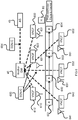
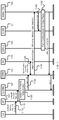
- Figure 6 shows a simplified network topology for a predicted route to the hospital 80, according to an embodiment.
- Each "A" 601, 602, 603 and 604 represents a different location at which the ambulance is located (at different times) as the ambulance traverses the predicted route.
- the route is illustrated in a straight line, even though the ambulance may make multiple turns as needed.
- the an entity within the network for example a G-CMM entity configured for an m-Health application
- NFVI e.g. APs 610, 621, 631, 641, 651 and 661
- the MANO then instantiates corresponding L-GW VNFCs 612, 622, 632, 642, 652 and 662 along the route.
- instantiating the L-GW as close to the radio edge as possible will reduce the latency of communications with the mobile device, but may come at the cost of requiring more L-GWs to be created and at the additional cost of moving the state of an active L-GW across the large number of L-GWs.
- An L-GW can support more than one AP, for example for a dense urban area with closely located APs (e.g.
- a VNFC can either be instantiated or not. If it has been instantiated, the VNFC can either be configured or not. An instantiated and configured VNFC can be either active or not (referred to as being inactive). It should be noted that neither instantiating nor configuring a VNFC cannot be done instantly. However, if a VNFC is instantiated and configured, changing it to an active state can be done very quickly. A VNFC that is not in the Active state, consumes network resources, but not as many network resources as a VNFC in the active state.
- the VNFCs for the D-GW can be both Instantiated and Configured when the predicted routes are identified (which may happen during dispatch).
- the VNFCs can remain inactive so that they do not unnecessarily consume network resources.
- the VNFC associated with the AP can be changed to active.
- the VNFC's can be activated well in advance of when they are needed, whereas in other embodiments the VNFCs can be activated on a "just-in-time" basis.
- VNFCs associated with a serving AP may be activated prior to radio connections between the ambulance and the AP are established.
- the dashed lines in Figure 6 between the AS 45 and the Anchor GW 40, and between the Anchor GW 40 and each of the VNFCs 612 622 632 642 650 and 662, represent potential user plane paths for data traffic. It should be appreciated that there may be multiple network nodes (e.g. switches, routers, etc.) which can be used to forward traffic between the components. Accordingly, an SDN-C 694 configures the paths from the AS 45 located at the hospital to the A-GW 40, which may occur through providing instructions to the nodes at either end of the logical connection as well as the physical nodes at the end of links within the logical connection. In some embodiments, another SDN-C 693 configures the paths from the A-GW 40 to each of the VNFCs.
- network nodes e.g. switches, routers, etc.
- an SDN-C 694 configures the paths from the AS 45 located at the hospital to the A-GW 40, which may occur through providing instructions to the nodes at either end of the logical connection as well
- SDN-Cs 693 and 694 are illustrated in this example, which may involve a separate data network, such as a wide area network (WAN), between the hospital and the A-GW 40.
- WAN wide area network
- a single SDN-C can be used to configure all the links. Multiple paths can be configured for reliability and to meet the delay and throughput requirements.
- other embodiments may utilize an SMNF/SME instead of the SDN-C.
- the ambulance is in the second position 602 and is within the serving area of APs 610, 621 and 651.
- VNFCs 612 622 and 652 (shown in solid lines) would be active.
- a CMM entity for example CMM 180 (as shown in Figure 1 ), can determine which VNFCs to activate based on the ambulance location and trajectory. By activating only the VNFCs that are associated with the potential serving APs resources are conserved. Any data sent by AS 45 to Anchor GW 40 for delivery to the ambulance will be transmitted to the active L-GW VNFCs. As such, by only activating the VNFCs associated with the serving APs, resources in the network are conserved.
- VNFCs 632, 642 and 662 remain inactive (and are shown in dashed lines).
- a serving cluster of APs which includes a plurality of APs each of which can establish radio connections to the ambulance, can be used. By making use of a serving cluster, additional throughput and redundancy, both for UL and DL can be achieved.
- three RAN access link connections 614, 624 and 654 are shown, but it is not necessary for each AP within range to have an active connection at all times.
- some embodiments configure user plane paths 615, 625 and 655 for each activated VNFC.
- DL data for the session is sent from the AS 45 at the hospital to the A-GW 40.
- the A-GW 40 then forwards the data to each active VNFC along the user plane paths 615, 625 and 655. Because the data is available at all active VNFCs, handover delay is eliminated.
- the ambulance may initially be served by both AP 610 and AP 651 via RAN access links 614 and 654 respectively. As the ambulance moves, the ambulance receives a clearer signal from AP 621 than from AP 610. Accordingly, the CMM 180 instructs AP 624 to start serving the ambulance.
- the ambulance may be configured to only support a set number of connections (and only use the strongest connections if there are more than the set number available), or it may use all connections that are sufficiently robust. In such cases, the connection 614 to AP 610 can be dropped.
- the VNFC 612 can be deactivated (and possibly torn down).
- DL data sent by the AS 45 to Anchor GW 40 is buffered at L-GW 622 for transmission to the ambulance by AP 621 via access link 624. This allows the session to be maintained while avoiding data loss and delay for the handover from AP 610 to AP 621.
- a plurality of APs within a single serving cluster can serve the ambulance.
- Each AP that can connect to the ambulance can establish a user plane path to the AS.
- Each AP in the serving cluster can be used to forward the data to the ambulance using a suitable protocol, such as single frequency network (SFN) transmission, MBMS or Coordinated Multi Point (CoMP).
- SFN single frequency network
- MBMS MBMS
- CoMP Coordinated Multi Point
- UL data received by a plurality of APs from the ambulance, can be decoded in a number of different ways.
- Each AP can decode the data on its own, and then sent the decoded data to the A-GW 45, or alternately a shared decoding strategy which allows for each of the APs to provide information to a central decoder for a single decoding process can be employed.
- the data received or decoded at the A-GW 40 can then be forwarded to the AS 45. Accordingly, in the above example, data is still transmitted between the ambulance and the AP 651 via access link 654 during the handover from AP 610 to AP 621.
- Some embodiments can use coordinated or uncoordinated transmission using the same or different RATs.
- data plane paths also referred to as user plane paths
- the path pre-configuration can help minimize delays in providing an end-to-end service between the AS and the ambulance.
- the paths can be configured responsive to a determination of the predicted route.
- the paths carrying DL traffic may be different than the paths which carry UL traffic, for example due to asymmetric capacity of the links and nodes within the paths, and recognizing the fact the UL traffic will often be greater for this particular example.
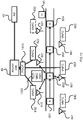
- Figure 8 illustrates the network entities involved with the path configuration, according to an embodiment.
- the AS 45, the ambulance, or some other entity determines the predicted route.
- a network entity for example a G-CMM entity, or some other mobility management network function (MM NF) configured for an m-Health application
- MM NF mobility management network function
- the G-CMM determines which APs having a serving area through which the UE will pass as it moves along the predicted route.
- the MM function keeps track of the UE's serving cluster.
- the TE function 195 in the Orchestrator 140 can determine the links between each of the APs and the AS 45, as well as the capacity bounds for each of the links This information is sent to the VIM 150, which then sends the flow and traffic management rules to the SDN-C 193. Based on the location of the ambulance, and the topology of the network, the ambulance may only be served by a limited number of VNFCs at a given time.
- the CMM function 180 can determine which AP (or APs) the data should be forwarded to. Similar determinations can be made to identify which VNFCs should be active at any time (if only the VNFCs serving the ambulance are active, then the CMM function 180 can simply transmit the data to all active VNFC-based L-GWs).
- the SDN-C 193 then provides the forwarding rules to the forwarding switches, for example routers and the like within the physical network architecture. It should be appreciated that multiple pre-configured paths can be established as there will likely be multiple active APs at a single time. Multiple paths can be configured for each source and destination pair for redundancy in case of link failure, and to meet the delay and throughput requirements.
- FM 175 manages the flows across the pre-configured paths.
- the FM function 175 can split the flows across the multiple paths to ensure that the capacity bounds of any given link are not violated and that the delay and throughput requirements are met.
- other embodiments may utilize an SMNF/SME instead of either or both of the SDN-C and the TE functions.
- FIG. 9 illustrates a procedure for configuring the data plane path (also known as the user plane path) for the requested session according to an embodiment.
- the Orchestrator TE function 195 e.g. the TE function 195 within the Orchestrator 140
- the VIM 150 and the SDN-C 193 are involved with the path computation 901 for the data plane.
- the paths for the end-to-end service may span across multiple VIMs, and each VIM may contain its own SDN-C.
- the TE 195 operates across multiple VIMs.
- the VIM and the SDN-C 193 within the VIM has a complete view within the administrative domain of the VIM.
- Each VIM can determine the paths within its domain and send these paths to the TE 195, which can then calculate the capacity bound 910 per physical link across all VIMs.
- the AS which may be part of a hospital network under a different administrative network domain may be one of the two ends of the complete end-to-end path. Accordingly, one of the domains may be administered by a WAN Infrastructure Manager (WIM).
- WIM WAN Infrastructure Manager
- the Orchestrator (TE function) 195 calculates the capacity bounds for each physical link in each path.
- the Orchestrator then forwards the capacity bounds to the VIMs/WIMs.
- the VIMs/WIMs forward rules, which can include the capacity bounds, to the SDN-Cs.
- the SDN-Cs then configures forwarding switches in the computed path, in part by providing forwarding rules.
- other embodiments may utilize an SMNF/SME instead of the SDN-C and or TE functions.
- Figure 10 illustrates a procedure for establishing the control plane (CP) functions and paths for an m-Health service request, according to an embodiment, with further reference to the architecture of Figure 1 .
- the m-Health Network Service (NS) request 1001 is sent to the G-CSM 187.
- the NS request is sent to request instantiation of the CP functions required to process the m-Health service request.
- this NS request is sent by the hospital AS when the ambulance is dispatched.
- the request may include the VNFFG for instantiating the control plane, bandwidth and throughput requirements for the CP, the coverage are of the service, and any priority information (if available).
- the request is sent from within the ambulance when the patient is picked up.
- the G-CSM 187 Upon receipt of the request 1001, the G-CSM 187 either creates a new slice (if needed) or assigns the service to an existing slice in 1010, for example m-Health slice 115. As noted above, the process described here does not require that the service be provided within a slice. If the network does not support slicing, step 1010 can be omitted.
- the G-CSM 187 sends a request 1020 to the Orchestrator to instantiate the CP functions required to provide the m-health service.
- the CP functions may already have been instantiated, and are simply awaiting the appropriate configuration.
- Orchestrator 140 can also configures the CP paths between the functions.
- the CP functions can include service specific CMM 180, FM 175 and AA 116 functions. In some embodiments, service specific functions are instantiated for each m-Health NS.
- the G-CMM 182 is provided with the m-Health configuration details. A connection between the G-CMM 182 and the m-Health specific CMM(s) 180 is established.
- the NFV MANO 135 then instantiates and configure the CP VNFs 1030 and configures paths 1040 for the CP.
- the CP functions within the slice may be used for the m-Health UEs.
- Figure 11 illustrates a process for a UE (for example an ambulance) to attach to the m-Health network slice or a slice supporting the m-Health service, when the ambulance is dispatched, according to an embodiment.
- the ambulance may already be attached to a common MBB slice.
- the ambulance can send a new service/session request 1110 for a reliable low latency session to the AP 100.
- the AP 100 forwards 1115 the request to the G-CMM 182.
- G-CMM 182 can assign the UE to the m-Health slice (or another a critical communication slice supporting the m-Health service as appropriate) if the service is provided within a sliced network.
- m-Health service request 1110 includes the predicted route from the dispatch location to the hospital, although, as discussed, in other embodiments the predicted route may originate elsewhere.
- the UE can first send an attach request to attach to the m-Health slice then send a new service request to establish an m-Health session.
- G-CMM 182 can send a service request (SR) 1030 to the CMM function 180.
- the CMM function 180 would have been previously instantiated as part of the process of instantiating the m-Health service, for example as set out in Figure 10 .
- the functions required for provision of the service will have already been instantiated, and their addresses may be known.
- the AP 100 can be configured to forward the Attach Request 1115 directly to the CMM 180.
- the CMM 180 can authenticate 1135 the request, such as with the AA function 116.
- CMM 180 can send a request 1140 to the MANO (TE) function 195 to instantiate (and configure) 1145 a D-GW 50 along the predicted route.
- the SDN-C 193 and the TE function 195 then establish 1150 data plane paths for each AP along the route.
- other embodiments may utilize an SMNF/SME instead of the SDN-C and or TE functions.
- the D-GW may already be instantiated. In this case, the D-GW only needs to be configured with the UE context.
- Figure 12 illustrates a process for updating the serving cluster of a D-GW, according to an embodiment.
- the UE transits a UL beacon.
- This beacon is received by all APs within range of the UE.
- the UL beacon is received 1230 by both API 1210 and by AP2 1220 neither of which are part of the cluster of serving APs associated with the UE. Because the UL Beacon is broadcast by the UE, it will be received 1230 by both API 1210 and AP2 1220 as the UE approaches their serving areas.
- Each AP performs signal strength measurements 1235 and 1246 on the received UL beacon. These measured signal strengths are transmitted 1236 to the CMM 180.
- the received measurement reports from all APs are used to determine the serving cluster membership in 1250. If the measurement report from an AP indicates that the UE is within a threshold distance of the AP, the CMM 180 can include the AP within the serving cluster. An AP that was not previously a part of the cluster will already have VNFCs created to support the UE (because the AP is part of the predetermined path), but the VNFC will be inactive. CMM 180 transmits an instruction 1255 to the VNFM 145 to begin the activation process for the VNFCs associated with the APs that are being added to the serving cluster.
- the VNFM 145 responds by transmitting VNFC activation instructions to each of VNFC1 1211 (which is associated with AP1 1210 ) and VNFC2 1221 (which is associated with AP2 1220 ).
- VNFC1 1211 which is associated with AP1 1210
- VNFC2 1221 which is associated with AP2 1220 .
- the CMM 180 may conclude that the AP should be removed from the serving cluster.
- a message can be sent to the VNFM 145 to deactivate the VNFC associated with the AP that is being removed from the serving cluster.
- the VNF may not be terminated in all embodiments, as there may be a benefit to leaving the VNF instantiated and configured for a period of time (e.g. a change in direction of the ambulance requires it to backtrack).
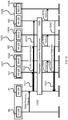
- Figure 13 is similar to Figure 7 but includes a Customized Protocol Stack for improved security, according to an embodiment.
- a VNF with a customized security protocol e.g. enhanced Packet Data Convergence Protocol (PDCP)
- PDCP Packet Data Convergence Protocol
- a customized Physical (PHY), Medium Access Control (MAC) and Radio Link Control (RLC) layer protocol handling function 1320 can be instantiated within a baseband unit (BBU) at the PoPs hosting the VNFCs of the D-GW, as will be discussed below with reference to Figure 14 .
- BBU baseband unit
- the PoP can include a data center which includes computing resources that support multiple virtual machines for hosting the VNFC, the customized protocol stack, and other functions.
- the A-GW 40 may include a resource scheduler for the serving APs. Common radio resources can be reserved at the serving APs to enable synchronized transmission of the same data using the same resources, for example utilizing SFN transmission or CoMP, or the like.
- Figure 14 shows the Customized Protocol Stack discussed in Figure 13 , according to an embodiment.
- the modified PDCP function 1310 can be instantiated at the same PoP as the Anchor GW.
- the modified PDCP function which interfaces with the UE, is effectively moved from the AP to the A-GW, which controls the PDCP function for each AP of the D-GW.
- the PDCP can be enhanced to use more robust encryption and integrity protection algorithms. For example, key length can be increased from 128 bits to 256 bits (or higher).
- the algorithms and keys for encryption and integrity protection can be configured when the A-GW is established. Such encryption might be utilized to help ensure the privacy of patient data, but it can also be used for integrity checking, for example to prevent tampering.
- the security keys can be distributed to each node within the serving cluster simultaneously.
- the key length can be dynamically adjusted depending on the processing abilities of the network functions used by the service at any given time. In one embodiment, a lower bound on the strength of the encryption is defined, and the encryption provided will never drop below the threshold, but if there are sufficient computing resources available a longer key can be used. Changes in the length of the key can be managed at a control or management plane level.
- FIG. 15 shows a radio resource allocation procedure, according to an embodiment.
- the A-GW VNFC 40 may include an IM-SN function 41 for negotiating common spectrum resources for each AP serving the ambulance (e.g., for SFN transmission).
- the IM-SN can be a separate VNF, for example a global function or the IM-SN function 190 of slice 115.
- An IM-SB function is instantiated at each PoP hosting the VNFCs of the D-GW.
- IM-SB 161 function is instantiated within PoP 1501 which includes BBU1 150
- IM-SB 162 function is instantiated within PoP 1503 which includes BBU2 150
- IM-SB 163 function is instantiated within PoP 1505 which includes BBU3 1506.
- IM-SN 41 sends radio resource requests 1511, 1512 and 1513 to IM-SB 161, IM-SB 162, and IM-SB 163 respectively.
- Each IM-SB reserves the radio resources for the m-Health service with their respective BBU via messages 1531, 1532, and 1533 and the BBUs send their responses via messages 1541, 1542, and 1543 respectively.
- other transmission schemes can also be used that do not require common radio resources.
- the IM-SN function and IM-SB function, and thus SN and SB functions may be applied to cover other types of Radio Access Technologies (RATs), for example, WiFi, unlicensed cellular frequency bands, and the like.
- RATs Radio Access
- Figure 16 illustrates two views of an alternative radio resource allocation scheme, according to an embodiment.
- Figure 16A illustrates a UE being served by two APs according to an embodiment
- Figure 16B illustrates example message and data flows for such an embodiment.
- different resources can be used for each serving AP 1641 and 1642, and two different AP types can be used.
- the two APs need not use the same RAT, although they each should have a connection to the 5G core (m-Health network slice).
- a centralized scheduler 1610, along with PDCP function 1310 can be located at the PoP 42 hosting the A-GW 40.
- AP PoP 1641 hosts L-GW VNFC 1621 and includes BBU1 1630 which can implement an RLC/MAC/PHY protocol 1631 according to a first RAT.
- AP PoP 1642 hosts L-GW VNFC 1622 and includes BBU2 1640 which can implement an RLC/MAC/PHY protocol 1632 according to a second RAT.
- Scheduler 1610 can schedule all of the transmit points (in this example BBU1 1630 and BBU2 1640 ) and the scheduling information can be sent to each serving AP along with the encrypted data.
- systems and methods discussed herein can be extended to other communication services with similar reliability and low latency requirements and which utilize a predictable route.
- embodiments can be extended for other emergency dispatch situations, for example if police, fire rescue and one or more ambulances are sent to an accident site.
- systems and methods described herein can be extended to non-emergency applications for which there is a predictable route, such as for providing a reliable low latency service to multiple users within a moving train or motorcade.
- the m-Health platform manages the movement of entities with respect to the network infrastructure (physical or virtual). It is possible that a stationary platform can make use of the disclosed method and systems. In situations where a service provider will change the network on which the m-Health platform is supported, for any of a number of reasons, the above systems and methods can be used.
- a service provider will change the network on which the m-Health platform is supported, for any of a number of reasons.
- the above systems and methods can be used.
- an ambulance will be stationary and, due to network loading, the AP that the ambulance is connected to will change.
- the ability to move to an already configured gateway on the new AP will provide the same advantages as when the ambulance is moving.
- the concept of high mobility handovers includes any movement of the ambulance relative to the topological locations of the mobile network infrastructure.
- the above-described network functionalities and operations may correspond to a method for use in supporting operation of a communication network, such as a 5G wireless communication network.
- the method may involve computer-implemented functions, namely functions which are implemented by one or more of computing, communication and memory components of the network infrastructure. These components may take various forms, such as specific servers or one or more of general-purpose computing, communication and memory devices which are configured to provide the required functionality through virtualization technologies.
- the method may involve the operation of one or more network components in order to improve the operation of the network.
- embodiments of the present invention may be directed to improving internal operations of the communication network.
- embodiments of the present invention relate to a communication network system or associated apparatus thereof, which is configured to perform the above-described network functionalities and operations.
- the system or apparatus may comprise one or more of computing, communication and memory components of the network infrastructure, which may take various forms, such as specific servers or one or more of general-purpose computing, communication and memory devices which are configured to provide the required functionality through virtualization technologies.
- Various methods as disclosed herein may be implemented on one or more real or virtual computing devices, such as devices within a communication network control plane, devices operating in the data plane, or a combination thereof.
- Computing devices used to implement method operations may include a processor operatively coupled to memory, the memory providing instructions for execution by the processor to perform the method as described herein.
- Various embodiments of the present invention utilize at least one of real and virtual computer resources.
- Such computer resources utilize, at a hardware level, a set of one or more microprocessors operatively coupled to a corresponding set of memory components which include stored program instructions for execution by the microprocessors.
- Computing resources may be used to provide virtual computing resources at one or more levels of virtualization.
- one or more given generic computer hardware platforms may be used to provide one or more virtual computing machines.
- Computer hardware such as processor resources, memory, and the like, may also be virtualized in order to provide resources from which further virtual computing machines are built.
- a set of computing resources which are allocatable for providing various computing resources which in turn are used to realize various computing components of a system may be regarded as providing a distributed computing system, the internal architecture of which may be configured in various ways.
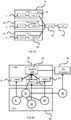
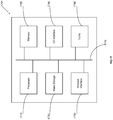
- FIG. 17 is an exemplary block diagram of a processing system 1701 that may be used for implementing the various network functions.
- processing system 1701 includes a processor 1710, working memory 1720, non-transitory storage 1730, network interface, I/O interface 1740, and depending on the node type, a transceiver 1060, all of which are communicatively coupled via bi-directional bus 1770.
- processing system 1701 may contain multiple instances of certain elements, such as multiple processors, memories, or transceivers. Also, elements of processing system 1701 may be directly coupled to other components without the bi-directional bus.
- the memory may include any type of non-transitory memory such as static random access memory (SRAM), dynamic random access memory (DRAM), synchronous DRAM (SDRAM), read-only memory (ROM), any combination of such, or the like.
- the mass storage element may include any type of non-transitory storage device, such as a solid state drive, hard disk drive, a magnetic disk drive, an optical disk drive, USB drive, or any computer program product configured to store data and machine executable program code. According to certain embodiments, the memory or mass storage have recorded thereon statements and instructions executable by the processor for performing the aforementioned functions and steps.
- the processing system 1701 can be used to implement a node or host which executes the various network functions described herein.
- gateway functions can be distributed throughout the network, for example, they can be co-located with the Access Points 100. These gateways can be configured to serve a plurality of different UEs, and due to their co-location with AP 100, the round trip time or latency for communications is reduced.
- the method remains the same.
- the CMM could communicate with at least one of another network management and another orchestration entity, and in place of a request for instantiation, a request for initialization and configuration of a physical gateway component can be transmitted.
- At least one of the network management and orchestration entity would then initialize the GW component, and the physical network GW function can be configured to act just as the D-GW 50 function would.
- the use of physical network functions may be more frequently used for commonly or heavily used functions, while functions that are used more rarely may be virtualized.
- requests for the instantiation of a virtual function could be replaced by requests for the initialization or initiation of a physical function, and reference to a virtual network function or virtual network function component can be understood to also be applicable to any type of network function of network function component.
- the present disclosure may be implemented by using hardware only or by using software and a necessary universal hardware platform. Based on such understandings, the technical solution of the present disclosure may be embodied in the form of a software product.
- the software product may be stored in a non-volatile or non-transitory storage medium, which can include the device memory as described above, or stored in removable memory such as compact disk read-only memory (CD-ROM), flash memory, or a removable hard disk.
- the software product includes a number of instructions that enable a computer device (computer, server, or network device) to execute the methods provided in the embodiments of the present disclosure. For example, such an execution may correspond to a simulation of the logical operations as described herein.
- the software product may additionally or alternatively include number of instructions that enable a computer device to execute operations for configuring or programming a digital logic apparatus in accordance with embodiments of the present disclosure.
Landscapes
- Engineering & Computer Science (AREA)
- Computer Networks & Wireless Communication (AREA)
- Signal Processing (AREA)
- Computer Security & Cryptography (AREA)
- Business, Economics & Management (AREA)
- Health & Medical Sciences (AREA)
- Emergency Management (AREA)
- Environmental & Geological Engineering (AREA)
- Public Health (AREA)
- Mobile Radio Communication Systems (AREA)
- Remote Sensing (AREA)
Claims (8)
- Procédé, réalisé par une fonction de réseau de gestion de session (1701), de fourniture d'un service de communication mobile, comprenant les étapes consistant à :configurer des nœuds le long d'une route prédite ;établir et configurer (1150) des chemins de réseau à partir de points d'accès (100) le long de la route prédite jusqu'à un nœud de destination ; etchanger l'état des nœuds selon la localisation du dispositif mobile afin de fournir le service de communication mobile,caractérisé en ce que la configuration des nœuds comprend l'étape consistant à instancier et configurer, avant qu'un dispositif mobile ne s'approche de la zone de desserte des points d'accès (100) qui sont associés aux nœuds, des fonctions de réseau virtuelles dans les nœuds, les fonctions de réseau virtuelles instanciées et configurées, une fois activées, agissant comme des passerelles locales pour une pluralité des points-d'accès qui desservent simultanément le dispositif mobile, une pluralité de fonctions de réseau étant actives simultanément de sorte que de multiples points d'accès desservent le dispositif mobile à n'importe quel moment donné et que des données en liaison descendante soient transmises du nœud de destination aux passerelles locales pour une transmission au dispositif mobile ; et qu'une liaison montante soit reçue par chaque point d'accès de la pluralité de points d'accès qui desservent simultanément le dispositif mobile et soit transférée vers le nœud de destination par l'intermédiaire des passerelles locales,le changement de l'état (1255) des nœuds comprenant l'étape consistant à activer, avant que le dispositif mobile ne se connecte aux points d'accès, les fonctions de réseau virtuelles instanciées et configurées.
- Procédé selon la revendication 1, dans lequel l'établissement et la configuration de chemins de réseau (1150) comprennent l'étape consistant à configurer des chemins de plan d'utilisateur avant que le dispositif mobile n'atteigne la zone de desserte d'un point d'accès.
- Procédé selon l'une quelconque des revendications 1 et 2, comprenant en outre l'étape consistant à déterminer la route prédite pour un dispositif mobile.
- Procédé selon la revendication 3, dans lequel la détermination de la route prédite comprend l'étape consistant à recevoir une notification indiquant quels points d'accès ont des zones de desserte le long de la route prédite.
- Procédé selon la revendication 1, comprenant en outre les étapes consistant à :établir une grappe potentielle de desserte (1250) d'AP ;déterminer une grappe réelle de desserte d'AP.
- Fonction de réseau de gestion de session (1701), comprenant :une interface de réseau (1750) pour recevoir une demande de service de réseau et pour transmettre des instructions ;un processeur (1710) ;une mémoire non temporaire (1720) pour stocker des instructions qui, lorsqu'elles sont exécutées par le processeur, amènent la fonction de réseau de gestion de session à :configurer des noeuds le long d'une route prédite ;établir et configurer des chemins de réseau à partir de points d'accès (100) associés aux nœuds le long de la route prédite jusqu'à un nœud de destination ; et changer l'état des nœuds selon la localisation du dispositif mobile afin de fournir le service de communication mobile,caractérisée en ce que des instructions qui amènent la fonction de réseau de gestion de session à configurer les nœuds le long de la route prédite comprennent des instructions pour instancier et configurer, avant qu'un dispositif mobile ne s'approche de la zone de desserte des points d'accès (100) qui sont associés aux nœuds, des fonctions de réseau virtuelles dans les nœuds, les fonctions de réseau virtuelles instanciées et configurées, une fois activées, agissant comme des passerelles locales pour une pluralité des points d'accès qui desservent simultanément le dispositif mobile, une pluralité de fonctions de réseau étant actives simultanément de sorte que de multiples points d'accès desservent le dispositif mobile à n'importe quel moment donné et que des données en liaison descendante soient transmises du nœud de destination aux passerelles locales pour une transmission au dispositif mobile ; et qu'une liaison montante soit reçue par chaque point d'accès de la pluralité de points d'accès qui desservent simultanément le dispositif mobile et soit transférée vers le nœud de destination par l'intermédiaire des passerelles locales,les instructions qui amènent la fonction de réseau de gestion de session à changer l'état des fonctions de réseau comprenant des instructions pour activer, avant que le dispositif mobile ne se connecte à des points d'accès associés aux nœuds, les fonctions de réseau virtuelles instanciées et configurées.
- Fonction de réseau de gestion de session (1701) selon la revendication 6, dans laquelle les instructions qui amènent la fonction de réseau de gestion de session à activer des fonctions instanciées comprennent des instructions pour activer les fonctions avant que le dispositif mobile n'ait besoin de se connecter à des points d'accès afin de garantir un transfert intercellulaire ininterrompu ; et le changement de l'état des fonctions de réseau comprend la désactivation de fonctions instanciées quand le dispositif mobile quitte la zone de desserte de points d'accès associés aux hôtes.
- Fonction de réseau de gestion de session (1701) selon la revendication 7, dans laquelle les instructions qui amènent la fonction de réseau de gestion de session à changer l'état des fonctions de réseau comprennent des instructions qui amènent la fonction de gestion de session à :déterminer une grappe de desserte sur la base de rapports de mesure reçus en provenance d'une pluralité de points d'accès et sur la base de la route prédéfinie ;activer des passerelles locales non actives pour des points d'accès dans la grappe de desserte déterminée et désactiver des passerelles locales pour des points d'accès qui quittent la grappe de desserte.
Applications Claiming Priority (4)
| Application Number | Priority Date | Filing Date | Title |
|---|---|---|---|
| US201562220682P | 2015-09-18 | 2015-09-18 | |
| US201562255101P | 2015-11-13 | 2015-11-13 | |
| US15/239,224 US10645528B2 (en) | 2015-09-18 | 2016-08-17 | System and methods for reliable communication with mobility along a predictable route |
| PCT/CN2016/099228 WO2017045643A1 (fr) | 2015-09-18 | 2016-09-18 | Système et procédés pour une communication fiable avec une mobilité le long d'un itinéraire prévisible |
Publications (3)
| Publication Number | Publication Date |
|---|---|
| EP3338469A1 EP3338469A1 (fr) | 2018-06-27 |
| EP3338469A4 EP3338469A4 (fr) | 2018-07-25 |
| EP3338469B1 true EP3338469B1 (fr) | 2020-11-11 |
Family
ID=58283761
Family Applications (1)
| Application Number | Title | Priority Date | Filing Date |
|---|---|---|---|
| EP16845757.0A Active EP3338469B1 (fr) | 2015-09-18 | 2016-09-18 | Système et procédés pour une communication fiable avec une mobilité le long d'un itinéraire prévisible |
Country Status (4)
| Country | Link |
|---|---|
| US (1) | US10645528B2 (fr) |
| EP (1) | EP3338469B1 (fr) |
| CN (1) | CN108353247B (fr) |
| WO (1) | WO2017045643A1 (fr) |
Families Citing this family (93)
| Publication number | Priority date | Publication date | Assignee | Title |
|---|---|---|---|---|
| US10645528B2 (en) | 2015-09-18 | 2020-05-05 | Huawei Technologies Co., Ltd. | System and methods for reliable communication with mobility along a predictable route |
| US9930587B2 (en) * | 2015-09-18 | 2018-03-27 | Huawei Technologies Co., Ltd. | Distributed virtual gateways |
| EP3386264B1 (fr) * | 2015-12-01 | 2021-02-17 | Nec Corporation | Système de communication et procédé de communication |
| LT3398379T (lt) * | 2015-12-30 | 2022-01-10 | Deutsche Telekom Ag | Būdas sukurti ryšio kanalą ryšių terminalui per ryšių tinklo sekciją |
| US11089579B2 (en) * | 2016-01-13 | 2021-08-10 | Samsung Electronics Co., Ltd. | Method and apparatus for supporting multiple services in advanced MIMO communication systems |
| WO2017125143A1 (fr) * | 2016-01-20 | 2017-07-27 | Nokia Solutions And Networks Oy | Procédés, appareils et produit programme d'ordinateur pour une continuité de service améliorée avec un calcul informatisé en périphérie de réseau mobile |
| US10129894B2 (en) * | 2016-03-04 | 2018-11-13 | Huawei Technologies Co., Ltd. | Systems and methods for performing traffic engineering through network slices |
| WO2017170692A1 (fr) * | 2016-04-01 | 2017-10-05 | 株式会社Nttドコモ | Système et procédé de gestion de tranche |
| US10028128B2 (en) | 2016-04-29 | 2018-07-17 | Motorola Mobility Llc | Procedures to support network slicing in a wireless communication system |
| US10149193B2 (en) | 2016-06-15 | 2018-12-04 | At&T Intellectual Property I, L.P. | Method and apparatus for dynamically managing network resources |
| GB2552845A (en) * | 2016-08-12 | 2018-02-14 | Nec Corp | Communication system |
| CN109565469A (zh) * | 2016-08-17 | 2019-04-02 | 株式会社Ntt都科摩 | 切片分配方法 |
| US10212100B2 (en) * | 2016-09-26 | 2019-02-19 | Huawei Technologies Co., Ltd. | System and method for data transmission in uplink RAN |
| WO2018068815A1 (fr) * | 2016-10-10 | 2018-04-19 | Nokia Solutions And Networks Oy | Fonction réseau virtualisée polymorphe |
| US10454836B2 (en) | 2016-11-01 | 2019-10-22 | At&T Intellectual Property I, L.P. | Method and apparatus for dynamically adapting a software defined network |
| US10284730B2 (en) | 2016-11-01 | 2019-05-07 | At&T Intellectual Property I, L.P. | Method and apparatus for adaptive charging and performance in a software defined network |
| US10505870B2 (en) | 2016-11-07 | 2019-12-10 | At&T Intellectual Property I, L.P. | Method and apparatus for a responsive software defined network |
| US10469376B2 (en) | 2016-11-15 | 2019-11-05 | At&T Intellectual Property I, L.P. | Method and apparatus for dynamic network routing in a software defined network |
| US10039006B2 (en) | 2016-12-05 | 2018-07-31 | At&T Intellectual Property I, L.P. | Method and system providing local data breakout within mobility networks |
| WO2018103826A1 (fr) * | 2016-12-06 | 2018-06-14 | Nokia Solutions And Networks Oy | Réseau mobile évolutif |
| US9888455B1 (en) | 2016-12-06 | 2018-02-06 | Cisco Technology, Inc. | Slice-based tracking areas |
| US10264075B2 (en) * | 2017-02-27 | 2019-04-16 | At&T Intellectual Property I, L.P. | Methods, systems, and devices for multiplexing service information from sensor data |
| US10469286B2 (en) | 2017-03-06 | 2019-11-05 | At&T Intellectual Property I, L.P. | Methods, systems, and devices for managing client devices using a virtual anchor manager |
| JP2018152691A (ja) * | 2017-03-13 | 2018-09-27 | 日本電気株式会社 | 制御装置 |
| KR102277946B1 (ko) * | 2017-03-17 | 2021-07-16 | 삼성전자주식회사 | 차량의 무선 통신을 지원하기 위한 방법들 및 장치들 |
| CN108632945B (zh) * | 2017-03-20 | 2020-11-06 | 华为技术有限公司 | 一种网络切片选择方法、用户设备及网络设备 |
| JP7410360B2 (ja) * | 2017-03-23 | 2024-01-10 | フラウンホーファー-ゲゼルシャフト・ツール・フェルデルング・デル・アンゲヴァンテン・フォルシュング・アインゲトラーゲネル・フェライン | ハンドオーバの先行準備およびトラッキング/ページングエリアハンドリングならびにセルラネットワーク内のインテリジェントルート選択 |
| WO2018174225A1 (fr) * | 2017-03-24 | 2018-09-27 | 日本電気株式会社 | Dispositif d'organisation de gestion virtualisée de fonction de réseau, système de communication, procédé et programme |
| KR102247424B1 (ko) * | 2017-03-31 | 2021-05-04 | 텔레호낙티에볼라게트 엘엠 에릭슨(피유비엘) | Nr 및 5gc에서의 애플리케이션 토폴로지 인식형 사용자 평면 선택 |
| EP3602978B1 (fr) * | 2017-03-31 | 2022-10-19 | Telefonaktiebolaget LM Ericsson (publ) | Sélection coordonnée de fonctions de plan d'utilisateur dans des réseaux central et d'accès radioélectrique |
| CN109314893B (zh) * | 2017-04-14 | 2020-09-29 | 华为技术有限公司 | 一种切换方法及装置 |
| US10819606B2 (en) | 2017-04-27 | 2020-10-27 | At&T Intellectual Property I, L.P. | Method and apparatus for selecting processing paths in a converged network |
| US10212289B2 (en) | 2017-04-27 | 2019-02-19 | At&T Intellectual Property I, L.P. | Method and apparatus for managing resources in a software defined network |
| US10749796B2 (en) | 2017-04-27 | 2020-08-18 | At&T Intellectual Property I, L.P. | Method and apparatus for selecting processing paths in a software defined network |
| US10673751B2 (en) | 2017-04-27 | 2020-06-02 | At&T Intellectual Property I, L.P. | Method and apparatus for enhancing services in a software defined network |
| US10382903B2 (en) | 2017-05-09 | 2019-08-13 | At&T Intellectual Property I, L.P. | Multi-slicing orchestration system and method for service and/or content delivery |
| US10257668B2 (en) | 2017-05-09 | 2019-04-09 | At&T Intellectual Property I, L.P. | Dynamic network slice-switching and handover system and method |
| CN109246837B (zh) * | 2017-06-12 | 2023-05-05 | 华为技术有限公司 | 通信方法和装置以及无线接入网络 |
| US10824454B2 (en) * | 2017-06-15 | 2020-11-03 | At&T Intellectual Property I, L.P. | 5G dynamic slice and network identity instantiation, termination, and access management system and method |
| BR112019027767A2 (pt) * | 2017-06-23 | 2020-07-07 | Huawei Technologies Co., Ltd. | método de implementação de continuidade de serviço, dispositivo, e sistema de implementação de continuidade de serviço |
| WO2019001381A1 (fr) * | 2017-06-26 | 2019-01-03 | 华为技术有限公司 | Procédé et appareil de gestion de session, dispositif, et système |
| CN109121170B (zh) | 2017-06-26 | 2021-04-20 | 华为技术有限公司 | 会话管理的方法、装置、设备及系统 |
| EP3646558A1 (fr) * | 2017-06-26 | 2020-05-06 | Telefonaktiebolaget LM Ericsson (PUBL) | Rafraîchissement d'un contexte de sécurité destiné à un dispositif mobile |
| US10070344B1 (en) | 2017-07-25 | 2018-09-04 | At&T Intellectual Property I, L.P. | Method and system for managing utilization of slices in a virtual network function environment |
| WO2019048048A1 (fr) * | 2017-09-07 | 2019-03-14 | Telefonaktiebolaget Lm Ericsson (Publ) | Optimisation dépendante de l'utilisation d'une partition de réseau d'accès radio |
| WO2019052406A1 (fr) * | 2017-09-13 | 2019-03-21 | Telefonaktiebolaget Lm Ericsson (Publ) | Procédés, nœuds et supports lisibles par ordinateur pour l'établissement de tunnel par tranche |
| CN109788514B (zh) * | 2017-11-13 | 2021-03-23 | 中国电信股份有限公司 | 边缘计算应用的数据同步方法、系统及边缘计算平台 |
| CN109788513B (zh) * | 2017-11-13 | 2021-03-23 | 中国电信股份有限公司 | 边缘计算应用的数据同步方法、系统及控制器 |
| EP3704850A1 (fr) * | 2017-11-21 | 2020-09-09 | Telefonaktiebolaget LM Ericsson (publ) | Fonction et procédé de traitement de trafic pour une application |
| JP7173041B2 (ja) * | 2017-11-29 | 2022-11-16 | 日本電気株式会社 | 管理装置、上位装置、管理方法及びプログラム |
| US10104548B1 (en) | 2017-12-18 | 2018-10-16 | At&T Intellectual Property I, L.P. | Method and apparatus for dynamic instantiation of virtual service slices for autonomous machines |
| US11382163B2 (en) | 2017-12-19 | 2022-07-05 | At&T Intellectual Property I, L.P. | Instantiating intelligent service delivery parameters within protected hardware |
| WO2019119305A1 (fr) | 2017-12-20 | 2019-06-27 | Nokia Shanghai Bell Co., Ltd. | Procédé et appareil d'équilibrage de charge dans un réseau d'accès radio en nuage |
| EP3729726B1 (fr) * | 2017-12-20 | 2023-11-22 | Telefonaktiebolaget LM Ericsson (publ) | Procédés, dispositifs et systèmes pour gérer une tranche de réseau fédérée |
| CN114172869A (zh) * | 2018-02-12 | 2022-03-11 | 华为技术有限公司 | 管理媒体传输通路的方法、系统以及相关设备 |
| CN108064062B (zh) * | 2018-02-13 | 2021-04-06 | 中国联合网络通信集团有限公司 | 一种跨基站的信息处理的方法及装置 |
| EP3750278B1 (fr) * | 2018-03-08 | 2024-01-31 | Huawei Technologies Co., Ltd. | Fonction de réseau pour services de communication d'extrémité à extrémité |
| CN110300143B (zh) * | 2018-03-23 | 2021-10-15 | 华为技术有限公司 | 业务切换处理方法、相关装置及计算机存储介质 |
| US11032236B2 (en) * | 2018-03-31 | 2021-06-08 | Intel Corporation | Technologies for content delivery network with multi-access edge computing |
| CN110505073B (zh) | 2018-05-16 | 2020-11-17 | 华为技术有限公司 | 一种移动边缘计算方法及装置 |
| CN112205007B (zh) * | 2018-06-01 | 2022-11-01 | 三星电子株式会社 | 利用启用层在5g网络中更好地利用资源的系统和方法 |
| EP3735765B1 (fr) * | 2018-06-01 | 2025-11-05 | Huawei Technologies Co., Ltd. | Grappe avec architecture à serveurs multiples pour assurer une fonction virtuelle de réseau |
| EP3794847B1 (fr) | 2018-06-07 | 2025-08-06 | Huawei Technologies Co., Ltd. | Procédé de mobilité basé sur une prédiction et une pré-préparation |
| CN108668237B (zh) * | 2018-06-29 | 2020-07-31 | 连尚(新昌)网络科技有限公司 | 一种用于保持用户设备的无线连接的方法与设备 |
| EP3827573A4 (fr) * | 2018-07-24 | 2022-03-16 | Nokia Technologies Oy | Procédé, dispositif et support lisible par ordinateur destinés à émettre des paquets de plan de données à l'aide d'un service de transport séparé vnfc |
| CN109067583A (zh) * | 2018-08-08 | 2018-12-21 | 深圳先进技术研究院 | 一种基于边缘计算的资源预测方法及系统 |
| US10931586B2 (en) * | 2018-10-30 | 2021-02-23 | Verizon Patent And Licensing Inc. | Method and system for predictive edge resources |
| EP3874701A4 (fr) * | 2018-10-31 | 2022-07-27 | John Mezzalingua Associates, LLC | Orchestrateur et dispositif de mappage de tissu d'interconnexion destiné à une station de base sans fil virtuelle |
| CN109979045B (zh) * | 2018-12-21 | 2021-08-06 | 维沃移动通信有限公司 | 一种信息输出方法及终端设备 |
| CN109618283B (zh) * | 2019-01-23 | 2020-10-13 | 湖南大学 | 一种基于sdn的车载自组织网移动切换系统及方法 |
| US11297554B2 (en) | 2019-03-28 | 2022-04-05 | At&T Intellectual Property I, L.P. | Candidate beam selection and control for 5G or other next generation network |
| US11064337B2 (en) | 2019-03-28 | 2021-07-13 | At&T Intellectual Property I, L.P. | Beam as a service for 5G or other next generation network |
| US10880836B2 (en) | 2019-03-28 | 2020-12-29 | At&T Intellectual Property I, L.P. | Beam provisioning for sensory data collection for 5G or other next generation networks |
| US11991055B2 (en) | 2019-04-30 | 2024-05-21 | Telefonaktiebolaget Lm Ericsson (Publ) | Technique for anticipating service level impacts |
| US11026095B2 (en) | 2019-07-31 | 2021-06-01 | At&T Intellectual Property I, L.P. | Real-time network provisioning for distributed virtual zones of collaborative mobile devices for 5G or other next generation network |
| US10834618B1 (en) * | 2019-08-05 | 2020-11-10 | Sprint Communications Company L.P. | Wireless communication network access using different functionality splits for different communication services |
| US11096036B2 (en) * | 2019-09-12 | 2021-08-17 | Intel Corporation | Multi-access Edge Computing service for mobile User Equipment method and apparatus |
| EP4032231B1 (fr) * | 2019-09-20 | 2025-06-25 | Telefonaktiebolaget LM Ericsson (publ) | Procédé et appareil d'abstraction de ressources de réseau dans un réseau de radiotéléphonie mobile |
| KR20190116187A (ko) * | 2019-09-23 | 2019-10-14 | 엘지전자 주식회사 | 차량 단말 및 그의 동작 방법 |
| CN112583615B (zh) * | 2019-09-29 | 2022-04-29 | 北京华为数字技术有限公司 | Vnf实例化方法、nfvo、vim、vnfm及系统 |
| JP2021069037A (ja) * | 2019-10-25 | 2021-04-30 | 矢崎総業株式会社 | 車両通信システム |
| US11218546B2 (en) * | 2020-03-25 | 2022-01-04 | Intel Corporation | Computer-readable storage medium, an apparatus and a method to select access layer devices to deliver services to clients in an edge computing system |
| WO2021197074A1 (fr) * | 2020-03-31 | 2021-10-07 | Telefonaktiebolaget Lm Ericsson (Publ) | Procédé et appareil d'abonnement à une notification de changement d'une fonction de réseau |
| EP4136408A1 (fr) | 2020-04-17 | 2023-02-22 | Telefonaktiebolaget LM ERICSSON (PUBL) | Procédé et système de modélisation hors ligne pour une prédiction de qualité de service pour des véhicules connectés |
| US11375361B2 (en) * | 2020-04-30 | 2022-06-28 | Hewlett Packard Enterprise Development Lp | Dynamic tuning of mobile network device configuration based on location |
| US12402156B2 (en) * | 2020-05-28 | 2025-08-26 | Telefonaktiebolaget Lm Ericsson (Publ) | Scheduling radio resources in a communications network |
| WO2022008082A1 (fr) * | 2020-07-10 | 2022-01-13 | Telefonaktiebolaget Lm Ericsson (Publ) | Procédés et appareil de commande de réseau |
| CN112492687B (zh) * | 2020-11-16 | 2023-06-27 | 中国电子科技集团公司第七研究所 | 一种基于无线网络切片的自适应资源分配方法及系统 |
| US11363513B1 (en) * | 2020-12-16 | 2022-06-14 | Sprint Spectrum L.P. | Proactive control of UE service based on quality of an access node's RF-circuitry as to frequency bands on which the access node operates in coverage zones through which the UE is predicted to move |
| CN114937254A (zh) * | 2022-06-16 | 2022-08-23 | 慧之安信息技术股份有限公司 | 基于边缘计算的救护车智能识别方法 |
| CN115968042B (zh) * | 2023-03-16 | 2023-06-23 | 杭州康晟健康管理咨询有限公司 | 一种移动医疗车的资源配置方法 |
| US12041134B1 (en) | 2023-04-11 | 2024-07-16 | Bank Of America Corporation | System and method for replication and transmission of critical data using ultra reliable low latency communication network architecture |
| EP4518435A1 (fr) * | 2023-08-31 | 2025-03-05 | Volkswagen Aktiengesellschaft | Méthode pour assurer la redondance des voies de communication le long d'un itinéraire |
Family Cites Families (46)
| Publication number | Priority date | Publication date | Assignee | Title |
|---|---|---|---|---|
| US6965592B2 (en) | 2001-01-24 | 2005-11-15 | Tekelec | Distributed signaling system 7 (SS7) message routing gateway |
| ATE332602T1 (de) | 2004-05-24 | 2006-07-15 | Cit Alcatel | Drahtlose datenweiterleitung zwischen zugangspunkten für eine eisenbahn |
| CN100579316C (zh) | 2007-02-15 | 2010-01-06 | 大唐移动通信设备有限公司 | 多媒体广播和组播业务中载波迁移的方法和装置 |
| US8335162B2 (en) | 2007-08-13 | 2012-12-18 | At&T Intellectual Property I, Lp | Methods and apparatus to control traffic in a packet-switched network |
| US8107921B2 (en) | 2008-01-11 | 2012-01-31 | Seven Networks, Inc. | Mobile virtual network operator |
| KR101574670B1 (ko) * | 2008-12-02 | 2015-12-04 | 삼성전자주식회사 | 협력 기지국 클러스터를 이용한 기지국 협력 기법 및 이를 위한 시스템 |
| US8594061B2 (en) * | 2010-06-22 | 2013-11-26 | Blackberry Limited | Methods and apparatus to access network connectivity information using predicted locations |
| US8374183B2 (en) | 2010-06-22 | 2013-02-12 | Microsoft Corporation | Distributed virtual network gateways |
| CN102043676B (zh) | 2010-12-08 | 2012-09-05 | 北京航空航天大学 | 虚拟化数据中心调度方法及系统 |
| WO2013082245A1 (fr) | 2011-11-29 | 2013-06-06 | Interdigital Patent Holdings, Inc. | Procédés de gestion de la mobilité ip |
| HK1204195A1 (en) | 2012-04-02 | 2015-11-06 | Nokia Solutions And Networks Oy | Gateway selection for mobile communications network architecture optimization |
| US9847915B2 (en) | 2013-01-11 | 2017-12-19 | Huawei Technologies Co., Ltd. | Network function virtualization for a network device |
| US9407519B2 (en) | 2013-03-15 | 2016-08-02 | Vmware, Inc. | Virtual network flow monitoring |
| CN104253770B (zh) | 2013-06-27 | 2017-07-14 | 新华三技术有限公司 | 实现分布式虚拟交换机系统的方法及设备 |
| CN103491129B (zh) | 2013-07-05 | 2017-07-14 | 华为技术有限公司 | 一种业务节点配置方法、业务节点池注册器及系统 |
| US9226153B2 (en) | 2013-08-23 | 2015-12-29 | Cisco Technology, Inc. | Integrated IP tunnel and authentication protocol based on expanded proxy mobile IP |
| CN104579732B (zh) | 2013-10-21 | 2018-06-26 | 华为技术有限公司 | 虚拟化网络功能网元的管理方法、装置和系统 |
| US20150124622A1 (en) * | 2013-11-01 | 2015-05-07 | Movik Networks, Inc. | Multi-Interface, Multi-Layer State-full Load Balancer For RAN-Analytics Deployments In Multi-Chassis, Cloud And Virtual Server Environments |
| EP2874448A1 (fr) | 2013-11-18 | 2015-05-20 | Sony Corporation | Procédé pour faire fonctionner un réseau radio cellulaire |
| US9760428B1 (en) | 2013-12-19 | 2017-09-12 | Amdocs Software Systems Limited | System, method, and computer program for performing preventative maintenance in a network function virtualization (NFV) based communication network |
| EP3095032B1 (fr) | 2014-01-17 | 2022-09-21 | Nokia Solutions and Networks GmbH & Co. KG | Commande de réseau de communication comprenant des fonctions de réseau virtualisées |
| WO2015118875A1 (fr) | 2014-02-06 | 2015-08-13 | 日本電気株式会社 | Procédé d'agencement optimal pour une fonction de réseau virtuelle, dispositif de commande de réseau, dispositif de gestion de réseau et système de réseau |
| JP2015149577A (ja) | 2014-02-06 | 2015-08-20 | 株式会社日立製作所 | 帯域制御装置 |
| WO2015122177A1 (fr) | 2014-02-12 | 2015-08-20 | 日本電気株式会社 | Dispositif de traitement d'informations, procédé de communication, dispositif de commande de réseau, procédé de commande de réseau et programme |
| EP3116175A4 (fr) | 2014-03-04 | 2017-09-13 | Nec Corporation | Serveur, dispositif de commande, dispositif de gestion, système de communication, procédé de communication, procédé de commande, procédé de gestion, et programme |
| US10356225B2 (en) | 2014-04-03 | 2019-07-16 | Centurylink Intellectual Property Llc | System and method for implementing isolated service overlays between provider network service point and customer premises |
| US9948493B2 (en) | 2014-04-03 | 2018-04-17 | Centurylink Intellectual Property Llc | Network functions virtualization interconnection gateway |
| US10374972B2 (en) | 2014-05-13 | 2019-08-06 | Telefonaktiebolaget Lm Ericsson (Publ) | Virtual flow network in a cloud environment |
| WO2015199685A1 (fr) | 2014-06-25 | 2015-12-30 | Hewlett Packard Development Company, L.P. | Virtualisation d'une fonction de réseau |
| US9832168B2 (en) | 2014-07-01 | 2017-11-28 | Cable Television Laboratories, Inc. | Service discovery within multi-link networks |
| CN104202264B (zh) | 2014-07-31 | 2019-05-10 | 华为技术有限公司 | 云化数据中心网络的承载资源分配方法、装置及系统 |
| US9898318B2 (en) | 2014-08-15 | 2018-02-20 | Centurylink Intellectual Property Llc | Multi-line/multi-state virtualized OAM transponder |
| CN104219127B (zh) | 2014-08-30 | 2018-06-26 | 华为技术有限公司 | 一种虚拟网络实例的创建方法以及设备 |
| CN104270416B (zh) | 2014-09-12 | 2018-03-13 | 杭州华为数字技术有限公司 | 负载均衡控制方法及管理节点 |
| US9491683B2 (en) | 2014-10-31 | 2016-11-08 | At&T Intellectual Property I, L.P. | Mobile network with software defined networking architecture |
| US9729396B2 (en) | 2014-11-04 | 2017-08-08 | Cisco Technology, Inc. | System and method for providing dynamic radio access network orchestration |
| CN104410672B (zh) | 2014-11-12 | 2017-11-24 | 华为技术有限公司 | 网络功能虚拟化应用升级的方法、转发业务的方法及装置 |
| US9769694B2 (en) | 2015-03-13 | 2017-09-19 | Intel IP Corporation | MME overload or underload mitigation by MME VNF apparatus and method |
| WO2016148001A1 (fr) | 2015-03-13 | 2016-09-22 | 日本電気株式会社 | Dispositif, système et procédé de communication, et dispositif et programme d'attribution |
| CN104811923B (zh) | 2015-04-01 | 2018-07-24 | 新华三技术有限公司 | 一种无线漫游的方法和设备 |
| KR101746202B1 (ko) | 2015-06-09 | 2017-06-12 | 주식회사 케이티 | 네트워크 기능 가상화 방법 및 이를 위한 장치 |
| US10349329B2 (en) * | 2015-07-28 | 2019-07-09 | Qualcomm Incorporated | Mechanisms for differentiated treatment of offloaded traffic |
| US10645528B2 (en) | 2015-09-18 | 2020-05-05 | Huawei Technologies Co., Ltd. | System and methods for reliable communication with mobility along a predictable route |
| US9930587B2 (en) | 2015-09-18 | 2018-03-27 | Huawei Technologies Co., Ltd. | Distributed virtual gateways |
| US10277687B2 (en) | 2015-11-16 | 2019-04-30 | At&T Intellectual Property I, L.P. | Master service orchestration of virtual networking functions |
| US10405260B2 (en) * | 2016-04-21 | 2019-09-03 | At&T Intellectual Property I, L.P. | Vehicle-based mobile node fleet for network service deployment |
-
2016
- 2016-08-17 US US15/239,224 patent/US10645528B2/en active Active
- 2016-09-18 EP EP16845757.0A patent/EP3338469B1/fr active Active
- 2016-09-18 CN CN201680054442.1A patent/CN108353247B/zh active Active
- 2016-09-18 WO PCT/CN2016/099228 patent/WO2017045643A1/fr not_active Ceased
Non-Patent Citations (1)
| Title |
|---|
| None * |
Also Published As
| Publication number | Publication date |
|---|---|
| CN108353247A (zh) | 2018-07-31 |
| CN108353247B (zh) | 2020-09-11 |
| EP3338469A1 (fr) | 2018-06-27 |
| WO2017045643A1 (fr) | 2017-03-23 |
| US20170086049A1 (en) | 2017-03-23 |
| US10645528B2 (en) | 2020-05-05 |
| EP3338469A4 (fr) | 2018-07-25 |
Similar Documents
| Publication | Publication Date | Title |
|---|---|---|
| US10645528B2 (en) | System and methods for reliable communication with mobility along a predictable route | |
| US11849366B2 (en) | System and methods for network slice reselection | |
| US10448320B2 (en) | System and method for virtualized functions in control and data planes | |
| US10419988B2 (en) | Distributed gateways and methods | |
| EP3278504B1 (fr) | Système et procédé destinés à des fonctions virtualisées dans des plans de commande et de données | |
| US10111163B2 (en) | System and method for virtualized functions in control and data planes | |
| US20240373312A1 (en) | System and method for efficient upload or download of transmission data over mobile access devices | |
| EP4084530A1 (fr) | Système et procédé de téléversement ou de téléchargement efficace de données de transmission sur des dispositifs d'accès mobiles | |
| WO2025049329A1 (fr) | Modèle flexible pour fournir des services de communication sans fil dans des zones de suivi de fonction de plan utilisateur primaire et secondaire | |
| US20250344230A1 (en) | Dynamic access and mobility management function (amf) scaling | |
| US20260019822A1 (en) | Shared radio unit architectures supporting dynamic temporary resource allocation | |
| US20250056320A1 (en) | Flexible model to provision wireless communication services in overlapping user plane function tracking areas | |
| US20260040174A1 (en) | Improve handover performance in inter vendor handover scenario | |
| US20260039546A1 (en) | Interworking of communication models between network functions |
Legal Events
| Date | Code | Title | Description |
|---|---|---|---|
| STAA | Information on the status of an ep patent application or granted ep patent |
Free format text: STATUS: THE INTERNATIONAL PUBLICATION HAS BEEN MADE |
|
| PUAI | Public reference made under article 153(3) epc to a published international application that has entered the european phase |
Free format text: ORIGINAL CODE: 0009012 |
|
| STAA | Information on the status of an ep patent application or granted ep patent |
Free format text: STATUS: REQUEST FOR EXAMINATION WAS MADE |
|
| 17P | Request for examination filed |
Effective date: 20180323 |
|
| AK | Designated contracting states |
Kind code of ref document: A1 Designated state(s): AL AT BE BG CH CY CZ DE DK EE ES FI FR GB GR HR HU IE IS IT LI LT LU LV MC MK MT NL NO PL PT RO RS SE SI SK SM TR |
|
| AX | Request for extension of the european patent |
Extension state: BA ME |
|
| A4 | Supplementary search report drawn up and despatched |
Effective date: 20180626 |
|
| RIC1 | Information provided on ipc code assigned before grant |
Ipc: H04W 12/00 20090101ALI20180620BHEP Ipc: H04W 36/32 20090101ALI20180620BHEP Ipc: H04W 36/00 20090101ALI20180620BHEP Ipc: H04W 48/20 20090101ALI20180620BHEP Ipc: H04W 4/90 20180101ALI20180620BHEP Ipc: H04W 88/16 20090101ALI20180620BHEP Ipc: H04W 36/08 20090101ALI20180620BHEP Ipc: H04W 4/02 20180101AFI20180620BHEP Ipc: H04W 4/029 20180101ALI20180620BHEP Ipc: H04W 40/00 20090101ALI20180620BHEP Ipc: H04L 12/725 20130101ALI20180620BHEP |
|
| DAV | Request for validation of the european patent (deleted) | ||
| DAX | Request for extension of the european patent (deleted) | ||
| GRAP | Despatch of communication of intention to grant a patent |
Free format text: ORIGINAL CODE: EPIDOSNIGR1 |
|
| STAA | Information on the status of an ep patent application or granted ep patent |
Free format text: STATUS: GRANT OF PATENT IS INTENDED |
|
| INTG | Intention to grant announced |
Effective date: 20200518 |
|
| GRAS | Grant fee paid |
Free format text: ORIGINAL CODE: EPIDOSNIGR3 |
|
| GRAA | (expected) grant |
Free format text: ORIGINAL CODE: 0009210 |
|
| STAA | Information on the status of an ep patent application or granted ep patent |
Free format text: STATUS: THE PATENT HAS BEEN GRANTED |
|
| AK | Designated contracting states |
Kind code of ref document: B1 Designated state(s): AL AT BE BG CH CY CZ DE DK EE ES FI FR GB GR HR HU IE IS IT LI LT LU LV MC MK MT NL NO PL PT RO RS SE SI SK SM TR |
|
| REG | Reference to a national code |
Ref country code: GB Ref legal event code: FG4D |
|
| REG | Reference to a national code |
Ref country code: CH Ref legal event code: EP |
|
| REG | Reference to a national code |
Ref country code: AT Ref legal event code: REF Ref document number: 1334608 Country of ref document: AT Kind code of ref document: T Effective date: 20201115 |
|
| REG | Reference to a national code |
Ref country code: DE Ref legal event code: R096 Ref document number: 602016047829 Country of ref document: DE |
|
| REG | Reference to a national code |
Ref country code: IE Ref legal event code: FG4D |
|
| REG | Reference to a national code |
Ref country code: NL Ref legal event code: MP Effective date: 20201111 |
|
| REG | Reference to a national code |
Ref country code: AT Ref legal event code: MK05 Ref document number: 1334608 Country of ref document: AT Kind code of ref document: T Effective date: 20201111 |
|
| PG25 | Lapsed in a contracting state [announced via postgrant information from national office to epo] |
Ref country code: NO Free format text: LAPSE BECAUSE OF FAILURE TO SUBMIT A TRANSLATION OF THE DESCRIPTION OR TO PAY THE FEE WITHIN THE PRESCRIBED TIME-LIMIT Effective date: 20210211 Ref country code: RS Free format text: LAPSE BECAUSE OF FAILURE TO SUBMIT A TRANSLATION OF THE DESCRIPTION OR TO PAY THE FEE WITHIN THE PRESCRIBED TIME-LIMIT Effective date: 20201111 Ref country code: PT Free format text: LAPSE BECAUSE OF FAILURE TO SUBMIT A TRANSLATION OF THE DESCRIPTION OR TO PAY THE FEE WITHIN THE PRESCRIBED TIME-LIMIT Effective date: 20210311 Ref country code: GR Free format text: LAPSE BECAUSE OF FAILURE TO SUBMIT A TRANSLATION OF THE DESCRIPTION OR TO PAY THE FEE WITHIN THE PRESCRIBED TIME-LIMIT Effective date: 20210212 Ref country code: FI Free format text: LAPSE BECAUSE OF FAILURE TO SUBMIT A TRANSLATION OF THE DESCRIPTION OR TO PAY THE FEE WITHIN THE PRESCRIBED TIME-LIMIT Effective date: 20201111 |
|
| PG25 | Lapsed in a contracting state [announced via postgrant information from national office to epo] |
Ref country code: SE Free format text: LAPSE BECAUSE OF FAILURE TO SUBMIT A TRANSLATION OF THE DESCRIPTION OR TO PAY THE FEE WITHIN THE PRESCRIBED TIME-LIMIT Effective date: 20201111 Ref country code: BG Free format text: LAPSE BECAUSE OF FAILURE TO SUBMIT A TRANSLATION OF THE DESCRIPTION OR TO PAY THE FEE WITHIN THE PRESCRIBED TIME-LIMIT Effective date: 20210211 Ref country code: IS Free format text: LAPSE BECAUSE OF FAILURE TO SUBMIT A TRANSLATION OF THE DESCRIPTION OR TO PAY THE FEE WITHIN THE PRESCRIBED TIME-LIMIT Effective date: 20210311 Ref country code: LV Free format text: LAPSE BECAUSE OF FAILURE TO SUBMIT A TRANSLATION OF THE DESCRIPTION OR TO PAY THE FEE WITHIN THE PRESCRIBED TIME-LIMIT Effective date: 20201111 Ref country code: PL Free format text: LAPSE BECAUSE OF FAILURE TO SUBMIT A TRANSLATION OF THE DESCRIPTION OR TO PAY THE FEE WITHIN THE PRESCRIBED TIME-LIMIT Effective date: 20201111 Ref country code: AT Free format text: LAPSE BECAUSE OF FAILURE TO SUBMIT A TRANSLATION OF THE DESCRIPTION OR TO PAY THE FEE WITHIN THE PRESCRIBED TIME-LIMIT Effective date: 20201111 |
|
| REG | Reference to a national code |
Ref country code: LT Ref legal event code: MG9D |
|
| PG25 | Lapsed in a contracting state [announced via postgrant information from national office to epo] |
Ref country code: HR Free format text: LAPSE BECAUSE OF FAILURE TO SUBMIT A TRANSLATION OF THE DESCRIPTION OR TO PAY THE FEE WITHIN THE PRESCRIBED TIME-LIMIT Effective date: 20201111 |
|
| PG25 | Lapsed in a contracting state [announced via postgrant information from national office to epo] |
Ref country code: LT Free format text: LAPSE BECAUSE OF FAILURE TO SUBMIT A TRANSLATION OF THE DESCRIPTION OR TO PAY THE FEE WITHIN THE PRESCRIBED TIME-LIMIT Effective date: 20201111 Ref country code: SM Free format text: LAPSE BECAUSE OF FAILURE TO SUBMIT A TRANSLATION OF THE DESCRIPTION OR TO PAY THE FEE WITHIN THE PRESCRIBED TIME-LIMIT Effective date: 20201111 Ref country code: EE Free format text: LAPSE BECAUSE OF FAILURE TO SUBMIT A TRANSLATION OF THE DESCRIPTION OR TO PAY THE FEE WITHIN THE PRESCRIBED TIME-LIMIT Effective date: 20201111 Ref country code: CZ Free format text: LAPSE BECAUSE OF FAILURE TO SUBMIT A TRANSLATION OF THE DESCRIPTION OR TO PAY THE FEE WITHIN THE PRESCRIBED TIME-LIMIT Effective date: 20201111 Ref country code: SK Free format text: LAPSE BECAUSE OF FAILURE TO SUBMIT A TRANSLATION OF THE DESCRIPTION OR TO PAY THE FEE WITHIN THE PRESCRIBED TIME-LIMIT Effective date: 20201111 Ref country code: RO Free format text: LAPSE BECAUSE OF FAILURE TO SUBMIT A TRANSLATION OF THE DESCRIPTION OR TO PAY THE FEE WITHIN THE PRESCRIBED TIME-LIMIT Effective date: 20201111 |
|
| REG | Reference to a national code |
Ref country code: DE Ref legal event code: R097 Ref document number: 602016047829 Country of ref document: DE |
|
| PG25 | Lapsed in a contracting state [announced via postgrant information from national office to epo] |
Ref country code: DK Free format text: LAPSE BECAUSE OF FAILURE TO SUBMIT A TRANSLATION OF THE DESCRIPTION OR TO PAY THE FEE WITHIN THE PRESCRIBED TIME-LIMIT Effective date: 20201111 |
|
| PLBE | No opposition filed within time limit |
Free format text: ORIGINAL CODE: 0009261 |
|
| STAA | Information on the status of an ep patent application or granted ep patent |
Free format text: STATUS: NO OPPOSITION FILED WITHIN TIME LIMIT |
|
| 26N | No opposition filed |
Effective date: 20210812 |
|
| PG25 | Lapsed in a contracting state [announced via postgrant information from national office to epo] |
Ref country code: AL Free format text: LAPSE BECAUSE OF FAILURE TO SUBMIT A TRANSLATION OF THE DESCRIPTION OR TO PAY THE FEE WITHIN THE PRESCRIBED TIME-LIMIT Effective date: 20201111 Ref country code: NL Free format text: LAPSE BECAUSE OF FAILURE TO SUBMIT A TRANSLATION OF THE DESCRIPTION OR TO PAY THE FEE WITHIN THE PRESCRIBED TIME-LIMIT Effective date: 20201111 Ref country code: IT Free format text: LAPSE BECAUSE OF FAILURE TO SUBMIT A TRANSLATION OF THE DESCRIPTION OR TO PAY THE FEE WITHIN THE PRESCRIBED TIME-LIMIT Effective date: 20201111 |
|
| PG25 | Lapsed in a contracting state [announced via postgrant information from national office to epo] |
Ref country code: SI Free format text: LAPSE BECAUSE OF FAILURE TO SUBMIT A TRANSLATION OF THE DESCRIPTION OR TO PAY THE FEE WITHIN THE PRESCRIBED TIME-LIMIT Effective date: 20201111 |
|
| PG25 | Lapsed in a contracting state [announced via postgrant information from national office to epo] |
Ref country code: ES Free format text: LAPSE BECAUSE OF FAILURE TO SUBMIT A TRANSLATION OF THE DESCRIPTION OR TO PAY THE FEE WITHIN THE PRESCRIBED TIME-LIMIT Effective date: 20201111 |
|
| REG | Reference to a national code |
Ref country code: CH Ref legal event code: PL |
|
| REG | Reference to a national code |
Ref country code: BE Ref legal event code: MM Effective date: 20210930 |
|
| PG25 | Lapsed in a contracting state [announced via postgrant information from national office to epo] |
Ref country code: IS Free format text: LAPSE BECAUSE OF FAILURE TO SUBMIT A TRANSLATION OF THE DESCRIPTION OR TO PAY THE FEE WITHIN THE PRESCRIBED TIME-LIMIT Effective date: 20210311 Ref country code: MC Free format text: LAPSE BECAUSE OF FAILURE TO SUBMIT A TRANSLATION OF THE DESCRIPTION OR TO PAY THE FEE WITHIN THE PRESCRIBED TIME-LIMIT Effective date: 20201111 |
|
| PG25 | Lapsed in a contracting state [announced via postgrant information from national office to epo] |
Ref country code: LU Free format text: LAPSE BECAUSE OF NON-PAYMENT OF DUE FEES Effective date: 20210918 Ref country code: IE Free format text: LAPSE BECAUSE OF NON-PAYMENT OF DUE FEES Effective date: 20210918 Ref country code: FR Free format text: LAPSE BECAUSE OF NON-PAYMENT OF DUE FEES Effective date: 20210930 Ref country code: BE Free format text: LAPSE BECAUSE OF NON-PAYMENT OF DUE FEES Effective date: 20210930 |
|
| PG25 | Lapsed in a contracting state [announced via postgrant information from national office to epo] |
Ref country code: LI Free format text: LAPSE BECAUSE OF NON-PAYMENT OF DUE FEES Effective date: 20210930 Ref country code: CH Free format text: LAPSE BECAUSE OF NON-PAYMENT OF DUE FEES Effective date: 20210930 |
|
| PG25 | Lapsed in a contracting state [announced via postgrant information from national office to epo] |
Ref country code: HU Free format text: LAPSE BECAUSE OF FAILURE TO SUBMIT A TRANSLATION OF THE DESCRIPTION OR TO PAY THE FEE WITHIN THE PRESCRIBED TIME-LIMIT; INVALID AB INITIO Effective date: 20160918 |
|
| PG25 | Lapsed in a contracting state [announced via postgrant information from national office to epo] |
Ref country code: CY Free format text: LAPSE BECAUSE OF FAILURE TO SUBMIT A TRANSLATION OF THE DESCRIPTION OR TO PAY THE FEE WITHIN THE PRESCRIBED TIME-LIMIT Effective date: 20201111 |
|
| PG25 | Lapsed in a contracting state [announced via postgrant information from national office to epo] |
Ref country code: MK Free format text: LAPSE BECAUSE OF FAILURE TO SUBMIT A TRANSLATION OF THE DESCRIPTION OR TO PAY THE FEE WITHIN THE PRESCRIBED TIME-LIMIT Effective date: 20201111 |
|
| PG25 | Lapsed in a contracting state [announced via postgrant information from national office to epo] |
Ref country code: TR Free format text: LAPSE BECAUSE OF FAILURE TO SUBMIT A TRANSLATION OF THE DESCRIPTION OR TO PAY THE FEE WITHIN THE PRESCRIBED TIME-LIMIT Effective date: 20201111 |
|
| PG25 | Lapsed in a contracting state [announced via postgrant information from national office to epo] |
Ref country code: MT Free format text: LAPSE BECAUSE OF FAILURE TO SUBMIT A TRANSLATION OF THE DESCRIPTION OR TO PAY THE FEE WITHIN THE PRESCRIBED TIME-LIMIT Effective date: 20201111 |
|
| P01 | Opt-out of the competence of the unified patent court (upc) registered |
Free format text: CASE NUMBER: UPC_APP_326544/2023 Effective date: 20230524 |
|
| PGFP | Annual fee paid to national office [announced via postgrant information from national office to epo] |
Ref country code: DE Payment date: 20250730 Year of fee payment: 10 |
|
| PGFP | Annual fee paid to national office [announced via postgrant information from national office to epo] |
Ref country code: GB Payment date: 20250731 Year of fee payment: 10 |