EP3340199B1 - Sender-empfänger-vorrichtung, meldemodul, verfahren zum berührungslosen deaktivieren eines alarmzustandes eines meldemoduls und computerprogramm - Google Patents
Sender-empfänger-vorrichtung, meldemodul, verfahren zum berührungslosen deaktivieren eines alarmzustandes eines meldemoduls und computerprogramm Download PDFInfo
- Publication number
- EP3340199B1 EP3340199B1 EP17207362.9A EP17207362A EP3340199B1 EP 3340199 B1 EP3340199 B1 EP 3340199B1 EP 17207362 A EP17207362 A EP 17207362A EP 3340199 B1 EP3340199 B1 EP 3340199B1
- Authority
- EP
- European Patent Office
- Prior art keywords
- module
- unit
- light
- light signal
- data
- Prior art date
- Legal status (The legal status is an assumption and is not a legal conclusion. Google has not performed a legal analysis and makes no representation as to the accuracy of the status listed.)
- Active
Links
Images


Classifications
-
- G—PHYSICS
- G08—SIGNALLING
- G08B—SIGNALLING SYSTEMS, e.g. PERSONAL CALLING SYSTEMS; ORDER TELEGRAPHS; ALARM SYSTEMS
- G08B29/00—Checking or monitoring of signalling or alarm systems; Prevention or correction of operating errors, e.g. preventing unauthorised operation
- G08B29/02—Monitoring continuously signalling or alarm systems
- G08B29/04—Monitoring of the detection circuits
- G08B29/043—Monitoring of the detection circuits of fire detection circuits
-
- G—PHYSICS
- G08—SIGNALLING
- G08B—SIGNALLING SYSTEMS, e.g. PERSONAL CALLING SYSTEMS; ORDER TELEGRAPHS; ALARM SYSTEMS
- G08B17/00—Fire alarms; Alarms responsive to explosion
-
- G—PHYSICS
- G08—SIGNALLING
- G08B—SIGNALLING SYSTEMS, e.g. PERSONAL CALLING SYSTEMS; ORDER TELEGRAPHS; ALARM SYSTEMS
- G08B25/00—Alarm systems in which the location of the alarm condition is signalled to a central station, e.g. fire or police telegraphic systems
- G08B25/001—Alarm cancelling procedures or alarm forwarding decisions, e.g. based on absence of alarm confirmation
Definitions
- a triggered alarm can be reset directly on the detector if at least one line of sight to the detector is available. Resetting is usually done using a push button, the push button being installed directly on the detector. Since the detectors are often mounted on the ceilings of a room, it is difficult for a person to reach the push button easily and / or without further aids.
- the pamphlet DE 10 2012 201 589 A1 describes a fire alarm with a fire sensor device for detecting a fire and for outputting a fire signal, with an environmental sensor device for detecting bodies in the vicinity of the fire alarm and for outputting an environmental signal, with a control device which, depending on the fire signal, sets a normal state and an alarm state of the fire alarm sets, wherein the fire alarm is designed as a man-machine interface and the control device checks whether the ambient signal is to be evaluated as a user input.
- a device for detecting fires comprising an infrared receiver for receiving infrared signals with which a signal transmitter can be deactivated.
- a transmitter-receiver device having the features of claim 1 is proposed. Furthermore, a method for Contactless deactivation of an alarm state of a message module with the features of claim 11 and a computer program with the features of claim 12 are proposed. Preferred and / or advantageous embodiments of the invention emerge from the subclaims, the following description and the attached figures.
- a transmitter-receiver device comprises at least one portable electronic module as a transmitter and at least one signaling module as a receiver.
- the reporting module is in particular a stationary reporting module and, for example, a peripheral device.
- the reporting module is preferably designed to output an alarm, in particular to output an acoustic and / or visual alarm.
- the electronics module is in particular a hand-held device for a person and / or a user.
- the reporting module is preferably designed as a receiver to interact and / or couple with a plurality of transmitters, in particular portable electronic modules.
- the portable electronics module is preferably designed to interact and / or couple with a plurality of signaling modules.
- the signaling module can be arranged in a monitoring area.
- the monitoring area is, for example, a building, in particular a house, a factory and / or an airport.
- the reporting module can be arranged and / or arranged, for example, on the wall and / or on the ceiling of the monitoring area.
- the reporting module is preferably designed to monitor the surveillance area in terms of safety.
- the reporting module comprises a detection device and a control device.
- the control device and the detection device preferably form a common central computer device.
- the detection device and control device are connected to one another in terms of data technology.
- the detection device is designed to detect an event in the monitoring area.
- the detection device comprises a sensor for detecting the event and a detection evaluation device for determining and detecting the event based on the sensor data.
- the An event is, for example, a fire, movement, ingress of water, a rise in temperature and / or a break-in in the monitoring area.
- the detection device is designed to provide the detected event to the control device in terms of data technology as event data.
- the event data are digital data; alternatively, the event data are analog data.
- the event data preferably include information on the type of event, the time of the event, an intensity of the event and / or a level strength of the detected event.
- the control device is designed to set the reporting module into an alarm state and into a normal state based on the event data. As long as the detection device does not detect an event in the monitoring area, it is assumed that there is no event in the monitoring area and thus the reporting module is in the normal state and / or is set. If an event is detected in the monitoring area by the detection device, the reporting module is set to the alarm state. As a reaction to the setting of the reporting module to the alarm state, an acoustic alarm signal is output and / or an alarm message, for example via a network, in particular a security network, is sent to a monitoring center, which can then take further measures.
- a network in particular a security network
- the portable electronics module comprises a coding unit and a light transmitting unit.
- the coding unit is preferably a microchip, a computer unit or a data technology application.
- the coding unit is designed to code acknowledgment data and to provide it to the light transmission unit.
- the coding unit is designed to code acknowledgment data according to a predetermined and / or adjustable protocol and / or coding key.
- the coded acknowledgment data are in particular digital data.
- the acknowledgment data are preferably provided by the user and / or include a command for the control device to switch the message module from the alarm state to the normal state.
- the light transmission unit is designed to emit light.
- the light transmission unit is a directed light source, for example with a predetermined emission direction.
- the light transmission unit is a point source and / or a flat light source.
- the light transmission unit is designed to output the coded acknowledgment data as a coded light signal.
- the coded light signal is an alternation of emission and not emission of light, in particular on / off of the light source.
- the time variation of the light signal in the intensity and / or the color of the light signal is preferably understood as a coded light signal.
- the coded light signal can be a specific shape and / or a specific coded pattern.
- the reporting module includes a light receiving unit and a decoding unit.
- the decoding unit comprises the light receiving unit.
- the light receiving unit is, for example, a photodiode and is designed to detect light and output it as a signal.
- the light receiving unit is designed to receive the encoded light signal of the portable electronic module.
- the light receiving unit is preferably designed to convert the received coded light signal into an electrical signal, in particular to convert it into a digital or analog signal and to provide it to the detection device in terms of data.
- the decoding unit is, for example, a computer device, a computer chip or a computer unit.
- the decoding unit is designed to decode the coded light signal provided by the light receiving unit and to provide it as acknowledgment data to the control device.
- the same coding key is used for decoding the light signal as is used for coding the acknowledgment data by the coding unit.
- the decoded acknowledgment data correspond to the unacknowledged acknowledgment data that were coded by the coding unit.
- the control module is designed to set the message module from the alarm state to the normal state based on the acknowledgment data.
- the control module is designed to switch the message module from the alarm state to the normal state only for a specific acknowledgment data record set, wherein the acknowledgment data record is part of the acknowledgment data and comprises an instruction and / or a command for setting the normal state of the message module.
- the control module is designed to switch the reporting module from the alarm state to the normal state if the acknowledgment data include the information that there is no event in the monitoring area and / or that the event is a false alarm.
- the invention has the advantage that a transmitter-receiver device is provided which enables the contactless acknowledgment of the alarm and / or the contactless resetting of a reporting module in a monitoring area.
- the acknowledgment is secure against an incorrect acknowledgment of the alarm, since, for example, only a certain group of people can acknowledge the alarm through the use of portable electronic modules.
- the coded light signal is a light signal in the visible wavelength range.
- the light signal is preferably a light signal from a thermal light source; alternatively and / or in addition, the light signal is a light signal from a non-thermal light source.
- the light signal is preferably a white light light signal, alternatively the light signal is a color light signal, such as a blue or red light signal.
- the coded light signal is preferably a light signal which has been coded and / or encrypted based on the RC5, the RC6, the RECS80, the NEC or the RCMM code.
- This refinement is based on the consideration of using a light signal and / or a light source for the transmitter-receiver device that is specially adapted to the area of application of the receiver, in particular of the reporting module.
- the reporting module has a radio interface and the portable electronics module has a radio counter-interface.
- the radio interface and radio counter-interface are preferably a WLAN interface, Bluetooth interface, IR interface or other radio interface.
- the radio interface and radio counter-interface can be coupled to one another in terms of data technology, with auxiliary data being exchangeable by means of the data-technical coupling of the radio interface with the radio counter-interface.
- the auxiliary data can be exchanged from the radio interface towards the radio counter-interface and / or from the radio counter-interface towards the radio interface.
- the auxiliary data include information for the verification of a switchover of the signaling module from the alarm state to the normal state.
- the auxiliary data include the ID of the user and / or the ID of the electronic module, the control module, for example, being designed to switch the signaling module from the alarm state to the normal state only if the ID of the user and / or the ID of the electronic module is stored and / or is authorized to do so.
- the auxiliary data include the ID of the reporter, for example the ID of the reporter is required to generate the key and / or the protocol.
- the auxiliary data it is particularly possible for the auxiliary data to include information that the coded light signal is being sent and / or the light source is active, so that, for example, the control module is designed to activate the light receiving unit to receive the coded light signal. This refinement is based on the consideration of providing a transceiver device which reduces the false detection rate of switching off and / or acknowledging an alarm.
- the auxiliary data include coding and / or decoding information.
- the auxiliary data include the key, the coding key and / or the protocol for coding and / or decoding the light signal.
- the auxiliary data are designed to transfer the protocol and / or the key from the reporting module to the portable electronics module and / or vice versa.
- the key and / or the protocol is a dynamic key and / or a dynamic protocol. This refinement is based on the idea of providing a particularly attack-proof coding and / or decoding method for the transmitter / receiver device.
- the reporting module can be arranged in a monitoring area, for example a house, in particular on a wall and / or a ceiling of the monitoring area.
- the reporting module comprises a detection device and a control device.
- the detection device is designed to detect an event, for example a fire and / or a break-in, in the monitoring area and to provide the control device with the detected event as event data.
- the reporting module includes a light receiving unit and a decoding unit.
- the light receiving unit is preferably part of the decoding unit.
- the light receiving unit is a photosensitive device such as a photodiode.
- the light receiving unit is designed to receive a coded light signal and to provide the detection device with data.
- the encoded light signal is provided to the detection device as an analog electrical signal and / or as a digital electrical signal.
- the decoding unit is designed to decode the light signal and provide it as acknowledgment data to the control device.
- the control module is designed to set the message module from the alarm state to the normal state based on the acknowledgment data.
- the control module is designed to switch the reporting module from the alarm state to the normal state in the event that the acknowledgment data include information that the detected event is a false alarm and / or information that the alarm state should be actively set to the normal state.
- This invention is based on the idea of providing a signaling module which can be set from an alarm state to a normal state without contact by means of a transmitter device, so that a false alarm can be acknowledged.
- the light receiving unit comprises a daylight filter.
- the daylight filter is designed in particular to filter out light in the wavelength range outside the visible light range and to allow only light in the visible wavelength range to pass.
- This refinement is based on the idea of providing a reporting module that is not susceptible to the reception of light signals that do not represent coded light signals.
- the reporting module is a fire alarm and / or a motion alarm.
- the signaling module is a smoke detector that can detect a fire in the monitored area based on smoke parameters.
- the reporting module is also possible for the reporting module to be a fire detector that detects a fire in the monitoring area based on fire characteristics such as light emission and / or temperature rise.
- a reporting module designed as a motion detector is designed, for example, to detect movements in the monitored area and thus, for example, to detect unauthorized access and / or a break-in.
- the portable electronics module is designed in particular for the transmitter-receiver device.
- the portable electronic module comprises a coding unit and a light transmitting unit.
- the coding unit is designed to code acknowledgment data and provide it to the light transmitter unit.
- the light transmission unit is designed to output the coded acknowledgment data as a coded light signal.
- the portable electronics module is designed to send a coded light signal to a reporting module.
- the invention is based on the idea of providing a portable electronic module that can be coupled to signaling modules and encoded light signals are designed to deactivate a signaling module.
- the invention is based on the idea of providing a portable electronic module that enables a specific group of people to deactivate one and / or a plurality of reporting modules in the event of a false alarm.
- the portable electronics module comprises an LED and / or OLED.
- the LED is a single-color LED.
- the LED is an RGB LED.
- the LED forms the light transmission unit. This embodiment is based on the consideration that a portable electronics module, which for example a Flashlight application includes, can be used as a deactivation module of a reporting module.
- the electronics module comprises a camera unit for taking pictures.
- the camera unit preferably comprises a CCD or a CMOS camera.
- the camera further comprises a light flash source, the light flash source being designed to illuminate the object to be recorded with a light flash when taking pictures, in particular when the brightness of the surroundings is too low.
- the light flash source preferably forms the light transmission unit.
- the electronics module comprises a display unit for displaying text and / or images.
- the display unit is in particular an electronic display unit and, for example, an LED display, an OLED display and / or an LCD display.
- the display unit forms in particular the light transmission unit, the coded light signal being formed by a change between a light operating state of the display unit and a dark operating state of the display unit.
- the light operating state is a white display on the display unit and the dark operating state is a black display on the display unit.
- This refinement is based on the idea of using a screen display and / or a display of a portable electronic module instead of an incandescent lamp and / or an LED as the light source, with a large number of electronic modules being able to be used to deactivate a signaling module.
- the portable electronics module is a smartphone, a tablet computer, a phablet computer or some other type of mobile computer, with the coding of the light signal being stored in the electronics module as an application and / or as a program, for example. It is also possible that the portable electronic module is a remote control for controlling a television set, a hi-fi system and / or another electronic device. The remote control preferably uses one RC5 code. This refinement is based on the idea of creating a way that signaling modules with common electronic devices can be switched off in the event of a false alarm.
- Another object of the invention is a method for contactless deactivation of an alarm state of a message module.
- a portable electronic module is used to send a coded light signal to the reporting module, the reporting module preferably being in an alarm state.
- the reporting module receives the coded light signal and provides acknowledgment data based on the coded light signal.
- the reporting module is then set from the alarm state to the normal state when the acknowledgment data include the command that the reporting module is to be set to the normal state and / or that the alarm state corresponds to a false alarm.
- This invention is based on the idea of providing a method which makes it possible, in a quick and simple manner, to set a reporting module to a normal state in the event of a false alarm and thus to acknowledge the false alarm.
- Another object of the invention is a computer program with program means.
- the computer program provides that all steps for carrying out the method for contactless deactivation of an alarm state of a signaling module are carried out when the program is carried out on a computer, the portable electronic module and / or the signaling module.
- the computer program is, for example, an application for the portable electronics module, for example an application for a smartphone.
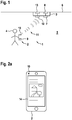
- Figure 1 shows a transmitter-receiver device 1 comprising a portable electronics module 2 as a transmitter and a stationary reporting module 3 as a receiver.
- the transmitter-receiver device 1 can include a plurality of portable electronic modules 2 as transmitters and a plurality of signaling modules 3 as receivers.
- the portable electronics module 2 as a transmitter is designed in particular to control the reporting module 3 and / or to interact with it.
- the portable electronics module 2 is preferably designed to exchange data with the reporting module 3.
- the portable electronic module 2 is designed for use by a person 4, the person 4 being able to carry the portable electronic module 2 with him, for example in a trouser pocket.
- the portable electronics module 2 preferably includes further functions that can be used by the person 4.
- the transmitter function represents only a secondary function of the portable electronics module 2.
- the portable electronics module 2 is, for example, a smartphone or a tablet computer.
- the reporting module 3 forms a receiver of the transmitter-receiver device 1.
- the reporting module 3 is, for example, a fire detector or a motion detector.
- the reporting module 3 is arranged in a monitoring area 5 in order to monitor it in terms of safety.
- the reporting module 3 is arranged on the ceiling 6 of the monitored area 5.
- the reporting module 3 comprises a detection device 7 which is designed to detect an event in the monitoring area 5.
- the detection device 7 is designed to be detected in the monitoring area 5 as a security-relevant event, such as a fire and / or a break-in.
- the detection device 7 is connected in terms of data technology to a control device 8, the detection device 7 being designed to provide a detected event in the monitoring area 5 as event data to the control device 8.
- the control device 8 is designed to set the reporting module 3 in an alarm state and / or in a normal state.
- the control device 8 is designed to set the reporting module 3 to the alarm state for a detected safety-relevant event in the monitoring area 5.
- the reporting module 3 is preferably in the normal state.
- the control device 8 sets the reporting module 3 to the alarm state, which corresponds to a false alarm.
- the false alarm is in particular and / or should in particular be able to be acknowledged by the person 4, the reporting module 3 being set from the alarm state to the normal state.
- the portable electronics module 2 comprises a coding unit 9.
- the coding unit 9 is designed to send the command to switch off the alarm state and or the command to switch from the alarm state to the normal state to a digital one To encode signal and / or a digital code.
- the portable electronics module comprises a light transmission unit 10, which is designed, for example, as a light-emitting diode.
- the light transmission unit 10 is connected to the coding unit 9 in terms of data.
- the light transmission unit 10 is designed to send and / or emit coded acknowledgment data in the form of a coded light signal 11.
- the coded acknowledgment data correspond in particular to acknowledgment data which, for example, include the command to change from the alarm state to the normal state, which were coded by the coding unit 9.
- the coded light signal 11 is, for example, a light signal with laterally fluctuating intensities of the radiation intensity, with a change in color composition over time and / or with a pattern that changes over time.
- the person 4 preferably positions himself so that the light-transmitting unit 10 is in direct line of sight to the reporting module 3.
- the reporting module 3 comprises a light receiving unit 12 which is designed to receive the coded light signal 11.
- the light receiving unit 12 is, for example, a photodiode.
- the light receiving unit 12 is designed to convert the coded light signal 11 into signal data, in particular electrical signal data, the electrical signal data being digital or analog electrical signals.
- the signal data of the light receiving unit 12 are provided to a decoding unit 13.
- the decoding unit 13 is in particular part of the message module 3.
- the decoding unit 13 is designed to decode the encoded light signal 11 received by the light receiving unit into decoded acknowledgment data.
- the decoded acknowledgment data include, in particular, the information that was sent by the portable electronics module 2 to the reporting module 3.
- the decoding unit 13 is connected to the control device 8 in terms of data.
- the control device 8 is designed to set the message module 3 from an alarm state to the normal state based on the decoded acknowledgment data, in particular when the decoded acknowledgment data includes the command to change from the alarm state to the normal state.
- FIG. 2a shows a detailed view of a portable electronic module 2 in a front view.
- the portable electronics module 2 is here a smartphone.
- the portable electronics module 2 comprises a light transmission unit 10, which is designed as an LED in this exemplary embodiment, the light transmission unit 10 having the actual function of a status display lamp of the portable electronics module 2.
- the portable electronics module 2 has a display unit 14.
- the display unit 14 is designed as a display, for example as an LCD or LED display.
- the display unit 14 is preferably used to display text and / or image information on the portable electronic module 2.
- the display unit 14 is designed as a controller and / or as an operating unit for operating the portable electronic module 2 by the person 4.
- the person 4 can For example, select a program and / or an application on the display unit, which encodes the information for acknowledging the alarm status of a message module 3, the acknowledgment data and provides the light transmitting unit 10 with data.
- the light transmitting unit 10 is designed to emit the coded acknowledgment data in the form of a coded light signal, the coded emitted light data being receivable by the light receiving unit 12 of the message module 3.
- FIG. 2b shows the portable electronics module 2 from FIG Figure 2a in a rear view.
- the portable electronics module 2 has a camera unit 15.
- the camera unit 15 furthermore has a camera lens 16 which is arranged on the rear side of the portable electronic module.
- the camera unit is used to record images by means of the portable electronics module 2.
- the camera unit 15 further comprises a light flash source 17, which can be used to record images by means of the camera unit in poor and / or dark lighting conditions. Contrary to the actual task as a flash of light in camera recordings, the light flash source 17 is designed to form the light transmitting unit 10.
- the light flash source 17 is connected to the coding unit 9 in terms of data, the coding unit 9 providing the coded acknowledgment data to the light flash source 17, the light flash source 17 being designed to emit the coded acknowledgment data in the form of a coded light signal.
- FIG. 2 shows the portable electronics module 2 from FIG Figures 2a and 2 B in a view in which the display unit 14 is at maximum brightness.
- the display unit 14 is designed in such a way that each pixel of the display unit 14 emits light with maximum intensity, preferably white light with maximum intensity.
- Figure 2d shows the portable electronics module Figure 2c , the display unit 14 being in a dark operating state here.
- the dark operating state of the display unit 14 is formed in particular by the fact that each pixel of the display unit 14 is present as a black pixel. It is thus possible for the display unit 14 to be connected to the coding unit 9 in terms of data technology, the display unit 14 being able to form the light transmitting unit 10, the coded light signal being emitted by the display unit 14, the display unit 14 for emitting the light signal 11 between light operating state and dark operating state changes.
- FIG. 3 shows a detailed view of a reporting module 3.
- the reporting module 3 comprises a housing 18, the reporting module 3 with the housing 18 being arranged on the ceiling 6 of the monitoring area 5.
- the reporting module 3 includes a radio interface 19 and an alarm output unit 20.
- the radio interface 19 is, for example, a WLAN, a Bluetooth or an infrared interface, the radio interface 19 being in particular for data purposes can be coupled to a radio interface of the portable electronics module 2.
- auxiliary data can be exchanged between the portable electronics module 2 and the message module 3, the auxiliary data including additional information for decoding and / or coding the acknowledgment data.
- the auxiliary data include the coding key and / or the decoding key.
- the radio interface 19 is connected to the decoding device 13 and / or the control device 8 in terms of data.
- the radio interface 19 provides the auxiliary data to the decoding device 13 and / or the control device 8.
- the alarm output unit 20 is connected in terms of data to the control device 8, the control device 8 providing and / or reporting the alarm state to the alarm output unit 20 in terms of data technology, the alarm output unit 20 being designed to output an acoustic and / or visual alarm in the alarm state. In the normal state, the alarm output unit 20 is in an idle state and does not output an acoustic alarm and / or a visual alarm.
Landscapes
- Physics & Mathematics (AREA)
- General Physics & Mathematics (AREA)
- Business, Economics & Management (AREA)
- Emergency Management (AREA)
- Engineering & Computer Science (AREA)
- Computer Security & Cryptography (AREA)
- Alarm Systems (AREA)
Description
- Bei einer Vielzahl von Peripheriegeräten, beispielsweise Brandmeldern, darf nach Vorschrift ein ausgelöster Alarm direkt am Melder zurückgesetzt werden, wenn mindestens eine Sichtverbindung zum Melder vorhanden ist. Das Zurücksetzen geschieht in der Regel mittels eines Druckknopfes, wobei der Druckknopf direkt am Melder verbaut ist. Da die Melder häufig an Decken eines Raumes montiert sind, ist es schwierig für eine Person, den Druckknopf ohne Weiteres und/oder ohne weitere Hilfsmittel zu erreichen.
- Die Druckschrift
DE 10 2012 201 589 A1 beschreibt einen Brandmelder mit einer Brandsensorikeinrichtung zur Detektion eines Brandes und zur Ausgabe eines Brandsignals, mit einer Umgebungssensoreinrichtung zur Detektion von Körpern in der Umgebung des Brandmelders und zur Ausgabe eines Umgebungssignals, mit einer Steuerungseinrichtung, welche in Abhängigkeit des Brandsignals einen Normalzustand und einen Alarmzustand des Brandmelders setzt, wobei der Brandmelder als eine Mensch-Maschine-Schnittstelle ausgebildet ist und die Steuerungseinrichtung prüft, ob das Umgebungssignal als eine Benutzereingabe zu werten ist. - Aus der Druckschrift
EP 2 555 176 A1 , die den nächstkommenden Stand der Technik bildet, ist eine Vorrichtung zum Erkennen von Bränden bekannt, wobei die Vorrichtung einen Infrarotempfänger zum Empfangen von Infrarotsignalen umfasst, mit denen ein Signalgeber deaktivierbar ist. - Im Rahmen der Erfindung wird eine Sender-Empfänger-Vorrichtung mit den Merkmalen des Anspruchs 1 vorgeschlagen. Ferner wird ein Verfahren zur berührungslosen Deaktivierung eines Alarmzustandes eines Meldemoduls mit den Merkmalen des Anspruchs 11 sowie ein Computerprogramm mit den Merkmalen des Anspruchs 12 vorgeschlagen. Bevorzugte und/oder vorteilhafte Ausführungsformen der Erfindung ergeben sich aus den Unteransprüchen, der nachfolgenden Beschreibung sowie den beigefügten Figuren.
- Im Rahmen der Erfindung wird eine Sender-Empfänger-Vorrichtung vorgeschlagen. Die Sender-Empfänger-Vorrichtung umfasst mindestens ein tragbares Elektronikmodul als Sender und mindestens ein Meldemodul als Empfänger. Das Meldemodul ist insbesondere ein stationäres Meldemodul und beispielsweise ein Peripheriegerät. Das Meldemodul ist vorzugsweise zur Alarmausgabe, insbesondere Ausgabe eines akustischen und/oder optischen Alarms, ausgebildet. Das Elektronikmodul ist insbesondere ein Handgerät für eine Person und/oder einen Benutzer. Vorzugsweise ist das Meldemodul als Empfänger ausgebildet, mit einer Mehrzahl an Sendern, insbesondere tragbaren Elektronikmodulen, zu interagieren und/oder koppelbar. Ferner ist das tragbare Elektronikmodul vorzugsweise ausgebildet, mit einer Mehrzahl an Meldemodulen zu interagieren und/oder koppelbar.
- Das Meldemodul ist in einem Überwachungsbereich anordenbar. Der Überwachungsbereich ist beispielsweise ein Gebäude, insbesondere ein Haus, eine Fabrik und/oder ein Flughafen. Das Meldemodul ist beispielsweise an der Wand und/oder an der Decke des Überwachungsbereiches anordenbar und/oder angeordnet. Das Meldemodul ist vorzugsweise ausgebildet, den Überwachungsbereich sicherheitstechnisch zu überwachen.
- Das Meldemodul umfasst eine Detektionseinrichtung und eine Steuereinrichtung. Vorzugsweise bilden Steuereinrichtung und Detektionseinrichtung eine gemeinsame zentrale Rechnereinrichtung. Detektionseinrichtung und Steuereinrichtung sind insbesondere datentechnisch miteinander verbunden. Die Detektionseinrichtung ist ausgebildet, ein Ereignis im Überwachungsbereich zu detektieren. Insbesondere umfasst die Detektionseinrichtung einen Sensor zum Erfassen des Ereignisses und eine Detektionsauswerteeinrichtung zur Bestimmung und Detektion des Ereignisses basierend auf den Sensordaten. Das Ereignis ist beispielsweise ein Brand, eine Bewegung, ein Wassereinbruch, ein Temperaturanstieg und/oder ein Einbruch im Überwachungsbereich.
- Die Detektionseinrichtung ist ausgebildet, das detektierte Ereignis der Steuereinrichtung datentechnisch als Ereignisdaten bereitzustellen. Insbesondere sind die Ereignisdaten digitale Daten, alternativ sind die Ereignisdaten analoge Daten. Vorzugsweise umfassen die Ereignisdaten Informationen zum Typ des Ereignisses, den Zeitpunkt des Ereignisses, eine Intensität des Ereignisses und/oder eine Pegelstärke des detektierten Ereignisses.
- Die Steuereinrichtung ist ausgebildet, das Meldemodul basierend auf den Ereignisdaten in einen Alarmzustand und in einen Normalzustand zu setzen. Solange von der Detektionseinrichtung kein Ereignis im Überwachungsbereich detektiert wird, wird davon ausgegangen, dass kein Ereignis im Überwachungsbereich vorliegt und somit das Meldemodul im Normalzustand ist und/oder gesetzt ist. Falls ein Ereignis im Überwachungsbereich durch die Detektionseinrichtung detektiert ist, wird das Meldemodul auf den Alarmzustand gesetzt. Als Reaktion auf das Setzen des Meldemoduls auf den Alarmzustand wird beispielsweise ein akustisches Alarmsignal ausgegeben und/oder eine Alarmmeldung, zum Beispiel über ein Netzwerk, insbesondere ein Sicherheitsnetzwerk, in eine Überwachungszentrale geleitet, die dann weitere Maßnahmen ergreifen kann.
- Das tragbare Elektronikmodul umfasst eine Codiereinheit und eine Lichtsendeeinheit. Die Codiereinheit ist vorzugsweise ein Mikrochip, eine Computereinheit oder eine datentechnische Anwendung. Die Codiereinheit ist ausgebildet, Quittierungsdaten zu codieren und der Lichtsendeeinheit bereitzustellen. Insbesondere ist die Codierungseinheit ausgebildet, Quittierungsdaten nach einem vorgegebenen und/oder einstellbaren Protokoll und/oder Codierungsschlüssel zu codieren. Die codierten Quittierungsdaten sind insbesondere digitale Daten. Vorzugsweise sind die Quittierungsdaten vom Benutzer bereitgestellt und/oder umfassen einen Befehl für die Steuereinrichtung zum Umschalten des Meldemoduls vom Alarmzustand in den Normalzustand.
- Die Lichtsendeeinheit ist ausgebildet, Licht abzustrahlen. Insbesondere ist die Lichtsendeeinheit eine gerichtete Lichtquelle, beispielsweise mit einer vorgegebenen Abstrahlrichtung. Die Lichtsendeeinheit ist eine Punktquelle und/oder eine flächige Lichtquelle. Die Lichtsendeeinheit ist ausgebildet, die codierten Quittierungsdaten als codiertes Lichtsignal auszugeben. Beispielsweise ist das codierte Lichtsignal ein Wechsel von Abstrahlen und nicht Abstrahlen von Licht, insbesondere An/Aus der Lichtquelle. Als codiertes Lichtsignal wird vorzugsweise die zeitliche Variation des Lichtsignals in der Intensität und/oder der Farbe des Lichtsignals verstanden. Alternativ und/oder ergänzend kann das codierte Lichtsignal eine bestimmte Form und/oder ein bestimmtes codiertes Muster sein.
- Das Meldemodul umfasst eine Lichtempfangseinheit und eine Decodierungseinheit. Beispielsweise umfasst die Decodierungseinheit die Lichtempfangseinheit. Die Lichtempfangseinheit ist beispielsweise eine Fotodiode und ist ausgebildet, Licht zu detektieren und als Signal auszugeben. Die Lichtempfangseinheit ist ausgebildet, das codierte Lichtsignal des tragbaren Elektronikmoduls zu empfangen. Ferner ist die Lichtempfangseinheit vorzugsweise ausgebildet, das empfangene codierte Lichtsignal in ein elektrisches Signal umzuwandeln, insbesondere in ein digitales oder analoges Signal umzuwandeln und der Detektionseinrichtung datentechnisch bereitzustellen. Die Decodierungseinheit ist beispielsweise eine Computereinrichtung, ein Computerchip oder eine Rechnereinheit. Die Decodierungseinheit ist ausgebildet, das von der Lichtempfangseinheit bereitgestellte codierte Lichtsignal zu decodieren und als Quittierungsdaten der Steuereinrichtung bereitzustellen. Erfindungsgemäß wird zum Decodieren des Lichtsignales derselbe Codierschlüssel verwendet, wie zur Codierung der Quittierungsdaten durch die Codierungseinheit. Insbesondere entsprechen die decodierten Quittierungsdaten den unquittierten Quittierungsdaten, die durch die Codierungseinheit codiert wurden.
- Das Steuermodul ist ausgebildet, das Meldemodul basierend auf den Quittierungsdaten vom Alarmzustand in den Normalzustand zu setzen. Insbesondere ist das Steuermodul ausgebildet, das Meldemodul nur für einen bestimmten Quittierungsdatensatz vom Alarmzustand in den Normalzustand zu setzen, wobei der Quittierungsdatensatz Teil der Quittierungsdaten ist und eine Anweisung und oder einen Befehl umfasst zum Setzen des Normalzustandes des Meldemoduls. Beispielsweise ist das Steuermodul ausgebildet, das Meldemodul vom Alarmzustand in den Normalzustand zu setzen, wenn die Quittierungsdaten die Information umfassen, dass kein Ereignis im Überwachungsbereich vorliegt und/oder dass es sich bei dem Ereignis um einen Fehlalarm handelt.
- Die Erfindung hat den Vorteil, dass eine Sender-Empfänger-Vorrichtung bereitgestellt wird, die das berührungslose Quittieren des Alarmes und/oder das berührungslose Zurücksetzen eines Meldemoduls in einem Überwachungsbereich ermöglichen. Insbesondere ist das Quittieren sicher gegenüber eine Fehlquittierung des Alarmes, da durch die Verwendung von tragbaren Elektronikmodulen beispielsweise nur ein bestimmter Personenkreis den Alarm quittieren kann.
- Erfindungsgemäß ist das codierte Lichtsignal ein Lichtsignal im sichtbaren Wellenlängenbereich. Vorzugsweise ist das Lichtsignal ein Lichtsignal einer thermischen Lichtquelle, alternativ und/oder ergänzend ist das Lichtsignal ein Lichtsignal einer nicht thermischen Lichtquelle. Vorzugsweise ist das Lichtsignal ein Weißlicht-Lichtsignal, alternativ ist das Lichtsignal ein Farblichtsignal, wie beispielsweise ein blaues oder rotes Lichtsignal.
- Das codierte Lichtsignal ist vorzugsweise ein Lichtsignal, welches basierend auf dem RC5, dem RC6, dem RECS80, dem NEC oder dem RCMM-Code codiert und/oder verschlüsselt wurde.
- Dieser Ausgestaltung liegt die Überlegung zugrunde, ein Lichtsignal und/oder eine Lichtquelle für die Sender-Empfänger-Vorrichtung zu verwenden, das speziell angepasst auf den Anwendungsbereich des Empfängers, insbesondere des Meldemoduls, angepasst ist.
- Eine Ausgestaltung der Erfindung sieht vor, dass das Meldemodul eine Funkschnittstelle aufweist und das tragbare Elektronikmodul eine Funkgegenschnittstelle aufweist. Vorzugsweise sind Funkschnittstelle und Funkgegenschnittstelle als WLAN-Schnittstelle, Bluetooth-Schnittstelle, IR-Schnittstelle oder anderweitige Funkschnittstelle ausgebildet. Insbesondere sind Funkschnittstelle und Funkgegenschnittstelle miteinander datentechnisch koppelbar, wobei mittels der datentechnischen Kopplung der Funkschnittstelle mit der Funkgegenschnittstelle Hilfsdaten austauschbar sind. Insbesondere sind die Hilfsdaten von Funkschnittstelle in Richtung Funkgegenschnittstelle und/oder von Funkgegenschnittstelle in Richtung Funkschnittstelle austauschbar. Die Hilfsdaten umfassen Informationen zur Verifikation eines Umschaltens des Meldemoduls vom Alarmzustand in den Normalzustand.
- Beispielsweise umfassen die Hilfsdaten die ID des Benutzers und/oder die ID des Elektronikmoduls, wobei beispielsweise das Steuermodul ausgebildet ist, das Meldemodul nur dann vom Alarmzustand in den Normalzustand zu schalten, wenn die ID des Benutzers und/oder die ID des Elektronikmoduls hinterlegt ist und/oder dazu berechtigt ist. Alternativ und/oder ergänzend umfassen die Hilfsdaten die ID des Melders, wobei beispielsweise die ID des Melders dazu benötigt wird, den Schlüssel und/oder das Protokoll zu generieren. Ferner ist es insbesondere möglich, dass die Hilfsdaten Informationen umfassen, dass das codierte Lichtsignal gesendet wird und/oder die Lichtquelle aktiv ist, sodass beispielsweise das Steuermodul ausgebildet ist, die Lichtempfangseinheit zum Empfangen des codierten Lichtsignals zu aktivieren. Dieser Ausgestaltung liegt die Überlegung zugrunde, eine Sende-Empfänger-Einrichtung bereitzustellen, welche die Falscherkennungsrate eines Abschaltens und/oder Quittierens eines Alarms reduziert.
- Besonders bevorzugt ist es, dass die Hilfsdaten Codierungs- und/oder Decodierungsinformationen umfassen. Beispielsweise umfassen die Hilfsdaten den Schlüssel, den Codierungsschlüssel und/oder das Protokoll zum Codieren und/oder Decodieren des Lichtsignals. Beispielsweise sind die Hilfsdaten ausgebildet, das Protokoll und/oder den Schlüssel von dem Meldemodul an das tragbare Elektronikmodul und/oder umgekehrt zu übergeben. Beispielsweise ist der Schlüssel und/oder das Protokoll ein dynamischer Schlüssel und/oder ein dynamisches Protokoll. Dieser Ausgestaltung liegt die Überlegung zugrunde, ein besonders angriffssicheres Codierungs- und/oder Decodierungsverfahren der Sender- Empfänger-Vorrichtung bereitzustellen.
- Das Meldemodul ist in einem Überwachungsbereich, beispielsweise einem Haus, anordenbar, insbesondere an einer Wand und/oder einer Decke des Überwachungsbereichs. Das Meldemodul umfasst eine Detektionseinrichtung und eine Steuereinrichtung. Die Detektionseinrichtung ist ausgebildet, ein Ereignis, beispielsweise einen Brand und/oder einen Einbruch, im Überwachungsbereich zu detektieren und der Steuereinrichtung das detektierte Ereignis als Ereignisdaten bereitzustellen. Das Meldemodul umfasst eine Lichtempfangseinheit und eine Decodierungseinheit. Vorzugsweise ist die Lichtempfangseinheit Teil der Decodierungseinheit. Die Lichtempfangseinheit ist eine fotosensitive Einrichtung, wie beispielsweise eine Fotodiode. Die Lichtempfangseinheit ist ausgebildet, ein codiertes Lichtsignal zu empfangen und der Detektionseinrichtung datentechnisch bereitzustellen. Insbesondere wird der Detektionseinrichtung das codierte Lichtsignal als analoges elektrisches Signal und/oder als digitales elektrisches Signal bereitgestellt. Die Decodierungseinheit ist ausgebildet, das Lichtsignal zu decodieren und als Quittierungsdaten der Steuereinrichtung bereitzustellen. Das Steuermodul ist ausgebildet, das Meldemodul basierend auf den Quittierungsdaten vom Alarmzustand in den Normalzustand zu setzen. Insbesondere ist das Steuermodul ausgebildet, das Meldemodul vom Alarmzustand in den Normalzustand zu setzen, für den Fall, dass die Quittierungsdaten Informationen umfassen, dass das detektierte Ereignis ein Fehlalarm ist und/oder Informationen, dass der Alarmzustand aktiv in den Normalzustand gesetzt werden soll. Dieser Erfindung liegt die Überlegung zugrunde, ein Meldemodul bereitzustellen, welches mittels einer Sendervorrichtung berührungslos von einem Alarmzustand in einen Normalzustand gesetzt werden kann, sodass ein Fehlalarm quittierbar ist.
- In einer besonders bevorzugten Ausgestaltung der Erfindung umfasst die Lichtempfangseinheit einen Tageslichtfilter.
- Der Tageslichtfilter ist insbesondere ausgebildet, Licht im Wellenlängenbereich außerhalb des sichtbaren Lichtbereiches herauszufiltern und nur Licht im sichtbaren Wellenlängenbereich passieren zu lassen.
- Dieser Ausgestaltung liegt die Überlegung zugrunde, ein Meldemodul bereitzustellen, das gegenüber dem Empfang von Lichtsignalen, die keine codierten Lichtsignale darstellen, unanfällig ist.
- In einer möglichen Ausgestaltung der Erfindung ist das Meldemodul ein Brandmelder und/oder ein Bewegungsmelder. Insbesondere ist das Meldemodul ein Rauchmelder, der basierend auf Rauchkenngrößen einen Brand im Überwachungsbereich detektieren kann. Ferner ist es möglich, dass das Meldemodul ein Brandmelder ist, der basierend auf Brandkenndaten, wie beispielsweise Lichtemission und/oder Temperaturanstieg, einen Brand im Überwachungsbereich detektiert. Ein als Bewegungsmelder ausgebildetes Meldemodul ist beispielsweise ausgebildet, Bewegungen im Überwachungsbereich zu detektieren und so beispielsweise einen unberechtigten Zutritt und/oder einen Einbruch zu detektieren.
- Das tragbare Elektronikmodul ist insbesondere für die Sender-Empfänger-Vorrichtung ausgebildet. Das tragbare Elektronikmodul umfasst eine Codierungseinheit und eine Lichtsendeeinheit. Die Codierungseinheit ist ausgebildet, Quittierungsdaten zu codieren und der Lichtsendeeinheit bereitzustellen. Die Lichtsendeeinheit ist ausgebildet, die codierten Quittierungsdaten als codiertes Lichtsignal auszugeben. Insbesondere ist das tragbare Elektronikmodul ausgebildet, ein codiertes Lichtsignal an ein Meldemodul zu schicken. Der Erfindung liegt die Überlegung zugrunde, ein tragbares Elektronikmodul bereitzustellen, das mit Meldemodulen koppelbar ist und codierte Lichtsignale zum Deaktivieren eines Meldemoduls ausgebildet ist. Insbesondere liegt der Erfindung die Überlegung zugrunde, ein tragbares Elektronikmodul bereitzustellen, das einem bestimmten Personenkreis ermöglicht, ein und/oder eine Vielzahl von Meldemodulen bei einem Fehlalarm zu deaktivieren.
- Besonders bevorzugt ist es, dass das tragbare Elektronikmodul eine LED und/oder OLED umfasst. Insbesondere ist die LED eine einfarbige LED. Alternativ und/oder ergänzend ist die LED eine RGB-LED. Die LED bildet insbesondere die Lichtsendeeinheit. Dieser Ausgestaltung liegt die Überlegung zugrunde, dass ein tragbares Elektronikmodul, welches beispielsweise eine Taschenlampenapplikation umfasst, als Deaktivierungsmodul eines Meldemoduls verwendbar ist.
- In einer besonders bevorzugten Ausgestaltung der Erfindung umfasst das Elektronikmodul eine Kameraeinheit zum Aufnehmen von Bildern. Die Kameraeinheit umfasst vorzugsweise eine CCD- oder eine CMOS-Kamera. Die Kamera umfasst ferner eine Lichtblitzquelle, wobei die Lichtblitzquelle ausgebildet ist, bei der Aufnahme von Bildern, insbesondere bei zu geringer Helligkeit der Umgebung, das aufzunehmende Objekt mit einem Lichtblitz zu erhellen. Die Lichtblitzquelle bildet vorzugsweise die Lichtsendeeinheit. Dieser Ausgestaltung liegt die Überlegung zugrunde, als tragbares Elektronikmodul elektronische Geräte verwenden zu können, deren prinzipiell gedachte Aufgabe in erster Linie die Aufnahme von Bildern ist.
- In einer möglichen Ausgestaltung der Erfindung umfasst das Elektronikmodul eine Anzeigeeinheit zur Darstellung von Text und/oder Bildern. Die Anzeigeeinheit ist insbesondere eine elektronische Anzeigeeinheit und beispielsweise eine LED-Anzeige, eine OLED-Anzeige und/oder eine LCD-Anzeige. Die Anzeigeeinheit bildet insbesondere die Lichtsendeeinheit, wobei das codierte Lichtsignal durch einen Wechsel zwischen einem hellen Betriebszustand der Anzeigeeinheit und einem dunklen Betriebszustand der Anzeigeeinheit gebildet wird. Beispielsweise ist der helle Betriebszustand eine weiße Anzeige der Anzeigeeinheit und der dunkle Betriebszustand eine schwarze Anzeige der Anzeigeeinheit. Dieser Ausgestaltung liegt die Überlegung zugrunde, statt einer Glühlampe und/oder einer LED als Lichtquelle eine Bildschirmanzeige und/oder ein Display eines tragbaren Elektronikmoduls zu verwenden, wobei so eine Vielzahl an Elektronikmodulen zur Deaktivierung eines Meldemoduls verwendbar ist.
- Besonders bevorzugt ist es, dass das tragbare Elektronikmodul ein Smartphone, ein Tablet-Computer, ein Phablet-Computer oder eine andere Art von mobiler Computer ist, wobei beispielsweise die Codierung des Lichtsignals als eine Applikation und/oder als ein Programm im Elektronikmodul hinterlegt ist. Ferner ist es möglich, dass das tragbare Elektronikmodul eine Fernbedienung zum Ansteuern eines Fernsehgerätes, einer Hi-Fi-Anlage und/oder eines anderen elektronischen Gerätes ist. Vorzugsweise bedient sich die Fernbedienung einem RC5-Code. Dieser Ausgestaltung liegt die Überlegung zugrunde, eine Möglichkeit zu schaffen, dass Meldemodule mit gängigen Elektronikgeräten abschaltbar im Falle eines Fehlalarmes sind.
- Einen weiteren Gegenstand der Erfindung bildet ein Verfahren zum berührungslosen Deaktivieren eines Alarmzustandes eines Meldemoduls. In einem ersten Schritt wird mit einem tragbaren Elektronikmodul ein codiertes Lichtsignal an das Meldemodul geschickt, wobei sich das Meldemodul vorzugsweise in einem Alarmzustand befindet. In einem weiteren Schritt des Verfahrens empfängt das Meldemodul das codierte Lichtsignal und stellt basierend auf dem codierten Lichtsignal Quittierungsdaten bereit. Insbesondere sind die Quittierungsdaten die Decodierung des codierten Lichtsignals. Das Verfahren sieht vor, dass basierend auf den Quittierungsdaten das Meldemodul vom Alarmzustand in den Normalzustand gesetzt werden kann und/oder gesetzt wird. Insbesondere wird verfahrensgemäß das Meldemodul dann vom Alarmzustand in den Normalzustand gesetzt, wenn die Quittierungsdaten den Befehl umfassen, dass das Meldemodul in den Normalzustand zu setzen ist und/oder dass der Alarmzustand einem Fehlalarm entspricht. Dieser Erfindung liegt die Überlegung zugrunde, ein Verfahren bereitzustellen, das auf eine schnelle und einfache Art und Weise es ermöglicht, ein Meldemodul bei einem Fehlalarm in einen Normalzustand zu setzen und so den Fehlalarm zu quittieren.
- Einen weiteren Gegenstand der Erfindung bildet ein Computerprogramm mit Programmmitteln. Das Computerprogramm sieht vor, dass alle Schritte zum Durchführen des Verfahrens zum berührungslosen Deaktivieren eines Alarmzustandes eines Meldemoduls durchgeführt werden, wenn das Programm auf einem Computer, dem tragbaren Elektronikmodul und/oder dem Meldemodul durchgeführt wird. Insbesondere ist das Computerprogramm beispielsweise eine Applikation für das tragbare Elektronikmodul, beispielsweise eine Applikation für ein Smartphone.
- Weitere Merkmale, Vorteile und Wirkungen der Erfindung ergeben sich aus der nachfolgenden Beschreibung eines der bevorzugten Ausführungsbeispiele der Erfindung sowie der Figuren. Dabei zeigen:
-
Figur 1 zeigt eine schematische Darstellung einer Sender-Empfänger-Vorrichtung; -
Figur 2a ,2b ,2c und2d zeigen eine schematische Detaildarstellung eines tragbaren Elektronikmoduls; -
Figur 3 zeigt eine schematische Detailansicht eines Meldemoduls. -
Figur 1 zeigt eine Sender-Empfänger-Vorrichtung 1 umfassend ein tragbares Elektronikmodul 2 als Sender und ein stationäres Meldemodul 3 als Empfänger. Insbesondere ist es möglich, dass die Sender-Empfänger-Vorrichtung 1 eine Mehrzahl an tragbaren Elektronikmodulen 2 als Sender und eine Mehrzahl an Meldemodulen 3 als Empfänger umfassen kann. Das tragbare Elektronikmodul 2 als Sender ist insbesondere ausgebildet, das Meldemodul 3 zu Steuern und/oder mit diesem zu interagieren. Vorzugsweise ist das tragbare Elektronikmodul 2 ausgebildet, mit dem Meldemodul 3 Daten auszutauschen. - Das tragbare Elektronikmodul 2 ist zur Benutzung durch eine Person 4 ausgebildet, wobei die Person 4 das tragbare Elektronikmodul 2 mit sich führen kann, beispielsweise in einer Hosentasche. Das tragbare Elektronikmodul 2 umfasst vorzugsweise neben der Senderfunktion für die Sender-Empfänger-Vorrichtung 1 weitere Funktionen, die durch die Person 4 nutzbar sind. Die Senderfunktion stellt insbesondere nur eine Nebenfunktion des tragbaren Elektronikmoduls 2 dar. Das tragbare Elektronikmodul 2 ist beispielsweise ein Smartphone oder ein Tablett-Computer.
- Das Meldemodul 3 bildet einen Empfänger der Sender-Empfänger-Vorrichtung 1. Das Meldemodul 3 ist beispielsweise ein Brandmelder oder ein Bewegungsmelder. Das Meldemodul 3 ist in einem Überwachungsbereich 5 angeordnet, um diesen sicherheitstechnisch zu überwachen. Insbesondere ist das Meldemodul 3 an der Decke 6 des Überwachungsbereichs 5 angeordnet. Das Meldemodul 3 umfasst eine Detektionseinrichtung 7, welche ausgebildet ist, ein Ereignis im Überwachungsbereich 5 zu detektieren. Insbesondere ist die Detektionseinrichtung 7 ausgebildet als sicherheitstechnisch relevantes Ereignis, wie beispielsweise einem Brand und/oder einem Einbruch, im Überwachungsbereich 5 zu detektieren. Die Detektionseinrichtung 7 ist datentechnisch mit einer Steuereinrichtung 8 verbunden, wobei die Detektionseinrichtung 7 ausgebildet ist, ein detektiertes Ereignis im Überwachungsbereich 5 als Ereignisdaten der Steuereinrichtung 8 bereitzustellen. Die Steuereinrichtung 8 ist ausgebildet, das Meldemodul 3 in einen Alarmzustand und/oder in einen Normalzustand zu setzen. Insbesondere ist die Steuereinrichtung 8 ausgebildet, das Meldemodul 3 für ein detektiertes sicherheitsrelevantes Ereignis im Überwachungsbereich 5, in den Alarmzustand zu setzen. Für den Fall, dass die Detektionseinrichtung 7 kein Ereignis im Überwachungsbereich 5 detektiert hat, befindet sich das Meldemodul 3 vorzugsweise im Normalzustand. Insbesondere ist es möglich, dass die Detektionseinrichtung 7 falscherweise etwas als ein sicherheitsrelevantes Ereignis im Überwachungsbereich 5 detektiert, und die Steuereinrichtung 8 darauf basierend das Meldemodul 3 in den Alarmzustand setzt, was einem Fehlalarm entspricht. Der Fehlalarm ist insbesondere und/oder soll insbesondere durch die Person 4 quittierbar sein, wobei das Meldemodul 3 von dem Alarmzustand in den Normalzustand gesetzt wird.
- Um das Meldemodul 3 vom Alarmzustand in den Normalzustand zu setzen, umfasst das tragbare Elektronikmodul 2 eine Codiereinheit 9. Die Codiereinheit 9 ist ausgebildet, den Befehl des Abschaltens des Alarmzustandes und oder den Befehl zum Wechsel vom Alarmzustand in den Normalzustand in ein digitales Signal und/oder einem digitalen Code zu codieren. Das tragbare Elektronikmodul umfasst eine Lichtsendeeinheit 10, die beispielsweise als eine Leuchtdiode ausgebildet ist. Die Lichtsendeeinheit 10 ist datentechnisch mit der Codierungseinheit 9 verbunden. Die Lichtsendeeinheit 10 ist ausgebildet, codierte Quittierungsdaten in Form eines codierten Lichtsignales 11 abzusenden und/oder abzustrahlen. Die codierten Quittierungsdaten entsprechen insbesondere Quittierungsdaten, die beispielsweise dem Befehl zum Wechsel von dem Alarmzustand in den Normalzustand umfassen, die durch die Codierungseinheit 9 codiert wurden. Das codierte Lichtsignal 11 ist beispielsweise ein Lichtsignal, mit seitlich schwankenden Intensitäten der Abstrahlintensität, mit einem zeitlichen Wechsel der Farbzusammensetzung und/oder mit einem zeitlich veränderlichen Muster. Zum Quittieren des Alarmzustandes des Meldemoduls 3, positioniert sich die Person 4 vorzugsweise so, dass die Lichtsendeeinheit 10 in direkter Sichtverbindung zum Meldemodul 3 ist.
- Das Meldemodul 3 umfasst eine Lichtempfangseinheit 12, die ausgebildet ist, dass codierte Lichtsignal 11 zu empfangen. Die Lichtempfangseinheit 12 ist beispielsweise eine Photodiode. Die Lichtempfangseinheit 12 ist ausgebildet, das codierte Lichtsignal 11 in Signaldaten, insbesondere elektrische Signaldaten umzuwandeln, wobei die elektrischen Signaldaten digitale oder analoge elektrische Signale sind. Die Signaldaten der Lichtempfangseinheit 12 werden einer Decodiereinheit 13 bereitgestellt. Die Decodiereinheit 13 ist insbesondere Teil des Meldemoduls 3. Die Decodiereinheit 13 ist ausgebildet, dass von der Lichtempfangseinheit empfangene codierte Lichtsignal 11 in decodierte Quittierungsdaten zu decodieren. Die decodierten Quittierungsdaten umfassen insbesondere die Information, die durch das tragbare Elektronikmodul 2 an das Meldemodul 3 gesendet wurde. Die Decodierungseinheit 13 ist datentechnisch mit der Steuereinrichtung 8 verbunden. Die Steuereinrichtung 8 ist ausgebildet, basierend auf den decodierten Quittierungsdaten das Meldemodul 3 von einem Alarmzustand in den Normalzustand zu setzen, insbesondere dann, wenn die decodierten Quittierungsdaten den Befehl zum Wechseln vom Alarmzustand in den Normalzustand umfasst.
-
Figur 2a zeigt eine Detailansicht eines tragbaren Elektronikmoduls 2 in einer Vorderansicht. Das tragbare Elektronikmodul 2 ist hierbei ein Smartphone. Das tragbare Elektronikmodul 2 umfasst eine Lichtsendeeinheit 10, die in diesem Ausführungsbeispiel als eine LED ausgebildet ist, wobei die Lichtsendeeinheit 10 die eigentliche Funktion einer Status-Anzeige-Leuchte des tragbaren Elektronikmoduls 2 aufweist. Das tragbare Elektronikmodul 2 weist eine Anzeigeeinheit 14 auf. Die Anzeigeeinheit 14 ist als ein Display ausgebildet, beispielsweise als ein LCD- oder LED-Display. Die Anzeigeeinheit 14 dient vorzugsweise zur Anzeige von Text und/oder Bildinformationen auf dem tragbaren Elektronikmodul 2. Insbesondere ist die Anzeigeeinheit 14 ausgebildet, als eine Steuerung und/oder als eine Bedieneinheit zum Bedienen des tragbaren Elektronikmoduls 2 durch die Person 4. Die Person 4 kann beispielsweise auf der Anzeigeeinheit ein Programm und/oder eine Applikation auswählen, welche die Information zum Quittieren des Alarmzustandes eines Meldemoduls 3 die Quittierungsdaten codiert und der Lichtsendeeinheit 10 datentechnisch bereitstellt. Die Lichtsendeeinheit 10 ist dabei ausgebildet, die codierten Quittierungsdaten in Form eines codierten Lichtsignales abzustrahlen, wobei die codierten abgestrahlten Lichtdaten von der Lichtempfangseinheit 12 des Meldemoduls 3 empfangbar sind. -
Figur 2b zeigt das tragbare Elektronikmodul 2 aus derFigur 2a in einer Rückansicht. Das tragbare Elektronikmodul 2 weist eine Kameraeinheit 15 auf. Die Kameraeinheit 15 weist ferner eine Kameralinse 16 auf, die auf der Rückseite des tragbaren Elektronikmoduls angeordnet ist. Die Kameraeinheit dient der Aufnahme von Bildern mittels des tragbaren Elektronikmoduls 2. Die Kameraeinheit 15 umfasst ferner eine Lichtblitzquelle 17, die zur Aufnahme von Bildern mittels der Kameraeinheit in schlechten und/oder dunklen Lichtverhältnissen herangezogen werden kann. Entgegen der eigentlichen Aufgabe als Lichtblitz bei Kameraaufnahmen, ist die -ichtblitzquelle 17 ausgebildet, die Lichtsendeeinheit 10 zu bilden. Dabei wird beispielsweise die Lichtblitzquelle 17 datentechnisch mit der Codiereinheit 9 verbunden, wobei die Codiereinheit 9 die codierten Quittierungsdaten der Lichtblitzquelle 17 bereitstellt, wobei die Lichtblitzequelle 17 ausgebildet ist, die codierten Quittierungsdaten in Form eines codierten Lichtsignales abzustrahlen. - Die
Figur 2c zeigt das tragbare Elektronikmodul 2 aus denFiguren 2a und2b in einer Ansicht, bei der die Anzeigeeinheit 14 in maximaler Helligkeit vorliegt. Die Anzeigeeinheit 14 ist dabei im Zustand der maximalen Helligkeit so ausgestaltet, dass jeder Bildpunkt der Anzeigeeinheit 14 Licht mit maximaler Intensität, vorzugsweise Weißlicht maximaler Intensität ausstrahlt. -
Figur 2d zeigt das tragbare Elektronikmodul ausFigur 2c , wobei die Anzeigeeinheit 14 hier in einem dunklen Betriebszustand vorliegt. Der dunkle Betriebszustand der Anzeigeeinheit 14 wird insbesondere dadurch gebildet, dass jeder Bildpunkt der Anzeigeeinheit 14 als schwarzer Bildpunkt vorliegt. Somit ist es möglich, dass die Anzeigeeinheit 14 datentechnisch mit der Codierungseinheit 9 verbunden ist, wobei die Anzeigeeinheit 14 hierbei die Lichtsendeeinheit 10 bilden kann, wobei das Abstrahlen des codierten Lichtsignals durch die Anzeigeeinheit 14 erfolgt, wobei die Anzeigeeinheit 14 zum Abstrahlen des Lichtsignals 11 zwischen hellem Betriebszustand und dunklem Betriebszustand wechselt. -
Figur 3 zeigt eine Detailansicht eines Meldemoduls 3. Das Meldemodul 3 umfasst ein Gehäuse 18, wobei das Meldemodul 3 mit dem Gehäuse 18 an der Decke 6 des Überwachungsbereiches 5 angeordnet ist. Neben der Decodiereinrichtung 13 der Steuereinrichtung 8 der Detektionseinrichtung 7 und der Lichtempfangseinheit 12 umfasst das Meldemodul 3 eine Funkschnittstelle 19 und eine Alarmausgabeeinheit 20. Die Funkschnittstelle 19 ist beispielsweise eine WLAN-, eine Bluetooth- oder eine Infrarot-Schnittstelle, wobei die Funkschnittstelle 19 insbesondere datentechnisch koppelbar mit einer Funkgegenschnittstelle des tragbaren Elektronikmoduls 2 ist. Mittels der Funkschnittstelle 19 sind zwischen dem tragbaren Elektronikmodul 2 und dem Meldemodul 3 Hilfsdaten austauschbar, wobei die Hilfsdaten Zusatzinformationen zum Decodieren und/oder Codieren der Quittierungsdaten umfassen. Beispielsweise umfassen die Hilfsdaten den Codierungsschlüssel und/oder den Decodierungsschlüssel. Die Funkschnittstelle 19 ist insbesondere datentechnisch mit der Decodierungseinrichtung 13 und/oder der Steuereinrichtung 8 verbunden. Die Funkschnittstelle 19 stellt dabei die Hilfsdaten der Decodierungseinrichtung 13 und/oder der Steuereinrichtung 8 bereit. - Die Alarmausgabeeinheit 20 ist datentechnisch mit der Steuereinrichtung 8 verbunden, wobei die Steuereinrichtung 8 den Alarmzustand datentechnisch der Alarmausgabeeinheit 20 bereitstellt und/oder meldet, wobei die Alarmausgabeeinheit 20 im Alarmzustand ausgebildet ist, einen akustischen und/oder optischen Alarm auszugeben. Im Normalzustand ist die Alarmausgabeeinheit 20 in einem Ruhezustand und gibt hierbei keinen akustischen Alarm und/oder keinen optischen Alarm aus.
Claims (12)
- Sender-Empfänger-Vorrichtung (1), umfassend ein tragbares Elektronikmodul (2) als Sender und ein Meldemodul (3) als Empfänger,
wobei das Meldemodul (3) in einem Überwachungsbereich (5) anordenbar ist und eine Detektionseinrichtung (7) und eine Steuereinrichtung (8) umfasst, wobei die Detektionseinrichtung (7) ausgebildet ist, ein Ereignis im Überwachungsbereich (5) zu detektieren und der Steuereinrichtung (8) das detektierte Ereignis als Ereignisdaten bereitzustellen,
wobei die Steuereinrichtung (8) ausgebildet ist, das Meldemodul (3) basierend auf den Ereignisdaten in einen Alarmzustand und einen Normalzustand zu setzen,
wobei das tragbare Elektronikmodul (2) eine Codierungseinheit (9) und eine Lichtsendeeinheit (10) umfasst, wobei die Codierungseinheit (9) ausgebildet ist, Quittierungsdaten nach einem Codierungsschlüssel zu codieren und der Lichtsendeeinheit (10) bereitzustellen, wobei die Lichtsendeeinheit (10) ausgebildet ist, die codierten Quittierungsdaten als codiertes Lichtsignal (11) auszugeben,
wobei das Meldemodul (3) eine Lichtempfangseinheit (12) und eine Decodierungseinheit (13) umfasst, wobei die Lichtempfangseinheit (12) ausgebildet ist, das codierte Lichtsignal (11) des tragbaren Elektronikmoduls (2) zu empfangen und der Decodierungseinheit (13) datentechnisch bereitzustellen,
wobei die Lichtsendeeinheit (10) ausgebildet ist, als codiertes Lichtsignal (11) ein Lichtsignal (11) im sichtbaren Wellenlängenbereich auszugeben,
wobei die Decodierungseinheit (13) ausgebildet ist das codierte Lichtsignal (11) zu decodieren und als Quittierungsdaten der Steuereinrichtung (8) bereitzustellen, wobei zum Decodieren des codierten Lichtsignals (11) derselbe Codierungsschlüssel verwendet wird, wie zur Codierung durch die Codierungseinheit (9),
wobei die Steuereinrichtung (8) ausgebildet ist, das Meldemodul (3) basierend auf den Quittierungsdaten vom Alarmzustand in den Normalzustand zu setzen. - Sender-Empfänger-Vorrichtung (1) nach Anspruch 1, dadurch gekennzeichnet, dass das Meldemodul (3) eine Funkschnittstelle (19) aufweist und das tragbare Elektronikmodul (2) eine Funkgegenschnittstelle aufweist, wobei Funkschnittstelle (19) und Funkgegenschnittstelle datentechnisch zum Austausch von Hilfsdaten koppelbar sind, wobei die Hilfsdaten Informationen zur Verifikation eines Umschaltens des Meldemoduls (3) vom Alarmzustand in den Normalzustand umfassen.
- Sender-Empfänger-Vorrichtung (1) nach Anspruch 2, dadurch gekennzeichnet, dass die Hilfsdaten Codierungs- und/oder Decodierungsinformationen umfassen.
- Sender-Empfänger-Vorrichtung (1) nach einem der vorhergehenden Ansprüche, dadurch gekennzeichnet, dass das tragbare Elektronikmodul (2) eine LED umfasst, wobei die LED die Lichtsendeeinheit (10) bildet.
- Sender-Empfänger-Vorrichtung (1) nach einem der vorhergehenden Ansprüche, dadurch gekennzeichnet, dass das Elektronikmodul (2) eine Kameraeinheit (15) zum Aufnehmen von Bildern umfasst, wobei die Kameraeinheit (15) eine Lichtblitzquelle (17) umfasst, wobei die Lichtblitzquelle (17) die Lichtsendeeinheit (10) bildet.
- Sender-Empfänger-Vorrichtung (1) nach einem der vorhergehenden Ansprüche, dadurch gekennzeichnet, dass das Elektronikmodul (2) eine Anzeigeeinheit (14) zur Darstellung von Text und/oder Bildern umfasst, wobei die Anzeigeeinheit (14) die Lichtsendeeinheit (10) bildet, wobei das codierte Lichtsignal (11) durch einen Wechsel zwischen hellem Betriebszustand und dunklen Betriebszuständen der Anzeigeeinheit (14) gebildet wird.
- Sender-Empfänger-Vorrichtung (1) nach einem der vorhergehenden Ansprüche, dadurch gekennzeichnet, dass das Elektronikmodul (2) ein Smartphone, Tablet-computer, Phablet-computer oder eine Fernbedienung zum Ansteuern eines Fernsehgerätes ist.
- Sender-Empfänger-Vorrichtung (1) nach Anspruch 1, dadurch gekennzeichnet, dass die Lichtempfangseinheit (12) einen Tageslichtfilter umfasst.
- Sender-Empfänger-Vorrichtung (1) nach Anspruch 8, dadurch gekennzeichnet, dass der Tageslichtfilter ausgebildet ist, Licht in einem Wellenlängenbereich außerhalb des sichtbaren Lichtbereiches herauszufiltern.
- Sender-Empfänger-Vorrichtung (1) nach Anspruch 1, dadurch gekennzeichnet, dass das Meldemodul (3) ein Brandmelder oder ein Bewegungsmelder ist.
- Verfahren zum berührungslosen Deaktivieren eines Alarmzustandes eines Meldemoduls (3), wobei mit einem tragbaren Elektronikmodul (2) ein, nach einem Codierungsschlüssel codiertes Lichtsignal (11) an das Meldemodul (3) geschickt wird,
wobei das codierte Lichtsignal (11) ein Lichtsignal (11) im sichtbaren Wellenlängenbereich ist,
wobei das Meldemodul (3) das codierte Lichtsignal (11) empfängt, decodiert und basierend auf dem Lichtsignal (11) Quittierungsdaten bereitstellt, wobei zum Decodieren des codierten Lichtsignals (11) derselbe Codierungsschlüssel verwendet wird, wie zur Codierung des Lichtsignals (11),
wobei das Meldemodul (3) basierend auf den Quittierungsdaten vom Alarmzustand in den Normalzustand gesetzt werden kann und/oder wird. - Computerprogramm mit Programmcodemitteln, um alle Schritte des Verfahrens nach Anspruch 11 durchzuführen, wenn das Programm auf einem Computerausgeführt wird.
Applications Claiming Priority (1)
| Application Number | Priority Date | Filing Date | Title |
|---|---|---|---|
| DE102016226133.9A DE102016226133A1 (de) | 2016-12-23 | 2016-12-23 | Sender-Empfänger-Vorrichtung, Meldemodul, tragbares Elektronikmodul, Verfahren zum berührungslosen Deaktivieren eines Alarmzustandes eines Meldemoduls und Computerprogramm |
Publications (2)
| Publication Number | Publication Date |
|---|---|
| EP3340199A1 EP3340199A1 (de) | 2018-06-27 |
| EP3340199B1 true EP3340199B1 (de) | 2021-02-17 |
Family
ID=60673580
Family Applications (1)
| Application Number | Title | Priority Date | Filing Date |
|---|---|---|---|
| EP17207362.9A Active EP3340199B1 (de) | 2016-12-23 | 2017-12-14 | Sender-empfänger-vorrichtung, meldemodul, verfahren zum berührungslosen deaktivieren eines alarmzustandes eines meldemoduls und computerprogramm |
Country Status (2)
| Country | Link |
|---|---|
| EP (1) | EP3340199B1 (de) |
| DE (1) | DE102016226133A1 (de) |
Families Citing this family (1)
| Publication number | Priority date | Publication date | Assignee | Title |
|---|---|---|---|---|
| DE102022105018A1 (de) * | 2022-03-03 | 2023-09-07 | TRUMPF Werkzeugmaschinen SE + Co. KG | Verfahren und System zur Freigabe einer sicherheitskritischen Funktion einer Maschine |
Family Cites Families (5)
| Publication number | Priority date | Publication date | Assignee | Title |
|---|---|---|---|---|
| CA2625923A1 (en) * | 2005-10-12 | 2007-04-19 | Global Zone, Llc | Smoke detector with remote alarm silencing means |
| GB2484288A (en) * | 2010-10-04 | 2012-04-11 | Thorn Security | Isolator Circuit for detector |
| DE202011050908U1 (de) * | 2011-08-04 | 2011-10-11 | Atral- Secal Gmbh | Vorrichtung zum Erkennen von Bränden |
| DE102012201589A1 (de) | 2012-02-03 | 2013-08-08 | Robert Bosch Gmbh | Brandmelder mit Mensch-Maschinen-Schnittstelle sowie Verfahren zur Steuerung des Brandmelders |
| EP3091516A1 (de) * | 2015-05-06 | 2016-11-09 | Siemens Schweiz AG | Offener streulichtrauchmelder sowie mobiles kommunikationsgerät für einen derartigen offenen streulichtrauchmelder zum empfang von melderdaten und zum senden von update-daten |
-
2016
- 2016-12-23 DE DE102016226133.9A patent/DE102016226133A1/de not_active Withdrawn
-
2017
- 2017-12-14 EP EP17207362.9A patent/EP3340199B1/de active Active
Non-Patent Citations (1)
| Title |
|---|
| None * |
Also Published As
| Publication number | Publication date |
|---|---|
| EP3340199A1 (de) | 2018-06-27 |
| DE102016226133A1 (de) | 2018-06-28 |
Similar Documents
| Publication | Publication Date | Title |
|---|---|---|
| US10909825B2 (en) | Outdoor security systems and methods | |
| KR200453992Y1 (ko) | 위험 경보 장치 및 이를 이용한 경보 시스템 | |
| US20160150135A1 (en) | Multifunctional home monitoring system combined with lighting device | |
| KR101637007B1 (ko) | 위급상황 모니터링 시스템 | |
| CN106887110A (zh) | 结合照明装置多功能的居家监控系统 | |
| US20150130609A1 (en) | Security condition notification system | |
| KR20210010703A (ko) | 지하 주차장 사고 관리 시스템 및 이를 이용한 사고 관리 방법 | |
| JP2020098574A (ja) | 緊急事態通知システム | |
| EP3340199B1 (de) | Sender-empfänger-vorrichtung, meldemodul, verfahren zum berührungslosen deaktivieren eines alarmzustandes eines meldemoduls und computerprogramm | |
| US20110080292A1 (en) | Security Device and Security System | |
| KR100945857B1 (ko) | 멀티 소방 피난 유도장치 | |
| WO2017102999A1 (de) | Alarmvorrichtung | |
| KR102019287B1 (ko) | 엘이디등의 개별 및 그룹 제어장치 | |
| KR101964744B1 (ko) | 가시광선 조명과 적외선 조명 일체형 cctv 카메라 시스템 | |
| DE202015105334U1 (de) | Modular aufgebaute in ein Gehäuse integrierte Sicherheitsleuchte | |
| JP4418292B2 (ja) | 監視カメラシステム | |
| US20130155232A1 (en) | Surveillance camera, surveillance system and method for configuring an or the surveillance camera | |
| CN204442568U (zh) | 一种可视门铃对讲机 | |
| KR101879505B1 (ko) | 기상 조건에 대응하여 가변하는 감성 색상을 표출할 수 있는 조명부를 갖는 가정용 cctv | |
| DE102014220553A1 (de) | Multifunktionseinheit und Objektüberwachungssystem | |
| KR100946180B1 (ko) | 무인 자가 방범 시스템 | |
| KR101965961B1 (ko) | 레이더 led센서등을 이용한 고독사 감지 시스템 | |
| DE102016224330B4 (de) | Leuchte mit einem konfigurierbaren Sensor, mobile Vorrichtung zur Konfiguration und Kommissionierung des Sensors mittels Lichtsignalen | |
| US20180350215A1 (en) | Multi-functional network camera control apparatus | |
| WO2021138509A1 (en) | Outdoor security systems and methods |
Legal Events
| Date | Code | Title | Description |
|---|---|---|---|
| PUAI | Public reference made under article 153(3) epc to a published international application that has entered the european phase |
Free format text: ORIGINAL CODE: 0009012 |
|
| STAA | Information on the status of an ep patent application or granted ep patent |
Free format text: STATUS: THE APPLICATION HAS BEEN PUBLISHED |
|
| AK | Designated contracting states |
Kind code of ref document: A1 Designated state(s): AL AT BE BG CH CY CZ DE DK EE ES FI FR GB GR HR HU IE IS IT LI LT LU LV MC MK MT NL NO PL PT RO RS SE SI SK SM TR |
|
| AX | Request for extension of the european patent |
Extension state: BA ME |
|
| STAA | Information on the status of an ep patent application or granted ep patent |
Free format text: STATUS: REQUEST FOR EXAMINATION WAS MADE |
|
| 17P | Request for examination filed |
Effective date: 20190102 |
|
| RBV | Designated contracting states (corrected) |
Designated state(s): AL AT BE BG CH CY CZ DE DK EE ES FI FR GB GR HR HU IE IS IT LI LT LU LV MC MK MT NL NO PL PT RO RS SE SI SK SM TR |
|
| STAA | Information on the status of an ep patent application or granted ep patent |
Free format text: STATUS: EXAMINATION IS IN PROGRESS |
|
| 17Q | First examination report despatched |
Effective date: 20190625 |
|
| RAP1 | Party data changed (applicant data changed or rights of an application transferred) |
Owner name: ROBERT BOSCH GMBH |
|
| RIC1 | Information provided on ipc code assigned before grant |
Ipc: G08B 29/04 20060101ALI20200520BHEP Ipc: G08B 17/00 20060101AFI20200520BHEP Ipc: G08B 25/00 20060101ALN20200520BHEP |
|
| GRAP | Despatch of communication of intention to grant a patent |
Free format text: ORIGINAL CODE: EPIDOSNIGR1 |
|
| STAA | Information on the status of an ep patent application or granted ep patent |
Free format text: STATUS: GRANT OF PATENT IS INTENDED |
|
| RIC1 | Information provided on ipc code assigned before grant |
Ipc: G08B 25/00 20060101ALN20200616BHEP Ipc: G08B 29/04 20060101ALI20200616BHEP Ipc: G08B 17/00 20060101AFI20200616BHEP |
|
| RIC1 | Information provided on ipc code assigned before grant |
Ipc: G08B 25/00 20060101ALN20200626BHEP Ipc: G08B 29/04 20060101ALI20200626BHEP Ipc: G08B 17/00 20060101AFI20200626BHEP |
|
| INTG | Intention to grant announced |
Effective date: 20200717 |
|
| GRAS | Grant fee paid |
Free format text: ORIGINAL CODE: EPIDOSNIGR3 |
|
| GRAA | (expected) grant |
Free format text: ORIGINAL CODE: 0009210 |
|
| STAA | Information on the status of an ep patent application or granted ep patent |
Free format text: STATUS: THE PATENT HAS BEEN GRANTED |
|
| AK | Designated contracting states |
Kind code of ref document: B1 Designated state(s): AL AT BE BG CH CY CZ DE DK EE ES FI FR GB GR HR HU IE IS IT LI LT LU LV MC MK MT NL NO PL PT RO RS SE SI SK SM TR |
|
| REG | Reference to a national code |
Ref country code: GB Ref legal event code: FG4D Free format text: NOT ENGLISH |
|
| REG | Reference to a national code |
Ref country code: CH Ref legal event code: EP |
|
| REG | Reference to a national code |
Ref country code: DE Ref legal event code: R096 Ref document number: 502017009332 Country of ref document: DE |
|
| REG | Reference to a national code |
Ref country code: AT Ref legal event code: REF Ref document number: 1362497 Country of ref document: AT Kind code of ref document: T Effective date: 20210315 |
|
| REG | Reference to a national code |
Ref country code: IE Ref legal event code: FG4D Free format text: LANGUAGE OF EP DOCUMENT: GERMAN |
|
| REG | Reference to a national code |
Ref country code: LT Ref legal event code: MG9D |
|
| REG | Reference to a national code |
Ref country code: NL Ref legal event code: MP Effective date: 20210217 |
|
| PG25 | Lapsed in a contracting state [announced via postgrant information from national office to epo] |
Ref country code: GR Free format text: LAPSE BECAUSE OF FAILURE TO SUBMIT A TRANSLATION OF THE DESCRIPTION OR TO PAY THE FEE WITHIN THE PRESCRIBED TIME-LIMIT Effective date: 20210518 Ref country code: FI Free format text: LAPSE BECAUSE OF FAILURE TO SUBMIT A TRANSLATION OF THE DESCRIPTION OR TO PAY THE FEE WITHIN THE PRESCRIBED TIME-LIMIT Effective date: 20210217 Ref country code: HR Free format text: LAPSE BECAUSE OF FAILURE TO SUBMIT A TRANSLATION OF THE DESCRIPTION OR TO PAY THE FEE WITHIN THE PRESCRIBED TIME-LIMIT Effective date: 20210217 Ref country code: NO Free format text: LAPSE BECAUSE OF FAILURE TO SUBMIT A TRANSLATION OF THE DESCRIPTION OR TO PAY THE FEE WITHIN THE PRESCRIBED TIME-LIMIT Effective date: 20210517 Ref country code: PT Free format text: LAPSE BECAUSE OF FAILURE TO SUBMIT A TRANSLATION OF THE DESCRIPTION OR TO PAY THE FEE WITHIN THE PRESCRIBED TIME-LIMIT Effective date: 20210617 Ref country code: BG Free format text: LAPSE BECAUSE OF FAILURE TO SUBMIT A TRANSLATION OF THE DESCRIPTION OR TO PAY THE FEE WITHIN THE PRESCRIBED TIME-LIMIT Effective date: 20210517 Ref country code: LT Free format text: LAPSE BECAUSE OF FAILURE TO SUBMIT A TRANSLATION OF THE DESCRIPTION OR TO PAY THE FEE WITHIN THE PRESCRIBED TIME-LIMIT Effective date: 20210217 |
|
| PG25 | Lapsed in a contracting state [announced via postgrant information from national office to epo] |
Ref country code: RS Free format text: LAPSE BECAUSE OF FAILURE TO SUBMIT A TRANSLATION OF THE DESCRIPTION OR TO PAY THE FEE WITHIN THE PRESCRIBED TIME-LIMIT Effective date: 20210217 Ref country code: PL Free format text: LAPSE BECAUSE OF FAILURE TO SUBMIT A TRANSLATION OF THE DESCRIPTION OR TO PAY THE FEE WITHIN THE PRESCRIBED TIME-LIMIT Effective date: 20210217 Ref country code: LV Free format text: LAPSE BECAUSE OF FAILURE TO SUBMIT A TRANSLATION OF THE DESCRIPTION OR TO PAY THE FEE WITHIN THE PRESCRIBED TIME-LIMIT Effective date: 20210217 Ref country code: NL Free format text: LAPSE BECAUSE OF FAILURE TO SUBMIT A TRANSLATION OF THE DESCRIPTION OR TO PAY THE FEE WITHIN THE PRESCRIBED TIME-LIMIT Effective date: 20210217 Ref country code: SE Free format text: LAPSE BECAUSE OF FAILURE TO SUBMIT A TRANSLATION OF THE DESCRIPTION OR TO PAY THE FEE WITHIN THE PRESCRIBED TIME-LIMIT Effective date: 20210217 |
|
| PG25 | Lapsed in a contracting state [announced via postgrant information from national office to epo] |
Ref country code: IS Free format text: LAPSE BECAUSE OF FAILURE TO SUBMIT A TRANSLATION OF THE DESCRIPTION OR TO PAY THE FEE WITHIN THE PRESCRIBED TIME-LIMIT Effective date: 20210617 |
|
| PG25 | Lapsed in a contracting state [announced via postgrant information from national office to epo] |
Ref country code: CZ Free format text: LAPSE BECAUSE OF FAILURE TO SUBMIT A TRANSLATION OF THE DESCRIPTION OR TO PAY THE FEE WITHIN THE PRESCRIBED TIME-LIMIT Effective date: 20210217 Ref country code: EE Free format text: LAPSE BECAUSE OF FAILURE TO SUBMIT A TRANSLATION OF THE DESCRIPTION OR TO PAY THE FEE WITHIN THE PRESCRIBED TIME-LIMIT Effective date: 20210217 Ref country code: SM Free format text: LAPSE BECAUSE OF FAILURE TO SUBMIT A TRANSLATION OF THE DESCRIPTION OR TO PAY THE FEE WITHIN THE PRESCRIBED TIME-LIMIT Effective date: 20210217 |
|
| REG | Reference to a national code |
Ref country code: DE Ref legal event code: R097 Ref document number: 502017009332 Country of ref document: DE |
|
| PG25 | Lapsed in a contracting state [announced via postgrant information from national office to epo] |
Ref country code: RO Free format text: LAPSE BECAUSE OF FAILURE TO SUBMIT A TRANSLATION OF THE DESCRIPTION OR TO PAY THE FEE WITHIN THE PRESCRIBED TIME-LIMIT Effective date: 20210217 Ref country code: SK Free format text: LAPSE BECAUSE OF FAILURE TO SUBMIT A TRANSLATION OF THE DESCRIPTION OR TO PAY THE FEE WITHIN THE PRESCRIBED TIME-LIMIT Effective date: 20210217 Ref country code: DK Free format text: LAPSE BECAUSE OF FAILURE TO SUBMIT A TRANSLATION OF THE DESCRIPTION OR TO PAY THE FEE WITHIN THE PRESCRIBED TIME-LIMIT Effective date: 20210217 |
|
| PLBE | No opposition filed within time limit |
Free format text: ORIGINAL CODE: 0009261 |
|
| STAA | Information on the status of an ep patent application or granted ep patent |
Free format text: STATUS: NO OPPOSITION FILED WITHIN TIME LIMIT |
|
| 26N | No opposition filed |
Effective date: 20211118 |
|
| PG25 | Lapsed in a contracting state [announced via postgrant information from national office to epo] |
Ref country code: ES Free format text: LAPSE BECAUSE OF FAILURE TO SUBMIT A TRANSLATION OF THE DESCRIPTION OR TO PAY THE FEE WITHIN THE PRESCRIBED TIME-LIMIT Effective date: 20210217 Ref country code: AL Free format text: LAPSE BECAUSE OF FAILURE TO SUBMIT A TRANSLATION OF THE DESCRIPTION OR TO PAY THE FEE WITHIN THE PRESCRIBED TIME-LIMIT Effective date: 20210217 |
|
| PG25 | Lapsed in a contracting state [announced via postgrant information from national office to epo] |
Ref country code: SI Free format text: LAPSE BECAUSE OF FAILURE TO SUBMIT A TRANSLATION OF THE DESCRIPTION OR TO PAY THE FEE WITHIN THE PRESCRIBED TIME-LIMIT Effective date: 20210217 |
|
| PG25 | Lapsed in a contracting state [announced via postgrant information from national office to epo] |
Ref country code: IT Free format text: LAPSE BECAUSE OF FAILURE TO SUBMIT A TRANSLATION OF THE DESCRIPTION OR TO PAY THE FEE WITHIN THE PRESCRIBED TIME-LIMIT Effective date: 20210217 |
|
| PG25 | Lapsed in a contracting state [announced via postgrant information from national office to epo] |
Ref country code: IS Free format text: LAPSE BECAUSE OF FAILURE TO SUBMIT A TRANSLATION OF THE DESCRIPTION OR TO PAY THE FEE WITHIN THE PRESCRIBED TIME-LIMIT Effective date: 20210617 |
|
| PG25 | Lapsed in a contracting state [announced via postgrant information from national office to epo] |
Ref country code: MC Free format text: LAPSE BECAUSE OF FAILURE TO SUBMIT A TRANSLATION OF THE DESCRIPTION OR TO PAY THE FEE WITHIN THE PRESCRIBED TIME-LIMIT Effective date: 20210217 |
|
| REG | Reference to a national code |
Ref country code: CH Ref legal event code: PL |
|
| REG | Reference to a national code |
Ref country code: BE Ref legal event code: MM Effective date: 20211231 |
|
| PG25 | Lapsed in a contracting state [announced via postgrant information from national office to epo] |
Ref country code: LU Free format text: LAPSE BECAUSE OF NON-PAYMENT OF DUE FEES Effective date: 20211214 Ref country code: IE Free format text: LAPSE BECAUSE OF NON-PAYMENT OF DUE FEES Effective date: 20211214 |
|
| PG25 | Lapsed in a contracting state [announced via postgrant information from national office to epo] |
Ref country code: BE Free format text: LAPSE BECAUSE OF NON-PAYMENT OF DUE FEES Effective date: 20211231 |
|
| PG25 | Lapsed in a contracting state [announced via postgrant information from national office to epo] |
Ref country code: LI Free format text: LAPSE BECAUSE OF NON-PAYMENT OF DUE FEES Effective date: 20211231 Ref country code: CH Free format text: LAPSE BECAUSE OF NON-PAYMENT OF DUE FEES Effective date: 20211231 |
|
| PG25 | Lapsed in a contracting state [announced via postgrant information from national office to epo] |
Ref country code: HU Free format text: LAPSE BECAUSE OF FAILURE TO SUBMIT A TRANSLATION OF THE DESCRIPTION OR TO PAY THE FEE WITHIN THE PRESCRIBED TIME-LIMIT; INVALID AB INITIO Effective date: 20171214 |
|
| PG25 | Lapsed in a contracting state [announced via postgrant information from national office to epo] |
Ref country code: CY Free format text: LAPSE BECAUSE OF FAILURE TO SUBMIT A TRANSLATION OF THE DESCRIPTION OR TO PAY THE FEE WITHIN THE PRESCRIBED TIME-LIMIT Effective date: 20210217 |
|
| REG | Reference to a national code |
Ref country code: AT Ref legal event code: MM01 Ref document number: 1362497 Country of ref document: AT Kind code of ref document: T Effective date: 20221214 |
|
| PG25 | Lapsed in a contracting state [announced via postgrant information from national office to epo] |
Ref country code: AT Free format text: LAPSE BECAUSE OF NON-PAYMENT OF DUE FEES Effective date: 20221214 |
|
| PG25 | Lapsed in a contracting state [announced via postgrant information from national office to epo] |
Ref country code: MK Free format text: LAPSE BECAUSE OF FAILURE TO SUBMIT A TRANSLATION OF THE DESCRIPTION OR TO PAY THE FEE WITHIN THE PRESCRIBED TIME-LIMIT Effective date: 20210217 Ref country code: AT Free format text: LAPSE BECAUSE OF NON-PAYMENT OF DUE FEES Effective date: 20221214 |
|
| PG25 | Lapsed in a contracting state [announced via postgrant information from national office to epo] |
Ref country code: TR Free format text: LAPSE BECAUSE OF FAILURE TO SUBMIT A TRANSLATION OF THE DESCRIPTION OR TO PAY THE FEE WITHIN THE PRESCRIBED TIME-LIMIT Effective date: 20210217 |
|
| PG25 | Lapsed in a contracting state [announced via postgrant information from national office to epo] |
Ref country code: MT Free format text: LAPSE BECAUSE OF FAILURE TO SUBMIT A TRANSLATION OF THE DESCRIPTION OR TO PAY THE FEE WITHIN THE PRESCRIBED TIME-LIMIT Effective date: 20210217 |
|
| PGFP | Annual fee paid to national office [announced via postgrant information from national office to epo] |
Ref country code: GB Payment date: 20251218 Year of fee payment: 9 |
|
| PGFP | Annual fee paid to national office [announced via postgrant information from national office to epo] |
Ref country code: FR Payment date: 20251218 Year of fee payment: 9 |
|
| PGFP | Annual fee paid to national office [announced via postgrant information from national office to epo] |
Ref country code: DE Payment date: 20260223 Year of fee payment: 9 |
|
| PGFP | Annual fee paid to national office [announced via postgrant information from national office to epo] |
Ref country code: AT Payment date: 20260410 Year of fee payment: 5 |