EP3341304B1 - Beutel - Google Patents
Beutel Download PDFInfo
- Publication number
- EP3341304B1 EP3341304B1 EP16756707.2A EP16756707A EP3341304B1 EP 3341304 B1 EP3341304 B1 EP 3341304B1 EP 16756707 A EP16756707 A EP 16756707A EP 3341304 B1 EP3341304 B1 EP 3341304B1
- Authority
- EP
- European Patent Office
- Prior art keywords
- outlet
- cavity
- sachet
- outlet tunnel
- tunnel
- Prior art date
- Legal status (The legal status is an assumption and is not a legal conclusion. Google has not performed a legal analysis and makes no representation as to the accuracy of the status listed.)
- Active
Links
Images

Classifications
-
- B—PERFORMING OPERATIONS; TRANSPORTING
- B65—CONVEYING; PACKING; STORING; HANDLING THIN OR FILAMENTARY MATERIAL
- B65D—CONTAINERS FOR STORAGE OR TRANSPORT OF ARTICLES OR MATERIALS, e.g. BAGS, BARRELS, BOTTLES, BOXES, CANS, CARTONS, CRATES, DRUMS, JARS, TANKS, HOPPERS, FORWARDING CONTAINERS; ACCESSORIES, CLOSURES, OR FITTINGS THEREFOR; PACKAGING ELEMENTS; PACKAGES
- B65D75/00—Packages comprising articles or materials partially or wholly enclosed in strips, sheets, blanks, tubes or webs of flexible sheet material, e.g. in folded wrappers
- B65D75/52—Details
- B65D75/58—Opening or contents-removing devices added or incorporated during package manufacture
- B65D75/5805—Opening or contents-removing devices added or incorporated during package manufacture for tearing a side strip parallel and next to the edge, e.g. by means of a line of weakness
- B65D75/5811—Opening or contents-removing devices added or incorporated during package manufacture for tearing a side strip parallel and next to the edge, e.g. by means of a line of weakness and defining, after tearing, a small dispensing spout, a small orifice or the like
-
- A—HUMAN NECESSITIES
- A61—MEDICAL OR VETERINARY SCIENCE; HYGIENE
- A61J—CONTAINERS SPECIALLY ADAPTED FOR MEDICAL OR PHARMACEUTICAL PURPOSES; DEVICES OR METHODS SPECIALLY ADAPTED FOR BRINGING PHARMACEUTICAL PRODUCTS INTO PARTICULAR PHYSICAL OR ADMINISTERING FORMS; DEVICES FOR ADMINISTERING FOOD OR MEDICINES ORALLY; BABY COMFORTERS; DEVICES FOR RECEIVING SPITTLE
- A61J1/00—Containers specially adapted for medical or pharmaceutical purposes
- A61J1/03—Containers specially adapted for medical or pharmaceutical purposes for pills or tablets
-
- B—PERFORMING OPERATIONS; TRANSPORTING
- B65—CONVEYING; PACKING; STORING; HANDLING THIN OR FILAMENTARY MATERIAL
- B65D—CONTAINERS FOR STORAGE OR TRANSPORT OF ARTICLES OR MATERIALS, e.g. BAGS, BARRELS, BOTTLES, BOXES, CANS, CARTONS, CRATES, DRUMS, JARS, TANKS, HOPPERS, FORWARDING CONTAINERS; ACCESSORIES, CLOSURES, OR FITTINGS THEREFOR; PACKAGING ELEMENTS; PACKAGES
- B65D75/00—Packages comprising articles or materials partially or wholly enclosed in strips, sheets, blanks, tubes or webs of flexible sheet material, e.g. in folded wrappers
- B65D75/28—Articles or materials wholly enclosed in composite wrappers, i.e. wrappers formed by associating or interconnecting two or more sheets or blanks
- B65D75/30—Articles or materials enclosed between two opposed sheets or blanks having their margins united, e.g. by pressure-sensitive adhesive, crimping, heat-sealing, or welding
-
- B—PERFORMING OPERATIONS; TRANSPORTING
- B65—CONVEYING; PACKING; STORING; HANDLING THIN OR FILAMENTARY MATERIAL
- B65D—CONTAINERS FOR STORAGE OR TRANSPORT OF ARTICLES OR MATERIALS, e.g. BAGS, BARRELS, BOTTLES, BOXES, CANS, CARTONS, CRATES, DRUMS, JARS, TANKS, HOPPERS, FORWARDING CONTAINERS; ACCESSORIES, CLOSURES, OR FITTINGS THEREFOR; PACKAGING ELEMENTS; PACKAGES
- B65D75/00—Packages comprising articles or materials partially or wholly enclosed in strips, sheets, blanks, tubes or webs of flexible sheet material, e.g. in folded wrappers
- B65D75/52—Details
- B65D75/58—Opening or contents-removing devices added or incorporated during package manufacture
- B65D75/5816—Opening or contents-removing devices added or incorporated during package manufacture for tearing a corner or other small portion next to the edge, e.g. a U-shaped portion
- B65D75/5822—Opening or contents-removing devices added or incorporated during package manufacture for tearing a corner or other small portion next to the edge, e.g. a U-shaped portion and defining, after tearing, a small dispensing spout, a small orifice or the like
-
- B—PERFORMING OPERATIONS; TRANSPORTING
- B65—CONVEYING; PACKING; STORING; HANDLING THIN OR FILAMENTARY MATERIAL
- B65D—CONTAINERS FOR STORAGE OR TRANSPORT OF ARTICLES OR MATERIALS, e.g. BAGS, BARRELS, BOTTLES, BOXES, CANS, CARTONS, CRATES, DRUMS, JARS, TANKS, HOPPERS, FORWARDING CONTAINERS; ACCESSORIES, CLOSURES, OR FITTINGS THEREFOR; PACKAGING ELEMENTS; PACKAGES
- B65D83/00—Containers or packages with special means for dispensing contents
- B65D83/04—Containers or packages with special means for dispensing contents for dispensing annular, disc-shaped, spherical or like small articles, e.g. tablets or pills
- B65D83/0481—Containers or packages with special means for dispensing contents for dispensing annular, disc-shaped, spherical or like small articles, e.g. tablets or pills the articles passing through a small opening or passage, without additional dispensing devices and without retaining means for the following article
-
- B—PERFORMING OPERATIONS; TRANSPORTING
- B65—CONVEYING; PACKING; STORING; HANDLING THIN OR FILAMENTARY MATERIAL
- B65D—CONTAINERS FOR STORAGE OR TRANSPORT OF ARTICLES OR MATERIALS, e.g. BAGS, BARRELS, BOTTLES, BOXES, CANS, CARTONS, CRATES, DRUMS, JARS, TANKS, HOPPERS, FORWARDING CONTAINERS; ACCESSORIES, CLOSURES, OR FITTINGS THEREFOR; PACKAGING ELEMENTS; PACKAGES
- B65D2215/00—Child-proof means
Definitions
- the present invention relates to dispensing containers, particularly to flexible pouches and sachets containing a solid tablet product which can be dispensed from the sachet by squeezing pressure applied by a user to slide a tablet out of the pouch or sachet.
- Sachets are well known dispensing containers and are widely used for the containing and dispensing therefrom of a wide range of products including medicinal products such as prescription medicines and over-the-counter medicines.
- a sachet comprises two layers of flexible material defining a product containing cavity between them joined at the perimeter of the cavity.
- Typical flexible layer materials include metal foil, plastics material, paper etc. or a laminate of two or more such materials, such as known aluminium-propylene laminate materials as available commercially from AmcorTM.
- Typical techniques and processes by which such sachets are made include bringing two sheets of such flexible layer material together, or folding together a single sheet, and sealing the sheets together around the perimeter of an internal cavity between them.
- Sachets may be made with gussets, or without gussets to thereby allow a larger cavity size for the same area of material.
- the layers are joined together by welding, e.g. thermal or ultrasonic welding, or an adhesive.
- sachets are openable by tearing off a portion of the sachet, typically a corner, to thereby form or expose an outlet opening.
- Sachets are known, for example from GB-A-769810 , WO-A-88/05013 , WO-A-98/01361 and JP-A-2001114306 which have a sinuous outlet tunnel formed between the flexible sheets leading from the cavity towards an outlet opening which is normally closed before use by such a tear-off portion.
- the cavity in the sachet contains a fluid, and the sinuous outlet tunnel is provided to control flow of fluid as it is squeezed out of the sachet.
- Sachets are also used for containing solid products such as tablets. Such tablets are typically dispensed from such sachets by shaking them out of a non restricted simple opening. There is a problem in that children can relatively easily open sachets and access tablets contained therein out of a simple outlet opening, and a related opposite problem in that making a sachet can also make it difficult for elderly users to dispense tablets from the sachet.
- a sachet comprising two layers of flexible material defining a cavity between them and joined together around the cavity, with an outlet tunnel between said flexible layers along which a product can be moved in an outward direction from the cavity, said outlet tunnel having an inlet opening from the cavity into the outlet tunnel and an outlet opening from the outlet tunnel from which the product can be dispensed from the outlet opening, the outlet tunnel comprising sequential sections in the outward direction aligned at a non-180° angle to each other; wherein the cavity contains at least one solid tablet having a shape and dimensions such that the tablet can be urged into the inlet opening, along the outlet tunnel and out through the outlet opening.
- the non-180° angle between the sequential sections of the outlet tunnel is between 120° to 150°.
- the sachet of this invention is suitable for all kinds of solid tablets but is especially intended for medicinal tablets.
- Such tablets may have a generally conventional shape and size, e.g. rectangular or rounded as viewed in plan looking along their shortest dimension.
- the tablets have a bevelled edge so that applying squeezing pressure to the tablet causes it to move in a direction transverse to the pressure.
- a novel construction of a sachet suitable for containing tablets as above comprising two layers of flexible material defining a cavity between them and joined together around the cavity, with an outlet tunnel between said flexible layers along which a product can be moved in an outward direction from the cavity, said outlet tunnel having an inlet opening from the cavity into the outlet tunnel and an outlet opening from the outlet tunnel from which the product can be dispensed from the outlet opening, the outlet tunnel comprising two sequential sections being a first section extending outwardly from the inlet opening, and a second section extending in the outward direction from the first section to the outlet opening, and the respective first and second sections meet at an obtuse angle to each other.
- the only sequential sections of the outlet tunnel are said first and second sections.
- the obtuse angle (i.e. an angle is one which is more than 90° but less than 180°) in this second aspect is between 120° to 150°.
- a process wherein a sachet is made by joining two layers of flexible material together to define a closed cavity between them with an outlet tunnel between said flexible layers along which a product can be moved in an outward direction, said outlet tunnel having an inlet opening from the cavity into the outlet tunnel and an outlet opening from the outlet tunnel from which the product can be dispensed from the outlet opening, the outlet tunnel comprising sequential sections in the outward direction aligned at a non-180° angle to each other, and in which the cavity contains at least one solid tablet having a shape and dimensions such that the tablet can be urged into the inlet opening, along the outlet tunnel and out through the outlet opening.
- the invention in its various aspects addresses the above-mentioned problem of making a sachet containing tablets child-resistant by means of the requirement that to dispense a tablet from the sachet the tablet must be urged around the angle(s) between the sections of the outlet tunnel.
- This is likely to be relatively easy for an elderly user who understands the need to urge the tablet product around the angle and consequently succeeds in doing so, the effort of urging a tablet product around the angle(s) is likely to be too much for a small child who is then likely to give up in frustration or impatience.
- the angle(s) between the sections of the outlet tunnel also provide the further advantage that the angle(s) prevents accidental fall out of the tablets, meaning that the pack remains automatically closed and does not require a specific subsequent opening action.
- sachets typically have very unreliable and inconvenient re-close mechanisms such as stickers or re-usable low tack adhesives, or expensive/complex sealed rigid closures.
- the angle(s) between the sections of the outlet tunnel eliminates the need for these.
- the sachet is preferably of a generally rectangular shape, this term including square, shapes having at least three major sides at right angles to each other, including such shapes having rounded corners.
- the cavity is preferably of a shape generally corresponding to the outer shape of the sachet, e.g. a generally rectangular shape cavity within a generally rectangular sachet.
- Convenient dimensions for a sachet in view of the kind of tablet products likely to be contemplated by this invention, e.g. lozenges for oral administration, are ca. 120 x 90mm with a cavity of dimensions ca. 100 x 75mm.
- the flexible layers may be made of conventional sachet materials, and may be joined together conventionally as described above.
- the outlet tunnel is suitably formed as a region between the two layers which is not joined together.
- the outlet opening of the outlet tunnel is closed for example by means of a conventional tear-off portion, the tearing off of which exposes the outlet opening.
- the dimensions of the outlet tunnel to facilitate passage of a tablet along the outlet tunnel will depend upon the shape and size of the tablets to be dispensed from the sachet and can easily be determined empirically.
- the cross sectional shape and dimensions of the outlet tunnel should be similar to the cross sectional shape and dimensions of the tablet cut across the direction in which it is to travel along the outlet tunnel.
- the narrowest cross section area of the outlet tunnel should be the same as or slightly larger than the cross section of the tablet cut across the direction in which it is to travel along the outlet tunnel so as to facilitate the movement of the tablet along the tunnel, although if the layer material is elastically flexible the cross sectional area of the outlet tunnel may be slightly less than that of the tablet so that the tablet can stretch the material as it enters and passed through the tunnel along the outward direction.
- the dimensions of the outlet tunnel may be such that tablets in the cavity may be urged around the angle(s) between the sections of the outlet tunnel simply by tipping or shaking, i.e. relying on gravity or the impulse applied to the tablet by the shaking action, and/or by pressure applied by a user to the tablet through the layer of flexible material of the sachet to squeeze the tablet along the tunnel.
- the shape of the cavity incorporates a corner, e.g. a corner between two adjacent sides of a generally rectangular shaped cavity, and the inlet opening of the outlet tunnel preferably occupies, or is located adjacent to, this corner of the cavity.
- a corner e.g. a corner between two adjacent sides of a generally rectangular shaped cavity
- the inlet opening of the outlet tunnel preferably occupies, or is located adjacent to, this corner of the cavity.
- Such a location facilitates directing tablets within the cavity toward the outlet opening as a result of the funnelling effect of the corner location.
- At least part, e.g. a first section, of the outlet tunnel tapers in the outward direction from the inlet opening, becoming narrower toward the outlet opening, i.e. in the direction in which the tablet travels.
- a shape facilitates the entry of the tablet into the outlet tunnel via the inlet opening of the outlet tunnel.
- a second section of the outlet tunnel downstream from this first section may be parallel sided.
- the inlet opening of the outlet tunnel may be edged by rounded or ramped kerb portions, for example to reduce the risk of tearing of the flexible material through contact with a tablet as it enters the inlet opening, and/or to facilitate entry of a tablet into the inlet opening from the cavity.
- the sequential sections of the outlet tunnel may be provided by the outlet tunnel following a sinuous, serpentine or zig-zag shape.
- a zig-zag shape may comprise two or three sequential sections with bends in the tunnel between them.
- angles between the sections of the outlet tunnel are selected to optimise both child resistance and the ease with which an elderly user can urge a tablet through the outlet tunnel.
- the sequential sections of the outlet tunnel e.g. the first and second sections comprise sequential straight sections in communication with each other via a simple elbow bend between them, for example a sharp angled turn, or a radiused bend of minimum practical radius.
- the sequential sections of the outlet tunnel e.g. the first and second sections, may be of approximately the same length, e.g. having lengths that differ by up to 50%, preferably up to 25%.
- the sachet is generally rectangular
- the cavity is generally rectangular
- the inlet opening of the outlet tunnel occupies or is located adjacent to a corner of the cavity
- the outlet tunnel comprises a first section extending diagonally from the cavity, e.g. at an angle between 30 - 60° e.g. ca. 45° to the alignment of an edge of the generally rectangular shaped cavity, and a second section extending parallel to that edge.
- the geometry necessarily causes the respective first and second sections to meet at an obtuse angle of ca. 135° to each other.
- the sachet of this invention can also incorporate other child-resistance features, and/or tamper evidence features, which may be generally conventional.
- the sachet may be made by any essentially conventional process by which such sachets are made such as bringing two sheets of flexible material together, or folding and sealing together a single sheet, to thereby form the joined-together layers of flexible material of the sachet.
- the sachets may be made by a procedure of joining the sheets together around part of the perimeter of the cavity to be formed but leaving part of the perimeter of the sachet open, introducing tablets into the cavity via this opening, then joining the sheets together around the remainder of the perimeter of the cavity to thereby close the cavity, for example using the above-mentioned welding or adhesive techniques.
- Conventional sachet making machinery can be used to perform this process.
- WO-A-88/05013 describes a sachet-making process.
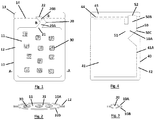
- a sachet 10 is shown overall in a plan view, being of a generally conventional construction comprising two flexible layers 10A and 10B of a conventional aluminium foil-plastics material laminate, seen in Fig. 2 , defining a rectangular cavity 11 between them and joined at 12 at the perimeter of the sachet 10 to form a sealed cavity 11 in a conventional manner by welding.
- An outlet tunnel 20 is formed between the said flexible layers 10A, 10B leading via an inlet opening 21 from the cavity 11 towards an outlet opening 22 of the tunnel.
- the inlet opening 21 is located at about the midpoint of an edge of the rectangular cavity 21.
- the outlet opening 22 of the outlet tunnel is closed by a conventional tear-off portion 13 of the sachet 10, which can be torn off along line of weakness 14 to expose the outlet opening 22.
- the outlet tunnel 20 comprises two sequential sections 20A and 20B having their orientations at an obtuse angle to each other. As shown in Fig. 1 the sections 20A and 20B are of approximately the same length.
- the cavity 11 contains tablets 30. As seen in plan view in Fig. 1 along their shortest dimension the tablets are square with rounded corners. As seen in Fig. 2 the tablets 30 have bevelled edges 31 so that applying squeezing pressure to the products 30 causes them to move in a direction transverse to the pressure. As seen in Fig. 3 the tunnel 20 has a cross sectional shape and size similar to the cross sectional shape of the tablet 30 cut across the direction in which it is to travel along the outlet tunnel.
- sachet 40 is shown overall in a plan view and being of a generally conventional construction analogous to that of Fig. 1 , being rectangular and incorporating a cavity 41 analogously as in Fig. 1 .
- the cavity 41 is generally rectangular in shape having three straight sides at right angles to each other and bounded by sealed perimeter 42.
- the sachet 40 measures ca. 120 x 90mm and the cavity 41 ca. 100 x 75mm.
- An outlet tunnel 50 is formed analogously as in Fig. 1 leading via an inlet opening 51 from the cavity 11 towards an outlet opening 52 of the tunnel.
- the outlet opening 52 of the outlet tunnel is closed by a conventional tear-off portion 43 of the sachet 40, which can be torn off along line of weakness 44 to expose the outlet opening 52.
- the inlet opening 51 of the outlet tunnel 50 occupies a corner of the overall generally rectangular shape of the cavity 41 and comprises a first section 50A extending from the cavity at an angle ca. 45° diagonally to the adjacent edge 41A of the generally rectangular shaped cavity 41, and a second section 50B extending parallel to that edge 41A, the sections 50A, 50B meeting at the angular elbow 50C. Consequently the first and second sections 50A, 50B have their respective orientations meeting at an angle of ca. 135° to each other.
- the cross section of the outlet tunnel 50 of Fig. 4 is similar to that shown in Fig. 3 .
- the first section 50A of the outlet tunnel tapers in the direction becoming narrower toward the outlet opening 52, i.e. in the outward direction in which tablets (not shown) in the cavity 41 would travel on dispensing.
- the second section 50B downstream in the outward direction is parallel-sided across its flow path direction and has a width of ca. 15mm.
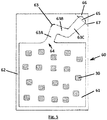
- FIG. 5 another construction of sachet 60 is shown overall in a plan view, being of a generally conventional construction analogous to that of Fig. 1 , being rectangular and incorporating a rectangular cavity 61 analogously as in Fig. 1 bounded by sealed perimeter 62.
- An outlet tunnel 63 is formed analogously as in Fig. 1 leading via an inlet opening 64 from the cavity 61 towards an outlet opening 65 of the tunnel.
- the outlet opening 65 of the outlet tunnel is closed by a conventional tear-off portion 66 of the sachet 60, which can be torn off along line of weakness 67 to expose the outlet opening 65.
- the outlet tunnel 63 comprises sequential sections 63A, 63B, 63C having their respective orientations at non-180° angles to each other.
- the cross section of the outlet tunnel 63 of Fig. 5 is similar to that shown in Fig. 3 .
- the cavity 61 contains tablets 30 analogous to those shown in the sachet of Fig. 1 of sectional dimensions corresponding to the sectional dimensions of the outlet tunnel 63.
- FIG. 6 and 7 this shows views of two sheets of flexible sachet layer material 70, 80, each comprising two mirror-image half sheets 71A, 71B and 81A, 81B connected by a fold line 72, 82.
- Each half sheet 71A, 81A comprises an area 73A, 83A which when the sheet 70, 80 is folded about its respective fold line 72, 82 will be joined, e.g. by conventional welding, adhesive etc. to a corresponding area 73B, 83B on the opposite half sheet 71B, 81B to thereby form a sealed sachet analogous to the sachets of Figs. 1 - 5 .
- Each half sheet 71A, 71B, 81A, 81B includes areas 74A, 74B, 84A, 84B which when the half sheets are folded at line 72, 82 and joined at 73A, 73B and 83A,83B define a correspondingly shaped cavity and outlet tunnel analogous to those of Figs. 1, 4 and 5 .
- the areas 74A, 74B, 84A, 84B of each sheet 70, 80 may be made concave downwards relative to the plane of the drawing of Figs. 6 and 7 to thereby modify the dimensions and volume of the cavity and outlet tunnel that are formed when the sheets 70, 80 are folded and joined together in this way.
- Figs. 6 and 7 the cavity and outlet tunnel which would be formed on folding the sheets 70, 80 in this way would be similar to that shown in Fig. 4 , i.e. a cavity of generally rectangular shape having three major straight sides at right angles to each other, an outlet tunnel occupying a corner of the cavity comprising a tapering first section extending from the so-formed cavity at an angle ca. 45° diagonally to the adjacent edge of the cavity to be formed and a second parallel sided section extending parallel to that edge, the sections meeting at an angular elbow.
- the half sheets 71A, 71B, 81A, 81B incorporate a line of weakness 75, 85 in the areas 73A, 73B, 83A, 83B which when the sheets 70, 80 are folded as above forms a line of weakness analogous to that 14, 44, 67 of Figs, 1, 4 and 5 along which the so-formed sachet can be torn to tear off the tear-off portion 76, 86 to open the so-formed outlet tunnel.
- the overall outer dimensions of the half sheets 71A, 71B are ca. 120 x 90 mm, those of the half sheets 81A, 81B ca. 130 x 90 mm, and the width of the parallel sided second section of the outlet tunnel which is formed when the sheets 70, 80 are folded is ca. 16 mm.
- the shape of the areas 73A, 73B, 83A, 83B are such as to provide rounded 77, 87 kerb portions (radius respectively ca. 2.5 and 3.5 mm) and ramped 78, 88 kerb portions at the inlet opening of the outlet tunnel formed when the sheets 70, 80 are folded as above.
- the sheets 70, 80 are folded about their respective fold lines 72, 82 and the respective areas 73, 83 are joined as described above around part of the perimeter of the respective areas 74A, 74B, 84A, 84B of each sheet 70, 80, for example along the two opposite long edges of the half sheets 71A, 71B, 81A, 81B extending perpendicular to the fold line 72, 82 whilst leaving the areas 73, 83 along the short edge of the half sheets 71A, 71B, 81A, 81B un-joined to thereby form an open-mouthed pouch.
- tablets e.g. those shown 30 in Figs. 1 and 5 may then be filled into these pouches via the open mouth and the un-joined parts of the areas 73, 83 then joined in a conventional manner to thereby seal the sachet closed.
- the sachets 10, 40, 60 of Figs. 1, 4 and 5 , and as formed from the sheets 70, 80 of Figs. 6 and 7 are used in a similar manner.
- the sachets 10, 40, 60 are provided with their outlet tunnel 20, 50, 63 closed by respective tear off portions 13, 43, 66.
- tear off portion 13, 43, 66 of the respective sachets of Figs. 1, 4 and 5 is torn off to expose the outlet opening 22, 52, 65.
- the tablets 30 within the cavity 11, 41, 61 may then be urged by squeezing through the flexible layers 10A, 10B to apply pressure to the tablet 30 to direct it into the outlet opening 21, 51, 64 and thence into the outlet tunnel 20, 50, 63.
- the tapered shape of the first portion 51 of the outlet tunnel facilitates the entry of the tablet 30 into the outlet tunnel 20, 50 via the inlet opening 21, 51 of the outlet tunnel.
- the tablet 30 can relatively easily be negotiated along the outlet tunnel 20, 50, 63 and around the angles 20C, 50C and between the sections 63A, 63B, 63C by a mature or elderly user, but negotiating these angles is relatively difficult for a child who is then likely to give up in frustration or impatience, thereby introducing a degree of child-resistance into the sachet 10, 40, 60.
Landscapes
- Engineering & Computer Science (AREA)
- Mechanical Engineering (AREA)
- Health & Medical Sciences (AREA)
- Chemical & Material Sciences (AREA)
- Composite Materials (AREA)
- Pharmacology & Pharmacy (AREA)
- Life Sciences & Earth Sciences (AREA)
- Animal Behavior & Ethology (AREA)
- General Health & Medical Sciences (AREA)
- Public Health (AREA)
- Veterinary Medicine (AREA)
- Medical Preparation Storing Or Oral Administration Devices (AREA)
Claims (13)
- Beutel (10) mit zwei Schichten (10A, 10B) aus einem flexiblen Material, die einen Hohlraum (11) zwischen ihnen definieren und um den Hohlraum miteinander verbunden sind, mit einem Auslasstunnel(20) zwischen den flexiblen Schichten, entlang dessen ein Produkt in einer Auswärtsrichtung aus dem Hohlraum bewegt werden kann, wobei der Auslasstunnel eine Einlassöffnung (21) von dem Hohlraum in den Auslasstunnel und eine Auslassöffnung (22) vom Auslasstunnel aufweist, von dem das Produkt aus der Auslassöffnung abgegeben werden kann, wobei der Hohlraum mindestens eine feste Tablette (30) aufweist, die eine Form und Abmessungen so aufweist, dass die Tablette in die Einlassöffnung, entlang des Auslasstunnels und durch die Auslassöffnung heraus gedrückt werden kann, dadurch gekennzeichnet, dass der Auslasstunnel aufeinander folgende Abschnitte (20A, 20B) aufweist, die in der Auswärtsrichtung mit einem von 180° verschiedenen Winkel miteinander ausgerichtet sind, wobei der von 180° verschiedene Winkel zwischen den aufeinander folgenden Abschnitten des Auslasstunnels 120° bis 150° beträgt, und die aufeinander folgenden Abschnitte des Auslasstunnels aufeinander folgende gerade Abschnitte aufweisen, die jeweils über eine Winkelbiegung zwischen ihnen in Verbindung miteinander stehen.
- Beutel nach Anspruch 1, der eine im Wesentlichen rechteckige Form aufweist, mit einem Hohlraum (11) mit einer im Wesentlichen rechteckigen Form.
- Beutel nach einem der vorangehenden Ansprüche, wobei der Auslasstunnel (20) als ein Bereich zwischen den zwei Schichten (10A, 10B) ausgebildet ist, der nicht miteinander verbunden ist.
- Beutel nach einem der vorangehenden Ansprüche, wobei die Einlassöffnung (21) des Auslasstunnels eine Ecke des Hohlraums besetzt oder benachbart dazu angeordnet ist.
- Beutel nach einem der vorangehenden Ansprüche, wobei sich mindestens ein Teil des Auslasstunnels (20) in der Auswärtsrichtung von der Einlassöffnung verjüngt, wobei er in Richtung zur Auslassöffnung schmaler wird.
- Beutel nach Anspruch 5, wobei ein sich von der Einlassöffnung (21) nach außen erstreckender erster Abschnitt des Auslasstunnels (20) verjüngt, wobei er in Richtung zur Auslassöffnung (22) schmaler wird.
- Beutel nach Anspruch 6, wobei ein sich vom ersten Abschnitt in der Auswärtsrichtung erstreckender zweiter Abschnitt des Auslasstunnels (20) parallele Seiten aufweist.
- Beutel nach einem der vorangehenden Ansprüche, wobei der Auslasstunnel (20) einer sinusförmigen, einer serpentinenförmigen Form oder einer Zickzack-Form folgt.
- Beutel nach einem der Ansprüche 2 bis 8, wobei der Auslasstunnel (20) einen sich von der Einlassöffnung nach außen erstreckenden ersten Abschnitt und einen sich von der Auslassöffnung nach innen erstreckenden zweiten Abschnitt aufweist und wobei die jeweiligen ersten und zweiten Abschnitte in einem stumpfen Winkel zwischen 120° und 150° aufeinander treffen.
- Beutel nach einem der vorangehenden Ansprüche, wobei die aufeinander folgenden Abschnitte des Auslasstunnels (20) über eine Winkelbiegung zwischen ihnen in Verbindung stehen.
- Beutel nach einem der vorangehenden Ansprüche, wobei die aufeinander folgenden Abschnitte des Auslasstunnels (20) ungefähr die gleiche Länge aufweisen.
- Beutel nach einem der Ansprüche 2 bis 11, wobei der Beutel im Wesentlichen rechteckig ist, der Hohlraum im Wesentlichen rechteckig ist, die Einlassöffnung (21) des Auslasstunnels (20) eine Ecke des Hohlraums (11) besetzt oder benachbart dazu angeordnet ist, wobei der Auslasstunnel einen sich diagonal vom Hohlraum in einem Winkel von 30-60° zur Ausrichtung eines Randes des rechteckig geformten Hohlraums erstreckenden ersten Abschnitt und einen sich zu diesem Rand parallelen zweiten Abschnitt aufweist.
- Beutel nach einem der Ansprüche 2 bis 12, wobei der Hohlraum eine feste Tablette (30) mit solchen Abmessungen, dass sie über den Auslasstunnel mittels eines durch die flexiblen Schichten des Beutels auf die Tablette aufgebrachten Ausdrück-Drucks aus dem Beutel herausgedrückt werden kann.
Applications Claiming Priority (2)
| Application Number | Priority Date | Filing Date | Title |
|---|---|---|---|
| GBGB1515354.7A GB201515354D0 (en) | 2015-08-28 | 2015-08-28 | Novel Device |
| PCT/EP2016/070025 WO2017036894A1 (en) | 2015-08-28 | 2016-08-25 | Novel device |
Publications (2)
| Publication Number | Publication Date |
|---|---|
| EP3341304A1 EP3341304A1 (de) | 2018-07-04 |
| EP3341304B1 true EP3341304B1 (de) | 2020-09-23 |
Family
ID=54326512
Family Applications (1)
| Application Number | Title | Priority Date | Filing Date |
|---|---|---|---|
| EP16756707.2A Active EP3341304B1 (de) | 2015-08-28 | 2016-08-25 | Beutel |
Country Status (5)
| Country | Link |
|---|---|
| US (1) | US11834246B2 (de) |
| EP (1) | EP3341304B1 (de) |
| AU (1) | AU2016313674B2 (de) |
| GB (1) | GB201515354D0 (de) |
| WO (1) | WO2017036894A1 (de) |
Families Citing this family (1)
| Publication number | Priority date | Publication date | Assignee | Title |
|---|---|---|---|---|
| FR3129928B1 (fr) * | 2021-12-03 | 2024-06-21 | Oreal | Sachet souple à double ouverture |
Family Cites Families (22)
| Publication number | Priority date | Publication date | Assignee | Title |
|---|---|---|---|---|
| USRE24251E (en) * | 1956-12-04 | Dispensing containers for liquids | ||
| US2333587A (en) * | 1942-11-19 | 1943-11-02 | Ivers Lee Co | Fold-closed package |
| US2976988A (en) * | 1957-06-25 | 1961-03-28 | William S Schneider | Unit dispensing container |
| US4491245A (en) * | 1982-03-24 | 1985-01-01 | Jamison Mark D | Liquid dispensing container |
| US4793121A (en) * | 1987-01-02 | 1988-12-27 | Jamison Mark D | Dispensing spout pre-forming system for pouch |
| US5018646A (en) * | 1988-11-23 | 1991-05-28 | S. C. Johnson & Son, Inc. | Squeezable fluid container |
| USD319976S (en) * | 1989-02-02 | 1991-09-17 | S. C. Johnson & Son, Inc. | Fluid container |
| DE9017419U1 (de) * | 1990-12-24 | 1991-03-14 | Imer, Rodney Haydn, Dipl.-Ing., 4000 Düsseldorf | Konturenbeutel zur Aufnahme flüssiger oder pastöser Stoffe |
| US5333758A (en) * | 1993-01-04 | 1994-08-02 | Marlingford Holdings Limited | Multi-outlet fluid dispenser pouch |
| WO1998001361A1 (en) * | 1996-07-10 | 1998-01-15 | Marlingford Holdings Limited | Squeezable fluid dispenser pouch |
| JP2001114306A (ja) | 1999-10-15 | 2001-04-24 | Rengo Co Ltd | 軟包装材製袋 |
| US6360916B1 (en) * | 2000-12-05 | 2002-03-26 | David Sokolsky | Disposable condiment pouch |
| US7607834B2 (en) * | 2004-08-02 | 2009-10-27 | R.P. Scherer Technologies, Inc. | Peelable pouch containing a single or multiple dosage forms and process of making same |
| EP1808380A1 (de) * | 2006-01-13 | 2007-07-18 | Pepup S.A. | Flexibler Beutel für eine Flüssigkeit und Verfahren zu dessen Herstellung |
| US7866475B2 (en) * | 2006-06-12 | 2011-01-11 | Mcneil-Ppc, Inc. | Blister package |
| GB0623320D0 (en) | 2006-11-22 | 2007-01-03 | Breath Ltd | Ampoules |
| EP1990290A1 (de) | 2007-05-11 | 2008-11-12 | Amcor Flexibles A/S | Ausgabeverpackung |
| EP2247512B1 (de) * | 2008-01-15 | 2011-08-03 | Novartis AG | Abziehbarer beutel |
| WO2011037717A1 (en) * | 2009-09-25 | 2011-03-31 | The Procter & Gamble Company | Reclosable package |
| SG191793A1 (en) * | 2010-12-28 | 2013-08-30 | Abbott Lab | Pouch, method of manufacturing a pouch and a method of dispensing a product from a pouch |
| EP2612825B1 (de) * | 2012-01-04 | 2017-11-01 | Noxell Corporation | Haarfärbemittelbehälter in Form einer flexiblen Tasche |
| US10562652B2 (en) * | 2017-12-12 | 2020-02-18 | H.J. Heinz Company Brands Llc | Spouted sachet |
-
2015
- 2015-08-28 GB GBGB1515354.7A patent/GB201515354D0/en not_active Ceased
-
2016
- 2016-08-25 AU AU2016313674A patent/AU2016313674B2/en active Active
- 2016-08-25 US US15/755,151 patent/US11834246B2/en active Active
- 2016-08-25 EP EP16756707.2A patent/EP3341304B1/de active Active
- 2016-08-25 WO PCT/EP2016/070025 patent/WO2017036894A1/en not_active Ceased
Non-Patent Citations (1)
| Title |
|---|
| None * |
Also Published As
| Publication number | Publication date |
|---|---|
| CA2994213A1 (en) | 2017-03-09 |
| AU2016313674B2 (en) | 2019-07-25 |
| GB201515354D0 (en) | 2015-10-14 |
| US11834246B2 (en) | 2023-12-05 |
| EP3341304A1 (de) | 2018-07-04 |
| US20180244451A1 (en) | 2018-08-30 |
| AU2016313674A1 (en) | 2018-02-15 |
| WO2017036894A1 (en) | 2017-03-09 |
Similar Documents
| Publication | Publication Date | Title |
|---|---|---|
| JP2008543683A (ja) | 流動性物質を格納及び投与するための多室形ブリスターパッケージ | |
| US8231272B2 (en) | Stand-up, easy-open and easy-close package of flexible material, particularly for liquid, viscous, pasty, granular or powdered products | |
| CN101415612B (zh) | 袋容器 | |
| JPH02219744A (ja) | 包装容器の開孔装置 | |
| NZ523059A (en) | A nozzle assemby with a reusable break-off cap a container having a nozzle assembly and packaging therefor | |
| US9376247B2 (en) | Re-sealable container | |
| CN112004757A (zh) | 角破开式密封包装 | |
| JPH0246460B2 (de) | ||
| WO2007010693A1 (ja) | 詰替パウチ | |
| US20170166380A1 (en) | Stick pack design | |
| JPH03289451A (ja) | 流体入りスタンドパックの連続的製法 | |
| US20220340350A1 (en) | Easy To Open Package With Controlled Dispensing Device | |
| CN106976633A (zh) | 薄膜袋 | |
| JP2000177756A (ja) | 注出機能付き包装袋 | |
| US20110233267A1 (en) | Pack having tear-open aid | |
| AU2016313674B2 (en) | Novel device | |
| JP3634576B2 (ja) | 注出機能付き包装袋 | |
| CA2994213C (en) | Sachet with an outlet tunnel having sequential sections | |
| CN110799430A (zh) | 液状物填充用复合包装 | |
| JP7224915B2 (ja) | 再封可能な開封器およびそのような開封器を備えたパッケージ | |
| GB2415684A (en) | Bags of easy closure and tear open construction | |
| JP5867174B2 (ja) | 包装容器 | |
| CN112672960B (zh) | 密封型破裂打开式包装及其相应的生产方法 | |
| JP2563619Y2 (ja) | 易開封性シート状包装体 | |
| JP7310209B2 (ja) | パウチ |
Legal Events
| Date | Code | Title | Description |
|---|---|---|---|
| STAA | Information on the status of an ep patent application or granted ep patent |
Free format text: STATUS: THE INTERNATIONAL PUBLICATION HAS BEEN MADE |
|
| PUAI | Public reference made under article 153(3) epc to a published international application that has entered the european phase |
Free format text: ORIGINAL CODE: 0009012 |
|
| STAA | Information on the status of an ep patent application or granted ep patent |
Free format text: STATUS: REQUEST FOR EXAMINATION WAS MADE |
|
| 17P | Request for examination filed |
Effective date: 20180119 |
|
| AK | Designated contracting states |
Kind code of ref document: A1 Designated state(s): AL AT BE BG CH CY CZ DE DK EE ES FI FR GB GR HR HU IE IS IT LI LT LU LV MC MK MT NL NO PL PT RO RS SE SI SK SM TR |
|
| AX | Request for extension of the european patent |
Extension state: BA ME |
|
| DAV | Request for validation of the european patent (deleted) | ||
| DAX | Request for extension of the european patent (deleted) | ||
| STAA | Information on the status of an ep patent application or granted ep patent |
Free format text: STATUS: EXAMINATION IS IN PROGRESS |
|
| 17Q | First examination report despatched |
Effective date: 20190513 |
|
| RAP1 | Party data changed (applicant data changed or rights of an application transferred) |
Owner name: GSK CONSUMER HEALTHCARE S.A. |
|
| GRAP | Despatch of communication of intention to grant a patent |
Free format text: ORIGINAL CODE: EPIDOSNIGR1 |
|
| STAA | Information on the status of an ep patent application or granted ep patent |
Free format text: STATUS: GRANT OF PATENT IS INTENDED |
|
| INTG | Intention to grant announced |
Effective date: 20200421 |
|
| GRAS | Grant fee paid |
Free format text: ORIGINAL CODE: EPIDOSNIGR3 |
|
| GRAJ | Information related to disapproval of communication of intention to grant by the applicant or resumption of examination proceedings by the epo deleted |
Free format text: ORIGINAL CODE: EPIDOSDIGR1 |
|
| GRAL | Information related to payment of fee for publishing/printing deleted |
Free format text: ORIGINAL CODE: EPIDOSDIGR3 |
|
| STAA | Information on the status of an ep patent application or granted ep patent |
Free format text: STATUS: EXAMINATION IS IN PROGRESS |
|
| GRAR | Information related to intention to grant a patent recorded |
Free format text: ORIGINAL CODE: EPIDOSNIGR71 |
|
| STAA | Information on the status of an ep patent application or granted ep patent |
Free format text: STATUS: GRANT OF PATENT IS INTENDED |
|
| INTC | Intention to grant announced (deleted) | ||
| INTG | Intention to grant announced |
Effective date: 20200716 |
|
| GRAA | (expected) grant |
Free format text: ORIGINAL CODE: 0009210 |
|
| STAA | Information on the status of an ep patent application or granted ep patent |
Free format text: STATUS: THE PATENT HAS BEEN GRANTED |
|
| AK | Designated contracting states |
Kind code of ref document: B1 Designated state(s): AL AT BE BG CH CY CZ DE DK EE ES FI FR GB GR HR HU IE IS IT LI LT LU LV MC MK MT NL NO PL PT RO RS SE SI SK SM TR |
|
| REG | Reference to a national code |
Ref country code: GB Ref legal event code: FG4D |
|
| REG | Reference to a national code |
Ref country code: CH Ref legal event code: EP |
|
| REG | Reference to a national code |
Ref country code: DE Ref legal event code: R096 Ref document number: 602016044549 Country of ref document: DE |
|
| REG | Reference to a national code |
Ref country code: IE Ref legal event code: FG4D |
|
| REG | Reference to a national code |
Ref country code: AT Ref legal event code: REF Ref document number: 1316189 Country of ref document: AT Kind code of ref document: T Effective date: 20201015 |
|
| REG | Reference to a national code |
Ref country code: SE Ref legal event code: TRGR |
|
| PG25 | Lapsed in a contracting state [announced via postgrant information from national office to epo] |
Ref country code: FI Free format text: LAPSE BECAUSE OF FAILURE TO SUBMIT A TRANSLATION OF THE DESCRIPTION OR TO PAY THE FEE WITHIN THE PRESCRIBED TIME-LIMIT Effective date: 20200923 Ref country code: NO Free format text: LAPSE BECAUSE OF FAILURE TO SUBMIT A TRANSLATION OF THE DESCRIPTION OR TO PAY THE FEE WITHIN THE PRESCRIBED TIME-LIMIT Effective date: 20201223 Ref country code: BG Free format text: LAPSE BECAUSE OF FAILURE TO SUBMIT A TRANSLATION OF THE DESCRIPTION OR TO PAY THE FEE WITHIN THE PRESCRIBED TIME-LIMIT Effective date: 20201223 Ref country code: GR Free format text: LAPSE BECAUSE OF FAILURE TO SUBMIT A TRANSLATION OF THE DESCRIPTION OR TO PAY THE FEE WITHIN THE PRESCRIBED TIME-LIMIT Effective date: 20201224 Ref country code: HR Free format text: LAPSE BECAUSE OF FAILURE TO SUBMIT A TRANSLATION OF THE DESCRIPTION OR TO PAY THE FEE WITHIN THE PRESCRIBED TIME-LIMIT Effective date: 20200923 |
|
| REG | Reference to a national code |
Ref country code: AT Ref legal event code: MK05 Ref document number: 1316189 Country of ref document: AT Kind code of ref document: T Effective date: 20200923 |
|
| PG25 | Lapsed in a contracting state [announced via postgrant information from national office to epo] |
Ref country code: LV Free format text: LAPSE BECAUSE OF FAILURE TO SUBMIT A TRANSLATION OF THE DESCRIPTION OR TO PAY THE FEE WITHIN THE PRESCRIBED TIME-LIMIT Effective date: 20200923 Ref country code: RS Free format text: LAPSE BECAUSE OF FAILURE TO SUBMIT A TRANSLATION OF THE DESCRIPTION OR TO PAY THE FEE WITHIN THE PRESCRIBED TIME-LIMIT Effective date: 20200923 |
|
| REG | Reference to a national code |
Ref country code: NL Ref legal event code: MP Effective date: 20200923 |
|
| REG | Reference to a national code |
Ref country code: LT Ref legal event code: MG4D |
|
| PG25 | Lapsed in a contracting state [announced via postgrant information from national office to epo] |
Ref country code: LT Free format text: LAPSE BECAUSE OF FAILURE TO SUBMIT A TRANSLATION OF THE DESCRIPTION OR TO PAY THE FEE WITHIN THE PRESCRIBED TIME-LIMIT Effective date: 20200923 Ref country code: CZ Free format text: LAPSE BECAUSE OF FAILURE TO SUBMIT A TRANSLATION OF THE DESCRIPTION OR TO PAY THE FEE WITHIN THE PRESCRIBED TIME-LIMIT Effective date: 20200923 Ref country code: PT Free format text: LAPSE BECAUSE OF FAILURE TO SUBMIT A TRANSLATION OF THE DESCRIPTION OR TO PAY THE FEE WITHIN THE PRESCRIBED TIME-LIMIT Effective date: 20210125 Ref country code: RO Free format text: LAPSE BECAUSE OF FAILURE TO SUBMIT A TRANSLATION OF THE DESCRIPTION OR TO PAY THE FEE WITHIN THE PRESCRIBED TIME-LIMIT Effective date: 20200923 Ref country code: EE Free format text: LAPSE BECAUSE OF FAILURE TO SUBMIT A TRANSLATION OF THE DESCRIPTION OR TO PAY THE FEE WITHIN THE PRESCRIBED TIME-LIMIT Effective date: 20200923 Ref country code: SM Free format text: LAPSE BECAUSE OF FAILURE TO SUBMIT A TRANSLATION OF THE DESCRIPTION OR TO PAY THE FEE WITHIN THE PRESCRIBED TIME-LIMIT Effective date: 20200923 |
|
| PG25 | Lapsed in a contracting state [announced via postgrant information from national office to epo] |
Ref country code: ES Free format text: LAPSE BECAUSE OF FAILURE TO SUBMIT A TRANSLATION OF THE DESCRIPTION OR TO PAY THE FEE WITHIN THE PRESCRIBED TIME-LIMIT Effective date: 20200923 Ref country code: AT Free format text: LAPSE BECAUSE OF FAILURE TO SUBMIT A TRANSLATION OF THE DESCRIPTION OR TO PAY THE FEE WITHIN THE PRESCRIBED TIME-LIMIT Effective date: 20200923 Ref country code: AL Free format text: LAPSE BECAUSE OF FAILURE TO SUBMIT A TRANSLATION OF THE DESCRIPTION OR TO PAY THE FEE WITHIN THE PRESCRIBED TIME-LIMIT Effective date: 20200923 Ref country code: PL Free format text: LAPSE BECAUSE OF FAILURE TO SUBMIT A TRANSLATION OF THE DESCRIPTION OR TO PAY THE FEE WITHIN THE PRESCRIBED TIME-LIMIT Effective date: 20200923 Ref country code: IS Free format text: LAPSE BECAUSE OF FAILURE TO SUBMIT A TRANSLATION OF THE DESCRIPTION OR TO PAY THE FEE WITHIN THE PRESCRIBED TIME-LIMIT Effective date: 20210123 |
|
| REG | Reference to a national code |
Ref country code: DE Ref legal event code: R097 Ref document number: 602016044549 Country of ref document: DE |
|
| PG25 | Lapsed in a contracting state [announced via postgrant information from national office to epo] |
Ref country code: SK Free format text: LAPSE BECAUSE OF FAILURE TO SUBMIT A TRANSLATION OF THE DESCRIPTION OR TO PAY THE FEE WITHIN THE PRESCRIBED TIME-LIMIT Effective date: 20200923 |
|
| PLBE | No opposition filed within time limit |
Free format text: ORIGINAL CODE: 0009261 |
|
| STAA | Information on the status of an ep patent application or granted ep patent |
Free format text: STATUS: NO OPPOSITION FILED WITHIN TIME LIMIT |
|
| PG25 | Lapsed in a contracting state [announced via postgrant information from national office to epo] |
Ref country code: DK Free format text: LAPSE BECAUSE OF FAILURE TO SUBMIT A TRANSLATION OF THE DESCRIPTION OR TO PAY THE FEE WITHIN THE PRESCRIBED TIME-LIMIT Effective date: 20200923 Ref country code: SI Free format text: LAPSE BECAUSE OF FAILURE TO SUBMIT A TRANSLATION OF THE DESCRIPTION OR TO PAY THE FEE WITHIN THE PRESCRIBED TIME-LIMIT Effective date: 20200923 |
|
| 26N | No opposition filed |
Effective date: 20210624 |
|
| PG25 | Lapsed in a contracting state [announced via postgrant information from national office to epo] |
Ref country code: IT Free format text: LAPSE BECAUSE OF FAILURE TO SUBMIT A TRANSLATION OF THE DESCRIPTION OR TO PAY THE FEE WITHIN THE PRESCRIBED TIME-LIMIT Effective date: 20200923 |
|
| REG | Reference to a national code |
Ref country code: DE Ref legal event code: R119 Ref document number: 602016044549 Country of ref document: DE |
|
| REG | Reference to a national code |
Ref country code: CH Ref legal event code: PL |
|
| PG25 | Lapsed in a contracting state [announced via postgrant information from national office to epo] |
Ref country code: MC Free format text: LAPSE BECAUSE OF FAILURE TO SUBMIT A TRANSLATION OF THE DESCRIPTION OR TO PAY THE FEE WITHIN THE PRESCRIBED TIME-LIMIT Effective date: 20200923 |
|
| REG | Reference to a national code |
Ref country code: BE Ref legal event code: MM Effective date: 20210831 |
|
| PG25 | Lapsed in a contracting state [announced via postgrant information from national office to epo] |
Ref country code: LI Free format text: LAPSE BECAUSE OF NON-PAYMENT OF DUE FEES Effective date: 20210831 Ref country code: CH Free format text: LAPSE BECAUSE OF NON-PAYMENT OF DUE FEES Effective date: 20210831 |
|
| PG25 | Lapsed in a contracting state [announced via postgrant information from national office to epo] |
Ref country code: LU Free format text: LAPSE BECAUSE OF NON-PAYMENT OF DUE FEES Effective date: 20210825 |
|
| PG25 | Lapsed in a contracting state [announced via postgrant information from national office to epo] |
Ref country code: FR Free format text: LAPSE BECAUSE OF NON-PAYMENT OF DUE FEES Effective date: 20210831 Ref country code: DE Free format text: LAPSE BECAUSE OF NON-PAYMENT OF DUE FEES Effective date: 20220301 Ref country code: BE Free format text: LAPSE BECAUSE OF NON-PAYMENT OF DUE FEES Effective date: 20210831 |
|
| PG25 | Lapsed in a contracting state [announced via postgrant information from national office to epo] |
Ref country code: HU Free format text: LAPSE BECAUSE OF FAILURE TO SUBMIT A TRANSLATION OF THE DESCRIPTION OR TO PAY THE FEE WITHIN THE PRESCRIBED TIME-LIMIT; INVALID AB INITIO Effective date: 20160825 |
|
| PG25 | Lapsed in a contracting state [announced via postgrant information from national office to epo] |
Ref country code: NL Free format text: LAPSE BECAUSE OF NON-PAYMENT OF DUE FEES Effective date: 20200923 Ref country code: CY Free format text: LAPSE BECAUSE OF FAILURE TO SUBMIT A TRANSLATION OF THE DESCRIPTION OR TO PAY THE FEE WITHIN THE PRESCRIBED TIME-LIMIT Effective date: 20200923 |
|
| PG25 | Lapsed in a contracting state [announced via postgrant information from national office to epo] |
Ref country code: MK Free format text: LAPSE BECAUSE OF FAILURE TO SUBMIT A TRANSLATION OF THE DESCRIPTION OR TO PAY THE FEE WITHIN THE PRESCRIBED TIME-LIMIT Effective date: 20200923 |
|
| PG25 | Lapsed in a contracting state [announced via postgrant information from national office to epo] |
Ref country code: TR Free format text: LAPSE BECAUSE OF FAILURE TO SUBMIT A TRANSLATION OF THE DESCRIPTION OR TO PAY THE FEE WITHIN THE PRESCRIBED TIME-LIMIT Effective date: 20200923 |
|
| PG25 | Lapsed in a contracting state [announced via postgrant information from national office to epo] |
Ref country code: MT Free format text: LAPSE BECAUSE OF FAILURE TO SUBMIT A TRANSLATION OF THE DESCRIPTION OR TO PAY THE FEE WITHIN THE PRESCRIBED TIME-LIMIT Effective date: 20200923 |
|
| PGFP | Annual fee paid to national office [announced via postgrant information from national office to epo] |
Ref country code: GB Payment date: 20250725 Year of fee payment: 10 |
|
| PGFP | Annual fee paid to national office [announced via postgrant information from national office to epo] |
Ref country code: SE Payment date: 20250723 Year of fee payment: 10 |
|
| PGFP | Annual fee paid to national office [announced via postgrant information from national office to epo] |
Ref country code: IE Payment date: 20250725 Year of fee payment: 10 |