EP3345890A1 - Verfahren zur herstellung von n-methyl-p-toluidin für dessen einsatz als additiv für flugbenzin - Google Patents
Verfahren zur herstellung von n-methyl-p-toluidin für dessen einsatz als additiv für flugbenzin Download PDFInfo
- Publication number
- EP3345890A1 EP3345890A1 EP17150428.5A EP17150428A EP3345890A1 EP 3345890 A1 EP3345890 A1 EP 3345890A1 EP 17150428 A EP17150428 A EP 17150428A EP 3345890 A1 EP3345890 A1 EP 3345890A1
- Authority
- EP
- European Patent Office
- Prior art keywords
- weight
- toluidine
- catalyst
- gew
- methyl
- Prior art date
- Legal status (The legal status is an assumption and is not a legal conclusion. Google has not performed a legal analysis and makes no representation as to the accuracy of the status listed.)
- Ceased
Links
Images
Classifications
-
- B—PERFORMING OPERATIONS; TRANSPORTING
- B01—PHYSICAL OR CHEMICAL PROCESSES OR APPARATUS IN GENERAL
- B01J—CHEMICAL OR PHYSICAL PROCESSES, e.g. CATALYSIS OR COLLOID CHEMISTRY; THEIR RELEVANT APPARATUS
- B01J21/00—Catalysts comprising the elements, oxides, or hydroxides of magnesium, boron, aluminium, carbon, silicon, titanium, zirconium, or hafnium
- B01J21/02—Boron or aluminium; Oxides or hydroxides thereof
-
- C—CHEMISTRY; METALLURGY
- C07—ORGANIC CHEMISTRY
- C07C—ACYCLIC OR CARBOCYCLIC COMPOUNDS
- C07C209/00—Preparation of compounds containing amino groups bound to a carbon skeleton
- C07C209/04—Preparation of compounds containing amino groups bound to a carbon skeleton by substitution of functional groups by amino groups
- C07C209/14—Preparation of compounds containing amino groups bound to a carbon skeleton by substitution of functional groups by amino groups by substitution of hydroxy groups or of etherified or esterified hydroxy groups
- C07C209/18—Preparation of compounds containing amino groups bound to a carbon skeleton by substitution of functional groups by amino groups by substitution of hydroxy groups or of etherified or esterified hydroxy groups with formation of amino groups bound to carbon atoms of six-membered aromatic rings or from amines having nitrogen atoms bound to carbon atoms of six-membered aromatic rings
-
- B—PERFORMING OPERATIONS; TRANSPORTING
- B01—PHYSICAL OR CHEMICAL PROCESSES OR APPARATUS IN GENERAL
- B01J—CHEMICAL OR PHYSICAL PROCESSES, e.g. CATALYSIS OR COLLOID CHEMISTRY; THEIR RELEVANT APPARATUS
- B01J23/00—Catalysts comprising metals or metal oxides or hydroxides, not provided for in group B01J21/00
- B01J23/002—Mixed oxides other than spinels, e.g. perovskite
-
- B—PERFORMING OPERATIONS; TRANSPORTING
- B01—PHYSICAL OR CHEMICAL PROCESSES OR APPARATUS IN GENERAL
- B01J—CHEMICAL OR PHYSICAL PROCESSES, e.g. CATALYSIS OR COLLOID CHEMISTRY; THEIR RELEVANT APPARATUS
- B01J23/00—Catalysts comprising metals or metal oxides or hydroxides, not provided for in group B01J21/00
- B01J23/06—Catalysts comprising metals or metal oxides or hydroxides, not provided for in group B01J21/00 of zinc, cadmium or mercury
-
- B—PERFORMING OPERATIONS; TRANSPORTING
- B01—PHYSICAL OR CHEMICAL PROCESSES OR APPARATUS IN GENERAL
- B01J—CHEMICAL OR PHYSICAL PROCESSES, e.g. CATALYSIS OR COLLOID CHEMISTRY; THEIR RELEVANT APPARATUS
- B01J23/00—Catalysts comprising metals or metal oxides or hydroxides, not provided for in group B01J21/00
- B01J23/70—Catalysts comprising metals or metal oxides or hydroxides, not provided for in group B01J21/00 of the iron group metals or copper
- B01J23/72—Copper
-
- B—PERFORMING OPERATIONS; TRANSPORTING
- B01—PHYSICAL OR CHEMICAL PROCESSES OR APPARATUS IN GENERAL
- B01J—CHEMICAL OR PHYSICAL PROCESSES, e.g. CATALYSIS OR COLLOID CHEMISTRY; THEIR RELEVANT APPARATUS
- B01J23/00—Catalysts comprising metals or metal oxides or hydroxides, not provided for in group B01J21/00
- B01J23/70—Catalysts comprising metals or metal oxides or hydroxides, not provided for in group B01J21/00 of the iron group metals or copper
- B01J23/76—Catalysts comprising metals or metal oxides or hydroxides, not provided for in group B01J21/00 of the iron group metals or copper combined with metals, oxides or hydroxides provided for in groups B01J23/02 - B01J23/36
- B01J23/80—Catalysts comprising metals or metal oxides or hydroxides, not provided for in group B01J21/00 of the iron group metals or copper combined with metals, oxides or hydroxides provided for in groups B01J23/02 - B01J23/36 with zinc, cadmium or mercury
-
- B—PERFORMING OPERATIONS; TRANSPORTING
- B01—PHYSICAL OR CHEMICAL PROCESSES OR APPARATUS IN GENERAL
- B01J—CHEMICAL OR PHYSICAL PROCESSES, e.g. CATALYSIS OR COLLOID CHEMISTRY; THEIR RELEVANT APPARATUS
- B01J35/00—Catalysts, in general, characterised by their form or physical properties
- B01J35/30—Catalysts, in general, characterised by their form or physical properties characterised by their physical properties
-
- B—PERFORMING OPERATIONS; TRANSPORTING
- B01—PHYSICAL OR CHEMICAL PROCESSES OR APPARATUS IN GENERAL
- B01J—CHEMICAL OR PHYSICAL PROCESSES, e.g. CATALYSIS OR COLLOID CHEMISTRY; THEIR RELEVANT APPARATUS
- B01J35/00—Catalysts, in general, characterised by their form or physical properties
- B01J35/30—Catalysts, in general, characterised by their form or physical properties characterised by their physical properties
- B01J35/34—Mechanical properties
- B01J35/36—Mechanical strength
-
- B—PERFORMING OPERATIONS; TRANSPORTING
- B01—PHYSICAL OR CHEMICAL PROCESSES OR APPARATUS IN GENERAL
- B01J—CHEMICAL OR PHYSICAL PROCESSES, e.g. CATALYSIS OR COLLOID CHEMISTRY; THEIR RELEVANT APPARATUS
- B01J35/00—Catalysts, in general, characterised by their form or physical properties
- B01J35/30—Catalysts, in general, characterised by their form or physical properties characterised by their physical properties
- B01J35/391—Physical properties of the active metal ingredient
- B01J35/392—Metal surface area
-
- B—PERFORMING OPERATIONS; TRANSPORTING
- B01—PHYSICAL OR CHEMICAL PROCESSES OR APPARATUS IN GENERAL
- B01J—CHEMICAL OR PHYSICAL PROCESSES, e.g. CATALYSIS OR COLLOID CHEMISTRY; THEIR RELEVANT APPARATUS
- B01J35/00—Catalysts, in general, characterised by their form or physical properties
- B01J35/40—Catalysts, in general, characterised by their form or physical properties characterised by dimensions, e.g. grain size
- B01J35/45—Nanoparticles
-
- B—PERFORMING OPERATIONS; TRANSPORTING
- B01—PHYSICAL OR CHEMICAL PROCESSES OR APPARATUS IN GENERAL
- B01J—CHEMICAL OR PHYSICAL PROCESSES, e.g. CATALYSIS OR COLLOID CHEMISTRY; THEIR RELEVANT APPARATUS
- B01J35/00—Catalysts, in general, characterised by their form or physical properties
- B01J35/60—Catalysts, in general, characterised by their form or physical properties characterised by their surface properties or porosity
- B01J35/61—Surface area
- B01J35/613—10-100 m2/g
-
- B—PERFORMING OPERATIONS; TRANSPORTING
- B01—PHYSICAL OR CHEMICAL PROCESSES OR APPARATUS IN GENERAL
- B01J—CHEMICAL OR PHYSICAL PROCESSES, e.g. CATALYSIS OR COLLOID CHEMISTRY; THEIR RELEVANT APPARATUS
- B01J35/00—Catalysts, in general, characterised by their form or physical properties
- B01J35/60—Catalysts, in general, characterised by their form or physical properties characterised by their surface properties or porosity
- B01J35/63—Pore volume
- B01J35/633—Pore volume less than 0.5 ml/g
-
- B—PERFORMING OPERATIONS; TRANSPORTING
- B01—PHYSICAL OR CHEMICAL PROCESSES OR APPARATUS IN GENERAL
- B01J—CHEMICAL OR PHYSICAL PROCESSES, e.g. CATALYSIS OR COLLOID CHEMISTRY; THEIR RELEVANT APPARATUS
- B01J37/00—Processes, in general, for preparing catalysts; Processes, in general, for activation of catalysts
- B01J37/0009—Use of binding agents; Moulding; Pressing; Powdering; Granulating; Addition of materials ameliorating the mechanical properties of the product catalyst
- B01J37/0063—Granulating
-
- B—PERFORMING OPERATIONS; TRANSPORTING
- B01—PHYSICAL OR CHEMICAL PROCESSES OR APPARATUS IN GENERAL
- B01J—CHEMICAL OR PHYSICAL PROCESSES, e.g. CATALYSIS OR COLLOID CHEMISTRY; THEIR RELEVANT APPARATUS
- B01J37/00—Processes, in general, for preparing catalysts; Processes, in general, for activation of catalysts
- B01J37/02—Impregnation, coating or precipitation
- B01J37/0236—Drying, e.g. preparing a suspension, adding a soluble salt and drying
-
- B—PERFORMING OPERATIONS; TRANSPORTING
- B01—PHYSICAL OR CHEMICAL PROCESSES OR APPARATUS IN GENERAL
- B01J—CHEMICAL OR PHYSICAL PROCESSES, e.g. CATALYSIS OR COLLOID CHEMISTRY; THEIR RELEVANT APPARATUS
- B01J37/00—Processes, in general, for preparing catalysts; Processes, in general, for activation of catalysts
- B01J37/02—Impregnation, coating or precipitation
- B01J37/03—Precipitation; Co-precipitation
- B01J37/031—Precipitation
-
- B—PERFORMING OPERATIONS; TRANSPORTING
- B01—PHYSICAL OR CHEMICAL PROCESSES OR APPARATUS IN GENERAL
- B01J—CHEMICAL OR PHYSICAL PROCESSES, e.g. CATALYSIS OR COLLOID CHEMISTRY; THEIR RELEVANT APPARATUS
- B01J37/00—Processes, in general, for preparing catalysts; Processes, in general, for activation of catalysts
- B01J37/04—Mixing
-
- B—PERFORMING OPERATIONS; TRANSPORTING
- B01—PHYSICAL OR CHEMICAL PROCESSES OR APPARATUS IN GENERAL
- B01J—CHEMICAL OR PHYSICAL PROCESSES, e.g. CATALYSIS OR COLLOID CHEMISTRY; THEIR RELEVANT APPARATUS
- B01J37/00—Processes, in general, for preparing catalysts; Processes, in general, for activation of catalysts
- B01J37/06—Washing
-
- B—PERFORMING OPERATIONS; TRANSPORTING
- B01—PHYSICAL OR CHEMICAL PROCESSES OR APPARATUS IN GENERAL
- B01J—CHEMICAL OR PHYSICAL PROCESSES, e.g. CATALYSIS OR COLLOID CHEMISTRY; THEIR RELEVANT APPARATUS
- B01J37/00—Processes, in general, for preparing catalysts; Processes, in general, for activation of catalysts
- B01J37/08—Heat treatment
-
- C—CHEMISTRY; METALLURGY
- C07—ORGANIC CHEMISTRY
- C07C—ACYCLIC OR CARBOCYCLIC COMPOUNDS
- C07C211/00—Compounds containing amino groups bound to a carbon skeleton
- C07C211/43—Compounds containing amino groups bound to a carbon skeleton having amino groups bound to carbon atoms of six-membered aromatic rings of the carbon skeleton
- C07C211/44—Compounds containing amino groups bound to a carbon skeleton having amino groups bound to carbon atoms of six-membered aromatic rings of the carbon skeleton having amino groups bound to only one six-membered aromatic ring
- C07C211/45—Monoamines
- C07C211/48—N-alkylated amines
-
- C—CHEMISTRY; METALLURGY
- C10—PETROLEUM, GAS OR COKE INDUSTRIES; TECHNICAL GASES CONTAINING CARBON MONOXIDE; FUELS; LUBRICANTS; PEAT
- C10L—FUELS NOT OTHERWISE PROVIDED FOR; NATURAL GAS; SYNTHETIC NATURAL GAS OBTAINED BY PROCESSES NOT COVERED BY SUBCLASSES C10G OR C10K; LIQUIFIED PETROLEUM GAS; USE OF ADDITIVES TO FUELS OR FIRES; FIRE-LIGHTERS
- C10L1/00—Liquid carbonaceous fuels
- C10L1/10—Liquid carbonaceous fuels containing additives
- C10L1/14—Organic compounds
- C10L1/22—Organic compounds containing nitrogen
- C10L1/222—Organic compounds containing nitrogen containing at least one carbon-to-nitrogen single bond
- C10L1/223—Organic compounds containing nitrogen containing at least one carbon-to-nitrogen single bond having at least one amino group bound to an aromatic carbon atom
-
- C—CHEMISTRY; METALLURGY
- C10—PETROLEUM, GAS OR COKE INDUSTRIES; TECHNICAL GASES CONTAINING CARBON MONOXIDE; FUELS; LUBRICANTS; PEAT
- C10L—FUELS NOT OTHERWISE PROVIDED FOR; NATURAL GAS; SYNTHETIC NATURAL GAS OBTAINED BY PROCESSES NOT COVERED BY SUBCLASSES C10G OR C10K; LIQUIFIED PETROLEUM GAS; USE OF ADDITIVES TO FUELS OR FIRES; FIRE-LIGHTERS
- C10L10/00—Use of additives to fuels or fires for particular purposes
- C10L10/10—Use of additives to fuels or fires for particular purposes for improving the octane number
-
- B—PERFORMING OPERATIONS; TRANSPORTING
- B01—PHYSICAL OR CHEMICAL PROCESSES OR APPARATUS IN GENERAL
- B01J—CHEMICAL OR PHYSICAL PROCESSES, e.g. CATALYSIS OR COLLOID CHEMISTRY; THEIR RELEVANT APPARATUS
- B01J2523/00—Constitutive chemical elements of heterogeneous catalysts
-
- C—CHEMISTRY; METALLURGY
- C07—ORGANIC CHEMISTRY
- C07C—ACYCLIC OR CARBOCYCLIC COMPOUNDS
- C07C2523/00—Catalysts comprising metals or metal oxides or hydroxides, not provided for in group C07C2521/00
- C07C2523/70—Catalysts comprising metals or metal oxides or hydroxides, not provided for in group C07C2521/00 of the iron group metals or copper
- C07C2523/72—Copper
-
- C—CHEMISTRY; METALLURGY
- C10—PETROLEUM, GAS OR COKE INDUSTRIES; TECHNICAL GASES CONTAINING CARBON MONOXIDE; FUELS; LUBRICANTS; PEAT
- C10L—FUELS NOT OTHERWISE PROVIDED FOR; NATURAL GAS; SYNTHETIC NATURAL GAS OBTAINED BY PROCESSES NOT COVERED BY SUBCLASSES C10G OR C10K; LIQUIFIED PETROLEUM GAS; USE OF ADDITIVES TO FUELS OR FIRES; FIRE-LIGHTERS
- C10L2270/00—Specifically adapted fuels
- C10L2270/04—Specifically adapted fuels for turbines, planes, power generation
Definitions
- the invention relates to novel processes for the preparation of N-methyl-p-toluidine for its use as an additive for aviation gasoline and to specific catalysts for these processes.
- Alkylated aromatic amines have a high economic potential and are used, for example, as fuel additives (anti-knock agents) in gasolines to replace environmentally harmful, lead-containing additives.
- the most commonly used alkylated aromatic amine is N-methylaniline.
- N-alkylated m- and p-toluidines For the preparation of N-methylated toluidines and especially N-methyl-p-toluidine only a few economically relevant processes are described.
- US-A5030759 and DE-A3803661 describe the N-alkylation of aniline and toluidines on zeolite catalysts.
- US-A2580284 describes the N-alkylation of aniline on alumina-based supported catalysts containing as a catalytically active element copper and promoters such as zinc oxide or calcium oxide.
- a catalytically active element copper and promoters such as zinc oxide or calcium oxide.
- DE-A3942413 the use of pure niobium acid or niobium acid in admixture with inert solids such as titanium oxide, zinc oxide, etc. is known, but leads to relatively high levels of dialkylated products.
- DE-A3840194 describes the use of alumina-supported copper catalysts impregnated with manganese or rare earth compounds. The main problem in the examples described above is the short lifetime of the catalysts used so far, which is caused by by-product formation on the catalyst surface.
- the object of the present invention was therefore to provide a process for the preparation of N-methyl-p-toluidine in high yields, a long service life of the catalyst at high throughput and avoidance of carcinogenic metals or their Oxides and ideally the provision of a new, economically producible catalyst.
- catalysts may be, for example, alkali and alkaline earth metals, water or nitrogen compounds, such as nitrates.
- the catalyst is pretreated by supplying hydrogen, preferably in the presence of an inert gas, at temperatures of at least 150.degree.
- the pretreatment of the catalyst with hydrogen may be prior to use in the reactor or in the reactor itself, d. H. in the reactor, which is used for the production of N-methyl-p-toluidine, take place.
- a pretreatment of the catalyst is preferably carried out by heating it into a reduction apparatus and heating it to preferably 150-300 ° C., more preferably 200-300 ° C., and most preferably 240-290 ° C.
- the catalyst is charged with a nitrogen / hydrogen stream of an initial composition of 95% N 2 and 5% H 2 .
- the hydrogen content in the gas stream is increased to 100%.
- the above pretreatment usually results in CuO being reduced to elemental Cu while the other metals are present as oxides.
- the catalyst For the pretreatment of the catalyst with hydrogen in the reactor itself, it is preferably in the aforementioned reactor under a nitrogen / hydrogen stream of the initial composition 95% N 2 and 5% H 2 to preferably 150-300 ° C, preferably 200-300 ° C and particularly preferred heated to 240 - 290 ° C and then preferably the hydrogen content in the gas stream increased to 100% H 2 .
- the loading of the catalyst is 0.1 to 1.5, preferably 0.3 to 1, more preferably 0.4 to 0.7 kg p-toluidine per kg of catalyst and hour.
- N-methyl-p-toluidine in the process according to the invention for the preparation of N-methyl-p-toluidine can methanol in commercial grade z. B. be used by Brenntag GmbH.
- the reaction preferably proceeds in a tubular reactor.
- the molar ratio of p-toluidine to methanol is 1: 0.7 to 1: 5, preferably 1: 1 to 1: 3.5, more preferably 1: 1.5 to 1: 2 ; 5.
- the molar ratio of p-toluidine to hydrogen is 1: 0.1 to 1: 5, preferably 1: 1 to 1: 3.5, more preferably 1: 1 to 1: 3.
- the z in the reaction. B caused by the decomposition of methanol resulting hydrogen in the mixture with the other process gases in a gas circulation in the reactor.
- this is carried out at a temperature of 200 to 300 ° C, preferably 210 to 270 ° C, more preferably 220 to 250 ° C.
- Another object of the present invention is a process for preparing a Cu, Zn and Al-containing catalyst by adding aqueous sodium carbonate solution and a mixture of aqueous copper nitrate and zinc nitrate solution to an aqueous alumina suspension, while maintaining a pH of preferably 7 , 5-8.5, more preferably 7.9-8.1, at a temperature of 60-80 ° C, preferably at 65-75 ° C, wherein the mixture of aqueous copper nitrate and zinc nitrate before addition to a pH Value of ⁇ 1, preferably a pH of 0.4 to 0.6 (at 20 ° C), the resulting Cu, Zn and Al-containing suspension is subsequently washed, then dried, the solid obtained therefrom calcined and preferably tabletted.
- the adjustment of the pH to ⁇ 1, preferably a pH of 0.4 - 0.6 is preferably carried out with nitric acid.
- alumina suspension zinc nitrate solution and copper nitrate solution depend on the desired composition of the Cu, Zn and Al-containing catalyst.
- the suspension is preferably first concentrated over a cross-flow filter and then washed with deionized water continuously over the cross-flow filter.
- the resulting suspension is then filtered, washed and the solid dried in a drying oven and then preferably sieved.
- the solid may also be dried by spray drying.
- the powder obtained is preferably calcined in a rotary kiln at 270 - 550 ° C, then added with graphite and processed with a tablet press to give moldings.
- the catalyst prepared by the process according to the invention is preferably used for the preparation of N-methyl-p-toluidine.
- the present invention furthermore relates to the catalyst produced by the process according to the invention having a specific copper surface area of 1.4-10.2 m 2 / g, measured according to DIN 66131-3.
- the present invention furthermore relates to the catalyst prepared by the process according to the invention, having an average copper particle size of more than 30 nm, preferably 35-100 nm, particularly preferably 35-75 nm, measured according to DIN66131-3.
- Another object of the present invention is N-methyl-p-toluidine having a p-toluidine content> 0.0001 to ⁇ 10 wt.%, Preferably> 0.001 to ⁇ 1 wt.%, which was preferably prepared by the process according to the invention ,
- the N-methyl-p-toluidine according to the invention preferably contains in proportions of> 0.0001 to ⁇ 10% by weight, preferably> 0.001 to ⁇ 1% by weight, also N, N-dimethyl-p-toluidine Proportions of preferably> 0.0001 to ⁇ 5 wt.%.
- N-methyl-p-toluidine with a p-toluidine content> 0.0001 to ⁇ 10% by weight, if appropriate in the presence of N, N-dimethyl-p-toluidine, is characterized in combination with a standard jet fuel Basefuel a freeze point of less than -58 ° C, according to ASTM D23866, and is therefore excellently suitable as an additive for use in unleaded aviation gasoline (AVGAS) according to ASTM D910.
- AVGAS unleaded aviation gasoline
- the hydrocarbons commonly used for aviation fuel Basefuel have a carbon number on the order of four (butane) to ten with a predominant frequency of eight (isooctane).
- hydrocarbon components of a standard aviation fuel base oil usually include isoparaffinic (butane, pentane, hexane, heptane and octane isomers) and aromatic hydrocarbons (benzene, toluene, ethylbenzene, xylene isomers, trimethylbenzene, cumene and naphthalene).
- Standard aviation fuel Basefuel is described for example in Chevron Aviation Fuels Technical Review 2M CBRES GIDC 5723 10/06 MS-9891 (10/06 ).
- Another object of the present invention is the use of the inventive N-methyl-p-toluidine and the inventive Method produced N-methyl-p-toluidine as an additive for gasolines, preferably aviation gasoline.
- the content of the precipitation vessel consisting of 40,000 g of deionized water, was heated to 70 ° C with a thermostat. Templates 1 and 2 were also heated to 70 ° C. While stirring, 273.6 g of alumina were added to the precipitation vessel.
- the mixture of copper nitrate and zinc nitrate solution from template 1 was pumped with a membrane pump continuously (190-220 ml / min) into the precipitation vessel, with a second membrane pump, the sodium carbonate solution from template 2 zupumpte so that during the precipitation of the pH at 7 , 9 - 8 was held.
- the suspension was then concentrated on the cross-flow filter and washed with deionized water to a conductivity ⁇ 100 ⁇ S.
- the suspension was filtered off with suction through a porcelain slide.
- the filter cake was dried in a drying oven at 110 ° C and forced through a 0.8 mm sieve.
- the product was calcined in a rotary kiln at 450 ° C.
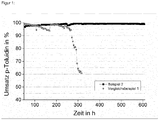
- FIG. 1 The direct comparison of the two catalysts is in FIG. 1 shown. It can be clearly seen that the catalyst used in the prior art has a service life of less than 300 hours, while the catalyst according to the invention shows no deactivation even after 600 hours.
Landscapes
- Chemical & Material Sciences (AREA)
- Organic Chemistry (AREA)
- Engineering & Computer Science (AREA)
- Materials Engineering (AREA)
- Chemical Kinetics & Catalysis (AREA)
- Oil, Petroleum & Natural Gas (AREA)
- Physics & Mathematics (AREA)
- Thermal Sciences (AREA)
- Combustion & Propulsion (AREA)
- General Chemical & Material Sciences (AREA)
- Organic Low-Molecular-Weight Compounds And Preparation Thereof (AREA)
- Catalysts (AREA)
Abstract
Die Erfindung betrifft neue Verfahren zur Herstellung von N-Methyl-p-toluidin für dessen Einsatz als Additiv für Flugbenzin sowie spezielle Katalysatoren für diese Verfahren.
Description
- Die Erfindung betrifft neue Verfahren zur Herstellung von N-Methyl-p-toluidin für dessen Einsatz als Additiv für Flugbenzin sowie spezielle Katalysatoren für diese Verfahren.
- Alkylierte aromatische Amine haben ein hohes wirtschaftliches Potential und werden beispielsweise als Treibstoffadditive (Antiklopfmittel) in Benzinen eingesetzt, um umweltschädliche, bleihaltige Additive abzulösen. Das am häufigsten eingesetzte alkylierte aromatische Amin ist N-Methylanilin. Daneben können aber auch N-alkylierte m- und p-Toluidine zum Einsatz kommen. Für die Herstellung von N-methylierten Toluidinen und speziell N-Methyl-p-toluidin sind nur wenige wirtschaftlich relevante Verfahren beschrieben.
US-A5030759 undDE-A3803661 beschreiben die N-Alkylierung von Anilin und Toluidinen an Zeolithkatalysatoren.US-A2580284 beschreibt die N-Alkylierung von Anilin an aluminiumoxidbasierten Trägerkatalysatoren, die als katalytisch aktives Element Kupfer und Promotoren wie Zinkoxid oder Calciumoxid enthalten. AusDE-A3942413 ist die Verwendung von reiner Niobsäure oder Niobsäure im Gemisch mit inerten Feststoffen wie Titanoxid, Zinkoxid etc. bekannt, was aber zu relativ hohen Anteilen dialkylierter Produkte führt.DE-A3840194 beschreibt die Verwendung von auf Aluminiumoxid geträgerten Kupfer-Katalysatoren, die mit Mangan bzw. Seltenerdverbindungen imprägniert sind. Hauptproblem in den oben geschilderten Beispielen ist die kurze Standzeit der bislang eingesetzten Katalysatoren, die durch Nebenproduktbildungen auf der Katalysatoroberfläche hervorgerufen wird. So berichtetRU-2205067 RU-2274488 RU-2270187 RU-2223258 - Aufgabe der vorliegenden Erfindung war daher die Bereitstellung eines Verfahrens zur Herstellung von N-Methyl-p-toluidin in hohen Ausbeuten, einer langen Standzeit des Katalysators bei hohem Durchsatz und Vermeidung kanzerogener Metalle bzw. deren Oxiden und idealerweise die Bereitstellung eines neuen, wirtschaftlich herstellbaren Katalysators.
- Überraschenderweise wurde nun gefunden, dass die erfindungsgemäße Aufgabe dadurch gelöst werden kann, dass mindestens ein Katalysator eingesetzt wird, der zumindest in folgenden Anteilen
- Cu: 45,5 - 68,0 Gew.%, vorzugsweise 47,0 - 64,1 Gew.%, besonders bevorzugt 47,5 - 60,5 Gew.%,
- Zn: 12,3 - 22,5 Gew.%, vorzugsweise 14,3 - 21,5 Gew.%, besonders bevorzugt 15,2 - 19,5 Gew.%,
- Al: 1,9 - 4,1 Gew.%, vorzugsweise 2,2 - 3,8 Gew.%, besonders bevorzugt 2,5 - 3,6 Gew.%,
- sowie 7,8 - 28,2 Gew.% Sauerstoff, vorzugsweise 13,6 - 25,1 Gew.%, besonders bevorzugt 16,2 - 24,5 Gew.% Sauerstoff und gegebenenfalls 0 - 10 Gew.% Kohlenstoff enthält, wobei Cu, Zn, Al, Sauerstoff und gegebenenfalls Kohlenstoff mindestens 99 Gew.%, vorzugsweise 99,5 Gew.% der Gesamtmenge des Katalysators umfassen.
- Gegenstand der vorliegenden Erfindung sind daher Verfahren zur Herstellung von N-Methyl-p-toluidin durch Umsetzung von p-Toluidin mit Methanol, wonach mindestens ein Katalysator eingesetzt wird, der zumindest in folgenden Anteilen
- Cu: 45,5 - 68,0 Gew.%, vorzugsweise 47,0 - 64,1 Gew.%, besonders bevorzugt 47,5 - 60,5 Gew.%,
- Zn: 12,3 - 22,5 Gew.%, vorzugsweise 14,3 - 21,5 Gew.%, besonders bevorzugt 15,2 - 19,5 Gew.%,
- Al: 1,9 - 4,1 Gew.%, vorzugsweise 2,2 - 3,8 Gew.%, besonders bevorzugt 2,5 - 3,6 Gew.%,
- sowie 7,8 - 28,2 Gew.% Sauerstoff, vorzugsweise 13,6 - 25,1 Gew.%, besonders bevorzugt 16,2 - 24,5 Gew.% Sauerstoff und gegebenenfalls 0 - 10 Gew.% Kohlenstoff enthält, wobei Cu, Zn, Al, Sauerstoff und gegebenenfalls Kohlenstoff mindestens 99 Gew.%, vorzugsweise 99,5 Gew.% der Gesamtmenge des Katalysators umfassen.
- Andere Bestandteile des Katalysators können beispielsweise Alkali- und Erdalkalimetalle, Wasser oder Stickstoffverbindungen, wie beispielsweise Nitrate sein.
- In einer bevorzugten Ausführungsform enthält der Katalysator zumindest in folgenden Anteilen
- kupferoxidhaltige Verbindungen, gerechnet als CuO 59,1 - 78,3 Gew.%, besonders bevorzugt 62,3 - 74,8 Gew.%,
- ZnO: 15,3 - 27,8 Gew.%, besonders bevorzugt 17,5 - 25,2 Gew.%,
- Al2O3: 4,4 - 6,8 Gew.%, besonders bevorzugt 4,9 - 6,1 Gew.%,
- sowie 0 - 10 Gew.% Kohlenstoff, wobei CuO, ZnO, Al2O3 und gegebenenfalls Kohlenstoff mindestens 99 Gew.%, vorzugsweise 99,5 Gew.% der Gesamtmenge des Katalysators umfassen.
- In einer Ausführungsform der Erfindung wird der Katalysator durch Zufuhr von Wasserstoff, vorzugsweise in Gegenwart eines Inertgases, bei Temperaturen von mindestens 150 °C vorbehandelt.
- Die Vorbehandlung des Katalysators mit Wasserstoff kann vor dem Einsatz in den Reaktor oder im Reaktor selber, d. h. im Reaktor, der für die Herstellung von N-Methyl-p-toluidin genutzt wird, erfolgen.
- Eine Vorbehandlung des Katalysators erfolgt vorzugsweise dadurch, dass dieser in eine Reduktionsapparatur eingefüllt und darin auf vorzugsweise 150 - 300 °C, besonders bevorzugt 200 - 300 °C und ganz besonders bevorzugt auf 240 - 290 °C aufgeheizt wird. Vorzugsweise wird der Katalysator mit einem Stickstoff/Wasserstoffstrom einer anfänglichen Zusammensetzung von 95 % N2 und 5 % H2 beaufschlagt. Vorzugsweise wird der Wasserstoffanteil im Gasstrom auf 100 % gesteigert. Die vorgenannte Vorbehandlung hat in der Regel zur Folge, dass CuO zu elementarem Cu reduziert wird, während die anderen Metalle als Oxide vorliegen.
- Für die Vorbehandlung des Katalysators mit Wasserstoff im Reaktor selber wird dieser im vorgenannten Reaktor unter einem Stickstoff/Wasserstoffstrom vorzugsweise der anfänglichen Zusammensetzung 95 % N2 und 5 % H2 auf vorzugsweise 150 - 300 °C, bevorzugt 200 - 300 °C und besonders bevorzugt auf 240 - 290 °C aufgeheizt und dann vorzugsweise der Wasserstoffanteil im Gasstrom auf 100 % H2 gesteigert.
- In einer bevorzugten Ausführungsform des erfindungsgemäßen Verfahrens liegt die Belastung des Katalysators bei 0,1 bis 1,5, vorzugsweise 0,3 bis 1, besonders bevorzugt 0,4 bis 0,7 kg p-Toluidin pro kg Katalysator und Stunde.
- In dem erfindungsgemäßen Verfahren zur Herstellung von N-Methyl-p-toluidin kann dabei p-Toluidin in handelsüblicher Qualität z. B. von der Lanxess Deutschland GmbH eingesetzt werden.
- In dem erfindungsgemäßen Verfahren zur Herstellung von N-Methyl-p-toluidin kann dabei Methanol in handelsüblicher Qualität z. B. von der Brenntag GmbH eingesetzt werden.
- In dem erfindungsgemäßen Verfahren läuft die Reaktion vorzugsweise in einem Rohrreaktor ab.
- In einer weiteren bevorzugten Ausführungsform des erfindungsgemäßen Verfahrens beträgt das molare Verhältnis von p-Toluidin zu Methanol 1:0,7 bis 1:5, vorzugsweise 1:1 bis 1:3,5, besonders bevorzugt 1:1,5 bis 1:2,5.
- In einer ebenfalls bevorzugten Ausführungsform des erfindungsgemäßen Verfahrens beträgt das molare Verhältnis von p-Toluidin zu Wasserstoff 1:0,1 bis 1:5, vorzugsweise 1:1 bis 1:3,5, besonders bevorzugt 1:1 bis 1:3.
- In einer weiteren Ausführungsform kann der bei der Reaktion z. B. durch die Zersetzung von Methanol entstehende Wasserstoff im Gemisch mit den weiteren Prozessgasen in einem Gaskreislauf in den Reaktor zurückgeführt werden.
- In einer weiteren bevorzugten Ausführungsform des erfindungsgemäßen Verfahrens wird dieses bei einer Temperatur von 200 bis 300 °C durchgeführt, bevorzugt 210 bis 270 °C, besonders bevorzugt 220 bis 250 °C.
- Ein weiterer Gegenstand der vorliegenden Erfindung ist ein Verfahren zur Herstellung eines Cu-, Zn- und Al-haltigen Katalysators durch Zugabe von wässriger Natriumcarbonatlösung sowie eines Gemisches aus wässriger Kupfernitrat- und Zinknitratlösung zu einer wässrigen Aluminiumoxidsuspension, unter Beibehaltung eines pH-Wertes von vorzugsweise 7,5 - 8,5, besonders bevorzugt 7,9 - 8,1, bei einer Temperatur von 60 - 80 °C, bevorzugt bei 65 - 75 °C, wobei das Gemisch aus wässriger Kupfernitrat- und Zinknitratlösung vor der Zugabe auf einen pH-Wert von < 1, vorzugsweise einen pH-Wert von 0,4 - 0,6 (bei 20 °C) eingestellt wird, die resultierende Cu-, Zn- und Al-haltige Suspension anschließend gewaschen, danach getrocknet, der daraus erhaltene Feststoff kalziniert und vorzugsweise tablettiert wird.
- Die Einstellung des pH-Wertes auf < 1, vorzugsweise einen pH-Wert von 0,4 - 0,6 erfolgt dabei vorzugsweise mit Salpetersäure.
- Die Einsatzmengen an Aluminiumoxidsuspension, Zinknitratlösung sowie Kupfernitratlösung hängen von der gewünschten Zusammensetzung des Cu-, Zn- und Al- haltigen Katalysators ab.
- Nach Beendigung der Fällung wird die Suspension vorzugsweise zunächst über ein Querstromfilter aufkonzentriert und dann mit entionisiertem Wasser kontinuierlich über das Querstromfilter gewaschen.
- In einer bevorzugten Ausführungsform der Erfindung wird die entstandene Suspension anschließend filtriert, gewaschen und der Feststoff im Trockenschrank getrocknet und vorzugsweise anschließend gesiebt. Alternativ kann der Feststoff auch durch Sprühtrocknung getrocknet werden. Das erhaltene Pulver wird vorzugsweise in einem Drehrohrofen bei 270 - 550 °C kalziniert, anschließend mit Graphit versetzt und mit einer Tablettenpresse zu Formkörpern verarbeitet.
- Der nach dem erfindungsgemäßen Verfahren hergestellte Katalysator wird vorzugsweise zur Herstellung von N-Methyl-p-toluidin eingesetzt.
- Gegenstand der vorliegenden Erfindung ist zudem der nach dem erfindungsgemäßen Verfahren hergestellte Katalysator mit einer spezifischen Kupferoberfläche von 1,4 - 10,2 m2/g, gemessen nach DIN66131-3.
- Gegenstand der vorliegenden Erfindung ist zudem der nach dem erfindungsgemäßen Verfahren hergestellte Katalysator, mit einer durchschnittlichen Kupferpartikelgröße von mehr als 30 nm, bevorzugt 35 - 100 nm, besonders bevorzugt 35 - 75 nm, gemessen nach DIN66131-3.
- Der Katalysator weist dabei vorzugsweise vor der Vorbehandlung die folgende Zusammensetzung auf und enthält zumindest in folgenden Anteilen
- Cu: 45,5 - 68,0 Gew.%, vorzugsweise 47,0 - 64,1 Gew.%, besonders bevorzugt 47,5 - 60,5 Gew.%,
- Zn: 12,3 - 22,5 Gew.%, vorzugsweise 14,3 - 21,5 Gew.%, besonders bevorzugt 15,2 - 19,5 Gew.%,
- Al: 1,9 - 4,1 Gew.%, vorzugsweise 2,2 - 3,8 Gew.%, besonders bevorzugt 2,5 - 3,6 Gew.%,
- sowie 7,8 - 28,2 Gew.% Sauerstoff, vorzugsweise 13,6 - 25,1 Gew.%, besonders bevorzugt 16,2 - 24,5 Gew.% Sauerstoff und gegebenenfalls 0 - 10 Gew.% Kohlenstoff enthält, wobei Cu, Zn, Al, Sauerstoff und gegebenenfalls Kohlenstoff mindestens 99 Gew.%, vorzugsweise 99,5 Gew.% der Gesamtmenge des Katalysators umfassen.
- Ein weiterer Gegenstand der vorliegenden Erfindung ist N-Methyl-p-toluidin mit einem p-Toluidin-Gehalt > 0,0001 bis < 10 Gew.%, vorzugsweise > 0,001 bis < 1 Gew.%, welches vorzugsweise nach dem erfindungsgemäßen Verfahren hergestellt wurde.
- Vorzugsweise enthält das erfindungsgemäße N-Methyl-p-toluidin neben dem p-Toluidin in Anteilen von > 0,0001 bis < 10 Gew.%, vorzugsweise > 0,001 bis < 1Gew.%, auch N,N-Dimethyl-p-toluidin in Anteilen von vorzugsweise > 0,0001 bis < 5 Gew.%.
- N-Methyl-p-toluidin mit einem p-Toluidin-Gehalt > 0,0001 bis < 10 Gew.%, gegebenenfalls in Anwesenheit von N,N-Dimethyl-p-toluidin, zeichnet sich in Kombination mit einem Standard Flugbenzin Basefuel, durch einen Freezepoint von kleiner -58 °C, gemäß ASTM D23866 aus und ist daher hervorragend als Additiv für die Verwendung in bleifreiem Flugbenzin (AVGAS) gemäß ASTM D910 geeignet.
- Um die für AVGAS benötigten Regelungen hinsichtlich Dampfdruck und Siedepunkten zu erfüllen, besitzen die für Flugbenzin Basefuel üblicherweise verwendeten Kohlenwasserstoffe eine Kohlenstoffnummer in der Größenordnung von vier (Butan) bis zehn mit einer vorwiegenden Häufigkeit von acht (Isooctan).
- Darüber hinaus enthalten die Kohlenwasserstoff-Komponenten eines Standard Flugbenzin Basefuels üblicherweise isoparafinische (Butan, Pentan, Hexan, Heptan und Octan Isomeren) und aromatische Kohlenwasserstoffe (Benzol, Toluol, Ethylbenzol, Xylol Isomere, Trimethylbenzol, Cumol und Naphthalin).
- Standard Flugbenzin Basefuel ist beispielsweise beschrieben in Chevron Aviation Fuels Technical Review 2M CBRES GIDC 5723 10/06 MS-9891 (10/06).
- Ein weiterer Gegenstand der vorliegenden Erfindung ist die Verwendung des erfindungsgemäßen N-Methyl-p-toluidins sowie des nach dem erfindungsgemäßen Verfahren hergestellten N-Methyl-p-toluidins als Additiv für Benzine, vorzugsweise Flugbenzin.
- Der Rahmen der Erfindung erfasst alle oben stehenden und im Folgenden aufgeführten allgemeinen oder in Vorzugsbereichen erwähnten Definitionen, Indizes, Parameter und Erläuterungen untereinander, also auch zwischen den jeweiligen Bereichen und Vorzugsbereichen in beliebiger Kombination.
- Die nachfolgenden Beispiele dienen der Erläuterung der Erfindung, ohne dabei limitierend zu wirken.
- Herstellung des erfindungsgemäßen Katalysators:
- 18773 g Kupfernitratlösung mit 14,6 % Cu und 5522 g Zinknitratlösung mit 15,9 % Zn wurden mit destilliertem Wasser auf 22400 ml aufgefüllt. Anschließend wurde mit HNO3 auf einen pH-Wert von 0,5 gestellt.
- 8959 g Natriumcarbonat wurden in 31038 g Wasser aufgelöst
- Der Inhalt des Fällkessels, bestehend aus 40000 g entionisiertem Wasser, wurde mit einem Thermostaten auf 70 °C aufgeheizt. Die Vorlagen 1 und 2 wurden ebenfalls auf 70 °C aufgeheizt. Unter Rühren wurden 273,6 g Aluminiumoxid in den Fällkessel gegeben. Das Gemisch aus Kupfernitrat- und Zinknitratlösung aus Vorlage 1 wurde mit einer Membranpumpe kontinuierlich (190 - 220 ml/min) in den Fällkessel gepumpt, wobei eine zweite Membranpumpe die Natriumcarbonatlösung aus Vorlage 2 zupumpte, so dass während der Fällung der pH-Wert bei 7,9 - 8 gehalten wurde.
Die Suspension wurde anschließend am Querstromfilter aufkonzentriert und mit entionisiertem Wasser auf eine Leitfähigkeit < 100 µS gewaschen. - Die Suspension wurde über eine Porzellannutsche abgesaugt. Der Filterkuchen wurde im Trockenschrank bei 110 °C getrocknet und durch ein 0,8 mm Sieb gedrückt. Das Produkt wurde im Drehrohrofen bei 450 °C kalziniert.
- 4505 g des kalzinierten Produkts wurden mit 225 g Graphit auf einer Tablettenpresse (Typ Korsch XL 100) zu 5 x 5 mm Tabletten verarbeitet.
-
- Schüttgewicht: 1746 g/l,
- Ø Seitenbruchhärte: 168 N,
- BET-Oberfläche: 65,4 m2/g, bestimmt nach ISO9277,
- Porenvolumen: 0,163 cm3/g,
- Glühverlust (1 h, 900°C): 10,7 %,
- Spezifische Cu-Oberfläche: 5,8 m2/g, gemessen nach DIN 66131-3,
- Durchschnittliche Kupferpartikelgröße: 54,8 nm, gemessen nach DIN 66131-3.
- Cu: 51,0 Gew.%, Zn: 16,3 Gew.%, Al 2,7 Gew.%, O: 23,8 Gew.%, die sich nach Aufheizen auf 900 °C und einer Haltezeit von 1 h wie folgt verändert haben:
- Cu: 57,0 Gew.%, Zn: 18,3 Gew.%, Al: 2,9 Gew.%, O: 21,4 Gew.%
- Austestung des erfindungsgemäßen Katalysators: 81 ml des nach Beispiel 1 hergestellten Katalysators (Siebfraktion 1,6 - 3,15 mm) wurden in ein Reaktionsrohr mit einem Innendurchmesser von 32 mm und einer Länge von 180 mm eingefüllt, in dem sich zusätzlich ein Innenrohr mit Thermoelement befand. Das Reaktionsrohr wurde durch eine elektrische Beheizung auf 275 °C gehalten, wobei zunächst der Katalysator mit einem Gemisch aus Stickstoff und Wasserstoff vorbehandelt wurde. Anschließend wurde kontinuierlich ein Reaktionsgemisch aus 40,4 g/h p-Toluidin, 24,1 g/h Methanol und 25,4 l/h Wasserstoff dosiert. Das Reaktionsprodukt wurde kondensiert und gaschromatographisch analysiert.
Die Zusammensetzung des Gemisches betrug nach Abzug von Wasser und Methanol, gemessen nach 300 Stunden: - p-Toluidin: 0,48 Gew.%
- N-Methyl-p-toluidin: 96,27 Gew.%
- N,N-Dimethyl-p-toluidin: 3,25 Gew.%
- und nach 600 h:
- p-Toluidin: 0,59 Gew.%
- N-Methyl-p-toluidin: 97,67 Gew.%
- N,N-Dimethyl-p-toluidin: 1,74 Gew.%
- Selbst nach 600 Stunden Laufzeit war keine signifikante Desaktivierung des Katalysators zu erkennen.
- Herstellung des Katalysators analog zu
US-B2580284 : - 209,5 g Aluminiumoxid wurden mit 113 ml einer Tränklösung bestehend aus 94,33 g Calciumnitrat*4H2O und 48,7 g Kupfer(II)-nitrat*3H2O, gelöst in 34 g Wasser, versetzt. Nach der Tränkung wurde das Material im Warmlufttrockner bei 120 °C getrocknet und anschließend 4 Stunden bei 450 °C kalziniert. Es wurden 243,9 g Katalysator mit Metallanteilen von 5,17 Gew.% Cu und 6,46 Gew.% Ca auf Aluminiumoxid erhalten.
- 81 ml des nach Vergleichsbeispiel 1 hergestellten Katalysators wurden analog zu Beispiel 1 für die Alkylierung von p-Toluidin eingesetzt.
Die typische Zusammensetzung des Gemisches betrug nach Abzug von Wasser und Methanol, gemessen nach 300 Stunden: - p-Toluidin: 33,02 Gew.%
- N-Methyl-p-toluidin: 66,70 Gew.%
- N,N-Dimethyl-p-toluidin: 0,28 Gew.%.
- Der direkte Vergleich der beiden Katalysatoren ist in
Figur 1 dargestellt. Es zeigt sich deutlich, dass der nach dem Stand der Technik eingesetzte Katalysator eine Standzeit von weniger als 300 Stunden aufweist, während der erfindungsgemäße Katalysator auch nach 600 Stunden keine Deaktivierung zeigt.
Claims (15)
- Verfahren zur Herstellung von N-Methyl-p-toluidin durch Umsetzung von p-Toluidin mit Methanol, dadurch gekennzeichnet, dass mindestens ein Katalysator eingesetzt wird, der zumindest in folgenden AnteilenCu: 45,5 - 68,0 Gew.%, vorzugsweise 47,0 - 64,1 Gew.%, besonders bevorzugt 47,5 - 60,5 Gew.%,Zn: 12,3 - 22,5 Gew.%, vorzugsweise 14,3 - 21,5 Gew.%, besonders bevorzugt 15,2 - 19,5 Gew.%,Al: 1,9 - 4,1 Gew.%, vorzugsweise 2,2 - 3,8 Gew.%, besonders bevorzugt 2,5 - 3,6 Gew.%,sowie 7,8 - 28,2 Gew.% Sauerstoff, vorzugsweise 13,6 - 25,1 Gew.%, besonders bevorzugt 16,2 - 24,5 Gew.% Sauerstoff und gegebenenfalls 0 - 10 Gew.% Kohlenstoff enthält, wobei Cu, Zn, Al, Sauerstoff und gegebenenfalls Kohlenstoff mindestens 99 Gew.%, vorzugsweise 99,5 Gew.% der Gesamtmenge des Katalysators umfassen.
- Verfahren nach Anspruch 1, dadurch gekennzeichnet, dass der Katalysator durch Zufuhr von Wasserstoff, vorzugsweise in Gegenwart eines Inertgases, bei Temperaturen von mindestens 150 °C vorbehandelt wird.
- Verfahren nach Anspruch 2, dadurch gekennzeichnet, dass die Vorbehandlung des Katalysators mit Wasserstoff vor dem Einsatz in den Reaktor oder im Reaktor selber erfolgen kann.
- Verfahren nach einem der Ansprüche 1 bis 3, dadurch gekennzeichnet, dass die Belastung des Katalysators 0,1 bis 1,5, vorzugsweise 0,3 bis 1, besonders bevorzugt 0,4 bis 0,7 kg p-Toluidin pro kg Katalysator und Stunde beträgt.
- Verfahren nach einem der Ansprüche 1 bis 4, dadurch gekennzeichnet, dass das molare Verhältnis von p-Toluidin zu Methanol 1:0,7 bis 1:5, vorzugsweise 1:1 bis 1:3,5, besonders bevorzugt 1:1,5 bis 1:2,5 beträgt.
- Verfahren nach einem der Ansprüche 1 bis 5, dadurch gekennzeichnet, dass das molare Verhältnis von p-Toluidin zu Wasserstoff 1:0,1 bis 1:5, vorzugsweise 1:0,5 bis 1:4, besonders bevorzugt 1:1 bis 1:3 beträgt.
- Verfahren nach einem der Ansprüche 1 bis 6, dadurch gekennzeichnet, dass das Verfahren bei einer Temperatur von 200 bis 300 °C durchgeführt wird.
- Verfahren zur Herstellung eines Cu-, Zn- und Al-haltigen Katalysators durch Zugabe von wässriger Natriumcarbonatlösung sowie eines Gemisches aus wässriger Kupfernitrat- und Zinknitratlösung zu einer wässrigen Aluminiumoxidsuspension, unter Beibehaltung eines pH-Wertes von vorzugsweise 7,5 - 8,5, besonders bevorzugt 7,9 - 8,1, bei einer Temperatur von 60 - 80 °C, bevorzugt bei 65 - 75 °C, wobei das Gemisch aus wässriger Kupfernitrat- und Zinknitratlösung vor der Zugabe auf einen pH-Wert von < 1, vorzugsweise einen pH-Wert von 0,4 - 0,6 (bei 20 °C) eingestellt wird, die resultierende Cu-, Zn- und Al-haltige Suspension anschließend gewaschen, danach getrocknet, der daraus erhaltene Feststoff kalziniert und vorzugsweise tablettiert wird.
- Katalysator, erhältlich durch ein Verfahren nach Anspruch 8, mit einer spezifischen Kupferoberfläche von 1,4 - 10,2 m2/g, gemessen nach DIN66131-3.
- Katalysator nach Anspruch 9, mit einer durchschnittlichen Kupferpartikelgröße von mehr als 30 nm, bevorzugt 35 - 100 nm, besonders bevorzugt 35 - 75 nm, gemessen nach DIN66131-3.
- N-Methyl-p-toluidin mit einem p-Toluidin-Gehalt > 0,0001 bis < 10 Gew.%, vorzugsweise > 0,001 bis < 1 Gew.%.
- N-Methyl-p-toluidin mit einem p-Toluidin-Gehalt > 0,0001 bis < 10 Gew.%, vorzugsweise > 0,001 bis < 1 Gew.% und N,N-Dimethyl-p-toluidin in Anteilen von > 0,0001 bis < 5 Gew.%.
- N-Methyl-p-toluidin, erhältlich nach einem Verfahren nach einem der Ansprüche 1 bis 7.
- Verwendung des nach dem Verfahren nach einem der Ansprüche 1 bis 7 hergestellten N-Methyl-p-toluidins als Additiv für Benzine, bevorzugt Flugbenzine.
- Verwendung des Katalysators nach Anspruch 9 oder 10 zur Herstellung von N-Methyl-p-toluidin.
Priority Applications (8)
| Application Number | Priority Date | Filing Date | Title |
|---|---|---|---|
| EP17150428.5A EP3345890A1 (de) | 2017-01-05 | 2017-01-05 | Verfahren zur herstellung von n-methyl-p-toluidin für dessen einsatz als additiv für flugbenzin |
| CA3049064A CA3049064C (en) | 2017-01-05 | 2017-12-19 | Method for preparing n-methyl-p-toluidine for the use thereof as additive for aviation fuel |
| EP17826216.8A EP3565804B1 (de) | 2017-01-05 | 2017-12-19 | Verfahren zur herstellung von n-methyl-p-toluidin für dessen einsatz als additiv für flugbenzin |
| MX2019008068A MX2019008068A (es) | 2017-01-05 | 2017-12-19 | Procedimiento para la preparacion de n-metil-p-toluidina para su utilizacion como aditivo para gasolina de aviacion. |
| US16/473,289 US10875823B2 (en) | 2017-01-05 | 2017-12-19 | Method for producing N-methyl-p-toluidine for use as an additive for aviation gasoline |
| RU2019124664A RU2762263C2 (ru) | 2017-01-05 | 2017-12-19 | Способ получения n-метил-п-толуидина для его использования в качестве добавки к авиационному бензину |
| PCT/EP2017/083582 WO2018127406A1 (de) | 2017-01-05 | 2017-12-19 | Verfahren zur herstellung von n-methyl-p-toluidin für dessen einsatz als additiv für flugbenzin |
| US16/885,853 US11834385B2 (en) | 2017-01-05 | 2020-05-28 | Method for producing N-methyl-p-toluidine for use as an additive for aviation gasoline |
Applications Claiming Priority (1)
| Application Number | Priority Date | Filing Date | Title |
|---|---|---|---|
| EP17150428.5A EP3345890A1 (de) | 2017-01-05 | 2017-01-05 | Verfahren zur herstellung von n-methyl-p-toluidin für dessen einsatz als additiv für flugbenzin |
Publications (1)
| Publication Number | Publication Date |
|---|---|
| EP3345890A1 true EP3345890A1 (de) | 2018-07-11 |
Family
ID=57749846
Family Applications (2)
| Application Number | Title | Priority Date | Filing Date |
|---|---|---|---|
| EP17150428.5A Ceased EP3345890A1 (de) | 2017-01-05 | 2017-01-05 | Verfahren zur herstellung von n-methyl-p-toluidin für dessen einsatz als additiv für flugbenzin |
| EP17826216.8A Active EP3565804B1 (de) | 2017-01-05 | 2017-12-19 | Verfahren zur herstellung von n-methyl-p-toluidin für dessen einsatz als additiv für flugbenzin |
Family Applications After (1)
| Application Number | Title | Priority Date | Filing Date |
|---|---|---|---|
| EP17826216.8A Active EP3565804B1 (de) | 2017-01-05 | 2017-12-19 | Verfahren zur herstellung von n-methyl-p-toluidin für dessen einsatz als additiv für flugbenzin |
Country Status (5)
| Country | Link |
|---|---|
| US (2) | US10875823B2 (de) |
| EP (2) | EP3345890A1 (de) |
| MX (1) | MX2019008068A (de) |
| RU (1) | RU2762263C2 (de) |
| WO (1) | WO2018127406A1 (de) |
Families Citing this family (1)
| Publication number | Priority date | Publication date | Assignee | Title |
|---|---|---|---|---|
| US11434441B2 (en) | 2021-05-07 | 2022-09-06 | John Burger | Blended gasoline composition |
Citations (11)
| Publication number | Priority date | Publication date | Assignee | Title |
|---|---|---|---|---|
| US580284A (en) | 1897-04-06 | Bellows attachment for chairs | ||
| DE803661C (de) | 1949-12-25 | 1951-04-05 | Stoll & Co H | Vorrichtung zum Umstellen der Schlossteile an den Schlittenumkehrstellen fuer flache Strickmaschinen |
| US2580284A (en) * | 1949-04-11 | 1951-12-25 | Shell Dev | Production of secondary aromatic amines |
| DE840194C (de) | 1950-03-04 | 1952-05-29 | Rau Swf Autozubehoer | Fahrtrichtungsanzeiger |
| DE942413C (de) | 1954-04-15 | 1956-05-03 | Krupp Ardelt G M B H | Portalkran mit Einzelfuessen |
| US5030759A (en) | 1989-04-27 | 1991-07-09 | First Chemical Corporation | Selective N-alkylation of aniline in the presence of zeolite catalysts |
| RU2205067C1 (ru) | 2001-10-12 | 2003-05-27 | Открытое акционерное общество "Пигмент" | Катализатор для получения n-метиланилина |
| EP1338587A2 (de) * | 2002-02-22 | 2003-08-27 | Bayer Ag | Verfahren und Katalysator zur Herstellung von Alkoholen |
| RU2223258C1 (ru) | 2003-01-15 | 2004-02-10 | Батрин Юрий Дмитриевич | Способ получения n-метиланилина |
| RU2270187C2 (ru) | 2004-04-14 | 2006-02-20 | Валерий Александрович Головачев | Способ получения n-метиланилина |
| RU2274488C1 (ru) | 2004-10-18 | 2006-04-20 | Открытое акционерное общество "Пигмент" | Способ получения катализатора для синтеза n-метиланилина |
Family Cites Families (13)
| Publication number | Priority date | Publication date | Assignee | Title |
|---|---|---|---|---|
| DE3803661A1 (de) | 1988-02-06 | 1989-08-17 | Bayer Ag | Verfahren zur herstellung von n-alkylierten anilinen |
| DE3840194A1 (de) | 1988-11-29 | 1990-05-31 | Bayer Ag | Kupfer-traegerkatalysator, verfahren zu seiner herstellung und verfahren zur herstellung von n-alkylierten aromatischen aminen unter einsatz dieses kupfer-katalysators |
| EP0433811B1 (de) | 1989-12-21 | 1995-06-28 | Bayer Ag | Verfahren zur Herstellung von N-alkylierten aromatischen Aminen |
| RU2259350C2 (ru) * | 2003-07-14 | 2005-08-27 | Открытое акционерное общество "Пигмент" | Способ получения анилина и/или n-метиланилина и катализатор для него |
| RU2346740C1 (ru) | 2007-08-22 | 2009-02-20 | Институт Катализа Им. Г.К. Борескова Сибирского Отделения Российской Академии Наук | Катализатор и способ получения n-метиланилина |
| CN101792393B (zh) | 2010-03-03 | 2013-04-24 | 太原化工股份有限公司 | 一种n-烷基芳胺化合物的合成方法 |
| RU2495017C1 (ru) * | 2012-03-28 | 2013-10-10 | Федеральное государственное бюджетное образовательное учреждение высшего профессионального образования "Московский государственный университет тонких химических технологий имени М.В. Ломоносова" (МИТХТ имени М.В. Ломоносова) | Способ одновременного получения ароматических углеводородов и дивинила |
| CN103570553B (zh) | 2012-08-01 | 2016-08-10 | 中国科学院兰州化学物理研究所 | 一种通过催化烷基化制备n-取代胺类化合物的方法 |
| CN104276957B (zh) | 2013-07-09 | 2016-03-30 | 中国科学院兰州化学物理研究所 | 一种制备n-甲基或n,n-二甲基胺类化合物的方法 |
| DE102014004413A1 (de) | 2014-03-26 | 2015-10-01 | Clariant International Ltd. | Hydrierkatalysator und Verfahren zu dessen Herstellung |
| FR3020377B1 (fr) | 2014-04-25 | 2020-11-27 | Total Marketing Services | Composition lubrifiante comprenant un compose anti-cliquetis |
| CN106957232A (zh) | 2017-03-14 | 2017-07-18 | 中国科学院兰州化学物理研究所 | 一种选择性制备n‑单甲基胺类化合物的方法 |
| CN108658783A (zh) | 2018-03-26 | 2018-10-16 | 中国科学院兰州化学物理研究所 | 一种以硝基化合物为原料选择性制备n-单甲基胺类化合物的方法 |
-
2017
- 2017-01-05 EP EP17150428.5A patent/EP3345890A1/de not_active Ceased
- 2017-12-19 EP EP17826216.8A patent/EP3565804B1/de active Active
- 2017-12-19 MX MX2019008068A patent/MX2019008068A/es unknown
- 2017-12-19 US US16/473,289 patent/US10875823B2/en active Active
- 2017-12-19 RU RU2019124664A patent/RU2762263C2/ru active
- 2017-12-19 WO PCT/EP2017/083582 patent/WO2018127406A1/de not_active Ceased
-
2020
- 2020-05-28 US US16/885,853 patent/US11834385B2/en active Active
Patent Citations (11)
| Publication number | Priority date | Publication date | Assignee | Title |
|---|---|---|---|---|
| US580284A (en) | 1897-04-06 | Bellows attachment for chairs | ||
| US2580284A (en) * | 1949-04-11 | 1951-12-25 | Shell Dev | Production of secondary aromatic amines |
| DE803661C (de) | 1949-12-25 | 1951-04-05 | Stoll & Co H | Vorrichtung zum Umstellen der Schlossteile an den Schlittenumkehrstellen fuer flache Strickmaschinen |
| DE840194C (de) | 1950-03-04 | 1952-05-29 | Rau Swf Autozubehoer | Fahrtrichtungsanzeiger |
| DE942413C (de) | 1954-04-15 | 1956-05-03 | Krupp Ardelt G M B H | Portalkran mit Einzelfuessen |
| US5030759A (en) | 1989-04-27 | 1991-07-09 | First Chemical Corporation | Selective N-alkylation of aniline in the presence of zeolite catalysts |
| RU2205067C1 (ru) | 2001-10-12 | 2003-05-27 | Открытое акционерное общество "Пигмент" | Катализатор для получения n-метиланилина |
| EP1338587A2 (de) * | 2002-02-22 | 2003-08-27 | Bayer Ag | Verfahren und Katalysator zur Herstellung von Alkoholen |
| RU2223258C1 (ru) | 2003-01-15 | 2004-02-10 | Батрин Юрий Дмитриевич | Способ получения n-метиланилина |
| RU2270187C2 (ru) | 2004-04-14 | 2006-02-20 | Валерий Александрович Головачев | Способ получения n-метиланилина |
| RU2274488C1 (ru) | 2004-10-18 | 2006-04-20 | Открытое акционерное общество "Пигмент" | Способ получения катализатора для синтеза n-метиланилина |
Non-Patent Citations (2)
| Title |
|---|
| J.E. BROWN, ET AL.: "Mechanism of aromatic amine anti-knock action", INDUSTRIAL AND ENGINEERING CHEMISTRY, vol. 47, no. 10, October 1955 (1955-10-01), American Chemical Society, Washington, DC, US, pages 2141 - 2146, XP002539089, ISSN: 0019-7866, DOI: 10.1021/ie50550a034 * |
| M. VIJAYARAJ, ET AL.: "Selective mono-N-methylation of aniline substrates on Cu<1-x>Zn<x>Fe<2>O<4>", APPLIED CATALYSIS A: GENERAL, vol. 320, 4 January 2007 (2007-01-04), Elsevier, Amsterdam, NL, pages 64 - 68, XP005912345, ISSN: 0926-860X, DOI: 10.1016/j.apcata.2006.12.016 * |
Also Published As
| Publication number | Publication date |
|---|---|
| EP3565804A1 (de) | 2019-11-13 |
| US11834385B2 (en) | 2023-12-05 |
| RU2019124664A3 (de) | 2021-04-26 |
| WO2018127406A1 (de) | 2018-07-12 |
| RU2019124664A (ru) | 2021-02-06 |
| EP3565804B1 (de) | 2021-06-09 |
| MX2019008068A (es) | 2019-08-29 |
| US10875823B2 (en) | 2020-12-29 |
| US20200148625A1 (en) | 2020-05-14 |
| CA3049064A1 (en) | 2018-07-12 |
| RU2762263C2 (ru) | 2021-12-17 |
| US20200290947A1 (en) | 2020-09-17 |
Similar Documents
| Publication | Publication Date | Title |
|---|---|---|
| DE2127656C2 (de) | Verfahren zur Herstellung von Schmieröl mit hohem Viskositätsindex | |
| DE69423106T2 (de) | Wasserstoffbehandlungskatalysator und seine verwendung | |
| EP0672452B1 (de) | Nickelhaltige Hydrierkatalysatoren | |
| DE69521289T2 (de) | Reduktive Aminierung zur selektiven Herstellung von Aminoethylethanolamin | |
| DE2164562A1 (de) | Hydroraffinierungskatalysator, Verfahren zu dessen Herstellung und dessen Verwendung | |
| DE2638498A1 (de) | Katalysator fuer die hydrierende entfernung von metallen und schwefel, dessen herstellung und dessen verwendung | |
| DE2018244A1 (de) | Verfahren zur Regenerierung von Hydrierungskatalysatoren | |
| WO2009124870A1 (de) | Verfahren zur dehydroaromatisierung von methanhaltigen gemischen unter regenerierung der entsprechenden edelmetallfreien katalysatoren | |
| DE1545396A1 (de) | Katalysator und Verfahren zur Umwandlung von Kohlenwasserstoffen | |
| DE69325919T2 (de) | Fischer-Tropsch Reaktion unter Verwendung von Katalysatoren, welche eine Zinkoxydzusammensetzung enthalten | |
| DE69100579T2 (de) | Verfahren zur Herstellung einer katalytischen Zusammensetzung für die Hydroentschwefelung von Kohlenwasserstofföl und Kohlenwasserstoffölhydroentschwefelungsverfahren. | |
| DE1442850A1 (de) | Katalysator zur Umwandlung von Kohlenwasserstoffen | |
| EP3565804B1 (de) | Verfahren zur herstellung von n-methyl-p-toluidin für dessen einsatz als additiv für flugbenzin | |
| DE2511202A1 (de) | Katalysatoren fuer die hydrierende entschwefelung von kohlenwasserstoffen | |
| DE3029266C2 (de) | Katalysator für die einstufige Hydrierung von Heteroatomverbindungen und Aromaten enthaltenden Kohlenwasserstoffgemischen | |
| DE2411986A1 (de) | Verfahren zur selektiven erzeugung von fluessiggas | |
| DE2540637A1 (de) | Verfahren zum reformieren von naphtha unter verwendung eines amphorafoermigen katalysators | |
| EP2303781B1 (de) | Verfahren zur herstellung nanokristalliner nickeloxide | |
| CA3049064C (en) | Method for preparing n-methyl-p-toluidine for the use thereof as additive for aviation fuel | |
| DE2654028A1 (de) | Kobaltkatalysator | |
| DE1074014B (de) | Verfahren zur Herstellung eines aktiven formfesten Tonerde Trager Katalysators | |
| DE2216975C3 (de) | Verfahren zur Herstellung eines hydrieraktiven Katalysators | |
| DE1127904B (de) | Verfahren zur Herstellung eines fuer die Reduktion von aromatischen Nitroverbindungen verwendbaren Kupferkatalysators | |
| DE1271870B (de) | Verfahren zur katalytischen Umwandlung einer Kohlenwasserstoffbeschickung | |
| DE886897C (de) | Verfahren zur Herstellung niedrigsiedender Kohlenwasserstoffe aus hoehersiedenden Kohlenwasserstoffen durch katalytische Spaltung |
Legal Events
| Date | Code | Title | Description |
|---|---|---|---|
| PUAI | Public reference made under article 153(3) epc to a published international application that has entered the european phase |
Free format text: ORIGINAL CODE: 0009012 |
|
| AK | Designated contracting states |
Kind code of ref document: A1 Designated state(s): AL AT BE BG CH CY CZ DE DK EE ES FI FR GB GR HR HU IE IS IT LI LT LU LV MC MK MT NL NO PL PT RO RS SE SI SK SM TR |
|
| AX | Request for extension of the european patent |
Extension state: BA ME |
|
| STAA | Information on the status of an ep patent application or granted ep patent |
Free format text: STATUS: THE APPLICATION HAS BEEN REFUSED |
|
| 18R | Application refused |
Effective date: 20181126 |