EP3346053A2 - Système de coloration pour matériaux textiles - Google Patents
Système de coloration pour matériaux textiles Download PDFInfo
- Publication number
- EP3346053A2 EP3346053A2 EP17186906.8A EP17186906A EP3346053A2 EP 3346053 A2 EP3346053 A2 EP 3346053A2 EP 17186906 A EP17186906 A EP 17186906A EP 3346053 A2 EP3346053 A2 EP 3346053A2
- Authority
- EP
- European Patent Office
- Prior art keywords
- container
- fixer
- salt
- opening
- dye
- Prior art date
- Legal status (The legal status is an assumption and is not a legal conclusion. Google has not performed a legal analysis and makes no representation as to the accuracy of the status listed.)
- Granted
Links
Images


Classifications
-
- D—TEXTILES; PAPER
- D06—TREATMENT OF TEXTILES OR THE LIKE; LAUNDERING; FLEXIBLE MATERIALS NOT OTHERWISE PROVIDED FOR
- D06P—DYEING OR PRINTING TEXTILES; DYEING LEATHER, FURS OR SOLID MACROMOLECULAR SUBSTANCES IN ANY FORM
- D06P1/00—General processes of dyeing or printing textiles, or general processes of dyeing leather, furs, or solid macromolecular substances in any form, classified according to the dyes, pigments, or auxiliary substances employed
- D06P1/0004—General aspects of dyeing
- D06P1/0016—Dye baths containing a dyeing agent in a special form such as for instance in melted or solid form, as a floating film or gel, spray or aerosol, or atomised dyes
-
- B—PERFORMING OPERATIONS; TRANSPORTING
- B65—CONVEYING; PACKING; STORING; HANDLING THIN OR FILAMENTARY MATERIAL
- B65D—CONTAINERS FOR STORAGE OR TRANSPORT OF ARTICLES OR MATERIALS, e.g. BAGS, BARRELS, BOTTLES, BOXES, CANS, CARTONS, CRATES, DRUMS, JARS, TANKS, HOPPERS, FORWARDING CONTAINERS; ACCESSORIES, CLOSURES, OR FITTINGS THEREFOR; PACKAGING ELEMENTS; PACKAGES
- B65D65/00—Wrappers or flexible covers; Packaging materials of special type or form
- B65D65/38—Packaging materials of special type or form
- B65D65/46—Applications of disintegrable, dissolvable or edible materials
-
- B—PERFORMING OPERATIONS; TRANSPORTING
- B65—CONVEYING; PACKING; STORING; HANDLING THIN OR FILAMENTARY MATERIAL
- B65D—CONTAINERS FOR STORAGE OR TRANSPORT OF ARTICLES OR MATERIALS, e.g. BAGS, BARRELS, BOTTLES, BOXES, CANS, CARTONS, CRATES, DRUMS, JARS, TANKS, HOPPERS, FORWARDING CONTAINERS; ACCESSORIES, CLOSURES, OR FITTINGS THEREFOR; PACKAGING ELEMENTS; PACKAGES
- B65D81/00—Containers, packaging elements, or packages, for contents presenting particular transport or storage problems, or adapted to be used for non-packaging purposes after removal of contents
- B65D81/32—Containers, packaging elements, or packages, for contents presenting particular transport or storage problems, or adapted to be used for non-packaging purposes after removal of contents for packaging two or more different materials which must be maintained separate prior to use in admixture
-
- C—CHEMISTRY; METALLURGY
- C09—DYES; PAINTS; POLISHES; NATURAL RESINS; ADHESIVES; COMPOSITIONS NOT OTHERWISE PROVIDED FOR; APPLICATIONS OF MATERIALS NOT OTHERWISE PROVIDED FOR
- C09B—ORGANIC DYES OR CLOSELY-RELATED COMPOUNDS FOR PRODUCING DYES, e.g. PIGMENTS; MORDANTS; LAKES
- C09B67/00—Influencing the physical, e.g. the dyeing or printing properties of dyestuffs without chemical reactions, e.g. by treating with solvents grinding or grinding assistants, coating of pigments or dyes; Process features in the making of dyestuff preparations; Dyestuff preparations of a special physical nature, e.g. tablets, films
- C09B67/0071—Process features in the making of dyestuff preparations; Dehydrating agents; Dispersing agents; Dustfree compositions
- C09B67/0072—Preparations with anionic dyes or reactive dyes
- C09B67/0073—Preparations of acid or reactive dyes in liquid form
-
- D—TEXTILES; PAPER
- D06—TREATMENT OF TEXTILES OR THE LIKE; LAUNDERING; FLEXIBLE MATERIALS NOT OTHERWISE PROVIDED FOR
- D06P—DYEING OR PRINTING TEXTILES; DYEING LEATHER, FURS OR SOLID MACROMOLECULAR SUBSTANCES IN ANY FORM
- D06P1/00—General processes of dyeing or printing textiles, or general processes of dyeing leather, furs, or solid macromolecular substances in any form, classified according to the dyes, pigments, or auxiliary substances employed
- D06P1/0004—General aspects of dyeing
-
- D—TEXTILES; PAPER
- D06—TREATMENT OF TEXTILES OR THE LIKE; LAUNDERING; FLEXIBLE MATERIALS NOT OTHERWISE PROVIDED FOR
- D06B—TREATING TEXTILE MATERIALS USING LIQUIDS, GASES OR VAPOURS
- D06B3/00—Passing of textile materials through liquids, gases or vapours to effect treatment, e.g. washing, dyeing, bleaching, sizing, impregnating
- D06B3/30—Passing of textile materials through liquids, gases or vapours to effect treatment, e.g. washing, dyeing, bleaching, sizing, impregnating of articles, e.g. stockings
Definitions
- the present invention relates to a dyeing system for textile materials comprising at least one salt in at least one first container and at least one dye in at least one second container, wherein the at least one first container, a first opening or a first group of a plurality of openings, and the at least one second Container has a second opening or a second group of multiple openings, the use of the dyeing system for dyeing textile materials or for refreshing dyeings of textiles and a method for dyeing textile materials based on the dyeing system.
- salt is added to the washing drum of a washing machine and, after about 5 minutes, a coloring agent is added to a washing compartment of the washing machine.
- the delayed addition of the colorant is intended to cause this enters into a washing machine drum filled with water and does not act punctiformly concentrated on the textile material.
- the salt is added together with the colorant in the washing machine drum.
- the salt is not sufficiently in the Washer drum is distributed and the dye reacts with the water in the drum and not with the fiber of the textile material.
- a resulting so-called dye hydrolyzate is colorless worthless because it does not contribute to the color.
- Hydrolyzate is the product of hydrolysis, which is the cleavage of a chemical compound by reaction with water.
- more and more washing machines have a so-called jet system that allows water to trickle evenly through nozzles in the washing machine drum and reduces the water consumption of the washing machine.
- the colorant which is added simultaneously with the salt into the washing machine drum, is then possibly too concentrated compared to the amount of water in the drum and causes cloudy discolorations or dye stains on the textile materials, especially in the case of light dyestuffs.
- a dispenser for laundry products especially fabric softening products, but not for dyeing textiles, and for use in the tumble dryer, the dispenser being in the form of a hollow ball with many product dispensing openings.
- the ball also has a product inlet opening in which a measuring cup is mounted in fluid communication with the product inlet.
- the DE 694 11 707 T2 discloses a dosing and dispensing device, consisting of a hollow body, for dispensing a liquid detergent for pretreating and washing fabrics in a washing machine, wherein the detergent exits through a so-called through-hole and an orifice, a ball being rotatably supported between the latter. For dyeing textiles, this device is not suitable.
- a washing or cleaning agent portion which may be packaged in a bag or sack, is proposed for charging a washing machine or dishwashing machine, wherein the portion comprises a first and a second measured amount of a washing or cleaning active preparation for two delayed-acting washing or cleaning Rinses contains.
- a coloring of textiles can not be done with it.
- a pouch for packaging a finely powdered colorant having a water-insoluble but water-permeable substrate and a water-sensitive sealant is removable such that the contents of the pouch are released by contact of the pouch with water and mechanical agitation.
- the DE 100 33 827 A1 relates to dimensionally stable hollow body containing a washing, cleaning or detergent portion and disintegrate under washing, cleaning or rinsing conditions. A coloring of textiles can not be done with it.
- a water-soluble detergent product in the form of a water-soluble bag comprising at least two chambers is removable, each chamber containing a different component of a composition, the first component comprising a liquid matrix and a peracid source.
- a coloring of textiles can not be done with it.
- no dye stains in particular no punctiform dye stains (so-called "spots"), are caused on the textile material to be dyed.
- the separate provision in different containers causes a slowed, but not too slow release of the reagents in the dyeing liquor, so that although the coloration of the fibers of the textile material can be done, but no such large amounts of dye and salt and optionally fixative on the textile Impact material that unwanted color spots (spots) are generated.
- the invention can be realized with a first container, especially if at least one salt, especially if in addition to the at least one salt at least one fixer is present in this, and even more preferably, if only one salt is used, and even more preferred if exactly one salt and exactly one fixer, apart from impurities, is added.
- Small amount impurities of about less than 0.2% by weight, based on the total amount of the first container, may be present in the first container, but are negligible with respect to the properties and effects of the at least one salt included in the first container and / or at least one fixer.
- a first container is particularly useful when a fixer-salt mixture is used.
- Two first containers are particularly suitable for the case when at least one salt and at least one fixer each in their own first container, but especially if exactly one salt and exactly one fixer are each used in a separate first container.
- the use of only one or two first containers, especially a single first container, has the advantage of environmentally friendly limiting the amount of (used) packaging material and is also generally less expensive than the use of more than one first container.
- the dyeing system is placed together with the textile material to be dyed in a third container.
- the third container is formed in the course of the dyeing process and the process according to the invention, the dyebath, also called dyeing liquor.
- the third container is a laundry drum, and more preferably a laundry drum of a washing machine (washing machine drum).
- washing machine is meant herein in particular a washing machine or washing machine for the private household, in particular a washing machine or washing machine with a laundry drum, which has a capacity of about 4 to about 8 kg, about 4 to about 7 kg or about 5 to about 6 kg dry laundry.
- the dyeing system according to the invention is not in a Ein Hughesfach a washing machine entered. Therefore, a third container in the context of the present invention is not to be understood as a dispensing compartment of a washing machine.
- the dyeing system in the third container is at a water temperature in a range of about 25 ° C to about 95 ° C, more preferably in a range of about 30 ° C to about 65 ° C, and most preferably in a range of about 30 ° C is used to about 40 ° C, and preferably over a period of about 15 minutes to about 300 minutes, more preferably over a period of about 30 minutes to about 90 minutes.
- the at least one second container is designed such that the beginning of the delivery of the dye or dyes, if appropriate, and preferably together with at least one solvent and one or more auxiliary agents, after the partial or complete release of the salt and / or fixer or the fixer Salt mixture from the at least one first container happens.
- the timing of the onset of delivery of the dye refers to the onset of delivery of the salt and / or fixer or fixer-salt mixture, and is preferably in the range of about 1 minute to about 10 minutes, more preferably in the range of about 2 minutes to about 8 minutes, and more preferably in a range of about 4 minutes to about 6 minutes.
- the complete or substantially complete delivery of the salt and / or fixer or fixer-salt mixture from the first container is completed before the dispensing of the dye from the second container begins.
- the dispensing of the dye from the second container can thus already begin when the delivery of the salt and / or fixer or the fixer-salt mixture from the first container is not completely completed.
- the first opening or the first group of a plurality of openings of the first container and the second opening or the second group of a plurality of openings of the second container have an opening width of about 0.5 ⁇ m to about 14 cm, more preferably up to about 11 cm more preferably to about 10 cm, on.
- the opening width of the openings of the first and second containers in particular in the range of about 0.5 microns to about 14 cm, more preferably up to about 11 cm, even more preferably up to about 10 cm, preferably about 0.5 ⁇ m to about 10 mm and more preferably about 0.5 ⁇ m to about 1 mm, a time delay between the delivery of the at least one dye from the at least one second container and the delivery of the at least one salt and optionally fixer or A fixer-salt mixture of the at least one first container from about 1 minute to about 10 minutes, preferably from about 2 minutes to about 8 minutes, and more preferably from about 4 minutes to about 6 minutes, wherein the exit of the ingredients or reagents from the first container takes place earlier than from the second container, allowing the precipitation of too much dye on the fiber of the textile material s and thus the formation of spots (spots) is avoided.
- Textile materials according to the present invention are, in particular, those made of cotton, other natural fibers, in particular natural fibers of plant origin, in particular linen, jute, hemp, bast or flax, natural fibers of animal origin, in particular wool or silk, synthetic fibers, in particular polyamide or polyester or Mixtures of the aforementioned materials are made.
- substantive and direct dyes are particularly suitable for textile materials which are made of cotton, other natural fibers, in particular natural fibers of plant origin, in particular linen, jute, hemp, bast or flax, natural fibers of animal origin, in particular wool or silk, synthetic fibers, in particular polyamide or polyester or mixtures of the aforementioned materials.
- reactive dyes are particularly suitable for textile materials which are made of cotton, other natural fibers of plant origin, in particular linen, jute, hemp, bast or flax, wool, polyamide or mixtures of the aforementioned materials are made. Otherwise, reactive dyes are useful in synthetic fibers such as polyester or silk only when these fibers are in admixture with other, dyeable natural fibers, especially selected from the group consisting of cotton, linen, wool, jute, hemp, bast and flax.
- the salt and / or fixer or fixer-salt mixture is contained in at least one first container and the at least one dye is received in at least one second container for direct use in the third container.
- the direct use means that the at least one first and second container are added to or placed in the third container before the start of a dyeing process. Accordingly, when using a washing machine prior to the start of a washing or dyeing program of a washing machine, the at least one first and second containers are added to or placed in the laundry drum together with at least one textile material to be dyed.
- the at least one first container is designed as a bag or can and preferably the at least one second container is designed as a bag, can or bottle.
- both the first container and the second container are formed as a bag or can, preferably as a bag.
- the first container is designed as a bag and the second container as a bottle, wherein more preferably exactly one such first container and such a second container are present in the dyeing system according to the invention.
- the first and second containers form a space essentially separating their contents from the environment. If the first container is designed as a bag, it is cut before use, preferably before insertion into the washing drum of a washing machine. If the second container is designed as a bottle, then before use, preferably before insertion into the washing drum of a washing machine, a screw cap or other closure of the bottle is removed and thus the at least one opening of the same is released.
- the first container and the second container are not interlaced.
- the at least one first container or the at least one second container is neither partially nor completely inserted into the respective other first or second container or is.
- the first container and the second container separate, that is not material connected, parts or containers.
- the inner region of the first and the second container are separated from each other, in particular flow or hydrodynamically separated, and / or not connected liquid-transmitting, that no exchange of ingredients or dissolved in water ingredients between the two containers. This applies in the closed state of the container.
- the sizes of the openings of the two containers can be chosen so that, when the closures of the openings of the container are removed, their respective content is discharged to the outside in the dyeing liquor, but only to a small extent or not a thorough mixing of the contents of a Container with a part of the contents of the other container in one of the container takes place.
- a direct reaction of the salt and / or fixer or the fixer salt mixture with the dye in an undesirable side reaction (hydrolysis of the dye) without dyeing of the textile material is greatly reduced or completely avoided.
- the release of the ingredients from the containers into the water or the dye liquor is slowed down so that the concentration of these ingredients (reactants) while on the textile material is sufficiently high for the dyeing process desired there, but low enough to greatly reduce side effects such as side reactions such as dye hydrolysis, but especially the stain / spot formation, or completely avoided.
- the outer region of the first and the second container may be separated from each other.
- the separation of the outer region allows independent movement of the first of the second container and vice versa, in particular such independent movement of the first and second container in the third container.
- the opening or openings of the first and / or second container is or are each by means of at least one closure selected from the group consisting of non-water-soluble Closures closed, wherein the non-water-soluble closures are selected in particular from the group consisting of hinged closures, screw caps, closures with predetermined breaking or tear seam, sealing seams and non-water-soluble layers such as in particular plastic films.
- the closure is openable and / or removable.
- the closure is preferably reclosable.
- the closure on one side with the second container and preferably on a bottle neck hinged and / or releasably connected.
- the closure has an internal thread and the second container has a corresponding counter or external thread around the second opening or the second group of a plurality of openings.
- the foldable function is preferably realized with a hinge and more preferably with an elastic intermediate piece, between the closure and the neck of the bottle.
- the second container which is more preferably designed as a bottle, at a top end of the bottle neck on a dosing.
- the dosing hood covers the preferably cylindrical bottle neck substantially on the upper side.
- the bottleneck has at least one second opening.
- the at least one second opening is preferably round. It preferably extends completely through the metering hood.
- the closure which is further preferably designed as a flap closure or rotary closure, centered on a closure top and extending into a cavity of the closure extending at least one pin.
- the pin of the closure preferably has an occlusive function or stuffing function.
- the opening width of the at least one second opening of the second container is selected such that it corresponds approximately to a width of the at least one pin. If the closure screwed to the second container or attached to this, the pin closes over the width of the second opening of the second container.
- meherer second openings provided are provided in a corresponding number of pins which engage in these second openings.
- the second opening or second openings of the second container are sealed in a further preferred embodiment with such closures that are water-soluble and / or alkali-soluble.
- Alkali-soluble means soluble in an aqueous medium having a pH greater than 7, i. in the alkaline range.
- the second container has, as a closure for the second opening or the second group of several openings, water-soluble and / or alkali-soluble closures which are selected from the group consisting of water-soluble and / or alkali-soluble layers and plugs, in particular water-soluble and / or or alkali-soluble layers and stoppers comprising one or more fatty acids.
- the alkali-soluble layer may preferably comprise carboxylated acrylic polymer.
- An alkaline substance such as NaOH or KOH is preferably contained in the first container together with the salt and / or fixer or in the fixer salt mixture.
- the closure for the second opening or the second group of multiple openings is the layer or pourable plug which dissolves from the time of reaching the melting point and / or in contact with water or alkaline medium.
- the layer or castable plug is preferably selected from one or more fatty acids selected from the group consisting of saturated fatty acids, in particular selected from the group consisting of decanoic acid (C 9 H 19 COOH), undecanoic acid (C 10 H 21 COOH), dodecanoic acid (C 11 H 23 COOH), tridecanoic acid (C 12 H 25 COOH), tetradecane casein (C 13 H 27 COOH), pentadecanoic acid (C 14 H 29 COOH), hexadecanes (C 15 H 31 COOH), heptadecanoic acid (C 16 H 33 COOH), octadecanoic acid (C 17 H 35 COOH), nonadecanoic acid (C 18 H 37 COOH and eicosane / icosanoic acid (C 19 H 39 COOH).
- decanoic acid C 9 H 19 COOH
- undecanoic acid C 10 H 21 COOH
- dodecanoic acid C 11 H 23 COOH
- the second opening or the second group of a plurality of openings of the second container each have an opening width of about 0.5 mm to about 10 mm, more preferably from about 1 mm to about 5 mm, and more preferably from about 1.5 mm to about 2.5 mm.
- the at least one first container for the salt and / or the fixing or the fixer-salt mixture is preferably made of plastic, in particular polyethylene and / or polypropylene.
- the first container of fibrous materials such as polyester fabric and / or at least in some areas a water-permeable fiber bag.
- the first container and the second container are made of fibrous materials and / or at least partially formed or completely in each case as a water-permeable fiber bag.
- the at least one first container is designed as a bag and has at least one first and optionally at least one second sealed seam.
- the at least one first sealed seam is arranged at an upper end of the bag and closes the contents of the bag tightly from the environment.
- the at least one second sealed seam is arranged substantially parallel to a first sealed seam.
- the one second sealing seam is arranged starting from the upper end of the bag slightly below the one first sealing seam and closer to a lower end of the bag than the one first sealing seam.
- the distance between the first seal seam and the second seal seam running essentially parallel to the latter is correspondingly selected so that after a separation of the first seal seam, preferably by means of a pair of scissors, a second seal seam is not damaged.
- the one second sealed seam is located much closer to the top of the bag than to the bottom of the bag.
- the at least one second sealed seam is preferably in contact with the content and adjoins it directly.
- the first container has only a first sealing seam, which is preferably arranged over the entire width of the bag at the upper end thereof, and which is preferably opened by cutting across the entire width of the bag.
- the first container has at least the first opening or the first group of a plurality of openings for the fixer-salt mixture.
- the first opening or the first group of a plurality of openings of the first container is one or at least one interruption of the at least one second sealed seam and is exposed by removing the at least one first sealed seam. Without the removal of a first sealed seam, the interior of the first container remains separated from the environment.
- the distance between the first sealed seam and the second sealed seam is selected to be correspondingly low, so that essentially no contents of the first container are collected between the one first sealed seam and the one second sealed seam.
- the first opening or the preferred interruption of a second sealing seam is preferably arranged approximately centrally to a longitudinal extension of the second sealing seam and forms a defined opening width.
- the first sealing seam and the second sealing seam have no gap and run directly against each other and form a common sealing surface.
- the first opening which is preferably arranged between or in the at least one second sealed seam, forms a groove.
- the groove is preferably rectangular and more preferably triangular in shape and runs adjacent to a first sealing seam substantially pointed together, and preferably with the tip pointing to the first sealing seam.
- the triangular design of the first opening Depending on the content is given by the triangular design of the first opening a variable choice of the position of the cutting line when separating the sealing seams and thus the size of the first opening. Due to the triangular design, the larger the first opening is separated from the first opening.
- the first and / or second container are formed at least in some areas as a water-permeable fiber bag.
- the water-permeable fiber bag preferably comprises a first group of a plurality of openings in the form of pores on the fibers.
- the first and / or the second container are substantially completely formed as a water-permeable fiber bag. More preferably, the region of fibers extends only over a bag front or bag back which extends substantially between the top and bottom of the bag. The bag front and the bag back, which extend over the top and bottom of the bag, as well as two lateral ends of the bag, are interconnected across the two lateral ends of the bag.
- the non-fibrous bag front or bag back is preferably made of plastic and impermeable to water. More preferably, the other fiber side of the bag is covered with a likewise water-impermeable transport foil which is removable and removed before the bag is placed in the third container.
- the pores of the fiber bag preferably have an opening width in a range from about 0.5 ⁇ m to about 1 mm, more preferably in a range from about 1 ⁇ m to about 150 ⁇ m and particularly preferably in a range from about 10 ⁇ m to about 50 ⁇ m ,
- opening width means the diameter of the opening and, in the case of ellipsoidal or non-round, such as rectangular openings, the distance between the two points furthest away from one another on the edges of the opening ,
- the dye may be in powder form or preferably dissolved in at least one, preferably exactly one, solvent.
- the fixer-salt mixture may be in the form of lumps, chunks or powders and may have a grain size with an equivalent diameter of from about 0.01 mm to about 1 cm.
- the powdered dye and / or the powdered fixer salt mixture preferably have a particle size with an equivalent diameter in a range of about 0.01 mm to about 2 mm, preferably in a range of about 0.1 mm to about 1 mm, and especially preferably in a range of about 0.3 mm to about 0.7 mm.
- the advantage of small particle sizes lies in an improved solubility behavior for faster production of the dye liquor.
- leakage of the fixer salt particles from the first container into the surrounding water or dye liquor is possible and advantageous.
- the fixer-salt mixture has a grain size which is preferably substantially less than or equal to the opening width of the first opening or the openings of the first container.
- the dye has a particle size which is greater than the opening width of the second opening or openings of the second container. This ensures that the dye only exits the second container when it has dissolved in the water that has penetrated into the second container.
- the fixer of the powdered fixer-salt mixture is selected from a group consisting of sodium metasilicate, potassium metasilicate, sodium carbonate, potassium carbonate, ammonium carbonate, sodium hydroxide and potassium hydroxide, preferably consisting of sodium metasilicate, sodium carbonate and sodium hydroxide.
- the salt is selected from a group consisting of sodium chloride, potassium chloride, ammonium chloride, sodium sulfate, potassium sulfate, ammonium sulfate, preferably consisting of sodium chloride, ammonium chloride, sodium sulfate and ammonium sulfate, more preferably consisting of sodium chloride and sodium sulfate.
- the fixer-salt mixture consists of sodium metasilicate or sodium carbonate as a fixer and sodium chloride as a salt.
- the fixer-salt mixture contains about 15% to about 85% by weight of a fixer and about 15% to about 85% by weight of a salt, each based on the fixer-salt mixture.
- the fixer-salt mixture contains the fixer in an amount ranging from about 65 wt.% To about 85 wt.% And the salt in an amount ranging from from about 15% to about 35% by weight, preferably sodium metasilicate and / or sodium carbonate in an amount ranging from about 65% to about 85% by weight and sodium chloride or sodium sulfate in an amount within a range from about 15% to about 35% by weight, based in each case on the fixer-salt mixture.
- the fixer-salt mixture contains the salt in an amount in the range of about 65% by weight. % to about 85 weight percent and the fixer in an amount ranging from about 15 weight percent to about 35 weight percent, preferably sodium chloride or sodium sulfate in an amount ranging from about 65 weight percent to about about 85 weight percent and sodium metasilicate and / or sodium carbonate in an amount ranging from about 15 weight percent to about 35 weight percent, each based on the fixer salt mixture.
- sodium carbonate is preferably present in an amount ranging from about 65% by weight, preferably from about 75% by weight to about 100% by weight, preferably to about 85% by weight %, Sodium metasilicate in an amount ranging from about 0% by weight, preferably from about 15% by weight to about 50% by weight, and sodium chloride in an amount ranging from about 0% by weight. , preferably from about 15 wt .-%, to about 80 wt .-%, preferably to about 50 wt .-%, each based on the fixer salt mixture before.
- the combined fixer-salt mixture is preferably used for color inks and dark colors.
- the second container preferably contains at least one further substance selected from the group consisting of dyes, solvents and auxiliaries, preferably the dye (s) in the form of a dye solution in the solvent, more preferably the dye (s) in the form of a dye solution with at least one excipient in the solvent.
- a chemical for softening water and / or a mixture for the container preservation of aqueous polymer emulsions and sensitive aqueous products may be included.
- the at least one dye according to the invention is preferably selected from the group consisting of direct dyes, substantive dyes and reactive dyes. More preferably, the at least one dye according to the invention is selected from a range comprising at least Remazol Yellow RR gran., Levafix Brilliant Yellow CA gran., Levafix Yellow CA gran., Remazol Orange RR gran., Remazol Orange BN, Remazol Brilliant Red F3B gran., Remazol Deep red RGB, Remazol Red RB gran. 133%, Remazol Ultra Red RGB, Remazol Red RGB, Remazol Turquoise Blue G 133% -Z, Remazol Navy GG gran.
- the at least one dye is in an amount in a range of from about 1 wt.% to about 22 wt.%, preferably in a range from about 1.5 wt.% to about 19.5 wt.%, with blackening in a range of about 55 wt. to about 75 wt .-%, each based on the total amount of the dye mixture, contained in this.
- At least one dye is a reactive dye such as Remazol®.
- Reactive dyes are, in structural form, "normal” dyes which additionally carry at least one reactive anchor group.
- the reactive anchor group is chemically fixed to the dye molecules, is chemically very reactive and is activated by the addition of alkali.
- alkali is included in the fixer or fixer-salt mixture.
- the activated anchor group enters into a solid chemical bond with the so-called hydroxy groups (OH groups) of the textile.
- a solvent in the second container to dissolve one or more dyes of the invention and optionally adjuvant except water and an aqueous urea solution and polyether in particular selected from polyethylene glycol (abbreviated “PEG”) of the formula H (OC 2 H 4 ) n OH with n of 1 to 4 and polypropylene glycol (abbreviated "PPG”) of the formula H (OCH 2 (CH 3 ) CH 2 ) m OH with m from 1 to 4, or mixtures thereof in question.
- PEG polyethylene glycol
- PPG polypropylene glycol
- the solvent is water, preferably in the form of softened tap water.
- a preferred aid for container preservation is preferably composed of chloro-methyl-isothiazolinone and / or methyl-isothiazolinone and is preferably a colorless to slightly yellowish liquid.
- the adjuvant has a pH in a range from about 1.5 to about 5.5, more preferably in a range from about 2.5 to about 4.5, and most preferably in a range from about 3 to about 4 ,
- a typical amount used depending on the dye is preferably between about 0.05% to about 0.4%, preferably to about 0.1% by weight, and more preferably between about 0.08% to about 0.1%.
- a dye solution according to the invention contains at least one of the abovementioned dyes, optionally at least one adjuvant, preferably exactly one adjuvant, preferably in the form of an auxiliary for container preservation or a softening agent, and otherwise water, in particular in the form of softened tap water.
- the dye solution thus contains no salt, alkali or the like, in particular no alkali or alkaline earth salts, in particular no sodium chloride and / or no potassium chloride.
- first container in the form of a bag and exactly one second container in the form of a bottle are provided.
- the first container has a plurality of first and a plurality of second sealing seams, wherein the second sealing seams have at least one interruption providing at least one opening after cutting.
- exactly one interruption is provided in the second sealing seams.
- at least one salt and at least one fixer are contained in the form of a fixer-salt mixture.
- the salt is preferably sodium and / or potassium chloride, the fixer sodium carbonate and / or sodium or potassium metasilicate.
- the second container preferably has exactly one opening.
- the opening in the second container is opened by unscrewing a closure, in particular in the form of a hinged or rotary closure.
- the second opening preferably has a smaller opening width than would be possible by an inner diameter of a bottle neck. Therefore, in the opening region of the bottle neck, preferably flush with an upper edge thereof, a plate is provided which preferably has the opening approximately in the middle.
- the at least one first opening in the first container preferably has an opening width in a range of about 0.4 cm to about 2.5 cm.
- the second opening in the second container has an opening width of about 1 mm to about 3 mm.
- In the second container is an aqueous dye solution of at least one dye, optionally one of the auxiliary agent mentioned above, and otherwise water.
- the dye solution has no salt or alkali, it is especially salt-free.
- the fixer-salt mixture and the dye solution those compositions which have already been mentioned above as being preferred or particularly preferred.
- the present invention further relates to a process for dyeing textile materials in a third container, wherein a fixer salt mixture in at least a first container and at least one dye in at least one second container are provided and together with a textile material to be dyed in the third container.
- the first opening or the first group of a plurality of openings of the first container with the fixer salt mixture and / or the second opening or the second group of a plurality of openings of the second container with the dye before the container in the third Container are placed, exposed.
- the exposure preferably takes place in the first container, preferably by removing at least one first sealed seam. Due to the removal of the first sealing seam, the preferred one is a first opening which forms a defined opening and is arranged between at least one second sealing seam or interrupts such, exposed.
- the preferably first container is a water-permeable fiber bag at least in some areas, and pores which form the preferably first group of several openings are covered by a layer, preferably a transport film, particularly preferably plastic film.
- a layer preferably a transport film, particularly preferably plastic film.
- the second opening or the second group of a plurality of openings of the second container for the dye is preferably by means of a closure selected from the group consisting of snap closure, screw cap, closure with predetermined breaking or tear seam, sealed seam and non-water-soluble layer, in particular plastic film, and water-soluble or alkali-soluble layer or plug, which in one embodiment is removed and / or unfolded to expose the second opening or the second group of multiple openings.
- the dye preferably comprises the reactive dye with the at least one reactive anchor group.
- the reactive anchor group is chemically very reactive and can be activated in combination with the fixer-salt mixture.
- the activated anchor group enters into a firm bond with the so-called hydroxy groups (OH groups) of the textile material, without losing the bond to the reactive dye.
- OH groups hydroxy groups
- the fibers of the textile material have groupings such as e.g. Have hydroxy or amine or amino functions that form a bond with the reactive anchor groups.
- the dye is placed in the third container at the same time or without the fixer-salt mixture and a washing or dyeing program is started, then only a very small proportion of the reactive dye reaches the fibers of the textile material.
- the reactive dye reacts with the water in the drum and not with the hydroxy functions of the fibers.
- the salt of the preferred fixer salt mixture causes a reduction in the solubility of the highly water-soluble reactive dye and improves the affinity of the dye for the fibers. Because of these properties, the order, concentration and temperature of the dyeing process play an important role.
- the beginning of delivery of the fixer-salt mixture from the first container into the third container is delayed after the start of a washing or dyeing program.
- the start of the dye discharge is delayed after the start of the delivery of the fixer salt mixture, but also preferably the start of the delivery of the fixer salt mixture after the start of the washing or dyeing program.
- the advantage is that the fixer salt mixture with already a larger amount of flushed water is discharged into the third container.
- the fixer salt mixture distributes uniformly in the drum and does not interact punctually with the textile material.
- the fixer-salt mixture begins to leak from the first container when it comes into contact with, mixes with, or dissolves in water.
- the powdered fixer salt mixture without the action of water only insignificantly or in a small amount from the first opening or the first group of several openings. Only when sufficient water, be it by a conventional Ein Hughessystem or the so-called jet system, distributed in the third container, this penetrates through the first opening or the first group of several openings and mixes with the fixer salt mixture or solve these.
- the release of the fixer-salt mixture is intensified by a rotation of the third container.
- the fixer-salt mixture is mixed with or dissolved in water substantially no longer in powder form.
- the water enters the pores forming the first set of multiple apertures of a water-permeable fiber bag, mixes with or dissolves the fixer-salt mixture, exits through the pores and disperses together with the fixer-salt mixture in the third container.
- the washing or dyeing program of the washing machine after the start preferably first opens a water feed and passes water into the third container, the fixer-salt mixture is already mixed with the water. Only by the subsequent rotation of the drum, in one embodiment, does the dye exit the second container through the second opening or the second group of multiple openings.
- the second container has a closure formed as a pourable plug of a material having a sufficiently low melting point.
- the plug closes the second opening or the second group of a plurality of openings and dissolves when it reaches a certain temperature near its melting point or on this.
- the material from which the pourable plug is made is adapted to the optimum working temperature of the fixer-salt mixture and the dye. Accordingly, the plug dissolves when the effects of the mixtures have reached their maximum.
- the second container is provided with a closure which is formed as an alkali-soluble layer.
- This layer covers the second opening or the second group of several openings and dissolves as soon as it comes into contact with the alkali-containing fixer-salt mixture. This ensures that a certain amount of fixer salt mixture is already contained in the third container. Especially in washing machines, where the water trickles into the third container by means of a jet system, this is advantageous, since it does not play a significant role at which time sufficient water is contained in the drum.
- the first container dispenses its contents only when the water has mixed with or dissolved the fixer-salt mixture, whereupon the alkali-soluble layer of the second container dissolves.
- the fixer salt mixture and / or the dye is delivered in a metered manner.
- This metered delivery is given by the shape and design of the first container and the second container.
- the first container relies on a certain amount of water that mixes or dissolves the powdered fixer-salt mixture over time, allowing it to exit the first container through the first opening or group of multiple openings.
- the second container has a metered or delayed release of the dye due to the diameter of the second aperture or the second group of multiple apertures.
- the second opening or the second group of several openings has an opening defined relative to the viscosity of the dye.
- the fixer-salt mixture and the dye are each received in a fiber bag and preferably exit through the pores of the fiber bags into the third container.
- the pores of the fixer-salt mixture bag are equal to or greater than the fixer-salt mixture in relation to the grain size of the fixer-salt mixture. Leakage of the fixer-salt mixture is also possible without the entry of water into the bag, but is reinforced by this.
- the pores of the bag with the dye are in proportion to the grain size of the dye smaller than this. An escape of the dye is not possible in undissolved form.
- the present invention relates to a use of a dyeing system according to the invention for dyeing textile materials of preferably cotton, natural fibers and / or polyamide.
- the use is preferably such that a dyeing system according to the invention, consisting of at least one fixer salt mixture in at least one first container and at least one dye, in particular in the form of a dye solution, in at least one second container, together with a textile material to be dyed in a third container is given.
- the use of the dyeing system in the third container which is preferably a laundry drum of a washing machine, is done without the detour via a Ein Hughesfach a washing machine.
- the dyeing system according to the invention for textile materials as well as the described method of the product according to the invention, a product which is easy to handle for the end user for dyeing textile materials is made available.
- the dyeing system according to the invention describes a so-called controlled release system. Due to the embodiments of the first and second containers salt or fixer salt mixture and dye are delivered delayed and / or metered. Preferably, the salt or the fixer salt mixture and the dye are not dispensed into the third container at the same time, but are added to one another in terms of time. More preferably, the washing or dyeing program of the washing machine first begins before the salt or the fixer salt mixture from the first container and then in a further step, the dye exits from the second container in a further step.
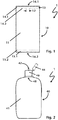
- Fig. 1 shows an embodiment of a first container 10 of a dyeing system 1 in a front view.
- the first container 10 is formed in this embodiment as a bag.
- the bag 10 is substantially rectangular in shape, with a longitudinal extent extending between two lateral ends, from an upper end 16.1 to a lower end 16.2 of the bag.
- the length of the bag 10 is substantially twice as long as a width of the bag 10 substantially perpendicular thereto.
- the bag 10 Located on a bag front 11 of the bag 10 and substantially at the top 16.1 of the bag 10, the bag 10 has a first one Sealing seam 14.1 on.
- the first sealed seam 14.1 extends from the one side end of the bag 10 to the other side end and sealingly connects the bag front 11 with a bag back, which is the Fig. 1 is not apparent.
- the bag rear side extends substantially identically to its extension as the bag front side 11 and is connected to the bag front side 11 via the lateral ends.
- Another first sealed seam 15.1 is arranged on the front side of the bag 11 at the lower end 16.2 of the bag and also connects the bag front 11 with the bag back.
- a second sealed seam 14.2 extends.
- the second sealed seam 14.2 is closer to a content, in particular reagents such as preferably at least one fixer-salt mixture, at least one dye and / or an auxiliary agent, arranged as the one first sealed seam 14.1.
- the second sealed seam 14.2 runs approximately parallel to the first sealed seam 14.1 and, like the first sealed seam 14.1, extends from one lateral end to the other lateral end.
- the second sealed seam 14.2 does not extend continuously from one side end to the other side end, but has an interruption approximately in the middle.
- the interruption is a first opening 12.
- Between the first sealed seam 14.1 and the second sealed seam 14.2 is correspondingly much space, so that a separation 15 of a first sealed seam 14.1 and the upper end 16.1 of the bag from the rest of the bag 10 with, for example Scissors is enabled, and a second sealed seam 14.2 is not damaged.
- Parallel to the further first sealed seam 15.1, another second sealed seam 15.2 runs.
- the further second sealed seam 15.2, starting from the further first sealed seam 15.1, is arranged slightly closer than the latter in the direction of the upper end 16.1 of the bag and, like the second sealed seam 14.2, has an interruption approximately in the middle.
- the first container 10 contains a fixer salt mixture with sodium carbonate as a fixer in an amount of about 75 wt .-% and sodium chloride as a salt in an amount of about 25 Wt .-%, wherein the amounts are in each case based on the total amount of the mixture.
- the first container 10 contains a fixer salt mixture with sodium metasilicate as a fixer in an amount of about 25 wt .-% and sodium chloride as a salt in an amount of about 75 wt .-%, wherein the amounts are in each case based on the total amount of the mixture.
- Fig. 2 shows a first embodiment of a second container 40 of the staining system 1 in a front view.
- the second container 40 is formed in this embodiment as a bottle.
- the bottle 40 has over four sides of a substantially rectangular shape, wherein the side connecting corners are rounded.
- a bottle front 41 of the bottle 40 is over the four sides with a bottle back, the Fig. 2 not removed, connected and together form an interior.
- the bottleneck 46 is cylindrical and has a second opening 42 at an upper end.
- the second opening 42 is the opening to the interior of the bottle 40.
- the bottle 40 Laterally at the upper end of the bottle neck 46, the bottle 40 has a closure 44.
- the closure 44 is secured to the bottle neck 46 with an elastically movable member and covers the second opening 42 in a closed position.
- the second container 40 contains a dye solution with softened tap water as a solvent in an amount of about 96.9% by weight and chloro-methyl isothiazolinone as adjuvant for package preservation in an amount of about 0.1% by weight.
- the dyes are Remazol Yellow RR gran in an amount of about 0.3% by weight, Levafix Brilliant Yellow CA gran. in an amount of about 1.4% by weight and Levafix Yellow CA gran. in an amount of about 1.3 wt .-%, wherein the amounts are each based on the total amount of the solution.
- the second container 40 contains a dessicated tap water solvent solution in an amount of about 83% by weight and chloro-methyl isothiazolinone as a can preservative aid in an amount of about 0.1% by weight.
- the dyes are Levafix Yellow CA gran. in an amount of about 2.3% by weight, Remazol Red RGB in an amount of about 13% by weight, Remazol Navy GG gran. 133% in one Amount of about 0.3% by weight and Remazol Black B gran. 133% in a range of about 0.3% by weight, the amounts being based on the total amount of the solution.
- the second container 40 contains a dessicated tap water solvent solution in an amount of about 31% by weight and chloro-methyl isothiazolinone as a can preservative in an amount of about 0.1% by weight.
- the dyes are Remazol Orange BN in an amount of 0.1 wt .-% and Remazol Tiefschwarz FHD-R fl 66% in an amount of 68, 8 wt .-%, wherein the amounts are in each case based on the total amount of the solution.
- Fig. 3.1 shows a second embodiment of a second container 50 of the staining system 1 in a perspective view.
- the second container 50 is formed as a bottle in this embodiment.
- the bottle 50 has a substantially spherical body with lateral planar surfaces 61.
- the bottle 50 has two planar surfaces 61, of which a plane surface 61 of FIG Fig. 3.1 it can be seen on.
- both planar surfaces 61 in the area of a transition to the spherical body of the bottle 50 have an edge rounding 62 around the planar surface 61.
- the edge rounding 62 extends circumferentially around the flat surface 61.
- a bottle front side 51 is arranged on the spherical body of the bottle 50 and between the two flat surfaces 61.
- the bottle front 51 is a portion of the spherical body of the bottle 50 between an upper bottle end 58 and a lower bottle end 68. Located at an upper bottle end 58 and away from the bottle front 51, the bottle 50 has a bottle neck 56. As a connector, between bottle 50 and bottle neck 56, the bottle neck 56 has a transition region 59. It forms a round neck 56 surrounding the rounded portion between a bottleneck outside 57 of the bottle neck 56 and the bottle 50.
- the bottleneck 56 extends cylindrically as a hollow cylinder remotely from the upper bottle end 58. At an upper end of the bottle neck 56 has this a dosing 55.
- the dosing hood 55 covers the cylindrical bottle neck 56 essentially on the upper side.
- the bottle neck 56 Centered on the metering hood 55, the bottle neck 56 a second opening 52.
- the second opening 52 extends around on the metering hood 55 and further through the metering hood 55 therethrough.
- the second opening 52 is the opening to an interior of the bottle 50.
- the bottleneck 56 has an external thread 60 on the bottleneck outer side 57.
- the external thread 60 extends on the bottleneck outer side 57 with a slight offset from the upper bottle end 58 in the direction of the second opening 52.
- Fig. 3.2 shows the second embodiment of the invention of the bottle 50 in a front view.
- the front view is the view on the bottle front side 51 and the two laterally arranged thereon planar surfaces 61.
- the edge roundings 62 are arranged on the bottle 50.
- the lower bottle end 68 is formed substantially flat for a better state and thus interrupts the spherical shape of the bottle 50.
- Above the upper bottle end 58 of the bottle neck 56 is arranged with the external thread 60 on the bottleneck outer side 57.
- Fig. 3.3 shows the second embodiment of the invention the bottle 50 in a side view.
- the side view illustrates the substantially circular edge rounding 62 around the flat surface 61.
- the bottle front side 51 is laterally from the plane surface and a bottle rear side 53 is arranged at an opposite bottle end.
- the bottle rear side 53 is like the bottle front side 51, only mirror-symmetrically formed.
- a dashed line 54 is listed, which together with the bottle sides 51, 53 illustrates a wall thickness of the bottle 50.
- Fig. 3.4 shows the second embodiment of the invention the bottle 50 in a plan view.
- Fig. 3.4 illustrates the oppositerobonvorder- and - Wegseite 51, 53, which are connected to each other via the flat surfaces 61.
- the two opposing planar surfaces 61 are plane-parallel to each other.
- the bottleneck 56 In the middle of the bottle 50 is the bottleneck 56, which is connected to the transition region 59 with the bottle 50.
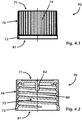
- Fig. 4.1 shows an embodiment according to the invention of a closure 70 of the bottle 50 in a side view.
- the closure 70 is substantially cylindrical.
- the shutter 70 further includes a contact portion 72 and a gripping portion 76.
- the contact region 72 is integrally connected to the gripping region 76.
- the closure 70 has a closure underside 81 and a closure upper side 71 above the gripping region 76.
- the contact portion 72 is annularly formed with a smooth surface.
- the gripping area 76 has a plurality of grooves 74.
- the grooves 74 extend with a longitudinal extent from the closure top 71 in the direction of the closure bottom 81.
- the plurality of grooves 74 are formed parallel to each other on the gripping region 76 and this circumferentially.
- Fig. 4.2 shows the embodiment according to the invention of the closure 70 of the bottle 50 in a sectional view.
- the cut according to Fig. 4.2 extends centrally from the closure bottom 81 to the closure top 71 through the closure 70.
- the closure 70 has a cavity 75 which is formed downwardly in the direction of the closure bottom 81 open.
- the closure 70 has the contact region 72 and the gripping region 76.
- the closure 70 has an internal thread 80.
- the internal thread 80 is suitable for the external thread 60, see Fig. 3.1 to 3.3 , the bottle 50 formed.
- a pin 82 is arranged centered on the closure top 71 and extending into the cavity 75.
- the pin 82 of the closure 70 has an occlusive function.
- the pin 82 engages through the second opening 52, which is arranged centrally on the metering hood 55 of the bottle neck 56.
- the second opening 52 has approximately the same diameter as the pin 82, which thus bears laterally against the second opening 52.
- the dyeing system may conform to the characteristics of a bottle Fig. 2 and the bag having the characteristics of a water-permeable fiber bag.
- the fixer salt mixture and / or the at least one dye is in at least one container, which differs from a bag and / or a bottle and the property of the delayed release of the dye and preferably the fixer salt. Mixture maintains.
- a plurality of first and second sealing seams may be provided.
Landscapes
- Engineering & Computer Science (AREA)
- Chemical & Material Sciences (AREA)
- Mechanical Engineering (AREA)
- Textile Engineering (AREA)
- Dispersion Chemistry (AREA)
- Chemical Kinetics & Catalysis (AREA)
- Organic Chemistry (AREA)
- Detergent Compositions (AREA)
- Coloring (AREA)
- Sampling And Sample Adjustment (AREA)
- Treatment Of Fiber Materials (AREA)
Priority Applications (1)
| Application Number | Priority Date | Filing Date | Title |
|---|---|---|---|
| HRP20230888TT HRP20230888T1 (hr) | 2016-08-26 | 2017-08-18 | Postupak za bojanje tekstilnih materijala |
Applications Claiming Priority (1)
| Application Number | Priority Date | Filing Date | Title |
|---|---|---|---|
| DE102016115927.1A DE102016115927A1 (de) | 2016-08-26 | 2016-08-26 | Färbesystem für textile Materialien |
Publications (3)
| Publication Number | Publication Date |
|---|---|
| EP3346053A2 true EP3346053A2 (fr) | 2018-07-11 |
| EP3346053A3 EP3346053A3 (fr) | 2018-08-22 |
| EP3346053B1 EP3346053B1 (fr) | 2023-06-21 |
Family
ID=59677104
Family Applications (1)
| Application Number | Title | Priority Date | Filing Date |
|---|---|---|---|
| EP17186906.8A Active EP3346053B1 (fr) | 2016-08-26 | 2017-08-18 | Procédé de coloration pour matériaux textiles |
Country Status (6)
| Country | Link |
|---|---|
| EP (1) | EP3346053B1 (fr) |
| DE (1) | DE102016115927A1 (fr) |
| DK (1) | DK3346053T3 (fr) |
| ES (1) | ES2954276T3 (fr) |
| HR (1) | HRP20230888T1 (fr) |
| PL (1) | PL3346053T3 (fr) |
Cited By (1)
| Publication number | Priority date | Publication date | Assignee | Title |
|---|---|---|---|---|
| CN113089346A (zh) * | 2021-05-11 | 2021-07-09 | 绍兴永通印花有限公司 | 一种环保型具有不掉色效果的人棉染色工艺 |
Family Cites Families (13)
| Publication number | Priority date | Publication date | Assignee | Title |
|---|---|---|---|---|
| US4659496A (en) * | 1986-01-31 | 1987-04-21 | Amway Corporation | Dispensing pouch containing premeasured laundering compositions |
| GB8605734D0 (en) * | 1986-03-07 | 1986-04-16 | Unilever Plc | Dispensing treatment agents |
| US5030242A (en) * | 1989-07-21 | 1991-07-09 | Bellaire David L | Method of imparting random coloration patterns in fabric |
| FR2714679B1 (fr) | 1994-01-05 | 1996-03-15 | Ideal | Utilisation d'un sachet pour le conditionnement d'un colorant ou pigment textile pulvérulent. |
| ES2119140T5 (es) | 1994-04-27 | 2002-07-16 | Procter & Gamble | Dispositivo dispensador de tratamiento previo. |
| FR2739880B1 (fr) * | 1995-10-13 | 1997-12-05 | Superba Sa | Procede de teinture en continu de fils, en particulier a base de fibres cellulosiques avec des colorants reactifs, et dispositif pour la mise en oeuvre de ce procede |
| DE10003429A1 (de) | 1999-03-03 | 2000-09-07 | Henkel Kgaa | Wasch- oder Reinigungsmittelportion mit kontrollierter Wirkstofffreisetzung |
| WO2002008371A2 (fr) | 2000-02-17 | 2002-01-31 | The Procter & Gamble Company | Composition de lavage |
| DE10066035B4 (de) | 2000-07-14 | 2006-06-08 | Henkel Kgaa | Kompartiment-Hohlkörper |
| US6574883B2 (en) | 2000-12-28 | 2003-06-10 | Unilever Home & Personal Care Usa, Division Of Conopco, Inc. | Dispensing for dryer |
| WO2003016165A1 (fr) | 2001-08-16 | 2003-02-27 | Warner-Lambert Company Llc | Enveloppe soluble dans l'eau |
| DE102006055435A1 (de) * | 2006-11-22 | 2008-05-29 | Henkel Kgaa | Verschluss mit Überkopfstandvorrichtung |
| GB201211941D0 (en) * | 2012-07-05 | 2012-08-15 | Punch Ind | Home fabric dye product |
-
2016
- 2016-08-26 DE DE102016115927.1A patent/DE102016115927A1/de not_active Withdrawn
-
2017
- 2017-08-18 PL PL17186906.8T patent/PL3346053T3/pl unknown
- 2017-08-18 EP EP17186906.8A patent/EP3346053B1/fr active Active
- 2017-08-18 HR HRP20230888TT patent/HRP20230888T1/hr unknown
- 2017-08-18 ES ES17186906T patent/ES2954276T3/es active Active
- 2017-08-18 DK DK17186906.8T patent/DK3346053T3/da active
Cited By (1)
| Publication number | Priority date | Publication date | Assignee | Title |
|---|---|---|---|---|
| CN113089346A (zh) * | 2021-05-11 | 2021-07-09 | 绍兴永通印花有限公司 | 一种环保型具有不掉色效果的人棉染色工艺 |
Also Published As
| Publication number | Publication date |
|---|---|
| EP3346053B1 (fr) | 2023-06-21 |
| PL3346053T3 (pl) | 2023-10-30 |
| DE102016115927A1 (de) | 2018-03-01 |
| ES2954276T3 (es) | 2023-11-21 |
| HRP20230888T1 (hr) | 2023-11-10 |
| EP3346053A3 (fr) | 2018-08-22 |
| DK3346053T3 (da) | 2023-08-21 |
Similar Documents
| Publication | Publication Date | Title |
|---|---|---|
| DE60129592T2 (de) | Wäschereiprodukt | |
| DE68927448T2 (de) | Verfahren und Vorrichtung zum Waschen von Wäsche in einer Maschine mit einem pulverförmigen Waschmittel | |
| DE60035607T2 (de) | Verfahren zur herstellung eines blattförmigen waschmittels | |
| DE69431771T2 (de) | Tintenstrahldruckverfahren zum Bedrucken von Textilien | |
| DE69217790T2 (de) | Tintenstrahl-Drucktinte zum Bedrucken von Textilien und Verfahren | |
| DE69800832T3 (de) | Verfahren und dosiervorrichtung zum waschen von wäsche in einer waschmachine | |
| DE69735392T2 (de) | Tintenstrahldruckgewebe, Tintenstrahldruckverfahren und Druck | |
| DE68903844T2 (de) | Vorrichtung zum waschen von waesche in einer waschmaschine. | |
| DE2656408A1 (de) | Verfahren zur herstellung von staubarmen praeparaten | |
| WO2018054687A1 (fr) | Coloration améliorée de textiles comprenant des matières synthétiques dans le lave-linge par des silicones modifiés | |
| DE69417086T2 (de) | Tinte für das Bedrucken von Textilien mit einem Tintenstrahl, Tintenstrahldruckverfahren und hierzu benötigtes Instrument und mit diesem Verfahren hergestellter Artikel | |
| DE2453369A1 (de) | Handelsformen trockener organischer substanzen | |
| DE4407801A1 (de) | Behandlung von Textilien | |
| DE19641746C2 (de) | Pastenspender | |
| EP3346053B1 (fr) | Procédé de coloration pour matériaux textiles | |
| DE19749212A1 (de) | Verfahren zum kontinuierlichen Färben von cellulosischen Rundstrick- und Rundwirkwaren mit Reaktivfarbstoffen | |
| EP2220203B1 (fr) | Agent pour éviter les phénomènes de décoloration lors du lavage de textiles | |
| EP2215205B1 (fr) | Agent de prétraitement de textiles comprenant un gel contenant des agents actifs | |
| DE2458580B2 (de) | Stabile konzentrierte loesungen sulfonsaeuregruppenhaltiger saeurefarbstoffe, verfahren zu ihrer herstellung und ihre verwendung | |
| DE2122714C2 (de) | Verfahren zum farbigen Bemustern von textlien Materialien, Papier, Kunststoff, Blech | |
| DE102007030424A1 (de) | Mischung zum Entfärben und/oder Entgrauen von Wäschestücken | |
| WO1996030489A2 (fr) | Procede de lavage a l'aide de detergents liquides non aqueux avec agent de blanchiment separe | |
| DE2924643A1 (de) | Verfahren zum kontinuierlichen faerben von getufteter textilware | |
| DE10062045A1 (de) | Verschiedenfarbiges wässriges mehrphasiges Reinigungsmittel | |
| DE2724951A1 (de) | Farbstoffpraeparationen |
Legal Events
| Date | Code | Title | Description |
|---|---|---|---|
| REG | Reference to a national code |
Ref country code: HR Ref legal event code: TUEP Ref document number: P20230888T Country of ref document: HR |
|
| PUAI | Public reference made under article 153(3) epc to a published international application that has entered the european phase |
Free format text: ORIGINAL CODE: 0009012 |
|
| STAA | Information on the status of an ep patent application or granted ep patent |
Free format text: STATUS: REQUEST FOR EXAMINATION WAS MADE |
|
| 17P | Request for examination filed |
Effective date: 20170818 |
|
| AK | Designated contracting states |
Kind code of ref document: A2 Designated state(s): AL AT BE BG CH CY CZ DE DK EE ES FI FR GB GR HR HU IE IS IT LI LT LU LV MC MK MT NL NO PL PT RO RS SE SI SK SM TR |
|
| AX | Request for extension of the european patent |
Extension state: BA ME |
|
| PUAL | Search report despatched |
Free format text: ORIGINAL CODE: 0009013 |
|
| AK | Designated contracting states |
Kind code of ref document: A3 Designated state(s): AL AT BE BG CH CY CZ DE DK EE ES FI FR GB GR HR HU IE IS IT LI LT LU LV MC MK MT NL NO PL PT RO RS SE SI SK SM TR |
|
| AX | Request for extension of the european patent |
Extension state: BA ME |
|
| RIC1 | Information provided on ipc code assigned before grant |
Ipc: D06P 1/00 20060101AFI20180717BHEP Ipc: D06P 1/673 20060101ALI20180717BHEP |
|
| STAA | Information on the status of an ep patent application or granted ep patent |
Free format text: STATUS: EXAMINATION IS IN PROGRESS |
|
| 17Q | First examination report despatched |
Effective date: 20200914 |
|
| GRAP | Despatch of communication of intention to grant a patent |
Free format text: ORIGINAL CODE: EPIDOSNIGR1 |
|
| STAA | Information on the status of an ep patent application or granted ep patent |
Free format text: STATUS: GRANT OF PATENT IS INTENDED |
|
| INTG | Intention to grant announced |
Effective date: 20221013 |
|
| GRAS | Grant fee paid |
Free format text: ORIGINAL CODE: EPIDOSNIGR3 |
|
| GRAJ | Information related to disapproval of communication of intention to grant by the applicant or resumption of examination proceedings by the epo deleted |
Free format text: ORIGINAL CODE: EPIDOSDIGR1 |
|
| GRAL | Information related to payment of fee for publishing/printing deleted |
Free format text: ORIGINAL CODE: EPIDOSDIGR3 |
|
| STAA | Information on the status of an ep patent application or granted ep patent |
Free format text: STATUS: EXAMINATION IS IN PROGRESS |
|
| INTC | Intention to grant announced (deleted) | ||
| GRAP | Despatch of communication of intention to grant a patent |
Free format text: ORIGINAL CODE: EPIDOSNIGR1 |
|
| STAA | Information on the status of an ep patent application or granted ep patent |
Free format text: STATUS: GRANT OF PATENT IS INTENDED |
|
| INTG | Intention to grant announced |
Effective date: 20230322 |
|
| GRAA | (expected) grant |
Free format text: ORIGINAL CODE: 0009210 |
|
| STAA | Information on the status of an ep patent application or granted ep patent |
Free format text: STATUS: THE PATENT HAS BEEN GRANTED |
|
| AK | Designated contracting states |
Kind code of ref document: B1 Designated state(s): AL AT BE BG CH CY CZ DE DK EE ES FI FR GB GR HR HU IE IS IT LI LT LU LV MC MK MT NL NO PL PT RO RS SE SI SK SM TR |
|
| REG | Reference to a national code |
Ref country code: CH Ref legal event code: EP |
|
| REG | Reference to a national code |
Ref country code: DE Ref legal event code: R096 Ref document number: 502017014937 Country of ref document: DE |
|
| P01 | Opt-out of the competence of the unified patent court (upc) registered |
Effective date: 20230528 |
|
| REG | Reference to a national code |
Ref country code: AT Ref legal event code: REF Ref document number: 1580968 Country of ref document: AT Kind code of ref document: T Effective date: 20230715 |
|
| REG | Reference to a national code |
Ref country code: IE Ref legal event code: FG4D Free format text: LANGUAGE OF EP DOCUMENT: GERMAN |
|
| REG | Reference to a national code |
Ref country code: RO Ref legal event code: EPE |
|
| REG | Reference to a national code |
Ref country code: DK Ref legal event code: T3 Effective date: 20230818 |
|
| REG | Reference to a national code |
Ref country code: NL Ref legal event code: FP |
|
| REG | Reference to a national code |
Ref country code: LT Ref legal event code: MG9D |
|
| REG | Reference to a national code |
Ref country code: HR Ref legal event code: ODRP Ref document number: P20230888T Country of ref document: HR Payment date: 20230809 Year of fee payment: 7 |
|
| PG25 | Lapsed in a contracting state [announced via postgrant information from national office to epo] |
Ref country code: SE Free format text: LAPSE BECAUSE OF FAILURE TO SUBMIT A TRANSLATION OF THE DESCRIPTION OR TO PAY THE FEE WITHIN THE PRESCRIBED TIME-LIMIT Effective date: 20230621 Ref country code: NO Free format text: LAPSE BECAUSE OF FAILURE TO SUBMIT A TRANSLATION OF THE DESCRIPTION OR TO PAY THE FEE WITHIN THE PRESCRIBED TIME-LIMIT Effective date: 20230921 |
|
| REG | Reference to a national code |
Ref country code: SK Ref legal event code: T3 Ref document number: E 42160 Country of ref document: SK |
|
| REG | Reference to a national code |
Ref country code: HR Ref legal event code: T1PR Ref document number: P20230888 Country of ref document: HR |
|
| REG | Reference to a national code |
Ref country code: ES Ref legal event code: FG2A Ref document number: 2954276 Country of ref document: ES Kind code of ref document: T3 Effective date: 20231121 |
|
| PG25 | Lapsed in a contracting state [announced via postgrant information from national office to epo] |
Ref country code: RS Free format text: LAPSE BECAUSE OF FAILURE TO SUBMIT A TRANSLATION OF THE DESCRIPTION OR TO PAY THE FEE WITHIN THE PRESCRIBED TIME-LIMIT Effective date: 20230621 Ref country code: LV Free format text: LAPSE BECAUSE OF FAILURE TO SUBMIT A TRANSLATION OF THE DESCRIPTION OR TO PAY THE FEE WITHIN THE PRESCRIBED TIME-LIMIT Effective date: 20230621 Ref country code: LT Free format text: LAPSE BECAUSE OF FAILURE TO SUBMIT A TRANSLATION OF THE DESCRIPTION OR TO PAY THE FEE WITHIN THE PRESCRIBED TIME-LIMIT Effective date: 20230621 Ref country code: GR Free format text: LAPSE BECAUSE OF FAILURE TO SUBMIT A TRANSLATION OF THE DESCRIPTION OR TO PAY THE FEE WITHIN THE PRESCRIBED TIME-LIMIT Effective date: 20230922 |
|
| PG25 | Lapsed in a contracting state [announced via postgrant information from national office to epo] |
Ref country code: FI Free format text: LAPSE BECAUSE OF FAILURE TO SUBMIT A TRANSLATION OF THE DESCRIPTION OR TO PAY THE FEE WITHIN THE PRESCRIBED TIME-LIMIT Effective date: 20230621 |
|
| PG25 | Lapsed in a contracting state [announced via postgrant information from national office to epo] |
Ref country code: IS Free format text: LAPSE BECAUSE OF FAILURE TO SUBMIT A TRANSLATION OF THE DESCRIPTION OR TO PAY THE FEE WITHIN THE PRESCRIBED TIME-LIMIT Effective date: 20231021 |
|
| PG25 | Lapsed in a contracting state [announced via postgrant information from national office to epo] |
Ref country code: SM Free format text: LAPSE BECAUSE OF FAILURE TO SUBMIT A TRANSLATION OF THE DESCRIPTION OR TO PAY THE FEE WITHIN THE PRESCRIBED TIME-LIMIT Effective date: 20230621 Ref country code: PT Free format text: LAPSE BECAUSE OF FAILURE TO SUBMIT A TRANSLATION OF THE DESCRIPTION OR TO PAY THE FEE WITHIN THE PRESCRIBED TIME-LIMIT Effective date: 20231023 Ref country code: IS Free format text: LAPSE BECAUSE OF FAILURE TO SUBMIT A TRANSLATION OF THE DESCRIPTION OR TO PAY THE FEE WITHIN THE PRESCRIBED TIME-LIMIT Effective date: 20231021 Ref country code: EE Free format text: LAPSE BECAUSE OF FAILURE TO SUBMIT A TRANSLATION OF THE DESCRIPTION OR TO PAY THE FEE WITHIN THE PRESCRIBED TIME-LIMIT Effective date: 20230621 |
|
| PG25 | Lapsed in a contracting state [announced via postgrant information from national office to epo] |
Ref country code: MC Free format text: LAPSE BECAUSE OF FAILURE TO SUBMIT A TRANSLATION OF THE DESCRIPTION OR TO PAY THE FEE WITHIN THE PRESCRIBED TIME-LIMIT Effective date: 20230621 |
|
| REG | Reference to a national code |
Ref country code: DE Ref legal event code: R097 Ref document number: 502017014937 Country of ref document: DE |
|
| REG | Reference to a national code |
Ref country code: CH Ref legal event code: PL |
|
| PG25 | Lapsed in a contracting state [announced via postgrant information from national office to epo] |
Ref country code: MC Free format text: LAPSE BECAUSE OF FAILURE TO SUBMIT A TRANSLATION OF THE DESCRIPTION OR TO PAY THE FEE WITHIN THE PRESCRIBED TIME-LIMIT Effective date: 20230621 |
|
| PG25 | Lapsed in a contracting state [announced via postgrant information from national office to epo] |
Ref country code: LU Free format text: LAPSE BECAUSE OF NON-PAYMENT OF DUE FEES Effective date: 20230818 |
|
| PLBE | No opposition filed within time limit |
Free format text: ORIGINAL CODE: 0009261 |
|
| STAA | Information on the status of an ep patent application or granted ep patent |
Free format text: STATUS: NO OPPOSITION FILED WITHIN TIME LIMIT |
|
| PG25 | Lapsed in a contracting state [announced via postgrant information from national office to epo] |
Ref country code: LU Free format text: LAPSE BECAUSE OF NON-PAYMENT OF DUE FEES Effective date: 20230818 Ref country code: CH Free format text: LAPSE BECAUSE OF NON-PAYMENT OF DUE FEES Effective date: 20230831 |
|
| PG25 | Lapsed in a contracting state [announced via postgrant information from national office to epo] |
Ref country code: SI Free format text: LAPSE BECAUSE OF FAILURE TO SUBMIT A TRANSLATION OF THE DESCRIPTION OR TO PAY THE FEE WITHIN THE PRESCRIBED TIME-LIMIT Effective date: 20230621 |
|
| REG | Reference to a national code |
Ref country code: BE Ref legal event code: MM Effective date: 20230831 |
|
| REG | Reference to a national code |
Ref country code: IE Ref legal event code: MM4A |
|
| 26N | No opposition filed |
Effective date: 20240322 |
|
| PG25 | Lapsed in a contracting state [announced via postgrant information from national office to epo] |
Ref country code: SI Free format text: LAPSE BECAUSE OF FAILURE TO SUBMIT A TRANSLATION OF THE DESCRIPTION OR TO PAY THE FEE WITHIN THE PRESCRIBED TIME-LIMIT Effective date: 20230621 |
|
| PG25 | Lapsed in a contracting state [announced via postgrant information from national office to epo] |
Ref country code: IE Free format text: LAPSE BECAUSE OF NON-PAYMENT OF DUE FEES Effective date: 20230818 |
|
| PG25 | Lapsed in a contracting state [announced via postgrant information from national office to epo] |
Ref country code: IE Free format text: LAPSE BECAUSE OF NON-PAYMENT OF DUE FEES Effective date: 20230818 |
|
| PG25 | Lapsed in a contracting state [announced via postgrant information from national office to epo] |
Ref country code: BE Free format text: LAPSE BECAUSE OF NON-PAYMENT OF DUE FEES Effective date: 20230831 |
|
| REG | Reference to a national code |
Ref country code: HR Ref legal event code: ODRP Ref document number: P20230888 Country of ref document: HR Payment date: 20240808 Year of fee payment: 8 |
|
| PGFP | Annual fee paid to national office [announced via postgrant information from national office to epo] |
Ref country code: HR Payment date: 20240808 Year of fee payment: 8 |
|
| PGFP | Annual fee paid to national office [announced via postgrant information from national office to epo] |
Ref country code: DK Payment date: 20240822 Year of fee payment: 8 |
|
| PGFP | Annual fee paid to national office [announced via postgrant information from national office to epo] |
Ref country code: ES Payment date: 20240918 Year of fee payment: 8 |
|
| PGFP | Annual fee paid to national office [announced via postgrant information from national office to epo] |
Ref country code: CZ Payment date: 20240805 Year of fee payment: 8 |
|
| PGFP | Annual fee paid to national office [announced via postgrant information from national office to epo] |
Ref country code: SK Payment date: 20240809 Year of fee payment: 8 |
|
| PG25 | Lapsed in a contracting state [announced via postgrant information from national office to epo] |
Ref country code: CY Free format text: LAPSE BECAUSE OF FAILURE TO SUBMIT A TRANSLATION OF THE DESCRIPTION OR TO PAY THE FEE WITHIN THE PRESCRIBED TIME-LIMIT; INVALID AB INITIO Effective date: 20170818 |
|
| PG25 | Lapsed in a contracting state [announced via postgrant information from national office to epo] |
Ref country code: HU Free format text: LAPSE BECAUSE OF FAILURE TO SUBMIT A TRANSLATION OF THE DESCRIPTION OR TO PAY THE FEE WITHIN THE PRESCRIBED TIME-LIMIT; INVALID AB INITIO Effective date: 20170818 |
|
| PGFP | Annual fee paid to national office [announced via postgrant information from national office to epo] |
Ref country code: NL Payment date: 20250821 Year of fee payment: 9 |
|
| PGFP | Annual fee paid to national office [announced via postgrant information from national office to epo] |
Ref country code: DE Payment date: 20250826 Year of fee payment: 9 |
|
| PGFP | Annual fee paid to national office [announced via postgrant information from national office to epo] |
Ref country code: PL Payment date: 20250807 Year of fee payment: 9 Ref country code: IT Payment date: 20250829 Year of fee payment: 9 |
|
| PGFP | Annual fee paid to national office [announced via postgrant information from national office to epo] |
Ref country code: BG Payment date: 20250821 Year of fee payment: 9 Ref country code: GB Payment date: 20250822 Year of fee payment: 9 |
|
| PGFP | Annual fee paid to national office [announced via postgrant information from national office to epo] |
Ref country code: AT Payment date: 20250819 Year of fee payment: 9 Ref country code: FR Payment date: 20250827 Year of fee payment: 9 |
|
| PGFP | Annual fee paid to national office [announced via postgrant information from national office to epo] |
Ref country code: RO Payment date: 20250811 Year of fee payment: 9 |
|
| PG25 | Lapsed in a contracting state [announced via postgrant information from national office to epo] |
Ref country code: TR Free format text: LAPSE BECAUSE OF FAILURE TO SUBMIT A TRANSLATION OF THE DESCRIPTION OR TO PAY THE FEE WITHIN THE PRESCRIBED TIME-LIMIT Effective date: 20230621 |
|
| REG | Reference to a national code |
Ref country code: HR Ref legal event code: PBON Ref document number: P20230888 Country of ref document: HR Effective date: 20250818 |
|
| REG | Reference to a national code |
Ref country code: DK Ref legal event code: EBP Effective date: 20250831 |
|
| PG25 | Lapsed in a contracting state [announced via postgrant information from national office to epo] |
Ref country code: HR Free format text: LAPSE BECAUSE OF NON-PAYMENT OF DUE FEES Effective date: 20250818 |
|
| REG | Reference to a national code |
Ref country code: SK Ref legal event code: MM4A Ref document number: E 42160 Country of ref document: SK Effective date: 20250818 |
|
| PG25 | Lapsed in a contracting state [announced via postgrant information from national office to epo] |
Ref country code: CZ Free format text: LAPSE BECAUSE OF NON-PAYMENT OF DUE FEES Effective date: 20250818 |
|
| PG25 | Lapsed in a contracting state [announced via postgrant information from national office to epo] |
Ref country code: SK Free format text: LAPSE BECAUSE OF NON-PAYMENT OF DUE FEES Effective date: 20250818 |