EP3347309B1 - Methods for obtaining salts of silver(ii) and hydrates thereof, products obtained by the methods and use of the same - Google Patents
Methods for obtaining salts of silver(ii) and hydrates thereof, products obtained by the methods and use of the same Download PDFInfo
- Publication number
- EP3347309B1 EP3347309B1 EP16794402.4A EP16794402A EP3347309B1 EP 3347309 B1 EP3347309 B1 EP 3347309B1 EP 16794402 A EP16794402 A EP 16794402A EP 3347309 B1 EP3347309 B1 EP 3347309B1
- Authority
- EP
- European Patent Office
- Prior art keywords
- silver
- acid
- hydrate
- vii
- salts
- Prior art date
- Legal status (The legal status is an assumption and is not a legal conclusion. Google has not performed a legal analysis and makes no representation as to the accuracy of the status listed.)
- Active
Links
Images




Classifications
-
- C—CHEMISTRY; METALLURGY
- C01—INORGANIC CHEMISTRY
- C01G—COMPOUNDS CONTAINING METALS NOT COVERED BY SUBCLASSES C01D OR C01F
- C01G5/00—Compounds of silver
- C01G5/006—Compounds containing silver, with or without oxygen or hydrogen, and containing two or more other elements
-
- C—CHEMISTRY; METALLURGY
- C01—INORGANIC CHEMISTRY
- C01G—COMPOUNDS CONTAINING METALS NOT COVERED BY SUBCLASSES C01D OR C01F
- C01G5/00—Compounds of silver
Definitions
- the present invention relates to a process for the electrochemical synthesis of the silver(II) salts of high purity, to the method of synthesis of silver(II) hydrates of high purity, to the products produced by these methods, and also to the use of the so obtained silver(II) compounds to modify the molecular structures of organic compounds, comprising isomerization processes (including cyclization and ring opening) dehydrogenation (including aromatization), cracking (breaking of C-C bonds) and coupling (formation of C-C bonds) of the molecules of organic compounds, allowing processing of these reactions in the simple one-pot synthesis (i.e., direct one-step synthesis). In some cases, modification reactions of organic compounds occur simultaneously or sequentially, resulting in many new products.
- a special case of use of silver(II) salts are the processes for treating wastes consisting of hydrocarbons, toxic hydrocarbons and their derivatives, or hazardous materials, such as Persistent Organic Pollutants, carcinogenic polyaromatic hydrocarbons, industrial wastes, wastes from nuclear industry, and other.
- Silver(II) salts Silver(II) salts.
- Silver(II)-containing compounds are known. Due to the presence of silver atoms in the +2 oxidation state, these compounds have very strong oxidizing properties.
- the standard redox potential of the Ag(II)/Ag(I) couple is about 2 V versus the standard hydrogen electrode [ A. J. Bard, R. Parsons, J. Jordan, "Standard potentials in Aqueous Solution ", Marcel Dekker INC., New York, Basel, 1985 ], and the formal potential can reach almost 3 V in an acid medium [ Chem. Comm., 49 (2013) 7480 ].
- Silver(II) compounds contain anions resistant to oxidation, typically fluorine-containing anions [ Angew. Chem. Int. Ed., 40 (2001) 2742 ]. During their decomposition these compounds often release gaseous fluorine or hydrogen fluoride, which are a threat to the health and life of humans and animals.
- Silver(II) salts derived from inorganic acids are known. For example: silver(II) fluorosulphate(VI), Ag(SO 3 F) 2 [ Eur. J. Inorg. Chem., 16 (2011) 2499 ] silver(I/II) difluoroortophosphate(V), Ag 9 (PO 2 F 2 ) 14 [ Dalton.
- the only inorganic divalent silver compound, which does not contain fluorine atoms is silver(II) sulphate(VI) ( Angew. Chem. Int. Ed., 49 (2010) 1683 ) which is routinely used in chemical laboratories. During decomposition of silver(II) sulfate(VI) no fluorine, hydrogen fluoride or other toxic chemicals are released. The product of reduction of silver(II) sulphate is silver(I) hydrogen sulphate(VI), or less likely silver(I) bisulphate(VI). Decomposition products of silver(II) sulphate are harmless to health.
- Silver(II) sulphate(VI) is antiferromagnetic semiconducting material with a narrow band gap (1.4 ⁇ 0.3 eV), with the highest absolute value of the magnetic coupling constant (217 K) among the known transition metals sulphates [ Angew. Chem. Int. Ed., 49 (2010) 1683 ], and the lowest temperature of the thermal decomposition of known metal sulphates [ Chem. Eur. J., 17 (2011) 10524 ].
- the product of this reaction consists of silver(II) sulphate(VI) contaminated with significant amounts of KSbF 6 , which cannot be removed from the main product.
- Silver(II) sulphate(VI) obtained by this method is not suitable for any further chemical applications due to the presence of impurities.
- a second known method of synthesis is a displacement reaction taking place between AgF 2 and the involatile acid H 2 SO 4 in a solution of anhydrous sulfuric(VI) acid (reaction R.2): AgF 2 + H 2 SO 4 ⁇ AgSO 4 ⁇ + 2 HF ⁇ (R.2)
- the product of this reaction is silver(II) sulphate(VI) contaminated with silver(I) compounds such as Ag 2 S 2 O 7 and Ag 2 SO 4 .
- silver(II) sulphate(VI) contaminated with silver(I) compounds such as Ag 2 S 2 O 7 and Ag 2 SO 4 .
- impurities cannot be completely removed.
- the purity of silver(II) sulphate(VI) obtained by the reaction between AgF 2 and H 2 SO 4 is much higher than the purity of the product of reaction between Ag(SbF 6 ) 2 and K 2 SO 4 .
- the basic processes used in organic synthesis can be divided into processes of isomerization (including cyclization and ring opening), dehydrogenation (including aromatization), cracking (breaking of carbon-carbon bonds) and coupling (formation of carbon-carbon bonds).
- reaction R.3 The isomerization reactions of organic compounds (reaction R.3) create molecules with the same empirical formula, but with a different construction (structure) with different molecular and physical-chemical properties: C x H y E z ⁇ iso-C x H y E z (R.3) where C is carbon, H - hydrogen, and E is any atom of another type or a mixture of such atoms in appropriate stoichiometric ratio (functional group), and x, y and z are integer numbers. Special cases of isomerization reactions are cyclization (formation of carbon ring) and decyclization (opening of the carbon ring).
- reaction R.4 The dehydrogenation reaction (dehydrogenation) of organic compounds (reaction R.4) involves the cleavage of the molecules and hydrogen [H] evolution: C x H y E z ⁇ C x H y-b + b [H] (R.4)
- the dehydrogenation reactions are typically classified according to the type of bonds in the molecule from which the hydrogen is removed: >C(H)-C(H) ⁇ , >C(H)-N(H)-, and >C(H)-O(H), etc.
- >C(H)-C(H) ⁇ >C(H)-N(H)-
- >C(H)-O(H) etc.
- This type of dehydrogenation is widely used in industry, especially in the dehydrogenation of paraffins.
- One specific case of dehydrogenation reaction are aromatization reactions. Dehydrogenation reactions of organic compounds with elimination of one hydrogen atom (formally by H°, H + and H - ) result in the formation of free radicals, carboanions or a carbocations, respectively.
- reaction R.5 The reaction of breaking C-C bonds (cracking) is the disruption of C-C bonds in the organic molecule to form two new molecules: C x H y E z ⁇ C x-a H y-b E z-c + C a H b E c (R.5)
- the most common type of bond cleavage is homolytic and it leads to the formation of two free radicals. Less likely bond cleavage is heterolytic which leads to the formation of ions.
- the ring-breaking (opening the carbon ring) is one particular example of the reactions involving breaking of C-C bonds.
- reaction R.6 The reaction of formation C-C bond (coupling) (reaction R.6) consists of creating C-C bonds between two molecules and formation of a new organic molecule: C x-a H y-b E z-c + C a H b E c ⁇ C x H y E z (R.6)
- the isomerization of light paraffins can be carried out in the gas phase over a catalyst which is a zeolite Na 2 Al 2 Si 3 O 10 doped with metallic Platinum at a temperature in the range of 250-300°C.
- Isomerization of light alkanes can be carried out in the gas phase, with a catalyst ZrO 2 /Zr(SO 4 ) 2 doped with platinum metal at a temperature in the range of 130-180°C.
- the isomerization of light paraffins (C5-C6) can be carried out in the gas phase, with a catalyst Al 2 O 3 /AlCl 3 doped with platinum metal at temperatures between 110-150°C.
- the catalytic dehydrogenation of aliphatic hydrocarbons is typically carried out with palladium or platinum deposited on aluminum oxide Al 2 O 3 with concentration of 0.3-0.7 wt%.
- Process of catalytic dehydrogenation is usually run at temperature of 400-600 °C and leads to the formation of olefins [ S. Matar L. F. Hatch Chemistry of Petrochemical Processes, Elsevier 2001 ; S. Matar, M. J. Mirbach, H. A. Tayim, Catalysis in petrochemical processes, Kluwer Academic Publisher, Dordrecht Holland 1989 ].
- the catalytic dehydrogenation of propane in the presence of sulfur to hydrogen sulfide and propylene can be carried out using a catylyst of nickel and tungsten sulphide on Al 2 O 3 at temperature not exceeding 350°C [ US 2004/0092784 A1 ].
- Thermal cracking is a decomposition reaction of long-chain aliphatic hydrocarbons connected with breaking of carbon-carbon bonds (C-C) at a temperature of 500-550°C and subsequent creations of C-C bonds, as a result of which a mixture of alkanes and alkenes with shorter chains are formed.
- C-C carbon-carbon bonds
- hydrocarbons are isomerized and often dehydrogenated to aromatics, that further condense to polycyclic aromatic hydrocarbons [ Sami Matar and Lewis Hatch F., Chemistry of Petrochemical Processes, (Second Edition), Elsevier, 2001 ].
- Disposal of hazardous waste Disposal of waste and hazardous materials (such as Persistent Organic Pollutants, POPs) including carcinogenic polyaromatic hydrocarbons, aromatic polyhalogenated compounds, for example pcb, waste from nuclear industries) is an important technological issue.
- Previous utilizations of these methods include ozonolysis of industrial waste, the use of electrochemically generated oxidizing Ag(II) ions in nitric(V) acid [ US5855763 ], the use of Co(III) and Ce(IV) [ J. Apl. Electrochem. 25 (1995) 846 ], oxidation with monopersulphate KHSO 5 in the presence of ruthenium catalyst (ruthenium-containing phthalocyanine sulgonate) [ Coordination Chem.
- the disadvantage of methods using ozone is a risk of ignition and explosion of hydrocarbons and high toxicity of ozone.
- the disadvantage of methods using electrochemically generated ions, Co(III) and Ce(IV), is their high toxicity.
- Limitation of methods of disposing POPs while utilizing monopersulphates is the high cost ruthenium catalysts.
- a disadvantage of using of Ag(II) ions is the need to use corrosive auxiliary substances such as nitric acid.
- a method of electrochemical synthesis of silver(II) salt characteristic in that the electrolysis of the silver(I) salt or a salt of silver(I) is conducted in the acid solution containing the same anion as electrolyzed salt, preferably oxoanion or oxofluoroanion with inorganic element in a high oxidation state, preferably non-metal such as C(IV), N(V), P(V), S(VI), Se(VI), Te(VI), CI(VII), Br(VII) and I(VII).
- non-metal such as C(IV), N(V), P(V), S(VI), Se(VI), Te(VI), CI(VII), Br(VII) and I(VII).
- concentrated acid solution is used, preferably a solution with a concentration over 80%, most preferably in a concentration of greater than or equal to 95%, the acceptable contamination of water is an anhydride of the acid or other solvent forming a solution of the corresponding salt of silver(I) and the acid, optionally with the addition of electrolyte.
- the electrolysis is carried out in a system comprising of least two electrodes: a working electrode and a counter electrode.
- the working electrode is used an electrode made of a material with high chemical resistance to acid environment, and to cathodic and anodic polarization, preferably doped tin oxide ITO or FTO, doped boron nitride BDD, glassy carbon, graphite oxide, lead(IV) PbO 2 , platinum, iridium, rhodium or ruthenium.
- the electrolysis is carried out at highly anodic potential, preferably at a potential higher than 2.0 V relative to a standard hydrogen electrode (NHE), most preferably at a potential higher than 2.5 V relative to a standard hydrogen electrode (NHE).
- the electrolysis is carried out in an inert atmosphere, preferably under argon or nitrogen, preferably doped with sulfur(VI) hexafluoride. Electrolysis is performed at temperature providing a liquid state of the acid used and in the range of thermal stability of the electrolysis product, preferably at temperature from - 50°C to +150°C.
- the electrolysis is carried out in an acid solution containing an electrolyte, preferably salts of alkali metal, ammonium or phosphonium salt of the anion of the acid used in electrolysis.
- the product is washed with a liquid electrolytic solution of the acid used in electrolysis, preferably distilled acid solution, whereas the acceptable contamination of the acid is water or acid anhydride. Washing the product is performed repeatedly, each time using a solution of the increasing water content.
- siver(II) salt is prepared by using a suitable silver(I) salt or silver(I) hydrogensalt is electrolysized in the acid solution of the same oxoanion that produce a silver(II) salt, in particular:
- a silver(II) salt obtained by reacting a suitable silver(I) salt or by electrolysis of silver(I) hydrogensalt in the acid solution of the same oxofluoroanion that produced a silver(II) salt, in particular:
- the invention includes silver(II) salts obtained by the method of electrochemical synthesis described above and previously unknown silver(II) salts among the salts mentioned above.
- Process for the synthesis of silver(II) salts hydrates is characteristic in that the silver(II) salts or silver (I/II) salts are exposed to water, ice or steam, preferably water vapor, to form a hydrated salt having a water content in the range 0.5-5.0 molecules of water per each atom of silver(II).
- the gaseous solution of water vapor with content in the range 0-100 g/m 3 , preferably 5-20 g/m 3 is applied. Exposure to steam is performed 1-200 hours, preferably 40-50 hours. Exposure to water vapor is carried out at temperature from -50°C to +100°C, preferably at 20-30°C. Alternatively, a fine spray of water in the liquid state can be used. Alternatively, the ice is used, where the mixture of silver(II) salt and ice are mechanically dispersed in a suitable stoichiometric ratio, and then slowly heated to a temperature above 0°C, unless the salt decomposes at a temperature above 0°C.
- silver(II) salts obtained by electrochemical method or by metathesis preferably silver(II) nitrate(V), silver(I/II) nitrate(V), silver(II) metaphosphate(V), silver(I/II) metaphosphate(V), silver(II) ortophosphate(V), silver(I/II) ortophosphate(V), silver(I/II) sulphate(VI), silver(II) sulphate(VI), silver(II) selenate(V), silver(I/II) selenate(V), silver(I/II) chlorate(VII), silver(II) chlorate(VII), silver(II) chlorate(VII), silver(I/II) bromate(VII), silver(II) bromate(VII), silver(I/II) iodate(VII), silver(II) iodate(VII), silver(I/II) fluorosulphate(V), silver(II) flu
- the invention includes hydrates of the silver(II) salts mentioned above, including the hydrates of silver(II) salts obtained by the methods of synthesis of a silver(II) salt hydrates described above.
- a method of modifying the molecular structures of organic compounds using an oxidising agent, and occurring in a liquid medium, especially organic, according to the invention is characteristic in that the oxidative initiation of a reagent comprises a redox compound, at least one compound of silver(II).
- the reaction is carried out as isomerization, dehydrogenation, cracking and/or coupling of molecules of organic compounds and the processes take place separately, simultaneously and/or sequentially.
- the reaction is carried out without prior functionalization or activation processing of organic compounds, maintaining the existing functional groups.
- the redox reagent is used in a molar ratio in the range from 0.01/1.0 to 10.0/1.0 with respect to the conjugated organic compounds based on the molar content of silver(II), preferably in a molar ratio of from 0.5/1.0 to 2.0/1.0.
- the reaction medium is gaseous or liquid organic reagent or a solution of the organic reagent in organic solvent or mixture of organic solvents, preferably a mixture of single phase (gas or liquid), multiphase emulsion or aerosol.
- organic solvents can be used hydrocarbons (aliphatic, cyclic and aromatic), hydrofluorocarbons (aliphatic, cyclic and aromatic), perfluorocarbons (aliphatic and aromatic alkylciclic), fluoroalcohols (primary, secondary and tertiary), perfluoroalcohols (primary, secondary and tertiary), fluoroamines (primary, secondary and tertiary), perfluoroamines (primary, secondary and tertiary), fluoroesters (aliphatic and aromatic alkylcyclic), perfluoroesters (aliphatic and aromatic alkylcyclic), fluoroethers (aliphatic and aromatic alkylcyclic), perfluoroethers (aliphatic and aromatic alkyl
- the solvent is hexafluoroisopropanol, nonafluorotertbutanol, cyclopentane, n-pentane, cyclohexane,n-hexane, dichloromethane or mixtures with other solvents, thereof.
- the process is carried out in anaerobic atmosphere, preferably under argon or nitrogen in a vacuum.
- the reaction is carried out at temperatures of 200-400 K, preferably 270-350 K, most preferably at room temperature.
- Reactions are carried out in apparatus made of a material inert with respect to silver(II) compounds, preferably in the glass apparatus, quartz apparatus, an apparatus made of fluoropolymers, stainless steel, or the apparatus containing the layer of glass, quartz, fluoropolymers, or stainless steel.
- the reactions are performed using mechanical or magnetic stirrer.
- the reactions are performed using sonication.
- the reactions are performed using the microwave acceleration.
- the reactions are performed using UV irradiation.
- the addition of a Lewis acid preferably BF 3 ⁇ O(C 2 H 5 ) 2 could be applied.
- the redox reagent comprising of silver(II) compound is in the same phase as the organic reagent.
- a redox reagent comprising of silver(II) compound is in a different phase than the organic reagent and the chemical reaction at the interface.
- silver(II) salts are used as silver(II) salts or silver(I/II) mixed valence salts comprising of oxoanions or oxofluoroanions, preferably salts, such as the silver(II) nitrate(V), silver(I/II) nitrate(V), silver(II) metaphosphate(V), silver(I/II) metaphosphate(V), silver(II) ortophosphate(V), silver(I/II) ortophosphate(V), silver(II) sulphate(VI), silver(I/II) sulphate (VI), silver(II) selenate(V), silver(I/II) selenate(V), silver(II) chlorate(VII), silver(I/II) chlorate(VII), silver(I/II) bromate(VII), silver(I/II) bromate(VII), silver(II) iodide (VII), silver(I
- used silver(II) compounds are trifluoromethanesulfonate(VI) (triflate), silver(II) fluorosulphate(VI), silver(I/II) fluorosulphate(VI), silver(II) sulphate(VI) and their hydrates.
- a compound of silver(II) in a solutions of a silver(II) salt preferably silver(II) sulphate(VI) dissolved in a solution of sulphuric acid (VI) or oleum.
- a compound of silver(II) is used in a solution containing ions of silver(II) either chemically or electrochemically generated in situ from suitable precursors directly in the reaction medium.
- Silver(II) salts as redox reagents are used in reactions carried out as described above.
- Silver(II) salts are used for the disposal of hazardous waste and/or toxic organic materials. Solid silver(II) compounds or their solutions in concentrated acids are applied.
- silver(II) salt and a compound of silver(II) is a compound containing silver in the +II oxidation state, optionally in combination with other metallic cations (including silver in +1 oxidation state).
- oxoanion is for anion consisting of cations of metal with oxygen atoms.
- oxofluoroanion is an anion consisting of cations of metal with oxygen and/or fluorine atoms.
- electrolyte is a salt of a significant ionicity which is easily electrolytic dissociated in ionizing solvents.
- oxidative initiation means to initiate chemical changes occurring under the influence of a strong oxidant.
- Description of the redox reagent is a substance or mixture of substances with strong oxidizing agents.
- the redox reagent comprises at least one silver(II) compound.
- the reagent can act as a redox reagent that is consumed (stoichiometric) in the course of the reaction and/or act as the initiator and/or catalyst.
- a method of electrosynthesis of silver(II) salt allows to prepare silver(II) salts containing oxoanions or oxofluoroanions with inorganic elements in a high oxidation state, such as C(IV), N(V), P(V), S(VI) Se(VI), Te(VI), CI(VII), Br(VII) and I(VII), for example, anions such as nitrates(V), phosphates(V), sulphates(VI), selenates(VI), chlorates(VII), bromates(VII) and iodates(VII), difluorophosphates(V), fluorosulphates(VI) and fluoroselenates(VI), trifluoroacetates, pentafluorooxotellurates(VI) (teflates) and also trifluoromethanesulfonates (triflates), perfluorobenzenesulf
- Salts of anions containing ions of silver(II) can be prepared via the electrolysis carried out in pure acids or their solutions in solvents because they include inorganic anions (containing non-metals in the highest oxidation state) which are resistant to the oxidizing action of silver(II) ions and to the strongly anodic potentials.
- Electrosynthesis of silver(II) salts is carried out in accordance with the invention in an electrochemical system comprising at least two electrodes: a working electrode and a counter electrode.
- a working electrode For better potential control of the ongoing reaction system, three electrodes are usually used, where the third electrode is a reference electrode
- Electrosynthesis of silver(II) salts is conducted in the acid solution containing the same ion assynthesized silver(II) salt, for example nitric(V) acid HNO 3 , metaphosphoric(V) acid HPO 3 , phosphoric(V) acid H 3 PO 4 , sulphuric(VI) acid H 2 SO 4 , selenic(VI) acid H 2 SeO4, perchloric(VII) acid HClO 4 , perbromic(VII) acid HBrO 4 , periodic(VII) acid HIO 4 , difluoroortophosphoric(V) acid HPO 2 F 2 , fluorosulphuric(VI) acid HSO 3 F acid, fluoroselenic(VI) acid HSeO 3 F, trifluoroacetic acid, pentafluorooxotelluric(VI) (teflic) acid, triflic acid HSO 3 CF 3 , perfluoro benzenosulfonic acid, per
- the concentration of the solution of the acids used is at least 80%, preferably above 95%.
- Acceptable contamination of the acid is water, the acid anhydride or another suitable solvent forming a solution of a silver(I) salt and the acid, optionally with the addition of electrolyte.
- the working electrode an electrode made of doped tin oxide (ITO, FTO) is used.
- the counter electrode an electrode made of silver sheet, with surface area greater than the actual specific surface of the working electrode, is used. The surface of electrode is modified to develop the actual surface before conducting electrolysis.
- a reference electrode for example, saturated silver(I) sulphate electrode in 100% sulfuric(VI) acid with a potential of 815 mV vs. the standard hydrogen electrode ( J. Phys. Chem. C, 117 (2013) 20689 ) or other reference electrode, with little or no diffusion potential with respect to acid solution, is used.
- Electrosynthesis of silver(II) salt is carried out under an inert atmosphere in order to avoid any contact with atmospheric moisture as silver(II) salts decompose during uncontrolled contact with water.
- the shielding gases include argon or nitrogen of high purity. It was observed that the surface coating layer of sulfur(VI) hexafluoride above of the solution of acid further reduces the risk of contact between synthesized silver(II) salt and atmospheric moisture. It is possible to carry out the electrosynthesis of the silver(II) salts using pure sulfur(VI) hexafluoride as a protective gas.
- the precursors for synthesis are the silver(I) salts and acid salts of silver(I) containing the same inorganic anion as synthesized silver(II) salt, for example silver(I) nitrate(V) AgNO 3 , silver(I) metaphosphate(V) AgPO 3 , silver(I) orthophosphate(V) Ag 3 PO 4 , silver(I) hydrogen phosphate(V) Ag 2 HPO 4 , silver(I) dihydrogen phosphate(V) AgH 2 PO 4 , silver(I) sulphate(VI) Ag 2 SO 4 , silver(I) hydrogensulphate (VI) AgHSO 4 , silver(I) selenate(VI) Ag 2 SeO 4 , silver(I) hydrogen selenate(VI) AgHSeO 4 , silver(I) chlorate(VII) AgClO 4 , silver(I) bromate(VII), AgBrO 4 , silver(I) iodidate(VII) AgIO 4 , silver
- Electrosynthesis of silver(II) salt is carried out at higher anodic potential than the formal potential of the redox couple Ag(II)/Ag(I), which in concentrated acids containing oxoanions, fluoroanions or oxofluoroanions exceeds 2 V, for example in 96% sulfuric(VI) acid redox couple Ag (II)/Ag(I) is about 2.6 V [ Chem. Comm., 49 (2013) 7463 ].
- Electrosynthesis of silver(II) salt is carried out in a concentrated acid solution at a concentration of above 80%, where the contaminants of acids are water, the acid anhydride or another suitable solvent forming a solution of a silver(I) salt and the acid, optionally with the addition of electrolyte.
- Optimal conditions are obtained for the electrosynthesis with acid concentrations greater than or equal to 95%.
- Large concentrations of acids are necessary because of the need to ensure the high purity of the reaction medium during the process of electrosynthesis of silver(II) salt. Given the difficulties in obtaining 100% acids, proces is carried out at a slightly lower acid concentration, thus using cheap and durable materials.
- the electrolysis yields the product as a solid forming on the working electrode, which then falls to the bottom of the electrochemical vessel.
- the product was washed with hydrogen fluoride (as in the synthesis of silver(II) sulphate(VI)), or with pure concentrated acid, where the electrolysis is carried out in order to wash out the substrates. It is possible to carry out repeated washing by using solutions of acid, in which the electrolysis was carried out, while using the increasing water content. After washing, the product is dried. It is possible to dry the product under vacuum.
- the half-life of complex moieties Ag(HSO 4 ) 2 ⁇ (H 2 SO 4 ) 2 is about 10 s in 100% sulphuric(VI) acid. It is determined that this is the maximum value of half-life of the Ag(HSO 4 ) 2 ⁇ (H 2 SO 4 ) 2 complex moieties.
- the process of the electrosynthesis is carried out at a temperature appropriately selected for the particular reaction, so that the acid solution is in liquid state and so that the temperature is the range of thermal stability of the resulting product.
- the synthesis of silver(II) selenate(VI) was carried out at a temperature above 58°C because the selenic(VI) acid has a melting point of 58°C.
- the syntheses of the silver(II) nitrate(V) and silver(II) chlorate(VII) were carried out at decreased temperature as the reaction products decompose at temperatures above -30°C.
- the syntheses of some of the silver(II) salts may be carried out at room temperature, for example, synthesis of silver(II) triflate.
- Silver(II) salts of the invention are of very high purity and can be used as a selective oxidizing agents in organic synthesis and as an oxidizing agents to treat the waste of hydrocarbons and dangerous materials, such as persistent organic pollutants, i.e. carcinogenic polyaromatic hydrocarbons, industrial waste, waste nuclear industry, and others.
- Electrosynthesis of silver(II) salts of the invention allows the reuse of the reduced silver(II) products, what enables cyclic use of this material as an oxidizing agent without incurring additional expenses for materials for its synthesis.
- the main cost replacement for synthesis of silver(II) sulphate is the cost of electricity.
- the method of the invention is of a high efficiency and is environmentally friendly.
- Synthesis process according to the invention does not require the use of substrates obtained by the use of hazardous chemicals, such as elemental fluorine.
- a method of electrochemical synthesis of the silver(II) salts according to the invention allows to obtain products of high purity in a high yield with respect to the used electric charge.
- silver(II) sulphate(VI) obtained by the method according to the invention has a very high purity and can be used as a selective oxidizing agent in organic synthesis and as an oxidizing agent for hydrocarbon waste and hazardous materials.
- Silver(II) sulphate(VI) obtained by the method according to the invention is of very high crystalinity with crystallite size in the range 20-500 microns.
- the largest observed particle of silver(II) sulphate(VI) obtained by the method according to the invention has a size greater than 1 mm in length.
- a method of electrochemical synthesis of silver(II) sulphate(VI) according to the invention allows to obtain a product with a yield of up to 69% relative to the used electric charge.
- the method of the invention has high efficiency and it is environmentally friendly.
- Hydrates of the silver(II) salts are chemicals that contain both silver ions Ag(II) and the coordinated water molecules. Hydrates of the silver(II) salts retain all desirable characteristics of silver(II) compounds (i.e., high redox potential, chemical inertness in contact with hydrocarbons, etc.), while they are water resistant. This is significant advantage, because facilities are able to use the silver(II) salt hydrates as chemicals under normal conditions in an air atmosphere containing moisture. Silver(II) hydrates salts as the chemicals are subject to the same reactions as the hydrate-free forms, so that they can be used to in all chemical reactions that are characteristic of the silver(II) salt.
- silver(II) salts prepared by any method can be used.
- a method of modifying the structures of molecules of organic compounds according to the invention relates to the isomerization reactions (including cyclization and ring opening) dehydrogenations (including aromatization), cracking (i.e., breaking of C-C bonds) and coupling (i.e., formation of C-C bonds) of the molecules organic compounds without previous need for modification or activation, which occurrs due to the oxidative initiation using a redox reagent containing silver(II) compounds.
- a redox reagent containing silver(II) compounds.
- a reagent provides the oxidative redox initiation of chemical reactions.
- Redox reagent comprises of at least one silver(II) compound thus having very high redox potential. It is possible to use various silver(II) compounds and mixtures thereof. For example, silver(II) salts comprising of oxoanions or oxofluoroanions.
- Oxidative coupling reactions of organic molecules, in the present invention proceed without first being modified or activated.
- This process involves the conjugation of the molecules of hydrocarbons or their derivatives and an oxidizing agent containing silver(II) compound.
- the process allows homo-coupling and cross-coupling of various types of organic compounds without functionalizing them first.
- the formation of carbon-carbon bonds takes place between the carbon atoms having only hydrogen substituents.
- the couple two or more organic molecule components The process may be performed under normal conditions.
- a redox reagent in the process according to the invention are substances containing silver(II) salts or hydrates thereof.
- Silver(II) salts are selected from the group consisting of silver(II) nitrate(V), silver(I/II) nitrate(V), silver(II) metaphosphate(V), silver(I/II) metaphosphate(V), silver(II) ortophosphate(V), silver(I/II) ortophosphate(V), silver(II) sulphate(VI), silver(I/II) sulphate(VI), silver(II) selenate(V), silver(I/II) selenate(V), silver(II) chlorate (VII), silver(I/II) chlorate(VII), silver(I) bromate(VII), silver(I/II) bromate(VII), silver(II) iodide(VII), silver(I/I) iodide(VII), silver
- the redox reagent in process of the invention is silver(II) trifluoromethanesulfonate(VI) (triflate), silver(II) fluorosulphate(VI), silver(I/II) fluorosulphate(VI), silver(II) sulphate(VI) or hydrates thereof containing silver(II).
- the use of silver(II) triflate, silver(II) sulphate(VI), and silver(II) sulfate(VI) hydrate has the advantage that they are ones of the few silver(II) compounds which are not fluorinating agents.
- the process of the present invention is not limited to any of the above oxidizing agents based on compounds of silver(II).
- Redox reagent is used in a molar ratio in the range from 0.01/1.0 to 5.0/1.0 with respect to the conjugated organic compounds, based on the molar content of silver(II). Broad range of the molar amount of oxidizing agent in the reaction mixture is due to the fact that the coupling reactions of various organic compounds may take place according to various mechanisms. In most mechanisms there is an intermediate stage which involves a radical cation formation by reaction of organic compound with a redox reagent in a stoichiometric ratio of 1:1.
- the cation can react with another formed cation, or with another neutral or modified molecule (i.e., due to the occurrence of cracking or dehydrogenation reaction), or further reaction with a reagent containing Ag(II). Therefore, despite of the constant stoichiometric ratio of reagents participating in the first chemical reaction, the molar ratio of reactants vs. the oxidizing agent may vary within a wide range. In some processes catalytic effect of the silver(II) compounds is observed, that changes the content of oxidizing agent in the reaction mixture to approx. 1 mol%.
- the method of the invention allows to carry out the modifications of molecular structures of organic compounds by a chemical reactions such as isomerization (examples 8, 9, 15), dehydrogenation (examples 8, 9, 10, 18), cracking (examples 8, 9, 18) and coupling (examples 8, 9, 10).
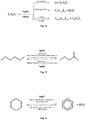
- the process schemes of modifying the structures of molecules of organic compounds with the silver(II) compound are shown in Figures 13-20 , the diagrams on Figures 19-20 relate to processes of homo-coupling and cross-coupling of molecules of organic compounds.
- the processes of disposal of hydrocarbons and their derivatives are illustrated in Examples 18 and 19.
- the method of the invention allows to carry out a chemical reaction with respect to organic compounds which are solids, liquids or gases.
- Redox reagent comprise of at least one silver(II) compound and can be in solid or liquid phase, but generally silver(II) salts are present in the solid phase. Therefore, the chemical reactions carried out according to the invention occur most often between the organic compound and the redox reagent as solid/liquid and solid/gas, wherein the solid is a redox reagent (fixed bed or slurry), and the organic reagent or organic reagent mixture is in gaseous (vapor) or liquid liquid form, or as an emulsion or spray.
- the chemical reactions carried out according to the invention can proceed directly between the redox reagent comprising of at least one silver(II) compound and an organic reagent or mixture of organic reactants. It is also possible to use solvents, preferably organic solvents to ensure appropriate reaction medium.
- liquid hydrocarbons aliphatic, cyclic and aromatic
- hydrofluorocarbons aliphatic, cyclic and aromatic
- perfluorocarbons aliphatic and aromatic alkyl-cyclic
- fluoroalcohols primary, secondary and tertiary
- perfluoroalkohols primary, secondary and tertiary
- fluoroamines primary, secondary and tertiary
- perfluoroamines primary, secondary and tertiary
- fluoroesters aliphatic and aromatic alkyl-cyclic
- perfluoroesters aliphatic and aromatic alkyl-cyclic
- fluoroethers aliphatic and aromatic alkyl-cyclic
- perfluoroethers aliphatic and aromatic alkyl-cyclic
- halogen derivatives of alkanes fluorinated ionic liquids, perfluorinated ionic liquids, sulfuric(VI) acid, oleum or other acids
- the chemical reaction in the process according to the invention is carried out in a protective atmosphere, for example under argon or nitrogen.
- a protective atmosphere is needed for the protection of the oxidizing agent from water and atmospheric humidity, because silver(II) compounds are generally very sensitive to moisture. Except for some selected hydrates of the silver(II) salts, which are insensitive to atmospheric moisture.
- the use of protective atmosphere is not necessary in cases where silver(II) compounds, organic reactants, intermediates and final products are not sensitive to moisture.
- the chemical reaction in the process according to the invention is carried out in apparatus of a material inert with respect to silver(II) compounds.
- Used equipment includes glass, quartz equipment, apparatus made of fluoropolymers, stainless steel, or apparatus covered with glass, quartz, fluoropolymers or stainless steel.
- the reactions can also be carried out in an apparatus comprising of components made of different materials which are inert with respect to silver(II) compounds.
- the process of the present invention is not limited to any of the above materials.
- the chemical reactions in the process according to the invention are carried out until completion of the reaction progress observed. Any particular preferred time of the process is not advised.
- additional treatments such as constant agitation, ultrasound, UV light, microwave radiation can be applied. These activities are aimed to facilitate and increase the area of contact between the reactants and the oxidizing agent to accelerate coupling process.
- a Lewis acid preferably BF 3 ⁇ O(C 2 H 5 ) 2
- the addition of the Lewis acid reduces the reaction time and increases the rate of reaction.
- the presence of a Lewis acid can increase the oxidizing power of the Ag(II) compounds used in the reaction.
- the isomerization reactions including cyclization and ring opening), dehydrogenation (including aromatization), cracking (i.e., breaking of C-C bonds) and coupling (i.e., formation of C-C bonds) of molecules of organic compounds of the invention may occur separately (as for example dehydrogenation reaction in example 9), parallely (e.g., cracking reactions, isomerization and coupling in example 5) or sequentially (e.g., coupling and dehydrogenation reactions in example 3).
- reaction medium i.e., the choice of reaction medium, pressure and temperature, as well as the yield and selectivity of the proces, depend on many parameters, including the nature of the organic compound, the type and nature of redox reagent of the applied silver(II) compound, the physical state of the reactants, and the nature of the solvent used (if used), etc.
- the initiation of the chemical process may occur by various mechanisms, which usually extend through the stage of the charge transfer between the organic compound and the silver(II) ion which results in formation of cations.
- the reaction of cation formation occurs most often in the stoichiometric ratio of 1:1 between redox reagent and the organic reagent.
- Resulted cation may then react with another formed cation or with another neutral or modified molecule (e.g., as a result of the cracking reaction).
- catalytic effect of silver(II) compounds was observed, that effects in the change of the content of oxidizing agent in the reaction mixture at approx. 1 mol%.
- silver(II) compounds are used in organic synthesis as redox reagents responsible for the initiation of the oxidative reactions that lead to modification of molecular structure of organic compounds.
- the redox reagents used in organic synthesis according to the invention are silver(II) trifluoromethanesulfonate(VI) (triflate), silver(II) fluorosulphate(VI), silver(I/II) fluorosulphate(VI), silver(II) sulphate, or hydrates thereof containing silver(II).
- the use of silver(II) triflate, silver(II) sulfate(VI), or silver(II) sulfate(VI) hydrate has the advantage that they are ones of the few silver(II) compounds, which are not fluorinating agents.
- the process of the present invention is not limited to any of the above oxidizing agents based on compounds of silver(II).
- the process according to the invention is characteristic by the capability to modify previously inaccessible organic compounds in organic synthesis.
- reactions can be carried out at room temperature over a number of organic compounds, which are considered to be chemically stable under normal conditions.
- the selectivity of the various silver(II) salts and their chemical activity can vary considerably for the same organic reactants.
- the activity of the silver(II) with respect to the organic compound is extremely powerful and allows the conversion of hydrocarbons with negligible reactivity, such as n-paraffins having a chain length of less than 6. It gives large possibilities for application of the silver(II) salt (II) as redox reagents in organic synthesis.
- Example 1 Electrosynthesis of silver(II) sulphate(VI) was carried out according to the invention.
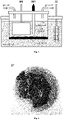
- the electrolysis was performed in a glass apparatus.
- the apparatus consisted of two parts connected by a porous sintered glass.
- the glass apparatus was washed twice with distilled sulphuric(VI) acid, then washed with water, then twice more with distilled sulphuric(VI) acid.
- System uses three electrodes: a working electrode (EC) made of FTO, counter electrode (CE) as a silver sheet with the actual surface 300 cm 2 , reference electrode (REF), i.e., saturated silver sulphate electrode in 100% sulphuric acid with potential of 815 mV relative to a standard hydrogen electrode(NHE).
- EC working electrode
- CE counter electrode
- REF reference electrode
- a working electrode and a reference electrode were placed in a part of the apparatus in which the electrolysis is carried out; second part was an auxiliary electrode.
- the reaction system was a solution of the silver(I) sulphate(VI) in 96% sulphuric(VI) acid.
- the reaction system was tightly closed and the atmosphere filled with argon with a purity of N6.7.
- the surface of solution was covered with a layer of sulphur(VI) hexafluoride.
- Electrolysis was performed at a potential in the range of 2.6-3.8 V vs. the standard hydrogen electrode (NHE). During the process a colorless solution of sulphuric acid turned yellow and then the black solid began to precipitate from solution, and it was collected at the bottom of the reaction vessel.
- NHE standard hydrogen electrode
- Example 2 Electrosynthesis of silver(II) trifluoromethanesulfonate(VI) was carried out according to the invention, and in accordance with the procedure in Example 1. The electrolysis was performed in a glass. The apparatus consisted of a glass four-necked heart-shaped flask. The apparatus was washed with a 10% solution of peroxosulphuric(VI) acid in sulphuric(VI) acid and then washed with deionized distilled water and dried at 150°C.
- working electrode made of a fluorine-doped indium tin oxide (FTO)
- counter electrode CE
- REF reference electrode
- a working electrode was placed directly into a glass flask, and the reference and auxiliary electrode were placed in glass tubes, separated from the primary reaction space by sintered glass.
- Silver(I) trifluoromethanesulfonate(VI) was added in 98% trifluoromethanosulfonate(VI) acid.
- the reaction system was tightly closed and the protective atmosphere of sulfur hexafluoride (VI) was applied.
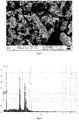
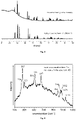
- the electrolysis was conducted at a potential in the range 2.6-4.8V relative to the normal hydrogen electrode (NHE) at 20°C. During the process, the transparent surface of the working electrode stained orange, and then, with the continuation of the process and increasing the thickness of the synthesized product it went dark brown. After completion of the electrolysis product was washed twice with 98% aqueous trifluoromethanesulfonate(VI) acid which was evaporated using a vacuum apparatus. The resulting product was subjected to spectroscopic and structural analyses. The results of analyzes are shown in Figures 7 and 8 . The reaction product was identified as silver trifluoromethanesulfonate(VI). No significant significant amounts of impurities where detected in the product.
- Example 3 Electrosynthesis of silver(II) nitrate(V) was carried out according to the invention, in accordance with the procedure in Example 1 using nitric(V) acid at a concentration of 100%. Since it contained nitrogen oxides the acid was reddish. Therefore before using it, acid was subjected to ozonolysis to remove nitrogen oxides yielding colorless 100% nitric(V) acid. Electrolysis was carried out at -35°C in a glass apparatus. After the electrosynthesis, the resulting dark brown product was washed with 100% nitric acid at -35°C and dried under high vacuum at -30°C. The product was identified as silver(II) nitrate.
- Example 4 Electrosynthesis of silver(II) fluorosuphate(VI) was carried out according to the invention, and in accordance with the procedure in Example 1, using fluorosulphuric(VI) acid at a concentration of 95%. Electrolysis was carried out at 20°C in an apparatus made of perfluorinated materials. After reaction, the resulting product of electrosyntesis was almost black. It was washed with 100% fluorosulphuric(VI) acid and dried in vacuum. The product was identified as silver(II) fluorosulphate(VI) polluted with silver(I/II) fluorosulphate(VI).
- Example 5 The process of electrolysis of invention, according to the procedure outlined in Example 1, was performed with silver(I) hydrogen selenate(VI) in a melt of selenic(VI) acid at a concentration of 85%. Electrolysis was carried out at 65°C in a glass apparatus. After the electrosynthesis, obtained product was washed with aqueous solutions of selenic(VI) acid at a concentration gradually decreasing from 85% to 0%. The product was then dried under high vacuum at 20°C. The product was identified as silver(II) selenate(VI).
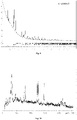
- Example 6 Silver(II) sulphate(VI) hydrate was prepared from silver(II) sulphate obtained electrochemically by the method described in Example 1. Silver(II) sulphate(VI) was subjected to atmospheric moisture at room temperature. Exposure was carried out for 48 hours. The resulting product was subjected to chemical, spectroscopic and structural analysis. The results of analyzes are shown in Figures 9, 10 , 11 and 12 . The product was identified as AgSO 4 ⁇ H 2 O.
- Example 7 The synthesis was performed to electrochemically prepare silver(II) selenate(VI) hydrate by the method described in Example 5. Silver(II) selenate(VI) was exposed to water vapour at a temperature ranging from 20°C to 30°C. Exposure to water vapour was carried for 24 hours. The resulting product was identified as a silver(II) selenate(VI) hydrate.
- Example 8 Silver(II) triflate was used as a redox reagent in the process of oxidative activation of C-H and C-C bonds of n-hexane in a reaction between 0.2 mmol of Ag(OTf) 2 and 1 ml of n-hexane. The reaction was carried out for 5 minutes in a glassware stirred continuously under an argon atmosphere. Products were identified by GC-MS using a HP-5MS column heated to a temperature of 300°C.
- Example 9 Silver(II) triflate was used as a redox reagent in the process of oxidative activation of C-H and C-C bonds of cyclohexane in a reaction between 0.2 mmol Ag(OTf) 2 and 1 ml of cyclohexane. The reaction was carried out for 5 minutes in a glassware stirred continuously under an argon atmosphere. Products were identified by GC-MS using a HP-5MS column heated to a temperature of 300°C.
- Example 10 Silver(II) sulfate(VI) hydrate was used as a redox reagent in the process of oxidative activation of C-H bonds of cyclohexane in a reaction between 0.2 mmol AgSO 4 ⁇ H 2 O and 0.1 mmol of cyclohexane in 1 ml of hexafluoro-2-propanol (HFIP). The reaction was carried out for 72 hours in glassware stirred continuously under an argon atmosphere. Products were identified by GC-MS using a HP-5MS column heated to a temperature of 300°C.
- HFIP hexafluoro-2-propanol
- Example 11 Silver(II) sulphate(VI) hydrate was used as a redox reagent in the process of oxidative activation of C-H and C-C bonds in n-octane in a reaction between 0.2 mmol AgSO 4 ⁇ H 2 O and 0.1 mmol of n-octane in 1 ml of hexafluoro-2-propanol (HFIP). The reaction was carried out for 72 hours in glassware stirred continuously under an argon atmosphere. Products were identified by GC-MS using a HP-5MS column heated to a temperature of 300°C.
- Example 12 Silver(II) sulfate(VI) hydrate was used as a redox reagent in the process of oxidative activation of C-H and C-C bonds in 2,2,3-trimethyl pentane in a reaction between 0.2 mmol AgSO 4 ⁇ H 2 O and 0.1 mmol of 2,2,3-trimethyl pentane in 1 ml of hexafluoro-2-propanol (HFIP). The reaction was carried out for 72 hours in glassware stirred continuously under an argon atmosphere. Products were identified by GC-MS using a HP-5MS column heated to a temperature of 300°C.
- Example 13 Silver(II) sulphate(VI) hydrate was used as a redox reagent in the process of oxidative activation of C-H and C-C bonds in 2,2,3,3 tetramethyl buthane in a reaction between 0.2 mmol AgSO 4 ⁇ H 2 O and 0.1 mmol of 2,2,3,3-tetrametyl buthane in 1 ml of hexafluoro-2-propanol (HFIP). The reaction was carried out for 72 hours in glassware stirred continuously under an argon atmosphere. Products were identified by GC-MS using a HP-5MS column heated to a temperature of 300°C. Observed cracking and the sp 3 -sp 3 coupling led to the formation of 3-methyl octane. The reaction yield calculated from GC-MS measurement was 5%. The results of analyzes are shown in Table 2.
- Example 14 Silver(II) sulphate(VI) hydrate was used as a redox reagent in the process of oxidative activation of C-H bonds of cyclohexene in a reaction between 0.2 mmol AgSO 4 ⁇ H 2 O, and 1 ml of pure over P 4 O 10 dried cyclohexene. The reaction was carried out for 72 hours in glassware stirring continuously under an argon atmosphere. Products were identified by GC-MS using a HP-5MS column heated to a temperature of 300°C. There were a sp 3 -sp 3 coupling, cyclization and dehydrogenation creating cykloheksyl benzene. The reaction yield calculated from GC-MS measurement was 5%. The results of analyzes are shown in Table 2.
- EXAMPLE 15 Silver(II) triflate was used as a reagent in the process of oxidative activation of C-H bonds of 1-octene in a reaction between 0.06 mmol of Ag(OTf) 2 and 1 ml of pure 1-octene dried over molecular sieves 4A. The reaction was carried out for 5 minutes in a glassware stirred continuously under an argon atmosphere. Products were identified by GC-MS using a HP-5MS column heated to a temperature of 300°C.
- Example 16 Silver(II) sulphate(VI) hydrate was used as a reagent in the process of dehydrogenation of 1,1',1",3,3',3"- hexafluoro-i-propanol in a reaction between 0.2 mmol AgSO 4 ⁇ H2O and 1 ml of hexafluoro-2-propanol (HFIP), dried on 4A molecular sieves. The reaction was carried out for 72 hours in glassware stirred continuously under an argon atmosphere. Products were identified by GC-MS using a HP-5MS column heated to a temperature of 300°C. Observed dehydrogenation of hexafluoro-2-propanol led to hexafluoro-2-propanone. The reaction yield calculated from GC-MS measurement was 5%. The results of analyzes are shown in Table 2.
- Example 17 Silver(II) triflate was used as a redox reagent in the process of oxidative activation of C-H and C-C bonds of cyclohexane in a reaction between 0.2 mmol of Ag(OTf) 2 and 1 ml of cyclohexane. The reaction was carried out for 5 minutes in a glass flow reactor in order to make silver(II) triflate to react with vapours of cyclohexane. Products were identified by GC-MS using a HP-5MS column heated to a temperature of 300°C.
- Example 18 S ilver(II) sulphate(VI) hydrate was used as a redox reagent in the process of oxidative activation of C-H and C-C bonds of of benzene in a reaction between 0.1 mmol AgSO 4 ⁇ H 2 O and 1 ml of benzene. The reaction was carried out for 2 minutes in a glass reactor. Products were identified by GC-MS using a HP-5MS column heated to a temperature of 300°C. Dehydrogenation and cracking were observed leading to the formation of carbon dioxide and water (absorbed by sulphuric(VI) acid. The reaction yield calculated from GC-MS measurement was 2%. The results of analyzes are shown in Table 2.
- Example 19 Electrochemically in situ generated silver(II) hydrogensulfate(VI) in 96% sulphuric(VI) acid was used as a redox reagent in the process of oxidative activation of C-H and C-C bonds in 1,2-dichlorobenzene.
- This organic compound is one of the pesticides and is on the list of persistent organic pollutants (POPs).
- POPs persistent organic pollutants
- the reaction was carried out in an electrochemical way using a solution of 50 mM silver(I) bisulphate(VI) and 0.5 M of 1,2-dichlorobenzene in 96% sulphuric(VI) acid to generate in situ complexes of silver(II) bisulfate(VI), with a potential of 2.2 V.
- Example 20 Silver(II) sulphate(VI) monohydrate was used as a reagent in the homo-coupling of 1-chloronaphtalene in reaction between 0.1 mmol 1-chloronaphtalene and 0.2 mmol AgSO 4 ⁇ H 2 O in a solvent of 1,1,1-trifluoroethanol and hexafluoroisopropanol at a volume ratio of 1: 1.
- the reaction was carried out 72 hours in glassware, stirred continuously at room temperature under argon.
- the reaction mixture was filtered to remove the solid reaction products and excess AgSO 4 ⁇ H 2 O.
- the reaction mixture was separated on a preparative thin-layer chromatography plate using n-hexane as eluent.
- Example 21 Process of homo-coupling of 1- chloronaphtalene was carried out in the presence of AgSO 4 .
- the reaction proceeded between 0.1 mmol 1-chloronaphtalene and 0.2 mmol AgSO 4 .
- As a reaction medium organic solvent mixture of 1,1,1-trifluoroethanol and hexafluoroisopropanol at a volume ratio of 1: 1 was used.
- the reaction was carried out 72 hours in glassware. During the reaction the mixture was stirred continuously with a magnetic stirrer, using a mixing element coated with a layer of PTFE. The reaction was conducted at room temperature under argon.
- Example 22 Homo-coupling process of 1-chloronaphtalene was carried out in the presence of AgSO 4 . Reaction proceeded between 0.1 mmol 1-chloronaphtalene and 0.2 mmol AgSO 4 . As the reaction medium hexafluoroisopropanol was used. The reaction was carried out 72 hours in glassware. The reaction mixture was treated with ultrasound (sonication) in a laboratory ultrasonic bath for 60 minutes. During the reaction the mixture was stirred continuously with a magnetic stirrer, using a mixing element coated with a layer of PTFE. The reaction was conducted at room temperature under argon.
- Example 23 Homo-coupling process of 1-chloronaphtalene was carried out in the presence of AgSO 4 .
- the reaction was taken between 0.1 mmol 1-chloronaphtalene and 0.2 mmol AgSO 4 .
- As the reaction medium hexafluoroisopropanol was used.
- the reaction was carried out 72 hours in an apparatus made of PTFE. During the reaction the mixture was stirred continuously with a magnetic stirrer, using a mixing element coated with a layer of PTFE. The reaction was performed at room temperature under argon. The reaction mixture was subjected to microwave irradiation for 15 minutes.
- reaction mixture was then filtered through a PTFE filter having a pore size of 0.45 ⁇ m to remove the solid reaction products and excess AgSO 4 .
- the reaction mixture was separated on a preparative thin-layer chromatography plate using n-hexane as eluent. Products were identified by GC-MS, and 1 H NMR, 13 C NMR and 1 H- 13 C HSQY 2D NMR spectroscopy at room temperature using CDCl 3 as solvent. Process gave 1,1'-dichlorobis naftyl (coupling product sp 2 -sp 2 ) in 6% yield (yield determined from GC-MS measurements). The results of analyzes are shown in Table 3.
- Example 24 Homo-coupling process of 1- chloronaphtalene was carried out in the presence of AgSO 4 .
- the reaction was taken between 0.1 mmol 1-chloronaphtalene and 0.2 mmol AgSO 4 .
- As the reaction medium hexafluoroisopropanol was used.
- the reaction was carried out 72 hours in a quartz apparatus. During the reaction the mixture was continuously mixed on a magnetic stirrer using a mixing element coated with a layer of PTFE. The reaction was conducted at room temperature under argon. The reaction mixture was exposed to UV radiation for 60 minutes.
- reaction mixture was then filtered through a PTFE filter having a pore size of 0.45 ⁇ m to remove the solid reaction products and excess AgSO 4 .
- the reaction mixture was separated on a preparative thin-layer chromatography plate using n-hexane as eluent. Products were identified by GC-MS, and 1 H NMR, 13 C NMR and 1 H- 13 C HSQY 2D NMR spectroscopy at room temperature using CDCl 3 as solvent. Process gave 1,1'-dichlorobis naftyl (coupling product sp 2 -sp 2 ) in 6% yield (yield determined from GC-MS measurements). The results of the analyzes are summarized in Table 3.
- Example 25 The process of homo-coupling of naphthalene was carried out in the presence of AgSO 4 . Reaction was taken between 1 mmol of naphthalene and 1 mmol AgSO 4 . As the reaction medium cyclohexane was used. The reaction was carried out 72 hours in glassware. During the reaction mixture was continuously mixed on a magnetic stirrer using a mixing element coated with a layer of PTFE. The reaction was conducted at room temperature under argon. After completion of the coupling, reaction mixture was then filtered through a PTFE filter having a pore size of 0.45 ⁇ m to remove the solid reaction products and excess AgSO 4 .
- reaction mixture was separated on a preparative thin-layer chromatography plate using n-hexane as eluent.
- Products were identified by GC-MS, and 1 H NMR, 13 C NMR and 1 H- 13 C HSQY 2D NMR spectroscopy at room temperature using CDCl 3 as solvent.
- Process gave the isomeric naphthalene dimers (sp 2 -sp 2 conjugates) 1,1-binaphthyl and 1,2-binaphthyl in yields of 6.5% and 1.5%.
- Example 26 Process of homo-coupling of 2,3,5,6- tetrafluorotoluene was carried out in the presence of AgSO 4 .
- the reaction proceeded between 0.1 mmol 2,3,5,6-tetrafluorotoluene and 0.1 mmol AgSO 4 .
- As the reaction medium cyclohexane was used.
- the reaction was carried out 72 hours in glassware. During the reaction the mixture was continuously mixed on a magnetic stirrer using a mixing element coated with a layer of PTFE. The reaction was conducted at room temperature under argon. After completion of the coupling, reaction mixture was then filtered through a PTFE filter having a pore size of 0.45 ⁇ m to remove the solid reaction products and excess AgSO 4 .
- reaction mixture was separated on a preparative thin-layer chromatography plate using n-hexane as eluent.
- Products were identified by GC-MS.
- Products were identified by GC-MS, and 1 H NMR, 13 C NMR and 1 H- 13 C HSQY 2D NMR spectroscopy at room temperature using CDCl 3 as solvent.
- Process yields 1,1'-bis (2,3,5,6-tetrafluorofenylo)ethane (coupling product sp 3 -sp 3 ) in a yield of 0.7%.
- Example 27 The process of cross-coupling of fluoronaphthalene and bromonaphthalene was carried out in the presence of AgSO 4 . Reaction proceeded between 0.1 mmol fluoronapthalene, 0.1 mmol bromonaphthalene and 0.2 mmol AgSO 4 . As reaction medium hexafluoroisopropanol was used. The reaction was carried out 72 hours in glassware. During the reaction the mixture was continuously mixed on a magnetic stirrer using a mixing element coated with a layer of PTFE. The reaction was conducted at room temperature under argon.
- reaction mixture was then filtered through a PTFE filter having a pore size of 0.45 ⁇ m to remove the solid reaction products and excess AgSO 4 .
- the reaction mixture was separated on a preparative thin-layer chromatography plate using n-hexane as eluent. Products were identified by GC-MS, and 1 H NMR, 13 C NMR and 1 H- 13 C HSQY 2D NMR spectroscopy at room temperature using CDCl 3 as solvent. Process gave 1-bromo-1'-fluorobis naftyl (coupling product sp 2 -sp 2 ) in 25% yield (yield calculated from GC-MS measurements). The results of the analyzes are summarized in Table 3.
- Example 28 The process of homo-coupling of 1-bromo-3-fluorobenzene was carried out in the presence of AgSO 4 . Reaction proceeded between excess of 1-bromo-3-fluorobenzene and 0.1 mmol AgSO 4 . As reaction medium, substituting 1-bromo-3-fluorobenzene was used. The reaction was carried out 72 hours in glassware. During the reaction the mixture was continuously mixed on a magnetic stirrer using a mixing element coated with a layer of PTFE. The reaction was conducted at room temperature under argon. The reaction mixture was separated and identified by GC-MS.
- Example 29 The process of homo-coupling of 1-chloronaphtalene carried out in the presence of AgSO 4 and BF 3 ⁇ O(C 2 H 5 ) 2 . Reaction proceeded between 0.1 mmol 1-chloronaphtalene, 0.1 mmol AgSO 4 and 0.1 mmol BF 3 ⁇ O(C 2 H 5 ) 2 . As the reaction medium hexafluoroisopropanol was used. The reaction was carried out 72 hours in glassware. During the reaction the mixture was continuously mixed on a magnetic stirrer using a mixing element coated with a layer of PTFE. The reaction was performed at room temperature under argon. The reaction mixture was separated and identified by GC-MS.
Landscapes
- Chemical & Material Sciences (AREA)
- Organic Chemistry (AREA)
- Inorganic Chemistry (AREA)
- Catalysts (AREA)
- Organic Low-Molecular-Weight Compounds And Preparation Thereof (AREA)
Applications Claiming Priority (6)
| Application Number | Priority Date | Filing Date | Title |
|---|---|---|---|
| PL413922A PL243170B1 (pl) | 2015-09-11 | 2015-09-11 | Sposób oksydatywnego sprzęgania cząsteczek węglowodorów posiadających atomy węgla podstawione wodorem |
| PL416026A PL240270B1 (pl) | 2016-02-04 | 2016-02-04 | Sposób elektrosyntezy siarczanu(VI) srebra(II) i produkt otrzymany tym sposobem |
| PL418465A PL234672B1 (pl) | 2016-08-25 | 2016-08-25 | Monohydrat siarczanu(VI) srebra(II) i sposób jego syntezy |
| PL418630A PL247802B1 (pl) | 2016-09-09 | 2016-09-09 | Sposób modyfikacji struktury cząsteczek związków organicznych oraz zastosowanie soli srebra(II) w tym sposobie |
| PL418629A PL246534B1 (pl) | 2016-09-09 | 2016-09-09 | Sposób elektrosyntezy trifluorometanosiarczanu(VI) srebra(II) |
| PCT/IB2016/001280 WO2017042624A1 (en) | 2015-09-11 | 2016-09-12 | Methods for obtaining salts of silver(ii) and hydrates thereof, products obtained by the methods and use of the same |
Publications (2)
| Publication Number | Publication Date |
|---|---|
| EP3347309A1 EP3347309A1 (en) | 2018-07-18 |
| EP3347309B1 true EP3347309B1 (en) | 2022-07-20 |
Family
ID=57281247
Family Applications (1)
| Application Number | Title | Priority Date | Filing Date |
|---|---|---|---|
| EP16794402.4A Active EP3347309B1 (en) | 2015-09-11 | 2016-09-12 | Methods for obtaining salts of silver(ii) and hydrates thereof, products obtained by the methods and use of the same |
Country Status (5)
| Country | Link |
|---|---|
| EP (1) | EP3347309B1 (lt) |
| CA (1) | CA2998293C (lt) |
| LT (1) | LT3347309T (lt) |
| PL (1) | PL3347309T3 (lt) |
| WO (1) | WO2017042624A1 (lt) |
Families Citing this family (1)
| Publication number | Priority date | Publication date | Assignee | Title |
|---|---|---|---|---|
| CN107311135B (zh) * | 2017-07-14 | 2019-04-05 | 华南师范大学 | 一种多足状磷酸银材料的制备方法 |
-
2016
- 2016-09-12 EP EP16794402.4A patent/EP3347309B1/en active Active
- 2016-09-12 WO PCT/IB2016/001280 patent/WO2017042624A1/en not_active Ceased
- 2016-09-12 PL PL16794402.4T patent/PL3347309T3/pl unknown
- 2016-09-12 LT LTEPPCT/IB2016/001280T patent/LT3347309T/lt unknown
- 2016-09-12 CA CA2998293A patent/CA2998293C/en active Active
Non-Patent Citations (3)
| Title |
|---|
| J. A. MCMILLAN: "Higher Oxidation States of Silver.", CHEMICAL REVIEWS, vol. 62, no. 1, 1 February 1962 (1962-02-01), US, pages 65 - 80, XP055719883, ISSN: 0009-2665, DOI: 10.1021/cr60215a004 * |
| P. C. LEUNG ET AL: "Synthesis and structural characterization of fluorosulfate derivatives of silver(II)", INORGANIC CHEMISTRY, vol. 17, no. 7, 1 July 1978 (1978-07-01), EASTON, US, pages 1765 - 1772, XP055719889, ISSN: 0020-1669, DOI: 10.1021/ic50185a012 * |
| PIOTR POLCZYNSKI ET AL: "Stabilization and strong oxidizing properties of Ag(II) in a fluorine-free solvent", CHEMMCOMM, vol. 49, 20 June 2013 (2013-06-20), pages 7480 - 7482, XP055720049, DOI: 10.1039/c3cc43072c * |
Also Published As
| Publication number | Publication date |
|---|---|
| EP3347309A1 (en) | 2018-07-18 |
| CA2998293C (en) | 2023-10-31 |
| LT3347309T (lt) | 2023-01-10 |
| WO2017042624A1 (en) | 2017-03-16 |
| PL3347309T3 (pl) | 2023-05-08 |
| CA2998293A1 (en) | 2017-03-16 |
Similar Documents
| Publication | Publication Date | Title |
|---|---|---|
| Kaur et al. | Two‐dimensional perovskites for photocatalytic CO2 reduction | |
| Zheng et al. | Selective photocatalytic oxidation of benzyl alcohol into benzaldehyde with high selectivity and conversion ratio over Bi4O5Br2 nanoflakes under blue LED irradiation | |
| Wang et al. | Direct generation of hydroxyl radicals over bismuth oxybromide nanobelts with tuned band structure for photocatalytic pollutant degradation under visible light irradiation | |
| Lee et al. | Fabrication of hierarchical bismuth oxyhalides (BiOX, X= Cl, Br, I) materials and application of photocatalytic hydrogen production from water splitting | |
| Sahoo et al. | Synergistic effects of plasmon induced Ag@ Ag 3 VO 4/ZnCr LDH ternary heterostructures towards visible light responsive O 2 evolution and phenol oxidation reactions | |
| Qiu et al. | Highly efficient microwave catalytic oxidation degradation of p-nitrophenol over microwave catalyst of pristine α-Bi2O3 | |
| Carey et al. | Photodechlorination of PCB's in the presence of titanium dioxide in aqueous suspensions | |
| Adhikari et al. | Role of Ni in hetero-architectured NiO/Ni composites for enhanced catalytic performance | |
| Tiong et al. | Improved interfacial charge transfer and visible light activity of reduced graphene oxide–graphitic carbon nitride photocatalysts | |
| Zhang et al. | Study of the role of oxygen vacancies as active sites in reduced graphene oxide-modified TiO 2 | |
| Al Aqad et al. | Photocatalytic degradation of basic blue dye using zinc nanoparticles decorated graphene oxide nanosheet | |
| Li et al. | Boosting peroxymonosulfate activation over cyanuric acid-modified Co3O4@ Fe2O3 for tetracycline degradation: insights into catalytic performance, degradation mechanism, and routes | |
| Kasalica et al. | Photocatalytic degradation of PFOA over rGO-doped TiO2 coatings formed by plasma electrolytic oxidation | |
| Bi et al. | Room temperature synthesis of ultrathin iodine-doped BiOCl nanosheets | |
| Xue et al. | Insights into the improved photocatalytic performance of fluorine surface modified mpg-C3N4 at room temperature under aqueous conditions | |
| CA2998293C (en) | Methods for obtaining salts of silver(ii) and hydrates thereof, products obtained by the methods and use of the same | |
| Zeng et al. | Synergistic interaction of S-type heterojunction and sulfur vacancies in g-C3N5@ Sv-ZnIn2S4 composites: Simultaneous promotion of complete 2, 4-dichlorophenol mineralization and Cr (VI) reduction | |
| Sehati et al. | High visible light intercalated nanophotocatalyst (PbS-CdS/Ti6O13) synthesized by ultrasound: Photocatalytic activity, photocorrosion resistance and degradation mechanism | |
| Qiao et al. | Phosphorus-doped C3N4 supported Fe-Ni-MOF heterojunction: a highly efficient photocatalyst for selective benzene hydroxylation | |
| Cirillo et al. | Advanced electrochemical degradation of Methyl Orange using a silver-functionalized 3D-printed electrode | |
| Dermèche et al. | Preparation and characterization of mixed caesium-tin mixed salt of Keggin-type phosphovanadomolybdate. Application to photocatalytic chromate reduction | |
| EP0614444A1 (en) | Novel salts of fullerenes | |
| Saeed et al. | Two-electron transfer photoreduction of methyl viologen and perfluorooctanoic acid mediated by flavin mononucleotide at colloidal titanium dioxide interfaces | |
| Li et al. | Dual-functional engineering of Sn-doping and polyaniline coating for Cs 3 Bi 2 Br 9 perovskite: boosting its photocatalytic activity and photostability in selective oxidation of benzyl alcohol | |
| Jiamprasertboon et al. | Porous Nanosheets and Excellent Charge Carrier Dynamics in Ag+‐Doped Na0. 5Bi2. 5Nb2O9 Aurivillius‐Phase Layered Perovskite for Enhanced Visible‐Light Photocatalytic Activity |
Legal Events
| Date | Code | Title | Description |
|---|---|---|---|
| STAA | Information on the status of an ep patent application or granted ep patent |
Free format text: STATUS: UNKNOWN |
|
| STAA | Information on the status of an ep patent application or granted ep patent |
Free format text: STATUS: THE INTERNATIONAL PUBLICATION HAS BEEN MADE |
|
| PUAI | Public reference made under article 153(3) epc to a published international application that has entered the european phase |
Free format text: ORIGINAL CODE: 0009012 |
|
| STAA | Information on the status of an ep patent application or granted ep patent |
Free format text: STATUS: REQUEST FOR EXAMINATION WAS MADE |
|
| 17P | Request for examination filed |
Effective date: 20180411 |
|
| AK | Designated contracting states |
Kind code of ref document: A1 Designated state(s): AL AT BE BG CH CY CZ DE DK EE ES FI FR GB GR HR HU IE IS IT LI LT LU LV MC MK MT NL NO PL PT RO RS SE SI SK SM TR |
|
| AX | Request for extension of the european patent |
Extension state: BA ME |
|
| RIN1 | Information on inventor provided before grant (corrected) |
Inventor name: JURCZAKOWSKI, RAFAL ROBERT Inventor name: ADAMCZYK, WOJCIECH MAREK Inventor name: LESZCZYNSKI, PIOTR Inventor name: POLYCZYNSKI, PIOTR Inventor name: BUDNIAK, ADAM KRZYSZTOF Inventor name: GROCHALA, WOJCIECH RAFAL Inventor name: MAZEJ, ZORAN Inventor name: GILEWSKI, TOMASZ EDWARD Inventor name: GAWRACKZYNSKI, JAKUB HENRYK |
|
| DAV | Request for validation of the european patent (deleted) | ||
| DAX | Request for extension of the european patent (deleted) | ||
| GRAP | Despatch of communication of intention to grant a patent |
Free format text: ORIGINAL CODE: EPIDOSNIGR1 |
|
| STAA | Information on the status of an ep patent application or granted ep patent |
Free format text: STATUS: GRANT OF PATENT IS INTENDED |
|
| INTG | Intention to grant announced |
Effective date: 20200930 |
|
| GRAJ | Information related to disapproval of communication of intention to grant by the applicant or resumption of examination proceedings by the epo deleted |
Free format text: ORIGINAL CODE: EPIDOSDIGR1 |
|
| STAA | Information on the status of an ep patent application or granted ep patent |
Free format text: STATUS: REQUEST FOR EXAMINATION WAS MADE |
|
| INTC | Intention to grant announced (deleted) | ||
| STAA | Information on the status of an ep patent application or granted ep patent |
Free format text: STATUS: EXAMINATION IS IN PROGRESS |
|
| 17Q | First examination report despatched |
Effective date: 20210330 |
|
| GRAP | Despatch of communication of intention to grant a patent |
Free format text: ORIGINAL CODE: EPIDOSNIGR1 |
|
| STAA | Information on the status of an ep patent application or granted ep patent |
Free format text: STATUS: GRANT OF PATENT IS INTENDED |
|
| INTG | Intention to grant announced |
Effective date: 20220223 |
|
| GRAS | Grant fee paid |
Free format text: ORIGINAL CODE: EPIDOSNIGR3 |
|
| GRAA | (expected) grant |
Free format text: ORIGINAL CODE: 0009210 |
|
| STAA | Information on the status of an ep patent application or granted ep patent |
Free format text: STATUS: THE PATENT HAS BEEN GRANTED |
|
| AK | Designated contracting states |
Kind code of ref document: B1 Designated state(s): AL AT BE BG CH CY CZ DE DK EE ES FI FR GB GR HR HU IE IS IT LI LT LU LV MC MK MT NL NO PL PT RO RS SE SI SK SM TR |
|
| RIN1 | Information on inventor provided before grant (corrected) |
Inventor name: MAZEJ, ZORAN Inventor name: GROCHALA, WOJCIECH RAFAL Inventor name: JURCZAKOWSKI, RAFAL ROBERT Inventor name: POLCZYNSKI, PIOTR Inventor name: GILEWSKI, TOMASZ EDWARD Inventor name: GAWRACZYNSKI, JAKUB HENRYK Inventor name: ADAMCZYK, WOJCIECH MAREK Inventor name: BUDNIAK, ADAM KRZYSZTOF Inventor name: LESZCZYNSKI, PIOTR |
|
| REG | Reference to a national code |
Ref country code: CH Ref legal event code: EP |
|
| REG | Reference to a national code |
Ref country code: DE Ref legal event code: R096 Ref document number: 602016073654 Country of ref document: DE |
|
| REG | Reference to a national code |
Ref country code: AT Ref legal event code: REF Ref document number: 1505452 Country of ref document: AT Kind code of ref document: T Effective date: 20220815 |
|
| REG | Reference to a national code |
Ref country code: IE Ref legal event code: FG4D |
|
| REG | Reference to a national code |
Ref country code: NL Ref legal event code: FP |
|
| REG | Reference to a national code |
Ref country code: NO Ref legal event code: T2 Effective date: 20220720 |
|
| PG25 | Lapsed in a contracting state [announced via postgrant information from national office to epo] |
Ref country code: SE Free format text: LAPSE BECAUSE OF FAILURE TO SUBMIT A TRANSLATION OF THE DESCRIPTION OR TO PAY THE FEE WITHIN THE PRESCRIBED TIME-LIMIT Effective date: 20220720 Ref country code: RS Free format text: LAPSE BECAUSE OF FAILURE TO SUBMIT A TRANSLATION OF THE DESCRIPTION OR TO PAY THE FEE WITHIN THE PRESCRIBED TIME-LIMIT Effective date: 20220720 Ref country code: PT Free format text: LAPSE BECAUSE OF FAILURE TO SUBMIT A TRANSLATION OF THE DESCRIPTION OR TO PAY THE FEE WITHIN THE PRESCRIBED TIME-LIMIT Effective date: 20221121 Ref country code: LV Free format text: LAPSE BECAUSE OF FAILURE TO SUBMIT A TRANSLATION OF THE DESCRIPTION OR TO PAY THE FEE WITHIN THE PRESCRIBED TIME-LIMIT Effective date: 20220720 Ref country code: FI Free format text: LAPSE BECAUSE OF FAILURE TO SUBMIT A TRANSLATION OF THE DESCRIPTION OR TO PAY THE FEE WITHIN THE PRESCRIBED TIME-LIMIT Effective date: 20220720 Ref country code: ES Free format text: LAPSE BECAUSE OF FAILURE TO SUBMIT A TRANSLATION OF THE DESCRIPTION OR TO PAY THE FEE WITHIN THE PRESCRIBED TIME-LIMIT Effective date: 20220720 |
|
| REG | Reference to a national code |
Ref country code: AT Ref legal event code: MK05 Ref document number: 1505452 Country of ref document: AT Kind code of ref document: T Effective date: 20220720 |
|
| PG25 | Lapsed in a contracting state [announced via postgrant information from national office to epo] |
Ref country code: IS Free format text: LAPSE BECAUSE OF FAILURE TO SUBMIT A TRANSLATION OF THE DESCRIPTION OR TO PAY THE FEE WITHIN THE PRESCRIBED TIME-LIMIT Effective date: 20221120 Ref country code: HR Free format text: LAPSE BECAUSE OF FAILURE TO SUBMIT A TRANSLATION OF THE DESCRIPTION OR TO PAY THE FEE WITHIN THE PRESCRIBED TIME-LIMIT Effective date: 20220720 Ref country code: GR Free format text: LAPSE BECAUSE OF FAILURE TO SUBMIT A TRANSLATION OF THE DESCRIPTION OR TO PAY THE FEE WITHIN THE PRESCRIBED TIME-LIMIT Effective date: 20221021 |
|
| REG | Reference to a national code |
Ref country code: DE Ref legal event code: R097 Ref document number: 602016073654 Country of ref document: DE |
|
| PG25 | Lapsed in a contracting state [announced via postgrant information from national office to epo] |
Ref country code: SM Free format text: LAPSE BECAUSE OF FAILURE TO SUBMIT A TRANSLATION OF THE DESCRIPTION OR TO PAY THE FEE WITHIN THE PRESCRIBED TIME-LIMIT Effective date: 20220720 Ref country code: RO Free format text: LAPSE BECAUSE OF FAILURE TO SUBMIT A TRANSLATION OF THE DESCRIPTION OR TO PAY THE FEE WITHIN THE PRESCRIBED TIME-LIMIT Effective date: 20220720 Ref country code: MC Free format text: LAPSE BECAUSE OF FAILURE TO SUBMIT A TRANSLATION OF THE DESCRIPTION OR TO PAY THE FEE WITHIN THE PRESCRIBED TIME-LIMIT Effective date: 20220720 Ref country code: DK Free format text: LAPSE BECAUSE OF FAILURE TO SUBMIT A TRANSLATION OF THE DESCRIPTION OR TO PAY THE FEE WITHIN THE PRESCRIBED TIME-LIMIT Effective date: 20220720 Ref country code: AT Free format text: LAPSE BECAUSE OF FAILURE TO SUBMIT A TRANSLATION OF THE DESCRIPTION OR TO PAY THE FEE WITHIN THE PRESCRIBED TIME-LIMIT Effective date: 20220720 |
|
| REG | Reference to a national code |
Ref country code: CH Ref legal event code: PL |
|
| REG | Reference to a national code |
Ref country code: BE Ref legal event code: MM Effective date: 20220930 |
|
| PLBE | No opposition filed within time limit |
Free format text: ORIGINAL CODE: 0009261 |
|
| STAA | Information on the status of an ep patent application or granted ep patent |
Free format text: STATUS: NO OPPOSITION FILED WITHIN TIME LIMIT |
|
| PG25 | Lapsed in a contracting state [announced via postgrant information from national office to epo] |
Ref country code: SK Free format text: LAPSE BECAUSE OF FAILURE TO SUBMIT A TRANSLATION OF THE DESCRIPTION OR TO PAY THE FEE WITHIN THE PRESCRIBED TIME-LIMIT Effective date: 20220720 Ref country code: EE Free format text: LAPSE BECAUSE OF FAILURE TO SUBMIT A TRANSLATION OF THE DESCRIPTION OR TO PAY THE FEE WITHIN THE PRESCRIBED TIME-LIMIT Effective date: 20220720 |
|
| 26N | No opposition filed |
Effective date: 20230421 |
|
| PG25 | Lapsed in a contracting state [announced via postgrant information from national office to epo] |
Ref country code: LU Free format text: LAPSE BECAUSE OF NON-PAYMENT OF DUE FEES Effective date: 20220912 Ref country code: AL Free format text: LAPSE BECAUSE OF FAILURE TO SUBMIT A TRANSLATION OF THE DESCRIPTION OR TO PAY THE FEE WITHIN THE PRESCRIBED TIME-LIMIT Effective date: 20220720 |
|
| PG25 | Lapsed in a contracting state [announced via postgrant information from national office to epo] |
Ref country code: LI Free format text: LAPSE BECAUSE OF NON-PAYMENT OF DUE FEES Effective date: 20220930 Ref country code: IE Free format text: LAPSE BECAUSE OF NON-PAYMENT OF DUE FEES Effective date: 20220912 Ref country code: CH Free format text: LAPSE BECAUSE OF NON-PAYMENT OF DUE FEES Effective date: 20220930 |
|
| PG25 | Lapsed in a contracting state [announced via postgrant information from national office to epo] |
Ref country code: BE Free format text: LAPSE BECAUSE OF NON-PAYMENT OF DUE FEES Effective date: 20220930 |
|
| PG25 | Lapsed in a contracting state [announced via postgrant information from national office to epo] |
Ref country code: HU Free format text: LAPSE BECAUSE OF FAILURE TO SUBMIT A TRANSLATION OF THE DESCRIPTION OR TO PAY THE FEE WITHIN THE PRESCRIBED TIME-LIMIT; INVALID AB INITIO Effective date: 20160912 |
|
| PG25 | Lapsed in a contracting state [announced via postgrant information from national office to epo] |
Ref country code: CY Free format text: LAPSE BECAUSE OF FAILURE TO SUBMIT A TRANSLATION OF THE DESCRIPTION OR TO PAY THE FEE WITHIN THE PRESCRIBED TIME-LIMIT Effective date: 20220720 |
|
| PG25 | Lapsed in a contracting state [announced via postgrant information from national office to epo] |
Ref country code: MK Free format text: LAPSE BECAUSE OF FAILURE TO SUBMIT A TRANSLATION OF THE DESCRIPTION OR TO PAY THE FEE WITHIN THE PRESCRIBED TIME-LIMIT Effective date: 20220720 Ref country code: IT Free format text: LAPSE BECAUSE OF FAILURE TO SUBMIT A TRANSLATION OF THE DESCRIPTION OR TO PAY THE FEE WITHIN THE PRESCRIBED TIME-LIMIT Effective date: 20220720 |
|
| PG25 | Lapsed in a contracting state [announced via postgrant information from national office to epo] |
Ref country code: BG Free format text: LAPSE BECAUSE OF FAILURE TO SUBMIT A TRANSLATION OF THE DESCRIPTION OR TO PAY THE FEE WITHIN THE PRESCRIBED TIME-LIMIT Effective date: 20220720 |
|
| PG25 | Lapsed in a contracting state [announced via postgrant information from national office to epo] |
Ref country code: MT Free format text: LAPSE BECAUSE OF FAILURE TO SUBMIT A TRANSLATION OF THE DESCRIPTION OR TO PAY THE FEE WITHIN THE PRESCRIBED TIME-LIMIT Effective date: 20220720 |
|
| PGFP | Annual fee paid to national office [announced via postgrant information from national office to epo] |
Ref country code: LT Payment date: 20250901 Year of fee payment: 10 Ref country code: DE Payment date: 20250901 Year of fee payment: 10 |
|
| PGFP | Annual fee paid to national office [announced via postgrant information from national office to epo] |
Ref country code: NO Payment date: 20250901 Year of fee payment: 10 |
|
| PGFP | Annual fee paid to national office [announced via postgrant information from national office to epo] |
Ref country code: PL Payment date: 20250901 Year of fee payment: 10 Ref country code: NL Payment date: 20250901 Year of fee payment: 10 |
|
| PGFP | Annual fee paid to national office [announced via postgrant information from national office to epo] |
Ref country code: GB Payment date: 20250829 Year of fee payment: 10 |
|
| PGFP | Annual fee paid to national office [announced via postgrant information from national office to epo] |
Ref country code: FR Payment date: 20250829 Year of fee payment: 10 |
|
| PGFP | Annual fee paid to national office [announced via postgrant information from national office to epo] |
Ref country code: CZ Payment date: 20250903 Year of fee payment: 10 |
|
| PGFP | Annual fee paid to national office [announced via postgrant information from national office to epo] |
Ref country code: SI Payment date: 20250901 Year of fee payment: 10 |
|
| PG25 | Lapsed in a contracting state [announced via postgrant information from national office to epo] |
Ref country code: TR Free format text: LAPSE BECAUSE OF FAILURE TO SUBMIT A TRANSLATION OF THE DESCRIPTION OR TO PAY THE FEE WITHIN THE PRESCRIBED TIME-LIMIT Effective date: 20220720 |