EP3352580B1 - Produit alimentaire de type fromage frais et procédé de production - Google Patents
Produit alimentaire de type fromage frais et procédé de production Download PDFInfo
- Publication number
- EP3352580B1 EP3352580B1 EP16760393.5A EP16760393A EP3352580B1 EP 3352580 B1 EP3352580 B1 EP 3352580B1 EP 16760393 A EP16760393 A EP 16760393A EP 3352580 B1 EP3352580 B1 EP 3352580B1
- Authority
- EP
- European Patent Office
- Prior art keywords
- food product
- weight
- mass
- fat
- nuts
- Prior art date
- Legal status (The legal status is an assumption and is not a legal conclusion. Google has not performed a legal analysis and makes no representation as to the accuracy of the status listed.)
- Active
Links
Images


Classifications
-
- A—HUMAN NECESSITIES
- A23—FOODS OR FOODSTUFFS; TREATMENT THEREOF, NOT COVERED BY OTHER CLASSES
- A23C—DAIRY PRODUCTS, e.g. MILK, BUTTER OR CHEESE; MILK OR CHEESE SUBSTITUTES; PREPARATION THEREOF
- A23C20/00—Cheese substitutes
- A23C20/02—Cheese substitutes containing neither milk components, nor caseinate, nor lactose, as sources of fats, proteins or carbohydrates
- A23C20/025—Cheese substitutes containing neither milk components, nor caseinate, nor lactose, as sources of fats, proteins or carbohydrates mainly containing proteins from pulses or oilseeds
-
- A—HUMAN NECESSITIES
- A23—FOODS OR FOODSTUFFS; TREATMENT THEREOF, NOT COVERED BY OTHER CLASSES
- A23L—FOODS, FOODSTUFFS OR NON-ALCOHOLIC BEVERAGES, NOT OTHERWISE PROVIDED FOR; PREPARATION OR TREATMENT THEREOF
- A23L25/00—Food consisting mainly of nutmeat or seeds; Preparation or treatment thereof
- A23L25/30—Mashed or comminuted products, e.g. pulp, pastes, meal, powders; Products made therefrom, e.g. blocks, flakes, snacks; Liquid or semi-liquid products
-
- A—HUMAN NECESSITIES
- A23—FOODS OR FOODSTUFFS; TREATMENT THEREOF, NOT COVERED BY OTHER CLASSES
- A23C—DAIRY PRODUCTS, e.g. MILK, BUTTER OR CHEESE; MILK OR CHEESE SUBSTITUTES; PREPARATION THEREOF
- A23C19/00—Cheese; Cheese preparations; Making thereof
- A23C19/06—Treating cheese curd after whey separation; Products obtained thereby
- A23C19/068—Particular types of cheese
- A23C19/076—Soft unripened cheese, e.g. cottage or cream cheese
-
- A—HUMAN NECESSITIES
- A23—FOODS OR FOODSTUFFS; TREATMENT THEREOF, NOT COVERED BY OTHER CLASSES
- A23C—DAIRY PRODUCTS, e.g. MILK, BUTTER OR CHEESE; MILK OR CHEESE SUBSTITUTES; PREPARATION THEREOF
- A23C19/00—Cheese; Cheese preparations; Making thereof
- A23C19/06—Treating cheese curd after whey separation; Products obtained thereby
- A23C19/068—Particular types of cheese
- A23C19/08—Process cheese preparations; Making thereof, e.g. melting, emulsifying, sterilizing
- A23C19/082—Adding substances to the curd before or during melting; Melting salts
-
- A—HUMAN NECESSITIES
- A23—FOODS OR FOODSTUFFS; TREATMENT THEREOF, NOT COVERED BY OTHER CLASSES
- A23C—DAIRY PRODUCTS, e.g. MILK, BUTTER OR CHEESE; MILK OR CHEESE SUBSTITUTES; PREPARATION THEREOF
- A23C20/00—Cheese substitutes
-
- A—HUMAN NECESSITIES
- A23—FOODS OR FOODSTUFFS; TREATMENT THEREOF, NOT COVERED BY OTHER CLASSES
- A23C—DAIRY PRODUCTS, e.g. MILK, BUTTER OR CHEESE; MILK OR CHEESE SUBSTITUTES; PREPARATION THEREOF
- A23C20/00—Cheese substitutes
- A23C20/02—Cheese substitutes containing neither milk components, nor caseinate, nor lactose, as sources of fats, proteins or carbohydrates
-
- A—HUMAN NECESSITIES
- A23—FOODS OR FOODSTUFFS; TREATMENT THEREOF, NOT COVERED BY OTHER CLASSES
- A23L—FOODS, FOODSTUFFS OR NON-ALCOHOLIC BEVERAGES, NOT OTHERWISE PROVIDED FOR; PREPARATION OR TREATMENT THEREOF
- A23L25/00—Food consisting mainly of nutmeat or seeds; Preparation or treatment thereof
Definitions
- the invention relates to a method for producing fresh cheese-like, preferably vegan, food products, in particular a particle suspension based on nuts and / or kernels, according to claim 1.
- the invention also relates to a fresh cheese-like, especially vegan food product based on nuts and / or kernels according to claim 13.
- Nutritional behavior is constantly changing.
- vegan products such as vegan spreads
- that try to mimic traditional, non-vegan products such as milk-based cream cheese. So far, this has only been possible in practice with products on the market, in particular vegan spreads on nut and / or kernel base, only moderately.
- the known substitute products differ significantly with regard to the mouthfeel of classic cream cheese and are perceived as rough or coarse-grained depending on the product.
- the currently offered vegan spreads for example, cashew based by a rather gray color impression, which differs significantly from a typically white color and a high brightness value L * in CIELAB color space, as is the case with classic cream cheese.
- a possible method for producing a vegan food product based on kernel or nut is for example in EP 1 102 550 B1 described.
- cores or nuts are processed with the addition of water to a stirrable, pulpy substance to which then oil is added. To the from the oil addition The resulting substance is then added to the final consistency of acid.
- the DE 198 34 925 C5 describes a method for producing a vegan food product based on kernels or nuts, wherein according to the teaching of the patent, a stirrable substance is prepared from the comminution of kernels or nuts with the addition of water in a certain weight ratio, which is oil or liquefied fat, again in a certain weight ratio is added, then a final acidification to adjust the consistency.
- the document teaches mixing granulated cashew kernels under stirring with soymilk in a certain proportion, then pasteurizing, cooling and acidifying them by addition of microorganisms, thereby obtaining a thick milk-like substance. From this, then, as in the classic cheese production, a whey-like liquid separated and obtained in this way a raw material of desired consistency, the raw material can be flavored by the addition of spices and / or herbs.
- a creamy consistency can be achieved by processing the raw mass with a curd mill.
- the GB 874 537 A describes a proteinaceous food product based on oilseed, wherein first the vegetable protein is separated from the contained oil. An aqueous solution of the vegetable protein is prepared by adding fat to the aqueous protein solution before it is heated. According to this teaching of the document arises by heating a kind of break that can be processed similar to classic cheese curd.
- the US 4,639,374 A is not concerned with fresh cheese-like food products, but with an almond paste based on almonds, sugar and emulsifiers as the basis for drinks, for example, by mixing the almond paste with milk or for further processing into a dessert.
- the almonds are ground, the processing taking place with the addition of emulsifiers and large amounts of sugar, which, according to the teaching of the document, is essential for the comminution process carried out on rolls.
- the document mentions in Example 4 the use of a homomixer and a homogenizer, wherein the texture of the production result is not described. According to information in the document is supported by the added emulsifiers an oil in water emulsion.
- the DE 10 2006 037 608 A1 describes a method of making a spread.
- the ingredients used are already comminuted together in a first step with the addition of water.
- the oilseeds used are preferably already soaked in advance.
- the WO 2013/010037 A1 ( EP 2731451 A1 ) is an alternative method of making an almonds based cheese substitute product, the reference teaches to separate almonds fibers.
- An essential feature of the known production method is the use of the crosslinking enzyme (transglutaminase).
- the invention has for its object to produce a method for producing an improved food product, specifically a fresh cheese substitute product, based on nuts and / or kernels, which as possible mouthfeel the mouthfeel produced by classic milk-based cream cheese comes close.
- the method should be designed such that the resulting food product and a brightness coming close to a classic cream cheese L * in CIELAB color space and most preferably also has a natural white color impression.
- the object is to provide a correspondingly improved food product, in particular as a fresh cheese substitute product.
- the invention is based first of the finding that on the market fresh cheese substitute products on nut or core basis with regard to the structure of their microstructure level significantly different from classic cream cheese based on milk. It is believed that this difference is responsible for the different mouthfeel of known cream cheese products to classic cream cheese. It is also believed that the microstructure, which differs from cream cheese, is responsible for the rather gray color impression that known substitute products bring to the consumer.
- the method according to the invention then has an influence, in particular, on the brightness L * in the CIELAB color space, which is (significantly) increased in the case of the inventive or concrete embodiment of the method.
- the production of pasty mass of almonds especially preferably exclusively from almonds or with an almond content of more than 50% by weight, even more preferably over 80% by weight.
- Water is then added to the pasty mass to adjust the dry matter weight fraction, so that a pumpable mass is obtained which has a dry matter weight fraction of less than 80%, preferably less than 60%, particularly preferably less than 40%.
- Another essential feature of the method according to the invention consists in that it comprises at least one heating step (heating step) and at least one mechanical processing step for obtaining the food product according to the invention from the pumpable mass, which are to be designed and / or carried out in such a way that the resulting food product has a structure
- Microstructure level corresponds at least approximately to the microstructure level of classic cream cheese, so that a large part of the fat phase, preferably at least approximately the entire fat phase is not separately, ie as a separate visible in microscopic analysis phase, but is incorporated into the microgel particles of the food product, that is as far as possible or pure microgel particle suspension is present and also the mean particle diameter x50.3 of not digested by a solvent, ie unchanged Leb ensmittel opers, measured in distilled water, in particular by means of a laser diffraction spectrometer, ⁇ 100 microns, preferably between 10 .mu.m and 40 .mu.m, which in turn corresponds to the mean particle diameter
- At least one peak, most preferably a global maximum of the particle size distribution of a food product according to the invention is at a x3 particle diameter greater than 10 microns.
- the particle size distribution of the undigested, preferably as previously described, particle size distribution of the non-digested, ie. unchanged food product according to the invention has at sufficient heating and sufficient mechanical processing at least one peak (maximum), most preferably a global maximum, with a particle diameter x3> 10 microns.
- the fat phase to the desired extent preferably at least largely, more preferably completely, is not present as free phase, but is incorporated according to the invention in the microgel particles of the food product, a further condition must be met with correct heating and mechanical processing.
- the food product in a partially digested state obtained by mixing one part by weight of the (unchanged) food product with nine parts by weight of an SDS-EDTA solution (0.25% SDS, 0.25% EDTA), the food product must have a particle size distribution different from the particle size distribution of the undigested food product (see above) characterized by at least one additional or additional peak at a particle diameter x3 ⁇ 10 microns.
- a peak in the partially open state, a peak can be observed in a particle size range ⁇ 10 ⁇ m, in particular a local maximum, which does not occur in the undigested state.
- This additional peak in teilauf toneen state, namely generated by fat or oil droplets of the fatty phase of the food product, which were dissolved out by the addition of SDS-EDTA solution from the microgel particles and thus present as the free phase and thus the particle size distribution influence.
- the presence of the additional peak in a particle size range of ⁇ 10 microns thus proves that the heating and mechanical processing step has been carried out according to the invention or correct, so that the pumpable mass sufficient heating and sufficient mechanical stress, in particular a pressure and / or Shear stress was exposed to the fat phase, at least largely integrate into the microgel particles.
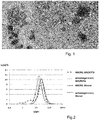
- FIG. 1 in six pictures a1, a2, a3, b1, b2 and b3 different microscopic images are shown. These were created under 40x magnification under a light microscope.
- Figure a1 shows the inclusion of a non-artificially digested, ie unchanged, almond-based food product dispersed in distilled water, which was produced according to the prior art without additional mechanical processing according to the invention.
- microgel particles located in the center of the image a large number of free, spherical fat droplets can be seen, which form a fat phase separate from the microgel particles.
- Figure a2 shows the food product not according to the invention in the SDS-EDTA solution partially digested state and fat drop focus
- Figure a3 shows the food product not according to the invention also in the SDS-EDTA solution partially digested state and microgel particle focus.
- Figure b1 shows a food product according to the invention, which was heated to over 65 ° C during the production and also mechanically processed, in this case by an example two-stage, high-pressure homogenization, in which the heated pumpable mass through a first nozzle (preferably one, for example annular, slit nozzle ) was conveyed against a baffle surface with 400bar and 80bar back pressure and then through a second nozzle (preferably one, for example, annular, slit nozzle) against another baffle with 80bar.
- a first nozzle preferably one, for example annular, slit nozzle
- a second nozzle preferably one, for example, annular, slit nozzle
- Fig. 6 are the light micrographs, at 40X magnification of 3 diluted in water food products darg Robinson.
- Fig. 6 a is an almond-based food product produced according to the invention, wherein the mechanical processing was carried out as a two-stage homogenization step at 200 bar / 40 bar.
- Fig. 6 b is a market-ready milk-based double-cream cheese product.
- Fig. 6 c presented a commercial cashew-based pattern with a focus on free fat drops, which are obviously not fully integrated into the particles of the food product. It is therefore not a pure microgel particle suspension in this commercial pattern.
- Fig. 2 Density distribution diagram
- Fig. 2 Density distribution diagram
- the curve “unhomogenized, water” is the Particle size distribution of a prior art food product as shown in Figure a1 of the Fig. 1 , where “non-homogenized” here means that in combination no heating and mechanical processing according to the invention has taken place.
- Evident is an approximately ideal bell curve, without peak in a particle size range x3 ⁇ 10 microns.
- Such a peak is also absent in the case of the curve "unhomogenized, SDS / EDTA", for the determination of which the aforementioned food product was mixed with SDS / EDTA solution, as shown in Figures a2 and a3 according to Fig. 1 is shown. Since the digested fat spheres are to be found in a size range of the microgel particles, they do not appear with this particle size distribution as a separate peak at a particle size x3 ⁇ 10 microns.
- the particle size distribution "400/80, water” is the particle size distribution of a food product formed according to the concept of the invention which, for example, in FIG Fig. 1 is shown.
- this particle size distribution curve shows no peak at a particle size x3 ⁇ 10 microns.
- a peak here a global maximum with a particle size of x3 of about 15 ⁇ m.
- Fig. 4 the particle size distributions of an alternative food product according to the invention based on almonds and hazelnuts are shown. It can also be seen here that in the partially digested state “hazelnut SDS / EDTA” compared to the undigested state “hazelnut water” an additional peak at ⁇ 10 ⁇ m, specifically can be observed at about 2 microns. This results from the combination of heating and mechanical processing.
- the detection of the fat droplet fraction thus serves as an analytical proof of a heating and mechanical processing step carried out according to the invention.
- the particle size distributions are particle size distributions obtained by means of a laser diffraction spectrometer, ie semilogarithmic density distributions of a volume-specific equivalent diameter x3 in one, by way of example in FIG Fig. 2 shown, particle size distribution diagram (semilogarithmic density distribution curve), in which on the abscissa axis (X-axis) the volume-specific equivalent diameter x3 and on the ordinate axis (Y-axis), the percentage frequency (particle size distribution density) of the particles is plotted.
- Particles are to be understood as meaning all units which can be detected by a laser diffraction spectrometer, ie both solids, agglomerates and droplets, such as fat droplets. All particle size distributions treated and claimed in the application were determined using a LA-960 laser diffraction spectrometer from Retsch Technology GmbH, Germany, the calculation always being based on a refractive index of 1.33.
- the Measurement of the particle size distribution of the undigested, ie unchanged food product is carried out by dispersion of the food product in distilled water. For this purpose, the samples were added undiluted to the measuring cell filled with distilled water and it was measured four times, with particle agglomerates being broken up by pumping around in the measuring cell until a stable measured value is established. The first three measurements serve to prove that a stable measured value has been established. For the determination of the particle size distribution, the fourth measurement is used.
- a weight proportion of food product sample in particular 10 g and 9 parts by weight SDS-EDTA solution (0.25% SDS, 0.25% EDTA ), In particular, 90 g of this solution with a magnetic stirrer at 200 U / min at room temperature for 30 min digested. Due to the partial digestion, the formerly incorporated fat drops dissolve out of the microgel particles and are stabilized by SDS.
- SDS is sodium deodecyl sulfate, an anionic surfactant, and EDTA is ethylenediaminetetraacetic acid.
- the measuring suspension thus prepared is added to the measurement cell filled with distilled water for measurement.
- four times is preferably measured to determine the particle size distribution by means of a laser diffraction spectrometer described above, wherein the smallest measured particle size distribution is used for interpretation.
- x50,3 is a characteristic value for volume-related particle size distribution. This is given in ⁇ m and means that 50% of the total particle volume consists of particles smaller than the mean particle size x50,3.
- the characteristic X50,3 thus gives an indication of the average particle size and is referred to as such.
- the characteristic x10.3 says that 10% of the total particle volume consists of particles smaller than the particle size x10.3. This gives an indication of the typical size of small particles.
- the characteristic x90.3 states that 90% of the total particle volume consists of particles smaller than the particle size x90.3. This characteristic thus gives a characteristic value to the typical size of larger particles.
- the indication x3 is a volume-specific particle equivalent diameter.
- q3 (x) denotes the percentage frequency, i. the particle size distribution density.
- the partially digested dispersion was applied to a microscope slide and analyzed at 40x magnification under a light microscope.
- Strength measurement to determine the strength was carried out by means of a texture testing machine (zwicki Z 5.0 TN, Zwick GmbH & Co. KG, Germany). For the measurements, the samples were tempered for 12 hours at 10 ° C and only taken out of the cooling immediately before the measurement. A round test stamp with an area of 1.27 cm2 penetrates to the measurement at a speed of 2 mm / sec. 10 mm into the sample.
- the measured value of the strength is the maximum force absorbed by the sensor.
- a rotational viscometer (Rheomat R180, ProRheo, Germany) was used. The measurement was carried out with a 14 mm measuring body (measuring body 3, ProRheo, Germany) in a 55 mm diameter sample vessel. The measurement is carried out at a set speed of 50 1 / min (measuring program 3, measuring body 3 without measuring tube). Over the duration of 4 minutes a total of 20 measuring points are recorded. All samples were measured at 10 ° C ⁇ 2 ° C.
- a sensor panel according to DIN 10957 was used, with a lean quark with 20% fat in the dry matter being used as a reference product for the rough-braking property.
- Color and brightness measurements were performed in the CIELAB color space according to EN ISO 11664-4: 2011. The following was used: Color spectrometer Dr. med. Long spectro-color type LMG 183. These are the Values L *, a * and b * around the Cartesian coordinates of the color space defined in the DIN standard.
- the L * -axis describes brightness (luminance) of the color with values from 0 to 100.
- the a * axis describes the green or red portion of a color, with negative values for green and positive values for red.
- the b * axis describes the blue or yellow part of a color, with negative values for blue and positive values for yellow.
- the food product according to the invention is, as explained, with respect to its microstructuring a classic cream cheese very similar, which is reflected in particular on the sensory properties, in particular the mouthfeel of the food product according to the invention.
- the guiding attribute of the classic cream cheese typology is the texture concept.
- the evaluation of this sensor characteristic which is carried out as explained above, using a lean quark with 20 wt.% Fat in the dry matter above 2.5, and preferably in a range between 3 and 7.5, is analogous to classic cream cheese.
- An inventive food product or the method result of the method according to the invention preferably also corresponds to the other texture attributes of a smooth dimensions (reference cold butter), fast melting (reference cold Schmand - minimal processing) and soft (reference cold Schmand stirred) the ratings of classic cream cheese.
- the ratings preferably lie in the value ranges specified for rough braking, wherein the further sensory analyzes according to DIN 10957 are also carried out.
- the heating step is particularly preferably carried out before the mechanical processing, it being expedient if the pumpable mass is still mechanically processed in the heated state. In principle, however, it is possible to carry out the heating step before and / or during the mechanical processing. It is also possible to carry out the heating step exclusively before or only during or exclusively after the mechanical processing. According to the invention, the heating step is carried out before and / or during the mechanical loading. As will be explained later, it is preferable that the heating step satisfies the conditions of pasteurization, that is, it is carried out so that the temperature to which it has been heated is kept long enough to obtain a certain germ counts, preferably of at most 1000 seeds / g food product to achieve.
- heating to a temperature from a temperature range between 65 ° C and 140 ° C particularly preferably takes place at a temperature from a temperature range between 75 ° C and 79 ° C.
- a rise in viscosity associated with the heating that is to say a comparison of the viscosity of the mass before and after the heating.
- the heating is carried out such that the heating step results in an increase in viscosity of at least 100%, preferably by at least 300%.
- the heating and the mechanical processing are carried out together or successively so that, as a whole, the heating and mechanical processing step leads to an increase in viscosity of at least 250%, preferably at least 500%, very preferably over 600% or more than 700%.
- the heating is preferably carried out in a Koch mixer, for example a Stephan universal machine of the UMC type or in a Karl high-speed automatic machine.
- Alternative heating options are also available realizable.
- Very particular preference is also given to the production of the pumpable mass by adding water to the pasty mass in such a device.
- a cream cheese can be well simulated or simulated not only in terms of its texture properties but also in terms of its brightness and color, ie in terms of coordinates in CIELAB- color space. Namely, preferably results from a heating and / or mechanical processing step according to the invention, a significant or measurable increase in brightness, ie the base coordinate L * in the CIELAB color space by an amount of at least 5, preferably by an amount from a range between 5 and 25.
- the base coordinate L * has a value of at least 78, preferably at least 80, very particularly preferably from a value range between 80 and 95 or more.
- the particularly high brightness values can be achieved comparatively easily if the nuts and / or kernels, for example exclusively almonds, are selected accordingly.
- An appropriate choice of nuts and / or almonds is particularly important with regard to the setting of the further coordinates a * and b * in the CIELAB color space, since they can be influenced less strongly by the method according to the invention than the brightness L *.
- the value of a * is preferably between -3 and +1 and / or the value b * between -1 and +9 in the food product according to the invention.
- a (very) white or natural Frischkarselintik can in particular by the choice of comparatively bright Nuts and / or cores are achieved, for example by the food product, in particular exclusively, at least analogously, based on cashew nuts and / or very particularly preferably, in particular blanched almonds is produced. Blanching is the removal of the dark seed skin from the bright amygdala.
- the pasty mass preferably does not contain any dark seed skins of the nuts and / or kernels, whereby a particularly bright, uniform product can be obtained.
- the provided pasty mass (exclusively) consists of crushed nuts and / or almonds.
- the paste-like mass is, as explained above, preferably generated prior to providing in a separate step as a further development according to the method (self).
- the pasty mass is prepared without added water and / or without addition of salt, and / or without addition of sugar and / or without addition of an emulsifier very particularly preferably without further ingredients other than nuts and / or almonds.
- the pasty mass in particular from nuts and / or cores are, for example, Schlagmessermühlen and / or ball mills.
- the pasty mass can also be referred to as Mus, for example, for the preferred use of exclusively or mostly almonds as almond paste.
- an essential step of the method according to the invention for obtaining the food product according to the invention is the mechanical processing of the heated or (not yet) heated pumpable mass, so the realization of an intensive in the broadest sense homogenization step of the main responsible for the desired microstructuring.
- the mechanical processing should be carried out so that a high mechanical stress, in particular pressure and / or shear stress of the particles takes place.
- the mechanical processing comprises a Hochdruckhomogenisier Mission, for example, a single-stage or multi-stage, in particular two-stage high-pressure homogenization, as used for example for the homogenization of fresh milk.
- High-pressure homogenization is understood to mean the delivery of the pumpable mass through a nozzle, for example a split nozzle, at high pressures, in particular between 25 bar and 600 bar, most preferably between 100 bar and 400 bar, the pressure jet impinging on a baffle surface, for example a baffle ring.
- a high-pressure homogenization can be carried out in one stage, that is to say the entire pressure reduction takes place by means of a nozzle or in a homogenization step or, alternatively, in multiple stages, in particular in such a way that a gradual reduction of an initial pressure then finally to atmospheric pressure takes place.
- a two-stage Hochdruckhomogenisiervorides the company HST Maschinenbau GmbH called HL2.5-550K can be used for the mechanical processing step.
- machining is expressly not limited to high-pressure homogenization.
- Other mechanical processing methods such as one in the EP 2 052 772 B1 described dissolver or suitable rotor-stator systems such as shear pumps, other pump-nozzle systems, systems in which the product is exposed to cavitation, or systems in which the product is under Pressure is exposed to a spontaneous relaxation are additionally or alternatively used.
- the pH of the food is adjusted to a value ⁇ 5.5, preferably from a value range between 4 and 5.4.
- the adjustment of the pH serves primarily to improve the durability and to positively influence the protein denaturation and swelling for improved simulation of the properties of a classic cream cheese.
- the acidification is expressly not used to adjust the consistency or the rheological properties, especially as a corresponding influence of acidification behind the influence of heating and mechanical processing significantly recedes - in particular, any influence on an increase in consistency with direct acidification of pasty mass is less as 15% of the absolute increase in viscosity when using the method according to the invention.
- the pasty mass can be acidified and / or the pumpable mass and these before and / or during and / or after the heating and / or (before and / or during and / or after) the mechanical processing.
- the acidification can be effected by adding an acid approved or suitable for foods, such as citric acid and / or acetic acid.
- acidification may be effected by addition of microorganisms and appropriate fermentation, it being possible in principle to carry out this fermentation in different process stages.
- the pasty mass and / or the pumpable mass can be carried out before or after the heating and before or after the mechanical processing. In the event that heating takes place before the fermentation or addition of bacteria, the mass is initially cooled a temperature ⁇ 45 ° C. It is also possible to acidify by adding an acidic food such as lemon juice or vinegar.
- one or more of the following species is preferably used: Streptococcus thermophilus; Lactobacillus delbrueckii ssp. bulgaricus; Lactobacillus delbrueckii ssp. lactis; Lactobacillus delbrueckii ssp. delbrueckii; Lactobacillus acidophilus; Lactobacillus plantarum; Lactobacillus rhamnosus; Lactobacillus casei; Lactobacillus paracasei; Lactobacillus buchneri; Lactobacillus parabuchneri; Lactococcus lactis ssp.
- the mass provided may already contain added oil and / or fat, which is preferably added already during the extraction of the pasty mass, in particular during the comminution of the cores and / or nuts.
- oil and / or fat may be added to the (finished) pasty mass in addition to the water to obtain the pumpable mass.
- the amount added it is advantageous to choose the amount added so that the added oil and / or fat content of the finished food product between 0% and 20%, preferably between 0.1% and 20% , preferably between 5% and 15%.
- the finished food product has a (total) fat content of between 20% and 80% fat in the dry matter.
- oil and / or fat of the pasty mass or the mixture of water and pasty Mass is added to obtain the pumpable mass, it is preferably heated so that the added fat melts and thus is present in liquid form.
- the step of heating is carried out in a Koch mixer, for example a Stephan universal machine, in particular of the UMC type or alternatively in a Karl high-speed automatic machine, in which then already one mechanical processing takes place.
- a Koch mixer for example a Stephan universal machine, in particular of the UMC type or alternatively in a Karl high-speed automatic machine, in which then already one mechanical processing takes place.
- the heating step is preferably carried out as a pasteurisation step, preferably at a temperature between 65 ° C. and 140 ° C. and / or a holding time of less than 3600 seconds, or at least such that the germ count of the finished food product is ⁇ 1000 per gram.
- the pasty mass is prepared or contains, preferably exclusively, not roasted but only dried nuts and / or kernels, wherein the residual water content of the nuts and / or cores is preferably less than 4 wt.%, Preferably less than 2 wt .-% , Preferably, the total water content of the pasty mass is less than 4 wt .-%, more preferably less than 2 wt .-%. It is particularly expedient if oil and / or fat is added in an amount in the provision of the nuts and / or cores for obtaining the pasty mass or the pasty mass, resulting in a water content of less than 2% by weight.
- the mass provided is or is produced exclusively from nuts and / or cores, with particularly good experiences being made, in particular in view of a high brightness and / or a high degree of whiteness of the finished food product when the pasty mass is not made of nuts but exclusively from cores and very particularly preferably from blanched almonds or is obtained therefrom.
- salt may be added to the pasty mass and / or the pumpable mass (the latter before and / or during and / or after heating, and / or before and / or during and / or after mechanical working), especially in an amount in that the salt content of the food product is between 0.05% by weight and 4% by weight, very particularly preferably between 0.1% by weight and 2% by weight. Possibly. Additional ingredients may be added.
- the total amount of water added during the process is chosen such that the water content of the food product is between 50% by weight and 82% by weight, preferably between 60% by weight and 72% by weight.
- ingredients for example, herbs and / or spices, and / or nuts and / or cocoa, and / or sugar, and / or vegetables, and / or fruits may be added, in particular in a total amount that the total weight of the other ingredients in the finished Food product between 0.01 wt .-% and 25 wt .-% is.
- a food-approved thickening agent is added, in particular according to the Rajzumiksver Aunt, in particular locust bean gum, preferably for the purpose of texture adaptation and / or dry mass exchange.
- the total weight percentage of thickening agents in the finished food product is between 0.01% by weight and 25% by weight. It is also possible to completely dispense with thickening agents.
- emulsifier preferably in accordance with the approval ordinance, in particular with a total weight fraction of the finished food product of between 0.01% and 25% for the purpose of further optimizing the fat drop comminution and fat drop incorporation.
- the use of an emulsifier usually leads to additional stabilization of the small droplets generated in the mechanical step, which then appear in teilauf toneen state as an additional peak at a particle size ⁇ 10 microns.
- the use of emulsifiers is dispensed with.
- the heating and in particular the mechanical processing is carried out such that the particle size distribution of the food product in the non-digested state has a particle diameter x10.3 from a value range between 5 microns and 15 microns and / or a x90.3 particle diameter a range of values between 20 ⁇ m and 75 ⁇ m.
- the disclosure also leads to a food product which is characterized by the particle size parameters explained in the introduction in connection with the method according to the invention, in particular a preferred mean particle diameter x50.3 ⁇ 100 ⁇ m, preferably between 10 ⁇ m and 40 ⁇ m in the undigested state and by at least one Peak, in particular a global maximum in the particle size distribution at a volume-specific particle diameter (equivalent diameter) x3 ⁇ 10 microns.
- a preferred mean particle diameter x50.3 ⁇ 100 ⁇ m preferably between 10 ⁇ m and 40 ⁇ m in the undigested state and by at least one Peak, in particular a global maximum in the particle size distribution at a volume-specific particle diameter (equivalent diameter) x3 ⁇ 10 microns.
- an additional peak in a size range ⁇ 10 ⁇ m can be observed compared with the non-open state.
- the food product contains between 5% by weight and 50% by weight of the pasty mass, the content of the nuts and / or kernels on the pasty mass being very particularly preferably 100% by weight, but preferably at least 70% by weight. , most preferably 80 wt .-%, even more preferably 90 wt .-%.
- the total proportion of added fat and / or oil in the finished food product is selected from a value range between 0% by weight and 20% by weight, in particular between 0.1% by weight and 20% by weight. %.
- the total water content of the finished food product is between 50% by weight and 82% by weight, very particularly preferably between 60% by weight and 72% by weight.
- the oil or fat content in the dry mass is preferably between 30% by weight and 80% by weight, preferably between 50% by weight and 75% by weight, and / or the salt content between 0.05% by weight. and 4% by weight, preferably between 0.1% by weight and 2% by weight.
- the strength, as described in the introduction, of the food product is adjusted so that it has a value from a range of values between 0.2 N and 7.0 N, preferably between 0.5 N and 2.5 N, each measured at 10 ° C.
- the majority, preferably at least 90% by weight of the total oil and / or fat content of the food product (of course in the non-digested state) is incorporated in microgel particles on a nut and / or core basis, i. not present as free fat phase.
- Particularly preferred is an embodiment in which when viewed under the light microscope at 40-fold magnification in the water-dispersed, undigested state of the food product no free fat drops are visible.
- the food product is free from ingredients based on (animal) milk - most preferably the food product is vegan.
- the food product according to the invention can be used in different ways. It is particularly preferred to use the food product neat (independently) as a foodstuff or alternatively as a constituent of a preferably industrially produced foodstuff product. So it is also possible to use the food product according to the invention as a mixture with dairy products, for example in cream cheese, yogurt or quark.
- a use as a raw material or formulation ingredient of other cheese substitutes such as substitutes for white cheese, mozzarella and hard and sliced cheese, is possible.
- the first essential process step is step B.
- a pasty mass is provided, which can optionally be obtained in a preceding process step A from cores and / or nuts by means of a mechanical comminuting step, oil and / or fat optionally being added for the preparation of the pasty mass ,
- a water addition wherein preferably dispensed with an addition of water for the preparation of the pasty mass.
- the paste-like mass can be prepared, for example, on the basis of dried, preferably not roasted almonds having a residual water content of ⁇ 2% by weight, wherein the comminution can be carried out, for example, using a drum knife mill and / or ball mill. If the pasty mass is produced exclusively on the basis of almonds, ie no nuts or other kernels, the pasty mass is an almond paste.
- the pumpable mass C is prepared by mixing (step II) of the pasty mass with water, so that the dry matter weight fraction of the pumpable mass is ⁇ 80%, which corresponds to a water content> 20%.
- ingredients such as fat, oil and / or sugar is possible.
- further ingredients such as thickening agents, for example locust bean gum and / or acidulants, such as citric acid and / or acetic acid may be added to the pumpable mass.
- a mixing step III and a heating step IV and a mechanical processing V, preferably a high-pressure homogenization.
- the steps II to IV and, if appropriate, also the steps IV to IX to be explained later or individual ones of these steps can be carried out, for example, in a cooking mixer.
- the heating step can also take place after the mechanical processing, for example.
- heating and mechanical processing result in a food product according to the invention, which is preferably vegan and cream cheese-like (see D).
- a plurality of optional resulting from the block diagram process steps can be realized, which can be carried out individually and in any combination and also claimable.
- a fermentation culture for the purpose of acidification may be added additionally or alternatively to a previous addition of acid, optionally followed by a mixture according to step VII and then an optional fermentation according to step VIII.
- a heating step IX done and if necessary, then further ingredients, such as salt can be added. If these additional ingredients, such as salt, are added, optional mixing occurs in step X.
- ingredients such as herbs or spices may be added and / or further additional mechanical processing may be performed, for example additional high pressure homogenization if a particular particle / fat distribution is to be achieved.
- the food product is cooled (see step XIV).
- An exemplary recipe / method designed according to the concept of the invention is as follows: It is made or provided a pasty mass, which was made exclusively from almonds, in particular by grinding the almonds.
- the weight proportion of almonds is exemplified by 17.2% by weight of the finished food product.
- the finished food product contains a total weight fraction of water of, for example, 69.25% by weight, the water additive necessary for this being added to the paste-like mass in order to obtain the pumpable mass.
- oil and / or fat is added so that in an amount of the total fat and / or oil content of the finished food product is 12.5%.
- salt is added to produce the pumpable mass, as well as citric acid and salt in an amount such that the total weight fraction of the salt in the finished food product is 0.8% by weight and the citric acid weight fraction is 0.25% by weight.
- the pumpable mass thus obtained is heated in a cooking mixer to a temperature of 85 ° C, said temperature over 120s. is held.
Landscapes
- Life Sciences & Earth Sciences (AREA)
- Chemical & Material Sciences (AREA)
- Engineering & Computer Science (AREA)
- Food Science & Technology (AREA)
- Polymers & Plastics (AREA)
- Health & Medical Sciences (AREA)
- Nutrition Science (AREA)
- Dairy Products (AREA)
- Seeds, Soups, And Other Foods (AREA)
Claims (21)
- Procédé de production d'un produit alimentaire semblable au fromage frais, de préférence d'un produit alimentaire végétalien, comprenant les étapes consistant à :- fournir une masse de noix broyées et/ou de graines broyées ;- ajouter de l'eau à la masse et obtenir une masse pompable de sorte qu'une proportion en poids de masse sèche de la masse pompable de < 80 %, de préférence < 60 %, de préférence particulière < 40 %, est atteinte ;- obtenir le produit alimentaire à partir de la masse pompable par chauffage à une température dans une plage de températures entre 65 °C et 140 °C et par traitement mécanique de telle manière que∘ le produit alimentaire obtenu a, dans un état non désintégré, une distribution granulométrique caractérisée par une distribution granulométrique, mesurée dans l'eau distillée utilisant un spectromètre de diffraction laser, qui a un diamètre de particule moyen de x50,3 < 100 µm, de préférence entre 10 et 40 µm, ainsi que par au moins un pic, notamment un maximum global, à un diamètre de particule de x3 > 10 µm,
et de telle manière que∘ le produit alimentaire a, dans un état partiellement désintégré obtenu en mélangeant une partie en poids du produit alimentaire avec neuf parties en poids d'une solution SDS-EDTA (0,25 % SDS; 0,25 % EDTA), une distribution granulométrique, mesurée dans l'eau distillée utilisant un spectromètre de diffraction laser, qui a au moins un pic additionnel à un diamètre de particule de x3 < 10 µm par comparaison à l'état non désintégré,caractérisé en ce que
la masse fournie de noix et/ou de graines broyées est pâteuse, et en ce que l'étape de chauffage est effectué avant et/ou pendant le traitement mécanique, et en ce que la teneur totale en eau du produit alimentaire fini est entre 50 % en poids et 82 % en poids, et en ce que le produit alimentaire a une solidité dans une plage de valeurs entre 0,2 N et 7,0 N, la solidité étant mesurée à 10 °C utilisant une machine d'essai de texture dans laquelle un poinçon de pressage rond ayant une surface de 1,27 cm2 pénètre dans un échantillon à une vitesse de 2 mm/s. - Procédé selon la revendication 1,
caractérisé en ce que
le chauffage est effectué de préférence entre 75 °C et 95 °C. - Procédé selon l'une quelconque des revendications 1 ou 2,
caractérisé en ce que
le chauffage est effectué de telle manière qu'il y a une augmentation de la viscosité de la masse chauffée par au moins 100 %, de préférence par au moins 300 %, par comparaison à avant l'étape de chauffage, et/ou en ce que le chauffage et le traitement mécanique sont effectués de telle manière qu'il y a une augmentation de la viscosité d'au moins 250 %, de préférence au moins 500 %, la mesure rhéologique étant effectuée utilisant un viscosimètre rotatif ayant un corps de mesure de 14 mm dans un récipient d'échantillon de 55 mm à une vitesse de 50 1/min sans tube de mesure à une température de 10 °C ± 2 °C. - Procédé selon l'une quelconque des revendications précédentes,
caractérisé en ce que
le chauffage et/ou le traitement mécanique est effectué de telle manière que la couleur du produit alimentaire dans l'espace de couleur CIELAB avec les coordonnées de base cartésiennes L*, a*, b* selon EN ISO 11664-4:2011 est définie par L* ≥ 78 et/ou a* entre -3 et +1 et/ou b* entre -1 et +9 et/ou de telle manière que le chauffage et/ou le traitement mécanique augmente L* par au moins 5, de préférence par une valeur dans la plage de valeurs entre 5 et 25, dans l'espace de couleur CIELAB avec les coordonnées de base cartésiennes L*, a*, b* selon EN ISO 11664-4:2011. - Procédé selon l'une quelconque des revendications précédentes,
caractérisé en ce que
la masse pâteuse fournie est obtenue par le broyage de noix et/ou d'amandes, de préférence sans addition d'eau et/ou sans addition de sel et/ou sans addition de sucre et/ou sans addition d'émulsifiants et/ou sans addition d'épaississants. - Procédé selon l'une quelconque des revendications précédentes,
caractérisé en ce que
le traitement mécanique est une homogénéisation à haute pression, notamment en une étape ou en plusieurs étapes, de préférence à une pression allant de 25 à 600 bar, de préférence particulière de 100 à 400 bar. - Procédé selon l'une quelconque des revendications précédentes,
caractérisé en ce que
le pH du produit alimentaire est réglé à un pH inférieur à 5,5 et/ou dans une plage de valeurs entre 4 et 5,4, notamment en acidifiant la masse pâteuse et/ou la masse pompable et/ou avant et/ou pendant et/ou après le chauffage et/ou le traitement mécanique. - Procédé selon l'une quelconque des revendications précédentes,
caractérisé en ce que
de l'huile et/ou de la graisse est ajoutée aux graines et/ou aux noix afin d'obtenir la masse pâteuse et/ou que de l'huile et/ou de la graisse est ajouté en plus de l'eau à la masse pâteuse afin d'obtenir la masse pompable, la teneur totale en huile et/ou en graisse correspondant de préférence à une proportion en poids du produit alimentaire d'entre 0,1 % et 20 %, de préférence entre 5 % et 15 %, et/ou étant sélectionnée de telle manière que le produit alimentaire a une proportion en poids de graisse d'entre 20 % et 80 % de graisse dans la masse sèche. - Procédé selon l'une quelconque des revendications précédentes,
caractérisé en ce que
le chauffage est effectué dans un mélangeur-cuiseur. - Procédé selon l'une quelconque des revendications précédentes,
caractérisé en ce que
le mélange d'eau de de masse pâteuse pour obtenir la masse pompable est chauffé de telle manière que la graisse ajutée est en forme liquide. - Procédé selon l'une quelconque des revendications précédentes,
caractérisé en ce que
les noix et/ou les graines de préférence non grillées pour obtenir la masse pâteuse et/ou la masse pâteuse fournie ont été séchés de préférence à une teneur en eau résiduelle inférieure à 4 % en poids, de préférence < 2 % en poids, et/ou la masse pâteuse fournie a une teneur en eau inférieure à 4 % en poids, de préférence < 2 % en poids, et/ou en ce que l'huile et/ou la graisse est ajoutée au noix et/ou aux graines pour obtenir la masse pâteuse ou à la masse pâteuse fournie en un amont résultant à une teneur en eau de < 2 % en poids. - Procédé selon l'une quelconque des revendications précédentes,
caractérisé en ce que
la masse pâteuse fournie se compose seulement et/ou est obtenue seulement à partir de noix et/ou de graines, de préférence seulement de graines, de préférence particulière seulement d'amandes de préférence blanchies. - Produit alimentaire semblable au fromage frais, obtenu de préférence par un procédé selon l'une quelconque des revendications précédentes, contenant des noix et/ou des graines broyées, de préférence des amandes, le produit alimentaire semblable au fromage frais ayant, dans un état non désintégré, une distribution granulométrique caractérisée par une distribution granulométrique, mesurée dans l'eau distillée utilisant un spectromètre de diffraction laser, qui a un diamètre de particule moyen de x50,3 < 100 µm, de préférence entre 10 et 40 µm, ainsi que par au moins un pic, notamment un maximum global, à un diamètre de particule de x3 > 10 µm, et le produit alimentaire ayant, dans un état partiellement désintégré obtenu en mélangeant une partie en poids du produit alimentaire avec neuf parties en poids d'une solution SDS-EDTA (0,25 % SDS; 0,25 % EDTA), une distribution granulométrique, mesurée dans l'eau distillée utilisant un spectromètre de diffraction laser, qui a au moins un pic additionnel à une diamètre de particule de x3 < 10 µm par comparaison à l'état non désintégré,
caractérisé en ce que
le produit alimentaire a une solidité dans une plage de valeurs entre 0,2 N et 7,0 N, la solidité étant mesurée à 10 °C utilisant une machine d'essai de texture dans laquelle un poinçon de pressage rond ayant une surface de 1,27 cm2 pénètre dans un échantillon à une vitesse de 2 mm/s, et en ce que la teneur totale en eau du produit alimentaire fini est entre 50 % en poids et 82 % en poids, et en ce que le produit alimentaire contient entre 5 % en poids et 50 % en poids d'une masse pâteuse ayant une teneur en noix et/ou en graines d'au moins 70 % en poids. - Produit alimentaire selon la revendication 13,
caractérisé en ce que
la propriété de texture rugueuse-freinant du produit alimentaire, déterminé par un panel descriptif d'analyse sensorielle selon DIN 10967 utilisant un fromage blanc maigre contenant 20 % en poids de graisse dans la masse sèche comme produit de référence, est supérieure à 2,5 et/ou a une valeur dans une plage de valeurs entre 3 et 7,5. - Produit alimentaire selon l'une quelconque des revendications 13 ou 14,
caractérisé en ce que
le produit alimentaire a une solidité dans une plage de valeurs entre 0,5 N et 2,5 N, mesurée à 10 °C. - Produit alimentaire selon l'une quelconque des revendications 13 à 15,
caractérisé en ce qu'
au moins 90 % en poids, de préférence au moins 98 % en poids, de la proportion d'huile et/ou de graisse du produit alimentaire sont incorporés dans des particules de microgel sur la base de noix et/ou de graines. - Produit alimentaire selon l'une quelconque des revendications 13 à 16,
caractérisé en ce que
la distribution granulométrique du produit alimentaire dans l'état non désintégré a un diamètre de particule x10,3 dans une plage de valeurs entre 5 et 15 µm et/ou un diamètre de particule x90,3 dans une plage de valeurs entre 20 et 75 µm. - Produit alimentaire selon l'une quelconque des revendications 13 à 17,
caractérisé en ce que
le pH est dans une plage de valeurs entre 4,0 et 5,4, de préférence entre 4,6 et 5,0. - Produit alimentaire selon l'une quelconque des revendications 13 à 18,
caractérisé en ce que
la teneur en eau est entre 60 et 72 % en poids et/ou en ce que la teneur en graisse dans la masse sèche est entre 30 et 80 % en poids, de préférence entre 50 et 75 % en poids, et/ou en ce que la teneur en NaCl est entre 0,05 et 4 % en poids, de préférence entre 0,1 et 2 % en poids. - Produit alimentaire selon l'une quelconque des revendications 13 à 19,
caractérisé en ce que
la couleur du produit alimentaire dans l'espace de couleur CIELAB avec les coordonnées de base cartésiennes L*, a*, b* selon EN ISO 11664-4:2011 est définie par L* ≥ 78 et/ou a* entre -3 et +1 et/ou b* entre -1 et +9. - Utilisation d'un produit alimentaire selon l'une quelconque des revendications 13 à 20 comme aliment pur ou comme ingrédient d'une recette, notamment comme remplissage ou additif dans un aliment, notamment dans un aliment fabriqué industriellement.
Applications Claiming Priority (2)
| Application Number | Priority Date | Filing Date | Title |
|---|---|---|---|
| DE102015116249 | 2015-09-25 | ||
| PCT/EP2016/068958 WO2017050480A1 (fr) | 2015-09-25 | 2016-08-09 | Produit alimentaire de type fromage frais et procédé de production |
Publications (2)
| Publication Number | Publication Date |
|---|---|
| EP3352580A1 EP3352580A1 (fr) | 2018-08-01 |
| EP3352580B1 true EP3352580B1 (fr) | 2019-05-08 |
Family
ID=56855409
Family Applications (1)
| Application Number | Title | Priority Date | Filing Date |
|---|---|---|---|
| EP16760393.5A Active EP3352580B1 (fr) | 2015-09-25 | 2016-08-09 | Produit alimentaire de type fromage frais et procédé de production |
Country Status (7)
| Country | Link |
|---|---|
| US (2) | US11771118B2 (fr) |
| EP (1) | EP3352580B1 (fr) |
| CA (1) | CA2999609C (fr) |
| DK (1) | DK3352580T3 (fr) |
| ES (1) | ES2740223T3 (fr) |
| RU (1) | RU2689949C1 (fr) |
| WO (1) | WO2017050480A1 (fr) |
Cited By (1)
| Publication number | Priority date | Publication date | Assignee | Title |
|---|---|---|---|---|
| GB2612011A (en) | 2021-07-30 | 2023-04-26 | Intercontinental Great Brands Llc | A vegan cream-cheese-like spread and method for the manufacture thereof |
Families Citing this family (7)
| Publication number | Priority date | Publication date | Assignee | Title |
|---|---|---|---|---|
| DK3620059T4 (da) * | 2018-09-06 | 2025-10-20 | Hochland Se | Fremgangsmåde til fremstilling af et foretrukkent vegansk, partikulært levnedsmiddel på basis af mandelmel |
| EP3745883B1 (fr) | 2018-12-20 | 2022-02-02 | Hochland SE | Procédé de production d'un produit alimentaire de type fromage frais |
| US20230000120A1 (en) * | 2019-12-09 | 2023-01-05 | Societe Des Produits Nestle S.A. | Beverage paste |
| JP7268797B2 (ja) * | 2020-03-26 | 2023-05-08 | 不二製油株式会社 | 植物ベース発酵乳の製造法 |
| US20220030901A1 (en) | 2020-07-31 | 2022-02-03 | Savencia Sa | Cream cheese |
| US20220030899A1 (en) * | 2020-07-31 | 2022-02-03 | Savencia Sa | Vegan fermented soft cheese |
| CN117907169A (zh) * | 2023-11-15 | 2024-04-19 | 内蒙古蒙牛乳业(集团)股份有限公司 | 体积加权平均直径在后热处理酸奶颗粒感评估中的应用 |
Family Cites Families (15)
| Publication number | Priority date | Publication date | Assignee | Title |
|---|---|---|---|---|
| GB874537A (en) | 1957-01-29 | 1961-08-10 | Unilever Ltd | Protein food products and their preparation |
| US4198439A (en) * | 1978-05-18 | 1980-04-15 | Research Triangle Institute | Nut cheese product |
| US4435438A (en) * | 1980-12-29 | 1984-03-06 | A. E. Staley Manufacturing Company | Soy isolate suitable for use in imitation cheese |
| JPS5881768A (ja) * | 1981-11-09 | 1983-05-17 | Ton:Kk | 飲料用又はデザ−ト用アーモンドペ−ストの製造法 |
| US6699517B2 (en) * | 1997-11-28 | 2004-03-02 | Compagnie Gervais Danone | Method for preparing food products by fermenting soy milk with streptococcus thermophilus |
| DE29824133U1 (de) | 1998-08-04 | 2000-04-20 | Gut zum Leben Nahrungsmittel von Feld und Hof GmbH, 97828 Marktheidenfeld | Biologische Substanz |
| RU2216191C1 (ru) * | 2002-03-25 | 2003-11-20 | ГУ Волгоградский научно-исследовательский технологический институт мясо-молочного скотоводства и переработки продукции животноводства РАСХН | Способ получения мягкого сыра |
| ES2242541B1 (es) | 2004-04-30 | 2006-12-16 | Consejo Superior De Investigaciones Cientificas | Producto fermentado sin lactosa a partir de batido de frutos secos no legumbres y/o horchata. |
| DE102006037608A1 (de) | 2006-08-10 | 2008-02-14 | Schöning, Susanne | Verfahren zur Herstellung einer Zubereitung für einen Brotaufstrich sowie eine Anlage zur Durchführung des Verfahrens |
| DE102007051430B3 (de) | 2007-10-25 | 2009-03-19 | Ak System Gmbh | Dissolver |
| DE202007017700U1 (de) | 2007-12-19 | 2009-04-30 | Oppenkowski, Katrin Von | Pflanzliche Substanz |
| US20110064862A1 (en) | 2009-09-11 | 2011-03-17 | Dean Intellectual Property Services, Inc. | Non-Dairy, Nut-Based Milk and Method of Production |
| DE202011002097U1 (de) | 2011-01-28 | 2011-03-24 | Tofutown.Com Gmbh | pflanzliche Frischcreme |
| EP3488703A1 (fr) | 2011-07-12 | 2019-05-29 | Impossible Foods Inc. | Procédés et compositions pour produits consommables |
| JP2016502868A (ja) * | 2013-01-11 | 2016-02-01 | インポッシブル フーズ インコーポレイテッド | コアセルベートを含む、乳成分非含有チーズ代替品 |
-
2016
- 2016-08-09 WO PCT/EP2016/068958 patent/WO2017050480A1/fr not_active Ceased
- 2016-08-09 DK DK16760393.5T patent/DK3352580T3/da active
- 2016-08-09 US US15/756,080 patent/US11771118B2/en active Active
- 2016-08-09 EP EP16760393.5A patent/EP3352580B1/fr active Active
- 2016-08-09 CA CA2999609A patent/CA2999609C/fr active Active
- 2016-08-09 ES ES16760393T patent/ES2740223T3/es active Active
- 2016-08-09 RU RU2018109904A patent/RU2689949C1/ru active
-
2023
- 2023-08-25 US US18/238,059 patent/US20230397640A1/en active Pending
Non-Patent Citations (1)
| Title |
|---|
| None * |
Cited By (2)
| Publication number | Priority date | Publication date | Assignee | Title |
|---|---|---|---|---|
| GB2612011A (en) | 2021-07-30 | 2023-04-26 | Intercontinental Great Brands Llc | A vegan cream-cheese-like spread and method for the manufacture thereof |
| EP4570074A2 (fr) | 2021-07-30 | 2025-06-18 | Intercontinental Great Brands LLC | Produit à tartiner de type fromage à la crème végane et son procédé de fabrication |
Also Published As
| Publication number | Publication date |
|---|---|
| WO2017050480A1 (fr) | 2017-03-30 |
| US20230397640A1 (en) | 2023-12-14 |
| US20180242622A1 (en) | 2018-08-30 |
| US11771118B2 (en) | 2023-10-03 |
| DK3352580T3 (da) | 2019-08-05 |
| CA2999609A1 (fr) | 2017-03-30 |
| ES2740223T3 (es) | 2020-02-05 |
| RU2689949C1 (ru) | 2019-05-29 |
| EP3352580A1 (fr) | 2018-08-01 |
| CA2999609C (fr) | 2020-02-25 |
Similar Documents
| Publication | Publication Date | Title |
|---|---|---|
| EP3352580B1 (fr) | Produit alimentaire de type fromage frais et procédé de production | |
| EP3745883B1 (fr) | Procédé de production d'un produit alimentaire de type fromage frais | |
| EP3620059B2 (fr) | Procédé de fabrication d'une matière particulaire de denrée alimentaire, de préférence végane,à base de farine d'amandes | |
| DE60120018T2 (de) | Verfahren zur Herstellung von 'pflanzlichem Joghurt' durch Obst- oder Gemüse-Fermentation | |
| DE602004006491T2 (de) | Joghurt mit zweiphasen-struktur und herstellungsverfahren dafür | |
| DE69426450T2 (de) | Hitzestabile Öl-in-Wasser Emulsion und Verfahren zur Herstellung derselben | |
| DE202016008878U1 (de) | Aufschlagmittel zur Verwendung bei der Herstellung essbarer Toppings | |
| EP3160246B1 (fr) | Émulsion avec la protéine de lupin, son utilisation et production | |
| DE2325133C3 (de) | Wäßrige Ölemulsion und Verfahren zu ihrer Herstellung und ihre Verwendung | |
| EP1560501B1 (fr) | Preparation biotechnologique contenant des proteines, procede de fabrication associe et utilisation comme complement alimentaire | |
| DE60302354T2 (de) | Essbare emulsion mit lebenden mikroorganismen | |
| DE2834093A1 (de) | Kaeseersatz und verfahren zu seiner herstellung | |
| DE69211777T2 (de) | Pasta-Filata-Typ-Käse enthaltend verschiedene Zutaten | |
| DE202015105079U1 (de) | Frischkäseähnliches Lebensmittelprodukt | |
| EP1838161B1 (fr) | Procede de production d'un complement proteique vegetal d'une glace et glace contenant ce complement proteique | |
| EP2839748B1 (fr) | Excipient de fromage blanc avec qualité de gout ameliorée II | |
| DE69101093T2 (de) | Verfahren zur Beschleunigung des Reifens von Käse. | |
| RU2774717C1 (ru) | Подобный молодому сыру пищевой продукт, а также способ его получения | |
| EP4537668A1 (fr) | Compositions alimentaires et procédés de traitement de compositions alimentaires | |
| DE102024112744A1 (de) | Herstellung schnittfester pflanzlicher Käsealternative auf Sojabasis unter der Weiterentwicklung konventioneller Molkereitechnologie | |
| DE706115C (de) | Herstellung von Milcheiweiss enthaltenden Getreideextraktionsprodukten | |
| DE19516982A1 (de) | Milchkuh-Futterzusammensetzung und Verfahren zur Erzeugung von Milch | |
| EP3403508A1 (fr) | Composition paté à tartier et procédé de sa preparation et son utilisation | |
| DE202023107333U1 (de) | Komposition zur Anwendung als pflanzenbasierte Alternative für, bevorzugt fermentierte, Milchprodukte mit hohem Proteingehalt ("High Protein") | |
| EP3906784A1 (fr) | Les produits alimentaires à tartiner ou à couper |
Legal Events
| Date | Code | Title | Description |
|---|---|---|---|
| STAA | Information on the status of an ep patent application or granted ep patent |
Free format text: STATUS: THE INTERNATIONAL PUBLICATION HAS BEEN MADE |
|
| PUAI | Public reference made under article 153(3) epc to a published international application that has entered the european phase |
Free format text: ORIGINAL CODE: 0009012 |
|
| STAA | Information on the status of an ep patent application or granted ep patent |
Free format text: STATUS: REQUEST FOR EXAMINATION WAS MADE |
|
| 17P | Request for examination filed |
Effective date: 20171016 |
|
| AK | Designated contracting states |
Kind code of ref document: A1 Designated state(s): AL AT BE BG CH CY CZ DE DK EE ES FI FR GB GR HR HU IE IS IT LI LT LU LV MC MK MT NL NO PL PT RO RS SE SI SK SM TR |
|
| AX | Request for extension of the european patent |
Extension state: BA ME |
|
| RIC1 | Information provided on ipc code assigned before grant |
Ipc: A23C 20/02 20060101ALI20180914BHEP Ipc: A23L 25/00 20160101AFI20180914BHEP |
|
| GRAP | Despatch of communication of intention to grant a patent |
Free format text: ORIGINAL CODE: EPIDOSNIGR1 |
|
| STAA | Information on the status of an ep patent application or granted ep patent |
Free format text: STATUS: GRANT OF PATENT IS INTENDED |
|
| DAX | Request for extension of the european patent (deleted) | ||
| INTG | Intention to grant announced |
Effective date: 20181130 |
|
| DAV | Request for validation of the european patent (deleted) | ||
| GRAS | Grant fee paid |
Free format text: ORIGINAL CODE: EPIDOSNIGR3 |
|
| GRAA | (expected) grant |
Free format text: ORIGINAL CODE: 0009210 |
|
| STAA | Information on the status of an ep patent application or granted ep patent |
Free format text: STATUS: THE PATENT HAS BEEN GRANTED |
|
| AK | Designated contracting states |
Kind code of ref document: B1 Designated state(s): AL AT BE BG CH CY CZ DE DK EE ES FI FR GB GR HR HU IE IS IT LI LT LU LV MC MK MT NL NO PL PT RO RS SE SI SK SM TR |
|
| REG | Reference to a national code |
Ref country code: GB Ref legal event code: FG4D Free format text: NOT ENGLISH |
|
| REG | Reference to a national code |
Ref country code: AT Ref legal event code: REF Ref document number: 1128771 Country of ref document: AT Kind code of ref document: T Effective date: 20190515 Ref country code: CH Ref legal event code: EP |
|
| REG | Reference to a national code |
Ref country code: DE Ref legal event code: R096 Ref document number: 502016004635 Country of ref document: DE |
|
| REG | Reference to a national code |
Ref country code: IE Ref legal event code: FG4D Free format text: LANGUAGE OF EP DOCUMENT: GERMAN |
|
| REG | Reference to a national code |
Ref country code: CH Ref legal event code: NV Representative=s name: BODENSEEPATENT PATENTANWAELTE BEHRMANN WAGNER , CH |
|
| REG | Reference to a national code |
Ref country code: RO Ref legal event code: EPE |
|
| REG | Reference to a national code |
Ref country code: DK Ref legal event code: T3 Effective date: 20190731 |
|
| REG | Reference to a national code |
Ref country code: SE Ref legal event code: TRGR |
|
| REG | Reference to a national code |
Ref country code: NL Ref legal event code: FP |
|
| REG | Reference to a national code |
Ref country code: LT Ref legal event code: MG4D |
|
| REG | Reference to a national code |
Ref country code: NO Ref legal event code: T2 Effective date: 20190508 |
|
| PG25 | Lapsed in a contracting state [announced via postgrant information from national office to epo] |
Ref country code: AL Free format text: LAPSE BECAUSE OF FAILURE TO SUBMIT A TRANSLATION OF THE DESCRIPTION OR TO PAY THE FEE WITHIN THE PRESCRIBED TIME-LIMIT Effective date: 20190508 Ref country code: PT Free format text: LAPSE BECAUSE OF FAILURE TO SUBMIT A TRANSLATION OF THE DESCRIPTION OR TO PAY THE FEE WITHIN THE PRESCRIBED TIME-LIMIT Effective date: 20190908 Ref country code: LT Free format text: LAPSE BECAUSE OF FAILURE TO SUBMIT A TRANSLATION OF THE DESCRIPTION OR TO PAY THE FEE WITHIN THE PRESCRIBED TIME-LIMIT Effective date: 20190508 Ref country code: HR Free format text: LAPSE BECAUSE OF FAILURE TO SUBMIT A TRANSLATION OF THE DESCRIPTION OR TO PAY THE FEE WITHIN THE PRESCRIBED TIME-LIMIT Effective date: 20190508 |
|
| PG25 | Lapsed in a contracting state [announced via postgrant information from national office to epo] |
Ref country code: LV Free format text: LAPSE BECAUSE OF FAILURE TO SUBMIT A TRANSLATION OF THE DESCRIPTION OR TO PAY THE FEE WITHIN THE PRESCRIBED TIME-LIMIT Effective date: 20190508 Ref country code: RS Free format text: LAPSE BECAUSE OF FAILURE TO SUBMIT A TRANSLATION OF THE DESCRIPTION OR TO PAY THE FEE WITHIN THE PRESCRIBED TIME-LIMIT Effective date: 20190508 Ref country code: BG Free format text: LAPSE BECAUSE OF FAILURE TO SUBMIT A TRANSLATION OF THE DESCRIPTION OR TO PAY THE FEE WITHIN THE PRESCRIBED TIME-LIMIT Effective date: 20190808 |
|
| REG | Reference to a national code |
Ref country code: GR Ref legal event code: EP Ref document number: 20190402241 Country of ref document: GR Effective date: 20191128 |
|
| PG25 | Lapsed in a contracting state [announced via postgrant information from national office to epo] |
Ref country code: CZ Free format text: LAPSE BECAUSE OF FAILURE TO SUBMIT A TRANSLATION OF THE DESCRIPTION OR TO PAY THE FEE WITHIN THE PRESCRIBED TIME-LIMIT Effective date: 20190508 Ref country code: SK Free format text: LAPSE BECAUSE OF FAILURE TO SUBMIT A TRANSLATION OF THE DESCRIPTION OR TO PAY THE FEE WITHIN THE PRESCRIBED TIME-LIMIT Effective date: 20190508 Ref country code: EE Free format text: LAPSE BECAUSE OF FAILURE TO SUBMIT A TRANSLATION OF THE DESCRIPTION OR TO PAY THE FEE WITHIN THE PRESCRIBED TIME-LIMIT Effective date: 20190508 |
|
| REG | Reference to a national code |
Ref country code: ES Ref legal event code: FG2A Ref document number: 2740223 Country of ref document: ES Kind code of ref document: T3 Effective date: 20200205 |
|
| REG | Reference to a national code |
Ref country code: DE Ref legal event code: R097 Ref document number: 502016004635 Country of ref document: DE |
|
| PG25 | Lapsed in a contracting state [announced via postgrant information from national office to epo] |
Ref country code: SM Free format text: LAPSE BECAUSE OF FAILURE TO SUBMIT A TRANSLATION OF THE DESCRIPTION OR TO PAY THE FEE WITHIN THE PRESCRIBED TIME-LIMIT Effective date: 20190508 |
|
| PLBE | No opposition filed within time limit |
Free format text: ORIGINAL CODE: 0009261 |
|
| STAA | Information on the status of an ep patent application or granted ep patent |
Free format text: STATUS: NO OPPOSITION FILED WITHIN TIME LIMIT |
|
| PG25 | Lapsed in a contracting state [announced via postgrant information from national office to epo] |
Ref country code: TR Free format text: LAPSE BECAUSE OF FAILURE TO SUBMIT A TRANSLATION OF THE DESCRIPTION OR TO PAY THE FEE WITHIN THE PRESCRIBED TIME-LIMIT Effective date: 20190508 |
|
| 26N | No opposition filed |
Effective date: 20200211 |
|
| PG25 | Lapsed in a contracting state [announced via postgrant information from national office to epo] |
Ref country code: PL Free format text: LAPSE BECAUSE OF FAILURE TO SUBMIT A TRANSLATION OF THE DESCRIPTION OR TO PAY THE FEE WITHIN THE PRESCRIBED TIME-LIMIT Effective date: 20190508 |
|
| PG25 | Lapsed in a contracting state [announced via postgrant information from national office to epo] |
Ref country code: MC Free format text: LAPSE BECAUSE OF FAILURE TO SUBMIT A TRANSLATION OF THE DESCRIPTION OR TO PAY THE FEE WITHIN THE PRESCRIBED TIME-LIMIT Effective date: 20190508 |
|
| REG | Reference to a national code |
Ref country code: CH Ref legal event code: PFA Owner name: HOCHLAND SE, DE Free format text: FORMER OWNER: HOCHLAND SE, DE |
|
| PG25 | Lapsed in a contracting state [announced via postgrant information from national office to epo] |
Ref country code: CY Free format text: LAPSE BECAUSE OF FAILURE TO SUBMIT A TRANSLATION OF THE DESCRIPTION OR TO PAY THE FEE WITHIN THE PRESCRIBED TIME-LIMIT Effective date: 20190508 |
|
| PG25 | Lapsed in a contracting state [announced via postgrant information from national office to epo] |
Ref country code: IS Free format text: LAPSE BECAUSE OF FAILURE TO SUBMIT A TRANSLATION OF THE DESCRIPTION OR TO PAY THE FEE WITHIN THE PRESCRIBED TIME-LIMIT Effective date: 20190908 |
|
| PG25 | Lapsed in a contracting state [announced via postgrant information from national office to epo] |
Ref country code: HU Free format text: LAPSE BECAUSE OF FAILURE TO SUBMIT A TRANSLATION OF THE DESCRIPTION OR TO PAY THE FEE WITHIN THE PRESCRIBED TIME-LIMIT; INVALID AB INITIO Effective date: 20160809 Ref country code: MT Free format text: LAPSE BECAUSE OF FAILURE TO SUBMIT A TRANSLATION OF THE DESCRIPTION OR TO PAY THE FEE WITHIN THE PRESCRIBED TIME-LIMIT Effective date: 20190508 |
|
| PG25 | Lapsed in a contracting state [announced via postgrant information from national office to epo] |
Ref country code: SI Free format text: LAPSE BECAUSE OF FAILURE TO SUBMIT A TRANSLATION OF THE DESCRIPTION OR TO PAY THE FEE WITHIN THE PRESCRIBED TIME-LIMIT Effective date: 20190508 |
|
| PG25 | Lapsed in a contracting state [announced via postgrant information from national office to epo] |
Ref country code: MK Free format text: LAPSE BECAUSE OF FAILURE TO SUBMIT A TRANSLATION OF THE DESCRIPTION OR TO PAY THE FEE WITHIN THE PRESCRIBED TIME-LIMIT Effective date: 20190508 |
|
| P01 | Opt-out of the competence of the unified patent court (upc) registered |
Effective date: 20230601 |
|
| PGFP | Annual fee paid to national office [announced via postgrant information from national office to epo] |
Ref country code: LU Payment date: 20230821 Year of fee payment: 8 |
|
| PGFP | Annual fee paid to national office [announced via postgrant information from national office to epo] |
Ref country code: NO Payment date: 20230822 Year of fee payment: 8 Ref country code: IT Payment date: 20230831 Year of fee payment: 8 Ref country code: IE Payment date: 20230821 Year of fee payment: 8 Ref country code: FI Payment date: 20230823 Year of fee payment: 8 |
|
| PGFP | Annual fee paid to national office [announced via postgrant information from national office to epo] |
Ref country code: SE Payment date: 20230823 Year of fee payment: 8 Ref country code: GR Payment date: 20230818 Year of fee payment: 8 Ref country code: DK Payment date: 20230823 Year of fee payment: 8 Ref country code: BE Payment date: 20230822 Year of fee payment: 8 |
|
| REG | Reference to a national code |
Ref country code: DK Ref legal event code: EBP Effective date: 20240831 |
|
| REG | Reference to a national code |
Ref country code: SE Ref legal event code: EUG |
|
| PG25 | Lapsed in a contracting state [announced via postgrant information from national office to epo] |
Ref country code: FI Free format text: LAPSE BECAUSE OF NON-PAYMENT OF DUE FEES Effective date: 20240809 |
|
| PG25 | Lapsed in a contracting state [announced via postgrant information from national office to epo] |
Ref country code: LU Free format text: LAPSE BECAUSE OF NON-PAYMENT OF DUE FEES Effective date: 20240809 |
|
| PG25 | Lapsed in a contracting state [announced via postgrant information from national office to epo] |
Ref country code: NO Free format text: LAPSE BECAUSE OF NON-PAYMENT OF DUE FEES Effective date: 20240831 |
|
| PG25 | Lapsed in a contracting state [announced via postgrant information from national office to epo] |
Ref country code: GR Free format text: LAPSE BECAUSE OF NON-PAYMENT OF DUE FEES Effective date: 20250306 |
|
| REG | Reference to a national code |
Ref country code: BE Ref legal event code: MM Effective date: 20240831 |
|
| PG25 | Lapsed in a contracting state [announced via postgrant information from national office to epo] |
Ref country code: DK Free format text: LAPSE BECAUSE OF NON-PAYMENT OF DUE FEES Effective date: 20240831 |
|
| PG25 | Lapsed in a contracting state [announced via postgrant information from national office to epo] |
Ref country code: BE Free format text: LAPSE BECAUSE OF NON-PAYMENT OF DUE FEES Effective date: 20240831 Ref country code: IT Free format text: LAPSE BECAUSE OF NON-PAYMENT OF DUE FEES Effective date: 20240809 |
|
| PG25 | Lapsed in a contracting state [announced via postgrant information from national office to epo] |
Ref country code: IE Free format text: LAPSE BECAUSE OF NON-PAYMENT OF DUE FEES Effective date: 20240809 |
|
| PGFP | Annual fee paid to national office [announced via postgrant information from national office to epo] |
Ref country code: NL Payment date: 20250821 Year of fee payment: 10 |
|
| PGFP | Annual fee paid to national office [announced via postgrant information from national office to epo] |
Ref country code: ES Payment date: 20250917 Year of fee payment: 10 |
|
| PGFP | Annual fee paid to national office [announced via postgrant information from national office to epo] |
Ref country code: DE Payment date: 20250827 Year of fee payment: 10 |
|
| PG25 | Lapsed in a contracting state [announced via postgrant information from national office to epo] |
Ref country code: SE Free format text: LAPSE BECAUSE OF NON-PAYMENT OF DUE FEES Effective date: 20240810 |
|
| PGFP | Annual fee paid to national office [announced via postgrant information from national office to epo] |
Ref country code: GB Payment date: 20250822 Year of fee payment: 10 |
|
| PGFP | Annual fee paid to national office [announced via postgrant information from national office to epo] |
Ref country code: AT Payment date: 20250819 Year of fee payment: 10 Ref country code: FR Payment date: 20250821 Year of fee payment: 10 |
|
| PGFP | Annual fee paid to national office [announced via postgrant information from national office to epo] |
Ref country code: CH Payment date: 20250901 Year of fee payment: 10 |
|
| PGFP | Annual fee paid to national office [announced via postgrant information from national office to epo] |
Ref country code: RO Payment date: 20250805 Year of fee payment: 10 |