EP3354533A1 - Dispositifs, systèmes et procédés permettant de relayer des messages vocaux à des unités de commande d'opérateurs de locomotives de commande à distance - Google Patents
Dispositifs, systèmes et procédés permettant de relayer des messages vocaux à des unités de commande d'opérateurs de locomotives de commande à distance Download PDFInfo
- Publication number
- EP3354533A1 EP3354533A1 EP18150044.8A EP18150044A EP3354533A1 EP 3354533 A1 EP3354533 A1 EP 3354533A1 EP 18150044 A EP18150044 A EP 18150044A EP 3354533 A1 EP3354533 A1 EP 3354533A1
- Authority
- EP
- European Patent Office
- Prior art keywords
- control unit
- locomotive
- voice message
- operator
- operator control
- Prior art date
- Legal status (The legal status is an assumption and is not a legal conclusion. Google has not performed a legal analysis and makes no representation as to the accuracy of the status listed.)
- Withdrawn
Links
Images


Classifications
-
- B—PERFORMING OPERATIONS; TRANSPORTING
- B61—RAILWAYS
- B61C—LOCOMOTIVES; MOTOR RAILCARS
- B61C17/00—Arrangement or disposition of parts; Details or accessories not otherwise provided for; Use of control gear and control systems
- B61C17/12—Control gear; Arrangements for controlling locomotives from remote points in the train or when operating in multiple units
-
- B—PERFORMING OPERATIONS; TRANSPORTING
- B61—RAILWAYS
- B61C—LOCOMOTIVES; MOTOR RAILCARS
- B61C17/00—Arrangement or disposition of parts; Details or accessories not otherwise provided for; Use of control gear and control systems
-
- B—PERFORMING OPERATIONS; TRANSPORTING
- B61—RAILWAYS
- B61L—GUIDING RAILWAY TRAFFIC; ENSURING THE SAFETY OF RAILWAY TRAFFIC
- B61L15/00—Indicators provided on the vehicle or train for signalling purposes
- B61L15/0018—Communication with or on the vehicle or train
- B61L15/0027—Radio-based, e.g. using GSM-R
-
- B—PERFORMING OPERATIONS; TRANSPORTING
- B61—RAILWAYS
- B61L—GUIDING RAILWAY TRAFFIC; ENSURING THE SAFETY OF RAILWAY TRAFFIC
- B61L3/00—Devices along the route for controlling devices on the vehicle or train, e.g. to release brake or to operate a warning signal
- B61L3/02—Devices along the route for controlling devices on the vehicle or train, e.g. to release brake or to operate a warning signal at selected places along the route, e.g. intermittent control simultaneous mechanical and electrical control
- B61L3/08—Devices along the route for controlling devices on the vehicle or train, e.g. to release brake or to operate a warning signal at selected places along the route, e.g. intermittent control simultaneous mechanical and electrical control controlling electrically
- B61L3/12—Devices along the route for controlling devices on the vehicle or train, e.g. to release brake or to operate a warning signal at selected places along the route, e.g. intermittent control simultaneous mechanical and electrical control controlling electrically using magnetic or electrostatic induction; using radio waves
- B61L3/127—Devices along the route for controlling devices on the vehicle or train, e.g. to release brake or to operate a warning signal at selected places along the route, e.g. intermittent control simultaneous mechanical and electrical control controlling electrically using magnetic or electrostatic induction; using radio waves for remote control of locomotives
-
- G—PHYSICS
- G08—SIGNALLING
- G08C—TRANSMISSION SYSTEMS FOR MEASURED VALUES, CONTROL OR SIMILAR SIGNALS
- G08C17/00—Arrangements for transmitting signals characterised by the use of a wireless electrical link
-
- G—PHYSICS
- G10—MUSICAL INSTRUMENTS; ACOUSTICS
- G10L—SPEECH ANALYSIS TECHNIQUES OR SPEECH SYNTHESIS; SPEECH RECOGNITION; SPEECH OR VOICE PROCESSING TECHNIQUES; SPEECH OR AUDIO CODING OR DECODING
- G10L15/00—Speech recognition
- G10L15/22—Procedures used during a speech recognition process, e.g. man-machine dialogue
-
- G—PHYSICS
- G10—MUSICAL INSTRUMENTS; ACOUSTICS
- G10L—SPEECH ANALYSIS TECHNIQUES OR SPEECH SYNTHESIS; SPEECH RECOGNITION; SPEECH OR VOICE PROCESSING TECHNIQUES; SPEECH OR AUDIO CODING OR DECODING
- G10L15/00—Speech recognition
- G10L15/26—Speech to text systems
-
- H—ELECTRICITY
- H04—ELECTRIC COMMUNICATION TECHNIQUE
- H04B—TRANSMISSION
- H04B1/00—Details of transmission systems, not covered by a single one of groups H04B3/00 - H04B13/00; Details of transmission systems not characterised by the medium used for transmission
- H04B1/38—Transceivers, i.e. devices in which transmitter and receiver form a structural unit and in which at least one part is used for functions of transmitting and receiving
- H04B1/3822—Transceivers, i.e. devices in which transmitter and receiver form a structural unit and in which at least one part is used for functions of transmitting and receiving specially adapted for use in vehicles
-
- H—ELECTRICITY
- H04—ELECTRIC COMMUNICATION TECHNIQUE
- H04B—TRANSMISSION
- H04B1/00—Details of transmission systems, not covered by a single one of groups H04B3/00 - H04B13/00; Details of transmission systems not characterised by the medium used for transmission
- H04B1/38—Transceivers, i.e. devices in which transmitter and receiver form a structural unit and in which at least one part is used for functions of transmitting and receiving
- H04B1/3827—Portable transceivers
- H04B1/385—Transceivers carried on the body, e.g. in helmets
-
- H—ELECTRICITY
- H04—ELECTRIC COMMUNICATION TECHNIQUE
- H04B—TRANSMISSION
- H04B7/00—Radio transmission systems, i.e. using radiation field
- H04B7/14—Relay systems
- H04B7/15—Active relay systems
- H04B7/155—Ground-based stations
-
- H—ELECTRICITY
- H04—ELECTRIC COMMUNICATION TECHNIQUE
- H04W—WIRELESS COMMUNICATION NETWORKS
- H04W4/00—Services specially adapted for wireless communication networks; Facilities therefor
- H04W4/80—Services using short range communication, e.g. near-field communication [NFC], radio-frequency identification [RFID] or low energy communication
-
- H—ELECTRICITY
- H04—ELECTRIC COMMUNICATION TECHNIQUE
- H04W—WIRELESS COMMUNICATION NETWORKS
- H04W52/00—Power management, e.g. Transmission Power Control [TPC] or power classes
- H04W52/04—Transmission power control [TPC]
-
- G—PHYSICS
- G08—SIGNALLING
- G08C—TRANSMISSION SYSTEMS FOR MEASURED VALUES, CONTROL OR SIMILAR SIGNALS
- G08C17/00—Arrangements for transmitting signals characterised by the use of a wireless electrical link
- G08C17/02—Arrangements for transmitting signals characterised by the use of a wireless electrical link using a radio link
-
- G—PHYSICS
- G08—SIGNALLING
- G08C—TRANSMISSION SYSTEMS FOR MEASURED VALUES, CONTROL OR SIMILAR SIGNALS
- G08C2201/00—Transmission systems of control signals via wireless link
- G08C2201/50—Receiving or transmitting feedback, e.g. replies, status updates, acknowledgements, from the controlled devices
-
- G—PHYSICS
- G10—MUSICAL INSTRUMENTS; ACOUSTICS
- G10L—SPEECH ANALYSIS TECHNIQUES OR SPEECH SYNTHESIS; SPEECH RECOGNITION; SPEECH OR VOICE PROCESSING TECHNIQUES; SPEECH OR AUDIO CODING OR DECODING
- G10L15/00—Speech recognition
- G10L15/22—Procedures used during a speech recognition process, e.g. man-machine dialogue
- G10L2015/223—Execution procedure of a spoken command
-
- H—ELECTRICITY
- H04—ELECTRIC COMMUNICATION TECHNIQUE
- H04B—TRANSMISSION
- H04B1/00—Details of transmission systems, not covered by a single one of groups H04B3/00 - H04B13/00; Details of transmission systems not characterised by the medium used for transmission
- H04B1/38—Transceivers, i.e. devices in which transmitter and receiver form a structural unit and in which at least one part is used for functions of transmitting and receiving
- H04B1/3827—Portable transceivers
- H04B1/385—Transceivers carried on the body, e.g. in helmets
- H04B2001/3866—Transceivers carried on the body, e.g. in helmets carried on the head
Definitions
- the present disclosure generally relates to devices, systems, and methods for relaying voice messages to operator control units of remote control locomotives.
- a locomotive may include a locomotive control unit configured to control one or more aspects of the locomotive, including starting, stopping, speed, braking, switching, etc. Operators may use an operator control unit to control the locomotive.
- the operator control unit may send commands, instructions, etc. to the locomotive control unit via a wireless interface to control the locomotive.
- the locomotive control unit may send messages back to the operator control unit to be displayed on a display of the operator control unit. Status messages may be transmitted from the locomotive control unit to an operator over a voice radio channel.
- RCL remote control locomotive
- OCUs operator control units
- LCUs locomotive control units
- the feedback may be provided over a cab voice radio channel, or displayed on a display of the operator control unit. While this feature is appreciated by remote control operators by providing a heads-up operating status feedback, it can create excessive voice radio traffic and can distract other railyard personnel if used too frequently, limit availability of the voice channel for other railyard operations, etc.
- the voice messages can broadcast over a two-way radio channel. This channel is typically used by everyone in a particular geographic location of the yard in related crafts. This may create interference because people may be attempting to have conversations over this channel. Radio etiquette rules can dictate that these conversations must be job related, and can actually be safety critical in many cases because they relay instructions for locomotive and train movements.
- the inventor has recognized voice radio traffic throughout the railyard may be reduced by sending voice messages directly to only the RCL crew responsible for the locomotive generating the voice message. This may avoid broadcasting the voice messages over the voice channel.
- Some example systems may provide digital feedback through a radio frequency (RF) link that is used for control between an operator control unit (e.g., a handheld unit, etc.) and a locomotive control unit associated with a locomotive.
- RF radio frequency
- the RF data packet sent from the LCU to the OCU may include a voice message number when applicable.
- a component inside the OCU can retrieve the voice message for that message number.
- the voice message can be digitally stored in the operator control unit.
- Once the message is retrieved it may be sent to an earpiece worn by the operator via a near-field wireless transmission (e.g., BLUETOOTH, etc.), sent to the earpiece over a wired connection between the OCU and the earpiece, retransmitted on the same radio channel that the voice radio is using at a power level low enough to only reach the operator holding the OCU, etc.
- a near-field wireless transmission e.g., BLUETOOTH, etc.
- an additional radio can be installed in the operator control unit for the rebroadcast on a voice channel.
- greater ( e.g., complete, etc. ) railyard monitoring may be implemented using another device that could monitor all RF transmissions, decode them, and play them in a yard office in real time, log text versions of the messages for review, etc.
- the latter could be useful in some cases where a yard manager monitors the messages over the voice radio as a way to confirm equipment is working properly.
- One location for the monitoring device that may act as a sniffer for the entire yard could be a repeater, which could then relay the data to the yard office over a network, fiber optic link, a co-axial link, an Ethernet link, etc.
- Some voice messages may relay a status of the locomotive to the operator(s) (e.g., crew, etc.) responsible for the locomotive.
- the voice messages may include unsolicited messages (e.g., a fault detected by the RCL system, etc.).
- An example unsolicited message is "Locomotive 1234 Pullback Protection On with Medium Train Brake" to alert the crew that the system just started applying pullback and stopping protection.
- the voice messages may include solicited messages (e.g. , in response to a status request from an operator made via the operator control unit) may be transmitted.
- An example solicited message is "Locomotive 1234, Emergency Brake Recovery from A", where "Locomotive 1234" would be the client ID and actual locomotive running number (e.g., [Client ID] 2440, etc.) and "A" is referencing the operator control unit that is assigned as OCU A (e.g., there may be OCU A and OCU B for a two-person crew, etc.).
- the voices messages may be specific to only one of the multiple OCUs (e.g., only OCU A or OCU B, etc.), or may be specific to more than one (or all) of the multiple OCUs (e.g., OCU A and OCU B, etc. ) , etc.
- voice messages could be digitally stored on a module inside the operator control unit. This can provide the ability to have different dictionaries for different customers that could be updated during the pairing session between the locomotive control unit and operator control unit.
- the LCU could receive an updated dictionary through a wireless link (e.g., cell modem link, etc.), a technician plugging a laptop into the LCU ( e.g. , if the technician was already on the locomotive for other reasons, etc. ) , etc.
- a locomotive control unit could send a message number to the operator control unit.
- the OCU could then use the received message number from the LCU to retrieve the actual voice message from the dictionary, where the actual voice message in the dictionary corresponds to the received message number.
- any suitable channel may be used to transmit voice message numbers from the LCU to the OCU.
- the voice message numbers may be sent over a same RF channel as the one used to transmit control information (e.g. , a data RF telegram, command data, etc.) from the OCU to the LCU.
- control information e.g. , a data RF telegram, command data, etc.
- a voice message may be transmitted directly from the LCU to the OCU.
- the actual voice message content may be transmitted to the OCU over the RF channel.
- the actual voice message content may be transmitted instead of the voice message number, in addition to the voice message number, etc.
- a remote control locomotive repeater may be used to receive and retransmit messages between the locomotive control unit and the operator control unit. This may extend RF range within the railyard, the LCU and OCU voice message transmission range, etc.
- an operator control unit can include a user interface configured to receive one or more commands from an operator for controlling a locomotive.
- the operator control unit can also include a wireless communication device.
- the wireless communication device is configured to transmit command data corresponding to the one or more commands to a locomotive control unit on the locomotive.
- the operator control unit may be any suitable controller for sending commands to control a locomotive ( e.g. , train, engine, etc. ) , including a remote control, a locomotive control, a locomotive operation device, etc.
- the operator control unit may send any suitable commands, including switch commands, brake commands, speed commands, direction, bell, horn, headlight, sand, status requests, motion detection, tilt detection, pitch and catch, low battery voltage condition, fault detection, etc.
- the operator control unit may allow an operator (e.g. , user, locomotive control person, engineer, rail yard coordinator, etc. ) to control movement and/or other functions of the locomotive.
- the operator control unit may include any suitable user interface for receiving commands and/or other input from an operator, including a touch screen interface, keypad, buttons, etc.
- the operator control unit may include a display, lights, light emitting diodes (LEDs), indicators, etc. for displaying information to the operator.
- the operator control unit may include one or more processors, memory ( e.g. , one or more hard disks, flash memory, solid state memory, random access memory, read only memory, etc.) , etc. configured to operate the OCU and store information related to operation of the OCU.
- the operator control unit may include one or more wireless communication devices, antennas, etc. for wireless communication.
- the operator control unit may also include any suitable element, device, etc. for determining a location of the OCU, including a global positioning system (GPS) antenna, receiver, etc.
- GPS global positioning system
- the operator control unit may include an audible alert device to notify an operator of one or more different conditions.
- the operator control unit may control the locomotive via wireless signals transmitted to a locomotive control unit located at the locomotive.
- the locomotive control unit may be any suitable controller for controlling operation of the locomotive and may be coupled to one or more systems of the locomotive including a braking system, an engine and/or driving system, a switching system, a navigational system, etc.
- the locomotive control unit may be mounted on the locomotive, included inside the locomotive, attached to the locomotive, incorporated into the locomotive, etc. In some embodiments, the locomotive control unit may not include any portions that are not located on the locomotive and/or other parts of the train.
- the operator control unit may transmit commands, data, messages, signals, etc. to the locomotive control unit via a wireless network.
- the wireless network may be any suitable wireless network, including RF, WiFi, Bluetooth, etc.
- the operator control unit may transmit (e.g., send, etc.) signals to the locomotive control unit via one-way communication, such that the OCU does not receive signals back from the locomotive control unit.
- the operator control unit may send and receive signals from the locomotive control unit via two-way communication between the OCU and the LCU.
- the operator control unit may send command signals only to the locomotive control unit, may not send command signals to any central station or location not located at the locomotive, may send data to a remote control locomotive repeater, etc.
- Command data may be transmitted from the operator control unit to the locomotive control unit via any suitable protocol, including RF channels, etc.
- the command data may be transmitted in one or more messages which may be included in one or more RF packets and transmitted on an RF channel.
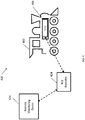
- FIG. 1 illustrates an example system 100 according to some aspects of the present disclosure.
- the system 100 includes a locomotive 102 having a locomotive control unit 106, which may include any suitable locomotive control unit (e.g., machine control unit, etc.) as described herein.
- a locomotive control unit 106 which may include any suitable locomotive control unit (e.g., machine control unit, etc.) as described herein.
- the system 100 also includes an operator control unit 104, which may be any suitable operator control unit as described herein.
- the operator control unit 104 may receive commands from an operator 108, and transmit the commands to the locomotive control unit 106 for controlling the locomotive 102.
- the operator control unit 104 may allow an operator 108 to control the locomotive 102, send commands to the locomotive control unit 106, etc., while the operator 108 is remote from the locomotive 102. Accordingly, the operator 108 may control the locomotive 102 from a variety of suitable positions. In some embodiments, the operator 108 may be required to be within a threshold distance of the locomotive 102, such as in sight of the locomotive 102, within a wireless network signal strength range, etc.
- FIG. 1 illustrates a locomotive 102, an operator 108, and an operator control unit 104 in communication with a locomotive control unit 106.
- command signals 111 may be sent in a direction from the operator control unit 104 to the locomotive control unit 106.
- This may be one-way communication channel for the command signals 111, or a two-way communication channel may be used with 113 representing the second half of the two-way communications.
- An optional repeater 115 may be used to transmit the command signals 111 from the OCU 104 to the LCU 106.
- the repeater 115 is illustrated as having two frequency indicators (F1, F2), but other embodiments may include more or less frequencies.
- the repeater 115 may include multiple antennas (e.g., two antennas, etc.).
- command signals 111 may be transmitted directly from the OCU 104 to the LCU 106 instead of through repeater 115.
- Voice message signals 113 may be transmitted from the locomotive control unit 106 to the operator control unit 104.
- the voice message signals 113 may be transmitted on the same RF data channel used to transmit data from the LCU 106 to the OCU 104.
- the voice message signals 113 may include a voice message number corresponding to a voice message status stored on the OCU 104.
- the voice message signals 113 may include actual voice message content.
- An optional repeater 117 may be used to transmit the voice message signals 113 (and optionally any other RF data packets including command data packets) from the LCU 106 to the OCU 104.
- the repeater 117 is illustrated as having two frequency indicators (F1, F2), but other embodiments may include more or less frequencies.
- the frequency indicators F1, F2 may be receive frequencies, transmit frequencies, both receive and transmit (e.g., transceiver, etc.) frequencies, etc.
- These frequency indicators F1, F2 of the repeater 117 may be the same or different frequencies from the frequency indicators F1, F2 of the repeater 115.
- the repeater 117 may include multiple antennae ( e.g. , two antennae, etc. ). Alternatively, or additionally, voice message signals 113 may be transmitted directly from the LCU 106 to the OCU 104 instead of through repeater 117.
- the operator 108 may have a wireless earpiece 109, which may include a near-field wireless transmission (e.g., BLUETOOTH, etc.) earpiece, headset, etc.
- the operator control unit 106 may transmit voice messages to the earpiece 109 using near-field wireless transmission.
- the OCU 104 may transmit a voice message corresponding to a voice message number received from the LCU 106, may transmit actual voice message content received from the LCU 106, etc.
- the system 100 may include more than one locomotive 102, more than one operator 108 and OCU 104, more than one LCU 106, an OCU 104 in two-way communication with an LCU 106, etc.
- FIG. 2 illustrates a block diagram of the operator control unit 104 as shown in FIG. 1 .
- the operator control unit 104 includes a user interface 210 for receiving input (e.g., commands, etc.) from an operator.
- the user interface may include a display 212, which may include any suitable display (e.g ., a liquid crystal display (LCD), light emitting diodes (LED), indicator lights, etc. ).
- the operator control unit may include an audible alert device to notify the operator of one or more different conditions.
- the user interface may include an input 214, which may include any suitable input ( e.g. , a keypad, touchscreen, switches, etc.). In other embodiments, the operator control unit 104 may not include a display 212 or an input 214.
- the operator control unit 104 also includes a wireless communication interface 216.
- the wireless communication interface 216 may communicate with a locomotive control unit of a locomotive via one-way or two-way communication, using any suitable wireless communication protocol (e.g., RF, WiFi, Bluetooth, etc.).
- the operator control unit can include an optional GPS receiver 218, which is configured to receive GPS signals to determine a location of the operator control unit 104.
- GPS receiver 218 is configured to receive GPS signals to determine a location of the operator control unit 104.
- other suitable devices capable of determining a location of the operator control unit 104 may be used.
- the operator control unit 104 includes a processor 220, which may be any suitable processor including, but not limited to, a microprocessor, microcontroller, integrated circuit, digital signal processor, etc.
- the processor 220 is configured to receive a voice message number from the locomotive control unit 106 of the locomotive 102 via the wireless communication interface 216, retrieve one of multiple stored voice messages from memory 222 corresponding to the received voice message number, and transmit the retrieved voice message to the operator 108 ( e.g. , send the voice message to an earpiece 109 of the operator 108 via near-field wireless transmission, etc.).
- the operator control unit also includes memory 222, which may be any suitable memory capable of storing computer-executable instructions and data, including but not limited to, a hard drive, flash memory, random access memory, etc.
- the memory 222 is configured to store multiple voice messages corresponding to the locomotive 102.
- the operator control unit 104 may be configured to receive actual voice message content from the locomotive control unit 106 via the wireless communication interface 216.
- the processor 220 may be configured to relay the retrieved actual voice message content to the operator 108 ( e.g. , send the voice message to an earpiece 109 of the operator 108 via near-field wireless transmission, etc.).
- the memory 222 may not need to store voice messages corresponding to voice message numbers, and the processor 220 may not need to retrieve voice messages corresponding to voice message numbers received at the wireless communication interface 216.
- the earpiece 109 of the operator 108 may be wired to the operator control unit 104. In those cases, the operator control unit 104 may transmit the voice message to the earpiece 109 of the operator 108 via the wired connection.
- FIG. 3 illustrates another example system 300 according to some aspects of the present disclosure.
- the system 300 includes a locomotive 302 having a locomotive control unit 306, which may include any suitable locomotive control unit as described herein.
- the system 300 also includes an operator control unit 304, which may be any suitable operator control unit as described herein.
- the operator control unit 304 may receive commands from an operator 308, and transmit the commands to the locomotive control unit 306 for controlling the locomotive 302.
- the operator control unit 304 may allow an operator 308 to control the locomotive 302, send commands to the locomotive 302, etc., while the operator 308 is remote from the locomotive 302. Accordingly, the operator 308 may control the locomotive 302 from a variety of suitable positions. In some embodiments, the operator 308 may be required to be within a threshold distance of the locomotive 302, such as in sight of the locomotive 302, within a wireless network signal strength range, etc.
- FIG. 3 illustrates a locomotive 302, an operator 308, and an operator control unit 304 in communication with a locomotive control unit 106.
- communication channel 319 e.g., RF channel, etc.
- communication channel 319 may allow commands to be sent from the OCU 304 to the LCU 306, and also voice message numbers (or actual voice message content) to be sent from the LCU 306 to the OCU 304.
- the communication channel may transmit feedback data from the LCU 306 to the OCU 304 regarding one or more states of operation of the locomotive.
- An optional repeater 321 may be used to transmit signals between the OCU 304 and the LCU 306 using communication channel 319.
- the repeater 321 is illustrated as having two frequency indicators (F1, F2), but other embodiments may include more or less frequencies.
- the repeater 321 may include multiple antennas ( e.g. , two antennas, etc.). Alternatively, or additionally, command signals, voice message numbers, actual voice message content, etc. may be transmitted directly between the OCU 104 and the LCU 106.
- the operator control unit 304 includes a user interface configured to receive one or more commands from the operator 308 for controlling the locomotive 302, a wireless communication interface configured to transmit data to and from the locomotive control unit 306 of the locomotive, memory configured to store multiple voice messages corresponding to the locomotive 302, and a processor configured to receive a voice message number from the locomotive control unit 306 of the locomotive 302 via the wireless communication interface, retrieve one of the multiple stored voice messages from memory corresponding to the received voice message number, and transmit the retrieved voice message to the operator 308.
- retrieved voice messages may be transmitted from the OCU 304 to a headset 309 of the operator 308 (e.g. , via near-field wireless transmission such as BLUETOOTH, etc.), thereby allowing the operator 308 to hear the voice messages.
- the voice messages may be transmitted using near-field wireless transmission communication protocols between the headset 309 and the OCU 304, which may inhibit the voice messages from interfering with other operators.
- the OCU 304 may include a near-field wireless transmission communication interface for communicating with the headset 309, which may or may not be part of the wireless communication interface of the OCU 304.
- the OCU 304 may include a wireless radio (e.g., in addition to the wireless communication interface used to communicate with the LCU 306, etc.) configured to transmit the retrieved voice message to the operator 308.
- the OCU 304 may transmit the retrieved voice message via the wireless radio over a voice channel at a power level that is below a specified threshold, to inhibit reception of the transmitted voice message by operators other than the operator 308 associated with the OCU 304.
- the specified threshold may be a power level at which the transmitted voice message is not received by operators at who are more than five feet, ten feet, one hundred feet, etc. from the OCU 304.
- the OCU 304 may be configured to transmit a status request to the LCU 306 to request a current status of the locomotive 302.
- the OCU 304 may receive a voice message number from the LCU 306 corresponding to a voice message indicative of the status of the locomotive. This may allow the operator 308 to solicit status information from the LCU 306 in the form of voice messages.
- the LCU 306 may be configured to determine whether a predefined event (e.g., braking, stopping, etc.) has occurred. In response to determining that the predefined event has occurred, the LCU 306 may be configured to transmit a voice message number to the operator control unit corresponding to a voice message indicative of the predefined event. This may allow the OCU 304 to receive unsolicited voice messages when the LCU 306 determines that an event has occurred regarding the locomotive 302, even if the OCU 304 is not currently requesting a status voice message.
- a predefined event e.g., braking, stopping, etc.
- FIG. 4 illustrates another example embodiment of the present disclosure, in which a system 400 includes a locomotive 402, a locomotive control unit 306, a remote control locomotive (RCL) system repeater 424 and a remote monitoring device 426.
- a system 400 includes a locomotive 402, a locomotive control unit 306, a remote control locomotive (RCL) system repeater 424 and a remote monitoring device 426.
- RCL remote control locomotive
- the RCL repeater 424 is configured to relay a voice message number transmitted from the locomotive control unit 406 to the remote monitoring device 426.
- the remote monitoring device 426 may then be configured to play a voice message corresponding to the transmitted voice message number when the voice message number is received from the RCL repeater 424. This can allow a railyard manager to monitor operation of the locomotive, etc.
- the remote monitoring device 426 may be configured to store a text version of the voice message corresponding to the transmitted voice message number when the voice message number is received from the RCL repeater 424. This may allow for storage of the voice messages for later review, etc.
- the repeater 424 is configured to relay the voice message number to the remote monitoring device 426 via a fiber optic link, a network link, etc. As should be apparent, other embodiments may relay the voice message number from the repeater 424 to the remote monitoring device 426 via an RF channel, etc.
- an exemplary method of relaying voice messages to an operator control unit (OCU) associated with a locomotive remote control unit generally includes receiving a voice message from a locomotive control unit (LCU) of a locomotive at a wireless interface of an operator control unit, and transmitting the received voice message to an earpiece of the operator via a wired transmission and/or a near-field wireless transmission to allow the operator to listen to the retrieved voice message.
- LCU locomotive control unit
- Receiving the voice message may include receiving a voice message number and retrieving a voice message corresponding to the received voice message number from one of multiple voice messages stored in a memory of the operator control unit.
- the earpiece may include a BLUETOOTH receiver, and transmitting the received voice message includes transmitting the received voice message via a BLUETOOTH near-field wireless transmission to the BLUETOOTH receiver of the operator.
- transmitting may include receiving the voice message at a repeater, and relaying the voice message number to a remote monitoring device.
- Some embodiments may provide one or more advantages including freeing a voice radio channel without sacrificing functionality, allowing voice messages to be directed to operators associated with a specific locomotive without distracting other operators, reducing interference of voice communication channels needed for safety critical communication, etc.
- Example embodiments are provided so that this disclosure will be thorough, and will fully convey the scope to those who are skilled in the art. Numerous specific details are set forth such as examples of specific components, devices, and methods, to provide a thorough understanding of embodiments of the present disclosure. It will be apparent to those skilled in the art that specific details need not be employed, that example embodiments may be embodied in many different forms, and that neither should be construed to limit the scope of the disclosure. In some example embodiments, well-known processes, well-known device structures, and well-known technologies are not described in detail.
- parameter X may have a range of values from about A to about Z.
- disclosure of two or more ranges of values for a parameter subsume all possible combination of ranges for the value that might be claimed using endpoints of the disclosed ranges.
- parameter X is exemplified herein to have values in the range of 1 - 10, or 2 - 9, or 3 - 8, it is also envisioned that Parameter X may have other ranges of values including 1 - 9, 1 - 8, 1 - 3, 1 - 2, 2 - 10, 2 - 8, 2 - 3, 3 - 10, and 3 - 9.
- first, second, third, etc. may be used herein to describe various elements, components, regions, layers and/or sections, these elements, components, regions, layers and/or sections should not be limited by these terms. These terms may be only used to distinguish one element, component, region, layer or section from another region, layer or section. Terms such as “first,” “second,” and other numerical terms when used herein do not imply a sequence or order unless clearly indicated by the context. Thus, a first element, component, region, layer or section discussed below could be termed a second element, component, region, layer or section without departing from the teachings of the example embodiments.
- One aspect of the invention relates to a system for relaying voice messages to an operator control unit (OCU) of a locomotive, the system comprising:
Landscapes
- Engineering & Computer Science (AREA)
- Mechanical Engineering (AREA)
- Computer Networks & Wireless Communication (AREA)
- Signal Processing (AREA)
- Physics & Mathematics (AREA)
- Multimedia (AREA)
- Computational Linguistics (AREA)
- Health & Medical Sciences (AREA)
- Audiology, Speech & Language Pathology (AREA)
- Human Computer Interaction (AREA)
- Acoustics & Sound (AREA)
- Automation & Control Theory (AREA)
- Transportation (AREA)
- General Physics & Mathematics (AREA)
- Selective Calling Equipment (AREA)
- Mobile Radio Communication Systems (AREA)
Applications Claiming Priority (1)
| Application Number | Priority Date | Filing Date | Title |
|---|---|---|---|
| US15/397,186 US10449973B2 (en) | 2017-01-03 | 2017-01-03 | Devices, systems, and methods for relaying voice messages to operator control units of remote control locomotives |
Publications (1)
| Publication Number | Publication Date |
|---|---|
| EP3354533A1 true EP3354533A1 (fr) | 2018-08-01 |
Family
ID=61022099
Family Applications (1)
| Application Number | Title | Priority Date | Filing Date |
|---|---|---|---|
| EP18150044.8A Withdrawn EP3354533A1 (fr) | 2017-01-03 | 2018-01-02 | Dispositifs, systèmes et procédés permettant de relayer des messages vocaux à des unités de commande d'opérateurs de locomotives de commande à distance |
Country Status (4)
| Country | Link |
|---|---|
| US (1) | US10449973B2 (fr) |
| EP (1) | EP3354533A1 (fr) |
| CN (2) | CN108263399B (fr) |
| CA (1) | CA2990542C (fr) |
Cited By (1)
| Publication number | Priority date | Publication date | Assignee | Title |
|---|---|---|---|---|
| EP3798090A1 (fr) * | 2019-09-27 | 2021-03-31 | Siemens Mobility GmbH | Procédé de surveillance d'une communication parlée dans le trafic ferroviaire et système d'acheminement des trains associé |
Families Citing this family (5)
| Publication number | Priority date | Publication date | Assignee | Title |
|---|---|---|---|---|
| US10449973B2 (en) * | 2017-01-03 | 2019-10-22 | Laird Technologies, Inc. | Devices, systems, and methods for relaying voice messages to operator control units of remote control locomotives |
| DE102017110715A1 (de) * | 2017-05-17 | 2018-11-22 | Konecranes Global Corporation | Steuerschalter, Steuersystem und Verfahren zur Bedienung eines Krans |
| JP7052709B2 (ja) * | 2018-12-25 | 2022-04-12 | トヨタ自動車株式会社 | 車両制御装置及び車両制御方法 |
| CN111422225A (zh) * | 2020-05-06 | 2020-07-17 | 天津七一二通信广播股份有限公司 | 一种数字列调车站电台及其实现方法 |
| CN112606734A (zh) * | 2020-12-17 | 2021-04-06 | 安徽通盛能源科技有限公司 | 一种基于轨道车用控制驱动系统 |
Citations (3)
| Publication number | Priority date | Publication date | Assignee | Title |
|---|---|---|---|---|
| US6232887B1 (en) * | 1998-04-29 | 2001-05-15 | Joseph E. Carson | Warning systems |
| WO2005061297A1 (fr) * | 2003-12-09 | 2005-07-07 | General Electric Company (A New York Corporation) | Systeme de telecommande de locomotive |
| US20100131127A1 (en) * | 2008-11-21 | 2010-05-27 | General Electric Company | Railroad signal message system and method |
Family Cites Families (15)
| Publication number | Priority date | Publication date | Assignee | Title |
|---|---|---|---|---|
| US5511749A (en) | 1994-04-01 | 1996-04-30 | Canac International, Inc. | Remote control system for a locomotive |
| US5924651A (en) * | 1997-03-26 | 1999-07-20 | Penza; George Gregory | Tactile and audible warning system for railroad workers |
| CA2266998C (fr) | 1999-03-25 | 2008-01-15 | Canac Inc. | Methode et dispositif permettant d'assigner des adresses a des composants d'un systeme de commande |
| US6470245B1 (en) | 2002-01-31 | 2002-10-22 | Canac Inc. | Remote control system for a locomotive with solid state tilt sensor |
| US6863247B2 (en) | 2003-05-30 | 2005-03-08 | Beltpack Corporation | Method and apparatus for transmitting signals to a locomotive control device |
| CN1902074B (zh) * | 2003-12-09 | 2010-12-01 | 通用电气公司 | 机车遥控系统 |
| US7812740B2 (en) * | 2007-09-27 | 2010-10-12 | Verizon Patent And Licensing Inc. | Systems, devices, and methods for providing alert tones |
| US20100039514A1 (en) * | 2008-08-14 | 2010-02-18 | John Brand | System and Method for Image Projection of Operator Data From An Operator Control Unit |
| KR20140050519A (ko) * | 2012-10-19 | 2014-04-29 | 한국전자통신연구원 | 사물통신 기반 열차 방호장치 및 그 방법 |
| GB2510561B (en) * | 2013-02-06 | 2016-04-27 | Trimble Railway Ltd | A Rail Train Diagnostics System |
| JP6051092B2 (ja) * | 2013-04-15 | 2016-12-27 | 株式会社日立製作所 | 列車制御システム |
| KR20150135975A (ko) * | 2014-05-26 | 2015-12-04 | 한국전자통신연구원 | 열차의 무선 통신 장치를 제어하는 시스템 및 방법, 그리고 원격으로 열차를 관리하는 방법 및 시스템 |
| CN104506568A (zh) * | 2014-11-21 | 2015-04-08 | 陕西西北铁道电子有限公司 | 一种用于远程控制、更新gyk的dmi程序的方法 |
| CN104875773A (zh) * | 2015-05-21 | 2015-09-02 | 中国铁路总公司 | 基于卫星通信和公共蜂窝通信的列车控制系统 |
| US10449973B2 (en) * | 2017-01-03 | 2019-10-22 | Laird Technologies, Inc. | Devices, systems, and methods for relaying voice messages to operator control units of remote control locomotives |
-
2017
- 2017-01-03 US US15/397,186 patent/US10449973B2/en active Active
-
2018
- 2018-01-02 EP EP18150044.8A patent/EP3354533A1/fr not_active Withdrawn
- 2018-01-02 CA CA2990542A patent/CA2990542C/fr active Active
- 2018-01-03 CN CN201810004428.1A patent/CN108263399B/zh active Active
- 2018-01-03 CN CN201820009352.7U patent/CN207712047U/zh active Active
Patent Citations (3)
| Publication number | Priority date | Publication date | Assignee | Title |
|---|---|---|---|---|
| US6232887B1 (en) * | 1998-04-29 | 2001-05-15 | Joseph E. Carson | Warning systems |
| WO2005061297A1 (fr) * | 2003-12-09 | 2005-07-07 | General Electric Company (A New York Corporation) | Systeme de telecommande de locomotive |
| US20100131127A1 (en) * | 2008-11-21 | 2010-05-27 | General Electric Company | Railroad signal message system and method |
Cited By (1)
| Publication number | Priority date | Publication date | Assignee | Title |
|---|---|---|---|---|
| EP3798090A1 (fr) * | 2019-09-27 | 2021-03-31 | Siemens Mobility GmbH | Procédé de surveillance d'une communication parlée dans le trafic ferroviaire et système d'acheminement des trains associé |
Also Published As
| Publication number | Publication date |
|---|---|
| CA2990542A1 (fr) | 2018-07-03 |
| US10449973B2 (en) | 2019-10-22 |
| CA2990542C (fr) | 2020-01-14 |
| CN108263399A (zh) | 2018-07-10 |
| CN207712047U (zh) | 2018-08-10 |
| CN108263399B (zh) | 2020-05-12 |
| US20180186386A1 (en) | 2018-07-05 |
Similar Documents
| Publication | Publication Date | Title |
|---|---|---|
| CA2990542C (fr) | Dispositifs, systemes et methode de transmission de messages vocaux aux modules de controle operateur de locomotives telecommandees | |
| US10023210B2 (en) | Devices, systems, and methods related to tracking location of operator control units for locomotives | |
| US11046335B2 (en) | Devices, systems, and methods related to tracking location of operator control units for locomotives | |
| CN101207523A (zh) | 无线网络的异常通知系统 | |
| JP5089234B2 (ja) | 通信装置 | |
| US12030539B2 (en) | Devices, systems, and methods related to tracking location of operator control units for locomotives | |
| EP2347943A2 (fr) | Système de signalisation | |
| US6795685B2 (en) | Method and apparatus for repeater priority resolution in a wireless communication system | |
| US11265284B2 (en) | Communication status system and method | |
| JP2010258565A (ja) | 列車無線システム | |
| EP2723045B1 (fr) | Système audio numérique d'un aéronef | |
| US11926353B2 (en) | Devices, systems, and methods related to tracking location of operator control units for locomotives | |
| JP2006188151A (ja) | 列車接近警報システム | |
| JP2008052331A (ja) | バスロケーションシステム | |
| JP4571739B2 (ja) | 進路設定システム | |
| US20190297127A1 (en) | Systems, methods and devices for operator control unit based voip communication | |
| JP4860425B2 (ja) | 無線通信システム | |
| EP1953727A1 (fr) | Système pour la signalisation d'urgence sélective entre véhicules appropriés pour éviter les fausses alarmes | |
| KR101218713B1 (ko) | 선박용 3축제어 위성안테나 이중화 제어시스템 | |
| CN219351737U (zh) | 一种地铁通信系统 | |
| WO2023248614A1 (fr) | Système de communication radio, procédé de communication radio, et système de commande de communication | |
| JPH10172095A (ja) | バス接近予告表示解除回路 | |
| JP2016072748A (ja) | 無線機 | |
| JP2010020369A (ja) | 非常連絡システム | |
| RU2019139919A (ru) | Система управления воздушным движением, а также способ обработки одновременной передачи вызовов |
Legal Events
| Date | Code | Title | Description |
|---|---|---|---|
| PUAI | Public reference made under article 153(3) epc to a published international application that has entered the european phase |
Free format text: ORIGINAL CODE: 0009012 |
|
| STAA | Information on the status of an ep patent application or granted ep patent |
Free format text: STATUS: THE APPLICATION HAS BEEN PUBLISHED |
|
| AK | Designated contracting states |
Kind code of ref document: A1 Designated state(s): AL AT BE BG CH CY CZ DE DK EE ES FI FR GB GR HR HU IE IS IT LI LT LU LV MC MK MT NL NO PL PT RO RS SE SI SK SM TR |
|
| AX | Request for extension of the european patent |
Extension state: BA ME |
|
| STAA | Information on the status of an ep patent application or granted ep patent |
Free format text: STATUS: REQUEST FOR EXAMINATION WAS MADE |
|
| 17P | Request for examination filed |
Effective date: 20190124 |
|
| RBV | Designated contracting states (corrected) |
Designated state(s): AL AT BE BG CH CY CZ DE DK EE ES FI FR GB GR HR HU IE IS IT LI LT LU LV MC MK MT NL NO PL PT RO RS SE SI SK SM TR |
|
| RAP1 | Party data changed (applicant data changed or rights of an application transferred) |
Owner name: CONTROL SOLUTIONS ENTERPRISES, INC. |
|
| RAP1 | Party data changed (applicant data changed or rights of an application transferred) |
Owner name: CATTRON NORTH AMERICA, INC. |
|
| STAA | Information on the status of an ep patent application or granted ep patent |
Free format text: STATUS: EXAMINATION IS IN PROGRESS |
|
| 17Q | First examination report despatched |
Effective date: 20210326 |
|
| STAA | Information on the status of an ep patent application or granted ep patent |
Free format text: STATUS: THE APPLICATION IS DEEMED TO BE WITHDRAWN |
|
| 18D | Application deemed to be withdrawn |
Effective date: 20210806 |