EP3798090A1 - Procédé de surveillance d'une communication parlée dans le trafic ferroviaire et système d'acheminement des trains associé - Google Patents
Procédé de surveillance d'une communication parlée dans le trafic ferroviaire et système d'acheminement des trains associé Download PDFInfo
- Publication number
- EP3798090A1 EP3798090A1 EP19200176.6A EP19200176A EP3798090A1 EP 3798090 A1 EP3798090 A1 EP 3798090A1 EP 19200176 A EP19200176 A EP 19200176A EP 3798090 A1 EP3798090 A1 EP 3798090A1
- Authority
- EP
- European Patent Office
- Prior art keywords
- terms
- speech recognition
- computer
- train
- communication
- Prior art date
- Legal status (The legal status is an assumption and is not a legal conclusion. Google has not performed a legal analysis and makes no representation as to the accuracy of the status listed.)
- Pending
Links
Images
Classifications
-
- B—PERFORMING OPERATIONS; TRANSPORTING
- B61—RAILWAYS
- B61L—GUIDING RAILWAY TRAFFIC; ENSURING THE SAFETY OF RAILWAY TRAFFIC
- B61L15/00—Indicators provided on the vehicle or train for signalling purposes
- B61L15/0018—Communication with or on the vehicle or train
- B61L15/0027—Radio-based, e.g. using GSM-R
-
- B—PERFORMING OPERATIONS; TRANSPORTING
- B61—RAILWAYS
- B61L—GUIDING RAILWAY TRAFFIC; ENSURING THE SAFETY OF RAILWAY TRAFFIC
- B61L27/00—Central railway traffic control systems; Trackside control; Communication systems specially adapted therefor
- B61L27/70—Details of trackside communication
-
- G—PHYSICS
- G06—COMPUTING OR CALCULATING; COUNTING
- G06F—ELECTRIC DIGITAL DATA PROCESSING
- G06F18/00—Pattern recognition
- G06F18/20—Analysing
- G06F18/21—Design or setup of recognition systems or techniques; Extraction of features in feature space; Blind source separation
- G06F18/214—Generating training patterns; Bootstrap methods, e.g. bagging or boosting
-
- G—PHYSICS
- G10—MUSICAL INSTRUMENTS; ACOUSTICS
- G10L—SPEECH ANALYSIS TECHNIQUES OR SPEECH SYNTHESIS; SPEECH RECOGNITION; SPEECH OR VOICE PROCESSING TECHNIQUES; SPEECH OR AUDIO CODING OR DECODING
- G10L15/00—Speech recognition
- G10L15/20—Speech recognition techniques specially adapted for robustness in adverse environments, e.g. in noise, of stress induced speech
-
- G—PHYSICS
- G10—MUSICAL INSTRUMENTS; ACOUSTICS
- G10L—SPEECH ANALYSIS TECHNIQUES OR SPEECH SYNTHESIS; SPEECH RECOGNITION; SPEECH OR VOICE PROCESSING TECHNIQUES; SPEECH OR AUDIO CODING OR DECODING
- G10L15/00—Speech recognition
- G10L15/22—Procedures used during a speech recognition process, e.g. man-machine dialogue
-
- H—ELECTRICITY
- H04—ELECTRIC COMMUNICATION TECHNIQUE
- H04L—TRANSMISSION OF DIGITAL INFORMATION, e.g. TELEGRAPHIC COMMUNICATION
- H04L9/00—Cryptographic mechanisms or cryptographic arrangements for secret or secure communications; Network security protocols
- H04L9/06—Cryptographic mechanisms or cryptographic arrangements for secret or secure communications; Network security protocols the encryption apparatus using shift registers or memories for block-wise or stream coding, e.g. DES systems or RC4; Hash functions; Pseudorandom sequence generators
- H04L9/0643—Hash functions, e.g. MD5, SHA, HMAC or f9 MAC
-
- H—ELECTRICITY
- H04—ELECTRIC COMMUNICATION TECHNIQUE
- H04L—TRANSMISSION OF DIGITAL INFORMATION, e.g. TELEGRAPHIC COMMUNICATION
- H04L9/00—Cryptographic mechanisms or cryptographic arrangements for secret or secure communications; Network security protocols
- H04L9/50—Cryptographic mechanisms or cryptographic arrangements for secret or secure communications; Network security protocols using hash chains, e.g. blockchains or hash trees
Definitions
- the invention relates to a method for monitoring spoken communication in train traffic.
- the invention also relates to a method for creating patterns for computer-aided speech recognition.
- the invention also relates to a train control system for spoken communication.
- the invention relates to a computer program product and a provision device for this computer program product, the computer program product being equipped with program commands for carrying out this method.
- Train (number) may travel to (name of the train station / train notification point). (Addition if necessary: there intersection with train (number).) Or, if not all conditions are met: No, wait After arriving at the train station up to which the driver's license has been issued, the train conductor must inform about the arrival of the train of the arrival notification: train (number) in (name of the train station / train notification point). Only after the arrival report has been received, the train conductor may grant a following train a driving license to a train run point behind. This ensures that at least one section of the route remains free between two trains following each other. Driving permits and arrival reports are two types of train movement reports, there is also the parking report, route safety report and departure report.
- the object of the invention is to provide a method for guiding trains and a train control system using this method, with which a greater degree of safety can be achieved during train operation despite manual train control via communication between the people involved.
- the object of the invention is to specify a computer program or a provision for such a computer program, the computer program being able to carry out the method.
- the recording of the communication forms the basis for the subsequent speech recognition.
- the recording itself can be analog or, preferably, digital.
- the speech recognition provides a digital model of individual linguistic elements, which in the present case are terms that are used in accordance with the guidelines for communication, for example RiL 436. Terms can consist of individual words or groups of words, these groups of words forming fixed phrases of train communication.
- Inadmissible deviations within the meaning of the invention are to be understood as deviations of the terms from the stored patterns. These deviations are synonymous with the fact that the speech recognition does not recognize a spoken communication as a permissible term within the scope of the check. There is naturally a certain tolerance interval within which the speech recognition also recognizes the commands if the speaker produces certain deviations from the respectively stored pattern, for example due to a dialect. The fact that the terms to be used follow precise rules for communication ensures that the speech recognition ensures a high degree of recognition reliability because of the limited "vocabulary" available.
- the basic idea of this invention is to use existing methods for speech recognition, for example based on the so-called "Hidden Markov Models", which are generally known for performing speech recognition, in order to achieve the to digitize spoken communication as part of train control operations according to RiL 436 and to give warning feedback to the people involved in the event of deviations from the specified procedure.
- Hidden Markov Models which are generally known for performing speech recognition
- the procedure described has the following advantages.
- the communication monitoring according to the invention by means of voice recognition and automatic comparison with the "permitted" communication (specified for example in accordance with RiL 436) can significantly increase security in train control operations that have not been automatically secured up to now.
- the method according to the invention can be implemented as a new possible product as part of a digitization strategy, e.g. in the interaction between mobile terminals and local computers / databases. Due to the increased interest in this digital solution, the operator is initially only partially digitizing the route network during project planning. In this way, route sections that are secured using spoken communication can be included in the digital environment of a partially digitized route network.
- the terms “create”, “calculate”, “calculate”, “determine”, “generate”, “configure”, “modify” and the like preferably refer to actions and / or processes and / or processing steps that change and / or generate data and / or convert the data into other data.
- the data are in particular available as physical quantities, for example as electrical impulses or also as measured values.
- the necessary instructions / program commands are summarized in a computer program as software.
- the terms “receive” refer to “transmit”, “read in”, “read out”, “transmit” and the like refer to the interaction of individual hardware components and / or software components via interfaces.
- the interfaces can be implemented in terms of hardware, for example wired or as a radio link, and / or in software, for example as interaction between individual program modules or program parts of one or more computer programs.
- “computer-aided” or “computer-implemented” can be understood to mean, for example, an implementation of the method in which one or more computers executes or executes at least one method step of the method.
- the term "computer” is to be interpreted broadly, it covers all electronic devices with data processing properties. Computers can thus be, for example, personal computers, servers, handheld computer systems, pocket PC devices, mobile radio devices and other communication devices that process data with the aid of computers, processors and other electronic devices for data processing, which can preferably also be connected to a network.
- a “memory unit” can be understood to mean, for example, a computer-readable memory in the form of a random access memory (RAM) or a data memory such as a hard disk or a data carrier.
- RAM random access memory
- data memory such as a hard disk or a data carrier.
- a “processor” can be understood to mean, for example, a machine such as a sensor for generating measured values or an electronic circuit.
- a processor can in particular be a central processing unit (CPU), a microprocessor or a microcontroller, for example an application-specific integrated circuit or a digital signal processor, possibly in combination with a memory unit for storing program commands, etc. .
- a processor can also be, for example, an IC (integrated circuit), in particular an FPGA (field programmable gate array) or an ASIC (application-specific integrated circuit), or a DSP (digital signal processor) act.
- a processor can also be understood to be a virtualized processor or a soft CPU. For example, it can also be a programmable processor that is equipped with a configuration for executing a computer-aided method.
- the error message occurs acoustically or visually, in particular on a mobile terminal of a vehicle and / or an operating device of a control center.
- An acoustic error message is of particular advantage because the train control is also carried out acoustically via spoken communication and the train driver and the employee in the control center are set to an acoustic signal transmission (voice). An acoustic signal is therefore perceived well, even if the staff does not concentrate on optical output devices during the error message.
- An optical error output can take place via optical output devices such as screens. This has the advantage that this infrastructure is provided anyway and the staff is prepared to evaluate the output via these output devices.
- Another optical output device can be, for example, a warning light that is only activated for this purpose. This has the advantage that the signal is unambiguous (if the staff is appropriately trained) and can also be output if a screen has to be used as an output device for handling other tasks of transmitting information.
- a position of the vehicle is taken into account when creating the recording.
- the position of the vehicle can be determined with GPS, for example. Knowing the position is helpful for documentation purposes. It is helpful, for example, to correlate the current position of the vehicle with the start of communication, so that it is also possible to determine which of the trainlines have been used where.
- the position is compared with route data and / or location-dependent weather data. According to a further embodiment of the invention, it is provided that when comparing the position, terms are taken into account that are correlated with the route data and / or with the weather data.
- a comparison of the position with route data for example from a route atlas, or weather data that can be made available by a weather service, for example, makes it possible to correlate this with the spoken communication in the context of train control.
- the advantage here is that the context of the route and the environmental conditions (e.g. weather) can be included in the assessment of whether an adequate term was used during the train control process. In other words, it is only possible to check whether terms have been used and are permissible according to the communication standards, but whether these terms have also been used sensibly. If, for example, it is known in which order the stations of a route section are approached, a check can be made to determine whether the train communication between those involved has made a mistake as to which station is currently being approached. Another possibility is to reduce the maximum permissible speeds due to the weather, so that the driving license for a certain speed is interpreted as an incorrect assessment of the situation and output as an error, depending on the situation.
- the absence of a term correlated with the route data and / or with the weather data is also interpreted as a deviation.
- the recording is stored after the speech recognition has been carried out.
- blockchain technology is used to store the recording.
- the cloud technology advantageously makes it possible to use the storage resources belonging to the cloud without having to reserve separate storage capacities for storing the communication.
- a “cloud” is to be understood as an environment for “cloud computing” (German computer cloud or data cloud). What is meant is an IT infrastructure that is over a network such as the Internet is made available. It usually includes storage space, computing power or application software as a service without these having to be installed on the local computer using the cloud. These services are offered and used exclusively through technical interfaces and protocols, such as a web browser.
- the range of services offered in the context of cloud computing encompasses the entire spectrum of information technology and includes infrastructure, platforms and software, among other things.
- the named method thus represents the first phase for preparing the application of speech recognition, in which the program for speech recognition has to be trained. It is thus advantageously possible to train a speech recognition program so that it can be used for communication.
- machine learning is used.
- Performing machine learning has the advantage that the process of creating patterns for speech recognition can be automated. In particular, it is advantageously also possible to detect errors that occur while using the speech recognition occur repeatedly due to imprecise or incorrect patterns, which can be improved by subsequent training in speech recognition.
- the machine learning thus enables a continuous optimization process for the application of the method according to the invention for monitoring.
- the computer-aided infrastructure that is supposed to carry out machine learning must be equipped with artificial intelligence.
- Artificial intelligence also abbreviated to AI in the following
- AI computer-aided machine learning
- ML computer-aided machine learning
- the system recognizes patterns and regularities in the recorded process data based on previously entered learning data.
- suitable algorithms ML can independently find solutions to emerging problems.
- ML is divided into three fields - monitored learning, unsupervised learning and reinforcement learning, with the more specific (sub) applications of regression and classification, structure recognition and prediction, data generation (sampling) and autonomous action.
- supervised learning the system is trained through the connection between the input and the associated output of known data. It depends on the availability of correct data, because if the system is trained with bad examples, it learns incorrect connections.
- unsupervised learning the system is also trained with sample data, but only with input data and without any connection to a known output. It learns how to create and expand data groups, what is typical and where deviations occur. This allows use cases to be described and error states to be discovered.
- reinforcement learning the system learns through trial and error by suggesting solutions to given problems and receiving a positive or negative evaluation of this suggestion via a feedback function. Learned depending on the reward mechanism the AI system to perform appropriate functions.
- location information is also processed which contains the position of the vehicle during the use of the relevant terms in the rail network.
- the above procedures are intertwined.
- the creation method can, for example, not only be used initially to create patterns for the monitoring method, but it can also be used to correct patterns which led to unauthorized error messages.
- This digitized (i.e., recognized by speech recognition) dialog between all persons involved in train control operations is compared, for example, with the texts and permitted processes specified in RiL 436. These can, for example, have been stored in a storage unit (database).
- an acoustic or optical warning message is issued via a mobile application or a message is sent to other devices such as control centers or the like. In this way, the train crew involved is alerted and can initiate measures to avoid any operationally dangerous situations.
- a provision device for storing and / or providing the computer program product.
- the provision device is, for example, a data carrier that stores and / or provides the computer program product.
- the provision device is, for example, a network service, a computer system, a server system, in particular a distributed computer system, a cloud-based computer system and / or virtual computer system, which the computer program product preferably stores and / or provides in the form of a data stream.
- the provision takes place, for example, as a download in the form of a program data block and / or command data block, preferably as a file, in particular as a download file, or as a data stream, in particular as a download data stream, of the complete computer program product.
- This provision can, for example, also take place as a partial download, which consists of several parts and, in particular, is downloaded via a peer-to-peer network or provided as a data stream.
- Such a computer program product is, for example, read into a system using the supply device in the form of the data carrier and executes the program commands so that the method according to the invention is executed on a computer or the creation device is configured in such a way that it generates the workpiece according to the invention.
- the described components of the embodiments each represent individual features of the invention that are to be considered independently of one another, which also develop the invention independently of one another and are thus also to be regarded as part of the invention individually or in a combination other than the one shown. Furthermore, the described embodiments can also be supplemented by further features of the invention already described.
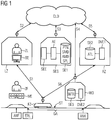
- FIG. 1 shows a route ST with a vehicle FZ in the form of a train.
- the vehicle FZ is currently traveling on a single-track track section GA, the vehicle FZ being able to communicate with a control center LZ via an interface S1.
- the train communication is monitored via the interface S1 by a data center RZ, a first data processing unit DVE1 being responsible for this.
- the monitoring runs via a cloud CLD. The following steps are carried out in detail.
- the communication is transmitted from the control center LZ to the cloud CLD via an interface S1.
- a speech recognition service SES has access to the data via an interface S3, the speech recognition service SES having a speech recognition unit SEE with an algorithm which is suitable for speech recognition.
- the data are subjected to an analysis by means of an analysis unit AE in order to determine whether the recognized speech components match the phrases customary for train communication.
- the analysis unit AE finds terms in the spoken language which can be compared with the phrases customary according to the RIL standard.
- the analysis unit AE uses patterns PTN which are stored for the various terms.
- the analysis also includes language models SMD, acoustic models AMD and pronunciation data SPL used, which are stored in a first memory unit SE1.
- weather data WTR that are stored in a third storage unit SE3 can also be transmitted to the cloud CLD via a second data processing unit DVE2 via an interface S4.
- This data comes, for example, from a weather service WD and can be used for a context analysis. This is because there are voice commands in train communication that can be issued depending on the weather, for example reducing a speed. If the associated command is not received when there is critical weather data, this can result in an error message. An error message can be sent directly to the vehicle FZ by the data center RZ via an interface S6 so that it can be displayed on the mobile terminal ME.
- Route data ATL of the route network to be traveled can also be taken into account in the data center RZ. These are also transmitted to the first data processing unit DVE1 and correlated with the analyzed speech data.
- the data center RZ is connected to the cloud CLD via an interface S5.
- the comparison with the route data ATL can be used, for example, to check the names of the train stations approached, which are used in the standardized communication method. If there are deviations that z. If, for example, the order of the names of the stations was mixed up, an error message can be triggered in the vehicle FZ via the interface S6.
- the interfaces S1 to S6 are in FIG. 1 only given by way of example.
- the communication between the vehicle FZ and the control center LZ as well as the data center RZ takes place via a radio interface. This could also be handled via the Cloud CLD (in FIG. 1 not shown) .
- the Cloud CLD in FIG. 1 not shown
- direct communication between the control center LZ and the voice recognition service SES as well as with the weather service WD and the data center RZ can take place (not shown).
- these interfaces do not have to be designed as radio interfaces, but can also be implemented via wired interfaces (not shown).
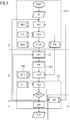
- FIG. 2 the procedure for creating patterns PTN and for speech recognition is shown as a flow chart.
- the phases A to D already mentioned above can be seen here.
- the individual phases A to D are separated from one another by dashed lines.
- FIG. 2 the system boundaries of the units of the control center LZ, the voice recognition service SES, the weather service WD and the data center RZ indicated by dash-dotted lines. This makes it clear which method steps in the method example according to FIG. 2 in which of these units can be carried out.
- the speech recognition system must be trained in accordance with phase A.
- the RIL guideline for example, is fed into the process as input.
- an analysis step ANL can be carried out in order to identify terms digitized from the phrases used.
- training can then take place in a training step TRN so that patterns PTN can be created from the identified terms, which are stored for later use of the recognition method. This also means stopping the training process, which in principle only has to take place once and, if necessary, if, for example, an increasing number of errors occur, it can be repeated again in order to improve the quality of the PTN pattern.
- the spoken communication between the train conductor ZL and the train driver ZF is recorded in a recording step REC.
- a speech recognition step IDF is then performed by the speech recognition service SES carried out so that the digital terms that have been recognized can be compared in a subsequent comparison step CMP with the patterns PTN, which are retrieved from the memory for this purpose.
- a further plausibility check step PLS can then be carried out, whereby the recognized terms, whose agreement with comparable patterns PTN has already been determined, can be compared with weather data WTR, provided by the weather service WD, and route data ATL, which are available in the data center RZ. Even in the event that the terms recognized by the speech recognition correspond to corresponding patterns PTN, it can be determined whether the recognized terms fit into the context of the train control operation currently in progress. For example, it can be checked whether the names of the stations are communicated in the correct order.
- a subsequent checking step MAT it is determined whether the plausibility-checked data match the train control operation or not.
- the process is continued in order to check further spoken phrases of the train control operation for their authenticity.
- an EOR error detected in the data center RZ and output Only in the negative case, i.e. when discrepancies are detected due to the context of the train control operation, or because there is no PTN pattern for the recognized text, is an EOR error detected in the data center RZ and output. This is passed on to an error display OUT and can be displayed, for example, to the train conductor ZL and / or the train driver ZF on the operating device BE or the mobile terminal ME.
- the communication is stored as a stored communication SVE and is therefore available for a more detailed check or analysis later as part of the training step (phase A).
Landscapes
- Engineering & Computer Science (AREA)
- Physics & Mathematics (AREA)
- Acoustics & Sound (AREA)
- Audiology, Speech & Language Pathology (AREA)
- Human Computer Interaction (AREA)
- Health & Medical Sciences (AREA)
- Multimedia (AREA)
- Mechanical Engineering (AREA)
- Computational Linguistics (AREA)
- Theoretical Computer Science (AREA)
- Data Mining & Analysis (AREA)
- Signal Processing (AREA)
- Computer Networks & Wireless Communication (AREA)
- Computer Security & Cryptography (AREA)
- Power Engineering (AREA)
- Bioinformatics & Cheminformatics (AREA)
- Evolutionary Computation (AREA)
- General Engineering & Computer Science (AREA)
- General Physics & Mathematics (AREA)
- Evolutionary Biology (AREA)
- Computer Vision & Pattern Recognition (AREA)
- Bioinformatics & Computational Biology (AREA)
- Artificial Intelligence (AREA)
- Life Sciences & Earth Sciences (AREA)
- Train Traffic Observation, Control, And Security (AREA)
Priority Applications (2)
| Application Number | Priority Date | Filing Date | Title |
|---|---|---|---|
| EP19200176.6A EP3798090A1 (fr) | 2019-09-27 | 2019-09-27 | Procédé de surveillance d'une communication parlée dans le trafic ferroviaire et système d'acheminement des trains associé |
| US17/034,624 US20210097983A1 (en) | 2019-09-27 | 2020-09-28 | Method for monitoring spoken communication in rail traffic and associated train control system |
Applications Claiming Priority (1)
| Application Number | Priority Date | Filing Date | Title |
|---|---|---|---|
| EP19200176.6A EP3798090A1 (fr) | 2019-09-27 | 2019-09-27 | Procédé de surveillance d'une communication parlée dans le trafic ferroviaire et système d'acheminement des trains associé |
Publications (1)
| Publication Number | Publication Date |
|---|---|
| EP3798090A1 true EP3798090A1 (fr) | 2021-03-31 |
Family
ID=68084647
Family Applications (1)
| Application Number | Title | Priority Date | Filing Date |
|---|---|---|---|
| EP19200176.6A Pending EP3798090A1 (fr) | 2019-09-27 | 2019-09-27 | Procédé de surveillance d'une communication parlée dans le trafic ferroviaire et système d'acheminement des trains associé |
Country Status (2)
| Country | Link |
|---|---|
| US (1) | US20210097983A1 (fr) |
| EP (1) | EP3798090A1 (fr) |
Cited By (2)
| Publication number | Priority date | Publication date | Assignee | Title |
|---|---|---|---|---|
| CN119314479A (zh) * | 2024-10-11 | 2025-01-14 | 北京交通大学 | 一种列车司机语音识别方法、设备、介质及产品 |
| DE102023134382B3 (de) | 2023-12-08 | 2025-03-20 | Bayerische Motoren Werke Aktiengesellschaft | Verfahren zum Ermitteln von fehlerhafteten Fahrzeugen einer Fahrzeugflotte, computerlesbares Medium, System, und Fahrzeug |
Families Citing this family (2)
| Publication number | Priority date | Publication date | Assignee | Title |
|---|---|---|---|---|
| US11893978B2 (en) * | 2021-08-12 | 2024-02-06 | Ford Global Technologies, Llc | Speech recognition in a vehicle |
| CN114220427A (zh) * | 2021-10-29 | 2022-03-22 | 深圳市锐明技术股份有限公司 | 口呼指令的识别方法、装置、终端设备及存储介质 |
Citations (2)
| Publication number | Priority date | Publication date | Assignee | Title |
|---|---|---|---|---|
| US20180082697A1 (en) * | 2015-06-24 | 2018-03-22 | Yamaha Corporation | Information providing system, information providing method, and computer-readable recording medium |
| EP3354533A1 (fr) * | 2017-01-03 | 2018-08-01 | Laird Technologies, Inc. | Dispositifs, systèmes et procédés permettant de relayer des messages vocaux à des unités de commande d'opérateurs de locomotives de commande à distance |
Family Cites Families (6)
| Publication number | Priority date | Publication date | Assignee | Title |
|---|---|---|---|---|
| US20060046769A1 (en) * | 2004-09-02 | 2006-03-02 | General Motors Corporation | Radio preset system for phone numbers |
| RU2631975C2 (ru) * | 2014-08-29 | 2017-09-29 | Общество С Ограниченной Ответственностью "Яндекс" | Способ и система для обработки входных команд пользователя |
| KR102304052B1 (ko) * | 2014-09-05 | 2021-09-23 | 엘지전자 주식회사 | 디스플레이 장치 및 그의 동작 방법 |
| US11776530B2 (en) * | 2017-11-15 | 2023-10-03 | Intel Corporation | Speech model personalization via ambient context harvesting |
| US20190327330A1 (en) * | 2018-04-20 | 2019-10-24 | Facebook, Inc. | Building Customized User Profiles Based on Conversational Data |
| US11133026B2 (en) * | 2019-01-04 | 2021-09-28 | International Business Machines Corporation | Natural language processor for using speech to cognitively detect and analyze deviations from a baseline |
-
2019
- 2019-09-27 EP EP19200176.6A patent/EP3798090A1/fr active Pending
-
2020
- 2020-09-28 US US17/034,624 patent/US20210097983A1/en not_active Abandoned
Patent Citations (2)
| Publication number | Priority date | Publication date | Assignee | Title |
|---|---|---|---|---|
| US20180082697A1 (en) * | 2015-06-24 | 2018-03-22 | Yamaha Corporation | Information providing system, information providing method, and computer-readable recording medium |
| EP3354533A1 (fr) * | 2017-01-03 | 2018-08-01 | Laird Technologies, Inc. | Dispositifs, systèmes et procédés permettant de relayer des messages vocaux à des unités de commande d'opérateurs de locomotives de commande à distance |
Cited By (2)
| Publication number | Priority date | Publication date | Assignee | Title |
|---|---|---|---|---|
| DE102023134382B3 (de) | 2023-12-08 | 2025-03-20 | Bayerische Motoren Werke Aktiengesellschaft | Verfahren zum Ermitteln von fehlerhafteten Fahrzeugen einer Fahrzeugflotte, computerlesbares Medium, System, und Fahrzeug |
| CN119314479A (zh) * | 2024-10-11 | 2025-01-14 | 北京交通大学 | 一种列车司机语音识别方法、设备、介质及产品 |
Also Published As
| Publication number | Publication date |
|---|---|
| US20210097983A1 (en) | 2021-04-01 |
Similar Documents
| Publication | Publication Date | Title |
|---|---|---|
| EP3798090A1 (fr) | Procédé de surveillance d'une communication parlée dans le trafic ferroviaire et système d'acheminement des trains associé | |
| DE102017220266B3 (de) | Verfahren zum Überprüfen eines Onboard-Spracherkenners eines Kraftfahrzeugs sowie Steuervorrichtung und Kraftfahrzeug | |
| DE102019214471A1 (de) | Verfahren zum Fernsteuern eines Kraftfahrzeugs | |
| EP3968213A1 (fr) | Procédé de détermination d'un chemin ferroviaire dans une voie ferrée et dispositif de mise en uvre dudit procédé | |
| DE102014207828A1 (de) | Verfahren zur Bereitstellung einer Diagnosenachricht bei einem Schienenfahrzeug | |
| DE102019214461A1 (de) | Verfahren zum Fernsteuern eines Kraftfahrzeugs | |
| EP2734998A2 (fr) | Système d'assistance | |
| DE102019214420A1 (de) | Verfahren zum zumindest assistierten Überqueren eines Knotenpunkts durch ein Kraftfahrzeug | |
| DE102019214415A1 (de) | Verfahren zum zumindest assistierten Einfädeln eines Kraftfahrzeugs in einen Fahrstreifen | |
| EP4124539A1 (fr) | Procédé de comptage des essieux à évaluation assistée par ordinateur | |
| EP4186775B1 (fr) | Procédé et dispositif de détection des propriétés d'un véhicule | |
| WO2020221544A1 (fr) | Procédé servant à définir l'occupation d'une voie, ainsi que dispositif compteur d'essieux | |
| EP3984856B1 (fr) | Procédé de de la catégorie de véhicule ferroviaire et dispositif apte à l'application dudit procédé | |
| EP3742419B1 (fr) | Réduction des risques dans la circulation routière | |
| EP4634033A1 (fr) | Procédé de création automatique d'un script de test | |
| EP4124540A1 (fr) | Procédé et dispositif permettant de faire fonctionner un arrêt automatique pour un véhicule guidé sur rails | |
| EP4408720A1 (fr) | Procédé d'activation d'une pluralité de portes dans un véhicule | |
| DE102016219578A1 (de) | Fahrzeugwarnvorrichtung | |
| EP4516624A1 (fr) | Véhicule guidé avec un dispositif de déverrouillage de porte | |
| DE102020202506A1 (de) | Verfahren zur Dokumentation einer sprachbasierten Kommunikation | |
| EP4063229B1 (fr) | Procédé d'optimisation d'un trafic ferroviaire d'un réseau de trafic ferroviaire | |
| EP4458643A1 (fr) | Procédé de comptage d'axes avec évaluation assistée par ordinateur et détection d'erreurs | |
| EP4563438A1 (fr) | Procédé pour accoupler des groupes de véhicules guidés | |
| DE102019214418A1 (de) | Verfahren zum Fernsteuern eines Roboters | |
| DE102016212603A1 (de) | Verfahren und Vorrichtung zum Ermitteln einer Fahrtverlauf-Information |
Legal Events
| Date | Code | Title | Description |
|---|---|---|---|
| PUAI | Public reference made under article 153(3) epc to a published international application that has entered the european phase |
Free format text: ORIGINAL CODE: 0009012 |
|
| STAA | Information on the status of an ep patent application or granted ep patent |
Free format text: STATUS: THE APPLICATION HAS BEEN PUBLISHED |
|
| AK | Designated contracting states |
Kind code of ref document: A1 Designated state(s): AL AT BE BG CH CY CZ DE DK EE ES FI FR GB GR HR HU IE IS IT LI LT LU LV MC MK MT NL NO PL PT RO RS SE SI SK SM TR |
|
| AX | Request for extension of the european patent |
Extension state: BA ME |
|
| STAA | Information on the status of an ep patent application or granted ep patent |
Free format text: STATUS: REQUEST FOR EXAMINATION WAS MADE |
|
| 17P | Request for examination filed |
Effective date: 20210927 |
|
| RBV | Designated contracting states (corrected) |
Designated state(s): AL AT BE BG CH CY CZ DE DK EE ES FI FR GB GR HR HU IE IS IT LI LT LU LV MC MK MT NL NO PL PT RO RS SE SI SK SM TR |
|
| STAA | Information on the status of an ep patent application or granted ep patent |
Free format text: STATUS: EXAMINATION IS IN PROGRESS |
|
| 17Q | First examination report despatched |
Effective date: 20230823 |
|
| RAP3 | Party data changed (applicant data changed or rights of an application transferred) |
Owner name: SIEMENS MOBILITY GMBH |