EP3358532B1 - Procédé de détermination automatique de l'utilisation de véhicules - Google Patents
Procédé de détermination automatique de l'utilisation de véhicules Download PDFInfo
- Publication number
- EP3358532B1 EP3358532B1 EP17154545.2A EP17154545A EP3358532B1 EP 3358532 B1 EP3358532 B1 EP 3358532B1 EP 17154545 A EP17154545 A EP 17154545A EP 3358532 B1 EP3358532 B1 EP 3358532B1
- Authority
- EP
- European Patent Office
- Prior art keywords
- vehicle
- data
- terminal device
- central computer
- mobile terminal
- Prior art date
- Legal status (The legal status is an assumption and is not a legal conclusion. Google has not performed a legal analysis and makes no representation as to the accuracy of the status listed.)
- Active
Links
Images



Classifications
-
- G—PHYSICS
- G07—CHECKING-DEVICES
- G07B—TICKET-ISSUING APPARATUS; FARE-REGISTERING APPARATUS; FRANKING APPARATUS
- G07B15/00—Arrangements or apparatus for collecting fares, tolls or entrance fees at one or more control points
- G07B15/02—Arrangements or apparatus for collecting fares, tolls or entrance fees at one or more control points taking into account a variable factor such as distance or time, e.g. for passenger transport, parking systems or car rental systems
Definitions
- the present invention relates to a method for automatically determining vehicle usage. Essentially, it involves automatically determining the use of fee-based means of transport as a basis for calculating fares. It is assumed that the presence of a mobile device in the vehicle indicates the user's use of the vehicle. For several years, various approaches have existed in the prior art for calculating fares based on the technically determined presence of passengers in a vehicle. For this purpose, data is periodically and wirelessly exchanged between a vehicle infrastructure and a user terminal. This data can be credited to a (previously loaded) travel value in the user terminal, or the data is transmitted to a central computer, where the journey is determined and the fare is calculated. These methods are known under the keyword "Be-In/Be-Out,” or "BIBO" for short.
- the data communication between the vehicle-side communication device and the central computer can be permanently active or activated periodically or depending on the location of the vehicle or the number of data telegrams received.
- the data communication can be based on a digital mobile network (GSM, GPRS, UMTS, LTE), a Wi-Fi connection, a Bluetooth connection, an infrared connection, or any other suitable wired or wireless data connection.
- Wired or otherwise locally limited data connections can, of course, only be active when the vehicle is within the data connection range, for example, at a bus station, train station, a pier, or at stops equipped with a corresponding data connection.
- At least one vehicle transmitter in a vehicle repeatedly transmits vehicle data telegrams. These vehicle data telegrams are at least partially received by the at least one vehicle receiver, i.e., at least one vehicle receiver receives at least one complete vehicle data telegram.
- the vehicle receiver reads the digital vehicle data contained in the received vehicle data telegrams.
- the digital vehicle data from the vehicle data telegrams contain a time specification (e.g., date and time) or is supplemented by the vehicle receiver or the on-board computer with a current time specification.
- the vehicle receiver or the on-board computer further supplements the data with a system-wide, unique identifier of the vehicle's own vehicle and the vehicle's location.
- the vehicle-side communication device sends the received digital vehicle reference data sets to the central computer. Furthermore, the transmission of a vehicle reference data set by the vehicle-side communication device can occur with a time delay, which here means that more than X minutes pass between the receipt of a data telegram and the transmission of the vehicle reference data set.
- the vehicle-side communication device can temporarily store the vehicle reference data sets and thus send a large number of vehicle reference data sets to the central computer in a bundle. This is particularly the case when the data connection between the vehicle-side communication device and the central computer is not permanently active.
- the vehicle reference data sets that the central computer receives from the vehicle-side communication device are stored there in at least one database. The central computer receives corresponding vehicle reference data sets from a large number of vehicles.
- At least one vehicle transmitter in a vehicle repeatedly transmits vehicle data telegrams.
- These vehicle data telegrams are at least partially received by a user's mobile terminal, i.e. the mobile terminal receives at least one complete vehicle data telegram.
- the mobile terminal reads the digital vehicle data contained in the received vehicle data telegrams.
- the digital vehicle data from the vehicle data telegrams contain a time specification (e.g. date and time) or they are supplemented by the mobile terminal with a current time specification; the digital vehicle data can also contain the vehicle location.
- the mobile terminal supplements the data with its system-wide unique identifier.
- a digital terminal data set is thus created from the data of a received vehicle data telegram.
- the system-wide unique identifier of the mobile terminal can be a mobile telephone number, a mobile telephone ID, an IMEI number (International Mobile Station Equipment Identity), a MAC address (Media Access Control address, also known as Ethernet ID, Airport ID or WiFi ID), a Bluetooth MAC address, a user ID under which a user maintains his user account in the fare management system, a user ID under which a user has registered his BIBO app with which the method according to the invention is carried out, a user identification under which the BIBO app was purchased, or any other system-wide unique identifier that allows the mobile terminal to be identified.
- the mobile device sends the device data records to the central computer. This can occur in real time, i.e., immediately after the mobile device has received a data telegram, or in quasi-real time, which here means that up to X minutes can elapse between the receipt of a data telegram and the transmission of the device data record. Furthermore, the transmission of a device data record by the mobile device can occur with a time delay. What this means here is that more than X minutes elapse between the receipt of a data telegram and the transmission of the terminal data record.
- the mobile terminal can temporarily store the terminal data records and thus send a large number of terminal data records to the central computer in a bundle. This is particularly the case when the data connection between the mobile terminal and the central computer is not permanently active.
- the terminal data records that the central computer receives from the mobile terminal are stored there in the at least one database.
- the central computer receives corresponding terminal data records from a large number of mobile terminals.
- the journey reconstruction according to the invention on the central computer for each mobile terminal used is therefore particularly "robust" and insensitive to possible non-vehicle data telegrams that a terminal potentially receives, since the central computer knows via the vehicle reference data sets which data telegrams - even non-vehicle ones - belong to the reconstructed journey.
- the look-up table can, for example, contain data on the sequence of stops on the current journey, the names of the stops, the expected arrival times of the vehicle at the stops, accessible connecting connections, weather data, warning data about weather or road conditions, etc. This data can be displayed to the app user as journey information.
- the code can be generated from status data, for example, from the current location data of the vehicle, e.g., as a hash value from the longitude and latitude of the vehicle location or from the route.
- the code can be generated from a date/time stamp, e.g., as a hash value from it.
- the authenticity check according to the invention becomes particularly secure when the codes are changed frequently.
- the authenticity check is then not based on the match of one or a few codes in multiple terminal and vehicle reference data sets, but rather on a sequence of frequently varied codes, so that good procedural security is achieved even with relatively short codes.
- the repeated transmission of the first vehicle data telegrams by the at least one first BLE beacon can mean, in the sense of the invention: transmission with constant time intervals between two transmission processes, transmission with variable time intervals between two transmission processes, transmission in time intervals that depend on at least one of the following criteria: driving speed, location of the vehicle within the fare zone of a fare system, reaching or crossing fare zone boundaries by the vehicle, state of the vehicle doors (open or closed or just closed) and a combination of such criteria.
- the data of the at least one first beacon can be used in two different ways for the method according to the invention: Firstly, the data of the at least one first beacon contains data for trip recording, such as the operator number (a system-specific identifier for the transport company), the vehicle number, a reference to the look-up table, the trip number (e.g. bus line, train number, etc.), direction of travel, the number of the next Breakpoint or any other type of data or combination of data that can be used for the secure implementation of the method according to the invention and that can be represented in the BLE radio data signal within the scope of the available data volume.
- the operator number a system-specific identifier for the transport company
- the vehicle number e.g. bus line, train number, etc.
- the trip number e.g. bus line, train number, etc.
- direction of travel e.g. bus line, train number, etc.
- the code can be generated from a date/time stamp, e.g., as a hash value thereof.
- the second vehicle data telegrams can contain data about the distance traveled by the vehicle, such as a travel counter. If the maximum counter value is exceeded, the counter is restarted at the value 0.
- the second vehicle data telegrams can contain any combination of data that can be used for the secure implementation of the method according to the invention and that can be represented in the BLE radio data signal within the scope of the available data volume.
- both vehicle transmitters i.e. both BLE beacons
- the vehicle's on-board computer which carries out the change of the data contents for both the first and the second vehicle data telegram and dynamically configures the UUID of the second vehicle transmitter so that it can be extracted from the first vehicle data telegrams by a procedural app.
- the data of the at least one first beacon contains - as above mentioned - data for trip recording, such as the operator number (a system-specific identifier for the transport company), the vehicle number, a reference to the look-up table, the trip number (e.g. bus line, train number, etc.), direction of travel, and the number of the next stop.
- this data is static, e.g., only the operator number and the vehicle number, because, for example, the vehicle infrastructure does not provide dynamic trip data.
- it is proposed to vary the data of at least one first beacon e.g., with a time-variable random number or the hash of a date/time stamp, or similar.
- the on-board computer 105 is connected to a GPS receiver 107 via a data network, so that the current location of the bus 101 is known in the on-board computer 105 as location data (longitude and latitude).
- the first vehicle transmitter 102 periodically transmits a first vehicle data telegram 301.1, namely as an iBeacon radio signal (the content of this first vehicle data telegram is in Fig. 2
- a mobile terminal 110 receives at least a first vehicle data telegram and starts a pre-installed app to participate in the automated BIBO process.
- the vehicle receiver 104 also receives the vehicle data telegrams 301.1, 302.1 and external data telegrams 301.2, 302.2. It extracts data from the received data telegrams and forwards them to the on-board computer 105.
- the on-board computer 105 uses this data to write a second log file in which the sequence of digital data from the received data telegrams 301.1, 302.1, 301.2, 302.2 is logged.
- the second log file is stored and managed in the on-board computer 105.
- the on-board computer 105 tags each entry in the second log file with the current location of the vehicle, which is determined via a GPS receiver 107.
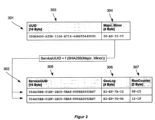
- the first vehicle data telegram 301 originates from an iBeacon. It can thus be received by mobile devices running the iOS operating system without requiring any special configuration; only the Bluetooth radio network must be activated on the respective device.
- the on-board computer which generates the major and minor data 304 for the first vehicle transmitter (the iBeacon), also configures the second vehicle transmitter (the Travelbeacon) via a data network connection, for whose second data telegrams 302 the app searches.
- the vehicle receiver also receives first and second data telegrams 301, 302. It also extracts from the major and minor values 304, from the GeoLog 306 and from the RunCounter 307 Trip recording data; this will be part of the data that the on-board computer writes to the second log file.
- Figure 3 Describes the exemplary reception of a sequence of 9 vehicle data telegrams by a mobile device and by the vehicle receiver.
- the mobile device is located on bus "4711"; the vehicle receiver is the one on bus "4711".
- the bus's on-board computer changes the random number in the major and minor values of the iBeacon and the associated service UUID of the travel beacon.
- the iBeacon's data telegrams change.
- the mobile device receives such a changed first data telegram 301.1 and then two further second data telegrams 302.1. (Data telegrams #4-6 from Figure 3 )
- the mobile device is always ready to receive the first 301 data telegrams from iBeacons according to the Bluetooth standard for iOS operating systems, provided, of course, that its Bluetooth radio network is switched on.
- Figure 4 shows the exemplary data content of five terminal data records 400 for the embodiment.
- the mobile device received a total of nine data telegrams, namely four first data telegrams (from an iBeacon) and five second data telegrams from a travel beacon.
- the data required for journey reconstruction was contained partly in the first data telegrams and partly in the second data telegrams. This means that a mobile device can only create and send to the central computer as many device data sets 400 as it has received second data telegrams, because only the receipt of a second data telegram provides the database for a complete device data set 400.
- Figure 5 shows the exemplary data content of five vehicle reference data sets 500 for the exemplary embodiment.
- an on-board computer of a vehicle can only create and send to the central computer as many vehicle reference data sets 500 as it has received second data telegrams.
- the on-board computer now creates the vehicle reference data records 500 according to Fig. 5
- the vehicle reference data set 500 consists partly of received data 501 and partly of the vehicle's own data 502.
- the on-board computer extracts the received GeoLog 503, received RunCounter 504, and received Vehicle Number 505 (all shown in decimal notation) from the received data telegrams.
- This data is supplemented with data added by the on-board computer, here the on-board computer's own GeoLog 506, the on-board RunCounter 507, the on-board vehicle number 508 (all shown in decimal notation), the on-board location data 509, and a date/time stamp 510.
- this data represents the core data content of the vehicle reference data sets 500. It will be clear to those skilled in the art that vehicle reference data sets may contain other, additional, or fewer data fields in practice.
Landscapes
- Business, Economics & Management (AREA)
- Finance (AREA)
- Physics & Mathematics (AREA)
- General Physics & Mathematics (AREA)
- Mobile Radio Communication Systems (AREA)
Claims (15)
- Procédé pour déterminer automatiquement la présence d'un utilisateur équipé d'un terminal mobile dans un véhicule, dans lequel au moins un émetteur de véhicule est installé dans le véhicule et dans lequel le terminal mobile est connecté via un réseau de données mobile à un ordinateur central, le procédé comprenant les étapes de:a) transmission répétée, par l'émetteur du véhicule, d'au moins un télégramme de données de véhicule, le télégramme de données de véhicule contenant au moins une identification unique du véhicule à l'échelle du système,b) réception, par le terminal mobile, d'au moins un télégramme de données relatives au véhicule,c) création, par le terminal mobile, d'un ensemble de données de terminal à partir du télégramme de données de véhicule, l'ensemble de données de terminal contenant au moins l'identification unique à l'échelle du système du véhicule, une identification unique à l'échelle du système du terminal et un horodatage,d) transmission, par le terminal mobile, dudit au moins un ensemble de données de terminal à l'ordinateur central,e) réception, par l'ordinateur central, de l'ensemble de données d'au moins un dispositif terminal en provenance d'au moins un terminal mobile,f) détermination, par l'ordinateur central, de la présence du terminal mobile dans le véhicule sur la base de l'ensemble de données de terminal,caractérisé en ce quele télégramme de données du véhicule contient un code en plus de l'identification unique du véhicule à l'échelle du système,le code varie en fonction du temps,le code est généré du côté du véhicule et transmis à l'ordinateur central à partir d'un dispositif de communication du côté du véhicule,et que l'ordinateur central détermine l'authenticité de l'ensemble de données reçues d'au moins un terminal sur la base du code.
- Procédé selon la revendication 1, caractérisé en ce que les étapes du procédé sont répétés.
- Procédé selon l'une quelconque des revendications précédentes, caractérisée en ce que le code est généré en fonction de l'emplacement.
- Procédé selon la revendication 1, caractérisé en ce que pour chaque télégramme de données de véhicule, un nouveau code est généré.
- Procédé selon l'une quelconque des revendications précédentes, caractérisé en ce que le dispositif de communication côté véhicule stocke plusieurs codes et les transmet à l'ordinateur central dans un paquet.
- Procédé selon l'une quelconque des revendications précédentes, caractérisé en ce qu'après l'étape c), le terminal mobile stocke plusieurs ensembles de données de terminal et les transmet à l'ordinateur central dans un paquet.
- Procédé selon l'une quelconque des revendications précédentes, caractérisée par l'utilisation d'une balise Bluetooth en tant qu'émetteur de véhicule.
- Procédé selon l'une quelconque des revendications précédentes, caractérisée par l'utilisation d'une balise Bluetooth Low Energy en tant qu'émetteur du véhicule.
- Procédé selon l'une quelconque des revendications précédentes, caractérisé en ce que les étapes du procédé sont commandées par une application mobile ("app") sur le terminal mobile.
- Procédé selon l'une quelconque des revendications précédentes, caractérisé en ce que le terminal mobile est un smartphone, une tablette, un appareil de jeu, un ordinateur portable, un netbook, des lunettes de données ou une montre intelligente.
- Système de détermination automatique de la présence d'un utilisateur équipé d'un terminal mobile dans un véhicule, le système comprenantau moins un véhicule,au moins un émetteur dans le véhicule,un ordinateur central avec au moins une base de données,un réseau de données mobile,un dispositif de communication côté véhicule,et un réseau de données de véhicule externe,dans lequel l'au moins un émetteur de véhicule est configuré pour transmettre de manière répétée des télégrammes de données de véhicule, un télégramme de données de véhicule contenant au moins une identification unique du véhicule à l'échelle du système,le terminal mobile est configuré pour recevoir des télégrammes de données de véhicule et pour créer des ensembles de données de terminal à partir des télégrammes de données de véhicule reçus, un ensemble de données de terminal contenant au moins l'identification unique à l'échelle du système du véhicule, une identification à l'échelle du système du dispositif terminal et un horodatage,dans lequel le terminal mobile est configuré pour transmettre les ensembles de données de terminal à l'ordinateur central,dans lequel l'ordinateur central est configuré pour recevoir les ensembles de données de terminal,et dans lequel l'ordinateur central est configuré pour déterminer la présence du terminal mobile dans le véhicule sur la base de l'ensemble de données de terminal,caractérisé en ce queles télégrammes de données de véhicule contiennent un code en plus de l'identification unique du véhicule à l'échelle du système,le code est généré du côté du véhicule avant d'être transmis à l'ordinateur central,le code varie en fonction du temps,le dispositif de communication côté véhicule est configuré pour transmettre à l'ordinateur central les codes créés côté véhicule,et que l'ordinateur central est configuré pour déterminer l'authenticité des ensembles de données de terminal reçus sur la base du code.
- Système selon la revendication 11, caractérisé en ce que l'émetteur du véhicule est une balise Bluetooth.
- Système selon la revendication 11, caractérisé en ce que l'émetteur du véhicule est une balise Bluetooth Low Energy.
- Système selon l'une quelconque des revendications 11 à 13, caractérisé en ce que le terminal mobile est contrôlable par une application mobile ("app").
- Système selon l'une quelconque des revendications 11 à 14, caractérisé en ce que le terminal mobile est un smartphone, une tablette, un appareil de jeu, un ordinateur portable, un netbook, des lunettes de données ou une montre intelligente.
Priority Applications (1)
| Application Number | Priority Date | Filing Date | Title |
|---|---|---|---|
| EP17154545.2A EP3358532B1 (fr) | 2017-02-03 | 2017-02-03 | Procédé de détermination automatique de l'utilisation de véhicules |
Applications Claiming Priority (1)
| Application Number | Priority Date | Filing Date | Title |
|---|---|---|---|
| EP17154545.2A EP3358532B1 (fr) | 2017-02-03 | 2017-02-03 | Procédé de détermination automatique de l'utilisation de véhicules |
Publications (2)
| Publication Number | Publication Date |
|---|---|
| EP3358532A1 EP3358532A1 (fr) | 2018-08-08 |
| EP3358532B1 true EP3358532B1 (fr) | 2025-04-09 |
Family
ID=58158770
Family Applications (1)
| Application Number | Title | Priority Date | Filing Date |
|---|---|---|---|
| EP17154545.2A Active EP3358532B1 (fr) | 2017-02-03 | 2017-02-03 | Procédé de détermination automatique de l'utilisation de véhicules |
Country Status (1)
| Country | Link |
|---|---|
| EP (1) | EP3358532B1 (fr) |
Families Citing this family (4)
| Publication number | Priority date | Publication date | Assignee | Title |
|---|---|---|---|---|
| EP4120212A1 (fr) * | 2021-07-16 | 2023-01-18 | Deutsche Telekom AG | Procédé de détection de la présence et/ou de l'enregistrement d'événement dans un lieu ou dans une zone spatiale, système de détection de la présence et/ou de l'enregistrement d'événement, module radio courte portée fixe ou module radio courte portée mobile, programme informatique, support lisible par ordinateur |
| DE102023201555A1 (de) * | 2023-02-22 | 2024-08-22 | Zf Friedrichshafen Ag | Tracking von Kindern mittels CiCo- oder BiBo-System |
| DE102023116909A1 (de) * | 2023-06-27 | 2025-01-02 | Scheidt & Bachmann Gmbh | Fahrzeuganordnung für ein Personentransportfahrzeug |
| WO2025011757A1 (fr) * | 2023-07-11 | 2025-01-16 | Sonobeacon Gmbh | Procédé et système d'analyse d'utilisation de moyen de transport |
Family Cites Families (8)
| Publication number | Priority date | Publication date | Assignee | Title |
|---|---|---|---|---|
| WO2000033258A1 (fr) | 1998-11-30 | 2000-06-08 | Joachim Albrecht | Procede de decompte du prix d'un billet lors de l'utilisation des transports publics |
| EP1667074B1 (fr) | 2004-12-02 | 2019-10-30 | mcity GmbH | Méthode automatique de détecter l'utilisation des vehicules payants et de facturer le prix du voyage |
| DE102012101638A1 (de) * | 2012-02-29 | 2013-08-29 | Rainer Söllner | Verfahren und System zur Übermittlung von Verkehrsmittel-/Fahrstreckendaten in einem Verkehrsmittel an ein Mobilfunkgerät und zur Ermittlung von abrechnungsrelevanten Daten |
| EP2658291B1 (fr) | 2012-04-24 | 2018-06-13 | Scheidt & Bachmann GmbH | Procédé de détermination automatique du lieu de résidence d'une personne |
| EP2657900A1 (fr) | 2012-04-24 | 2013-10-30 | Scheidt & Bachmann GmbH | Procédé de détermination automatique d'informations utiles |
| EP2811444A1 (fr) * | 2013-06-07 | 2014-12-10 | Scheidt & Bachmann GmbH | Procédé et dispositif de détermination de l'utilisation d'un service d'un moyen de transport public |
| WO2015127095A1 (fr) * | 2014-02-19 | 2015-08-27 | Swyft Technologies Inc. | Surveillance de transport sans fil automatique et transactions pour dispositifs mobiles |
| GB2527499A (en) * | 2014-05-29 | 2015-12-30 | Mastercard International Inc | Travel data of transport system users |
-
2017
- 2017-02-03 EP EP17154545.2A patent/EP3358532B1/fr active Active
Also Published As
| Publication number | Publication date |
|---|---|
| EP3358532A1 (fr) | 2018-08-08 |
Similar Documents
| Publication | Publication Date | Title |
|---|---|---|
| EP2624233A1 (fr) | Procédé de contrôle dans un système de péage routier | |
| EP2924662B1 (fr) | Unité embarquée et procédé de surveillance du fonctionnement dans un système de péage routier | |
| EP2325807B2 (fr) | Procédé et dispositifs de production d'informations de péage dans un système de péage routier | |
| DE102012101638A1 (de) | Verfahren und System zur Übermittlung von Verkehrsmittel-/Fahrstreckendaten in einem Verkehrsmittel an ein Mobilfunkgerät und zur Ermittlung von abrechnungsrelevanten Daten | |
| EP3358532A1 (fr) | Procédé de détermination automatique de l'utilisation de véhicules | |
| DE102009052675A1 (de) | Verfahren zur Verteilung von Informationen an mobile Endgeräte | |
| EP2500869B1 (fr) | Procédé de mise à disposition de services de données en fonction du lieu | |
| EP3383094B1 (fr) | Système et procédé de transfert de contenus ayant un grand volume de données dans un laps de temps court | |
| EP2490183B1 (fr) | Appareil de véhicule, réseau ad hoc et procédé pour un système de péage routier | |
| EP2360646A1 (fr) | Procédé de communication DSRC | |
| EP2541502A1 (fr) | Procédé de détermination du paiement automatique dans un système de péage routier | |
| DE112019003236T5 (de) | Fahrzeug-zu-Fahrzeug-Kommunikationssystem und Fahrzeugkommunikationsvorrichtung | |
| DE102009054795A1 (de) | Fahrzeug-zu-X Kommunikation über mobile Geräte, die mit dem Fahrzeug verbunden sind | |
| EP3358533B1 (fr) | Procédé de détermination automatique de l'utilisation de véhicules | |
| DE102013226532A1 (de) | Verfahren zur Vorbereitung und Durchführung einer Fahrt einer Mehrzahl zu einem Verbund zusammengeschlossener Fahrzeuge und Kommunikationssystem | |
| WO2017167568A1 (fr) | Procédé et système de détection de la présence et/ou de détermination du prix de transport d'un passager d'un véhicule | |
| EP3817406B1 (fr) | Procédé de fonctionnement d'une application de service installée sur un dispositif terminal mobile | |
| EP4099182B1 (fr) | Procédé de création et de mise à jour d'une banque de données pour dispositif de charge et véhicule automobile | |
| DE202016001371U1 (de) | Fahrzeugeinrichtung, System und straßenseitige Einrichtung zur Durchführung wenigstens einer Transaktion | |
| EP3211605A1 (fr) | Dispositif de vehicule, systeme, dispositif cote route et procede d'execution d'au moins une transaction | |
| DE102016212163A1 (de) | Verfahren und Steuervorrichtung zum Betreiben einer Basisstation | |
| DE102020121114A1 (de) | Verfahren und System zum Aufbauen einer digitalen Umgebungskarte für Verkehrsteilnehmer sowie Kraftfahrzeug für das System | |
| DE102014201664B4 (de) | Verfahren und Fortbewegungsmittel zur Bereitstellung von mobilen Sensordaten auf einem stationären Server | |
| DE102022202678B3 (de) | Kommunikationsmodul, Fahrzeug, Verfahren für ein Kommunikationsmodul und Computerprogramm | |
| EP2242024B1 (fr) | Procédé, composants et systèmes de production de transactions de péage |
Legal Events
| Date | Code | Title | Description |
|---|---|---|---|
| PUAI | Public reference made under article 153(3) epc to a published international application that has entered the european phase |
Free format text: ORIGINAL CODE: 0009012 |
|
| STAA | Information on the status of an ep patent application or granted ep patent |
Free format text: STATUS: REQUEST FOR EXAMINATION WAS MADE |
|
| 17P | Request for examination filed |
Effective date: 20171222 |
|
| AK | Designated contracting states |
Kind code of ref document: A1 Designated state(s): AL AT BE BG CH CY CZ DE DK EE ES FI FR GB GR HR HU IE IS IT LI LT LU LV MC MK MT NL NO PL PT RO RS SE SI SK SM TR |
|
| AX | Request for extension of the european patent |
Extension state: BA ME |
|
| STAA | Information on the status of an ep patent application or granted ep patent |
Free format text: STATUS: EXAMINATION IS IN PROGRESS |
|
| 17Q | First examination report despatched |
Effective date: 20210520 |
|
| P01 | Opt-out of the competence of the unified patent court (upc) registered |
Effective date: 20230525 |
|
| GRAP | Despatch of communication of intention to grant a patent |
Free format text: ORIGINAL CODE: EPIDOSNIGR1 |
|
| STAA | Information on the status of an ep patent application or granted ep patent |
Free format text: STATUS: GRANT OF PATENT IS INTENDED |
|
| INTG | Intention to grant announced |
Effective date: 20241114 |
|
| GRAS | Grant fee paid |
Free format text: ORIGINAL CODE: EPIDOSNIGR3 |
|
| GRAA | (expected) grant |
Free format text: ORIGINAL CODE: 0009210 |
|
| STAA | Information on the status of an ep patent application or granted ep patent |
Free format text: STATUS: THE PATENT HAS BEEN GRANTED |
|
| AK | Designated contracting states |
Kind code of ref document: B1 Designated state(s): AL AT BE BG CH CY CZ DE DK EE ES FI FR GB GR HR HU IE IS IT LI LT LU LV MC MK MT NL NO PL PT RO RS SE SI SK SM TR |
|
| REG | Reference to a national code |
Ref country code: GB Ref legal event code: FG4D Free format text: NOT ENGLISH |
|
| REG | Reference to a national code |
Ref country code: CH Ref legal event code: EP |
|
| REG | Reference to a national code |
Ref country code: DE Ref legal event code: R096 Ref document number: 502017016781 Country of ref document: DE |
|
| REG | Reference to a national code |
Ref country code: IE Ref legal event code: FG4D Free format text: LANGUAGE OF EP DOCUMENT: GERMAN |
|
| REG | Reference to a national code |
Ref country code: NL Ref legal event code: MP Effective date: 20250409 |
|
| PG25 | Lapsed in a contracting state [announced via postgrant information from national office to epo] |
Ref country code: NL Free format text: LAPSE BECAUSE OF FAILURE TO SUBMIT A TRANSLATION OF THE DESCRIPTION OR TO PAY THE FEE WITHIN THE PRESCRIBED TIME-LIMIT Effective date: 20250409 |
|
| PG25 | Lapsed in a contracting state [announced via postgrant information from national office to epo] |
Ref country code: FI Free format text: LAPSE BECAUSE OF FAILURE TO SUBMIT A TRANSLATION OF THE DESCRIPTION OR TO PAY THE FEE WITHIN THE PRESCRIBED TIME-LIMIT Effective date: 20250409 Ref country code: ES Free format text: LAPSE BECAUSE OF FAILURE TO SUBMIT A TRANSLATION OF THE DESCRIPTION OR TO PAY THE FEE WITHIN THE PRESCRIBED TIME-LIMIT Effective date: 20250409 Ref country code: PT Free format text: LAPSE BECAUSE OF FAILURE TO SUBMIT A TRANSLATION OF THE DESCRIPTION OR TO PAY THE FEE WITHIN THE PRESCRIBED TIME-LIMIT Effective date: 20250811 |
|
| REG | Reference to a national code |
Ref country code: LT Ref legal event code: MG9D |
|
| PG25 | Lapsed in a contracting state [announced via postgrant information from national office to epo] |
Ref country code: NO Free format text: LAPSE BECAUSE OF FAILURE TO SUBMIT A TRANSLATION OF THE DESCRIPTION OR TO PAY THE FEE WITHIN THE PRESCRIBED TIME-LIMIT Effective date: 20250709 Ref country code: GR Free format text: LAPSE BECAUSE OF FAILURE TO SUBMIT A TRANSLATION OF THE DESCRIPTION OR TO PAY THE FEE WITHIN THE PRESCRIBED TIME-LIMIT Effective date: 20250710 |
|
| PG25 | Lapsed in a contracting state [announced via postgrant information from national office to epo] |
Ref country code: PL Free format text: LAPSE BECAUSE OF FAILURE TO SUBMIT A TRANSLATION OF THE DESCRIPTION OR TO PAY THE FEE WITHIN THE PRESCRIBED TIME-LIMIT Effective date: 20250409 |
|
| PG25 | Lapsed in a contracting state [announced via postgrant information from national office to epo] |
Ref country code: BG Free format text: LAPSE BECAUSE OF FAILURE TO SUBMIT A TRANSLATION OF THE DESCRIPTION OR TO PAY THE FEE WITHIN THE PRESCRIBED TIME-LIMIT Effective date: 20250409 |
|
| PG25 | Lapsed in a contracting state [announced via postgrant information from national office to epo] |
Ref country code: HR Free format text: LAPSE BECAUSE OF FAILURE TO SUBMIT A TRANSLATION OF THE DESCRIPTION OR TO PAY THE FEE WITHIN THE PRESCRIBED TIME-LIMIT Effective date: 20250409 |
|
| PG25 | Lapsed in a contracting state [announced via postgrant information from national office to epo] |
Ref country code: RS Free format text: LAPSE BECAUSE OF FAILURE TO SUBMIT A TRANSLATION OF THE DESCRIPTION OR TO PAY THE FEE WITHIN THE PRESCRIBED TIME-LIMIT Effective date: 20250709 |
|
| PG25 | Lapsed in a contracting state [announced via postgrant information from national office to epo] |
Ref country code: IS Free format text: LAPSE BECAUSE OF FAILURE TO SUBMIT A TRANSLATION OF THE DESCRIPTION OR TO PAY THE FEE WITHIN THE PRESCRIBED TIME-LIMIT Effective date: 20250809 |
|
| PG25 | Lapsed in a contracting state [announced via postgrant information from national office to epo] |
Ref country code: LV Free format text: LAPSE BECAUSE OF FAILURE TO SUBMIT A TRANSLATION OF THE DESCRIPTION OR TO PAY THE FEE WITHIN THE PRESCRIBED TIME-LIMIT Effective date: 20250409 |
|
| REG | Reference to a national code |
Ref country code: DE Ref legal event code: R097 Ref document number: 502017016781 Country of ref document: DE |
|
| PG25 | Lapsed in a contracting state [announced via postgrant information from national office to epo] |
Ref country code: DK Free format text: LAPSE BECAUSE OF FAILURE TO SUBMIT A TRANSLATION OF THE DESCRIPTION OR TO PAY THE FEE WITHIN THE PRESCRIBED TIME-LIMIT Effective date: 20250409 Ref country code: SM Free format text: LAPSE BECAUSE OF FAILURE TO SUBMIT A TRANSLATION OF THE DESCRIPTION OR TO PAY THE FEE WITHIN THE PRESCRIBED TIME-LIMIT Effective date: 20250409 |
|
| PG25 | Lapsed in a contracting state [announced via postgrant information from national office to epo] |
Ref country code: CZ Free format text: LAPSE BECAUSE OF FAILURE TO SUBMIT A TRANSLATION OF THE DESCRIPTION OR TO PAY THE FEE WITHIN THE PRESCRIBED TIME-LIMIT Effective date: 20250409 |
|
| PG25 | Lapsed in a contracting state [announced via postgrant information from national office to epo] |
Ref country code: EE Free format text: LAPSE BECAUSE OF FAILURE TO SUBMIT A TRANSLATION OF THE DESCRIPTION OR TO PAY THE FEE WITHIN THE PRESCRIBED TIME-LIMIT Effective date: 20250409 |
|
| PG25 | Lapsed in a contracting state [announced via postgrant information from national office to epo] |
Ref country code: SK Free format text: LAPSE BECAUSE OF FAILURE TO SUBMIT A TRANSLATION OF THE DESCRIPTION OR TO PAY THE FEE WITHIN THE PRESCRIBED TIME-LIMIT Effective date: 20250409 Ref country code: RO Free format text: LAPSE BECAUSE OF FAILURE TO SUBMIT A TRANSLATION OF THE DESCRIPTION OR TO PAY THE FEE WITHIN THE PRESCRIBED TIME-LIMIT Effective date: 20250409 |
|
| PG25 | Lapsed in a contracting state [announced via postgrant information from national office to epo] |
Ref country code: IT Free format text: LAPSE BECAUSE OF FAILURE TO SUBMIT A TRANSLATION OF THE DESCRIPTION OR TO PAY THE FEE WITHIN THE PRESCRIBED TIME-LIMIT Effective date: 20250409 |
|
| PLBE | No opposition filed within time limit |
Free format text: ORIGINAL CODE: 0009261 |
|
| STAA | Information on the status of an ep patent application or granted ep patent |
Free format text: STATUS: NO OPPOSITION FILED WITHIN TIME LIMIT |
|
| REG | Reference to a national code |
Ref country code: CH Ref legal event code: L10 Free format text: ST27 STATUS EVENT CODE: U-0-0-L10-L00 (AS PROVIDED BY THE NATIONAL OFFICE) Effective date: 20260218 |
|
| REG | Reference to a national code |
Ref country code: CH Ref legal event code: U11 Free format text: ST27 STATUS EVENT CODE: U-0-0-U10-U11 (AS PROVIDED BY THE NATIONAL OFFICE) Effective date: 20260301 |
|
| 26N | No opposition filed |
Effective date: 20260112 |
|
| PGFP | Annual fee paid to national office [announced via postgrant information from national office to epo] |
Ref country code: CH Payment date: 20260301 Year of fee payment: 10 |
|
| PG25 | Lapsed in a contracting state [announced via postgrant information from national office to epo] |
Ref country code: LT Free format text: LAPSE BECAUSE OF FAILURE TO SUBMIT A TRANSLATION OF THE DESCRIPTION OR TO PAY THE FEE WITHIN THE PRESCRIBED TIME-LIMIT Effective date: 20250409 |
|
| PGFP | Annual fee paid to national office [announced via postgrant information from national office to epo] |
Ref country code: DE Payment date: 20260427 Year of fee payment: 10 |
|
| PG25 | Lapsed in a contracting state [announced via postgrant information from national office to epo] |
Ref country code: SE Free format text: LAPSE BECAUSE OF FAILURE TO SUBMIT A TRANSLATION OF THE DESCRIPTION OR TO PAY THE FEE WITHIN THE PRESCRIBED TIME-LIMIT Effective date: 20250409 |