EP3359538B1 - 1,4,8-triazaphenanthren-derivate zur behandlung von eurodegenerativen erkrankungen - Google Patents
1,4,8-triazaphenanthren-derivate zur behandlung von eurodegenerativen erkrankungen Download PDFInfo
- Publication number
- EP3359538B1 EP3359538B1 EP16778417.2A EP16778417A EP3359538B1 EP 3359538 B1 EP3359538 B1 EP 3359538B1 EP 16778417 A EP16778417 A EP 16778417A EP 3359538 B1 EP3359538 B1 EP 3359538B1
- Authority
- EP
- European Patent Office
- Prior art keywords
- alkyl
- quinoxaline
- pyrido
- compound
- alkoxy
- Prior art date
- Legal status (The legal status is an assumption and is not a legal conclusion. Google has not performed a legal analysis and makes no representation as to the accuracy of the status listed.)
- Active
Links
- 0 *c1nc2ccc(**C=C3)c3c2nc1* Chemical compound *c1nc2ccc(**C=C3)c3c2nc1* 0.000 description 3
- NNWLFPYWXDOLBO-UHFFFAOYSA-N Cc1c(-c(cc2)ccc2Cl)nc(c2cccnc2cc2)c2n1 Chemical compound Cc1c(-c(cc2)ccc2Cl)nc(c2cccnc2cc2)c2n1 NNWLFPYWXDOLBO-UHFFFAOYSA-N 0.000 description 1
- WELZXEMKZSYDDG-UHFFFAOYSA-N c1cc(-c2cnc(ccc3ncccc33)c3n2)cnc1 Chemical compound c1cc(-c2cnc(ccc3ncccc33)c3n2)cnc1 WELZXEMKZSYDDG-UHFFFAOYSA-N 0.000 description 1
- NBDOJNUIRIUEFY-UHFFFAOYSA-N c1cc2cc(-c3cnc(ccc4ncccc44)c4n3)cnc2cc1 Chemical compound c1cc2cc(-c3cnc(ccc4ncccc44)c4n3)cnc2cc1 NBDOJNUIRIUEFY-UHFFFAOYSA-N 0.000 description 1
- ZADCNZFSUIWBJQ-UHFFFAOYSA-N c1ccc(cc(cc2)-c3nc4c(cccn5)c5ccc4nc3)c2c1 Chemical compound c1ccc(cc(cc2)-c3nc4c(cccn5)c5ccc4nc3)c2c1 ZADCNZFSUIWBJQ-UHFFFAOYSA-N 0.000 description 1
Classifications
-
- C—CHEMISTRY; METALLURGY
- C07—ORGANIC CHEMISTRY
- C07D—HETEROCYCLIC COMPOUNDS
- C07D471/00—Heterocyclic compounds containing nitrogen atoms as the only ring hetero atoms in the condensed system, at least one ring being a six-membered ring with one nitrogen atom, not provided for by groups C07D451/00 - C07D463/00
- C07D471/02—Heterocyclic compounds containing nitrogen atoms as the only ring hetero atoms in the condensed system, at least one ring being a six-membered ring with one nitrogen atom, not provided for by groups C07D451/00 - C07D463/00 in which the condensed system contains two hetero rings
- C07D471/04—Ortho-condensed systems
-
- A—HUMAN NECESSITIES
- A61—MEDICAL OR VETERINARY SCIENCE; HYGIENE
- A61P—SPECIFIC THERAPEUTIC ACTIVITY OF CHEMICAL COMPOUNDS OR MEDICINAL PREPARATIONS
- A61P25/00—Drugs for disorders of the nervous system
- A61P25/14—Drugs for disorders of the nervous system for treating abnormal movements, e.g. chorea, dyskinesia
- A61P25/16—Anti-Parkinson drugs
-
- A—HUMAN NECESSITIES
- A61—MEDICAL OR VETERINARY SCIENCE; HYGIENE
- A61P—SPECIFIC THERAPEUTIC ACTIVITY OF CHEMICAL COMPOUNDS OR MEDICINAL PREPARATIONS
- A61P25/00—Drugs for disorders of the nervous system
- A61P25/28—Drugs for disorders of the nervous system for treating neurodegenerative disorders of the central nervous system, e.g. nootropic agents, cognition enhancers, drugs for treating Alzheimer's disease or other forms of dementia
Definitions
- the present invention relates to 1,4,8-triazaphenanthrene derivatives, as well as their methods of preparation, the pharmaceutical compositions comprising them and their use as a medicament, in particular in the treatment of neurodegenerative diseases.
- neurodegenerative diseases such as Alzheimer's disease or Parkinson's disease, due to the increase in life expectancy.
- Alzheimer's disease is a disease of the brain tissue that causes progressive and irreversible loss of cognitive function, and affects approximately 24 million people worldwide.
- the first symptom is the loss of memory of recent events (amnesia), then cognitive deficits extend to the areas of language (aphasia), organization of movements (apraxia), visual recognition (agnosia) and functions executive (such as decision making and planning).
- Parkinson's disease also affects the central nervous system but causes motor disorders of progressive and irreversible course, with in particular deficits in the organization of movements and tremors in the body.
- the inventors of the present invention have already demonstrated the potential of hybrid compounds having an amino-quinoxaline nucleus in the treatment of neurodegenerative diseases ( WO 2012/131080 ).
- the inventors have surprisingly discovered that the 1,4,8-triazaphenanthrene derivatives also possess neuroprotective activity and are capable of crossing the blood-brain barrier.
- the term “pharmaceutically acceptable” is intended to denote what is useful in the preparation of a pharmaceutical composition which is generally safe, non-toxic and neither biologically nor otherwise undesirable and which is acceptable for veterinary use as well as human pharmaceutical.
- Solvates acceptable for the pharmaceutical use of the compounds according to the present invention include conventional solvates such as those formed, during the last step of the process for preparing the compounds according to the invention, with the reaction solvent (s).
- the reaction solvent s
- (C 1 -C 6 ) alkyl group is meant, within the meaning of the present invention, a saturated, linear or branched hydrocarbon chain, comprising 1 to 6, preferably 1 to 4, carbon atoms.
- a saturated, linear or branched hydrocarbon chain comprising 1 to 6, preferably 1 to 4, carbon atoms.
- (C 1 -C 6 ) alkoxy group is meant, within the meaning of the present invention, a (C 1 -C 6 ) alkyl group as defined above, linked to the rest of the molecule via of an oxygen atom.
- a (C 1 -C 6 ) alkyl group as defined above linked to the rest of the molecule via of an oxygen atom.
- methoxy, ethoxy, propoxy, isopropoxy, butoxy or even tert- butoxy groups are examples of methoxy, ethoxy, propoxy, isopropoxy, butoxy or even tert- butoxy groups.
- (C 2 -C 6 ) alkynyl group is meant, within the meaning of the present invention, a hydrocarbon chain, linear or branched, comprising at least one triple bond and comprising 2 to 6 carbon atoms.
- the (C 2 -C 6 ) alkynyl group will advantageously comprise one and only one triple bond.
- aryl group is meant, within the meaning of the present invention, an aromatic hydrocarbon group, preferably comprising from 6 to 10 carbon atoms and comprising one or more contiguous rings. it will advantageously be a phenyl or naphthyl group.
- the aryl group When the aryl group is substituted, it may advantageously be substituted by one or more groups chosen from a halogen atom, (C 1 -C 6 ) alkyl, (C 1 -C 6 ) alkoxy, aryl, N 3 , NO 2 , OH, NH 2 , and -NH - ((C 1 -C 6 ) alkyl); preferably chosen from a halogen atom, (C 1 -C 6 ) alkyl, (C 1 -C 6 ) alkoxy, OH and aryl.
- heteroaryl is meant, within the meaning of the present invention, an aromatic group comprising one or more, in particular 1 or 2, attached hydrocarbon rings, in which one or more carbon atoms, advantageously 1 to 4 and even more advantageously 1 or 2, are each replaced by a heteroatom chosen from sulfur, nitrogen and oxygen atoms and in which each cycle advantageously comprises 5 to 7 links, preferably 5 or 6 links.
- it will be an aromatic group comprising 1 or 2 attached hydrocarbon rings, each ring being 5 or 6 members, in which 1 or 2 carbon atoms are each replaced by a heteroatom chosen from sulfur atoms, d nitrogen and oxygen, preferably chosen from nitrogen and oxygen atoms, such as nitrogen.
- heteroaryl groups are furyl, thienyl, pyrrolyl, isoxazolyl, thiazolyl, isothiazolyl, imidazolyl, pyrazolyl, oxadiazolyl, thiadiazolyl, triazolyl, tetrazolyl, pyridyl, pyridazinyl, pyrimidinyl, pyrazinyl quinoxalyl or indyl. It will especially be a pyridyl, quinoxalyl or quinolyl group, in particular pyridyl or quinolyl.
- the heteroaryl group When the heteroaryl group is substituted, it may advantageously be substituted by one or more groups chosen from a halogen atom, (C 1 -C 6 ) alkyl, (C 1 -C 6 ) alkoxy, aryl, N 3 , NO 2 , OH, NH 2 , and -NH - ((C 1 -C 6 ) alkyl); preferably chosen from a halogen atom, (C 1 -C 6 ) alkyl, (C 1 -C 6 ) alkoxy, OH and aryl.
- groups chosen from a halogen atom, (C 1 -C 6 ) alkyl, (C 1 -C 6 ) alkoxy, aryl, N 3 , NO 2 , OH, NH 2 , and -NH - ((C 1 -C 6 ) alkyl) preferably chosen from a halogen atom, (C 1 -C 6 ) alkyl, (C
- halogen atom is meant, within the meaning of the present invention, the fluorine, chlorine, bromine and iodine atoms, preferably fluorine, chlorine and bromine atoms.
- unsaturated is meant, within the meaning of the present invention, that the hydrocarbon chain can comprise one or more unsaturation (s), advantageously one.
- stereoisomer is meant, within the meaning of the present invention, a geometric isomer or an optical isomer.
- the geometric isomers result from the different position of the substituents on a double bond which can then have a Z or E configuration.
- optical isomers result in particular from the different position in the space of the substituents on a carbon atom comprising 4 different substituents. This carbon atom then constitutes a chiral or asymmetric center.
- Optical isomers include diastereoisomers and enantiomers.
- the optical isomers which are images of each other in a mirror but not superimposable are designated by "enantiomers”.
- the optical isomers which are neither superimposable nor images of one another in a mirror are designated by “diastereoisomers”.
- racemic mixture A mixture containing equal amounts of two individual enantiomeric forms of opposite chirality is referred to as a "racemic mixture".
- chiral group is meant, within the meaning of the present invention, a group which is not superimposable on its image in a mirror.
- Such a chiral group may in particular comprise a chiral carbon atom, that is to say a carbon atom substituted by four different substituents (including hydrogen).
- a compound according to the present invention will thus advantageously be a compound of the following formula (la): or a pharmaceutically acceptable salt and / or solvate thereof, a stereoisomer, or a mixture of stereoisomers in all proportions, in particular a mixture of enantiomers, and in particular a racemic mixture, wherein R 1 and R 2 are as defined above or below.
- R 1 and R 2 each represent, independently of one another, a hydrogen atom; a (C 1 -C 6 ) alkyl group; or an aryl or heteroaryl group optionally substituted, in particular by one or more groups chosen from a halogen atom, (C 1 -C 6 ) alkyl, (C 1 -C 6 ) alkoxy, aryl, N 3 , NO 2 , OH , NH 2 , and -NH - ((C 1 -C 6 ) alkyl); preferably chosen from a halogen atom, (C 1 -C 6 ) alkyl, (C 1 -C 6 ) alkoxy, OH and aryl; especially chosen from (C 1 -C 6 ) alkoxy and OH.
- R 1 and R 2 may each represent, independently of one another, a hydrogen atom; a (C 1 -C 6 ) alkyl group; or a phenyl, naphthyl, pyridyl, quinoxalyl or quinolyl group, in particular phenyl, naphthyl, pyridyl or quinolyl, optionally substituted, in particular by one or more groups chosen from a halogen atom, (C 1 -C 6 ) alkyl, (C 1 -C 6 ) alkoxy, aryl, N 3 , NO 2 , OH, NH 2 , and -NH - ((C 1 -C 6 ) alkyl); preferably chosen from a halogen atom, (C 1 -C 6 ) alkyl, (C 1 -C 6 ) alkoxy, OH and aryl; especially chosen from (C 1 -C 6 ) alkoxy and OH.
- R 1 will represent a hydrogen atom or a (C 1 -C 6 ) alkyl group such as methyl, in particular a hydrogen atom.
- R 2 will represent an aryl or heteroaryl group, preferably aryl, optionally substituted, in particular by one or more groups chosen from a halogen atom, (C 1 -C 6 ) alkyl , (C 1 -C 6 ) alkoxy, aryl, N 3 , NO 2 , OH, NH 2 , and -NH - ((C 1 -C 6 ) alkyl); preferably chosen from a halogen atom, (C 1 -C 6 ) alkyl, (C 1 -C 6 ) alkoxy, OH and aryl; especially chosen from (C 1 -C 6 ) alkoxy and OH.
- R 2 may represent in particular a phenyl, naphthyl, pyridyl, quinoxalyl or quinolyl group, in particular phenyl, naphthyl, pyridyl or quinolyl, preferably phenyl, optionally substituted, in particular by one or more groups chosen from a halogen atom, (C 1 -C 6 ) alkyl, (C 1 -C 6 ) alkoxy, aryl, N 3 , NO 2 , OH, NH 2 , and -NH - ((C 1 -C 6 ) alkyl) ; preferably chosen from a halogen atom, (C 1 -C 6 ) alkyl, (C 1 -C 6 ) alkoxy, OH and aryl; especially chosen from (C 1 -C 6 ) alkoxy and OH.
- R 1 will represent a hydrogen atom or a (C 1 -C 6 ) alkyl group such as methyl, in particular a hydrogen atom
- R 2 will represent a group an aryl group or heteroaryl, preferably aryl, optionally substituted, in particular by one or more groups chosen from a halogen atom, (C 1 -C 6 ) alkyl, (C 1 -C 6 ) alkoxy, aryl, N 3 , NO 2 , OH, NH 2 , and -NH - ((C 1 -C 6 ) alkyl); preferably chosen from a halogen atom, (C 1 -C 6 ) alkyl, (C 1 -C 6 ) alkoxy, OH and aryl; especially chosen from (C 1 -C 6 ) alkoxy and OH.
- R 2 may represent in particular a phenyl, naphthyl, pyridyl, quinoxalyl or quinolyl group, in particular phenyl, naphthyl, pyridyl or quinolyl, preferably phenyl, optionally substituted, in particular by one or more groups chosen from a halogen atom, (C 1 -C 6 ) alkyl, (C 1 -C 6 ) alkoxy, aryl, N 3 , NO 2 , OH, NH 2 , and -NH - ((C 1 -C 6 ) alkyl); preferably chosen from a halogen atom, (C 1 -C 6 ) alkyl, (C 1 -C 6 ) alkoxy, OH and aryl; especially chosen from (C 1 -C 6 ) alkoxy and OH.
- the (C 1 -C 6 ) alkyl group may more particularly be a methyl, n -butyl, s -butyl, t -butyl or n -hexyl group, such as methyl ;
- the (C 2 -C 6 ) alkynyl group may more particularly be an ethynyl group;
- the optionally substituted aryl group may more particularly be a phenyl or naphthyl group, preferably phenyl, optionally substituted, such as a phenyl, 1-naphthyl, 2-naphthyl, m- hydroxyphenyl, m- methoxyphenyl, p- methoxyphenyl, p - chlorophenyl, p -fluorophenyl, p -methylphenyl, 3,4-dimethoxyphenyl, 3,4,5-trimethoxyphenyl, 3,4-
- the compounds of formula (I) can in particular be chosen from the following compounds: Iac Yaf Iaa Iag Iad I am Iae Iah Iai Iaj Iak Ibn Ibl Ibf Ibo Ibp Ibh Ibq Ibj Xbc and their pharmaceutically acceptable salts and / or solvates.
- the present invention also relates to a compound of formula (I) as defined above, for its use as a medicament, in particular as a neurotrophic or neuroprotective medicament, and more particularly for its use in the treatment or prevention neurodegenerative disease.
- the present invention also relates to the use of a compound of formula (I) as defined above for the manufacture of a medicament, in particular of a neurotrophic or neuroprotective medicament, and more particularly for the manufacture of a medicament intended for the treatment or prevention of a neurodegenerative disease.
- the present invention also relates to a method of treatment or prevention of a neurodegenerative disease comprising the administration of an effective amount of a compound of formula (I) as defined above to a patient in need thereof.
- the neurodegenerative disease may more particularly be Alzheimer's disease, Parkinson's disease, multiple sclerosis or amyotrophic lateral sclerosis (ALS) also called Charcot disease, and in particular Parkinson's disease.
- ALS amyotrophic lateral sclerosis
- the present invention also relates to a pharmaceutical composition
- a pharmaceutical composition comprising at least one compound of formula (I) as defined above and a pharmaceutically acceptable vehicle, excluding a solution of pyrido [3,2-f] quinoxaline in water.
- composition is meant, within the meaning of the present invention, a composition having curative or preventive properties with regard to diseases, such as neurodegenerative diseases in the present case, intended to be administered to an animal, in particular a mammal such as man.
- compositions according to the invention can be formulated for parenteral administration (for example subcutaneous, intraperitoneal, intramuscular, intravenous, intracranial, intrathecal, etc.), oral, sublingual, transdermal, local or rectal, intended for mammals , including man.
- parenteral administration for example subcutaneous, intraperitoneal, intramuscular, intravenous, intracranial, intrathecal, etc.
- oral, sublingual, transdermal, local or rectal intended for mammals , including man.
- the dosage varies depending on the treatment and the condition in question.
- the active ingredient in the pharmaceutical compositions of the present invention, can be administered in unit administration forms, in admixture with conventional pharmaceutical carriers, to animals or humans.
- Suitable oral administration unit forms include tablets, capsules, powders, granules and oral solutions or suspensions, and parenteral, especially intraperitoneal, administration forms.
- the main active ingredient is mixed with a pharmaceutical vehicle such as gelatin, starch, lactose, magnesium stearate, talc, gum arabic or the like.
- a pharmaceutical vehicle such as gelatin, starch, lactose, magnesium stearate, talc, gum arabic or the like.
- the tablets can be coated with sucrose or other suitable materials or they can be treated so that they have a prolonged or delayed activity and that they continuously release a predetermined quantity of active principle.
- a preparation in capsules is obtained by mixing the active ingredient with a diluent and by pouring the mixture obtained into soft or hard capsules.
- a preparation in the form of a syrup or elixir may contain the active ingredient together with a sweetener, an antiseptic, as well as a flavoring agent and an appropriate color.
- the water dispersible powders or granules may contain the active ingredient in admixture with dispersing or wetting agents, or suspending agents, as well as with flavor correctors or sweeteners.
- aqueous suspensions, isotonic saline solutions or sterile injectable solutions which contain pharmacologically compatible dispersing agents and / or wetting agents.
- the active principle can also be formulated in the form of microcapsules, optionally with one or more additive supports.
- the compounds of the invention can be used at doses of between 0.01 mg and 1000 mg per day, given in a single dose once a day or administered in several doses throughout the day, for example twice a day. day in equal doses.
- the dose administered per day is advantageously between 5 mg and 500 mg, even more advantageously between 10 mg and 200 mg. It may be necessary to use doses outside these ranges which the skilled person will be able to realize himself.
- the pharmaceutical composition as defined above may further comprise another active principle, useful in particular in the treatment or prevention of neurodegenerative diseases, and advantageously chosen from acetylcholinesterase inhibitors such as donepezil , galanthamine, rivastigmine, memantine and tacrine; monoamine oxidase inhibitors such as selegiline or rasagiline; catecholamine O-methyltransferase inhibitors such as entacapone; glutamatergic inhibitors such as amantadine and baclofen; cholinergic agonists such as sabcomelin; dopamine agonists such as pergolide, cabergoline, ropirinole and pramipexole; analogs or precursors of neuromediators such as L-3,4-dihydroxyphenylalanine; and anticholinergics such as trihexyphenidyl and tropatepine.
- acetylcholinesterase inhibitors such as donepezil , galanthamine,
- the present invention also relates to a pharmaceutical composition according to the invention for its use as a neurotrophic or neuroprotective drug, and more particularly for its use in the treatment or prevention of a neurodegenerative disease, in particular as defined above.
- the present invention also relates to the use of a pharmaceutical composition according to the invention for the manufacture of a neurotrophic or neuroprotective medicament, and more particularly for the manufacture of a medicament intended for the treatment or prevention of a neurodegenerative disease , in particular as defined above.
- the present invention also relates to a method of treatment or prevention of a neurodegenerative disease, in particular as defined above, comprising the administration of an effective amount of a pharmaceutical composition according to the invention to a patient in need thereof.
- aminoquinoxaline of formula (II) are commercially available or can be easily prepared by methods well known to those skilled in the art. Their synthesis is notably described in the previous international applications WO 2010/007179 and WO 2012/131080 . Synthesis methods are also illustrated in the experimental part below.
- This coupling reaction will advantageously be carried out in the presence of a base such as K 2 CO 3 or K 3 PO 4 , and in particular an iodide such as KI, NaI or nBu 4 NI.
- a base such as K 2 CO 3 or K 3 PO 4
- an iodide such as KI, NaI or nBu 4 NI.
- This reaction can advantageously be carried out in a solvent such as dimethylfomamide (DMF), dioxane, NMP (N-methyl pyrrolidinone), DMSO (dimethylsulfoxide), DMPU (1,3-dimethyl-3,4,5, 6-tetrahydro-2 (1H) -pyrimidinone), HMPA (hexamethylphosporamide), DMA (dimethylacetamide) or a mixture of these, and in particular DMF, in particular at a temperature between 50 and 140 ° C., especially about 80 ° C.
- a solvent such as dimethylfomamide (DMF), dioxane, NMP (N-methyl pyrrolidinone), DMSO (dimethylsulfoxide), DMPU (1,3-dimethyl-3,4,5, 6-tetrahydro-2 (1H) -pyrimidinone), HMPA (hexamethylphosporamide), DMA (dimethylacetamide) or a mixture of these, and in particular
- the cycloisomerization reaction will advantageously be carried out in the presence of a catalyst such as a copper (I) derivative (for example CuCl, Cu 2 O, CuOTf, CuPF 6 or CuBF 4 ) or a silver salt (for eg AgNO 3 , Ag 2 CO 3 , AgF, AgPF 6 , AgOTf, AgBF 4 or CF 3 C (O) OAg).
- a catalyst such as a copper (I) derivative (for example CuCl, Cu 2 O, CuOTf, CuPF 6 or CuBF 4 ) or a silver salt (for eg AgNO 3 , Ag 2 CO 3 , AgF, AgPF 6 , AgOTf, AgBF 4 or CF 3 C (O) OAg).
- a catalyst such as a copper (I) derivative (for example CuCl, Cu 2 O, CuOTf, CuPF 6 or CuBF 4 ) or a silver salt (for eg AgNO 3 , Ag 2 CO 3 , AgF, AgPF 6
- This reaction can advantageously be carried out in a solvent such as dimethyl sulfoxide (DMSO), chloroform, toluene, DMF, dioxane, NMP, DMPU, HMPA, DMA or a mixture thereof, and in particular DMSO or toluene, especially at a temperature between 70 and 160 ° C, especially around 120 ° C.
- a solvent such as dimethyl sulfoxide (DMSO), chloroform, toluene, DMF, dioxane, NMP, DMPU, HMPA, DMA or a mixture thereof, and in particular DMSO or toluene, especially at a temperature between 70 and 160 ° C, especially around 120 ° C.
- step (b1) is carried out from a compound of formula (IIIa) to give a derivative of the 1,4,8-triazaphenanthrene type.
- the salification step may be carried out under conditions well known to those skilled in the art, in the presence of an acid or a pharmaceutically acceptable base, in particular as defined above.
- this solvation generally takes place in the last stage of the process, the solvent of the solvated form being in this case the solvent of the reaction medium.
- This coupling can be carried out under the conditions of the Suzuki reaction well known to those skilled in the art.
- This coupling reaction will thus advantageously be carried out in the presence of a palladium catalyst such as Pd (PPh 3 ) 4 , Pd (OAc) 2 , PdCl 2 (dppf) or PdCl 2 (PPh 3 ) 2 , in particular PdCl 2 (PPh 3 ) 2 .
- a palladium catalyst such as Pd (PPh 3 ) 4 , Pd (OAc) 2 , PdCl 2 (dppf) or PdCl 2 (PPh 3 ) 2 , in particular PdCl 2 (PPh 3 ) 2 .
- a base such as K 2 CO 3 , K 3 PO 4 , Na 2 CO 3 , Cs 2 CO 3 , KOH, CsOH or NaOH, in particular K 2 CO 3 .
- This reaction can advantageously be carried out in a solvent chosen from dioxane, water and their mixtures, more particularly in a water / dioxane mixture, in particular at reflux.
- the boronic acid derivative used may more particularly be a boronic acid of formula R 3 -B (OH) 2 .
- This coupling can be carried out under the conditions of the Negishi reaction well known to those skilled in the art.
- This coupling reaction will thus advantageously be carried out in the presence of a palladium catalyst such as Pd (PPh 3 ) 4 .
- a nickel catalyst can also be envisaged.
- This reaction can advantageously be carried out in a solvent such as tetrahydrofuran (THF).
- a solvent such as tetrahydrofuran (THF).
- This coupling can be carried out under the conditions of the Stille reaction well known to those skilled in the art.
- This coupling reaction will thus advantageously be carried out in the presence of a palladium catalyst such as Pd (PPh 3 ) 4 .
- a palladium catalyst such as Pd (PPh 3 ) 4 .
- the addition of copper salts such as CuTC, CuDPP, or CuCl can be used to facilitate the reaction.
- a 1 , A 2 and A 3 will advantageously be identical, and will represent in particular Me or Bu, in particular Bu.
- This coupling can be carried out under the conditions of the Kumada reaction well known to those skilled in the art.
- This coupling reaction will thus advantageously be carried out in the presence of a palladium catalyst such as Pd (PPh 3 ) 4 or PdCl 2 (dppf) or a nickel catalyst such as Ni (acac) 2 , NiCl 2 (dppp) , NiCl 2 (dppe) or NiCl 2 (dppb).
- a palladium catalyst such as Pd (PPh 3 ) 4 or PdCl 2 (dppf)
- a nickel catalyst such as Ni (acac) 2 , NiCl 2 (dppp) , NiCl 2 (dppe) or NiCl 2 (dppb).
- This coupling can be carried out under the conditions of the Hiyama reaction well known to those skilled in the art.
- This coupling reaction will thus advantageously be carried out in the presence of a palladium catalyst such as PdCl 2 , Pd 2 dba 3 , Pd (OAc) 2 , Pd (PPh 3 ) 4 or PdCl 2 (dppf) or a catalyst with nickel such as Ni (acac) 2 , NiCl 2 (dppp), NiCl 2 (dppe), NiCl 2 (dppb), NiBr 2 .diglyme or NiCl 2 .glyme.
- a palladium catalyst such as PdCl 2 , Pd 2 dba 3 , Pd (OAc) 2 , Pd (PPh 3 ) 4 or PdCl 2 (dppf) or a catalyst with nickel such as Ni (acac) 2 , NiCl 2 (dppp), NiCl 2 (dppe), NiCl 2 (dppb), NiBr 2 .diglyme or NiCl 2 .glyme.
- This coupling reaction will also advantageously be carried out in the presence of a source of fluoride such as TBAF (tetra- n- butylammonium fluoride), TASF (tris (dimethylamino) sulfonium difluorotrimethylsilicate) or CsF, or else hydroxide such as NaOH or KOH
- a source of fluoride such as TBAF (tetra- n- butylammonium fluoride), TASF (tris (dimethylamino) sulfonium difluorotrimethylsilicate) or CsF
- hydroxide such as NaOH or KOH
- a 1 , A 2 and A 3 will advantageously be identical, and will represent in particular Me or Et.
- This coupling can be carried out under the conditions of the Sonogashira reaction well known to those skilled in the art.
- This coupling reaction will thus advantageously be carried out in the presence of a palladium catalyst such as Pd (PPh 3 ) 4 or PdCl 2 (PPh 3 ) 2 , in particular PdCl 2 (PPh 3 ) 2 , and a copper salt ( I) such as CuI or CuBr, in particular CuI.
- a palladium catalyst such as Pd (PPh 3 ) 4 or PdCl 2 (PPh 3 ) 2 , in particular PdCl 2 (PPh 3 ) 2
- a copper salt ( I) such as CuI or CuBr, in particular CuI.
- a base such as a tertiary or secondary amine, for example NHEt 2 , NEt 3 or NEt ( i Pr) 2 , in particular NEt 3 .
- This reaction can advantageously be carried out in a solvent chosen from THF (tetrahydrofuran), acetonitrile, ethyl acetate and their mixtures, more particularly in THF, in particular at reflux.
- a solvent chosen from THF (tetrahydrofuran), acetonitrile, ethyl acetate and their mixtures, more particularly in THF, in particular at reflux.
- step (a2) will advantageously be carried out by a reaction from Suzuki or Sonogashira.
- the protecting group for the alkyne function may be a silylated group such as SiA 4 A 5 A 6 where A 4 , A 5 and A 6 each represent, independently of one another, a (C 1 -C 6 ) alkyl group. It may more particularly be a trimethylsilyl group (TMS).
- TMS trimethylsilyl group
- Step (c2) see previous step (c1).
- the compound obtained by one of the two above processes can be separated from the reaction medium by methods well known to those skilled in the art, such as for example by extraction, evaporation of the solvent or also by precipitation and filtration.
- Step 1 To a solution of compound IIbl (343 mg, 1.29 mmol, 1 equiv.) In anhydrous dimethylformamide are added 178 mg of K 2 CO 3 (1.29 mmol, 1 equiv.), 214 mg of KI (1.29 mmol, 1 equiv.) And 0.288 ml of propargyl bromide (1.7 mmol, 2 equiv., 80% in toluene). The reaction medium is then heated at 80 ° C for 24 h. After cooling, the reaction medium is hydrolyzed with a saturated solution of K 2 CO 3 , then extracted 3 times with ethyl acetate.
- Step 2 CuCl (26 mg, 0.183 mmol, 1.1 equiv) is added to a solution of compound IIIbl (50 mg, 0.166 mmol, 1 equiv. In DMSO mL). After 8 h at 120 ° C., the reaction medium is cooled to ambient temperature, then 28% NH 3 (5 ml), CH 2 Cl 2 (10 ml) and H 2 O (10 ml) are added. The aqueous phase is extracted 3 times with CH 2 Cl 2 , then the combined organic phases are washed 2 times with an aqueous NaCl solution dried over MgSO 4 , then concentrated.
- Trimethylsilylacetylene (260 ⁇ L, 1.85 mmol, 4 equiv.), CuI (4.3mg, 0.0232) are added to a solution of the lad chlorinated compound (100 mg, 0.464 mmol, 1equiv.) In THF 5 mL. mmol, 0.05 equiv.), PdCl 2 (PPh 3 ) 2 (6.5 mg, 0.0093mmol, 0.02 equiv) and then triethylamine (3 mL). The reaction mixture is brought to reflux under an argon atmosphere for 48 h, then cooled to room temperature. The reaction mixture is filtered on a silica pad, and eluted with ethyl acetate.
- the compounds according to the invention have been evaluated for their neuroprotective and neurodifferentative (or neuritogenic) properties.
- the compounds according to the invention were tested in a model of degeneration of dopaminergic neurons originating from primary cultures of embryonic ventral mesencephalon according to the protocol described in the article by S. Guerreiro et al. (2008).
- the primary cultures of embryonic ventral midbrain thus obtained are mixed cultures containing approximately 50% of neuronal cells and 50% of glial cells.
- dopaminergic neurons represent 3% of total neurons, the majority of neurons from these cultures being GABAergic.
- glial cells they are mainly represented by astrocytes (> 95% of glial cells).
- the results show a particularly significant activity of the compounds lac, Iae , Iag, Iaj and Iam with a percentage of survival almost equal to 10 ⁇ M to that induced by db-AMPc at 1 mM.
- Compound Iac is a 3-phenyl-1,4,8-triazaphenanthrene. In vitro, it has neuroprotective activity at a concentration of 1 ⁇ M for optimal activity at 10 ⁇ M.
- the physicochemical properties of the compound Iac were compared with the theoretical physicochemical properties expected for an active compound at the central level then the passage of the blood-brain barrier was evaluated.
- the compound Iac has, in terms of physicochemical properties, most of the characteristics necessary for its diffusion through the BBB.
- this type of prediction is limited to the passive diffusion of the molecule and does not take into account possible interactions with the barrier, such as metabolism by the BBB cytochromes, as well as the phenomena of efflux pumps or transport. active. An in vivo study of the BBB passage is therefore essential to confirm this prediction.
- the aim of this study is to verify, by HPLC coupled with mass spectrometry, the presence of the compound Iac in the cerebral parenchyma after subchronic intravenous treatment in mice.
- the study is carried out with CD-1 mice.
- a solution of compound Iac is prepared at 0.5 mg / ml in physiological saline containing 10% of Cremophor EL®. The same dose of this solution is administered to 6 mice intravenously (2 ⁇ L / g).
- mice After 5 min, 3 mice are sacrificed. After 30 min, the other 3 mice are sacrificed.
- Blood is drawn and the plasma is separated by centrifugation.
- the brain is removed after an intracardiac infusion.
- the samples are frozen and stored at -80 ° C before processing.
- Plasma 400 ⁇ L of each plasma sample is mixed with 1 mL of acetonitrile to precipitate the proteins and extract the compound Iac.
- Brain Each brain is ground in 400 ⁇ L of physiological saline. 800 ⁇ L of acetonitrile are added to extract the compound Iac.
- the treated samples are agitated using a vortex for 3 minutes, then placed in a sonicator for 3 minutes also.
- the precipitated proteins and the solid residues are sedimented by centrifugation (15,000 g, 5 minutes at 4 ° C).
- the supernatants are transferred to a microplate to be analyzed by HPLC-MS / MS.
- the samples are analyzed with the method described below, the detection and the quantification, based on the area of the peaks, being carried out by HPLC-MS / MS in MRM mode.
- the solutions of the standard ranges are analyzed in the same series of injections.
- the average volume of plasma of a mouse is evaluated at 1.5 ml.
- an FIA analysis is performed as described below in order to choose the analysis conditions for MS / MS. It is carried out by injecting directly into the mass spectrometer the pure Iac product diluted in a solvent. There is therefore no separation in HPLC since it is a control solution and not a brain extract. A solution of compound Iac is injected in continuous flow into the mass spectrometer, and voltages are adjusted to obtain an optimal intensity for the molecular ion and one or two son ions obtained by fragmentation of the molecular ion.
- a solution of compound Iac is prepared at 1 mg / ml in acetonitrile. This solution is diluted 1/100.
- the analysis is developed with a UHPLC coupled to a Shimadzu LC-MS 8030 triple quadrupole.
- the system is used in FIA mode. 1 ⁇ L of the diluted solution is injected.
- the molecular ion analysis conditions are optimized (source, ionization).
- the m / z ratio of the molecular ion is adjusted.
- the voltages are adjusted (Q1, collision chamber, Q3).
- the best fragment (s) are selected and their m / z ratios adjusted.
- a 10 mM solution of compound Iac in DMSO is diluted to a concentration of the order of ⁇ M to perfect the method of analysis.
- the chromatographic conditions are optimized (solvents, pH, elution mode, flow rate, etc.).
- the chromatograms are recorded by preferably injecting 1 ⁇ L of solution.
- a standard range is produced from 5 dilutions of compound Iac in mouse plasma.
- the plasma samples are processed and extracted as indicated above.
- the samples are prepared in the same way as for the calibration but in this case, the plasma does not contain compound Iac.
- the latter is present in acetonitrile in sufficient quantity to reach a concentration equivalent to 1 ⁇ M in plasma.
- Brain calibration A standard range is produced from 5 dilutions of compound Iac in the brains of mice crushed in 400 ⁇ L of saline solution. The samples in brains are processed and extracted as indicated above.
- the samples are prepared in an identical way to that for the calibration but in this case, the brain does not contain compound Iac.
- the latter is present in acetonitrile in an amount sufficient to arrive at an amount equivalent to 1 nmol per brain:
- Compound I ac is capable of crossing the BBB in vivo after intravenous administration.
- mice were treated with Iac (50 and 100 mg / kg, po, in 1% carboxymethylcellulose and 0.5% tween 80) for 11 consecutive days.
- MPTP (20 mg / kg; intraperitoneally) or saline solution for controls was administered on treatment days 4 to 8. All mice were killed on day 12 following the final administration of the treatment, then the striatum tissue has been dissected for analysis.
- Iac 50 mg / kg and 100 mg / kg increased DA levels in the striatum (64% and 78%, respectively). HVA levels of the striatum were also increased (25%) but only at the highest dose of Iac (100 mg / kg). A reduction in the ratio (DOPAC + HVA) / DA) was observed at the doses of 50 mg / kg (30%) and 100 mg / kg (28%) of Iac. There was no significant effect of Iac treatment on DOPAC levels. At a dose of 2x25 mg / kg / day ( per os ), almost complete survival of the TH + neurons was observed.
Landscapes
- Health & Medical Sciences (AREA)
- Chemical & Material Sciences (AREA)
- Organic Chemistry (AREA)
- Engineering & Computer Science (AREA)
- Bioinformatics & Cheminformatics (AREA)
- Biomedical Technology (AREA)
- Neurology (AREA)
- Neurosurgery (AREA)
- General Chemical & Material Sciences (AREA)
- Animal Behavior & Ethology (AREA)
- Veterinary Medicine (AREA)
- Medicinal Chemistry (AREA)
- Nuclear Medicine, Radiotherapy & Molecular Imaging (AREA)
- Pharmacology & Pharmacy (AREA)
- Life Sciences & Earth Sciences (AREA)
- Chemical Kinetics & Catalysis (AREA)
- General Health & Medical Sciences (AREA)
- Public Health (AREA)
- Psychology (AREA)
- Hospice & Palliative Care (AREA)
- Psychiatry (AREA)
- Pharmaceuticals Containing Other Organic And Inorganic Compounds (AREA)
Claims (14)
- Verbindung der folgenden Formel (I):
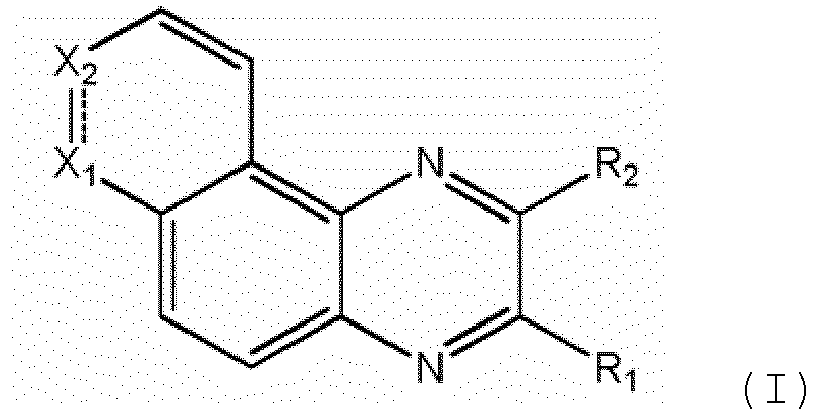
wobei:------- für eine Einfach- oder Doppelbindung, vorzugsweise eine Doppelbindung steht,- X1 steht für:▪ NR1a, wenn------ für eine Einfachbindung steht, und▪ N, wenn------ für eine Doppelbindung steht,- X2 steht für:▪ CR2aR2b, wenn------ für eine Einfachbindung steht, und▪ CR2c, wenn------ für eine Doppelbindung steht,- R1 und R2 jeweils unabhängig voneinander für ein Wasserstoffatom; ein Halogenatom wie etwa ein Chlor-, Brom- oder Fluoratom; eine gesättigte oder ungesättigte, lineare oder verzweigte Kohlenwasserstoffkette, die 1 bis 10, vorzugsweise 1 bis 6 Kohlenstoffatome umfasst; ein gegebenenfalls substituiertes Aryl; oder ein gegebenenfalls substituiertes Heteroaryl stehen,- R1a und R2c jeweils unabhängig voneinander für ein Wasserstoffatom oder eine (C1-C6)-Alkylgruppe stehen, und- R2a und R2b jeweils unabhängig voneinander für eine (C1-C6)-Alkylgruppe stehen,mit Ausnahme:-- von Pyrido[3,2-f]chinoxalin,-- von 2,3-Dimethylpyrido[3,2-f]chinoxalin,-- von 2,3,8-Trimethylpyrido[3,2-f]chinoxalin, und-- von 2,3-Diphenylpyrido[3,2-f]chinoxalin. - Verbindung nach Anspruch 1, dadurch gekennzeichnet, dass es sich um eine Verbindung der folgenden Formel (Ia):

wobei R1 und R2 wie in Anspruch 1 definiert sind. - Verbindung nach einem der Ansprüche 1 und 2, dadurch gekennzeichnet, dass R1 und R2 jeweils unabhängig voneinander stehen für:- ein Wasserstoffatom,- ein Halogenatom wie etwa Chlor, Fluor und Brom,- ein (C1-C6)-Alkyl,- ein (C2-C6)-Alkinyl, das vorteilhafterweise eine, und nur eine Dreifachbindung umfasst,- ein Aryl, das gegebenenfalls durch eine oder mehrere Gruppen substituiert ist, ausgewählt aus einem Halogenatom, (C1-C6)-Alkyl, (C1-C6)-Alkoxy, Aryl, N3, NO2, OH, NH2, und -NH-((C1-C6)-Alkyl) ; vorzugsweise ausgewählt aus einem Halogenatom, (C1-C6)-Alkyl, (C1-C6)-Alkoxy, OH und Aryl; vor allem ausgewählt aus (C1-C6)-Alkoxy und OH, oder- ein Heteroaryl, das gegebenenfalls durch eine oder mehrere Gruppen substituiert ist, ausgewählt aus einem Halogenatom, (C1-C6)-Alkyl, (C1-C6)-Alkoxy, Aryl, N3, NO2, OH, NH2, und -NH- ((C1-C6)-Alkyl) ; vorzugsweise ausgewählt aus einem Halogenatom, (C1-C6)-Alkyl, (C1-C6)-Alkoxy, OH und Aryl; vor allem ausgewählt aus (C1-C6)-Alkoxy und OH.
- Verbindung nach einem der Ansprüche 1 bis 3, dadurch gekennzeichnet, dass R1 und R2 jeweils unabhängig voneinander für ein Wasserstoffatom; eine (C1-C6)-Alkylgruppe; oder eine Aryl- oder Heteroarylgruppe stehen, die gegebenenfalls durch eine oder mehrere Gruppen substituiert ist, ausgewählt aus einem Halogenatom, (C1-C6)-Alkyl, (C1-C6)-Alkoxy, Aryl, N3, NO2, OH, NH2, und -NH-((C1-C6)-Alkyl); vorzugsweise ausgewählt aus einem Halogenatom, (C1-C6)-Alkyl, (C1-C6)-Alkoxy, OH und Aryl; vor allem ausgewählt aus (C1-C6)-Alkoxy und OH.
- Verbindung nach einem der Ansprüche 1 bis 4, dadurch gekennzeichnet, dass R1 und R2 jeweils unabhängig voneinander für ein Wasserstoffatom; eine (C1-C6)-Alkylgruppe; oder eine Phenyl-, Naphthyl-, Pyridyl-, Chinoxalyl- oder Chinolylgruppe stehen, die gegebenenfalls durch eine oder mehrere Gruppen substituiert ist, ausgewählt aus einem Halogenatom, (C1-C6)-Alkyl, (C1-C6)-Alkoxy, Aryl, N3, NO2, OH, NH2, und -NH-((C1-C6)-Alkyl); vorzugsweise ausgewählt aus einem Halogenatom, (C1-C6)-Alkyl, (C1-C6)-Alkoxy, OH und Aryl; vor allem ausgewählt aus (C1-C6)-Alkoxy und OH.
- Verbindung nach einem der Ansprüche 1 bis 4, dadurch gekennzeichnet, dass R1 für einen Wasserstoff oder eine (C1-C6)-Alkylgruppe steht, und R2 für eine Aryl- oder Heteroaryl-, vorzugsweise Arylgruppe steht, die gegebenenfalls durch eine oder mehrere Gruppen substituiert ist, ausgewählt aus einem Halogenatom, (C1-C6)-Alkyl, (C1-C6)-Alkoxy, Aryl, N3, NO2, OH, NH2, und -NH-((C1-C6)-Alkyl); vorzugsweise ausgewählt aus einem Halogenatom, (C1-C6)-Alkyl, (C1-C6)-Alkoxy, OH und Aryl; vor allem ausgewählt aus (C1-C6)-Alkoxy und OH.
- Verbindung nach Anspruch 6, dadurch gekennzeichnet, dass R2 für eine Phenyl-, Naphthyl-, Pyridyl-, Chinoxalyl- oder Chinolyl-, vorzugsweise Phenylgruppe steht, die gegebenenfalls durch eine oder mehrere Gruppen substituiert ist, ausgewählt aus einem Halogenatom, (C1-C6)-Alkyl, (C1-C6)-Alkoxy, Aryl, N3, NO2, OH, NH2, und -NH-((C1-C6)-Alkyl); vorzugsweise ausgewählt aus einem Halogenatom, (C1-C6)-Alkyl, (C1-C6)-Alkoxy, OH und Aryl; vor allem ausgewählt aus (C1-C6)-Alkoxy und OH.
- Verbindung nach Anspruch 1, dadurch gekennzeichnet, dass sie aus den folgenden Verbindungen:
Iac 
Iaf 
Iad 
Iag 
Iae 
Iam 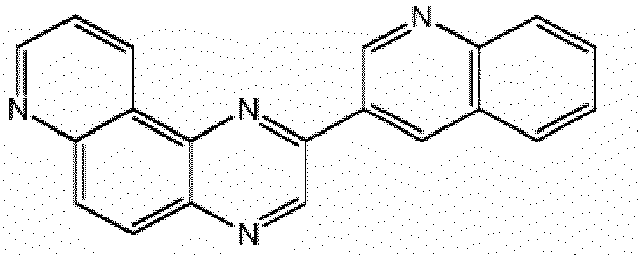
Iai 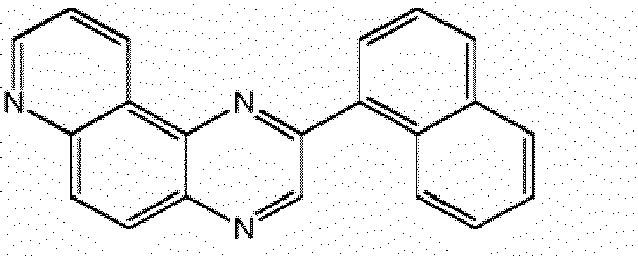
Iah 
Iak 
Iaj 
Ibl 
Ibn 
Ibo 
Ibf 
Ibh 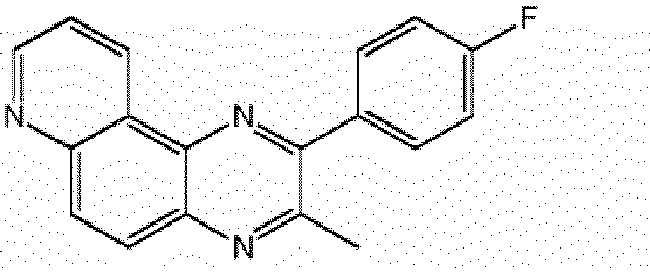
Ibp 
Ibj 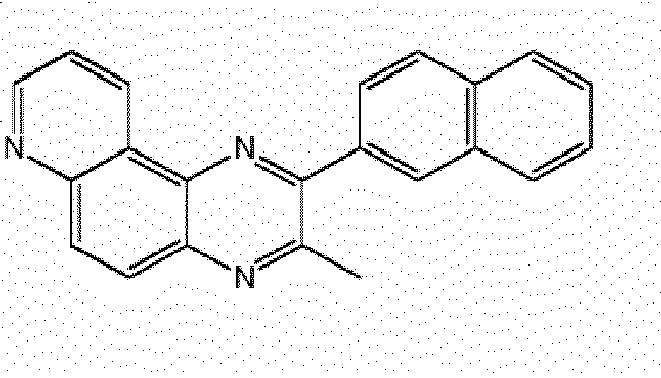
Ibq 
Xbc 
- Verbindung nach einem der Ansprüche 1 bis 8 oder Pyrido[3,2-f]chinoxalin, 2,3-Dimethylpyrido[3,2-f]chinoxalin, 2,3,8-Trimethylpyrido[3,2-f]chinoxalin oder 2,3-Diphenylpyrido[3,2-f]chinoxalin zur deren/dessen Verwendung als Arzneimittel, insbesondere als neurotropes oder neuroprotektives Arzneimittel.
- Verbindung nach einem der Ansprüche 1 bis 8 oder Pyrido[3,2-f]chinoxalin, 2,3-Dimethylpyrido[3,2-f]chinoxalin, 2,3,8-Trimethylpyrido[3,2-f]chinoxalin oder 2,3-Diphenylpyrido[3,2-f]chinoxalin zur deren/dessen Verwendung in der Behandlung oder der Vorbeugung einer neurodegenerativen Erkrankung.
- Verbindung zu deren Verwendung nach Anspruch 10, dadurch gekennzeichnet, dass die neurodegenerative Erkrankung die Alzheimer-Erkrankung, die Parkinson-Erkrankung, die multiple Sklerose oder die amyotrophe Lateralsklerose, und insbesondere die Parkinson-Erkrankung ist.
- Pharmazeutische Zusammensetzung, die mindestens eine Verbindung, ausgewählt aus den Verbindungen der Formel (I) nach einem der Ansprüche 1 bis 8, Pyrido[3,2-f]chinoxalin, 2,3-Dimethylpyrido[3,2-f]chinoxalin, 2,3,8-Trimethylpyrido[3,2-f]chinoxalin und 2,3-Diphenylpyrido[3,2-f]chinoxalin; und ein pharmazeutisch verträgliches Vehikel umfasst,
mit Ausnahme einer Lösung von Pyrido[3,2-f]chinoxalin in Wasser. - Verfahren zur Herstellung einer Verbindung der Formel (I) nach Anspruch 1, von Pyrido[3,2-f]chinoxalin, von 2,3-Dimethylpyrido[3,2-f]chinoxalin, von 2,3,8-Trimethylpyrido[3,2-f]chinoxalin oder von 2,3-Diphenylpyrido[3,2-f]chinoxalin, das die folgenden aufeinanderfolgenden Schritte umfasst:(a1) Koppeln zwischen einem Aminochinoxalin der folgenden Formel (II):

mit einem Propargylhalogenid der Formel CH≡C-CHR2cHal oder CH≡C-CR2aR2bHal, wobei R2a, R2b und R2c wie in Anspruch 1 definiert sind und Hal für ein Halogenatom wie etwa Cl, Br oder I steht,
um eine Verbindung der folgenden Formel (IIIA) oder (IIIb): (b1) Cycloisomerisieren der im vorhergehenden Schritt erhaltenen Verbindung der Formel (IIIa) oder (IIIb) und Aromatisieren, wenn
------ für eine Doppelbindung steht, um eine Verbindung der Formel (I) zu bilden, und(c1) gegebenenfalls Versalzen und/oder Solvatisieren der im vorhergehenden Schritt erhaltenen Verbindung der Formel (I), um ein pharmazeutisch verträgliches Salz und/oder Solvat der Verbindung der Formel (I) zu bilden. - Verfahren zur Herstellung einer Verbindung der Formel (I) nach Anspruch 1, wobei mindestens eines aus R1 und R2 für eine gesättigte oder ungesättigte, lineare oder verzweigte Kohlenwasserstoffkette, die 1 bis 10 Kohlenstoffatome umfasst; ein gegebenenfalls substituiertes Aryl; oder ein gegebenenfalls substituiertes Heteroaryl steht; von 2,3-Dimethylpyrido[3,2-f]chinoxalin, von 2,3,8-Trimethylpyrido[3,2-f]chinoxalin oder von 2,3-Diphenylpyrido[3,2-f]chinoxalin, das die folgenden aufeinanderfolgenden Schritte umfasst:(a2) Koppeln einer Verbindung der Formel (I) nach Anspruch 1, wobei mindestens eines aus R1 und R2 für ein Halogenatom wie etwa Cl, Br oder I steht,
mit einem Boronsäurederivat der Formel R3-B(R4)2 oder R3-BF3 -K+, wobei R3 für eine gesättigte oder ungesättigte, lineare oder verzweigte Kohlenwasserstoffkette, die 1 bis 10 Kohlenstoffatome umfasst; ein gegebenenfalls substituiertes Aryl; oder ein gegebenenfalls substituiertes Heteroaryl steht, und R4 für eine (C1-C6)-Alkyl-, OH- oder (C1-C6)-Alkoxygruppe steht,
oder mit einem Zinkderivat der Formel R3-Zn-Hal, wobei R3 wie oben definiert ist und Hal für ein Halogenatom wie etwa Cl, Br oder I steht,
oder mit einem Stannanderivat der Formel R3-SnA1A2A3, wobei R3 wie oben definiert ist und A1, A2 und A3, identisch oder verschieden, jeweils für eine (C1-C6)-Alkylgruppe stehen,
oder mit einem Magnesiumderivat der Formel R3-Mg-Hal, wobei R3 und Hal wie oben definiert sind,
oder mit einem Siliciumderivat der Formel R3-SiMe2OH, R3-SiF3 oder R3-Si(OA1)(OA2)(OA3), wobei R3, A1, A2 und A3 wie oben definiert sind,
oder mit einem Alkin der Formel R'-C≡CH, wobei R' für eine Schutzgruppe oder eine gesättigte oder ungesättigte, lineare oder verzweigte Kohlenwasserstoffkette steht, die 1 bis 8 Kohlenstoffatome umfasst,(b2) wenn der Schritt (a2) mit einem Alkin der Formel R'-C≡CH ausgeführt wurde, wobei R' für eine Schutzgruppe steht, Entschützen der Schutzgruppe der Alkinfunktion, und(c2) gegebenenfalls Versalzen und/oder Solvatisieren der im vorhergehenden Schritt erhaltenen Verbindung der Formel (I), um ein pharmazeutisch verträgliches Salz und/oder Solvat der Verbindung der Formel (I) zu bilden.
Applications Claiming Priority (2)
| Application Number | Priority Date | Filing Date | Title |
|---|---|---|---|
| FR1559639A FR3042191B1 (fr) | 2015-10-09 | 2015-10-09 | Derives 1,4,8-triazaphenanthrene pour le traitement de maladies neurodegeneratives |
| PCT/EP2016/074235 WO2017060530A1 (fr) | 2015-10-09 | 2016-10-10 | Derives 1,4,8-triazaphenanthrene pour le traitement de maladies neurodegeneratives |
Publications (3)
| Publication Number | Publication Date |
|---|---|
| EP3359538A1 EP3359538A1 (de) | 2018-08-15 |
| EP3359538B1 true EP3359538B1 (de) | 2020-03-25 |
| EP3359538B9 EP3359538B9 (de) | 2021-06-16 |
Family
ID=54848751
Family Applications (1)
| Application Number | Title | Priority Date | Filing Date |
|---|---|---|---|
| EP16778417.2A Active EP3359538B9 (de) | 2015-10-09 | 2016-10-10 | 1,4,8-triazaphenanthren-derivate zur behandlung von eurodegenerativen erkrankungen |
Country Status (4)
| Country | Link |
|---|---|
| US (1) | US10550115B2 (de) |
| EP (1) | EP3359538B9 (de) |
| FR (1) | FR3042191B1 (de) |
| WO (1) | WO2017060530A1 (de) |
Family Cites Families (2)
| Publication number | Priority date | Publication date | Assignee | Title |
|---|---|---|---|---|
| FR2933977B1 (fr) | 2008-07-18 | 2013-04-26 | Centre Nat Rech Scient | Derives heterocycliques utiles dans le traitement des maladies neurodegeneratives |
| FR2973373A1 (fr) * | 2011-03-30 | 2012-10-05 | Centre Nat Rech Scient | Derives amino-quinoxalines pour le traitement de maladies neurodegeneratives |
-
2015
- 2015-10-09 FR FR1559639A patent/FR3042191B1/fr not_active Expired - Fee Related
-
2016
- 2016-10-10 WO PCT/EP2016/074235 patent/WO2017060530A1/fr not_active Ceased
- 2016-10-10 US US15/767,053 patent/US10550115B2/en not_active Expired - Fee Related
- 2016-10-10 EP EP16778417.2A patent/EP3359538B9/de active Active
Non-Patent Citations (1)
| Title |
|---|
| None * |
Also Published As
| Publication number | Publication date |
|---|---|
| EP3359538A1 (de) | 2018-08-15 |
| US10550115B2 (en) | 2020-02-04 |
| US20190071438A1 (en) | 2019-03-07 |
| FR3042191B1 (fr) | 2020-01-17 |
| FR3042191A1 (fr) | 2017-04-14 |
| EP3359538B9 (de) | 2021-06-16 |
| WO2017060530A1 (fr) | 2017-04-13 |
Similar Documents
| Publication | Publication Date | Title |
|---|---|---|
| US20060009480A1 (en) | Sinomenine and sinomenine compounds, synthesis and use | |
| EP0579681B1 (de) | Kristallines tiagabinehydrochlorid-monohydrat, seine herstellung und verwendung | |
| EP0611766A1 (de) | Polysubstituierte 2-Amidothiazole-Derivate, Verfahren zu ihrer Herstellung, pharmazeutische Zusammenstellungen die sie enthalten und ihre Anwendung für die Bereitung eines Arzneimittels | |
| WO2007083060A2 (fr) | Derives de chalcone a activite antimitotique | |
| EP2300424B1 (de) | Verwendung von indolderivaten als nurr-1-aktivatoren zur behandlung von morbus parkinson | |
| EP2691377B1 (de) | Aminochinoxalinderivate zur behandlung von neurodegenerativen erkrankungen | |
| CA1228359A (fr) | Procede de preparation de nouveaux derives de la quinoleine | |
| EP2094675B1 (de) | Salz von 3-benzyl-2-methyl-2,3,3a,4,5,6,7,7a-octahydrobenzo[d]isoxazol-4-on | |
| CN106831799A (zh) | 羟基苯乙烯吡啶曼尼希碱类化合物、其制备方法和用途 | |
| EP3359538B9 (de) | 1,4,8-triazaphenanthren-derivate zur behandlung von eurodegenerativen erkrankungen | |
| FR2999575A1 (fr) | 3,5-diaryl-azaindoles comme inhibiteurs de la proteine dyrk1a pour le traitement des deficiences cognitives liees au syndrome de down et a la maladie d'alzheimer | |
| WO2019029613A1 (zh) | 一种氘代喹啉化合物及其制备和用途 | |
| EP0399159A2 (de) | Chinolinderivate | |
| CA2557942C (fr) | Derives de carbamate de 2h- ou 3h-benzo[e]indazol-1-yle, leur preparation et leur application en therapeutique | |
| EP0427605B1 (de) | Morpholinderivate, Verfahren zu ihrer Herstellung und sie enthaltende pharmazeutische Zusammensetzungen | |
| TWI466887B (zh) | 經取代的黃嘌呤衍生物 | |
| CA1202631A (fr) | Derives de la quinidine, procede de preparation et application en therapeutique | |
| EP0042348A1 (de) | Olivacin-Derivate und ihre therapeutische Verwendung | |
| FR3067711A1 (fr) | Inhibiteurs de la catechol-o-methyl-transferase (comt) | |
| WO2002094840A2 (fr) | Derives tricycliques de dihydroquinoleines, leur procede de preparation et les compositions pharmaceutiques qui les contiennent | |
| BE874322R (fr) | Nouveaux composes heterocycliques, leur preparation et leur application comme medicaments | |
| CN108203439A (zh) | 苯乙烯吡啶类化合物、其制备方法和用途 | |
| FR2539739A1 (fr) | Nouveaux derives de la naphtyl pyridazine actifs sur le systeme nerveux central, procede de preparation de ces derives et medicaments en contenant | |
| FR2800071A1 (fr) | Tetrahydropyridines, procede pour leur preparation et compositions pharmaceutiques les contenant |
Legal Events
| Date | Code | Title | Description |
|---|---|---|---|
| STAA | Information on the status of an ep patent application or granted ep patent |
Free format text: STATUS: THE INTERNATIONAL PUBLICATION HAS BEEN MADE |
|
| PUAI | Public reference made under article 153(3) epc to a published international application that has entered the european phase |
Free format text: ORIGINAL CODE: 0009012 |
|
| STAA | Information on the status of an ep patent application or granted ep patent |
Free format text: STATUS: REQUEST FOR EXAMINATION WAS MADE |
|
| 17P | Request for examination filed |
Effective date: 20180504 |
|
| AK | Designated contracting states |
Kind code of ref document: A1 Designated state(s): AL AT BE BG CH CY CZ DE DK EE ES FI FR GB GR HR HU IE IS IT LI LT LU LV MC MK MT NL NO PL PT RO RS SE SI SK SM TR |
|
| AX | Request for extension of the european patent |
Extension state: BA ME |
|
| DAV | Request for validation of the european patent (deleted) | ||
| DAX | Request for extension of the european patent (deleted) | ||
| STAA | Information on the status of an ep patent application or granted ep patent |
Free format text: STATUS: EXAMINATION IS IN PROGRESS |
|
| 17Q | First examination report despatched |
Effective date: 20190416 |
|
| GRAP | Despatch of communication of intention to grant a patent |
Free format text: ORIGINAL CODE: EPIDOSNIGR1 |
|
| STAA | Information on the status of an ep patent application or granted ep patent |
Free format text: STATUS: GRANT OF PATENT IS INTENDED |
|
| INTG | Intention to grant announced |
Effective date: 20191002 |
|
| GRAS | Grant fee paid |
Free format text: ORIGINAL CODE: EPIDOSNIGR3 |
|
| GRAA | (expected) grant |
Free format text: ORIGINAL CODE: 0009210 |
|
| STAA | Information on the status of an ep patent application or granted ep patent |
Free format text: STATUS: THE PATENT HAS BEEN GRANTED |
|
| RAP1 | Party data changed (applicant data changed or rights of an application transferred) |
Owner name: UNIVERSITE PARIS-SACLAY Owner name: INSTITUT NATIONAL DE LA SANTE ET DE LA RECHERCHE MEDICALE (INSERM) Owner name: ASSISTANCE PUBLIQUE - HOPITAUX DE PARIS Owner name: CENTRE NATIONAL DE LA RECHERCHE SCIENTIFIQUE (CNRS) Owner name: SORBONNE UNIVERSITE Owner name: INSTITUT DU CERVEAU ET DE LA MOELLE EPINIERE |
|
| AK | Designated contracting states |
Kind code of ref document: B1 Designated state(s): AL AT BE BG CH CY CZ DE DK EE ES FI FR GB GR HR HU IE IS IT LI LT LU LV MC MK MT NL NO PL PT RO RS SE SI SK SM TR |
|
| REG | Reference to a national code |
Ref country code: GB Ref legal event code: FG4D Free format text: NOT ENGLISH |
|
| REG | Reference to a national code |
Ref country code: AT Ref legal event code: REF Ref document number: 1248417 Country of ref document: AT Kind code of ref document: T Effective date: 20200415 Ref country code: IE Ref legal event code: FG4D Free format text: LANGUAGE OF EP DOCUMENT: FRENCH |
|
| REG | Reference to a national code |
Ref country code: DE Ref legal event code: R096 Ref document number: 602016032607 Country of ref document: DE |
|
| REG | Reference to a national code |
Ref country code: CH Ref legal event code: NV Representative=s name: MICHELI AND CIE SA, CH |
|
| PG25 | Lapsed in a contracting state [announced via postgrant information from national office to epo] |
Ref country code: FI Free format text: LAPSE BECAUSE OF FAILURE TO SUBMIT A TRANSLATION OF THE DESCRIPTION OR TO PAY THE FEE WITHIN THE PRESCRIBED TIME-LIMIT Effective date: 20200325 Ref country code: NO Free format text: LAPSE BECAUSE OF FAILURE TO SUBMIT A TRANSLATION OF THE DESCRIPTION OR TO PAY THE FEE WITHIN THE PRESCRIBED TIME-LIMIT Effective date: 20200625 Ref country code: RS Free format text: LAPSE BECAUSE OF FAILURE TO SUBMIT A TRANSLATION OF THE DESCRIPTION OR TO PAY THE FEE WITHIN THE PRESCRIBED TIME-LIMIT Effective date: 20200325 |
|
| PG25 | Lapsed in a contracting state [announced via postgrant information from national office to epo] |
Ref country code: GR Free format text: LAPSE BECAUSE OF FAILURE TO SUBMIT A TRANSLATION OF THE DESCRIPTION OR TO PAY THE FEE WITHIN THE PRESCRIBED TIME-LIMIT Effective date: 20200626 Ref country code: HR Free format text: LAPSE BECAUSE OF FAILURE TO SUBMIT A TRANSLATION OF THE DESCRIPTION OR TO PAY THE FEE WITHIN THE PRESCRIBED TIME-LIMIT Effective date: 20200325 Ref country code: LV Free format text: LAPSE BECAUSE OF FAILURE TO SUBMIT A TRANSLATION OF THE DESCRIPTION OR TO PAY THE FEE WITHIN THE PRESCRIBED TIME-LIMIT Effective date: 20200325 Ref country code: SE Free format text: LAPSE BECAUSE OF FAILURE TO SUBMIT A TRANSLATION OF THE DESCRIPTION OR TO PAY THE FEE WITHIN THE PRESCRIBED TIME-LIMIT Effective date: 20200325 Ref country code: BG Free format text: LAPSE BECAUSE OF FAILURE TO SUBMIT A TRANSLATION OF THE DESCRIPTION OR TO PAY THE FEE WITHIN THE PRESCRIBED TIME-LIMIT Effective date: 20200625 |
|
| REG | Reference to a national code |
Ref country code: NL Ref legal event code: MP Effective date: 20200325 |
|
| REG | Reference to a national code |
Ref country code: LT Ref legal event code: MG4D |
|
| PG25 | Lapsed in a contracting state [announced via postgrant information from national office to epo] |
Ref country code: NL Free format text: LAPSE BECAUSE OF FAILURE TO SUBMIT A TRANSLATION OF THE DESCRIPTION OR TO PAY THE FEE WITHIN THE PRESCRIBED TIME-LIMIT Effective date: 20200325 |
|
| PG25 | Lapsed in a contracting state [announced via postgrant information from national office to epo] |
Ref country code: PT Free format text: LAPSE BECAUSE OF FAILURE TO SUBMIT A TRANSLATION OF THE DESCRIPTION OR TO PAY THE FEE WITHIN THE PRESCRIBED TIME-LIMIT Effective date: 20200818 Ref country code: RO Free format text: LAPSE BECAUSE OF FAILURE TO SUBMIT A TRANSLATION OF THE DESCRIPTION OR TO PAY THE FEE WITHIN THE PRESCRIBED TIME-LIMIT Effective date: 20200325 Ref country code: CZ Free format text: LAPSE BECAUSE OF FAILURE TO SUBMIT A TRANSLATION OF THE DESCRIPTION OR TO PAY THE FEE WITHIN THE PRESCRIBED TIME-LIMIT Effective date: 20200325 Ref country code: SM Free format text: LAPSE BECAUSE OF FAILURE TO SUBMIT A TRANSLATION OF THE DESCRIPTION OR TO PAY THE FEE WITHIN THE PRESCRIBED TIME-LIMIT Effective date: 20200325 Ref country code: LT Free format text: LAPSE BECAUSE OF FAILURE TO SUBMIT A TRANSLATION OF THE DESCRIPTION OR TO PAY THE FEE WITHIN THE PRESCRIBED TIME-LIMIT Effective date: 20200325 Ref country code: EE Free format text: LAPSE BECAUSE OF FAILURE TO SUBMIT A TRANSLATION OF THE DESCRIPTION OR TO PAY THE FEE WITHIN THE PRESCRIBED TIME-LIMIT Effective date: 20200325 Ref country code: SK Free format text: LAPSE BECAUSE OF FAILURE TO SUBMIT A TRANSLATION OF THE DESCRIPTION OR TO PAY THE FEE WITHIN THE PRESCRIBED TIME-LIMIT Effective date: 20200325 Ref country code: IS Free format text: LAPSE BECAUSE OF FAILURE TO SUBMIT A TRANSLATION OF THE DESCRIPTION OR TO PAY THE FEE WITHIN THE PRESCRIBED TIME-LIMIT Effective date: 20200725 |
|
| REG | Reference to a national code |
Ref country code: AT Ref legal event code: MK05 Ref document number: 1248417 Country of ref document: AT Kind code of ref document: T Effective date: 20200325 |
|
| REG | Reference to a national code |
Ref country code: DE Ref legal event code: R097 Ref document number: 602016032607 Country of ref document: DE |
|
| PG25 | Lapsed in a contracting state [announced via postgrant information from national office to epo] |
Ref country code: AT Free format text: LAPSE BECAUSE OF FAILURE TO SUBMIT A TRANSLATION OF THE DESCRIPTION OR TO PAY THE FEE WITHIN THE PRESCRIBED TIME-LIMIT Effective date: 20200325 Ref country code: ES Free format text: LAPSE BECAUSE OF FAILURE TO SUBMIT A TRANSLATION OF THE DESCRIPTION OR TO PAY THE FEE WITHIN THE PRESCRIBED TIME-LIMIT Effective date: 20200325 Ref country code: IT Free format text: LAPSE BECAUSE OF FAILURE TO SUBMIT A TRANSLATION OF THE DESCRIPTION OR TO PAY THE FEE WITHIN THE PRESCRIBED TIME-LIMIT Effective date: 20200325 Ref country code: DK Free format text: LAPSE BECAUSE OF FAILURE TO SUBMIT A TRANSLATION OF THE DESCRIPTION OR TO PAY THE FEE WITHIN THE PRESCRIBED TIME-LIMIT Effective date: 20200325 |
|
| PLBE | No opposition filed within time limit |
Free format text: ORIGINAL CODE: 0009261 |
|
| STAA | Information on the status of an ep patent application or granted ep patent |
Free format text: STATUS: NO OPPOSITION FILED WITHIN TIME LIMIT |
|
| PG25 | Lapsed in a contracting state [announced via postgrant information from national office to epo] |
Ref country code: PL Free format text: LAPSE BECAUSE OF FAILURE TO SUBMIT A TRANSLATION OF THE DESCRIPTION OR TO PAY THE FEE WITHIN THE PRESCRIBED TIME-LIMIT Effective date: 20200325 |
|
| 26N | No opposition filed |
Effective date: 20210112 |
|
| PG25 | Lapsed in a contracting state [announced via postgrant information from national office to epo] |
Ref country code: SI Free format text: LAPSE BECAUSE OF FAILURE TO SUBMIT A TRANSLATION OF THE DESCRIPTION OR TO PAY THE FEE WITHIN THE PRESCRIBED TIME-LIMIT Effective date: 20200325 |
|
| REG | Reference to a national code |
Ref country code: CH Ref legal event code: PK Free format text: RECTIFICATION B9 |
|
| PG25 | Lapsed in a contracting state [announced via postgrant information from national office to epo] |
Ref country code: LU Free format text: LAPSE BECAUSE OF NON-PAYMENT OF DUE FEES Effective date: 20201010 Ref country code: MC Free format text: LAPSE BECAUSE OF FAILURE TO SUBMIT A TRANSLATION OF THE DESCRIPTION OR TO PAY THE FEE WITHIN THE PRESCRIBED TIME-LIMIT Effective date: 20200325 |
|
| PG25 | Lapsed in a contracting state [announced via postgrant information from national office to epo] |
Ref country code: IE Free format text: LAPSE BECAUSE OF NON-PAYMENT OF DUE FEES Effective date: 20201010 |
|
| PGFP | Annual fee paid to national office [announced via postgrant information from national office to epo] |
Ref country code: FR Payment date: 20210909 Year of fee payment: 6 |
|
| PGFP | Annual fee paid to national office [announced via postgrant information from national office to epo] |
Ref country code: DE Payment date: 20211008 Year of fee payment: 6 Ref country code: GB Payment date: 20211020 Year of fee payment: 6 |
|
| PGFP | Annual fee paid to national office [announced via postgrant information from national office to epo] |
Ref country code: CH Payment date: 20211029 Year of fee payment: 6 Ref country code: BE Payment date: 20211029 Year of fee payment: 6 |
|
| REG | Reference to a national code |
Ref country code: DE Ref legal event code: R081 Ref document number: 602016032607 Country of ref document: DE Owner name: UNIVERSITE PARIS-SACLAY, FR Free format text: FORMER OWNERS: ASSISTANCE PUBLIQUE - HOPITAUX DE PARIS, PARIS, FR; CENTRE NATIONAL DE LA RECHERCHE SCIENTIFIQUE (CNRS), PARIS, FR; INSTITUT DU CERVEAU ET DE LA MOELLE EPINIERE, PARIS, FR; INSTITUT NATIONAL DE LA SANTE ET DE LA RECHERCHE MEDICALE (INSERM), PARIS, FR; SORBONNE UNIVERSITE, PARIS, FR; UNIVERSITE PARIS-SACLAY, SAINT-AUBIN, FR Ref country code: DE Ref legal event code: R081 Ref document number: 602016032607 Country of ref document: DE Owner name: SORBONNE UNIVERSITE, FR Free format text: FORMER OWNERS: ASSISTANCE PUBLIQUE - HOPITAUX DE PARIS, PARIS, FR; CENTRE NATIONAL DE LA RECHERCHE SCIENTIFIQUE (CNRS), PARIS, FR; INSTITUT DU CERVEAU ET DE LA MOELLE EPINIERE, PARIS, FR; INSTITUT NATIONAL DE LA SANTE ET DE LA RECHERCHE MEDICALE (INSERM), PARIS, FR; SORBONNE UNIVERSITE, PARIS, FR; UNIVERSITE PARIS-SACLAY, SAINT-AUBIN, FR Ref country code: DE Ref legal event code: R081 Ref document number: 602016032607 Country of ref document: DE Owner name: INSTITUT NATIONAL DE LA SANTE ET DE LA RECHERC, FR Free format text: FORMER OWNERS: ASSISTANCE PUBLIQUE - HOPITAUX DE PARIS, PARIS, FR; CENTRE NATIONAL DE LA RECHERCHE SCIENTIFIQUE (CNRS), PARIS, FR; INSTITUT DU CERVEAU ET DE LA MOELLE EPINIERE, PARIS, FR; INSTITUT NATIONAL DE LA SANTE ET DE LA RECHERCHE MEDICALE (INSERM), PARIS, FR; SORBONNE UNIVERSITE, PARIS, FR; UNIVERSITE PARIS-SACLAY, SAINT-AUBIN, FR Ref country code: DE Ref legal event code: R081 Ref document number: 602016032607 Country of ref document: DE Owner name: INSTITUT DU CERVEAU ET DE LA MOELLE EPINIERE, FR Free format text: FORMER OWNERS: ASSISTANCE PUBLIQUE - HOPITAUX DE PARIS, PARIS, FR; CENTRE NATIONAL DE LA RECHERCHE SCIENTIFIQUE (CNRS), PARIS, FR; INSTITUT DU CERVEAU ET DE LA MOELLE EPINIERE, PARIS, FR; INSTITUT NATIONAL DE LA SANTE ET DE LA RECHERCHE MEDICALE (INSERM), PARIS, FR; SORBONNE UNIVERSITE, PARIS, FR; UNIVERSITE PARIS-SACLAY, SAINT-AUBIN, FR Ref country code: DE Ref legal event code: R081 Ref document number: 602016032607 Country of ref document: DE Owner name: CENTRE NATIONAL DE LA RECHERCHE SCIENTIFIQUE (, FR Free format text: FORMER OWNERS: ASSISTANCE PUBLIQUE - HOPITAUX DE PARIS, PARIS, FR; CENTRE NATIONAL DE LA RECHERCHE SCIENTIFIQUE (CNRS), PARIS, FR; INSTITUT DU CERVEAU ET DE LA MOELLE EPINIERE, PARIS, FR; INSTITUT NATIONAL DE LA SANTE ET DE LA RECHERCHE MEDICALE (INSERM), PARIS, FR; SORBONNE UNIVERSITE, PARIS, FR; UNIVERSITE PARIS-SACLAY, SAINT-AUBIN, FR Ref country code: DE Ref legal event code: R081 Ref document number: 602016032607 Country of ref document: DE Owner name: ASSISTANCE PUBLIQUE - HOPITAUX DE PARIS, FR Free format text: FORMER OWNERS: ASSISTANCE PUBLIQUE - HOPITAUX DE PARIS, PARIS, FR; CENTRE NATIONAL DE LA RECHERCHE SCIENTIFIQUE (CNRS), PARIS, FR; INSTITUT DU CERVEAU ET DE LA MOELLE EPINIERE, PARIS, FR; INSTITUT NATIONAL DE LA SANTE ET DE LA RECHERCHE MEDICALE (INSERM), PARIS, FR; SORBONNE UNIVERSITE, PARIS, FR; UNIVERSITE PARIS-SACLAY, SAINT-AUBIN, FR |
|
| PG25 | Lapsed in a contracting state [announced via postgrant information from national office to epo] |
Ref country code: TR Free format text: LAPSE BECAUSE OF FAILURE TO SUBMIT A TRANSLATION OF THE DESCRIPTION OR TO PAY THE FEE WITHIN THE PRESCRIBED TIME-LIMIT Effective date: 20200325 Ref country code: MT Free format text: LAPSE BECAUSE OF FAILURE TO SUBMIT A TRANSLATION OF THE DESCRIPTION OR TO PAY THE FEE WITHIN THE PRESCRIBED TIME-LIMIT Effective date: 20200325 Ref country code: CY Free format text: LAPSE BECAUSE OF FAILURE TO SUBMIT A TRANSLATION OF THE DESCRIPTION OR TO PAY THE FEE WITHIN THE PRESCRIBED TIME-LIMIT Effective date: 20200325 |
|
| PG25 | Lapsed in a contracting state [announced via postgrant information from national office to epo] |
Ref country code: MK Free format text: LAPSE BECAUSE OF FAILURE TO SUBMIT A TRANSLATION OF THE DESCRIPTION OR TO PAY THE FEE WITHIN THE PRESCRIBED TIME-LIMIT Effective date: 20200325 Ref country code: AL Free format text: LAPSE BECAUSE OF FAILURE TO SUBMIT A TRANSLATION OF THE DESCRIPTION OR TO PAY THE FEE WITHIN THE PRESCRIBED TIME-LIMIT Effective date: 20200325 |
|
| REG | Reference to a national code |
Ref country code: DE Ref legal event code: R119 Ref document number: 602016032607 Country of ref document: DE |
|
| REG | Reference to a national code |
Ref country code: CH Ref legal event code: PL |
|
| REG | Reference to a national code |
Ref country code: BE Ref legal event code: MM Effective date: 20221031 |
|
| GBPC | Gb: european patent ceased through non-payment of renewal fee |
Effective date: 20221010 |
|
| PG25 | Lapsed in a contracting state [announced via postgrant information from national office to epo] |
Ref country code: LI Free format text: LAPSE BECAUSE OF NON-PAYMENT OF DUE FEES Effective date: 20221031 Ref country code: FR Free format text: LAPSE BECAUSE OF NON-PAYMENT OF DUE FEES Effective date: 20221031 Ref country code: DE Free format text: LAPSE BECAUSE OF NON-PAYMENT OF DUE FEES Effective date: 20230503 Ref country code: CH Free format text: LAPSE BECAUSE OF NON-PAYMENT OF DUE FEES Effective date: 20221031 |
|
| PG25 | Lapsed in a contracting state [announced via postgrant information from national office to epo] |
Ref country code: BE Free format text: LAPSE BECAUSE OF NON-PAYMENT OF DUE FEES Effective date: 20221031 |
|
| PG25 | Lapsed in a contracting state [announced via postgrant information from national office to epo] |
Ref country code: GB Free format text: LAPSE BECAUSE OF NON-PAYMENT OF DUE FEES Effective date: 20221010 |