EP3360506A1 - Verfahren und model für die positionierung von orthodontischen brackets - Google Patents
Verfahren und model für die positionierung von orthodontischen brackets Download PDFInfo
- Publication number
- EP3360506A1 EP3360506A1 EP18155931.1A EP18155931A EP3360506A1 EP 3360506 A1 EP3360506 A1 EP 3360506A1 EP 18155931 A EP18155931 A EP 18155931A EP 3360506 A1 EP3360506 A1 EP 3360506A1
- Authority
- EP
- European Patent Office
- Prior art keywords
- transfer
- model
- dental arch
- orthodontic
- modeling method
- Prior art date
- Legal status (The legal status is an assumption and is not a legal conclusion. Google has not performed a legal analysis and makes no representation as to the accuracy of the status listed.)
- Withdrawn
Links
Images



Classifications
-
- A—HUMAN NECESSITIES
- A61—MEDICAL OR VETERINARY SCIENCE; HYGIENE
- A61C—DENTISTRY; APPARATUS OR METHODS FOR ORAL OR DENTAL HYGIENE
- A61C7/00—Orthodontics, i.e. obtaining or maintaining the desired position of teeth, e.g. by straightening, evening, regulating, separating, or by correcting malocclusions
- A61C7/002—Orthodontic computer assisted systems
-
- A—HUMAN NECESSITIES
- A61—MEDICAL OR VETERINARY SCIENCE; HYGIENE
- A61C—DENTISTRY; APPARATUS OR METHODS FOR ORAL OR DENTAL HYGIENE
- A61C7/00—Orthodontics, i.e. obtaining or maintaining the desired position of teeth, e.g. by straightening, evening, regulating, separating, or by correcting malocclusions
- A61C7/12—Brackets; Arch wires; Combinations thereof; Accessories therefor
- A61C7/14—Brackets; Fixing brackets to teeth
- A61C7/146—Positioning or placement of brackets; Tools therefor
Definitions
- the present invention relates to the field of orthodontics, in particular to methods and devices related to the positioning techniques of orthodontic brackets.
- the present invention relates, more particularly, to a modeling method and to a model thus obtained for the positioning of orthodontic brackets in indirect bonding procedures.
- the positioning of orthodontic brackets is one of the most delicate and complex steps in so-called indirect bonding orthodontic procedures, in particular in lingual orthodontics, in fact playing a decisive role for a successful treatment.
- the aforementioned indirect bonding technique is based on the fixing of a bracket on each tooth of a physical model of the patient's dental arch, often according to the skill of the health worker.
- a transfer tray is created which takes the mold of the dental arch of the above physical model provided with the brackets.
- the tray is made by covering the dental arch with specific materials that allow retaining the orthodontic brackets. Finally, the tray comprising the brackets is applied to the patient's mouth.
- brackets are in the patient's mouth according to the predetermined positions on the mold and, through specific chemical-physical processes, transferred from the tray to the teeth so as to make them adhere to the surface of the latter.
- the most recent techniques involve the use of dedicated software to position, on a three-dimensional virtual model of a dental arch, the brackets and subsequently transfer them on a physical model of the latter maintaining all the digitally programmed information.
- brackets in a virtual library loaded in the software are able to choose brackets in a virtual library loaded in the software, and move them appropriately into the digital space until the correct position is achieved on the digital reconstruction of the lingual - or buccal - dental surfaces.
- transfer jigs are then produced, i.e. transfer elements able to support the brackets and aimed at positioning the latter on the physical model of the dental arch, as said typically in malocclusion, in accordance with what programmed in digital processing.
- each tooth is associated with one of said transfer jigs, the manufacture whereof is first obtained digitally, starting from a difference in volumes in the digital space to create a surface complementary to the anatomical one of the corresponding tooth, and then through 3D printing or equivalent technology of the digital transfer jig obtained in this way.
- Each transfer jig is therefore applied with the surface complementary to the anatomical surface of the corresponding tooth, thus being able to correctly position the brackets on the physical model in malocclusion.
- the above mentioned transfer tray is then packaged to be applied to the patient's mouth to complete the indirect bonding procedure.
- a first drawback lies in the fact that the digital operation aimed at creating, for each transfer jig, the surface complementary to the anatomical one of a respective tooth, is an operation that requires a considerable computational effort and is often the cause of errors in a digital environment due to the complex mesh discretization of the model that reproduces the dental arch.
- the complex and extremely irregular surfaces such as the anatomical teeth surfaces, are difficult to achieve through 3D printing or equivalent techniques, constituting in fact a technological constraint that requires a specific skill of the operator in correcting any undesired results during treatment due to inaccuracies in the positioning of the brackets.
- the entire physical model of the dental arch and the various transfer elements are disposed of after use, the latter being univocally associated with the specific surface of the teeth that make up the reconstructed dental arch of a given patient, binding the health worker to the creation, from time to time, of specific transfer elements, with evident limits and inefficiencies in the production cycle.
- the technical problem posed and solved by the present invention is therefore that of overcoming the problems described above, and this is achieved through an orthodontic modeling method to allow the positioning of orthodontic brackets as defined in claim 1.
- the invention relates to a transfer model and a transfer element to allow the positioning of the orthodontic brackets as defined respectively in claims 12 and 17.
- the modeling method, the model and the transfer element according to the present invention allow an accurate positioning of the orthodontic brackets and the reduction of the computational effort necessary to achieve such positioning.
- the present invention relates to an orthodontic modeling method which allows orthodontic brackets to be positioned on the basis of the use of a plurality of transfer elements.
- This method involves providing a three-dimensional model of a dental arch and digitally generating a base element of the latter. Preliminarily, a fixing position of an orthodontic bracket is digitally provided on each tooth of said three-dimensional model, thus obtaining a treatment positions setup.
- the method provides for digitally generating a plurality of seats on said base element, each positioned and dimensioned according to the treatment positions setup, obtaining a transfer digital model whereof a physical model is then generated.
- Each seat is suitable for receiving one of said plurality of transfer elements to which an orthodontic bracket is fixed.
- said plurality of transfer elements is therefore provided, to which a respective orthodontic bracket is fixed.
- each transfer element is inserted in a corresponding seat of the physical model in such a way as to obtain the positioning of said orthodontic brackets according to the treatment positions setup.
- This solution allows improving the accuracy of the positioning of the orthodontic brackets, as it reduces problems in the digital procedure related to the complexity of the operations based on the involvement of the anatomical surface of the tooth.
- the above technical problem is solved by a transfer model and a transfer element, which cooperate to obtain the positioning of the orthodontic brackets.
- the transfer model comprises a three-dimensional reconstruction of the dental arch and of said base element, wherein the latter is provided with a volume that develops in a region opposite to a region that protrudes from an occlusal plane of the dental arch. Said seats are formed in such a volume according to a pre-determined information related to a fixing position of an orthodontic bracket to a respective tooth.
- the transfer member comprises a main body, provided with two ends, wherein a first end carries a housing configured to receive, in use, an orthodontic bracket, and the second end is provided with an engagement portion configured to engage a respective one of said seats of the base element of the transfer model.
- the method according to the present invention provides for the possibility of using a transfer model which corresponds to a dental arch in the condition of malocclusion or, preferably, in the condition of treatment end of a patient's mouth.
- the invention therefore allows reducing the costs associated with the manufacture of devices for positioning orthodontic brackets, being able in fact to use the same transfer elements in association with different transfer models, or in the various treatment steps.
- the transfer element is released from the role of carrier element of the personalized information related to a specific dental arch.
- each orthodontic bracket on the respective dental element of the physical model of the transfer model, as mounting can be performed on a physical model which corresponds to a condition of treatment end with aligned teeth.
- the method and the model according to the present invention contemplates the possibility of creating and using an aligner for the end of orthodontic treatment finishes, thus guaranteeing a 100% faithful occlusion with respect to what is digitally programmed.
- the model on which the orthodontic brackets are mounted can also be the one that simulates the end of treatment configuration, it is possible to manufacture one or more aligners on the same model, to be used at the end of the treatment to compensate and correct what may have been left unfinished by the treatment itself.
- a top view of a dental arch 1 is shown, which dental arch is designed to receive orthodontic brackets according to a transfer method according to the present invention.
- This method finds a preferred field of application in the so-called orthodontic techniques of indirect bonding, specifically in those techniques which involve the preliminary planning of the position of the orthodontic brackets on a virtual reconstructed model of the dental arch and subsequently, through specific procedures and appropriate devices, the transfer of the latter on the patient's teeth, at the programmed position and thus allow the orthodontic treatment.
- the dental arch 1 in figure 1A is a three-dimensional reconstruction of a dental arch of a patient's mouth. While the lower arch is always shown in the figures, the method described herein may also provide for the use of a reconstruction of an upper dental arch, or both.
- the dental arch 1 represented in the figures relates to a three-dimensional model in condition of end of orthodontic treatment, or to the final condition in which the teeth are arranged according to the desired position.
- This condition is preferably the condition referred to by the method according to the present invention, although also with reference to malocclusion conditions this method is applied.
- Such a reconstruction may be digitally acquired through a scan of a mold of the dental arch (in the case of an arch in malocclusion), or alternatively it may be received or acquired through computer software.
- such software is a CAD/CAM software, implemented by algorithms able to recreate a three-dimensional virtual space within which it is possible to manipulate and/or modify the reconstructions acquired to create virtual models and subsequently realize physical models of said virtual models.
- a processing unit starts from the three-dimensional model 1 illustrated in figure 1A provided with teeth positioned in the final treatment condition, a processing unit, through an algorithm, digitally generates a mesio-distal surface 10 between each pair of dental elements, in order to simulate gums on such a model, as seen in figure 1B .
- a base element 20 of this three-dimensional model 1 is then digitally generated and, with reference to the example illustrated in figure 2 , it is appreciable that such a base element 20 is, in a preferred embodiment, a "hoof" of the latter, that is, a base of the dental arch 1 which develops following the path of the latter.
- this base element 20 is algorithmically generated from mathematically optimized surfaces, that is, generated taking into account, for example, degree, number of control points, u-v subdivision, to prepare the latter for Boolean difference operations, or subtracting volumes in CAD environment, which will be described in more detail below.
- such a base element 20 may of course have geometries which for example occupy the lingual or palatal area of the dental arch 1, or other geometries.
- the base element 20 comprises a volume that develops in a region opposite to a region that protrudes from an occlusal plane of the dental arch 1.
- a fixing position of an orthodontic bracket 30 is digitally provided on each tooth of the three-dimensional model 1, thus obtaining a treatment positions setup (TS).
- the optimal positions of the orthodontic brackets 30 depend, for example, on the type of treatment to be performed or on the type of orthodontic brackets selected, in any case according to information processed and provided by specific orthodontic software.
- This position setup (TS) can be located at the inner or lingual face of the dental arch 1 (as illustrated in the above figures) or, in a manner completely equivalent to the purposes of the present invention, on the outer or buccal face of the latter.
- the information contained in the treatment positions setup (TS) provided which can be associated overall with a position information of each orthodontic bracket 30 to a respective tooth, is transferred to the base element 20 of the three-dimensional model 1.
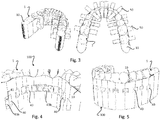
- a plurality of seats 40 are generated algorithmically on said base element 20, positioned and dimensioned each according to the information contained in the treatment positions setup (TS), obtaining a transfer model 100, as shown in figure 4 and 5 .
- Each seat of said plurality of seats 40 is associated with a respective tooth of the three-dimensional model of the dental arch 1 and the position and geometry of each seat 40 is obtained according to the pre-determined information on said model 1 related to the fixing position of the orthodontic bracket 30 to a respective tooth.
- a respective orthodontic bracket 30 is associated, each of which will subsequently be positioned on a physical model of the previously obtained transfer model 100.
- each seat 40 is adapted to receive a respective transfer element 50, or plug, the latter intended to support a relative orthodontic bracket 30 in order to be able to fix it in the correct position on the physical model.
- each transfer element 50 has a main body 51 provided with a first end 52 and a second end 53.
- the first end 52 carries a housing 52a configured to receive, in use, an orthodontic bracket 30, and the second end 53 is instead provided with an engagement portion 53a configured to engage the respective seat 40 of the base element 20 of the transfer model 100.
- the main body 51 is shaped with a substantially "C” profile, wherein the free ends of said "C” profile are provided with respectively said housing 52a and said engagement portion 53a.
- the main body 51 has, in this example, a quadrilateral geometry section transversal to its development direction.
- other sections are possible, such as generally polygonal or even circular sections.
- this section is made in such a way as to obtain an ergonomic profile, to allow easy handling of the transfer element 50, and of reduced size, to allow easy removal, for example, of the excesses of all the materials necessary for fixing the orthodontic brackets 30 to the dental elements of the physical model obtained from the transfer model 100.
- each transfer element 50 carries an identification code, indicated in the figures with reference 54, for example numerical or alphanumeric, associated with the type of orthodontic bracket it supports and/or to the type of tooth on which the latter must be fixed.
- an identification code indicated in the figures with reference 54, for example numerical or alphanumeric, associated with the type of orthodontic bracket it supports and/or to the type of tooth on which the latter must be fixed.
- the housing 52a of the first end 52 of each transfer element 50 is configured to receive orthodontic brackets 30 of different types, for example configured to receive lingual orthodontic brackets known by the trade name ALIAS (Ormco®).
- the engagement portion 53a of the second end 53 is configured in such a way as to engage seats 40 of different transfer models 100 related to different treatment positions setup (TS) of the orthodontic brackets 30.
- Such an engagement portion 53a is shaped like a step, i.e. in such a way as to provide an abutment surface 53b which, by contacting a corresponding stop surface 43b present in a respective seat 40 on the base element 20, allows blocking at least the sliding of the transfer element 50 within the latter.
- the volume of the engagement portion 53a of the transfer element 50 corresponds to the volume which is algorithmically subtracted from the base element 20 according to the pre-determined treatment positions setup (TS), to generate one of said plurality of seats 40.
- each seat 40 has a guide 41 shaped to removably receive the engagement portion 53a of a corresponding transfer member 50.
- the engagement portion 53a and the guide 41 are provided with surfaces of complementary geometries which cooperate with each other by blocking the sliding of the transfer element 50.
- the location of the seat 40 on the base element 20 with respect to a reference system integral with the tooth allows completing the transfer on the latter of the information on the correct position of the orthodontic bracket 30.
- the information on the approach of the orthodontic bracket 30 to the tooth is expressed by the depth of the step within a respective seat 40 case by case.
- the transfer elements 50 are standardized elements that may already be available to an operator, as a physical model used for example in previous treatments, or alternatively be generated digitally contextually to the generation of a specific transfer model 100.
- the method according to the present invention preferably uses rapid prototyping techniques, such as for example 3D printing, in association with the typical materials suitable for orthodontic applications, and per se known.
- the brackets 30 are fixed to the dental arch of the physical model, through specific techniques and adhesives known to the man skilled in the art. Subsequently, the transfer elements 50 are extracted, which are now lacking the brackets 30 and a transfer tray is created to transfer said brackets to the patient's mouth.
- the transfer tray is made of materials for example with a silicone base, in any case with properties such as to adapt perfectly to the morphology of the dental arch on which the orthodontic bracket is fixed.
- the tray is therefore made of materials such as to allow the adhesion and the retention of one or more brackets 30 and, subsequently, to be applied to the patient's dental arch, in order to obtain the fixing of the brackets to the teeth of the latter.
- transfer elements 50 they can also be inserted into the seats 40 of the base element 20 according to different modes.
- the guides 41 of the seats 40 and the engagement portions 53a of the transfer elements 50 can cooperate in such a way that the insertion of the latter takes place along a direction substantially parallel to an occlusal plane of the dental arch 1.
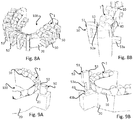
- the application of the orthodontic brackets is lingual, but likewise, as illustrated in figures 8a and 8b , the aforesaid method of insertion along a direction parallel to the occlusal plane of the transfer elements 50 may allow the application of the brackets on the vestibular side of the dental arch 1.
- the base element 20 is shaped in such a way that the guides 41 of the seats 40 thereof and the engagement portions 53a of the transfer elements 50 can cooperate in such a way that the insertion of the latter takes place along a direction substantially orthogonal to the occlusal plane of the dental arch 1.
- an edge 21 of the base element 20 is visible, which follows the path of the dental arch along the buccal surface of the teeth, and allows a lingual application of the orthodontic brackets 30.
- the stop surface 43b which contacts the abutment surface 53b of the engagement portion 53a of the transfer member 50 is in fact formed by the edge region surrounding the opening of the seat 40.
Landscapes
- Health & Medical Sciences (AREA)
- General Health & Medical Sciences (AREA)
- Dentistry (AREA)
- Epidemiology (AREA)
- Life Sciences & Earth Sciences (AREA)
- Animal Behavior & Ethology (AREA)
- Oral & Maxillofacial Surgery (AREA)
- Public Health (AREA)
- Veterinary Medicine (AREA)
- Engineering & Computer Science (AREA)
- General Engineering & Computer Science (AREA)
- Dental Tools And Instruments Or Auxiliary Dental Instruments (AREA)
- Paper (AREA)
- Metal Rolling (AREA)
Applications Claiming Priority (1)
| Application Number | Priority Date | Filing Date | Title |
|---|---|---|---|
| IT102017000014318A IT201700014318A1 (it) | 2017-02-09 | 2017-02-09 | Metodo e modello per il posizionamento di attacchi ortodontici |
Publications (1)
| Publication Number | Publication Date |
|---|---|
| EP3360506A1 true EP3360506A1 (de) | 2018-08-15 |
Family
ID=59297198
Family Applications (1)
| Application Number | Title | Priority Date | Filing Date |
|---|---|---|---|
| EP18155931.1A Withdrawn EP3360506A1 (de) | 2017-02-09 | 2018-02-09 | Verfahren und model für die positionierung von orthodontischen brackets |
Country Status (2)
| Country | Link |
|---|---|
| EP (1) | EP3360506A1 (de) |
| IT (1) | IT201700014318A1 (de) |
Cited By (2)
| Publication number | Priority date | Publication date | Assignee | Title |
|---|---|---|---|---|
| CN111728723A (zh) * | 2020-07-27 | 2020-10-02 | 西安交通大学口腔医院 | 一种口腔正畸的托槽安装装置及方法 |
| CN116077211A (zh) * | 2022-12-19 | 2023-05-09 | 杭州西湖生物材料有限公司 | 一种用于托槽辅助定位及粘接的正畸托槽双层压膜定位器的制作方法 |
Citations (4)
| Publication number | Priority date | Publication date | Assignee | Title |
|---|---|---|---|---|
| US20040253562A1 (en) * | 2003-02-26 | 2004-12-16 | Align Technology, Inc. | Systems and methods for fabricating a dental template |
| US20070031774A1 (en) * | 2005-08-03 | 2007-02-08 | 3M Innovative Properties Company | Registering physical and virtual tooth structures with markers |
| EP2604218A1 (de) * | 2011-12-16 | 2013-06-19 | 3M Innovative Properties Company | Form und Verfahren zur Herstellung einer individuell angepassten orthodontischen Klammer und Verfahren zur Herstellung der Form |
| US20140255864A1 (en) * | 2013-03-06 | 2014-09-11 | American Orthodontics Corporation | Indirect Bonding Tray and Method of Manufacture Thereof |
-
2017
- 2017-02-09 IT IT102017000014318A patent/IT201700014318A1/it unknown
-
2018
- 2018-02-09 EP EP18155931.1A patent/EP3360506A1/de not_active Withdrawn
Patent Citations (4)
| Publication number | Priority date | Publication date | Assignee | Title |
|---|---|---|---|---|
| US20040253562A1 (en) * | 2003-02-26 | 2004-12-16 | Align Technology, Inc. | Systems and methods for fabricating a dental template |
| US20070031774A1 (en) * | 2005-08-03 | 2007-02-08 | 3M Innovative Properties Company | Registering physical and virtual tooth structures with markers |
| EP2604218A1 (de) * | 2011-12-16 | 2013-06-19 | 3M Innovative Properties Company | Form und Verfahren zur Herstellung einer individuell angepassten orthodontischen Klammer und Verfahren zur Herstellung der Form |
| US20140255864A1 (en) * | 2013-03-06 | 2014-09-11 | American Orthodontics Corporation | Indirect Bonding Tray and Method of Manufacture Thereof |
Cited By (2)
| Publication number | Priority date | Publication date | Assignee | Title |
|---|---|---|---|---|
| CN111728723A (zh) * | 2020-07-27 | 2020-10-02 | 西安交通大学口腔医院 | 一种口腔正畸的托槽安装装置及方法 |
| CN116077211A (zh) * | 2022-12-19 | 2023-05-09 | 杭州西湖生物材料有限公司 | 一种用于托槽辅助定位及粘接的正畸托槽双层压膜定位器的制作方法 |
Also Published As
| Publication number | Publication date |
|---|---|
| IT201700014318A1 (it) | 2018-08-09 |
Similar Documents
| Publication | Publication Date | Title |
|---|---|---|
| Xue et al. | Accurate bracket placement using a computer-aided design and computer-aided manufacturing–guided bonding device: an in vivo study | |
| US9402695B2 (en) | Individualized jig for orthodontic braces, assembly formed by that jig, a base and a bracket, and its design methods | |
| RU2739965C1 (ru) | Система для подготовки зубов к установке виниров | |
| US10028804B2 (en) | System for producing a one-piece orthodontic jig and attachments | |
| CN109069227B (zh) | 促进牙齿协调移动的正畸器具 | |
| KR102711251B1 (ko) | 치아 포지셔닝 기구 및 시스템 | |
| US9763750B2 (en) | Rapid prototyped transfer tray for orthodontic appliances | |
| US9700383B2 (en) | Bracket system and method for planning and producing a bracket system for the correction of tooth malpositions | |
| EP2068748B1 (de) | System und verfahren zur automatischen konstruktion von zahnachsen | |
| TWI620549B (zh) | 齒列矯正裝置設置具 | |
| US20160346063A1 (en) | System for producing a one-piece orthodontic jig and brackets | |
| CN113662690B (zh) | 正畸托槽、系统及方法 | |
| US20170312052A1 (en) | Reduced registration bonding template | |
| US20170281314A1 (en) | Method for prducing a positioning tray and the device therefor | |
| KR20230044199A (ko) | 수복물을 위한 치아 준비 시스템 | |
| US10390907B2 (en) | Method for producing trays for brackets | |
| JP2022550278A (ja) | 歯肉方向に延びたチャネルを含むトランスファー装置及び関連する製造方法 | |
| JP2013512023A (ja) | カスタマイズされた歯列矯正装置の製造方法、およびその方法により製造された装置 | |
| EP3360506A1 (de) | Verfahren und model für die positionierung von orthodontischen brackets | |
| EP4493107A1 (de) | Dentalhalter | |
| KR102157109B1 (ko) | 맞춤형 교정 브라켓 제조용 브라켓 블록, 맞춤형 교정 브라켓 세트, 및 그 제조방법 | |
| JP7439074B2 (ja) | 修復歯科治療プランニングのコンピュータ実装方法 | |
| US20260007488A1 (en) | Orthodontic treatment evaluation | |
| RU2730969C1 (ru) | Способ ортодонтического лечения методом прямой дуги с применением 3D-моделирования и индивидуальные элементы брекет-системы для его реализации |
Legal Events
| Date | Code | Title | Description |
|---|---|---|---|
| PUAI | Public reference made under article 153(3) epc to a published international application that has entered the european phase |
Free format text: ORIGINAL CODE: 0009012 |
|
| STAA | Information on the status of an ep patent application or granted ep patent |
Free format text: STATUS: THE APPLICATION HAS BEEN PUBLISHED |
|
| AK | Designated contracting states |
Kind code of ref document: A1 Designated state(s): AL AT BE BG CH CY CZ DE DK EE ES FI FR GB GR HR HU IE IS IT LI LT LU LV MC MK MT NL NO PL PT RO RS SE SI SK SM TR |
|
| AX | Request for extension of the european patent |
Extension state: BA ME |
|
| STAA | Information on the status of an ep patent application or granted ep patent |
Free format text: STATUS: REQUEST FOR EXAMINATION WAS MADE |
|
| 17P | Request for examination filed |
Effective date: 20190215 |
|
| RBV | Designated contracting states (corrected) |
Designated state(s): AL AT BE BG CH CY CZ DE DK EE ES FI FR GB GR HR HU IE IS IT LI LT LU LV MC MK MT NL NO PL PT RO RS SE SI SK SM TR |
|
| STAA | Information on the status of an ep patent application or granted ep patent |
Free format text: STATUS: EXAMINATION IS IN PROGRESS |
|
| 17Q | First examination report despatched |
Effective date: 20200218 |
|
| STAA | Information on the status of an ep patent application or granted ep patent |
Free format text: STATUS: THE APPLICATION IS DEEMED TO BE WITHDRAWN |
|
| 18D | Application deemed to be withdrawn |
Effective date: 20220901 |