EP3363922A2 - Alliage de cuivre contenant du siliciure de cobalt - Google Patents
Alliage de cuivre contenant du siliciure de cobalt Download PDFInfo
- Publication number
- EP3363922A2 EP3363922A2 EP16826980.1A EP16826980A EP3363922A2 EP 3363922 A2 EP3363922 A2 EP 3363922A2 EP 16826980 A EP16826980 A EP 16826980A EP 3363922 A2 EP3363922 A2 EP 3363922A2
- Authority
- EP
- European Patent Office
- Prior art keywords
- copper alloy
- percentage
- copper
- precipitated phases
- content
- Prior art date
- Legal status (The legal status is an assumption and is not a legal conclusion. Google has not performed a legal analysis and makes no representation as to the accuracy of the status listed.)
- Granted
Links
Images
Classifications
-
- C—CHEMISTRY; METALLURGY
- C22—METALLURGY; FERROUS OR NON-FERROUS ALLOYS; TREATMENT OF ALLOYS OR NON-FERROUS METALS
- C22C—ALLOYS
- C22C9/00—Alloys based on copper
- C22C9/04—Alloys based on copper with zinc as the next major constituent
-
- C—CHEMISTRY; METALLURGY
- C22—METALLURGY; FERROUS OR NON-FERROUS ALLOYS; TREATMENT OF ALLOYS OR NON-FERROUS METALS
- C22F—CHANGING THE PHYSICAL STRUCTURE OF NON-FERROUS METALS AND NON-FERROUS ALLOYS
- C22F1/00—Changing the physical structure of non-ferrous metals or alloys by heat treatment or by hot or cold working
- C22F1/08—Changing the physical structure of non-ferrous metals or alloys by heat treatment or by hot or cold working of copper or alloys based thereon
Definitions
- the present invention relates to the technical field of alloys, and in particular to a copper alloy containing cobalt and silicon.
- the brass can be added with other alloy elements to form complex brass to satisfy different requirements. Due to its good processing property, mechanical property and corrosion performance, the brass alloy becomes one of the most widely used alloys among non-ferrous metals. Since the reserve of zinc is abundant and the cost of raw material is thus far lower than that of copper, the cost of raw material of the brass is generally lower than that of the bronze. In terms of both the reserve of resources and the profit of enterprises, it will be a great trend to replace the bronze with the brass by improving some performances of the brass by proper schemes so that the brass meets the requirements in more application fields.
- the modulus of elasticity of the phosphor bronze is about 110 GPs; in contrast, the brass-type substitute material has a reduced modulus of elasticity of about 105 GPa due to the increase of the solid solution strengthening proportion, so that the brass-type substitute material cannot meet the requirements on miniaturization and weight reduction in the application fields of the elastic material.
- the material forming the devices is required to have a higher strength and a tradeoff between strength and ductility. It is well known that the strength and the plasticity are conflicted with each other. If the strength of the material is increased by cold-deformation work hardening, the ductility will be decreased, and the plastic processing capability of the material is thus reduced.
- a kind of brass material for substituting tin-phosphor bronze contains the following components: 70% to 73% of Cu, 0.9% to 1.2% of Sn and the remaining of Zn.
- the mechanical property can meet the application requirements on the material in the above industries, but its stress relaxation rate is less than 80% under an initial stress at a yield strength of 50% at 100°C for 1000 h, so that it is difficult to meet the requirements on durability.
- Chinese Patent Application No. CN103088229A has disclosed a substitute material for tin-phosphor bronze, which reduces the cost by reducing the content of Sn.
- the substitute material for tin-phosphor bronze contains the following main components: 0.01% to 2.5% of Sn, 0.01% to 0.3% of P, 0.01% to 0.5% of Fe, 0.01% to 0.5% of Ni, 0.01% to 0.1% of Mn, and the remaining of Cu.
- the conductivity of this substitute material is only 10% to 16% IACS, so its application fields are limited.
- the cost is not reduced greatly. Since the content of Cu is increased to above 97% while reducing the content of Sn, the overall cost is reduced by only 5% to 10%.
- a technical problem to be solved by the present invention is to provide a copper alloy containing cobalt and silicon, which can significantly reduce the alloy cost and which has lower stress relaxation rate, higher creep resistance, higher yield-to-strength ratio, higher modulus of elasticity and better conductivity.
- the copper alloy containing cobalt and silicon comprises (in percentage of weight):
- the copper alloy comprises matrix phases of copper-zinc ⁇ solid solution and Co x Si y precipitated phases; the Co x Si y precipitated phases are dispersedly distributed on a matrix phase; the percentage of the matrix phases by area is greater than or equal to 95%; and, the percentage of the Co x Si y precipitated phases by area is 0.01% to 5%.
- the percentage of the Co x Si y precipitated phases having a particle size between 10 nm and 200 nm is greater than or equal to 90%, and the percentage of the Co x Si y precipitated phases having a particle size above 200 nm is less than or equal to 10%.
- an atomic ratio of copper to zinc is 2.3 to 15.8, and a mass fraction of copper and zinc satisfies 0.65 ⁇ ([Cu]/3+1)/([Zn]+5) ⁇ 3.5.
- a yield strength/tensile strength of the copper alloy is greater than or equal to 85%; and a stress relaxation rate under an initial stress at a yield strength of 50% at 100°C for 1000 H is less than or equal to 15%.
- the copper alloy further comprises (in percentage of weight) at least one of 0.01% to 3.5% of Sn, 0.01% to 4.0% of Al and 0.01% to 3% of Ni.
- the copper alloy further comprises (in percentage of weight) 0.01% to 0.35% of P.
- the copper alloy further comprises Co m P n precipitated phases, and a percentage of the Co m P n precipitated phases by area is 0.01% to 5%.
- the copper alloy comprises A having a total content of 0.0001% to 2%, and the A is at least one selected from a group comprises (in percentage of weight) 0.01% to 1.5% of Mn, 0.01% to 1.5% of Fe, 0.001% to 0.3% of Cr, 0.001% to 0.2% of Zr, 0.001% to 0.5% of Mg, 0.001% to 0.8% of Ti, 0.0005% to 0.3% of B and 0.0001% to 0.1% of Re.
- the copper and zinc have the following functions and proportions: Zn is solved into Cu to form a single-phase ⁇ solid solution which plays a role of solid solution strengthening and forms a matrix for the alloy structure.
- the ⁇ solid solution can be formed as long as the content of Zn is less than 38%, but the content of copper and the content of zinc need to satisfy a certain relationship.
- the atomic ratio of copper to zinc is less than 2.3 and the mass ratio of copper to zinc is less than 0.68, i.e., ([Cu]/3+1)/([Zn]+5) ⁇ 0.68, due to excessive zinc solved into copper, the conductivity and the modulus of elasticity of the matrix become low, and the high-temperature resistance is degraded sharply, so that the requirements on current transmission, signal transmission, temperature rise in unit time, clamping force, durability and the like cannot be satisfied.
- the atomic ratio Cu/Zn of copper to zinc is greater than 15.8 and the mass ratio of copper to zinc satisfies the condition ([Cu]/3+1)/([Zn]+5)>2.88, there are less lattice distortions caused by the solid solution treatment.
- the solid solution formed by solving a cobalt-silicon compound into lattices by the solid solution treatment is less stable, and a saturated solid solution of the cobalt-silicon compound can be formed only by quick cooling at a high temperature.
- the brass suffers serious oxidization and thus dezincification at a high temperature, the production requirements cannot be satisfied.
- the cobalt-silicon compound is allowed to still have a high solid solubility at 600°C. In this case, online water-cooling solid solution treatment can be directly performed to form a saturated solid solution. Thus, the conditions for further aging precipitation are satisfied, and the process interval is expanded.
- the atomic ratio of copper to zinc is 2.4 to 15, and the mass ratio of copper to zinc satisfies the condition 0.69 ⁇ ([Cu]/3+1)/([Zn]+5) ⁇ 2.76.
- the mass fraction of Cu is preferably 81% to 92%.
- the cobalt and silicon have the following functions and proportions: when only Co is added, Co is solved into the matrix, so that the strength of the material is improved by the solid solution strengthening effect.
- the zinc equivalent coefficient of Si is 10, and the addition of a unit of Si is equivalent to the addition of 10 units of zinc.
- the ⁇ -phase region is reduced while the ⁇ region is expanded.
- the solid solution strengthening will facilitate the formation of the harder ⁇ phase, so that the strength of the material is improved.
- the individual addition of the both will reduce the conductivity and modulus of elasticity of the material, and thus cannot improve the elasticity and durability of the material.
- the compound is precipitated and dispersedly distributed on the matrix.
- Co and Si to be solved into the matrix phase to reduce the conductivity are left out of the matrix, and the conductivity of the material is thus improved.
- the fine precipitated phases dispersedly distributed on the matrix phase can hinder the slippage of lattices and the movement of dislocations to thus form more dislocations and dislocation pileups, i.e., to form Cottrell air masses, so that the material has a higher strength and a larger ratio of the yield strength to the tensile strength than the addition of only Co.
- the fine precipitated phases dispersedly distributed on the matrix phase makes the material require a higher stress during elastic deformation, that is, the modulus of elasticity of the material is improved. Similarly, the difficulty of having plastic deformation within the elastic deformation range of the material and at a relatively high temperature is increased, that is, the resistance to stress relaxation of the material is improved. If the content of Co exceeds 3 wt%, the hot workability of the material will be degraded; and, if the content of Co is less than 0.01 wt%, it is unable to form sufficient precipitated phases to improve the material performance. If the content of Si exceeds 0.5%, hot shortness of the material will be caused, and the conductivity will be reduced greatly; and, if the content of Si is less than 0.01 wt%, it is unable to form sufficient precipitated phases to improve the material performance.
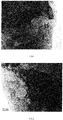
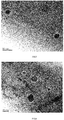
- the microstructure of the copper alloy has the following characteristics: the ⁇ -phase formed by the copper-zinc solid solution is the matrix phase and has a percentage by area greater than or equal to 95%; and the Co x Si y intermetallic compound formed by cobalt and silicon is dispersedly distributed on the matrix and has a percentage of 0.01% to 5% by area. Since the cobalt-silicon intermetallic compound has a nanometer-level particle size, pictures of the microstructure need to be taken by a scanning electron microscope or a transmission electron microscope, and its percentage by area is then calculated.
- the type of the Co x Si y intermetallic compound is identified by EDS energy spectrum analysis mated with the scanning electron microscope or transmission electron microscope, and then described by a value of x/y, where x/y is between 0.2 and 3.
- the precipitated phase has limited effects on the improvement of the material performance.
- the x/y is between 0.5 and 2. If the percentage of the precipitated phases by area is less than 0.01%, the improvement on various performances of the material is limited; and, if the percentage of the precipitated phases by area is greater than 5%, various performances begin to be degraded, and the precipitated phase tends to grow by aggregation so that the improvement on metal performances is weakened.
- the percentage of the precipitated phases is 0.05% to 4%, and the percentage of the ⁇ -phase is greater than or equal to 96%. More preferably, the percentage of the precipitated phases is 0.1% to 3.5%, and the percentage of the ⁇ -phases is greater than or equal to 96.5%.
- the percentage of the Co x Si y precipitated phases having a particle size between 10 nm and 200 nm is greater than 90%, and the remaining has a particle size above 200 nm. If the particle size is smaller, the effects of hindering the slippage of lattices and pinning dislocations are stronger during the plastic deformation of the metal at a temperature lower than the recrystallization temperature, so that more dislocations and dislocation pileups are formed, and the material is thus allowed to have a higher strength and a larger yield-to-strength ratio.
- the material is allowed to have a higher modulus of elasticity and better high-temperature durability.
- the particle size of the precipitated phases is smaller, the obstruction to electron transmission is lower, and the material is allowed to have higher conductivity.
- the percentage of the precipitated phases having a particle size between 10 nm and 200 nm is greater than 92%. More preferably, the percentage of the precipitated phases having a particle size between 10 nm and 200 nm is greater than 95%.
- the elasticity is mainly related to the yield strength/tensile strength ratio and the modulus of elasticity of the material.
- the yield strength of the material is absolutely lower than the tensile strength. If the applied stress exceeds the yield strength, plastic deformation occurs. If the tensile strength is higher, the amount of plastic deformation endurable for the material before fracture failure is larger; if the yield strength is higher, the maximum endurable elastic deformation is larger; and, if the modulus of elasticity is larger, a larger resilience force can be obtained under a same elastic displacement. Therefore, for a same kind of material, to allow the material to have better elasticity, it is required to obtain a yield strength/tensile strength and a modulus of elasticity as high as possible.
- the fine precipitated phases of Co x Si y intermetallic compound are dispersedly distributed on the copper-zinc matrix phase, firstly, the matrix is strengthened, and the tensile strength and yield strength of the material are improved; and secondly, during the plastic deformation of the material, the slippage of lattices and the movement of dislocations can be hindered so that more dislocations and dislocation pileups are generated, and these dislocations and dislocation pileups allow the material to have a higher yield strength, i.e., to have a higher yield strength/tensile strength ratio.
- the fine precipitated phases of Co x Si y intermetallic compound dispersedly distributed on the matrix phase makes the material require a higher stress during elastic deformation, so that the modulus of elasticity of the material is improved.
- the yield strength/tensile strength ratio is greater than 85%, preferably greater than 88%, and more preferably greater than 92%.
- the endurance of elasticity refers to the capability of keeping sufficient clamping force when a lasting external stress is applied to the material, particularly at a high temperature (>80°C).
- the endurance of elasticity is described by the stress relaxation rate.
- the initially applied stress value which is commonly described by the percentage of the yield strength
- the test temperature the test temperature
- the test duration the stress relaxation performance of the material.
- the stress relaxation performance of the material is essentially an integral of creep deformation lower than the yield strength. When tests are performed under the three specific conditions, the reduction rate of the yield strength is the stress relaxation rate. A lower stress relaxation rate indicates better endurance of elasticity of the material.
- the fine precipitated phases of Co x Si y intermetallic compound are dispersedly distributed on the copper-zinc matrix phase, during the continuous plastic deformation of the material, the creep deformation and dislocation of crystal boundaries and lattices and the spread of dislocation pileups are hindered and relieved, and dislocations in different directions are merged and then disappear. Accordingly, the stress relaxation rate of the material is reduced, and the endurance of elasticity of the material is improved. Endurance tests are performed on the alloy under an initial stress at a yield strength of 50% at 100°C for 1000 h, and the stress relaxation rate is less than or equal to 15%, preferably less than or equal to 12%, and more preferably less than or equal to 10%.
- the tin has the following functions and proportion.
- the copper alloy can further comprise Sn having a percentage of 0.01% to 3.5% by mass.
- the Sn can further stabilize the solid solution state of the cobalt-silicon intermetallic compound, inhibit the rapid precipitation of the precipitated phases at a high temperature, and thus reduce the percentage of the precipitated phases having a particle size above 200 nm.
- the Sn can further improve the strength and hardness of the material through the solid solution strengthening effect.
- the tin can further inhibit the dezincification, and thus improve the corrosion resistance of the material.
- the tin can further improve the hot dipping and electroplating performance and the brazing performance of the material. If the content of Sn is less than 0.01%, the above functions cannot be realized.
- the content of Sn (in percentage of weight) is preferably 0.05% to 3.0%, and more preferably 0.1% to 2.5%.
- the copper alloy can further comprise at least one of Al and Ni, characterized in that, the percentage of A1 is 0.01% to 4.0% by mass, and the percentage of Ni is 0.01 wt% to 3 wt% by mass.
- Both Ni and Al can improve the heat resistance and hot workability of the material, and also have the solid solution strengthening effect and improve the corrosion resistance of the material.
- Ni and Al can inhibit the growth of the cobalt-silicon intermetallic compound during the aging process, so that the percentage of the cobalt-silicon intermetallic compound having a particle size between 10 nm and 150 nm is increased.
- Ni can form Ni-Si precipitated phases together with Si.
- the matrix is further strengthened, the conductivity is improved, the modulus of elasticity is increased, and the endurance of elasticity and the clamping force of the material are improved.
- the content of Ni and of Al is less than 0.01%, the above functions cannot be realized.
- the content of Ni is greater than 3% and the content of Al is greater than 4%, the conductivity will be reduced greatly, and the modulus of elasticity will be decreased.
- the percentage of Ni is 0.01% to 2.5% by mass
- the percentage of Al is 0.05% to 3.5% by mass. More preferably, the percentage of Ni is 0.02% to 2.0% by mass, and the percentage of A1 is 0.1% to 3.0% by mass.
- the phosphorus has the following functions and proportion: the copper alloy can further comprise P having a percentage of 0.01% to 0.35% by mass.
- the P, together with Co, can also form an intermetallic compound Co m P n , which can be precipitated.
- the microstructure has the following characteristics: the copper-zinc ⁇ -phase forms the matrix, and the Co x Si y precipitated phases and the Co m P n precipitated phases coexist and are dispersedly distributed on the matrix phase, characterized in that, the percentage of the ⁇ -phases by area is greater than or equal to 90%, the percentage of the Co x Si y precipitated phases by area is 0.01% to 5%, and the percentage of the Co m P n precipitated phases by area is 0.01% to 5%.
- the growth rate of the cobalt-silicon intermetallic compound during the aging process can be effectively relieved, and the particles become smaller. Consequently, the dispersion uniformity of the cobalt-silicon intermetallic compound on the matrix is improved, and the effects of improving the mechanical property, conductivity and high-temperature durability of the material are enhanced.
- the content of P is greater than 0.35%, hot shortness of the material will be caused, and the conductivity will be reduced greatly; and, if the content of P is less than 0.01 wt%, it is unable to form sufficient precipitated phases to improve the material performance.
- the content of P is preferably 0.01% to 0.30%, and more preferably 0.01% to 0.25%.
- the copper alloy can further comprise at least one of A, and the A is selected from a group comprises (in percentage of weight): 0.01% to 1.5% of Mn, 0.01% to 1.5% of Fe, 0.001% to 0.3 of Cr, 0.001% to 0.2% of Zr, 0.001% to 0.5% of Mg, 0.001% to 0.8% of Ti, 0.0005% to 0.3% of B, and 0.0001% to 0.1% of Re.
- A is selected from a group comprises (in percentage of weight): 0.01% to 1.5% of Mn, 0.01% to 1.5% of Fe, 0.001% to 0.3 of Cr, 0.001% to 0.2% of Zr, 0.001% to 0.5% of Mg, 0.001% to 0.8% of Ti, 0.0005% to 0.3% of B, and 0.0001% to 0.1% of Re.
- the manganese and iron have the following proportions and functions.
- Mn and Fe can effectively improve the distribution of the Co x Si y precipitated phases, so that the distribution thereof is more uniform and the dispersity is better. Consequently, the effects of the precipitated phases are enhanced.
- Mn can further realize deoxidization during the smelting process so as to improve the purity of the metal, and can further improve the hot workability of the material.
- Both Mn and Fe have the solid solution strengthening effect, and can improve the basic mechanical property of the material and decrease the modulus of elasticity of the material. If the content of Mn and of Fe is less than 0.01%, the above functions cannot be realized.
- the content of Mn is greater than 1.5% and the content of Fe is greater than 1.5%, the conductivity will be reduced greatly, and the modulus of elasticity will be decreased, so that the application requirements of this material cannot be satisfied. Meanwhile, if the content of Fe is greater than 1.5%, the corrosion resistance of the material will be reduced greatly.
- the content of Mn is 0.05% to 1.3%, and the content of Fe is 0.02% to 1.2%. More preferably, the content of Mn is 0.08% to 1.0%, and the content of Fe is 0.05% to 1.0%.
- the chromium, zirconium and titanium have the following proportions and functions: in the hot working and solid solution treatment procedures, the copper alloy in the schemes will generate a small amount of strip-shaped cobalt-silicon compound precipitates, and the strip-shaped compound phase will degrade the performance of the metal.
- the addition of Cr, Zr and Ti can inhibit the formation of this morphological compound.
- both Cr and Zr can increase the softening temperature and high-temperature strength of the material, improve the high-temperature stability of the material, and reduce the stress relaxation rate of the material. By adding both Cr and Zr, a Cr2Zr compound can be formed.
- the improvement effect is better than that in a case where only one of them is added, and the resistance to bonding and the welding performance of the material can also be improved.
- Ti can also improve the corrosion performance of the material. If the content of Cr is less than 0.001%, the content of Zr is less than 0.001% and the content of Ti (in percentage of weight) is less than 0.001%, the corresponding functions cannot be realized. However, if the content of Ti is greater than 0.8%, the conductivity of the material will be greatly reduced; meanwhile, if the content of Ti is greater than 0.8%, the content of Cr is greater than 0.3% and the content of Zr is greater than 0.2%, the production cost of the material and the cost of raw material will be increased greatly.
- the content of Cr in percentage of weight
- the content of Zr is 0.005% to 0.15%
- the content of Ti is 0.005% to 0.6%. More preferably, the content of Cr (in percentage of weight) is 0.008% to 0.20%, the content of Zr (in percentage of weight) is 0.008% to 0.10%, and the content of Ti is (in percentage of weight) 0.008% to 0.5%.
- the boron, magnesium and rare earth have the following proportions and functions: all B, Mg and Re can inhibit crystal boundary reactions, decrease the number of the Co x Si y precipitated phases on the crystal boundary, reduce the hardness of the copper alloy after the solid solution treatment, and improve the subsequent cold workability.
- B can further improve the anti-dezincification capability of the brass and thus improve the corrosion resistance.
- B and Mg can further increase the resistance to stress relaxation of the material, and improve the cold and hot workability of the material.
- Re can realize the removal of impurities and deoxygenation during the smelting, so that the purity of metal is improved. Due to its high melting point, the rare earth can be used as a core of crystalline during the smelting.
- the content of columnar crystals in the cast ingot is decreased, the content of isometric crystals is increased, and the hot workability of the material is improved.
- the content of the rare earth is less than (in percentage of weight) 0.0002%, the above functions cannot be realized. If the content of the rare earth exceeds (in percentage of weight) 0.1 t%, high-temperature oxide impurities will be formed, and the performance of metal will be degraded.
- the content of B (in percentage of weight) is 0.001% to 0.2%
- the content of Mg (in percentage of weight) is 0.005% to 0.3%
- the content of RE (in percentage of weight) is 0.0008% to 0.08%.
- the content of B (in percentage of weight) is 0.002% to 0.15%
- the content of Mg (in percentage of weight) is 0.01% to 0.2%
- the content of RE (in percentage of weight) is 0.001% to 0.05%.
- the copper alloy can be processed into plates and strips, bars or wire rods.
- Preparation methods for plates and strips successively include the following steps.
- the temperature for smelting is 1080°C to 1280°C
- the temperature for horizontal continuous casting is 1050°C to 1250°C
- the temperature for continuous up casting is 1060°C to 1260°C.
- the solid solution treatment is cooling after casting, where the cooling medium is air or water and the cooling rate is 10°C/min to 150°C/S.
- the working rate of the primary inverse drawing and the secondary inverse drawing is 5% to 60%, and one shaving process at a working rate of 1% to 3% can be added to remove surface detects.
- the temperature for the first-stage aging heat treatment is 350°C to 650°C, the temperature holding time is 10 min to 10 h, the heating rate is 2°C/min to 50°C/min, and the cooling rate is 5°C/min to 50°C/min.
- the temperature for the second-stage aging heat treatment is 300°C to 600°C, the temperature holding time is 10 min to 10 h, the heating rate is 2°C/min to 50°C/min, and the cooling rate is 5°C/min to 50°C/min.
- the continuous drawing and aging heat treatment is successively performed by a large-sized continuous drawing and aging heat treatment machine, a middle-sized continuous drawing and aging heat treatment machine and a small-sized continuous drawing and aging heat treatment machine according to specifications for different stages of corridor billet.
- the finished products are processed by a small-sized continuous drawing and aging heat treatment machine.
- the two-stage aging heat treatment processes play a key role in the performance of the finished products.
- the first-stage aging temperature is 350°C to 650°C
- the second-stage aging temperature is 300°C to 600°C.
- the precipitation proportion and granularity of the precipitated phases are controlled by the first-stage aging heat treatment.
- the distribution pattern of the precipitated phases is controlled by the second-stage aging heat treatment. If the precipitated phase is precipitated more completely and has a smaller granularity and a more uniform distribution, various performances of the material are better.
- the aging heat treatment is performed beyond the temperature range, it is unable to achieve the expected effects.
- the copper alloy of the present invention has a larger value of yield strength/tensile strength and a larger modulus of elasticity, and thus has better elasticity and higher resilience clamping force. Furthermore, the copper alloy has a low stress relaxation rate, better resistance to stress relaxation and better endurance of elasticity. Moreover, the copper alloy has higher conductivity, good conduction performance when in use, large clamping force, less heat, good material formability and long service life.
- This scheme includes comparison examples 1 and 2, and embodiments 3 to 12.
- This scheme is applied to component tests for indicating the influence of the content and proportion of Cu and Zn on the performance of the copper alloy.
- Materials are prepared according to the designed composition.
- the raw materials comprise electrolytic copper, 0# zinc, metal cobalt, and intermediate copper-silicon alloy. Samples are obtained from the extruded blanks, and back-furnace components thereof are tested.
- an Inductive Coupling Plasma spectrograph ICP is used as the test instrument. Materials in each group are casted and ingoted in a 10 Kg intermediate frequency furnace, then turned into ⁇ 50 extruded ingots, and finally extruded into ⁇ 15 blanks. The extruded blanks are cooled with water online.
- the following processing is successively performed on the extruded blanks: cold drawing at a working rate of 60% ⁇ aging heat treatment for 5 h at 550°C ⁇ cold drawing at a working rate of 30% ⁇ aging heat treatment for 4 h at 450°C ⁇ cold drawing at a working rate of 20% ⁇ heat treatment on finished products for 3 h at 280°C ⁇ cleaning.
- the finished products are machined into ⁇ 7 standard tensile samples. Tensile tests are performed on the samples on a 10-ton hydraulic drawing machine to test the tensile strength, yield strength, ductility and modulus of elasticity of the samples.
- the finished products are cut into a length of 80 cm, and then the conductivity of the finished products is measured by a bridge tester. The various data is shown in Table 1 and Continued Table 1.
- the Table 1 and the Continued Table 1 mainly indicate the influence of the mass relation and atomic ratio of Cu and Zn in the matrix on the related performances of the material.
- the atomic ratio and the mass relation of copper and zinc are beyond the scope of the claims.
- Embodiment 1 due to excessive Zn solved into the matrix, both the conductivity and the modulus of elasticity of the matrix are low, and the mechanical property is improved limitedly, so that the application requirements cannot be satisfied.
- Embodiment 2 due to too little Zn solved into the matrix, there are less lattice distortions.
- the solid solution formed by solving the cobalt-silicon compound into lattices is less stable, and it is difficult to form a supersaturated solid solution under the online solid solution conditions. Accordingly, the conditions for dispersed precipitation of the cobalt-silicon phase cannot be satisfied, the conductivity of the material is low, and the modulus of elasticity and the mechanical property are improved limitedly, so that the application requirements cannot be satisfied.
- the mass relation and the atomic ratio of Cu and Zn are within the scope of the claims.
- Embodiments 13 to 23 As shown in Table 2, among which Embodiments 13 and 14 are comparison examples beyond the component scope claimed by the present patent, for indicating the hazards and results when the alloy element or its proportion are beyond the claimed range.
- materials are prepared according to the designed composition.
- the raw materials comprise electrolytic copper, 0# zinc, metal cobalt, and intermediate copper-silicon alloy. Samples are obtained from the extruded blanks, and back-furnace components are tested.
- an Inductive Coupling Plasma spectrograph (ICP) is used as the test instrument.
- the Table 2 mainly indicates the influence of different changes in content of two alloy elements Co and Si on various basic performances of the material. It can be seen from the data in Embodiments 15 to 22 and comparison examples 13 and 14 that, in the present invention, the content of Co needs to be between 0.01% and 3%, and the content of silicon needs to be between 0.01% and 0.5%. If the content of any element is beyond this range, the comprehensive performance of the material cannot satisfy the requirements.
- This scheme is used for indicating the influence of the proportion of phases in the microstructure of the copper alloy on the material performance, and includes Embodiments 23 to 32, as shown in Fig. 3 , among which Embodiments 23 and 24 are comparison examples.
- the comparison examples are beyond the scope claimed by the present patent, and used for indicating the hazards and results when the microstructure of the copper alloy does not conform to the claimed scope.
- Materials are prepared according to the designed composition.
- the raw materials comprise electrolytic copper, 0# zinc, metal cobalt, and intermediate copper-silicon alloy. Samples are obtained from the extruded blanks, and back-furnace components are tested. As the test instrument, an Inductive Coupling Plasma spectrograph (ICP) is used.
- ICP Inductive Coupling Plasma spectrograph
- the proportion of the phase is evaluated on an SEM or TEM graph.
- the diameter of the precipitated phase is first measured, and the proportion is then determined.
- the area of the precipitated phase is 0.01% to 5%. If the percentage of the precipitated phases by area is less than 0.01%, the improvement to various performances of the material is insufficient; however, if the percentage of the precipitated phases by area is greater than 5%, various performances will be degraded, and the precipitated phases tend to grow by aggregation, so that the effect in improving the metal performance is weakened. This conclusion can be obtained from Table 3.
- This scheme is used for indicating the influence of the size of the Co x Si y precipitated phase in the microstructure of the copper alloy on the material performance, and includes Embodiments 33 to 38, among which Embodiments 33 and 34 are comparison examples, and the percentage of the cobalt-silicon compound by size is beyond the scope claimed by the present patent and used for indicating the hazards and results when the microstructure of the copper alloy does not conform to the claimed scope.
- Materials are prepared according to the designed composition.
- the raw materials comprise electrolytic copper, 0# zinc, metal cobalt, and intermediate copper-silicon alloy. Samples are obtained from the extruded blanks, and back-furnace components are tested. As the test instrument, an Inductive Coupling Plasma spectrograph (ICP) is used.
- the comprehensive performance of the material is better if the proportion of the Co x Si y precipitated phases having a diameter of 10 nm to 200 nm is higher.
- the proportion of the Co x Si y precipitated phases within this size range needs to be greater than 90%, preferably greater than 92%, and more preferably greater than 95%.
- This scheme is used for indicating the influence of Sn on the compound precipitated phases having a diameter of above 200 nm in the microstructure of the copper alloy, and includes Embodiments 39 to 43, among which Embodiment 43 is a comparison example for indicating hazards and results when the content of Sn exceeds the claimed scope.
- Materials are prepared according to the designed composition.
- the raw materials comprise electrolytic copper, 0# zinc, metal cobalt, intermediate copper-silicon alloy and metal tin. Samples are obtained from the extruded blanks, and back-furnace components are tested.
- an Inductive Coupling Plasma spectrograph ICP
- Tensile tests are performed on the samples on a 10-ton hydraulic drawing machine to test the tensile strength, yield strength, ductility and modulus of elasticity of the samples.
- the finished products are cut into a length of 80 cm, and then the conductivity of the finished products is measured by a bridge tester.
- Various data is shown in Table 5.
- Embodiment Element content (wt%) The number of precipitated phases having a diameter of above 200 nm in a single field of view Performance Cu Zn Co Si Sn Tensile strength (MPa) Yield strength (MPa) Modulus of elasticity (Gpa) Ductility (%) Conductivity (% IACS) 39 75.08 29.39 0.52 0.15 - 3 529 488 113 16 24.5 40 75.11 9.11 0.51 0.14 0.05 2 531 494 115 15 23.5 41 75.02 29.39 0.49 0.15 1.05 1 559 512 115 16 23.5 42 74.88 29.39 0.51 0.16 2.91 0 566 547 113 15 16.2 Compa rison example 43 74.93 9.11 0.53 0.13 3.13 0 575 553 111 13 13.1
- This scheme is used for indicating the influence of Ni and Al on the proportion of the compound precipitated phases having a diameter between 10 nm and 150 nm in the structure of the copper alloy, and includes Embodiments 44 to 50.
- Embodiments 49 and 50 are comparison examples for indicating hazards and results when the content of Ni and Al exceeds the claimed scope.
- Materials are prepared according to the designed composition.
- the raw materials comprise electrolytic copper, 0# zinc, metal cobalt, intermediate copper-silicon alloy, metal nickel, and metal aluminum. Samples are obtained from the extruded blanks, and back-furnace components are tested. As the test instrument, an Inductive Coupling Plasma spectrograph (ICP) is used.
- ICP Inductive Coupling Plasma spectrograph
- This scheme is used for indicating the influence of Mn, Fe and P on the dispersity of the Co x Si y precipitated phases in the structure of the copper alloy.
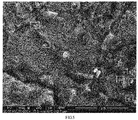
- the dispersity is evaluated by a variance of the distribution of the precipitated phases by the following method: a corresponding scanning electron microscope graph is divided into 3 ⁇ 3 checkers, the number of the Co x Si y precipitated phases within each checker is counted, and an expectation and a variance are calculated.
- This scheme includes Embodiments 51 to 61. Among these embodiments, Embodiments 59, 60 and 61 are comparison examples for indicating hazards and results when the content of Mn, Fe and P exceeds the scope of the claims. Materials are prepared according to the designed composition.
- the raw materials comprise electrolytic copper, 0# zinc, metal cobalt, intermediate copper-silicon alloy, intermediate copper-phosphorus alloy, metal manganese, and metal aluminum. Samples are obtained from the extruded blanks, and back-furnace components are tested. As the test instrument, an Inductive Coupling Plasma spectrograph (ICP) is used. Materials in each group are casted and ingoted in a 10 Kg intermediate frequency furnace, then turned into ⁇ 50 extruded ingots, and finally extruded into ⁇ 15 blanks. The extruded blanks are cooled with water online.
- ICP Inductive Coupling Plasma spectrograph
- the following processing is successively performed on the extruded blanks: cold drawing at a working rate of 60% ⁇ aging heat treatment for 5 h at 550°C ⁇ cold drawing at a working rate of 30% ⁇ aging heat treatment for 4 h at 450°C ⁇ cold drawing at a working rate of 20% ⁇ heat treatment on finished products for 3 h at 280°C ⁇ cleaning.
- the finished products are machined into ⁇ 7 standard tensile samples. Tensile tests are performed on the samples on a 10-ton hydraulic drawing machine to test the tensile strength, yield strength, ductility and modulus of elasticity of the samples.
- the finished products are cut into a length of 80 cm, and then the conductivity of the finished products is measured by a bridge tester. The various data is shown in Table 7 and Continued Table 7.
- the uniformity of the distribution of the cobalt-silicon phases is described by the variance in Table7 and the Continued Table 7.
- a smaller value of the variance indicates more uniform distribution of the cobalt-silicon phases and more improvements to the basic performances of the material by the cobalt-silicon phases. It can be seen from the tables that, with the addition of the several elements, the value of variance becomes smaller and the material performance becomes better. However, in the comparison examples, if the content of the elements exceeds the claimed scope, the conductivity is reduced greatly and the application requirements thus cannot be satisfied.
- This scheme is used for indicating the influence of the addition of Cr, Zr and Ti on the formation of strip-shaped cobalt-silicon compounds, by observing the number of the strip-shaped compounds in a corresponding scanning electron microscope graph.
- This scheme includes Embodiments 62 to 68.
- Materials are prepared according to the designed composition.
- the raw materials comprise electrolytic copper, 0# zinc, metal cobalt, intermediate copper-chromium alloy, intermediate copper-zirconium alloy, and intermediate copper-titanium alloy. Samples are obtained from the extruded blanks, and back-furnace components are tested.
- an Inductive Coupling Plasma spectrograph ICP
- This scheme is used for indicating the effect of B, Mg and Re in inhibiting the precipitation of the Co x Si y precipitated phases on the crystal boundary, by observing the number of the Co x Si y precipitated phases distributed on the crystal boundary in a corresponding scanning electron microscope graph.
- This scheme includes Embodiments 69 to 75.
- Materials are prepared according to the designed composition. The raw materials comprise electrolytic copper, 0# zinc, metal cobalt, intermediate copper-boron alloy, intermediate copper-magnesium alloy, and mischmetal. Samples are obtained from the extruded blanks, and back-furnace components are tested. As the test instrument, an Inductive Coupling Plasma spectrograph (ICP) is used.
- ICP Inductive Coupling Plasma spectrograph
- the addition of B, Mg and Re effectively reduces the number of the Co x Si y precipitated phases distributed on the crystal boundary.
- the compounds distributed on the crystal boundary have no significant influence on the macro-performances of the material, but are easy to become crack sources during the stamping process, resulting in burrs, so that the use is influenced. Therefore, the compounds should be avoided as far as possible.
- Embodiments 69 to 85 This scheme is used for indicating processing methods of different forms of materials, and includes Embodiments 69 to 85, characterized in that, in Embodiments 69 to 70, wire rods having a product specification of ⁇ 0.5 mm are produced by the preparation methods 4 and 5; in Embodiments 71 to 72, bars having a product specification of ⁇ 15 mm are produced by the preparation method 3; in Embodiments 73 to 75, strips having a product specification of 0.3 mm are produced by the preparation method 2; and Embodiment 73 is accordance with American Standard C51900 as a comparison example. In Embodiments 76 to 85, strips having a product specification of 0.3 mm are produced by the preparation method 1.
- Embodiment 76 is accordance with American Standard C42500
- Embodiment 77 is accordance with American Standard C26000
- Embodiment 78 is accordance with American Standard C44300. All Embodiments 76, 77 and 78 are comparison examples. The various data is shown in Table 10 and Continued Table 10:
- This scheme is used for making a comparison in terms of the endurance of elasticity of the copper alloy containing cobalt and silicon and the stress relaxation rate of the material.
Landscapes
- Chemical & Material Sciences (AREA)
- Engineering & Computer Science (AREA)
- Materials Engineering (AREA)
- Mechanical Engineering (AREA)
- Metallurgy (AREA)
- Organic Chemistry (AREA)
- Physics & Mathematics (AREA)
- Thermal Sciences (AREA)
- Crystallography & Structural Chemistry (AREA)
- Conductive Materials (AREA)
- Silicon Compounds (AREA)
- Internal Circuitry In Semiconductor Integrated Circuit Devices (AREA)
- Battery Electrode And Active Subsutance (AREA)
Applications Claiming Priority (2)
| Application Number | Priority Date | Filing Date | Title |
|---|---|---|---|
| CN201510439092.8A CN105018782B (zh) | 2015-07-23 | 2015-07-23 | 一种含钴硅的铜合金 |
| PCT/CN2016/000301 WO2017012283A2 (fr) | 2015-07-23 | 2016-06-08 | Alliage de cuivre contenant du siliciure de cobalt |
Publications (3)
| Publication Number | Publication Date |
|---|---|
| EP3363922A2 true EP3363922A2 (fr) | 2018-08-22 |
| EP3363922A4 EP3363922A4 (fr) | 2019-08-21 |
| EP3363922B1 EP3363922B1 (fr) | 2023-04-19 |
Family
ID=54409079
Family Applications (1)
| Application Number | Title | Priority Date | Filing Date |
|---|---|---|---|
| EP16826980.1A Active EP3363922B1 (fr) | 2015-07-23 | 2016-06-08 | Alliage de cuivre contenant du siliciure de cobalt |
Country Status (4)
| Country | Link |
|---|---|
| US (1) | US20180066339A1 (fr) |
| EP (1) | EP3363922B1 (fr) |
| CN (1) | CN105018782B (fr) |
| WO (1) | WO2017012283A2 (fr) |
Families Citing this family (15)
| Publication number | Priority date | Publication date | Assignee | Title |
|---|---|---|---|---|
| CN105018782B (zh) * | 2015-07-23 | 2017-09-26 | 宁波博威合金板带有限公司 | 一种含钴硅的铜合金 |
| CN105400987A (zh) * | 2015-11-10 | 2016-03-16 | 太仓捷公精密金属材料有限公司 | 一种铜合金材料 |
| CN105385890A (zh) * | 2015-11-27 | 2016-03-09 | 宁波博威合金材料股份有限公司 | 一种含镍、硅的青铜合金及其应用 |
| CN108285988B (zh) * | 2018-01-31 | 2019-10-18 | 宁波博威合金材料股份有限公司 | 析出强化型铜合金及其应用 |
| CN108384986B (zh) * | 2018-05-07 | 2020-02-21 | 宁波博威合金材料股份有限公司 | 一种铜合金材料及其应用 |
| CN108796296B (zh) * | 2018-06-12 | 2019-08-06 | 宁波博威合金材料股份有限公司 | 一种铜合金及其应用 |
| CN109321780A (zh) * | 2018-11-20 | 2019-02-12 | 薛中有 | 一种高弹性模量的黄铜合金及其制备方法 |
| CN109536756A (zh) * | 2018-12-28 | 2019-03-29 | 武汉泛洲中越合金有限公司 | 高强度耐磨无铅铜合金材料、制备方法及滑靴 |
| CN110724851A (zh) * | 2019-12-07 | 2020-01-24 | 和县卜集振兴标准件厂 | 一种开关插座用耐热耐腐蚀合金及其制备方法 |
| JP7469072B2 (ja) * | 2020-02-28 | 2024-04-16 | 株式会社神戸製鋼所 | アルミニウム合金鍛造材及びその製造方法 |
| CN111363948B (zh) * | 2020-04-24 | 2021-11-09 | 浙江大学 | 一种高强高导铜合金的高效短流程制备方法 |
| CN111663063B (zh) * | 2020-06-23 | 2022-04-01 | 宁波金田铜业(集团)股份有限公司 | 一种适用于高速自动化加工的铅黄铜棒材及其制备方法 |
| CN112048689A (zh) * | 2020-09-16 | 2020-12-08 | 扬州大学 | 一种焊接喷嘴的热处理方法 |
| CN113293323B (zh) * | 2021-05-27 | 2022-04-15 | 宁波金田铜业(集团)股份有限公司 | 一种硅青铜棒材及其制备方法 |
| CN115838881A (zh) * | 2022-12-06 | 2023-03-24 | 武汉泛洲中越合金有限公司 | 一种冷变形铜合金及其高精度管棒材制备方法 |
Family Cites Families (10)
| Publication number | Priority date | Publication date | Assignee | Title |
|---|---|---|---|---|
| DE19548124C2 (de) * | 1995-12-21 | 2002-08-29 | Euroflamm Gmbh | Reibkörper und Verfahren zum Herstellen eines solchen |
| JP2002349573A (ja) * | 2001-05-29 | 2002-12-04 | Mitsubishi Materials Corp | 耐摩耗性に優れた銅合金製動圧軸受け用スリーブおよびスラストプレート |
| WO2004022805A1 (fr) * | 2002-09-09 | 2004-03-18 | Sambo Copper Alloy Co., Ltd. | Alliage de cuivre extremement resistant |
| JP5040140B2 (ja) * | 2006-03-31 | 2012-10-03 | Dowaメタルテック株式会社 | Cu−Ni−Si−Zn系銅合金 |
| JP5247010B2 (ja) * | 2006-06-30 | 2013-07-24 | Jx日鉱日石金属株式会社 | 高強度で曲げ加工性に優れたCu−Zn系合金 |
| JP5224415B2 (ja) * | 2008-07-31 | 2013-07-03 | 古河電気工業株式会社 | 電気電子部品用銅合金材料とその製造方法 |
| CN101709405A (zh) * | 2009-11-03 | 2010-05-19 | 苏州撼力铜合金材料有限公司 | 一种高强耐磨汽车同步环用复杂黄铜 |
| JP4672804B1 (ja) * | 2010-05-31 | 2011-04-20 | Jx日鉱日石金属株式会社 | 電子材料用Cu−Co−Si系銅合金及びその製造方法 |
| KR101260912B1 (ko) * | 2011-02-01 | 2013-05-06 | 주식회사 풍산 | 해수용 동합금재 및 이의 제조 방법 |
| CN105018782B (zh) * | 2015-07-23 | 2017-09-26 | 宁波博威合金板带有限公司 | 一种含钴硅的铜合金 |
-
2015
- 2015-07-23 CN CN201510439092.8A patent/CN105018782B/zh active Active
-
2016
- 2016-06-08 US US15/558,477 patent/US20180066339A1/en not_active Abandoned
- 2016-06-08 EP EP16826980.1A patent/EP3363922B1/fr active Active
- 2016-06-08 WO PCT/CN2016/000301 patent/WO2017012283A2/fr not_active Ceased
Also Published As
| Publication number | Publication date |
|---|---|
| EP3363922B1 (fr) | 2023-04-19 |
| US20180066339A1 (en) | 2018-03-08 |
| CN105018782B (zh) | 2017-09-26 |
| WO2017012283A2 (fr) | 2017-01-26 |
| CN105018782A (zh) | 2015-11-04 |
| EP3363922A4 (fr) | 2019-08-21 |
| WO2017012283A3 (fr) | 2017-03-23 |
Similar Documents
| Publication | Publication Date | Title |
|---|---|---|
| EP3363922B1 (fr) | Alliage de cuivre contenant du siliciure de cobalt | |
| KR101161597B1 (ko) | 전자 재료용 Cu-Ni-Si-Co계 구리합금 및 그 제조 방법 | |
| CN103328665B (zh) | 铜合金及铜合金的制造方法 | |
| JP4937815B2 (ja) | 電子材料用Cu−Ni−Si−Co系銅合金及びその製造方法 | |
| JP5312920B2 (ja) | 電子材料用銅合金板又は条 | |
| JP5214701B2 (ja) | 強度、導電率及び曲げ加工性に優れたチタン銅及びその製造方法 | |
| JP2004149874A (ja) | 易加工高力高導電性銅合金 | |
| CN110923499B (zh) | 一种含Ce和B的钛青铜合金带材及其制备方法 | |
| JP2011214088A (ja) | 電子材料用Cu−Ni−Si−Co系銅合金及びその製造方法 | |
| TWI429764B (zh) | Cu-Co-Si alloy for electronic materials | |
| JPWO2011036804A1 (ja) | 電子材料用Cu−Ni−Si−Co系銅合金及びその製造方法 | |
| JP5461467B2 (ja) | 強度、導電率及び曲げ加工性に優れたチタン銅及びその製造方法 | |
| KR20130109209A (ko) | 전자 재료용 Cu-Si-Co 계 구리 합금 및 그 제조 방법 | |
| CN103140591A (zh) | 电子材料用Cu-Co-Si类铜合金及其制备方法 | |
| KR20170013881A (ko) | 구리 합금 판재 및 그 제조 방법, 상기 구리 합금 판재로 이루어지는 전기전자 부품 | |
| JP2021523977A (ja) | 曲げ加工性に優れたCu−Co−Si−Fe−P系銅合金及びその製造方法 | |
| JP2006265731A (ja) | 銅合金 | |
| JP6749121B2 (ja) | 強度及び導電性に優れる銅合金板 | |
| EP2692877B1 (fr) | Alliage de cuivre et procédé de production d'un alliage de cuivre | |
| JP6837542B2 (ja) | 耐熱性及び放熱性に優れた銅合金板材 | |
| CN112048637B (zh) | 一种铜合金材料及其制造方法 | |
| JP4446479B2 (ja) | 電子機器用銅合金 | |
| JP5048046B2 (ja) | 電子機器用銅合金 | |
| WO2015004940A1 (fr) | Alliage de cuivre pour équipement électronique/électrique, tôle fine en alliage de cuivre pour équipement électronique/électrique, composant conducteur pour équipement électronique/électrique et borne | |
| JP5879464B1 (ja) | 銅合金板及び銅合金板の製造方法 |
Legal Events
| Date | Code | Title | Description |
|---|---|---|---|
| STAA | Information on the status of an ep patent application or granted ep patent |
Free format text: STATUS: THE INTERNATIONAL PUBLICATION HAS BEEN MADE |
|
| PUAI | Public reference made under article 153(3) epc to a published international application that has entered the european phase |
Free format text: ORIGINAL CODE: 0009012 |
|
| STAA | Information on the status of an ep patent application or granted ep patent |
Free format text: STATUS: REQUEST FOR EXAMINATION WAS MADE |
|
| 17P | Request for examination filed |
Effective date: 20170919 |
|
| AK | Designated contracting states |
Kind code of ref document: A2 Designated state(s): AL AT BE BG CH CY CZ DE DK EE ES FI FR GB GR HR HU IE IS IT LI LT LU LV MC MK MT NL NO PL PT RO RS SE SI SK SM TR |
|
| AX | Request for extension of the european patent |
Extension state: BA ME |
|
| DAV | Request for validation of the european patent (deleted) | ||
| DAX | Request for extension of the european patent (deleted) | ||
| RIC1 | Information provided on ipc code assigned before grant |
Ipc: C22F 1/08 20060101ALI20190424BHEP Ipc: C22C 9/04 20060101AFI20190424BHEP |
|
| A4 | Supplementary search report drawn up and despatched |
Effective date: 20190724 |
|
| RIC1 | Information provided on ipc code assigned before grant |
Ipc: C22C 9/04 20060101AFI20190718BHEP Ipc: C22F 1/08 20060101ALI20190718BHEP |
|
| STAA | Information on the status of an ep patent application or granted ep patent |
Free format text: STATUS: EXAMINATION IS IN PROGRESS |
|
| 17Q | First examination report despatched |
Effective date: 20200618 |
|
| INTG | Intention to grant announced |
Effective date: 20230102 |
|
| GRAS | Grant fee paid |
Free format text: ORIGINAL CODE: EPIDOSNIGR3 |
|
| STAA | Information on the status of an ep patent application or granted ep patent |
Free format text: STATUS: GRANT OF PATENT IS INTENDED |
|
| GRAA | (expected) grant |
Free format text: ORIGINAL CODE: 0009210 |
|
| STAA | Information on the status of an ep patent application or granted ep patent |
Free format text: STATUS: THE PATENT HAS BEEN GRANTED |
|
| AK | Designated contracting states |
Kind code of ref document: B1 Designated state(s): AL AT BE BG CH CY CZ DE DK EE ES FI FR GB GR HR HU IE IS IT LI LT LU LV MC MK MT NL NO PL PT RO RS SE SI SK SM TR |
|
| REG | Reference to a national code |
Ref country code: GB Ref legal event code: FG4D |
|
| REG | Reference to a national code |
Ref country code: CH Ref legal event code: EP |
|
| REG | Reference to a national code |
Ref country code: DE Ref legal event code: R096 Ref document number: 602016078929 Country of ref document: DE |
|
| REG | Reference to a national code |
Ref country code: IE Ref legal event code: FG4D |
|
| REG | Reference to a national code |
Ref country code: AT Ref legal event code: REF Ref document number: 1561229 Country of ref document: AT Kind code of ref document: T Effective date: 20230515 |
|
| REG | Reference to a national code |
Ref country code: LT Ref legal event code: MG9D |
|
| REG | Reference to a national code |
Ref country code: NL Ref legal event code: MP Effective date: 20230419 |
|
| REG | Reference to a national code |
Ref country code: AT Ref legal event code: MK05 Ref document number: 1561229 Country of ref document: AT Kind code of ref document: T Effective date: 20230419 |
|
| PG25 | Lapsed in a contracting state [announced via postgrant information from national office to epo] |
Ref country code: NL Free format text: LAPSE BECAUSE OF FAILURE TO SUBMIT A TRANSLATION OF THE DESCRIPTION OR TO PAY THE FEE WITHIN THE PRESCRIBED TIME-LIMIT Effective date: 20230419 |
|
| PG25 | Lapsed in a contracting state [announced via postgrant information from national office to epo] |
Ref country code: SE Free format text: LAPSE BECAUSE OF FAILURE TO SUBMIT A TRANSLATION OF THE DESCRIPTION OR TO PAY THE FEE WITHIN THE PRESCRIBED TIME-LIMIT Effective date: 20230419 Ref country code: PT Free format text: LAPSE BECAUSE OF FAILURE TO SUBMIT A TRANSLATION OF THE DESCRIPTION OR TO PAY THE FEE WITHIN THE PRESCRIBED TIME-LIMIT Effective date: 20230821 Ref country code: NO Free format text: LAPSE BECAUSE OF FAILURE TO SUBMIT A TRANSLATION OF THE DESCRIPTION OR TO PAY THE FEE WITHIN THE PRESCRIBED TIME-LIMIT Effective date: 20230719 Ref country code: ES Free format text: LAPSE BECAUSE OF FAILURE TO SUBMIT A TRANSLATION OF THE DESCRIPTION OR TO PAY THE FEE WITHIN THE PRESCRIBED TIME-LIMIT Effective date: 20230419 Ref country code: AT Free format text: LAPSE BECAUSE OF FAILURE TO SUBMIT A TRANSLATION OF THE DESCRIPTION OR TO PAY THE FEE WITHIN THE PRESCRIBED TIME-LIMIT Effective date: 20230419 |
|
| PG25 | Lapsed in a contracting state [announced via postgrant information from national office to epo] |
Ref country code: RS Free format text: LAPSE BECAUSE OF FAILURE TO SUBMIT A TRANSLATION OF THE DESCRIPTION OR TO PAY THE FEE WITHIN THE PRESCRIBED TIME-LIMIT Effective date: 20230419 Ref country code: PL Free format text: LAPSE BECAUSE OF FAILURE TO SUBMIT A TRANSLATION OF THE DESCRIPTION OR TO PAY THE FEE WITHIN THE PRESCRIBED TIME-LIMIT Effective date: 20230419 Ref country code: LV Free format text: LAPSE BECAUSE OF FAILURE TO SUBMIT A TRANSLATION OF THE DESCRIPTION OR TO PAY THE FEE WITHIN THE PRESCRIBED TIME-LIMIT Effective date: 20230419 Ref country code: LT Free format text: LAPSE BECAUSE OF FAILURE TO SUBMIT A TRANSLATION OF THE DESCRIPTION OR TO PAY THE FEE WITHIN THE PRESCRIBED TIME-LIMIT Effective date: 20230419 Ref country code: IS Free format text: LAPSE BECAUSE OF FAILURE TO SUBMIT A TRANSLATION OF THE DESCRIPTION OR TO PAY THE FEE WITHIN THE PRESCRIBED TIME-LIMIT Effective date: 20230819 Ref country code: HR Free format text: LAPSE BECAUSE OF FAILURE TO SUBMIT A TRANSLATION OF THE DESCRIPTION OR TO PAY THE FEE WITHIN THE PRESCRIBED TIME-LIMIT Effective date: 20230419 Ref country code: GR Free format text: LAPSE BECAUSE OF FAILURE TO SUBMIT A TRANSLATION OF THE DESCRIPTION OR TO PAY THE FEE WITHIN THE PRESCRIBED TIME-LIMIT Effective date: 20230720 Ref country code: AL Free format text: LAPSE BECAUSE OF FAILURE TO SUBMIT A TRANSLATION OF THE DESCRIPTION OR TO PAY THE FEE WITHIN THE PRESCRIBED TIME-LIMIT Effective date: 20230419 |
|
| PG25 | Lapsed in a contracting state [announced via postgrant information from national office to epo] |
Ref country code: FI Free format text: LAPSE BECAUSE OF FAILURE TO SUBMIT A TRANSLATION OF THE DESCRIPTION OR TO PAY THE FEE WITHIN THE PRESCRIBED TIME-LIMIT Effective date: 20230419 |
|
| PG25 | Lapsed in a contracting state [announced via postgrant information from national office to epo] |
Ref country code: SK Free format text: LAPSE BECAUSE OF FAILURE TO SUBMIT A TRANSLATION OF THE DESCRIPTION OR TO PAY THE FEE WITHIN THE PRESCRIBED TIME-LIMIT Effective date: 20230419 |
|
| PG25 | Lapsed in a contracting state [announced via postgrant information from national office to epo] |
Ref country code: MC Free format text: LAPSE BECAUSE OF FAILURE TO SUBMIT A TRANSLATION OF THE DESCRIPTION OR TO PAY THE FEE WITHIN THE PRESCRIBED TIME-LIMIT Effective date: 20230419 |
|
| REG | Reference to a national code |
Ref country code: DE Ref legal event code: R097 Ref document number: 602016078929 Country of ref document: DE |
|
| PG25 | Lapsed in a contracting state [announced via postgrant information from national office to epo] |
Ref country code: SM Free format text: LAPSE BECAUSE OF FAILURE TO SUBMIT A TRANSLATION OF THE DESCRIPTION OR TO PAY THE FEE WITHIN THE PRESCRIBED TIME-LIMIT Effective date: 20230419 Ref country code: SK Free format text: LAPSE BECAUSE OF FAILURE TO SUBMIT A TRANSLATION OF THE DESCRIPTION OR TO PAY THE FEE WITHIN THE PRESCRIBED TIME-LIMIT Effective date: 20230419 Ref country code: RO Free format text: LAPSE BECAUSE OF FAILURE TO SUBMIT A TRANSLATION OF THE DESCRIPTION OR TO PAY THE FEE WITHIN THE PRESCRIBED TIME-LIMIT Effective date: 20230419 Ref country code: MC Free format text: LAPSE BECAUSE OF FAILURE TO SUBMIT A TRANSLATION OF THE DESCRIPTION OR TO PAY THE FEE WITHIN THE PRESCRIBED TIME-LIMIT Effective date: 20230419 Ref country code: EE Free format text: LAPSE BECAUSE OF FAILURE TO SUBMIT A TRANSLATION OF THE DESCRIPTION OR TO PAY THE FEE WITHIN THE PRESCRIBED TIME-LIMIT Effective date: 20230419 Ref country code: DK Free format text: LAPSE BECAUSE OF FAILURE TO SUBMIT A TRANSLATION OF THE DESCRIPTION OR TO PAY THE FEE WITHIN THE PRESCRIBED TIME-LIMIT Effective date: 20230419 Ref country code: CZ Free format text: LAPSE BECAUSE OF FAILURE TO SUBMIT A TRANSLATION OF THE DESCRIPTION OR TO PAY THE FEE WITHIN THE PRESCRIBED TIME-LIMIT Effective date: 20230419 |
|
| REG | Reference to a national code |
Ref country code: CH Ref legal event code: PL |
|
| PLBE | No opposition filed within time limit |
Free format text: ORIGINAL CODE: 0009261 |
|
| STAA | Information on the status of an ep patent application or granted ep patent |
Free format text: STATUS: NO OPPOSITION FILED WITHIN TIME LIMIT |
|
| REG | Reference to a national code |
Ref country code: BE Ref legal event code: MM Effective date: 20230630 |
|
| PG25 | Lapsed in a contracting state [announced via postgrant information from national office to epo] |
Ref country code: LU Free format text: LAPSE BECAUSE OF NON-PAYMENT OF DUE FEES Effective date: 20230608 |
|
| 26N | No opposition filed |
Effective date: 20240122 |
|
| GBPC | Gb: european patent ceased through non-payment of renewal fee |
Effective date: 20230719 |
|
| REG | Reference to a national code |
Ref country code: IE Ref legal event code: MM4A |
|
| PG25 | Lapsed in a contracting state [announced via postgrant information from national office to epo] |
Ref country code: LU Free format text: LAPSE BECAUSE OF NON-PAYMENT OF DUE FEES Effective date: 20230608 |
|
| PG25 | Lapsed in a contracting state [announced via postgrant information from national office to epo] |
Ref country code: IE Free format text: LAPSE BECAUSE OF NON-PAYMENT OF DUE FEES Effective date: 20230608 |
|
| PG25 | Lapsed in a contracting state [announced via postgrant information from national office to epo] |
Ref country code: IE Free format text: LAPSE BECAUSE OF NON-PAYMENT OF DUE FEES Effective date: 20230608 Ref country code: GB Free format text: LAPSE BECAUSE OF NON-PAYMENT OF DUE FEES Effective date: 20230719 Ref country code: CH Free format text: LAPSE BECAUSE OF NON-PAYMENT OF DUE FEES Effective date: 20230630 |
|
| PG25 | Lapsed in a contracting state [announced via postgrant information from national office to epo] |
Ref country code: SI Free format text: LAPSE BECAUSE OF FAILURE TO SUBMIT A TRANSLATION OF THE DESCRIPTION OR TO PAY THE FEE WITHIN THE PRESCRIBED TIME-LIMIT Effective date: 20230419 |
|
| PG25 | Lapsed in a contracting state [announced via postgrant information from national office to epo] |
Ref country code: SI Free format text: LAPSE BECAUSE OF FAILURE TO SUBMIT A TRANSLATION OF THE DESCRIPTION OR TO PAY THE FEE WITHIN THE PRESCRIBED TIME-LIMIT Effective date: 20230419 Ref country code: IT Free format text: LAPSE BECAUSE OF FAILURE TO SUBMIT A TRANSLATION OF THE DESCRIPTION OR TO PAY THE FEE WITHIN THE PRESCRIBED TIME-LIMIT Effective date: 20230419 Ref country code: BE Free format text: LAPSE BECAUSE OF NON-PAYMENT OF DUE FEES Effective date: 20230630 Ref country code: FR Free format text: LAPSE BECAUSE OF NON-PAYMENT OF DUE FEES Effective date: 20230619 |
|
| PG25 | Lapsed in a contracting state [announced via postgrant information from national office to epo] |
Ref country code: BG Free format text: LAPSE BECAUSE OF FAILURE TO SUBMIT A TRANSLATION OF THE DESCRIPTION OR TO PAY THE FEE WITHIN THE PRESCRIBED TIME-LIMIT Effective date: 20230419 |
|
| PG25 | Lapsed in a contracting state [announced via postgrant information from national office to epo] |
Ref country code: BG Free format text: LAPSE BECAUSE OF FAILURE TO SUBMIT A TRANSLATION OF THE DESCRIPTION OR TO PAY THE FEE WITHIN THE PRESCRIBED TIME-LIMIT Effective date: 20230419 |
|
| PG25 | Lapsed in a contracting state [announced via postgrant information from national office to epo] |
Ref country code: CY Free format text: LAPSE BECAUSE OF FAILURE TO SUBMIT A TRANSLATION OF THE DESCRIPTION OR TO PAY THE FEE WITHIN THE PRESCRIBED TIME-LIMIT; INVALID AB INITIO Effective date: 20160608 |
|
| PG25 | Lapsed in a contracting state [announced via postgrant information from national office to epo] |
Ref country code: HU Free format text: LAPSE BECAUSE OF FAILURE TO SUBMIT A TRANSLATION OF THE DESCRIPTION OR TO PAY THE FEE WITHIN THE PRESCRIBED TIME-LIMIT; INVALID AB INITIO Effective date: 20160608 |
|
| PGFP | Annual fee paid to national office [announced via postgrant information from national office to epo] |
Ref country code: DE Payment date: 20250630 Year of fee payment: 10 |
|
| PG25 | Lapsed in a contracting state [announced via postgrant information from national office to epo] |
Ref country code: TR Free format text: LAPSE BECAUSE OF FAILURE TO SUBMIT A TRANSLATION OF THE DESCRIPTION OR TO PAY THE FEE WITHIN THE PRESCRIBED TIME-LIMIT Effective date: 20230419 |