EP3365322B1 - Verfahren zur herstellung von hochreinem (z)-endoxifen - Google Patents
Verfahren zur herstellung von hochreinem (z)-endoxifen Download PDFInfo
- Publication number
- EP3365322B1 EP3365322B1 EP16798855.9A EP16798855A EP3365322B1 EP 3365322 B1 EP3365322 B1 EP 3365322B1 EP 16798855 A EP16798855 A EP 16798855A EP 3365322 B1 EP3365322 B1 EP 3365322B1
- Authority
- EP
- European Patent Office
- Prior art keywords
- endoxifen
- crystalline solid
- mother liquor
- solvent
- ratio
- Prior art date
- Legal status (The legal status is an assumption and is not a legal conclusion. Google has not performed a legal analysis and makes no representation as to the accuracy of the status listed.)
- Active
Links
- MHJBZVSGOZTKRH-OCOZRVBESA-N CC/C(/c1ccccc1)=C(/c(cc1)ccc1O)\c(cc1)ccc1OCCNC Chemical compound CC/C(/c1ccccc1)=C(/c(cc1)ccc1O)\c(cc1)ccc1OCCNC MHJBZVSGOZTKRH-OCOZRVBESA-N 0.000 description 2
- MHJBZVSGOZTKRH-IZHYLOQSSA-N CC/C(/c1ccccc1)=C(\c(cc1)ccc1O)/c(cc1)ccc1OCCNC Chemical compound CC/C(/c1ccccc1)=C(\c(cc1)ccc1O)/c(cc1)ccc1OCCNC MHJBZVSGOZTKRH-IZHYLOQSSA-N 0.000 description 2
Classifications
-
- C—CHEMISTRY; METALLURGY
- C07—ORGANIC CHEMISTRY
- C07C—ACYCLIC OR CARBOCYCLIC COMPOUNDS
- C07C213/00—Preparation of compounds containing amino and hydroxy, amino and etherified hydroxy or amino and esterified hydroxy groups bound to the same carbon skeleton
- C07C213/10—Separation; Purification; Stabilisation; Use of additives
-
- C—CHEMISTRY; METALLURGY
- C07—ORGANIC CHEMISTRY
- C07C—ACYCLIC OR CARBOCYCLIC COMPOUNDS
- C07C213/00—Preparation of compounds containing amino and hydroxy, amino and etherified hydroxy or amino and esterified hydroxy groups bound to the same carbon skeleton
- C07C213/02—Preparation of compounds containing amino and hydroxy, amino and etherified hydroxy or amino and esterified hydroxy groups bound to the same carbon skeleton by reactions involving the formation of amino groups from compounds containing hydroxy groups or etherified or esterified hydroxy groups
-
- C—CHEMISTRY; METALLURGY
- C07—ORGANIC CHEMISTRY
- C07C—ACYCLIC OR CARBOCYCLIC COMPOUNDS
- C07C41/00—Preparation of ethers; Preparation of compounds having groups, groups or groups
- C07C41/01—Preparation of ethers
- C07C41/18—Preparation of ethers by reactions not forming ether-oxygen bonds
- C07C41/30—Preparation of ethers by reactions not forming ether-oxygen bonds by increasing the number of carbon atoms, e.g. by oligomerisation
-
- C—CHEMISTRY; METALLURGY
- C07—ORGANIC CHEMISTRY
- C07C—ACYCLIC OR CARBOCYCLIC COMPOUNDS
- C07C45/00—Preparation of compounds having >C = O groups bound only to carbon or hydrogen atoms; Preparation of chelates of such compounds
- C07C45/45—Preparation of compounds having >C = O groups bound only to carbon or hydrogen atoms; Preparation of chelates of such compounds by condensation
- C07C45/455—Preparation of compounds having >C = O groups bound only to carbon or hydrogen atoms; Preparation of chelates of such compounds by condensation with carboxylic acids or their derivatives
-
- C—CHEMISTRY; METALLURGY
- C07—ORGANIC CHEMISTRY
- C07B—GENERAL METHODS OF ORGANIC CHEMISTRY; APPARATUS THEREFOR
- C07B2200/00—Indexing scheme relating to specific properties of organic compounds
- C07B2200/09—Geometrical isomers
Definitions
- Some breast cancer cells require estrogen as a growth factor, the estrogen acting by binding to estrogen receptors on the cancer cells.
- Compounds which act as competitive estrogen receptor antagonists bind to the estrogen receptor without triggering the estrogen response, and can competitively block binding by native estrogen.
- Drugs which act through the competitive estrogen antagonism pathway have been successfully used to treat breast cancer.
- Tamoxifen is an anticancer drug which has been used for over 40 years to reduce the risk of occurrence or recurrence of cancers, primarily breast cancer. Tamoxifen acts via estrogen receptor antagonism, but tamoxifen itself is actually a prodrug, and in its parent form has moderate to low affinity for the estrogen receptors in breast tissue. Tamoxifen's efficacy relies on metabolism in the liver by cytochrome P450 isoforms CYP2D6 and CYP3A4 to transform tamoxifen into the active metabolites, 4-hydroxytamoxifen (afimoxifene) and N-desmethyl-4-hydroxytamoxifen (endoxifen).
- Endoxifen exists as two forms, E and Z, with the Z form more active at the estrogen receptor. Endoxifen is frequently synthesized as a mixture of E and Z, with a difficult separation of isomers required to obtain pure Z isomer. Some procedures in the art separate the E and Z isomers via methods which are expensive and difficult to perform on larger scale, such as preparative HPLC. Thus there is a need in the art for a practical, scalable synthesis that gives access to highly pure (Z)-endoxifen. Note that WO2012050263 discloses methods of preparing endoxifen, Shoukath et al (Bioorganic & Medicinal Chemistry Letters, 20100401, vol. 20, no.
- This disclosure is directed to a new process for the preparation of the active metabolite of tamoxifen, (Z)-endoxifen.
- the procedure provides a very attractive approach for obtaining the compound as it proceeds efficiently from commercially available starting materials and without the need of protection and de-protection steps. It also avoids the use of chromatography in the separation of the Z- and E-isomers and enables facile scale-up operations in multi-kilogram quantities.
- the conversion of the E-isomer by-product to additional Z-isomer is accomplished via an innovative recycling procedure, which uses thermal isomerization exclusively, and selective recrystallizations with two different solvents.
- a first solvent which can be isopropyl acetate, serves the dual functions as the equilibration medium and solvent with the suitable differential solubility between the E- and Z-isomers. Recrystallization of the isomeric mixture in the first solvent results in the preferential removal of the E-isomer as a solid and enrichment of the Z-isomer in the supernatant. Recrystallization of similar mixtures in the second solvent, which can be acetone, allows the precipitation of Z-isomer with increasing isomeric purity. The combined methodology greatly enhances the efficiency and productivity of the new process.
- the claimed invention provides a process for preparing (Z)-endoxifen, comprising
- the claimed invention also provides a process for preparing (Z)-endoxifen, comprising
- the disclosure encompasses all variations, combinations, and permutations in which one or more limitations, elements, clauses, and descriptive terms from one or more of the listed claims are introduced into another claim.
- any claim that is dependent on another claim can be modified to include one or more limitations found in any other claim that is dependent on the same base claim.
- elements are presented as lists, e.g., in Markush group format, each subgroup of the elements is also disclosed, and any element(s) can be removed from the group.
- isotopes include those atoms having the same atomic number but different mass numbers.
- isotopes of hydrogen include tritium and deuterium and isotopes of carbon include 11 C, 13 C, and 14 C.
- the opened ended term "comprising” includes the intermediate and closed terms “consisting essentially of' and “consisting of.”
- Halo or "halogen” means fluoro, chloro, bromo, or iodo.
- a significant change is any detectable change that is statistically significant in a standard parametric test of statistical significance such as Student's T-test, where p ⁇ 0.05.
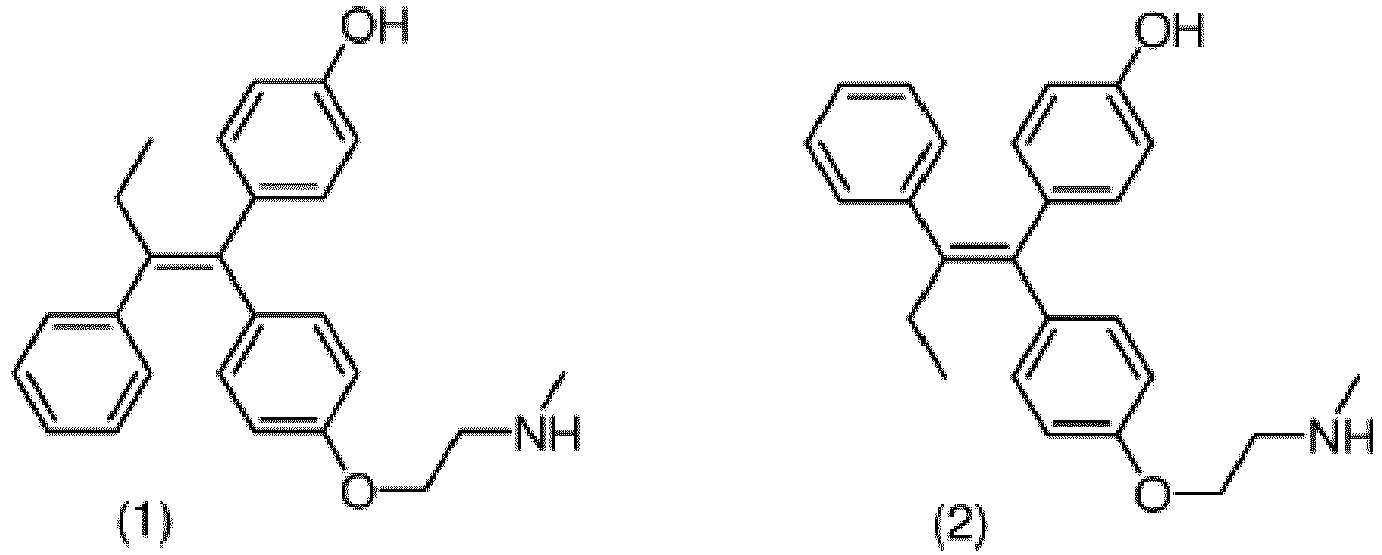
- isopropyl acetate can equilibrate a mixture of (Z)-endoxifen (1) and (E)-endoxifen (2) containing less than 50% Z-endoxifen to a 1:1 mixture of (Z)-endoxifen (1) and (E)-endoxifen (2) by heating.
- crystallization can be used to remove a crystalline solid containing primarily the unwanted E-isomer, and provide a mother liquor containing a mixture of (Z)- and (E)-endoxifen, but which is predominantly (Z)-endoxifen, for example the mother liquor may contain about 70% (Z)-endoxifen.
- This process is distinct from the usual crystallization procedure, which provides a crystalline solid containing mainly the desired (Z)-isomer.
- the claimed invention provides a process for preparing (Z)-endoxifen comprising:
- the initial step (i) in the disclosed process is the recrystallizing of an input crystalline solid comprising a mixture of (Z)-endoxifen (1) and (E)-endoxifen (2) from a first solvent, wherein the first solvent is isopropyl acetate, toluene, methyl ethyl ketone, or methyl isobutyl ketone, to provide a first crystalline solid and a first mother liquor, wherein the first mother liquor has a ratio of (1) to (2) at least 1.3 times greater than the ratio in the input crystalline solid;
- This recrystallizing is carried out in a first solvent in which the E isomer (2) crystallizes well and is significantly less soluble than the Z isomer (1). It has been unexpectedly discovered that toluene, isopropyl acetate, methyl ethyl ketone, and methyl isobutyl ketone are particularly useful first solvents for carrying out this step, with isopropyl acetate particularly preferred.
- the recrystallization can be performed by dissolving the input crystalline solid in the first solvent at a first temperature of 40 to 100°C and then cooling the solution by 20 to 100°C to a second temperature to effect crystallization. The solution can be held at the second temperature for several hours to allow for adequate crystallization.
- the input crystalline solid can be dissolved in isopropyl acetate at 70 to 100°C or 80 to 90°C, and then the resulting solution is cooled to 0 to 40°C or 20 to 30°C, and held at the second temperature for 0.5 hours to 10 days, preferably 2 to 24 hours. In some cases longer holding times at the second temperature may be required.
- the first crystalline solid and the first mother liquor may be separated by filtration, decanting, aspiration, or any suitable method.
- the separated first crystalline solid may be washed with a suitable solvent to remove impurities, and can be dried with or without heat and/or reduced pressure to remove solvent.
- the first crystalline solid is collected by filtration, washed with first solvent, and dried in vacuo to constant weight.
- the separated mother liquor can be concentrated in vacuo to give a solid or a non-solid, and can be can be dried with or without heat and/or reduced pressure to remove solvent.
- the concentrated mother liquor is dried in vacuo to constant weight.
- ratios of (1) to (2) can be accomplished by HPLC as given in the general methods section, as well as by other methods.
- the ratio of (1) to (2) in the first mother liquor can be from 1.3 to 100 times greater, or more than 1.3, 1.5, 2, 5, 10 or 20 times greater than the ratio of (1) to (2) in the input crystalline solid.
- the ratio of (1) to (2) in the first mother liquor can be from 2 to 40, or from 3 to 10, or from 4 to 5 times greater than the ratio of (1) to (2) in the input crystalline solid.
- the ratio of (1) to (2) in the first crystalline solid can be from 1.3 to 100 times lower, or more than 1.3, 1.5, 2, 5, 10 or 20 times lower than the ratio of (1) to (2) in the input crystalline solid.
- the ratio of (1) to (2) in the first crystalline solid can be from 1.3 to 40, or from 2 to 10, or from 2 to 4 times lower than the ratio of (1) to (2) in the input crystalline solid.
- the second step (ii) in the disclosed process is recrystallizing a solid produced by concentrating the first mother liquor, or by removal of the first solvent from the first mother liquor, from a second solvent to give a second crystalline solid and a second mother liquor.
- This recrystallizing is carried out in a second solvent in which the Z isomer (1) crystallizes well and in which enrichment of the Z isomer can be increased upon crystallization. It has been unexpectedly discovered that acetone is a particularly useful second solvent for carrying out this step, though methanol or ethanol may also be used as the second solvent.
- the recrystallization can be performed by dissolving the input crystalline solid in the second solvent at a first temperature of 20 to 100°C and then cooling the solution by 20 to 100 °C to a second temperature to effect crystallization. The solution can be held at the second temperature for several hours to allow for adequate crystallization.
- a solid formed from the concentrated first mother liquor can be dissolved in acetone from 20 to 47 °C (reflux temperature of acetone), preferably from 40 to 47 °C, and then the resulting solution is cooled to -10 to 20 °C or 0 to 10 °C, and held at the second temperature for 0.5 hours to 10 days or 2 to 72 hours. In some cases longer holding times at the second temperature may be required.
- the second crystalline solid and the second mother liquor may be separated by filtration, decanting, aspiration, or any suitable method.
- the separated second crystalline solid may be washed with a suitable solvent to remove impurities, and can be dried with or without heat and/or reduced pressure to remove solvent.
- the separated mother liquor can be concentrated in vacuo to give a solid, and can be can be dried with or without heat and/or reduced pressure to remove solvent.
- the second mother liquor is separated from the second crystalline solid by aspiration, concentrated and dried in vacuo to constant weight.
- the ratio of (1) to (2) in the second crystalline solid can be from 1.2 to 200, or 1.3 to 100, or 1.5 to 50, or 1.3 to 10 times higher than the ratio of (1) to (2) in the first mother liquor.
- the ratio of (1) to (2) in the second crystalline solid can be from 1.3 to 40, or from 2 to 10, or from 2 to 4 times higher than the ratio of (1) to (2) in the input crystalline solid.
- the third step (iii) is optionally recrystallizing the second crystalline solid from the second solvent one to five additional times to give a third crystalline solid, wherein the third crystalline solid has a ratio of (Z)-endoxifen (1) to (E)-endoxifen (2) greater than 20:1. This ratio may also be at least 1.3 times greater than the ration of (Z)-endoxifen (1) to (E)-endoxifen (2) in the second crystalline solid.
- the ratio of (1) to (2) in the second crystalline solid can be greater than 20:1, or greater than 50:1.
- the ratio of (1) to (2) in the third crystalline solid can be greater than 20:1, or greater than 50:1, or greater than 100:1.
- the process includes generating the input crystalline solid by reacting 4-(1-(4-(2-haloethoxy)phenyl)-2-phenylbut-1-enyl)phenol (3) with methylamine to produce a mixture of (Z)-endoxifen (1) and (E)-endoxifen (2), wherein X is chloro, bromo, or iodo
- the reaction of (3) with methylamine occurs in hydroxylic solvent, such as ethanol, methanol, or isopropanol. In some embodiments the reaction of (3) with methylamine occurs in methanol solvent. In some embodiments the reaction of (3) with methylamine occurs at a temperature from 30 to 50°C.
- the reaction of (3) can be concentrated, taken up in organic solvent, and washed with mild aqueous base such as NaHCO 3 or Na 2 CO 3 , and concentrated to give a solid.
- the product mixture of (1) and (2) can be recrystallized from a solvent such as acetone.
- the process includes generating the 4-(1-(4-(2-haloethoxy)phenyl)-2-phenylbut-1-enyl)phenol (3) by reacting propiophenone (4) with (4-(2-haloethoxy)phenyl)(4-hydroxyphenyl)methanone (5) in the presence of a titanium halide reagent
- reaction to form (3) is performed in the presence of zinc, which can be in the form of zinc dust.
- the titanium halide is titanium tetrachloride.
- the reaction can be performed with reagents suitable for the McMurray coupling between two ketones.
- the reaction can be performed in aprotic solvents such as dimethoxyethane, tetrahydrofuran, and methyl t-butyl ether.
- the reaction is performed in dimethoxyethane.
- the reaction can be performed at temperatures from -10 to 30°C, or from -5 to 15°C.
- the product (3) is purified by chromatography on silica gel.
- the process includes generating the (4-(2-haloethoxy)phenyl)(4-hydroxyphenyl)methanone (5) by reacting 4-hydroxybenzoic acid (6) with 1-(2-haloethoxy)benzene (7)
- the reaction to form (5) is performed in the presence of Bronsted or Lewis acid.
- the acid can be metal halide Lewis acids such as zinc bromide, iron trichloride, or aluminum trichloride. Other acids such as polyphosphoric acid, or phosphorus trihalides can be used.
- the reaction to form (5) is performed in the presence of zinc bromide, phosphorus tribromide and polyphosphoric acid.
- the reaction product mixture containing (5) can be concentrated, taken up in organic solvent, washed with aqueous base, and concentrated.
- the X group can be any leaving group which is stable enough to survive until the reaction of compound (3), but can be displaced by methylamine in the reaction of compound (3).
- X can be halogen (such as chloro, bromo, or iodo), sulfonate (such as methane sulfonate or p-toluenesulfonate), or other suitable leaving groups.
- X is halogen, more preferably X is bromo.
- X is bromo
- the first solvent is isopropyl acetate, toluene, methyl ethyl ketone, or methyl isobutyl ketone.
- the first solvent is isopropyl acetate.
- the second solvent is methanol, ethanol, or (preferably) acetone.
- the third crystalline solid has a ratio of (Z)-endoxifen (1) to (E)-endoxifen (2) of 50:1 or greater.
- each recrystallization requires dissolving the compound or compounds to be recrystallized in solvent that is at a first temperature, and then cooling the resulting solution to a second temperature 20 to 100°C lower than the first temperature.
- the first and second temperatures are selected based on the nature of the solvent. The cooling can be rapid or gradual, and can take from 1 minute to 24 hours or more.
- "recrystallizing" can be crystallizing from a nonsolid or semi-solid form, such as a syrup that has been concentrated but not solidified.
- the recrystallizing of the second crystalline solid in step (ii) is performed 2 times to obtain the third crystalline solid.
- the process includes a fourth step (iv) isomerizing a crystalline solid or mother liquor formed according to previous embodiments wherein the ratio of (Z)-endoxifen (1) to (E)-endoxifen (2) is less than 0.9 to 1, by dissolving the crystalline solid or mother liquor in a third solvent and heating at a temperature from 60 to 100°C for 0.5 to 4 hours, to produce an isomerized solution with a ratio of (Z)-endoxifen (1) to (E)-endoxifen (2) of approximately 1:1.
- the isomerizing can be performed at temperatures from 40 to 150°C, depending on the solvent. In some embodiments the isomerizing is performed at a temperature from 60 to 100°C, or from 70 to 90°C. Preferably the isomerizing is performed in isopropyl acetate at a temperature from 70 to 90°C.
- the isomerizing can be performed in the presence of acid.
- the acid can be a weak acid such as acetic acid, propionic acid, or citric acid, or the acid can be a strong acid such as hydrochloric, p-toluenesulfonic, or trifluoroacetic acid.
- the process further comprises concentrating the isomerized solution to form an isomerized crystalline solid, and using the isomerized crystalline solid as the input crystalline solid for steps (i) through (iii).
- the process further includes a fifth step, (v) cooling the isomerized solution by 30 to 100°C to form a fourth crystalline solid and a fourth mother liquor, and removing the mother liquor followed by resubjecting the fourth crystalline solid to step (iv) followed by cooling and crystallization at least two times or three or more times, and combining the resulting mother liquors to provide a combined mother liquor with a ratio of (Z)-endoxifen (1) to (E)-endoxifen (2) of at least 1.5 to 1.
- the fourth mother liquor is removed by aspiration, concentrated in vacuo and dried to solid weight.
- the combined mother liquor is concentrated in vacuo and dried to solid weight.
- the process further comprises designating the combined mother liquor as a first mother liquor and subjecting it to the same steps that would be used for a first mother liquor. In this way isomerized material can be used to produce more Z-endoxifen product.
- the third solvent is isopropyl acetate.
- the third solvent is the same as the first solvent. In some embodiments both the first solvent and third solvent are isopropyl acetate.
- the disclosure includes a process for preparing (Z)-endoxifen, including a first step (i) of recrystallizing an input crystalline solid comprising a mixture of (Z)-endoxifen (1) and (E)-endoxifen (2) from isopropyl acetate to provide a first crystalline solid and a first mother liquor, wherein the first mother liquor has a ratio of (1) to (2) at least 1.3 times greater than the ratio in the input crystalline solid;
- the chromatography conditions included a Phenomenex Luna Phenyl-Hexyl column (4.6 x 150mm, 5 ⁇ m), elution with a flow rate of 1.0 mL/min, and a gradient of mobile phase A: mobile phase B from 100:0 to 0:100.
- Mobile phase A was 40:60 10 mM ammonium formate in water, pH 4.3 : 10 mM ammonium formate in methanol, and mobile phase B was 10 mM ammonium formate in methanol.
- Zinc bromide (3.011 kg, 13.1 mol) and polyphosphoric acid (16.5 kg) were charged into a 20-L reaction vessel and stirred well while heated to 45°C.
- 4-Hydroxybenzoic acid (974 g, 6.98 mol) and 2-phenoxyethyl bromide (1302 g, 6.34 mol) were added.
- Phosphorus tribromide (2.72 kg, 9.83 mol) was added via an addition funnel over a period of 2.5 hours at a rate as to keep temperature below 50°C. Stirring at 40 - 50°C was continued for 1 hour and overnight (16 hours) without heating. Completion of the reaction was confirmed by NMR.
- the reaction mixture was poured into a well stirred ice-water mixture (ca. 38 L) in a 50-L reactor. The resulting suspension was stirred for 2 hours. The aqueous phase was separated from the sticky solid on the bottom of the reactor and discarded after neutralization to pH 5. The sticky residue was washed with water (6 L) and then dissolved in ethyl acetate (32 L). The resulting organic solution was washed with 20% aqueous NaOH solution (3.2 L). The formed solid was separated by filtration, washed with ethyl acetate and discarded. The aqueous phase was separated from the organic filtrate and discarded.
- Zn dust (4.3 kg, 65.8 mol) was suspended in anhydrous dimethoxyethane (26 L) in a 100-L jacketed glass reactor under argon atmosphere, and the contents of the reactor were cooled to 2°C. Titanium tetrachloride (6 kg, 31.6 mol) was added at such a rate as to keep the temperature inside the reactor below 25 °C. The mixture was heated to reflux and stirred for 1 hour, then left overnight at ambient temperature (15°C).
- the reactor was then cooled to 5°C, and a solution of propiophenone (542 g, 4 mol) and (4-(2-bromoethoxy)phenyl)(4-hydroxyphenyl)methanone (1324 g, 4 mol) in anhydrous dimethoxyethane (10 L) was added to the reaction flask in one portion.
- the mixture was stirred and heated at reflux for 6 hours, then cooled to 60 °C and left overnight at ambient temperature.
- the content of the reactor was cooled to -3°C, and methyl t -butyl ether (30 L) was added.
- a 5% aqueous HCl solution (-13 L) was added via an addition funnel, and the mixture was stirred for 2 hours before the organic phase was separated.
- the oil was purified in two portions by column chromatography on silica gel eluted with methylene chloride.
- the first portion (935 g) of the crude bromide was eluted with methylene chloride through a column of 13" (diameter) and 18" (height) packed with 11.4 kg of silica gel. Collected fractions were analyzed by TLC and HPLC. Fractions of a suitable purity were combined and the solvent was removed in vacuo to give a white solid (641 g of a Z/E mixture with a purity of 98%, calculated as sum of E+Z isomers).
- a jacketed glass reactor (100-L size) was charged with first -55 L methylamine solution (33% solution in ethanol) and then 4-(1-(4-(2-bromoethoxy)phenyl)-2-phenylbut-1-enyl)phenol (1875 g, 4.429 mol).
- the reaction mixture was heated to 33 °C for 21 hours, at which point a TLC test indicated complete consumption of the starting bromide.
- aqueous phase was re-extracted once with dichloromethane (15 L), and the combined organic solution was dried over Na 2 SO 4 (1.6 kg), filtered and concentrated in a 20-L evaporator to a tan solid.
- Acetone was added to the solid then removed in vacuo twice (7 L and 3 L of acetone, respectively) to give a solid (2164 g).
- the solid was dissolved in 5.9 L of acetone and the solution was heated to 65°C, and the resulting clear solution was slowly cooled to 20 °C for 19 hours and then kept in refrigerator at -10 °C for 4 days.
- the resulting crystalline material was collected by filtration (initial weight 2336 g) and dried in vacuo to give 1395 g of a mixture of E- and Z-Endoxifen.
- the filtrate was concentrated to provide an oily residue (314 g) which was dissolved in 950 mL of boiling acetone and then stored for 4 weeks at -10 °C.
- the resultant crystalline material (100 g) was collected by filtration and dried in vacuo to a constant weight (73 g). Filtrate of the second crop, containing mostly impurities and E-isomer, was discarded.
- the total yield of endoxifen (E/Z-isomer ratio: 51/47) from two recrystallizations was 1468 g (87%).
- Endoxifen (5512 g, E/Z ratio: ⁇ 50/50) was dissolved in 55 L of hot isopropyl acetate at 88°C. The clear solution was slowly cooled to 23 °C and kept for 6 hours. The crystalline material was collected in a filter funnel, washed with isopropyl acetate and dried in vacuo to a constant weight to give 2722 g (49%) of a material with an E/Z ratio of 68/30. The filtrate was concentrated to give a solid which was dried in vacuo to a constant weight to produce 2666 g (48%) of material enriched with the Z-isomer (E/Z-ratio: 19/77).
- Endoxifen (2721 g, E/Z ratio ⁇ 70 /30,) was suspended in isopropyl acetate (27 L) in a 100-L reactor. The suspension was heated at 85°C for 2 hours. The E/Z ratio of the solution was determined to be -1/1 by HPLC analysis. The mixture was cooled slowly to 15°C, resulting in the preferential crystallization of the E-isomer. The mother liquor (containing 71% Z-isomer) was removed from the reactor, evaporated to provide a solid and dried at 35°C to constant weight: 1314 g (48%, Z-isomer content: 73%).
- the material recovery of this step is 99%.
- Endoxifen (5013 g, E/Z ratio ⁇ 30/70) was dissolved in 50 L of acetone which was heated to reflux in a 100-L reactor. The resulting solution was cooled and stirred for 40 hours at 1 to 5 °C. The mother liquor was removed from the reactor by aspiration. The remaining crystalline material was re-dissolved in boiling acetone (52 L). The resultant solution was stirred for 50 hours at 1 to 5 °C. The mother liquor was removed. The remaining crystalline material was again dissolved in boiling acetone (48 L). The hot solution was filtered and kept for 22 hours at 1 to 5 °C. The crystalline material which precipitated was collected by filtration and washed with ice-cooled acetone.
Landscapes
- Chemical & Material Sciences (AREA)
- Organic Chemistry (AREA)
- Chemical Kinetics & Catalysis (AREA)
- Pharmaceuticals Containing Other Organic And Inorganic Compounds (AREA)
- Organic Low-Molecular-Weight Compounds And Preparation Thereof (AREA)
Claims (15)
- Verfahren zur Herstellung von (Z)-Endoxifen, umfassend:(i) Umkristallisieren eines eingegebenen kristallinen Feststoffs, umfassend ein Gemisch von (Z)-Endoxifen (1) und (E)-Endoxifen (2), aus einem ersten Lösungsmittel, wobei das erste Lösungsmittel Isopropylacetat, Toluol, Methylethylketon oder Methylisobutylketon ist, um einen ersten kristallinen Feststoff und eine erste Mutterlauge bereitzustellen, wobei die erste Mutterlauge ein Verhältnis von (1) zu (2) aufweist, das um mindestens das 1,3-fache höher als das Verhältnis in dem eingegebenen kristallinen Feststoff ist;
 (ii) Umkristallisieren eines Feststoffs durch Einengen der ersten Mutterlauge oder durch Abziehen des ersten Lösungsmittels aus der ersten Mutterlauge aus einem zweiten Lösungsmittel, wobei das zweite Lösungsmittel Methanol, Ethanol oder Aceton ist, um einen zweiten kristallinen Feststoff und eine zweite Mutterlauge zu ergeben;(iii) optionales Umkristallisieren des zweiten kristallinen Feststoffs aus dem zweiten Lösungsmittel ein bis fünf weitere Male, um einen dritten kristallinen Feststoff zu ergeben;wobei der dritte kristalline Feststoff ein Verhältnis von (Z)-Endoxifen (1) zu (E)-Endoxifen (2) aufweist, das größer als 20:1 ist.
 - Verfahren nach Anspruch 1, zusätzlich umfassend:
Erzeugen des eingegebenen kristallinen Feststoffs durch Umsetzen von 4-(1-(4-(2-Haloethoxy)phenyl)-2-phenylbut-1-enyl)phenol (3) mit Methylamin, um ein Gemisch von (Z)-Endoxifen (1) und (E)-Endoxifen (2) zu produzieren, wobei X Chlor, Brom oder Iod ist:
- Verfahren nach Anspruch 2, zusätzlich umfassend:
Erzeugen des 4-(1-(4-(2-Haloethoxy)phenyl)-2-phenylbut-1-enyl)phenol (3) durch Umsetzen von Propiophenon (4) mit (4-(2-Haloethoxy)phenyl)(4-hydroxyphenyl)methanon (5) in Gegenwart eines Titanhalogenid-Reagens:
- Verfahren nach Anspruch 3, zusätzlich umfassend:
Erzeugen des (4-(2-Haloethoxy)phenyl)(4-hydroxyphenyl)methanon (5) durch Umsetzen von 4-Hydroxybenzoesäure (6) mit 1-(2-Haloethoxy)benzol:
- Verfahren nach einem der Ansprüche 1 bis 4, wobei (a) jede Umkristallisation ein Lösen einer Verbindung oder mehrerer Verbindungen, die umkristallisiert werden soll bzw. sollen, in einem Lösungsmittel, das bei einer ersten Temperatur ist, und dann ein Abkühlen der resultierenden Lösung auf eine zweite Temperatur, die 20 bis 100°C niedriger als die erste Temperatur ist, erfordert und/oder (b) das Umkristallisieren des zweiten kristallinen Feststoffs in Schritt (ii) 2 Mal durchgeführt wird, um den dritten kristallinen Feststoff zu erhalten.
- Verfahren nach einem der Ansprüche 3 bis 5, wobei das Umsetzen von Propiophenon (4) mit (4-(2-Haloethoxy)phenyl) (4-hydroxyphenyl)methanon (5) in Gegenwart von Zink durchgeführt wird und wobei das Titanhalogenid-Reagens Titantetrachlorid ist.
- Verfahren nach einem der Ansprüche 4 bis 6, wobei das Umsetzen von 4-Hydroxybenzoesäure (6) mit 1-(2-Haloethoxy)benzol in Gegenwart von Zinkbromid, Polyphosphorsäure und Phosphortribromid erfolgt.
- Verfahren nach einem der Ansprüche 1 bis 7, ferner umfassend:
(iv) Isomerisieren eines kristallinen Feststoffs oder einer Mutterlauge, nach Anspruch 1 gebildet, wobei das Verhältnis von (Z)-Endoxifen (1) zu (E)-Endoxifen (2) weniger als 0,9 zu 1 ist, durch Lösen des kristallinen Feststoffs oder der Mutterlauge in einem dritten Lösungsmittel und Erhitzen auf zwischen 60 und 100°C für 0,5 bis 4 Stunden, um eine isomerisierte Lösung mit einem Verhältnis von (Z)-Endoxifen (1) zu (E)-Endoxifen (2) von ungefähr 1:1 zu produzieren. - Verfahren nach Anspruch 8, ferner umfassend ein Einengen der isomerisierten Lösung, um einen isomerisierten kristallinen Feststoff zu bilden, und ein Verwenden des isomerisierten kristallinen Feststoffs als den eingegebenen kristallinen Feststoff für die Schritte (i) bis (iii).
- Verfahren nach Anspruch 8 oder 9, ferner umfassend:
(v) Abkühlen der isomerisierten Lösung um 30 bis 100°C, um einen vierten kristallinen Feststoff und eine vierte Mutterlauge zu bilden, und Abziehen der Mutterlauge, gefolgt von einem erneuten Unterziehen des vierten kristallinen Feststoffs den Schritten (iv) und (v) mindestens zwei Mal und Vereinen der resultierenden Mutterlaugen, um ein vereinte Mutterlauge mit einem Verhältnis von (Z)-Endoxifen (1) zu (E)-Endoxifen (2) von mindestens 1,5 zu 1 bereitzustellen. - Verfahren nach Anspruch 10, ferner umfassend:
Bezeichnen der vereinten Mutterlauge als eine erste Mutterlauge und Unterziehen dieser denselben Schritten, die für eine erste Mutterlauge verwendet werden. - Verfahren nach einem der Ansprüche 8 bis 11, wobei das dritte Lösungsmittel mit dem ersten Lösungsmittel identisch ist.
- Verfahren nach Anspruch 8 oder Anspruch 12, wobei das dritte Lösungsmittel Isopropylacetat ist.
- Verfahren nach Anspruch 1, wobei der dritte kristalline Feststoff ein Verhältnis von (Z)-Endoxifen (1) zu (E)-Endoxifen (2) aufweist, das größer als 50:1 ist.
- Verfahren zur Herstellung von (Z)-Endoxifen, umfassend:(i) Lösen eines Gemischs von (Z)-Endoxifen (1) und (E)-Endoxifen (2) in Isopropylacetat, wobei das Gemisch ein Verhältnis von (1) zu (2) enthält, das kleiner als 1:1 ist;(ii) Erhitzen des Gemischs von (1) und (2) in Isopropylacetat bei einer Temperatur von 55°C bis 88°C, um ein zweites Gemisch von (1) und (2) zu erhalten, das ein Verhältnis von (1) zu (2) von etwa 1:1 aufweist; und(iii) Abkühlen des Gemischs, um einen kristallinen Feststoff und eine erste Mutterlauge zu bilden;(iv) Abziehen der ersten Mutterlauge von dem kristallinen Feststoff; und(v) Verdampfen der ersten Mutterlauge, um einen Feststoff zu bilden, der ein Verhältnis von (1) zu (2) aufweist, das größer als 1:1 ist.
Applications Claiming Priority (2)
| Application Number | Priority Date | Filing Date | Title |
|---|---|---|---|
| US201562245012P | 2015-10-22 | 2015-10-22 | |
| PCT/US2016/058413 WO2017070651A1 (en) | 2015-10-22 | 2016-10-24 | Process for preparing (z)-endoxifen of high purity |
Publications (2)
| Publication Number | Publication Date |
|---|---|
| EP3365322A1 EP3365322A1 (de) | 2018-08-29 |
| EP3365322B1 true EP3365322B1 (de) | 2021-05-26 |
Family
ID=57389508
Family Applications (1)
| Application Number | Title | Priority Date | Filing Date |
|---|---|---|---|
| EP16798855.9A Active EP3365322B1 (de) | 2015-10-22 | 2016-10-24 | Verfahren zur herstellung von hochreinem (z)-endoxifen |
Country Status (4)
| Country | Link |
|---|---|
| US (1) | US10464881B2 (de) |
| EP (1) | EP3365322B1 (de) |
| ES (1) | ES2883172T3 (de) |
| WO (1) | WO2017070651A1 (de) |
Families Citing this family (3)
| Publication number | Priority date | Publication date | Assignee | Title |
|---|---|---|---|---|
| IL304863B2 (en) | 2017-09-11 | 2025-08-01 | Atossa Therapeutics Inc | Methods for making and using endoxifen |
| JP7662204B2 (ja) | 2019-07-03 | 2025-04-15 | アトッサ・セラピューティクス・インコーポレイテッド | エンドキシフェンの徐放性組成物 |
| IL314075A (en) | 2022-01-12 | 2024-09-01 | Atossa Therapeutics Inc | Compositions of (Z)-endoxifen and methods for their enrichment |
Citations (1)
| Publication number | Priority date | Publication date | Assignee | Title |
|---|---|---|---|---|
| WO2017080770A1 (de) * | 2015-11-10 | 2017-05-18 | Robert Bosch Gesellschaft Für Medizinische Forschung Mbh | Synthese von (z)-endoxifenhydrochlorid |
Family Cites Families (1)
| Publication number | Priority date | Publication date | Assignee | Title |
|---|---|---|---|---|
| KR101308258B1 (ko) * | 2010-10-15 | 2013-09-13 | 씨제이제일제당 (주) | 엔독시펜의 신규한 제조 방법 |
-
2016
- 2016-10-24 EP EP16798855.9A patent/EP3365322B1/de active Active
- 2016-10-24 WO PCT/US2016/058413 patent/WO2017070651A1/en not_active Ceased
- 2016-10-24 ES ES16798855T patent/ES2883172T3/es active Active
- 2016-10-24 US US15/770,274 patent/US10464881B2/en active Active
Patent Citations (1)
| Publication number | Priority date | Publication date | Assignee | Title |
|---|---|---|---|---|
| WO2017080770A1 (de) * | 2015-11-10 | 2017-05-18 | Robert Bosch Gesellschaft Für Medizinische Forschung Mbh | Synthese von (z)-endoxifenhydrochlorid |
Also Published As
| Publication number | Publication date |
|---|---|
| EP3365322A1 (de) | 2018-08-29 |
| US10464881B2 (en) | 2019-11-05 |
| US20180305295A1 (en) | 2018-10-25 |
| WO2017070651A1 (en) | 2017-04-27 |
| ES2883172T3 (es) | 2021-12-07 |
Similar Documents
| Publication | Publication Date | Title |
|---|---|---|
| EP3596042B1 (de) | Kristallformen von aminolipiden | |
| EP3102208B1 (de) | Kristallines polymorph der freien base von 2-hydroxy-6-((2-(1-isopropyl-1h-pyrazol-5-yl)pyridin-3-yl)methoxy)benzaldehyd | |
| ES2596202T3 (es) | Método para la preparación de una forma cristalina de 1-cloro-4-(ß-D-glucopiranos-1-il)-2-[4-((S)-tetrahidrofuran-3-iloxi)-bencil]-benceno | |
| EP3365322B1 (de) | Verfahren zur herstellung von hochreinem (z)-endoxifen | |
| EP1334082A2 (de) | Kristalline venlafaxinbase und neue venlafaxin-hydrochlorid-modifikationen sowie verfahren zu deren herstellung | |
| EP3351550B1 (de) | Phosphoramidatverbindung und herstellungsverfahren und kristalline form davon | |
| US10442832B2 (en) | Process of making regadenoson and novel polymorph thereof | |
| US20260008752A1 (en) | Polymorphic forms of florbetapir precursor av-105 | |
| Kanagavel et al. | Trimorphic forms of 5-fluorocytosine–gentisic acid with enhanced hydration stability | |
| CN102336818A (zh) | 一种肽类物质的晶体及其制备方法和用途 | |
| CN114105872B (zh) | 一种用于制备盐酸丙卡特罗的中间体及其制备方法 | |
| CN101883486A (zh) | 制备r-棉酚l-苯丙氨醇二烯胺的方法 | |
| EP3568394A1 (de) | Kristalline valbenazinfreie base | |
| CN115448895B (zh) | 一种沃替西汀前药的晶型、其制备方法和应用 | |
| EP4582419A1 (de) | Verfahren zur herstellung eines chinoxalinderivats | |
| EP4083047B1 (de) | Carbacyclische phosphatidsäureverbindung | |
| CN120818003A (zh) | 一种雷公藤红素及其溶剂合物的晶型、制备方法与应用 | |
| CN111362816B (zh) | 他莫昔芬有关物质的制备方法 | |
| Nádvorník et al. | Syntheses, X-ray, MSn, NMR and CD structure determination of nickel (II) complexes of Schiff bases of (S)-N-(2-benzoylphenyl)-1-benzylpyrrolidine-2-carboxamide and aromatic α-amino acids | |
| HK40057492A (en) | Crystalline polymorphs of the free base of 2-hydroxy-6-((2-(1-isopropyl-1h-pyrazol-5-yl)pyridin-3-yl)methoxy)benzaldehyde | |
| WO2014104905A1 (en) | Process for preparation of 3,24;16,22-di-o,o-isopropylideneprotoescigenin and crystalline forms thereof | |
| WO2011114336A1 (en) | Process for the isolation of ganciclovir intermediate | |
| HU193781B (en) | Process for producing 10alpha-methoxy-6-methylergoline derivatives and acid additional salts thereof | |
| BE670695A (de) |
Legal Events
| Date | Code | Title | Description |
|---|---|---|---|
| STAA | Information on the status of an ep patent application or granted ep patent |
Free format text: STATUS: UNKNOWN |
|
| STAA | Information on the status of an ep patent application or granted ep patent |
Free format text: STATUS: THE INTERNATIONAL PUBLICATION HAS BEEN MADE |
|
| PUAI | Public reference made under article 153(3) epc to a published international application that has entered the european phase |
Free format text: ORIGINAL CODE: 0009012 |
|
| STAA | Information on the status of an ep patent application or granted ep patent |
Free format text: STATUS: REQUEST FOR EXAMINATION WAS MADE |
|
| 17P | Request for examination filed |
Effective date: 20180521 |
|
| AK | Designated contracting states |
Kind code of ref document: A1 Designated state(s): AL AT BE BG CH CY CZ DE DK EE ES FI FR GB GR HR HU IE IS IT LI LT LU LV MC MK MT NL NO PL PT RO RS SE SI SK SM TR |
|
| AX | Request for extension of the european patent |
Extension state: BA ME |
|
| DAV | Request for validation of the european patent (deleted) | ||
| DAX | Request for extension of the european patent (deleted) | ||
| STAA | Information on the status of an ep patent application or granted ep patent |
Free format text: STATUS: EXAMINATION IS IN PROGRESS |
|
| 17Q | First examination report despatched |
Effective date: 20190516 |
|
| GRAP | Despatch of communication of intention to grant a patent |
Free format text: ORIGINAL CODE: EPIDOSNIGR1 |
|
| STAA | Information on the status of an ep patent application or granted ep patent |
Free format text: STATUS: GRANT OF PATENT IS INTENDED |
|
| INTG | Intention to grant announced |
Effective date: 20201216 |
|
| GRAS | Grant fee paid |
Free format text: ORIGINAL CODE: EPIDOSNIGR3 |
|
| GRAA | (expected) grant |
Free format text: ORIGINAL CODE: 0009210 |
|
| STAA | Information on the status of an ep patent application or granted ep patent |
Free format text: STATUS: THE PATENT HAS BEEN GRANTED |
|
| AK | Designated contracting states |
Kind code of ref document: B1 Designated state(s): AL AT BE BG CH CY CZ DE DK EE ES FI FR GB GR HR HU IE IS IT LI LT LU LV MC MK MT NL NO PL PT RO RS SE SI SK SM TR |
|
| REG | Reference to a national code |
Ref country code: GB Ref legal event code: FG4D |
|
| REG | Reference to a national code |
Ref country code: CH Ref legal event code: EP |
|
| REG | Reference to a national code |
Ref country code: AT Ref legal event code: REF Ref document number: 1396104 Country of ref document: AT Kind code of ref document: T Effective date: 20210615 |
|
| REG | Reference to a national code |
Ref country code: DE Ref legal event code: R096 Ref document number: 602016058501 Country of ref document: DE |
|
| REG | Reference to a national code |
Ref country code: IE Ref legal event code: FG4D |
|
| REG | Reference to a national code |
Ref country code: LT Ref legal event code: MG9D |
|
| REG | Reference to a national code |
Ref country code: AT Ref legal event code: MK05 Ref document number: 1396104 Country of ref document: AT Kind code of ref document: T Effective date: 20210526 |
|
| PG25 | Lapsed in a contracting state [announced via postgrant information from national office to epo] |
Ref country code: LT Free format text: LAPSE BECAUSE OF FAILURE TO SUBMIT A TRANSLATION OF THE DESCRIPTION OR TO PAY THE FEE WITHIN THE PRESCRIBED TIME-LIMIT Effective date: 20210526 Ref country code: FI Free format text: LAPSE BECAUSE OF FAILURE TO SUBMIT A TRANSLATION OF THE DESCRIPTION OR TO PAY THE FEE WITHIN THE PRESCRIBED TIME-LIMIT Effective date: 20210526 Ref country code: BG Free format text: LAPSE BECAUSE OF FAILURE TO SUBMIT A TRANSLATION OF THE DESCRIPTION OR TO PAY THE FEE WITHIN THE PRESCRIBED TIME-LIMIT Effective date: 20210826 Ref country code: AT Free format text: LAPSE BECAUSE OF FAILURE TO SUBMIT A TRANSLATION OF THE DESCRIPTION OR TO PAY THE FEE WITHIN THE PRESCRIBED TIME-LIMIT Effective date: 20210526 Ref country code: HR Free format text: LAPSE BECAUSE OF FAILURE TO SUBMIT A TRANSLATION OF THE DESCRIPTION OR TO PAY THE FEE WITHIN THE PRESCRIBED TIME-LIMIT Effective date: 20210526 |
|
| REG | Reference to a national code |
Ref country code: NL Ref legal event code: MP Effective date: 20210526 |
|
| PG25 | Lapsed in a contracting state [announced via postgrant information from national office to epo] |
Ref country code: IS Free format text: LAPSE BECAUSE OF FAILURE TO SUBMIT A TRANSLATION OF THE DESCRIPTION OR TO PAY THE FEE WITHIN THE PRESCRIBED TIME-LIMIT Effective date: 20210926 Ref country code: LV Free format text: LAPSE BECAUSE OF FAILURE TO SUBMIT A TRANSLATION OF THE DESCRIPTION OR TO PAY THE FEE WITHIN THE PRESCRIBED TIME-LIMIT Effective date: 20210526 Ref country code: GR Free format text: LAPSE BECAUSE OF FAILURE TO SUBMIT A TRANSLATION OF THE DESCRIPTION OR TO PAY THE FEE WITHIN THE PRESCRIBED TIME-LIMIT Effective date: 20210827 Ref country code: PT Free format text: LAPSE BECAUSE OF FAILURE TO SUBMIT A TRANSLATION OF THE DESCRIPTION OR TO PAY THE FEE WITHIN THE PRESCRIBED TIME-LIMIT Effective date: 20210927 Ref country code: PL Free format text: LAPSE BECAUSE OF FAILURE TO SUBMIT A TRANSLATION OF THE DESCRIPTION OR TO PAY THE FEE WITHIN THE PRESCRIBED TIME-LIMIT Effective date: 20210526 Ref country code: NO Free format text: LAPSE BECAUSE OF FAILURE TO SUBMIT A TRANSLATION OF THE DESCRIPTION OR TO PAY THE FEE WITHIN THE PRESCRIBED TIME-LIMIT Effective date: 20210826 Ref country code: SE Free format text: LAPSE BECAUSE OF FAILURE TO SUBMIT A TRANSLATION OF THE DESCRIPTION OR TO PAY THE FEE WITHIN THE PRESCRIBED TIME-LIMIT Effective date: 20210526 Ref country code: RS Free format text: LAPSE BECAUSE OF FAILURE TO SUBMIT A TRANSLATION OF THE DESCRIPTION OR TO PAY THE FEE WITHIN THE PRESCRIBED TIME-LIMIT Effective date: 20210526 |
|
| REG | Reference to a national code |
Ref country code: ES Ref legal event code: FG2A Ref document number: 2883172 Country of ref document: ES Kind code of ref document: T3 Effective date: 20211207 |
|
| PG25 | Lapsed in a contracting state [announced via postgrant information from national office to epo] |
Ref country code: NL Free format text: LAPSE BECAUSE OF FAILURE TO SUBMIT A TRANSLATION OF THE DESCRIPTION OR TO PAY THE FEE WITHIN THE PRESCRIBED TIME-LIMIT Effective date: 20210526 |
|
| PG25 | Lapsed in a contracting state [announced via postgrant information from national office to epo] |
Ref country code: DK Free format text: LAPSE BECAUSE OF FAILURE TO SUBMIT A TRANSLATION OF THE DESCRIPTION OR TO PAY THE FEE WITHIN THE PRESCRIBED TIME-LIMIT Effective date: 20210526 Ref country code: CZ Free format text: LAPSE BECAUSE OF FAILURE TO SUBMIT A TRANSLATION OF THE DESCRIPTION OR TO PAY THE FEE WITHIN THE PRESCRIBED TIME-LIMIT Effective date: 20210526 Ref country code: EE Free format text: LAPSE BECAUSE OF FAILURE TO SUBMIT A TRANSLATION OF THE DESCRIPTION OR TO PAY THE FEE WITHIN THE PRESCRIBED TIME-LIMIT Effective date: 20210526 Ref country code: RO Free format text: LAPSE BECAUSE OF FAILURE TO SUBMIT A TRANSLATION OF THE DESCRIPTION OR TO PAY THE FEE WITHIN THE PRESCRIBED TIME-LIMIT Effective date: 20210526 Ref country code: SK Free format text: LAPSE BECAUSE OF FAILURE TO SUBMIT A TRANSLATION OF THE DESCRIPTION OR TO PAY THE FEE WITHIN THE PRESCRIBED TIME-LIMIT Effective date: 20210526 Ref country code: SM Free format text: LAPSE BECAUSE OF FAILURE TO SUBMIT A TRANSLATION OF THE DESCRIPTION OR TO PAY THE FEE WITHIN THE PRESCRIBED TIME-LIMIT Effective date: 20210526 |
|
| REG | Reference to a national code |
Ref country code: DE Ref legal event code: R097 Ref document number: 602016058501 Country of ref document: DE |
|
| PLBE | No opposition filed within time limit |
Free format text: ORIGINAL CODE: 0009261 |
|
| STAA | Information on the status of an ep patent application or granted ep patent |
Free format text: STATUS: NO OPPOSITION FILED WITHIN TIME LIMIT |
|
| 26N | No opposition filed |
Effective date: 20220301 |
|
| PG25 | Lapsed in a contracting state [announced via postgrant information from national office to epo] |
Ref country code: IS Free format text: LAPSE BECAUSE OF FAILURE TO SUBMIT A TRANSLATION OF THE DESCRIPTION OR TO PAY THE FEE WITHIN THE PRESCRIBED TIME-LIMIT Effective date: 20210926 Ref country code: AL Free format text: LAPSE BECAUSE OF FAILURE TO SUBMIT A TRANSLATION OF THE DESCRIPTION OR TO PAY THE FEE WITHIN THE PRESCRIBED TIME-LIMIT Effective date: 20210526 |
|
| REG | Reference to a national code |
Ref country code: BE Ref legal event code: MM Effective date: 20211031 |
|
| PG25 | Lapsed in a contracting state [announced via postgrant information from national office to epo] |
Ref country code: MC Free format text: LAPSE BECAUSE OF FAILURE TO SUBMIT A TRANSLATION OF THE DESCRIPTION OR TO PAY THE FEE WITHIN THE PRESCRIBED TIME-LIMIT Effective date: 20210526 |
|
| PG25 | Lapsed in a contracting state [announced via postgrant information from national office to epo] |
Ref country code: LU Free format text: LAPSE BECAUSE OF NON-PAYMENT OF DUE FEES Effective date: 20211024 Ref country code: BE Free format text: LAPSE BECAUSE OF NON-PAYMENT OF DUE FEES Effective date: 20211031 |
|
| PG25 | Lapsed in a contracting state [announced via postgrant information from national office to epo] |
Ref country code: IE Free format text: LAPSE BECAUSE OF NON-PAYMENT OF DUE FEES Effective date: 20211024 |
|
| PG25 | Lapsed in a contracting state [announced via postgrant information from national office to epo] |
Ref country code: HU Free format text: LAPSE BECAUSE OF FAILURE TO SUBMIT A TRANSLATION OF THE DESCRIPTION OR TO PAY THE FEE WITHIN THE PRESCRIBED TIME-LIMIT; INVALID AB INITIO Effective date: 20161024 |
|
| P01 | Opt-out of the competence of the unified patent court (upc) registered |
Effective date: 20230511 |
|
| PG25 | Lapsed in a contracting state [announced via postgrant information from national office to epo] |
Ref country code: CY Free format text: LAPSE BECAUSE OF FAILURE TO SUBMIT A TRANSLATION OF THE DESCRIPTION OR TO PAY THE FEE WITHIN THE PRESCRIBED TIME-LIMIT Effective date: 20210526 |
|
| PG25 | Lapsed in a contracting state [announced via postgrant information from national office to epo] |
Ref country code: MK Free format text: LAPSE BECAUSE OF FAILURE TO SUBMIT A TRANSLATION OF THE DESCRIPTION OR TO PAY THE FEE WITHIN THE PRESCRIBED TIME-LIMIT Effective date: 20210526 |
|
| PG25 | Lapsed in a contracting state [announced via postgrant information from national office to epo] |
Ref country code: MT Free format text: LAPSE BECAUSE OF FAILURE TO SUBMIT A TRANSLATION OF THE DESCRIPTION OR TO PAY THE FEE WITHIN THE PRESCRIBED TIME-LIMIT Effective date: 20210526 |
|
| REG | Reference to a national code |
Ref country code: CH Ref legal event code: U11 Free format text: ST27 STATUS EVENT CODE: U-0-0-U10-U11 (AS PROVIDED BY THE NATIONAL OFFICE) Effective date: 20251101 |
|
| PG25 | Lapsed in a contracting state [announced via postgrant information from national office to epo] |
Ref country code: TR Free format text: LAPSE BECAUSE OF FAILURE TO SUBMIT A TRANSLATION OF THE DESCRIPTION OR TO PAY THE FEE WITHIN THE PRESCRIBED TIME-LIMIT Effective date: 20210526 |
|
| PGFP | Annual fee paid to national office [announced via postgrant information from national office to epo] |
Ref country code: DE Payment date: 20251029 Year of fee payment: 10 |
|
| PGFP | Annual fee paid to national office [announced via postgrant information from national office to epo] |
Ref country code: GB Payment date: 20251027 Year of fee payment: 10 |
|
| PGFP | Annual fee paid to national office [announced via postgrant information from national office to epo] |
Ref country code: IT Payment date: 20251021 Year of fee payment: 10 |
|
| PGFP | Annual fee paid to national office [announced via postgrant information from national office to epo] |
Ref country code: FR Payment date: 20251027 Year of fee payment: 10 |
|
| PGFP | Annual fee paid to national office [announced via postgrant information from national office to epo] |
Ref country code: CH Payment date: 20251101 Year of fee payment: 10 |
|
| PGFP | Annual fee paid to national office [announced via postgrant information from national office to epo] |
Ref country code: ES Payment date: 20251103 Year of fee payment: 10 |