EP3367355B1 - Générateur d'écran de fumée - Google Patents
Générateur d'écran de fumée Download PDFInfo
- Publication number
- EP3367355B1 EP3367355B1 EP16857272.5A EP16857272A EP3367355B1 EP 3367355 B1 EP3367355 B1 EP 3367355B1 EP 16857272 A EP16857272 A EP 16857272A EP 3367355 B1 EP3367355 B1 EP 3367355B1
- Authority
- EP
- European Patent Office
- Prior art keywords
- flow path
- closure
- smoke screen
- discharge flow
- discharge
- Prior art date
- Legal status (The legal status is an assumption and is not a legal conclusion. Google has not performed a legal analysis and makes no representation as to the accuracy of the status listed.)
- Active
Links
Images
Classifications
-
- F—MECHANICAL ENGINEERING; LIGHTING; HEATING; WEAPONS; BLASTING
- F41—WEAPONS
- F41H—ARMOUR; ARMOURED TURRETS; ARMOURED OR ARMED VEHICLES; MEANS OF ATTACK OR DEFENCE, e.g. CAMOUFLAGE, IN GENERAL
- F41H9/00—Equipment for attack or defence by spreading flame, gas or smoke or leurres; Chemical warfare equipment
- F41H9/06—Apparatus for generating artificial fog or smoke screens
-
- F—MECHANICAL ENGINEERING; LIGHTING; HEATING; WEAPONS; BLASTING
- F42—AMMUNITION; BLASTING
- F42B—EXPLOSIVE CHARGES, e.g. FOR BLASTING, FIREWORKS, AMMUNITION
- F42B12/00—Projectiles, missiles or mines characterised by the warhead, the intended effect, or the material
- F42B12/02—Projectiles, missiles or mines characterised by the warhead, the intended effect, or the material characterised by the warhead or the intended effect
- F42B12/36—Projectiles, missiles or mines characterised by the warhead, the intended effect, or the material characterised by the warhead or the intended effect for dispensing materials; for producing chemical or physical reaction; for signalling ; for transmitting information
- F42B12/46—Projectiles, missiles or mines characterised by the warhead, the intended effect, or the material characterised by the warhead or the intended effect for dispensing materials; for producing chemical or physical reaction; for signalling ; for transmitting information for dispensing gases, vapours, powders or chemically-reactive substances
- F42B12/48—Projectiles, missiles or mines characterised by the warhead, the intended effect, or the material characterised by the warhead or the intended effect for dispensing materials; for producing chemical or physical reaction; for signalling ; for transmitting information for dispensing gases, vapours, powders or chemically-reactive substances smoke-producing, e.g. infrared clouds
-
- F—MECHANICAL ENGINEERING; LIGHTING; HEATING; WEAPONS; BLASTING
- F41—WEAPONS
- F41B—WEAPONS FOR PROJECTING MISSILES WITHOUT USE OF EXPLOSIVE OR COMBUSTIBLE PROPELLANT CHARGE; WEAPONS NOT OTHERWISE PROVIDED FOR
- F41B15/00—Weapons not otherwise provided for, e.g. nunchakus, throwing knives
-
- G—PHYSICS
- G08—SIGNALLING
- G08B—SIGNALLING SYSTEMS, e.g. PERSONAL CALLING SYSTEMS; ORDER TELEGRAPHS; ALARM SYSTEMS
- G08B15/00—Identifying, scaring or incapacitating burglars, thieves or intruders, e.g. by explosives
- G08B15/02—Identifying, scaring or incapacitating burglars, thieves or intruders, e.g. by explosives with smoke, gas, or coloured or odorous powder or liquid
Definitions
- the present invention relates to a smoke screen generator which is usable in combination with a security apparatus.
- a smoke screen generator may be mounted to a ceiling, a wall, or the like of a room in order to mentally confuse an intruder breaking and entering a store, a room, or the like by visually blocking an escape route and to secure time until the intruder is captured.
- JP-B No. 3816867 discloses an invention of a smoke screen generation apparatus. As shown in Figs. 1 to 5 , the smoke screen generation apparatus has a disk-like outer shape and, at the time of actuation, discharges a smoke screen in a radial direction.
- JP-A No. 2015-043143 discloses an invention of a smoke generator. As shown in Figs. 1 and 3 , a smoke screen generation apparatus has a disk-like outer shape and, at the time of actuation, discharges a smoke screen in a radial direction in a similar manner to JP-B No. 3816867 .
- document US 2014/230685 A1 discloses a gas generator including a cylindrical housing, a diffuser portion, a first combustion chamber defined by a first porous plate member, a second combustion chamber defined by a second porous plate member, and an ignition device having an ignition portion attached to an igniter collar.
- a first aspect of the present invention provides a smoke screen generator including a cylindrical housing, an igniter and a smoke screen generating agent which are accommodated in the cylindrical housing, a first closure including the igniter and closing a first end opening of the cylindrical housing, a second closure having a first discharge flow path and a first discharge port, which is an outlet of the first discharge flow path, and closing a second end opening of the cylindrical housing on an opposite side in an axial direction to the first end opening, a flow path changing member for a smoke screen source being attached to an outer side of the second closure, a second discharge flow path being provided between the second closure and the flow path changing member and in communication with the outlet of the first discharge flow path, and an outlet of the second discharge flow path being a final discharge port, the first discharge flow path being extended in a direction coaxial with the cylindrical housing and the second discharge flow path being extended in a different direction from that of the first discharge flow path, the first closure having a discharge hole for discharging an ignition product which is
- a second aspect of the present invention provides a smoke screen generator including a cylindrical housing, an igniter and a smoke screen generating agent which are accommodated in the cylindrical housing, a first closure including the igniter and closing a first end opening of the cylindrical housing, a second closure having a first discharge flow path and a first discharge port, which is an outlet of the first discharge flow path, and closing a second end opening of the cylindrical housing on an opposite side in an axial direction to the first end opening, a flow path changing member for a smoke screen source being attached to an outer side of the second closure at an interval from the second closure in the axial direction, the flow path changing member being substaintially in a cup shape and having a bottom portion and a circumferential wall, the second closure having a shape such that a continuous second discharge flow path is formed between the second closure and the bottom portion of the flow path changing member, between the second closure and an inner circumferential surface of the circumferential wall of the flow path changing member, between the second closure
- the apparatuses according to the inventions of JP-B No. 3816867 and JP-A No. 2015-043143 both have a disk-like outer shape. In other cases, smoke generating apparatuses may have a cylindrical outer shape.
- the present invention provides a smoke screen generator in which an ignition and combustion rate of an entire smoke screen generating agent is increased and, further, an ejection rate and a diffusion rate of generated smoke into a room are elevated with a use of a cylindrical container.
- the present invention provides a smoke screen generator which reduces a discharge amount of by-products derived from components of a smoke screen generating agent.
- a cylindrical housing is made of a metal such as iron or stainless steel and has a first end opening and a second end opening.
- a first closure is made of a metal such as iron or stainless steel and has a shape and a size which are capable of closing the first end opening of the cylindrical housing.
- the first closure is attached to the first end opening of the cylindrical housing by being screwed thereinto, by being press-fitted thereinto, or by being welded thereto.
- An igniter and the first closure may be integrated or the igniter may be disposed in the first closure.
- igniter a known igniter for a gas generator used in an airbag apparatus can be used.
- a second closure is made of a metal such as iron or stainless steel and has a shape and a size which are capable of closing the second end opening of the cylindrical housing.
- the second closure has a first discharge flow path and a first discharge port for a smoke screen source which is an outlet of the first discharge flow path.
- the first discharge flow path is extended in a direction coaxial with the cylindrical housing.
- the second closure is attached to the second end opening of the cylindrical housing by being screwed thereinto, by being press-fitted thereinto, or by being welded thereto.
- the second closure may be formed of a single member or may be formed of a combination of two members.
- the two members may be integrated by being screwed into each other, by being press-fitted into each other, or by being welded to each other.
- a porous cylindrical body of the first aspect and the second aspect needs only to be a metallic cylindrical member having a large number of holes on a circumferential surface thereof, and a net molded into a cylindrical shape, a cylinder with a large number of holes formed on a circumferential surface thereof, and the like can be used.
- the porous cylindrical body is a net molded into a cylindrical shape.
- Holes of the porous cylindrical body preferably are in a size such that the smoke screen source passes therethrough and prevents entry of a smoke screen generating agent accommodated in a smoke screen generating agent-accommodating chamber.
- a combustible member such as paper can be interposed between the porous cylindrical body and the smoke screen generating agent in order to prevent the smoke screen generating agent from entering a discharge path of the smoke screen source.
- the porous cylindrical body Prior to actuation, acts to push the smoke screen generating agent accommodated in the smoke screen generating agent-accommodating chamber radially outward and therefore functions to prevent gaps from being created in the smoke screen generating agent-accommodating chamber, and at the time of actuation, the porous cylindrical body functions as a discharge path of the smoke screen source generated by combustion of the smoke screen generating agent.
- the smoke screen generating agent is preferably a known smoke screen generating agent molded into a columnar shape or the like, but the smoke screen generating agent may be in a powder form.
- the smoke screen generating agent for example, a smoke generating agent composition including a smoke generating agent and a gas generating agent disclosed in JP-A No. 2015-42603 or a combination of the smoke generating agent and the gas generating agent disclosed in JP-A No. 2015-43143 can be used.
- the gas generating agent includes a fuel, an oxidizing agent, a binder and the like.
- a fuel selected from sucrose, silicone oil, and tripotassium citrate salt (monohydrate) can be used.
- a first component, a second component, or a combination of the first component and the second component can be used.
- the first component is preferably selected from paraffin wax, liquid paraffin, microcrystalline wax, polyethylene glycol and the like
- the second component is preferably selected from metal carbonate (hydrate), metal hydride, and metal hydroxide.
- the first discharge flow path which is provided in the second closure is extended in a direction coaxial with the cylindrical housing, and the second discharge flow path between the second closure and the flow path changing member is extended in a direction orthogonal to the first discharge flow path.
- the flow path changing member is made of a metal such as iron or stainless steel and is combined with the second closure to form the second discharge flow path.
- the flow path changing member and the second closure may be integrated by a fixing means such as a bolt in a state where an interval is provided between the flow path changing member and the second closure.
- a fixing means such as a bolt
- the interval between the flow path changing member and the second closure is the second discharge flow path.
- the flow path changing member and the second closure may be formed integrally, or may be integrated by welding.
- the second discharge flow path is formed by a single channel or a plurality of channels (for example, cross-shaped channels or radial channels) connected to an outlet of the first discharge flow path.
- the second discharge flow path is extended in a direction that differs from that of the first discharge flow path.
- an angle formed between the second discharge flow path and the axial direction of the cylindrical housing is preferably equal to or smaller than 90 degrees and may be set to, for example, a range of 45 to 90 degrees.
- the second discharge flow path is provided between the second closure and the flow path changing member, and in communication with an outlet of the first discharge flow path, a through hole, which penetrates the flow path changing member in a thickness direction and reaches the second discharge flow path, is provided, an annular outlet of the second discharge flow path is a first final discharge port and the through hole is a second final discharge port, and the first final discharge port and the second final discharge port are opened and closed to control a discharge direction of a smoke screen source.
- the smoke screen generator according to the present embodiment has a first final discharge port and a second final discharge port as final discharge ports connected to the second discharge flow path.
- the first final discharge port opens in a direction that differs from the first discharge flow path while the second final discharge port opens in a same direction as the first discharge flow path.
- a method of opening and closing the first final discharge port and the second final discharge port is not particularly limited and, such a method can be employed that screws are threaded in respective inner wall surfaces of the first final discharge port and the second final discharge port and a bolt is screwed thereinto to close the discharge holes or unscrewed therefrom to open the discharge holes.
- a part of the plurality of the first final discharge ports may be closed while the remaining holes are opened, and a part of the plurality of the second final discharge ports may be closed while the remaining holes are opened.
- the igniter Since the igniter is positioned at the first end opening together with the first closure, when the igniter is actuated, the smoke screen generating agent in the smoke screen generating agent-accommodating chamber is ignited and burned on the side of the first closure and combustion proceeds toward the second closure.
- the porous cylindrical body is arranged in a central portion of the smoke screen generating agent-accommodating chamber in a range from the first closure to the second closure, and thereby, when the smoke screen generating agent is ignited and burned on the side of the first closure, high-temperature gas generated by the combustion enters the porous cylindrical body, moves in the axial direction, and at the same time, ignites and burns the smoke screen generating agent in contact with the porous cylindrical body.
- the high temperature-smoke screen source passes through the first discharge flow path, then changes its direction by passing through the second discharge flow path of the flow path changing member, and is discharged as a smoke screen into a room from the final discharge ports.
- the first discharge flow path which is provided in the second closure is extended in a direction coaxial with the cylindrical housing, and the second discharge flow path between the second closure and the flow path changing member is extended in a direction orthogonal to the first discharge flow path.
- the smoke screen source collides directly with an inner wall surface to change its direction before being discharged into a room.
- the second discharge flow path is formed to be in communication with the first discharge flow path, and to be extended in an orthogonal direction to the first discharge flow path and further bent at a plurality of locations.
- the smoke screen source collides at a plurality of locations in the course of passing through the second discharge flow path until the final discharge port, and thereafter is discharged from the final discharge ports.
- a central portion of the first closure where the discharge holes of the ignition product are not provided, has a protruding portion, a surface of the second closure at a position, which faces the protruding portion of the first closure in the axial direction, has a first discharge flow path, and one end opening of the porous cylindrical body is fitted onto an outer side of the protruding portion of the first closure and the other end opening thereof is fitted to an inner side of the first discharge flow path of the second closure to fix the porous cylindrical body.
- the smoke screen generator according to the present invention provides a high ignition and combustion rate of a smoke screen generating agent and enables a smoke screen to be readily diffused, the smoke screen generator according to the present invention is suitable as a security apparatus.
- the smoke screen generator according to the present invention can be used as a security apparatus.
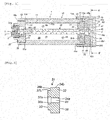
- a cylindrical housing 10 is combined with a flow path changing member 60.
- a first annular stepped surface 12 is provided on an inner circumferential surface of a circumferential wall 11 on the side of a first end 10a of the cylindrical housing 10, and a section between the first annular stepped surface 12 and the first end 10a corresponds to a first tip circumferential wall 13 which is reduced in thickness.
- An inner circumferential surface 13a of the first tip circumferential wall 13 has a screw portion.
- a second annular stepped surface 14 is provided on the inner circumferential surface of the circumferential wall 11 on the side of a second end 10b of the cylindrical housing 10, and a section between the second annular stepped surface 14 and the second end 10b corresponds to a second tip circumferential wall 15 which is reduced in thickness.
- An outer circumferential surface 15a of the second tip circumferential wall 15 has a screw portion.
- the first end 10a of the cylindrical housing 10 is closed by a first closure 20.
- the first closure 20 is substantially in a cup shape and has a bottom surface 21 and a circumferential wall 22.
- the bottom surface 21 has a protrusion 23 in a central portion thereof and has, around the protrusion 23, a plurality of discharge holes 24 for an ignition product formed by piercing the bottom surface 21. Around two to eight of the discharge holes 24 for the ignition product are formed at equal intervals in a circumferential direction.
- a seal tape which is to rupture during actuation is attached to close the discharge holes 24 of the bottom surface 21, when necessary, in order to prevent spillage of a smoke screen generating agent or as a measure against humidity.
- the circumferential wall 22 has a screw portion 22a which is screwed into the screw portion of the inner circumferential surface 13a of the first tip circumferential wall 13.
- An igniter 5 including an igniter collar 6 is disposed in an internal space 25 of the first closure 20.
- the igniter 5 is mounted by screwing the igniter collar 6 into an inner circumferential wall surface 25a of the first closure 20.
- An ignition portion 5a of the igniter 5 is positioned inside the internal space 25.
- the second end 10b of the cylindrical housing 10 is closed by a second closure 30.
- the second closure 30 is formed of a combination of a first member 31 and a second member 40, but the second closure 30 may be formed of a single member.
- the first member 31 has an annular substrate 32 with a larger outer diameter, an annular protrusion 33 which is formed on the annular substrate 32 and has an outer diameter smaller than that of the annular substrate 32, an inner circumferential wall 34a of the annular substrate, an outer circumferential wall 34b of the annular substrate, and an annular bottom surface 35.
- the annular protrusion 33 Due to a difference in outer diameters between the annular protrusion 33 and the annular substrate 32, the annular protrusion 33 has an annular inner stepped surface 36a which is arranged on the side of the inner circumferential wall 34a of the annular substrate and faces in the direction of the axis X, and an annular outer stepped surface 36b which is arranged on the side of the outer circumferential wall 34b of the annular substrate and faces in the direction of the axis X.
- the annular protrusion 33 Due to a difference in outer diameters between the annular protrusion 33 and the annular substrate 32, the annular protrusion 33 has an annular inner circumferential wall surface 37a which faces inward in a radial direction (a direction orthogonal to the direction of the axis X), and an annular outer circumferential wall surface 37b which faces outward in the radial direction.
- a first-a discharge flow path 44 is formed in a central portion of the first member 31.
- the first member 31 is fitted into an opening of the second end 10b of the cylindrical housing 10 in a state where the annular outer circumferential wall surface 37b abuts against the inner circumferential wall surface 10c of the cylindrical housing 10, the annular outer stepped surface 36b abuts against the second annular stepped surface 14, and the outer circumferential wall 34b of the annular substrate abuts against the second tip circumferential wall 15.
- the second member 40 is substantially in a cup-shape and has a circumferential wall 41 and has a bottom surface 42.
- the circumferential wall 41 has a screw portion 41a on an inner circumferential surface thereof.
- the bottom surface 42 has, in a central portion thereof, a first-b discharge flow path 45 and a first-c discharge flow path 46 which are through holes with different inner diameters, and the first-b discharge flow path 45 is connected to the first-a discharge flow path 44.
- the first-a discharge flow path 44, the first-b discharge flow path 45, and the first-c discharge flow path 46 form a first discharge flow path for a smoke screen source, and an outlet of the first-c discharge flow path 46 is a first discharge port 46a.
- the first-a discharge flow path 44 of the first member 31 and the first-b discharge flow path 45 and the first-c discharge flow path 46 of the second member 40 form the first discharge flow path, and centers of the discharge flow paths are positioned coaxially with the axis X of the cylindrical housing 10.
- the second member 40 is fixed by screwing the screw portion 41a onto the outer circumferential surface 15a of the second tip circumferential wall 15.
- the first member 31 Since the bottom surface 42 of the second member 40 presses the annular bottom surface 35 of the first member 31 in the direction of the axis X (a direction toward the first end 10a), the first member 31 is held between the second member 40 and the second annular stepped surface 14 and fixed thereby.
- the flow path changing member 60 is in a disk shape and integrally formed with the second member 40.
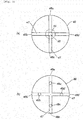
- a cross-shaped second discharge flow path 47 is formed between the flow path changing member 60 and the second member 40.
- a central axis (the axis X) passing through the first-a discharge flow path 44, the first-b discharge flow path 45 and the first-c discharge flow path 46 and a central axis passing through the cross-shaped second discharge flow path 47 are orthogonal to each other.
- the cross-shaped second discharge flow path 47 has first final discharge ports 48a to 48d at four locations.
- the flow path changing member 60 has holes 49a to 49d at four locations in a thickness direction, and the holes 49a to 49d penetrate from the bottom surface 42 to the cross-shaped second discharge flow path 47 and respectively serve as second final discharge ports 49a to 49d.
- An example thereabove can include an embodiment in which the first final discharge ports 48a to 48d are opened and the second final discharge ports 49a to 49d are closed (or an embodiment in which all of the final discharge ports are opened) when the smoke screen generator is installed in a central portion of a ceiling of a room, and an embodiment in which the first final discharge ports 48a to 48d are closed and the second final discharge ports 49a to 49d are opened when the smoke screen generator is installed in a corner of the room.
- a porous cylindrical body 50 which is formed of a net molded in a cylindrical shape is disposed inside the cylindrical housing 10.
- a first opening 50a is fitted onto the protrusion 23 of the first closure 20 from the outer side, and a second opening 50b is abutted against the annular inner stepped surface 36a and the annular inner circumferential wall surface 37a of the first member 31 of the second closure.
- the porous cylindrical body 50 Since the porous cylindrical body 50 is fixed from both sides in the direction of the axis X, the porous cylindrical body 50 does not move prior to actuation and at the time of actuation.
- a cylindrical space between the inner circumferential wall surface 10c of the cylindrical housing 10 and the porous cylindrical body 50 is a smoke screen generating agent-accommodating chamber 55 which accommodates a smoke screen generating agent 56.
- the smoke screen generating agent 56 is a known smoke screen generating agent, and a smoke generating agent composition including a smoke generating agent and a gas generating agent disclosed in JP-A No. 2015-42603 or a combination of a smoke generating agent and a gas generating agent disclosed in JP-A No. 2015-43143 , or the like can be used.
- the smoke screen generating agent 56 can be provided in an agent form with a desired shape such as a columnar shape, a disk shape, a powder shape, and a granular shape.
- the smoke screen generating agent-accommodating chamber 55 faces, on the side of the first end 10a, the plurality of the discharge holes 24 for the ignition product which are formed on the bottom surface 21 of the first closure 20, and, on the side of the second end 10b, the first member 31 of the second closure 30.
- the igniter 5, the porous cylindrical body 50, the first-a discharge flow path 44, the first-b discharge flow path 45, the first-c discharge flow path 46 and the flow path changing member 60 are arranged such that central axes thereof and the axis X of the cylindrical housing 10 are coaxial with each other.
- the second member 40 (the second member 40 integrated with the flow path changing member 60) is screwed onto the cylindrical housing 10 from the outside to be fixed, and thereby, the opening of the second end 10b is closed.
- the igniter 5 is screwed into the first closure 20 to be fixed.
- the igniter 5 When the igniter 5 is actuated and an ignition product such as flames is discharged into the internal space 25, the ignition product is discharged into the smoke screen generating agent-accommodating chamber 55 from the discharge holes 24 for the ignition product and the smoke screen generating agent 56 is ignited and burned.
- a high-temperature smoke screen source generated by the combustion of the smoke screen generating agent 56 passes through the porous cylindrical body 50 and moves in a direction toward the second closure 30 from the first closure 20.
- the combustion of the smoke screen generating agent 56 proceeds in the direction toward the second closure 30 from the first closure 20. At the same time, since ignition and combustion also proceed as the high-temperature smoke screen source, which is passing through the porous cylindrical body 50, comes into contact with the smoke screen generating agent 56, the combustion also proceeds outward from the inside in a radial direction.
- the smoke screen source After moving through the porous cylindrical body 50, the smoke screen source passes through the first-a discharge flow path 44 of the first member 31, and after further passing through the first-b discharge flow path 45 and the first-c discharge flow path 46 (the first discharge port 46a) of the second member 40, collides with the flow path changing member 60, changes its direction, passes through the second discharge flow path 47, and is radially discharged into a room through the first final discharge ports 48a to 48d to create a smoke screen.
- While a discharge rate of the smoke screen source is controlled at a portion with a smallest sectional area in the first discharge flow path (the first-a discharge flow path 44, the first-b discharge flow path 45 and the first-c discharge flow path 46) and the second discharge flow path 47, diffusion of a smoke screen is facilitated by increasing opening areas of the first final discharge ports 48a to 48d and by causing the smoke screen source to be radially discharged.
- this operation represents an embodiment in which the second final discharge ports 49a to 49d are closed.
- the first final discharge ports 48a to 48d are closed and the second final discharge ports 49a to 49d are opened, since the smoke screen source is discharged in the axial direction, a directional discharge operation of the smoke screen source is realized.
- the smoke screen generator 1 shown in Fig. 1 also produces, the following collateral effects.
- a combination of a gas generating agent and a smoke generating agent is used as the smoke screen generating agent 56 used in the smoke screen generator 1.
- a by-product derived from a component of the smoke screen generating agent 56 may be created concurrently with the generation of a smoke screen source.
- Conceivable examples of the by-product include potassium nitrate used as an oxidizing agent, potassium carbonate generated by combustion of sucrose or wax, potassium bicarbonate resulting from the absorption of carbon dioxide by potassium carbonate, carbides derived from an organic substance such as sucrose and waxes, and aggregates including potassium bicarbonate and the carbide.
- the by-product hardly contributes to the generation of a smoke screen when discharged into a room from the smoke screen generator 1, and increases a burden of subsequent cleanup work by remaining in the room after actuation in a state where the by-product is adhered to a floor surface or a wall surface of the room.
- the smoke screen source passes through the first discharge flow path (the first-a discharge flow path 44, the first-b discharge flow path 45 and the first-c discharge flow path 46), collides with the flow path changing member 60 and changes its direction, passes through the second discharge flow path 47, and is discharged into a room through the final discharge ports 48. Accordingly, the smoke screen source (including the by-product described above) in a high temperature state repetitively comes into contact with the inner wall surfaces of the discharge flow paths.
- the smoke screen source (including the by-product described above) in a high temperature state repetitively comes in contact with the inner wall surfaces of the discharge flow paths, and, during this process, the by-product adheres to and is captured by the inner wall surfaces before the smoke screen source is discharged from the final discharge ports 48. Thereby, a discharge amount of the by-product from the final discharge ports 48 is reduced.
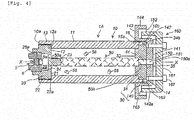
- a smoke screen generator 1A shown in Fig. 4 is the same as the smoke screen generator-1 shown in Fig. 1 with the exception of having a different formation of a second discharge flow path.
- a same reference numeral as in Fig. 1 refers to a same component or part.
- the second closure 30 includes the first member 31 and a second member 140.
- the second member 140 is substantially in a cup shape, has a bottom surface 141 and a first circumferential surface 142, further a flange portion 143 extended outward from an opening and a second circumferential surface 144 extended in the direction of the bottom surface 141 from the flange portion 143.
- the bottom surface 141 has a through hole in a central portion thereof, the through hole is a first-b discharge flow path 150, and the first-b discharge flow path 150 is connected to the first-a discharge flow path 44.
- a seal tape can be provided as necessary before the first-b discharge flow path 150 as a measure against humidity.
- An outlet of the first-b discharge flow path 150 which faces a second discharge flow path 151 is a first discharge port 150a.
- An inner surface of the first circumferential surface 142 has a screw portion 142a, and the screw portion 142a is screwed onto a screw portion of the outer circumferential surface 15a of the second tip circumferential wall 15.
- a flow path changing member 160 is in a cup shape and has a bottom surface 161, a circumferential surface 162 and further an annular end surface 163 at an opening.
- An inner diameter of the circumferential surface 162 is larger than an outer diameter of the first circumferential surface 142 of the second member 140, and an outer diameter of the circumferential surface 162 is smaller than an inner diameter of the second circumferential surface 144.
- the flow path changing member 160 is attachably and detachably mounted to the second member 140 by four bolts 167 such that a continuous interval is formed between the bottom surface 161 and the bottom surface 141 of the second member 140, between an inner circumferential surface of the circumferential surface 162 and an outer circumferential surface of the first circumferential surface 142 of the second member 140, between the annular end surface 163 and the flange portion 143, and between an outer circumferential surface of the circumferential surface 162 and an inner circumferential surface of the second circumferential surface 144.
- the four bolts 167 are screwed in so as to straddle through holes at four locations in a thickness direction of the flow path changing member 160 and screw holes at four locations of the second member 140.
- the continuous interval between the flow path changing member 160 and the second member 140 is the second discharge flow path 151.
- the second discharge flow path 151 is connected to the first discharge flow path (the first-a discharge flow path 44 and the first-b discharge flow path 150) and reaches a final discharge port 152 which is an annular opening, after passing three corner portions (flow paths bent at 90-degree angles).
- the smoke screen generator 1A shown in Fig. 4 can be assembled by a similar procedure to the smoke screen generator 1 shown in Fig. 1 .
- the smoke screen generating agent a combination of a gas generating agent and a smoke generating agent is preferably used.
- the gas generating agent includes a fuel, an oxidizing agent, a binder which are known, and the like.
- the fuel is preferably selected from sucrose, silicone oil, and tripotassium citrate salt (monohydrate).
- the oxidizing agent is preferably selected from a chlorate such as potassium chlorate and sodium chlorate, a perchlorate such as strontium perchlorate, magnesium perchlorate, ammonium perchlorate, potassium perchlorate, and sodium perchlorate, and a nitrate such as strontium nitrate, potassium nitrate, and sodium nitrate.
- a chlorate such as potassium chlorate and sodium chlorate
- a perchlorate such as strontium perchlorate, magnesium perchlorate, ammonium perchlorate, potassium perchlorate, and sodium perchlorate
- a nitrate such as strontium nitrate, potassium nitrate, and sodium nitrate.
- a nitrate is more preferable, and potassium nitrate is even more preferable.
- a first component, a second component, or a combination of the first component and the second component is used as the smoke generating agent.
- the first component is preferably selected from paraffin wax, liquid paraffin, microcrystalline wax, polyethylene glycol and the like.
- the second component is preferably selected from metal carbonate (hydrate), metal hydride and metal hydroxide.
- the smoke screen generator (with only the first final discharge ports 48a to 48d opened) shown in Fig. 1 , the smoke screen generator shown in Fig. 4 , and a comparative smoke screen generator produced by removing the flow path changing member from the smoke screen generator shown in Fig. 1 were prepared.
- the smoke screen generator was placed at center inside an airtightly sealed test dome (16 m3), and a single sheet of white A3 paper was placed 1 m away from the smoke screen generator.
- the A3 paper of the comparative smoke screen generator (without the flow path changing member) was colored brown as a whole as compared to a brand new sheet of A3 paper.
- the A3 paper of the smoke screen generator shown in Fig. 1 was colored light brown as a whole as compared to a brand new sheet of A3 paper but had less coloration than the comparative smoke screen generator.
- the A3 paper of the smoke screen generator shown in Fig. 4 had almost the same color as a brand new sheet of A3 paper.
- the staining substance on the sheets of A3 paper is conceivably by-products derived from components of the smoke screen generating agent, if a thickness of a smoke screen due to actuation of the smoke screen generators is the same, a smoke screen generator with a smaller discharge amount of the staining substance is desirable from the perspective of reducing a burden of cleanup work of a room interior-after actuation.
Landscapes
- Engineering & Computer Science (AREA)
- General Engineering & Computer Science (AREA)
- Physics & Mathematics (AREA)
- General Physics & Mathematics (AREA)
- Chemical & Material Sciences (AREA)
- Combustion & Propulsion (AREA)
- Burglar Alarm Systems (AREA)
Claims (6)
- Générateur d'écran de fumée (1) comprenant un boîtier cylindrique (10), un dispositif d'allumage (5) et un agent générateur d'écran de fumée (56) qui sont logés dans le boîtier cylindrique (10),
une première fermeture (20) comprenant le dispositif d'allumage (5) et fermant une première ouverture d'extrémité (10a) du boîtier cylindrique (10),
une seconde fermeture (30) ayant un premier trajet d'écoulement de décharge (44, 45, 46) et un premier orifice de décharge (46a), qui est une sortie du premier trajet d'écoulement de décharge (44, 45, 46), et fermant une seconde ouverture d'extrémité (10b) du boîtier cylindrique (10) sur un côté opposé dans une direction axiale à la première ouverture d'extrémité (10a),
un élément de changement de trajet d'écoulement (60) pour une source d'écran de fumée étant fixé à un côté extérieur de la seconde fermeture (30),
un second trajet d'écoulement de décharge (47) étant prévu entre la seconde fermeture (30) et l'élément de changement de trajet d'écoulement (60) et en communication avec la sortie (46a) du premier trajet d'écoulement de décharge (44, 45, 46), et une sortie du second trajet d'écoulement de décharge (47) étant un orifice de décharge final (48a, 48b, 48c, 48d),
le premier trajet d'écoulement de décharge (44, 45, 46) étant étendu dans une direction coaxiale avec le boîtier cylindrique (10) et le second trajet d'écoulement de décharge (47) étant étendu dans une direction différente de celle du premier trajet d'écoulement de décharge (44, 45, 46),
la première fermeture (20) ayant un trou de décharge (24) pour décharger un produit d'allumage qui est généré au moment de l'actionnement du dispositif d'allumage (5), un corps cylindrique poreux (50) étant agencé entre une surface de la première fermeture (20) où le trou de décharge (24) pour le produit d'allumage n'est pas prévu et le premier trajet d'écoulement de décharge (44, 45, 46) de la seconde fermeture (30),
un espace entre une surface de paroi circonférentielle intérieure (10c) du boîtier cylindrique (10) et le corps cylindrique poreux (50) étant une chambre de réception d'agent de génération d'écran de fumée (55) qui reçoit l'agent de génération d'écran de fumée (56), et le trou de décharge (24) pour le produit d'allumage faisant face à la chambre de réception d'agent de génération d'écran de fumée (55), et
au moment de l'actionnement du dispositif d'allumage (5), l'agent de génération d'écran de fumée (56) dans la chambre de réception d'agent de génération d'écran de fumée (55) est allumé et brûlé pour générer une source d'écran de fumée, la source d'écran de fumée se déplaçant à travers un intérieur du corps cylindrique poreux (50), passant par le premier trajet d'écoulement de décharge (44, 45, 46), le premier orifice de décharge (46a) et le second trajet d'écoulement de décharge (47), et étant ensuite déchargée à partir de l'orifice de décharge final (48a, 48b, 48c, 48d) vers l'extérieur pour générer un écran de fumée. - Générateur d'écran de fumée (1) selon la revendication 1, dans lequel le premier trajet d'écoulement de décharge (44, 45, 46) qui est prévu dans la seconde fermeture (30) est étendu dans une direction coaxiale avec le boîtier cylindrique (10), et
le second trajet d'écoulement de décharge (47) entre la seconde fermeture (30) et l'élément de changement de trajet d'écoulement (60) est étendu dans une direction orthogonale au premier trajet d'écoulement de décharge (44, 45, 46). - Générateur d'écran de fumée (1) selon la revendication 1 ou 2, dans lequel le second trajet d'écoulement de décharge (47) est prévu entre la seconde fermeture (30) et l'élément de changement de trajet d'écoulement (60), et en communication avec une sortie. (46a) du premier trajet d'écoulement de décharge (44, 45, 46),
un trou traversant (49a, 49b, 49c, 49d), qui pénètre dans l'élément de changement de trajet d'écoulement (60) dans une direction d'épaisseur et atteint le second trajet d'écoulement de décharge (47), est prévu,
une sortie annulaire du second trajet d'écoulement de décharge (47) est un premier orifice de décharge final (48a, 48b, 48c, 48d) et le trou traversant (49a, 49b, 49c, 49d) est un second orifice de décharge final, et
le premier orifice d'évacuation final (48a, 48b, 48c, 48d) et le second orifice d'évacuation final (49a, 49b, 49c, 49d) sont ouverts et fermés pour commander une direction de décharge d'une source d'écran de fumée. - Générateur d'écran de fumée (1A) comprenant un boîtier cylindrique (10), un dispositif d'allumage (5) et un agent générateur d'écran de fumée (56) qui sont reçus dans le boîtier cylindrique (10),
une première fermeture (20) comprenant le dispositif d'allumage (5) et fermant une première ouverture d'extrémité (10a) du boîtier cylindrique (10),
une seconde fermeture (30) ayant un premier trajet d'écoulement de décharge (44, 150) et un premier orifice de décharge (150a), qui est une sortie du premier trajet d'écoulement de décharge (44, 150), et fermant une seconde ouverture d'extrémité (10b) du boîtier cylindrique (10) sur un côté opposé dans une direction axiale à la première ouverture d'extrémité (10a),
un élément de changement de trajet d'écoulement (160) pour une source d'écran de fumée étant fixé à un côté extérieur de la seconde fermeture (30) à un intervalle à partir de la seconde fermeture (30) dans la direction axiale,
l'élément de changement de trajet d'écoulement (160) étant sensiblement en forme de coupelle et ayant une partie inférieure (161) et une paroi circonférentielle (162),
la seconde fermeture (30) ayant une forme telle qu'un second trajet d'écoulement de décharge continu (151) est formé entre la seconde fermeture (30) et la partie inférieure (161) de l'élément de changement de trajet d'écoulement (60), entre la seconde fermeture (30) et une surface circonférentielle intérieure de la paroi circonférentielle (162) de l'élément de changement de trajet d'écoulement (160), entre la seconde fermeture (30) et une surface d'extrémité annulaire (163) d'une ouverture de l'élément de changement de trajet d'écoulement (160), et entre la seconde fermeture (30) et une surface circonférentielle extérieure de la paroi circonférentielle (162) de l'élément de changement de trajet d'écoulement (160),
le premier trajet d'écoulement de décharge (44, 150), qui est prévu dans la seconde fermeture (30), étant étendu dans une direction coaxiale avec le boîtier cylindrique (10),
le second trajet d'écoulement de décharge (151) étant prévu entre la seconde fermeture (30) et l'élément de changement de trajet d'écoulement (160) et étant en communication avec le premier trajet d'écoulement de décharge (44, 150), étendu dans une direction orthogonale au premier trajet d'écoulement de décharge (44, 150) et en outre courbé en une pluralité d'emplacements, et une sortie du second trajet d'écoulement de décharge (151) étant un orifice de décharge final (152),
la première fermeture (20) ayant un trou de décharge (24) pour décharger un produit d'allumage qui est généré au moment de l'actionnement du dispositif d'allumage (5), un corps cylindrique poreux (50) étant agencé entre une surface de la première fermeture (20) où le trou de décharge (24) pour le produit d'allumage n'est pas prévu et le premier trajet d'écoulement de décharge (44, 150) de la seconde fermeture (30), un espace entre une surface de paroi circonférentielle intérieure (10c) du boîtier cylindrique (10) et le corps cylindrique poreux (50) étant une chambre de réception d'agent de génération d'écran de fumée (55) qui reçoit l'agent de génération d'écran de fumée (56), et le trou d'évacuation (24) pour le produit d'allumage faisant face à la chambre de réception d'agent de génération d'écran de fumée (55), et
au moment de l'actionnement du dispositif d'allumage (5), l'agent de génération d'écran de fumée (56) dans la chambre de réception d'agent de génération d'écran de fumée (55) est allumé et brûlé pour générer une source d'écran de fumée, la source d'écran de fumée se déplaçant à travers un intérieur du corps cylindrique poreux (50), passant par le premier trajet d'écoulement de décharge (44, 150), le premier orifice de décharge (150a) et le second trajet d'écoulement de décharge (151), et étant ensuite déchargé à partir de l'orifice de décharge final (152) vers l'extérieur afin de générer un écran de fumée. - Générateur d'écran de fumée (1, 1A) selon l'une quelconque des revendications 1 à 4, dans lequel le corps cylindrique poreux (50) est un treillis moulé en une forme cylindrique.
- Générateur d'écran de fumée (1, 1A) selon l'une quelconque des revendications 1 à 5, dans lequel une partie centrale de la première fermeture (20), où les trous de décharge (24) du produit d'allumage ne sont pas prévus, présente un partie saillante (23),
une surface de la seconde fermeture (30), dans une position qui fait face à la partie saillante (23) de la première fermeture (20) dans la direction axiale, a un premier trajet d'écoulement de décharge (44, 45, 46, 150), et
une première ouverture d'extrémité (50a) du corps cylindrique poreux (50) est ajustée sur un côté extérieur de la partie saillante (23) de la première fermeture (20) et l'autre ouverture d'extrémité (50b) de celui-ci est ajustée sur un côté intérieur du premier trajet d'écoulement de décharge (44, 45, 46, 150) de la seconde fermeture (30) pour fixer le corps cylindrique poreux (50).
Applications Claiming Priority (2)
| Application Number | Priority Date | Filing Date | Title |
|---|---|---|---|
| JP2015206625A JP6563773B2 (ja) | 2015-10-20 | 2015-10-20 | 煙幕発生器 |
| PCT/JP2016/079378 WO2017068956A1 (fr) | 2015-10-20 | 2016-10-04 | Générateur d'écran de fumée |
Publications (3)
| Publication Number | Publication Date |
|---|---|
| EP3367355A1 EP3367355A1 (fr) | 2018-08-29 |
| EP3367355A4 EP3367355A4 (fr) | 2019-05-08 |
| EP3367355B1 true EP3367355B1 (fr) | 2020-12-02 |
Family
ID=58557405
Family Applications (1)
| Application Number | Title | Priority Date | Filing Date |
|---|---|---|---|
| EP16857272.5A Active EP3367355B1 (fr) | 2015-10-20 | 2016-10-04 | Générateur d'écran de fumée |
Country Status (4)
| Country | Link |
|---|---|
| US (1) | US10443986B2 (fr) |
| EP (1) | EP3367355B1 (fr) |
| JP (1) | JP6563773B2 (fr) |
| WO (1) | WO2017068956A1 (fr) |
Families Citing this family (3)
| Publication number | Priority date | Publication date | Assignee | Title |
|---|---|---|---|---|
| JP6795368B2 (ja) * | 2016-10-07 | 2020-12-02 | 株式会社ダイセル | 発煙剤組成物 |
| CN109141126B (zh) * | 2018-09-14 | 2023-05-16 | 潍坊云深机械科技有限公司 | 发烟机和该发烟机的操作方法 |
| JP2024145431A (ja) | 2023-03-31 | 2024-10-15 | 日本化薬株式会社 | 発煙装置および制御システム |
Family Cites Families (78)
| Publication number | Priority date | Publication date | Assignee | Title |
|---|---|---|---|---|
| US1367464A (en) * | 1918-05-16 | 1921-02-01 | Robert N Cook | Explosive shell |
| GB132068A (fr) * | 1918-10-24 | |||
| US2094562A (en) * | 1935-02-20 | 1937-09-28 | Fed Lab Inc | Hand grenade |
| US2119697A (en) * | 1935-08-13 | 1938-06-07 | Victory Fireworks And Specialt | Float light |
| US2993648A (en) * | 1959-01-05 | 1961-07-25 | Phillips Petroleum Co | Jet propelled spraying device |
| GB918976A (en) * | 1960-03-21 | 1963-02-20 | Waeco Ltd | Improvements in or relating to pyrotechnic or explosive devices |
| US3134430A (en) * | 1960-03-21 | 1964-05-26 | Ind Cie Kleinewefers Konstrukt | Metallic recuperator for high waste gas temperatures |
| US3109821A (en) * | 1961-01-12 | 1963-11-05 | Texaco Experiment Inc | Smoke generator |
| US3110259A (en) * | 1961-08-16 | 1963-11-12 | Edward F Van Dersarl | Signal device and composition therefor |
| US3143070A (en) * | 1962-07-27 | 1964-08-04 | Gilbert C Bowen | Safe biological or chemical warfare projectile |
| DE1285919B (de) * | 1964-06-04 | 1968-12-19 | Rheinmetall Gmbh | Nebelkerze |
| US3345948A (en) * | 1965-08-03 | 1967-10-10 | John W Sarvis | Projectile |
| US3354829A (en) * | 1966-03-08 | 1967-11-28 | Frank M Nichols | Smoke signal |
| US3730093A (en) * | 1966-12-27 | 1973-05-01 | North American Rockwell | Explosive apparatus |
| US3558285A (en) * | 1969-10-01 | 1971-01-26 | Us Army | Propellant gas generator |
| US3711115A (en) * | 1970-11-24 | 1973-01-16 | Allied Chem | Pyrotechnic gas generator |
| US3678857A (en) * | 1971-02-26 | 1972-07-25 | Susquehanna Corp | Aerosol disseminator |
| US3707918A (en) * | 1971-02-26 | 1973-01-02 | Susquehanna Corp | Aerosol disseminator |
| US3904221A (en) * | 1972-05-19 | 1975-09-09 | Asahi Chemical Ind | Gas generating system for the inflation of a protective bag |
| US3988888A (en) * | 1974-06-14 | 1976-11-02 | The United States Of America As Represented By The Secretary Of The Navy | Filter/cooler |
| DE2437535C3 (de) * | 1974-08-03 | 1981-08-06 | Rheinmetall GmbH, 4000 Düsseldorf | Ausstoßbarer Nebeltopf für hochbeanspruchte Geschosse |
| DE2555323C2 (de) * | 1975-12-09 | 1984-04-05 | Buck Chemisch-Technische Werke GmbH & Co, 7341 Bad Überkingen | Geschoßfüllung aus übereinander angeordneten Nebeltöpfen und Verfahren zur Herstellung eines Nebeltopfes |
| DE2811016C1 (de) * | 1978-03-14 | 1986-07-17 | Buck Chemisch-Technische Werke Gmbh & Co, 8230 Bad Reichenhall | Wurfkoerper |
| US4291629A (en) * | 1978-04-10 | 1981-09-29 | The United States Of America As Represented By The Secretary Of The Army | Combined T-shape smoke projectile and launching assembly |
| US4436036A (en) * | 1979-09-28 | 1984-03-13 | Thiokol Corporation | Projectile for dispensing gaseous material |
| CA1121609A (fr) * | 1980-06-03 | 1982-04-13 | Joseph E.G. Couture | Dispositif de mise a feu largable de l'air |
| DE3031369C2 (de) * | 1980-08-20 | 1987-01-02 | Pyrotechnische Fabrik F. Feistel GmbH + Co KG, 6719 Göllheim | Pyrotechnische Ladung aus Nebelsatz und Anzündsatz und Verfahren zur Herstellung der Nebelmischung und des Anzündsatzes |
| FR2490333B1 (fr) * | 1980-09-12 | 1986-05-02 | Lacroix E Tous Artifices | Cartouche a actionnement pyrotechnique de charge utile avec securite |
| US4598096A (en) * | 1981-11-06 | 1986-07-01 | Grant George A | Safe sensory irritant |
| DE3238455C2 (de) * | 1982-10-16 | 1987-03-05 | Pyrotechnische Fabrik F. Feistel GmbH + Co KG, 6719 Göllheim | Nebelwurfkörper |
| DE3507643A1 (de) * | 1985-03-05 | 1986-09-11 | Nico-Pyrotechnik Hanns-Jürgen Diederichs GmbH & Co KG, 2077 Trittau | Patronierte munition |
| DE3515166A1 (de) * | 1985-04-26 | 1986-10-30 | Buck Chemisch-Technische Werke GmbH & Co, 7347 Bad Überkingen | Wurfkoerper zur darstellung eines infrarot-flaechenstrahlers |
| US4726295A (en) * | 1986-05-16 | 1988-02-23 | Aai Corporation | Grenade arrangement for screening cloud |
| US4934272A (en) * | 1987-10-05 | 1990-06-19 | Keystone Materials Partnership Limited | Smoke generating cartridge for ovens and barbecues and means for holding same |
| US4805533A (en) * | 1987-12-21 | 1989-02-21 | The United States Of America As Represented By The Secretary Of The Navy | Swimmer pyrotechnic signal device |
| CH674742A5 (fr) * | 1987-12-24 | 1990-07-13 | Eidgenoess Munitionsfab Thun | |
| US4938144A (en) * | 1988-02-16 | 1990-07-03 | S. C. Johnson & Son, Inc. | Motion activated thermal fogger |
| DE3809177C1 (fr) * | 1988-03-18 | 1989-06-22 | Buck Chemisch-Technische Werke Gmbh & Co, 7347 Bad Ueberkingen, De | |
| US5025729A (en) * | 1990-02-21 | 1991-06-25 | Cameron Robert W | Aerial distress flare |
| DE4030430C1 (de) * | 1990-09-26 | 1993-12-02 | Buck Chem Tech Werke | IR-undurchlässigen Nebel erzeugende Zusammensetzung |
| DE4125355C1 (fr) * | 1991-07-31 | 1993-01-28 | Buck Werke Gmbh & Co, 7347 Bad Ueberkingen, De | |
| US5313888A (en) * | 1992-05-05 | 1994-05-24 | Martin Brian D | Pull-wire igniter for flares |
| DE4337680C2 (de) * | 1993-11-04 | 1995-08-24 | Buck Chem Tech Werke | Zweikomponenten-Nebelwurfkörper |
| US5561259A (en) * | 1994-10-13 | 1996-10-01 | Alliant Techsystems Inc. | Decoy flare with sequencer ignition |
| DE19548436C1 (de) | 1995-12-22 | 1997-06-26 | Buck Chem Tech Werke | Schnellnebelhandgranate |
| US5661257A (en) * | 1996-01-16 | 1997-08-26 | Thiokol Corporation | Multispectral covert target marker |
| FR2750206B1 (fr) * | 1996-06-21 | 1998-09-11 | Lacroix Soc E | Projectile non letal |
| NL1005529C2 (nl) * | 1997-03-13 | 1998-09-15 | Tno | Samenstelling voor het genereren van rook. |
| US5874690A (en) * | 1998-02-06 | 1999-02-23 | Brunn; Michael | Smoke grenade with rapid ignition |
| US5983801A (en) * | 1998-04-29 | 1999-11-16 | Brunn; Michael | Separating smoke grenade |
| DE29812623U1 (de) * | 1998-07-15 | 1998-12-10 | Buck Werke GmbH & Co., 73337 Bad Überkingen | Wurfkörper mit kontrollierter Zerlegung und in den Wirkmassenbereich integrierter Ladung |
| TW527294B (en) * | 1999-11-29 | 2003-04-11 | Daicel Chem | Gas generator for air bag and devices for the same |
| US6349650B1 (en) * | 2000-08-29 | 2002-02-26 | Michael Brunn | Launchable flameless expulsion grenade |
| DE10065816B4 (de) * | 2000-12-27 | 2009-04-23 | Buck Neue Technologien Gmbh | Munition zur Erzeugung eines Nebels |
| US6523478B1 (en) * | 2001-09-10 | 2003-02-25 | The United States Of America As Represented By The Secretary Of The Army | Rifle-launched non-lethal cargo dispenser |
| US20030056680A1 (en) * | 2001-09-25 | 2003-03-27 | Falken, S.A. | Device with combustible charge with smoke-generating, tear-generating or signaling effects |
| JP3816867B2 (ja) | 2001-11-12 | 2006-08-30 | 日本工機株式会社 | 煙幕生成装置 |
| US6581521B1 (en) * | 2002-08-26 | 2003-06-24 | Robert G. Dixon | Reusable gas grenade canister |
| WO2004097760A1 (fr) | 2003-05-01 | 2004-11-11 | Secom Co., Ltd. | Generateur d'ecrans de fumee |
| US20050115721A1 (en) * | 2003-12-02 | 2005-06-02 | Blau Reed J. | Man-rated fire suppression system |
| DE102005004935B4 (de) * | 2005-02-03 | 2007-03-15 | Diehl Bgt Defence Gmbh & Co. Kg | Schwimmfähiger Nebeltopf |
| US9046327B2 (en) * | 2005-03-31 | 2015-06-02 | Tk Holdings Inc. | Gas generator |
| US20070024038A1 (en) * | 2005-07-26 | 2007-02-01 | Daicel Chemical Industries, Ltd. | Gas generator |
| JP3134430U (ja) * | 2007-05-30 | 2007-08-16 | 日本化薬株式会社 | 点火器組立体およびこれを備えたガス発生器 |
| US7950692B2 (en) * | 2007-12-14 | 2011-05-31 | Autoliv Asp, Inc. | Gas generation device with consumable ignitor tube |
| DE102008058776A1 (de) * | 2008-11-24 | 2010-05-27 | Rheinmetall Waffe Munition Gmbh | Irritationskörper mit Zusatzeffekt |
| SG10201402195PA (en) * | 2009-05-08 | 2014-10-30 | Rheinmetall Waffe Munition | Activation unit for explosive masses or explosive bodies |
| US8162350B1 (en) * | 2010-10-07 | 2012-04-24 | Autoliv Asp, Inc. | Gas generator |
| US8365668B2 (en) * | 2011-03-31 | 2013-02-05 | Michael Brunn | Multiple output and effect grenade |
| WO2013146153A1 (fr) * | 2012-03-27 | 2013-10-03 | Daicel Corporation | Générateur de gaz |
| US8776691B2 (en) * | 2012-06-04 | 2014-07-15 | Csi-Penn Arms, Llc | Launched smoke grenade |
| EP2938959B1 (fr) * | 2012-12-31 | 2017-03-08 | Bandit NV | Dispositif de génération de brouillard et boîtier amovible associé |
| JP5965334B2 (ja) * | 2013-02-18 | 2016-08-03 | 株式会社ダイセル | ガス発生器 |
| US8776692B1 (en) * | 2013-03-13 | 2014-07-15 | The United States Of America As Represented By The Secretary Of The Army | Flameless smoke pot |
| US20160115090A1 (en) * | 2013-05-30 | 2016-04-28 | Jared D. Moretti | Pyrotechnic yellow smoke compositions based on solvent yellow 33 |
| JP6196099B2 (ja) | 2013-08-26 | 2017-09-13 | 株式会社ダイセル | 発煙剤組成物 |
| JP6223063B2 (ja) * | 2013-08-26 | 2017-11-01 | 株式会社ダイセル | 発煙器 |
| JP6585461B2 (ja) * | 2015-10-20 | 2019-10-02 | 株式会社ダイセル | 煙幕発生器 |
-
2015
- 2015-10-20 JP JP2015206625A patent/JP6563773B2/ja active Active
-
2016
- 2016-10-04 US US15/759,284 patent/US10443986B2/en active Active
- 2016-10-04 WO PCT/JP2016/079378 patent/WO2017068956A1/fr not_active Ceased
- 2016-10-04 EP EP16857272.5A patent/EP3367355B1/fr active Active
Non-Patent Citations (1)
| Title |
|---|
| None * |
Also Published As
| Publication number | Publication date |
|---|---|
| EP3367355A1 (fr) | 2018-08-29 |
| JP2017078961A (ja) | 2017-04-27 |
| US20180252502A1 (en) | 2018-09-06 |
| US10443986B2 (en) | 2019-10-15 |
| JP6563773B2 (ja) | 2019-08-21 |
| EP3367355A4 (fr) | 2019-05-08 |
| WO2017068956A1 (fr) | 2017-04-27 |
Similar Documents
| Publication | Publication Date | Title |
|---|---|---|
| EP3012159B1 (fr) | Générateur de gaz destiné à un dispositif de retenue d'occupant | |
| EP2957468B1 (fr) | Générateur de gaz | |
| JP6908619B2 (ja) | ガス発生器 | |
| JP6223063B2 (ja) | 発煙器 | |
| EP3367355B1 (fr) | Générateur d'écran de fumée | |
| EP3367049B1 (fr) | Générateur d'écran de fumée | |
| CN104245437B (zh) | 气体发生器 | |
| CN109906176B (zh) | 气体发生器 | |
| TWI711475B (zh) | 氣化噴霧劑滅火裝置 | |
| KR20170040190A (ko) | 가스 발생기 | |
| US20190176745A1 (en) | Gas generator | |
| JP2017190003A (ja) | ガス発生器 | |
| EP3037163B1 (fr) | Générateur de gaz | |
| CN101940825B (zh) | 一种受限空间油气爆炸抑制方法 | |
| KR20150025844A (ko) | 자동소화장치 | |
| KR20170055472A (ko) | 가스 발생기 | |
| CA3052548C (fr) | Grenade a main servant a produire de la fumee | |
| CN210512865U (zh) | 一种彩色烟幕弹 | |
| JP2015232864A (ja) | 煙幕発生器およびその使用方法 | |
| JP2001220283A (ja) | 燃焼器 | |
| WO2023101576A1 (fr) | Générateur d'aérosol (variantes) | |
| SU1240417A1 (ru) | Быстродействующий затвор дл емкости /его варианты/ |
Legal Events
| Date | Code | Title | Description |
|---|---|---|---|
| STAA | Information on the status of an ep patent application or granted ep patent |
Free format text: STATUS: THE INTERNATIONAL PUBLICATION HAS BEEN MADE |
|
| PUAI | Public reference made under article 153(3) epc to a published international application that has entered the european phase |
Free format text: ORIGINAL CODE: 0009012 |
|
| STAA | Information on the status of an ep patent application or granted ep patent |
Free format text: STATUS: REQUEST FOR EXAMINATION WAS MADE |
|
| 17P | Request for examination filed |
Effective date: 20180419 |
|
| AK | Designated contracting states |
Kind code of ref document: A1 Designated state(s): AL AT BE BG CH CY CZ DE DK EE ES FI FR GB GR HR HU IE IS IT LI LT LU LV MC MK MT NL NO PL PT RO RS SE SI SK SM TR |
|
| AX | Request for extension of the european patent |
Extension state: BA ME |
|
| DAV | Request for validation of the european patent (deleted) | ||
| DAX | Request for extension of the european patent (deleted) | ||
| A4 | Supplementary search report drawn up and despatched |
Effective date: 20190404 |
|
| RIC1 | Information provided on ipc code assigned before grant |
Ipc: F41H 9/08 20060101AFI20190329BHEP Ipc: C06D 3/00 20060101ALN20190329BHEP Ipc: F42B 12/48 20060101ALI20190329BHEP Ipc: G08B 15/02 20060101ALI20190329BHEP Ipc: F42B 3/04 20060101ALN20190329BHEP |
|
| STAA | Information on the status of an ep patent application or granted ep patent |
Free format text: STATUS: EXAMINATION IS IN PROGRESS |
|
| 17Q | First examination report despatched |
Effective date: 20191125 |
|
| REG | Reference to a national code |
Ref country code: DE Ref legal event code: R079 Ref document number: 602016049214 Country of ref document: DE Free format text: PREVIOUS MAIN CLASS: G08B0015020000 Ipc: F41H0009080000 |
|
| GRAP | Despatch of communication of intention to grant a patent |
Free format text: ORIGINAL CODE: EPIDOSNIGR1 |
|
| STAA | Information on the status of an ep patent application or granted ep patent |
Free format text: STATUS: GRANT OF PATENT IS INTENDED |
|
| RIC1 | Information provided on ipc code assigned before grant |
Ipc: G08B 15/02 20060101ALI20200529BHEP Ipc: F42B 12/48 20060101ALI20200529BHEP Ipc: F41H 9/08 20060101AFI20200529BHEP Ipc: F42B 3/04 20060101ALN20200529BHEP Ipc: C06D 3/00 20060101ALN20200529BHEP |
|
| INTG | Intention to grant announced |
Effective date: 20200618 |
|
| RIN1 | Information on inventor provided before grant (corrected) |
Inventor name: MIMURA, ATSUSHI Inventor name: KURODA, TAKAO Inventor name: HIGUCHI, YUJI Inventor name: NAKAHASHI, KATSUHIRO |
|
| GRAS | Grant fee paid |
Free format text: ORIGINAL CODE: EPIDOSNIGR3 |
|
| GRAA | (expected) grant |
Free format text: ORIGINAL CODE: 0009210 |
|
| STAA | Information on the status of an ep patent application or granted ep patent |
Free format text: STATUS: THE PATENT HAS BEEN GRANTED |
|
| AK | Designated contracting states |
Kind code of ref document: B1 Designated state(s): AL AT BE BG CH CY CZ DE DK EE ES FI FR GB GR HR HU IE IS IT LI LT LU LV MC MK MT NL NO PL PT RO RS SE SI SK SM TR |
|
| REG | Reference to a national code |
Ref country code: GB Ref legal event code: FG4D |
|
| REG | Reference to a national code |
Ref country code: AT Ref legal event code: REF Ref document number: 1341406 Country of ref document: AT Kind code of ref document: T Effective date: 20201215 Ref country code: CH Ref legal event code: EP |
|
| REG | Reference to a national code |
Ref country code: IE Ref legal event code: FG4D |
|
| REG | Reference to a national code |
Ref country code: DE Ref legal event code: R096 Ref document number: 602016049214 Country of ref document: DE |
|
| PG25 | Lapsed in a contracting state [announced via postgrant information from national office to epo] |
Ref country code: NO Free format text: LAPSE BECAUSE OF FAILURE TO SUBMIT A TRANSLATION OF THE DESCRIPTION OR TO PAY THE FEE WITHIN THE PRESCRIBED TIME-LIMIT Effective date: 20210302 Ref country code: RS Free format text: LAPSE BECAUSE OF FAILURE TO SUBMIT A TRANSLATION OF THE DESCRIPTION OR TO PAY THE FEE WITHIN THE PRESCRIBED TIME-LIMIT Effective date: 20201202 Ref country code: FI Free format text: LAPSE BECAUSE OF FAILURE TO SUBMIT A TRANSLATION OF THE DESCRIPTION OR TO PAY THE FEE WITHIN THE PRESCRIBED TIME-LIMIT Effective date: 20201202 Ref country code: GR Free format text: LAPSE BECAUSE OF FAILURE TO SUBMIT A TRANSLATION OF THE DESCRIPTION OR TO PAY THE FEE WITHIN THE PRESCRIBED TIME-LIMIT Effective date: 20210303 |
|
| REG | Reference to a national code |
Ref country code: NL Ref legal event code: MP Effective date: 20201202 |
|
| REG | Reference to a national code |
Ref country code: AT Ref legal event code: MK05 Ref document number: 1341406 Country of ref document: AT Kind code of ref document: T Effective date: 20201202 |
|
| PG25 | Lapsed in a contracting state [announced via postgrant information from national office to epo] |
Ref country code: BG Free format text: LAPSE BECAUSE OF FAILURE TO SUBMIT A TRANSLATION OF THE DESCRIPTION OR TO PAY THE FEE WITHIN THE PRESCRIBED TIME-LIMIT Effective date: 20210302 Ref country code: PL Free format text: LAPSE BECAUSE OF FAILURE TO SUBMIT A TRANSLATION OF THE DESCRIPTION OR TO PAY THE FEE WITHIN THE PRESCRIBED TIME-LIMIT Effective date: 20201202 Ref country code: LV Free format text: LAPSE BECAUSE OF FAILURE TO SUBMIT A TRANSLATION OF THE DESCRIPTION OR TO PAY THE FEE WITHIN THE PRESCRIBED TIME-LIMIT Effective date: 20201202 Ref country code: SE Free format text: LAPSE BECAUSE OF FAILURE TO SUBMIT A TRANSLATION OF THE DESCRIPTION OR TO PAY THE FEE WITHIN THE PRESCRIBED TIME-LIMIT Effective date: 20201202 |
|
| PG25 | Lapsed in a contracting state [announced via postgrant information from national office to epo] |
Ref country code: NL Free format text: LAPSE BECAUSE OF FAILURE TO SUBMIT A TRANSLATION OF THE DESCRIPTION OR TO PAY THE FEE WITHIN THE PRESCRIBED TIME-LIMIT Effective date: 20201202 Ref country code: HR Free format text: LAPSE BECAUSE OF FAILURE TO SUBMIT A TRANSLATION OF THE DESCRIPTION OR TO PAY THE FEE WITHIN THE PRESCRIBED TIME-LIMIT Effective date: 20201202 |
|
| REG | Reference to a national code |
Ref country code: LT Ref legal event code: MG9D |
|
| PG25 | Lapsed in a contracting state [announced via postgrant information from national office to epo] |
Ref country code: LT Free format text: LAPSE BECAUSE OF FAILURE TO SUBMIT A TRANSLATION OF THE DESCRIPTION OR TO PAY THE FEE WITHIN THE PRESCRIBED TIME-LIMIT Effective date: 20201202 Ref country code: SM Free format text: LAPSE BECAUSE OF FAILURE TO SUBMIT A TRANSLATION OF THE DESCRIPTION OR TO PAY THE FEE WITHIN THE PRESCRIBED TIME-LIMIT Effective date: 20201202 Ref country code: EE Free format text: LAPSE BECAUSE OF FAILURE TO SUBMIT A TRANSLATION OF THE DESCRIPTION OR TO PAY THE FEE WITHIN THE PRESCRIBED TIME-LIMIT Effective date: 20201202 Ref country code: CZ Free format text: LAPSE BECAUSE OF FAILURE TO SUBMIT A TRANSLATION OF THE DESCRIPTION OR TO PAY THE FEE WITHIN THE PRESCRIBED TIME-LIMIT Effective date: 20201202 Ref country code: SK Free format text: LAPSE BECAUSE OF FAILURE TO SUBMIT A TRANSLATION OF THE DESCRIPTION OR TO PAY THE FEE WITHIN THE PRESCRIBED TIME-LIMIT Effective date: 20201202 Ref country code: RO Free format text: LAPSE BECAUSE OF FAILURE TO SUBMIT A TRANSLATION OF THE DESCRIPTION OR TO PAY THE FEE WITHIN THE PRESCRIBED TIME-LIMIT Effective date: 20201202 Ref country code: PT Free format text: LAPSE BECAUSE OF FAILURE TO SUBMIT A TRANSLATION OF THE DESCRIPTION OR TO PAY THE FEE WITHIN THE PRESCRIBED TIME-LIMIT Effective date: 20210405 |
|
| PG25 | Lapsed in a contracting state [announced via postgrant information from national office to epo] |
Ref country code: AT Free format text: LAPSE BECAUSE OF FAILURE TO SUBMIT A TRANSLATION OF THE DESCRIPTION OR TO PAY THE FEE WITHIN THE PRESCRIBED TIME-LIMIT Effective date: 20201202 |
|
| REG | Reference to a national code |
Ref country code: DE Ref legal event code: R097 Ref document number: 602016049214 Country of ref document: DE |
|
| PG25 | Lapsed in a contracting state [announced via postgrant information from national office to epo] |
Ref country code: IS Free format text: LAPSE BECAUSE OF FAILURE TO SUBMIT A TRANSLATION OF THE DESCRIPTION OR TO PAY THE FEE WITHIN THE PRESCRIBED TIME-LIMIT Effective date: 20210402 |
|
| PLBE | No opposition filed within time limit |
Free format text: ORIGINAL CODE: 0009261 |
|
| STAA | Information on the status of an ep patent application or granted ep patent |
Free format text: STATUS: NO OPPOSITION FILED WITHIN TIME LIMIT |
|
| PG25 | Lapsed in a contracting state [announced via postgrant information from national office to epo] |
Ref country code: AL Free format text: LAPSE BECAUSE OF FAILURE TO SUBMIT A TRANSLATION OF THE DESCRIPTION OR TO PAY THE FEE WITHIN THE PRESCRIBED TIME-LIMIT Effective date: 20201202 Ref country code: IT Free format text: LAPSE BECAUSE OF FAILURE TO SUBMIT A TRANSLATION OF THE DESCRIPTION OR TO PAY THE FEE WITHIN THE PRESCRIBED TIME-LIMIT Effective date: 20201202 |
|
| 26N | No opposition filed |
Effective date: 20210903 |
|
| PG25 | Lapsed in a contracting state [announced via postgrant information from national office to epo] |
Ref country code: DK Free format text: LAPSE BECAUSE OF FAILURE TO SUBMIT A TRANSLATION OF THE DESCRIPTION OR TO PAY THE FEE WITHIN THE PRESCRIBED TIME-LIMIT Effective date: 20201202 Ref country code: SI Free format text: LAPSE BECAUSE OF FAILURE TO SUBMIT A TRANSLATION OF THE DESCRIPTION OR TO PAY THE FEE WITHIN THE PRESCRIBED TIME-LIMIT Effective date: 20201202 |
|
| PG25 | Lapsed in a contracting state [announced via postgrant information from national office to epo] |
Ref country code: ES Free format text: LAPSE BECAUSE OF FAILURE TO SUBMIT A TRANSLATION OF THE DESCRIPTION OR TO PAY THE FEE WITHIN THE PRESCRIBED TIME-LIMIT Effective date: 20201202 |
|
| REG | Reference to a national code |
Ref country code: CH Ref legal event code: PL |
|
| PG25 | Lapsed in a contracting state [announced via postgrant information from national office to epo] |
Ref country code: IS Free format text: LAPSE BECAUSE OF FAILURE TO SUBMIT A TRANSLATION OF THE DESCRIPTION OR TO PAY THE FEE WITHIN THE PRESCRIBED TIME-LIMIT Effective date: 20210402 |
|
| REG | Reference to a national code |
Ref country code: BE Ref legal event code: MM Effective date: 20211031 |
|
| GBPC | Gb: european patent ceased through non-payment of renewal fee |
Effective date: 20211004 |
|
| PG25 | Lapsed in a contracting state [announced via postgrant information from national office to epo] |
Ref country code: MC Free format text: LAPSE BECAUSE OF FAILURE TO SUBMIT A TRANSLATION OF THE DESCRIPTION OR TO PAY THE FEE WITHIN THE PRESCRIBED TIME-LIMIT Effective date: 20201202 |
|
| PG25 | Lapsed in a contracting state [announced via postgrant information from national office to epo] |
Ref country code: LU Free format text: LAPSE BECAUSE OF NON-PAYMENT OF DUE FEES Effective date: 20211004 Ref country code: GB Free format text: LAPSE BECAUSE OF NON-PAYMENT OF DUE FEES Effective date: 20211004 Ref country code: BE Free format text: LAPSE BECAUSE OF NON-PAYMENT OF DUE FEES Effective date: 20211031 |
|
| PG25 | Lapsed in a contracting state [announced via postgrant information from national office to epo] |
Ref country code: LI Free format text: LAPSE BECAUSE OF NON-PAYMENT OF DUE FEES Effective date: 20211031 Ref country code: CH Free format text: LAPSE BECAUSE OF NON-PAYMENT OF DUE FEES Effective date: 20211031 |
|
| PG25 | Lapsed in a contracting state [announced via postgrant information from national office to epo] |
Ref country code: IE Free format text: LAPSE BECAUSE OF NON-PAYMENT OF DUE FEES Effective date: 20211004 |
|
| PG25 | Lapsed in a contracting state [announced via postgrant information from national office to epo] |
Ref country code: HU Free format text: LAPSE BECAUSE OF FAILURE TO SUBMIT A TRANSLATION OF THE DESCRIPTION OR TO PAY THE FEE WITHIN THE PRESCRIBED TIME-LIMIT; INVALID AB INITIO Effective date: 20161004 |
|
| PG25 | Lapsed in a contracting state [announced via postgrant information from national office to epo] |
Ref country code: CY Free format text: LAPSE BECAUSE OF FAILURE TO SUBMIT A TRANSLATION OF THE DESCRIPTION OR TO PAY THE FEE WITHIN THE PRESCRIBED TIME-LIMIT Effective date: 20201202 |
|
| PG25 | Lapsed in a contracting state [announced via postgrant information from national office to epo] |
Ref country code: MK Free format text: LAPSE BECAUSE OF FAILURE TO SUBMIT A TRANSLATION OF THE DESCRIPTION OR TO PAY THE FEE WITHIN THE PRESCRIBED TIME-LIMIT Effective date: 20201202 |
|
| PG25 | Lapsed in a contracting state [announced via postgrant information from national office to epo] |
Ref country code: TR Free format text: LAPSE BECAUSE OF FAILURE TO SUBMIT A TRANSLATION OF THE DESCRIPTION OR TO PAY THE FEE WITHIN THE PRESCRIBED TIME-LIMIT Effective date: 20201202 |
|
| PG25 | Lapsed in a contracting state [announced via postgrant information from national office to epo] |
Ref country code: MT Free format text: LAPSE BECAUSE OF FAILURE TO SUBMIT A TRANSLATION OF THE DESCRIPTION OR TO PAY THE FEE WITHIN THE PRESCRIBED TIME-LIMIT Effective date: 20201202 |
|
| PGFP | Annual fee paid to national office [announced via postgrant information from national office to epo] |
Ref country code: DE Payment date: 20251021 Year of fee payment: 10 |
|
| PGFP | Annual fee paid to national office [announced via postgrant information from national office to epo] |
Ref country code: FR Payment date: 20251030 Year of fee payment: 10 |